From the FasterSkier archive — posts syndicated from athletes’ and coaches’ own blogs between 2004 and 2012, kept online as published. Current coverage is at fasterskier.com.
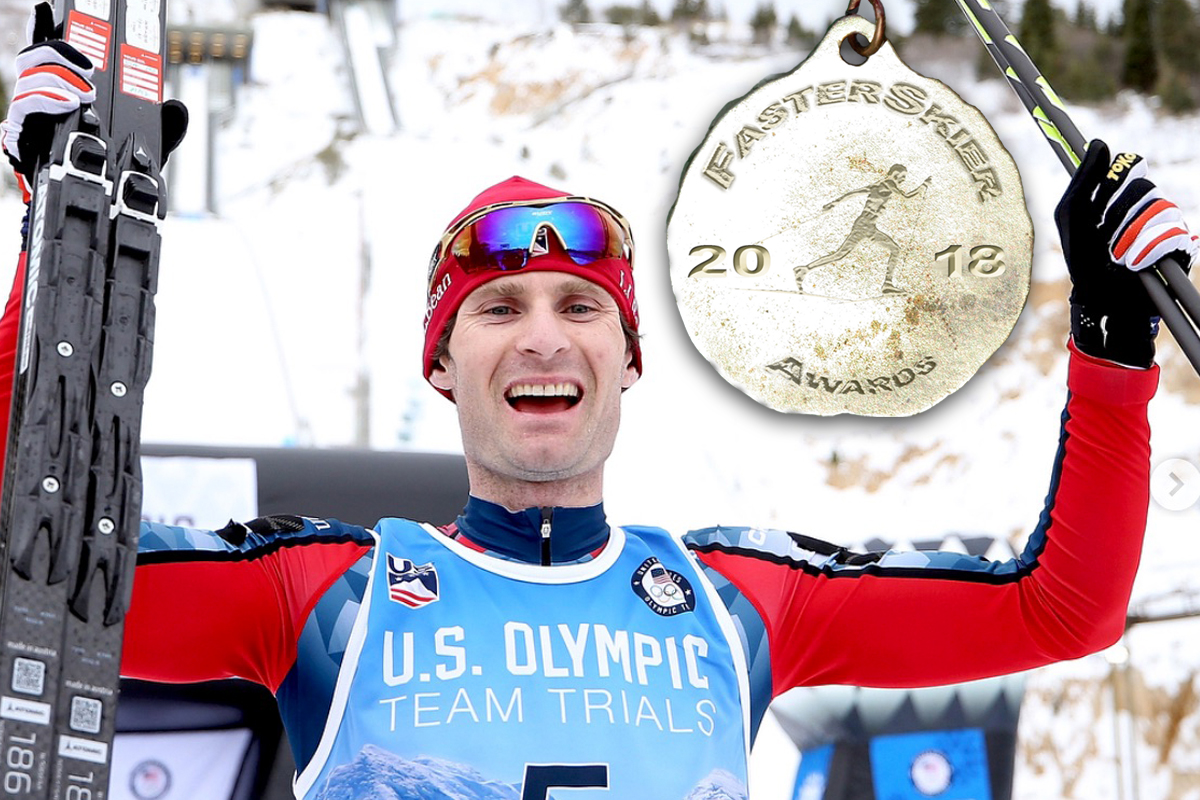
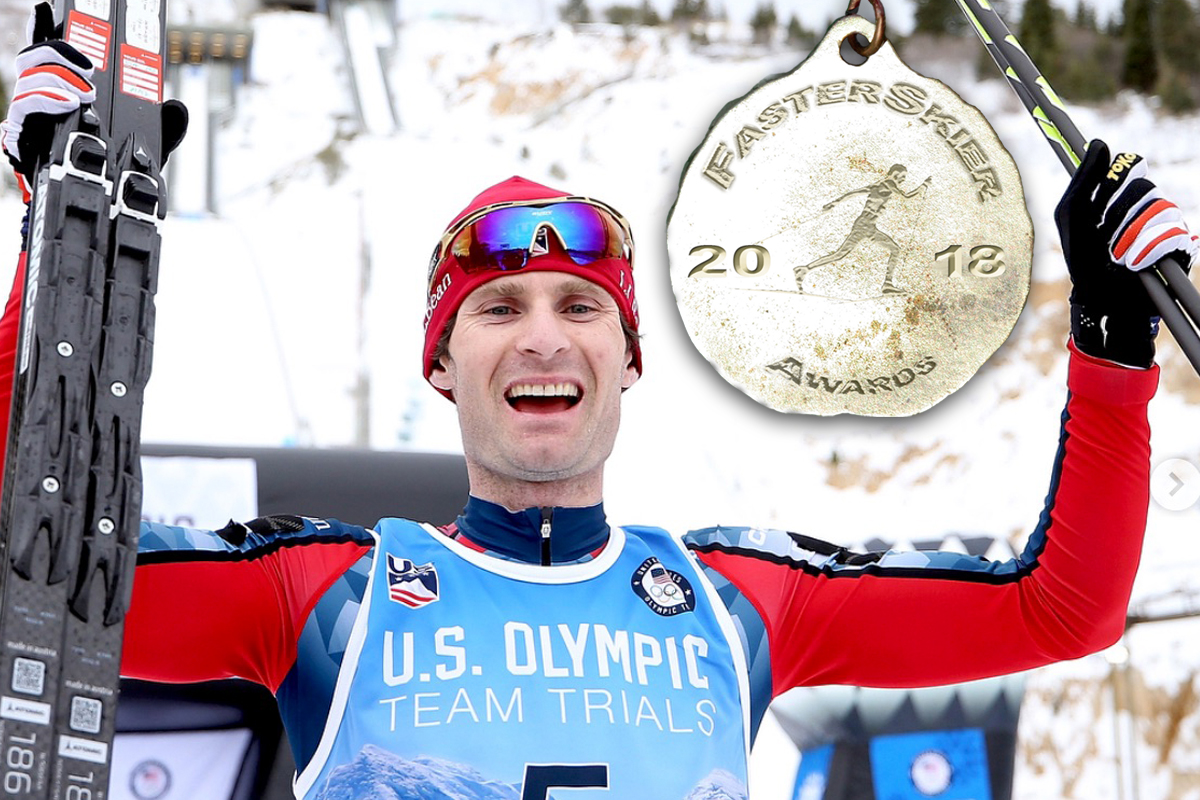
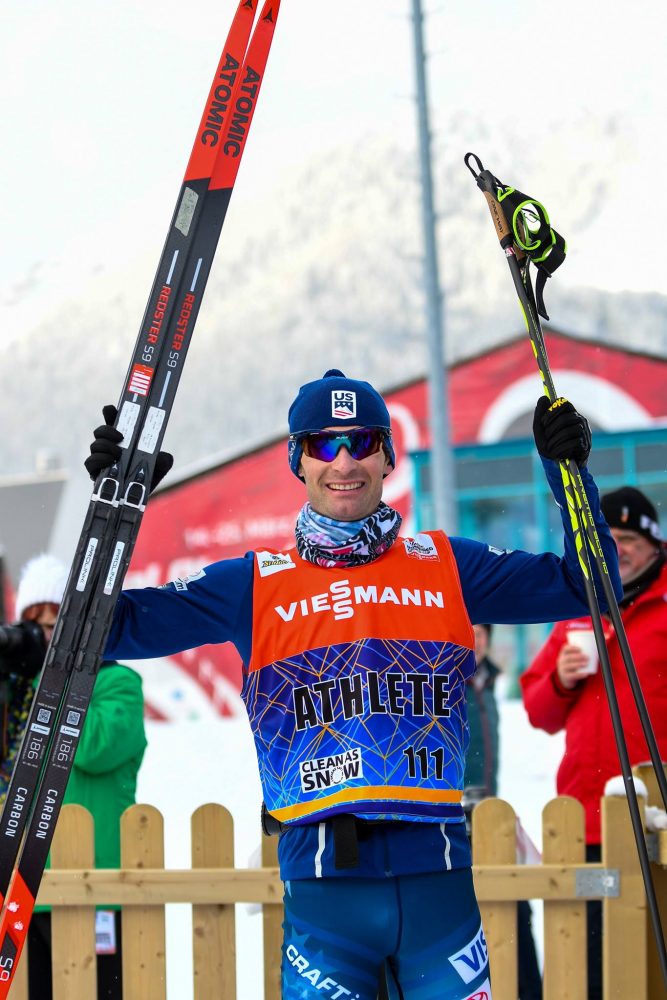
Bryan Fletcher (U.S. Nordic Combined) is FasterSkier’s 2018 Nordic Combined Skier of the Year. (Photo: US Ski Team)
With the 2017/2018 season officially in the rearview, FasterSkier is excited to unveil its annual award winners for this past winter. Votes stem from the FS staff, scattered across the U.S., Canada, and Europe, and while not scientific, they are intended to reflect a broader sense of the season in review. This set of honors goes to outstanding North American nordic combined athletes.
At 31 years old, it’s safe to say U.S. Nordic Combined’s Bryan Fletcher has been a beneficiary of the axiom, “What comes around goes around”. What came around when Fletcher literally jumped and skied onto the scene in 2002 was a cadre of athletes setting the performance bar at a high level. Fletcher followed in the steps of Todd Lodwick, Johnny Spillane, Brett Camerota, and Billy Demong. In his last season as a professional nordic-combined competitor, Fletcher had several standout performances but also allowed himself to bring some of the stability and veteran leadership he learned about years ago to a young U.S. Nordic Combined Team.
Fletcher was a rock for skiers like 19-year-old Ben Loomis, who earned a bronze at World Juniors. Loomis is one example, but the U.S. team as a whole, trends towards the younger side of twenty. With younger eyes on him as a mentor and athlete, Fletcher navigated performance disappointments and hiccups to score some standout performances on the Nordic Combined World Cup.
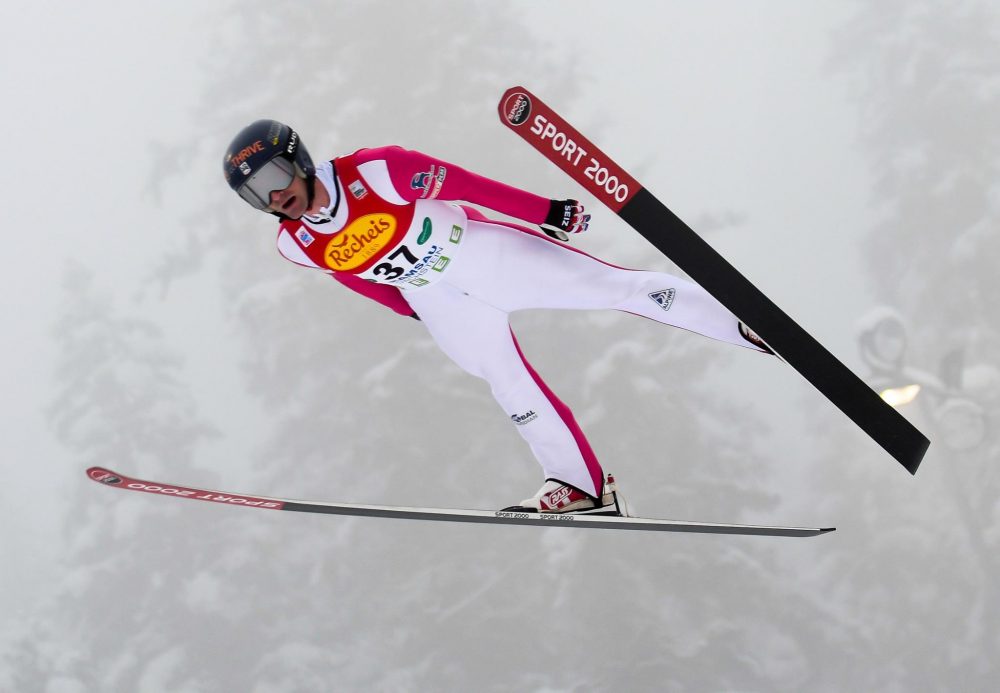
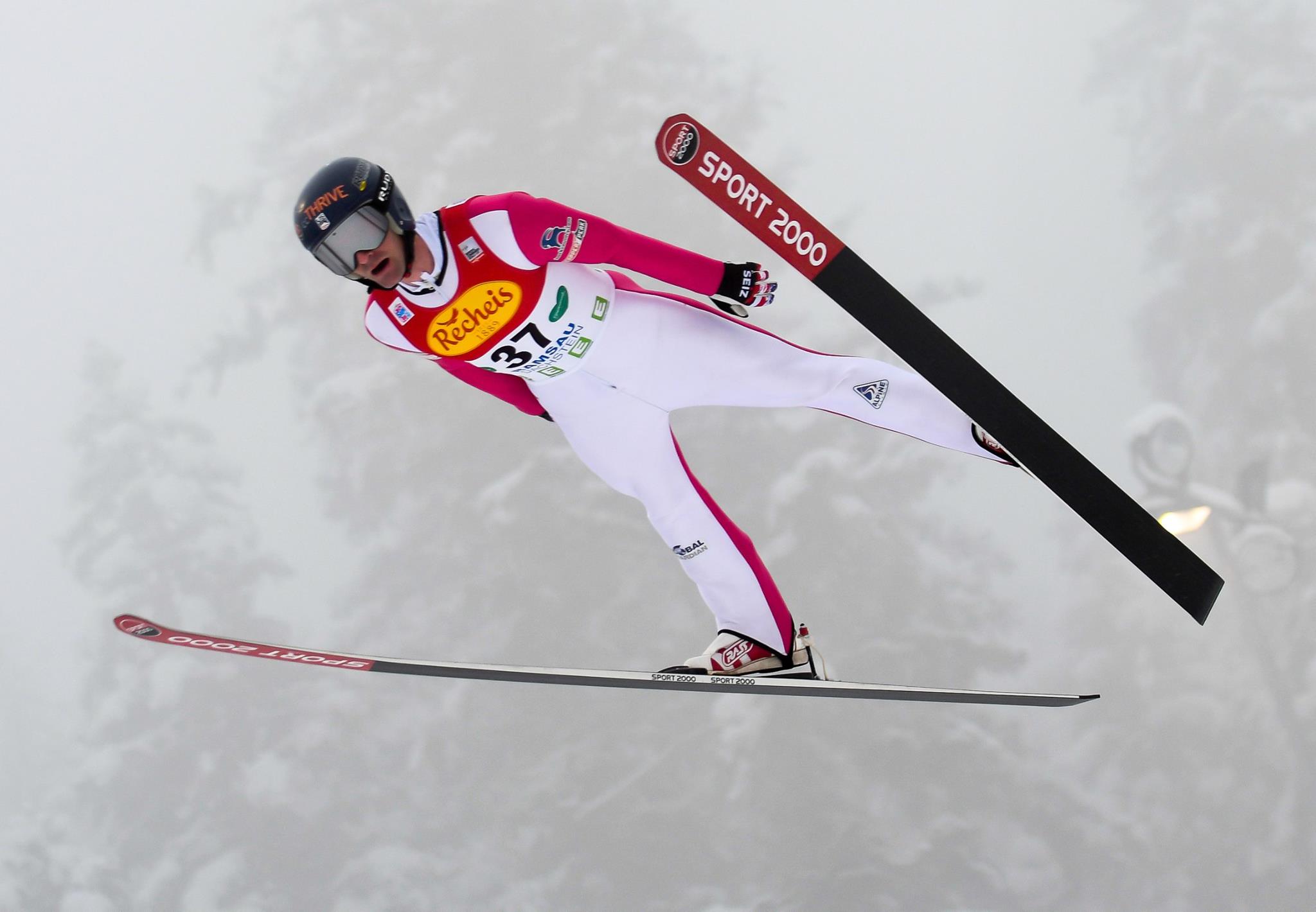
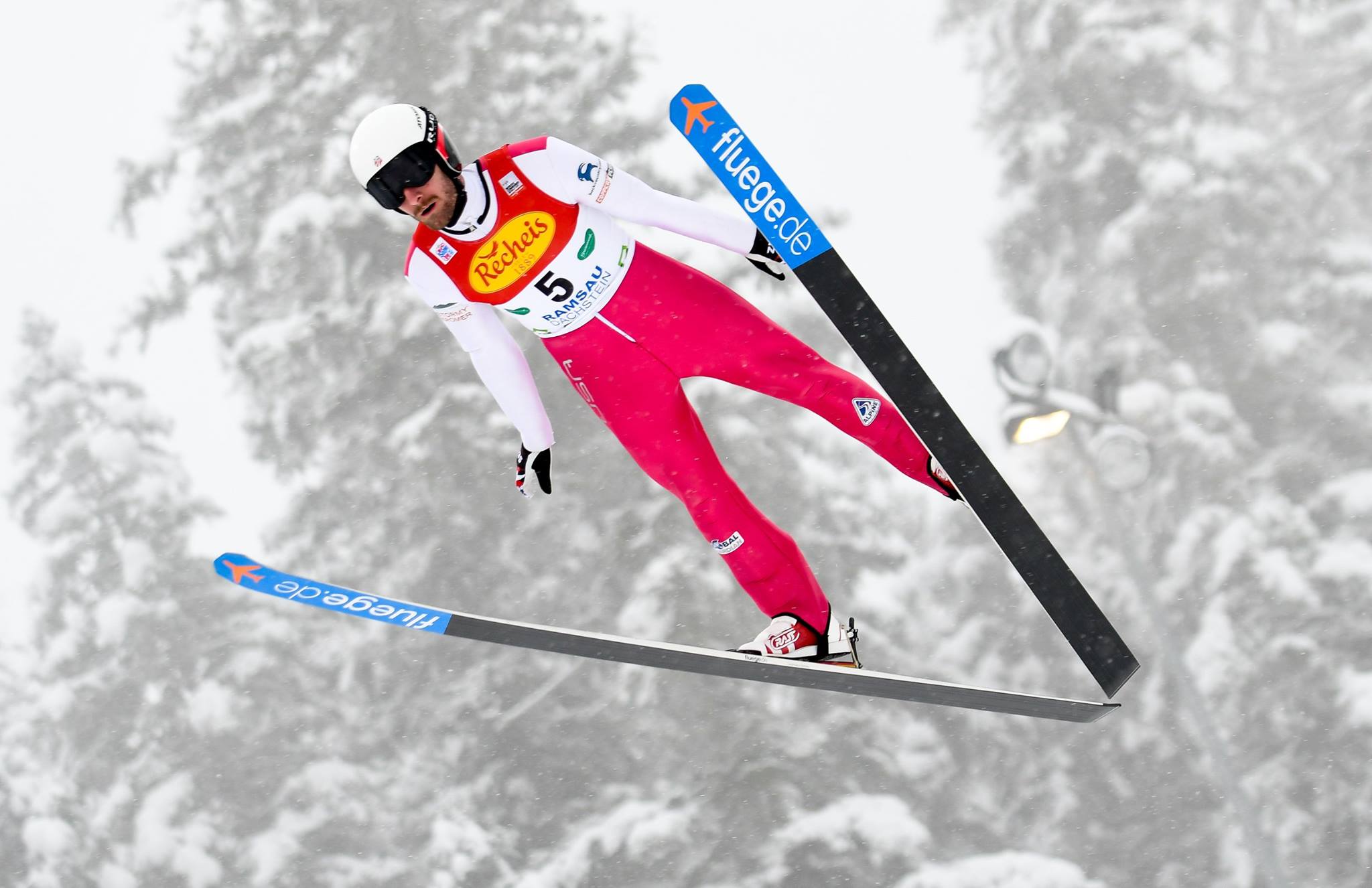
Bryan Fletcher (USA Nordic) jumping to 45th in the Nordic Combined World Cup on Dec. 17 in Ramsau, Austria. In the 10 k that followed, he skied the third-fastest time to finish 14th overall. (Photo: Romina Eggert/USA Nordic Facebook)
Fletcher entered 12 World Cups, 10 of which were individual races. In only one individual race did he place outside the top 30 (he finished 32nd on Dec. 1 in Val di Fiemme, Italy). Of his remaining individual races, Fletcher was out of the top 20 just one other time (placing 29th on Nov. 26 at the season-opener in Kuusamo, Finland).
Fletcher’s other eight races were all top 20’s. In Ramsau, Austria, he scored a seventh place. And in his last career World Cup on March 14 in Trondheim, Norway, Fletcher matched his season-best result with another seventh place.
One can hear any athlete say these weren’t exactly the results they were looking for. That would be true in Fletcher’s case as well. Yet he was more than consistent in terms of keeping himself within striking distance of several podiums. Those opportunities came most often from Fletcher’s skiing rather than his jumping. At season’s end, he was the 42nd-ranked overall jumper on the Nordic Combined World Cup. To prove our point, he was ranked the 15th-best skier. (Overall, he ranked 29th on the World Cup this season.)
Here are Fletcher’s best cross-country race times (in the 10-kilometer Gundersen starts) of the 2017-2018 World Cup season:
Nov. 25, Kuusamo, Finland: Fourth fastest time of day
Dec. 16, Ramsau, Austria: Second fastest time of day
Dec. 17, Ramsau: Third fastest time of day
Jan. 14, Val di Fiemme, Italy: Second fastest time of day
From a domestic perspective, Fletcher proved he’s still the best U.S. nordic combined athlete. During a high-pressure format — the only guaranteed U.S. Nordic Combined Olympic spot was reserved for the winner of U.S. Nordic Combined’s Olympic Trials on Dec. 30 in Park City, Utah — Fletcher found himself in fifth place after the jumping round. A full 1:24 minutes behind the best jumper Ben Loomis. Yet in typical fashion, Fletcher’s podium hunt on skis ended with a first place and a booked trip to PyeongChang for his second Olympic Games.
In both individual events in PyeongChang, Fletcher was the best American finisher, placing 17th twice.
For being the best-performing American nordic combined skier, Fletcher receives the nod for Nordic Combined skier of the year. But don’t forget, Fletcher is the whole package: in the 2017/2018 season, he was a leader, professional role model, and mentor to the young ones chasing his ski tails.
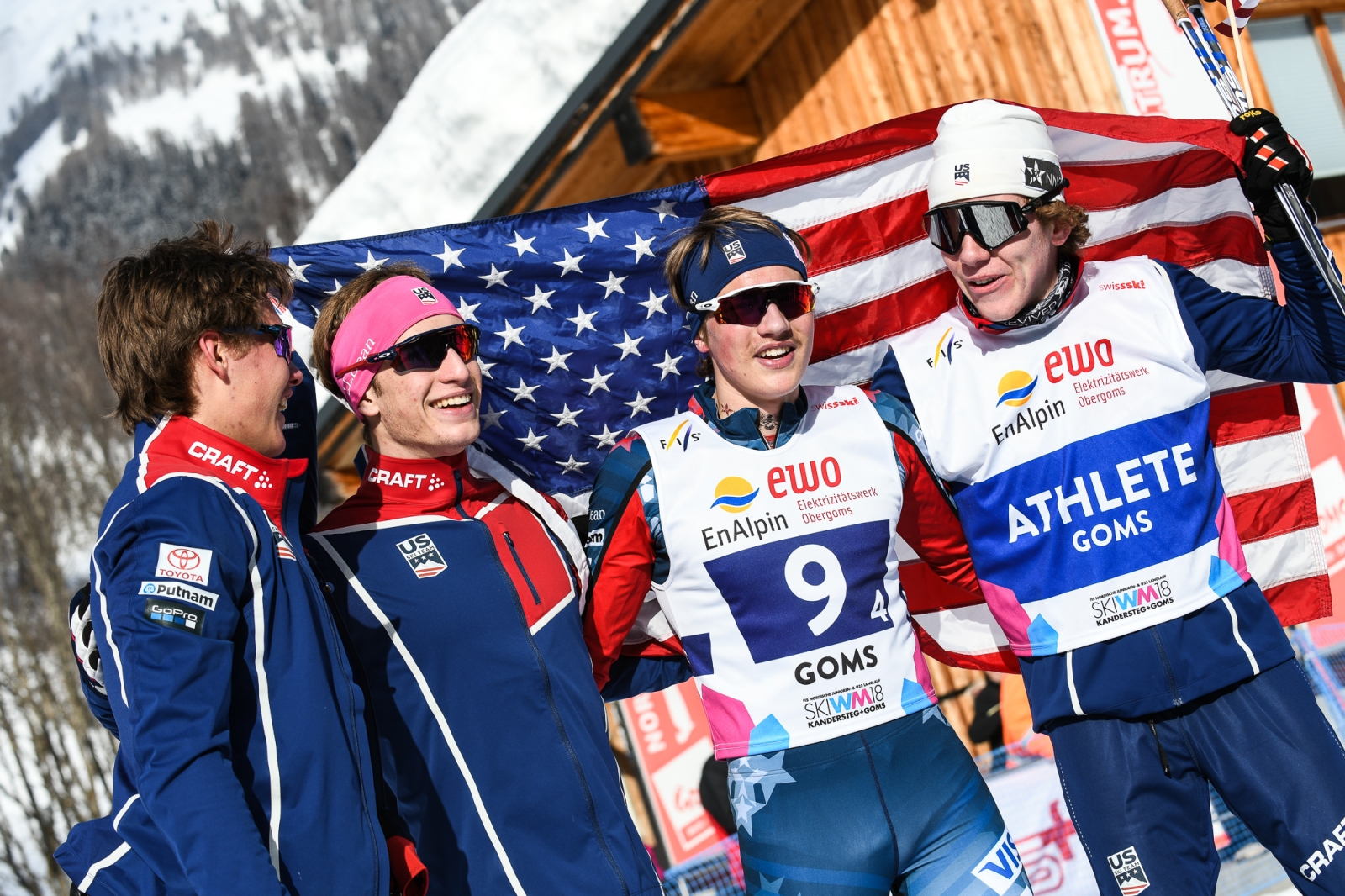
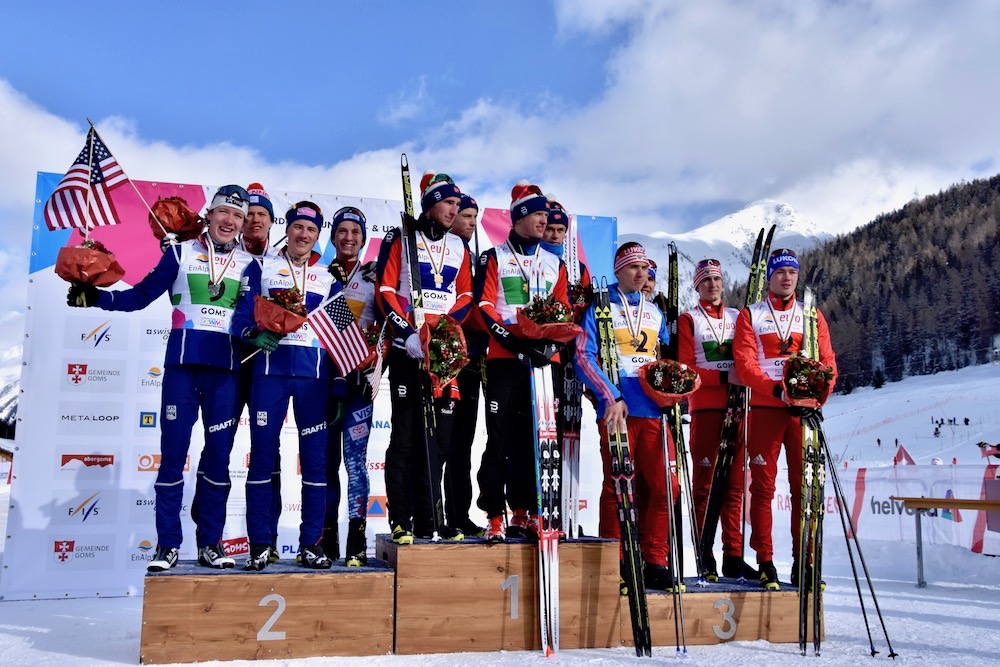
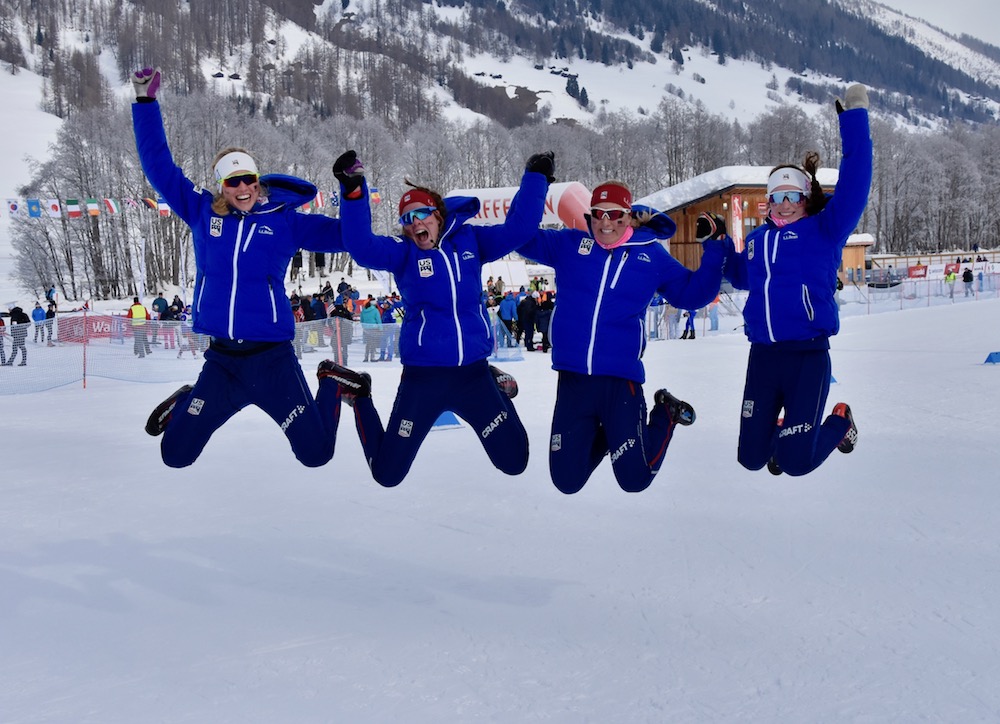
The U.S. men’s silver-medal relay at 2018 Junior World Championships in Goms, Switzerland, with (from left to right) Luke Jager, Hunter Wonders, Gus Schumacher, and Ben Ogden. (Photo: JWSC2018.ch)
(Note: This article has been updated to include comments from Americans Ben Loomis, Luke Jager and Gus Schumacher.)
Junior World Championships (Goms, Switzerland): Men’s and women’s relays
Two individual medals and a relay podium. That’s how the U.S. team fared this week at Junior World Championships in terms of a medal count, but the significance of its breakthroughs go way beyond the hardware.
Hailey Swirbul became the most successful American nordic skier at Junior World Championships with a silver and a bronze in the two women’s distance races. Then, on Saturday, the U.S. men took their turn in the spotlight, racing to second and almost first in the 4 x 5-kilometer relay for the best relay finish by an American team at Junior Worlds. Last year, the U.S. women placed third at 2017 Junior Worlds at Soldier Hollow in Midway, Utah.
Luke Jager started the team off on Saturday as the first classic leg, putting the U.S. men in sixth at the first exchange, 14 seconds behind Sweden in first.
While Sweden dropped to second on the next leg, the U.S. continued to move up, with Ben Ogden racing to fourth, 8.5 seconds out of first, behind Norway, Russia and France, respectively.
On the first freestyle leg, Hunter Wonders held the U.S. in fourth and tagged anchor Gus Schumacher in fourth, 31.3 seconds out of first. Norway continued to lead with France, and Russia skied about 5 seconds back in third with 5 k to go.
Schumacher then skied the fastest anchor leg to race up to second, passing France and finally Russia in the finishing straight, as he crossed the line 2.2 seconds behind Norway’s Jørgen Lippert — who eased up in the finish and secured the Norwegian gold with a total time of 50:04.2 minutes.
The men’s 4 x 5 k relay podium at 2018 Junior World Championships with Norway (c) in first, the U.S. (l) in second (Ben Ogden, Luke Jager, Gus Schumacher, Hunter Wonders), and Russia (r) in third. (Photo: Julia Kern)
The U.S. placed second, 3.3 seconds ahead of Russia in third (+5.5), and France finished fourth (+29.6).
Norway’s winning team included two men who won individual golds this week, Harald Østberg Amundsen (in the 20 k skiathlon) and Jon Rolf Skamo Hope (10 k classic), as well as Håvard Moseby and Lippert (who took bronze in two races).
Russia’s team was made up of Kirill Kilivnyuk, Sergey Ardashev, Yaroslav Rybochkin, and Alexander Terentev. Team France was Camille Laude, Hugo Lapels, Tom Mancini, and Pierre Tichit.
Canada placed 11th (+3:12.8) with Antoine Cyr, Ritchie Graham, Felix Longpre, and Etienne Hebert. Sixteen teams contested the men’s relay on the final day of Junior Worlds in Goms.
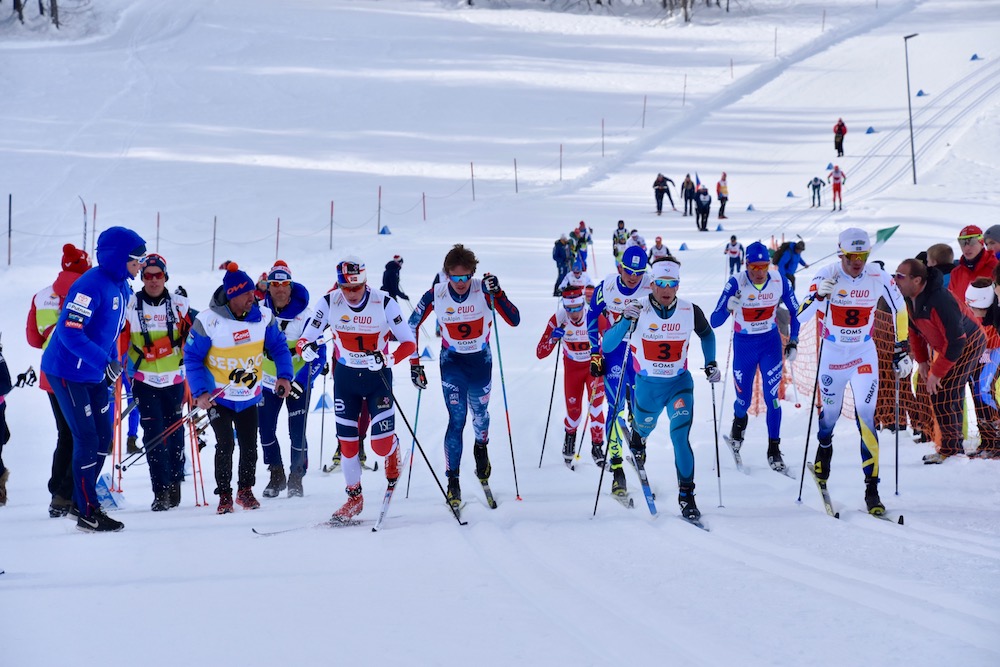
American Luke Jager (9) skiing with Norway’s Harald Østberg Amundsen (1), France’s Camille Laude (3), and Sweden’s Jacob Nystedt (8) during the first leg of the men’s 4 x 5 k relay on Saturday at 2018 Junior World Championships in Goms, Switzerland. (Photo: Julia Kern)
In an email, Jager, who turned 18 last month, explained that he was grateful for the opportunity to race at his first Junior Worlds.
“I barely qualified for this trip after a tough week in Anchorage so my options for starts were super limited,” Jager wrote. “I got the sprint start last week which was pretty horrendous and then a guaranteed spot on the relay team. So I had the whole week to prepare and rest. Watching the boys all week we realized that a medal could be possible and we started targeting that super closely.”
But over the last week, Jager hadn’t been feeling well.
“I was feeling really really bad in the days following the sprint and could barely get out and ski for 60 minutes each day,” he recalled. “I had actually told [U.S. Ski Team Development Coach Bryan] Fish that if I continued to feel as bad as I had been I was gonna sit out the relay. But I started feeling better and better throughout the week and was feeling really good this morning.”
He had previously asked Fish if he could ski the scramble leg.
“Bryan was stoked about it too so that decision was easy,” Jager explained. “This group of dudes is perfect for each leg of a relay so we barely even needed to discuss order. I am definitely a stronger classic skier so I was stoked to be able to get some redemption for my poor form in the last month.”
Schumacher, 17, explained he found out the relay order on Friday night and “really started to get excited about it,” he wrote in an email. “We had some foreign friends say that they thought we could do well so that really helped confidence.”
From the gun, Jager expected a fast pace and pushed to put himself in the lead group while trying to conserve energy and avoid any tangles He locked onto Norway’s Amundsen and by the last climb on the second lap, found that the group was beginning to string out.
“I was thankfully able to hold on just enough to maintain connection with the leaders and put Ben in a position where he could do his thing,” Jager wrote. “I would have liked to be a little further up in the group when I tagged off to Ben but the Swedes’ first skier had done so much damage in the last minutes that we were all in single file and pretty much in survival mode up the last climb.”
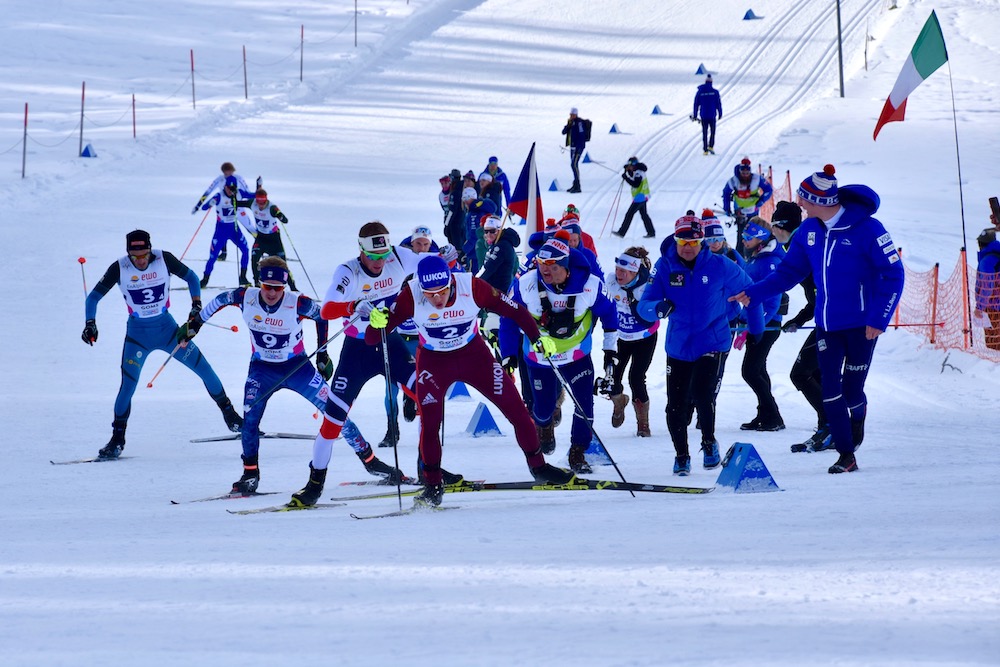
Russia’s Alexander Terentev leading Norway’s Jørgen Lippert, American Gus Schumacher (9), and France’s Pierre Tichit (3) up a climb in the final leg of the men’s 4 x 5 k relay at 2018 Junior World Championships in Goms, Switzerland. (Photo: Julia Kern)
Fast-forward to Schumacher getting tagged in fourth in the final exchange, 31.5 seconds behind Norway in first, 30.9 seconds behind France in second, and 26.2 seconds behind Russia in third. Despite the gap, he believed he could close it.
“I definitely thought those three were in reach, and I wanted to catch them, if for no other reason than to keep clear of 5th and 6th,” Schumacher wrote. “I focused on really holding steady for the first 2k, then starting to push more, and I was able to catch that lead pack and then recover with them for the last sprint, which did end up really hurting.”
While he had distanced himself from France and secured third by the final hill, he hadn’t anticipated catching Russia or Norway.
“By the time I got through the downhill corner, however, I was closing fast on the Russian and realized I was right there,” Schumacher wrote. “I popped around the last corner and was almost even with Russia, then after a few seconds of sprinting I pulled ahead and he slowed down and I knew I had it.”
While Jager explained he’s not one to get very nervous about racing, Saturday was completely different.
“… Watching the rest of the race progress was one of the most nerve wracking experiences of my life,” he wrote. “When Hunter tagged off to Gus I knew we were really really gonna be in the fight for a medal. I’ve been racing Gus for most of my life and I know when that kid is gonna throw down and produce a miracle and I could see it…
“This is something this group of guys has been dreaming of and training for for a really long time now,” he added. “To be able to watch that dream come into fruition today was indescribable. Probably the best day of my life since Cole Morgan added me on Snapchat. We came here this year to show the world that US skiing is the real deal and that we’re here to stay and I think we did that. To be able to be a piece of that history was an honor.”
“Experiencing the podium here has been so cool,” Schumacher wrote. “I thought it was possible, but actually getting it feels amazing. This whole trip has been really cool even without this success, it’s such an amazing place and the team is tight. I think individually I anticipated results maybe a little better, but this seems about right, and as a team I think we all surprised ourselves. Together we can make some big waves.”
Germany Wins Women’s Relay; U.S. 8th
In the women’s 4 x 3.3 k relay earlier on Saturday, Germany took the win by 8.6 seconds over Russia with a winning time of 39:17.4. Sweden finished third, 47.5 seconds out of first.
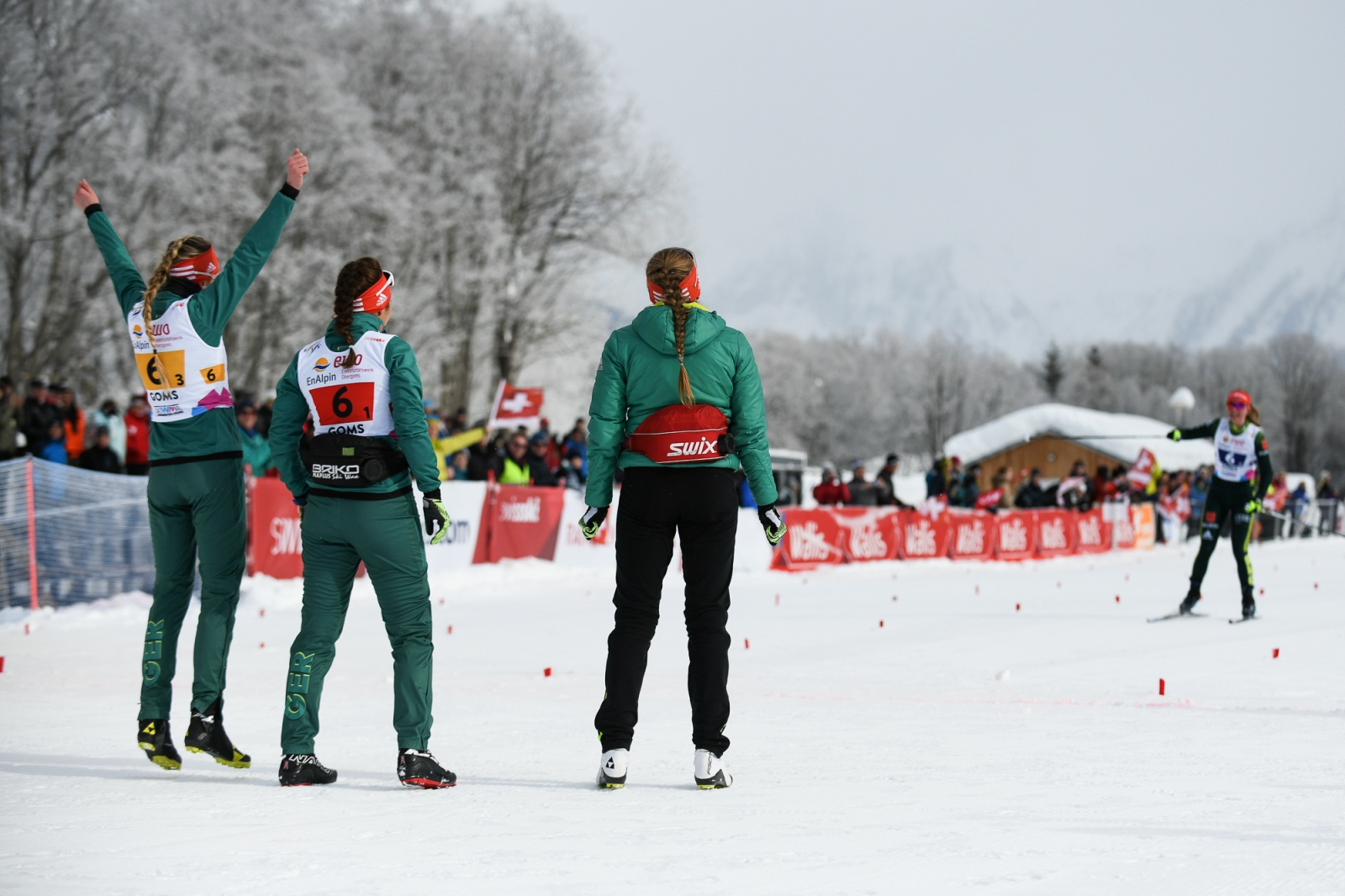
Germany’s Alexandra Danner, Celine Mayer and Lisa Lohmann await their teammate Anna-Maria Dietz at the finish of the women’s 4 x 3.3 k relay on Saturday at 2018 Junior World Championships in Goms, Switzerland. Germany placed first and Russia finished second, 8.6 seconds later. (Photo: JWSC2018.ch)
Germany (Alexandra Danner, Celine Mayer, Lisa Lohmann, Anna-Maria Dietz) improved from third on the first leg, to second on the second and third legs, and final first on Dietz’s anchor leg.
Russia (Polina Nekrasova, Hristina Matsokina, Nina Dubotolkina, Maya Yakunina) led the race from the first through the third and final exchange, before slipping to second at the finish.
Sweden (Tua Dahlgren, Frida Karlsson, Alicia Persson, Johanna Hagström) rebounded from 13th and more than a minute and a half back at the first exchange to tag in fourth and 28 seconds out of first thanks to Karlsson’s fastest second-leg time. By the final exchange, they were up to third and they held that position to the finish.
The U.S. women’s 4 x 3.3 k relay at 2018 Junior World Championships, with (from left to right) Hailey Swirbul, Kathleen O’Connell, Hannah Halvorsen, and Molly Gellert. They placed eighth on Saturday. (Photo: Julia Kern)
The U.S. placed eighth (+1:08.1) with Kathleen O’Connell, Swirbul, Molly Gellert, and Hannah Halvorsen. After O’Connell put them in eighth and about a minute back on the first leg, Swirbul skied them up to sixth with the second-fastest second leg, 30.1 seconds out of first. Gellert held onto that position on the first skate leg, but Halvorsen slipped two places on the anchor leg to finish eighth.
Canada finished 15th (+4:47.8) out of 16 teams with Hannah Mehain, Natalie Hynes, Annika Richardson, and Alexandra Racine.
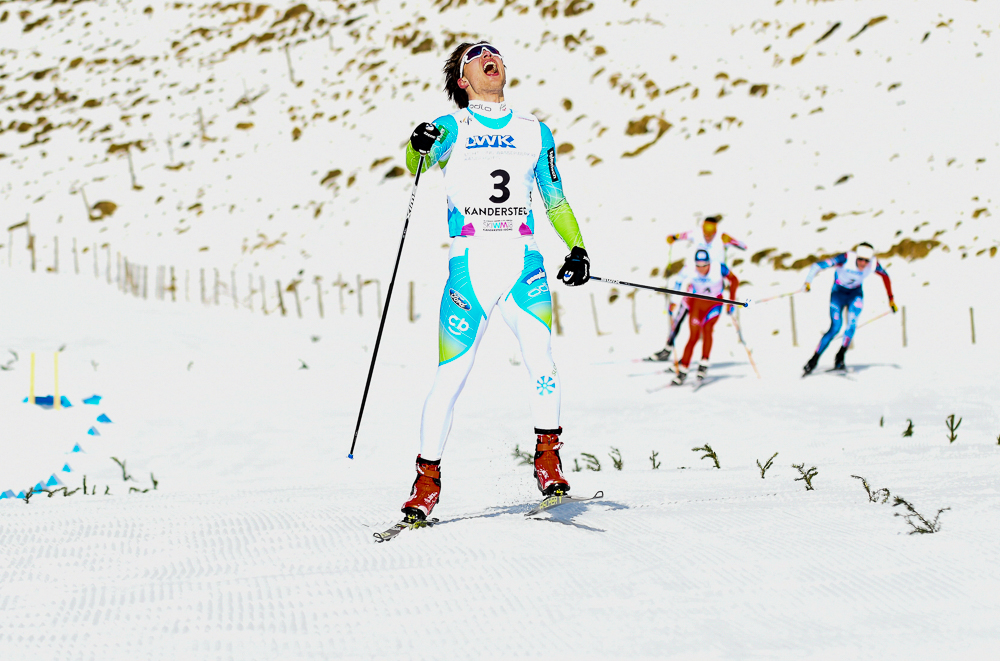
Slovenia’s Vid Vrhovnik (3) celebrates his win in the last nordic-combined competition of 2018 Junior World Championships, the individual normal hill/5 k, on Saturday in Kandersteg, Switzerland, while the Czech Republic’s Jan Vytrval, Austria’s Dominik Terzer and American Ben Loomis (r) battle for second. (Photo: JWSC2018.ch)
Nordic Combined Junior World Championships (Kandersteg, Switzerland): Normal hill/5 k Gundersen
In the final nordic-combined competition of Junior Worlds, American Ben Loomis nearly notched his second podium of the week, missing it by one-tenth of a second in fourth place.
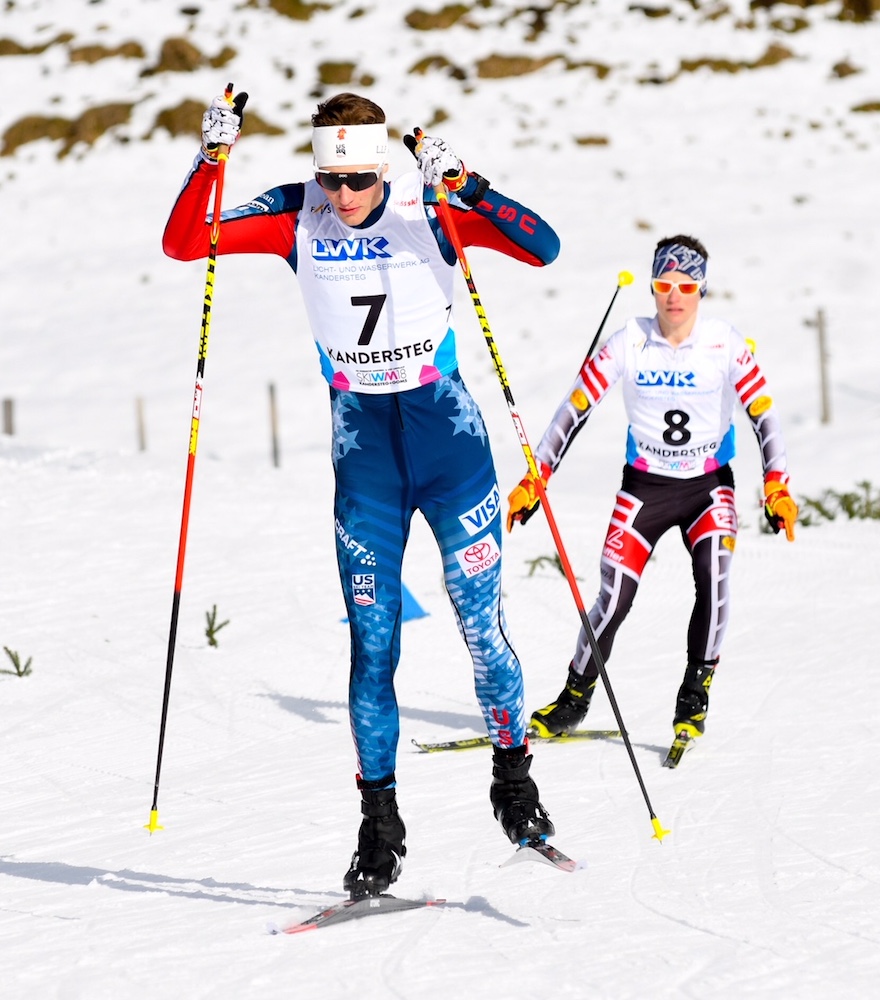
American Ben Loomis (7) leads Austria’s Johannes Lamparter during Saturday’s 5 k at 2018 Nordic Combined Junior World Championships in Kandersteg, Switzerland. Loomis went on to place fourth and Lamparter finished eighth. (Photo: Romina Eggert)
Slovenia’s 18-year-old Vid Vrhovnik won the individual normal hill/5 k Gundersen by 4.9 seconds over Austria’s Dominik Terzer. After posting the third-best jump on the 106-meter hill, Vrhovnik started the 5 k race 6 seconds behind Germany’s Luis Lehnert in first. Terzer jumped to second and started just 4 seconds behind, while the Czech Republic’s Jan Vytrval jumped to fourth and started 10 seconds back. Loomis jumped to seventh (just as he did on Tuesday before racing to third place) and started 27 seconds out of first.
“I was happy with my jump being closer in time to the front,” Loomis wrote in an email about his his jump, which put him about 10 seconds closer to the leaders than on Tuesday. “I didn’t feel quite as lucky with the wind. I was hoping to jump around the top 5, but 7th, only 27sec back was good, too.”
Over the two-lap 5 k, Vrhovnik battled with Terzer, while Lehnert slipped to seventh at the finish, 23.5 seconds behind. The Slovenian took the win by nearly five seconds over Terzer in 11:28.8, and Vytrval outlunged Loomis for third place (+5.4). Loomis placed fourth (+5.5), well ahead of Norway’s Einar Lurås Oftebro in fifth (+18.4).
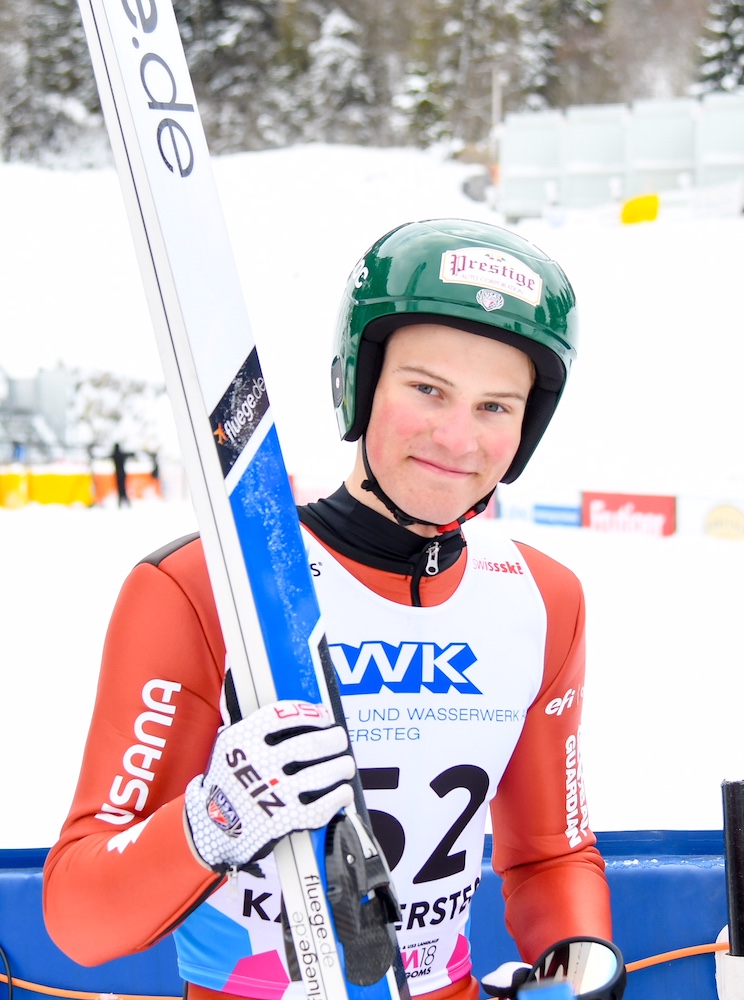
Ben Loomis (USA Nordic) on the last day of 2018 Nordic Combined Junior World Championships in Kandersteg, Switzerland. He jumped to seventh and moved up to fourth in the 5 k. (Photo: Romina Eggert)
“I was able to catch places 3-6 on the first lap and ski with them through the beginning of the second lap,” Loomis wrote. “Towards the end of second lap I closed down on second place (Jan Vytral) with Dominik Terzer. On the last corner we packed up in positions 2-4.
“The finish started with a sharp downhill corner followed by a quick stretch less than 100 meters,” he continued. “I came into the finishing lanes in second but unfortunately took the wrong line and was passed by Dominik and never quite caught Jan in front of me.”
While he had been hoping for another podium, Loomis acknowledged that he was pleased to ski the fastest race time and “be battling at the front”.
“Overall I am leaving Switzerland with my goals accomplished and feeling satisfied,” he wrote. “It would have been nice to walk away with a double podium but I am still very happy with how to week went. This week has been a huge confidence booster going into the Olympics next week. I am very excited to represent my country and enjoy my time at the games. I am looking to have fun, take in experience and not overthink the results.”
Also for the U.S., Stephen Schumann placed 18th (+1:18.6), up one place from 19th in the jump, Jared Shumate finished 40th (+3:05.7), up from 48th in the jump, and Tucker Hoefler was 55th (+5:50.5), after jumping to 55th.
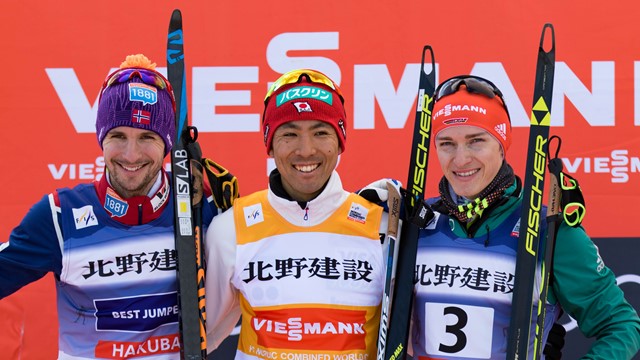
The podium at Saturday’s Nordic Combined World Cup in Hakuba, Japan, with Japan’s Akito Watabe (c) in first, Norway’s Jan Schmid (l) in second and Germany’s Manuel Faißt (r) in third. (Photo: FIS/Flawia Krawczyk)
Nordic Combined World Cup (Hakuba, Japan): Large hill/10 k Gundersen
Many of the winter-sports World Cups were off this weekend before the Olympics start in earnest a week from today in PyeongChang, South Korea, but not nordic combined, which had a World Cup stop in Hakuba, Japan.
There, local hero Akito Watabe took the win in 24:14.6 minutes, a whopping 1:12.6 minutes clear of Norway’s Jan Schmid in second. Germany’s Manuel Faißt placed third, 1:22 back, and Estonia’s Kristjan Ilves finished 52 seconds later in fourth (+2:14).
The lone American competing in Saturday’s 10 k Gundersen, Ben Berend achieved his first individual World Cup top 30, placing 23rd (+4:31.7) after jumping to 16th on Hakuba’s 134-meter large hill.
Watabe led from the beginning of the day after jumping to first, ahead ofIlves in second, Faißt in third, and Schmid in fourth. Watabe started the 10 k with a 16-second head start on Ilves, while Faisst started 52 seconds out of first and Schmid started 1:08 behind.
Berend started the 10 k with a 2:36 deficit to first, with five others within 10 seconds of him. His teammate Adam Loomis did not start the 10 k after jumping to 38th.
Another individual large hill/10 k Gundersen will be held on Sunday in Hakuba. The first nordic combined competition in PyeongChang, the individual normal hill/10 k, is set for Wednesday, Feb. 14.
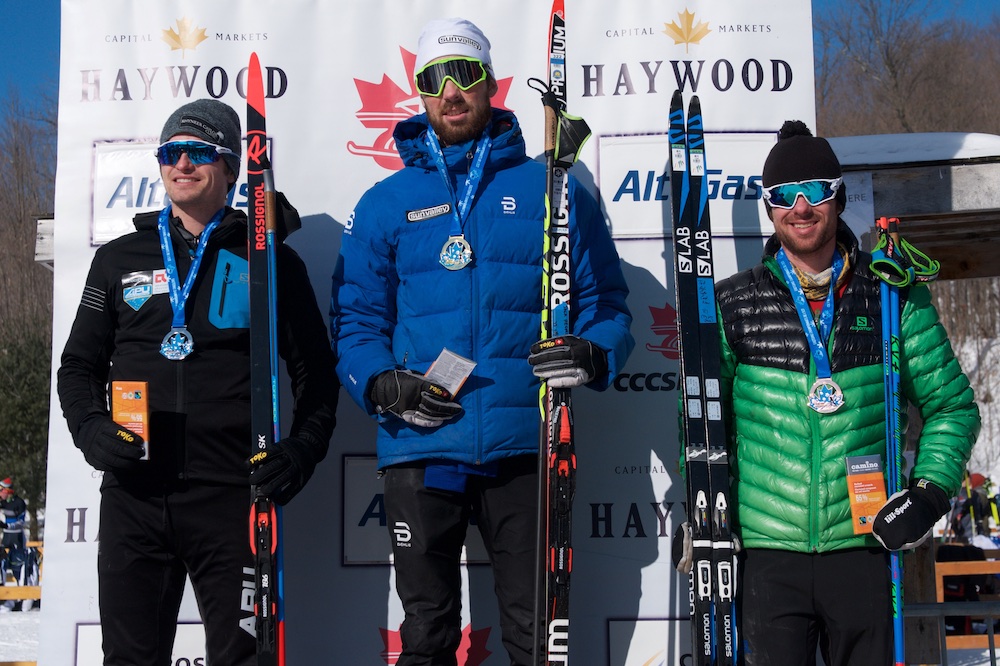
The men’s 15 k freestyle podium at 2018 Eastern Canadian Championships in Gatineau, Quebec, with Jack Hegman (c) in first, David Norris (l) in second and Tad Elliott (r) in third. (Photo: Rob Smith)
NorAm Eastern Canadian Championships (Gatineau, Quebec): 10/15 k freestyle
Americans swept the podium in both the men’s and women’s freestyle individual starts on Saturday at Eastern Canadian Championships in races that count toward both NorAm and SuperTour standings.
According to unofficial results, Jack Hegman, of the Sun Valley Ski Education Foundation (SVSEF), won the men’s 15 k by 9.1 seconds over David Norris, of Alaska Pacific University (APU), in 35:44.9. Tad Elliott (Ski Club Vail) placed third (+38.7) just ahead of the top Canadian, Jack Carlyle, of the Alberta World Cup Academy (AWCA), in fourth (+41.7).
The U.S. occupied eight of the top 10 in the men’s race, with Kevin Bolger (SVSEF) in fifth (+45.0), Ben Lustgarten, of the Craftsbury Green Racing Project (CGRP) in sixth (+52.3), Brian Gregg (Team Gregg/LNR/CXC) in seventh (+57.0), Rogan Brown (SVSEF) in eighth (+58.1), Canada’s Scott Hill (Barrie Cross Country) in ninth (+1:14.7), and Eric Packer (APU) in 10th (+1:18.6).
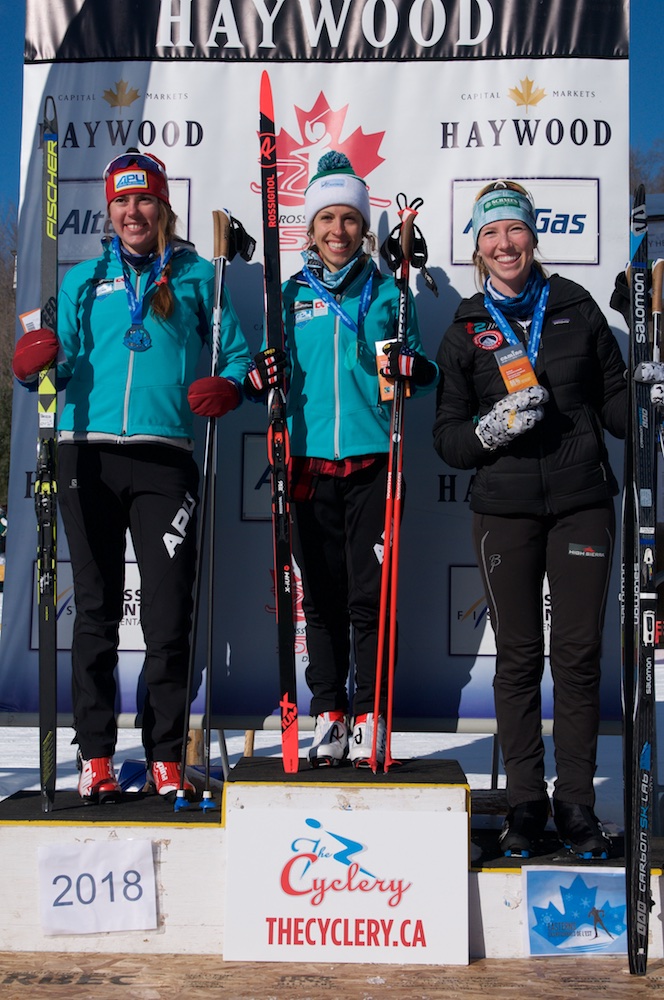
The women’s 10 k freestyle podium at 2018 Eastern Canadian Championships in Gatineau, Quebec, with Rosie Frankowski (c) in first, Becca Rorabaugh (l) in second and Erika Flowers (r) in third. (Photo: Rob Smith)
After placing second in a 10 k freestyle at last weekend’s SuperTour in Craftsbury, Vermont, Rosie Frankowski (APU) won the women’s 10 k freestyle on Saturday in Gatineau by more than 30 seconds in 27:07.3. Her teammate Becca Rorabaugh (who won the Craftsbury 10 k skate as well as Friday’s classic sprint in Gatineau) placed second (+37.1) on Saturday, and Erika Flowers placed third (+1:26.4) for the third-straight race.
Frédérique Vézina, of the Pierre-Harvey National Training Centre, led the Canadians in fourth (+1:46.2), while America Liz Guiney (CGRP) placed fifth (+1:52.2), and Olivia Bouffard-Nesbitt (Rocky Mountain Racers) finished sixth (+1:56.4).
Also in the top 10, Kaitlynn Miller (CGRP) placed seventh (+1:57.8), Felicia Geisor (CXC Team) was eighth (+2:18.5), Zoë Williams (Carleton University) ninth (+2:39.6) and Annika Hicks (AWCA) 10th (+2:43.4).
Eastern Canadian Championships conclude Sunday with 10/15 k classic pursuits at the Nakkertok Nordic Ski Centre.
Bryan Fletcher (USA Nordic) jumping at the Nordic Combined World Cup last Sunday, Dec. 17, in Ramsau, Austria. After jumping to 45th in the provisional round on Friday (Sunday’s competition round was cancelled midway through), he skied the third-fastest time in Sunday’s 10 k to finish 14th overall. (Photo: Romina Eggert/USA Nordic Facebook)
On Dec. 30, the nordic-combined community will gather in Park City for the U.S. Olympic Team Trials, a one-and-done event which will dole out an Olympic berth for the race winner. As they have for much of their professional-sport careers, brothers Bryan and Tyler Fletcher are eying the same prize.
Bryan Fletcher was ranked 34th on the World Cup last season. His best individual results during the 2016/2017 World Cup calendar were an 11th and 18th place.
This past weekend in Ramsau, Austria, Bryan, the older of the Fletcher brothers, came through with a seventh place on Saturday, Dec. 16, for his best individual result in nearly two years.
“The opportunity was there,” Bryan, 31, said on the phone from Utah this week. He explained that the jumping hill in Ramsau is smaller than the hill used for the opening weekend in Ruka, Finland.
“Ramsau is one of those hills where everybody tends to jump a little bit closer. That was the first thing that was really helpful there,” he said. “The second thing was definitely that I jumped on a little bit higher level than the previous weekends. … I was able to put together a little bit better jumps and on a more consistent basis. As a result I was able to put myself in the fight in the race.”
Bryan jumped to 28th, yet scored 110.5 points, while the best jumper, Taihei Kato of Japan, scored 125.9 points — not a massive gap when considering the Fletchers’ skiing speed. That 15.4-point differential put Bryan 1:02 minutes behind Kato at the start of the 10 k Gundersen. When in position after a solid jump, both of the Fletchers can close out a top 20 or a top 10 in the ski.
But moving through a field of World Cup skiers — Bryan moved up 21 spots in Saturday’s race — is part-art and part-sufferfest.
Bryan Fletcher (USA Nordic) notched seventh in the Nordic Combined World Cup this weekend in Ramsau, Austria, for his best result since January 2016. (Photo: USA Nordic/Facebook)
“More these days, the old-school laws of track don’t really apply for us,” Bryan said about passing skiers during the ski portion. “Especially in nordic combined where every place is so crucial and those points are so valuable people don’t want to move over. They know if they move over for you that opens a hole for potentially five to 10 skiers that are in that train to get by.”
Ramsau’s course remains a link to the past with skinny trails placing a premium on high-risk, high-reward aggressive skiing. Moving to the front when a gap opens or sitting in and sucking a draft can make or break a result.
“That opportunity pays itself off in the end, that is exactly what happened to me,” Bryan said of his high-octane skiing and thread-the-needle gap finding. “There were several times coming over the top of a hill where I really could have taken the opportunity to tuck into the group and get some rest, but I knew I was going to be log-jammed later down on the course. I would take the risk and get to the front of the group and that would get me a clean opportunity to get up the next hill or through the choke point unscathed. There were definitely times where I was going up the hill and it was two skiers wide and I was stuck and sitting behind everybody and you just have to wait for a hole to open up and just be patient and take that rest as it comes. Of course, when it opens you just have to go and don’t look back and move on up.”
Germany’s Eric Frenzel started the 10 k race in third and took the win in 24:17.8, while Bryan finished 32.6 seconds back in seventh after skiing the second-fastest time of the day.
On Sunday, another German, Fabian Rießle, stood on top of the podium after jumping to ninth and rising to first in the 10 k, finishing in 26:12.5. The weather conditions were unsettled for Sunday’s jump competition, yet both Fletcher brothers posted solid results on the hill before the competition round was halted and ultimately cancelled. As a result, competition results did not count, and jumps from Friday’s provisional round were used instead to determine time back for the ski.
Bryan began the ski 1:30 minute back with the 45th-ranked provisional jump, while Taylor bagan the ski 2:53 minutes back after jumping to 58th, just ahead of teammate Adam Loomis in 59th.
Taylor Fletcher (USA Nordic) jumping at the Dec. 17 World Cup in Ramsau, Austria. After ranking 58th in the provisional jump on Friday, he picked off 24 places to finish 34th in the 10 k on Sunday. (Photo: Romina Eggert/USA Nordic Facebook)
Fast skiing by the Fletchers was once again on display on Sunday. Bryan raced up to 14th (+43.7) with the third-fastest time of the day while Taylor improved a whopping 24 positions to finish 34th (+2:01.6) with the second-fastest time of the day. Loomis moved up seven places to place 52nd (+4:38.6) out of 55 finishers.
“Those major ski efforts begin in May, with the intensity over the summer — that all gets you to a place where you are able to sustain efforts like that,” Taylor Fletcher said on the phone. “I love pushing myself. Every year when we do a VO2max I am excited about it. Because I want to go until I absolutely cannot go. It is the same with racing. Our races should be slightly faster than our threshold-plus intervals that we do. We have done a good job with that. And this past weekend it was snowing and I love racing when it is dumping snow. You have to be a strong skier for sure.”
When the jumping round was cancelled on Sunday, Taylor had to refocus as the jump that wouldn’t count for his ski seeding would have positioned him for a top-20 strike. Instead, his preliminary jump from Friday put him at the back of the field.
“My position drastically changed over the course of the 30 minutes that they decided to cancel the competition round,” Taylor Fletcher explained. “I wanted to try to get points no matter what. I went as hard as I possibly could for the entire race. There was not a spot where I could really settle and say I could have made up 20 seconds there and finished in the points. It’s hard to go through the field like that. When you are racing from 58th to try to get into the top 30, you are passing 28 guys, and Ramsau is a very narrow course … maybe if I could get around them quicker, then maybe they would have blown up earlier and fallen back even more. It takes a little bit of strategy and a lot of nerve and a lot of commitment to be able to push through and catch those guys and pass them and drop them.”
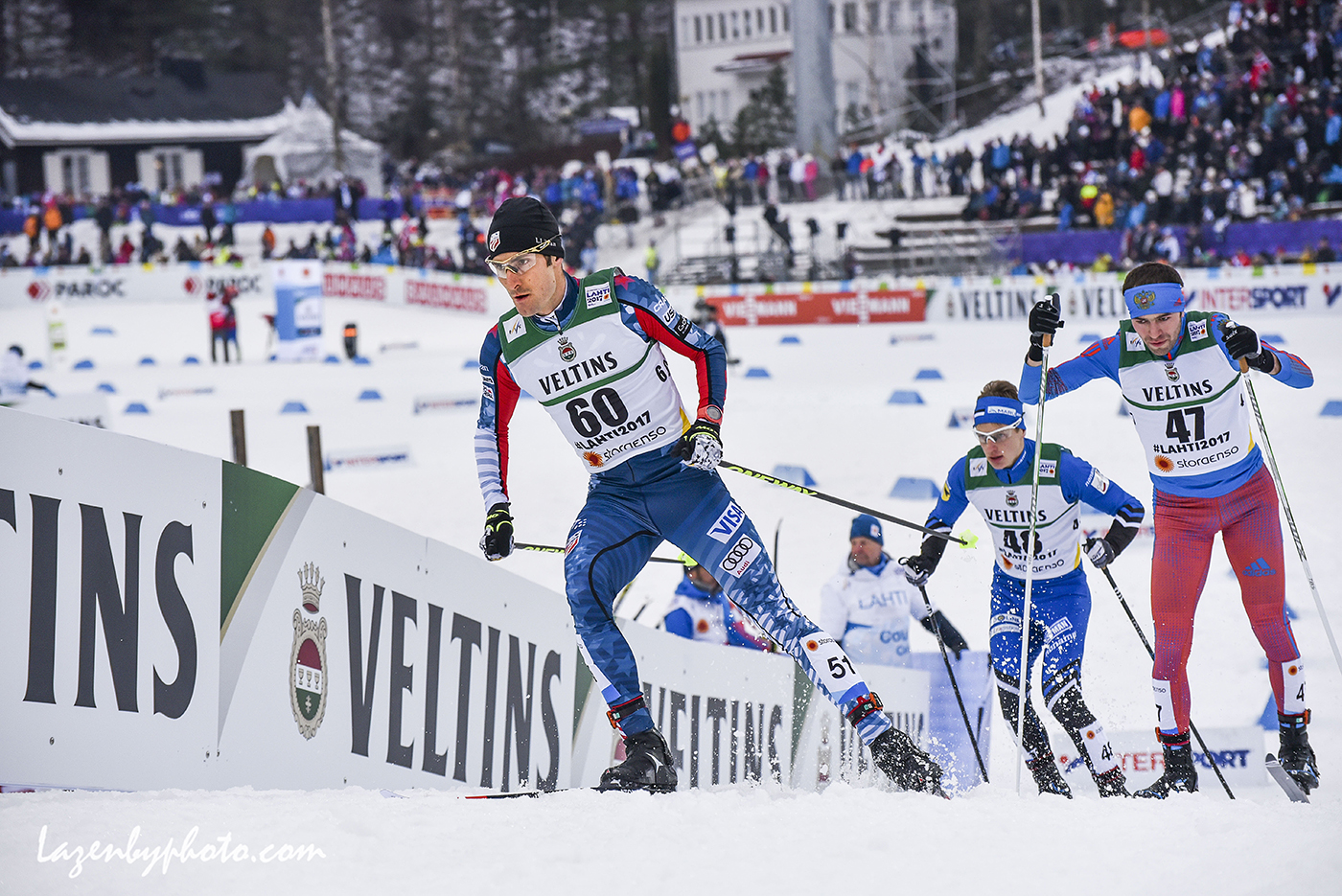
American Taylor Fletcher (60) racing to 36th last March after starting 51st in the individual large hill/10 k Gundersen race at 2017 World Championships in Lahti, Finland. (Photo: John Lazenby/Lazenbyphoto.com)
Let’s put this out there as it’s no mystery to any fan of the sport or any World Cup nordic-combined athlete: having a Fletcher chasing from behind can be a gamble if you don’t gun it. As the Olympic trials approach both Bryan and Taylor know their ski shape is good.
However, when asked to summarize his World Cup Period 1, Taylor was straight to the point.
“Pretty bad to be honest,” Taylor said. “Looking back after the summer and all the work, I was confident I could get off to a decent start in points and fight for points. I wasn’t worried about qualifications or anything but I was definitely bummed when I found myself struggling pretty badly with the jumping. But that being said, it was only one aspect. I mean everything else was good. Cross-country is obviously solid. My strength and power and speed in terms of the jumping is there, it’s just more mental — the mental approach I was taking to the jumping. I was trying to be almost be too perfect and trying to really get these good jumps in and really focus so much on certain aspects of the jump, I was forgetting about the whole bigger picture in a sense.”
In the short term, Taylor is focused on winning the lone competition at Olympic trials on Dec. 30 and improving his results in the new year.
“My goal right now is to win on the 30th, win the Olympic trials here and that way I can completely forget about a qualification spot and I can go out there and focus on my training and focus on the individual competitions,” Taylor said. “And then move forward and focus on the next step as we get towards the Olympics. Honestly, I think I am all right. … And hopefully the team can also step up and we can guarantee that we have four spots on the Olympic team so we can have a team event, hope for sure that we have four so we can represent the U.S. at the Olympics.”
Bryan, along with the entire who’s who in U.S. NoCo, will be honing for the shoe-in Olympic spot on the 30th. According to USA Nordic’s selection document, after the lone spot is secured at the trials, any remaining spots can be nominated using discretion with the potential for Olympic success as the guiding principle. In total, the U.S. is allotted a maximum of four spots for the PyeongChang Games. If discretion does not fill the quota, then the first step on the selection hierarchy are top-10 results from the World Cup between Nov. 15, 2017 and Jan. 22, 2018.
Currently, only Bryan meets that standard thanks to his seventh place in Ramsau.
“I think I have made the objective criteria to go, but nothing is set in stone until the qualification ends or Olympic trials are won,” Bryan said. “That will be the first guaranteed spot on the team; Olympic trials. There are a lot of eyeballs on that. A lot of guys on the team are going to be vying for that spot.”
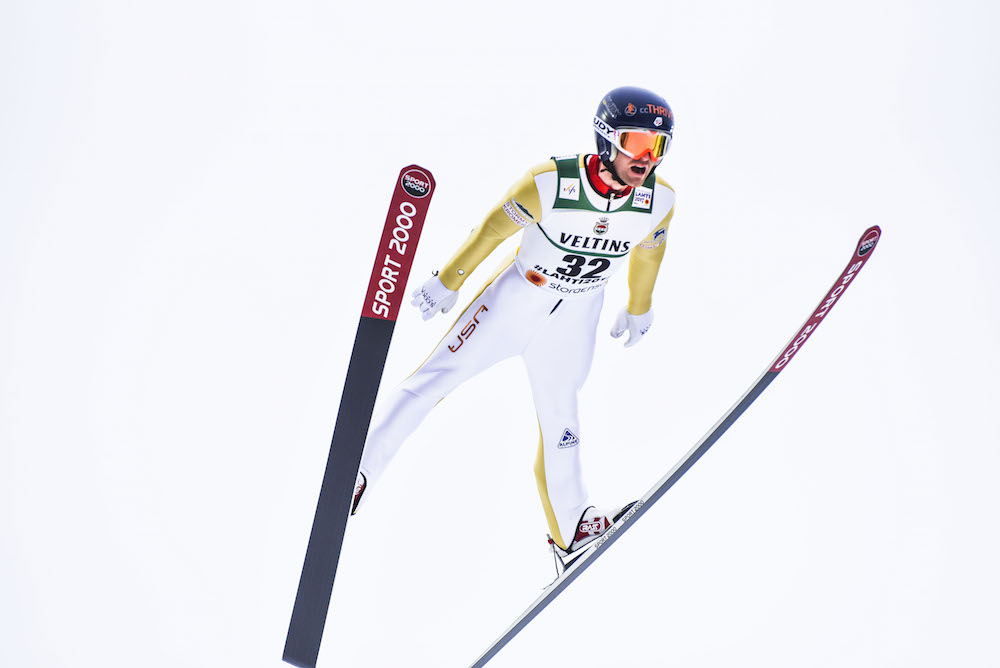
Bryan Fletcher (U.S. Nordic Combined) jumping to 31st on the large hill at 2017 Nordic Combined World Championships in Lahti, Finland. He later finished the day in 31st in the 10 k Gundersen to lead his team. (Photo: John Lazenby/Lazenbyphoto.com)
At the season-ending Nordic Combined World Cup weekend in Schonach, Germany, American Bryan Fletcher tallied his second-best result of the season: 11th in the individual large hill/10-kilometer Gundersen start on Saturday, March 18. He did so by posting one of his best jumps of the year, which interestingly tied his jumping result at his season-best World Cup in December in Lillehammer, Norway.
In Lillehammer, Fletcher jumped to 22nd with a 129-meter leap, also on the large hill, and went on to place ninth in the 10 k. On Saturday in Schonach, the 30-year-old U.S. Nordic Combined veteran jumped to 22nd with a distance of 98 meters, and skied the eighth-fastest 10 k to move up to 11th.
American Bryan Fletcher leading Japan’s Yoshito Watabe early in the men’s 10 k Gundersen start in the first nordic-combined competition of 2017 Nordic World Championships in Lahti, Finland. Fletcher went on to place 14th and Yoshito Watabe 44th. (Photo: John Lazenby/Lazenbyphoto.com)
“Jumping was starting to come around at the end of the season a bit more,” Fletcher wrote in an email on Tuesday. “It was still inconsistent but I have learned a lot about myself as a competitor this season especially in regards to my technical skills and abilities. Towards the end of the year I was able to start applying some of the things I have learned about myself to my jumping and the results were slowly starting to improve.
“Obviously the level is very high in the sport right now and so even small mistakes mean you are out of contention,” he added. “So it’s very hard to confidently make changes during the season with so much at stake. But given my rather up and down season I decided this was the season I had to start to shake up my routine to either find a new, better, or more consistent level or to simply confirm that the way I am doing things is still the be path to be on. Schonach on Saturday was only a small change but obviously had a big impact on my results.”
Fletcher started the 10 k race 53 seconds behind Japan’s Yoshito Watabe, who led after jumping. Fletcher explained the race was seven laps on a difficult 1.5 k course, which would typically play to his strengths, but he’s been struggling with his shape since World Championships three weeks ago.
“The legs and body were not responding the way I would have liked. So I was pretty unsure going into the race of how I would hold up,” he wrote. “I went out slow and tried to work into the race a bit saving energy for the last laps which almost paid off big. I was able to make contact with the lead group and be there for the winning move, but I was unable to go with the sprint. I felt like I skied a smart race and my overall performance but I would have been much happier if I could have hung on for a top 10 result.”
Germany’s Eric Frenzel, who started seventh based on his jump and started 15 seconds behind Watabe, raced to first with the 10th-fastest time. He finished in 28:14 minutes, 3.4 seconds ahead of Austria’s Wilhelm Denifl in second and 7.1 seconds ahead of his German teammate Johannes Rydzek in third. Denifl had started second, 9 seconds back, and held his position, while Rydzek improved from ninth in the jump. Watabe slipped to 17th (+1:02.5).
Fletcher, who finished 32.8 seconds out of first and 4.5 seconds out of 10th, led two Americans on Saturday, with 17-year-old Stephen Schumann placing 42nd.
The Nordic Combined World Cup podium on March 19, the last World Cup of the season, in Schonach, Germany, with Germany’s Eric Frenzel (c) in first, France’s Francois Braud (l) in second, and Japan’s Akito Watabe (r) in third. (Photo: FIS Nordic Combined/Twitter)
On Sunday in Schonach, none of the Americans completed the Day 2 large hill/10 k competition. Ben Berend jumped to 36th, but did not start the race.
Meanwhile, Frenzel completed his weekend sweep and claimed his fifth-straight Overall World Cup title with a 7.7-second win over France’s Francois Braud. Japan’s Akito Watabe rounded out the podium in third, 11.2 seconds behind Frenzel.
Overall, Frenzel ended the season with 1,734 points, Rydzek placed second in the overall standings with 1,609, and Akito Watabe completed the podium in third with 1,086.
The leader after Sunday’s jump, Germany’s Tobias Simon, did not finish the 10 k. Frenzel started the race in eighth, 57 seconds out of first, and posted the 11th-fastest ski time for his third-straight win after topping the large hill/10 k last Wednesday, March 15, at the World Cup in Trondheim, Norway. There, Fletcher led three Americans in 35th. His brother Taylor Fletcher placed 39th and Berend finished 48th.
At the previous World Cup on March 11 in Oslo, Norway, Frenzel placed second, just 0.4 seconds behind Akito Watabe in another large hill/10 k. Bryan Fletcher finished 43rd and Schumann 49th.
“This season was one of the hardest I have had,” Fletcher wrote. “I came into the season ready to go and in really good shape for both XC and jumping. I think my mistake was I was too eager to get the season underway. I had trouble maintaining that fitness and body composition and ultimately had to reset over the holidays and rebuild in order to prepare for World Championships.”
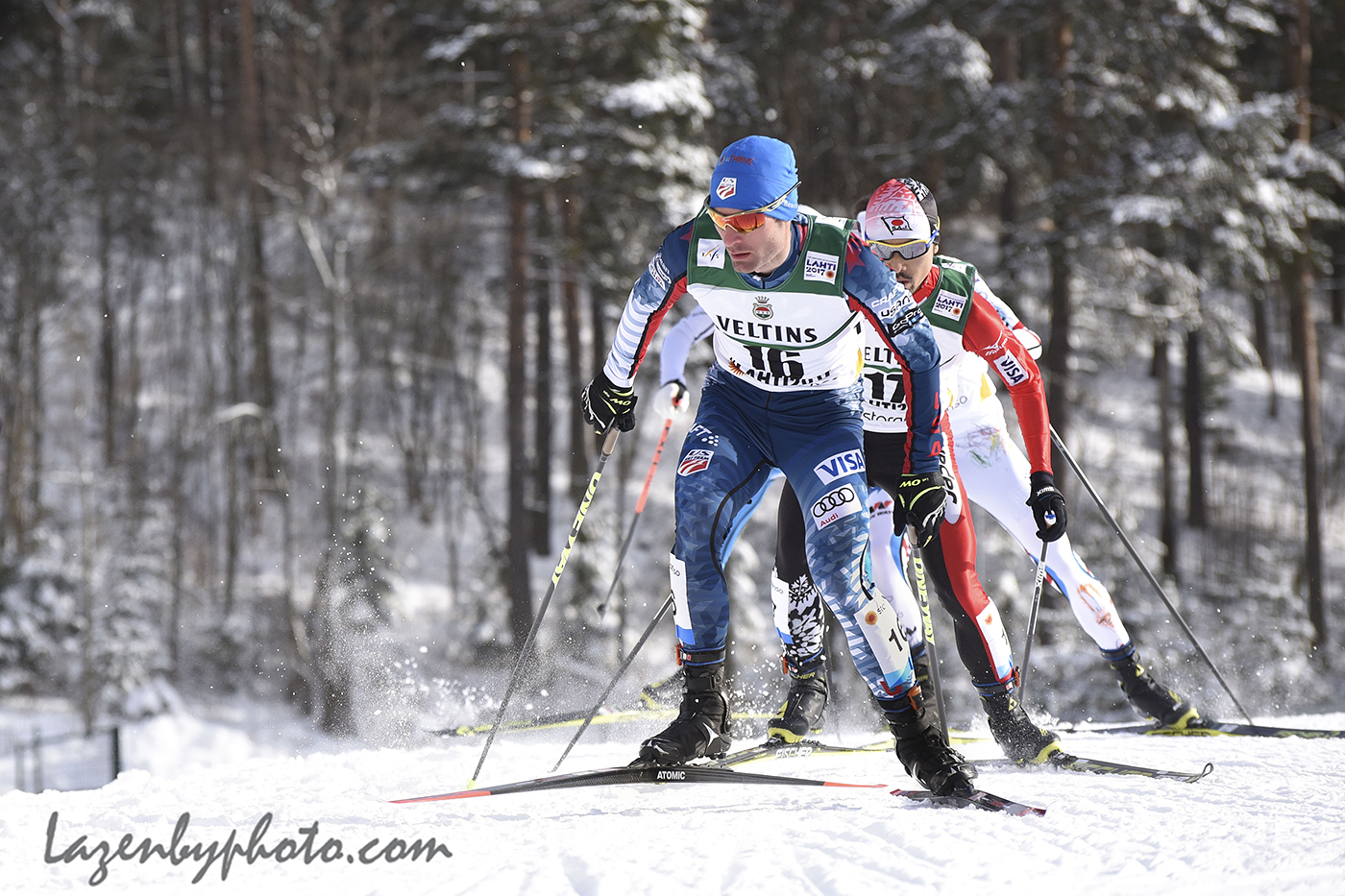
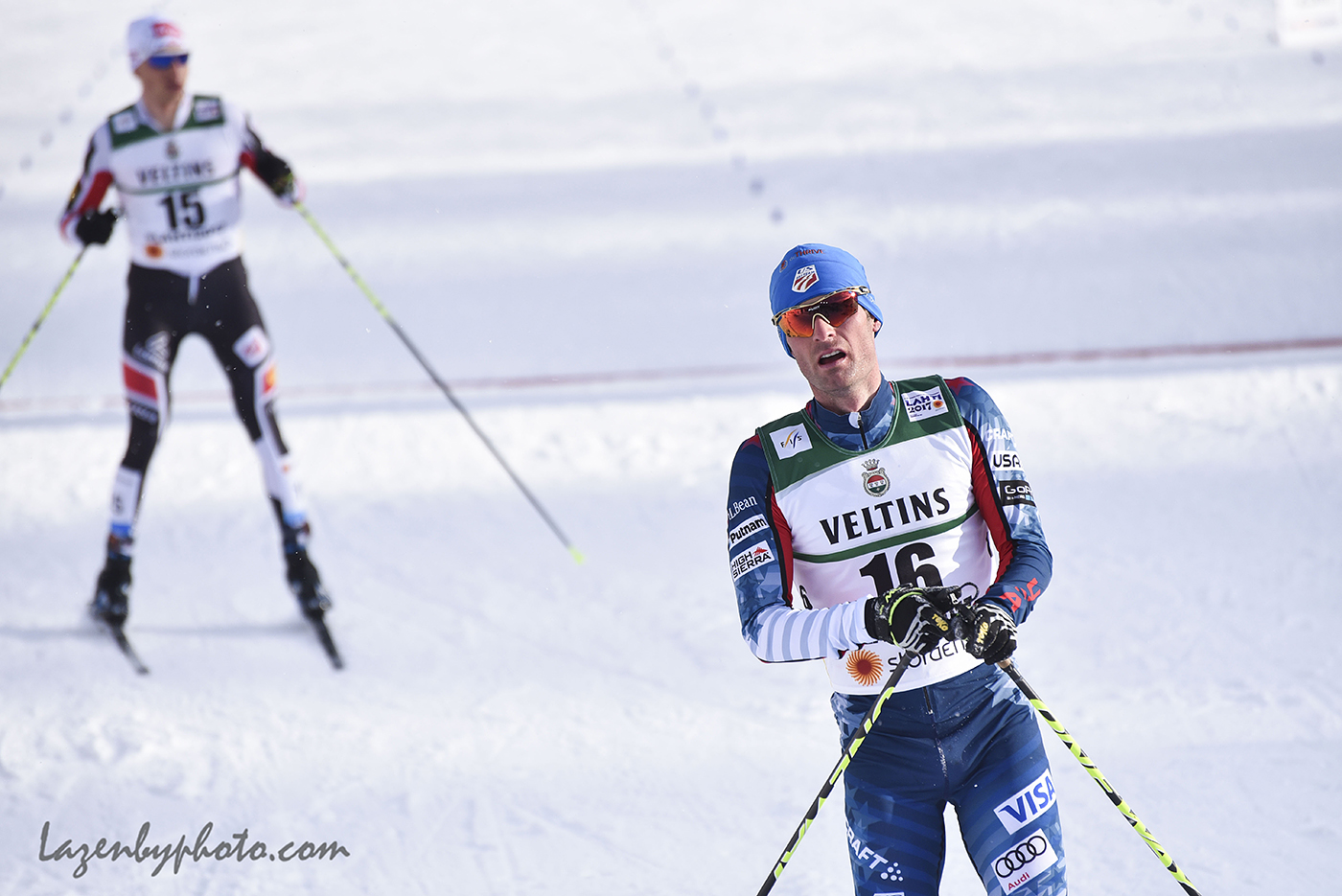
American Bryan Fletcher (16) after finishing 14th in the normal hill/10 k Gundersen start, the first nordic-combined competition of 2017 Nordic World Championships in Lahti, Finland. He had been in the hunt for a medal but crashed on the final corner coming into the stadium. Behind him, Austria’s David Pommer finished 16th. (Photo: John Lazenby/Lazenbyphoto.com)
At World Championships, Fletcher led his team in 14th in the opening individual competition: the large hill/10 k. He had been in podium contention until crashing on the last corner, about 200 hundred meters before the finish. That day, he jumped to 16th. Looking back on his season, Fletcher considered that event a season highlight.
“I wanted to be a contender in that event and I was,” he wrote. “I have replayed that race a few times in my head and I think a few different moves in the final lap and I could have been fully in the fight for the medal. Also Lillehammer was a strong race, also I was happy with my performance in Schonach on Saturday after two disappointing comps the week before.”
After being sick for a couple weeks in January and feeling like he peaked a week too early for World Championships, Fletcher, who has been competing at the World Cup level since 2009, is already thinking about next season.
“No rest for the wicked haha,” he wrote. “I have already started my training plan for next season with specific areas in both XC and Jumping that I want to improve upon. Specifically I need to improve my finish sprints and in jumping I need to improve my in run balance and position.”
“I am really motivated for next year and my body is feeling good,” he continued. “The past two seasons I planned to tone things down a bit in my training, so that I could build up a bit stronger for Pyeongchang. In the past I have always had a performance build for the 3 years prior to the olympics but have come into the Olympic season a bit flat. My goal was to disrupt that cycle to increase performance next season.”
While Fletcher was his team’s most consistent member this season, he explained that jumping overall has been a bit of a struggle amongst his teammates.
“Our team found a really high level at the end of the summer, however, a 5 week break without jumping due to weather before the season disrupted our progress,” he wrote. “Also our guys changed a lot this summer technically. It takes time to build a high level of jumping and I expect us to continue our progress on what we learned this season to improve those adaptations. I have no doubt we will be on a higher level next year.”
For now, Fletcher, a new dad, is enjoying some downtime with his wife and 7-month-old daughter Ellery.
“It does feel amazing to be home with the family!” he wrote. “… [Ellery] had been sleeping on my chest for about the last 30 minutes and to be honest it was awesome to forget about everything else and just enjoy the moment.”
Matt Gelso (SVSEF) topping the SuperTour podium for the second-straight day in West Yellowstone, Mont. Joining him on Sunday’s 15 k classic podium: CGRP’s Ben Lustgarten (l) in second and APU’s Scott Patterson (r) in third.
Welcome to The Rundown, your quick primer of need-to-know information about the day’s racing. We’ll be updating this digest as the day goes on with additional results, photos and quotes. The Rundown is NOT a race report; stay tuned for complete race reports later today with interviews from the day’s top racers.
(Note: This Rundown has been updated to include comments from U.S. Nordic Combined’s Bryan Fletcher, who placed ninth on Sunday at the World Cup in Lillehammer, Norway.)
***
U.S. SuperTour opener in West Yellowstone: 10/15 k classic
Matt Gelso made the case that he can win any discipline and format when it comes to cross-country skiing, topping the SuperTour podium for the second-straight day of the circuit’s opening weekend in West Yellowstone, Mont. Gelso, of the Sun Valley Ski Education Foundation (SVSEF) Gold Team, won the men’s 15-kilometer classic individual start in 42:57. He finished 32.2 seconds ahead of Ben Lustgarten of the Craftsbury Green Racing Project (CGRP) in second, and Scott Patterson, of Alaska Pacific University (APU), clocked in 1:16.8 back in third.
In the women’s 10 k classic, Liz Guiney (CGRP) tallied the distance victory in 33:52.8. Katharine Ogden, of the Stratton Mountain School (SMS) and U.S. Ski Team D-team, finished 7.7 seconds back in second place, while Craftsbury put two on the podium with Kaitlynn Miller in third (+28.4).
Nordic Combined World Cup in Lillehammer: Two individual comps and a relay
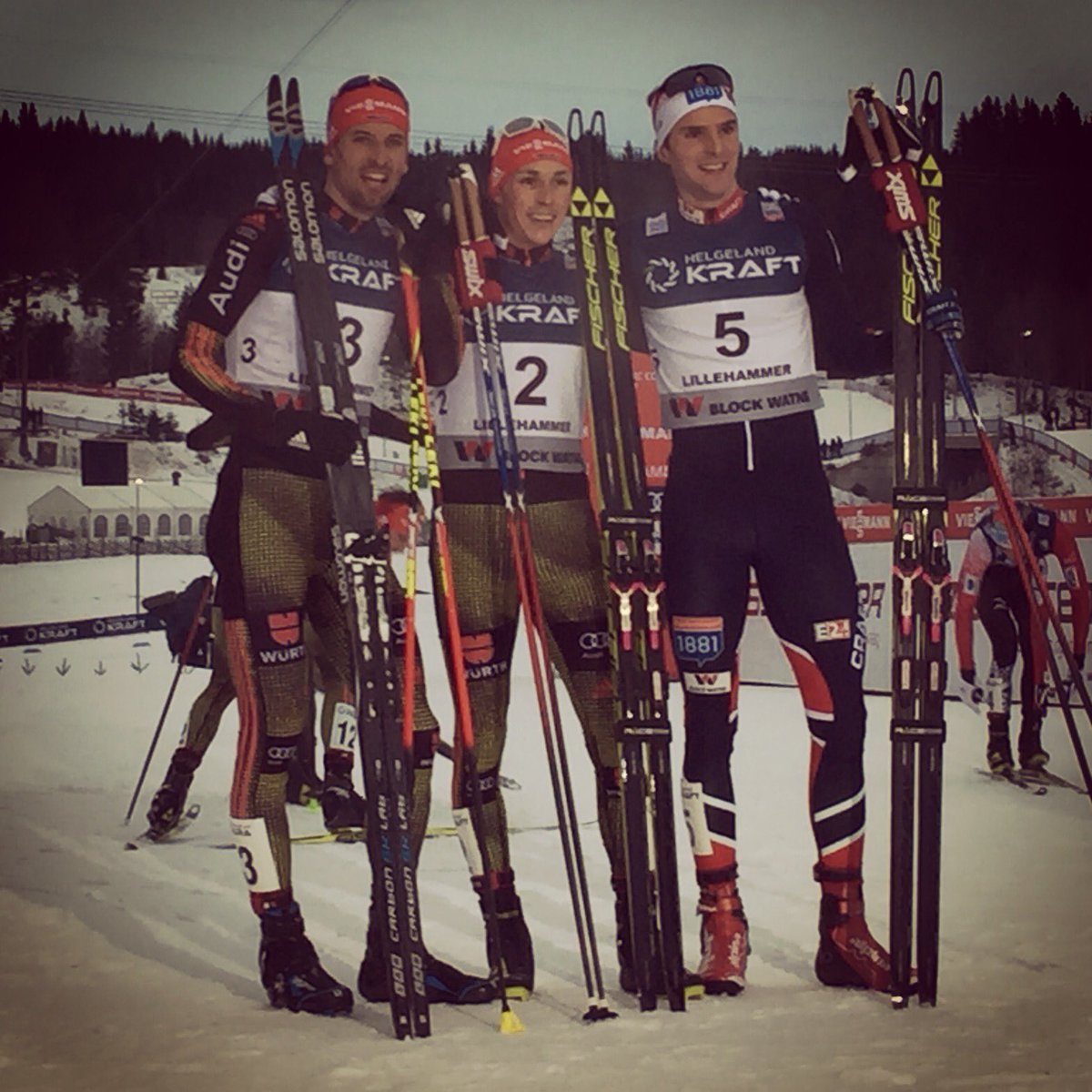
German winner Eric Frenzel (c) with teammate Björn Kircheisen (l) in second and Norway’s Jørgen Graabak (r) in third on Day 3 of the Nordic Combined World Cup in Lillehammer, Norway. (Photo: FIS Nordic Combined/Twitter)
[UPDATE) Twenty-second in the jump. Ninth at the finish. That’s a bit more like it for U.S. Nordic Combined’s Bryan Fletcher. The American jumped to 22nd on Sunday on the large hill in Lillehammer, Norway, then raced to ninth in the 10 k Gundersen start cross-country race. He finished 1:22 minutes behind race winner Eric Frenzel, who notched his second-straight individual victory and third win (including Friday’s team event) of the Nordic Combined World Cup’s long weekend in 25:13.6.
“Going into the race on Sunday I was confident that with a good race I could move up quite well,” Fletcher wrote in an email. “So I just set out to ski my own race and right from the start I was moving up. Top 10 was the goal and I was happy to accomplish that.”
Germany went 1-2 with Björn Kircheisen in second (+10.8) and Jørgen Graabak of Norway finished third (+23.4) on Day 3 in Lillehammer. Fletcher’s younger brother Taylor Fletcher placed 26th (+2:21.1), moving way up from 48th in the jump (with the fastest overall course time). Also for the U.S., Ben Berend placed 49th (+4:30), and Ben Loomis was 52nd (+5:16).
On Friday, the German teammates started off the three-day series with a victory in the first 4 x 5 k team event of the season. They teamed up with Kircheisen and Fabian Riessle for first, beating Norway by 31.5 seconds with a winning time of 49:34.9.
Norway’s squad, with Mikko Kokslien, Espen Andersen, Håvard Klemetsen, and Graabak, finished second without anyone else in sight. Austria took third (+1:23.7) with David Pommer, Mario Seidl, Wilhelm Denifl, and Phillipp Orter.
Finland placed fourth, Japan was fifth, France sixth, the Czech Republic seventh, Italy eighth, and the U.S. ninth (+4:19.1), ahead of Russia in 10th.
The order for the U.S. team was Bryan Fletcher, Berend, Loomis, and Taylor Fletcher. They rose as high as sixth during Bryan’s first leg, but dropped to eighth and finally ninth.
On Saturday, in the individual normal hill/10 k competition, Frenzel overtook Rydzek for the win in 24:35. Rydzek started the day by winning the jump, and Frenzel ranked fourth heading into the 10 k Gundersen start. Frenzel overcame a 24-second deficit at the start to pass Rydzek and beat him by 15 seconds at the finish. Germany ended up sweeping the podium with Riessle in third (+25.8), after Riessle improved from 11th at the start with the second-fastest course time.
Also on Saturday, Taylor Fletcher led the Americans in 26th (+1:51.2) after jumping to 44th and starting 2:02 minutes back from Rydzek. Fletcher skied the ninth-fastest course time.
Bryan improved from 43rd at the start to 32nd (+2:32.9), Loomis ended up 43rd (+5:02.6) and Berend 44th (+5:33.4).
“Going into this weekend I was feeling good and had some solid jumps in training so I knew that I was capable of a decent performance,” Bryan wrote on Sunday. “However, I struggle to put all the pieces together through the weekend. The team event was a good performance on my part and it was fun to ski with our young guys too. In Saturday’s event, I was close but had a rather unusual race in which I just couldn’t get going and fell off the pace quickly. Sunday however it all came together with a decent jump and race to finish 9th. This is more indicative of my true level at the moment so I was happy to finally fall into form.
“This is definitely a result that I was hoping for in this period,” he continued. “I would like to finish in the top 10 consistently this year and it was a bit of a shaky start but I am starting to find the rhythm now. I hope to continue this momentum in Ramsau.”
Lowell Bailey came oh-so-close to fourth place on Sunday. Just two fewer misses and he could’ve been in the hunt, but that’s how biathlon goes.
US Biathlon’s top man so far this season, Bailey started 13th in the IBU World Cup 12.5 k pursuit on Sunday in Östersund, Sweden, and by the first prone stage, he was up to seventh with clean shooting. Two-and-a-half kilometers later, he was back in the range and shooting without a miss again. Bailey headed out on his third loop in fourth, and more or less held that position through the third shooting — cleaning yet again in standing.
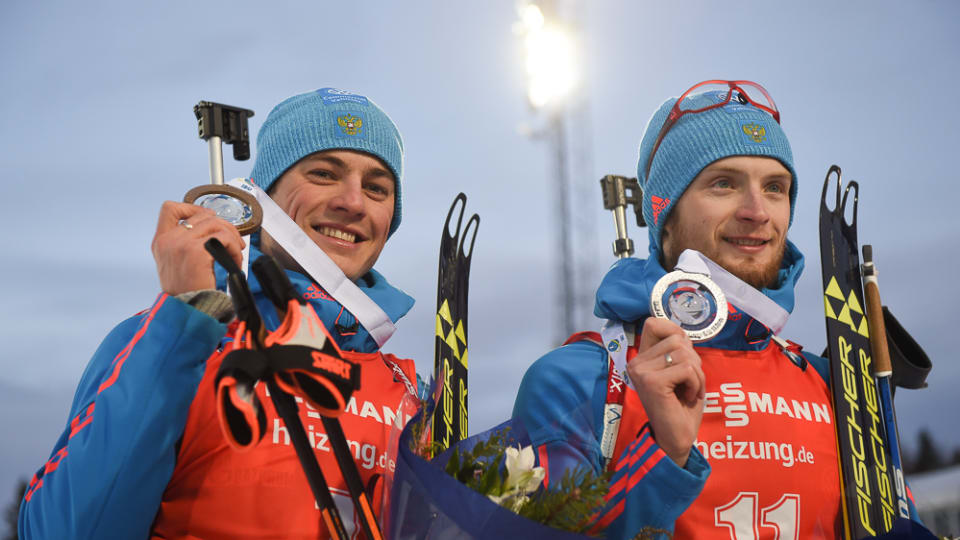
Russia went 1-2 in the men’s 15 k pursuit on Sunday at the IBU World Cup in Ostersund, Sweden, with Anton Babikov (l) winning his first World Cup and Maxim Tsvetkov (r) placing second. (Photo: IBU)
But two misses on the final standing dropped him to ninth, and on the final loop, Bailey slipped six spots to 15th at the finish. With two penalties (0+0+0+2), Bailey finished 1:21.8 behind the winner, Russia’s Anton Babikov, who hit 19-of-20 targets en route to his first World Cup victory and podium. Russia took second place as well with Maxim Tsvetkov shooting clean (0+0+0+0) and finishing 10.5 seconds behind his teammate, and France’s Martin Fourcade pushed through four penalties (2+0+0+2) to place third (+15.2).
Fourcade started the day in first, after winning Saturday’s sprint, and lost the lead on the final stage, with two misses sending him to the penalty lap. On that last shooting, Babikov (the seventh starter) took control, and Tsvetkov (who started 11th) moved up from skiing in third for most of the race to second place.
Also for the U.S., Tim Burke placed 35th (+2:39.2) after starting 29th, with four penalties (0+1+2+1).
Canada’s Scott Gow finished 47th (+3:34.8) with three misses (0+0+2+1), Brendan Green was 50th (+3:45.5) wit five misses (1+3+0+1), and Macx Davies 51st (+3:54.6) with four penalties (0+0+2+2).
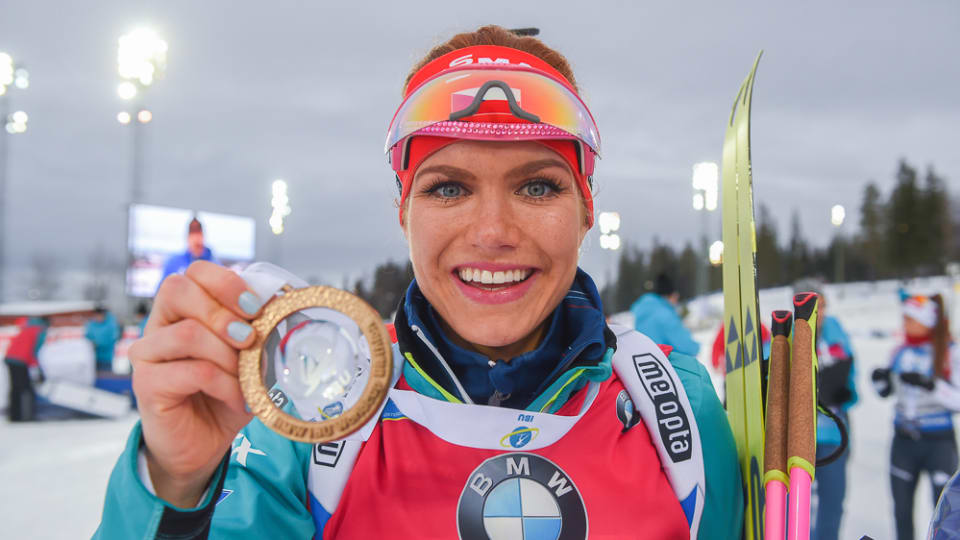
Gabriela Koukalová of the Czech Republic with her first-place prize after winning Sunday’s 10 k pursuit at the IBU World Cup in Ostersund, Sweden. (Photo: IBU)
In the women’s race, Gabriela Koukalová (formerly Soukalova, you’ll get used to it, we promise), took her third-place finish in Saturday’s sprint and catapulted herself into first on Sunday in the 10 k pursuit. Koukalova shot 19-for-20, missing just one on the first standing (0+0+1+0) to cross the finish line first, 8.4 seconds ahead of Germany’s Laura Dahlmeier.
While Koukalova, of the Czech Republic, took the win in 31:43.3, Dahlmeier placed second (after starting fourth) with two penalties (0+1+1+0). Italy’s Dorothea Wierer improved from 19th to third (+21.4) at the finish, with perfect shooting (0+0+0+0).
Switzerland’s Lena Häcki also cleaned for fourth (+36.3), after starting 12th.
The first out of the gate (the winner of Saturday’s sprint), France’s Marie Dorin Habert dropped to seventh, more than a minute and 15 seconds back, with six penalties (2+1+2+1).
American Susan Dunklee moved up to 22nd (+2:55.7) after starting 27th, despite five penalties (2+2+0+1).
Also for US Biathlon, Clare Egan improved to 30th (+3:35.4), up from 44th, with three misses (0+0+1+2).
Joanne Reid (US Biathlon) finished 47th (+4:59.6) with four misses (1+1+1+1), and Canada’s Julia Ransom finished 58th (+6:36.8) with eight misses (2+0+4+2).
Martin Johnsrud Sundby is the man to beat once again after winning the men’s 15-kilometer classic pursuit on Sunday in Lillehammer, Norway. The Norwegian started seventh and overcame a 50-second deficit to Sweden’s Calle Halfvarsson, the leader going into the final day of the mini tour. Halfvarsson dropped to fifth, while Sundby rose to first and brought another Norwegian Johannes Høsflot Klæbo to the top with him. Klæbo started sixth, 3 seconds ahead of Sundby, and placed second, 2.3 seconds behind him. Finland’s Matti Heikkinen took the final spot on the podium in third (+2.7), by 0.9 seconds over Norway’s Emil Iversen in fourth. Halfvarsson was 6.3 seconds back in fifth, his Swedish teammate Marcus Hellner sixth (+6.8), Norway’s Pål Golberg and Finn Hågen Krogh seventh (+9.9) and eighth (+15.0), respectively, and Canada’s Alex Harvey ninth (+16.2), ahead of Finland’s Iivo Niskanen in 10th (+52.0)
Canada had two in the points with Devon Kershaw rising from 43rd to 27th (+2:08.5). Len Valjas placed 48th (+3.44), Graeme Killick was 53rd (+3:53.9), Knute Johnsgaard 72nd (+6:20.3), Bob Thompson 81st (+8:16.3), Andy Shields 83rd (+9:57.3).
For the U.S., Noah Hoffman rose to 36th (+2:39.5) after starting 48th, Erik Bjornsen finished 57th (+4:33.3), and Eric Packer finished out his first overseas mini tour in 68th (+5:45.1).
Heidi Weng (c) held onto her lead to win the Lillehammer mini-tour by 16.1 seconds over Norwegian teammate Ingvild Flugstad Østberg (l). Finland’s Krista Parmakoski was third after losing a shot at second thanks to a crash. (Photo: FIS Cross Country/Twitter)
Heidi Weng of Norway started the 10 k pursuit in first place, and that’s where she finished it, 16.1 seconds ahead of teammate Ingvild Flugstad Østberg. Finland’s Krista Parmakoski rounded out the podium in third, after skiing up from a fifth place starting position and passing Østberg near the end of the race but then crashing on a downhill and losing valuable seconds. Nevertheless her effort gave Parmakoski the fastest ski time of the day.
Jessie Diggins, who started the race in third position after winning yesterday’s 5 k skate, made an early bid to ski with Østberg but ultimately lost ground, ending eighth, +1:39.4.
Instead it was Marit Bjørgen who took fourth, +57.5. Stina Nilsson of Sweden was one of the biggest movers of the day, skiing from 27th at the start all the way up to fifth, +1:26.1.
Following Diggins, Sadie Bjornsen finished 11th, +1:51.2. The American had started in a pack of skiers and stayed there for most of the race. Liz Stephen was 38th (+3:31.8), and Rosie Brennan and Caitlin Patterson 41st (+3:50.2) and 42nd (+3:56.8). Ida Sargent rounded out the U.S. results in 57th (+5:39.7).
Emily Nishikawa led the Canadians in 46th (+4:08.5), with Cendrine Browne and Dahria Beatty 52nd (+4:41.5) and 59th (+6:08.2).
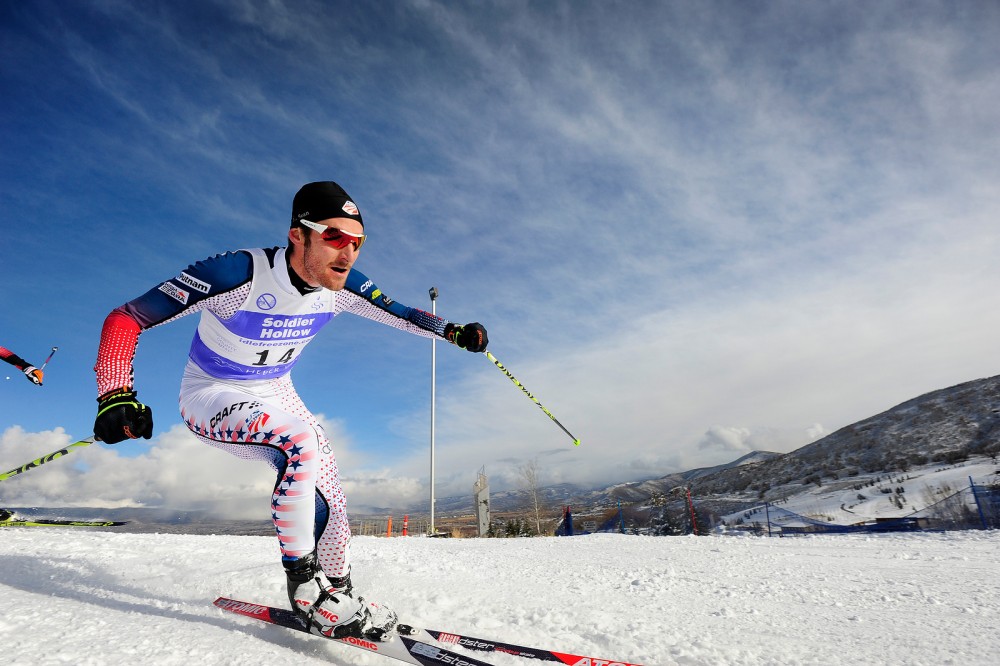
Taylor Fletcher (U.S. Nordic Combined) charges around a corner in a 10 k Nordic Combined Continental Cup cross-country race in December at Soldier Hollow in Midway, Utah. (Photo: U.S. Ski Team/Tom Kelly)
It will have been since Dec. 20, over one long month, since the last Nordic Combined World Cup event. That lack of high-end competition can take its toll on athletes and on the national organizations and regional clubs constituting the sport’s backbone of support. The U.S. Nordic Combined team is no stranger to the vagaries of where their funds are coming from and when the next high-level competition will take place.
Unlike its cross-country cousin, nordic combined is not simply snow-dependent — it’s also dependent on calmer atmospheric conditions. In other words, if it’s too windy, or the winds are too swirly, too unpredictable, the jumping can be cancelled. The first scheduled World Cup in Kuusamo, Finland, Nov. 28-29 was canceled due to dicey wind conditions. The next weekend’s races, in Lillehammer, Norway, had a modified schedule on the first day of competition because of winds: judges canceled the jumping, using the provisional jumping results from the day before, to set the cross-country ski portion’s start order.
The Ramsau World Cup in Austria got off the ground Dec. 19-20, but the cancellation trend continued after holiday break. A lack of snow led organizers to cancel the Jan. 2-3 World Cup races in Klingenthal, Germany. The following weekend’s races Jan. 16-17 in Chaux-Neuve, France, were postponed a week also due to low snow. (Currently, those races are scheduled to be held this weekend, Jan. 23-24.)
Lack of snow and periodic cancellations are something U.S. Nordic Combined Head Coach Dave Jarrett must stomach. “It’s a real tough thing because it’s not anything we can control, mother nature which is difficult,” Jarrett said in a phone interview from Park City, Utah.
Adam Loomis (U.S. Nordic Combined B-team) in a competition jump (Photo: National Nordic Foundation)
The U.S. team has taken what they can control and made the best of it. Back in December, the U.S. men entered several skiers in what amounted to a local series of Continental Cup races with jumping at Utah Olympic Park in Park City and skiing at Soldier Hollow in Midway. Their objective: earn enough points to advance more skiers to the World Cup stage.
Jarrett and the team met that goal. But it remains bittersweet.
“It also adds a little bit of a sting, we earned a wildcard in the first period, with the results at Soldier Hollow. Every race that we have had the ability to start five guys on the World Cup has been canceled so far, and we are not going to get those chances back. Even if they reschedule them later in the year, they’ll occur in a different period,” Jarrett said. “You now that was the the hard thing, because we really needed to get some new names on the points scoring list that we haven’t had before. We have two more chances though.”
If the World Cup schedule proceeds as planned, the U.S. can bring five skiers to both the Chaux-Neuve races and to the following week’s races in Seefeld, Austria.
Excited to be back in @ChauxNeuve for the @fisnc world cup! Even more pumped to see it dumping snow with cold temps! Lets hope it stays!
But getting new names on the list is something Jarret mentioned several times. And with the current period ending after the Seefeld rounds, the pressure is mounting for results; the number of U.S. start positions depends on it.
“If Adam Loomis, for example, doesn’t get some World Cup points to maintain his spot, then his points will expire, and so we will lose his spot. Bill Demong [who retired this past spring] had points from last year that are set to expire at the end of this period, and we know that he is not going to earn those points back. So we know that that spot is going to expire,” Jarrett explained.
“So right now, we need to have more different names on that list: the Adam Loomis’, the Ben Berends, the Michael Wards. They need to step up because Bill [Demong] is not around anymore, and Todd [Lodwick] is not around anymore, and Johnny [Spillane] is not around anymore. Adam did it last year, but Adam has not gotten any points this year, so he needs to do that as well. There’s a realistic chance that after Seefeld, if nobody gets enough World Cup points, we will only have the ability to start two guys on World Cup for the next weekend at Oslo.”
The Oslo race on Feb. 2 begins the new period.
Training and Maintaining
After the first post-holiday competition was canceled, Bryan and Taylor Fletcher decided to remain stateside, basing themselves in Park City. Maintaining race fitness hasn’t been as difficult, as both are cross-country racing locally.
“But there’s definitely that mental edge, that competion edge that you have once the season starts and you are going weekend into weekend, it’s competition time,” remarked Jarrett. “And it’s hard to replace. The good thing is that it’s been the same for everyone. It’s not like somebody’s injured and they are trying to come back, and there’s been competitions going on. Their hasn’t been competition. We’ve been maintaining fitness as best we can. “
The podium at the 2015 U.S. Nordic Combined Championships, which were held in Park City and Midway, Utah: with winner Bryan Fletcher (c), second-place finisher Adam Loomis (l) and Taylor Fletcher in third. (Photo: USSA/Tom Kelly)
At least for the Fletchers, Park City remains a locale with an upside.
“We are at an advantage at altitude to be here and living here,” Jarrett said. “And we can assimilate sea level. So I feel pretty good about the way that they are, but it’s more that competition mindset.”
The remaining four U.S. Nordic Combined skiers, Adam Loomis, Ben Berend, Jasper Good, and Michael Ward, have remained in Europe to train.
Although race cancellations may impact quota spots, it also impacts the bottom line for his skiers.
“If we are not there, we are not paying to be there,” Jarrett said of expenditures. “We have had to pay some airline ticket changes, and things like that, but you know if we are not there we are not collecting travel money [from FIS], at the same time we are not spending money on accommodations and things like that.”
Beyond impacting institutional finances, race cancellations also impact small wallets. “It’s also they are losing the opportunity to make prize money, which also, when you look at the big picture, they have bills to pay and things like that. Certainly, having no event and no opportunity to earn money is another big big piece of the puzzle.”
With earning potentials compromised, the team must rework how it allocates funds. That puzzle problem is compounded by the team’s insecure quota spots.
“We project revenue based on quota spots, and collecting travel money based on those quota spots. So when there is cancellation you don’t collect that money and if they. If you have a stable quota then it doesn’t matter, they make it up in the next period, but our quota is going to start fluctuating,” Jarrett said.
So quota spots, funding and potential sponsorship dollars go hand in hand. Better results corresponds to better publicity, and hopefully in the long term, a more secure financial situation for athletes. This in turn comes back to the season’s races and subsequent cancellations. Jarrett says the lack of races, the lack of opportunities, ripple throughout the U.S Nordic Combined community.
“We have a bunch of young guys that need to get established on the World Cup list. We are going to lose some spots probably before we get more again. And so, we needed to have as many opportunities to get those extra spots for the next period, and the next period, and the next year. And so when they are cancelled, it has a ripple effect throughout the system. Because if you are starting four or five on World Cup, and then all of a sudden we can only start two, then that knocks two guys down to Continental Cup, and then that knocks two younger skiers out of Continental Cup.”
Now more than ever, in addition to quota spots, the nordic-combined community must think about money. “What we are faced with now is that all the athletes, all the staff, are full-time fundraisers, and tongue and cheek, part-time athletes. Everybody knows, athlete’s included, that if there’s no funds, it doesn’t matter how much you train, if you can’t get there, you can’t get there. So those guys, the athletes, I know the staff, wake up in the morning and they think about two things: how are we going to raise more money and what are we doing for training today?”
For the next two weekends Jarrett has his fingers crossed — quota spots and more are on the line.
Bryan Fletcher (USA Nordic Combined) advanced 28 spots in Sunday’s 10 k to earn and eighth place finish in Lillehammer. The result was his best in January of this year.
Bryan Fletcher’s strategy in Sunday’s Nordic Combined World Cup 10 k was simple. After placing 36th in the Gundersen LH HS-138, he planned to sit behind strong skiers through the race in order to make his way to the lead pack.
“I knew if I could catch the lead group with some left in the tank I had as much of a chance as anybody,” he wrote in an email.
However, the race didn’t go according to plan for the 28-year-old from Steamboat Springs, Colo.
Instead of drafting his competitors and conserving energy for the final sprint, Fletcher was caught doing the majority of the pulling. Starting in 36th Fletcher exerted much needed energy to maneuver the often-congested trails.
“The race didn’t play out exactly like I wanted it, I actually led my group quite a bit though the race,” he wrote.
Despite the toll of winding thorough his competitors without much rest, Fletcher eventually made it to the lead pack with energy to spare. As the group approached the finish, he held back, waiting for the right time to strike.
In the end, Fletcher made his move too late and the skiers who eventually won spots on the podium slipped out of his reach.
“I tried to be patient and hang back until the sprint, however the move went a little earlier then I anticipated and I was unable to get around some of the other skiers. It was a tight finish and ultimately that little separation is what decided the podium,” Fletcher wrote.
Despite what could have been, Fletcher ended his day in eighth, just six seconds behind winner Mikko Kokslien of Norway who finished with a time of 25:49.8. He clocked the second fastest time on the day after advancing 28 spots. His time of 24:19.8 was second only to Kokslien, who raced the 10 k in 24:11.8 after jumping to 38th position.
The result was Fletcher’s best individual performance on the World Cup circuit since he finished fifth in a Seefeld, Austria World Cup in January of this year. His placement also demonstrates a continued improvement in the cross country portion of nordic combined. In previous years it was Fletcher’s brother, Taylor, who often had the the fastest cross country times while Fletcher excelled at jumping. Taylor did not compete in Sunday’s race.
While the race didn’t play out the way he planned, the result shows what Fletcher is capable on the World Cup circuit this season. He wrote that his eighth-place finish was a confidence boost as he looks toward the rest of the season.
“The components for good results are there both in the XC and on the jump hill. I just have not been able to perform at my normal ability in competition. Early season training was good and promising and I am confident that form will come again as the season presses on,” he wrote.
Adam Loomis, the only other American to compete in Lillehammer, finished the day in 35th – a career best – after jumping to 46th and racing the 11th fastest time on the 10 k course.
After Sunday’s race, Fletcher traveled back to the U.S. to rest and spend time with family before he returns to competition in Ramsau, Austria Dec. 20.
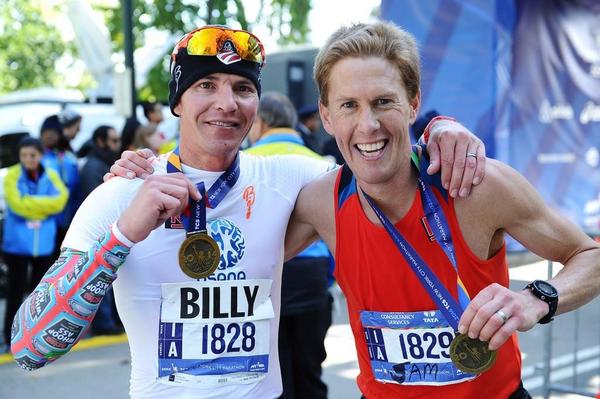
Billy Demong (US Nordic Combined) and friend Sam Krieg (r) pose after finishing the 2014 NYC Marathon. Demong placed 51st with a time of 2:33:05. (Photo: Drea Braxmeier, NYRR)
Nordic-combined Olympic gold medalist Billy Demong ran like a champion in the 2014 New York City Marathon. Despite having never raced a road marathon until Sunday, the 34 year old ran the 26.2-mile road race in 2:33:05 and placed 51st overall.
What set Demong apart from the estimated field of 50,000 was his ability to adapt to the challenging conditions. With wind gusts reaching 50 miles per hour and chilly temperatures, Demong said that the race felt more like a nordic competition than a marathon.
“It was way more of a cross-country race than a normal marathon because of the weather and the terrain,” he said on the phone Monday. “There were a lot of sharp corners and not-so-good pavement in places.”
Hoping to run the race in 2:36:00, Demong was surprised that he surpassed his goal by three minutes on a challenging course in trying conditions.
From the beggining of the race he ran with a pack of “sub-elite” racers that included many Scandinavians. However, the group set a blazing pace that Demong knew he wouldn’t be able to maintain while running through the five boroughs of the city.
Demong and several other runners eventually broke off the back of the group, but were still running mile speeds that were 20 seconds faster than he wanted.
“At that point I was like, ‘Well let’s just see. My legs feel all right. I’ll just keep going,’ ” he recalled.
Even with the rapid pace at the beginning, Demong said that he was able to maintain his energy throughout the race and have a strong finish.
“I didn’t ever feel like I fell apart. I really pushed it to the line,” he said. “I’m ecstatic given the conditions and the course. It was really far outside of what my training put me at. My training put me at that pace on a perfect flat day with no wind in Chicago, not in New York on the hardest day.”
Demong, who was the 15th American male to cross the line, explained that he wanted to compete in a marathon for over ten years — dating back to his last competitive endurance running race in 2002. He had originally registered for the Oct. 12 Chicago Marathon, but due to a conflict with his team’s overseas training camp in Switzerland, Demong decided to run the New York City Marathon instead.
It was a decision he didn’t regret.
“I was astounded at how awesome it was,” he said. “It was a two-and-a-half hour adrenaline rush .”
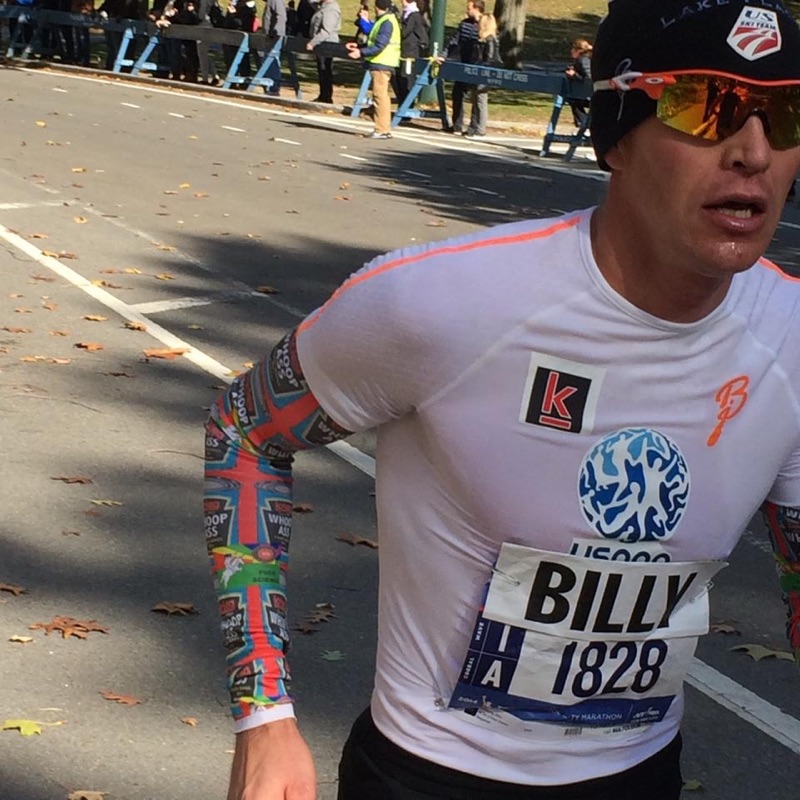
Billy Demong (US Nordic Combined) running in the NYC Marathon Sunday. (Photo: Andrew Quinn)
Demong may be in top running shape, but the 2010 Olympic gold medalist said he’s less prepared for the upcoming ski season than in years past. He explained that while his jumping is on-par, he is skiing roughly a minute slower on average than he did in previous years.
After the Olympic games in Sochi, Demong was unsure whether or not he was ready for another season of competition.
However, the nordic-combined veteran eventually decided to compete in the 2014/2015 season after the national team began to face its financial problems.
One of Demong’s main goals for the year is to regain his paid spot on the World Cup so that the U.S. team will have future opportunities to send skiers to nordic combined’s highest level of racing.
Once that goal is accomplished, Demong hopes that he will be skiing well enough to help the U.S. be competetive in the team relay at the 2015 World Championships in Falun, Sweden.
“We’ve had some guys who have really stepped up this summer, and we have a good team on that squad,” he said. “Hopefully I can be good enough to add to that dynamic and put us back in medal contention at World Championships.”
U.S. Nordic Combined will begin international competition Nov. 29 and 30 at the opening weekend of the FIS Nordic Combined World Cup. Demong, however, will not attend the races in Kuusamo, Finland. Instead, he will start his World Cup season in January, when he believes that he’ll have overcome any training deficiencies.
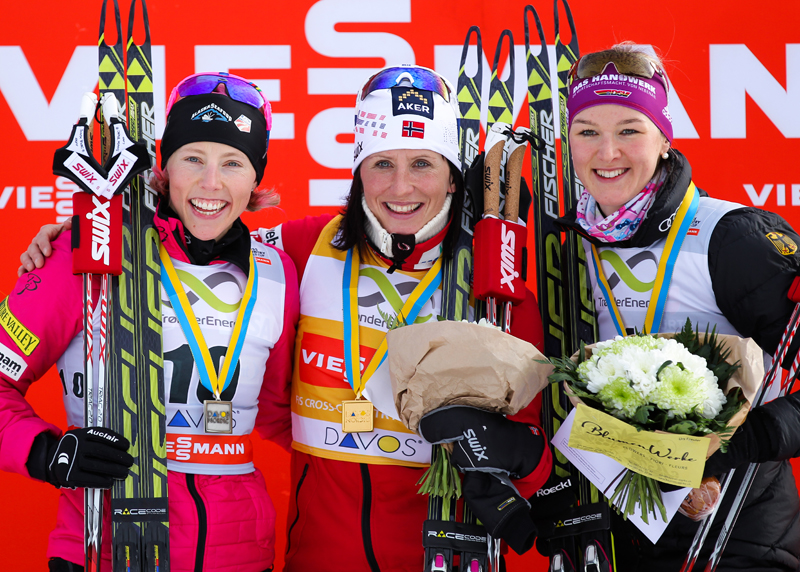
The women’s podium at Sunday’s World Cup skate sprint in Davos, Switzerland: (from l to r) Kikkan Randall (USST) in second, Marit Bjørgen (NOR) in first, and Denise Herrmann (GER) in third. (Photo: Fischer/Nordic Focus)
From the cross-country World Cup in Davos, Switzerland, to U.S. Nordic Combined’s best team-sprint result in Ramsau, Austria, to five straight days of biathlon races in Annecy, France: here’s everything you didn’t get to read about over the weekend in simple thumbs-up-thumbs-down fashion. And if you missed the recaps, check out our digest.
Likes:
Skiing fast:
“Skiing super fast [feels] awesome. This is definitely the strongest I’ve skied in a little while and definitely very appreciative of it. It’s a great feeling to be able to move up through the ranks like that and just builds to your confidence.” – Bryan Fletcher (U.S. Nordic Combined), on placing fourth with Todd Lodwick in Saturday’s World Cup 2 x 7.5 k team sprint in Ramsau, Austria
“The energy was good, and our skis were so fast. We were working hard on pushing over the top of the hills because if you just add one more skate, you’re flying down the hill.” – Jessie Diggins, 12th in Sunday’s World Cup skate sprint in Davos, Switzerland
“I tried to go out really hard right from the start and just hold on. It worked out well for me and I ended up feeling better today than in any of my previous races this season. I ended with the 3rd fastest ski time, so I am very happy with the direction my skiing is headed.” – Tim Burke (US Biathlon), 16th in Sunday’s IBU World Cup 12.5 k pursuit in Annecy, France
Qualifying for the 2014 Sochi Olympics:
In an email, Megan Heinicke explained that, in placing fourth with Canada’s relay at the IBU World Cup last Thursday, she completed her Olympic qualification (with teammates Megan Imrie, Rosanna Crawford and Zina Kocher):
“I am incredibly relieved to have that finalized and just so happy to have Sochi in my plans. This girls on this relay team will be our Olympic team and I think this result gives us a lot of confidence and motivation, which is awesome!” – Heinicke (Biathlon Canada)
Fourth place:
“I knew it was likely to be painful so I was mentally prepared for a hard fight and as motivated as ever to give it my all. The result altogether was amazing…I couldn’t stop smiling. We saw that we had this kind of potential in our relay last weekend and we all knew that a relay without penalty loops would be enough to fight for a top 6 finish. I am so proud of all of us! I think the coolest thing for our relay is that this wasn’t a miracle race – it was just 4 good to normal races which means that this is a result we can realistically repeat and even improve on.” – Heinicke
“I could have played my cards a little bit different to give us another chance to be up there on the podium, but nevertheless fourth place is awesome and we had the fastest time out there.” – Todd Lodwick (U.S. Nordic Combined), on Saturday’s team sprint
Team sprints:
“Nordic combined was actually the one who invented the team sprint. It actually began in 1993, and then it kind of went away from the program in the ’90s until it came back in 2011. I think they brought it back as a World Cup event after cross-country took it on and did it as an event and showed it’s a good spectator event.” – U.S. Nordic Combined Head Coach Dave Jarrett
“It’s a strength, and [it was] a medal event in the World Championships last year. It was the first time it was a medal event, but it won’t be a medal event in the Olympics. We tend to rally around each other when it comes to team events and certainly Todd and Bryan were clearly in a good place and they did a good job.” – Jarrett
Women’s 15 k races:
The women’s 15 k individual race on Saturday in Davos, Switzerland, was only the second one on the World Cup in the last 10 years, with the other in Davos two years ago. What gives? Bring on the distance!
Note: Bjørgen won that race, too, but Norway swept the 2011 edition’s top four. On Saturday, they took three of the top four, with Sweden’s Charlotte Kalla placing third.
Davos
“Davos is really nice and the cheering was great. There were lots of fans out there with big bells which is fun.” – Ida Sargent (US Ski Team), 41st in Sunday’s Davos World Cup sprint
Personal bests
“[Sunday] was the second best qualifying result I have ever had in a WC sprint, classic or skate, in terms of both FIS points and total time back from the leaders but it was just super tight today. There are just a lot of fast women out there.” – Sargent
Note: The top 30 women were separated by 3.6 seconds in Sunday’s 1.5 k freestyle sprint qualifier. The men’s top 30 on the same course was separated by nearly six seconds.
Teammates tearing it up:
“It was awesome to watch the heats in the sun and see all of those girls ski so well. Kikkan is obviously so strong and Jess and Soph skied awesome quarterfinals. It was fun to see.” – Sargent, on Sunday’s World Cup skate sprint
“I was really hoping we’d actually see a couple of Americans in the final, and it was close. So it was really cool to see those girls just coming on and coming on, and it’s really fun to have a team component. I think everyone should be pretty psyched.” – Kikkan Randall (US Ski Team), second in sprint
Last Thursday, the U.S. women tied a team-best eighth in the IBU World Cup relay:
“Getting 8th again shows that our result last week wasn’t a fluke – 8th can be our new norm, and in the next relay we can do even better! I think that we had a really really good year of training this year, and the fact that we mostly had poor results in the first few races doesn’t mean anything. We’re just starting to hit our stride, and I think that we will all continue on an upward trajectory into the second trimester of the season.” – Hannah Dreissigacker (US Biathlon)
Feeling young:
“I still feel like I am in my youth in the way I’m skiing and competing. I have so much fun doing it. It’s a blast. I love the sport and [Saturday’s team sprint] was just a culmination of really, really good teamwork. ” – Lodwick, 37
Fast skis:
“The wax techs did an awesome job … providing us with really, really fast skis. They did a heck of a job and allowed us to ski our own race.” – Lodwick
Perfect conditions:
“The range conditions were excellent. There was almost no wind. It was totally calm with stable light. I would say it was perfect.” – Heinicke, 50th in Saturday’s 7.5 k sprint
Annecy’s course:
“The course here is really fun and it suits me well. Shooting has also been quite easy here.” – Annelies Cook (US Biathlon), after anchoring U.S. women’s relay to team-best eighth
Dislikes:
Missing a relay:
With just three guys on the IBU World Cup, the Canadians had to sit out the men’s relay on Friday in Annecy, France:
“Unfortunately we didn’t start enough WC’s last year and subsequently didn’t rank high enough in Nation Cup points to have 4 start spots this WC season. There are selection trials next week in Canmore, Dec 20-21 and they will be used to selected the final Men’s Olympic spot and the next IBU Cup tour which will see those athletes compete in Oberhof and then continue onto the IBU Cup. Anyone who is not qualified is at home getting ready for those races.” – Scott Perras (Biathlon Canada)
“Having not raced the relay is kind of bitter sweet. Sure it’s great to get a whole week to rest up (mentally) but I think things would have gone better had I raced [Friday]… I guess it is also a plus to have rested a week physically, but maybe not so great to maintain that race shape and speed.” – JP Le Guellec (Biathlon Canada), 49th in Saturday’s IBU World Cup 10 k sprint
Davos sprint course
“I don’t really like this course just because I’m not a huge fan of two lap courses. I’ve never figured out how to pace them and I don’t think I have ever qualified in a two lap skate sprint.” – Sargent
Annecy’s course:
“Flat courses with bumps like here or Antholz [Italy] give me grief with my back. I think it’s all the one skate followed by tucking and opening again for more one skate that takes its toll. So I could feel my back being pretty tight in standing, which definitely is an issue.” – Le Guellec, on Saturday’s sprint
The unavoidable
“… Little things like hitting a patch of ice on the final corner and almost going down and then skiing a horrible transition into the hill on one the laps really adds up.” — Sargent
DQs:
“I’ve taken a very hard look at my suits and measured myself neck to ankles in 5 cm increments as well as spent a good deal of time sewing and trying to understand how it all comes together. As far as the bib fiasco part II well? Sh*t happens;)” – Billy Demong (U.S. Nordic Combined), ninth in Sunday’s individual competition, a week after being disqualified for forgetting his bib in Lillehammer, Norway
Billy Demong leading the chase group in the 10 k Gundersen competition in the Nordic Combined World Cup on Sunday in Val di Fiemme, Italy. Photo: Fiemme2013
When Friday didn’t go according to plan for all of the Americans on the Nordic Combined World Cup, they were happy to have Saturday to shoot for better results.
When the team sprint went better on the second day of competition in Val di Fiemme, Italy, with the two U.S. teams cracking the top 10, the four members were even more excited for Sunday. If trial and error told them anything, they figured they’d have foul-proof tactics for Sunday’s 10 k Gundersen start.
First, they concentrated on the jumping hill. Led by Bryan Fletcher in ninth, the crew posted a solid set of results with Billy Demong and Johnny Spillane ranking a respective 17th and 18th in the jumps and Taylor Fletcher jumping the 33rd best out of more than 50 athletes.
Relying on racing skills they had refined throughout the season, all four Americans went on to make the top 20. Demong skied the fastest 10 k of the day for third overall – his best World Cup result in two years. His previous best was a victory in Val di Fiemme in January 2010. He went on to win Olympic gold that year.
Bryan Fletcher tied a career best of seventh in the World Cup on Sunday with the 18th fastest time. His brother, Taylor, demolished his previous personal best of placing just outside the top 20, notching 14th overall. He skied the fifth fastest on the day, and Spillane was 19th despite recovering from a stomach bug.
Japan's Akito Watabe celebrates as he wins the Nordic Combined World Cup competition in Val di Fiemme, Italy, on Sunday. Billy Demong (USA) at right and Mikko Kokslien (NOR) at left battle for second. (Photo: Fiemme2013)
Japan’s Akito Watabe won Sunday overall in 28:27.8, setting a fast pace early on that Demong and Mikko Kokslien of Norway, who started 17th and 14th, respectively, did not try to reckon with. Instead, the two joined forces near the start, and skied into the race.
“Him and I like to ski a pretty similar race,” Demong said. “When we’re both skiing well, it’s controlled to start and just gets harder and harder throughout the race. [We] don’t go out crazy, just ski negative splits.”
Kokslien, who was part of the winning team sprint on Saturday, went on to outsprint Demong for second place, edging him by 0.9 seconds. Kokslien finished 3.0 seconds behind Watabe, and Demong said they were both surprised to see him in the stadium at the end.
“Honestly [Watabe] was so far in front of us at 5 k that we kind of just mentally let him go,” Demong said. “He had a minute and 20 seconds on us at one point so we were like, whatever, he’s gone.”
Demong said that was a smart strategy on his part. He was also impressed with his own tactics.
“I started off this weekend a little anxious and went out Friday and blew up,” Demong said of finishing 18th in the penalty race. “[I] went out hard, pulled away from the mass start [and] about 500 meters into the race, gapped off the field. Basically by 2 k was about ready to go back to the hotel.”
Although worn out from Friday’s race, he was more patient Saturday and helped secure sixth in the team sprint with Bryan Fletcher. On Sunday, Demong said he was recovered and ready to go, but wanted to again be patient. Skiing relaxed and controlled, he found himself in the hunt for a podium on the last lap.
“I started pulling away from the group without even knowing it,” Demong said. “Then [I] kind of had that confidence that, ‘All right, all I’ve got to do is go hard from here on out and not kill it,’ and we were left to fight it out, just Mikko and I.”
Bryan Fletcher hung with a group of 10 for most of the race and aimed to conserve energy for the end. With about 1 ½ kilometers to go, Bryan said six or seven remained in the chase for fourth place.
“It was definitely a challenging race and sitting in and not doing any work was a huge advantage for me in the end,” Bryan said. “I had a little bit fresher legs and more energy when the pace picked up .”
Taylor said he started near Austrian Mario Stecher, who helped him set a strong pace. The two skied together, and Taylor edged him for 14th by half a second.
“I felt awesome,” Taylor said. “I started dropping the guys behind me and catching more people. That’s a big energy boost so I just kept it going.”
U.S. head coach Dave Jarrett wrote in an email that the team was “psyched” with its collective performance to wrap up long weekend. “We want to keep the momentum rolling.”
“I’m pretty excited with our results this weekend,” Bryan said. “We had some chances and we didn’t take advantage of all of them but it’s there and the momentum’s going in the right direction.”
“To get a podium is great, but I think it’s even better to have the depth of the team,” said Demong, who added that he and Taylor Fletcher have a cumulative time bet for the season.
Going into Sunday’s race, Taylor was 5.5 seconds ahead of Demong, it terms of net time for all the World Cup races. Demong said he beat him by 10.3 seconds, putting him 4.8 seconds ahead.
“So we’re neck and neck,” Demong said. “And we’ve got six races left.”
On Monday, the team planned to fly back to the U.S. to train for two weeks before returning to the World Cup in Klingenthal, Germany, on Feb. 18. They opted to skip next weekend’s races in Kazakhstan.
Olympic gold medalist Billy Demong at the 2010 Vancouver Games
In some ways, starting off average works well for Billy Demong.
It’s not that he would prefer to rank 21st out of 54 athletes, although for some nordic combined athletes, that would be a good jump in the World Cup.
For Demong, a four-time Olympian and gold medalist, that result meant he was about 20 spots away from where he wanted to be.
On Sunday, the 31-year-old attacked the afternoon 10 k Gundersen start as he would have liked to on the 118-meter large hill in Chaux-Neuve, France. It was Demong’s last day of World Cup competition for nearly three weeks, and he went for it.
At the same time, so did his U.S. teammate Johnny Spillane, who ranked 20th in the morning jump. Working together, they captured their best results of the season as Demong finished sixth and Spillane placed eighth.
Starting 1 second in front of Demong, Spillane charged ahead to chase down his competition, and Demong followed. For most of the four laps, Demong and Spillane worked with Norway’s Mikko Kokslien to move to the front and drop those behind them, Demong wrote in an email.
They successfully caught second on the third lap, with only the weekend’s two-time defending champion, Alessandro Pittin (ITA), ahead. Demong held his position at the front of the chase group and attempted to drop his contenders on the last hill. In the end, he found he was too tired to sprint at the finish and fight for a podium spot.
While sixth wasn’t first, second or third, Demong was satisfied with his progress.
“I’m feeling good overall, building again,” Demong wrote. “My goals for this season are basically to get back on the podium and win. I’m also still satisfied to be struggling a bit as it fields my motivation to train harder.”
By struggling, Demong and Spillane and the rest of the U.S. crew generally mean their jumping. On Sunday, Demong clocked the third-fastest 10 k time (21:34.6) and Spillane had the fifth-fastest split (21:42.6).
Kokslien was the fastest of the day (21:30.6), and after starting 24th, the Norwegian placed third. Pittin picked up his third-straight victory of the weekend in 22:18.1 after becoming the first Italian to top the World Cup podium on Friday. Joergen Graabak (NOR) was second overall.
“They key to today’s race was jumping,” Pittin told EuroSport Italia on Sunday. “There, I made a difference.”
If Demong, Spillane or any of the other Americans had ranked fourth after the jumps, like Pittin, it’s likely they could have ended up in even better positions.
“The level both on the hill and on the course is really high,” U.S. Nordic Combined Head Coach Dave Jarrett said. “In order to win you have to very good at both sides in every comp. Not very much room for mistakes.”
American Bryan Fletcher placed 26th after ranking 28th in the jump. His brother, Taylor, finished 39th after starting 51st and Nick Hendrickson moved one spot down from 50th in jumping to 49th overall.
On the road almost as soon as the three-day competition ended, Jarrett said his athletes would fly home to train in Park City, Utah, and Steamboat Springs, Colo., for at least a week. The team will reunite in early February when the World Cup starts up again with a penalty race, team sprint and Gundersen start in Predazzo, Italy.
A look at the 142-meter large hill and nordic-combined course in Kuusamo, Finland, on Saturday. Photo courtesy of Dave Jarrett.
Don’t call the Americans ungrateful. They were happy to be on snow in Kuusamo, Finland, competing for the first time, jumping when they could.
But they’re happy to be moving on to Lillehammer, Norway, for the second weekend of the nordic-combined World Cup. The first one was challenging enough.
After U.S. veteran Johnny Spillane was eliminated from the competition before it started, missing out a qualifying jump on Friday, the team suffered another blow Saturday morning. Windy conditions made the 142-meter hill — the largest on the circuit — off-limits.
There would be no jumping on the second day of competition. The provisional jumps taken Friday would count.
Competition officials decided it was too windy to jump in Kuusamo, Finland, on Saturday. Provisional jumps from Friday were used to determine the nordic-combined 10 k start. Photo courtesy of Dave Jarrett.
Billy Demong said he heard the official decision around 8:30 a.m. Saturday. The jumps, originally scheduled to start at 9:30 a.m., were canceled and the remaining 10-k race was pushed back until later that afternoon.
That gave Demong and his two teammates, Bryan and Taylor Fletcher, time to prepare. While a nordic-combined skier wears many hats, Demong said the change allowed them to focus on one element of competition. After Demong ranked 30th in the provisional jump and Bryan was 25th, they needed all the strength they could muster to work their way to the top.
The preparation worked, as Demong worked his way to 19th with the 11th-fastest ski and Bryan finished 20th with the 12th-fastest time.
Taylor Fletcher narrowly missed scoring World Cup points in 33rd after ranking 42nd in the provisional jump. Despite starting that far back of 50 competitors, he was the ninth-fastest skier on Saturday.
“All the guys had a solid race,” U.S. head coach Dave Jarrett wrote in an email to FasterSkier. “The weather today was nasty and they made the right call not to jump today. However the conditions yesterday were also challenging but that is the way it goes sometimes.”
Demong had a feeling the decision was coming. Once they knew they wouldn’t be jumping Saturday, he said they were able to open up their day to other important activities.
“Obviously with the elimination of the jump we had time to be normal guys … and eat a leisurely lunch,” Demong wrote in an email. “Then as Cross Country guy takes over it’s time for feet up watching the cross country races on TV, hydrating and eating a bit until the last minute and then doing the real work.
“Bottom line,” he added. “I got to focus on being cross country Bill today!”
The channeled energy allowed Demong to test his limits and fitness.
“I was having a really hard time catching and staying with Bryan,” he wrote. “It was only because it was my teammate that I was able to keep clawing forward as he caught and passed people. My biggest hope was that he would not ask me to lead because I was dying.”
For Bryan, who started too fast in Friday’s race and ended up 34th in the ski, Saturday was about being smart.
“In the big picture my goal today was to ski slow to fast,” he wrote in an email. “Just ski faster than yesterday.”
Feeling better in his legs than Friday, Bryan was able to stick with Demong and produce negative splits. Demong finished the 10 k in 26:44.5 and ended up 2:38.2 behind the winner, Tino Edelmann of Germany. Bryan clocked the next-fastest time of 26:57 (+2:40.7).
While both said they were finding their groove in both the races and on the hill, they understood that it was early in the season.
“Kuusamo is a really tough place to start for Nordic Combined,” Demong wrote. “Big climbs on challenging courses make for some really hard races. The ski jump is the biggest hill we jump all year, now add the wind AND make it first … as in nobody has jumped a big hill on snow yet this season, we all roll the dice.”
Taylor wrote in an email that it could be worse: it was -20 degrees Celsius there last year, and this year, it was zero degrees. But with warmer conditions come strong wind, he wrote.
“It has been very challenging with the jumping,” Taylor wrote. “I was jumping very well back in Park City, but the break between Park City and here was a little long and made for challenging competition.”
Most of the nordic-combined athletes in Kuusamo were unable to get a practice jump in all week before Friday.
“I am very happy with my XC form at this present time,” Taylor wrote after ranking seventh in Friday’s race. “Two top 10 times on WC is something to be very happy and optimistic about, since it should get better with time! XC skiing is something I can always lean on to turn a day around from a bad jump.”
Jarrett is confident their jumping and overall results will only improve.
“We know with our normal jumping and racing we can fight for the podium,” he wrote.
Atop the podium on Saturday was Germany’s Edelmann, who was third in Friday’s competition. That day, he logged the best provisional jump (134.5 meters) and managed to place first despite ranking 29th in the ski.
It was Edelmann’s second World Cup victory and granted him the overall leader’s yellow jersey.
Janne Ryynaenen (FIN) was second on Saturday (+8.0) with the second-best jump and 26th-fastest ski. Japan’s Akito Watabe, who was second on Friday, pulled off another podium with a solid 5th-place jump and 5th-fastest ski.
Haavard Klemetsen (NOR) started fourth, but lost his positioning in the ski and ended up fifth (+26.3), after Alessandro Pittin (ITA), who was the fastest in Saturday’s 10 k in 26:01.
Friday’s winner, Magnus Krog (NOR) ended up sixth (+33.5).
In the overall World Cup standings, Bryan Fletcher was 18th and Demong ranked 19th.
Jason Lamy-Chappuis, the Frenchman who won an Olympic individual gold medal at the 2010 Winter Games in Vancouver, jumped 113 meters, a whopping 7.5 meters longer than anyone else, and started with a minute and four second lead on Maxime Laheurte (FRA). With Norwegians Mikko Kokslien jumping to 8th place and Magnus Moan all the way down in 25th, Lamy-Chappuis maintained his position through the cross-country portion of the race. He finished in 25:33.2, while Magnus Moan, who started 1:53 behind Lamy-Chappuis, skied into second place, finishing in 26:02.5, while Kokslien was third, clocking in at 26:06.1.
“Jason destroyed the field,” United States Ski Team’s (USST) Bryan Fletcher said with awe.
“He jumped 1:04 ahead of second place. He was able to jump 113 meters. Pretty great performance by him. He also was able to stay off the front and won by almost 40 seconds so it was a good day for him,” Bryan Fletcher said.
As for his own race, Bryan Fletcher said the course was tricky and conditions were tough, and that the margins were just not on his side, despite a decent jump.
“Today was tough. The course was a combo of bullet proof ice and spring slush. With the technical down hills it was a sketchy scene,” said Bryan Fletcher, explaining that the tight field did not help his game.
“The race was very tightly packed. I did not have my best race by any means. I also fell twice, which doesn’t help. One was not my fault – someone stepped on my tip and pole and spun me around 180 degrees. In the middle of a pack, it was tough to get back on course. But I made it through that and worked my way back up to the pack only to fall again on the fourth lap on the big nasty corner,” Bryan Fletcher said, noting that he was content with his jumping.
“The jumping went alright for me, I was able to land myself in 14th position,” he said.
Taylor Fletcher was 34th overall after jumping to 47th place and starting 2:36 behind Lamy-Chappuis, and Johnny Spillane was 44th overall, after jumping to 54th place and starting in the wave of skiers who started 3 minutes behind Lamy-Chappuis.
“It was a pretty good day on the hill for Bryan, Todd, and Taylor as well. Johnny didn’t jump as well,” head coach Dave Jarrett said, noting that conditions for the cross-country were tricky.
“The course was hard and very icy. Todd and Bryan skied OK but not where we hoped they would finish. Taylor had a better race, and Johnny is still getting into race shape. It is clear we need to work on some cross-country stuff and that will be addressed going to Oslo,” Jarrett said.
He knows both Lodwick and Bryan Fletcher is capable of better races than 23rd and 28th, and that the real goal is the World Championships in Oslo in February.
“We have another competition tomorrow, so we will keep working,” said Jarrett.
Johnny Spillane feels like the potential is there, but knows he has to be patient. “Today was not too great for me, but you have to keep everything in perspective. I have not been able to train for almost eight months due to my knee injury and some time off after the Olympics, so for me it is nice to get in the mix,” Spillane said.
“Of course, I want to do better, but competing in a World Cup without much training is difficult. I’m in the process if trying to test new jumping skis and also compete, which is hard. But my main goal is Oslo, and I’m going to do everything I can to be prepared for Worlds,” Spillane said.
The US Nordic Combined team, with Johnny Spillane returning to the scene for the first time since March, placed a respectable seventh place in the Nordic Combined World Cup Team Competition in Seefeld, Austria, crossing the line two minutes and 37.4 seconds behind first place Norway.
Norway, in third place after the jumping, won the competition in 47 minutes, 31.2 seconds, leaving a gap of 11.9 seconds to Austria in second place and 47.9 seconds to France in third. Norway’s Magnus Moan quickly passed the French team on the first leg of the cross-country relay, but nothing was decided until the last leg was completed. Norway and Austria were virtually even in first place after the initial exchange, before Norway opened a 12-second gap on Austria on the second leg, only to have Austria come back on the third leg. However, Mikko Kokslien sealed the deal for Norway with a strong anchor leg.
As for the US team, US Nordic Combined head coach Dave Jarrett said the squad did well on the hill, earning them a seventh place after the jumping. He had, however, hoped to advance on the course.
“In the race we were just off the back of Germany and Japan and couldn’t close the gap, eventually losing time. In the meantime, Italy caught us and passed us. We finished where we started which was disappointing. However, keeping things in perspective is important. We were not very far off the front today and we can improve on that for sure,” Jarrett said in an email to FasterSkier after the team competition Friday.
Overall decent job
“It was a pretty good day today when you look at individual aspects,” Jarrett said. He pointed out that the provisional competition results for Bryan Fletcher and Todd Lodwick were particularly good, and that everyone jumped well in the team competition compared to how they have been in training lately.
Jarrett also emphasized that having Johnny Spillane back on the team is great, but that he has not raced since March and will need some time to get his race legs under him.
“While it was awesome to have Johnny back in the competition scene, it was his first competitions since last March so we need to be patient,” Jarrett said.
Making strides
Bryan Fletcher, who has improved his jumping throughout the season, was satisfied with his contribution to the team competition.
“I was pretty happy with my performance today. My jumping was good today. I was able to put a 101.5 meter jump for the team event,” Fletcher said to FasterSkier, noting that the course was a bigger challenge for him today.
“The cross country was a little tough and I definitely made some mistakes on the course, but now I know and I can use that to my advantage for tomorrow hopefully making the race a bit easier,” he said.
“Tomorrow is an individual event. I will be trying to do the same thing on the jump hill and hopefully be starting in a good comfortable spot for the race,” Fletcher said.
Keeping perspective
Younger brother Taylor Fletcher also logged a good day at the office Friday, explaining that things worked in his favor, especially on the hill. This is all good prep for the World Championships, he said.
“I was pretty happy with the jumping as it a large small hill so people can go much further and it is still small hill points,” said Taylor Fletcher, who also found the course to be the harder part of the competition.
“5k races are so hard for me. We all get used to racing one distance and a pace,” he said, noting that when you’re used to do 10K races, a 5k course almost feels like a sprint. Add to that a technical course that was icy in spots making it hard to ski corners at full speed, and it made for a challenging day.
Taylor Fletcher is aiming to jump at least as well as today in the individual event tomorrow, and then improve on the course, which will be the normal 10K distance.
“Tomorrow I will try to jump the same as I did today, and I feel like I can easily do that! Then have a race that I know I can do and score some points,” Taylor Fletcher said. “This is all training for World Championships and its starting to be in good form!”
Austria dominated the podium as Nordic Combined World Cup action continued in Germany. Felix Gottwald took first place clocking in 24:38.4, Mario Stecher was 15.6 seconds behind in second place, and Bernhard Gruber in third, 16.2 seconds behind Gottwald. Jason Lamy-Chappuis (FRA) who was first after the jumping, ended in 11th place overall.
Gottwald made a strong move on the last major climb of the course to open up a gap on his teammates and Jan Schmid (NOR).
Bryan Fletcher jumped well and started the cross-country in ninth place and 55 seconds behind Lamy-Chappuis, ready to battle the world for the podium. But the course wanted it differently, and rather than plucking racers off along the way, Fletcher damaged a pole early and played catch up from the 1K mark. He dropped to 31, almost two minutes behind the winner.
“Today was a bit bittersweet. I had a good jump and was very happy with my starting position. However I quickly ran into problems on the cross country,” Bryan Fletcher said to FasterSkier in an email.
“About 1 kilometer into the race I broke the basket on my pole. It was in the worst spot for it to happen. I had to ski almost another kilometer without a pole before I could get one. So that fried me quick. Afterwards I had to spend two laps recovering and relaxing before I could start working my way back up again,” Fletcher explained. However, Fletcher is moving on.
“Oh well, bad luck happens and my focus is now on Seefeld,” Fletcher said, taking away the highlight of the day: a good jump.
“I have a lot of confidence in my skiing so I am sure that with a good jump, I can be in there again. Today was just a very frustrating day, but it happens to everyone.
Rain and warm weather also added their share of challenges for the racers, especially on the cross-country course.
“The conditions were soft and warm, quite a change from out previous races. The course is pretty muddy but the organizers have done a good job keeping the course and the jump hill in good shape for the competitions with all the rain that has happened,” Fletcher said.
Tomorrow the US Nordic Combined team is entering the World Cup team competition, before moving on to the next World Cup events in Seefeld (AUT) January 14 to 16.
“For the team comps tomorrow I just want to have some fun and see what we as a team can accomplish. I will also be looking at how I can compare individually as well. It will be a good chance to work on some fine-tuning in competition before Seefeld,” Fletcher concluded.
The other Americans were Taylor Fletcher in 56th (3:18 behind), Brett Denney in 58th (3:45.4 behind) and Eric Camerota in 60th (3:58.8 behind). Complete results.