From the FasterSkier archive — posts syndicated from athletes’ and coaches’ own blogs between 2004 and 2012, kept online as published. Current coverage is at fasterskier.com.
The April 4 event pairs a live global broadcast with on-snow programming at Tahoe XC.
The inaugural Tahoe Nordic Expo will take place April 4, 2026, bringing together some of the most accomplished names in Nordic sport for a live, global virtual panel focused on the past season, the Olympic year, and the future of the sport.
Designed as a hybrid event, the Expo centers around a live virtual panel featuring Olympic, Paralympic, and World Cup athletes across multiple Nordic disciplines, including cross-country skiing, biathlon, Nordic combined, and telemark.
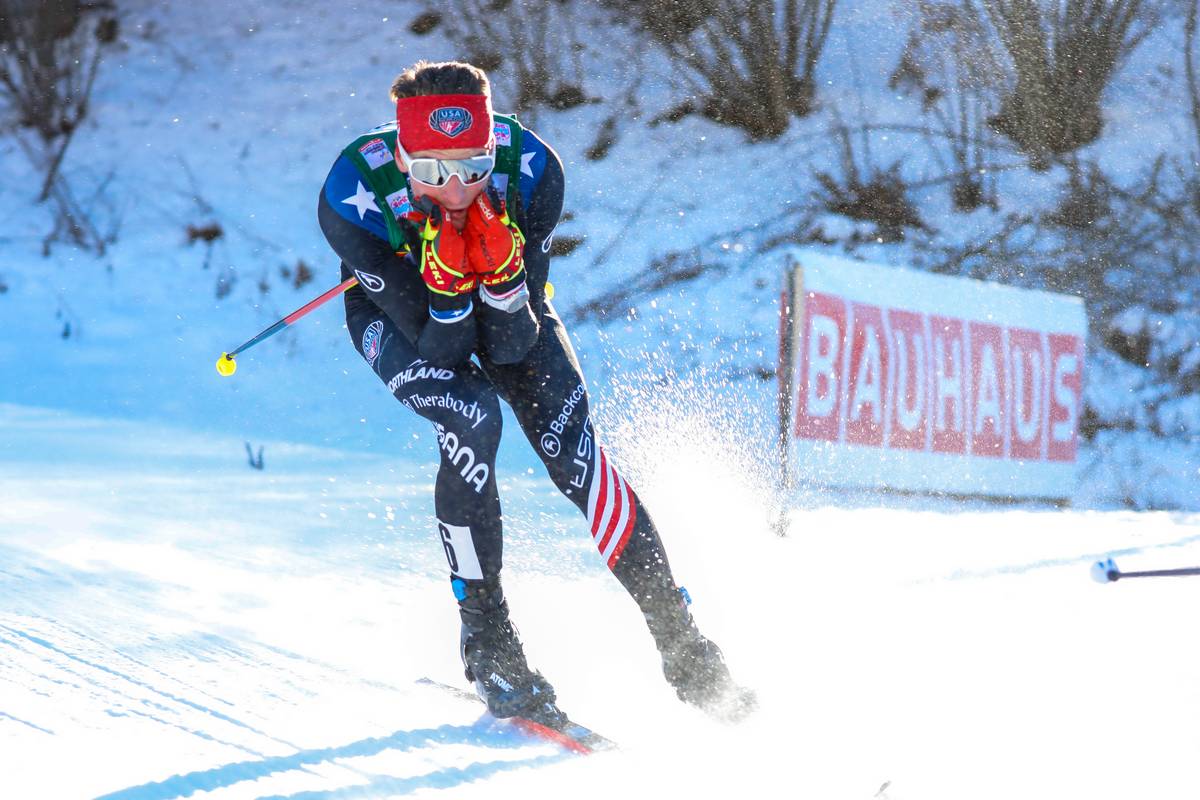
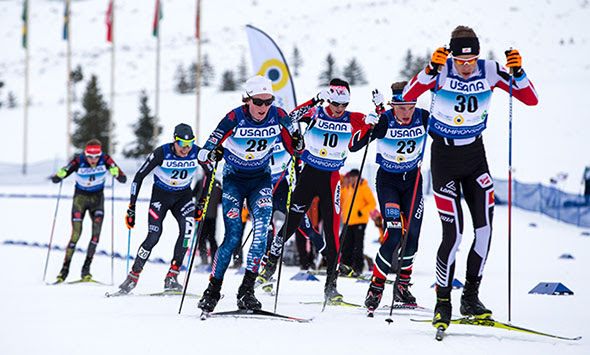
Julia Kern (USA) racing the World Cup cross-country mass start in Ruka (FIN). (Photo: Modica/NordicFocus)
The panel lineup includes:
Kikkan Randall, Olympic gold medalist and one of the most decorated U.S. cross-country skiers in history
Oksana Masters, 24-time Paralympic medalist in Nordic skiing and multiple sports
JC Schoonmaker, Tahoe native and two-time Olympian
Julia Kern, World Cup medalist and Olympian
Annika Malacinski, national champion and leading voice in women’s Nordic Combined
Jaz Taylor, multiple-time World Cup champion
The discussion will be moderated by Andy Newell, a four-time Olympian and prominent voice in the sport.
The 90-minute panel will serve as a live season recap, covering the 2025–26 World Cup circuit and the Milano Cortina Olympic and Paralympic Games, while offering audiences a rare opportunity to hear directly from athletes about training, competition, and the evolving culture of Nordic sport. Virtual attendees can submit questions in advance, while in-person participants will engage in a live Q&A.
Coach Andy Newell all smiles at the 2023 BMT. (Photo: BMT)
Founder Elyse Sara created the Expo to fill a gap in the Nordic landscape – one that emphasizes connection, storytelling, and access to athletes across disciplines and levels. The event brings together voices from across the global Nordic community, from Olympic medalists to emerging leaders shaping the future of the sport.
The event also includes a limited in-person component at Tahoe XC featuring clinics, demos, a laser biathlon relay, live viewing of the virtual panel, and other community events.
In addition to its focus on sport and storytelling, the Expo also supports inclusion in athletics. Ten percent of all proceeds will benefit Move United, a national leader in adaptive sports programming.
The Tahoe Nordic Expo aims to establish a new kind of gathering within the sport – one that reflects, connects, and looks ahead.
JC Schoonmaker (USA) onhis way to finish the individual sprint in 15th place at the World Championships in Trondheim (NOR) in 2025. (Photo: NordicFocus)
PARK CITY, UTAH (January 19, 2022) — USA Nordic Sport announced today its nominations for the U.S. Olympic Nordic Combined Team that will represent Team USA at the Olympic Winter Games Beijing 2022. Nominations are to be confirmed by the United States Olympic & Paralympic Committee when it formally announces the U.S. Olympic Team.
Athletes to Watch
The team will be headlined by three-time Olympian Taylor Fletcher, who looks for his first Olympic podium. Fletcher’s top finishes at the Olympics include a sixth-place finish in the Team Large Hill/4x5km competition at the Sochi Games in 2014, along with a 20th place finish in the Large Hill/10km Individual competition and a 33rd place finish in the Normal Hill/10km in Sochi. Fletcher will be joined by Ben Loomis, a one-time Olympian who will also be looking for his first Olympic podium. At the Pyeongchang Olympics in 2018, Loomis carded a 10th place finish in the Team Large Hill/4x5km competition, 40th in the Large Hill/10km Individual competition and 41st in the Normal Hill/10km Individual competition.
Taylor Fletcher competes in Val di Fiemme in January, 2022. (Photo: NordicFocus)
Selection Process
The selection process for nordic combined includes results from both domestic and international competitions. The first spot on the U.S. Olympic Nordic Combined Team is decided by the winner of the Olympic Trials event in Lake Placid, New York on December 25, 2022. Additional spots were selected based on athletes’ results at both the FIS World Cup and Continental Cup levels during this winter’s qualification period.
Olympic Competition Schedule Nordic Combined has an action-packed schedule at the 2022 Games. The first of three medal events kick off on Wednesday, February 9, with the Individual Gunderson Normal Hill/10km competition, followed by the Individual Gunderson Large Hill/10km on Tuesday, February 15. The final event –Team Gunderson Large Hill/4x5km – is scheduled for Thursday, February 17.
2022 U.S. OLYMPIC NORDIC COMBINED TEAM
(Name; hometown, birthday; club; past Olympics)
Taylor Fletcher, Steamboat Springs, Colorado;5/11/90; Steamboat Springs Winter Sports Club(Olympics: 2010, 2014, 2018)
Ben Loomis,Eau Claire, Wisconsin; 6/9/98; Flying Eagles Ski Club (Olympics: 2018)
Jasper Good,Steamboat Springs, Colorado; 5/10/96; Steamboat Springs Winter Sports Club (Olympics: 2018)
*Jared Shumate, Park City, Utah; 3/6/99; Park City Ski and Snowboard
*Stephen Schumann, Park City, Utah; 3/14/00; Park City Ski and Snowboard
*Denotes first-time Olympian
WatchTeam USA compete on the networks ofNBCthroughoutthe Olympics, February 4-20, 2022.
Ben Loomis competes in a World Cup in Val di Fiemme, Italy in January, 2022. (Photo: NordicFocus)
Taylor Fletcher
“Getting named to my fourth Olympic team after winning the Olympic Trials is a big motivation for me. As the veteran athlete of the U.S. Nordic Combined Olympic Team, I want to make the most of this Olympics with my best results. Knowing that my spot is secure will allow me to focus on training and competition to make sure I am in the best form going into Beijing 2022. The Olympics are always a big focus and have been since I started the sport many many years ago. I feel confident I can go there and have my best results yet. We will have a young team but a team for the future, which is very exciting. Look out for nordic combined in the coming weeks!”
Ben Loomis
“I am extremely proud to have been named to the 2022 Olympic Team. It will be a true honor to represent both USANordic and the U.S. Army World Class Athlete Program in Beijing. Amongst the current state of COVID-19, it will be great to bring the world together in a safe manner and showcase what the Olympics are all about. I couldn’t be more excited to have a team of both experienced Olympians and athletes heading to their first games alongside me in Beijing.”
Jasper Good
“I am incredibly honored and excited to be named to the 2022 U.S. Olympic Team. Representing Team USA at this Games means even more to me as a member of the U.S. Army World Class Athlete Program (WCAP). The support and camaraderie I have gained from WCAP have helped me reach new levels. It will be an honor to represent the U.S. with this added factor. I am really excited about how much progression our team has made and can’t wait to perform with my team in Beijing!”
Jared Shumate
“I am honored to be selected to represent the USA at the 2022 Olympics. It has been a goal of mine since I was a kid to compete at the Olympics, and I am overjoyed to officially be selected to my first Olympic team. I feel like I have made some big steps forward in the last few months, including scoring my first World Cup points in Predazzo, Italy, which qualified me for the team, and I am looking forward to keeping the momentum going into Beijing! I’m excited to compete with the rest of my teammates at the highest level of sport and am looking forward to experiencing my first Olympic Games, even though COVID is making these games a bit different than previous years. In the weeks leading up to the Olympics, the goal is to stay healthy and train hard!”
Stephen Schumann
“I’m beyond excited for the opportunity to represent the USA at the upcoming Olympics in Beijing. It has been a dream of mine to compete at the Olympics since I first stepped on a ski jump at 5 years old. To think that the dream I had as a little kid is coming true 16 years later is surreal, and the fact that I get to do it with some of my best friends makes it so much better. I could not be more excited! Thank you so much to everyone who has believed in me and helped me get to this point through all the setbacks and hard times; it wouldn’t have been possible without you. Now, time to buckle down and polish things up before heading to Beijing!”
Jasper Good jumps in a December, 2021 World Cup competition in Lillehammer, Norway. (Photo: NordicFocus)
COACH QUOTES:
Nick Hendrickson – Men’s Nordic Combined Team Director
“With the nomination of our 2022 Olympic Team, I am extremely excited to have every one of these athletes selected to represent the USA in Beijing. I am proud of each individual for their accomplishments throughout the qualification process, but I am most proud of the teamwork that has been invested behind the scenes to raise our competition level. Collectively, our team is composed of four-time Olympic veterans, two-time Olympians, as well as first-timers; we have a lot of both experience and opportunity in this group of talented guys. The team momentum that we have at the moment is contagious and we can’t wait to keep it rolling into Beijing!”
###
About USANordic USANordic is the national leadership organization for Nordic combined and ski jumping in the United States, providing support and guidance to the nations’ clubs and coaches while overseeing the national elite teams. More information can be found at usanordic.org or its social media channels @usanordic.
FOR MORE INFORMATION CONTACT:
Riley Elliott Nordic Combined/Ski Jumping Olympic Press Officer riley@usanordic.org
USA NORDIC ANNOUNCES TEAM NOMINATIONS Group of 45 nordic combined and ski jumping athletes earn spots
USA Nordic has nominated 45 American athletes to its 2021-22 national and junior nordic combined and ski jumping teams. Athletes achieved the nominations based on selection criteria. They will have the option of being a part of the 2021-22 U.S. Nordic Combined or U.S. Ski Jumping Team.
The nominations were made after the conclusion of the 2021 competition season. Athletes are now in training for the upcoming summer and winter seasons.
“Our team nominations include a wide range of veterans across our national teams, but some great up-and-coming athletes on the junior teams,” said USA Nordic Sport Director Jed Hinkley. “It was especially challenging this year with ever-changing schedule changes and cancelations.”
Athletes will have the option of accepting nominations prior to the 2021-22 season. The final teams for the season will be named this fall. With the Olympics coming up next winter in Beijing, athletes will be striving to earn positions on Team USA. Those nominations and team naming will be announced just prior to the Olympics.
2021-22 U.S. NORDIC COMBINED SKI TEAM
Men’s National Team
Grant Andrews, 23, Steamboat Springs, Colo., Steamboat Springs Winter Sports Club
Taylor Fletcher, 30, Steamboat Springs, Colo., Steamboat Springs Winter Sports Club
Jasper Good, 24, Steamboat Springs, Colo., Steamboat Springs Winter Sports Club
Ben Loomis, 22, Eau Claire, Wis., Flying Eagles Ski Club
Niklas Malacinski, 17, Steamboat Springs, Colo., Steamboat Springs Winter Sports Club
Evan Nichols, 17, Lyme, N.H., Ford K. Sayre Memorial Ski Council
Jared Shumate, 22, Park City, Utah, Park City Ski & Snowboard
Stephen Schumann, 21, Park City, Utah, Park City Ski & Snowboard
Women’s National Team
Tess Arnone, 18, Steamboat Springs, Colo., Steamboat Springs Winter Sports Club
Alexa Brabec, 16, Steamboat Springs, Colo., Steamboat Springs Winter Sports Club
Annika Malacinski, 19, Steamboat Springs, Colo., Steamboat Springs Winter Sports Club
Tara Geraghty-Moats, 28, W. Fairlee, Vt., Craftsbury Nordic Ski Club
2021-22 U.S. SKI JUMPING TEAM
Men’s National Team
Erik Belshaw, 16, Steamboat Springs, Colo., Steamboat Springs Winter Sports Club
Kevin Bickner, 24 Wauconda, Ill., Norge Ski Club
Decker Dean, 20, Steamboat Springs, Colo., Steamboat Springs Winter Sports Club
Patrick Gasienica, 22, Spring Grove, Ill., Norge Ski Club
Casey Larson, 22, Barrington, Ill., Norge Ski Club
Andrew Urlaub, 20, Eau Claire, Wis., Flying Eagles Ski Club
Canadian Athletes Training with USA Nordic
Mackenzie Boyd-Clowes
Matthew Soukup
Women’s National Team
Annika Belshaw, 18, Steamboat Springs, Colo., Steamboat Springs Winter Sports Club
Jillian Highfill, 17, Park City, Utah, Park City Ski & Snowboard
Anna Hoffmann, 20, Madison, Wis., Blackhawk Ski Club
Paige Jones, 18, Park City, Utah, Park City Ski & Snowboard
Cara Larson, 20, Barrington, Ill., Norge Ski Club
Nina Lussi, 27, Lake Placid, N.Y., New York Ski Education Foundation
Samantha Macuga, 20, Park City, Utah, Park City Ski & Snowboard
Logan Sankey, 22, Steamboat Springs, Colo., Steamboat Springs Winter Sports Club
2021-22 U.S. NORDIC COMBINED SKI TEAM – JUNIOR TEAM
Men’s Junior Team
Carter Brubaker, 17, Anchorage, Nordic Skiing Association of Anchorage
Tate Frantz, 16, Lake Placid, New York Ski Education Foundation
Gunnar Gilbertson, 18, Steamboat Springs, Colo., Steamboat Springs Winter Sports Club
Henry Johnstone, 20, Concord, Mass. Andover Outing Club
Aidan Ripp, 20, Cloquet, Minn., Cloquet Ski Club
Zach Selzman, 16, Park City, Utah, Park City Ski & Snowboard
Caleb Zuckerman, 15, Norwich, Vt., Ford K. Sayre Memorial Ski Council
Women’s Junior Team
Aspen Bennett-Manke, 15, Steamboat Springs, Colo., Steamboat Springs Winter Sports Club
Charlotte Ripp, 16, Cloquet, Minn., Cloquet Ski Club
2021-22 U.S. SKI JUMPING TEAM – JUNIOR TEAM
Men’s Junior Team
Jason Colby, 15, Steamboat Springs, Colo., Steamboat Springs Winter Sports Club
Hunter Gibson, 20, Woodstock, Ill., Norge Ski Club
Stewart Gundry, 15, Eau Claire, Wis., Flying Eagles Ski Club
Shane Kocher, 17, Algonquin, Ill., Norge Ski Club
Landon Lee, 18, Eau Claire, Wis., Flying Eagles Ski Club
Women’s Junior Team
Rachael Haerter, 16, Park City, Utah, Park City Ski & Snowboard
Josie Johnson, 14, Park City, Utah, Park City Ski & Snowboard
Elise Loescher, 18, Burlington, Vt., New York Ski Education Foundation
Macey Olden, 16, Park City, Utah, Park City Ski & Snowboard
Adeline Swanson, 15, Woodbury, Minn., St. Paul Ski Club
About USA Nordic
USA Nordic is the national leadership organization for nordic combined and ski jumping in the United States, providing support and guidance to the nations’ clubs and coaches while overseeing the national elite teams. To stay connected, visit www.usanordic.org.
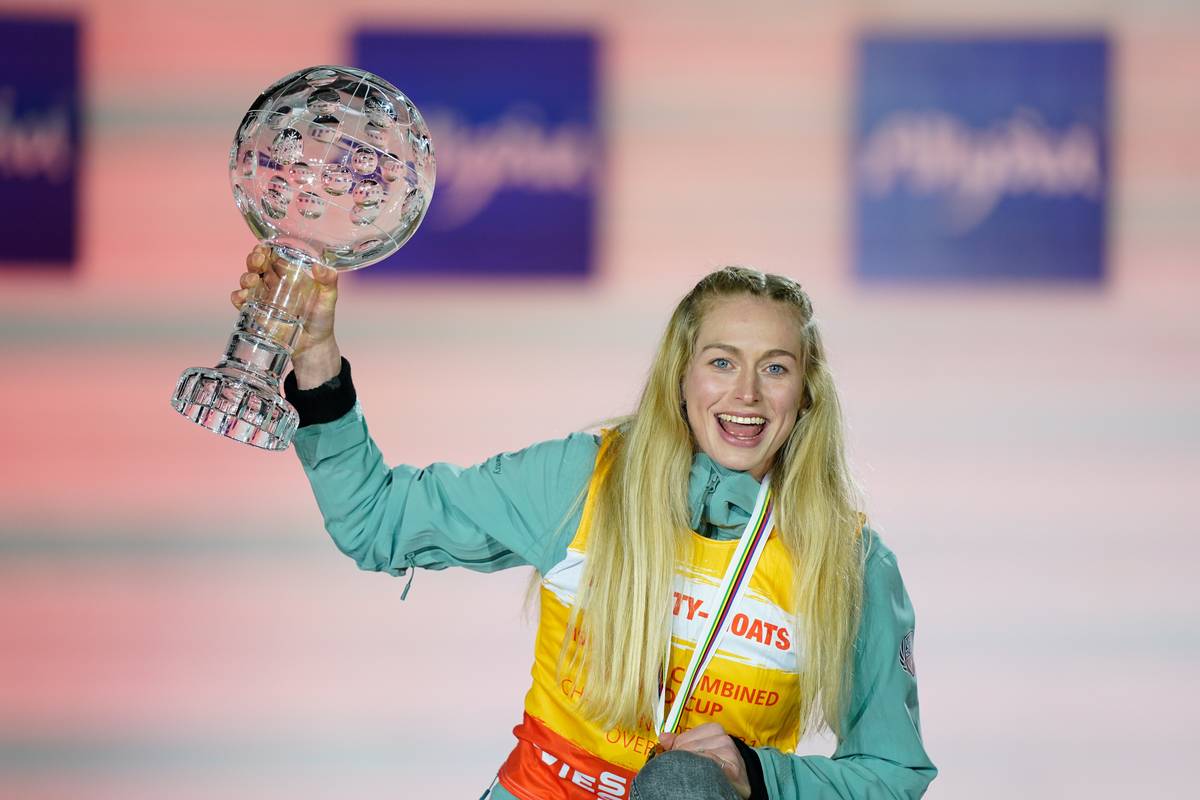
Tara Geraghty-Moats hoisting the first-ever awarded overall World Cup crystal globe for women’s nordic combined. (Photo: NordicFocus)
This year was a big year for women’s Nordic combined racing, not in the way 2020 was a “big year”, but in a record-breaking, moving forward to better things kind of way. For those of you who don’t follow Nordic combined, here’s what you need to know: Competitions involve ski jumping, in which athletes are scored based on style and distance, and later in the day, they compete in a pursuit-start skate race based on their performance on the jumps. It is also the last sport at the Olympics to be contested only by men.
The 2020/21 season marked the first year of a World Cup circuit for women’s Nordic combined racing. Enter Tara Geraghty-Moats, who won the inaugural FIS Nordic Combined World Cup in Ramsau, Austria and took home the Overall Crystal Globe for the season.
Geraghty-Moats grew up in West Fairlee, Vermont and has been competing on the Ski Jumping World Cup circuit since 2014. As FIS has taken steps towards gender equality in the sport of Nordic Combined, Geraghty-Moats has been at the forefront. When the Continental Cup was established in the 2018/19 season Geraghty-Moats placed first in eleven out of the twelve competitions that year. In 2019/20, she took home the gold in every single Continental Cup race. Heading into 2020/21 with the first World Cup circuit, Geraghty-Moats looked to be the strong favorite.
“This was our first ever season of women’s Nordic combined World Cup and I was very excited about it,” said Geraghty-Moats, “going into the season I knew that there was a possibility of cancellation but I was really hoping for the best, trying to stay optimistic.”
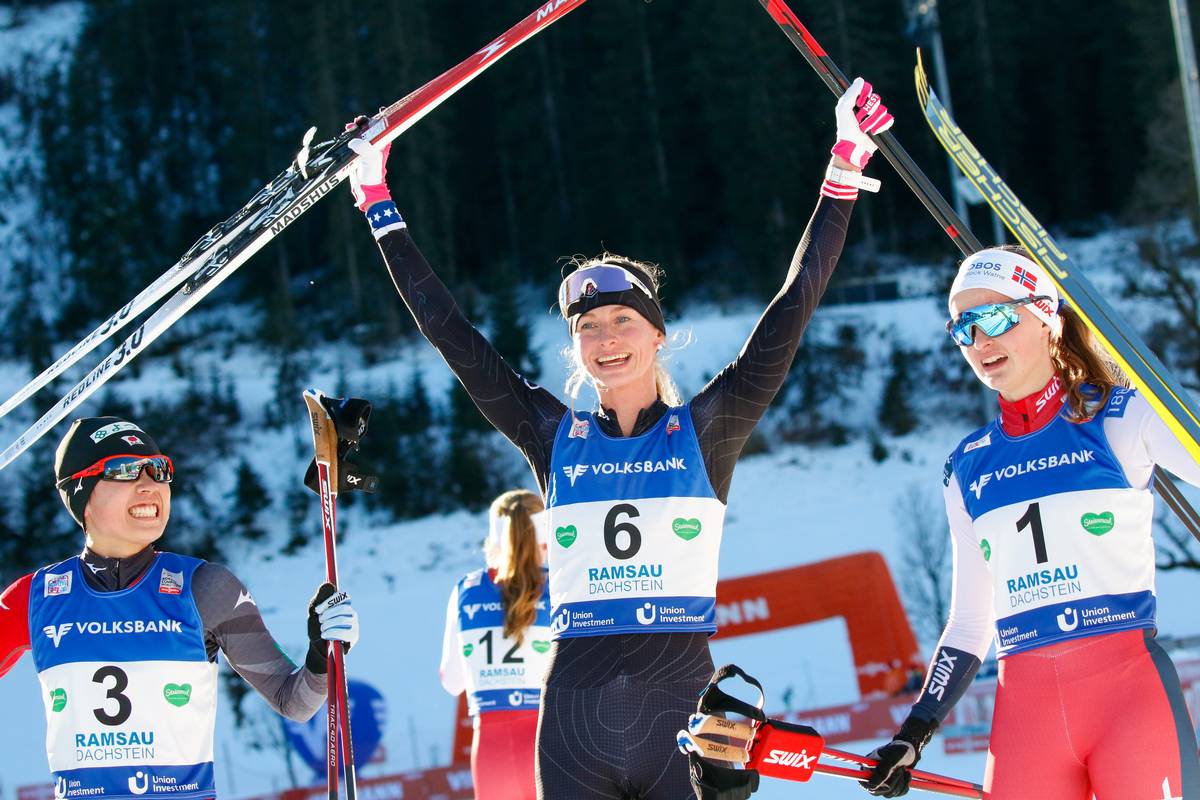
The podium from the individual Gundersen HS98/5km, in Ramsau, Austria: Anju Nakamura (JPN), Tara Geraghty-Moats (USA), Gyda Westvold-Hansen (NOR) (l-r). (Photo: NordicFocus)
In Ramsau for the first-ever women’s World Cup event, Geraghty-Moats was in fifth after the ski jumping leg, having a 39-second deficit to make up on her competitor, Gyda Westvold Hansen of Norway. Geraghty-Moats did just that over the 5k skate, finishing 1.5 seconds ahead of the Norwegian and becoming the first women to be awarded World Cup gold in the sport’s history. The two other World Cup competitions scheduled for the season were canceled due to COVID, but World Championships went on as planned in Oberstdorf, Germany.
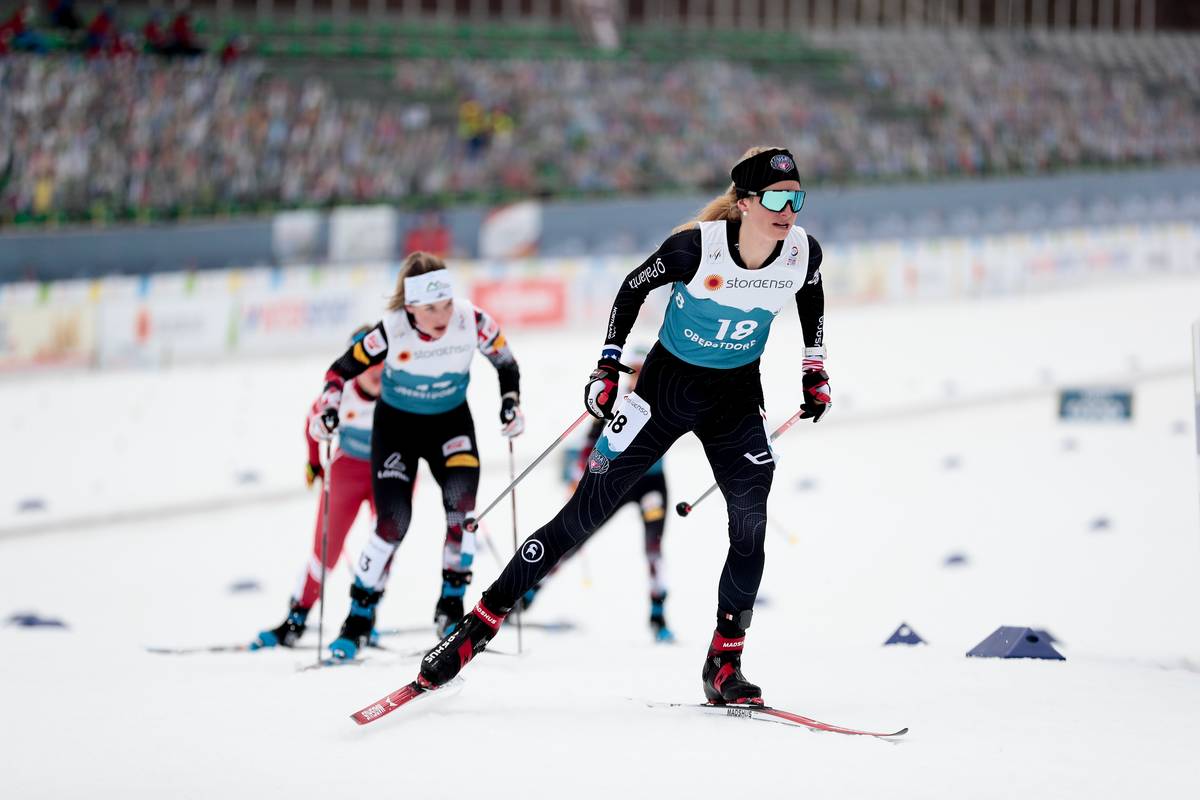
In Oberstdorf, Geraghty-Moats came in fifth after starting the cross-country portion in 18th position starting 2:13 minutes behind the leader. On Instagram, Geraghty-Moats wrote, “I am incredibly proud I got 5th at the World Championships. I felt like I used the opportunity and support I had to its fullest potential… Complications this season meant I was not able to ski jump as much as I needed to. I was not a good enough ski jumper to overcome only having 205 jumps since March 2020. I did the best I could and that is all I can ask of myself.”
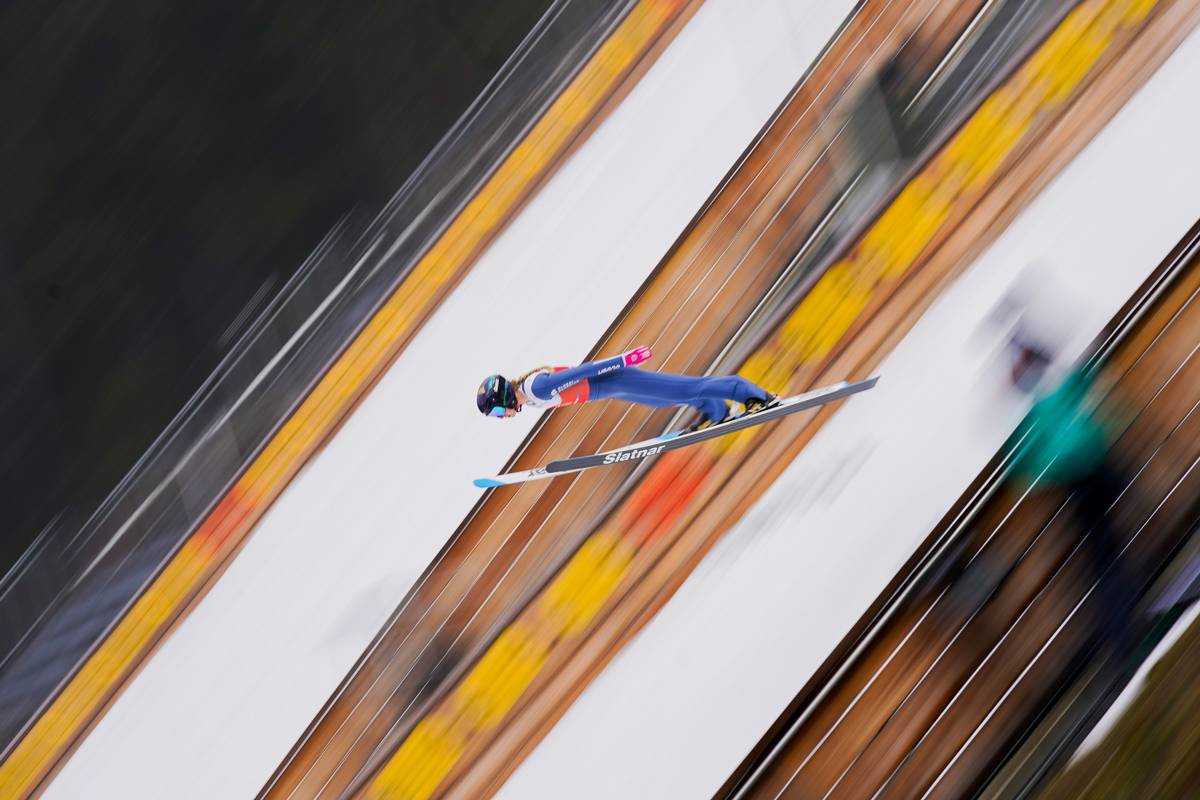
Tara Geraghty-Moats jumping during 2021 World Championship women’s nordic combined individual Gundersen HS106/5km, in Oberstdorf, Germany. (Photo: NordicFocus)
At the conclusion of a historic season, Geraghty-Moats became the first woman to take home the FIS Nordic Combined Overall crystal globe. To this achievement, Geraghty-Moats wrote, “We did what we could with what we had. We made history and came home with a crystal globe. We didn’t have a lot but we had each other. I’m proud of this team. These girls are tough, I’m honored to have them as my teammates.”
Speaking to Geraghty-Moats after the season’s end she reflected on this achievement by saying, “It’s pretty wild, it’s a huge honor. After I was awarded [the globe] I kind of woke up and had to pinch myself that I was the first-ever globe winner. I’m really proud that all my hard work paid off and not only that I helped the sport move forward but that I was able to get the first overall.”
Despite the progress towards parity in the sport, many challenges still remain. The men’s Nordic combined World Cup schedule this season included 13 venues and competitions (six of which were cancelled due to COVID), whereas the women’s schedule only included four, three of which were cancelled.
Geraghty-Moats said, “In the spring (2020) we thought there would be about eight World Cups, four weekends, which although that isn’t too much we were excited for the first year of the World Cup. We didn’t know how many were going to get cancelled but it was going to be a good start. And then going through the season more and more started getting cancelled and it was pretty hard to keep our motivation.”
Tara Geraghty-Moats during the ski portion one the women’s individual Gundersen HS106/5km, at the 2021 World Championships. (Photo: NordicFocus)
On the topic of parity, Geraghty-Moats acknowledged that this season was a big step forward, “it wasn’t as big as we wanted it to be because there weren’t that many World Cups but it is a huge step towards being included in the Olympics, we had our World Championships which was huge and a very successful competition but it wasn’t as big a year as we had hoped for,” said Geraghty-Moats. Even after an inaugural World Cup season, women’s Nordic combined will not be included in the 2022 Olympics in Beijing.
“I would really encourage people to follow women’s Nordic combined, take an interest in it and support the female Nordic combined athletes who are trying to make waves in the sport,” said Geraghty-Moats. “I guess I would challenge everyone… to engage in our story and be an active part of moving this sport forward because at the end of the day, sport is a business and we need more fans and more attention to move this forward. And I think that is starting to happen, especially after the World Championships, but the more involvement we can have, the better for gender equality in the sport and better for the ski community as a whole.”
Nordic combined fans can expect to see more of Tara Geraghty-Moats as she continues to push the boundaries of the sport and compete at the highest level. “It will be a season I tell my grandkids about,” Geraghty-Moats said, “I got the overall in the middle of a pandemic in the first-ever season of women’s Nordic combined. Like you can’t even say that without going like, wow, what?! There is only forward, only upward to go for women’s Nordic combined and I’m really excited to see the progress we will make in the coming years.”
Tara Geraghty-Moats won the Nordic Combined Continental Cup in the previous season and is set to be a podium contender for the overall standings in this year’s cup as well. Now she finds herself in Lillehammer ready to jump in this weekend’s World Cup. FasterSkier met up with her to hear her thoughts on training, what it’s like to compete at her level and the future of nordic combined for women.
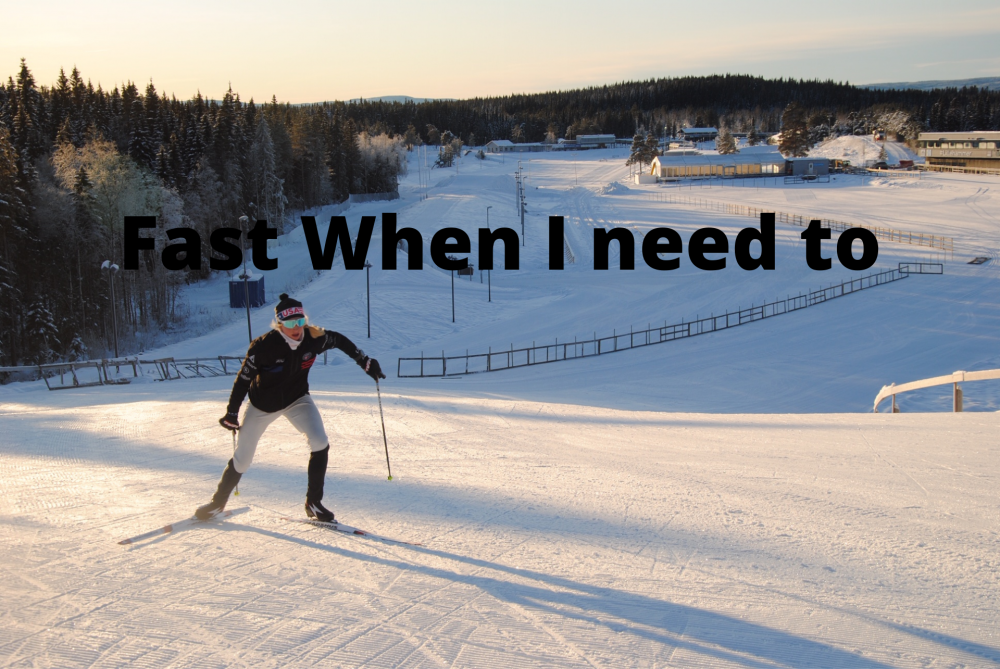
Today, a Monday, she opted for a 7×1 minute hill intervals up the first hill on Lillehammer’s course. This particular hill is the first challenge the skiers tackle as they race the 1994 Winter Olympics. Some 15-25 seconds after the gun goes off, the skiers will find themselves battling it out on the steep hill, which offers a slight break midway through. This break, however, does not offer much of a pause, as Geragthy-Moats’ heart rate will tell you. one hundred and ninety seven beats per minute during her intervals places her just over 96 % of her tested max of 205 and sent her lactate level relatively high above threshold levels. Anyone with knowledge of sports physiology knows what this means: your muscles will be sore.
“Fast when I need to”
Geraghty-Moats explains why she puts herself through a workout like this by saying “the idea is to install a super-boost in your legs”. This top gear, as she also calls it, is something she’s been working on this year. When asked about her workout of the day and why she did it, she explains: “so if I’m skiing in a pack I’ll be able to sprint away from the pack and make a clean break, something that’s really useful in mass-start racing and the nordic combined pursuit format.”
She goes on to say that she’s hopefully in good shape, with good endurance and good conditioning for a race and that “this is sort of the cherry on top of my conditioning for the year, where I’m trying to get my speed up so I have the ability to go fast when I need to.”
How do you feel like a workout such as this one prepares you for an upcoming race?
“Basically those one minute sprints are sort of warming up my engine and making sure that my legs can move quickly, I feel pretty in shape and I feel in good condition this season but that doesn’t necessarily mean you’re ready to race so this is sort of the last prep to race, also for me I have to balance between ski jumping and Nordic skiing, so I have to focus on quality over quantity.”
And how are you able to improve on both?
“For me, the most effective way is to take training blocks where I focus on jumping and different training blocks where I focus on skiing.”
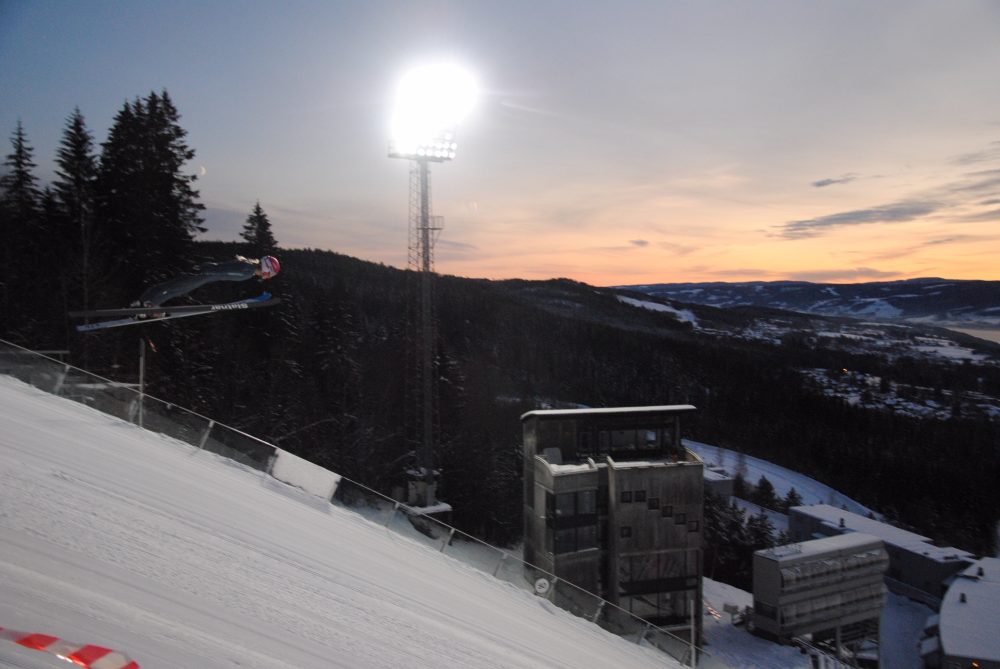
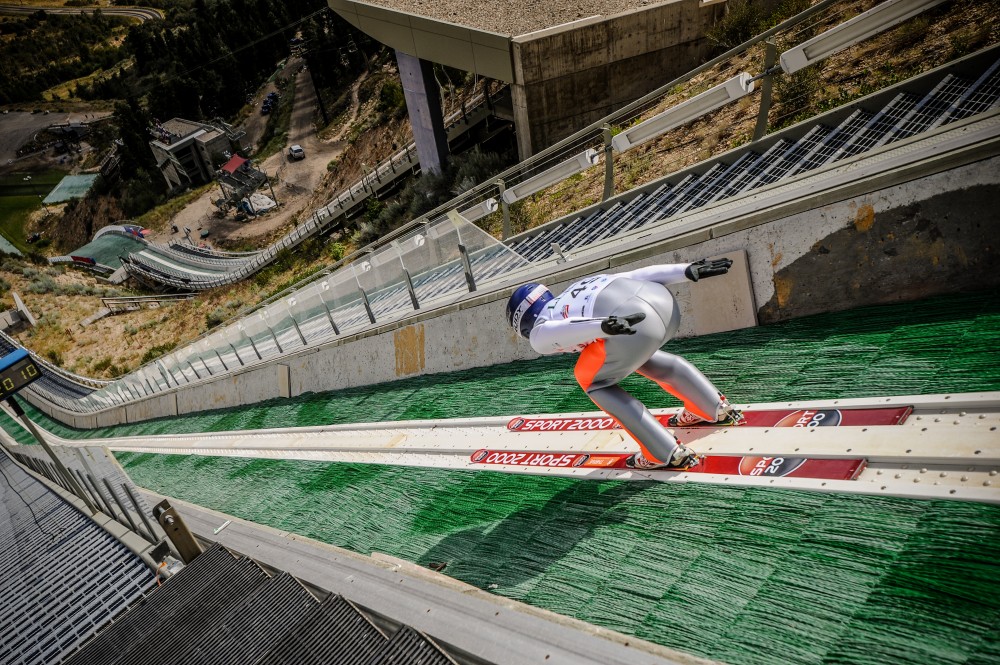
Tara Geraghty-Moats flying off Lillehammer’s HS140 as she prepares for the new season of racing. (Photo: Aleks Tangen)
The training block for this week started with seven sprints in the morning and seven jumps off the big hill (HS140) in Lillehammer. When it comes to deciding what to do in training, Geraghty-Moats considers her competitions. She writes her own training plans and explains that she has an overall plan, which stretches for 2-3 months. As she gets closer to competition, she specializes her sessions. When asked about how she factors in yesterday and tomorrow when deciding what to do today she says: “I decided to do my longer intervals yesterday and shorter intervals in the morning and then have some rest and get ready for jumping. But really I look at when my competitions are and when I’m going to want to be feeling fast and good and then build sort of backwards from there.”
She explains that an important aspect to this process is knowing how long it takes to recover and how long it takes for the intervals to have an effect on overall skiing speed. On December 13-15, the Continental Cup comes to Park City, Utah and the effect she speaks of will show if things are going according to her plan or not.
Below is a lightly edited and condensed version of an interview with Geraghty-Moats.
Aleks Tangen: For your workout today what were you doing?
Geraghty-Moats: So today I was doing one minute sprint intervals something I’ve been working on a lot of this year is really just improving my Top Gear so if I’m skiing in a pack I’ll be able to sprint away from the pack to make a clean break something that you really useful in mass start racing and the nordic combined pursuit format
AT: The reason why you’re doing your workout like that at this time of year is because you want to be able to sprint past the other racers?
G-M: Hopefully with this year’s training I’m in pretty good shape, I have pretty good endurance, good conditioning for a race and this is sort of the cherry on top of my conditioning for the year where I’m trying to get my speed up so I have the ability to go fast when I need to. And I was doing it on the hill, obviously it’s a little bit harder there, where are you get a lot more lactic acid in your legs and preparing my body for that really helps when I’m in a race where I’m already going fairly hard and have to put on the gas and really sprint.
AT: How do you feel like a work out such as this one prepares you for an upcoming race?
G-M: Those one minute sprints are sort of warming up my engine and making sure that my legs can move quickly I feel pretty in shape and I feel in good condition this season but that doesn’t mean necessarily, that you are ready to race. So this is sort of the last prep to race, also for me. I have to balance between ski jumping and nordic skiing. So I have to focus on quality over quantity. Yesterday, I did an interval session, ideally I would do another hard session if I was simply a nordic skier. But today doing a shorter interval session, my body is already tired from yesterday, I don’t have to ski for so long, I don’t have to do so many laps. I still get the training affect, and I still have the hours where I have time to jump and I can feel fresh for the jumping I’m doing later.
AT: It’s a Monday, you’re competing this weekend, what factors playing into doing this particular kind of workout?
G-M: This week I’m actually just competing in ski jumping World Cup, so I’m trying to get a good number of intensity workouts done early in the week so by the time the weekend rolls around I am pretty fresh. I’ll probably do some weights and plyometric workouts on Wednesday and Thursday to get my legs fresh and activated for jumping. But at the same time I still need to stay in shape for cross-country skiing, which will be the weekend after next, in Park city Utah, so yeah it’s always a balance with nordic combined, because you really want to be the best at both sports so you have to stay on top of everything, but also not overextend yourself.
AT: For a workout like this one, how do you structure the warm up?
G-M: For me warm-ups are really important, especially with one minute intervals, because if you’re not warmed up properly first of all you can’t really go that fast and second of all it’s a really big shock to your system, you can get sick or the lactic acid floods your system so you can’t do as many sets. I usually ski between 20 and 30 minutes for warm-up. I start pretty slowly and then I do 3 x 3 min. level III, threshold intervals, before I start the sprint – all out work out – so that gets my system going.
Tara Geraghty-Moats training in Lillehammer, Norway. (Photo: Aleks Tangen)
AT: Considering you are sprinting up the hill, it’s kind of tough, how do you prepare yourself mentally for such a work out?
G-M: Actually, I really like these workouts because they’re pretty quick, and I just enjoy going fast on skis, it’s fun for me. I just look forward to it. It’s kind of easy on a day like this when the conditions are perfect. I have the whole stadium to myself. I mean I don’t really need much motivation, and physically it’s nicer when I’m fresh and not tired. But realistically that’s part of the job, some days my legs are just going to hurt a little bit.
AT: How do you feel the workout you did today, what part of your performance does that improve?
G-M: Anything that short is definitely anaerobic, it really helps you deal with anything lactate flooding your system, and just gets your body moving fast. You see a lot of the women especially in skiing have a lot of high tempo even in the longer races and if you’re not efficient at that anddon’t feel comfortable doing that you really have no chance.
AT: Strength training plays an important role in that if you’re strong then it’s easier to maintain high speed and high intensity.
G-M: For me actually it’s important to not do a lot of weight and strength session but make sure the ones that I do are really quality. I don’t necessarily do strength workouts after an interval workout or after a long day. I think that’s another thing most nordic skiers tend to do — they will slide in strength after an session or when they are already tired and it is really important to do strength when you are fresh. It gives you a chance to improve, and really focus on getting stronger, and not just maintaining.
AT: Being in the moment and not necessarily measuring quantity, but doing it as good as possible?
G-M: Right. And I think that’s nordic combine in a nutshell: quality over quantity. Because there’s no way I can train 800 hours like the cross-country girls on World Cup. It is not going to happen it’s not realistic so I have to have a paired down training plan for nordic.
AT: How many hours do you train every year?
G-M: This is actually my first full year of being a true nordic combiner, so I’ll probably do about 480-500 hours so it’s not nothing, but it is not sort of what you would expect of nordic skiers. I think it’s not really comparable, and you have jumping which is a completely different sport from long-distance nordic skiing. They can do somewhere between 700 and 800 or 900 but they don’t do as much explosive and plyometric work which requires a totally different recovery.
Also the time of the day I can do training sessions for jumping but I might not be that tired but I might’ve still been on the hill in training mode for five or six hours on that day because we usually warm up for about 45 minutes and then we are on the hill for an hour and a half and I can go for a ski in the evening and it means that I might be training close to seven hours that day.
Tara Geraghty-Moats (USA) and Akito Watabe (JPN) were the winners of the first individual event of the Summer Grand Prix 2019. The American won by a large margin of +1:48.3, while Watabe distanced Franz-Josef Rehrl (AUT) by 1.5 seconds. Yoshito Watabe completed the podium on the men’s side, Stefaniya Nadymova (RUS) and Jenny Nowak (GER) claimed the podium positions for the women.
Difficult wind conditions made ski jumping in Oberwiesenthal very difficult today. Both for the men and for the women, the jumping rounds had to be cancelled and the PCR was used.
On Friday, Tara Geraghty-Moats (USA) had shown a jump of 98 metres and a point total of 116.5 points put her on top of the result list with an advantage of 17 seconds at the start. The American was be followed by strong Russian Stefaniya Nadymova, who jumped to 96 metres. Gyda Westvold Hansen (NOR) was third with 90.5 metres (101.6 p.) and started her race at a respectful distance of one minute behind Geraghty-Moats.
Behind Westvold Hansen, the field was tightly packed with Annika Sieff (ITA) starting at +1:09, Marte Leinan Lund followed at +1:12, Veronica Gianmoena (ITA) at +1:20 and Jenny Nowak (GER) and Annalena Slamik (AUT) started their races at +1:43 and +1:47.
Geraghty-Moats skied a lonely race at the top, overlapping many of the competitors on the way to the finish. At half-time point, her advantage had already grown to almost a minute and the dominator or the Women’s Nordic Combined circuit extended her lead to one minute and 48 seconds in the end. With her result, Geraghty-Moats set the best jump and the best cross-country time of 15:49.4, proving once more she is the the most complete female Nordic Combined athlete in the world right now.
Russia’s Stefaniya Nadymova impressed on the jumping hill and skied fast enough to defend the second place by almost a minute in the end. German Jenny Nowak delighted the audience with a courageous race and skied to the podium from position seven. She finished +2:34.4 after Geraghty-Moats. The second-fastest woman on track was Anastasia Gocharova, who skied from position 16 to a final sixth rank.
On the men’s side, the Japanese team struck back with a vengeance after not being on start in the Mixed Team event yesterday. Young Japanese Ryota Yamamoto was the best on the jumping hill with a great jump of 105 metres. 136.5 points put him in the lead of the race by 10 seconds. Yamamoto’s closest pursuers were his teammates, the brothers Watabe. Akito claimed the second place with 103 metres (134 p.), Yoshito showed 99 metres (128.3 p.) Translated into delays at the start line, this meant +0:10 seconds for Akito and +0:33 seconds for Yoshito.
Franz-Josef Rehrl (AUT) ranked fourth with +0:46, Terence Weber (GER) and Christian Deuschl (AUT) shared the fifth place and took up their races at +0:52 respectively.
The race was a tactical affair that had Akito and Yoshito Watabe and Franz-Josef Rehrl working very well together to keep their advantage. At the beginning, Ryota Yamamoto skied together with the three leaders but had to let go around the 3.5 km point of the race. Behind the leading trio, fast German Vinzenz Geiger worked his way to the front and had closed the gap to 14.2 seconds at the half-way point of the race. After that, he ran out of steam and finally finished on position 17 only.
After his Mixed Team victory yesterday, Samuel Costa was in impressive shape again and appeared behind the three leaders and together with Martin Fritz and Johannes Lamparter and several other athletes, a big group chased the brothers Watabe and Franz-Josef Rehrl going out on the last lap.
In the end, the leaders proved too strong and 2017/18 overall World Cup winner Akito Watabe rewarded himself with a victory, while Franz-Josef Rehrl took the second place and Yoshito Watabe surprised with position three. Martin Fritz had the best end of big pursuing group and finished fourth, Samuel Costa was fifth and Johannes Lamparter sixth, between +21.2 and +29.4 behind the winner.
Nathaniel Mah, a 22-year-old Canadian, isn’t someone we would normally liken to an endangered species. That’s perhaps the best analogy for Mah, who describes himself as the last remaining nordic combined athlete in Canada. He currently trains in Canmore with the Alberta World Cup Academy and jumps when he can — most often in the U.S. at the Utah Olympic Park (UOP) jumping facility in Park City.
That defining characteristic, the last Canadian NoCo skier, hasn’t deterred Mah from his international competition ambitions. He’s been able to weave a tapestry of training opportunities and support to pursue his athletic goals.
In this Nordic Nation episode, we speak to Mah about how he’s been able to train and compete while Canada’s nordic combined and jumping scene struggles to remain viable. Mah is coached in cross country by Chris Jefferies and Allison Macardle from the Alberta World Cup Academy. Currently, Mah is without an official jumping coach.
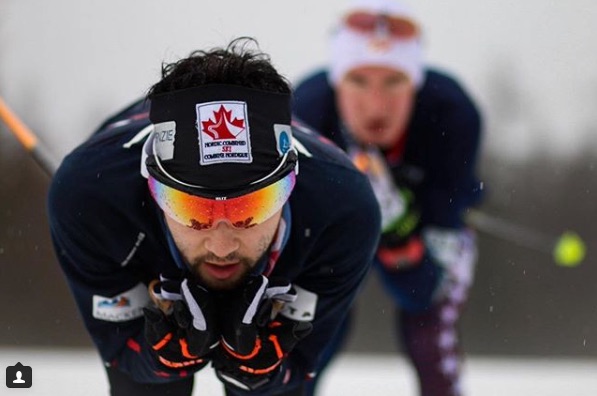
Nathaniel Mah racing in 2017 in Planica, Slovenia. (Photo: Nathaniel Mah/Instagram)
Most pressing for Mah and his constituency of avid ski jumpers is the prospect of Calgary’s ski jumping complex at Canada Olympic Park (COP) shuttering this coming October. WinSport is a nonprofit that owns and operates the COP as well as the Beckie Scott High Performance Training Centre on Haig Glacier and the Bill Warren Training Centre at the Canmore Nordic Centre. According to several news reports, WinSport claims the jumps require a costly upgrade and the $500,000-dollar annual cost to operate is not sustainable. (Read more:March 27 CBC article and March 23 article in Canada’s Global News)
Ski Jumping Canada posted a press release detailing its position on the likely closure of the jumping venue.
Making matters more complex, it appears Calgary is preparing a bid for the 2026 Winter Olympics. In a study (full report) commissioned by Ski Jumping Canada, data suggest a majority of respondents desire events involving ski jumping to be held specifically in Calgary rather than Vancouver. (It has been reported that Vancouver is a possible ski-jumping venue for a proposed Calgary 2026 Winter Olympic bid.)
Bryan Fletcher, seen here at 2016 U.S. Ski Jumping and Nordic Combined Large Hill Championships in Park City, Utah, isn’t all about the downhills. One of his favorite workouts is a “good-old-fashioned hill climb.” (Photo: USSA/Tyler Tate/T Squared Action Sports)
When Bryan Fletcher retired from the Nordic Combined World Cup this spring, FasterSkier asked the national-team veteran and two-time Olympian for a workout that is sure to stand the test of time. Here’s what he had to say.
***
After 11 years on U.S. Nordic Combined’s national team, it’s no wonder many of Bryan Fletcher’s most recent teammates viewed him as the ‘Team Dad’. Along with being an actual father — he has a daughter named Ellery who will be 2 in August — he’s dedicated close to 25 years of his life to NoCo. Food for thought: the average age of his teammates at this year’s Winter Olympics was 23.
So when Fletcher announced that, at age 31, he would be retiring from NoCo this spring, FasterSkier reached out to the veteran for a tried-and-true workout. Fletcher’s response was simple. For him, nothing beats a “good-old-fashioned hill climb.” The experienced skier’s most savvy advice? Take the gondola back down.
“Downhills can be pretty abusive on the knees and your back,” Fletcher explained on the phone. “[This workout] is super-easy way to get long hours in or a good intensity session in, without putting a huge load on the lower body.”
Fletcher’s other favorite part about the workout is its versatility and adaptability (two words all parents should know).
It can be a long, easy distance workout or an interval one depending on the effort you choose to climb back up. For an easy workout, hike up at a Level 1 effort and take the gondola back down. For an intensity session, hike/bound up at a Level 3 effort and take the gondola back down.
“I chose this workout because I think it’s well-suited to all nordic athletes,” Fletcher said. “It really has a little bit of everything that a nordic athlete should be focusing on in terms of their endurance and also their hiking and bounding abilities.”
The Workout: Easy Endurance or Level 3/Steady State Intensity
Terrain: Alpine hill (preferably with a Gondola to ride down)
Warmup: 15-20 minutes easy
If doing intensity, Fletcher recommends at least one “pickup” at a steady state pace during the warmup time. “Nothing too long,” he said. “Just enough to get the muscles warm and the legs moving and to get that speed in the legs a little bit.”
Set:If doing easy distance, hike up with poles at a Level 1 effort. If doing intensity, Fletcher recommends doing 4 x 15 minutes at threshold and taking 5 minutes in between.
Cool down:15-20 minutes
Total time: 120-130 minutes
Fletcher’s Top-Two Tips
Wear the water belt. “They’re not going to have rest stations along the way so you’ve got to stay hydrated and it will be super-refreshing on your ride down.”
Take stake in the scenery. “The best way to keep this fun is to enjoy the hike and the nature that you’re in.”
American Bryan Fletcher after jumping to 18th on the 109-meter normal hill at the 2018 Olympics in PyeongChang, South Korea. He went on to finish 17th in the 10 k later in the day. (Photo: FlyingPointRoad)
At age 31, Bryan Fletcher estimates he’s dedicated 25 years to the sport of nordic combined. He has been a U.S. national team member for the past 11 years and maintains that first time he flew off a jump on skis occurred at the ripe age of 4. Before that, and before his first steps, Fletcher’s exposure to skiing came from the viewpoint of a child carrier on his father’s back.
For the first time since his initial national-team naming in 2006, Fletcher’s full-time work will no longer revolve around nordic combined. As of this spring, the U.S. Nordic Combined veteran has retired from World Cup competition, as have a few other internationally notable nordic-combined skiers.
For any athlete who has devoted as much time as Fletcher, retirement rarely means complete severance from the sport. From the onset of his career, nordic combined (NoCo) served as more than just an athletic pursuit for Fletcher. It was also in a way, a lifeline.
***
Bryan Fletcher (U.S. Nordic Combined) at the 2016 U.S. Ski Jumping and Nordic Combined Large Hill Championships in Park City, Utah. (Photo: USSA/Tyler Tate/T Squared Action Sports)
When he was 6 years old, Fletcher made a special request to his parents. At the time, he was a self-proscribed “adrenaline-junkie kid” living in Steamboat Springs, Colorado — a well-known ski town that is also home to the country’s historical ski jumping venue, Howelsen Hill. Fletcher had heard that his hometown was hosting a “learn-to-ski-jump day” for kids his age.
Naturally, he wanted to attend.
But even if Fletcher’s 6-year-old self self showed a fearless gall and a desire to jump, his parents had other reasons to feel nervous about signing him up. His health. Three years earlier, he had been diagnosed with acute lymphoblastic leukemia (ALL)-
A type of cancer in which the body’s bone marrow overproduces lymphocytes (a type of white blood cell), ALL’s symptoms can range from pain in the bones and joints to fatigue and fever. To treat his condition, Fletcher completed regular chemotherapy sessions three hours away in Denver, Colorado. Some sessions left him without hair.
“I think it’s very easy for young kids, especially going through cancer, to be pretty down in the dumps and not really get to feel like they’re a normal kid,” Fletcher told FasterSkier on the phone earlier this month. “I don’t know how or why, but I guess I begged my parents enough to sign me up for that learn-to-ski-jump day.”
With some persuasion, he convinced his parents to let him partake in the event. Instantly, Fletcher was hooked, prompting him to join Steamboat’s youth ski-jumping program. Eventually, he found his way to the cross-country trails and began participating in the youth NoCo program at the Steamboat Springs Winter Sports Club.
“I think they saw the smile on my face and were like, ‘Holy cow, how are we going to tell him that he can’t do this?’ ” Fletcher recalled of the first time he tried ski jumping.
NoCo became what Fletcher referred to as the “perfect distraction” from his chemotherapy sessions and childhood cancer. In Denver, he adhered to everything his doctors recommended, especially if it meant getting back to Steamboat, skiing and jumping sooner.
“I think it was, in hindsight, a great motivator for me,” Fletcher said of his early days in the sport.
***
U.S. Nordic Combined’s 2011/2012 team members (from left to right) Bill Demong, Bryan Fletcher and Taylor Fletcher with head coach Dave Jarrett at Soldier Hollow in Midway, Utah. (Photo: USSA)
From then on, Nordic Combined became inextricably intertwined with his life, both on the hill and at home. His younger brother, Taylor Fletcher, who was four years younger, also picked up NoCo, and the two shared practices and passion for the sport.
“Both he and I are fighters, but … he’s always had to work for it a little bit harder than I did,” Taylor said on the phone this month. “That’s what drove him to become as good as he was.”
When Bryan was a freshman at the Winter Sports School in Park City, Utah, he was selected to be a forejumper for the 2002 Winter Olympics.
“This honor further solidified my goals and ambitions to become a world-class athlete,” Bryan wrote on his website.
Just two years after his high-school graduation, Bryan earned a spot on the U.S. Ski Team. He was 20 years old. One year later, he qualified for his first World Championships in Sapporo, Japan, racing to 40th in the sprint.
Six months after his 22nd birthday, Bryan claimed his first Continental Cup podium: third place in an individual large hill/10-kilometer Gundersen at Soldier Hollow near Park City. He competed at his second World Championships in 2009, walking away with two individual top-30 performances (30th in the large hill/10 k and 22nd in the normal hill/10 k).
By the third competition weekend of the 2010/2011 World Cup season, Bryan had achieved his first individual top 10, placing eighth in the normal hill/10 k in Ramsau, Austria.
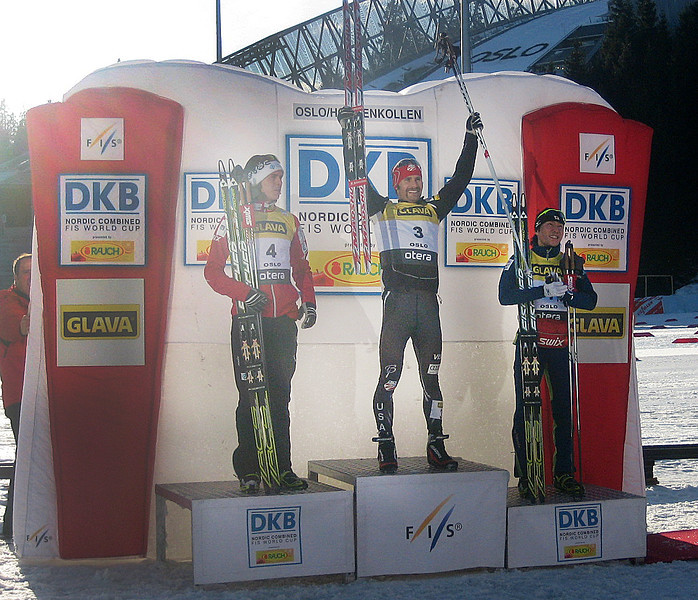
Bryan Fletcher on the top of the podium in at the 2012 Nordic Combined World Cup in Oslo, Norway. (Photo: Margo Christiansen/USSA)
But it was the following season, in 2011/2012, that Fletcher really found his form. At the 2012 Holmenkollen World Cup in Oslo, Norway, he became the fifth American to win a Nordic Combined World Cup with a victory in the large hill/10 k. In that season alone, he also finished in the top 10 seven other times.
“That was kind of a pivotal point,” Fletcher said of his Holmenkollen win. “It was a reinforcing result. … I was like, ‘OK, I do belong here at the top of a World Cup and I have a future in the sport … all the sacrifices and work you’ve put into it are worth it.”
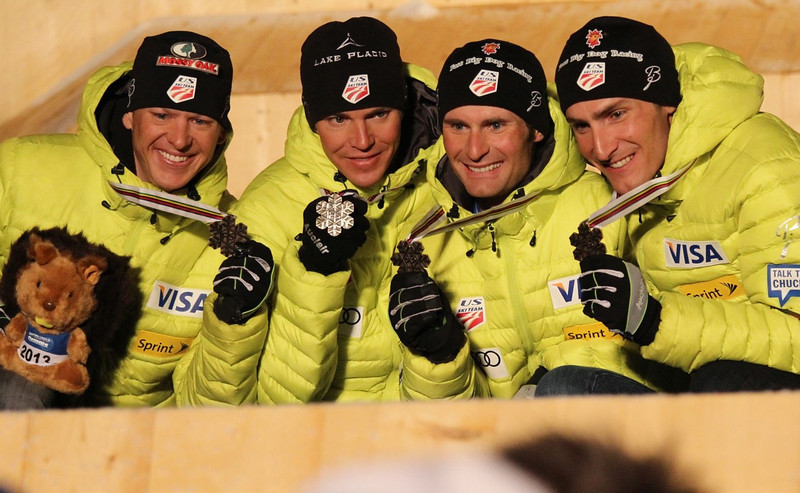
Bryan once again made the team for 2013 World Championships in Val di Fiemme, Italy, where he and his teammates Billy Demong, Todd Lodwick and his brother Taylor raced to bronze in the 4 x 5 k team event.
“That was just solid teamwork and great performances by all,” Bryan said. “A happy moment in the career.”
From left to right: Todd Lodwick, Billy Demong, Bryan Fletcher, and Taylor Fletcher with their bronze medals from the team event at the 2013 Nordic Combined World Championships in Val di Fiemme, Italy. (Photo: Fiemme2013)
Twelve years after his cameo forerunning appearance at the 2002 Salt Lake Olympics, Bryan found himself at the top of another Olympic jumping hill — this time wearing the Team USA race suit. He had qualified for the 2014 Olympics in Sochi, Russia, where he went on to finish 22nd in the large hill/10 k and 26th in the normal hill/10 k.
Over the next four years, he would qualify for two more World Championship teams as well as the 2018 Olympics in PyeongChang, South Korea. On top of those achievements, he’d accumulate 10 more individual top-10 World Cup finishes, including two seventh-place results this past winter.
In PyeongChang, Bryan placed 17th in both individual races: the large hill and normal hill/10 k Gundersen starts.
“I went into PyeongChang wanting to have a lot of fun, obviously wanting to fight for a medal, and to put my best foot forward,” Bryan explained. “I put together probably some of my best performances on the jump hill I’ve had in several years. Unfortunately my cross-country wasn’t quite as strong as I’d hoped for, but I still felt like I put everything I had in the training going into it.”
***
When it comes to his work, Bryan is all about giving his all, which is one reason he chose to retire from World Cup competitions. It is also one of the reasons why he is not immediately transitioning into coaching, despite his close connection to the sport for so many years.
“I am the type of guy who likes to do things 100 percent,” Bryan explained. “The sport is always growing and the level is always rising, and I just felt like I wasn’t going to be able to give the sport all the effort that I needed to give it to be successful [as an athlete]. So I decided that 2018 was the year that I would retire and I would move into finishing my academic career and start a new journey.”
Bryan Fletcher holding his newborn, Ellery Ardene Fletcher. Fletcher and his wife Nikki welcomed their baby girl on Aug. 29, 2016. (Photo: USSA Nordic)
His new journey will involve finishing school and spending more time with his wife and 20-month-old daughter, Ellery. Through online courses, he has been working toward a degree in health education and promotion (with an emphasis on health science), which he aims to complete by next year. Graduate school has popped into his mind, as well as the idea of becoming a physician assistant.
Though coaching may have seemed like the ideal professional avenue for an athlete like Fletcher, the U.S. team veteran sees value in spacing himself from the team before getting too deeply involved.
“I think that going into coaching is really easy, especially to go straight from your athletic career, but you don’t have that time to expand your knowledge,” he said. “For a number of years, coaching was how I wanted to stay involved in the sport. I’ve since changed that idea.”
Instead, he hopes to enhance his knowledge of athletics and health science before working with athletes. The idea is to not only allow himself to develop more, but give the current U.S. NoCo team time to develop as well.
“When you come back to a sport so fresh out of retirement, it’s easy to focus on the same problems that you had as an athlete,” Fletcher explained. “But those issues may not be necessarily what the other athletes are struggling with or what they need to work on.
“On our team, we have some athletes that are great jumpers and we also have some athletes that are great cross-country skiers, but we don’t have particularly many of both right now,” he continued. “I think we just need to take some time to let those athletes develop in a new environment. That way you’re not just coaching the strong skiers to be strong skiers and the best jumpers to be the best jumpers, but instead allowing them to find strength in the opposite areas.”
Though he himself was 20 years old when he joined the team, by the end of his career, most of Fletcher’s teammates were almost a decade younger than him. While the team energy in recent years was one that left him admittedly needing “more naps”, he also sees the younger pool of athletes as an opportunity to foster a new team dynamic for American nordic combined.
Bryan Fletcher with his father at the 2014 Winter Olympics in Sochi, Russia: “The biggest lesson I ever learned from my dad was not only how to ski but how to enjoy every single day on skis.”
“As the younger athletes come up, we have to let them create their own culture and be accommodating of it,” Fletcher said. “I think the way I can have the biggest impact on the team is not by jumping immediately into coaching, but instead taking some time away from the team to broaden my knowledge base and skill sets in different areas. Then several years from now, I can return to the team with a new attitude and new approach and add something different.”
For the time being, his involvement with NoCo will remain at the administrative level. He was recently elected to Team USA’s Athletes’ Advisory Council and will serve a four-year term on the board of directors.
Even so, his presence at practice sessions will be missed.
“It’s going to be weird,” Taylor said of his brother’s departure from the team. “He was always the very level-headed leader.”
As Taylor, a three-time Olympian, steps into the primary NoCo team-veteran role, Bryan was sage in his advice to those who will continue to hit the trails and the hill.
“Just have a plan in place, especially when you start to think that you’re heading down that road of retirement,” Bryan said. “I think it’s really easy to kind of get stuck and not know what you want to do, so just make sure that you kind of have some sort of idea, some kind of stepping stone to go forward.”
Bryan Fletcher flying at the 2016 U.S. Ski Jumping Championships at Utah Olympic Park in Park City, Utah. (Photo: USSA/Tyler Tate/T Squared Action Sports)
Germany’s Eric Frenzel celebrates defending his Olympic gold in the normal hill/10 k Gundersen on Wednesday, the first nordic-combined competition of the 2018 Olympics in PyeongChang, South Korea. Japan’s Akito Watabe (l) placed second, 4.8 seconds back. (Photo: FlyingPointRoad)
PYEONGCHANG, South Korea — Wednesday at the Alpensia nordic sport complex, the first of the scheduled three nordic-combined events of the 2018 Olympics got underway. Despite the women’s 15-kilometer individual biathlon event being postponed to Thursday due to high winds, the nordic-combined jumping portion went off earlier in the day as planned.
The men’s individual normal hill/10-kilometer Gundersen competition saw Austria’s Franz-Josef Rehrl scored the highest number of points off the jump with a jump of 112 meters and 130.6 points. Norway’s Jarl Magnus Riiber jumped to second, flying 111 meters and scoring 126.9 points, and Japan’s Akito Watabe posted the third-best jump of 105.5 meters, which scored 123.7 points.
Four U.S. nordic combined skiers entered the competition. After the jump, Bryan Fletcher was the top American in 18th place. Ben Loomis was the next best placed American in 37th, while Taylor Fletcher ranked 39th and Jasper Good 47th.
The pursuit-race format saw Rehrl leave first on the demanding four-lap, 10 k course. Riiber followed in second, starting 15 seconds back, Watabe began with a 28-second deficit.
Germany’s Eric Frenzel (5) leads Austria’s Lukas Klapfer during the individual normal hill/10 k competition on Wednesday at the 2018 Olympics in PyeongChang, South Korea. Frenzel went on to win while Klapfer placed third. (Photo: FlyingPointRoad)
Several skiers ready to chase down the leaders began with reasonable time penalties to overcome. Germany’s Eric Frenzel started 36 second back in fifth, Austria’s Lukas Klapfer was Frenzel’s initial rabbit, starting four seconds before the German in fourth place.
Both Fletcher brothers are renowned for their cross-country skiing. Often ranked in the top three for overall time on the 10 k course, a deficit of over a minute is not an insurmountable gap for the brothers from Steamboat Springs, Colorado. Yet on Wednesday, Bryan began 2:06 minutes back while Taylor looked ahead at a massive 3:37-minute vacuum to Rehrl in first. Loomis began the ski four seconds ahead of Taylor, while Good started in the wave, 4 minutes back.
For the first 2.5 k lap of the race, the 24-year-old Rehrl skied alone until a climb about 5 minutes in, where Riiber caught him. The chase group, with Watabe, Klapfer, and Frenzel, wasn’t much farther behind. At the 2.5 k mark, that group was just 12 seconds behind the two leaders as they lapped through the stadium.
Meanwhile, Bryan pushed out of the start in immediate pursuit of Finland’s Ilkka Herola and Germany’s Fabian Rießle 2 and 3 seconds ahead of him, respectively. At 2.5 k, Bryan was up to 16th, skiing in a pack with Herola, Fabian Rießle, Germany’s Vinzenz Geiger, and Japan’s Hideaki Nagai and Go Yamamoto, about 1:33 minutes back from the leaders.
Halfway through the race at 5 k, Frenzel, Riiber, Watabe, Klapfer, and Rehrl pushed on as a unit, forming the nucleus from which gold, silver and bronze would eventually come. There, Bryan continued to ski in 16th with a slightly more strung-out chase pack, 1:18 behind Frenzel in first.
Frenzel, Watabe and Klapfer swapped leads over the next 2.5 k, while Rehrl dropped to seventh, 25 seconds behind Germany’s Johannes Rydzek and Finland’s Eero Hirvonen, who had 21 seconds between them and the leaders at 7.5 k.
Bryan spent most of that next lap skiing alone in 17th, about 10 seconds out of 16th. By the end of the third lap, he was almost a minute clear of France’s Jason Lamy-Chappuis in 18th.
While Bryan held his ground in 17th for the final 2.5 k, the four-man lead group battled for three medals. Frenzel moved into first with 1 k to go and on the last climb, a long grinder before a descent into the stadium, Frenzel launched his attack. Only Watabe in second could immediately respond, but about halfway up the climb, even he lost sight of Frenzel over the top.
Japan’s Akito Watabe (3) leading Germany’s Eric Frenzel and Austria’s Lukas Klapfer during the 10 k ski race portion of the normal hill/10 k at the 2018 Olympics in PyeongChang, South Korea. Frenzel went on to win, Watabe placed second and Klapfer third. (Photo: FlyingPointRoad)
Frenzel steamrolled into the stadium to cross the finish line first in 24:15.4 minutes, defending his title from the normal hill/10 k four years ago at the Olympics in Sochi, Russia. While Frenzel, 29, is a perennial threat, it was only his second victory of the season, after he won a normal hill/10 k World Cup event in December in Ramsau, Austria. Meanwhile, Watabe came into the Games having won four of the last five individual World Cup competitions. But an Olympic gold still eludes the Japanese skier.
“It was a moment that was hard to stomach for me,” Frenzel recalled of the last few hundred meters of the race in an interview with German broadcaster ZDF. “In that moment I couldn’t yet quite believe that I could come back on the finish stretch in first place, and just tried to enjoy the moment. It was a lot of work up to this place for it to work out today. I waited for this for a long time again. And so I am overjoyed it worked out again.”
Watabe crossed the line 4.8 seconds later for silver, his second medal in as many Olympics after he placed second in the normall hill/10 k behind Frenzel in Sochi. Klapfer held off Riiber for third, 18.1 seconds behind Frenzel, for Klapfer’s second Olympic bronze after taking third with his Austrian teammates in the 4 x 5 k team event in Sochi.
Riiber placed fourth (+22.5), Rydzek was just behind in fifth (+27.9), Hirvonen finished sixth (+51.6), and Rießle and Herkola moved all the way up to seventh (+1:05.3) and eighth (+1:05.5), respectively, finishing with Geiger in ninth (+1:05.5).
With four Germans in the top 10, Frenzel predicted more success for his team at these Olympics.
“I hope there will be more golden moments like this here,” he told ZDF. “I think all of us are in good shape at the moment, especially Fabian [Rießle] who definitively was out of luck on the jump today. He surely can perform at a similar level as I did. So because of that we will keep attacking here over the next few days, especially on the large hill, and then we will see what is in it for us.”
American Bryan Fletcher racing to 17th in the normal hill/10 k Gundersen start on Wednesday at the 2018 Olympics in PyeongChang, South Korea. It was his first individual top 20 at his second Olympics. (Photo: FlyingPointRoad)
Bryan nearly caught Estonia’s Kristjan Ilves in 16th at the line, finishing 0.3 seconds behind him in 17th (+2:12.2) for his best individual result in his second Olympics. The 31 year old’s previous Olympic best was 22nd in the large hill/10 k in Sochi.
In a post-race interview with FasterSkier and other reporters in PyeongChang, Bryan said that he was disappointed with the result and felt that, with faster skis, he could’ve been in the mix. He noticed his skis weren’t up to par with Germany and FInland immediately out of the start, where he said he was sprinting to catch Rießle and Herkola.
“A two-second gap, I should be able to just yo-yo right onto them, and I couldn’t even get there,” he said. “That to me was a surefire sign that something was up. Either my physical performance wasn’t there or the skis weren’t there. It very well could’ve been a combination of both.”
He explained that nordic-combined athletes don’t warm up on race skis. “They were good, but just not quite there,” Bryan said of his skis.
On the day, his course time ranked 22nd, about 20 places slower than usual.
“I dug deep, I’m happy with how I managed that today and limited losses,” he explained. “Positive takeaways from the jump hill I think were really good. I know that I can be in the fight there and also know that with some better skis I can be in fight in the cross-country, so refocus and looking forward to next week.”
American Bryan Fletcher after jumping to 18th on the 109-meter normal hill at the 2018 Olympics in PyeongChang, South Korea. He went on to finish 17th in the 10 k later in the day. (Photo: FlyingPointRoad)
After his jump, he had hoped for a top 10.
“In fact, I think it was completely doable,” Bryan said. “It was only about a minute to eighth so it was a little bit disappointing going in and not being able to close that gap. It’s a big event, it’s one day and certainly anything can happen. And unfortunately today the cards didn’t stack in our favor.”
As a father and the oldest member of the USA’s young Olympic team, Bryan said he had been giving his teammates some pointers.
“I think they’ve been calling me ‘Dad’ all week because they love the advice, so falling into a parent role again,” he said. “It’s been fun and certainly they give me as much energy as I give them.”
Behind him, his younger brother Taylor, 27, finished 35th (+3:27.8) with the 15th-fastest course time, Loomis placed 41st (+4:29.4), and Good 45th (+5:48.4).
American Taylor Fletcher racing to 35th in the normal hill/10 k, after jumping to 39th, at the 2018 Olympics in PyeongChang, South Korea. (Photo: FlyingPointRoad)
Asked about his day, Taylor described it as “Not awesome. I mean it was realistic,” he explained. “Average day on the jump, average day on the cross-country. I know what I did and what I need to do, and I think that’s the harsh reality, for sure, but it was a mix between thinking the skis weren’t so great, me definitely going a little too hard at the beginning and maybe me [trying to figure] out whether it was me or whether it was skis, and honestly I think it was more me.”
Italy’s Alessandro Pittin started the race 4 seconds ahead of him in 38th. Pittin went on to ski the fastest 10 k time of 23:48.9 to end up 19th at the finish.
“Alessandro Pittin is the fastest skier, he’s taken that away from me for sure,” Taylor said. “I think I put a little too much energy on that first lap trying to stay with him and then I actually went passed him and led in the wind going up this hill coming back toward the stadium, and I think that just put me on edge a little bit too much and too early.”
Taylor described the conditions as variable, alternating from glazed and fast to “mush” and “dead” feeling.
“It’s hard to describe where I’ve skied that before, but it has no character, no feeling to it, and it’s really hard to glide on it,” he said of the snow in PyeongChang. “I was struggling on the gradual hill coming back into the stadium and I felt like I couldn’t get up onto my toe for that final kick of V2 so I was very static and heavy on the legs and that’s not where I want to be at all. It’s not fluid for me, and it’s just difficult.”
As for his jumping, he was pleased with his improvement since earlier this season.
“It’s a million times better than it was in December,” he said. “… It’s still got a ways to go, but I’ve shown in these last couple weeks that slightly better jumps are leaps and bounds better for me.”
As the 10th jumper to descend down PyeongChang’s 109-meter hill on Wednesday, Taylor explained that the first three American jumpers got “a little unlucky” with the crosswind on the jump. Good was the first jumper of the day in bib 1, Loomis started ninth, Taylor 10th, and Bryan 26th out of 48 starters.
(Article continues below)
American Ben Loomis jumping to 37th on the 109-meter normal hill at the 2018 Olympics in PyeongChang, South Korea. (Photo: FlyingPointRoad)
“I still had good conditions compared to Jasper, but compared to a lot of the other guys, I was still slightly behind them,” Taylor said. “But for me, I’ve just got to jump a little bit early and a little bit more forward with the speed and it’ll be there.”
Good told reporters that the top of the PyeongChang jump “literally feels like a hurricane. The wind is just howling and the first time we got up there training earlier this week, I was like, there is no chance we’re jumping right now,” he recalled. “But the wind barriers they have set up do an awesome job because when you actually get to the jump the wind is fine so it’s more of a mental battle.”
In his first Olympic competition, the 21-year-old Good’s jump of 76 meters put him last place going into the 10 k. But he started with four other skiers in a wave start, 4 minutes behind the leader.
“It’s a little bit easier to get motivation starting in the back in this event just because it’s so big, you’re on the world stage, and this is the kind of race where everyone has, like, inspired skis regardless of where they’re skiing,” Good said. “It just feels like there’s more to it and there’s more within you, but it’s just awesome to be out competing and achieve a personal dream of mine.”
American Ben Loomis en route to 41st in the normal hill/10 k Gundersen at the 2018 Olympics in PyeongChang, South Korea. (Photo: FlyingPointRoad)
Loomis said that while PyeongChang is probably the windiest place he’s ever jumped, it made for a challenging and exciting competition. He said his jump on Wednesday, at 86.5 meters, was better than most of his training jumps there.
“Most of the training rounds were even a lot windier than today, so we kind of got well-prepared for that, and luckily it was pretty good for the comp today,” Loomis explained. “The winds were about as even as they’ve been here so far.”
At 19 years old, Loomis is coming off a bronze-medal performance and fourth-place finish in two individual races at Junior World Championships in Kandersteg, Switzerland, just two weeks ago.
“It’s my first Olympics and I’m one of the younger guys so I’m looking to take it all in and learn from this and gain as much experience as I can for the next Olympics in four or even eight years out of today,” he said.
The next nordic-combined competition at the Games is set for Tuesday, Feb. 20 with the individual large hill/10 k.
The nordic-combined normal hill/10 k podium at the 2018 Olympics, with Germany’s Eric Frenzel (c) in first, Japan’s Akito Watabe (r) in second, and Austria’s Lukas Klapfer (l) in third. (Photo: FlyingPointRoad)
American Bryan Fletcher racing to 17th in the men’s 10 k Gundersen start today, the second half of the nordic-combined normal hill/10 k competition, on Wednesday at the 2018 Olympics in PyeongChang, South Korea. It was his first individual top 20 at his second Olympics. (Photo: FlyingPointRoad)
After the jumping round of the nordic-combined individual normal hill/10-kilometer Gundersen-start competition on Wednesday, Austria’s Franz-Josef Rehrl topped the standings thanks to a jump of 112 meters, just a meter farther than second place Jarl Magnus Riiber of Norway.
The top American was Bryan Fletcher, who sat in 18th place after a jump of 97.5 meters good for 99 points. He started the 10 k cross-country skiing portion of the competition 2:06 behind Rehrl, 1:51 behind Riiber – who has won two World Cups this season – and 1:30 behind defending Olympic champ Frenzel.
Fletcher initially made up some time on the leaders, but as the pace of the race was constantly changing in the end he wound up just one spot ahead of where he started, in 17th. Defending Olympic champ Eric Frenzel of Germany made it to the front after starting in bib five and sprinted to a 4.8 second victory over Japan’s Akito Watabe. Austria’s Lukas Klapfer earned bronze (+18.1) just ahead of Riiber (+22.5). Fletcher’s time was 2:12.2 behind Frenzel at the finish.
Ben Loomis and Taylor Fletcher jumped to 37th and 39th positions, respectively, and started the cross-country competition 3:24 and 3:37 out of the lead. Taylor Fletcher moved up four spots to finish 35th (+3:27.8) while Loomis lost a few places to finish 41st (+4:29.4). The final American starter, Jasper Good, was last (47th) after the jumping round but made up two spots on the trails to finish 45th (+5:48.4)
“Play True” is the World Anti-Doping Agency’s (WADA) outward appeal to athletes, coaches, doctors, a myriad of handlers and advisers, and, ironically, anti-doping labs to keep sport clean.
On one hand, “Play True” could be interpreted as a baseline demand, something educators might instill in elementary students. But it also reads like a plea; for fans of the sport and most importantly participant athletes themselves, there’s a lot to lose when athletes “Play False”.
The sharpened teeth behind words like “Play True” are the tests administered to detect doping and potential bans for positive tests, although WADA’s anti-doping arsenal also includes a confidential digital hotline for individuals to file claims of suspected doping.
On Oct. 25, WADA released its annual testing numbers in a massive document titled “2016 Anti-Doping Testing Figures.” The report itemizes every sample tested by the 34 WADA-accredited labs in 2016 and uploaded into WADA’s Anti-Doping Administration and Management System (ADAMS). The information includes all in- and out-of-competition tests on both athlete urine and blood, and results for Athlete Biological Passport (ABP) blood analysis.
The 2016 report does not include data or discussion of Anti-Doping Rule Violations (ADRVs). A discussion of 2016 ADRVs is expected sometime in 2018. The report does include the number of Adverse Analytical Findings (AAF) and Atypical Findings (ATF).
Here’s the simple appetizer before the full course: an AAF occurs when a sample contains a prohibited substance. An ATF, according to WADA, indicates that “while there may not be an adverse analytical finding, there may be some suspicion according to the results and that further analysis or investigation should be conducted.” After an ATF is investigated, it could lead to a negative result (the suspicion was not warranted), an AAF (something was found), or it may be canceled.
WADA stresses that in reading and interpreting 2016 Anti-Doping testing Figures report, “one single result does not necessarily correspond to one athlete. Results may correspond to multiple findings regarding the same athlete or measurements performed on the same athlete; such as, in the case of longitudinal studies of testosterone.”
Also, the number of AAFs in the 2016 testing report will not correlate directly to the number of ADRVs in 2016. Among other reasons, that is because some AAFs end up being explained by the athlete having a Therapeutic Use Exemption (TUE).
The Report’s Findings
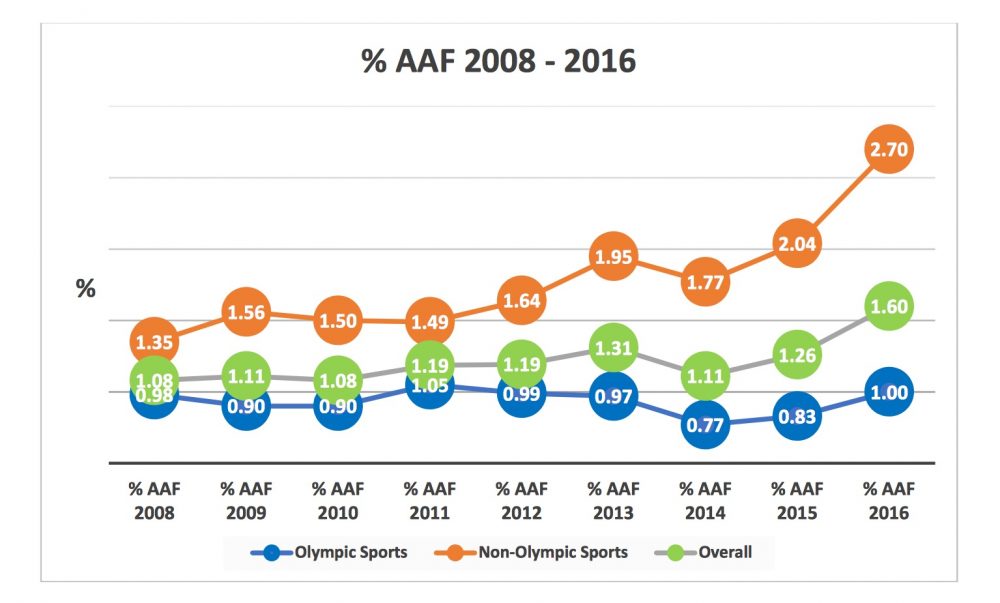
% AAF 2008-2016 from the 2016 from WADA’s 2016 Anti-Doping Testing Figures report. (Photo: Screenshot from 2016 Anti-Doping Testing Figures report, Samples Analyzed and Reported by Accredited Laboratories in ADAMS)
It’s worth mentioning again the length and comprehensiveness of this report. FasterSkier created a Google spreadsheet to better understand testing results in three sports we cover: biathlon, cross-country skiing and nordic combined. This process simply allowed FasterSkier to compare testing analysis in these sports more efficiently, and you can see the spreadsheet yourself at the link above.
WADA articulated what it felt were the report’s highlights. The anti-doping watchdog advertised what it called a “noteworthy” development: that the total number of AAFs increased from 1.2 percent in 2015 to 1.6 percent in 2016. WADA also qualifies the total increase in positive tests as “partly related” to AAFs attributed to Meldonium — that drug was placed on the prohibited list in January 2016 without much consideration of how long it might stay in athletes’ bodies, or whether athletes had enough advance warning to stop taking the drug.
At the same time, WADA noted that the total number of samples tested decreased from 303,369 to 300,565 from 2015 to 2016. WADA claimed that despite the downturn in the total number of tests, the administration and efficacy of its tests contributed to the higher AAFs total in 2016 compared to 2015.
Totals
Starting with biathlon, there were 1688 total samples tested: 671 were in-competition urine samples, 39 in-competition blood samples, 859 out-of-competition urine samples, and 119 out-of-competition blood samples. Of those 1688 samples, 16, or 0.9 percent of the total, were considered AAFs (seven in-competition AAFs and nine out-of-competition AAFs, all from urine samples).
Cross-country skiing accounted for 2135 total samples tested. 623 were in-competition urine tests, while 19 were in-competition blood tests. 1163 were out-of-competition urine tests, 330 out-of-competition blood tests. The sport had a single in-competition AAF and eight out-of-competition AAFs — again, all derived from urine samples. Out of all the cross-country samples tested, 0.4 percent were AAFs.
Nordic combined had 393 total tests. Eighty-eight of those were in-competition urine tests, six were in-competition blood tests. According to the WADA report, out-of-competition urine tests accounted for the majority of samples taken; 245 urine samples were analyzed and 54 out-of-competition blood tests were recorded. Nordic combined had two confirmed AAFs — both from in-competition urine tests. Of all the nordic-combined tests, 0.5 percent were AAFs.
How exactly should we read these tea leaves? It has been well-documented in the mainstream media, as well as in documentaries like Icarus, that historically, the anti-doping system can be gamed. Methods other than drug testing have shown that between 15 and 40 percent of elite athletes have intentionally doped at some point. With the low rate of AAFs in the three sports highlighted by FasterSkier, biathlon, cross-country and nordic combined, a few basic conclusions can be made.
With the low rate of AAFs in the three sports highlighted by FasterSkier, biathlon, cross-country and nordic combined, a few basic conclusions can be made: the possibility of doping and skiing undetected remains, but if the “Play Fair” mantra works, the majority of athletes are training and racing clean.
Tests for Blood Doping
Of importance to policing endurance sports like biathlon, cross-country and nordic combined is increased implementation of WADA’s Technical Document for Sport Specific Analysis (TDSSA). The TDSSA demands that certain sports conduct a mandatory minimum of tests to screen for specific drugs.
For both biathlon and cross-country, the TDSSA calls for enhanced testing for Erythropoiesis Stimulating Agents (ESAs) — think EPO. There’s also a required testing minimum for Growth Hormone (GH) and Growth Hormone Releasing Factors (GHRFs). As of January 2017, the current TDSSA calls for 60 percent of all samples in biathlon and cross-country to be tested for ESAs and 10 percent for GH and GHRF’s respectively.
Partly because of this, the 2016 WADA Anti-Doping Testing Figures report also includes data about specific tests conducted on urine and blood samples – like the ESA or GH tests.
ESAs stimulate red blood cell production in the body. Several ESAs are available, the one most closely followed in endurance sport being recombinant erythropoietin (EPO). Both anecdotally and in research, EPO has been shown to boost endurance, power thresholds and recovery. When it comes to those willing to cheat in endurance sport, ESAs are a go-to. They appear to work.
As a result, WADA has emphasized the testing of both urine and blood for ESAs in sports where an ESA would benefit. It follows that the majority of total samples tested in biathlon and cross-country are comprised of ESA tests. (ESA testing in nordic combined did not constitute a majority of the specific tests administered.)
ESA testing accounted for nearly 63 percent of all the tests in biathlon. In biathlon, 469 in-competition urine tests and 592 out-of-competition urine tests for ESAs were administered with no AAFs. The number of in- and out-of-competition blood tests for ESAs were far less. There were 29 in-competition ESA blood tests and 17 out-of-competition blood tests. Again, not a single sample flagged an AAF.
For cross-country, 1107 samples were tested for ESAs — comprising almost 52 percent of the total 2135 cross-country samples tested in 2016. Like biathlon, nearly all of these samples were from urine samples. 316 tests were from in-competition urine tests and 735 from out-of-competition urine tests. Eight in-competition blood tests and four out-of-competition blood tests were screened for ESAs in cross-country. No AAFs for ESAs were documented in cross-country.
Like biathlon and cross-country, nordic combined was void of any AAFs in their ESA testing pool. Thirty-two in-competition urine and 106 out of competition urine ESA tests occurred in nordic combined. No in-competition blood tests and one out of competition blood test for ESAs were administered. ESA testing made up 35 percent of the total test in nordic combined.
Prohibited Substances Used in Nordic Sport
Reflecting back on the total number of AAFs reported in biathlon, cross-country and nordic combined (16, 9 and 2, respectively), WADA did, however, provide information on the drug class of those AAFs.
In biathlon, 14 of those AAFs were flagged in the Hormone and Metabolic Modulators drug class, whereas two were in the Diuretics and Other Masking Agents drug class. That’s maybe not surprising as meldonium is a metabolic modulator, and there was a burst of findings of meldonium in early 2016, with Ukrainian biathlete Olga Abramova as just one example. Several of the athletes were ultimately cleared without sanctions.
For cross-country, there was one AAF in the Anabolic Agents drug class, two in the Beta-2 Agonist drug class (which includes asthma medications), five in the Hormone and Metabolic Modulators drug class, one in the Stimulants drug class, and one in the Glucocortico-steroids drug class were noted.
In nordic combined, the two AAFs were both in the Stimulants drug class.
Athlete Biological Passport (ABP)
Total ABP Samples Analyzed per Year 2008-2016. (Photo: Image capture from WADA 2016 Anti-Doping Testing Figures report)
In recent years, ABPs have been established throughout the sporting world. Rather than a method to catch an athlete at a particular competition or out of competition training block, ABPs are more longitudinal in nature. WADA is upfront about the intended function of ABPs. The fundamental principle of the Athlete Biological Passport (ABP) is to generate a baseline of data for specific biological markers in an athlete. For example, each athlete’s testosterone and hematocrit levels are tracked over time. When an ABP test is taken, the purpose is to determine if any of the biological markers sampled are elevated or inconsistent – a big red flag – compared to that baseline.
WADA also clarifies that anti-doping organizations can pursue an ADRV simply based on an atypical ABP. No adverse analytical finding is needed to pursue a doping violation when an ABP is suspect.
In biathlon, 960 total ABP samples were analyzed: eight in-competition and 952 out-of-competition. The testing authority responsible for testing 645 of those out-of-competition samples was the International Biathlon Union (IBU).
Cross-country accounted for 883 total ABP samples; 88 in-competition and 795 out-of-competition.
Nordic combined amassed 224 total ABP samples; 21 in-competition and 203 out-of-competition.
Conclusions and Opinions
Stating the obvious, the anti-doping crusade evolves. The 2016 testing report’s substance lies in its depth and breadth. Although no athlete names are publicly associated with specific ATFs and AAFs in the report, a better understanding of how WADA and the global “Signatories to the [WADA] Code,” are advancing clean sport can be gleaned.
Broadly speaking, the report’s findings indicate that the testing of athletes’ blood may be a misuse of resources.
An article at the Sports Integrity Initiative titled “WADA 2016 Test Figures P1: Blood tests are not catching dopers” reveals a key pattern in the report. The article’s author, journalist Andy Brown, calls attention to the following: when considering all summer and winter Olympic sports together, 3,200 in-competition blood tests were run, but only 17 AAFs resulted. Out-of-competition testing was far more routine, with 12,443 blood tests run. Under that massive testing net, only 11 AAFs were returned.
Disaggregating the AAF return on blood tests in the winter Olympic Sports may raise more questions than it answers. The 197 total in-competition blood tests performed in the winter Olympic disciplines amassed no AAFs. There were no AAFs for the 1,104 out-of-competition blood tests on the winter side, either. Blood testing is more costly, and data indicates it may not have its desired effect as a doping deterrent.
Taylor Fletcher cruising in the 2017 Fish Creek Time Trial in Steamboat Springs, Colo. (Photo: Jasper Good)
From late June into early July, U.S. Nordic Combined hosted a major training camp in Steamboat Springs, Colo. Among the sessions was the Fish Creek Time Trial, a skate rollerski race first held in 2007. That year, Johnny Spillane set down the first in a series of course records that would be improved by different athletes in the next decade.
The time trial is 8 kilometers and gains 885 feet of elevation, starting just south of Steamboat Springs and ending up in the Medicine Bow-Routt National Forest.
National team member Jasper Good is a Steamboat Springs native and remembers the first time he participated in the now-annual time trial.
“In 2012 Ben Berend and I miscalculated how long it would take us to get to the start,” he wrote in an email. “We proceeded to show up and were getting yelled at by everyone saying, ‘You’re starting right NOW, GO GO GO!’ Not the best first impression at a time trial with the National Team.”
A group photo of participants in the 2016 Fish Creek Time Trial, from “young guns” to Olympians. That year, retired gold medalist Billy Demong competed. (Photo: Jasper Good)
OK, that first start was a snafu, but that’s one of the points of the time trial: getting young racers like Good and Berend were then on the same pavement with the national team veterans and staff. Good is now 21 years old and collected his first Continental Cup top-10 last season, so he’s on his way to being one of those veterans that juniors can measure their progress against.
“We do the annual Fish Creek Time Trial with everyone from national teams down to young guns,” Good wrote.
The time trial is a suffer-fest, starting with rolling terrain that must be worked very deliberately, and also featuring a few walls.
“The first half is a gradual but hard rolling uphill with a lot of V2 gradient, an important part to keep your speed up and use momentum over hills,” Good explained. “About [5.5 k in], you hit the first wall of the race. After the wall there is a false flat with another segment of rolling uphill V2 gradient before you hit the final climb. As it starts to kick up more and more, you hit the second wall where you really don’t want to bonk. Because after the top of that, you only have about 250 meters to the finish. But the last 250 at the very top is a false flat that hurts oh so much. The race finishes with all the racers sprawled out all over the parking lot.”
Because there are now ten years of data, performances can be compared both between athletes and from year to year for any individual racer.
“It has been helpful to see the results from this time trial over the years,” Good wrote. “With it being a mid-summer uphill time trial, it is good to see overall fitness and willingness to suffer, but it’s not always a key indicator of how an athlete may race in a NoCo race come winter. It’s more of a checkpoint mid-summer.”
Other things can change over the years, too: as the “suffer-fest” becomes more and more like a normal race effort over the years, athletes can change how they approach it. For instance, Good’s warmup has changed a lot since that first year when he nearly missed the start.
“My warm-up now resembles my winter time warm-up more than ever,” he wrote. “When I was younger it was mostly just warmup to the start of the race from downtown and then just send it into the race.”
How To Make a Great Time Trial Course
U.S. Nordic Combined Coach Martin Bayer starts athletes at the 2017 Fish Creek Time Trial in Steamboat Springs, Colo. (Photo: Jasper Good)
There are a few things to keep in mind while putting together a rollerski time trial course: just finding the biggest hill with a paved road is not enough. Here are some reminders from Good, who has done Fish Creek for several summers in a row now.
Not All Uphill. “The first part is all about pacing it right and not going out to hard,” Good wrote. “If you go too hard at the beginning the two walls [at the end] are absolutely brutal. Technique and momentum is key in the first half.” Choosing a course with a big chunk of rolling terrain will require athletes to use good technique, execute on their transitions, and maintain momentum. That means that finishing times will reflect not only the athlete with the biggest ‘motor’, but also to some extent that they are skiing well.
Overall Time. “Taylor Fletcher set the time trail record this year at 23:02,” Good writes. “But most of us race it in 23:30 to 26:00, so it is very similar to our typical 10 k times [in nordic combined competitions]. I think it is key that it is in a sense the same time as our typical race, and the same sort of mentality.”
When the Gun Goes Off. How will you set up your time trial? Mass start? Interval start? For Fish Creek, there’s a very deliberate seeding strategy. “It is an interval start with reverse order and the best skier starting last,” Good writes. “In that regard, it is good for every athlete to have someone to chase, and perhaps a stronger skier to go by them. This is good because everyone can try their best to hang on to faster skier and learn how they ski the time trial.”
Pick a Location. If your club is big, this isn’t a big issue — you will always have people to race. But potentially consider whether you can locate your time trial in a place where athletes from surrounding clubs might consider commuting to, or a spot where regional or national teams sometimes host camps. “It is important for all of the NoCo crew to do this time trial together so that every athlete can see where they are at in comparison to the best (i.e. Taylor Fletcher the last few years),” Good writes. “It is also an annual thing so everyone can go out and try and best their time from previous years.”
German nordic-combined stars Johannes Rydzek (c), Eric Frenzel (1) and Björn Kircheisen (8) after taking gold, silver and bronze, respectively, in the individual normal hill/10 k Gundersen at 2017 World Championships in Lahti, Finland. (Photo: John Lazenby/Lazenbyphoto.com)
What are the physiological capacities of nordic-combined athletes and can laboratory tests predict performance capabilities on the World Cup?
Those are the questions that a team of Norwegian researchers set out to answer by testing 12 competitors from eight different countries before a 2015 World Cup competition in Trondheim, Norway.
The study, led by Vegard Rasdal of the Norwegian University of Science and Technology and the Norwegian Olympic Sports Center, was recently published in the academic journal Plos One. It is an open-access journal, so you can read the paper here.
“The sport is always evolving,” Rasdal wrote in an email to FasterSkier about the results. “Today it is no longer enough to be ‘just’ a strong ski jumper or cross-country skier, you really have to excel in both in order to be successful in terms of podiums. Johannes Rydzek and Eric Frenzel, the two most successful athletes last season, were not only two of the best jumpers last season but also the fastest skiers.”
Indeed, they found that the best skiers in the nordic combined field have VO2Max capacities close to those of the best cross-country skiers, period – and even higher than those of Olympic medalist sprinters. Furthermore, this was a good predictor of World Cup results in the Trondheim competition.
Variability in Abilities and Physiology
There have been plenty of physiological studies on top cross-country skiers and some on ski jumpers, but the fascinating aspect of nordic combined is that two very different sports are combined. That creates uncertainty about what the ideal physiology for a competitor might actually be. Should they be light and explosive, for jumping? Strong and enduring, for skiing?
And do nordic-combined atheltes have as much explosive power as ‘special jumpers’, or as high aerobic capacities as cross-country skiers?
“As with most endurance sports, you will find a strong association between VO2Max and performance when the study group is heterogeneous, as e.g. a study group of 200 college students,” Rasdal explained. “Overall, VO2max is widely accepted as the most important factor for endurance performance. However, in a more homogenous study group, such as elite cross-country skiers, all athletes may have a ‘high enough’ VO2max to perform well at an elite level. Thus, other factors such as skiing efficiency becomes a stronger determining factor.”
U.S. Nordic Combined skier Bryan Fletcher jumping to 31st on the large hill at 2017 Nordic Combined World Championships in Lahti, Finland. At the end of last season, he was the top-ranked American in the overall World Cup standings in 34th. (Photo: John Lazenby/Lazenbyphoto.com)
Rasdal and his co-authors wondered whether nordic-combined athletes fell into the first group, with moderately variable VO2Max, or the second group, where all had such high capacity that they had to be distinguished by some other characteristics.
Because some athletes get their start in ski jumping, and all must also train for jumping, the athlete selection process and training background from young ages is different than for cross-country skiers and could lead to more variability among individuals.
“It is not given that all nordic combined athletes have a ‘high enough’ VO2max or vertical jump capacity,” Rasdal wrote. “The shortcomings in one may to some degree be compensated with higher level in the other.”
To address that question, the research team partnered with the International Ski Federation (FIS) to conduct laboratory tests on athletes the day before a World Cup competition.
“FIS was responsible for the invitation of athletes, and each nation in the World Cup was invited and encouraged to participate with two athletes to be tested,” Rasdal explained. “To collect data on the very best athletes in the world is always a challenge, especially so close to an important international competition. We as a research group are extremely grateful that so many World Cup athletes chose to participate in the data collection.”
The athletes ran the gamut from being ranked second to 66th in the previous season’s overall World Cup standings, and included the eighth-best skier and second-best ski jumper.
About Endurance Capacity, and World Cup Success
The hypothesis that nordic-combined athletes were more variable in their physiology compared to single-sport specialists was largely upheld.
“Among the athletes we studied, a VO2peak range of 66.9-80.8 could be found, which does illustrate the heterogeneity in nordic combined,” Rasdal wrote. “This may make subordinate factors such as skiing efficiency relatively less important (although still important) than VO2peak.”
The upper measurements of VO2Max among the 12 athletes are close to those of cross-country skiers.
Furthermore, it was clear that the athletes on the lower end of the VO2Max spectrum were somewhat less successful on the World Cup. At least at this World Cup event, the overall ranking at the end of the day was strongly correlated to an athlete’s VO2Max and ski performance.
“This study together with the study by Tønnessen et al. may indicate that a body-mass normalized VO2Max in the region of 75 ml/kg/min is a sufficient capacity for a strong cross-country performance in Nordic Combined, whereas 80 is at very highest percentile,” Rasdal explained.
However, the Trondheim World Cup course is not necessarily representative of all World Cup venues. And poor cross-country skiing could have been penalized even more at this venue than usual.
“Trondheim is a special arena compared with other courses in the World Cup, with many steep uphills and fast downhill terrain,” Rasdal wrote. “In addition, 2015 was a bad winter in Trondheim, and the course was salted and ice hard. This made the event well suited for technical good skiers with strong upper-body capacity. It is therefore necessary to investigate the impact of ski jumping versus cross-country skiing on overall performance, as well as the associations to laboratory capacities, also at other venues and conditions.”
And About Those Jumps
2017 World Championships jump training on Feb. 21 in Lahti, Finland. (Photo: John Lazenby/Lazenbyphoto.com)
The implication is that perhaps at a different competition, the association between ski jumping performance and overall competition ranking might be stronger.
“Unpublished data does show that [across a whole season], the regression line for ski jumping to overall performance is similar to that of cross-country and the correlation coefficients are similar,” Rasdal explained.
When it came to benchmarking, the researchers also identified laboratory measurements that could predict ski jumping performance by nordic-combined athletes. They tried two measurements: a straight, simple squat-jump, and an “imitation jump” where the athletes were asked to start in the same position they would on a ski jump ramp. The jumping style and technique varied from athlete to athlete.
While it seems logical that these would be good predictors of ski jumping performance, it actually wasn’t a trivial matter. Such measurements have mainly been validated on straight ski jumpers, and because of their different body mass and physiology the relationship between squat jumping and performance, for example, could very well have been different among nordic-combined athletes.
“The time available at the take-off in the [ski jump] hill may present a greater challenge for NC athletes than specialist ski jumpers as two-thirds of the NC athletes’ annual training consists of endurance training,” the authors wrote in the paper. “This does not only leave less time available for power and [jumping-] specific training compared to the specialists, but endurance training may lead to negative effects on muscle strength and power.”
But in the end, the same measurements did predict ski jump performance.
“The jump capacity in the sport-specific imitation jump distinguished performance level better than the general jump capacity in squat jump,” Rasdal wrote. “That supported the argument for sport-specific testing at an elite level.”
Still, the imitation jump wasn’t perfect at predicting actual ski jump performance.
“The upper range of the lowest ranked performance group touches the lower range of the highest ranked performance group,” Rasdal said of the imitation jump measurements. “There is not necessarily a continuous linear relationship with performance. At some level, the ability to utilize the capacity in the field as well as other factors become more determining for performance, e.g. body mass, transition to flight (minimize the loss of speed), flight performance, etc… Ski jumping is an extremely challenging technical task to be performed in less than 0.35 seconds, and where a well execution may compensate more for a lack of physical capacity.”
And then there’s money.
“In ski jumping the equipment plays an important role, and the nations with the highest budgets may for instance have better suits which makes them jump farther,” Rasdal said of other potentially confounding factors in predicting jump performance.
What to Shoot For
At the end of the paper, the authors summarized the ideal characteristics of a nordic-combined athlete: high VO2Max, a strong upper body, a good vertical jump, and low body mass. Hitting all those different metrics at the same time is a tough calculus, but it’s what is required to be a champion these days.
“Although the relative importance of ski jumping to overall performance has varied in the sport over time, the pendulum today appears to lean more towards ski jumping,” Rasdal noted. “That’s both as a result of regulations (e.g. increase of meter-value in large hills in 2015), and also an increase in overall performance level where the best ski jumpers also ski fast.”
American Ben Berend after jumping to 22nd in the nordic-combined individual/normal hill competition at 2017 FIS Nordic World Ski Championships in Lahti, Finland. He went on to place 41st in the 10 k to end the day on Feb. 24.
Three years ago, U.S. Ski and Snowboard (formerly known as the U.S. Ski and Snowboard Association, or USSA) officially dropped nordic combined from its funding rolls. It was a potentially big blow and flat-liner moment for a program coming off one the most successful runs in U.S. nordic sports history. As recently as 2013, the foursome of Todd Lodwick, Billy Demong, Bryan Fletcher, and Taylor Fletcher earned bronze in the team event at World Championships in Val di Fiemme, Italy.
Now, under the umbrella of USA Nordic, and two World Championships and nearly two Olympics removed from that seismic restructuring, American ski jumping and nordic combined are way beyond life-support mode.
Koby Vargas (Park City Nordic Ski Club) jumping at 2016 U.S. nationals in Park City, Utah. (Courtesy photo)
“What we see, and we see this across sport and the larger picture of health, is that we have less young athletes participating in sports these days,” said Jed Hinkley, sport development director for USA Nordic. “It’s not unique to any specific sport — it is across the board. There are some exceptions to that and I would say ski jumping and nordic combined are an exception to that.”
Hinkley has been on the job since last summer. He’s seen his mission morph from grasping member clubs’ capacity, infrastructure, and financials to determining how to attract athletes and retain them.
“I know our numbers are heading in a positive direction, but we still do see a fairly big drop off as athletes enter their teen years,” he said. “I would say that my role has shifted a little bit to be more athlete development around the U20 level — to try to keep athletes in the sport longer.”
According to Hinkley, ski jumping is experiencing a resurgence in the U.S. In 2014, USA Nordic began organizing a regional jumping competition, the US Cup Junior Series. Three of the four regions tracked by USA Nordic — Central, West and Alaska — experienced significant growth in participation. The only outlier was the East, which canceled its end-of-season jump competition due to severe weather. Hinkley believes that cancellation skewed the data downward.
Data collected for the series tracks boys and girls ages U10 (under 10) to U16. Between 2016 and 2017, the Central region increased participation 49 percent, the West percent, and Alaska 192 percent.
From a global perspective, the U.S. appears to be on a path to fostering a legitimate nordic-sport pipeline. Hinkley admits his data collection methodology relied in part on the “brother of a friend of a brother’s mechanic model,” but his information appears promising.
“To the best of my knowledge, Norway and Germany are one and two for numbers in ski jumping and nordic combined,” Hinkley said. “From what we can figure out, it appears that the U.S. is the third-largest ski jumping and nordic combined nation in the world. There is one country that I don’t have numbers for that could outrank us, that being Poland, because they have such a huge love for ski jumping. It appears our numbers are higher than Slovenia, Austria and Japan, which are all part of the jumping and nordic-combined powerhouses.”
Jumping and nordic combined are resource-intensive sports — they both require what can be costly jumping infrastructure. Two regions have taken different approaches to ski jumping viability.
In Anchorage, Alaska, two women spearheaded a regional revival. As part of the Nordic Skiing Association of Anchorage (NSAA), Karen Compton and Vivienne Murray, along with a core group of volunteers, now respond to daily emails, shuttle athletes, and supply and maintain loaner equipment in an effort to expose young athletes to jumping.
“When we started there were only three other boys jumping and a burned-out coach who quit shortly thereafter,” Compton said on the phone from Anchorage. “There just wasn’t anyone involved in the program, and I ran around a got some friends have their kids come and try it out because it’s only fun if your friends are doing it along with you. Vivian was one of the friends I asked. Her kids liked it and at the end of the season, which was just a few months, we talked about it and we decided the two of us would take it on and resurrect the program.”
The Karl Eid Ski Jumping Complex in Anchorage, Alaska, which completed a retrofit in 2016. The three jumps pictured are now modernized with summertime jumping available to the athletes. (Photo: NSAA)
In 2012, Compton and Murray began co-chairing a grant-writing and fundraising campaign. By 2016 they had raised enough funds to rehabilitate the jumps at Anchorage’s Karl Eid Ski Jumping Complex. The complex now boasts a modernized 10-20 meter combined jump, and 40-meter and 65-meter jumps, respectively. Under NSAA, Team AK Ski Jumping/Nordic Combined has upwards of 70 kids jumping each winter.
Perhaps more importantly to developing higher-level jumpers, the modernization efforts allowed NSAA to plasticize the jumps’ in-runs to facilitate summertime jumping.
“[Anchorage] has been a good model to recruit, maintain, and make the sport fun,” Hinkley said. “They do a lot of social stuff outside of the jump hill, and organization-wise they are creating a welcoming environment and a professional organization. … I think what they are doing really well is they are a part of NSAA, which is all of cross-country skiing in Anchorage. They work collaboratively with the cross-country side and they are all in it together. I think in a lot of places, historically, there has been a divide between ski-jumping clubs and cross-country clubs, whereas in Anchorage there is an awesome collaboration.”
Anchorage came to the table with jumps in place. The Midwest boasts two from-the-ground-up success stories.
Red Wing, Minn., is developing a new Olympic-size jump on land owned by the Prairie Island Indian Community. “It’ll be a state-of-the-art facility with potentially cross-country trails at the base. And they want to do things like World Cups, FIS Cups, Grand Prix,” Hinkley said.
On a smaller but no-less-significant scale, a dedicated group in Cameron, Wis., built a 7-meter snow jump. That group collaborated with the well-established Flying Eagles Ski Club, a nationally recognized ski jumping club in Eau Claire, Wis.
The Pipeline
How bright is the future when it comes to international potential? On the U.S. men’s ski jumping side, four athletes were recently named to the its national team. Sixteen-year-old Kevin Bickner, who began jumping in Illinois but now lives in Park City, Utah, is the only A-team member. Bickner jumped to a 15th place on the World Cup this past March in Vikersund, Norway. In doing so, he jumped 244.5 meters, which was an American distance record, according to a USA Nordic press release.
Rounding out the men’s jumping team are three B-team members: Casey Larson (18), Michael Glasder (28) and William Rhoads (22). At last year’s Junior World Ski Championships, Larson placed eighth in the individual normal-hill competition.
“With men’s jumping, we have seen quite a phenomenal turnaround,” said USA Nordic Executive Director Billy Demong. “In participation for both women’s and men U14 levels, but for the national team, we have some guys who are really good. In fact, Kevin Bickner has had the best results in over a decade. And cumulatively the team scored more points last year than over the previous twelve years combined. They also had the best team-event finish since 1985, so there’s a solid group of four athletes.”
Demong also noted that keeping U20 skiers involved with the sport remains a priority. For scoring criteria as it relates to national-team selection, USA Nordic begins scoring at the more competitive (larger field size) Continental Cup competitions. He explained that success at the Continental Cup indicates a positive trajectory. The C-team is organized as a U24 program, essentially allowing older athletes an incentive to invest and remain in the sport. The C-team is comprised of two skiers, Nicholas Mattoon (22) and AJ Brown (22).
“We give our athletes a little more time to develop,” Demong said. “I think that’s partially why we are seeing the change. We are providing resources and opportunities for a greater group of athletes and at a higher level than it has been.”
This season, the U.S. Nordic Combined team will be led by A-team returners and brothers Bryan Fletcher (31) and Taylor Fletcher (27).
Last winter, the nordic-combined team was bottom heavy on the age-and-experience spectrum, with the Fletcher brothers being obvious outliers. U.S. Nordic Combined lacked the World Cup quota spots to expose several young skiers to that level of competition beyond domestic races and Junior World Championships .
U.S. NoCo’s Stephen Schumann (28) passing on the outside, en route to 10th in the normal hill/10 k at 2017 Nordic Junior World Championships at Soldier Hollow in Midway, Utah. (Photo: U.S. Ski Team/Steven Earl)
“One of the hopes is that we are able to start increasing the quota on the World Cup as well as the Continental Cup,” Demong said. “Last year, we had five different individuals score a top 10 on the Continental Cup, I believe. That’s unusual to have that much depth at that level. And what we need now is for some of those guys to transition into the World Cup.”
Adam Loomis (25), Ben Berend (21), Ben Loomis (19), Jasper Good (21) and Stephen Schumann (17) comprise the Nordic Combined B-team. Grant Andrews (19) is the sole C-team member.
The fleet of skiers following the Fletchers have time on their side in terms of World Championship and Olympic cycles, yet their recent junior-level results maintain the team’s emerging optimism. At the most recent Junior World Championships at home in Park City and Midway, Utah, U.S. Nordic Combined tallied two top-10 performances. Schumann placed 10th in the 10-kilometer Gundersen, and Ben Loomis finished ninth in the 5 k.
“There is a big group behind Schumann and Ben Loomis,” Demong explained. “I think in one of the qualifying events in Park City, there were six or seven of them that all finished within a minute, so pretty good size crew for a little sport.”
This April, USA Nordic formalized its efforts to keep promising athletes in an organized pipeline. Demong said it expanded its junior-national teams for both ski jumping and nordic-combined to include top athletes in the U16 to U20 range. USA Nordic also has national-development camps planned for this summer.
“I think it is a very nice transition from the Junior National team to National Team the way we have built it out, because we set our own criteria for the teams we fund,” Demong said. “Ideologically we are trying to give the U20’s a reason to continue competing and skiing in the critical 18-, 19-, 20-year-old ages and that this is something really worth investing in.”
As a 10 year old attending an end-of-the-year ski party, scoring the last piece of pizza is usually bonus enough. Not the case for Gabby Armstrong. Hers was getting to test the landing hill of the K18 on her cross-country skis.
Thanks to her New York Ski Educational Foundation (NYSEF) junior club coach Dave McCahill (who had a background in nordic combined), Armstrong was introduced to the jump hill by the time she was 10. Within a day of hitting the hill on her nordic skis, she joined the ski-jumping team. Soon after that, she entered any nordic-combined events she could. Though often the only female competitor, Armstrong was not about to let either sport go.
“It never really occurred to me to stop cross-country skiing,” Armstrong, now 18, said during a recent phone interview. “Even though a lot of coaches would say that I was the lone nordic-combined athlete, it was kind of fun going out against the boys.”
She’s attended two FIS Youth Nordic Combined Cups in Trondheim, Norway, and with the recent addition of women’s nordic combined to the FIS Continental Cup, she’s hoping to boost her event experience to an even higher level.
Gabby Armstrong, a member of Women’s Ski Jumping USA and a nordic combined competitor as well, rollerskiing at the Flaming Leaves Festival in Lake Placid, N.Y. (Courtesy photo)
“Any opportunity I have to compete nationally or internationally, for either nordic combined or ski jumping, I’ll take,” said Armstrong, a member of the Women’s Ski Jumping USA national team.
In order to train for nordic combined, Armstrong jumps during her scheduled practice times and joins the NYSEF cross-country skiers whenever she can. One workout she likes when she’s not with the NYSEF nordic team is aqua jogging with her sister and cousin, an endurance athlete who also holds the unofficial aqua jogging record at Stanford University.
“She really knows what she’s doing,” Armstrong said of her cousin with a laugh. “It’s a workout I picked up last year and I found was really good for me, especially because my knees were really bothering me a little bit last summer.”
On days when she aqua jogs, Armstrong will often perform an afternoon plyometrics workout. According to her Women’s Ski Jumping USA teammate Tara Geraghty-Moats, plyometrics (plyos for short) are particularly important for the role they play in take-off body positioning during ski jumping and the complimentary body/hip awareness they provide for cross-country skiing.
“Plyos are really important, especially at this time of year, to build explosive power, the kind of power you that you’re going to use at the end of the take-off when you jump,” Geraghty-Moats, 24, said on the phone. “It’s also something that I feel is really undervalued in the nordic world. I always felt that plyos profited my cross-country skiing as well.”
An afternoon plyometrics session for Geraghty-Moats also provides an opportunity for new training partners. She has spent the past month in Lake Placid, N.Y., completing plyo practices with NYSEF, and plans to head to Park City, Utah, at the end of July and Europe after that.
“I really enjoy being able to train with people of different ages because it sort of lightens up the atmosphere,” Geraghty-Moats said. “Plyos is the kind of training, too, that you can have a huge spread of abilities work together effectively. I couldn’t really go out and do intervals with a 12 year old and have them push me, but with plyos I maybe adjust the hurdles a little bit and we all learn from each other. They get to see your technique and I learn so much when I’m helping teach and helping coach.”
Regardless of the workout, both Armstrong and Geraghty-Moats are excited about the upcoming Continental Cup schedule and the direction women’s nordic combined is headed: no longer just up in the air, but gaining ground.
“Norway and Austria are already there, they definitely have a core group of high level nordic combiners,” Geraghty-Moats said. “It’s going to take a couple of years in the U.S to build a strong women’s team, but I think it will happen.”
The Morning Workout:
Type: Aqua Jogging
Armstrong aqua jogs at least once a week. When aqua jogging, your feet should not hit the bottom of the pool or lake. The idea is to keep your body suspended in the water while mimicking the movement of running through deep water. Aqua jogging removes the stress of running from the body joints, but allows an individual to continue training their muscles in the motion of running. Ideal for those injured or looking to switch up their workout.
Terrain: Pool or lake
Equipment: Though Armstrong uses no equipment, there are aqua-jogging belts out there for those interested.
Warmup: 10-20 minutes of easy aqua jogging
The set: 2 minutes on-time, 1 minute off. Repeat this 6 times for a total of 12 minutes on (18)
(If you need a long interval session, complete 6 x 2 minutes on, 1 minute off a second time for a total of 24 minutes on)
Cool down: 10-20 minutes east aqua jogging
Total time: 38-78 minutes
*If doing the workout in a lake, Armstrong recommends bringing a buddy for safety reasons.
Armstrong’s Top-Two Tips:
Don’t be discouraged by the distance. When it comes to aqua jogging, it’s not how far you get, but how long you go for that ultimately matters. “When you’re working harder, it’s slower progress forward,” Armstrong said. “It’s going to seem like you’re getting nowhere, but you’re still going to be working pretty hard.”
Stay upright to keep the core tight. The importance of engaging the core is no new news for nordic skiers. To do so in this workout, Armstrong suggests athletes focus their effort on staying upright while aqua jogging, not leaning forward. “Making sure your core is activated and trying to stay as upright as possible will prevent your hips from floating up behind you into a doggy paddle motion,” she said.
The Afternoon Workout:
Type: Plyometric exercises
Geraghty-Moats typically does this workout at least twice a week (during rest weeks, she’ll do it once). During plyometrics, an athlete exerts a large amount of force in a short amount of time to increase their power or speed-strength. Exercises should be done in an explosive manner.
Equipment: Hurdles of varying length, a box jump, a track or a open field with a 100-meter stretch
Warmup: 30-45 minutes easy running, followed by 30 minutes stretching
For Geraghty-Moats, stretching is one workout aspect too often overlooked. “What stretching does is really allow your muscles to function efficiently,” she said. “For me, the hips are a big one. … That’s sort of the root of your center of balance and your coordination and often where people are sore and tight. I tend to do at least a half an hour of stretching before I start doing plyos.”
The Plyometric set: 6 x broad jumps, 6 x vertical jumps, 5 x telemark jumps, 5 x hurdles, 5 x 100-meter sprints
*See Geraghty-Moats’s exercise graphic below for more details on plyometric exercises and setup
Tara Geraghty-Moats’s plyometric plan (Courtesy photo)
Geraghty-Moats recommends using varying heights of hurdles to improve agility. “They range from knee to hip height,” Geraghty-Moats said. “It’s sort of like a downhill course, you have to react and be explosive and quick while also thinking about what you’re doing. It’s not just the same thing every time.”
Cool down: 15 minutes of body weight core (e.g. 1 minute of front plank, 1 minute of side planks, 1 minute of leg lifts, etc.) followed by 15 minutes jogging
“And always more stretching!” Geraghty-Moats added.
Total estimated time: 2-2.25 hours
Geraghty-Moats’s Top-Two Tips:
Plyos take patience. “When you’re doing plyos, if you’re not used to putting your body in the air, it’s going to feel really awkward at first,” Geraghty-Moats said. “So just start small … it’s going to take two months before you really feel like, ‘Oh, I have something in my legs. I can get further off the ground than two inches.”
Only the strong know when to stop. Rather than trying to push through a plyo workout, Geraghty-Moats suggests paying attention to your body and not being afraid to end the workout early. “If you have any sore ankles or sore knees, it’s OK to stop,” she said. “With intervals, we’re taught that you have to push through the pain. That’s not necessarily effective in this workout. This is more about being focused and giving yourself time. Quantity less and quality more.”
Russian ski jumper Sofia Tikhonova during the women’s 100HS final at 2017 FIS Nordic World Ski Championships in Lahti, Finland. (Photo: Dustin Satloff/dustinsatloff.com)
For Tara Geraghty-Moats, nothing compares to the sense of weightlessness she feels and the way spectators appear to sink into the ground when she soars off a ski jump — except maybe the feeling of pushing her physical limits during a cross-country ski race.
The two sports have been a part of the 24-year-old New England native’s life since her grammar-school days — she picked up both at the age of 9 and in both, she excelled.
By the time she was 15, her jumping talents earned her a spot on the Women’s Ski Jumping USA development team, and she captured third place at the 2009 Springer Tournee in Park City, Utah. But within a year of her nomination, due to concurrent knee injuries, she was forced to leave the ski hill and for the next four seasons, she focused on cross-country skiing.
Vermonter Tara Garaghty-Moats (c) after winning the junior sprint at 2013 Swedish Biathlon Championships. (Courtesy photo)
Despite being told she would never jump again, she returned to the hill in 2013. That same year, she jumped to fifth at ski-jumping nationals in Lake Placid, N.Y., which earned her nomination to the Women’s Ski Jumping USA World Cup B-team.
While Geraghty-Moats saw success in both jumping and XC over the years, she never had the opportunity to showcase her combined abilities at an international level. Not because she didn’t want to, but because the opportunity didn’t exist — until this year.
“We have sort of been waiting for the sport to catch up with Tara Geraghty-Moats for quite a while,” Billy Demong, executive director for USA Nordic Sport (the U.S. governing body for men’s ski jumping and nordic combined) said on the phone earlier this month.
Geraghty-Moats on the range at 2011 Swedish Biathlon Nationals. (Photo: Per Nilsson)
Now it appears to be heading in Geraghty-Moats’s favor. Prior to this season, most of the cross-country ski training she did was either for pleasure or to maintain fitness for ski jumping. Now her training will take on a new meaning, as for the first time in history, women’s nordic combined will be included in the International Ski Federation (FIS) Continental Cup schedule. The inaugural women’s Nordic Combined event in the U.S. will be the USSA National Championships in Lake Placid on October 7. Demong anticipates eight to ten women to participate in the event.
“I’ve been wanting to compete on an international level for nordic combined for a long time,” Geraghty-Moats said on the phone this month. “It’s something I’m really invested in long term and something I’d like to see at a World Championships and Olympic-level competition. I’m really looking forward to helping develop the sport and helping mentor the younger girls that are getting into and also performing at a high level internationally.”
Women’s nordic combined has not yet been contested at the World Cup or Olympic level. Since this season marks an Olympic year, Geraghty-Moats will put her focus on World Cup ski-jumping events and enter as many FIS nordic-combined Continental Cups as she can.
“The ideal situation would be that I would qualify [for the 2018 Winter Olympics] in ski jumping and then am able to compete all the nordic combined races,” she said. “But there’s no way for me to tell where I’ll be in the points for the Olympic qualifying competitions … so hopefully I’ll be able to do them all, but I don’t really know.”
According to Demong, incorporating women’s nordic combined into the FIS schedule has been “on the radar for quite a while.” However, one blockade that prevented immediate action was the risk of draining athletes from a developing sport. Women’s ski jumping was added to Nordic World Ski Championships in 2009, the World Cup in 2011 and the Olympics in 2014.
“I think [women’s nordic combined] has really been in discussion since it was obvious that women’s ski jumping was going to be in the Olympics,” Demong said. “At the FIS level, I think one of the biggest challenges is with women’s ski jumping, you still have a developing sport. The ranks just aren’t as large and deep as the men’s side. And so I think there was a lot of fear that if you add another discipline, it could truncate the growth of women’s jumping.”
Sarah Hendrickson (Women’s Ski Jumping USA) taking flight during a summer competition in 2011. (Photo: Dan Campbell)
Over the past few years, the U.S. has seen more junior women participating in ski jumping. According to Demong, some a clubs have doubled their numbers within the last five years.
“The largest increase we saw in any user group was U8 [under 8], U10, and U12 in the Midwest, but also in Park City there was a pretty big increase, too,” he said. “We didn’t have a whole lot of participation before probably because they didn’t see a pathway. There were some diehards, like Tara and Gabby [Armstrong], but there weren’t droves of them and I think now there will be more in the sport because there’s a much more clear pipeline.”
This year will also be the first year that women’s nordic combined will be included at Junior World Championships. To Demong’s knowledge, Geraghty-Moats and Armstrong are the only two senior American women that plan to compete in the FIS Continental Cup competitions. Both will be supported by USA Nordic national-team staff at nordic-combined events, since the women’s events are scheduled to align with the men’s competitions.
“We have some really good 14 and 15 year olds that we’d like to see participate in the FIS Youth Cups again this year,” Demong added.
Also this year, the inaugural Women’s Nordic Combined National Championships will be held Oct. 7 in Lake Placid, N.Y.
With a longtime dream finally coming to fruition, Geraghty-Moats is not ready to let it end there.
“I don’t necessarily schedule things four years out,” she said. “But I definitely know that nordic-combined is going to be in my goals as an athlete for the foreseeable future. Obviously I need to stay healthy and continue doing things in my life, like going to school and staying at a high level of skiing, but I’m 100-percent sure that I will do nordic combined for as long as possible.”
Bryan Fletcher (U.S. Nordic Combined) jumping to 20th on the normal hill at 2015 World Championships in Falun, Sweden. (Photo: FlyingPointRoad)
Nordic combined is exactly that: a combination of the two discrete nordic-sport disciplines. There’s the cross-country side, which if you read FasterSkier regularly, you’re pretty comfortable with in terms of technique, gear, and the nuts and bolts of race dynamics. If you’re like me, the jumping side is a bit more foreign. I took the opportunity in this podcast episode to explore ski jumping.
For nordic combined competitions, it is the ski jumping portion that dictates the start order for the freestyle pursuit-style race. So to fully understand the discipline, and know why, for example, a skier starts one minute back from the morning’s ski-jump winner, I reached out to Bryan Fletcher, a 30-year-old old U.S. Nordic Combined Team veteran (he’s also a new dad), and Clint Jones, a former U.S. Ski Team jumper and currently a jumping coach and team director for USA Nordic, which encompasses nordic combined and ski jumping.
From those two we get a jumper’s perspective of a massive ski flying hill in Planica, Slovenia, and firsthand knowledge of jumping technique. Jumping may not be for the faint of heart, but understanding how it sets up the cross-country ski race after the jumps is critical to following nordic combined.
And when you listen to the podcast, you’ll hear Bryan Fletcher say this: “For me, I’m kind of an adrenaline junkie. I’ve done a lot of stupid adrenaline things in my life. And one of those is base jumping off of the bridge in Twin Falls, [Idaho]. And typically they recommend you have 100 sky dives before you ever go base jumping. Instead I spent two months learning how to pack a parachute, and then went and took six jumps off the bridge. And to give you perspective, base jumping I didn’t know anything about … However with ski jumping, you kind of have those rumors and commentary from other jumpers, I was more nervous getting on the bar of a ski flying hill for the first time than I was crawling over the railing of a bridge to base jump for my first time.”
You’ll also learn the difference between a ski flying hill — the type of jump Fletcher refers to in his base-jumping quote — and a regular, Olympic-style ski jumping hill. It’s always a good day to learn something new.
Billy Demong, a former U.S. Nordic Combined skier and five-time Olympian, jumping at 2015 World Championships in Falun, Sweden. (Photo: FlyingPointRoad)
Twenty-two World Cup podiums and five Olympics later, Billy Demong can’t leave what’s in his blood behind; he was born to jump and ski fast. No, Demong, 36, is not announcing a comeback — he retired from international competitions after the 2014/2015 Nordic Combined World Cup season. For a year he stayed away. Post-retirement, Demong worked in marketing for Utah-based Reynolds Cycling. He’s back as executive director of USA Nordic Sport.
Let’s turn back the clock for a moment to gain some perspective. Beyond Bill Koch’s 1976 Olympic medal, the U.S. Nordic Combined team remains the only other nordic discipline to win a coveted Olympic medal. In 2010, Demong won an individual gold and was part of the team relay silver in Vancouver, British Columbia.
There’s a reason to reference past Olympic glory — as part of this narrative, it matters.
A scant four years after the Vancouver Games and two months after the 2014 Sochi Olympics, the U.S. Ski and Snowboard Association (USSA), once the primary funder and governing body responsible for U.S. Nordic Combined, dropped most of its funding for nordic combined. It was a seismic event that most insiders had a feeling was coming. Current U.S. Nordic Combined Head Coach Dave Jarrett said at the time, “Based on [USSA’s] study in 2010 that eliminated jumping in other sports, they didn’t think nordic combined was a podium-potential sport for 2018 or 2022.”
Looking back, Demong voiced his understanding of USSA’s decision.
“At the end of the day it really comes down to resources,” Demong, now in his full-time role with USA Nordic Sport, said on the phone late last month. “Resource allocation is a tough thing. USSA, they are successful organization — I have watched them grow and develop. But there are a lot of teams and a lot of athletes. There were a lot of hard choices that needed to be made, but I believe in the potential of the athletes we have in the pipeline today and the opportunity for long term sustainable success with strong leadership in both ski jumping and nordic combined.”
The defunding setback also served up an opportunity for the primary nordic-combined stakeholders to take ownership over the sport’s viability.
“The community of ski jumping and nordic combined athletes and alumni have historically really leaned on USSA to develop athletes and I think now over the last six-seven years, we have taken a lot of that back onto our community,” Demong explained. “And it’s been successful. I think we have some of the best athletes in the pipeline right now that we have had in a long time in ski jumping. We have some great up and coming talent in nordic combined. And we have a growing base. Last year we developed a study that indicates about 800 kids put bibs on or participated in a program. So it is a healthy number for a sport that is not big anywhere.”
The community Demong referenced was not beginning from scratch. An organization named USA Ski Jumping — founded originally by past ski jumping and nordic combined Olympic athletes and coaches including Rex Bell, Jim Holland, Jeff Hastings and Alan Johnson — was already carrying the ski jumping torch. With their help over time, Demong said during the interview, that group worked to grow and develop the scope of the organization. In the spring of 2015 they adopted new bylaws and became committed to assisting the nordic combined community. With the more inclusive snow sport focus, the organization was renamed USA Nordic Sport. And two months ago, Demong was named its Executive Director.
Back to Demong’s World Cup and Olympic credentials. Demong offers proof that the US can develop nordic combined skiers ranging from kids soaring off small-scale jumps to international champions. He also comes with the cache of Olympic hardware: that can be a draw when soliciting funds and volunteers.
Billy Demong soaking up his victory atop the podium after winning the individual large hill competition at the 2010 Vancouver Winter Olympics.
The whirlwind of a new job and mission have given Demong a fresh perspective of what endurance means beyond chasing elite skiers around a loop.
“The first two months here have been exciting,” Demong said of his appointment as Executive Director. “I feel very passionate about what I am doing and there is a lot going on every day. Because this isn’t simply going out and raising some money and spending it. We’ve got ten staff. We’ve got a lot people and we are working together and making sure that everybody’s efforts are moving the sports in the right direction together. That requires a lot of time and energy as well as raising funds and keeping our audience and community engaged.”
Ski jumping and nordic combined are not completely devoid of USSA’s support and input. Demong noted that USSA is the National Governing Body. Therefore, nordic combined’s FIS representatives are appointed by USSA. And sponsors like LL Bean and Craft — both sponsors of the U.S. Cross Country Ski Team — also uniform the nordic combined team. Additionally, team USA’s head nordic combined coach remains Dave Jarrett and his position, as well as a grant for sport development, are funded by USSA. In this fashion, a quasi partnership has emerged between USA Nordic and USSA.
USA Nordic Sport (USANS) operates much of the day to day business of the U.S. Nordic Combined and U.S. Men’s Ski Jumping teams (women’s ski jumping has been its own entity since 2003, Women’s Ski Jumping USA). It’s also tasked with growing the sports of ski jumping and nordic combined, fielding competitive elite and international teams and building a pipeline of athletes for the future. This last part of the equation, Demong said, is where USANS is placing much of its effort as they support their pre-existing athletes and clubs while building a broader community.
“We are focusing a lot of our efforts on the operating clubs we have, adding new clubs as opportunities arise, establishing and disseminating best practices to those clubs so they can develop,” Demong said. “They can recruit more athletes, they can engage those athletes and those communities, and develop higher-quality experiences and opportunities. Ultimately, that is really our big goal right now, basically one team, one community, where all of our nordic combined and ski jumping clubs, and athletes, coaches and parents feel like they are part of something bigger. And athletically, we are really focused upon recruit, retain, and engage.”
“That is really our big goal right now, basically one team, one community.” — Billy Demong, USA Nordic Sport’s executive director
Specifically, Demong said that USANS has a detailed plan to execute the mission. They can assist clubs with building low-tech jumps made of snow and absent any permanent jumping structure. For more ambitious clubs, USANS will provide building plans, detailed architectural drawings of jumps, and the tools to build and operate a facility.
“The medium-range goal is to take these small feeder clubs, and if there is local desire and a champion, to help them drive a fundraising effort to build a more sizable hill,” he added. “We would like to be able to help accomplish that, and additionally, provide opportunity and a pathway for athletes that want to take it to the next level.”
Taking it to the next level could mean higher-end jumping equipment and travel assistance to places like Park City, Utah, that host events for aspiring jumpers and skiers. One Park City-based summertime event is called Springer Tournee — it doubles as the US Large Hill Ski Jumping and Nordic Combined Championships. USANS also organizes what they call Virtual Nationals. It’s a low-cost low barrier of entry competition allowing juniors to participate in a nationwide event without leaving their local jumping hill.
“What we do is we ask the kids and parents to send in videos of their children jumping and then they are broken into classes like U-10 girls, U-12 boys, etc.” Demong said. “Last year, we had a group of judges like Sarah Hendrickson and Clint Jones … that basically allowed the kids to compete in their peer group around the country. So that’s been really effective in getting everybody engaged together.”
The U.S. nordic combined and ski jumping hills in Park City, Utah (Photo: Mikko Kokslien)
Demong said nordic combined has suffered from a lack of record keeping when it came to junior development. He hopes things like Virtual Nationals will help change that dynamic.
“That has been one of the struggles historically — we have some clubs with quite a few athletes but nobody has really been keeping records,” Demong explained. “Does U-12 usually make to U-16? We know that we have attrition along the pipeline just like any sport, but how can we have less? How can we retain more? How can we have a more complete pipeline from first jump on a 10-meter to a World Cup team?”
Demong insists the health of jumping and nordic combined are way beyond life-support status. On the contrary, Demong believes his beloved sports are poised for growth. That may, in some part, be attributed to the roughly fifty percent of the population — women — traditionally unable to participate in jumping and nordic combined. Although opportunities to jump internationally are not on par with those afforded to men, 2014 marked the first time women’s ski jumping was an official Olympic sport.
On the nordic-combined side, Demong mentioned this winter will be the first for women’s international nordic-combined competitions without an age limit.
“In the past couple years, when women’s nordic-combined has been brought online, it has been age limited to mostly junior competitions, and now all of sudden there is going to be open class, senior-level events. It will not be in PyeongChang [South Korea for the 2018 Olympics], but certainly I think it is tracking to be in Beijing [in 2022]. And so that is something Dave Jarrett has definitely been a proponent of at the FIS level and is also preparing to gear up to develop a national-team program for that as well.”
With new ventures moving forward, Demong also mentioned the links cross-country skiing and nordic jumping sports share. In his eyes, they each possess attributes that benefit the other.
“Cross country is an amazing sport. It’s so difficult, it teaches so much discipline and perseverance and work ethic, and a host of other core values. They obviously have the same heritage,” he said. “And there is a whole other set of values ski jumping offers for personal growth, like courage: the ability to stand on top of the in-run, even to stand on top of the 40-meter [hill] and look down as a good skier and know that if you let go to the bar there is no backing out. It is a skill set unto itself. If I had one vision for our nordic communities, it is that we will continue to work together to provide as many participants as possible the opportunity to experience all that the nordic sports have to offer… I think there is a tremendous opportunity there … to add some additional skills to the cross country side by participating at whatever level in some ski jumping activity and vice versa.”
U.S. Nordic Combined skiers Adam (l) and Ben Loomis on a backcountry ski trip in the Rockies near Aspen, Colo. (Courtesy photo)
You’ve heard about the Fletchers, but there are another set of nordic-combined brothers in Park City, Utah, and they’re poised to make an impression on the World Cup.
Adam and Ben Loomis, originally from Eau Claire, Wis., both made the criteria for the U.S. Nordic Combined B-team this season, according to Adam, who has three individual World Cup top-30’s to his name and teamed up with his younger brother Ben in the 4 x 5-kilometer relay in March in Schonach, Germany. With just the Fletcher brothers — Bryan and Taylor — ahead of them on the A-team, the two Wisconsin natives have figurative carrots to chase and plenty of teammates to train with in Park City. But sometimes, the two of them get out for a little quality time.
“Although it’s awesome to get to train together, it’s not too often that this happens on a Wednesday,” Adam, 24, explained in an email. “Ben is in school all summer, so his team trains later in the afternoon than my group typically does. However, on the weekends, we get in some training time together.”
This time of year, the two focus on logging long hours at an easy pace to “build a strong foundation for the season,” Adam continued.
The best time to do that? Weekends.
“A typical weekend session for us is a 3 – 4 hour distance workout, but how we accomplish this depends on the weather and what sounds like the most fun. Weather permitting, my favorite way to get the hours in is on a long backcountry ski. As the snow melts, we get out our bikes, and on the trails, Ben is usually the one leading the way.”
Ben Loomis was one of the 54 “remarkable” people in Eau Claire recently selected by DeLong middle schoolers for their “Humans of the Chippewa Valley” project. (Photo: Karyl Loomis)
Ben is 17, about two weeks shy of his 18th birthday. He moved to Park City two years ago to attend The Winter Sports School in Park City, a college-prep public charter school.
“Adam left home when he was 17 and I was 11 so our workouts were pretty limited,” Ben wrote. “Moving to Park City and living with Adam has been a great opportunity for my training. Adam has been a great partner on long weekend workouts. … He’s like another coach to me, giving me strategy and advice and talking about technique. He’s really helped me.”
So what exactly do they like to do? Ben explained they’ll often hit the trails for a long afternoon.
“A typical workout for us can last as long as 4 hours so hydration and nutrition are key,” he wrote. “I usually bring a bar, a few gels and about a liter of water. Taking small sips and bites throughout the workout is the best way to refuel. Also, thinking about your technique is a great way to pass the time. Incorporating little sprints and drills is another great way to mix up the workout.”
“One way that our team incorporates sprints into our workouts is by racing for town and county signs,” Adam elaborated. “This is an old tradition amongst us when we’re out on group rides on our road bikes. The element of surprise in these sprints makes things fun and interesting and keeps us on our toes.”
“My advice? Setting goals is huge. Think about how you are going to get better every day. Ask yourself, ‘What am I going to do today to get where I want to go the next day, and the next day, and the next day.” — Ben Loomis, as told to sixth graders at DeLong Middle School in Eau Claire, Wis.
As for what a typical training week entails, Adam wrote that late spring calls for three to six long workouts per week, each lasting three hours or more.
“The longer the workout, the more important nutrition becomes, as Ben mentioned. I’m not a big fan of gels, but I tend to graze on bars and ‘chews’ such as Honey Stinger chews throughout the workout,” he wrote. “I also like to have some real food if I’m out for most of the day, like a banana or homemade granola bar, The other week I made rice cakes — which are popular among cyclists and are easy to digest but great for getting sustainable energy for long workouts.”
Most of the intensity workouts are done as a team, as well as a decent amount of distance workouts during the week. But on weekends, training is typically “OYO” — on your own.
“We’ll still meet up with most of the team on many of these days — showing how close we are as a group,” Adam wrote. “But on weekends its easiest for Ben and I to make plans for training at the breakfast table, and then we can go together from there.
“It’s been great to have Ben out in Park City these last couple years,” he concluded. “We didn’t have the chance to train or spend much time together before this, given our 6 year age difference and that I’ve been living out west since high school. Just as cool has been Ben’s quick rise to the international level — suddenly we’re on a much more even level! There’s definitely a special competition that provides extra motivation between brothers!”
The workout: Quality time and conversational distance training
What: 3-4 hour session, either biking, running, or skiing
Bring: Food and water (i.e. energy bar, gels and a liter of water. Take small sips and bites throughout the workout)
Keep in mind:
– Bring a buddy: “It’s important to have a buddy for safety purposes when you’re in the backcountry, and on bikes or trail shoes its just more fun to have someone alongside you,” Adam wrote. “Having fun is important in these sessions — you don’t want to be burned out by June from running laps around a track your city block.”
– Shake it up: “Keep things fresh by making an effort to get onto new terrain, or find variety in your favorite route by going a different direction,” he added.
– Slow it down: “The secret is to take it easy. It’s difficult to go slow too slow, unless you’re out walking your dog, you’re probably going hard enough to get in the training benefit. As our coach Dave Jarrett likes to say — if you’re doing your easy sessions too fast, your intensity sessions will be too slow.”
– Think technique: If the conversation lags, simply focus on technique. “Incorporating little sprints and drills is another great way to mix up the workout,” Ben wrote.