From the FasterSkier archive — posts syndicated from athletes’ and coaches’ own blogs between 2004 and 2012, kept online as published. Current coverage is at fasterskier.com.

Tag: Nordic skiing analysis

  • Svahn Returns to the Top as Olympic Stakes Sharpen in Goms Women’s Classic Sprint

    Svahn Returns to the Top as Olympic Stakes Sharpen in Goms Women’s Classic Sprint


    This coverage is made possible through the generous support of Marty and Kathy Hall and A Hall Mark of Excellence A Hall Mark of Excellence Award. To learn more about A Hall Mark of Excellence Award, or to learn how you can support FasterSkier’s coverage, please contact info@fasterskier.com.

    Maja Dahlqvist (SWE) and Laura Gimmler (GER), (l-r) with Jessie Diggins (USA) just behind during the Classic Sprint heats in Goms, Switzerland. (Photo: Authamayou/NordicFocus)

    By the time the women clicked into their classic skis in the upper Rhône Valley on Saturday morning, the sprint course in Goms had already made its argument. This would not be a day for pure glide, or pure kick. It would be a day for the awkward in-between—the calculus of wax, confidence, and courage. The kind of skiing that rewards athletes who keep their heads when the track changes mid-lap, when the fastest line is also the most exposed. Here, “relaxed” and “hard” have to mean the same thing.

    The official report called the surface “hard packed.” Air was just above freezing (0.4°C). Snow was far colder (-8.0°C). This split-temperature setup can turn one polished corner into a skating rink, and one kick zone into a question you must answer at speed.

    With Milano Cortina looming—the last World Cup weekend before Olympic racing in Val di Fiemme—every answer carried extra weight. Sweden, in particular, arrived with a familiar burden: racing to win and also to clarify which few women might fill the nation’s four Olympic start spots in the classic sprint. The day’s story was not just about who won. It was about the ones who looked ready to be chosen.

    At the center of it all was Linn Svahn—back on top of a World Cup sprint after what she described, in a post-race on-air interview with FIS, as a challenging year.

    “So nice to be back and compete again,” Svahn said. “It’s been like a roller coaster year… It’s one of my favorite courses of the whole World Cup. But it was tough.”

    She looked more than “back.” She looked inevitable.

    Lauren Jortberg (USA) during qualification. (Photo: Authamayou/NordicFocus)

    Qualification: fast snow, sharp edges, and a fraction too much ice

    Svahn set the tone immediately, winning the qualification in 3:46.07, with Switzerland’s Nadine Fähndrich second (+1.84) and Finland’s Jasmi Joensuu third (+4.35).

    For the Americans, the qualification round was both encouraging and cruel, as sprint prologues often are: three into the top 30, one out by a place.

    • Jessie Diggins qualified 6th in 3:54.81 (+8.74).
    • Julia Kern qualified 15th in 3:58.58 (+12.51).
    • Samantha Smith qualified 26th in 4:00.71 (+14.64).
    • Lauren Jortberg—was so close—finishing 31st, 4:01.74 (+15.67), one spot out of the heats.

    Jortberg’s own description of the qualification captured the emotional violence of that single place. Her plan, she said, was to ski “as relaxed and smoothly as I can,” then push the fast pieces—downhills and turns—hard. She believed she executed that plan almost everywhere.

    Except, crucially, at the top of the major climb.

    “It was way icier… than when we were warming up on it, and I wasn’t anticipating that at all,” Jortberg said. “I lost a ton of time. I nearly fell because I slipped so much—so that’s really brutal, especially being 31st.”

    Her immediate feeling, she admitted, was a strange split: “both devastation and almost like tears of joy,” because of how much she had struggled in classic sprinting in the past—and because, on this day, she could finally feel the gap closing. “There’s more to come,” she said. “I’m really excited to keep working on my classic skiing and showing that I’m a threat in both classic and skate.”

    On paper, it reads like a line item: 31st, not qualified. In the body, it feels like something very positive is brewing from many years of hard work.

    Julia Kern (USA) and Samantha Smith (USA), (l-r) during the Classic Sprint quarterfinals in Goms, Switzerland. (Photo: Authamayou/NordicFocus)

    The heats: Sweden’s depth, Switzerland’s home-course fire, and the shape of the final

    The women’s sprint in Goms unfolded in the standard format: five quarterfinal heats of six, two automatic qualifiers from each, plus two “lucky losers” on time; then two semifinals with the same rule; then a final of six.

    What made Saturday distinct was how quickly the day shifted from “times” to “tactics.” Goms is not a flat drag race. It’s a course that asks athletes to make decisions—when to risk the inside line, when to conserve, when to surge. Kern noted afterward that those decisions are hard to replicate outside racing.

    “For me, nothing beats the effort of racing head-to-head to practice digging really deep,” Kern said. “Those surges and tactics are hard to emulate in training.”

    That mattered because Kern arrived at this World Cup period still chasing a particular feeling—what she has described as race sharpness—after time back home training.

    On Saturday, she said, she finally felt it.

    “Today I felt sharper than I have in any sprint so far this season,” Kern said. Even in a moment when she was sixth over the top of the first climb, she believed she could re-enter the race: “I knew I could charge the second climb and that I wasn’t out of it.”

    Kern also described the way she is trying to reprogram the smallest pieces of sprint execution—especially the opening of the qualifier, where she has struggled.

    “One of my goals was to start faster in the qualifier… and I did today,” she said. In the heats, the goals shifted: “continue to believe and never count myself out,” keep technique cues in mind, “send the downhill,” and practice cornering. And the most important sign, to her, was the feeling on the second climb: “I felt my second hill surge… and that’s encouraging for the last bit of training before the games.”

    Kern ultimately exited in the quarterfinals, finishing 15th overall on the day. But the quote that lingered was not about the placing—it was about learning to believe, again and again, in the middle of the heat, when the race tries to convince you you’re done.

    Smith also advanced out of qualification and into the quarters—another solid marker in a season where her trajectory has been trending upward. She finished 23rd overall.

    Her takeaway was precise and practical, the kind of detail you can only identify when you’re close enough to feel time leak out of the run.

    “Looking ahead, the next few weeks, I’m really going to prioritize transition moments because I felt like I lost a lot of time there on the course,” Smith said. “But I know it’s something I can practice and sharpen with some intentionality.”

    She also pointed to tactics: “I think there’s a lot I can improve tactically, and definitely walking away from today’s race with some stuff to focus on for the next few weeks.”

    Her plan between now and the Games is a familiar championship build: “I’m going to use the next two weeks as an opportunity to build volume before sharpening with some faster and higher-intensity workouts,” she said, adding that she’ll keep her preparation similar to what has worked for her before major championships.

    Maja Dahlqvist (SWE), Jessie Diggins (USA), Nicole Monsorno (ITA), and Magdalena Scherz (AUT), (l-r) stride up one of the two long climbs on the sprint course in Goms, Switzerland. (Photo: Authamayou/NordicFocus)

    For Diggins, the day held a different kind of meaning. She arrived in Goms wearing the World Cup leader’s yellow bib, but approached the classic sprint less as a referendum on form and more as a laboratory — a chance to learn, adapt, and sharpen instincts under pressure.

    In the quarterfinals, Diggins said her skis felt “a little bit slick,” prompting an adjustment before the semifinals as conditions continued to glaze over. “We added more for the semi, which I was super, super happy about,” she said, noting how quickly the track changed as the day wore on. “I was really impressed with the team’s ability to shift mid-round when it turns out, like, oh, it’s getting a little more glazy.”

    Rather than fight the conditions, Diggins leaned into them. She said she made a conscious decision to seek out firmer, faster snow and to corner aggressively, skiing where the surface had stayed icy instead of getting churned into powder. “Downhills are my strength, so I was like, I’m going to play my strengths here,” she said. “I was really psyched about that — and also really impressed with my ski speed. I’m really, really grateful to our team.”

    Diggins qualified sixth, advanced through the rounds, and finished 7th overall, exiting in the semifinals. In a day defined by razor edges, she looked close. The difference between “final” and “semis” felt less like fitness, and more like the thousand small interactions between ski feel, kick security, and how aggressively you can take space in traffic.

    Diggins framed the race as part of a broader Olympic preparation, even with the acknowledgement that racing under training load makes the experience different than what awaits in Val di Fiemme. “I was really just seeing this as great practice for the Olympics,” she said. “You can still learn so much — learn where your strengths are, what you think you need, how you might want to pace.”

    She described the day as “a learning mission,” an expedition of sorts to gather information she can use over the final weeks before the Games. While the classic sprint is not her primary Olympic focus, Diggins said that doesn’t change how she approaches it. “If I’m going to do it, I want to really go for it and give it the best that I can.”

    Technically, Diggins said the Goms sprint offered a valuable reminder of what she is still actively refining in classic skiing. On a long sprint course with slow, natural snow early in the day, her focus was on what she called “relaxed power.”

    “I was thinking a lot about not skiing frantically,” Diggins said, describing cues she used throughout the race — staying tall on the steep sections instead of folding forward at the waist, leading with her hands when fatigue set in, and prioritizing efficiency over force. “Lots of little cues,” she said, all aimed at skiing as economically as possible when the course demanded patience as much as aggression. I

    Maja Dahlqvist (SWE), Johanna Matintalo (FIN), Laura Gimmler (GER), Linn Svahn (SWE), and Nadine Faehndrich (SUI), (l-r) come down the home stretch. (Photo: Authamayou/NordicFocus)

    The final: Svahn returns, and the podium reshapes itself

    By the time the final arrived, the field had taken on an instructive shape: three Swedes (Svahn, Dahlqvist, Emma Ribom), a Swiss home favorite (Fähndrich), a German (Laura Gimmler), and a Finn (Johanna Matintalo).

    If Sweden came to Goms needing clarity, this was the clearest possible argument: depth, multiplied.

    Svahn won the final in 3:46.07. Behind her, Gimmler took second at +10.54, with Fähndrich third at +12.38 (listed as +1.84 behind Gimmler in the results display). Dahlqvist finished fourth, Matintalo fifth, and Ribom sixth.

    For Svahn, the victory read like both a return and a resolution. In that FIS on-air interview, she framed the months since then as having reshaped her perspective.

    “I think [the nerves are] quite all right,” she said of the Olympic approach. “It feels like the last year has given me a lot of challenges. So [it] feels like I’m just happy to be back racing.”

    The subtext—the thing everyone in sprint skiing understands without saying—is that “happy” is not the same as “soft.” Sometimes it’s the opposite. Sometimes it’s what happens when fear gets replaced by appetite.

    Jessie Diggins (USA) battled her way to 7th place in Goms, Switzerland. (Photo: Authamayou/NordicFocus)

    What the Americans take from Goms

    For the U.S., Saturday offered a compact set of truths:

    1. Diggins is still Diggins—top-six in qualification, semifinal caliber in classic sprinting, and moving through the day with the poise of someone who is not guessing anymore.
    2. Kern’s sharpness is arriving at the right time, and she can feel it—not as a vague confidence, but as the ability to surge when the race says you can’t.
    3. Smith is identifying controllable time, the kind that can realistically be found in the last weeks before a championship: transitions, tactical decisions, and intentional sharpening.
    4. Jortberg is at the door, close enough that a single icy misread becomes the whole story—and also close enough that “devastation” can coexist with proof of progress.

    That last point may be the most emotionally resonant, because sprinting is brutally literal: it doesn’t care how well you’ve been training, or how much you’ve improved, or what you deserve. It cares what happened on the one lap, on the one climb, when the track turned slicker than it was ten minutes earlier.

    Still, if you listened carefully to Jortberg, you could hear the deeper shift: the sense that classic sprinting is no longer a weakness she is managing, but a skill she is building. “There’s more to come,” she said—and she didn’t sound like she was trying to convince herself.

    It was a close battle to the line of the finals between Maja Dahlqvist (SWE), Laura Gimmler (GER), Linn Svahn (SWE), and Nadine Faehndrich (SUI) (l-r). (Photo: Authamayou/NordicFocus)

    A last World Cup weekend, and the feeling of the calendar tightening

    The phrase “before the Olympics” can make everything sound ceremonial. In reality, it makes everything feel compressed. It turns a ski change into an existential decision. It turns a quarterfinal exit into either a warning or a reassurance, depending on your mood, your coaches, and your confidence in the training you still need to do.

    In Goms, the course didn’t let anyone hide from that compression. It asked for kick and glide, yes—but also for willingness: willingness to trust your skis when the track changes, willingness to believe you’re not out of it when you crest a climb in sixth, willingness to keep choosing speed through corners, through transitions, through the parts of the course where time disappears quietly.

    Svahn won because she looked like someone who had already made peace with the hard months—and decided to race anyway. Diggins moved through the day like someone who understands exactly what she needs and what she doesn’t. Kern sounded like an athlete who could finally feel the race returning to her body. Smith sounded like an athlete who knows where the seconds are. Jortberg sounded like an athlete who knows how thin the line is between “in” and “out”—and how much it matters that she’s standing on it at all.

    Diggins also spoke with pride about the broader U.S. team atmosphere in Goms, describing the rounds as collaborative as much as competitive. She said she and Julia Kern spent time discussing tactics and strategies between heats, and she pointed to Samantha Smith’s growing confidence as a highlight of the weekend.

    “Seeing Sammy gain confidence and get into the rounds with a really great strike rate has been so cool for me to see,” Diggins said. “I’m just incredibly proud.” She added that the momentum extended across the team, noting breakthroughs on the men’s side as well — moments she described as “really beautiful to see.”

    The Olympics, when they arrive, will not care about any of this context. They will simply happen. But if Goms offered any preview, it was this: the women who will matter most in Val di Fiemme are the ones who can treat uncertainty not as a threat, but as part of the job.

    And on a hard-packed, split-temperature day in Switzerland—on a course Svahn calls her favorite, on a climb that turned to ice without warning—you could see who is learning to do exactly that.


    Goms World Cup Women’s Classic Sprint QUALIFYING

    Goms World Cup Women’s Freestyle Team Sprint RESULTS


    Help Support Our Olympic Coverage!

    FasterSkier will have our own Nat Herz on the ground at the Olympics, which is a very big financial lift. If you value the thoughtful work FasterSkier provides at championships like this one, please consider becoming a Voluntary Subscriber.

    Join the FasterSkier community!


    Laura Gimmler (GER), Linn Svahn (SWE), and Nadine Faehndrich (SUI), (l-r) share the Classic Sprint podium in Goms, Switzerland. (Photo: Authamayou/NordicFocus)
  • The Day American Skiing Aligned

    The Day American Skiing Aligned

    This coverage is made possible, in part, through the generous support of Marty and Kathy Hall and A Hall Mark of Excellence Award. To learn more about A Hall Mark of Excellence Award, or to learn how you can support FasterSkier’s coverage, please contact info@fasterskier.com.

    Gus Schumacher (USA) and the rest of his heat work their way up and over Toblach’s signature feature during the 5 k Mass Start last week. (Photo: Modica/NordicFocus)

    There are days in this sport when the numbers feel like the whole story: a time, a place, a gap. But every so often, cross-country skiing produces a day that can’t be explained by the clock alone — a day that feels bigger than the course, bigger than the snow, bigger than the athlete who happens to win it.

    December 31, 2025, was one of those days.

    In the space of a few hours at the Tour de Ski in Toblach, Gus Schumacher and Jessie Diggins both climbed onto the top step of the World Cup podium — Schumacher winning the men’s 5 km freestyle heat mass start in 9:35.4, Diggins winning the women’s in 10:51.2.

    It’s worth pausing on what that sentence contains.

    Not merely that two Americans had strong races on the same day. Not merely that the U.S. team put two athletes in contention. But that the United States — a nation that has spent decades carving out its place in a sport long dominated by Europe — produced two winners, one men’s and one women’s, on the same World Cup day, in the same venue, in a brand-new format that demanded equal parts speed, tactics, and social intelligence.

    The official results pages will always show the same clean fact pattern: Schumacher over Austria’s Benjamin Moser by two-tenths, Norway’s Lars Heggen third; Diggins comfortably ahead of Sweden’s Emma Ribom and Moa Ilar.

    But inside the U.S. wax room and the mixed zone, the day’s atmosphere was not clinical. It was almost disorienting — a moment that drew a line through American skiing’s past and then, for a beat, let everyone see how far the line had traveled.

    “It’s probably going to take us all a little bit to really kind of wrap our heads around it,” U.S. Ski Team Nordic Director Chris Grover said afterward, still sounding like someone trying to describe a thing while standing inside it.

    And then he admitted the quiet truth that every program director carries: days like this don’t happen on demand.

    “It’s a special moment to see both those athletes on top at the same time,” he said. “It’s going to be hard to replicate. We’ll take it where we can get it for sure.”

    U.S. head coach Matt Whitcomb saw it less as lightning and more as follow-through.

    “It truly was a great day,” Whitcomb said. “And it was actually better than the results show. Every heat — with the exception of Kevin [Bolger’s] experience — our athletes moved up, finished competitively, and executed the plans they intended to execute.”

    What stood out most to him wasn’t just the double victory. “Honestly,” Whitcomb said, “better than the double win is the feeling that we came up with a plan individually and as a team — and executed. It was a big win for everybody.”

    Jessie Diggins (USA) wasn’t just the leader of the race and the Tour, but also of the athletes she teamed with in her heat of the 5 k Mass Start. (Photo: Modica/NordicFocus)

    A day that didn’t have to happen this way

    If you want to understand why Toblach felt like more than an athletic coincidence, it helps to begin with the format, because the format did not reward the simplest kind of superiority.

    Stage 3 was a 5-kilometer freestyle race in four separate mass-start heats with staggered start times and a final classification determined by combined times, not by who crossed the line first in any single heat. It was new enough that even veterans were still learning what the race “wanted.”

    Whitcomb described the format as genuine unknown territory — not because the course was unfamiliar, but because the distance itself had been largely absent from the World Cup.

    “The 5 k hasn’t been part of the World Cup for a while,” he said. “We know historically that we skate well, sprint well, skate 10 k’s well — and we focus a lot on the 5 k as a building block in training. But nobody really knew what to expect.”

    The approach, he said, was deliberately simple: stay organized, enjoy the process, and trust the system. “We just operated the way we always do,” Whitcomb said. “Be organized, enjoy each other’s company, and look at the results at the end of the day.”

    In a normal interval start, you win by suffering well. In a normal mass start, you win by positioning, conserving, and timing. In this hybrid, the incentives were stranger: the best strategy could be to help your competitors go faster — to create a heat so fast that it swallowed the rest of the field on arithmetic.

    That sounds like something coaches dream up in theory and athletes abandon under the first real surge.

    And yet, both Diggins and Schumacher described essentially the same decision: race the clock, and don’t be precious about the heat win.

    Schumacher put it in his own blunt, funny way when asked about winning on the same day as Diggins: “I think it’s super cool! Jessie had to be a huge favorite today, so it was up to us to hold up our end, haha.”

    Diggins, in the mixed zone after her race, was still riding the strange energy of having watched the men first — watched the experiment play out once — and then stepping into the women’s version with a clearer sense of the rules of engagement.

    “What’s nice is it was just 5 k,” she said. “After watching the men, you were like, okay, you’re going to gain or lose 10 seconds on the Tour overall. But the big thing was to just have a really fast heat.”

    Then she said the thing that makes this day so revealing: she described her heat as a temporary team—a coalition formed not by flags but by incentives.

    “I thought it was so cool and fun to feel the camaraderie,” Diggins said. “I was talking to all the girls beforehand, like, okay, team number three, we’re going to do this… we’re going to change leads, and everyone’s like, yeah… We had really great teamwork out there… It was an unexpected delight of the format.”

    Gus Schumacher (USA) charges to the finish line to win heat two and post the fastest time of the day. (Photo: Modica/NordicFocus)

    Schumacher told a version of the same story — not as delight, but as commitment.

    “I think my heat-mates and I realized that having a fast heat was the biggest picture,” he said. “I was prepared to be 10th in the heat if it meant we were fast.”

    From the outside, Whitcomb saw something even more deliberate.

    “Gus spent time reaching out to Lars Heggen and Ben Moser and came up with a plan,” Whitcomb said. “You saw some really well-orchestrated trading off of the lead in that heat. That led to a fast heat — and it led to those three guys on the podium.”

    For Whitcomb, that was the defining trait of the race. “Gus is an incredibly savvy racer,” he said. “He’s a great physical specimen — this distance suits him. But what really made the difference was his willingness to control everything he could. And that meant teaming up with athletes from Austria and Norway.”

    He explained how that philosophy became practical: trading leads early, staying disciplined, then continuing to work together deeper into the race than he expected — a heat built like a rotating paceline, but on snow, at World Cup speed.

    And then, of course, the part no coalition can hand you: the finish.

    Schumacher still had to have enough left to win the stage outright. Diggins still had to be strong enough to make the tactics matter.

    The format offered an opening. The athletes still had to ski through it.

    Benjamin Moser (AUT), Gus Schumacher (USA), and Lars Heggen (NOR), (l-r) share the Tour de Ski stage podium in Toblach (ITA). (Photo: Modica/NordicFocus)

    The numbers, briefly, before the meaning

    It’s important in a historical story to keep the results clean and factual.

    On the men’s side, Gus Schumacher (USA) won in 9:35.4, with Benjamin Moser (AUT) second at +0.2, and Lars Heggen (NOR) third at +0.6.

    On the women’s side, Jessie Diggins (USA) won in 10:51.2, with Emma Ribom (SWE) second at +5.5, and Moa Ilar (SWE) third at +6.9.

    Those are the hard edges of the day — the parts that will remain true no matter what story gets written around them.

    But what made Toblach feel different was not just that two Americans won; it was who they were, where they were in their respective arcs, and what it implied about the American program’s shape heading into an Olympic season.

    Diggins is the established cornerstone — a skier who has spent years normalizing things that once felt improbable for the U.S. program. Schumacher is the next wave, still building the evidence that Minneapolis wasn’t a one-off, that his skillset is durable, that he can win in more than one kind of race.

    In the mixed zone, Diggins made it feel personal and immediate. She had the post-win glow, yes, but the first emotion she reached for was pride in Schumacher.

    “It was really cool,” she said. “It was super inspiring seeing Gus with his win. I’m so proud of him. So excited for him.”

    That’s the moment: the most decorated active American skier on the women’s side, standing in Toblach, still buzzing, describing the men’s win as fuel — not as separate news.

    Emma Ribom (SWE), Jessie Diggins (USA), and Moa Ilar (SWE), (l-r) on the Tour de Ski podium for the 5 k Freestyle Mass Start. (Photo: Modica/NordicFocus)

    Toblach, of all places

    Grover, thinking like a director who has watched years of World Cup logistics and outcomes, pointed to something that has been true long enough to become lore: Toblach has often been a good venue for the U.S. team.

    “It’s funny — over the years, I’ve got to say Toblach has probably been the best venue for us of any place on the World Cup,” he said. He cited previous successes there — podiums and performances from different eras and athletes — and he also offered the pragmatic layer: Toblach’s dry, manmade Italian snow can be “easier to wax for,” which matters more than casual fans appreciate.

    The location matters for another reason, too: Toblach sits inside the Tour de Ski, a crucible that encourages narratives. Athletes arrive tired. They leave tired. Every result is filtered through what it means for the overall standings and what it costs to achieve it.

    This year’s Stage 3 came after a rest day and arrived as a kind of reset: short enough to be explosive, structured enough to be strange, meaningful enough to be remembered.

    It was also the kind of stage where the U.S. program’s long-running strengths could express themselves.

    Grover offered one of the more interesting explanations for why the U.S. has historically punched above its weight in short freestyle formats: structural adoption.

    When sprint racing emerged and became formalized on the World Cup, the U.S. embraced it aggressively, he said — building it into domestic racing pathways early, so the program effectively selected and developed athletes with high anaerobic capacity, then built the aerobic engine on top.

    The result, over time, has been athletes who can tolerate the speed of short formats without losing the distance competence required to survive something like the Tour.

    Diggins and Schumacher are not identical athletes, but the day in Toblach suggested they share a kind of hybrid competence: fast skating with depth.

    And that’s exactly what the new format asked for.

    The historical thread: what came before, and why this is still rare

    Toblach’s double win is easier to appreciate when you place it alongside earlier American “two-at-once” moments — because it clarifies what is new here and what is part of a longer progression.

    Fellow U.S. Ski Team members Kikkan Randall (l) and Sophie Caldwell after finishing an unprecedented first and third, respectively, in the World Cup freestyle sprint in Lahti, Finland in 2014. (Photo: Fischer/Nordic Focus)

    Two Americans on the same World Cup podium: the women’s thread

    Over the last 15 years, the most frequent American double podiums in individual races have come on the women’s side — and FasterSkier’s archive captures that evolution in chapters.

    If you track those milestones as a line, you can see how the U.S. women’s program went from “breakthrough” to “repeatable.” It also helps explain why Diggins winning in Toblach — while still special — did not feel like a shock.

    It felt like the continuation of a normal she helped invent.

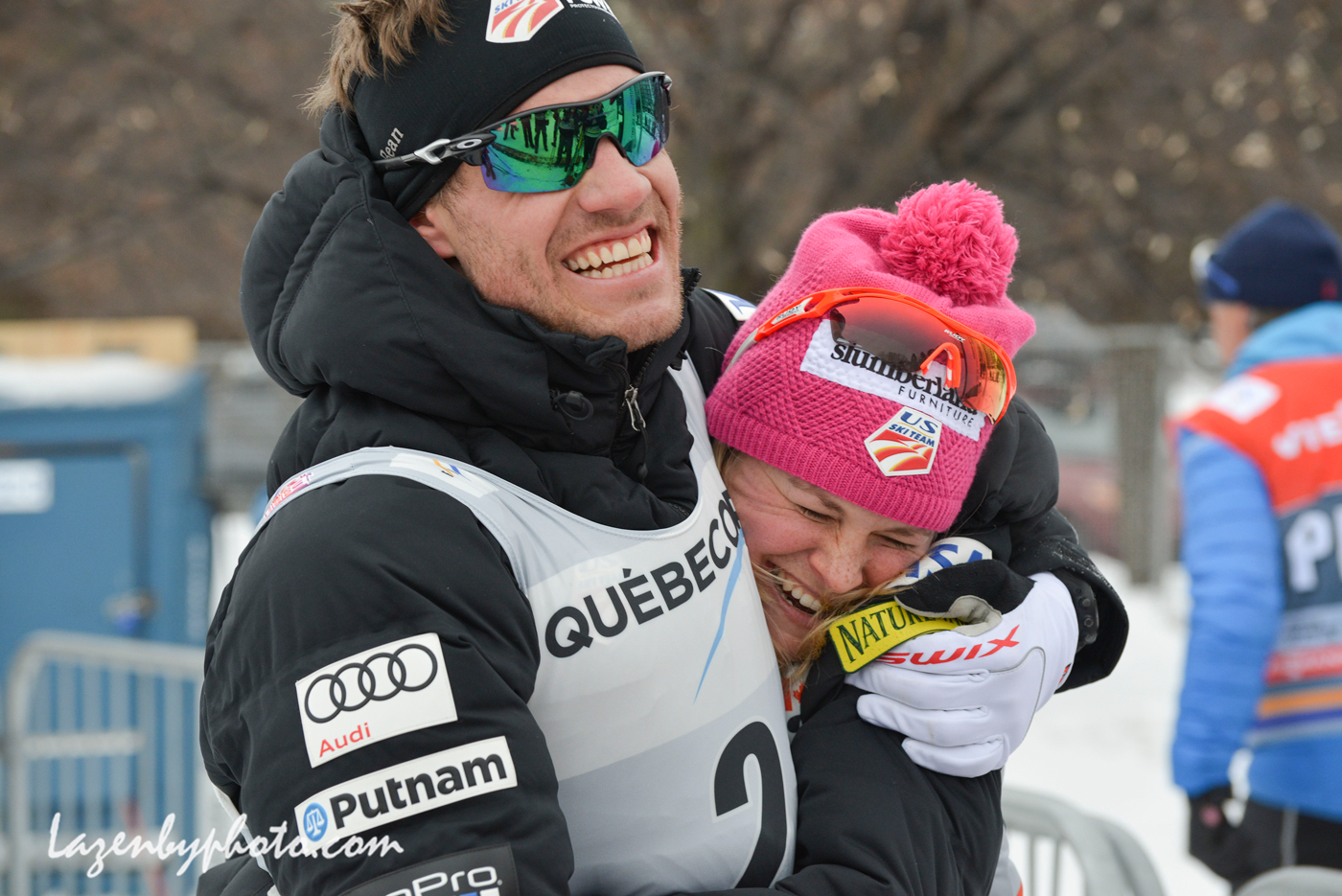
    Simi Hamilton (l) hugs fellow U.S. Ski Team member Jessie Diggins after both placed third in their respective freestyle sprint finals at the World Cup stage in Gatineau, Quebec. (Photo: John Lazenby/Lazenbyphoto.com)

    Men + women on the podium the same day: the precedent

    Now add the second thread: men and women both reaching the podium on the same day.

    In Gatineau (2016), during Ski Tour Canada, Simi Hamilton and Jessie Diggins both placed third in their freestyle sprint finals, and FasterSkier rightly framed it as a historic first: an American man and woman podiuming on the same World Cup day.

    That day is an important historical anchor because it shows how rare cross-gender podium alignment was, even during periods of strong U.S. women’s success.

    That alignment has echoed in the recent past, too — most memorably on February 18, 2024, in Minneapolis. Schumacher’s first World Cup victory, a 10-kilometer freestyle individual start on home snow, came on a day when Diggins also climbed onto the podium, finishing third in the women’s race. It was the kind of split-screen moment that hinted at what might be coming: a U.S. program no longer living on isolated miracles, but beginning to stack elite performances across genders on the same afternoon. Toblach sharpened that earlier echo into something rarer still — not a shared podium, but shared victories, on foreign snow, inside the Tour de Ski.

    Toblach 2025 goes a step further than Gatineau 2016 — not “podium together,” but win together.

    And that is why Grover’s comment — “hard to replicate” — matters. Because even a strong program doesn’t get to schedule these moments. It can only position itself to recognize them when they arrive.

    Gus Schumacher (USA) celebrates the victory in Toblach (ITA) with his US Ski Team teammates, coaches, and staff. (Photo: Modica/NordicFocus)

    Why the double win felt like a team story

    One reason Toblach resonated within the team is that both Diggins and Schumacher narrated their wins with a vocabulary that sounded less like a solitary triumph and more like collective execution.

    Diggins led with skis.

    “Fast snow, had really fast skis,” she said. “So thank you to our team…”

    She emphasized tactics not as personal cleverness but as mutual agreement: “Everyone did their part… Okay, I can pull now, and you can pull now.”

    And she framed the day’s broader meaning not as a press-release milestone but as a human reaction: “I’m so proud of Gus and everyone on the team.”

    Schumacher, asked to reflect on the same-day symmetry, responded with humor and a little humility — the kind that still acknowledges responsibility.

    Jessie Diggins (USA) also celebrates the victory in Toblach (ITA) with her US Ski Team teammates, coaches, and staff. (Photo: Modica/NordicFocus)

    Jessie “had to be a huge favorite,” he said. So “it was up to us to hold up our end.”

    That sentence contains something important about Schumacher’s emergence: he speaks like someone who believes he belongs in the job.

    Not in a boastful way — in a functional way. Like a skier who believes the U.S. men’s team is allowed to contribute to a “historic day” not as an anomaly but as a duty.

    Grover, who has watched the U.S. program move through phases in which the women carried the torch while the men tried to catch up, seemed to feel that shift, too.

    He described the day as something that bridges eras: there were times when a strong men’s day came without a matching women’s result; times when the women’s team was deep, and the men’s team was still searching for its consistent breakthrough.

    Toblach wasn’t just both genders on the podium. It was both on top.

    Whitcomb saw the same pattern across the roster.

    “Every one of our athletes — men and women — finished competitively in their heats,” he said. “And they executed the plans they came in with.”

    That included results beyond the podium: Diggins winning, Schumacher winning, Julia Kern in 10th, Ben Ogden in 20th, and J.C. Schoonmaker in 29th. “It really was an all-around great day,” Whitcomb said. “The execution was better than the results show.”

    A program doesn’t change overnight, but it does reveal itself in moments like this — when two separate pipelines deliver winners on the same day, under the same strange rules, in the same high-pressure context.

    Jessie Diggins (USA) embracing the excitement in the finish corral. (Photo: Modica/NordicFocus)

    The strange beauty of the format: teamwork as the unintended point

    FIS likely designed the four-heat format for spectacle: shorter races, more winners crossing lines, more “events” within a day. But Diggins described a different kind of spectacle — not for the cameras, but for the athletes.

    The format made cross-country skiing briefly feel like a sport of temporary alliances.

    “Maybe that wasn’t the goal,” Diggins said, acknowledging that she was projecting her own values onto a structural experiment. “Maybe that wasn’t the goal to get teamwork across countries. But for me, that was the goal.”

    Whitcomb was candid about why formats like this matter beyond athlete preference.

    “What’s most important isn’t actually what the athletes think,” he said. “It’s what the fans think. What the fans think dictates whether or not the sport survives in some regards.”

    Traditional 10 and 15-kilometer individual starts, he added, can be hard for casual viewers to engage with. “We need some change,” Whitcomb said. “And I think today provided a little bit of life to the sport. Frankly, it needs that.”

    Schumacher’s description of his heat was less philosophical but equally revealing: a group of men deciding, in advance, that the only way to win was to make the whole heat fast — even if it meant giving up individual control.

    This is an unusual kind of honesty in ski racing, where athletes are trained to reveal as little as possible about tactics.

    And it helps explain why the double win felt like a “team day” even though cross-country skiing is, most of the time, one of the most solitary endurance sports in the world.

    Both winners described the same phenomenon: speed created by cooperation.

    And both wins required the same final act: individual excellence layered atop shared work.

    Gus Schumacher (USA) thanks his ‘lucky’ fan club in Toblach (ITA). (Photo: Vanzetta/NordicFocus)

    The human detail that made it feel like a story, not a statistic

    Near the course, as the day unfolded, there was also the kind of detail that doesn’t appear in official documents but sticks to memory — the four “good luck Alaskans” who have now become part of Schumacher’s mythology.

    They were present at his World Juniors victory. They were present in Minneapolis. They were in Toblach again.

    They will be at the Olympics, too.

    It’s an affectionate superstition, but it also points toward something real: American skiing used to feel like a sport of isolated miracles — one athlete, one day, one surprise.

    Now, it is starting to feel like a sport that can sustain its own community momentum — people traveling for it, following it, building rituals around it.

    A program becomes a culture not when it wins once, but when it wins often enough that people start to behave like it’s a thing worth following.

    Jessie Diggins (USA) and Rosie Brennan (USA), (l-r) skied to second and third place in Davos in 2024. (Photo: NordicFocus)

    What to do with a day like this

    There is always a temptation, after a historic result, to treat it like a prophecy.

    To declare that the U.S. has “arrived,” that the future is guaranteed, that Toblach is the beginning of the next era.

    Neither Diggins nor Schumacher offered that kind of certainty. Diggins, even in the glow, stayed practical; Schumacher talked about holding up his end and taking the Tour day by day.

    Grover, too, resisted prophecy. He chose something quieter: recognition, gratitude, and the realism that moments like this can’t be manufactured.

    But history has its own rules. Even if athletes move on quickly, even if the World Cup continues, even if the next races erases some of last week’s glow, the record will still show: the United States won both races on the same World Cup day in Toblach.

    And when future athletes look back through FasterSkier’s archive — through Lahti 2014, Falun 2015, Gällivare 2015, Toblach 2017, the Tour days with Diggins and Brennan, the first men-and-women same-day podium in Gatineau — they will see Toblach 2025 not as a random spike, but as a point that makes the line look continuous.

    A story isn’t just an outcome. It’s the shape that outcomes make when you stack them over time.

    On December 31, 2025, American cross-country skiing’s shape changed again — not by accident, but by two winners choosing to race the same strange day with the same clear idea of what mattered.

    Go fast. Together. Then finish it yourself.


    Links and results

    FasterSkier’s Men’s Race Report

    FasterSkier’s Women’s Race Report

    Men’s Official 5 k Freestyle Mass Start Results

    Women’s Official 5 k Freestyle Mass Start Results


    Love Stories Like This? Help Keep Them Coming.

    Feature stories like this one take time, access, and care to produce. If you value thoughtful storytelling and independent ski journalism, please consider becoming a Voluntary Subscriber. Your support directly fuels the work we do to cover the people, places, and moments that make our sport special.

    Join the FasterSkier community!


    It is fitting that Brennan and Diggins were there in Minneapolis to celebrate and lift Schumacher when he won his first World Cup race; it’s easy to imagine Randall, Gregg, Maubet Bjornsen, Caldwell Hamilton, and Hamilton also there lifting all of them because they are all building blocks for what comes next. (Photo: Modica/NordicFocus)


  • In Davos, the Second Lap Always Tells the Truth

    In Davos, the Second Lap Always Tells the Truth

    This coverage is made possible through the generous support of Marty and Kathy Hall and A Hall Mark of Excellence Award. To learn more about A Hall Mark of Excellence Award, or to learn how you can support FasterSkier’s coverage, please contact info@fasterskier.com.

    Davos doesn’t reward urgency.

    It tolerates it, sometimes — lets it flirt with the clock through the opening kilometers — but it never forgets. Like a mysterious, wispy cloud, the altitude sits quietly above the stadium, thinning the air just enough that the consequences arrive late, not immediately. The first lap can feel generous. The second is where Davos asks what you’ve really brought with you.

    On Sunday, in the men’s 10-kilometer freestyle interval start at the World Cup in Davos, Switzerland, that truth arrived right on schedule. Athletes who attacked early were gradually called back. Athletes who waited found themselves moving forward without ever appearing to accelerate. And one skier — patient, smooth, and increasingly inevitable — turned the second lap into a private demonstration.

    Einar Hedegart of Norway won in 22:40.7, earning his second straight World Cup victory, this one built not on surprise but on control. Behind him came Harald Østberg Amundsen (NOR) at +11.7 seconds, Mattis Stenshagen (NOR) at +18.8, Johannes Høsflot Klæbo (NOR) fourth (+24.1), and Martin Løwstrøm Nyenget (NOR) fifth (+30.6). Andrew Musgrave (GBR) led the non-Norwegians in sixth (+31.1).

    Five Norwegians in the top five — but only one skied the race the way Davos prefers.

    Mattis Stenshagen (NOR) comes to the 10 k Interval Start Freestyle finish in Davos (SUI). (Photo: Modica/NordicFocus)
    The Temptation of the First Lap

    Interval starts strip racing down to decisions. No drafting. No cover. No negotiation. In Davos, those decisions begin almost immediately because the course invites speed from the start. The opening kilometers flow. The snow was hard and fast after an overnight freeze. Skis hummed. Breathing felt manageable.

    Several athletes took the invitation.

    Early time checks were brisk, and for a moment the race appeared to be tilting toward the skiers willing to press from the gun. Harald Østberg Amundsen, the reigning overall World Cup champion, was among them — assertive, controlled, but unmistakably on the front foot. At the first major checkpoint, Amundsen held a small advantage over Hedegart, exactly the kind of margin that feels reassuring on paper.

    Others followed similar scripts. Strong starters carved seconds in the opening loop, skiing as if Davos were simply another mid-altitude venue rather than one of the circuit’s quiet physiological traps. It all looked reasonable — until the course turned upward again.


    Why Davos Punishes Impatience

    At roughly 1,560 meters above sea level, Davos sits just high enough to distort pacing instincts. Red-lining a climb here doesn’t always feel catastrophic in the moment. The cost arrives later, when recovery never quite comes, and the second lap begins to feel longer than the first.

    That dynamic defined the race.

    Athletes who went hard early found themselves defending, not attacking, once the second lap began. Speed leaked away on the longer climbs. Transitions dulled. The ability to change gears — so critical in freestyle skating — started to fade.

    Hedegart, meanwhile, was doing something else entirely.

    Einar Hedegart (NOR) with Vili Crv (SLO) trailing during the 10 k Interval Start Freestyle in Davos (SUI). (Photo: Vanzetta/NordicFocus)
    Hedegart’s Patience — and the Moment it Mattered

    Hedegart did not lead early.

    That point matters.

    He allowed seconds to slip away in the first lap, skiing smoothly but without urgency, keeping his effort under control on the steepest sections. At altitude, that restraint isn’t passive — it’s strategic. Backing off even a few percent on the climbs can preserve a system that stays responsive later.

    When the race entered the second lap, the difference became apparent.

    Hedegart didn’t surge so much as continue. While others plateaued, he maintained tempo. While early leaders fought to hold speed, he quietly increased his advantage, taking time not through dramatic accelerations but through the absence of slowdown.

    By the 7.4-kilometer mark, the race had clarified. The seconds Hedegart had conceded early were gone — and then some. His advantage over Amundsen had grown decisively. The course was no longer offering second chances.

    The finish confirmed what the splits already suggested: Hedegart’s second lap was the fastest in the field, and it wasn’t close.

    Harald Amundsen (NOR) on his way to second place in Davos (SUI). (Photo: Vanzetta/NordicFocus)
    Amundsen, Stenshagen, and the Norwegian Sorting Hat

    Behind Hedegart, the Norwegian internal race unfolded in layers.

    Amundsen’s early aggression kept him close, but the cost was unavoidable. He remained solid — this was not a collapse — yet the final kilometers belonged to Hedegart. What had been a narrow early lead turned into an 11.7-second deficit at the line.

    Mattis Stenshagen, by contrast, skied one of the day’s most even races. Never flashy, never panicked, he moved steadily forward as others drifted back, finishing third and reinforcing his reputation as one of Norway’s most reliable distance technicians.

    Johannes Høsflot Klæbo offered another useful case study. After a frustrating sprint the day before, Klæbo looked sharper and more composed, staying in contention through the middle of the race. But Davos demands distance-specific economy, not just efficiency, and he lost ground late, finishing fourth — competitive, but never truly threatening Hedegart.

    Martin Løwstrøm Nyenget, wearing the red distance bib, rounded out the Norwegian sweep of the top five, steady as ever but unable to match the winning pace in the final lap.

    Five Norwegians, five slightly different races — and one clear template emerging at the top.

    Andrew Musgrave (GBR) was the fastest non-Norwegian skier in Davos (SUI). (Photo: Vanzetta/NordicFocus)
    The International Picture: Holding On vs. Moving Up

    Outside Norway, the same altitude logic applied.

    Andrew Musgrave (GBR) skied a disciplined race, managing his effort well enough to stay competitive throughout. He was rewarded with sixth place — not by attacking late, but by avoiding the fade that claimed others. In Davos, survival is often the first victory.

    France’s Mathis Desloges and Hugo Lapalus hovered near the top ten, their early speed gradually neutralized by the second lap. Italy’s Federico Pellegrino, so dangerous in sprint formats, found the sustained demands of the 10 km Interval Start less forgiving, finishing outside the top 30.

    The pattern repeated down the results list: strong early checkpoints followed by diminishing returns. Davos was collecting its debts.

    On his way to 30th place, John Steel Hagenbuch (USA) follows teammate Ben Ogden (USA). (Photo: Vanzetta/NordicFocus)
    The American View: Learning in Familiar Air

    For the U.S. team, John Steel Hagenbuch finished 30th, the top American on the day — a result that only hints at how complicated his Davos race really was.

    Hagenbuch has never considered himself particularly sensitive to altitude, a fact that quietly shaped both his expectations and his pacing plan.

    “I’m maybe not the best authority to say how altitude feels, as I usually don’t feel affected by it much,” Hagenbuch said. “I typically start slow and then pick up speed through races, and this pacing strategy is typically rewarded at altitude.”

    That approach aligned neatly with what Davos demanded. And while Hagenbuch is quick to downplay any physiological advantage from growing up and training in Sun Valley, Idaho, he did note a different kind of familiarity.

    “I think being from altitude can help with racing at altitude, but it’s certainly not a decisively significant factor — I was still plenty far behind the sea-level Norwegians today,” he said, with a laugh. “Speaking of familiarity, however, I remarked at how much Davos reminded me of home — the trails and the surrounding mountains strongly resemble Galena.”

    The race itself marked his best feeling of the opening World Cup block — even if the result came under less-than-ideal circumstances.

    “This Davos Skate 10 km was the best I’ve felt so far in Period 1,” Hagenbuch said. “But it unfortunately came only a day after I crashed hard on the infamously icy slalom downhill coming down from Flüelapass and subluxed my right shoulder for about the tenth time.”

    By race morning, the pain hadn’t gone away.

    “Even with a few thousand milligrams of acetaminophen down the hatch, every single pole stroke hurt,” he said. “So while it was nice to finally — barely — be top 30, I can’t help but think that without the injury and the stress associated with it, I could have done better. Alas, that’s life, and that’s skiing. I am not the only one to have had some bad luck in important races.”

    Zooming out, Hagenbuch remains confident in his trajectory, even if the opening block didn’t fully reflect it.

    “I feel confident in what I can achieve this winter — even if I didn’t necessarily show it during Period 1,” he said. “With this being an Olympic year, the competition was even higher than normal. For example, Per-Erik Bjornestad, one of our Norwegian wax techs, said that the Trondheim 10 km skate was the highest level of skiing he had ever witnessed.”

    Looking ahead, Hagenbuch’s plans are clear — and pragmatic.

    “Pretty much regardless of how today’s race went, I was going to go home to Sun Valley for Christmas,” he said. “I don’t think it makes sense for me to do the Tour de Ski, given how my health has been this fall and the start of the winter. I’m excited to go home and to compete at U.S. Nationals in Lake Placid.”

    Einar Hedegart (NOR) celebrates with a fist pump to the camera in Davos (SUI). (Photo: Modica/NordicFocus)
    Why this Race Matters More than it Looks

    It’s easy to treat Davos as an outlier — scenic, elevated, a little unique. The athletes don’t.

    The men’s 10 km Freestyle Interval Start is an Olympic format. It’s a race without shelter, without drafting, and without excuses. Davos amplifies all of that. Pacing errors are magnified. Aerobic limits are exposed. The second lap becomes a referendum.

    Hedegart passed that referendum emphatically.

    This was not a perfect-day fluke. It was not a tactical accident. It was the same pattern, repeated under different conditions, at a different altitude, against the deepest field in the sport. Ski patiently. Protect the climbs. Let others make the race hard early — then make it impossible late.

    Einar Hedegart (NOR) remained on the snow for several minutes after crossing the finish line in Davos (SUI). (Photo: Modica/NordicFocus)
    A Quiet Finish, a Louder Message

    There was no spectacle at the finish line. No disbelief. No chaos. Hedegart crossed, collapsed, and recovered — another man undone by thin air, but this time by his own effort.

    Two races. Two wins. Two second laps that separated him from everyone else.

    Davos didn’t raise its voice. It didn’t have to.

    It simply told the truth — the same one it always tells — and this time, Einar Hedegart listened better than anyone else.


    Men’s 10 k Individual Start Freestyle RESULTS


    Harald Amundsen (NOR), Einar Hedegart (NOR), and Mattis Stenshagen (NOR), (l-r) take the 10 k Freestyle podium in Davos (SUI). (Photo: Modica/NordicFocus)

    Love Stories Like This? Help Keep Them Coming.

    Feature stories like this one take time, access, and care to produce. If you value thoughtful storytelling and independent ski journalism, please consider becoming a Voluntary Subscriber. Your support directly fuels the work we do to cover the people, places, and moments that make our sport special.

    Join the FasterSkier community!
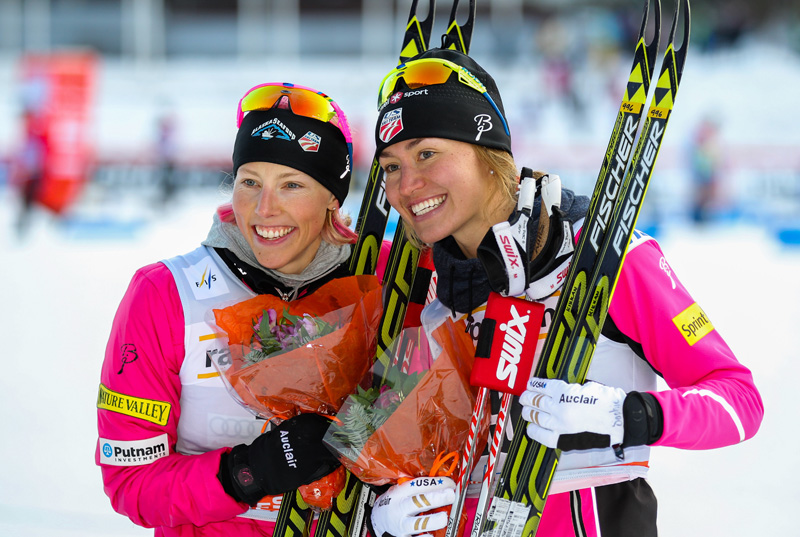
     

    Andrew Musgrave (GBR) gives the race winner Einar Hedegart (NOR) a sleigh ride after the pair had excellent days in the 10 k Freestyle in Davos (SUI). (Photo: Vanzetta/NordicFocus)