From the FasterSkier archive — posts syndicated from athletes’ and coaches’ own blogs between 2004 and 2012, kept online as published. Current coverage is at fasterskier.com.
The above discretionary selection process will be repeated for each period of World Cup this coming season. As always, if you have questions or concerns about this process, feel free to contact me directly.
Snow is the first question anyone asks about a ski trip. It is rarely the one that decides whether the trip was any good.
Plenty of skiers have booked a week somewhere with a meter of base and come home flat, because the grooming was inconsistent, the trail network was a single 5-kilometer loop repeated until it went stale, or the lodging was a forty-minute drive from the tracks. The destinations people return to year after year get a handful of less obvious things right at the same time.
Here are seven worth checking before you book. Winter travel outfits likeAlpine Elements build packages around most of them, but the list applies whether you are booking through an operator or piecing a trip together yourself.
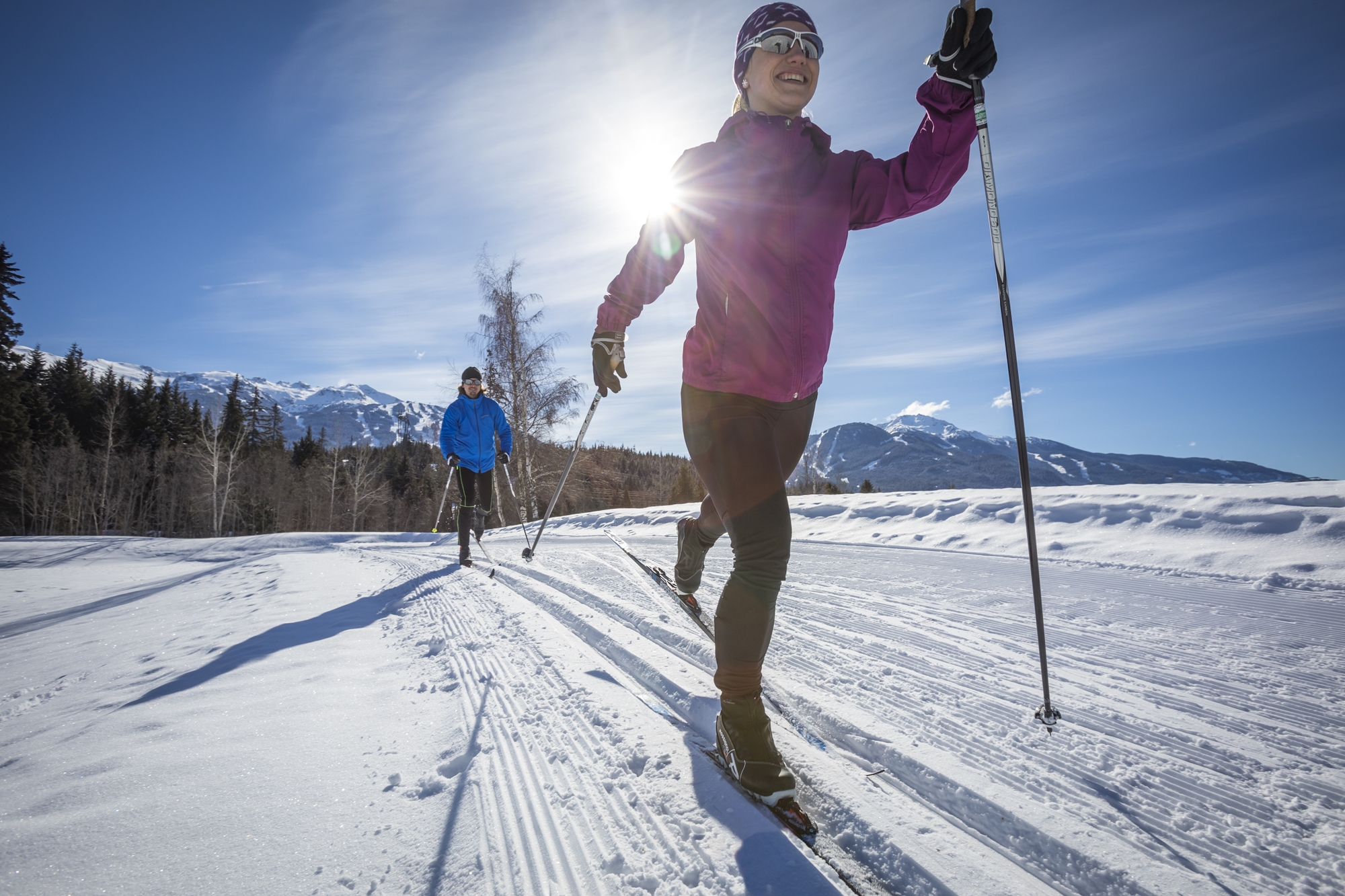
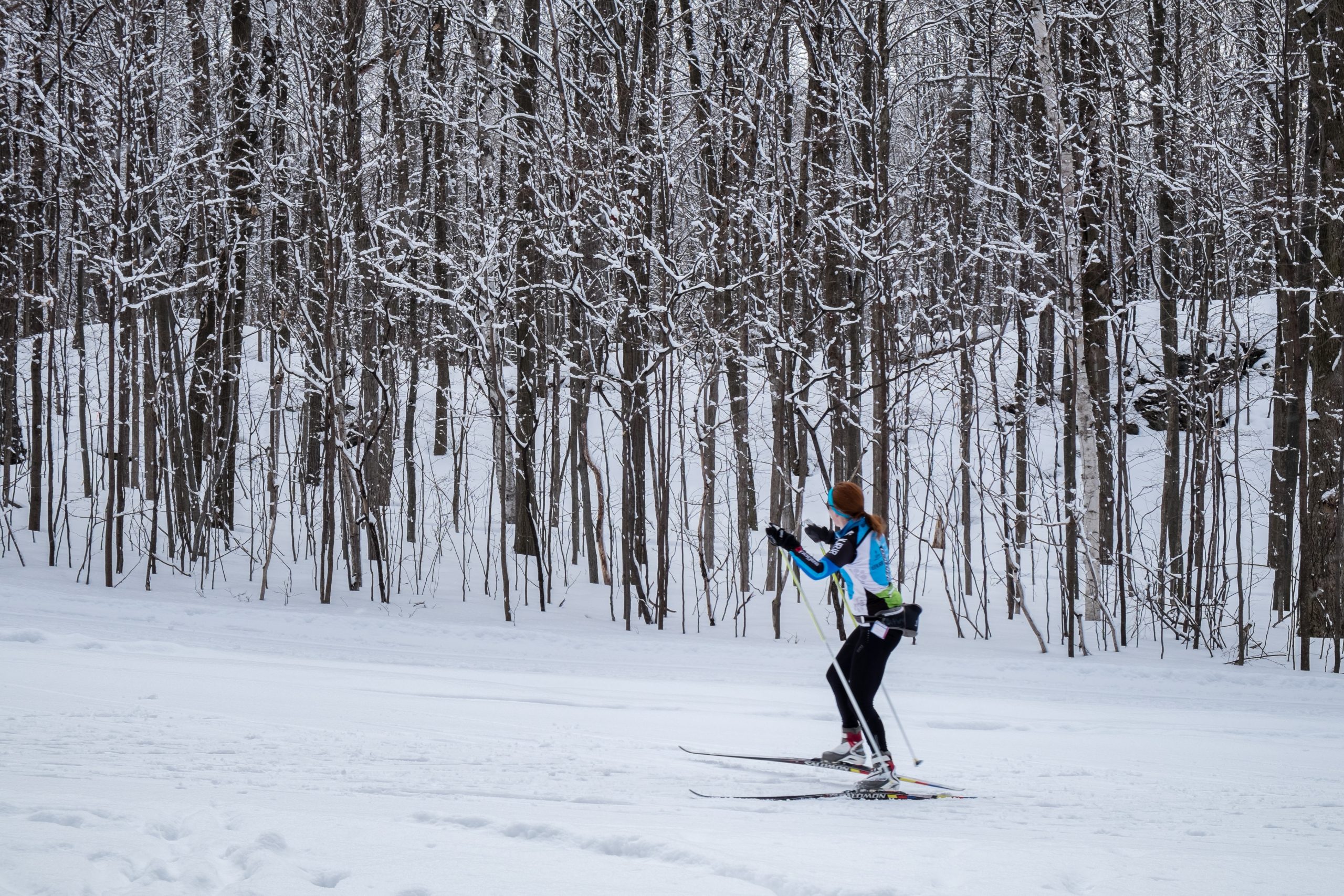
Photo: Tourism Whistler
1. Snow reliability, not just snowfall
The quality of any cross-country skiing holiday depends heavily onsnow conditions. Average annual snowfall is the number resorts advertise. It is not the number that matters most. What matters is how consistently a place holds skiable snow through the window when you can actually travel.
Altitude does a lot of the work here. Higher trail systems stay cold enough to keep a base intact through a February thaw that wipes out valley tracks. So does snowmaking. A growing number of Nordic centers now blow snow on a core loop, typically 3 to 5 kilometers, which guarantees you something to ski on even in a bad year. That loop will not carry a full week on its own, but it is real insurance.
Look up the last five seasons rather than the thirty-year average. Early December and late March are the risky bookings. Mid-January is almost always safe.
2. Grooming you can count on
Scenery does not save a badly groomed track. Nothing does.
The questions to ask are specific ones. How often does the center groom, and does it groom after a storm or wait for it to settle? Are classic tracks set on both sides of the skating lane, or does the skate deck take priority when the cats are short on time? Is there night grooming, so morning corduroy is a given rather than a coin flip?
Most serious centers post a daily grooming report. Read a few weeks of them before you commit. A center that logs conditions honestly, including the days when things were icy, is telling you something useful about how it operates.
Skating has been shown exacerbate CECS, even more than classic skiing. (Photo by Thomas Dils on Unsplash)
3. Terrain that matches the skiing you actually do
Cross-country skiing is unusually welcoming across ages and ability levels, which is exactly why destinations vary so much in who they suit.
A newer skier wants gentle, wide, well-signed terrain and a lesson program worth taking. Someone comfortable on skis wants 40 or 50 kilometers of connected trail with real climbing and descending, so a full day out does not mean skiing the same loop four times. A racer or a distance skier wants a network that supports a three-hour effort and, ideally, a hill they can do intervals on.
Beginners often benefit from gentle terrain, dedicated practice areas and professional tuition, whileintermediate skiers may prefer destinations offering longer routes with a mixture of climbing, descending and varied scenery. Experienced skiers and endurance enthusiasts are likely to appreciate extensive trail systems that provide technical challenges and opportunities to cover greater distances.
Groups complicate this. If you are traveling with a partner who skis twice a year and a kid who wants to go hard, a center with one difficulty band will frustrate somebody every day. Trail maps are free and they answer this question in about two minutes.
4. Where the trails go
Skiing is the rare winter sport that moves you through a landscape rather than down it. You cover ground at a pace that lets you see it.
That makes the setting a genuine part of the product, not a marketing photo. Trails that thread through old-growth forest, cross a frozen lake, or open onto a valley floor at the right hour give you something a treadmill of a loop through a parking-lot perimeter never will. Light matters more here than people expect. Low winter sun on fresh snow at nine in the morning is most of the reason skiers get out of bed on vacation.
Recreational skate. (Photo: Phillip Belena)
5. Lodging close enough to matter
Ten minutes from the trailhead and thirty-five minutes from the trailhead are different trips. The second one costs you an hour a day and quietly kills the second ski.
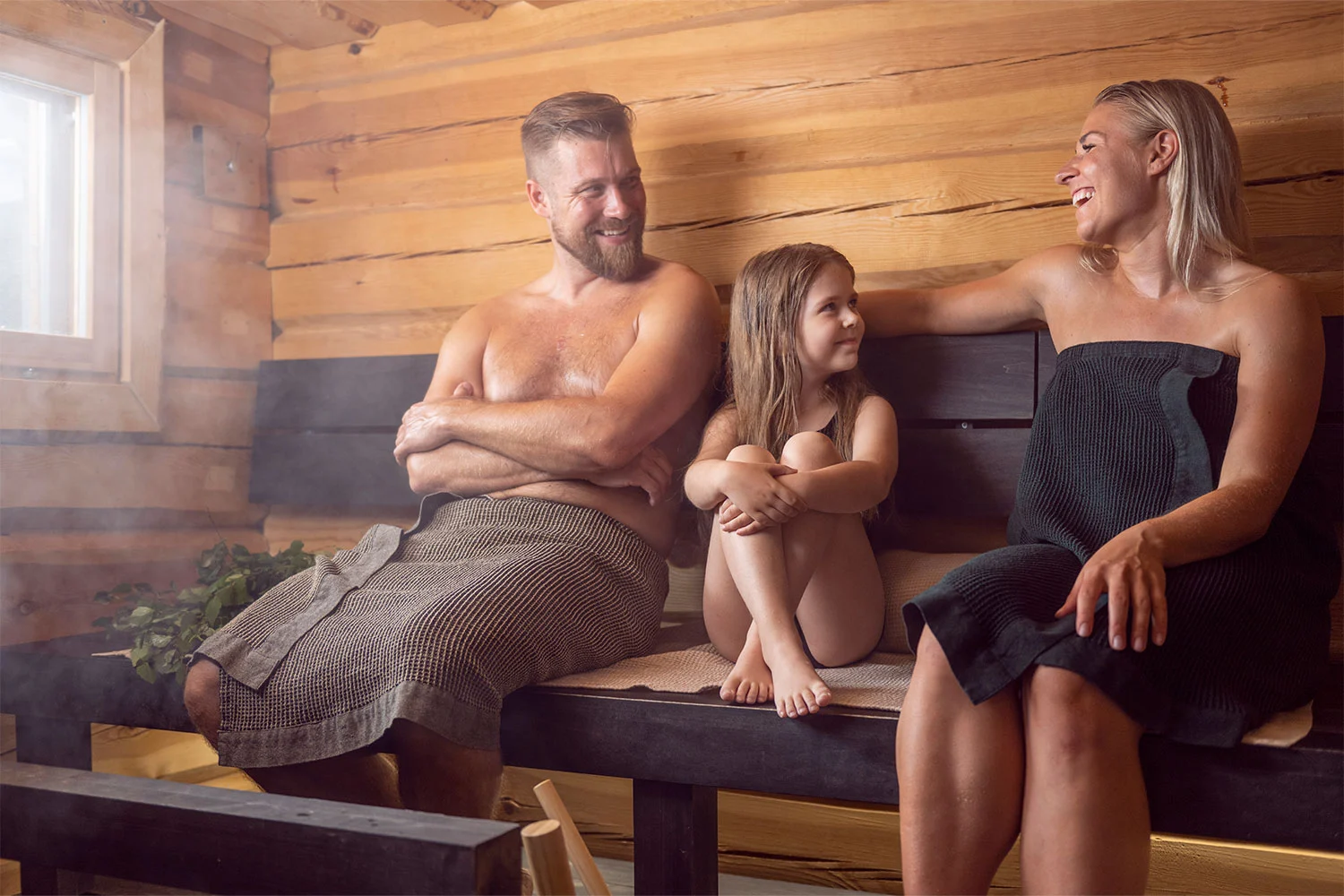
Beyond distance, the practical stuff is what separates a place that understands Nordic skiers from a place that rents rooms. Heated wax and boot rooms. Somewhere to dry gloves. A kitchen or a breakfast that runs early enough to eat before you go out. A sauna, which is not a luxury after four hours in the cold so much as a piece of recovery equipment.
6. What happens when the skiing stops
You are probably skiing three or four hours a day. That leaves a lot of day.
Towns with something going on, a bakery, a decent restaurant, a bar where people who ski actually go, turn the rest of the day into part of the trip instead of downtime in a rental. It also matters if you are traveling with someone who does not ski every day. Snowshoe trails, winter walking paths, a market, a hot spring, all of that keeps a group happy without forcing everyone onto the same schedule.
7. Getting there and getting outfitted
Logistics are boring right up until they eat a day of your trip.
Check the transfer time from the nearest airport or rail station honestly, including the last leg, which is often the slow one. Check whether you need a car once you arrive or whether a shuttle connects the lodging to the trails. If you are flying with skis, check the airline’s oversize policy before you buy, not after.
Rental quality is the other one people underestimate. A center with a real shop, current skis, a waxing service, and staff who ski themselves will get you on decent equipment in twenty minutes. A center without one will hand you a pair of rock skis from 2009 and wish you luck.
Recreational skate. (Photo: Pierre Jarry)
The right destination is the one that fits how you ski
Some skiers want distance and a network big enough to get lost in. Some want a quiet loop through the woods and a long lunch. Neither is looking for the same trip, and neither is served by picking whichever place claims the most kilometers.
The places worth returning to are the ones where reliable snow, honest grooming, terrain that suits you, and lodging you can walk to from the tracks all show up in the same week. Get those four right and the rest of it, the light on the snow, the pace, the quiet, takes care of itself.
The National Nordic Foundation (NNF) has kicked off its annual Summer Auction, running through July 13, with a fundraising goal of $30,000 to support grassroots Nordic ski development across the country. As of this week, the auction had already raised roughly $8,700 toward that target.
The online silent auction features a mix of gear, experiences, and unique memorabilia, including a fan bib signed by Jessie Diggins, an entry into the Alley Loop 42k, a training and technique video call with Kristen Bourne, and an autographed soccer ball from Sammy Smith, among other items still open for bidding.
Proceeds support NNF’s mission of centralizing funding and energy behind Nordic sport, connecting donors with athletes and programs at every level of the pipeline. Skiing fans can browse items and place bids at www.32auctions.com/NNFSummerAuction2026 before the auction closes on July 13.
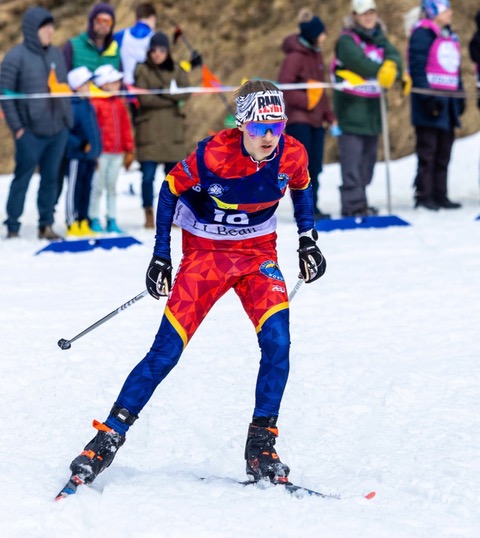
Quinn Holan on his way to a top 5 junior finish at US Nationals Lake Placid. (Photo: Courtesy Photo)
Will Sweetser thinks American Nordic skiing is recruiting in the wrong places. Here is what he is building on Donner Pass to prove it. This is the second of two parts — be sure to read part one, to learn about Sweetser’s background and coaching philosophy — Keep Showing Up: Will Sweetser’s Unglamorous First Principle
The number Will Sweetser carries around is thirty.
That, he says, is roughly how many development and junior racers a competitive Nordic ski club will produce from any 30,000 Americans with access to snow. The figure does not move much. Aroostook County, Maine, from Houlton to Fort Kent, about that. Stratton, Vermont, about that. Truckee, California, where he lives now, about that. He has been watching the number hold for thirty years.
“Maybe it’s a little richer in some of these alpine resort towns like Jackson or Aspen,” Sweetser said. “But in general, I think that’s a pretty good estimation of what you’re going to get.”
If he is right, the implication cuts against how most American Nordic clubs are organized. Truckee has three programs competing for that local pool. Each ends up with roughly ten development-age athletes. Sweetser, who runs the Nordic operation at Royal Gorge on Donner Pass, calls the result “not functional. And actually bad for athlete development.”
His conclusion is the one most clubs in snow country do not want to hear. He thinks they are fighting over the wrong 30,000 people.
Quinn Holan, Walker Rawlinson and Cabot Godoy celebrating learning at Jackson Hole International Spring Series 2023. (Photo: Courtesy Photo)
The 30,000 that interest Sweetser sit on the other side of the Sierra crest.
The Reno valley, by his count, holds about 650,000 people. The slice he is targeting — the corridor running from Gardnerville up through northwest Reno into Verdi, Nevada — is roughly 140,000 of that. He likes to compare it to the state of Vermont, where the total population is about 648,000. From west Reno to Royal Gorge is under 50 minutes. To Auburn Ski Club, the next program over, it is 40.
That, he points out, is shorter than what plenty of Vermont families drive to ski on Saturday mornings. It is shorter than what he himself drove from Bates to find usable snow in the 1990s.
“Why am I fighting over the 30,000 who live in Truckee,” Sweetser said, “who are frankly inundated with sports options?” Lacrosse. Soccer. Dance. Most of his daughter’s friends, he said, are doing two or three sports a season through elementary school. “How do you compete? Do cross-country ski training on top of all of that?”
There is a second front in the same argument. Truckee is a snow-sport town, but it is also a freeride town, and Nordic, in his telling, is losing the adolescent attention war to a sport that was built for the camera roll. “It’s never going to look as good as huck yourself off of a classic line at Palisades or Sugar Bowl or Heavenly,” he said. “You’re just not going to.”
Quinn Holan, Walker Rawlinson and Cabot Godoy. (Photo: Courtesy Photo)
So Royal Gorge is being repositioned. Sweetser describes it as a destination training center, by which he means destination for both racers and resources. The piece that interests him most is the labor pool.
A generation of Eastern Intercollegiate Ski Association graduates moved to the Bay Area for jobs in tech and finance over the last decade or so. Sweetser, off the top of his head, can name seven or eight. Widen the age range and he says he can name another thirty. They are not coaches by trade. Most of them make considerably more money than coaching pays. But they are skiers, and Sweetser’s bet is that a meaningful number of them would take three and a half hours twice a week — a Tuesday and a Thursday morning, say, or a Tuesday and a Saturday — to be paid by Royal Gorge to run a session in the Bay.
“The ones who are older don’t care about the money. They’ll do it anyway,” he said. “But the younger guys probably care about the money even less. They’re psyched to be out.”
He has tried this before with a Bay Area satellite through Sugar Bowl Academy and lost it to a turnover in headmasters. The current effort is being underwritten by Royal Gorge, whose general manager, Tom Miner, took over a few years ago and has been, in Sweetser’s description, the institution willing to write the checks. Bay Area families would still drive up Thursdays and Fridays for weekend training; the satellite sessions supplement, they don’t replace. “Four to five sessions of skiing per week,” Sweetser said. “Which is pretty crazy if you think about it. You can develop a lot.”
His reference point was his own résumé. He coached at Bates in the 1990s, when the team was off Mondays, didn’t ski Tuesdays or Wednesdays most weeks, and drove an hour each way the rest of the time or just left on Thursday for the next carnival stop. “I don’t think it’s the worst development plan for kids who want to ski in college,” he said. “Nor do I think it’s going to hurt your lifelong love of the sport to ski three or four days a week instead of six.”
JC Schoonmaker and Emma Ribom giving back at a Far West dryland clinic. (Photo: Courtesy Photo)
“I think it’s also a thought exercise more than a practicality,” he said. The snow-belt population is small to begin with, he argued, and within it, Nordic competes against alpine, against freeride, against every other thing a kid with a phone can see. He went looking for the counterexample and landed on Great Britain. Their entire cross-country skiing base, he estimated, is “maybe a thousand” people. Three British men finished in the top eight of a World Cup race in the lead-up to last year’s Olympics. The United States, from a population orders of magnitude larger, did not have three.
“So I think we have to apply both systems simultaneously,” he said. “You want the best possible resource application and preservation, as well as the recruiting.”
The recruiting, in his version, is what is taking him to Reno and to the foothills around Auburn and Grass Valley, towns at 2,000 feet of elevation, with populations several times Truckee’s, that have a history of ski teams without a current knowledge base. He has also been watching California middle-school track results, the way a baseball scout reads box scores. He is looking for the eleven- and twelve-year-olds who will hit puberty, stop being runners, and still have an engine.
Long view of program and athlete development. (Photo: Courtesy Photo)
The institutional pieces have been moving in the meantime, some faster than others.
Sweetser submitted a bid this month to host the 2028 Junior Nationals at Royal Gorge. The bid still needs approval from the sport committee and the junior working group, and the organizing committee is largely the one already preparing for an earlier event. He said the bid is in part a consequence of another organization having stepped back, and would not elaborate.
He is also in the middle of homologating four race courses at Royal Gorge — a sprint, a 2.5, a 3.3, and a 3.75 kilometer loop, with options for a 5K and additional sprint variants. Sweetser did the initial mapping himself; a professional GIS contractor is doing the formal version now.
The third moving piece is administrative. Sweetser owns a company called Ydalir, which is the U.S. importer for the Italian wax brand Maplus and the holding entity for his coaching operation. Ydalir’s junior and weekend programs are being folded into the Royal Gorge brand. “Weekend program up through juniors is branded Royal Gorge cross country,” Sweetser said. The older athletes — gap-year skiers, elite development athletes, masters groups — sit one tier up, with the financial arrangement still being worked out.
The deal makes sense to him because of what an institution provides. “I can’t just be running around in the woods all the time,” he said. “I need a home.”
Walker Rawlinson (Menlo CA) in a breakthrough race Jackson Hole 2023. (Photo: Courtesy Photo)
The home matters because of who he wants in it.
The NCAA is on the verge of changes that will give skiers a five-year clock from high school graduation, capped at age 24, in which to use four years of eligibility. Sweetser thinks the new rule will quietly squeeze out the gap-year athlete — the kid who could use a year at a prep school, the kid who is simply not ready at 18, the kid who would be a different athlete and a different person at 20. The five-year window is generous in theory and tight in practice.
What Royal Gorge can offer those athletes, Sweetser said, is a landing pad. Last year the resort gave passes to the three older skiers he was coaching. This year, in addition to the passes, it will offer them paid work with the ability to ski before and after a shift.
“It’s a pretty decent deal when you’re trying to make it,” he said.
None of this is new in concept. The Maine Winter Sports Center built something close to it in the 2000s, and produced a long run of national-team athletes from it. Sweetser was part of that operation. The Royal Gorge version inherits the DNA and adds a piece Maine never had: a population base on the other side of the mountains big enough to recruit out of.
Whether his thirty-out-of-30,000 math holds in California the way it held in Aroostook is the experiment.
“You take an 18-year-old and go out as a 20-year-old,” Sweetser said, “you’re a different person.”
Help Support Our Coverage!
If you value the thoughtful work and access FasterSkier provides, please consider becoming a Voluntary Subscriber. Your support directly fuels our work to cover the people, places, and moments that make our sport special.
Position Title: Development Coach, National Ski Team (NST), Olympic
Location: Canada
About Nordiq Canada
Nordiq Canada is the national governing body for both cross-country and Para Nordic skiing. We lead, support, and inspire world-class performances and lifelong participation in these sports nationwide.
The Opportunity
Reporting to the High-Performance Director and working within a collaborative high-performance environment, the primary responsibility of the Development Coach will be to lead and oversee the Development Team program. Development Team athletes have been identified as having strong potential for transitioning from junior racing to international excellence.
As a contributing member of the Nordiq Canada coaching staff, this position will involve organizing and leading training camps and competitive opportunities, providing enhanced services and support, and ensuring optimal functioning of Development Team athletes in their DTEs, including alignment with their IAPPs.
This is an exciting opportunity to contribute to one of Canada’s leading winter sport organizations and to work alongside world-class athletes, coaches, and support staff in pursuit of sustained international excellence.
Key Responsibilities
Provide support, oversight and technical expertise on the Yearly Training Program (YTP), daily program planning, delivery, and athlete gap mitigation to identified athletes and their coaches.
Check in regularly with athletes and coaches to ensure training is progressing, and athlete accountability measures are fulfilled.
Contribute to a culture of excellence, openness and growth.
Work in collaboration with experts in their respective fields.
Maintain a high level of scientific rigour in all processes, ensuring performance-based decision making and optimizing athlete health and wellness.
Lead projects and work plans with respect to gap analysis, the Podium Pathway and the Gold Medal Profile.
Assist the HPD in annual report writing and presentations.
Lead and oversee competitive opportunities such as World Juniors, international junior camps, and Nordiq Canada camps.
Attend all meetings as required or requested by the HPD and CEO.
Assist the HPD in program development, direction and philosophy.
Skills & Requirements
Experience coaching and connecting with young and developing athletes.
Experience leading competition trips and travel with teams, provincially and domestically.
Strong technical skiing ability, including the capacity to analyze and communicate areas for technical improvement and efficiency.
Competency in assessing and interpreting sport science testing and data.
Must be physically fit and capable of testing skis as well as training with athletes on some of their easy sessions.
Ability to contribute to a positive and professional team environment in and outside of competitive settings.
Excellent interpersonal, time management, and communication skills.
Detail and task oriented, goal driven, a strategic and tactical thinker and planner.
Bilingualism (English/French) considered a strong asset.
Valid driver’s license.
Working Conditions
This position requires approximately eight (8) weeks of travel domestically and internationally for training camps, athlete visits and competition opportunities annually.
How to Apply
Interested candidates are invited to submit a resume and cover letter to: bscott@nordiqcanada.ca
Application deadline: June 22, 2026, or until the position is filled.
Please include your name and “Development Coach NST” in the subject line. Only candidates selected for an interview will be contacted.
Nordiq Canada is committed to employment equity and encourages applications from all qualified candidates. Preference will be given to Canadian citizens and permanent residents.
Antoine Cyr qualified for his first sprint finals during Stage 5 of the 2023 Tour de Ski, and the first for a Canadian since Alex Harvey in 2018. (Photo: Nordic Focus).
Version française
Intitulé du poste : Entraîneur de développement, Équipe nationale de ski (ENS), Olympique
Lieu : Canada
À propos de Nordiq Canada
Nordiq Canada est l’organisme national de tutelle du ski de fond et du ski nordique paralympique. Nous encourageons, soutenons et inspirons des performances de classe mondiale ainsi qu’une pratique de ces sports tout au long de la vie à l’échelle nationale.
L’offre
Sous la responsabilité du directeur de la haute performance et au sein d’un environnement collaboratif axé sur la haute performance, la principale responsabilité de l’entraîneur de développement sera de diriger et de superviser le programme NexGen et l’équipe de développement junior.
En tant que membre à part entière du personnel d’entraînement de Nordiq Canada, ce poste impliquera d’organiser et de diriger des stages d’entraînement et des compétitions, de fournir des services et un soutien améliorés, et de veiller au fonctionnement optimal des athlètes de l’équipe de développement dans le cadre de leurs programmes de développement (DTE), y compris l’alignement avec leurs plans de développement individuels (IAPP).
Il s’agit d’une opportunité passionnante de contribuer à l’une des principales organisations de sports d’hiver du Canada et de travailler aux côtés d’athlètes, d’entraîneurs et de personnel de soutien de classe mondiale dans la poursuite d’une excellence internationale durable.
Responsabilités clés
Fournir un soutien, une supervision et une expertise technique concernant le YTP, la planification quotidienne des programmes, leur mise en œuvre et l’atténuation des lacunes des athlètes identifiés et de leurs entraîneurs.
Effectuer des bilans réguliers avec les athlètes et les entraîneurs pour s’assurer que l’entraînement progresse et que les mesures de responsabilisation des athlètes sont respectées.
Créer et soutenir une culture d’excellence, d’ouverture et de croissance.
Travailler en collaboration avec des experts dans leurs domaines respectifs.
Maintenir un haut niveau de rigueur scientifique dans tous les processus, en garantissant une prise de décision fondée sur la performance et en optimisant la santé et le bien-être des athlètes (toutes disciplines confondues).
Diriger des projets et des plans de travail concernant l’analyse des lacunes, le parcours vers le podium et le profil de la médaille d’or.
Assister le HPD dans la rédaction du rapport annuel et les présentations.
Diriger et superviser les opportunités de compétition telles que les Championnats du monde juniors, les camps internationaux juniors et les camps de Nordiq Canada.
Assister à toutes les réunions requises ou demandées par le HPD et le PDG.
Assister le HPD dans l’orientation et la philosophie du programme.
Compétences et exigences
Expérience en tant qu’entraîneur auprès de jeunes athlètes et d’athlètes en développement.
Expérience en tant qu’entraîneur au niveau provincial et national.
Compétences en matière d’évaluation et d’interprétation des tests et des données issus des sciences du sport.
Doit être en bonne condition physique et capable de tester des skis ainsi que de s’entraîner avec les athlètes lors de certaines de leurs séances faciles.
Capacité à contribuer à un environnement d’équipe positif et professionnel, tant dans le cadre de la compétition qu’en dehors.
Excellentes compétences interpersonnelles, en gestion du temps et en communication.
Souci du détail et de l’exécution des tâches, orienté vers les objectifs, esprit stratégique et tactique, et sens de l’organisation.
Le bilinguisme (anglais/français) est considéré comme un atout majeur.
Permis de conduire valide.
Conditions de travail
Ce poste nécessite environ huit (8) semaines de déplacements nationaux et internationaux par an pour des stages d’entraînement, des visites d’athlètes et des compétitions.
Comment postuler
Les candidats intéressés sont invités à envoyer leur CV et leur lettre de motivation à : bscott@nordiqcanada.ca
Date limite de candidature : 22 juin 2026, ou jusqu’à ce que le poste soit pourvu.
Veuillez indiquer votre nom et « Entraîneur de développement NST » dans l’objet de votre message. Seuls les candidats retenus pour un entretien seront contactés.
Nordiq Canada s’engage en faveur de l’équité en matière d’emploi et encourage toutes les candidatures de personnes qualifiées. La préférence sera donnée aux citoyens canadiens et aux résidents permanents.
Sovereign Lake Nordic Centre (SLNC) is offering an exceptional opportunity for a Head Coach who wants to lead, inspire, and shape one of Canada’s strongest cross-country ski communities. As one of Canada’s largest Nordic clubs, with 50+ km of daily groomed trails, a thriving athlete base, and a full suite of high-performance facilities, it’s a place where a coach can truly make an impact. Located just minutes from the City of Vernon, Sovereign Lake delivers a rare blend of professional and outdoor lifestyle. The North Okanagan’s trails, lakes, and mountains sit right outside your door, making year-round training and recreation part of everyday life. If you’re driven to develop athletes, build a positive team culture, and contribute to enhancing Nordic programs while enjoying an unmatched work-life balance, Sovereign Lake Nordic Centre is an ideal place to lead your next chapter. Reporting to the General Manager, this role works in close partnership with the Biathlon Head Coach and a dedicated team of volunteer coaches to deliver premier Nordic programming. The successful candidate will foster a collaborative environment that strengthens the club’s community and ensures a unified approach to athlete development.
Summary of Responsibilities
The Head Coach provides technical leadership and strategic oversight for SLNC’s competitive and developmental pathways, from Learning to Train (L2T) through post-secondary levels. This role is responsible for ensuring all training aligns with Long-Term Athlete Development (LTAD) principles and maintaining the high standard of excellence for which our programs are known. Key focuses include athlete progression, program integration across disciplines, and the successful delivery of seasonal training cycles.
Key Responsibilities
Athlete Instruction & Planning: Designing comprehensive yearly training plans (YTPs); Conducting performance testing; Providing expert technical modeling in classic, skate, and roller skiing; Coach (assist) for biathlon program with communication with the Biathlon Coach. Race & Technical Leadership: Providing high-level coaching and oversight at regional, provincial, and national events; Management of race-day wax operations; Provide race support liaison with other coaches and race officials. Program Growth: Driving club expansion through athlete recruitment; Lead volunteer coaching development; Conducting professional development workshops; Recruit and train assistant coaches. Safety & Communication: Maintaining a secure, inclusive training environment through strict adherence to Safe Sport protocols; Develop, communicate and ensure implantation of safety management plans for all coach-supervised training sessions in consultation with the Program Committee; Ensure and manage pro-active effective communication pertaining to weekly training sessions, club events, and XC race dates to athletes, parents, and other coaches via digital platforms. Administrative Oversight: Participating in committee meetings; Regular coach meetings and ensuring program deliverables; Contributing to the continuous improvement of club operations; Regular reporting to the General Manager; Develop and maintain relationships with sponsors and community organizations.
Fundamental Requirements
Professional Credentials:
NCCP Competition Coaching Development Certification (or ability to obtain within 8 months);
NCCP Competition Introduction Certified Coach Status (or equivalent);
5 years’ experience as an XC coach and/or athlete;
Standard First Aid Certification (to be maintained as current).
Proven excellence in classic, skate, and roller ski techniques with the ability to demonstrate skills to athletes effectively.
Operational Readiness:
A valid driver’s license and dependable vehicle access;
Flexibility to work evenings, weekends, and holidays in diverse outdoor conditions;
Criminal Record with Vulnerable Sector Check.
Character & Fit:
Collaborative, empathetic mentor;
Genuine passion for growing the sport across all skill levels;
Strong team player;
Ability to motivate, build trust, and gain the confidence of athletes and parents.
Position Type: Seasonal Full-Time (August 17 – March 31) Salary: $45,000 (seasonal term) paid biweekly
How to Apply
Interested candidates should submit their application by June 30, 2026, including a resume, cover letter, and two references (one character, one professional) to the General Manager of Sovereign Lake Nordic Club: gm@sovereignlake.comWe thank all applicants for their interest; however, only those selected for an interview will be contacted.
Two older girls on the Edward Little ski team went looking for bodies. It was the mid-1980s, the boys’ Nordic program at the Auburn, Maine, high school was thin and not very good, and the girls’ team was strong. The two girls, Becky Flynn (SVSEF) and Sarah Pribram (NWVE), knew a freshman who had skied a little in middle school. They asked him if he wanted in.
Will Sweetser’s second cross-country ski race ever was the Maine High School State Championship, he finished 34th, the best result on the team.
The next winter Edward Little won the state title. Sweetser placed seventh in the state — and fourth on his own squad. “I was the fourth guy running, I was the fourth guy skiing,” he said. The sport was tilting toward skating then, and almost nobody his age had figured out how to skate yet. Technique was a wash. So the results sorted themselves out the only way they could.
“It turned out that engines won,” Sweetser said.
That phrase could serve as an epigraph for everything he has done since, except for one inconvenient fact. His own engine was nothing special, at least by his own standards.
He learned exactly how unspecial his was as a freshman skier at Dartmouth, when the team did VO2 max testing. The results put Sweetser, the slowest man on the roster, “squarely in the bottom half of the women’s team.” He ran the numbers on his own future and did not like the answer. “I was already running almost the times they suggest for my VO2 max,” he said. The writing, he decided, was on the wall.
If the engine couldn’t get bigger, the speed had to come from somewhere else.
“Wax makes things faster. Strength makes things faster. I better learn technique,” Sweetser said. “Maybe I was a genetic predeterminist, and that’s why I started learning all the physiology.”
After graduating from Dartmouth, Sweetser took an assistant coaching position at Bates College in Lewiston, Maine, where he went to the library and more or less stayed there.
At Bates, Sweetser became a fixture in the stacks while living with his grandfather, working into the evening. “I literally was in the library more than the team,” he said. For two years, he averaged four or five interlibrary-loan requests a week. He calls what he built in that period “a self-taught, master’s-level survey course” in exercise physiology. He was also, by his own account, one of the first coaches in the country mailing away for VHS tapes of World Cup races, freeze-framing technique frame by frame because there was no other way to see it.
Will Sweetser (right) has worked with Olympian JC Schoonmaker (left), who now lives in Alaska and races for APU, since Schoonmaker was a young skier.
Three decades later, that reading has produced one of the more idiosyncratic coaching minds in American skiing. Sweetser is now based in Soda Springs, California, high on Donner Pass, after a long stretch running the program at the Maine Winter Sports Center. And the first principle he’ll hand you is almost aggressively unglamorous.
It’s consistency. Just showing up.
Sweetser points to a Norwegian study he came across years ago — his recollection puts it around 2006 to 2008 — that examined the country’s top 14 nationally ranked women, essentially its entire World Cup pipeline. Researchers measured everything: VO2 max, speed broken into 20-second segments, correlation after correlation. The single factor that most cleanly separated the top seven from the next seven, Sweetser says, wasn’t engine size or top speed. It was days lost to illness and injury. The lower group averaged roughly two weeks of missed training a year. The top group averaged two or three days.
“That seems to be the most correlated thing,” he said. Stretch it across a four- or five-year Olympic cycle and the gap stops being trivial.
It sounds obvious. It is also not how a great many junior programs actually behave, which is where Sweetser’s second idea comes in, and that one is stranger.
He builds training around fiber type, and he has a field test for sorting it. He’ll have an athlete — 15 or older — run a 400 meters, rest 20 minutes, then run a 3,000 meter. Then he looks at the ratio. A “normal” distance athlete, he says, holds about 76.5 percent of 400-meter pace over 3k. He can quote the figure to the hundredth. Drop below 68 percent and the athlete is built to sprint; climb above 82 and they’re built to grind. “This is how specific they are,” he said of the research he leans on.
The athletes all come to the same session. What changes is the leash. The sprinter types get a short one, where Sweetser wants the heart-rate alarm to go off the instant it “faintly whispers” the next zone, because those athletes overshoot every interval.
Where the distance types might run eight intervals, the sprinters run five or four. Body position stays the same for everyone. Cadence and power output are already different on their own. What he actually teaches, he says, is tactics — where on the course to spend, and where to wait based on each athletes strengths and weaknesses.
This is also why he keeps reaching for the treadmill. It is measurable and it is controllable, and that combination lets him do something he values more than almost anything: build what he calls “an athlete persona that’s rooted in belief, not hope.”
The clearest proof he offers was from an athlete he met at Bates, Sarah Dominick — the woman who would later become his wife and is now his coaching partner. At Bates, her running coaches kept pushing her mileage up, and every time she got much past 25 miles a week, she broke down. It made sense to Sweetser: she had a sprinter’s makeup, but was being asked to train like a distance runner. She was miserable enough that she sat out her junior year of competition entirely.
When she came back as a senior wanting to race the 3k and 5k, Sweetser says her coach called it a waste of time.
His plan went the other direction. He capped her running at roughly three hours a week and backfilled the volume with cycling and roller skiing. Warm-ups and cool-downs were run on grass, in the opposite direction around the track, to spare the leg that always flared. The key session, twice a week, was deceptively small: two sets of 15-seconds-on, 15-seconds-off at 3k race pace, jogging the corners, six minutes of rest between sets. Start to finish, it took about an hour.
She went from 11:38 to 10:00 for 3,000 meters in a month. She became a Division III All-American and set a school record. The following year, training off skiing and running on a dirt road at altitude, she ran 9:27.
The lesson Sweetser took from it is the one he now spends most of his time trying to give away. “Your best training computer is still between your ears,” he said.
Will Sweetser doing lactate testing during a hill-bounding session two season ago with Quinn Holan.
You can see what that looks like in Quinn Holan, the 18-year-old Sweetser coaches most directly and has worked with since the athlete was 11. These days, Holan, Far West’s standout U20 skier, writes his own training plans and brings Sweetser the questions, not the other way around. Increasingly, when the two disagree, the athlete keeps his own counsel, which is exactly the point. “You can call me his coach,” Sweetser said, “but it’s sort of like Klæbo’s grandpa is his coach.”
It is a strange arc for a man who started with so little to work with. Sweetser was the high school freshman recruited because the team needed a warm body, the college skier in the bottom half of the women’s VO2 results, and the coach who had to teach himself the sport one interlibrary loan slip at a time. Thirty years on, the whole project — the fiber-type tests, the treadmill data, the athlete who outgrows his coach — is really just an effort to spare the next kid the loneliness of that library.
Sweetser never did get the engine he wanted as an athlete, but as a coach, he has built something much more durable.
Next: why Will Sweetser thinks American skiing is fighting over the wrong 30,000 people — and what he’s building on Donner Pass to prove it.
Help Support Our Coverage!
If you value the thoughtful work and access FasterSkier provides, please consider becoming a Voluntary Subscriber. Your support directly fuels our work to cover the people, places, and moments that make our sport special.
The Telluride Ski & Snowboard Club (TSSC) is looking for an experienced cross-country coach to lead its Junior Nordic Race Team.
This is a chance to lead a program on the rise. TSSC Nordic has grown quickly over the past several seasons, and its junior racers now compete throughout the Rocky Mountain Division, including Junior National Qualifiers. Based in Telluride, Colorado, the club wants a coach who can develop that group across technique, fitness, and racecraft — and keep kids in the sport for the long haul.
The Position
Season: October through March
Hours: Approximately 20 hours per week, with potential to grow into a full-time role
Travel: Some travel is required for races
Compensation: $15,000–$25,000 depending on experience
How to Apply
Send a letter of interest and resume — or any questions — to nordic@tssc.org.
The International Ski and Snowboard Federation (FIS) unveiled its proposed 2026/2027 cross-country skiing World Cup calendar this week at the FIS Spring Meetings in Portorož, Slovenia.
The schedule — first shared publicly through FIS social media and still pending FIS Council approval — builds the season around the 2027 World Championships in Falun, Sweden, with three pre-Christmas stops, a nine-race Tour de Ski, a stretch of three weekends between the Tour and Worlds, and a Scandinavian closing kick that ends with the Finals in Ulricehamn.
For North American fans, the calendar is once again entirely European, with no scheduled stops in Canada or the United States.
Frida Karlsson (SWE) poses with Mr. and Mrs. Claus following the 10k Classic to start last season in Ruka (FIN). (Photo: Modica/NordicFocus)
Pre-Holiday: Ruka, Trondheim, Davos
The season opens where it almost always does — in Ruka, Finland, where the World Cup begins November 27. From there, the circuit moves to Trondheim, host of the 2025 World Championships, before the pre-Christmas block closes in Davos, Switzerland, with a team sprint.
November 27-29, 2026: Ruka, Finland
27/11: 10km Interval Start Classic
28/11: Sprint Classic
29/11: 20km Mass Start Freestyle
December 1-3, 2026: Trondheim, Norway
01/12: 10km Interval Start Classic
02/12: Sprint Freestyle
03/12: 20km Skiathlon
December 11-13, 2026: Davos, Switzerland
11/12: 5km Heat Mass Start Freestyle
12/12: Sprint Freestyle
13/12: Team Sprint Freestyle
With Jessie Diggins (USA) now retired, there will be a new FIS Overall Crystal Globe and Tour de Ski champion next season (Photo: Vanzetta/NordicFocus)
Tour de Ski 2026/2027
The Tour de Ski returns to a three-country format, opening in Les Rousses, France, on New Year’s Day, moving to Oberstdorf, Germany, and finishing with three races in Val di Fiemme, Italy — capped, as ever, by the Final Climb up Alpe Cermis.
January 1-3, 2027: Les Rousses, France
01/01: Sprint Classic
02/01: 20km Mass Start Classic
03/01: 15km Pursuit Freestyle
January 5-6, 2027: Oberstdorf, Germany
05/01: 15km Mass Start Classic
06/01: 5km Heat Mass Start Freestyle
January 8-10, 2027: Val di Fiemme, Italy
08/01: 15km Skiathlon
09/01: Sprint Freestyle
10/01: Final Climb
Gus Schumacher (USA) and the rest of the US team will hope to continue their success in Toblach (ITA). (Photo: Modica/NordicFocus)
After the Tour, Before Worlds: Engadin, Toblach, Lahti
Three weekends bridge the Tour de Ski and the World Championships. Engadin opens its weekend with a mixed relay — a format the FIS has been working into more World Cup weekends — and Lahti closes the pre-Worlds stretch with its classic 20km skiathlon and 10km interval start.
January 22-24, 2027: Engadin, Switzerland
22/01: Mixed Relay
23/01: Sprint Freestyle
24/01: 20km Mass Start Freestyle
January 29-31, 2027: Toblach, Italy
29/01: 10km Interval Start Freestyle
30/01: Sprint Freestyle
31/01: 20km Mass Start Classic
February 12-14, 2027: Lahti, Finland
12/02: Sprint Classic
13/02: 20km Skiathlon
14/02: 10km Interval Start Classic
Kendall Kramer (USA) had a breakout World Cup Skiathlon in Falun (SWE) last season. (Photo: Authamayou/NordicFocus)
2027 FIS Nordic World Ski Championships: Falun, Sweden
The 2027 FIS Nordic World Ski Championships run from February 22 through March 7 in Falun, Sweden, with all title formats on the program. Falun last hosted Worlds in 2015.
Final Period: Oslo, Drammen, Ulricehamn
The closing stretch is a Scandinavian one. Oslo’s Holmenkollen weekend features back-to-back 50km mass start classic races on March 13 and 14 — long a fixture of the late-season calendar — before a one-day sprint stop in Drammen and the World Cup Finals in Ulricehamn, Sweden.
March 13-14, 2027: Oslo, Norway
13/03: 50km Mass Start Classic
14/03: 50km Mass Start Classic
March 16, 2027: Drammen, Norway
16/03: Sprint Classic
March 19-21, 2027: Ulricehamn, Sweden (World Cup Finals)
19/03: 10km Interval Start Freestyle
20/03: Sprint Freestyle
21/03: 20km Mass Start Classic
The calendar remains subject to FIS Council approval.
We’re happy to welcome Patrick O’Brien back to the ranks of the Craftsbury Ski Club, this time as the Assistant GRP Ski Coach. Pat, a native of Putney, VT, raced collegiately for Dartmouth before his stint as a professional ski racer with the Green Racing Project from 2010-2014.
While on the GRP, Pat competed in multiple World Cups and also became known to the Craftsbury community as a hardworking jack-of-all-trades with a deep love of skiing and the outdoors. Pat moved on from racing to become the head coach of the SMS T2 team from 2014-2022. Although he coached multiple athletes to international success, he’s most proud of the role he played in building a program that brought together athletes of all ages and rooted the team in its local community.
In recent years, Pat has supported various junior, college, and elite teams as a service technician, all while juggling a job as a builder and wrangling a growing young family. When not up to his eyeballs in ski wax or construction detritus, Pat can often be found outdoors with his wife Ida, who also has deep ties to Craftsbury, and their two kids. Welcome back, Pat!
Registration is open for the Stratton Mountain School BKL Summer Camp, which runs August 3-6, 2026, on the SMS campus in Stratton Mountain, Vermont. The camp is open to athletes ages 10 to 14, with a maximum grade of eighth.
The four-day program is built around progressive skill work in a low-pressure setting. Hiking, swimming, roller skiing, ski bounding, and games are all on the schedule, along with the camp’s annual lip-sync contest. Campers will also sit down with members of the SMS T2 Elite Team for a Q&A — the T2 group has put skiers on World Cup and Olympic start lists, and the session is one of the camp’s longer-running traditions.
The camp is split into two sections, one for male athletes and one for female athletes, both running the same August 3-6 dates. Registration and payment deadlines are both July 31, 2026.
If the camp fills before the deadline, SMS is keeping a waitlist through a Google form linked on the registration page. Note that the form does not allow duplicate phone numbers. Cancellations made fewer than 30 days before the camp start date are non-refundable.
For questions, contact Nordic Program Director Matt Boobar at mboobar@gosms.org or 570-594-7555.
Where do High School and USCSA programs fit into our development.
In a recent article, I laid out the disconnect between what we say about long-term development in Nordic skiing and what we do and the rewards. “Long-Term Development in Nordic Skiing: What We Say vs. What We Actually Do”. Most people that I talk with agree with the premise of long-term development and keeping youth in sport longer. None of this is particularly controversial. We all understand that endurance development, technical skills and learning how to race takes years. We now see this statement across virtual all endurance sports world, that early results are a poor predictor of long-term success.
So, if we assume there is a consensus then we must ask why the system seems to act in the opposite way. Because systems don’t reflect what we say. They reflect what we reward through early selection, for competition and training opportunities. That’s really the question sitting underneath all of this.
We’ve reached a point where there’s broad agreement on philosophy. Long-term development matters. Early results don’t predict long-term success. Endurance, technique, and racing ability take years to build. You hear that all endurance sports now, not just skiing.
None of that is controversial!
But if that’s true, then we have to be honest about what follows. Because systems don’t reflect what we say. They reflect what we reward. And right now, the system is still rewarding something very different.
The incentives tell the story.
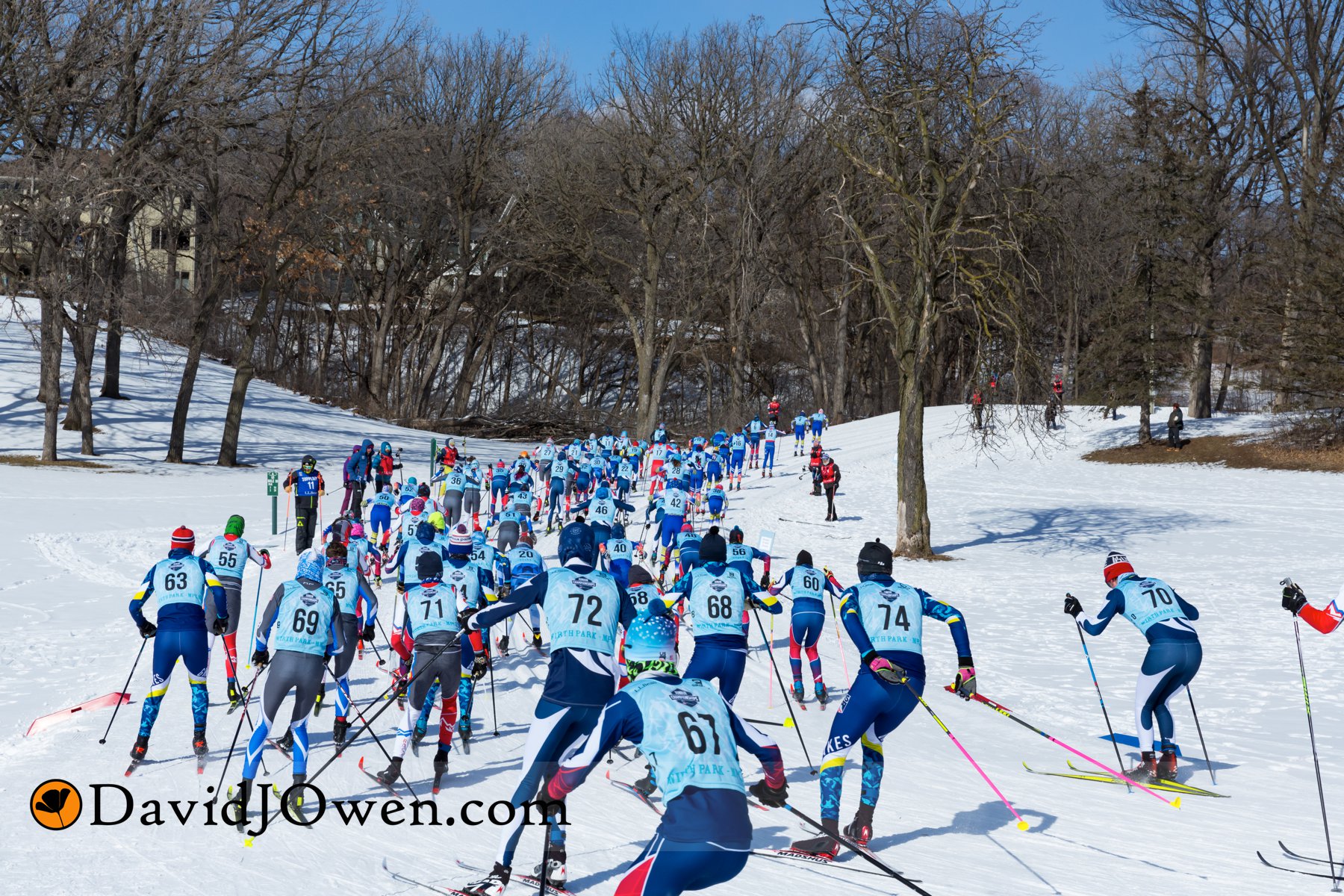
Skiers from all over the country round the first corner of the Theodore Wirth Park course in the U16 Boys 5 k Classic at Junior Nationals in Minneapolis in 2022. (Photo: David J Owen Photography)
Junior skiing in the U.S. is quietly organized around early selection. Qualification for Junior Nationals, especially at U16 and younger, carries weight. Rankings matter. Opportunities follow results. No one would say that’s the goal. But it’s the outcome.
Athletes see it. Parents respond to it. Coaches feel it. And none of that is inherently bad. But when those forces align around early results, the system starts to tilt. Short-term performance carries more weight than it should. And over time, that shows up in participation. The fields in USSS junior races get smaller as the age groups progress. We can debate why, but we can’t ignore that we’re losing athletes along the way.
The earlier we start selecting, the earlier we start excluding, selecting out athletes. And in a sport like skiing, that’s a problem. Development is long-term, non-linear, and tied to maturation in ways we can’t reliably predict. So, when we sort athletes at 13, 14, or 15 years of age, or younger, we’re making decisions on incomplete information, and treating those decisions as if they’re meaningful. They’re not!
What we’re really doing is narrowing the pathway at the exact point where it should be widest. If we believe in long-term development, early stages should include more athletes, not filter them out. We don’t lose athletes because they lack talent. We lose them because they stop seeing a path or opportunities forward.
That loss doesn’t always show up at the top. At the elite level, we can always point to success and say the system works. And in a narrow sense, it does. Every system produces some high performers. But that’s survivorship bias. But even with the perceived success, it is clear that most of those who step onto the World Cup are not prepared and developed for that level of competition, or we see an erosion of their performances over several years.
What matters more is what happens in the middle. Over time, that middle erodes. Fewer athletes stay. Fewer develop later. Fewer are still around when their best years should begin. And once they’re gone, they’re gone. So, how do we grow the sport and improve the development system? Following are a couple of ideas for the integration of high school and college skiing.
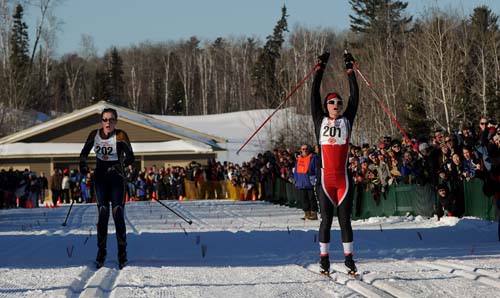
Stillwater senior Jessie Diggins, right, finishes ahead of St. Paul Academy senior Annie Hart in the 2010 edition of the Minnesota State Meet. (Photo: MSHSL Archives)
This is where the high school system should come into focus. Whether we acknowledge it or not, it’s one of the most influential environments in the entire pathway. We’re talking about roughly 6,500 high school athletes, compared to about 2,100 in the USSS junior system. That alone tells you something. Most athletes are not in the club pipeline. And there’s very little overlap between the two, in some regions more than others.
So now you have two systems, often operating in parallel, sometimes in conflict, shaping the same athlete. The club system is year-round, often very expensive, which creates barriers, and it is tied to rankings, qualifications, and progression. Ideally, at least in theory, it is long-term focused. The high school system is seasonal. Compressed. Built around immediate competition, conferences, regional, and state.
Both have value. But they’re not aligned. And when systems aren’t aligned, the athlete’s abilities are often put in difficult positions. High school seasons are short. That compresses everything. Training, racing, recovery, all of it gets stacked into a three-month season.
And yet, high school skiing also gets something right that the system needs more of. It creates a connection. It lowers barriers to entry. It brings athletes into sport who might never join a club. It makes skiing social. It makes it fun. Those values matter!
Athletes who feel connected to a team stay in the sport longer. That alone makes the high school system one of the most valuable pieces of the entire pathway. The issue isn’t that it exists rather it is not integrated, where do those high school skiers go after high school, an assumption may be many go into the non-integrated USCSA programs.
If that gap exists in high school, it becomes even more obvious at the college level.
Because this is where the pipeline either tightens or disappears. On one side, you have NCAA skiing. Roughly 20–25 programs. Maybe 300–400 athletes. Small, but structured, providing consistent coaching, clear expectations, and daily training environments that align with the demands of sport.
On the other side, you have USCSA. Thousands of athletes. Hundreds of active racers. A much broader participation base. So yes, USCSA is far bigger. But the NCAA is more efficient. In NCAA programs, a higher percentage of athletes improve year over year. More reach FIS relevance. More stay on a performance trajectory. That’s not because they’re inherently more talented. It’s because the environment supports development. Training is consistent. Coaching is present. Progression is clear.
USCSA shows the opposite. It’s not only a talent problem. It’s a structural problem. You have hundreds of athletes still in the sport. Many have endurance backgrounds. Many are still within a trainable window. But training is inconsistent. Coaching is variable. Development isn’t systematized. And there’s no clear bridge to higher performance levels. So, the conversion rate stays low.
This is where the pipeline argument starts to fall apart. We tend to focus on the front end, getting more kids into the sport. But at the USSS level that has been ineffective at best. And missing the fact that we already have athletes in the system that aren’t welcome or integrated. High school skiing, USCSA, represents a large participation pool sitting right in the middle of the development pathway. What we don’t have is a system that consistently integrates and develops them.
So, what actually needs to change? Not the philosophy, it seems we already agree on that. What needs to change is how the system behaves across the junior and collegiate level, it means recognizing where the opportunity is not just in the NCAA pipeline, but in the larger, under-structured USCSA system that already exists.
Even if we integrated the high school athletes and the USCSA athletes into the USSS system, the sport is still tiny. But it seems growing the sport significantly beyond this level is unlikely so we should be looking for ways to include these athletes in the system as much as possible for those who have an interest.
There are athletes in the system right now, thousands of them, who could or have the potential to improve dramatically beyond high school. Some who could enter the sport late and still become competitive.
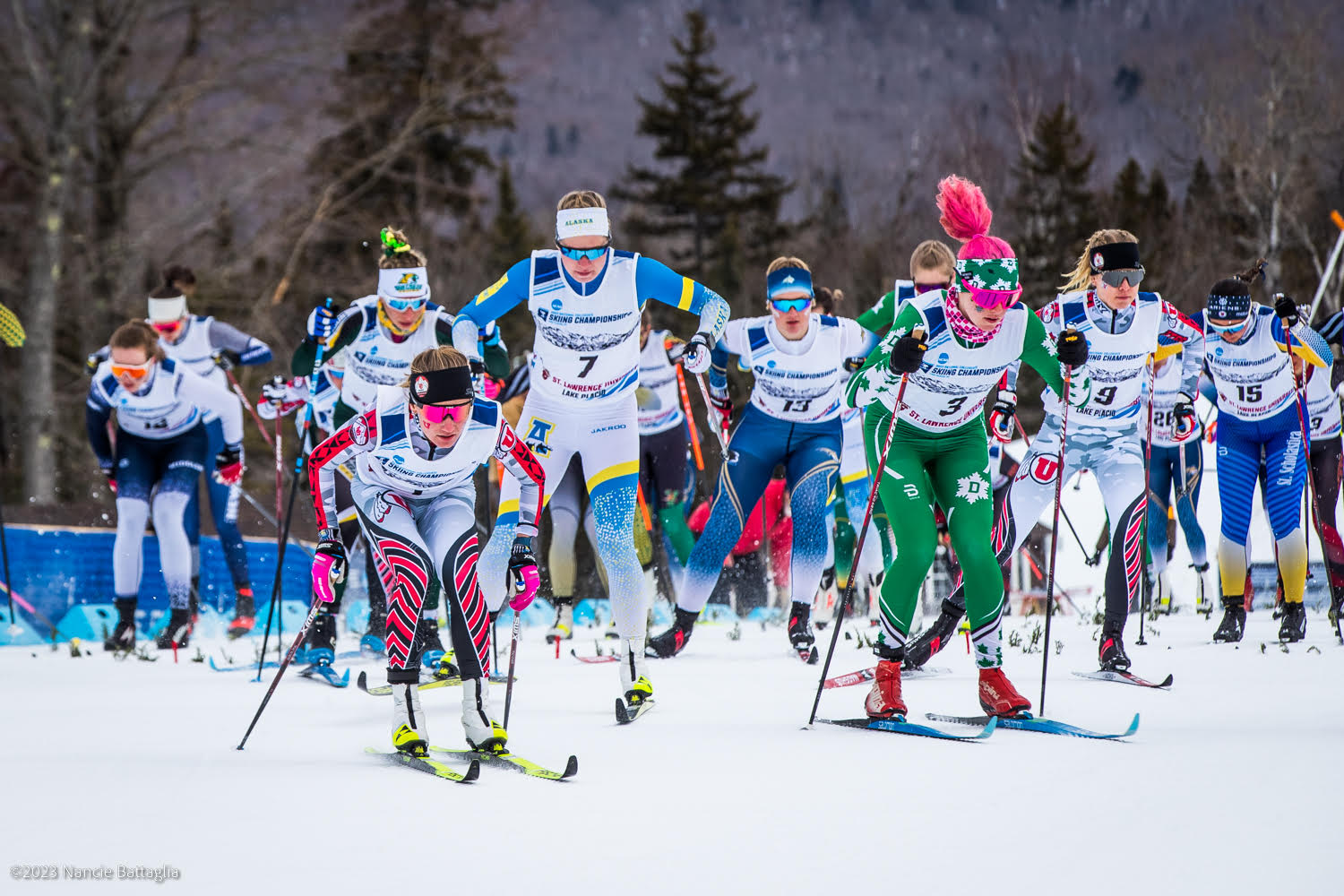
Novie McCabe controlled the pack for much of the 20-k mass start at the 2023 NCAA Championship in Lake Placid, New York. McCabe became just the fifth three-time NCAA Women’s Champion with her win. (Photo: (c) 2023 Nancie Battaglia)
At some level, this comes down to a simple choice. Do we want a system that identifies and benefits early performers? Or one that develops athletes over time? Right now, we say the second. But too often, we operate like the first. And the differences are real; we can see it by who improves, who stays in the sport, and when athletes exit the sport.
We don’t need to overhaul everything. There’s a lot in the system that works. High school brings athletes in. NCAA shows what structured development can look like. Even USCSA shows us how much untapped potential is sitting there.
But without alignment, those pieces don’t add up. So the question isn’t whether we understand long-term development. It’s whether we’re willing to build a system that actually supports it. Because if we are, the path forward should be clear.
And if we’re not, we should at least be honest about what we’re choosing instead.
Help Support Our Olympic Coverage!
If you value the thoughtful work and access FasterSkier provides, please consider becoming a Voluntary Subscriber. Your support directly fuels our work to cover the people, places, and moments that make our sport special.
Saint Michael’s College, a Division III liberal arts institution located in Colchester, Vermont, is seeking a Head Nordic Ski Coach to lead its program. The successful candidate will oversee all aspects of a year-round program, from training and competition to recruiting and budget management, while building meaningful relationships with student-athletes and the broader campus community.
Position Details
Institution: Saint Michael’s College (Colchester, VT)
Status: Full-Time
Salary: $48,000–$54,000
Benefits: Health, dental, vision, employer-paid life and disability insurance, 401(k), generous paid time off, employee and dependent tuition benefits, parental leave, flexible spending accounts, discounted gym membership, paid volunteer time, and access to athletic facilities and the library
Responsibilities
Plan and conduct daily practices during the season
Coach athletes throughout competition
Manage year-round recruiting and maintain prospect database via ARMS software
Counsel student-athletes with a focus on personal development and academic excellence (minimum 3.0 GPA expected)
Collaborate with the Head Alpine Coach to supervise the Kelley Ski Center
Manage program budget, equipment, and travel planning
Serve as event manager for non-Championship segment competitions
Engage the team in life skills programming, community service, and department-wide initiatives
Attend monthly staff meetings and respond to inquiries from within and outside the College
Qualifications
Bachelor’s degree required
Minimum five seasons of coaching Nordic skiing at the collegiate, professional, Olympic, or club level (competitive experience at the collegiate, national, or Olympic level will count toward this requirement)
US Ski and Snowboard L100 coach’s certification required
Current CPR and Basic First Aid certifications
Must meet Saint Michael’s College driver eligibility requirements
Familiarity with Microsoft Office and ARMS recruiting database
Strong communication and problem-solving skills across a range of audiences
Annika Martell racing during the NENSA club relays, Saturday, March 28, 2026 at Craftsbury. (Photo: Phil Belena)
The Craftsbury Green Racing Project has named Annika Martell as its new Head Ski Coach.
Martell brings a resume that spans nearly every corner of the Nordic skiing world. A Minnesota native, she headed east to ski at Colby College, where she captained the team and earned recognition for her leadership before graduating with a degree in economics and environmental science.
Her coaching career has taken a similarly wide path. Early on, she interned with the US Biathlon Association and coached juniors at Ford Sayre and the Berkshire Nordic Ski Club, before moving into elite-level work as an assistant coach with the Stratton Mountain School T2 Team. She spent four years as an assistant coach at Williams College, during which time she completed two stints as a Trail to Gold Fellow with the US Ski Team and served twice on the wax staff for Team New England at Junior Nationals.
Most recently, Martell was the Head Nordic Coach at St. Michael’s College, where she guided the program to highly competitive results.
Her background extends well beyond the ski tracks. She is a certified weightlifting coach and handled strength and conditioning duties at Williams. She also has experience in finance and operations management, and holds a Master’s degree in Sports Business from Drexel University.
The Craftbury Green Racing Project is still accepting athlete applications for the incoming 2026 snow class — Apply Here
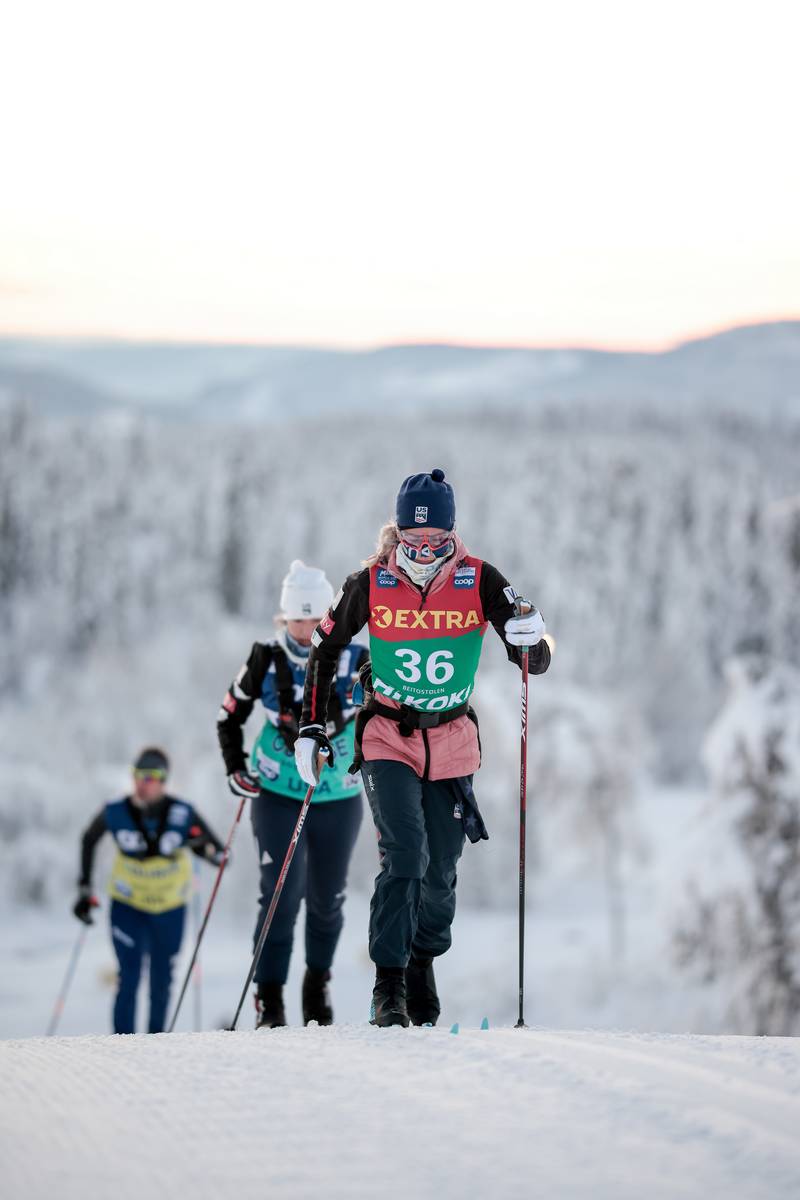
Martell follows Jessie Diggins on course in Beitostolen in 2022. (Photo: Nordic Focus)
American Neve Gerard (l) leads athletes from other countries at an International Training Camp in August, 2024, in Sjusjøen, Norway. (Courtesy photo)
As this ski season wraps up, many of us coaches are doing similar work. Using spreadsheets or a popular training platform, we map out training for the year. We plan the yearly hours, monthly hours, and weekly hours, along with defining the training intensity distribution. We also plan how long and over-distance sessions should be, and maybe how much high-intensity training we should include, etc. I have done the same in the past.
Nowadays, my yearly plans include almost none of those things, but rather it is a general road map of how I might want the training loads to progress, what type of high-intensity, neuromuscular work, strength training focus, technique development, training camps, testing sessions, and a general concept of where we start in April or May. We must be able to adjust training on the fly based on an assessment of how athletes’ recovery and adaptation, week to week, with the training and developing fitness.
In this article, I want to make a case for the changes I have made. Why? Because these detailed hours and training-intensity distribution plans we make are about as good as the day they were written. We then must avoid the temptation to implement training in May, June, or July just because we wrote it down in April. There is no way we can anticipate in April how an athlete will respond to training next month, much less than 2-6 months down the road.
In discussion with many athletes and coaches I have consulted with in the last four to five years, I believe the biggest challenge faced is how and when to increase training load within a training year. For reference, I use TRIMP to define the metabolic load. TRIMP is described as a modeled internal-load metric or composite index based on exercise duration and HR-derived intensity weighting. TRIMP is not perfect because it is based on heart rate parameters, so power and strength training, mechanical loads are not accounted for. I find TRIMP an excellent proxy for the loads of all endurance training.
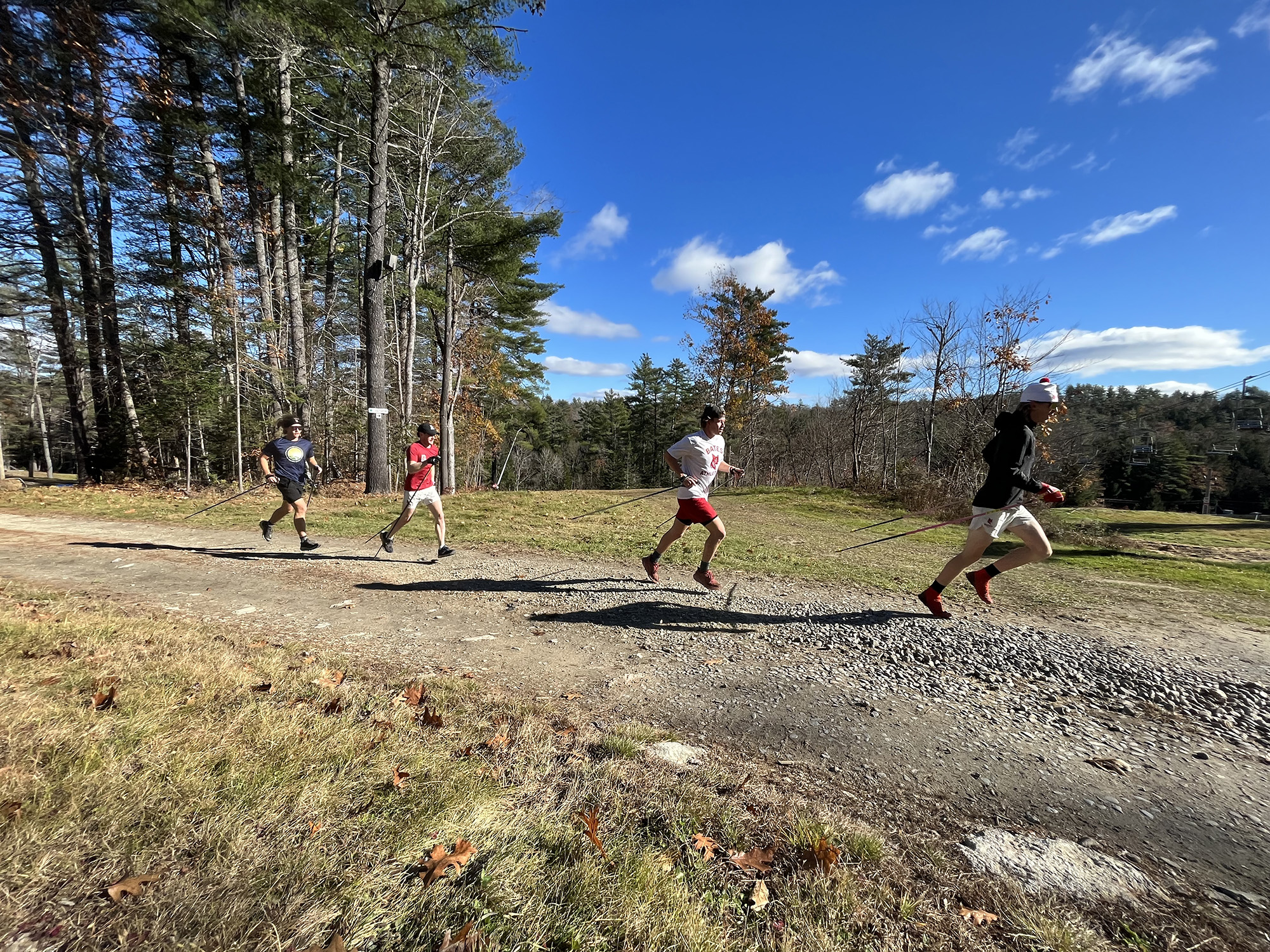
Bates College getting after some dryland in 2024. (Photo: courtesy photo)
Others simply use hours to plan and measure the loads. The challenge is difficult when just looking at hours, how to compare an hour of easy training versus an hour of hard training. Then, looking at percentages of time in zones or with other training methods does not define the load or focus the training on the desired adaptation.
I am not going to address the year-to-year increases simply because all the assorted tables recommending volume of training at an age are based on population averages. The goals of the athletes, the athletes’ training age, training history, and many other potential factors. Just assigning training based on a table is foolish without considering these other factors. In most cases, athletes will train enough if the right principles are followed.
When we are coaching athletes, we should only increase loads because of improved fitness not in an attempt to drive fitness gains. The decision to increase loads should come from evidence that the athlete(s) have absorbed the current load, not simply because it is a new month and the plan calls for a month-over-month increase. I believe that in the past we have used templates or models that have called for big month-to-month increases. The basis of building fitness is consistency and adaptation to the training. In many cases, we can go as long as 2-3 months at a very similar or very small increase in load.
I am far from certain how coaches plan training these days, but others and I in the past have planned training based on monthly and weekly hours. In my days, I used to start in May with 50 hours, and by November, I was training more than 100 hours. Then the weekly progression within those months might go 12 hours, 14 hours, 16 hours, 10 hours or something like that. Even back then, how does a 50-hour month prepare you to do a 60-hour month, how does a 12-hour week prepare you to do a 14-hour week? What I learned more than 30 years ago. It doesn’t work that way; even if an athlete completes that kind of protocol, it does not mean it worked; it just means they survived it.
The research and experience suggest that higher monthly volume and small periodic increases are better for building long-term fitness and performance, with far less risk than the typical plans that ramp up training with increases of 10-15-20% per month. Many old-school thoughts persist that we must increase volume to stimulate further improvements. That is an invalid belief and has been shown to be in much research and analysis. If we are in fact building fitness, we are moving faster at every intensity. Isn’t that already an increase in load? Recruiting more muscle fibers and motor units aerobically, improving mitochondrial density and function, improving aerobic enzymes in more muscle fibers, among other aerobic adaptations.
Fin Bailey works on uphill technique at training camp. (Photo: courtesy photo)
I look for three layers of signals: performance stability, physiological response, and behavioral cues.
The stability of performance in training is easily measured with simple technology, such as heart rate and GPS. Prior to increasing loads, the athlete should show improvement or stable performance in workouts. The aerobic training sessions should feel consistent and easy, with very little or no heart rate drift through the workouts. So, a simple training session once a week, once every two weeks, around a standard loop, both for high-intensity and aerobic training, can tell us much.
The key workouts should show repeatable performance levels from week to week. The pace athletes can maintain at aerobic intensity should gradually and slowly improve, and the technique should stay stable and efficient throughout the workouts.
Indicator
What it suggests
Same HR but faster pace, HRV is improving
Aerobic adaptation
Same workout feels easier, HRV is stable or improving
Load is absorbed
Ability to repeat intervals without extra fatigue
Ready for progression
If workouts are still producing large fatigue swings, the system is still adapting and increasing load is premature.
As I have written previously for FasterSkier, older junior ( U18’s) athletes, masters, and elite athletes, I think it is important to use HRV to assess recovery. Using HRV, we can see whether the athletes are recovering predictably between sessions. We can see the stability or improving response their training, and we can assess whether the training loads are sustainable.
Useful signals:
Resting HR stable
HRV 7-day trend stable or improving
Sleep quality normal
Muscle soreness minimal after aerobic sessions
The data and the athlete reports feeling normal again within ~24 hours
If recovery between sessions is incomplete, increasing load compounds fatigue rather than builds fitness. The rush to hit hourly objectives and the failure to respond to accumulating fatigue are the biggest causes of maladaptive training.
The critical question HRV can help to address. Are the current loads the athlete is doing correct? HRV, especially RMSSD trends collected consistently, can help flag whether an athlete is tolerating training well. But HRV should be interpreted alongside performance, subjective recovery, resting HR, sleep, and life stress rather than used as a standalone decision rule. In some cases, this may mean adjusting other areas of life; in others, we may simply have to reduce the training loads. Simply low HRV indicates a compromised ability to recover from and adapt to training
A good indicator of readiness is the athlete’s ability to handle training density. Most athletes should have at least one rest day per week. During a training period, the athlete should be able to handle 3-5 moderate training days in a row without feeling accumulated fatigue, and the quality of workouts remains normal and stable.
The occasional longer sessions should not disrupt the next day’s planned training, and recovery should be normal the following day. If an athlete is doing double sessions, the second session of the day should not be carrying excessive fatigue from the morning session, and the quality, speed, pace, or intensity of the second workout should be consistent.
When the athlete’s readiness and physiological measures indicate that an increase in load is appropriate, there should only be a slight increase in volume. Make a few sessions per week a little bit longer, followed in the future by adding a workout or two per week
Training load should only increase when the muscles and connective tissue are tolerating the training. If there is persistent tendon soreness, joint irritation, muscle tightness, or recurring niggles are common, it is not appropriate to increase the loads. Aerobic fitness improves faster than structural durability, which is why injuries often appear right after a volume jump.
We also need to be aware of and watch for behavioral cues in the athletes, not just the recovery and performance data. We should look for the athlete’s motivation to train and their assessment of the RPE (rating of perceived exertion) for a given workout. If the perceived exertion of a given workout is increasing, it is not a positive signal. Finally, we should ensure that athletes’ nutrition is good, and their body weight is stable.
As a practical guideline, I would recommend increasing load only after a period of 3-6 weeks, where we can see stable adaptation and improvement in training and recovery measures. When we look at elite training, we always see the training progression is often much slower than people expect.
JC Schoonmaker and Luke Jager training in Anchorage, Alaska back in 2023. (Photo: Brinkema Brothers)
Training Phase
Progression Pattern
Base Phase
+5–10% volume every 3-6 weeks, but only if all inputs are positive. If using TRIMP or Training Peaks TSS the load increase should never exceed 15-20%
Race Prep Phase
Maintain a stable volume, intensity increase slowly from the base phase
Competition phase
Volume and Training load decreases slightly; intensity is maintained or increased due to race load.
As useful guidelines for coaches. If a training day or a week feels heroic, it is too big. Most likely, all the heroic training did was build fatigue and greatly slow recovery and adaptation. Sure, the athlete can do it occasionally, but it in no way means the load improves fitness or performance, or that the athlete adapts to it. My rule of thumb is that the longer it takes for an athlete to recover from a workout, a week, or a month of training, the less adaptation that is possible. When I shared this comment regarding high-intensity workouts with Zach Caldwell, I asked him when we should adapt to them. His response was Thursday! Not next Thursday, not a Thursday next month. Thursday!
An effective training progression should feel well-tolerated for weeks. Fitness improvements are built on consistent, manageable weeks. Where the fitness is developed through compounded training, not the occasional massive week. I have seen it repeatedly, it is big increases in training load, too much, too soon, that ultimately leads to declining performance and overtraining. Sure, elite athletes train massive weeks, but to get there, they adapt to training every year, step by step.
Increases in training load should be almost invisible over weeks and months as athletes develop. Over the years of training, the increases are clearly visible and large.
In summary, increase training load when:
Current workouts are repeatable and controlled
Athletes recover following training days, normally within ~24 hours
No structural soreness or injury signals
Motivation and energy are normal
This training performance has improved, and recovery has been stable or improving for 3-6 weeks
Help Support Our Olympic Coverage!
If you value the thoughtful work and access FasterSkier provides, please consider becoming a Voluntary Subscriber. Your support directly fuels our work to cover the people, places, and moments that make our sport special.
Park City Ski & Snowboard is seeking a Head Cross Country Competition Coach to lead its U16+ competitive Nordic program. The full-time, year-round position reports to Cross Country Director Emma Garrard.
Below is the full job description.
Reports To: Cross Country Director, Emma Garrard Employment Status: Full-time, year-round, salaried exempt Compensation: Annual salary commensurate with experience, plus benefits Athlete Focus: U16 and above
Position Summary
The Head Comp Team Coach will manage the coaching staff, run the competitive calendar, and represent PCSS in the Regional and National Nordic community. This position requires someone who can coach at a high level and manage staff, budgets, calendars, and travel around the country for training and races, while upholding PCSS core values of Passion, Accountability, Respect, Team, and Integrity.
Program Leadership & Staff Management
Design and execute a multi-year training and competition framework, consistent with US Ski & Snowboard Training System principles
Supervise, mentor, and evaluate XC comp assistant coaches
Lead staff meetings and maintain clear communication
Maintain a strong focus on positive team culture
Collaborate with the Director on program goals, budget planning, and seasonal priorities
Contribute to the recruitment and retention of quality coaching staff
Prioritize strong communication with the Director, staff, and parents
Attend PCSS staff meetings and all-program events as requested by PCSS leadership
Support PCSS-hosted events and fundraising initiatives
Technical Coaching & Athlete Development
Implement and evaluate individual and team training plans on an annual and multi-year basis
Lead on-snow sessions 5–6 days per week during the training season, with full preparation and follow-up
Develop and execute strength and conditioning programs, including dryland
This job description is not an employment agreement or contract. PCSS management reserves the right to alter the scope of work within the framework of this description at any time. All offers are contingent on successful background check completion.
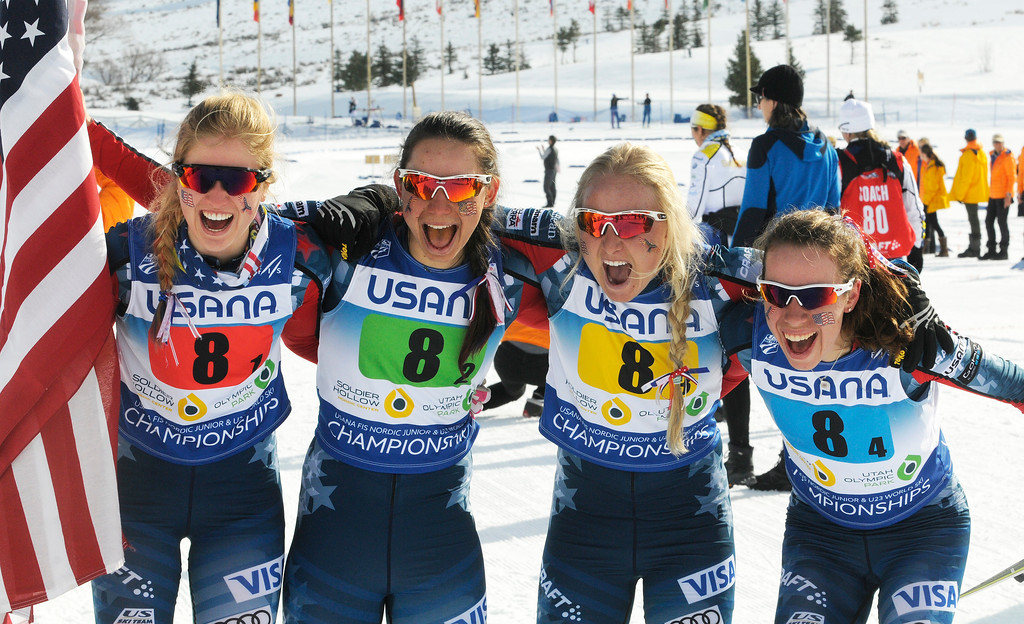
The U.S. women’s relay after taking a historic third in the 4 x 3.3 k relay at 2017 Junior World Championships on Sunday at Soldier Hollow in Midway Utah, with (from left to right) Hailey Swirbul, Julia Kern, Hannah Halvorsen, and Katharine Ogden. (Photo: U.S. Ski Team/Tom Kelly)
As the season winds down, it’s worth stepping back and asking a simple question: Does the way we develop young skiers in the United States reflect the philosophy we say we believe in? I know everyone is probably done with hearing about how the Norwegians do it, so let’s look at what we say we know and what we embrace.
Many coaches and programs describe cross-country skiing as a lifetime sport. We talk about patience and say it takes ten years or more to develop as a skier. Clubs reference long-term athlete development models, and parents hear that endurance sports reward athletes who build gradually and peak later in life.
All of that is true.
But much of the system we’ve built rewards the opposite.
Once rankings, camp selections, college recruiting, and program reputation become tied to junior results, the incentives quietly shift. Development begins to be measured by podiums and training hours rather than movement quality, long-term improvement, or whether athletes are still engaged in the sport five or ten years later.
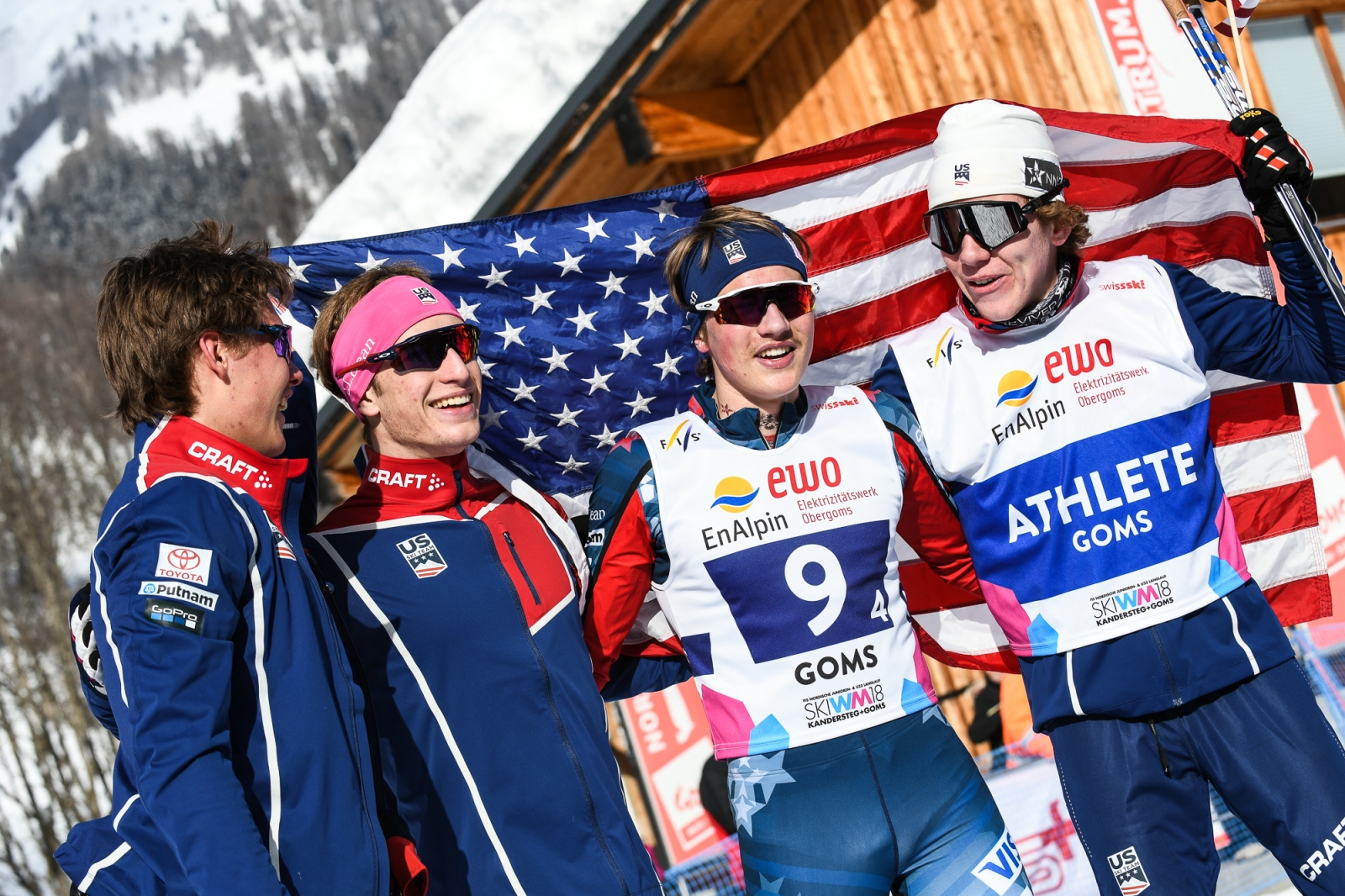
The U.S. men’s silver-medal relay at 2018 Junior World Championships in Goms, Switzerland, with (from left to right) Luke Jager, Hunter Wonders, Gus Schumacher, and Ben Ogden. (Photo: JWSC2018.ch)
What is long-term development
Aerobic capacity develops over years, often decades. Technical efficiency improves gradually. The durability required to handle training load is built slowly through years of training. Most elite endurance athletes reach their peak in their mid-twenties or early thirties, not in high school.
If peak performance happens ten or fifteen years after an athlete first enters the sport, the early years should focus less on maximizing results and more on building the foundation that supports long-term growth.
That foundation includes several elements.
Movement skill. Nordic skiing is a technical sport, and the best skiers move efficiently long before their physiology fully matures. This efficiency is critical to managing training loads in the future. More efficiency in technique equals less stress and load from training.
General athletic development. Running, biking, jumping, climbing, and playing other sports all contribute to coordination and resilience. Athletes who move well tend to adapt better to training later.
Motivation. The most valuable asset a young athlete has isn’t VO₂ max or the hours trained by some arbitrary definition. It’s the desire to keep showing up year after year.
Junior athletes race during the 2022 U.S. Cross Country Championships in Soldier Hollow, UT. (Photo: Tobias Albrigtsen / @untraceableg)
The System Sends Mixed Signals
In practice, the system often sends young athletes a different message.
Junior racing has become increasingly competitive. Rankings exist even for younger age groups, and selections for camps, trips, and development programs often depend on early results. National events and development pathways can make performance at 14 or 15 feel like it carries some long-term significance. Yet we also claim to know that identifying future elite athletes at that age is extremely unreliable. If that’s true, it’s worth asking why the system places so much weight on those results.
One example is allowing U14 athletes to ski up in order to qualify for Junior Nationals. It doesn’t happen frequently, but it happens every year. It’s hard to reconcile that with the philosophy of not rushing development. If long-term development truly matters, governing bodies should show leadership and address this issue.
In some regions of the country, qualifier races have U16 athletes seeded in the start list with U18 and U20 athletes. People say it doesn’t matter because we separate them in the results. I disagree, the are intermingled with much older and more developed athletes. But more than that it is again the message begin sent?
At the same time, training culture has shifted. Training data is widely shared, and conversations often revolve around hours. Young athletes begin comparing workloads long before their bodies are ready to handle them. Often the more is better attitude prevails, even though we say that we should be working on other skill aspects of development.
These pressures can push athletes toward earlier specialization and higher training loads than their stage of development requires. A 14-year-old begins to feel like they need to train like a college skier. A 15-year-old worries that missing races or reducing training volume might put them behind.
The Boulder Nordic Junior Race Team out for an adventure ski in 2014. (Photo: BNST)
What are the impacts of the mixed signals
The most visible consequence is burnout. Many people challenge the idea of burnout. But after more than forty years around this sport, I’ve seen the pattern repeatedly. Just because we don’t measure something well doesn’t mean it isn’t happening.
Coaches who have spent time around junior skiing see the pattern: talented athletes who disappear from the sport sometime between their late teens and early twenties. Sometimes academics, finances, or changing interests are the reason. But often the explanation is simpler, they are tired from too much too early and to intense.
There are also physical consequences. Adolescence is a complex period of growth and development. Training loads that are manageable for more mature athletes are impossible for a developing body. When volume and intensity climb too quickly, overuse injuries and chronic fatigue become more likely.
Early specialization is not the problem. Rather, it is ineffective programming that has these young athletes training like more mature athletes. This early training focus limits athletic development. Athletes may accumulate impressive training hours but miss the movement diversity that builds long-term durability.
The biggest loss in this process is one that is unseen because those athletes are lost from the sport.
From a coaching perspective, the shift shows up in small ways. Conversations revolve around weekly training hours instead of how well athletes are skiing. Easy sessions slowly become harder. Fatigue accumulates while movement quality quietly declines. None of this happens overnight, but over time, the focus drifts away from skill development and toward simply doing more.
Development in endurance sports isn’t about accumulating work. It’s about adapting to the work being done and building the capacity to handle more later. A training log that looks impressive at 15 doesn’t necessarily translate into success at 25. What matters more is whether the athlete remains healthy, motivated, and technically sound over the long term.
Hailey Swirbul celebrates the U16 Junior National Championship title in the Freestyl Mass Start in Stowe, Vermont, in 2014. (Photo: Voisin/FasterSkier)
What Good Development Actually Looks Like
If long-term development is the goal, the early years should look different from elite training. Young skiers benefit from variety. Running, cycling, hiking, and other sports build coordination and resilience. The goal isn’t to replicate elite training programs but to create athletes who move well and enjoy being active.
Technique deserves major attention. Nordic skiing rewards efficiency, and athletes who develop strong movement patterns early often progress faster later because every hour of training becomes more productive. Training volume should increase gradually over time. Consistency across years matters far more than pushing limits in any single season.
Most importantly, development should seek to preserve motivation. The sport needs athletes who remain engaged long enough to realize their potential. We often see athletes try to do a big training year to catch up or reach a target training volume. It rarely works out.
The Problem With “More Volume” Thinking
In Nordic skiing, training volume carries a certain mystique. Conversations quickly turn to hours, weekly totals, yearly totals, and stories of elite athletes training 800 to 1,000 hours per year.
It’s easy to see why. Endurance sports reward consistency and large training volumes. But a subtle misunderstanding often occurs. Volume stops being seen as the result of long-term development and starts being treated as the cause of performance.
Correlation becomes mistaken for causation.
Hunter Wonders (APU/Alaska) winning the U16 Boys Mass Start Freestyle race at the US Junior National Championship in Stowe, Vermont. (Photo: Voisin/FasterSkier)
High Volume Works for Elite Skiers
At the elite level, high training volume makes sense. World Cup athletes have spent years building the capacity to handle that workload. Their aerobic systems are highly developed, their movement patterns are efficient, and their bodies have adapted gradually.
High volume works because it sits on top of a massive foundation: technical skill, durability, and years of progressive training.
The problem arises when that model gets copied without the same foundation underneath it.
The Missing Variable: Training Age
One of the most overlooked concepts in endurance development is training age. Training age refers to how many years an athlete has spent consistently adapting to structured training. Two 18-year-old skiers may have very different training ages. One may have spent eight years gradually building capacity. Another may have entered the sport recently and increased training dramatically. On paper, their training logs may look similar. In reality, their ability to adapt to those loads can be very different.
Training only produces progress when adaptation occurs. Without adaptation, training simply builds fatigue.
The U18 Girls field works its way past the Loppet Foundation Adventure Center in Minneapolis during Junior Nationals on March 11th, 2022. (Photo: David J Owen Photography)
The Efficiency Problem
Elite skiers move extremely well. Their technique allows them to ski long distances while conserving energy and minimizing unnecessary muscular stress. Developing this efficiency early is critical. In the future, it will allow the athletes to train large volumes without the metabolic and neuromuscular stress that can lead to overtraining.
Young athletes often lack efficiency. When technique is still evolving, large training volumes can actually slow technical development. Fatigue reinforces inefficient movement patterns that later become difficult to change.
For developing skiers, time spent improving movement quality can be far more valuable than time spent extending distance.
The Cost of Chasing Hours
There is also a practical cost to the “more volume” mindset. Elite athletes structure their lives around training. Sleep, nutrition, and recovery are integrated into the system. Young athletes are balancing school, travel, social life, and other commitments. When training volume climbs, something gives. Sleep declines, recovery becomes inconsistent, and fatigue accumulates.
Under those conditions, simply adding more hours rarely produces better results.
What Volume Should Really Represent
Training volume does matter. Endurance sports ultimately require substantial workloads. But volume should be viewed as a long-term outcome of development, not a short-term objective. Successful endurance athletes rarely build training hours quickly. They accumulate them gradually across many seasons, allowing their bodies to adapt step by step. By the time they reach elite levels, high training volumes feel natural because they have spent years building the durability to support them.
The 2026 US Ski and Snowboard Junior National Championships in Cable, Wisconsin, hosted by the American Birkebeiner Ski Foundation. (Photo: Tryg Solberg)
A Better Question to Ask
Instead of asking how many hours an athlete should train, a better question might be:
What training can this athlete adapt to right now?
For some athletes, the answer may involve increasing volume. For others, improving technique, strength, or intensity distribution may produce greater gains. Development is not identical for every athlete. What matters is finding the training load that promotes consistent adaptation rather than constant fatigue.
Why This Matters for the Future of the Sport
Cross-country skiing, like all endurance sports, depends on long-term participation. The sport needs athletes who remain engaged, not only as competitors but as lifelong skiers, coaches, and community members.
A development system that pushes athletes too hard, too early risks losing them before they reach their potential. It also narrows the pathway to elite performance by favoring early maturity and filtering out late developers.
If Nordic skiing truly wants to remain a lifetime sport, its development culture must reflect that philosophy.
Closing
Cross-country skiing has always valued endurance. That value should extend beyond physiology and into how we develop athletes. Endurance isn’t just about how long someone can ski hard on race day. It’s about how long they can remain engaged in the process of improving.
If we truly believe Nordic skiing is a lifetime sport, then our development system should not resemble a funnel that selects kids out at every progressive age group. It should look more like a runway, where every young athlete has the opportunity and the time to fully develop their potential, not just the ones who mature early.
Help Support Our Olympic Coverage!
If you value the thoughtful work and access FasterSkier provides, please consider becoming a Voluntary Subscriber. Your support directly fuels our work to cover the people, places, and moments that make our sport special.
The 2026 US Ski and Snowboard Junior National Championships in Cable, Wisconsin, hosted by the American Birkebeiner Ski Foundation. (Photo: Tryg Solberg)
This coverage is made possible through the generous support of Marty and Kathy Hall and A Hall Mark of Excellence Award. To learn more about A Hall Mark of Excellence Award, or to learn how you can support FasterSkier’s coverage, please contact info@fasterskier.com.
LAKE PLACID, New York (March 21) — As the snow settled on Lake Placid and clouds began to dissipate over Mt. Van Hoevenberg, a growing sense that something momentous could happen permeated the crowd assembling for the last Sprint of the 2025-26 World Cup.
That something unusual would happen was assured. With the Sprint Globe already secured to Johannes Høsflot Klæbo, the golden-haired juggernaut would not be on the starting line – opting instead to rest his legs, and head, in hopes of defending his 12-point lead over Harald Østberg Amundsen in the Distance standings. By default, then, someone other than Klæbo would stand atop Saturday’s podium – a rare occurrence in a season where the Norwegian had already won 8 of 11 Sprints in commanding fashion. (Two wins evaded Klæbo due to falls; the third because he did not start in Oberhof).
Who would take his place? Ben Ogden, the Northeast’s homegrown favorite and the Sprint silver medalist in Milano-Cortina? Gus Schumacher, Ogden’s partner in the Olympic Team Sprint? France’s embattled specialist, Lucas Chanavat, who appeared on track to rival Klæbo during the 2023-24 season, who had seized the opportunity – and the win – after Johannes’ bobble in Davos last December? Ansgar Evensen (NOR), who had done the same in Drammen?
Or, perhaps, it would be Federico Pellegrino (ITA) – the 35-year-old elder statesman of the league; making his 344th (and penultimate) World Cup start, eyeing an 18th and final Sprint victory?
Johannes Hoesflot Klæbo (NOR) and Federico Pellegrino (ITA) after the finish of the Finals in Davos, 2022. Pellegrino bested Klæbo on the eve of the birth of his first child. (Photo: Nordic Focus)
It states the obvious to say that success in cross-country skiing is a matter of timing, and for “Chicco Pelle’s” 15 seasons, the timing had been just shy of right. The formative and final years of Pellegrino’s career were defined by the dominance of skiers other than he. Pellegrino made his World Cup debut in Drammen in March 2010, finishing 49th. The winner that day was Emil Joensson (SWE); runner-up was Petter Northug (NOR), then on his way to his first of two Overall Globes. These were the halcyon days in which Dario Cologna (CHE) descended from his Alpine fastness to rack up World Cup and Tour de Ski titles; when Northug, Joensson and Marcus Hellner (SWE) traded sprint victories and taunts in a bitter intra-Scandinavian rivalry. Pellegrino was 12th in his first World Championships Sprint (Oslo, 2011) and 11th at his first Olympic Sprint (Sochi, 2014).
While notching his debut victory in December, 2014 in the Davos Freestyle Sprint, Chicco’s break came in the 2015-16 season. He won 5 of 13 sprint races, becoming the first non-Scandinavian male to win the Sprint Globe. As Pellegrino hit his stride, Northug’s star was showing its first flickerings ahead of a dramatic waning, Joensson had entered the twilight of his career, and although Sergey Ustiugov (RUS) was approaching his own prime, the factious cast of World Cup sprinters was looking for a new leading man.
That man would not be Chicco. An upstart dramatist from Trondheim, Johannes Høsflot Klæbo, had arrived to script skiing’s long, and mind-bogglingly successful, next chapter. After making his debut in Drammen in 2016, Klæbo outscored Pellegrino in the 2016-17 Sprint standings, taking his first of 8 (and counting) Sprint Globes. The two went head to head at the 2017 World Championships in Lahti, Finland, where Pellegrino surged from behind to claim his first World Title ahead of a legendary lineup, including Ustiugov, Klæbo, and Northug, but this maiden gold would also be his last. In Pyeongchang the next year, the Olympic gold went to Klæbo; Chicco brought home silver.
The wins did keep coming for Chicco, including a tear of three consecutive Sprint victories and his second Sprint Globe in 2020-21. And, though they admittedly came in greater abundance to Klæbo (who, it should be noted, did not start in those races, or the 2020-21 Tour de Ski), it is rather glib to assert that Chicco’s career had slid “in[to] the shadow of” the Norwegian. Pellegrino bested Klæbo in Dresden and Lahti in the spring of 2018; in Lillehammer that winter; and in Davos in 2022. He was near-omnipresent on Sprint podiums and won his second Olympic silver in Beijing in 2022; moreover, he was among the very few men who could disrupt Klæbo’s dominance in the discipline, and the clear favorite when Johannes was absent.
But Pellegrino’s win in Davos in December 2022 marked the beginning of a long, and perhaps self-inflicted, World Cup drought. Chicco declared his intention to focus on distance races ahead of Milano-Cortina, and did indeed record four such podiums in classic, skate, and skiathlon formats, alongside a welter of Sprint podiums – including an ecstatic World Championships silver in Trondheim in 2025, and Olympic bronzes on home soil in the Team Sprint (alongside Elia Barp) and in the 4 x 7.5 k Relay (which he described as “the proudest day of [his] life!”) this February.
Elia Barp welcomes Federico Pellegrino to a bronze-medal finish in the Olympic Team Sprint in Milano-Cortina, February 18th, 2026. (Photo: Vanzetta/Barbieri/NordicFocus)
Outright wins, however, were not forthcoming. By the time March 21, 2026 arrived in Lake Placid, it had become Pellegrino’s last, best chance to secure one more Sprint victory.
Anticipation and emotions ran high. While Pellegrino had been impervious to the crowd in Friday’s 10 k Classic – earbuds deadening the world beyond his blue racing cap during warmups, and his face a deaf mask of exertion during the race – their excitement overwhelmed him on Saturday. During his first warmup lap, he skated calmly up the course’s A-Climb through a chorus of “CHI-CCO, CHI-CCO, CHI-CCO.” On his second, the frenzied chant began again, and the gravity of the impending race dragged him to a halt. His skis splayed wide against the pitch; he buried face in his hands. “The energies I got in the Final were coming from the warmup lap, where I stopped in the middle of the climb, crying,” Pellegrino told me at the finish line. “I think the public deserved this kind of show, and I deserved to finish my career, with a Sprint skate like this.”
Pellegrino embraces the crowd ahead of Sprint qualifying in Lake Placid. “The energies I got in the Final were coming from the warmup lap, where I stopped in the middle of the climb, crying.” (Photo: Thibaut/NordicFocus.)
To reach that final finish line, however, was a perilous journey.
After qualifying second, Pellegrino sidestepped two falls (the first from Jules Chappaz (FRA); the second from Elias Keck (GER)) in his Quarterfinal, moving from sixth to first in the course’s final descent and level hairpin. In Semifinal 1, he attempted to close on Lucas Chanavat (FRA) and Anton Grahn (SWE) through the crest of the A-Climb but couldn’t get by; pushed to the outside on the level hairpin, he was out-lunged by Lars Heggen (NOR) in the final meters, finishing third by 0.03.
While the Lucky Loser spot was Chicco’s to lose heading into Semifinal 2, Erik Johansson (SWE), Harald Amundsen (NOR), and Even Northug (NOR) lost time playing for a slipstream position as they approached the top of the A-Climb. Pellegrino was on to the final by a comfortable margin.
Lars Heggen (NOR) outlunges Federico Pellegrino (ITA) by 0.03 in Semifinal 1. Federico moved on to the Final as a Lucky Loser. (Photo: Thibaut/NordicFocus)
Once more around the track, and the day could be his. After being fourth out of the gate, he attacked from the outside on the B-Climb; breaking into an aggressive V-2 and taking Chanavat and Heggen by surprise, he moved into second behind Grahn. The pace increased again at the base of the A-Climb, but where Grahn and Chanavat’s broad frames moved up the hill in sweeping, powerful strokes, Pellegrino leapt into a furious V-1.
The move was decisive. To the adulation of the crowd, he opened a decisive gap through the crest of the climb. His lead only grew through the final descent into the level hairpin, but Chicco was taking no chances. While Grahn and Heggen grappled for second behind him, Pellegrino hammered to the line, threw his arms wide and his head back, roaring with the crowd.
An 18th victory and 46th career podium, clinched.
Federico Pellegrino secures his 18th and final World Cup victory. Lake Placid, March 21, 2026. (Photo: Thibaut/NordicFocus)
What had happened in the Semifinal, when this triumphant last dance had nearly evaded him by three hundredths of a second? And what had changed for the Final?
“I could not do what I did in the Final, because the energies of the other athletes were still quite big,” Chicco admitted our post-race interview. “About the last downhill, I was not the same as the others. I am not, I know, but I have some different qualities, and if I could get quite good gap in the top of the uphill, then I knew that I could keep it until I end. This is what I did. This is how I loved to win all along my career – not wait until the last meter, but trying before.”
“Sometimes it happened, mostly before Klæbo came,” he laughed. “But today I was there, and I studied the best tactics in the end . . . the public here in Lake Placid deserves this kind of show, and I think we are all happy now.”
And, this was nothing short of “the best way” to end his journey. “I could not do different. In the end, the last four years have been strange. I didn’t focus so much on sprinting; I tried to discover my body in different fields. Sometimes I got really great feelings and performances, but then, to come back here . . . and to win in that way, I could not do more.”
Pellegrino after his final win. “I think the public deserved this kind of show, and I deserved to finish my career, with a Sprint skate like this.” (Photo: Thibaut/NordicFocus)One more podium for Federico Pellegrino, alongside Lars Heggen (NOR) and Anton Grahn (SWE). (Photo: Thibaut/NordicFocus.)
In 15 seasons, Pellegrino proved himself to be far more than a runner-up to those Swedish and Norwegian titans who loomed large over his early and later years. He had taken the Sprint Globe from the Scandinavians for the first time; outsprinted Klæbo, Ustiugov, and Northug in Lahti; perpetually challenged – and occasionally beaten – the greatest athlete in the history of the sport; and secured Olympic medals on home soil, alongside a team of up-and-coming Italians ready and eager to fill his boots. “I’m really happy that he finished his career with probably one of the best weekends for him so far,” Elia Barp (ITA) told me on Sunday. “I’m very happy for him; I’m very happy for the team. I think we have proved that we are ready to race without him – not only me, but a few other young guys are ready to try to take victories next year . . . [He showed] that it is important to keep fighting and try to be a good overaller as he was in the last years. And, now we know that it’s possible; everyone is human as us, and we can do that.”
To Chicco’s fans, that determination – to grapple with giants; to reinvent himself; to seize the final, perfect timing and a final, perfect victory – defined his career. But for Pellegrino himself, “the biggest memories will not stay about the races, but much more about the hugs I got from the teammates, from the coaches, even outside of Italy, from my family, from the people that love me – and not only when things went well; even when things were not going so well. I think this is something that sport teaches us; that in the end, it’s only a cross-country ski race, and life is different. That’s it. The hugs are something I will remember for my entire life.”
Pellegrino, the most popular man at Zig Zag’s on Saturday, March 21. (Photo: Lily Den Hartog)
At Zig Zag’s Pub on Saturday night, Pellegrino told this reporter’s associate that his win vindicated his decision to retire. On Sunday, soaked with rain and champagne and tears after his last World Cup race, he reaffirmed it:
“That’s it. I tried to enjoy today as well . . . I tried to give my best, as always, and it was good after the finish line; under the rain, it was special. But with the teammates and coaches and waxers celebrating this moment, it was good for me.”
“Now, I really need to stay with my family. They deserve this, and I need to give them a lot of time.”
Love Stories Like This? Help Keep Them Coming.
Feature stories like this one take time, access, and care to produce. If you value thoughtful storytelling and independent ski journalism, please consider becoming a Voluntary Subscriber. Your support directly fuels the work we do to cover the people, places, and moments that make our sport special.
“Grazie Papao!!” Team Italy was waiting at the finish of the 20 k Skate with champagne and a tribute to Pellegrino’s children and wife, Greta Laurent (ITA, ret.). (Photo: Thibaut/NordicFocus)
Novie McCabe of APU narrowly winning over Kendall Kramer and Alayna Sonnesyn. (Photo: Tryg Solberg / FasterSkier)
CRAFTSBURY, Vermont — Craftsbury’s SuperTour Finals 40k highlighted some awesome battles amongst the top American men and women. The women started off the day with some extremely fast conditions on the winding and punchy Craftsbury 5k loop. The men took on the course later in the morning and conditions were mostly firm besides the south facing hills.
The women’s race broke into a lead pack of 5 that held strong until a sprint finish. APU’s Novie McCabe narrowly took the win over Kendall Kramer of APU and Alayna Sonnesyn of Team Birkie. Luci Anderson of Team Birkie and Craftsbury’s own Margie Freed, both 2026 Olympic biathletes, finished 4th and 5th.
The early leaders of the women’s 40k heading up Screaming Mimi hill. (Photo: Tryg Solberg / FasterSkier)
In an interview with Craftsbury’s Sheldon Miller after the race, McCabe said that “it was really fun to ski with such a great group of girls.” In regards to her difficult last couple of seasons, McCabe said that “it’s nice to have these good days again. It’s super fun to be back racing this year.”
Margie Freed, mostly a biathlete in the last few seasons, said that “it was really nice to not carry an extra ten pounds on my back, but I was a little sad to not be able to lay down in the middle of my race.” She thanked her coaches for helping her keep track of the lap count.
Alayna Sonnesyn, the Team Birkie athlete that narrowly missed out on the Olympics, said that the top three broke away at the top of the Screaming Mimi climb. When asked how her race went, Sonnesyn said “it was great, it was so fun to be out here. Conditions were fast and furious, kind of like the Birkie this year.”
The men’s 40k leaving the stadium. (Photo: Steve Snider)
The men’s race was tight with the top 14 coming in less than 60 seconds behind the win. Gus Schumacher of APU ended up edging out John Hagenbuch of Dartmouth for 1st. Kevin Bolger of Team Birkie finished 3rd.
Jake Brown in his last race for Craftsbury Green Racing Project taking the lead up Screaming Mimi. (Photo: Steve Snider)
Hagenbuch said that he has been fighting through some illness since the Lake Placid World Cup Finals.“I didn’t win today, but I was still smiling out there and really just taking in what was my last race for Dartmouth.”
Gus Schumacher also said that the conditions were really fast and it was hard to get away from the pack. He and Zak Ketterson were pushing at the front when Zak had an unfortunate fall within the last few hundred meters: “I was given the first place position and just went for it from there.”
The award ceremony’s after the races highlighted the 40k, junior 20k and 2025-2026 SuperTour awards.
Thank you to Sheldon Miller of Craftsbury Outdoor Center for the post-race interviews with athletes.
FasterSkier will have our own Nat Herz on the ground at the Olympics, which, to be honest, is a very big financial lift for us. If you value the thoughtful work and access FasterSkier provides at championships like this one, please consider becoming a Voluntary Subscriber. Your support directly fuels the work we do to cover the people, places, and moments that make our sport special.
The SuperTour Relay start on Saturday afternoon. (Photo: Tryg Solberg / FasterSkier)
CRAFTSBURY, Vermont — The second day of racing at Craftbury’s SuperTour Finals brought on some hard-hitting team relays. The “Club Relay” had a diverse array of club skiers young and old, along with some college teams. In the afternoon, the “SuperTour Relay” featured the North American pro teams along with the top eastern college squads.
Craftsbury groomer, Eric Hanson, captured Anders Weiss of BSF and Jack Young of Craftsbury Green Racing Project skiing in front of the dump truck responsible for keeping the course open. The truck was stuck on course the d prior year and pushed off to the side with one of their Pistenbully groomers. (Photo: Eric Hanson)
The afternoon raced proved to be quite entertaining as conditions held firm. Team Birkie’s first relay squad won, upsetting APU’s first squad by 46 seconds. Alayna Sonnesyn, Kevin Bolger, Lucy Anderson, and Zak Ketterson held off the APU’s four 2026 Olympians that included Kendall Kramer, Zanden McMullen, Novie McCabe, Gus Schumacher. Craftsbury’s home team of Margie Freed, Brian Bushey, Michaela Keller-Miller, and Jack Young finished in 3rd.
Team Birkie, APU and Craftsbury’s relay teams filling the podium. (Photo: Tryg Solberg / FasterSkier)
Team Birkie was ecstatic with their win. Their second team also came within 6 seconds of the podium. BSF’s team came in 4th of the 33 teams.
Luci Anderson’s leg put on a significant gap to the APU team that they would keep through the race. (Photo: Tryg Solberg / FasterSkier)
In the morning, an additional 33 relay teams and 132 racers in total took on the 5 kilometer lap that Craftsbury staff worked hard to keep open through the recent warm spells. Hundreds of dump trucks and many more snowmobile sleds patched thinning spots on a sections of thinning snow. Eric Hanson, a Craftsbury groomer of 25 years, said that they’ve spent hundred of hours moving snow onto the race course over the last month.
33 teams starting the Club Relay in the morning. (Photo: Tryg Solberg / FasterSkier)
The Club Relay showcased the often-mentioned perk of Nordic skiing: it’s a lifelong sport. With the youngest competitors in the single digits and the oldest many decades in, it was a celebration of the sport and the joy that comes from friendly competition. While most teams donned their spandex suits, some teams added some flair with outfits that surely boosted their speed.
Ollie Burruss, Craftsbury’s Nordic Race Director, making the college skiers nervous with his lead in the first leg of the Club Relay. (Photo: Tryg Solberg / FasterSkier)
All but 7 relay teams were pairs of 2 women and 2 men. The mixed relay was won by “UVM Gold” with Owen Young, Molly Moening, Benon Brattebo, and Caleb Boyce throwing down to narrowly beat out their teammates on “UVM Green.”
Benon Brattebo of UVM leading the first leg of the Club Relay. (Photo: Tryg Solberg / FasterSkier)
If you value the thoughtful work and access FasterSkier provides, please consider becoming a Voluntary Subscriber. Your support directly fuels the work we do to cover the people, places, and moments that make our sport special.