From the FasterSkier archive — posts syndicated from athletes’ and coaches’ own blogs between 2004 and 2012, kept online as published. Current coverage is at fasterskier.com.

Tag: Nordic World Ski Championships

  • Norway Makes It 100 Championship Golds with Women’s Relay Win

    Norway Makes It 100 Championship Golds with Women’s Relay Win

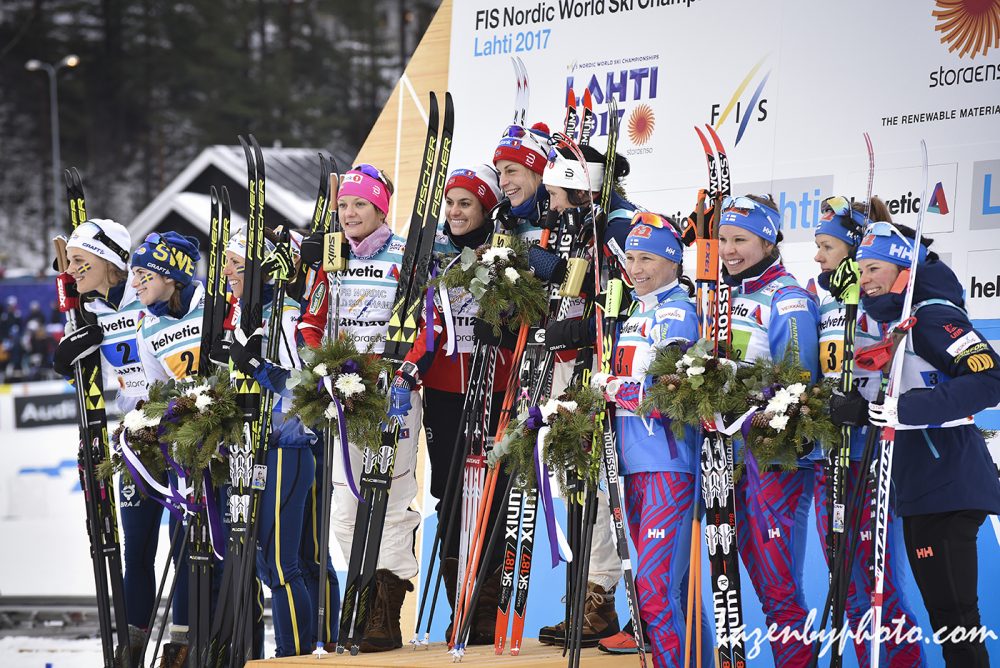
    The women’s 4 x 5 k relay podium at 2017 Nordic World Ski Championships in Lahti, Finland, with Norway (c) in first, Sweden (l) in second and Finland (r) third. (Photo: John Lazenby/Lazenbyphoto.com)

    LAHTI, Finland—The Norwegian lineup for the women’s 4 x 5-kilometer team at the 2017 Nordic World Championships on Thursday was daunting: Maiken Caspersen Falla, Heidi Weng, Astrid Uhrenholdt Jacobsen, Marit Bjørgen. On paper and on snow, a rundown of names and accomplishments.

    Here during these Lahti championships the Norse foursome have hauled; Falla with a freestyle sprint gold, Falla and Weng with a classic team sprint gold, Bjørgen a 10 k individual classic gold and 15 k skiathlon gold, and Jacobsen’s hardware was a bronze in the 10 k classic.

    On Thursday the Norwegian women made the country’s historic championship gold medal count a tidy 100 by winning the 4 x 5 k relay in 52:21.5 minutes. In a sprint for the remaining two podium spots, Sweden’s anchor skier Stina Nilsson outsprinted Finland’s Krista Pärmäkoski for second.

    The Swedish team of Anna Haag, Charlotte Kalla, Ebba Andersson, and Nilsson scored silver (+1:01.6) while Finland’s home team of Aino-Kaisa Saarinen, Kerttu Niskanen, Laura Mononen, and Pärmäkoski was third (+1:02.1).

    The U.S., represented by Kikkan Randall, Sadie Bjornsen, Liz Stephen, and Jessie Diggins, placed fourth (+1:33.8).

    Two Legs of Parity, Then Norwegian Dominance

    Rabid fans of the sport know Norway is winner of the last three consecutive championship relays. And lovers of tactics also know the Norwegians like to push the pace from the gun and break the pack early.

    Halfway through the first leg, Poland’s Justyna Kowalczyk, a classic specialist, led Finland, Norway, Sweden, and the U.S. through the 2.5 k mark.
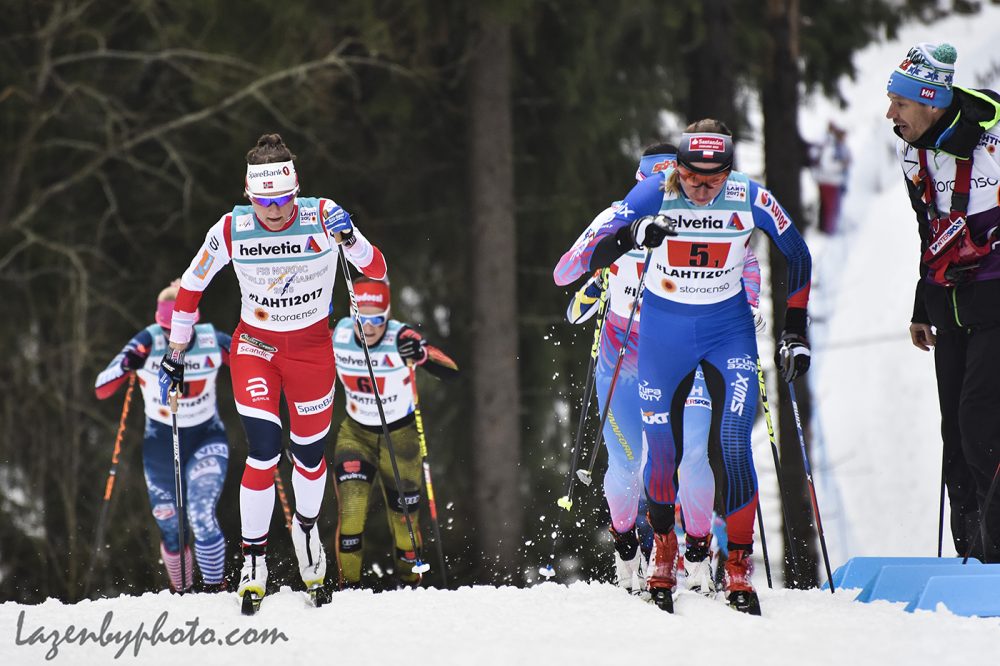
    Norway’s Maiken Caspersen Falla (l) leads one row of skiers, Poland’s Justyna Kowalczyk lead’s another, during the scramble leg of the 2017 Nordic World Championships 4 x 5 k relay in Lahti, Finland. (Photo: John Lazenby/lazenbyphoto.com)

    For Falla, Norway’s scramble leg, it was her debut in a championship 4 x 5 k relay. Despite her prior medals, her pre-relay nerves were unsettled.

    “I was really excited today and I was just hoping that the time could pass fast so I can race,” Falla said after the race. “It was a lot of waiting time, but I get good advice … and that helped me today. So I get my nerves under control.”

    According to Falla, here’s the advice: “That I should stay behind the first lap and be strong in the climbs in the last lap,” she explained. “I did that, just as they said.”

    In the last kilometer, Falla made a small break, tagging off to Weng with a near eight-second advantage on the chasers.

    Weng leads the World Cup overall standings, but racing in the Finnish ski-den, she was unable to fend off the surging Finns. Five kilometers later, Niskanen had absorbed Norway’s punch. Finland and Norway tagged off to their respective third-leg skiers simultaneously. Sweden trailed twelve seconds back.

    Up the first hill, the mother of all climbs on the skating course, Jacobsen and Mononen pulsed. Carrying Sweden’s hopes was Andersson — a 19-year-old junior fresh off a win in the 5 k skate at last month’s Junior World Championships at Soldier Hollow in Utah.

    The Finn-Norwegian duo pulled away, leaving Andersson with a 22.6-second deficit 1.3 k into the third leg.
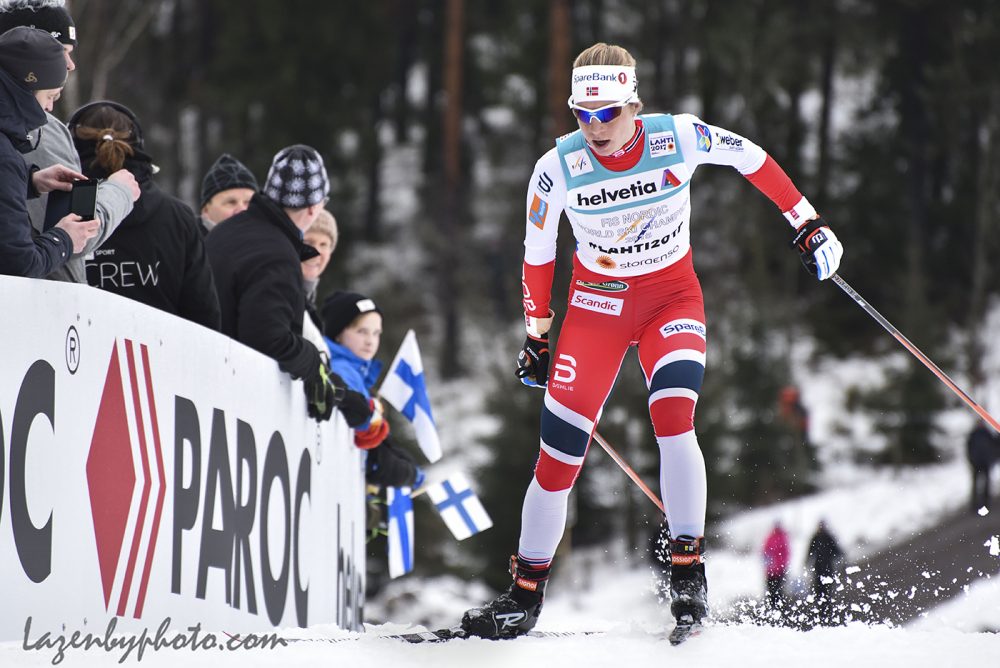
    Astrid Uhrenholdt Jacobsen, Norway’s third-leg skier, made a decisive move to put major time into second-place Sweden and third-place Finland during the 2017 Nordic World Championships 4 x 5 k relay in Lahti, Finland. (Photo: John Lazenby/Lazenbyphoto.com)

    A resurgent Jacobsen kept pushing; her moves to drop Andersson early on weren’t only a tactic to make it a two-team race, but a sustained display of overdrive that ultimately broke the Finns, too.

    The third leg was the tipping point for Finland and Sweden. They were on the side of bleeding time to Norway; Norway on the side of looming victory. By 13.8 k, Norway was up 30.4 seconds on Finland and 45.8 seconds on Sweden.

    Andersson managed the damage. She and Mononen skied into the stadium amidst a raucous Finnish crowd. By then, Jacobsen handed Bjørgen nearly a minute cushion.

    That kind of margin and Bjørgen hustling from the line: Boom!

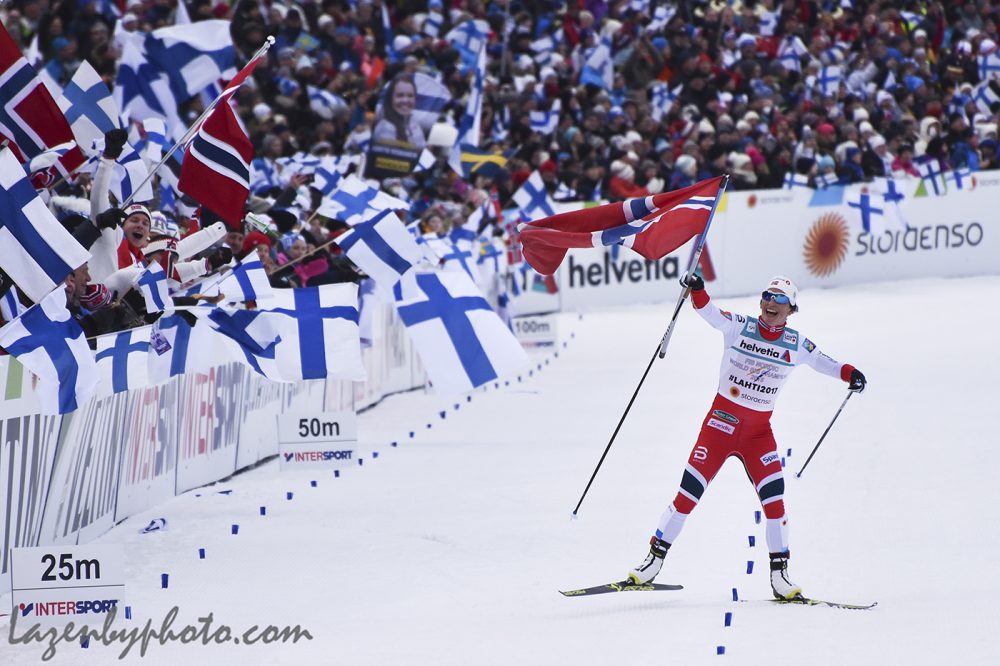
    You know how this ends, with the queen waving an oversized Norwegian flag.

    After the race, Jacobsen spoke of the pressure of skiing on Norway’s storied relay teams.
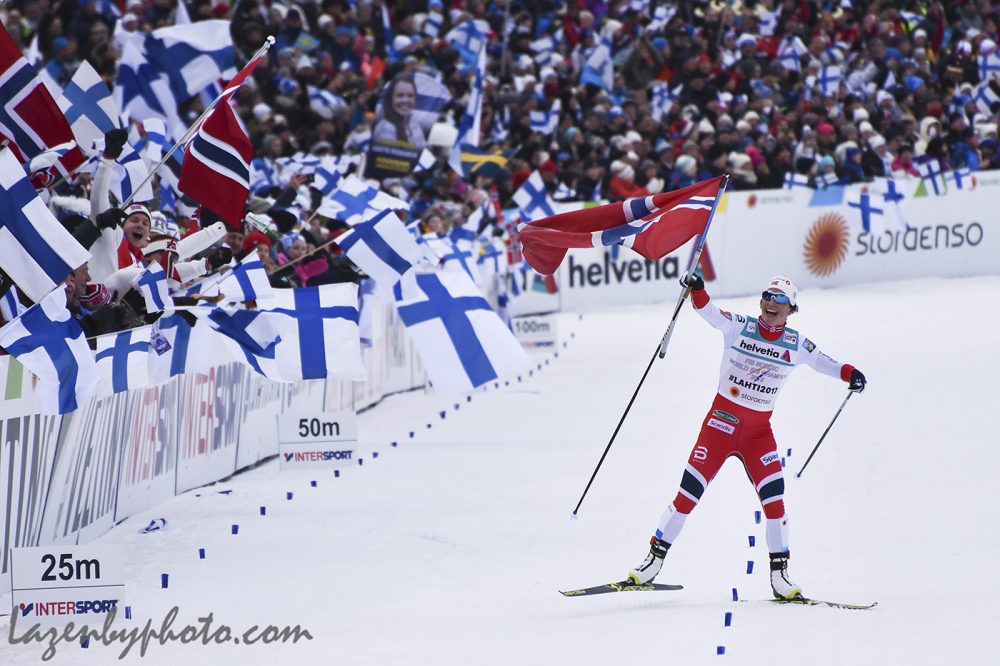
    Marit Bjørgen carrying the Norwegian flag as she crosses the line first for Norway’s 100th World Championship win during the women’s 4 x 5 k relay at the 2017 Nordic World Championships in Lahti, Finland. (Photo: John Lazenby/Lazenbyphoto.com)

    “I think actually the biggest pressure is the one we put on ourselves and probably because it’s so hard for us to qualify for the team,” Jacobsen said. “We are skiing for the girls who didn’t make it this year but will probably make it next year. So we ski of course for our people and our nation. But I think the biggest nerves come from the desire to perform well and do strong legs.”

    One hundred championship gold medals later, Jacobsen acknowledged it’s a full treasure chest.

    “The Norwegian people are getting spoiled in gold medals, but it not so easy like it looks,” Jacobsen said.

    Glide for glide, pole for pole, Sweden and Finland were mirror images the last leg. Known as a closer, Nilsson strategized that coming into the final corner she wanted to follow Parmakoski.  

    Sweden’s second-leg skier Kalla explained that Nilsson’s tactic was one of waiting until the end.

    “If Stina should go with some team in the end, she should wait to the stadium and just focus on her strength and she made it just like the plan,” Kalla said.

    Days earlier in the team sprint, Nilsson lost out on bronze to Diggins in a sprint to the line.

    “In the team sprint I was first in the final curve,” Nilsson reflected. “And I felt that Diggins had an advantage of it, so I didn’t want to be first today.”

    The press conference’s moderator interjected and tried to correct Nilsson, saying she was first again in the closing moments, not shadowing the Finn.

    “No, not in the curve, but after the curve,” Nilsson said with a laugh.

    The silver and bronze fight came down to Nilsson’s final kick and this time she made it stick for silver.

    (Story continues below)
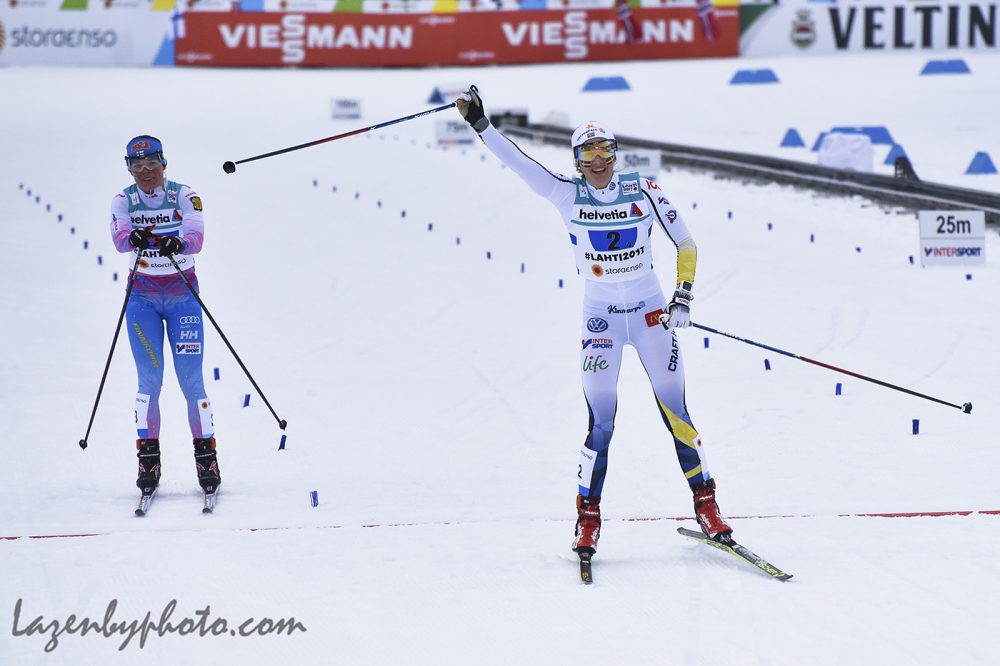
    Sweden’s Stina Nilsson celebrates silver after outsprinting Finland’s Krista Parmakoski (l) in the final meters of the women’s 4 x 5 k relay at the 2017 Nordic World Championships in Lahti, Finland. (Photo: John Lazenby/Lazenbyphoto.com)

    Same Place, But Progress: U.S. Places Fourth, Canada 10th

    With three world champs medals already in the hands of American skiers prior to Thursday’s team relay, the public hope for a podium was high. Perhaps too high.

    As U.S. Ski Team (USST) Head Coach Chris Grover explained, medaling in the team relay was certainly on the radar coming into the world champs week, but not where the team’s greatest expectations were held.
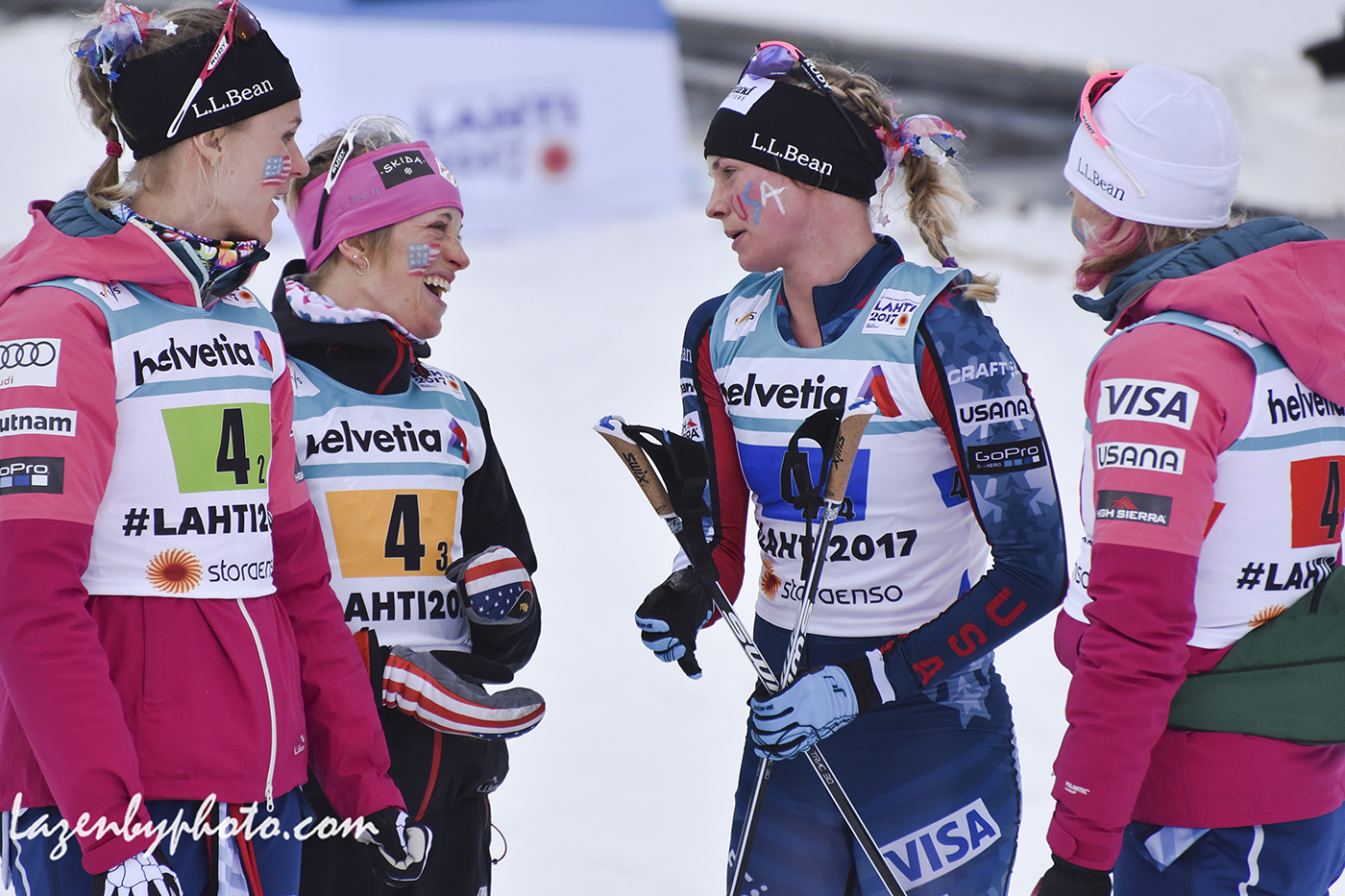
    The U.S. women’s relay team, (from left to right) Sadie Bjornsen, Liz Stephen, Jessie Diggins, and Kikkan Randall, after placing fourth on Thursday at 2017 World Championships in Lahti, Finland. (Photo: John Lazenby/Lazenbyphoto.com)

    “The relay we knew was a shot, the team sprint we knew was an outside shot,” Grover said after Thursday’s race. “Probably our greatest medal opportunity was the individual sprint.”

    As a gritty group of women, the Americans exude the attitude of a top team. Adorned in red, white and blue socks and face paint sporting the U.S.A.’s emblematic stars and stripes, it’s easy to see the enthusiasm the U.S. women show for team events.

    But where does the blur between team-relay hype end and the reality of results begin?

    Disappointment in anything less than a podium only comes when the expectation of one exists. Taken over the past few world champs years, the relay event might be one where the U.S. women can, and have, improved the most.

    Eight years ago, at the 2009 world champs in Liberec, Czech Republic, the U.S. finished 13th, a little over three minutes out of third place. The following World Championships year, 2011 in Oslo, Norway, they were almost two minutes off the podium, crossing in ninth overall.

    In 2015, the team finished fourth, a little over a minute back from the bronze medal.

    This year? The U.S. once again finished fourth — the third time in a row that the team has finished one place outside the podium at a World Championships event.

    Yet, Thursday’s performance was the second closest the team has come to bronze, with the Americans crossing 31.7 seconds after third (their 2013 result in Val di Fiemme, Italy, was closer: 26.6 seconds behind third). Given room for systematic error, the statistical trend for the U.S. women in the team relay over the past five world champs: positive.
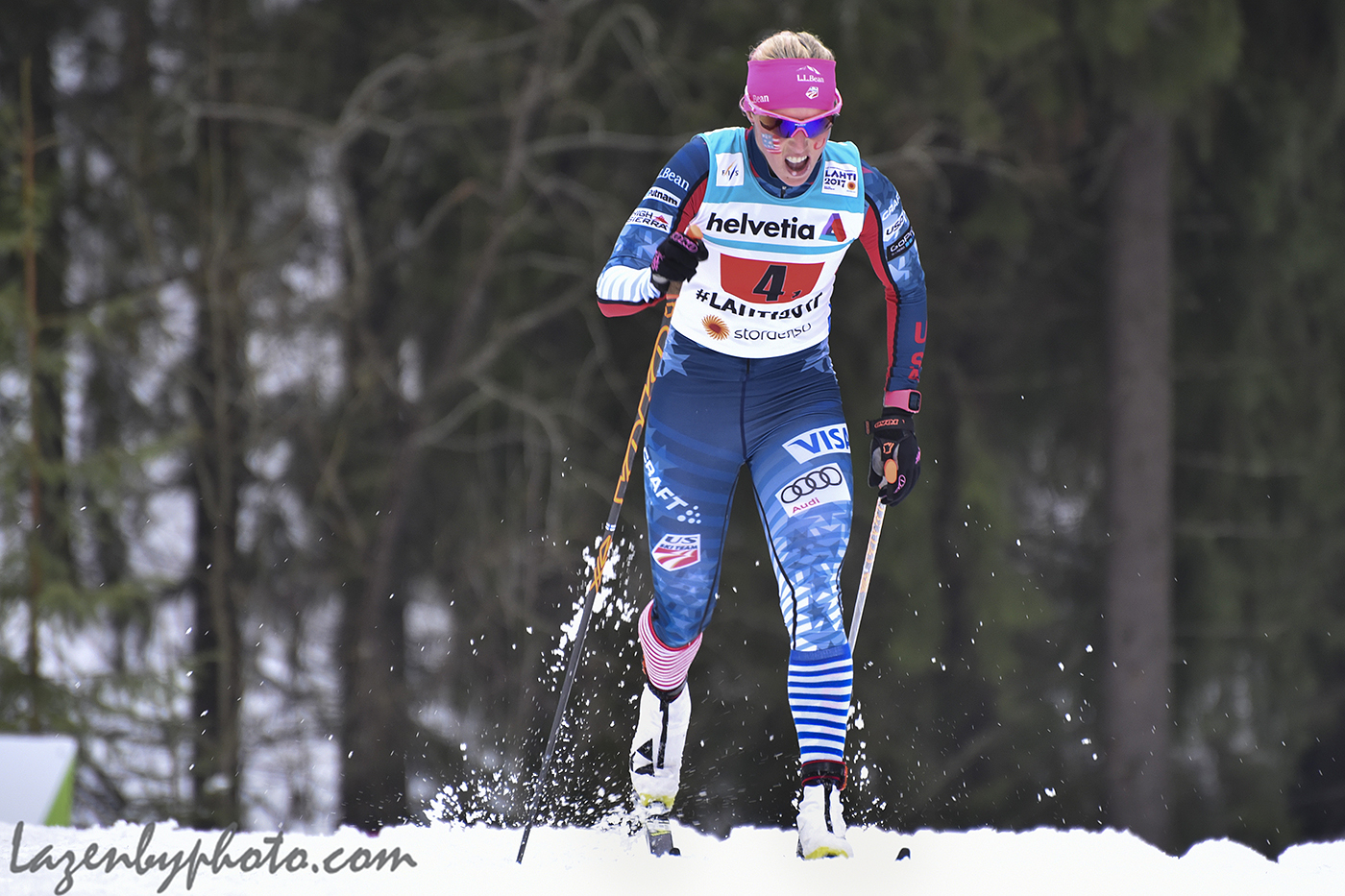
    American Kikkan Randall during the first leg of the women’s 4 x 5 k relay at the 2017 Nordic World Championships in Lahti, Finland. (Photo: John Lazenby/Lazenbyphoto.com)

    “Even though this is the third time in a row that we’ve been fourth place at a world championships, there’s progress, there’s real progress,” Grover said. “The athletes could see the competition ahead of them the whole time. … To be getting closer and closer to that top standard, that’s very gratifying.”

    When looking at the longer-distance performances from the week in tandem with Thursday’s start list, Grover further explained that the U.S. team’s incoming rank was similar to their outcoming result.

    “I guess I’d say that when you look at the start list and you look at the results from the 10 k and the skiathlon, on paper we’re fourth,” Grover said. “Sweden, Finland, Norway they’re definitely ahead of us in terms of the distance results that we’ve seen here all week. So we knew we were sort of an outside chance to be fighting for the bronze and we knew that when we’re successful on the World Cup, it’s because one of those teams has a weak leg.”

    A weak leg from Finland, Norway or Sweden — the three teams that finished ahead of the Americans — at least in Thursday’s race, was nowhere to be found for the U.S.

    From the start, Kowalczyk, pushed the pace with Falla, Haag and Saarinen in close quarters, while the USST’s Randall worked hard to hold on.

    “Unfortunately, we lost some important time there in the beginning,” Randall said. “I know that’s something I’ve got to work on for next year, but it was exciting to know that we were still in the race the whole time and made Sweden and Finland really fight for those medals.”

    Randall handed off to Bjornsen in fifth, approximately 16 seconds back from the second, third, and fourth spots. From there, the Americans raced alone, working hard to reel in the racers ahead.

    “It’s always hard to have a carrot right in front of you and not go too hard at the beginning,” Bjornsen said. “I think all of us had a hard time with that today, not going too hard to try to catch them right away.”

    By the end of her leg, Bjornsen needed another eight seconds from Randall’s time back to catch the third place position. She handed off to Stephen, who would have to make up 23.5 seconds on Sweden’s third leg, Andersson, to contend for the podium.

    The young Andersson, however, was putting on a show. And Stephen wasn’t surprised. During the early stages of her ski career, Stephen attended a weeklong camp in Sweden. While there, she’d learn invaluable lessons from countless coaches, one just happening to be Andersson’s father.
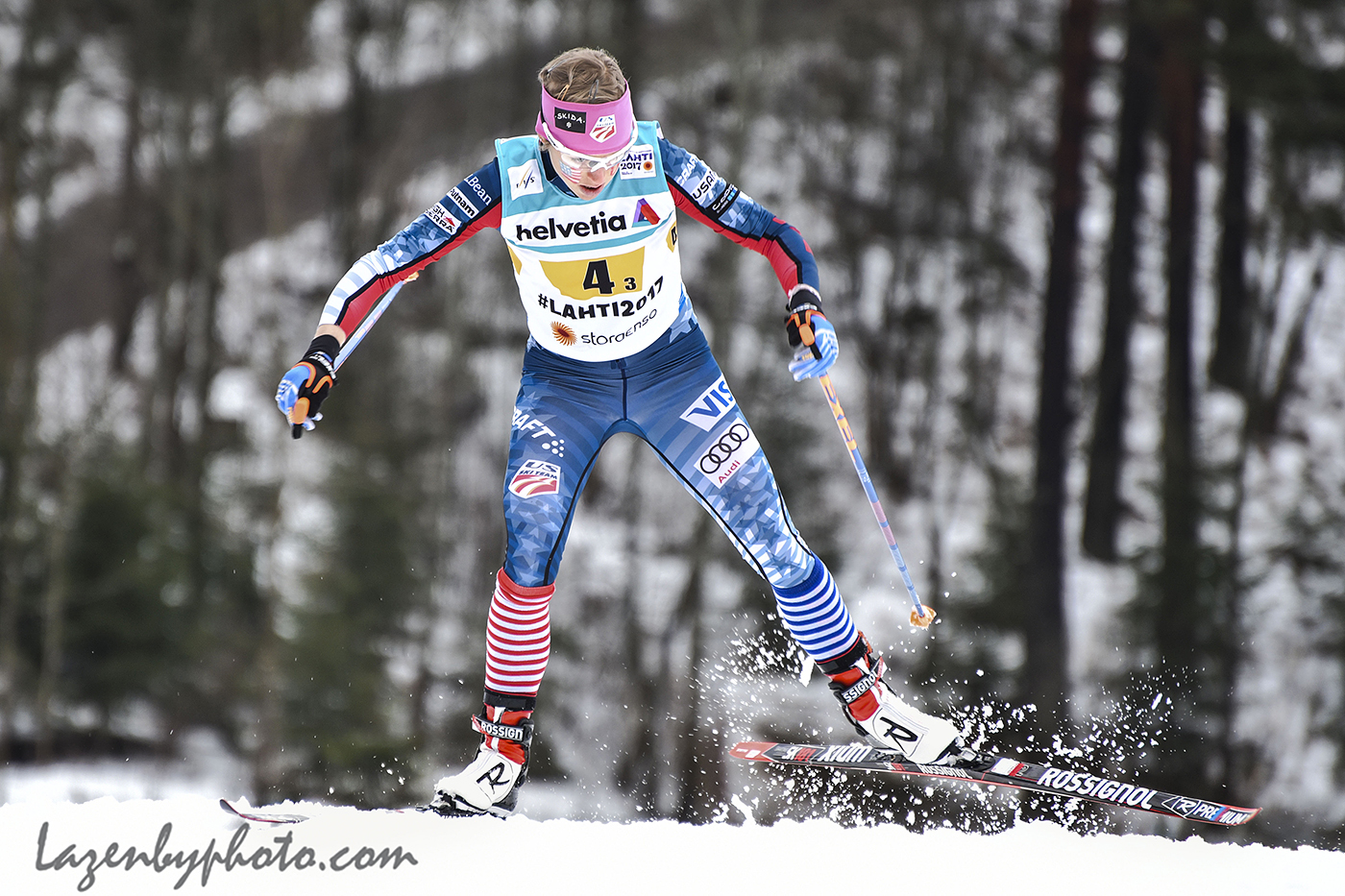
    Liz Stephen racing the third leg for the U.S. women’s team in the 4 x 5 k relay at the 2017 Nordic World Championships in Lahti, Finland. (Photo: John Lazenby/ Lazenbyphoto.com)

    “As I was lining up with her today I was just like ‘this is just full circle,’ “Stephen said after. “She’s a damn-good skier.”

    That of course didn’t stop Stephen from putting her best foot forward. The American emphasised the areas she knew were her strength, working the hills.

    “Part of me wanted to go out and blow [it] out of the water off the bat, but I also knew that these conditions are also a little bit more energy-expending than normal, hard-packed conditions,” Stephen explained.

    Halfway through the first lap, Stephen had gained close to seven seconds on Andersson. By the end of the second lap, however, Andersson had regained the ground that she had lost.

    “Unfortunately I couldn’t get her,” Stephen said. “But I did what I could out there … and I am very inspired to be on this team again. To watch my teammates give it all out there, it just makes you want to do the same.”

    When Stephen handed off to Diggins, the anchor legs for Sweden and Finland were skiing together. Diggins explained that she had hoped Nilsson and Pärmäkoski’s race tactics would provide an opportunity for her to gain on them.

    “I saw where we were coming in and I said, my only strategy is to go out as hard as I can and hope that they are playing cat and mouse in the front,” Diggins said. “[I thought] if they’re trying to be all strategic for the final sprint-out, then maybe I can catch them.”

    Ultimately the gap proved too large, with Diggins crossing in fourth.

    “I wasn’t able to close the gap but I never stopped fighting and neither did my teammates, and I’m really proud of that,” Diggins said.

    Canada’s team of Katherine Stewart-Jones, Emily Nishikawa, Cendrine Browne, and Dahria Beatty finished 10th (+4:16.2) for the fourth-best world champs result of a Canadian women’s relay team. According to a Cross Country Canada press release, this was just the fourth time in the last decade that Canada has fielded a World Championships women’s relay (excluding the Olympics).

    At the 2001 World Championships, Beckie Scott, Milane Thériault, Jaime Fortier, and Sara Renner raced to sixth for Canada. Before that, the program’s previous best was eighth at 1989 world champs, also in Lahti.
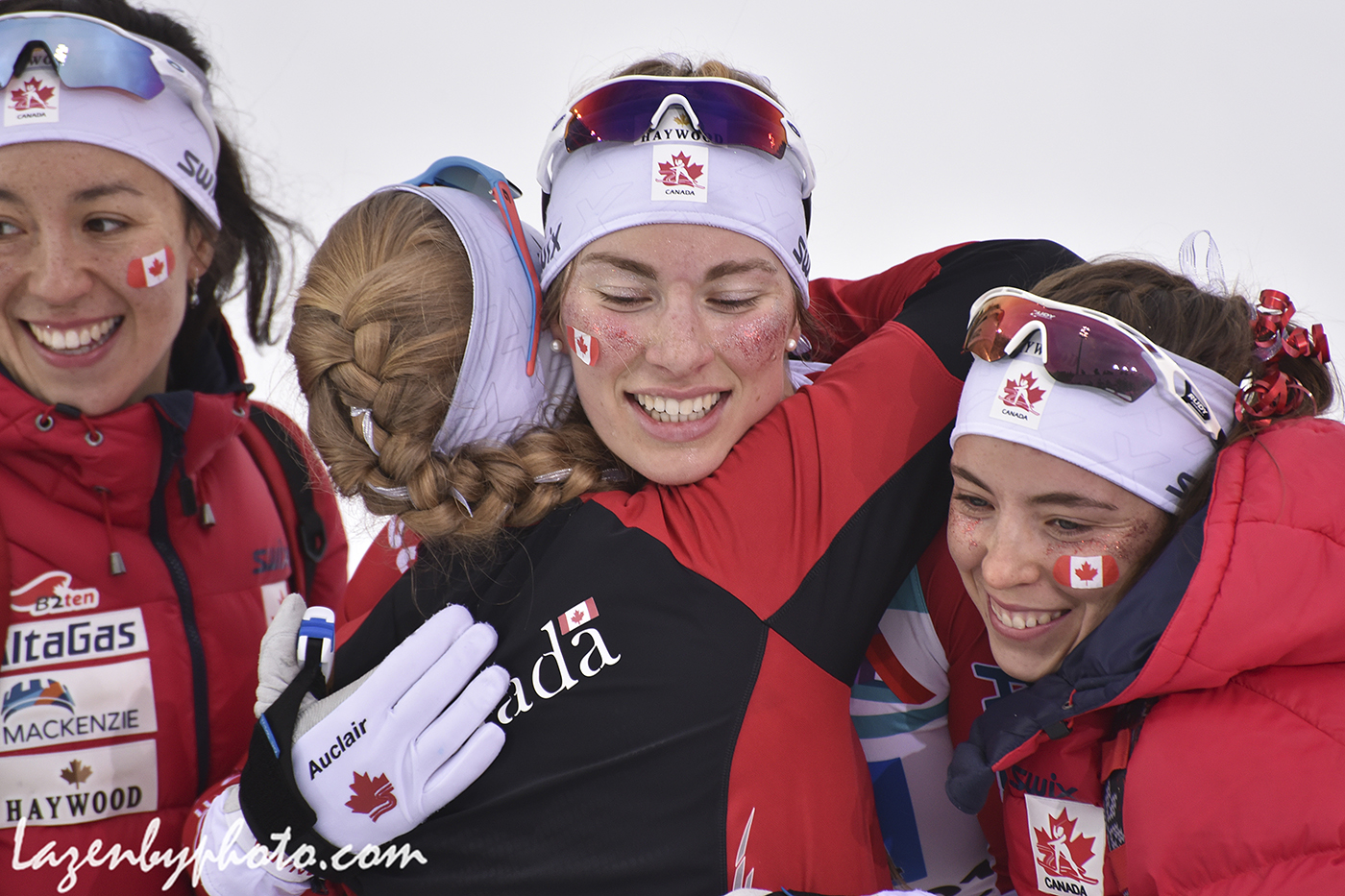
    (Left to right) Canada’s Emily Nishikawa, Cendrine Browne, Dahria Beatty, and Katherine Stewart-Jones after placing 10th in the women’s 4 x 5 k relay at the 2017 Nordic World Championships in Lahti, Finland. (Photo: John Lazenby/Lazenbyphoto.com)

    “I think today we surprised ourselves,” Canadian World Cup coach Ivan Babikov said on Thursday.

    “[Katherine Stewart-Jones] skied incredibly that first leg, with everything she could,” he added. “She was ahead of Germany, ahead of Russia, so many really good countries, and after that it was a matter of holding on and it was great.”

    Stewart-Jones finished her leg in eighth, just seven-tenths of second behind Germany’s Katharina Hennig in seventh. Though Switzerland and Italy eventually caught the Canadians, the women expressed excitement about the finish and results yet to come.

    “This is the first time we’ve fielded a world champs relay in a long time so that’s a huge accomplishment [in itself],” Nishikawa said during an in-person interview. “And then to come 10th … it’s really the beginning of something that’s pretty special.”

    “I’m really proud of us,” Browne added. “I think we all skied really strongly today, and very positive for the future.”

    — Harald Zimmer, Gerry Furseth, and Alex Kochon contributed
    Results

  • Amidst Finnatics, Niskanen Strides to 15 k Gold; Bjornsen Notches 18th at World Champs

    Amidst Finnatics, Niskanen Strides to 15 k Gold; Bjornsen Notches 18th at World Champs

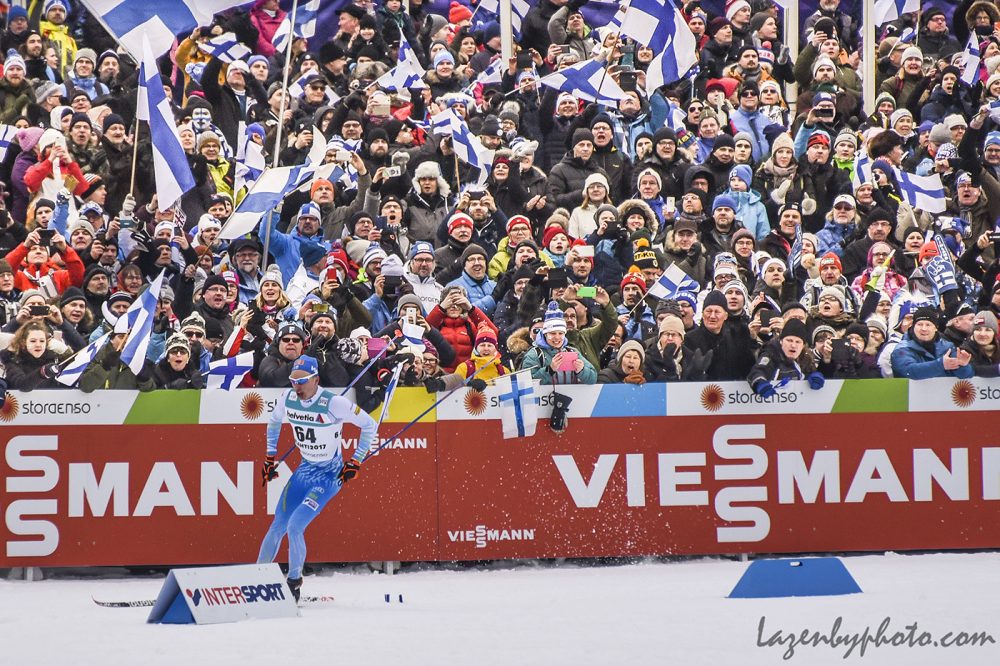
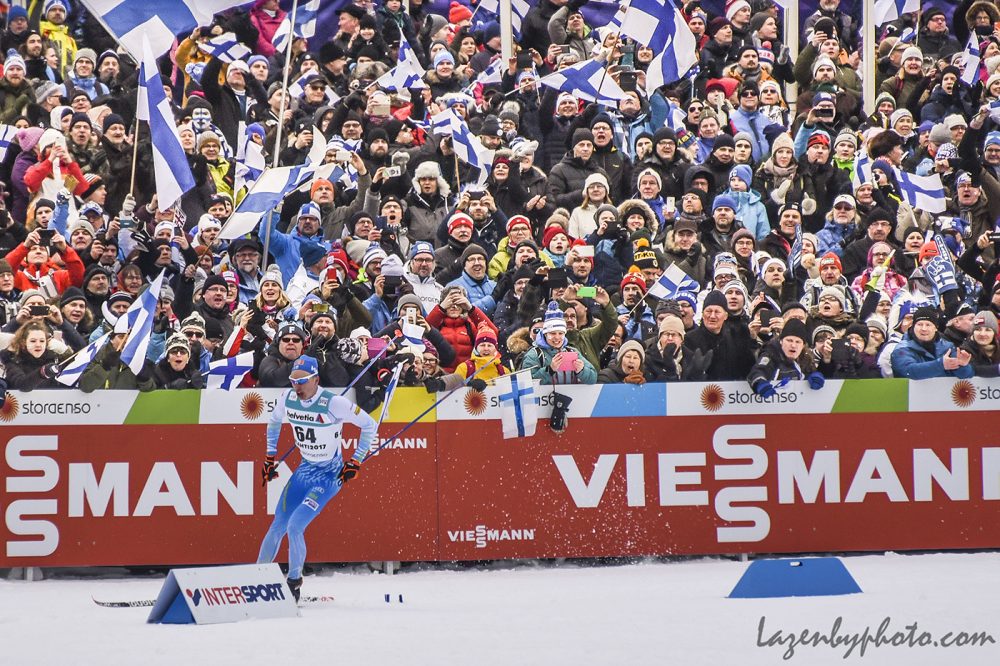
    Amidst a sea of Finnish flags, Finland’s Iivo Niskanen turns the final corner on his way to gold in the men’s 15 k classic individual start on Wednesday at 2017 Nordic World Championships in Lahti, Finland. (Photo: John Lazenby/Lazenbyphoto.com)

    LAHTI, Finland — Through the first seven medal races of 2017 Nordic World Championships, the hometown Finns came close. There was Krista Parmakoski’s skiathlon silver. There was the spectacular Finn non-win when Finland’s Iivo Niskanen and Norway’s Emil Iversen tumbled 200 meters from the line during Sunday’s classic team sprint. At the moment of the tangle, Niskanen was primed to pass Iversen for what appeared to be a golden performance.

    Instead of a cheer concluding the sprint, a collective exhale deflated the crowd: Niskanen and teammate Sami Jauhojärvi ultimately settled for bronze. While it wasn’t the result they had hoped for, it remained the 25-year-old Niskanen’s first World Championships medal.

    Another race on Wednesday brought another Finnish opportunity. On a 34-degree Fahrenheit day with moist tracks and low-hanging clouds, gold was up for grabs.

    During the men’s 15-kilometer classic individual start, Niskanen channeled whatever bitter taste remained from his team sprint near-win into a controlled and sufficient pace. After 1.5 k, Niskanen ranked fourth — from then on, he was the fastest through every remaining timing point, and first when it mattered most. Niskanen won in 36:44 minutes.

    Norway’s Martin Johnsrud Sundby finished 17.9 seconds off his time for silver. Sundby’s teammate Niklas Dyrhaug clocked in 31.3 seconds back for bronze, his first-career individual championships medal.

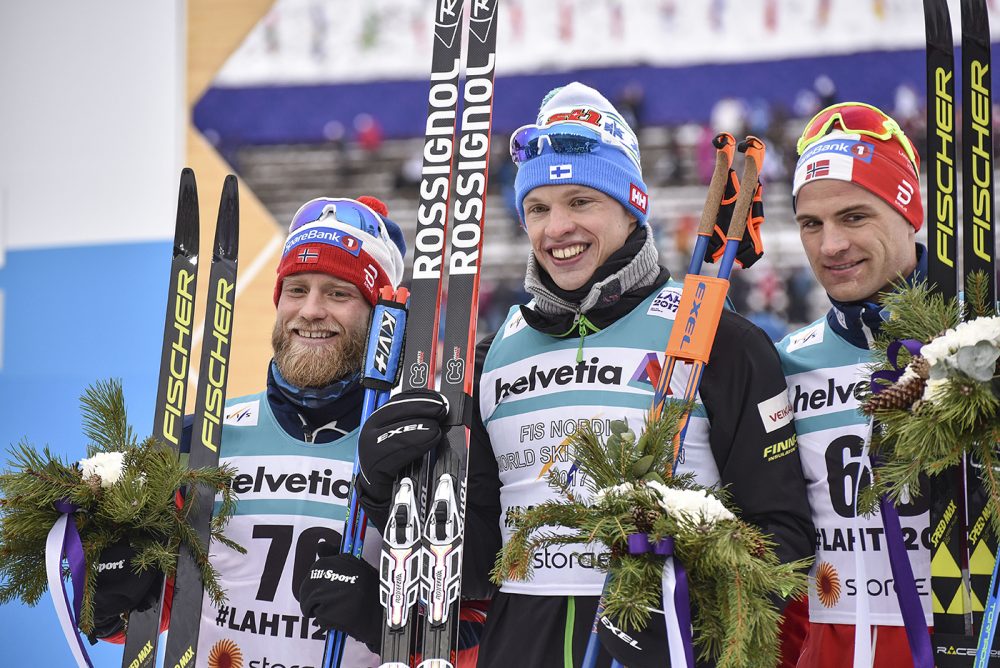
    The men’s 15 k classic podium at 2017 Nordic World Ski Championships in Lahti, Finland: (from left to right) Norway’s Martin Johnsrud Sundby (l) in second, Finland’s Iivo Niskanen (c) in first, and Norwegian Niklas Dyrhaug (r) in third. (Photo: John Lazenby/Lazenbyphoto.com)

    “It’s for sure a really good team, Norway, and it’s a hard fight in all the places for every distances,” Dyrhaug said at the post-race press conference about making Norway’s 12-man World Championships team. “I have been a reserve for the skiathlon and the team sprint. I have been here since Otepää — ten days now. I have been ready so when I got the chance in the 15 k, yeah, I am happy to show everybody that I am in really good shape and I have something in world champs to do.”

    The 15 k classic appears an odds maker’s nightmare. It remains a fickle distance and technique with a million and one variables. There’s the course profile, the athlete’s classic technique to consider — do they thrive on headwalls or stridable terrain, double poling? The wax. The snow type. The venue’s altitude. Then there’s the pacing — go out hard? Look for negative splits? Ski it like a true distance race, not an elongated sprint?

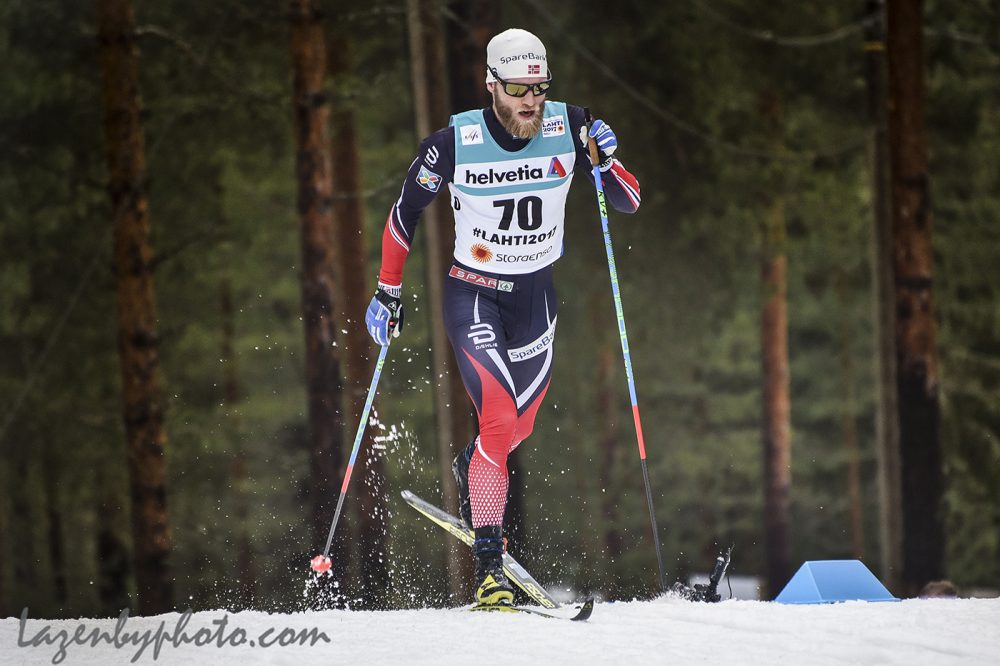
    A single 15 k classic win at a championship or World Cup level evidently doesn’t mean more will come your way. Of the 133 starters on Wednesday, Finland’s Matti Heikkinen remains the only athlete who had won a 15 k classic at a World Championships or Olympics (at 2011 World Championships in Oslo, Norway, he won the gold in this event). Not since the ’54 and ’58 championships has an athlete won two world titles in this event.

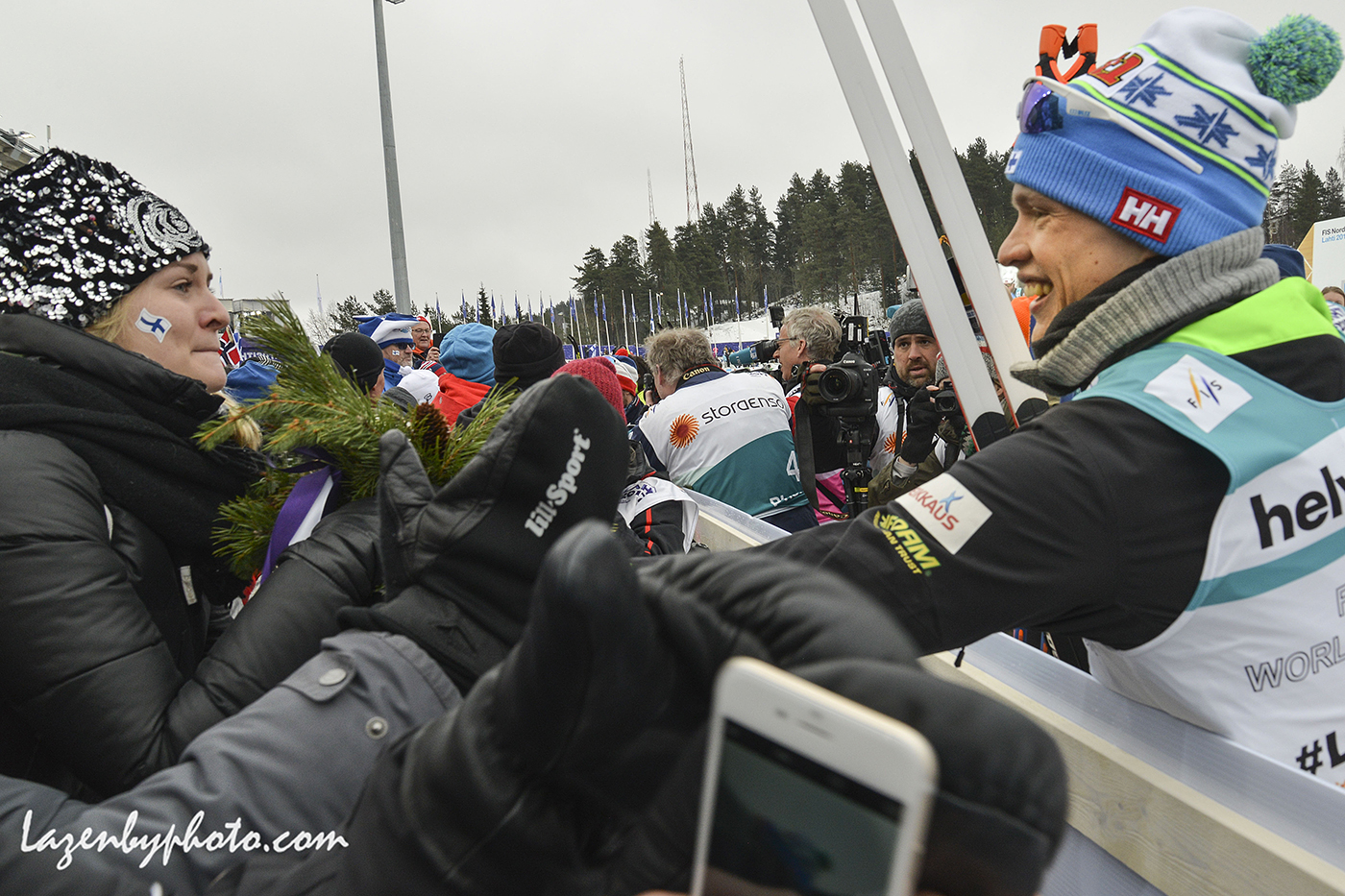
    Finland’s Iivo Niskanen (r) celebrates his 15 k classic win with loved ones at 2017 Nordic World Championships in Lahti, Finland. (Photo: John Lazenby/Lazenbyphoto.com)

    Niskanen and the 15 k classic are sympatico and eventually he may buck the consecutive-winner’s curse. Niskanen has three career World Cup podiums: all in the 15 k classic. There’s two wins — both in Kuusamo, Finland, and a second place at the last pre-championship World Cup race last month in Otepää, Estonia.

    That doesn’t mean the Finn isn’t flawless.

    “Many times, in many races I have started too hard for the first two kilometers,” Niskanen said after the race.

    His too-early, hot-pacing issues were remedied Wednesday as he left nothing to chance. Niskanen suggested he’d had a Lahti champs dress rehearsal to test his pacing strategy.

    “It was good to race here before on the Scandinavian Cup and learn the track, today I’m ready,” Niskanen said.

    Back on Jan. 8, Lahti hosted a Scandinavian Cup 15 k classic. Like today, Niskanen won over another Norwegian, Johannes Høsflot Klæbo (+5.8).

    “Today I planned to do a half kilometer and push hard,” Niskanen said on Wednesday. “After a kilometer and a half, I was quite fresh and got quite easily a gap and pushed as hard as I can. Everyone is cheering you and so then you don’t actually feel the lactate as normal. I had a difficult last kilometers, but it was one and a half to go I just thinking about myself, ‘Now we are not going to lose 20 seconds anymore.’ ”

    That losing 20-seconds remark referred to his Scando Cup race. During that 15 k, he was 17 seconds up on Klæbo with 3 k remaining. He actually lost 12 seconds to Klæbo on that final sector, not 20, but Niskanen recognized the trend — slowing down in the final push.

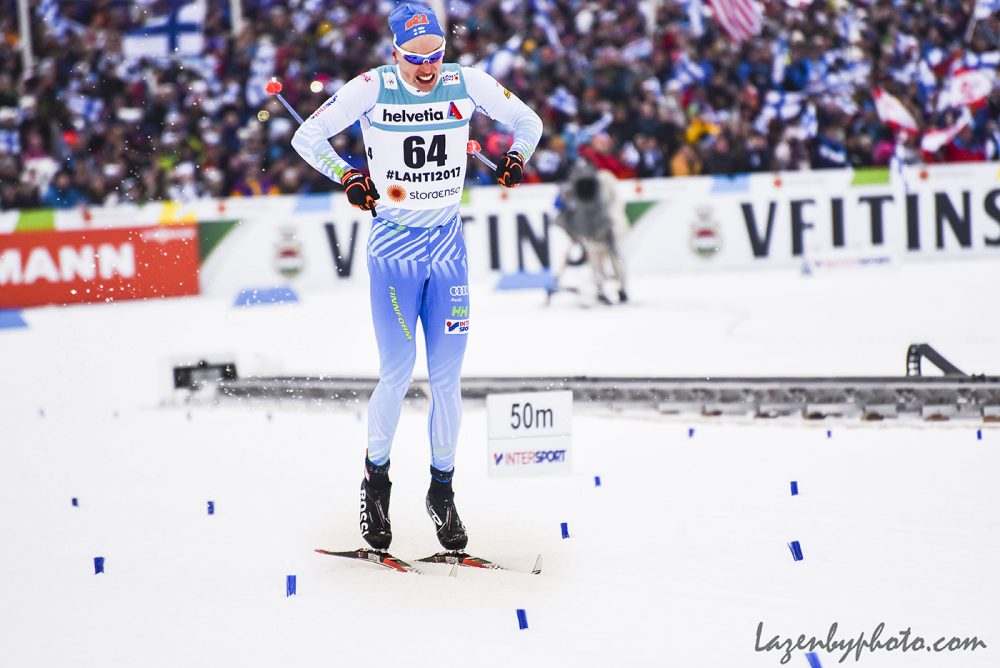
    Finland’s Iivo Niskanen powers down the finishing stretch en route to gold in the men’s 15 k classic at 2017 Nordic World Championships in Lahti, Finland. (Photo: John Lazenby/lazenbyphoto.com)

    Although young, Niskanen has struggled with repeated sickness and overtraining. Promoted as a potential World Cup overall contender, Niskanen’s three 15 k classic victories remain the sole podiums highlighting his World Cup resume.

    “It has been many hard years and I said when I wake up, ‘I feel healthy today and I have hope’,” Niskanen said. “I have gotten easily sick for many years and over training, maybe I have been training too much and too hard during the last years. But this year I have trained more than ever, but I have not raced in every weekend.”

    The higher-volume, limited-racing recipe worked. This season, the Finn tailored his race schedule — not too much, not too little. To date, he’s raced 11 World Cup races.

    “The goal was to win here in Lahti and be in the best shape here and we see it with my gold,” Niskanen said.

    Norway’s Sundby remains a World Cup benchmark— he’s a mutiple overall Crystal Globe winner and leads this year’s standings. But for the reigning overall World Cup winner, an individual championship gold (at world champs or the Olympics) still eludes him.

    “I think my race was really good, I felt so fast out there,” Sundby said after the race. “And then I was 20 seconds behind, I don’t believe it. It was tough for the mind to motivate myself for fighting today, but I did what I thought was one of my best race ever at this distance.”

    Norway’s Martin Johnsrud Sundby on his way to second place in the 15 k classic at the 2017 Nordic World Championships on Wednesday in Lahti, Finland. (Photo: John Lazenby/lazenbyphoto.com)

    Asked if he felt demoralized knowing he was 20 seconds down grinding away on Lahti’s wooded tracks, Sundby explained how he attempted to remain in the hunt.

    “It is not so difficult in the World Champs … [Niskanen] did the race here in the Scan Cup a few months ago, where he for sure lost a lot of seconds in the last 3.75,” Sundby added. “And I tried to motivate myself. I said, ‘He will meet the wall, he will meet the wall, you just have to push.’ I felt good, I felt good all the way and tried to gain seconds but it was nearly impossible today.

    “It is an amazing performance Iivo showed us today, everybody,” Sundby said of his Finnish protagonist. “You have to appreciate a really good sportsman. Also with some things that happened before here in the world champs, maybe in the team sprint, and it’s called karma. Today he showed everybody.”

    Best World Champs Finishes for Bjornsen in 18th, Bratrud in 33rd

    While Niskanen took the overall victory on Wednesday, American Erik Bjornsen walked away with a win of his own. Two days earlier, the 25-year-old Washington native had raced to a historic fifth place in the classic team sprint with his U.S. Ski Team (USST) teammate Simi Hamilton for the best team-sprint result for the U.S. men’s program. Before that, the team’s best was seventh place in 2015.

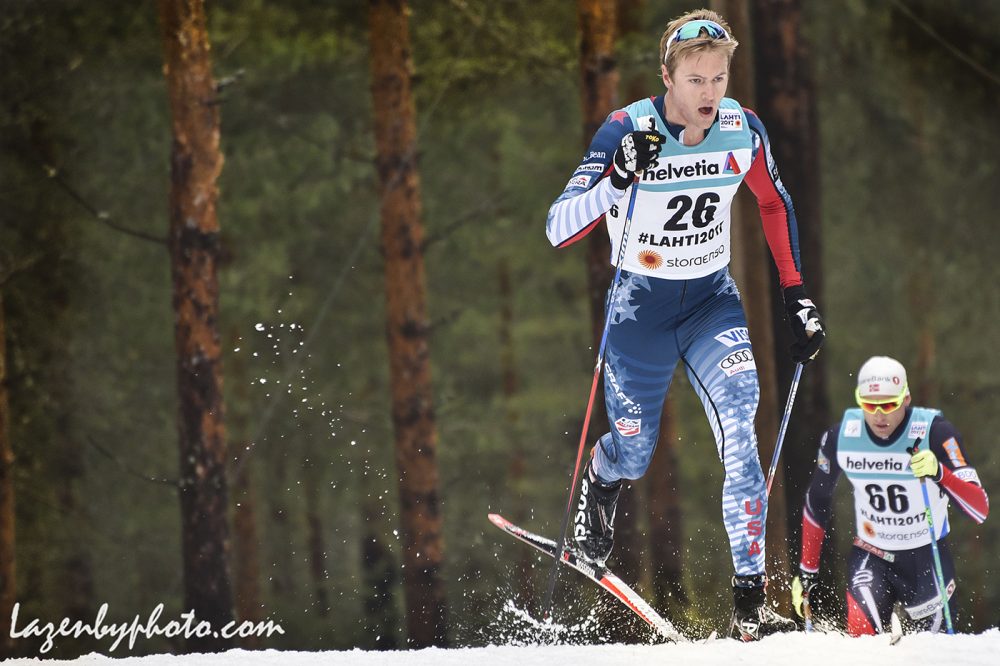
    U.S. Ski Team member Erik Bjornsen (26) skiing ahead of Norway’s Niklas Dyrhaug (66) during the men’s 15-kilometer individual start at the 2017 Nordic World Championships on Wednesday in Lahti, Finland. Bjornsen went on to place 18th, while Dyrhaug captured third place for bronze. (Photo: John Lazenby/lazenbyphotography.com)

    Bjornsen had raced the anchor leg for the U.S., challenged by names like Norway’s Johannes Høsflot Klæbo, Russia’s Sergey Ustiugov and Wednesday’s eventual 15 k winner, Niskanen.

    Despite some of the heavy hitting names that challenged Bjornsen on Sunday, he found himself in the mix (two of his laps were the fifth fastest and one the fourth fastest of all second-leg skiers).

    “In the team sprint the other day, you saw some of the best skiers, I mean, I was skiing with Iivo Niskanen, who has a good shot at winning today, and I felt pretty comfortable skiing with some of those guys,” Bjornsen after Wednesday’s race. An early starter in bib 26, he initially finished third before being bumped 15 places to 18th (+1:56.7).

    “I definitely went into the [15 k] race with quite a bit of excitement from the team sprint,” he said.

    Bjornsen added that the energy he was able to find during the team sprint is something he sees as working it’s way into his longer-distance efforts.

    His performance in the 15 k appears to prove that, as he finished in the top 20 for his best individual World Championships result. The finish also ties his best individual World Cup result — he placed 18th three years ago in a 15 k in Toblach, Italy. The finish was also the best championships result of an American in the men’s 15 k classic since Kris Freeman placed fourth at Liberec world champs eight years ago. 

    Bjornsen explained that a slight bonk toward the end of his first lap caused him to put on the brakes briefly, though he found he was ultimately able to pick his pace back up before finishing.

    “I went for it in the beginning, for sure, and I think I had a pace for the first lap that would have been pretty similar to some guys in the top ten,” Bjornsen said. “Then I kind of hit a little bit of a wall there, a little bit through the first lap, and struggled for a couple of kilometers … then I was able to pick up a little bit of steam before the finish.”

    American Kyle Bratrud (CXC Team) racing to a career-best 33rd in the men’s 15 k classic at 2017 Nordic World Championships in Lahti, Finland. (Photo: John Lazenby/lazenbyphoto.com)

    “I mean hopefully I can just continue to improve and be able to keep that pace up the whole way and then I think it can come together for me,” he added.

    The second American to finish on Wednesday was Kyle Bratrud in 33rd (+3:11.5). Bratrud’s result was 20.7 seconds out of the top 30 and marks his best individual result at his second World Championships and career best at the World Cup level.

    Seeing himself as a stronger skater, Bratrud, 24, of the CXC Team, entered Wednesday wanting to test his ability to push his classic-technique limits.

    “I think I’m a little more confident in skate skiing, so classic I figured I had nothing to lose,” Bratrud said after. “I basically just went as hard as I could from the gun … to see if I could hang on.”

    While the decision resulted in Bratrud having to ease up during some of the climbs, he indicated that managed to recover well enough on the descents to regain control.

    “The course is pretty rolly and I was dying a lot on the uphills,” he said. “On the downhills I was getting some recovery and and all of a sudden I’d feel good again, but I’d get to the next hill and I’d be totally dead.

    “It was kind of a roller coaster of energy, but I just tried to keep my legs moving as fast as I could,” he added.

    With Wednesday also being his mother’s birthday (both his parents made the trek to Lahti to watch him race), Bratrud was thankful for the opportunity to race before throngs of fans, even if the names most were yelling didn’t belong to him.  

    “This is pretty awesome to not even be able to hear yourself breathing because it’s so loud,” Bratrud said “I love when people are cheering, even if it’s not for me.”

    Two other Americans competed on Wednesday, with Andy Newell (U.S. Ski Team) finishing 50th (+4:21.7) and Ben Lustgarten (Craftsbury Green Racing Project) 55th (+4:56.9).

    With his USST teammate Noah Hoffman out due to sickness, Newell explained that he was then slotted to race Wednesday’s classic event.

    “It was fun to get a 15 k in at the championships like this, it’s unfortunate that Hoff wasn’t feeling good so I had to come in and take his spot,” Newell said after.

    Adding that much of his goals are geared towards races scheduled to take place next season –particularly the 2018 Olympics in PyeongChang, South Korea — Newell is not too concerned with numerical results.

    “I felt OK in a few places, but definitely lost too much time out there. I’m just kind of going after a feeling. It wasn’t a great day, but I didn’t feel awful, either,” Newell said. “I’m hoping to build on this year and kind of use this year as a platform to be at my best by the Olympics. I’m not worried too much about results, just trying to feel good when I can.”

    Lustgarten indicated that he had been dealing with a bout of food illness prior to Wednesday. Unable to eat much in the days leading up to the race, the 24 year old had difficulty tapping into his normal race speed.

    “I was just blown. I tried to ski really smooth and then on the the steep stuff, I tried to ski really light and I tried not to throw up,” Lustgarten said. “I’m probably at 70 percent right now and I’m just trying to ski as well as I can here. … It’s a great experience and it was cool to hear the crowd going, I just wish I could ski like I was a month ago.”

    Canada’s Jess Cockney racing to 65th in Wednesday’s 15 k classic at 2017 Nordic World Championships in Lahti, Finland. (Photo: John Lazenby/lazenbyphoto.com)

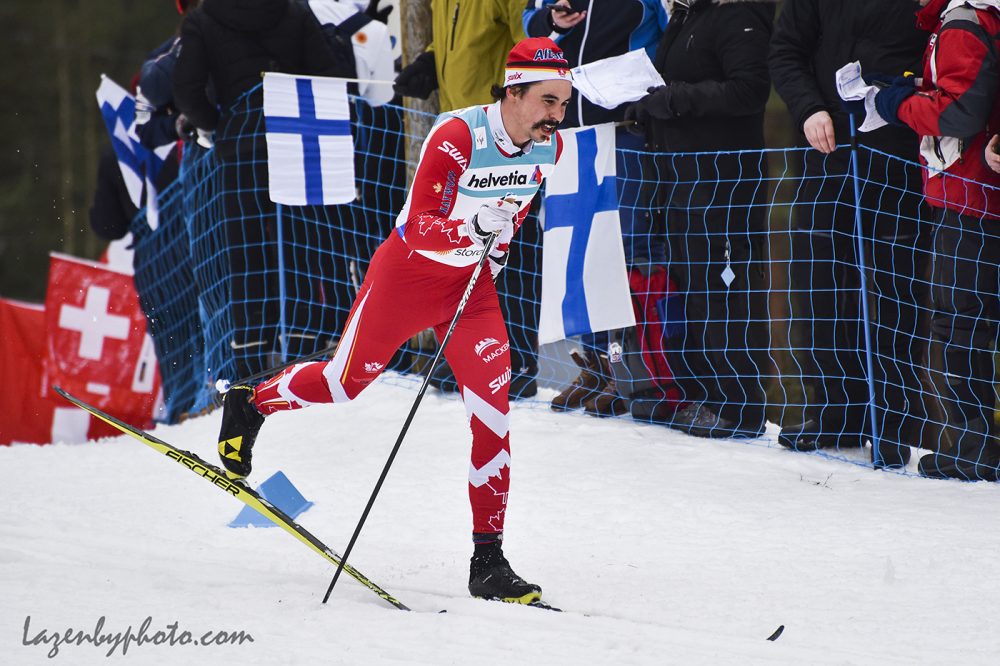
    Canada was led by Devon Kershaw in 35th (+3:24.8). The next Canadian to finish was Knute Johnsgaard in 56th (+5:00.7), followed by Jess Cockney in 65th (+6:20.7).

    “I don’t think I pushed as hard as I should have. … Mentally, maybe I wasn’t totally zoned in, but I was happy to do a distance race in front of a big fan base like this in Finland for the hometown favorites, so that was good,” Cockney said.

    This being Johnsgaard’s first world champs experience, the 24 year old was happy with how he race his third individual event of the week.

    “I just went out at a pace I thought I could sustain for 15 k and kept that pace pretty steady I think and was able to push hard and kind of sprint up the last hill,” Johnsgaard said. “I felt like I paced it as well as I could, so I’m pretty satisfied with my race.”

    Results

    — Gerry Furseth and Harald Zimmer contributed

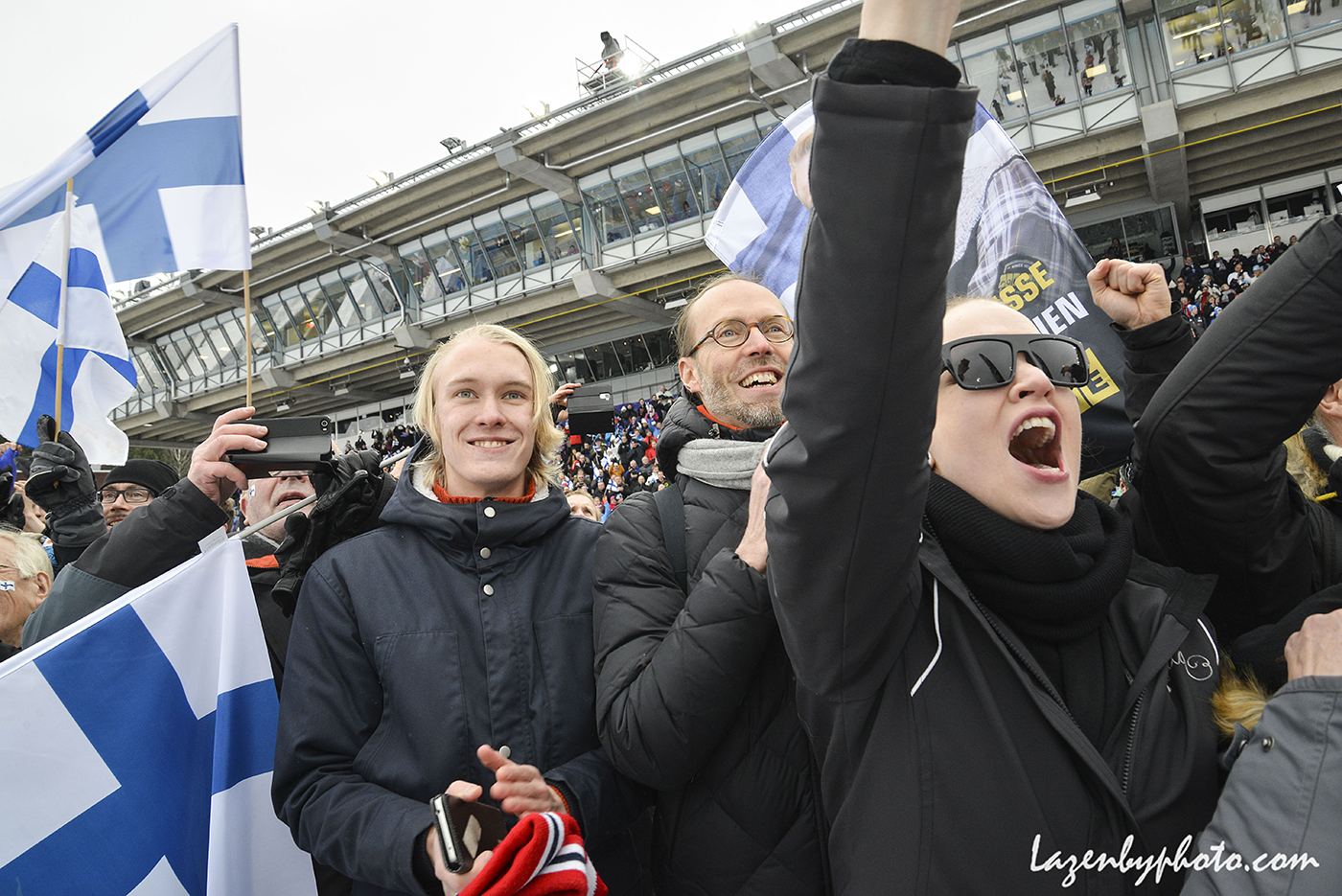
    Finnish fans celebrate Iivo Niskanen’s gold medal in the men’s 15 k classic at 2017 Nordic World Championships in Lahti, Finland. (Photo: John Lazenby/Lazenbyphoto.com)