From the FasterSkier archive — posts syndicated from athletes’ and coaches’ own blogs between 2004 and 2012, kept online as published. Current coverage is at fasterskier.com.

Tag: Nordiq Canada

  • Alison Mackie Is Chasing the Speed She Doesn’t Have Yet

    Alison Mackie Is Chasing the Speed She Doesn’t Have Yet

    This article was made possible through the generous support of our voluntary subscribers. If you value coverage like this, please support FasterSkier with a voluntary subscription.
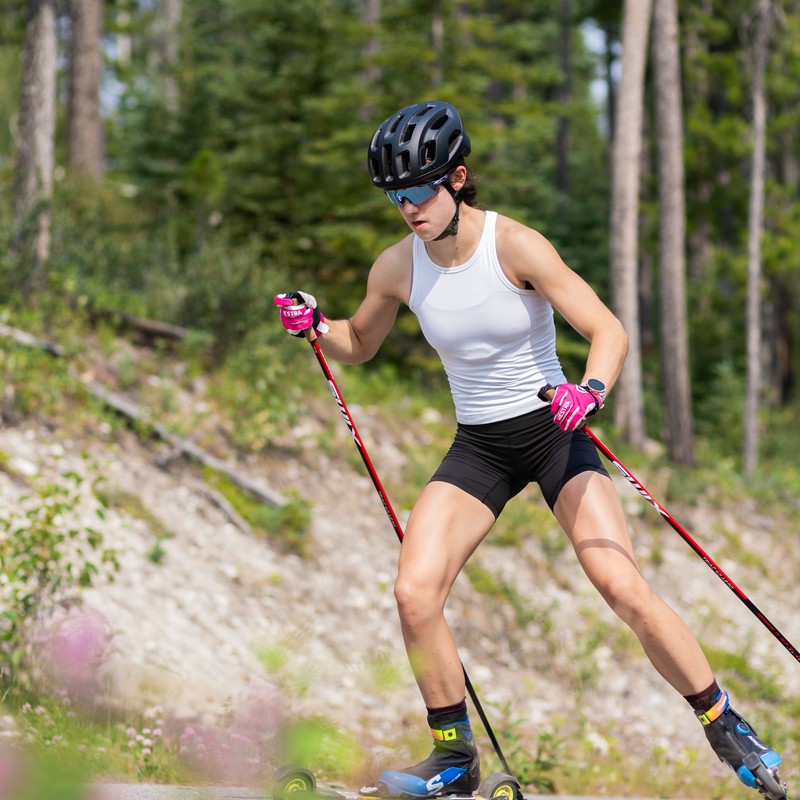
    Alison Mackie skate rollerskiing uphill on a paved forest road in a white training top and black helmet.
    Alison Mackie rollerskiing during summer training in July. She trains with the Alberta World Cup Academy in Canmore, Alberta. (Photo: Nathaniel Mah)

    For Alison Mackie, the 2024 Junior World Championships in Planica never really started.

    She had arrived in Slovenia with reason to expect something. A year earlier, at 17, she had finished 13th in the 20 k at the junior championships in Whistler, British Columbia, on home snow, in exactly the kind of long, grinding distance race that suits her. In Planica she missed the qualification in the opening sprint, fell ill, and watched the rest of the week from a hotel room. She was not on the tracks when her Canadian teammates made history either: Sonjaa Schmidt won the U23 sprint, and Canada won the U23 relay.

    Back at her base in Canmore, Alberta, at the end of that season, Mackie and her coaches set a target for the next one. Top five at the 2025 Junior World Championships in Schilpario, Italy.

    Privately, she wanted more than that.
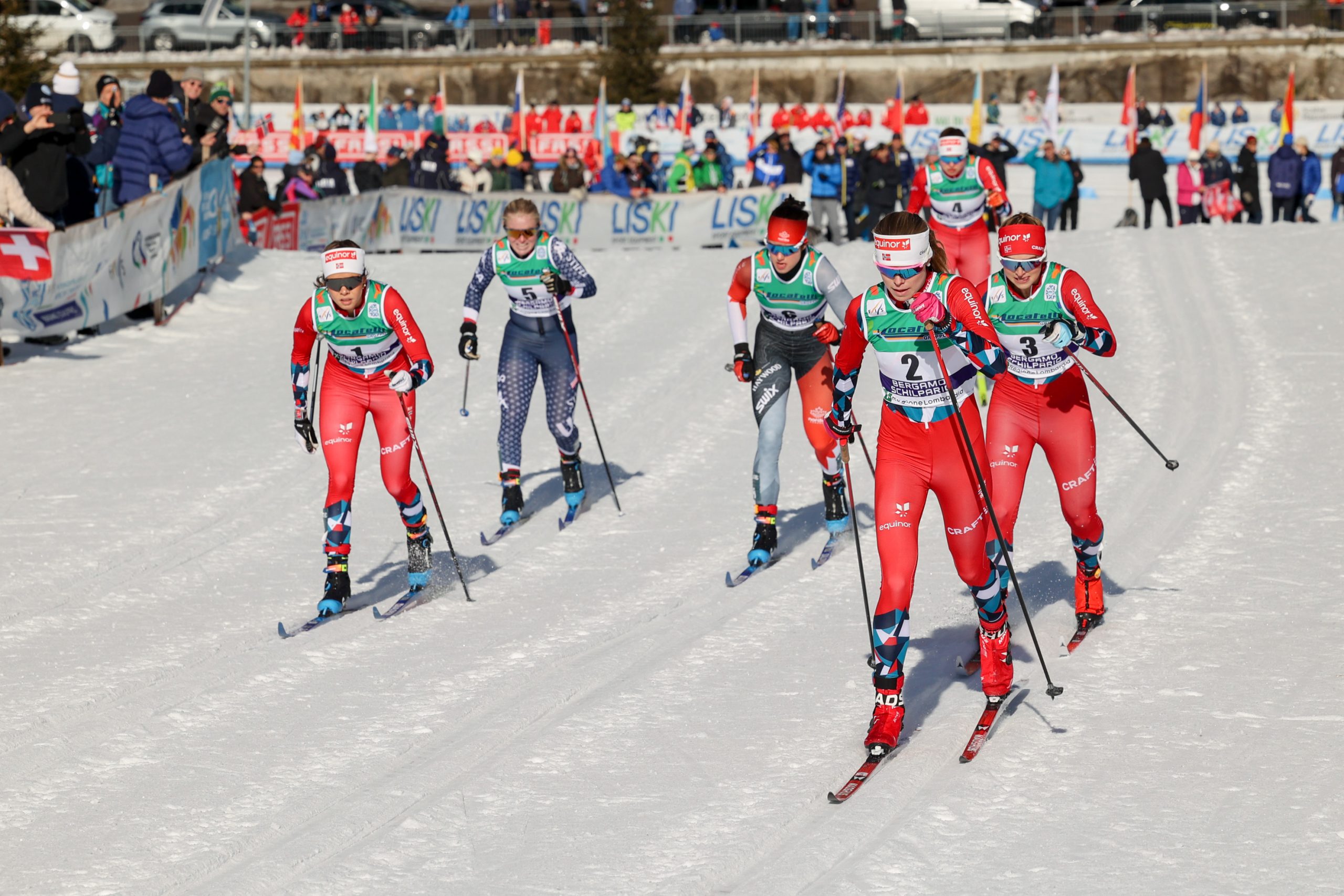
    Alison Mackie in bib 6 racing a classic sprint heat alongside Sammy Smith and four Norwegians.
    Mackie in bib 6 during the classic sprint at the 2025 Junior World Championships in Schilpario, where she finished fourth. Two bronze medals followed in the distance races. (Photo: Newspower.it)

    A Comeback in Schilpario

    “Yes, Junior World Championships in Schilpario were the main focus of my season that year,” Mackie said. “I trained specifically for that event to get my best shape there. But I wouldn’t say revenge, instead a kind of comeback because the year before in Planica I was pretty disappointed because I haven’t had the opportunity to race being sick.”

    On the Italian tracks she won bronze in the 20 k mass start classic, then bronze again two days later in the 10 k interval start skate. She was fourth in the classic sprint. They were the first junior world championship medals won by a Canadian woman since 1989.

    “I wanted a top five, and I finished with three top fours, including two medals,” she said. “The preparation we had put in proved to be correct, and I had a lot of confidence before starting the championships because I felt really good in the previous months leading up to my arrival in Italy.”
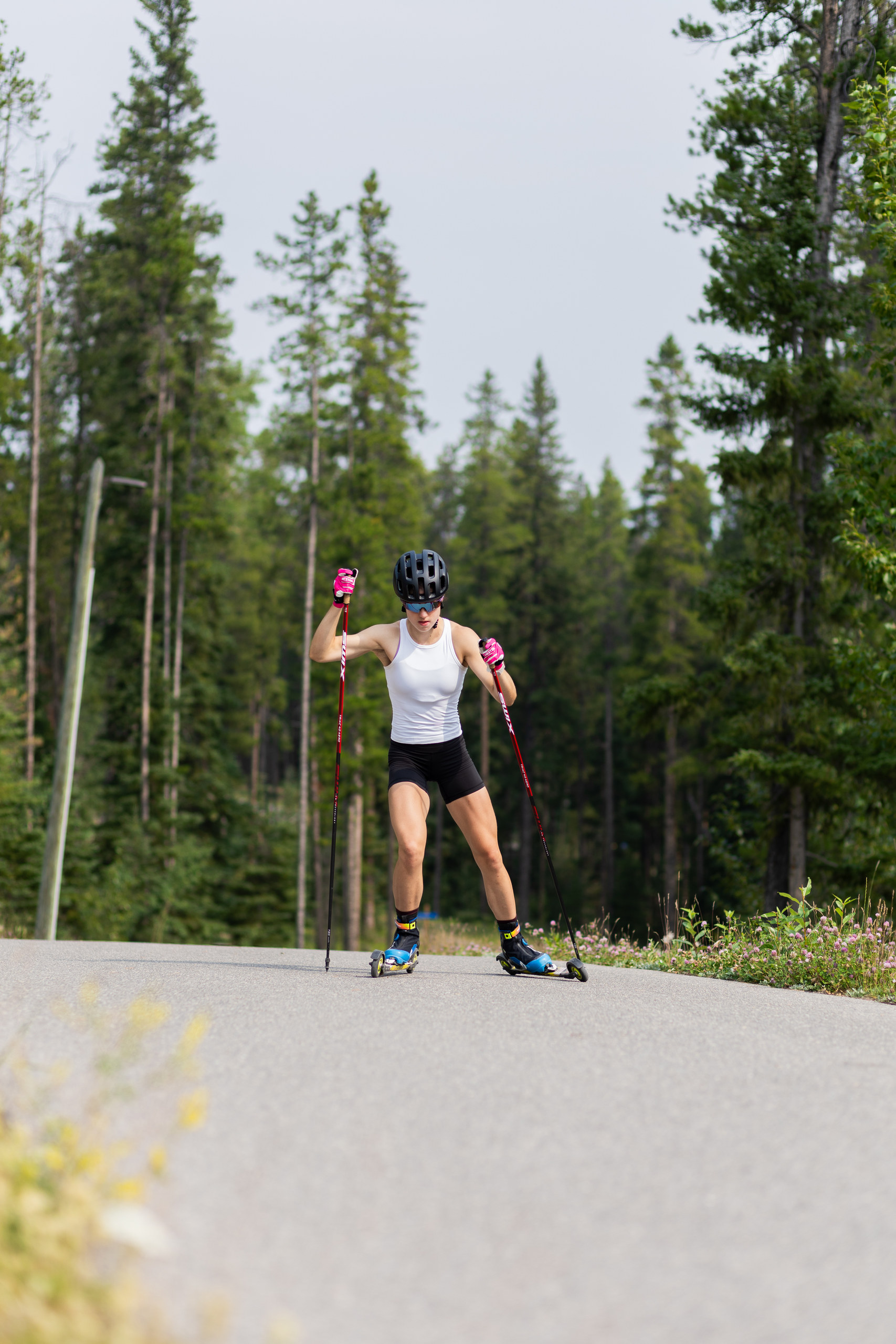
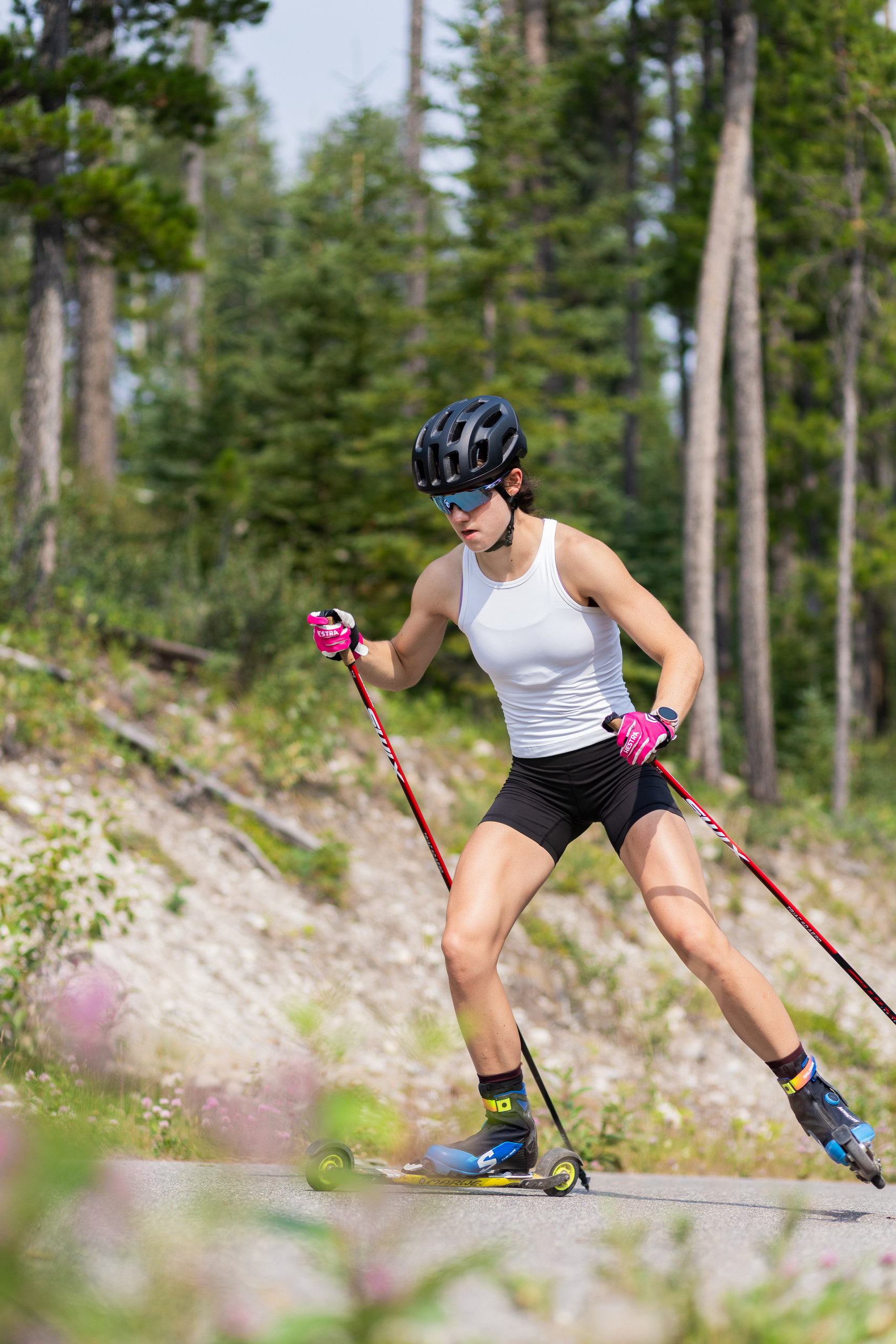
    Alison Mackie rollerskiing toward the camera on a paved road lined with evergreens.
    Mackie on a summer rollerski session in July. She started racing in Alberta as a teenager and won her first national title at 16. (Photo: Nathaniel Mah)

    Put on Skis Before She Could Walk

    Mackie was born in Montreal and raised in Edmonton, and she is 20 years old. Her mother, Jennifer, is a pediatrician. Her father, Andrew, is a pediatric cardiologist. Both of them ski, and both of them had her on skis before she has any memory of it.

    “My parents put me on ski as soon as I could walk,” she said. “So skiing accompanied all my childhood. Then I took real ski lessons and I started doing racing in my region of Alberta during my teenage times. That’s till Covid period arrived and with the restrictions I had nothing else to do others than training. But anyway, I really enjoyed myself during that period, developing my technique with my coaches at Edmonton ski club and when Covid finished my very first race that I won was our National title in March 2022 as a 16 year old.”

    Canada is known around the world as the home of ice hockey. Why did you choose cross-country skiing over hockey, freestyle, or swimming, following Summer McIntosh’s footsteps for example?

    “In parallel with cross-country skiing, I did a lot of other sports like cross-country track and field, rock climbing, mountain biking, swimming, soccer and in all of these sports I wasn’t as super competitive as I was in cross-country skiing. I did that only for fun as an opportunity to stay healthy during summer period. Cross-country skiing has been to me the only sport I competed at my best in my early ages and my favourite discipline. That’s why I chose it.”

    That first national title, won in Whistler in March 2022, is the race she keeps coming back to.

    “Yes, that race in Whistler BC was one of the first big races after the Covid pandemic,” she said. “I trained a lot during that period and didn’t have the opportunity to race and see my level, and when I went to my first National Championships and won the first race, it was a special moment and made me realize that I wanted to keep pursuing cross-country skiing for even better results and seeing how far I could get.”
    Alison Mackie racing the Olympic 10 k freestyle in Tesero, panned against a packed grandstand.
    Mackie racing to eighth in the Olympic 10 k freestyle in Tesero on Feb. 12, the best Olympic cross-country result by a Canadian woman. (Photo: Vanzetta/NordicFocus)

    Eighth at the Olympics

    The line has run one direction since. Two bronze medals at Junior Worlds. Her first World Cup top 10s, in Toblach and Val di Fiemme. Eighth in the 10 k free at the Milano Cortina Olympics in her first senior season. Gold in the 20 k mass start free at the U23 World Championships in Lillehammer in March. And at the end of that season, on 548 points, the FIS U23 overall World Cup title, the first won by a Canadian woman, with the finals held at Lake Placid.

    At the Milano Cortina Olympics you finished eighth in the 10 k free, after your first World Cup top 10s in Toblach and Val di Fiemme. What do you remember from those two weeks in Italy?

    “It was super cool being part of that multi sport event that the Olympic Games represent. It was my dream since I was a child watching Olympics on TV and having the opportunity to compete in high level in this huge event was really special to me. Definitely they have been long two weeks, also overwhelming at the time, but made me really happy how I performed overall and the 8th place I got in 10km skating has definitely been the highlight without any doubt. Entering the top 10 has been quite a surprise to me in that moment, because there were all the best skiers at the starting line. But now looking back at all the hard work I did during the whole season and the good results I got before that race in both World Cup and in under 23 World Championships, I wouldn’t say it was a huge surprise for me. Probably demanding Val di Fiemme’s track suited me very well, given that I finished as well 8th in Tour de Ski’s Cermis climb the month before.”

    What is the current situation in Canada for cross-country skiing, in terms of ski club membership, visibility in the national media, and financial support?

    “I would say the current cross-country skiing community in Canada is pretty small, if compared to other European power nations, but strong and with lots of passion in developing our discipline. There are a lot of young skiers coming up and I think it is very exciting for the great results to come in the future. Our National sports organization here in Canada are working really hard to make sure our National team can get all the support we need in order to achieve some World Cup podium with both boys and girls team during the seasons to come.”
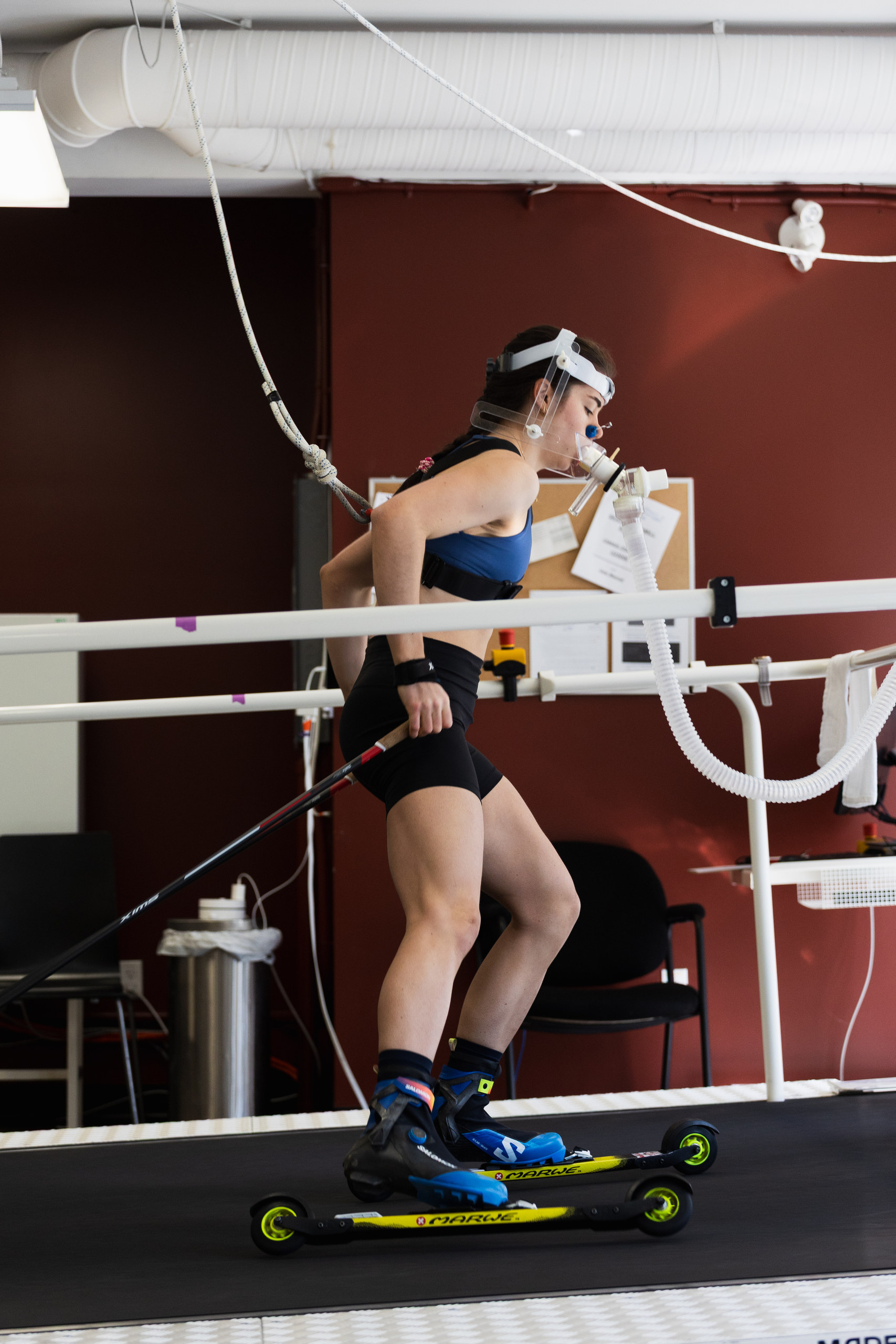
    Alison Mackie skate rollerskiing on a laboratory treadmill while wearing a metabolic mask.
    Mackie on the treadmill during a lab test in May. Distance racing is her strength, and finding speed is the summer’s assignment. (Photo: Nathaniel Mah)

    Distance Strength, Sprint Homework

    Describe yourself as a cross-country skier. What are your characteristics, your strengths, and the areas you are working on for the coming seasons?

    “I describe myself as a pretty strong skier in distance races, while I struggle a bit in sprint not to get through the top 30 and consequently not play the sprint finals, that is an element that I am working on in next seasons,” she said. “Between classic and skate I have found more success in free technique in the past seasons, but I enjoy training both classic and skate equally. Distance races are definitely my strength but I am working to improve my speed skiing as well so I could become a really strong overall skier in order, in the future, to fight for a higher overall spot in World Cup.”

    And the criticism you get from your coaches?

    “More than critics I would call special feedback from my coaches. Because sometimes I have a tendency to train too much and too hard that I need. That is something I am working on this summer, knowing when to push my body and when to give the correct time to rest and recover.”

    The World Cup calendar keeps skiers from outside Europe away from home for close to five months a season. How hard is that for you?

    “Personally I have spent on the road, following World Cup calendar, the past two seasons, but not the full European calendar. I really enjoy travelling and being on the road, so I don’t think it is a huge struggle for me. It is tough to not see friends and family for a long time but I am really lucky that I had friends and family came and watched me on tracks while I was in Europe a couple of time during season. Next season it will be quite different for me, because I am transitioning to attend the University of Utah so I will leave World Cup a bit because I do need to go to class and represent the University of Utah in North America as well.”
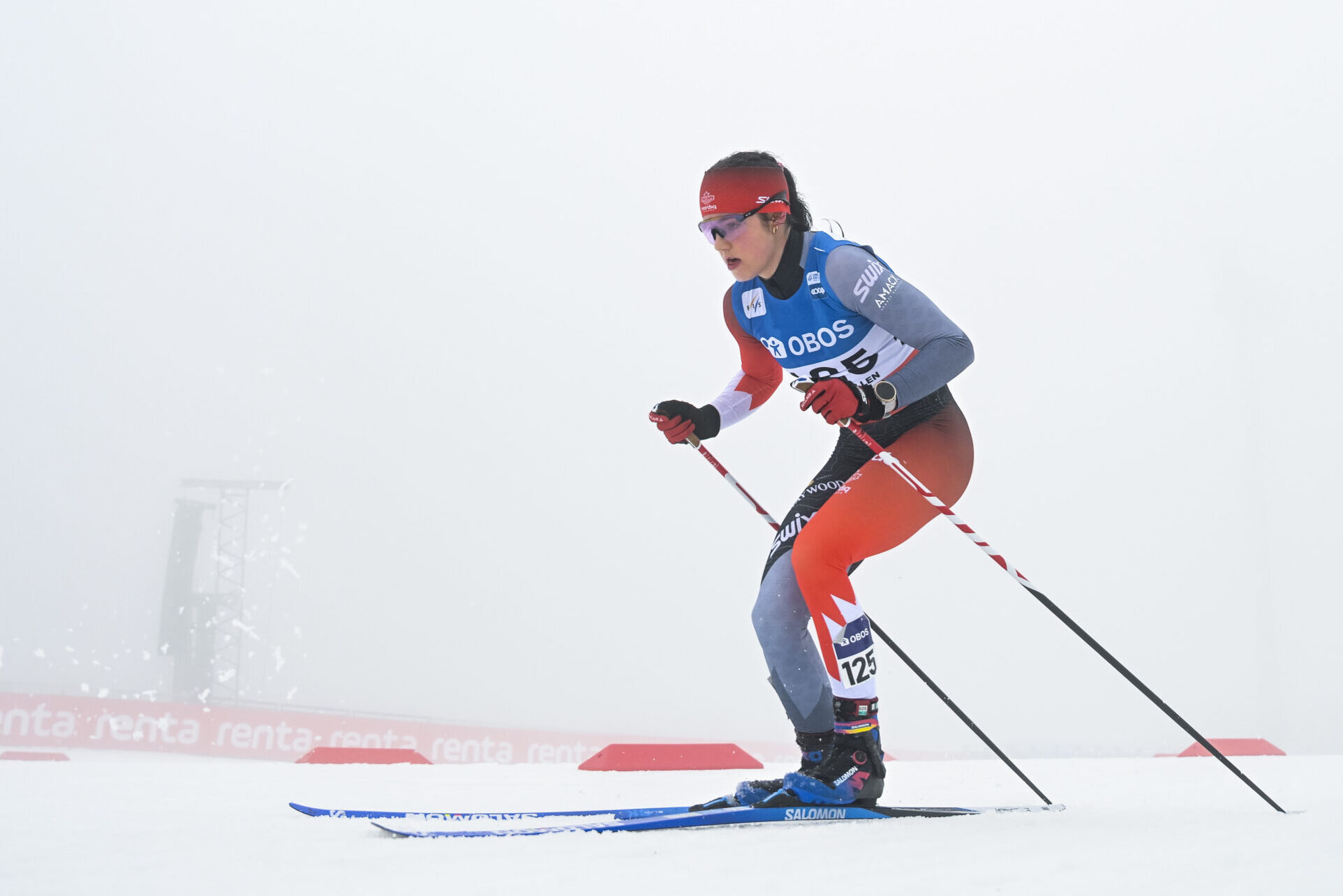
    Alison Mackie skiing in a Canadian race suit through fog at Holmenkollen.
    Mackie at the Holmenkollen World Cup in March, a week before the tour reached Lake Placid. (Photo: Authamayou/NordicFocus)

    A Winter Without Diggins

    The World Cup went to Minneapolis in the last two seasons, and Lake Placid hosted the finals in March in front of enormous crowds. Why not race in North America more often?

    “We do have actually Canmore scheduled for World Cup 2028, but realistically there are not so many resources for cross-country skiing in North America,” Mackie said. “It takes a lot of money and human power for the organization and preparation of those races. Of course, it will be amazing to have more opportunities to race in North America in the future but I have to be realistic and understand that organizing an event here in Canada, for example every four years, require lots of efforts and preparations from the local organization. Maybe we need more venues in North America that we currently have that are able to bring here World Cup events. I admit with huge pleasure that in the past seasons both Minneapolis and Lake Placid events showed how strong local communities are in terms of support and enthusiasm for cross-country skiing and those events have been a great boost for our discipline in North America, especially between young kids.”

    After fifteen seasons, this will be the first World Cup winter without Jessie Diggins, who clinched one more crystal globe in Lake Placid in March before retiring. Will she be missed outside the U.S. team as well? Did you ever get advice from her?

    “I definitely think Jessie’s presence will be missed in World Cup. Not only inside USA Team. I think she has always been a positive skier and a really amazing role model in so many ways. And 100% her presence, her ambitious way of racing and unique skiing spirit will be missed. That will definitely change some racing tactics as well. I had the opportunity to train together with Jessie in New Zealand last summer and it was a pretty cool experience and I wish all the best in her future.”
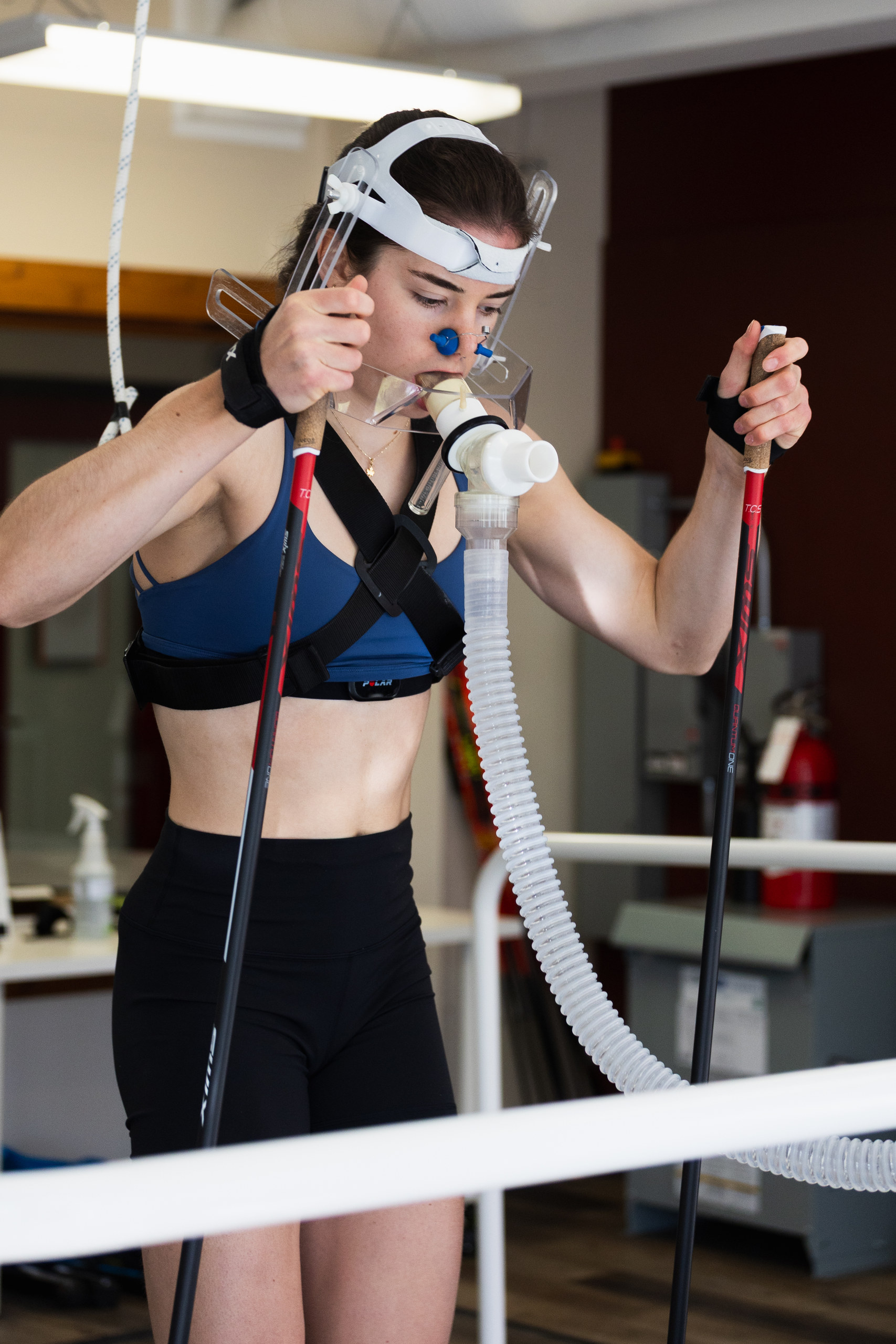
    Alison Mackie adjusting a metabolic testing mask while holding ski poles in a testing lab.
    Mackie fitting a metabolic mask before a treadmill test in May. She trains in Canmore and will study medical engineering at the University of Utah this year. (Photo: Nathaniel Mah)

    Canmore, Utah, and Life Off the Snow

    How is the Canadian team organized, and how is training divided between the women and the men at camps and at home?

    “I think Canadian skiing is gonna take a really exciting trajectory. I am really excited to work with our new Swedish coach Stefan Thomson over the next seasons but also in our group here in Canmore we have Norwegian Tormod Vatten as our assistant coach and with them we have a really strong support staff. For the Canadian National Team over the next seasons is going to be really exciting seeing where we all can go in World Cup and I am really proud to be part of this young but strong group of skiers that our Nordiq Canada are building now, under the [leadership] of former Olympic champion Beckie Scott and our amazing ski communities.”

    How do you manage your studies, at Queen’s University until last year and now at the University of Utah, with training and racing that run through most of the academic year?

    “I just make sure that I manage my schedule accordingly to have enough time for both my trainings and school throughout my day. I think having something other than skiing to focus on is really important for me. I was an online student at Queen’s University over the past two years and now I am transitioning to the University of Utah studying medical engineering. I think it is important the communication with the professors, making sure they know that my situation is a little bit different if compared to normal students, due to the fact that my training sessions, travels and races during winter season take my mind. But despite that my goal is to give my full focus during hours in classrooms too.”

    What kind of person are you away from cross-country skiing? Your personality, your interests, what you do on days off from training and racing?

    “Outside of cross-country skiing I am a pretty introvert person. I try to keep things on my own. I like studying and I really enjoy sewing clothes in my free time. I truly also love to learn new things and that is why I am excited to attend the University of Utah this year. I also love to spend time in the mountains nearby Edmonton where I grew up and in Canmore where I train myself with Alberta World Cup Academy and where I graduated in High school. Hiking, Mountain biking, running and skiing, of course, are my favourite activity when I can spend my time outside in the lush Canadian Nature.”

    In 10 to 15 years, at the end of your career, you will be proud of yourself if what?

    “I think, regardless of what I achieve in my future, I will be extremely proud of my career in addition to what I already accomplished. But really, my goal is just to ski because I love it and see where I can get of myself and also trying to inspire other young skiers. I think that there are a lot of young skiers in Canada right now, who have the potential to be amazing athletes. I really want to inspire them, showing them that anything is possible, it doesn’t matter what country you are from or how old you are. So regardless of what I achieve over the rest of my career I will always be proud of what I have already achieved.”

    Paolo Romanò is a freelance reporter based in Italy who covers cross-country skiing and Nordic combined.

    Help Support Our Coverage!

    If you value the thoughtful work and access FasterSkier provides, please consider becoming a Voluntary Subscriber. Your support directly fuels our work to cover the people, places, and moments that make our sport special.

    Join the FasterSkier community!
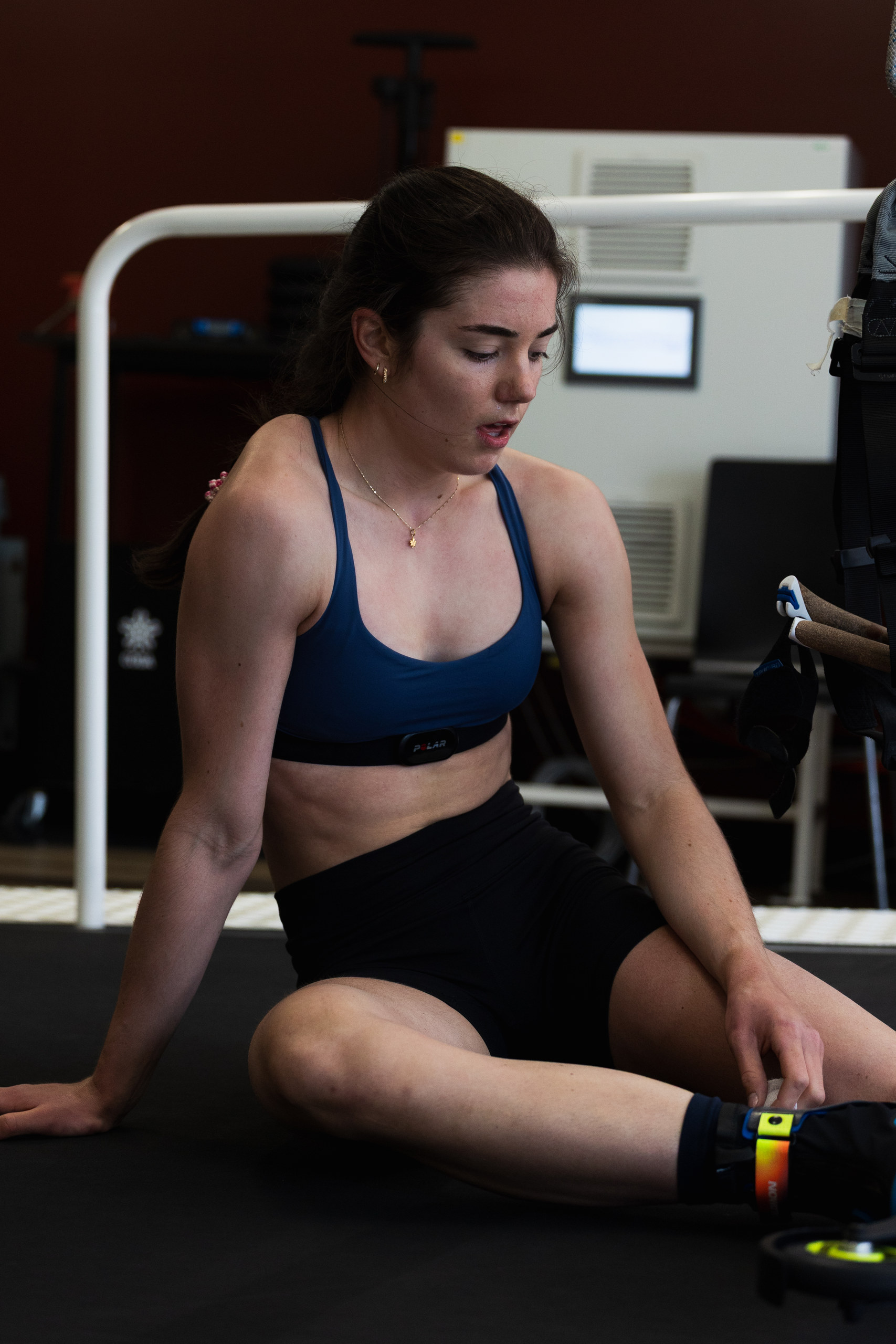
     

    Alison Mackie sitting on a laboratory floor catching her breath and unstrapping a sensor from her leg.
    Mackie catching her breath after a lab test in May. She races her first season for the University of Utah this winter. (Photo: Nathaniel Mah)
  • ENGNE Sets Record Prize Money for Candy Cane Cup and Easterns

    ENGNE Sets Record Prize Money for Candy Cane Cup and Easterns

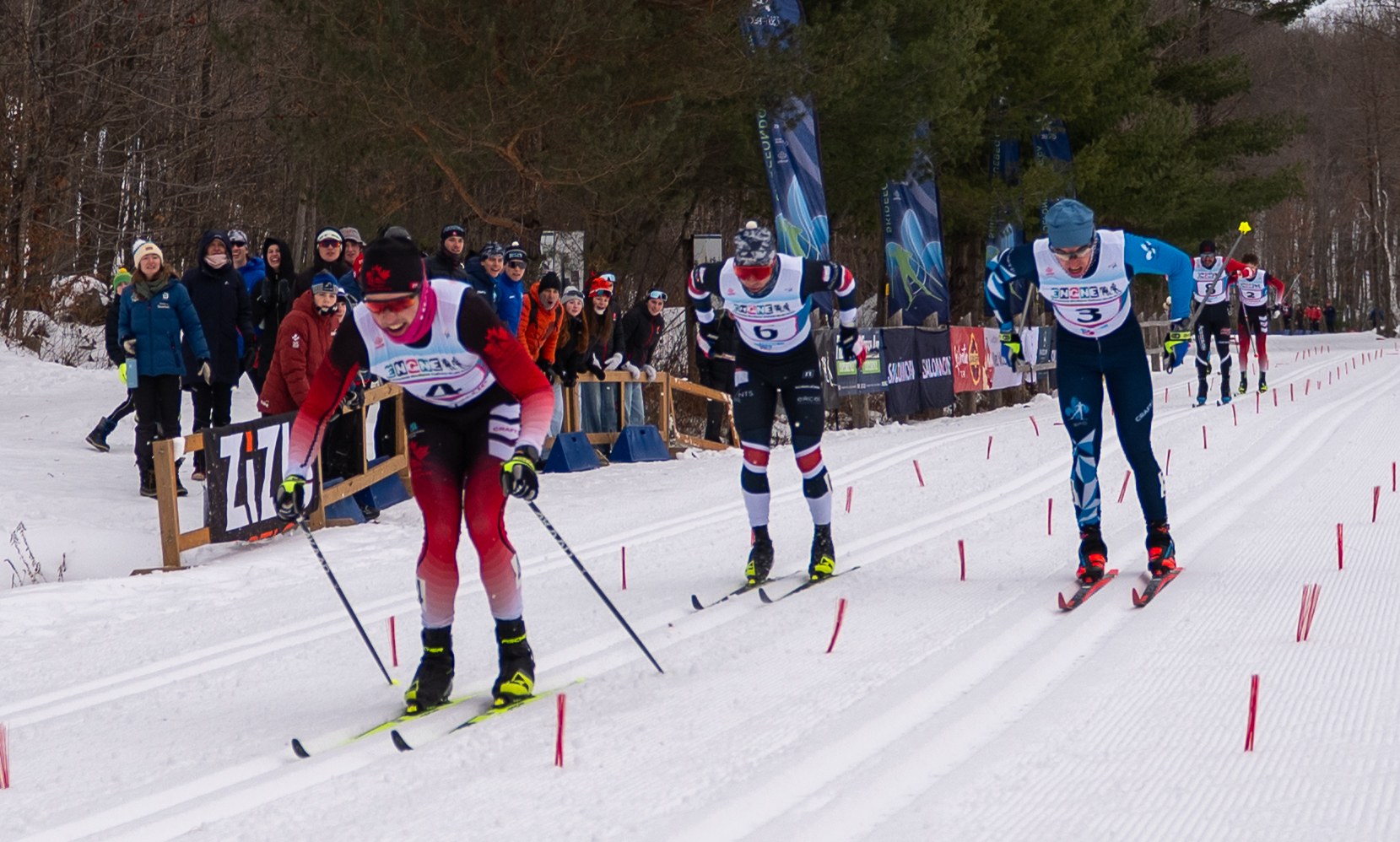
    Three cross-country skiers double-poling side by side down a finishing straight, with spectators watching from behind a fence.
    A classic sprint for the line at the Candy Cane Cup in December 2025. (Photo: Rob Smith)

    The series, taking place in Gatineau, Quebec (near Ottawa), kicks off with the Canadian World Junior and U23 Championship trials, Dec. 18-21, and concludes with the Eastern Canadian Championships, Feb. 5-7. These FIS races, organized by Évènements Nordiques Gatineau Nordic Events (ENGNE), take place at Nakkertok Ski Club with the support of Ville de Gatineau and Tourisme Outaouais, longtime sponsors of the events and of skiing in the region.

    Nakkertok is known for its excellent grooming and for race trails supported by an extensive snowmaking system, and for a very experienced organizing committee (nakkertok.ca).

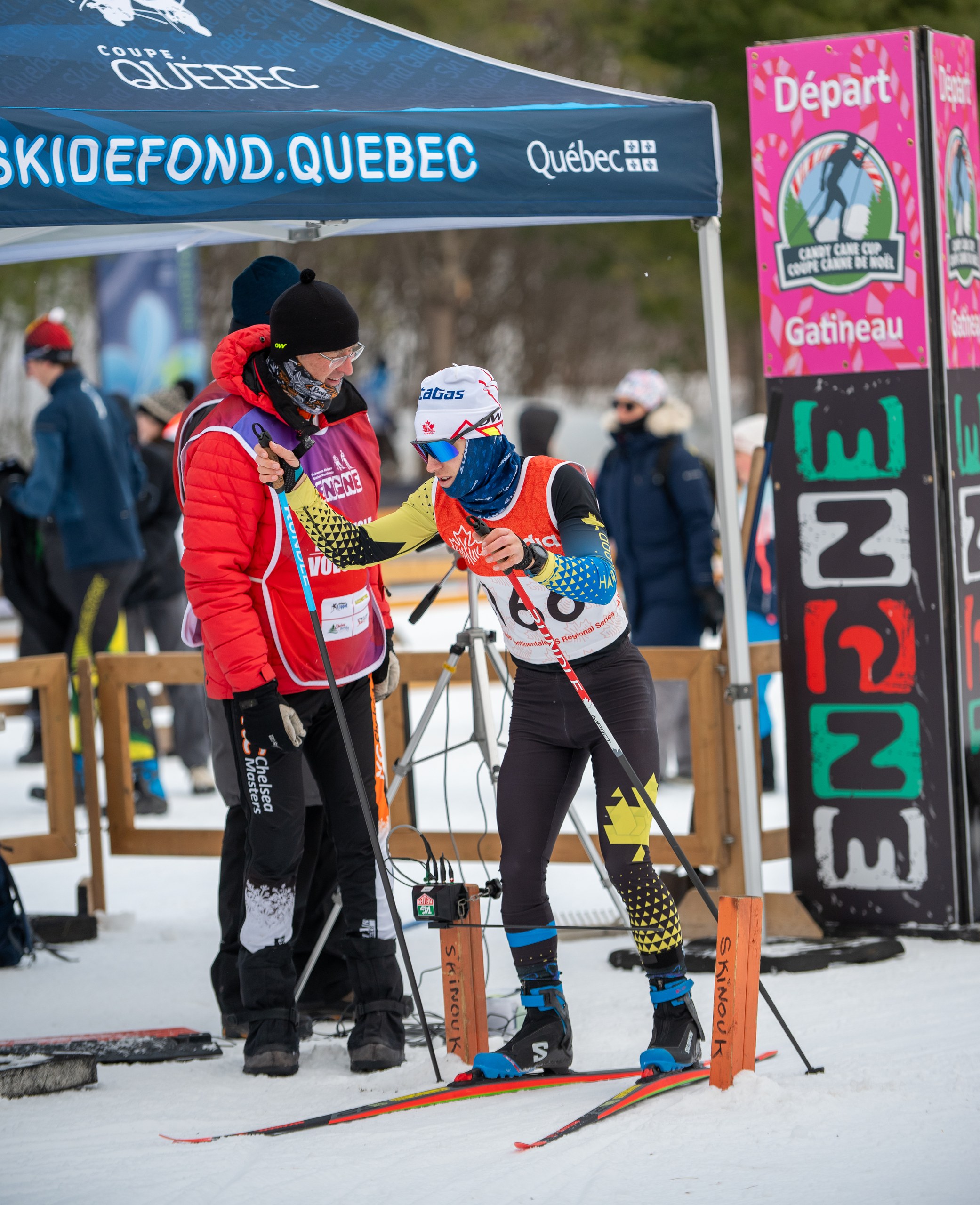
    An official in a red jacket steadies a racer in the start gate beneath a Candy Cane Cup banner.
    A racer leaves the start gate at the Candy Cane Cup in Gatineau, December 2025. (Photo: Rob Smith)

    The Candy Cane Cup

    The December races, also known as the Candy Cane Cup, will feature Canada’s best Junior and U23 athletes as they battle for positions on the Canadian team at the FIS Championships in Otepää, Estonia. The Candy Cane Cup is also the second Nordiq Canada NorAm event of the 2026-2027 season, identifying senior athletes for the Period 3 FIS World Cups. Winners in the Open class will claim $500 per race, with the overall winner receiving an additional $1,000 as a Hall Mark of Excellence (HME) Award. Junior race winners will receive $200 per race and $500 overall. Additional prize money will be awarded for other placings and categories, including ParaNordic events, with racers selected for the Canadian teams receiving an additional cash bonus.

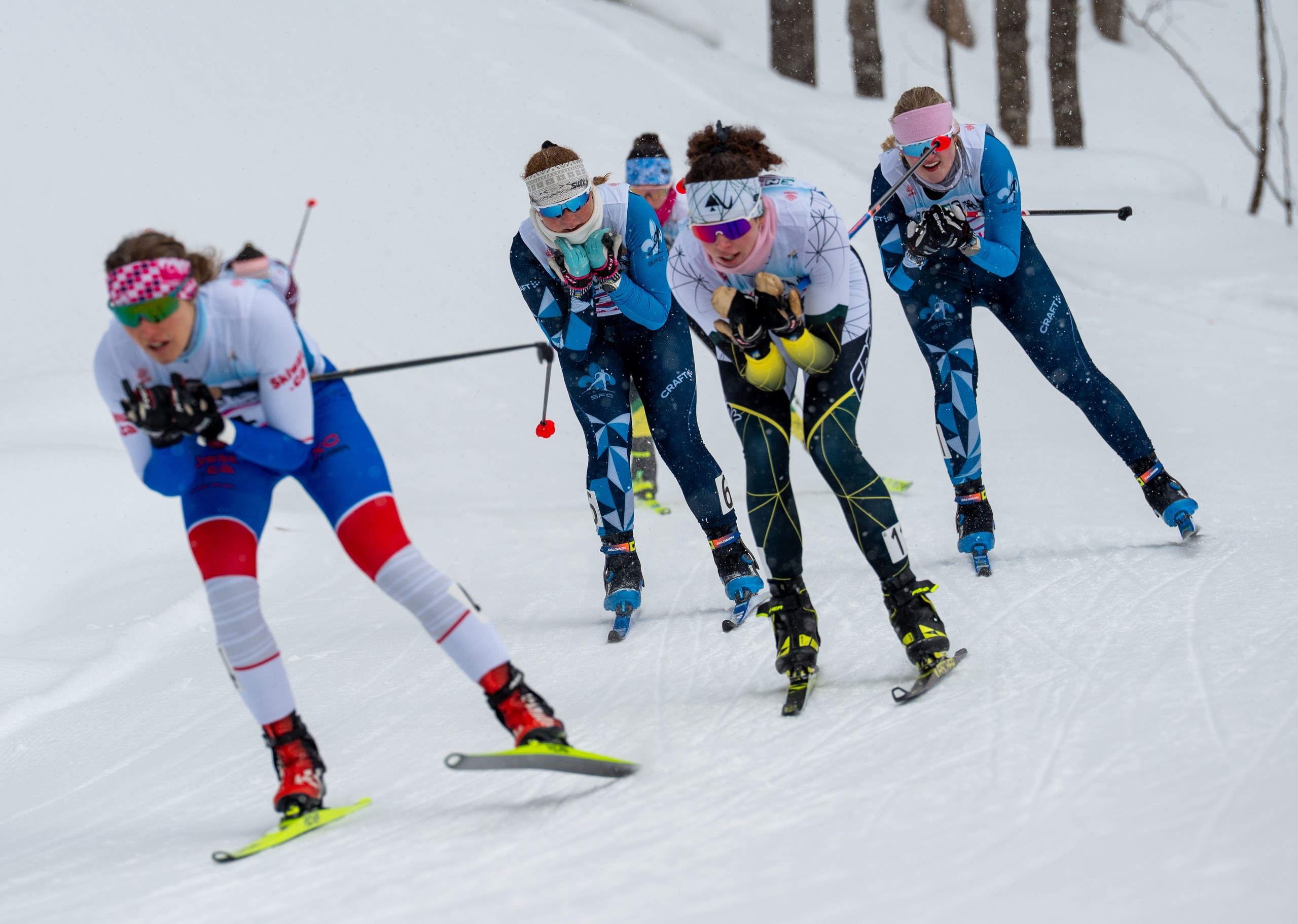
    Five women skiers in a tight group tucking down a hill while snow falls around them.
    A chase group tucks through falling snow at the 2026 Eastern Canadian Championships. (Photo: Rob Smith)

    The Eastern Canadian Championships

    February’s Eastern Canadian Championships start the Friday following the NorAm and SuperTour races in Lake Placid, 2.5 hours “up the road,” and have a similar prize structure. Athletes who participate in both events will be eligible for the additional $2,700 in HME prize money for overall performances.

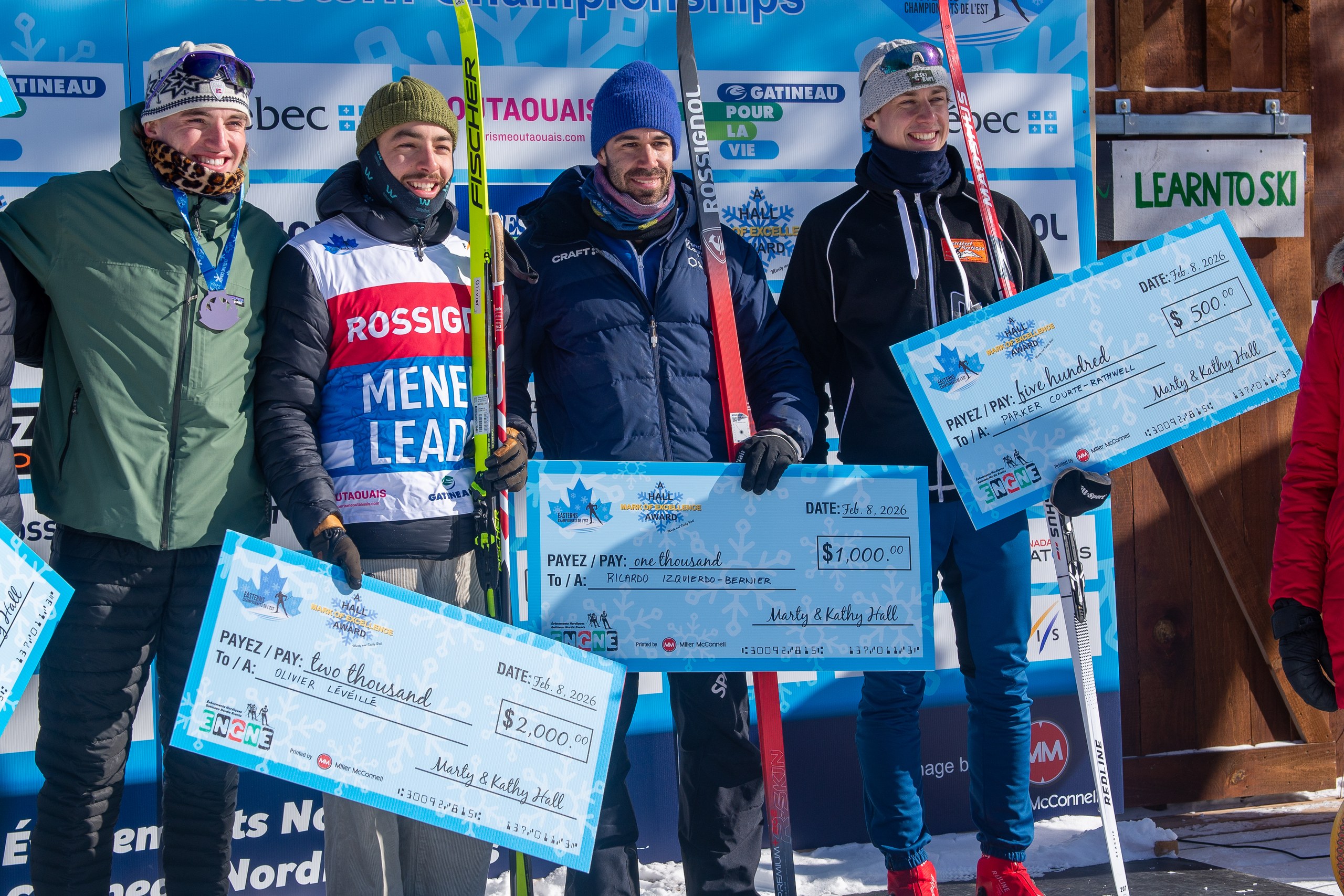
    Four skiers holding oversized presentation cheques in front of an Eastern Championships backdrop.
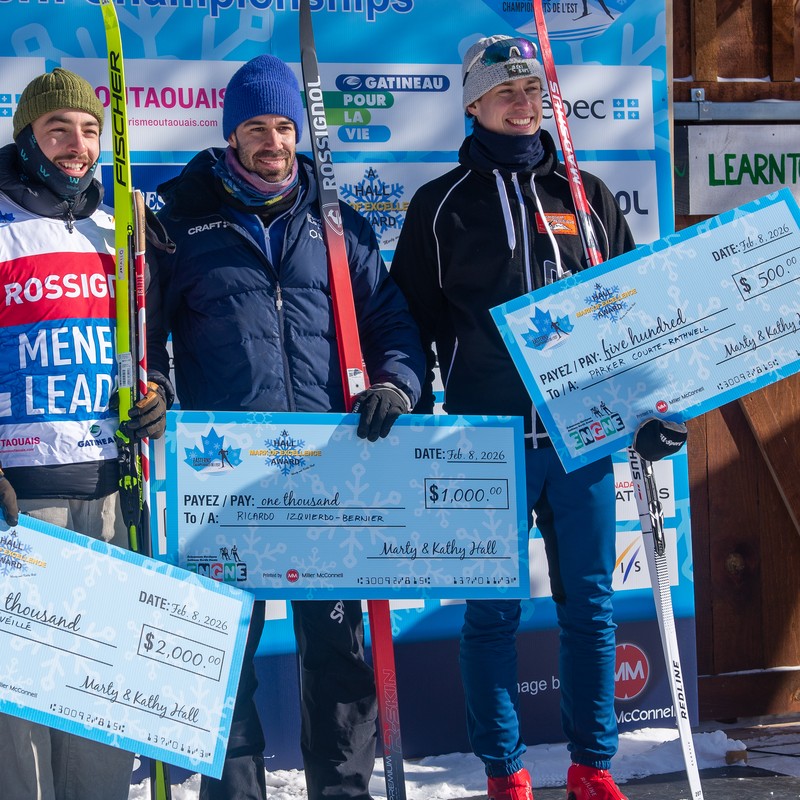
    Hall Mark of Excellence checks for $2,000, $1,000 and $500 presented at the 2026 Eastern Canadian Championships, made out to Olivier Léveillé, Ricardo Izquierdo-Bernier and Parker Courte-Rathwell, respectively. (Photo: Rob Smith)

    The Hall Mark of Excellence Award

    The Hall Mark of Excellence Award program, founded by Marty and Kathy Hall, has provided over $70,000 of prize money at ENGNE events over the last six years, providing much needed financial support to athletes. As Kathy Hall described, “The intent of our program is to inspire and reward skiers, ultimately to enable them to continue to develop their potential and pursue their success at whatever level of skiing they choose.”

    For the 2026-27 season events the HME is contributing $18,000, with an additional $17,000 provided by ENGNE and $8,600 by Nordiq Canada for the NorAm event.

    “Nordiq Canada is pleased to contribute financially toward the December NorAm at Nakkertok and to work alongside ENGNE and the local organizing team to deliver a strong competition opportunity for Canada’s athletes,” said Beckie Scott, CEO of Nordiq Canada. “Investing in our domestic competition calendar is an important part of creating a high-quality pathway for athletes to develop, compete and prepare for international racing. We’re grateful to ENGNE and its partners for continuing to raise the standard of racing in the Ottawa-Gatineau region and for their commitment to supporting Canadian athletes.”

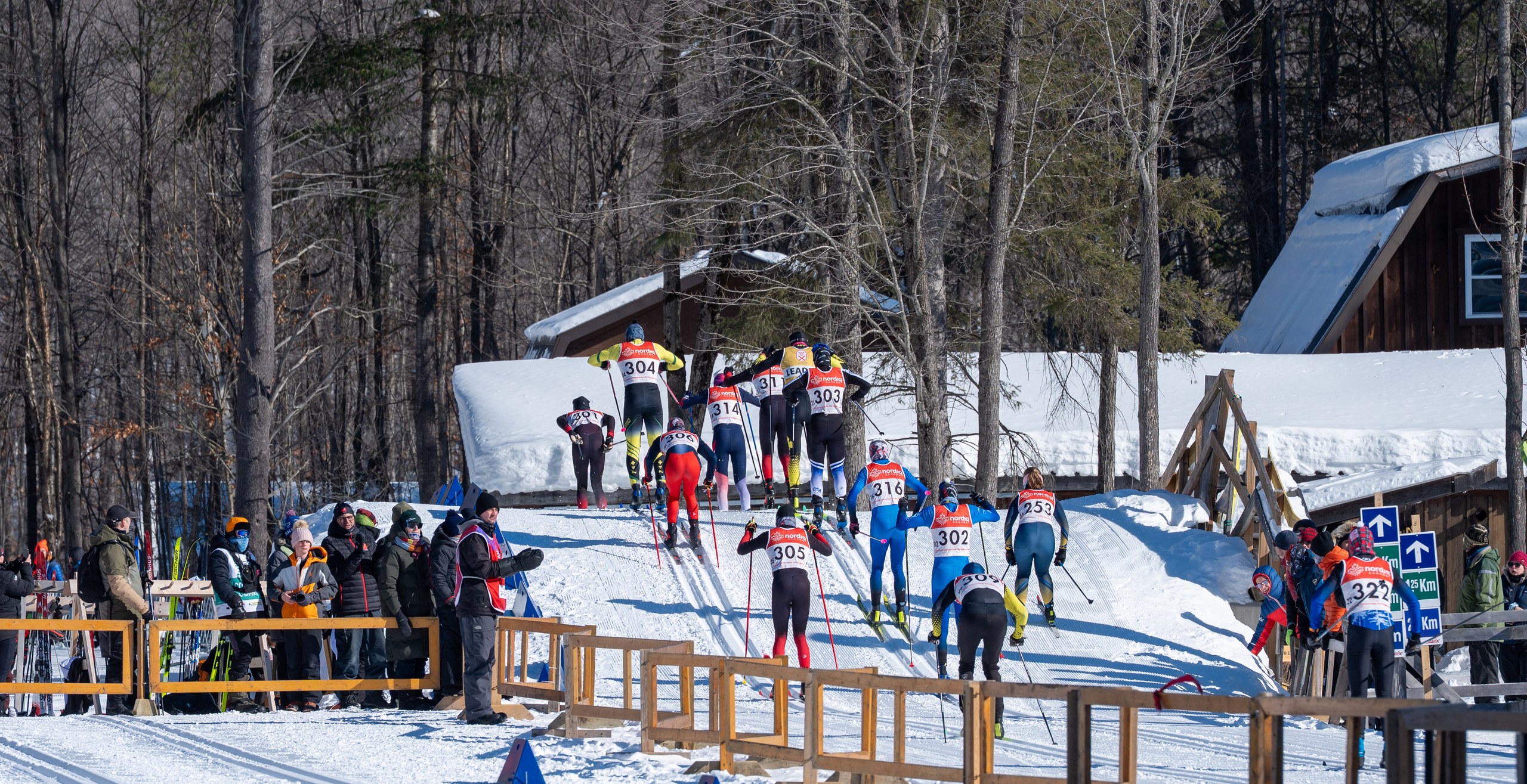
    A line of racers climbing a hill past a wooden chalet while spectators watch from behind a fence.
    The field double-poles over a small climb early in the 2026 Eastern Canadian Championships. (Photo: Rob Smith)

    A Record Year at Nakkertok

    ENGNE has been organizing races in the Ottawa/Gatineau area since being formed to run the 2016 World Cup event as part of Ski Tour Canada. “A larger prize purse was important to us this season: it helps ease the financial load for athletes heading to World Championships,” said John Halvorsen, ENGNE President. “With the support of Nordiq Canada and Kathy Hall, we’ve set a record year for prize money at Nakkertok Nordic Ski Club, cementing its place as eastern Canada’s hub for world-class ski racing.”

    As well as the Nakkertok trails, the Ottawa/Gatineau area has over 200 kilometres of ski trails, including Gatineau Park, home of the Gatineau Loppet, and an extensive urban trail system. It is a great area in which to train, explore and relax. We look forward to welcoming you to our winter ski home.

    Follow us on Instagram at @coursesengneraces and watch zone4.ca for more information when available.

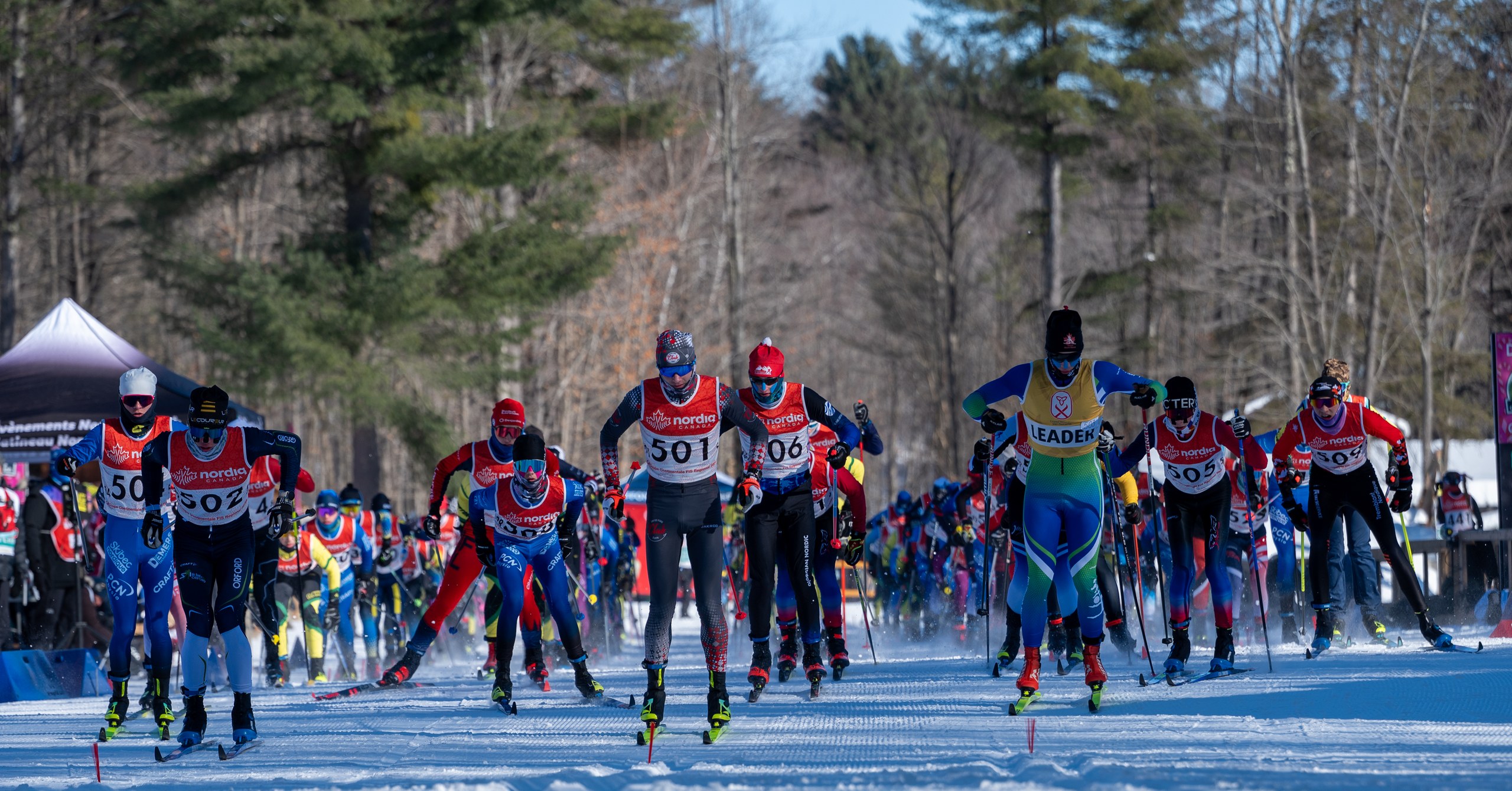
    A wide field of skate skiers spread across a groomed start straight at the beginning of a mass start race.
    The mass start rolls out at the 2026 Eastern Canadian Championships. (Photo: Rob Smith)

    Publishing press releases is a service we offer to the ski community, so please note these articles are not written by FasterSkier and therefore do not necessarily represent our thoughts and standards.

  • Beckie Scott: The Olympic Champion Rebuilding Nordiq Canada

    Beckie Scott: The Olympic Champion Rebuilding Nordiq Canada

    This article was made possible through the generous support of our voluntary subscribers. If you value coverage like this, please support FasterSkier with a voluntary subscription.

    The five minutes Beckie Scott spent at the finish line in Soldier Hollow on February 15, 2002, lasted longer than most things in her career. She had crossed the line in what felt like third place. She thought she had a medal. She did not yet know.

    “It was actually a photo finish,” Scott said. “There were about five full minutes where we didn’t know. And then it was announced.”

    Her teammates, her coaches, and the wax technicians were already gathered in the pit, standing in the cold. The result came over the loudspeaker. Bronze. Canada. Beckie Scott.

    “We went ballistic,” she said. “It was magic. By that point, a lot of the coaches and wax technicians had made their way down to the pit. We were sort of standing there all waiting, and then when it was announced, it was just chaos. But in the best possible way.”

    The Canadian flag went up the pole in third position. The bronze, in the moment, was a win.

    “There was no disappointment. We celebrated that medal like it was platinum. This was the first medal for Canada. It was a long shot. It was absolutely incredible and powerful to stand on. In that moment, I got to celebrate that and have that day, and that feeling, and all the joy that comes with it.”

    What happened next is now part of cross-country skiing’s history. The two Russian skiers who finished ahead of her were caught for doping. The bronze turned to silver, then to gold. The flag that had risen for her in third place was wrong, but only because the truth had not yet caught up to the racing.

    It would catch up eventually, though, and so would Scott, now an Olympic champion.

    Beckie Scott with the gold medal she was awarded at a ceremony in Vancouver in June 2004. A former Canadian cross-country skier, Scott finished third in the 5 k pursuit at the 2002 Olympics but was later awarded gold when the two women ahead of her were disqualified for using performance-enhancing drugs. (Photo: Cross-Country Canada)

    Scott grew up in Vermilion, Alberta, a rural community in the province’s northeastern region. Her parents were avid cross-country skiers and members of the local club. The trails started at the back of their property and ran into the provincial park. She could ski out the back door.

    When the Jackrabbit program — the Canadian equivalent of the Bill Koch Youth Ski League in the United States — rolled out across Canada in the early 1980s, her mother adopted it in Vermilion and Scott came up through it.

    “I developed just a real affinity and love for the sport, right from the start,” she said. “I was very inspired by the community. I really loved the community. I loved competing, and I just loved the idea that the harder you worked at something, the better you could do. So as a kid, it was all very exciting, and a lot of fun.”

    The Vermilion club is now more than 50 years old. The trails are well used. It remains a rare facility for a rural Alberta town.

    What was not rare, in the late 1990s, was the experience of a North American woman struggling on the World Cup. Scott was at the front of a group that did not yet exist. She was the best of her cohort, which was a difficult thing to be.

    “Even when we started on the World Cup, when I was there, the results were abysmal. It was very, very poor performances. The results were nowhere near successful, that’s for sure.”

    She remembers it now with a kind of dry humor. “I think it’s good that we had a good sense of humor, because there were a lot of days, if we weren’t laughing, we would have been crying. I do remember being completely devastated, often. Not just by being so far down the list, but by how far behind I was. That, to me, just seemed almost impossible. To see the gaps that I was seeing when I first started, in the era, I think we all know why the Russian women were skiing as fast as many of the men.”

    She did not know that at the time. She thought she was just a weak competitor.

    The way through, she said, started with a single word.

    “The first step was approaching it as a professional. Leveling up the approach to my career as a cross-country skier, as a professional. I don’t think I was doing that in the early days, and I didn’t even understand what that meant, necessarily. So that was a big shift. And then it was increasing training hours, getting serious about strength training, and technique. Taking every single piece of what a performance needs and addressing it separately, and eventually collectively. But the biggest shift for me was the mental, socio-emotional approach. Shifting the paradigm to being a professional.”

    She offers this as the lesson she most wants to pass on. The hardest part, she said, was maintaining belief.

    “In the early days, I just didn’t know at first if this was even possible, or what it was going to take, or how to get there. I had this incredibly aspirational ideal of what I wanted to be, and I was so far from that when I first started.”

    The first glimmer of light came at a World Cup in Val di Fiemme, Italy. She does not remember the exact year when we spoke, but it was in December of 1997. After seasons of trying to crack the top 30, she finished eighth.

    “That was it. That was the moment. It’s like, okay, 100 percent this can be done. And this isn’t going to be a one-off. It was totally exciting and inspiring, and I just wanted more.”

    Beckie Scott racing in Val di Fiemme (courtesy photo)

    By Salt Lake City, she was a contender. Not a sure thing, but a contender.

    “We had the belief, even years leading into Salt Lake City, that this was a golden opportunity that we shouldn’t and couldn’t pass up. We had spent our years living and training in Europe, constantly dealing with jet lag, living in hotels, foreign language, foreign food. And this was a magical opportunity on our doorstep to effectively race at home.”

    The 2002 women’s pursuit was a five-kilometer classic followed an hour and a half later by a five-kilometer skate. The format played to her strengths.

    “I could do both techniques well. There’s this powerful energy that’s created when you have a home crowd behind you. It really does change things for athletes in a way that’s hard to describe. There’s an uplift that’s just incredibly powerful. I felt it. I remember it to this day, twenty years later.”

    Then came the five minutes of waiting, and the chaos in the pit, and the medal that was, eventually, the right color.

    The irony of becoming the public face of clean sport in cross-country skiing was not lost on her. She had been vocal before Salt Lake, after most of the Finnish team was caught for doping at the 2001 World Championships in Lahti.

    “It was deeply frustrating to know that we were doing everything we could do to compete at the highest level in this sport, and we were constantly being thwarted by athletes who were using performance-enhancing drugs. That was incredibly aggravating. And it was shared. Not just by me, but my coaches, technicians, fellow teammates. This was not just unique to me.”

    When the Russians were caught in Salt Lake, her first reaction was surprise.

    “It was an open secret how much performance-enhancing drug use was going on in our sport, in particular by the Russian team. I was surprised because I did not have much belief, faith, or confidence in the anti-doping systems at that time. When I learned later about what actually happened at Salt Lake City to have those tests revealed as positive during those games, it was a remarkable series of events.”

    That path eventually led her to the World Anti-Doping Agency and a long career in sport integrity work.

    Canada’s Beckie Scott (right) and Sara Rennner receiving their silver medal in the team sprint at the 2006 Olympics in Torino, Italy. That was two years after Scott belatedly received the gold medal she won at the 2002 Olympics, after fighting long and hard to earn it when the first two finishers were found to be doping. (Photo: courtesy photo)

    In 2006, in Turin, she won another medal. This one is remembered less for who lost it and more for who gave it.

    In the women’s team sprint, her teammate Sara Renner broke a pole. A Norwegian coach, Bjørnar Håkensmoen, standing on the side of the course handed Renner one. Renner finished the leg. Canada finished second. Norway dropped to fourth.

    “It really lived long in the hearts of people, I think, because of the sportsmanship element,” Scott said. “The Norwegian coach giving her the pole, which moved the Norwegians back to fourth and gave us the opportunity to have a silver that day. That piece was so encouraging and heartening, and really in the spirit of what we like to think the Olympics should be about.”

    The other piece, for her, was personal. The team sprint silver was the last medal of her career, won with Renner, with whom she had been racing for eleven years.

    “That was the culmination of 11 years of traveling and racing World Cups, World Championships, and Olympic Games together. And then we could stand on the podium together, in what would be the last year of my career. As teammates, but also very good friends, lifelong friends. We’re friends today. There was a dual component to that experience. It was, I think, lovely and inspiring in a lot of different ways.”

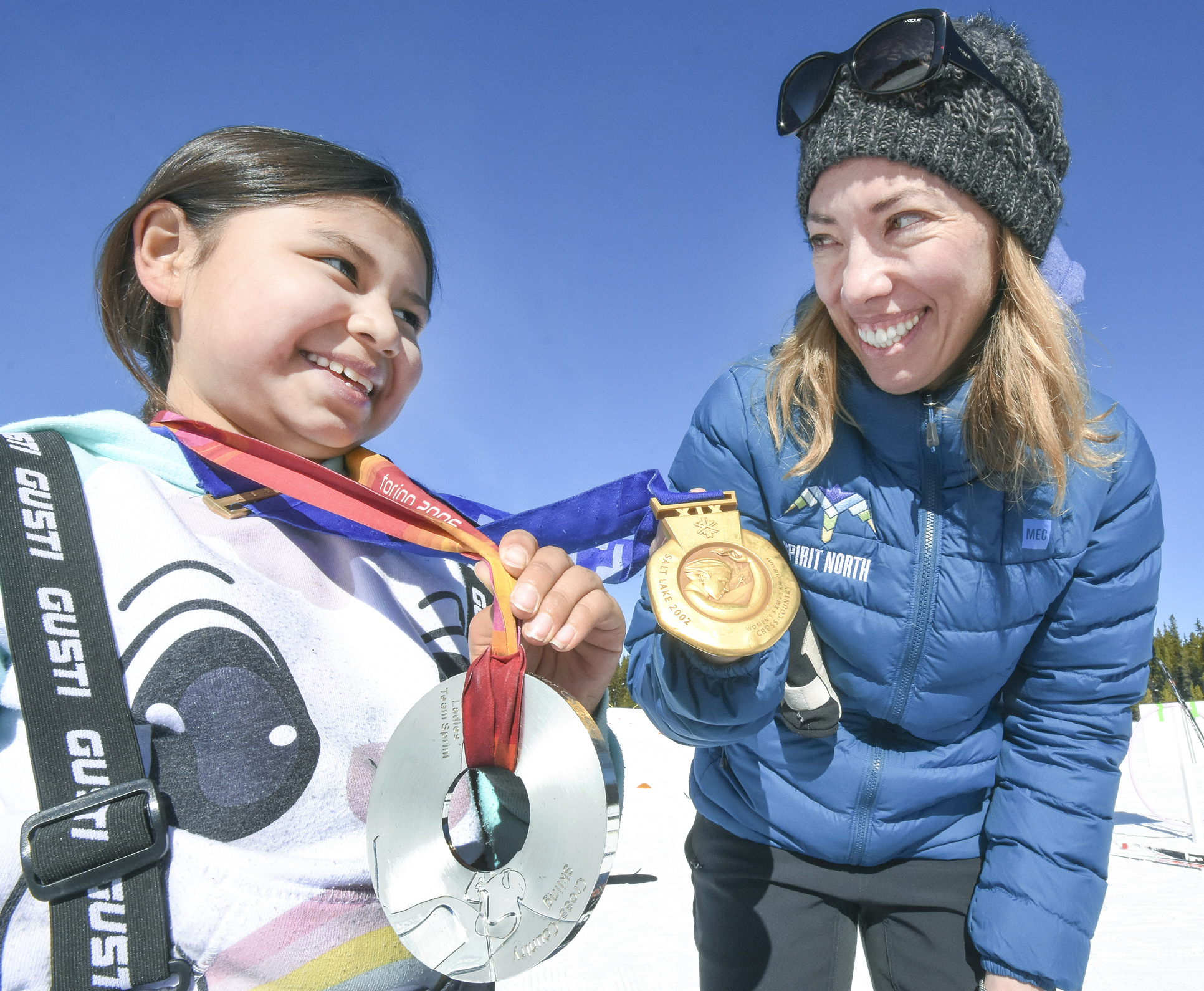
    Beckie Scott shares her silver and gold Olympic medals with a Spirit North participant. (Photo: Spirit North)

    When she retired from racing, she was invited to be an ambassador for a Learn to Ski program sponsored by an oil and gas company in northern Alberta. The program ran in indigenous communities. She would visit a community five or ten times a year, ski with the kids, show the medals, give a talk, then go home.

    She kept going home, and she kept thinking about what she had seen.

    “I began to notice many things. First, the disparity in the socioeconomic conditions of how indigenous people in this country live versus non-indigenous people. The lack of opportunity that kids were really able to access for sport and play. And then just the paradox of my own life and the opportunities that I had through sport, and my own kids were having through sport.”

    It struck her, she said, as deeply unfair.

    “An entire population of people was effectively kept out of that arena, and for no valid reason that I could see or think of.”

    The Truth and Reconciliation Commission published its final report in 2015. Among its 94 calls to action were several related to sport. Scott read the report. She had, she said, a hard time just letting things be.

    “I have a hard time just turning away and saying, not my problem. So I started a nonprofit.”

    She started with four communities in northern Alberta. The organization, Spirit North, is now national. It operates in 160 communities across Canada. It serves roughly 20,000 kids a year. It is among the largest sport for development organizations in the country.

    “The lesson there is that you can make a difference. I didn’t know anything about starting a nonprofit. I didn’t even really know much about indigenous culture and ways of being and knowing. But being open to learning, being super curious, and being driven by a vision of what change could look like, and meaningful action. That resulted in that organization.”

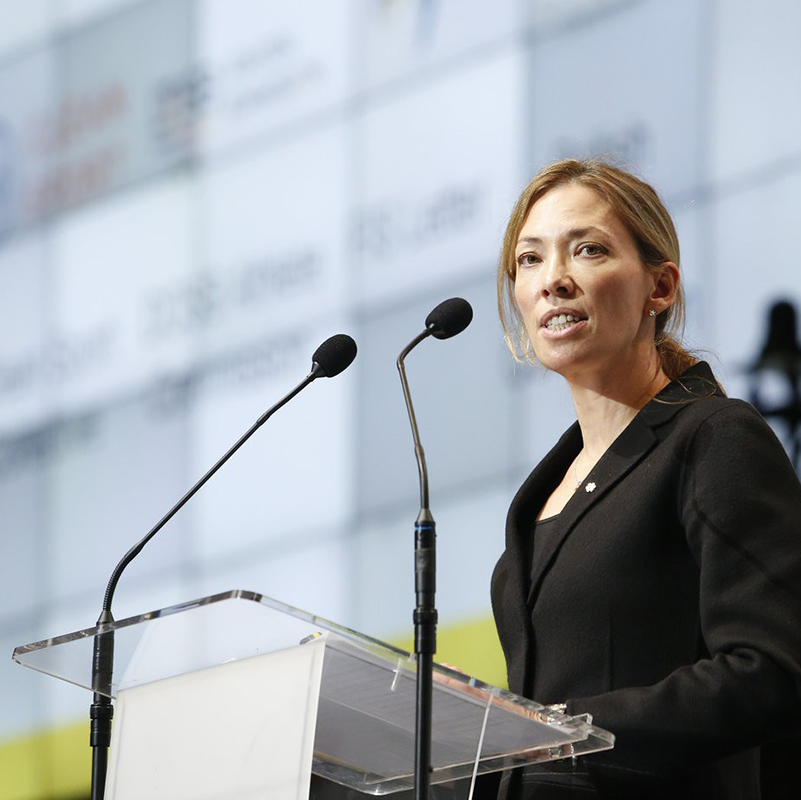
    Beckie Scott gives a speech while she served as the Chair of the World Anti-Doping Agency (WADA) Athlete Committee. She also served on the Compliance Review Committee. (Photo: courtesy photo)

    In March of 2025, Scott started a new job as CEO of Nordiq Canada. The skills, she said, transfer. Spirit North was a nonprofit. So is Nordiq Canada. There is a board, staff management, fundraising, finance, HR, and strategy.

    “A big part of our job at Spirit North was setting the strategy. A big part of our work here at Nordiq Canada is setting the strategy. Putting the activities together. How are we going to get to where we want to go. Many, many parallels.”

    The job she walked into was harder than the parallels suggest. The federal government had frozen its core contributions to National Sport Organizations for 20 years. The core funding that Nordiq Canada received from Sport Canada when she started last year was the same dollar figure as when she was racing two decades earlier.

    “Think about that in terms of the cost of living, inflation, and the rising demands on an NSO. It really crippled the organization in terms of capacity and what it was able to deliver.”

    She brought her CFO, Sian Bolton, from Spirit North with her. They streamlined operations. She went out and raised money.

    “I just started knocking on doors and pounding the pavement, trying to raise money for the organization. The response in the community has been encouraging. We signed on a number of new donors and had some major gift contributions. People recognize that we have a lot of talent right now in our programs in this moment. And if we don’t get behind them, we’re going to lose them. People heard that message loud and clear.”

    Then, after Milano, the federal government announced a $755 million investment in sport over the next five years.

    “It’s transformational. We are going to benefit from that. I am very optimistic about our future financial state because of the government’s recent announcement and because of our fundraising success.”

    The total budget at Nordiq Canada now sits just under $5 million, covering both the Olympic and Paralympic programs. About $2 million of that is core federal funding. Scott would like to add another $1.5 to $2 million.

    She conducted a ‘listening tour’ after taking the role. The thing she heard most often from athletes was a lack of trust in the high-performance system.

    “As an athlete, you want to believe more than anything that your NSO has got their act together and knows what they’re doing when it comes to high performance. That was one of the biggest areas that needed to be addressed.”

    She restructured the leadership team quickly. “It was time to make a fresh start. The organization needed to be right-sized for the budget and the financial situation we were in. But we also needed the right skill sets and the right roles.”

    She has, she said, four near-term goals. Podium results. Financial stability. Restoring trust and credibility. Unifying the community.

    “It’s a bit fractured,” she said of Canadian skiing now. “I think we can do a much better job of pulling together, remembering why we’re all here. Unifying as a nation behind our athletes and our programs and our development and our organization.”

    The fifth goal, on a longer arc, is coaching development.

    “I see a huge opportunity for closing the gap in coaching in this country. I look to the U.S. and what the U.S. has done to generate so many really highly qualified coaches, and not bringing them over from Europe all the time. For me, for the next four to five years, coaching development is going to be a big focus.”

    Beckie Scott and Justin Wadsworth pose with their family. (Photo: courtesy photo)

    Scott is married to Justin Wadsworth, who spent six years as head coach and high-performance director for Biathlon Canada and is now consulting for U.S. Biathlon. They try not to talk about work over dinner.

    “It’s hard. We’re living it every day, and our kids are both in it. But dinners are generally pretty lighthearted. We don’t avoid talking about work, but we certainly don’t do it all the time.”

    She is writing her report for the upcoming Nordiq Canada AGM. When she looks back on her first year, she said, it has been a remarkable one.

    “It was a lot of transformational change. New leadership in finance, high performance, events, athlete support. But at the same time, we managed to do that without destabilizing our teams. Our athlete performances continued to rise at the Olympic Games, at the Paralympic Games, at the World Juniors. We have so much to celebrate and be proud of when we think about this last year in terms of performance. The organization is on solid ground, and it’s really full steam ahead.”

    It could seem strange that the woman who became the first North American to win an Olympic gold medal in cross-country skiing now spends her days raising money, restructuring boards, and writing AGM reports. Alternatively, maybe the trail Scott got on out of her backyard in Vermilion had been leading her all along to this moment, and she has proven she is ready for it.


    Help Support Our Coverage!

    If you value the thoughtful work and access FasterSkier provides, please consider becoming a Voluntary Subscriber. Your support directly fuels our work to cover the people, places, and moments that make our sport special.

    Join the FasterSkier community!
     

  • Nordiq Canada hiring Development Coach for the National Ski Team

    Nordiq Canada hiring Development Coach for the National Ski Team

    Position Title: Development Coach, National Ski Team (NST), Olympic

    Location: Canada

    About Nordiq Canada

    Nordiq Canada is the national governing body for both cross-country and Para Nordic skiing. We lead, support, and inspire world-class performances and lifelong participation in these sports nationwide.

    The Opportunity

    Reporting to the High-Performance Director and working within a collaborative high-performance environment, the primary responsibility of the Development Coach will be to lead and oversee the Development Team program. Development Team athletes have been identified as having strong potential for transitioning from junior racing to international excellence.

    As a contributing member of the Nordiq Canada coaching staff, this position will involve organizing and leading training camps and competitive opportunities, providing enhanced services and support, and ensuring optimal functioning of Development Team athletes in their DTEs, including alignment with their IAPPs.

    This is an exciting opportunity to contribute to one of Canada’s leading winter sport organizations and to work alongside world-class athletes, coaches, and support staff in pursuit of sustained international excellence.

    Key Responsibilities

    • Provide support, oversight and technical expertise on the Yearly Training Program (YTP), daily program planning, delivery, and athlete gap mitigation to identified athletes and their coaches.
    • Check in regularly with athletes and coaches to ensure training is progressing, and athlete accountability measures are fulfilled.
    • Contribute to a culture of excellence, openness and growth.
    • Work in collaboration with experts in their respective fields.
    • Maintain a high level of scientific rigour in all processes, ensuring performance-based decision making and optimizing athlete health and wellness.
    • Lead projects and work plans with respect to gap analysis, the Podium Pathway and the Gold Medal Profile.
    • Assist the HPD in annual report writing and presentations.
    • Lead and oversee competitive opportunities such as World Juniors, international junior camps, and Nordiq Canada camps.
    • Attend all meetings as required or requested by the HPD and CEO.
    • Assist the HPD in program development, direction and philosophy.

    Skills & Requirements

    • Experience coaching and connecting with young and developing athletes.
    • Experience leading competition trips and travel with teams, provincially and domestically.
    • Strong technical skiing ability, including the capacity to analyze and communicate areas for technical improvement and efficiency.
    • Competency in assessing and interpreting sport science testing and data.
    • Must be physically fit and capable of testing skis as well as training with athletes on some of their easy sessions.
    • Ability to contribute to a positive and professional team environment in and outside of competitive settings.
    • Excellent interpersonal, time management, and communication skills.
    • Detail and task oriented, goal driven, a strategic and tactical thinker and planner.
    • Bilingualism (English/French) considered a strong asset.
    • Valid driver’s license.

    Working Conditions

    This position requires approximately eight (8) weeks of travel domestically and internationally for training camps, athlete visits and competition opportunities annually.

    How to Apply

    Interested candidates are invited to submit a resume and cover letter to: bscott@nordiqcanada.ca

    Application deadline: June 22, 2026, or until the position is filled.

    Please include your name and “Development Coach NST” in the subject line. Only candidates selected for an interview will be contacted.

    Nordiq Canada is committed to employment equity and encourages applications from all qualified candidates. Preference will be given to Canadian citizens and permanent residents.

    Antoine Cyr qualified for his first sprint finals during Stage 5 of the 2023 Tour de Ski, and the first for a Canadian since Alex Harvey in 2018. (Photo: Nordic Focus).

    Version française

    Intitulé du poste : Entraîneur de développement, Équipe nationale de ski (ENS), Olympique

    Lieu : Canada

    À propos de Nordiq Canada

    Nordiq Canada est l’organisme national de tutelle du ski de fond et du ski nordique paralympique. Nous encourageons, soutenons et inspirons des performances de classe mondiale ainsi qu’une pratique de ces sports tout au long de la vie à l’échelle nationale.

    L’offre

    Sous la responsabilité du directeur de la haute performance et au sein d’un environnement collaboratif axé sur la haute performance, la principale responsabilité de l’entraîneur de développement sera de diriger et de superviser le programme NexGen et l’équipe de développement junior.

    En tant que membre à part entière du personnel d’entraînement de Nordiq Canada, ce poste impliquera d’organiser et de diriger des stages d’entraînement et des compétitions, de fournir des services et un soutien améliorés, et de veiller au fonctionnement optimal des athlètes de l’équipe de développement dans le cadre de leurs programmes de développement (DTE), y compris l’alignement avec leurs plans de développement individuels (IAPP).

    Il s’agit d’une opportunité passionnante de contribuer à l’une des principales organisations de sports d’hiver du Canada et de travailler aux côtés d’athlètes, d’entraîneurs et de personnel de soutien de classe mondiale dans la poursuite d’une excellence internationale durable.

    Responsabilités clés

    • Fournir un soutien, une supervision et une expertise technique concernant le YTP, la planification quotidienne des programmes, leur mise en œuvre et l’atténuation des lacunes des athlètes identifiés et de leurs entraîneurs.
    • Effectuer des bilans réguliers avec les athlètes et les entraîneurs pour s’assurer que l’entraînement progresse et que les mesures de responsabilisation des athlètes sont respectées.
    • Créer et soutenir une culture d’excellence, d’ouverture et de croissance.
    • Travailler en collaboration avec des experts dans leurs domaines respectifs.
    • Maintenir un haut niveau de rigueur scientifique dans tous les processus, en garantissant une prise de décision fondée sur la performance et en optimisant la santé et le bien-être des athlètes (toutes disciplines confondues).
    • Diriger des projets et des plans de travail concernant l’analyse des lacunes, le parcours vers le podium et le profil de la médaille d’or.
    • Assister le HPD dans la rédaction du rapport annuel et les présentations.
    • Diriger et superviser les opportunités de compétition telles que les Championnats du monde juniors, les camps internationaux juniors et les camps de Nordiq Canada.
    • Assister à toutes les réunions requises ou demandées par le HPD et le PDG.
    • Assister le HPD dans l’orientation et la philosophie du programme.

    Compétences et exigences

    • Expérience en tant qu’entraîneur auprès de jeunes athlètes et d’athlètes en développement.
    • Expérience en tant qu’entraîneur au niveau provincial et national.
    • Compétences en matière d’évaluation et d’interprétation des tests et des données issus des sciences du sport.
    • Doit être en bonne condition physique et capable de tester des skis ainsi que de s’entraîner avec les athlètes lors de certaines de leurs séances faciles.
    • Capacité à contribuer à un environnement d’équipe positif et professionnel, tant dans le cadre de la compétition qu’en dehors.
    • Excellentes compétences interpersonnelles, en gestion du temps et en communication.
    • Souci du détail et de l’exécution des tâches, orienté vers les objectifs, esprit stratégique et tactique, et sens de l’organisation.
    • Le bilinguisme (anglais/français) est considéré comme un atout majeur.
    • Permis de conduire valide.

    Conditions de travail

    Ce poste nécessite environ huit (8) semaines de déplacements nationaux et internationaux par an pour des stages d’entraînement, des visites d’athlètes et des compétitions.

    Comment postuler

    Les candidats intéressés sont invités à envoyer leur CV et leur lettre de motivation à : bscott@nordiqcanada.ca

    Date limite de candidature : 22 juin 2026, ou jusqu’à ce que le poste soit pourvu.

    Veuillez indiquer votre nom et « Entraîneur de développement NST » dans l’objet de votre message. Seuls les candidats retenus pour un entretien seront contactés.

    Nordiq Canada s’engage en faveur de l’équité en matière d’emploi et encourage toutes les candidatures de personnes qualifiées. La préférence sera donnée aux citoyens canadiens et aux résidents permanents.

  • Nordiq Canada Seeks Assistant Coach for National Ski Team Olympic Program

    Nordiq Canada Seeks Assistant Coach for National Ski Team Olympic Program


    Nordiq Canada is hiring an Assistant Coach for its National Ski Team (NST) Olympic program, with the successful candidate stepping into a high-performance role supporting Canada’s top cross-country skiers on the World Cup, at World Championships, and at the Olympic Games.

    Reporting to the Head Coach, the Assistant Coach will help plan, coordinate, and deliver coaching support for NST A and B athletes, with occasional responsibility for leading training camps and managing competitive periods on the World Cup circuit. The position is based in Canada and requires extensive domestic and international travel.

    Key Responsibilities

    • Assist with the planning, coordination, and execution of training camps, competitions, and international tours for NST A and B athletes.
    • Provide technical, tactical, and race-day coaching support.
    • Contribute to athlete monitoring, performance analysis, and training feedback.
    • Support ski preparation, waxing operations, and equipment management as required, including serving as a technician for athletes when needed.
    • Collaborate with Integrated Support Team (IST) providers including physiologists, strength and conditioning coaches, sport science, medical, and mental performance staff.
    • Assist with logistics, travel coordination, and operational planning.
    • Uphold a culture of excellence, professionalism, accountability, respect, and athlete wellness.
    • Comply with Nordiq Canada’s Safe Sport policies and commitments.

    Skills & Requirements

    • Experience coaching World Cup athletes, either individually or on the World Cup circuit.
    • Experience on the World Cup circuit as a coach or athlete.
    • Competency in assessing and interpreting sport science testing and data.
    • Must be physically fit and capable of testing skis as well as training with athletes on some of their easy sessions.
    • Excellent interpersonal, time management, and communication skills.
    • Detail- and task-oriented; a strategic and tactical thinker and planner.
    • Ability to coach Sprint format technical and tactical capacities considered an asset.
    • Bilingualism (English/French) considered a strong asset.
    • Valid driver’s license.

    How to Apply

    Interested candidates should submit a resume and cover letter to bscott@nordiqcanada.ca, with their name and “Assistant Coach NST” in the subject line.

    Application deadline: June 12, 2026, or until the position is filled.

    Nordiq Canada is committed to employment equity and encourages applications from all qualified candidates. Preference will be given to Canadian citizens and permanent residents.

  • Black Jack Ski Club Seeks Coach to Lead Year-Round Programming

    Black Jack Ski Club Seeks Coach to Lead Year-Round Programming

    Position: Assistant Head Nordic Ski Coach
    Employer: Black Jack Cross Country Ski Club
    Location: Rossland, British Columbia, Canada
    Reports To: Head Coach & Director of Skier Development Program
    FTE: Negotiable
    Start Date: Flexible
    Compensation: $40,000–$50,000 inclusive of benefits, commensurate with qualifications, and adjusted for agreed-upon FTE
    Term: One-year contract from start date, potentially leading to a permanent position
    Application Deadline: Open until filled

    About the Position

    Black Jack Cross Country Ski Club (BJSC) is looking to welcome a motivated and energetic individual to fill the position of Assistant Head Nordic Ski Coach. In collaboration with the Head Coach and other team members, the position will lead and/or oversee programming for all levels of the program as aligned with Nordiq Canada’s Long Term Athlete Development model.

    About Black Jack Cross Country Ski Club

    BJSC is a registered non-profit organization functioning to support and grow the sport of Nordic skiing since 1983. With a history of producing skiers at the international and national levels, the club is looking to promote cross-country skiing at all levels of the sport.

    BJSC offers athlete development programs for ages 3 to adult, including:

    • Bunnies
    • Jack Rabbits
    • Track Attack
    • School Outreach
    • Community lessons
    • Private and group lessons
    • Race Team

    Programming is delivered under the leadership of the Director of Skier Development, the BJSC Board, and a part-time Head Coach. BJSC has a dedicated and skilled set of volunteer coaches who are committed to delivering high-quality, fun programming. The BJSC Board is an avid and responsive supporter of the Skier Development program and actively collaborates on initiatives to enhance the sport of Nordic skiing for all members of the community. The Head Coach is committed to mentoring as needed.

    Facilities and Community

    BJSC has over 50 km of groomed trails for both skate and classic, including 2.5 km of daily lit night skiing. The main trailhead is five minutes from town and has professional groomers on staff supported by a robust group of volunteers to keep trails in great shape. Two connected ski areas extend the ski season from November to April. In 2025–26, club membership was over 1,000 strong, and the club successfully built a new day lodge. A dedicated GM supports club operations from September through April.

    Black Jack Ski Club and Rossland offer an ideal location to live and train both summer and winter, with backyard access to roller-skiing, running, hiking, road and mountain biking, climbing, alpine and backcountry skiing. Rossland has an outdoor summer pool, tennis courts, a bike park, multiple fields, and a local gym. Trail, a 15-minute drive away, has indoor training facilities. An active, young community, Rossland is a desirable destination for both vacationers and those seeking to be locals.

    Qualifications

    Education

    • Minimum post-secondary education, including coaching, athlete development, and leadership

    Occupational Certification

    • Canada National Coaching Certification Program: minimum Training to Train (T2T) or international equivalent as related to Nordic skiing
    • Valid Standard First Aid (minimum), Wilderness First Aid (preferred)
    • Class 4 driving license, or ability to obtain within 3 months, and access to a reliable personal vehicle
    • Criminal Record Check with Vulnerable Sector Screen

    Experience

    • Previous coaching experience
    • Athlete training plan design and monitoring, including Training Peaks
    • Managing and leading a team of volunteer coaches (beginner through experienced)
    • Wax and race support operations
    • Planning and executing training camps
    • Administration

    Personal Suitability

    • Demonstrates good decision-making skills
    • Enjoys collaborating with others, including volunteers, parent groups, and other coaches
    • Personable, enjoys connecting with people
    • Able to initiate and complete projects
    • Communicates effectively and proactively, including when resolving sticky situations
    • Considers conflict an opportunity for growth and focuses on win-win resolutions
    • Takes responsibility for self
    • Strives for excellence
    • High degree of fitness, with ability to demonstrate and give feedback on skate and classic ski techniques
    • Commits to professional development, including ongoing coaching training and connection with provincial and national programs

    Responsibilities

    Reporting to the Head Coach & Director of Skier Development, the successful applicant will support the club’s Racers, Junior Racer, and Track Attack programs. They will work in collaboration with volunteer coaches for the Bunnies and Jack Rabbits programs and the School Outreach program. Adult clinics, lessons, and programs will be coordinated with the GM.

    Specific responsibilities include:

    • Support BJSC’s Head Coach with Racer program delivery, including session facilitation
    • Collaborate on the delivery of year-round athlete programming for Junior Racers and Track Attack that aligns with Nordiq Canada’s Long Term Athlete Development Model, including working with volunteer coaching staff to ensure appropriate dryland and on-snow programming
    • Provide technical feedback to athletes to ensure physical competency of all cross-country ski techniques as appropriate for the athlete’s development
    • Support volunteer coaches’ ongoing development
    • Facilitate mentorship opportunities between athletes at various stages of development
    • Uphold a safe, inclusive, and positive training environment, with Safe Sport practices, BJSC policies, appropriate supervision standards, and risk management
    • Support the organization of camps, races, and other events
    • Attend races as negotiated with the Head Coach, providing leadership, coaching support, wax selection, logistics, direction to parent and coach volunteers, and other tasks as needed
    • Maintain familiarity with BJSC Board activities, contribute to ongoing improvement of club operations, and assist in planning and execution of club events as necessary
    • Collaborate with the Bunnies and Jack Rabbits Program Coaches as directed by the Director of Skier Development
    • Collaborate effectively with the BJSC Skier Development Director
    • Collaborate with the BJSC Race Hosting Committee
    • Attend monthly Skier Development Program (SDP) Committee meetings
    • Other duties as directed by the Director of Skier Development

    The position will require travel as well as working in the evenings and on weekends.

    How to Apply

    Submit the following to sdp@skiblackjack.ca:

    • Resume with two references
    • Cover letter outlining how you meet the Education and Experience criteria listed in the Statement of Qualifications, with concrete examples (2,000 words maximum)

    The position will remain open until filled. All applicants are thanked in advance; only those considered for an interview will be contacted.

    For more information about the club, visit www.skiblackjack.ca.

  • Canmore Nordic Ski Club Seeks XC & Biathlon Coach

    Canmore Nordic Ski Club Seeks XC & Biathlon Coach

    Canmore Nordic Ski Club is located in the beautiful Canadian Rockies and operates out of the Canmore Nordic Center, the site of the Nordic and biathlon events for the 1988 Winter Olympics. The center has received regular updates to its trails and facilities and hosts World Cup races for both cross-country skiing and biathlon.

    The Canmore Nordic Ski Club strives to be one of the premier cross-country ski clubs in Canada and is now accepting applications for a full-time Cross Country and Biathlon Coach to lead the U14 program, co-lead the U16 program, and support the U18 athletes.

    Learn more about the club: www.canmorenordic.com/ and instagram.com/canmorenordicskiclub
    View the full job posting: http://canmorenordic.com/wp-content/uploads/2026/04/XC-Biathlon-Coach-Job-Posting.pdf

    How to apply: Submit a cover letter, resume, and references to Head Coach Matt deCarufel at mattd@canmorenordic.com
    Closing date: May 15th, 2026

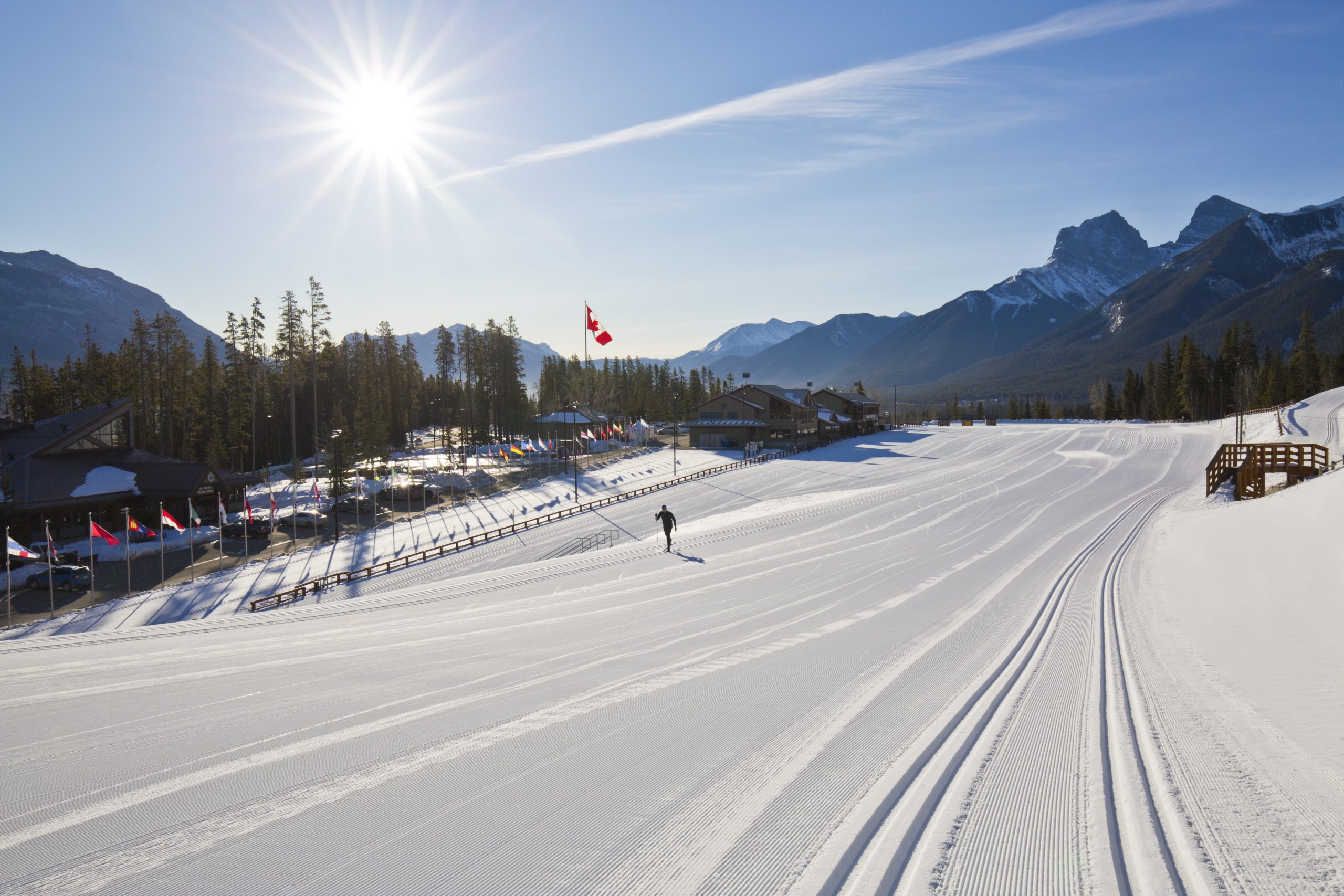
    The wide and inviting stadium at the Canmore Nordic Center (Photo: GibsonPictures)
  • Nordiq Canada Seeks Head Coach for Senior National Cross-Country Ski Team

    Nordiq Canada Seeks Head Coach for Senior National Cross-Country Ski Team


    Nordiq Canada is the national governing body for cross-country skiing in Canada. We lead, support, and inspire world-leading performances and lifelong participation in the sport across the country.

    The Opportunity

    Nordiq Canada is seeking an experienced and dynamic Head Coach to lead the Canadian Senior National Cross-Country Ski Team.

    Reporting to the High-Performance Director, the Head Coach provides leadership to athletes, coaches, and performance support staff in pursuit of sustained international success. The successful candidate will lead preparation for major international competitions and work collaboratively across Canada’s high-performance system to align national team programming with the broader athlete development pathway.

    This is an exciting opportunity for an exceptional coach with strong leadership, communication, and organizational skills to contribute to a high-performance culture focused on achieving podium performances at the Olympic Games, World Championships, and World Cup events.

    Liliane Gagnon (CAN) in Falun, Sweden. (Photo: Authamayou/NordicFocus)
    Key Responsibilities
    Team Leadership & Performance
    • Lead and implement the Canadian Senior National Cross-Country Ski Team program and performance plan.
    • Plan and deliver world-class training, competition preparation, and performance strategies.
    • Lead the team at major international competitions including World Cups, World Championships, and Olympic Games.
    Program Alignment
    • Work closely with the High-Performance Director to align the Senior National Team program with Canada’s broader high-performance system.
    • Collaborate with national training centres and personal coaches to support athlete development and progression.
    • Contribute to the development and implementation of the national high-performance strategy.
    Antoine Cyr (CAN) in Falun (SWE). (Photo: Authamayou/NordicFocus)
    Athlete & Staff Development
    • Mentor and support assistant coaches and performance support staff.
    • Foster a collaborative, athlete-centered culture built on excellence, accountability, and trust.
    • Promote strong communication among athletes, coaches, and support personnel.
    Planning & Operations
    • Plan and oversee training camps and competition schedules.
    • Work with sport science and sport medicine professionals to support athlete testing, monitoring, health, and performance.
    • Contribute to program evaluation and continuous improvement.
    Xavier Mckeever (CAN) during the Men’s Skiathlon at the Milano-Cortina Olympic Winter Games in Tesero, Italy. (Photo: Vanzetta/NordicFocus)
    Qualifications
    • Proven experience coaching at the international high-performance level.
    • Experience leading or supporting teams at World Cup, World Championship, or Olympic level competitions.
    • Strong leadership, communication, and organizational skills.
    • Demonstrated ability to mentor athletes and staff within a collaborative team environment.
    • Strong understanding of factors that drive international success in cross-country skiing.
    Working Conditions
    • Extensive domestic and international travel throughout the year for training camps and competitions.
    • Frequent work in outdoor winter sport environments.
    • Occasional evening and weekend work required.
    How to Apply

    Interested candidates are invited to submit a resume and cover letter to bscott@nordiqcanada.ca by April 3, 2026.

    Please include your name and “Head Coach Application” in the subject line.

    Only candidates selected for an interview will be contacted.

    Nordiq Canada is committed to employment equity and encourages applications from all qualified candidates. Given equal qualifications, Canadian citizens and permanent residents will be given priority. This position is funded in part by Sport Canada.

     Alison Mackie (CAN) in Goms, Switzerland. (Photo: Authamayou/NordicFocus)
  • North American Sites to Host FIS Cross Country World Cups in 2024

    North American Sites to Host FIS Cross Country World Cups in 2024

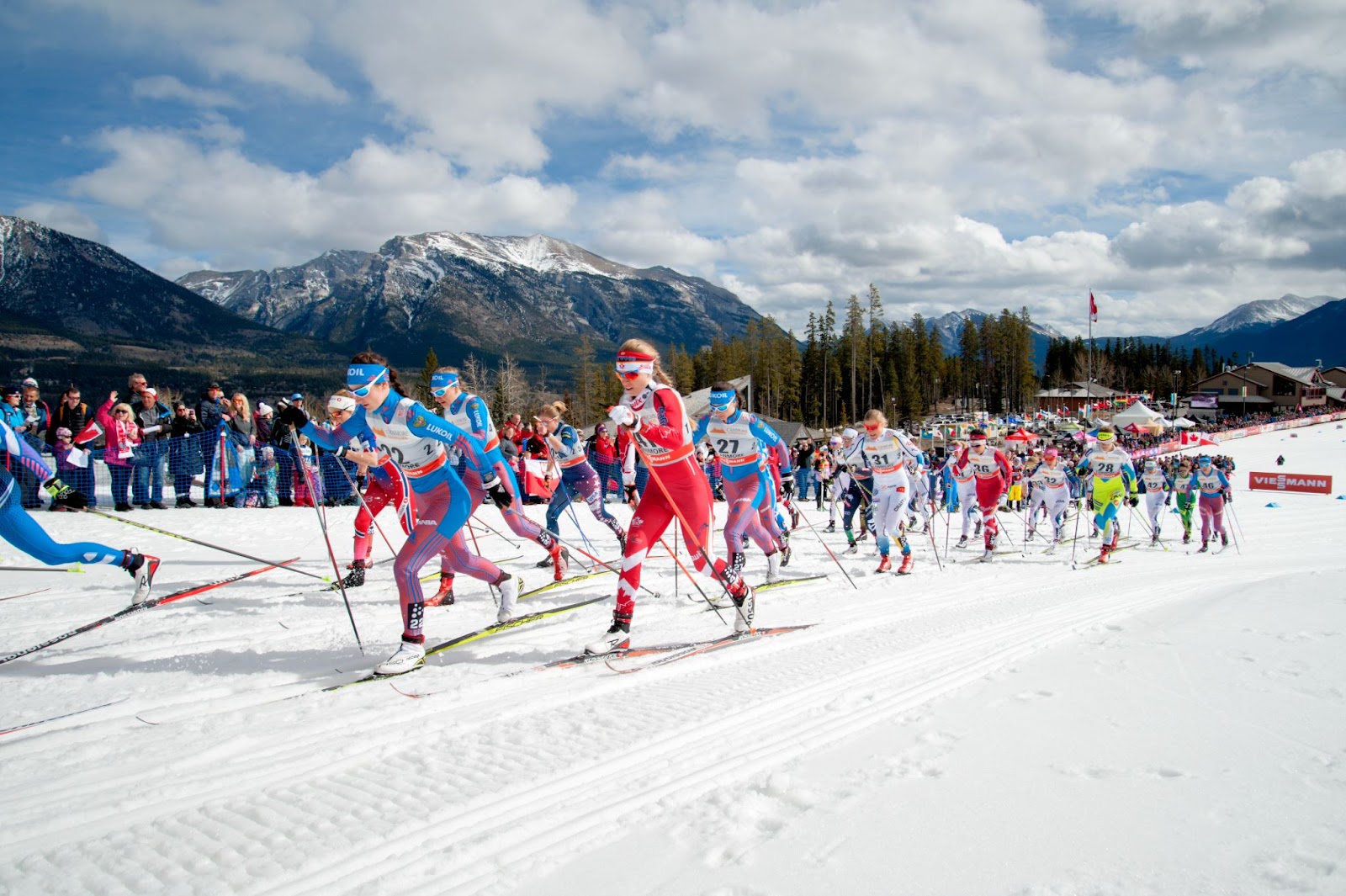
    Canmore Nordic Centre Provincial Park hosted World Cup racers during Ski Tour Canada, 2016. Canmore is again scheduled to host FIS World Cup Cross Country events in February, 2024. (Photo: Pam Doyle Photography)
    Canmore, Alberta—February 9-13, 2024
    The Alberta World Cup Society (AWCS) will host the COOP FIS Cross-Country World Cup for three race days at the Canmore Nordic Centre Provincial Park and one City Sprint in Calgary from February 9-13, 2024. This marks the seventh time that AWCS has invited the world’s best skiers to experience Alberta’s world renowned Canmore Nordic Centre Provincial Park. And a new challenge has been undertaken by the organizing committee, hosting a City Sprint in Calgary!  The Calgary City Sprint on Prince’s Island Park will be the first of its kind and all Calgarians will be invited to take part in this exciting event.
    “Hosting of international events in Canada is critical for the development of Canadian skiers but also for FIS to truly deliver its mandate as an international federation,” said Stéphane Barrette, CEO, Nordiq Canada. “We are grateful to have another opportunity to partner with FIS in hosting these World Cups next February to continue building the profile of cross-country skiing around the World.”
    To request additional information, please contact Nancy Richard at (403) 585-0503 or nrichard@albertaworldcup.com
    Minneapolis, Minnesota—February 17-19, 2024

    After their events in Alberta, World Cup athletes will travel to the United States for two more races when the Loppet Foundation, Share Winter Foundation, and U.S. Ski & Snowboard will welcome the world to Minneapolis’ Wirth Park for the COOP FIS Cross Country World Cup Feb. 17-19, 2024 (date pending final FIS confirmation). This will also mark the first time in two decades that such event has been staged on American soil

    The Loppet Foundation was prepared to host a Minneapolis World Cup in March 2020, but that event was canceled due to the coronavirus pandemic. The Loppet Foundation looks forward to hosting in 2024 while building on preparations made for the 2020 event.

    “We are thrilled to work with the Loppet Foundation and Share Winter Foundation to bring back a cross country World Cup to the states,” said President and CEO of U.S. Ski & Snowboard Sophie Goldschmidt. “We know that this event will be a huge success and allow our athletes to showcase their incredible talent in front of a community that has always supported this sport.”

    Minnesota native, Jessie Diggins, is the most decorated American in Olympic Cross Country Skiing. (Photo: NordicFocus)

    “I’m excited to give ski fans from around the U.S. a chance to see the action up close for the first time in over 20 years,” said US Team standout—and Minnesota native—Jessie Diggins. “I am so proud to represent Minnesota as one of the first American athletes to win Olympic gold in cross country, and now to bring the sport I love to the state I call home.”


    The Loppet Foundation is a 501(c)(3) nonprofit organization that connects people to the outdoors through experiences that grow community. Learn more at loppet.org.

    Share Winter Foundation (Share Winter) is a non-profit grantmaking organization working to improve the lives, health, and fitness of youth through winter sports, and create a more diverse, inclusive, and welcoming winter sports community. Learn more at www.sharewinterfoundation.org.

    U.S. Ski & Snowboard is the Olympic National Governing Body (NGB) of ski and snowboard sports in the USA, based in Park City, Utah. For more information, visit www.usskiandsnowboard.org.

  • Canadian Trials at Caledonia Nordic

    Canadian Trials at Caledonia Nordic

    Olivia Bouffard-Nesbitt leads Monika Skinner (#202) and Izabela Marcisz in the sprint final. (Photo: Kelly Bergman – Berg Media)

    The pressure was on at Caledonia Nordic in Prince George, BC, for the trials that would be used to select athletes for World Championships in Planica, Slovenia, and U20/U23 World Championships in Whistler. The three days of racing is also a Nordiq Cup, which is a FIS tier 1 event equivalent to a US SuperTour or Scando Cup, but the focus was on earning a spot on one or more of the teams.

    The snow conditions were trickier than usual for January. Prince George is the geographic centre of British Columbia, and is better known for cold weather than rain, but the atmospheric river that damaged California delivered warm and wet weather over a large part of the west. The weather also added excitement to travel, with some skiers missing ski bags after cancelled flights. Chelsea’s Tory Audet, a 17 year old who collected three open category wins in Eastern Canada Cups in December and represented Canada at U20’s last year, received her skis Tuesday night, with no chance to test in advance of Wednesday’s sprint.

    For Planica, three athletes were preselected from World Cup results: Katherine Stewart-Jones, Antoine Cyr, and Graham Ritchie. That left five to nine selections open, with selection guaranteed for the top Canadian racer in each of the three races.

    For Whistler, the team size is four to six athletes in each of the four groups (male/female, U20/U23), with no athletes preselected. The selection order is 1st place Canadian in the classic sprint, 1st place in the 10km free, and 1st place in the 20km classic mass start, then cycling through 2nd, 3rd until at least four athletes are selected.

    Full details are in the selection criteria.

    Poland’s Izabela Marcisz on her way to a second win in Prince George. (Photo: Kelly Bergman – Berg Media)

    While most competitors were Canadian, a few younger international athletes stopped in on their way to Whistler. World Cup fans will have seen Poland’s Izabela Marcisz and Monika Skinder along with Estonian twins, Kaidy and Keidy Kaasiku.

    Quotes are from interviews by Nordiq Canada’s Nathaniel Mah, unless otherwise stated.

    Classic Sprint, Wednesday

    It was +4C and klister for the sprint day. The top 30 qualifiers from both U20 and Open automatically went into the Open heats. Fondeurs Laurentides Olivia Bouffard-Nesbitt won the 1.1km qualification in 2:47.09, 0.98 ahead of Skinder and Whitehorse’s Dahria Beatty. In the final, Bouffard-Nesbitt, Skinder, and Marcisz got a gap on the other three before a collision took Bouffard-Nesbitt down. Marcisz won ahead of Skinder, with Beatty dropping Katie Weaver and Liliane Gagnon to take third and the Planica selection.

    “[It was] soft conditions, the tracks were completely gone by the time the heats came around,” Beatty told NC. “Try to be as efficient as possible on the climbs… It was really about being tactical in your positioning on the downhills, trying to give as much as possible on that final plateau and a draft into the finish.”

    Beatty was feeling the fatigue from the Tour de Ski, and skipped the final two race days to get an early start on the pre-Planica altitude camp at Apex (at 1,800m elevation, near Penticton, BC).

    Marcisz was a little surprised to win a sprint, as she sees herself as a distance skier, but the challenging course suited her.

    Gagnon, in fifth, was the top Canadian U23 to book her trip to Whistler, along with Edmonton’s Alison Mackie who was top U20 in 8th.

    Julian Smith leads over the final kicker in the semifinal. (Photo: Kelly Bergman – Berg Media)

    For the men, it was Thunder Bay’s Julian Smith, who won the qualification in 2:20.62 and then won each heat from the front. Foothills’ Xavier McKeever was second and top U20 with Black Jack’s Julien Locke taking third.

    “The course was so fun,” Smith said. “Caledonia did a great job putting on this event.”

    Tactics were straightforward; on all three heats, I came into the downhill in third … and my skis were so free today,” Smith said. “Before the last little kicker, I would find myself in the lead, and from there it was just going as hard as I could to the finish.”

    McKeever was happy in second, confirming selection for Whistler and (probably) Planica. “I definitely had some fun on this course, there’s a lot of good turns, and really technical sections. I just went out and enjoyed myself today.”

    “It’s definitely a good downhill to slingshot on,” he said. “I got a slingshot into second, that’s where I wanted to be to get some draft, but Julian was really strong today.”

    Whitehorse’s Sasha Masson, 6th in the final behind Orford’s Léo Grandbois and Canmore’s Russell Kennedy, was the top U23 finisher.

    Olivier Léveillé leads Russell Kennedy in the 20km mass start. (Photo: Kelly Bergman – Berg Media)

    20km Mass Start Classic, Thursday

    The men raced first, with Orford’s Olivier Léveillé and Kennedy getting a gap. Léveillé arrived late on Tuesday night and took Wednesday off to recover from travel and lost baggage.

    “We started pretty hard, Russell and I, the second lap was even harder and that’s when we broke away, just the two of us.”

    “We exchanged the lead for a little bit, but the last lap I was pretty dead,” he said. “I punch as hard as I could on the last uphill, and I made a little gap, just enough to hold him to the finish line.”

    The winning time was 51:51.4, with Kennedy at 0.1 back and Grandbois taking third alone at 1:40.1 behind.

    Léveillé is U23, but he may not accept the Whistler invitation.

    “I don’t know yet, where I’m going to go next. I need to talk to my coach. Senior World Champs is a big goal for me this year. I got a top ten last year in World Cup and I really want to prepare myself to do well.”

    Léveillé admitted that he is still feeling his Tour de Ski finish and after last year’s U23 individual podium, it makes sense for him to be looking ahead.

    For the women, Nakkertok and U of New Hampshire’s U23 Jasmine Lyons grabbed the win in 1:02:10.4, 25.5 ahead of Gagnon and 48.1 ahead of Bouffard-Nesbitt. Lyons, Gagnon, Bouffard-Nesbitt and Keidy Kaasiku got a gap early and skied together for three of four laps.

    “The last lap we picked up the pace a little, and I just tried to hammer up the hills,” Lyons said. “We were trading off [earlier]. Olivia was doing the brunt of the work a lot of the time, and especially on the downhills… She would often pull away and really push the pace.”

    Lyons has been racing in NCAA and didn’t have a comparison to other Canadians going in, but that cuts both ways.

    “Yeah, I just skied my own race. I really had no idea where I was compared to other people.”

    Bouffard-Nesbitt was processing after Wednesday’s crash and now third.

    “I’m trying to qualify for the world champs, and the only way to do that is to win a race.”

    “I was just trying to track whoever was trying to lead the race, trying to save energy. When Jasmine started pushing the pace, I went with it and then I just blew up in the last lap.”

    Mackie was top U20 again, finishing 9th at 3:13.2 back.

    Jasmine Lyons on her way to third and top Canadian in the 10km skate. (Photo: Kelly Bergman – Berg Media)

    10km Individual Free, Saturday

    The final day brought falling snow and extra pressure for athletes who hadn’t earned selection targets yet.

    Marcisz again showed her form on the way to Whistler, winning the two lap 10km in 26:05.8.

    “I really like [the skate course], I think it’s quite similar than Planica,” she said on Wednesday.

    Keidy Kaasiku earned second, 30.3 seconds back, just edging out top Canadian Lyons at 33.0 behind. Gagnon continued her strong results in 4th at 56.0, followed by Kaidy Kaasiku and then Olivia Bouffard-Nesbitt at 1:09.2.

    Before the start, Bouffard-Nesbitt was absorbing two races that hadn’t gone to plan and focussing ahead.

    “I think the skate course is a lot of fun, and I’m just going to go into it …  and hope the result is what I’m looking for.”

    With only the top Canadian guaranteed a trip to Plancia, hope would depend on the High Performance Committee and the more intricate parts of the selection criteria document.

    Australia’s Zana Evans was the top U20 in 9th while Revelstoke’s Alexandra Luxmoore locked down her selection in 10th at 2:07.6.

    Sasha Masson pushing through the snow and punching his ticket to Whistler. (Photo: Kelly Bergman – Berg Media)

    For the men, Kennedy locked down his Planica selection with the win in 23:20.6. TBay’s Max Hollman took second and top U23 at 15.3 behind. Masson was third at 16.8 followed by Black Jack’s Rémi Drolet at 26.0 to put three U23 athletes in the top four.

    “I like to leave it to the last day, I’ve done it with everything,” Kennedy said jokingly. “I think it’s a really good team going to World Champs, I’m excited to see what the young guns can do. Olivier’s looking good and we’ve got Max over here, he’s skiing really fast.”

    Kennedy and Drolet both completed the Tour de Ski, with Kennedy wanting some recovery and training time before the next race.

    “I’m just so happy to do a whole race without falling over,” Hollman said of his race. He fell in the mass start Thursday, but no one remembers any previous crashes, surely…. Hollman wasn’t sure he had qualified for Whistler, which means he spent less time than most with the selection criteria.

    Masson knew what he needed to do to get to Whistler and was showing his excitement in the finish interview. “I think it’s going to be awesome,” he said. “I’m really excited [to go back to U23’s] because the gang of boys is really fun.”

    Full Results, Event Website, Kelly Bergman Photo Gallery

    Selections

    The Planica announcement shows the maximum of 12 athletes were nominated.

    The Whistler announcement confirms that Léveillé declined U23’s and will likely join the Planica altitude camp at Apex.

    Nordiq Canada has selected the maximum number of athletes for both trips. This fits well with the stated goal of building experience for the 2026 and 2030 Olympic cycles.

    There are a few missing names that readers might have expected to see. This is partly from having a high stakes selection in a four day period. One athlete had a minor injury in Prince George and missed all three races. With only six or seven recovery days between the last missed trial to the first Whistler race, it is probably not a surprise that the High Performance Committee didn’t use the injury or illness provision for a discretion selection.

    Many athletes came to measure themselves and went home with lessons learned. The top athletes came with specific result goals and some of them are headed home with missed goals to digest.

    “Cross country skiing is the greatest sport for life,” Head Coach Robin McKeever told FasterSkier last week en route to Prince George. “But we still need to absolutely understand what is high performance and what we’re up against on an international level. Because there is it’s about seconds that matter, 10ths of seconds in sprints. and it’s a hard environment to be successful in.”

    Hard work, pain, and missed opportunities abound at the top level of this sport. All the more reason to celebrate the successes when they come.

  • Nordiq Canada Rolls Into 2023

    Nordiq Canada Rolls Into 2023

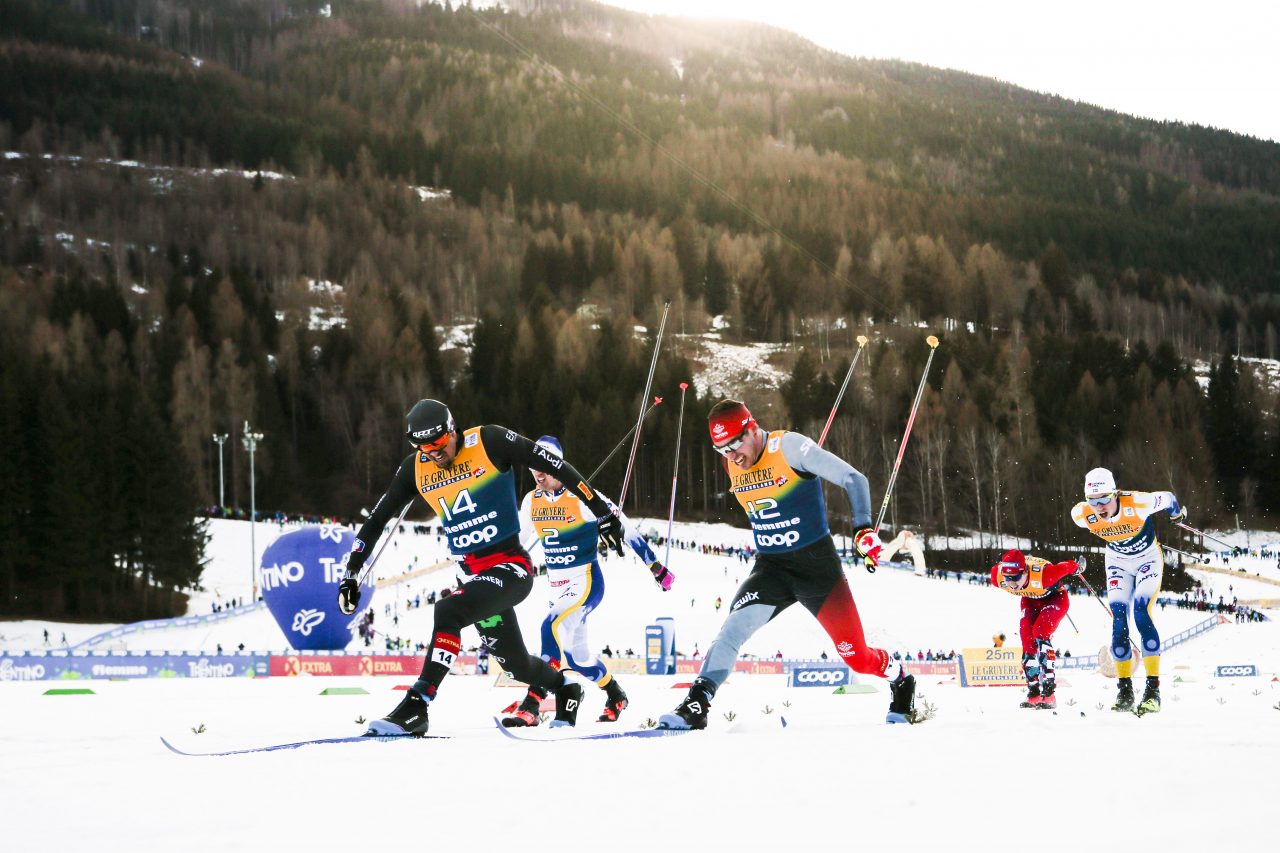
    Francesco de Fabiano (14) edges Tony Cyr (12) in stage 6’s 15km classic at Val di Femme. (Photo: Modica/NordicFocus)

    Canada is in the rebuilding part of the success rollercoaster, with many changes to the High Performance team and the development programs.

    Since May 1st, Chris Jeffries has joined Nordiq Canada (NC) full time as the High Performance Director, Robin McKeever has transitioned from the extremely successful Para program to become the Olympic Stream Head Coach. NextGen coach Eric de Nys and Dev coach Matt Smider are in their first full year in those roles and have shifted modes from planning to delivering.

    This season, Canada returned to the Tour de Ski with three top ten finishes and is hosting the World Junior/U23 Championships.

    The Tour de Ski was an obvious highlight, with all of the nine athletes and six of eight support staff experiencing the Tour for the first time.

    “Yves Bilodeau has obviously has done a few Tour de Ski’s and Simon Boisvert was on the trip with us as a wax tech,” McKeever told FasterSkier, “but yeah, everybody else was pretty much rookies there, I think just the tech, so we were following the tech’s lead to learn from them as much as anything.” For non-Canadians, Bilodeau represented Canada at two Olympics before becoming a wax tech and VW bus driver for the Beckie Scott generation.

    Asked to pick just one highlight, McKeever chose one result and one process goal: “My personal highlight from the Tour has to be Tony’s fourth place and coming ever so close,” he said, referencing Antoine Cyr losing a photo finish for a podium spot in Val di Femme the day after finishing 6th in the sprint. “That’s I think beyond some of our expectations through this year, but at the same time, it is belief in the system and belief for the younger up and coming athletes and others around him that it is possible. We need to get that back in the system. We’ve lost it since you know that Beckie, Chandra [Crawford], Sarah [Renner] years of Olympic medals, and with Alex Harvey’s retirement, things were kind of frayed. So it’s time to rebuild that and get positive focus forward and making sure that we’re looking at growth mindset and looking for positive solutions, rather than always complaining about the issues.”

    Katherine Stewart-Jones (CAN) racing up the Alpe di Cermis in the final stage of the 2023 Tour de Ski. (Photo: Barbieri/NordicFocus)

    Katherine Stewart-Jones, who has this season scored her first top 10 plus six top 20’s, and joined the red group as the 15th ranked distance skier, is another obvious highlight for Canada.

    Canada will select athletes for U20/U23 Championships in Whistler and World Championships in Planica at the Trials event at Caledonia Nordic this week, with many younger skiers expecting to qualify. There is also a good field of older skiers planning to hand out some learning experiences on their way to Planica, which should result in exciting racing. Live timing and full results will be here.

    For Planica, three athletes were pre-selected: Katherine Stewart-Jones and Tony Cyr met the standard of two top 20s on the World Cup this season, and Graham Ritchie earned a discretion pick with a 17th, a 21st, and two top 20 sprint qualifiers. Everyone else is at Caledonia.

    When FasterSkier was interviewing NC staff this season during race weekends, the phrases “that’s Julie” and “Julie does” got used a lot. Julie Beaulieu is in her second year at NC as Development Director. What does that role entail? It appears that it is mostly enabling the more visible staff members to succeed. The most visible of those is McKeever.

    Robin McKeever stopped in at the Reino Keski Salmi Loppet on the way to Prince George for Trials, providing wax support to his family and answering questions for FasterSkier. (Photo: FasterSkier)

    If asked about McKeever, most ski fans will remember his time guiding his younger brother to Para glory, or his leadership that brought Canada to the elite of the Para-nordic world. This has eclipsed his own history of podiums, multiple national titles, and Olympic experience since he joined the Junior National team in 1990. McKeever has been part of the National team system every year since then: the good, the bad, and the Nagano ugly.

    From the outside view, McKeever never produces inspirational speeches that would make Hollywood proud. If he shouts, it is encouragement to a racer on course, and he is most often seen having a quiet one-on-one conversation. Every conversation loops back to “moving forward” and what can be learned to be better in the future.

    So what makes McKeever a leader? He is surrounded by inspired people. Athletes produce year over year improvement. Retired athletes look back with a smile at their team memories. And there are a lot of “team” moments, among both the athletes and the staff.

    Para athletes often talked about lessons learned from teammates and the support they felt. Asked how to bring the Para success to the rest of the team, McKeever focussed on culture.

    “Para … it’s it’s a small community overall. Tiny,” he said. “So it’s a lot easier to create that team environment and attitude around our culture.”

    “So the funny thing is, we think Nordic or cross country skiing is such a big community overall but compared to the world, it’s actually a fairly small community. I still remember a lot of people [on the World Cup circuit] from when I raced back in the late 90s, early 2000s. So this is a small community overall.”

    And the next step is change.

    “So changing the culture within Canada is about being open to others’ ideas. And we have gone to a decentralized program where athletes are training within their home environments. And then we’re camp-based. So we create our team environment in camps and on the World Cup in the winter. Bit more similar, probably, to what the US system is right now under Matt Whitcomb.”

    While McKeever listens to others, he has a solid core of philosophy.

    “And that culture is about being a positive influence on the program, always forward. No, we’re not always going to have successful days,” he explained. “But to come in and improve on the tough days and look at the positives, but also look at where we can improve every single day. And I think that just that philosophy and the culture that is behind that creates a safe environment where athletes are free to express themselves as they will. And they’re not scared to speak openly. And so when they do that, we can create a space where they can be happy to operate in, so that creates the smiles. Cohesion as a group and a team becomes the number one key focus that I try to look at.“

    With the decentralized structure, athletes work primarily with their club/personal coaches with support from the national system. This adds continuity as skiers enter and exit the World Cup and the National Team; it also helps knowledge trickle down into the clubs.

    This fits in with an overall goal of integrating the National Team system more tightly with the clubs.

    Next up in the Canadian series is the NextGen and Development changes, along with an explanation of why the USST’s Bryan Fish and Greta Anderson were using the same phrases as Jeffries and de Nys at the combined Nordiq Cup/SuperTour at Sovereign Lake in December.

  • The Devon Kershaw Show: New Canadian XC Coach Robin McKeever

    The Devon Kershaw Show: New Canadian XC Coach Robin McKeever

    We have no excuses for our prolonged absence other than it being the summer time. Devon has school and kids to take care of; Nat has…well, Nat really has no excuse. We taped this show with Robin McKeever, the new Canadian coach, and we’re just getting around to posting it now.

    You can email us at devon@fasterskier.com and nat@fasterskier.com.

    PyeongChang 9/3/2018 – Emily Young, of Kelowna, BC, and Coach Robin McKeever, of Canmore, AB, during a biathlon/cross country training session at the Alpensia Biathlon Centre during the 2018 Winter Paralympic Games in Pyeongchang, Korea. Photo: Dave Holland/Canadian Paralympic Committee
  • Canadian Nationals/US SuperTour Finals: Julia Kern wins again, while Xavier McKeever takes first Canadian title in Classic Sprint

    Canadian Nationals/US SuperTour Finals: Julia Kern wins again, while Xavier McKeever takes first Canadian title in Classic Sprint

    Julia Kern (SMS T2) and Dahria Beatty (Whitehorse) fist bump at the finish of the women’s classic sprint final. (Photo: Doug Stephen / VR 45 Photography)

    Racing at the joint Canadian Nationals/US SuperTour Finals resumed on Wednesday, showcasing some of the best racers in North America facing off for a classic sprint. 

    As the Whistler Olympic Park was home for cross country skiing during the 2010 Vancouver Games, the classic sprint course on Wednesday was one that played host to an important stepping stone in North American skiing history. In that competition, both American and Canadian skiers solidified the inroads they had made into the top echelons of the sport through the burgeoning discipline of sprinting. Names like Kikkan Randall (USA), Daria Gaiazova (CAN), Chandra Crawford (CAN), Devon Kershaw (CAN), and Simi Hamilton (USA) all qualified for heats, while gracing the television screens of many athletes who now, twelve years later, carried momentum from those inspiring performances onto today’s start line in Whistler.

    If my waxing nostalgia about those 2010 Olympics is making you open a new tab to see if they’re available to revisit on YouTube, let me help you: they are! But before you go, let me send you an assignment: watch how Marit Bjørgen and Justyna Kowalczyk race the final on the 1.2 k course (the men raced a 1.4 k course). Ok, here’s the link (46:16 for the final, and yes, the genders are flipped in the title).

    What you’ll have seen if you completed this FasterSkier sidequest (trademark pending) is that the rolling course at Whistler presented two distinct tactical options for the skiers who made it into the heats on Wednesday. One: the Kowalczyk – attack on the steep climb that left the stadium to try and create a gap on the field that would hold as you went into the first downhill and leave you with an advantage on the second (and final) climb, or two: the Bjørgen –  hold onto the pace-setter until the second hill, when a punchy attack could leave a skier with a distinct advantage going into the mostly downhill approach to the stadium and subsequent final stretch. The latter approach worked in 2010 for Bjørgen, but 2022 was twelve years on and a different field with the SuperTour.

    Before we got to the heats, however, we, and the skiers, had to go through qualifying. 

    The Classic Sprint started off with the women’s champion in the 10 k Classic yesterday, Julia Kern (SMS T2). And after every racer in the women’s field completed the course, Kern finished in first too (3:11.14). Her qualifier was commanding, with second place Dahria Beatty (Whitehorse) +6.58 seconds back. In third place was Alayna Sonnesyn (SMS T2) (+7.54), in a field that otherwise was tight all the way through to the last heat qualifier, 30th place Mariah Bredal (BSF) (+21.37).

    The men’s field that followed proved to be an even tighter affair. At the top of the field, less than a second split first place Andreas Kirkeng (Denver University) (3:09.82), second place Luke Jager (University of Utah) (+0.41) and third place Logan Hanneman (APU) (+0.88). It was only +11.97 seconds back to the last heat qualifier in 30th place, Montana State’s Reed Godfrey.

    The women’s US SuperTour podium saw Julia Kern take the top step ahead of Caitlin Patterson and Sydney Palmer-Leger. (Photo: Joern Rohde / Nordiq Canada)
    Women’s Open

    In the women’s open quarterfinals, the top qualifiers were able to win their heats handily. Julia Kern turned in the fastest quarterfinal in the field, finishing first in a time of 3:29.93, ahead of Novie McCabe (+1.93), who advanced to the semifinals by taking second place. Kern’s fast pace-setting in heat one proved to animate the field from the gun, and third place Zoë Williams (Nakkertok) was rewarded for keeping pace with one of the lucky loser spots (+3.56).

    That pattern held in the 2nd heat, when a pack loaded with talent including Caitlin Patterson (Craftsbury), Alexandra Lawson (Craftsbury), Sydney Palmer-Leger (University of Utah), Sophia Laukli (University of Utah) and Cendrine Brown (Fondeurs-Laurentides) set a furious pace from the start and held it all the way through. In a five-person sprint, Patterson took first (3:32.13), and Lawson second (+0.55), to take the automatic semi-final bids. In third place, Sydney Palmer-Leger (+1.47) took the other lucky loser spot.

    When the first semi-final took to the start-line, it was filled with five skiers from those first two quarterfinals, with the sixth, 16-year-old Samantha Smith (Sun Valley), having won the third quarterfinal (3:36.43). It was no surprise then, when the “fast from the gun” tactics of those quarterfinals followed into the semis. Julia Kern (SMS T2) again attacked as soon as they hit the first incline out of the stadium, and held her lead throughout. The only skier that proved to be able to match her pace through the course was Caitlin Patterson (Craftsbury), and it would be those two who took the automatic advancement places to the finals; Kern in first (3:34.27) and Patterson second (+3:35.27).

    Behind them, two of the youngest bright stars of US women’s skiing had shown their intrepid ability to match their older counterparts, with Palmer-Leger (UU) taking third place (+3.47) and Novie McCabe (UU)  taking fourth (+3.74) in a sprint ahead of Samantha Smith (Sun Valley) (+4.03). For their efforts, the third and fourth place pairing advanced to the finals.

    In the second semi-final, previous Canadian Sprint National Champion Dahria Beatty (Whitehorse) was able to take first place (3:38.39) ahead of second place Laurence Dumais (Fondeurs-Laurentides) (+0.34) for the second heat in a row. They finished strong in a pack that otherwise remained tight throughout, and created separation in the last stretch to finish ahead of third place Alayna Sonnesyn (SMS T2) (+1.18) and fourth place Katharine Ogden (SMS T2) (+3.45).

    The final field then, was set. For the overall win, four US women – Julia Kern (SMS T2), Caitlin Patterson (Craftsbury), Sydney Palmer-Leger (UU), and Novie McCabe (UU) – and two Canadian women – Dahria Beatty (Whitehorse) and Laurence Dumais (Fondeurs-Laurentides) – would compete. That latter pairing also made the matter of the Canadian Sprint National title on the line simple; a duel between Beatty and Dumais.

    Julia Kern strikes again in the women’s classic sprint, taking the win ahead of Caitlin Patterson (CGRP) and Dahria Beatty (Whitehorse). (Photo: Doug Stephen / VR 45 Photography)

    Kern, spurred on by her success racing hard from the gun all day, went for it again. In an interview with Nordiq Canada she said, “All day I just wanted to ‘send it’ – practice skiing hard and not taking any chances out there. My form and fitness is really good so I wanted to try and not leave it until the end.”

    The whole field was tasked with matching her confidence…and her speed. As in the semi-finals before, just one was up to the task the whole 1.2 k through; Caitlin Patterson. Behind her, Dahria Beatty led a charge to try and keep pace, but as she said in an interview with Nordiq Canada “I was confident in my finish but trying not to lose time on the uphills today. Unfortunately, [in the final], I let a gap open up to Caitlin [Patterson] and wasn’t able to close back on that.”

    And “send it” Kern did in the final. Kern took the pace out hot from the start. With a look over her shoulder, she saw that she had gapped the field by the top of the long striding climb, a position which she held, despite a bobble on the tight left hand curve on the subsequent descent, comfortably through the finish to win by several seconds.

    Patterson having lead the chase group after a gap throughout the heat, found herself sprinting with a powerful doublepole into the stadium to hold her ground in second place.

    Behind them, the race for the last podium spot coalesced around Beatty, Palmer-Leger and McCabe. As they entered the stadium together, Beatty stuck to a strategy that her coach pointed out earlier in the day, “it was working really well to try and go in the outside in the finish chute because people hadn’t skied there in the qualifier.”

    With that bit of tactical maneuvering, she opened up a gap on the two UU teammates behind her, and came across the line in third place overall (+6.16). In doing so, she also came across with a Canadian National title – her second Canadian Sprint title (and first classic). Following her in the Canadian Nationals race was second place Laurence Dumais (Fondeurs-Laurentide), who finished the finals heat in 6th place (+21.57). Based on her time in the semi-final, Zoë Williams (Nakkertok) took third place.

    Kern’s win marked her second in a row at SuperTour finals this week, which have been marked by all sorts of varying conditions that she has used to her advantage, saying to Nordiq Canada:

    “I love variable conditions. Everyone says if it’s a rainy day, it’s a Julia Kern day – I’ve thrived under those conditions before…it makes you have to adjust your skiing and that makes you a better athlete.”

    The Canadian women’s sprint podium, with Dahria Beatty coming out on top in the classic sprint. (Photo: Joern Rohde / Nordiq Canada)
    Men’s Open

    The men’s quarterfinals saw a similar pattern to the women’s, with experienced sprinters grouping together in heats, attacking early, and producing fast times that punctuated the number of racers they sent to the semi-finals. For the men that happened in quarterfinal two, with Graham Ritchie (Georgian Nordic), Antoine Cyr (Skinouk), Kjetil Bånerud (Northern Michigan), Bill Harmeyer (SMS T2), and Étienne Hébert (Montériski) all pushing each other to the line. When the five skiers came into the final stretch, it ended up being Ritchie (3:23.11) and Cyr (+0.32) who took the first and second spots, respectively. Both lucky losers came from the heat, with Bånerud in third (+0.95) and Harmeyer fourth (+1.73).

    Ritchie, Cyr, and Harmeyer would all meet again in the first semi-final. There, they were joined by Andreas Kirkeng (DU), Logan Diekmann (BSF), and Magnus Bøe (CU). With tight racing throughout, Kirkeng was able to gain an advantage and hold off all challengers as he advanced to the final in first place (3:22.97) ahead of second place Antoine Cyr (+0.83). The aggressive tactics of Ritchie and Cyr again proved to push the entire field forward, with Ritchie the benefactor when his third place finish (+1.47) secured him a lucky loser spot alongside fourth place Logan Diekmann (+2.76).

    The second semi-final, meanwhile, was a duel between the young stars from both sides of the 49th parallel. American Luke Jager (UU) and Canadian Xavier McKeever battled to a sprint finish in which Jager took first place (3:23.34) and McKeever took second (+0.50) to advance to the finals.

    Jager and McKeever stepped up alongside Antoine Cyr (Skinouk), Andreas Kirkeng (DU), Graham Ritchie (Georgian Nordic), Magnus Bøe (CU) and Logan Diekmann (BSF). The two young skiers showed no signs of timidness against their older competitors. Jager launched an attack on the first hill that opened a gap as the field rounded the corner leading into the final climb. McKeever was back in the field, looking to “limit damage, if I’m honest” as he said in an interview with Nordiq Canada.

    He followed Graham Ritchie, who was leading the charge to try and catch up to Jager. When they crested the hill, Ritchie, McKeever, and Kirkeng had all managed that feat – joining up with Jager as they went into the downhill leading to the stadium.

    McKeever was still at a disadvantage though, back in the pack, when the curious mix of rain, ice, and sunshine that had worked the snow at Whistler park all day became a factor. As McKeever said to Nordiq Canada, “going into the downhill I had insane boards, and was able to glide back up to the leaders and double-pole from a good position.”

    Xavier McKeever (Foothills Nordic) takes the classic sprint win with Antoine Cyr (Skinouk) on his tails and Luke Jager (University of Utah) chasing in the lane to his left. (Photo: Doug Stephen / VR 45 Photography)

    When he found himself in that good position he could hardly believe it, “I was just stoked to be in the final and top-three in Canada. Going into that finish was insane, and I knew I had to get to the finish line as quickly as possible to try and steal [the National title].”

    What he categorized as stealing, we’ll categorize as earned. The 18 year-old out-sprinted North America’s best head-to-head, winning the overall race, and his first Canadian National title in a time of 3:19.72. Behind him in second place was fellow Canadian Antoine Cyr (+1.38), with Luke Jager rewarded for his long-range attack with a third place overall (+1.99). Graham Ritchie, finishing fifth overall, rounded out the Canadian Nationals podium (+4.13) after a day of leading out attacks in every heat he raced.

    It a promising indicator for Canada’s young up-and-comers with McKeever taking on a field of North America’s best and eeking out a win. For McKeever though, the race was only a preparation for bigger things to come, saying post-race that, “I’ve had some really good sprints this year, so I just wanted to try and challenge myself [racing up] since this is the course that we’ll be racing at World Juniors next year.”

    The Canadian national podium for the classic sprint saw the young Xavier McKeever take the win ahead of Olympic classic team sprint duo Antoine Cyr and Graham Ritchie. (Photo: Joern Rohde / Nordiq Canada)

    Racing continues Friday with a freestyle team sprint, which can be live-streamed here.

    Full Results:

    Qualifiers  | Open and U20 Heats


  • Martin and Kern Stride to the Top on Day Two in Whistler

    Martin and Kern Stride to the Top on Day Two in Whistler

    Carrying the momentum from the first day of racing into a second distance event, athletes lined up once more at the Whistler Olympic Park for a 10 / 15-kilometer interval start classic. Over 130 men and 90 women participated in the open categories, representing clubs across Canada and the United States. 

    Adding a springtime layer of complexity to remind us that we are officially past the equinox, temperatures in Whistler hovered above freezing while a mix of precipitation fell off and on throughout the day. Webcams of the venue showed the spectacular mountain backdrop hidden amongst dense clouds and conifers still laden with the week’s snow.

    It’s a humidity-temperature combo that makes classic waxing tricky. Consequently, many athlete chose to use “hairies”, which are known as “rub skis” in Canada, essentially foregoing kick wax and opting instead for a sandpapered kick zone. For those with strong striding technique, this achieves grip without as significant a risk of icing issues, as klisters can be known create in such conditions. 

    Top Canadian U20 racer Xavier McKeever (Foothills Nordic), who was 13th overall today, explained how this changes the game for those who haven’t had the experience: “You have to be a bit more careful with your kicks and a bit more gentle, because they can slip out really easily. That was the biggest focus for me [today], just to try and ski technically well.”

    Craftsbury’s Adam Martin takes the 15 k classic win in Whistler. (Photo: Doug Stephen / VR 45 Photography)

    Following 10 k sitting and standing events contested by Nordiq Canada’s Para Nordic athletes, the open men’s category headed out for the three 5 k loops. In a close race for the top podium spot, Craftsbury’s Adam Martin took the win with a time of 40:29.3. Martin was chased by today’s Canadian National Champion, Antoine Cyr (Skinouk) who hunted his times from 19 bibs behind.  

    Though Cyr led through the first 10 k, a strong closing lap from Martin moved the American to the lead in the splits, with Cyr skiing the third fastest final lap to take second (+1.3). Canmore’s Russell Kennedy was third overall (+13.1) for the second spot on the Canadian podium, while fellow Canmore athlete Sam Hendry, who now trains with the University of Utah, was third for Canada in fifth overall (+48.0). Both Cyr and Kennedy had also raced onto the podium in yesterday’s 10 k free. 

    “I felt really good today,” Martin wrote to FasterSkier after the race. “Particularly in the second half, I started to figure out how to best race this course and these conditions, and I found a good place mentally to push. I’m really happy with the outcome – that was a dream to win.”

    The men’s 15 k classic podium in Whistler: Adam Martin (CGRP) took the win ahead of Antoine Cyr (Skinouk), and Russell Kennedy (Canmore Nordic). (Photo: Joern Rohde / Nordiq Canada)

    A successful season of SuperTour racing has Martin ranked at the top of the rankings, and earned him starts in post-Olympic World Cup events. After taking third at the American Birkie, Martin headed to Norway to race the 50 k classic at Holmenkollen, where he finished 26th. The following weekend, he skied to 44th in the 15 k free in Falun, Sweden. A week later, Martin is back with his Craftsbury team and standing atop the US SuperTour podium. 

    “It’s nice to return from the World Cup and still feel in good shape. After two 50 k’s, and travel, and a season that I’m really happy with, everything is a bonus at this point. I think it’s great that we are able to combine with Canada for these races. There are a lot of guys at a similar level, so it makes for some tight, fun racing.”

    A 23-year-old Quebec native, Cyr’s best results have been in classic this season, namely an 11th place finish in the opening World Cup 15 k classic in Ruka, Finland, and racing with Graham Ritchie to put the Canadian team in fifth during the Olympic classic team sprint in Zhangjiakou. After the team sprint, he was praised by both his teammate and coach Erik Bråten, along with armchair quarterback Devon Kershaw, for his classic technique.

    “Classic is always good for me and is a race I love,” Cyr said of today’s 15 k in a post-race interview with Nordiq Canada. “It was tough conditions this morning, and a good skier normally comes out on top in hard conditions. I was able to ski well, focus on the race, and came second overall, which is a little bittersweet because it was a really tight battle in the end. But it was really fun, the track is amazing. It’s an Olympic standard track, so it’s just really good.”

    Antoine Cyr races for the Canadian National Title in the 15 k classic in Whistler. (Photo: Nordiq Canada / Nathaniel Mah)

    In his second lap, Cyr had caught yesterday’s winner, Rémi Drolet (Team Black Jack), whom Cyr credited in supporting his strong result today.

    “When I saw was closing the gap on him on the first lap, I decided to go a little harder than I planned to catch up with him. [I then tried] to relax behind him for a lap or half of a lap.. In the end, I was missing a little bit on the last lap. I think that that helped for sure, skiing with someone strong like Rémi.”

    Finally, Cyr spoke to the importance of an international field featuring all age groups coming together this week, particularly on the heels of a two-year hiatus due to pandemic restrictions.

    “It is so good for the young kids — us older guys, we’ve been racing on the World Cup, but like the juvenile and junior, they almost have no races in Canada. To have a big event like this is just amazing and we’ve been looking at the younger guys’ results for an hour yesterday, seeing who’s in good form, and who’s coming up, and you are the next guys to be like taking over. So for them, it is awesome, and for us too, racing with the US is always — it should always be like this.”

    Joining Martin for the SuperTour podium, BSF Pro Team athlete Finn O’Connell was 7th overall (+1:06.4) and second American, with University of Utah’s Luke Jager half a second behind in 8th overall (+1:06.9).

    Julia Kern strides for the win in tricky conditions during the 10 k classic in Whistler. (Photo: Doug Stephen / VR 45 Photography)

    In the women’s 10 k, SMS T2’s Julia Kern skied a strong second lap to take the win in her second consecutive day on the podium, stopping the clock at 29:54.3. Her club and national teammate, Jessie Diggins, took the second step finishing +18.3 back, while University of Utah’s Sophia Laukli skied to third (+1:03.2).

    Looking at tough conditions, Kern explained she raced by trial and error today, exploring which techniques were most efficient on different sections.

    “I kind of had an open mindset going in today,” she told Nordiq Canada after the race. “I knew that the tracks might be a little bit punchy or washed out in sections, and so I was double pulling wide or double polling narrow or just like power striding on the flats if it was getting too punchy out there. So just trying it all.”

    She continued that she was looking to “have fun, send it from the start, and see if I could hold that pace the whole time,” which she ultimately proved able to do. It’s the time of year where the hay is in the barn training-wise, and athletes have had a long season, leaving them in varying states heading into the last hurrah. On whether she was looking to just have fun at these races, or whether it was a serious quest for the podium, Kern said “both”.

    “I think the end of the season is always really fun. It’s so cool to have this many athletes here. And I’ve been feeling really good the last few weeks and so enjoying racing when it does feel good and when I’m able to push really hard. We’re all really tired at the end of the season, but also, when the body’s in form you might as well take advantage of it and send it on the course.” 

    The women’s 10 k classic podium on day 2 in Whistler: Julia Kern (SMS T2) took the win ahead of Jessie Diggins (SMS T2) and Sophia Laukli (Univ. of Utah). (Photo: Joern Rohde / Nordiq Canada)

    Winning back-to-back Canadian National titles, Katherine Stewart-Jones (Nakkertok Nordique) was again on top for the Canucks, finishing sixth overall (+1:17.5). Finishing in the same order as yesterday, Dahria Beatty (Whitehorse Ski Club) was second for Canada in eighth overall (+1:55.0), while Cendrine Browne (Fondeurs-Laurentides) rounded out the podium in ninth overall (+2:14.5). 

    “I went out really hard knowing that that’s what I had to do if I wanted to make the podium,” Stewart-Jones said of her race. “I had a good first lap, and I definitely slowed down a lot on the first part of the second lap. I was just tired and was having a hard time staying in the zone and keeping the rhythm, but I was able to pull it together a bit for the second half of the second lap. So I was really happy with that. And I was happy with how hard I pushed. I just didn’t have it quite in me today, and sometimes that happens.”

    On the importance of focusing on her technique on this type of course with sub-optimal conditions, she continued, “It’s really important, especially on the climbs. The grip isn’t always perfect in these conditions, so you really have to make sure to stay on top of your skis. If you get tired and you start leaning forward, then it makes it even harder to kick… And then on the flatter sections, it was a bit awkward, and you had to expect that. Either you’re striding awkwardly or you’re doing a kick double pool, but your poles are sinking. You have to just really focus on committing to whatever you decide to do and not like trying to switch too much between.”

    Speaking to already standing atop two podiums, Stewart-Jones responded with pride, while also acknowledging that the overall win would be sweeter.

    “Oh, it’s definitely nice to be winning the national championship title… because we’re racing against the Americans, I obviously care about the overall too, so maybe it feels a little less exciting, but for sure, I’m proud of that.”

    Katherine Stewart-Jones (Nakkertok Nordique) takes back-to-back national titles in the women’s 10 k classic in Whistler. (Photo: Doug Stephen / VR 45 Photography)

    In order to get closer to the overall podium, she said he would focus on resting as much as possible and maintaining the head space to perform her best. “It’s been a long season and I haven’t raced this much in a long time. I think everyone’s pretty tired. But also just being able to also be mentally strong [over the next races]. And yeah, you never know what’s gonna happen.”

    Racing continues Wednesday with individual classic sprints, which will be live-streamed by the Black Tusk Nordic Events Society. If you’re looking for additional video updates, follow along on the Nordiq Canada and Black Tusk Instagram pages. 

    Full Results

  • Cyr and Ritchie faked it til they made it – to the best classic team sprint finish in Canadian men’s history

    Cyr and Ritchie faked it til they made it – to the best classic team sprint finish in Canadian men’s history

    During the opening weekend of World Cup racing in Ruka, FIN back in November 2021, Canada’s Antoine (Tony) Cyr popped an 11th place finish in the first distance race – a tough 15-kilometre classic won by Finland’s Iivo Niskanen, now a gold medalist in the event. 

    Antoine Cyr (CAN) pushes around a the curve as he helps the Canadians to 5th in the classic team sprint during the 2022 Olympics. (Photo: NordicFocus)

    After the race, Cyr wrote to FasterSkier that the course had suited him with its long uphills and frigiddig conditions; temperatures were near zero degrees Fahrenheit ( -17 C). “Cold weather is good for us Canadians,” he said. Cyr repeated his strong showing in Ruka the next day, placing 12th in the skate pursuit. 

    Flash forward through a number of subsequent racing highs and lows, and Cyr found himself in similar circumstances: on classic skis in single digit temps, with an arduous course designed to test the mettle of the best in the world.

    Cyr was awaiting one final tag in the Olympic team sprint from partner Graham Ritchie, still amidst the lead group of eight teams, racing with some of the top names in the sport toward an Olympic medal. After receiving the tag, Cyr did his best to keep Canada in contact with the leaders, who began to surge, breaking apart this lead group as the list of medal contenders dwindled to three teams. 

    Along with William Poromaa of Sweden, Cyr lost contact with the top-three, tagging Ritchie for the final leg of the race in fifth, a position Ritchie held through the finish to cross the line in 19:45.3, only +22.3 back from the Norwegian gold medalists Johannes Høsflot Klæbo and Erik Valnes. 

    Graham Ritchie (CAN) double-poles toward the finish of the men’s team sprint. (Photo: NordicFocus)

    It was the best men’s result in a classic team sprint in Canada’s rich Olympic history. At the event’s debut in the 2006 Torino Games, which was competed classic, Devon Kershaw and George Grey took 11th in the team sprint for Canada, while Beckie Scott raced with Sara Renner to win a silver medal. Kershaw lined up with Alex Harvey at the following Games in Vancouver in 2010 for the skate team sprint, just missing the podium in fourth.

    “This is so incredible to pull this off and throw down such a good result for Canada,” Cyr told Nordiq Canada after the race. “It’s overwhelming, especially to do this with such a good friend like Graham. It is really special.”

    Graham Ritchie and Antoine Cyr celebrate 5th place in the classic team sprint during the 2022 Olympic Winter Games. (Photo: Laura Leclair)

    Both 23-years-old and competing in their first Olympic Games, the Canadians had been looking for more than the results they’ve had thus far in Zhangjiakou. A pre-Olympic camp at a similar elevation in Sovereign Lake/SilverStar reportedly went well, and tight COVID safety protocols had kept the athletes healthy, allowing them to safely enter the Olympic bubble. 

    While the opening races ultimately did not feature the Canadians vying for top-10 finishes, Cyr and Ritchie could look back on the 2021 World Championships in Oberstdorf, Germany, where they took seventh for Canada in the freestyle team sprint. 

    Ritchie told FasterSkier in the mixed zone that they knew from this experience that they would need to be in the top-four in the semifinals to advance safely into the final. They had done it in the World Champs and they believed they could do it again in the Olympics. 

    “We know we had it in us, we just knew we had to race smart and race hard and have a good day,” Ritchie explained. “So [I’m] super proud of Tony and me to be able to work together and use our experience to push through that semi and end up giving our shot at a good race in the final.”

    Graham Ritchie (CAN) races at the front of the pack at the start of the men’s classic team sprint in Zhangjiakou. (Photo: NordicFocus)

    So far in the Games, Cyr has raced every event, but had not cracked the top-30 individually. Ritchie sat out the skiathlon and 15 km classic, and finished as the top-Canadian in 34th in the freestyle sprint, just off the time needed to make the heats. Racing the first two classic legs of the 4 x 10 km relay, Canada finished 11th out of 12 teams that completed the race. It’s not the makings of an underdog story about a small nation in a rebuilding phase after a string of notable retirements that one might drum up.

    “I think we put every other race in the back of our minds and just knew we [could have] a good day,” Ritchie told FasterSkier on the team’s confidence in spite of sub-optimal results. “Tony is an exceptional classic skier. And myself and him are both – we know we can pull off a sprint. So we really put those other races behind us and were only focused on today…

    “But then I mean to be on the last lap, with the podium right there,” Ritchie continued dreamily, as if still feeling the thrill. “That was pretty eye opening.”  

    Though he acknowledged the challenge of facing the likes of Klæbo, Joni Maki (FIN), and Alexander Terentev (ROC) in the last lap, who eventually took the gold, silver, and bronze medals, respectively, Ritchie shared that the possibility of a Canadian medal crept into his mind in the final lap. Moreso, it planted a seed for what might be possible in the future. 

    “I mean, during the race, I definitely thought about it. Like you could see it right there… And I mean, we’re both 23 years old. We’ve got a lot of racing left in us. So yeah, that was a big race for us. And we’re really looking forward to seeing what we can do in the future here for Canada.” 

    In the mixed zone, World Cup competition coach Erik Bråten also spoke to the team’s ability, particularly in Cyr’s case, to put aside the early results of the Games and take on a “fake it till you make a kind of attitude today. And just push through it.”

    Speaking to the difference makers that led to this outstanding result, Bråten projected that Cyr had skied among the “top-three technically”, particularly when striding up the 400 meter A-climb, which rose 30 vertical meters to the high point of the course midway. 

    Antoine Cyr (CAN) matches Iivo Niskanen (FIN) up the climb during the classic team sprint in Zhangjiakou. (Photo: NordicFocus)

    Though Cyr had raced the odd legs of the team sprint during the World Championships and was second in the classic sprint final during the Canadian Olympic Team Trials in January, having also won both the freestyle sprint and the 15 km classic earlier in the trials, Bråten deliberated the matchup he would enlist for the team sprint until official selections were due.

    “For me, this team was pretty clear before we went here. But Tony’s been struggling a little bit. And Graham hasn’t been his maximum self here either, but I felt like he did decent enough in the [freestyle sprint]. I know Tony – the potential he has. And I felt like –  we plan for success. And I think on the best day, he was the right man for the day. We don’t plan for people to have a bad day. And he had an amazing day. He showed us what he could do out there. So I just think everything came together in a perfect way.”

    This coming together means more than just a new best Olympic result in the classic team sprint for the Canadian men. Bråten stated emphatically that it is a result that could spark a return to international success for Canadian cross country skiing, elevating every level of the development pathway.

    “I think it’s extremely important. It’s important for all the athletes back home in Canada, seeing what’s possible. It’s important for coaches, the coaches of these athletes, knowing what’s going on, knowing what it takes to get this result. And they’re so young, they can do even better next year, and so on. So it’s just a trickle down effect that can be quite big both financially, but also, of course, information and knowledge wise. They know what they did to get to this level. Well, that can be shown down [the development pathway] as well.”  

    That said, feeding the development pipeline and supporting the athletes within it requires resources. While some aspects of elite level cross country skiing are relatively low cost, Canada is limited by its budget in what it can do for athletes aiming for the top.

    “The man on the boards [is] the most important person,” Bråten said simply. “Any female or male who wants to be good, the most important thing you do is just get out there and do the work, which is free. Of course, there’s equipment involved, but the work is mostly free… However, there’s so much behind this. What do you put on the boards? Which boards do you have in the first place? Are you getting the coach, physiologists, ski support you need? And  we’re good enough to do this, apparently, but…”

    Bråten trailed off before gravely stating, “One Norwegian athlete is the same budget as our entire team.”

    Graham Ritchie skis to 34th in the freestyle sprint qualifier during the 2022 Beijing Olympic Games. (Photo: NordicFocus)

    “It’s tough,” he continued. “So, for sure, we wouldn’t hurt getting a little bit more financial support.”

    Ultimately, he has confidence in the team he is supporting, and in particular in Cyr and Ritchies outlook heading into the upcoming 2023 World Championships, which will be held in Planica, Slovenia beginning in late February.

    “There’s no reason they can’t fight for at least a medal, and why not just go gold if you’re going to go for bronze?”

  • (Press Release) Canadian Women’s Relay Team Skis to Ninth in Beijing

    (Press Release) Canadian Women’s Relay Team Skis to Ninth in Beijing

    Canucks celebrate best Olympic relay result since 2002


    BEIJING, Chn—The Canadian women’s relay squad skied to its best result Olympic result in two decades, finishing ninth on Saturday at the Zhangjiakou National Cross-Country Ski Centre.

    Skiing on a mission for eighth spot, the women’s team of Katherine Stewart-Jones, Dahria Beatty, Cendrine Browne and Olivia Bouffard-Nesbitt mixed together their best relay result on the sport’s ultimate stage since the 2002 Games, skiing into the top-10 in the 4 x 5 kilometre race with a combined time of 57:20.9.

    Katharine Stewart-Jones skis the opening leg of the women’s 4 x 5 k relay. (Photo: NordicFocus)

    “I love relay days. There is no race more fun than a relay. The 5 k’s are brutal. They are really rough. We all went out together and gave it absolutely everything,” said Stewart-Jones. “I had a good time cheering the girls on when I was done, and I think we can be really proud of our effort.”

    The women’s relay consists of each athlete skiing one five-kilometre leg. The first two athletes ski classic-ski format followed by the final two members of the team taking on the skate-skiing legs.

    Stewart-Jones (Chelsea, Que.) was first out of the gate for the Canucks , skiing a steady 5km before passing off to Dahria Beatty (Whitehorse) in 10th spot.  Beatty, a two-time Olympian, continued her solid run in Beijing where she has rattled off a trio of career-best races, by grabbing two spots on the field before completing her five-kilometre charge around the challenging Nordic trails.

    “I just tried to empty the tank out there and give it all I had. I had China to catch at the beginning and saw Japan in the distance and tried to reel them in,” said Beatty. “There was a new pack well out in front of me that was a big group. I did a solo time trial out there and gave it all I had. It was a great result for the team.”

    Cendrine Browne races the 4 x 5 k relay during the 2022 Beijing Olympic Winter Games. (Photo: NordicFocus)

    Cendrine Browne (Prévost, Que.) – the only other two-time Olympian on Canada’s Nordic Ski Team in China – skied a steady third leg to hang onto the eighth spot before tagging Olivia Bouffard-Nesbitt for the anchor portion of the race.

    “Katherine got us in good position and Dahria skied really well. When she tagged me, my job was to keep the gap. I was able to do that,” said Browne. “We were aiming for top-eight. Olivia skied really strong. I’m so proud of our entire team.”

    Dahria Beatty races the third leg of the 4 x 5 k relay during the 2022 Olympic Winter Games. (Photo: NordicFocus)

    Bouffard-Nesbitt gutted out a solid skate-ski leg where she continued to hold eighth spot until the final kilometre of the race.  The Morin Heights, Que. resident battled the last Italian skier through to the finishing stretch but was edged out at the line.

    “It was such a privilege to be racing with this team. I was so impressed with my teammates. They did everything they could and I so badly wanted that eighth-place for the team,” said Bouffard-Nesbitt. “It was tough at the end. I could feel Italy on me. I tried to use whatever tactics I had left to play with in last 400 metres.

    “She was a little too strong for me in last 50 metres, but I think ninth by four-tenths shows eighth was a realistic goal and all of the girls did exactly what we needed to do.”

    Olivia Bouffard-Nesbitt (CAN) collapses as she’s greeted by her team at the finish of the 4 x 5 k relay. (Photo: NordicFocus)

    Canada’s women’s Olympic relay team of Beckie Scott, Milaine Theriault, Sara Renner and Amanda Fortier were eighth in 2002. The Canadian women also posted ninth at last year’s World Championships, which was also the best result at the premier event in a non-Olympic year in two decades.

    Athletes representing the Russian Olympic Committee won the women’s relay with a time oof 53:41.0. Germany was second at 53:59.2, while Sweden skied to the bronze medal with a time of 54:01.7.

    ***

    Complete Results: https://bit.ly/3GPLqU1

    For complete details on Team Canada at the 2022 Olympic Winter Games, please visit  https://olympic.ca/games/beijing-2022/

  • (Press Release) Dahria Beatty Beaming in 18th with Career Best Olympic Result

    (Press Release) Dahria Beatty Beaming in 18th with Career Best Olympic Result

    Canada’s Dahria Beatty was beaming after cracking the top-20 for the first time in her two trips to the Olympic Winter Games, finishing the women’s individual start 10-kilometre classic cross-country skiing event in 18th spot.

    Feeding off career-best Olympic performances in her first two starts, the 27-year-old put down a memorable performance, skiing twice around the demanding five-kilometre loop in a time of 30:00.2.

    “I definitely feel like I am in the best shape of my season now, so I knew there was potential for a strong race today,” said Beatty, who placed 28th in the skiathlon and 25th in the sprint races earlier this week.

    “I’ve been feeling good in the other two events and think that I’ve been building through each one. I had a strong result in this race at our Trials in Canmore and I feel like I’m in a lot better shape now. It was a happy surprise to be in the top-20.”

    The cagey veteran of the National Ski Team skied smart and aggressively while finding her groove while powering her way through the heavy winds and steadily working her way up the epic climbs at the Zhangjiakou National Cross-Country Ski Centre.

    “I was able to get into my own rhythm. I felt I was too conservative in the skiathlon (earlier in the week) on the climbs – especially in the classic part of the race. I had a better idea of how that would go today.

    “I really tried to push my limits on the climbs and trust that I’d be able to recover enough on the downhills to go into the next one.”

    Dahria Beatty (CAN) skiing to a personal best Olympic result of 18th in the 10 k classic. (Photo: NordicFocus)

    The Whitehorse resident was hanging tough with the sport’s elite, progressively gaining time on the field as the race went on.

    Norway’s Therese Johaug clocked the golden time at 28:06.3, edging out Finland’s Kerttu Niskanen by .4 seconds. Niskanen celebrated the silver medal at 28:06.7. Her teammate, Krista Parmakoski, finished 31.5 seconds off the leading mark to claim the bronze medal at 28:37.8.

    Beatty has only finished in the top-20 on the World Cup four times throughout her career. Three of those performances – two 15ths and a 16th place – have come in sprint races. Steadily making progress with her distance skiing, Beatty’s best World Cup distance race came last season when she was 15th in a 30-kilometre pursuit in Engadin, Switzerland.

    “If you go back to my teenage years, I was more of a distance skier, but I’ve had a lot more success sprinting internationally,” said Beatty. “It is definitely easier to break into sprinting if you are able to get that qualifying speed, but the last few years, I’ve been able to have good training seasons and that overall fitness has been caught back up with the tactical power I’ve had for sprinting.

    “I’ve never given up saying I’m an all-around skier so I’m happy that I am finally showing that again after all of these years.”

    Katharine Stewart-Jones (CAN) races the 10 k individual start classic during the 2022 Olympic Winter Games. (Photo: NordicFocus)

    Three other talented Canadian women also hit the start line on Thursday for the individual start race. Katherine Stewart-Jones (Chelsea, Que.) battled to 36th place with a time off 31:08.6. Cendrine Browne (Prévost, Que.) skied into 48th spot with a time of 31:47.9. Olivia Bouffard Nesbitt (Morin Heights, Que.) completed the 10-kilometre test in a time of 33:01.1 for 61st place.

    Additional Canadian Athlete Quotes

    Olivia Bouffard Nesbitt

    “I tried super hard, and I was able to make myself hurt. Some of those uphill’s were painful in the best way. That is how absolutely what you want in this race is to finish having hurt yourself a little bit. I’m pumped. I’m super grateful to be here and to have an Olympic bib on.”

    Cendrine Browne

    “Sadly, it was tougher today. I always have more difficulty with the 10 km classical event and the second part of the race today was a bit more difficult. I was on my own on the track for a while. I gave everything I had today even if it’s not the result I was looking for. It can only be better next time. I am looking forward to the relay event with the girls. I believe we are all in a good shape right now and the best is yet to come for us.”

    Katherine Stewart-Jones

    “Definitely pretty disappointed with my race. After the skiathlon I know that I’m in really good shape so I thought I could get a really good result today. I just fell short of that. I gave everything I had but it just wasn’t the feeling I wanted. I know I’m in shape and that’s nto the problem. I have other races to look forward to so I am excited for that.”

    Three Canadian men – Olivier Léveillé (Sherbrooke, Que.), Antoine Cyr (Gatineau, Que.) and Rémi Drolet (Rossland, B.C.) – will compete in Friday’s 15-kilometre individual start classic-ski race.

    *****

    Complete Results: https://bit.ly/3BdoBbG

    For complete details on Team Canada at the 2022 Olympic Winter Games, please visit  https://olympic.ca/games/beijing-2022/

  • (Press Release) Young Nordic Canucks Get First Taste of Olympic Experience in Skiathlon

    (Press Release) Young Nordic Canucks Get First Taste of Olympic Experience in Skiathlon

    Olivier Léveillé grinds out 31st-place finish on a monster of a course

    By Chris Dornan on behalf of Nordiq Canada

    BEIJING, Chn—A trio of Canadian men officially made their Olympic debut in the men’s 30-kilometre skiathlon race on Sunday at the Zhangjiakou National Cross-Country Skiing Centre near Beijing.

    The youngest member of the Canadian squad at 20 years of age, Olivier Léveillé (Sherbrooke, Que.), finished just outside the top-30 in the 70-man field, clocking a 31st-place time of 1:23:42.0.

    Olivier Léveillé leads the Canadian men in 31st in the men’s 30 k skiathlon. (Photo: NordicFocus)

    “It was a tough course and a really tough race, but I was able to stay in control and finish strong today so I’m feeling pretty good,” said Léveillé. “I’m happy now to be an Olympian. I’m going to eat, get some rest and come back strong for the sprint race.”

    Antoine Cyr (Gatineau, Que.) battled through the challenging conditions, completing his eight laps around the punishing course in a time of 1:25:26.9 for 42nd spot.

    Rémi Drolet (Rossland, B.C.) was one of 18 athletes pulled from the course after getting lapped near the 20-kilometre mark.

    Rémi Drolet competes in the men’s 30 k skiathlon during the 2022 Beijing Olympic Winter Games. (Photo: NordicFocus)

    The Canadians skied strong early in the mass start, matching the pace for the first five kilometres before the field broke apart. Léveillé bounced around the middle of pack before finding a comfortable pace in a small group of four who worked together to reel in a handful of skiers before crossing the finish line together.

    Two athletes representing the Russian Olympic Committee finished on top of the podium. Alexander Bolshunov dusted the field to win with a time of 1:16:09.8. Denis Spitsov skied to the silver medal at 1:17:20.8. Finland’s Iivo Niskanen secured the bronze with a time of 1:18:10.0.

    The men’s skiathlon consisted of 15 kilometres of classic cross-country skiing followed by a final 15 kilometres in the free technique. Athletes change equipment in a pit stop area between the two legs with the clock still running.

    The men’s and women’s Olympic free technique sprint races are slated for Tuesday, February 8.

    *****

    Complete Results: https://bit.ly/3rvbG1S

    For complete details on Team Canada at the 2022 Olympic Winter Games, please visit  https://olympic.ca/games/beijing-2022/

  • (Press Release) Cendrine Browne Battles to 20th in Epic Olympic Skiathlon

    (Press Release) Cendrine Browne Battles to 20th in Epic Olympic Skiathlon

    Three Canadian women ski into elite group of 30 on grueling race day in Beijing

    By Chris Dornan on behalf of Nordiq Canada

    Katharine Stewart-Jones (bib 23) skis to 23rd in the women’s 15k skiathlon, which opened the 2022 Beijing Olympic Games. (Photo: NordicFocus)

    BEIJING, Chn — Cendrine Browne and her teammates set the tone for the Canada’s cross-country skiers at the 2022 Winter Games after putting down her best-ever Olympic performance, skiing to 20th place in the women’s 15-kilometre skiathlon race on Saturday in Beijing, China.

    Competing in her second Olympic Games, the 28-year-old from Prévost, Que. clocked a time of 47:58.1 after a gutsy effort that challenged the top women’s cross-country skiers who were faced with long punishing climbs and blustery winds on a frigid afternoon at the Zhangjiakou National Cross-Country skiing Centre.

    “That is a career-best result today! I’m really, really happy and proud of how I raced,” said Browne. “I worked very hard on my classic the last year and I think that really helped me today. It was definitely a tough race with tough conditions so I’m glad I was able to ski relaxed and be conservative with my energy. It was really fun being in the same pack as Katherine! I’m so proud of our team. This shows that we are in great shape!”

    Canada’s Browne, Katherine Stewart-Jones (Chelsea, Que.) and Dahria Beatty (Whitehorse) worked together in the chase pack for much of the race. Browne and Stewart-Jones exchanged positions as the top Canuck in each of the four laps. Skiing strong, the Canadian trio conserved their energy for a strong finish in the top-30.

    Dahria Beatty races the 15k skiathlon in Zhangjiakou, the opening event of the 2022 Beijing Winter Olympic Games. (Photo: NordicFocus)

    Skiing in and out of the top-20 on the wide-open course, Stewart-Jones (Chelsea, Que.) finished 23rd at 48:17.3 in her Olympic debut.

    “This is my first Olympic Games, so it was a really great experience. There was a lot of wind today, so it was important to stay in the tracks and conserve energy,” said Stewart-Jones. “It was a long 15 kms given how tough a course this is. I was happy with the way I felt out there despite it being so long since I had raced, and I didn’t really know what to expect. This will do a lot for my confidence for the rest of these Games.”

    Beatty also had a boost of confidence with her career best Olympic result, skiing steady in the middle of the pack en route to a 28th place finish at 48:52.0.

    “You had to be pretty strategic on the downhills today. With the wind, my goal was to be as small as possible on the downhills and then give everything I had on the climbs. I’m super happy with how it went for me. Being in the top-30 in a distance race is always something I’m happy with,” said Beatty.

    Olivia Bouffard Nesbitt (Morin Heights, Que.) scrapped her way to 44th in a time of 50:11.7.

    “It was super challenging conditions for everyone. It was windy, cold, the snow was slow, and this is a heck of a course,” said Bouffard Nesbitt. “It is one of the hardest courses if not the hardest. It was just epic today – my first Olympic race – getting blasted by the wind right off the start. You really could just feel the size of the event right away.”

    Battling for the first Nordic skiing medal of the Games, the field of 63 women set an electric pace from the start gun and held it throughout the challenging 15-kilometre test which combined 7.5 kilometres of classic cross-country skiing followed by 7.5 additional kilometres in the free technique. Athletes change equipment in a pit stop area between the two legs with the clock still running.

    Cendrine Browne (right) hugs teammate Katharine Stewart-Jones (left) after the pair finished 20th and 23rd, respectively, in the 15k Olympic skiathlon. (Photo: Nat Herz/FasterSkier-ADN)

    Norway’s Therese Johaug controlled the pack in both disciplines. A force from start-to-finish, Johaug led a group of approximately 15 athletes who strung out the field on the second hill in the first lap. Charging out onto the second half of the course after leading the pack into the exchange area, the Norwegian skied with a handful of athletes until surging with less than three kilometres to go en route to winning the gold medal with a time of 44:13.7.

    Natalia Nepryaeva, who is an athlete representing the Russian Olympic Committee, was the next best finisher 30.2 seconds off the golden pace. Nepryaeva claimed the silver with a time of 44:43.9, topping Austria’s Teresa Stadlober who grabbed the bronze medal at 44:44.2.

    The Canadian men will hit the Olympic start line for a 30-kilometre skiathlon race on Sunday.

    *****

    Complete Results: https://bit.ly/3B0mbxc

    For complete details on Team Canada at the 2022 Olympic Winter Games, please visit  https://olympic.ca/games/beijing-2022/

  • (Press Release) Rémi Drolet and Olivia Bouffard added to Beijing 2022 cross-country skiing team

    (Press Release) Rémi Drolet and Olivia Bouffard added to Beijing 2022 cross-country skiing team

    CANMORE (January 21, 2022) – Team Canada will now have five women and four men on the cross-country skiing start line as Olivia Bouffard Nesbitt and Rémi Drolet are heading to Beijing for the 2022 Olympic Winter Games.

    Bouffard Nesbitt (Morin Heights, Que.) and Drolet (Rossland, B.C.) were the final two athletes nominated by Nordiq Canada to the Canadian Olympic Committee after an additional two quota spots were handed down to Canada by International Ski Federation (FIS) following a reallocation process.

    “This is a tremendous opportunity for Remi and Olivia to test themselves on the ultimate stage while having the opportunity to realize their Olympic dream,” said Stéphane Barrette, Chief Executive Officer, Nordiq Canada. “Gaining two additional quota spots allows Nordiq Canada to deepen our high-performance program by having more athletes on the start line competing against the world’ best.”

    Olivia Bouffard-Nesbitt striding into a skiathlon time trail at Sovereign Lake on January 23rd, 2022. (Photo: Peggy Hung)

    The 29-year-old Bouffard Nesbitt, who is a former National Ski Team member, was named first alternate for Canada’s cross-country ski team after placing second in the skate-sprint qualifier before going onto finish third in the head-to-head heats at Nordiq Canada’s Olympic Trials earlier this month.

    “Getting this confirmation was a huge moment for me and, quite honestly, overwhelming validation of years of hard work,” said Bouffard Nesbitt. “This journey has required patience and persistence through a lot of ups and downs, but the belief this was possible never wavered. I am so grateful to all of those who have invested in me. It was the most amazing feeling to call all of those people and tell them we made it happen. I’m so grateful. I’m so happy and I’m going to race my heart out with the team in Beijing for all of Canada.”

    Drolet, one of the top young prospects in the Canadian men’s program, earned his alternate spot following a second-place finish in the 15-kilometre classic cross-country ski race at the Trials. The 21-year-old Drolet skied the anchor leg of Canada’s historic silver medal-winning relay team at the 2020 Junior World Ski Championships.

    Rémi Drolet races the 50km freestyle during the 2021 World Championships in Oberstdorf, Germany. (Photo: NordicFocus)

    “When I found out I would be getting an Olympic spot I was overjoyed, and it was incredibly relieving,” said Drolet. “Making it to Beijing has been a dream goal of mine for the past four years so it feels amazing to have achieved it. Having this opportunity at this point in my career is encouraging for me to see what I am capable of and I want to use this a steppingstone to reach a strong international level in the next few years.”

    FIS distributes quota spots to each country based on international rankings. If the top nations do not use all of their qualified spots at the deadline, those spots are then reallocated to the next highest-ranking nation.

    Bouffard Nesbitt and Drolet round out the Olympic cross-country ski team which was announced on January 13.

    The athletes nominated are:

    Dahria Beatty (Whitehorse, Yukon)
    Olivia Bouffard Nesbitt (Morin Heights, Que.)
    Cendrine Browne (Saint-Jérôme, Que.)
    Antoine Cyr (Gatineau, Que.)
    Remi Drolet (Rossland, B.C.)
    Laura Leclair (Chelsea, Que.)
    Olivier Léveillé (Sherbrooke, Que.)
    Graham Ritchie (Parry Sound, Ont.)
    Katherine Stewart-Jones (Chelsea, Que.)

    Cross-country skiing events will take place February 5 to February 20 (Day 2 to 16) at the Zhangjiakou Cross Country Centre.

    Prior to being named to Team Canada, all nominations are subject to approval by the Canadian Olympic Committee’s Team Selection Committee following its receipt of nominations by all National Sport Organizations.

    The latest Team Canada Beijing 2022 roster can be found here and the qualification tracker can be found here.

    MEDIA CONTACTS:


    Chris Dornan, Communications Advisor for Nordiq Canada

    C: 403-620-8731

    E: hpprchris@shaw.ca

    Tara MacBournie, Team Canada’s Cross Country Skiing Media Attaché

    C: 647-522-8328

    E: tmacbournie@olympic.ca

    Josh Su, Team Canada’s Press Operations Lead
    C: 647-464-4060
    E: jsu@olympic.ca