From the FasterSkier archive — posts syndicated from athletes’ and coaches’ own blogs between 2004 and 2012, kept online as published. Current coverage is at fasterskier.com.

Tag: normal hill

  • Rydzek Realizes Every Child’s Dream as Nordic Combined World Champ; Taylor Fletcher Leads U.S. in 19th

    Germany's Johannes Rydzek celebrates his first World Championships title in the first nordic-combined competition of 2015 World Championships on Friday in Falun, Sweden. (Photo: FlyingPointRoad)
    Germany’s Johannes Rydzek (5) celebrates his first World Championships title in the first nordic-combined competition of 2015 World Championships on Friday in Falun, Sweden. He edged Italy’s Alessandro Pittin in the normal hill/10 k individual by 1.3 seconds. (Photo: FlyingPointRoad)

    FasterSkier’s coverage of the 2015 FIS Nordic World Ski Championships in Falun, Sweden, is brought to you by the generous support of L.L. Bean, now featuring a complete line of Kikkan Randall training wear.

    FALUN, Sweden — Johannes Rydzek hadn’t seen the podium in a World Championships competition since his first World Championships in 2011 in Oslo, Norway, where he won three silver medals between the large-hill individual and two team events.

    Four years later, the 23-year-old German rose to gold in the normal hill/10-kilometer individual on Friday, the first day of nordic combined at 2015 FIS Nordic World Ski Championships.

    “Every child that comes to sport has this dream to be a world champion, and now I am one,” Rydzek told the Associated Press.

    Rydzek jumped to fifth on the 100-meter hill at Lugnet Arena in Falun, Sweden, then overcame a 31-second starting deficit to make a break for first on the last lap of the 10 k Gundersen start. Rydzek answered an attack from Italian leader Alessandro Pittin with about half a kilometer to go, trailing him down into the stadium. On the final rise before a sweeping downhill toward the finish, Rydzek passed Pittin and outlasted him by 1.3 seconds for the win.

    “I tried everything to go alone,” Pittin told the AP. “But for sure, Johannes was faster than me when we entered the stadium.”

    Pittin had raced up to second with the fastest ski time, latching onto the lead pack on the fourth-and-final lap. He jumped to 14th and started the 10 k race 1:16 minutes behind Germany’s Eric Frenzel, who led the jumping portion.

    Rydzek posted the fourth-fastest ski time to win in 26:38.9, while France’s defending Olympic champion Jason Lamy Chappuis finished third (+5.0) after starting third, 25 seconds back. Frenzel placed fourth (+6.1) with the 20th-ranked time.

    Håvard Klemetsen led Norway in fifth (+9.6) after starting sixth, and Japan’s Akito Watabe and Yoshito Watabe placed sixth (+12.2) and seventh (+14.4), respectively. The two were among the most competitive in the jump on a windy afternoon, which included delays, with Yoshito soaring to second and Akito ranking fourth heading into the 10 k.

    Norway’s Jørgen Graabak improved from 11th to eighth, Germany’s Fabian Riessle rocketed from 23rd to ninth with the fifth-fastest time, and Austria’s Bernhard Gruber went from 17th to 10th overall.

    U.S. Nordic Combined's Taylor Fletcher (25) racing to 19th in Friday's 10 k after jumping to 25th on the normal hill in Falun, Sweden. Fletcher was the lone American in the top 20 on the first day of nordic combined at the 2015 World Championships. (Photo: FlyingPointRoad)
    U.S. Nordic Combined’s Taylor Fletcher (25) racing to 19th in Friday’s 10 k after jumping to 25th on the normal hill in Falun, Sweden. Fletcher was the lone American in the top 20 on the first day of nordic combined at 2015 World Championships. (Photo: FlyingPointRoad)

    Taylor Fletcher led the U.S. in 19th after starting 25th, 1:31 behind Frenzel, and finished 1:32.5 after Rydzek. His ski time ranked 18th.

    “I felt like I had good speed, I just I never got into a rhythm,” Fletcher said afterward. “I felt like I was swimming and I was never comfortable. I had people stepping all over my poles and I was going in and out of the line of people trying to move up, and I didn’t race my style.”

    Fletcher started four seconds behind his older brother Bryan, who jumped to 20th and ended up 21st (+1:40.9).

    “We were really hoping that we’d be able to pull away or work together and pull up to the front, but with the way the conditions were and just how I was skiing, it was really hard to actually make up ground on anybody,” Bryan said.

    While temperatures cooled slightly to around 35-degrees Fahrenheit by the start of the race at 4 p.m., the course had turned to a mashed-potato-like consistency with the sun beating down on a 40-degree afternoon.

    The 50-man field saw the jumping portion delayed from 10 a.m. to 1:30 p.m. because of winds, leaving competitors with about 50 minutes after the last jump to prepare for the pursuit-style race.

    “We didn’t get much of a warmup and we were only able to ski the upper part of the course,” Bryan said. “They didn’t have the full course open or anything so that was tough. It was a quick turnaround.”

    Ben Berend (U.S. Nordic Combined) competing in his first World Championships competition on Friday in Falun, Sweden. After jumping to 16th on the normal hill, Berend finished 45th in the 10 k. (Photo: FlyingPointRoad)
    Ben Berend (U.S. Nordic Combined) competing in his first World Championships competition on Friday in Falun, Sweden. After jumping to 16th on the normal hill, Berend finished 45th in the 10 k. (Photo: FlyingPointRoad)

    He noted that his teammate Ben Berend, in his first World Championships, had more adversity to deal with jumping as the ninth starter in the first group.

    “Every time they were going to start the competition today, he’d have to get dressed, go all the way to the top of the jump and by the time he’d get there, they’d say, ‘OK we’re not going to do it,’ and he’d have to come right back down,” Bryan said. “For us in the later group, it wasn’t nearly as bad. It certainly is a lot of warming up and then, ‘OK, we’re not going yet.’ … It’s the same for everybody. It used to happen a lot more on World Cup then it does these days with TV and everything, but it’s just something you have to deal with.”

    Berend jumped to 16th, the second best of the four Americans after Billy Demong leapt to 10th.

    After having competed at one World Cup beforehand, the 19-year-old Berend was surprised to discover he led the jump through the first 18 men.

    “I went and actually got equipment checked. I was in there forever and I came back out and they were like, ‘You’re still in the lead. You need to come back to the leader’s chair,’ ” he recalled. “I’ve never been there before so that was a pretty awesome experience being able to take that in.”

    The 19th jumper, Demong bumped him out of it.

    “Having Bill take me out of that leader’s chair, it couldn’t have been more perfect,” Berend said.

    “They were like, ‘You’re still in the lead. You need to come back to the leader’s chair.’ ” — Ben Berend (U.S. Nordic Combined), who was 16th in Friday’s jump and 45th overall for his career best in his second World-Cup-level individual competition

    Demong went on to finish 25th in the 10 k (+1:51.8), and Berend placed 45th (+4:54.6).

    “I’m not fast enough to ski at the front of these races,” Berend said. “The conditions just made it tougher so the race was pretty brutal, but you learn. It was good experience for me out there. … Overall it was an awesome day. I’m looking forward to learning from this and moving on to better results in the future.”

    Demong noted that this was Berend’s first World Championships and third-ever World Cup event (after two competing twice at last month’s World Cup in Schonach, Germany).

    “To execute well and sit in the lead, that’s huge,” Demong said. “At 19 it’s a lot easier to train a few years and get faster at cross country than it is to make a ski jumper. Ski jumping is a really funny sport. When I was his age I was a great jumper, but I struggled in cross country. I’d rather start with someone who is a talented athlete, a great jumper, and try to teach them the cross-country side.”

    In his eighth World Championships, the 34-year-old Demong explained that jumping has been his strong point this year.

    “I haven’t competed a whole lot, and seemingly in my old age not training much for jumping has paid off,” he said. “The same can’t be said about cross country. I haven’t raced super well this year, but it’s been stable. Today, I started out harder, hoping to make something happen and paid for it the second half of the race. Ordinarily, these were my racing conditions. When I was my fittest this is where I would win, like Vancouver and Liberec. That being said, when you’re not the fittest, it is punishing.”

    The second of four nordic-combined events is scheduled for Sunday with the 4 x 5 k team event.

    “Sunday is going to be great if we can jump like we did today,” Demong said. “I think Taylor and Bryan skied a really good first half today. They’ve been two of the fastest, if not the fastest guys this year, so hopefully I can pull my stuff together and we’ll have a fight for a medal.”

    — Lander Karath contributed reporting

    Results

  • Onto Day 2 of Olympic NoCo: U.S. Seeking Above-Average Performances

    Onto Day 2 of Olympic NoCo: U.S. Seeking Above-Average Performances

    The new flex tester helped Billy Demong win Gold at the Olympics.  The same tester and the same formulas are used to put fast skis on every consumer.
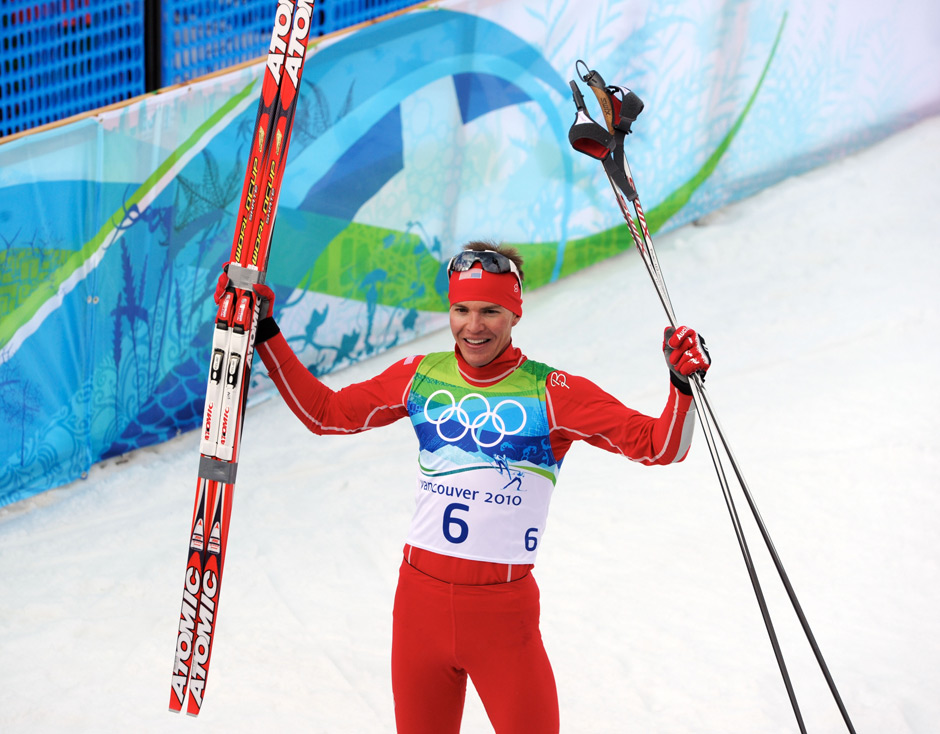
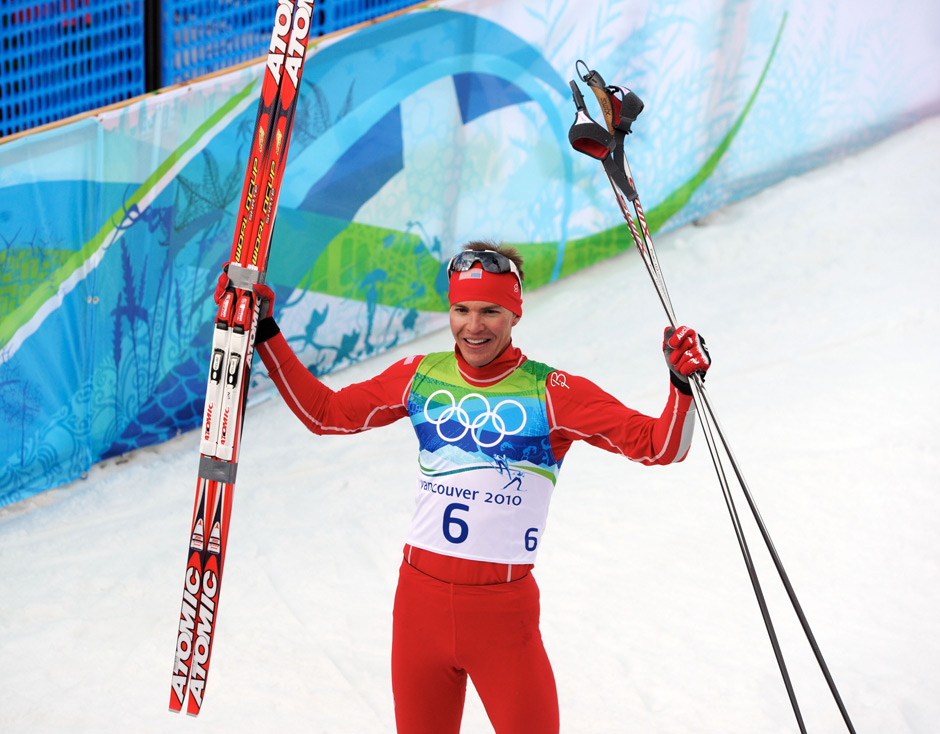
    Billy Demong after winning gold in the large hill/10 k competition at the 2010 Olympics in Vancouver, B.C.

    KRASNAYA POLYANA, Russia — It’s been almost a week since the nordic-combined Olympians did their thing in the first of three competitions at the 2014 Winter Games. Last Wednesday’s event was on the 106-meter normal hill, not exactly U.S. Nordic Combined’s favorite.

    Billy Demong led the U.S. in 24th, nearly a minute and 50 seconds behind German’s Eric Frenzel, who won the 10-kilometer Gundersen start. He had posted the 31st-best jump (tied with Finland’s Janne Ryynänen) out of 46 in the competition round, going 92.5 meters for 108.2 points. In the preceding trial round, Demong, 33, had his best jump of the season — just shy of 100 meters.

    “It’s hard to be too upset because I’ve been struggling a little bit this week on this hill,” said Demong, the defending large hill Olympic champion, after last week’s competition. “I think it’s a little flatter than anything I’ve skied before.”

    Flatter? His teammate Bryan Fletcher, who improved from 41st to 26th, for the second-best U.S. result on Feb. 12, tried to explain.

    “This is probably one of the hardest hills I’ve ever jumped in my life,” the 27-year-old Fletcher said. “The rhythm of the hill does not match how your subconscious feelings are, so it was really difficult to find a rhythm. I found it in the trial round today, but I went for it in the comp jump, tried to lay it all out on the line, all or nothing. Unfortunately it didn’t work out, but I’ll try again next week.”

    His younger brother Taylor Fletcher, who improved from 46th to 33rd, was the third American in the results. Todd Lodwick jumped to 34th — in his sixth jump after a scary crash in France in early January — but did not race in order to further heal his shoulder before the team event.

    “This hill … is … it’s hard. I don’t understand it,” Taylor, 23, said. “I think a lot of people have the same feelings. I don’t know what it is that makes it so difficult. It’s a big hill, and we’ve jumped big hills. I jumped really well last year on it. It was my best jump, my best result all year, so I know I can race that. I’m a little bit better on a big hill. I don’t know if it’s my size that allows me to do that, but I get in a rhythm on it, and I can be a little more aggressive, which you really can’t on a smaller hill.”

    Demong said there were positive takeaways from Day 1 of the Olympics: he had his two best jumps of the season between the trial and competition rounds.

    “I almost pulled off the miracle jump today — what I didn’t think was possible before today, but it was by far my best jump of the weekend,” he said. “It kind of gave me a little hope. I’ve already almost been looking forward to the big hill because I think things were pretty good there last year, and my shape’s much better.”

    The competition also gave the NoCo guys a chance to scope out the 2.5 k course they’ll race around two more times at the Olympics — with another 10 k Gundersen start after today’s large hill competition (starting at 4 p.m. Moscow time) and the 4 x 5 k team event on Thursday.

    “I think the cross-country course is a lot of work,” Bryan said. “There’s no rest on it whatsoever, and any rest is followed by a technical corner or stuff like that. You really zap the legs going in with all the hills, and if you ski the hills hard like you want to, you pay for it on the corners again, so it’s just a very cumulative course as far as energy goes.”

    Looking ahead to Tuesday’s large-hill competition, U.S. Nordic Combined Head Coach Dave Jarrett said Lodwick wasn’t a definite for the 10 k, and he was hoping the rest of his athletes would rise to the occasion on the 140-meter hill.

    “We were better than our average, but our average wasn’t good enough,” Jarrett said last week. “We need to get off to good start on the big hill. The first training jump needs to be good. There are some good things that happened: Todd jumped pretty well and tested his shoulder and I think he’ll be able to ski. [The others] jumped OK, at least they had a good jump and they’re not walking away from the small hill without any good jumps. We’re looking forward to the big hill and keeping a positive attitude.”

    With a drawn-out schedule that spaces out three competitions over nine days, Jarrett said it can be tough to stay focused — especially in a place like Krasnaya Polyana, at least an hour away from the coastal cities of Adler and Sochi. In 2010, they flew down to Park City, Utah, between Olympic competitions in Vancouver.

    “There’s nowhere to go, really,” Jarrett said of their current Olympic home base, adding that they’ve trained at the Laura Cross-Country & Biathlon Center as well.

    Sightsee? Shop?

    “Yeah, we’ve done that,” he said.

    Could the extra time help Lodwick’s shoulder?

    “Yeah, it’s good for him,” Jarrett said. “The difference between this week and next week as far as a fracture being healed is not really that much. … Rehab is going well, he’s not out of the woods yet, but if everything stays the same, he’ll be able to compete.”

    Update: After Tuesday’s jump, Bryan Fletcher led the team in 27th, Todd Lodwick was 30th, Taylor Fletcher 35th, and Billy Demong 38th.

    Current standings

  • 2011 Oslo – NoCo: US Racers Fast in the Track, Lack on the Hill

    2011 Oslo – NoCo: US Racers Fast in the Track, Lack on the Hill

    Bill Demong skied the challenging 10 kilometer course in Holmenkollen in 24 minutes and 18.4 seconds, moving him up 22 spots from 29th to seventh.

    Billy Demong heads out on course in the cross-country portion of the World Championship Nordic Combined competition.

    “The jump competition was disappointing. But I’m vying for a spot on the relay team,” Demong said with a grin. Demong won the gold medal at the 2010 Olympics in Vancouver, and was hoping for a podium Saturday, which he considered within reach on a good day.

    Todd Lodwick was the second best American, finishing in eighth.

    “The race was good, jumping was not good,” Todd Lodwick said, noting that he gave everything on the course. “It was a grudge fest out there. It was pure will at the end there,” he said.

    Lodwick pointed out that the conditions – falling snow and basically no visibility on top of steep and technical loops – made for a hard day at the office.

    The second-best ski leg (24:25.6) belonged to Felix Gottwald (AUT), who moved up from 15th place to the podium for the bronzed medal. Eric Fretzel (GER) won the competition. After delivering the best jump of the day, Fretzel was able to fend off the other racers on the course as well, even though there were plenty of racers with faster times for the ski leg.

    Spillane, like Demong, fared better on the track today.

    Johnny Spillane, who just recently returned to World Cup racing after recovering from a knee injury, felt that things were easier on the course than on the hill. Now he’s focusing on posting better results in the jumping.

    “I obviously have to jump better, and I pretty much speak for all of the team there,” Johnny Spillane said to FasterSkier after the competition. Spillane moved up from 34th to 19th on the course, and had the fifth fastest cross-country time of the day.

    Promising from the rookie

    Despite knowing he has more to offer on the hill Taylor Fletcher posted his strongest international result in a World-Cup caliber field: 26th place.

    “I am definitely happy with my race. I was able to move up quite a bit, from 39th to 26th. I caught a lot of people on the first lap, but then I skied two laps of the race entirely by myself. I never really latched onto a real group,” Fletcher said, explaining that skiing with people makes a big difference.

    “I’m hoping to build on this through the World Championships and into the end of the World Cup and finish strong in Lahti,” Fletcher said.

    Bryan Fletcher had the best jumping result of the five, starting the cross-country in 10th place, one minute behind the leader Eric Frentzel (GER) who also ended up winning the competition. However, Fletcher lost significant time on the course and dropped 12 spots to 22nd.

    Complete results here.

    Taylor Fletcher at the finish.