From the FasterSkier archive — posts syndicated from athletes’ and coaches’ own blogs between 2004 and 2012, kept online as published. Current coverage is at fasterskier.com.

Tag: Northern Michigan Univerisity

  • The Secret Weapon Is Fun: Inside Kristen Bourne’s Collaborative Coaching on the U.S. Ski Team

    The Secret Weapon Is Fun: Inside Kristen Bourne’s Collaborative Coaching on the U.S. Ski Team

    When we spoke, Kristen Bourne was sitting on the couch in her living room in Truckee, California, a small ski town she now calls home. Tibetan prayer flags hung loosely behind her, shifting gently in the morning light that poured through the window. The room felt warm and calm — the kind of quiet space that comes from someone who spends much of her year on the move. Bourne smiled easily as she spoke, her voice’s cadence unhurried, like someone grounded in both her work and the mountain rhythm around her.

    She had just returned from camp and was preparing to leave again this weekend to start the World Cup with the U.S. Ski Team. Between talk of travel logistics and packing lists, she mentioned the soundtrack that keeps her company on solo skis. “When I’m skiing by myself? Yes,” she said, grinning. “I really like skiing to Machine Gun Kelly… it kind of brings me back to the Blink-182, Sum 41 days. It feels almost like nostalgic, but newer age.”

    That small confession says a lot about Bourne, now in her fourth season on the U.S. Cross-Country Ski Team coaching staff: rooted in rhythm, grounded in joy, and always blending the familiar with the fresh.

    Joy, she’ll tell you, isn’t a garnish. It’s the point.

    Kristen Bourne, Olivia Nesbitt Bouffard, and Jessie Diggins on an afternoon run in Wanaka, New Zealand. (Photo: Jessie Diggins)

    “Happiness goes such a long way in professional sport… our secret weapon as a team is having fun. Our staff genuinely enjoys being together. The athletes genuinely enjoy being together. We love to all come together.”

    The proof, for her, is a memory from the day Jessie Diggins won the 10 K at the World Championships in Planica. The scene isn’t what the public imagines. “You’d think everybody is stressed,” Bourne said. “We were ahead of schedule, and we all just sat down in [our wax truck], Yolanda, and made instruments out of whatever we could find for, like, 30 minutes.” The room filled with improvised drums and laughter. “It was so fun,” she said. “That’s the stuff people never see.”
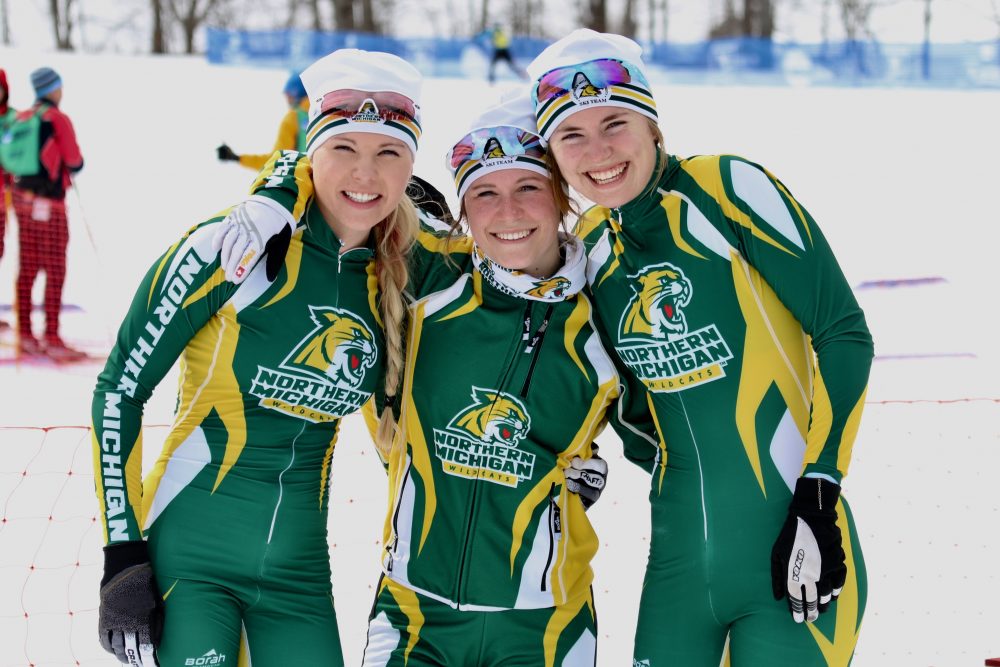
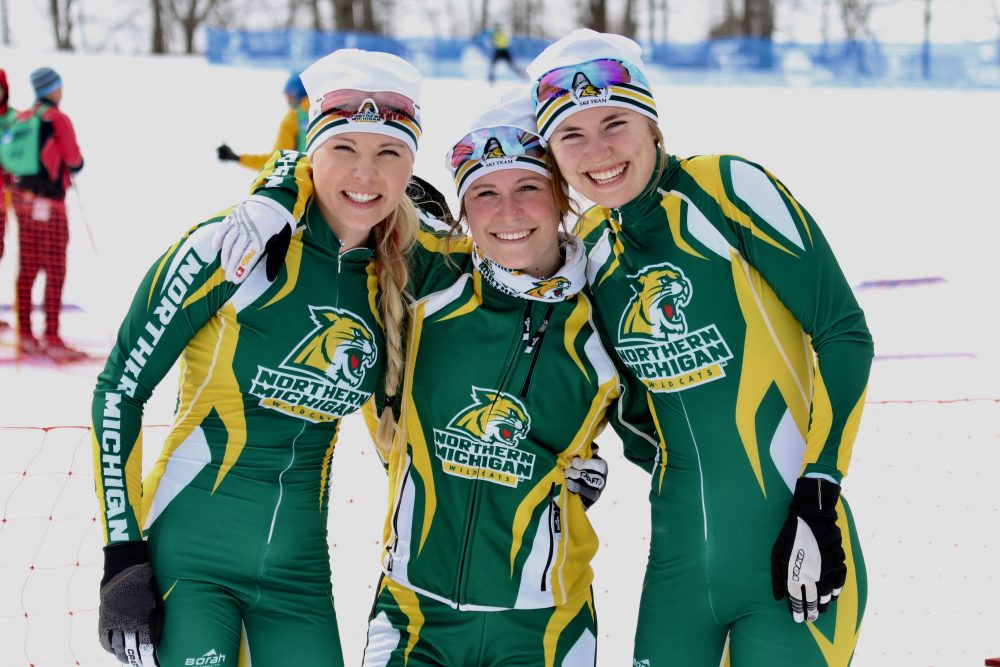
    Northern Michigan University’s Kristen Bourne (c) after the 5-kilometer classic race at the 2017 NCAAs in Jackson, New Hampshire. (Photo: Jackie Schneider)

    Minnesota Roots, and a Goal Cut in Half

    Bourne grew up just outside the Twin Cities, where endurance sport was a family language. “Our family vacations were going to [my dad’s] marathons and triathlons,” she said. She started by hopping into a mile here and there, handing him nutrition at the end of the driveway, learning the cadence and care that go into long efforts.

    Skiing arrived as a nudge. A new high-school coach was recruiting runners to cross-country ski at Mounds Park Academy. The first season was rough: “I swore I was going to quit. Every single race I did, I cried after most races,” she said. In a 5k, Jessie Diggins (then a rival in the same section) beat her by 12 minutes. Bourne’s response was characteristic—specific, measurable, gritty: next year, get that down to six.

    She continued to run and ski through high school, then headed to Northern Michigan University after spending a semester at the University of Colorado. She transferred mid-winter 2014 and skied at NMU through 2018, working under a rotation of assistants. Her path after graduation would tilt everything she thought she knew about training.

    Kristen Bourne spent time in Norway after college training with Lyn Ski / Team Obos. Bourne is pictured here racing in a Norwegian Cup race in Gålå. (Photo: Martin Riseth)

    Norway: Where Individual Plans Meet Shared Trails

    Right out of college, Bourne moved to Norway for a year and a half. She intended to ski; illnesses complicated the plan. But a concurrent internship at the Norwegian School of Sports Science opened doors into a different coaching world. Back home, she was used to “show up and the coach tells you the workout and everybody does the same thing.” In Norway, she said, “you sit down with a coach and you generate your plan… It was the first time I was exposed to individual planning—thinking about what’s best for you, not necessarily the team.”

    Interval days there could look like organized chaos: “Every single person… almost had a different workout, but people would sync up where they could.” At first, she struggled; she missed the mob grind. Then she looked around at a culture of success and realized what was happening: athletes were learning their bodies early, practicing agency. The lesson stuck. “Team workouts are also the way to go,” she said, “but giving athletes a platform to think for themselves—creating this athlete-coach collaborative experience versus coach telling athlete, ‘this is what you should do’—had a tremendous impact” on how she now works.
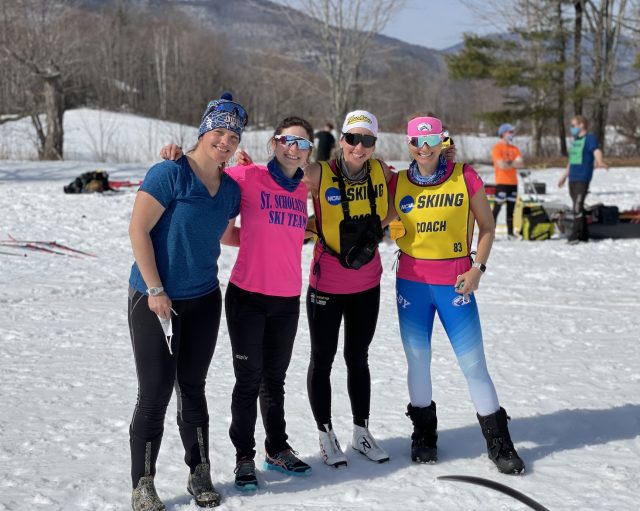
    (l-r) WSCA members Maria Stuber (then CSS), Kristen Bourne (then CSS, now with the US Ski Team), Kristen Monahan-Smith (Michigan Tech), and Tracey Cote (Colby College) at the NCAA Championships in Jackson, New Hampshire, in 2021. (Courtesy Photo).

    The Parking-Lot Pivot

    Her return to the U.S. was abrupt. She lost her residence permit—”turns out it was under the seat of my roommate’s dad’s car”—and flew home with two days’ notice, arriving just as COVID was beginning to ripple into sport. She kept racing a little, then decided she was done.

    That’s when a well-timed email—and a parking-lot shout—changed everything. Her dad reached out to Maria Stuber, who was building the Women’s Ski Coaches Association. “Maria found me in a parking lot at U.S. Nationals and yelled out her window, ‘I’m going to call you,‘” Bourne remembered. A call later, Maria offered her a position at the College of St. Scholastica and connected her with Pepa Miloucheva at the Craftsbury Green Racing Project. After two school years at Scholastica, with summers in Craftsbury, Bourne joined the U.S. Ski Team staff.

    The transition was, by her own admission, intimidating. “It was this idea of, like, how am I here?“ she said. But Norway’s reminder—that fresh eyes are valuable—kept her steady. “Just because you’re newer and have less experience doesn’t mean your ideas aren’t valid,“ she said. “You’re maybe fresher out of a ski career, you relate with athletes in a different way. There’s a lot of value in that.”

    She also learned to de-personalize the miss. “Technique feedback doesn’t always stick. That’s not a reflection of me as a coach or the athlete,“ she said. “We tried that idea; it’s fine. We’ll try something else.“ Each year, she felt more confident; more importantly, she built deeper connections.

    Julia Kern—one of the athletes Bourne works with most closely—sees that same quality every day.

    “Kristen is unique in the sense that she’s able to connect with just about any personality type on the team,“ Kern said. “One of her strengths is figuring out how to connect differently with different athletes. Every athlete responds differently and has different needs, and she just gets that. She’s very approachable and sees athletes as whole people.”
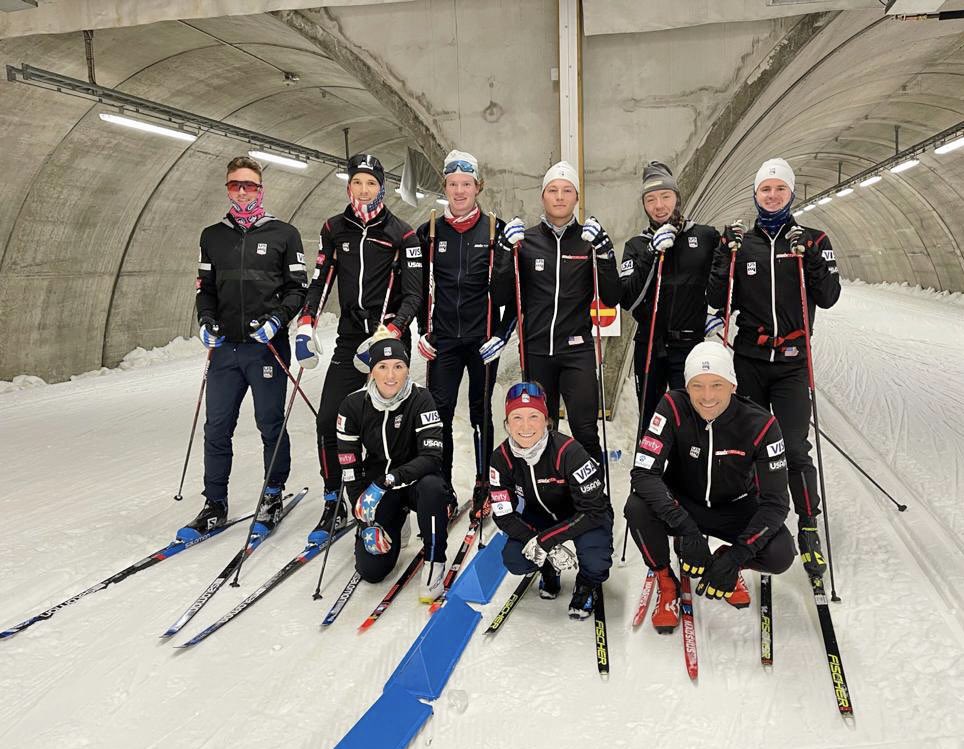
    USST athletes and coaches in the Torsby Ski Tunnel, August 2022. Back row, from left: Johnny Hagenbuch, Kevin Bolger, Finn O’Connell, JC Schoonmaker, Ben Ogden, and Walker Hall. Kneeling, from left: coaches Greta Anderson, Kristen Bourne, and Matt Whitcomb. (photo: François Faivre)

    Mentors and a Collaboration-First Culture

    Ask Bourne about mentors and the names tumble out: Matt Whitcomb, Chris Grover, Jason Cork. “From the very beginning… incredibly supportive,“ she said. “Matt will answer his phone every time. He usually likes to FaceTime… we brainstorm ideas.“ The flow goes both ways: she calls when the connection is hard; he calls when he’s stuck on something.

    Her women’s network is just as active. “Maria Stuber, hands down,“ Bourne said. “And Sam Benzing at Montana State—we coached together at Scholastica. She’s younger, but her perspective is so interesting.“ Group FaceTimes are common: Maria, Sam, Kristen, swapping angles and problem-solving. It’s not just helpful; it’s survival. “It would be really hard to be in this job and not have that,“ Bourne said. “The collaboration makes it so much more sustainable.”

    That same approach underpins her work with athletes like Kern.

    “Kristen’s helped me figure out what kind of training plan works well for me,“ Kern said. “We’ve tried some new things the last few years—different kinds of workouts, always thinking creatively. She’s open-minded, reads up on what other athletes are doing, but also thinks for herself. She’s got such a growth mindset.”

    Julia Kern and Kristen Bourne in Sjusjøen at the 2025 pre-World Championships camp. (Photo: Matt Whitcomb)

    Coaching Women, Coaching Men — and Being Seen

    On the World Cup, visibility is progress measured in inches. FIS’s women-coach bibs created access (up to two additional bibs if teams have women on staff), but change is slow. “Every year, maybe there’s one or two new women… it definitely hasn’t blown up,“ Bourne said. Old assumptions linger. “I probably get asked a couple times a year from male coaches: ‘Are you the massage therapist or PT?’“

    For Kern, Bourne’s presence is more than symbolic.

    “It’s huge,“ Kern said. “She’s one of the few female coaches on the World Cup level, and she’s down to work hard and just have fun with it too. I hope the next generation of women who want to coach feel inspired that they can do it too. Kristen’s paving the way, even in ways people might not see from the surface.”

    Bourne herself agrees that visibility matters. “You can’t be it if you can’t see it,“ she said. “It’s important for young men, too, to see women in leadership roles. Our men’s team has been incredible—they’ve never made me feel like I don’t belong.”

    Her advice to aspiring women coaches is emphatic: build a robust support community. “Ask for advice,“ she said. “It makes a world of difference.”

    Kristen Bourne and Sophia Laukli on the pre-race day at Val di Femme during the 2025 Tour de Ski. (Photo: Leann Bentley)

    Athlete Work: Julia Every Other Day, Gus and Sophia on the Radar

    Bourne’s primary day-to-day is Kern. “We’re talking basically every other day—texting or on the phone, training planning. We work very closely, very in depth,“ she said. She also monitors Gus Schumacher and Sophia Laukli.

    Kern said that beyond the workouts, Bourne has shaped the team culture itself.

    “She’s really good at encouraging athletes to bring their own sense of leadership,“ Kern said. “Not everyone is going to be outspoken—some are quiet leaders, some lead through training. She empowers people to be leaders in their own way. She creates a team atmosphere that’s a judgment-free zone. No idea is a bad idea.”

    Gus Schumacher and Kristen Bourne after his 4th place finish in the Davos sprint during the 2023 Tour de Ski. (Photo: Leann Bentley

    Season Outlook: Keep the Vibe, Chase the Team Moments

    Last year’s long illnesses made for uneasy preseason reading. This year feels different. “People are in a pretty good place,“ Bourne said. “At our camp in Utah, I would assume there would be a little more stress—it’s an Olympic year. Not at all. People were so relaxed and chill and vibing and doing their thing.”

    If there’s a metric she’d choose for success, it’s carrying that “happy momentum“ through everything—the Olympics, Lake Placid World Cup Finals. “In a year with so many eyes on cross-country skiing, that would be massive,“ she said.

    Results still matter, of course. And she lights up talking about the collective ones. “It would be so awesome to see success in team events,“ she said. “Relay and the sprint relay—those mean so much when it’s a collective team event. We want to do well there.”

    Lucas Wilmot, Kristen Bourne, Murphy Kimball, Tabor Greenberg in Bend, Oregon 2025 after wrapping up the first L3 intervals at camp. (Photo: Leann Bentley)

    Representation, Purpose, and the Long Run

    There’s a moment near the end of our conversation when Bourne zooms out to the why. “We are very deeply intertwined in another person’s process and journey,“ she said. “What an absolute privilege to be part of that. It’s impossible not to come to absolutely love and care so much about these people.”

    Kern echoed that sentiment from the athlete side.

    “Kristen understands there’s life outside of skiing,“ Kern said. “She also knows what it takes to be one of the best in the world—and when it’s time to step away. She helps us stay grounded.”

    Five years from now, Bourne hopes she’s doing exactly this, just deeper—”coaching, getting to know these athletes more and more.”

    And she hopes the picture around her looks different: more women coaches on staff, on other staffs, in other sports at U.S. Ski & Snowboard; more women wax techs. “If I can have a tiny ounce of contribution into changing that,“ she said, “I’d be so, so happy.”

    Kristen Bourne and Colin Rodgers out for a run during the OD run at Park City camp, 2025. (Photo: Matt Whitcomb)

    Purpose, Rhythm, and Joy

    As our conversation wound down, Bourne slightly rotated her position as the light spilling through the window shifted—yet still filtering across the prayer flags behind her. She laughed when she mentioned her must-pack item: heated socks for Finland. “I get cold fast,“ she said. “Those are my best friend.“

    There’s rhythm in that, too: warmth, joy, and purpose, all braided into one.

    Because for Kristen Bourne—and for the athletes who work with her—the secret weapon really is fun.

    Leann Bentley, Kristen Bourne, and Bernie Nelson at Val di Fiemme the morning of one of the last stages of the 2024 Tour de Ski. (Photo: Matt Whitcomb)

    Love Stories Like This? Help Keep Them Coming.

    Feature interviews like this one take time, access, and care to produce. If you value thoughtful storytelling and independent ski journalism, please consider becoming a Voluntary Subscriber. Your support directly fuels the work we do to cover the people, places, and moments that make our sport special.

    Join the FasterSkier community!
  • CCSA Skiers Excited to Start Their Season This Weekend

    CCSA Skiers Excited to Start Their Season This Weekend

    This article was made possible through the generous support of our voluntary subscribers.  If you would like to see more collegiate coverage like this, please support FasterSkier with a voluntary subscription.  

    By: Francesca Kitch

    The Central Collegiate Ski Association (CCSA) is composed of six competing schools spanning the Midwest. Each season there are four CCSA invites–weekends full of racing–and this year, these competitions are set to begin this Saturday. The first three US Nationals races in Anchorage, Alaska, also counted towards CCSA competition; the skate 10k was scored as an NCAA qualifier, while the classic sprint and 20k classic mass start served as an opportunity to accumulate points toward team standings. Although the CCSA is a small conference, it doesn’t lack enthusiasm. Spectators travel all over the Midwest–and even to Alaska–to watch their athletes race.

    Across all NCAA conferences–the CCSA, Eastern Intercollegiate Ski Association (EISA), and Rocky Mountain Intercollegiate Ski Association (RMISA)–distances and techniques are standardized. Every two years, the distance races at NCAA Championships alternate between skate and classic, and the races at the invites reflect this change. This year, the 20k mass start at NCAA’s will be skate and the 7.5k will be classic, so the CCSA qualifying races will consist mostly of 20k classic mass starts and 7.5k individual classic races. From the points earned in these races, skiers will be ranked within the CCSA, and the top 6 athletes of each gender will qualify for the NCAA Championships to compete in Hanover, New Hampshire, this March. 

    Women lining up for a 20km classic mass start last season. (Photo: Tryg Solberg)

    The CCSA invite this weekend will be hosted by the University of Wisconsin at Green Bay. The Green Bay team has undergone an impressive transformation from 4 years ago when head coach Sam Meyers started the job. With a full roster of 3 men in 2021, Meyers has built up the program to now carry 17 athletes (9 men and 8 women) for the 2025 season. “This is the first year that we’ve had an upperclassmen-heavy roster…it feels like everyone has a really good understanding of how we operate as a team.” Meyers is encouraged to see how helpful the team captains have been in the seamless running of the team and how this has aided the overall maturity of the team. “We work really hard, we have big goals. But we also remember that skiing is fun.” Meyers adds, “One of the big things I look for in recruits is someone that just simply loves the sport of nordic skiing, and that’s a big factor in creating the culture that we like….not only good skiers but love working hard and being outside.” Meyers predicts strong performances from senior Ryan Themie and Junior Noah Erikson, the two top finishers on the men’s team from last season, finishing in 15th and 23rd, respectively, in the CCSA rankings. On the women’s side, Sophomore Lily Franzen is looking to improve on her performance from last year as the leading women’s skier for the team, and Meyers is excited to see what freshman Hedda Samuelsson has to show. 

    Men from Michigan Tech enthusiastically cheering on the women in a CCSA invite last season. (Photo: Tryg Solberg)

    Michigan Tech Head Coach Tom Smith looks forward to another season with his team, excited by individual standouts and a promising team as a whole. Michigan Tech finished 13th at NCAA’s last year, the highest rank of the central conference, despite being hindered in the rankings by its lack of an alpine team to supplement the nordic team’s scores. “I’m proud to say we have an amazing team, and that’s because we have amazing people that make it what it is!” Smith stresses the importance of the balance between student and athlete as well as competition and fun. “We have two overarching goals for our team: to always work for improved performance…and above all, for our student-athletes to love their experience as a member of the team!” 3 time NCAA Championship qualifier Colin Freed is having a standout Senior season so far with top 15 finishes in the Cable Supertour and a CCSA win in the 10km skate race at US Nationals. On the women’s side, Smith highlighted Marie Wangen, Alice McKnight, and Greta Hansen as promising this season. Wangen skied into the semi-finals of both the skate and classic sprints at US Nationals as the top CCSA finisher and skied similarly well at the Super Tour in December with a top 6 performance. Of McKnight, Smith says she has “really made a performance jump in her senior season” with the first CCSA podium of her career in the 10km skate race at US Nationals. Hansen has been consistent all-around with CCSA podiums in distance races so far this season and finished as the 5th U23 American in the skate sprint at US Nationals. 

    St. Olaf’s team has come into new leadership this year with head coach Tor Hanson, a recent graduate of St. Olaf himself (‘23) who stayed on as an assistant coach last season. Hanson describes that “working from the team Brochman provided and now laying down my own foundation, I’m incredibly encouraged by the development seen amongst our team.” The team has indeed been making their mark on the local and international stage: Senior Lily Hubanks and Sophomore Amaeli Kam-Magruder are currently in Italy for the World University Games after impressive performances at the Cable Supertour. Hansen is encouraged by the incoming speed of the first-year class on both the men’s and women’s teams, and combined with the experience of older members of the team, it will be interesting to see how the season progresses.

    Jason Kask, Head Coach for the College of St. Scholastica (CSS) team, started his job in the fall of 2023. “With an excellent freshman class and our veterans in great form, it’s shaping up to be a fun winter,” Kask remarks. Senior captains Chase High and Mae Whitcomb have bright seasons ahead after a great year of training and some promising early-season results. Freshman Leevi Tarjanne and junior Greta Leitheiser also look promising after the Supertour, Leitheiser coming home with multiple top 20 finishes and Tarjanne with top 30 performances. “We are excited to see their hard work in the off-season shine this winter.”

    Northern Michigan University men’s team is all smiles after winning the conference title last season. (Photo: Tryg Solberg)

    Northern Michigan University is consistently a top school in the CCSA, and last year their men’s team won the conference title. Sophomore Henriette Nilssen was last year’s highest-ranked CCSA woman and currently leads the standings after a CCSA win in the 10km skate at US Nationals. Her teammate, Senior Victoria Dybwad, was the third CCSA finisher last season and finished second in the 10km at US Nationals. Junior Luke Fricker was last year’s top men’s skier and finished second place in the US Nationals 10km skate. Sophomore Adrik Kraftson finished the podium off in the skate 10km at nationals in 3rd place. 

    St. Cloud University will also participate in these invitationals, but currently only has one member of the women’s team, and no men. Head coach Mike Schroden was unavailable for comment. 

  • Ian Torchia: An Early Retrospective as he Retires from Professional Skiing

    Ian Torchia: An Early Retrospective as he Retires from Professional Skiing

    Ian Torchia crosses the finish line at a 2021 World Cup in Falun. Torchia announced his retirement last week following the American Birkiebeiner. (Photo: NordicFocus)

    Skiing-wise, Ian Torchia has nearly done it all. And now, in life, he’s ready to do some more.

    In an Instagram post following the American Birkiebeiner, Torchia announced that he is retiring from professional skiing with his trademark blend of gratitude and humor, saying, “In the end I won’t remember the races won (a few) or lost (many more) but the lifelong bonds of teammates, the support of friends and family, and how special the ski community as a whole is.”

    Heading into retirement, Torchia seemed to take a victory lap through the Midwest marathon circuit, starting with a win in the 37 k classic City of Lakes Loppet in Minneapolis on February 5th. He then went back-to-back to the following weekend at the Mora Vassaloppet, winning both the 48 k skate and classic races within one weekend. At the Birkie on February 26th, Torchia finished 5th in the 50 k skate, roughly 15 seconds behind the winner, Gerard Agnellet of France. Not a bad run.

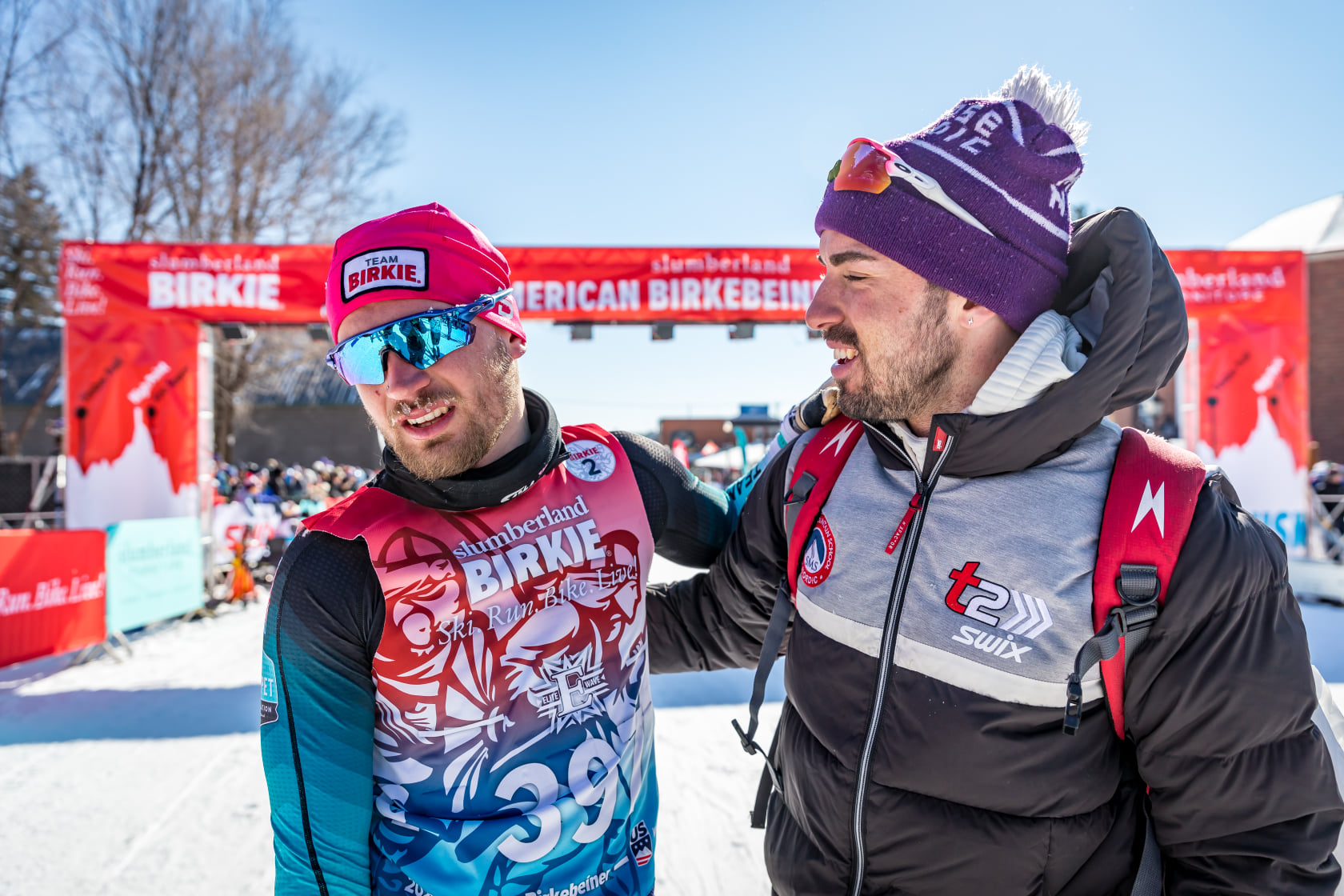
    Ian Torchia congratulates his former NMU teammate and friend, Leo Hipp, as he catches his breath after winning the 55k classic at the 2022 American Birkie. (Photo: ©2022 American Birkebeiner Ski Foundation)

    That skiing contains truths about how to live a good life is not a unique notion, but Torchia had a one-of-a-kind knack for finding those truths and sharing what he learned. He also did so, of course, while racing very fast. Torchia lived out the wildest dreams that every young Midwestern kid has when lined up for the Junior Birkie – coming from Rochester, Minnesota to win a junior national title, ski for legendary coach Sten Fjeldheim at Northern Michigan University (NMU), add to that program’s legacy by winning a NCAA title in 2018, be nominated to the US Ski Team, race the World Cup, win the Birkie in 2021, and become training partners with some of the best athletes in the US, like Jessie Diggins.

    It’s been a busy path that’s seen him in constant movement. But that suits Torchia.

    When FasterSkier caught up with him less than a week after his announced retirement, he was stepping out from a visit to the St. Louis Aquarium on a day trip with his brother’s kids. Already on the move, Torchia was gracious enough to share what’s next, and what, in these early days of retrospection, he has learned from our sport.

    This interview has been edited for length and clarity.

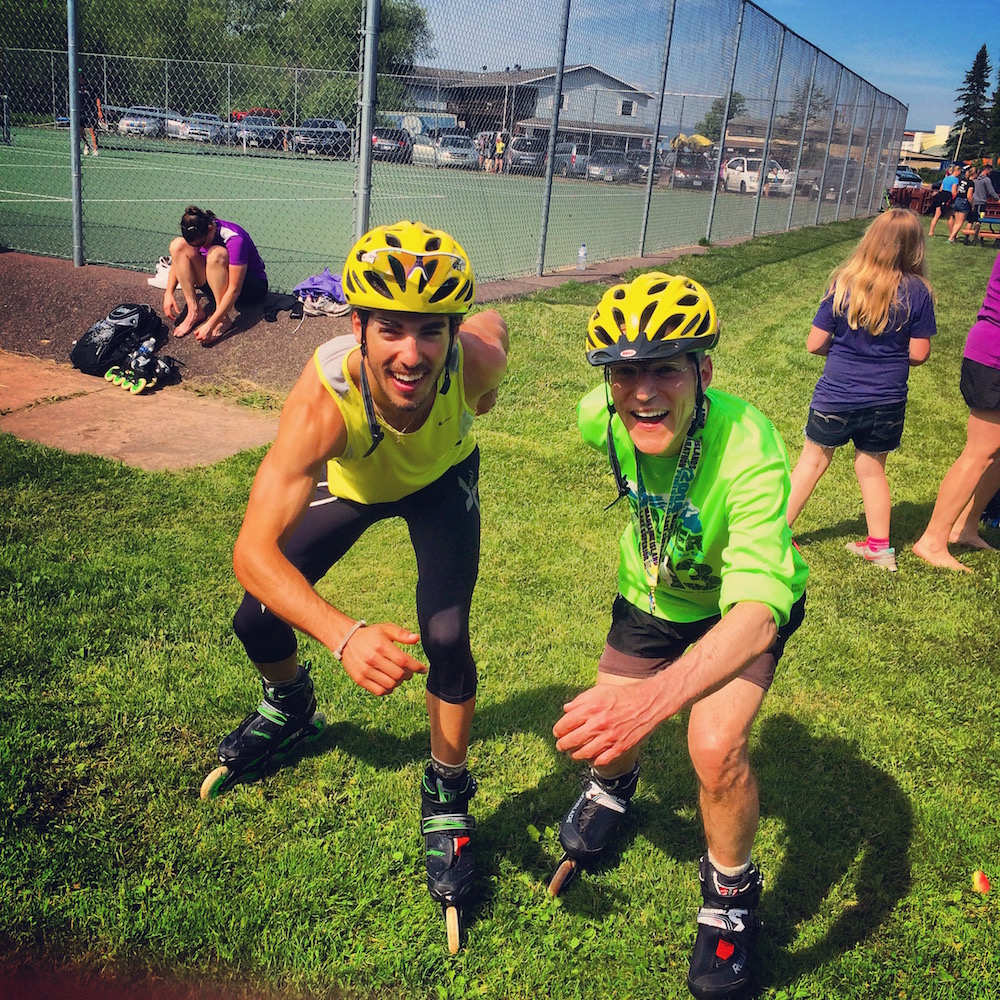
    Ian, and dad, Mike Torchia at an inline skate race on Madeline Island, Wisconsin, in 2016. Torchia wrote on his dad’s advice at the time: “‘You know what happens to hot dogs, Ian? They get eaten!’ – Mike Torchia
    While my dad (affectionately called Sir) has given countless gems of advice, the above is one that I remember the most as he has always emphasized humility in the face of success.” (Courtesy Photo)
    On the decision to retire and what comes next:

    Ben Theyerl / FasterSkier (FS) : Starting with a pretty simple question; how are you feeling right now?

    Ian Torchia (IT): I’m feeling great. I’m in St. Louis with my brother’s family and their five kids. It’s been a little bit of a whirlwind. I’m just taking a week off – not running or doing anything which I haven’t done in a long, long time. But I’m just feeling very energetic about what’s next.

    I’m looking forward to a second interview for a job right now. I want to get some experience as a medical scribe before going to medical school to become an osteopathic physician. Between that, taking the MCAT, and a few prerequisites, it’s going to be a busy next two years.

    FS: I know you just retired, but have to ask, any plans to throw your hat into citizen races the rest of the season?

    IT: Maybe the Great Bear Chase. Realistically, my next race effort is going to be in Marquette, MI with my college buddies. There’s a route [in Marquette] where you go down County Road 510 to the Lake (Superior) and back, it’s 18mi or so, and we’ve wondered whether on an icy day you could do it in under an hour.

    FS: Have you thought about what racing looks like next season for you?

    IT: I want to do Senior Nationals in [Houghton, Michigan]. I wouldn’t do it if it wasn’t in Houghton (Torchia is based out of Ann Arbor, MI). And probably, the Birkie.

    FS: Which races would you want to race again at Nationals? Like are you targeting the 30 k, or have you thought that far yet?

    IT: I mean, I had a lot of fun with sprint’s this year, and I qualified for my first final at Nationals, so while I haven’t thought too much about it, I’m going to miss doing those types of races so why not do one more? It’s more just that I want to do the races that I know that I like racing. A shorter, classic race is not really my forte, but like a longer classic race, or a skate marathon, I’m game. I think it’s a skate 30 k at Nationals next year, so that would be cool.

    FS: With your goals set towards medical school, have you put any thought towards where you’d like to go?

    IT: This is all early, but Pacific Northwest University in Yakima, Washington has an osteopathic school, and I think it’d be really cool to move out West for four years. But Kameron and I (Torchia’s wife) have definitely talked about coming back to the Midwest when everything’s said and done. And specifically, Marquette. We just love that place so much.

    FS: Backing up, what was the process of coming to the decision that now is the right time to step away from professional skiing?

    IT: I think it started at the beginning of the training season in May. I talked about it with my wife, and we both agreed that I should give it my best shot to qualify for the Olympics, because that’s always been my goal. At the time we also looked out beyond this season and said, ‘you know, the journey to become a doctor is a long one,’ and I need to get started at some time. I wasn’t thinking beyond this season with skiing, and personally, I was okay with that.

    A lot of it comes down to just wanting other parts of my life. It’s hard being away from Kameron and our dog. I give a lot of props to the members of the US Ski Team who are away from their loved ones for four to five months every winter. It’s hard to do it, and yeah, one big reason to retire was actually being able to live with my wife.

    Number two is, and I don’t want it to be misconstrued, but skiing at a professional level means being a little selfish – it is a big focus on you and yourself, and everyone around you is working for you. I think about life, and at some point, I wanted to step back and give back, and I think that’s the main goal I have now. My goal to become an osteopathic physician is based around helping others, and there’s a lot of cool things in skiing to do that work on inspiring the youth and inspiring each other.

    FS: Yeah, on the skiing end, I think I can say I’m sure there’s at least a hundred kids who would sign up for an “Ian Torchia skate clinic” at Wirth Park (in Minneapolis) anytime.

    IT: (Laughing) Well, thanks. That’s something I want to try to bring here, actually, to Ann Arbor and downstate Michigan. When I go skiing on the one snowmaking loop around here, I really don’t see that many kids out. So if in these next few years, I could get something going where I can help bring even more kids out from Detroit and get them on skis, it would be really cool. I’d love to do that.

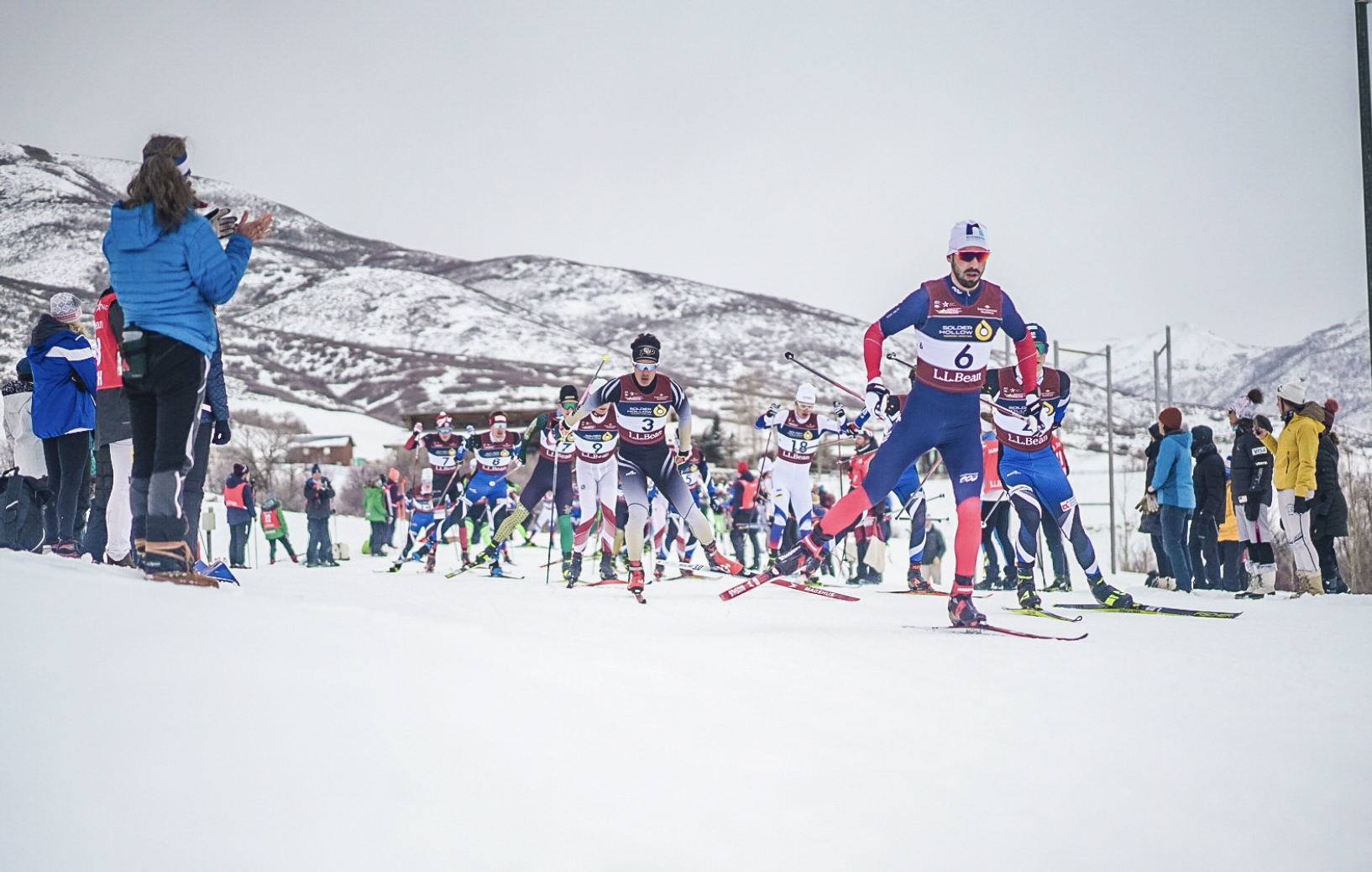
    Ian Torchia leads the charge at the start of the men’s 30k mass start freestyle in Soldier Hollow at 2022 US Senior Nationals. (Photo: Tobias Albrigtsen / @untraceableg)
    On a life, so far, spent skiing:

    FS: I know it’s early, but I wanted to go all the way back and get your retrospective on your time in skiing, if you’re okay with that?

    IT: Oh that’s all I’ve been thinking about, so yeah.

    FS: You’re from Minnesota, which is pretty well-known, but what’s glanced over is you’re from Rochester, which is I-90, not I-94 — it’s south of most of the ski leagues and big clubs. Coming from there, what drew you to Nordic skiing over say, running, which you and your older brothers were also very successful in?

    IT: I credit my mom for starting all of this. Like, they put me on skis the day before I turned two, apparently, and I definitely don’t remember that.

    Beyond that, my parents started the high school team here in 2000 when I was five. I have four older siblings who are all four plus years older than me, and so since my mom had no choice but to bring me along, I was an honorary member of the team. That Rochester team has just grown and grown over the years – right now there’s like 200 kids every year and over half of those are newcomers who just want to try it out. I think they’re getting their first snowmaking loop now, which with the way things are going is important to being able to have a place to ski [in Rochester].

    It was an unusual place to start skiing. My family was building the team, and I got to help build the trails. I look back and it may be what led me to love skate more than classic, since we didn’t have classic trails in high school.

    I loved it. It was unique, but I wouldn’t have changed it for the world.

     FS: Then from there it was a Junior Nationals title, the Northern Michigan (NMU) team, NCAA championships, the US ski teams, the Birkie win. You’ve seen a lot of the sport. What does that journey look like from where you’re sitting right now?

    IT: (pausing) I mean, yeah, it really is just looking back on it all. It sounds funny to say, but I look at that Junior Nationals title my junior year of high school as a pivotal moment in my life. I give a lot of credit to Sten Fjeldheim who met with me like a week after that happened. I was thinking I was going to run in college, and I ended up winning my first junior nationals race, he sent me an email, and the rest is history. It’s the one moment I look back on and go, where would I be now?

    So I guess I would say to Sten, ‘Thanks for finding me and putting me on the path I’m on.’ I’m grateful for everyone who’s helped me out on the way. The support, as I look back on it, is insane. My best friends have come from skiing. My wife – I wouldn’t know her if it wasn’t for skiing (Kameron and Ian were teammates at NMU). It’s shaped my life.

    Yeah, I’m done with the professional side of it, but I’m going to be doing the Birkie for many years to come.

    FS: To return to that moment, you mentioned Sten and NMU. That’s a big legacy in Midwestern and US skiing that you were instrumental in sustaining. What made Sten and that experience special?

    IT: I was just getting a massage from this guy in Marquette, and we were talking about Sten, and my masseuse of all people was like, ‘man, Marquette would be a different place if Sten Fjeldheim had never been here.’ And it’s so true. He transformed not only the Northern Michigan team into a powerhouse but helped make Marquette a skiing community. And he’s just a force of nature. The first time I ever talked to him, even across the phone, I was getting fired up. As soon as I hung up the phone, I wanted to ski for that guy. He has a way of lighting a fire inside you and getting you to be your best self. I definitely miss being coached by him. 

    Marquette is my favorite place in the world and I’m lucky to say that it’s my wife’s too. It just has everything that you could ever want. Every year, it seemed I would find a new thing that I was like, ‘Oh my gosh, you can do this here.’ Freshman year it was just running on trails all the time, the next it was mountain biking, and the next I discovered surfing on Lake Superior. It’s a cool playground with a Midwest community and a Midwest vibe, and it would be great one day to return there. I have a pipe dream that my friends could all live next to each other, and yeah, that would just be too good to be true.

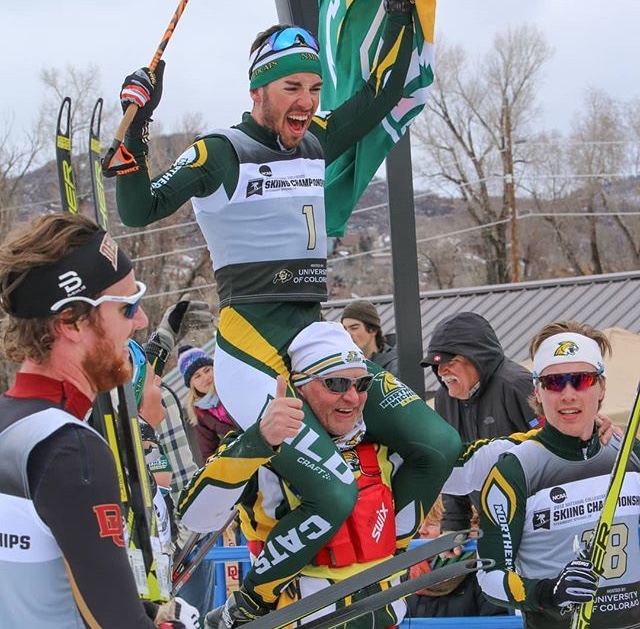
    Ian Torchia (1) on the shoulders of Northern Michigan University Head Coach Sten Fjeldheim after he won the men’s 20-kilometer freestyle race at 2018 NCAA Skiing Championships in Steamboat Springs, Colorado. (Courtesy photo)

    FS:  That’s going to be quite the lineup in the waves out there.

    Both talking here and reading back on a few interviews you’ve done with FasterSkier, I keep being struck by just how much you seem to revel in both the sport of Nordic skiing, and the people who you do the sport with. A couple of years ago, you said [to FasterSkier] that one of your all-time favorite moments was having three All-Americans from NMU in the same year with you, Adam Martin, and Jake Brown.

    What is special about nordic skiing as a sport for you? What’s been at the center of the sport for you as you kind of climbed up its ranks?

    IT: It sounds cliche, but it’s not the destination. It’s the journey along the way. My favorite memories are out, training on the roads, doing three-hour ODs, the trails and the van rides.

    It’s crazy people who love to be out in crazy weather pushing their hardest. Like, you don’t need any team bonding activities when you’re out on a rainy cold three-hour OD. That’s the thing bringing you together.

    FS: Two-part question: Looking back over everything, what’s one – your favorite result? And two – your favorite moment?

    IT: Favorite result; winning NCAAs was really special. It wasn’t the hardest I’d pushed in a race, but the tactics are what I’m really proud of. I think oftentimes I feel like I have a responsibility in a pack to go hard, and so it was a testament to my teammates that a sprint developed there and I was able to come out on top.

    Favorite moment: The Birkie Classic [last year] because I hadn’t won the day before (the 2020 Birkie was raced over four days, with a Saturday race featuring an elite skate race, and a Sunday race featuring an elite classic race) and there were just crazy conditions. I bonked and pushed through it.

    FS: I mean, I’ve been on the Birkie trail all my life, and watching you trudge through those conditions (a couple of inches of new, wet, heavy, snow covered what was essentially ice during the race) was one of the crazier scenes I’ve ever seen.

    IT: It was hard to understand-type ‘crazy.’

    FS: Picking the Birkie as a favorite moment reminds me that you’ve really been one of the more fun athletes to watch at that race the past couple of years. Not only last year, but also the year before — I have to imagine skiing with Niklas Dyrhaug was pretty cool.

    IT: Oh yeah, thanks for bringing that up. I was proud of that one too, because I was having cramps about halfway through and pushed through those and just kind of stayed in it. I wasn’t battling it out with Dyrhaug at the end, but got into a sprint for second and ended up with it. That was definitely a special race too.

    I mean, just doing this is making me realize there’s many little special moments along the way. Just a lot of special moments…

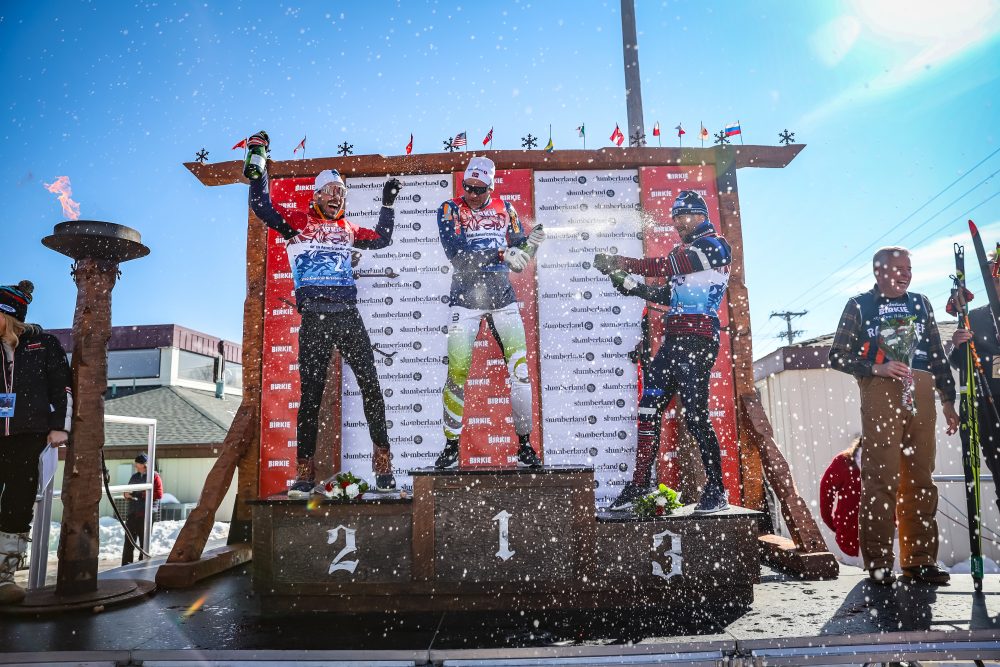
    American Birkebeiner skate 50 k podium in 2020, (l to r) Ian Torchia second, Norway’s Niklas Dyrhaug first, and France’s Robin Duvillard third. Torchia would follow up his 2020 race by winning the Birkie Classic in 2021. (Photo: ©2020 American Birkebeiner Ski Foundation)

    FS: Which brings you to where you are now. I know that’s a lot of big questions but…

    IT: I should also say that Stratton (Mountain School) was huge the past couple of years. I hadn’t had a great last year of college, but they still brought me on the team and that was just the most unique experience. Getting to learn alongside Jessie (Diggins), Simi and Sophie (Hamilton), and Kyle Bratrud. Pat (O’Brien) especially drew me to that team. It was just like Marquette with it being another special pocket of the world in Vermont where Nordic skiing is just the thing.

    FS: Yeah, like you just rattled off being teammates with Jessie, Sophie, and Simi – that’s three of the most influential athletes in US skiing history right there…

    IT: I mean, yeah. I have an Instagram post about it from right after Jessie won the silver (medal, in the Olympic 30 k freestyle). I had a matched interval bounding workout last fall where I was at threshold, and she had max. five-minute sets. We’re fifteen seconds into the first one and she was already breathing like a truck. Then she just keeps it pinned there for the next, I don’t even know, thirty or thirty-five minutes.

    I was watching the Olympic 30 k live and was like, ‘Oh my gosh, I’ve seen this film before.’ When you see her doing that on the television, it’s pretty cool. When she’s right next to you it makes you go, ‘Ok, if I want to be that good, I have to work this hard.’

    FS: She goes out and turns in a performance that’s not just the iconic moment of the Olympics for skiing, but for the whole country. That’s a pretty unique way to experience it.

    IT: Just one of the coolest.

    FS: So, after all that then, do you have any other thoughts?

    IT: I’m just lucky, and happy…and probably gotta get back to the aquarium. 

    FS: Well then, I’ll end by saying congratulations from all of us out there in skiing.

    IT: Thanks man. Thanks everyone.

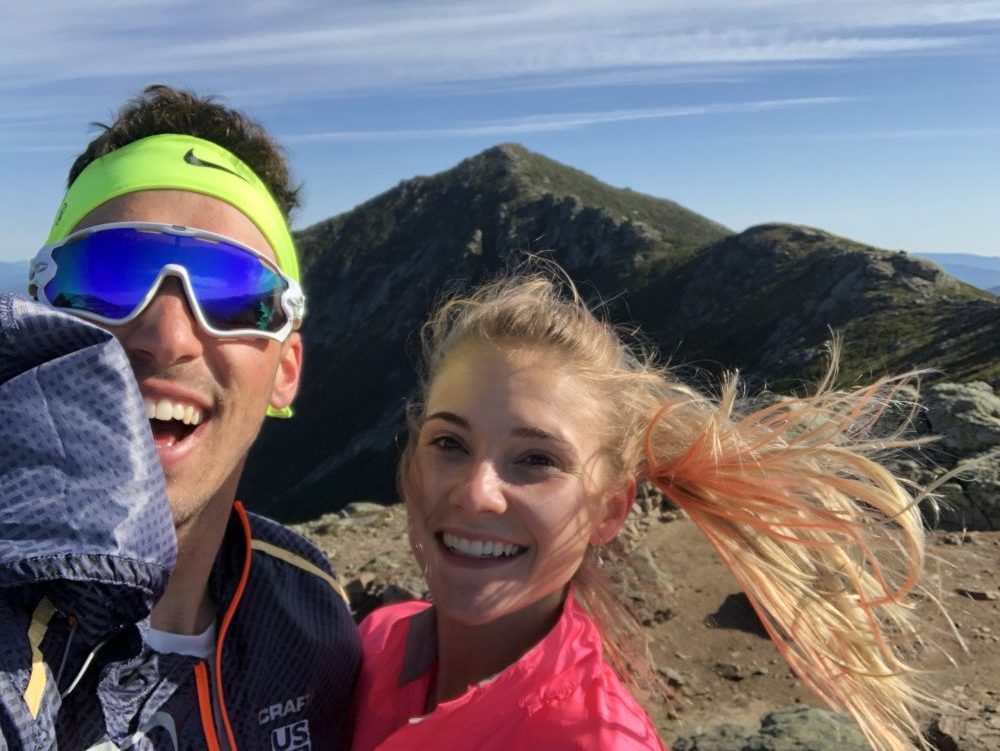
    Ian Torchia (l) with wife Kameron hiking in Franconia Notch, N.H. in 2018. (Courtesy photo)
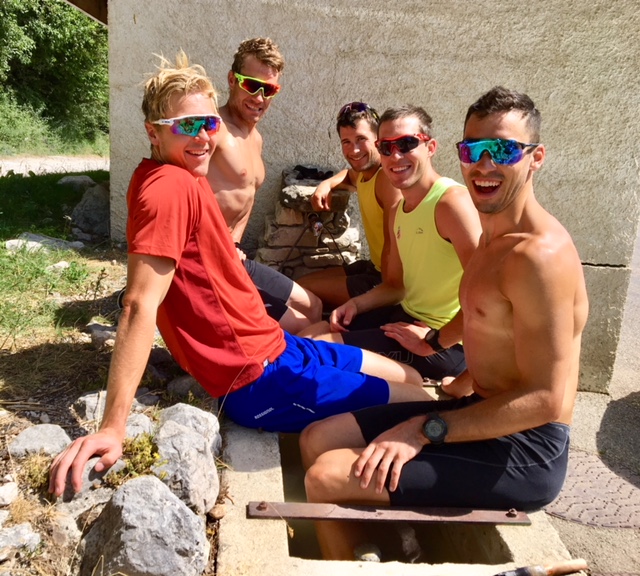
    Right to left: Ian Torchia, Paddy Caldwell, Adrien Backscheider, Simi Hamilton, and Erik Bjornsen during a post-interval cool down in Villard-de-Lans, France in 2018. (Courtesy photo)
  • Northern Michigan University Seeking Head Coach

    Northern Michigan University Seeking Head Coach

    Northern Michigan University is seeking applications for a Head Coach for Nordic Skiing. The positions will direct, organize, coach and administer the men’s and women’s Nordic skiing program.

    Minimum qualifications: Bachelor’s Degree or an equivalent combination of education and experience. NCAA learning portal proficiency, or pass within one month of hire. Possess a current CPR certification or have the ability to obtain upon hire. Demonstrated successful Nordic skiing coaching experience as a head coach or an assistant coach at the professional level, NCAA Division I, II or III level or as a head coach at a junior college, elite club or high school level. Demonstrated commitment to the academic success of student-athletes. No prior involvement with NCAA major rules violations. On- and off-campus recruitment of student athletes.

    Required knowledge/skills/abilities: Education and Training-Understanding NCAA bylaws. Knowledge of principles and methods for curriculum and training design, teaching and instruction for individuals and groups, and the measurement of training effects.
    Administration and Management-Knowledge of business and management principles involved in strategic planning, resource allocation, human resources modeling, leadership technique, production methods, and coordination of people and resources. Instructing- Teaching others how to do something. Oral and Written Communication-Active listening, speaking, and writing which ensures comprehension and understanding in both the speaker and target audience. Time Management-Managing one’s own time and the time of others. Social Perceptiveness-Being aware of others’ reactions and understanding why they react as they do. Coordination-Adjusting actions in relation to others’ actions. Monitoring- Monitoring/assessing performance of yourself, other individuals, or organizations to make improvements or take corrective action. Critical Thinking-Using logic and reasoning to identify the strengths and weaknesses of alternative solutions, conclusions or approaches to problems. The ability to organize effectively. The ability to tell when something is wrong or is likely to go wrong. It does not involve solving the problem, only recognizing there is a problem. The ability to come up with unusual or original ideas about a given topic or

    situation, or to develop creative ways to solve a problem. The ability to establish a good rapport and effective working relationship with student athletes, coaches, assistant coaches, administrators, college faculty and staff, alumni, professional colleagues, and the general public. The ability to actively look for ways to help people. Expertise with video editing systems. The ability to work effectively under stressful and high-pressure situations. The ability to develop knowledge of, respect for, and skills to engage with those of other cultures or backgrounds.

    The position is variable shift/variable days depending upon playing schedule, recruiting demands and department events. The salary is commensurate with experience.

    Northern Michigan University, with 7,900 students and 177 degree programs, is located along the shore of Lake Superior in the vibrant, historic city of Marquette, consistently named a top

    spot in the nation to raise a family, vacation, and enjoy an excellent quality of life. See more at www.nmu.edu/marquette. For a summary of the benefits offered by Northern Michigan University, visit https://nmu.edu/hr/benefits and under summary of benefits, select administrative professional.

    Submit NMU staff application, cover letter and resume utilizing our on-line application process by accessing https://workatnmu.nmu.edu. All required application materials must be submitted electronically by May 6, 2021.

    NMU is an equal opportunity, affirmative action employer of protected veterans and individuals with disabilities, and is strongly committed to increasing the diversity of its faculty and staff.

    Ian Torchia (1) on the shoulders of Northern Michigan University Head Coach Sten Fjeldheim after he won the men’s 20-kilometer freestyle race at 2018 NCAA Skiing Championships in Steamboat Springs, Colorado. (Courtesy photo)
  • Nordic Nation: The Recovery Episode with Tad Elliott

    Nordic Nation: The Recovery Episode with Tad Elliott

    Back in January 2016, Tad Elliott emerged back onto the national championship scene with a win in the men’s 30-kilometer freestyle mass start at U.S. Nationals in Houghton, Mich. It had been some time since the skier originally from Durango, Colorado had felt unleashed from the grips of the energy-sapping Epstein-Barr virus.

    Elliott went on to make the 2017 Nordic Ski World Championship team in Lahti, Finland. There, it was hard to miss his stunning effort firing up the first big climb out of the stadium as he skied the third leg of the U.S. men’s 4 x 10 k relay. Talk about lightness and upward momentum. In Lahti, he also notched a 27th in the men’s 50 k skate. He is a former member of the U.S. Ski Team and a three-time World Championship team member. (Let’s not forget this is a two-sport athlete. On two-wheels, Elliott crushed as an elite mountain biker. He won two U23 National Championship in mountain biking.)

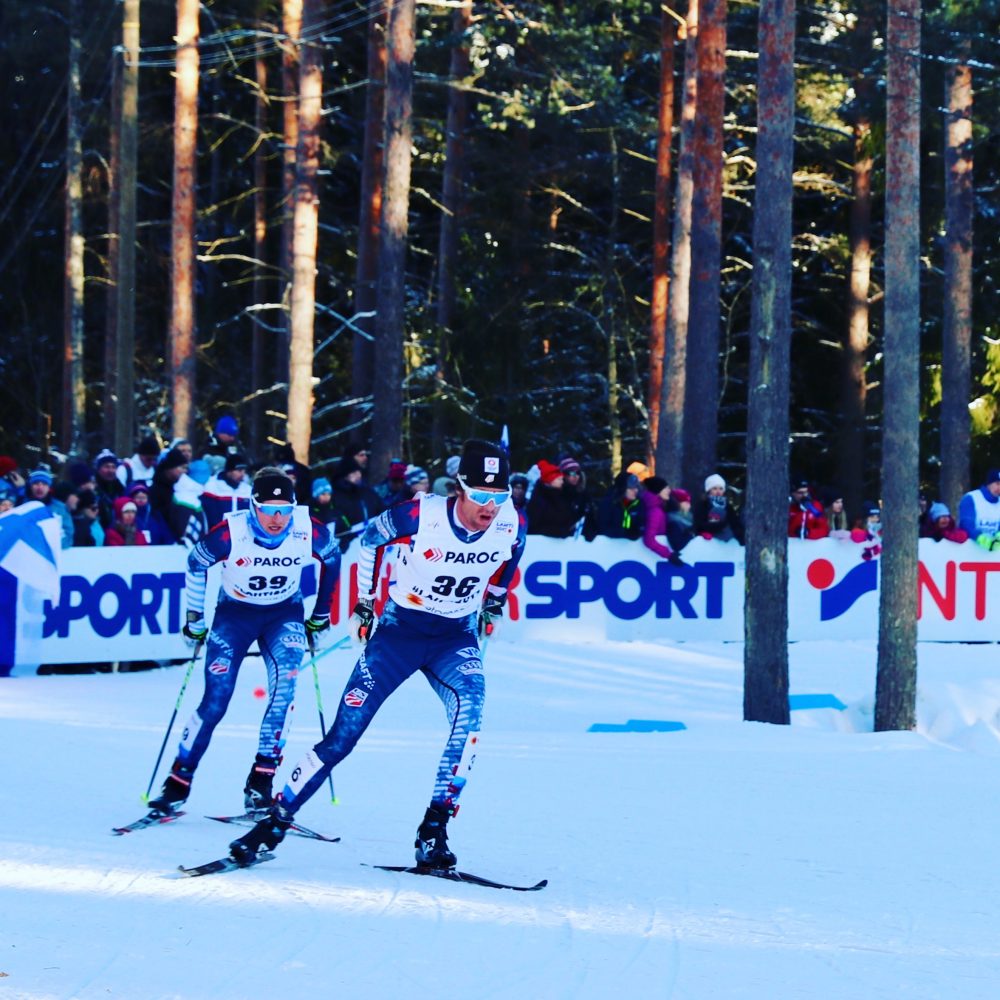
    Tad Elliott (bib 36) and Kyle Bratrud (bib 39) during the men’s 30-kilometer skiathlon at the 2017 Lahti World Championships. (Photo: Matt Whitcomb)

    Known as one of the finest skate skiers of his generation, Elliott’s upward trajectory unraveled in 2013 as he began struggling with symptoms of the Epstein-Barr virus. The winner of multiple national championships, Elliott began literally walking towards a life and a career premised on rest and recovery with the occasional aerobic stimulus to gradually bring him back into form.

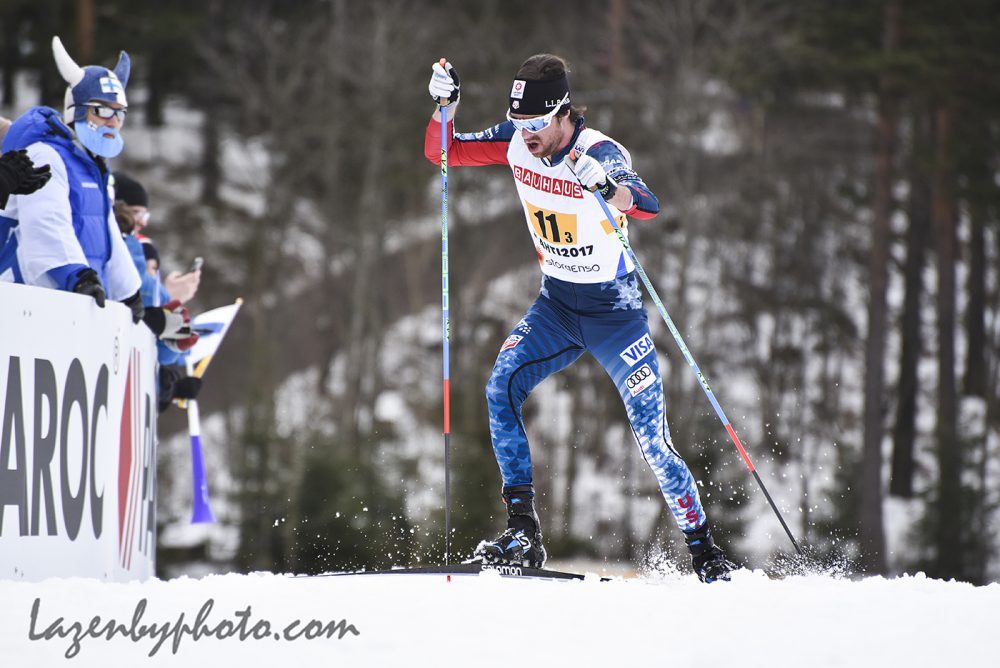
    Tad Elliott racing the third leg of the U.S. men’s 4 x 10 k relay at the 2017 Nordic World Championships on Friday in Lahti, Finland. (Photo: John Lazenby/Lazenbyphoto.com)

    In this episode of Nordic Nation, we tracked down the now thirty-year-old Elliott on October 9th, where he has begun undergraduate studies in sport physiology at the University of Northern Michigan. Elliott is also applying what he learned during his racing career as an assistant coach with the storied NMU program. He has also begun a side gig consulting athletes struggling with recovery and those wanting to develop sustainable training plans.

    We have the go-ahead to post his email. You can reach out to him at tadelliott2@gmail.com if you’ve got questions as it relates to his experience with overtraining and the rebound. And he drives an El Camino that we are informed is stored indoors somewhere back east.

    (Elliott also works with Nordic Team Solutions.)

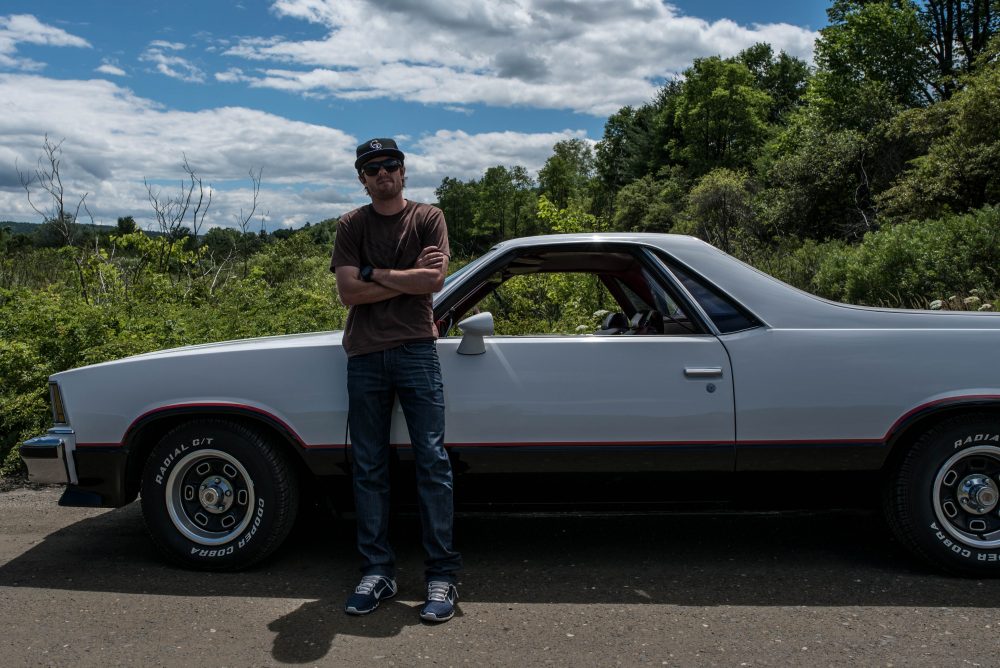
    Tadd Elliott and his prized El Camino – part car/part truck. Pure class. The El Camino did not make the trip to NMU. (Photo: Tad Elliott Collection)

    (To subscribe to the Nordic Nation podcast channel, download the iTunes app. If you have iTunes, subscribe to Nordic Nation here.)

  • Kristen Bourne on Recovering from Mono and Making NCAAs

    Kristen Bourne on Recovering from Mono and Making NCAAs

    Northern Michigan University’s Kristen Bourne (c) after the 5-kilometer classic race at the 2017 NCAAs in Jackson, New Hampshire. (Photo: Jackie Schneider)

    Two-and-half months into her summer training last year, Kristen Bourne woke up in a cold sweat. Her temperature read higher than normal and no amount of lozenges could soothe her sore throat. The Northern Michigan University (NMU) skier went to a doctor and received antibiotics to treat what was thought to be strep throat.

    But two weeks later, Bourne still didn’t feel like herself, and she wanted to know why.

    Behind her were 215 logged hours of summer training in Marquette, Mich., a 6 1/2 hour drive from her hometown of Lake Elmo near Stillwater, Minn.

    Ahead of her was a promising junior season at NMU, with plans to attend the university’s sports-science graduate program in the winter of 2018. She had redshirted the year before and gained an extra year of development under NMU Head Nordic Coach Sten Fjeldheim, as well as an extension on her National Collegiate Athletic Association (NCAA) eligibility.

    The investment she had put in her season was nothing to scoff at; neither was her uncharacteristic exhaustion at practice. After finishing one session in late August feeling especially spent, Bourne returned to the doctor, and this time, was able to pinpoint the issue.  

    “I went to the doctor that day and they did a mono test,” Bourne explained on the phone.

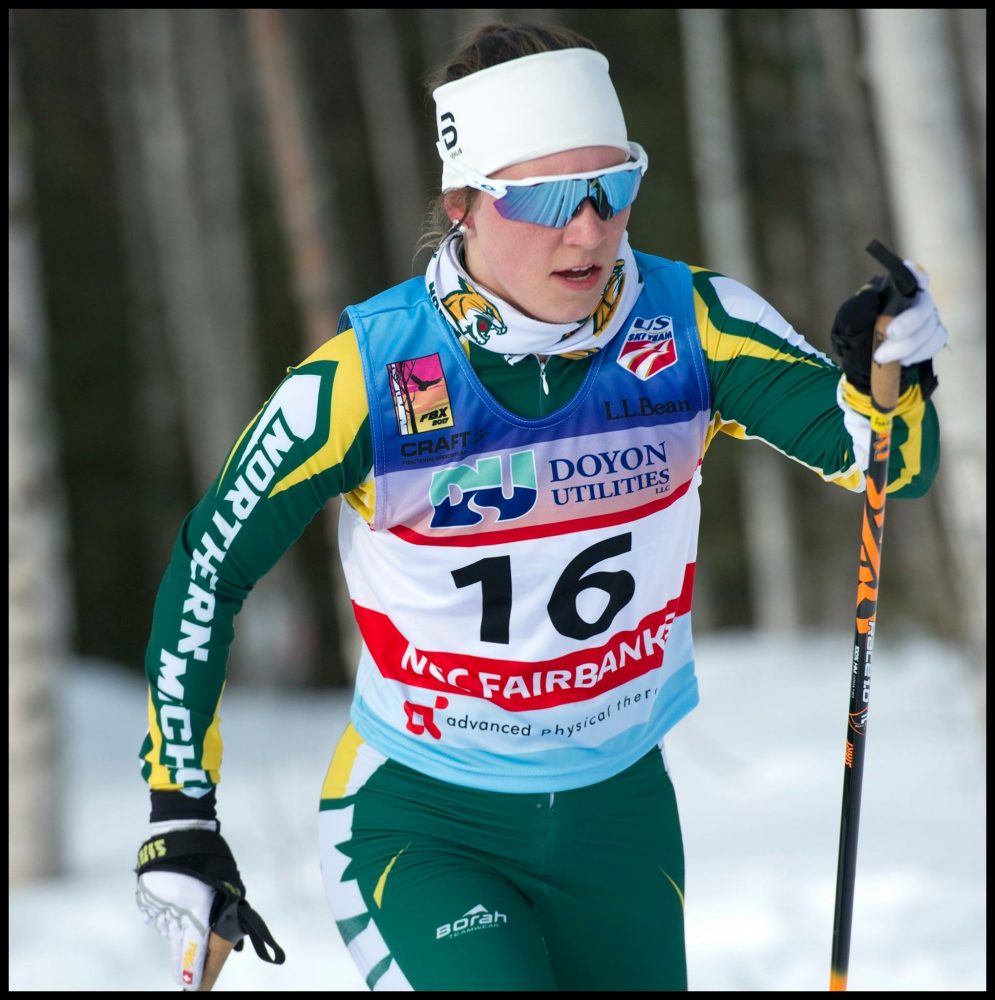
    NMU junior Kristen Bourne racing to 19th in the 15 k skiathlon at the 2017 U.S. SuperTour Finals on March 27 in Fairbanks, Alaska. (Photo: Lance Parrish, Fairbanks)

    The results tested positive. With fall training just around the corner, and a sudden uncertainty about where she was headed, Bourne began to worry. What did this mean for her season? Was there any way out? Were all those hours of work and training for nothing?

    “I was so bummed,” Bourne, who turns 22 later this month, said. “It was the best I had felt training; when you put in all this work and then realize that you’re not going to do anything and for that long, it’s really concerning.”

    The mononucleosis put her out of training for two months, from the beginning of September until the end of October. These months are not dispensable as they often incorporate a new cycle of intensity sessions, hours and gym time.

    But for Bourne, it was the beginning of a learning process and careful track back to top form, thanks in part to Fjeldheim and his connection to the NMU sports-science department.

    The First: Fielding Mono with Fjeldheim

    What exactly is mono? How does it affect athletes? How might it affect athletes as they return to training?

    These were some of the questions Fjeldheim had when he encountered his first case of mono among his student athletes. While coaching NMU’s cross-country running team, one of his top runners came down with the illness at the end of the summer. (Fjeldheim coached for the NMU running program for more than 20 years, and now solely coaches nordic).

    With the cross-country running season only lasting about eight weeks, there was limited time before some of the more important scoring races, like regionals, appeared next on the calendar.

    Fjeldheim wasn’t deterred. He approached Dr. Phil Watts, NMU’s sports-science program coordinator and professor. Sitting in Watts’s office — a room Fjeldheim had visited when he was a Wildcat — the two discussed the costs and benefits of de-training to the body and ultimately developed a way to help the runner make a full recovery.

    “We laid out a plan with the team doctor on how to bring her back,” Fjeldheim said. “I think she got [mono] in early August and then by early November we ran our regionals and she got third. That’s after running only one other running race before the regionals. I think she ran a running race at the end of October and then second week in November, she’s third in our regionals.”

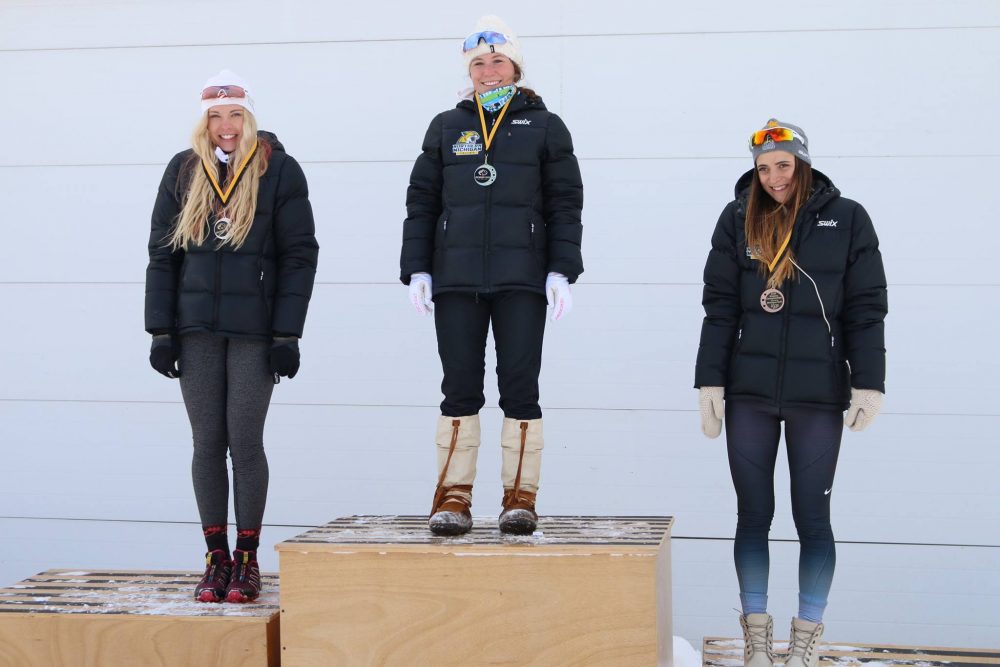
    NMU’s Kristen Bourne (c) topped the podium at the 2017 CCSA Distance Championships in early February in Houghton, Mich. (Photo: Jackie Schneider)

    After that, Fjeldheim worked with a few other athletes who came down with mono early in their season yet went on to become All-American athletes. Though Bourne would not earn this accolade, she came close.

    By the end of her season, Bourne won both races at the Central Collegiate Ski Association (CSSA) Distance Championships and also qualified for NCAA Skiing Championships. There in Jackson, N.H., she finished 17th in the 5 k classic and was the top NMU woman in the 15 k freestyle mass start two days later, placing 13th and within two seconds of All-American status (top 10).

    All after having mono. How?

    Bourne’s comeback was not without meticulous and methodical planning. Her return to training was slow and her situation was unique: not only did her coach, Fjeldheim, have experience working with athletes who had mono and successfully returned to racing, but Bourne was also the type of athlete who made the return more amenable.  

    Over the course of an entire summer, Bourne routinely checked her heart rate each morning, before getting out of bed. She wrote it down and kept track of fluctuations and differences. Every day.

    When she was diagnosed with mono, knowing her base heart rate was crucial. After two months off and having her spleen examined to ensure it was no longer enlarged, she started exercising again. Each week entailed meetings with coaches and every day, she assessed her resting heart rate and how far off it was from her previous one.

    “We used the morning heart rate as a guide,” Fjeldheim explained. “Once her morning heart rates were back to normal, within say two or three beats of what her base morning heart rate had been for months and possibly years, then we just started with getting back into moving again.”

    He emphasized that this came after making sure Bourne’s spleen was a normal size. Then she safely began training again while agreeing to listen to what her body was telling her via her heartbeat and lactate tests. And she had to keep it to a minimum.

    “When I started working out, it was 15-minute jogs,” Bourne said. “Then every week, I’d sit down with my coaches and re-evaluate how I felt, how that week went. Every two weeks I was doing some lactate tests to monitor my heart-rate zones … then every week adding a little bit if I was ready. Come November, I started actually doing more systematic training instead of just doing low distance.”

    Fjeldheim also monitored Bourne’s sleep patterns to make sure there weren’t disruptions and whether she was gaining or losing weight.

    If any of the numbers were off, she rested.

    “You don’t mess with mono,” Bourne emphasized. “If you don’t feel good, you do nothing. You can’t try and push it out of your system it just doesn’t work that way.”

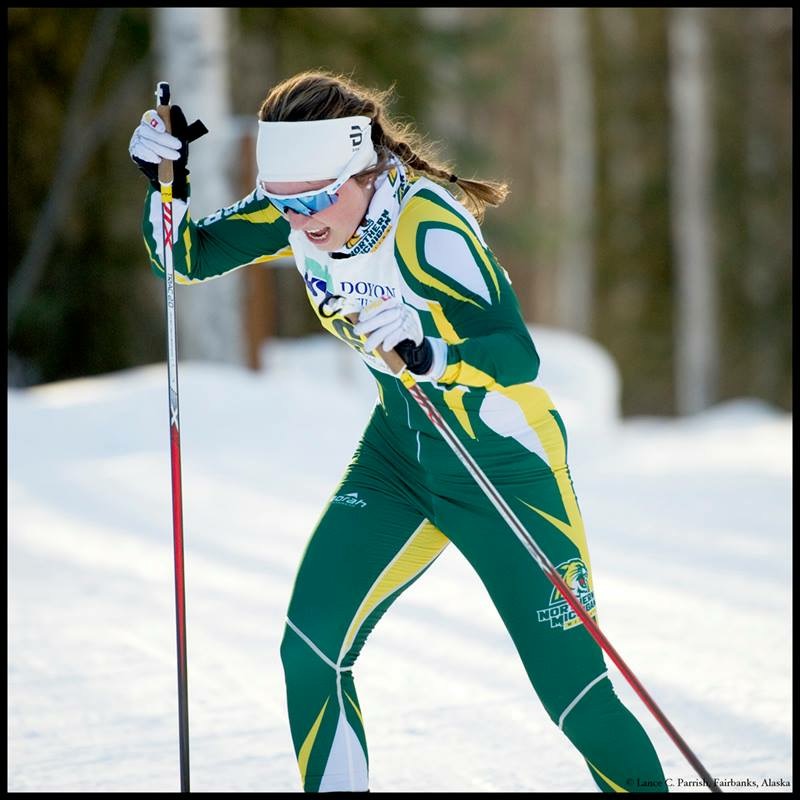
    NMU junior Kristen Bourne racing the freestyle leg of the mixed relay at the 2017 U.S. Distance Nationals in late March in Fairbanks, Alaska. (Photo: Lance Parrish, Fairbanks)

    This perhaps was the hardest part. While Bourne rested in bed, her teammates were out training. When Bourne finally began training an hour and a half again, her teammates were out doing three. She missed out on more than three months of interval training. And when she did reincorporate hard efforts, she didn’t always feel good.

    “Mentally, it’s really tough,” Bourne said. “I just had to trust what my coaches said and trust myself and keep my fingers crossed and hope that my season would work out. We figured that I wouldn’t start doing well until February because I didn’t actually start doing intervals until the end of November. … I have to give so much credit to my coaches reassuring me all the time and my teammates being so supportive about it, being like, Kristen if anyone can do it, you can do it.”

    Rather than get caught up in what training she couldn’t do, Fjeldheim advised Bourne to focus on what she could do, like improving her technique. 

    “As I told her, hey you know, you’re going to come back from this. It’s not cancer, it’s not debilitating, you didn’t find out you’ve got some rare disease,” he said. “You have mono and we’re going to figure out a plan. You got to have a plan and then they got to buy into it.”

    The experience gave Bourne not only some of her best collegiate results, but also a new edge on her training. She plans to ski for NMU next winter and is considering continuing to race competitively after she graduates.

    “A lot can happen in a year and I can’t set any expectations for myself right now,” Bourne wrote in an email. “We’ll just have to wait and see!”

    ***

    Author’s note: This article is not intended to be a guide on how to train through mono, but rather track one athlete’s recovery from illness.

  • With ‘Bigger Target’ on His Back, Torchia Joins U.S. Ski Team, Sticks with NMU

    With ‘Bigger Target’ on His Back, Torchia Joins U.S. Ski Team, Sticks with NMU

    Ian Torchia (center) with Northern Michigan University nordic head coach Sten Fjeldheim (l) and assistant coach, Shane MacDowell after Torchia placed second in the men's 10 k freestyle race at this year's NCAA Championship races in Steamboat Springs, Colo. (Photo: Courtesy Photo)
    Ian Torchia (c) with Northern Michigan University Head Coach Sten Fjeldheim (l) and assistant coach Shane MacDowell after Torchia placed second in the men’s 10 k freestyle at 2016 NCAA Championship in Steamboat Springs, Colo. He went on to place fourth in the 20 k classic mass start. (Courtesy photo)

    As the youngest in a family of five, it’s no wonder that Ian Torchia, an incoming junior at Northern Michigan University (NMU), considers himself “scrappy.” It’s also no wonder that, when it comes to sport, Torchia takes on skiing with tooth-and-claw grit. Within the first few hours of being a freshman on the NMU ski team, the Rochester, Minn., native established himself as tenacious if nothing else.

    “Watching him ski on the treadmill the first time I worked with him, he was just raw,” Sten Fjeldheim, head coach of the NMU men’s and women’s nordic teams reflected in a phone interview. “His technique was, well, not pretty, but I knew he had a heck of an engine from his running times.”

    After Torchia finished his freshman year just outside qualifying for NCAA Skiing Championships, he made it a goal to reach the championships the following year. As a sophomore, he not only qualified for NCAA’s, but he went on to place second in the men’s 10-kilometer freestyle and fourth in the 20 k classic mass start at the 2016 championships in Steamboat Springs, Colo.

    By the end of his first two years at NMU, the 20-year-old Torchia had also tapped into another tool: technique. He asked his college coaches ceaseless questions, watched countless ski videos and began to implement what he saw on the screen into his own skiing.

    “He’s just really good at being a student of his own sport: skiing,” Fjeldheim said of Torchia’s technical improvements. 

    However, the sophomore’s upward climb last season didn’t end with his work on the NMU ski team. In January, he won the junior men’s 10 k freestyle at U.S. nationals in Houghton, Mich. Also at nationals, he placed seventh among seniors in the men’s 15 k classic, and at 2016 Junior World Championships in Romania, he raced to 15th in the junior men’s 15 k freestyle.

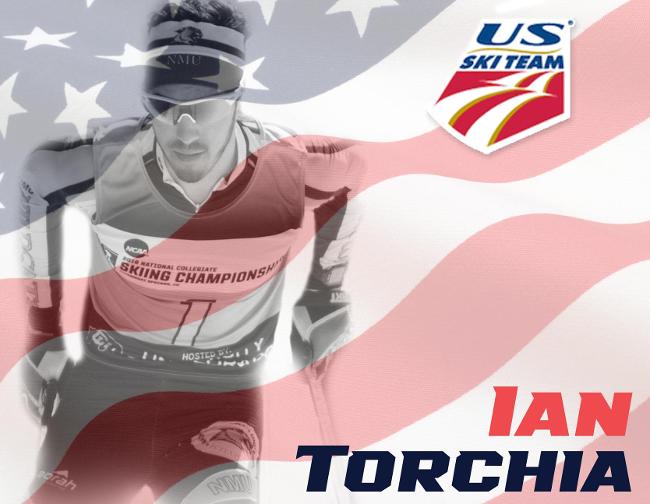
    NMU designed the above image for a press release after Ian Torchia was nominated to the U.S. Ski Team D-Team. (Photo: NMU Wildcats/Twitter)
    NMU designed the above image for a press release after Ian Torchia was nominated to the U.S. Ski Team D-Team. (Photo: NMU Wildcats)

    Most recently, Torchia discovered he was among 16 athletes nominated to the U.S. Cross Country Ski Team.

    “I was on my way to go cliff jumping when Bryan Fish [U.S. Ski Team development coach] called me,” Torchia said on the phone. “The celebratory back flip didn’t go too well.” (According to Torchia, the backflip was more of a “back flop.”)

    Though perhaps brazen when it comes to black flips and Lake Superior bluffs, the main sentiment Torchia spoke of was that of humility.  In his eyes, the opportunity to ski for U.S. Ski Team ‘D’ (or development) Team is an opportunity to once again put his tenacity to the test.

    “You know, there’s still two more levels of the U.S. Ski Team to go,” Torchia said of the ‘A’ and ‘B’ team levels. “If anything, [the nomination] just motivates me to train harder. I mean, the way I see it, it’s an honor to be named. I get invited to the camps and I get the uniform. It puts a bigger target on my back, but I’m OK with that.”

    U.S. Ski Team (USST) Head Coach Chris Grover explained in an email that the team was “looking for athletes who can deliver big results in Europe against tough fields,” he wrote. “Ian was the standout USA male once again at World Juniors and posted his second consecutive top-15 result there.”

    At the 2015 Junior World Championships in Kazakhstan, Torchia notched 11th in the 20 k skiathlon.

    Moving forward, Torchia plans to accept the nomination and attend the two USST summer training camps, the first one taking place in Bend, Ore., this month and the second in Anchorage, Alaska. According to Fjeldheim, not much will change for Torchia in regards to training.

    “He’ll pretty much be on the same training plan that he’s been on,” Fjeldheim said. “But I think the opportunity for him to ski with some other national-team skiers is going to be good.”

    Along with accepting the nomination, Torchia also plans to continue attending NMU as a full-time student and eventually earn a degree in exercise science.

    Ian Torchia (c) with his parents Mike (l) and Patricia after this year's U.S. nationals in Houghton, Mich. (Courtesy photo)
    Ian Torchia (c) with his parents Mike (l) and Patricia after this year’s U.S. nationals in Houghton, Mich. (Courtesy photo)

    “I think my mom would kill me if I wasn’t in school,” Torchia said.

    But his reasons for staying in school extend beyond his so-called death sentence, even if it means suffering through organic chemistry finals. To Torchia, continuing his education sends a broader message to other nordic athletes, especially those trying to determine whether skiing in college can lead to a ski career.

    “One of the main reasons why I wanted this to happen is to show that you can do it while you’re in college,” Torchia said of his national-team nomination. “It is hard to balance school and skiing, but it’s doable. [College skiing] is a pipeline.”

    School, Torchia insisted, also gives him options outside of skiing.

    “Make sure to have balance in your life between skiing and make sure skiing isn’t the only thing in your life,” Torchia said of how he found success in sport. “We kind of take that mentality here at NMU. We have the top GPA of all the sports teams here, so it’s both skiing and school. It’s a lifestyle and we love it. It’s hard, but you got to go for it.”

    Beyond the importance Torchia finds in education, his NMU teammates and coaches also played a large role in his decision to continue his ski career on the college path. He cited post-practice conversations and training plans his coaches provided as a staple to his success.

    “I could not have done this without Sten and [NMU assistant coach] Shane MacDowell,” Torchia said.

    “Ian always shows up with a smile on his face,” Fjeldheim said. “Yeah, he like to pull pranks on me and his teammates every now and then and we prank him back, but he’s a great kid to have on your team as far as sportsmanship goes and manners. He’s very humble.”

    “It’s a lifestyle and we love it. It’s hard, but you got to go for it.” — Ian Torchia, NMU junior and U.S. Ski Team rookie

    With teammates like Adam Martin and Jake Brown, both first-team All Americans at this year’s NCAA Championships, Torchia views his peers as motivation and proof of where they, too, are headed.

    “You can never get too big of a head around here because there will always be someone to serve you a piece of humble pie,” Torchia said. “I can say that I won’t be the last one to be named [to the U.S. SKi Team] out of NMU.”

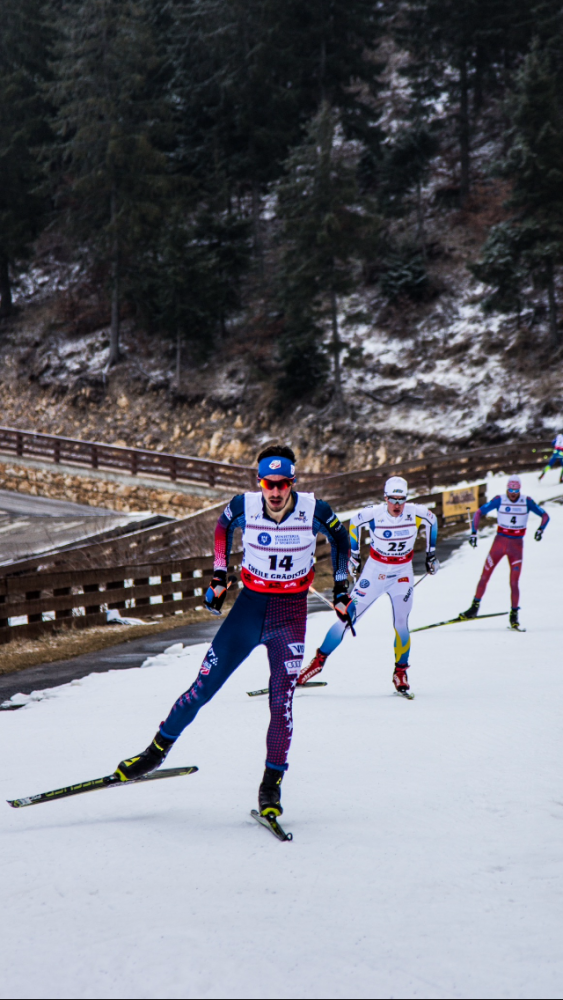
    Ian Torchia (14) racing to a 15th in the men's 15 k freestyle at 2016 Junior World Ski Champioships in Rasnov Romania. (Photo: Thomas O'Hara)
    Ian Torchia (14) racing to 15th in the men’s 15 k freestyle at 2016 Junior World Ski Champioships in Rasnov Romania. (Photo: Thomas O’Harra)

    With the nomination, Torchia is undecided as to where his ski career will be drawn after graduation day. Though not currently on the CXC team, joining the program is one potential route for him post-college. 

    “Kind of this past year, I guess I really thought about skiing after college,” Torchia said. “Right now, Kyle Bratrud is [in Marquette] skiing for [Central Cross Country] and we’re getting [Dartmouth grad] Oscar Friedman up here. I think we’re going to make a return to the days when CXC was a really a powerhouse. I can see myself here. We’ll see. It’s still a long way away.”

    While Torchia’s five-year plan remains flexible, his 14 weeks of summer are at least set to go. This includes attending the two USST training camps, training in Marquette, Mich. (potentially with the likes of Kris Freeman, he said), and wedding crashing.

    “I’m going to go home, surprise my mom on Mother’s Day and then head out to Bend for the camp there,” Torchia said. “Then I’ll come back [to Marquette] for June and then go out to Anchorage for that camp. And then it’s my sister’s wedding in Colorado. So it should be a fun summer.”

    Particularly fun due to the training crew he plans to surround himself with.

    “Basically the entire [NMU] guy’s team is going to be [in Marquette] this summer,” Torchia said. “We call it the Marquette Training Group: MTG. So, MTG 2.0 is kicking off this summer. We’re hoping that a few guest stars show up; there’s rumors that Bird [Kris Freeman] and Tad Elliott and Paddy Caldwell and Brian Gregg might be up here. So it’s going to be pretty kickass.”

    While the USST nomination makes him a new training target to many, Torchia remains humble of where he’s been and where he’s headed. For now, he appears to prefer taking it one step at a time up the ski ladder — even when it comes to housing.

    “I’ve got the Trailer Park Room,” he said, indicating that as one of the younger athletes, it may have fallen on him to take on the tiny living quarters in the NMU men’s ski house for the summer. “It’s the smallest room in the house, but I kind of like it. It doesn’t have a closet, very narrow and small, but I don’t know, I like it.”

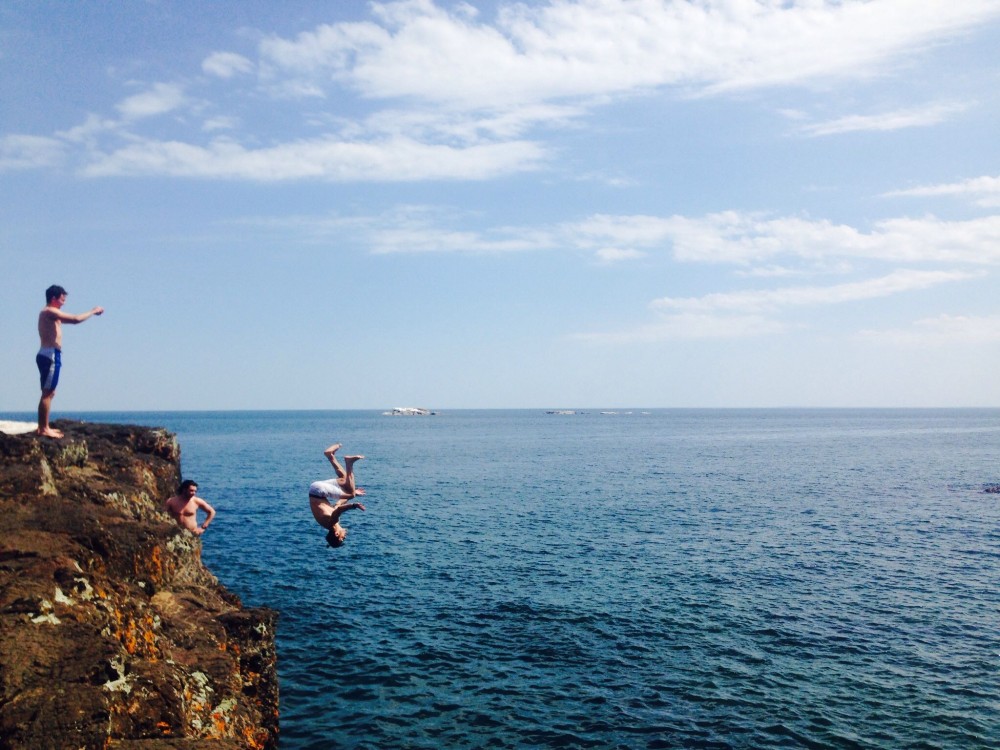
    Northern Michigan University's Ian Torchia celebrating his nomination to the U.S. Ski Team D-Team this spring with a cliff jumping back-flip. According to Torchia, it ended as more of a "backflop." (Photo: Abby Cook)
    Northern Michigan University’s Ian Torchia celebrating his nomination to the U.S. Ski Team D-Team this spring with a cliff jumping back-flip. According to Torchia, it ended as more of a “backflop.” (Photo: Abby Cook)