Tag: Northug

  • A Northug Classic: Norwegian Waits, Lurks, Pounces for Victory in Toblach Pursuit

    A Northug Classic: Norwegian Waits, Lurks, Pounces for Victory in Toblach Pursuit

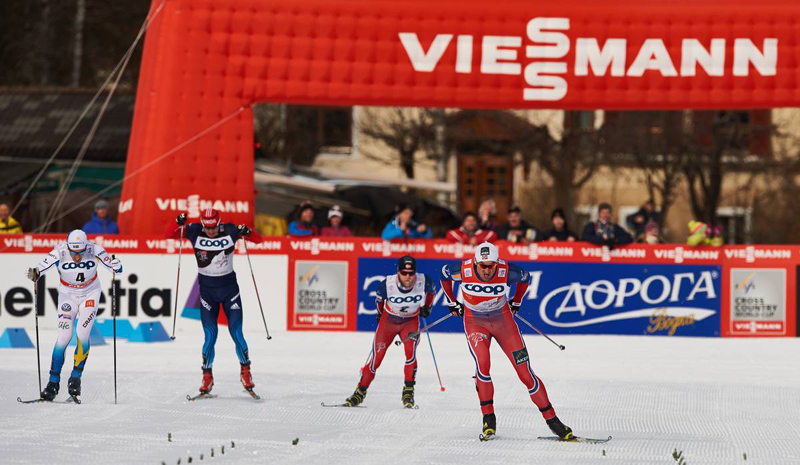
    Calle Halfvarsson (SWE), Evgeniy Belov (RUS), Martin Johnsrud Sundby (NOR and Petter Northug (NOR), (l-r) come to the line at the end of the Tour de Ski pursuit in Cortina-Toblach (ITA).  (photo: Fischer / Nordic Focus)
    Calle Halfvarsson (SWE), Evgeniy Belov (RUS), Martin Johnsrud Sundby (NOR and Petter Northug (NOR), (l-r) come to the line at the end of the Tour de Ski pursuit in Cortina-Toblach (ITA). (photo: Fischer / Nordic Focus)

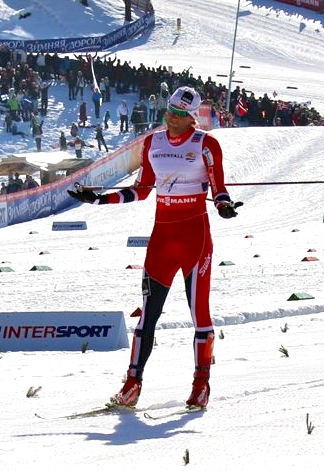
    Norway’s Petter Northug won the 25 k skate pursuit in Toblach, Italy, after surging past the leading trio on the final hill and making the sprint finish look easy. The Norwegian now leads the Tour de Ski, a seven-stage race series, by seven seconds with two competitions to go.

    Northug started the race two seconds ahead of his teammate Martin Johnsrud Sundby and seven seconds in front of Russia’s Evgeney Belov. Calle Halfvarsson of Sweden started 14 seconds behind Northug. However, the three chasers quickly passed Northug, who hung out in the back of the trio throughout the race.

    A master tactician, Northug surged into the last hill and made his move over the top, putting a gap on Halfvarsson over the hill and into the finish chute.
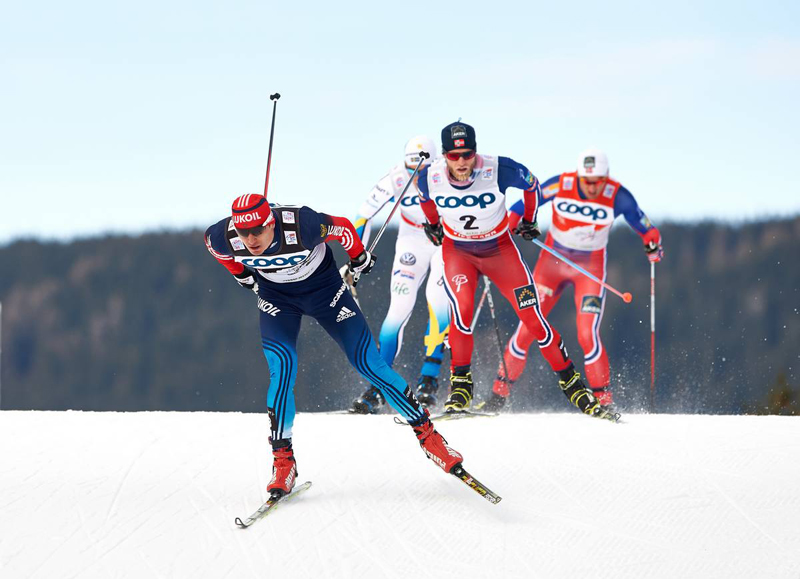
    Evgeniy Belov (RUS),  and Martin Johnsrud Sundby (NOR) did the majority of the work for the lead foursome.  (photo: Fischer / Nordic Focus)
    Evgeniy Belov (RUS), and Martin Johnsrud Sundby (NOR) did the majority of the work for the lead foursome. (photo: Fischer / Nordic Focus)

    “I managed to push my weight over the last hill and used that to my advantage so I could pick the chute to the finish line,” Northug said to NRK reporters after the race.

    The star noted that he was not in a position to contribute in front today.

    “I was focusing on hanging onto the group. They were all stronger than me today, but it was fun to hang with the big boys,” Northug explained.

    However, the tactics – of hanging with the pack but not leading, and then burning competitors in a sprint finish – is nothing new for Northug, who often justifies his lack of leadership in group skiing by saying that he’s tired.

    Not everyone was impressed. While Northug was pointing to his bib and gesturing in celebration of his win, Belov, who finished fourth in the sprint finish and did not collect any bonus seconds, angrily pointed his finger at Northug.

    This was only the fifth stage, it was not the final Tour de Ski, which we were racing for today,” he told Sweden’s Dagbladet newspaper. “In this case, you have to help the group during the race. He just went back and let the rest of us do the job. I don’t think it’s the way you should do this, and that’s why I both reacted in the finish and am angry now.”

    Belov and Sundby led the four-man group for much of the race.

    With the 15 bonus seconds awarded to the winner, 10 to second place, and 5 to third, Northug is now seven seconds in front of Halfvarsson in second place overall and 12.2 seconds ahead of Sundby, who is defending the 2014 Tour de Ski overall title.
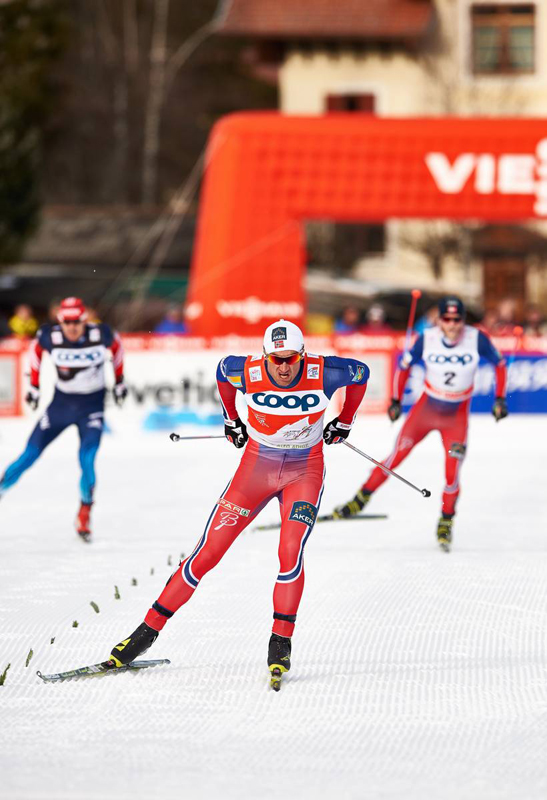
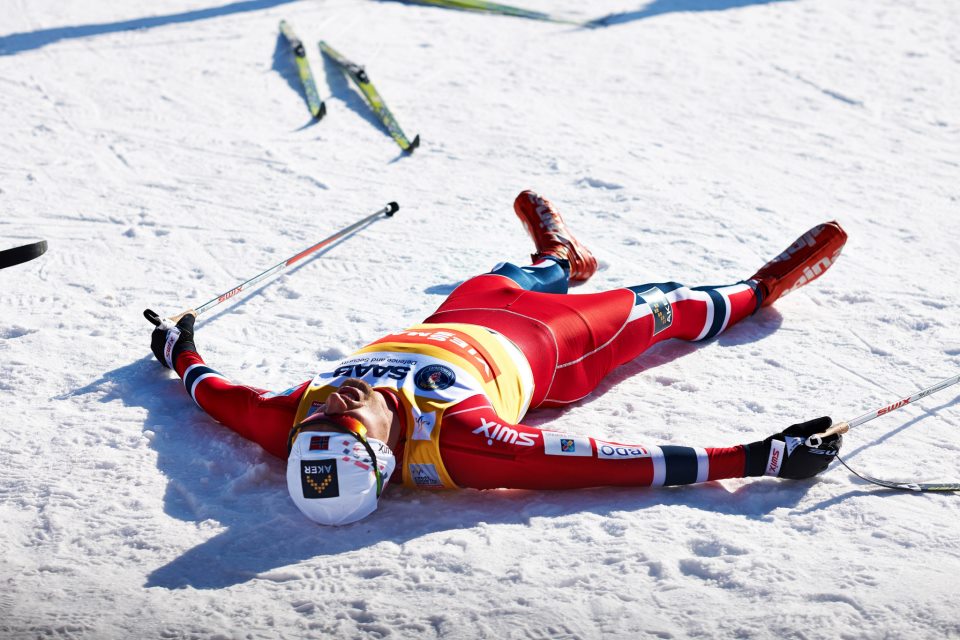
    Petter Northug (NOR) takes the stage win.  (photo: Fischer / Nordic Focus)
    Petter Northug (NOR) takes the stage win. (photo: Fischer / Nordic Focus)

    Northug said that he is excited to try to add more bonus seconds in the 15 k classic mass start on Saturday, but doesn’t consider himself a favorite for the overall title, where he believes Sundby the best bet.

    “Calle (Halfvarsson) and I suck equally bad at the monster hill,” Northug said. “I would like to have a minute down to Sundby going into the big hill on Sunday.”

    Wants to go neck-a-neck with Northug on Sunday

    Halfvarsson didn’t argue with Northug’s comment on his chances up Alpe Cermis, but he cherishes the idea of measuring strengths in real time.

    “It would be really fun to go into that hill even with Northug on Sunday,” Halfvarsson said to NRK reporters after the race. “Then we could really see who of us is the fastest.”

    As for today’s race, Halfvarsson was pleased to finish only two seconds behind Northug and beat both Sundby and Belov.

    “I am super content with my race today,” Halfvarsson said to NRK reporters after the race. “I had to work really hard in the beginning to make it up to the front and that cost me a lot. I kept thinking to myself that I wanted to hang in there for one more lap, and then one more lap and then it was the last lap. I didn’t expect to have a chance to hang with these guys today. But it wasn’t me who set the speed. That was Sundby and Belov’s work. I tried to contribute when I could.”

    He was also pleased to have added time on Dario Cologna of Switzerland, a previous many-time Tour winner, and Swedish teammate Marcus Hellner. Completely exhausted, Halfvarsson is looking forward to a rest day on Friday before he tries to stay on the Tour de Ski podium in the last weekend of competition.

    It will be nice,” he told Swedish newspaper Expressen. “This was the roughest course I’ve been through.”

    Alternate course

    Today’s stage was originally a 35 k point-to-point skate pursuit, but due to lack of snow, it was changed to a 25 k consisting of five laps on the same 5 k course that was used for Wednesday’s 10 k classic competition. After five of seven stages, the top four overall have a solid gap on the rest of the field going into the last two stages of the Tour.

    Niklas Dyrhaug of Norway won a sprint finish for fifth place, besting Canada’s Alex Harvey, Cologna, and Wednesday’s classic 10 k winner Alexey Poltoranin of Kazakhstan.

    ““My optimistic goal was to ski back into the top-five. I just got outsprinted at the end, but I improved on my result so I have to be happy with today,” Harvey, who started in bib seven, said in a CCC press release. “The group didn’t push too hard today so I’m feeling less tired than I did at this point last year.”

    The fastest overall time of the day belonged to Andrew Musgrave of Great Britain, who started in 21st and moved up to 11th place, narrowly losing a sprint finish with Russia’s Maxim Vylegzhanin, a favorite from Tour de Skis past.

    While an isolated pursuit time doesn’t count as a traditional World Cup win, it’s still historic for Great Britain.

    “What a day, what a week, the word legend springs to mind – it was a great race today particularly after the result in Val Mustair and Muzzy’s best ever Classic World Cup race yesterday,” British Cross Country coach Roy Young said in a British Ski and Snowboard press release.

    With the chase group two minutes behind the top four racers, the fight for the overall title has now been narrowed to Northug, who has a seven-second lead to Halfvarsson, 12.2 seconds to Sundby and 12.4 to Belov.

    The two editions in which Northug was leading after the Toblach pursuit are the only two seasons where the leader after this stage did not win the overall. In their previous Tour de Ski victories, both Cologna and Sundby led after this stage. Cologna won in 2011 and 2012, and Sundby won in 2014.

    -Chelsea Little contributed reporting.
    Results

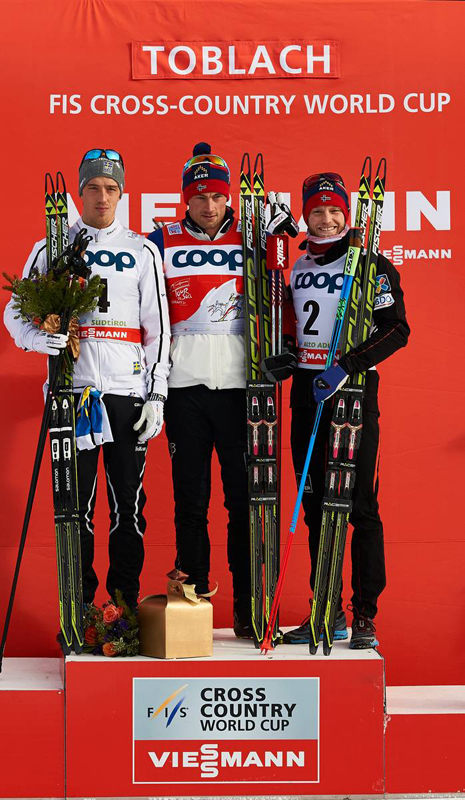
    The men's podium of Calle Halfvarsson (SWE), Petter Northug (NOR) and Martin Johnsrud Sundby (NOR), (l-r). (photo: Fischer / Nordic Focus)
    The men’s podium of Calle Halfvarsson (SWE), Petter Northug (NOR) and Martin Johnsrud Sundby (NOR), (l-r). (photo: Fischer / Nordic Focus)
  • Pellegrino Takes it to Norwegians in Tour de Ski Skate Sprint

    Pellegrino Takes it to Norwegians in Tour de Ski Skate Sprint

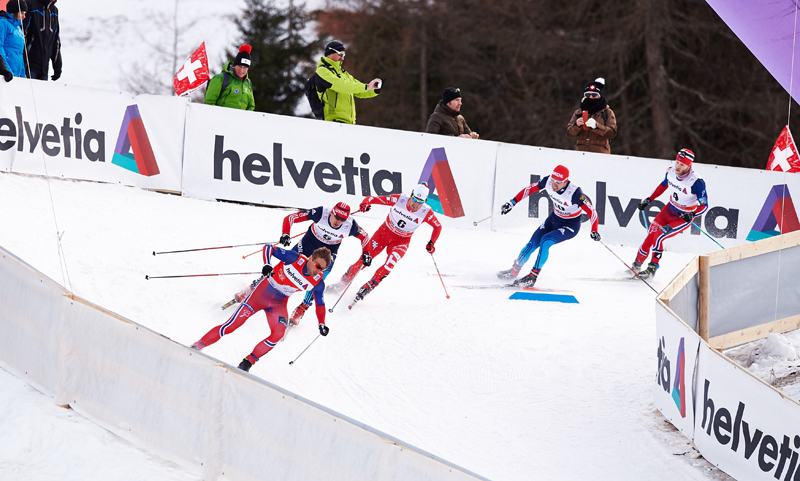
    Petter Northug (NOR), Evgeniy Belov (RUS), Federico Pellegrino (ITA), Ilia Chernousov (RUS), Martin Johnsrud Sundby (NOR), (l-r) attack the tricky corner just after the highpoint during the first lap of the finals in Val Mustair, Switzerland. (photo: Fischer/Nordic Focus)
    Petter Northug (NOR), Evgeniy Belov (RUS), Federico Pellegrino (ITA), Ilia Chernousov (RUS), Martin Johnsrud Sundby (NOR), (l-r) attack the tricky corner just after the highpoint during the first lap of the finals in Val Mustair, Switzerland. (photo: Fischer/Nordic Focus)

    Italy’s Federico Pellegrino repeated what he did in the Davos World Cup before Christmas: he destroyed the Norwegians in the Tour de Ski sprint final in Val Müstair, Switzerland.

    “Today, one of my big dreams has come true: to beat Petter (Northug) in the sprint final,” Pellegrino said to reporters after the race.

    The swift Italian beat Tour de Ski (TDS) leader Petter Northug of Norway as well as defending overall TDS champion Martin Johnsrud Sundby in increasingly challenging conditions.

    “I feel I am in a great shape,” Pellegrino said in a press conference. “I was focused on Petter and I forgot about Martin. In the last curve before the finishing straight I had a good speed and I could keep it to the finish and win.”

    As the day progressed the course got both icy and chewed up, especially in the turns.

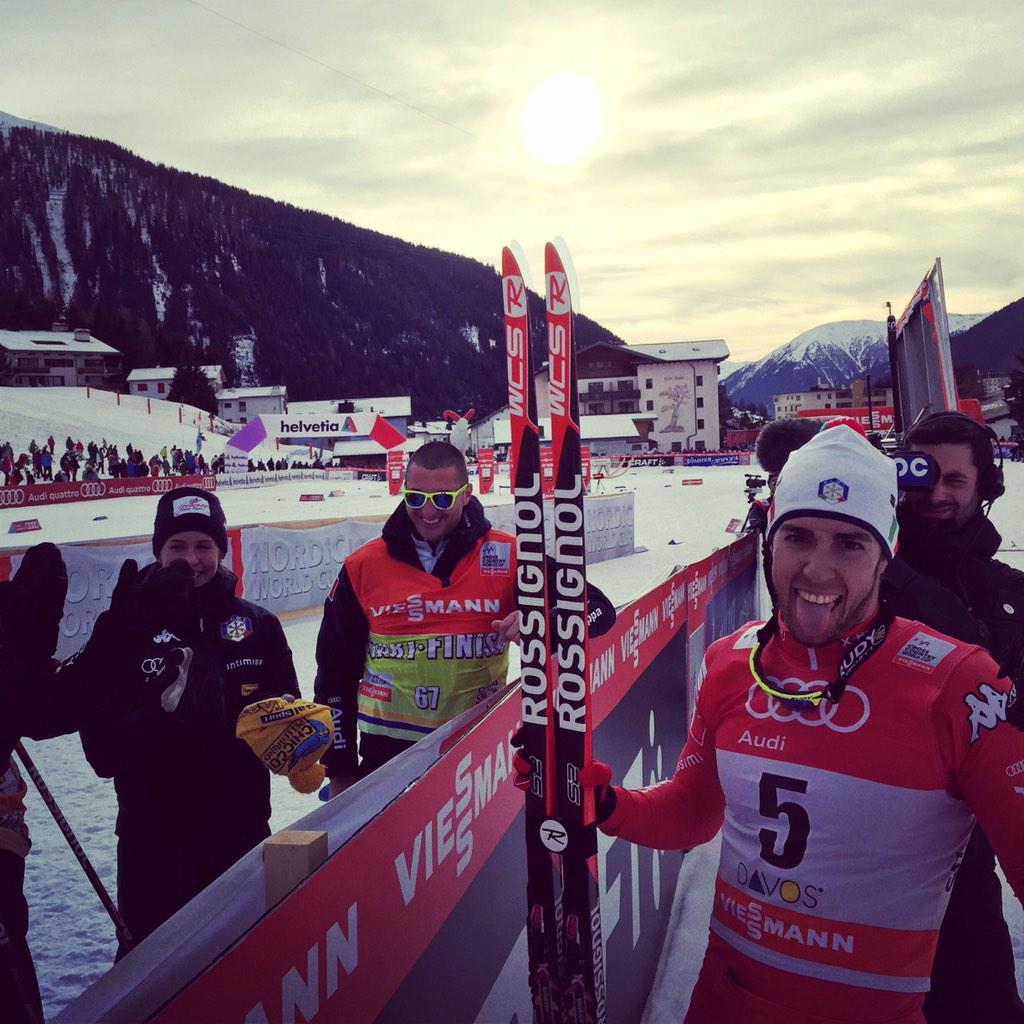
    Federico Pellegrino (r) after his first World Cup victory, in the 1.4 k skate sprint in Davos, Switzerland, in December. (Photo: FIS Cross Country/Twitter)
    Federico Pellegrino (r) after his first World Cup victory, in the 1.4 k skate sprint in Davos, Switzerland, in December. (Photo: FIS Cross Country/Twitter)

    On the top from the first heat 

    Pellegrino was sixth in the qualifier, where Northug had the fastest time. But from there on, Pellegrino won every heat. First he beat Russia’s Evgeney Belov in the quarterfinals after a controlled effort pulling into first on the final meters. In the process, he knocked hometown favorite Dario Cologna out of the race.

    In the semifinal, Pellegrino beat both Sundby and Northug after a tactically perfect run.

    In fact, Northug made the final by the skin of his teeth, advancing as a lucky loser after finishing third in the semifinal behind Pellegrino and Sundby.

    In the final, Northug showed that he learned from the close call in the semifinal, and opened aggressively from the start. Sundby, however, hung out in the back on the first lap along with Sweden’s Calle Halfvarsson, one of the other overall contenders. But unlike Halfvarsson, and later Ilia Chernousov of Russia, Sundby advanced on the second lap, creating a large gap to the Swede and the Russian.

    By the end of the second lap, Sundby was first approaching finish line, in front of Northug, while Pellegrino came like a bullet from behind and beat both of them in a thriller finish.

    Nothing determined overall

    At the end of the day, Northug now has a 25-second buffer to Sundby in second place in the overall Tour de Ski.

    “With a 10k classic on the schedule tomorrow, it’s even likely that Martin takes the overall lead,” Northug said in the press conference, noting that he hardly feels that the overall victory is in sight. “I will use my position as best I can, and hopefully go out somewhere close to Martin in the long-distance pursuit that follows. At least not too far behind him.”

    There are still four stages to go, and the last stage up the alpine hill Alpe Cermis in Val di Fiemme, Itlay, has been an Achilles heel for the strong Norwegian as long as the Tour has been around.

    “Winning the overall Tour de Ski is not that likely,” Northug said. “I’ve started the final stage with fantastic leads before and still made a fool of myself year after year. So I have to try again.”

    Harvey’s Missed Opportunity 

    Canadian Alex Harvey hurt his own chances in the quarterfinals. After a slow start, Harvey moved up on the second lap and looked like a for sure second place, behind Halfvarsson who had an impressive gap on the rest of the heat. Harvey was surging toward the finish line, but forgot to get the full picture and narrowly lost the position to Halfvarsson’s teammate Andersson, who slid into second place.

    The move cost Harvey not only the semi final, but also 40 bonus seconds in the overall TDS.

    Results

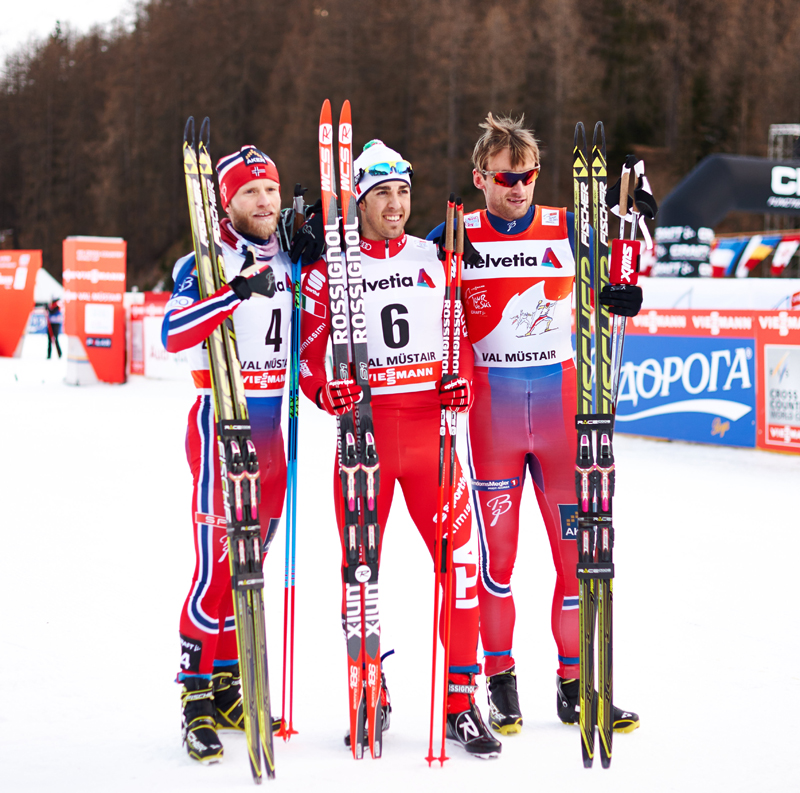
    Martin Johnsrud Sundby (NOR), Federico Pellegrino (ITA) and Petter Northug (NOR), (l-r) take the men's podium in Val Mustair (SUI). (photo: Fischer/Nordic Focus)
    Martin Johnsrud Sundby (NOR), Federico Pellegrino (ITA) and Petter Northug (NOR), (l-r) take the men’s podium in Val Mustair (SUI). (photo: Fischer/Nordic Focus)
  • Consequences of Northug’s Mess Up Can Be a Lesson (Editorial)

    Consequences of Northug’s Mess Up Can Be a Lesson (Editorial)

    Petter Northug after an exhausting fourth-place finish in Saturday's 15 k classic mass start at 2013 World Cup Finals in Falun, Sweden. (Photo: Fischer/Nordic Focus; facebook.com/FIS Cross Country)
    An exhausted Petter Northug after finishing fourth in the 15 k classic mass start at 2013 World Cup Finals in Falun, Sweden. (Photo: Fischer/Nordic Focus)

    Editor’s Note: The following is an editorial based on the recent news regarding Petter Northug’s pending DUI. Facts are juxtaposed with opinion, which belong to the author and do not reflect FasterSkier as a whole. 

    Petter Northug screwed up. And now he feels bad, or so he says.

    While the news that the 28-year-old Olympic champion and Norwegian bad-a** athlete celebrity drove drunk and crashed his Audi A7 on Sunday morning didn’t come as a complete surprise, it was still a disappointment — to Norwegians, fans around the world and Northug himself.

    Petter Northug sealing a relay victory for Norway at the 2013 World Championships in Val di Fiemme, Italy.
    Petter Northug sealing a relay victory for Norway at the 2013 World Championships in Val di Fiemme, Italy.

    After leaving his friend and running to his house just a few hundred meters away from the roundabout crash, which totaled his leased car, Northug answered the door when police knocked just minutes later.

    He could’ve hid inside, sobered up, and been charged with leaving the scene of an accident (and ditching his friend). It wouldn’t have been moral, but it might have been smarter.

    What Northug did — taking his car out for a joy ride early Sunday morning (around 5 a.m.) while heavily intoxicated — was a bad idea. Ultimately coming clean when police confronted and questioned him, then having his manager blitz together a press release about his mistakes later that day, was the right decision.

    At least he’s on the right track … now.

    A lot of people don’t like Northug. The guy makes way too much money for being somewhat of a dingleberry. He swears, he doesn’t play nice, and he’s arrogant. But that’s his M.O. in the sometimes dry sport of cross-country skiing. Every exciting drama needs its villain.

    Northug never asked to be a role model. His raw talent threw him into the spotlight. A two-time gold medalist at the 2010 Olympics (in the team sprint and 50 k classic), he went on to win the Holmenkollen 50 k skate, making him the first skier to win the 50 k at Holmenkollen, World Championships and the Olympics since Sweden’s Gunde Svan did so in 1988. And Northug was a show stopper as a junior, racking up six golds at Junior World Championships.

    Today, Northug is worth several million dollars: $5.8 million according to sportrichlist.com. Some $1.5 to $3.6 million of that (10-20 million kroner) comes from his main sponsor, Coop, an 800-store grocery chain. Coop is in the business of selling juice and bread with Northug’s name on them, according to the Wall Street Journal. Maybe the company should sell beer with his face on its labels, too.

    While the execs at Coop have a difficult task ahead of them in deciding whether to stand by Northug or drop him with the help of a contractual exit clause, Northug’s got his own issues to deal with.

    He could face jail time, although the prospects of that are unlikely. According to the International Center for Alcohol Policies, the legal limit for blood-alcohol concentration (BAC) in Norway is below 0.02 percent (compared to 0.08-percent in the U.S., Canada and Mexico, for instance). Getting pulled over with a BAC of 0.02 percent in Norway would warrant a fine and potentially a suspended license in the case of aggravated circumstances.

    At 0.05 percent, you’ll get a suspended sentence, your license suspended and a fine; 0.10 percent, a fine, suspended or mandatory sentence, and a suspended license; and 0.15 percent, a mandatory sentence, suspended license and a fine.

    Asbjørn Strandbakken, the dean of the University of Bergen’s Faculty of Law, told NRK that the circumstances of Northug’s crash will likely be considered aggravated and the maximum penalty would likely be a year in prison. Driving with a BAC above 0.10-percent usually warrants 21 days to three months in prison, he said.

    While Northug’s BAC won’t be released for up to two weeks, pending a police investigation, he described his level of intoxication as high. He had been out with friends the night before partying in Trondheim and returned home early the next day.

    “I was so drunk that I was not able to make the right choices,” he told VG, according to a translation. “That was the reason I didn’t leave the car keys alone.

    “Around five o’clock people began to go home and some went to bed,” he explained. “It was kind of just me and the passenger in the car who were awake when we decided to go out in the car and drive it. We had no motive for why we were out.”

    The rest was history. He went straight through a roundabout, exceeded the speed limit of 40 kilometers per hour (around 25 mph), and off the road into a barrier. He and his friend, the passenger, were OK (police later found the friend beside the car with minor injuries), but the car was totaled. No one else was harmed.

    “When we started driving, it was not many hundred meters before we started going to fast and we ran into a roundabout and into the crash barrier,” Northug recalled. “It slammed. Probably both in shock, we asked each other, are you OK? … There was no damage that we saw and the next thing that happens is that I am acting in panic and want to get away.”

    Once the police came to his house, Northug went with them to the emergency room for routine checks. Then, he went to the police station for questioning. The interrogation ended around 3 p.m. Sunday, about 10 hours after the accident.

    If Northug is fined for a BAC above 0.05 percent, it will cost him at least 1 1/2 months of his base salary — which could add up to a hefty amount. Jail time ranges from three weeks to three months with a maximum of a year. Suspensions can vary from less than a year to two years, according to Norway’s traffic laws. None of this takes into account lawyer fees.

    And while Northug might not go to jail (although he was prepared to: “I’m ready to take punishment for this,” he told VG. “I’ll take my punishment, there is no doubt about that.”), he could be put under house arrest or confined to traveling to and from training sessions.

    And that might not be a bad thing. Northug has reiterated that he’s sorry, that his judgment was completely flawed, and that he’s going sober from here on out to commit himself to training.

    This is a guy who has claimed to be dry (alcohol-free) throughout the racing season. While it’s believable — even for a poker aficionado — maybe drinking a little throughout the winter and not so much at once at the end of the season wouldn’t be a bad idea.

    I’m not promoting drinking, and if anything, it’s probably best to stay off the stuff altogether. But the idea of going buck wild for a month or two before training resumes might not be the best one. Not for Northug and not for anyone, especially those who don’t think about the consequences of getting behind the wheel after a night out.

  • What Can We Expect from Northug?

    What Can We Expect from Northug?

    Petter Northug Jr. working hard up the Alpe Cermis during the final climb of the 2011/2012 FIS Tour de Ski, where he was 24th in the 9 k pursuit on Jan. 8 in Val di Fiemme, Italy.

    By all accounts, Petter Northug’s 2011-2012 campaign was an unexpected failure. The high-profile Norwegian star, who usually finished at or near the top of every podium he contended for, specifically set out to do two things last winter: take the Tour de Ski and win the Vasaloppet.

    He came up short on both counts; Switzerland’s Dario Cologna and Marcus Hellner of Sweden both beat him in the Tour in first and second, respectively, and a stomach bug kept him from starting the Vasaloppet. The Marcialonga in northern Italy was his only marathon showing of the year, and there he fell to 10th place behind Norway’s Aukland brothers, Jorgen and Anders, who were first and second.

    Northug’s World Cup season subsequently ended prematurely in mid-February, and the 2010 Crystal Globe winner watched his overall ranking slip from second to third in his absence. But despite failing to meet his and everyone else’s expectations, Northug is still as unabashedly ambitious as he ever was.

    Northug at 2012 Norwegian Nationals in late January, where he was 40th in the 15 k skate.

    In a recent interview with the Swedish daily Expressen from a team training camp in Livigno, Italy, he laid out exactly how many races he’ll win: seven World Cups, the Tour de Ski and three golds at World Championships.

    “The [World Cup] premiere in Gällivare [Sweden] I will win,” Northug said, according to a translation. “It’s so damn good to win on home ground.”

    He took the opportunity to make another jab at Sweden: “In Sweden, of course, I win all the races. It’s most important of all,” he said.

    Before last season, ski fans could generally count on Northug to be true to his word. The 26-year-old would reliably deliver unreal finishing kicks that landed him on the top of the podium again and again. But now, after a disappointing winter?

    Norwegian coach Trond Nystad affirmed that Northug appears to be in good shape.

    “He looks very good,” Nystad said. “Petter has had better results than ever before in the tests we’ve done this summer.”

    For all his bravado, Nystad said that Northug manages every aspect of his life and training to a T.

    “I usually say that he has steel control of everything he does,” he said.

    And despite poking fun at his Swedish rival at every chance he gets, Northug takes Hellner and Cologna seriously.

    “Take the last Tour de Ski, while I just became more worn it seemed Marcus became more alert every day. It was impressive,” he said. “Every time Marcus defeats me it hurts inside.”

    In Northug’s opinion, the only two skiers to keep track of next winter apart from himself are Hellner and Cologna.

    “I think it is Marcus, me and Dario Cologna who will be the strongest over the whole season,” he said.

    There are 67 days to go until the season kicks off in Gällivare, and with that kind of confidence, Northug has at least ensured that all eyes will be trained on him.

  • With Trademark Speed, Northug Takes Vegas Race–With Video, Updated

    With Trademark Speed, Northug Takes Vegas Race–With Video, Updated

    Marcus Hellner leads Petter Northug in the first heat of their rollerski race in Las Vegas.

    In Las Vegas, the house always wins. And in Tuesday’s head-to-head rollerski race between Marcus Hellner and Petter Northug, Northug was the house.

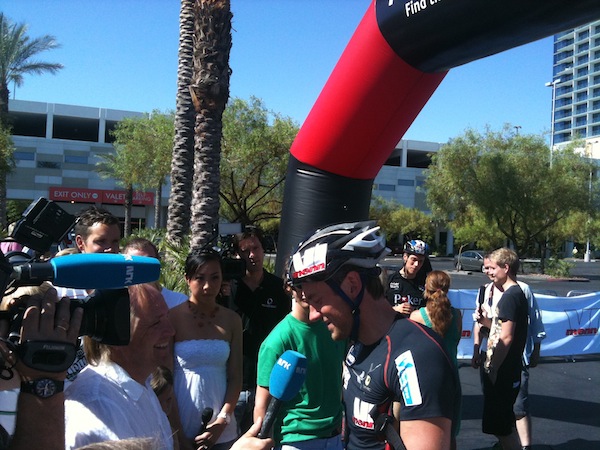
    On a course laid out by his Norwegian magazine sponsor—and modified at the last minute to give him a better shot at the win—Northug took the last two heats of a best-of-three series in the parking lot of the Palms Casino, evening the score with Hellner after losing to the Swede in a poker match earlier this week.

    Marcus Hellner (L) and Petter Northug (R) at the start of the first heat of their rollerski race in Las Vegas.

    After attracting some attention from poker websites and even ESPN broadcasters at their appearance at the World Series of Poker tournament yesterday, it seemed like the race between Northug and Hellner had the potential to draw a decent crowd.

    But at 8:30 on a Tuesday morning, at a resort two miles from the strip, all Las Vegas could muster was a thirty-strong rabble of predominantly Norwegian fans, a few of whom waved 8.5 by 11 inch printouts of the country’s flag. They gave Northug a rousing cheer when he skied by on his warm up, while Hellner was met with a chorus of boos.

    On the tight, twisting figure-eight loop around two traffic islands, the start made all the difference, as the first athlete to the first corner took the victory every time.

    Organizers from Vi Menn, the Norwegian magazine, had Northug and Hellner throw dice for starting position. Hellner won, giving him the advantage in two out of the three heats.

    After the first two rounds, it appeared that it would be the dice, not fitness, that would decide the outcome, because the man with the inside line to the first corner took each heat—Hellner the first and Northug the second.

    But for the final heat, Vi Menn staff moved back the start line a few yards, giving Northug more time to overcome his unfavorable start spot on the outside. Using his trademark explosive speed, he won what was essentially a 50-meter drag race to the sharp, righthand turn around a traffic island housing a handful of palm trees and some forlorn desert shrubs, and never looked back. The whole thing was over in less than 45 seconds.

    “They are all Norwegian guys in the jury—so they did something,” Hellner said, laughing. “It’s still fair, because I got the best start [position]. He’s a quicker

    Northug showing Hellner who's boss.

    starter than me—that made all the difference.”

    As the pair warmed up for the race, Northug seemed unhappy about the course, with all its tight corners, and after defeating Hellner, he looked more relieved than anything else.

    “With the tough course, you had to be first out there,” he said. “In the first heat, Marcus was first out, and it’s difficult to pass him. But in the two last ones I was waking up, and was hearing the home crowd here…I took the start in the last heat, and that was important.”

    After Northug’s win in the race and Hellner’s victory in their card game on Sunday, the battle between the two comes down to their placings in the World Series of Poker, which continues this coming weekend. Both Northug and Hellner have said that they will stay in town as long as they remain in the tournament, which could mean another full week in the city if the athletes play their cards right. (And if either makes it into the final nine, another visit to Las Vegas will be necessary in November.)

    But the race was the highest-profile portion of the trip, and with it over, many of the dozen Scandinavian journalists that have been chronicling the athletes’ every move will now head back to their home countries. With the highest-profile part of the trip concluded, the Northug and Hellner will have a little more time to relax—as will Alex Oysta, the Vi Menn editor who orchestrated the trip.

    More than anything, Oysta said he was thankful that no one got hurt. If one of the athletes had been injured in the race, he said, it would have been his own face on the pages of the newspapers—not Northug’s.

    Video is posted on YouTube: click here to see the second heat, or here for the finals.

    The scene at the Palms before the start of the first heat.
  • Northug and Red Bull sponsorship: an issue of morality in Norway

    Northug and Red Bull sponsorship: an issue of morality in Norway

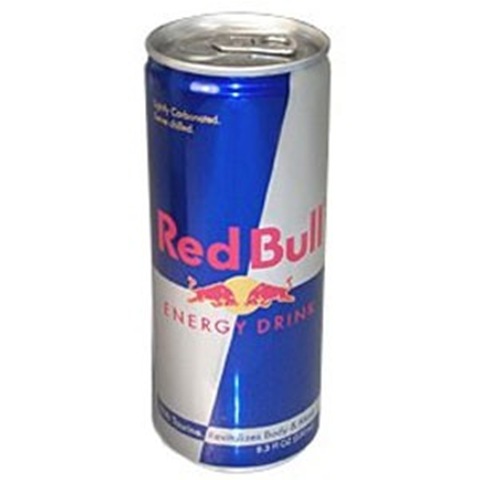
    In a country where energy drinks have become almost as American as pie, it might seem odd to us that in Norway the energy drink Red Bull had been banned until just half a year ago. The ban was also just recently lifted in France, while several other countries still ban the drink, including Denmark and Uruguay.   With this in mind,  you may imagine the uproar generated when the media recently reported that one of their most recognized athletes, Petter Northug, was signing a sponsorship agreement with Red Bull.

    Petter Northug (photo: Ida Karlsson)
    Petter Northug (photo: Ida Karlsson)

    Already on shaky ground with some team sponsors and personnel over rumors of his plans to leave the national team this season (which Northug and his publicists have denied), Northug again ran into trouble  with the Norwegian National Ski Federation (NNSF) for wearing a Red Bull logo on his hat for a television interview without permission, and was fined the equivalent of a month’s salary.

    The Norwegian alpine racer Aksel Lund Svindal was the first skier to be approached for sponsorship by Red Bull, but at the time he had to turn down the sponsorship because the country had still banned the drink. He is now sponsored by the beverage, but Elling Breivik, head of Norway’s Alpine Skiing Federation, cites the main difference from Northug is that Svindal’s contract with Red Bull does not call for his obligation to wear the company’s logo on any clothing.  Because there is limited space on suits and hats for sponsorship, the NNSF is very concerned with approving sponsors for individual athletes that may conflict with major team sponsors.

    Norway’s Sports President, Tove Paule, was unhappy with Northug’s decision and thought that the approval of his sponsorship by the NNSF was perhaps a bit rushed, citing that because Northug is a role model for so many young kids, there may be a moral or ethical obligation at stake.  Several of the biathlon federation sponsors also stated that they were unhappy with the deal because of ethical reasons.  Though Northug stood by his decision to be sponsored by Red Bull when the news first broke, he and his media team, Team Northug, did reconsider the contract for awhile because of the negative feedback.

    Meanwhile, the hype brought on by the national outcry has actually been a type of advertising for the energy drink. An estimate from Harald Massager, creative director at ad agency TIBE, found that with all the mentions of Red Bull in the media, the company has garnered 20-30 million dollars worth of unpaid advertising.