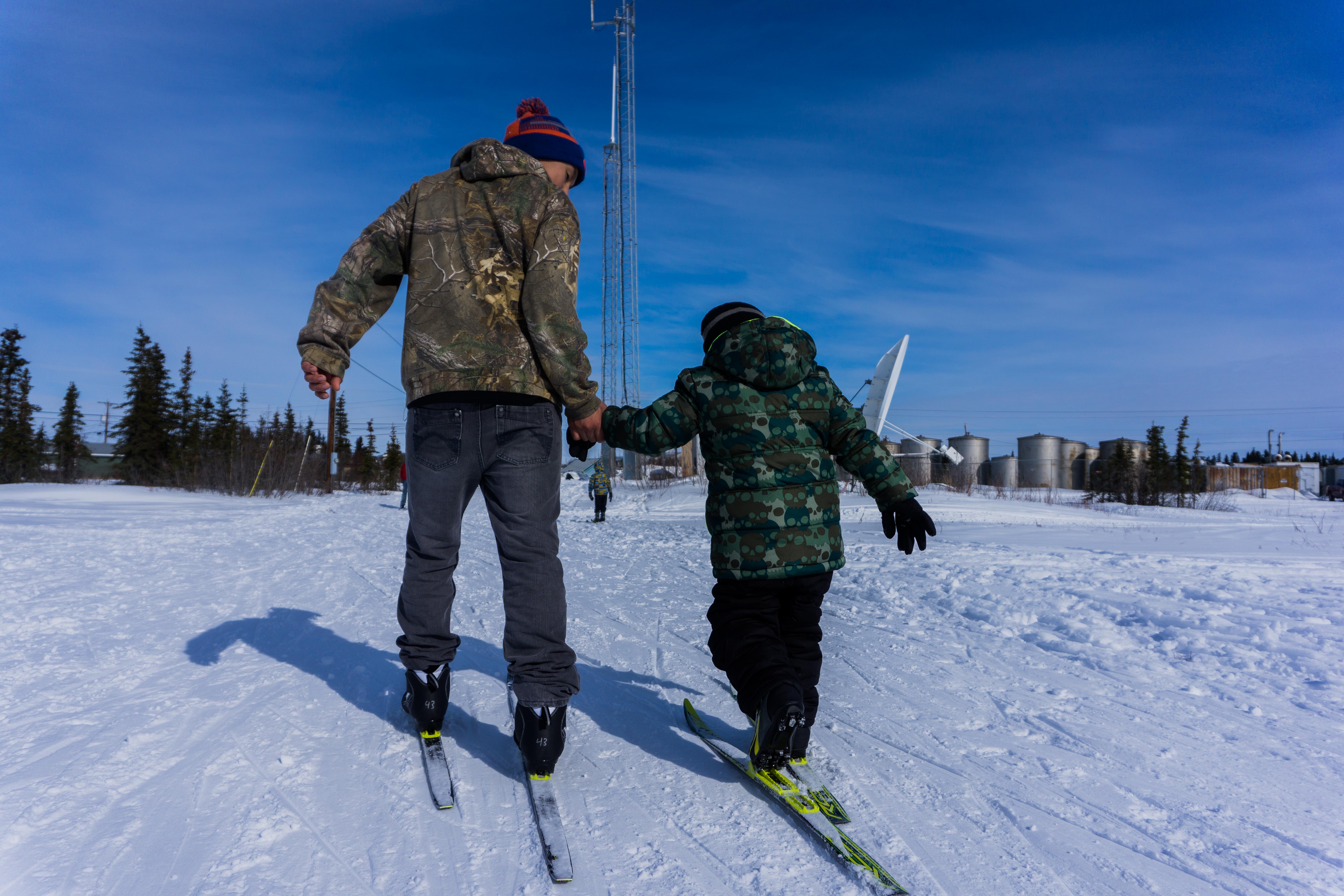
Tag: Northwest Alaska

  • Learning While Teaching Skiing with NANANordic in Northwest Alaska

    Learning While Teaching Skiing with NANANordic in Northwest Alaska

    NANANordic has been covered extensively by FasterSkier in the past, most recently in May 2014. Now in its fourth year, NANANordic sends elite cross-country ski racers to Alaskan villages to teach skiing to school children, with the goal that skiing become a lifestyle activity in rural Alaska.

    Seth Adams, a FasterSkier contributor who lives in Fairbanks, Alaska, joined the ranks of the volunteers this spring. Some of his photos from NANANordic in Noorvik appeared on this site in April. All opinions expressed here are his own. 

    DSC08987

    I don’t remember what I said.

    “Well, no. Not exactly,” Lars Flora responded, sounding pained. “That’s a common misconception among city Alaskans about the villages.”

    I was interviewing Lars for an article I wrote last year about NANANordic, a program that Lars began in 2012 to teach skiing to kids in remote Alaskan villages.

    As I write these words, a year after that interview with Lars, whatever I was wrong about wasn’t important enough to me to remember. But the take-home point was important to me. Although Lars was trying to be nice, the message was loud and clear — I thought I knew something, but I didn’t know anything. And I was part of the problem.

    I’m from Fairbanks, Alaska, the state’s second-largest city. Although Alaska’s cities contain most of the state’s population, there are far more villages than there are cities. And Alaska’s cities are majority white population (like me), while the villages are almost-exclusively Alaska Native.

    I’d never really been to any of the villages. And among white, city Alaskans, that is not at all uncommon. Most of the villages aren’t accessible by road — the only way in or out is by snowmobile, airplane or boat. And without a specific reason to go to one of the villages, most people don’t. City Alaskans often view them as grim places — devoid of economy or diversion, where alcoholism and domestic violence are more the rule than the exception.

    But in spite of our lack of firsthand experience with village life and our negative opinion of what we think we know, city Alaskans tend to not be indifferent to the villages. We see these places as an integral part of our state identity and their existence as a part of the Alaskan experience.

    We see these places as an integral part of our state identity and their existence as a part of the Alaskan experience.

    And so when I was told that some of my preconceived ideas were wrong, it cut deep. What else didn’t I know? I decided it was time to see for myself. Besides, volunteering with NANANordic sounded fun.
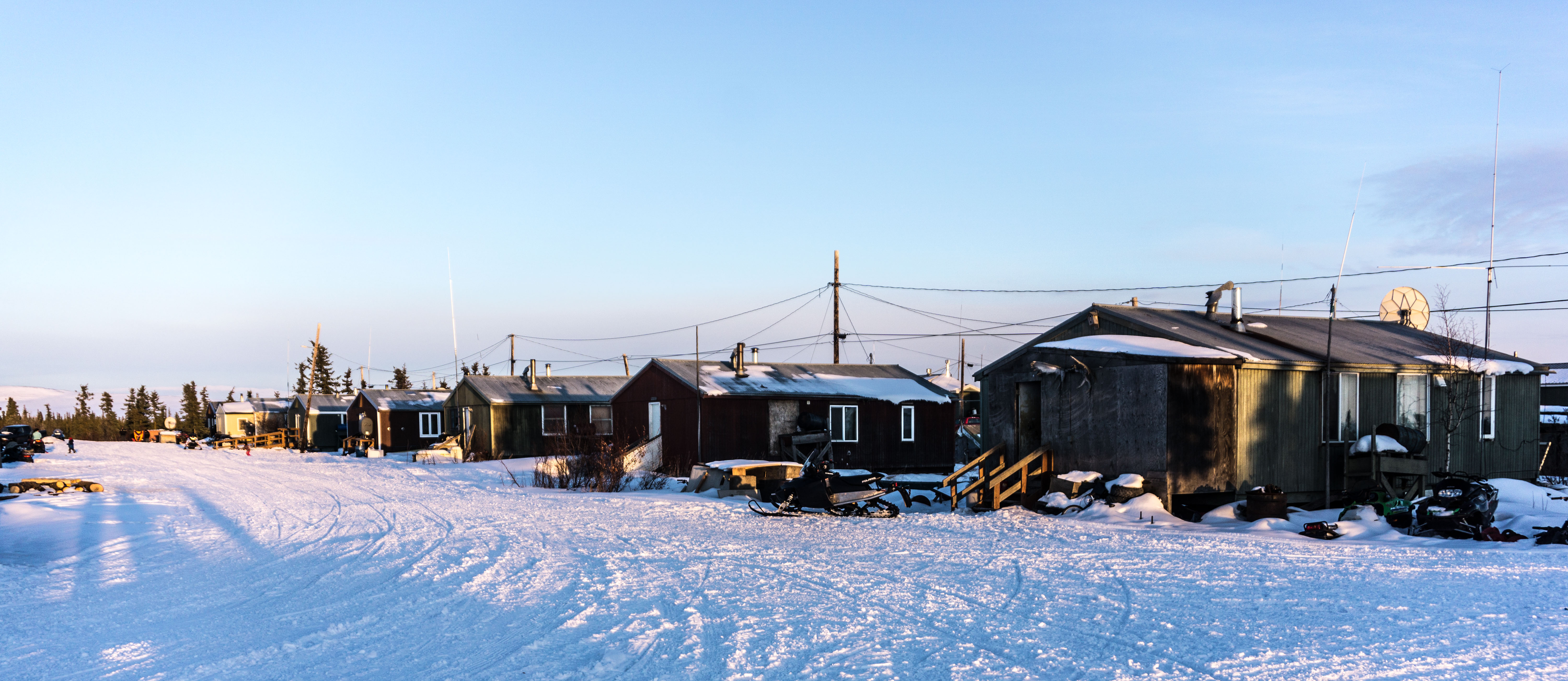
    DSC09059

    Noorvik

    After a hectic schedule of personal travel, I had a cold. I met my fellow coaches in the Anchorage airport at a truly uncivilized hour on the morning of April 5 to catch our flight to Kotzebue. There were a gaggle of NANANordic volunteers swarming the check-in line, all headed to different villages in the Northwest Arctic region.

    I would be headed to Noorvik with four other coaches — three veterans of NANANordic: Alaska Pacific University’s Lauren Fritz, Lauren’s boyfriend and Australian National Team member Paul Kovacs, and U.S. Paralympics Nordic Development Coach Robert Rosser. And one other newbie — 15 year-old Anchorage high school skiing standout Luke Jager.

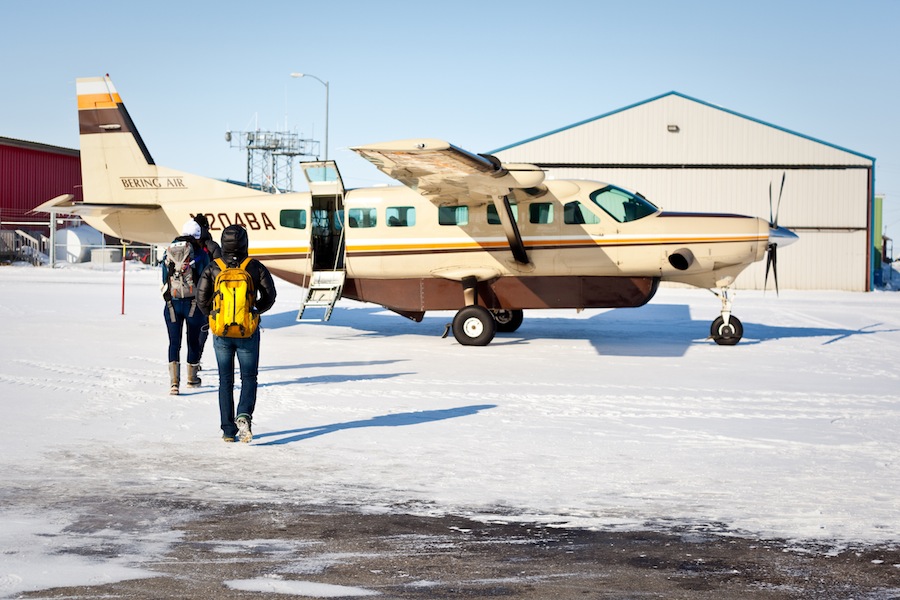
    We boarded an Alaska Airlines 737-combi (half of the passenger compartment is converted to cargo space) for the hour-and-a-half flight to Kotzebue. After some shuffling and waiting for winds to calm, we settled into an eight-seater Bering Air single-engine prop plane for the 30-minute flight from Kotzebue to Noorvik. After a remarkably smooth landing amidst the whipping wind in Noorvik, we loaded our bags into a van driven by the school principal.

    “The skiers are here!” the kids exclaimed as we carried our bags into the school. The school would be our home for the rest of the week. We looked around approvingly.DSC08651
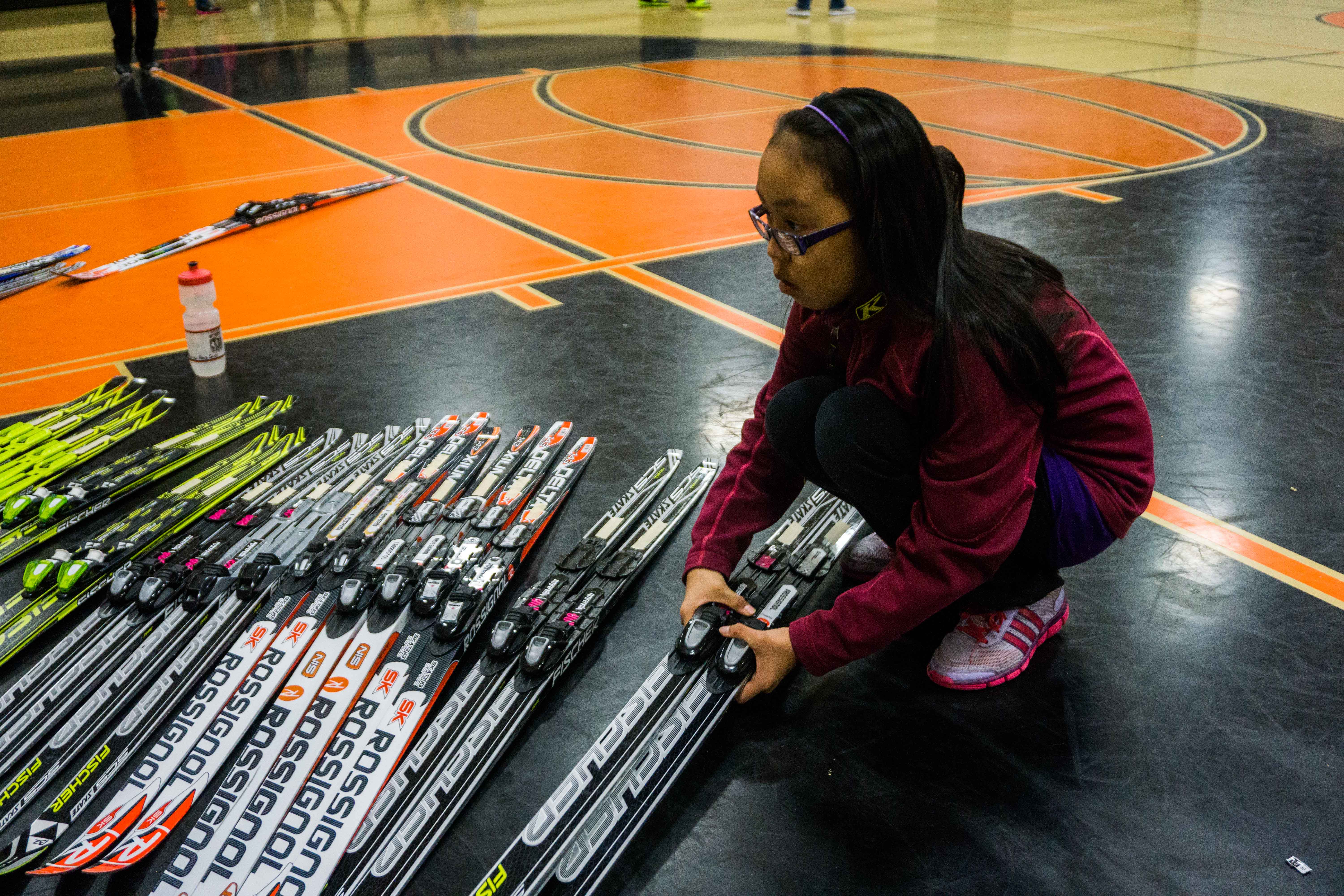
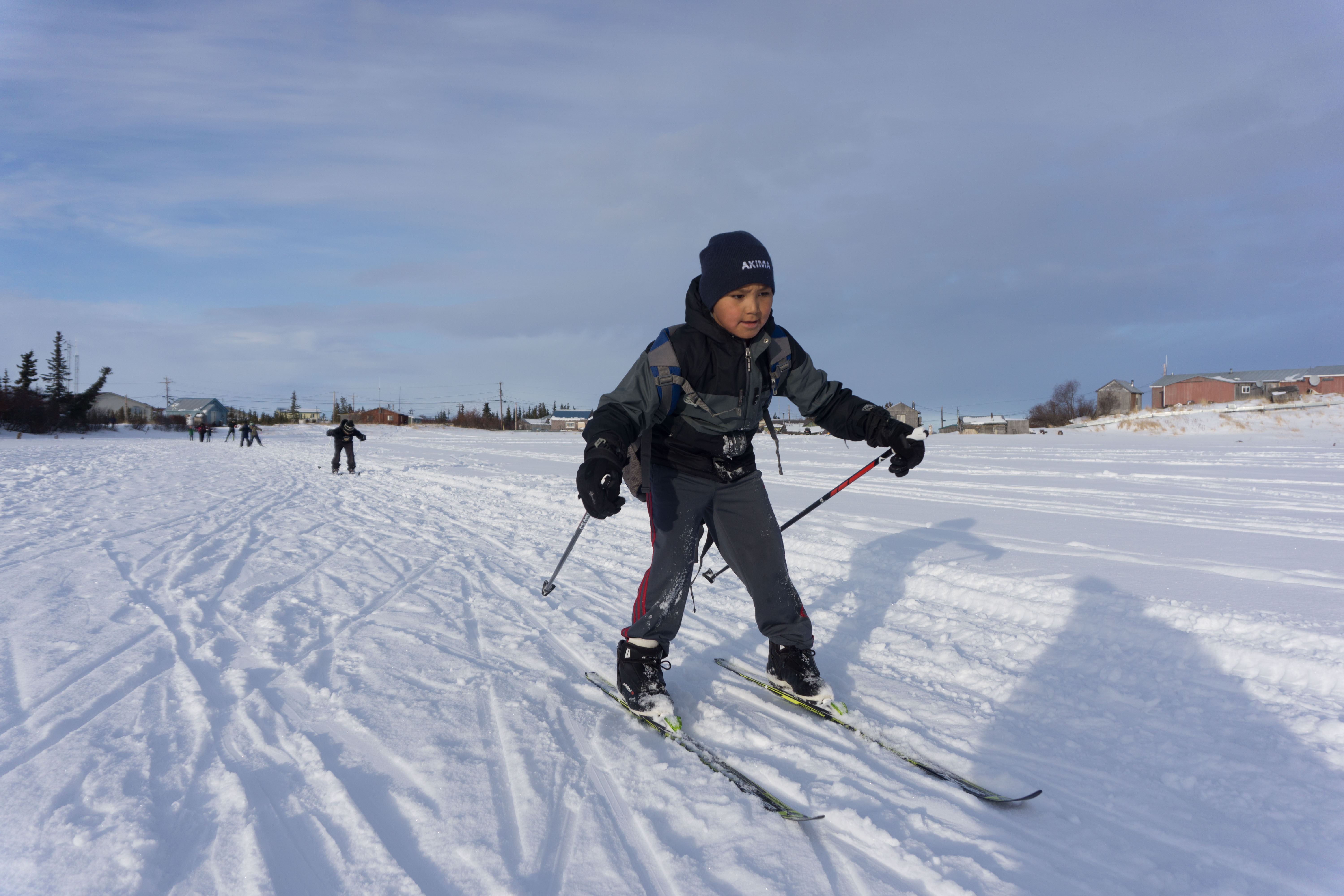
    In the afternoon we went out to ski around and get oriented. Luke stood with his skis braced against the wind. He straightened his skis and began accelerating across the icy school yard as the wind pushed him backwards.

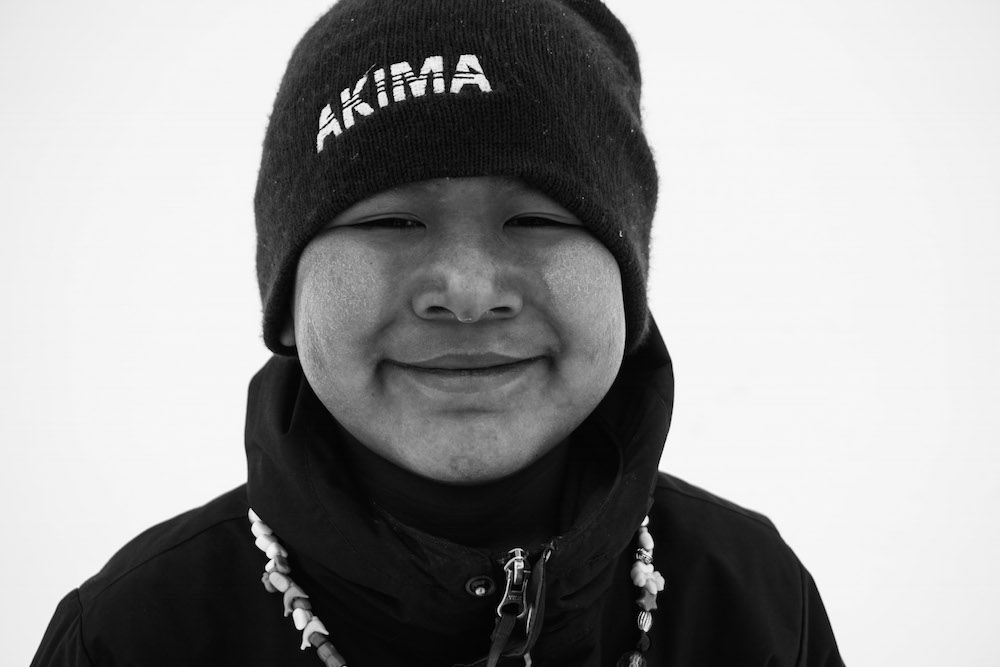
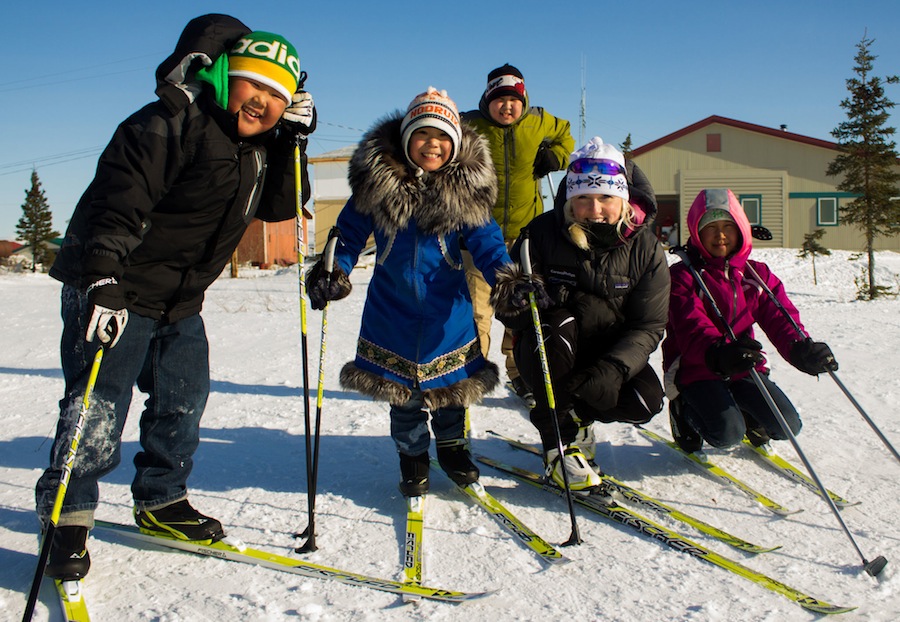
    At some point during the school day, each teacher brought every kid in the school to the gym to ski. I don’t know whether or not they were forced to ski with us — but it didn’t matter seem to matter, because almost to a student, including the surly high schoolers, they wanted to.

    Personally, the naturally athletic kids that easily picked up skiing weren’t the most rewarding to work with; it was the strugglers that were the most interesting.

    Take a first-grader, we’ll call him Casey, as a case study. During his first time on skis, Paul and I stayed back with him, and at the end of the session we both agreed that our backs were sore from repeatedly helping him onto his feet. He could stand for only seconds at a time and asking him to untangle himself once on the ground and get back on his feet on his own seemed a bit like asking him to fly the space shuttle. There were tears and there was whimpering.

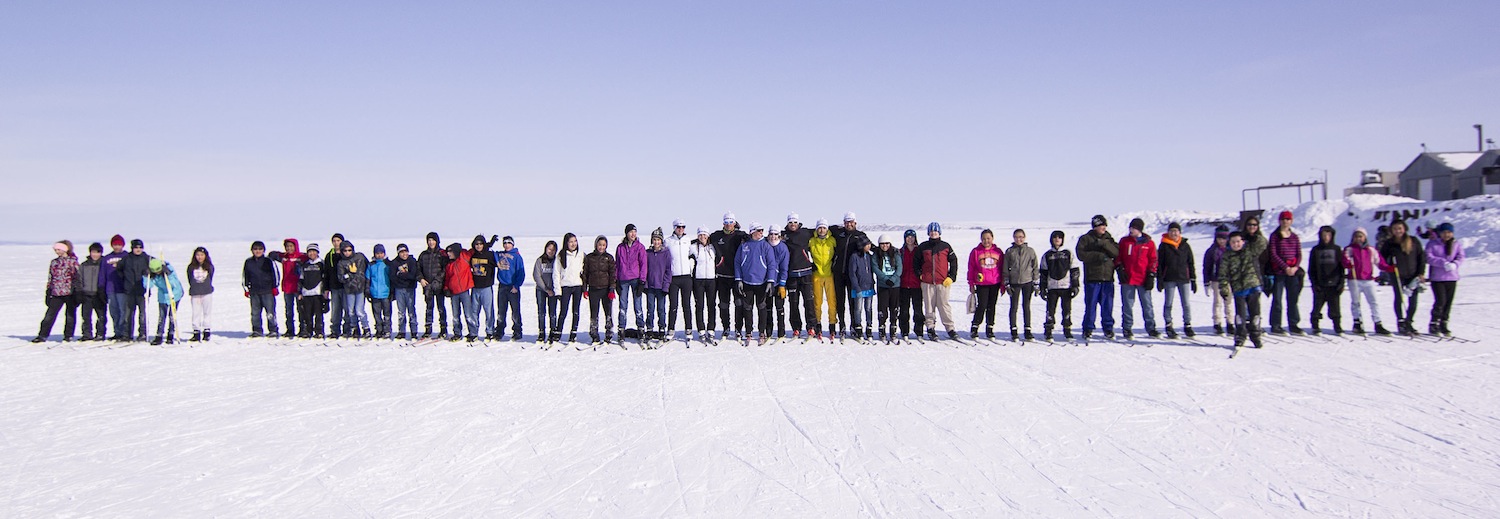
    But after school, when returning to ski was their own prerogative, Casey was back. As were many other kids that we did not expect to see. Out of the 190 kids in the school, over 60 were neatly lined-up outside the gymnasium door to ski again — fully one third of the school was back to ski for a second time that day. You would definitely not see this in Fairbanks or Anchorage.

    … One third of the school was back to ski for a second time that day. You would definitely not see this in Fairbanks or Anchorage.

    Casey constantly asked for help with everything. Like many of the kids, he was naturally quiet and rarely used words, expressing many of his emergencies in pantomime. But there seemed to be no minimum to how ridiculous his emergencies might be. One time, he frantically gestured at me that his sock had come off and stayed in his boot after he took the boot off.

    “So pull it out and put it back on,” I said.

    He held up his gloved hand in alarm, to show he could not possibly remove the sock from the boot by himself, since he was hamstrung by the glove.

    DSC09286
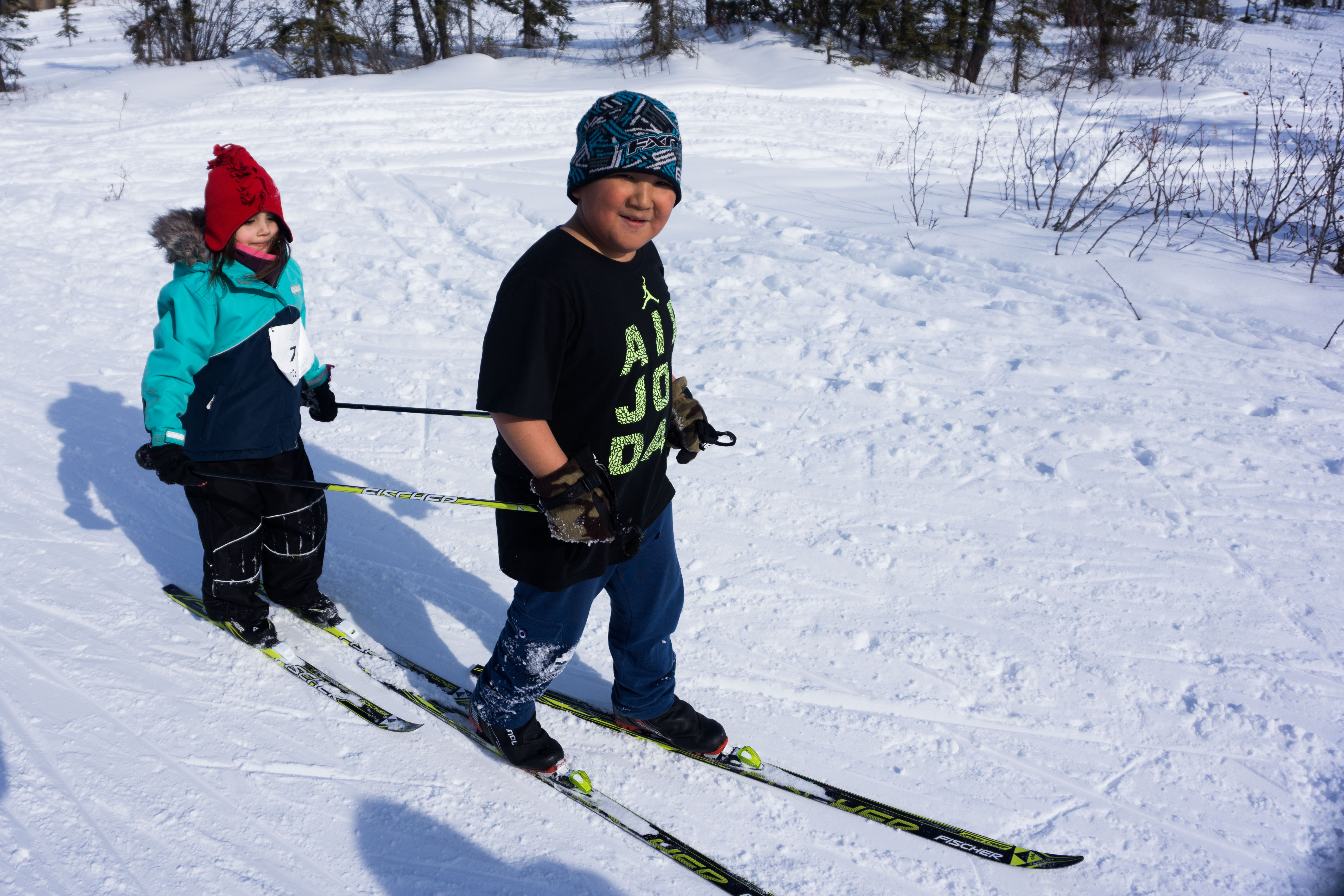
    Casey tows another kid on our last day in the village.

    “Take the glove off, Casey,” I said with a laugh. He shrugged in disappointment, and did it. He was perfectly capable of everything everyone else was, but somehow being helped filled a need for him.

    Casey probably isn’t going to become a heroic story of having won the race or landed a 360. But he kept skiing all week, and although he never outwardly seemed to love it, at the end of each session he unfailingly asked when he could ski again.  As did many of the others. The bottled-up enthusiasm for skiing and for being outdoors was something that we all found remarkable.

    At the end of each day we were exhausted. We skied for at least nine hours a day, usually no-pole and in a rush to tend to one “emergency” or another. Then it was at the end of each day that we had the biggest group. We often led the whole group fairly far away from the school, with the smallest kids desperate to keep up with the biggest.  At the end of the session, getting everyone back was a huge chore.

    Occasionally the frayed ends of Paul’s nerves would show, which resulted in me calling him “the cranky Australian.” But I could understand why was frazzled. We’d taken the kids out to the Kobuk River on the far side of town, and they were scattered as far as we could see. It was getting late, but Luke, who is a high schooler himself, was hitting a jump with a group of older kids on the far side of the river. Paul’s jaw was repeatedly clenching and unclenching.

    Right then a woman and two kids pulled up on a snowmobile and told one of the kids to get on. Another kid grabbed onto the back of the sled and got towed, face dragging through the snow as he held tight to the snowmachine, until the woman realized he was back there and scolded him off. He stood up grinning a mischievous grin.

    DSC08921I didn’t know who the woman was, didn’t remember the name of the kid she’d scooped, and was unsure if we’d get the skis and boots back. I looked at Paul and shrugged — we were visitors in a strange land, and our job was to teach skiing.

    It’s difficult to overstate the tightness of the social fabric Noorvik. Nearly everyone is related in some way, and there is no need to be accountable for where the kids are, since everyone watches out for everyone. But this was hard for us to remember; the idea that small kids can run loose through a town and be perfectly safe is not a part of our cultural experience. We reminded ourselves that we were the only ones that were overwhelmed; for everyone else this was daily life. Except that usually they don’t have skis.

    “The little kids won’t head back to the school until you guys stop hitting that jump and head back yourselves,” I told the high schoolers, trying not to beg. “Do you mind just heading back? Because otherwise we’ll be out here all night getting the small kids back.”

    The count of skis and boots at the end of the day was exactly right. No equipment was missing. The woman must have returned her child’s skis and boots.

    The week was a bit of a blur of chasing kids, clicking boots into skis, offering encouragement, and answering endless questions about when the next chance to ski would be. But being in Noorvik I was reminded of the conversation I’d had with Lars. I looked around, waiting to have one of my preconceived notions shattered in lightning bolt epiphany.

    Noorvik wasn’t overly different from what I’d expected. Life there isn’t easy, but it wasn’t as tough as I’d imagined. Perhaps it was just seeing it that mattered and seeing how tight the social bonds are, witnessing how the older siblings watch out for the younger ones with no trace of resentment, and that all the adults in town are essentially guardians for all the kids.

    Noorvik wasn’t overly different from what I’d expected. Life there isn’t easy, but it wasn’t as tough as I’d imagined.

    “I like what you’re doing with our kids,” one man told me as he walked past.

    A couple of hours later when he walked back by, I invited him to join us.

    “No,” he replied, then, apologetically, “I’m drinking now.” The kids continued to ski in excited circles all around us.

    Noorvik is a dry village, which means any possession of alcohol is prohibited. He excused himself, and I invited him back another day, but he never came. The kids, however, were all hooked on skiing. And they kept coming back.

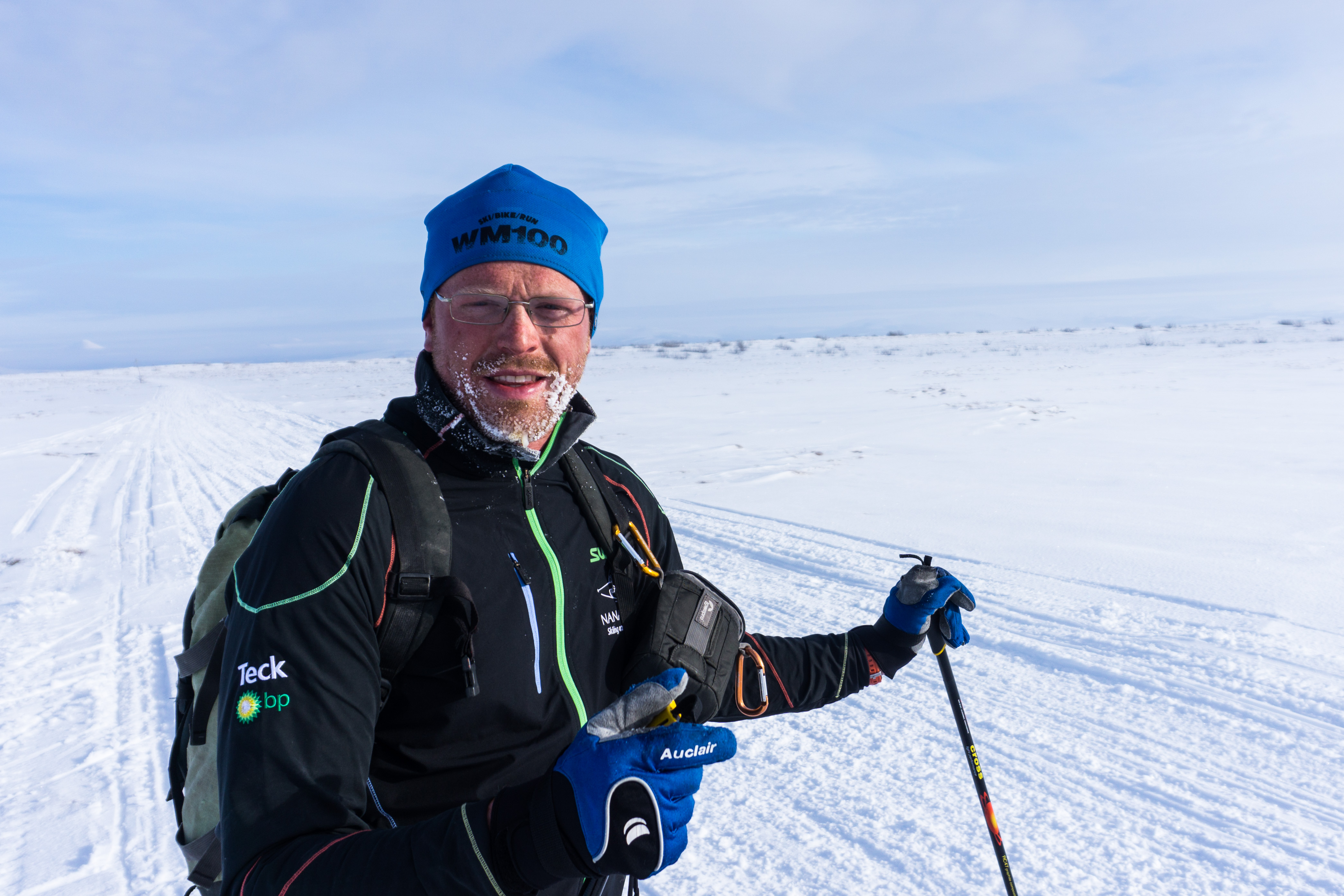
    FasterSkier contributor and NANANordic 2015 volunteer Seth Adams during his weeklong visit to Northwest Alaska.
    FasterSkier contributor and NANANordic 2015 volunteer Seth Adams during his weeklong visit to Northwest Alaska.

    At the end of the week, all five coaches skied 55-kilometers from Noorvik to the village of Selawik. Read about it and see pictures on Seth’s personal blog.

  • Photos from NANANordic in Noorvik

    Photos from NANANordic in Noorvik

    FasterSkier’s Seth Adams caught the NANANordic bug this season and recently headed up to Noorvik, a city of fewer than 700 people in Northwest Alaska, to volunteer with NANANordic from April 6-11. Here are some photos from his escapades so far:

  • No Easy Feat: NANANordic Gets Nearly 2,000 Rural Alaskans on Skis

    No Easy Feat: NANANordic Gets Nearly 2,000 Rural Alaskans on Skis

    Gym class with NANANordic in Kotzebue, Northwest Alaska. (Photo: Brice Habeger)
    Gym class with NANANordic in Kotzebue in northwest Alaska. In its second year, the program designed to introduce nordic skiing as a lifestyle sport in rural Alaska got between 1,500 and 2,000 grade-school students on skis, between 11 villages in the NANA region and one in North Slope. (Photo: Brice Habeger)

    (Note: This is the first of two articles on the NANANordic project, innovated by Lars Flora in 2011. Stay tuned for another piece on the addition of biathlon to the program.)

    If you ask Lars Flora, there’s no “No” in NANANordic.

    Founded by Flora, a two-time Olympic skier from Anchorage, Alaska, the program is designed to be fluid and adaptive in its effort to establish cross-country skiing in rural Alaska. If thousands of kids want to get on skis, bring the equipment to them. If adults, including military, want to learn as well, let them.

    “It’s kind of the way it works out there,” Flora said of the NANA region in the Northwest Arctic, about 550 miles from Anchorage by air. “Things happen and the program evolves every day.”

    With about 7,000 residents, 90 percent of which are Iñupiat (the northern-most aboriginal people in the world), the region spans some 38,000 square feet above the Arctic Circle. Locals and suppliers generally travel between NANA’s 11 incorporated villages by bush plane, but Flora wanted to ski the distances.

    Alaska Pacific University junior coach Erika Klaar during a NANANordic on-snow session in Kiana in Northwest Alaska. (Photo: Reese Hanneman)
    Alaska Pacific University junior coach Erika Klaar (second from right) during a NANANordic on-snow session in Kiana in Northwest Alaska. (Photo: Reese Hanneman)

    He did so last year, assembling a team of 17 volunteers to visit four villages with a fleet of skate skis, poles and boots. They spent about five days in each, teaching grade-school students the basics during the day and sleeping in classrooms at night. He logged 135 miles, not counting his on-snow time with the kids.

    Upon returning from a successful first trip last spring and gearing up for the next one in 2013, Flora met with the NANA Development Corporation (NDC), which oversees all things related to the region. One of 13 regional corporations created under the Alaska Native Claims Settlement Act, the NDC primarily encourages economic growth while preserving 10,000 years of history.

    A big fan of Flora’s goal to bring nordic skiing to the region (and all of Alaska), NDC Vice President of Communications and Marketing Robin Kornfield (mother of former University of Alaska Fairbanks skier Tyler Kornfield) asked Flora to commit to four years with the program. Done, he agreed.

    And what about visiting all 11 villages this year?

    “About half the people who know what it’s all about running programs in these areas said, ‘That’s way too fast to grow. It’s too many places,’ ” said Flora, 35. “We usually say yes to everything and when new opportunities come up, we try to find a solution and make it happen.”

    NANA Villages Visited
    (between April 8 and 24, 2013):

    Ambler
    Buckland
    Deering
    Kiana
    Kivalina
    Kobuk (video)
    Kotzebue
    Noatak
    Noorvik
    Selawik
    Shungnak (video)
    (plus Anaktuvuk Pass in the North Slope)

    Sure enough, the program grew in its second year with more than 40 volunteers flying north to put in roughly 10-hour days with enthusiastic youth and teens. In 17 days, NANANordic touched down in all 11 villages (plus Anaktuvuk Pass in the North Slope region), getting 1,500 to 2,000 children on skis – up from 650 the year before.

    “We had more interest than we knew what to do with,” said Eric Packer, a volunteer coach and Anchorage native who trains with Vermont’s Stratton Mountain School T2 Team. “It was really inspiring and motivating for me as an athlete to see that.”

    After a long season of competing at home and abroad, Packer was one of dozens of well-known athletes, including U.S. Ski Team member Erik Bjornsen and U.S. Biathlon’s Susan Dunklee, Sara Studebaker and Hannah Dreissigacker, who jetted to northern Alaska to help Flora. Packer was stationed in Buckland and brought there by a bush plane.

    “The nearest town is 70 miles away by snowmobile so you’re pretty far out there,” the 22-year-old said. “It was a really neat community, really tightly knit. The public school is the biggest building, so it uses the school as its hotel.”

    The NANANordic volunteers shared quarters with military personnel from Arctic Care, a health and medical service that aids villages via Black Hawk helicopters. With little convincing, about 100 of the service men and women also tried skiing.

    NANANordic volunteers board the plane to Shungnak in Kotzebue, Alaska. (Photo: Charlie Renfro)
    NANANordic volunteers board the plane to Shungnak in Kotzebue, Alaska. (Photo: Charlie Renfro)

    “They were out there, we were out there, and everybody stays at the school so we asked if we could give them ski lessons,” Flora said. “They were all into it.”

    With a four-year sponsorship commitment from Teck, a Canadian mining company, Flora was able to purchase about 230 sets of equipment, building on his quota of 70 last year. Just as it had previously done, NANANordic left 20 pairs of skis, boots and poles in each village, giving the four school districts they visited last year a grand total of 40.

    In places like Buckland, skiing was a completely new activity. That didn’t slow down most students, already comfortable in the outdoors.

    “The kids were really self-reliant and picked it up super fast,” Packer said of the hour-long school sessions.

    Additional ski time was offered after school, and Packer estimated more than 70 percent of the students came back for more.

    “The bell would ring at 3:30 and at 3:31, we’d have a line out the door,” he said. “That kind of excitement that was really cool.”

    Who Went:

    Directors: Lars Flora, Andrew Kastning, Charlie Renfro, Dylan Watts, Zach Hall, Tamra Kornfield

    Volunteer coaches: Amanda Del Frate, Austin Hess, Bre Donovan, Tully LaBelle-Hamer II, Caitlin Patterson, Calisa Kastning, Dave Smullin, Erik Bjornsen, Erika Klaar, Felicia Kreiter, Fischer Heimburger, Frances Pillifant, Greta Anderson, Hannah Dreissigacker, HC Holmberg, Jake Bassett, Josh Smullin, Katy Rehm, Lauren Fritz, Lauren Hess, Leah Droege, Lydia Blanchet, Meghan Clemens, Molly Schouweiler, Nick Treinen, Nils Koons, Nora Miller, Odin Brudie, Peter Kling, Reese Hanneman, Eric Packer, Donny Donovan, Sam Dougherty, Sara Studebaker, Susan Dunklee, Taryn Hunt-smyth, Siku Johnson, Asa Bergamaschi, Paul Lincoln, James Oksoktaruk

    Seeing the growth and adding new elements of the program like biathlon and four untimed races, was rewarding, Flora said. Students in Kotzebue, NANA’s largest village with about 3,000 residents, got a little too cold before their race and jumped the gun, but the coaches let them go.

    “They’re fun races. They’re participation,” Flora said. “Basically the last day of the week, we put bibs on the kids and made a little course.”

    Next year, Flora is thinking about organizing a larger race, like an invitational. However, transporting people between villages isn’t easy; a few students could easily hop on a bush plane, but 30 to 40 would require several trips.

    “There were a couple kids asking if they could make a ski team at the school,” Flora said. “I think there was 30 high-school kids wanting a ski team. … One of the goals is to have skiing as part of the school district.”

    In the Bering Straits region just south of NANA, skiing and biathlon are already in the schools. According to Flora, the districts are interested in integrating classic skiing into their programs, which he intends to help them with.

    The relationship has already become mutually beneficial. For the first time in 20 years, two skiers from the Bering Straits ventured to NANA to ski. A high-school senior, Asa Bergamaschi, and Sikulik Johnson, an eighth grader, came as volunteer coaches, and their experience was just as essential as that of the more elite athletes.

    “I received probably 100 emails with people who wanted to go out and then I had a few coaches recruiting for me,” Flora said of the volunteer-gathering process. Next year, he anticipates they’ll have an online application.

    “It’s this adventure combined with teaching kids how to ski so it’s really important for us to have some people who are here in Anchorage and know how to run programs and work with school districts,” he said of his staff.

    In terms of a vision, Flora hopes the sport truly takes hold in the region in the next three years. Beyond that, he’d like to spread the love to the rest of Alaska as well.

    NANANordic Director Lars Flora enjoying his time in the villages last month. (Photo: Reese Hanneman)
    NANANordic Director Lars Flora enjoying his time in the villages last month. (Photo: Reese Hanneman)

    “The whole idea is to actually get ski programs across Alaska so we’re putting a system together that can expand to other regions,” Flora said. “Someone asked me, ‘How many villages will you plan to do next year?’ We might try to pull off 30.”

    In the meantime, he’ll continue to focus on his program headed by five other directors (Charlie Renfro, Andrew Kastning, Dylan Watts, Zach Hall, and Tamra Kornfield) and keep it manageable. Later, he might consider joining forces with similar initiatives, like the Ski-Go Club in interior Alaska, run by Heidi Rader out of Fairbanks.

    “There’s 200-plus villages out there and if we’re going to start programs in all of them it is going to take the nordic community to make it happen and the whole state coming together,” Flora added.

    It might seem like a tough task, but it’s one he’s excited about. Flora will review the program the coming weeks to formulate future plans while continuing to pursue a degree in environmental science. He also works in the development office for the Alaska Pacific University ski team with his brother and head coach Erik Flora.

    In June, Lars will represent NANANordic in Greece after the U.S. Olympic Committee selected him to visit the International Olympic Academy (IOA). The Committee chose three programs across all sports to attend the IOA Young Participants Session, and Flora will spend more than two weeks there on behalf of his mission.

    “I’m definitely dedicated to keep going on with this program,” Flora said. “It’s been an amazing experience.”

    — Audrey Mangan contributed reporting

    More photos | Charlie Renfro videos (Kobuk and Shugnak)

    Related: Flora Brings Skiing to Northwest Alaska

  • Flora Brings Skiing to Northwest Alaska

    Flora Brings Skiing to Northwest Alaska

    Lars Flora stands behind a drying rack of sheefish, a popular springtime fish in Northwest Alaska, while Elvina, an Selawik eighth-grade skier in his NANANordic program, looks on. (Photo by Charlie Renfro)

    While most of his cross-country skiing brethren kicked up the last bits of snow at Spring Series in Craftsbury, Vt., Lars Flora was hard at work at home in Anchorage, Alaska, crunching numbers and finalizing details of his upcoming trip.

    It would have been easy if he had been the only one traveling to Northwest Alaska, but Flora had 17 volunteer coaches and two doctors to accommodate, the NANA Development Corporation to run by, and about 650 kids waiting for him in four different villages.

    NANANordic took all the focus and logistical smarts the two-time Olympian could muster. Yet every morning, the program’s potential in providing youngsters with cross-country skis was what excited him most.

    A couple of schoolchildren ski below Rainbow bridge in Selawik in Northwest Alaska. Without any roads in town, Selawik is mostly made up of boardwalks and bridges and built on the Selawik river. (Photo by Reese Hanneman/Engine Room Media)

    For three weeks from April 9 to May 1, Flora and a crew of peers and supporters visited schools in the Northwest Arctic, about 550 miles northwest of Anchorage by air. Slightly bigger than the state of Indiana, the region has an estimated 7,000 people living in 13 villages.

    Last year, Flora made it his mission to bring skiing to each town.

    Similar initiatives, such as the RurAL CAP Ski Go Club program founded by Jennifer Johnston, introduced students in the Northwest to nordic skiing in the past. The program fell by the wayside a few years ago following Johnston’s election as Anchorage assemblywoman, and Flora saw a need to pick up the pieces. His program, he decided, would be even bigger and most importantly, sustainable.

    “I felt [it] was a really good fit for the region and there’s no reason there can’t be ski programs up there,” Flora said in a phone interview from Anchorage. “It’s something they can [do] outside and go do something active somewhere. A lot of times, there’s no one taking them anywhere.”

    Like many city-dwellings Alaskans, Flora, 34, had always dreamt about seeing “real” Alaska, that rural part of the state where natives speak Iñupiat Eskimo and live off the land in often brutally cold conditions. He made the two-stop, two-hour flight to the region’s hub in Kotzebue for the first time last fall, where he watched the community assemble for a high-school running race.

    People drove up on boats and flew in on planes to see the event. Flora stood back amazed.

    “Spending time up there, you learn the people are super-warm and nice,” he said. “And when there’s a sporting event or any type of event, the whole community comes together.”

    Basketball was king, he said. Everybody played and followed its superstar athletes. But for some reason, skiing wasn’t ingrained in their culture. Flora wanted to change that.

    “The interesting thing about it is these kids are super active,” he said. “They were just so eager to ski. Every day, the questions would be, ‘Where are we skiing today?’ We did afterschool sessions and we ran out of equipment most of the sessions. Kids would be lined up at the door pushing down the door.”

    After a whirlwind winter, in which Flora started off on the World Cup circuit, placed fourth at U.S. Nationals in the 30-kilometer classic and suffered some unlucky crashes in two ski marathons, the Alaska Pacific University racer said there was nothing he looked forward to more than seeing his program, NANANordic, come to life.

    Since convincing the NDC native corporation to sponsor him last spring, Flora made it his priority. He partnered with the Northwest Arctic Borough School District, rounded up influential athletes, attracted volunteer doctors and donations from one of his sponsors – the Asthma and Allergy Foundation of Alaska – and arranged to have food and transportation paid for through NMS Food Services, Alaska Airlines and Bering Air.

    Flora stands behind some students ready to go skiing in Kiana in Northwest Alaska. (Photo courtesy of NANANordic)

    Fischer and Rossignol combined to donate 70 sets of equipment. Flora had the whole fleet transported between the four villages they visited – Kotzebue, Kiana, Noorvik and Selawik –and eventually left 20 sets in each.

    Flora skied between the towns for a total of about 135 miles. After 3 ½ weeks up there, Flora said he was a little tired.

    Each week, he and a few other coaches stayed at a given school, cooking in home-ec rooms and cozying up into sleeping bags at night. By day, Flora and about five members from his loaded staff, which included U.S. national team biathletes Sara Studebaker and Zach Hall,  APU skiers Reese Hanneman, Charlie Renfro, Greta Anderson and Dylan Watts, and University of Alaska Anchorage ski coach Andrew Kastning, taught 100 to 150 students per day.

    “Our first session was at nine o’clock and we were coaching all day,” Flora said. “[The kids are] basically all big hitters. They had been classic skiing on no-wax skis, but no one really knew how to skate ski so it was starting from the beginning, showing them how to put bindings on, put pole straps on, really starting with the basics.”

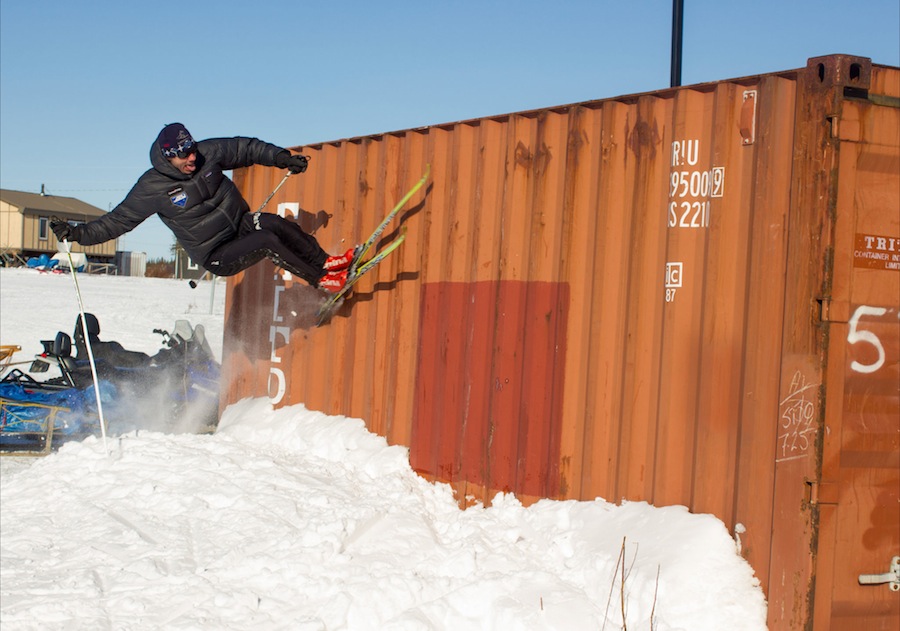
    Most of his volunteers stuck around for about six days, coaching during gym classes and after school with students in kindergarten through 12th grade. Children played games, asked questions, laughed and caught big air on skinny skis. Flora said their enthusiasm was overwhelming, and many coaches noted that children in Anchorage or other ski communities didn’t get that excited about skiing.

    Next year, Flora hopes to double the amount of villages and visit eight. Ultimately he wants to reach all 13.

    “I was totally unfamiliar what it was like to be up in the villages and just getting to know the logistics part of running a program [there],” he said. “The dynamics between the school district and the native corporations, the teachers and the local community, it’s been a huge learning curve. It’s been really fun.”

    A Balancing Act

    The amount of work involved is what kept Flora from the SuperTour Finals in Craftsbury in late March. He had to decide whether he wanted to race there or in the Norwegian Birkebeinerrennet, one of the most challenging marathons on the Worldloppet circuit. On March 17, he ended his season in Norway placing 59th despite a tough wax day.

    In all, Flora completed four marathons last season. He was third in the Gatineau Loppet after a crash near the finish, sixth in the American Birkebeiner after a tangle around 40 k, and 31st in the Swiss Engadin.

    Asked whether he chose the marathon route this season to prepare for trekking between villages in Northwest Alaska, Flora laughed.

    “It wasn’t totally planned out,” he said. “Coming into the season, you always put the goal out there and once you commit to it, it’s like, ‘OK, you get to go to the World Cup and see what happens, right?’ I got through the first period and realized I missed some big training periods so that’s when I started thinking that the marathons were going to be my main thing. By the time I did all those marathons, I was in great shape. I had a blast.”

    His desire to do more Worldloppets had been on his mind – that and what would be required up north. After their first stop in Kotzebue, Flora and Dylan Watts skied 75 miles to Kiana. They planned to cover the distance in one day, but teachers warned them otherwise.

    On the Trip:
    Sara Studebaker, Zach Hall (US Biathlon); Andrew Kastning (U of Alaska Anchorage); Reese Hanneman, Charlie Renfro, Greta Anderson, Dylan Watts (APU); Crystal Pitney (U of Alaska Fairbanks); Tamra Kornfield (formerly of UAF); Evelyn Dong, Katy Rehm, Rachel Samuelson, Danielle Hess (elite racers); Forest Tarbath, John Glen, Hugh Cosgrave (Service High School); Mariah Cooper (of Ojibwe band in Hayward, Wis.); Dr. Demain & Dr. Rathkopf (Asthma & Allergy Foundation of Alaska)

    “You’re going out on terrain you’re not familiar with and you’re right on the Bering Strait so the weather can chance in a second and can be blowing 60 to 70 miles an hour,” Flora said. “So we got a little nervous.”

    They packed a sled with food and camping and safety equipment, including a radio, and pulled the 30-40 extra pounds behind them. They split the trip into two days, skiing five hours on the first and three on the second.

    After that, Flora completed a 25-mile solo ski from Kiana to Noorvik in one day, and skied with Kastning, Renfro, Hanneman and Evelyn Dong for his last journey between villages.

    Along those final 35 miles, Flora said he experienced the highlight of the trip when they came upon a herd of about two thousand caribou.

    “I looked at Andrew and I was like, ‘I think I’m just going to ski right up to them,’ ”Flora said. “Andrew’s like, ‘So you’re going to be that guy? They guy who just splits the whole herd?’ Right when he said that, our friend Charlie came up and skied right through. He was like, “Let’s go!’ ”

    With each skier approaching at a different angle, the herd spooked and ran by Renfro, who was ready with his camera.

    “He had, I don’t know, two hundred caribou running right through him,” Flora said. “It was pretty cool.”

    Skiing through about 2,000 caribou on the way to Selawik in Northwest Alaska in late April. (Photo by Charlie Renfro)

    A day after returning from the region, Flora said they would immediately launch into planning for next year. At this point in his career, after some 17 years of elite racing, it was exactly what he needed.

    “When I would wake up, this was the stuff that got me excited,” Flora said. “I lost that excitement to get out there and train, and once you lose it, it’s hard to get back sometimes.”

    Last year was essentially an evaluation period in his ski career. He said it went “OK” considering the high he came off in 2011 with two top-40 finishes at World Championships, but in the end, he lacked training. At the Teva Winter Mountain Games in February, he suffered what he called “the worst bonk of his career.”

    Three months later, Flora still has a strange sensation in his fingertips. His friend, ski racer and ER doctor, Adam Swank told him to give it a few weeks and see if the effects of dehydration, altitude and cold wore off. They didn’t, and Flora said he was going to work with a physical therapist on what he thought was a pinched nerve.

    “My body doesn’t respond well going up and racing at eleven thousand feet,” Flora said. “That was brutal.”

    As for next season, Flora said he’s still undecided as to whether he will continue racing or pursue a career in coaching. One thing’s for sure: he’ll be back in the Northwest Arctic with skis in tow next spring.

    “When I started to see how much excitement and how much fun it was to pull this off with NANANordic, it was a good sign that I needed to move on and do something else,” he said.