From the FasterSkier archive — posts syndicated from athletes’ and coaches’ own blogs between 2004 and 2012, kept online as published. Current coverage is at fasterskier.com.
Johannes Hoesflot Klaebo (NOR), Emil Iversen (NOR), and Martin Loewstroem Nyenget (NOR), (l-r) during the final kilometers of the Olympic 50 k classic. (Photo: Vanzetta/NordicFocus)
A review of a recently published paper from Norway, “Long-term development culture for sustainable Olympic success: Lessons learned from Norwegian cross-country skiing” by Jacob Walther and Øyvind Sandbakk, is worth the time.
We’ve all heard enough about Norway. But this one simply cuts through some misconceptions, and it is worth the time to review. It strips away the mythology and gets back to what actually drives development and ultimately elite performance. Norway isn’t operating with better information. They’re more disciplined about applying what most programs already understand, and more consistent about what they refuse to do.
The paper addresses this immediately and directly. There is no “Norwegian method.” No magic interval session. No secret intensity zone you can implement and expect results. What they have is a system. And more importantly, a system built around their culture.
We tend to frame their success in physiological and technical terms. It’s not physiology, technique, health management, or mental health; they are all part of it, but they don’t explain the system. Most programs know early specialization is risky and inaccurate. Most coaches understand long-term development and the need to build training slowly and in phases based on training age. The difference is that Norway holds the line on it.
The elements are not new. Delay early selection. Encourage multi-sport participation, and integrate sport science into daily coaching. Invest in coach education. Treat athlete health as part of development, not something that gets in the way of it. The result isn’t just better elite athletes. It’s broader mass participation, more informed training, and a deeper pool of athletes and families engaged in the sport.
Norway’s Johannes Høsflot Klæbo won his first World Cup at 20, in the men’s 1.6 k freestyle sprint in Otepää, Estonia, in 2017. (Photo: Fischer/NordicFocus)
The paper uses Johannes Høstflot Klæbo as a case study. At 15, he placed 101st at junior nationals. Years later, he’s the most decorated Winter Olympian of all time. That’s a compelling outcome. But the value isn’t the result. It’s what the system expects and allows.
In most programs, that athlete gets filtered out early. In Norway, they stay in longer. That’s the point. This isn’t about identifying talent earlier and directing resources and opportunities at those. It’s about not eliminating talent identification too soon. That requires patience, cooperation among club programs, trust in the system, and a willingness to ignore short-term validation.
That’s where the Norwegian model sets itself apart. The turning point came in the lead-up to the 1994 Winter Olympics. Norway didn’t discover new physiology or invent new training methods. They organized themselves differently. They centralized expertise, embedded sport science into coaching, collected experience and training data across all Olympic Sports, and aligned the ski federation from the national team down to the club level.
Olympiatoppen sits at the center, not as a lab removed from the field, but as part of the training process. It doesn’t drive the system, but it informs and shapes it. That balance matters. Norway didn’t just add sports scientists. They used sports science to improve coaching. At higher levels, many coaches are trained in exercise physiology. That reduces misinterpretation and creates consistency over time.
Long-term development in Norway isn’t a slogan. It is intentionally implemented. It follows physiology. Peak endurance performance arrives in the late 20s, after years of consistent training. They don’t challenge that reality; they built their whole system around that reality.
You see that athletes stay in the sport longer, as evidenced by high-level FIS races in Norway. Hundreds of skiers are over 25-30 years old. They build general capacity before narrowing focus. Skill development has time and the room to engrain. Training isn’t rushed. Volume and intensity progress over years, not seasons. Junior results are not used as a sorting mechanism.
And this is where most systems break down. They say development matters, so select early and train accordingly. In Norway, youth championships are not selection events. They are part of the development process. The culture reinforces it. Clubs and schools coordinate so athletes can participate in multiple sports. Athletes regularly move across multiple ski disciplines. The recruitment base stays broad, and the system stays resilient.
Norway hasn’t eliminated selection; they’ve delayed it and minimized its consequences. That distinction matters. What gets labeled as “talent” at 14–16 is often early maturation, better support, or more exposure, not long-term potential. Norway avoids that trap by not falling into it. While many other systems double down on it.
Another principle sits underneath all of this: athlete health, physical and mental, comes before results. Training is managed for long-term progression. Training loads increase gradually over the years. High intensity is controlled, and low intensity dominates most of the training. The goal is adaptation over time, not accumulation in the short term.
The paper also points to emerging pressure on this model. Rising costs, shifting societal trends, increasing early specialization, and changes in team structures all push against it. These aren’t theoretical concerns. There are real pressures that can erode the system if they’re not managed.
Harald Oestberg Amundsen (NOR), Johannes Hoesflot Klaebo (NOR), and Einar Hedegart (NOR), (l-r) share the 20 k Freestyle Mass Start podium at the final World Cup in Lake Placid (USA) to end the 2025/2026 season. (Photo: Modica/NordicFocus)
So what carries over?
We can’t copy Norway. That misses the point. The lesson is alignment. Align incentives with long-term outcomes. Integrate sports science into coaching to improve the coach’s work. Build systems that allow athletes time to develop. And hold the line when short-term pressure starts to dictate decisions.
Many countries can point to a standout athlete. But if success depends on outliers, unusual resilience, unusual support, unusual talent, you don’t have a system. You have anecdotes. Norway produces depth, that is, the expectation and the standard.
There’s no secret session here. What they’ve built is a system that connects coaching and science, commits to long-term development, creates space for late progression, and maintains consistency over time. Not what they’re doing this week or next week, but what the athletes are doing ten years from now.
Help Support Our Olympic Coverage!
If you value the thoughtful work and access FasterSkier provides, please consider becoming a Voluntary Subscriber. Your support directly fuels our work to cover the people, places, and moments that make our sport special.
This coverage is made possible through the generous support of Marty and Kathy Hall and A Hall Mark of Excellence Award. To learn more about A Hall Mark of Excellence Award, or to learn how you can support FasterSkier’s coverage, please contact info@fasterskier.com.
Johannes Hoesflot Klaebo (NOR) took all six gold medals awarded in men’s cross-country skiing at the Olympics last month. (Photo: Barbieri/NordicFocus)
Johannes Hoesflot Klaebo made the call late Tuesday night… he’s racing.
According to the Scandinavian press, Klaebo departed Oslo’s Gardermoen airport at 6:25 Wednesday morning, beginning a roughly 20-hour journey to Lake Placid, where he’ll arrive about a day and a half before Friday’s 10-kilometer classic interval start. The Norwegian Ski Federation confirmed the news in a press release on Wednesday morning.
“I can see this isn’t going to be an optimal buildup, both with the long travel and not being able to adjust to the time difference,” Klaebo said. “But I want to be part of the World Cup finale in the USA.”
The decision came after Klaebo did a training session on Tuesday morning in Trondheim and responded well. National team doctor Ove Feragen gave him the green light.
Ben Ogden (USA) checks on Johannes Hoesflot Klaebo (NOR) after their crash eliminated them from the race in Drammen, Norway. (Photo: Nordnes/NordicFocus)
“After the fall during the sprint in Drammen, and some quiet days at home, Johannes has gradually resumed training and normal activity,” Feragen said. “He has responded well to this, without any recurring symptoms after the fall. After observation and further examinations, we have concluded that he is fit to compete.”
Klaebo has been sidelined since March 12, when American Ben Ogden fell across the Norwegian’s skis during Classic Sprint semifinals in Drammen, Norway. The resulting crash sent Klaebo’s head into the hard-packed snow. He was diagnosed with a mild concussion, withdrew from the Holmenkollen 50k, and scrapped a planned media tour in New York City that included sit-downs with CNN, NBC, the New York Times, and the Wall Street Journal.
Now the question shifts from whether Klaebo will race to how much he’ll race. He’s not committing to the full program.
Harald Oestberg Amundsen (NOR), Johannes Hoesflot Klaebo (NOR), and Martin Loewstroem Nyenget (NOR), (l-r) share the Skiathlon podium in Falun, Sweden, on March 1st, 2026. (Photo: Thibaut/NordicFocus.)
“My expectations for performance are not sky-high,” Klaebo said. “I’ll do my best despite a poor buildup and potential jet lag. Whether I race one, two, or three events in Lake Placid, I’ll decide once I get to the USA and get skis on my feet.”
The stakes are real despite the measured tone. Klaebo has already clinched the overall World Cup — his sixth, tying Bjoern Daehlie — and the sprint globe. But he trails Harald Oestberg Amundsen by three points in the distance standings after missing the Holmenkollen 50k. Two distance events remain: Friday’s 10 k Classic and Sunday’s 20k Freestyle Mass Start. A clean sweep of the overall, sprint, and distance globes would be a first in Klaebo’s career.
“For cross-country skiing, it’s especially important to have World Cups in the USA,” Klaebo said. “I’ve been looking forward to this finale for a long time.”
Racing begins Friday at Mt. Van Hoevenberg. Klaebo will be on the start line — jet lag and all.
Love Stories Like This? Help Keep Them Coming.
Feature stories like this one take time, access, and care to produce. If you value thoughtful storytelling and independent ski journalism, please consider becoming a Voluntary Subscriber. Your support directly fuels the work we do to cover the people, places, and moments that make our sport special.
Ben Ogden (USA) and Johannes Hoesflot Klaebo (NOR), along with Oskar Opstad Vike (NOR), (l-r) on the Olympic sprint podium last month. It should be made clear that Ogden and Klaebo have a strong respect for one another, to say the least. (Photo: Vanzetta/NordicFocus)
Fans from across the United States who will be in Lake Placid are anxiously hoping Johannes Hoesflot Klaebo (NOR) is well enough to travel and race in Lake Placid this weekend. (Photo: Authamayou/NordicFocus)
Johannes Hoesflot Klaebo has been included in Norway’s 22-athlete squad for this week’s World Cup finals at Mt. Van Hoevenberg in Lake Placid, N.Y., BUT the six-time Olympic gold medalist’s participation hinges on a decision being made today.
Klaebo, 29, suffered a mild concussion in a dramatic crash during the sprint semifinals at last Thursday’s World Cup in Drammen. American sprinter Ben Ogden lost his footing on the icy course and fell across Klaebo’s skis, sending the Norwegian backward and slamming the back of his head into the hard-packed snow. Klaebo lay on the ground for several minutes before being helped off course and transported to a hospital for evaluation.
The Norwegian Ski Federation confirmed the concussion diagnosis on Friday, and Klaebo withdrew from Saturday’s 50-kilometer race at Holmenkollen.
“He shall make an evaluation together with the national team doctor on Tuesday and would potentially travel on Wednesday,” Klaebo’s manager, Lasse Gimnes, told Norwegian broadcaster NRK on Monday. If cleared by national team doctor Ove Feragen, Klaebo would travel to New York on Wednesday — arriving just two days before Friday’s 10-kilometer classic interval start.
The crash also disrupted a planned trip to New York City for media appearances with CNN, NBC, the New York Times, and the Wall Street Journal — a reflection of the enormous international attention Klaebo has drawn since his record-setting six-gold performance at the Milano Cortina Olympics. Those in-person interviews have been scrapped, though some may shift to virtual formats.
Johannes Hoesflot Klaebo (NOR) poses with the FIS Crystal Globes he won last season at World Cup Finals in Lahti, Finland. (Photo: Thibaut/NordicFocus)
The distance globe is on a knife’s edge
The distance cup title is the central subplot heading into the finals. Before Holmenkollen, Klaebo held a 128-point lead in the distance standings. But with the Norwegian watching from home on Saturday, Amundsen’s 131-point haul vaulted him into the distance lead: Amundsen now sits at 939 points, three ahead of Klaebo’s 936. Martin Loewstroem Nyenget climbed to 914 in third. Just two distance events remain — Friday’s 10-kilometer classic interval start and Sunday’s 20-kilometer freestyle mass start. If Klaebo can travel and race, the margin is thin enough that a single strong result could flip the standings again. If the concussion keeps him out, the distance globe almost certainly goes to Amundsen.
Klaebo has already clinched both the overall World Cup — his sixth, tying Bjoern Daehlie’s all-time record — and the sprint globe.
Norway’s men’s squad: Harald Oestberg Amundsen, Martin Loewstroem Nyenget, Einar Hedegart, Andreas Fjorden Ree, Mattis Stenshagen, Emil Iversen, Johannes Hoesflot Klaebo, Lars Heggen, Even Northug, Ansgar Evensen, and Even Solem Michelsen.
Jessie Diggins soaks in all the energy from the home crowd during her warmup in Minneapolis — the last time the World Cup was on American snow. (Photo: Leann Bentley/USST)
Diggins’s farewell, and notable absences
The Lake Placid finals will serve as the final competitive races for Jessie Diggins, the most decorated cross-country skier in U.S. history. The women’s overall cup and distance cup are both decided, with Diggins winning with a comfortable margin over Sweden’s Moa Ilar in second. The three-time Olympic medalist and three-time overall World Cup champion announced before the season that this would be her last, and a farewell on home snow in front of an American crowd at the first-ever U.S.-hosted World Cup finals is about as fitting a send-off as anyone could script.
Klaebo is not the only notable question mark heading into the weekend. Norway’s Kristine Stavaas Skistad and Mathilde Myhrvold have opted to skip the finals to prepare for part two of Norwegian nationals in Harstad next week. Sweden’s Ebba Andersson has also pulled out.
Norway’s women’s squad for Lake Placid includes Astrid Oeyre Slind, Heidi Weng, Kristin Austgulen Fosnaes, Karoline Simpson-Larsen, Nora Sanness, Karoline Groetting, Julie Bjervig Drivenes, Tiril Udnes Weng, Julie Myhre, Lotta Udnes Weng, and Milla Grosberghaugen Andreassen.
The men’s freestyle mass start gets started at the US National Championships in Lake Placid, NY, 1/8/26. (Photo: Nancie Battaglia)
A historic venue
The Lake Placid finals mark the first Cross-Country World Cup finals ever held in the United States and the return of World Cup racing to Lake Placid for the first time since 1979. Racing kicks off Friday at Mt. Van Hoevenberg with the 10-kilometer classic interval start, followed by a freestyle sprint on Saturday and a 20-kilometer freestyle mass start on Sunday.
This is a developing story. FasterSkier will update when Klæbo’s decision is announced.
Help Support Our Olympic Coverage!
If you value the thoughtful work and access FasterSkier provides, please consider becoming a Voluntary Subscriber. Your support directly fuels our work to cover the people, places, and moments that make our sport special.
This coverage is made possible through the generous support of Marty and Kathy Hall and A Hall Mark of Excellence Award. To learn more about A Hall Mark of Excellence Award, or to learn how you can support FasterSkier’s coverage, please contact info@fasterskier.com.
The start of the Holmenkollen Men’s 50 k Freestyle in Oslo, Norway. (Photo: Authamayou/NordicFocus)
For nearly two hours on Saturday, 77 men disappeared into a stubborn curtain of fog that clung to the hillsides above Oslo, their figures swallowed by the mist somewhere between the stadium and the high point at Frognerseteren. When it was over, only one emerged with his arms in the air, and it was the one freestyle specialist who had been topping shorter freestyle distance races most of the season.
Einar Hedegart, the 24-year-old former biathlete who only committed fully to cross-country skiing in November, surged past Harald Oestberg Amundsen in the final meters to win the Holmenkollen 50 k Freestyle in 1:51:38.2 — his first victory on cross-country skiing’s most storied stage, in just his seventh World Cup start.
“This is the greatest feeling I’ve ever had,” Hedegart said after the finish. “This is just a nostalgia stadium. [A] legendary race, almost all my heroes have won this race, and especially Petter Northug. This might be the reason why I’ve been so motivated my whole life to be a cross-country skier.”
Einar Hedegart (NOR) celebrates winning Norway’s most iconic race. www.nordicfocus.com. (Photo: Authamayou/NordicFocus)
But the result that will echo loudest across the sport happened away from Oslo. Johannes Hoesflot Klaebo, the overall World Cup leader, was home nursing a mild concussion from a hard crash in the Drammen sprint two days earlier. Klaebo, who has already compiled a nearly perfect season, winning the Tour de Ski, all six Olympic races, secured the FIS Overall Crystal Globe, the FIS Sprint Crystal Globe, and only needed to keep racing the remaining distance races to take the clean sweep of the season with the FIS Distance Crystal Globe. BUT his absence from the start line meant zero points scored in the distance standing today. And with Amundsen’s second-place finish today, the distance crystal globe race was blown wide open: Amundsen now leads the distance standings by three points, 939 to 936, with two distance races remaining at the World Cup Finals in Lake Placid.
Klaebo posted to Instagram yesterday: “Took a fall yesterday and hit my head pretty hard, but luckily everything is all good in the hood. Ended up with a concussion, so I’ll take some days off from both training and the internet just to make sure everything settles properly. Only got one head, so have to take good care of it.”
He had been scheduled to fly to the United States on Sunday, but will now stay in Norway for a few extra days, hoping to recover in time for Lake Placid.
Einar Hedegart (NOR) emerges from the fog to take the win. (Photo: Nordnes/NordicFocus)
A Race Defined by Fog
The Holmenkollen 50 k — first raced in 1888, a fixture of the World Cup since 1982, and a race that draws an estimated 100,000 fans to the forested hills above Oslo — returned to the calendar Saturday after a one-year absence. For the first time, the men’s and women’s 50 k races were held on the same day, the women starting 45 minutes behind the men in a format designed to create an all-day spectacle. The fog, however, had other ideas. Conditions were so thick that spectators along the course could hear the racers before they could see them.
The course — six laps of 8.3 km with 334 meters of climbing per lap — was firm and fast after overnight salting despite an air temperature of 5.0°C. The salted, compact surface was ideal for skating, and the winning time of 1:51:38 came in roughly four minutes faster than the last time the Holmenkollen 50 k was contested in freestyle.
Harald Oestberg Amundsen (NOR) on his way to second place. (Photo: Authamayou/NordicFocus)
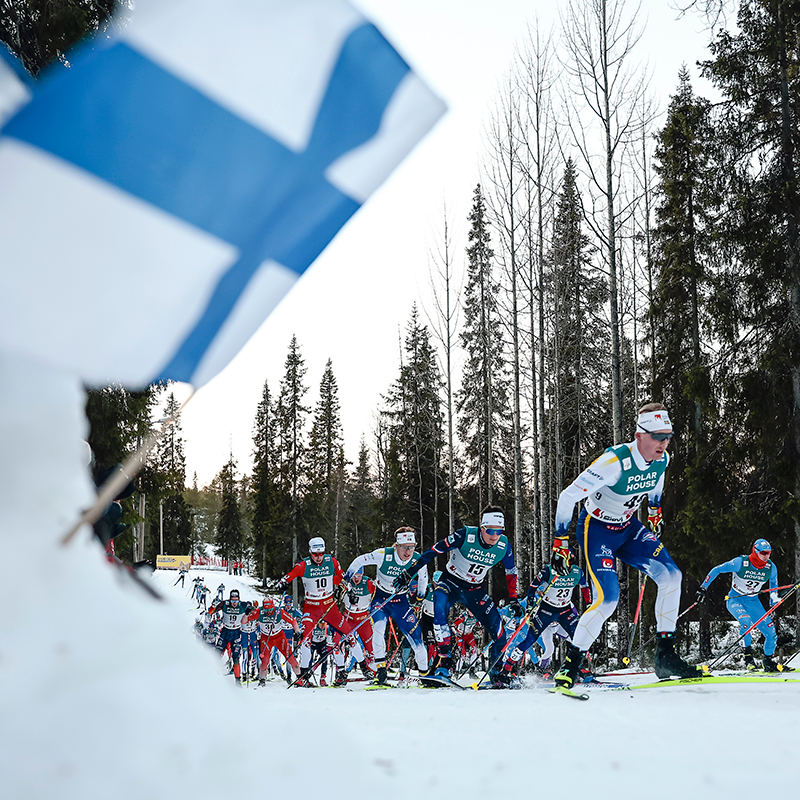
Through the first three laps, the race unfolded as a cautious tactical affair. A large pack of roughly 40 skiers stayed together, with Martin Loewstroem Nyenget, Mattis Stenshagen, and Federico Pellegrino taking turns at the front. The first athlete to make a decisive tactical move was Iver Tildheim Andersen, who changed skis early at the stadium after the third lap while the rest of the pack continued through. The fresh skis gave Andersen a burst, and when the lead group stopped for their own ski exchange one lap later, he suddenly found himself alone at the front with a roughly 15-second advantage.
“Just stick with the field as long as possible and then hopefully be in position when the group starts swarming,” Hedegart said of his plan. “But today I was really offside, like 70 percent of the race. So I was lucky that no one took a gap.”
The chase group — reduced to roughly eight athletes, all Norwegian once France’s Victor Lovera fell off the pace — gradually closed on Andersen through the fifth lap, with Hedegart, Simen Hegstad Krueger, Amundsen, Nyenget, Andreas Fjorden Ree, and Kasper Andersson Herland trading pulls at the front. By the time the group reached the final lap, they had swallowed Andersen, and the race became a question of who had saved enough for the final kilometers.
Simen Hegstad Krueger (NOR) tried his best to get away for the win. (Photo: Authamayou/NordicFocus)
Krueger’s Late Charge and Hedegart’s Final Kick
Krueger, who was celebrating his 33rd birthday the day before, was omitted from the Norwegian Olympic team despite multiple Olympic medals in his career and was the winner of the last freestyle Holmenkollen 50 k. He drove the pace through the final lap. He pushed hard over the climbs near the iconic Holmenkollen church, stringing out the group and shedding Andersen off the back. But Krueger couldn’t sustain the pressure all the way to the finish, and as the group of seven came around the final corner and up the short, steep ramp before the descent into the home stretch, the sprint was on.
Amundsen launched first, throwing everything he had at the final few hundred meters. But Hedegart, who had looked labored at points earlier in the race, found a gear no one could match. He came alongside Amundsen, took the lead in front of the grandstand crowd, and raised his fist in celebration as he skied across the line.
“I felt, like, better,” Hedegart said of his position in the back of the pack through much of the race. “So I was just laying in the field, and I had to remind myself he did the same,” he added, referring to his idol Northug, whose trademark move was stalking from behind before unleashing a devastating sprint.
Harald Oestberg Amundsen (NOR), Mattis Stenshagen (NOR), and Martin Loewstroem Nyenget (NOR), (l-r) stayed in the lead pack. (Photo: Authamayou/NordicFocus)
Hedegart crossed in 1:51:38.2. Amundsen finished four-tenths of a second behind. Nyenget was third at +1.1. Ree took fourth (+1.5), followed by Herland (+2.1), Krueger (+3.0), Moseby (+4.8), and Andersen (+16.8) after his brave solo effort. Norway swept the top eight positions.
France’s Lovera was the first non-Norwegian in ninth (+48.1), followed by AIN athlete Savelii Korostelev in 10th (+1:24.2).
Zak Ketterson (USA) led the way for the Americans in the chase pack racing for 11th place; he ultimately finished 18th. (Photo: Authamayou/NordicFocus)
Ketterson Fights for 11th in His Adopted Home
Zak Ketterson, who spent the summer and fall living and training in Oslo, found himself in the thick of a battle for 11th place, a fight he learned about from coaches stationed along the fog-shrouded course.
“I had heard from coaches on the side of the trail that our pack was fighting for 11th, and that was super cool,” Ketterson said. “I actually felt pretty fresh at the end and thought my finishing sprint would be pretty good, but I didn’t time it well and got really boxed in on the last couple turns into the finish.”
Ketterson ultimately finished 18th (+1:54.2), part of a chase pack that came across the line within seconds of each other. He said everyone in the group knew a sprint was coming on the final lap.
The fog made the tactical picture nearly impossible to read. “I couldn’t see more than 10 meters in front of me,” Ketterson said. “It definitely made it difficult to assess where I was relative to the leaders in the later laps. It also made some of the corners feel way sketchier because you couldn’t really choose an optimal line with such limited visibility.”
For Ketterson, the race carried personal significance beyond the result. Having trained on the Holmenkollen course through the Norwegian summer and fall, he knew every climb and descent intimately. “This is definitely one of the most iconic and cool races we get to do,” he said. “It was especially special for me this year since I trained on this course all summer and fall living in Oslo. The highlight was definitely having my wife Julie and her family out there cheering me on.”
What made the performance all the more impressive was the state of his body coming in. “I honestly feel like I am really running on fumes,” Ketterson said. “To be honest, I was not sure if I would even start this race in the morning. I felt so bad, and honestly, my body has felt super up and down in the last few weeks. I’m really curious to see how my body responds to this race. I was pleasantly surprised by how decent it felt, but I feel like the next week could go either way. Especially with the international travel tomorrow.”
Brian Bushey (USA) gaining experience on his way to 59th place. (Photo: Authamayou/NordicFocus)
The Rest of the North Americans
Hunter Wonders was 45th (+5:46.9), Kevin Bolger was 48th (+6:51.3), and Brian Bushey was 59th (+12:24.9).
Canada’s Xavier McKeever finished 41st (+5:11.4), while Thomas Stephen was 43rd (+5:18.1).
Harald Oestberg Amundsen (NOR) takes over the FIS Distance Globe lead with just two distance races remaining. (Photo: Authamayou/NordicFocus)
Distance Globe: Three Points
The ramifications of Saturday’s race land squarely on the crystal globe picture. Before the race, Klaebo held a 128-point lead over Amundsen in the distance standings and a 636-point lead in the overall. With Klaebo watching from home, Amundsen’s 131-point haul (including bonus points) vaulted him into the distance lead: Amundsen now sits at 939 points, three ahead of Klaebo’s 936. Nyenget climbed to 914 in third.
Klaebo’s overall World Cup lead, at 2,071 points to Amundsen’s 1,566, remains secure with a 505-point cushion. But the distance globe — awarded to the season’s best across distance events only — will come down to the final two races: a 10 k Classic Interval Start and a 20 k Freestyle Mass Start in Lake Placid, March 20-22.
If Klaebo can travel to Lake Placid and race, he’ll have every opportunity to reclaim the lead. If the concussion keeps him out, the distance globe is likely to belong to Amundsen.
Kasper Andersson Herland (NOR), who finished fifth, celebrates with Einar Hedegart (NOR), (l-r) at the finish of the Holmenkollen. (Photo: Authamayou/NordicFocus)
A Star Made for This Stage
Hedegart’s career trajectory is one of the season’s best stories. A junior biathlon world champion who struggled with his shooting, he drifted toward cross-country skiing after a surprising second-place finish at the Holmenkollen World Cup last season. He spent the summer training with a cross-country team while bringing his rifle to every camp, undecided. In November, after winning the popular pre-World Cup cross-country race in Beitostoelen, Norway, by a wide margin and missing eight of 20 shots in a biathlon event, he committed to leaving the rifle at home.
Since then: an Olympic bronze in the 10 k Freestyle behind Klaebo, a team sprint gold partnered with Klaebo, victories in the Engadin Marathon, and now the Holmenkollen 50 k — a distance he had never raced at the World Cup level. He was asked whether his approach of sitting back resembled Northug’s famous stalking tactics.
“Yeah, I felt like Petter,” Hedegart said. “So I was just lying in the field, and I had to remind myself he did the same.”
For a race that dates to 1888, that has been won by the sport’s mythical stars, and that is contested before the King of Norway in a stadium surrounded by 100,000 fans, there is no small amount of weight to what happened Saturday at the Holmenkollen. Hedegart is, by every measure, now a cross-country skier.
The season concludes with the World Cup Finals in Lake Placid, New York, March 20-22. Three races remain. The distance globe is separated by three points. And the world waits to see whether Klaebo can make it to the start line.
Feature stories like this one take time, access, and care to produce. If you value thoughtful storytelling and independent ski journalism, please consider becoming a Voluntary Subscriber. Your support directly fuels the work we do to cover the people, places, and moments that make our sport special.
Harald Oestberg Amundsen (NOR), Andreas Fjorden Ree (NOR), and Martin Loewstroem Nyenget (NOR), (l-r) share the Holmenkollen 50 k Freestyle in Oslo, Norway. (Photo: Authamayou/NordicFocus)
We’ll keep it short and sweet: Here’s a recap of the men’s 50 k. It was a fun race to watch and left us with a lot to discuss.
We’ll be back after Sunday’s race. Reach us at devon[at]fasterskier.com and nat[at]fasterskier.com. We’re really grateful for all the support during the Olympics — thanks for notes and encouragement.
A reminder: This is a homegrown podcast done by two guys working long hours and late nights. We’re also paying real money to be here in Italy. If you can, support the show and FasterSkier’s ongoing coverage with a voluntary membership. We’re also offering a bonus during the Olympics: a WhatsApp group with notes on Nat’s experiences in Italy, the food he’s eating, interview transcripts and more.
Send nat[at]northernjournal[dot]com a confirmation of your voluntary membership and the number he should use for WhatsApp and we’ll get you signed up. You can also Venmo him directly at @nat-herz if a membership isn’t for you. We’re suggesting a minimum of $10, but we also won’t turn anyone away who wants to join because of an inability to pay.
Help Support Our Olympic Coverage!
FasterSkier will have our own Nat Herz on the ground at the Olympics, which, to be honest, is a very big financial lift for us. If you value the thoughtful work and access FasterSkier provides at championships like this one, please consider becoming a Voluntary Subscriber. Your support directly fuels the work we do to cover the people, places, and moments that make our sport special.
This article was made possible through the generous support of our voluntary subscribers who have helped put our Nat Herz on the ground at the Olympics. If you value coverage like this, please support FasterSkier with a voluntary subscription.
Martin Loewstroem Nyenget (NOR #3) and Emil Iversen (NOR #4) lead during the opening kilometers of the Men’s Olympic 50 k in Tesero, Italy. (Photo: Barbieri/NordicFocus)
TESERO, ITALY — Sprint races can be dazzling, relay legs can be heroic, but the 50 k, especially classic, is where cross-country skiing gets carved into stone. The 50 k Classic turns strength, technique, and endurance into history, myth, and lore.
On Saturday afternoon in Val di Fiemme, Johannes Hoesflot Klaebo skied into that mythology.
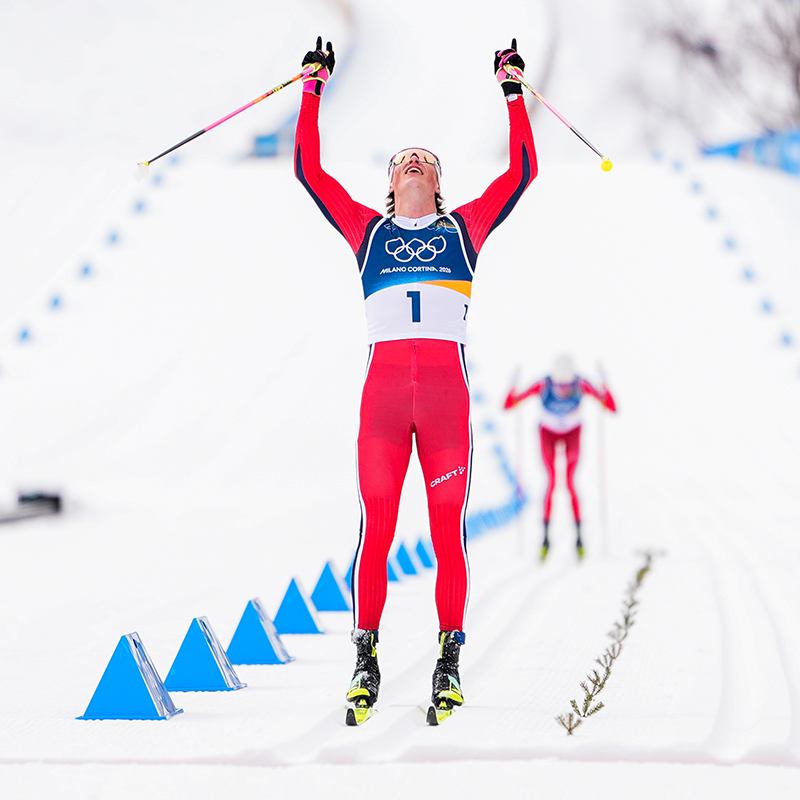
By winning the Olympic 50 k Classic, Klaebo completed a sweep of six gold medals at these Games — six events, six victories — something no Winter Olympian had ever done before. The sprint prodigy who has built his reputation on ferocity over 1.5 kilometers now owns the sport’s most traditional crown.
“I don’t think I even could have dreamed about this,” Klaebo said afterward.
“In Norway, they say you must win a 50 k to become a man.” Klaebo said, smiling in the post-race press conference, “I think I am that now.”
Johannes Hoesflot Klaebo (NOR) both the Olympic 50 k gold and a clean sweap of these games. (Photo: Vanzetta/NordicFocus)
Feeling the significance
The 50 k Classic is the most prestigious event in the sport with a long and storied history, and over 100 years of these championships, no one had ever put their skis on to start this race, trying to win an unprecedented 6th gold medal in one Olympic Games. But Klaebo had proven last year he could, winning six races at the World Championships on his home trails in Trondheim, Norway.
The historic attempt was larger than cross-country skiing, too. American long-track speed skater Eric Heiden won five gold medals at the 1980 Winter Olympics in Lake Placid, New York. Klaebo was attempting to do something no athlete had ever done before at the Winter Olympics.
Savelii Korostelev (AIN #12), Iivo Niskanen (FIN #7), Martin Loewstroem Nyenget (NOR #3), Johannes Hoesflot Klaebo (NOR #1), Harald Oestberg Amundsen (NOR #2), Emil Iversen (NOR #4), (l-r) during the early stages of the 50 k. (Photo: Vanzetta/NordicFocus)
The potential spoilers
Going into the race, the heavy favorites were without a doubt the Norwegians with Klaebo, his training partner Emil Iversen, Harald Oestberg Amundsen, and Martin Loewstroem Nyenget. However, others had to be considered as potential spoilers for the historic moment, among them, athletes on the French team, including Mathis Desloges, Hugo Lapalus, Victor Lovera, Finland’s Iivo Niskanen, American Gus Schumacher, and the Independent Neutral Athlete (AIN) Savelii Korostelev. Though it was a long shot, these other nations’ athletes could, potentially, battle for the win or at least a podium spot.
Johannes Hoesflot Klaebo (NOR), Emil Iversen (NOR), and Martin Loewstroem Nyenget (NOR), (l-r) turned the 50 k into a three-man race. (Photo: Vanzetta/NordicFocus)
The Shape of the Race
The Olympic course in Tesero is not subtle. Seven laps with relentless climbing. Among them, the featured hill, the Zorzi Climb, waits like a toll booth each time the skiers re-enter the stadium.
Heading into the race, there were 65 men on the start list, but Italy’s Federico Pellegrino, Finland’s Ristomatti Hakola, and America’s Ben Ogden all scratched.
Once the race started, the first lap went by without much drama, though the field began to stretch. As they entered the stadium after one loop, over 30 skiers were within 20 seconds of the lead. By the end of lap two, that front pack had reduced to 20 skiers within 23 seconds of the lead, and on lap three, things really began to take shape.
Early on in lap three, two favorites, Niskanen (FIN) and Amundsen (NOR), who had been at the front of the race, pulled out. The French favorites and American Schumacher also began to lose contact with the front-runners. Only Korostelev was able to maintain contact until even he could no longer keep up with the three top Norwegians.
Martin Loewstroem Nyenget (NOR) did much of the work at the front. (Photo: Vanzetta/NordicFocus)
By the middle of the race, there were three
By lap four, it was unmistakable: Nyenget, Iversen, and Klaebo were alone, three red suits moving in steady formation.
From the stadium, the mood was less frantic than historic, almost strangely calm.
“The sun shone down… as if God had ordained the great Klaebo, winning his six in a row… I mean, it really was a beautiful day,” said FasterSkier’s Nat Herz, who was on the ground in Tesero. “I think people were just pretty relaxed watching this three-man Norwegian time trial as it went around the course… These guys have the best technique, the best materials, the best skis, the best fitness, and they did exactly what they set out to do.”
The crowd was not roaring every lap. It was watching. Waiting.
“Nyenget and Klaebo definitely gave everyone a good show, and it was tense to see. Was Klaebo going to be able to do this incredible accomplishment?”
There was little theatrics in their separation from the field — no dramatic surge, no visible cracking. Just a grinding tempo that only they could sustain.
Even the question of ski exchanges became a collective calculation. While much of the field ducked into the pit lane for fresh skis after lap four, the Norwegians skied past the ski exchange zone each lap.
A Norwegian train. (Photo: Barbieri/NordicFocus)
“Martin made the choice of not changing skis,” Klaebo said. “Emil and I just followed because we didn’t want to gamble.”
In long races, fortune often hides in such decisions. The snow was changing; the sun had warmed the surface. Fresh skis could have been salvation or ruined a chance at gold.
“I think it was the right decision,” Klaebo said in the press conference afterwards about the three Norwegians not switching skis.
Johannes Hoesflot Klaebo (NOR) makes history as he crosses the line of the Men’s 50 k Classic. (Photo: Barbieri/NordicFocus)
Saving Something for the Hill
Through lap six, Nyenget did much of the visible work. Klaebo shadowed him, conserving every drop of energy he could.
“I wish I was able to help them a little bit,” he said. “But when they asked me if I could go in front, I said no, because I was too tired.”
It was not false modesty, Klaebo’s Olympic schedule had been more than the other two and fifty kilometers taxes even those who make winning look inevitable.
“My plan today was just try to save as much energy as possible,” he said. “I needed to play on my strength… the last few hundred meters.”
On the final lap, Klaebo came to the front, as if to take measure of the other two Norwegians, but in doing so, he created a gap on Iversen. Was the race for gold now just down to two? The answer was yes, as the rubber band had clearly been snapped for Iversen, who began to drift backwards from the leading pair.
The decisive moment arrived where many had expected it would: on the Zorzi Climb. On the preceding descent, Klaebo rose from his tuck, adjusted his pole straps, and as they exited the sweeping left-hand turn at the base of the final climb, Klaebo pulled alongside Nyenget before beginning to accelerate. Not explosively — this was the closing act of a two-hour effort — but with the control of someone who knew exactly how much he had left.
Nyenget followed for a few strides. Then he did not.
Behind them, Iversen skied alone to bronze, sealing a Norwegian sweep.
A moment of reflection at the finish for Johannes Hoesflot Klaebo (NOR). (Photo: Barbieri/NordicFocus)
A Private Moment
At the finish, Klaebo crossed the line and sat down alone on the snow. There was no theatrical collapse, only a quiet reckoning.
“For me, it’s the best feeling, the last 200 meters before I cross the finish line knowing that I’m going to win,” he said.
This Olympics, he suggested, had been built on deliberate choices, in training, in team structure, in how he and his father organized his life around the sport.
“He has probably sacrificed as much as I have done,” Klaebo said of his father.
Sacrifice is not his preferred word. He calls them choices. But the effect is unmistakable: a skier who once seemed specialized has become complete.
Emil Iversen (NOR) enjoys his bronze medal and the sunshine after a lot of hard work to get back to the front of the sport and this moment. (Photo: Vanzetta/NordicFocus)
Racing in His Time
For the rest of the field, competing in the Klaebo era carries a strange duality, almost a frustration braided with admiration.
“Of course, a bit,” Nyenget said when asked whether it is annoying to race alongside him.
“But it’s more motivating as well. [Klaebo] is pushing us to be better every day.”
Iversen echoed the sentiment.
“I think it’s just fun to compete with the best skier ever,” he said.
Across these two weeks, Klaebo has made dominance look procedural, yet his rivals know the margins are real, the preparation exhaustive. He bristles at the idea that this is inevitable.
“I like myself way better when I’m winning than when I’m losing,” he said.
Gus Schumacher (USA) gave everything he had to this sixth race at these Winter Olympic Games. (Photo: Vanzetta/NordicFocus)
The American Effort
For the United States, the 50 k carried a different emotional weight.
Gus Schumacher, who had spent the early races in these Games chasing form and momentum before winning silver in the Team Sprint with Ben Ogden, finished 13th. He described the psychological toll of racing in every event.
“There’s been a pretty heavy mental load the last two weeks,” Schumacher said. “If I’ve got a flame, it was ripping a couple days ago… halfway through the race, it felt like a little candle.”
He has raced all six events, too, though with different outcomes.
“I really don’t understand how you can ski 50 k so well and also sprint so fast,” Schumacher said of Klaebo. “I don’t really feel like there’s another athlete in the world that can compare to that scope of athleticism.”
Hunter Wonders (USA) also pushed his body to its limits in the race. (Photo: Vanzetta/NordicFocus)
Hunter Wonders placed 35th and spoke candidly about the physical reckoning.
“I’m alive barely,” Wonders said. “I didn’t think I was gonna finish there for a little while.”
Cramps seized him in waves — hips, hamstrings, forearms — and yet he finished.
“I completed a race that four years ago I was really chomping at the bit to be able to compete in,” he said.
Antoine Cyr (CAN) “gave everything” to the final men’s race in the Olympics. (Photo: Barbieri/NordicFocus)
The Canadian Outcome
Canada placed two men inside the top 20.
Antoine Cyr finished 11th, just outside the top 10 he had targeted.
“I gave it everything,” Cyr said. “It’s such a hard course.”
He pointed to the Zorzi Climb and the long drag back to the high point of the course after coming through the stadium, efforts that stretch toward six minutes, rare in modern championship layouts.
“It’s really tough,” he said.
Thomas Stephen finished 17th, steady and controlled in conditions that demanded patience. While he did not step into the medal conversation, his result underscored the depth Canada has built in distance racing and marks what is possible in future years.
Martin Loewstroem Nyenget (NOR), Johannes Hoesflot Klaebo (NOR), and Emil Iversen (NOR) (l-r) share the Milano-Cortina Olympic Winter Games 50 k Classic podium in Tesero, Italy. (Photo: Barbieri/NordicFocus)
What Remains
Klaebo plans to rest for a few weeks before racing again in Lake Placid.
“That’s the plan,” he said.
There will be time later to measure what six-for-six means, how it reshapes record books, and how it reframes conversations about the greatest Winter Olympians. For now, it exists as a bright fact in the thin mountain air.
The 50 k endures because it asks the oldest question in endurance sport: what is left?
On Saturday, Johannes Hoesflot Klaebo had something left. Enough to attack on the final climb once more. Enough to once again finish alone down the final meters. Enough to make something mythical and historic feel ordinary and predictable.
FasterSkier will have our own Nat Herz on the ground at the Olympics, which, to be honest, is a very big financial lift for us. If you value the thoughtful work and access FasterSkier provides at championships like this one, please consider becoming a Voluntary Subscriber. Your support directly fuels the work we do to cover the people, places, and moments that make our sport special.
Emil Iversen (NOR), Johannes Hoesflot Klaebo (NOR), and Martin Loewstroem Nyenget (NOR) come through the stadium to the delight of the crowd. (Photo: Vanzetta/NordicFocus)
This article was made possible through the generous support of our voluntary subscribers who have helped put our Nat Herz on the ground at the Olympics. If you value coverage like this, please support FasterSkier with a voluntary subscription.
Four Norwegian men, including Martin Loewstroem Nyenget (NOR), Mattis Stenshagen (NOR), Harald Oestberg Amundsen (NOR), Johannes Hoesflot Klaebo (NOR), (l-r) set to lead the Men’s 20 k Skiathlon out of the start and begin the 2026 Milano-Cortina Olympic Winter Games in Tesero, Italy. (Photo: Vanzetta/NordicFocus)
PREDAZZO, ITALY — The snow in Val di Fiemme had finally settled. After a colder night and a full day’s distance from the most recent snowfall, the surface beneath the men’s skis on Sunday morning felt less negotiable than it had twenty-four hours earlier. It was firmer, faster, and exacting—the kind of track that rewards decisiveness and punishes hesitation. On a course defined by momentum, there would be no neutral moments.
By the time the leaders crested the Zorzi Climb for the final time, illuminated by the bright northern Italian sun, one truth had been clarified: the Olympic Men’s Skiathlon had not produced a surprise. It had produced a confirmation.
Johannes Hoesflot Klaebo arrived in Val di Fiemme as the most accomplished skier of his generation, the reigning master of range—sprint speed married to endurance patience, and the man who, one year earlier at the World Championships in Trondheim, Norway, became the first skier ever to win gold in every event. On Sunday, in the opening men’s race of the 2026 Olympic Winter Games, he did not reinvent himself. He simply waited, watched, and delivered exactly what the sport has come to expect.
But the Skiathlon is never only about the man who wins it. It is about where the race breaks, who is caught on the wrong side of that break, and how little time there is to recover once it happens.
In Val di Fiemme, that truth arrived early—at a fast right-hand corner about two kilometers into the race—and again, more quietly but just as decisively, midway through the skate leg, when a tangle in the pack ended one of Norway’s strongest medal threats.
An unfortunate early crash took Gus Schumacher (USA) out of a top performance. (Photo: Vanzetta/NordicFocus)
Firmer Conditions, Faster Consequences
The men’s skiathlon opened with a 10-kilometer classic leg, mass start, with athletes seeded by season-long results. It is a procedural detail that becomes strategic fact the moment the gun fires: the highest-ranked skiers line up at the front, while those just behind them must navigate the churn.
On Sunday, the pace was relentless from the first kilometer. The field stretched quickly as athletes fought for position ahead of the course’s first defining technical feature—a fast right-hand corner roughly two kilometers in, where the trail bottoms out before pitching uphill again.
It was the same corner where Jessie Diggins fell in Saturday’s women’s race. And once again, it reshaped the day.
Several skiers went down in the crash, including Edvin Anger (SWE), Zak Ketterson (USA), and Gus Schumacher (USA)—all athletes with legitimate top-ten potential under normal circumstances. The cost of falling there was immediate and severe: not just lost momentum, but lost momentum at the precise moment the leaders were accelerating uphill and creating separation.
“I was dead last after the fall,” Schumacher said afterward. “Unfortunately, Zak fell right in front of me. It was tight coming into that corner, and I didn’t see what happened to Zak, but into the dropdown I got one ski around him and the other caught and spun me around off track.”
“I did what I could, but when the people at the front are still going as fast, it’s hard to catch them. All I could do was ski as smoothly as I could for the next 18 k. At that point, it’s an individual race. I feel like I skied well for being back there.”
Zak Ketterson (USA) was involved in the same crash as Schumacher and was forced to burn many matches early while playing chase, which ultimately proved too costly. He ultimately ended the race in 43rd place. (Photo: Vanzetta/NordicFocus)
Ketterson’s version of the same moment underscored how quickly the situation unraveled.
“I fell on that same corner Jessie Diggins fell on yesterday,” he said. “I was hopeful we’d ski it well, but coming into it everyone started snowplowing and freaking out and someone in front of me fell.
“I fell pretty hard, but I got back up and just burned so many matches catching back up to the group. I was fighting from there to the finish.”
Ahead of them, the race did not wait.
Xavier McKeever (CAN) had, what he described, the race of his life. (Photo: Vanzetta/NordicFocus)
Control Without Calm
With the early chaos, the classic leg splintered the field. A front group formed, thinned, and re-formed, the pace steady enough to discourage attacks but high enough to extract a cost from anyone forced to chase.
For the U.S. team, there was at least one quiet positive. Head coach Matt Whitcomb felt far better about ski preparation than he had the day before.
“We had, in general, very competitive skis today,” Whitcomb said.
But ski quality can only matter if contact is maintained.
“When you get taken out of contact with the leaders,” Whitcomb said, “the people you’re drafting off of are slower than the leaders. It’s kind of negative compounding—you just drift away.”
By the time the top eight skiers entered the stadium for the ski exchange at the end of the classic leg, the race had already begun to select for those who could tolerate discomfort without revealing it. Among them were Norway’s Mattis Stenshagen, who soon faded, France’s emerging depth, and Klaebo himself—observant and patient.
Then the skis changed, and the race revealed its teeth.
Harald Oestberg Amundsen (NOR) got tangled with Savelii Korostelev (AIN), which caused him to fall and lose contact with the lead pack. Korostelev managed to stay on his feet and was able to earn a fourth place. (Photo: Barbieri/NordicFocus)
A Quiet Turning Point in the Skate Leg
The opening kilometers of the freestyle leg altered the race more subtly, but no less decisively.
At approximately 11.5 kilometers, Harald Oestberg Amundsen (NOR)—who had positioned himself exactly where Norway would want him entering the skate portion—tangled skis with Savelii Korostelev (AIN). Amundsen went down. The lead group did not.
He remounted quickly, but the elastic had snapped. His chance to fight for a medal in the opening race of the Games was gone.
For Norway, a team that has dominated the men’s World Cup season at times filling nearly the entire top ten, it was a small moment with outsized implications.
Hugo Lapalus (FRA), Martin Loewstroem Nyenget (NOR), Savelii Korostelev (AIN), Mathis Desloges (FRA), Johannes Hoesflot Klaebo (NOR), (l-r) formed the lead pack and became the group that would battle for the podium. (Photo: Vanzetta/NordicFocus)
Desloges, a Yellow Card, and a Protest That Went Nowhere
As the race accelerated, Mathis Desloges (FRA) briefly found himself leading at the end of the first skate lap. In a moment of confusion, he mistakenly turned into the ski exchange lane before cutting back through the V-boards and rejoining the course.
The detour shortened his route by only a few meters and offered no meaningful advantage. The race jury issued Desloges a yellow card warning and allowed the result to stand.
After the race, AIN filed a protest, arguing that the infraction should result in disqualification and elevate Korostelev, who finished fourth, to the bronze medal position. The jury rejected the protest.
Desloges framed the day not around controversy, but around progression.
“I’m very happy,” he said. “The preparation was very good. Two years ago today, I became [the U23 World Champion], and now it’s different. I’m better than two years ago.
“This medal is for my family, for my friends, and for everyone on the French team—the staff and my family.”
Johannes Hoesflot Klaebo (NOR) delivered a spectacular move on the Zorzi Climb that opened up a large gap in the final kilometer. (Photo: Barbieri/NordicFocus)
Klaebo on the Zorzi Climb
There are moments in ski racing that feel preordained—not because they are inevitable, but because the athlete who executes them has taught the sport to expect them.
Klaebo’s move on the Zorzi Climb belonged to that category.
He waited. He measured. And then, on the final ascent, he applied a pressure no one else in the group could answer. The gap opened quickly, almost unbelievably so if he had not done the same thing so many times before, and by the time the course tipped back toward the stadium, the Olympic gold medal was no longer in doubt. Klaebo came to the finish with enough margin to ease up, take off his poles, and ski the final meters, celebrating in front of the stadium crowd.
For Klaebo, the performance was the product of both familiarity and tension.
“The last couple of days have been nerve-racking,” he said. “I’ve had a very high resting heart rate these days. I’ve been very nervous, but this is my third Olympics, so you get a little bit of experience. This is a track and course that we know a lot from previously—we’ve done a lot of World Cups here.”
When the skis changed and the race accelerated, that experience showed.
“I had good skis, my body felt good,” Klaebo said. “It’s always good to start a championship in good shape.”
One year removed from his historic sweep in Trondheim, Klaebo arrived in Val di Fiemme carrying questions that extended well beyond a single race. Six gold medals are available in Milano Cortina. No man has ever won them all.
“We’ll see,” Klaebo said. “I’m going to take one race at a time. But it’s a pretty good start. With the weather and the crowds, it was amazing out there.”
Mathis Desloges (FRA) and Martin Loewstroem Nyenget (NOR), (l-r) come down the finish stretch battling for the silver and bronze medal. (Photo: Barbieri/NordicFocus)
Nations in Contrast
France: Depth and Belief
If Norway remains the benchmark, France is no longer content to chase quietly.
Desloges acknowledged Norway’s status entering the race, but did not concede anything beyond the present tense.
“The French athletes are very strong,” he said. “Of course, the Norwegian guys are also very strong, but I believe we can be better. Today, I’m very good, and I’m happy.”
France backed up that belief with the most comprehensive team performance of the day, placing second, fifth, ninth, and fifteenth.
“We see the French team on a similar level as our team,” Whitcomb said. “When we have success, they’re one of the first teams to congratulate us. They’re just a really passionate group, and we love to see them succeed.”
Hugo Lapalus (FRA) and Mathis Desloges (FRA) celebrate an unbelievable day for France. (Photo: Vanzetta/NordicFocus)
Norway: Gold, Bronze—and Perspective
For Norway, the medal count told only part of the story. A gold and a bronze would thrill nearly any other nation, but the context surrounding this team—deep enough to leave world-class skiers at home—made the result feel more measured.
Bronze medallist Martin Loewstroem Nyenget (NOR), racing his first Olympic event, framed the day not as a shortfall, but as an arrival.
Johannes Hoesflot Klaebo (NOR), Martin Loewstroem Nyenget (NOR), Harald Oestberg Amundsen (NOR), and Mattis Stenshagen (NOR), (l-r) all entered the day with hopes of an Olympic medal for Norway; two delivered, two did not. (Photo: Barbieri/NordicFocus)
“I’m really happy and proud,” Nyenget said. “It’s a result of training, but also of time away from family and a lot of hard mental work. The past days and weeks, I’ve been nervous, so it’s good to be done with my first Olympic race.
“To have this first race in this atmosphere, with these blue skies, and have my wife and little kid in the stadium somewhere—it’s a really good day.”
Asked whether gold and bronze constituted a satisfactory outcome, Nyenget was direct.
“I think so,” he said. “We have some really high pressure. We’ve been doing crazy good in the World Cup, but usually in championships, all racers are at their very best. You see today that there is strong competition from the French, and we took two podium places. It’s good.”
After the fall Gus Schumacher (USA) spent the day racing his way through the field, eventually finishing in 24th place. (Photo: Barbieri/NordicFocus)
United States: Disappointed, Not Discouraged
For the U.S. team, the early crash changed everything.
Schumacher and Ketterson were forced into playing chase. Zanden McMullen, who avoided the crash, felt the day slip away in the skate leg.
“Today’s race was not great, but not horrendous,” McMullen said. “I felt really good in the classic leg and then I don’t know what happened in the skate portion. I was cramping up quite a bit and just didn’t have it.”
Hunter Wonders (USA) on his way to 31st place. (Photo: Vanzetta/NordicFocus)
Hunter Wonders, making his Olympic debut, focused instead on the scale of the task.
“It was hard,” Wonders said. “It was a hard course with tricky conditions. The skiathlon is difficult because it mixes up the muscle groups you use and takes a second to transition, but it was fun. Great Olympic debut.”
Whitcomb struck a measured tone.
“I’m feeling good, not great,” he said. “Slightly disappointed, but not discouraged. Nothing about that feels negative to me. This is just one of the days of the Games, and now it’s behind us.”
Xavier Mckeever (CAN) fighting for a top ten, eventually finishing in 13th place. (Photo: Vanzetta/NordicFocus)
Canada: The Race of a Lifetime
For Canada, the day belonged to Xavier McKeever, who finished 13th after spending much of the race on the edge of the top ten.
“Oh man—that was incredible,” McKeever said. “I can’t believe what just went down, to be honest.”
He described a race that improved with each kilometer.
“I felt like I skied it really smart—tried to conserve as much energy as possible—and I just felt better and better,” he said. “The skate felt really good, which is sweet, because that’s usually a weak spot for me.”
Mid-race, the realization crept in.
“You can’t really comprehend what’s going on,” McKeever said. “You’re just like, ‘Holy crap, I’m here right now, fighting for top ten.’ It’s surreal, but you’ve got to focus on the race.”
The result carried deeper meaning.
“To be honest, I was about a foot away from not making this Olympic team,” he said. “To come here and have the best race of my life so far on the first day at the Olympics—I couldn’t ask for anything more.”
Mathis Desloges (FRA), Johannes Hoesflot Klaebo (NOR), and Martin Loewstroem Nyenget (NOR), (l-r) share the Olympic Men’s 20 k Skiathlon podium in Tesero, Italy. (Photo: Vanzetta/NordicFocus)
One Race Down
The skiathlon rarely offers mercy, and Val di Fiemme offered none.
There will be more races, more chances, and more medals to chase. Klaebo will insist he is taking this one race at a time. Everyone else will count.
On firmer snow, with no ambiguity left beneath the skis, the hierarchy revealed itself plainly—and the Olympic Winter Games began exactly where cross-country skiing so often does: with Johannes Hoesflot Klaebo setting the standard.
On the ground reporting by FasterSkier’s Nat Herz.
Help Support Our Olympic Coverage!
FasterSkier has our own Nat Herz on the ground at the Olympics, which is a significant financial lift for us. If you value the thoughtful work and access FasterSkier provides at championships like this one, please consider becoming a Voluntary Subscriber. Your support directly fuels our work to cover the people, places, and moments that make our sport special.
This coverage is made possible through the generous support of Marty and Kathy Hall and A Hall Mark of Excellence Award. To learn more about A Hall Mark of Excellence Award, or to learn how you can support FasterSkier’s coverage, please contact info@fasterskier.com.
It was a good day at the office, a stunning office, for Ben Ogden (USA) in Goms, Switzerland. (Photo: Authamayou/NordicFocus)
For the skiing stars of Norway, World Cup victories are commonplace—almost expected. For the skiers of most other nations, any World Cup podium appearance is a career-defining event. That said, some of the most interesting World Cup racing takes place on those days when the strength of the field is re-shuffled, when a few notables stay home, when a few teams re-arrange their rosters. Those are days when World Cup podiums will still be filled, and a greater number of teams know they can rise to that occasion. Still, it’s not a straightforward task, and many teams find themselves stumbling over the challenge rather than rising to the top. Today was a day that the USA saw this opportunity, and rise they did . . .
Norway may have won today’s Team Sprint (though with Harald Oestbeg Amundsen and Einar Hedegart are a team that’s unlikely to contend for this same win when the Olympics begin in Val di Fiemme), and Italy may have flown second across the finish on the wings of Federico Pellegrino (a performance he would hope to repeat in front of his countrymen in the Olympics), but it was the third-place effort of Team USA’s Ben Ogden and Gus Schumacher that really drew attention. The circumstances of the day offered them an opportunity to ascend to a World podium; they grabbed that opportunity with both hands. It’s great to see American men on World Cup podiums, even greater to see them earn that position with such fortitude and skill.
“Today was a pretty full field,” said Ogden. “But there was no Klaebo today. There definitely will be Klaebo in Val di Fiemme. I’m sure that some teams will put up different athletes on their Team Sprint than they did today, but it’s really one of those things that’s not worth dwelling on until the time comes to actually seethe start list, to go out and get it done.”
The day started with Gus Schumacher (USA) having a great qualification for the Team Sprint in Goms, Switzerland. (Photo: Authamayou/NordicFocus)
The Alpine municipality of Goms, Switzerland (population 1,160) was the venue for a staging of an event that will take place in the Olympic Games in Val di Fiemme—the Freestyle Team Sprint—but today’s race was not exactly a dress rehearsal for that Olympic race. Specifically, the cast of characters is likely to change in the Olympics even as the strategy employed by today’s winner, Team Norway, is likely to remain the same. They’ll set the pace, they’ll stay at the front (and out of trouble). They’ll accelerate in the penultimate leg. They’ll hope to give Johannes Hoesflot Klaebo a lead at the beginning of the anchor leg. They’ll rely on Klaebo to remain unbeatable in any Freestyle Sprint where he enters the finishing straightaway with a lead. We really do expect this Olympic event to follow that script. Even so, many questions remain. Who will team with Johannes Hoesflot Klaebo in what is likely to be the gold medal favorite team? And who will the USA field as its Team Relay pair? Will Schumacher team with Ogden? Or will coaches choose another combination of abilities? Will Pellegrino and Elia Barp continue to be factors in the finishing straightaway? And which other teams will arrive with hopes of a medal: Finland? Switzerland? Sweden?
“If history is any indicator, then Norway leading and everyone else following will likely (repeat as a strategy) at the Olympics,” said Ogden. “Val di Fiemme is definitely a harder course, so I anticipate it being something like that. Championship Team Sprints are definitely intense; it’ll have some similarities to today, and probably many differences.”
Individual qualifying saw USA 1—comprised of likely Olympic teammates Ben Ogden and Gus Schumacher—as the third fastest qualifier. They would be joined in the 15-team Final by USA 2’s JC Schoonmaker and Zanden McMullen (who would finish 11th on the day).
Home-team, Switzerland 1, was the top qualifier thanks to the efforts of seasoned Sprint competitors Janik Riebli and Valerio Grond (though packing a Team Sprint team with a pair of true sprinters is usually not considered to be the best way to excel in this event—Switzerland 1 would top all qualifiers, but would finish sixth on the day). Switzerland’s fast qualifying standard was followed by Norway 1’s Harald Oestberg Amundsen and Einar Hedegart, both of whom were recently named to the Norwegian Olympic team, but neither of whom are likely to appear in this event in Milano-Cortina. Fourth fastest qualifier was Italy 1’s Elia Baro and Federico Pellegrino who are likely to team up when the Olympic Team Sprint takes place in their homeland.
Ben Ogden (USA) also had an excellent qualification for the Team Sprint – together with Schumacher, they posted the third-fastest time. (Photo: Authamayou/NordicFocus)
A Plan to Follow—Easier Said than Done
For some teams, Goms’ Team Sprint was an Olympic dress-rehearsal, for other teams, a consolation prize. Norway 1 had the potential to take a World Cup win, but they will certainly NOT be the Olympic duo that Norway fields in this event (that spot being reserved for Johannes Hoesflot Klaebo and (presumably) his gold medal partner from Beijing, Erik Valnes). Norway 2 was comprised of Ansgar Evensen and Even Northug, two of the world’s best sprinters who, nonetheless, found themselves overlooked when Norway selected its team of Olympians. While the skiers of Norway 2 may have hoped to prove that they belonged on the Olympic Team, their efforts fizzled in Goms. Norway 2 would place 15th, last among starters in the Team Sprint final.
Norway 1, on the other hand, performed as expected. Amundsen led out Leg 1, keeping the pace high and keeping himself out of trouble. He was followed by Riebli, Barp, and Ogden. Ogden tangled skis briefly with Barp as they entered the exchange, but both skiers shook it off masterfully. Norway 1 continued to lead.
Norway kept the pressure on to keep things stringed out. (Photo: Authamayou/NordicFocus)
Ogden tagged Schumacher to begin Leg 2. Schumacher seems a logical choice to team with Ogden in the Olympic Team Sprint, a pairing suggested by the tactic of pairing a sprinter with a seasoned, fast-skiing all-rounder who can navigate in a tight pack and not get dropped. American Olympian, Jack Young, is a world-class freestyle sprinter, but even though it’s called the “Team Sprint,” there’s no use in fielding a team of two pure sprinters. The only sprint that matters is the one to the finish line at the end of the final leg. Before then, each teammate’s job is simply to steer clear of trouble, to hang on to the pace, and to not get dropped. More than perhaps any of his US Olympic teammates, Schumacher fits that bill.
“The first leg was pretty chill,” said Schumacher. “I found myself a little far back after our tag, but made a good move on the fast corner.”
“The second leg was pretty fast,” Schumacher continued. “But we still had a group, so it wasn’t too bad. We held the gap to Norway, which is good. Norway was definitely trying to string everyone out. They were really impressive, but we’re not far off. And I think. if the right person was in a good position, they probably could have held that. With Norway, that’s something to think about for the future.”
Schumacher knows his role, and in Goms’ Team Sprint he skied it brilliantly. Through Leg 2, he remained in contact, preserving energy as Norway 1’s Hedegart set the pace at the front followed by Switzerland’s Grond and Sweden’s Edvin Anger. Leg 3 began with no changes in leaders, and with Ogden remaining solidly in contact with the top five. Amundsen continued to set the pace for Norway followed by Riebli and Barp.
Einar Hedegart (NOR) clearly was racing with something to prove to the Norwegian team coaches about his place in the Olympic Team Sprint with Johannes Hosflot Klaebo. (Photo: Authamayou/NordicFocus)
Leg 4 saw Hedegart stringing out the pace while Schumacher continued to mark the skiers at the front. The field began to string out, with Schumacher keeping USA 1 in contention.
Leg 5 is where the field expects Norway to make a move; Amundsen did not disappoint, storming off the front even before the field had left the flat terrain around the exchange zone. By the time he reached the course’s first uphill, Amundsen enjoyed a lead of 30 meters. Rather than chase him in vain, the chase group—led by Barp—sat up a bit to preserve energy. Norway had earned a gap as Amundsen tagged Hedegart to begin the anchor leg. The rest of the field would fight for second and third.
The way the Americans set up today’s relay team—with the sprinter, Ogden, leading off and the all-rounder, Schumacher, finishing—showed that Team USA may realize that the Olympic version of this event will NOT come down to a finishing line sprint, but to a final-leg high-speed dash that sheds sprinters and leaves all-rounders leading the way to medals. This may be the scene in a few weeks—Schumacher dueling Pellegrino in the final leg. If so, then today was a bit of a dress rehearsal after all. On the first of the final leg’s two uphills, Schumacher tried desperately to cross the gap to Amundsen. It was a bold ploy, but one that a fast distance skier needed to try in order to shake Pellegrino. Pellegrino shadowed Schumacher, but seemed to struggle in doing so. Over the second uphill, and Pellegrino struggled again under Schumacher’s re-application of pressure . . . but in order to beat a sprinter you need to drop a sprinter.
Gus Schumacher (USA) kept the pressure on, leading the chase group behind Norway. (Photo: Authamayou/NordicFocus)
Ahead of them, Hedegart show-boated playfully at the finish line, taking off his poles and sheathing them like a sword after a successful duel. Pellegrino undid Schumacher in the finishing straightaway—a cagey veteran having played his hand with seasoned mastery. Schumacher shrugged across the finish line in third, having done all he could to lengthen the sprint in an attempt to take the sting out of Pellegrino’s sprint.
“Pellegrino is a super strong sprinter,” said Schumacher.” Today, he basically made me pull through. I didn’t want to mess around with a big bunch sprint, and I’m glad I didn’t. I’m fine with him beating me in the end. But, yeah, we’ll see how it plays out in Val di Fiemme. I think I can beat him if I can get a good draft. We’ll see; you need drop him before the finish line. I guess you just have to go faster! But he’s also a great distance skier, so that’s a tough one.”
“Having Gus in the second leg felt good for me,” said Ogden. “He’s really good at positioning, and super strong and fit, and he’s going to have legs at the end when it matters . . . Today was just to try something and learn from it. I think that we thought it was a natural thing to try. We went with it today, and it worked out well.”
After all the strategizing, all the jockeying, all the surging, all the positioning, it’s a skier like Pellegrino—a world-class sprinter who can also contend in distance races—who is the ideal finisher for a Team Sprint. Approaching the Olympic Team Sprint in his home country—and hoping for a gold medal in front of his countrymen—Pellegrino still has one major obstacle to overcome: Klaebo is the one skier who has proven to be even faster, even more durable than Pellegrino. If the Italian wants to claim gold on home turf, he’ll need to beat the best of all time in order to do it . . . but that will be the same for any skier who hopes to claim gold in any event when the Olympic races are run in Val di Fiemme.
Gus Schumacher (USA) and Ben Ogden (USA), (l-r) proved they are true contenders for a medal in the Team Sprint at the Olympics. (Photo: Authamayou/NordicFocus)
While the cast may be different when this event is staged at the Olympics of Milano-Cortina, the script is likely to be strikingly similar. If so, then Team USA will be there hoping. To recreate the tactics, the speed, the strength, and the brilliance that took them to a third place finish today in Goms. Ironically, today’s Norwegian winners are not likely to be offered the chance to pursue Olympic gold in this same event. When asked whether he thought this dominant performance ahead of numerous teams likely to contend in this event in Val di Fiemme could cause Team Norway to reconsider their starters in the Olympic Team Sprint, Hedegart was playful, yet again.
“Message sent,” grinned Hedegart. “I hope the message is received.”
Chance of Hedegart becoming the face of Team Norway in season’s to come? Quite high, it appears. Chance of Hedegart replacing Valnes (as Klaebo’s teammate) in Norway’s Olympic Team Sprint? Far less likely . . . but much could happen between the World Cup finish line in Goms and the Olympic starting line in Val di Fiemme.
Goms World Cup Men’s Freestyle Team Sprint QUALIFYING
Goms World Cup Men’s Freestyle Team Sprint RESULTS
Help Support Our Olympic Coverage!
FasterSkier will have our own Nat Herz on the ground at the Olympics, which, to be honest, is a very big financial lift for us. If you value the thoughtful work and access FasterSkier provides at championships like this one, please consider becoming a Voluntary Subscriber. Your support directly fuels the work we do to cover the people, places, and moments that make our sport special.
Federico Pellegrino (ITA), Elia Barp (ITA), Harald Oestberg Amundsen (NOR), Einar Hedegart (NOR), Gus Schumacher (USA), Ben Ogden (USA), (l-r) share the Team Sprint podium in Goms, Switzerland. (Photo: Authamayou/NordicFocus)
This coverage is made possible through the generous support of Marty and Kathy Hall and A Hall Mark of Excellence Award. To learn more about A Hall Mark of Excellence Award, or to learn how you can support FasterSkier’s coverage, please contact info@fasterskier.com.
Davos doesn’t reward urgency.
It tolerates it, sometimes — lets it flirt with the clock through the opening kilometers — but it never forgets. Like a mysterious, wispy cloud, the altitude sits quietly above the stadium, thinning the air just enough that the consequences arrive late, not immediately. The first lap can feel generous. The second is where Davos asks what you’ve really brought with you.
On Sunday, in the men’s 10-kilometer freestyle interval start at the World Cup in Davos, Switzerland, that truth arrived right on schedule. Athletes who attacked early were gradually called back. Athletes who waited found themselves moving forward without ever appearing to accelerate. And one skier — patient, smooth, and increasingly inevitable — turned the second lap into a private demonstration.
Einar Hedegart of Norway won in 22:40.7, earning his second straight World Cup victory, this one built not on surprise but on control. Behind him came Harald Østberg Amundsen (NOR) at +11.7 seconds, Mattis Stenshagen (NOR) at +18.8, Johannes Høsflot Klæbo (NOR) fourth (+24.1), and Martin Løwstrøm Nyenget (NOR) fifth (+30.6). Andrew Musgrave (GBR) led the non-Norwegians in sixth (+31.1).
Five Norwegians in the top five — but only one skied the race the way Davos prefers.
Mattis Stenshagen (NOR) comes to the 10 k Interval Start Freestyle finish in Davos (SUI). (Photo: Modica/NordicFocus)
The Temptation of the First Lap
Interval starts strip racing down to decisions. No drafting. No cover. No negotiation. In Davos, those decisions begin almost immediately because the course invites speed from the start. The opening kilometers flow. The snow was hard and fast after an overnight freeze. Skis hummed. Breathing felt manageable.
Several athletes took the invitation.
Early time checks were brisk, and for a moment the race appeared to be tilting toward the skiers willing to press from the gun. Harald Østberg Amundsen, the reigning overall World Cup champion, was among them — assertive, controlled, but unmistakably on the front foot. At the first major checkpoint, Amundsen held a small advantage over Hedegart, exactly the kind of margin that feels reassuring on paper.
Others followed similar scripts. Strong starters carved seconds in the opening loop, skiing as if Davos were simply another mid-altitude venue rather than one of the circuit’s quiet physiological traps. It all looked reasonable — until the course turned upward again.
Why Davos Punishes Impatience
At roughly 1,560 meters above sea level, Davos sits just high enough to distort pacing instincts. Red-lining a climb here doesn’t always feel catastrophic in the moment. The cost arrives later, when recovery never quite comes, and the second lap begins to feel longer than the first.
That dynamic defined the race.
Athletes who went hard early found themselves defending, not attacking, once the second lap began. Speed leaked away on the longer climbs. Transitions dulled. The ability to change gears — so critical in freestyle skating — started to fade.
Hedegart, meanwhile, was doing something else entirely.
Einar Hedegart (NOR) with Vili Crv (SLO) trailing during the 10 k Interval Start Freestyle in Davos (SUI). (Photo: Vanzetta/NordicFocus)
Hedegart’s Patience — and the Moment it Mattered
Hedegart did not lead early.
That point matters.
He allowed seconds to slip away in the first lap, skiing smoothly but without urgency, keeping his effort under control on the steepest sections. At altitude, that restraint isn’t passive — it’s strategic. Backing off even a few percent on the climbs can preserve a system that stays responsive later.
When the race entered the second lap, the difference became apparent.
Hedegart didn’t surge so much as continue. While others plateaued, he maintained tempo. While early leaders fought to hold speed, he quietly increased his advantage, taking time not through dramatic accelerations but through the absence of slowdown.
By the 7.4-kilometer mark, the race had clarified. The seconds Hedegart had conceded early were gone — and then some. His advantage over Amundsen had grown decisively. The course was no longer offering second chances.
The finish confirmed what the splits already suggested: Hedegart’s second lap was the fastest in the field, and it wasn’t close.
Harald Amundsen (NOR) on his way to second place in Davos (SUI). (Photo: Vanzetta/NordicFocus)
Amundsen, Stenshagen, and the Norwegian Sorting Hat
Behind Hedegart, the Norwegian internal race unfolded in layers.
Amundsen’s early aggression kept him close, but the cost was unavoidable. He remained solid — this was not a collapse — yet the final kilometers belonged to Hedegart. What had been a narrow early lead turned into an 11.7-second deficit at the line.
Mattis Stenshagen, by contrast, skied one of the day’s most even races. Never flashy, never panicked, he moved steadily forward as others drifted back, finishing third and reinforcing his reputation as one of Norway’s most reliable distance technicians.
Johannes Høsflot Klæbo offered another useful case study. After a frustrating sprint the day before, Klæbo looked sharper and more composed, staying in contention through the middle of the race. But Davos demands distance-specific economy, not just efficiency, and he lost ground late, finishing fourth — competitive, but never truly threatening Hedegart.
Martin Løwstrøm Nyenget, wearing the red distance bib, rounded out the Norwegian sweep of the top five, steady as ever but unable to match the winning pace in the final lap.
Five Norwegians, five slightly different races — and one clear template emerging at the top.
Andrew Musgrave (GBR) was the fastest non-Norwegian skier in Davos (SUI). (Photo: Vanzetta/NordicFocus)
The International Picture: Holding On vs. Moving Up
Outside Norway, the same altitude logic applied.
Andrew Musgrave (GBR) skied a disciplined race, managing his effort well enough to stay competitive throughout. He was rewarded with sixth place — not by attacking late, but by avoiding the fade that claimed others. In Davos, survival is often the first victory.
France’s Mathis Desloges and Hugo Lapalus hovered near the top ten, their early speed gradually neutralized by the second lap. Italy’s Federico Pellegrino, so dangerous in sprint formats, found the sustained demands of the 10 km Interval Start less forgiving, finishing outside the top 30.
The pattern repeated down the results list: strong early checkpoints followed by diminishing returns. Davos was collecting its debts.
On his way to 30th place, John Steel Hagenbuch (USA) follows teammate Ben Ogden (USA). (Photo: Vanzetta/NordicFocus)
The American View: Learning in Familiar Air
For the U.S. team, John Steel Hagenbuch finished 30th, the top American on the day — a result that only hints at how complicated his Davos race really was.
Hagenbuch has never considered himself particularly sensitive to altitude, a fact that quietly shaped both his expectations and his pacing plan.
“I’m maybe not the best authority to say how altitude feels, as I usually don’t feel affected by it much,” Hagenbuch said. “I typically start slow and then pick up speed through races, and this pacing strategy is typically rewarded at altitude.”
That approach aligned neatly with what Davos demanded. And while Hagenbuch is quick to downplay any physiological advantage from growing up and training in Sun Valley, Idaho, he did note a different kind of familiarity.
“I think being from altitude can help with racing at altitude, but it’s certainly not a decisively significant factor — I was still plenty far behind the sea-level Norwegians today,” he said, with a laugh. “Speaking of familiarity, however, I remarked at how much Davos reminded me of home — the trails and the surrounding mountains strongly resemble Galena.”
The race itself marked his best feeling of the opening World Cup block — even if the result came under less-than-ideal circumstances.
“This Davos Skate 10 km was the best I’ve felt so far in Period 1,” Hagenbuch said. “But it unfortunately came only a day after I crashed hard on the infamously icy slalom downhill coming down from Flüelapass and subluxed my right shoulder for about the tenth time.”
By race morning, the pain hadn’t gone away.
“Even with a few thousand milligrams of acetaminophen down the hatch, every single pole stroke hurt,” he said. “So while it was nice to finally — barely — be top 30, I can’t help but think that without the injury and the stress associated with it, I could have done better. Alas, that’s life, and that’s skiing. I am not the only one to have had some bad luck in important races.”
Zooming out, Hagenbuch remains confident in his trajectory, even if the opening block didn’t fully reflect it.
“I feel confident in what I can achieve this winter — even if I didn’t necessarily show it during Period 1,” he said. “With this being an Olympic year, the competition was even higher than normal. For example, Per-Erik Bjornestad, one of our Norwegian wax techs, said that the Trondheim 10 km skate was the highest level of skiing he had ever witnessed.”
Looking ahead, Hagenbuch’s plans are clear — and pragmatic.
“Pretty much regardless of how today’s race went, I was going to go home to Sun Valley for Christmas,” he said. “I don’t think it makes sense for me to do the Tour de Ski, given how my health has been this fall and the start of the winter. I’m excited to go home and to compete at U.S. Nationals in Lake Placid.”
Einar Hedegart (NOR) celebrates with a fist pump to the camera in Davos (SUI). (Photo: Modica/NordicFocus)
Why this Race Matters More than it Looks
It’s easy to treat Davos as an outlier — scenic, elevated, a little unique. The athletes don’t.
The men’s 10 km Freestyle Interval Start is an Olympic format. It’s a race without shelter, without drafting, and without excuses. Davos amplifies all of that. Pacing errors are magnified. Aerobic limits are exposed. The second lap becomes a referendum.
Hedegart passed that referendum emphatically.
This was not a perfect-day fluke. It was not a tactical accident. It was the same pattern, repeated under different conditions, at a different altitude, against the deepest field in the sport. Ski patiently. Protect the climbs. Let others make the race hard early — then make it impossible late.
Einar Hedegart (NOR) remained on the snow for several minutes after crossing the finish line in Davos (SUI). (Photo: Modica/NordicFocus)
A Quiet Finish, a Louder Message
There was no spectacle at the finish line. No disbelief. No chaos. Hedegart crossed, collapsed, and recovered — another man undone by thin air, but this time by his own effort.
Two races. Two wins. Two second laps that separated him from everyone else.
Davos didn’t raise its voice. It didn’t have to.
It simply told the truth — the same one it always tells — and this time, Einar Hedegart listened better than anyone else.
Harald Amundsen (NOR), Einar Hedegart (NOR), and Mattis Stenshagen (NOR), (l-r) take the 10 k Freestyle podium in Davos (SUI). (Photo: Modica/NordicFocus)
Love Stories Like This? Help Keep Them Coming.
Feature stories like this one take time, access, and care to produce. If you value thoughtful storytelling and independent ski journalism, please consider becoming a Voluntary Subscriber. Your support directly fuels the work we do to cover the people, places, and moments that make our sport special.
Andrew Musgrave (GBR) gives the race winner Einar Hedegart (NOR) a sleigh ride after the pair had excellent days in the 10 k Freestyle in Davos (SUI). (Photo: Vanzetta/NordicFocus)
It’s on — the 2026 Olympic season, that is. Devon and Nat break down six season-opening races from northern Finland, including a thriller in Sunday’s men’s race.
Contact us with fan mail, hate mail and everything in between: devon[at]fasterskier.com and nat[at]fasterskier.com. We’re looking for title and other sponsors for our Olympic coverage; email matthew[at]fasterskier.com with inquiries.
This coverage is made possible through the generous support of Marty and Kathy Hall and A Hall Mark of Excellence Award. To learn more about A Hall Mark of Excellence Award, or to learn how you can support FasterSkier’s coverage, please contact info@fasterskier.com.
On a warm, wet morning in Ruka — the kind that turns the classic tracks into soft gutters and the final climb into something closer to a staircase than a ski trail — the women’s World Cup sprint season opened without one of the athletes who would, on almost any other November weekend, be standing in the center of the conversation.
Linn Svahn wasn’t here.
The Swedish star, still making her slow recovery from the concussion and neck trauma suffered in the crash before February’s World Championships, watched this one from a distance. Had she been healthy, she would almost certainly have been one of the day’s central figures, a direct rival for Kristine Stavaas Skistad and a disruptor in the final. Her absence didn’t merely change the top-end speed of the field — it left a quiet outline in the race, the sense that one of the usual gravitational forces was missing from the orbit.
But in her place were other stories, ones that have begun to shape this Olympic season in their own way.
Jessie Diggins (USA) and Hilla Niemela (FIN), (l-r) battle to the finish of their quarterfinal in Ruka (FIN). (Photo: Modica/NordicFocus)
Jessie Diggins, in the first sprint of her final World Cup winter, moved through the day with the bright, energized ease of someone committed to savoring each stop. After the race, she said, “I did have a lot of smiles. I’ve been having so much fun and really just soaking in the atmosphere of racing and just really enjoying it.” She described the entire season as something she’ll remember long after retirement: “It’s the people and the process and the excitement, and I felt so much love from fans out there and from other teams and other coaches and industry and just so many people… it just feels like a gift from so many people.”
And behind all of this sat a U.S. team that arrived here knowing — and accepting — that late November was not meant to be the full expression of their form. Head coach Matt Whitcomb put it in simple terms: “Nobody needs to be in full glory in late November or even early December.” The Americans arrived in Europe only recently, still shaking off jet lag, holding onto a broader plan shaped around February rather than November. It’s a trade-off they’ve leaned into during Olympic years, and one they believe pays off when it matters most.
The result? A day that was not spectacular, not disastrous — something in the middle, and something useful. A day the team could work with.
Jasmi Joensuu (FIN), Jessie Diggins (USA) and Hilla Niemela (FIN), (l-r) lunge for the finish line at the end of their quarterfinal in Ruka (FIN). (Photo: Modica/NordicFocus)
Quarterfinals: Diggins Rockets, Brennan Battles
The conditions had shifted overnight from hard-wax possibilities to what Whitcomb described bluntly: “straight klister conditions.” Wet, soft, and slow — the kind of snow that punishes the indecisive and rewards the athletes willing to run up the hill rather than glide it.
Jessie Diggins — Heat 3
Diggins qualified 13th in the morning (3:01.70), then immediately looked sharper once the heats began. In Quarterfinal 3, she won the heat outright in 2:52.50, one of the fastest times of the round. Her skis were outstanding on the tricky, rain-softened course, something she attributed to the tech crew: “I had thanks to our wax service team and cork. I had awesome skis. I had an amazing kick. It was beautiful klister skiing, and I felt like I could just run right up that hill.” She added that feeling confident on the final climb in her last Ruka sprint meant something special: “It was really fun to have my last Ruka… classic skiing… be feeling confident on that final climb up into the stadium.”
Rosie Brennan (USA) during qualification of the individual sprint in Ruka (FIN). (Photo: Modica/NordicFocus)
Rosie Brennan — Heat 2
For Brennan, who qualified 26th (3:05.07), the story was one of resilience. Early in the season, she is still building form, still putting together rhythm after a less-than-ideal lead-in. She finished third in her quarterfinal (+2.47), just outside the automatic spots and missing the lucky-loser times by narrow margins.
Afterward, she said:
“I’m really happy with today. I was in a tough heat and am happy with how I skied it. Without a proper build into the season, I definitely feel I am missing some form and fitness, but doing back-to-back races was a huge win for me, and each time I get to race, I am getting some good stimulus to build with moving forward.”
It was a patient, grounded performance — one that suggests her January and February could look much sharper.
Kristine Stavaas Skistad (NOR), Maja Dahlqvist (SWE), Johanna Matintalo (FIN) and Jonna Sundling (SWE), (l-r) battle down the finishing stretch of the semifinal in the Classic Sprint in Ruka (FIN). (Photo: Modica/NordicFocus)
Semifinals: A Wall of Scandinavians
Diggins landed in a brutally deep semifinal alongside Skistad, Sundling, Dahlqvist, Ilar, and Matintalo — essentially a final before the final.
The pace accelerated early, and while Diggins held contact through the long downhill, the group accelerated hard into the climb. Skistad controlled the top end, Sundling and Dahlqvist surfed the draft, and Hagström remained dangerous. Diggins finished fifth (+1.22), just outside contention for the final.
Diggins said the confidence she felt on the steep final climb came from years of work on her classic technique: “I have also been working really, really hard for my whole career on my classic technique… and it’s fun to feel confident in my classic skiing these days.” The wet, broken-down tracks made the semifinal a pure strength test. Diggins embraced it: “I thought it was just really awesome klister skiing… I was also planning to use the draft as much as possible and therefore have pretty aggressive amounts of kick, which I asked my tech for… because I know that for me, I really like to have that solid kick so I don’t lose critical momentum on the climb.”
Whitcomb framed her skiing in the semifinal as reflective of her season-long mindset:
“She’s just really excited to be racing again… It’s particularly special, maybe bittersweet, but also just, I think, joyous, knowing that this is the last time going to each of these venues. It just feels like a celebration. And she’s skiing that way.”
Diggins ultimately placed 10th overall — a solid result in a field this dense and with the conditions as tricky as they were.
Kristine Stavaas Skistad (NOR) down the finishing stretch of the Classic Sprint in Ruka (FIN). (Photo: Modica/NordicFocus)
Final: Skistad’s Authority, Sweden’s Depth
With Diggins out, the final belonged to Scandinavia.
Kristine Stavaas Skistad stamped her authority on the day, claiming victory in 2:53.22 — her 12th career win. Behind her, Sweden placed second through fourth, with Jonna Sundling and Maja Dahlqvist tying on time, and Johanna Hagström just behind them. Nadine Fähndrich (SUI) and Johanna Matintalo (FIN) rounded out the top six.
Without Svahn, without Diggins in the mix, without the American finals presence we’ve seen in other years, the final took on a familiar Nordic shape: fast, powerful, and decided almost entirely on the steep wall that defines Ruka’s sprint venue.
Kristine Stavaas Skistad (NOR) poses for the cameras after earning the win in Ruka (FIN). (Photo: Modica/NordicFocus)
Conditions, Skis, and the Quiet Work Behind the Day
Whitcomb described the U.S. skis as “in the ballpark,” adding that some athletes reported excellent skis while others wanted minor adjustments — typical for a warm, slushy classic day. “We prepared zeros, hard wax skis, low, high camber, and klister,” he said, “and we woke up to just straight klister conditions.”
It was a day in which tech teams mattered as much as legs; a day decided by how well athletes could keep kicking under them in collapsing tracks. Diggins and Brennan managed it well enough to be competitive, not dominant — appropriate for where they are in their seasonal arc.
And perhaps most importantly, Whitcomb dismissed any notion that the U.S. athletes were disadvantaged by brand dynamics:
“I don’t think we are a team that really worries that we’re not getting the great skis… Every single company works really hard for us.”
Johanna Hagstroem (SWE) congratulates Maja Dahlqvist (SWE), (l-r) after the final of the classical individual sprint in Ruka (FIN). (Photo: Modica/NordicFocus)
Closing: A Season That Begins in Soft Focus
The November racing in Ruka often reveals very little about what the winter will become. It’s too early, too dependent on sharpness that only racing — consecutive weekends of it — can provide.
But it does tell us a few things.
It tells us that Skistad is still Skistad.
It tells us that Sweden remains the deepest sprint nation in the world.
It tells us that when Svahn returns, the landscape may shift again.
And it tells us that Jessie Diggins, in her final Ruka sprint, is racing with a lightness and delight that is unmistakably different from years past.
For the Americans, the weekend was not a warning sign but a beginning — intentionally imperfect, deliberately unpolished, the first strokes of a long Olympic season they believe will crescendo later, not now. “Right now we’re just trying to get fast,” Whitcomb said. And in that simple phrase sits the truth of the day.
Ruka rarely gives anyone their final form.
But it gives them their starting point.
And the U.S. women leave the day with something solid: a semifinal, a top-10, a top-15, a clear sense of process, and a long winter still ahead.
Jonna Sundling (SWE), Kristine Stavaas Skistad (NOR) and Maja Dahlqvist (SWE), (l-r) share the podium of the Classic Sprint in Ruka (FIN). (Photo: Modica/NordicFocus)
Love Stories Like This? Help Keep Them Coming.
Feature interviews like this one take time, access, and care to produce. If you value thoughtful storytelling and independent ski journalism, please consider becoming a Voluntary Subscriber. Your support directly fuels the work we do to cover the people, places, and moments that make our sport special.