From the FasterSkier archive — posts syndicated from athletes’ and coaches’ own blogs between 2004 and 2012, kept online as published. Current coverage is at fasterskier.com.
Mid-August is a time to reflect on the summer and start looking forward to the upcoming changing of the seasons. The long, sunny days have brought me many adventures this year, particularly to lakeside destinations like Achensee just up the valley from Innsbruck. A quick dip in the lake is an excellent way to cool down after a bike ride, hike or even rollerski, in the mountains with friends on a hot day. Soon, though, the temperatures will begin dropping and our favorite trails start preparing for the coming winter.
If you’ve been dreaming of exploring Europe’s top cross-country ski trails this winter, there is still space on several Lumi trips to the Alps and Scandinavia. Whether you’d like to check a Worldloppet event (or two!) off your list or simply sight-ski in a new country at your own pace, Lumi’s expert, local trip leaders will help make you get the most out of your ski time in Europe. Check out Lumi’s 2027 winter calendar below and start making your plans today.
Ski in Seefeld & Seiser Alm
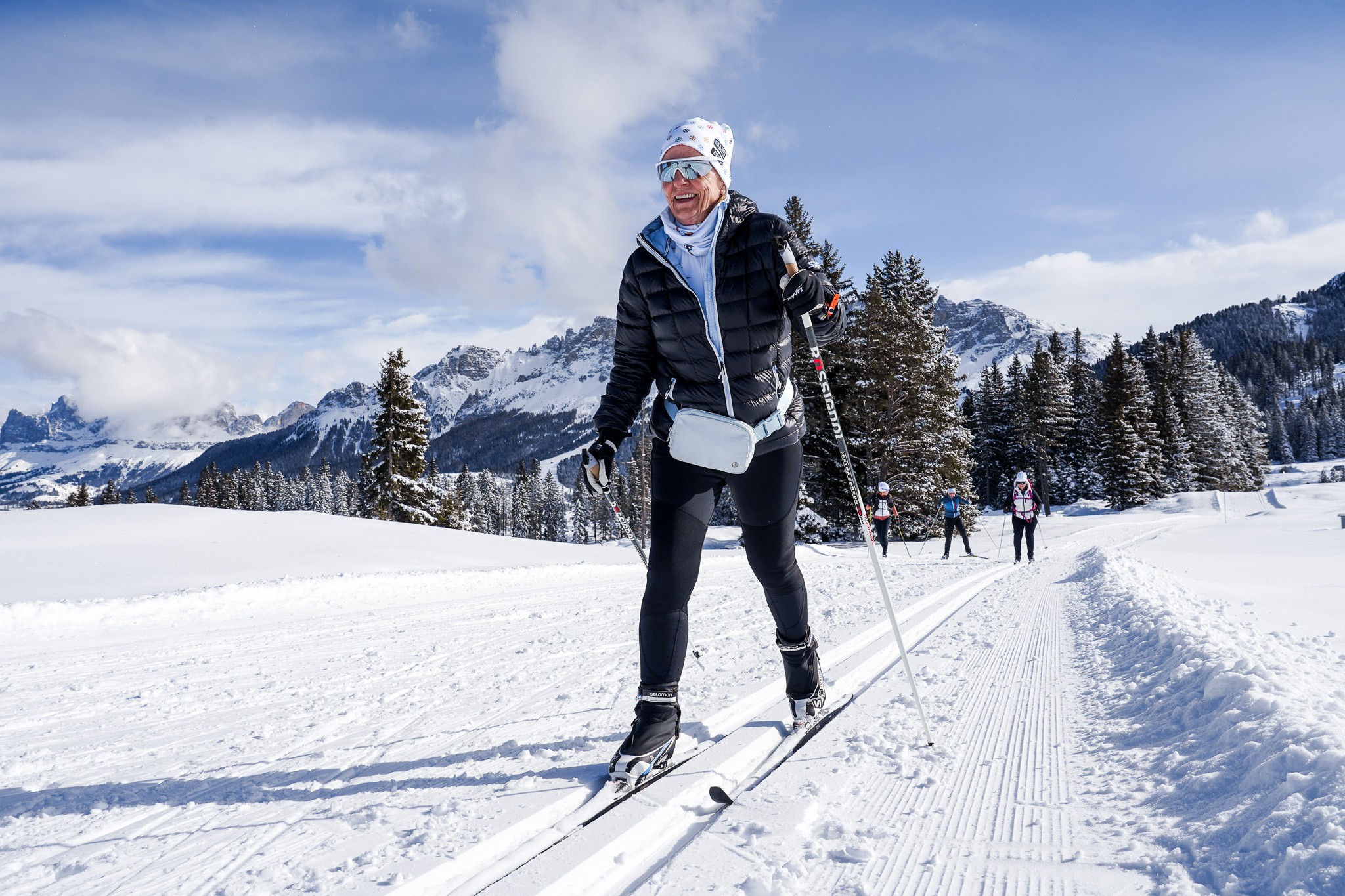
Explore the trails on Seiser Alm, one of Italy’s premier Nordic skiing destinations (Photo: Lumi Experiences)
This Winter Seefeld, Austria and Seiser Alm, Italy are renowned for their approachable, yet scenic skiing during the winter months. Start your journey on the nearly-flat trails of Leutasch outside of Seefeld, where picture-perfect mountains rise above the valley below. Trailside huts serving traditional Austrian fare, including the classic Aperol Spritz, dot the trails so you’re never far from a snack break or full meal. Continue your trip on Seiser Alm, where the higher elevations place you above the clouds and nearly at eye-level with the craggy Dolomite spires that ring this high-altitude plateau. Both locations have reliable snow-making capabilities that enable them to open the trails by November before natural snow takes over in December and beyond. The March trip is already sold out, but we still have space on both January trips to Seefeld & Seiser Alm trips. Reach out soon! Our January 20 departure only has one room remaining.
Earn Two Worldloppet Stamps Towards Your Masters Medal
Ski through Finland’s dense forests at the Finlandia-Hiihto (Photo: Finlandia-Hiihto)
If you’re craving the thrill of participating in a major ski marathon, look no further than Lumi’s Marcialonga & König Ludwig Lauf and Finlandia & Tartu trips. Both trips feature Worldloppet events on back-to-back weekends, putting you that much closer to reaching your Worldloppet Master medal. Your expert, local trip leaders assist with all race logistics, including ski waxing for each event so you can simply focus on enjoying the skiing and surroundings on your big event day. We only have a few spots left on both trips, so if you’d like to participate in two Worldloppet events on one trip we recommend reaching out soon.
The Marcialonga & König Ludwig Lauf trip features skiing in Italy, Austria and Germany over 11 days, allowing you to experience some of the best skiing and dining in each region. New for 2027 is the chance to participate in the 32 km Marcialonga “Just for Fun” event, the perfect distance for those who aren’t able to ski the full 70 km classic event. After skiing the beautiful trails in and around Seefeld, Austria, continue your Worldloppet pursuit at the König Ludwig Lauf in Germany on their newly refreshed, snow-secure course.
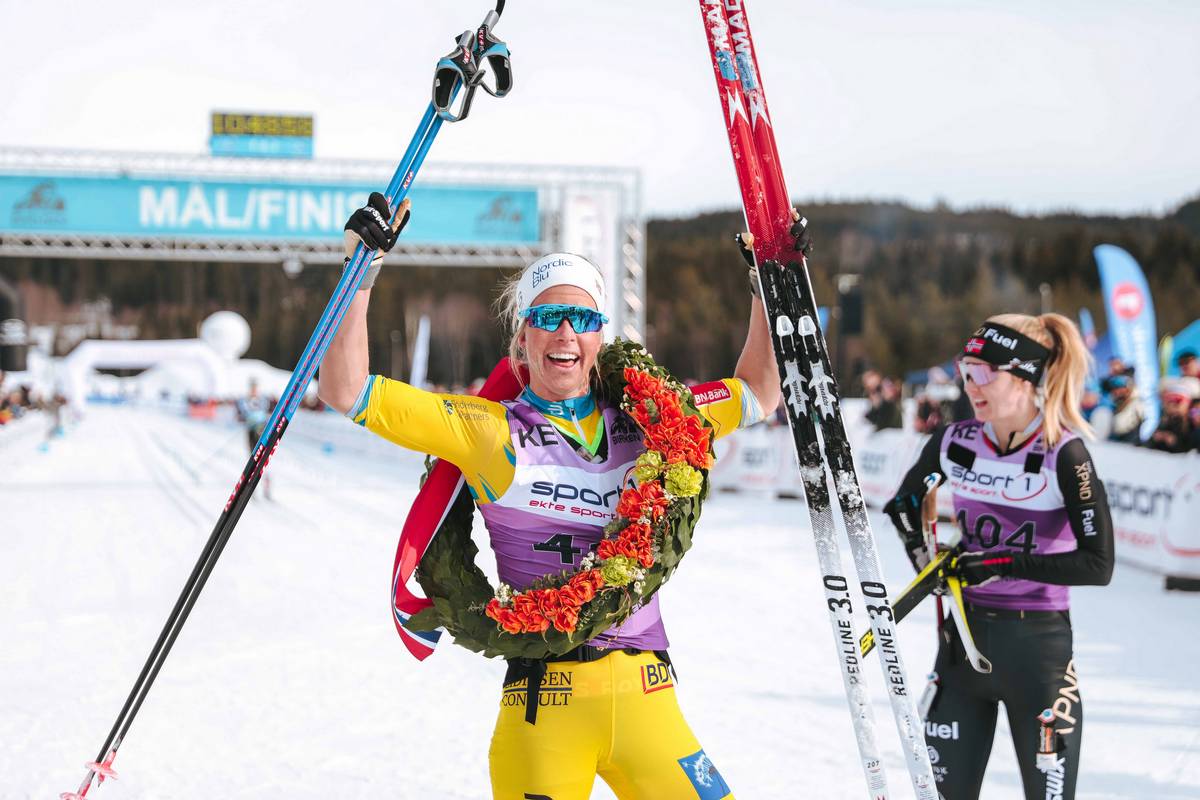
Whether you ski the full 70 km course or the new 32 km “Just For Fun” event, crossing the Marcialonga finish line is an exciting accomplishment (Photo: Lumi Experiences)
Later in the winter you’ll have the opportunity to ski the Finlandia-Hiihto and Tartu Ski Marathon on Lumi’s Finland & Estonia trip. Both events feature moderate terrain and a relaxed atmosphere in part due to their smaller size – especially compared to Worldloppet events like the Birken, Engadin and Vasaloppet, all of which regularly reach over 10,000 participants. In addition to enjoying both nations’ Olympic museums, cuisine and trails, guests have the opportunity to sauna every day in Finland in a variety of traditional Finnish saunas.
Join skiers from around the world in a group stretch before skiing the Finlandia-Hiihto Worldloppet (Photo: Finlandia-Hiihto)
Sight-Ski Your Way Across Norway or Slovenia & Italy
Not interested in participating in a ski marathon? Join a sight-skiing trip in Norway or Slovenia & Italy next winter. Lumi’s sight-skiing trips skip the races so you can focus on enjoying the scenery, cuisine and culture that make each destination unique.
Ski the Holmenkollen trails above Oslo before trekking north to Norway’s Sjusjøen trails (Photo: Lumi Experiences)
We have two Norway Sight-Skiing trips scheduled for mid-February next winter, each of which begins in Oslo on the Nordmarka trails before shifting north to the Olympic city of Lillehammer and the seemingly endless trails of Sjusjøen. Enjoy Oslo’s harbor from two unique angles: first from the top of the iconic Holmenkollen Ski Jump high above the city, then from the water on a floating sauna – before an optional cold plunge into the icy waters. Our February 14 departure is almost full, with just two more rooms available for up to 4 guests
Lumi’s Slovenia & Italy Sight-Skiing trip in early-March is the perfect trip for those looking to explore a quieter corner of the Alps. Your accommodations for the week-long trip are just a few minutes walk along rustic village paths to the trails, which lead directly to the famous Planica Nordic Center, site of the 2023 FIS World Championships. Ski to one of our favorite trailside huts in the Julian Alps before taking a gondola ride to a mountaintop village nearly a kilometer in elevation above the valley below. Wrap up your trip with a visit to Lake Bled, one of Slovenia’s most cherished natural wonders.
Discover the quieter trails of the Julian Alps in Slovenia and Italy (Photo: Lumi Experiences)
End Your Season Under the Auroras in Iceland
Part Worldloppet trip, part sight-seeing adventure: Lumi’s Iceland Fossavatn trip in mid-April has a little bit of everything. Start your trip off in Reykjavik before trekking northwards along Iceland’s rugged interior, with stops at volcanic craters, scenic waterfalls and geothermal springs. Upon reaching the country’s Westfjords region, you’ll find a beautiful trail network just above sea level, with stunning views of the fjord in the glacially-carved valley overlooking the Atlantic Ocean. After participating in the last Worldloppet event of the season, celebrate with your fellow skiers from around the world at the Fossavatn’s famous cake party, with dozens of delicious cakes to choose from – not to mention freshly-caught seafood served at restaurants throughout Ísafjörður. With almost no light pollution to speak of, this trip has the highest chance of seeing the northern lights of any Lumi trip.
Visit Iceland next April for the chance to see the northern lights (Photo: Annika Landis)
Space is limited on many of these trips, so if you are interested in traveling to Europe with Lumi for your next ski vacation, reach out soon to secure your spot. Message reservations@lumiexperiences.com for a detailed trip itinerary or to sign up. We look forward to hearing from you!
As the world’s premier cross-country ski travel company, Lumi Experiences offers boutique trips that introduce travelers to winter cultures where Nordic skiing is a part of everyday life — from Sweden to Slovenia. It’s a ski vacation like no other.
Media contact: Nathan Miller – Marketing & Guest Communications Manager – nathan@lumiexperiences.com
Norwegian ski testers Pål Trøan Aune, left, and Mats Iversen carry bags back to the country’s service truck at the Olympic cross-country ski venue in Lago di Tesero, Italy. (Nathaniel Herz/FasterSkier)
This article was made possible through the generous support of our voluntary subscribers who have helped put our Nat Herz on the ground at the Olympics. If you value coverage like this, please support FasterSkier with a voluntary subscription.
LAGO DI TESERO, ITALY — A day before Norway’s Johannes Høsflot Klæbo won his fourth straight gold medal in cross-country skiing at the Winter Olympics, a strange sight was unfolding next to the race trails in Northern Italy.
Two figures, dressed in Norwegian team suits, were skiing loop after loop on a tiny test track — in search of the most infinitesimal edge over rivals from France, Finland, Italy and America.
Neither figure was Klæbo: The superstar was back at his hotel room playing video games and resting up for the next day’s race.
Instead, the two men were retired ski racers hired by the Norwegian team for one of the strangest jobs of the Olympics: sprinting for miles over the same small patch of snow to help identify which waxes and other products can be applied to the surface of cross-country skis to make them faster.
While Klæbo spent much of Saturday in bed, one of the testers, Mats Iversen, skied dozens of laps adding up to more than 15 miles. Earlier in the Games, Iversen was skiing even more: as far as 44 miles a day, and just over 200 miles in his first week in Northern Italy, according to numbers he logs on the Strava tracking app.
Screenshots from the Strava workout tracking app that show a map of one of Mats Iversen’s testing days, and some of the times he skied on a test loop.
There’s no question that Iversen is skiing “way more” than the athletes competing at the Olympics, Klæbo said at a news conference Wednesday after winning his fifth straight gold.
Iversen’s one 44-mile day is “close to what I’ve done the whole week,” said Klæbo, whose race Wednesday totaled just over six kilometers, or some 3.5 miles.
“They’re amazing, and they are doing an amazing job to help us have the best possible skis,” Klæbo said. Referring to the winners’ podium, he added: “None of us would be able to sit here if it wasn’t for them.”
In a 45-minute interview after a 22-mile day last week, Iversen, his fellow tester, Pål Trøan Aune and their boss Tord Hegdahl offered a behind-the-scenes glimpse of the huge investment of equipment, technology and manpower that go into preparing the Norwegian team’s skis.
Aune and Iversen relax on the top floor of Norway’s service truck. (Nathaniel Herz/FasterSkier)
They spoke in a lounge area on the upper floor of an enormous, customized truck that houses hundreds of pairs of skis, along with work stations for staff members who prepare them for testing and racing. Iversen and Aune are, essentially, the engines of an intricate machine — with others operating the controls.
“You don’t need a 200 IQ to be a ski tester,” Iversen said. Pointing to the lower floor, where the technicians work, he added: “The brains are in here.”
‘Dizzy’ from all the loops
The Norwegian truck is parked in a big lot beside the competition trails in Italy where other nations like France, Sweden and the Czech Republic have their own vehicles and trailers.
The American team truck cost some $750,000 and is named Yolanda — a reference to a line from actor Samuel L. Jackson’s character in the cult classic film Pulp Fiction, according to NPR.
Inside the trucks, teams of technicians work to identify the skis and products that will slide the fastest given a specific set of snow conditions.
The work has several layers. Each athlete may have dozens of pairs of skis, and teams have to find the best ones for each day. Then, there’s what’s known as the “stone grind” — a pattern of tiny etchings that a machine can apply on the bottom side of a ski to help it move more easily over different types of snow crystals.
Finally, there’s wax, which can be applied to the ski base to give athletes even more of an edge. Dozens of products and brands exist in block, powder and liquid form, which can be melted or rubbed into the skis with waxing irons or obscure tools like a rotating wool brush attached to a drill.
A staff member prepares skis inside the Norwegian service truck. (Nathaniel Herz/FasterSkier)
Testers like Iversen and Aune help identify which combinations of skis, wax and grind work best in a given set of circumstances.
Every country does some level of testing. But Norway’s big budget for staff has afforded the team the luxury of an unusual level of specialization at the Olympics, with Iversen and Aune doing very little other than skiing — while other teams’ can mix testing in with other staff responsibilities, like waxing.
“We are terrible waxers,” Iversen said. Addressing a reporter, he said: “I think you are probably better.”
The Americans, by contrast, sometimes lean on coaches to test waxes on the trails, freeing up their specialized technicians to focus on picking skis with the athletes.
“If you take a look at our skis — we might have three bags and a couple of racks out before the race” for testing, said Matt Whitcomb, one of the U.S. coaches. “Norway will have two or three times that.”
Australian technicians Leopold Hensler and Toni Escher take a break from testing on the Olympic trails in Italy. (Nathaniel Herz/FasterSkier)
Canada’s team, meanwhile, employs two Italian “ski pilots” who, like Aune and Iversen, focus on testing at big events during the winter — often skiing upwards of 15 miles in a day. The rest of the year, one of them, Thea Schwingshakl, is a research biologist, while the other, Sara Hutter, markets Tyrolean apples.
Like Aune and Iversen, they spend their days in the tiny testing area, where Schwingshakl joked that they get “a bit dizzy there, from all the loops.”
But, she added: “It’s good for the whole team. We can just focus on skiing and testing, and they focus more on the product and on the wax and structures.”
Canada’s ski pilots, Sara Hutter, left, and Thea Schwingshakl ski upwards of 15 miles a day. (Nathaniel Herz/FasterSkier)
It’s not so much that the right skis, wax and grind will produce an Olympic medal — though they certainly help — as much as the wrong ones can put an athlete out of contention. After the men’s cross-country relay last weekend, American Johnny Hagenbuch suggested that his inability to keep up with rivals on the downhills had to do with his equipment.
“I was with everyone at the top of the climb and then — yeah, no longer,” he said. “There was nothing I could do.”
‘Simple and boring’ work
Iversen and Aune are part of a larger Norwegian project aimed at boosting numerous Olympic snow sports — not just cross-country skiing, but also Nordic combined and biathlon, said Hegdahl, their boss.
The effort includes a stone grinding machine that Norway operates near the cross-country race trails; Iversen and Aune help test patterns that can be used across those sports.
Another staff member has the sole task during the Games of driving skis over the mountains to the biathlon venue, said Hegdahl, who leads the Norwegian cross-country service staff.
One of the essential tasks that Aune and Iversen perform is the “paired glideout.” At the top of a small hill in the test track, the men stand side by side, then push themselves forward. As they start moving, Iversen equalizes their speed by grabbing ahold of a ski pole that Aune holds firm.
A French team member stands in the testing track at the Olympic trails. (Nathaniel Herz/FasterSkier)
Then, they let go without accelerating or jostling and see which of the different waxes or structures beneath their feet is faster.
Typically, they’re assessing sets of eight pairs of skis that — aside from the products underfoot — have been chosen because they’re perfectly matched. That, in turn, allows the technicians to more precisely measure the impact of the wax and grind patterns on speed.
The testing is set up like a single-elimination tournament, with quarterfinals, semifinals and a final. Results are transmitted back to technicians in the truck via WhatsApp messages or a GPS watch.
The matching of the eight pairs is so precise that, after the final test, Aune and Iversen take extra laps on the skis that are knocked out early to equalize them with the top pairs, to make sure the winning skis aren’t getting extra wear. Which also means that a mishap during a test lap requires three extras, to keep the six other pairs even.
Teams leave skis alongside the race trails for testing. (Nathaniel Herz/FasterSkier)
The whole process — from the unending right turns down to the bending over to take each pair of skis off and put the next set on — is hard on the body. They can ski 200 or more laps of the test track in a day.
But Iversen and Aune are both fit, and capable of the workload, according to Hegdahl.
“Testing is quite simple and boring. But we need guys to do the skiing who have the feeling of the skis,” Hegdahl said. “They’ve done a lot of skiing together with some of the best athletes, as well. So they know a bit.”
Aune and Iversen have also been friendly for years, and enjoy the camaraderie and the chance to participate at a championship event that neither reached as an athlete.
Mats Iversen’s brother Emil has had a standout season this winter. (Vianney Thibaut/NordicFocus)
Iversen’s brother Emil is competing for Norway in Italy, and won a gold medal with the men’s team in the relay.
“It’s very special — it’s our best friends who are racing,” said Aune. “I think they trust that we will do all we can.”
The work can get boring, Iversen conceded. “But it’s nice to be with a friend,” he said.
They’re “better than most” with their team spirit, Iversen added. But Hegdahl, their boss, acknowledged that the testers might need a little time off after three weeks of rooming and working together through the Olympics, which conclude Feb. 22.
“I’m not sure Pål will be at Mats’ place for a glass of wine on the 24th,” said Hegdahl. “But maybe the 28th.”
Help Support Our Olympic Coverage!
FasterSkier will have our own Nat Herz on the ground at the Olympics, which, to be honest, is a very big financial lift for us. If you value the thoughtful work and access FasterSkier provides at championships like this one, please consider becoming a Voluntary Subscriber. Your support directly fuels the work we do to cover the people, places, and moments that make our sport special.
This article was made possible through the generous support of our voluntary subscribers who have helped put our Nat Herz on the ground at the Olympics. If you value coverage like this, please support FasterSkier with a voluntary subscription.
Astrid Øyre Slind races in Norway earlier this season (Federico Modica/NordicFocus)
PREDAZZO, ITALY — When Astrid Øyre Slind was 26, she almost retired from cross-country skiing.
She was a good skier, just not quite good enough to break into the international circuit from her home country of Norway, where competition in cross-country is cutthroat. She was, in her own words, “stuck,” feeling like being an athlete wasn’t worth it any more.
“If you try for the same thing for 10 years, you get disappointed in yourself that you’re not getting better,” she said. “You’re working your ass off, and you’re still not there.”
But Slind didn’t retire. Instead, she mixed up her training plan, found a new coach and spent years racing on a lower-level long-distance circuit — the minor league baseball of cross-country skiing.
Nearly a decade later, in 2022, she returned to the international stage, and soon after made her first-ever World Cup podium, against Olympic-caliber competition.
This season, she finally qualified to race at her first Olympics, at age 38.
In Thursday’s 10-kilometer freestyle race, Slind finished a painful fourth place, just seconds from a medal. But on Saturday, she led the Norwegian women’s relay team to gold — punctuating a career arc that few novelists could have scripted.
“Her story, I think it’s really important to tell,” said Pål Golberg, another Norwegian skier who found success late in his career.
Slind, he said, was not an athlete with exceptional physical talent, nor especially good technique, and at times she was “struggling to find her way.”
But there’s still a message embedded in her success.
“You can get really far just by hard working,” Golberg said. “And she’s a perfect example.”
At a news conference after Saturday’s relay, Slind said she’d accomplished something she’d been working toward since childhood.
Slind, at lower left, celebrates her Olympic relay medal with, in clockwise order, Heidi Weng, Karoline Simpson-Larsen and Kristin Austgulen Fosnaes. (Federica Vanzetta/NordicFocus)
“It’s kind of crazy to say, but it’s actually been a dream for 30 years,” she said. “And it’s something I’ve given up on during the way there — and then started to believe again.”
She added: “It’s nice to finally make it.”
Not a top prospect
Cross-country skiers can be competitive into their late 30s, but few of them stay in the sport that long. In Thursday’s freestyle race, Slind was the oldest competitor, and one of just two of the 111 athletes who was born in the 1980s.
Slind grew up in the village of Oppdal in Central Norway, in a family of skiers. Her father, Peder Einar Slind, is a ski coach who once spent a year in Western Massachusetts on an exchange with a collegiate cross-country ski coach there.
Astrid also has two ski racing sisters: a younger one, Kari, and a twin, Silje.
Both still compete at a high level on European circuits. Kari, in fact, had the first breakthrough at the international level, nearly landing on the World Cup podium in her mid-20s. Experts thought she would be “the biggest of them,” said Birger Lofaldli, a reporter at Adresseavisen, the Slinds’ local newspaper.
In this archival photo, Kari Øyre Slind, center, poses with American skier Jessie Diggins and Slind’s friend Ragnhild Haga after a strength training session in Norway years ago. (Roar Hjelmeset)
“But Astrid came back,” Lofaldli said. “And now she’s greater than ever.”
Astrid did not grow up as a top prospect.
Unlike Kari, she never qualified to represent Norway at the World Championships for juniors, a proving ground for young athletes.
But Astrid was always skiing, she said in an interview in November. Her father would take the sisters out to play on skis; the twins were always pushing each other, with Kari “chasing us behind,” Astrid said.
At three years old, she added, the twins were “crying ourselves in” to local club races in Oppdal, where their parents initially didn’t want them to compete.
“Silje and I really wanted to go,” Astrid said. “From that day, we’ve just been skiing as long as the snow is out, and loving it.”
‘Crazy training’ with a new coach
After failing to break into Norway’s national team and the top-level World Cup circuit in her 20s, Slind spent years racing on a tour called the Ski Classics. The circuit features distance races as long as 90 kilometers, or 56 miles.
Slind celebrates winning the Birkebeiner, a long-distance race that finishes in Lillehammer, Norway. (Federico Modica/NordicFocus)
She had her ups and downs there, too. In one especially tough year, Slind said, she had trained too much — so much, that she could barely race — and was again thinking about quitting the sport.
Instead, she started talking about her problems with a teammate, Chris Jespersen, another Norwegian who was a few years older and had also struggled to stay at the highest level of the sport.
“He was like, ‘You know what? I really think I can make a good skier out of you — I’ve made all the mistakes myself. I can see what you’re doing. Let’s try to figure it out together,’” Slind said.
Jespersen, at the time, was not a coach, just an “athlete who had ideas,” Slind said.
But at that point, Slind said, she had nothing to lose, so the two started working together. They made a deal: When they disagreed — if Slind, for example, wanted to push herself to do more training but Jespersen thought it was too much — Jespersen would get the last word.
It turned out that Jespersen had a knack for explaining what Slind needed to do differently with her ski technique, in a way that she could understand. He was also a good check on what Slind describes as her impulse to do “crazy training” — things like a six-hour session of skiing with the arms-only double pole technique, with hard intervals in the middle of it, or workouts where she’d try to keep up with her team’s strongest men.
Slind had done more of those kinds of sessions as she moved into the Ski Classics circuit, where she discovered that she “needs a lot of training to be at a good enough level.”
“I think it was what put a spark in my skiing again,” she said.
But Jespersen, she added, helped rein her in when the crazy training got a little too crazy.
“He wasn’t too eager, and he wasn’t too defensive,” she said. “It was kind of the perfect balance for me.”
A breakthrough, and medals
Slind’s breakthrough came in the winter of 2022-2023, when she finally qualified to return to the World Cup circuit after a nearly nine-year absence.
Two months into the season, after nine races, Slind stood on the podium for the first time. Later that season, she won a bronze medal at the World Championships in the skiathlon, and a gold medal with Norway’s relay team.
Still, it hasn’t always been easy since then.
Last season, she raced at what was effectively a home World Championships, in the city of Trondheim just a two-hour drive from her hometown. Amid challenging snow conditions and constant rain, her results were disastrous, including a mishap with a ski during the skiathlon, and she finished with no individual medals — just a silver from the relay.
Then, at the Olympics this year, she was oh-so-close to a medal in the 10-kilometer freestyle race in fourth, just 3.3 seconds behind bronze medal-winner Jessie Diggins of the U.S.
Slind was also painfully close in her first Olympic race, the skiathlon, where she was skiing in medal position before being overtaken by a teammate and ultimately fading to eighth.
“I completely died out there,” Slind said in an interview afterward. “I’m not a good enough skier today.”
In Sunday’s relay, though, Slind was one of the strongest athletes in the race, putting pressure on the Swedish star Ebba Andersson, who ultimately crashed twice and cost her team the gold medal.
Slind leads the Olympic relay on Saturday. (Nathaniel Herz/FasterSkier)
The performance caps a storybook turnaround — one so improbable that Slind probably wouldn’t have believed it herself, said Jostein Vinjerui, a Norwegian coach who works with Slind’s club team, Aker Dæhlie.
“If you’d have asked her during the Beijing Olympics, four years ago, if she’d be able to do the Olympics in four years time, I think she would have laughed, I’m pretty sure,” Vinjerui said. “It’s just an amazing story, being 38 years old now and winning a first gold medal.”
More Olympic medals are possible for Slind: The Norwegian coaches have named her to the two-person team sprint squad, and she and Julie Bjervig Drivenes will be podium contenders in the event Wednesday. Slind is also expected to vie for medals Sunday in the longest race of the Games, the 50-kilometer competition in the classical technique.
After the relay gold, Slind said at the news conference that she’s good at turning depressing results into motivation for the next event.
“Maybe the two other races just made me more on fire for today, and really wanting to show what I’m good for,” she said. “And I will take that with me into the 50 k.”
Help Support Our Olympic Coverage!
FasterSkier will have our own Nat Herz on the ground at the Olympics, which, to be honest, is a very big financial lift for us. If you value the thoughtful work and access FasterSkier provides at championships like this one, please consider becoming a Voluntary Subscriber. Your support directly fuels the work we do to cover the people, places, and moments that make our sport special.
This article was made possible through the generous support of our voluntary subscribers who have helped put our Nat Herz on the ground at the Olympics. If you value coverage like this, please support FasterSkier with a voluntary subscription.
Johannes Klæbo stands with his father, Haakon, during a water break on a rollerski workout in Utah in 2023. (Nathaniel Herz/FasterSkier)
PREDAZZO, ITALY — Johannes Høsflot Klæbo is four for four — and officially the most golden Winter Olympian in history.
By anchoring Norway’s relay team to first place Sunday, Klæbo claimed his ninth Winter Olympic gold — moving him out of a tie, with two other Norwegian cross-country skiers and a Norwegian biathlete, for the most ever.
At a news conference afterward, Klæbo said he’d been drained by the effort it took to win Friday’s 10-kilometer individual start skate race — the first time he’d ever won an event in that discipline.
The next day, he said, “the only thing I did was lay in the bed and play on my PlayStation.” But by the time he woke up Sunday morning and checked his heart rate, he said, “it looked pretty good.”
After Sunday’s relay win over France and Italy, Klæbo is now poised to win the last two cross-country events at the Games, both of which — a team sprint, and a 50-kilometer mass start race in the classical technique — favor him.
At the news conference, he said he’s still taking it one day at a time. “We’ll see where we end up at the end,” he said. “But it feels, so far, so good.”
In search of some more revealing answers, we went looking for Klæbo’s father.
Haakon Klæbo, for the past week, has been a ubiquitous presence at the Olympic cross-country ski venue, watching races with the masses alongside the race trails with friends and family. We found him walking alone behind the stadium — where he was happy to answer a few questions before others broke in.
Nathaniel Herz: Are the Olympics a platform where Johannes is starting to go from a Norwegian to a global star, with these viral videos of him running up the last hill in the sprint race?
Haakon Klæbo: Yeah, it looks like at least it is. It is a huge interest in him. Olympics is really big in the U.S. But I also think that more U.S. citizens are learning how much time he spent there. He’s linked with (Utah physiotherapist) Megan (Stowe). She is really the one that has made his strength program, which is — it’s not that it’s secret, but if you look into it, he’s doing a lot of core strength. This is a program that he also follows at home (in Norway).
NH: How nervous were you for the 10-kilometer skate race two days ago?
HK: I was really nervous for the 10 k, and I knew that it was his weak point, or Achilles, in a way. We have to remember that he has never won a 10 k skate before, never — and this is in his whole career. I think that he has been in good enough shape, but this has been something in his head — and something that if you do not accomplish, it starts to become even more problematic.
Devon Kershaw, a retired Canadian World Championships gold medalist in cross-country skiing, who’s working as an expert TV commentator at the Olympics, walks up: Congratulations.
Herz, to Klæbo: You know this guy?
HK: No.
NH: This is Devon Kershaw.
DK. Congratulations, it’s been quite the show.
HK: Oh! Yeah — it is a little unbelievable, because you don’t expect it. And we had these crazy days in (the World Championships in) Trondheim last year, in which were hoping for like two or three (medals). (Klæbo won gold in all six events.)
And now, with four.
NH: Do you think going through this whole Trondheim experience last year is making this a lot easier for him now?
HK: Yeah. He had been training for that since he heard Trondheim would host the World Championships, and he has been the front figure. They used him (in their marketing materials), saying, ‘Born and raised.’ He’s standing there, like 18 years old — he had one pair of Leki ski poles at that time. He was wearing a suit that he had borrowed from a friend that was on the team. He was like, ‘This is my dream.’ And then he managed to do it. So, I think he was really stressed for it.
This season, it has just been fun. We’ve been together with (teammate and friend) Emil (Iversen). Me and him and Emil have been traveling around — it’s like being there with two boys playing around. So, I think he’s really much more relaxed. And you can see, also — I think he is even stronger, here, if you look at his sprint.
DK: I agree with you, 100%. Everyone made such a big deal of it, but winning the individual start skate. That’s the biggest thing to me, as a fan and a person that raced his whole life. I’m getting goosebumps thinking about what I saw two days ago. When you win that, then you’re really the king.
HK: And I said to Nathaniel that I think that he has been strong enough to do it for years. But it has been something up here (points to his head). He’s never won it.
NH: Do you think that’s his best accomplishment ever?
HK: Yeah, I think it is. And he was really tired after — he has been working really, really hard. I was afraid for this relay today — that he wouldn’t be able to run, because I think he put so much into the 10k. So much energy spent.
Johannes Høsflot Klæbo celebrates one of his four Olympic gold medals in Italy. (Davide Barbieri/NordicFocus)
NH: Was he at a disadvantage being first, in this individual time-trial style race, of all these Norwegian guys? That meant that he wouldn’t get as much information on the course from his coaches about how his times compared to the others.
HK: Actually, his best races from skate individual start are when he is just doing his own thing — just making his own pace, and doing what he’s good at. You could see that for the others, it was a disadvantage. I think, for (rival-teammate) Einar (Hedegart), it was trying to push on Johannes’ time (that was the problem). If you look at the two of them, racing, they’re pretty similar in taking it a little slow in the first two kilometers. Then starting to get faster and faster and faster, and having a crazy second half.
I think that that was what made Einar lose the silver. He pushed too hard — and he got burned and he lost 20 seconds in the last 1,000 meters.
NH : Will you be very stressed about the 50 kilometer race, the last event? Or do you feel like, once you get to the 50 k, so much has already been done that you can relax a little.
HK: The 10 k was what I was really afraid of. And now, I don’t know — we’re just here here enjoying and having fun. And then, everything can happen. And even if he is getting sick tomorrow, we’ve had four gold medals, and you’re the best Winter Olympian — and still, you can race for another Olympics. I think if you ask him, his dream Olympics would be to do a 50 k in Soldier Hollow (in Utah) — which is his home.
A middle aged fan carrying a Finland flag breaks in, screaming: “Klæbo! Klæbo! Number one!” The fan demands a photo, then ushers Klæbo away.
Help Support Our Olympic Coverage!
FasterSkier will have our own Nat Herz on the ground at the Olympics, which, to be honest, is a very big financial lift for us. If you value the thoughtful work and access FasterSkier provides at championships like this one, please consider becoming a Voluntary Subscriber. Your support directly fuels the work we do to cover the people, places, and moments that make our sport special.
This article was made possible through the generous support of our voluntary subscribers who have helped put our Nat Herz on the ground at the Olympics. If you value coverage like this, please support FasterSkier with a voluntary subscription.
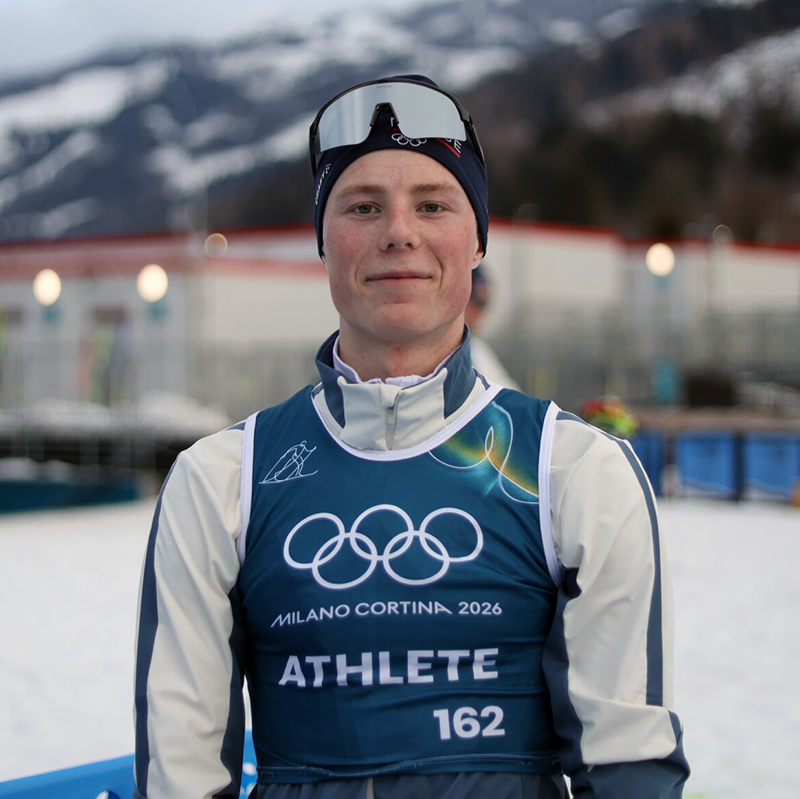
Einar Hedegart poses for a photo after training at the Olympic cross-country ski venue in the Dolomites in Northern Italy. (Nathaniel Herz/FasterSkier)
PREDAZZO, ITALY — Johannes Høsflot Klæbo is, almost without question, the greatest cross-country skier who’s ever lived.
The Norwegian athlete has won gold in eight consecutive championship races spread across two seasons — including the first two events at this year’s Olympics, in Italy. It’s quite possible he could walk away from the Games with gold in all six events.
His biggest threat comes from a guy who’s been a cross-country skier for less than three months.
Norwegian Einar Hedegart has beaten Klæbo all three times they’ve raced each other this winter. He’s won five of the six cross-country events he’s entered since the season began in November.
Johannes Høsflot Klæbo celebrates a gold medal at the Olympics in Italy. (Davide Barbieri/NordicFocus)
November is when, at least according to Hedegart, he finally accepted the label of cross-country skier. Before that, he’d still been, at least partially, a biathlete — the Olympic discipline that combines cross-country skiing with precision shooting.
In biathlon, Hedegart was a fast skier, but not always a reliable shooter. Last season, he jumped into a World Cup race against cross-country skiing’s best competitors, and finished a surprising second place.
That result set off a chain of events that have led him to Italy on Norway’s Olympic cross-country team, with a specific focus on the 10-kilometer freestyle event. That’s where, on Friday, he’s expected to challenge Klæbo for Olympic gold.
“We’re looking forward to Friday,” Emil Hosøy, the coach of Hedegart’s club team in Norway, said in a phone interview this week. “It will be a hard competition.”
In a brief interview Tuesday after training with a teammate at the Olympic venue in the Dolomites, Hedegart said he’s prepared for the showdown.
“Everything has gone according to plan,” he said.
Biathlon vs. cross-country
Hedegart’s meteoric rise has enlivened a long-running, colorful debate between cross-country skiers and biathletes over which discipline is superior, and who’s faster. Biathletes have periodically crossed over and notched competitive results, though it doesn’t happen often.
Swedish cross-country star William Poromaa sparked a furor in Scandinavia two years ago by joking that biathlon, with its stops for target shooting, was for athletes who need a rest between ski sessions.
Hedegart is the latest test case — showing that on today’s racing circuits, elite biathletes can be, at a minimum, competitive with the best cross-country skiers.
“I think a lot of cross-country skiers underestimate the level biathlon is at, and the amount of training we are doing,” Hedegart told two cross-country Olympians on their podcast, Skirious Problems. “You guys have to give us some credit, please.”
Hedegart, 24, is from a little north of Trondheim, a city in central Norway that’s produced some of the world’s best cross-country skiers, including Klæbo.
As a kid, he watched cross-country skiing on television, because the Norwegian superstar Petter Northug Jr. came from his area. But Hedegart’s focus was biathlon, and he showed promise early — winning medals at the World Junior Championships and, in 2023, reaching the top 30 in the World Cup, the sport’s highest level of competition.
Einar Hedegart competes in a cross-country World Cup race in Switzerland (Federica Vanzetta/NordicFocus)
Hedegart would also, from time to time, enter elite cross-country races. Some of those decisions were happenstance — one because he didn’t have a partner for a biathlon relay on the same day, and another that he entered on a whim after a registration deadline.
But in both of those cases, he won.
His results earned him an entry into a cross-country World Cup race in Oslo last year, where he placed second — prompting questions from Scandinavian pundits about whether Hedegart was focused on the right sport.
So, over the summer, Hedegart hedged his bets: He switched from training with biathlon teams to training with a cross-country ski team — albeit one that would allow him to keep shooting his rifle and compete in biathlon.
“All the way from May to November, I was 50-50,” Hedegart said. “I brought my gun to every camp and shot a lot.”
At the start of this winter, Hedegart entered two sets of races over two weekends — biathlon and cross-country — to help decide how he would spend the rest of the season.
In biathlon, he shot poorly. In one race, he missed eight of 20 shots; only one athlete out of 59 competitors missed more.
The cross-country race, meanwhile, he won by a big margin — besting not just Norway’s top skiers but other top talents from France and Austria. That was the day things changed, Hedegart said.
“I’m a cross-country skier this winter season,” he said.
Klæbo, whose championship winning streak is at risk, has taken notice of Hedegart’s rise, which resulted in him being named to Norway’s Olympic cross-country team early in the winter.
“It’s impressive, what he has done,” Klæbo said. “I’m going to try to give him a good match.”
The best skater of all time?
Both Klæbo and Hedegart himself credit Hedegart’s success this season to a unique aspect of his training.
Cross-country skiing, both on the World Cup circuit and at the Olympics, features events in two techniques — the traditional forward striding and poling known as classical, and the side to side pushing called skating.
Biathletes compete only in skating, and Hedegart, this past year, has focused his training almost exclusively on that technique. He hasn’t even bothered to contest classical cross-country competitions this winter.
Hedegart said on the podcast, in November, that he’d spent less than 12 hours practicing classical style in the previous six months — a tiny fraction of the hundreds of hours he’d spent training in total. Top cross-country skiers, meanwhile, typically divide their training close to evenly between the two techniques.
Einar Hedegart, center, celebrates winning a World Cup cross-country race in Switzerland. (Federica Modica/Nordic Focus)
“That is my strength, that I can use more time than anyone else ever has on skating,” said Hedegart in the interview. “I’ve just really done my thing, and that has gotten me this far.”
Hedegart’s training plan has other unconventional elements, including lots of moderately hard sessions and few extra-hard ones, which allows him to spend more time training overall, said Hosøy, his coach. Hedegart is also a “very clever” athlete who’s shown a keen awareness of his own body that’s unusual for someone his age, Hosøy added.
But it’s the added emphasis on skating that’s allowed Hedegart to take the technique “to a new level,” said Pål Golberg, a former top Norwegian skier who’s competed against Hedegart and now is working at the Olympics as an expert TV commentator.
“The training he does is out of this world,” Golberg said. “He can be the best skater the sport has seen — if he wants to do that.”
A postseason dilemma
That’s the question Hedegart will have to answer after this season — and it poses a real dilemma.
Avoiding the classical technique means he can only compete in half of cross-country’s racing schedule. And because his success, so far, has come mostly in distance events, Hedegart has not yet earned a chance to race individual sprint races for the Norwegian team, whose start slots are hotly contested.
As a result, Hedegart has started just six cross-country races this winter — far less than athletes competing in both disciplines.
“If you want to get old in this sport, maybe you have to get to compete more to have the motivation to train as much as he does,” said Hosøy, the coach.
But training and racing in the classical technique would risk the success Hedegart has found after specializing in skating.
“I wouldn’t take the chance,” said Golberg. “If he has this skating that’s so good, why would you risk it? He would never win a distance race in classic, I’m pretty sure.”
There’s also the question of whether Hedegart will ultimately return to biathlon — which, he said, would make it pointless to try to improve his classical technique, since it’s not used on the biathlon circuit.
Hedegart celebrates a podium finish at a cross-country World Cup race in Finland earlier this year. (Federico Modica/NordicFocus)
At the start of the season, Hedegart said, he still planned to go back to biathlon next year. Now, he added, he’s pretty sure he’s changed his mind: If he’s offered a spot on Norway’s national cross-country team for next year, he’d take it, at least for one season.
But in 2029, the biathlon World Championships will be held in Oslo — a chance to compete in a marquee event in Hedegart’s home nation. “That is a big, big dream of mine,” he said. “And I really hope that I can compete there.”
“That is the back and forth I have to do,” Hedegart added, referring to the balance between the two sports.
If Hedegart’s success this season has complicated his career planning, it’s at least provided Scandinavians with a compelling new storyline — particularly in men’s cross-country skiing, where some pundits complain that Norwegian dominance is making the sport boring.
“Norwegians are pretty tired of watching one Norwegian fighting with another,” said Golberg. “But now, suddenly, you have two sports clashing together.”
Help Support Our Olympic Coverage!
FasterSkier has our own Nat Herz on the ground at the Olympics, which is a significant financial lift for us. If you value the thoughtful work and access FasterSkier provides at championships like this one, please consider becoming a Voluntary Subscriber. Your support directly fuels our work to cover the people, places, and moments that make our sport special.
By the time Sophia Laukli picks up the phone from Lillehammer, it’s raining again.
“There is, like, a small 1k loop up at Sjusjøen,” she says, “but it’s… yeah, it’s, like, raining every day, so it’s not really great conditions.”
On paper, Laukli is one of the most intriguing dual-sport athletes in endurance sport: a U.S. Ski Team member and Olympian who has also become a force in international trail running. In person—or over Zoom—she’s thoughtful, understated, and very clear on one thing: the way she trains now, in Norway, looks a lot more boring than the world might imagine.
You come to Norway expecting secrets, she says. What she found instead was simplicity.
“They’re so simplistic around ski training,” Laukli explains. “It’s not rocket science. You can do the same… You do essentially the same workouts every single week, all year round.”
That realization—combined with a crash-and-burn experiment as a full-time runner and a new coaching relationship with her boyfriend, longtime Norwegian pro skier Gjøran Tefre—has quietly reshaped her career.
As this Olympic season approaches, Laukli’s bet is clear: train like a skier, keep the training simple, stay within herself, and let the results show up in both sports.
Maine Roots, Late Commitment
For all the talk about Norway, Laukli’s story really starts in coastal New England.
“I was actually in the Boston area until I was, like, six or seven,” she says. Then came a year and a half in Norway, and finally Yarmouth, Maine—the place that still feels like home.
“From my memories and my ski memories, it’s all from Maine.”
Her father is Norwegian, so skis were always around. Winters meant skiing, family trips to Norway, and a life that looked, from the outside, like an early pipeline to the World Cup. From the inside, it didn’t feel that way at all.
“It was a very recreational thing,” she says. “I didn’t really enjoy it that much. It was just kind of like, obviously, we’re gonna ski because it’s winter. But I didn’t know anything else.”
In Maine, her parents weren’t just ski parents—they were essentially the ski people in the community.
“They were my coaches,” she says. “And very present in the ski world, which was hard for me… A part of me became pretty hesitant towards skiing.”
She gravitated toward soccer and tennis. Skiing felt obligatory.
“Up until midway through high school, skiing was kind of just something I did because my family did it,” she says.
The idea of becoming a professional athlete wasn’t just unrealistic—it was unimaginable.
“I was gonna just go to school and be a nerd or something,” she says. “Being a professional skier wasn’t even a consideration.”
Then came the pivot: joining the iconic Yarmouth High School ski team, coached by the legendary Bob Morse.
“It opened my eyes a lot,” she says. “It wasn’t super competitive, but it showed me the sport that felt forced on me was actually something I liked—and could be really good at if I tried.”
Looking back, she’s grateful it took so long.
“I’m super happy I went through that zero-pressure, uncommitted relationship to skiing,” she says. “Today I have so much motivation to be 100% committed… and I’m far from burnt out compared to many skiers who commit when they’re 12.”
Discovering Running (By Hating It First)
The other half of her dual-sport identity—trail running—comes from an even stranger origin story.
“Running was something that I actually hated,” she says, laughing. “I really, really, really did not like to run when I was young.”
Running in Maine didn’t help.
“It just wasn’t enjoyable to run there,” she says. “Unless you really liked running on roads and golf courses.”
She ran cross country her senior year only because the coach wanted her on the roster for states. She ran track for one year and found it “horrible.”
“It wasn’t until I started training out West in the summers, finding mountains… that I actually enjoyed running.”
Those Western US trails served as the practice grounds, preparing Laukli for some of the world’s biggest trail races. But first she had to figure out college—and how training would fit around it.
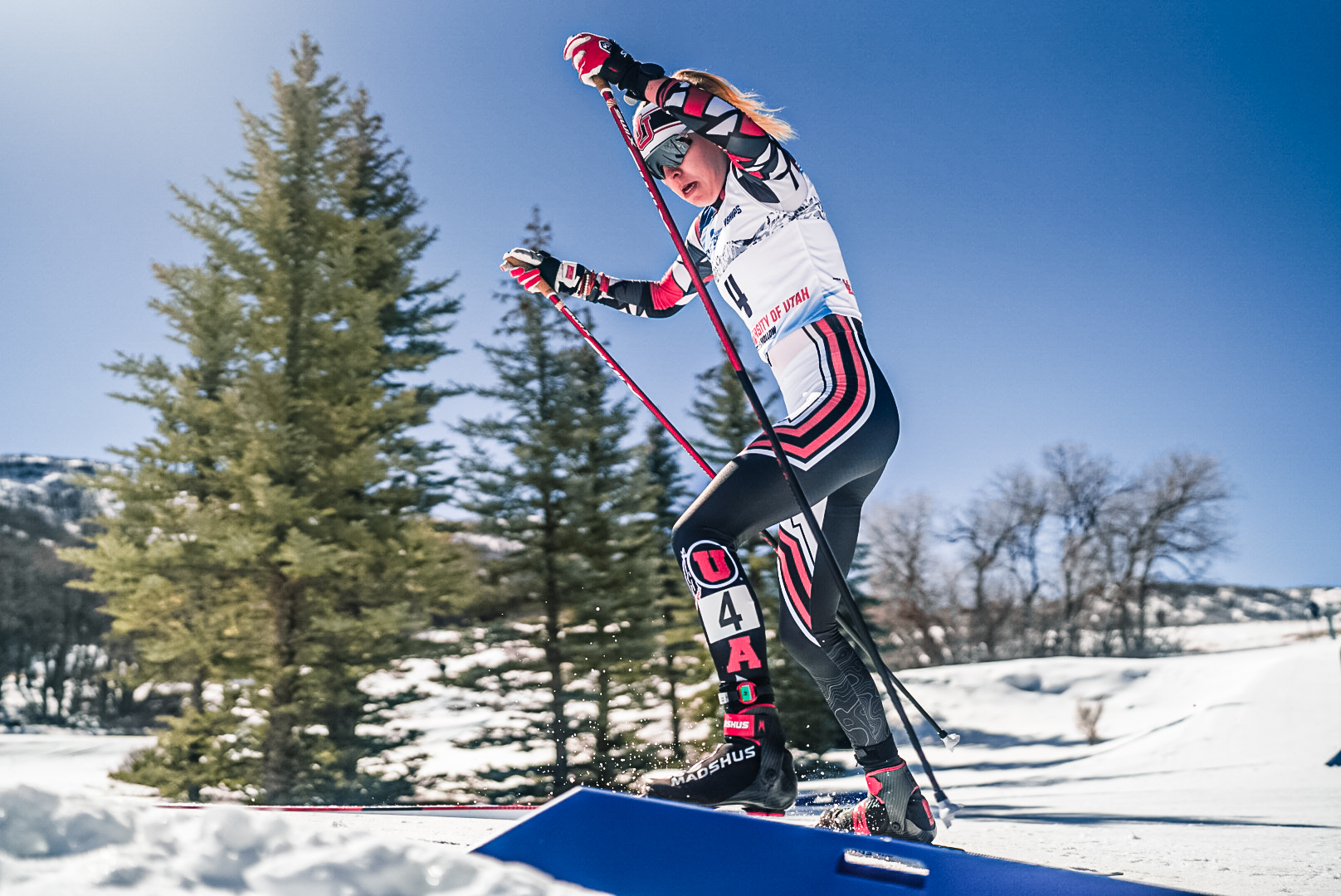
Sophia Laukli takes the collegiate national title in the 15 k skate in 2022. (Photo: Tobias Albrigtsen / @untraceableg)
Middlebury to Utah: Building a Life Around Skiing
Laukli chose Middlebury because, at the time, academics were the top priority.
“I knew I didn’t want to be done skiing,” she says, “but it wasn’t the priority.”
Covid changed everything. Remote classes allowed her to chase early World Cup opportunities without living on campus. Once Middlebury required students to return in person, the timing coincided with the rapid ascent of her ski career.
That led to a transfer to the University of Utah.
“Utah is built for athletes,” she says. Most classes were online and flexible. She chose economics not out of passion but practicality.
“I didn’t necessarily choose the thing I thought was interesting,” she says. “I chose what would best suit my ski career.”
Now, even as a full-time pro based in Norway, she’s studying again—an online Norwegian MBA.
“I’ve never been someone who can come home from training and sit on the couch until my next session,” she says. “I think I was missing having more than just training.”
Balancing skiing and school helps her prevent the sport from consuming everything.
Last year, after the World Championships, Laukli decided to lean all the way into running. It seemed logical—if she’s good at running without specifically training for it, imagine how good she’d be if she did.
“I always thought I’d be a much better runner if I had just run,” she says.
So she tried it. No roller skiing. No ski sessions. Just running—every day.
“I was running 10 to 12 hours a week,” she says. “And I was so tired each day. I was getting worse and worse at running. And obviously not good at skiing.”
The experiment collapsed at a race where she felt utterly depleted. She flew home, frustrated and confused. That’s when she sat down with her boyfriend, Gjøran Tefre.
“He said, ‘It’s fine. I’ll write a plan. Don’t freak out,’” she says. “‘We’ll get you a coach, but ski training is straightforward. We’re gonna baby you into ski training again.’”
Two weeks completely off. Then a return to “textbook” ski training.
Within a week of roller skiing, something wild happened: her running started feeling good again.
The pattern was clear. She ran better when she trained like a skier.
Sophia Laukli (USA) during the World Cup 20km in Engadin (SUI). (Photo: Authamayou/NordicFocus)
Kristen Bourne Saw The Same Thing
“Last season was definitely a struggle for her, both running and skiing,” says U.S. Ski Team assistant coach Kristen Bourne, who monitors Laukli’s training load. “And she’s just trying to figure out why.”
For Bourne, the shift wasn’t just physical—it was psychological.
“I’m a huge believer that what makes a difference from a good athlete to a great athlete is the athlete who is very invested in their own process,” Bourne says. “The ones who are thinking, advocating for what they need—not just deferring to a coach because the coach’s word is gospel.”
That ownership, she says, is new in Laukli.
“She’s definitely leaning into that more this year,” Bourne says. “Which is really cool.”
Sophia Laukli and Gjøran Tefre at the Cross Country Skiing World Championships. (Photo: Courtesy Photo)
The Gjøran Factor: Coach, Partner, Check on Reality
Mixing a relationship with coaching is a delicate thing. Laukli knows the risks—she’s heard them all.
“I’ve been told by many people this is not a good idea,” she says. “And other people are like, ‘Wow, I wish I could do that.’”
She also knows why it works.
For one, they communicate constantly. For another, his intentions are pure.
“One of the hardest parts of finding the right coach was that they either only cared about skiing or only cared about running,” she says. “He’s the only one who actually wants me to do well in both.”
Still, she doesn’t call him her “coach.”
“I want our personal life and work life to be separate,” she says. “We need other people in the room.”
That’s where Bourne plays a key role.
“At this level, athletes have so much experience—they do know what they need,” Bourne says. “So my goal isn’t to dictate everything. It’s to help Sophia articulate what she feels and translate it into training.”
The two systems—Tefre’s daily presence and Bourne’s structured oversight—meet in the middle.
One of the key themes that has emerged from all our recent interviews is the importance of making time for fun. Sophia Laukli and Gjøran Tefre embrace that notion entirely. (Photo: Courtesy Photo)
The Norwegian Experiment: Simple Workouts, Serious Control
When Laukli moved to Norway, she expected cutting-edge workouts—maybe some secrets behind the country’s dominance.
“It’s almost been the opposite,” she says. “They’re so simplistic around ski training.”
Five-by-ten-minute intervals around the Holmenkollen loop. The same long, easy days. Repeated blocks of threshold.
“You’re gonna become better if you do five-by-ten once a week for 12 weeks in a row,” she says. “You’re gonna become better.”
The key difference from the U.S.? Control.
Almost every Norwegian skier has a weekly treadmill “profile test,” which involves six-minute stages at a 10 percent incline, with lactate samples taken at each step andheart rate recorded.
“It’s to see if you’re in the right range,” Laukli says. “Not to get better each week.”
Bourne sees value in that simplicity.
“Sometimes a coach wants to prescribe the flashy intervals,” Bourne says. “But honestly, the athletes who can execute the basics really, really well—that’s where the gains are.”
She sees Laukli finally embracing that mindset.
“Athletes shouldn’t feel like training is something done to them,” Bourne says. “They should feel like they’re building something in collaboration with the coach. Sophia is starting to live that.”
Laukli agrees that American juniors often overtrain because they don’t know any better.
“If I go too hard too many times in a row, it’s a much worse year,” she says.
The hardest part? Slowing down when training with Norwegian women who can drop her on almost every roller-ski interval.
“Every interval I do here, I know I’m not gonna keep up,” she says. “At 17, that would’ve crushed me. Now I have evidence that I can beat them in the winter.”
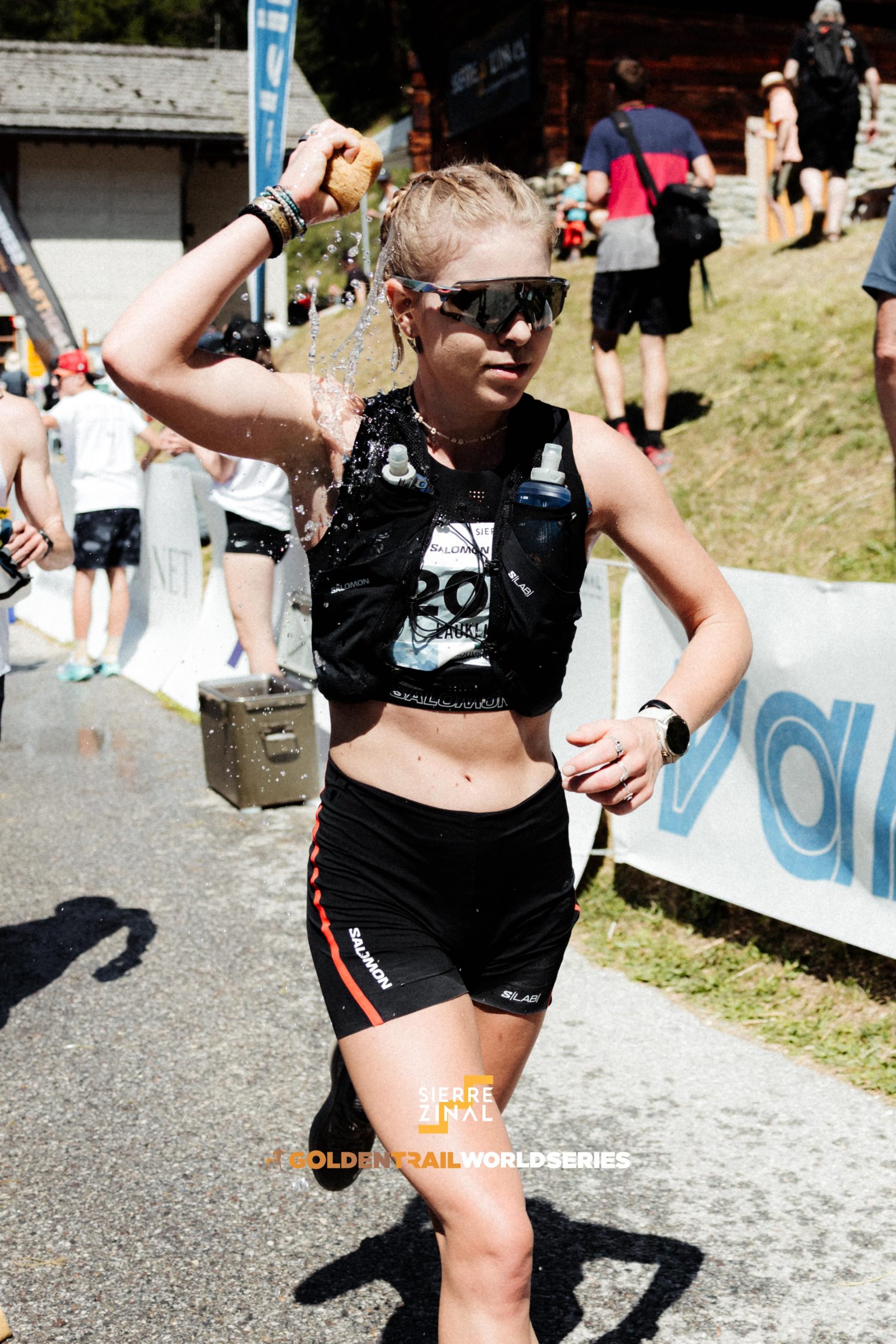
Laukli racing Sierre-Zinal in the Gold Trail World Series in 2024. (Photo: @rising.story_@colinolivero_GTWS_SierreZinal
Two Seasons, One Mindset
Running and skiing back-to-back seasons creates year-round excitement—and pressure.
“I have two competition periods,” she says. “It’s easier to motivate. But it also means I’m 100% consumed by performance all year.”
That obsession became a barrier last year. Now, Laukli is working with Bourne and Tefre to shift her mindset.
She has clear goals for skiing: the Olympic 10k, the Olympic relay, andthe final hill climb at the Tour de Ski.
She has equally specific running goals: above all, returning to Sierre-Zinal, where she once ran 2:53 on the iconic 31 km route.
However, she’s no longer defining success solely by results.
“There’s so much I’m working on—technique, tactics, how I ski courses,” she says. “It’s easy to be on a start line and focus on whether those things show up.”
Bourne sees that evolution clearly.
“Sophia has the instincts of a really high-level athlete,” Bourne says. “But learning to trust those instincts—rather than obsessing about the result column—is where she’s growing most.”
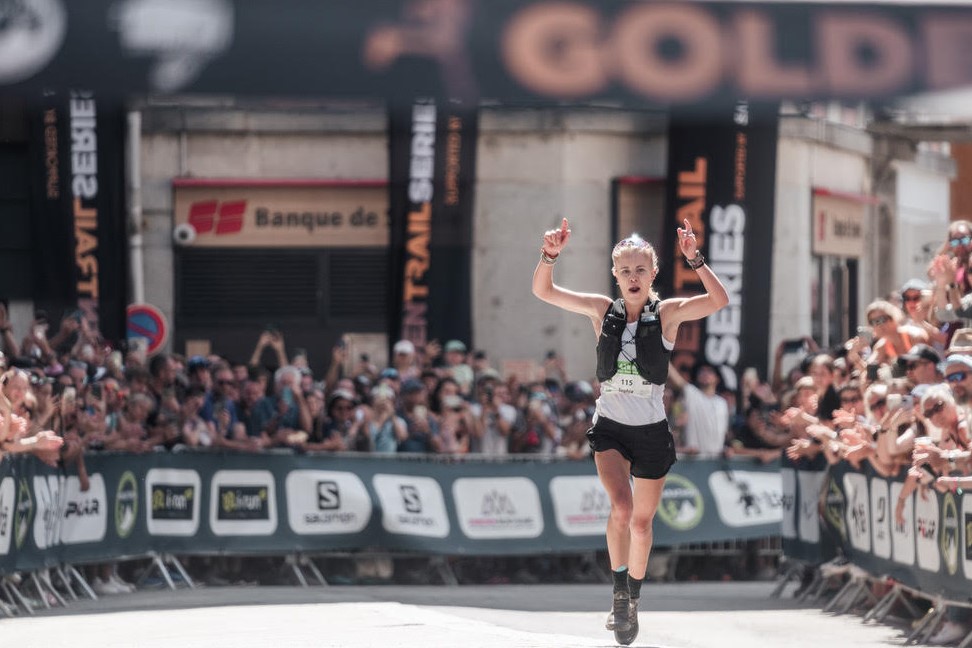
Laukli nears the finish of the final climb of the 2024 Tour de Ski on Alpe Cermis, where she claimed the victory. (Photo: NordicFocus)
Why Salomon Fits: One Athlete, Two Worlds
For an athlete splitting her year between the World Cup and the Golden Trail Series, sponsorship could easily become complicated. Many runners work with running-only brands; many skiers work with ski-only brands. For Laukli, that would have been a logistical mess — and maybe even a dealbreaker.
Instead, she found the perfect home with Salomon.
“I’m super grateful that I get to have my sponsor, my main sponsor, support me in both,” she says. “Because then it’s a lot easier to focus on each season. I know that they’re supporting me in that.”
That unified support matters. It lets her shift from skis to singlets without the politics of competing brand calendars and conflicting performance expectations.
“I don’t really know if it would be possible for me to be a runner for another brand and a skier for a different brand,” she says. “Like, defending to them that I can’t run a normal running season because it’s the Olympics, or I need to drop World Cups so I can run better this year — that just wouldn’t work.”
With Salomon, the opposite is true. Everyone’s aligned.
“Having everyone be on the same team makes it manageable,” she says. “And a lot more motivating, because everyone has the same goal.”
She works directly with Salomon’s France-based team, and Laukli lights up when she talks about the group behind her.
“They’re all French,” she says, laughing — a nod to the company’s deep culture in both ski sport and trail running. It’s also a reminder that Laukli lives firmly in the middle of two endurance worlds that Salomon understands and embraces.
That harmony matters. Her identity isn’t split; it’s blended. And Salomon is built for that.
Sophia Laukli (USA) racing the World Cup Mass Start in Les Rousses (FRA). (Photo: Modica/NordicFocus)
Sunny Weekends and Simple Breakfasts
Some things have gotten simpler, like her pre-race breakfast.
“I used to do peanut butter and banana,” she says. “Now I just have cereal. Apparently, simple is better.”
World Cup life has also taught her the importance of flexibility.
“You learn how to adapt,” she says. “Something will always go wrong on a race weekend.”
When she’s asked for her favorite place on the circuit, she doesn’t hesitate.
“Davos,” she says. “It’s sunny. You can have bad races, and it doesn’t matter because it’s a really nice place to hang out.”
That small detail fits her evolving philosophy. Training is simpler. Goals are more balanced. And the sport—skiing and running—feels more sustainable.
Somewhere between Maine and Norway, between Middlebury and Utah, between World Cup stadiums and alpine trails, Sophia Laukli has built a training model that doesn’t look flashy. It’s repetitive. It’s measured. It’s rooted in trust, communication, and doing the basic things right, over and over again.
And if the Norwegians are right—and if Laukli’s instincts keep sharpening—those basics may be exactly what carry her to the front this season, in both sports.
Love Stories Like This? Help Keep Them Coming.
Feature interviews like this one take time, access, and care to produce. If you value thoughtful storytelling and independent ski journalism, please consider becoming a Voluntary Subscriber. Your support directly fuels the work we do to cover the people, places, and moments that make our sport special.
When JC Schoonmaker talks about his earliest memories of ski racing, he doesn’t begin with speed or snow conditions, or the particular magic of gliding across winter trails. He starts, instead, with raffles. “I just remember as a kid, there’d be raffles after every race that I would be so stoked for,” he says. “Trying to get a prize, like a new pair of gloves or a hat.” It is an unexpectedly tender snapshot of a skier now known for his explosive starts and the sharp, angular drama of World Cup sprint heats. But it is also revealing. Long before Schoonmaker was on national team radars, long before he was analyzing sprint tactics or refining breathwork, he was simply a boy who loved showing up at races, surrounded by friends, snow, and the possibility of leaving with a hat.
Schoonmaker grew up in Tahoe, a place where winter sport is woven into the fabric of childhood. Yet unlike many of the region’s rising athletes, he was not funneled into Alpine skiing or a single disciplinary track. Instead, he moved constantly—and in every direction. “Both my parents were super athletic, into sports,” he says. “So from a really early age, I was just doing tons of different stuff: soccer, downhill skiing, andNordic skiing. I played lacrosse. A little bit of baseball.” The variety shaped him in ways he didn’t appreciate at the time: balance from soccer, strength from downhill, elasticity from lacrosse, and a developing sense of rhythm from all of it.
Meanwhile, the Nordic community in Tahoe was small enough to feel intimate yet substantial enough to provide him with peers, mentors, and a place to grow without suffocation. “Joining a Nordic team for me was super fun because I got to go out and ski with friends,” he says. “It was kind of my first experience racing.”
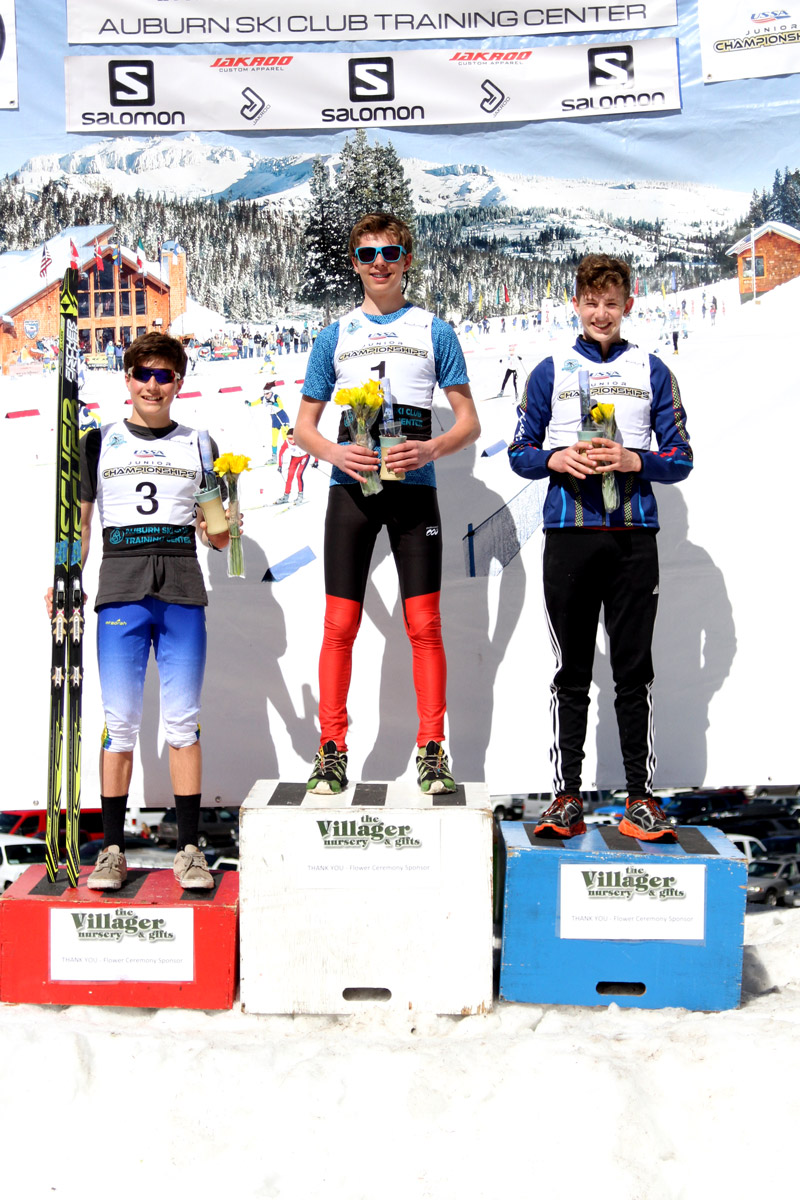
The U16 men’s podium from the 5 k Classic Mass Start at 2015 U.S. Junior Nationals at Auburn Ski Club in Soda Springs, Californial. JC Schoonmaker took home third place. (Photo: Mark Nadell/MacBeth Graphics)
Early Validation in Soldier Hollow and Truckee
It wasn’t until he traveled outside his region that Schoonmaker realized how he measured up. On a Far West trip to Soldier Hollow—his first time racing beyond his local bubble—he surprised himself. “I think I got third in the first race… then I won the second one,” he recalls. “I didn’t even really know it was a big deal, but all the older kids on the trip were… really excited for me.” Their reaction revealed something he hadn’t yet recognized: that his potential extended well beyond his local podiums.
A similar revelation arrived at Junior Nationals in Truckee, where home snow became a proving ground. He had hoped to earn All-American status, although the early races had gone poorly. “All the first races didn’t really go super well,” he says. “I had high expectations.” Yet in the final individual race before the relay, he stepped onto the podium. “Somehow onto the podium and got third,” he says. “That gave me a bunch of confidence… really helped me.” It was not just affirmation but a directional sign. Skiing was becoming more than an activity. It was becoming a path.
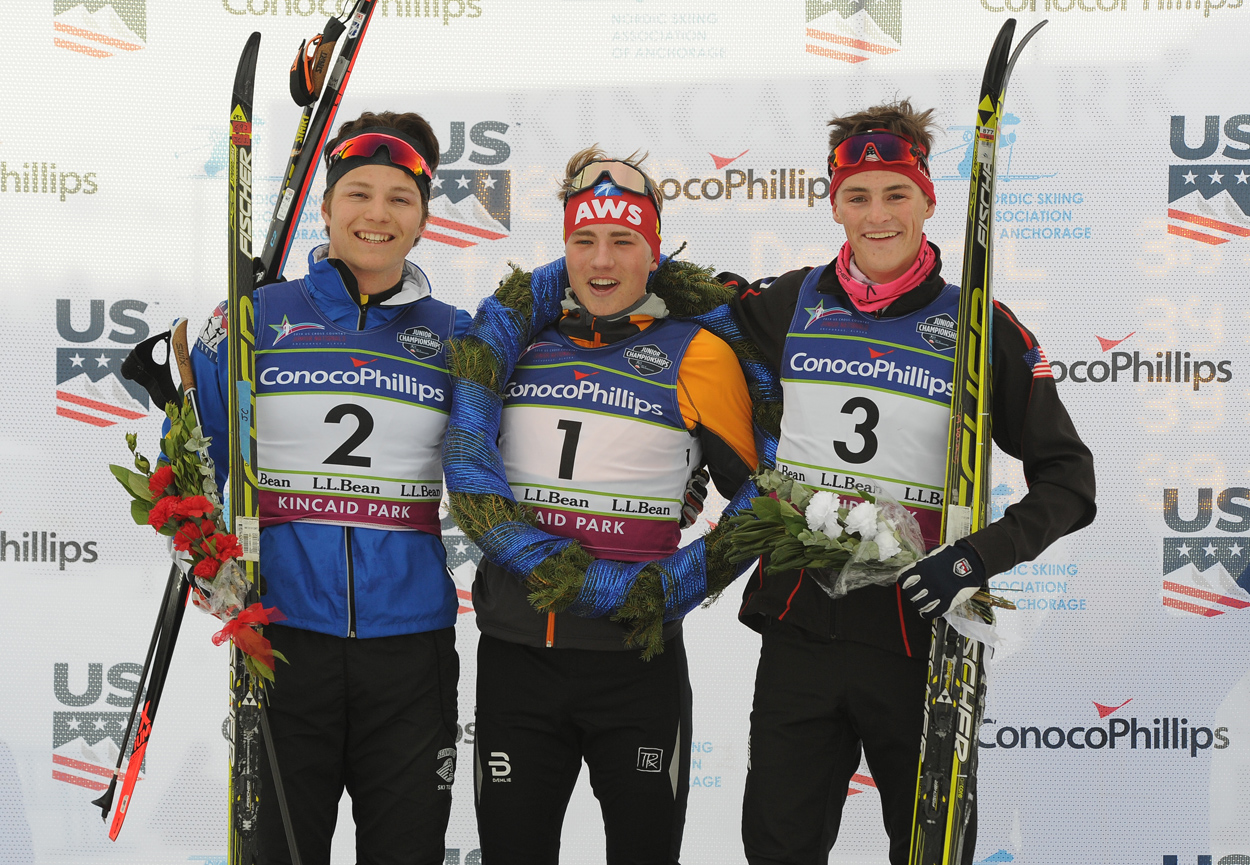
Gus Schumacher (Alaska Winter Stars/Team Alaska), center, won the U20 men’s 15K classic mass start race at the 2019 U.S. Ski & Snowboard Cross Country Junior National Championships at Kincaid Park. J.C. Schoonmaker (UAA-Auburn Ski Club/Far West), left, was second, followed by Cameron Wolfe (Ski and Snowboard Club Vail/Rocky Mountain), right. (Photo: Michael Dinneen)
Choosing Anchorage and the Power of the Right Environment
Despite his junior successes, Schoonmaker’s college recruiting process was sobering. His age cohort was stacked—Gus Schumacher, Luke Jager, Canyon Tobin—and their achievements overshadowed many strong skiers. “My top choice was UVM, and I just didn’t get a spot there,” he says. “I didn’t have a ton of options.” But an unexpected opportunity appeared when a Tahoe friend encouraged him to consider the University of Alaska Anchorage. He visited, and something clicked. “I’d say that’s the best decision I ever made,” he says. “I ended up coming to an excellent team… It’s an awesome place for skiing.”
Anchorage wasn’t glamorous, but it was grounding: clear air, big terrain, and a training culture built on consistency rather than spectacle. Under coach Trond Flagstad, Schoonmaker’s skiing matured—his engine, his technique, and his confidence—all while laying the foundation for a collaborative coaching story that would shape his rise.
A Uniquely Collaborative Coaching Path
Schoonmaker’s development is defined by the unusually harmonious network of coaches who supported him. In Tahoe, he trained with Will Sweetser, whose workout creativity brought nuance to his summer training. At UAA, Flagstad built his fall rhythm with threshold work and bounding. In the winter, U.S. Ski Team coaches—Matt Whitcomb, Kristen Bourne, and Chris Grover—stepped in with race-day craft and a national pipeline. And now, in Anchorage, he works with Eric Flora at APU, whose daily presence has brought structure and clarity.
“I feel like I didn’t even really have to do much in the way of balancing that,” he says. “Trond, Will, and Matt… kind of just took that on themselves.”
That kind of multi-coach collaboration is rare. Instead of conflicting philosophies, Schoonmaker received overlapping layers of expertise, each building on the others. He remembers one of Sweetser’s signature interval sets with particular fondness: “Twenty seconds L5… forty seconds rest… forty seconds L5… then six minutes of threshold. A cool blend… essential for getting you ready for doing sprints on the World Cup.” Flagstad brought heavy doses of fall bounding at L4. Whitcomb and Bourne added race sharpness. Flora, finally, aligned everything. “Having him at World Championships last year made it feel like just a practice in Anchorage,” Schoonmaker says.
JC Schoonmaker (bib #1) at the 2020 Senior Nationals in Houghton Michigan. (Photo: Reese Brown)
The Unexpected World Cup Start That Changed Everything
The first moment when Schoonmaker truly understood the trajectory he was on came suddenly. At U.S. Nationals in Houghton, Michigan, in 2020, he won the sprint qualifier. It was exciting, but he didn’t assume it meant anything beyond that day’s result. Then his assistant coach, Marine Dusser Bjornsen, approached him with unexpected news. “She was like, ‘Oh yeah, you’re gonna get World Cup starts from that,’” he recalls. “And I was like, ‘What? No way.’” His passport was expiring, his bags were unprepared, and within days, he was on a plane to Dresden.
Stepping into the World Cup for the first time felt surreal. “I wasn’t even really worried about those being my first World Cups,” he says. “I was mostly just hoping to get to go over there.” The qualifiers felt manageable; the heats were startling. “Racing against those dudes in the heats… was just a whole other level. A different beast.” Still, he never felt crushed by the moment. “We were just having fun,” he says. “It wasn’t crazy high expectations.” That experience didn’t instantly transform him, but it recalibrated his sense of where he belonged.
APU: A Training Collective That Became Home
When Schoonmaker finished college and committed to training full-time in Anchorage, it wasn’t only because of Flora’s coaching. It was because the environment felt like home. “Luke coming back… Gus joining… Zan and Michael… it was such a good team,” he says. “A lot played into it… but mostly that stuff.” APU is one of the few places in the country where the majority of the national team trains together throughout the year, creating a rare sense of continuity on the World Cup.
Yet even in a group that suits him so well, Schoonmaker knows he needs occasional solitude to stay balanced. “I definitely find times during the summer where I’m pretty excited to do an interval session by myself,” he says. “I grew up training alone in Tahoe.” Winter, of course, is different. “You’re living with this group of people for the entire winter,” he says. “Sometimes it is hard to find time to yourself.” But the team understands him. “Everyone knows whatever’s best for you is what’s best for the team.”
A New Kind of Training: Mindfulness and Sprint Awareness
This year, Schoonmaker added something he had never practiced formally: daily mindfulness training. “Some breath holds… super simple, just five minutes of mindfulness,” he says. “Focusing on my breath, trying not to let my thoughts wander.” The shift wasn’t driven by physical shortcomings, but by an honest assessment of where he needed to grow tactically. “In sprint heats… I’ve tended to have my head down, thinking about my technique… rather than, ‘I need to get this position around this corner.’”
Mindfulness gave him a way to sharpen his presence during races and training. During intervals, he began noticing moments when his focus drifted. “My mind starts thinking about what I’m gonna have for lunch,” he admits. “I’m getting better at bringing myself back… loosen up, ski relaxed.” The work is subtle, internal, and mostly invisible, yet deeply connected to the kind of racer he wants to become.
Passing It On: What He’d Tell the Next Generation
If Schoonmaker were speaking to a group of juniors in Tahoe today, he would know exactly what he would emphasize. “I love this puzzle of trying to get better every day,” he says. “Focus on the small things you can control… let the cards fall where they fall.” But he would also add a piece of training wisdom gained from experience. “I almost feel like I got a little too caught up in L1 and L3,” he says. “Walking up hills on classic skis isn’t getting you better at classic skiing. You have to ski fast to get better at skiing fast.” It is the kind of message that cuts through both trends and dogma.
Life on the Road: Davos, Oslo, and a Simpler Suitcase
Schoonmaker’s favorite destinations reflect a balance of beauty and familiarity. Davos stands out. “I’d love to go there when I’m not getting ready for the Tour de Ski… explore it a little more,” he says. He also holds a soft spot for Oslo. “That’s a special spot. I always feel like I’m having a really good time there.” On race mornings, he keeps things simple: “Probably a couple eggs and a few pieces of toast with jam.” And he no longer travels with the heaviest item from his early career. “I brought over an Xbox… took up, like, 12 pounds in my bag,” he laughs.
Schoonmaker and girlfriend, Emma Ribom (SWE). (Photo: Courtesy Photo)
Olympic Season: Ambition, Clarity, and the Calm Before the Heats
Despite the stakes of the Olympic year, Schoonmaker hasn’t reinvented his approach. “I honestly haven’t been doing anything different,” he says. “I’m more excited to be healthy and head into Period 1 feeling good.” But his goals are not small. “My goals would be to win a medal,” he says. “That’s what I’m shooting for.” A chance to race the relay again is just as meaningful. “The relay in Trondheim was super fun,” he says. “I would love to get another chance.”
As for the individual sprint, his ambition is both grounded and bold. “If I could make the final… that would be a solid day,” he says. “But I do feel like I can win a medal.” Few athletes can express that kind of aim with such composure. Schoonmaker delivers it as calmly as if he were describing a morning ski.
JC Schoonmaker (USA) had a breakout day in Oestersund (SWE) in 2023, reaching the podium for the first time. The American took third place. (Photo: NordicFocus)
Where He Stands Now
What stands out most about Schoonmaker at this moment is not bravado, but clarity. He is no longer the boy who raced for raffle prizes, nor the college skier unsure of his place, nor the rookie dragging an Xbox through European airports. He has become something steadier, more self-aware, and more intentional. A sprinter with composure. An athlete with perspective. A competitor capable of holding his ambition lightly without losing its sharpness.
Presence, for Schoonmaker, is not stillness. It is an ongoing process of tuning himself to the shifting rhythms of a sprint heat, listening to what his mind and body are telling him, and moving through the season with intention rather than urgency. If he keeps his head up—literally and figuratively—this may be the season when the skiing world begins to see not only what he has built, but why it was built this way.
Love Stories Like This? Help Keep Them Coming.
Feature interviews like this one take time, access, and care to produce. If you value thoughtful storytelling and independent ski journalism, please consider becoming a Voluntary Subscriber. Your support directly fuels the work we do to cover the people, places, and moments that make our sport special.
When Trond Nystad talks about Norway’s athletic success, he doesn’t start with medals or podiums. He begins with children — specifically, children who love to play.
“The model of Norwegian sport,” he says, “is to have as many kids as possible, for as long as possible, and try to make them as good as possible.” That simple mantra, lived out in ski clubs from Tromsø to Trondheim, is what he believes keeps Norway at the top of the endurance-sport world.
“It’s about being a champion of the world, not a world champion,” Nystad explains. “The focus is on learning, mastering things, having fun — not on winning.”
Trond Nystad (Photo: NordicFocus)
A System That Lives Its Values
Nystad has coached at nearly every level — from college programs at Northern Michigan University and the University of Denver to national teams in the U.S., Germany, Austria, Switzerland, and Norway. He’s seen systems that thrive and systems that sputter. What sets Norway apart, he says, isn’t a secret training formula but the culture that surrounds young athletes.
“In Norway, the principles of long-term athlete development — the LTAD model — are lived, not just written,” he says.
“In some places, LTAD is a document. In Norwegian clubs, it’s a way of life. Coaches and parents make sure kids master skills, become independent, and most importantly, have fun.”
That lived philosophy keeps kids skiing, running, and playing far longer than in most countries. “Every country that has success over a longer period of time has figured out how to lure kids into sport and keep them there,” he says. “If you have a lot of kids and you teach them a lot of skills, they’ll be driven and have fun. Then it’s easy to talk about high-level training later — because you start with the right foundation.”
The U.S. Comparison: Knowledge Is Not the Issue
Nystad has deep respect for the American coaching scene — he spent years building programs here and still closely follows U.S. skiing. “The U.S. has a lot of really good coaches,” he says. “Sometimes the issue isn’t knowledge. It’s that cross-country skiing doesn’t attract as many kids because it has to compete with other sports.”
The challenge, he believes, is not to clone Norway’s system but to borrow its spirit. “We need more skiers, and we need to take care of them,” he says. “Make sure they have so much fun developing that they don’t want to quit.”
That message — that development is not linear, and that joy is a strategic asset — could resonate in American junior clubs. “If you have fun and learn mastery,” Nystad says, “success will come. But if you chase results too early, you lose too many kids.”
Like many elite skiers, Lauren Jortberg and Julia Kern enjoy mountain biking opportunities for a change of pace. (Photo: Julia Kern)
Against Early Specialization
Asked when Norwegian athletes begin to specialize, Nystad laughs gently. “Focus and specialization are a little bit mutually exclusive,” he says. “You can be focused and still do more than one sport.”
Most Norwegian kids, he explains, play several sports until age 15 or 16 — sometimes even longer. “When they’re 18 or 19, they might focus on one main sport and keep a couple on the side — running and skiing, for example, or cycling and skiing,” he says. “It’s part of the culture. People are active.”
The danger, he warns, comes from well-meaning adults. “A lot of parents try to self-realize through their kids,” he says.
“They want them to specialize early, to do everything right. In the end, the kids are sick of it, have no fun, and they quit.”
His takeaway is simple: “Kids are not miniature adults. They’re kids. Let them be kids as long as it makes sense. Life gets serious soon enough.”
Adam Witkowski poses with his parents after unexpectedly racing a World Cup in Minneapolis in 2024. (Nathaniel Herz/FasterSkier)
The Role of Parents: Mentors, Not Managers
Nystad, as a father himself, knows firsthand how difficult it is to strike that balance of knowing when it is time to commit. “Sixteen is just a number,” he says. Some sixteen-year-olds are grown up; they can form their own opinions and take ownership. Others can barely wipe their own ass,” he says with a laugh.
“But in the end, the kids have to decide for themselves. It has to be something that’s rewarding for them. Our job as parents is to support them — to help them make fewer mistakes, to be mentors along the way.”
That mentoring role — guiding but not controlling — is something Nystad sees as critical for the next generation of athletes. “We’re supposed to help them realize their dreams and develop,” he says. “Not to live our dreams through them.”
“Keep It Simple”: Trust the Body, Not the Gadgets
In an era dominated by data, GPS, and lactate meters, Nystad is refreshingly old-school. He’s not anti-science — he’s trained with and coached some of the world’s most analytically minded teams — but he cautions against what he calls “numbing the senses.”
“The reason to measure is to understand,” he says. “You measure to confirm your subjective feelings — not to replace them.”
“If you’re tired, you sleep. If you’re hungry, you eat. If you’re thirsty, you drink. Those are subjective feelings — and they’re more important than any data you can measure,” he explains.
“Most devices today are not 100 percent correct. Your body usually is.”
For Nystad, training success comes from continuity, not complexity. “The KISS principle applies — keep it simple,” he says. “In endurance sports, you have to train with continuity for a long time and be patient. Don’t screw things up. Control gives continuity, and continuity is everything.”
Fun as a Foundation for Longevity
Nystad lights up when the conversation turns to lifelong sport. “If sport or physical activity makes us happy, we’ll prioritize it,” he says. “Talking about training doesn’t make you better — actually doing it does.”
He encourages athletes — elite or recreational — to reframe movement as a privilege, not a chore. “We should appreciate every day we get to move,” he says.
“It means we’re healthy, we have the time, we can afford the equipment. That’s a luxury we need to appreciate more.”
For parents juggling work and family, his advice is pragmatic: “Maybe it’s better to go for a one-hour run first, and then drink your beer and watch Netflix,” he says with a grin. “It’s just about organizing your day so you get your little quick fix of physical activity.”
The Norwegian Definition of Success
For someone who’s coached Olympic medalists, Nystad’s definition of success has nothing to do with results. “I can’t even remember what happened last winter,” he admits. “Success has nothing to do with medals or wins. I’m happy as a coach when the athletes are happy — when they’ve developed as athletes and as human beings.”
He sees coaching as a human project as much as an athletic one. “I always try to build teams where people work together, respect each other, and do their best. That’s success. If we treat each other well and do the job the best way we can, we’ll reach our potential. Reaching your potential — as a human or as an athlete — that’s success.”
It’s a deeply Norwegian sentiment, one echoed across their sports system: the process matters more than the podium.
One of many kids enjoying the features on the course and in the Kiddie Cross terrain park at NordicX in 2022. (Photo: Eric Maurer / NordicX)
Lessons for U.S. Clubs and Coaches
Nystad believes that U.S. programs can apply these lessons without mimicking Norway wholesale. “The principles are the same,” he says. “It’s about creating an environment where kids master things, have fun, and stay in sports longer.”
That may mean rethinking what “development” looks like. “Most of the time, we lose more than we win,” he says. “So it’s okay to have a bad race or a bad day. Focus on skill development and mastery — even when things aren’t going well. If it’s fun, and you keep mastering skills, success will come.”
He also urges patience from young athletes. “A big mistake is intensity control,” he says. “They go too fast on the easy sessions and too fast on the hard sessions. They believe ‘no pain, no gain,’ but endurance sport doesn’t work like that. The best athletes are the ones who train a lot — and train smart.”
Technique, Mastery, and Play
Skiing, Nystad reminds us, is as much art as science. “Especially in skiing, which is such a technical sport, the quality lies in doing things right — not just going hard,” he says. “I see so many people skiing with music in their ears, talking, doing all kinds of things, instead of focusing on perfecting technique.”
He encourages athletes to “play” with movement: “No one tells us how to do it. We can choose the way that fits our body and our strength,” he explains. “If more people would play with technique, be conscious of their technical and pacing choices, the outcome would be better for most people.”
Astrid Oeyre Slind (NOR) on her way to a second-place finish in Cogne, Italy. (Photo: NordicFocus)
The Lifelong Athlete Mindset
At 55, Nystad continues to coach, ski, and move daily — not out of obligation, but joy. “If you train right, take care of yourself physically, mentally, nutritionally — and have a blast doing it — there’s no limit to how long you can be good,” he says.
“The moment you start thinking it’s a sacrifice, or that it’s boring — that’s when your career starts to end.”
He cites examples like Hilde Gjørum, who earned her first Olympic medal at 43, and Astrid Øyre Slind, who made her first Norwegian World Championships team at 34 and won her first World Cup at 37. “There are lots of stories like that,” he says. “Everyone can keep getting better — if you love what you do.”
Looking Ahead: A Sustainable Future
Nystad’s final reflections return to sustainability — both of snow and of sport. “Obviously, we’ll have issues with snow,” he says. “Snow storage and snow farming are becoming normal in Europe, and that will change the sport. But cross-country skiing will survive. It’s a great sport — full-body, low-injury, healthy.”
The real challenge, he believes, is getting people to participate. “We need to sell it for all it’s worth and get more people involved,” he says. “If we can bring more people into skiing — kids, families, anyone — the rest will take care of itself.”
The Takeaway: “Master the World”
For Nystad, the essence of sport is not the stopwatch, but the spirit. “The focus,” he repeats, “is on mastering the world — being a champion of the world, not a world champion.”
It’s a mindset that turns every trail into a classroom, every race into a chance to learn. And perhaps that’s the real secret behind Norway’s golden age of endurance: a culture where success isn’t measured in medals, but in how many people can’t wait to clip into their skis again tomorrow.
Trond Nystad, the coach of the Norwegian men’s cross-country ski team, takes questions from the media after the relay at the Sochi Olympics.
This article was made possible through the generous support of our voluntary subscribers. If you would like to see more articles like this one, please support FasterSkier with a voluntary subscription.
The Norwegian men are in a league of their own—but when a league is contested by just one team, will fans still watch?
Fans wave flags at the 2025 World Championships in Trondheim. (Photo: Stuart Harden/FasterSkier)
TRONDHEIM, NORWAY – As the morning gales gave way during last Thursday’s men’s 4×7.5 kilometre relay, the crowds at the Trondheim World Ski Championships picked up steam until Granåsen stadium was fit to burst. And burst it did: Fans cheered in unbridled, patriotic delight when Johannes Høsflot Klæbo sailed into the stadium in first place hoisting a full-size Norwegian flag.
In truth, Norway’s win was written before the athletes even hit the start line: The Norwegian men have stood atop the podium in seventeen of the last eighteen relays. If one can look past Klæbo’s mind-bending Championship tally of six for six gold medals, the depth and dominance of the Norwegian mens’ team comes into focus — until Sweden’s William Poromaa broke the spell with an impressive second place finish in the 50-kilometer, they were just one silver medal away from sweeping every single distance podium at the Championships.
The country’s fans and media are increasingly anxious that this level of Norwegian dominance threatens the future of international cross-country skiing. Many pundits and people in the grandstands are convinced that fewer young Norwegians are interested in international ski racing, and that the sheer strength of the Norwegian men’s team is partly to blame.
Simon, Nina, and Tor Erik are locals taking in this week’s races (Photo: Stuart Harden/FasterSkier)
Simon lives a few minutes walk from the ski centre and has tickets for the whole week of competitions. He sums up the state of men’s skiing in a few words: “It’s all about Norway. It’s about Klæbo.”
One of his friends, Nina, chimes in with a familiar refrain: “it’s bad for the sport.”
Simen Hegstad Krüger himself isn’t blind to the consequences of such a lopsided competition. “In the long term,” the Olympic gold medalist admits, “I think it’s better when it’s some change on the podium.”
Simen Hegstad Krueger battles through heavy snow in the men’s 10 kilometre interval start on Tuesday (Photo: Aidan O’Donnell/FasterSkier)
To be sure, other nations aren’t at their best in Trondheim. The French men are flagging, their sprint stars notably missing from the podium. The absence of Finland’s Iivo Niskanen’s clearly blunted the drama of the 10-kilometer classic race. And, despite two bronze medals so far, Edvin Anger and the other Swedish men are still short of their long-promised redemption.
Meanwhile, on the women’s side of the competition, one can’t help but worry that an inverse story of Swedish domination is taking shape. Ebba Andersson and Jonna Sundling each have a hand on the women’s crown, with Sundling making an especially strong case for the title “Queen of Trondheim”: She has medaled in every race of the four she has started, winning three of them.
Jonna Sundling takes over from Ebba Andersson on the way to victory in the women’s 4×7.5 kilometre relay (Photo: Aidan O’Donnell/FasterSkier)
Viewership data collected by the International Ski Federation, or FIS, appears to support the notion that an unbeatable team turns off spectators. Norway — which ranks fourth in international viewership behind Sweden, Germany, and Finland — saw a 10% decline in TV World Cup viewership between 2023 and 2024.
This year’s World Championships are all but guaranteed to drive TV viewership back up in Norway. Indeed, it’s no secret here that whenever the sport’s popularity threatens to dip, the Norwegian Ski Federation relies on events like this to jumpstart hype and participation. Which then begs the question: If a competitive field is so crucial to FIS’ television ratings, when will the United States and Canada have their own chance to host a World Ski Championships to encourage growth in North America?
International Ski Federation statistical reporting shows that fewer Norwegians watched World Cup Competitions in 2024 than in the year previous (FIS/Nielsen Media Research AS)
Despite word on the street and speculation in the broadsheets, there are more factors that affect skiing’s TV ratings than simply the Norwegian men’s results. Indeed, judging by Norwegians’ compulsion to discuss the topic, it seems that their second favorite national pastime after skiing itself is debating whether their chosen sport is dying — and who exactly is killing it.
Fans in Trondheim have pointed out that since Norway’s national broadcaster, NRK, lost the rights to air international ski racing in 2021, people have been reluctant to pay the subscription fees required to follow World Cup racing on other channels. Their fear now is that the recent move by FIS to centralize international broadcasting rights hurts any prospect that free-to-watch World Cups may return.
Other frequently cited causes for the apparent decline in skiing’s popularity are the increasing costs of racing and the shortening of winters due to climate change.
Brothers Vegard, Magnus, and Howard Graesli watch the first lap of the women’s skiathlon. They blame shorter winters, expensive equipment, and the reallocation of media rights away from the state broadcaster for the decline in skiing’s viewership in Norway. (Photo: Stuart Harden/ FasterSkier)
But not everyone buys the doom and gloom narrative. Martin Løwstrøm Nyenget, from his vantage point on the skiathlon and relay podiums, says that the sky most certainly is not falling. He chalks up the talk of declining viewership and participation to media spin.
Nyenget says that “it’s been popular in Scandinavia — and especially Norway — to write in the negative and to tell that the popularity is going down. But it doesn’t seem like it’s completely the truth.” He points to the blockbuster crowds in Trondheim as a testimony to the sport’s vitality.
“You see here around the track during the championship, it seems like it’s still a popular sport,” he said.
Martin Nyenget skied away with the men’s 4×7.5 k relay for Norway last Thursday. (Photo: NordicFocus)
The Norwegian men say that, in the end, they are just doing their job the only way they know how to: without compromise.
Krüger puts the onus on other nations. “The other guys need to step it up,” he said. “We have a really strong team and, for sure, we are just pushing as hard as we can to be the best and to be on top.”
For those keen for some cultural entertainment, on Thursday, Trondheim’s Nidaros Cathedral hosted the World Championships concert. Backed by a string ensemble, the Nidaros Girls’ Choir performed folk songs and modern compositions in the packed 11th Century gothic cathedral.
Nidaros Cathedral (Photo: Stuart Harden/FasterSkier)
On Thursday night, at the site where Norwegian monarchs have been crowned for centuries, the nave echoed with the lyrics: “At the World Championships, I show up with a ticket in my back and color film. I want a world champion, tough and harsh and narrow-hipped. Yes, a world champion is my ideal.”
Other pieces performed at the concert included the themes for the 1966 World Championships in Oslo, the 1997 World Championships in Trondheim, and the 1994 Olympics in Lillehammer (Photo: Stuart Harden/FasterSkier)
Perhaps, then, it is a more ephemeral variable that best explains why Norwegian men are so damn good at skiing.
Nyenget agrees: “I think the culture is the main factor for the good results. It’s almost like, for the Norwegian team, it’s not only the results that are okay. It’s the top of the podium.”
This sentiment should sound familiar to Canadians, who have notoriously high expectations of their junior national hockey teams. And, like Norwegians, Canucks don’t turn off the television when their team goes on a winning streak — they cheer all the louder.
So, while a World Championships on Norwegian soil offers a welcome boost to the profile of cross-country skiing, it seems that the jury is still out as to whether Klæbo and company are killing the sport in the long run. For now, then, ski fans may as well enjoy the spectacle on offer from Klæbo and his merry band of VO2 monsters.
This reporting costs money. Please support this coverage with a voluntary subscription (below) so FasterSkier can provide this level of access to the sport we all love year-round.
This reporting costs money. Please support this coverage with a voluntary subscription (below) so FasterSkier can provide this level of access to the sport we all love year-round.
This reporting costs money. Please support this coverage with a voluntary subscription (below) so FasterSkier can provide this level of access to the sport we all love year-round.
This reporting costs money. Please support this coverage with a voluntary subscription (below) so FasterSkier can provide this level of access to the sport we all love year-round.
This reporting costs money. Please support this coverage with a voluntary subscription (below) so FasterSkier can provide this level of access to the sport we all love year-round.
This reporting costs money. Please support this coverage with a voluntary subscription (below) so FasterSkier can provide this level of access to the sport we all love year-round.
This reporting costs money. Please support this coverage with a voluntary subscription (below) so FasterSkier can provide this level of access to the sport we all love year-round.
This reporting costs money. Please support this coverage with a voluntary subscription (below) so FasterSkier can provide this level of access to the sport we all love year-round.
This reporting costs money. Please support this coverage with a voluntary subscription (below) so FasterSkier can provide this level of access to the sport we all love year-round.
This reporting costs money. Please support this coverage with a voluntary subscription (below) so FasterSkier can provide this level of access to the sport we all love year-round.
This reporting costs money. Please support this coverage with a voluntary subscription (below) so FasterSkier can provide this level of access to the sport we all love year-round.