From the FasterSkier archive — posts syndicated from athletes’ and coaches’ own blogs between 2004 and 2012, kept online as published. Current coverage is at fasterskier.com.
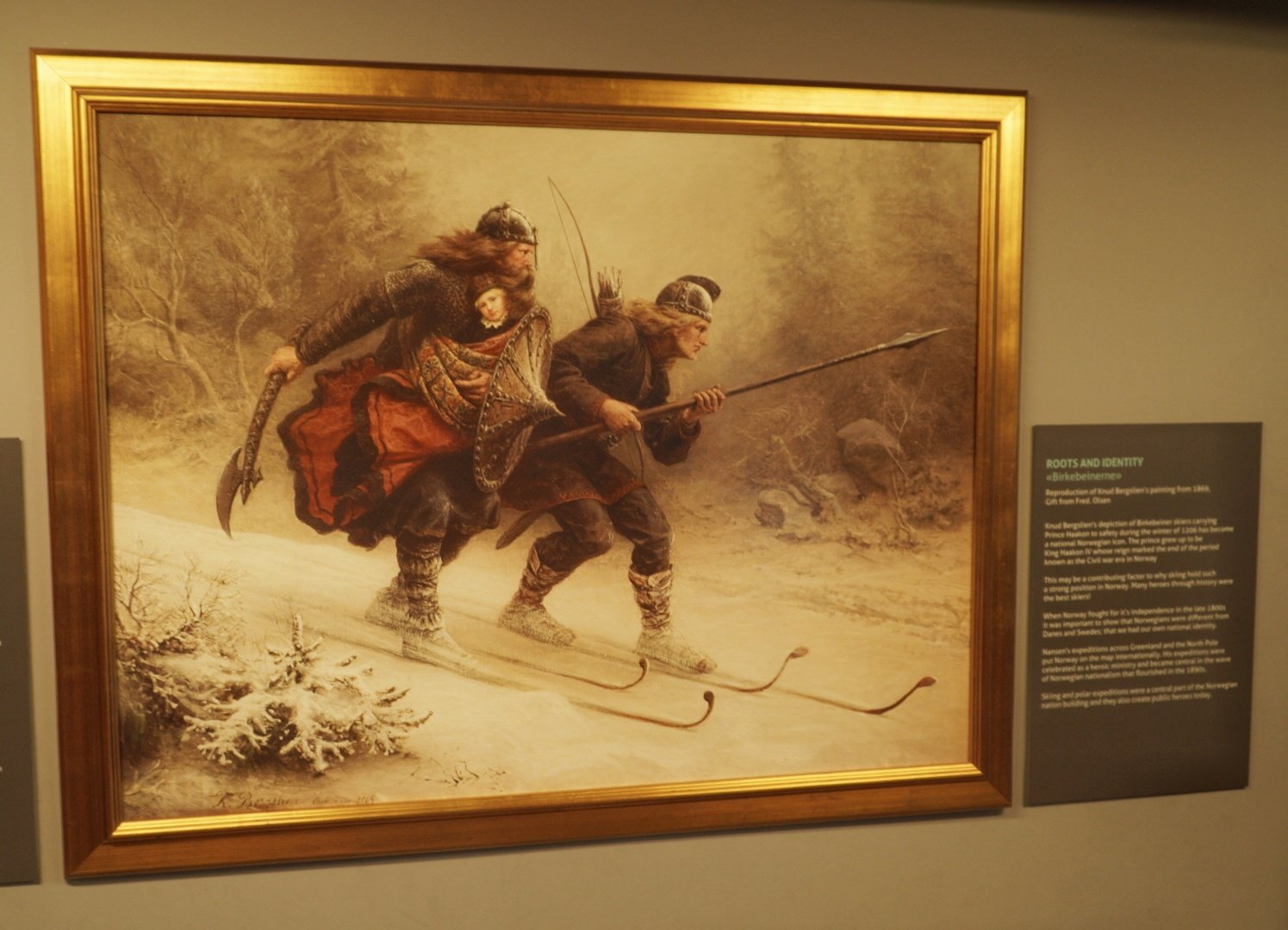
The original 1869 oil painting of Knud Larsen Bergslien’s “The Birkebeiner” is on display at the Holmenkollen Ski Museum in Oslo. (Photo: Lumi Experiences)
Most Birkie skiers are familiar with the legendary story of the original Norwegian Birkebeiners and how that inspired the famous cross country ski race in Norway, from Rena to Lillehammer; which in turn inspired the American Birkebeiner from Cable to Hayward.
But what is the Norwegian Birkebeiner like today? I skied my first American and Norwegian Birkies last year and took away many impressions.
“Wait, what?!” you ask. “Garrott, you lived in Hayward for 5 years and have never skied the Birkie?” Well, okay. I skied the Birkie once in 2007, but it finished at OO that year. The Birkie’s timing in late February always overlapped with World Cups or Olympic Games. After retiring in 2011, I moved away from Wisconsin. Last year was my first year back, as my company, Lumi Experiences, had a booth at the Expo, sharing stories from the Worldloppet events where we run cross country ski vacations.
Spectators cheering on Birken skiers. (Photo: Lumi Experiences)
On Birkie Saturday, I couldn’t pass up the opportunity to ski from Cable to Hayward and actually finish on Main Street. Finally, I checked off one of my bucket-list items as a ski racer.
Three weeks later, I found myself standing in Rena, Norway getting ready to classic ski 54 km from Rena to Lillehammer, carrying an 8 pound backpack representing baby prince.
Spectators provide extra sustenance to skiers between the official aid stations. (Photo: Lumi Experiences)
Håkon Håkonsson. The three-week gap between the two events was enough to recover from one and carry good fitness into the next.
Our group was staying in Lillehammer, so it was an early morning bus ride to get to the start in Rena. The race course takes you on a direct path over the mountains, but the roads have to go around the mountains. In order to arrive at the start by 8:00 am, the bus left Lillehammer at 5:30 am. I was expecting a very dark start to the morning, but when I opened the blackout curtains and daylight came in, I thought I had slept through my alarm. This should not have surprised me, as we were just two days from the Spring Equinox and only 5° south of the Arctic Circle.
Ski trails in every direction. (Photo: Lumi Experiences)
The start of the Birken is basically in a farm field with temporary warming tents without any permanent infrastructure. The colloquial name for the Birkebeinerrennet was one of the biggest surprises for me. I’ve grown up in the US calling it the Norwegian Birkie, but in Norway, it is unequivocally referred to as the “Birken.” This terminology makes it easy to differentiate the American “Birkie” from the Norwegian “Birken.”
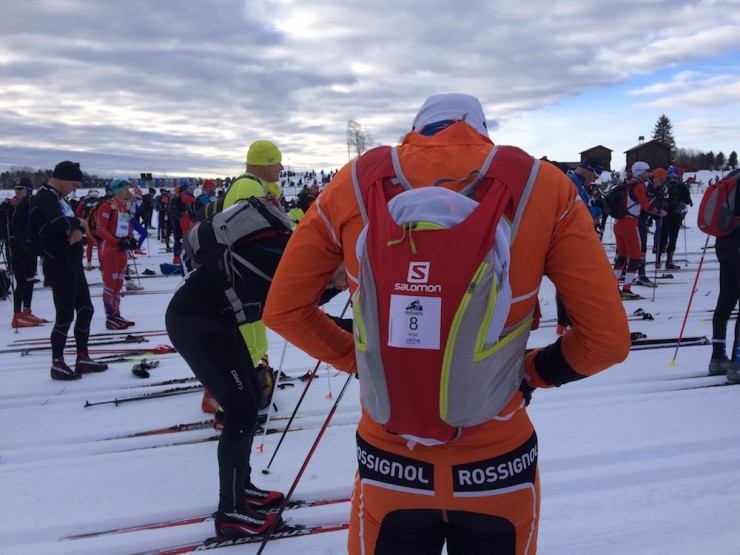
The start itself was one of the most civilized starts I have ever experienced. The ~ 10,000 starters are split into 14 waves. As a wave 1 Birkie skier, my Birkie time was good enough to be seeded in the 4th wave at the Birken – a wave placement which seemed surprisingly accurate, given the pace of the skiers around me. Ample tracks and a gradual uphill start kept everyone spread out without any accidents. It seemed like everyone understood they had 54 km to ski and no one needed to win the first kilometer.
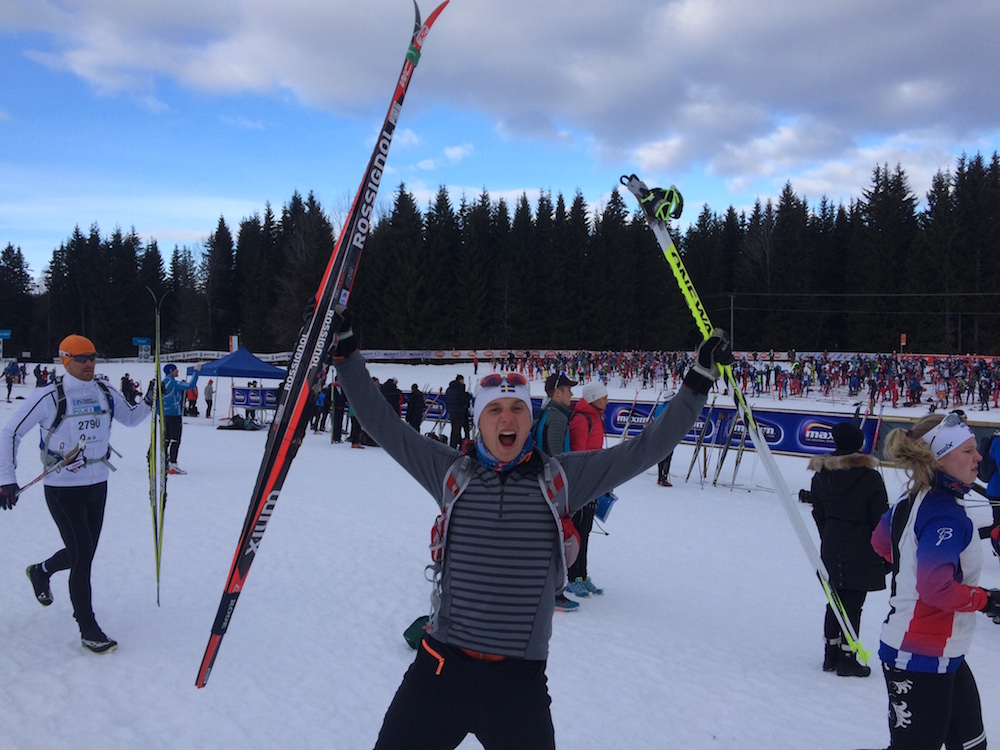
Sunshine and blue skies. (Photo: Lumi Experiences)
In fact, as early as one kilometer into the race, skiers were already stopping to work on their kick wax. Conditions were surprisingly tricky, as the course starts only 1000 feet above sea level, then climbs to about 3000 feet of elevation. The weather warms throughout the day and a skier may go through three or four different wax conditions.
I waxed with a thin layer of klister, covered with hardwax. This combination is tricky because you have to keep your skis moving to prevent icing in the powder at higher elevations, but it provided great kick for the first 20 km of climbing up to the plateau in Raudfjelllet. It was also durable enough to last for my entire 54 km race. I just stopped once to switch skis half-way through the race in Kvarstad. This meant the wax that had worn off the inside edges of my skis was now on the outside edges, giving me better glide and kick for the second half of the race.
The spectators really help make a ski race fun for participants. The Marcialonga in Italy and the Engadin in Switzerland both go through many villages, so it’s easy for people to cheer from their balcony. The Birkie and Birken courses are much more rural, so they’re harder for spectators to access. However, the spectators that make it out onto the course are there to have fun and bring a lot of enthusiasm for the racers. There were so many spectators at the Birkie this year that I thought I was already at OO when in fact, I was only at Boedecker Rd. By the time I was actually at OO, skiing over the Key Log Bridge, I was in awe at all of the new infrastructure and enthusiastic spectators. My favorite spectators, however, are the snowmobilers. They are often in the harder to reach corners of the course and seem to be there more to cheer on the agony of defeat than the thrill of victory.
Skiing into the Birkebeiner Stadium. (Photo: Lumi Experiences)
The Birken goes through a protected region, high on the plateau, so there are no snowmobilers. Somehow, though, spectators figure out how to bring couches to the trailside, build huge bonfires and offer homemade aquavit or Jagermeister to skiers passing by.
Speaking of aid stations: each Worldloppet event seems to have its own unique treats, like Comte cheese in France, dark chocolate in Switzerland or blueberry soup in Sweden. In Norway, it’s lefse. Seriously. The rolled lefse dough filled with cinnamon and sugar looked a little dry to me, but I was hungry at the first aid station and took a bite. It turned out to be one of the best tasting race foods I have ever eaten. After that, I made sure to take a buttery lefse at each aid station. Yum!
Unlike the Birkie, which is mostly wooded from start to finish with lots of rolling trails, the Birken is mostly on a high open plateau with long, sustained climbs and long, gradual descents. I often found myself looking out over the wide expanses and admiring the views throughout the race.
We were fortunate to have ideal weather conditions for this year’s Birken, save for a headwind somewhat reminiscent of crossing Lake Hayward at the Birkie this year. There are years, however, where the weather on the plateau can be much less ideal. Besides the symbolism of the backpack, there is also the practical consideration that you can carry warm, dry clothes with you. Not only does the backpack need to weigh 8 pounds, it also needs to store a windproof jacket, pants, long underwear, hat, gloves and balaclava.
One of the best parts of the Birken is the final 15 km from Sjusjøen to Lillehammer. Rather than big climbs and a lake leading to the finish, the last 15 km of the Birken is a long, gradual downhill. Before the race, I learned that a special award is given to finishers who cross the line within 25% of their age group winner’s time. I’m not sure if the Birkie still has a 25% Club award, but the tradition lives on in Norway. I train far less than I did as a racer, but still have a competitive spirit. Achieving the 25% Club award in the Birken is not easy. When I realized I may still be in the running at the last time check, I tried to make up as much time as I could on the downhill to Lillehammer, relying more on my ski skills than on my fitness.
Lumi guests Bill and Meg celebrate at the Birken finish. (Photo: Lumi Experiences)
The Birken finishes at the Birkebeiner Stadium, which hosted the 1994 Lillehammer Olympic Games and still has one of the most challenging trail networks on the World Cup circuit.
Fortunately, the Birken finish does not take racers on any of the World Cup course. Instead, skiers cruise through the flat stadium and into the finish. After a quick backpack check, skiers are awarded their Birken medal and Worldloppet passport stamp, recognizing their achievement.
For me, one of my favorite aspects of completing a big event like the Birken is sharing the experience with friends. After the race, everyone gathered to share stories about their journey from Rena to Lillehammer and to cheer on the new friends they had made during the week. Skål!
If you’d like to ski the Norwegian Birkebeiner, check out the Lumi Experiences Norway Birken Trip and receive the early booking discount of $300 per person when you secure your spot before March 31. We would love to have you along. Reach out to see the itinerary!
JoJo Baldus at the 2016 Birkebeinerrennet in Norway. He completed the 54-kilometer classic marathon, also known as the Birken, in mid-March. (All photos: JoJo Baldus)
(Editor’s note: JoJo Baldus is a nordic skier from snowy Minneapolis, Minn., who spent this past winter “living the dream,” as he described it, as a volunteer journalist and photographer for FasterSkier while enjoying a gap year before starting at Macalester College in St. Paul. He set a goal to complete nine Worldloppet ski races this winter, three of which were canceled due to low snow. He did five — including the Finlandia-Hiihto — but did not race the Jizerská because it was shortened. This is a tale of his most memorable experiences.)
***
People travel in a wide variety of ways and for quite varying reasons. Many flock like pigeons to big, famous, ridiculously densely populated cities. Historic sites often attract the hordes. And the great outdoors also allure many travelers.
Being on a ‘gap year’ exploring Europe before college, I immersed myself in the international ski scene this winter. It is just my kind of travel: being outdoors, meeting interesting skiers from all over the world, and experiencing different ski cultures from one country to the next. Italy and Finland and Norway, oh my!
After following around the World Cup race scene in December and January reporting for FasterSkier, interviewing athletes and photographing races at the Tour de Ski, I embarked on what I called a marathon of ski marathons. Originally I prepared myself to endure these nine Worldloppet races:
Jan. 10: Jizerská 50: 50 k classic, Liberec, Czech Republic
Jan. 24: Dolomitenlauf: 60 k skate, Lienz, Austria
Jan. 31: Marcialonga: 70 k classic, Predazzo, Italy
Feb. 6: König Ludwig Lauf: 50 k skate, Oberammergau, Germany*
Feb. 14: La Transjurassienne: 68 k skate, Morez, France*
Feb. 21: Tartu Marathon: 63 k classic, Tartu, Estonia*
Feb. 28: Finlandia-Hiihto: 50k skate, Lahti, Finland
March 6: Vasaloppet: 90 k classic, Mora, Sweden
March 19: Birkebeinerrennet: 54 k classic, Rena, Norway
Of course the weak winter that plagued Central Europe this year had a different vision. The Konig Ludwig Lauf, La Transjurassienne, and Tartu Ski Marathon were all unfortunately canceled (*see above) due to a lack of snow and soberingly warm temps. But the golden lining — you appreciate each of the other races just that much more!
As winter melts away to spring and we mournfully watch the beautiful white snow turn to brown slop, we can keep the season alive a little longer by recalling, sharing, and reliving all the fun and joys of the past months on snow. For everyone stateside, with tulips blooming, I hope to capture a little snippet of each of the races I did; bringing the scene to life, and piquing passions and curiosities for all to ski abroad.
The Norwegian Birkebeiner: Properly, the Grand Finale
Start line at the Norwegian Birke with 3.5-kilogram backpacks representing the weight of 18-month-old Prince Haakon, whom the Birkebeins skied to safety.
2016 Birkebeinerrennet
At the high point of the course, Midtfjellet.
2016 Birkebeinerrennet
If there is a place where skiing is king, it’s Norway. And the Birke certainly made a strong case for that idea in many ways. It was the full package event: beautiful scenery, incredible atmosphere, wonderful skiing — all anyone could ever ask for.
The big day begins in Rena. But don’t forget about your Prince; he desperately needs saving! The race truly begins the night prior, with preparing the obligatory 3.5-kilogram backpack representing the young prince. It’s all part of the fun, and this twist serves to mix the race scene up, adding some unique spice to the event. At the start-line clothes bag drop, big metal balances are set pre-weighted with 3.5-kilograms to test your bag. Hopefully you got it right on, or else you better throw in a few fistfuls of gravel right there on the spot.
At the start, from the sound of the gun, it was as smooth as butter. It is a wave-start format, and felt different than any other race I’ve ever done. There were only a couple hundred people in my wave, I didn’t see a single crash or tangle, and not a trace of a broke pole. That seemed like a naturally good way to start the day — definitely a plus of the race, in my mind.
High temps, wet snow, and a lot of freeze/thaw action in the days prior meant klister conditions on race-day Sunday. But we also lucked out with a perfectly sunny day and a quite comfortable temperature.
With or without the sun, the course is magnificently beautiful. As commonly mentioned, the course is definitely windy in some exposed sections over the mountains, but the endless stunning vistas more than make up for it. The Birke was easily the most scenic race of all, which made the race very well-rounded and balanced. The beauty takes the pain right out of racing and singlehandedly makes the whole trek worthwhile. What a great way to see some of Norway’s incredible natural landscapes.
It is the celebratory, cultural atmosphere of the Birke that makes it especially unique. Norway is like the promise land for cross-country skiers. It is in the culture here, in the air, in their blood. Andbeing a part of that energy, that buzz, passion, and love — it’s an amazing feeling.
“The Birke was easily the most scenic race of all, which made the race very well-rounded and balanced. The beauty takes the pain right out of racing and singlehandedly makes the whole trek worthwhile.”
Everyone is out: old folk and young bucks, serious racers and family-shufflers. Norway’s Crown Prince Haakon himself even raced, personally challenging the Danish Prince. Skiing is in the royal blood — skiing is royal in Norway. The Birke is a major cultural event for all. Ask almost anyone here and they’ll most certainly know the Birke. And it is amazing how well many of these people can ski, too. Sound technique and undoubting fitness is impressively the standard throughout the crowd of skiers.
The course challenges even the toughest of skiers, but also rewards the efforts. The course crosses over three mountaintops, so naturally, long climbs give way to splendid views. The first 13 kilometers out of the gate are continuously uphill, but very comfortably stride-able. Then, after a long, screaming downhill, the climb resumes for about five kilometers, to reach the second peak. The third and final peak, and high point of the course comes 34 k in, at Midtfjellet. Make it there, and you should be set to enjoy some flatland through to beautiful Sjusjøen, and then the long 10+ kilometer descent down to celebrating at Birke Skistadium.
All in all, I thoroughly encourage all skiers to take the pilgrimage and go save Prince Haakon at least once in your life. The Birkebeiner felt like the epitome of cross-country skiing, and for me proved to be a perfect grand finale for a season of Worldloppet marathons.
Vasaloppet: The Long Haul, 90 k for King Vasa
The start-line scene with skis for 15,000 racers
The start-line scene with skis for 15,000 racers
2016 Vasaloppet
View of the finish down main street in Mora, Sweden.
Two weeks earlier, I raced the Swedish Vasaloppet with 15,000 other skiers. This event takes the prize for the biggest hoopla.
The place to experience is Mora, with the buzz of fellow racers descending en masse upon this little town. The race finish is right down main street and is set up the week of the race, filling the whole town with race cheer. Multiple other Vasaloppet event races finish downtown daily. Tear-jerking inspirational videos about the Vasaloppet play on a mega screen. Thousands of people pour in and out of the giant expo tent; emerging with their very own red Vasaloppet bib packet. The Vasaloppet museum located by the finish is worthy of a stop to peruse race lore and general nordic ski history. Everyone is out and about main street preparing for their own race, becoming a part of something bigger.
Race morning comes quick, starting with a brutally early wake-up. The buses from Mora to the start left at 4 a.m. Hours before race time, skis line the tracks at the start to save spots, something like 25 lanes across, hundreds and hundreds of rows back — quite a sight to behold. To be in this extensive company easily sends a jolt of adrenaline down one’s spine — quite thrilling.
It’s a true mass start, with all 15,000 starting at the sound of the gun. After a couple hundred meters of wide open double poling, the course comes to a slight rise and turns a bit to the right. Here I stole a gaze back towards the start, as a friendly Vasaloppet veteran had recommended at the start line. A dense, colorful sea of fellow racers stretched on and on in a ribbon of humanity. During the entire 90 kilometers I was never even remotely alone. Vasaloppet racers are all in it together, which is simultaneously exciting, encouraging and a pain!
The first three kilometers of the race is a rather steep climb that was admittedly not too much fun. Deep mashed-potato snow, shoulder-to-shoulder herringboning with people stepping all over everyone’s equipment. Brute double-poling steep uphills — trying to channel my inner-pro — none of it worked too pleasantly.
After this initial climb with the sea of humanity, the Vasaloppet has a reputation for being a flat, double-pole derby. Compared with the Birke, this is true, but there is still definitely a rolling nature to the course. There is plenty of climb even mid-race, and with 90 kilometers to survive, you feel every hill. The 30 k to 45 k section boasts some relentless continuous climbing, which can easily put one into the pain cave with still 45 k to ski.
“There is plenty of climb even mid-race, and with 90 kilometers to survive, you feel every hill.”
This year provided remarkably better snow and trail conditions than in the race’s recent past. But even starting in group 3, the tracks were fairly obliterated, rutted and iced over for most of the race. I think that is largely dependent on snow conditions to begin with, but I sure did appreciate the beautiful tracks the Birke had to offer alternatively.
The impressive length of the race and number of participants all tackling it at once makes the Vasaloppet a really exciting event just to be a part of and offers an undoubtable sense of satisfaction to finish. The crowdedness and excitement fills Mora and you feel like you’ve been a part of more than a race — but rather a grand, inspired gathering.
Marcialonga: The Miracle on (Manmade) Snow
The trail as seen in the training days leading up to the race.
2016 Marcialonga
2016 Marcialonga
2016 Marcialonga
Predazzo, at the 45 k mark, the day before the race.
The Marcialonga takes place in Val di Fiemme, which is also a race site for the FIS Cross-Country Ski World Cup and Tour de Ski.
The fact that the Marcialonga even happened at all this year was quite impressive, and furthermore, still on the full 70-kilometer point-to-point course. The whole week leading up to the race was in the 40s and even edging into the 50s. Some days bore full sun and birds chirping about — nothing short of a balmy beach day. It felt like we just skipped right over winter and were budding into springtime.
No snow had fallen and none was forecasted either. Instead we had nice spitting rain here and there. A month or so prior, the race organizers took advantage of freezing temps and packed down an initial track of manmade snow; a little ribbon of trail just wide enough. They also prepared massive mounds of manmade snow dotted throughout the valley, which they were able to spread along parts of the trail closer to race day. There is no doubt; sections of the course were extremely slushy, dirty, puddle-y, grassy, and rocky. But holding the event was still quite a feat, as we learned by our three following races getting canceled despite arguably more favorable conditions.
The Marcialonga means ‘the long march’ in Italian. And that it was. 70 kilometers of classic. I don’t think I had ever skied that long straight through, especially not in very slow, 45-degree conditions, 99 percent double poling, and with a horde of others. Let’s just say that I was quite enthused to cross the finish line, accomplishing the first and foremost goal of every race.
The course runs primarily right along the valley floor starting from Moena, heading out to Canazei, and then looping back around, through Moena, Predazzo, and to the finish in Cavalese.
It was especially tough because I was in one of the last waves. The course was shredded, destroyed, utterly annihilated; the classic tracks thoroughly did not exist at all. And I was amongst a teeming swarm of skiers, a fair portion of whom were not super capable nor fast. I was not in the best race shape ever, but it was quite tough to come to any slight uphill and have to herringbone through six inches of mush in the jostling crowds, only to wait in line at the top of the subtlest of descents to snowplow walk down.
It was not very encouraging to tire out my triceps by 5 k due to bracing myself with my poles, inching down the descents. After 20 k of brutally progressing like that, it was 50 k of double-poling monotony. By the end, my shoulders and triceps felt like they were going to rip, tear and explode in ten different places, but I managed to push through and enjoy the finish.
“By the end, my shoulders and triceps felt like they were going to rip, tear and explode in ten different places, but I managed to push through and enjoy the finish.”
The Marcialonga finish features a notorious final cascade climb, two-and-a-half kilometers long and very, very steep. At the base of this hill, there are many wax service stations. After endless kilometers of flat double poling, most racers stop for a quick and generous coat of kick wax before running like banshees up to the finish line right in the heart of the classic Italian cliff town of Cavalese.
The Dolomitenlauf: Maiden Voyage
The Dolomitenlauf is Austria’s contribution to the Worldloppet series, with the 60-kilometer skate being the main event. But this year, also due to lack of snow, it was shortened to a 42 k composed of four laps, and moved up the mountain from Lienz to Obertilliach.
Compared with the other races, the Dolomitenlauf was a small affair. There were only a few hundred participants, and therefore naturally a more low-key, homespun atmosphere. This was my first ever ski marathon — the weather, course, and conditions were very accommodating for my maiden voyage. Fast, flat and sunny, but keep in mind this was the alternative course. The course was mostly manmade snow, but the organizers had done well to thoroughly cover the whole course and make it very compact.
As with many of these ski races, the start was hectic. The announcer gave commands in both German and English, which was handy no doubt. I was in the third of four mass-start sections, lined up shoulder to shoulder, skis tip to tail. Without a countdown, the gunshot echoed and we were off. Although, at first it was a brutally slow pace. One double pole every couple seconds; we inched forward with a wall of people in front of us. The first kilometer out of the start did not seem to be too well equipped to handle the mass of racers packed together. It was quite narrow and contained a handful of little climbs and rather sharp turns right away.
Then, for at least the first half of the race, I could not find anyone to ski with cruising at my speed. Unluckily, as international racers, we are predestined to one of the latter starting blocks, holding primarily the slower, less-competitive skiers. Between that and a conservative navigation of the wild start, I was stuck with a bit slower crowd than ideal. Maybe also due simply to the lower number of participants compared to the other races. The competition was not cutthroat at all though, so I was just able to enjoy the skiing and my first-ever marathon race.
“The competition was not cutthroat at all though, so I was just able to enjoy the skiing and my first-ever marathon race.”
Spectators cheered in German, Italian, and English alike, adding a festive international aura. The race bibs had each individual’s name, so it was fun to know I was skiing behind people with names like Giacomino and Helmut. Although it was not as festive, the smaller crowd made it very manageable and still had the fun element of international competition. The Dolomitenlauf was a great, relaxed race to ease into the winter of marathons.
***
Travel structured on a winter full of Worldloppet ski races was a truly fruitful experience. Each race offered a bit different flavor, yet all complimented each other so well. Any one of these races offers a great opportunity to get a taste of another country’s, and a generally more international, ski scene. As a skier from the United States, where the sport is far from front and center, it is amazing to sample these more ski-steeped cultures.
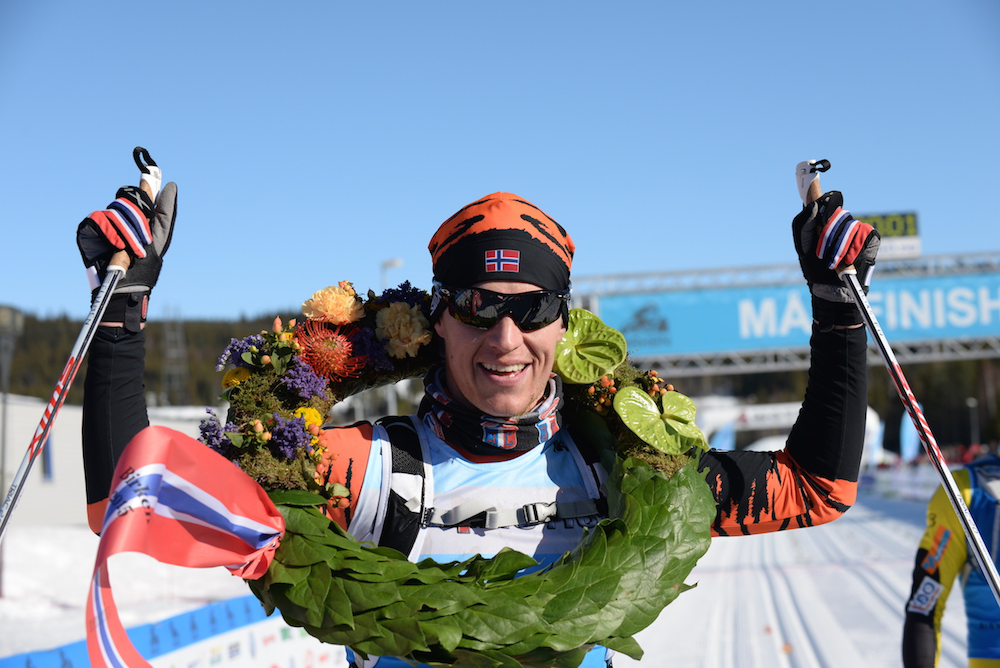
Petter Eliassen after double poling his way to a victory at the Norwegian Birkebeiner on March 22. The 29-year-old Norwegian went on to win the 2014/2015 Ski Classics title in his first season on the circuit. (Photo: Kent Murdoch)
How did Petter Eliassen do it? A month ago, the 29-year-old Norwegian from Trondheim double poled his way to a victory in the Norwegian Birkebeiner and went on to win the final Ski Classics race of the season — Sweden’s Årefjällsloppet — to claim the overall 2014/2015 Ski Classics title. It was his fourth-straight win on the circuit, making him the first racer to do so in Ski Classics history.
FasterSkier recently spoke with Eliassen, a Norwegian national team member two seasons ago, on the phone, and he happily shared his training strategies. The following interview has been translated from Norwegian to English.
A rookie to the long-distance circuit, he was content with the opening of his season, placing among the top 10 in the first five races of the Ski Classics series.
But Eliassen did not expect to close the season with a four-race winning streak — starting with the König Ludwig Lauf in Germany on Feb. 2, then a Vasaloppet win in his very first attempt at the legendary 90-kilometer classic race in Sweden on March 9. He won the Norwegian Birkebeiner on March 21, and finished the season off with a final victory in the Årefjällsloppet on March 28.
And he certainly didn’t expect to win the overall circuit crown in his first try. Eliassen beat established elite racers, such as the Aukland brothers of Norway, and former Vasaloppet champions, like Norway’s John Kristian Dahl and three-time Vasa Champion Jörgen Brink of Sweden, as well as a long list of merited marathon specialists, including Sweden’s Jerry Ahrlin, Oskar Svärd and Daniel Tynell, and Czech super-veterans Lukáš Bauer and Stanislav Řezáč.
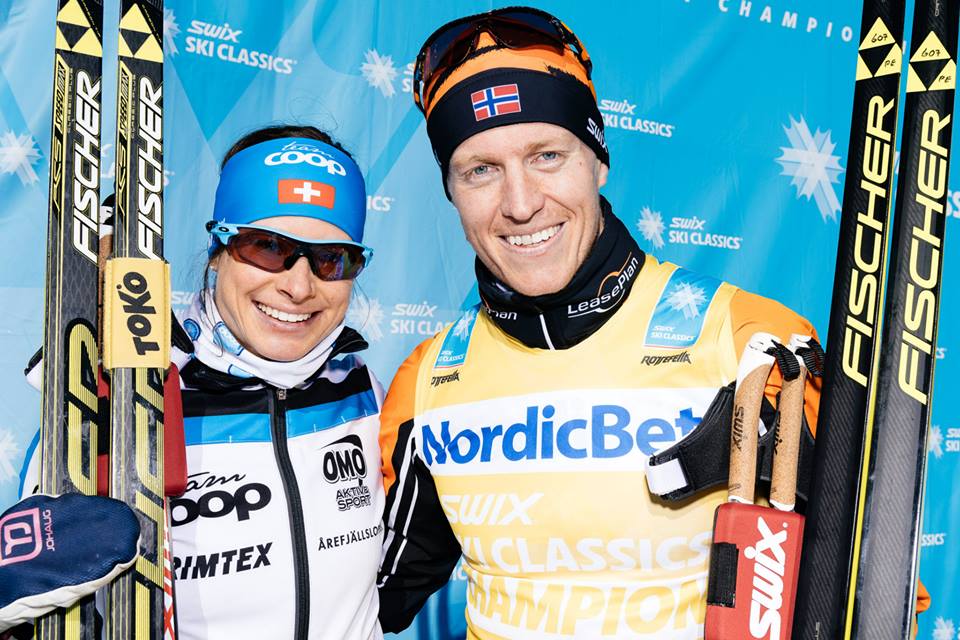
Petter Eliassen (r) of Norway and Team LeasePlan Go and Switzerland’s Seraina Boner (l) of Team Coop won the Årefjällsloppet on March 28, the last of nine events in the 2014/2015 Swix Ski Classics marathon series. (Photo: Ski Classics)
What’s your key to marathon success?
“I definitely benefit from years of racing experience,” Eliassen said, adding that the support and depth on Team LeasePlan Go made a difference. “We have a support crew and a race team that is very experienced and very well run. That’s huge both prior to the races and also in the offseason.
“Training-wise, I have done much the same leading up to this season as I did when I was on the national team. We do a lot of volume and some strength, but I have focused a bit more on double poling than I used to and much less on skating,” he said, adding that he does miss skating.
“I enjoy skating, and I still do some skate workouts throughout the season, but it’s definitely not the main part of the volume.”
While the Ski Classics organizers have not ruled out including freestyle events to the race schedule in the future, Eliassen doesn’t see that happen in the near future.
“So many of the established long-distance elite racers are highly specialized and spend so much of their training effort on perfecting their double-pole technique and strength that I think they would object,” he said.
Practice your weaknesses, race your strengths
While double poling isn’t his specialty, Eliassen is constantly trying to improve that aspect of his classic technique. He explained his team spends many of its group workouts focusing on tight finishes and does a lot of intense intervals in all kinds of terrain to prep for those.
“My favorite terrain is uphill. But many of the Ski Classics events have flat or even slight downhill finishes, so we spend a lot of time on that,” he said.
His race strategy is to determine how the race will play out well ahead of the finish line to avoid a double-pole showdown.
“I always go into the race with the intention to stay with the lead group as long as I can, but I try to pull away while there is still some distance to go and preferably in terrain that I’m good at,” he explained.
Skiers are made in the summer
During the season, Eliassen generally puts in one or two double-pole workouts per week, which last from one to three hours depending on how he feels and how much time there is between the races. When there are several weeks between events, he does longer workouts, and when the races come like rapid-fire, his main focus is recovering from one event to the next.
But the bulk of his double-pole training is completed even before the snow falls. During the dryland season, Eliassen and his teammates log several long rollerski workouts each week, with two to four hours of double poling.
“I am definitely not the one who logs the most volume on our team, but in the summer, I do at least two of those each week,” he said.
While rollerskiing isn’t his choice dryland workout, he loves running and also puts in a fair amount of time on his bike.
“I have to admit that my favorite summer workouts are long runs in the mountains. That’s where I really feel at home,” he said.
Strength and recovery
Eliassen stressed that plenty of variety was the key to staying injury free, along with a healthy dose of general strength, flexibility and recovery.
“It’s really important to do a lot of core strength in order to protect your back, shoulders and arms,” he said. “Also make sure to stretch. When you do a lot of ski-specific and double-pole specific training, you tend to get very tight, especially in the front of your body.
“And definitely make sure you allow yourself plenty of recovery time between the hard and long workouts, especially the rollerski double-pole sessions,” he added, pointing out that tendinitis issues often are a result of overuse and under-recovery.
In terms of building double-pole specific strength, he believes in simply double poling a lot.
“I don’t do any of the double-pole machines … I know a lot of skiers use them, but I believe there are several training methods that will lead to success, and so far, I haven’t used those,” he said.
If it ain’t broke, don’t fix it
Based on his experiences and results from his rookie season on the marathon circuit, Eliassen planned to continue with his training plan from last season.
“I will train mostly the same way as I did prior to this season, but of course, I will try to improve my test results even a little bit more,” he said.
Generally, Team LeasePlan Go does a one-week training camp each month during the dryland season, and in between, its athletes train independently.
“We live all over the country, so it’s nice to meet on a regular basis, but I also enjoy the flexibility of setting my own training schedule,” Eliassen said.
“I think the marathons really is my arena,” he added with a smile.
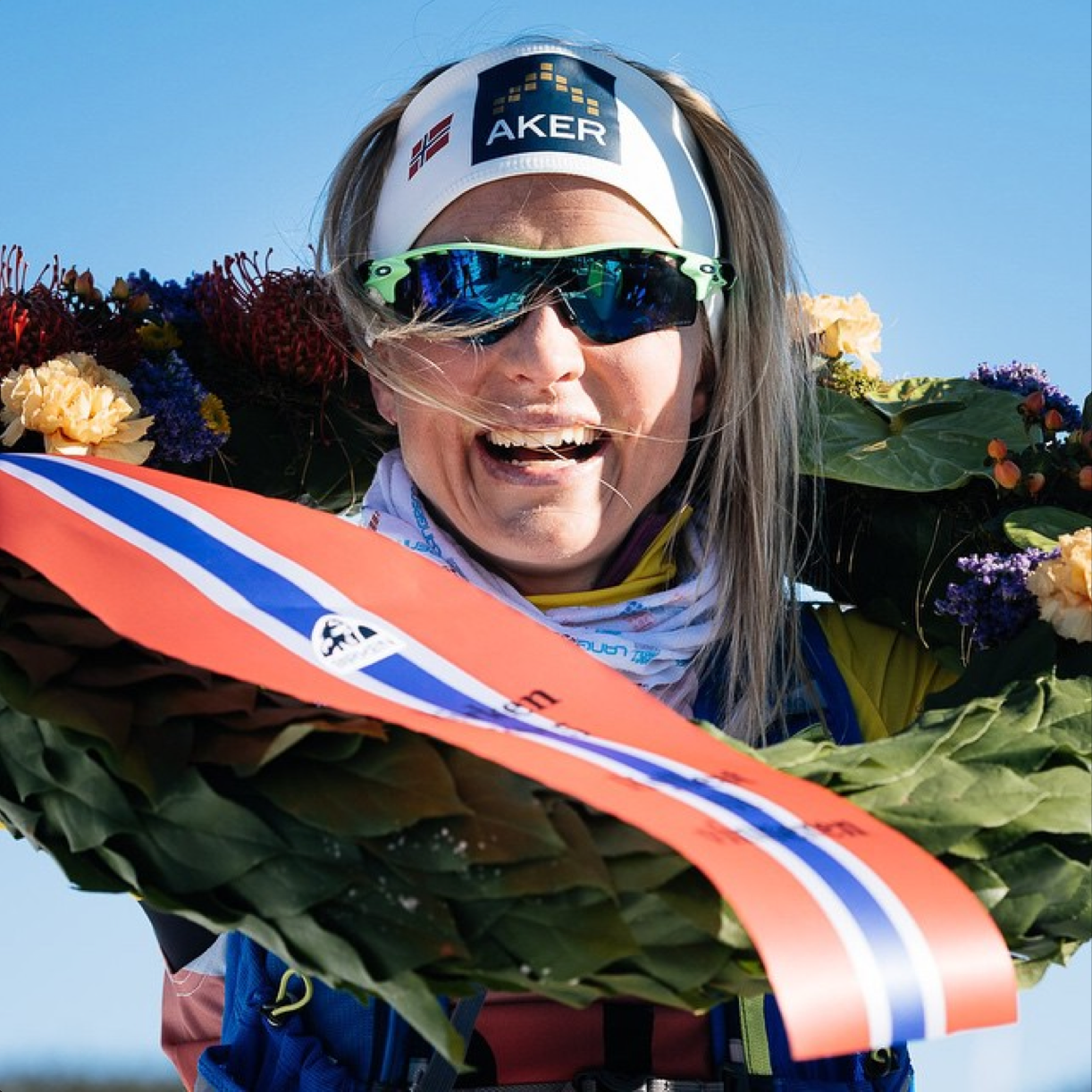
Therese Johaug of Norway said it had been a dream to compete in the Birkebeiner ever since she was a little girl. On Saturday her dream came true… and not only did she win, she set a five-minute course record. (Photo: Swix Ski Classics/Instagram)
The Birkebeiner, a legendary 54 k ski race from Rena to Lillehammer in Norway, has been running for 77 years. But that doesn’t mean that every year can’t bring something new.
Last year, the Birkebeiner was canceled due to extreme weather on the mountain summits in the middle of the race course. This year, weather was perfect and the snow was faster than ever, leading to course record times being set in both the men’s and women’s races.
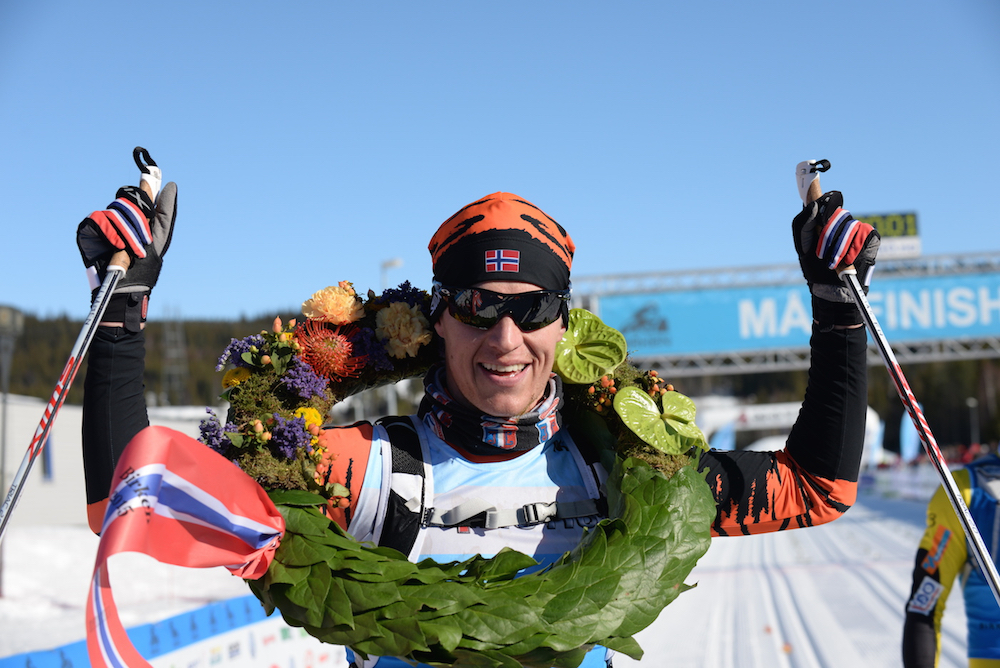
The men’s race was won in 2:19:28 by Petter Eliassen, who also made history in another way: the Norwegian racer, representing team LeasPlanGo, also went without kickwax. It was the first time the race has ever been won on skis without grip, and probably among the first times such an attempt was even made.
“I was very unsure whether I would go without or with kick wax,” Eliassen told Norwegian broadcaster E24 after the finish. “But after talking with the guys on the team, we agreed that I would do it. It’s how I have been training all year.”
While other marathons such as the Vasaloppet in Sweden or the Marcialonga in Italy are routinely won on skate skis, or classic skis with only glidewax, the Birkebeiner is different. It gains 600 meters, or nearly 2000 feet, of altitude from the start to the high point at 34 k into the race, and the total climb is even greater than that because of a substantial descent from 19 to 27 kilometers which racers then must climb up from again.
Yet despite lacking kick wax and having to double pole the entire race, Eliassen still had the upper body strength at the end to beat out fellow Norwegian Martin Johnsrud Sundby by 10 seconds. John Kristian Dahl placed third, another five seconds back.
Eliassen built up a lead descending from Sjusjøen, but Sundby and Dahl caught back up to him and forced an exciting finish.
“It is quite special and very fun to win the Birken,” Eliassen told E24. “It’s a great, traditional race… It was a good race. We were a nice group that went along together the entire race.”
Sundby, who just finished up the World Cup season with the overall title, said he has a lot to learn for these long marathon races with such huge fields. He also said he’s still recovering, in some sense, from the illness that knocked him out of the first week of racing at World Championships back in February.
“I’m in good shape, but have not gotten myself up again,” he told Aftenposten. “I’ve tested a bit lately, and is quite far from where I am at my best.”
Beating the reigning World Cup champ does not tempt Eliassen to return to shorter distance racing, however. A former national team member, he finished World Cup Finals in Falun, Sweden, last year in eighth place. Then he shifted his focus, and it has paid off. He won the König Ludwig Lauf in Germany and the Vasaloppet in Sweden as well as the Birkebeiner this season.
“Now it’s long races that appeal to me,” he told Aftenposten. “That’s what I like and what suits me, and so I enjoy it very well with the team.”
In the women’s race, Therese Johaug competed in the Birkebeiner for her first time and won it handily; her time of 2:41:46 was also a course record. She broke the previous record by five minutes.
“It was a fantastic trip over the mountain,” she told NRK. “What a mood! It could not have been better with these surroundings. It was incredibly fun to dabble in Birken. It has been a dream since I was a little girl.”
Johaug is coming off of a successful World Cup season, including victories in both the 15 k skiathlon and the 30 k mass start classic competitions at World Championships. Like Sundby, she raced for Team United Bakeries at the Birkebeiner.
Austria’s Katerina Smutna was the runner-up in 2:44:27, and Seraina Boner of Switzerland placed third two seconds behind her.
Holly Brooks, an Alaskan racing for Team Santander, finished 11th in 02:58:25. Robyn Anderson of Stowe Vermont and VTXC finished in 3:16:00. Christina Turman, the interim head coach of the University of Alaska Fairbanks ski team, finished in 3:35:14.
The top Canadian result went to Brian McKeever, who finished in 2:34:39, good for 58th place in the elite wave. McKeever is a member of Canada’s Para-Nordic World Cup team and his guide, Erik Carleton, placed 110th in 2:41:11. Ian Murray of Rocky Mountain Racers crossed the line just over a minute later to place 121st in 2:42:27, while Philip Shaw of Club Ski Rosemère finished in 3:00:18.
Lillehammer, Norway: Stanislav Rezac (CZE) won the exhilarating sprint finish in the men’s elite wave of the Norwegian Birkebeiner Saturday. He polished off the 54 kilometers from Rena to Lillehammer in 2 hours, 39 minutes and 54 seconds. Jörgen Brink (SWE) was right on his tails, finishing in 2:39:55, with Jerry Ahrlin another second back for third place.
“I had fantastic skis, super glide and perfect kick the whole way,” said Rezac, who skis for the Madshus Marathon Team.
In the women’s elite wave, Seraina Boner (SUI) won by almost a minute. She clocked in at 3:11:17, with Jenny Hansson (SWE/NOR) posted 3:12:05 for second place. Sara Svendsen (NOR) was third in 3:12:09.
“I really had to fight for it. This is probably the hardest course I’ve ever done. It’s up and down all the time and there is no place to recover,” Boner said to langrenn.com after the race.
“I had really good skis, and I’m in great shape right now, so I really hammered the uphills. I think that was the difference between first and fourth place today,” Boner explained.
Stephanie Howe (XC Oregon) was 17th in the FIS elite women’s wave, posting 3:38:29 for the 54-kilometer course. Brayton Osgood (XC Oregon) finished in 3:02:38 and earned him 24th place – the same as in the Engadin Ski Marathon last weekend. Teammates Taylor Leach was 33 in the 25-29 age category while Sarah Max was 11 in the 35-39 bracket.
Postcard beautiful weather and solid tracks made for an enjoyable day across the mountains for all participants. The Norwegian Birkebeiner was filled to capacity, a maximum of 16,000 skiers, already in October, less than an hour after online registration opened. Complete and searchable results here. http://resultatservice.birkebeiner.no/sok_resultater2.php?arr=2&per=2011
Stephanie Howe (left), Taylor Leach and Sarah Max (right) at the 2011 Engadin. (Photo courtesy of Howe)
The XC Oregon skiers posted solid results at the Engadin Ski Marathon in Switzerland last weekend and are ready to take on the Norwegian Birkebeiner on Saturday.
Now fully adjusted to the time change, the XC Oregon racers are excited to race from Rena to Lillehammer, 54 kilometers in challenging, exposed, open tundra terrain with a 3.5-kilo backpack. The venerable event that has been a staple on the calendar for almost 75 years.
Brayton Osgood, 29, is coming off a solid performance at the Engadin last weekend where he was the top American and finished 24th overall, is excited about the Birkie and hopes to build on that experience on Saturday.
“For the Birkie I have pretty much the same goals as I had going into the Engadin. I want to ski with the lead group until the race gets serious, and then put out a good effort from there to the finish,” Osgood said to FasterSkier, noting that at the Engadin, the only thing missing was enough juice for the last couple of kilometers.
“So, if I can finish things off a little better than I did at ESM, I’ll be very pleased, but mostly I want to make it to the finish and have some good memories when it’s all said and done. I won’t say I want to have a good time out there, because that’s a pretty tough standard to live up to during a race,” Osgood added.
(Article continues below the photo)
16,000 racers annually enter the Norwegian Birkebeiner. (Photo: Inge Scheve)
Something a skier has to do
While Osgood has tried his hand at the Birkie before, his XC Oregon teammates Taylor Leach, Stephanie Howe and Sarah Max are new to the legendary race.
“As a skier, the Norwegian Birkie is one of the races you have to do in your lifetime,” Howe said.
With her previous marathon results, including winning the women’s freestyle Gatineau Loppet in February, Howe has landed herself a spot in the FIS elite wave. That certainly adds some performance pressure, but Howe still wants to enjoy the experience.
“I hope to have fun! I am starting in the elite FIS wave, so I’m a bit nervous. It should be fun though, I love climbing, and I hear there should be plenty of that. The biggest challenge for us will be to select the correct skis and wax,” Howe explained.
Less pressure
Leach and Max said being new to the event adds some uncertainties, but also cuts down on the expectations and self-inflicted performance pressure.
“I have never done the Norwegian Birke before, but I have wanted to do this race for a long time. so I am really excited, a little bit nervous because it seems like a challenging course. As I have dedicated most of my winter to coaching, I do not have many expectations. My goals are to ski technically well, have a smart race and enjoy the experience,” Leach said to FasterSkier.
The same is true for Max.
“I’ve never done the Birkie. I don’t have much in the way of expectations, which is the beauty of doing a race that is completely unfamiliar,” Max said.
Additionally, the Norwegian Birkebeiner will represent some extra challenges for Max, who is fairly new to classic skiing. Given that the course covers 54 kilometers of varying, exposed and challenging terrain, Max is hoping for good kick from Rena to Lillehammer.
“This is only my fourth or fifth classic race ever. My hopes are to have good kick throughout the race,” Max said.
(Article continues below the photo)
Being new to classic skiing and new to the Norwegian Birkebeiner, Max (XC Oregon) is hoping for wax conditions a little less tricky and frantic than these. From the start at Rena in 2007. (Photo: Inge Scheve)
A legendary race
Since the inaugural Birkebeiner race in 1932, the Norwegian Birkie has only been cancelled seven times, most of them due to World War II (no race in 1941, 1942, 1943, 1944, and 1945).
But in 2007, when the XC Oregon trio Brayton Osgood, Marshall Greene and Zach Violett, attempted to cross the mountains, the Birkie was cancelled due to blizzard conditions, high winds and literally no visibility in the open. The racers in the first couple of waves, which were allowed to start, were called down from the mountain and brought back to the start at Rena.
XC Oregon's Birkie crew in 2007: Zack Violett (left), Brayton Osgood, and Marshall Greene (front). They were turned around early. (Photo: Inge Scheve)
That first wave in 2007 included the XC Oregon skiers, who said they encountered head winds so strong that it was hard for even large skiers to make headway into the wind, let alone stay on the tracks that quickly disappeared from windblown snow on the tundra.
In 1948, the owners of the event could not agree on whether to develop the Birkie into an elite competitive race or focus on participation and recreational skiers. The race was not held, but the owners worked out their issues and now the Birkie is a mass-participation event, maybe the largest and best-known ski race in the World.
The lure of the marathons
For Leach, 25, the European marathons represent crowds and atmospheres unmatched anywhere in North America.
“The big European marathons are a different experience to racing the US, there are so many people. Even our biggest race, the American Birke, is not even close to the size of many of these races. Although when it comes down to it, racing is racing, regardless of where you are,” Leach said, explaining that as a junior coach with the Mount Bachelor Sports Education Foundation in Bend, she doesn’t have the opportunity to do many races for herself in the meat of the season.
“The Engadin and the Norwegian Birke were the only races that I was planning on doing this year, I did get to race at Crescent Lake a few months ago and I may be able to race the Great Nordeen but these European races were really the focal point of my winter,” Leach explained.
For Max, 36, now a veteran of the European marathon circuit, the European marathons have become the main focus of the season. But equally the overall experience is easily just as important as the race aspect.
“I’ve done about half a dozen European marathons now, and while I consider them my main focus, the races are really just a good excuse to travel around, meet interesting people and eat euro breakfasts,” Max said to FasterSkier.
Stephanie Howe won the 2011 Gatineu Loppet (Photo courtesy of XC Oregon)
For Howe, 27, the European marathon races are the reward after a long domestic season, and the European racing experience is icing on the cake.
“They are kind of a bonus at the end of the season. I didn’t have a lot of expectations since I haven’t raced in Europe before. I’m also still new to the marathon distance, but I am learning. In terms of overall season, these races were something I was looking forward to all year,” Howe said.
Return on Investment
In Downing’s opinion, ski marathons are a great return on investment for athletes who can’t do a lot of travel to follow the USSA SuperTour or Canadian Nor-Am series, but want to race a stacked field. For many of the XC Oregon racers, the marathons serve as motivation, variety and a season goal.
“For any athlete that isn’t interested in the SuperTour-format races and prefer longer events with guaranteed field strength, the American Ski Marathon Series domestically and World Loppet internationally are the way to go. Particularly for female athletes, or any athletes with limited travel time, the value of the marathon circuits is super hard to beat,” Downing said.
For XC Oregon as team, marathons are one more way get exposure and experience.
“What we (as a team) are getting out of the World Loppet starts is keeping athletes motivated and excited plus many great to good results over the years,” Downing said to FasterSkier.
Downing lists off that just this season, XC Oregon has placed four female athletes in the top ten at World Loppets: Evelyn Dong third place at the American Birkie, Kristina Strandberg’s Engadin Ski Marathon eighth, Sarah Max’s fourth at the Gatineau Loppet freestyle and Stephanie Howe’s first place in the Gatineau Loppet classic.
As a reward to the dealers who were able to sell the most Swix Triac poles and Fischer RCS Carbonlite boots a contest was organized; to the winners a trip to Norway. First a few days in Lillehammer then down to Oslo for the World Championships.
Come on New Jersey
On Monday the nine dealers from all over the United States were supposed to converge in Newark to catch the same flight to Oslo, Norway. That seemed like a fairly easy task until bad weather moved into New Jersey, flights were canceled, delayed several hours, bags were lost and David Peterson (The Ute Mountaineer, Aspen, CO) even got rerouted through Heathrow. Eventually though we all met up in Oslo and headed to Lillehammer.
After a quick stop at our hotel, we were off to lunch at Nicker’s downtown to watch the men’s 15km classic race that was going on back down in Oslo. After watching the race, eating and possibly enjoying a few adult beverages the group headed back to the hotel to check-in to our rooms an change up for a little ski.
Part of the group poses for a picture along side of the final kilometers of the Norwegian Birkebeiner. From left to right; Dave Greer (Paco's), Eli Brown (Brick Wheels), Spike Clayton (Ski Rack), Bert Hinkley (WebSkis), Bob Rosso (Elephant Perch) and Matt Voisin (FasterSkier). Lillehammer, Norway.
Where it all happened
Birkebeineren Ski Stadium, Lillehammer, Norway. Home to most of the Nordic events at the 1994 Olympic Games.
The afternoon ski was a treat in itself as we headed up to the Birkebeineren Ski Stadium which was home to most of the Nordic events at the 1994 olympic games in Lillehammer. While skiing around it was hard not to imagine the same space crowded with thousands of Norwegians cheering on Bjorn Daehlie as he raced Silvio Fauner to the line only to be silenced by the Italian in the men’s 4×10 relay (YouTube video).
The group enjoyed both the more gentle terrain that was the final kilometers of the Norwegian Birkebeiner as well as the much more challenging trails of the Olympic course, where we all tried to keep up with the surges of Eli Brown (Brick Wheels, Traverse City, MI) and Bob Rosso (Elephants Perch, Ketchum, ID).
After skiing for an hour and a half we headed back to the hotel to freshen up and head to dinner downtown at Pepe’s Pizza. Then most everyone headed to bed after a long day of traveling and skiing.
Bacon Ost
Bacon Ost, coming to friendly bets in US ski communities next week.
In the morning we were all treated to a spread of typical Norwegian breakfast foods. If you are friends with someone on the trip there is a good possibility that you will be presented with some Bacon Ost upon their return home.
It is important that they are sober
After breakfast the group headed to the Swix Factory for a tour from the legendary Harald Bjerke. It was amazing to see how so few workers are able to run the entire wax production. When asked about it Bjerke commented that, “it is just like cooking, you just follow the recipe, but it is important that they are sober.”
After the tour, Bjerke gave a powerpoint presentation about the history of Swix and developments along the way, including wax and poles – all of which included anecdotes.
The group about to head out to ski on the Birkebeiner race course lead by Swix's Eivind Opsahl.
Hitting the Birkebeiner race course
From there the group got changed up back at the hotel and headed up to the Birkebeiner trails. As we worked our way backwards along the course we were treated with four classic tracks each separated by a skate lane, all of which was groomed to perfection. Our turnaround point was about 8km out at the highpoint of the course which is 910 meters above sea level. We skied the rolling and mostly flat terrain back to were we started, from there most of us decided it would be fun to ski the remaining fifteen kilometers to the finish of the Birkie and then drop down the hill to our hotel. Although there was a climb here and there, for the most part it was all down and at times quite so.
Midtfjellet: Highpoint of the Norwegian Birkiebeiner at 910 meters.
Dinner at a restaurant called The Cave was amazing and gave way to a ‘few’ hours of socializing with Eivind and some other Lillehammer locals.
Meeting Ulf Bjerknes
Ulf Bjerknes, President of Swix Sport.
Let’s just say the early morning departure was hard for some who were going on little sleep, but two and a half hours later we were back in Oslo at Swix’s main office to meet the company’s president Ulf Bjerknes and pole production manager Svein Pedersen. Bjerknes gave an interesting presentation about what the company is working on; from the production and growth of their apparel line to the challenges that exist in different countries.
Pedersen talked about the innovations in their pole line and the difficulties of always looking for something lighter, stiffer, stronger and with an improved swing.
Drammen Testing
After that it was time to head to our new hotel in downtown Oslo to meet similar dealer groups from Germany and Sweden. From there it was off to Drammen to test those ‘black’ skis that are Fischer’s new line for the 2011/12 season on the World Cup race course. Although most of the dealers had already tested the line at the SIA show at Devil’s Thumb Ranch last month it was still a great opportunity to provide feedback to some of Fischer’s top employees. On a whole the new skis were just what you would expect from Fischer; light, solid, stable and of course fast and the graphics look even more impressive in person than what you may have already seen on the web.
The highlight of the ski in Drammen was that Fischer had arranged for all the dealers to get personal lessons from Jon Nordby, who is one of the top club coaches in all of Norway and his son Sindre Wiig Nordby, who is rising the ranks and is now just off the national team. Sindre, you may recall, may be best known in the United States for showing up on JohnnyKlister doing his skier imitation.
[A video of him doing his best Michael Jackson impersonation on skis is coming soon, so check back later today.]
Now we head to Mecca
All the dealers would agree that this trip has been amazing and that everyday has brought something new and better than the best from the day before, but today, today we head up the hill to the ‘Kol’, today we go to the World Championships at the Holmenkollen, it does not get any bigger.
The popular Norwegian ski marathon, Birkebeinerrennet, was sold out in a record time of 18 minutes after the registration went online last week. The organizers had reserved a total of 16,000 start bibs and all of them were snapped up in just 18 minutes. The Birkebeinerrennet will take place on 19th March 2011. Never before has the race has been sold out so fast. The sharp increase in interest is even more dramatic looking back when it took three weeks to sell the start bibs 12 months ago!
The Birkebeinerrennet starts in Rena and ends in Lillehammer, covering a distance of 54 km. The number of participants is limited to 16,000 and it is usually fully subscribed. The race has been held since 1932 and commemorates a trip made by the Birkebeiner loyalists to save the heir to the Norwegian throne, Håkon Håkonsson, in 1206. All participants carry a backpack weighing at least 3.5 kg, symbolizing the weight of the then one-year old heir.