From the FasterSkier archive — posts syndicated from athletes’ and coaches’ own blogs between 2004 and 2012, kept online as published. Current coverage is at fasterskier.com.
In the big global picture, much has transpired since Jessie Diggins won the Tour de Ski. On the macro side of things, that being on the World Cup, a break has transpired. On Saturday, the cross-country World Cup returns with a skiathlon. The more notable news is the Norwegian national team will spice up the skiing as they return from a self-imposed hiatus from the World Cup since early December.
We also answer some listener questions and discuss how we deal emotionally with less than desirable outcomes. So yeah, there’s an unofficial therapy session of sorts.
Thanks for listening and feel free to send questions to devon@fasterskier.com and jason@fasterskier.com.
This Interview with former Norwegian National Team member Astrid Uhrenholdt Jacobsen comes from Paolo Romanò, a reporter for Fondoitalia.it. The interview was also published on the FIS website. This version of the interview has been lightly edited.
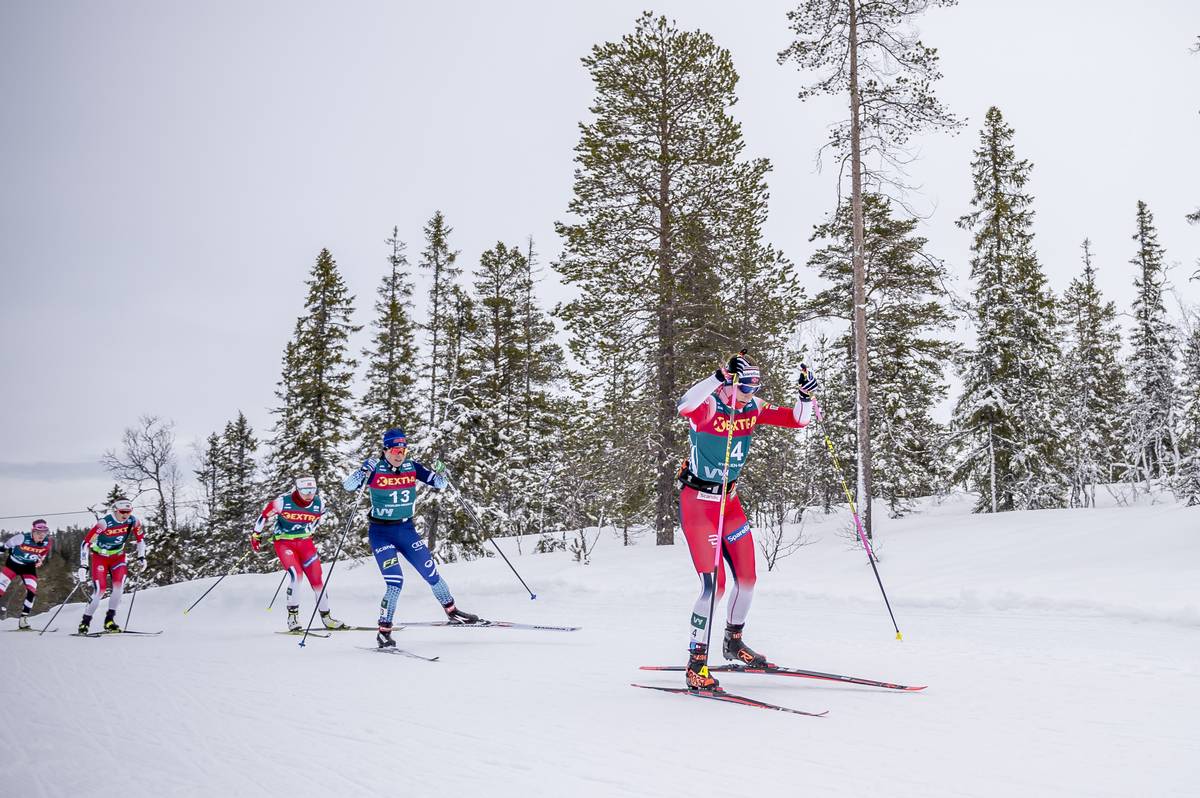
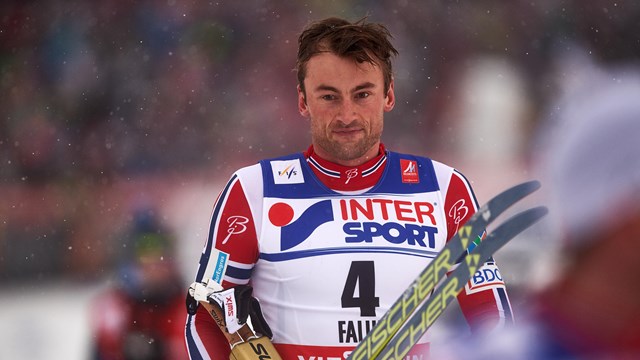
Astrid Uhrenholdt Jacobsen in bib 4 during the Storlien-Meraker, Norway stage of the 2020 Tour de Ski. (Photo: NordicFocus)
Since 22nd February 2007 – at the young age of twenty – Astrid Uhrenholdt Jacobsen shocked the cross-country skiing world. From that first gold medal in the classic sprint at the World Ski Championships in Sapporo, many have followed this athlete who has balanced academic life with elite level sport.
In Japan, Astrid Jacobsen began to show the world her fluid and powerful classic technique that accompanied her throughout her storied career until her last unfortunate race at the Holmenkollen 30 k classic where she struggled with skis. The year prior, in the same event, Jacobsen skied to sixth overall on her home course. It was not the career ending anyone would have hoped for.
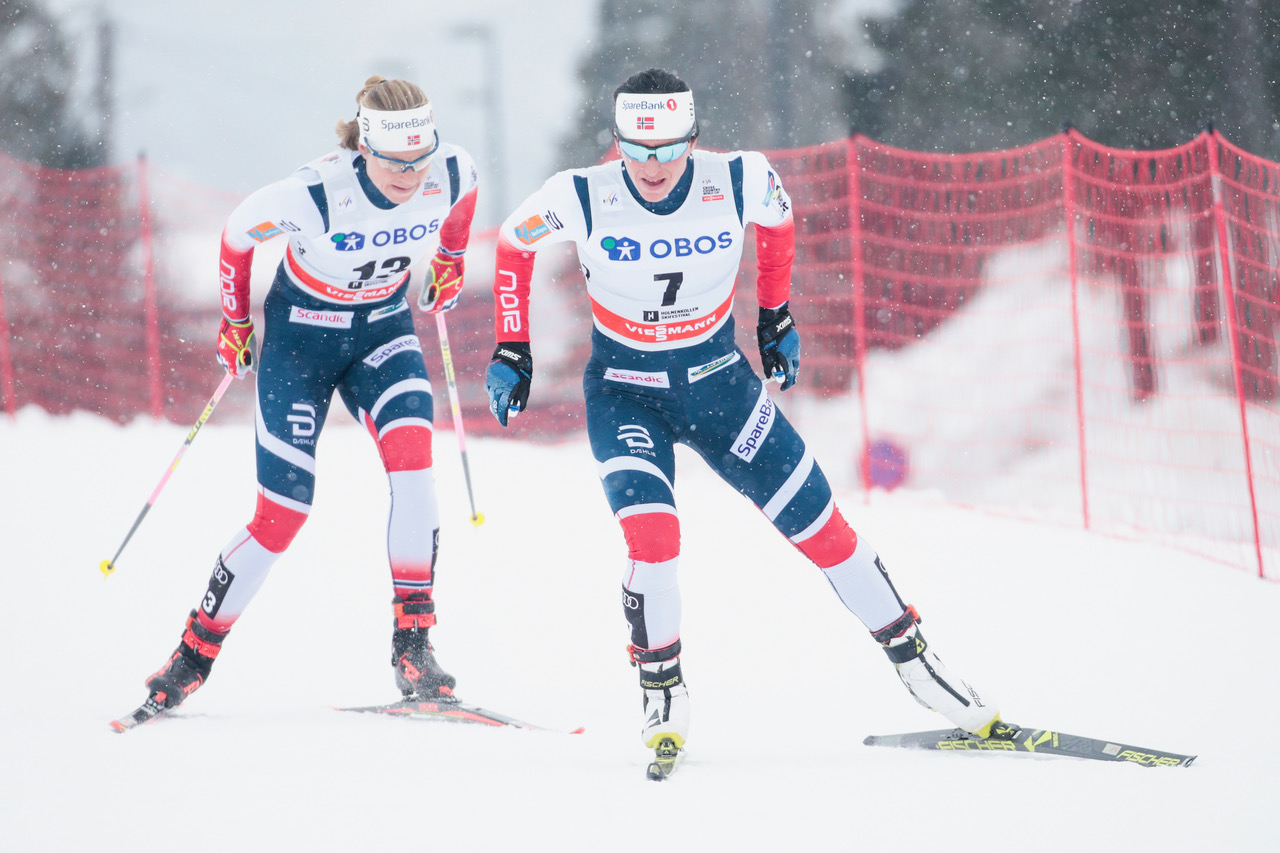
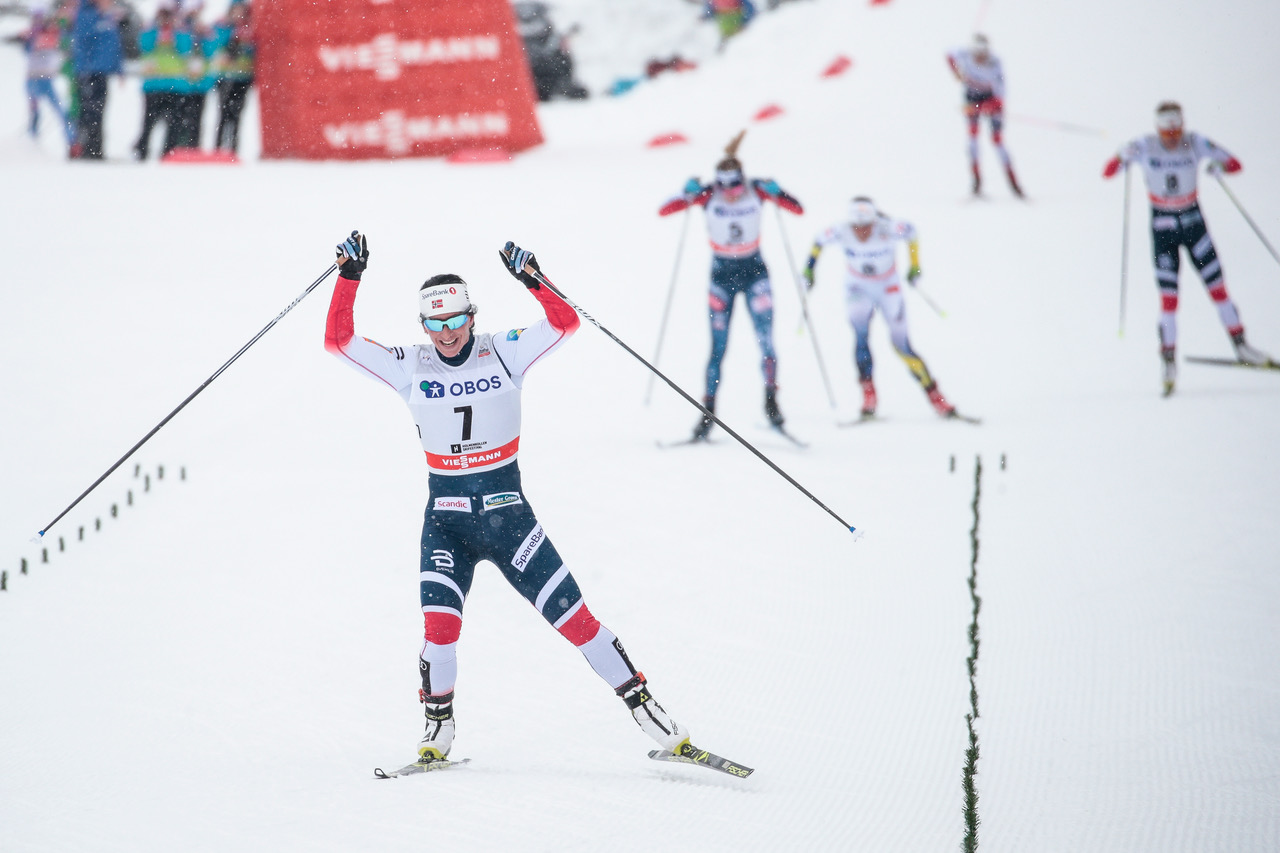
Sadie Maubet Bjornsen (USA), Astrid Uhrenholdt Jacobsen (NOR), Elina Roennlund (SWE), (l-r) cresting a hill during the Stage 6 classic sprint at the 2020 Tour de Ski. (Photo: NordicFocus)
At the Olympic Winter Games 2018 in PyeongChang, Jacobsen raced to a well deserved gold medal with her Norwegian teammates in the 4 x 5 k relay. During seven World Championships, she collected a total of ten medals. In 258 World Cup starts, she notched 43 podiums including six individual victories. The last pearl was achieved in Val di Fiemme’s 10 k mass start classic during her final Tour de Ski. These are all stout achievements considering Jacobsen faced strong dominating athletes in their primes such as Marit Bjørgen, Justyna Kowalczyk, and Therese Johaug.
With her retirement from competitive sport this year, Jacobsen continues with her ongoing medical studies. With her final medical exams concluding in the middle of 2021, the Norwegian will have transformed herself from an elite skier to Doctor Jacobsen.
The following interview offers Jacbosen an opportunity to reflect on her career — a career that was shaken by a mountain bike accident in 2009 and the sudden passing of her brother at the start of the Olympic Winter Games in 2014.
That is my favourite thing about skiing, when it makes you flow on snow. That’s why I used so much time trying to improve my technique — to try to reach perfection. When you develop this flow, you can harness speed too.
Jacbosen met with journalist Paolo Romanò in the company of her trusty little dog on a sunny afternoon in Holmenkollen. She looked back on a career that ended six months ago on the same spot. Romanò asked the name of her dog and reports the following from Jacobsen: “He [name] is Dovre, like the Norwegian mountain range. He is very tame for a hunting dog but lately, he is hunting only bees, rather than small prey.”
***
Paolo Romanò: The whole world discovered a young Astrid Jacobsen during Sapporo 2007 World Championships. But what are your best memories before that golden sprint? In junior races or during your school years.
Astrid Uhrenholdt Jacobsen: In Heming IL, my home club here in Oslo, we had many strong skiers when I was a teenager and I remember the Junior Norwegian Nationals in 2004 when the podium was swept by athletes from our ski club. I remember very well that race because my entire training group was from this small area in Oslo and it has been really weird that we beat all the other girls coming from all around Norway. And at the Nationals Champs here in Norway there are always a lot of skiers.
But I remember also my first time I raced Senior Nationals in January 2005 in Lillehammer in which I was second behind Marit Bjørgen. That sprint classical race was my first FIS competition. In qualification, I started last because my ranking was bad, but I was able to finish in third. In the final only Marit was able to beat me.
That race was the last trial for the Oberstdorf World Championships but the Norwegian Federation said that I was just a kid and too young to compete at the senior level internationally. And the same thing happened the year after when I finished third at the Nationals but again they said that I was too young for getting a spot for the Torino Olympics. With that generation’s of coaches, you had to be in senior age to compete in international competition but then things changed with Therese Johaug, Marthe Kristoffersen and Ingvild Østberg or looking at our current period with Helene Marie Fossesholm.
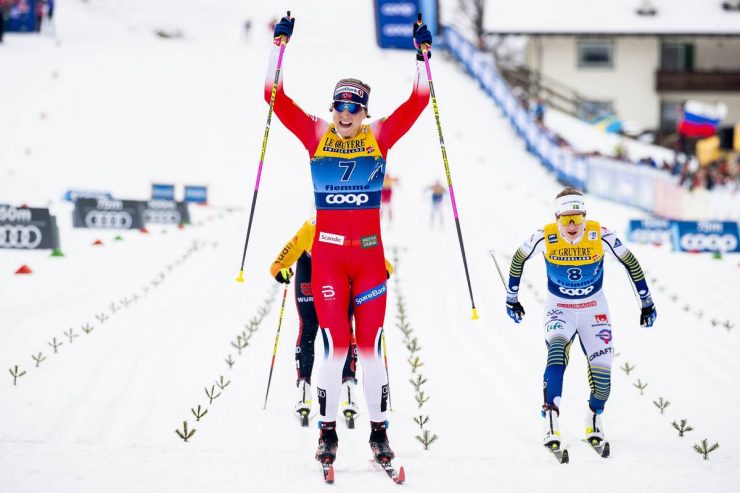
Astrid Uhrenholdt Jacobsen (NOR) takes the win during Stage 5 of the 2020 Tour de Ski. (Photo: NordicFocus)
Paolo Romanò: During your career, you won many medals during World Championships [10] but only one at the Olympics? Are there any particular reasons for that?
Astrid Uhrenholdt Jacobsen: About my first Olympic Games in Vancouver, I had a dramatic crash with my mountain bike the previous summer. Someone said that I wouldn’t race anymore, but getting the qualification for Vancouver has been one of the best performances in my career because on July 1st I had to wear a support-corset that I wore until the end of August because of the many fractures. Just being able to ski again that winter was a victory. I still can’t understand how I was able to ski as well as I did. Of course, I think without the crash things probably would have been different.
Sochi was a sum of multiple bad events that began with my brother’s tragedy. Then when the coach picked the team for the skiathlon I wasn’t selected. That was weird to me because I was consistently strong the whole season in that format. I think with the coach of that time we were not the best of friends.
When I raced the sprint it was emotional for me. But during the final, I broke my pole and finished fourth. For the 10 k classic and team relay we had bad skis. But in Sochi, I was in really good shape before starting those games. Sochi 2014, Falun WCH 2015, and Lahti WHC 2017 have been the events in which I had the best shape. When I left Sochi I was confident that I was the best athlete without a medal. I don’t have a good feeling about the Olympics because the same misfortune happened in Pyeongchang when I got the flu just before we started. Then I won gold in the relay but that wasn’t my best day, maybe they paid me back for the unlucky past.
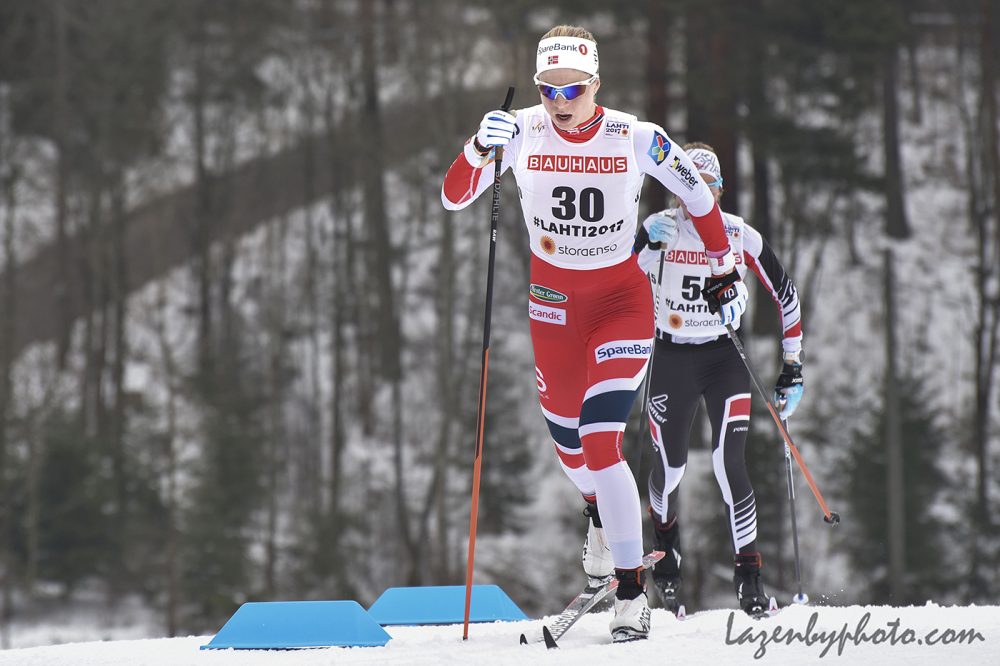
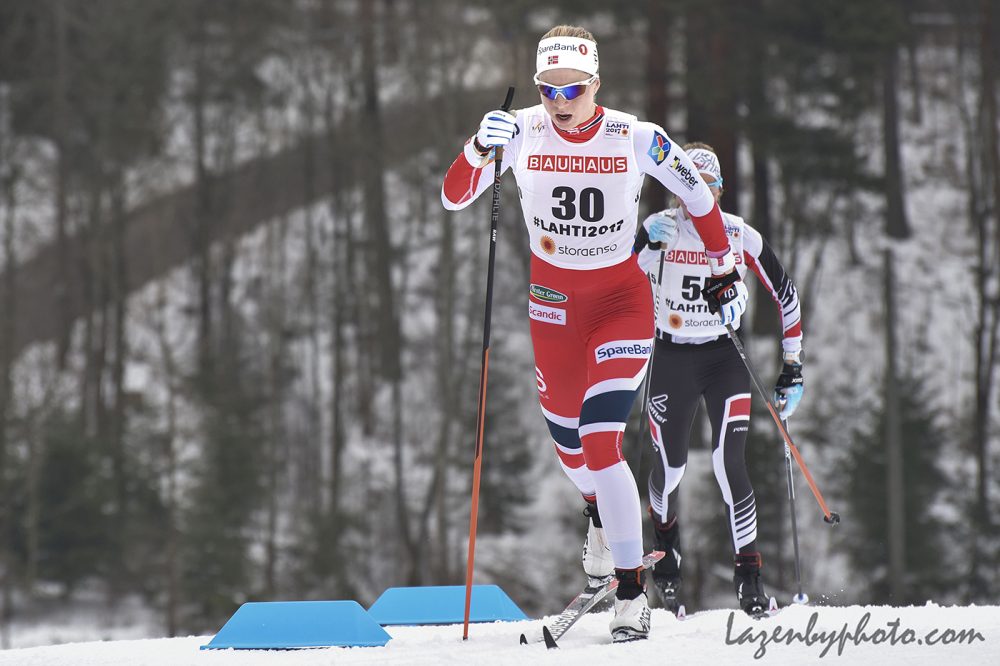
Norway’s Astrid Uhrenholdt Jacobsen on her way to bronze during the women’s 10 k classic at the 2017 Nordic World Championships in Lahti, Finland. (Photo: John Lazenby/lazenbyphoto.com)
Paolo Romanò: Many ski analysts and commenters say that you have the best classic style in the last three or four decades. Did you work a lot to develop that harmonic and so poetic style?
Astrid Uhrenholdt Jacobsen: Yes, I worked a lot with my technique, and for me, it’s like dancing with skis. I love the feeling when you do the diagonal stride in a proper snow-covered track. Because now in modern cross-country, they ski like machines and I don’t really like it, okay maybe it’s fast or something like that. If we could return to tracks as they were in the past with the difference in height changing all the time instead of what we have now when practically all World Cup tracks have a hill, then a flat, and followed by a downhill. We need tracks in which it’s possible to follow the rhythm of your skiing to get the feeling of the terrain that must be always changing.
That is my favorite thing about skiing, when it makes you flow on snow. That’s why I used so much time trying to improve my technique — to try to reach perfection. When you develop this flow, you can harness speed too. I think I was always focused on the part of the sport which considers improving, working on technique, and doing things over and over to get this feeling of mastering it. That has probably been more important to me than just winning a race and that is why some people may say, ”Ok you ski beautifully but that didn’t make you win.” But it’s also a part of the sport to be able to master it.
Paolo Romanò: What has been the best race of your career? Or the race that gave you most satisfaction that affirmed: “That was my day !”
Astrid Uhrenholdt Jacobsen: I have two races in Falun that I remember very well. The first one was in 2008 in skiathlon that historically has been my least favorite race. But that day I could ski for the whole day long. We were all Norwegian girls in the top positions before the last lap, then on top of Mördanbakken, only me and Marit remained. And I remember that one of my coaches told me: “Astrid you can calm down now, you have another race tomorrow!” and I strangely watched him like I didn’t understand the reason. That was one of my strongest days, I felt in supershape there.
Maybe the race that means the most to me personally is another skiathlon in Falun during the 2015 World Championships. Because after the Sochi OG and what has happened to my brother, I compensated for that loss by dedicating my thoughts only to training during the summer because that was the only way to make me feel a bit Ok.
But all that work caused tiredness in my body — working from August till Christmas — and the rest of the team they thought “Ok, Astrid is out of the team, she will not come back this season.” Suddenly, I started skiing again and in one month I went from being a total disaster and someone that other people didn’t count to get a spot on the Norge squad for the World Championships despite the hard fight that is always present in our team selection, to a podium athlete. The first race in Falun was the skiathlon and winning a silver medal was a great victory for me considering the previous difficult year. That was a year in which I learned the most personally, Skiing was just not simply a sport anymore, it was more.
Paolo Romanò: Did you have any special rituals on race day?
Astrid Uhrenholdt Jacobsen: Not really. The only ritual I had if we can call it a ritual was the food that I could eat or not eat the day before a race – or doing little training the morning of a race if we competed in the afternoon. I think one of my strengths is that I knew what was important and what was not, and rituals weren’t because they are only rituals. So if something unplanned happened before the race, I loved that, some people always got stressed because of that, but for me, it was Ok even if they changed the format from classic to skating the evening before. I stayed calm. I always stayed calm. That was my best quality. So the more the stress, the better for me.
Paolo Romanò: What do you miss most about cross-country right now?
Astrid Uhrenholdt Jacobsen: I miss the girls, my teammates, coaches, and everyone working around cross-country. I miss the flexibility in the daily schedule we have — that is different from working. And I miss my best shape that now is not that good. Now I do my training when I get the motivation. While I don’t miss all the training camps abroad or doing two hard sessions a day or following a daily regime.
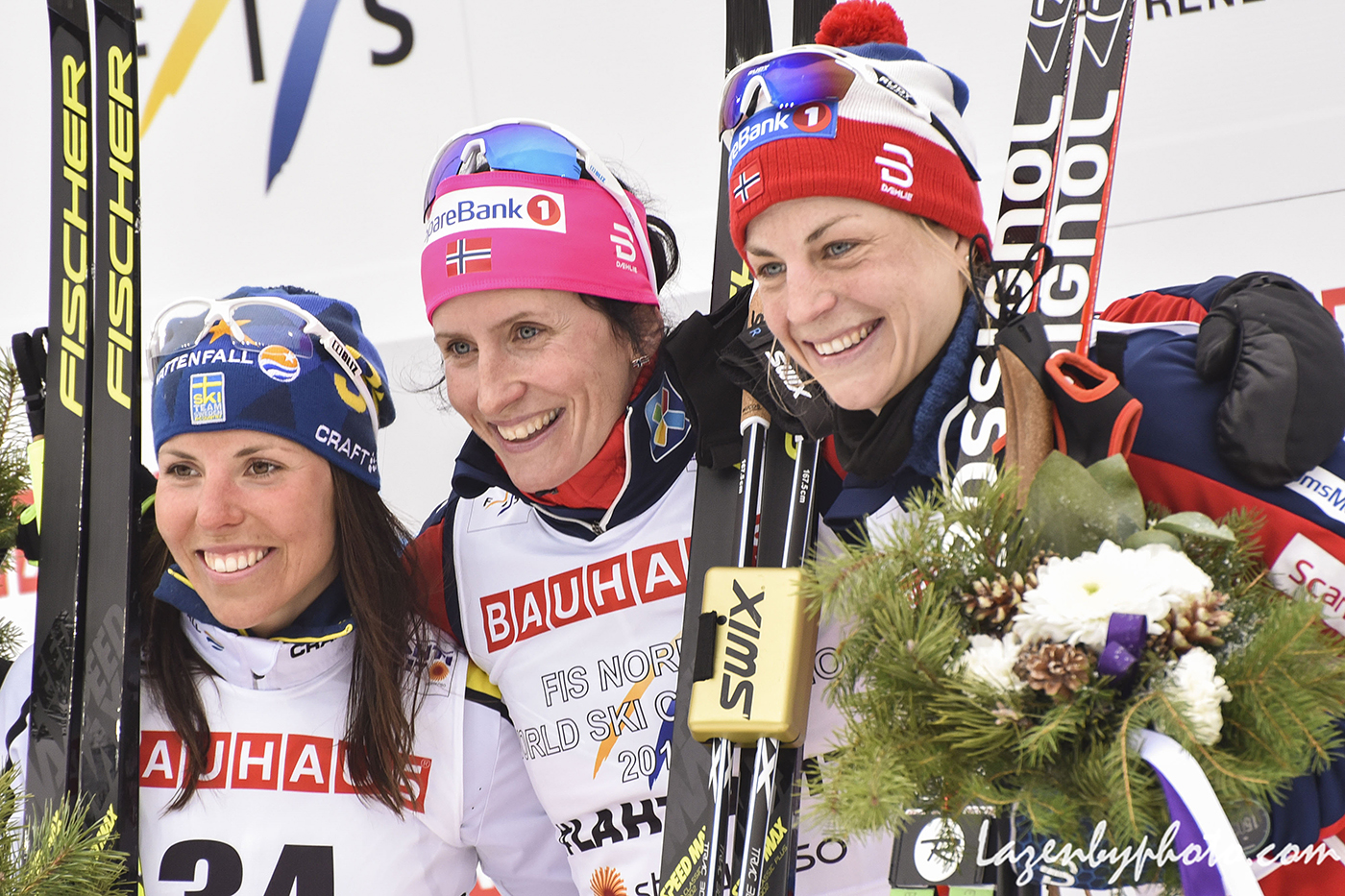
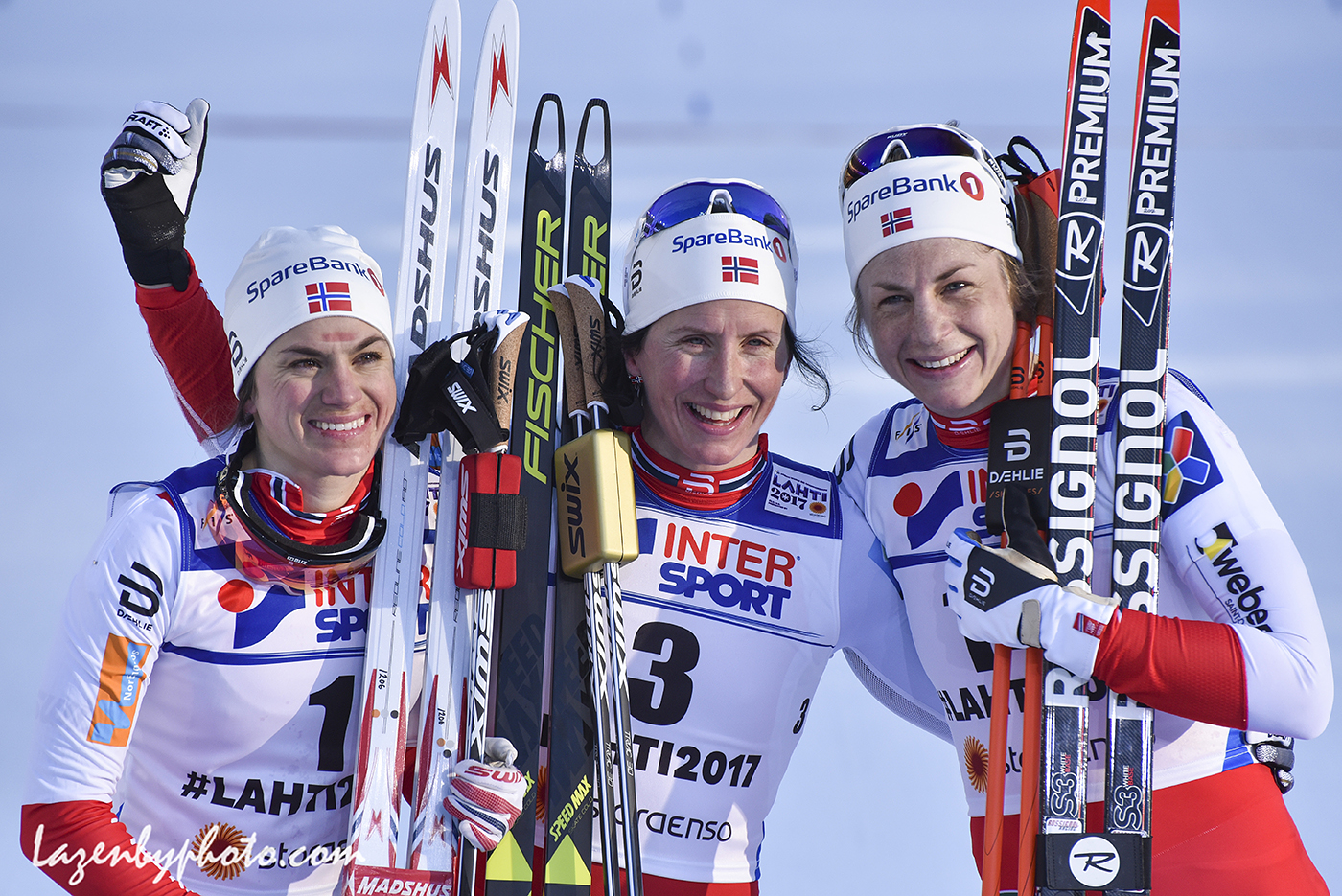
The 2017 Nordic World Championships women’s 10 k classic podium, with (from left to right) Sweden’s Charlotte Kalla in second, Norway’s Marit Bjørgen in first, and Norway’s Astrid Uhrenholdt Jacobsen in third. (Photo: John Lazenby/lazenbyphoto.com)
Paolo Romanò: How do you define yourself as a girl outside cross-country? What kind of character do you have?
Astrid Uhrenholdt Jacobsen: I like people, and I think I am quite good at taking different perspectives. I don’t always have my own perspective — I can see that there are two, three, four different ways to see things which makes it easier to understand other people and their perspectives. The other quality that I used in cross-country too is my calmness. I think I usually see the best in people. I am quite naive and I think people have good intentions until proved otherwise. I am a bit impatient and efficient, so I expect others to be the same and expect others to be doing their best which is probably annoying for others around me. I probably think the best in people, but I expect a lot from them.
Paolo Romanò: You have been studying medicine for the last six years. What are your perspectives in that field for the future?
Astrid Uhrenholdt Jacobsen: I have one year left then I am a doctor. Then I will do an internship that is like one and a half years, which is a position allocated to young doctors and then you start specializing. I am not really sure what direction I am going to head in, but this summer I am working in a female clinic where they follow everything from birth to postpartum in a gynecologist office. That has been interesting.
I am not sure what kind of specialization I want to choose, the only thing I know is that I want to choose a branch where there is the possibility of learning throughout your career. I want to specialize where you don’t start with something broad and then you specialize with something small like orthopedics. That’s not my kind of thing. I want to be a generalist, so maybe gynecology, maybe intensive medicine or trauma, or maybe a general doctor. We have a great health system in Norway. I am looking forward to working and being a part of our system. I really like that we have this social platform with the same treatment for everyone, it doesn’t matter if you are rich or poor. We have the same health system for everyone.
Paolo Romanò: Why is so difficult in the wintersports world to combine success in sport and university at the same time? Only a few athletes have done both in recent years?
Astrid Uhrenholdt Jacobsen: Regarding my personal case, I wouldn’t be working towards becoming a doctor if only the National team or my University allowed me to be flexible. They both had to be on board. I have had some years in which I had really strict programs. If you are on the National team you have to do this training camp, this race, this training in this specific place, etc. The same being a medical student, you have to do this exam, this course, this test, etc.
And all of them said to me: “we love if you do both sport and medical studies, that is a really good thing!” And I said, “it doesn’t matter if you love this if you don’t help me.” I never asked the University or National team to skip things, I just needed to arrange my schedule in advance because it’s not that easy to do both of them or to be in two places at the same time.
This is one of my goals for the future, to convince politicians to make it easier to combine sport and study. Because to a politician that can create losers in life. You can be excellent in sport but then you get too old and have no idea what you want to do in the future. They think that’s why some people become losers. In society, it’s better to create winners in life if we permit the combination of sport and school, or if we work to lift up athletes in their after-sport career. That’s better for society. This is one of the very few good things with the pandemic, it has forced universities to use more digital platforms, where it is possible to be located in different places but with a wide possibility to learn at the same time.
Norway’s Marit Bjørgen leading teammate Astrid Uhrenholdt Jacobsen in the Holmenkollen 30 k freestyle mass start at the World Cup in Oslo, Norway. (Photo: Fischer/Nordic Focus)
Paolo Romanò: Let’s imagine that you are the supreme boss of Cross-Country. What are you going to change? You could build your own calendar and develop new rules — what is your advice to bring back cross-country to its glory days?
Astrid Uhrenholdt Jacobsen: First I will cut the number of races. I will stop being politically correct and giving a race to this place and that. For example, now Slovenia and other countries need some races, everyone needs World Cup races. And every winter is not possible to ski here for training in Holmenkollen because they use constant artificial snow, and FIS requires twelve meters wide and 30 cm deep along the entire track for holding races. Then we go to other places and find stones or grass and inconsistent snow. So they should allow different places to have different rules. I would start with having fewer race weekends, starting stages on Friday in the evening with a sprint in prime time when people have finished working. And then distance races on Saturday and Sunday. And doing three weekends in a row and then a break. Other important ideas are using high quality and traditional locations, not always the same locations but those that have something important to offer. And if you fail once offering a bad show, then you are out of the World Cup.
Paolo Romanò: Are you saying follow the IBU program?
Astrid Uhrenholdt Jacobsen: Yes, sort of with the weekend break system. But I don’t like competing on Wednesday or Thursday. The World Cup calendar needs fewer weekends and less traveling. When Bente Skari won her last World Cup in 2003 she won 14 out of 17 World Cup races in which she started, in a total of twenty-one World Cup races in the program that year. That was 2003, less than twenty years ago, and now there are too many races.
Paolo Romanò: A survey revealed a certain loss in cross-country practice in Norway in favor of other sports between young generations. What are your thoughts about it and your suggestion to the Norway Ski Association to limit this loss of enthusiasm in future generations of kids?
Astrid Uhrenholdt Jacobsen: That’s probably because we recently had winters with less snow in the south of Norway. This could be an easy answer — the lack of snow in winter. Nice winters and nice tracks can attract more young generations to cross-country and having fun. But in Norway in the junior races, there are still more and more skiers. The loss of participation in under 14 could be temporary. Of course, one other reason is due to the cost of materials. Being active in youth races already requires too much equipment too early. This high cost causes a loss in recruiting kids.
Paolo Romanò: What is there on your future wish list?
Astrid Uhrenholdt Jacobsen: Good question! Maybe to have my own kids, (Ha ha). That would be the most obvious one. I don’t need too much. I’d like to have a job that I find interesting and stay healthy.
Norway’s new National Junior Team Coach Monika Kørra. (Photo: skiforbundet.no)
In early August, Norwegian Monika Kørra was named Norway’s national junior team coach, an under-the-radar, nordic news event that resonates. Kørra, a 29-year-old accomplished runner and cross-country athlete in Norway, comes to the job with an undergraduate degree from Southern Methodist University in Dallas, Texas, and a master’s in coaching and sport psychology, which she completed in Oslo this summer.
Kørra’s primary athletes are 12 junior skiers (six boys and six girls) that comprise Norway’s National Junior Team. Organizing camps, writing training plans, coordinating with an athlete’s club coaches, and competition travel are just a few of Kørra’s primary responsibilities. Like any coach, she’ll be the travel agent, psychologist, ski organizer, and team motivator.
Kørra is also a trailblazer along with Brit Baldishol, a longtime Norwegian Ski Federation coach and now the federation’s ski development manager. Baldishol has been employed by the federation since 1999.
Norwegian junior team coach Monika Kørra speaks at a recent Norwegian Ski Federation conference. (Photo: Ørn Borgen/NTB scanpix)
“Until I was hired, Brit has been the only female coach at the higher level within skiing in Norway,” Kørra told FasterSkier in a phone interview. “And now with this position, I am the only one. The only female.”
Baldishol, having been immersed in Norway’s ski culture for decades, understands change can be slow.
“It is not equal yet,” Baldishol said of the dearth of female coaches at the elite level in Norway. “We started because I have been the junior national coach before so I know about that position. I know we can do this and our teammates can do this job. It is not that you can do a better job because you are a male. It depends on what you are looking for. For us, I think it is more important that we look for a coach that can be a good coach for different types of athletes.”
Kørra posited that women may have been reluctant in the past to take on demanding coaching positions due to the travel demands and an emphasis placed on technical ability.
“I think is what we value the most about the coaches in skiing is more the technical side of things,” Kørra said. “The way I see it is that to work with people, to see all the people, you need to be able to really communicate with them. The more feminine qualities in coaches might have been maybe not valued as much as the technical side.”
Baldishol emphasized that Kørra comes into a stable system with well-established technical norms to develop athletes.
“This is a job we have done for many years and we have this book we use for all the coaches that tells about the philosophy and what is important in Norway for being a good athlete and what we believe are the proper steps,” Baldishol explained. “We do not take shortcuts, but take it step by step for how to develop.”
Despite the time-worn and successful pathway, Norway felt a need to broaden leadership opportunities for women in skiing. Last winter, it launched a three-year mentorship program called “Skiing Leaders of Tomorrow”. Kørra was part of the initial mentee group.
“They selected 20 women to attend this program to help them reach their goals, to become leaders in the form of trainers or coaches within an organization,” Kørra said.
Baldishol, who serves as a mentor in the “Skiing Leaders of Tomorrow” program, revealed that Kørra, early on, stated she aspired to become Norway’s national junior coach.
“When this position was announced, she had to apply because everybody expected that she would apply for this job,” Baldishol recalled. “And she did it. She went all the way because she had great interviews. But we started this program because we need to have more female coaches to believe that they can have this as a full-time job.”
Monika Kørra during her SMU running days (Photo: SMU Athletics)
Growing up in Løten, Norway, Kørra became an exceptional summer and winter athlete as she matured. Her running times gained the interest of major collegiate track and field programs in the U.S., and she was offered an athletic scholarship to Southern Methodist University (SMU) in Dallas. She accepted and specialized in the 3,000-meter steeplechase, 10 k and 5 k.
“I think what drew me to the U.S. was how I was able to combine sports with school and how I saw that everyone was having a great time as a team in the U.S.,” Kørra said. “Within the running community in Norway, it is not that much of a team sport, it is more individual. That was the thing that drew me to the U.S. to run. And I had a great time, time of my life in the U.S. I don’t regret that for one second. It was a great experience.”
But she separated that moment from the rest of her experience living in Dallas. According to an ESPN article written about her in 2012, she loved both the school and the city.
Kørra told FasterSkier that she discovered a team ethos at SMU that she’ll apply in her role as a national-level coach.
Although still a daily runner or skier depending on the season, Kørra gravitated towards ski coaching.
“I loved how in skiing … you have all types of people, all types of body types, that can race well when they are skiing,” Kørra said of how she chose skiing. “And that is one thing that fascinates me is how different people can still be good at something.”
Norway certainly expects podiums, medals and meteoric nordic stars. That is the unrelenting pressure from the federation and the nation. When speaking with Kørra, her commitment to the whole person when considering her athletes became clear. Her core values transcend medal count. She emphasized her duty to foster adults who themselves contribute beyond just fast splits on the ski tracks.
“I think one of the most important things are my values, what I stand for,” Kørra said of her coaching philosophy. “How I focus on the fact that I want to help these athletes grow as people as well as athletes, and the way that I might choose to see everyone and I want to help everyone. I think there is a lot about my background and experience that I bring along to the job and how I love coaching. I live for it. I breathe for it. … I think I show that in coaching, and I think people value that.”
The stats are simply mind-boggling. Essentially, Norway’s Marit Bjørgen has the mostest. The most decorated Winter Olympic medalist: 15 total medals, eight gold, four silver, and three bronze — over five Olympiads from 2002 to 2018. The most World Championships bling: 26 total medals, 18 gold, five silver, and three bronze. Bjørgen won 114 individual World Cups and podiumed 184 times on the World Cup.
Take a bow. Marit Bjørgen of Norway winning the 30-kilometer classic mass start at 2015 World Championships in Falun, Sweden. (Photo: Nordic Focus/Fischer)
Norway’s Marit Bjørgen celebrates her seventh Holmenkollen 30 k victory in Oslo, Norway, ahead of American Jessie Diggins, Norway’s Ragnhild Haga (not shown) and Sweden’s Charlotte Kalla. (Photo: Fischer/NordicFocus)
This brings us to the point that this is the 50th episode of Nordic Nation. So, we wanted to go big. Really, no one is bigger than Bjørgen in the sport. In this ‘Take a Bow’ episode with Marit, we cover motherhood, training, racing, the media, and growing up in a small Norwegian club with three racers. The newly retired Bjørgen, 38, was interviewed last Tuesday, July 10.
Afternoon workouts at Natrudstilen Stadium in Sjusjøen, Norway. (Photo: Maks Zechel)
Editor’s Note: The following is part of a series proposed by Maks Zechel, a 20-year-old Canadian cross-country skier embarking on his first season training abroad. In August, he made the big move to Norway, where he’ll be training and racing with Team Asker for the entire winter. Through these updates, Maks hopes to share his personal “observations, stories and lessons learned” to help close the gap between North American and Scandinavian nordic skiing. Previous posts: 1,2,3, 4, 5, 6, 7 and 8.
This particular post, entitled “Head Games”, is broken up into three parts.
Part I: What Skiing Means to Us
If you’re dedicated enough to be reading an online magazine about cross-country skiing, then you probably really love skiing.
Don’t be too hard on yourself; I love skiing, too.
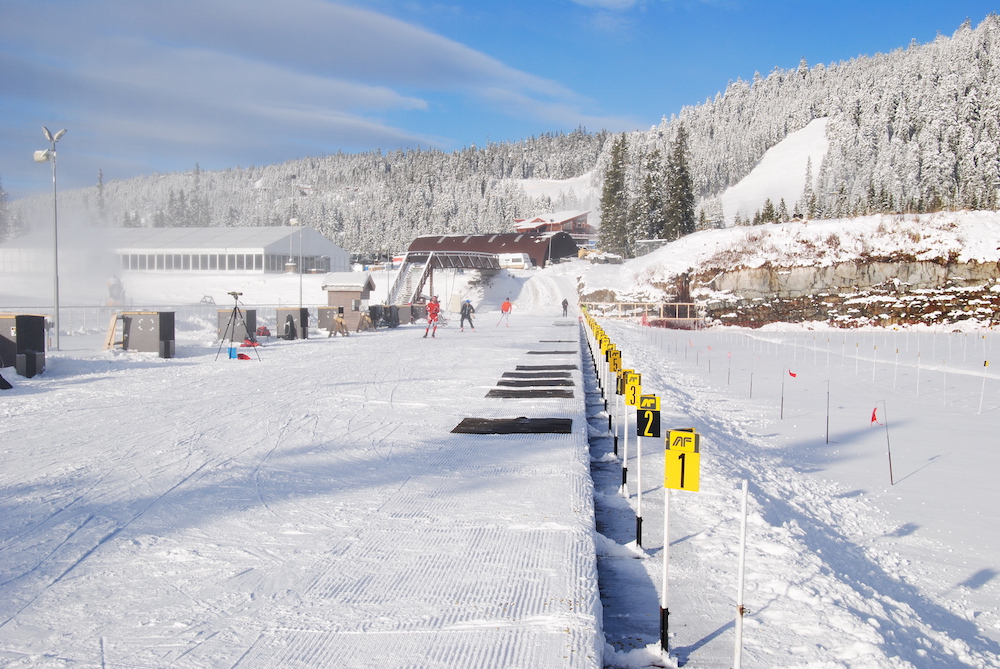
The shooting range in Sjusjøen, Norway, as seen on Nov. 2. (Photo: Aleks Tangen)
This post starts with a crisp day on skis just outside of Lillehammer on Nov. 2, 2017; a skier’s dream…
I have never been to Wall Street, but I imagine it feels a lot like Natrudstilen Stadium in Sjusjøen*, Norway, at 9 a.m., two weeks before the season opener in Beitostølen. It’s barely below freezing, but the snow guns are blazing. They hum, interrupted by the BEEP BEEP BEEP of heavy machinery transporting snow, and a steady stream of skiers moving in every direction imaginable. You hear them, too: the squeak, WOOSH, squeak, WOOSH of tips biting into snow and carbon swinging through the air. It’s a bluebird day and the snow is rocket-fast. The sun barely skims above the highest peaks in the distance, but nobody looks up. Something much more important is on everyone’s mind today, and that is going fast on skis.
My friends, Erland and Hedda, and I are doing intensity this morning. Dozens of others have the same plan, and Lillehammer Skiklubb (the biggest club in Norway) is running a time trial. It’s hard to tell what the biathletes are doing, as they always seem to be wearing bibs and going fast, but I jump out of their way regardless since they all carry rifles.
The main loop is slightly under 2.5 kilometers long. No section of the track is ever empty and coaches give encouragement and feedback from all sides. There is a four-way intersection at one point on the course, which skiers approach at speed from both directions. Most people are too focused to acknowledge one another, except to tell someone to get out of their way or when they almost collide; it is chaos on a mission. Just the way that I imagine Wall Street, everyone is going about their business, and everyone thinks their business is most important. At times like these, it can be easy to lose sight of the fact that the reason we are all whizzing about this track today, is not just because of our individual goals, but because of our shared passion for this beautiful sport.
The next evening I am back at Natrudstilen, enjoying the extra 3 k of trail that was prepared the night before. The sky is a big northern sky; the horizon is dotted with the silhouettes of stunted trees as the last strip of pink sunlight warms the remaining dark blues and purples fading into black above. The moon is full, huge, and slightly orange. The crisp air is more potent than coffee and makes skating around the glazed track effortless. When the sun is gone, the lights turn on. Dozens of skiers still churn out laps well past the 5 p.m. sunset, but it is much more peaceful than the morning bustle.
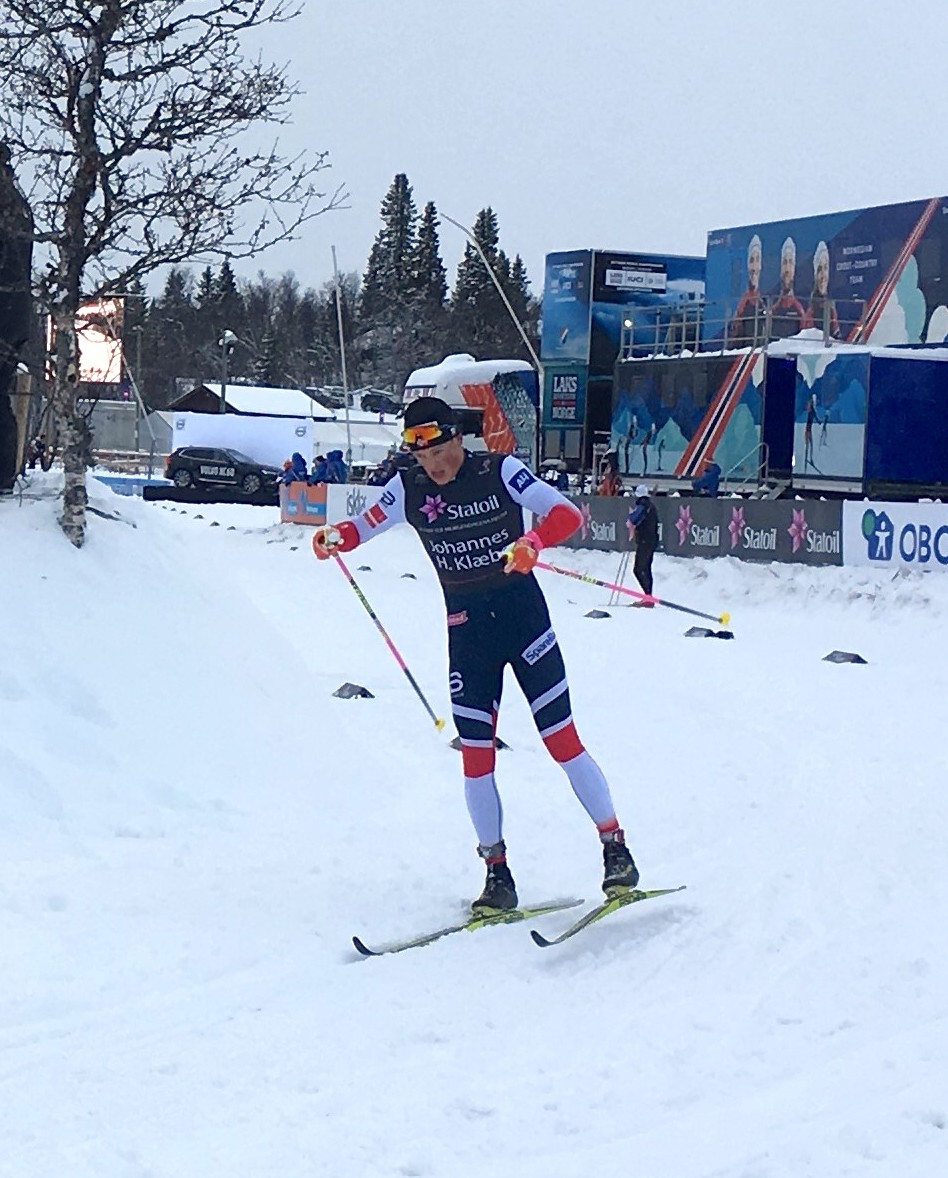
As I ski by myself, a skier passes me in the classic tracks. He is wearing the Norwegian national team training clothes and skiing quite well, so I am quite sure he is not just a “Norges Skiforbund super-fan.” As he skis by, he pushes his strides over the short, punchy hill. He is not moving impressively fast, but by the way he moves I can tell that this is far below his competition speed. I should know who this is, but it is dark. As we crest the hill, I put my crazy-skiing-fan-sleuthing skills to work: I notice the telltale headphones, Leki poles, Fischer boots, and, the last piece of the puzzle, the initials JHK on his drinking belt. “OH S***, it’s Klæbo!”
Norway’s Johannes Høsflot Klæbo in his debut race of the 2017/2018 season at the FIS season opener in Beitostølen, Norway, in November. (Photo: Maks Zechel)
Over the top of the hill he relaxes his strides and glides slowly, drooping his head and letting his arms hang. He looks back and then walks over to the side of the trail to take a break. Johannes Høsflot Klæbo is the youngest person to ever win the World Cup Sprint Crystal Globe. He is also a human being who seems tired and feels the pressure of the oncoming ski season like everyone else. I may not be a World Cup medalist, but as with all skiers, I have the same good and bad days.
The training season for a cross-country skier is long, never-ending really, with many skiers preparing for goals that are years away. How can we know that we will be ready to perform for a few minutes, or maybe an hour or more, in an event that is years away? Confidence takes many forms and comes and goes from moment to moment. The feeling that one gets in one hour of training can ruin the confidence that was built over weeks of perfectly executed workouts and races. It is an incredible skill to be able to have confidence in yourself throughout the ups and downs of training and day-to-day life and to have trust in a plan that must constantly be changed to respond to normal human imperfections.
Why do we continue down such a path, where the tiniest bumps and setbacks in the road have such great control over our well-being? Some of the drive comes from the small daily joys: the sense of purpose, the goal setting, and the achievement of those goals. For myself, much of the joy comes from the places skiing takes me and the people that I meet, but the biggest drive comes from the special moments, those moments of complete contentment in life where everything else momentarily fades away. Sometimes they happen with others, but with the solitary nature of cross-country ski training, these moments often occur when you are on your own. It’s hard to see them coming, and for me they happen just a few times every year.
Maybe it’s a ride to the race site with a car full of your friends, and that one song you all love comes on as you pass through the mountains. Maybe it’s 9 p.m., -15 ̊ degrees Celsius, and you’re sitting at a bus stop after a cold ski under the stars, about to make the journey home but the bus isn’t coming for another 15 minutes, when you remember to pull out your hot thermos of peppermint tea. Or maybe it’s an icy fast day on a Norwegian early season snow loop, and you just realized that one of the best skiers in the world feels just like you do.
*Sjusjøen: pronounced “shoe-shun” (“shoe”, as in the footwear). For a more accurate pronunciation guide, please seek out a Norwegian.
Norwegian Word of the Week:
Norwegian: koselig
Danish: hygge
Translation: a feeling of coziness and/or contentment. E.g. drinking a mug of hot chocolate under a blanket next to the fire during a snowstorm; laughing with your friends; a fast day on skis when you feel like you could ski forever.
***
Part II: What Skiing Does to Us
Anyone lucky enough to have grown up cross-country skiing should know what a privilege it is to have access to such opportunities. Few people have the means to take up ski racing, whether it is for financial, geographical, or other reasons. Nonetheless, skiing manages to bring together people from many different backgrounds, uniting us with the shared love of being outside. Skiing, more than most sports, is something that sticks with you for life. I know many people that only started ski racing in university, including my parents, and for them skiing has remained one of the most important parts of their lives ever since. In North America, skiing is a sport that lacks the same intimidating atmosphere that sports like hockey and football sometimes have. It is easy to join a ski program no matter your level of experience. Skiing brings together a special community of people, but at the elite level it also begins to alienate us.
Skiers are tough. We love how tough our sport is and we begin to encourage characteristics of toughness (at least to make sure children survive the elements of winter) in ski lessons at an early age. Skiers with the best “pain faces” are put on a pedestal by athletes and coaches because of how visible their effort is. Probably the most offensive thing you could tell a skier is that their rollerskis or skis are really fast; it is hard for skiers to admit that their performance has been aided by anything other than their own strength and technical abilities. In short, it is hard for skiers to admit they need help.
The toughness of our sport makes us hesitate to acknowledge feelings that might make us seem weak, especially when we fail to reach our goals. Instead of asking for help, skiers compare themselves with those faster than them, and in that way blame their failures on the unchangeable characteristics that make them unique:
“I need to look like a World Cup skier to be fast.”
“I need to train more.”
“I need to train harder.”
“I need to lose 10 pounds.”
“Am I just a slow skier who needs to work harder, or do I have a mental health issue?”
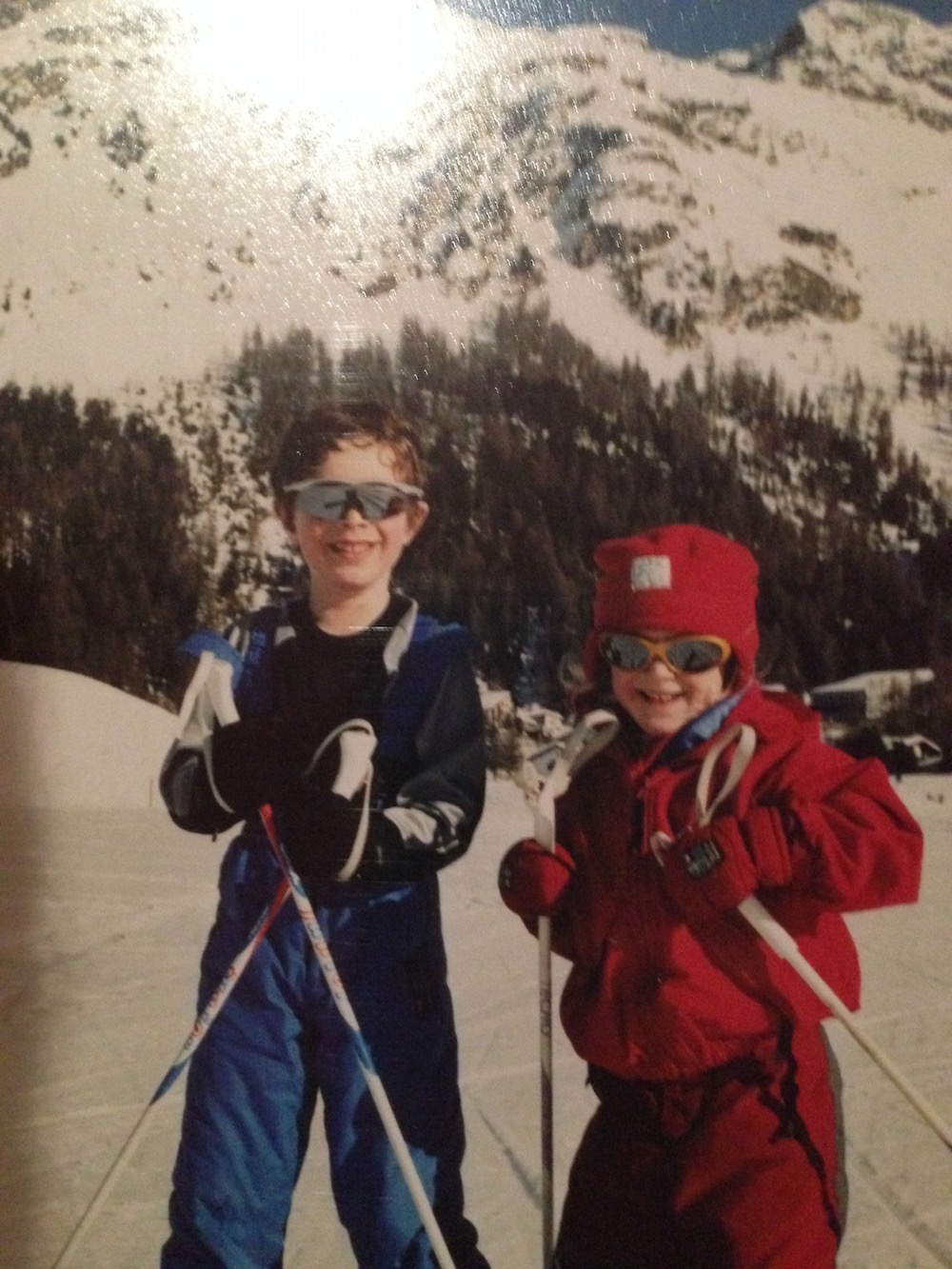
The early days: little Maks Zechel (l) and his sister Anni skiing in Switzerland. (Photo: David Zechel)
Many skiers get hooked on training at a young age. I started training at least four times a week when I was 11 years old; I did it because it was fun and I thought that it was the coolest thing to arrive at school and be able to tell my friends that “I ran 3 KILOMETERS this morning!” I haven’t changed much… But back then I could feel content, motivated and energized for the entire day just from that.
Unfortunately, increased fitness and getting older make it harder to achieve the same satisfaction from running a few kilometers. I didn’t realize it at the time, but at 11 I was already becoming addicted to training. It took me until I was almost 20 years old to realize that I could no longer satisfy my mental health, to achieve contentment in life, through training alone. Some days it is enough, but other days I can train for 5 hours and finish the day feeling overweight and unfit. Sometimes it is hard to tell whether I feel unwell because I have eaten too much, or because I have barely eaten all day.
It sounds ridiculous to call something that is “good for you” a mentally destructive addiction, but that in itself is part of the problem. Many athletes fail to gain control over their mental health issues because they don’t realize that they are sick. When somebody breaks their femur, they are told to stop training, recover and rest until they are healthy enough to train productively. It is harder to tell that someone is unwell when they are simply doing the things that are encouraged by our sport: excessive training, pushing through fatigue, gritting your teeth and working hard no matter how you feel. When one athlete races slower than another, the first thought of the slower athlete is that they have to train more and become fitter. Much of this culture comes from skiing itself, but we get a lot of it from team sports, where the motto is always, “if you’re not training hard, you may as well not be training at all.” But in endurance sports, where everybody is affected by training differently, sometimes training too much, or at the wrong time, or in the wrong way, can have the same effect on your fitness as you would have from training too little. Are you training to gain fitness or are you training to satisfy your confidence?
When you train once or twice a day, it is easy to pretend that these issues do not exist, but when this schedule disappears, everything comes back to haunt you. I experience the most difficulty with my mental health at two, essentially opposite, times: when I race, and during the “off-month” of April.
Racing is the amalgamation of months of rigorous training, obsessive motivation, and gasping with relief after hard efforts. Skiers take a leap of faith off of the start line, relying on all the confidence and focus they can muster to ski fast around a loop of snow in the woods. The race is exciting; it is also the origin of all your nerves, dreams and fears. In this place of vulnerability, even the smallest thoughts of doubt come to surface. It doesn’t matter if you gritted your teeth and pretended it didn’t exist for the entire year, your mental health is of utmost importance during a race, and it is essential to learn how to regulate it in order to achieve success.
[Racing] is exciting; it is also the origin of all your nerves, dreams and fears.
April is the period of rest and recovery craved by almost everyone at the end of a 3-5 month racing season. But for many it simply turns into the month of caving in to everything that we deprived ourselves of for 11 months: parties, staying up late, cramming in studying before exams, and being human for a change. Doing “normal” things? It’s the hardest month of the year, and every year I crawl my way to May 1st with desperation, more exhausted than at the start of April.
This past April, I decided to face my mental health issues that I had always known existed, but never understood or recognized for what they were. What an awkward thing to talk about, mental health, but it shouldn’t be. Our minds have to be taken care of with the same attention that we give our bodies through training and recovery. It doesn’t matter what it is that makes you begin to acknowledge your difficulties, but it has to be done; it is grossly underestimated just how permanent unchecked mental health issues can be. I didn’t acknowledge my health issues because I cared about my health, but I did care that it was starting to affect the way I raced, and although not the most important reason, it was enough to motivate me to work on my mental “fitness.”
Since moving to Norway, the issues I have had with my mental health have faded into the background. I’m too motivated and excited about where I am to think about such things. But it is still there, and the novelty of where I am will eventually wear off, and then I will have to be ready to deal with these things. It is important not to allow happy distractions to get in the way of how you deal with your mental health, because for every incredible high, there is a devastating low. It is better to take the time when you are feeling good to plan coping strategies, so that when you are hurting you can maintain your overall health in a way that is better for your success as a skier, and a person.
Although ski racing at the highest level can seem like the only important thing in life, that level of racing can’t be maintained forever. For people who may have been training hard with a single goal in their head since they were small children, throwing them into the regular world can be an overwhelming shock. The skiing community needs to put an emphasis on not only producing elite skiers who will ski fast, but also on developing people who will be successful and healthy beyond their years in competitive sport.
Norwegian Phrase of the Week:
Norwegian: Uten mat og drikke, duger helten ikke.
Translation: Without food or drink, even heroes aren’t good enough.
***
Part III: Skiing Healthy
We don’t get to choose the bodies and minds we are born with or the ailments that afflict us. But we can choose to learn about ourselves, talk to one another, and explore how we can be successful because of, not just despite, our unique personalities. Instead of struggling to get by in spite of what hinders us, thinking about our mental health should be seen as an opportunity to become better at the things in which we want to succeed.
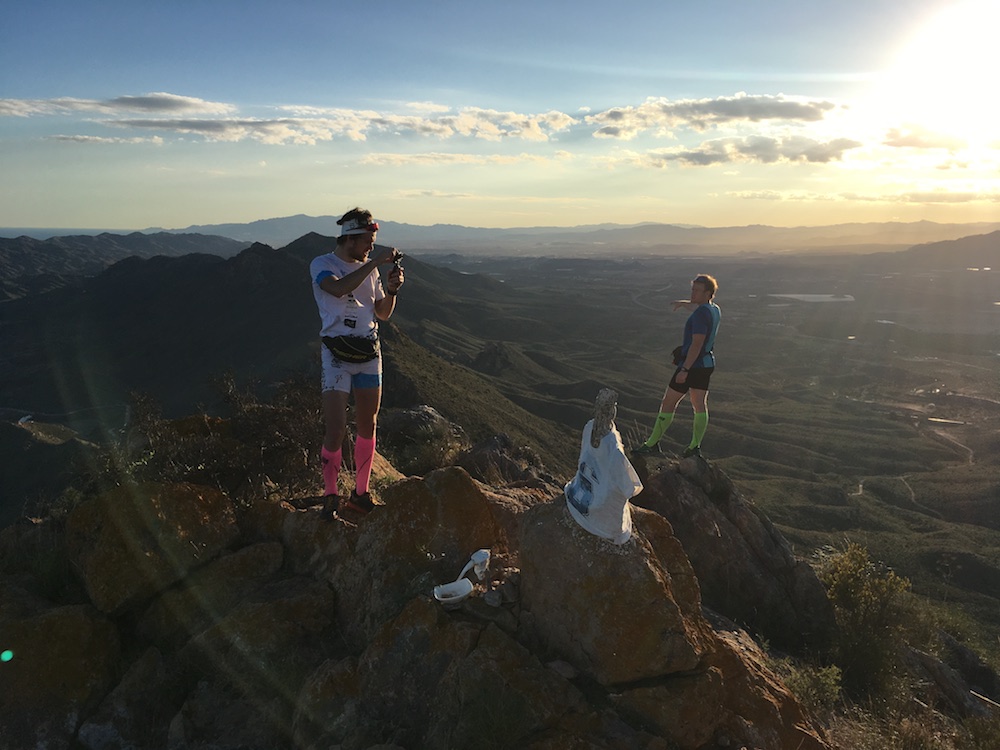
An evening run with teammates Erland and Eirik during Team Asker’s 10-day training camp in Mar de Pulpi, Spain, in October. (Photo: Erland Kvisle)
People don’t understand how to talk about mental illness. If it’s in your head, then it’s not real, so get over it, right? When someone is functioning at a seemingly normal level on the surface, it is hard for people to recognize all mental illnesses as real issues. Excuses for unexpectedly poor races can be found everywhere, from eating the wrong thing for breakfast to having difficulty clearing lactate. For every race there’s a new excuse, something simple that can be easily improved on for the next race, but the subject of mental illness is never brought up. Everyone wants to hear the story behind your broken leg, but people have been taught to tip-toe around the subject of mental health. “Be considerate. Make sure you don’t offend him. She’s sick in the head. He’s really delicate. You can’t talk to her like a normal person.”
Not everyone wants to talk about their mental health issues, but many need to. When I decided to try to improve my mental health, I was afraid to talk to others. I wanted to talk to someone, but I didn’t want to burden those that I care about with the things that I thought about myself. I am generally a happy person and I did not want people to see me as anything less than that. What I really wanted was to talk to someone straight up: “Hi, I’m Maks. I’m a happy person who loves life, but for some reason I often hate myself.” I didn’t want to see the scared or awkward looks in the eyes of those I care about as they struggled to look for something positive to say. I didn’t want pity. I didn’t want someone to tell me something positive. I needed to talk logically about what I feel, why I feel it, and what I can do to control those things.
I desperately needed a third-party person, someone with whom I didn’t share a connection and with whom I could talk openly without affecting their happiness. This led me to seek the help of a psychologist.
Seeing a psychologist isn’t like getting a flu shot. Part of my brain thinks in a certain way, and that can’t be fixed. I can’t hide or run away or fight it. What I can do is acknowledge what I am feeling and what it makes me want to do. Seeing a psychologist was a relieving experience for me. Instead of feeling an unclear jumble of emotions constantly tearing me apart, I could talk with someone about exactly what I felt and how I could be happy and productive in the face of how I felt.
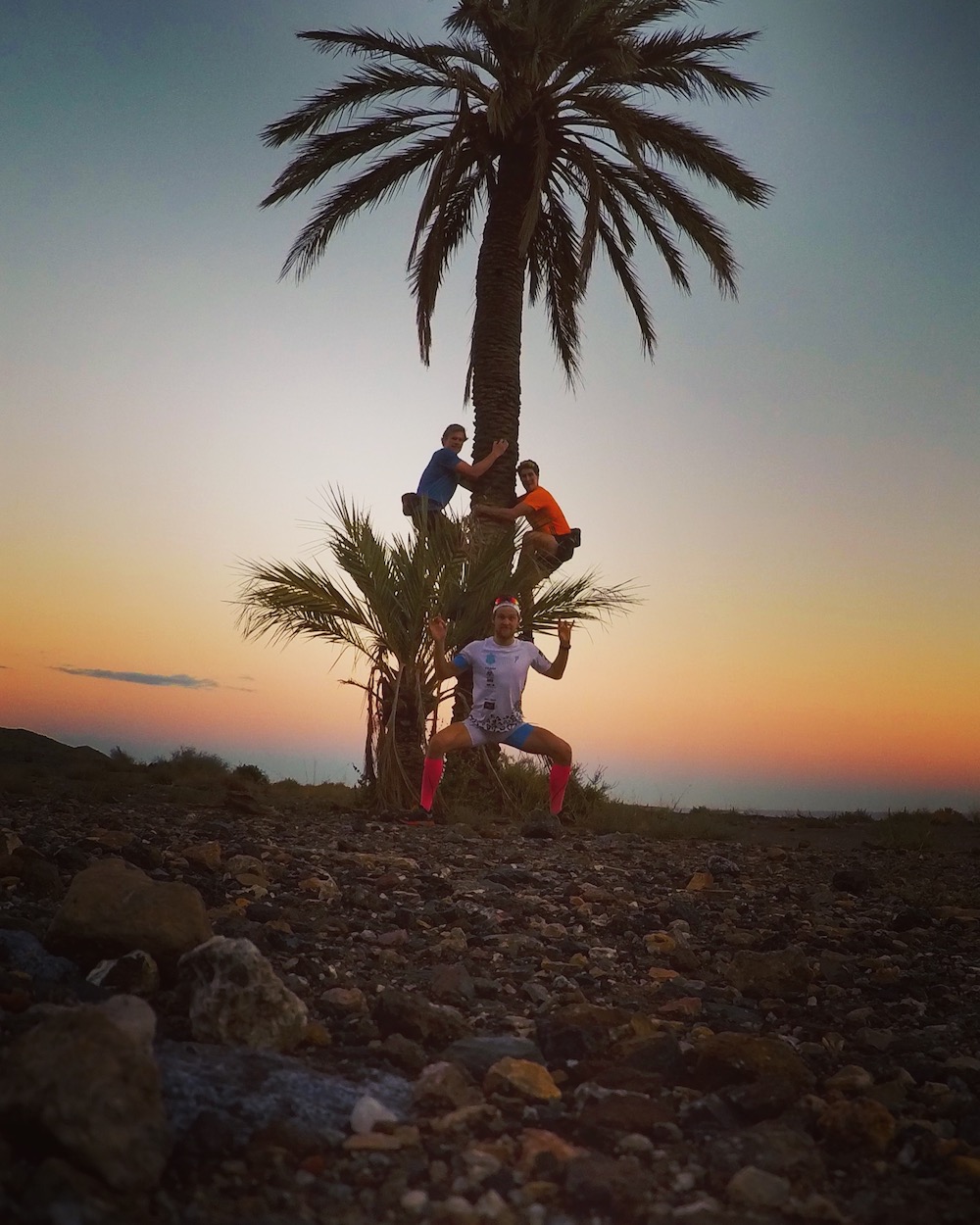
Spain sunsets (Photo: Maks Zechel)
Now when I feel an incessant urge to train in a way that is unhealthy, I recognize that urge, I think about what it is that I want to do, and then I give that thought space to dissolve in my head. For my issues, it has been more productive to allow these destructive thoughts to enter my head and to think about them, rather than clenching my teeth, pretending that they don’t exist and training myself into the ground. I train out of need, but I also train because I love it. The key to finding a balance between my dependence on training and doing it because I love it has been to think about the driving force behind why I train each day. Categorizing the motivations behind my actions has helped me to do what is best for my health and progression as a skier. This allows me to think positively and rationally with focus. Allowing space in my head to understand why I feel the way I do has been more effective for me than beating these thoughts away with artificial positivity.
If you’re reading this, then you probably really love skiing. It’s OK, I love skiing too, and I am happy to admit that it is one of the most important things in my life. But if I want skiing to continue to be a big part of my life, I can’t let it harm the rest of the person that exists beyond skier-Maks. Ski-racing careers can last a long time. I am lucky enough to have grown up around athletes and coaches who have proven that you can train and race for life, but in order to do that you have to take care of yourself. We skiers are competitive creatures, but acknowledging a mental health issue doesn’t have to mean giving up in defeat. The greatest skiers are those that understand their bodies, training, equipment, and minds the best. Each of our bodies is different, but that doesn’t prevent anyone from achieving their goals, and the same goes with our mental health.
Norwegian Phrase of the Week:
Norwegian: Gi drømmer en sjanse.
English: Give dreams a chance.
***
About Maks: Maks Zechel is a competitive cross-country skier who secretly wants to become a professional mile runner. He loves hiking and going on canoe trips with his family, as well as peanut butter cups in ice cream. Johan Olsson is his favourite skier and he hopes to race the Cortina-Toblach stage of the Tour de Ski one day. He enjoys writing about his experiences. Follow him on Instagram @makszechel.
Way back it seems now, in 2012, an op-ed appeared in The New York Times. Titled “The ‘Busy’ Trap,” the op-ed is a serious and somewhat comical riff on how ‘busy’ we all are. If your day’s schedule is defined by overscheduled, then you too are ‘busy’.
In this episode of Nordic Nation, we interview Astrid Uhrenholdt Jacobsen. At 30 years old, Jacobsen is a longtime member of the venerable Norwegian national ski team — and she’s truly busy. Her career on the World Cup has spanned a decade, bookended by her first World Championship medal in 2007 in Sapporo, Japan (a sprint), and three 2017 World Champ medals in Lahti, Finland. There, Jacobsen placed third in the 10-kilometer classic and 30 k skate and was part of the winning 4 x 5 k relay.
Norway’s Astrid Uhrenholdt Jacobsen on her way to bronze during the women’s 10 k classic at the 2017 Nordic World Championships in Lahti, Finland. (Photo: John Lazenby/lazenbyphoto.com)
If you’re too busy for this episode of Nordic Nation, hook up the headphones, go ahead and multitask — carve out 51 minutes and 51 seconds for the Astrid chronicles.
The all-Norwegian women’s 30 k freestyle mass start podium at 2017 World Championships in Lahti, Finland, with Marit Bjørgen (c) in first, Heidi Weng (l) in second, and Astrid Uhrenholdt Jacobsen (r) in third.
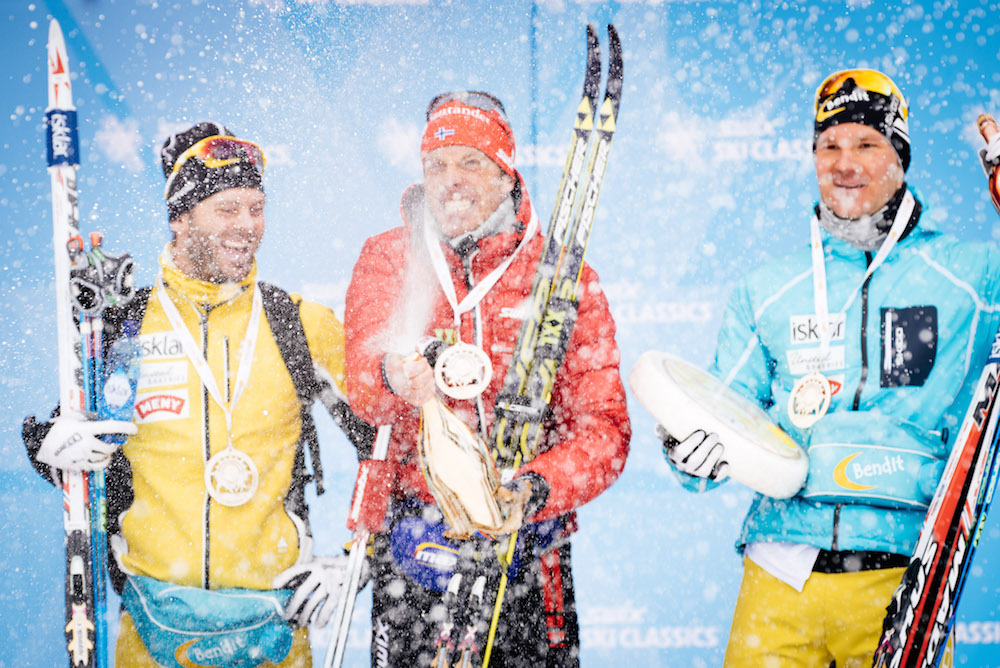
Øystein Pettersen (right) of Team United Bakeries after placing third in the 2014 La Sgambeda Ski Classics race in Livigno, Italy, behind Team Santander’s Anders Aukland (c) and Team United Bakeries teammate Johan Kjølstad (l). (Photo: Ski Classics)
Norwegian cross-country skier Øystein Pettersen posted the following essay on his Facebook page last week. He felt a need to respond to discussion about doping (or not) by the Norwegian national ski team after the cases of Therese Johaug and Martin Johnsrud Sundby. With his permission, we are posting an English translation for the North American ski community.
“I am glad that some are interested in the truth and not only speculation,” Pettersen wrote in an email to FasterSkier. “I have nothing to hide and am more than willing to answer any questions.”
Pettersen, age 33, is currently a member of the newly-formed BN Bank Ski Classics team. Nicknamed “The Sausage” (“Pølsa”), he previously represented Team United Bakeries, won the 2015 La Diagonala and finished third in the Marcialonga. Before that, he was a member of the Norwegian national team, where he accumulated six World Cup sprint podiums and won Olympic gold with Petter Northug in the 2010 team sprint in Vancouver, British Columbia. Despite being Norwegian, he says that his favorite Ski Classics event is Sweden’s Vasaloppet.
***
“There is a wind blowing in Norwegian cross-country skiing.
It blows on many fronts and it is equally sad as it is self-inflicted. I will not say anything about the cases in question, for the simple reason that I have no idea what has happened. I won’t comment on anything about the handling of cases. It is not my responsibility, and the last thing this debate needs is yet another expression of opinion without enough knowledge. But I feel it’s appropriate to talk about how I experienced my time in Norwegian Ski Federation (NSF) and how my practice was around these doping regulations.
Short backstory, I have been skier my entire adult life. Never been the world’s best, perhaps never will be. Eight years in the national team at senior level, and been on a number of other teams out there.
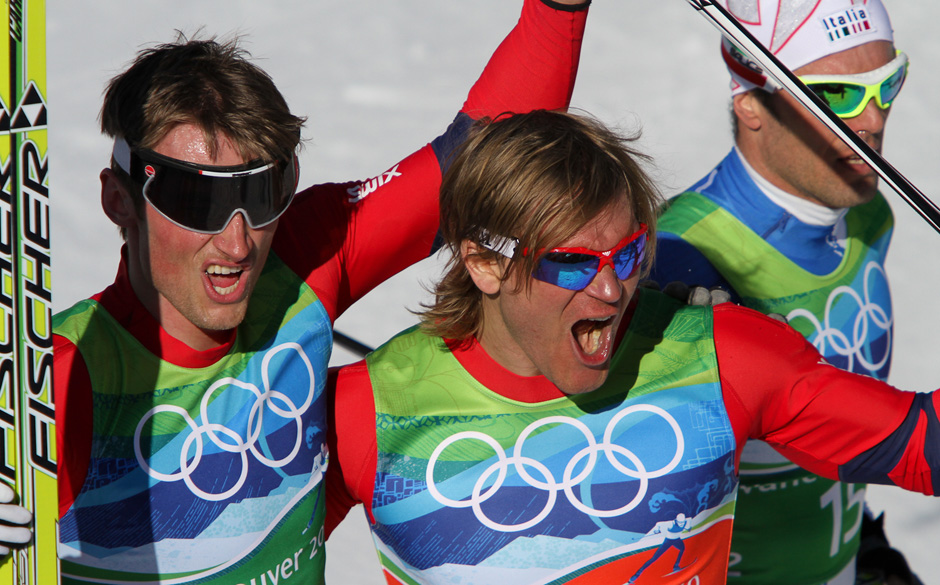
Petter Northug (l) and Øystein Pettersen celebrate their gold medal in the 2010 Olympic team sprint.
In today’s VG I was interviewed and yes, it’s true that what happened Therese could have happened to me. Call it naive, call it irresponsible, call it whatever you want, but I never checked anything I got from the doctor during my time on the national team.
The reason for this? As long as I have known it, the culture of cross-country Norway has always been founded on hard and honest work. Doping and bending the rules have never been accepted. For this simple — but also strong — reason, I never had any reason to believe that I would ever be breaking doping regulations by taking something I got from my NSF doctor. I salute the support I received from the federation. They worked like crazy for me to have the best possible conditions to be able to reach my sporting goals.
Doping was never even an issue. It was never a case of bending the rules or trying to take advantage of regulations. If I was sick and needed antibiotics, it was never in my mind that I would get something that was not allowed. The same was true, for example, with anti-inflammatory agents I might need for overuse injuries. Or asthma medicine for that matter. (Ed note: Pettersen has taken asthma medication since he was a child.)
Call it blunt, call it naive, call it irresponsible of me, call it what you will. I look at it as trust, respect, and I never had any reason to doubt.
The consequences for Johaug sadly have become catastrophic from a simple human error. I will not judge anyone, speculate or place blame. I’m just saying that if my doctor had made the same mistake, I also would been caught in the same trap.
NSF’s support is fantastic. My experiences were so positive that I became lazy. It is perhaps the only objection against the system. In my case, it led to the situation I never made extra checks.
I do not know if this was only the case for me. Maybe I’m the laziest of everyone, but it gets to my second comment.
What I know is that as I write this, I am dealing with an inflammation in my heel. In connection with this injury, I was prescribed an anti-inflammatory agent by a sports physician here in Lillehammer. He knows who I am and what I stand for, I know the same about him. I did not check if there was anything frightening in the package he gave me. Had the Johaug case not come up, I probably wouldn’t have even considered it either.
This case is a “wake up call” for all athletes to take responsibility for what we use.
When I look at NRK and see that 24 percent of you (the Norwegian public) think Norwegian cross-country skiers are doping, it makes me sad. But I can understand that you doubt in light of recent events. Therefore, I am very interested in being open. Is there anything you or the media are wondering about around my training, my use of medication, my routines involving ski racing? Do not hesitate to contact us.
There are sides of Norwegian cross-country skiing that are not so positive. Eating disorders, overtraining, stress, pressure, the equipment arms race and much more. But doping, this is not part of the Norwegian cross-country sport. If it is, I am the most naive, blue-eyed soul and I will retire from the sport immediately.
Now I’m going out to train. I love the cross-country skiing lifestyle and I love its development.
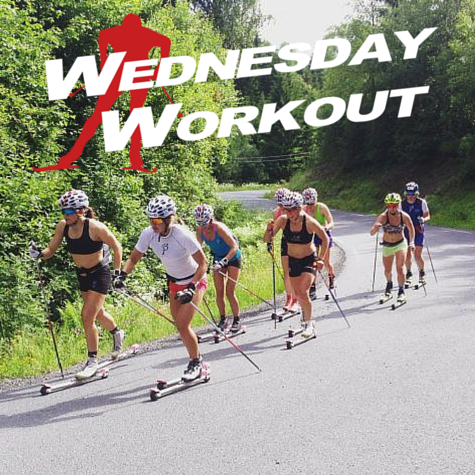
The Norwegian national women’s team and U.S. Ski Team member Jessie Diggins (second from right) during a classic rollerski workout late last month in Norway. (Photo: Roar Hjelmeset)
Update: This article formerly read that the Norwegian national team training camp took place in Farstad, Norway. The camp was actually held in Svarstad Vestfold, Norway and the article has been updated accordingly.
Booking a plane ticket for a 10-hour overnight flight seldomly stirs airline passengers to jump for joy. Yet when current U.S. Ski Team member Jessie Diggins clicked the ‘buy’ button for a red-eye flight to Oslo, Norway, departing June 18, she couldn’t contain her excitement. The Afton, Minn., native had spent plenty of time lunging to the line competing against Norway’s fastest nordic women, but the opportunity to work out with them as a training partner and short-term teammate was altogether new.
Diggins’s Norwegian Ski Federation (NSF) camp invite stemmed from a conversation she had with Norway’s women’s coach at the time, Egil Kristiansen. Following the final races of the Ski Tour Canada this past March in Canmore, Alberta, Diggins, 24, approached Kristiansen and asked about the possibility of joining one of their camps. Despite his initial response, she remained determined in convincing him the value of international shared training experiences.
Norway’s Ragnhild Haga (l) and Maiken Caspersen Falla (r) with U.S. Ski Team member Jessie Diggins at the top of a mountain hike during one of the Norwegian team’s camps in late June. (Photo: Jessie Diggins)
“I said, ‘Hey, you know I’m always looking for ways to make summer training exciting, new and adventurous, and if you have a spot open at any of your camps, I would really love to come,’ ” Diggins recalled on the phone Monday, back at her training base in Vermont.
“The coach laughed, and then I was like, ‘No, I promise I’ll have a great attitude.’ And we started talking and he was like, ‘You know, we we’re actually thinking we might start inviting a new athlete to camps,’ ” she explained. “Previously the [Norwegian team] never really did that.
Three months later, Diggins found herself opening a forwarded email from the new Norwegian women’s coach Roar Hjelmeset with a list of available national-team camps for her to attend.
“They sent [U.S. women’s coach] Matt [Whitcomb] the official [invite] … and I booked my ticket the next day,” Diggins said. “I flew to Oslo on the night of the 18th … and I stayed with Astrid [Uhrenholdt Jacobsen] then I drove with her and Roar to the camp.”
Diggins kicked off her weeklong adventure with a rollerski in Drammen, Norway, the site of her first World Cup race before the Oslo World Championships in 2011.
“It was really funny that my first World Cup race happened to be this place where I was [now] coming to do intervals with the Norwegian girls,” Diggins said.
After that, athletes piled into the vans and made the remaining 45-minute drive up to Svarstad Vestfold, Norway, where the rest of the camp took place. During the next six days, Diggins immersed herself in the team’s workouts, discovered the difference between the Norwegian women’s training plans and those of the U.S. women, and baked banana bread with the team.
“If you’re a guest at a camp, you go there willing to work,” Diggins said. “At least I can do that. I’m willing to work, I’m ready to be there, I’m ready to just be jumping. Whatever they do, I’ll do, too. And that was really fun; that was the best part … I just tried to be as much a part of the team as possible.”
Team ‘Norge’ Sample Workout: Distance rollerski, ending with pickups
Length: 2 hours
End with: Set of 5 x 10-second pickups, done about three-fourths of the way through the workout. Start head-to-head for the pickups.
Diggins’s Top-Three Takeaways from Training with Norway:
1. Training is Training. “The biggest thing I found out right off the bat was that there really ARE no training secrets. In all the big ways, we train exactly the same as the Norwegians, which was really awesome (and reassuring) to find out,” Diggins wrote in a blog post. “The training plan for the camp was almost identical to one we would have at our training camps – a mix of long slow distance training, L3 and L4 intervals, strength and speed training.”
2. Don’t Be Afraid to Take Charge. According to Diggins, the Norwegian women hold eight camps throughout their training season, with two weeks “on their own” in-between. Post-training camp, the Norwegian women evaluate their own needs and write their own training plans for those two weeks in between camps. “The Norwegian girls, they are their own main coach in between camps,” Diggins said, “which I think is really cool because at the end of the day, you are the one in your body. You’re the only one who knows, oh, my legs are really tired, I shouldn’t do bounding I should just double pole or something. So I think it’s really cool that they take charge that way.”
3. Tally Your Worth as a Teammate. “The skill and ability to be a great teammate is often under-valued but can make the biggest difference in how you look back on your career and feel about your work as an athlete,” Diggins wrote on her blog.
Egil Kristiansen (l) announced his resignation as Norwegian cross-country women’s team coach earlier this week. Kristiansen has led the women’s team for the last 10 years. (Photo: Skilandslaget/Facebook)
Proud moments are not always performance based. After leading the Norwegian women’s cross-country team to 47 World Championship and Olympic medals — for a total of 23 gold — over the past 10 years, it was not the results that have meant the most to Egil Kristiansen, the Norwegian national team women’s coach who announced his resignation Sunday via a team press release. It was the pressure he, his athletes, and Norway put on others to push themselves in the sport.
“It’s actually what we have managed to achieve,”Kristiansen told NRK, according to a translation, of his proudest coaching moment during the last decade with the team. “Managing to keep the pressure up, regardless of whether the results are bad or good; to do the damn job one hundred percent anyway. Not being dragged down by a poor outcome, or about to take off for good results. To paint on paint anyway.”
Kristiansen, 50, began heading up the women’s team in 2006, after working as an assistant coach under Svein Tore Samdal. The next 10 years are history.
In 2009, Kristiansen coached the now-retired Kristin Størmer Steira to silver in the women’s 15-kilometer pursuit at World Championships in Liberec, Czech Republic.
In 2010, he helped Norwegian Marit Bjørgen to her first Olympic gold at the Vancouver Olympics in the women’s classic sprint. She went on to achieve four more medals at those Olympics after that, including two more gold. Prior to Vancouver, Kristiansen worked with Bjørgen for 10 years and would work with her for five more.
“Egil has meant a lot to me,”Bjørgen told VG.no during a press conference, according to a translation. “There has been a security for me to have him there … He’s been a crazy good leader, a manager type that has gathered the group.”
Beyond Bjørgen and Størmer Steira, Kristiansen has worked with numerous other Norwegian superstars, including Olympics or World Championships medalists Therese Johaug, Maiken Caspersen Falla, Heidi Weng, Ingvild Flugstad Østberg, Vibeke Skofterud, and Astrid Uhrenholdt Jacobsen.
Norway’s “Coach of the Year” in 2011, Kristiansen said he’s ready to move forward and feels the the Norwegian women’s team should as well.
“I feel privileged to have worked with the world’s best cross-country skiers,” Kristiansen told Aftenposten, according to a translation. “But I’ve determined that it’s time to move on. As a coach, it is difficult to always give one’s best to the same group athletes over many years. Therefore, I believe this is the right time to resign, and it will help the athletes receive new inspiration.”
Norwegian women’s sprint coach Roar Hjelmeset calls out to Therese Johaug as she races to bronze in the 10 k classic at the 2014 Sochi Olympics.
There is no official word as to who will look to replace Kristiansen’s shoes. Women’s sprint coach Roar Hjelmeset has said he’s interested in filling in, but only for a year.
“I‘ve said I want to be national coach a one year period for women. The problem is that they were looking for someone who can train [through the] Olympics in 2018,” Hjelmeset, who first coached national-team juniors in 2008 then the women’s sprint team since 2011, told NRK.
National team director Vidar Løfshus indicated that Kristiansen’s successor must be willing to make a commitment through the 2018 Winter Olympics.
“I was prepared that [his decision] could go either way, hoping of course that he would continue,” Løfshus said to Langrenn, according to a translation. “To sum up his time as coach of the national team will be the one long tribute.”
Hetland Takes Over Norway’s Men’s National Team
Kristiansen’s resignation is not the only change in the nexus of Norwegian nordic skiing. Tor-Arne Hetland was hired this spring as the new men’s cross-country coach.
Tor-Arne Hetland was a Swiss sprint coach from 2010-2014, then coached the Canadian World Cup Team for a season (2014/2015) before taking an assistant coaching position with his alma mater, the Norwegian national team. He is now the Norwegian men’s head coach. (Photo: FIS)
A 2002 Olympic gold-medalist sprinter, Hetland, who competed for Norway, previously worked as a national coach for Germany, Switzerland and Canada before assisting the Norwegian team last season under former men’s coach Trond Nystad.
“Trond has been generous and given me great responsibility allround team this season,” Hetland told Skiforbundet,according to a translation. “I want to continue a culture where athletes together take responsibility for their own training and development. Created to be the best trained and set a standard that new generations of skiers want to strive for. I look forward to continue working with the team and with the rest of the support develop each athlete so that they can bring out their maximum potential.”
The outgoing coach for the Norwegian men’s cross-country team Trond Nystad fields questions at the 2014 Sochi Olympics
Nystad, 45, had been the head coach for the men since 2011, working with his twin brother Knut Nystad, Norway’s head wax technician. Trond had previously coached the U.S. and Swiss teams.
Nystad’s contract with the team ends May 31. Earlier this month, he dispelled rumors that he would advise Russia’s Alexander Legkov this winter. Rather, after spending what he estimated to be nearly 250 days on the road in the last five years, Nystad wanted to focus on being a dad.
“Nothing is certain, nothing is excluded, but in relation to their family situation is probably not wise to continue with 240-250 days of travel,” he told NRK. “But I still want to work with sport.”
Petter Northug Jr. racing the 15 k freestyle at the 2015 World Championships in Falun, Sweden. It was by far his worst showing at a world championships: he placed 62nd. (Photo: Fischer/NordicFocus)
About a month and a half after the Norwegian ski federation said it was effectively done with Petter Northug Jr., both sides have come to agreement and, you guessed it, Northug is back on the national team.
“This agreement gives me the sporting freedom I need to win more ski races and take more gold for Norway,” Northug said in a press release earlier this week. “My goal is to go ski fast for Norway on World Cup this coming winter and in the major championships that will follow.”
Petter Northug Jr. in Falun, Sweden. (Photo: FIS/NordicFocus)
Northug’s three-year contract with the Norwegian national team was announced Sunday, and effectively outlines the same terms of his agreement with the team last year. The stumbling point since this spring has been that Coop, Northug’s main sponsor, wanted the 13-time world champion and two-time individual Olympic champ to wear its logo year-round.
When it comes to uniforms and private sponsorships, the Norwegian team does not make exceptions for any of its athletes, and it argued that it would not bend to Northug.
While the federation didn’t cave, it kept the communications lines with Northug open longer than it initially planned. Negotiations remained on the table, and ultimately, the team secured a contract with the 29 year old starting this season and lasting through the 2018 Olympics. Per the agreement, he will be allowed to wear all things Coop from early spring until the season starts in late November, for the next three years.
But all the loose ends aren’t necessarily tied up.
Northug and the national team have different clothing suppliers, and the federation reportedly wants him in the team’s sponsor — Bjørn Dæhlie — rather than Swix, his personal supplier.
“He’ll have to give up his deal with Swix,” Stein Opsal, the federation’s secretary general, told Adressa. “That was an important point in going from a one-year to a three-year agreement.”
According to NewsInEnglish.no, Northug’s manager, Are Sørum Langås, interpreted it differently, saying that Northug should be able to wear Swix outside the race season.
“That’s what the agreement says,” Langås told Adressa. “We will abide by the agreement.”
Petter Northug anchoring the Norwegian men’s relay to gold at the 2015 World Championships in Falun, Sweden. As of Sept. 14, 2015, Northug is no longer part of the Norwegian team and will not be able to compete on the World Cup or Tour de Ski this season. (Photo: Fischer/NordicFocus)
Petter Northug, his manager, Åre Sørum Langås, and company are taking a hard look at the season ahead after they failed to reach an agreement with the Norwegian ski federation. The federation announced Monday that it would move ahead with planning its 2015/2016 season without Northug after the 13-time world champion and two-time Olympic gold medalist turned down its offer to let him compete with the same “athletic freedom” as last season, according to NewsinEnglish.no.
Instead, the national team is focused on “those skiers who have signed an agreement” with the federation and it will not take “any further initiative towards Petter Northug” or his primary personal sponsor, Coop, a Norwegian grocery store chain.
All of this means the 29 year old won’t ski for Norway at the World Cup or Tour de Ski this season, and without the team’s blessing, he won’t be able to compete at all.
At a board meeting last weekend, Torbjørn Skogstad, head of the federation’s cross-country committee, told the federation that neither Northug nor Coop accepted the terms drawn up in June, which were the same as last year and would have allowed him to keep his corporate sponsorship with Coop until the start of the season in November, according to the federation. After that point, “he then would have to commit himself to the national team and its sponsors throughout the season [until April], with the same rights and obligations as all the other skiers on the team,” according to the federation.
For now, he’s off the national team, and based on previous musings to the media, Northug could be racing marathons exclusively this winter.
His manager, Langås, told NRK that they are waiting to issue an official response to the federation’s decision.
“We register that the ski federation has issued a press release,” Langås said. “We will come with an accounting of this in a few days. Apart from that I have no comment today.”
Marit Bjørgen (c) led a Norwegian sweep of the 2015/2016 Tour de Ski podium, with teammates Therese Johaug (l) and Heidi Weng (r) placing second and third, respectively. They finished the season in that order as well, with Bjørgen winning the overall World Cup, Johaug placing second and Weng placing third. (Photo: Val di Fiemme World Cup)
Lately, life is looking a little different for Marit Bjørgen, Norway’s most decorated female cross-country skier. The six-time Olympic gold medalist and 14-time world champion is due to have her first child in December. While Bjørgen, 35, won’t officially be a mom until then, if you ask her teammates, she’s already filled the role.
Heidi Weng grew up watching Bjørgen. Now 24, Weng as one of the most competitive women on Norway’s national team is hoping to make the next leap in the overall World Cup standings without Bjørgen to contend with.
“I’ve learned from a lot of people, but I think I’ve learned the most from Marit,” Weng told the Norwegian newspaper Aftenposten in August. Weng finished third overall last season; Bjørgen won the 2015/2016 World Cup outright and their teammate Therese Johaug placed second.
“Heidi has always been very close to Marit Bjørgen. Bjørgen is like a mom to her,” Weng’s mother, May Bente Weng, said.
“I think it’s like that for a lot of us on the team,” Weng explained. “[Marit] is the one who has been in the game the longest, and she has solid routines for everything. She is very confident. It’s not just me saying this, most of us think that.”
Norway’s Marit Bjørgen striding to a 17-second win in the final classic distance race of the 2014/2015 season, the women’s 10 k classic on March 8 at the World Cup in Lahti, Finland. (Photo: Fischer/NordicFocus)
Like most of her teammates, Weng has learned from Bjørgen by chasing her in workouts and mimicking her technique.
“Technically, I’ve become a much better skier. Skiing behind her has helped me a lot,” said Weng, who’s focusing on the Tour de Ski in January and the Canadian World Cup tour in March.
Meanwhile, Bjørgen, headed into her third trimester of pregnancy, has backed off the hard workouts and, according to Aftenposten, plans to join a few more camps before easing off more.
“I think we’ll do fine without her,” Weng said. “It’s not like we lose her. But it will be strange that she’s not there on all the workouts and that she wont be winning all the races.”
But she will be back — with 2017 World Championships as her main target — and plans to compete again as soon as 10 weeks after giving birth.
“I hope to be back as early as March,” Bjørgen told NRK last week during a team camp in Livigno, Italy.
“I think it certainly is possible, but it is difficult to say in advance,” she said more specifically of her return to racing in that time. “I am in very good shape, and I don’t think it will mean much losing three months of training.”
She’ll focus on racing closer to home first, which means the Tour of Canada is probably out. Bjørgen told NRK she thought it was a “shame” to have the final World Cup races in Canada.
“It could instead be in Holmenkollen, Falun and Lahti in March, but that’s not the case this year,” she said, according to a translation. “To travel to Canada with a little one … I will probably be back in Norway.”
She added that it’s tough to prepare for the unknown.
“I’m going into something completely new,” she said. “Getting a small child means a new life. It changes a lot. But I have a plan to get back to the World Championships in Lahti.”
Kristin Størmer Steira (second from l) with the Norwegian gold-medal relay team at 2013 World Championships with teammates Marit Bjørgen (l), Therese Johaug (second from r) and Heidi Weng in Val di Fiemme, Italy.
Last Monday, April 20, Norwegian national-team veteran Kristin Størmer Steira, 33, announced her decision to retire following several seasons of injuries and illness, the most recent of which came just prior to 2015 World Championships in Falun, Sweden, and kept her from racing the 30-kilometer classic mass start there.
“I’ve experienced so much as a cross-country skier and I love ski racing, but the time has come to find a new track. And that won’t be a ski track,” Steira said in a translated team press release.
“I feel privileged to have had the chance to work with the best ski racers and coaches in the world,” she added. “There have been rough times, sacrifices, blood, sweat and tears too, but those are valuable experiences that I will carry with me.”
And she will be missed, by both her teammates and coaching staff.
“I am sad to see her quit now,” Marit Bjørgen told TV2. “Kristin and I have been teammates since 2003, so it will be strange to continue without her, but I respect her decision. She has meant so much to me, both as a teammate on the course and as a friend outside the track, and she has been an important part of Norwegian cross-country skiing for over a decade.”
“She has been an important part of Norwegian cross-country skiing for over a decade.” — Marit Bjørgen, on Norwegian teammate Kristin Størmer Steira’s retirement
“Kristin is not only a solid skier. She is a fantastic person with a great personality and contributes to a positive atmosphere wherever she goes,” said national-team director Åge Skinstad.
During her career, Steira participated in three Olympics: 2006 in Turin; Italy, 2010 in Vancouver, Canada; and 2014 in Sochi, Russia. She earned an Olympic gold medal in the relay in 2010, and her first individual Olympic medal in 2014 with bronze in the 30 k freestyle mass start.
Kristin Størmer Steira after taking bronze in the 30 k mass start at the 2014 Olympics. (Photo: FIS)
Steira competed in six World Championships: 2003 in Val di Fiemme, Italy; 2005 in Oberstdorf, Germany; 2007 in Sapporo, Japan; 2009 in Liberec, Czech Republic; 2011 in Oslo, Norway; and 2013 again in Val di Fiemme. During that time, she helped Norway win three World Championships golds in the relay in 2005, 2011 and 2013. Additionally, she earned four individual World Championships medals: two silvers in the 30 k classic mass start in 2007 and 15 k pursuit in 2009, as well two bronze medals in the 15 k skiathlon in 2005 and 15 k pursuit in 2007.
She also holds two individual Norwegian national titles in the 15 k pursuit in 2014 and the 30 k classic in 2010, along with two silver and three national bronze medals.
Steira first entered the World Cup circuit in 2002, when she raced the 30 k classic on home turf in Holmenkollen and came in 46th. She started 181 World Cups, tallied six individual World Cup victories and reached the World Cup podium 22 times.
Kristin Størmer Steira racing in the 10 k classic mass start at 2012 World Cup Finals.
In 2012, the national team sidelined her in the middle of the season due to weight concerns, with a BMI under the team’s minimum limit. She told NRK that she has fought weight problems throughout her career.
“It is something that has been challenging for me through my whole sports career. I’m naturally thin, and when I train my body reacts with that I lose weight,” she said, according to a translation. “I have worked hard, and it has been challenging since I have been on the border many times.”
She reiterated that she did not have an eating disorder and was happy to talk about the subject.
“People have wondered and I have tried to be as open about it as I could,” she said. “This is particularly true with teammates and the others we have worked with on the team … But it’s not something I feel … has been a major problem.”
For the rest of the spring, Steira will continue to study full time, stepping up her academic pursuits of earning a business degree. In July, she has a wedding date set with Canadian World Cup skier Devon Kershaw, and the couple hopes to start a family soon.
Marit Bjørgen won the overall FIS World Cup title for the fourth time in 2014-2015, also taking home the Sprint Cup and Distance Cup globes. She will headline the Norwegian National Team in the 2015/2016 season. (Photo: Fischer/NordicFocus.com)
Both Norway and Sweden announced their National Team picks for the 2015/2016 season Friday. The respective teams of the two rivals will see few changes in the upcoming year as both hope to either maintain or improve their team successes.
The Norwegians have nominated the majority of the 2014/2015 team, which won the year’s Nation’s Cup with 17,225 points – 11,364 points over the Russian Federation in second place. Headlining the women’s team is Marit Bjørgen who won her fourth overall World Cup title this year. The 35-year-old recently announced that she would continue to race the World Cup circuit, despite some uncertainty immediately after the season’s end.
“I have used the spring to think a little, and I am now sure that I’m a hundred percent ready to put down the work needed to continue my career,” she told Norwegian broadcaster NRK, according to a translation.
Missing from the women’s team roster are Celine Brun-Lie and Kristen Størmer Steira who both announced their retirements in recent weeks. Replacing the two will be Kari Vikagen Gjeitnes and Ragnhild Haga. Haga finished fifth overall in the World Cup standings and fourth overall in the 2015 Tour de Ski.
Petter Northug silences his critics after out-sprinting Sweden’s Calle Halfvarson in the 4 x 10 k relay at the 2015 World Championships. (Photo: Fischer/Nordic Focus)
The Norwegian men will be led by Martin Sundby, who won his second-straight overall World Cup title in 2014/2015. Sundby had a strong start to the season but was unable to demonstrate his top form at the 2015 World Championships in Falun due to illness.
Norwegian superstar Petter Northug was notably left off the list due to his contract with the grocery store chain Coop and its team. While there is little information as to negotiations between Northug and the Norwegian National Team, Northug’s manager, Are Sørum Langås, recently said that the four-time 2015 World Championships gold medalist had a plan for the season that would satisfy his needs.
The men’s sprint team remains identical to the 2014/2015 season. Hans Christer Holunder and Niklas Dyrhaug are the only additions to the all around team.
According to Head Coach Vidar Løfshus, selection for the team began during the 2015 World Championships and that they aimed to have the team feature roughly 25 skiers. Friday’s announcement names 24 skiers to the team.
“The challenge has been to put together the best training groups in the men. We have spent time discussing and thinking to managed and achieve the best ability. It is about finding out that training program tailored to each athlete best,” Løfshus explained to FIS.
Norwegian National Team:
Ladies
Marit Bjørgen, Rognes IL
Maiken Caspersen Falla, Gjerdrum IL
Kari Vikhagen Gjeitnes, Henning Skilag
Ragnhild Haga, Åsen IL
Martine Ek Hagen, IL i BUL
Kathrine Rolsted Harsem, IL Varden
Astrid UhrenholdtJacobsen, IL Heming
Therese Johaug, Nansen IL
Heidi Weng, IL i BUL
Ingvild Flugstad Østberg, Gjøvik Skiklubb
Men allround
Niklas Dyrhaug, Tydal IL
Pål Golberg, Gol IL
Hans Christer Holund, Lyn Ski
Chris Jespersen, IL Korlevoll-Odda
Sjur Røthe, Voss IL
Martin Johnsrud Sundby, Røa IL
Simen Andreas Sveen, Ring IL
Didrik Tønseth, Byåsen IL
Men sprint
Eirik Brandsdal, Kjelsås IL
Sondre Turvoll Fossli, Hokksund IL
Anders Gløersen, Rustad Il
Ola Vigen Hattestad, Ørje IL
Finn Hågen Krogh, Tverrelvdalen IL
Tomas Northug, Strindheim IL
Sweden’s Charlotte Kalla racing to her first-career individual gold at 2015 World Championships in Falun, Sweden. Kalla won the 10 k freestyle by 41 seconds over silver medalist Jessie Diggins. (Photo: Fischer/NordicFocus)
Sweden
The Swedish National team also announced its National Team Friday. While the team did not have the success it aimed for in the 2014/2015 season it achieved third overall in the Nation’s Cup standings behind Norway and Russia.
Four-time 2015 World Championships medalist Charlotte Kalla will return as the team’s most anticipated skier. Sprinting star Stina Nilsson will also remain in the team’s rank to much fanfare.
Johan Olsson, Daniel Richardson and Lars Nelson will not return to the National Team in the 2015/2016 season. Olsson won the 15 k freestyle and earned two other podiums at the 2015 World Championships with a second in the 4 x 10 k relay and third in the 50 k classic.
According to Swedish National Team Head Coach Rikard Grip, his women are especially strong this year. He explained that the coaching staff aimed to create a team centered around maintaining the team’s status as one of the world’s best.
“We want to improve the quality of sprint training sessions and create opportunities for more and tougher challenges in racing similar situations, man to man and woman against woman,” Grip said to FIS.
Swedish National Team
Ladies
Charlotte Kalla, Piteå Elit
Anna Haag, IFK Mora SK
Ida Ingemarsdotter, Åsarna IK
Emma Wikén, Åsarna IK
Maria Rydqvist, Älvdalens IF
Stina Nilsson, IFK Mora SK
Sofia Bleckur, IFK Mora SK
Magdalena Pajala (sprint), Piteå Elit
Jennie Öberg (sprint), Piteå Elit
Hanna Falk (sprint), Ulricehamns IF
Men
Calle Halfvarsson, Falun-Borlänge SK
Martin Johansson, IFK Mora SK
Anders Svanebo, Stockviks SF
Marcus Hellner, Gellivare Skidallians
Simon Andersson, Falun-Borlänge SK
Emil Jönsson (sprint), IFK Mora SK
Teodor Peterson (sprint), IFK Umeå
Johan Edin (sprint), IFK Mora SK
Development teams
Ladies
Hanna Erikson, Åsarna IK
Anna Dyvik, Falun-Borlänge SK
Sofia Henriksson, Piteå Elit
Jonna Sundling, IFK Umeå
Evelina Settlin, Hudiksvalls IF
Linn Sömskar (sprint), IFK Umeå
Maja Dahlqvist (sprint), Falun-Borlänge SK
Maria Nordström (sprint), Ulricehamns IF
Men
Jens Burman, Åsarna IK
Marcus Ruus, Åsarna IK
Simon Lagesson, Åsarna IK
Axel Ekström, Garphyttans IF
Oscar Svensson, Falun-Borlänge SK
Carl Quicklund (sprint), Östersunds SK
Jesper Modin (sprint), Piteå Elit
Simon Persson (sprint), IFK Umeå
Anton Lindblad, Sollefteå Skidor (sprint)
Erik Silfver (sprint), IFK Umeå
Gustav Nordström (sprint), Borås SK
Norway’s Pål Golberg during the 15 k freestyle last month in Beitostølen, Norway. Golberg has spent significant time working on his skate technique this fall. (Photo: Inge Scheve)
Norwegian national-team member Pål Golberg rollerskis through the winter and plays golf as much as he can.
Golberg, 24, had his international breakthrough at the Lillehammer World Cup a year ago, when he won the 15-kilometer classic. This year, he came out with a similar fire, winning the opening sprint in the Lillehammer mini tour last Friday.
Norway’s Pål Golberg after winning his first individual World Cup race, the Lillehammer 15 k classic, in December 2013. (Photo: NSF)
While Lillehammer is home turf for Golberg, who skis for Gol IL and knows the trails like the back of his hand, he says there is nothing special about the venue. For him, it was simply a matter of racing well.
“There is nothing magic about Lillehammer. It’s all about nailing the tactics and having the best skis,” Golberg told FasterSkier on Saturday, after placing 12th in the Lillhammer 10 k freestyle. “But I like these trails. I’ve trained a lot here and I know the courses well.”
Furthermore, success at the World Cup level is the result of thousands of training hours over several years. Golberg believes in having a plan for every workout, and performing each session with dedication and purpose.
“Don’t just go out there to train. You need to know what you’re doing, how you’re doing it and why you’re doing it,” he said.
For him, these training goals vary from making sure he’s staying in specific training zones throughout the workout to more-specific technique assignments.
“Sometimes it’s just sticking to a specific heart rate, other times I tell myself that for 10 minutes every hour, I will have 100-percent focus on technique,” he said.
The secret to better technique
Golberg in a Nutshell:
Age: 24 Hometown: Gol, Norway Lives in: Lillehammer, Norway Ski Club: Gol IL Team: Norwegian National Team all-around Started skiing: As soon as he could walk Favorite workouts: Long distance in the mountains at home in Gol, and strength workouts consisting of one-hour uphill double pole on rollerskis followed by general strength in the gym Favorite place to ski: Golsfjellet, Norway, where he grew up skiing. Vast, open, uncrowded Favorite post-workout food: pasta with eggs or egg sandwiches – a good mix of carbohydrate and protein Hobbies: Playing golf, hanging out with friends, playing guitar
Leading up to this season, Golberg has put an extra effort into his skate technique.
“I’ve worked a lot on skating this fall, because I feel that this is an area where I still have a lot to gain,” he said. “I feel that my skating is more efficient now, so the effort is paying off.
“Skating, just like classic skiing, is fundamentally all about balance and coordination,” he added. “So doing a lot of no-pole skiing and working on gliding as long as you can on one ski fully committed with all of your body weight are good exercises for everyone, whether you are at the World Cup level or just getting into skiing.”
Favorite workout
Golberg has several workouts he likes a lot. In the winter, he loves long-distance workouts in the mountains near his home in Gol, Norway.
“You can ski really far at Golsfjellet – all the way from Hemsedal to Nesbyen, which is a long ways,” he said. “Maybe it’s because its home, and I don’t get to be home all that often, but I really think Golsfjellet is quite unique.”
Through the summer and fall, Golberg is fond of moosehoofing and bounding.
“Those workouts are really good for building capacity and technique at the same time. I put a lot of effort into this during the dryland season,” he said.
Year-round rollerskiing
And Golberg’s final key to success? Rollerskiing in winter.
Pål Golberg (l) skating to a 0.24-second victory over teammate Finn Hågen Krogh (2) and Russia’s Alexey Petukhov (3) last Friday in the men’s 1.5 k freestyle sprint at the Lillehammer World Cup. (Photo: Fischer/NordicFocus)
“I try to do at least one rollerski workout on the treadmill every week, all winter long. My favorite strength session consists of one-hour uphill double poling on rollerskis on the treadmill, followed by a general strength workout in the gym,” he said.
“The double poling delivers specific endurance strength, while the weights and core strength works makes it a very well-rounded workout.”
So where does golfing come in? Before focusing wholeheartedly on skiing, Golberg was an avid golfer. These days, he plays as often as he can. During the race season, that’s not very often, if at all, but in the summer he likes to get onto the green at least often enough to maintain his skills.
“I’m not sure if the skills are directly transferable to skiing, but golf does require a fair amount of coordination and technique as well,” he said.
“I also like to have something else to think about than just skiing and training, especially during times when things aren’t going as smoothly,” said Golberg, who’s put his business degree on hold for the time being.
Ingvild Flugstad Østberg racing to fifth in her first FIS race of the season, the 10 k skate on Nov. 22 in Beitostølen, Norway. (Photo: Inge Scheve)
Ingvild Flugstad Østberg, a 2014 Olympic gold and silver medalist in Sochi, has worked hard at becoming worse. More specifically, the 24-year-old Norwegian national-team member says she’s less obsessed with perfection and more focused on the overall picture.
Ingvild Flugstad Østberg in the mixed zone after the 10 k skate FIS race on Nov. 22 in Beitostølen, Norway. (Photo: Inge Scheve)
“I’ve gotten a lot of training advice through the years, and a lot of it centers around listening to your body and things in that direction,” said Østberg, widely considered one of the up-and-coming stars of the Norwegian women’s team after winning silver in the freestyle sprint at the 2014 Olympics and gold with Marit Bjørgen in the team sprint.
Østberg gladly shared her experience last Saturday after placing fifth in the 10-kilometer freestyle FIS race in Beitostølen, Norway.
“Maybe the best advice I’ve gotten, and something that definitely has stuck with me, is that you have to go for quality over quantity,” she said. “I used to just want to do more and more and more, and thought that would be better, but what you do really matters more.
“I really have to focus on separating hard workouts from easy workouts, so that I don’t end up with everything being somewhat hard,” she added. “Then you don’t have the juice to go really hard when you want to go really hard.
“Go hard when you plan to go hard, go easy when it’s an easy workout, and the more volume you do, the more important it is to distinguish. I can understand that people who just work out whenever they can get to it want to go somewhat hard to feel that they get something out of their workout. But for those who really train a lot, it’s not the way to go,” she said.
“Go hard when you plan to go hard, go easy when it’s an easy workout, and the more volume you do, the more important it is to distinguish.” — Ingvild Flugstad Østberg, to FasterSkier on Nov. 22
Østberg also tries to focus on what she’s doing when she works out.
“Don’t waste your workout time. Think about your technique in every push, every kick and every pole plant, and make them count.”
Ingvild Flugstad Østberg after finishing fifth in her first FIS race of the season, the 10 k skate on Nov. 22 in Beitostølen, Norway. (Photo: Inge Scheve)
Østberg didn’t race the 10 k classic on Friday, but saved her season debut for the 10 k skate, one of her favorite events. She finished fifth and gave herself a passing grade.
“This was a good trial, and I’ve never had my best races here at Beitostølen,” she said. “It’s still very early in the season, and I feel that I have more to offer.”
She hoped her performance Saturday combined with Sunday’s sprint (in which she went on to place fourth) would secure her a spot on the World Cup team the following weekend.
On Monday, the Norwegian national team made its formal announcement, and named as Østberg as one of 11 women on its Kuusamo World Cup team.
Kristin Størmer Steira (r) on the podium at the Sochi Olympics closing ceremony with teammates Marit Bjørgen (jumping) and Therese Johaug, after Norway swept the podium in the women’s 30 k freestyle mass start, the last cross-country race of the Olympics. (Photo: Wikimedia Commons)
Note: This article has been updated to include Kristin Størmer Steira’s most recent athletic accomplishment as 10,000-meter champion at Norwegian Athletics Championships on Sunday. It was her first time running the 10,000, according to VG.
***
If you asked Kristin Størmer Steira about the ‘R’ word six months ago, the Norwegian national-team member might’ve told you she was considering it.
A not-so-hot start to her third Olympics had left the then-32-year-old Steira contemplating retirement. Never before had she been outside the top 10 at the Olympics, and in two previous 15-kilometer skiathlons at back-to-back Olympic Games, she placed fourth.
Kristin Størmer Steira in 2012 (Photo: Wikimedia Commons)
But in Sochi, she was 23rd — not bad, but not to her standards.
Her next chance came in the 30 k freestyle mass start, the final race of the Sochi Games.
In a seemingly seamless race for three Norwegians, Steira placed third behind her two teammates Marit Bjørgen and Therese Johaug, respectively. It was her first Olympic medal in eight individual starts.
“My Olympics went from the worst competition I’ve ever had to maybe the best,” Steira said on the phone from Norway earlier this summer. “It was a special Olympics for sure.”
Before the races began, her team had to cope with the sudden passing of teammate Astrid Jacobsen’s brother, a skier whom many of the national-team members were close with.
“It was a lot of feelings, a lot of emotions,” Steira recalled. “We had a rough time in our team … but in the end, to have a medal in the 30 k … I really, really felt that I worked hard for that and to be able to do it when it counts was a great feeling.”
She also had the unique experience of standing on the podium at the closing ceremony in front of 40,000 spectators and millions more who watched on TV.
“It was maybe the best day for being on the podium,” Steira said. “You felt kind of small getting up on stage with the crowd and the stadium. I’ll never experience [that] again.”
One might ask, why not? With four individual World Championships podiums and 22 World Cup podiums in the last 12 years, and after placing second in the rollerski hill climb at the Blink Festival in Norway earlier this month, how does she know when it’ll be over?
She doesn’t, but she was thinking about it after Sochi.
“I was more towards not doing another year and I guess the medal in the 30 k both made me kind of feel [like] I could stop skiing — I managed to do what I planned to do: have a medal individually in the Olympics,” she said. “On the other side, it also makes you so motivated to do another year. I guess when I was thinking about it, it counted both ways.”
“I want to learn something other than classic and skating and technique, to put my mind a bit on other stuff and also start preparing for the next step — whatever that will be.” — Kristin Størmer Steira, Norwegian national-team member & three-time Olympian
So here she is, 33 and revving up for the 2015 World Championships in Falun, Sweden.
“It’s close to Norway,” she said of her decision to focus on Falun and race for another season. “I think it will be amazing [at World Championships] … a lot of people, but I guess in the end mostly the motivation was still there and I love skiing and I wanted to give it one more year, mostly because it was so fun.”
Kristin Størmer Steira rappels during their Himalayan trek. (Photo: Devon Kershaw)
In late April, she got sick during a three-week excursion in the Himalayas. She left Kathmandu with a ring on her finger, thanks to fiancé Devon Kershaw, but it took her some time to shake the parasite she contracted on her way up the 6,476-meter (21,000-foot) Mera Peak.
“Early summer was not quite as planned … I still struggled to recover after illness in Nepal,” she wrote on her blog.
After spending some time with family, “hiking, swimming, grilling,” she worked back into her full-training load before Blink and her team’s training camps in August.
Steira missed the women’s team’s June camp in Hemsedal because she wasn’t fully recovered, but was back with them in Lillehammer earlier this month. She said they planned to train in Italy in late August-early September, and will be back in Norway in October.
“We normally have been in Italy in the last week of June-first week of July, but since worlds is not at altitude we decided not to,” she said of the altitude camp.
On Sunday, she ran the 10,000-meter distance event at Norwegian Athletics Championships and won it by a minute and 46 seconds. Norway’s VG asked Athletics Association Director Ronny Nilsen whether that was embarrassing for the sport.
“No, it is not,” he said, according to a translation. “Kristin is strong, and there were several good runners that were missing at the starting line.”
Steira said “it was a pity” that so many top runners didn’t start, but it wasn’t embarrassing. She simply dropped the pack early.
“Ten-thousand [meters] is a distance that suits a skier well,” she told VG. “But athletes certainly wish there were more people to compete with.”
After the race, she tweeted that she was celebrating her 10,000-meter debut with coffee.
“Ten-thousand [meters] is a distance that suits a skier well.” — Steira on her 10,000-meter win in her debut at Norwegian Athletics Championships
Back to Skiing
Looking ahead to Falun, Steira couldn’t say exactly what was next — except for no more Olympics.
“I do not have a long-term plan for my skiing, but I learned from my earlier mistakes saying this is my last year,” she said. “But I don’t think longer than Falun this year of skiing, then we’ll see. It’s a pretty sweet life so it’s hard to stop doing the thing you love the most. I’m getting older and it’s other things I want to do and have a family and stuff so we’ll see. I will not take another Olympic year, that’s for sure.”
She has a bachelor’s degree in marketing and is starting an MBA program this fall.
“I’m going part time back to school this year mostly because I feel it’s time,” she said. “I want to learn something other than classic and skating and technique, to put my mind a bit on other stuff and also start preparing for the next step — whatever that will be, I’m not sure.”
Her focus will be human resources: mostly concerning personal relationships and working in teams.
“I’m still hoping that Oslo will get the Olympics for 2022, so maybe I’ll get some work for that,” she said. “That could be interesting.”
Anette Bøe displays her medals from the 1985 World Championships in Seefeld, Austria. She earned two gold, one silver, and a bronze at the Championships and was crowned Overall World Cup Champion later that year. (Photo: Anette Bøe/Facebook)
Anette Bøe has led a life filled with innovation and adventure.
The Norwegian skier was the first woman on the international racing circuit to venture into the realm of skate skiing in 1984 despite a Norwegian distaste for the new technique.
When she retired from professional skiing, she decided she wanted to try a new sport in order to “cool-down” and in the process earned a podium finish in the inaugural year of the mountain bike World Cup in 1989.
She didn’t stop there. Fulfilling a childhood desire to play hockey, Bøe joined a professional team where she earned two Norwegian national championships.
According to Bøe, her adventurous nature can be traced back to her hometown of Larvik, Norway.
“It was a very active, small town and I was very lucky to grow up in that kind of community,” she said in a phone interview. “When we came back from school we were always on skates or skis.”
In addition to the active environment she grew up in, Bøe attributed her entry and drive in nordic skiing to her father Albert. Before Bøe was born, Albert attended the University of Denver as one of the first Norwegians to receive a ski scholarship, under famed coach Willy Shaeffler.
Bøe was born in 1957 and from then on her father used his experiences as a ski racer to ensure his daughter shared his love for the sport.
“I think he had a plan with me because he loved cross-country skiing,” she said.
1985 Overall World Cup Champion Anette Bøe kayaks on Norway’s Helgeland Coast in a recent photo. (Photo: Anette Bøe)
With guidance from her father throughout her developmental years, Bøe had dreams of becoming the best skier in the world, despite disapproval of such ambitions at the time.
“It sounds crazy, but in the old days you couldn’t say that to anyone,” Bøe said of her aspirations. “Now it’s open. You can say that to anyone you want to, but in the old days you couldn’t say ‘I have a goal to be the best skier in the world.’”
Her drive to succeed lasted well into the peak of her skiing career. In the 1980s she was training in St. Moritz, Switzerland where she interacted with many international teams and broadened her horizons outside of the often-isolated Norwegian team.
Because of her familiarity with international teams such as the U.S. Ski Team, Bøe experienced the new technique of skating very early on in its conception.
Bøe was selected for the Norwegian Olympic team in 1984, but despite winning a trial race, she was not picked to compete. She watched from the sidelines as skiers like Bill Koch used skating to their advantage. Later that season, Bøe followed suit and made the decision to abandon the kick wax on her skis, making her the first woman to skate on the international circuit.
“No one on the girls side of the Olympics was skating but then I picked it up in the end of 1984 at the last ski race,” Bøe explained. “I took off the wax and I skated. I’m actually the first woman in the world to be skating without wax (on the international racing scene).”
By 1985, Bøe had fully embraced the skating technique and earned two gold medals at the World Championships in Seefeld, Austria in addition to two other podium finishes. Later that year she was crowned the Overall World Cup Champion.
Bøe also won the prestigious Holmenkollen Medal in 1985, Norway’s highest honor in in skiing.
For the Norwegian, the creation of skating represented a new era not only for her but also for nordic skiing as a whole.
“I think it was really good for cross country skiing when the skating came because everybody had a new chance,” she said.
She pointed to the U.S. Ski Team as an example, saying that the innovative use of skate skiing opened the door for skiers like Bill Koch and Kikkan Randall to shine on the international stage and grow the sport outside the realms of Scandinavia.
According to Bøe, the Norwegian national team was reluctant to embrace the new technique and suffered the consequences. She said she was fortunate to be training in St. Moritz at the time, so that she could practice the technique.
“The Norwegians were in the back yard and all the other nations were in the front because they picked it up pretty quick,” she said. “We lost a generation in Norway of skaters because they were old-fashioned.
“I was lucky to be in the right spot, in the right time and be open to changes. Every day being an athlete you need to find new ways.”
Bøe retired from her cross country skiing World Cup career in 1989, but knew she still needed sport in her life.
“I like to give something back (to others) what the sport gave to me,” Anette Bøe says of her relationship with cross country skiing today. (Photo: Anette Bøe Skiskole)
During her first of many visits to America Bøe witnessed mountain biking for the first time, and was inclined to try it.
“I was lucky because I have always been adventurous and wanted to do new things,” she said on her entrance into the new sport.
By the end of 1989 Bøe had participated in the inaugural year of the mountain biking World Cup and took third place in a cross country style race, making her one of the first women in the world to earn a World Cup podium in mountain biking.
By the early 1990s she was finished with bike racing, but her ventures into new realms of athleticism were far from over.
During her career as a skier, Bøe had an encounter with a Norwegian women’s hockey team. Having always been intrigued by hockey from a young age, Bøe talked with the team. After her conversation she walked away thinking that as soon as she retired from skiing she would play hockey.
Once her skiing career ended, Bøe did just that. She joined a local team and in the 1990s she and her teammates won two Norwegian national championships.
In 2000 she was awarded the Honorary Prize of Egeber, a distinction bestowed on Norwegian athletes who excel in more than one sport, for her accomplishments in cross country skiing and hockey.
Bøe found her experience as a hockey player very rewarding, not only because of her successes but also because of the team dynamic she discovered while competing on ice.
“When I was a cross country skier I would always ski by myself and I was always depending on me,” she said. “But when you are on a team and depending on the team to play together, it’s totally another ball game. For me it was good, it was very interesting.”
Since Bøe’s departure from professional competition, she has filled her time with a variety of endeavors. She’s worked in the Norwegian television and radio industry, as a manager for an ice hockey team, and as a packager for athletic firms and Olympic sponsors.
One of her favorite projects is the ski school that she created ten years ago.
Anette Bøe hopes to move to the U.S. soon to be closer to friends and her two children who live in Denver and Boston. (Photo: Anette Bøe Skiskole)
“That’s giving me a lot because it’s nice to give something back to the sport,” Bøe said of her ski school. “I see people getting happy when they break the code; when they feel all their body weight is on one ski and they can kick and glide with total body control on the skis.”
However, now that the 56-year-old has more time on her hands she thinks she might be ready for a change. At the movement, Bøe sees that change as a move to the U.S.
Intrigued by her father’s stories of America as a young girl, Bøe always found the U.S. very attractive. On top of that, two of her children will be living in the country in the coming year: her oldest daughter, Thea, graduated from the University of Denver in 2013 and is still living in Colorado, while her youngest son, Oliver, will be attending a boarding school in Boston this coming year.
Bøe has been searching for work in the U.S. but can only commit to a year due to uncertainly of whether her youngest son will stay stateside. Earlier this year, Bøe had secured a job in Massachusetts but due to her sister’s illness she was forced to decline.
Much like many other accomplished foreign skiers in the country, Bøe envisions herself as a possible coach or public figure in the U.S. cross country skiing community.
“I like to give something back (to others) what the sport gave to me,” she said.
Whatever lies ahead for the 1985 Overall World Cup Champion, her ability to take advantage of her surroundings will likely ensure that her future is just as innovative as her past.
Therese Johaug clinches her first Overall World Cup title with a pursuit win at 2013/2014 World Cup Finals on March 16 in Falun, Sweden. (Photo: Fischer/NordicFocus)
This is the second article in a series on the future of the national-team model as seen in Norway. First we took at look at Petter Northug, Jr., and here we explore Theresa Johaug’s approach to a successful career and how that relates to the Norwegian National Team.
Can the Norwegian Ski Federation (NSF) keep its Norwegian ski stars on its team or will it lose them to big sponsors? That is the question now facing Stein Opsal, the foundation’s secretary general.
Perhaps the most valuable athlete for the NSF is Therese Johaug. Johaug, 25, represents a kind of Norwegian ideal: outwardly sincere and positive, perennially tan from vigorous outdoor exercise, she radiates “true sporting pleasure” as her manager Jørn Ernst describes it.
Johaug won a place in the hearts of Norwegians with her emotional victory in the 30 k skate race at the 2011 World Championships in Oslo, Norway.
“I remember I got the Norwegian flag,” Johaug recalled. “When I crossed the finish line, I thought, ‘Is this real? My God, I’ve won my first international ski race.’ ”
She collapsed into the snow crying ecstatically, and after she had recovered, she broke royal protocol by enthusiastically hugging King Harald. The Norwegian public was charmed, and 120,000 showed up in Oslo’s University Square that evening to watch Johaug receive her gold medal and sing Ja, Vi Elsker, the Norwegian national anthem.
Old times: Baby sister Veronika, Therese and brother Karstein at home on the farm. (Photo: Karstein Johaug)
For Johaug, who describes herself as “just a hick from Dalsbygda,” the national attention following the championships was a new experience.
“I think that I have been fortunate to have been allowed to grow up in a village where everyone knows everyone,” she said Johaug of growing up in the rural town during a 2012 interview with Dagbladet. “Sure, it has its drawbacks, too, but to grow up in that environment, in the yard, experience summer vacations on the farm with Mommo … I think that I have never had things put in my hands for me. I have worked and helped at home.”
After the championships, her popularity rocketed, and she was swiftly declared the most-admired athlete in Norway, ousting the previously most admired, the ever-humble biathlete Ole Einer Bjørndalen.
As Johaug described it in 2012, “It’s only now I realize how much that day meant to me. For my career, for [people’s] interest, sponsorship, everything. It was very special in Oslo.”
Johaug celebrates her second place finish in the 2013 Tour de Ski. (Photo: Fiemme2013)
Johaug’s fame has also come at a price. “I have become a more famous person, too,” Johaug said of the aftermath of the 2011 championships. “It is not only positive. Even if you get a lot of nice feedback, it is not constantly so cool. If I shall go for a walk in town … I wish I was a normal person, instead of that I will be topic of conversation during dinner to people. ‘Yes, I saw Johaug. I saw she did this, and bought that.’ It does not seem so cool.”
Johaug has found that spending time in Oslo can be an uncomfortable scene. “People [are] bumping into each other whispering, ‘Look, it’s her,’” she said. Asked if she was able to spend evenings out in Oslo, Johaug exclaimed, “No, that’s impossible! When people get something in their system they make contact. They dare not otherwise, almost.”
Johaug has reconciled herself to this fame, and embraced her sponsorship potential.
“Of course, when I’ve got the name I’ve got now, with the partners I have, I have a unique opportunity to get myself a position for the future,” said Johaug.
Jacob Lund, a sponsor expert, told Dagbladet in 2012: “She’s going to make more money than both Petter Northug and Marit Bjørgen. The girl has everything, so the sponsors will be willing to pay very much.”
Yet Johaug talks little of business matters to the media, leaving the subject to Jørn Ernst, her manager. After Northug left the Norwegian National Team and signed a private contract with Coop last May, Ernst told NRK that he found the deal “exciting” and would “pay close attention” to Northug’s career choice.
“Therese would have earned big money if she went out of the national team,” he added. “[But] money is the last thing she thinks of.”
Ernst also put concerns to rest that Johaug would leave the national team. “Therese is very clear that it is not the way to go,” he said. “She has no plans to invest alone, and it has never been discussed. Therese thrives very well in the national team. They are a tight group and she needs a good environment to perform. She and Northug are completely different. He is in a unique position. Therese has not been able to focus alone.”
Traditional Sponsorship
Marit Bjørgen (l) and Therese Johaug with their gold and silver medals from the 2011 World Championships 15 k in Oslo, Norway. (Photo: Wikimedia Commons)
Johaug has instead turned to the traditional route of making money as a cross country skier: private sponsorship. To this end she has deals with 12 sponsors, not to mention her own new line of ski gloves named Johaug, of which 120,000 pairs were sold before Christmas of 2013, as well as a private jewelry collection, and property investments.
Her sponsorships includes a deal with Austrian executive-air service Mapjet, worth some 2 million kroner a year, and secured after the company’s CEO became enamored with Johaug after watching her race in the 2011 Oslo World Championships. The CEO even went so far as to insist that she braid her hair for the promotional photos in the same fashion that she had it during the Championships.
She is also a face of Swiss watchmaker Tag-Heuer. This year she turned down an opportunity to open a new Tag-Heuer store on Paris’s Champs Elysees with Leonardo di Caprio and the million-kroner appearance fee that went with it, citing a conflict with her training regimen.
According to Ernst, Johaug turns down opportunities almost every day, from TV shows to jumping out of birthday cakes, in order to concentrate on her ski training. She has famously refused to be sponsored by sports drinks, as she finds them antithetical to her beliefs about healthy living. Ernst gives the impression that Johaug does little more than train and turn down financial offers in order to train even more.
But Johaug is fully aware of her long-term picture, and senses the opportunity to secure her future now. “A cross country skier I am,” she said to Dagbladet, “but I’m the girl next door too. I must say that that gives me a lot, I can really connect. Although cross country is incredibly important to me right now, and I admit that life is falling apart if I do not get the results I want…then cross country just a tiny part of my life in the long run. There are other important values, afterwards.”
There are plenty of opportunities for Johaug, and in turn, the NSF as well. Johaug’s popularity with Norwegians has only boosted the profile of the Norwegian National Team, which has increased its sponsorship funds by 53 million kroner ($8.8 million dollars) over the last five years. ASKO, a Norwegian grocery chain and NSF’s title sponsor, and the mega-food conglomerate Norgesgruppen/Spar, specifically sponsors just two members of the team: Johaug and Marit Bjørgen.
Bjørgen and Johaug
Bjørgen, the queen of the Norwegian ski team and its most successful woman in cross-country skiing history, has been an influential to Johaug. When Johaug has grown discouraged, it has been Bjørgen who has instilled confidence in her, and there is no question that training with the best woman in the world has made Johaug a better skier.
Yet despite Bjørgen being the best skier, by 2012 Johaug earned 1.1 million kroner to Bjørgen’s million. Bjørgen still had the greater net worth, with a fortune of 21.7 million kroner ($3.6 million dollars) to Johaug’s 13.3 million kroner ($2.2 million dollars), but that will likely not last for long.
If Johaug had everything that sponsors wanted in 2012, as Lund had declared, then she certainly has even more now. The 2013/2014 season was exceptional for Johaug: she won the Tour de Ski, captured individual silver and bronze medals at the Sochi Olympics, and was able to fend off Bjørgen for the Overall World Cup title. With the World Cup title to her name, Johaug now has the results to fully reach her income potential. How she chooses to do that will be an important for the future of the NSF.
The Truth Behind Their Income
Yet despite all of her sponsorships, these opportunities do not seem to have made Johaug rich by Northug’s new standards — at least not yet. Johaug’s 2012 income of 1.1 million kroner was less than Northug’s 1.6 million kroner that year, and a far cry from the 10 to 20 million he is reported to make now.
However, those numbers, based on public tax records, don’t tell the whole story. The NSF has set up a private fund for its cross country skiers. Established in 1985, the fund was created to provide skiers financial support after they retired from the national team. The money in the fund remains tax-free for as long as a skier is active on the national team, and allows the profits reaped during bountiful years on the team to be spread out over many years. Therefore, Johaug may well have made more than a million kroner in 2012, but that was only the amount she withdrew from her fund.
According to the Norwegian business newspaper Hegnar, “The funds … can be withdrawn without taxation to cover documented expenses related to sporting activity, such as exercise equipment, travel, hotel stays, consultancy, computer equipment and training in other sports where relevant.”
“Normal people would have dreamed of getting such a deal,” the fund’s chairman Helge Bie, told Hegnar.
This fund shields Norwegian skiers from what would otherwise be a large tax burden. A wealthy athlete like Johaug would usually have to pay somewhere between 37 and 40 percent on their income in Norway, where the income tax rate is a flat 28 percent, with an additional 9 percent on income over 456,000 kroner, and 12 percent over 741,000 kroner.
Johaug’s a national hero for thousands of Norwegian fans.
“We can safely say that the fund is a good solution for skiers,” said Bie. “And there is great interest in using it. Those who have good advisors around them, their money is in the fund.”
The fund itself is good indicator of how much new money there is in the sport in Norway. In 2011, the fund was worth 70 million kroner, with 150 members, most of them former skiers who are no longer paying into it. In January 2014, Bie said the fund was around 150 million kroner, despite gaining hardly any new members. This suggests that current NSF athletes deposited some 80 million kroner ($13.3 million) to more than double the fund over the last three years.
Northug’s manager Are Soerum Langås confirmed to Hegnar that “there are a few million in Petter’s fund,” but Johaug’s manager declined to say how much was in her fund. Norwegian business paper Kapital reported in January 2014 that Johaug’s career wealth had grown to 25 million kroner, nearly double from what it had been two years prior.
Five million of that wealth came from her national-team salary, which is likely about 450,000 kroner a year, and the team’s sponsors. Another five million came from prize money and bonuses given for winning medals. The remaining 15 million kroner came from her private sponsors. Not bad for a 25-year-old skier who already owns two homes and wheels around in a BMW X3.
Yet this is only the beginning for Johaug. Dagbladet reported that her renegotiated sponsorship deals may now be worth up to 10 million kroner a year, rivaling Northug’s new income. Johaug’s success in her private sponsorship agreements is also important for the Norwegian National Team, as it seeks to demonstrate its value to skiers. If Johaug surpasses Northug’s Coop deal through the traditional sponsorship route, it will send an important message to other athletes that there are not necessarily any advantages to leaving the team.
The NSF’s doing what it can to ensure that both Johaug and Bjørgen are content on the national team. Perhaps Ernst’s comments about watching the Northug deal closely were a subtle hint to the NSF to not take Johaug for granted. If so they seem to have received the message. The NSF goes to great lengths to keep their star athletes happy, even providing Johaug with a private car and chef during the Tour de Ski. As privately sponsored ski teams are able to new levels of personal support, the NSF will likely have to compete on the type of luxuries it provides its athletes, and pressure the social democracy ethos that has long ruled the national team.
A Juggling Act
Yet just because Johaug is a current member of the national team does not necessarily mean her sponsorship situation is without its drawbacks. Unlike Northug who was able to sign one substantial agreement with a grocery chain, Johaug has many different agreements in place, 13 in fact. This plethora of sponsors can create its own headaches and distractions.
Norway’s Therese Johaug celebrates a nearly 30-second victory over teammate Marit Bjørgen in the World Cup Finals 10 k freestyle pursuit on March 16 in Falun, Sweden, which sealed Johaug’s first Overall World Cup title. (Photo: Fischer/Nordic Focus)
For instance, like Northug, Johaug’s Colgate ads had to be pulled during the Olympics to accommodate exclusivity clauses. As Johaug’s agreements become more expansive in the Norwegian market, she will likely encounter more exclusivity issues even if she carefully chooses them to avoid conflict.
Johaug also brought out the absurdity of product endorsement when she repeatedly drank from her a bottle of Isklar — the water sponsor of the national team— during a post-race interview in December. On closer examination, it appeared that the cap was still on the bottle and Johaug was mocked for the gratuitous product display. The tables at press conferences that Johaug and Bjørgen sit at are often piled high with products that support the national team. The promotion benefits the skiers and the NSF, but it creates a blurry line between a national team and a commercially sponsored ski team.
Then there is the issue of her new ski-gear company, which she is also eager to promote. The venture has attracted 15 million kroner from investors, and Johaug owns the rights to her namesake brand in Norway, Russia, China, the European Union, and the United States.
It’s unknown what the ultimate goal is for the company, but ski gloves is probably just a start. While Johaug has been careful not to overcommit her time to other sponsorship entities, she may find it harder to say no to the business baring her name.
While Ernst and Johaug have worked hard to ensure that her sponsorship obligations don’t interfere with her training, many great skiers over the years have warned that each year brings more distractions and non-skiing-related demands.
“We train insanely much,” Johaug told Dagbladet in March 2012. “Coach Egil [Kristiansen] says that we train more than Ulvang and Dæhlie did at their best.” Whether Johaug, now the defending World Cup champion, can maintain her grueling training regimen and the demands of her financial obligations, remains to be seen.
If Johaug, as the defending World Cup champion should choose to leave the NSF it would be a serious blow not only to the Norwegian National Team, but it would threaten the national team model in the sport. Johaug though, has given no indication that she would make such a move, and as Stein Opsal debates about what do with Northug, he can afford to make a stronger move knowing that his women’s team is fully onboard.
Johaug’s booming commercial success is a shining example that the old, traditional route of national team membership can be as profitable as anything in the private realm of skiing. She represents the young, bright face of the sport, and as long as she chooses to stay with the NSF, she will remain a paragon for what can be achieved on a national team.
***
Stay tuned for the rest of this series when it returns in June; the author is touring Nepal and India in May!
This FasterSkier series will examine the growing challenge to the national team model by privately funded ski teams and independent sponsorship agreements. Will national teams be able to support themselves in the future, or will corporate teams take over cross country skiing? This first article in the series will look at Petter Northug, Jr.’s record deal with Coop and the implications it has for the Norwegian National Team and the sport as a whole.
***
Last May, Petter Northug, Jr., the bombastic figure of nordic skiing, called a press conference and announced that he was leaving the Norwegian National Team. The news hardly came as a surprise to Norwegian ski fans; for weeks prior to the announcement rumors had swirled in the press that the ski star had signed a lucrative deal with Coop, a Norwegian grocery chain.
The deal was indeed a profit windfall for the then 27-year-old Norwegian. Though the financial terms of the agreement haven’t been made public, the three-year deal was widely reported to be worth somewhere between 10 to 20 million Norwegian kroner a year, or $1.6 to 3.3 million dollars.
Predictably, Northug’s decision to leave the Norwegian National Team, or the Norges Skiforbund (NSF) as it is known in Norway, caused a certain amount of backlash at home. Northug’s career has been rife with moments of controversy, but his decision to leave the NSF may well be a watershed moment for skiing, one that comes to redefine the role of national teams in the international ski arena. This spring will likely see what the future holds for skiing, as the NSF debates whether it will allow Northug to continue to ski for Norway, and other ski stars watch and weigh their options.
“I’m going out of the national team and will train independently,” Northug said at his press conference last year. “I want to prepare myself mostly alone. Motivation makes me draw this initiative. If you are not 100-percent motivated, you’re done. I want to control things myself.”
“There are major challenges,” Northug’s father Petter Northug, Sr., better known by his middle name, John, said. “He chooses not a good arrangement for the national team, but said he had to do this to get greater motivation.”
John Northug added that the cause of his son’s flagging motivation was the stagnation of having already spent seven years on the national team.
“This was the new personal challenge he needed,” he continued. “I see that he thrives on it and he thinks it is brilliant to have responsibility for himself. He is in high spirits everyday. It has given him a new dimension to govern himself.”
Inevitably, Northug’s announcement caused a stir. Some accused him of being unpatriotic, even traitorous, a point of view that Northug says he understands. The older generation of Norwegians is more critical of Northug’s perceived lack of patriotism, while younger Norwegians are more sympathetic with his financial desires.
To counter the fallout, Northug brought NSF Cross Country Head Coach Åge Skinstad to sit beside him in front of the press. Looking like an older, somewhat elfin version of Northug with his similarly shaggy hair, Skinstad was there to lend his protégé support, if not his stamp of approval.
Åge Skinstad, Norwegian National Team head coach (Photo: Jarle Vines)
“We have discussed the consequences,” Skinstad said. “And although we have disagreed about the decision, there have been good discussions. … We still have a common goal towards next season with the Olympics, the Tour de Ski, and the World Cup.”
Skinstad stressed that all the funding and support that Northug had enjoyed from the NSF would end immediately. But he added, “When we come to the [World Cup] ski races in Kuusamo [Finland], then Petter will get the same support as the others.”
Northug penned the agreement in the belief that he would still be able to compete for Norway at World Cup competitions, the Olympics, and World Championships through a representation agreement. Since only national teams are allowed to compete at these competitions, temporary representation agreements are often drawn up to allow skiers who are not normally on the national team to temporarily join the team when they qualify for competitions.
It is this representation agreement that continues to put the NSF in a bind. The problem is simple: sponsor exclusivity.
“… [Northug] has signed a major sponsorship agreement with Coop, which is a competitor of NSF’s sponsorship Norgesgruppen/Spar,” Stein Opsal, NSF secretary general, stated on the NSF’s website. “NSF sponsors have industry exclusivity in their agreements. It has therefore been important for the NSF to fulfill our partners’ interests. It is these partners who contribute to the financing of … Norwegian cross country skiing.”
“At the same time,” wrote Opsal, “it has been our clear desire to contribute to Petter getting the best possible athletic program before the Olympics, within the limits we can defend.”
For a star like Northug to be absent from the team for 10 months of the year, while partnering with the NSF’s sponsor’s closest competitor, creates a vexing problem for Opsal and his organization. They were counting on Northug to provide them with Olympic medals in Sochi, and felt that they could scarcely afford to sacrifice that all-important marker of success over exclusivity clauses.
For that reason it was to no party’s advantage to see him left out of the team in a critical Olympic season, but with the 2014 Games behind him his future is in some doubt. Partly it depends on the desires of the Norgesgruppen. If the food conglomerate insist upon total exclusivity, then Opsal will be under serious pressure to exclude Northug entirely. If, on the other hand, Norgesgruppen decides that his temporary inclusion on the national team still elevates its sponsorship profile, or fearing a negative backlash if they force him out, the company may let the issue rest. In any case, Northug correctly gambled that he wouldn’t be pushed out, though that may change.
From his announcement last May, Northug was unable to come to terms with the NSF over a representation agreement until October 13, 2013, an unusually long time for what Opsal called a “general representation agreement.” That agreement also came with “an attachment that governs the relationship between Northug’s sponsorship and NSF sponsorship.”
The Agreement Itself
That attachment seems to have been an awkward compromise at best. As part of his deal with Coop, Northug has become a face of the store, and a poster boy for its healthy living campaign. His visage is on everything from juice, cereal, and bread in the store, and as part of the contractual agreement, all Northug-related products and advertisements that were launched after October 30 had to be removed from stores between January 30 and February 28, 2014, so as not to interfere with Spar’s Olympic exclusivity.
If the products remained in the stores, Northug risked being suspended from the Games, and fearful store managers scrutinized their aisles for Northug items that could have caused trouble. One store manager, Erik Tangstad, said that he didn’t even dare let the advertisements stay in the warehouse, and threw everything away for fear that banned items could be mistakenly be brought into this store during the Olympics.
How long these sorts of arrangements can remain feasible is uncertain.
“It is clear it can be a challenge for the national model,” Opsal told NRK. “It is something we will now evaluate after the season, for our loyalty lies primarily with our partners. So if we feel we have gone above and beyond what we feel is reasonable [with representation agreements], we will tighten it for next season.”
Northug has also put himself at disadvantage in these agreements by having a poor season. Having struggled with sickness in the fall, Northug was lackluster at best on the World Cup and dreadful at the Olympics. Additionally problematic, at least for Northug, was the emergence of Martin Johnsrud Sundby as the Tour de Ski and Overall World Cup winner at the end of the season. Throughout the Northug era Norwegian ski fans have worried that there wasn’t another world-class man on the team. In the one season that Northug was a non-entity, Sundby suddenly emerged as the world’s best all-round skier. With Sundby in good form, Opsal may now feel less pressure to come to an agreement with Northug for the 2014/2015 season.
While Opsal speaks cryptically about tightening agreements, Vegard Ulvang, former Norwegian ski star and head of the FIS Cross Country Committee, is more direct.
Vegard Ulvang
“It’s a very difficult issue,” Ulvang told Aftenposten. “In principle, the Norwegian national model is built on a strong Norwegian National Team, which all contribute to the economy [of the NSF]. If the model is broken … then we need to align ourselves with another system, to lay down the national team and let the [professional teams] take over.”
Ulvang questioned who would provide the infrastructure and support system that national team skiers now enjoy. “If you let [skiers] be free,” said Ulvang, “the system will not work the way it does today. In my mind there is not any other way, either to finance or organize this, than we do today. Then everyone must contribute.”
As a longtime advocate for the national-team structure Ulvang does not think that skiing will go the way of cycling with its professional teams. In a June 25 interview with NRK he ranted, “Our sport is not developed alone in a hotel room in Italy. The development of the national [team] environment and the Petter Northug training culture today is a product created over 50 years where everyone has contributed. To break out of the federation’s national system is a serious violation of the way we are organized.”
“I fear that Petter has started something that more will [choose],” he continued. “I am very concerned that this will be the trend. It is important that Northug and all others that are good give knowledge and expertise back to those who come after them. There’s supposed to be a new Northug one day. Therefore, we must avoid that the best break out of the national system once they have received the best fruits contained therein. There is enough flexibility in the national team, so this is about one thing only: Economy.”
“Petter is not the first star who has had the opportunity to do things differently,” Ulvang fumed. “But in previous cases, we have always found flexible solutions within the system.”
“What people are saying I do not care so much about,” Northug responded. “I follow what I want and what I feel.”
New Money
Jürg Capol, former FIS race director and current marketing chief, supports Northug’s route.
Jürg Capol
“The ability to concentrate on one’s own, with major sponsors at one’s back, is too good to miss,” Capol said. “[It’s] essentially a luxury problem: that there is so much money in the sport.”
The fact that there is so much money now in the sport is an issue that national teams have been slow to respond to. The last decade and half has seen a concerted effort by FIS to turn World Cup skiing into a TV-friendly event. The reinvention of race formats and coverage quality has paid off handsomely. The 2013 Cross Country World Cup season boasted an aggregate audience of 1.86 billion viewers over 1,135 hours of broadcast time. This represented an audience increase of 25 percent from the 2012 season alone, and with it, sponsorship revenue.
It’s not just the World Cup races that are popular to watch on TV. The Vasaloppet captures 73.9 percent of the television audience in Sweden the first Sunday morning in March. It’s such a TV event that former race director Jonas Bauer, looking to expand the Vasaloppet’s market abroad, concocted a new marathon circuit: the Swix Ski Classics.
The Swix Ski Classics was inaugurated in 2011 with the Tour de France as a role model, and the races follow in that tradition. There are now 32 professional ski teams that compete on the circuit, and 200,000 euros in prize money. The series consists of six long-distance classic races: La Diagonela, Marcialonga, König Ludwig Lauf, Vasaloppet, Birkebeinerrennet, and the Årefjällsloppet. These races were broadcasted last year in 50 countries with 20 million live viewers.
Though far from equaling FIS’s TV audience, the Ski Classics is only in its fourth year and growing rapidly. This alternative ski circuit has fueled the creation of private ski teams, particularly in Scandinavia, where sponsorship money is ripe for the picking. It is precisely these ski teams that are now catching the eye of many top cross-country skiers.
A former member of the Norwegian junior and recruit national teams, Chris Andre Jespersen left the national team in favor of Team United Bakeries. Jespersen had a breakout season this winter, finishing second in the Tour de Ski. At the summit of the Alpe Cermis after the race, he was asked whether or not he would join the national team the next season. Shrugging off the question he thanked United Bakeries for the support they’d given him.
“I got an offer last year,” Jespersen said on top of Alpe Cermis. “We get good financial support, all of the camps, private physio — we really have it all. There is no reason why we should not go as fast.”
Norway’s Chris Arne Jespersen racing in shorts at the 2014 Winter Olympics 15 k classic in Sochi, Russia.
He doubted whether he would receive the same kind of treatment in the NSF. Asked about his future on April 2, Jespersen gave a cautious answer, “I’ve decided, but I do not want to say what I’ve decided.”
All of this leads back to the Northug debate, and the amount of money that Northug had left on the table while still on the national team. Public tax statements indicate that Northug’s income in 2012 was 1.6 million kroner ($268,000), the lowest amount that Northug has reported since 2008. As more money is available in the sport, Northug has apparently been making less.
The high water mark for Northug was in 2011, the year the World Championships were held in Oslo when he reported 3.59 million kroner. All told, according to Bergens Tidende, Northug’s net worth in 2012 was 11.9 million kroner ($2.18 million dollars). Compared to these numbers, the 10-20 million kroner ($1.5-3.6 million) Coop is now paying him seems too good a prize for him to have passed by.
For skiers on the national team, the base salary is 200,000 kroner ($33,500), while its top stars earn 450,000 kroner ($75,400). Prize money and additional sponsorship make up the rest of a skiers income. Even so, Therese Johaug reported an income in 2012 of 1.1 million kroner ($184,000) while Marit Bjørgen made only million kroner herself, though her total wealth is estimated at $3.6 million.
All of this comes as the NSF’s sponsorship revenue has exploded. In 2009 the team collected 20 million kroner ($3.3 million) in sponsorship funds. In 2013 that number was 66 million kroner, or $11 million.
To what extent Northug was responsible for the 10-million kroner increase per year is up for debate. Skinstad dismissed the idea saying, “It is impossible to say what Northug has had on the economy [of the team]. I believe that the total interest is not very dependent on individuals.”
Northug’s manager Are Soerum Langås, has a different take. “Peter has contributed an amazing amount in all the years in which he has been part of the national system, including by increasing the FIS market,” Langås said.
In the minds of Camp Northug, Petter has already contributed his share, and has seen his personal income drop while the profits of FIS and the bankroll of the national team have soared.
Bernt Halvard Olderskog, the NSF’s commercial manager questioned the notion that Northug helps attract sponsorship to the NSF in a March 2014 interview with Adressa. Olderskog noted that this year with Northug only temporarily on the team, the NSF received 73 million kroner in sponsorship funds, up 7 million from the previous year, an increase of 10 percent.
“We expect an increase next year,” said Olderskog. “The large income jump we have already taken, but there is additional revenue in license products and equipment sales.”
Olderskog defended the fact the NSF’s ski stars make less than their earning potential while they’re on the team. “It’s a social democracy that prevails in the national team,” he said. “Marit and Therese could have earned more …”
Will Others Follow?
The biggest threat to the National Team’s economic model of course is losing more of its star athletes. Of chief concern are its leading ladies, Marit Bjørgen and Therese Johaug, both hugely popular figures in Norway. The NSF receives sponsorship from ASKO specifically for Bjørgen and Johaug, and if it lost them, the team would likely find itself much less attractive to partners and its overall revenue would decline. The NSF will likely never be able to offer athletes the money and exclusive perks of a well-funded corporate team, instead for the time being they are relying on other methods to keep their athletes on board. What the team can offer is top-notch resources and personnel, not to mention prestige, national pride, and camaraderie.
To prevent the further loss of athletes, Opsal is debating his options. Ulvang is encouraging the total exclusion of Northug from the national team to set a precedent, while Opsal seems to be favoring a more moderate approach.
An April 2, 2014 article in NRK stated that Opsal is actively reviewing the NSF’s representation agreement policy and would come to a conclusion on the matter by the end of May of this year.
“It is wrong to talk about possible outcomes at this stage in the process,” Opsal said. Nevertheless, NRK proceeded to outline the three possible outcomes:
1) The policy will remain the same. Athletes can sign representation agreements even if they have other conflicting sponsorship agreements.
2) Athletes can sign representation agreements only if they have no conflicting sponsorship agreements.
3) Athletes that are offered membership on the national team but opt not to join will be refused the right to sign representation agreements.
Eldar Rønning may leave the the Norwegian National Team after the 2014/2015 season
While it’s unlikely that the NSF would choose Option 3 and essentially force skiers onto the national team, Opsal must choose whether or not to allow sponsorship conflicts to continue. His decision will be shaped by how threatening he finds Northug’s private initiative to be for the future of the national team. With Jespersen likely to remain with United Bakeries, and Eldar Rønning hinting that he may pursue something similar after next season in order to be more “family friendly,” Opsal may heed Ulvang’s warning.
Yet Opsal knows that if he goes with Option 2, it is very unlikely that Northug will leave his partnership with Coop. Therefore, if he changes the terms of the representation agreements, Northug will almost certainly no longer ski for Norway. Whether Norway can remove the sting of the Olympics with a Northug-free relay team at next years World Championships in Falun, Sweden, is also a question that must be on his mind.
The reality is that Northug is fully prepared to no longer ski for Norway. He has already won everything there is to win, and though he surely would like to win more, he and the NSF don’t get along very well, and never really have.
His disagreements with the NSF began at the very beginning of his career: he was contentiously left off the Norwegian team for the 2006 Olympics, and has said he has not yet forgiven then National Team Coach Krister Sørgård for the decision. The bad blood he felt between himself and the national team from this episode has remained with him throughout his career, and with each new conflict he can taste it again — a sense of mistreatment and injustice.
The Northug Complex
Petter Northug
To understand Northug is to know that for him skiing has always been about proving people wrong. His motivation seems to stem from a sense of himself being set against the world. Many thought he would mellow with age, but so far at 28, that hasn’t quite happened. Even as he became arguably the best skier of his time, he kept up his war of words: belittling Sweden at every opportunity, mocking his rivals, and making boastful comments whenever a microphone was in front of him, much to the delight of reporters.
Media outlets like NRK have covered him extensively, and the following two sections are based largely on their reports.
Perhaps the most telling example of his attitude was Northug’s warmup jacket at the 2013 World Championships in Val di Fiemme, Italy. Emblazoned on the back of the jacket was a picture of Northug’s face holding up a single, shushing finger over his mouth, while an inscription on his sleeve read in English: “Haters gonna hate.” If that wasn’t clear enough, Northug took it upon himself to point out the inscription whenever the cameras rested on him.
Critically, though, for Northug, he wasn’t able to maintain a harmonious relationship within the insular national team. In April of 2008, Northug was reprimanded by his teammates at the end of the season evaluations for “contributing too little in training.” The grievance was that he was too concerned with training at the right intensity to fully participate and push his teammates in the harder workouts. Northug’s occasional lack of effort at training sessions has continued to be a bone of contention on the team.
Northug’s sponsorship battles are also nothing new. In November of 2008, he showed up on the TV show “Grosvold” with his personal sponsor, a decision his teammates criticized him for. His sponsorship conflicts really heated up though the following year, when Northug signed on with Red Bull. The NSF did their best to stop the Red Bull deal going forward, despite the fact that on the NSF’s alpine team, the famous Aksel Lund Svindal was enjoying a rewarding partnership with the very same brand.
The NSF threatened to revoke Northug’s racing license over the issue, and he was accused of sending “unfortunate moral signals” by pursuing the deal. Northug in the end was allowed to keep his Red Bull contract, but for him the experience equaled the injustice he felt following his 2006 Olympic team omission. It was then, in the fall of 2009, when the Red Bull tensions were at their highest that Northug first began to privately consider a career for himself outside of the national team.
More Conflicts
Of course there have been many other flare-ups along the way. He was outraged at not being given a bib in the sprint race at the 2009 World Championships in Liberec, Czech Republic, the race he felt gave him his best chance to win gold. After a poor performance in the 15 k at the 2010 Olympics Northug declared that something had been done to his skis.
Petter Northug during his first day at the 2010 World Series of Poker
While it was never confirmed whether anything had happened to his skis, tension remained high throughout the Games as his father stepped in, giving Northug the equipment and wax service he needed to be successful in Vancouver.
In April 2010 he was hounded by the Confederation of Norwegian Sports over his poker habit, and that May he failed to show up to a national-team camp citing illness, but was skewered in the press after it was revealed that he had actually gone instead to play a soccer match for Mosvik, a lower-division club he occasionally plays for. That revelation was relatively benign compared to the popularly held belief that he had skipped the camp to get blindingly drunk on the Spanish island of Mallorca.
In December 2010, Ulvang howled that he was “embarrassed to be a Norwegian” after Northug showed up late to an award ceremony after a World Cup race in La Clusaz, France. Last year, Sundby called him a coward, and Northug had to fight to be allowed to ski in the World Cup races in Sochi, preparation he said was vital ahead of an Olympic year. All told, by the end of the 2012/2013 season he simply ran out of patience with the national team and its “haters-gonna-hate” attitude, as his sleeve that year attested.
It’s likely Northug had been developing his strategy for a national-team exit for some time before his announcement last May. To understand how he managed to land such a momentous agreement with Coop, one need not look farther than Northug’s father.
The Ultimate Ski Patriarch
John Northug is nothing if not the ultimate ski patriarch. He is the father of three sons, all skiers: Petter, Thomas, and Even, and he has been instrumental in developing their ski careers. Aside from his eldest son Petter’s obvious success, Thomas, age 23, is a member of the National Team, and Even, 18, is on his way up. When Even took third in a Norwegian rollerski race last summer, Petter exclaimed: “We don’t play around, we don’t play around. F*ck, we’re good.”
For three years John has managed Petter’s career, helping him reach an unprecedented level of success and fame. Yet the relationship between the two was argumentative, often tense in the public sphere and said to be even more turbulent behind closed doors.
Petter Northug at the 2011 Bislett Games. Photo: Chell Hill
“When I started, it was because Peter wanted it. And I was positive. We both agreed that I was the right man for the job,” John told Dagbladet. “In the aftermath, we can say that it was a misjudgment.”
After three years, they decided that John would move on from his managerial role, and he told Dagbladet he was relishing a return to the simple life of living on his farm and working at the Agricultural Office in Inderoy.
“Now I have it good,” John said at the time. “Now I have found serenity. When I was a manager, I walked around with a tension in my body all the time. What would show up today? It was something all the time.”
He didn’t last long at the Agricultural Office. If John Northug thought he was ready to return to the simple life of a municipal worker, and leave his role as chief of the “Northug Circus” as his son’s exploits are referred to, he was kidding himself.
“It is just a little bit that I do some other things too well,” he said about he decision to leave the municipality.
He then joined a sport-management company based in Trondheim, Norway, called Nye Høyer, or “New Heights” in English. As a senior consultant with New Heights, his role was largely to help the company develop its activities relating to major Worldloppet ski events such as the Marcialonga, Dolomitenlauf, and the Engadin.
It was no accident then that Northug arrived at the doorstep of New Heights, the company he actually signed with when he left the national team in 2013. Whether John was hired by New Heights with the expectation that they would manage Petter’s business affairs in the future, or whether that idea was borne later, by last spring it was decided that Northug would partner with New Heights, and that they would, “handle all areas around the Petter Northug brand.” The deal they arrived at with Coop didn’t disappoint the company motto of, “a profitable journey of continuous improvement.”
With New Heights, Northug has the experience of his father backed up with the support and connection of a well-oiled management company. New Heights cited their connection to the legal firm Pretor Advokat and the Trondheim branch of the international auditing house PricewaterhouseCoopers to provide Northug with extra legal, financial and tax assistance.
To what extent New Heights is currently leveraging their connections to assure that their golden boy remains able to compete for Norway in big competitions is unknown. Perhaps his future will lie entirely in the world of marathon races, and if so he may lift those events to even greater prominence. In any case, whatever Opsal decides and despite Ulvang’s cries of alarm, the sport of cross-country skiing is not likely to proceed in the same way for long. FIS has been successful in making skiing popular to watch, and there is money in the sport in a way there never has been before. With Norwegian national-team salaries capped at $73,000 and most other nations paying their athletes significantly less, it’s only a matter of time before more skiers opt for a more remunerative route.
If Opsal opts to change the agreements he may delay the inevitable for some time in Norway, but star athletes from other countries will likely soon hear the siren sound of private teams, exclusive contracts, and real wealth.
***
This series will continue by examining Therese Johaug and her path to a successful career while on the Norwegian National Team.