From the FasterSkier archive — posts syndicated from athletes’ and coaches’ own blogs between 2004 and 2012, kept online as published. Current coverage is at fasterskier.com.
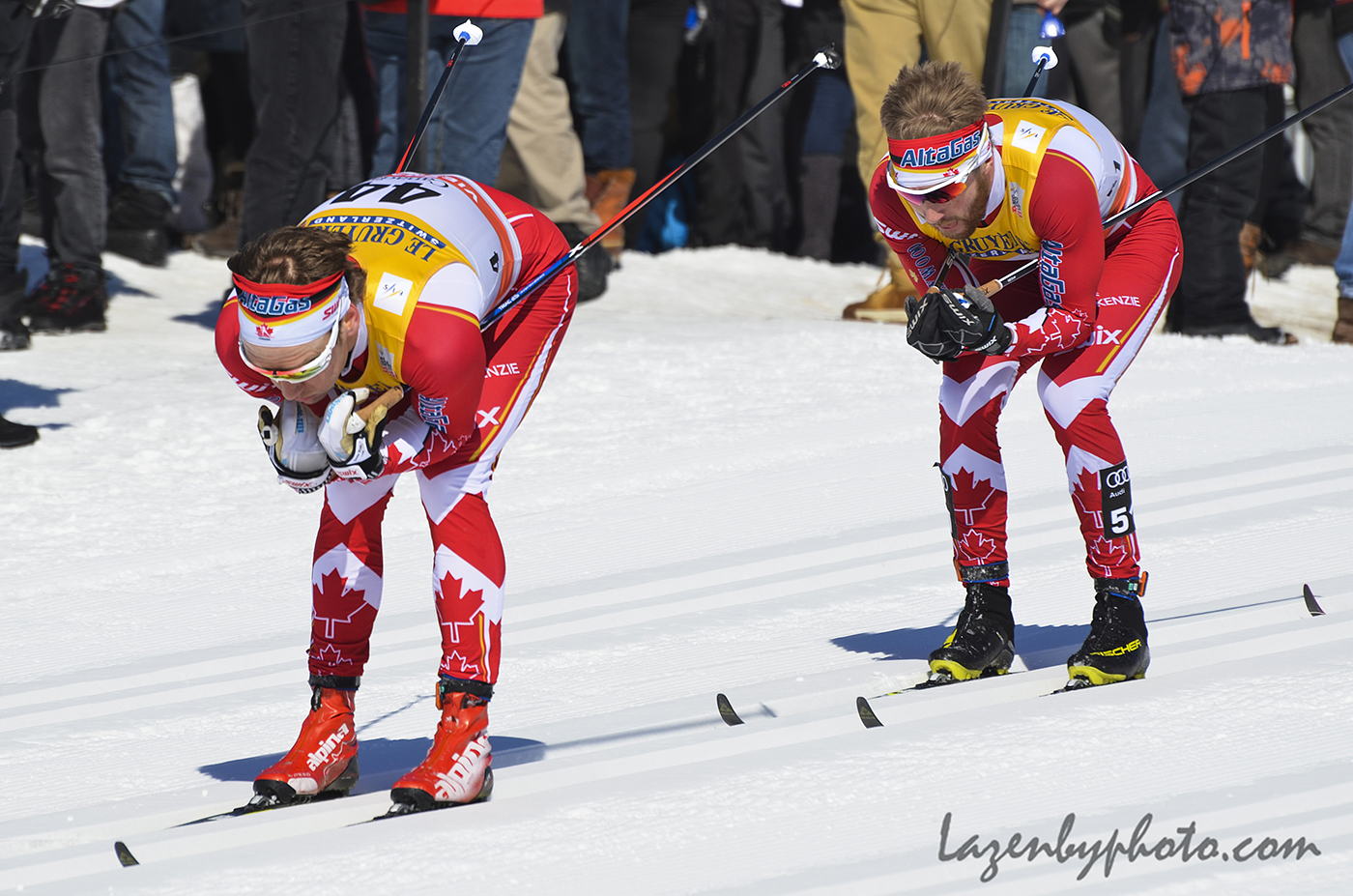
Russell Kennedy (46) with a Canadian wax tech before Tuesday’s classic sprint qualifier at the 2018 Olympics in PyeongChang, South Korea. (Photo: FlyingPointRoad)
Top 30. It’s a tough mark to make at the World Cup level, let alone the Olympics. On Tuesday, the U.S. and Canadian teams each entered four men and four women in the classic-sprint qualifiers at the 2018 Olympic Games in PyeongChang, South Korea.
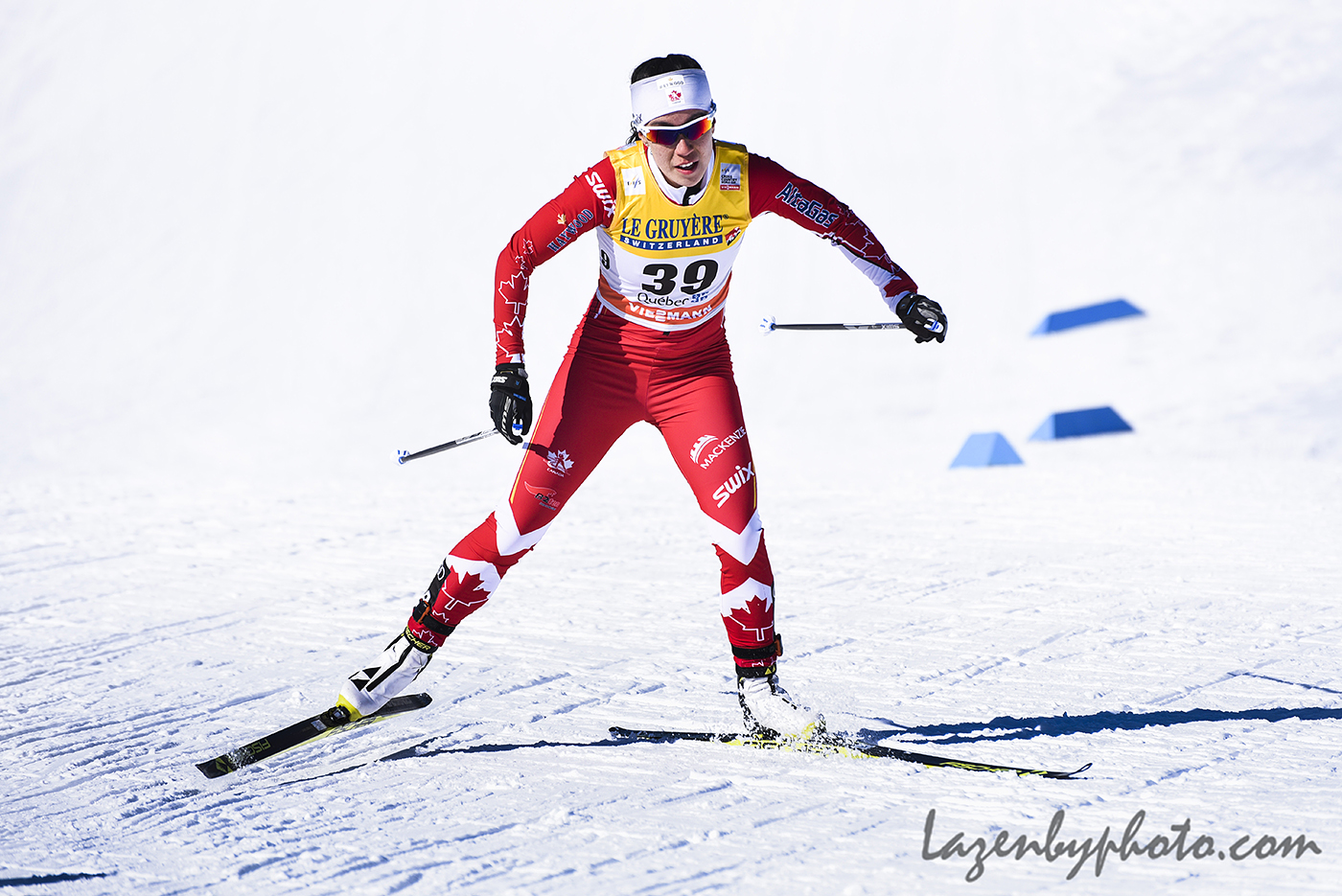
American Logan Hanneman racing to 42nd in the men’s 1.4-kilometer classic sprint qualifier at the 2018 Olympics in PyeongChang, South Korea. It was his first Olympic race. (Photo: FlyingPointRoad)
Three American women and two American men qualified, but Ida Sargent, Andy Newell and Logan Hanneman did not. Sargent finished the women’s 1.25-kilometer qualifier in 33rd, 1.78 seconds out of the top 30, Newell missed it by 1.67 seconds in 37th the men’s 1.4 k qualifier, and Hanneman finished 42nd.
For Canada, one man qualified: Len Valjas. Alex Harvey tied for 32nd and missed the cutoff by just 0.26 seconds. Jess Cockney placed 35th, 0.85 seconds out of 30th, and Russell Kennedy was 54th. Three Canadian women started, but none qualified. Emily Nishikawa, best known as a distance skier, led them in 34th, 2.73 seconds out of 30th, for her career-best sprint result. Dahria Beatty placed 42nd and Cendrine Browne was 51st.
Then there was Jessica Yeaton, who races for Australia but trains with Alaska Pacific University in Anchorage, Alaska. Yeaton finished the qualifier in 48th. Ahead of her, the Czech Republic’s Petra Hyncicova, the two-time defending 2017 NCAA champion who skis for the University of Colorado Boulder, finished 45th in her first Olympics.
Here are some quotes from the North Americans who caught up with FasterSkier in the mixed zone after Tuesday’s qualifier:
On race feelings:
“I felt really good, I executed a really good plan, and yeah, just didn’t pan out.” — Jess Cockney (Canada), 35th
“It wasn’t great. It was a really hard course, and it was quite windy today, and I just didn’t feel like I could get my body up to the speed I need to be going at on this course was working. I just felt a little of that distance-race pace today so that was too bad because I am always hoping to make the heats on a stage like this, but just didn’t have it today.” — Dahria Beatty (Canada), 42nd
On strategy:
“I knew this first climb was going to set everything else up, and you have to had already been in it. You can’t get to the top of the hill and think you’re going to ski yourself back into it — that’s half the course right there. I executed that really well and came up short.” — Cockney
On PyeongChang’s sprint course:
“There’s a monster climb in it and also dealing with the wind — it’s definitely a tough course, but it skis really nice and it’s a well-designed course, so it’s fun to ski.” — Emily Nishikawa (Canada), 34th
“It’s a really hard course, lots of climbing and pretty steep, so I am really proud of my teammate Emily, who did her best-ever sprint result, so that is really inspiring. Hopefully I will get there one day, too, because she is a distance skier as well.” — Cendrine Browne (Canada), 51st
“After shortening it from the course they had last year, they essentially took out the only downhill in the first half of the course. Especially with the wind today, you had to work half ay into the downhill, so there wasn’t any rest until the top of the course at about 2.5 minutes, so it was a real endurance course.” — Beatty
“It’s really hard. I skied it last year and it was actually harder on the boys’ course, so this first hill was a little better ‘cuz it sort of cuts out the part where you start slipping, but at the same time it cuts out all that rest from your tuck down. This time you’re shooting straight into the second hill, which is really hard.” — Jessica Yeaton (Australia), 48th
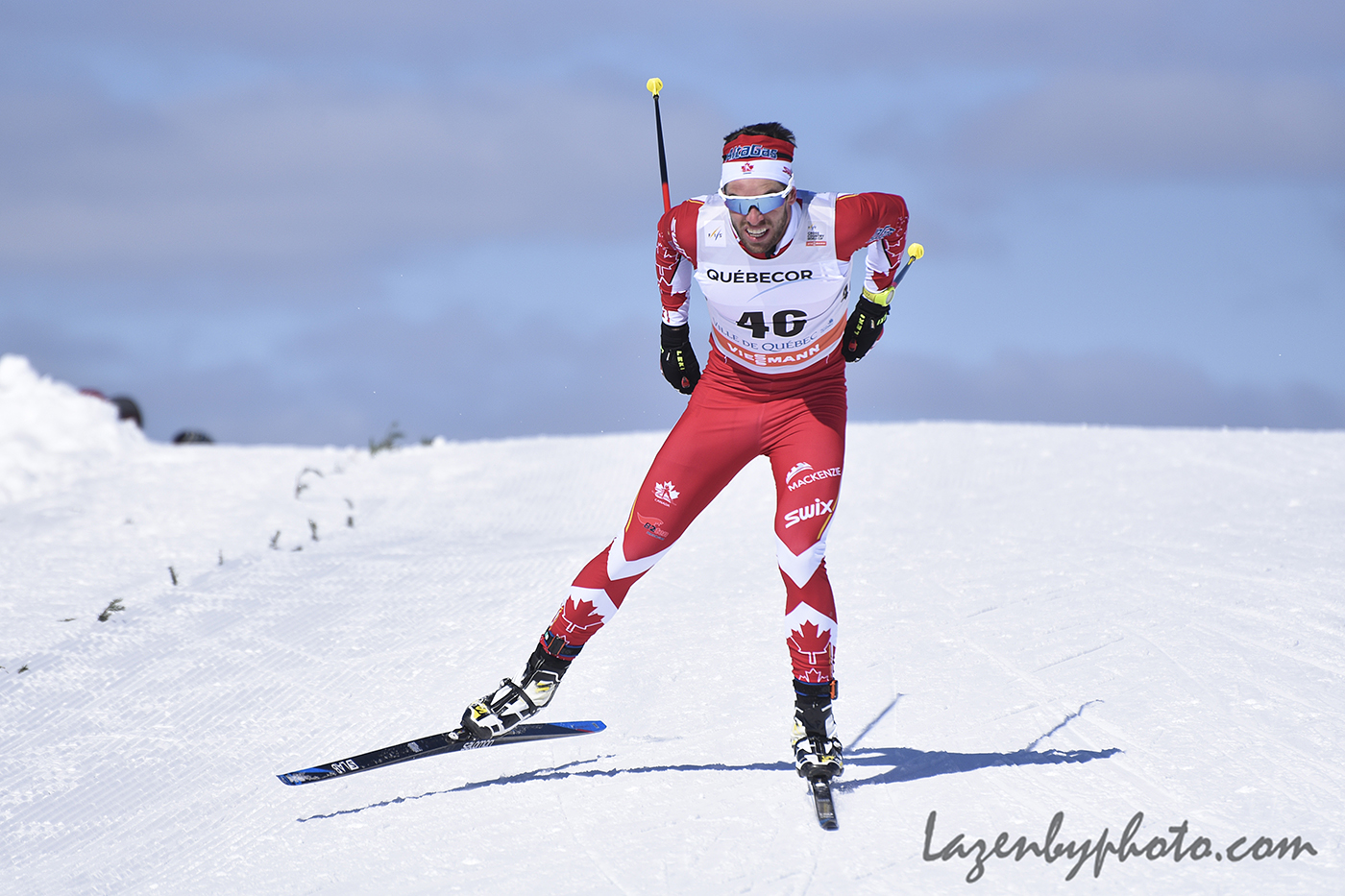
Canada’s Russell Kennedy racing to 54th in the men’s 1.4-kilometer classic sprint qualifier at the 2018 Olympics in PyeongChang, South Korea. (Photo: FlyingPointRoad)
“I think it’s more than hard, it’s just a strategy course. If you go too hard, you can lose a lot in the second half, and for me that is what happened today.” — Russell Kennedy (Canada), 54th
On the wind:
“I feel like you get a huge gust every now and then … It’s definitely windy the whole time, but then sometimes you run into something crazy and it’ll be like, ‘Whoa,’ and it throws you back a little bit. But it’s sort of the same conditions for everyone. You can’t control when it’s going to have a big gust.” — Nishikawa
“Definitely the conditions are tough and the wind doesn’t help when you get a head gust and then a tail wind and throw off your tempo and stuff, but it’s a very smart thinker’s course I think.” — Kennedy
On looking forward:
“It’s a long championships. You can’t dwell on a bad race too long, even a good race, like there’s always another one in a day or two so you have to take the time to learn from the race, or if you’re really pumped or really upset you can take a few minutes to process that, but not much longer than that really.” — Nishikawa
“Today I wasn’t expecting much from the result, but I was more thinking about how well I wanted to ski the course, so I really wanted to ski well and push hard in preparation for the 10 k skate, which is my favorite race, so I am really looking forward to that. Today was more of an intensity to prepare myself for my favorite race.” — Browne
On the Olympic experience so far:
“It’s been awesome. It’s been the best 10 days ever so far. I’ve had so much fun. The racing’s been good, nothing amazing, nothing terrible though, so it’s just been a really good experience overall.” — Yeaton
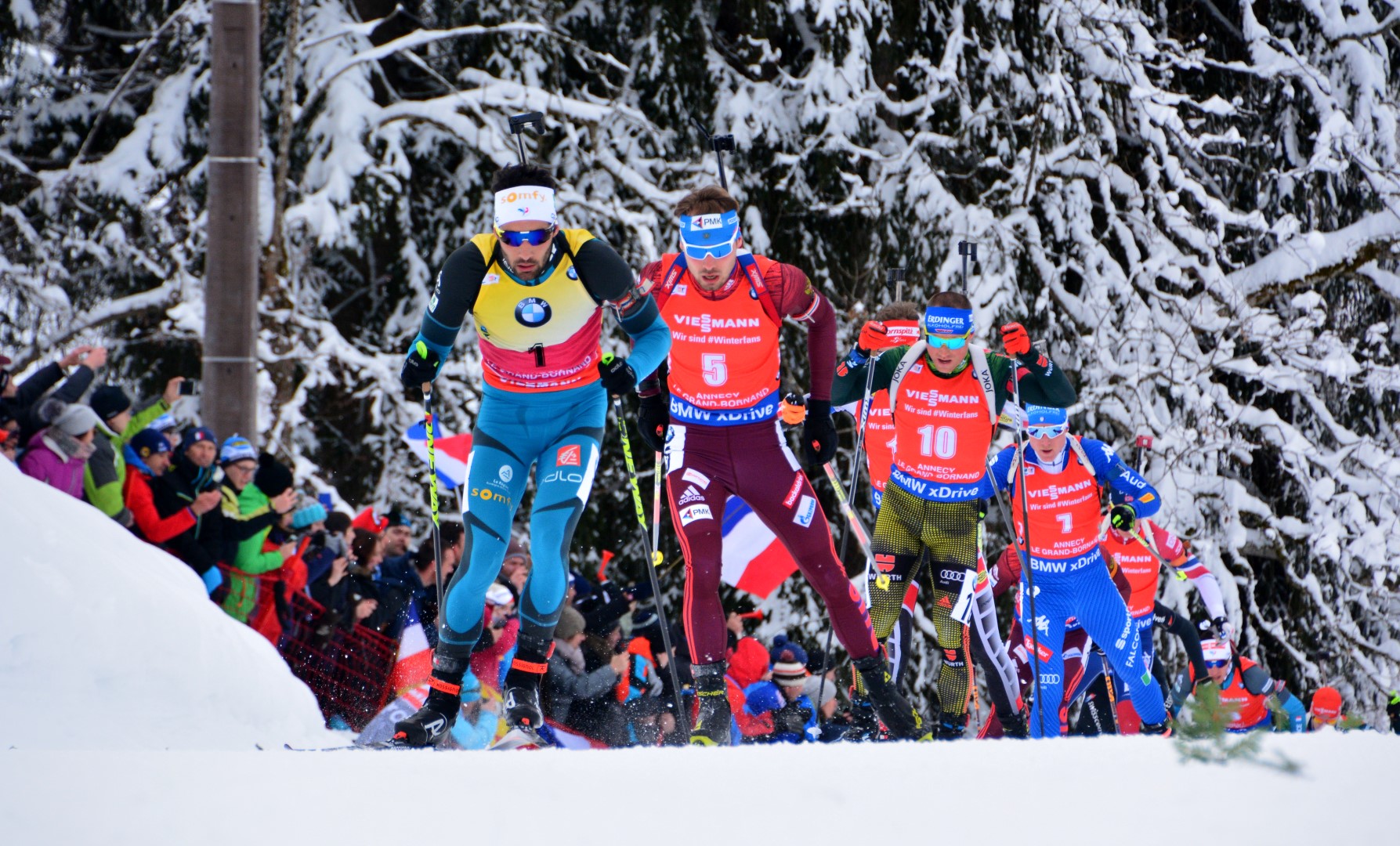
Martin Fourcade of France leads the IBU World Cup 15 k mass start in Le Grand-Borland, France, on Sunday. (Photo: Glen Crawford)
LE GRAND-BORNAND, France — After a long weekend of racing, beginning with heavy snow and continuing with glazed tracks, the biathlon World Cup is on break for two weeks to recalibrate and rejuvenate as the athletes prepare for the rest of the season and the 2018 Olympics in February.
Here’s what some members of the field thought about the races this weekend – the bits of interviews and press conferences that didn’t make it into our race reports.
On Pressure
“This was tougher than some World Cups where we are less expected. But it’s also what we want, asking for a World Cup at home. We know that it’s not the same as when we are competing in Norway. It’s so much bigger in terms of emotions. I would do it again.”
— Martin Fourcade (France)
Susan Dunklee of U.S. Biathlon after the mass start, which moved her up to being ranked 30th on the World Cup after a disastrous first two weeks of racing had left her out of the points. (Photo: Glen Crawford)
On Annecy & Le Grand-Bornand
“I like this place. Four years ago I was on the podium too in the pursuit behind Johannes. I was one year later on holiday here. I like this place, I like the people. It’s a really nice nature, mountain, valleys. I know that I got some Reblochon cheese, too.”
— Erik Lesser (Germany)
“It was very loud. I couldn’t hear what my coaches were saying on the side of the course at all. I knew they were there because I could see them out of the front of my eyes, but their voices just got lost in that big, massive noise. Getting this many people here, is absolutely incredible. It has grown so much since last time [in 2013]. It’s a lot of positive energy, and that counts for a lot.”
— Susan Dunklee (USA)
“I love it. It’s definitely a different race course with those steep little bumps. But I think it could be [more often] on the circuit.”
— Julia Ransom (Canada)
“There are amazing trails that go up the valley. I just went for a classic cruise yesterday just looking around everywhere in awe. The food… We are staying right in the downtown, and the food in our hotels is like cheese and dessert after every meal. I’m like ‘oh no I have to pass on that…’ And the fans, too, I couldn’t believe it. They are so loud, cheering for everyone. I was a little bit overwhelmed just with the sound during the race. I was like ‘okay, keep going’. I love this place.”
— Emma Lunder (Canada)
Anastasiya Kuzmin of Slovakia leading the women’s mass start. (Photo: Glen Crawford)
“We had a really good atmosphere four years before. But now we really have so much snow in the mountains and in the village. That is why we all make biathlon – we love winter and we love the snow. I’m really happy to have such good conditions here.”
— Laura Dahlmeier (Germany)
“You can feel power from the mountains and the snow. What is more important is that there are many fans here… you feel the power from the people who are always supporting you. It’s like a big energy wave. On the track it helped me. Thank you so much.”
— Anastasiya Kuzmina (Slovakia)
“Every athlete has their World Cup which is their favorite and where they always do good races. And I think this is one of my top three venues on the World Cup. I really like it here.”
— Johannes Thingnes Bø (Norway)
“I want to point out that the organization and the popularity of biathlon grew a lot since 2013. I was really surprised to see so many people around the track cheering, not only local athletes but also international athletes. I could hear them saying my name. So I want to thank them for supporting us.”
— Anton Shipulin (Russia)
On Three Weeks of Racing, and Now a Break
Emma Lunder of Canada competing in the mass start in Le Grand-Bornand, France. (Photo: Glen Crawford)
“I think it’s great to finish with a nice race. Now I can enjoy the time at home, the time in France. And keep confident of the work which was done.”
— Justine Braisaz (France) after winning the mass start
“I think my shape is getting better and better and also on the shooting range. It’s important to make some good races, it’s good for your own feeling. It’s good for the Christmas holiday now.”
— Laura Dahlmeier (Germany) after finishing third in the mass start
“To have good races going into the Christmas break, that’s all I could ask for… Now we can feel like we did a good job, relax, and get some good training in.”
— Emma Lunder (Canada), who had her best-ever World Cup result and qualified for her first mass start
“Yeah, I definitely felt [the fatigue] today, but you kind of come to expect that after the first trimester. Now we have a good block of recovery time, and I’ll definitely be looking forward to a few days off.”
— Lowell Bailey (USA)
(l-r) Erik Lesser, Martin Fourcade, and Johannes Thingnes Bø after the mass start. (Photo: Glen Crawford)
“It is always a fight there. Today [Erik] Lesser was there also and [Anton] Shipulin is coming back top-six too. They will be stronger after Christmas.”
— Johannes Thingnes Bø (Norway), winner of the sprint and pursuit, after the mass start
“I’ll be getting some good volume training in, I think. Kind of reset the body and get a bit of a training load.”
— Scott Gow (Canada)
“I felt pretty tired today, and then on top of it everyone is fast in the mass start… I was looking forward, looking forward to the finish line.”
— Emma Lunder (Canada), after the mass start
“Now I’m just [working on] my good shooting and staying concentrated on the shooting position. I think I need a little bit more time, a little bit more practice. But I’m happy that my ski times are still good.”
— Anastasia Kuzmina (Slovakia)
Mission Accomplished
Scott and Christian Gow of Canada after the pursuit, where they both finished in the top 30. (Photo: Glen Crawford)
“I was hoping to just lock up the Olympic qualification and get that off my back, which is really nice. And then really just put together a solid three sets of races. Last year I was sick, and I wasn’t even in Europe at this point. I was kind of just slogging my way back to good health. So I’ve had some good races here and it’s a good block to start the year… Last year taught me how to grind through something that isn’t the best hand of cards that you could have been dealt.”
— Sean Doherty (USA), who was named to the U.S. Olympic Team after his performances this weekend
“I’m really glad that we are finally part of the podium. Finally third, on the World Cup.”
— Anton Shipulin (Russia), after finishing third in the pursuit and earning Russia’s first podium of the season
Goals
Laura Dahlmeier of Germany setting up to shoot in Thursday’s sprint. (Photo: Glen Crawford)
“I’ve been trying to win the yellow bib every year since I came in the World Cup. But I’ve never had a chance. So we will see this year. But I know it’s a long way there. Now I’m just focusing on the race today, and the next race, and not about the whole season. I’m in good shape here and I try to do the best I can.”
— Johannes Thingnes Bø (Norway), currently trailing Martin Fourcade by 20 points in the World Cup Total Score
On Ski Speed
“I’m definitely working my way back into it. I don’t feel 100% on skis. I felt good all the way up to the beginning of the season, and then got set back with some sickness. But I’m still confident with how we trained this summer, and the path towards PyeongChang, so just have to stick to the plan.”
— Lowell Bailey (USA)
“Honestly, my skiing, I’m not very satisfied with it at the moment. It’s coming back, step by step, and week by week it has improved, but I feel like there is a lot of room there and I don’t totally feel like myself yet. There’s still plenty of season left.”
Canada’s Alex Harvey with his medals for placing second in the Distance World Cup and third in the Overall World Cup on the last day of World Cup Finals in Quebec City on Sunday, March 19. (Photo: John Lazenby/Lazenbyphoto.com)
After last weekend’s three-day World Cup Finals mini tour drew nearly 60 North American competitors and tens of thousands of spectators to Quebec City, it’s only fitting that we share the quotes from some of the athletes you haven’t heard from yet (and some you have). Here is a collection of some of the most interesting comments from the Canadian World Cup and Nation’s Group skiers at World Cup Finals. There were 30 in total. (Stay tuned for the U.S. notes & quotes version.)
And here are our race reports (with links to results at the bottom of each) from Friday though Sunday, March 17-19:
Canada’s 21-year-old Ricardo Izquierdo-Bernier, of the Pierre Harvey National Training Centre (CNEPH) racing his first World Cup during the men’s freestyle sprint qualifier at World Cup Finals on March 17 in Quebec City. (Photo: John Lazenby/Lazenbyphoto.com)
“I was surprised when I was selected, but I am very happy to be here.” — Ricardo Izquierdo-Bernier (CNEPH)
“I was stressing when they announced that, ‘The national group, maybe you will have the opportunity to qualify for your first World Cup.’ [My coach and I] just kind of put that to the back of our minds and decided that if it happened, it was going to be an incredible icing on the cake part of my race season, and it happened and it was super exciting. I was really just focusing on the process so I am super excited to be here, a little overwhelmed but really excited.” — Annika Richardson (Junior NST/NTDC Thunder Bay)
“I was just happy to be here. Last year I got my concussion in Montreal [during the Ski Tour Canada] so I didn’t actually get to race here so it’s a great place to come and race. I’ve raced here just a couple of times and it’s an incredible feeling to have the crowd behind you. … It’s really great because you don’t get that in Europe. You get lots of fans, but not people who know your name so it’s pretty cool.” — Andrea Dupont (Rocky Mountain Racers)
“I am really really excited to be here. I did the [Ski Tour Canada] last year and this is probably my favourite venue to race at in Canada, being in the city and it’s a beautiful day. Can’t really ask for anything more.” — Annika Hicks (AWCA)
“I didn’t reach my goal of qualifying for the World Championships, but to race at this level this weekend far exceeds all my expectations. I was a forerunner for the Tour of Ski last year, but now I’m actually racing. That makes me really happy!” — Laura Leclair (Junior NST/Chelsea Nordiq)
“It’s the cherry on the sundae. It’s good to go up against the best in the world, and it’s an opportunity to see what you have to work on for the next year, and try your hardest.” — Frédérique Vézina (CNEPH)
On racing in Canada:
“I thought last year was going to be my last chance to race internationally in Canada so I am really thrilled to be here.” — Devon Kershaw (Canadian World Cup Team)
“We are pretty lucky to have the end of the World Cup here in our own house, and it’s really exciting to be able to finish of the season here in Canada and it’s definitely convenient to be able to relax here after we are finished. We have Canadian nationals still, so I guess not complete relaxation … but it’s really fun to be back in Canada.” — Len Valjas (Canadian World Cup Team)
“It’s nice to be back here in Canada racing a World Cup. I think we are pretty lucky to have the opportunity as a group of Canadians, developing skiers, young guys, old guys like me just trying to get up there, but also seeing Alex skiing so well, world champion. I mean, what can you say? It’s awesome. It’s good for our sport right now.” — Brian McKeever (Canadian Para-Nordic Ski Team)
“The atmosphere here is really on par, today especially, with the races we do overseas, and especially being in a city center that we know so well like Quebec, it’s a really good energy.” — Jess Cockney (Canadian World Cup Team), after Saturday’s 15 k classic mass start
“It’s absolute incredible to come back to Quebec after last year and race something that’s familiar to us already, but slightly different because the race course, they change out the race course, which is always exciting. It’s amazing to race in front of Canadians and to have people cheering your name all around the course that actually personally know you, so it’s a pretty incredible experience to come out here and do that. “ — Alannah MacLean (NTDC Thunder Bay)
“It’s been great to finish the season at home. It’s been a really long season, though. I have been overseas way more than I ever have in my life so I think it’s taking a little bit of a toll on the energy, but I am just so excited to be able to race at home here and enjoy this amazing atmosphere.” — Dahria Beatty (National U25 Team/AWCA)
“I was pretty tired after such a long season, and I was really happy to be here and to able to finish the season on such a fun note, to ski a World Cup at home. It’s happened the last two years, but it doesn’t really happen that often, so it’s a unique opportunity. I gave it everything that was left in the tank, and I had a lot of fun.” — Katherine Stewart-Jones (NST U25 Team/NTDC Thunder Bay)
“This is huge for Canada, and I hope FIS can see that it’s really amazing to have races here, and I think the athletes like it, too, so I hope this becomes a staple even after our generation. There’s enough North American skiers that we should have this here every year. We’re winning medals too and Alex is up there in the overall, we deserve to make them travel a little bit. I’d love to see more races here.” — Valjas
On being cheered on by tens of thousands of fans:
“It started in warmup where you kind of would be skiing around and people recognized the National Development team jacket and yell, ‘Go Canada!’ and I was like, OK, just smile and keep going and trying to keep my focus, but it felt incredible to ski around and have everyone cheering for you and rooting for you because you’re Canadian. Definitely had to nail my focus today a bit more than usual because of that, but good practice.” — Richardson
Alex Harvey (Canadian World Cup Team) racing to fourth in the men’s freestyle sprint qualifier on the first day of World Cup Finals, last Friday, March 17, in Quebec City. He went on to win the final. (Photo: John Lazenby/Lazenbyphoto.com)
“Sometimes they’re cheering really loud and you know it’s actually not for you, it’s just the commentator mentioned Alex but then you’re just like, I’ll take it. I’ll pretend they’re cheering for me.” — Valjas
“It’s a beautiful day in Quebec and the crowds are pretty amazing. It just kind of keeps the intensity high the whole time so it’s a fun place to race.” — Dupont, after Sunday’s 10 k freestyle pursuit
“It was another absolutely beautiful day out here, lots of home crowd cheering us on, so it was a really perfect day at the races.” — Knute Johnsgaard (NST U25 Team/AWCA), after Sunday’s 15 k freestyle pursuit
“Today was not the greatest day in my skiing career, however, it was pretty amazing because the crowd was cheering me on the whole way.” — Julien Locke (NST U25 Team/AWCA), after Saturday’s 15 k classic mass start
“It’s funny that people recognize me and know my name. It’s heart warming to have all the public support me and the Canadian team. … It was really an amazing weekend, the atmosphere, the crowd, the conditions, everything was on point. I couldn’t of hoped for a better way to end the season.” — Cendrine Browne (NST U25 Team/CNEPH)
On making the jump to the World Cup:
“It was amazing. The first day it was a lot to take in with the crowd and such a high-level race and having such high-level skiers around, but then Saturday I was more used to it and I was able to really focus on my race and put in a good effort.” — Katie Weaver (Junior NST/Hollyburn)
“You’ve got a lot of fast guys, and you’re kind of going from being one of the faster guys to obviously to one of the slowest guys around, and that’s a cool feeling, actually.” — Gareth Williams (Junior NST/Telemark)
“It’s always intimidating, but once you’re on the starting line, it’s mostly exciting. I’m not expecting to lead the pack anytime soon, so all I can do is try giving my max effort.” — Sophie Carrier-Laforte (CNEPH)
“This was my first. I qualified for a couple in the winter but because of U23 [World Championships] I wasn’t able to take advantage of it.” — Evan Palmer-Charrette (NTDC Thunder Bay)
“This was my fifth [World Cup race]. I still feel like there’s a lot of work I can do to be more competitive in this field, but I think I’m getting more and more comfortable with it in general.” — Sadie White (NTDC Thunder Bay)
“I don’t think I’m at this level of competition yet, but I think it’s so fun to be here and see how the fastest people in the world race.” — Mia Serratore (NTDC Thunder Bay), at the end of her first World Cup weekend
“I mean, they’re so fast out there, but I love it because I get to see what level I need to get to. Racing in Quebec, it’s so fun. The crowd’s just crazy. It’s so good.” — Joey Foster (Team Hardwood), at the end of his first World Cup weekend
Russell Kennedy (Canmore Nordic/Team R.A.D.) racing to 36th in the men’s skate sprint qualifier at World Cup Finals in Quebec City on March 17. (Photo: John Lazenby/Lazenbyphoto.com)
On five Canadian men qualifying for the sprint heats in the top 30 (a first for Canada in a World Cup):
“I am really pumped for everyone and I think it’s really good for the sport to see that many people up there. We have been sprinting really well in a lot of races and have a lot of good sprinters so it’s good to see everyone get up there and do well. Hopefully they can carry it out in the heats and get a couple of those closer to the podiums.” — Russell Kennedy (Canmore Nordic/Team R.A.D.)
On sprinting:
“It’s about 89.5 k too short for me these days.” — Brian McKeever (Canadian Para-Nordic Ski Team), who also specializes in marathons
On conditions:
“The snow is perfect conditions. The snow is cold, but the sun is warm, and the track is holding up great, so good Canadian conditions.” — Beatty, after Friday’s sprint
“I guess it’s pretty tricky to get grip with hard wax in this stuff, and I think klister would’ve been too slow so I had a lot of speed on my skis but my grip was definitely lacking a bit in the sun. In the shade it was pretty good, but it was a lot of upper body today, which I think was the way to go anyways.” — Andy Shields (Lappe Nordic), after Saturday’s 15 k classic mass start
“The skis showed good grip. The technicians delivered today. The issue was more the skier!” — Carrier-Laforte, after Saturday’s 10 k classic mass start
“The snow was fine. It didn’t really even get that mushy on the course and the downhills were pretty glazed actually. It stayed nice and firm. My skis were just amazing today. I was drafting people and shooting by them no problem. It was really good, really competitive skis.” — Foster, after Sunday’s 15 k freestyle pursuit
On the course:
“It’s tough because there’s a lot of flats, so you’re always working, whether it’s gradually downhill or gradually uphill. It’s good. It’s a challenging course in its own way. It’s not your typical World Cup where you have a huge climb and then a big rest after that, you’re just working stead, so it hurts. It’s a different kind of tough.” — Valjas
On sunscreen:
“Today is the first day that warranted the sunscreen, but I put the zinc on every day. Gotta protect yourself.” — Cockney
On goals for World Cup Finals:
“My goals were just to ski relaxed and push my body as hard as I can. I’ve really been injured this entire season so I haven’t done really that much racing at all. I was able to get enough racing in to qualify for this World Cup, which was something that I didn’t think was going to be possible at the beginning fo the season when I got injured, but to be here and not be 100 percent, but to be able to race in this environment is something that keeps me in the sport.” — MacLean (who herniated a disk)
“I really want to push as hard as I can for each race. I think that is something that sometimes it is difficult to do in Canada on the NorAm circuit because maybe if you’re not having a good race, you could pull back a little bit and save yourself for the next day and come in seventh instead of fifth, but here, I will still probably be in the back of the field, but I really want to push and feel good every time I cross the finish line that I gave it my all and kept pushing.” –– Richardson
Cendrine Browne, of the Canadian U25 Team and CNEPH, after finishing 41st in the women’s 10 k classic mass start on Saturday at World Cup Finals in Québec City. (Photo: John Lazenby/Lazenbyphoto.com)
On digging deep:
“Somehow I found a bit of fight. I didn’t really do much of a warmup today. I opted for a conserving energy strategy and I think it worked well. We’ve done so much racing that my body didn’t really need a warmup to get going so I did as little as possible before the racing to save everything I had for this last effort.” — Beatty
“It’s been a lot of racing this week. I was down in Lake Placid doing U.S. Junior Nationals and then I came here and now we’re off to Canadian Nationals for another three races. It’ll be a lot of racing, but that’s what I love to do.” — Weaver
“[After] yesterday’s race, I wasn’t going to start today and then the physio said, ‘If I’m treating you, you’re going to start.’ And I was like, ‘OK, Let’s do this!’ And she actually fixed me and today was much better.” — Valjas, on his upper-back injury, after Sunday’s 15 k freestyle pursuit
“I felt really really good, but I’m just having so many problems with my shins and my calves this season so it just makes it really difficult to ski properly.” — Serratore
On Quebec City:
“Quebec City, as far as Canada goes, is probably the closest thing to Europe, but it’s still the same country, same food.” — Palmer-Charrette
On their season overall:
Devon Kershaw leads Canadian teammate Graeme Killick in the men’s 15 k classic mass start at World Cup Finals on March 18 in Quebec City. (Photo: John Lazenby/Lazenbyphoto.com)
“It has been a really good season. It has been my most consistent season to date, so I have been really happy with it, have had some really good races and I just think especially in sprinting, my bad races are way better than they have been in the past. The fluctuation is smaller so I am showing good signs for next year.” — Beatty
“I think the season for me was a little disappointing. I had some signs of the training paying off, but I think overall I might have overdone it through the summer in sections and from that I struggled with some sickness through a lot of the season. I think some races were OK for me and I’ll take that and try to fix some things for next year over the summer and see what I can do. I mean, today was a good reminder that skate is not there and I really need to work on it for next year.” — Graeme Killick (Canadian World Cup Team), after 15 k skate pursuit
On season highlights:
“It’s got to be those two relay medals, especially the 4 x 7.5 k, that was so cool because my whole career we’ve tried to get a medal there and I was honored to be the anchor and that was a huge moment in my career to be able to pull that off and secure a medal for the men’s relay was just awesome. And of course, the first win for me with Alex was also just as special. It’s been a good year. Lots of highs, some lows, and I’m ready for next year.” — Valjas, on historic third-place finish with men’s relay at World Cup in Ulricehamn, Sweden, and World Cup freestyle team sprint win with teammate Alex Harvey in Toblach, Italy
Emily Nishikawa (Canadian World Cup Team) racing to 38th on the final day of 2017 World Cup Finals on Sunday in Quebec City, the women’s 10 k freestyle pursuit. (Photo: John Lazenby/Lazenbyphoto.com)
“I think the relay in Lahti for us, it was one of our best women’s results since 2001 or something like that, so 16 years.” — Emily Nishikawa (Canadian World Cup Team), on the Canadian women’s team’s 10th place in the 4 x 5 k relay at 2017 Nordic World Championships
“For me, it would be Davos. I was really happy with my form there, and I think I never felt that good in a skate race. I like altitude, too, so that course kind of suits me. That was my best individual start ever so it’s good to have one of those. I was really happy with that day.” — Killick, referring to his 21st place in the World Cup 30 k freestyle individual start on Dec. 10 in Davos, Switzerland
“That’s hard to call. Probably the highlight of my season was my 26th was La Clusaz, getting my first distance top 30. That was something I wasn’t really sure I’d be able to bridge this season and to be able to ski into the top 30 in distance as well as sprint this year wasp pretty amazing so that was a big step for me forward in coming years.” — Beatty, on her 26th place in the World Cup 10 k freestyle mass start on Dec. 17 in La Clusaz, France
“Maybe this, watching Harv do well. The Holmenkollen was an amazing experience. It was hard and not my best finish ever, but it was a really, really cool experience and I can’t say enough how awesome it was.” — Kennedy, who placed 47th in the 50 k classic mass start at Holmenkollen in Oslo, Norway, on March 11
On the upcoming training season:
“I’m pretty relieved that this season’s over and really excited to kind of get a fresh start on next year and just take some time to reflect on this past season and look at the things that went well and things that I could improve on and hopefully use those as building blocks for next year’s training.” — Johnsgaard
“This summer, I’ll put in practice what I learned from my World cup experience. I’ll really focus on technique and work on my tempo. The only way to improve is to keep racing against the best.” — Browne
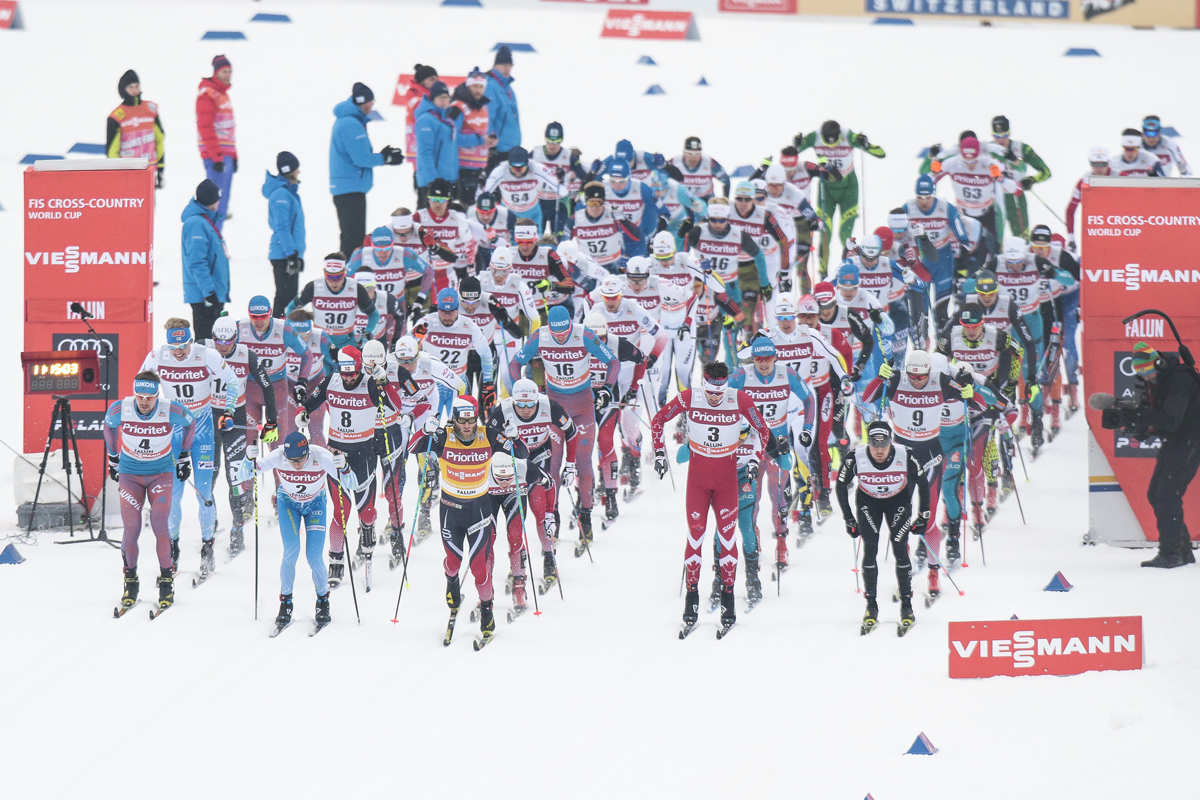
The start of the men’s 30 k classic mass start on Sunday, Jan. 29, at the World Cup in Falun, Sweden, with (front, left to right) Russia’s Sergey Ustiugov (4), Finland’s Matti Heikkinen (2), Norway’s Martin Johnsrud Sundby (yellow bib), Canada’s Alex Harvey (3), and Switzerland’s Dario Cologna leading out of the gate. (Photo: Fischer/NordicFocus)
We’re a couple days out from last weekend’s World Cup in Falun, Sweden, with several top racers taking a two-week breather now to prepare for World Championships, but several more are headed to PyeongChang, South Korea, to preview the 2018 Olympic course at this coming weekend’s three-day World Cup, Friday through Sunday. Here is a final wrap of some of the North American comments from Falun that didn’t make it into the race reports.
“I think it is a great sprint course. I think they could maybe do a little reconstruction on the fast righthand downhill corner to bank it a little, because that was getting pretty icy today, but everything else skis really well. It’s a little frustrating because it seemed like most of the racing comes down to the last 45 seconds or minute, and who can get the best draft coming into the stadium. It is such a fast finish there … but that’s part of racing, it’s not going to be a totally fair thing all the time. It just takes some really good positioning for that downhill and then kind of launching your move as you come into that bump, and carrying that momentum through the finish.”
— Simi Hamilton (U.S. Ski Team), 18th overall
“It was a fast sprint today. The perfect event for an athlete like Erik Bjornsen is the team sprint, where you link together multiple very hard efforts. He’s an athlete that can recover and maintain a high pace. But these really short, really fast sprints, that he’s still working on. He needed another minute for his strength to really show, and he only missed by a little over a second.”
— Matt Whitcomb (U.S. Ski Team coach), on Erik Bjornsen, who finished 43rd in the qualifier
On organizing-committee snafus:
“They had a little bit of a grooming mistake where they set a [classic] track in the qualification lane. Normally for qualification [in a skate sprint] you are behind the wand, pole in front of it, and then you skate right out. Today they had a five-meter track. All of the girls double poled out of it. Simi was bib 11, and right before he started we told him, ‘You gotta skate.’ We were watching the ten guys who started before him double pole, and it just didn’t look very fast, so he skated out of the gate, and Emil Iversson behind him did that too. The next handful of guys double poled, and then the rest of the field started to catch on to that, and everybody else skated the qualification after that.”
— Whitcomb
On qualifying:
“I was really psyched with how my qualifier went today. It was funny, because when I finished I wasn’t sure how it went because it didn’t feel like a typical sprint. Even though the time on course is only about 3 minutes, it is a really hard course, with a lot more uphill than we are used to skiing in skate sprints. I knew it would be easy to blow up on this course, so out of the start I focused on big pushes with a lot of glide and on the two big uphills, I didn’t allow myself to hop skate and instead did a hard and fast V1 where I tried not to waste too much energy being springy. I felt like I skied the technical downhills well and had a semi strong finish, but mostly was happy with how I had paced it. I was thrilled to see I had qualified in 3rd.”
— Sophie Caldwell (U.S. Ski Team), on qualifying in 3rd
On finding her sprinting groove:
“Everybody has such a different tactic, like today I saw Kikkan [Randall] go right before me and she was aggressive from the back so I tried that method, and I think that maybe that is the problem I keep falling into. I am trying to do what my teammates are doing and forgetting to use my specific strengths and remembering that everyone is different.”
— Sadie Bjornsen (U.S. Ski Team), 19th overall
On measurable progress:
“It is my first final in about two years, so that was pretty fun to be back in the final. I have been getting progressively better every sprint race this season, so this was just another good step forward. Never having come back from a baby before I don’t really have anything to gauge against or a way to expect it was going to go. I have been just trying to build strength this season, and I like the trajectory I am on, so another month and hopefully I can be ready to contend for that podium.”
“It was my least favorite conditions today with the tracks really hard to find kick in and getting really sugary as they broke down, so it was good to have another chance to work on my striding and improve my classic racing! But like yesterday, I was so impressed with our service team and my skis were great!”
— Jessie Diggins (U.S. Ski Team), 10th
“It was challenging conditions today with sugary tracks that were a little beat up from the boys. I actually really enjoy skiing in this kind of condition so I was optimistic about today’s race.”
— Rosie Brennan (U.S. Ski Team), 24th
“I remembered TERRIBLE snow conditions [from 2015 World Championships] and a major climb that was going to entail a lot of herringbone. Fortunately, the snow was much better (Icy at the beginning and then sugary) although still not easy to kick skiing and the steepest part of the climb I was thinking about was changed. The course used much of the terrain from World Champs but the courses were a fair bit different and as such skied very differently.”
— Matt Gelso (Sun Valley Ski Education Foundation), 44th
On the course:
“I like skiing here in Falun, I think the courses suit me well. There is a long relatively flat section that comes out of the stadium, and in almost every distance race we lap though it multiple times. I tend to feel stronger in double pole and V2 so I really like this section.”
— Erik Bjornsen (U.S. Ski Team), 35th
On the race format:
“We don’t get to race 15 k very often so it’s hard to know what to expect out there.”
— Brennan
On the weeks to come:
“I am looking forward to some rest and recovery to rebuild for a big and important block of racing to come!”
— Sadie Bjornsen, 21st
On keeping up the momentum while during a two-week break from racing:
“When things are going good you just want to keep racing, so I am looking forward to it, more to be able to really put in a good block of training and doing what I have done in the past before championships. But I really enjoy racing, I love training, and I love most of the things we do in the summer pretty much other than maybe strength workouts, like, it’s not like labor for me or anything, but racing is really why I do all of that. I am never saying, ‘Oh, I need a break. Now it would be nice to not be putting a bib on for three weeks,’ I have never really had that feeling. … I guess it’s the opposite. By World Cup Finals, if things are going well I am just kind of sad to leave the circuit, but it might be different for others. You are never going to find me saying it’s time to stop racing ’cause I actually really, really enjoy everything about it, the adrenaline and everything around racing.”
— Alex Harvey (Canadian World Cup Team), 15th
On the decision to race next weekend in South Korea:
“Liz [Stephen] and I are the only [U.S.] distance skiers going, and we both decided on that last minute, not until after the Tour de Ski, to go. And my decision was based on looking back at the 2012/13 season and the 2013/14 season, both years that I had pretty successful championships, and looking at the schedule between the Tour and the championship in those seasons. I was racing almost every weekend and we were traveling a lot, and I remember it being so much fun. I was just enjoying myself and so psyched to be over here [in Europe], and I was sitting in Val di Fiemme at the end of the Tour de Ski and looking at this year’s schedule, and it was a week off and then two weekends in Sweden and then two more weeks off before Otepää and Worlds, and that’s not exciting and that’s not fun! I don’t want to just sit around in Europe, and I didn’t feel like I needed a bunch of training time at that point. I thought, if anything, I needed to just chill and then race. … Korea sounded like fun. It was a cool opportunity. I handle travel super-well, and it’s fun to race World Cups with weak fields because you do better [laughs]. Not that I don’t believe I can do well in a World Cup with a full field, but you know, next week is a great opportunity.”
— Noah Hoffman (U.S. Ski Team), 37th
On Erik Bjornsen and Hoffman coming within striking distance of World Cup points on Sunday:
“Noah and Erik didn’t end up with the results they are capable of, but each athlete came very close to putting together a good one. Erik spent most of his race fighting up to 23rd or 24th, and was skiing phenomenally, but did so working alone. It came with a price. With 7 k to go, a pack that had been trading leads came charging through. Noah’s race was moving in the right direction in the final 10 k, but a crash in the stadium lost his contact with the points. His energy looked good today, so I think he’ll be strong in Korea.”
— Whitcomb
Thinking ahead to World Cup Finals, on ending the season at home in Quebec City:
“I think motivation at the end of the season is a huge factor because pretty much everybody, at least everybody that is in the top 10 overall, we are kind of all running a bit on fumes, like physically, especially on a championship year where everybody’s going to try to really work up a peak for the end of February. So then by mid-March, everybody will be kind of sliding out their peak. I really think motivation will be one of the most important factors, and the fact that I will be able to be at home will surely help the motivation. If I find myself in the spot that I am close to, like a similar spot that when I am in right now [fourth overall in the World Cup], that could be the difference between third and fourth in the overall. So that is, for sure, I think for me, a good advantage.”
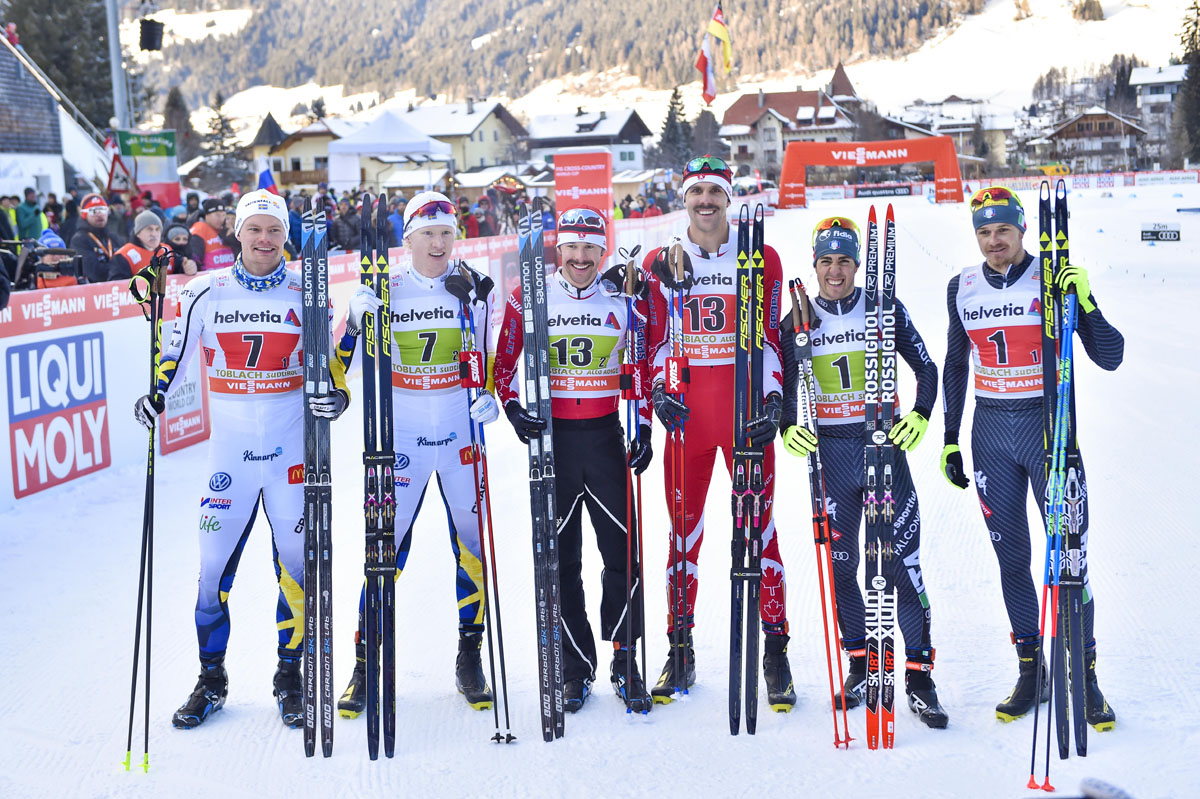
The men’s freestyle team sprint podium on Sunday, Jan. 15 in Toblach, Italy, with Canada’s Alex Harvey and Len Valjas (c) in first, Sweden’s Oskar Svensson and Karl-Johan Westberg in second (l), and Italy’s Federico Pellegrino and Dietmar Noeckler in third (r). (Photo: Fischer/Nordic Focus)
And you thought the weekend after the Tour de Ski would be boring. For fans of North American World Cup cross-country skiers, it was anything but, with Simi Hamilton coming excruciatingly close to a win in the men’s freestyle sprint on Saturday, Jan. 14, and placing second for his first podium of the season, followed by Canada’s first team-sprint victory since 2011 for Len Valjas’s first World Cup win. There was a lot of excitement surrounding two days of racing in Toblach, Italy, and plenty that didn’t make it into the race reports. See below.
The men’s freestyle sprint podium at Saturday’s World Cup in Toblach, Italy, with American Simi Hamilton (l) in second, Norway’s Sindre Bjørnestad Skar (c) in first and Norway’s Johannes Høsflot Klæbo (r) in third. (Photo: Fischer/NordicFocus)
“I think that my qualification speed has maybe dropped off just a little bit in the last few years with doing a little more threshold work all the time and focusing a little bit more on my overall distance fitness versus just my top qualification speed, but at the same time I knew I had great skis going into the qualifier and I knew I was 100-percent healthy and the conditions were really good for me. It was definitely a little bit slower out there today than it was last year with the new snow that came in yesterday, and it was a slightly longer course than it was last year, but I knew that if I just put together a good qualification, then I would probably end up towards the top there. So I was psyched to qualify fifth and only 0.8 [seconds] out. I think that was a reflection of kind of how I am feeling right now with my fitness.”
— Simi Hamilton
On having all five U.S. athletes qualify:
“We weren’t surprised by all of them qualifying. Sophie [Caldwell] and Ida [Sargent] have been very consistent qualifiers, and Kikkan [Randall] also qualified in the last skate sprint that she did in the Tour, so I think that was within reason. Also, the field the week after the Tour de Ski is slightly smaller, because so many people, like Jessie [Diggins], Sadie [Bjornsen], [Sweden’s] Stina Nilsson, and such are resting, so it makes for a slightly easier field. I think there were only 46 women who started, so it wasn’t too much of a surprise. It was really great to see them all move through the quarterfinals. I think all three of them skied great, and especially Ida and Sophie, just outright making great moves and pushing themselves through, and then Kikkan being a lucky loser. It was great to see them all move through, and unfortunately [Caldwell and Randall] got tangled up in the semifinal…”
— U.S. Ski Team Head Coach Chris Grover
On the U.S. semifinal tangle:
“According to Kikkan, as you could see in the race, the draft was such a big thing coming down that hill. Kikkan thought she had too much speed so she tried to go to the inside of Sophie, instead of running into the back of her, and somehow after that, they got tangled; that was really unfortunate. You hate to see when two people from the same team actually manage to take each other out. These guys are usually really good about watching out for each other, so I was a little surprise that that happened.”
— Grover
“It’s a bummer to have fallen in the two races that I’ve made the semis this year, but I’m feeling good and know that my time will come. It was a great day for the U.S. and seeing Simi’s brilliant final and second place erased any sour taste about falling today.”
— Sophie Caldwell
On lessons learned:
“In my quarter[final], I was a little too focused on trying to be in the top three for the first half of the heat, and something I kind of figured out almost by mistake in that quarterfinal was that I could ski off the bridge climb just extremely hard and get a really good slingshot going into that final climb and pick up a few places right there. I think when I was doing that, it was setting me up really well for the finish. … You see a lot of guys coming through that were getting a little slower start and then are running 4-5-6 the first half of the sprint, and then they make a big move at the end and position themselves for a really good finish, so I kind of figured that out on.”
— Hamilton
On a tailored plan:
“I have realized that the very last climb definitely suits me well. It’s kind of gradual and if I come into that climb with really good speed after the bridge downhill, after having picked up a couple of spots from the slingshot after that downhill, definitely makes me ski kind of confidently up that climb. The nature of that course is, you want to be in a really good spot coming down that long downhill the second tim, coming into the finish. So in the final, I just focused on basically skiing the first half, the first two climbs, all the way up to the building climb just really efficiently and try to conserve as much energy. I knew that if I put a move on coming off that bridge hill and skied that last climb really well, then I would have a really good chance of being top three coming over that last climb. So that’s what I did and I felt confident in my plan going into the final.”
— Hamilton
On riding confidence:
“I think I am really confident in knowing exactly which part of the course I can ski the best and being able to kind of capitalize on that knowledge and use those spots to my advantage and just know that I can get around some people in those clutch spots, for me, is a really big thing. At the same time, I think there’s just the whole mental side of it in knowing that you know you can, knowing that you can ski really well and in a specific place on multiple occasions. I think that’s just as big as knowing that your skis are really good, knowing that you’re really healthy, knowing that you’re fit, just knowing that you kind of figured a course out and that you really enjoy skiing it, really enjoy racing it, that it is a good thing for you, I think that is really important.”
— Hamilton
On getting back those good-ol’ race sensations:
“I had such a solid summer and fall of training that I actually expected myself to be right in the mix when the season started. But when the racing started, I began to realize that this comeback was going to take some time. I didn’t expect the patience and time it would take to get the racing gears back after taking a full year away from that kind of effort. Each race I do I am feeling a little closer to my normal sprint form. So if I can just stay patient and healthy, I think this season will progress nicely.”
— Kikkan Randall
On Andy Newell’s season-best 13th:
“He’s had such a rough start to the year, coming over and getting a pretty serious elbow infection to start the World Cup season, and then getting sick right after that through Lillehammer, and then he stuck to his plan and went home after Davos. Instead of staying on to race the Tour, he took a break and spent time with his fiancé [Stratton Mountain School Elite teammate Erika Flowers] over the break, so I was really excited to see how he skied today. For him and Simi to qualify fifth and sixth, they were moving incredibly fast in qualification. Simi was under a second from first, Andy was maybe just over a second from first in qualification, so they were flying. I thought Andy skied with really good energy, good tactical moves. In the quarterfinal, he just missed by a few hundredths or tenths [of a second] going through as the lucky loser, so really good stuff for Andy.”
Canada’s Len Valjas (followed by American Andy Newell in bib 15) en route to Valjas’s first World Cup victory in the men’s freestyle team sprint on Sunday, Jan. 15, in Toblach, Italy. He teamed up with Alex Harvey (not shown). (Photo: Fischer/NordicFocus)
“I’ve never raced with Len in the team sprint, and it’s the only one before [World Championships], and we knew we would be together at Worlds, so we wanted to do it to practice the exchange, and get a feel for it, because it’s a pretty unique race. It’s different from anything else, and it’s been a while since I’ve done a team sprint, so for all those reasons we really wanted to go and do the team sprint. Yesterday [in the individual sprint] I treated it more like a race prep, since I’ve done barely anything since the Tour, no intensity, no nothing, no pre race intervals, so I didn’t know what to expect, so I was pleasantly surprised with the feeling yesterday. It gave me a lot of confidence for today.”
— Alex Harvey
On winning:
“You look on paper, we were ranked No. 3. They take either your best distance points or your best sprint points, so they took my distance points and Lenny’s sprint points, and our total was like 36 FIS points, and that was the third lowest, so we were pretty well ranked, we had just never done it before. We liked our team on paper before, and like I said yesterday, we both felt good, and we both felt like we had more to give … I’d be lying if I said we expected to win, but the goal was to be top 5, and from there, the podium is within reach, for sure.”
— Harvey
On being 6-foot-6:
“This course had good parts for me, for sure, the one skate hill and maybe the flat out of the exchange, I felt good. My height does help for the more gradual climbs, but as soon as we got to that big, building climb, like, the actual steepest, I found it’s hard for me to ski as wide as I want to because I only go to my left side…”
— Len Valjas
On his team-sprint teammate:
“I think [Andy Newell] is skiing really well right now and I think both of us will be feeling really good by World Champs. Hopefully with some really good training coming up and some more good race opportunities, so I am really looking forward to having a good one with him in Lahti. I have heard the rumors that they are going to go back to the old classic sprint course in Lahti for the team sprint, which is pretty cool, and it’s definitely a bit different from the skate sprint course that they have now. It has essentially one huge climb with a really steep kicker at the top and some technical quarters coming back into the stadium, so I think that fares well for us. We are both good on our skis and good on the downhill and cornering, so we could put together a good race in Lahti in few weeks.”
— Hamilton
On slow doping control:
“I am a huge proponent of them doing a lot more testing and being consistent with that and so I was really happy to see that. I was in the anti-doping room with about eight or nine other athletes, so that was really cool to see that they are taking good initiative on that. It did frustrate me a little bit that they didn’t have a couple of spin bikes in there or any food. It was kind of like a really cold basement room, which was a bummer. I thought it was going to be a really quick urine sample, kind of in and out and be done, and they only had two people processing everyone’s test, so even though I pretty much had to pee right after the race yesterday, I ended up just sitting in that room for about 1 1/2 hours just waiting for someone to deal and process the test with me, and then I had to do blood sample after that and that requires sitting for 2 hours still after the race finished before they can take your blood. So fortunately, I was able to come to the hotel and just lounge here while I was still in that two-hour window, but they didn’t end up showing up here until about three hours after the race. When it was all said and done I didn’t really get any kind of cool down and just went straight from giving my blood to dinner, to a quick massage, to bed, right to a team meeting then bed, so it was kind of not-an-ideal afternoon yesterday, and I think that was kind of resulted not feeling great during the semifinal this morning.”
Friday night, Oct. 28, after the freestyle distance interval starts on Day 1 of Frozen Thunder racing at the Canmore Nordic Centre in Canmore, Alberta. (Photo: Russell Kennedy)
For most racers, Frozen Thunder is about getting quality hours on snow. Below is what several athletes had to say about the trails, the snow and the experience of racing in Canmore, Alberta, last week. For details about the races, see distance, classic sprint, and skate sprint recaps. For the photos, keep scrolling down.
***
“Frozen thunder has been warm but with solid snow of course and it’s always great coming out to the early snow. With my southern Ontario background, I still don’t get tired of snow in October when I used to have to wait until well into December to be able to ski at home.” — Bob Thompson (NDC TBay)
“This is my first year coming to Frozen Thunder! It is so incredibly beautiful up here, so that makes it worth it even without the great skiing. I think it has been really beneficial to get some big hours on snow before we start traveling to races. We’re lucky because we had the month of August on snow as well and now we have this big week to add to that. This is the most time I’ve had skiing on snow in the offseason ever, which is pretty cool! We’ll see if I can tell the difference once we get into the race season.” — Kelsey Phinney (SVSEF)
“The track had broken down and was soft where the guys had skied, but there were a few sections of fast, firm snow to be found near the edges of the trail.” — Olivia Bouffard-Nesbitt (AWCA/NST U25 Team), on the skate-sprint conditions Nov. 3
“Frozen Thunder has been an awesome opportunity so far this year! I have been able to test most of my new skis already, work on technique, get in some high intensity on snow intervals and now have a couple of race starts behind me! It’s also been great to be surrounded by so many high level athletes everyday. I have learned a lot by just following other athletes throughout the loop.” — Caitlin Gregg (Team Gregg/Madshus)
“Frozen Thunder is not looking so good right now. It’s been quite warm in Canmore, with some rain and no temps below zero at night, so it is for sure hurting! The weather forecast doesn’t look very promising either. So everyone get out there and do your cold and snow dance please! This time last year we had a big dump of snow around the start of November and the temperatures during the day were about -5, so there snow guns were going. So things look very different this year. Might have to pull out the roller skis for a few afternoon workouts for sure.” — Dahria Beatty (AWCA/NST U25 Team) on Nov. 3
“It’s a huge help to be on snow this early for us and the fact that it’s available in my hometown is incredibly lucky.” — Jess Cockney (Canadian World Cup B-team)
“CCC did a great job running the races and it was nice to see nearly 100 skiers out on course. For the first time that I have seen in Canada, they had a TV crew on-site broadcasting the races live. Great work Shaw [TV Calgary]!” — Julien Locke (Black Jack/NST U25 Team)
“The conditions were slow but everyone was on the same wax, at least for the qualifier so we all suffered together!” — Knute Johnsgaard (AWCA/NST U25 Team) on the classic sprint.
“Frozen Thunder is such a good way to enter the season. Every year they have made improvements on laying it down and its nice to have the ability to mix up workouts with rollerskiiing and on snow training.” — Graeme Killick (Canadian World Cup B-team)
“Being able to have Frozen Thunder and be back on snow is a huge benefit as we prepare for the season. Having already done two races in the past week and with another race and a time trial coming up later this week it is a great bonus to be able to do this prep period on snow instead of roller skiing.” — Beatty
“These races are really good for figuring out what work still needs to be done before the start of the season. I can take a few lessons from today to feel better prepared come December. I’m really excited to get things going now because it’s been a really great summer and fall of training.” — Annika Hicks (AWCA)
“We had fantastic conditions… it was a little bit like the APU summer training grounds on Eagle Glacier :), couple inches of wet corn snow! With the rain the last two days- they did a great job with the courses. Course crowding was definitely not a problem, and it is always fun to have more people on course!” — Chelsea Holmes (APU)
“I am so grateful that Frozen Thunder and the organizers of the training ground as well as the races. I love skiing exponentially more than roller skiing so I couldn’t be happier to not only have the opportunity to be skiing but also to be able to put a bib on and kick start the year.” — Holmes
“The conditions were great practice today! It was pretty soft but I tried to figure out how to maintain speed by playing around with my power, tempo and technique. I find myself racing some softer loop courses during the year and wishing I had more practice for those conditions so today was a great learning day! The wax was PRE-set for everyone so that made waxing super easy (although I do have fantastic skis) and a non-factor.” — Caitlin Gregg on the Oct. 28 distance race
“This is my first couple of days on snow since last March! I spent my summer and fall training with my local Loppet Nordic Racing (LNR) in the Midwest and focused on my dry land fitness. I love coming to Canmore, AB and look for any excuse to spend as much time as possible here 😉 The scenery is gorgeous, the training is fantastic and most importantly the training partners are amazing! [My husband] Brian and I skipped Frozen Thunder last year and I have been looking forward to coming back for another fall! I am very grateful to my sponsors and community for the opportunity to be here training again!” — Gregg on the experience
“The organizers behind Frozen Thunder do an incredible job and the skiing is fantastic! The coverage is great and you can expect most days to be firm skate skiing and toko blue/red klister in the morning and softer skating and Toko yellow klister classic skiing in the afternoon.” — Gregg
“We spent 3 weeks in New Zealand this summer, which was a great way to get on snow. I think it’s really great that Canmore puts in so much effort to ensure we have this early season snow. It can take a bit of time to get that snow feeling back! It’s also really great that we no longer need to do roller ski trials in the summer/early fall. Roller skiing is quite different from snow skiing, some athletes can be quite fast on roller skis and then not have that transfer over to snow.” — Rosanna Crawford (Biathlon Canada)
“Frozen Thunder has only been open for a week, but this year our team spent 3 weeks training at the Snow Farm in New Zealand earlier this summer. This training season encompassed the most time I’ve ever spent on snow, and I think this has been really positive for me.” — Brendan Green (Biathlon Canada)
“Getting on snow at this point in the season is crucial. It is important to enter the first race series in December with as much immediate on snow time as possible. An extra week of skiing at the end of October goes a long way towards being prepared to race well in early December. I went to Australia for the month of August to ski- the SVSEF Gold Team organized a training trip and we got 4 weeks of skiing at Falls Creek. The trails and snow were great and it was a very productive trip, so I have had a substantial amount of ski time on the last 2.5 months.” — Matt Gelso (SVSEF)
“Conditions have been good up here. Although the rain has soaked the snow through, the water has been draining out well, keeping the snow icy and fast. In the mornings when the snow is very firm it is great, and as it softens throughout the day it is a little challenging to ski in at times but still solid skiing. It is nice to have the full loop open this year as well.” — Gelso
“Frozen Thunder is definitely a huge asset to western North America. There is no doubt that it helps get you into ski shape long before the season starts.”– Russell Kennedy (AWCA)
“The conditions have been unreal this year! Until yesterday when it started raining haha. It has been really excellent though most days firm and fast!” — Kennedy
“Since April, I had one 7 day camp of skiing on the Haig Glacier [near Canmore] in June/July. I tried to get up on the Eagle Glacier too but there was no space available. I love skiing on snow! The setup on Frozen Thunder is fantastic too as it offers the ability to easily test skis in a variety of snow conditions. Although it is unique to be on snow that has been saved all summer, we are finding ourselves racing more and more on transformed man made snow. This is a great time of year to get to understand the different characteristics of each of our skis. It is also great to have many other strong skiers training in the same place. As you can see the Biathletes skied well today, as they usually do and it has been good to train beside them. The US Biathlon team is here as well and I have a lot of respect for those guys. Skiing on snow is a real treat, but it is also really good to be in a camp environment. Caitlin and I love being able to spend so much time with the community and many of our camps have been with our LNR Club this year. Our camp here at Frozen Thunder is important time for us to be able to focus on our personal preparation.” — Brian Gregg (Team Gregg/Madshus) on all the topics
Caitlin Gregg sprinting to third in the Frozen Thunder skate sprint qualifier. (Photo: Glen Crawford Production Services)
Len Valjas sprinting to victory in the skate sprint qualifier at Frozen Thunder on Thursday in Canmore, Alberta. (Photo: Glen Crawford Production Services)
Brendan Green leads a group with Olexandr Zhrynyi (#4), Jack Carlyle, Soo Finish, #11), Bob Thompson (NDC TBay, #19) and Gareth Williams (Telemark, #1) (Photo: Matthias Ahrens)
Rosanna Crawford on her path to victory in the Frozen Thunder 2016 skate sprint (Photo: Glen Crawford Production Services)
Olivia Bouffard-Nesbitt sprinting at Frozen Thunder 2016 (Photo: Glen Crawford Production Services)
Canmore Nordic’s Jonah Steinberg pushes across the finish line. (Photo: Matthias Ahrens)
The start of an all-women’s heat at the 2016 Frozen Thunder classic sprint, which followed King’s Court format. (Photo: Matthias Ahrens)
Russell Kennedy in the classic qualifier at Frozen Thunder 2016 (Photo: Jenn Jackson)
The Ladies A final at Frozen Thunder 2016 (Photo: Jenn Jackson)
(From left to right) Bob Thompson (NTDC Thunder Bay) chases Lenny Valjas (Canadian World Cup A-Team), Graeme Killick (AWCA/NST B-team), and Knute Johnsgaard (AWCA/NST U25 Team) at the start of a classic sprint heat at 2016 Frozen Thunder in Canmore, Alberta, on Nov. 1. (Photo: Jenn Jackson)
A truck out on the 2-kilometer trail at the Canmore Nordic Centre. (Photo: Bob Truman)
Christian Gow in the skate sprint qualifier (Photo: Matthias Ahrens)
Scott Gow and Brendan Green at the biathlon range after the skate sprint. (Photo: Matthias Ahrens)
Len Valjas on his second lap as Russell Kennedy starts the classic sprint qualifier. (Photo: Martine Zilligen)
Len Valjas (#1), Graeme Killick (#14), and Knute Johnsgaard (#2) lead Bob Thompson in a classic sprint heat. (Photo: Martine Zilligen)
Norway’s Therese Johaug was happy to be done with the eight-stage Ski Tour Canada on Saturday, March 12. She won the Tour title along with the Overall and Distance World Cup Crystal Globes. (Photo: Fischer/Nordic Focus)
CANMORE, Alberta — After eight races in 12 days, the final day of the Ski Tour Canada last Saturday brought both extreme exhaustion and feelings of completion for the 14 Americans (10 women, four men) and 12 Canadians (seven men, five women) who made it to the culminating finish of the season-ending World Cups.
Here is some of the best from the North Americans who made it to the last two stages (the Stage 7 freestyle individual start and Stage 8 classic pursuit):
Canada’s Emily Nishikawa racing to 35th in the women’s 10 k freestyle at Stage 7 of the Ski Tour Canada in Canmore, Alberta. She went on to lead the Canadian women in 37th overall in the Tour. (Photo: Fischer/NordicFocus)
“It was initially very overwhelming, but once I got the hang of how things go on race day, it was really fun to be out racing with so many fast women.” — Kaitlynn Miller (Craftsbury Green Racing Project), 41st overall
“I’ve never done anything like this before. It is a test of will because you are either traveling or seeing the course … It is so different, I was so glad I had a chance to do this in a place like Canada where there are so many supporters. It was fun, I’m stoked it is over but it was actually really fun.” — Jennie Bender (Bridger Ski Foundation), 48th overall
“It was pretty intimidating in the beginning but I guess I’m kind of getting used to it.” — Katharine Ogden (Stratton Mountain School/USST D-team), 36th overall
On how the body held up:
“Before the race, I felt really nauseous and pale and I thought, ‘I should go drink some water.’ … I did not think today was going to go well at all. I was thinking best-case scenario would be finishing. I don’t know, I never know what my body is going to do, but my back felt good and I skied with a group, which was freaking awesome.” — Bender
2016 Ski Tour Canada finishers:
CANADA:
5. Alex Harvey
14. Ivan Babikov
16. Devon Kershaw
27. Graeme Killick
37. Emily Nishikawa
40. Cendrine Browne
43. Kevin Sandau
44. Olivia Bouffard-Nesbitt
47. Annika Hicks
49. Maya MacIsaac-Jones
49. Michael Somppi
50. Russell Kennedy
USA
5. Jessie Diggins
11. Sadie Bjornsen
24. Rosie Brennan
31. Chelsea Holmes
33. Caitlin Gregg
34. Ida Sargent
34. Noah Hoffman
36. Katharine Ogden
41. Kaitlynn Miller
42. Erik Bjornsen
43. Anne Hart
46. Scott Patterson
48. Jennie Bender
51 Tad Elliott
“I broke my finger about two weeks ago right before the Birkie but I felt solid there. When I start to get tired, my immune push-back starts flaring up and I was dealing with that a bit in the beginning of the tour and didn’t know how I would fare with all this hard racing. Honestly, I thought about pulling the plug after the first half, I was really suffering. But they said, ‘Go West, it is where you are from and the sunshine will do you well, stay relaxed and just enjoy ski racing.’ That is what I tried to do today and things have been coming around fast so it is kinda nice to feel that way.” — Tad Elliott (Ski & Snowboard Club Vail), after placing 41st in the 15 k freestyle at Stage 7 (he went on to finish 51st overall in the Tour)
“I just had to focus on the process and just ski as well as I could and I think I did that. I didn’t have much energy to work with so I had to make due with what I had. I skied as well as I could and just focused on technique.” — Emily Nishikawa (Canadian Senior Development Team), after placing 35th in 10 k freestyle at Stage 7 (she went on to place 37th overall in the Tour)
“The season is wearing on me. I’ve been traveling a lot and racing a lot this year and haven’t had time to do any volume training and I think that is showing, my body has nothing left to give.” — Michael Somppi (NDC Thunder Bay), after placing 50th in the 15 k freestyle at Stage 7 (he placed 49th overall in the Tour)
On finishing:
“Everyone was so awesome, I am glad I made it to the end. I’m stoked. Finished my first tour, I can’t complain.” — Russell Kennedy (Canmore Nordic), 50th overall
“My goal was just to finish without getting lapped and I achieved that so I am really pumped to have finished the Tour. … I learned that my fitness is good enough to make it through all these races, but it needs to get better in order to improve.” — Jessica Yeaton (Australian national team and Alaska Pacific University), 46th overall
“I raced it for myself. I didn’t have any expectations for today and I, 100 percent, wanted to race my own race. I crossed the finish line happy with my effort and that is all I wanted.” — Olivia Bouffard-Nesbitt (Canadian Senior Development Team), after placing 42nd in 10 k freestyle at Stage 7 (she went on to place 44th overall in the Tour)
“It is my first interval start on the World Cup ever. It was fun to kind of ski my own race, but Johaug just blew by me on the wall of course.” — Annika Hicks (Canmore Nordic) after placing 48th in the 10 k freestyle at Stage 7 (she went on to place 47th overall in the Tour)
“Honestly, I thought about pulling the plug after the first half, I was really suffering. But they said, ‘Go West, it is where you are from and the sunshine will do you well.’ ” — Tad Elliott, of Durango, Colorado
On highs and lows:
“There was definitely highs and lows. Racing this much is pretty taxing physically and emotionally, but every day I was training or racing I was thinking about how ‘effing’ awesome this is to do at home. It is something I might not be able to do it again, but I hope I will. It is such as privilege and every time I thought about it I was so thankful to be here.” — Bouffard-Nesbitt
“I got passed by both Therese and Heidi [in the 10 k freestyle], which was great, and I was like, ‘Holy sh*t!’ … Actually, proud moment of the race: I skied behind Therese on the downhill and she snowplowed and I did not so I was beating her on the downhill. But yeah, they climb like fiends. I don’t think I have the ability to go that tempo, being twice as big as both of them.” — Bender
“It is great if you can pick up a good ride, but today I had Sundby blow past me. You want that ride that is just a bit too fast, not one that is killing you.” — Scott Patterson (APU), after placing 47th in 15 k freestyle (he went on to place 46th overall in the Tour)
“I tried to ski with Maurice [Manificat] out there but then kinda exploded. I knew you follow Maurice it brings you to a top 20, within sight brings me to a top 30. I wasn’t able to accomplish that today, but to feel this good after all the health issues I’ve gone through recently is a sign of good things to come.” — Elliott after placing 41st in the 15 k freestyle at Stage 7
On takeaways from the Tour:
Canada’s Michael Somppi racing to 50th in the men’s 15k skate in Canmore, Alberta. He went on to place 49th overall in the Tour. (Photo: Fischer/Nordic Focus)
“I definitely feel like I have the endurance for long events like this — that is one of my strong suits. I seem to recover well. I mean, I am exhausted now, but I’ve still been getting out of bed and excited to race. I was racing pretty well on the domestic circuit, but it is just so different. I learned so much in the five distance races … In mass start races, you have to be aggressive and fight for those spots early on. I’m noticing my redline that I am comfortable skiing at in domestic races; the pace is different here.” — Kevin Sandau (Alberta World Cup Academy), 43rd overall
“I think it’s really just essential to getting us used to the World Cup atmosphere and no longer just feeling super nervous as you get to the start line. Making it more part of just any other race that you are able to focus more on the procedure of the race and feel the speed that these ladies race at and try to even just stay with it for five or 10 seconds through the race just gives you that little glimpse of where you need to be.” — Dahria Beatty (Alberta World Cup Academy/Canadian U23 Development Team) , 44th after Stage 7, (did not race Stage 8 due to a sore back)
“One of the big things is seeing just how hard all the women race at every race. In the NorAm circuit, we all ski hard but the World Cup is at a whole different level. These women go as hard as they can from the start until they collapse at the end. I think just being able to see just how hard they push shows me just how hard I need to be working and how hard I have to push to ski at this level.” — Maya MacIsaac-Jones (Rocky Mountain Racers), 49th overall in the Tour
“… The maturity and strength these guys have, it was good for me to see. I know the work I need to do in the summer and I am motivated to do it.” — Elliott
On future plans:
“Continue to train hard. I’ll stay at the centre next year and continue to try and improve. Also, keep working on the sprints.” — Sophie Carrier-Laforte (Pierre-Harvey National Training Centre), after placing 52nd in the 10 k freestyle at Stage 7 (she did not race Stage 8)
“I’ve been patient and I have had a long-term plan all the way through so I can see into my career now, but the support of a good coach is to keep that lid on. After Spring Series, I’m taking six weeks. I just ordered some Oakley golf gear, ordered some clubs from Wilson — I’m going to enjoy some golf and some warm weather and some mountain biking with my brother and come June maybe I’ll think about dusting off the rollerskis.” — Elliott
Video:Inside the Fence - Coming to North America
Ever wonder what European athletes think about coming to North America? Inside the Fence takes a look at the impressions from World Cup athletes participating in Ski Tour Canada
Posted by FIS Cross-Country Skiing on Thursday, March 10, 2016
Kikkan Randall (U.S. Ski Team) at left, bib 33, and former Canadian national team member Chandra Crawford (front, bib 32) leading the Fast and Female forerunners before the Tuesday’s classic sprint at Stage 5 of the Ski Tour Canada in Canmore, Alberta. (Photo: Fischer/NordicFocus)
CANMORE, Alberta — Throughout the first two days of racing in Canmore at the Ski Tour Canada, FasterSkier caught up most everyone competing for the U.S. and Canada. Here is what you haven’t read — quotes from the Stage 5 classic sprint and Stage 6 skiathlon earlier this week — listed in alphabetical order (of athlete last names).
Dahria Beatty (AWCA/Canadian U23 Development Team)
On her skiathlon (41st place)
“I’ll start with the positives: the second half of the race, the skating felt really good. I was able to get a second wind and be revived in the skate leg and really push hard and pick up some people.
“The classic leg unfortunately, the back didn’t hold up the entire 7.5 k, at about 3 k, it started to seize again so the second lap I was limited very much by my body and wasn’t able to reach my aerobic capacity so that was frustrating. I lost a lot of time there just not being able to move fully, but once I got to the skate I made up some time so I think it bodes well for the skate race in two days time.”
Jennie Bender (Bridger Ski Foundation)
On her sprint qualifier (51st place):
“I actually felt good. Flipped up onto my knee at the very top, but I felt good.”
On her skiathlon (54th):
“I haven’t done a pursuit in a really long time. The classic I knew would definitely be my initial struggle and then I was just kind of hanging on. I hung on. I’m feeling it but you know, it’s done.”
On how she’s feeling:
“My back is really tight, especially going from a really hilly hard classic to a skate. It’s something I’ve been dealing with all year.”
On her goals:
“My goal is to finish up the Tour. I knew that these last few days would be rough for me, but I’m in a better position than I was this time last year, so at the moment I’m in it for the long haul.”
“Felt good. Broke a pole in the start gate, so that was a huge bummer, but that’s how that goes sometimes.”
On his focus at this point in the Tour:
“Ski smooth. It’s easy to get to get punished out here with the altitude and the climb. When you watch the best skiers ski, they always ski beautifully and that was my mantra.”
On his results so far:
“I’ve had better distance results than I expected and it came a lot easier because I was just skiing smooth. I wasn’t trying to woodchuck my way to the front, you know? In the sprints I kind of over-skied the courses a little bit and it hasn’t worked out. I was really hoping today for something different. I felt great, I skied really hard, but there’s not much you can do at that point.”
Olivia Bouffard-Nesbitt (Canadian U23+ Development Team)
Canadian National Development Team skiers Dahria Beatty (l) and Olivia Bouffard-Nesbitt (r) during the women’s 15 k skiathlon on Wednesday in Canmore, Alberta. (Photo: Fischer/NordicFocus)
On her skiathlon (42nd place):
“It was a lot of fun. It was really hard as skiathlons always are and I tried really hard.”
On pacing the classic portion:
“I actually thought I paced it well, I was tempted to go harder, but I tried to keep it a race pace I could sustain so I could push it in the skate. But I thought that even though I had somebody to work with and my body was feeling good, my body wouldn’t follow what my mind wanted to do in the skate leg… Definitely a Day 6.”
Cendrine Browne (CNEPH/Canadian U23 Development Team)
On her skiathlon (38th place):
“It was so, so hard. The classic course is so hard, but I managed to stay with Emily and we skied together the whole race and I am happy with the result. It is my best World Cup result. I am getting closer to 30th place so that is nice.”
On mental preparation during a Tour:
“I just tell myself I will try and follow today, when it is a mass start it is easier mentally to follow. So I had Emily in front of me to follow and that really helped. Also I just tell myself, everyone is tired today so don’t discourage myself, I just try my best.”
Tad Elliott (Ski & Snowboard Club Vail)
On his skiathlon (58th place):
“Things are starting to turn around here during the Tour. I got to [return] to altitude. That was the best I’ve felt the whole Tour.”
On looking back at eventual winner, Norway’s Martin Johnsrud Sundby, closing in on the second skate lap:
“I actually hit Patrick’s [Stewart-Jones’] pole. We knew they were coming, I was waiting for it, but I went as hard as I can to try to stay on that lap.”
On finishing out the race:
“I was getting splits and knew they were coming so I went pretty deep on that third lap. I’m a skate skier so I’m looking forward to a 15 k skate at altitude. That’s the race I circled all Tour. The goal was to survive today so goal accomplished.”
Brian Gregg (Team Gregg)
On his skiathlon (lapped; 68th place):
“It’s a hard course here. The slow conditions, it’s good to have a hard course for the race at this point, but I’d say the Tour sort of caught up with me. I didn’t feel it for today.”
On the freestyle half of the race:
“Normally I do [like the skate leg]. I didn’t quite make it to the skate exchange, but certainly I was looking forward to that because that’s where I can usually move up a little bit. The classic section was hard. Body wasn’t feeling good, the skis and our service crew did a really good job though.”
Caitlin Gregg (Team Gregg/U.S. Ski Team)
On her skiathlon (31st place and 0.1 seconds out of 30th):
I felt really good. I like these hard hills for sure. I kind of wish the skate course was on slightly steeper hills, I’m really looking forward to the 10 k skate. I had a 14th here in 2010 and that was kind of out of nowhere. I think it was one of [my] better distance results up until that point so I’m looking forward to getting back on those tough, hard climbs, kind of similar to Falun to some extent. My skis, wow, my skis felt amazing today. Just phenomenal. I have nothing I would’ve changed with the skis, that’s for sure.
On finishing one-tenth of a second outside the points:
“I have a broken toe right now so I’m a little apprehensive on some of the [downhill] turns. It’s just painful and I know it’s not as stable. I tried to get away on that last climb today, right before the final downhill under the bridge. I just wanted to be safe and I didn’t realize how close the girls were behind me so I think I maybe started my sprint a little too late and just didn’t anticipate there being that many girls right there. … I didn’t know [how close it was] until actually we were going at the line. I had to lunge at that point.
On her plan for Friday’s 10 k skate:
“Going forward, perhaps giving myself even a little bit more of a cushion on some of the uphills and having a little bit more stability in my skate boots will help with the toe issue. … The next race, I think it really comes down to the uphills on this course, and I’m looking forward to that so much.”
On her sprint qualifier (47th place):
“I felt pretty good on the climbs. That last little pitch though, I had to get out of the tracks and herringbone a bit. That definitely lost me some time. I’m definitely glad that my sprinting is over for this Tour, looking forward to some distance races now and the big hills at altitude.”
On racing in Canmore:
“I’ve had some awesome races here in the past. The last time I got to race here we had the same format with a 10 k skate. And I’m looking forward to some… I dunno… suffering I guess.”
Reese Hanneman (APU)
On his sprint qualifier (62nd place):
“I was not feeling too bad for so many races in such a tight amount of time and a lot of travel between almost every one of those. I was pretty optimistic this morning and did everything I could do.”
On his goals at this point in the Tour:
“Survive. I don’t know, I mean I was kind of focusing on today and from this point I’ll play it by ear, see if I can gut it out.”
On excelling in a World Cup Tour:
“The guys who are doing well are really just all around good skiers. … It just shows you that if you can do that, you be good at anything.”
Annie Hart (SMST2)
On her sprint qualifier (36th place):
“Damn, I really wanted to be in the top 30. … So close! I felt awesome. It’s a great course. Hard! Really hard. No rest. And every day is a new experience, new learning. I mean, if you hated it today, you girls should just quit the sport. It is so glorious outside. Almost just played hockey and went for a six-hour ski, but figured that would have made them a little mad.”
On her motto for the Tour:
“Just to leave it all out there and treat these as they are my first World Cups and just kind of figure out what I need to work on. Basically I have come away with a lot of confidence. I am close, it’s not like I am leagues away and going into the summer training like, ‘Oh crap, I don’t even know where to begin.’ It’s been really great learning. Take it each day at a time and keep on going.”
“If you hated it today, you girls should just quit the sport. It is so glorious outside.” — Annie Hart
Annika Hicks (Canmore Nordic)
On her skiathlon (49th place):
“I think it’s the first day I’m starting to feel the residual fatigue of the whole Tour. … I did the best that I could do today. I’m looking forward to a rest day tomorrow and starting again without a sprint race first so that could be good for me.”
On the course:
“The classic part was quite tough. I know the hills here pretty well and I knew the classic was going to be harder than the skate and it definitely was.”
On the advantage of racing on a home course:
“Coming down the corners I feel super confident, I could do them with my eyes closed. So that was good.”
Chelsea Holmes (APU)
On her skiathlon (33rd place; career best):
“Today was rough. I guess I was tired. Some days are better than others. It was fun. I’m glad to be here.”
On her biggest takeaway from the Tour so far:
“Just learning tons. It’s great all around.”
Jenn Jackson (NDC Thunder Bay)
On her skiathlon (52nd place):
“It was good. I hung in there. I definitely felt like I had more fight today compared to earlier in the week. The classic felt pretty good — I hit a rough patch going up the wall the second time, but turning over to the skate leg, my legs felt like jelly so I really struggled up those hills.”
On how she’s feeling after six races in the last week:
“My energy is actually pretty good. Without having to do heats, the sprint days are just one hard four-minute effort.”
Knute Johnsgaard (AWCA/Canadian U23+ Development Team)
On his sprint qualifier (48th place):
“I felt pretty good. The course held up pretty well. Up the hills it started to break down a little bit. So I tried to keep it smooth on the steep section and keep a narrow herringbone. Unfortunately it wasn’t quite fast enough to make the heats, but it was all right. Still a solid day.”
On racing at altitude:
“I think I did some good preparation at altitude, so now that we are in Canmore at 1400 meters, hoping to maybe have a little bit advantage there. But I am definitely feeling the effects of the last weeks of racing, but did what I could today.”
Russell Kennedy (Canmore Nordic)
On his skiathlon (52nd):
“It was a lot of work; the conditions were hard. I’m pretty pleased with it. I think definitely one of my better classic legs. I had to push myself a little harder than I wanted to but the skate was awesome, I love skating.”
On concerns about being caught on Lap 7:
“I was definitely relieved when we got into the exchange. I think that following [American Erik] Bjornsen and being right next to [inaudible] … I knew they weren’t going to let that happen so I just tried to hang on for dear life. It was tough knowing those guys were coming so we were pushing. In the end, Bjornsen skied a nice race. I’m sure Bjornsen wasn’t super stoked with it but I’m happy.”
On tactics: pacing or simply survival?
“In the classic I just tried to hang on for dear life, that was my tactic. I didn’t have the fastest skis on the downhill, but I had plenty of kick so tried to kick smooth on the long uphills and try to save energy for the skate leg, but by the time I got to the skate leg, I didn’t have much left anyway.”
Simon Lapointe (Skinouk)
On his sprint qualifier (70th place):
“Today was a tough course, but it was better today. Not quite the result I want.”
On Canmore’s elevation:
“You don’t feel it in the warmup, but in the race you feel it.”
On the Tour in general:
“I don’t think my shape is there anymore so I am a little disappointed with that, but that’s life.”
Matt Liebsch (Gear West)
On his sprint qualifier (83rd):
“I felt good which is probably a bad thing. I just was not moving very well. Skis were a little slippery.”
On his goal at this point in the Tour:
“Just try to stay relaxed and have fun, take it all in. I’m looking forward to that 15 k skate on Friday.”
On how he would describe the Tour:
“This is like a traveling circus. It’s awesome though.”
“I felt good which is probably a bad thing. I just was not moving very well.” — Matt Liebsch
Maya MacIsaac-Jones (Rocky Mountain Racers)
On her skiathlon (51st place):
“It was mostly challenging in the sense that I am pretty tired by this point in the Tour. This is the sixth race so I’m definitely starting to feel the fatigue, but on the bright side, it was so much fun and the skis were outstanding out there.”
On racing at home in Canmore:
“It has really been great to race here so far, to be able to race in my club suit and have the support everyone in town and especially from all my teammates from Rocky Mountain Racers, that has really been amazing for me.”
Kaitlynn Miller (Craftsbury Green Racing Project)
On her sprint qualifier (38th place):
“It’s definitely a really hard course.”
On her goals:
“Just to ski as hard as I could and really learn from all the new experiences.”
On her experience at the Tour so far:
“It’s been amazing to race against the fastest women in the world and see how you stack up. It’s really amazing.”
Emily Nishikawa (Canadian Senior Development Team)
On her skiathlon (37th place):
“It was tough. I’m feeling pretty tired.
“It is a long season and this is the sixth race in a short number of days, but everyone is in the same boat. I’m just a bit flat today, but there are still two great races for me so it is not over yet.”
Katharine Ogden (Stratton Mountain School/USST)
Katharine Ogden (50) leads fellow American and Stratton teammate Annie Hart (48) during the women’s 15 k skiathlon on Wednesday in Canmore, Alberta. (Photo: Fischer/NordicFocus)
On her skiathlon (32nd place):
“It was so awesome. It was kind of annoying to be that close to the points … but I do need to work on finishing speed. But I’m still so excited. It was awesome to be able to ski with Caitlin [Gregg].”
On the skiathlon transition and skate leg:
“My exchange went really smoothly, surprisingly, because I haven’t done it in a year. But that went well and I got out with a group of a couple Americans. I think maybe Chelsea [Holmes] was there and then Caitlin caught up to us and I just was like, ‘You know what? I’m just going to stick right on her and see what happens,’ and it worked out really well.”
On her biggest takeaway from the Tour:
“All those little things that you try and work on, like the little weaknesses, they can definitely get magnified when you come [to the World Cup]. It’s good motivation.”
“All those little things that you try and work on, like the little weaknesses, they can definitely get magnified when you come [to the World Cup]. It’s good motivation.” — Katharine Ogden
Eric Packer (APU)
On his sprint qualifier (73rd place):
“Today was tough, for sure. The track condition really changed during the qualifier. We were on a bit icier snow in the morning and it kind of turned to slush and broke right when we were qualifying.”
On his motto for the Tour:
“Just try to take each day as it comes.”
Scott Patterson (APU)
On his skiathlon (55th place):
“I didn’t get lapped so that was good. First lap of the classic was pretty good, I think I was in the top 20 or at least top 30, but then second lap, it just kind of blew up on me. I struggled for a couple laps and then skis ended up slowing way down so classic was rough. Once I got to skate, things felt a little better. I was skiing with Michael Somppi and a few other Canadians around me, which was fun and we managed to hold off getting lapped.”
On race plan:
“I’ve kind of been going for the gamble-and-hope for a big one. You get a good day and things can go awesome.”
Kevin Sandau (AWCA)
On his skiathlon (40th place):
“It was a long day out there. I thought I had a good start, but then I figured out those guys were just chilling at the start. I was able to ski pretty close to the front, but then a few speed changes and I just didn’t have it, I was red-lining pretty early and I had to pull back if I wanted to survive.”
On how long he stuck with the pack:
“I’d say about the third lap and then gaps opened up. I was skiing in no-man’s land for way too long so burned energy like that, but once I got back with people I felt better.”
Ida Sargent (CGRP/U.S. Ski Team)
On her skiathlon (35th place):
“I felt like it was Stage 6 in the tour. I was really excited, because I’ve been feeling great all the way through qualifier yesterday. And then the past two days, the quarterfinal and then the race today, my body was really really tired. It was so nice to have my teammates out there; skiing with Caitlin [Gregg], Katherine [Ogden], Chelsea [Holmes] and Anne [Hart] at the end to keep me going. But the altitude and the hills and everything, I was just struggling out there. But my skis were great, so that really pulled me back in quite a few times.
“My classic legs were really tired out there, so when I switched to skate it was a nice reprieve where normally it’s kind of a struggle. I was like, ‘OK, I can do this for a little bit longer.’ I really lucked out with fast skis. And I am looking forward to an off day, and coming back and finishing strong for the last two.”
On the Tour in general:
“I’ve noticed before in the Tour de Ski, you have lows and highs. There is a lot of ups and downs for how your body feels. Each day can be totally different. I’m hoping that that’s what it is, and that I can come back strong on Friday.”
Andy Shields (NDC Thunder Bay)
On the sprint qualifier (64th place):
“I pushed pretty hard on the first lap and kind of held it together on the second lap. The top of the hill was pretty hard. Very, very hard course … I had a little bit of a race cough after that.“
On how he’s feeling so far:
“It’s a tough set of races in five days. Just take each race and trying to digest it as quick as I can and recover for the next one.”
On World Cup racing at the Tour in general:
“It’s been a lot of fun. It’s pretty sweet to have all these awesome athletes to see what they are doing. We don’t have a chance to race them very often.”
Michael Somppi (NDC Thunder Bay)
On his skiathlon (54th place):
“Honestly, the pace didn’t feel that crazy at the start. I was able to stay in the lead group the first lap and I had to push a little bit extra to stay in there, but that was my plan to go for it. It didn’t actually feel that bad and then the second time, the wall, it just hit me and I was going back pretty fast and losing positions. It took me about a lap to start to come around again and could ski hard again.
“I gave myself a chance to be top 30 and it just didn’t happen. I didn’t really think about the guys lapping us until I was going out on my last lap and I saw them finishing and I thought, ‘Holy …. that was a lot closer than I thought.’ The rest of the race I skied a solid pace and that was all I could do.
“I’m happy. It was probably the longest I’ve stayed comfortably in the lead group in a World Cup.
It was fun, I was right behind Northug for a bit, but it went backwards pretty quick after that.”
On pacing:
“If you are trying to get your best result, it is better to ski within yourself and pace better. That was Knute’s [Johnsgaard’s] plan and he dusted me today. But if you are going for a top 30, the spread isn’t that big so you have to go for it. You are going so much faster when you are skiing behind someone in the draft with less effort so you have to go for it.”
Katherine Stewart Jones (NDC Thunder Bay/Canadian U23 Development Team)
On her skiathlon (48th place):
“It was pretty rough, I’m starting to feel pretty tired today after so many races. Especially on the classic leg, the second lap, my legs and arms just felt so full of lactate I didn’t know if I was able to finish the race. I felt better after switching to skating and it was a lot of fun when I was able to ski with other people because it is very mentally tiring to ski alone.”
On the course:
“The skate course is super-fun actually. I like how there is not a lot of flats because it is hard to ski flats when you are tired but on uphills you can get into a rhythm and just keep going.”
Bob Thompson (NDC Thunder Bay)
On his skiathlon (lapped; 62nd place):
“It was definitely tough. I’m happy with the classic section. … Just didn’t quite have enough today. I got two laps in and was starting the third, when they came running at me to stop. I was kind of like, ‘No, I don’t want to’ but I skied up to Justin [Wadsworth] and he confirmed that, yes, I would have to stop … so it’s a little frustrating, but you got to just accept getting upset about it and you can’t change anything you just got to move on. I’ll focus on [Canadian] nationals now and recover a bit.”
On his first World Cup experiences:
“I’ve definitely learned a lot and know what I need to do to get to that next level now that I’ve seen it.”
Lenny Valjas (Canadian World Cup Team)
On his skiathlon (46th place):
“It was tough. In the classic I felt OK and starting the skate I felt really good and I tried to catch the Austrian skier, but as soon as I did he just blew my wheels off and I ended up bonking at the end.”
On trying not to get caught on the seventh lap:
“I was trying to salvage my position. I was sitting 41st for a while so I was trying to not lose too many spots. I was just trying to hold on and not let too many guys catch me.”
Jessica Yeaton (APU/Australian National Team)
On her skiathlon (47th place):
“It wasn’t my greatest. My hair tie fell out, so that was unfortunate. Comb it like a big ’fro. Coming in in style at least.”
On her biggest takeaway from the Tour so far:
“The biggest takeaway from this experience would be how awesome it is to have all the national group here. … To have the group in the end, it’s been really fun to see that kind of racing, and have way more World Cups in North America. Basically, that is way better!”
“My hair tie fell out, so that was unfortunate. Comb it like a big ’fro. Coming in in style at least.” — Jessica Yeaton
Bonus Round:
Andrew Musgrave (Great Britain)
On his skiathlon (42nd place):
“Terrible… I broke a pole in the classic and then I was in the back of the pack. I felt OK in the skate, but I lost so much time in the classic that there wasn’t much else I could do.”
On looking ahead to the final two stages:
“I’m going to have to go dead fast both days to make up for all the lost time from today. It was absolutely awful, so disappointed.”
Kikkan Randall (U.S. Ski Team)
Kikkan Randall (U.S. Ski Team) watching the Wednesday’s skiathlon races at the Ski Tour Canada in Canmore, Alberta. (Photo: Fischer/NordicFocus)
After forerunning the Canmore sprint:
“I’m feeling really good. Happy to be back, it’s like coming to a reunion. Seeing everybody, and the sun’s out. We just got our cool Fast and Female suits. So I’m just psyched to be here.”
Her take on the sprint course:
“That’s one heck of a hill so I think it’s gonna be [about] carrying momentum over the top, and then having a good burst for that second time up, and still having good power for the finish. It’s gonna be a challenging course today. But that’s good, that’s what the end of the season is all about!”
QUEBEC CITY — With the first half of the Ski Tour Canada in the rearview, we wanted to recognize the dozens of North American athletes that didn’t make it into the main reports from the third and fourth stages in Quebec City. Check out our assortment of images above from the pursuit race on Friday, March 5, as well as additional post-race comments below.
Cendrine Browne after placing 49th (up from 51st) as the second-best Canadian in the women’s 10 k freestyle pursuit at Stage 4 of the Ski Tour Canada in Quebec City on March 5. (Photo: John Lazenby/Lazenbyphoto.com)
“The wave start I was in was pretty quick, so I was able to get in the front group with them, and they pulled me along to a really good time on the day. Pretty happy that I’m able to manage that pace.” – Andy Shields, 65th in Stage 4 freestyle pursuit with 30th fastest time of day (scoring points in his second distance World Cup and eighth-career World Cup start)
“The first couple k, my legs were pretty shot and the pace was pretty high. I was thinking, ‘Well, this could be a rough one,’ but once it broke up a bit and once I got warmed up and got into the race, my legs started to feel better and actually I ended up enjoying it. It was a super nice day and tons of people watching, so it was a lot of fun.” – Patrick Stewart-Jones (AWCA), after placing 66th in the Stage 4 freestyle pursuit
“It hasn’t been the start that I had hoped for. The first three [races] were all solid. If today had been better I would have been pretty happy going to Canmore, but yeah, just wasn’t able to capitalize on the skate today, which is my stronger discipline.” – Michael Somppi (NDC Thunder Bay) after placing 67th in the freestyle pursuit
“I’d say [I’ve had] the most positive experiences from all the races so far, and I’ve definitely got a bunch of things to take away to learn and try to do better. But overall it’s been really great so far.” – Bob Thompson (NDC Thunder Bay) after placing 74th in pursuit
“It’s just amazing to race here. The crowds were just so loud, especially on those climbs. It was really fun, and just so many people cheering my name. It’s such a great atmosphere here. It’s just awesome.” – Emily Nishikawa (Canadian Senior Development Team), after placing 45th in pursuit
“The pace was really hard off the start because everyone was a little worried about getting lapped. … I don’t like starting in packs so I stayed at the back at the start and was able to have a little more energy for the third lap … I am pretty pumped that I made it through to this point. I am excited for the races in Canmore.” – Katherine Stewart-Jones (NDC Thunder Bay) after placing 58th in pursuit
“I went into the race with the mindset of trying as hard as I could for the first two laps to make sure that I didn’t get lapped out, and then just hanging on. So that’s what I did, and then on the last lap I died a bit, but I still managed to come in pretty well placed within the Canadians, so, happy with that.” – Maya MacIsaac Jones (Rocky Mountain Racers) after placing 60th in pursuit
“It’s been a tough time since coming back from [Junior] World Champs so far. … I think trying to take it on was all reasonable until my health took a turn for the worse, and that’s kind of what has piled onto itself and made things are a lot more challenging. Opportunities are becoming just more, step by step. Trying to learn and take the positives from each one of them.” – Jenn Jackson (NDC Thunder Bay) after placing 63rd in pursuit
“If I take in consideration my condition right now, it’s the end of the Tour for me. I have a problem with [coughing]. I take this race for fun and just gave everything for my friends, my family. … I gave everything and I’m happy for that.” – Marie Corriveau (CNEPH/National Junior Team), after placing 63rd in Stage 3 freestyle sprint (she did not start the freestyle pursuit the next day)
The opening ceremony at the 2016 Ski Tour Canada, held at the Grand Hall of the Canadian Museum of History in Hull, Quebec, just across the Ottawa River from Ottawa and a block for the sprint venue at Jacques Cartier Park. The evening included aboriginal dancers, Canadian Mounties, the introduction of athletes, and various speakers in front of a filled hall. (Photo: John Lazenby/Lazenbyphoto.com)
(Photo: John Lazenby/Lazenbyphoto.com)
(Photo: John Lazenby/Lazenbyphoto.com)
(Photo: John Lazenby/Lazenbyphoto.com)
(Photo: John Lazenby/Lazenbyphoto.com)
(Photo: John Lazenby/Lazenbyphoto.com)
(Photo: John Lazenby/Lazenbyphoto.com)
(Photo: John Lazenby/Lazenbyphoto.com)
With 49 North Americans competing at the Ski Tour Canada (26 Canadians and 23 Americans), there were a ton of tales to be told after the first two stages in Gatineau and Montreal, Quebec, respectively. FasterSkier did its best to check in with most of the North American racers.
Check out some of the best of our post-race interviews from Day 1 and 2 below (and a guide to team affiliations at bottom*).
For more on the top North American finishers, read our race reports:
“Being able to race in front of a home crowd and going around the course twice and hearing my name, like, left, right and center was pretty crazy. It was definitely just an incredible experience.” — Alannah MacLean (NDC Thunder Bay), after finishing 63rd in Gatineau sprint
“It was the loudest race I’ve ever done. It was crazy to hear all the noise. It was motivating.” — Olivia Bouffard-Nesbitt (CNST), 49th in sprint
“It was just really amazing to be at home and have so many people watching.” — Katharine Stewart-Jones (NDC Thunder Bay and originally from Nakkertok), 68th in sprint
“It’s really exciting because I get to race in front of my friends and family, which doesn’t happen very often, so that’s great to hear my name when I’m racing.” — Cendrine Browne (CNEPH/CNST), 55th in sprint
“It was an amazing atmosphere. So many people cheering, and I felt a little distracted…” — Dahria Beatty (AWCA/CNST), 45th in sprint
“The ambiance was pretty good and helped me a lot to do a good race.” — Simon Lapointe (Skinouk), 82nd in classic mass start
“Racing in front of a home crowd and just having so many fans out cheering for us is really special.” — Emily Nishikawa (CNST), 66th in sprint
“At every corner, at every point of the course there was a roar. It’s surreal racing in front of the home crowd. Looking to the crowd, and recognizing so many faces that are there to support you.” — Mark Rajack(Trinidad & Tobago/XC Ottawa), 86th in the sprint
“It’s just so great that we have such great volunteers and the organizing committees of all these places are really, ah, it’s fantastic.” — Devon Kershaw (Canadian World Cup Team), 50th in the sprint
“Having this many races here at home is a nice advantage for us, not having the jet-lag and [such]. It’s pretty special being able to race in front of the home crowd.” — Graeme Killick (CNST), 76th in the sprint
“Just tons of people cheering your name, and just cheering for Canada, so it’s really fun to be at home.” — Len Valjas (Canadian World Cup Team), 37th in the sprint
Americans:
Katharine Ogden (SMS/USST) racing to 59th in the women’s 10.5 k classic mass start in Montreal, Quebec, at the second stage of the Ski Tour Canada. (Photo: Flyingpointroad.com/NNF)
“It was exhilarating.” — Katharine Ogden (SMS/USST), 62nd in sprint
“It’s nice that people are speaking English and we can use our phones. There’s a lot more comfort involved than being over in like Finland or somewhere.” — Tad Elliott (SSCV), 81st in sprint
“The crowd is awesome. There’s so many Americans out here and it’s something special.” — Noah Hoffman (SSCV/USST), 74th in sprint
“Everything here is awesome. The fans are amazing, like half of them are from the U.S. I think, and the other half are from Canada so it’s pretty awesome to be here.” — Liz Stephen (USST), 59th in sprint
“I grew up in Vermont so it’s not that far. It really helps. It makes everything feel more comfortable. Any taste of home on the trail is amazing.” — Jennie Bender (BSF), 51st in classic mass start
“There were a lot of people cheering for us. A lot of Americans, a lot of Canadians. … Hope for even bigger crowds for the rest of the tour.” — Scott Patterson (APU), 75th in sprint
“It was awesome. You hear your name everywhere.” — Dakota Blackhorse-von Jess (Bend Endurance Academy), 54th in the sprint
Bonus: Great Britain
“There were a few people cheering me on, that was nice.” — Andrew Musgrave, 44th in sprint
What can you say about this opportunity?
“These are my first World Cups so I’m just going out here and learning as much as I possibly can and seeing what the next level of skiing is.” — MacLean, 64th in classic mass start
“It’s a really good team atmosphere. Everyone’s really stoked to have the opportunity to do these races in Canada.” — Michael Somppi (NDC Thunder Bay), 68th in sprint
“To have 12 girls here is just incredible. It’s really important for our women’s program.” — Nishikawa
“To have such a huge girls team is so awesome. I don’t think it’s ever been this big, and we’re all super supportive of each other. I think it’ll be a super-fun Tour.” — Annika Hicks (Canmore Nordic), 71st in sprint
“I’m racing against people that are four years older and have lots more experience than me so I’m here for more experience.” — Marie Corriveau (CNEPH/Canadian National Junior Team), 67th in sprint
“This is my first tour of World Cups, my first World Cups ever. So really every race is kind of a new adventure.” — Annie Hart (SMST2), 61st in classic mass start
How are you feeling?
Caitlin Gregg (Team Gregg/U.S. Ski Team) training on the course in Quebec City. (Photo: John Lazenby/Lazenbyphoto.com)
“I’m feeling really good. I have a ton of energy and I can tell that I want to just keep going and going and going, kind of that long-distance kind of style racing.” — Caitlin Gregg (Team Gregg/USST), 47th in classic mass start
“I’ve been getting over a chest cold after the last World Cup [in Falun]. I don’t know why, it was just a terrible recovery. I’ve been able to ski the last week, but I’ve only done two intensities and they both really sucked. So, all things considered, the lungs held up OK with the temperature, but I was just missing a bit of a snap.” — Valjas, after sprint
“I had a bit of issues with my back seizing. I’ve been struggling with that my last couple races.” — MacLean, 64th in classic mass start
“I had a couple crashes out there, broke a pole and my back seized on the second lap after the first crash. The first lap went really well actually, and I was right up there in the group and I felt like I was skiing well. After the tucking section, I came into the second lap and stood up and just, bam, my back completely seized. The last two laps were a real struggle.” — Beatty, 65th in classic mass start
“I don’t know what was going on, I was just so tired by the top [of the course]. …The body was doing something weird to me today.” — Andy Shields (NDC Thunder Bay), 76th in classic mass start
“I took a few spills, which sent me back a bit, but I felt good so I’m happy with that.” — Russell Kennedy (Canmore Nordic), 74th in classic mass start
What was your strategy?
“I took a lot of energy from the crowd and I just went out as hard as possible.” — MacLean, after sprint
“I really tried to stay composed. Everyone was rushing at the start. I kept my eyes opened, stayed on my skis and skied relaxed… Though I fell in the first lap like many others.” — Browne, 48th in classic mass start
“I just really wanted to survive it, you know, not get lapped. As silly as that seems, setting the bar pretty low, I haven’t had great classic races this year so it was a concern in the back of my mind and I’m happy to have survived. … I raced the first 3 k as if it was a 3 k race. I was kind of racing for my life out there, trying to get up as far up into the field as I could, as soon as I could to avoid crashes and bottlenecks and it worked.” — Bouffard-Nesbitt, 53rd in classic mass start
“I started really far back because I fell in the sprint … so it was just a matter of, let’s see how many spots I can move up, and I think I got about twenty so that was good.” — Bender, after the mass start
What were the course and conditions like in Montreal?
Kaitlynn Miller (Craftsbury Green Racing Project) on a cold training day in Quebec City on Thursday before the third stage of the Ski Tour Canada. (Photo: John Lazenby/Lazenbyphoto.com)
“It was a really technical course. The downhills were really icy and really hard to stay on your feet at some points, especially after some of the grueling uphills. I managed to stay upright and it was a success in that sense, but I wasn’t able to hang onto the group for as long as I would’ve liked.” — Knute Johnsgaard (CNST), 69th in classic mass start
“I started pretty far back. I was seeded 75th and I noticed right up the first hill that I was in dead last. I’m thinking, ‘Oh man, something didn’t go right with that start.’ It was kind of a weird course with sharp downhills that got skidded to ice so it just scraped off all your wax and then it was like, herringbone and double pole, herringbone and double pole.” — Patterson, 55th in classic mass start
“The downhills were very icy and very sketchy. Some of the most sketchy downhills I’ve had in a race. It was very icy around the turns and we were just all doing our best to stay on our feet and try not to get in any pileups.” — Eric Packer (APU), 67th in classic mass start
“It was a tough day. I think the conditions made the course and the race even more challenging. But it’s always a learning experience for me, only my second World Cup today so I’ll take what I can get.” — Jenn Jackson (NDC Thunder Bay), 63rd in the classic mass start
“I really enjoyed the course and just the energy of everyone cheering. My family and friends were there to watch so it was really fun.” — Kaitlynn Miller (CGRP), 39th in classic mass start
What are your goals for the Tour?
“I think all the Canadian girls are searching for those top 30s, and if a few of us can get it that’s gonna be great.” — Andrea Dupont (RMR), 56th in the sprint
“Definitely trying to stay in the competition every race. … My goal is really a top 30, and I hope to get it one of these races.” — Beatty
What race are you most looking forward to?
“Very excited about having two 15 k skates.” — Brian Gregg (Team Gregg), 83rd in sprint
“The pursuit in Canmore. It’s a course I know pretty well, and I had some great races on the exact course like for trials and other events. So I’m really excited to race the pursuit.” — Killick
“I’m excited to go back to Quebec, but I’m really looking forward to Canmore. For me that’s home. That’s a home venue.” — Blackhorse-von Jess (of Bend, Oregon)
“The classic sprint in Canmore. That suits me, that is my best event I think.” — Bob Thompson (NDC Thunder Bay), 52nd in sprint
“I think each event presents it’s own learning experiences and challenges, but a classic sprint in Canmore — I really enjoyed the classic sprint in Canmore on the NorAms — so hopefully we can have some good races there.” — Jackson, 58th in sprint
“Just getting to ski a lot of World Cups is a pretty awesome opportunity. Definitely looking forward to more of the distance races.” — Ogden
“I’m quite looking forward to the skiathlon in Canmore, but there’s going to be a lot of good stages, good crowd here, so I think all of the stages will be fun if the crowd is good the whole way.” — Musgrave, after the sprint
“The other athletes here worked their entire lives to be here. I literally started [skiing] three years ago and I just showed up. So my goal here is to come here and do justice to the sport and not erode the validity and integrity of the sport that these athletes worked so hard to create.” — Rajack, after the sprint
Also:
We missed NorAm leader Kevin Sandau (AWCA), but this video he made before the Ski Tour Canada sums up a lot (click here to view on YouTube)
*Guide to North American teams:
Canada:
– AWCA: Alberta World Cup Academy
– CNEPH: Pierre-Harvey National Training Centre (Centre National D’entraînement Pierre Harvey)
– CNST: Canadian National Senior Team
– NDC Thunder Bay: Thunder Bay National Development Centre
– RMR: Rocky Mountain Racers
USA:
– APU: Alaska Pacific University
– BSF: Bridger Ski Foundation
– CGRP: Craftsbury Green Racing Project
– SMS: Stratton Mountain School
– SMST2: Stratton Mountain School T2 Team (elite team)
A happy spectator at 2015 Canadian Ski Nationals at Lappe Nordic in Thunder Bay, Ontario. (All photos: Martin Kaiser)
Canadian Ski Nationals in Thunder Bay, Ontario, capped off the 2014/2015 domestic season in Canada from March 14-21. Here are some of our favorite photos and athlete comments from the weeklong series at the Lappe Nordic Centre, courtesy of Martin Kaiser. (Quotes collected via email by Gerry Furseth and François Léger Dionne.)
2015 Canadian Nationals freestyle team sprints at Lappe Nordic Centre in Thunder Bay, Ontario. (Photo: Martin Kaiser)
2015 Canadian Nationals freestyle team sprints at Lappe Nordic Centre in Thunder Bay, Ontario. (Photo: Martin Kaiser)
2015 Canadian Nationals freestyle team sprints at Lappe Nordic Centre in Thunder Bay, Ontario. (Photo: Martin Kaiser)
2015 Canadian Nationals freestyle team sprints at Lappe Nordic Centre in Thunder Bay, Ontario. (Photo: Martin Kaiser)
2015 Canadian Nationals freestyle team sprints at Lappe Nordic Centre in Thunder Bay, Ontario. (Photo: Martin Kaiser)
2015 Canadian Nationals freestyle team sprints at Lappe Nordic Centre in Thunder Bay, Ontario. (Photo: Martin Kaiser)
2015 Canadian Nationals freestyle team sprints at Lappe Nordic Centre in Thunder Bay, Ontario. (Photo: Martin Kaiser)
2015 Canadian Nationals freestyle team sprints at Lappe Nordic Centre in Thunder Bay, Ontario. (Photo: Martin Kaiser)
On highlights:
“I was really happy to get my first senior national title in the 5km free. I didn’t get any splits until 4k so I didn’t know how it was going results wise but I was pushing as hard as I could and made sure to race the first portion that was flatter like a sprint prologue so I wouldn’t give up too much time before the climbing. … There have been lots of great moments this week but I have to say my favourite was when Peri [Jones] came over to me at the end of the 5k free and told me that I had won. ” — Dahria Beatty (AWCA/NST-U23), who beat World Cup veteran Perianne Jones by 3.7 seconds in the women’s 5 k skate
“One of my favourite moments was when [teammate] Peri [Jones] came across the finish line in second in the team sprint. It was an amazing feeling to have won a medal with someone who has been a[n] inspiration for me for a very long time.” — Katherine Stewart-Jones (Nakkertok/NST-Junior Team), 2nd in the freestyle team sprint with Perianne Jones
“I think my favorite moment was seeing all my friends again after a long time being gone in Europe for racing. Seeing faces I know everywhere and talking to people I know was really nice. And I also really enjoyed hearing my name when people were cheering during races. Being back home, this feeling is just great!” — Cendrine Browne (CNEPH/NST-U23), 3rd in 10 k classic and 30 k freestyle mass start
On exceeding goals:
“My focus events were the skate races. The team sprint, 10km and 50km. I can’t believe I was able to win gold in all three.” — Michael Somppi (AWCA/NST-Dev.), 1st place in the freestyle team sprint, 10 k freestyle and 50 k freestyle mass start at 2015 Canadian Nationals
2015 Canadian Nationals men’s 50 k freestyle mass start at Lappe Nordic Centre in Thunder Bay, Ontario. (Photo: Martin Kaiser)
2015 Canadian Nationals men’s 50 k freestyle mass start at Lappe Nordic Centre in Thunder Bay, Ontario. (Photo: Martin Kaiser)
2015 Canadian Nationals men’s 50 k freestyle mass start at Lappe Nordic Centre in Thunder Bay, Ontario. (Photo: Martin Kaiser)
2015 Canadian Nationals men’s 50 k freestyle mass start at Lappe Nordic Centre in Thunder Bay, Ontario. (Photo: Martin Kaiser)
2015 Canadian Nationals women’s 30 k freestyle mass start at Lappe Nordic Centre in Thunder Bay, Ontario. (Photo: Martin Kaiser)
2015 Canadian Nationals women’s 30 k freestyle mass start at Lappe Nordic Centre in Thunder Bay, Ontario. (Photo: Martin Kaiser)
2015 Canadian Nationals junior girls 7.5 k freestyle mass start at Lappe Nordic Centre in Thunder Bay, Ontario. (Photo: Martin Kaiser)
2015 Canadian Nationals junior women’s 7.5 k freestyle mass start at Lappe Nordic Centre in Thunder Bay, Ontario. (Photo: Martin Kaiser)
2015 Canadian Nationals junior girls 7.5 k freestyle mass start at Lappe Nordic Centre in Thunder Bay, Ontario. (Photo: Martin Kaiser)
2015 Canadian Nationals men’s classic sprint at Lappe Nordic Centre in Thunder Bay, Ontario. (Photo: Martin Kaiser)
2015 Canadian Nationals women’s classic sprint semifinal at Lappe Nordic Centre in Thunder Bay, Ontario. (Photo: Martin Kaiser)
2015 Canadian Nationals junior men’s classic sprint A-final at Lappe Nordic Centre in Thunder Bay, Ontario. (Photo: Martin Kaiser)
2015 Canadian Nationals junior men’s classic sprint B-final at Lappe Nordic Centre in Thunder Bay, Ontario. (Photo: Martin Kaiser)
Junior women’s sprint huddle at 2015 Canadian Nationals at Lappe Nordic Centre in Thunder Bay, Ontario. (Photo: Martin Kaiser)
Junior women at 2015 Canadian Nationals at Lappe Nordic Centre in Thunder Bay, Ontario. (Photo: Martin Kaiser)
On beating World Cup veteran Ivan Babikov in the 50 k freestyle mass start:
“When we neared the final kms it was apparent Ivan’s legs were cramping up and as we crested over the 2nd last big climb I noticed I had a small gap on him. So I just blasted with everything I had left and opened up a good margin to the finish line … It was just an amazing feeling coming into the finish with the home crowd cheering me on. Maybe that’s what helped me feel so good … and really, this whole week.” — Somppi
On overcoming adversity:
“In the qualifier I broke a binding on the last hill so I had to stop and put it back on, which took about a minute and a half. Luckily, there were only 28 girls in the race so I qualified anyway with bib number 28. I was pretty rattled after breaking a binding but I managed to calm down and focus on the heats. I knew that before I had broken the binding my race had been going well so I was confident that I could ski well in the heats. Because of my low bib number, I was put in the hardest quarter-final and in the hardest semi-final and was lucky looser in both of the races, At that point, I was pretty relieved to have made the final. Overall I am happy with my fourth place because I skied as hard as I could and I am happy with how I skied.” — K. Stewart-Jones, 4th in junior women’s classic sprint
On a long season:
“[It] feels like travel and all 180km of racing that I’ve done in the past 4 weeks finally [caught] up to me.” — Ivan Babikov (Canadian World Cup Team)
“I’m skiing as fast as I can and with all the energy that I have left.” — Browne, 3rd in 10 k classic
“Considering my lead-up to Nationals wasn’t ideal, with racing in Lahti the weekend beforehand and traveling back to Canada on Monday, I’m happy with the consistency of my performances.” — Somppi
USST’s Sadie Bjornsen racing to 29th in the Davos World Cup 10 freestyle, Dec. 20, 2014. (Photo: Fischer/Nordic Focus)
World Cup racing returned to Davos, Switzerland, for the second weekend in a row, marking the last races of period one. With a 10/15 k freestyle individual start and a 1.3 k freestyle sprint, the international circuit wrapped up racing as competitors enjoy a holiday break before starting the Tour de Ski Jan. 3 in Oberstdorf, Germany.
Below are quotes from the U.S. Ski Team interviews that didn’t make it into our weekend race reports:
On feelings going into the weekend of racing…
“I got sick going into the week of Lillehammer and didn’t want to miss the chance to race three races in a row. [I was] definitely a bit under so having done three races after fighting a cold kept me under going into last weekend. I have been taking it easy, trying to get back to zero so I can build from there.”
– Kikkan Randall, describing factors that resulted in a “strange start” to the season. She explained that she felt more like herself this weekend of racing. Randall earned her first top 10 of the season with a ninth place finish after falling in the semifinal.
“I had a head cold for the week and took most of it off. I woke up yesterday and felt it move into my chest. I was a little worried about that because I have a bad history with respiratory stuff. I decided I still wanted to go for it this morning.”
– Simi Hamilton, who sat out last weekend’s races in Davos to recover from illness.
“I think this hard block of racing and training is starting to catch up with me. Racing every weekend for four weeks doesn’t sound too bad but when you tack on race prep every Friday, and intervals on Wednesday to keep the body from falling asleep, it adds up. After tomorrow I will have completed my first period of racing on the World Cup. That right there was my goal – I got to start every race and I really think this experience is going to pay off.”
– Erik Bjornsen, who was the lone USST male in the 15 k classic. He finished the race in 56th, and in the sprint he placed 41st.
On Saturday’s distance race…
“We were hoping for a little better overall. Liz had a great race for her, definitely the highpoint to today’s race. This race was her best she been able to put together [in Davos].”
“I keep trying every weekend to not start slow and it just keeps happening. I think eventually I’m going to figure this out after some mass starts, but I have this tendency to be conservative. At altitude I have more of a tendency because I don’t want to redline too early. It’s something I need to figure out before I have some spectacular races. That’s a goal for my next period of racing.”
– Sadie Bjornsen, on her tendency to start conservatively in distance races. She finished 29th in Saturday’s 10 k and 36th in Sunday’s sprint.
On Sunday’s sprint race…
“We practiced that course a lot this week, as did everybody else… We were as well prepared as we could have been. We never would have guessed that there would have been that many slips and tangles out there. In general it was more on the bad luck side. That’s part of sprinting. Last weekend [Federico] Pellegrino fell and he went on to win today.
“At the same time we made some great corners out there. The last corner, a lot of people scrubbed speed coming into the final stretches. We knew how to ski that and we tried to take the wide line around that corner and carry momentum into the finish. Everyone was ready to do that, but unfortunately they didn’t get a shot because some people didn’t make it that far.”
– Grover, on the abundance of USST crashes in Sunday’s sprint. All five skiers in the finals either fell or tangled with another competitor.
“I came through and I was very out of breath and Guss [Kaeding] was in the finish pen, and he was like ‘Sophie, you finished lucky loser, that heat was three seconds faster than any other one,’ and I was just like, ‘thank God.’”
– Sophie Caldwell, on her quarterfinal strategy in the 1.4 k sprint. She ‘blew up’ after attempting to stay with Ingvild Flugstad Østberg of Norway, but still advanced to the semifinals after earning lucky loser. She ended her day in 11th after placing sixth in her semifinal heat.
“I came around the downhill corner and I saw someone else had fallen, and as soon as I saw a dark suit out of the corner of my eye I thought, ‘oh no, I hope that’s not Kikkan.’”
– Caldwell, on witnessing Randall’s fall in the semifinal. Caldwell fell earlier in the same heat and the two finished fifth and sixth in the round.
On the holiday break….
“I’m going to be here [in Davos] with my husband Jeff. Because of the snow conditions, most of my team members have decided to stay here in Davos and train. We will probably get together a few times and we got invited to the FIS chief of marketing’s house for Christmas Eve. It will be nice to be in a home for a little bit of Christmas tradition. I am looking forward to some nice training and spending some time with my husband.”
– Randall, whose husband Jeff Ellis works for the FIS cross country marketing team.
“[Davos] seems to be one of the few places in the world that has snow. So we’re just going to be here, training. I’m very excited to do some family skis on Christmas day.”
– Jessie Diggins, whose family will be with her in Davos until Dec. 30
On the upcoming start of the Tour de Ski…
“I loved starting the Tour last year. I think it’s a really good way to get used to racing a lot. You learn that you can’t get nervous about each race because you’re doing it every single day. So I think both physically and mentally it’s a good test. The races I’m planning on doing are two short skates and two longer classics. That’s what I prefer, skate sprinting and classic distance.”
– Caldwell, who will appear in the Tour for the second time in January.
“I’m always excited about the Tour as it’s always fun. I guess we’ll see how the snow situation is and see where we’re racing. I’m looking forward to doing it and finishing with Liz – that’s always really cool.”
– Diggins, who has plans to race the entirety of the Tour alongside Stephen this year.
On the rest of the season…
“It was a slower start to the year, and I’m really happy with the way the form is coming and where I’m at. I’m really happy with where our team is as well. It’s a big season with the World Championships and that’s where we want to be performing best. Our sights are there and we’re all happy with the small breakthroughs we’ve had each weekend.”
– Liz Stephen, who was 4.9 seconds out of the top-10 in Saturday’s 10 k after finishing 12th.
“We’re all super motivated and we know that we want to be on our game 100% in February for World Champs and I think we’re all headed that direction. So the energy is good around here and we’re all super positive.”
– Hamilton, who finished 23rd in Sunday’s sprint.
“I’m excited to have some breakthrough performances, maybe, in the next periods, so I think it’s going to be just great to take a few weeks of rest for a mental recovery and come back with confidence and excitement.”
– Sadie Bjornsen, who has consistently placed in the top-30 throughout the first period of racing.
On public perceptions of the USST’s results…
“I’d like to point out something really interesting that we’re hearing a lot from the media and from other people – ‘Oh, obviously you must be so disappointed in your race.'”
“You can never take for granted a top-30 on the World Cup and you can never take for granted qualifying. If you’re just the tiniest bit off in this field you’re way off the back.
“I think it is interesting that everyone always immediately says, ‘oh you must be kind of disappointed but good job anyway.’ I think it’s important for us to look at that and realize we are doing our best and we’re doing everything that we can. There’s literally nothing we could be doing to try harder to do our job.”
– Diggins, who finished in the top 30 in both races this weekend.
Andy Newell (l) of the USST trails eventual 3rd place finisher Erik Brandsdal of Norway (r) and Alexey Petukhov of Russia (c) who eventually finished fourth in the 1.3 k freestyle sprint in Davos, Switzerland. (Photo: Fischer/Nordic Focus)
DAVOS, Switzerland — FasterSkier was on-site in Davos, Switzerland for the weekend of World Cup racing. With a classic 10/15 k individual start and a 1.3 k freestyle sprint, the world’s best gathered to demonstrate their capabilities as they shake off the early season cobwebs and enter into the bulk of the year’s racing.
Below are quotes that didn’t make it into our race reports from Sunday’s sprint races:
On the shorter 1.3 k sprint course…
“It’s so short that it’s pretty much a pure sprinter’s race. You saw that some of the distance guys had a hard time getting in there, so that left more room for the sprinters.”
“It’s just a little shorter so you can afford to go at a little bit higher pace.”
– Andy Newell, USST, who qualified and finished his day in 15th.
“The race was quite short for me. It’s already a short course and they shortened it more this year. It’s about 100 meters shorter this year compared to last year. A two-minute sprint means the race is quite anaerobic for me. I did the best I could but I’m not good anaerobically.”
– Alex Harvey, Canada, who placed 45th in the qualification round.
“Last year it was great. I think these long flats are good for me. I prefer V2. I still need to figure out that short hill a little. My legs just flood, although that could be the altitude. But I do like the course here.”
– Sophie Caldwell, USST, who finished 22nd after qualifying in 23rd. Caldwell made the semifinals for the first time in a Davos sprint Dec., 2013.
Ida Sargent on her recent results…
“The second time [up the hill], I was just skiing a little frantic. I felt like I skied a really smooth qualifier, and not as smooth in the heat. It was still really fun. It was my best skate qualifier maybe ever, so I was really happy with that.”
– Sargent, USST, who qualified in 19th position and finished her day in 16th.
“I can relax, because I know I can be there. Even a day like today, I can tell that I was skiing with all those girls.”
– Sargent, on her fifth-place finish in Kuusamo, Finland in November.
Perianne Jones on the Canadian women’s team…
“It was really gratifying to see [Emily Nishikawa] do so well. We have been working together a bit so to see her work so hard and put it together was great to see. It’s been really fun this year to have the younger girls around. In the past I’ve been the youngest one so it is really positive for the program to see Emily do so well. It shows we are making progress and it is fun to have been able to have a small part in that.”
– Jones, Canada, who qualified 40th. Nishikawa earned her best-ever World Cup finish in Saturday’s 10 k classic with a 29th place finish.
“The plan is to bring over more Canadian women after Christmas and the Tour de Ski. It all depends on who is doing well back home. Hopefully they can get some races over here.”
– Jones, on the possible plan for the Canadian domestic women to join her and Nishikawa in Europe.
On Kikkan Randall’s slow start to the season…
“I’ve just been struggling with being sick and down all summer. And I was sick last week. I haven’t had a chance to really put myself through this format. The more I do it, the more I think my body will remember how. I’ll get there… Right now I just have to be really patient and smart. The big goal this year is February anyway. I have a lot of time between now and then.”
– Randall, USST, who qualified in 28th position and finished 20th. Earlier in December, Randall failed to qualify for the freestyle sprint for the first time since 2009 and is working to regain the racing shape that earned her two consecutive World Cup sprint title.
“As you heard Kikkan say, it was a step in the right direction for her. Not just in terms of the result, but in terms of when she tried to make a move out on the course something actually happened today. Versus her qualification efforts or distance pacing in the last couple of weeks, she just didn’t seem to have a response to moves she was trying to make. So we have to be patient. And we’re pleased that we’re moving in the right direction.
“That’s the cool thing about a team. We have a number of leaders on the team. In a sense, everyone is. But your top performer steps aside with some fatigue or whatever it is, and it seems almost without fail that somebody’s going to fill that spot. It’s just kind of naturally the way teams work and the way group dynamics work. So it’s not surprising for me to see some outstanding performances coming from other people. The window’s open. Kikkan doesn’t try to close it. She encourages her teammates to win, and she wants them to win.”
The women’s 15 k skiathlon cross-country at the XXII Winter Games in Sochi, Russia. (Photo: Fischer/NordicFocus)
FasterSkier’s coverage is made possible through the generous support of Rudy Project.
SOCHI, Russia — After all the buildup and accompanying action of Saturday’s cross-country and biathlon competitions, the first of the 2014 Winter Olympics, there was plenty to talk about on Saturday. Here are some of the soundbites that didn’t make the race reports.
On Norwegian biathlon great Ole Einar Bjørndalen, who won his seventh gold and 12th Olympic medal in Saturday’s sprint:
“You never know with that guy! He’s an extreme athlete. After some bad years, he’s definitely back this season. He did a perfect pre-camp before the Olympics, and now he’s just making an incredible race. I’m so happy for him and so impressed.” — Tarjei Bø, Norwegian biathlete, 39th in the sprint
On the Norwegian team effort on Saturday, with two men in the top 10 (Bjørndalen, first, and Emil Hegle Svendsen, ninth) and the other two placing 39th (Tarjei Bø) and 55th (Johannes Thingnes Bø):
“It’s bad, but I guess the Olympics is about winning. One gold medal is better than four in the top ten. We took the right medal and it’s good for the team. We’re very happy, and especially that Ole can finish his fantastic career with a gold medal.” — Tarjei Bø
On the sudden death of Astrid Uhrenholdt Jacobsen’s brother, Sten Anders:
“We had a very hard afternoon and tough night yesterday. We tried to switch to competition mode yesterday night, but it was not so easy.” — Egil Kristiansen, Norwegian women’s coach
“We feel sorry for the Norwegian team, and we have talked with some people and we know that they have had a hard yesterday and even hard day today. So we feel sorry for them and hope they manage to recover from that. Because of that I think the Norge girls did a very, very strong race today to be able to focus on the race. When Charlotte [Kalla] got to know this about half past 12, one half hour before the start, I saw that in her face she was struggling a bit, with feelings. I don’t know if she know the guy, but I think she had met him, at least. It’s a small family, you know.” — Mattias Persson, Swedish women’s coach
On women’s skiathlon silver medalist, Sweden’s Charlotte Kalla:
“I saw immediately from the beginning in the classic that she was strong today. And when they went out for the free … there was a little [lead] group.” — Persson
On Justyna Kowalczk’s shape:
“I don’t know. It was not so good in Toblach and it was not so good here, so maybe it’s not so good, but she has also … her foot, I heard.”— Kristiansen
On Kowalczyk falling in the skiathlon transition:
“Then we had the three Norwegian girls, and which of them is [Kalla] gonna beat? Because some of them will be on the podium. And which place? It was an interesting race for me and for all the waxers and the team leaders.” — Persson
On the Olympic atmosphere:
“There’s quite a good number of people out on course. A lot more than I was expecting. I thought we’d be kind of alone except when we were in the stadium, but there were lots of people on the climbs. Which was pretty good – that hill hurt.” — Nathan Smith, Canadian biathlete, 13th in Saturday’s sprint
“When the Russians around shooting, then it’s pretty loud. It has a big World Cup feel I would say.” — Tim Burke, U.S. biathlete, 19th
“As a racing experience it was great. There were definitely places without fans. In Vancouver it was really eerie because there were people in the stadium and then once you got out, you felt like you could be racing the 1952 Holmenkollen or something. It was so quiet out there it was eerie. There was always a voice out here on the course today. It’s not like Oslo or anything, but it’s great. The views are spectacular. This is one of the most gorgeous places that we come, so I hope that it continues to be a World Cup venue after the Olympics.” — Holly Brooks, U.S. nordic skier, 47th in Saturday’s skiathlon
“The fans were amazing. I couldn’t even hear Matt [Whitcomb] yelling something at me. It reminded me of World Championships from Oslo a couple of years ago. People had whiteboards out to tell their athletes what they wanted. The fans and everyone in Russia have been really great, so it’s just really fun to get the Olympics started again.” — Liz Stephen, U.S. nordic skier, 12th in skiathlon
On the Olympic course:
“These are the steepest longest hills in the entire world. Aside from the Alpe Cermis, which is skiing up an alpine area [in Val di Fiemme, Italy]. I’m a little bit more of a V2, flat skier. So it’s brutal for me.” — Brooks
“This is six races on the toughest course in the world.” — Lowell Bailey, U.S. biathlete, 35th
“It’s a tough course … You attack the first climb and it feels okay, and then you hit that second really long climb, and it just kind of slowly eats you up. It’s an unforgiving course, and then when you have a long range entry, you just can’t miss. It’s a challenging venue, for sure.” — Brendan Green, Canadian biathlete, 23rd
“It’s pretty crazy. [The skiathlon skate course is] literally is a massive downhill, you get so much speed. It’s good because it’s a great rest, but literally once you get down you just climb all the way back up. It’s a burner. Head down.” — Amanda Ammar, Canadian nordic skier, 55th in skiathlon
On the conditions:
“It’s great to be here on these tracks. They are in perfect condition. The sun has been amazing the last few days.” — Stephen
“It’s really warm out but the snow is staying cold, which is perfect for skiing.” — Sadie Bjornsen, U.S. nordic skier, 31st in skiathlon
“The trick today was to find that balance and get guaranteed kick on the two last climbs of the classic course. The balance was to have skis that would kick and glide well … If you have bad glide, it’s rough, but our skis were good. … This gives a good confidence to the guys tomorrow, that wax technicians did a good job today. … We went on hard wax.” — Justin Wadsworth, Canadian Nordic Team Head Coach
On adjusting to late races and a different time zone:
“I’ve pretty much stayed on Central European Time. I go to bed really late, sleep in. I haven’t eaten dinner yet, but I ate lunch at about three o’clock, which is fine. The hardest part is the two o’clock races then. It feels really early.” — Burke
“I’m just keeping it (my routine) the same as I’ve been doing all year and I tried to just treat it like a regular race. I tried to keep it as normal as possible.” — Emily Nishikawa, Canadian nordic skier, 42nd in skiathlon
Erik Bjornsen (APU/USST) racing to a victory in the 2013 SuperTour Finals opening prologue at Auburn Ski Club last Thursday. (Photo: Mark Nadell/MacBeth Graphics)
FasterSkier’s coverage of SuperTour Finals and U.S. Distance Nationals is brought to you by the generous support of Concept2, the leading manufacturer of indoor rowers, racing oars, and the SkiErg.
SODA SPRINGS, Calif. — In their last races of the season, several top skiers had plenty to say in the first three of four races at SuperTour Finals.
Here are some of the best quotes that didn’t make it into the following race reports from Auburn Ski Club:
“It’s fun to see all people I haven’t see all year, for sure, and I love to cross-country ski race so I’m just enjoying that part about it.” – Liz Stephen (Burke Mountain Academy/U.S. Ski Team)
“I love skiing in Tahoe, especially days like this. I had my first and last JNs here and my last JNs was pretty successful here. I always have good memories of this place.” – Erik Bjornsen (Alaska Pacific University/USST), second in Friday’s 15 k classic mass start
“I started my college career in Reno and then I transferred to Utah so it’s really special to be back here … just to see everybody in the U.S. It’s a good time.” – Maria Graefnings (SWE), fifth in Saturday’s 1.5 k classic sprint
On racing at altitude (7,000+ feet):
“Nothing really feels good skiing here, especially at altitude, so you just have to convince yourself that once you go hard, it’ll feel better.” – Sadie Bjornsen (APU/USST)
“It didn’t feel as terrible as I thought. My legs only quit on me for like 30 seconds, which I think was a positive.” – Mike Sinnott (Sun Valley Ski Education Foundation), third in Thursday’s 3.3 k freestyle prologue
“I was training at 9,000 feet before I came up here at home [in Durango, Colo.]. I felt great training at home, everything was going well. I just don’t really know what’s going on. Maybe a long season, a lot of travel, not really sure, but obviously these other guys are skiing fast, too.” – Tad Elliott (Ski & Snowboard Club Vail/Team HomeGrown),17th in the men’s15 k classic mass start on Friday
“I think racing this high at altitude and this time in the season is gonna be hard no matter what the conditions are. … You really have to keep the pacing in check.” –Stephen
Rosie Brennan (APU) leads a pack of women, including Caitlin Gregg (second from r), Susan Dunklee and Annelies Cook (l), up the new A-climb at Auburn Ski Club in the 10 k classic mass start at SuperTour Finals on April 5.
On Auburn Ski Club’s new A-climb:
“I was crawling up it. That was a hard-core thing.” – Stephen, third in Friday’s 10 k classic mass start
On racing in the rain/snow in Thursday’s prologue:
“Thankfully, it’s a short race. I figured if you’re warm enough at the start, you can probably stay warm enough for eight or nine minutes … I wished I would have saved my race suit ’til the race. I warmed up in the bottom half and by the time I started my legs were pretty soaked.” – Kikkan Randall, prologue winner and second-fastest overall in men’s/women’s 3.3 k
“I thought it was gonna be sunny so I came up here with no warm clothes. As we started driving up, it started raining and I thought, ‘OK, this is gonna be interesting.’ Then we got out here and it was snowing, but it made it kind of exciting. It’s kind of mysterious out in the woods, you know?” – Sadie Bjornsen, third in prologue
“I came out early and I skied before the girls’ race and I was pumped because it was super fast. Then I started the race and it dropped over that hill, and I was like, ‘Oh God, it’s slow.’ ” – Mark Iverson (APU), tied Sinnott for third in prologue
Mike Sinnnott (SVSEF) in Saturday’s classic sprint qualifier. He went on to place sixth in the final. (Photo: Mark Nadell/MacBeth Graphics)
“These conditions, I actually thought, weren’t as bad as they looked. I mean, it’s raining, but it turned to snow for us, and it didn’t go to super-soupy mush. It firmed up … The trails were actually quite nice and good skiing. It didn’t bother me. It was kind of like, ‘Whatever, let’s go for it.’ ” – Sinnott
On conditions later in the week:
“There’s like a lake on the right side of the stadium, but other than that … it was sloppy, but totally skiable.” – Sadie Bjornsen, third in classic sprint
On peaking for the last races of the season:
“Early season, I really wanted to make those World Cups for the sprint, and I came out sprinting pretty hard and kind of paid the price the whole rest of the year. … But to be able to ski those World Cups in December, which was an early-season goal, and to be able to collect myself and ski well out here, which was my other big goal, was really sweet. It makes you forget those races in the middle of the winter when you’re not feeling yourself and you’re not racing the way you’d want.” – Pat O’Brien (Craftsbury Green Racing Project), second in classic sprint
“People always remember the most-recent results, so … I think it’s really important to have good results in the last part of the season. For me, it’s really motivating for the summer to know that I can duke it out with some of the top guys in the U.S. It’ll motivate me to train hard so I have the chance to make the Olympics.” – Erik Bjornsen, with three-consecutive podiums in as many races at SuperTour Finals
“I actually haven’t really done a prologue before. I like them now.” – Knute Johnsgaard (CAN/Yukon Elite Squad), second in men’s prologue
“Today was probably my favorite day of this race series so far. You might have seen I threw my arms up at the finish. I was pretty excited. … Ever since joining APU, [head coach Erik] Flora was like, ‘I think you can be a hybrid, you can ski both distance and sprint.’ I feel like there’s so much less pressure on you if you can do both. You see guys on the team that are just sprinters and it comes down to a sprint day and they’re just like, ‘Uh, this is my one race in a three-day series,’ and I just didn’t want to do that. I think I might like distance better now. It’s a lot of fun, and I’m happy to be able to do both of them.” – Erik Bjornsen, third in classic sprint
Andy Newell (SMST2/USST) on his way to winning Saturday’s classic sprint final at SuperTour Finals in Soda Springs, Calif. (Photo: Mark Nadell/MacBeth Graphics)
On teammate respect:
“[Andy] Newell inspires me a lot. I don’t think he gets enough credit, actually, for his sprinting. To be as consistent as he is, seems like he’s always making the A-finals. People say, like, ‘Oh, he can’t make it to the podium,’ but, I’ve seen what it takes and it’s really impressive. Like him and Noah [Hoffman] and [Kris] Freeman, they’re all skiing strong. I hope I can push them, too, and hope to train with them this summer. I’d like to raise the level of men’s skiing in the U.S. and those guys can do it.” – Erik Bjornsen, second in 15 k classic mass start
On the unexplainable:
“I felt great in the beginning, really fast skis, really good kick, felt comfortable and controlled and actually didn’t reach Kris [Freeman] on the uphill ’cause I was worried about blowing up. I let the gap go and skied smooth and consistent and those guys [in the chase group] were charging and they caught me. That’s kind of how it’s gone this year for me; I think I’m comfortable, think I’m fine. I’m where I’d like to be or where I could be skiing, and I get pretty tired.” – Tad Elliott,17th in 15 k classic mass start
On the unintentional:
“I’m a little bit not so good at skiing behind someone, I just step on their skis all the time. I like it because then I don’t need to do the pace myself, but it’s maybe a little bit annoying for them.” – Lisa Larsen (SWE), fourth in 10 k classic mass start
Oh Liberec, oh Liberec, before we say so long … here’s what didn’t quite fit into last weekend’s recaps of the World Cup classic sprints and team sprints in the Czech Republic. Disclaimer: It’s Canadian- and female-heavy.
An excited Dasha Gaiazova at the women’s 0.85 k World Cup classic sprint in Liberec, Czech Republic. The Canadian was fourth for a career best and narrowly missed the podium in a photo finish. (Chandra Crawford photo)
On World Cup prep:
“We were in Oberwiesenthal [Germany] last week racing an OPA Cup just to get the cobwebs out and get rid of the jetlag, which I think really helped. We all felt pretty terrible last weekend so it was nice to come here and feel good and, having done the race last weekend, feel like we were ready to go on the World Cup. – Perianne Jones, Canadian National Ski Team (CNST), 9th in classic sprint for World Cup individual best
On tactics:
“[In my quarterfinal] I made sure I was kind of behind everyone on the big downhill and I made sure to get my own track coming up the last hill and was kind of made a bit of a move there to pass most people because it was kind of hairy. With just one lap, there’s a big corner at the bottom of the big hill and everyone would kind of get clumped together then you shoot right up into an uphill. It was interesting.” – Jones
On kicking off the New Year with a personal best:
“I think it’s a good start after Christmas. You’re always a little unsure, when none of us did the Tour, just coming here and racing, we’ve been away from it for a little while, but it’s good to have a good first race back and now we can really look forward to the rest of the season. There’s a bunch more classic sprints, World Championships is a classic sprint so I’m pretty pumped about that.” – Jones
On the big picture:
“The World Cup is so competitive that we have to be excited with improvement and stay focused on making small gains.” – Ida Sargent, U.S. Ski Team (USST), 7th in team sprint with Sadie Bjornsen
“I thought that I raced pretty strong and I was able to catch back every round a few spots and stay closer to the front. Unfortunately we missed advancing to the final by one-hundredth of a second.” – Dasha Gaiazova (CNST),11th in team sprint with Jones
“It was bad luck today, but a very good weekend for the team. We have good bodies and good speed so the girls will build a lot of confidence from the results here.” – CNST Women’s Coach Eric de Nys (as told to Cross Country Canada)
On team-sprint tempo:
“The pace was pushing the entire time. Because it was such a short course, people were going hard the entire way.The final leg was of course the hardest, and teams began to really hit top gear. – Sadie Bjornsen (USST), 7th with Sargent
On team momentum:
Alex Harvey tweeted a photo of the skiing in Praz de Lyz, France, on Saturday. (Twitter.com/alex_harvey)
“In general, we have just such good momentum for the whole team. Everybody’s working so well together, coaches are super invested in all the athletes; it’s just a fun group to be part of and we just are all feeding off each other’s positive energy and elevating each other. It’s always nice to see the boys do so well last week in the Tour de Ski and sort of feed off that success as well.” – Gaiazova (after career-best 4th in Saturday’s classic sprint)
On conditions:
“[Friday during training] it was so crappy and so windy, and the tracks were terrible. [Saturday], even though it maybe didn’t look great on TV, it was a huge step up. It was night and day. The tracks were way better and it wasn’t nearly as windy so we felt pretty lucky when we got out there.” – Jones
On taking a three-day vacation in Hurghada,Egypt:
“I don’t think I’ll ever go back. It was a little bit of a sketchy place but it made for a pretty interesting trip. It was fun.” – Lenny Valjas (CNST), 10th in classic sprint
On where the rest of the Canadians were:
“Alex [Harvey] just got to Praz de Lys [France]. He’s doing some training there and Devon [Kershaw] will be there shortly, too. Everyone’s slowly meeting in Praz de Lys. We’re all gonna be there on Monday; the whole team will be back together. Right now [Harvey, Kershaw and Ivan Babikov] decided to skip this and focus on training.” – Valjas (on Saturday)
Graeme Killick (l) during Sunday’s skate sprint heats at the Lappe Nordic NorAm World Junior/U23 Trials in Thunder Bay, Ontario. (Photo: Martin Kaiser)
The NorAm World Junior/U23 Trials are over and athletes are heading in different directions with varying moods. Some have long trips home, some do not. Some qualified for Junior Worlds or U23’s in Liberec, some did not. Some took a step closer to earning a start at the World Championships in Val di Fiemme, some took a step back. Many had more personals goals like executing tactical plans or holding technique to the end of the race.
The lists of skiers who qualified for trips doesn’t really show the time, effort, and determination that it took to achieve this goal. It also doesn’t show all the ‘unsuccessful’ skiers who forced the successful athletes to reach higher.
The official Canadian U23 list has:
Andrea Lee (NDC Thunder Bay), Marlis Kromm (AWCA) , Heidi Widmer (AWCA) , Annika Hicks (AWCA) , Andy Shields (NDC Thunder Bay) , Patrick Stewart-Jones (AWCA), Russell Kennedy (AWCA), Colin Abbott (Yukon Elite Squad)
The junior list has:
Frédérique Vézina (CNEPH), Maya MacIssac-Jones (RMR), Cendrine Browne (CNEPH), Katherine Stewart-Jones (Nakkertok), Anne-Marie Comeau (CNEPH), Raphaël Couturier (CNEPH) , Alexis Turgeon (CNEPH), David Palmer (Black Jack) , Ezekiel Williams (Nakkertok) , Scott Hill (NDC Thunder Bay)
Most of these athletes were automatically selected by winning a race at Thunder Bay. Comeau and Widmer were selected by ‘force majeure’, meaning they didn’t qualify due to an illness beyond their control. Widmer was held out of the last two races with a suspected concussion.
Colin Abbott, David Palmer, Ezekiel Williams, and Scott Hill were selected based on their rankings, which include the Thunder Bay races. Full details are on the CCC website.
As ever, the racers had lots of interesting things to say.
On the recent past and the near future:
Chris Hamilton (AWCA):
I felt really good in the race on Sunday, was able to go hard right from the start and blast the entire course.
I am pumped with my results this weekend, I had my best ever Sprint result in Senior Mens(9th, pretty damn good for a “non-sprinter”) on Saturday and combined with Sundays first Senior NorAm podium, my confidence has definitely got a boost.
I will travel down to the next NorAms in Duntroon, followed by Easterns in Ottawa and Westerns in Grand Prairie. The Alberta World Cup Academy has a fairly busy schedule for the rest of the season, so I will be on the road for the next while.
Graeme Killick (AWCA):
I felt pretty good going into each race. I don’t think the results were quite there this weekend but my form is still there and I might just need a different course/condition to really bring it out. I struggled on the skate day with keeping the speed up on the gradual terrain. Something to definitely work on in the future. Not happy with the results from the weekend but looking forward to fighting for the NorAm spot again in Duntroon and Ottawa!
Brittany Webster (Highlands), on Sunday’s interval start where she was 4th:
I really like hills and lots of them so this course wasn’t the best for me. Power skiers really did well today- Kate, Em, Zoe. And in the men the local guys did really well and also those who were bigger and more powerful. Like Graham Nish, not my kind of course, too much flat. It was probably the most fun race of the season.
[Next] I’ll get my energy up and legs really rested and then focus on skating in preparation for the 10k skate at highlands. It is my home club!! So really looking forward to it. My sister always brings a massive cheering section, which will put a smile on my face. There’s nothing like racing at home with you friends, parents and supporters to cheer you on.
Alana Thomas (Nakkertok):
I was happy with how the 10k skate went today, I had good energy and had fun working all the twisty, fast sections of the course. The sprint yesterday was so-so so it feels good to bounce back from that with a stronger performance today.
I’ll head to Ottawa now to get some training in before the NorAm at highland’s nordic in 3 weeks. From there I’ll head to my parent’s place near Hardwood Ski and Bike to do the final prep for Highland’s. I’m pumped to get some more training and sharpening done in places I love!
Zoe Roy (RMR):
I felt good in the skiathlon, better than in earlier races this season. It felt great to get on the podium!
[In the sprint, I] didn’t feel really snappy but was able to sneak through the quarterfinals in the lucky loser spot! Stayed on my feet and made up time on the hill to come in 2nd in the B final.
[Sunday] was another fun but cold day! I made an in the start gate decision to ditch my boot warmers 😉 We had good skis today and I liked the course, it had a little bit of everything. I think it was a solid weekend as a whole.
I’m staying in the east until Duntroon instead of going back to Canmore to minimize travel and get some training in here. I’m headed off to Ottawa on Tuesday for a few weeks before then.
Emily Nishikawa (AWCA):
I felt pretty good today, and I’m really happy with my whole weekend. Everything went really well, and I’m glad I was able to put together 3 good races in a row. I’m back to Canmore tomorrow for a couple weeks, then back out east to Duntroon for more NorAms.
Phil Widmer (AWCA):
So far the season has been good. I was really happy to get a top 15 in Canmore [at the World Cup] and I had a solid Nor-Am before that.
My goal for the rest of the season, simply put, is to get a bit better with each race. It would be amazing to get the opportunity to race in Europe and we’ll see what happens.
Michael Somppi (AWCA):
I’ve had some good feeling all weekend on my skis. Those feelings combined with some frustration at being close to the podium in the previous two races, but not quite making it fuelled my desire to win today.
Overall it was a strong weekend of racing for me. I hope to continue to perform at this level for the rest of the season. Next up on the schedule is the NorAm competition in Duntroon, Ontario at the end of the month.
Kevin Sandau (AWCA):
I was sick for the weekend, some light chest thing, but I don’t think it is going around. Started Saturday morning and felt better [Sunday] but decided to be on the safer side and not race.
David Greer (YES):
The Thunder Bay races were pretty mediocre for me. The races weren’t bad, I just know I’m capable of more. Next up for me is the Super Tour races in St Paul next weekend. John, Knute and I are currently in Duluth getting a bit of training in before we head over to Minneapolis next week.
Graham Nishikawa (AWCA):
Weekend was fun, overall ok. I am happy with my performance on Thursday.
Russell Kennedy (AWCA), on Sunday:
I felt real good right from the start. I knew it was a good course for me and I had to get top U23 to secure a spot for the Liberec trip. It turned out to be the best race of my life. I was a little disappointed with my sprint result but I had finished as 2nd U23 in the pursuit and knew I could make a good weekend great today. Now I have set my focus to skiing fast in Liberec.
Knute Johnsgaard (YES):
I’m obviously a bit disappointed I didn’t get named to the U23 team but I feel it was a good race weekend.
I felt my races were better than what my results showed. It seemed like there was a lot of guys who just had that race of their life, which was kind of unfortunate for me.
With the Duntroon NorAm a couple weeks from now and easterns right after that, it didn’t make sense to spend another thousand bucks on a plane ticket home so we’re staying out east. John [Parry], David [Greer], and I will be racing the first weekend of the Tour de Twin Cities in Minnesota.
Jess Cockney (AWCA):
As a whole I am definitely disappointed in the way the weekend shook down and I’m looking forward to another shot at trials in a couple weeks. Next up is some training in Canmore and off to Duntroon for the next trials in a couple weeks.
Alexis Turgeon (CNEPH):
(After Thursday’s 2nd place) I’m happy about my result, but I got to stay focused because a 2nd place doesn’t give you a free pass to Europe. Planning on winning the sprint and then having a good 15km skate to finish the week. For the rest of the season I want to be on the podium in the classic sprint at World Juniors and top 10-15 results on the distance racing.
(After Saturday’s win) All the pressure is off now. I felt like I really had to qualify this year because I did last year. After my second place in the pursuit this sprint gives me confidence for the world champs. I’ll be able to ski way more relax in the future without any stress.
Raphaël Couturier (CNEPH), on moving up to senior heats from junior:
It’s a really good opportunity to improve my strategies and to have a better idea of what WJ will look like.
(Next up) The focus from now will remain on WJ and nationals in Whistler late March.
Colin Abbott (YES):
It feels like a relief to qualify, this was my last year to make the U23 team and I don’t think I realized how badly I wanted it until after the races were over. The weekend of racing was one of my most consistent ever. The 30km pursuit started slow and it let me settle in comfortably before the pace picked up. I was able to ski at the front of the race for a lot of the first 15km. My legs didn’t like the switch to skating much and I got dropped by the lead pack after the first skate lap. Despite that, I maintained my position well and finished as the 3rd U23 at the end of the day.
The classic sprint race was the first one to be held on the Noram circuit in over a year so I didn’t know what to expect going into it. The qualifier felt a bit shaky but I think that was the case for a lot of people. The quarterfinal was tactically very good for me and I qualified comfortably for the semis for the first time in my life. Despite the good quarterfinal my body let me down in the semis and B-final and I wound up in 12th position, 3rd U23.
The 15km individual skate race was the race I was the most worried about. It’s traditionally been my weakest event and I really needed to be in the top 5 or 6 U23 guys to be considered. I managed to get my head on straight before the start of the race and after 5km or so I was kind of surprised at how good I was feeling. That boosted my confidence a bit and I tried to ski as fast and efficient as possible to the line. There were incredibly tight results that day and I was happy to be towards to top of them.
On Thunder Bay:
Chris Hamilton (AWCA):
It was a really great boost to know all of the volunteers and locals who were out there cheering. After all the years living in Thunder Bay I’ve gotten to know all of their cheering voices, so I kinda unconsciously knew who was there beside the race course yelling for me. It was a very special feeling to be able to perform this well in front of all my family, friends and sponsors. They definitely helped carry me around the course.
Alana Thomas (Nakkertok):
I’ve got to mention how impressed I was with the course, T-Bay really loves skiing and volunteers spent hours and hours shoveling snow onto the race loops to make today possible – all worthwhile and much appreciated!
Graham Nishikawa (AWCA):
The organizers did an amazing job getting the course together- there is very little snow here!
Jess Cockney (AWCA):
The volunteers have done a great job with what they’ve got but the snowfall has been unseasonably low and there’s a few rocky sections in and around the stadium.
Michael Somppi (AWCA):
The trails are in race shape despite limited snow in Thunder Bay at the moment. The ski community here has really worked hard to make this event possible and I am very grateful.
Emily Nishikawa (AWCA):
The organizers have done a great job getting the trails ready with a small amount of snow. We are using 2.5 km loops, so there will be a lot of laps- especially for the men!
Colin Abbot (YES):
Considering that Lappe has to make do with only the small amount of natural snow that has fallen so far this year they’ve done an amazing job with the trails.
Rosie Brennan (APU) and Annie Pokorney (Middlebury) climbing during the women’s 10 k freestyle on Friday at Soldier Hollow. Brennan won the race and Pokorney took fourth. Photo: Bert Boyer.
FasterSkier’s coverage of the 2013 US Cross County Championships is brought to you through the generous support of The Memory Clinic, Bennington, Vt.
MIDWAY, Utah — Can’t get enough of the action at U.S. Nationals? Here are some bits and pieces from top performers on Friday that didn’t make the original race reports.
On setting new goals:
“I have some goals. I definitely want to get a podium this week; I’ve never podiumed at Nationals before. It’s exciting. A couple of years ago I was feeling like more of a sprinter, but this year I’m pretty excitied for all four races. It’s hard to say, I don’t think there’s one race I’m more excited for.
“I mean, and I was just thinkng about this, it’s interesting — I’m maybe in a position to be on the podium and I’ve been more consistent this year, but I don’t think much has changed. I guess I just trained harder, got more experince and the results seem to keep improving, which is good. I don’t feel like there’s been some radical change. The training plan has been working an the experience definitely helps.”
— Erik Bjornsen (APU/USST), 1st, the Tuesday before U.S. Nationals began.
“I’ve been rollerskiing the paved tracks here in the summer, doing intervals with Tad [Elliott] up Hermod’s. It helps, but I’ve been skiing quite a bit of altitude this season and that helps as well.
“The last couple seasons everybody’s been like, ‘You’re a classic specialist,’ kind of thing. My goal this year was, after sking all those OPA cups and watching what those Europeans were doing with their V2, I was just going to work on that all summer. So this summer I just did a ton of V2ing up the hillsides in Anchorage, a bunch of trying to feel that rhythm, and it kinda clicked near the end of the off-season. Up on the glacier things were starting to feel really good. So I was exciting for my skating this season.”
— Bjornsen, after winning the 10 k skate.
On the power of a strong team:
“I think the number one thing is team. I started as the head coach here six years ago or so. And that was the first thing I thought … as an athlete I was always searching for a strong team.
“It’s incredible. Yesterday everybody was just in a good, light mood. Some people had great races in the classic sprint, others had rough days, and everyone just kind of make sure that everyone was taken care of. It’s something I think is maybe the most important thing.”
— Erik Flora, Alaska Pacific University head coach
On the conditions:
“It was really cold; I cant feel my toes right now. But it wasn’t too bad. The sun is so warm here and most of the course was in the sun so it was OK. You’re working so hard the whole time and there weren’t too many downhills to get too cold. Yeah, [the snow] was pretty slow, but not too bad though.”
— Rosie Brennan (APU), 1st
“In Alaska the snow is cold, where here it’s manmade snow so it’s not so slow and your skis still move. But we also don’t ski in the cold because I’m never in Alaska in the winter. I mean, I leave in November and don’t come back ‘til April, so I don’t experience the cold, fortunately. But this snow, I mean the snow’s great because a lot of it’s manmade so you can still move pretty well on your skis. Fairbanks is challenging; you think of that when you think of cold. There it’s like ‘squeak, squeak, squeak’ and like, you’re hardly moving.”
— Sadie Bjornsen (APU/USST), 2nd
“It’s a really rough, really hard course. It’s obviously fast, but it doesn’t feel really greasy. It was interesting. Our wax techs did a good job — I don’t think skis were the issue, I think Bjornsen killing it was the issue.”
— Tad Elliott (SSCV Team HomeGrown/USST), 2nd
“The snow was a little bit funny with a mix of manmade and natural snow, and that has a little bit different texture from place to place. And it’s certainly a hard course, a lot of rolling hills and then really quick downhills that don’t allow you a lot of recovery.”
— Caitlin Patterson (CGRP), 5th
“It felt worse warming up. It’s one of those courses where you warm up and you’re doing your level 3 and you’re like, ‘Oh man this is gonna be really tough, and then it’s not that bad. Once you get on step and you’re racing there’s more glide than you’d think.”
— Becca Rorabaugh (APU), 6th
On pacing:
“I think it skied smoother than I thought it was gonna be. If you really worked it good along the top of the course it wasn’t as hard as I thought it was gonna be; you could ski big and kind of relax. My body was there so I could go out hard and not blow up. That was probably the biggest thing; my body was in good enough shape that even if I thought I went a little hard it didn’t matter because my body could respond to it.”
— Matt Gelso (SVSEF), 3rd
“I was just trying to ski as hard as I can, as big as I could. I know this course had a lot of strong V2, and I was trying to focus on really getting as much power into the V2 as I could even up the gradual hills and things.”
— Kate Fitzgerald (APU), 3rd
“I tried not to think about the result, it was more: take it easy out of the start and just stack it up through the entire race. Rosie caught me on the first hill, and in that second it was like, ‘All right, here we go! I’m gonna try to stick with her as long as I can.’ And I think it really helped and she really helped me through. Getting to start between two World Cup starters was pretty awesome, between Becca [Rorabaugh] and Rosie, so I was in a good place this morning and excited and it worked out.”
— Annie Pokorney (Middlebury), 4th
“I think it was a fairly good pace [the first lap], then on the second lap certainly some of the people who were starting out started really quickly. I hope they managed to make it through because they were going quite fast, but I think I felt like I wish I could’ve been a little stronger on the second lap.”
— Patterson
“I tried to hang onto Tad as long as I could knowing he was skiing relally well. It was a nice train going, it was fun, it was fast — just really hard. I’m pretty happy with the start to the season. I’m racing into it, I don’t usually race this well this early, so I’m kind of taking it as it comes. Dylan and I actually tied which is pretty sweet, it’s fun to have the green teamers up there, and it’s fitting that we tied since we train together all year.”
— Bryan Cook (CGRP), 7th
On new training methods:
“I think my training is definitely focused a lot more on distance side of things; a bit more on skiing a little bit faster in my distance workouts, maybe not as hard of intervals. I think that’s good in the longer races, I feel I’m more relaxed.”
— Brian Gregg (CXC), 4th
On skiing a course other than the Olympic 5 k:
“I’ve raced a lot here but almost all of it’s been on the Olympic 5 k, not this course… It’s definitely is not a bad course, it’s just a different course. Which is kind of nice, to ski something different once in a while. Skiing in the western college circuit you pretty much ski here every year.”
– Gelso
“Some people complained about it not being the Olypmic 5 k. I think it was still a hard course because there was lot of V2, which can be tough. If you’re tired you can really burn up quickly on V2.”
— Patrick Johnson (SVSEF), 5th
On finally putting the old Rudys away:
“I decided maybe I had to retire them after about 10 years.”
Start of the Alberta World Cup 15 k classic mass start on Dec. 13 in Canmore, Alberta.
CANMORE, Alberta – With the holidays heralding a rest period for many, Canmore might be in the back of many racers minds, but we haven’t forgotten about several of the athletes we interviewed there. Here are some of the highlights, and be sure to check out our video montage with several Canadian nation’s group skiers.
Déjà vu?
It was good until the top of the hill and just complete lactate at the top, just really heavy. We knew it was going to happen so we tried to forget about it and keep skiing well. – Alysson Marshall, Alberta World Cup Academy (AWCA), on sprint qualifier
Canadian National Team member Perianne Jones attacks the hill in the 1.3 k freestyle sprint in Canmore, Alberta. She was 11th overall for an individual World Cup best.
The top piece always feels like you should’ve went harder, but I’m pretty happy. – Andrea Dupont, Rocky Mountain Racers (RMR)
I wanted to ski my own race and make sure that I pushed over the hills well. – Paul Kovacs, Australian NST
It’s tough but it’s really just one climb, it’s pretty short. – Mikey Sinnott, Sun Valley Ski Education Foundation (SVSEF) on sprint course
It’s not that long but there’s no forgiveness on it. It’s like, ugh. – Patrick Stewart-Jones, AWCA
Those hills are so tough … They really burn you. – Michael Somppi, AWCA
It’s a big opportunity to get to race in a world cup at home so I just went all in and it was good. I did the best I could so I’m happy. – Marlis Kromm, AWCA
There’s still some big opportunities for us for the rest of the winter, just race, move onto the next race. – Matt Wylie, AWCA
Newbies
Before doing the World Cups, people would tell me that’s what it’s going to be like, but you could never actually like feel like what it is, I couldn’t have guessed what it was going to feel like. It’s such a cool feeling. – Corey Stock (Cambridge Sports Union)
It was pretty fun to see all those people cheering for us at home, well it’s not really home, but it’s still in Canada and to see all those fast skiers too. We see that nothing is impossible.– Frédérique Vézina (CNEPH)
I’m still really nervous every morning, but hopefully it gets normal by the end of the year. I’m just getting used to that level. Hopefully in a couple years, everything is gonna be fast. – Alexis Turgeon, Pierre-Harvey NTC (CNEPH)
Improvement’s always good. I think I can do better but I couldn’t have done any better today. – Russell Kennedy, AWCA (42nd in skate sprint qualifier)
It’s really an honor to be able to race in these world cups. It’s amazing to be able to race these and get some experience racing against international athletes. – Maya McIsaac-Jones, Rocky Mountain Racers
It’s pretty awesome to represent Canada. – Zoe Roy, RMR
It was fun for me, a good experience to ski with the fastest so I appreciate. – Anne-Marie Comeau (CNEPH)
It’s a great experience just to race against these guys. It’s so different than any NorAm you could ever do. – Knute Johnsgaard, Yukon Elite Squad
Ready or Not, Go!
I think I found some parts of my lung that I haven’t felt before. It felt pretty horrible … You feel like you’re at the end of the sprint, but you’re only a third of the way through. – Reese Hanneman, Alaska Pacific University (APU) on sprint qualifier
I didn’t know I was racing until 8 this morning. [US Ski Team member] Simi [Hamilton] was sick or something so they knocked on my door, they were like, ‘Hey, you want to do a hot lap?’ I was like, ‘What do you mean, like, drive you to the venue right now?’ And they’re like, ‘No you want to race? Simi’s out and Freeman didn’t want to race.’ So it kind of fell to me. I’m glad I skied the course like once [the day before] and kind of learned it. I wasn’t sure how I’d be able to ski the course. … I was kind of excited just to get to go out there. – Mikey Sinnott, SVSEF
I was awake at 4:30 this morning. It’s hard to expect a similar performance to yesterday, just because it’s a completely different race, but I’m happy. A 30 k is usually quite a pain train for me so I think I got better at it today and I’m still learning. – Jesse Cockney, AWCA
I felt pretty flat. I think six days of not doing anything, it makes sense. I wasn’t really expecting to do much today [Saturday], just use [the sprint] as a good warmup for [Sunday], but yeah, it’s a tough course. A minute and a half of climbing and then shoot down to the finish. – Sylvan Ellefson, Ski & Snowboard Club Vail (SSCV)/Team HomeGrown
I don’t think the shape is right there for this weekend. It was tough. – Graeme Killick, AWCA
I wish I wasn’t tired but I think I am a little bit tired. I guess maybe traveling or something, but altitude I think takes it out of you, too. – Caitlin Patterson (Craftsbury Green Racing Project)
Happy Thoughts
This is such a beautiful day. The course was just perfect, great snow and it was so awesome to hear so many fans. I know my parents are out there and tons of my friends from the Yukon are here, too, which is super cool. I couldn’t have asked for a better day. – Emily Nishikawa, AWCA (34th in skiathlon)
There’s so many awesome fans here and I have so many family and friends. I’m out here to just hopefully have a good result, but mostly have a good time and just race well. – Sylvan Ellefson, SSCV/Team HomeGrown
Canmore fans are the best fans especially when you’re from here. I think we’ve got such a great community supporting cross-country skiing and the national ski teams, it’s just a fantastic place to train and race and we’re very, very proud to be a part of this community. – Brian McKeever, Canadian Para-Nordic Ski Team
I think it’s so cool to have the best in the world come to our home course. I see them walking around downtown and it’s pretty neat. – Marlis Kromm, AWCA
Outside Skiing
[Note: Sylvan Ellefson dedicated his races on Saturday and Sunday to those affected by the Connecticut school shooting]
When I’m not ski racing I’m in the fourth grade classroom at my old elementary school and my mother-in-law is a kindergarten teacher. I just can’t even imagine having her be in those teachers’ positions or even the families’ positions in Connecticut. – Ellefson
Alberta World Cup Academy/Canadian Senior Development Team members Kevin Sandau (r) and Graeme Killick (c) and Erik Bjornsen (U.S. Ski Team) charge up a climb about halfway through the Alberta World Cup men’s 15 k classic mass start on Thursday.
CANMORE, Alberta – Twenty-nine Canadians, count them, put their bodies to the test Thursday in the first of three races at the Alberta World Cup. On tap was the 10- and 15-kilometer classic mass starts – not the easiest format to start with, especially not on Canmore’s challenging mini loops.
The women worked their way around the stadium three times and the men did four loops, and by the end, some slurred their speech, others didn’t want to rehash the suffer-fest, and guys like Devon Kershaw had a hard time seeing.
But the course was the same for everybody, and just think of how some of those nation’s group skiers felt. Even though several of the Canadians hail from Canmore, it didn’t make it much easier out there, certainly not for some in their first World Cup races (or first in a few years).
“Rough day to have a rough day,” said 21-year-old Patrick Stewart-Jones of the Alberta World Cup Academy (AWCA), which is located on-site at the Canmore Nordic Centre, after finishing 58th in his first World Cup.
“There is no forgiveness in the World Cup,” he added. “I felt decent at the start, but after that, the wheels came off a little. I can’t be too disappointed, I just did a World Cup and I finished, and it was a beautiful day.”
His teammate, Graeme Killick, who is on Canada’s Senior Development Team (NST) as well, had done two World Cups in Otepää, Estonia, two seasons ago. Those didn’t really count, he said, after placing 40th on Thursday.
“I look on this as kind of my debut,” Killick said. “I’ve only done one World Cup, it was before U23s in Estonia, it wasn’t the greatest for me. … [Today was a] good experience, for sure. Couple things I might improve on. All in all, it was good.”
Something out of his control was breaking a pole on the first lap. After the finish, he still had one labeled “Newell.”
“Someone’s leg went through [my pole at] the bottom on the first lap,” Killick explained. “Luckily I got a pole pretty quick.”
Anne-Marie Comeau (Pierre-Harvey National Training Centre) en route to placing 46th in her first World Cup on Thursday in Canmore, Alberta. The 16-year-old was the second top Canadian female in the 10 k classic mass start.
The youngest of the Canadian bunch, Anne-Marie Comeau of the Pierre-Harvey National Training Centre (CNEPH) had one of the best results in 46th. She was just over a minute behind the top Canadian female, Brittany Webster (Highlands Trailblazers) in 38th, and Comeau’s only 16. (She turns 17 on Jan. 6).
“It is hard, but I like the trails here,” Comeau said. “It is bonne [French for ‘good’] to race against the best in the … countries.”
As for the 15 k skiathlon she plans to start Sunday: “I don’t expect anything,” Comeau said. “I just want to have fun and no stress.”
Far more experienced as a former Canadian National Team member, Webster, 25, said she felt the same.
“It’s great to be able to get this one out of the way,” Webster said in her first World Cup since racing in Canmore in February 2010. Back then, she placed 57th in a 10 k skate race.
“What I really like about this, too, is they made all [the distance races] mass start,” Webster added. “I think for Canadians and the U.S. Ski Team, it’s really good for us to have that opportunity because if you’re doing an individual start, you don’t get to see the pace as much. You’re kind of skiing your own race more so. It’s great to be able to ski with a whole crowd of girls and sort of see where they’re at, see how they climb the hills and see how they double pole and everything like that. It helps you race faster.”
Emily Nishikawa (AWCA/NST), who was 48th, said the spectators also helped.
“It was a great experience, really cool to have so many fans out here,” she said. “It was just so loud with all the crowd cheering. It was really cool to race on our home turf. I was really happy about that.”
In terms of racing, she’s hoping for a better result in Saturday’s skate sprint or Sunday’s skiathlon.
“I started a little bit fast … but my body was a little tired today and I lost a little on the last two laps,” Nishikawa said.
Another AWCA and Senior Development skier, Kevin Sandau placed 39th and said he was happy with how his body felt considering.
“I was able to really push over the hills so that was good for me,” he said. “I was hoping to be a bit closer to the leaders. Kind of midway through the race, I made a few bad tactical choices just with lane choices on the hills, so learn from that for the 30k. … If I can build on today, that should be a better day.”
Eighteen-year-old Frédérique Vézina (CNEPH) simply followed the lead of others in her first World Cup, putting her 51st.
“It was pretty tough, but really nice to see how fast those girls go,” she said. “The fastest in the world are here, it was nice to complete against them. … It was just a good experience.”
One spot behind her, 19-year-old Julia Ransom of the Biathlon Alberta Training Centre in Canmore was somewhat surprised with placing 52nd.
“I think it was a little better than I was expecting actually. I am happy with how I placed, in terms of Canadians,” she said. “I was so excited just to race. Getting onto the top uphill I just realized how much fun skiing is, how much fun racing is. I went in with no expectations and just went out and had fun.”
Back in the game, Frédéric Touchette (CNEPH/NST) placed 54th in his first World Cup since 2009 in Vancouver, British Columbia (where he was 21st in a 30 k pursuit and 33rd in a classic sprint).
“I haven’t raced much in the last two years because I was injured,” he said. “I am kind of getting back in the racing mode. I am not in as good shape as three years ago, but it is getting back. It is fun.”