From the FasterSkier archive — posts syndicated from athletes’ and coaches’ own blogs between 2004 and 2012, kept online as published. Current coverage is at fasterskier.com.
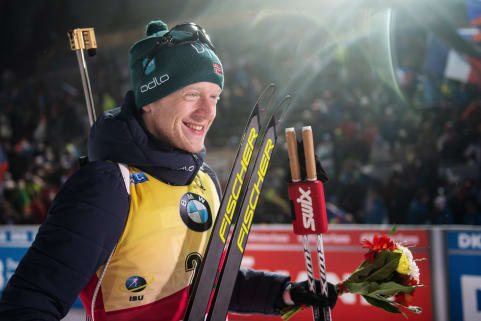
Johannes Thingnes Bø of Norway after winning the 2018 men’s 10 k sprint in Nove Mesto, Czech Republic. It was the Norwegian’s third sprint win of the season and his fourth win overall this year. He leads the IBU World Cup. (Photo: biathlonworld.com)
IBU World Cup Nové Město, Czech Republic Men’s 10 k Sprint
On Thursday in Nové Město, Johannes Thingnes Bø of Norway captured his third sprint victory of the early IBU World Cup season. Shooting clean, Bø won in a time of 23:09.9 minutes. It was Bø’s fourth win of the year. Alexander Loginov of Russia, in what was his best career result on the World Cup, placed second (+21.0) while shooting clean. In third place was Sweden’s Martin Ponsiluoma. The Swede also missed no targets while posting a career best for his first podium on the World Cup.
With several races left in Nove Mesto, Bø leads the men’s World Cup after six events with 308 points. Loginov sits in second with 232 points.
Christian Gow of Canada was the best placed North American as he tied for 20th (+1:31.8, 0+0). Also for Canada, Jules Burnotte placed 33rd (+1:57.8,0+1), Scott Gow 38th (+2:04.7,1+1), and Brendan Green 67th (+2:43.0, 1+1).
Leif Nordgren was the best American finisher in 40th (+2:07.6, 1+0). Sean Doherty placed 51st (+2:23.8, 2+0), Travis Cooper 56th (+2:28.8, 0+1), and Jake Brown 78th (+3:13.7, 1+1).
Racing continues tomorrow for the women with the 7.5 k sprint, and the men on Saturday with a 12.5 k pursuit.
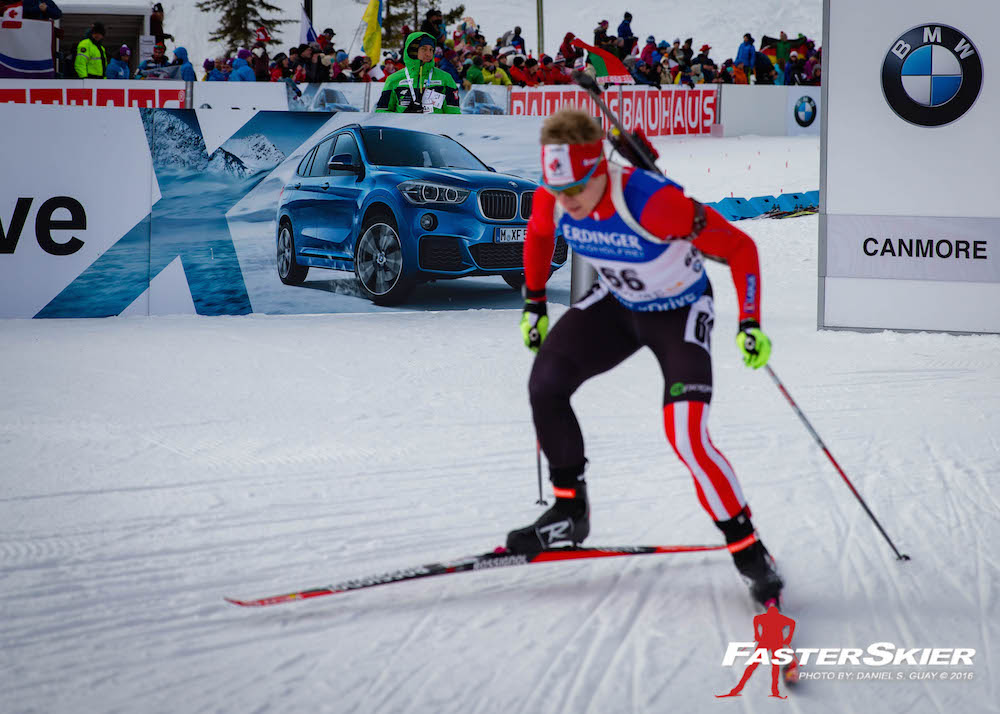
Scott Gow (Biathlon Canada) racing to 34th, one of the best results of his IBU World Cup career, last season in the men’s sprint in Canmore, Alberta. On Thursday, Gow tied a career best in 18th in the World Cup sprint in Nove Mesto, Czech Republic. (Photo: Daniel S. Guay)
For the third time in the last week, Scott Gow hit 100 percent of his targets: 10 in the sprint and 10 in the relay at the last International Biathlon Union (IBU) World Cup in Pokljuka, Slovenia, and another 10 in the 10-kilometer sprint on Thursday in Nove Mesto, Czech Republic.
And for the second time in his career, Gow, the oldest of two brothers on Biathlon Canada’s World Cup team, finished in the top 20 — tying his career-best of 18th.
“It feels great to achieve the second top-20 result of my career,” Gow said, according to a Biathlon Canada press release, referring to his 18th place in the 20 k individual at last season’s World Championships.
“My goal was to try and replicate my performance from last week in Pokljuka. I am very pleased to have shot clean, again, and to have a decent ski time,” he added. “Being in this group with the top 20 means that I’m finishing among the sport’s elite. That feels good knowing that I have the potential to compete with the best when I’m performing well.”
Gow started 15th of 101 finishers and cleaned the first prone stage with the 10th-fastest shooting and range times before repeating his shooting performance in standing. There, his shooting time slowed to 40th (and range time 34th), but his course time improved on the second loop, and he continued to speed up for the final, third loop. Overall, Gow’s course time ranked 40th.
“I trained very hard this year to increase my skiing and shooting abilities, and I also worked very hard to improve my consistency across both disciplines,” the 26-year-old Gow wrote in an email to FasterSkier. “I’ve been able to achieve great results in the past, but they always seemed few and far between. The reason I would have a good race one day but then fall into a dry spell was because my mental approach to racing wasn’t ideal, so I changed my mindset away from ‘hoping for the best’ to ‘I’m going to do my best,’ and it has worked very well for me at this point in the season.”
He added that he applies that mindset of not accepting anything less than a 100-percent effort to every aspect of his training and racing, whether it’s an easy combo or intensity session, or his precision in shooting, for example.
On Thursday, Dec. 15, France’s Martin Fourcade became the first man to win all three IBU World Cup sprints before the holiday break with his eighth win this season (and fifth individual victory) in Nove Mesto, Czech Republic. (Photo: IBU)
At the end of the day, Gow finished 46.5 seconds behind French winner Martin Fourcade, who racked up his eighth win (of nine races) this season in 23:48 minutes, despite one standing penalty (0+1). He made up more than 13 seconds on the final lap to surpass the race leader at the time, Russia’s Anton Shipulin, and beat him by 1.6 seconds at the finish.
Shipulin, the 16th starter, shot clean (0+0) and led until Fourcade in bib 31 crossed the line, and Norway’s Emil Hegle Svendsen ended up 6.4 seconds back in third with one miss (0+1).
Of the top 20, seven men hit all their targets on Thursday. Gow was one of them.
“The shooting conditions were perfect,” Gow wrote. “There was almost no wind from the start of zero to the end of the race, so the environment wasn’t messing with anyone today.”
He explained that Nove Mesto features a long stadium approach to the range, which took some consideration.
“It was important for me to make sure I didn’t ski too hard into the range and lose control of sights and rifle stability,” Gow told Biathlon Canada. “I definitely can’t shoot any better than I did today, so if I want to break into the top 10, I will have to find some time on the ski course. Skiing smarter and utilizing the course to my full advantage will help me do that, but I’ll need to have faster legs and skis in order to keep progressing.”
Gow led two Canadians in the top 60 required to qualify for Saturday’s pursuit. Brendan Green placed 54th (+1:48.1) with a miss in each stage (1+1). Christian Gow did not start.
Lowell Bailey racing to 20th, for his sixth-straight individual top 20 this season, on Thursday in the IBU World Cup sprint in Nove Mesto, Czech Republic. (Photo: USBA/NordicFocus)
For the U.S., two men also qualified for the pursuit, with Lowell Bailey in 20th (0+1, +47.5), and Russell Currier in 55th (1+1, +1:52.8). Tim Burke did not start because of illness, according to a US Biathlon press release.
“I was happy that my ski speed bounced back from last week,” Bailey said, according to the press release. He skied the eighth-fastest course time on the last loop and 17th fastest overall for his sixth-straight top six (in an individual race) this season.
“This is a challenging course, with some monster extended climbs and challenging downhills,” he said. “It’s also a difficult range in that you have a long approach with little rest before the shooting. I took my time in prone, which definitely cost me a few places, but I knew it was windy and I had to take a little bit of extra time to adjust for that. All in all, I’m happy with the result and looking forward to the pursuit on Saturday.”
American Russell Currier racing to 55th in the men’s 10 k sprint on Thursday at the IBU World in Nove Mesto, Czech Republic (Photo: USBA/NordicFocus)
For Currier, it was his first top 60 in a World Cup sprint since the 2014 Olympics (where he placed 60th), which meant Saturday’s pursuit would be his first at this level in nearly three years.
“The coaches and I were all pleased to have me in the top 60. The difference between a 60th and 61st is a lot in the sprint,” Currier wrote in an email. “Conditions were sub perfect, to be honest, The snow was sugary and mashed up. It didn’t get to much worse as the race progressed, but a bib 78 start didn’t help. The wind in the Nove Mesto range is tricky. It was calm when I set up for prone but a slight breeze that didn’t notice picked up on my third shot and landed me a miss.”
As for the U.S. men’s team, which is down to two so far this week, Currier said that it was “unfortunate … but the staff and coaches stayed positive and organized.”
He added that the crowd in Nove Mesto was “amazing,” in his first time back since the venue was being constructed four years ago.
“I’ve been to Nove Mesto a few times, and the fans are always incredible,” Gow explained. “The atmosphere is electric, full of energy and the fans seem to cheer for everyone. They genuinely love watching us race and it’s always fun having 30,000 people screaming while you try to rip around the course. Nove Mesto is definitely in my top 5 world cup venues.”
Notably absent from the Canadian roster is Nathan Smith, who missed last week’s World Cup in Pokljuka as well and is currently back in Canada.
“I flew back to Alberta from Slovenia last Tuesday [Dec. 6] to get rest and thorough medical tests,” Smith explained in an email. “It was a tough decision, as obviously I train all year to race and really don’t want to miss any. I also originally had plans to spend Christmas Break with my girlfriend in France, which all had to be changed.
“I hadn’t been feeling like myself in high intensity and time trials for some time,” he continued. “Perhaps 3-4 months. I thought I might have turned a corner shortly before leaving to Sweden, but evidently by how I performed I had not. Both myself and my coaches agreed that continuing to race wouldn’t be productive, and just delay my recovery from whatever is the root cause.”
As of this Wednesday, Dec. 14, Smith hadn’t determined what was wrong.
“Since getting home I haven’t done any training, and went through medical tests to check for mono, virii, hormone imbalances, etc. So far nothing concrete has surfaced, which could mean a case of over training,” he wrote. “Regardless of what the cause is, rest was needed, and I will ease back into training to aim for a comeback later in the winter. Whether that be after new year’s, World Champs, or the third trimester of racing.”
His coach Matthias Ahrens (also head coach of the Canadian team) explained that they were still investigating “the underlying health issues for [Smith’s] loss in performance, certain red flags have shown in last week’s tests and need further investigation and tests,” he wrote on Wednesday.
“Until then I can not comment on his status but would be very surprised if this was caused by or is overtraining,” Ahrens added.
He couldn’t say when Smith was expected to return to training or competition, as that was dependent on his next test results.
“Therefore I am also not able to comment on our team’s plan for whom we send to the [World Cups] after Christmas,” he added.
Fourcade Calls For Action
Russia’s Anton Shuplin (l) racing to second in the men’s 10 k sprint at the IBU World Cup in Nove Mesto, Czech Republic. (Photo: IBU)
Asked specifically how he felt about sharing the podium with a Russian on Thursday, Fourcade told German broadcaster ARD, “I think everyone in Germany and certainly in France knows how hard I fight against doping. … First of all, I want to see the facts. … If that is the truth, I want to be really aggressive against it with sanctions. I think it’s the athletes’ role to do that on their own. Otherwise they have to do something else for their salary. I am very proud of my clean performances.”
In another interview with Norwegian broadcaster NRK, he emphasized that the numbers involved were staggering.
“It’s not like it’s only one or two, it’s 31, added to the 12 we had the last few years in biathlon,” Fourcade said. “And I hope if my federation don’t get big balls enough to take [on] the problem, the athletes have to do it on their own.”
Elaborating on that, he spoke of a strike.
“If nothing is done in January, I will ask my colleagues in the international teams — I mean Norway, I mean Germany, Czech Republic, all of the nations — to not compete,” he said.
Leif Nordgren (US Biathlon) racing to a career-best World Cup result of 16th on Saturday in the men’s IBU World Cup 10 k sprint in Nove Mesto, Czech Republic. (Photo: USBA/NordicFocus)
When Leif Nordgren caught wind that he was seven seconds from a top 10 with one loop to go, he couldn’t help but get fired up.
The 25-year-old Minnesota native hadn’t cracked the top 20 in a World Cup since 2011, when he placed 17th in the mass start at 2011 IBU World Championships. The day before, in Friday’s mixed relay, US Biathlon Chief of Sport Bernd Eisenbichler said Nordgren looked better than ever — a sign of things to come.
On Saturday, Nordgren started 44th and raced himself up to ninth at one point in the men’s 10-kilometer sprint, right after cleaning his first of two shooting stages. Twelve-and-a-half seconds behind race leader Martin Fourcade of France, who led through prone, Nordgren headed out on his second-to-last lap.
Entering the range for the last time, he glanced at the leaderboard and noticed quite a few men had missed their targets on the windy afternoon. He shot conservatively in standing and missed one, which “was a little deflating,” he said, “but all I could do was push hard the last loop and see where I ended up.”
Even after skiing a penalty loop, he heard he was within reach of a top 10, which ended up being a top 20 after all 94 men in the field had finished. Nonetheless, Nordgren raced to complete his last lap and ended up 15th before being bumped to 16th by Germany’s Arnd Peiffer.
Sixteenth ended up being Nordgren’s magic number as it stood as his World Cup career best, 1:04.8 back from Slovenian winner Jakov Fak.
Leif Nordgren (US Biathlon) racing to a career-best World Cup result of 16th on Saturday in the men’s IBU World Cup 10 k sprint in Nove Mesto, Czech Republic. (Photo: USBA/NordicFocus)
“Today was almost a perfect race for me,” Nordgren said in a US Biathlon press release. “I felt really good on the skis, a little tired from the race yesterday, but not too much to handle. With clean shooting in prone I had a lot of momentum to work with right off the bat.
“I’m especially excited for tomorrow knowing I’m skiing good right now,” he wrote in an email to FasterSkier.
In Sunday’s 12.5 k pursuit, Nordgren will start 16th, 1:05 after Fak and at the same time as Russia’s Matvey Eliseev.
“Anything can happen in a race with 4 shooting stages,” Nordgren wrote. “If the conditions are tricky with wind like they can be here, then I look forward to a good opportunity to improve on today!”
Three American men started Saturday’s sprint, and all of them made the top 60 to qualify for the pursuit, with Tim Burke in 38th and Sean Doherty in 57th. Lowell Bailey is recovering from an illness in Ruhpolding, Germany, after running a fever for five days, according to Eisenbichler. On Monday, Bailey will meet the team in Oslo, Norway, to prepare for the next World Cup.
Tim Burke (US Biathlon) on his way to 38th in the men’s IBU World Cup 10 k sprint in Nove Mesto, Czech Republic. (Photo: USBA/NordicFocus)
Burke finished 1:40.7 behind Fak after three initial prone penalties set him back to 81st overall after the first stage. He made up more than half of those positions with a clean standing stage and skied the eighth-fastest course time overall.
Doherty met his season-long goal of qualifying for the pursuit, finishing 7.6 seconds ahead of 60th and 2:24.3 behind the winner. Like Burke, he also missed three prone targets to slip to 87th overall early on, then improved to 68th and finally 57th after a clean standing.
“The first shooing was really quite a disappointment,” Doherty reflected in an email. “The wind here can be tricky and I did not adjust enough to compensate for that, but other factors aside I know I am much better than 3 misses.”
He tried to clear his head and refocus on the second lap, forgetting everything that happened before.
“It worked out and I squeaked into the pursuit,” Doherty wrote. “I felt very strong on course today, not much different than yesterday. We had great skis and I was trying my best to make full use of them.”
As for Sunday’s pursuit, he simply planned to “go for it and race hard,” he wrote. “We will just have to see how it works out!”