Tag: nove mesto team sprint

  • Østberg, Falla Win Classic Team Sprint for Norway in Nove Mesto; U.S. Sixth (Updated)

    Østberg, Falla Win Classic Team Sprint for Norway in Nove Mesto; U.S. Sixth (Updated)

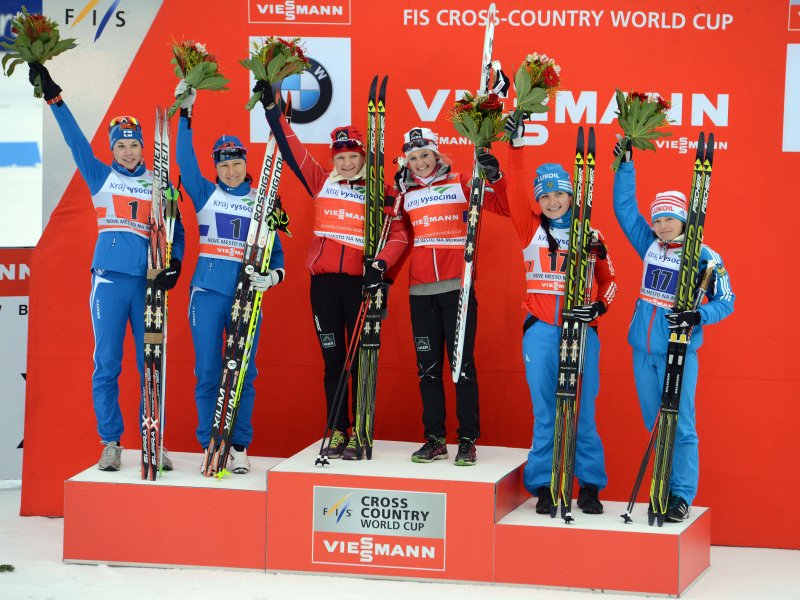
    Nove Mesto World Cup classic team sprint podium, with Norway's Maiken Caspersen Falla and Ingvild Flugstad Østberg (c) on top, Finland's Mona-Lisa Malvalehto and Aino-Kaisa Saarinen (l) in second, and Russia's Evgenia Shapolova and Julia Ivanova in third. (Photo: Fischer/Nordic Focus)
    Nove Mesto World Cup classic team sprint podium, with Norway’s Maiken Caspersen Falla and Ingvild Flugstad Østberg (c) on top, Finland’s Mona-Lisa Malvalehto and Aino-Kaisa Saarinen (l) in second, and Russia’s Evgenia Shapolova and Julia Ivanova in third. (Photo: Fischer/Nordic Focus)

    Note: This report has been updated to include quotes from Ida Sargent of the U.S. Ski Team.

    If history is a guide, Sunday’s classic team sprint in Nove Mesto, Czech Republic, was destined to end as showdown between Finland and Norway.

    Finland, led by Mona-Lisa Malvalehto and Aino-Kaisa Saarinen, was favored to win the relatively rare event on the World Cup. This was just the 12 time a team classic sprint has been held on either the World Cup or World Championships, and in the eleven previous occasions, Finland landed on the podium nine times. Finland came into the race on a hot streak, having won three of the last five classic team sprints, including three weeks ago in Asiago, Italy.

    The Norwegians, for their part, had won the event both previous times the World Cup brought it to the Czech Republic, although they started the day having won only once in the last five. Norway I’s team of Maiken Caspersen Falla and Ingvild Flugstad Østberg must have felt it was an auspicious day, though, as they won the freestyle team sprint together a year ago in Liberec, Czech Republic.

    The United States, having won two of the last three feestyle team sprints, has never reached the podium in a classic team sprint. The U.S. Ski Team was also without Kikkan Randall and Sadie Bjornsen. U.S. Head Coach Chris Grover explained, “We did not have Kikkan with us; she had a minor strain to one of her muscles in her back a couple weeks ago so she’s still taking it kind of easy on the back. She was being a little bit cautious today and we didn’t really have Sadie to use either; she’s been fighting off a little bit of a cold this past week.”

    The U.S. had one team in the event, with Ida Sargent leading and Sophie Caldwell anchoring.

    The course was a thick ribbon of artificial snow that curled around the green, snowless forests of Nove Mesto.  With no snow in Central Europe, Grover praised the event coordinators, saying, “The organizer did a fantastic job of getting the races off despite some really warm temperatures, and absolutely no snow anywhere nearby. Hats off to the Nove Mesto organizer, they really did an awesome job.”
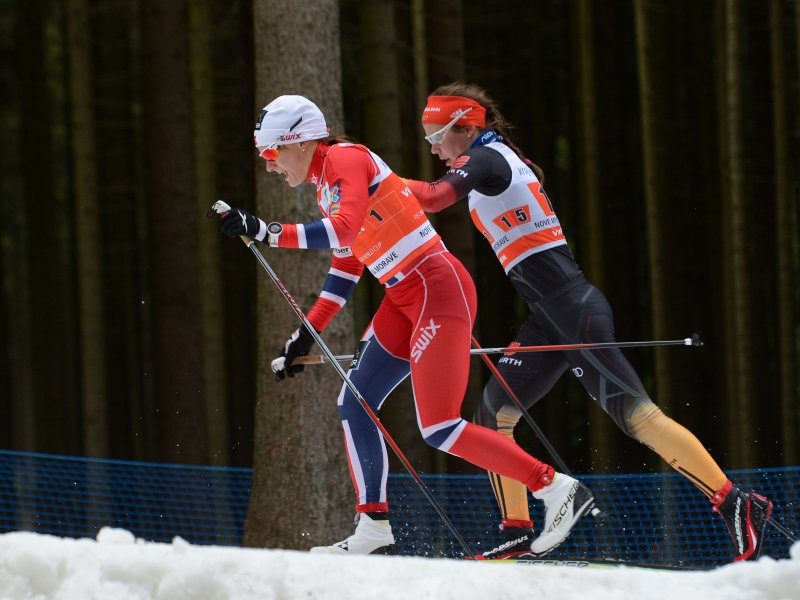
    Maiken Caspersen Falla (NOR), Hanna Kolb (GER)(Photo: Fischer/Nordic Focus)
    Norway’s Maiken Caspersen Falla (l) and Germany’s Hanna Kolb. (Photo: Fischer/Nordic Focus)

    Leading the team sprint out of the gate was Norway II’s Kathrine Rolsted Harsem. Behind her was Norway I’s Falla and Finland’s Malvalehto.

    Behind the Finn was Russia I’s Anastasia Dotsenko, and Russia II’s Evgenia Shapovalova. Britta Norgren Johansson skiing for Sweden II lost her balance on an icy corner on the first lap and fell, breaking her pole as she did so, and putting her well off the back of the pack and fighting to give her teammate Hanna Erikson a chance to catch up.

    The U.S. was led by Sargent who tagged off to Caldwell in seventh at the first exchange.

    “My strategy was to just stay relaxed, controlled, and in the mix for the first couple laps and try to go for it as much as I could on the last lap,” Sargent wrote in an email.

    The second lap was led out of the stadium by Celine Brun-Lie of Norway II, chased by Østberg of Norway I, and Finland’s Saarinen.

    Russia I’s Natalia Matveeva and Russia II’s Julia Ivanova were right behind as was Swtzerland’s Laurien Van der Graaf, who held a small gap ahead of Caldwell, skiing in sixth.
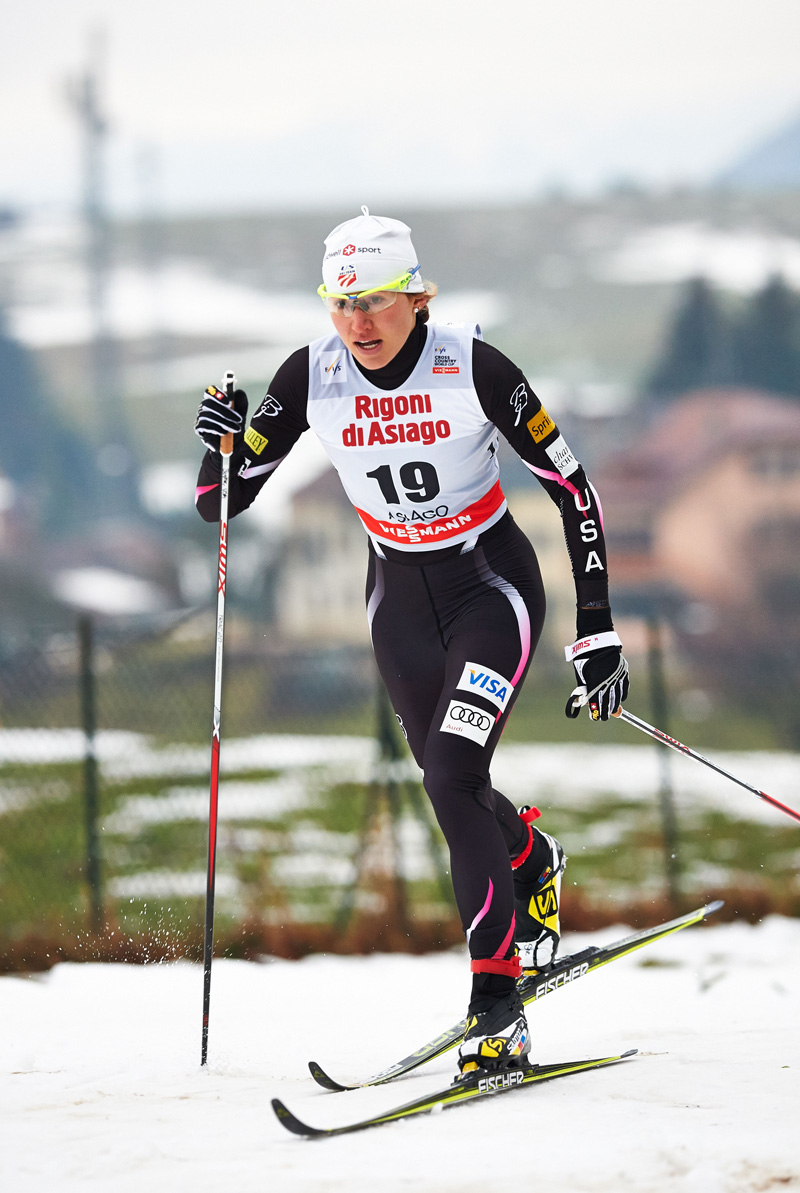
    Sophie Caldwell (US Ski Team) qualifying in 25th in the World Cup 1.25 k classic sprint in Asiago, Italy. She went on to place fifth in her quarterfinal for 24th overall. (Photo: Fischer/Nordic Focus)
    Sophie Caldwell (U.S. Ski Team) classic sprint in Asiago, Italy. (Photo: Fischer/Nordic Focus)

    Caldwell described the strategy for the early laps in an email. “I think the general idea is just to try to hold on for as long as possible,” she wrote. “You definitely want to be able to conserve a little energy for the last lap if possible, but you also want to try to maintain contact with the leaders.”

    On the top of the climb on the second lap, Østberg took the lead on the long gradual climb into the stadium from Brun-Lie.

    At the second exchange Østberg handed off in first, with Finland, Norway II, and Caldwell in fourth.

    Malvalehto took off on the third lap, leading up the early climb and created a small gap to Norway I and II who in turn held a small gap on Sargent who was being chased by Russia I and II.

    On the climb back to the stadium, Falla took back the lead from Malvalehto to hand off to Østberg in first for Norway I. The Russian teams had caught Sargent to put the U.S. in sixth at the third exchange.

    “It was a really fast paced and hard race but fun,” Sargent wrote.

    Despite the variable course profile and the number of laps, the race stayed quite consistent, without much movement in positions with the exceptions of the crashes.

    “It wasn’t as hard to make moves as it was during the skate sprint,” Caldwell wrote, “But I think it’s hard to make moves in team sprints in general because people are usually going close to as hard as possible the whole time. The course was pretty flat, but I think it skied much flatter as a skate course. I v2’ed basically the whole course yesterday, but today I was striding as much or more than double poling.”

    The fourth lap was dominated by Saarinen and Østberg who created a sizeable gap on the rest of the field.  Coming into the stadium for the fourth exchange, Matveeva caught her ski and fell, putting Russia I behind in a critical stage of the race.

    While the tracks were generally in good condition, the course itself varied throughout the 1.3 k loop. “It was definitely variable out there,” Grover said. “There were icy parts, there were a little bit softer parts, and there were places that were pretty hard to get kick.”
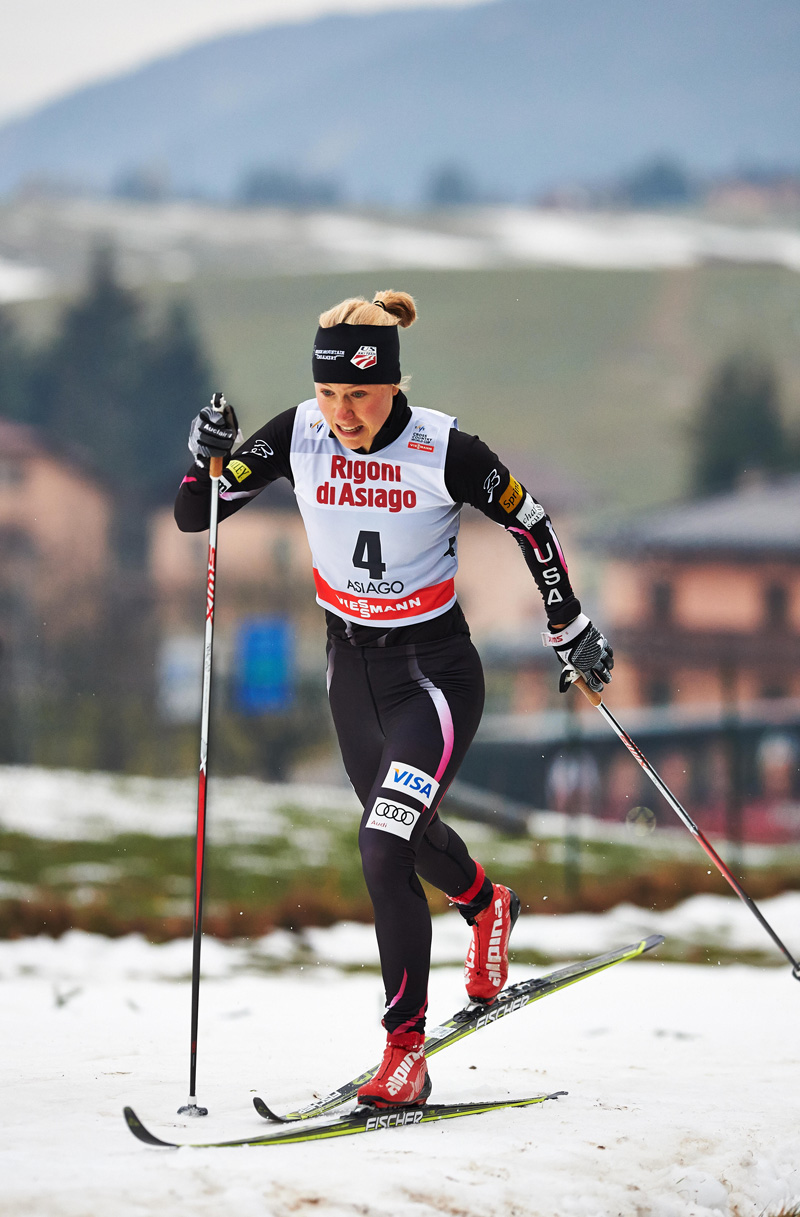
    Ida Sargent (U.S. Ski Team) racing to her first top 10 of the season in the 1.25 k classic sprint in Asiago, Italy. (Photo: Fischer/Nordic Focus)
    Ida Sargent (U.S. Ski Team) racing in Asiago, Italy. (Photo: Fischer/Nordic Focus)

    Of the course, Caldwell said, “It got below freezing last night so the course actually hardened up a lot over the night. The pole tracks were starting to break down, but the tracks held up quite well.”

    Falla and Malvalehto skied together out of the stadium on their final lap with a five second gap to Russia II’s Shapovalova.  On the final climb, Shapovalova made a huge effort and closed down the gap between her and Falla and Malvalehto.  The three came into the stadium together for the final exchange.

    Saarinen led out of the stadium and through the course with Østberg and Ivanova hanging on. Saarinen appeared to be in control of the race until the long gradual climb into the stadium. Østberg jumped into a track from behind Saarinen and began striding powerfully, taking the lead from Saarinen and then dropping her altogether as she entered the stadium with a comfortable gap to sprint to victory.

    The Norwegians won in 20:58.47 minutes, 3.8 seconds ahead of Finland in second.  Ivanova was right on Saarinen’s heels, placing third another 0.76 seconds back. Caldwell anchored the U.S. to sixth (+34.18), behind Russia I’s Anastasia Dotsenko and Natalia Matveeva in fourth (+26.01) and Norway II’s Kathrine Rolsted Harsem and Celine Brun-Lie in fifth (+26.70).

    “I thought Ida and Sophie did a great job getting themselves through the finals and fighting for every second in the finals and ended up sixth, so that was really cool,” Grover said.

    Falla told FIS, “I am of course very happy about the result today. I felt much better than in Asiago. Ingvild had a great day and skied amazingly.”

    Despite Finland being favored to win today, Malvalehto told FIS, “I am happy with today’s result. My shape has been good. Of course we always aim for the victory but to win in such a tough competition requires that everybody has her best day. But I am happy for the second place.”

    The Russians, surely hoping for a medal in this event in Sochi, were also content with the day’s result, considering that Russia I crashed out of contention. “It feels great to be on the podium today,” said Shapovalova. “We had a great day. I was pushing hard to stay in touch with the leading group. I felt sorry for Natalia (Matveeva) when she fell. But such things happen in the sprints. It was a great day for Russia.”

    The U.S. Ski Team will stay in Nove Mesto until Thursday when they travel to Szklarska Poreba, Poland, for next weekend’s World Cup. Poland, like the rest of Central Europe, is utterly devoid of snow, and the organizers have declared that there will be no official training at the Polish venue until Friday as they try to ready the course. The team will have to train on the loop of man-made snow in Nove Mesto.

    Grover explained that “there’s really no other option than that for hundreds and hundreds of kilometers. So that’s what those guys will do. The only other option for us would be to drive all the way back to the Alps and then all the way to back to Szklarska Poreba and that’s not really a smart decision.”

    Grover views the lack of snow as a temporary concern. “Our camp for the Olympics is in Seiser Alm [Italy], is at high altitude and they have lots of snow, and Toblach [Italy], has good snow, where we’re going prior to the games, and Sochi has good snow, so there’s not really any worries besides this week.”

    The World Cup continues on January 18th with a freestyle sprint in Szklarska Poreba.

    Results

  • Russia Sends a Message in Classic Team Sprint; Hamilton and Newell Combine for Notable Fifth

    Russia Sends a Message in Classic Team Sprint; Hamilton and Newell Combine for Notable Fifth

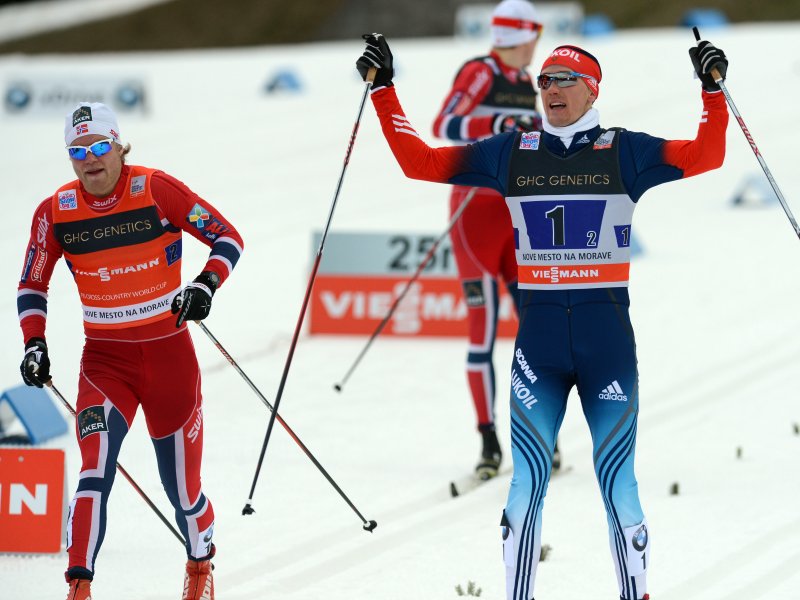
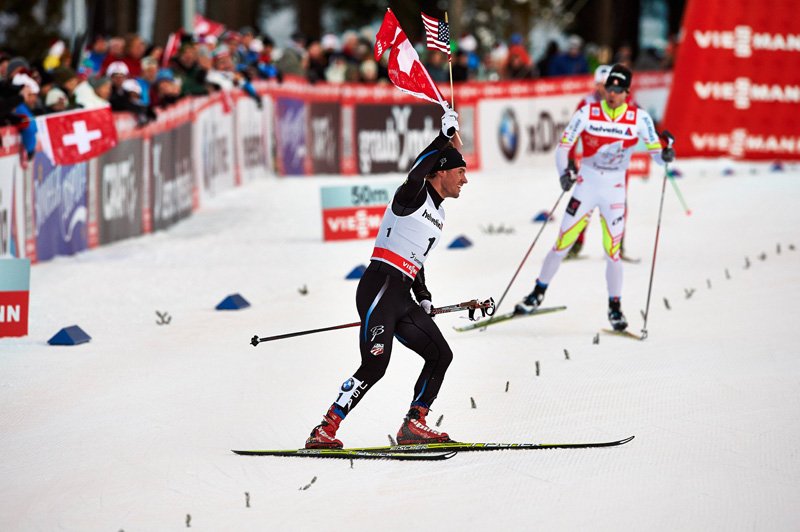
    Nikita Kriukov (r) celebrates a 0.22-second victory for Russia I over Norway I's Eirik Brandsdal in Sunday's 6 x 1.6 k classic team sprint. Norway II's Ola Vigen Hattestad placed third, 1.78 seconds back in the final classic sprint before the Olympics. (Photo: Fischer/Nordic Focus)
    Nikita Kriukov (r) celebrates a 0.22-second victory for Russia I over Norway I’s Eirik Brandsdal in Sunday’s 6 x 1.6 k classic team sprint. Norway II’s Ola Vigen Hattestad placed third, 1.78 seconds back in the final classic sprint before the Olympics. (Photo: Fischer/Nordic Focus)

    Twenty-five days before the Olympics open in Sochi, Russia, Nikita Kriukov couldn’t have timed Sunday’s 6 x 1.6-kilometer team-classic sprint victory much better. The 28-year-old Russian’s execution was right up there as well.

    Following Norway’s Eirik Brandsdal into the finish, the reigning sprint world champion left no doubt that he’s still in top form, and when it comes to classic sprinting, watch out.

    With teammate Maxim Vylegzhanin, Kriukov anchored Russia I to a World Cup win in 22:03.89 in the final classic-sprint tuneup before the Olympics, To do so, he outsprinted not only Brandsdal of Norway I by 0.22 seconds, but outlasted Norway II’s Ola Vigen Hattestad, who took third 1.78 seconds back.

    Almost as soon as he crossed the finish, Kriukov graciously bowed to the grandstand at Nové Mesto, Czech Republic. The Norwegians hung their heads, fully realizing what happened and the work they have cut out in the team classic sprint at the upcoming Winter Games.

    “I followed the plan and hoped to avoid meeting Kriukov [in the finish],” Brandsdal, 27, told NRK, according to a translation.

    Despite teammate Eldar Rønning giving him a 1.1-second head start out of the last exchange, Brandsdal ended up chasing Kriukov to the finish anyway.

    “We have to hope for a step up in the Olympics, but we do not know if this is being made,” Rønning told NRK. “There is strong competition.”

    But rehearsal is rehearsal and the show is the main attraction, the 31-year-old Rønning reasoned. Either way, the Russians made a point.

    The Norwegians led out of the start with Norway II’s Pål Golberg, 23, leading through the first exchange, just 0.4 seconds ahead of Rønning. Sweden II (Marcus Hellner/Emil Jönsson) remained in the mix 0.9 seconds back with Germany I (Sebastian Eisenlauer/Josef Wenzl), and Vylegzhanin was just a second back in fifth. Switzerland I (Ueli Schnider/Gianluca Cologna) tagged sixth, a tenth of a second ahead of the Americans, with Simi Hamilton handing off to Andy Newell 1.4 seconds back from the leaders.

    “We got off to a really good start,” Hamilton said on the phone, after the Americans qualified in second in their semifinal then placed fifth behind the Czech Republic (Martin Jaks/Ales Razym) in the final.

    All 10 teams remained within 2 1/2 seconds of one another through the first four laps, before the three leaders — Rønning, Vylegzhanin and Golberg — broke away on the second-to-last leg.

    Meanwhile, Hamilton put the U.S. in fourth, 4 1/2 seconds back. Newell had posted the fastest leg just before him to bring the team to third at the fourth exchange, tied with Russia.

    Russia I's Maxim Vylegzhanin leading Norway II's Paal Golberg in Sunday's World Cup 6 x 1.6 k classic team sprint in Nove Mesto, Czech Republic. (Photo: Fischer/Nordic Focus)
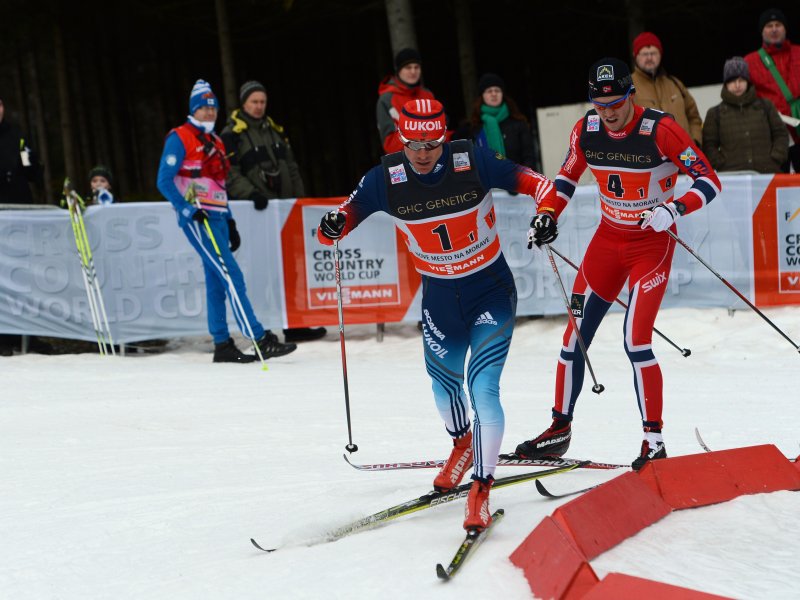
    Russia I’s Maxim Vylegzhanin leading Norway II’s Pål Golberg in Sunday’s World Cup 6 x 1.6 k classic team sprint in Nove Mesto, Czech Republic. (Photo: Fischer/Nordic Focus)

    “It was pretty tight the entire time with all ten teams and we lost a little bit of time in one of the tags because it was so tight with all ten teams within a couple seconds,” Hamilton explained.

    After Newell’s first lap, Hamilton fell from sixth to ninth, 2.4 seconds behind the two Norwegian teams and Russia up front.

    “We got a little scrapped up in one of the tags and lost a little time and came back thanks to Andy’s second leg,” Hamilton said. “When he tagged off to me on my last leg I just made it a goal to stay in contact with the top three teams. … I skied as hard as I could and lost a little bit of time but fought hard.”

    After Newell received the tag in fourth, he led the chase pack as Russia, Norway I and Norway II continued to contend for the lead.

    Norway II’s Hattestad fell off the pace on one of two climbs with what appeared to be less-than-ideal skis on the 36-degree Fahrenheit afternoon. Slipping up while herringboning outside the track, Hattestad initially lost contact with Kriukov and Brandsdal before putting on a last-ditch attempt to catch up.

    Brandsdal took advantage of his superior glide on the descent as he drafted and passed Kriukov a few hundred meters before the finish. Heading down into the stadium, Brandsdal led while Kriukov followed closely, and Hattestad, who anchored Norway to a classic team sprint victory three weeks ago in Asiago, Italy, trailed a couple meters behind.

    As Newell led the second group, including Czech Republic’s Razym and Germany’s Wenzl, into the stadium, Kriukov unleashed his well-known double pole, stepping around Brandsdal and definitively beating him to the finish.

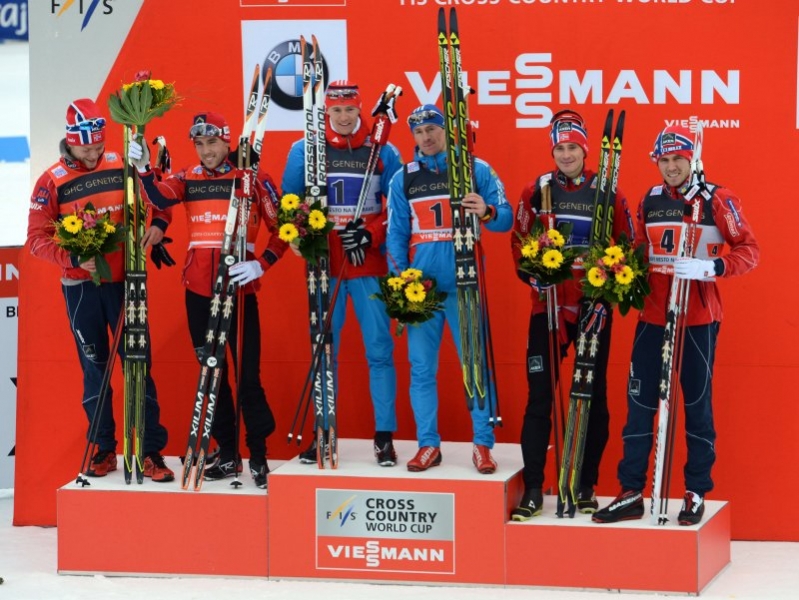
    The World Cup men's classic team sprint podium in Nove Mesto, Czech Republic: (from left to right) runner-up Norway I, winner Russia I, and Norway II in third. (Photo: Fischer/Nordic Focus)
    The World Cup men’s classic team sprint podium in Nove Mesto, Czech Republic: (from left to right) runner-up Norway I,  Russia I’s winners Nikita Kriukov and Maxim Vylegzhanin, and Norway II in third. (Photo: Fischer/Nordic Focus)

    “I felt much better than yesterday,” Kriukov told FIS after narrowly qualifying in 27th in Saturday’s classic sprint and placing 10th overall. “It was my first time skiing with Maxim. It gives us great confidence going to Sochi.”

    “A few centimeters were missing on Kriukov,” Brandsdal told FIS. “I do not like losing in the finish. Nikita was very strong. It was cool to have such [a] tight fight.”

    Newell successfully dropped Switzerland’s Cologna and bested Wenzel, but failed to match Razym, who used the home-crowd advantage to edge him by 0.54 seconds for fourth.

    The Americans placed fifth, 14.28 seconds behind the Russian winners, and held off Germany by seventh-hundredths of a second. Switzerland placed seventh, another 6 1/2 seconds back, France was eighth (+22.08), Italy ninth (+26.47), and Sweden 10th (+50.32).

    After Jönsson’s second leg, Sweden dropped from seventh to 10th with Hellner, leading him to rethink whether he’ll sprint at the Olympics after failing to qualify on Saturday.

    “It would not be fun to go and feel like this in the Olympics,” he told aftonbladet.se, according to a translation.

    “Right now I am pensive on sprint,” Hellner told Radio Sport. “But who knows, maybe it will be better and better. Nothing is certain in any case.”

    Jönsson was back in action after sitting out Saturday’s sprint because of a troublesome right knee.

    “I could list 3,000 things we could have done differently, but I’ve got three good races, have a knee … and Marcus holding up and moving well, so there is probably some bright spots,” Jönsson said.

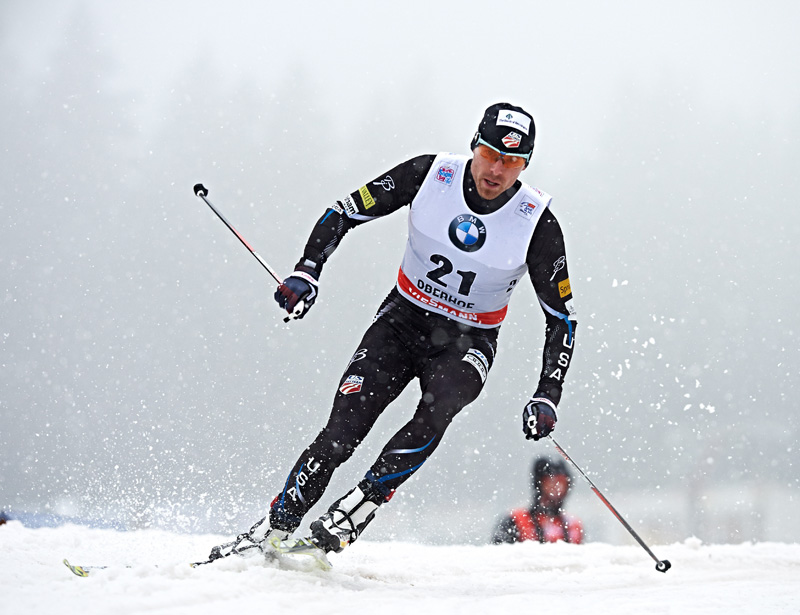
    Andy Newell (U.S. Ski Team) racing the individual sprint at the Tour de Ski Dec. 29 in Oberhof, Germany. (Photo: Fischer/Nordic Focus)
    Andy Newell (U.S. Ski Team) racing the individual sprint at the Tour de Ski Dec. 29 in Oberhof, Germany. (Photo: Fischer/Nordic Focus)

    Newell said that he and Hamilton, who won the Tour de Ski freestyle sprint in Lenzerheide, Switzerland, on New Year’s Eve, relied on smart yet aggressive skiing and not being afraid to take chances.

    “We were right in there for a while,” Newell said on the phone. “Whenever I do a sprint relay it’s just kind of my goal to stay up front and keep us in a good position and save as much energy as I can for the end because that’s when it’s really going to matter.”

    At least 20 meters behind the top three on the last lap, he realized the podium was likely out of reach.

    “We tagged in fourth for my last lap, but even then we weren’t in medal contention,” Newell said. “In a sprint relay even 20 meters is too much to make up on the best skiers in the world. If we’re going to be in medal contention, we need to be up in the front for the last tag, which is the only thing holding us back for being a contender. It’s looking good leading into Sochi for sure.”

    While fifth remains the best U.S. men’s team sprint result in recent memory, another highlight of the day was Hamilton and Newell automatically qualifying in second in their semifinal, 0.82 seconds behind Norway I’s Rønning and Brandsdal.

    “We had a really good day with Andy and Simi qualifying outright, being second in their semifinals and were strong all day,” U.S. Ski Team Head Coach Chris Grover said. “I don’t think the guys have been as high as fifth for a few years now so that was really cool.”

    Simi Hamilton (U.S. Ski Team) taking a victory lap after his win in the third stage of the Tour de Ski on Dec. 31 in Lenzerheide, Switzerland. (Photo: Fischer/Nordic Focus)
    Simi Hamilton (U.S. Ski Team) enjoying a victory lap after winning the third stage of the Tour de Ski on Dec. 31 in Lenzerheide, Switzerland. (Photo: Fischer/Nordic Focus)

    Racing against 15 other teams in the second semifinal, Grover pointed out that they needed to place in the top two to guarantee themselves a spot in the final. Ultimately, Germany I, Sweden II and Italy I (David Hofer/Federico Pellegrino), ended up advancing with them as lucky losers.

    “Andy and Simi’s semifinal was running slightly slower than the first semifinal which is somewhat typical in warmer conditions were the track is actually slowing down,” he said. “They would have been fine if they had been in the top four as it worked out, but you have to play it safe. Beyond that, we just try and get in the finals, and once you’re in the finals the tactic is just to rest when you can and be as strong as you can on the last two and half to three legs when people take off and really start hammering.”

    “We were able to save our energy when we needed to and stay on our feet and that’s all you can hope for, just staying out of trouble and staying up with the leaders,” Newell said. “We don’t want to be trying to break off the front. You only have to ski as fast as the people around you.

    “That’s what were trying to do in these relays: keep up with the leaders, stay out of trouble, and it always just comes down to last lap or two,” he added. “In Sochi it’s going to be a harder course, but I think were both in good enough shape so that when it comes down to our last laps we need to be up there with the best. I think we can do that for sure.”

    “It’s obviously a very different course than what we’re going to find at Sochi, but last year we skied really well at the team sprint day there,” Hamilton said, after he and Newell placed seventh in the World Cup classic team sprint in Sochi last February. “We both like that course there. I think it speaks to our fitness right now. We are both on a really good trajectory in terms of where our fitness is and our speed is. We’re encouraged and we’ll see what happens, but we’re psyched for sure. Today it would have been great to be on the podium but I think we’re encouraged with how everything went.”

    The Americans will continue training in Nové Mesto before the next World Cup in Szklarska  Poreba, Poland, with an individual skate sprint and 10/15 k classic mass start on Saturday and Sunday.

    After that, they’ll head to Europe’s largest high-altitude meadow at Seiser Alm, Italy, for a training block before the last World Cup before the Olympics in Toblach, Italy.

    — Lander Karath and Pasha Kahn contributed reporting

    Results