From the FasterSkier archive — posts syndicated from athletes’ and coaches’ own blogs between 2004 and 2012, kept online as published. Current coverage is at fasterskier.com.
Liz Stephen has earned her stripes. For the last 11 years, the 29-year-old Vermont native has been part of the US Ski Team (USST). After veterans like Kikkan Randall, Stephen has become an anchor on the women’s team, which now carries with it expectations of top-20’s, top-10’s and podiums. At the age of 15, the Burke Mountain Academy alpine skier and runner switched to the skinny skis for good.
With her high energy and drive, she became a force on the U.S. junior cross-country ski scene. What followed were a string of results commensurate with her high turnover. In both 2013 and 2014, she was the 15th-ranked distance skier on the World Cup. A year later, that ranking was more than halved — she concluded 2015 ranked seventh in the Distance World Cup.
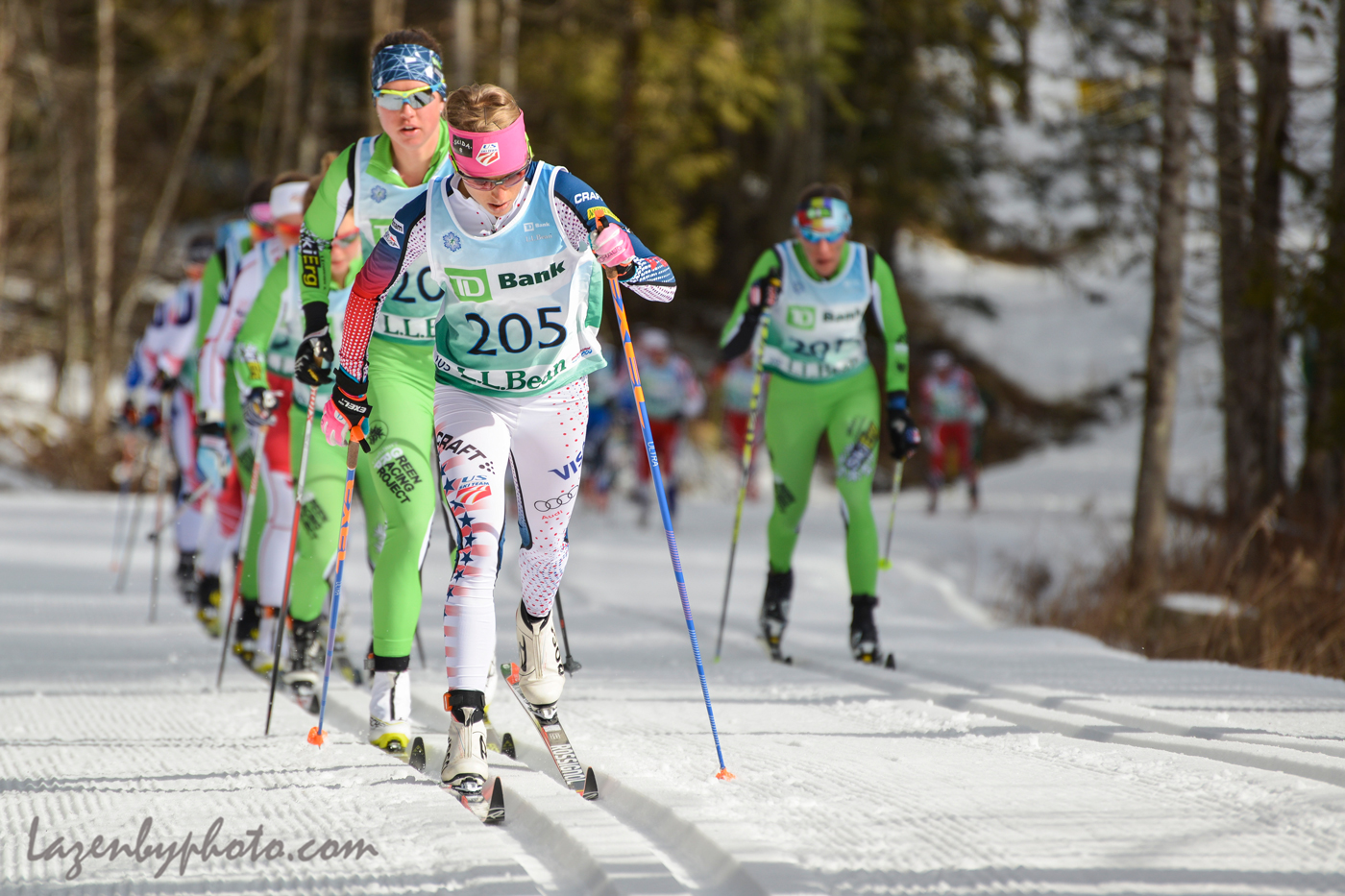
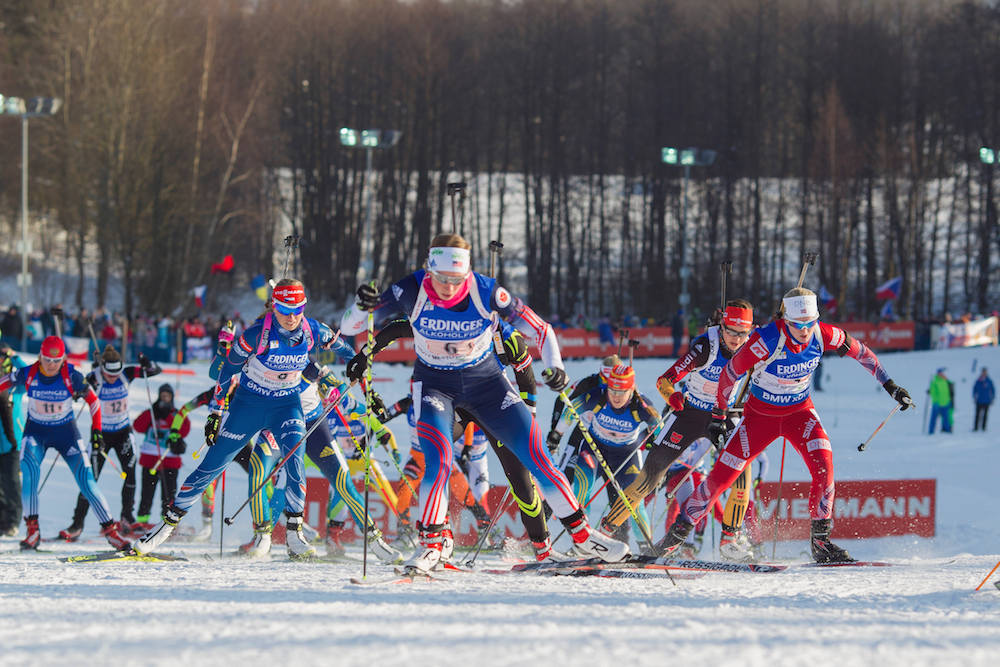
Liz Stephen (U.S. Ski Team) leads Caitlin Patterson (Craftsbury Green Racing Project) and the rest of the chase pack during the women’s 30 k classic mass start at 2016 U.S. Distance Nationals in Craftsbury, Vt. (Photo: John Lazenby/Lazenbyphoto.com)
Then, due to possible overtraining and some shaken confidence, Stephen’s results regressed to 28th on the distance list in 2016. Still good enough for an U.S. A-team nomination, but not what she expected.
“It’s not as though you worked any less hard, generally that’s not the case, sometimes it’s the opposite,” Stephen said during the podcast interview. “You feel like you worked really hard and none of it is paying off. It’s like a two-sided sword. Your results are going down. And instead of being, ‘All right, I can do this,’ gaining confidence, it’s the opposite. Every time you are getting a result you’re not proud of, your confidence is sinking a little bit lower. And for every percent your confidence sinks, that’s at least a place on the World Cup, if not two.”
In a world-championship year, Stephen is hoping to rebound individually and in support of her teammates on a medal-winning relay team. All that doesn’t seem so far fetched. Stephen skied the third leg in last season’s 4 x 5 k in Nove Mesto, Czech Republic, in which the U.S. women skied to their historic-best second place in a World Cup relay.
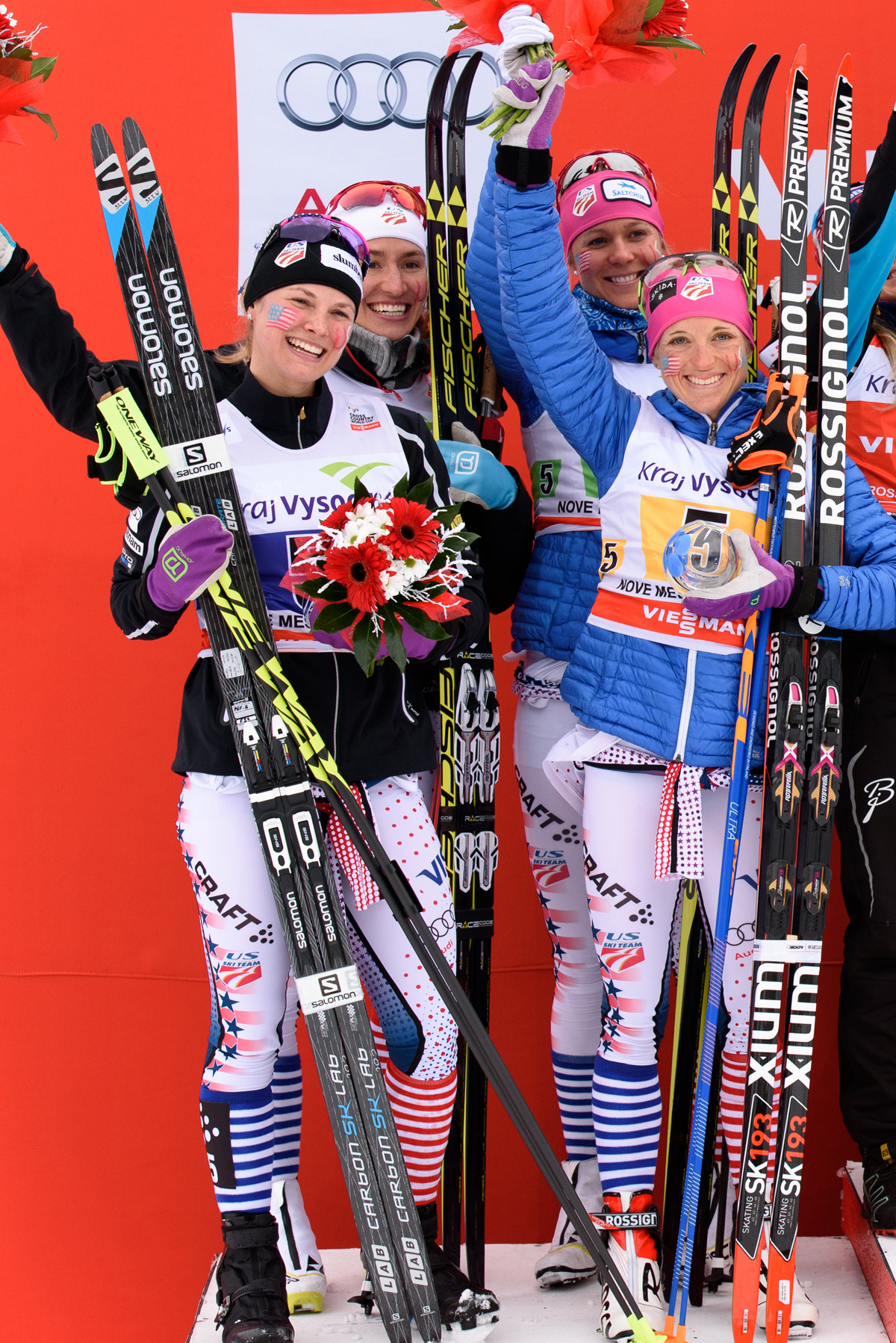
The U.S. women placed a historic second for their best-ever relay finish at the 2016 World Cup 4 x 5 k in Nove Mesto, Czech Republic. From left to right: Jessie Diggins, Sophie Caldwell, Sadie Bjornsen, and Liz Stephen. (Photo: Fischer/NordicFocus)
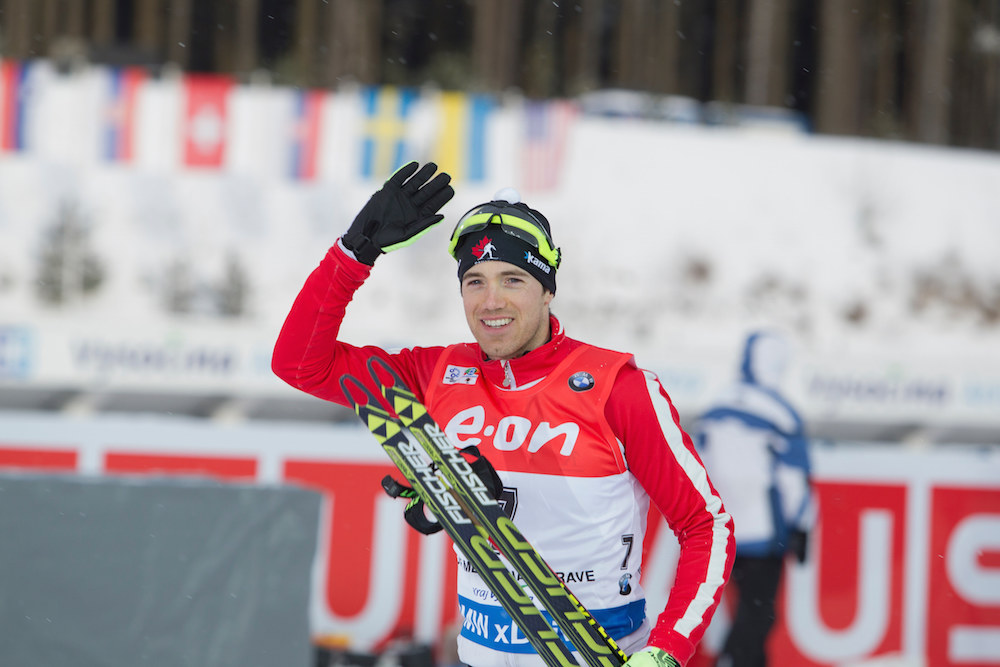
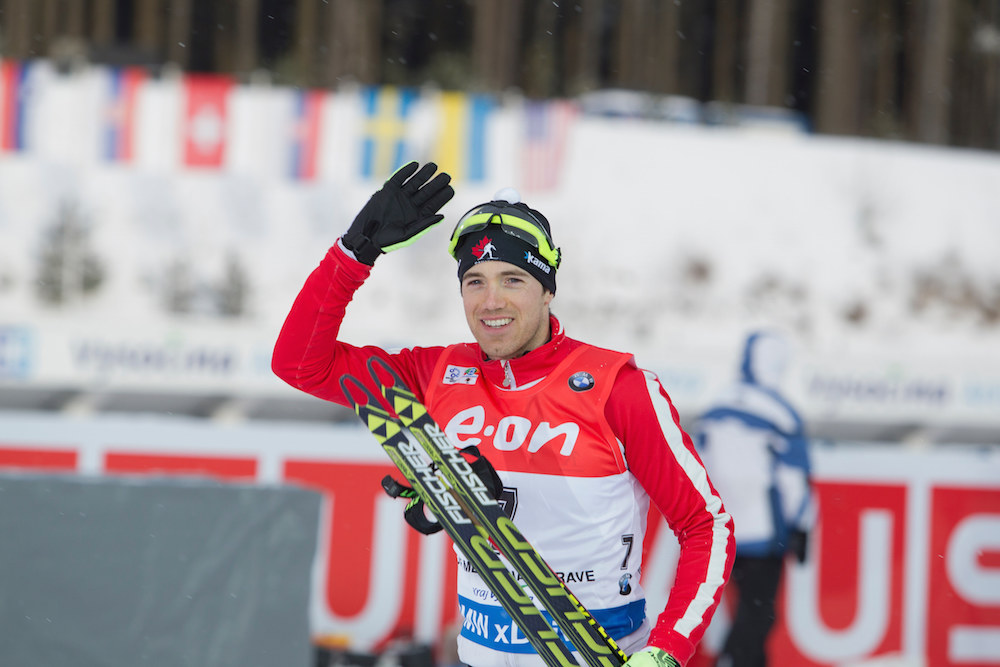
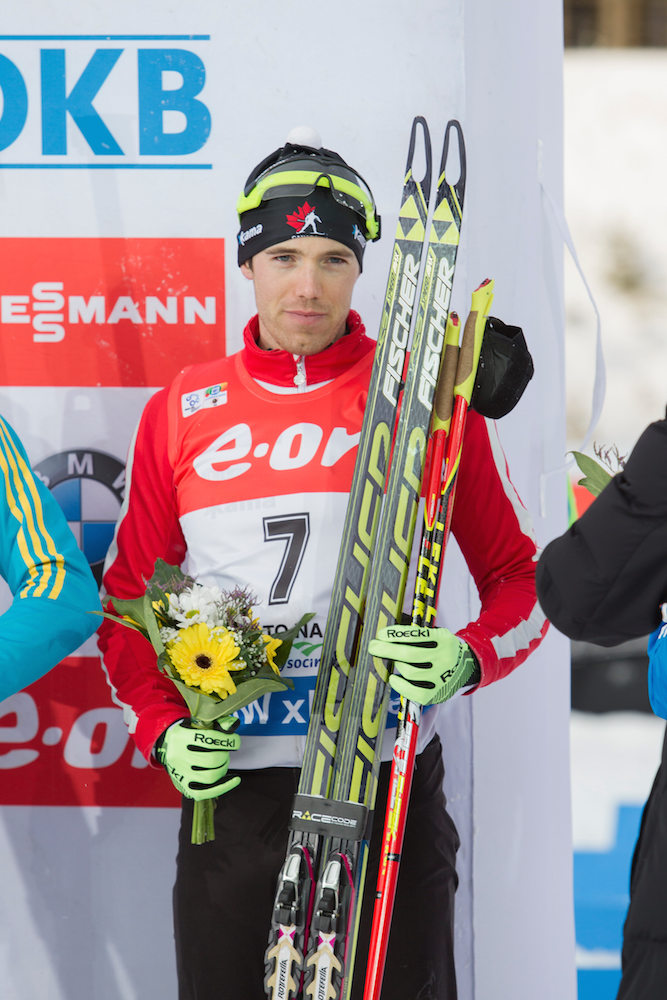
Canada’s Nathan Smith at his first-ever awards ceremony after placing a career-best fifth on Sunday in the IBU World Cup 12.5 k pursuit in Nove Mesto, Czech Republic. (Photo: Biathlon Canada/NordicFocus)
No part of Sunday could be described as “easy” for anyone racing the IBU World Cup pursuits. A little new snow and some wind had been in the forecast for the last day of racing in Nove Mesto, Czech Republic, and that seemed manageable.
Overnight, nearly half a foot of snow fell. Then, on Sunday afternoon, came the snow squalls, sporadically and unforgivingly, with increasing blizzard-like conditions making for a miserable-looking women’s race.
Heavily falling snow jammed rifles, and some women crossfired, like Germany’s Franziska Hildebrand, who was in the top five until shooting at the wrong targets in the final stage. She then skied the wrong number of penalty loops and was penalized six minutes, relegating her to 50th out of 51 finishers.
Meanwhile, the Czech Republic’s own Veronika Vitkova desperately tried to get the attention of race officials to reset her targets — the ones Hildebrand shot at. The technical delegate for the weekend, Max Cobb (also US Biathlon’s CEO) explained that video cameras in the range revealed Vitkova lost 52 seconds amid the confusion, and the jury deducted that from her final time, which put her in 11th overall.
And all that happened before the men’s race even started.
Canada’s Nathan Smith was ready for an equally slow-and-painful 12.5-kilometer men’s pursuit. He had seen blue skies during zero shift to snowfall during his warmup, amounting to a centimeter or so on the ground before the gun went off.
Fortunately, it lightened up to “a medium snowfall” for most of the race, he explained, up until the another big squall blew through on Smith’s final lap.
“Thankfully, I only had to deal with that for half a lap,” he wrote in an email.
But what a half a lap it was. After starting seventh, 38 seconds behind Saturday’s sprint winner Jakov Fak of Slovenia, Smith leapt to fifth with a clean first prone. Fak cleaned as well, as did France’s Martin Fourcade, who started fourth, Germany’s Simon Schempp, who started second, and the Czech Republic’s Michal Slesingr, who started fifth, respectively.
Smith, who posted a career-best seventh on Saturday, established himself behind them in fifth after the first shooting, 40.7 seconds after Fak. The top-12 men to leave the range all came out with perfect shooting.
Conditions were initially more favorable than the women’s race, with light snow and a slight-yet-variable wind.
But the weather gradually intensified, and with each passing shooting stage, the pressure picked up as well.
The 29-year-old Smith handled it like never before — cleaning all four stages for 20-for-20 shooting and keeping himself squarely in the top-six throughout the race.
“I was pretty nervous on the last standing, but channelled my previous fails to make sure I diligently aimed at the targets,” he wrote.
He focused on relaxing his left arm in prone and his left hand in standing — which worked.
After the last standing, Smith headed into the final lap in fifth, 5.2 seconds behind Ukraine’s Sergey Semenov in fourth and 22.7 seconds behind Fak, who was still in the lead despite a single miss on the last stage.
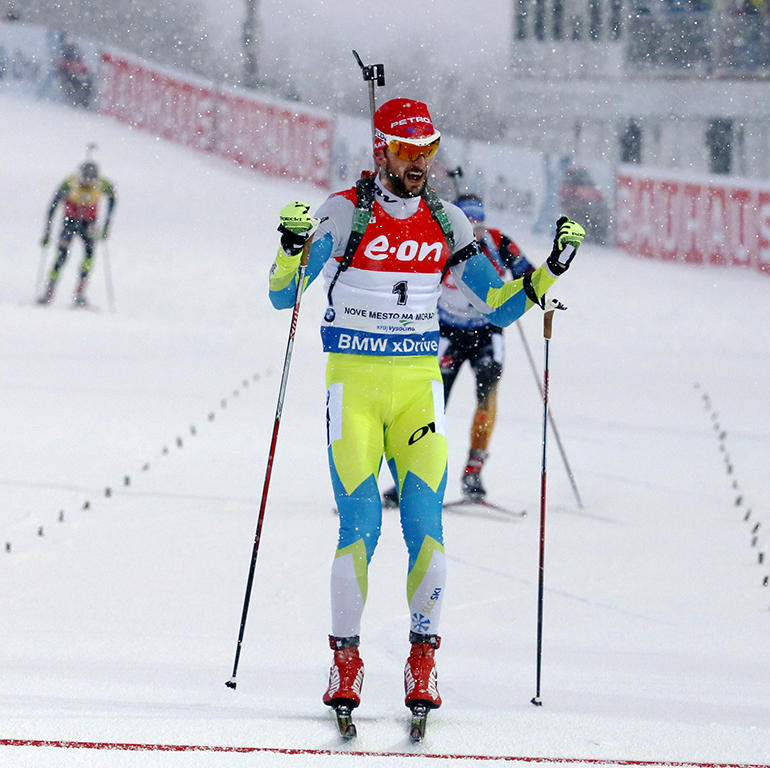
Slovenia’s Jakov Fak celebrates his second-straight win with a victory in Sunday’s 12.5 k pursuit at the IBU World Cup in Nove Mesto, Czech Republic. He held off Simon Schempp of Germany and France’s Martin Fourcade, respectively. (Photo: IBU/Květoslav Frgal)
(Fak completed his penalty loop just as Fourcade was leaving the range after cleaning his fourth-straight stage. Fak led the Frenchman into the last lap, where he extended his gap on him over the next 2.5 kilometers.)
Meanwhile, Smith simply needed to hold his position to set new World-Cup best, but that wasn’t easy, either.
“The Ukrainian [Semenov] and I had been skiing pretty similarly whenever I saw him,” Smith explained. “I tried my best to gain time but was a lot more concerned that someone might come up from behind.”
With 20.6 seconds separating Smith from sixth place (with Germany’s Erik Lesser) after the last stage, the Canadian skied the fifth-fastest course time on the last lap to secure fifth. He crossed the line 24.1 seconds after Fak, who proved untouchable on Sunday with a winning time of 37:24.9.
“I never started a pursuit in first and won so I am happy that I did that,” Fak told the IBU. “I wanted to shoot clean but do not have much experience shooting on lane one, so maybe next time I can do it.”
Fak’s 19-for-20 shooting and second-fastest overall course time was enough to hold off Fourcade and Schempp, who missed one on the second prone, by 4.4 seconds. Fourcade hit each one of his and was in contention for second until the last climb, where Fak attacked to drop both him and Schempp. The German proceeded to pass Fourcade about halfway up, accidentally stepping on Fourcade’s ski to leave the Frenchman staggering for a moment — a moment he couldn’t get back.
Fourcade let up and casually finished third, 8.9 seconds behind Schempp and 13.3 seconds after Fak. Semenov hung on to fourth, another seven seconds later, and Smith finished 3.8 seconds behind him in fifth.
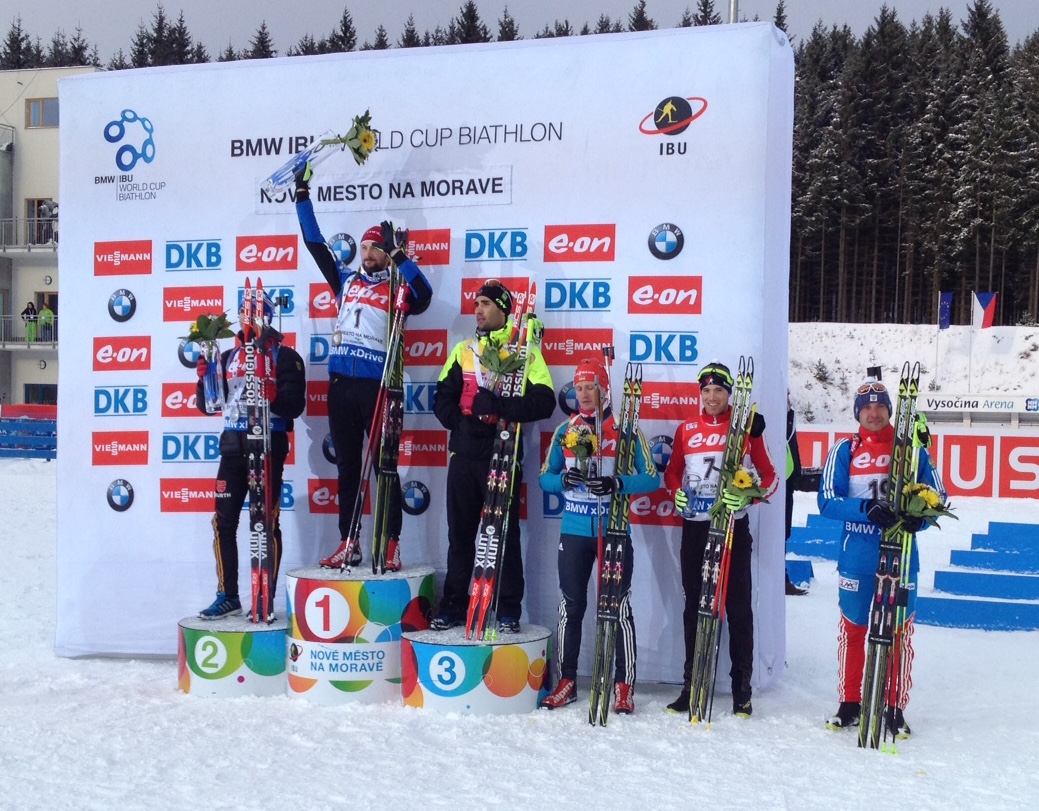
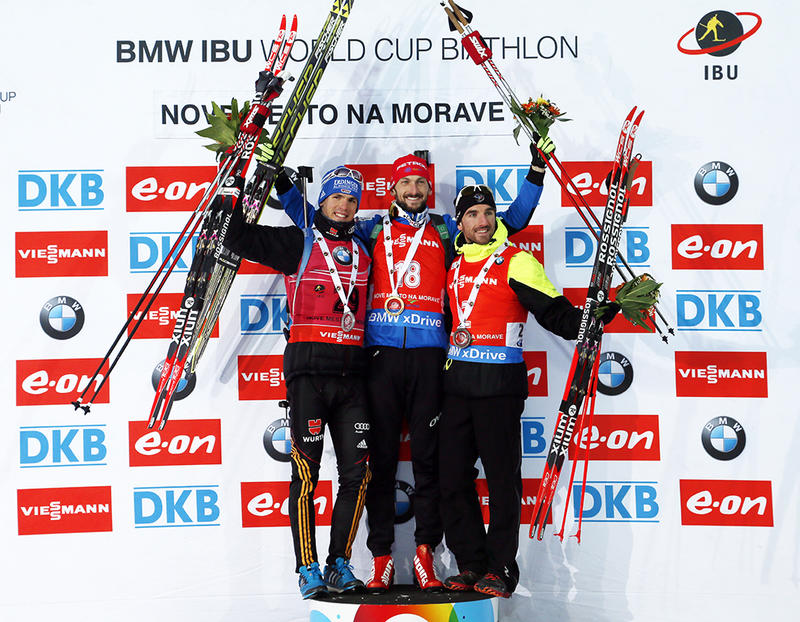
Canadian Nathan Smith (second from r) after placing fifth in Sunday’s IBU World Cup pursuit in Nove Mesto, Czech Republic, for his first-ever flower ceremony. Slovenia’s Jakov Fak (second from l) won the race, Germany’s Simon Schempp (l) placed second, and France’s Martin Fourcade (third from l)made the podium in third. (Photo: Matthias Ahrens/Biathlon Canada)
With Russia’s Evgeniy Garanichev in sixth (+45.6), the top-six men walked together to the following flower ceremony, where Fourcade patted Schempp on the back, indicating no hard feelings.
“It was not easy on the tracks; there was only one spot that was fast,” Schempp later told the IBU. “I had no other chance to pass him. We talked it over and it is okay.”
For Smith, the ceremony itself marked his season-long goal.
“It feels awesome to achieve that and especially when the other guys up there are the perennial biathlon top dogs,” Smith explained of his new career high.
In addition to a bouquet and a glass vase Smith estimated weighed 20 pounds, “It won’t be so great for travelling with,” he joked, Smith also received 3,500 Euros for sixth, roughly $4,000 U.S. dollars.
On any other day, with 20-for-20 shooting, he felt he could have been on or certainly closer to the podium. Fourcade and Semenov also cleaned all four stages just ahead of him.
“Today was a little unlucky for me as the top-three men were basically the Overall World Cup leaders,” Smith told Biathlon Canada, referring to Fourcade, Schempp and Fak, who rank first, second and fourth in the overall standings, respectively. “If a couple of them faltered I could have been there, but it is tough to beat the best when they are on 100 per cent. I know though if you’re only a couple of places off the podium enough times, one day it will happen.”
Canada’s Nathan Smith at his first-ever awards ceremony after placing a career-best fifth on Sunday in the IBU World Cup 12.5 k pursuit. (Photo: Biathlon Canada/NordicFocus)
For the first time in his career, the Canadian also notched back-to-back clean races. He came close last year at the Sochi Olympics, with 29-out-of-30 shooting between two races, but completed the feat on Saturday and Sunday, knocking down 30 consecutive targets.
“Today is extra special because it is the first 20/20 clean of my biathlon career,” Smith added. “It feels awesome to have that success. It makes skiing less of a chore, and you’re excited to get back to the range after the next lap.”
In an email, Canada’s head coach Matthias Ahrens observed that Smith was more mentally prepared for the pressure situation he faced on Sunday, than when he found himself in third coming into the last shooting earlier this season in Östersund, Sweden, and ended up 16th.
“He keeps it cool, he is a pretty quiet guy but lots of thinking in his preparation,” Ahrens wrote.
“The skill and control he demonstrated is exactly what we expect to see from an athlete hungry for medals at world cup and world championship competitions,” wrote Chris Lindsay, Biathlon Canada’s high-performance director, in an email. “Both he and Brendan [Green] have taken on the leader roles within the team now that more of the younger athletes are being introduced to the World Cup. This leadership is most important when it is expressed though performance like we saw today.”
The second of three Canadian men in the pursuit, Green started 22nd and finished 30th (+3:13) with three penalties, one on his second prone and two more in the last stage.
“For me the hardest part today was the skiing,” Green wrote in an email. “It’s a tough 2.5km course to begin with and the conditions today made it a really slow grind. I had some tough luck with my skis today. It wasn’t an easy day for the wax techs in those conditions and I ended up on a pair of skis that just didn’t want to glide.
“We’re all still a little baffled as to why that pair wasn’t gliding well but after chatting a bit we have a few ideas,” he added. “It’s a lesson learned and we’ll get it right in these conditions next time!”
In the range, he recalled a “fairly consistent wind” each time he shot.
“I think I managed it well,” Green wrote. “I would have been happier with one less miss in my last standing bout but 17/20 was decent for today.”
Canada’s 22-year-old Macx Davies started 54th and finished 54th (+9:01.5) with nine penalties (2+3+2+2).
Nordgren 20th for Career-Best Pursuit
Coming off an all-time best 16th on Saturday, Leif Nordgren again led the U.S. in 20th on Sunday. He finished 2:37.9 behind the winner with three penalties, one on each prone stage and one more in the last standing.
“I felt pretty good today, definitely tired from 3 days of racing, but not bad,” Nordgren wrote in an email. “One nice thing about starting the pursuits a little higher up is that there’s always someone to ski with and catch a good draft. I think for almost every loop I just skied behind whoever I happened to exit the range with.”
Nordgren started 1:05 after Fak with Russia’s Matey Eliseev. With an initial prone miss, the American slipped to 21st, then was 25th leaving the second prone. He worked his way back to 21st with a clean standing, and was 19th leaving the range after one last penalty on the final shooting. Overall, Norgren posted the eighth-fastest range time.
“I was sort of welcoming these conditions,” he explained. “Anytime there are these types of winds in a pursuit race is a really good opportunity to move up in a pursuit race, much like last week in Otepaa [where he skied up from 51st to 19th in the pursuit].
“I was pretty happy with where I ended up, but it should have been better,” Nordgren added. “I made 3 mistakes on the shooting range, 2 of them were really stupid mistakes that I shouldn’t have made, and two more hits would have put me a few places higher. … It’s my best ever pursuit result, but knowing it could have easily been better makes it bittersweet.”
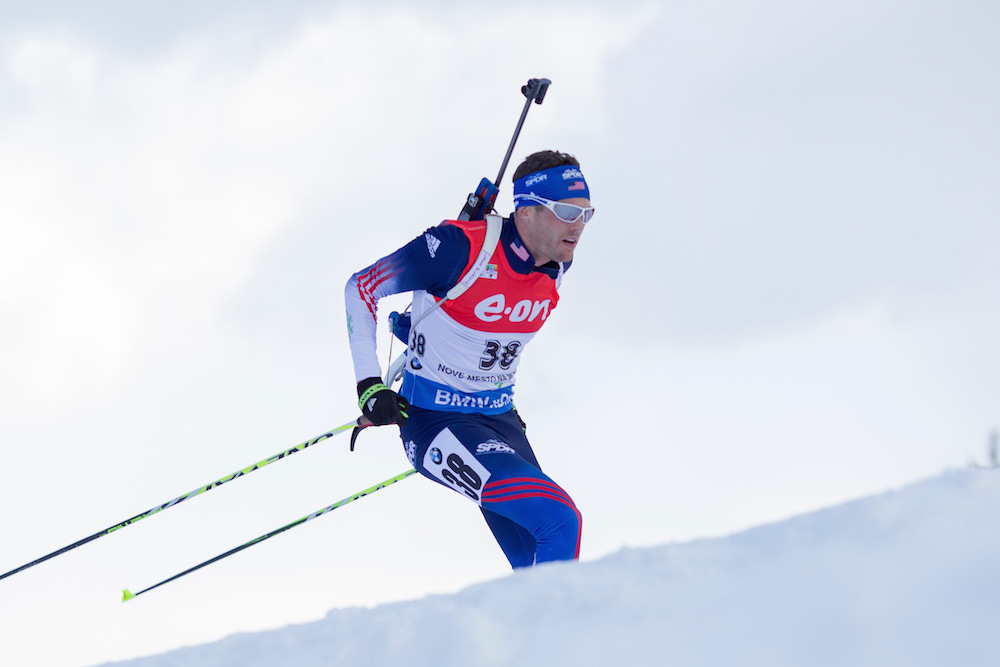
Tim Burke (US Biathlon) on his way to 37th in the men’s 12.5 k pursuit at the IBU World Cup in Nove Mesto, Czech Republic. (Photo: USBA/NordicFocus)
After Nordgren, Tim Burke started 38th and placed 37th for the U.S., 3:37.8 back with four penalties (1+2+1+0). Nineteen-year-old Sean Doherty started 57th and finished 45th (+5:02.1) with four misses as well (2+1+0+1).
“I think the best days of the season are still ahead of us,” Cobb wrote. “Just under a month to go until the World Champs.”
Darya Domracheva (Belarus) celebrates her 6.8-second pursuit win over Finland’s Kaisa Makarainen on Sunday at the IBU World Cup in Nove Mesto, Czech Republic. (Photo: IBU/ Květoslav Frgal)
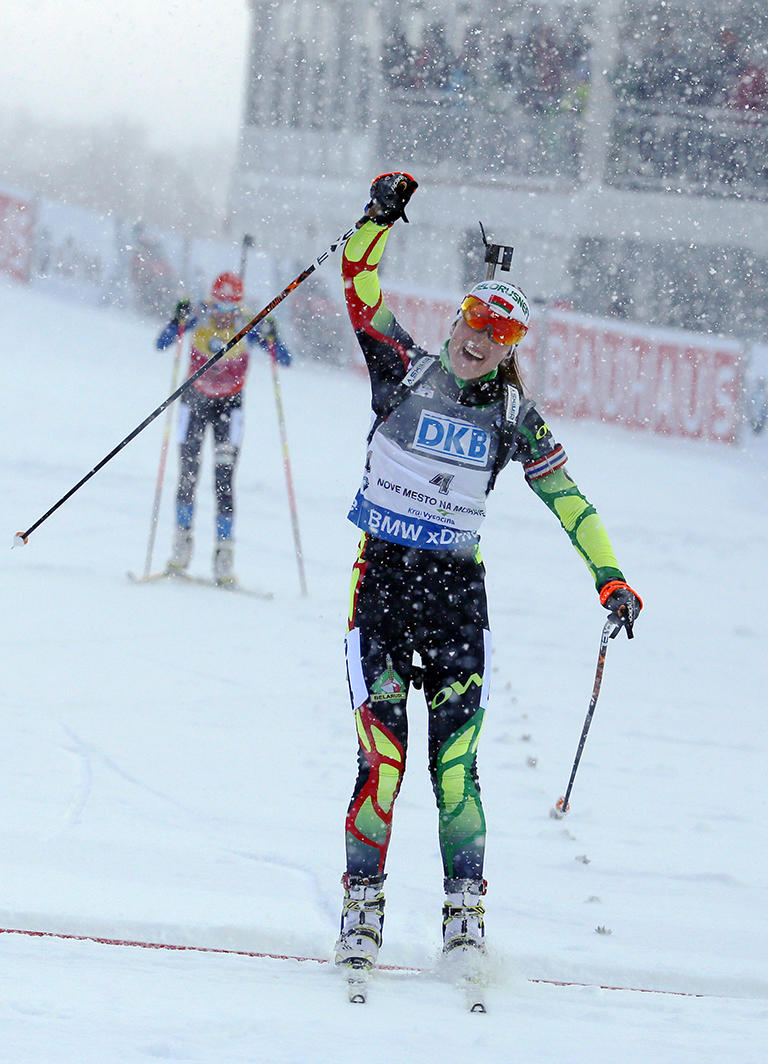
No amount of snow, wind or penalties was going to hold Darya Domracheva back on Sunday, at least that’s the way the Belarusian attacked the women’s 10-kilometer pursuit at the IBU World Cup in Nove Mesto, Czech Republic.
Second in the overall World Cup to Finland’s Kaisa Mäkäräinen, Domracheva started fourth in the pursuit, 23 seconds after Germany’s Laura Dahlmeier, who won Saturday’s sprint to start first. Another German, Franziska Hildebrand went out second, one second back, and Veronika Vitkova of the Czech Republic started third, 14 seconds behind.
The beginning of the race was relatively mild weather-wise, with sun at the start, but by the third of four shooting stages, competitors found themselves at the epicenter of a blizzard.
“It was a crazy day out there!” US Biathlon’s Hannah Dreissigacker wrote in an email. “We slid off the icy road in our van on the way to the start, luckily only half a k away so we walked from there. Then it was a total blizzard during zero. Then it got sunny for the start of the race, but then back to blizzard. … I’ve never really seen anything quite like it.”
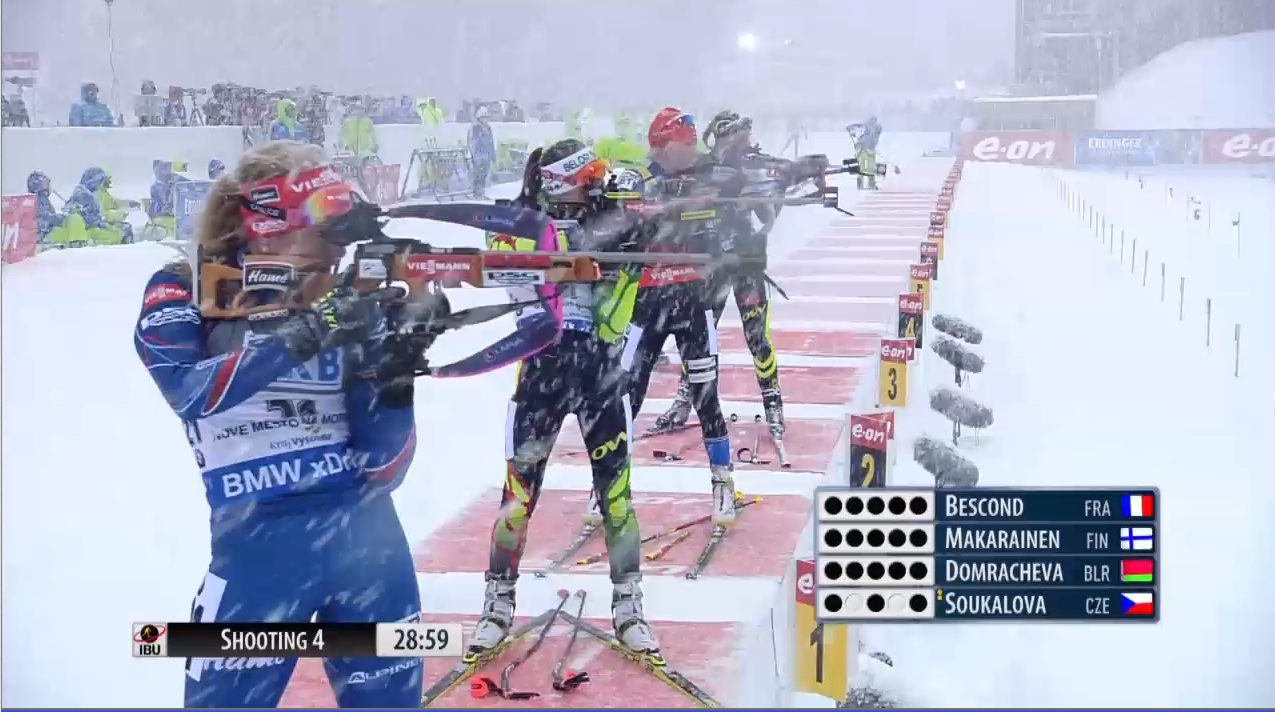
With snow increasingly blowing into athletes’ eyes as well as their rifles, the pursuit became more about who could keep it together rather than who could execute the perfect race. None of the 51 female finishers hit every target.
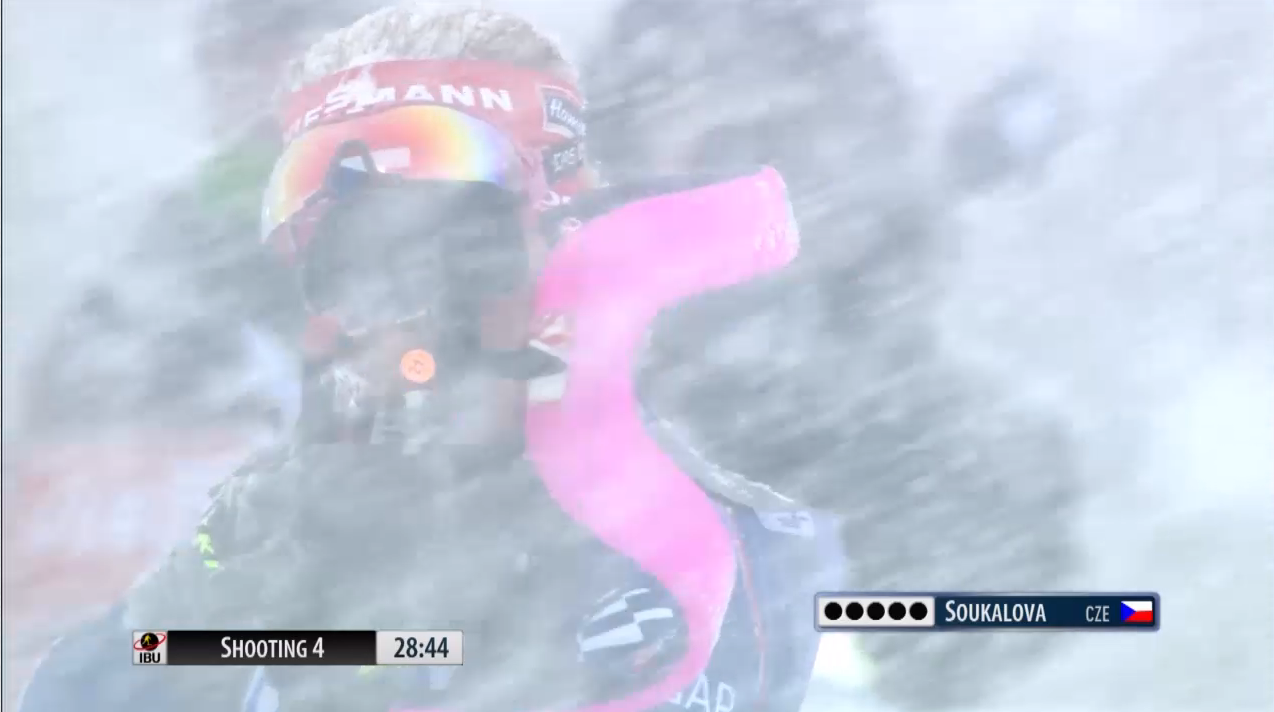
Gabriela Soukalova (Czech Republic) cleaned three-straight stages before missing two on the last standing to slip from first to third, then fifth at the finish of Sunday’s 10 k pursuit in Nove Mesto, Czech Republic.
That meant Domracheva couldn’t rely on shooting, and she didn’t need to. Even with two early prone misses that set her back to 12th, she rebounded to sixth with a clean second stage.
Entering the range for the first standing in the top four, she missed one, but moved into third. Domracheva left the stadium 19.3 seconds behind the Czech Republic’s Gabriela Soukalova, who cleaned her third-straight stage to take the lead from Hildebrand, who led from the first shooting.
France’s Anais Bescond also cleaned the first three stages to leave the range in second, 3.6 seconds after Soukalova. While the Czech extended her lead on Bescond over the next lap, Domracheva began to close on them both, coming into the final stage in second, less than 14 seconds behind.
Gabriela Soukalova (l) of the Czech Republic and Darya Domracheva (second from l) of Belarus go head-to-head in the final shooting stage of the women’s 10 k pursuit at the IBU World Cup in Nove Mesto, Czech Republic.
There, Soukalova missed two, and that cost her.
With the snow still falling so heavily it caused Hildebrand to crossfire and hit Vitkova’s targets (which led to a six-minute penalty for Hildebrand and Vitkova earning 52 seconds back at the finish), Domracheva missed one for her fourth penalty of the day.
She rounded the penalty loop quickly and headed out on the last lap first, 15.7 seconds ahead of Mäkäräinen, who also missed one for her fourth-total penalty.
Soukalova chased them both in third, 18.6 seconds back, along with Dahlmeier, who cleaned the last stage to leave the range two seconds later.
Over the next kilometer, Mäkäräinen closed the deficit to 14.2 seconds, and then 9.1 seconds with half a kilometer remaining. Domracheva continued to power ahead up front, skiing directly into a headwind along the course’s long climb, and ended up finishing first, 6.8 seconds ahead of Mäkäräinen, in 35:22.3.
“On the last loops it was so soft that on the last uphills and the poles fell down through the snow and you got no push or no glide with your skis,” Domracheva told the IBU. “It was a little bit hard race … [but] you have to fight to the end; you still have a chance.”
Mäkäräinen posted the fastest-course time overall, 17 seconds faster than Domracheva in second.
“If I would have cleaned that [last] stage, I would have been first, but I missed,” Mäkäräinen told the IBU.
Dahlmeier overtook Soukalova by the 9 k mark for third, 14.9 seconds after Domracheva, finishing with three penalties. Her German teammate Vanessa Hinz missed just two on the third stage to place fourth (+24.0), and Soukalova finished fifth (+33.2).
“The early loops are not so important,” said Dahlmeier, who stayed in the top three through the first two stages. “It is most important to have a good race in the last loop.”
Dunklee 18th for U.S.
American Susan Dunklee (r) during the first of five laps in the women’s 10 k pursuit on Sunday at the IBU World Cup in Nove Mesto, Czech Republic. She started ninth and finished 18th.
American Susan Dunklee skied the third-fastest course time on the last lap to place 18th. Back in 27th after two early prone misses, she improved to 19th by the last stage, then finished 1:54.9 behind Domracheva.
Dunklee started ninth, 46 seconds after Dahlmeier, but slipped to a minute and 35 seconds back after the first prone stage. She went on to clean her second prone to improve to 20th, then missed one in the first standing and two more on the last stage.
“It was a tough day and I had to keep reminding myself that everybody else out there was having a far from perfect day too,” Dunklee, who ranks 15th in the overall World Cup, wrote in an email. “The new snow made for slow tracks and it was difficult to pass because only one lane had been skied in.”
She discovered her first prone misses both hit the same edge of the target and was able to adapt to clean her second prone.
“I couldn’t make up as many places on the ski course as usual because I got stuck behind long trains of people,” Dunklee explained. “For the second time this week, I caught a great ride with [Switzerland’s] Elisa Gasparin for the last loops and she was very aggressive about moving around packs.”
Annelies Cook started 28th and finished 38th (+4:58.1) with eighth penalties (2+3+2+1), and Dreissigacker started 39th and finished 41st (+5:04.6) with eight misses as well (1+2+3+2).
While Dreissigacker’s shooting was off, she skied the 19th-fastest course time overall.
“I had great skis and felt good skiing,” Dreissigacker wrote in an email. “I’m psyched with my 19th ski time!! That is a new best for me. The shooting was another story though…it was a combination of bad luck and just bad shooting.”
In the first stage, she realized her rifle sight was completely clogged with ice and snow and spent about 30 seconds trying to blow it out.
“In the next stage I had a lot of wind and I took a lot of clicks and still missed two and so then I ‘shaded’ as well — when you just aim a little off of center to adjust for the wind,” she explained. “In standing I again got a lot of wind, and I didn’t deal with it well and took too long to shoot. And then my last stage was just bad shooting on my part. So not a good shooting day at all, but I just have to remember the positive takeaway — skiing was great!”
After finally getting her targets reset so that she could shoot, Vitkova ended up 11th with four misses (1+1+2+1). Hildebrand fell to 50th with a six-minute penalty after she failed to ski all of her penalty loops.
“She missed two targets in the cross firing so she skied two loops but since it was cross firing she gets 5 penalties and should have skied five laps,” Nove Mesto technical delegate and US Biathlon CEO Max Cobb explained in an email. “The penalty for missing a penalty loop is 2 min for each loop not skied thus 6 min.”
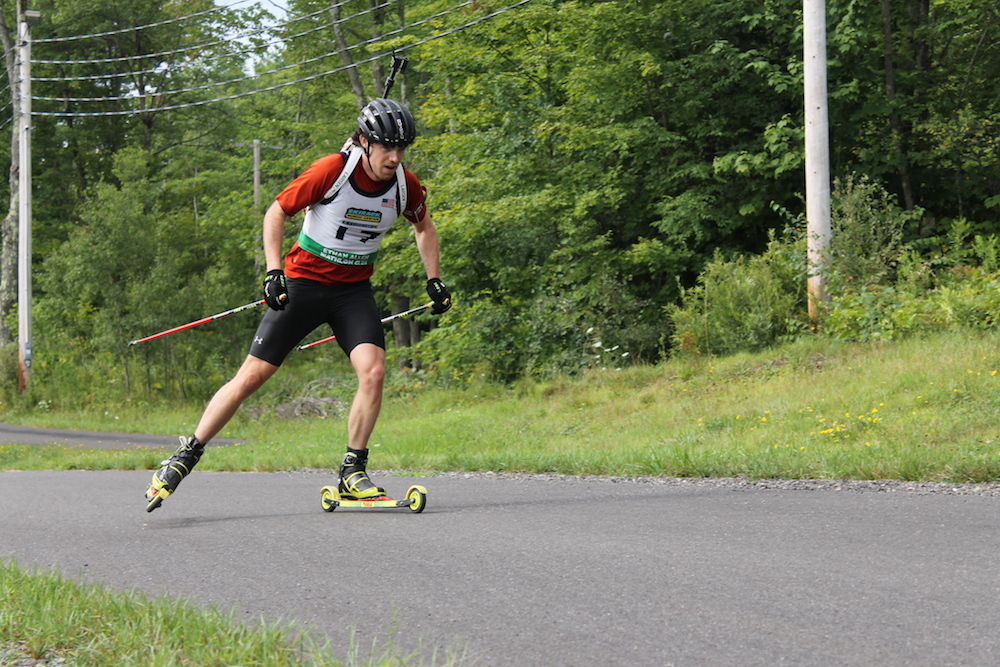
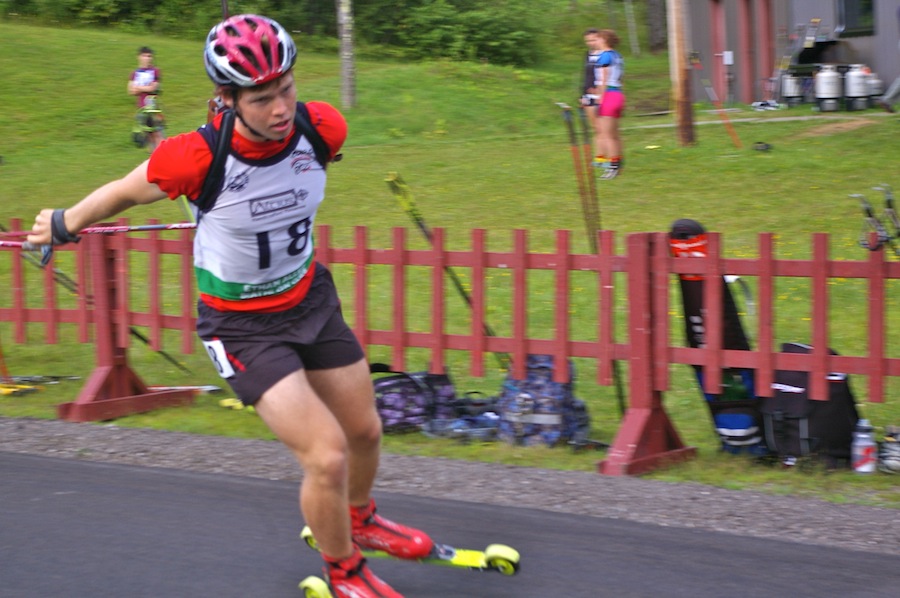
Nathan Smith racing in August in the men’s 10 k sprint at the 2014 North American Rollerski Championships in Jericho, Vt.
Note: This article has been updated to include emailed comments from Nathan Smith.
Seventy-eighth. That’s where Nathan Smith finished in the last IBU World Cup 10-kilometer sprint before Saturday’s race. And while the 29-year-old Canadian would probably very much like to forget that result in Antholz, Italy, it was a marker of how far he’d come in just over two weeks with some quality time spent training.
“January was a tough month of shooting and I felt like I was hitting my head against a brick wall trying to knock the targets down,” Smith told Biathlon Canada after Saturday’s 10 k sprint in Nove Mesto, Czech Republic. “Even though I was trying hard it just wasn’t happening. After the last World Cup I decided to take a week off shooting, and thought of some key points to focus on – relaxing into the position and slowing things down a touch.”
While training in Antholz, he fell on his chest and hurt his back, aggravating an injury he sustained three years ago while rollerskiing, he explained in an email on Sunday morning.
“That made it really hard to ski for a few days and racing was pretty painful,” Smith added. “I focused a lot during the break getting my back to relax and stretching a lot. Aside from that I just revised a little bit of volume training to help maintain my fitness through the rest of the season.”
He also did’t touch his rifle during that time.
“I decided to not touch my rifle at all during the break and let thing reset,” Smith wrote. “When I picked it up again I made a big effort to focus on relaxing…”
Nathan Smith (Biathlon Canada) (Photo: olympic.ca)
So with some, but not too much restraint, Smith forged ahead on Saturday, starting 25th on a crystal-clear-yet-windy day and ultimately finishing seventh for his career-best World Cup result. Earlier this season, he placed ninth in the mass start in Pokljuka, Slovenia, and ninth in the sprint in Östersund, Sweden, but seventh was a new high.
He finished 37.7 seconds behind Saturday’s winner, Jakov Fak of Slovenia, who rounded the course in 24:09.9. Fak hit all 10 of his targets, as did Smith. In fact, seven of the top-eight men cleaned (with the exception of France’s Martin Fourcade, who missed one standing).
“Today the top men shot amazingly well which makes for a very tough day to medal when you aren’t within the top-five or 10 skiers,” Smith said. “A medal may have been possible if I’d also had the ski of my life today, however, the odds of perfect shooting and skiing coming together are pretty low. A more likely way to grab a first podium is to put yourself in a position where you can capitalize on a day when the favourites falter.”
He passed two people during the race, yet Smith knew that didn’t exactly indicate how fast he was moving.
“There was a glory train of athletes starting behind me so I knew it must’ve been pretty good if no one passed me,” he wrote. “The techs were giving me info the entire time so I knew I was fighting for a top 10 and that a medal wasn’t too far away.”
Both his range and shooting times ranked fifth overall, and he was 23rd-fastest on course throughout the three-lap race.
“My skiing felt strong but I can definitely give a little more,” he reflected. “The difference was shooting 10-for-10 today and I will try and reflect on that in the future.”
Smith has seen his share of top 15’s on the international scene; at his first Olympics last season, he placed 11th in the pursuit and 13th in the sprint in Sochi, Russia. He’s also recorded five top-10 World Cup results in the last two years. He credited his success this season in part to his teammates.
“Rosanna [Crawford] had an amazing first trimester, and Brendan [Green] really came into his own in Ruhpolding and Antholz. All three of us have been very close to the podium the last couple of years, and it’s a bit of a friendly competition to see who will do it first,” he said.
“Today reaffirmed that my form is still there and that I can shoot really well,” he wrote. “It gave me some good confidence for the next couple world cups and leading to world champs.”
“I decided to not touch my rifle at all during the break and let thing reset. … When I picked it up again I made a big effort to focus on relaxing.” — Nathan Smith, after career-best seventh in IBU World Cup sprint on Saturday
Slovenia’s Jakov Fak shot 10-for-10 and skied faster than anyone else to win Saturday’s 10 k sprint at the IBU World Cup in Nove Mesto, Czech Republic. (Photo: IBU/Květoslav Frgal)
Ahead of Smith, Fak started 18th and ended up with the fastest-overall course time. He took his time on the range, hitting all his targets with the 60th-ranked range time out of 94 men.
Fak rose from fourth after his first stage to first with another clean shooting bout, skiing faster than Germany’s Simon Schempp, who started 29th. Schempp ended up second with perfect shooting, 12.8 seconds behind the Slovenian.
“It was important to shoot zero because in Antholz I missed the last shot,” Fak told the IBU after the race. “Today I hit it and could run my own race.”
The second starter, Jean-Guillaume Béatrix of France shot 10-for-10 and initially led at the finish before Fak crossed the line 26 seconds faster. Fourcade skied the second-fastest course time to counteract his single penalty and finished fourth, 0.3 seconds after Beatrix.
The men’s 10 k sprint podium at the IBU World Cup in Nove Mesto, Czech Republic: with Slovenian winner Jakov Fak (c), German runner-up Simon Schempp (l), and France’s Jean-Guillaume Béatrix in third. (Photo: IBU/Květoslav Frgal)
Michal Slesingr of the Czech Republic was another 0.4 seconds back in fifth with clean shooting, and Russia’s Anton Shipulin cleaned for sixth, 29.5 seconds behind the winner.
Smith initially finished fourth, then was bumped to seventh by Fourcade, Schempp, and Shipulin respectively. He ended up 8.2 seconds away from sixth and a spot at the awards ceremony.
“He showed great consistent skiing in all three laps,” Biathlon Canada Head Coach Matthias Ahrens wrote in an email, “and displayed again his strong shooting efficiency which showed in his personal best result of finishing 7th in a [World Cup].”
In all, three Canadian men made the top 60 to qualify for Sunday’s pursuit: Green placed 22nd (+1:12.8) with a single standing penalty, and 22-year-old Macx Davies finished 54th (+2:20.9) with one prone miss. That result tied Davies’ season best after he placed 54th in the World Cup sprint in Oberhof, Germany.
Canada’s fourth man, Scott Gow placed 63rd, 2:35.7 back from the winner and 3.8 seconds out of 60th with two prone penalties.
“It would have been nice to qualify all 4 men for the pursuit tomorrow, Scott Gow just missed it by a small margin,” Ahrens wrote. “Happy that Macx was able to continue in good form which he started at [IBU Open European Championships]. I am looking forward to next week’s relays since I believe we have a nice mixed team of eager younger and older more experienced athletes who supplement each other quite well.”
Macx Davies racing in the 2013 North American Biathlon Rollerski Championships 12.5 k pursuit in Jericho, Vt.
Last Sunday at the European Championships in Otepää, Estonia, Davies led Canada in 27th in the 12.5 k pursuit.
“I am elated to finally pull my shooting together after some crazy conditions in Otepaa,” Davies wrote in an email. “My skiing felt good, I spent most of the race pushing myself harder and harder. Until I felt like I was at the redline for my whole final loop.”
He set two personal goals on Saturday: to shoot 10-for-10 and make the top 40 to score World Cup points.
“Though I didn’t quite achieve either of these I still feel happy with my performance today and am excited to race tomorrow,” he wrote.
Davies will start Sunday’s 12.5 k pursuit 2:21 behind Fak in first; Smith will head out 38 seconds back in seventh, and Green will start 1:13 back in 22nd.
“Today was another good result for me and it sets me up well for tomorrow’s pursuit,” Green wrote in an email. “It’s a tight race amongst the top 30 and tomorrow will be another good opportunity. The shooting will be especially important for me tomorrow if we continue to face more wind.”
After Friday’s mixed relay, in which Green skied a penalty loop and used three spares to anchor Canada to 14th, he was looking for more.
“I knew today that I would have to step up my game,” he wrote. “I knew with the wind we’ve been experiencing here that the shooting would be challenging so I really tried to make each shot count. It’s a tough race course here as well and I tried hard to make time in the areas that I thought played into my ski strengths.”
He ended up rising from 34th overall after prone to 28th after missing his lone shot of the day in standing, and closed his last lap with the 17th-fastest course time to place 22nd.
“My skiing was better than yesterday. I definitely pushed and made myself hurt more on course, and at the same time tried to focus more on areas such as the gradual climbs that I felt would play more into my strength while skiing,” Green added. “I was happy shooting 9/10.”
Leif Nordgren (US Biathlon) racing to a career-best World Cup result of 16th on Saturday in the men’s IBU World Cup 10 k sprint in Nove Mesto, Czech Republic. (Photo: USBA/NordicFocus)
When Leif Nordgren caught wind that he was seven seconds from a top 10 with one loop to go, he couldn’t help but get fired up.
The 25-year-old Minnesota native hadn’t cracked the top 20 in a World Cup since 2011, when he placed 17th in the mass start at 2011 IBU World Championships. The day before, in Friday’s mixed relay, US Biathlon Chief of Sport Bernd Eisenbichler said Nordgren looked better than ever — a sign of things to come.
On Saturday, Nordgren started 44th and raced himself up to ninth at one point in the men’s 10-kilometer sprint, right after cleaning his first of two shooting stages. Twelve-and-a-half seconds behind race leader Martin Fourcade of France, who led through prone, Nordgren headed out on his second-to-last lap.
Entering the range for the last time, he glanced at the leaderboard and noticed quite a few men had missed their targets on the windy afternoon. He shot conservatively in standing and missed one, which “was a little deflating,” he said, “but all I could do was push hard the last loop and see where I ended up.”
Even after skiing a penalty loop, he heard he was within reach of a top 10, which ended up being a top 20 after all 94 men in the field had finished. Nonetheless, Nordgren raced to complete his last lap and ended up 15th before being bumped to 16th by Germany’s Arnd Peiffer.
Sixteenth ended up being Nordgren’s magic number as it stood as his World Cup career best, 1:04.8 back from Slovenian winner Jakov Fak.
Leif Nordgren (US Biathlon) racing to a career-best World Cup result of 16th on Saturday in the men’s IBU World Cup 10 k sprint in Nove Mesto, Czech Republic. (Photo: USBA/NordicFocus)
“Today was almost a perfect race for me,” Nordgren said in a US Biathlon press release. “I felt really good on the skis, a little tired from the race yesterday, but not too much to handle. With clean shooting in prone I had a lot of momentum to work with right off the bat.
“I’m especially excited for tomorrow knowing I’m skiing good right now,” he wrote in an email to FasterSkier.
In Sunday’s 12.5 k pursuit, Nordgren will start 16th, 1:05 after Fak and at the same time as Russia’s Matvey Eliseev.
“Anything can happen in a race with 4 shooting stages,” Nordgren wrote. “If the conditions are tricky with wind like they can be here, then I look forward to a good opportunity to improve on today!”
Three American men started Saturday’s sprint, and all of them made the top 60 to qualify for the pursuit, with Tim Burke in 38th and Sean Doherty in 57th. Lowell Bailey is recovering from an illness in Ruhpolding, Germany, after running a fever for five days, according to Eisenbichler. On Monday, Bailey will meet the team in Oslo, Norway, to prepare for the next World Cup.
Tim Burke (US Biathlon) on his way to 38th in the men’s IBU World Cup 10 k sprint in Nove Mesto, Czech Republic. (Photo: USBA/NordicFocus)
Burke finished 1:40.7 behind Fak after three initial prone penalties set him back to 81st overall after the first stage. He made up more than half of those positions with a clean standing stage and skied the eighth-fastest course time overall.
Doherty met his season-long goal of qualifying for the pursuit, finishing 7.6 seconds ahead of 60th and 2:24.3 behind the winner. Like Burke, he also missed three prone targets to slip to 87th overall early on, then improved to 68th and finally 57th after a clean standing.
“The first shooing was really quite a disappointment,” Doherty reflected in an email. “The wind here can be tricky and I did not adjust enough to compensate for that, but other factors aside I know I am much better than 3 misses.”
He tried to clear his head and refocus on the second lap, forgetting everything that happened before.
“It worked out and I squeaked into the pursuit,” Doherty wrote. “I felt very strong on course today, not much different than yesterday. We had great skis and I was trying my best to make full use of them.”
As for Sunday’s pursuit, he simply planned to “go for it and race hard,” he wrote. “We will just have to see how it works out!”
Leif Nordgren (US Biathlon) raced the third leg of Friday’s IBU World Cup mixed relay to put his team in fourth heading into the final exchange in Nove Mesto, Czech Republic. The U.S. ended up seventh. (Photo: USBA/NordicFocus)
Note: This article has been updated to include comments from U.S. anchor Sean Doherty.
Friday’s mixed relay had to have been one of Leif Nordgren’s best races of all time. Just last week, the 25-year-old US Biathlon A-teamer skied up from 51st to 19th in the men’s 12.5-kilometer pursuit at IBU Open European Championships in Otepää, Estonia, but US Biathlon Chief of Sport Bernd Eisenbichler didn’t see that race in person.
What he did witness was one of Nordgren’s most memorable performances in the mass start at 2011 World Championships in Khanty-Mansiysk, Russia, in which he placed 17th with three misses. And that rivaled what he did on Friday as the third of four legs in the 2 x 6 + 2 x 7.5 k mixed relay.
Nordgren brought the U.S. from 10th to fourth before the final exchange with clean prone shooting and a single standing miss. He used his spare to clean that stage and left the range for the last time in fourth, about a minute and a half behind the three race leaders (Norway, Ukraine and the Czech Republic).
“You have to give a really big compliment to Leif today; he had world-class shooting today,” Eisenbichler said on the phone after Friday’s race, the second of two mixed relays (with Annelies Cook and Tim Burke placing ninth for the U.S. in the single mixed relay).
“I never saw him in as good running shape as 2011 at World Championships … For sure, this was his best performance, and from 2011 to now, that’s four years so that’s really encouraging,” he added. “I’m extremely happy with where he is right now and I think he’s still going up to [2015] World Championships.”
American Sean Doherty hung in fifth for most of Friday’s mixed relay at the IBU World Cup in Nove Mesto, Czech Republic, before finishing seventh. (Photo: USBA/NordicFocus)
Building on the foundation teammates Susan Dunklee and Hannah Dreissigacker laid as the first and second legs, respectively, of the Americans’ mixed relay on Friday, Nordgren tagged Sean Doherty in fourth.
The 19-year-old Doherty anchored them to seventh, 2:23.8 behind the Norwegian winners (Fanny Welle-Strand Horn, Tiril Eckhoff, Johannes Thingnes Bø, and Tarjei Bø) and 0.2 seconds behind Germany in sixth.
“We were only two-tenths of a second out of the flower ceremony today, which is an exciting accomplishment, and it also makes us very hungry for more,” Dunklee wrote in an email. “Everyone skied very well today, and the guys did some fantastic work with the shooting.”
Dunklee used a total of four spares (two on each stage) to put the team in fourth after the first leg. She handed off to Dreissigacker, who used five spares (three prone and two standing) to tag Nordgren in 10th. Nordgren used just one spare, and Doherty used one in prone and two more in standing to finish seventh with a team total of 13 spares.
“I was really happy with the race today for my part,” Nordgren wrote in an email after posting the fifth-fastest course time and fifth-fastest range time on the third leg. “This whole year I’ve struggled to put both good shooting and good skiing together on the same day. Today I did just that, so I think I can be happy that things seem to moving in the right direction as we approach [World Championships] in Finland.”
Dunklee raced the fastest time of all 22 starters, leaving the range in 17th after her first shooting and improving to 10th before her last lap. By the time she got to Dreissigacker, Dunklee was up to fourth.
“I always expect Susan to crush it and pass people like crazy and tag off near the front,” Dreissigacker wrote in an email. “That’s normal for her. But she really outdid herself with the passing today! I had to laugh when I saw how much she’d moved up by the time I’d made my way over to the exchange zone. I was psyched!”
“I used more spares than I would have liked and channeled the frustration from the range into speed on the ski track,” Dunklee explained. “At the start of the second loop, I forgot entirely about pacing for a couple minutes and focused solely on regaining contact with the main pack. Then my body reminded me that that wasn’t a sustainable pace.”
She spent her last loop trying to ski “smarter” and save energy for the last climb. Leaving the range, she caught Switzerland’s Elisa Gasparin then slingshot by her before the last uphill.
Dreissigacker reflected that her first lap skiing in the top four felt fast, “but I wasn’t really feeling too much…so I was able to go harder than I maybe should have,” she wrote.
She seized the chance to ski behind France’s Marie Dorin Habert on her first lap, then slipped to seventh after her first shooting.
“I think that the wind was a bit variable on the first stage, but mostly I just wasn’t super well-settled,” Dreissigacker wrote. “I’ve been having a bit of a prone-shooting slump for the last few days, so I’m hoping to improve on that.”
Feeling the fatigue start to set in on her last two laps, Dreissigacker reminded herself how much she liked the course and “kept fighting.”
“In standing, I felt good through the first 5 shots, but had one close miss and then I got shaky shooting spares,” she wrote. “I accidentally fired one spare way too early when I wasn’t even on target, so I was just happy to hit that last one!”
Pushing to stay with Russia’s Ekaterina Shimulova on the last lap, Dreissigacker wasn’t able to do so and tagged Nordgren in 10th, 13 seconds behind Shimulova in eighth and 11.6 seconds back from Italy’s Federica Sanfilippo in ninth.
“I wanted to stay with [Shimulova] and catch up to the pack ahead so that Leif would have a good pack to ski with,” Dreissigacker wrote. “Luckily he had an awesome day and managed to catch the pack all by himself. The rest of the team did so well and it was really fun to watch the rest of the race and cheer as I cooled down.
“It was such an exciting finish!” she added. “Sean did awesome…and in a year or two, if not way sooner, he’ll be winning those photo-finishes.”
For Nordgren, fast skis helped, he explained, as he caught the group ahead of him on the first loop.
“I felt totally in control the first two loops, and I was able to push hard the last loop also,” he explained.
Nordgren added that by the end of last week, he could already feel like his shooting was starting to come around. He felt similarly about his ski shape: “I had glimpses of good shape in Antholz, but with an additional 3 races in Estonia I think it really forced that good shape to come back a little quicker,” he wrote.
“I really like that tracks here in Nove Mesto, I think they suit me perfectly, combine that with the near perfect snow conditions that we’ve had all week, and it just makes it really nice skiing,” Nordgren added. “As a team we all decided last night that we’d like to finish ahead of our bib number (7). So it was really close today, everyone from the team put in a really good effort, but sometimes it comes down to a few cm!!”
Doherty hung in fifth for most of his race before France’s Martin Fourcade and Germany’s Benedikt Doll passed him before the finish. The youngest member of the U.S. team, Doherty pushed to stay with them, but finished 2.3 and 0.2 seconds back, respectively.
“Funny thing, from where the warm up track is here in Nove Mesto you are a little bit out of the action, so I did not really know how well Leif was doing until I got into the start pen,” Doherty wrote in an email. “I was excited to be in such a good position, it is a great challenge and I am feeling good on the skis so I was excited to go against the other top athletes.
“Really I just tried to keep a good pace,” he added. “For standing I was trying to focus on the good things that I had been working on in training. It did not work out as well as it could have but that is biathlon and it was still a good fight to the line. … I am very happy with my personal performance, I am feeling stronger and stronger on the skis. As for the team overall it is great. It is nice to have everyone at full health and it is a good sign that our program is improving as a whole.”
At the end of the day, Eisenbichler was pleased, especially with both the team’s single mixed relay and four-person mixed relay finishing in ninth and seventh, respectively.
“Top 10 is really something we should always reach for,” he said. “It was really, really tight, especially in the mixed relay.”
Tarjei Bø celebrates his win for Norway in the 2 x 6 + 2 x 7.5 k mixed relay on Friday at the IBU World Cup in Nove Mesto, Czech Republic. He held off Ondrej Moravec (l) of the Czech Republic by four seconds.
Norway won the four-person relay in 1:12:49.2 with six spares, holding the Czech Republic (with Veronika Vitkova, Gabriela Soukalova, Michal Slesingr, and Ondrej Moravec) by 4.1 seconds. The Czechs used five spares, and Ukraine (Iryna Varvynets, Valj Semerenko, Dmytro Pidruchnyi, and Sergey Semenov) held tough for third (+1:21.3) with one penalty (from Semenov on his prone stage) and seven spares.
“Moravec is one of the fastest standing shooters, so today I wanted to show Moravec that I am the fastest,” Norway’s anchor, Tarjei Bø, told the IBU.
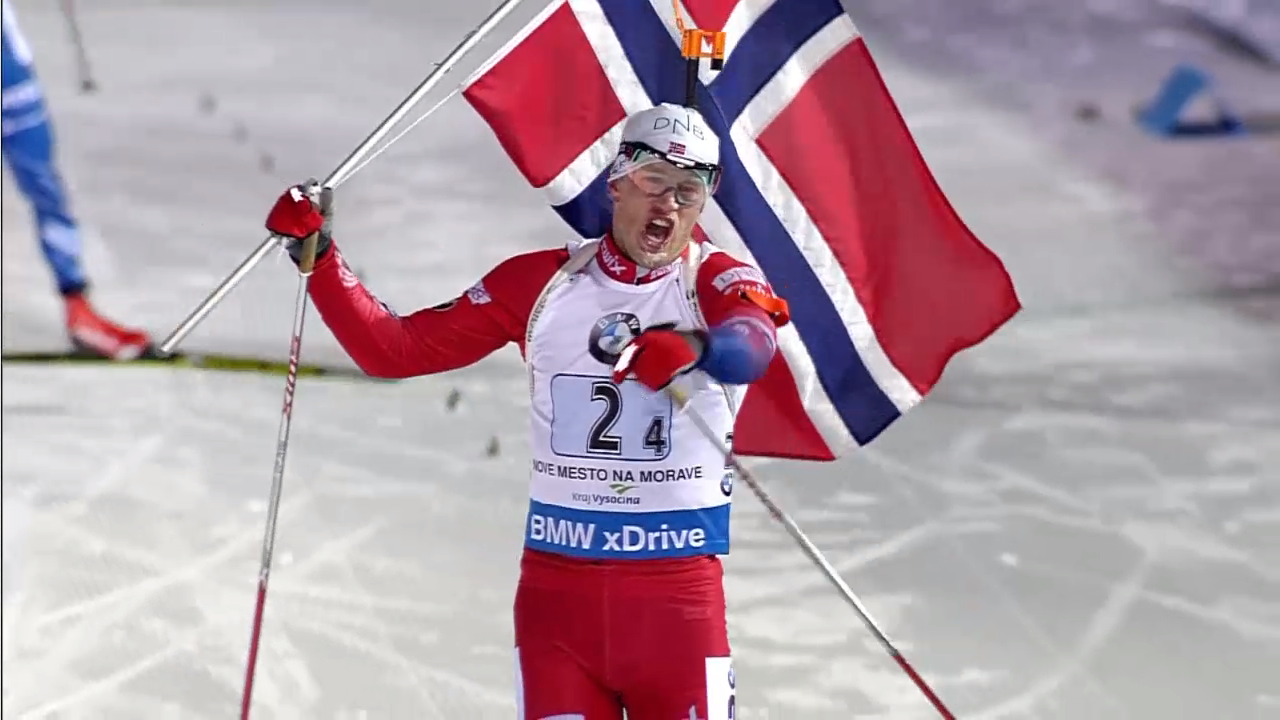
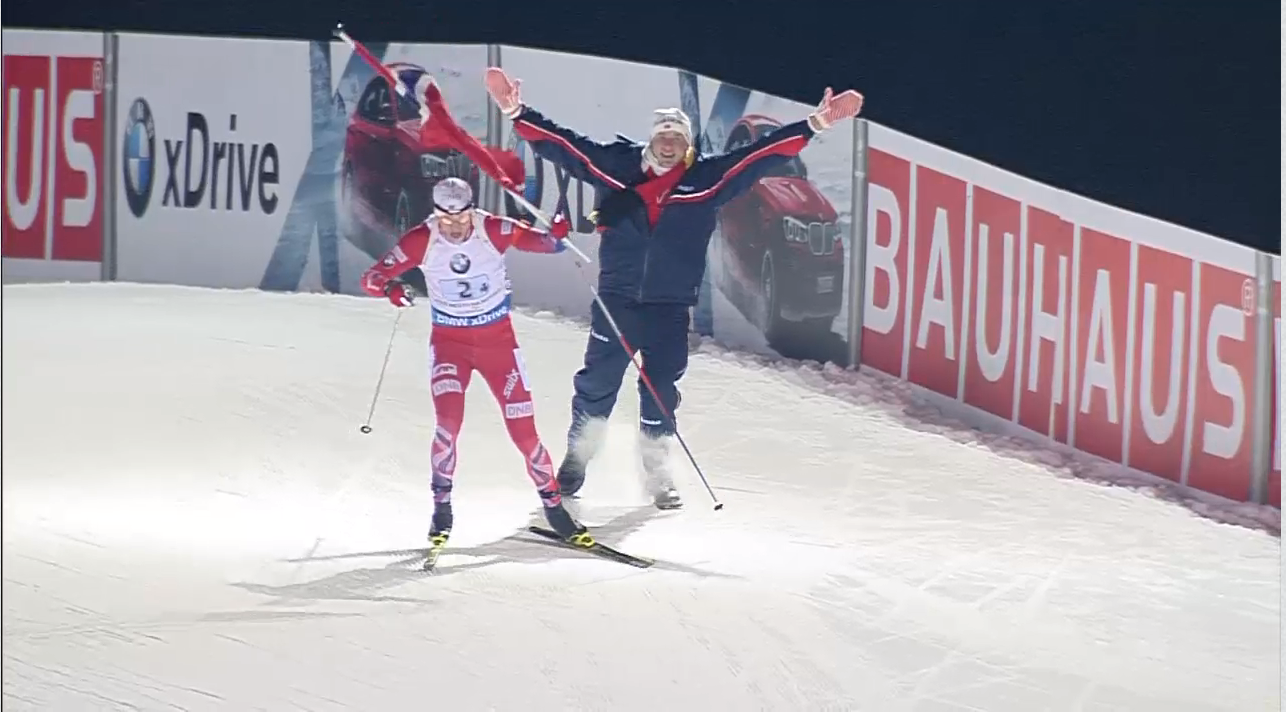
Using just one spare in prone and cleaning standing, he took the lead by 13.9 seconds with one lap remaining. Moravec, who used one spare on his last stage, closed on him in the final kilometers to come within four seconds of Bø, who had enough time to grab a large Norwegian flag before the finish.
Czech Ondrej Moravec mocks Russian Alexey Volkov’s finish-line celebration after Moravec finished second in Friday’s mixed relay. Earlier that afternoon, Volkov anchored Russia to the single-mixed-relay win.
“I think we can be really happy with second,” Slesingr told the IBU. “[Ondrej and I] spent a little more time in standing … Before the race we would have been happy with second so there is no disappointment … We were able to give something back to all of the fans who came here … we can feel their support that has made biathlon almost the number one sport in Czech Republic.”
Russia placed fourth, France was fifth and Germany was sixth.
Canadians 14th
Canada skied in the top 15 throughout the race with Audrey Vaillancourt, Rosanna Crawford, Nathan Smith, and Brendan Green ultimately placing 14th (+5:12.3).
“Overall I think the team had a rough day, we all seemed to have problems with our standing shooting,” Vaillancourt wrote in an email.
After her first mass-start experience on the World Cup, she cleaned the first shooting, but used three spares in standing to tag Crawford 1:28.4 back in 14th.
“I had a good start, but on the second hill a girl stepped on my pole and it fell off my hand. I had to go backwards to get it back and therefore lost the pack,” Vaillancourt explained. “Then I tried to catch up, but couldn’t do it before the first shooting.
“Skiing felt good, but I had a hard time making up for the time I had lost,” she added. “It might have affected my standing shooting. I wanted to get in, clean, and leave as fast as I could, but it didn’t work out so well. Instead I ended up using 3 spares.”
Her skiing felt better than in past weeks, she added, after her team spent a week of training “on lots of real snow” in Mittenwald, Germany.
Crawford explained she was starting to feel like her “old self” as well on Friday, after she skied the 10th-fastest course time of the second-leg skiers. She used two spares on her first stage, and then used three more and had a penalty loop after standing.
“I wanted to catch the pack of three just in front of me so I could have someone to ski with. That worked but then I lost what ever I had gained with poor shooting,” she wrote.
Crawford handed to Smith in 15th, 2:30 back.
“I was a bit surprised by the analysis. I thought I skied better than it looks on paper,” she wrote. “But hopefully this will just have gotten all the gears running again and tomorrow [the sprint] will be better. It’s a really hard 2.5km course. One of the tougher ones on [World Cup] I’d say. So good technique and proper pacing will be important. But it’s also only 3 loops so you have to be sharp!”
Smith cleaned prone to bring Canada up to 13th, but used two spares in standing and dropped one spot on the last lap to 14th. Green kept them there, with a clean first stage but had three spares and one penalty on his last shooting. He finished 14th, more than a minute and 10 seconds behind Italy in 13th.
“We had little hiccups starting with Audrey loosing a pole and loosing contact to the group, Rosanna having a penalty loop, Brendan having a penalty loop, Nathan not being able to stay with [Austria’s Julian] Eberhard when he was passed,” Biathlon Canada Head Coach Matthias Ahrens wrote in an email. “Anyhow I believe we could be where the US team was today whom I congratulate for a great race by all members.”
“I think we’re disappointed. But are looking forward to the weekend,” Crawford wrote.
Tarjei Bø (l) receives the Norwegian flag from an excited fan as he cruises down the finishing stretch to celebrate his win for Norway in the 2 x 6 + 2 x 7.5 k mixed relay on Friday at the IBU World Cup in Nove Mesto, Czech Republic.
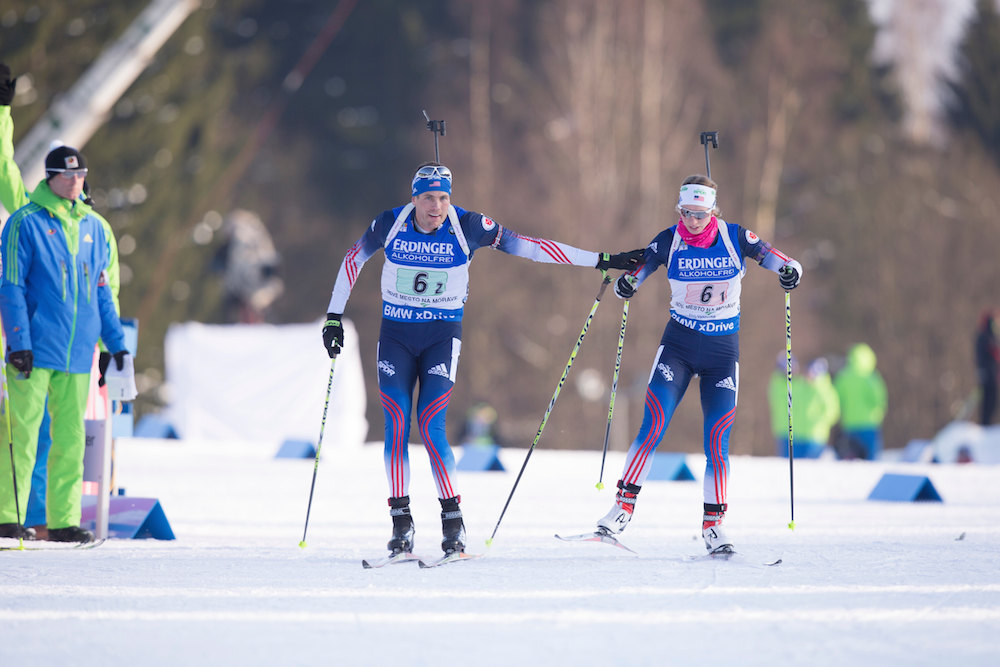
Tim Burke (l) tags U.S. teammate Annelies Cook in 15th in the second-to-last exchange in Friday’s single mixed relay at the IBU World Cup in Nove Mesto, Czech Republic. The two went on to place ninth when Burke skied up from 14th on his second-and-final leg. (Photo: USBA/NordicFocus)
He felt a little weird saying it, but US Biathlon Chief of Sport Bernd Eisenbichler viewed Friday’s single mixed relay — a brand-new event which was first tested in Oslo last season — as a “good training opportunity.”
Between that two-person race and the four-person mixed relay that followed on the same day at the IBU World Cup in Nove Mesto, Czech Republic, there was plenty of racing to go around. Some people needed to get in some intensity after the nearly two-week break from racing.
Each nation entered in both Friday’s single mixed relay and the 2 x 6-kilometer + 2 x 7.5 k mixed relay had to determine a) which six athletes to divvy up among those events and b) the starting order for both. Eisenbichler said on the phone late Friday that the US Biathlon staff decided to pair Annelies Cook and Tim Burke up for the single mixed relay, which is more of a team sprint than any other format, because both needed hard workouts. This way, those two could log intervals on race day.
Meanwhile, Susan Dunklee and Hannah Dreissigacker were put in their “traditional” starting positions of first and second, respectively, in the four-person mixed relay. With Lowell Bailey out sick and recovering in Ruhpolding, Germany, the U.S. opted to start Leif Nordgren as the third leg and 19-year-old Sean Doherty as anchor.
“We see every race as a practice,” Eisenbichler said, pointing to next month’s World Championships in Kontiolahti, Finland, as the end goal. “Every race in their [usual positions] is still a really good experience. It was also, for the boys today, being in the mixed relay in front of 30,000 spectators, a good experience.”
Both races turned out to be something the U.S. was proud of, especially in the four-person mixed relay where the team finished seventh and two-tenths of a second from the flower ceremony. Cook and Burke teamed up for ninth in the single mixed relay (out of 20 teams) despite some shooting struggles.
“I think with two top-10 results we accomplished our Nations Cup points and our goals for the weekend,” Eisenbichler said. “Top eight or top 10 is always what we reach for, I would rather say top eight … and in mixed relay at world championships, I would say top six.”
Single mixed relay
Annelies Cook (6) heads out of the mass start in Friday’s single mixed relay at the IBU World Cup in Nove Mesto, Czech Republic. Cook and teammate Tim Burke went on to place ninth for the U.S. in the first of two mixed relays on Friday. (Photo: USBA/NordicFocus)
The single mixed relay, in which each male and female on a two-person team races three 1.6 k laps twice, tagging their partner in between, made its debut last year on the same day as a set of men’s and women’s mass starts, which created an even busier day. Dreissigacker and Nordgren raced that event for the U.S., making Cook and Burke total newbies to the format on Friday.
“I was really excited about doing this race today because it was something new and such a fun format,” Cook wrote in an email. “I always loved doing sprints and team sprints in cross-country skiing and this was a little bit like that. I am not sure exactly how the coaches picked the teams for today, but they know I like to sprint and maybe that was part of it.”
Burke explained that he requested to be put in that race because he wanted “to try something different.”
“This format definitely makes for a different race feel,” he wrote in an email after Friday’s race. “It is quite awkward to go from a full sprint into the shooting range. … The ski speed definitely felt faster than any other format.”
Biathlon Canada entered Megan Heinicke and Scott Gow, but Heinicke was too ill to race on Friday so the team did not start the single mixed relay.
“Megan was already showing signs of sickness the day before, that is the reason we put her into the single mix relay otherwise she would have been in the mixed relay,” national team head coach Matthias Ahrens wrote in an email.
For the mixed relay, Canada started Audrey Vaillancourt, followed by Rosanna Crawford, Nathan Smith, and Brendan Green. The four combined for 14th after skiing two penalty loops and using 13 spare rounds.
Between Cook and Burke in the relay earlier that afternoon, the two Americans used 13 spares but avoided penalties, with Cook using three spares on the first shooting stage and Burke using six between two stages on his first leg.
“The first leg was so close to being really good, but I think I was too excited in prone and had random misses,” Cook reflected.
She went on to clean the first stage of her second leg, and used two spares on her last standing.
“Maybe the only difference in my second leg was to just come into the range a little calmer, while still trying to hammer the rest of the course,” she wrote. “It was all a learning experience since I haven’t done anything like this before. Somehow that took the pressure off, but still made it really fun and exciting.”
Burke felt he struggled with the change of pace between sprinting and then suddenly shooting, noting that he was too cautious in the range on his first two stages. The next time around, he used one spare in each shooting stage.
“I adjusted for my second leg and I very happy with how that went,” he wrote. “I think this is an interesting format but it definitely puts a huge emphasis on the shooting.”
The two skied in the top 15 for much of the race, and by the second exchange, they were more than two minutes behind Germany’s Luise Kummer and Erik Lesser in the lead. Cook tagged Burke for the last time in 14th, 2:40.6 back. There, Burke resolved to put them in the top 10.
With the fastest course time of any anchor, he did so, finishing ninth, 2:39.7 behind Russia’s Yana Romanova and Alexey Volkov, who won in 35:43.3.
The Russians took control on the anchor leg after coming through the final exchange in third, 5 seconds behind Germany and 4.8 seconds behind Ukraine. Lesser cleaned prone but missed most of his shots on his final standing stage and had to use three spares and ski three penalty loops.
Volkov cleaned his final shooting to move to first, 26.5 seconds ahead of Ukraine’s Artem Tyschenko in second. Norway’s Henrik L’Abee-Lund used one spare in his final prone and cleaned standing to improve to third overall with one lap to go, less than a second behind Tyschenko. Lesser dropped to fourth, 34.7 seconds back.
Alexey Volkov anchored Russia’s two-person single mixed relay (with Yana Romanova) to first on Friday at the IBU World Cup in Nove Mesto, Czech Republic. (Photo: IBU/Kustoslav Frgal)
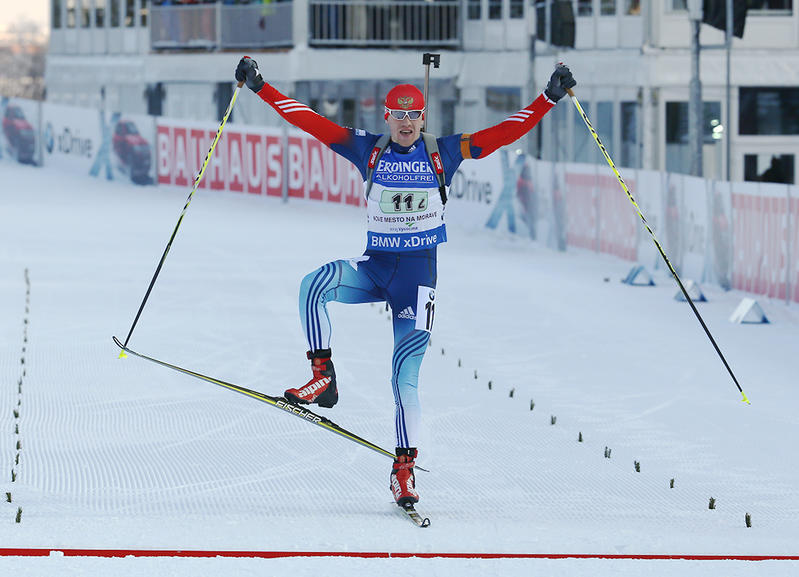
On the final lap, Volkov stayed in the clear, looking back near the top of the final rise before the stadium and soon after celebrating with a Captain Morgan-like pose at the finish.
L’Abee-Lund passed Tyschenko to clinch second for Norway (with teammate Marte Olsbu), 21.5 seconds out of first and 3.1 seconds ahead of Ukraine (with Juliya Dzhyma) with in third. A not-so-happy-looking Lesser crossed the line in fourth for Germany, 38.9 seconds back from Russia.
“I always dreamed about taking part in this type of the mixed relay since I saw the test event last season in Oslo,” Romanova told the IBU after the race. “I like it very much and like the short distance where everything depends on shooting!”
Romanova cleaned all four of her stages to put the Russians in third at the last exchange, and Volkov used a total of five spares to secure first place.
“I think that both Tim and I had one bad stage of shooting that hurt our chances for a top result, but I am still happy at the end of the day,” Cook wrote. “I really loved this race format and the only thing I would change is to not have extra rounds as part of it. It would be even crazier with just a short penalty loop.”
Burke agreed.
“I think they should at least do away with the extra rounds, so you spend a little less time on the range,” he wrote after the first-and-only single mixed relay scheduled this season.
Eisenbichler noted that while he’s “not the biggest fan” of the format, “today, it worked out for us. … But for a small team, it’s a really hard stretch to send two teams to the relays,” he added.
On the World Cup circuit, most nations have recently reached the point where they can field competitive teams for the four-person mixed relay, still a relatively new competition itself. Eisenbichler explained that he’d rather see one mixed relay or the other — not both.
“I don’t think it’s just the right format,” he said of the two-person event.
At the same time, the single mixed relay drew tens of thousands of spectators on Friday.
“The idea to do something is interesting …. I think it was a good try,” Eisenbichler said. “I think there will be a decision [after the season] if it goes further on or if there’s a changed format. … It would be really tough to schedule it into world champs in the future.”
Ahrens wrote that he wasn’t the biggest fan of the single mixed relay after last year’s test event, but added Friday that “it could have potential with shorter loops of 1km, no spares to be used and exchange between men and women after each shooting. … The single mixed is more of a shooting race but not so much biathlon with a 50/50 combination.”
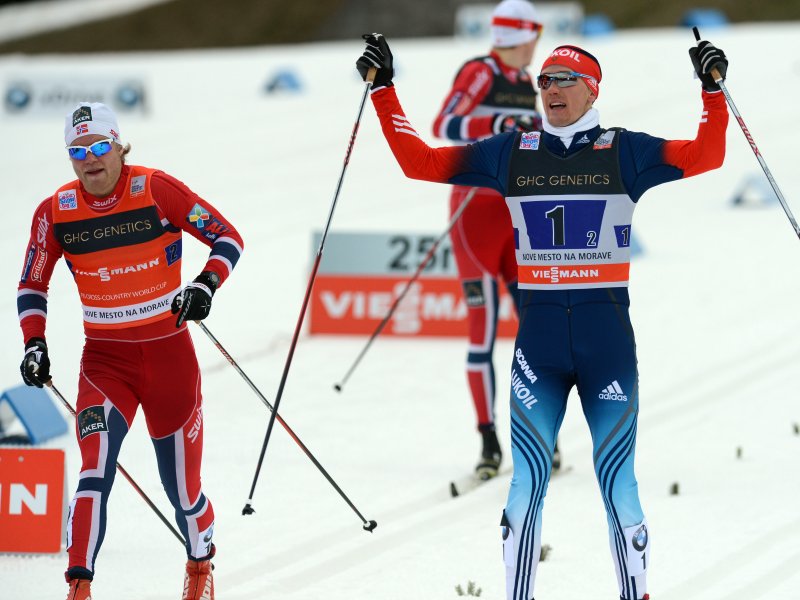
Nikita Kriukov (r) celebrates a 0.22-second victory for Russia I over Norway I’s Eirik Brandsdal in Sunday’s 6 x 1.6 k classic team sprint. Norway II’s Ola Vigen Hattestad placed third, 1.78 seconds back in the final classic sprint before the Olympics. (Photo: Fischer/Nordic Focus)
Twenty-five days before the Olympics open in Sochi, Russia, Nikita Kriukov couldn’t have timed Sunday’s 6 x 1.6-kilometer team-classic sprint victory much better. The 28-year-old Russian’s execution was right up there as well.
Following Norway’s Eirik Brandsdal into the finish, the reigning sprint world champion left no doubt that he’s still in top form, and when it comes to classic sprinting, watch out.
With teammate Maxim Vylegzhanin, Kriukov anchored Russia I to a World Cup win in 22:03.89 in the final classic-sprint tuneup before the Olympics, To do so, he outsprinted not only Brandsdal of Norway I by 0.22 seconds, but outlasted Norway II’s Ola Vigen Hattestad, who took third 1.78 seconds back.
Almost as soon as he crossed the finish, Kriukov graciously bowed to the grandstand at Nové Mesto, Czech Republic. The Norwegians hung their heads, fully realizing what happened and the work they have cut out in the team classic sprint at the upcoming Winter Games.
“I followed the plan and hoped to avoid meeting Kriukov [in the finish],” Brandsdal, 27, told NRK, according to a translation.
Despite teammate Eldar Rønning giving him a 1.1-second head start out of the last exchange, Brandsdal ended up chasing Kriukov to the finish anyway.
“We have to hope for a step up in the Olympics, but we do not know if this is being made,” Rønning told NRK. “There is strong competition.”
But rehearsal is rehearsal and the show is the main attraction, the 31-year-old Rønning reasoned. Either way, the Russians made a point.
The Norwegians led out of the start with Norway II’s Pål Golberg, 23, leading through the first exchange, just 0.4 seconds ahead of Rønning. Sweden II (Marcus Hellner/Emil Jönsson) remained in the mix 0.9 seconds back with Germany I (Sebastian Eisenlauer/Josef Wenzl), and Vylegzhanin was just a second back in fifth. Switzerland I (Ueli Schnider/Gianluca Cologna) tagged sixth, a tenth of a second ahead of the Americans, with Simi Hamilton handing off to Andy Newell 1.4 seconds back from the leaders.
“We got off to a really good start,” Hamilton said on the phone, after the Americans qualified in second in their semifinal then placed fifth behind the Czech Republic (Martin Jaks/Ales Razym) in the final.
All 10 teams remained within 2 1/2 seconds of one another through the first four laps, before the three leaders — Rønning, Vylegzhanin and Golberg — broke away on the second-to-last leg.
Meanwhile, Hamilton put the U.S. in fourth, 4 1/2 seconds back. Newell had posted the fastest leg just before him to bring the team to third at the fourth exchange, tied with Russia.
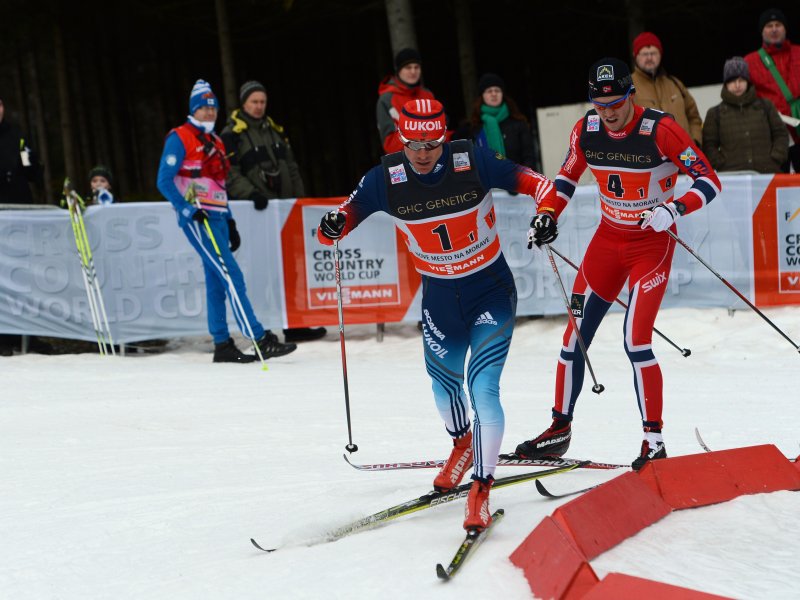
Russia I’s Maxim Vylegzhanin leading Norway II’s Pål Golberg in Sunday’s World Cup 6 x 1.6 k classic team sprint in Nove Mesto, Czech Republic. (Photo: Fischer/Nordic Focus)
“It was pretty tight the entire time with all ten teams and we lost a little bit of time in one of the tags because it was so tight with all ten teams within a couple seconds,” Hamilton explained.
After Newell’s first lap, Hamilton fell from sixth to ninth, 2.4 seconds behind the two Norwegian teams and Russia up front.
“We got a little scrapped up in one of the tags and lost a little time and came back thanks to Andy’s second leg,” Hamilton said. “When he tagged off to me on my last leg I just made it a goal to stay in contact with the top three teams. … I skied as hard as I could and lost a little bit of time but fought hard.”
After Newell received the tag in fourth, he led the chase pack as Russia, Norway I and Norway II continued to contend for the lead.
Norway II’s Hattestad fell off the pace on one of two climbs with what appeared to be less-than-ideal skis on the 36-degree Fahrenheit afternoon. Slipping up while herringboning outside the track, Hattestad initially lost contact with Kriukov and Brandsdal before putting on a last-ditch attempt to catch up.
Brandsdal took advantage of his superior glide on the descent as he drafted and passed Kriukov a few hundred meters before the finish. Heading down into the stadium, Brandsdal led while Kriukov followed closely, and Hattestad, who anchored Norway to a classic team sprint victory three weeks ago in Asiago, Italy, trailed a couple meters behind.
As Newell led the second group, including Czech Republic’s Razym and Germany’s Wenzl, into the stadium, Kriukov unleashed his well-known double pole, stepping around Brandsdal and definitively beating him to the finish.
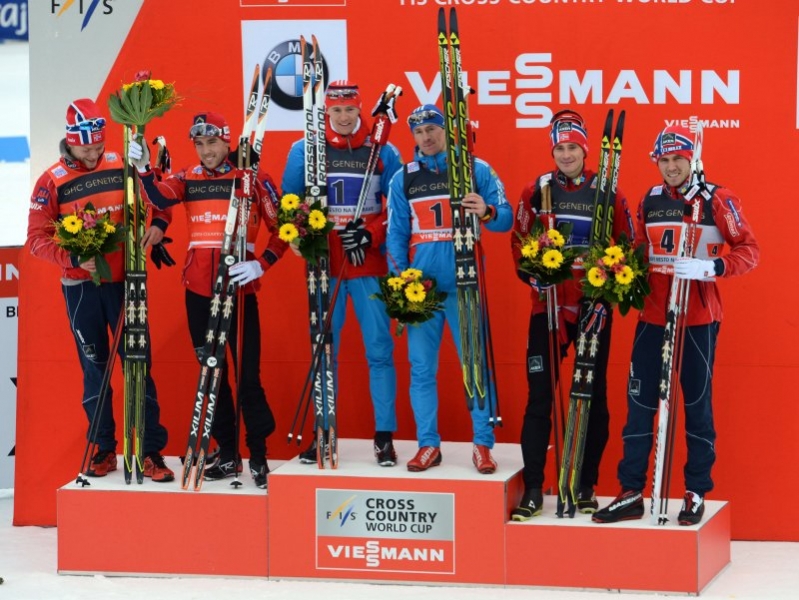
The World Cup men’s classic team sprint podium in Nove Mesto, Czech Republic: (from left to right) runner-up Norway I, Russia I’s winners Nikita Kriukov and Maxim Vylegzhanin, and Norway II in third. (Photo: Fischer/Nordic Focus)
“I felt much better than yesterday,” Kriukov told FIS after narrowly qualifying in 27th in Saturday’s classic sprint and placing 10th overall. “It was my first time skiing with Maxim. It gives us great confidence going to Sochi.”
“A few centimeters were missing on Kriukov,” Brandsdal told FIS. “I do not like losing in the finish. Nikita was very strong. It was cool to have such [a] tight fight.”
Newell successfully dropped Switzerland’s Cologna and bested Wenzel, but failed to match Razym, who used the home-crowd advantage to edge him by 0.54 seconds for fourth.
The Americans placed fifth, 14.28 seconds behind the Russian winners, and held off Germany by seventh-hundredths of a second. Switzerland placed seventh, another 6 1/2 seconds back, France was eighth (+22.08), Italy ninth (+26.47), and Sweden 10th (+50.32).
After Jönsson’s second leg, Sweden dropped from seventh to 10th with Hellner, leading him to rethink whether he’ll sprint at the Olympics after failing to qualify on Saturday.
“It would not be fun to go and feel like this in the Olympics,” he told aftonbladet.se, according to a translation.
“Right now I am pensive on sprint,” Hellner told Radio Sport. “But who knows, maybe it will be better and better. Nothing is certain in any case.”
Jönsson was back in action after sitting out Saturday’s sprint because of a troublesome right knee.
“I could list 3,000 things we could have done differently, but I’ve got three good races, have a knee … and Marcus holding up and moving well, so there is probably some bright spots,” Jönsson said.
Andy Newell (U.S. Ski Team) racing the individual sprint at the Tour de Ski Dec. 29 in Oberhof, Germany. (Photo: Fischer/Nordic Focus)
Newell said that he and Hamilton, who won the Tour de Ski freestyle sprint in Lenzerheide, Switzerland, on New Year’s Eve, relied on smart yet aggressive skiing and not being afraid to take chances.
“We were right in there for a while,” Newell said on the phone. “Whenever I do a sprint relay it’s just kind of my goal to stay up front and keep us in a good position and save as much energy as I can for the end because that’s when it’s really going to matter.”
At least 20 meters behind the top three on the last lap, he realized the podium was likely out of reach.
“We tagged in fourth for my last lap, but even then we weren’t in medal contention,” Newell said. “In a sprint relay even 20 meters is too much to make up on the best skiers in the world. If we’re going to be in medal contention, we need to be up in the front for the last tag, which is the only thing holding us back for being a contender. It’s looking good leading into Sochi for sure.”
While fifth remains the best U.S. men’s team sprint result in recent memory, another highlight of the day was Hamilton and Newell automatically qualifying in second in their semifinal, 0.82 seconds behind Norway I’s Rønning and Brandsdal.
“We had a really good day with Andy and Simi qualifying outright, being second in their semifinals and were strong all day,” U.S. Ski Team Head Coach Chris Grover said. “I don’t think the guys have been as high as fifth for a few years now so that was really cool.”
Simi Hamilton (U.S. Ski Team) enjoying a victory lap after winning the third stage of the Tour de Ski on Dec. 31 in Lenzerheide, Switzerland. (Photo: Fischer/Nordic Focus)
Racing against 15 other teams in the second semifinal, Grover pointed out that they needed to place in the top two to guarantee themselves a spot in the final. Ultimately, Germany I, Sweden II and Italy I (David Hofer/Federico Pellegrino), ended up advancing with them as lucky losers.
“Andy and Simi’s semifinal was running slightly slower than the first semifinal which is somewhat typical in warmer conditions were the track is actually slowing down,” he said. “They would have been fine if they had been in the top four as it worked out, but you have to play it safe. Beyond that, we just try and get in the finals, and once you’re in the finals the tactic is just to rest when you can and be as strong as you can on the last two and half to three legs when people take off and really start hammering.”
“We were able to save our energy when we needed to and stay on our feet and that’s all you can hope for, just staying out of trouble and staying up with the leaders,” Newell said. “We don’t want to be trying to break off the front. You only have to ski as fast as the people around you.
“That’s what were trying to do in these relays: keep up with the leaders, stay out of trouble, and it always just comes down to last lap or two,” he added. “In Sochi it’s going to be a harder course, but I think were both in good enough shape so that when it comes down to our last laps we need to be up there with the best. I think we can do that for sure.”
“It’s obviously a very different course than what we’re going to find at Sochi, but last year we skied really well at the team sprint day there,” Hamilton said, after he and Newell placed seventh in the World Cup classic team sprint in Sochi last February. “We both like that course there. I think it speaks to our fitness right now. We are both on a really good trajectory in terms of where our fitness is and our speed is. We’re encouraged and we’ll see what happens, but we’re psyched for sure. Today it would have been great to be on the podium but I think we’re encouraged with how everything went.”
The Americans will continue training in Nové Mesto before the next World Cup in Szklarska Poreba, Poland, with an individual skate sprint and 10/15 k classic mass start on Saturday and Sunday.
After that, they’ll head to Europe’s largest high-altitude meadow at Seiser Alm, Italy, for a training block before the last World Cup before the Olympics in Toblach, Italy.
— Lander Karath and Pasha Kahn contributed reporting
The start of the men's 30 k classic mass start in Nove Mesto, Czech Republic, on Saturday with Devon Kershaw (CAN) second from right near front. Photo: Fischer/Nordic Focus.
With every seemingly spontaneous sprint to the front of Saturday’s World Cup classic race in Nové Město na Moravě, Czech Republic, Devon Kershaw appeared as eager and energetic as a kid in a candy shop.
Naysayers or nervous Nellies might have questioned the Canadian’s strategy in the 30 k mass start. The head coach of the Canadian national ski team, Justin Wadsworth wasn’t worried.
Kershaw simply followed the plan the two carefully crafted before the race. If he felt good, Kershaw would sprint to intermediate checkpoints throughout the 30 k to win bonus points. If he collected enough points, they could contribute more toward his overall World Cup ranking than a top-10 result.
Four checkpoints and more than 20 kilometers later, Kershaw was still very much in the hunt for a podium finish – and he had won two of four preems. He was third in the other two, and those alone equaled a fifth-place finish in terms of points, Wadsworth said.
Kershaw went on to finish 12th, giving him a total of 72 points and putting him 50 points closer to Norway’s Petter Northug in the overall World Cup standings.
Northug ranked second behind World Cup leader Dario Cologna of Switzerland. Kershaw was third, 246 points behind Northug and 57 points ahead of Sweden’s Marcus Hellner in fourth. The result gave Kershaw additional cushion in the distance standings as well, where he was also third behind Cologna and Northug.
“Justin and I were talking a lot about what the best strategy is and of course I always want good results, but I just ended up being in a good position on the first preem,” Kershaw said in a phone interview after the race. “I kind of made a game-time decision, like, ‘Ah, you know what? I’m just going to try to go for every single preem here and try and collect as many points as I can and hopefully I have something left for the end.’ ”
He saw his plan through to the finish and collected 50 points in the process, but ran out of energy while leading the pack with a few kilometers to go. Sweden’s Johan Olsson first charged ahead and Cologna followed, and a slew of others including four Russians jolted ahead of Kershaw to bump him to fourth. Olsson won the race by 1.5 seconds over Cologna, and Kershaw was 21.6 seconds off Olsson’s winning time of 1:13.42.
“Twelfth’s just a bit of a sting, but I took a decision and I don’t regret the decision I made,” Kershaw said. “Had I not been in the preem hunt for every single preem, I’m sure I would have had the energy to have another banner result day.”
For him, it made more sense to race for the bonus points. Wadsworth explained that it gave Kershaw eight fewer points than he would have received for placing second overall. It was basically better than placing third in the race.
“Right now [Kershaw] staying in the top three in the overall World Cup is a really big goal,” Wadsworth said. “It’s possible to even get second.”
He pointed out that Northug doesn’t have much leeway after missing several World Cups recently, and the reigning World Champion was 14th on Saturday, 3.5 seconds behind Kershaw.
Meanwhile, Kershaw was about 3 seconds out of sixth place. He held to the leaders and took the lead several times despite back troubles, which Kershaw said was an unusual stiffness that kicked in on the second of six laps. Fortunately, lower-back pain turned out to be more of an annoyance than hindrance, he said.
“Hey, I don’t know, I’m 29 now, maybe I’m just getting old,” he said. “I haven’t really had any sore anything so it was a bit weird.”
His teammate Alex Harvey had significant back problems throughout the race, leading him to drop out near the halfway point.
“It was after a long descent and when I stood back up, I could barely ski,” Harvey wrote in an email after his first DNF since suffering something similar last year in Lahti, Finland. “There was nothing I could have done. It was hard for sure but it was the only reasonable option.”
Still in sixth overall in the World Cup, Harvey said he was putting Saturday’s race behind him and in good shape with the team’s physio and massage therapist. He didn’t have to worry about Sunday since the Canadians weren’t fielding a relay team. Instead, they would focus on Friday’s World Cup sprints in Szklarska Poreba, Poland.
“It’s unfortunate,” Wadsworth said of Harvey. “It’s really tough in a race like this where you know he’s going to be there, right with Devon and he has no points on the day and has to pull out and has a bad back because of it.”
Coming off two top-20 finishes in Rybinsk, Russia, Ivan Babikov pulled off 16th on Saturday in a discipline that wasn’t typically his specialty. Babikov said he was confident going into the race coming off a strong classic leg in the skiathlon last Sunday.
“Today, I just I tried to stay with the lead pack,” he said. “If there’s a chance for the bonus points, then I’ll try to get them, and that’s actually what happened, so I’m pretty happy.”
Babikov was fourth at the 15.9-k bonus, which Kershaw won. After getting eight points there, Babikov earned another point at the last bonus at 20.9 k.
He skied with Kershaw for much of the race, staying within about 4 seconds of the leaders. On the laps where Kershaw dropped back to recover before springing for another preem, the two floated around and just outside the top 10.
While Babikov said his wrist was not completely healed after a hard crash in the Tour de Ski, it didn’t bother him when he skied. It helped that the race involved very little double poling, he said.
“I actually really liked the course; we all liked the course,” Babikov said. “It’s really hard … We’re tired, but pretty satisfied.”
With 24 points at the end of the day, Babikov improved to 39th in the overall World Cup standings. That added to the team’s collective goal of having everyone qualify for the World Cup finals, Wadsworth said. To do so, each needed to make the top 50.
Lenny Valjas inched closer to that objective, scoring 12 points at the first bonus on Saturday. He sprinted ahead with Kershaw to place second at 5.9 k, then hung back to conserve his energy for next week’s sprints. Valjas finished 52nd, and the bonus points moved him from 54th to 51st in the World Cup standings.
He was one point away from 50th.
“That was the plan,” Valjas said. “I knew I probably wasn’t in good enough shape to finish in the top 15 … so I just decided to go for the first intermediate sprint there and I pretty much gave it everything I had.”
Doing so wasn’t easy. Valjas said he spent most of his energy on a tough climb about a kilometer before the preem.
“But I got 12 points there so I was pretty happy with that,” he said. “Pretty successful day.”
Perianne Jones skis to 30th place in the women's 15 k classic mass start on Saturday at the World Cup in Nove Mesto, Czech Republic. The result tied her career best in a distance race, which she set nearly three weeks ago in a 10 k classic race in Otepaa, Estonia. Photo: Fischer/NordicFocus
Earlier in the women’s 15 k classic mass start, Perianne Jones gave the Canadians their first result to celebrate when she placed 30th to tie her previous career best in a distance race. She notched the same result in a 10 k classic race three weeks ago in Otepää, Estonia, to score within the points.
“I would have liked to get more than just one point,” Jones said with a laugh. “But being in the top 30, that’s always the goal when I’m heading into a distance race.”
It wasn’t until the end of the first of three laps that Jones realized she was in the top 30. She decided to try to keep her position and see if she had some extra energy on the last lap. With about two hills to go, a few women passed her, forcing her to sprint for 30th.
She ended up 3:42.4 behind Norwegian winner Marit Bjørgen and 0.2 seconds ahead of 31st. For a sprinter who hadn’t originally planned on racing in Nové Město, Jones was glad she did.
“It was kind of a last-minute decision for Lenny and I to come over here,” she said. “I think we both made it a worthwhile trip.”
For Jones, who has seen some of her best results in the New Year, she credited her success to fast skis and a new approach. After the summer, she said she put too much pressure on herself.
“It was always like ‘Oh Peri’s in really good shape,’ so I was maybe even a little bit nervous,” she said. “But then after Christmas it was like, ‘It doesn’t matter how good of shape I was in over the summer, I’m just going to race and ski as fast as I can and that’s all that matters.’ ”
Wadsworth said the entire team was excited for her on Saturday.
“It’s definitely a big step,” he said “It shows her fitness and her commitment to the training that she’s done. … It takes time and energy to change your physiology when you’re a sprinter to get into that distance realm, and she’s going in that direction.”
Without any relay teams racing Sunday, the Canadians will travel back to Seefeld, Austria, to train for a few days before gearing up for the World Cup in Poland.
Jessie Diggins (in black) mixing it up in the semifinals of a World Cup sprint in Milan, Italy, earlier this season. In eight straight World Cup races this year, the 20-year-old Diggins has been outside the top 20 just twice. She was 33rd on Saturday in the 15 k classic mass start in Nové Město na Moravě, Czech Republic.
As the saying goes, you can’t win them all and some races downright hurt. Maybe that’s not the adage, but it’s the truth.
Several Americans felt an unfamiliar burn associated with disappointment on Saturday after finishing outside the top 30 in their respective World Cup mass starts in Nové Město na Moravě, Czech Republic.
U.S. Ski Team rookie Jessie Diggins led the women’s squad, placing 33rd in the 15 k classic race. Kris Freeman was also 33rd on Saturday, the top American in the men’s 30 k. He was coming off some of his best results of the season, placing 30th or better in the last three World Cup races.
For Diggins, it was the second time in eight consecutive World Cup starts this season that she placed outside the top 20. She was 6.5 seconds out of scoring points in 30th on Saturday; a position which Canadian Perianne Jones nabbed.
In an email, Diggins wrote that she had no idea she was gunning for 30th or better, but even if she had, it wouldn’t have mattered. She skied hard regardless, finishing 3:48.9 behind Norway’s Marit Bjørgen, who won in 39:20.3.
With more than 50 women to contend with from the start, Diggins wrote that she tried to stay on her feet and navigate the tricky descents throughout the three laps.
“The start went well for me but I think I’m just a little raced-out at the moment,” Diggins wrote. “I was having some issues kicking my skis later on and my technique started to fall apart as I got tired. It just wasn’t a day for me, but that’s totally ok!”
Starting near Diggins, Liz Stephen stayed close to her teammate for much of the race and finished 42.1 seconds behind her in 42nd (+4:31.0). Ida Sargent followed in 43rd (4:45.4). Holly Brooks did not finish because of a digestive issue, which she has been trying to kick since last weekend.
It was the first time Brooks dropped out of a ski race since 2003, according to the International Ski Federation (FIS) database. Brooks finished the Tour de Ski earlier this year with a broken wrist.
“My body felt like an under-powered Fiat,” Brooks wrote in an email. “And 15k in Nove Mesto is a long way to go if you aren’t feeling good.”
She also had Sunday’s relay in the back of her mind. Knowing before the race that Kikkan Randall planned to sit out the relay to rest for next week’s World Cup in Poland, Brooks didn’t want to jeopardize her spot, and in turn, the team’s prospects in the 4×5 k relay.
“I was certain that finishing the race would dig a huge hole – one that I might not be able to pull out of,” Brooks wrote.
Looking ahead to Sunday, she hoped to put her teammates – Diggins, Stephen and Sargent – “within contact” of their competitors so “they can work their magic,” Brooks wrote.
After what Stephen described as a tough day, she was particularly excited for the relay. On Saturday, she wrote that she felt tired and “super weak” skiing. She took two feeds, which were unplanned but necessary. On a 15 k course, Stephen typically doesn’t take any.
“The real problem was the body today, and then the head followed,” Stephen wrote. “I was charging really hard the whole race, but after the first lap and a half I lost a lot of my confidence out there and went in and out of being discouraged and pulling myself back into the race.”
For her, a race of that length was usually fun. She described Saturday as “really grueling.”
Sargent liked the course and wrote in an email that it was “super fun … with some hard climbs and a lot of fast twisty downhills.”
She said the race felt like an individual start, just a little more crowded, with a fast pace from the start.
“Nove Mesto is an awesome venue and there were a lot of spectators and cheering on the course, which helped especially when I was hurting at the end,” Sargent wrote.
Men’s Race
From the start of the men’s 30 k, Freeman wrote in an email that he skied relaxed and moved up in the field as others petered out. About a third of the way into the race, he found himself hovering outside of 20th and fewer than 20 seconds behind the leaders. At the time, Petter Northug (NOR) was just behind Freeman, 21 seconds out of first.
Northug went on to place 14th, 26.6 seconds after Johan Olsson of Sweden, who won in 1:13.42. Freeman ended up 33rd (+2:28.9).
“I blew up at 18 k and limped in with the chase group,” Freeman wrote. “The whole team was a step off today. Not sure why.”
U.S. head coach Chris Grover wrote in an email that everyone’s skis were OK, but “nobody had the race they wanted.”
“Perhaps [they are] still recovering from the trip to Russia and some illness going around the past 2+ weeks,” Grover wrote.
Hoffman was a victim of the flu last weekend, but reported he was healthy and recovered for Saturday’s 30 k. There, he finished 47th (+4:03.2) after following a fast pace from the start. He hung on for 10 kilometers, but worked hard to do so.
“I struggled for a couple of laps in the middle of the race and lost a lot of time,” Hoffman wrote. “I actually felt OK for the last 5k, but overall it was a disappointing day.”
Simi Hamilton and Sylvan Ellefson finished 55th and 56th, respectively, and while Ellefson wasn’t satisfied with his performance, Hamilton was. In the second 30 k of his career, Hamilton didn’t have many expectations and wanted to learn how to better ski a World Cup distance race.
“I struggled a bit with the cold air today even though temperatures weren’t too extreme, but I think Moscow did a number on my lungs,” he wrote, referring to his history of bronchitis and asthma.
“Hard and fast conditions definitely suit me better than slow and soft, so I was happy that the course held up really well … and it was a beautiful day,” Hamilton wrote.
Ellefson wrote that his body wasn’t feeling 100 percent “and it showed today.” He was looking forward to racing in Poland next Friday and getting some good training in.
Andy Newell did not finish Saturday because of a back injury he has been dealing with since last Friday’s sprints in Moscow.
“Today’s race started fine and I felt OK for the first two laps then the wheels started to come off and the back seized up,” Newell wrote in an email.
He finished four out of six laps and stopped at 20 k.
“I was out of the points and I didn’t really want to push it and do further damage,” Newell wrote.
While his back pain was not as bad as last weekend, Newell opted to sit out Sunday’s relay to prepare for Friday’s sprints. Freeman, Hoffman, Elliott and Hamilton would fill in for the 4×10 k.
Reflecting on an all-around tough day, Diggins acknowledged its importance.
“It’s good to get some ‘mental toughness’ races in there,” she wrote. “I’m proud of our team for battling through it.”
The stadium in Nové Město na Moravě, Czech Republic, on Friday before this weekend's World Cup races, the first there since 2009. Photo courtesy of Andy Newell. "Things are looking good for tomorrow," Newell wrote in an email. "The conditions are cold and hard. Sweet hard wax skiing. The course is tough but not crazy. Lots of stridable skiing!"
Life on the World Cup is one giant judgment call. Each day brings new decisions and, sometimes, unforeseen challenges. With little time, athletes and coaches often make up their minds and go with it. That’s about all they can do.
The spontaneity often leads to uncertainty – as is the case with this weekend’s World Cup in Nové Město na Moravě, Czech Republic. Several teams will probably do as the U.S. Ski Team plans and select its relay teams for Sunday based on Saturday’s races.
U.S. head coach Chris Grover said in a phone interview on Friday that only two of eight relay members between its men’s and women’s teams were final. Kikkan Randall opted to skip Saturday’s 15 k classic mass start to rest up for Sunday, and with an abundance of World Cup podiums and freestyle sprint victories this season, she was a shoe-in for the 4×5 k relay.
Tad Elliott was the only definite for the men’s relay since he isn’t racing Saturday, Grover said. Like Randall, Elliott is a skate specialist, and is sitting out the 30 k classic mass start because the U.S. had filled its allotted number of entrants.
Grover said they would name the men’s and women’s relays pending Saturday’s results, and also consider the state of each athlete and previous 5 k and 10 k performances.
“We’ll see what kind of shape people are in and how they’re feeling,” he said. “We have to weigh people’s strengths. I mean, tomorrow’s a classic race but we still need skaters in the relay, so it’s not necessarily the top three that come in.”
Randall resolved to skip Saturday’s 15 k nearly a week ago, Grover said. Despite feeling healthy, she decided with the help of her Alaska Pacific University coach, Erik Flora, that it would be better to rest before the relay.
“She just knew that she was kind of feeling a little bit tired, and she needed to kind of skip a couple races during this period in order to focus on recovery and skiing fast for the rest of the season,” Grover said.
Given the depth on both American squads, Grover was excited about their prospects in the relays. With Ida Sargent, Liz Stephen, Holly Brooks and Randall in the last relay in Sjusjøen, Norway, the U.S. women were ninth behind four Norwegian teams.
That was in November, before several American women notched career bests and Jessie Diggins joined the team in Europe. They will also have at least two fewer Norwegian teams to contend with on Sunday.
“I think everybody is stronger,” Grover said. “We don’t really know what our limitations are quite yet. We just haven’t had a chance to ski enough relays, but I feel like we can put together, for both men and women, quite strong teams if we can get a great performance out of all four athletes from each team.”
The previous U.S. men’s relay with Andy Newell, Kris Freeman, Simi Hamilton and Elliott was 11th in Sjusjøen. They were 13.3 seconds behind the Russians in 10th and trailed three Norwegian teams.
Earlier this season, Grover said his team set a goal to field relays good enough to compete on the World Cup, World Championship and Olympic levels. He was excited they had enough depth – with at least five men and five women – to see that out.
Canadian Starters
Following the trend they set earlier in the season, the Canadians will not compete in the relays, but not because they can’t.
The Canadian men have enough numbers and have been particularly dominant in recent World Cup races, with Devon Kershaw winning last Saturday’s 15 k freestyle mass start in Rybinsk, Russia. In the last four races, he and Alex Harvey helped Canada land in the top 10.
Ivan Babikov is also back with the team after recovering at home for part of January, and Lenny Valjas opted to race this weekend after originally trying to find a shorter race in Austria, head coach Justin Wadsworth said. Without much luck, Valjas and another Canadian sprinter, Perianne Jones, decided to join their team for the distance mass starts.
Jones will be Canada’s lone female racing on Saturday. Chandra Crawford returned to Europe on Friday after a brief trip home in Canmore, Alberta, and Dasha Gaiazova was in Ramsau, Austria.
Because Wadsworth did not expect Valjas to be available for the relay, he decided not to field a team.
“We made all the travel plans (flights etc.) based on that, so that’s one reason,” Wadsworth wrote in an email. “The other reason is it’s been a huge last 8-10 days for Devon and Alex.”
He noted the wear of traveling between Moscow and Rybinsk, where Kershaw and Harvey endured two hard races in cold weather. Then there was the long trip back to Austria, where the team had been training, the trip to the Czech Republic, and this weekend’s races to consider before heading back to Austria and then Poland next Wednesday.
“All that makes doing the relay after the 30 k WAY too much,” Wadsworth wrote. “Right now I’d be happy to get the guys out of this period without blowing up, and it’ll be close as it is. … All the races lately are great, but we do need a training period to ensure it all keeps on track, both mentally and physically.”
Saturday’s race holds a challenging 5 k course with plenty of long climbs and few double-pole opportunities, according to Grover. He said the hardwax should be straightforward with cold temperatures expected to reach about minus 10 degrees Celsius (14 degrees Fahrenheit) at race time.
“It will be a hard course, but perfect for our team,” Wadsworth wrote.


 Liz Stephen has earned her stripes. For the last 11 years, the 29-year-old Vermont native has been part of the US Ski Team (USST). After veterans like Kikkan Randall, Stephen has become an anchor on the women’s team, which now carries with it expectations of top-20’s, top-10’s and podiums. At the age of 15, the Burke Mountain Academy alpine skier and runner switched to the skinny skis for good.