From the FasterSkier archive — posts syndicated from athletes’ and coaches’ own blogs between 2004 and 2012, kept online as published. Current coverage is at fasterskier.com.
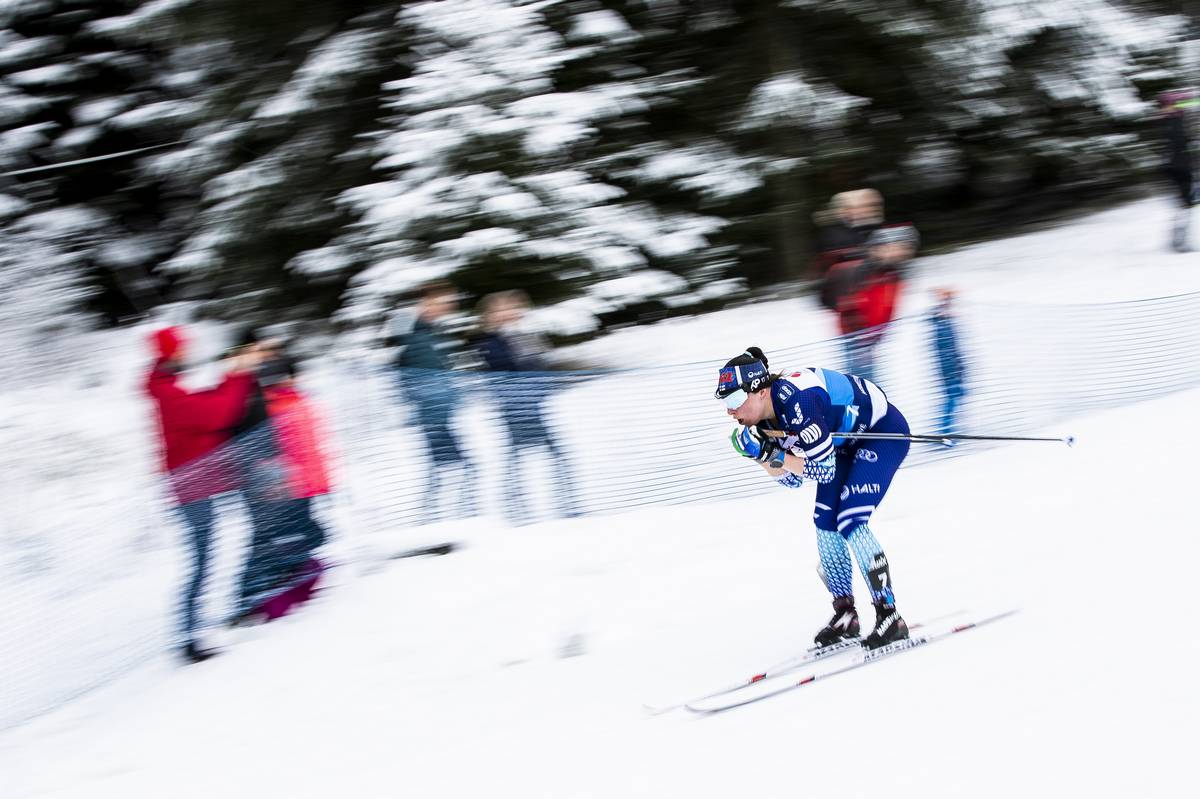
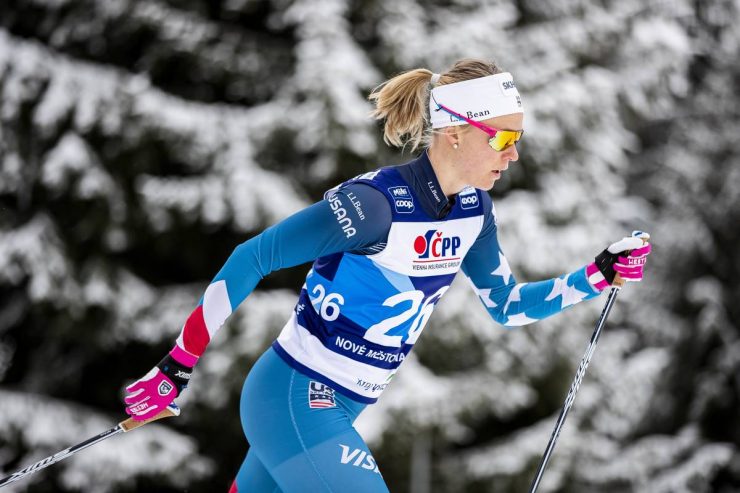
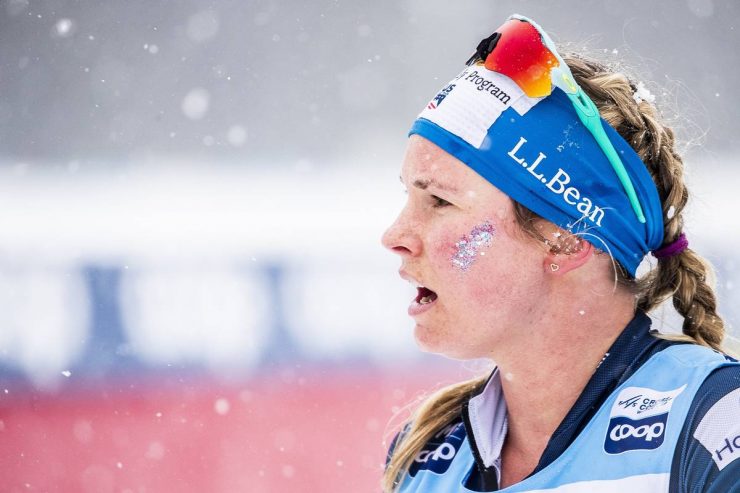
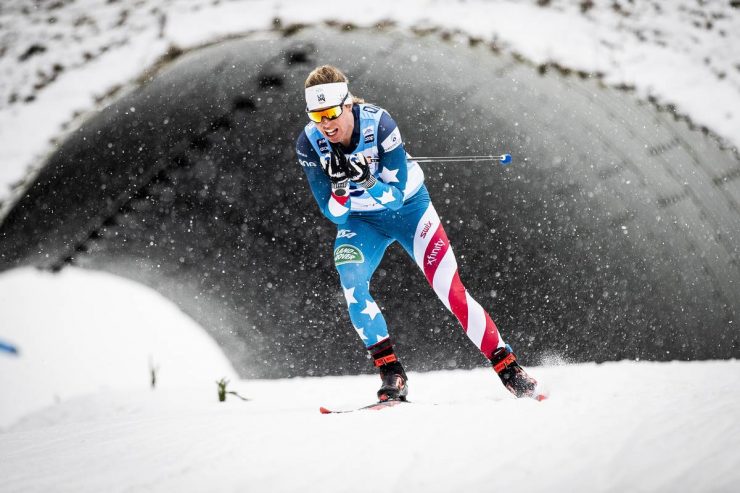
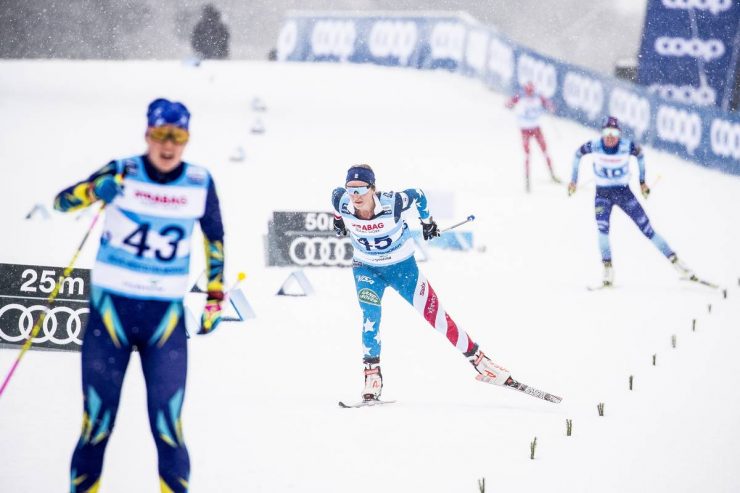
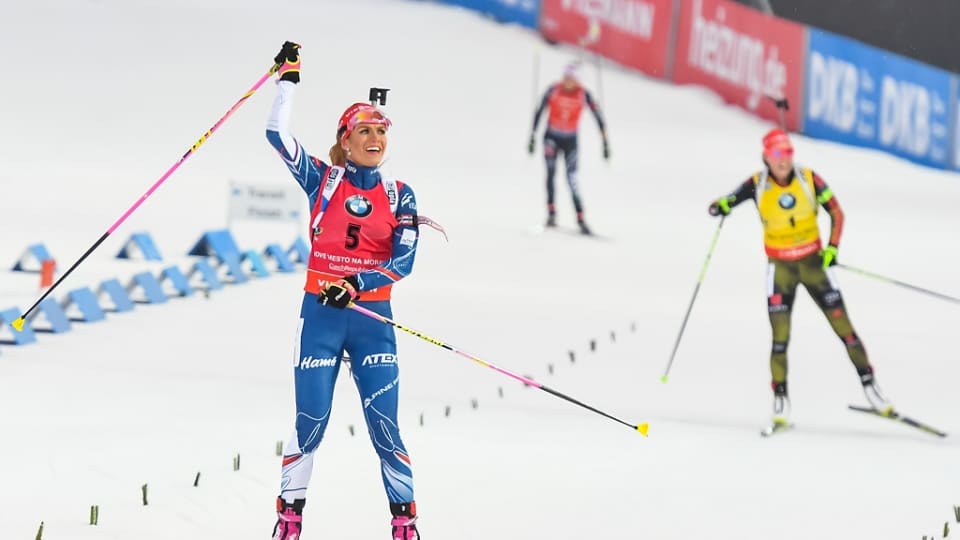
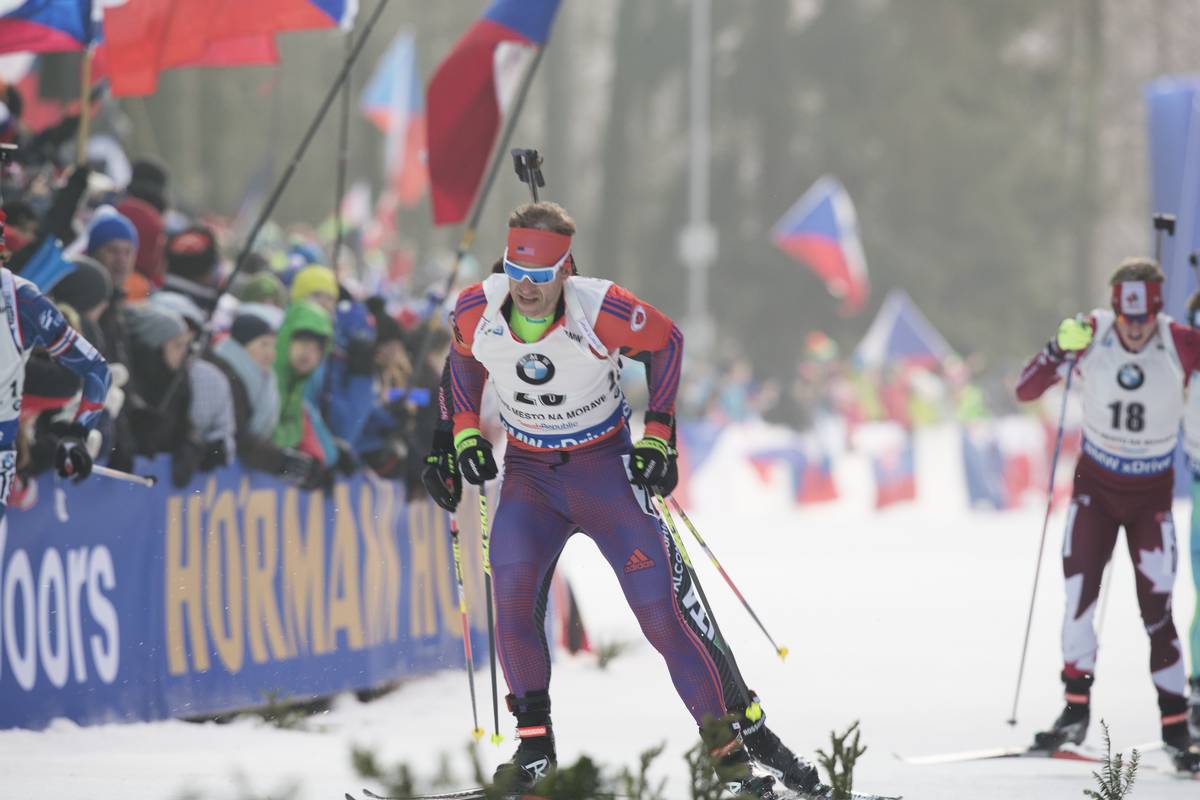
Alayna Sonnesyn back in 2020 strides it out during her second round of World Cup starts in Nové Město. (Photo: NordicFocus)
Slim pickings to no-pickings on the World Cup. Last week it was announced the Norway round of World Cups, Oslo and Lillehammer, were canceled due to strict requirements to enter Norway during the pandemic. Before the weekend, one World Cup remained on the schedule: Nové Město in the Czech Republic. That final World Cup domino fell over the weekend when the Czech organizing committee pulled the plug due to Covid-19 restrictions.
A Reuters story stated, “The decision came after Germany, which is due to host world championship races from Feb. 25 to March 7, tightened conditions for travellers from the Czech Republic, which has struggled to control one of Europe’s highest infection rates of the novel coronavirus.”
According to the Reuters, skiers participating in the Nové Město races would be required to quarantine upon entering Germany and would miss the races scheduled for the Oberstdorf World Championships.
For now, the International Ski Federation (FIS) has not rescheduled any cross-country Worlds Cups for March.
Nové Město, Czech Republic served up a traditional rock’em sock’em pursuit series on the World Cup. Saturday featured a 10 k/15 k interval start skate, followed by a 10 k/15 K classic pursuit. Bolshunov and Johaug were the clear fitness outliers but some great races within the race unfolded. And yes, how about those big baggy bibs? Part art-class smock part moo-moo, it was not a good race look. But we digress. To break it all down, former Canadian National Ski Team member Jess Cockney joins Devon for the show.
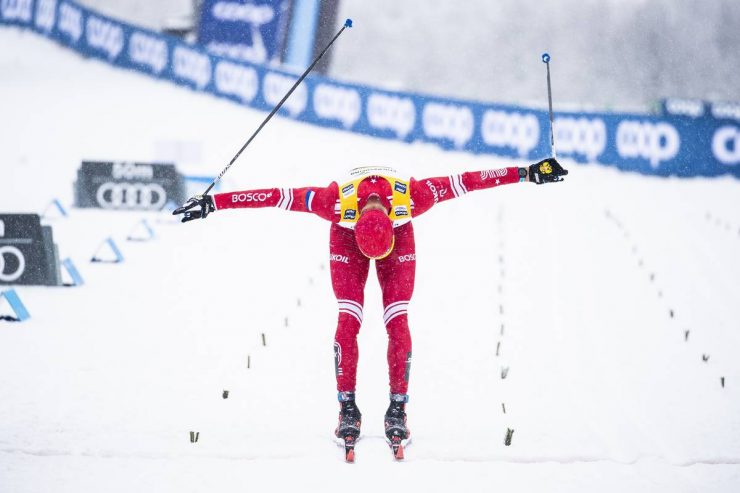
Take a bow: Alexander Bolshunov (RUS) also takes the win in Nové Město. (Photo: NordicFocus)
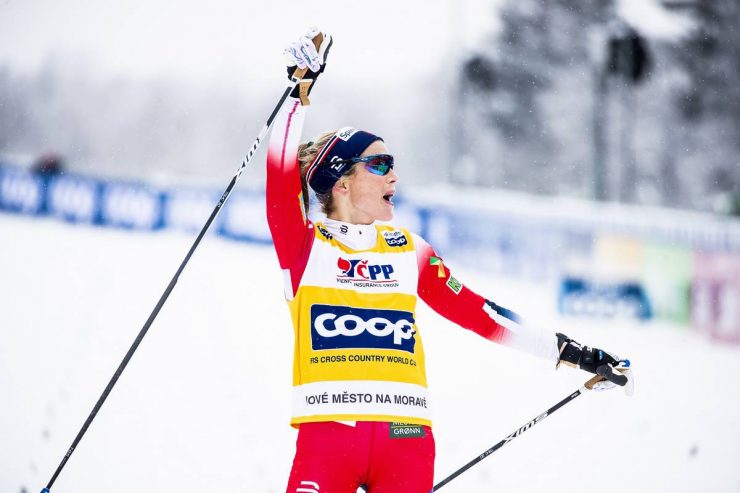
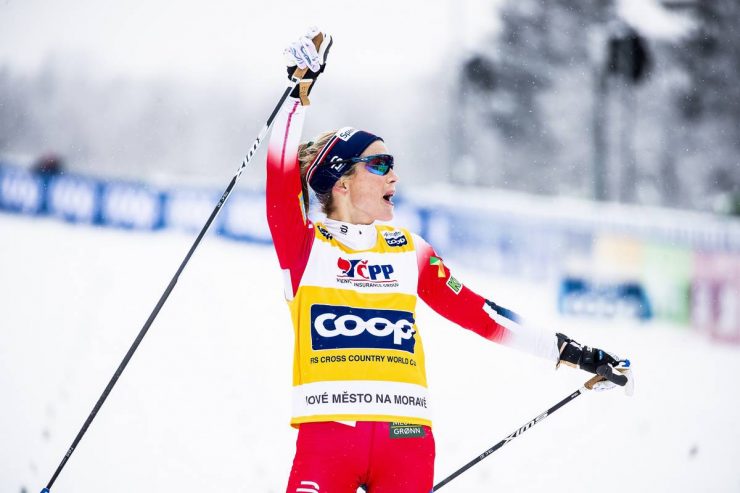
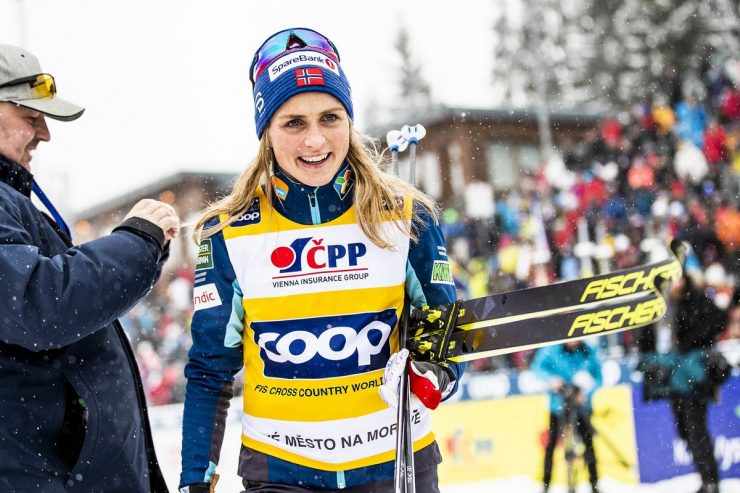
The champion in Nové Město: Therese Johaug. (Photo: NordicFocus)
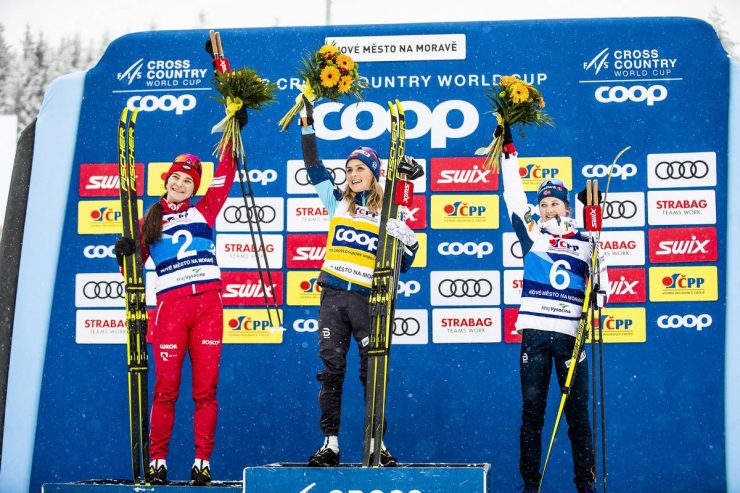
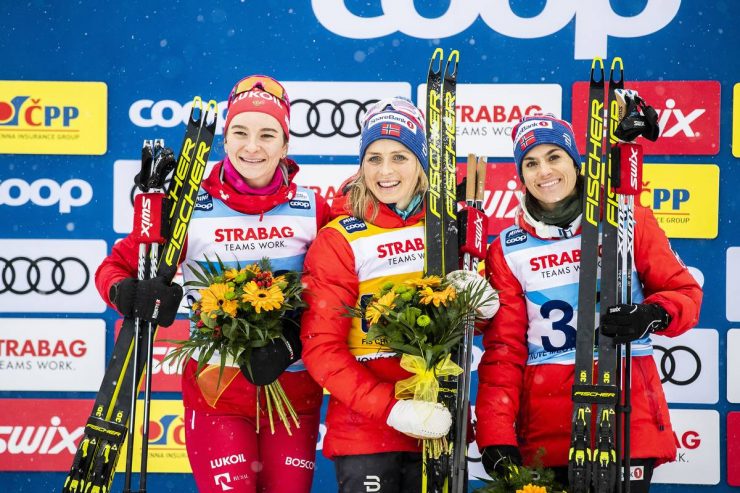
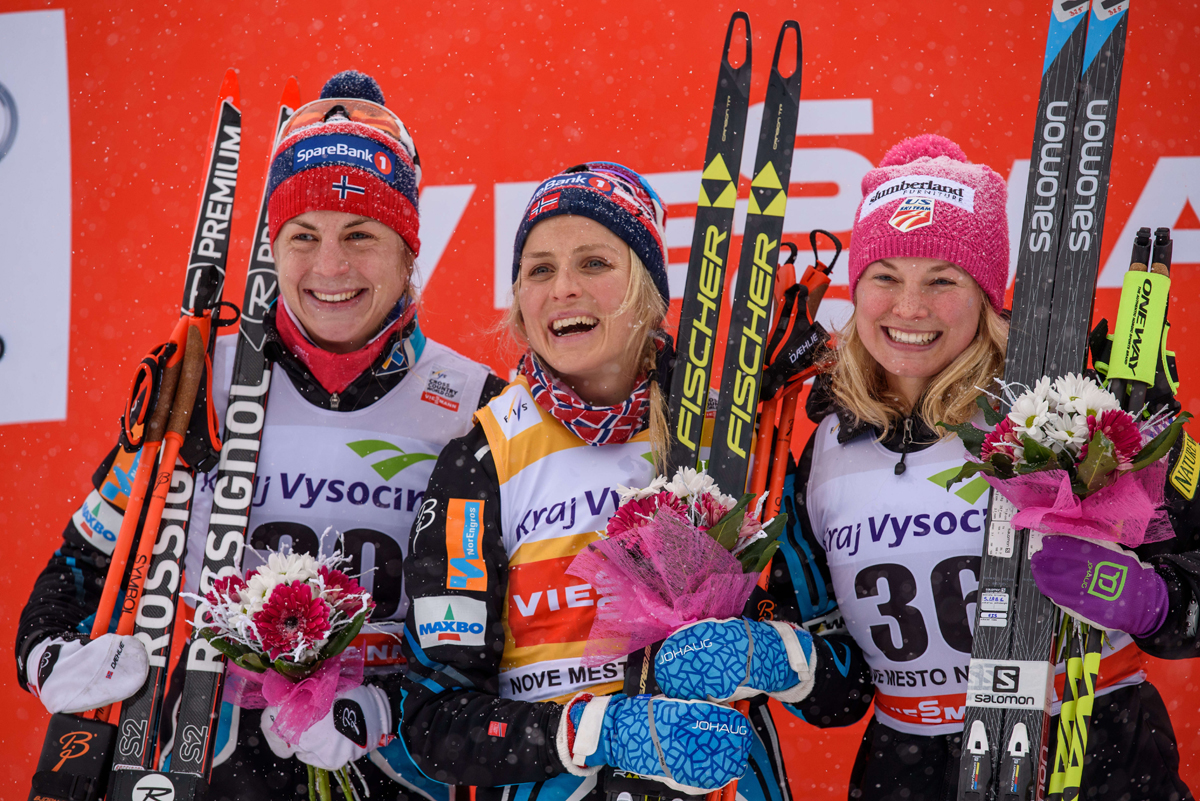
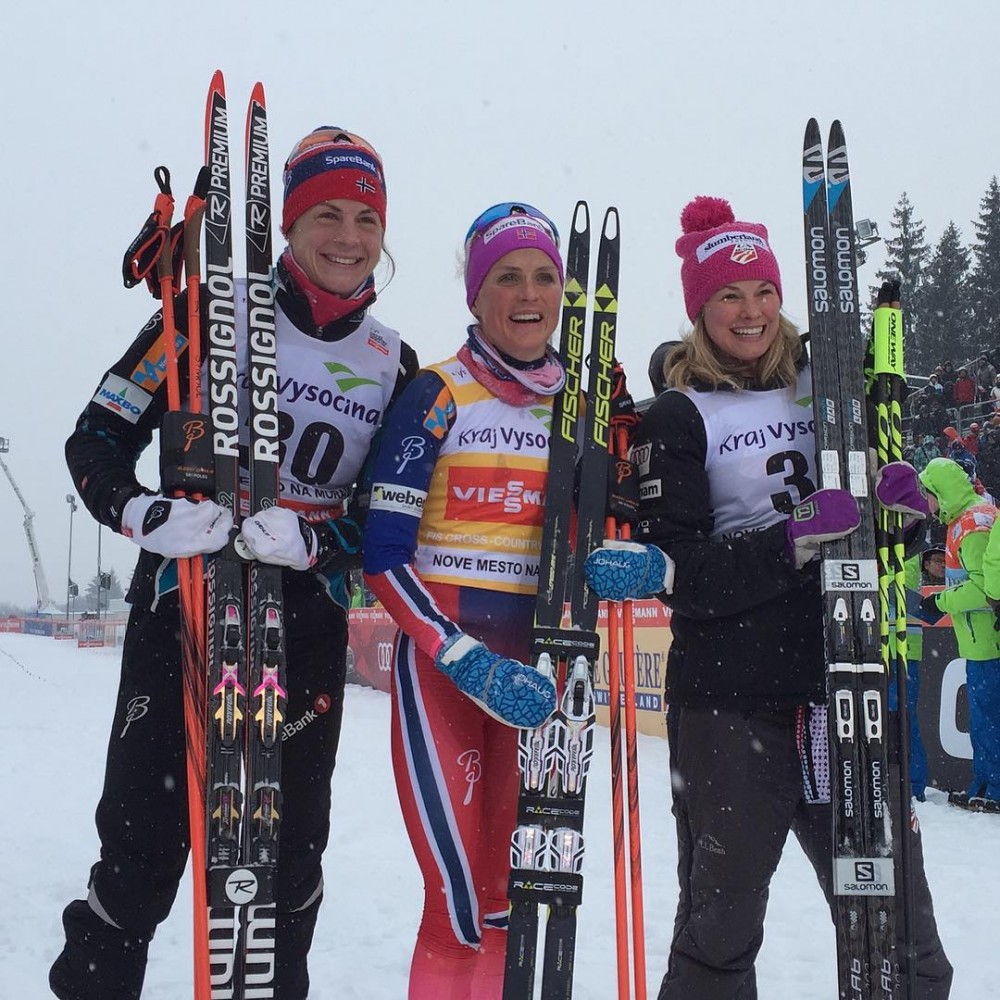
The classic pursuit podium Nové Město: Therese Johaug (NOR) took the win ahead of Natalia Nepyaeva (RUS) and Ingvild Flugstad Østberg (NOR). (Photo: NordicFocus)
Yesterday’s snow coated Nové Město, Czech Republic, clinging to the tall pines and masking the unsettling contrast of the man made ribbon of snow. Though wintry precipitation continued to fall, cheering crowds filled the stadium, ringing bells and sounding horns as racers passed through.
Picking up where they left off after the skate stage, athletes set out onto the arduous tracks for a 10-kilometer classic pursuit. Steep climbs, sharp curves, and gentler though rippling terrain in between.
Start to finish, Norway’s champion Therese Johaug put on a show. Looking unstoppable, she glided and kicked with rapid tempo, in a race that was hers to lose. Perhaps it was over before it began, as the champion started the race with a lead of 33 seconds over the next skier, Russia’s Natalia Nepryaeva.
But Johaug was not about to wait for her chasers to catch her and leave it to a final sprint. She simply hammered every meter, widening her gap over the field at each checkpoint. By the halfway mark, she was 55.4 seconds ahead, which grew to over a minute by the time she double poled powerfully down the final stretch to stop the clock at 26:49.7.
The champion in Nové Město: Therese Johaug. (Photo: NordicFocus)
FIS interviewers described it as a “perfect weekend” for Johaug while asking for post-race comments in the mixed zone.
“I’m really happy now,” she said in response. “My shape is really good at the moment, I didn’t know that before we started here in Nové Město. But I think all the competitions in the Tour de Ski and some quiet days at home, I think it’s perfect for me here to come here and race and have this shape.”
Johaug was asked about her “full gas” energy expenditure in a race she so clearly had on lock. She explained that she can’t be complacent in races, as she needs the intensity to maintain her fitness through the season.
“I had my focus on myself today and I want to have a good competition and also a good training sensation, if you understand what I mean. I did not have so many hard sensations after the Tour de Ski, so it’s good to do it here. Of course, I have perfect skis today so the waxers have done a really good job and the tracks here in Nové Město was really good for me, so I’m really happy.”
Therese Johaug (NOR) heads for the top spot on the podium in Nové Město. (Photo: NordicFocus)
In the densely packed chase group, Norway’s Heidi Weng started seven seconds behind Nepryaeva, followed by Jessie Diggins, teammates Ranghild Haga and Ingvild Flugstad Østberg of Norway, and Krista Pärmäkoski of Finland.
By 5 k, Weng and Østberg had charged ahead to close the gap to Nepryaeva, and the trio continued together through the second lap. The Norwegian’s took turns leading the charge, while the Russian waited in the draft, matching their attempts to leave her behind. Rolling and poling to the finish, Nepryaeva emerged at the front, leading the Norwegians into the stadium.
Cruising down the final stretch, Nepryeava had a gap of several meters on her chasers, who were side by side double-poling furiously in off-set timing. She held her position to remain in second place in the pursuit (+1:04.8).
Natalia Nepryaeva (RUS) slides for second, with Heidi Weng and Ingvild Flugstad Østberg of Norway close on her tails. (Photo: NordicFocus)
Down to a photo finish, Heidi Weng and Ingvild Flugstad Østberg of Norway sprint for third place, meters behind Natalia Nepryaeva (RUS). (Photo: NordicFocus)
Sprinting down the straightaway, Weng and Østberg looked almost as though they were pumping an old fashioned railcar. Putting in their final strokes, they threw their boots for a photo finish. It was deemed that Østberg had her teammate by millimeters, though the duo were given the same time, +1:06.0 on Johaug.
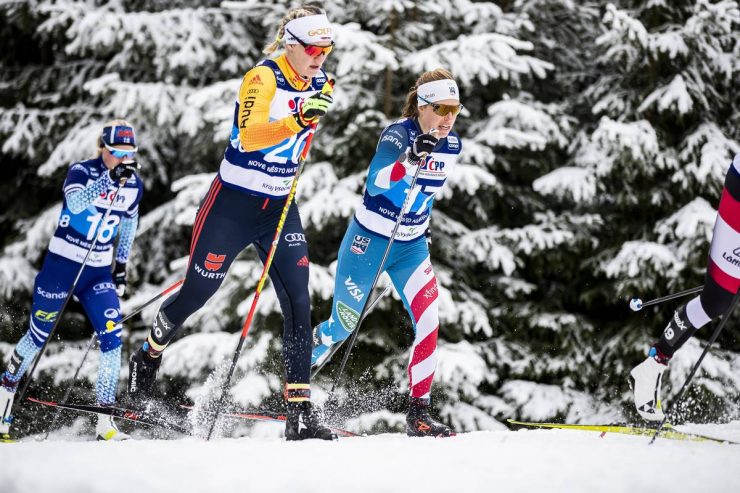
The next group to the line included Pärmäkoski and Sweden’s Ebba Andersson, who spent much of the race in a pack with Diggins, Haga, Finland’s Kerttu Niskanen, and Czech athlete Katerina Razymova. In the second half, Pärmäkoski and Andersson were able to pull ahead from the other women, sprinting to the line in another photo finish to take 5th and 6th, respectively.
With a final push, Krista Pärmäkoski (FIN) and Ebba Andersson (SWE) head to a photo finish. (Photo: NordicFocus)
Though fading, Diggins held her position with the remaining women through 7.5 k. She began to fall off the pace, but was fortunate to have a significant gap to the next chaser. Trailing by five seconds in the last kilometer, Diggins brought it home for 10th (+2:12.0).
“I was excited to be starting in a group of really great classic skiers, and I was proud of how hard I pushed the entire race,” Diggins emailed. “It was a really tricky wax day with a wide range of skis, but it was a great step in the right direction for me in terms of classic striding. I focused on staying in the draft to keep up as much as possible on the flat sections and was 100% focused on my technique on the striding parts, because the tracks were breaking down and getting good kick felt different on different parts of the course.”
Jessie Diggins pushes to the line in 10th in the 10-kilometer classic pursuit in Nové Město. (Photo: NordicFocus)
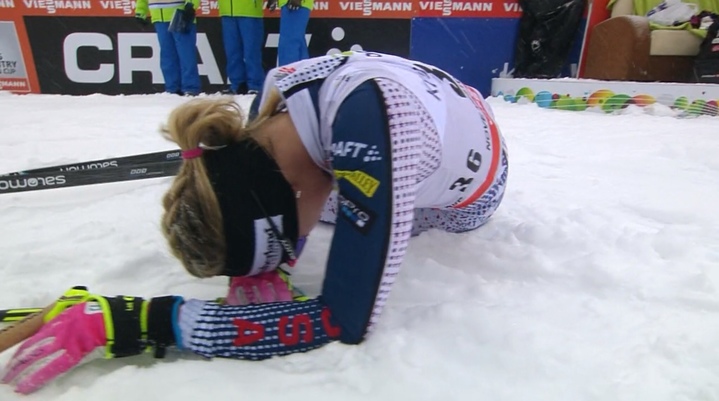
Still smiling after a challenging day in Nové Město. (Photo: NordicFocus)
The next American, Rosie Brennan, advanced from her 17th place start position into 13th (+2:35.1). She skied the 12th fastest time on course of the day.
“Today was a much better day for me,” Brennan wrote. “I had much better energy and really enjoyed skiing today. I had a really solid group that I started with and we stuck together throughout the race picking people off in front of us. The snow held up a little better today so it wasn’t quite as tricky as yesterday and I was thankful for that! I feel good that my energy is coming around after the tour and things are headed in a good direction.”
Tucked in with a group, Rosie Brennan skis the 12th fastest time of day in Nové Město. (Photo: NordicFocus)
Sadie Maubet Bjornsen also advanced, moving into 20th (+3:03.5) from 26th and posting the 15th fastest time of day.
“It was a redeeming day of ski racing after a really tough day yesterday,” wrote Maubet Bjornsen. “Recovering from the tour is a challenge of its own. Balancing the excitement of the experience with the fatigue is never easy. I managed to catch a cold post tour, and thought I had done a good enough job of resting, but I think I got a hair excited, which left me feeling flatter than I would have hoped yesterday. That combined with challenging conditions made for a perfect storm of imperfection yesterday.
“An ice tub, a night of sleep, and as much mental positivity as possible left me in a better place today! I would have loved to have been skiing with one of the front groups today, because I felt I had the strength to hang on, but instead, I worked my way through some girls, and tried my best to catch the group working together in front of me. It was a hefty mission on my own, but I feel really good about that way my body came around.
“My plan is to take a bit more rest, and then just participate in the sprint race next weekend in Obertsdorf, Germany. When I love racing as much as I do, it can be easy to just keep charging on, and forget to plan ahead. There is another tour event coming in hot, so I will take this opportunity to make sure I am fully recovered, and stronger than ever coming into the next period of racing.”
Sadie Maubet Bjornsen strides through the ranks in Nové Město. (Photo: NordicFocus)
Julia Kern fell back two spots into 32nd (+4:10.4), Caitlin Patterson slid into 44th (+4:58.1), and Alayna Sonnesyn into 51st (+6:13.2).
In a post-race call, Grover provided insight into how the athletes perceived their races and the opportunities each had to ski in group. In particular, this tactic supported Brennan and Bjornsen as they chipped away at the women ahead of them. (Please excuse the echo.)
Post-race interview with Chris Grover on the womens’ performance.
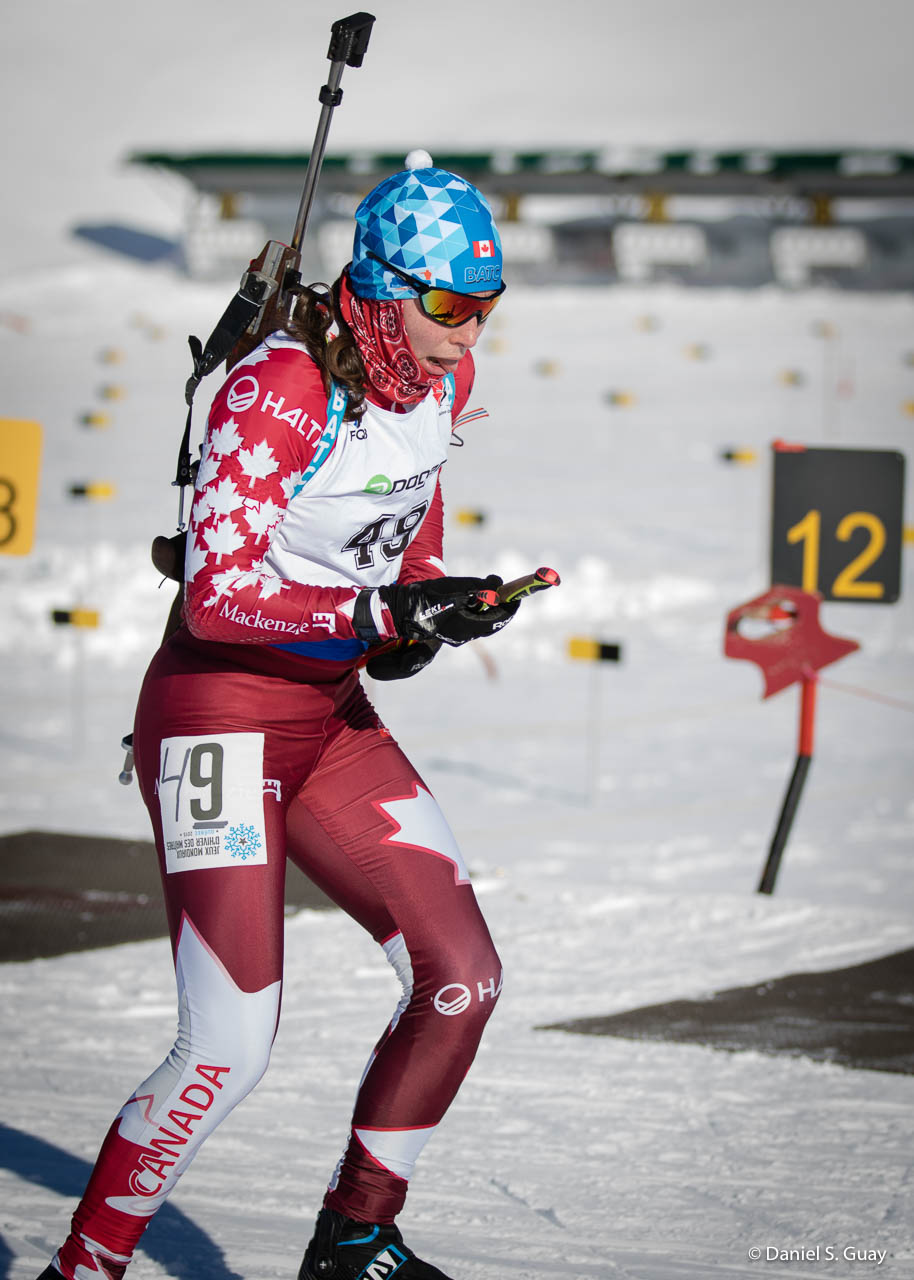
Alayna Sonnesyn strides it out in her second round of World Cup starts in Nové Město. (Photo: NordicFocus)
Reflecting on overall takeaways from the weekend, Grover acknowledged that the first set of distance races after the Tour de Ski can reflect the cumulative toll of the event. Some athletes may need additional recovery to regain form.
Post-race interview with Chris Grover regarding takeaways from Nové Město.
Racing continues next week in Oberstdorf, Germany with a 7.5 k/7.5 k skiathlon and classic sprint.
The women’s podium inNové Město. Therese Johaug (NOR) took the win ahead of Natalia Nepryaeva (RUS) and Heidi Weng (NOR). (Photo: NordicFocus)
“It has everything,” Sweden’s Charlotte Kalla told FIS before the start of the 10-kilometer interval start skate in Nové Město, Czech Republic. Though she was describing the steep uphills and working downhills, found along the 5 k track, it might have also been an apt description for what the weather had in store. As athletes headed out on course, the light icy precipitation transitioned into chunky white flakes accumulating on the deteriorating ribbon of man made and farmed snow.
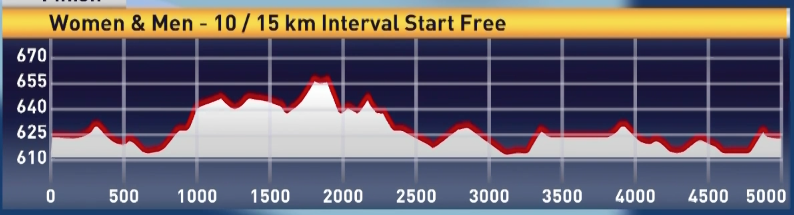
The course profile of the 5-kilometer lap in Nové Město, Czech Republic. (Photo: Screenshot FIS broadcast)
The two distance stages in Nové Město mark the start of Period III and the midpoint of the World Cup season, the tenth and eleventh of twenty one races. It also marks the return of the the squads of distance athletes who sat out last weekend’s city sprints in Dresden, Germany to recover from the compounding effect of their efforts in the Tour de Ski (TDS). Who made it through unscathed and who begins the second half of the season with lingering fatigue? Nothing like a two-day pursuit to find out.
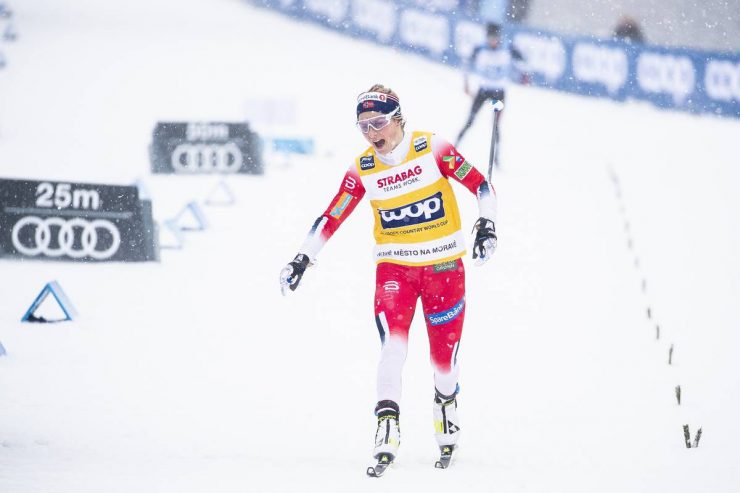
By 3 k, it was evident that Norway’s Therese Johaug, Tour de Ski winner and leader of both the World Cup overall and distance standings, was feeling on form. From the start, she unleashed her usual high tempo attack, clocking the fastest splits at each checkpoint. She stopped the clock at 23:31.1, over 30 seconds ahead of the next fastest time.
Therese Johaug (NOR) takes the win in snowy Nové Město, Czech Republic. (Photo: NordicFocus)
Therese Johaug takes the lead after Day 1 of the distance pursuit in Nové Město, Czech Republic. (Photo: NordicFocus)
“It was an amazing race today,” Johaug told FIS at the finish. “My shape and my body was really good. I have been a little bit tired after the Tour de Ski and I had some good sensation and bad sensations, but today it was a good day. Of course, the tracks out here and the snow was perfect for me, so I am really happy.”
Johaug was chasing the ghost of her teammate, Heidi Weng, who started two bibs prior at the front of the seeded group. Leading the race for second place, Weng time-trialed through the wooded course, setting splits that were just faster than her peers’. At the half, she trailed Johaug by 17 seconds with four women within ten seconds of her: Natalia Nepryaeva of Russia, Moa Lundgren of Sweden, Jessie Diggins, and Ingvild Flugstad Østberg of Norway.
Soaring, Natalia Nepryaeva (RUS) powers to a second place finish in the 10-kilometer individual start skate inNové Město, Czech Republic. (Photo: NordicFocus)
During the second lap, Nepryaeva closed the gap to Weng’s times, matching her with roughly two K’s to go, then pulling ahead by a few seconds. Throwing her boot for the second fastest time of the day, she knocked Weng back to third on the podium. Nepryaeva finished 32.7 seconds behind Johaug, and Weng was 40.3 seconds back.
Weng is now batting 70 percent for podium finishes; she has only missed the top-3 in three of the ten stages, with her lowest rank of 8th occurring in the final stage of the Tour de Ski.
Eyes locked on the task at hand, Heidi Weng skis to third during the 10-kilometer skate in Nové Město, Czech Republic. (Photo: NordicFocus)
Diggins started third in the seeded group behind Johaug and Weng. After hovering in the top 5 throughout the race, she was next across the line in fourth (+48.5), with Ragnhild Haga of Norway just behind (+48.8). Østberg rounded out the final spot in the top five (+49.7).
Jessie Diggins climbs to 4th in Nové Město. (Photo: NordicFocus)
Jessie Diggins gasps for air after taking 4th in the first stage of the distance pursuit Nové Město. (Photo: NordicFocus)
When asked for a preview of tomorrow’s pursuit, Johaug commented on this strong group of women who would be chasing her.
“Of course, I’m really happy that I have 30 seconds, but I know that it’s a big group behind me and they can do work together and I’m going to be in the front alone,” Johaug said. “I have to work hard to have the first position in the finish, but I will do my best and we will see tomorrow how it ends.”
The women of Nové Město. Therese Johaug (NOR) led the day, followed by Natalia Nepryaeva (RUS) and Heidi Weng (NOR). (Photo: NordicFocus)
Due to poor WiFi connection, Diggins chose to share her post-race comments via email.
“Today was a good race for me, although it was kind of funny because with the super deep, sugary snow, it never felt like I was moving very fast, especially stepping through the sugar on the uphills! But overall I’m happy with where my body is after the Tour de Ski, and I’m working on training as smart as I can to find that balance between racing and training hard and finding good recovery after such a big effort.”
After today’s result, Diggins is ranked third in the World Cup distance standings behind Johaug and Weng. She is ranked 5th in the overall standings. Diggins commented on how this plays into her tactics in the second half of the season.
Glitter, snow. and grit. Jessie Diggins takes 4th in Nové Město. (Photo: NordicFocus)
“In terms of overall ranking, there isn’t really a plan because it’s out of my control – as we saw during the TDS, a few tough waxing days can make a huge difference, and you obviously have no control over how other athletes are performing. With that in mind, I don’t worry about the overall and instead focus on making every race I do a complete effort, training and racing it to the best of my ability, only worrying about the things I can control like my race effort, technique and pacing. If I can do that well, then it sets me up as best I can for the overall.”
After the Tour, Diggins headed to the Dachstein glacier in Austria, where she was joined by her boyfriend, Wade, for a block of recovery and training.
“My post-TDS training camp was really awesome, and I felt so lucky to have my boyfriend there with me! It’s very important to me to find a healthy life/skiing balance, in order to be happy and want to continue racing on the road for years to come. So my main focus during that time was simply happiness, as well as quality rest and recovery after the huge effort of the Tour.”
Diggins closed with optimistic remarks heading into tomorrow’s classic pursuit.
“I had great skis today and I’m very thankful to our hardworking staff! Tomorrow should be an exciting pursuit start and I’m excited to ski with so many speedy ladies.”
Rosie Brennan (USA) during the women’s 10 k skate in Nové Město. (Photo:NordicFocus)
Following Diggins, Rosie Brennan was the second fastest American, finishing 17th (+1:35.3), followed by Sadie Maubet Bjornsen in 26th (+1:51.1), and Julia Kern in 30th (+2:03.3).
“We faced some challenging conditions today,” Brennan emailed to several news outlets. “With no [natural] snow on the ground, the course was made up of all man made or saved snow, which didn’t adhere well to itself so it was deep, sugary, and dirty. The course was challenging in the sense of the amount of transitional skiing. I wasn’t sure how I would feel after the Tour de Ski but tried to stay optimistic that my break was good and I would be back where I left off. I started well and was happy with my first lap. I faded much more than I had hoped in the end and think I am still feeling a bit of fatigue from the Tour. Overall, it was a solid day and I hope I can find another gear tomorrow.”
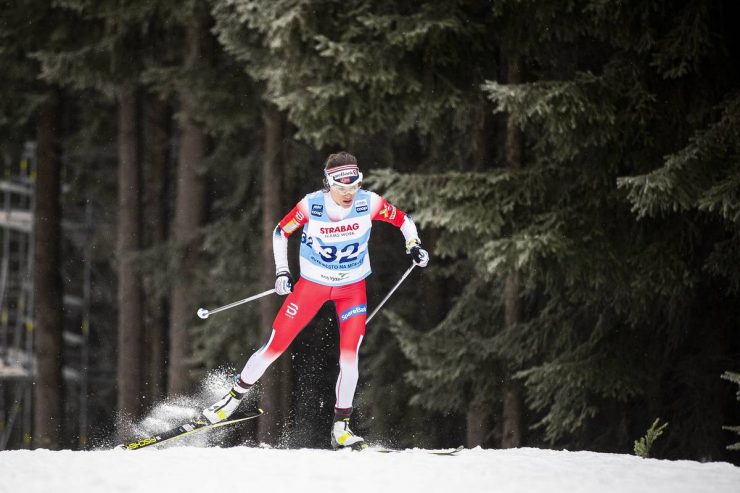
Alayna Sonnesyn skis to 46th in Nové Město. (Photo: NordicFocus)
Fresh off of U.S. Nationals in Houghton, Mich., Caitlin Patterson finished 39th (+2:17.7), and UVM graduate Alayna Sonnesyn (SMST2) rounded out the American squad in 46th (+2:38.1).
“I’m really happy with my race today,” Sonnesyn emailed about her race. “I feel like I skied well and was consistent through the whole thing. I think I will learn a lot each day and hope to keep improving in the next few weeks!”
New to this level, Sonnesyn begins her second set of World Cup starts, which she earned from her position as SuperTour points leader. Her first World Cup starts took place at the World Cup finals last spring in Quebec City, where a string of bad luck kept her from performing at her potential: illness, followed by three crashes and two broken poles, resulting in a DFL — “dead freaking last.”
“I was really excited about those starts [in Quebec City], but by mid-March I had traveled around the world (literally, I went from the Birkie to China to Germany and back to the US) all in about 2 weeks and I was totally wiped,” Sonnesyn explained. “I knew I didn’t have the kind of energy to have races that I was truly capable of but I still wanted to start them to gain that experience.
“This year, I was slightly more comfortable showing up at a World Cup race and didn’t have to waste a ton of energy fan girling (too hard),” she wrote with a wink. “That being said, the field is so deep here and going into the race I wanted to focus on my own skiing, without worrying about results. That’s the really nice thing about being SuperTour leader right now; I didn’t need to “prove myself” in this first race. I have six races over 4 weeks to grow accustomed to racing at this high level and hopefully keep building on a race like today.
In a post-race call, Chris Grover shared additional insights into the womens’ performances, including how Maubet Bjornsen is feeling after the Tour de Ski, and Patterson and Sonnesyn’s results fresh off the plane.
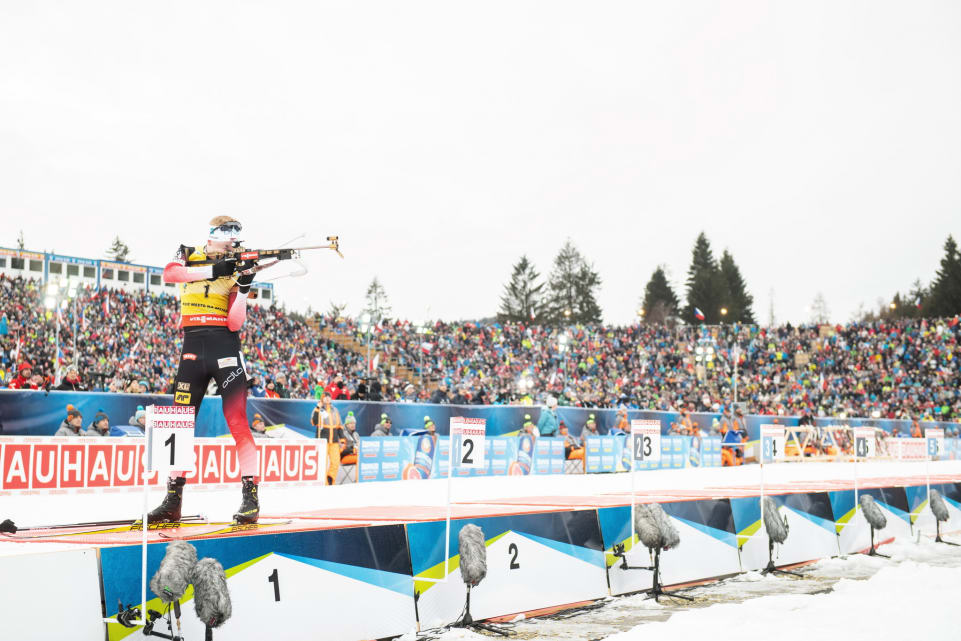
Johannes Thingnes Bø of Norway has dominated the win column. Sunday marked his sixth victory of the season as he won the 15-kilometer mass start race in Nové Město, Czech Republic in a time of 37:25.2 minutes. (Photo: biathonworld.com)
IBU World Cup Nové Město, Czech Republic Mass Starts
Sunday’s mass start races wrapped up the first stretch of IBU World Cup race calendar. And with it, on the men’s side, Johannes Thingnes Bø of Norway has dominated the win column. Sunday marked his sixth victory of the season as he won the 15-kilometer mass start race in Nové Město, Czech Republic in a time of 37:25.2 minutes. Bø shot clean on Sunday as he takes the World Cup lead into the holiday break and celebrates his 36th career World Cup win and a clean sweep of races in Nové Město.
In second place was France’s Quentin Maillet Fillon finishing 46.5 seconds back after amassing two penalties. Evgeniy Garanichev from Russia placed third (+54.1) after shooting clean.
Christian Gow of Canada was the only North American to qualify for the mass start. Gow placed 28th (+4:51.8) with three shooting penalties during his race and sits 26th overall on the World Cup.
In the women’s 12.5 k mass start, Slovenia’s Anastasiya Kuzmina took her first won of the season as she crossed the line in 35:34.4 minutes. Kuzmina suffered two penalties during her race. It was Kuzmina’s 11th World Cup win. Teammate Paulina Fialkova placed second (+12.1) with two penalties. Anais Chevalier of France finished in third (+13.3) with three penalties.
Clare Egan for the U.S. was the only North American to qualify for the mass start after Saturday’s pursuit race. Egan placed 14th finishing 1:22.3 minutes back with three penalties. It was Egan’s fourth individual top-20 of the season. Italy’s Dorothea Wierer leads the overall World Cup with 381 points, Egan heads into the holiday break ranked 22nd with 127 points.
American Vasek Cervenka (front right) racing at 2016 Youth Olympic Games in Lillehammer, Norway. (Courtesy photo)
In another 20-something-question, fill-in-the-blanks series, we checked in with the world-class U.S. and Canadian biathletes that will be competing at 2017 International Biathlon Union (IBU) Youth & Junior World Championships Feb. 22-28 in Osrblie (also known as Brezno-Osrblie), Slovakia.
Here’s 18-year-old Vasek Cervenka, of Grand Rapids, Minn., who will be representing the U.S. at his second Youth Worlds. Last year, Cervenka spent the winter of 2015/2016 training in the Czech Republic, and he’s been there since January of this year (with plans to stay until mid-April).
“My full name is Vaclav Cervenka but you can call me Vasek (VAH-SHEK). I was born in Boulder, Colo., and raised in Grand Rapids, Minn. I started cross-country skiing when I was able to walk, parents say 9 months old, and started biathlon when I was 13, thanks to my parents.
I currently train in Nove Mesto, Czech Republic, and Grand Rapids, Minn., with the Nove Mesto biathlon team or with Jakob Ellingson and Vladimir Cervenka.
U.S. teammates Vasek Cervenka (l) and Cam Christiansen at the Junior IBU Cup #3 in Pokljuka, Slovenia. (Courtesy photo)
If I’m not skiing, you might find me drinking tea watching ‘Rick and Morty’ or ‘Game of Thrones’.
If I had to pick a favorite book, it would be ‘The Adventures of Captain Underpants’ by Dave Pilkey.
One of the things I’m most excited about for Youth/Junior World Championships in Brezno-Osrblie is meeting pretty foreign girls 🙂 (SC – vashiggy_21)
This will be my second Youth/Junior World Championships, and this year, I’m competing as a youth. One race I’m especially targeting there is the 12.5 k individual.
The best advice anyone ever gave me about skiing or racing was ‘Don’t give a s**t about anyone else racing, focus on yourself.’
One of the best race memories I have is the 2016 Youth Olympic games 10 k pursuit.
If I could meet one World Cup biathlete, it would be Martin Fourcade.
If I don’t end up being a professional skier, I’ll probably be colonizing Mars (sponsor me Elon Musk).
I’m missing zero days of school to be here, and my teachers/professors are probably thinking, ‘Good call doing online school.’
Megan Bankes racing to 26th in the women’s 6 k sprint at IBU Youth World Championships in Cheile Gradistei, Romania, in 2016. (Photo: IBU YJWCH Cheile Gradistei 2016/Facebook)
The International Biathlon Union created a new competition circuit this season: the IBU Junior Cup, meant to be a season-long series leading up to World Youth and Junior Championships.
Going in, it wasn’t clear how many countries would send full teams or what the level of competition would be. But in the four weekends of racing so far, the racing has been fierce.
And right off the bat, Megan Bankes has set a mark Canadians will strive to match in the future. On Sunday, she finished second in the 10 kilometer pursuit in Nove Mesto, Czech Republic.
“I’ve never started that close to the front in a ‘real’ pursuit, so it was neat to be chasing down first place,” Bankes wrote in an email.
Bankes started the season on the IBU Cup, a second-tier senior circuit. There, she scored two top-30 results in two weekends of racing. But after the Christmas break, she moved to the Junior Cup.
Megan Bankes of Canada (left) on the podium after the IBU Junior Cup pursuit in Nove Mesto, Czech Republic. (Photo: IBU/Twitter)
Friday’s 12.5 k individual didn’t go well; despite shooting consistently all season, Bankes missed eight shots and finished 69th, +8:46.2.
“My standing in the individual was definitely not so good,” she wrote in an email.
To gather herself for the next two competitions, she explained, “I just focused on the fact that my prone went well, and that my skiing felt good — I know that I can hit targets standing, I just need to focus and not take stupid shots.”
In Saturday’s 7.5 k sprint, Bankes finished seventh with a single penalty. That left her 35.1 seconds out of the lead going into Sunday’s pursuit.
“I for sure knew that I was perfectly set up to have a good race as long as I hit targets, but I mainly just focused on having my best race possible,” Bankes wrote.
After a clean first prone stage, Bankes had moved up to second place, 28.2 seconds behind Marketa Davidova of the Czech Republic. But Davidova was to miss two shots in each of her next three stages.
Bankes, on the other hand, cleaned her second prone and took over the lead.
“It was definitely a little surreal on the third loop when I realized I left the range in first, after cleaning both prone bouts, and was leading the race!” she wrote.
She still held the lead on the final loop, when Davidova charged past her to take the win. But Bankes held on for second.
“The last loop was pretty amazing,” Bankes wrote. “I left the range just in front of a Russian girl, and I knew that Davidova was in the penalty loop, but was skiing really fast, and both would be chasing me down the whole loop. However, all the techs/coaches and athletes (who weren’t Russian or Czech) that were lining the course were cheering for me, which really helped me on my last loop. A bunch of my teammates were on the last hill going absolutely crazy and it was so loud, and I knew that one of the girls was right behind me (it was Davidova who passed me just after the top of that hill) but I didn’t know where the Russian girl was, so I just had to keep pushing hard all the way to the finish.”
With this result in her pocket, Bankes heads to World Junior Championships in Brezno-Osrblie, Slovakia, in a few weeks.
“I’m pretty stoked,” she wrote. “It’s really nice to know that I can be up there competing with the top girls, and as long as I stay chill in the range, and ski fast I should be good to go! I think racing the IBU Cups earlier this season did help, because there’s a really strong field of women competing. It really forces you to try and make your races perfect and not make careless mistakes. Every transition, stride and shot counts if you want to do well.”
Other consistent top-40 finishes came from Canada’s Nadia Moser (37th in 12.5 k individual, 28th in 7.5 k sprint, and 27th in 10 k pursuit) and the United States’ Vasek Cervenka (27th in the 15 k individual, 25th in 10 k sprint, and 29th in 12.5 k pursuit).
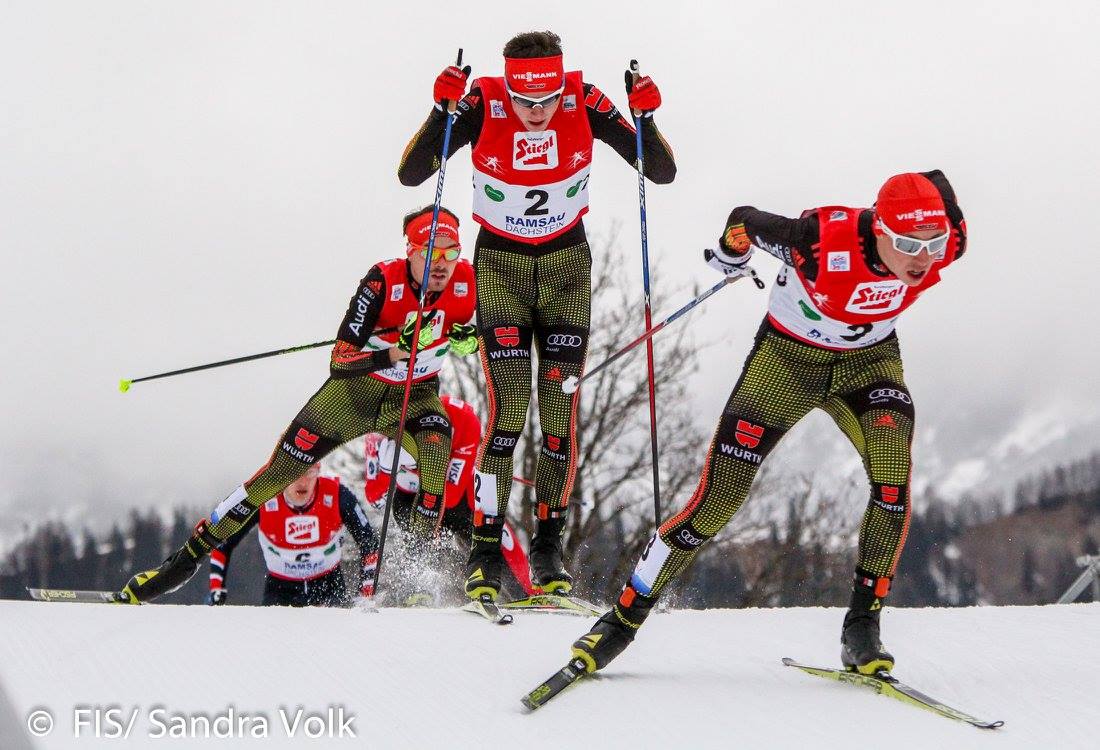
Eric Frenzel (r) leads German teammates Vinzenz Geiger (c) and Fabian Rießle (l) toward a sweep of the podium in the Nordic Combined World Cup individual normal hill/10 k on Sunday in Ramsau, Austria. (Photo: FIS Nordic Combined/Facebook)
Welcome to The Rundown, your quick primer of need-to-know information about the day’s racing. We’ll be updating this digest as the day goes on with additional results, photos and quotes. The Rundown is NOT a race report; stay tuned for complete race reports later today with interviews from the day’s top racers.
***
FIS Nordic Combined Continental Cup in Klingenthal
[UPDATE] Ben Loomis tallied two top 10’s and his U.S. Nordic Combined teammate Ben Berend notched eighth place this past weekend at the Continental Cup in Klingenthal, Germany.
Loomis ended the three-day series on Sunday by placing fifth in the large hill/10 k for his second-best result at the Continental Cup level (he finished fourth last year in the normal hill/10 k competition in Park City, Utah). Loomis put himself in position by jumping to sixth then racing to fifth, 49.9 seconds behind Japan’s winner Go Yamamoto, who finished in 24:06.4.
Florian Dagn of Austria placed second (+6.0) after jumping to first. Yamamoto jumped to second and headed out on the course seven seconds behind him.
Norway’s Sindre Ure Soetvik placed third (+28.8), after starting the 10 k in third. Germany’s David Welde finished fourth (+36.0), moving up after jumping to eighth.
Also on Sunday, Berend placed 15th (+2:25.3) and Jasper Good was 35th (+3:07).
Berend started the long weekend out with an eighth-place finish in the large hill/5 k on Friday. He jumped to fourth and finished the ski race in eighth, 1:09.2 minutes behind Germany’s Maximilian Pfordte, who won in 10:58.9.
Pfordte posted the best jump to start the 5 k first, then held his lead for a 16.4-second victory over Yamamoto in second. Dagn placed third (+18.3) after jumping to second, and Yamamoto’s jump ranked third.
Also for the U.S., Good finished 21st (+2:05.8) for his best result of the weekend, Loomis was 28th (+2:50.5) and Stephen Schumann 29th (+2:52.1).
On Saturday, it was Loomis who tallied another eighth place for the U.S. in the large hill/10 k. He jumped to 10th then improved to eighth, finishing 58 seconds behind German winner Tobias Simon. While Simon dominated the jump as well as the race, winning by 10.1 seconds, Yamamoto repeated in second place and Austria’s Thomas Joebstl reached the podium in third (+38.3).
Berend finished 25th (+1:45.9) and Good 45th (+3:24.9) on Day 2.
The Nordic Combined World Cup resumed this weekend in Ramsau, Austria, with Germany not only topping but sweeping the podium in both individual normal hill/10 k competitions.
On Saturday, Team Germany swept the top four, with Johannes Rydzek notching his third individual win of the season, ahead of teammates Fabian Rießle (+1.5) and Eric Frenzel (+8.7). Vinzenz Geiger completed the sweep in fourth (+15.0), a career best for the 19 year old after placing seventh earlier this month in Lillehammer, Norway.
Frenzel led after the jump on the 98-meter hill, which put him 2 seconds ahead of the second-best jumper, Austria’s Mario Seidl, in the 10 k Gundersen start. (Seidl went on to place seventh.)
Rydzek posted the third-best jump and started 10 seconds back, while Rießle started another 10 seconds later in seventh. Rydzek went on to ski the fifth-fastest course time and Rießle was third fastest en route to first and second at the finish.
Americans Taylor Fletcher and Bryan Fletcher finished 27th (+1:17.6) and 29th (+1:18.4), respectively, and Adam Loomis was 47th (+3:16.2).
Taylor started 41st, 1:18 back, and Bryan started five seconds later in 43rd. Bryan posted the seventh-fastest course time and ended with a photo finish with Finland’s Arttu Maekiaho, which Maekiaho took by 0.1 seconds for 28th. Loomis started 50th.
Day 2 in Ramsau went to Frenzel, who won the normal hill/10 k in 22:49.4. Rießle repeated in second (+0.8) and Geiger improved on his career best for his first podium in third (+23.4). Seidl again jumped to first and this time ended up fourth (+24.3).
Frenzel started third and raced to first, Rießle moved up from fourth in the jump to second, and Geiger made the most of his second-best jump.
Taylor Fletcher skied the third-fastest course time to move up from 46th after the jump to 22nd at the finish (+1:20.2). Bryan Fletcher finished 32nd (+1:33.5), losing one place after starting 31st.
The Nordic Combined World Cup goes on holiday break until resuming Jan. 7-8 in Lahti, Finland.
The NorAm mini tour in Rossland, British Columbia, wrapped up with a classic pursuit race on Sunday.
In the women’s 10 k classic, APU’s Chelsea Holmes continued her strong form, winning the mini tour with an aggregate time of 1:08:04.4. Holmes finished the 10 k in 35:35.4 minutes, 6.2 seconds behind fastest woman of the day, Katherine Stewart-Jones (NTDC Thunder Bay).
SMS Elite’s Erika Flowers continued her podium-filled visit to Canada with the third-fastest ski of the day, 48.1 seconds behind Stewart-Jones, to take second overall, 2:23.9 behind Holmes. AWCA’s Olivia Bouffard-Nesbitt was the fifth fastest in the 10 k to hold on to third overall (+3:25.2), while Stewart-Jones was just 0.5 seconds back in fourth overall.
NTDC Thunder Bay’s Evan Palmer-Charrette used a fourth-fastest ski in the 15 k to keep the overall title, with an aggregate time of 1:28:54.0. Alexis Dumas (CNEPH) skied 1:14.7 faster than Palmer-Charrette to climb from sixth at the start to second overall (+52.2). AWCA’s Jack Carlyle had the second-fastest time of the day, 29.9 seconds behind Dumas, to climb into third overall (+1:10.1).
National Para-Nordic guide Erik Carleton had the third-fastest 15 k time, 1:01.3 back, but it wasn’t enough to catch Team R.A.D.’s Russell Kennedy, who placedfourth overall (+1:20.8).
Full results (with tabs for the overall and time of the day)
***
FIS Cross-Country World Cup in La Clusaz: Men’s and women’s relays
Team Norway I emerged victorious in Sunday’s men’s 4 x 8 k mixed relay event in La Clusaz, France, with Didrik Tønseth leading the winning group’s first classic leg.
After crossing in seventh, Tønseth handed off to Martin Johnsrud Sundby for a second classic leg. Sundby dropped a spot, finishing his classic leg in eighth. Sundby tagged off to Anders Gløersen for the first freestyle leg.
Gløersen rocketed the team to first, and held the position straight through his 7.5 k. The final leg for Norway’s winning team went to Finn Hågen Krogh. The Norwegian men’s team completed the relay event in a total time of 1:11:25.7
Second place overall, two-tenths of a second behind, was team Russia, led by Evgeniy Belov for the first classic leg. Belov handed off to Alexander Legkov for the second classic leg, with Legkov putting down the third fastest time by the time he returned to the exchange zone.
The third and first freestyle leg for Russia went to Alexey Chervotkin, who maintained the team’s third place position. Anchoring the team was Sergey Ustiugov, who managed to maneuver the team from third place to second during his final freestyle leg.
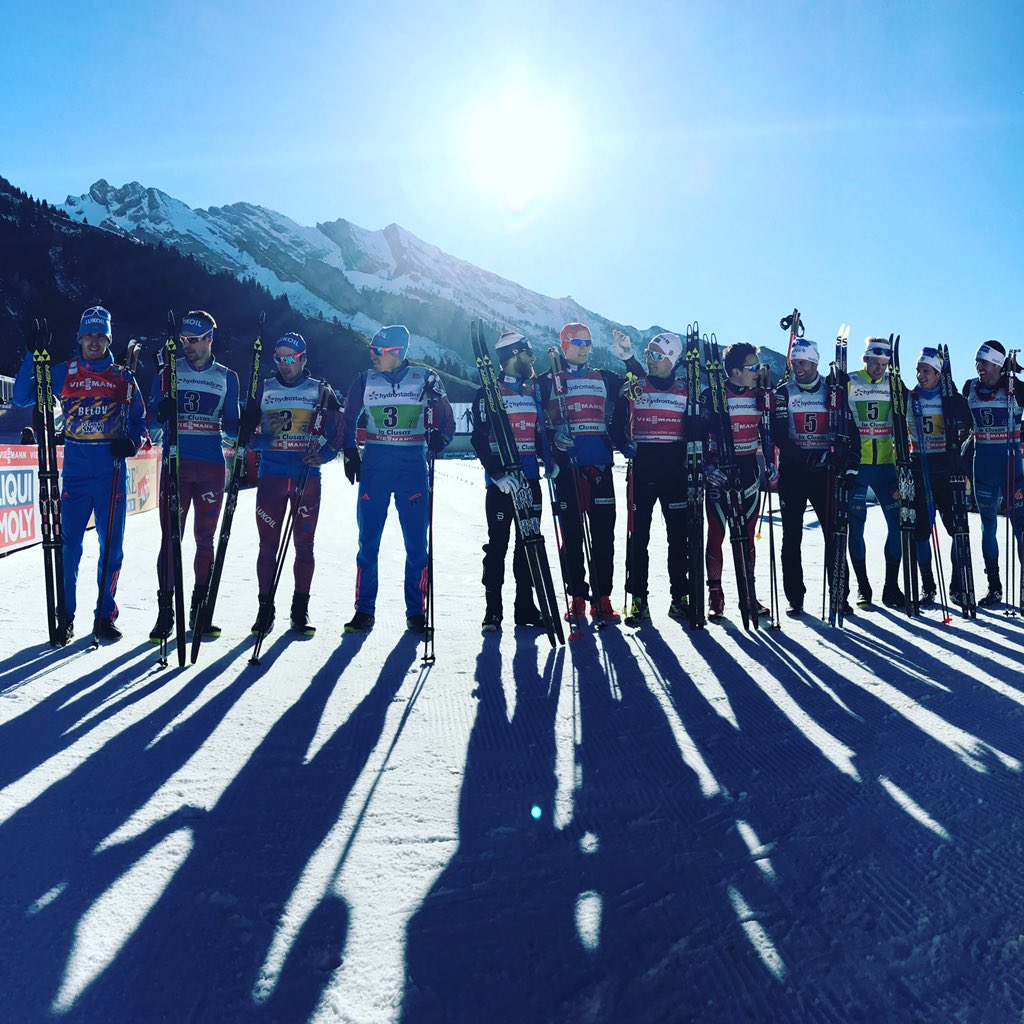
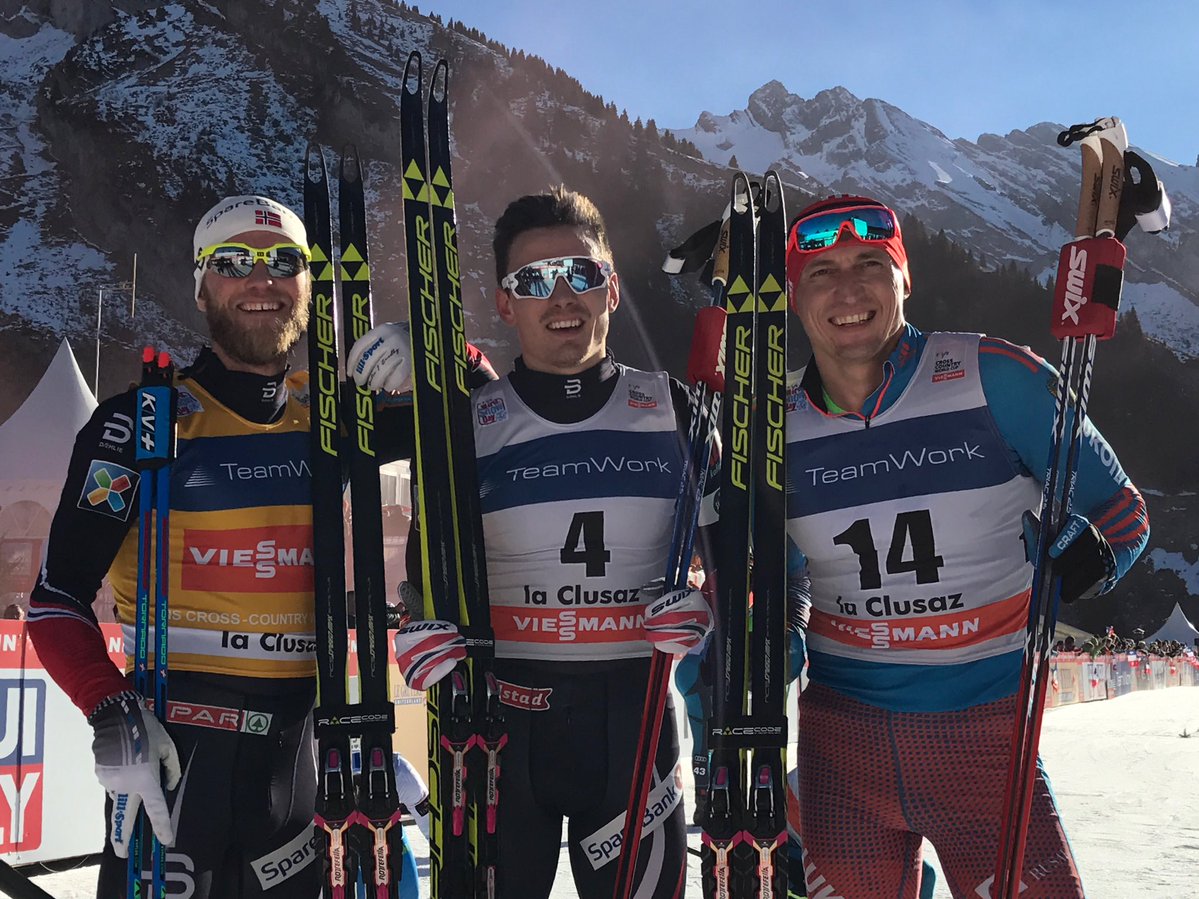
The men’s 4 x 8 k relay podium on Sunday in La Clusaz, France, with Russia in second (left four) Norway first (center four) and France third overall. (Photo: FIS Cross-Country/twitter)
Rounding out the men’s mixed relay podium on Sunday was France I (+7.7).
Jean-Marc Gaillard led team France’s first classic leg, racing in a sixth position into the exchange zone. Gaillard handed off to Alexis Jeannerod, who moved up to fifth place by the end of his classic leg.
Skiing the third and first freestyle leg was Clement Parisse who held onto fifth place and tagged off to Maurice Manificat for the final freestyle leg. Manificat managed to move around Sweden’s Axel Ekstrløm and Germany’s Lucas Bøgl for third place overall.
Neither Canada or the U.S. entered a men’s relay team due to illness.
In the women’s 4 x 4 k relay event, it was another Norwegian team who stood atop the podium.
Ingvild Flugstad Østberg led the women’s first classic leg, skiing in first place until her hand-off to Marit Bjørgen. Bjørgen maintained the first place position during her classic leg, tagging off to Ragnhild Haga.
Haga completed the first freestyle leg for Norway, handing off to Heidi Weng, who anchored the team’s last freestyle leg. The Norwegian women finished in a total time of 39:23.3.
In second was team Finland, 50.2 seconds behind Norway’s winning time. Aino-Kaisa Saarinen started the first classic leg for Finland, passing off to Anne Kyllønen.
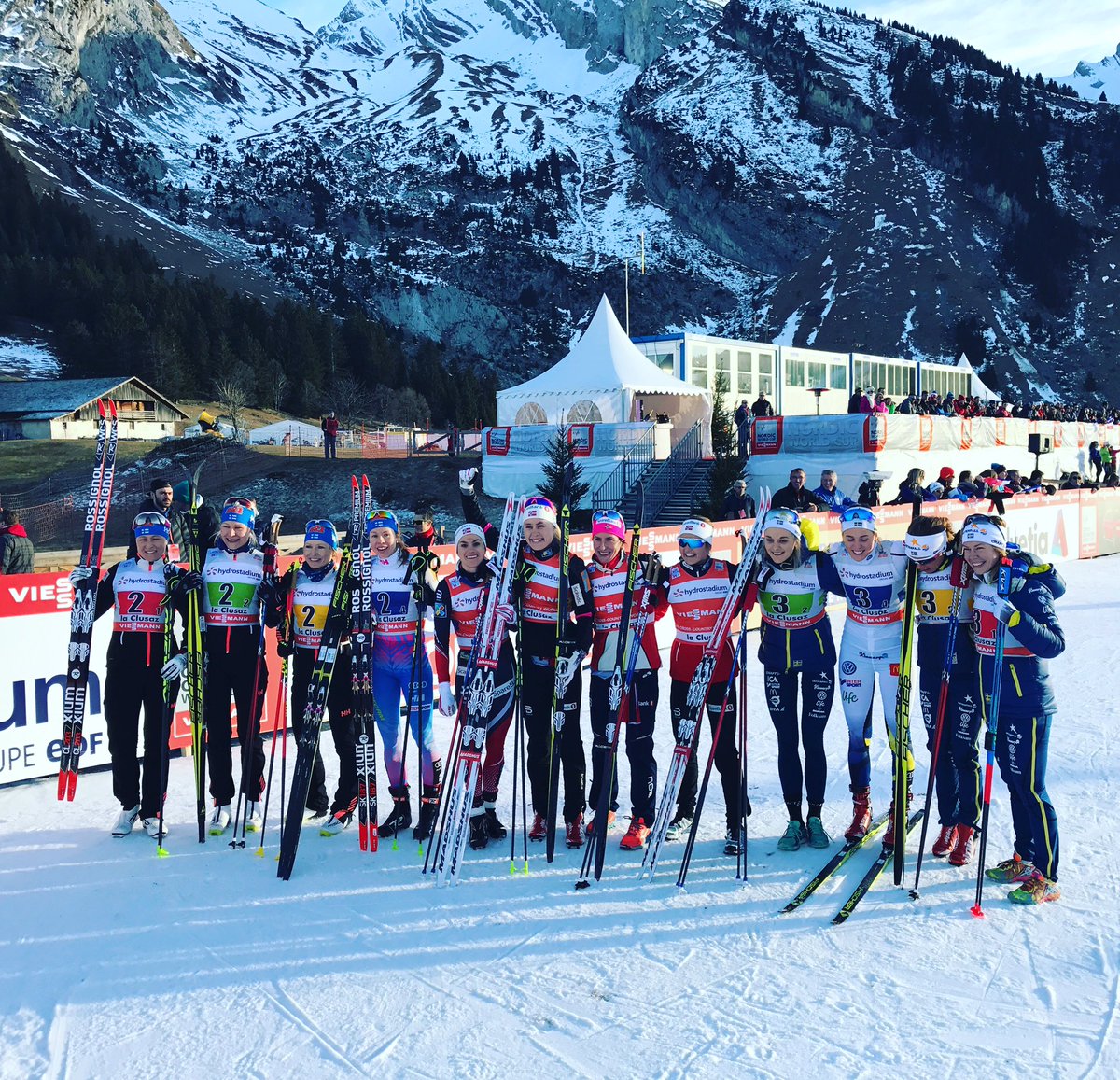
The women’s 4 x 4 k mixed relay podium on Sunday in La Clusaz, France. Norway (c) took the win ahead of team Finland in second (l) and Sweden in third. (Photo: FIC Cross-Country/Twitter)
Taking on the first freestyle leg for Finland was Riitta-Liisa Roponen, who tagged off to Laura Mononen for the final freestyle leg.
Rounding out the relay podium in third overall was team Sweden (+1:08.9). Emma Wiken raced the first classic leg, who tagged off to Stina Nilsson for the second classic leg. Maria Rydqvist raced the first freestyle leg and handed off to Anna Dyvik, who anchored the team to third.
Only one U.S. women’s relay team was entered on Sunday, with both Jessie Diggins and Sadie Bjornsen out due to illness. Sophie Caldwell led the U.S.’s first classic leg, followed by Rosie Brennan. Liz Stephen followed Brennan, taking on the first freestyle leg. Anchoring the team was Kikkan Randall in the final freestyle leg. The Americans finished in seventh overall (+2:26.0).
Canada also entered a women’s team in Sunday’s relay. Emily Nishikawa led the first classic leg, and handed off to Cendrine Browne for the second classic leg. Dahria Beatty raced the first freestyle leg and tagged off to Sophie Carrier-Laforte, who anchored the team to 12th overall (+4:07.9).
IBU World Cup in Nove Mesto: Men’s and women’s mass starts
Gabriela Koukalová of the Czech Republic looks to her home crowd as she wins the women’s 12.5 k mass start on Sunday at the IBU World Cup in Nove Mesto, Czech Republic. She fended off Germany’s Laura Dahlmeier (r), who took second. (Photo: IBU)
Despite skiing in 14th at one point in the men’s 15 k mass start on Sunday, France’s Martin Fourcade came back to win the International Biathlon Union (IBU) World Cup in Nove Mesto, Czech Republic.
That makes him seven for eight in individual races so far this season.
Fourcade started with bib 1 as the overall World Cup leader and finished first in 36:18.9 minutes, despite a penalty on his second prone that put him in 14th and 22 seconds back heading out on his third loop.
He rebounded with a clean third shooting to move into third, 2.5 seconds behind Ukraine’s Dmytro Pidruchnyi in first and 1.3 seconds behind Russia’s Anton Babikov in second.
By the final shooting stage, Fourcade was back in first with clean shooting (0+1+0+0), 28 seconds clear of Babikov in second. Babikov had his first penalty of the day on the final stage (0+0+0+1) to drop out of contention.
Germany’s Simon Schempp (1+1+0+0) came out on top of an eight-way battle for second place on the final loop. Schempp took it, 8.3 seconds after Fourcade and 1.1 seconds ahead of Babikov in third (+9.4).
The Czech Republic’s Ondrej Moravec was 0.3 seconds off the podium in fourth (+9.7), Pidruchnyi placed fifth (+10.2), Russia’s Matvey Eliseev finished sixth (+11.0), Norway’s Ole Einar Bjørndalen was back in the top 10 in seventh (+11.3), France’s Quentin Fillon Maillet notched his second-straight top 10 in eighth (+13.7), and Norway’s Johannes Thingnes Bø finished at the back of that pack in ninth (+19.8).
American Lowell Bailey missed the top 20 by 10 seconds in 21st (+1:17.1). He had three penalties, two of which came on the last stage (0+1+0+2) to drop him from ninth to 20th at the start of the final loop.
Bailey retained his spot in ninth in the overall World Cup standings, while Fourcade continues to lead, 158 points ahead of Shipulin in second.
In the women’s 12.5 k mass start, Gabriela Koukalová delivered to her home fans in Nove Mesto, Czech Republic, racing to her second win of the season in 34:42.1.
“I was so nervous before the race so it was amazing,” Koukalová said, according to an IBU press release. “I have so many emotions; it’s even more emotional than at the Olympics. I would like to say thanks to all the spectators and I hope I was able to make a nice Christmas present to all of them.”
The defending World Cup champion beat the current World Cup leader, Germany’s Laura Dahlmeier, by 3.1 seconds after shooting a single penalty and cleaning the last two stages (0+1+0+0) to move into first. Dahlmeier missed two on the first stage to drop 23rd, but cleaned her last three stages (2+0+0+0) to capture second at the finish. She passed three athletes on the last lap, including Italy’s Dorothea Wierer, who ended up third (+9.7) with one miss (1+0+0+0).
“I don’t really know what happened with those two misses,” she told German broadcaster ARD. “But in terms of skiing I had a great day on the course, and I had skis that were the bomb. It’s just a lot of fun when you can make the podium reaching the second place despite a large deficit in the beginning. I am overjoyed.”
Germany’s Vanessa Hinz rebounded from Friday’s sprint (where she placed 73rd) to end up fourth (+15.5) with a single penalty (0+0+1+0). None of the 29 finishers hit every target, and American Susan Dunklee did not start.
Dahlmeier leads the overall World Cup standings by 98 points over Finland’s Kaisa Mäkäräinen, and Koukalova is third, just seven points behind Mäkäräinen. Dunklee is 11th.
The IBU World Cup now goes on holiday break until resuming Jan. 5 in Oberhof, Germany.
The third IBU Cup was held on Dec. 16-17 in Obertilliach, Austria. In the men’s 20 k individual on Friday, the top three finishers were France’s Antonin Guigonnat, with a winning time of 49:58.6, Russia’s Yury Shopin in second (+32.2), and Germany’s Florian Graf in third (+35.6). Each of the top three had one miss, and Canada’s Matthew Hudec was the top North American in 34th (+4:11.3) with two penalties (0+2+0+0). Also for Canada, Carsen Campbell finished 38th with three penalties (1+2+0+0), Matthew Neumann was 53rd with three penalties (0+2+0+1) out of 118 finishers.
In the women’s 15 k individual on Friday, Germany’s Karolin Horchler took the win with clean shooting (0+0+0+0) in 44:54.7. France’s Coline Varcin was 1.1 seconds back in second with one penalty (1+0+0+0), and third went to Russia’s Daria Virolaynen (+30.2), who had one miss as well (0+1+0+0). Canada’s Nadia Moser was the top North American in 35th (+5:10.8) with two penalties (0+1+1+0). Also for Canada, Erin Yungblut placed 66th with five penalties (0+3+0+2).
In the men’s 10 k sprint on Saturday, two Norwegians took first and second with Henrik L’Abee-Lund winning in 23:29.9, and Vetle Sjastad Christiansen 13.9 seconds back in second. Third was claimed by Germany’s Phillipp Nawrath (+29.5) and all of the top three shot clean. Neumann led Canada in 47th (+2:20) with one miss (1+0). Campbell missed two (1+1) and finished 59th (+2:47.4), and Hudec was 64th (+2:58.9) with two penalties as well (1+1). Canada’s Pearce Hanna finished 87th, with two misses (2+0), out of 125 finishers.
In the women’s 7.5 k sprint, Russia swept the podium with Virolaynen winning in 20:31.5, followed closely by Uliana Kaisheva (+3.7), and then Anna Nikulina (+23.1). Virolaynen missed one (0+1), Kaisheva cleaned (0+0) and Nikulina had a standing miss as well (0+1). The top North American was Canada’s Megan Bankes in 30th (+2:08.1), with one prone penalty (1+0). Also for Canada, Sarah Beaudry finished 34th (+2:18.1), with two standing misses (0+2), Yungblut was 45th (+2:40.6) with clean shooting (0+0), and Moser finished 49th (+2:45.5) with two misses (1+1), out of 85 women.
France’s Martin Fourcade skiing up a climb on his way to winning the men’s 15-kilometer mass start on Sunday at the IBU World Cup in Nove Mesto, Czech Republic, while leading Germany’s Simon Schempp (6) and Ole Einar Bjørndalen. (Photo: IBU)
“The soft the supple step and sturdy pace, that in the smallest of all circles turns, moves like a dance of strength around a core in which a mighty will is standing stunned.”
– The Panther, second verse, by Rainer Maria Rilke. English translation by Stanley Appelbaum
At the turn of the 19th century, the Bohemian-Austrian poet and novelist Rilke frequently visited the town of Nove Mesto, Czech Republic, on holidays with his family. Later he spent several years in Paris, France, where in 1902 he was inspired by his observation of a panther pacing through its cage in a menagerie.
These days, French biathlete Martin Fourcade is turning circles through the woods of Nove Mesto with all the elegance and strength of a panther, only he is in no way caged in, frequently leaving his opponents “standing stunned”.
On Sunday in the International Biathlon Union (IBU) World Cup men’s 15-kilometer mass start, Fourcade only once struggled with his shooting accuracy in the second prone stage, having to ski a penalty lap and falling back half a minute to 14th place in the middle of the field of 30 starters. But in the end, his victory was once more not in doubt, while behind him an exciting sprint finish developed on the final loop with eight athletes vying for the remaining two positions on the podium.
Fourcade crossed the line in a time of 36:18.9 minutes with one penalty (0+1+0+0) to win the first mass start of the season, skiing at a slower pace only on the last loop, knowing he had a secure lead of almost 30 seconds after the final shooting.
“It was a really tense race,” Fourcade said during the press conference. “It was a really nervous [atmosphere] on the shooting range, and I think all the athletes felt it. So I really enjoyed it.”
Fourcade completed the hat trick of winning the sprint, pursuit and mass start in Nove Mesto, and it was his seventh win in eight individual races of the season.
“I had a wonderful beginning of the season so far,” Fourcade explained. “I just try to enjoy it … In the sprint my shape was good, but in the competitions yesterday and today I felt really, really good on the skis. I had extra power and could push a lot, and recovered really fast. Just wonderful days on the skis today and yesterday as well.”
Germany’s Simon Schempp celebrates his second place as he crosses the line of the men’s 15 k mass start on Sunday at the IBU World Cup in Nove Mesto, Czech Republic. Russia’s Anton Babikov (16) secured third place ahead of seven others. (Photo: IBU)
On the last loop Germany’s Simon Schempp created a small gap to win the second-place battle between eight athletes (+8.3), and Russia’s Ivan Babikov secured the third position on the podium (+9.4). Schempp had two penalties in the prone stages (1+1+0+0), while Babikov had one in the final standing shooting (0+0+0+1).
“I did it the way I already had planned it yesterday,” Schempp, who had lost a photo finish for third place in Saturday’s pursuit, told German TV broadcaster ARD. “Today it worked great, today there was no icy patch in my way. I had a bit of strength left on the last loop, and that result is sensational.”
“This actually is the first season for me where I have been at three World Cups in a row,” Babikov commented on his good recent races and the finish sprint via a translator during the press conference. “I am very glad that I had enough strength to be with such high-profile athletes.”
They were helped somewhat by a fall of Norway’s Johannes Thingnes Bø on a left turn in a downhill. He had led the chase group until that point, but lost a pole and fell back to the back of that group, finishing ninth (+19.8).
“It’s really annoying since I felt really good, I feel like I had a good chance,” Bø told Norwegian broadcaster NRK. “It’s unnecessary to fall, it’s all my fault, and it’s disappointing. I’ve been really close in many of the past races and then this happens. I’m determined to come back strong.”
“I managed to barely jump over his ski,” Schempp recounted the situation to ARD. “I narrowly avoided falling over him and crashing myself. There is just an icy patch on that downhill, and he hit it. It’s not easy to ski down there, especially on the final loop when the podium is on the line and everyone is already enormously tired.”
In front of a home crowd of more than 33,000 enthusiastic fans, Ondrej Moravec of the Czech Republic, who had broken his rifle stock in half in a crash during the pursuit a day before and thus had to start Sunday’s race with a spare rifle, finished fourth (+9.7), just behind Babikov.
“I missed one in the last standing, it was too much risk maybe,” Moravec, who shot two penalties (1+0+0+1), told the IBU in an interview. “It was 50/50 if I can beat Simon and Anton Babikov. But I am happy. I felt quite good during the last loop, but it was not enough for the first three. But still I am satisfied with the fourth place, [being in the] flower ceremony and the home crowd.”
Bailey in the Hunt for Most of Race
Lowell Bailey (US Biathlon) racing to 21st in the men’s 15 k mass start on Sunday at the IBU World Cup in Nove Mesto, Czech Republic. (Photo: USBA/NordicFocus)
US Biathlon’s Lowell Bailey was the lone North American starter qualified for the elite mass start, which is comprised of the 25 athletes leading the overall World Cup standings at that time (Bailey is currently ranked ninth), plus five athletes not among those with the best results of the competition week.
Bailey started his race day strong, remaining in the top 10 on the first loop and shooting clean in the first prone stage. He left the range in fourth place, just 6.2 seconds behind the Russia’s Anton Shipulin, who was leading the race at that time. On that loop, the leaders slowed the pace and the field bunched up again, with 20 athletes within ten seconds of one another.
In the second prone stage, Bailey missed one, leaving the penalty lap in 15th and 23.1 seconds back, just one place behind Fourcade, who had also incurred a penalty in that stage.
Bailey was unable to ski with Fourcade, but held a position near the top 20 and managed to shoot clean in the first standing stage while a number of his nearest competitors missed. The American returned to the course in ninth position and only 22 seconds out of first.
While losing a few more seconds to a hard-charging Fourcade, who decided the race on that next loop, Bailey moved up to eighth place entering the final shooting, but then had two more misses and had to ski twice through the penalty lap again, which cost him almost a minute to the top of the field.
He ended his race in 21st, 1:17.1 minutes back, with three penalties (0+1+0+2). In the two other races in Nove Mesto, Bailey placed 20th in the sprint and ninth in the pursuit, his best result in an individual race since the 2013/14 season.
“Today was a solid race until the end,” Bailey commented in a US Biathlon press release. “Sometimes things just don’t go your way and today was one of those days. Still satisfied with the start of the season and looking forward to some down time at home.”
The IBU World Cup takes a two-week break for the holidays, before returning on Jan. 5 with a men’s sprint in Oberhof, Germany.
“I am a bit sad about this [upcoming break] because I want this to never stop,” a smiling Fourcade told reporters during the press conference. “And now it will be two weeks of Christmas time, I will eat a lot of chocolates and I will be back in a poor shape! So we will see. But I am also happy to be back home. I will see my daughter tomorrow, and it has been a long time since I saw her. So, yeah, it will be cool.”
American Lowell Bailey racing to ninth in the men’s 12.5 k pursuit on Saturday at the IBU World Cup in Nove Mesto, Czech Republic, with Canada’s Scott Gow (r) chasing. Gow ended up 40th. (Photo: USBA/NordicFocus)
As Lowell Bailey rounded the course on Saturday in Nove Mesto, Czech Republic, a total of five times in the men’s 12.5-kilometer pursuit, he couldn’t hear a thing his coaches were shouting at him.
The 35,000 spectators in the stadium and lining the track were overpowering them, but their movements gave the US Biathlon veteran all the information he needed to know.
“It was, by far, the loudest spectator crowd I’ve ever experienced,” Bailey recalled on the phone on Saturday. “… There were stands on the course, bleacher stands, that was packed 15, 20 people deep, and I literally couldn’t hear a single bit of information that the coaches were screaming at me.”
After hitting every target in his final shooting stage, Bailey left the range for the last time in 11th, four seconds out of ninth. He wasn’t certain of his place or how many people he should try to catch on the last lap, he just knew it was go-time.
“I figured I was close to the top ten because of where I shot and who I was around, and the way the coaches were moving, jumping up and down,” he said. “But it was literally so loud I couldn’t hear a single bit of information.”
Bailey ended up passing those two competitors just seconds ahead of him on the last climb. He pushed through the finish for ninth place — his best result since placing second in a sprint in March 2014 — 1:22.1 minutes behind the winner, France’s Martin Fourcade, and about a second back from eighth. Behind him, the top Czech skier of the day, Michal Krcmar finished five seconds later in 10th, and Russia’s Evgeniy Garanichev was another second back in 11th.
Martin Fourcade after winning the 12.5 k pursuit at the IBU World Cup in Nove Mesto, Czech Republic, for his 55th World Cup victory, with Russian runner-up Anton Shipulin (r). Including Sunday’s mass start, Fourcade has won 10 of the 11 races so far this season (including relays). (Photo: IBU)
“It was one of those days when I had a little bit left in the tank, and I really like this course, especially the last half,” Bailey said. “I was able to make up enough time in the technical sections to get in a position to pass those guys … I was pretty psyched about my last lap, for sure.”
Bailey had started the day in 20th, 48 seconds behind Fourcade, based on the 10 k sprint on Thursday. Fourcade headed out on course with a two-second lead on Russia’s Anton Shipulin, the sprint runner-up. The man slated to start third, Norway’s Emil Hegle Svendsen, did not start because of a cold.
Shipulin passed Fourcade early and left the range 1.3 seconds ahead of him with the clean shooting and the fastest range time in the first prone stage. Fourcade hit all five targets as well, but four seconds slower than Shipulin. The fourth starter, Norway’s Johannes Thingnes Bø, missed one to drop to fifth.
Meanwhile, Bailey missed his first shot of the day.
“When I was shooting I was pretty frustrated to miss that last shot in my first prone,” he said. “That’s not a way you want to start a pursuit.”
That put him in 25th, 1:17 minutes behind the leaders. One loop later, with a clean second prone, Bailey was back in the top 20 in 19th (+1:18.5).
There, Shipulin cleaned again to firmly take control in first, while Fourcade missed one to fall 22.6 seconds back to second with a penalty lap.
A Czech favorite, Ondrej Moravec crashed and broke his rifle in half on the second loop, before that second stage.
“There was a lot of ice on the course, and there was this one downhill in particular that was really treacherous; you just really had to be on your toes going through it,” Bailey said. “I think it was a series of curves, and a lot of the top biathletes were struggling there. … You could tell it had taken victims every time because there were broken poles strewn everywhere. It was one of the most difficult downhills sections I’ve ever witnessed on the World Cup.”
Fortunately for Bailey, he made it to the finish without an incident.
“We had great skis today. The wax crews have done good jobs, they have really nailed it, so I have to thank them,” he said.
With the fastest course time on the third lap, Fourcade raced his way back into the lead, cleaning the first standing stage and leaving the range 10.9 seconds ahead of Shipulin, who had his first penalty of the day.
France’s Quentin Fillon Maillet moved into fourth with his third clean stage, behind Bø, who had cleaned the last two stages as well.
Bailey missed one on that standing but remained in 16th after the eighth-fastest course time on the third loop. At the end of the day, his course time averaged out to 11th overall.
“I’m really happy with that course time,” he reflected. “To get a top 20 in this field with Martin Fourcade and Svendsen and Bø. That’s my target, and then if you can put together a good shooting performance, you can be vying for the podium, so that’s where I want to be.”
Martin Fourcade celebrating his 55th World Cup victory in Saturday’s 12.5 k pursuit in Nove Mesto, Czech Republic, which he won by 30.2 seconds over Russia’s Anton Shipulin. (Photo: IBU)
On the final standing stage, Fourcade thrived under pressure as usual, cleaning his targets while Shipulin again missed one. This time, Fourcade started the last loop with a 40.8-second cushion to Shipulin, and eased up to a casual pace to take in his surroundings, acknowledge the crowd, and finally bow to thank them before finishing first in 32:53.6, without anyone else in sight.
“My wish is to be as complete a biathlete as possible, not just because I ski fast,” Fourcade said, according to an IBU press release. “That’s what I trained all summer and what I am trying to do now. These kind of wins are the best for an athlete.”
After leaving the penalty lap and distancing himself from the two skiers closest to him, Shipulin also eased off on the last loop. Fillon Maillet had moved into third and Germany’s Simon Schempp fourth with clean shooting on the last stage, leaving the range within four seconds of each other and about nine seconds behind Shipulin.
While Shipulin crossed the line in second, 30.2 seconds after Fourcade, Maillet and Schempp battled throughout the 2.5 k loop for third. Maillet outlunged Schempp by 0.1 seconds at the finish, taking third (+38.3) while Schempp — who shot clean to rise from 17th at the start — placed fourth (+38.4). (Maillet had started just ahead of him in 16th and also cleaned all 20 targets to reach the podium.)
“Today many athletes shot clean because of the good conditions,” Shipulin said after, according to an IBU press release. “After the race I told myself that I must shoot clean in these conditions … Martin is very strong throughout the whole season, so it’s very complicated to compete against such a strong athlete. Hopefully he will give us a new year’s present and let us compete for the win in 2017.”
Bø took fifth (+1:02.7) with three penalties (1+0+0+2), and Bailey crossed the line 19.4 seconds later in ninth (1+0+1+0).
“I’ve done this sport long enough that I know you can make the best plan, and best preparation, and then things don’t go the way you want them to go,” Bailey said. “But I feel like the preparation was really good this year, the training conditions, the training group, the coaching, the staff that we have now, all those variables are good and in the right place, and I’m really satisfied with the way this season has started.”
Two Canadian men also started the pursuit, with Scott Gow heading out in 18th and Brendan Green in 52nd. After a clean first prone, Gow had three penalties (0+2+1+0) and ended up 40th (+3:31.2) while Green finished 54th (+5:30.6) with five misses (1+0+3+1).
In his first pursuit since 2014, American Russell Currier was lapped on his fourth loop.
Bailey was the lone North American to qualify for the 30-man mass start, where he placed 21st on Sunday, 1:17.1 minutes back from winner — once again — Fourcade. Bailey is currently ninth in the overall World Cup standings. Stay tuned for the men’s 15 k mass start report.
The women’s 12.5 k mass start starts at 8:15 EST. American Susan Dunklee was slated to start but did not. Watch it live on Eurovisionsports.tv.
Susan Dunklee (US Biathlon) after achieving fourth place on Saturday for a personal-best pursuit result at the IBU World Cup in Nove Mesto, Czech Republic. (Photo: USBA/NordicFocus)
Welcome to The Rundown, your quick primer of need-to-know information about the day’s racing. We’ll be updating this digest as the day goes on with additional results, photos and quotes. The Rundown is NOT a race report; stay tuned for complete race reports later today with interviews from the day’s top racers.
***
IBU World Cup in Nove Mesto: 10/12.5 k pursuits
[UPDATE] Third one day, fourth the next. That’s the streak Susan Dunklee (US Biathlon) is riding after notching her third career podium on Friday in the women’s sprint, followed by a fourth place in the women’s 10-kilometer pursuit on Saturday in Nove Mesto, Czech Republic.
Dunklee posted the fastest range time and third-fastest shooting time overall and shot 18 for 20 (0+1+1+0) en route to fourth (Dunklee’s best pursuit result), 28 seconds behind France’s Anaïs Chevalier, who won in 30:38.1 minutes. Italy’s Dorothea Wierer landed on the podium in second (+9.5) and Friday’s sprint winner, Tatiana Akimova of Russia, placed third (+19.4). Chevalier missed just one in the first prone stage (1+0+0+0) to improve on her second-place sprint finish on Friday, which was her first podium. Wierer rose from seventh at the start to second with two penalties (0+1+1+0) and Akimova had just one miss on the first stage as well (1+0+0+0).
Canada’s Julia Ransom tied her career best by racing to her first top 20 of the season in 19th (+1:48.5) after starting 26th. She cleaned three straight stages (0+0+0+1), and skied into 18th after the third and fourth stages, before losing one place to Norway’s Marte Olsbu (19th, +1:47.2) at the finish.
Also for Biathlon Canada, Rosanna Crawford finished 32nd (+2:51.8), up from 37th at the start, with two penalties (1+0+1+0). Megan Tandy finished 57th (+5:32.7) with five penalties (1+1+0+3), after starting 44th.
American Joanne Reid slipped two spots to 54th (+4:29) with two misses (1+0+1+0).
US Biathlon’s Lowell Bailey raced from 20th at the start to ninth at the finish, 1:22.1 minutes behind French winner Martin Fourcade, for his best result of the season in the men’s 12.5 k pursuit.
The first starter with a two-second head start, Fourcade hit 19 of 20 targets and cleaned the last two shooting stages (0+1+0+0) to win the second-straight men’s race in Nove Mesto. Russia’s Anton Shipulin, who started second, ended up second again at the finish (+30.2) after a penalty on each of the last two stages (0+0+1+1). France’s Quentin Fillon Maillet and Germany’s Simon Schempp both cleaned all four stages (0+0+0+0) and battled to the very end in a fight for third. Fillon Maillet took third place by one-tenth of a second, 38.3 seconds behind Fourcade, while Schempp finished fourth (+38.4).
Bailey steadily picked off places throughout the race with just two penalties (1+0+1+0), and after leaving the range for the last time in 11th, he moved up two more spots on the final loop to place ninth for his first individual top 10 of the season.
Canada’s Scott Gow finished 40th (+3:31.2) after starting 18th, with a total of three penalties (0+2+1+0). Brendan Green moved up slightly from 54th at the start to 52nd (+5:30.6) with five penalties (1+0+3+1), and American Russell Currier was lapped.
Bailey was listed as the lone North American on the provisional start list for Sunday’s men’s mass start.
FIS Cross-Country World Cup in La Clusaz: 10/15 k freestyle mass starts
The men’s 15 k freestyle mass start podium on Saturday at the World Cup in La Clusaz, France, with Norway’s Finn Hågen Krogh (c) in first, Martin Johnsrud Sundby (l) in second, and Russia’s Alexander Legkov (r) in third. (Photo: FIS Cross-Country/Twitter)
It was a good day for Alex Harvey of the Canadian men’s team as well as Dahria Beatty of Canada’s women’s team, and for the U.S., Erik Bjornsen, Rosie Brennan and Liz Stephen, all of which landed in the top 30 in La Clusaz, France. Two U.S. favorites, Jessie Diggins and Sadie Bjornsen did not start the freestyle mass starts due to illness.
Harvey raced to seventh in the men’s 15-kilometer freestyle mass start, finishing 26 seconds behind Norwegian winner Finn Hågen Krogh. The big news of the day was Krogh beating his teammate and reigning overall World Cup champion Martin Johnsrud Sundby by 0.3 seconds in 34:09.3. Sundby won the last two distance races: a 15 k classic pursuit in Lillehammer, Norway, and 30 k freestyle last weekend in Davos Switzerland.
While Sundby had to settle for second on Saturday, he held off Russia’s Alexander Legkov, who placed third, 3.1 seconds behind Krogh.
Russia had two in the top five with Sergey Ustiugov in fifth (+25.3), behind Norway’s Didrik Tønseth in fourth (+12.1). Right behind Ustiugov, Finland’s Matti Heikkinen placed sixth (+25.4), 0.6 seconds ahead of Harvey in seventh.
Erik Bjornsen led the U.S. men with his first top 20 of the season and second-best result of his career, placing 20th (+1:02.3). (He had previously finished 18th in a 15 k classic in February 2014.) Two weekends ago in Lillehammer, Bjornsen placed 24th in the classic sprint.
Noah Hoffman finished 49th (+2:14.6) and Eric Packer was 66th (+4:12.5) for the U.S. Canada’s Knute Johnsgaard placed 63rd (+3:50.1), while Andy Shields was lapped for 70th place, Devon Kershaw did not finish, and Len Valjas didn’t start.
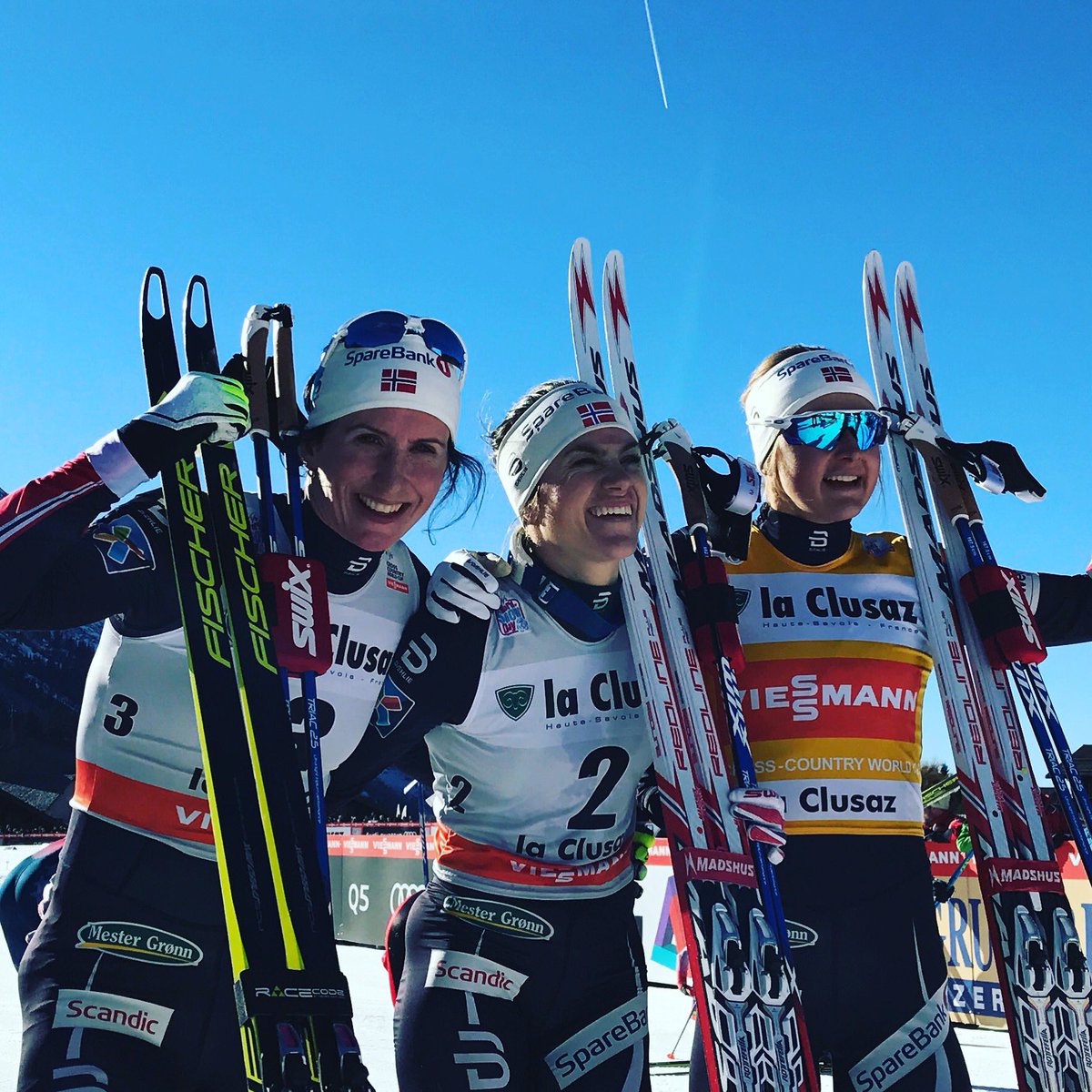
The all-Norwegian women’s 10 k freestyle mass start podium at the La Clusaz World Cup in France, with winner Heidi Weng (c), runner-up Marit Bjørgen (l), and Ingvild Flugstad Østberg (r) in third. (Photo: FIS Cross-Country/Twitter)
In the women’s 10 k freestyle mass start, Heidi Weng outlasted her Norwegian teammate Marit Bjørgen by 2.1 seconds for first, crossing the finish line in 23:43.5. Bjørgen placed second and it was an all-Norwegian podium with Ingvild Flugstad Østberg in third, 0.8 seconds behind Bjørgen and 2.9 seconds after Weng.
Rosie Brennan was the top U.S. woman in 22nd (+1:31.9) for her first top 30 this season and Liz Stephen was next across the line in 23rd (+1:36.5). Kikkan Randall placed 36th (+2:10.6), and Caitlin Patterson 37th (+2:12.7).
Canada’s Dahria Beatty landed in the points for her second-straight race and notched her best distance result in 26th (+1:38.7), Cendrine Browne was 41st (+2:32.3), Emily Nishikawa 48th (+2:52.4), and Sophie Carrier-Laforte 59th (+5:59.8).
Andy Newell and Erika Flowers celebrated their reunion in Rossland with a couples victory in the freestyle technique sprints today. The Stratton Mountain School (SMS) Elite Team couple is racing in the NorAm as a bonus race before their Christmas break in Bozeman, Mont.
Flowers, who was second in the interval start on Friday, won the A-final in 3:15.65, 0.44 seconds ahead of AWCA’s Olivia Bouffard-Nesbitt. Nakkertok’s Katherine Stewart-Jones was 7.09 seconds back, just 0.04 seconds ahead of yesterday’s winner, Chelsea Holmes of APU.
On the men’s side, Newell won comfortably in 2:44.81 after winning the qualifier and each heat. Black Jack’s own Julien Locke was second, 1.05 seconds back. Yesterday’s winner, NTDC Thunder Bay’s Evan Palmer-Charrette was third, 0.05 seconds behind Locke.
Sunday, the mini tour wraps up with a classic pursuit, where the leader after two days starts first and everyone else chases with the first person at the finish line winning the overall.
“Starting at the front tomorrow,” Palmer-Charrette wrote, “the plan is quite simple, stay there!! I’ll have some nerves on the start line knowing there’s a group of guys hunting me down so the big focus is to ski smooth and stay relaxed.”
On the women’s side with larger gaps, Holmes shared the most interesting race plan.
“My strategy for tomorrow is… no surprise here… I think the expression is to go out ‘like a bat out of hell’ and do my best. It will be a hard race any which way — for sure!”
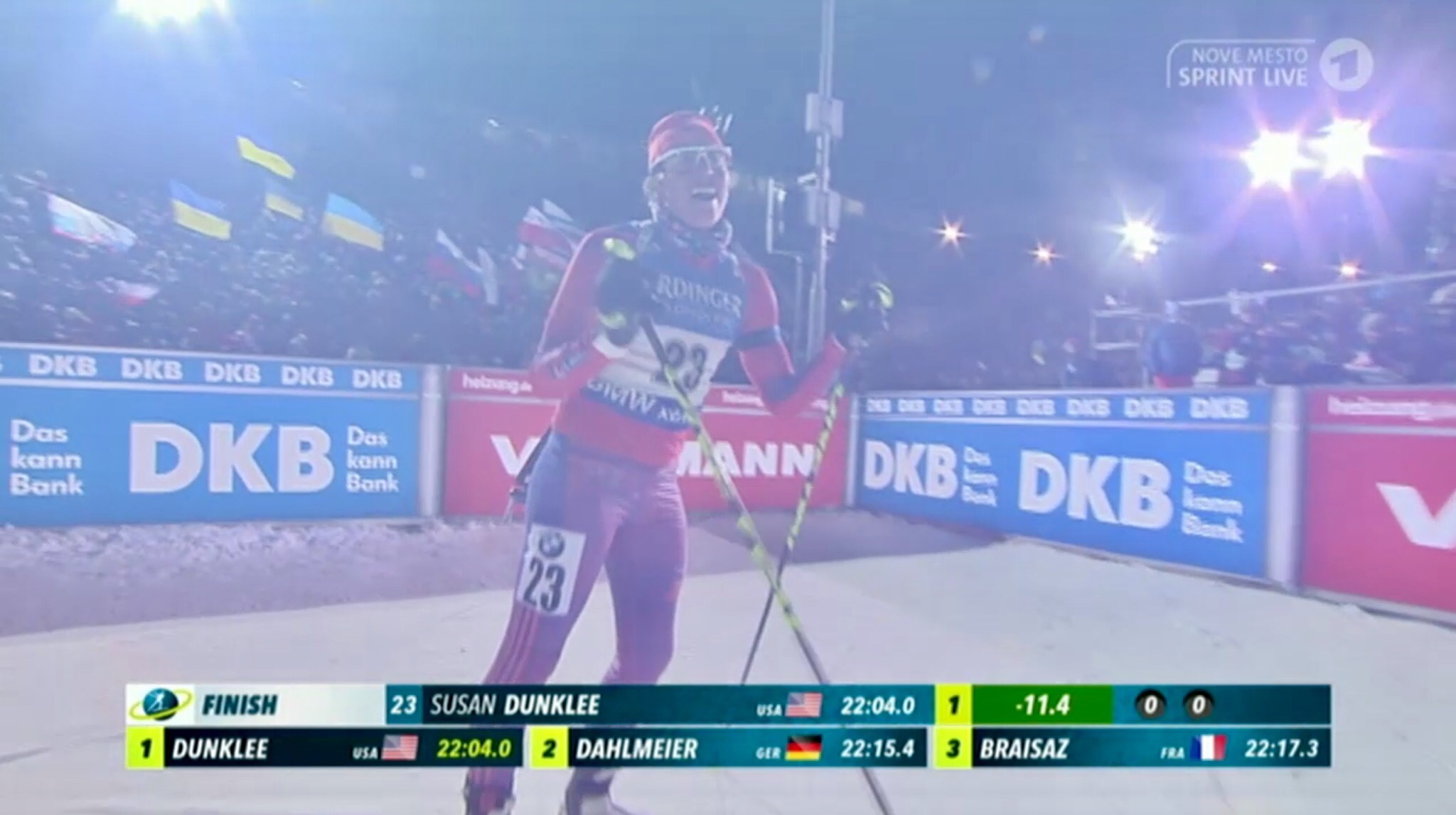
Susan Dunklee (US Biathlon) after crossing the finish first through 23 finishers in the women’s 7.5 k sprint at the IBU World Cup in Nove Mesto, Czech Republic. She went on to place third for her first podium of the season and the third of her career.
(Note: This is not a race report but rather a digest of the day’s events. Check back for complete race reports.)
***
IBU World Cup in Nove Mesto: Women’s 7.5 k sprint
Susan Dunkleecame close last week, and now she’s there. The 30-year-old US Biathlon skier rocketed to third in the first women’s race of the International Biathlon Union (IBU) World Cup in Nove Mesto, Czech Republic, on Friday: the 7.5-kilometer sprint.
She finished 5.1 seconds behind Russia’s Tatiana Akimova, who not only achieved her first win, but her first World Cup top 10 as well, with clean shooting (0+0) in 21:58.9 minutes. France’s Anaïs Chevalier placed second, 4.3 seconds back, with perfect shooting as well (0+0), and Dunklee was the third woman in the top three to hit all 10 targets.
Dunklee started 23rd and displaced Germany’s Laura Dahlmeier, who started 30 seconds ahead of her in bib 22, from first place by 11.4 seconds. Dunklee then had to wait for nearly 75 other finishers to secure her podium, bumped out of first by Akimova in bib 37 and finally to third place by Chevalier in bib 68. Dahlmeier ultimately placed fourth (+16.5) after two standing penalties (0+2).
Overall, Dunklee posted the fifth-fastest range time, ninth-fastest shooting, and 15th-fastest course time en route to the third podium of her career.
“I am very happy,” Dunklee said in a post-race press conference. “Last week I crossed the line in first and slipped back all the way to 11th with clean shooting, and this is quite an improvement over that. You never know with biathlon whether you are gonna hold a position when you cross the finish line. It’s just too unpredictable.”
Asked how she was feeling about Saturday’s pursuit, she said she was in a great position.
“The important thing is not to think too much about it and keep executing a good performance plan, like every other race,” she said.
Canada’s top finisher was Julia Ransom, who cracked the top 30 for the first time this year in 26th (+1:06.5) with a single standing penalty (0+1). Rosanna Crawford placed 37th (+1:30) with two misses (1+1), Megan Tandy was 44th (+1:34.8) with one prone penalty (1+0), and American Joanne Reid placed 52nd (+1:46.5) with one standing miss (0+1) to also qualify for Saturday’s pursuit.
The third U.S. woman racing on Friday, Clare Egan placed 62nd (+1:59.4) with three misses (2+1), missing the pursuit by 1.6 seconds.
The fourth Canadian woman, Emma Lunder finished 82nd (+3:02.2) with two penalties (2+0).
[UPDATE] The NorAm series kicked off its second stop on Friday with a three-race mini tour in Rossland, B.C.
The men’s 15 k freestyle had a more traditional result, with Canadians retaking the podium. Evan Palmer-Charrette of the Thunder Bay National Team Development Centre (NTDC) won in 40:36.7 minutes, 31.1 seconds ahead of Team R.A.D.’s Russell Kennedy. Erik Carleton of Rocky Mountain Racers and the Canadian Para-Nordic Ski Team edged out U.S. Ski Team and SMS Elite skier Andy Newell for third (+56.6).
Chelsea Holmes of Alaska Pacific University (APU) continued her dominating ways in the women’s 10 k freestyle, finishing in 29.37.8. Fellow American Erika Flowers (SMS Elite) was second, 1:49.2 behind with Olivia Bouffard-Nesbitt of the Alberta World Cup Academy and Canadian U25 Team in third (+2:27.2).
FasterSkier is seeking photos from this weekend’s NorAm. Submit yours with caption and credit info to info@fasterskier.com.
Max Durtschi making his World Cup debut in Canmore, Alberta, last season. (Courtesy photo)
Welcome to “17 Questions for 2017″, where we are catching up with American and Canadian national-team members before the beginning of the winter season.
***
A standout junior skier from Sun Valley, Idaho, Max Durtschi took a break from snow sports to focus on cycling – winning two national titles and competing on first a continental pro team and then, for two years, on Leopard-Trek’s European squad. But after retiring from bike racing in 2014, he came back to the snow. While working on a neuroscience degree at Dartmouth College, Durtschi decided to pick up biathlon.
1. Biggest change in your life in the last five or so months since the ski season ended?
Would either be taking “Cellular and Molecular Neurobiology” this spring at school or dealing with a pretty nasty illness this summer.
2. Biggest change in your training?
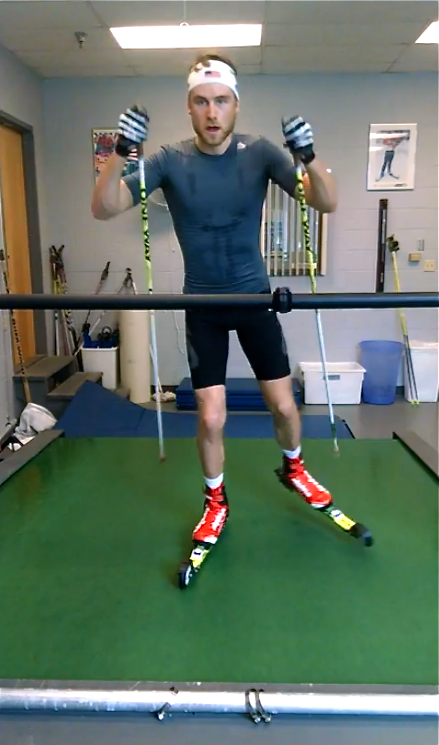
Max Durtschi spending some time on the rollerski treadmill in Lake Placid. (Courtesy photo)
We have done a good bit of plyometric work this summer, which is productive for a slow twitch guy like me.
3. Major areas of improvement you’ve seen so far?
I have seen a big jump up in my shooting and ski technique. Gaining upper body and core strength has helped a lot of technique work come together.
4. Whom you’ve been working closest with this offseason (coaches or training partners)?
Sean Doherty – that’s my guy. We have a great group here though, Tim Burke, Lowell Bailey, and Leif Nordgren are true professionals and great role models for us younger guys.
5. Best trip in the last five months (and why)?
I enjoy getting over to Burlington, VT in the summer. That is a neat place.
6. Favorite cross-training?
Ski erg. No, just kidding. I really like good hiking adventures in the Adirondacks.
7. Favorite non-athletic activity or pastime this summer?
Being on the lake – on a boat, paddle board, for a concert, grilling, etc .
8. Song that was your jam this summer?
Hmmm – I love a lot of different types of music. I will say this, setting “Ecstasy of Gold” by Ennio Morricone as the morning alarm has been a theme during the harder weeks this summer. That will get you out of bed.
9. All time favorite race moment?
A lot of good memories both on skis and the bike. I would say last year’s IBU Cup in Nove Mesto was a cool biathlon experience – fog, rain, big stadium, and a lot of fans drinking heavily at 10 am.
10. First thing you pack in your bag when you leave for Europe?
Slippers help hotels feel like home. Also, don’t be forgetting the power adapter. Having access to electricity makes the trip go smoothly.
11. Venue/event you’re most excited to visit this season?
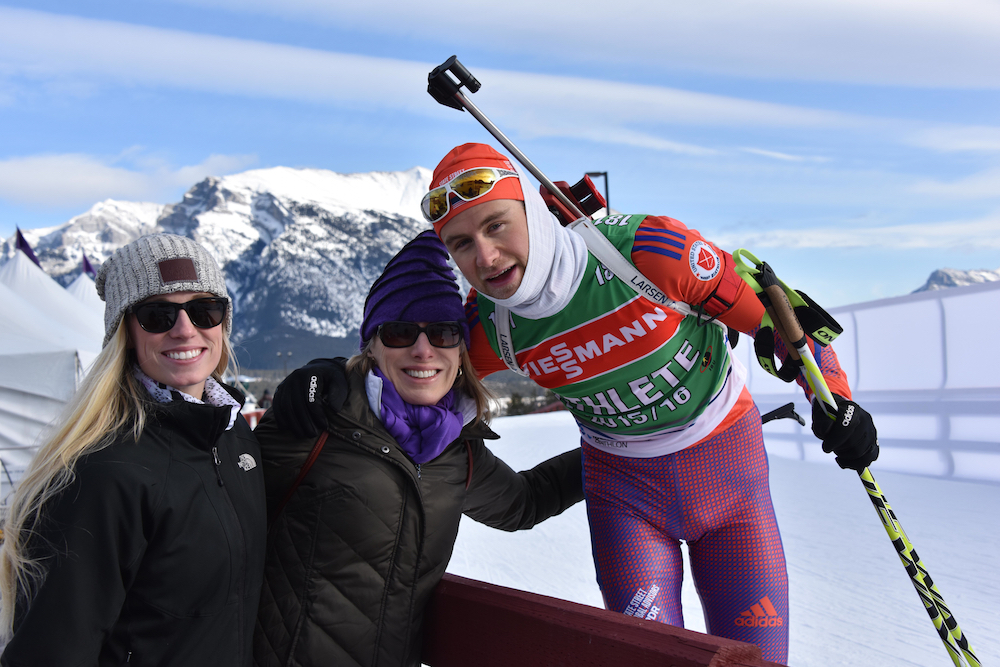
Durtschi with his mother and girlfriend at the World Cup in Canmore, Alberta. (Courtesy photo)
You know, I absolutely love traveling around Europe and seeing different venues. However, if I could get back to Sun Valley, Idaho (where I grew up) that would be pretty dang special.
12. Who will win the men’s and women’s World Cup titles this year?
Let’s go with the French double of Fourcade and Dorin-Habert.
13. Biggest sacrifice you feel you’ve made choosing this career path?
Starting in high school I don’t see home much. But after a bit, being away starts feeling like home…
14. If you could change one thing about your sport, what would it be?
Handling a firearm in the middle of winter can get really cold on the fingers, but then, my hands are always too hot anyway. Not sure if I would change much at all.
15. What did you have for breakfast this morning?
Oatmeal with the fruits and nuts. Fiber makes the world go around.
16. In 5 years, I’ll be ____?
I had better have finished college by then…
17. In 50 years, I’ll be ____?
Probably hiking up some damn mountain.. But you know “outlive the bastards” as Edward Abbey once said.
Durtschi competing at 2016 U.S. National Championships in Fort Kent, Maine. (Courtesy photo)
The Norwegian men secured another relay win by 6 seconds over Russia on Sunday at the World Cup in Nove Mesto, Czech Republic. Finn Hågen Krogh (l) anchored the victory, with teammates (from left to right) Martin Johnsrud Sundby, Sjur Røthe, and Mathias Rundgreen. (Photo: Fischer/NordicFocus)
As Martin Johnsrud Sundby of Norway double poled away from the men’s field during the second leg of the Sunday’s 4 x 7.5 kilometer World Cup relay in Nove Mesto, Czech Republic, it looked like the men could rival the Norwegian women team’s 42-second winning margin. However, the Russians weren’t about to let them off without a fight.
The race consisted of two classic legs followed by two freestyle legs with each technique utilizing a different course. With only one steep hill on the classic course, many of the second-leg classic skiers chose to double pole, including Sundby.
At the end of the first leg, his teammate on Norway’s first team, Sjur Røthe came into the initial exchange in fourth, 1.3 seconds after Evgeniy Belov — who established a first-leg lead for Russia — and just behind Kazakhstan’s Alexey Poltoranin and Italy’s Dietmar Nöckler, respectively.
Røthe handed off to Sundby, and the Overall and Distance World Cup leader immediately got to work shattering the field, demonstrating his double poling strength and establishing a 28-second lead over Russia I. Meanwhile, Russia’s Alexander Legkov chased alone, putting 25 seconds between himself and the chase group of Italy, Germany and France.
The Norwegian and Russian first teams maintained their wide margins throughout the third leg, but the chase group grew to seven. After receiving the tag in sixth and seventh, respectively, Noah Hoffman of the U.S. and Canada’s Len Valjas closed the gap to fifth within the first 2.5 kilometers of their skate leg. Fifteen seconds back at the third exchange, they caught the German-Italian-French chase pack by the 2.5 k timing point, and were suddenly in contention for third. Switzerland and Norway II also joined the group by the third exchange.
Meanwhile, just 2.5 k into the third leg, 20-year-old Alexey Chervotkin of Russia remained 27 seconds ahead in second, yet 39 seconds behind Norway’s 25-year-old Mathias Rundgreen in first. By the final exchange, Chervotkin had gained on Rundgreen slightly, leaving anchor Sergey Ustiugov 30 seconds down.
Germany, Italy and France had broken away slightly from the larger group — putting three seconds between them and Norway II in sixth. At the tag, third through ninth were all around a minute out of the lead, with Canada in seventh (+1:01.8) and the U.S. in eighth (+1:02.2).
Norway’s Finn Hågen Krogh waves to spectators as he secures the win for his team in the 4 x 7.5 k relay at the World Cup in Nove Mesto, Czech Republic. Russia’s Sergey Ustiugov finished 6 seconds back in second. (Photo: Fischer/NordicFocus)
Finn Hågen Krogh stepped up as Norway I’s anchor, with Petter Northug skipping the weekend to focus on the Ski Tour Canada. With 30 seconds on Russia and 57 seconds to third, it appeared the gold and silver were set. However, at every time check, the margin between Norway and Russia dwindled until it appeared Ustiugov just might pull off the upset. Despite posting the fastest split by more than 12 seconds, Ustiugov ran out of real estate, finishing just six seconds after Krogh, who sealed the win for Norway in 1:08:29.
“When I woke up this morning, I was tired… so I felt the pressure,” Krogh said. “With those guys, I know that nothing less than a win is good enough.”
“The plan was to keep a steady a pace in the first lap and then speed up,” Ustiugov told FIS. “I gave everything I had and tried to close the gap on Finn, but it was too much. Nevertheless, second place feels great.”
Meanwhile, seven teams engaged in a tight battle for third. The U.S. and Canada lost contact over the last 3 k and five teams entered the stadium together for the sprint finish. Italy’s Federico Pellegrino again demonstrated his sprinting prowess to take third (+54.3), edging Germany’s Thomas Bing in fourth and Norway II’s Anders Gløersen in fifth — both of which finished exactly 0.3 seconds later. Switzerland placed sixth (+58.5) and France was close behind in seventh (+59.4).
Simi Hamilton anchored the U.S. to eighth (+1:13.6) followed closely by Canada’s U23+ Development Team skier Knute Johnsgaard in ninth (+1:15.1).
North Americans Stick Together for Top 10
The two North American teams went through each exchange within one place of each other, eventually finishing within 1.5 seconds apart. Canada’s ninth place marked its second-best men’s relay finish in a World Cup, according to Cross Country Canada.
Simi Hamilton (shown here at last weekend’s freestyle sprint in Planica, Slovenia) anchored the U.S. men to eighth in Sunday’s World Cup relay in Nove Mesto, Czech Republic. (Photo: Fischer/NordicFocus)
“The Canadian team skied really well today so that is cool to see,” Hamilton said in a phone interview after the race. “It always great to battle with anyone out there, but when it is a fellow North American, it makes it even more fun.”
Scott Patterson (Alaska Pacific University) started first for the U.S. in his first World Cup relay on his first World Cup weekend. Patterson kept the Americans in contention, tagging off in 12th and 24.8 seconds back, while managing the challenges of the mass-start lead-off leg.
“On the third lap, the leading teams lead a charge up the steepest hill,” Patterson explained in an email. “Due to my position, I could only watch it happen as the path forward was blocked … I tried for the rest of the race to close a bit, but usually found that I had some company either blocking my way or pulling me along.”
Patterson handed off to Erik Bjornsen, who picked off six places with the fifth-fastest second leg to lift the U.S. to sixth. Meanwhile, Canada’s Graeme Killick came through the first exchange 1.2 seconds after Patterson and tagged Devon Kershaw in 13th. Kershaw then skied the fourth-fastest second leg to improve to seventh.
“We like how Killick races mass starts, and he is the future of the men’s distance skiers, so we thought it was right to put him first,” explained Canadian coach Chris Jeffries, head coach of the Alberta World Cup Academy who has been assisting the team in Europe.
With the field fragmented between France in sixth to Finland in 11th, Bjorsen and Kershaw of Canada the opportunity work their way up.
“I wanted to ski smooth and relaxed that first lap — knowing that people would be eager to chase back to that next group ahead,” Kershaw wrote in an email. “We were splintered a bit with smaller groups of people around so I was able to just pick off guys as I went.”
Len Valjas skied the third-fastest third leg on Sunday at the men’s World Cup 4 x 7.5 k relay in Nove Mesto, Czech Republic. In doing so, he maintained Canada’s positioning in seventh, and the team ended up ninth overall for its second-best result ever Here he’s shown racing last weekend’s freestyle sprint in Planica, Slovenia. (Photo: Fischer/NordicFocus)
Handing off to the third leg, the U.S. and Canada had moved up to sixth and seventh, respectively, just 15 seconds out of third. After the exchange, Hoffman and Valjas quickly bridged the gap to France, Italy, and Germany.
“I felt great out there, Noah helped pull me up to the third place group, he was skiing so well. I cant take any credit for catching that group, he was the one leading that charge,” Valjas explained in an email.
Both North American skiers posted freestyle splits that ranked in the top-10 overall. Valjas skied the third-fastest third leg; Hoffman’s was fourth fastest. Considering Valjas’s recent travel schedule, it was a surprising result. “I flew in late the night before just to race the relay. I felt surprisingly good considering I had been either in a car or plane, or airport for 14 hours that day,” he wrote.
Coming into the final exchange, Valjas and Hoffman were in the mix of seven teams vying for the final podium placing.
“Scott, Erik, and Noah skied really great legs and got me in a really good spot, we were in contact with the big group behind the Norwegians and Russians so they did an amazing job keeping us in there,” Hamilton said.
In the final leg, the North American anchors Hamilton and Johnsgaard received the tag in the midst of the chase pack and would ski the duration of the race together.
Hamilton was able to maintain contact with the group despite a broken pole the first lap of three laps. He quickly received a replacement from the French team, but had to swap it out again before finding one with a suitable length.
“It was actually in a really lucky place because it was mostly downhill back to the stadium so I don’t think I lost too much time or energy in that debacle,” Hamilton said.
The pair lost contact with the chase group about 4 k in, but kept the deficit within 20 seconds. Hamilton surged up the final hill to overtake Johnsgaard for eighth.
“Our men’s team is definitely improving and we are learning a lot each time we do it and it definitely keeps us hungry, especially me, to work harder at the distance races so I can be able to ski 7.5 k fast but efficient and be able to put in a really good sprint at the end,” Hamilton said.
“The pack containing three through nine and Simi, we really believe that when we can figure out the distance skiing just one or two steps further, that he’ll be able to conserve for more of the race and then attack when it counts,” U.S. coach Matt Whitcomb said. “Today would have been a race that would have been the perfect scenario for that. We’re not quite there yet; he was able to stay within just seconds of that sprint for the finish.”
Jeffries echoed Whitcomb’s optimism: “All four men skied great today. Individually, they all had really strong days, and that is a nice to have. Obviously as a nation, we want to be better than 9th, but we were right there until the end and we had a shot at a podium. The boys and staff were all really happy, big smiles are always nice on the World Cup where you can have some tough days.”
“It was a really fun 7.5km blast session and nice to see the whole team ski really well,” Kershaw wrote. “Just one of those days where ski racing is a real treat. Loved it.”
American Andy Newell in bib No. 2003 in the lead pack during the Dolomitenlauf 42 k classic race at the FIS Marathon Cup on Saturday in Lienz, Austria. (Photo: Fischer/NordicFocus)
Two and half months makes for along time on the road, especially when it only marks the halfway point. For U.S. Ski Team members like Andy Newell, who has been competing and traveling in Europe for the past 10 weeks, sometimes it’s important to spend time racing outside of the World Cup.
“There are so many great races in Europe you can do if you get out of the World Cup bubble a little bit,” Newell said Saturday on the phone.
The 32-year-old American, best known for his classic sprinting, opted out of this weekend’s World Cup races in Nove Mesto, Czech Republic, and instead competed in Austria, starting with the Dolomiten city sprint in Lienz on Friday night and Saturday’s Dolomitenlauf 42-kilometer classic marathon in Obertilliach.
“That’s one of my goals this year and in the future – to get away from some of the World Cup weekends that maybe aren’t my strength, like [Saturday’s] 15 k skate on the World Cup, that’s definitely not a great event for me. I’m much better at a double-pole race,” Newell explained.
American Andy Newell (l) and Austria’s Stefan Sutter in front during the Dolomitenlauf 42 k classic race on Saturday in Lienz, Austria. (Photo: Fischer/NordicFocus)
Testing the waters in his first international double-pole marathon, Newell finished second overall in the 42 k classic, just 5.7 seconds out of first and 0.3 seconds ahead of third. The overall win went to Stanislav Rezac of the Czech Republic in a time of 1:42.19, while Italy’s Mauro Brigadoi rounded out the top three.
“The top-10 guys were on no wax,” Newell said. “I knew it would be a good race for me, but more importantly good preparation for the next month of racing.
“I have some big classic sprints [in] Drammen and Stockholm,” he added. “To get in a long distance double-pole race can actually be good double-pole training for some of those sprints.”
U.S. Ski Team Head Coach Chris Grover wrote in an email that having Newell get two starts (the sprint and marathon) in Lienz, rather than a possible one in Nove Mesto, made more sense for Newell’s long-term training plan.
“It would have been good to have Andy here for a possible classic relay leg, but the Dolomitenlauf weekend offered him two confirmed starts (including a sprint) so it was a better fit,” Grover wrote.
Using the 42 k event as ‘race practice’, Newell entered Saturday’s competition open to anything.
American Andy Newell (l) outsprints Italy’s Mauro Brigadoi for second place in the Dolomitenlauf 42 k classic race on Saturday in Lienz, Austria. (Photo: Fischer/NordicFocus)
“I tried to go in with big confidence and an open mind, knowing that if I had a good day I could have a shot at winning the race or maybe even being on the podium,” Newell said. “I ended up doing a fair amount of leading actually and it came down to a group of 15 of us. Then it was a group of 10. By the last lap, it was maybe a group of five of us.”
With five skiers in the running for the top-three podium spots, Newell made a move with 4 k to go.
“I put my head down and put in a surge but I wasn’t able to get rid of the two guys that were behind me,” he said.
The top five men — Rezac, Newell, Brigadoi, and two Austrian skiers Martin Sutter and Stefan Sutter –made their way to the final kilometer, where the marathon turned into a marathon sprint.
“The Czech guy that won is a really strong double poler and great marathon skier. He had put his move down with maybe a half k to go and we were kind of strung out, a few meters in between all of us,” Newell said. “He had maybe ten meters before we even got to the stadium and it was a really drawn out sprint finish.”
While Newell captured second, three-tenths of a second ahead of the Italian, Brigadoi ousted the two Austrians for third.
Left to right: Second-place finisher Andy Newell (USA), along with race winner Stanislav Rezac (CZE), and third place Mauro Brigadoi (ITA) after the Dolomitenlauf 42 k classic FIS Marathon Cup on Saturday in Lienz, Austria. (Photo: EXPA/Gruber/Worldloppet Facebook)
While the sprint finish was perhaps more familiar territory for Newell, the American believes the race left him with a unique racing experience.
“I haven’t done too many of these types of marathons. On a race like [Saturday] you’re lapping people, so you have to weave in and out of slower folks … then there’s a helicopter and a snowmobile with a video camera like three feet away from you the entire time, which takes getting used to,” he said. “It was pretty fun and different.”
With a second-place podium finish and competitive spirit, who knows, the U.S. sprint specialist may make the transition to full-time marathoner yet.
“In the future I would like to make it to some more of the [Visma Ski] Classic races and the really big European marathons,” Newell said. “There’s some great competition and some good points and prize money. That was the goal for coming here, get a fun city sprint in Lienz, but to also race the 42 k classic.”
“Next time I want one of those wreath things!” Newell posted on Instagram after Saturday’s race. “Great experience and hard 42 k of double poling today. Happy with 2nd place in the Dolomitenlauf.”
Though the Dolomitenlauf is a part of the Worldloppet Marathon series, the 42 k classic event is not the designated Worldloppet race. Instead, many of the big-name marathoners suited up for Sunday’s 42 k freestyle competition held in Osttirol’s Drau Valley, Austria.
Racers began the 42 k event — changed on Jan. 5 from 60 k to 42 k — in Lienzand followed a course through various towns and villages located in the valley. Competitors finished back in the city of Lienz.
On the men’s side this year, all three podium spots were commandeered by the French.
French skier Bastien Poirrier won the men’s skate race in 1:32.42.3. Not far behind, French teammates Ivan Boiteux Perillat and Loic Guigonnet duked it out for second.
Boiteux Perillat ultimately beat Guigonnet to the line, a mere 0.2 seconds behind Poirrier. Guigonnet crossed the line in third, 0.5 seconds out of first.
For the women, France once again came out on top. French skier Aurelie Dabudyk raced to first in 1:41.32.3. French teammate Elisa Brocard finished 1:14.1 seconds back in second. Italy’s Antonella Confortola broke the French podium streak, crossing the line in third, 1:16.3 seconds behind Dabudyk.
The women’s 10 k freestyle podium at the World Cup in Nove Mesto, Czech Republic, with Norwegian winner Therese Johaug, Norway’s Astrid Uhrenholdt Jacobsen in second and American Jessie Diggins in third (r). (Photo: Fischer/NordicFocus)
Natural snowfall during a competition isn’t something many World Cup athletes have seen this season. With a steady stream of snowflakes descending onto the women’s 10-kilometer skate course on Saturday in Nove Mesto, Czech Republic, American Jessie Diggins proved that as the snow flies, so can she.
“I mean, there was a snow storm going on, but I love that,” Diggins, who reached the podium in the freestyle individual start by placing third, 9.4 seconds behind the race winner, Norway’s Therese Johaug, said in an interview.
American Jessie Diggins (r) with Norway’s Therese Johaug (c) and Astrid Uhrenholdt Jacobsen (l) all smile after placing third, first, and second, respectively, in the women’s 10 k freestyle individual start on Saturday in Nove Mesto, Czech Republic. (Photo: FIS/Instagram)
“I just kept thinking, it’s just like Falun and it worked out great there, so I can ski in anything,” the 24-year-old Minnesota native added, referring to her silver-medal finish in the 10 k freestyle interval start event at the 2015 World Championships. “If I can ski in snow at World Championships, I can do it here, too.”
With a World Championships silver medal, an individual World Cup title, and Saturday’s overall third place podium finish, Diggins demonstrated that her ability to push herself as an individual is close to unbeatable.
“I love individual starts because it’s just you out there,” she said. “I can ski the downhills how I want to, there’s nobody elbowing me or stepping on my poles and in my business. It’s just you and the course and you go ski that course as fast a you possibly can and that’s it.”
Diggins started in bib 36, just behind Canada’s Maya Macisaac-Jones. One of the favorites for the day’s distance skate event, Charlotte Kalla of Sweden, started four places ahead of her.
After just the first 500 meters of the course, Diggins trailed Kalla by just 0.2 of a second.
“I think some of the challenges of the course are right out of the start,” Diggins explained. “There’s a tiny little downhill drop, but then after that you’re really working all the way up until the highest point of the course. So you have to pace it well and figure out how to push through all those different sections and I think I definitely went out quite hot.”
Diggins did push the pace hard in the beginning, taking the lead over Kalla by one second by the 3.5 k mark.
“I was getting splits, but I also told the coaches to give me technique cues,” Diggins explained. “For me, splits are awesome and it’s sweet to know where you’re at, but it doesn’t make me race any harder. I’m racing as hard as I can anyway, so for me, what I was telling the coaches to do was say specific words that would remind me how to ski fast.”
As more heavy hitters got on course, including the overall race winner Johaug, Diggins maintained mental control of her race.
“When I’m out there I’m thinking about how I’m going to ski the next section, when am I going to switch from V2 to V1, I’m thinking about my cue words, like strong core…when I have a good race is when I can stay focused,” she said.
American Jessie Diggins in a “happy pain cave” after her third place finish in the women’s 10 k freestyle individual start on Saturday in Nove Mesto, CZE. (Photo: ARD)
At 5.5 k in, Diggins saw a glimpse of second place and pulled ahead of Norwegians Heidi Weng and Astrid Uhrenholdt Jacobsen. Jacobsen, ultimately passed Diggins for second place, 4.6 seconds behind her teammate Johaug, while Weng dropped back to sixth 31.1 seconds back.
“The wheels were coming off towards the end of the race,” said Diggins of the last few kilometers, “but I think I was able tohold it together just long enough.”
Along with Diggins’ third place finish, the U.S. women saw three other skiers crack the top 30 amidst Saturday’s snowfall.
“It’s funny sometimes you look outside and you see the snow coming and you get really stressed because you’re thinking it’s just going to be slower and slower and maybe it’s not going to be fair,” Sadie Bjornsen, who finished in 14th overall, 1:11.3 seconds back from Johaug, said in a phone interview. “But I just try to stay optimistic and excited. Skate skiing is always a challenge for me, so the weather brought a fun new twist to it. More than anything I think I was just so excited to see winter.”
With many of this year’s races taking place on manmade snow and shortened loops, Bjorsen believes she is not alone in her excitement for the race day precipitation, even if it added an extra challenge.
“It’s been a sad winter of feeling like we’re just doing this crazy sport where we’re skiing on a fake trail in the middle of the summer and sometimes you lose the vibe of ski racing with that,” Bjornsen said, “So I feel like these past couple days, everybody on the World Cup is smiling and just has this extra energy and I would totally crack it down to the fact that we’re seeing winter for the first time,” she added.
Bjornsen, who spent time after the Tour de Ski recovering from illness, also pointed out that the “winter” skiing brings out a different level of racing.
“Today I didn’t feel like I was having a spectacular race, but I just kept pushing,” Bjornsen said. “Even when I crossed the line I had no idea how I was doing because even though I felt like I went as hard as I could, I didn’t feel on fire. But I think that’s a result of not having skied in winter yet this year. When you’re skiing in winter, you don’t feel like you’re flying.”
The two other U.S. women to also finish in the top 30 were Liz Stephen and Rosie Brennan. Stephen’s time was 1:18.4 behind Johaug’s winning mark, and Brennan’s was 1:40.1 back.
“I am satisfied with today’s race,” Brennan wrote in an email. “The conditions were slow so it was hard to get positive feelings out there an starting as early as I did. I wasn’t sure how I was doing for much of the race, but I tried to just focus on working every section and maintaining the pace I was traveling at. I am starting to feel more like myself racing. I think the Tour helped me get into gear. It was unfortunate to end up on the backside of a tight group, I guess that will leave me hungry for more.”
The fifth American to compete on Saturday, SuperTour leader Chelsea Holmes, race to 37th place overall, 1:59.7 seconds back from Johaug.
“It’s been so fun to have all that hard work and all the hours of training pay off in such a big way,” Diggins said of her third place finish, “Of course it’s fun for the team because we all train together, so if I can do it, anyone can do it. It’s positive momentum moving forward and to have four girls in the points today was just awesome.”
With a strong individual and team showing on Saturday, the U.S. women prepare for Sunday’s 4 x 5 k relay event. Sophie Caldwell will lead the team out in the first classic leg, and tag off to Bjornsen for another classic leg. The switch to freestyle will be headed by Stephen in the third leg, and Diggins will anchor the relay team in the final freestyle leg.
“For me a crucial part of racing well is loving what I’m doing and having fun with my teammates,” Diggins added, “And I feel really lucky to be on a team that works really hard to create that environment.”
Maurice Manificat of France during the men’s 30 k freestyle on Dec. 12 in Davos, Switzerland. Despite giving Martin Johnsrud Sundby a run in that race, he ended up second. On Saturday, Manificat bested Sundby by 10.8 seconds for the win in the 15 k freestyle at the World Cup in Nove Mesto, Czech Republic.
Maurice Manificat shook up the Distance World Cup standings on Saturday with his fourth-career win in the men’s 15-kilometer freestyle in Nove Mesto, Czech Republic. Unlike the thin ribbons of manmade and farmed snow snaking through brownfields during the recent Tour de Ski, Saturday’s race played out amidst steady snowfall. The trees were draped in snow. Temperatures were in the low 20s. Winter had returned.
Old Man Winter, despite his late arrival, was just another welcome sideshow for Norway’s Martin Johnsrud Sundby and his stranglehold on the Overall and Distance World Cup titles. But on Saturday, Sundby had to settle for second.
Manificat won the race in 34:04.9, by 10.8 seconds over Sundby, to achieve France’s fifth World Cup podium in the last three races (after Baptiste Gros and Richard Jouve placed second and third in the freestyle sprint a week ago, and Renaud Jay and Gros teamed up for second and Valentin Chauvin and Jouve placed third in the team sprint last Sunday in Planica, Slovenia).
Behind Manificat and Sundby on Saturday, Russia’s Sergey Ustiugov skied to third (+13.0) and Evgeniy Belov placed fourth (+29.5).
The result lifted Manificat from fourth to second in the distance standings, ahead of two other Norwegians, Sjur Røthe and Niklas Dyrhaug. While Røthe placed 28th on Saturday (ranking eighth out of nine Norwegians who finished the race), Dyrhaug did not compete in the 15 k.
For Manificat, this was his first World Cup victory this season. He last won the Davos 30 k freestyle in 2013. Two years later, back in Davos last month, Manificat came close, finishing second to Sundby in the 30 k freestyle. He went on to reach the podium in the sixth stage of the Tour de Ski: he finished third in the 10 k freestyle in Toblach, Italy.
Norway’s Martin Johnsrud Sundby racing to second in the men’s 10 k freestyle at the sixth stage of the Tour de Ski in Toblach, Italy. (Photo: Fischer/NordicFocus)
Prior to the race, Sundby led the World Cup overall by 550 points ahead of fellow Norwegian Finn Hågen Krogh. On Saturday, Krogh finished in fifth, 32.7 seconds behind Manificat. Despite his second-place finish, Sundby buffered his overall lead by 35 points — he now leads the World Cup overall by 585 points.
Canada’s Alex Harvey posted the best result for the North American men, skiing to seventh (+41.3). Noah Hoffman, of the U.S. Ski Team, finished in the points in 27th place (+1:38.3).
Also for Canada, Devon Kershaw was outside the points for the first time in a non-stage World Cup distance race in 38th (+2:02.2). Canadian Development Team members Graeme Killick placed 63rd (+3:29.7) and Knute Johnsgaard finished 76th (+5:13.3).
For the U.S., Erik Bjornsen raced to 39th (+2:08.6). In his World Cup debut, Alaska Pacific University (APU) skier, Scott Patterson, placed 42nd (+2:10.9), and Simi Hamilton finished 65th (+3:39.0).
Two-Man Race and a Flip Flop
By the second time check, 3.5 k into the race, the foundation was laid for a two-man show. Manificat, in bib 58, had started one minute behind Sundby (bib 56), and came through the checkpoint 3.1 seconds short of Sundby, who held the fastest time. Harvey posted the third-fastest split, five seconds down.
France’s Maurice Manificat (c) after his first win of the season at the 15 k freestyle in Nove Mesto, Czech Republic, with runner-up Martin Johnsrud Sundby (l) of Norway and Russia’s Sergey Ustiugov in third. (Photo: FIS Cross Country/Twitter)
By 5 k, Sundby held a 4.2 second gap on Manificat. Then the flip flop began.
At 8.5 k, Manificat built up an 11.6-second lead. That margin shrunk to 7.2 seconds by 13.5 k, but Manificat never relented the lead. At the finish, Manificat had buffered his margin over Sundby, winning by 10.8 seconds.
After the race in an interview with FIS, Manificat, 29, made it clear this was a race he had marked on his calendar.
“I was focused on this weekend. There are not many 15 k free technique in the World Cup calendar. I knew Martin was a favorite, but I was ready to fight,” he said. “I had excellent skis. I am very happy for the first victory of the season. I had the advantage of starting behind Martin to get all the times. I know that when I am in the best shape I can ski like today.”
Sundby, on the other hand, looked visibly tired on the podium. Yet in his post-race interview with FIS, he paid deference to a rival he sees as a threat in the 15 k skate.
“I maybe was not in my top level, but Maurice is always among the best in this distance and technique,” Sundby said. “I am happy about second place today. It was very nice tracks, which feature long and short uphills as well as turns.”
In his first race back since finishing third in the overall Tour de Ski, Ustiugov remarked that third place was a pleasant surprise after the Tour’s grind.
“I did not know how was my shape after the Tour. I spent several days at home in Russia,” he told FIS. “I started slower today to see how my body reacts. I was feeling better and better after every lap and in the last kilometers I was feeling very strong. I am happy with 3rd place.”
Alex Harvey (Canadian World Cup Team) racing to 37th in Stage 6 of the Tour de Ski: the 10 k freestyle in Toblach, Italy. (Photo: Fischer/NordicFocus)
Harvey skied a consistent race, staying within the top 10 through every time check. Ten kilometers into the race, Harvey had ceded 27.1 seconds to winner, Manificat. In the next 3.5 k, that gap increased slightly to 39 seconds, and ultimately, Harvey finished 41.2 seconds back in seventh.
After the race, Canadian Head Coach Justin Wadsworth said on the phone from Canada that proper pacing during a 15 k is tricky business.
“If you give up 10 or 15 seconds in the first part of the race, sometimes it’s really hard to gain that back,” Wadsworth said. “If you go out and you can maintain good pace, and then you can hold on, that’s one of the days you are on the podium. That’s the way I think [Alex] skied it. Sometimes it’s just hard to hang on right at the end and you lose a little bit of time. But still, I think seventh place, that’s really fine pacing skills when you are looking at 10 or 15 seconds difference in a race that length, and with so many good guys.”
Chris Jeffries, Alberta World Cup Academy head coach, who is assisting the Canadian team in Nove Mesto, wrote in an email that Harvey had good feelings during Saturday’s race.
“He’s been doing some altitude training after Tour recovery, starting to get ready for second half of the year,” Jeffries wrote. “Good start to the race, opened up with a good first split. Always a good sign to be able to get on the pace. Faded a bit the second half, but he and his coach [Louis Bouchard] are feeling good about his fitness leading up to Oslo and the [Canadian World Cup] tour.”
Harvey could not be reached for comment.
The top American on Saturday, Hoffman, summarized his race effort in four words. “Today was brutally hard,” Hoffman wrote in an email. “The snow made for slow challenging conditions with very little opportunity to recover. I was not making the pace well on my own.”
The splits reveal that slow start. It was a pace he realized wouldn’t reflect good race execution. At 3.5 k, Hoffman already languished in 42nd place. Still on his own, Hoffman stalled a bit more in the next kilometer and a half. That’s around when Hoffman found his carrot: German Jonas Dobler, who started in bib 48.
“I was in the 50s at 5k. Soon after that, Dobler caught me from 30 seconds down,” Hoffman explained. “He was skiing well and showed me how fast I needed to be going. I was able to follow him all the way to the finish, though his pace really pushed my limits. It was the most painful race I’ve done this season.”
Hoffman remarked that his skis were good and that his post-Tour de Ski recovery had gone well. He finished the day in 27th place, whereas his pacer, Dobler, placed 16th.
World Cup Rookie
Scott Patterson gives it his all in the 15 k classic at the 2014 U23 World Championships in Val di Fiemme, Italy. Patterson finished 18th in that race. (Photo: flyingpointroad.com/NNF)
Also for the U.S., Patterson, 23, finished out his first ever World Cup race in 42nd, 2:10 behind the winner.
“This is my first World Cup. However I have starts for the rest of the season so this one could be thought of as a bit of a wake up call,” Patterson wrote in an email. “There were some nerves, but I also felt I could go into the race with absolutely no expectations as it was my first one.”
In bib 59, Patterson began the race in fast company. Manificat wore bib 58 ahead of him, and just behind him: Russia’s Alexander Legkov in bib 60.
“I think I did ok settling in, but I did go out a bit hot while feeling like I was relaxed,” Patterson wrote. “The noise, cameras, and seeding between eventual race winner Magnificat and 11th place Legkov kicked me into the race a little fast.
“My strategy was to go out and ski my own race with whatever happened,” he continued. “I didn’t really have a plan going in. More along the lines of start hard, go hard in the middle and finish hard. I figured I might be able to get a ride with Legkov, but that didn’t last very long. I executed reasonably but I think there is quite a bit more there to tap into.”
The World Cup is a big stage — a stage with added pressure, different dynamics.
“In a SuperTour, there might be 5 people with close times and only one or two that you get to ski with,” explained Patterson, who earned World Cup starts as a Period 1 U.S. SuperTour leader. “Here anybody around could be a challenge to ski with or a great ride. It throws in a much more dynamic element than just hammer.
“As it was my first World Cup, I tried to go in with no expectations,” he added. “I know that I can race right around Hoff and Bjornsen, so I figured a top 30 would be awesome, but in the thirties or forties would be alright. Beyond that I think I would have been a bit disappointed.”
Patterson will be part of the the U.S. men’s 4 x 7.5 k relay team on Sunday, along with Bjornsen, Hoffman and Hamilton.
On Saturday, U.S. Ski Team veteran sprinter Andy Newell raced to second in the 42 k classic Dolomitenlauf.
“Next time I want one of those wreath things!” Newell posted on Instagram with a photo of himself with the winner, Stanislav Řezáč of the Czech Republic, and third-place finisher. “Great experience and hard 42k of double poling today. Happy with 2nd place in the Dolomitenlauf.”
Joanne Reid of Colorado Biathlon racing at IBU Cup trials in December in Canmore, Alberta. (Courtesy photo)
After bringing only part of their team to the first World Cup weekend in Ruhpolding, Germany, the U.S. Biathlon Association has promoted two athletes from the second-tier IBU Cup to come compete at the highest level and fill out their relay rosters.
For one the move is no surprise: Leif Nordgren, a World Cup veteran who had strong early-season races but struggled once the World Cup began. After a bounce back to the IBU Cup where he finished 25th twice, he’s ready to try again.
Leif Nordgren (US Biathlon) racing to 19th place in the sprint in Sjusjøen, Norway, in December. “For the whole first trimester I felt like I was struggling [with skiing], Nordgren wrote in an email. “It’s a new year now… there’s a lot of season left and we’re not even into the most important races yet! I’ll just be looking to improve from the beginning of the season and hopefully things will fall into place.” (Photo: Jonne Kähkönen)“I had come into the season really strong but maybe a little too far along in process and was starting to come down off a peak,” Nordgren wrote in an email. “Of course it’s always a bummer to miss a World Cup weekend, but I wasn’t overly disappointed. The course in Nove Mesto is probably my favorite track that we race on, and the atmosphere is very relaxed on the IBU Cup, so sometimes its nice to go back and just have fun.”
Joining him on the trip from Nove Mesto, Czech Republic, to Ruhpolding was an athlete with a very different backstory: Joanne Reid, a California native and NCAA Champion skier who is finishing her masters degree at the University of Colorado in Boulder, in the ATLAS program for technology, media, and society.
Reid’s World Cup start on Thursday in the 15 k individual will be her first. It will also be just her eighth biathlon race, ever. She started shooting in August.
“It has been a really short, quick adventure,” Reid laughed in a phone interview on Tuesday. “This year I just wanted to go to IBU Cup trials and see what happened.”
Reid took a year off after graduating from the CU bachelors program in 2013, then resumed training in 2014 but not at a full-time capacity while she worked on her masters. Still, she earned a nod to the U.S. Ski Team’s squad for Under-23 World Championships, where she was the top American skier in both the 10 k skate and the 15 k skiathlon.
“I definitely needed the year off that I took,” Reid said.
When her family found themselves in possession of a biathlon rifle, something clicked in Reid’s head.
Reid training on the range in Canmore. (Courtesy photo)
“My grandfather, who was diagnosed with Alzheimers a couple years ago, had a biathlon rifle that he got when he was a master,” she explained. “It was repossessed because you can’t have a firearm if you have Alzheimers. It passed into my family, so I got my hands on this biathlon rifle. And I don’t particularly like to sprint, and I don’t particularly like to classic ski. So it was kind of like all the pieces fell together for me and I just went for it.”
Over the summer, Reid got in touch with the U.S. national team.
“I met up with her in Colorado Springs to discuss this and find a way to help her get started,” Chief of Sport Bernd Eisenbichler wrote in an email. “Obviously the interest from my side was huge to get her over to biathlon, because she has the skiing performance level we look for. I was impressed at the first meeting, as she already had organized a rifle and a laser shooting system to train with and was highly motivated to get started as a biathlete.”
Reid quickly found plenty of support: from the Auburn Ski Club biathlon program when she was home in California, from Colorado Biathlon when she was at school, and from the national team, who invited her twice to train in Lake Placid with Head Development Coach Jean Paquet and his group.
“Everyone in the entire community is just so great, and so excited for up-and-coming biathletes that they just really want to help you,” Reid said. “So the problem isn’t finding people to help you, it’s filtering through the giant mass of information coming at you. But for the most part it has been the national team who have really stepped up for me, really helped me and taken me under their wing and taught me all the important things, like how you get the rifle back on your back after shooting.”
After IBU Cup trials in Canmore, Alberta, Reid found herself on the team. Then when she got to Nove Mesto, she finished 16th with a single penalty in her first race, then followed that up with a clean-shooting 23rd-place finish in the second.
Reid at an Auburn Ski Club race in 2002 – which photographer Mark Nadell reports was even a biathlon race. (Photo: Mark Nadell/MacBeth Graphics)
“It was so fun,” Reid gushed. “And it was really great to start out there, in Nove Mesto, because it’s somewhere that I’ve raced before. So the course was at least familiar- the layout of where the stadium is, where the range is, and that helped a lot. I’m also just not a person that gets easily flustered or really nervous. So that has been really helpful as I have been trying to learn biathlon.”
In fact, the promise that Eisenbichler and his staff saw in Reid doesn’t have to do only with her ski speed, but also with her mental attitude.
Her approach to racing might be perfect for biathlon.
“I tend to be a very rational skier,” Reid said. “That’s really important in biathlon because you have to remember all the little pieces, you can’t forget anything. You have to come into the range with a really cool head and be very focused.”
Reid still has plenty to learn though, and at the time of this interview her rifle was in pieces after it stopped working in morning training.
“I’m having an exciting time trying to repair my rifle because it’s old and full of a lot of weird parts that my dad built for me,” Reid explained. “None of the mechanics have ever seen anything like it and they don’t know how to put it together! And I don’t even know how to take the barrel off my rifle yet.”
Over the holidays, Reid won Paco’s Fun Race, a 10 k skate on her home turf at Auburn Ski Club. (Photo: Mark Nadell/MacBeth Graphics)
The stock needed to have a riser block – the piece where right-handed biathletes place their left hand while shooting – added, and it has an older style magazine holder which slows things down.
But it obviously shoots straight, and, Reid said, “It’s mine!”
When her family got the rifle, her mother, speedskating Olympian Beth Reid, decided to give it a name. Because of its provenance she settled on “Forget-Me-Not.”
“The flowers are woodburned, by her, all along the stock, as well as the word forget-me-not,” Reid wrote in a later message. “Equipment check counted it as a sponsor on my rifle and made me tape over one of the Anschutz labels. I tried to explain it’s just a flower, but hey, they’re German.”
A very strict equipment check? That’s just one of the new things Reid will encounter on the World Cup.
“Usually a rookie in biathlon should stay a little longer first on the IBU Cup to gain more international experience there before being promoted to the World Cup,” Eisenbichler said. “But in her case and with these performances compared to the other American starters, we had and wanted to take her, knowing that she is still here for learning and development and improvement work even between the World Cup races. The coaches have a good plan for that.”
Reid has been selected for both Ruhpolding and the next weekend’s World Cups in Antholz, Italy, and an additional U.S. woman may or may not be called up for Antholz as well.
And once the racing begins on Thursday, in one of the most packed venues on the whole World Cup circuit (you can hear audio of the stadium here), what’s Reid’s plan?
“I’m really excited!” she laughed. “I hope I don’t miss too much. They said the range is really, really, really loud. So I hope I can just keep it together out there… It’s great to see the whole culture. It’s really inspiring and I’m absolutely thrilled.”
Canada’s Nathan Smith at his first-ever awards ceremony after placing a career-best fifth on Sunday in the IBU World Cup 12.5 k pursuit in Nove Mesto, Czech Republic. (Photo: Biathlon Canada/NordicFocus)
No part of Sunday could be described as “easy” for anyone racing the IBU World Cup pursuits. A little new snow and some wind had been in the forecast for the last day of racing in Nove Mesto, Czech Republic, and that seemed manageable.
Overnight, nearly half a foot of snow fell. Then, on Sunday afternoon, came the snow squalls, sporadically and unforgivingly, with increasing blizzard-like conditions making for a miserable-looking women’s race.
Heavily falling snow jammed rifles, and some women crossfired, like Germany’s Franziska Hildebrand, who was in the top five until shooting at the wrong targets in the final stage. She then skied the wrong number of penalty loops and was penalized six minutes, relegating her to 50th out of 51 finishers.
Meanwhile, the Czech Republic’s own Veronika Vitkova desperately tried to get the attention of race officials to reset her targets — the ones Hildebrand shot at. The technical delegate for the weekend, Max Cobb (also US Biathlon’s CEO) explained that video cameras in the range revealed Vitkova lost 52 seconds amid the confusion, and the jury deducted that from her final time, which put her in 11th overall.
And all that happened before the men’s race even started.
Canada’s Nathan Smith was ready for an equally slow-and-painful 12.5-kilometer men’s pursuit. He had seen blue skies during zero shift to snowfall during his warmup, amounting to a centimeter or so on the ground before the gun went off.
Fortunately, it lightened up to “a medium snowfall” for most of the race, he explained, up until the another big squall blew through on Smith’s final lap.
“Thankfully, I only had to deal with that for half a lap,” he wrote in an email.
But what a half a lap it was. After starting seventh, 38 seconds behind Saturday’s sprint winner Jakov Fak of Slovenia, Smith leapt to fifth with a clean first prone. Fak cleaned as well, as did France’s Martin Fourcade, who started fourth, Germany’s Simon Schempp, who started second, and the Czech Republic’s Michal Slesingr, who started fifth, respectively.
Smith, who posted a career-best seventh on Saturday, established himself behind them in fifth after the first shooting, 40.7 seconds after Fak. The top-12 men to leave the range all came out with perfect shooting.
Conditions were initially more favorable than the women’s race, with light snow and a slight-yet-variable wind.
But the weather gradually intensified, and with each passing shooting stage, the pressure picked up as well.
The 29-year-old Smith handled it like never before — cleaning all four stages for 20-for-20 shooting and keeping himself squarely in the top-six throughout the race.
“I was pretty nervous on the last standing, but channelled my previous fails to make sure I diligently aimed at the targets,” he wrote.
He focused on relaxing his left arm in prone and his left hand in standing — which worked.
After the last standing, Smith headed into the final lap in fifth, 5.2 seconds behind Ukraine’s Sergey Semenov in fourth and 22.7 seconds behind Fak, who was still in the lead despite a single miss on the last stage.
Slovenia’s Jakov Fak celebrates his second-straight win with a victory in Sunday’s 12.5 k pursuit at the IBU World Cup in Nove Mesto, Czech Republic. He held off Simon Schempp of Germany and France’s Martin Fourcade, respectively. (Photo: IBU/Květoslav Frgal)
(Fak completed his penalty loop just as Fourcade was leaving the range after cleaning his fourth-straight stage. Fak led the Frenchman into the last lap, where he extended his gap on him over the next 2.5 kilometers.)
Meanwhile, Smith simply needed to hold his position to set new World-Cup best, but that wasn’t easy, either.
“The Ukrainian [Semenov] and I had been skiing pretty similarly whenever I saw him,” Smith explained. “I tried my best to gain time but was a lot more concerned that someone might come up from behind.”
With 20.6 seconds separating Smith from sixth place (with Germany’s Erik Lesser) after the last stage, the Canadian skied the fifth-fastest course time on the last lap to secure fifth. He crossed the line 24.1 seconds after Fak, who proved untouchable on Sunday with a winning time of 37:24.9.
“I never started a pursuit in first and won so I am happy that I did that,” Fak told the IBU. “I wanted to shoot clean but do not have much experience shooting on lane one, so maybe next time I can do it.”
Fak’s 19-for-20 shooting and second-fastest overall course time was enough to hold off Fourcade and Schempp, who missed one on the second prone, by 4.4 seconds. Fourcade hit each one of his and was in contention for second until the last climb, where Fak attacked to drop both him and Schempp. The German proceeded to pass Fourcade about halfway up, accidentally stepping on Fourcade’s ski to leave the Frenchman staggering for a moment — a moment he couldn’t get back.
Fourcade let up and casually finished third, 8.9 seconds behind Schempp and 13.3 seconds after Fak. Semenov hung on to fourth, another seven seconds later, and Smith finished 3.8 seconds behind him in fifth.
Canadian Nathan Smith (second from r) after placing fifth in Sunday’s IBU World Cup pursuit in Nove Mesto, Czech Republic, for his first-ever flower ceremony. Slovenia’s Jakov Fak (second from l) won the race, Germany’s Simon Schempp (l) placed second, and France’s Martin Fourcade (third from l)made the podium in third. (Photo: Matthias Ahrens/Biathlon Canada)
With Russia’s Evgeniy Garanichev in sixth (+45.6), the top-six men walked together to the following flower ceremony, where Fourcade patted Schempp on the back, indicating no hard feelings.
“It was not easy on the tracks; there was only one spot that was fast,” Schempp later told the IBU. “I had no other chance to pass him. We talked it over and it is okay.”
For Smith, the ceremony itself marked his season-long goal.
“It feels awesome to achieve that and especially when the other guys up there are the perennial biathlon top dogs,” Smith explained of his new career high.
In addition to a bouquet and a glass vase Smith estimated weighed 20 pounds, “It won’t be so great for travelling with,” he joked, Smith also received 3,500 Euros for sixth, roughly $4,000 U.S. dollars.
On any other day, with 20-for-20 shooting, he felt he could have been on or certainly closer to the podium. Fourcade and Semenov also cleaned all four stages just ahead of him.
“Today was a little unlucky for me as the top-three men were basically the Overall World Cup leaders,” Smith told Biathlon Canada, referring to Fourcade, Schempp and Fak, who rank first, second and fourth in the overall standings, respectively. “If a couple of them faltered I could have been there, but it is tough to beat the best when they are on 100 per cent. I know though if you’re only a couple of places off the podium enough times, one day it will happen.”
Canada’s Nathan Smith at his first-ever awards ceremony after placing a career-best fifth on Sunday in the IBU World Cup 12.5 k pursuit. (Photo: Biathlon Canada/NordicFocus)
For the first time in his career, the Canadian also notched back-to-back clean races. He came close last year at the Sochi Olympics, with 29-out-of-30 shooting between two races, but completed the feat on Saturday and Sunday, knocking down 30 consecutive targets.
“Today is extra special because it is the first 20/20 clean of my biathlon career,” Smith added. “It feels awesome to have that success. It makes skiing less of a chore, and you’re excited to get back to the range after the next lap.”
In an email, Canada’s head coach Matthias Ahrens observed that Smith was more mentally prepared for the pressure situation he faced on Sunday, than when he found himself in third coming into the last shooting earlier this season in Östersund, Sweden, and ended up 16th.
“He keeps it cool, he is a pretty quiet guy but lots of thinking in his preparation,” Ahrens wrote.
“The skill and control he demonstrated is exactly what we expect to see from an athlete hungry for medals at world cup and world championship competitions,” wrote Chris Lindsay, Biathlon Canada’s high-performance director, in an email. “Both he and Brendan [Green] have taken on the leader roles within the team now that more of the younger athletes are being introduced to the World Cup. This leadership is most important when it is expressed though performance like we saw today.”
The second of three Canadian men in the pursuit, Green started 22nd and finished 30th (+3:13) with three penalties, one on his second prone and two more in the last stage.
“For me the hardest part today was the skiing,” Green wrote in an email. “It’s a tough 2.5km course to begin with and the conditions today made it a really slow grind. I had some tough luck with my skis today. It wasn’t an easy day for the wax techs in those conditions and I ended up on a pair of skis that just didn’t want to glide.
“We’re all still a little baffled as to why that pair wasn’t gliding well but after chatting a bit we have a few ideas,” he added. “It’s a lesson learned and we’ll get it right in these conditions next time!”
In the range, he recalled a “fairly consistent wind” each time he shot.
“I think I managed it well,” Green wrote. “I would have been happier with one less miss in my last standing bout but 17/20 was decent for today.”
Canada’s 22-year-old Macx Davies started 54th and finished 54th (+9:01.5) with nine penalties (2+3+2+2).
Nordgren 20th for Career-Best Pursuit
Coming off an all-time best 16th on Saturday, Leif Nordgren again led the U.S. in 20th on Sunday. He finished 2:37.9 behind the winner with three penalties, one on each prone stage and one more in the last standing.
“I felt pretty good today, definitely tired from 3 days of racing, but not bad,” Nordgren wrote in an email. “One nice thing about starting the pursuits a little higher up is that there’s always someone to ski with and catch a good draft. I think for almost every loop I just skied behind whoever I happened to exit the range with.”
Nordgren started 1:05 after Fak with Russia’s Matey Eliseev. With an initial prone miss, the American slipped to 21st, then was 25th leaving the second prone. He worked his way back to 21st with a clean standing, and was 19th leaving the range after one last penalty on the final shooting. Overall, Norgren posted the eighth-fastest range time.
“I was sort of welcoming these conditions,” he explained. “Anytime there are these types of winds in a pursuit race is a really good opportunity to move up in a pursuit race, much like last week in Otepaa [where he skied up from 51st to 19th in the pursuit].
“I was pretty happy with where I ended up, but it should have been better,” Nordgren added. “I made 3 mistakes on the shooting range, 2 of them were really stupid mistakes that I shouldn’t have made, and two more hits would have put me a few places higher. … It’s my best ever pursuit result, but knowing it could have easily been better makes it bittersweet.”
Tim Burke (US Biathlon) on his way to 37th in the men’s 12.5 k pursuit at the IBU World Cup in Nove Mesto, Czech Republic. (Photo: USBA/NordicFocus)
After Nordgren, Tim Burke started 38th and placed 37th for the U.S., 3:37.8 back with four penalties (1+2+1+0). Nineteen-year-old Sean Doherty started 57th and finished 45th (+5:02.1) with four misses as well (2+1+0+1).
“I think the best days of the season are still ahead of us,” Cobb wrote. “Just under a month to go until the World Champs.”
Darya Domracheva (Belarus) celebrates her 6.8-second pursuit win over Finland’s Kaisa Makarainen on Sunday at the IBU World Cup in Nove Mesto, Czech Republic. (Photo: IBU/ Květoslav Frgal)
No amount of snow, wind or penalties was going to hold Darya Domracheva back on Sunday, at least that’s the way the Belarusian attacked the women’s 10-kilometer pursuit at the IBU World Cup in Nove Mesto, Czech Republic.
Second in the overall World Cup to Finland’s Kaisa Mäkäräinen, Domracheva started fourth in the pursuit, 23 seconds after Germany’s Laura Dahlmeier, who won Saturday’s sprint to start first. Another German, Franziska Hildebrand went out second, one second back, and Veronika Vitkova of the Czech Republic started third, 14 seconds behind.
The beginning of the race was relatively mild weather-wise, with sun at the start, but by the third of four shooting stages, competitors found themselves at the epicenter of a blizzard.
“It was a crazy day out there!” US Biathlon’s Hannah Dreissigacker wrote in an email. “We slid off the icy road in our van on the way to the start, luckily only half a k away so we walked from there. Then it was a total blizzard during zero. Then it got sunny for the start of the race, but then back to blizzard. … I’ve never really seen anything quite like it.”
With snow increasingly blowing into athletes’ eyes as well as their rifles, the pursuit became more about who could keep it together rather than who could execute the perfect race. None of the 51 female finishers hit every target.
Gabriela Soukalova (Czech Republic) cleaned three-straight stages before missing two on the last standing to slip from first to third, then fifth at the finish of Sunday’s 10 k pursuit in Nove Mesto, Czech Republic.
That meant Domracheva couldn’t rely on shooting, and she didn’t need to. Even with two early prone misses that set her back to 12th, she rebounded to sixth with a clean second stage.
Entering the range for the first standing in the top four, she missed one, but moved into third. Domracheva left the stadium 19.3 seconds behind the Czech Republic’s Gabriela Soukalova, who cleaned her third-straight stage to take the lead from Hildebrand, who led from the first shooting.
France’s Anais Bescond also cleaned the first three stages to leave the range in second, 3.6 seconds after Soukalova. While the Czech extended her lead on Bescond over the next lap, Domracheva began to close on them both, coming into the final stage in second, less than 14 seconds behind.
Gabriela Soukalova (l) of the Czech Republic and Darya Domracheva (second from l) of Belarus go head-to-head in the final shooting stage of the women’s 10 k pursuit at the IBU World Cup in Nove Mesto, Czech Republic.
There, Soukalova missed two, and that cost her.
With the snow still falling so heavily it caused Hildebrand to crossfire and hit Vitkova’s targets (which led to a six-minute penalty for Hildebrand and Vitkova earning 52 seconds back at the finish), Domracheva missed one for her fourth penalty of the day.
She rounded the penalty loop quickly and headed out on the last lap first, 15.7 seconds ahead of Mäkäräinen, who also missed one for her fourth-total penalty.
Soukalova chased them both in third, 18.6 seconds back, along with Dahlmeier, who cleaned the last stage to leave the range two seconds later.
Over the next kilometer, Mäkäräinen closed the deficit to 14.2 seconds, and then 9.1 seconds with half a kilometer remaining. Domracheva continued to power ahead up front, skiing directly into a headwind along the course’s long climb, and ended up finishing first, 6.8 seconds ahead of Mäkäräinen, in 35:22.3.
“On the last loops it was so soft that on the last uphills and the poles fell down through the snow and you got no push or no glide with your skis,” Domracheva told the IBU. “It was a little bit hard race … [but] you have to fight to the end; you still have a chance.”
Mäkäräinen posted the fastest-course time overall, 17 seconds faster than Domracheva in second.
“If I would have cleaned that [last] stage, I would have been first, but I missed,” Mäkäräinen told the IBU.
Dahlmeier overtook Soukalova by the 9 k mark for third, 14.9 seconds after Domracheva, finishing with three penalties. Her German teammate Vanessa Hinz missed just two on the third stage to place fourth (+24.0), and Soukalova finished fifth (+33.2).
“The early loops are not so important,” said Dahlmeier, who stayed in the top three through the first two stages. “It is most important to have a good race in the last loop.”
Dunklee 18th for U.S.
American Susan Dunklee (r) during the first of five laps in the women’s 10 k pursuit on Sunday at the IBU World Cup in Nove Mesto, Czech Republic. She started ninth and finished 18th.
American Susan Dunklee skied the third-fastest course time on the last lap to place 18th. Back in 27th after two early prone misses, she improved to 19th by the last stage, then finished 1:54.9 behind Domracheva.
Dunklee started ninth, 46 seconds after Dahlmeier, but slipped to a minute and 35 seconds back after the first prone stage. She went on to clean her second prone to improve to 20th, then missed one in the first standing and two more on the last stage.
“It was a tough day and I had to keep reminding myself that everybody else out there was having a far from perfect day too,” Dunklee, who ranks 15th in the overall World Cup, wrote in an email. “The new snow made for slow tracks and it was difficult to pass because only one lane had been skied in.”
She discovered her first prone misses both hit the same edge of the target and was able to adapt to clean her second prone.
“I couldn’t make up as many places on the ski course as usual because I got stuck behind long trains of people,” Dunklee explained. “For the second time this week, I caught a great ride with [Switzerland’s] Elisa Gasparin for the last loops and she was very aggressive about moving around packs.”
Annelies Cook started 28th and finished 38th (+4:58.1) with eighth penalties (2+3+2+1), and Dreissigacker started 39th and finished 41st (+5:04.6) with eight misses as well (1+2+3+2).
While Dreissigacker’s shooting was off, she skied the 19th-fastest course time overall.
“I had great skis and felt good skiing,” Dreissigacker wrote in an email. “I’m psyched with my 19th ski time!! That is a new best for me. The shooting was another story though…it was a combination of bad luck and just bad shooting.”
In the first stage, she realized her rifle sight was completely clogged with ice and snow and spent about 30 seconds trying to blow it out.
“In the next stage I had a lot of wind and I took a lot of clicks and still missed two and so then I ‘shaded’ as well — when you just aim a little off of center to adjust for the wind,” she explained. “In standing I again got a lot of wind, and I didn’t deal with it well and took too long to shoot. And then my last stage was just bad shooting on my part. So not a good shooting day at all, but I just have to remember the positive takeaway — skiing was great!”
After finally getting her targets reset so that she could shoot, Vitkova ended up 11th with four misses (1+1+2+1). Hildebrand fell to 50th with a six-minute penalty after she failed to ski all of her penalty loops.
“She missed two targets in the cross firing so she skied two loops but since it was cross firing she gets 5 penalties and should have skied five laps,” Nove Mesto technical delegate and US Biathlon CEO Max Cobb explained in an email. “The penalty for missing a penalty loop is 2 min for each loop not skied thus 6 min.”