From the FasterSkier archive — posts syndicated from athletes’ and coaches’ own blogs between 2004 and 2012, kept online as published. Current coverage is at fasterskier.com.

Tag: Novie Mccabe

  • Diggins Podiums in Lahti as Karlsson Wins 10 k Classic

    Diggins Podiums in Lahti as Karlsson Wins 10 k Classic

    This coverage is made possible through the generous support of Marty and Kathy Hall and A Hall Mark of Excellence Award. To learn more about A Hall Mark of Excellence Award, or to learn how you can support FasterSkier’s coverage, please contact info@fasterskier.com.

    Jessie Diggins (USA) on her way to third place in the 10 k Classic Individual Start in Lahti, Finland. (Photo: Authamayou/NordicFocus)

    As Jessie Diggins climbed the final hills in Lahti on Sunday, she could hear something unusual rising above the crowd noise. Scattered along the course were hand-made signs held by Finnish fans and young skiers. Many carried the same simple message: “Thank you, Jessie.”

    For Diggins, racing through what has increasingly become a farewell tour of World Cup venues that have defined her career, the moment carried emotional weight. Lahti has not always been a place where the American felt the course played to her strengths, particularly in classic technique. But on Sunday, she delivered one of her most meaningful performances there, skiing to third place in the women’s 10-kilometer classic interval start.

    “There were so many people out on the course with signs saying ‘Thank you, Jessie,’ and it was really emotional in the best way,” Diggins said afterward. “It was incredibly touching. Seeing all the little kids in glitter after the race was just really special.”

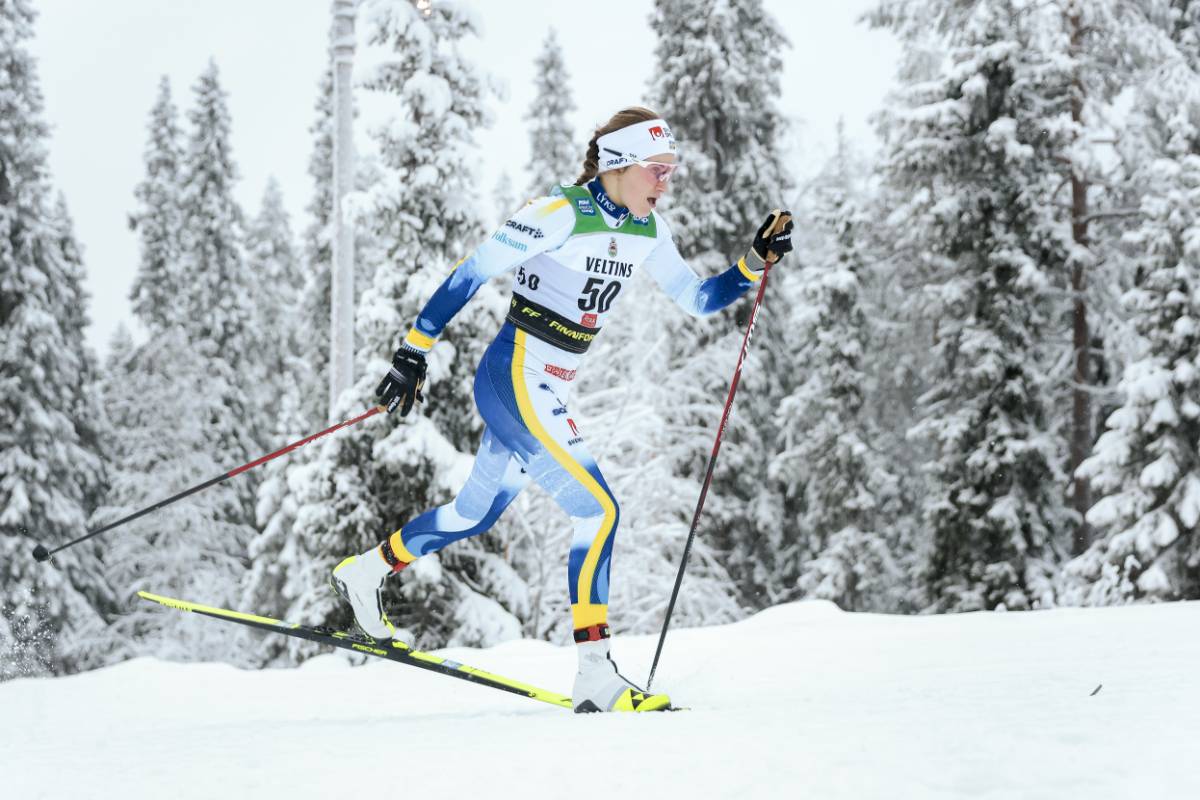
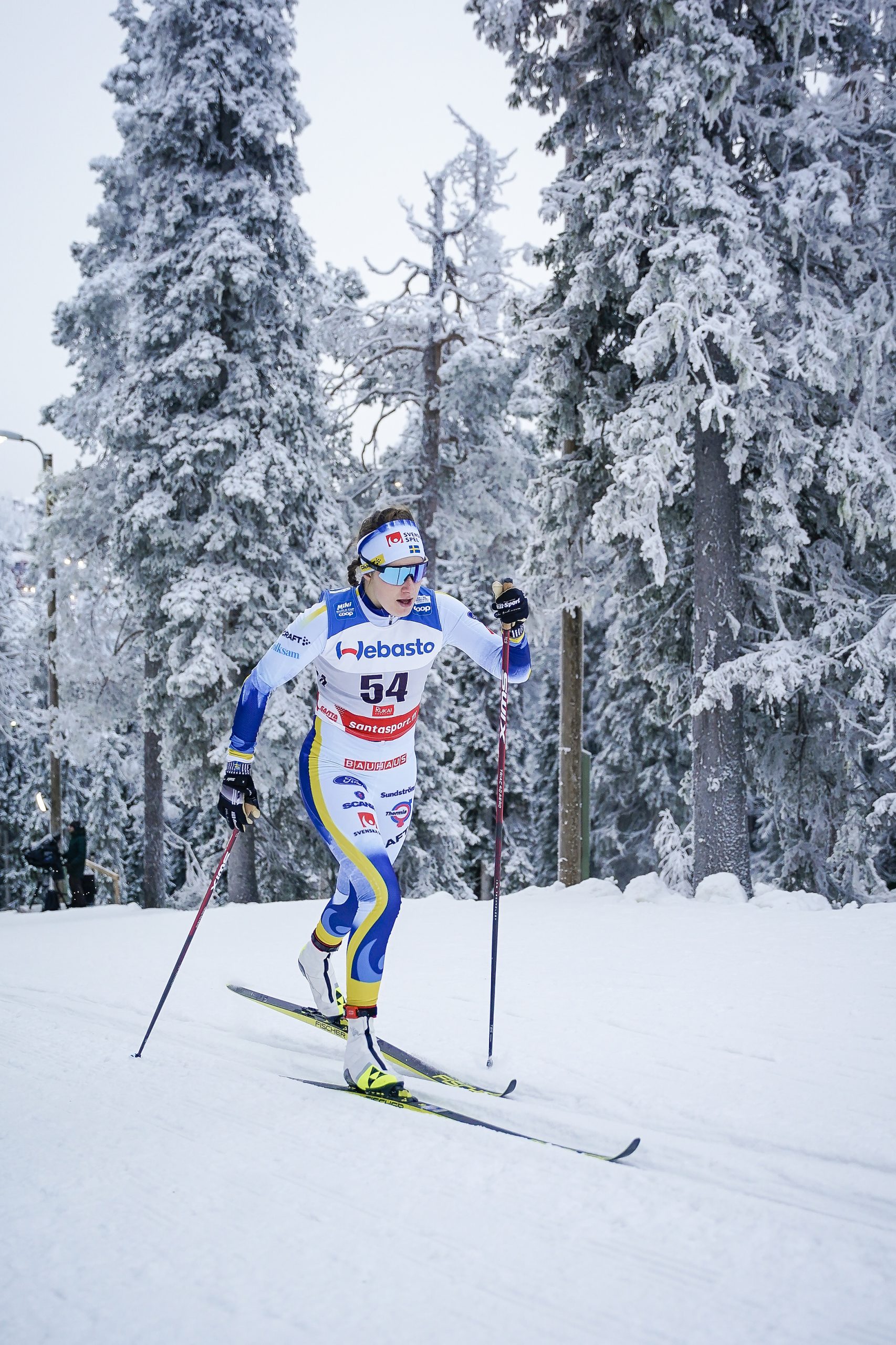
    Frida Karlsson (SWE) on her way to the 10 k Classic win in Lahti, Finland. (Photo: Authamayou/NordicFocus)

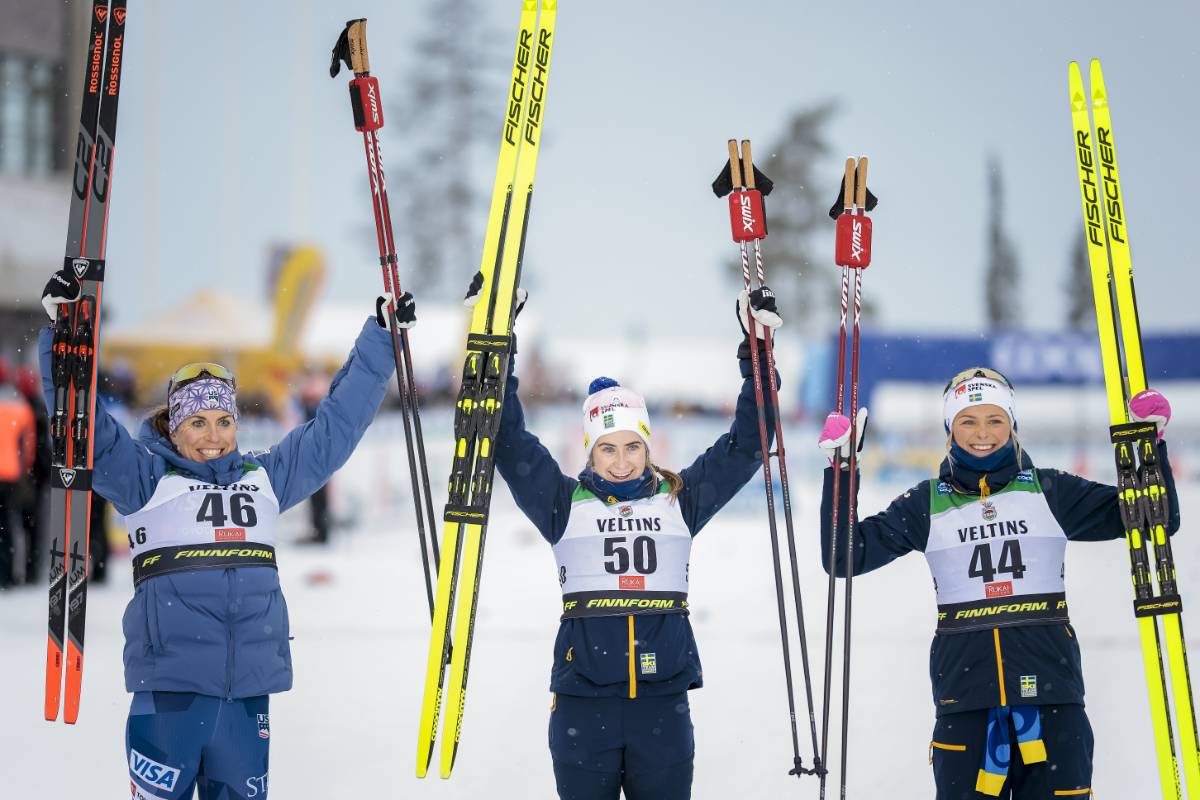
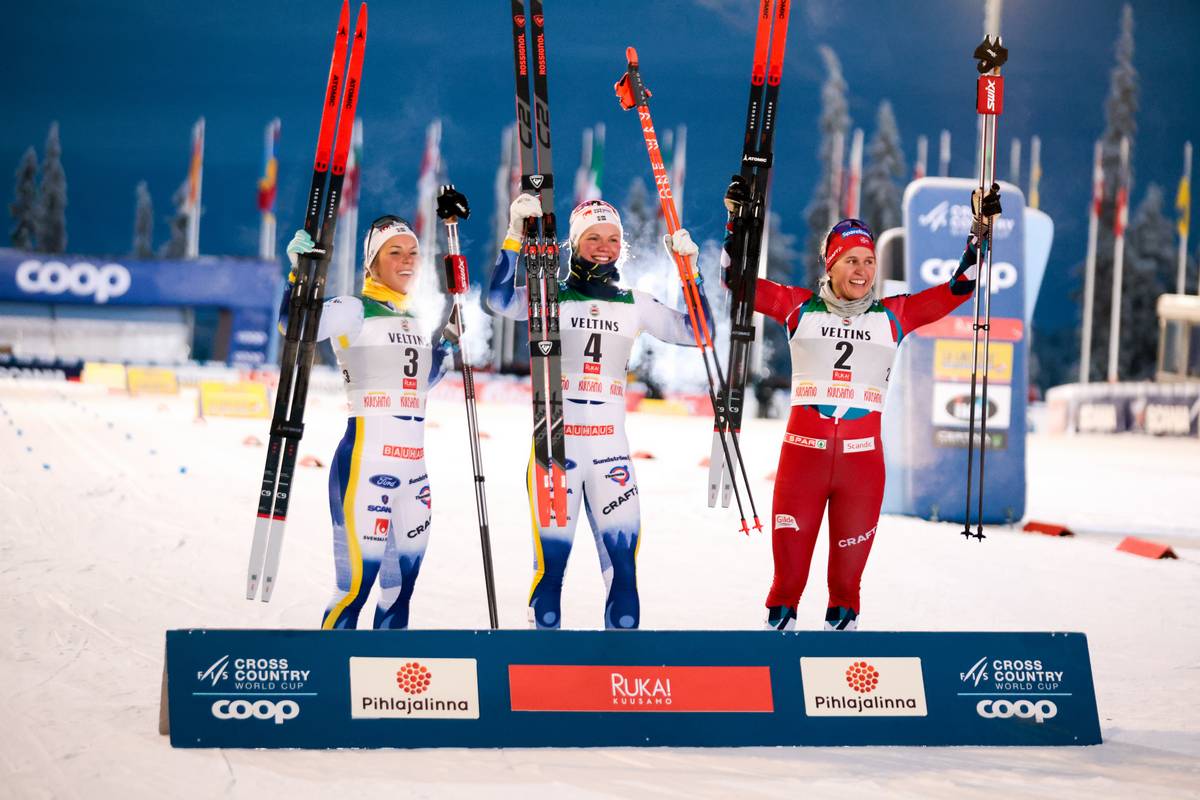
    Sweden’s Frida Karlsson powered to the victory in 25:57.6, edging teammate Linn Svahn by just over four seconds. Diggins followed in third, 6.2 seconds behind the winner, securing the 90th World Cup podium of her career — a milestone that came in her 375th World Cup start.

    The podium also represented a breakthrough for Diggins in a discipline she has spent years working on. Despite her long list of accomplishments, Sunday marked her first World Cup podium in a standalone 10-kilometer classic interval start.

    “The Lahti course hasn’t always suited my strengths in classic skiing,” Diggins said. “So it felt really cool to pull it together a bit more today.”

    The result allowed Diggins to maintain control of both major season-long competitions. With only three World Cup stops remaining this winter, she continues to lead Sweden’s Moa Ilar by 264 points in the Overall World Cup standings and by 188 points in the Distance standings, positioning herself strongly in the race for the sport’s coveted crystal globes.

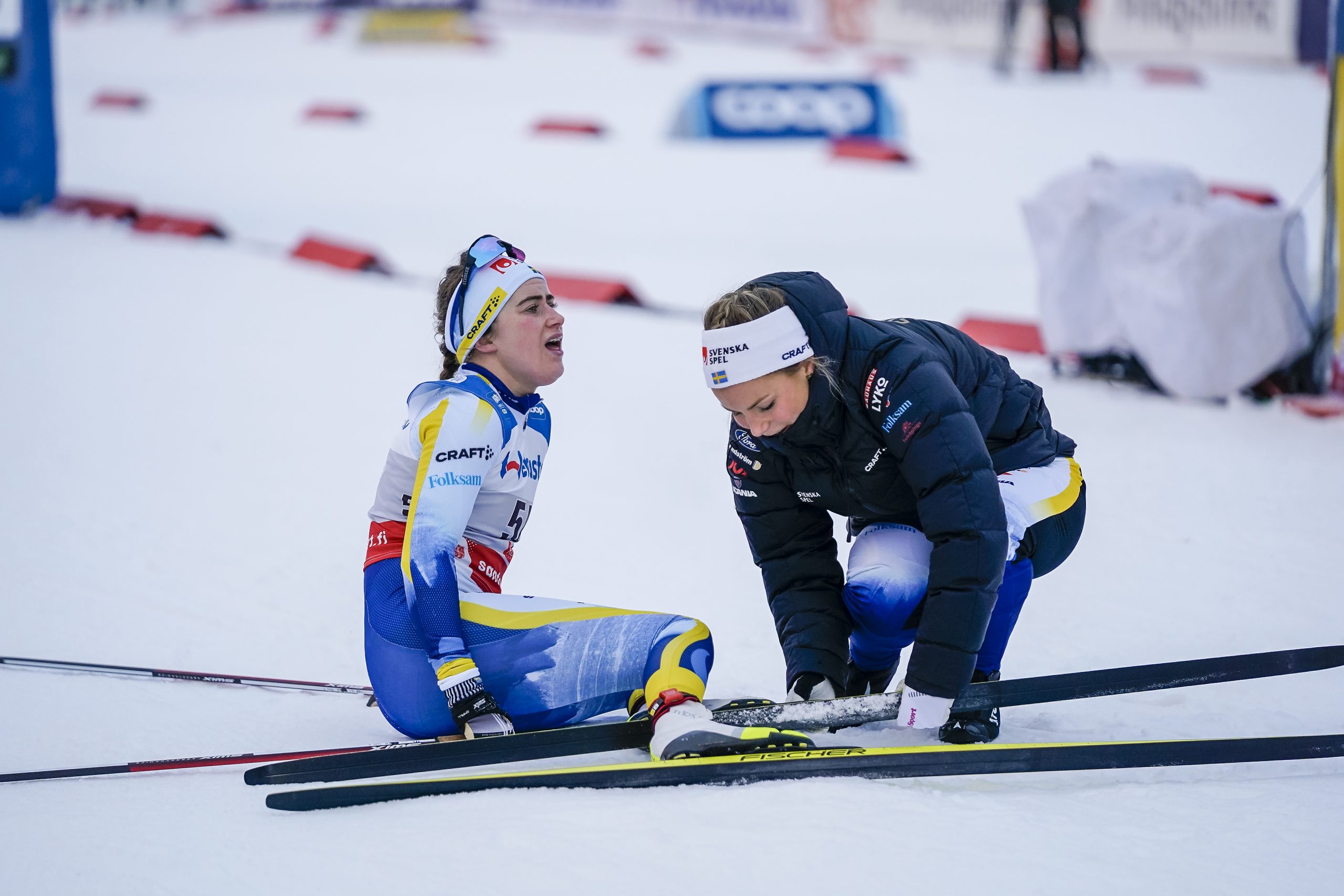
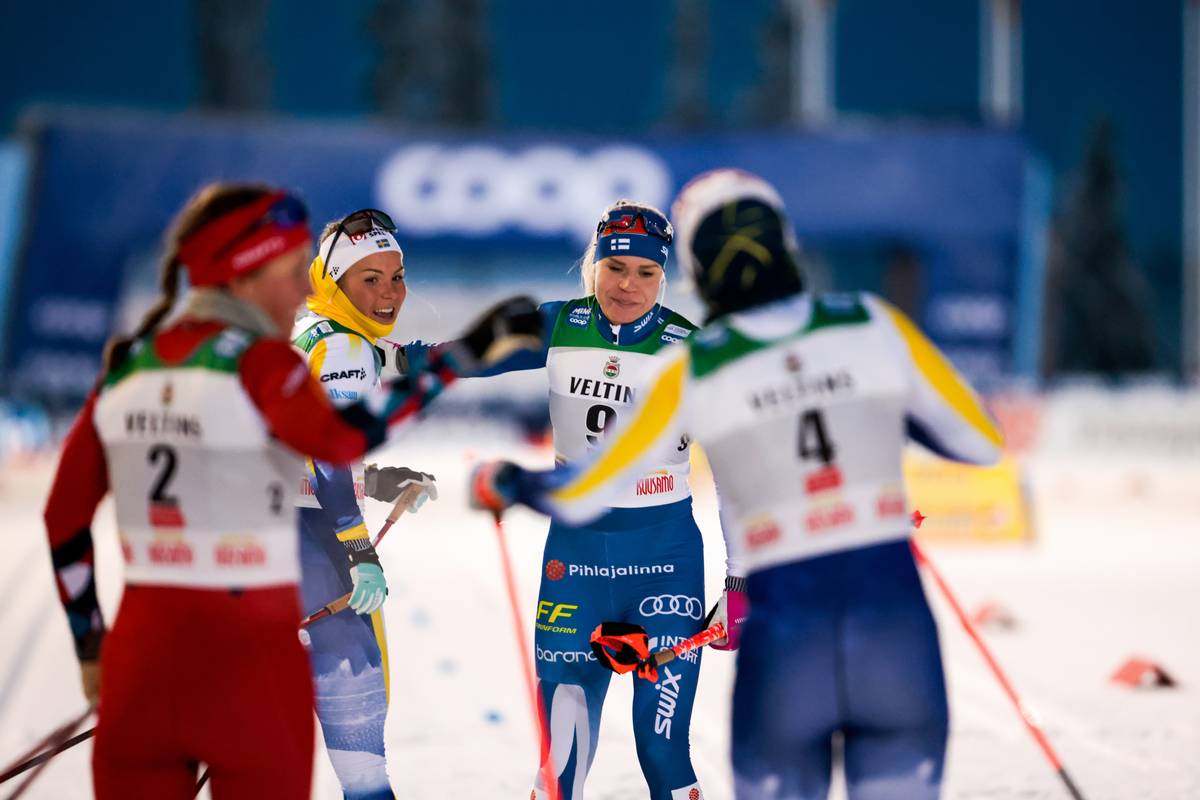
    Moa Ilar (SWE) and Linn Svahn (SWE), (l-r) reflecting at the finish. (Photo: Authamayou/NordicFocus)
    Svahn Sets the Early Benchmark, Karlsson Finishes the Job

    With the interval format — one athlete starting every 30 seconds — stretching the field across the Lahti course, the first major time to chase appeared almost immediately.

    Sweden’s Linn Svahn, starting with bib 5, was among the earliest contenders onto the course and quickly posted the fastest times through the early checkpoints. Known primarily as one of the World Cup’s dominant sprinters, Svahn skied aggressively over the opening kilometers and established the benchmark that much of the field would spend the next hour chasing.

    Her time held atop the standings as racer after racer attempted to match it.

    Later in the race, however, another Swede began to close the gap. Frida Karlsson, wearing bib 40, remained within seconds of Svahn through the intermediate checkpoints before edging ahead in the final kilometers.

    “I was just trying to stay in my own skiing,” Karlsson said afterward. “I heard it was between me and Linn, and I was super excited to get that fight.”

    Karlsson ultimately crossed the line in 25:57.6, securing the victory by 4.1 seconds over her teammate.

    The win came after a brief illness, which prevented her from competing in the Olympic 50 k, but Karlsson said she was eager to keep racing despite the setback.

    “I was sick after the Olympics, but I was really excited to keep racing and just do what I know best,” she said. “So I’m super glad to be here.”

    Diggins, starting shortly after Karlsson, kept herself in contention throughout the race, skiing within striking distance of the Swedish pair at each checkpoint before finishing 6.2 seconds back in third place.

    Linn Svahn (SWE) on her way to second place. (Photo: Authamayou/NordicFocus)
    Three Different Approaches to the Same Race

    The split times revealed three distinct pacing strategies among the podium finishers.

    Svahn, starting fifth, set the tone early. She posted the fastest time through the opening 1.1 kilometers and maintained the lead at the 3.4-kilometer checkpoint, immediately putting pressure on the rest of the field as they left the start gate.

    Karlsson, starting later in bib 40, remained just seconds behind through the early checkpoints, skiing a controlled opening before gradually closing the gap. By the middle of the race, she had moved into contention, and over the final kilometers, she proved strongest of all, ultimately pulling ahead to secure the victory.

    Diggins, meanwhile, delivered perhaps the most evenly paced effort of the three. She remained within striking distance of the leaders at every checkpoint — fifth at 1.1 kilometers, third by 3.4 kilometers, and still in podium position through the final lap.

    That steadiness proved decisive in the final standings. While the two Swedes battled for the win, Diggins’ consistent pace allowed her to secure third place and another important podium in the fight for the season-long crystal globes.

    Jessie Diggins (USA) sprints for the finish line. (Photo: Authamayou/NordicFocus)
    Diggins’ Classic Progress

    Diggins’ podium also reinforced one of the season’s quieter developments: the continued evolution of her classic technique.

    For much of her career, the American’s greatest moments have come in skating events, where her aggressive pacing and powerful finishing speed often prove decisive. But this season she has shown remarkable consistency in classic distance races, finishing in the top ten in every classic distance event on the World Cup calendar.

    Conditions in Lahti — warming temperatures and increasingly soft tracks — placed an additional premium on ski preparation, something Diggins was quick to acknowledge after the race.

    “I had great skis, which is a huge part of the equation, especially when the conditions get slushy,” Diggins said. “This podium really belongs to the team. I’m so grateful for all the hard work they put in.”

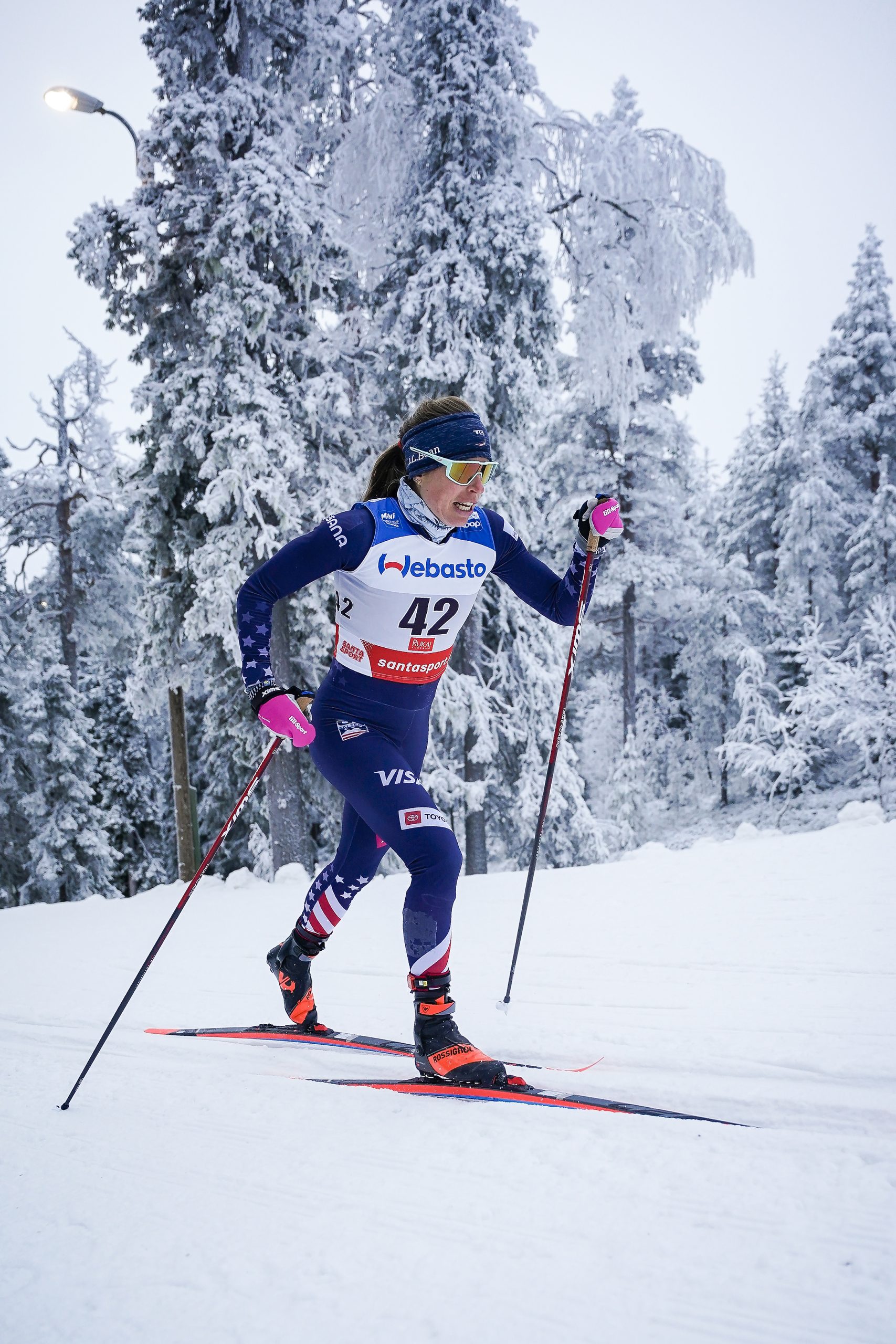
    Rosie Brennan (USA) on her way to 12th place. (Photo: Authamayou/NordicFocus)
    Brennan Continues Return to Form

    A bit further down the results list, fellow American Rosie Brennan continued a gradual return toward form after a long battle with illness that has affected much of her season.

    Brennan finished 12th (+38.6) in Lahti, a result that reflected both solid skiing and a cautious approach early in the race.

    “This whole process has really been a game of time,” Brennan said. “There have been many moments when I’ve wondered if I’ll ever feel normal again in my life. But the last three days are the most normal I’ve felt racing since December 2024.”

    The Lahti course, known for its steep climbs and technical demands, offered a test of efficiency in classic technique — a challenge Brennan felt she handled well.

    “Lahti requires really good technical skiing,” she said. “I felt like if I could relax and focus on my classic technique, that would give me the best chance.”

    Kendall Kramer (USA) working her way up one of the many Lahti climbs. (Photo: Authamayou/NordicFocus)
    Kramer Finds Lessons in the Lahti Hills

    For American Kendall Kramer — 42nd in 27:40.8 (+1:43.2) — the Lahti race presented a different kind of challenge: starting first.

    Wearing bib 1, Kramer had the advantage of pristine tracks before the course began to break down as temperatures warmed. But the early start also meant racing without reference splits from the rest of the field.

    “I was actually okay starting with bib 1 today, given the state of the tracks,” Kramer said. “They tend to break down as the race goes on, and the corners can get icy, so it was nice to have cleaner conditions early.”

    Without other athletes on course to gauge pacing against, Kramer said the race became more about skiing freely and trusting her own effort.

    “Racing without reference splits definitely makes pacing tougher, but at the same time it lets you ski freely and focus on your own race.”

    The steep Lahti climbs also highlighted the technical demands of classic skiing at the World Cup level.

    “The punchy hills were fun because I could really bound up them, which is something I haven’t done much in World Cup racing so far,” Kramer said. “But the sections where it turns into pure power striding showed me I still have a lot to work on.”

    Despite the challenges, Kramer described the experience as valuable for understanding the technical standards required to compete consistently at the highest level.

    “I’ve learned so much from racing here this season,” she said. “At the World Cup, every strength and every weakness gets highlighted, and that really helps show what to work on heading into the summer.”

    Julia Kern (USA) catches a rest from both the climbs and the sunlight. (Photo: Authamayou/NordicFocus)
    Kern Heading Home Early to Recover

    Julia Kern, who finished 51st — 28:11.4 (+2:13.8) — today, said she will return home early from the World Cup circuit as she continues working through health issues that have lingered since the Olympic races.

    “I’ve been battling my body on various fronts since the Olympics,” Kern said in a team media statement. “One of my strengths is showing up and continuing to try and believe despite the challenges, while also being patient and smart.”

    Kern added that she will take additional time to recover while seeking answers about her condition, with hopes of returning to competition at the Stifel World Cup Finals in Lake Placid later this month.

    “Right now, my body needs more time to recover and is in search of answers, so I’m headed home early with the hopes of being in a place to race in Lake Placid.”

    Lauren Jortberg (USA) and Katherine Weaver (CAN), (l-r) charge for the line. (Photo: Authamayou/NordicFocus)
    Jortberg Gets a Front-Row Look at Karlsson’s Pace

    For American Lauren Jortberg — 55th in 28:32.7 (+2:35.1) — the Lahti race offered a unique opportunity to measure herself against one of the sport’s best.

    Early in the race, Jortberg found herself skiing behind Sweden’s Frida Karlsson for several kilometers as the eventual winner was completing her second lap while Jortberg was still on her first.

    “I skied with Frida for about three kilometers, which was really cool,” Jortberg said. “She’s obviously a beast, and it was cool to hang with her and get a taste of what that pace actually feels like.”

    Jortberg said the experience offered valuable insight into the demands of racing a 10-kilometer interval start at the World Cup level, where pacing often means pushing near maximum effort from the start.

    “Ten-k pacing on the World Cup is basically as hard as you can go the whole way,” she said. “It’s about learning how to navigate that kind of effort and still ski your own race.”

    She added that the race reinforced both the progress she has made in classic technique and the areas she hopes to continue developing as she gains more experience at the international level.

    “I’m really proud of how my classic skiing is coming along,” Jortberg said. “There’s still a lot to work on, but it was definitely a good first start in a distance race.”

    Jortberg said she hopes to carry the fitness and lessons from Lahti into the next stop on the World Cup circuit in Drammen, Norway.

    Emma Albrecht (USA) giving it everything she can all the way to the finish. (Photo: Authamayou/NordicFocus)
    Albrecht Sees the Margins Up Close

    Further back in the start order, fellow American Emma Albrecht — 58th in 28:50.7 (+2:53.1) — experienced firsthand just how tight the margins can be in World Cup distance racing.

    “The tight margins were shown by skiers finishing at similar times,” Albrcht said after the race. “For me, I was not passed, and I did not pass anyone. Which meant the skiers in front and behind me were skiing at a similar pace to me.”

    Like Kramer, Albrecht said the steep Lahti climbs emphasized the technical demands of classic technique, particularly the efficiency required to stride uphill without losing grip.

    “The uphill sections are the most technical and demanding here,” she said. “The climbs in Lahti are steep, and striding up efficiently requires really good technique to avoid slipping.”

    For Albrecht, the race served as a clear reminder of the areas she hopes to refine moving forward.

    “One of my biggest takeaways is that I want to keep working on my striding technique and get better at adjusting my tempo based on the terrain.”

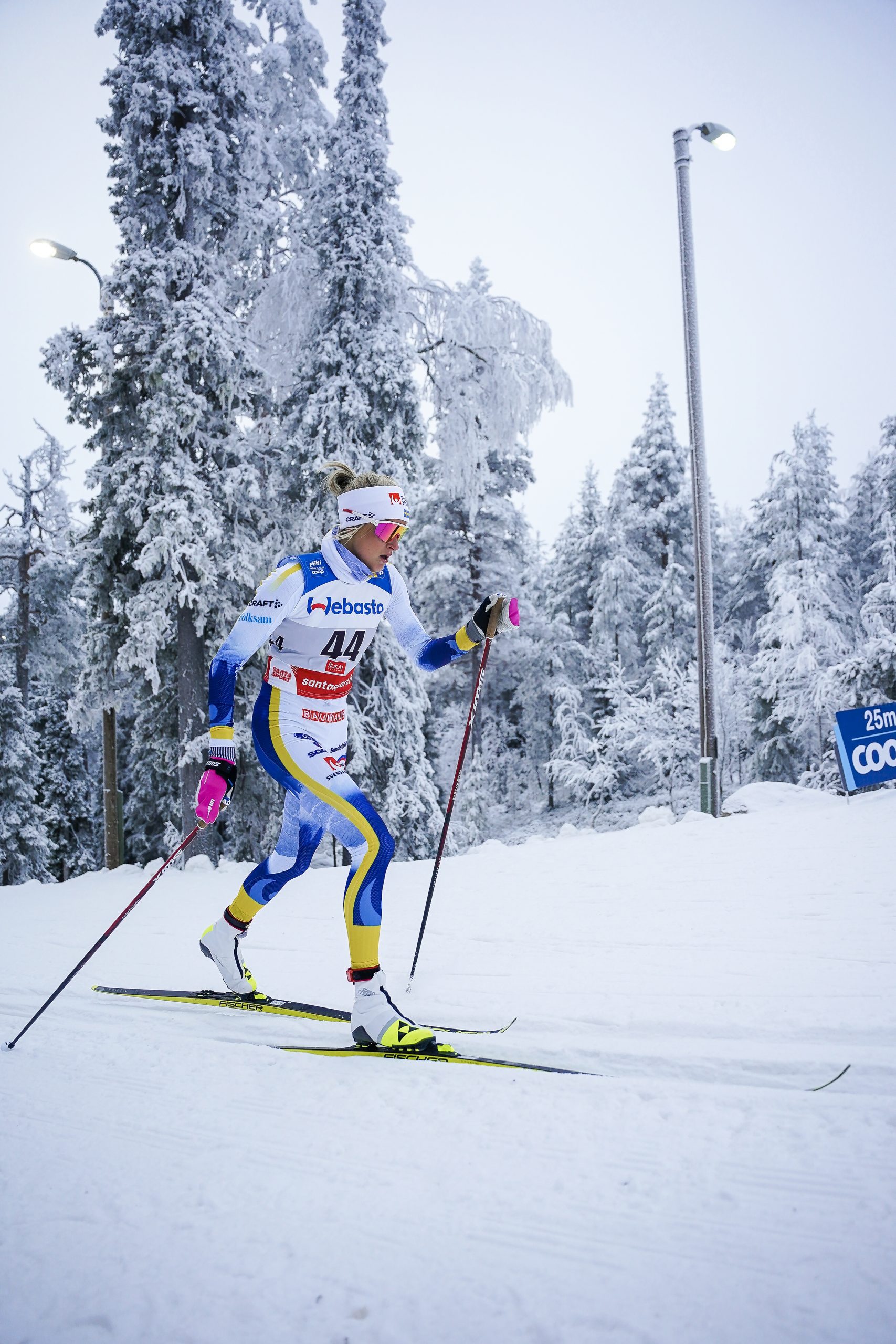
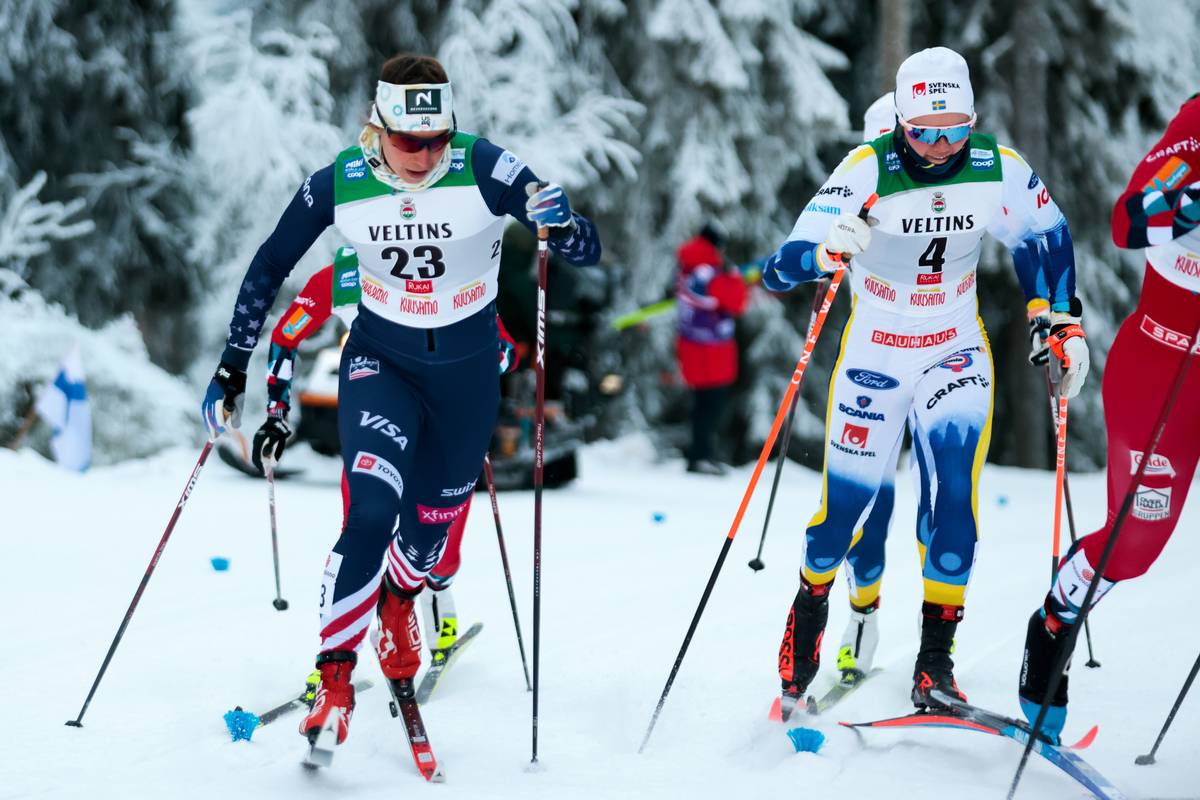
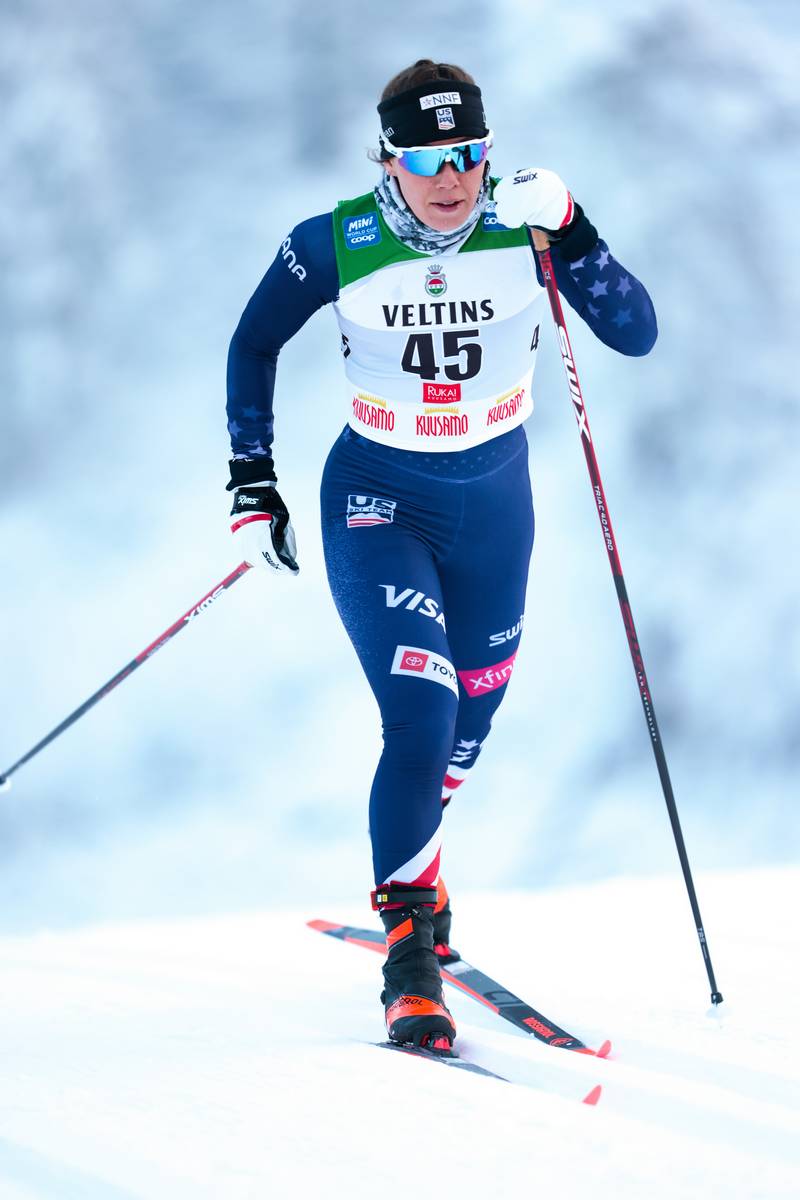
    Dariya Nepryaeva (AIN) and Novie Mccabe (USA), (l-r) come to the line. (Photo: Authamayou/NordicFocus)
    Other North Americans in the Field

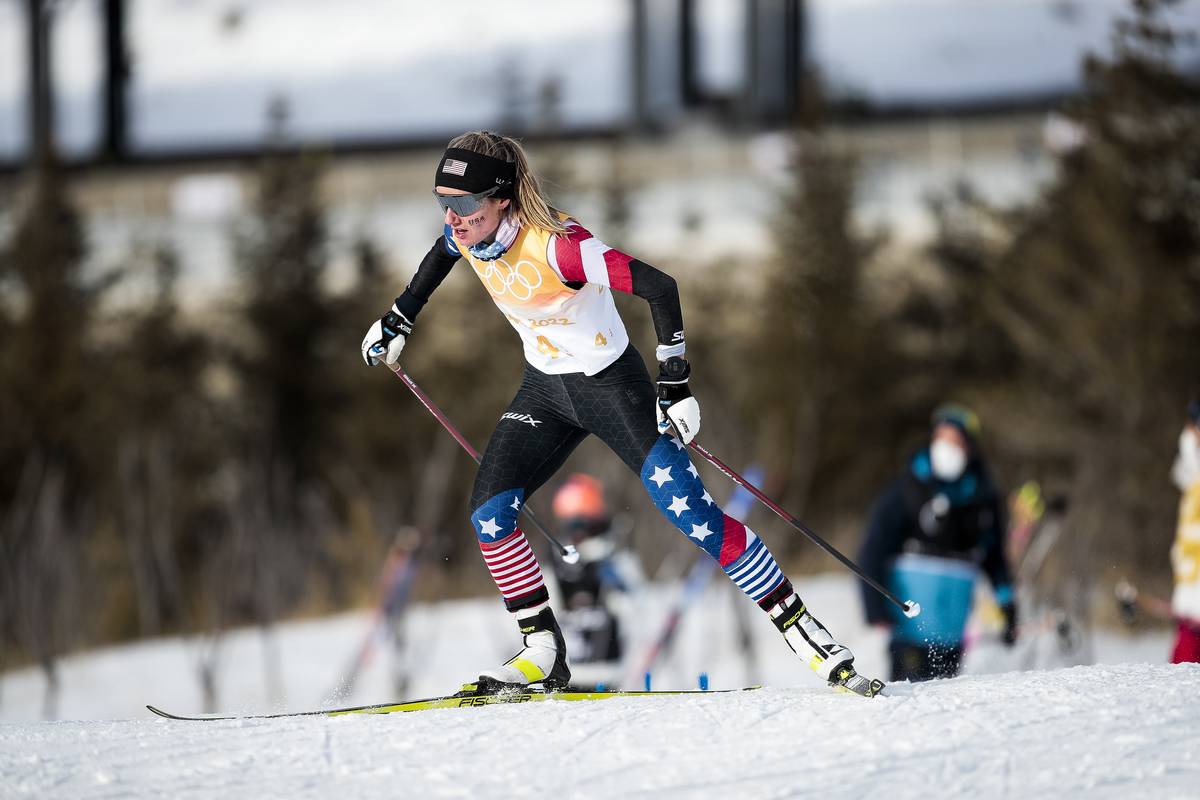
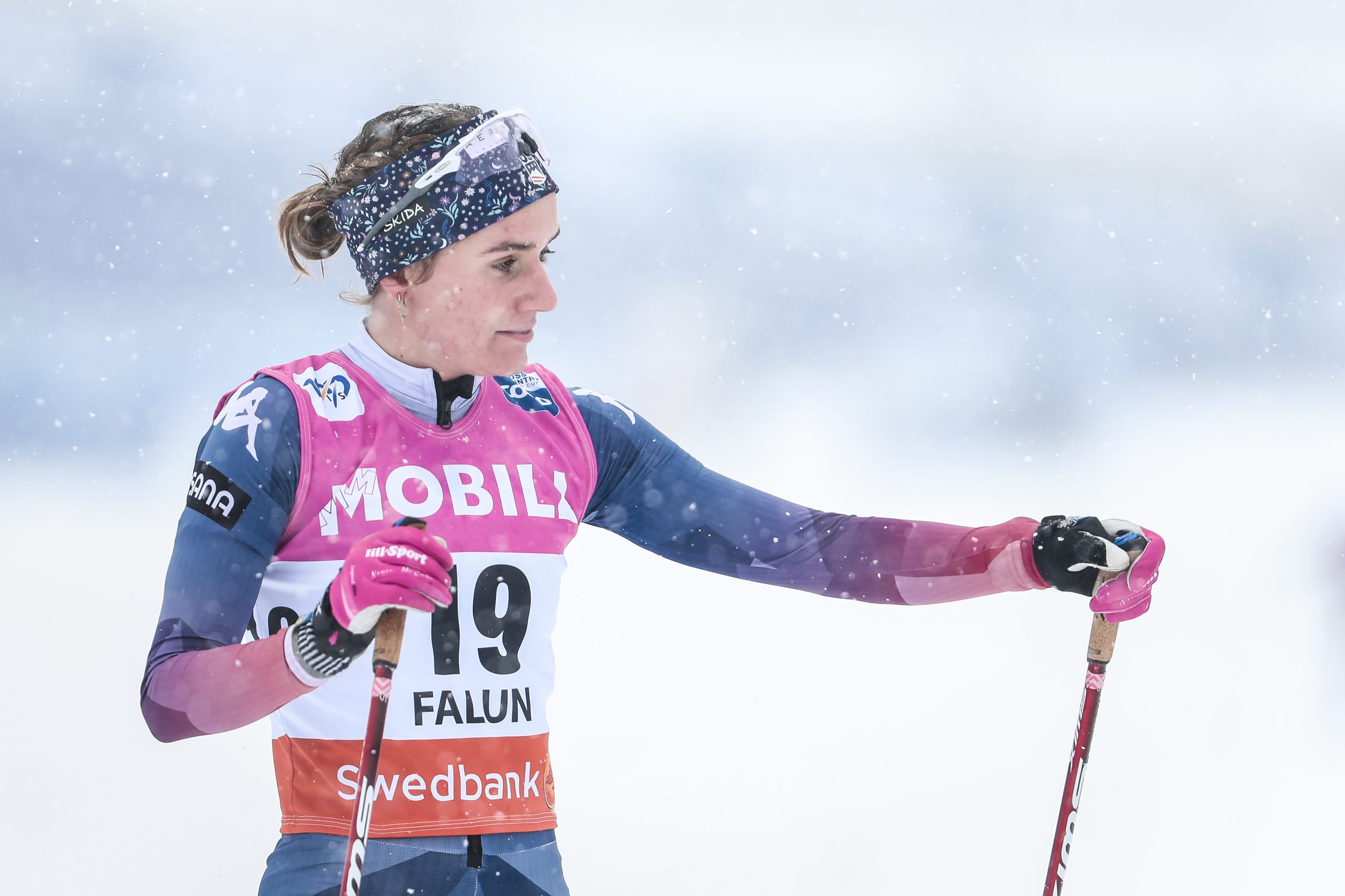
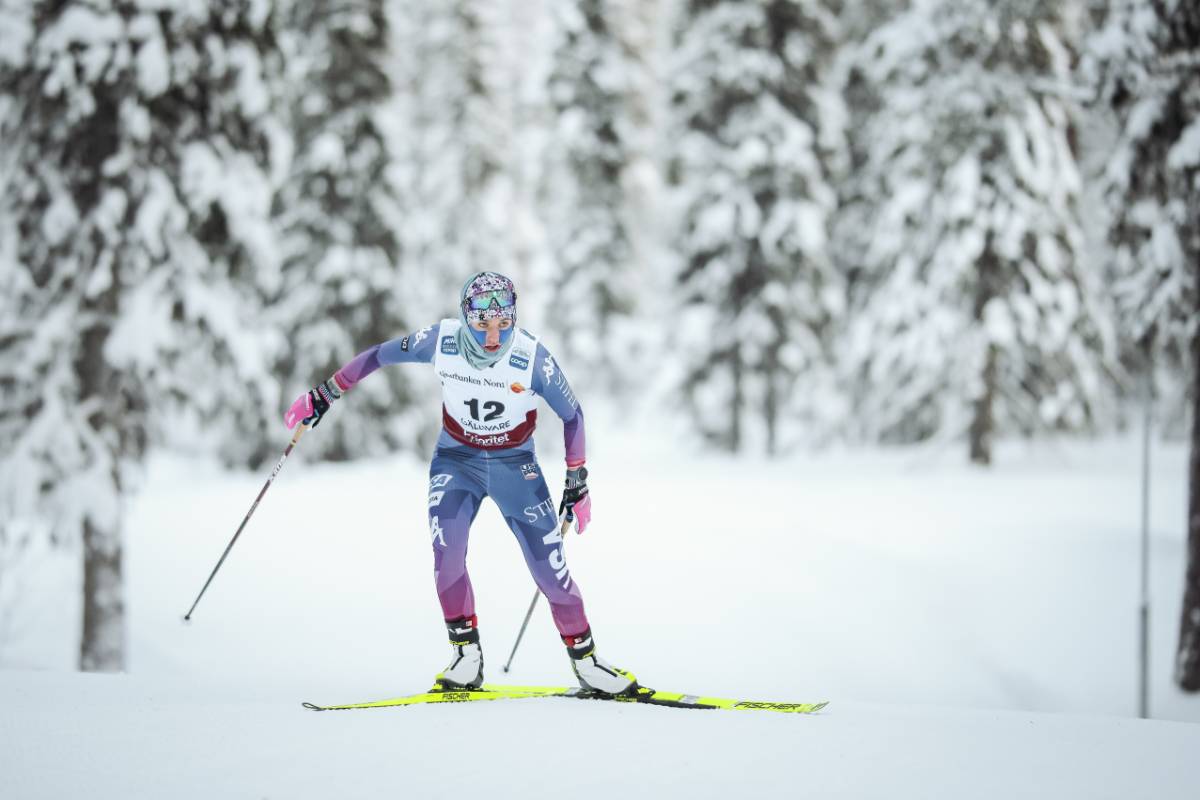
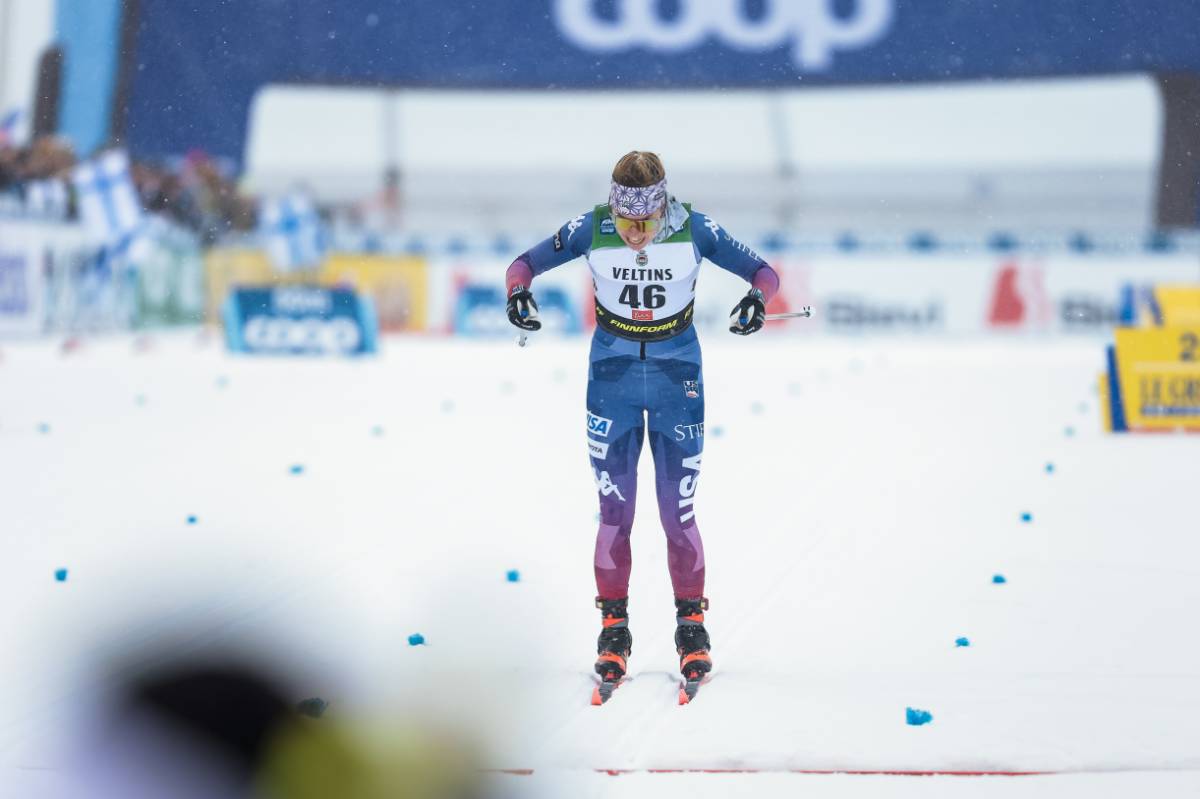
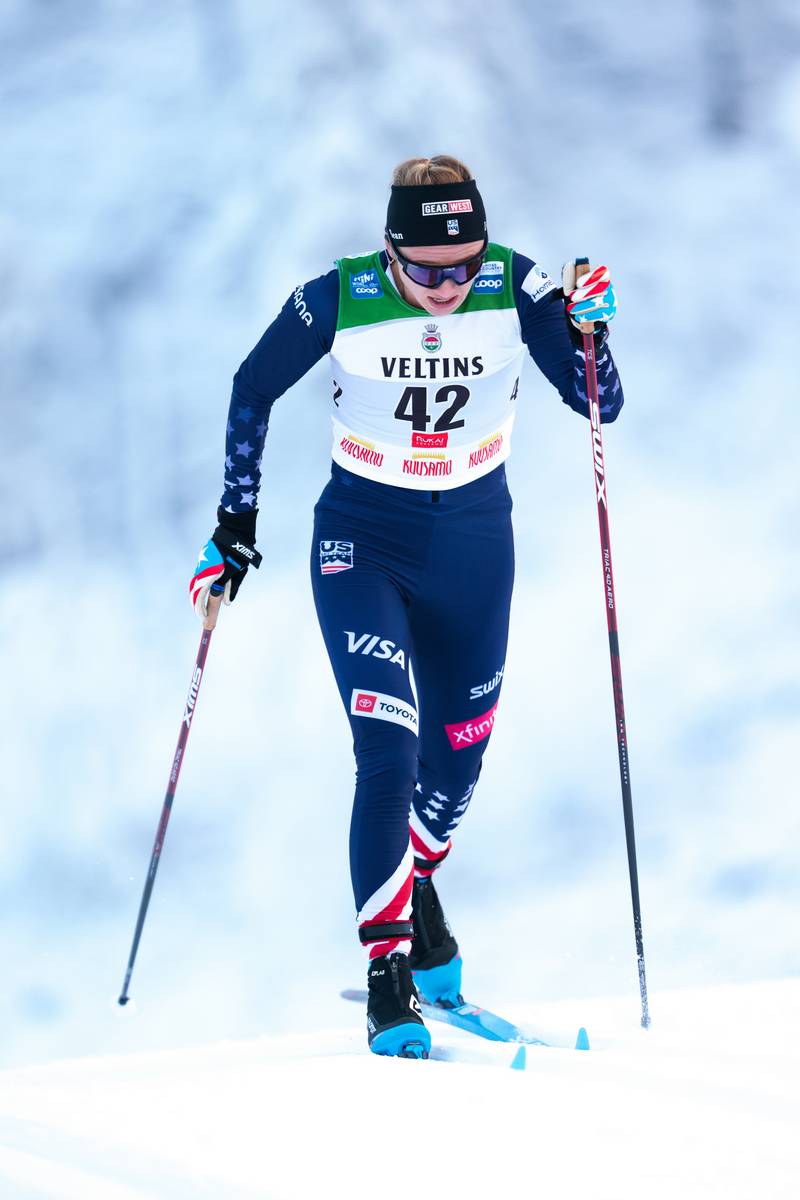
    Novie McCabe raced her way to 43rd in 27:45.0 (+1:47.4) in the 64-skier field.

    For Canada, Jasmine Drolet led the team in 41st place with a time of 27:39.8 (+1:42.2). Liliane Gagnon finished 46th in 27:56.4 (+1:58.8), and Katherine Weaver placed 59th in 29:00.9 (+3:03.3). Teammate Olivia Bouffard-Nesbitt, who had been listed on the start sheet, did not start the race.

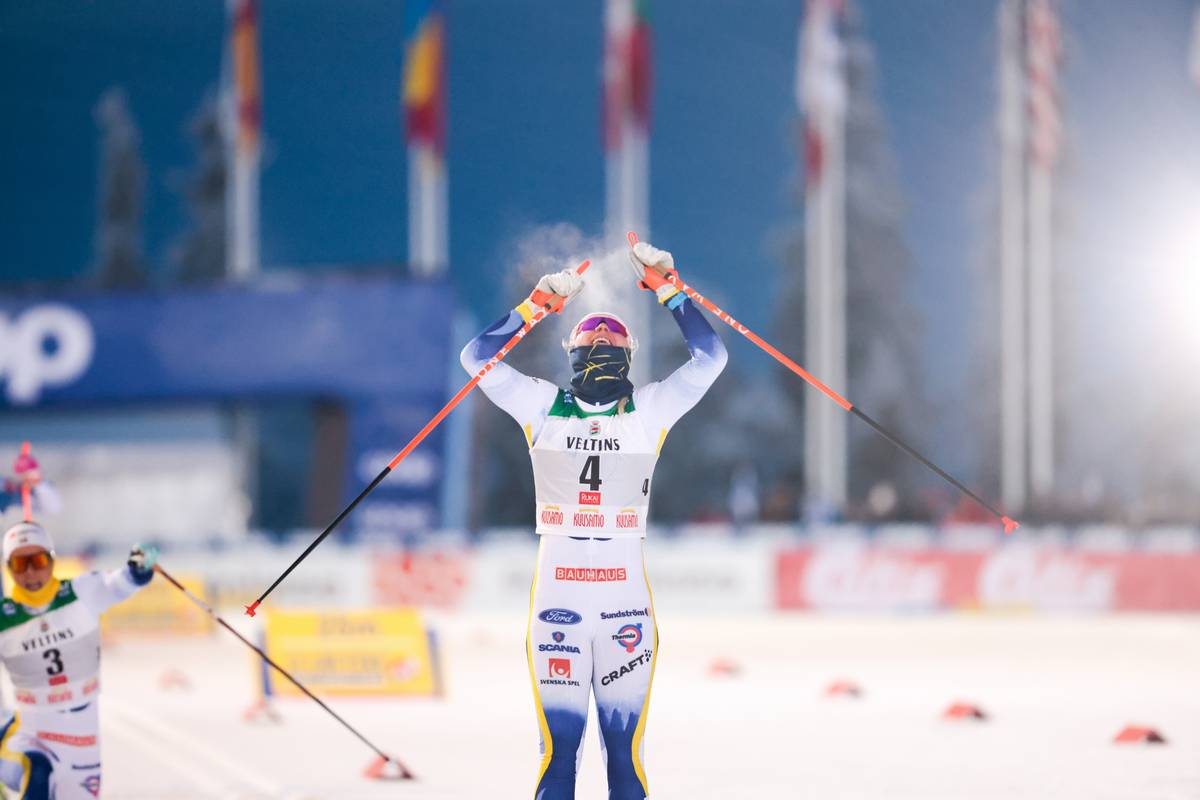
    Take a bow, Jessie Diggins (USA) . (Photo: Authamayou/NordicFocus)
    The Season’s Final Push

    Sunday’s race in Lahti brought us even closer to the end of the season, now with only two sprint races and three distance races remaining until the sport’s biggest prizes will ultimately be decided.

    For Diggins, the third-place finish represented more than another podium in an already historic career. It also reinforced the remarkable consistency that has defined her season. With top-10 finishes in every classic distance race this winter, she has transformed what was once considered a relative weakness into one of the foundations of her bid for both the Overall and Distance crystal globes.

    Three stops remain on the calendar: the classic city sprint in Drammen, Norway, the iconic 50-kilometer race at Holmenkollen in Oslo, and the Stifel World Cup Finals in Lake Placid, New York.

    For Diggins, those races now carry both competitive stakes and emotional significance. As the American continues what has increasingly felt like a farewell tour across the World Cup circuit, the crowds that gathered along the Lahti course on Sunday offered a glimpse of how much her career has meant to fans of the sport, not just in the United States, but all around the world.

    And as Diggins pushed across the final climbs toward the stadium — signs waving, glitter-clad children cheering from the side of the course — she did what she has done so often over the past decade: she kept fighting for every second and left everything she had, once again, on the course.

    Lahti Women’s 10 k Classic RESULTS


    Love Stories Like This? Help Keep Them Coming.

    Feature stories like this one take time, access, and care to produce. If you value thoughtful storytelling and independent ski journalism, please consider becoming a Voluntary Subscriber. Your support directly fuels the work we do to cover the people, places, and moments that make our sport special.

    Join the FasterSkier community!


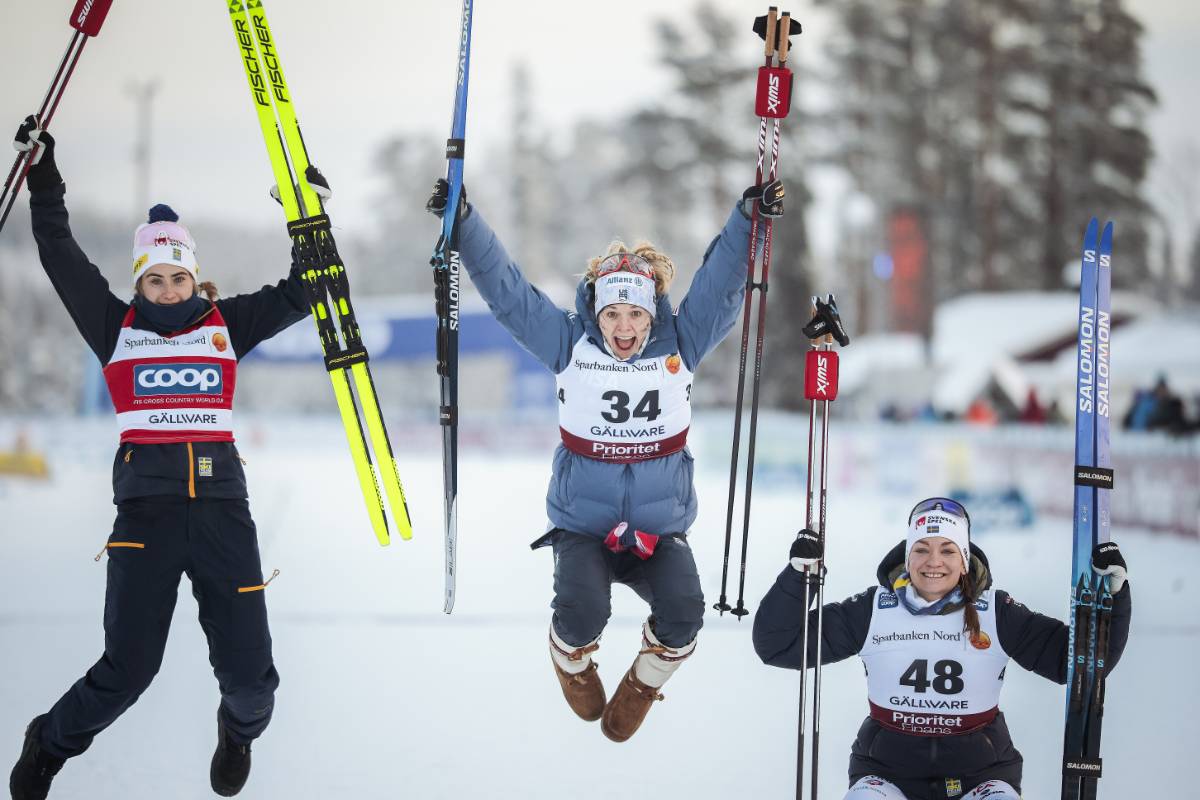
    Linn Svahn (SWE), Frida Karlsson (SWE), and Jessie Diggins (USA), (l-r) share the 10 k Classic podium in Lahti, Finland. (Photo: Authamayou/NordicFocus)
  • Chris Hecker and the Moment the Sun Came Out

    Chris Hecker and the Moment the Sun Came Out

    This article was made possible through the generous support of our voluntary subscribers.  If you value coverage like this, please support FasterSkier with a voluntary subscription.

    If you are a parent or coach and have been responsible for waxing skis for an important race — a state championship, a Junior National Qualifier — you know how stressful that can be. Now imagine it’s the morning of the Team Sprint at the Olympics, and you are responsible for Gus Schumacher’s skis. Feel your blood pressure rising yet?

    Welcome to the life of Chris Hecker, the US Cross-Country Ski Team service tech who leads the glide program and is Schumacher’s personal tech. Hecker, at this point, knows Schumacher well and that he has logged nearly 1,000 hours of training annually for years, and that he has dreamed of this specific day since the end of last season.

    “One of the most stressful moments actually came [on race day], about 45 minutes before the Men’s Team Sprint. I had selected the race skis for Gus and felt confident in the decision. At the time, it was clearly the best pair for the conditions.”

    Everything seemed to be playing out as Hecker had hoped, but then everything changed.

    “Then, about five minutes later, the sun came out. The course started to break down and got noticeably wetter. I still had a few minutes before beginning to wax, so I decided to run one more quick test. In the ten minutes between tests, the two top pairs kept getting closer and closer in performance.”

    These are the moments when experience, confidence, and a little tech magic can make or break a race. “In the end, I chose what was technically Gus’s second-best pair at that moment,” Hecker recalled. “As more athletes skied and the temperature continued to rise, there’s a good chance those skis actually became the faster option anyway.”

    Hecker was quick to point out that “Gus and Ben were on another level. Regardless of which skis Gus raced on, I’m confident the result would have been the same. They were [racing] on another level.”

    We may never really know, but maybe that decision did have something to do with Schumacher and Ben Ogden winning silver in the Team Sprint? For Hecker, it was a choice that was actually years in the making.

    Guided by family and noted mentors

    Hecker grew up in a family of skiers; his father, Mike, was a Pelton ski and Exel pole rep in the Midwest and had Chris on skis when he was just nine months old, “shuffling around and falling down.” Mike and his wife would pack the entire family, including Chris and his older brother Jeremy, and spend weekends traveling to different ski shows and venues. The parents told Chris and Jeremy it was their ‘vacation’, but in reality, it was just a family deeply invested in both the industry and the lifestyle.

    “So we were skiing from a really, really early age, and then we got into racing,” said Chris. When Chris was in middle school and high school, he raced for Anoka High School, in Minnesota, a northern suburb of Minneapolis. After graduating in 2013, he headed to St. Scholastica in Duluth, where he raced for three years under Chad Salmela and, in his senior year, under Maria Stuber.

    After graduating from St. Scholastica in 2017, Hecker took a job with Rex Ski Wax for the 2018 / 2019 season.

    “I worked with them for a year, spent a year on the World Cup being their racing service manager and research and development, kind of lead testing for all the new products, testing all the old products, and then walking around and working with the teams and saying, What do you need from us?”

    Hecker made himself available to World Cup teams, asking which products he could help with and which they thought were working well and which needed improvement. He continued this work for three full seasons before starting with the US Ski Team in 2020; this is now his sixth full season with the team.

    Two brothers… “Give me something weird.”

    Chris’s older brother, Jeremy, has kept the family tradition alive too, serving as a full-time employee of Pioneer Midwest and, in addition, as the domestic rep and race service lead for Rex ski wax.

    “We talk multiple times a week, and we get really deep into the weeds,” says Chris, who gives his brother lots of respect and praise. “He’s a really good wax tech, and sometimes you just need an idea from an outside source.”

    So when waxing domestically, Jeremy will ask his brother at the World Cup, “Give me something weird, give me something random to go out and test,” because he has all the normal, routine choices down.

    “He’ll always ask me for one random suggestion to try out for some of those race weekends. And sometimes it works, and sometimes it doesn’t.”

    For the most part, the two brothers talk about local races and how Jeremy can better support local skiers, since the products Chris is working on for the World Cup aren’t available to domestic skiers.

    “But it is also fun to talk about, when we have a really good day, like in Goms, or a really good day, like in the Val de Fiemme, on the final hill climb.”

    When that happens, Jeremy can spot it on the livestream and will call up Chris and ask, “Oh, what’d you guys do differently!”

    A lot more than two pairs of skis… like over 100

    In addition to being Schumacher’s personal tech, Chris Hecker is also responsible for Novie McCabe when she is on the World Cup and when she raced at the Olympics.

    In addition, Hecker is responsible for managing both athletes’ ski fleets. For McCabe, that means 38 pairs of skis and another 65 pairs for Schumacher, but even that can be variable, “like, Gus gets a ski [from Rossignol] maybe every other weekend or every third weekend because they’re always coming out with new prototypes and new skis.”

    McCabe is a Fischer-sponsored athlete, and they are admittedly a bit more controlled on allocating skis, but if Hecker and McCabe decide to “knock out a bad ski,” they can give it back to them and get another for her quiver.

    The new Rossignol skis arriving can introduce many more variables for Schumacher and Hecker to consider. As Hecker says, “ it can be new base material, new grinds, new core materials… the construction of the ski can be different.”

    Every little tweak has a purpose, “maybe it’s an easier kicking classic ski, maybe it’s a faster base material on a state ski.” As Hecker continues… “Maybe it’s a different laminate on a zero ski,” and what becomes quickly obvious is that all of these subtle variations make for endless possibilities.

    Building a rapport

    Hecker and Schumacher have been working together for two years now. Last season, Hecker was not responsible for another athlete, so he could focus on Schumacher, and the two quickly bonded.

    From the beginning, “working with him was really fun,” said Hecker . “We were trying to build a rapport as a new athlete and tech combination between the two of us.”

    Schumacher’s previous tech had left for the Swiss Biathlon Team, but Hecker and Schumacher found a lot of success last season with several top 10s and a podium in Falun, Sweden. As they started this season, they got right back to work.

    “Then starting this year, it was like jumping right back into it.” The two had a full year of experience to build on, and the dialogue and descriptions began to get more dialed, which is critical in the relationship between a tech and an athlete.

    Hecker began to know what Schumacher “likes for kick in skis, what feeling and stability he likes on skate skis,” and the two have been able to build that “innate rapport” which leads to a trusting relationship.

    As Hecker puts it, “[Schumacher] is one of the most astute athletes that I’ve worked with. He always comes with a question or two on race day. ‘Do you think we should try testing over on this side of the course instead of that side of the course, because I’m really trying to execute a plan here. Can we try focusing on glide for this half of the course, and maybe do a couple of glide outs here?”

    Hecker continues to describe how impressed he is with Schumacher as an athlete:

    “And so he’s always equally thinking as a wax tech and as an athlete when we’re out skiing together, and he’s really trying to dissect where the best places to test are. And it’s not just my job to revive the skis for him, but it’s also his job to pick the correct skis for him. And so he needs to know almost as much as I do about his skis and what is working and why it’s working, because ultimately we have to come to the decision together. He is racing, not me, and so we have a really cool relationship together to kind of pick and choose what we want to race on as a team.”

    Learning what he likes instead of what you like

    At this level, picking the right ski for an athlete is not just about what is fastest. It is also about picking a ski that responds the way the athlete prefers, and that matches the way a skier races.

    For Schumacher, that means a ski that is “extremely stable and forward tracking.” Hecker knows the way Schumacher skis, and how “when he pushes off to the left or to the right, and he goes fully onto one ski, he wants it to go straight.”

    “He doesn’t want the tip to move at all. He just wants it to point and shoot straight.”

    That isn’t a characteristic Hecker is personally always looking for in a ski, but he knows that’s what Schumacher wants. “So when I’m looking and testing without him some days, I say, ‘Okay, this ski is for sure going to be moving on because this feels better for him.’ And so we kind of have differing opinions sometimes on feeling, because I like a slightly different ski.”

    For Hecker, though, what is most important is that he understands not just what will ski fast, but also what will work best for Schumacher in different conditions, based on how he will race.

    “On a really firm course, he’ll look for this ski that just goes straight. And I think the reason why he likes that is that he will free skate a lot and likes being able to just push with his legs. And he’s so strong at that, and so relaxed when he does it, and so he can conserve a lot of energy.

    So it’s a really cool technique change from him, because I don’t think a lot of people utilize that on the men’s field. You see a lot of people always V2ing, and you’ll see him kind of free skating in the middle of the pack, just relaxing his upper body and giving half of his body a rest.”

    Inside the wax truck: how race morning actually works

    On a stable day, glide testing is fairly methodical.

    “We usually have four fleets of skis that go out,” Hecker explained. “Eight structure skis, eight paraffin skis, eight topping skis, and four to six application skis.”

    Before any athlete even gets to the venue, there is what the service team calls a “thinking period.” Jason [Cork], Tim [Baucom], Hecker, and anyone else in the truck who wants to join in, gather around a table with wax options.

    “We’ll put maybe 10 to 12 waxes in,” Hecker said. “Eli [Brown] might give us a wax. Oleg [Ragilo], our head of service, might give us a wax. Bernie [Nelson] might give us a wax. Then at the end of the table, it’s on me to narrow it down.”

    Ten or twelve become eight after the team removes the overlapping options. Some are eliminated because something similar tested better earlier in the week. Predictability and durability matter as much as outright speed.

    Structure follows a similar pattern. Baucom pulls 10 or 12 patterns before narrowing to eight that fit the day’s snow. The brainstorming narrows the options, then the skis go outside for testing.

    When results come back, they’re measured in inches and sometimes just two or three separate first from third.

    “If there are three that are really close,” Hecker said, “we might race on third place. Even if it’s two inches behind.”

    Because two inches in early testing might not matter if the wax is more durable, safer, or better, as temperatures rise and the track grows glazy under the skis of a throng of World Cup skiers.

    “It’s up to us to make a call,” Hecker said. “This is the wax we’re going to run today, even though it may not have won.”

    Once the athletes start warming up and testing skis, the techs have to add that feedback to the equation as well. Often, Hecker has one ear tuned to Gus’s feedback and the other to the incoming results.

    “When Gus is racing, a lot of these tests are going on,” he said. “I have to have my head on both testing skis with Gus, but also on the results that are coming in.”

    A call might come mid-session: pair 47 instead of pair 45. At this level, it’s small changes, constant recalibration, and decisions layered on decisions.

    For spectators, the race begins at the gun. For the glide team, it began hours earlier — likely in the dark — and never really stops until the racers reach the first checkpoint in the race and the team knows whether their choices put them in the race or not.

    “It’s definitely the hardest part of this job.”

    For Hecker, this will be his last season as part of the US World Cup service team.

    “It’s been a thing that I decided at the end of the year last year,” Hecker said. “I gave a fairly big heads up to the team in Bend in April.”

    This season marks the end of a third Olympic cycle for Hecker, but it is not that moments like the Olympic Team Sprint are wearing him down. That is not the hardest part of the job. The hardest part of the job is being away from his wife, Katie, family, and his dog.

    “It’s time to be at home with my wife and be more with my family and be back at home with my dog. And, yeah, right now it is time to retire after this year, and we’ll see what happens after that.”

    Like other staff and coaches on the US Ski Team, Hecker was able to sneak home twice so far this season, but those opportunities are few and far between.

    “Yeah, it’s, it’s definitely the hardest part of this job, not that waxing isn’t hard, but being away from your family, being away from loved ones for so long. It’s really hard.”

    This decision wasn’t made lightly because there are many things about being on the World Cup that Hecker will miss. Most significantly, the US Ski Team has done an amazing job creating a unified family.

    “It’s hard because this team is like a second family. Being away from these guys for long stretches is tough. I love working with them. When you like the person you’re rooming with every weekend, that means something. So leaving the team feels like leaving family.

    But I know it’s the right decision for me. I’m getting tired. There was a time when traveling to Europe was exciting, going to new venues, seeing new places. That was fun.

    Now it’s, ‘Okay, we’re going back to Val di Fiemme. We’re going back to Oberhof. We’re driving the wax truck to Oslo again.’ Last year, I realized I wasn’t looking forward to the travel anymore. I’d be excited once I got there, but the constant moving was wearing on me. That’s when I knew it might be time.”

    Gus Schumacher and Ben Ogden (USA), (l-r) celebrate their Olympic silver medal in the Team Sprint in Tesero, Italy. (Photo: Vanzetta/NordicFocus)
    On another level

    When the sun came out in Italy last Wednesday morning, it forced a decision. A choice was made to go with a slower pair of skis, but that decision was not a whim; it was not a swing for a bases-loaded grand slam to win the World Series. It was choosing an option that presented itself through a trusted process, through seasons of tested routines, and having the experience to trust instinct.

    By the time Gus Schumacher and Ben Ogden pushed off the line in the Team Sprint, the work had already been done, in the dark, in the truck, in inches measured on a test lane. Structures narrowed from twelve to eight, waxes debated and eliminated.

    The silver medal will always belong to the athletes. They were, as Hecker put it, “on another level.”

    But long before Schumacher chased down Johannes Høsflot Klæbo on the anchor leg, before the crowd roared in excitement, before the final sprint up the Zorzi Climb, there was a moment when the sun came out, and a technician had to make a decision.

    And one detail to remember when the story of the 2026 Olympic Team Sprint is retold for years to come is that the United States service team, on that day, was also ‘on another level.’


    Help Support Our Olympic Coverage!

    FasterSkier will have our own Nat Herz on the ground at the Olympics, which, to be honest, is a very big financial lift for us. If you value the thoughtful work and access FasterSkier provides at championships like this one, please consider becoming a Voluntary Subscriber. Your support directly fuels the work we do to cover the people, places, and moments that make our sport special.

    Join the FasterSkier community!


  • Matintalo First, Diggins Second: A Classic 20 K Test Before the Olympics

    Matintalo First, Diggins Second: A Classic 20 K Test Before the Olympics

    This coverage is made possible through the generous support of Marty and Kathy Hall and A Hall Mark of Excellence A Hall Mark of Excellence Award. To learn more about A Hall Mark of Excellence Award, or to learn how you can support FasterSkier’s coverage, please contact info@fasterskier.com.

    Emma Ribom (SWE), Moa Ilar (SWE), Kerttu Niskanen (FIN), Karoline Simpson-Larsen (NOR), (l-r) lead early in the women’s 20 K Classic Mass Start in Goms, Switzerland. (Photo: Authamayou/NordicFocus)

    The sky above the Goms Nordic Centre on Sunday morning had the washed-out look of winter at altitude — pale and reflective. Snow had fallen overnight — not enough to transform the valley, but enough to affect ski behavior. The tracks were glazed in some places and soft in others, offering a surface that challenged kick, balance, and restraint.

    This was the third and final race of the last World Cup weekend before the Olympic Games. The final challenge came in the form of a 20-kilometer Classic Mass Start — a distance long enough to punish impatience, short enough to reward precision. In many ways, it felt like a rehearsal, a partial preview of the Olympic 50 k to come, even as two of the discipline’s defining figures — Sweden’s Ebba Andersson and Frida Karlsson — were notably absent.

    Fifty-six women started. Not all of them finished. None of them were anonymous by the time the race ended.

    Jessie Diggins (USA) and Astrid Oeyre Slind (NOR), (l-r) got away early in the first lap before being brought back by the chase pack around 6.5 K. (Photo: Authamayou/NordicFocus)
    An Early Question — and a Fast Answer

    From the opening kilometers, the field confirmed what the course profile had suggested: this would be a race shaped less by outright speed than by rhythm and positioning. Short climbs arrived in quick succession, descents offered only brief relief, and the peloton stretched and compressed like an accordion with every change in gradient.

    The first clear question of the day was posed early.

    On the opening lap, Norway’s Astrid Øyre Slind moved decisively off the front. Jessie Diggins, wearing bib one and leading both the overall and distance World Cup standings, responded immediately. For a moment, the two skied clear — a clean, purposeful break that suggested collaboration rather than desperation.

    The gap grew briefly, then stalled. By roughly 6.5 kilometers, the chase pack — patient, organized, and unwilling to let the race fracture too soon — closed the door. The break dissolved without drama, but not without meaning. The message was clear: separation would be earned later, not gifted early.

    Through the first full lap and into the second, the splits told a consistent story. No one was allowed to escape. The front group remained compact, with the top ten separated by only a few seconds at successive checkpoints. Every surge was answered. Every acceleration absorbed.

    Karoline Simpson-Larsen (NOR), Dariya Nepryaeva (AIN), Katharina Hennig Dotzler (GER), Johanna Matintalo (FIN), and Kerttu Niskanen (FIN), (l-r) work to bring back Diggins and Slind. (Photo: Authamayou/NordicFocus)
    The Long Middle: Where Races Are Actually Won

    What followed was the part of mass-start racing that rarely makes highlight reels but defines outcomes: the long middle.

    The snow conditions amplified this dynamic. The fresh layer over a firmer base rewarded good kick but punished over-striding. Downhills carried enough draft that working alone was inefficient. On climbs, being out of position meant burning matches simply to stay attached.

    Julia Kern spent much of this phase skiing in between packs — strong enough to feel underutilized, cautious enough to avoid overreaching.

    Julia Kern (USA) and Tiril Udnes Weng (NOR), (l-r) trying to maintain contact. (Photo: Authamayou/NordicFocus)

    “Today’s race was definitely a really hilly one, and not that fast, given the new snow,” Kern said afterward. “The tracks were a bit glazed, but also powder. The techs did a really good job giving us great kick, and I really needed that for how much climbing there was.”

    She described a race defined by indecision forced by circumstance rather than confidence.

    “I skied a lot of the race kind of stuck in between two packs,” she said. “In the second lap, I wasn’t sure if I should really go with the pack and risk it. I didn’t want to blow up, especially at semi-altitude. It was just hard to say with such a long, slow race.”

    When a small bridge attempt formed later in the race, Kern hesitated — not from fear, but from realism.

    “It was one of those days where I was feeling stronger than the pack I was skiing in, but not quite sure I could keep up with the pack in front,” she said. “They started to slow down, so it was a little bit of yo-yoing.”

    For Kern, the result — 16th — came with clarity rather than frustration. The margins were small, the lessons specific, and the work ahead clearly defined.

    Hailey Swirbul (USA) coming up the final climb with teammate Kendall Kramer (USA) slightly behind. (Photo: Authamayou/NordicFocus)
    Moving Forward from the Back

    If Kern’s race unfolded in the gray area between groups, Novie McCabe and Hailey Swirbul experienced the race from its deepest end.

    McCabe started with bib 57. Swirbul with 58. Both expected chaos early — and neither panicked when it arrived.

    “I kind of expected the accordion,” McCabe said. “I talked to my tech before the race, and he thought it would be a good idea to stay calm early. When it strung out, that’s when I should try to move up.”

    That patience paid dividends. As the field gradually fractured, McCabe began to advance — not in dramatic surges, but in deliberate steps.

    “I tried to push up to whoever was ahead, then tuck in and rest,” she said. “Eventually, I got into a good group with Catherine Stewart-Jones and some others. At that point, it was about hanging on a little more.”

    The effort came at a cost. McCabe admitted she was suffering late, but also recognized the value of the experience.

    “It was nice to have such a good classic skier to ski behind and try to relax in there,” she said.

    Swirbul’s approach mirrored that composure, shaped by perspective earned through time away from the sport.

    “The start of the race actually didn’t feel stressful to me,” she said. “There’s not much you can do to move up until it breaks up a little bit, so I took that as an opportunity to relax and work into the race.”

    She broke the race into manageable pieces.

    “I like trying to pick people off in a mass start,” she said. “It helps to focus on closing one gap at a time.”

    Swirbul finished 24th, McCabe 22nd — both having moved forward through nearly the entire field.

    Samantha Smith (USA), Hailey Swirbul (USA), and Rosie Brennan (USA), (l-r) early on in the women’s 20 K Classic Mass Start in Goms, Switzerland. (Photo: Authamayou/NordicFocus)
    Rosie Brennan: The Value of a Steady Day

    For Rosie Brennan, Goms was not a race defined by sharp inflection points or dramatic movement through the field. Instead, it was a professional, workmanlike effort — the kind that rarely demands attention but often proves essential when teams begin to think about Olympic lineups, relays, and durability.

    Brennan skied much of the race just outside the most active chase groups, navigating the same glazed tracks and punchy climbs that tested everyone else. On a course that punished inefficiency, her race was marked by steadiness rather than volatility. She did not chase moves that would cost more than they offered, nor did she allow the race’s elastic rhythm to pull her into repeated accelerations that would compound fatigue.

    In a season where results are scrutinized as much for how they are achieved as where they land, Brennan’s day in Goms served as a reminder of her role within the U.S. program: a veteran presence capable of managing long classic efforts even when conditions and dynamics do not invite heroics.

    These are the kinds of races that rarely make headlines — and yet, as part of Olympic preparation, they often matter most.

    Kendall Kramer (USA) comes to the line with a top 30. (Photo: Authamayou/NordicFocus)
    Kendall Kramer: Learning in Plain Sight

    Kendall Kramer’s race unfolded quietly, but not inconsequentially. Still early in her World Cup career and newly named to her first Olympic team, Kramer approached the 20 K Classic as both an examination and an education.

    She remained engaged with the race as it evolved, skiing within her limits while absorbing the tactical realities of a mass start at altitude: when the field compresses, when it stretches, and how much energy it costs simply to stay connected on repeated climbs. In a race where early overcommitment was punished and late positioning proved decisive, Kramer’s task was not to force relevance, but to understand it.

    Her finish inside the top 30 (27th) reflected a growing familiarity with World Cup distance racing — not yet a statement, but a step. For an athlete still building the physical and tactical base required for races of this length, Goms offered clarity about where the work remains, and confidence that she belongs in the conversation.

    Samantha Smith (USA) nears the end of the 20 K in Goms, Switzerland. (Photo: Authamayou/NordicFocus)
    Samantha Smith: Building the Long View

    For Samantha Smith, the 20 K Classic represented another piece in a longer developmental arc — one that continues to unfold quietly but deliberately.

    Smith skied the full distance with control, settling into the rhythm of the race rather than fighting it. In a field that included Olympic medalists, Crystal Globe contenders, and seasoned distance specialists, her goal was not to dictate the race but to measure herself against it. The result reflected that intention: steady pacing, minimal volatility, and a complete performance on a demanding course.

    At this stage of her career, races like Goms are less about immediate return and more about accumulation — learning how long classic efforts feel when contested at World Cup intensity, how fatigue presents itself late, and how small tactical decisions compound over 20 kilometers.

    Those lessons are not always visible on a results sheet. But they are foundational — and necessary — for what comes next.

    Alison Mackie (CAN) continued her strong season as the U23 leader. (Photo: Authamayou/NordicFocus)
    The Canadian Women: Depth That Shapes the Race

    While the podium fight ultimately played out among familiar names, the Canadian women were far from passive participants in the race’s structure.

    Alison Mackie, wearing the under-23 leader’s green bib, skied assertively within the main chase group for much of the race. Starting deeper in the field, she navigated the accordion effect with composure, staying attached as the pace fluctuated and the snow conditions demanded constant adjustment. Her performance reinforced why she has emerged as one of the most promising young distance skiers in the World Cup field.

    Katherine Stewart-Jones, meanwhile, played a quieter but equally influential role. Her presence in the chase packs — particularly later in the race — provided both pace and stability. For athletes moving forward from the back, including Novie McCabe and Hailey Swirbul, Stewart-Jones’ classic proficiency offered a valuable reference point, a wheel worth following when the race began to exact its toll.

    Together, the Canadian performances underscored a broader truth about modern World Cup distance racing: influence is not limited to podium contenders. Nations with depth — even without a skier contesting the final sprint — shape how races unfold, how packs form, and how energy is spent.

    Astrid Oeyre Slind (NOR), Johanna Matintalo (FIN), and Jessie Diggins (USA), (l-r) charge for the podium. (Photo: Authamayou/NordicFocus)
    The Final Selection

    By the final lap, the race had distilled itself down to a familiar truth: six women remained, and no one else was coming back.

    Diggins had conserved. Øyre Slind remained vigilant. Finland’s Johanna Matintalo had been quiet — almost invisible — in the way that often precedes a decisive move.

    Diggins knew exactly what she had left, and just as importantly, what she didn’t.

    “I knew I was going to need to ride the draft as much as possible and save my energy,” she said. “It’s been a really big training week for me, so I knew I kind of had one shot.”

    Her plan was precise.

    “I was going to need to launch that move as late as possible, probably on the hill,” she said. “I had amazing kick. Double-poling isn’t quite my strength right now.”

    On the final major climb, Diggins moved. So did Øyre Slind. But Matintalo matched them — and crested first.

    From there, the race tipped irrevocably. Matintalo exited the climb with speed, controlled the final straight, and claimed her first World Cup victory. Diggins finished second, securing her 77th individual World Cup podium. Øyre Slind followed in third.

    Johanna Matintalo (FIN) claims the victory, with Jessie Diggins (USA) second, and Astrid Oeyre Slind (NOR) third. (Photo: Authamayou/NordicFocus) 


    What It Means Going Forward

    This was the final race before the Olympic Games. Diggins left Goms having extended her lead in both the overall and distance World Cup standings. More importantly, she leaves having confirmed — again — that her classic skiing is no longer something she manages, but something she trusts.

    “I try not to overthink it,” Diggins said of the looming 50 k. “All you can do is the best you can in the moment with the tools you have that day.”

    That sentiment echoed through the U.S. team’s performances — from podium contention to patient rebuilding.

    The race in Goms did not offer easy answers. But it did offer honest ones.

    Jessie Diggins (USA), Johanna Matintalo (FIN), and Astrid Oeyre Slind (NOR), (l-r) share the 20 K Classic Mass Start podium in Goms, Switzerland. (Photo: Authamayou/NordicFocus)
    A Quiet Confidence

    By the time the fog settled back into the valley and the stadium emptied, the course had revealed itself fully. It had rewarded patience. It had punished haste. And it had reminded everyone watching — and skiing — that distance racing rarely announces itself loudly.

    The Olympic 50 k will be longer. The stakes will be higher. The margins may be smaller still.

    But the questions asked in Goms were the right ones — and the answers, for those willing to listen, were already there.


    Goms World Cup Women’s 20 k Classic Mass Start RESULTS

    Women’s World Cup DISTANCE STANDINGS

    Women’s World Cup OVERALL STANDINGS


    Help Support Our Olympic Coverage!

    FasterSkier will have our own Nat Herz on the ground at the Olympics. If you value the thoughtful work FasterSkier provides at championships like this one, please consider becoming a Voluntary Subscriber.

    Join the FasterSkier community!


    Jessie Diggins (USA) and the US team celebrate another podium in Goms, Switzerland. (Photo: Authamayou/NordicFocus)
  • Where the Race Breaks Open: Women’s 20 k Freestyle at U.S. Nationals

    Where the Race Breaks Open: Women’s 20 k Freestyle at U.S. Nationals

    This article was made possible through the generous support of our voluntary subscribers.  If you value coverage like this, please support FasterSkier with a voluntary subscription.  

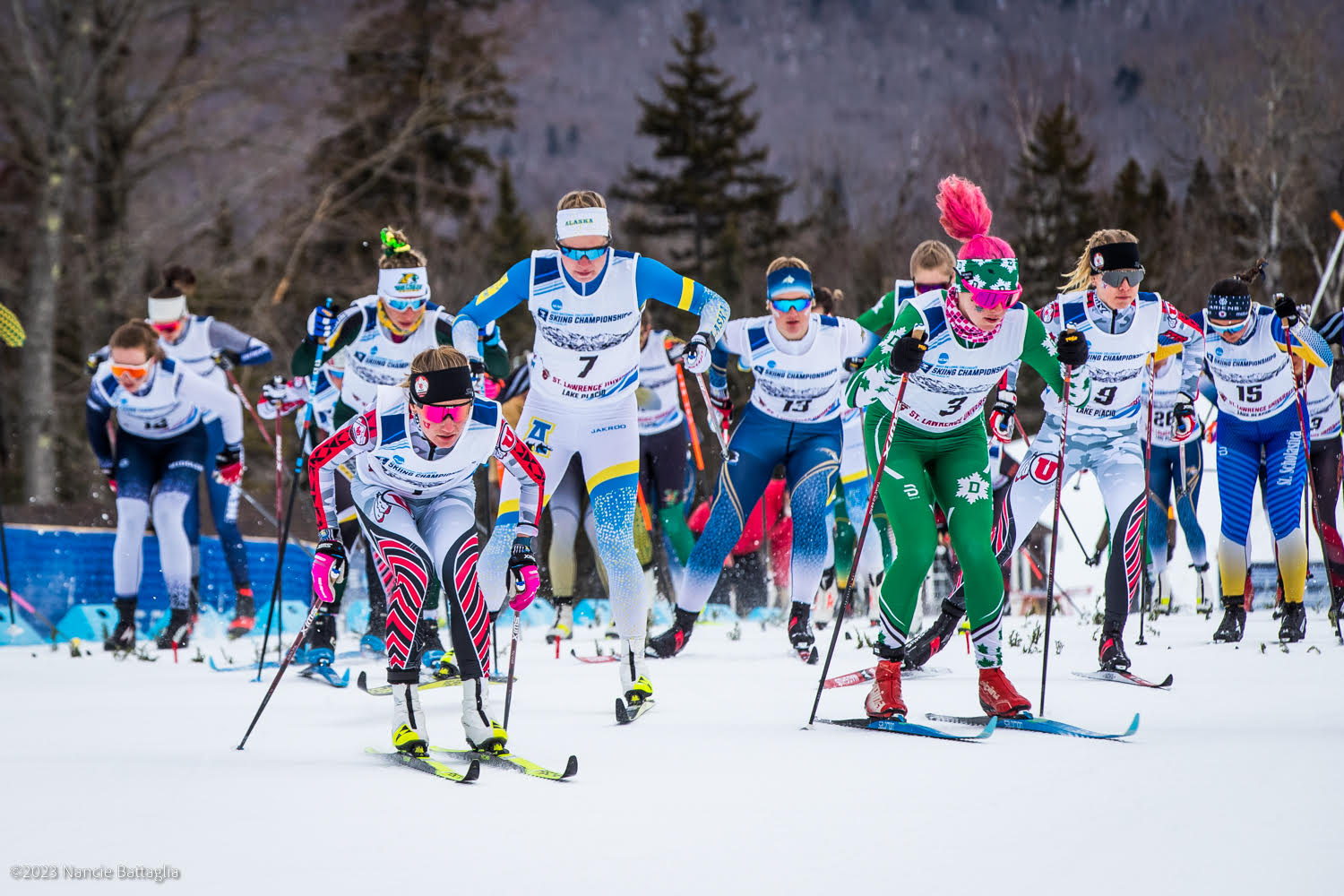
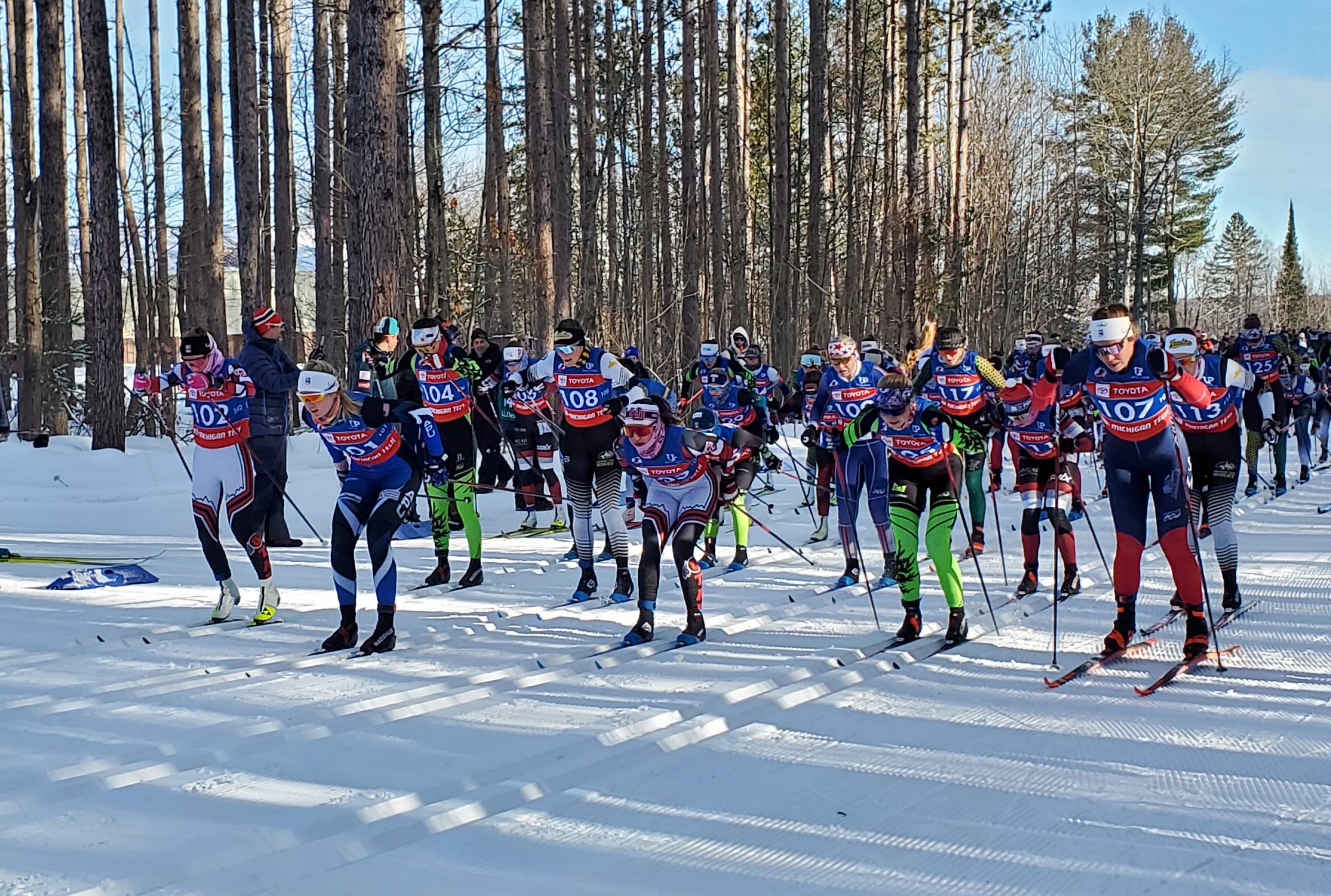
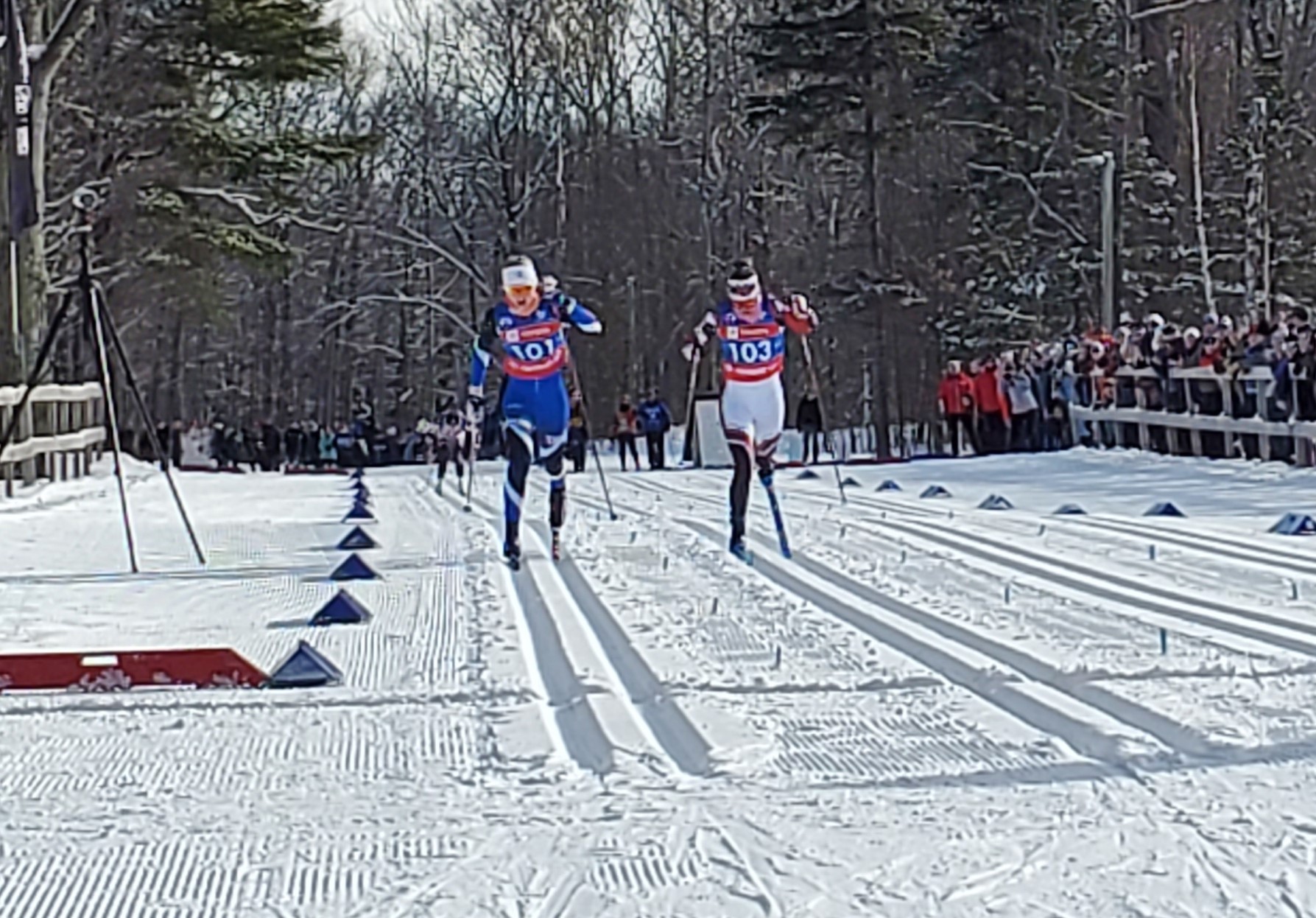
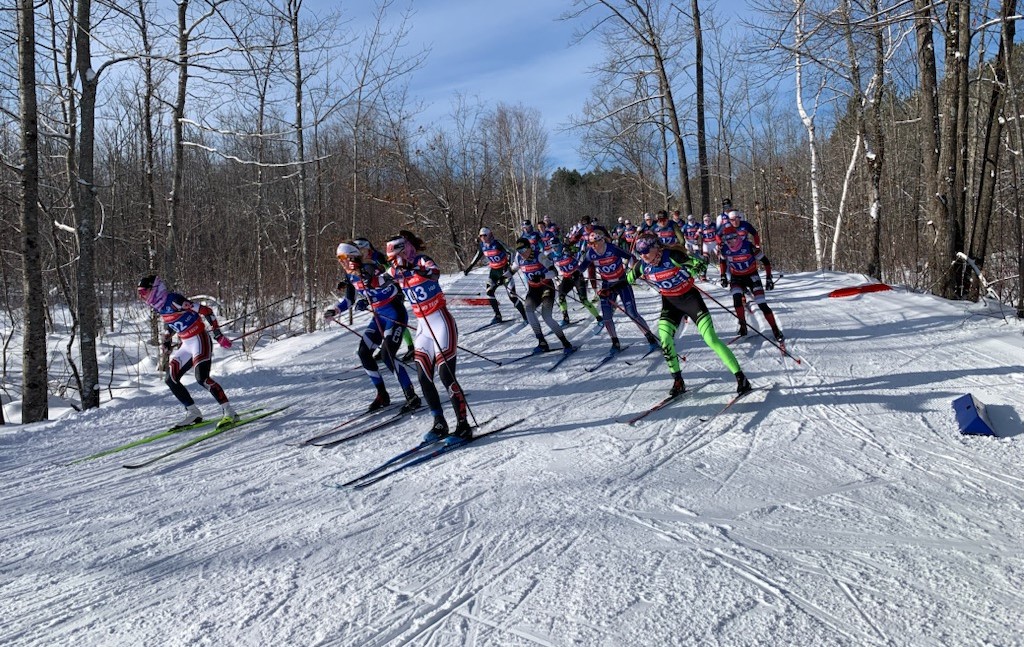
    Traffic was thick at the beginning of the US National Cross-Country Ski Championship Women’s 20 k Freestyle Mass Start in Lake Placid, NY. (Photo: Nancie Battaglia)

    There is a particular moment in a long mass start when the race quietly declares what it will be. It does not arrive with a surge, a crash, or even a decisive move. It arrives when the pack thins just enough that the edges of the course begin to matter—when skis no longer overlap cleanly, when passing requires intention, and when each athlete realizes—often simultaneously—that this is no longer a collective undertaking.

    At Mt. Van Hoevenberg, that moment came early.

    The women’s 20-kilometer freestyle mass start at the 2026 U.S. National Cross-Country Ski Championships unfolded under conditions that rewarded clarity and punished hesitation. The course was wide in places, narrow in consequence. Fresh snow lined the edges, slower and heavier than the main track, turning every attempt to move forward into a calculation of cost. The pace at the front was honest from the gun—fast enough to string the field out, fast enough to strip away the illusion that patience alone would bring opportunity.

    In an Olympic winter, Nationals rarely exist in isolation. They are arguments as much as races, each result carrying the quiet weight of future conversations. But on this morning, before selection scenarios and season arcs could intrude, the race itself demanded attention. Four laps. Twenty kilometers. A course that climbs insistently and asks athletes to be precise even when tired.

    What followed was not one story, but several—layered, intersecting, and revealing.

    Colorado’s Tilde Bångman did much of the work at the front of the Women’s 20 k Freestyle Mass Start in Lake Placid, NY. (Photo: Nancie Battaglia)

    The Fast Start That Changed Everything

    From near the front, the race immediately took on the shape many expected. Kendall Kramer, eager to avoid the kind of chaos that can derail a mass start before it has truly begun, made her intentions clear.

    “I wanted to go out fast because I didn’t want any funny business—colliding or breaking equipment,” Kramer said later. “I was super looking forward to being in the front of a mass start after being caught in the back on World Cups.”

    For Kramer, the early pace felt familiar rather than reckless. World Cups, she noted, often begin faster than domestic races, and the instinct to establish position early has become second nature. The speed was assertive but manageable. She felt fit, capable, present.

    Behind her, the effect was immediate. The field stretched, then fractured, then reorganized into smaller, more intentional units. For athletes starting deeper in the field, this stringing-out created both opportunity and pressure.

    Novie McCabe, starting from bib 26, felt the opening kilometers open rather than close.

    “My plan for the start was just to stay relaxed and try to work my way up,” she said. “It honestly ended up being easier than expected because the front girls took it out so fast. It was very strung out, and there was lots of room to move around.”

    Within minutes, McCabe had navigated cleanly into the front group. What followed was less about advancing and more about survival.

    “I got to the front pack about three minutes into the race,” she said. “So I spent most of it there just trying to hang on for as long as I could—and ended up having it in me to hang till the end.”

    That phrase—hang on—would recur in different forms throughout the day, taking on slightly different meanings depending on where each skier found herself in the race.

    Ava Thurston (#8 – Dartmouth) couldn’t quite hang on to the lead group of three, but eventually skied with Hailey Swirbul (#67 – APU) and Haley Brewster (#46 – UVM) before finishing fourth overall and third-place American. (Photo: Nancie Battaglia)

    When the Front Pulls Away

    Not everyone who tested the front pace could stay there.

    Late in the first lap, Ava Thurston made her own attempt to bridge. She came close enough to feel the rhythm of the leaders, close enough to understand the cost.

    “I tried to get back onto the front group, and I got pretty close,” Thurston said. “But I realized that I wasn’t going to be able to match their pace.”

    The realization came with consequences. For a brief stretch, she found herself skiing alone—a dangerous place in a mass start, especially early, when gaps can grow quietly and decisively.

    “That was where I did have a little bit of that panic,” she admitted.

    The panic did not last. Company arrived in the form of Hailey Swirbul and Haley Brewster, and with it, perspective.

    “Once I was skiing with them, I was kind of just thinking, ‘This is a good group. I can stay with these guys,’” Thurston said.

    From there, her race became less about chasing what was ahead and more about managing what was happening around her. She tucked in, matched surges, and responded quickly to small separations before they became something larger.

    “There were a couple of times where I would fall off the pack just a little bit,” she said. “Each time, I worked hard to get right back on before letting it be a big gap. I was really stoked on that.”

    On a course like Van Hoevenberg—four laps of sustained uphill skating—those moments add up. Fitness is exposed repeatedly, not all at once. For Thurston, the race offered reassurance.

    “This was the first race longer than 10k I’d done this year, and the first mass start that wasn’t a sprint,” she said. “It was a really good indicator that my fitness is there. It’s hard to fake anything on this course.”

    She would finish fourth, clearly separated from the podium trio but equally clear of the deeper chase—an honest result in a demanding field.

    With higher FIS points from not racing the past two seasons, Hailey Swirbul (#67 – APU) needed to ski through a lot of traffic during the early kilometers, but eventually found herself in the chase pack. (Photo: Nancie Battaglia)

    Racing From the Back Without Racing Small

    While the front and mid-pack sorted themselves, Hailey Swirbul was running an entirely different race.

    Starting from bib 67, she entered the day knowing she would need to be deliberate.

    “I didn’t even realize I would be seated so far back until the start list came out,” she said. “Obviously, I would be, because my FIS points aren’t low at this point—but it was an experience.”

    The challenge was not simply moving forward. It was how to do so without paying too steep a price.

    “The edges of the course had fresh snow on them,” Swirbul explained. “It was much slower, and a much higher energy expenditure to get around people that way.”

    Instead of forcing passes, she waited. Instead of locking into the pace of whatever group surrounded her at a given moment, she kept her attention forward.

    “I almost approached the first couple laps like an individual start,” she said. “It’s really easy to lock into the group you’re around and forget about the people ahead of you.”

    Women’s racing, she noted, often begins with a fast, destabilizing surge—a period where the goal is simply to hang on long enough for things to settle.

    “That’s exactly what happened today,” she said. “The leaders go fast, string it out, and then the real race starts again.”

    For Swirbul, the balance was constant: advancing through traffic while respecting the race’s length.

    “A 20k is a long race,” she said. “You can’t really pay for it.”

    Though she never bridged to the front trio, Swirbul finished fifth—solidly clear of the next wave behind her—and left the course satisfied with her execution and proud of the broader team effort.

    “Our coach absolutely crushed it with skis and feeds,” she said. “It was a good day to be APU.”

    Novie McCabe (APU) maintained contact on the uphills and used the downhills to close the small gaps to Tilde Bångman (CU) at the front of the race. (Photo: Nancie Battaglia)

    The Margins at the Front

    At the sharp end, the race narrowed to a familiar dynamic: strength, speed, and patience under pressure.

    As the kilometers mounted, Tilde Bångman began to apply pressure on the climbs, testing the group’s elasticity. By mid-race, the front had distilled to three: Bångman, McCabe, and Kramer. The chase group behind them was no longer within striking distance, and the podium places would be decided among those three alone.

    McCabe felt the pressure immediately.

    “In the last few kilometers, Tilde was skiing super strong and still really pushing the pace,” she said. “She would gap me a little bit on some of the hills.”

    Each gap mattered. Each closure required confidence—in skis, in timing, and in restraint.

    “I had some super good skis, so I was able to glide back up to her,” McCabe said.

    The plan crystallized: stay attached through the final hill, try once to make a move, and if that failed, save everything for the finish.

    “I tried to get a gap on the last hill, which didn’t quite work,” she said. “So I tried one last time at the finish.”

    It was enough.

    McCabe crossed the line first, securing the national title after a race built not on constant aggression, but on measured commitment. The emotion that surfaced surprised even her.

    “I think when I crossed the line, I mostly just felt super happy to be back racing and feeling like myself,” she said.

    The win mattered. So did what it represented.

    “Going into this week, I wasn’t sure it was the best idea for me to race frequently this season,” she said. “Now I have a lot more confidence that I can race—and maybe more importantly, recover from racing.”

    In an Olympic year, that distinction is not trivial.

    The lead pack and eventual overall podium with Kendall Kramer (APU), Tilde Bångman (CU), and Novie McCabe (APU) (l – r). (Photo: Nancie Battaglia)

    Kramer’s Race: Control Without Regret

    For Kendall Kramer, the separation late in the race came not through fitness, but friction.

    “My skis slowed down as they went,” she said. “They started to feel sticky—like I skied through too much Gatorade or something.”

    The effect was most pronounced on the downhills, where speed should have come freely.

    “The girls had to push my poles to speed me up to keep together,” she said. “Eventually, they could just gap on all the downhills.”

    Once the gap formed, Kramer shifted her focus from contesting the win to finishing the race well.

    “I’m happy to maintain my place and feel good,” she said. “I can’t complain.”

    What she wanted from the race, she explained, was not chaos or last-minute risk, but sustained pressure in a small group.

    “I wanted a small pack where we could test at every little bit,” she said, “as opposed to leaving it to a sprint or taking risks at a time like this.”

    She finished third, completing the podium, and left Lake Placid without repeating her national title—but with confirmation that mattered just as much.

    “I felt fit and totally capable today,” she said. “I didn’t feel bad feelings.”

    Novie McCabe (APU) managed to put a small gap on teammate Kendall Kramer to get away with Tilde Bångman (CU) and eventually ski to the national title in the finish stretch. (Photo: Nancie Battaglia)

    What the Race Revealed

    By the time the women completed their fourth lap, the story of the day was no longer about who surged when, but about how each athlete managed the same course differently—and honestly.

    McCabe raced with restraint until she no longer needed to. Kramer raced with intent and accepted the margins. Thurston learned, adjusted, and confirmed her distance fitness. Swirbul navigated from deep in the field with patience and clarity.

    None of those narratives exists in isolation. Together, they form a portrait of a championship race that did what the best distance races always do: expose truth without exaggeration.

    At U.S. Nationals, the women did not simply ski 20 kilometers. They negotiated space, managed doubt, trusted preparation, and tested belief.

    In an Olympic winter, those are not side effects.

    They are the point.

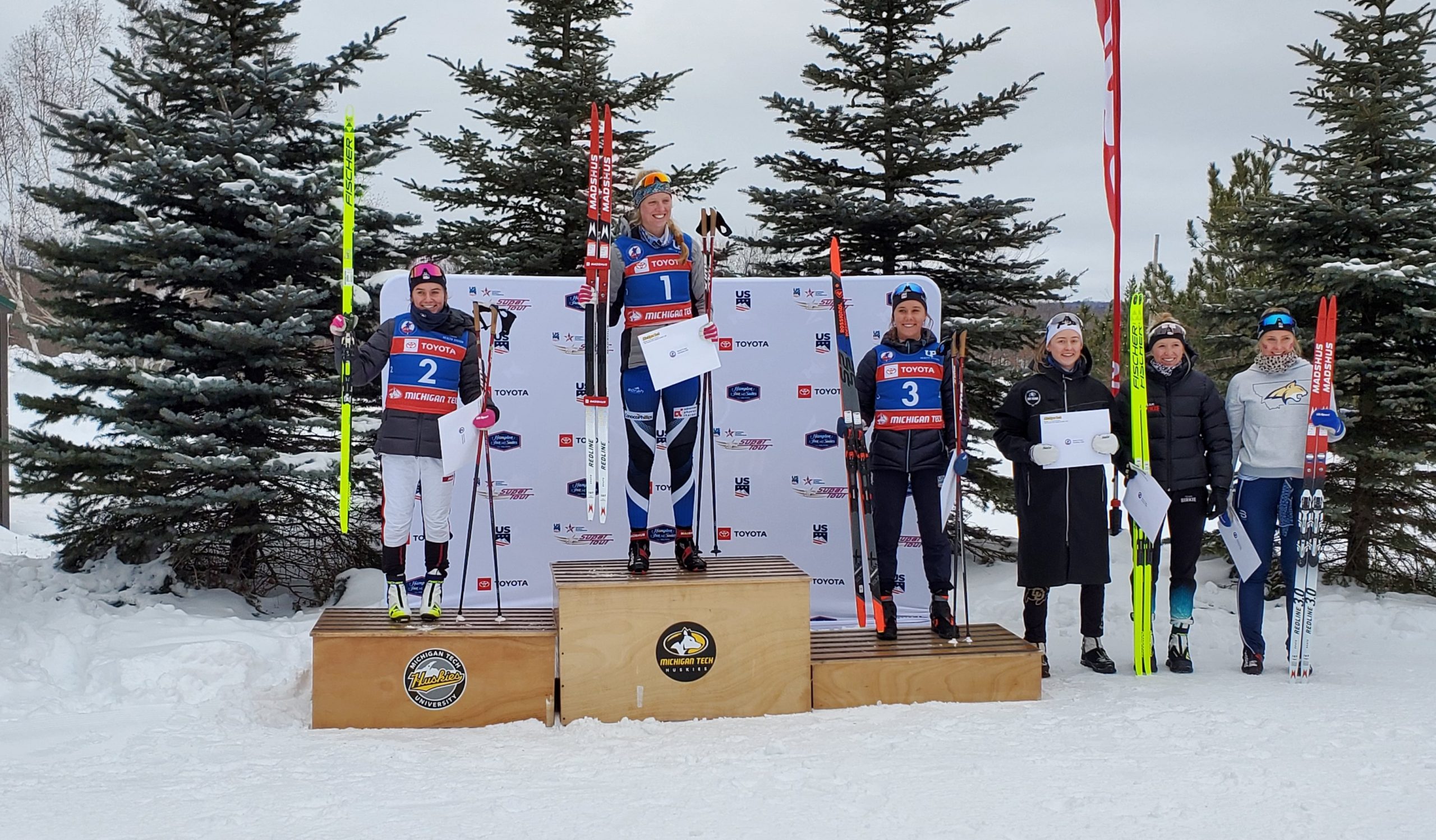
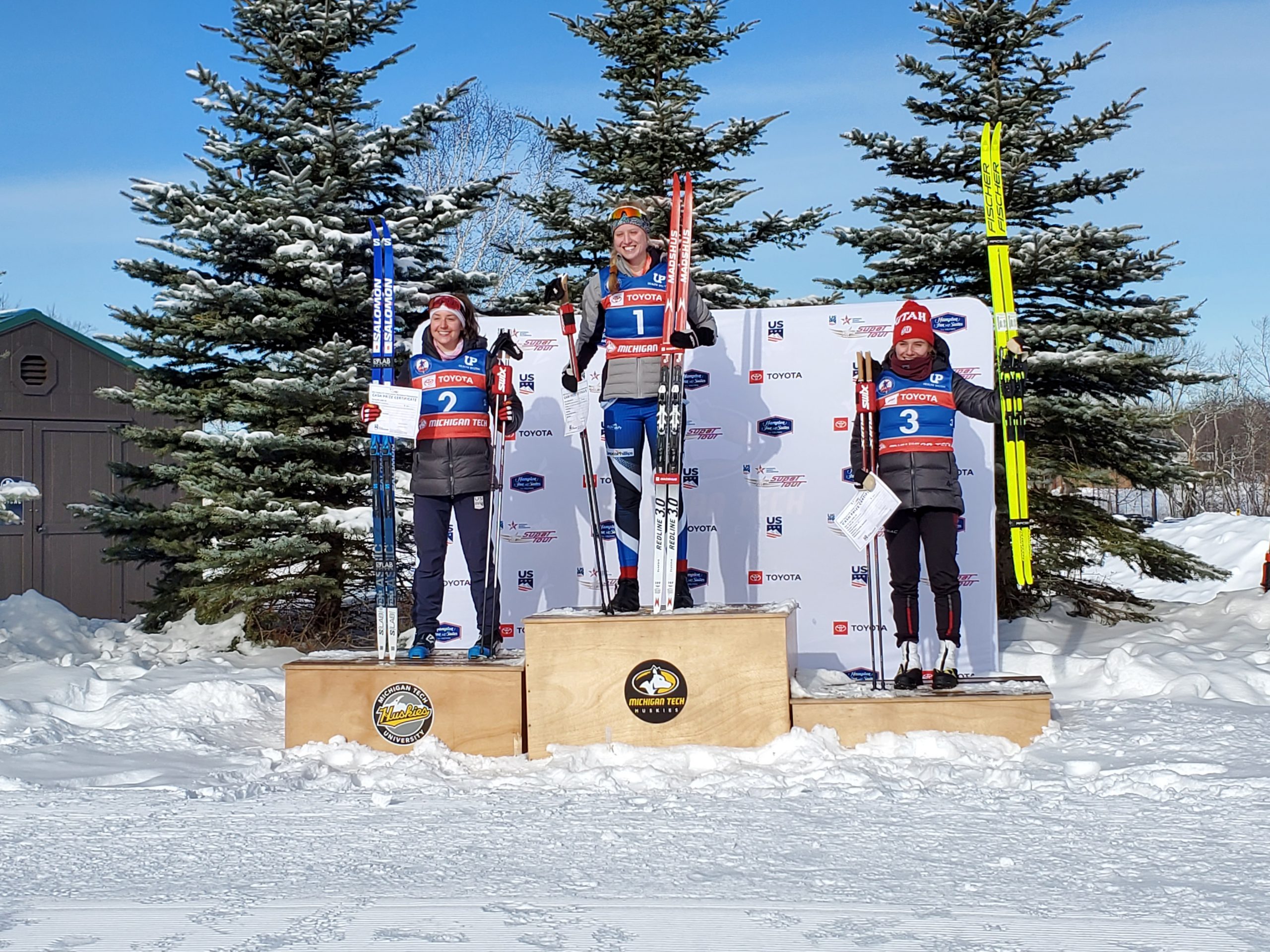
    The national podium for the US National Cross-Country Ski Championship Women’s 20 k Freestyle Mass Start with Novie McCabe (APU) first, Kendall Kramer (APU) second, and Ava Thurston (Dartmouth) third. (Photo: Nancie Battaglia)


    RESULTS:

    US Nationals Women’s 20 k Freestyle Mass Start


    Love stories like this? Help keep them coming.

    Feature stories like this one take time, access, and care to produce. If you value thoughtful storytelling and independent ski journalism, please consider becoming a Voluntary Subscriber. Your support directly fuels the work we do to cover the people, places, and moments that make our sport special.

    Join the FasterSkier community!


    The overall podium for the US National Cross-Country Ski Championship Women’s 20 k Freestyle Mass Start with Novie McCabe (APU) first, Tilde Bångman (CU) second, and Kendall Kramer (APU) third. (Photo: Nancie Battaglia)
  • Where the Margins Speak: U.S. Nationals Opens with Questions, Not Answers

    Where the Margins Speak: U.S. Nationals Opens with Questions, Not Answers

    This article was made possible through the generous support of our voluntary subscribers.  If you value coverage like this, please support FasterSkier with a voluntary subscription.  

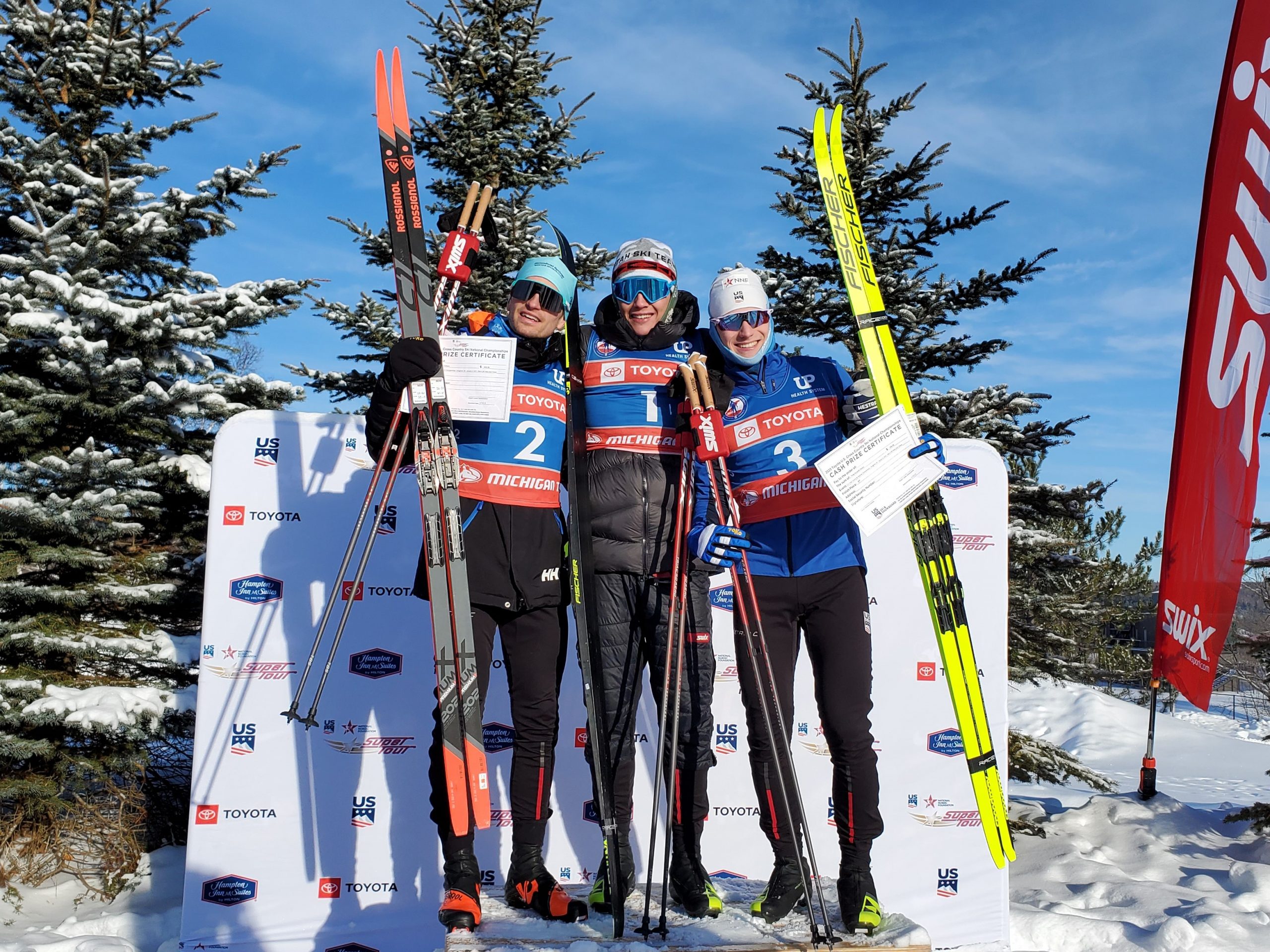
    The US National Championships got started yesterday with the 10 k Classic Individual Start in Lake Placid, NY.  Hunter Wonders (#369 – APU) took top honors in the men’s race.  (Photo: Nancie Battaglia)

    On a January afternoon in Lake Placid, Mt. Van Hoevenberg did what it has always done best: it asked skiers to be honest.

    The 10-kilometer classic individual start is not a format that rewards theater. It doesn’t care how good you looked in warm-up, how confident you sounded the night before, or how convincing your season-long narrative might be. It rewards pacing that’s brave but not reckless, technique that doesn’t unravel under strain, and the ability to keep making good decisions when your legs are trying to renegotiate the terms of the day.

    This year, the U.S. National Cross-Country Ski Championships opened with that race—two laps on the 5-kilometer loop—and the timing was no accident. In an Olympic winter, Nationals is never just Nationals. It’s an argument. It’s a week where results don’t merely “count,” they accumulate, and the accumulation becomes the story that follows athletes into selection meetings, petitions, and—if all goes right—onto a plane headed for Italy.

    Men’s 10 k Classic Individual Start Results

    Women’s 10 k Classic Individual Start Results

    Will Koch (SVSEF) on his way to 8th place on the day. (Photo: Nancie Battaglia)

    The Course: Where You Can’t Afford to “Blow Up”

    The Van Hoevenberg course is famous for being “fair,” but fairness in skiing is rarely gentle. The climbs arrive in layered sequences—sections where you can press, sections where you can survive, sections where you can lose seconds simply by being a fraction late to a gear change. There are places to win time, and places where you simply try not to hemorrhage it.

    Hunter Wonders described the central problem precisely after the finish:

    “It has some big hills. And I really think that in this course you can’t afford to blow up. If you blow up, you’re just going to bleed so much time.”

    That idea—bleeding time—was the hidden refrain of the day. Not because athletes were exploding spectacularly, but because this loop punishes any lapse in restraint. It is a course that rewards a mind that stays intact.

    Corbin Carpenter (UAA) on his way to 10th place in the 10 k Classic at US Nationals. (Photo: Nancie Battaglia)

    Men’s Race: Seconds as a Selection Language

    At the front of the men’s race, the margins compressed into something almost absurd: a national title decided in a space so small it could be measured in one imperfect corner, one extra step of herringbone, one pole that slips just slightly at the wrong moment.

    Hunter Wonders won the men’s 10 k Classic National Championship. Behind him, the podium fight came down to an almost unnerving closeness. The story wasn’t simply that the race was fast; it was that it was tight—tight enough to turn pacing into the defining skill.

    Wonders’ post-race reflection didn’t sound like someone who had “controlled” the race so much as someone who had managed it correctly, which is often the same thing in interval start racing:

    “Yeah. So going through it never really felt like it was my day. I knew it was going to be a competitive one, and I knew that it would just come to good skis, good feelings in the body, good pacing, and I’m just really happy that I was able to pull it off.”

    He returned to pacing again, emphasizing that his strategy wasn’t about heroics, but about avoiding the one mistake that the Van Hoevenberg loop will magnify:

    “I think pacing was the biggest challenge for me today… So I was trying to take it out hot to where I could be competitive but not blow myself up.”

    What made Wonders’ win especially convincing was how he described staying committed to his plan and then finishing with intent when the splits told him the race was available:

    “I never really changed my race plan mid-race. But I did get some good splits, especially near the end, so I just tried to finish as hard as I could.”

    And then, because it’s 2026 and everyone knows what this week represents, he said the part that matters most:

    “And then, of course, U.S. Nationals does carry some heavy weight in an Olympic year. And I’ve been thinking about this race since the races in Anchorage ended, so I’m just really happy to have it behind me.”

    He wasn’t pretending the pressure isn’t real:

    “I definitely felt the pressure, and I’m going to continue to feel the pressure throughout the rest of this Nationals. But I think I have good momentum going, and I have good confidence. I know that I’m in shape, and everything else just kind of hopefully falls into place over the next week.”

    The finish-line truth of the men’s race is that it created a kind of selection tension that will hang over the rest of the week: the top contenders weren’t separated by a narrative gap. They were separated by seconds.

    Luke Jager, who finished second, captured what that tightness means on this course and in this moment:

    “Yeah, crazy how close the times were! The course is cool because there are so many different gears in the climb that people can all have different focus spots and still end up so close together at the finish line. It is really cool, fair racing like that.”

    That line—different focus spots, same finish—explains why the top of the results can look like a near-tie without being random. You can ski this course well in different ways. But you still have to ski it well.

    Jager also spoke directly to the Olympic subtext without overplaying it:

    “I’m not naive enough to say that the Olympics aren’t on all of our minds, but I’m also really having fun just trying to do my best and working to solve the puzzle of how to perform on any given day. Italy would be sweet, but I’m super thankful for this opportunity to even be feeling that pressure at all. It’s been fun to have such a big challenge.”

    And then the warning embedded in the closeness:

    “The close times just show me that you can’t take anything for granted, and each race could be someone else’s day. Fun to have to try and be as dialed and prepared as you can every day when the stakes are high.”

    In other words, this wasn’t a day that “settled” anything. It made the next races more consequential.

    Men — Top 10 (10 km Classic Individual Start)

    1. Hunter Wonders — APU — 25:28.8
    2. Luke Jager — APU — 25:30.2
    3. Olivier Leveille — Orford – CNEPH — 25:30.8
    4. Zachary Jayne — University of Utah — 25:31.2
    5. John Steel Hagenbuch — DAR — 25:35.6
    6. Zanden McMullen — APU — 25:36.4
    7. Mons Melbye — University of Utah — 25:55.3
    8. Will Koch — SVSEF — 25:58.1
    9. Brian Bushey — Craftsbury — 26:00.1
    10. Corbin Carpenter — UAA — 26:01.3

    Men’s 10 k Classic Individual Start: Complete Results

    Hailey Swirbul (APU) on her way to a national title in the 10 k Classic at US Nationals in Lake Placid. (Photo: Nancie Battaglia)

    Women’s Race: Swirbul’s Return, and a Course That Doesn’t Flatter Anyone

    If the men’s race was defined by a razor-thin margin, the women’s race had a different feel: not less intense, but shaped by a performance at the front that felt like a statement. And the words that followed from the winner did not sound like someone who had stumbled into a good day; they sounded like someone who had been building toward a day like this for a long time.

    Hailey Swirbul framed her win as the visible outcome of a longer experiment:

    “Winning this race felt like finally getting to watch the outcome of a long experiment unfold! I’ve wanted to approach this season from a place of curiosity to see if I can get fitness and strength back after a 2.5-year hiatus. It has felt so rewarding to get stronger and remember how it feels to race and go hard again.”

    She described the way racing itself can re-teach an athlete what “hard” feels like:

    “Each race or hard interval session reminds me what it feels like a little bit more.”

    And then she said what almost everyone in the finish area seemed to be thinking, whether they admitted it or not:

    “This course is legit. I didn’t hear the words ‘I felt good out there!’ come out of a single person’s mouth! It was a battle of self against hill.”

    That sentence carries the whole day inside it: not a battle against other people, exactly, but against the course’s capacity to strip away pretense.

    Hailey Swirbul (APU) charges up one of the many climbs on that Lake Placid course behind Virginia Cobb (#120 – DAR) and Marit Flora (#76 – UAA). (Photo: Nancie Battaglia)

    Swirbul’s race plan—at least as she described it—was deeply personal in its logic. Not a copy of someone else’s pacing, not a response to what she imagined others were doing, but an attempt to ski in a way that matched her strengths:

    “I tried to ski true to myself. I wanted to use momentum and my own body weight the most effectively I could to get around that course as fast as I could- regardless of how the pacing looked for others.”

    And because it’s an Olympic year, she made the subtext explicit:

    “I have my eyes on an Olympic Team spot, and I’m going to continue to fight for it until the team is officially named. I’m not thinking beyond this week of racing here at Nationals. One step at a time, staying present…”

    Then the line that reminds you why athletes keep doing this:

    “…and enjoying getting to live this life and see so many people from old racing days— it’s a good life.”

    Women — Top 5 (10 km Classic Individual Start)

    1. Hailey Swirbul — APU — 28:42.5
    2. Erica Lavén — University of Utah — 29:14.4
    3. Tilde Bångman — University of Colorado — 29:23.9
    4. Novie McCabe — APU — 29:26.1
    5. Samantha Smith — SVSEF — 29:47.3
    6. Ava Thurston — DAR — 29:48.8
    7. Rosie Fordham — UAF — 29:56.7
    8. Kendall Kramer — APU — 30:02.7
    9. Renae Anderson — APU — 30:14.2
    10. Alayna Sonnesyn — Team Birkie — 30:16.0

    Women’s 10 k Classic Individual Start: Complete Results


    McCabe: Process as a Way Through Uncertainty

    Novie McCabe’s post-race comments carried a tone that felt especially relevant to this week: gratitude, yes—but also a clear-eyed description of how fragile a season can feel, and how an athlete can build stability by focusing on what can be controlled.

    “It meant a lot to be starting today for sure! I think that being a bit unsure of whether I’d be starting these races made me feel pretty grateful for the opportunity to go out there and give it my best today.”

    She described the emotional mix honestly:

    “There were, of course, lots of doubts and some nerves going in as well, but I really tried to just enjoy the skiing and made that my main goal going into it.”

    And she emphasized that conditions and course feel matter—not as excuses, but as context:

    “The conditions were insanely nice today, which helped, and this course is one of my favorites!”

    On pacing, McCabe described a strategy rooted in self-knowledge:

    “Honestly, I kinda just went out as hard as I could within reason, and tried to relax and hold onto it. I know the splits don’t really make it look that way, haha, but I am not the fastest starter, so it is usually best for me to go out at what feels like a pretty hard pace.”

    Then she explained the architecture of her day: not results goals, but process goals. She made a point that’s easy to dismiss until you remember what an Olympic week does to people:

    “Being focused on process goals going into a race really helps me develop a framework for success.”

    She listed those goals with specificity—how she wanted to feel, what she wanted to focus on, what she wanted her mind to do when discomfort arrived:

    “…going out hard but comfortable and trying to hold it, skiing well (not skiing hard), be the focus of the day, keeping up the positive self-talk, and finding the good and noticing what is going well throughout the race.”

    And on Olympic pressure, she offered a perspective that will sound familiar to anyone who has ever had a season disrupted by health or inconsistency:

    “I think it has honestly helped me out in terms of handling self-imposed Olympic qualification pressure to not have had the best lead up and be pretty unsure of what I would be doing as far as racing goes this year…”

    She described her focus as narrower—day by day—because it has to be:

    “…it has taken some of my focus off of results… It has just kind of led to an approach where I take it day by day, and don’t really think much further into the future than that.”

    That isn’t resignation. It’s an operating system. And it’s one that often works, especially on a course where you can lose time in the exact moment you start racing the future instead of the hill in front of you.

    Rosie Fordham (UAF) leaving it all on the course on her way to 7th place overall. (Photo: Nancie Battaglia)

    Samantha Smith: A Double Life and a Very Real Result

    Samantha Smith’s presence near the top of the women’s results came with a storyline that’s unusual even in American ski racing: balancing elite cross-country skiing with Division I soccer at Stanford, and arriving at the heart of ski season off a long NCAA tournament run.

    She spoke about the short transition plainly:

    “Yes, that’s correct, that our soccer team’s long run into the NCAA tournament has made for a much shorter transition to the season. I’ve only been on snow for a few weeks, so I know my ski fitness is improving every day.”

    She described the emotional carryover of playing for a national title—how it can become fuel rather than a distraction:

    “Playing in the National Championship was an amazing experience—we were so close to winning it all. It was a tough way to end such a great season. I’m taking that fire from our final game and pouring it into my skiing.”

    And she framed her path as something she’s embracing, not defending:

    “I know my path is different from others, but I’m doing what I love, and I think there’s a lot to be said for staying true to that. I’m trying to take everything step by step, live in the moment, and focus on what I can control!”

    On the scrutiny that comes with missing ski events earlier in the season, she emphasized the lessons she’s drawn from doing two sports seriously:

    “…for me, I feel like there’s actually a lot I can pull from the two sports and use it to my advantage.”

    She described last year as a “trial year” and explained how she’s adjusted:

    “I needed that test phase to figure out what works and what doesn’t work. I made some adjustments this year in training, switching things up a bit, and I feel like that’s helped me a lot going into this season.”

    She credited Braden Becker for helping with training and coaching through the fall:

    “I owe a huge thank you to Braden Becker, a retired skier, who’s now a grad student at Stanford. He helped me a lot with training this fall, and it honestly made a world of difference…”

    And then she returned to the mental challenge of this week—high stakes, lots of uncontrollables—and the philosophy that keeps an athlete from spiraling:

    “…I’m just trying to focus on what I can control—my attitude and effort.”

    Finally, she addressed the question of what a distance result might “say” about her:

    “I was happy with today’s result… I think today’s race was a good indication of my trajectory for the rest of the week and the rest of the season.”

    And she framed versatility—distance and sprint—as part of the argument she wants to make this winter:

    “…hopefully showcase some of my versatility in different distances and disciplines, which I think can be important for big competitions like the Olympics.”

    Alayna Sonnesyn (Team Birkie) on her way to 10th place overall. (Photo: Nancie Battaglia)

    Why This Week Matters So Much

    For the men, the arithmetic of Olympic selection is already partly written—and partly unresolved. At present, the United States is allotted seven men’s quota spots for the Olympic team, with the possibility that an eighth could roll down following this weekend’s World Cup races in Oberhof, Germany. That uncertainty is where much of the tension at U.S. Nationals resides.

    It is also where most of the speculation comes from—so take it for what it is, informed but unofficial. The six American men who recently raced the Tour de Ski appear, by any reasonable reading of the criteria, to be on solid ground. Each currently ranks in the top 45 on the FIS World Cup sprint and distance overall lists, the threshold set by the US Ski Team that meets the objective requirements for Olympic selection.

    Within that group of six, there is also ample sprint depth to cover the four available starts in the individual classic sprint and to form a competitive two-man sprint relay. As a result, Tuesday’s Freestyle Sprint at Nationals is likely to carry less weight for those athletes racing in Lake Placid with dreams of making the Olympic roster. Instead, the races most likely to function as closing arguments—particularly if an additional quota spot materializes—were Sunday’s 10 k Classic and Thursday’s 20 k Freestyle Mass Start. For at least one man, and potentially two, those performances may determine whether this week in Lake Placid becomes a footnote or a turning point.

    On the women’s side, the picture is far less settled—and far more fluid. The United States has eight Olympic quota spots available, but only a portion of them is considered secure. Jessie Diggins—if it were ever in doubt—has already satisfied the objective criteria by finishing in the top eight in World Cup races that are part of the Olympic schedule. Julia Kern and Rosie Brennan also appear well-positioned, based on their respective rankings on the sprint and distance overall lists.

    That still leaves as many as five remaining spots to be determined, drawing from a complicated blend of results across Period One on the World Cup, the SuperTour events in Alaska, and, critically, U.S. Nationals this week in Lake Placid. For those athletes, Nationals is not simply a domestic championship. It is an audition, a data point, and—in some cases—the clearest remaining path onto the Olympic team.

    John Steel Hagenbuch (DAR) on his way to 5th place overall on the day. (Photo: Phillip Belena/EISA)

    Grover: “There’s Going to be Space”… and then the Paperwork

    US Cross-Country Ski Team Director Chris Grover offered perhaps the clearest explanation for why the opening races at Nationals feel unusually charged—not because they deliver final answers, but because they create space. Space in which athletes can move themselves from the margins of the conversation toward its center.

    The story, as Grover framed it, is not simply who wins. It is what a result permits: what doors it opens, what arguments it strengthens, and how it positions an athlete within the broader, inevitably imperfect machinery of Olympic selection.

    As Grover put it in an interview with FasterSkier, U.S. Nationals does exactly that—it creates room:

    “…it’s going to be a great story because there’s space. There’s going to be space on both the men’s squad and the women’s squad, by the looks of it, for athletes to qualify from Nationals, to have great U.S. Nationals and come over, especially on the women’s side…”

    That space, however, is not filled automatically. In an Olympic year, it is accompanied by paperwork, petitions, and deliberation—an acknowledgment that performance, while central, is rarely the entire story.

    Grover outlined the petition process that follows Nationals, a step that often receives less public attention but carries significant weight:

    “…all athletes who want to be considered for discretionary selection… We’ll put in an application. Or a petition rather, where they will kind of write out what their case is, why they should be considered…”

    Those petitions, Grover explained, are then evaluated by a selection committee—six people tasked with translating results, trends, and context into final decisions:

    “…we have the six-person selection committee that will pick the team. So as a committee, we’ll read everybody’s application, and then we, as a committee, will decide whether we want to elevate somebody using Coach’s discretion to be selected.”

    Even the arithmetic of quota spots, Grover noted, is subject to forces beyond any one athlete’s control. On the men’s side, the possibility of an additional spot remains unresolved:

    “…it’s after Oberhof… qualification for nations also closes on January 18… and at that point a spot [might be] available…”

    Which is to say: timing matters. So does patience.

    Taken together, Grover’s explanation underscores a truth that every athlete racing this week understands intuitively. Lake Placid does not merely crown national champions. It produces evidence—sometimes decisive, sometimes ambiguous—for a selection process that will soon harden from theory into reality. And once it does, the margins that feel abstract today will become permanent.

    Ava Thurston (#45 – DAR) on her way to 6th place overall on the day. (Photo: Phillip Belena/EISA)

    What Sunday Actually Did

    The first day of Nationals did not select the Olympic team. It did something subtler and, in some ways, more powerful: it established the tone of the week.

    On the men’s side, it proved that the domestic field is not going to give anyone breathing room. Wonders’ win was decisive in the only way that matters in interval start racing: he was fastest when everyone had to ski alone. But the closeness behind him reinforced Jager’s point—each race could be someone else’s day. In a week like this, that’s not a platitude. It’s a forecast.

    On the women’s side, Swirbul’s victory felt like a day where preparation and belief finally aligned. But even she framed the week properly: one step at a time, staying present, not thinking beyond Lake Placid. McCabe and Smith offered two different versions of the same survival skill: build a framework, focus on process, control what you can, and let results become the output rather than the obsession.

    If there was a single emotional throughline, it was this: the athletes weren’t pretending the Olympics weren’t there. They were trying, in different ways, to keep that fact from hijacking the work.


    A Conclusion in the Shape of an Interval Start

    There’s a particular quiet that follows an interval start classic race—not silence, exactly, but the hush of athletes doing their internal accounting. A national championship can feel like a celebration. In an Olympic year, it can also feel like a deposit: something placed into the larger selection ledger, something that will matter later, in rooms the athletes won’t be in, in conversations they can’t control.

    What makes Lake Placid different—what makes Mt. Van Hoevenberg feel so permanent—is that it refuses to dramatize any of this. It simply asks the same thing of everyone: ski two laps honestly, manage the climbs, keep your head when your legs get loud, and finish without bargaining.

    Wonders said he felt the pressure—and expects to keep feeling it. Jager said the closeness means nothing can be taken for granted. Swirbul described a long experiment that finally yielded its outcome. McCabe described building success from process, not prediction. Smith described a life lived between two sports, and a focus narrowed to attitude and effort.

    Taken together, those aren’t just post-race quotes. They’re the first chapter of the week.

    And in an Olympic winter, first chapters matter—because the next race arrives quickly, and the story keeps writing itself, one start at a time.


    Love stories like this? Help keep them coming.

    Feature stories like this one take time, access, and care to produce. If you value thoughtful storytelling and independent ski journalism, please consider becoming a Voluntary Subscriber. Your support directly fuels the work we do to cover the people, places, and moments that make our sport special.

    Join the FasterSkier community!


    Brian Bushey (#345 – Craftsbury) on his way to 9th place overall. (Photo: Nancie Battaglia)
  • Novie McCabe’s Winding Trail to the Olympic-Season Start Line

    Novie McCabe’s Winding Trail to the Olympic-Season Start Line

    When Novie McCabe spoke with FasterSkier early last month, she was looking out the window of her place in Anchorage, waiting for winter to finally take hold. “We’re patiently waiting on snow,” she said. “But today might be the day.“

    Outside, the ground was still in its in-between phase—too brown for grooming, just white enough that fish-scale skis could work if you were stubborn and optimistic about it. Alaska in November often asks skiers to hover in that liminal space: ready but not yet racing; fit but not yet tested; hopeful but not naïve.

    This week, the waiting ends—at least for the top domestic circuit. The U.S. SuperTour season opens in Fairbanks and continues in Anchorage next weekend, but McCabe hopes her body will allow her to join the field. After a long, uncertain stretch, simply lining up for even one race would mark a meaningful step forward. The timing makes this the right moment to trace how she has arrived at this threshold, and how the places she has lived—Methow Valley, Salt Lake City, Anchorage, Europe—continue to shape the skier she is becoming.

    Laura, Sean, and young Novie McCabe. (Photo: Courtesy Photo)

    The Valley That Built Her

    The story begins in the Methow, where winter is less a season than an identity. “I grew up in the Methow Valley, which is like a small valley in north central Washington with a pretty big ski community,” McCabe recalled. “I think we have the most Ks in North America or something when the skiing is good.“

    Her mother, former U.S. Ski Team athlete Laura McCabe, and her mother’s longtime friend Leslie Hall helped build the Methow Valley Nordic Club from scratch. McCabe grew up inside the culture they created: open, community-driven, relentlessly outdoorsy, and—maybe most importantly—fun.

    “I was lucky enough to have a really big group of kids my age who all just kind of happened to be really close friends,” she said. “We would all just be active together and spend a lot of time outside… backpacking trips all the time together.“

    Skiing was less a pursuit than a language. Practice might include ultimate frisbee on skis or just exploring terrain with no agenda beyond movement. “That was the main thing that got me so excited about skiing—the community,” she said. “It was just what all my friends did.“

    These early years formed more than her fitness. They gave her a worldview: skiing should be joyful, shared, and balanced.

    “Stay Behind Us—It’s Supposed to Be Easy”

    That mindset came directly from her mother’s coaching style. “My mom… would do all the sessions with us,” McCabe said. The education was intuitive, rooted in feel rather than metrics.

    “It was very feeling-based,” she said. “Like, in L3 you should be able to talk to me and give me a sentence back at least when I ask you how you’re feeling.“

    Heart-rate monitors were used only sparingly—tools to complement the athlete, not dictate behavior. “We maybe did lactates once or twice the whole time I was in high school,” she said.

    One lesson, in particular, stuck with her. During easy sessions, her mom and Leslie Hall would say:

    “You guys have to stay behind us because it’s supposed to be easy.”

    The rule was simple, but the philosophy was profound: fundamentals come from awareness, not pressure.

    McCabe laughs that even today, in anything resembling an ultra-distance test, the result might still tilt toward her mom: “She might have the upper hand in anything longer than 50 k.“

    Novie McCabe during the 20 k Classic at the NCAA Championship hosted by Saint Laurence University in Lake Placid in 2023.  McCabe controlled a pack that also contained her teammates, Sophia Laukli and Sydney Palmer-Leger. McCabe led the UU women, who finished 1st, 3rd, and 5th, on the day that propelled the Utes to their 4th consecutive NCAA Championship. (Photo: (c) Nancie Battaglia).

    Utah and the COVID Bubble

    By the time she left the Methow, McCabe was ready for a bigger arena. She chose the University of Utah for its coaching, competitive team environment, and growth opportunities.

    “At that stage in my life, I was pretty ready for it,” she said.

    Her first year unfolded in the disruptive isolation of COVID—a strange, surreal time that somehow fostered uncommon cohesion.

    “It was the heart of COVID isolating, but honestly, kind of in a fun way,” she said. “We were just hanging out as a team all of the time.“

    Despite Utah’s reputation as an NCAA powerhouse, she never felt crushed by expectations. “It didn’t feel like a high-pressure situation,” she said. “They were there to help us get the best out of ourselves.“

    She balanced training with academics, majoring in political science and minoring in economics. Even then, she was thinking beyond skiing.

    Novie McCabe skiing for APU. (Photo: Courtesy Photo)

    Leaving Eligibility on the Table

    After her third year, she made a difficult decision: she left Utah with two years of NCAA eligibility remaining.

    “I just felt kind of ready to move on from the NCAA,” she said. The experience had been positive—”I think everyone should go NCAA… It’s so fun and great for development,”—but the structure had become limiting.

    She wanted freedom: to race World Cups without constant travel back to the U.S., to pursue her development without logistical whiplash.

    “I wanted the freedom to race as many World Cups as I wanted during the season and not fly back and forth so much.“

    Once she accepted that her path needed to diverge, the next step was obvious.

    Novie McCabe and Luke Jager. (Photo: Courtesy Photo)

    Anchorage and the APU Reboot

    Anchorage had already become a meaningful place—she had been coming there every summer since her first year at the University of Utah. Her partner, Luke Jaeger, is from there. And she had trained with APU coach Erik Flora for years.

    “It honestly wasn’t even much of a decision,” she said.

    Flora’s coaching became a stabilizing force. “Erik Flora is really awesome when things are going wrong,” she said. “He knows how to help athletes sort through challenges… It’s never a linear path to success in skiing or any sport.“

    APU offered a training environment grounded in trust and peer excellence. “This year there is a pretty big girls’ group,” she said. “Kendall Kramer, Quincy Donley, Annabel Needham, Haley Swirbul, we have a big crew.“

    Training with athletes like Rosie Brennan and Swirbul created a layered mentorship:

    “They have been and are some of the best in the world.“

    Anchorage became the center of her athletic and personal rebuild.

    Novie McCabe joined by family and friends for a climbing adventure. (Photo: Novie McCabe)

    The Year Without Racing

    McCabe didn’t race at all last winter, more or less. At the time, she explained this as part of a balance project—but in reality, the situation was more complicated.

    “I have historically been kind of bad at the balance thing,” she said. “My happiness is sometimes quite dependent on skiing.“

    That year became a forced reset, with significant emotional and physical consequences.

    “I think I’ve gotten better at it,” she said. “I’ve found some things that I really do like to do outside of skiing.” She mentioned baking, cooking, reading, and spending time outside in ways that weren’t tied to training logs.

    Yet she was still searching for answers.

    One of Novie Mccabe’s (USA) career highlights was her top 15 finish in Falun, Sweden in a Classic race. (Photo: NordicFocus)

    A Quiet Battle Behind the Scenes

    After our original conversation, McCabe followed up with more context—an important layer we had not fully jumped into earlier. For the past two years, she has been navigating what she called “some mystery health challenges,” a swirl of symptoms that worsened last fall to the point where racing no longer felt possible.

    “The best guess of most of the doctors I have seen is some sort of post-viral or chronic fatigue thing,” she wrote, “possibly combined with some issues keeping my celiac and Hashimoto’s in check, but I am still not really sure what is going on to be honest.“

    She spent the winter searching for stability rather than start lines.

    “I have taken a pretty cautious approach to training this year and just been trying to build back into it super slowly and give a lot of extra attention to rest and recovery,” she said. “And I do feel like I made some solid progress.“

    Even now, she remains cautious. “The past two weeks have been a bit of a step backward,” she said. She’s not entirely sure she will race in Fairbanks. Her hope is modest: “One race there and one race in Anchorage, just to give myself a bit more recovery between hard efforts.“

    Still, the optimism in her message is unmistakable.

    “It means a lot to be back in a place where racing seems like more of a possibility.“

    “I will definitely consider it a win if I get to do some racing this year and make some more progress toward feeling like myself again.“

    McCabe credits her teammates with helping her develop the traits that won her recognition. Here she is training in Beijing with Hailey Swirbul, Hannah Halvorsen, and Sophia Laukli. (Photo: Novie McCabe)

    Team USA on the Road

    The U.S. Ski Team’s culture is widely celebrated—glitter, dance videos, and road-trip camaraderie. McCabe grew up watching those clips.

    “I would see their dancing videos from the World Cup and be like, ‘That just looks like the best time ever.’”

    But she knows now that joy is a decision, especially when you’re far from home. “Sometimes you have to decide that it’s going to be a good time,” she said. “Everyone does an excellent job of being good teammates.“

    That environment matters, especially in challenging seasons.

    Novie McCabe skates a strong third leg for Team USA in the 4 x 5 k relay at the Beijing Olympics in 2022. (Photo: NordicFocus)

    Europe: Brown Cheese, Ferris Wheels, and Perspective

    Her memories of Europe arrive in flashes of color rather than race results.

    “I love brown cheese,” she said. “You can get it here, of course, but it’s not as good.“

    She recalls Trondheim at Christmas—”Ferris wheel and everything“—and moments where she stepped outside the hotel room and let herself experience the place.

    These glimpses matter because they remind her of what she still wants from her career: a stable return to the World Cup, a chance to live in that rhythm again.

    And through all her travels, she keeps a single talisman:

    “Katherine Ogden made me a crochet octopus one year… I’ve brought it along as a good luck charm ever since.“

    Novie McCabe after the World Cup 10k in Falun, Sweden, in 2024. (Photo: NordicFocus)

    The SuperTour Returns — and She Hopes to Join It

    Which brings the story back to this week, and the opening races of the season. “I haven’t started a season domestically in like four or five years,” McCabe said. But she’s doing this season differently.

    She is hopeful she will race—one race in Fairbanks, one in Anchorage, if her body allows. More than anything, she wants to be thoughtful and patient.

    “My main goal is to make the Olympics,” she said. But this winter, her priority is health. “Being able to race and stay healthy and recover… that would look like a win for me.“

    The Olympic qualification system is, as she put it, “really complicated“—top-45 overall rankings, top-8 results, SuperTour contingencies. But she isn’t thinking that far ahead yet.

    She’s thinking about one start line. One bib. One race that feels like progress.

    Becoming Who She Meant to Be

    If you fast-forward five years, she still knows exactly where she wants to be.

    “I, for sure, dream about being one of the best skiers in the world,” she said. “I hope to be able to compete with the best one day.“

    She also knows this path no longer looks how she imagined it “four years ago.” But she has something she didn’t have then: perspective, patience, and a grounded sense of herself.

    Back in Anchorage early last month, the snow hadn’t fully arrived. It mirrored her season ahead—close, possible, not yet certain. The SuperTour begins this weekend, and McCabe is on the edge of stepping back into the environment she loves.

    Maybe in Fairbanks. Maybe in Anchorage. Maybe later.

    But the hope is real. The joy is returning. And somewhere in her bag, the crocheted octopus is still waiting.


    Love Stories Like This? Help Keep Them Coming.

    Feature interviews like this one take time, access, and care to produce. If you value thoughtful storytelling and independent ski journalism, please consider becoming a Voluntary Subscriber. Your support directly fuels the work we do to cover the people, places, and moments that make our sport special.

    Join the FasterSkier community!


  • Hagenbuch and McCabe Win Snowy Spring Nationals 40 k

    Hagenbuch and McCabe Win Snowy Spring Nationals 40 k


    John Steel Hagenbuch started off his season with a World Cup career first top 15 in result Ostersund. Tuesday, he finished it off in style with a win in the 40 k skate mass start in Duluth. (Photo: Nordic Focus)

    Out like a Lion: the old adage seems to apply to March in Duluth, Minntesota. At the end of March—during the only true snowstorm that season has delivered to Duluth—the last race of the 2024 SuperTour season and Spring Nationals was set to be a ten lap, 40 kilometer mass start skate race. It was a big race, marking a big end to a big season for a pair of America’s best young skiers.

    In the Men’s race, John Steel Hagenbuch skied to an emphatic end on a season that reads like a dream. Back in the frosty days of early December, the Dartmouth Ski Team junior went to the World Cup held in Ostersund, Sweden and skied to his first career top 15. From there, he became US National Champion,  World U23 Championship medalist, and an NCAA champion too. In the closing moments of Tuesday’s 40 k skate, he marked a move made by Craftsbury Ski Club’s Jake Brown, came out of the final downhill at Spirit Mountain, and came across one final line with another National Championship to his name.

    On the Women’s side of the field, the one to watch as of late has been Alaska Pacific University’s Novie McCabe. She’s established herself as a consistent presence in the World Cup’s top 30, a trajectory that’s charted towards the front of the field with each passing week. A U23 World Championship highlighted by a fourth place in the 20 k skate mass start in February translated to form that led to an 11th place in the final 20 k skate race on the World Cup in Falun this season. Then, in Duluth, she has been nothing short of amazing. A win in the 10 k classic Thursday, a win in the classic sprint, a runners-up podium finish with teammate Renae Anderson on Sunday, and a long-range, solo victory through the wind and snow that left her two minutes ahead of second-place finisher Sydney Palmer-Leger.

    Men’s 40 k Skate Mass Start

    Ahead of Sunday’s Team Sprint at Spring Nationals, a round of wet snow started to fall onto the race course at Spirit Mountain, and by the 9am start of Tuesday’s 40 k skate, it hadn’t stopped. It only added to the challenge of a four kilometer loop that traversed the base of Spirit Mountain, featuring two distinct climbs over the course of ten laps.

    The set-up of the course had a clear-cut impact on how the Men’s field approached it. Through each lap, the opportunity opened up for an attack on the climb that wound its way out of the stadium for nearly a kilometer. A distinct group of leading skiers emerged including University of Utah’s Joe Davies, US Biathlete and Craftsbury Ski Club skier Jake Brown, Canadian Antoine Cyr, APU’s Scott Patterson, and John Steel Hagenbuch.

    The quintet remained in tight contact through the last half of the race, with Davies and Patterson picking up the pace through the later laps. Notably, Cyr and Hagenbuch rarely went to the front of the group to lead, alluding to both skiers’ dynamism as sprinters. With a winding downhill running into a clear-cut sprint finish, both seemed determined to make sure the group remained together into the final kilometers of the race. 

    At the base of the climb, Davies ticked up the pace, before Brown blew it wide open. The Minnesota native got a clear break from the group, but found one skier who was with him as they crested the first of two climbs on course: Hagenbuch.

    Scott Patterson earlier this year on the World Cup. The longtime APU skier rounded out a World Cup farewell season with a third place at Spring Nationals in Duluth Tuesday. (Photo: NordicFocus)

    Another break saw Patterson and Cyr behind the Brown/Hagenbuch group. Suddenly, a four-way race for three podium spots was on. Brown led through the second climb on course, and into the long, winding downhill that led back to the stadium. Hagenbuch waited until the base of the hill, and then put in his own move, gaining a second gap over Brown that would remain to the finish-line. Hagenbuch crossed in first with Brown in second. Behind the two leaders, Cyr opened a sprint at the base of the Spirit Mountain stadium crossing in third overall, with Patterson fourth. The race for the podium left everyone happy, however, as Cyr’s result did not factor into the US Nationals standings. Patterson’s place behind Cyr still netted him a third place; a great send off for the Alaskan veteran following his recently announced retirement from World Cup skiing.

    Novie McCabe started off consistent in the cold this season, and has finished it with three wins in four races at Spring Nationals in Duluth. (Photo: NordicFocus)
    Women’s 40 k Skate Mass Start

    McCabe sensed the same course dynamics as the Men’s field had earlier in the day at Spirit Mountain: lots of laps, and lots of hills to attack. She picked the sixth time up the first climb to pull away from a front pack of three containing the University of Utah’s Sydney Palmer-Leger and Sun Valley’s Mariah Bredal, came through the next split five seconds ahead, and then proceeded to grow the gap to over two minutes in the last 15 kilometers of racing to take first place.

    Sydney Palmer-Leger gained her own advantage over Bredal in following McCabe’s move, and kept a firm grip on second place. Bredal rounded out the podium in third place, with her own gap over Alayna Sonneysn (SMS T2) in fourth, and Ava Thurston (Dartmouth Ski Team) in fifth.

    US Spring Nationals 40 k RESULTS

  • Diggins Reigns at Gallivare 10 k Freestyle

    Diggins Reigns at Gallivare 10 k Freestyle

    This coverage is made possible through the generous support of Marty and Kathy Hall and A Hall Mark of Excellence Award. To learn more about A Hall Mark of Excellence Award, or to learn how you can support FasterSkier’s coverage, please contact info@fasterskier.com.

    Jessie Diggins (USA) sprints across the line to win her first FIS World Cup of the 2023-2024 season in the 10 k Freestyle in Gallivare, Sweden (Photo: Nordic Focus)

    Gallivare, Sweden marks the outer limit of the World Cup circuit. The latitude: as northern as it gets. The course: as “unrelentingly technical” as it gets. The weather: at 5℉ (-15℃) this morning, about as cold as it gets, too. Eleven years ago, Gallivare was the venue that saw the US Ski Team break in from the fringes of World Cup standings as a 21 year old Jessie Diggins rounded the final stadium corner and sprinted across the finish line with a dramatic ski toss, securing third place in a Team Relay: the first relay podium in modern US Ski Team history. “I had a lot of memories this week,” Diggins said today, “of that race, and digging deeper than I ever had in my life back then.” Eleven years later in Gallivare, there was less doubt. Diggins—now reigning World Champion in the 10 k Skate—skied each technical turn and bump of Gallivare’s 5 k loop faster than anyone else could, winning her first race of the 2023-24 World Cup season. 

    Diggins built a steadily-compounding lead over her nearest challenger, Sweden’s Ebba Andersson, that stretched from two seconds at the 2 k mark to a 23.1 seconds lead at the finish. On a course that featured tightly-wound corners and punchy uphills, Diggins pointed to her ability to take time in the spaces between as key to her success. “[There were] a lot of transitions, I tried to really find the flow in that course,” she said. “There’s a ton of thinking that can be done out there, and you always have to be working and pushing and sending it on the downhills. US Ski Team Head Coach Matt Whitcomb added that, “What makes [Jessie] so devastating on this course is her ability to ski into the hills, over the hills, and through the corners better than most, and better than anyone today.”

    Rosie Brennan (USA) finished sixth in a tightly contested top ten in Gallivare’s 10 k Freestyle. (Photo: Nordic Focus)

    Diggins’ win provided a definitive cap on a day when Americans delivered strong results. Joining Diggins near the top of the standings was Rosie Brennan in sixth place, a performance that moved Diggins and Brennan into first and second, respectively, in the World Cup Overall standings. This marks the first time in World Cup history that Americans have held the top two positions at once. In all, five American women scored top 30 results, underscoring the early season momentum that was evident in Ruka last weekend. Those results included Sophia Laukli one-upping her 14th place from last weekend’s 20 k skate with a 13th today, a strong 18th place finish from Julia Kern, and Novie McCabe 29th, her third top 30 in as many distance starts this season. 

    Jessie Diggins (USA) smiles after taking the win in the 10 k skate in Gallivare, Sweden on Saturday. (Photo: Nordic Focus)

    “I’m really proud of my teammates and everyone behind us,” Diggins said of the American team’s strong all-around performance. “They’re putting their heart and soul into this, and it shows.”

    Sweden’s Moa Ilar rounded out the podium in third place, a notable performance considering the bout of COVID currently sweeping through the Swedish team. The Swedish team’s situation kept the always-competitive Frida Karlsson out of this weekend’s racing; sill, there is the prospect of an exciting early-season 4 x 7.5 k Team Relay tomorrow as the dominant Swedish team meets the surging Americans. 

    Novie McCabe (USA) placed 29th in the Gallivare 10 k Freestyle, her third top 30 finish in as many starts this season. McCabe was one of five American Women in the top 30. (Photo: Nordic Focus)
    “Amazing, Unexpectedly Good Start”

    There were early signs that the American team was going to have a good day in Gallivare: starting in bib 4, Alayna Sonneysn set a top five split among the earliest starters. Sonnesyn skied to an eventual 40th place, but was followed in succession by Novie McCabe, Julia Kern, and Sophia Laukli who all showed top splits within their respective sections of the World Cup field.

    Sophia Laukli’s 13th place solidified a strong start building off her 14th in the 20 k Skate in Ruka last weekend. Laukli said post-race that she, “[has] a bit more ambition when it comes to the World Cup, seeing how the running success from the summer has combined with early results, I’m starting to set some bigger goals in the back of my mind.”

    The early pace-setting for Gallivare’s top finishers would come from Frenchwoman Delphine Claudel, who consistently took the top split at each early check point. Claudel would finish the day in fifth. At every check point of the winding, dipping, climbing Gallivare course, Andersson and Diggins marked one another. Andersson would top Claudel’s split, and then the question of whether Diggins would be able to match or top Andersson’s time would follow in short order. From the first 1.9 k split, Diggins continued to build her margin over Andersson. There was a consistent vector in Diggins’ growing margin of victory, as well. At 5 k, Diggins had a 13.2 second split over Andersson. At the finish, it was 23.1 seconds.

    Jessie Diggins told FIS media that she was enjoying her “amazing, unexpectedly good start.” Those results have been interspersed with some on-the-edge moments, including the dramatic, final-kilometer pole break in last week’s 20 k skate race, and a moment during today’s 10 k skate where Diggins told FasterSkier she “almost flew off one of the corners, because I got pretty aggressive . . . [that’s] when I race best.” Likewise, the technical Gallivare course served to liven up the World Cup circuit. “This was a really fun course for me,” said Diggins. “I had a lot of fun skiing it all week.”

    Women’s 10 k Freestyle RESULTS

    Ebba Andersson (SWE), Jessie Diggins (USA), Moa Ilar (SWE) celebrate podium performances at the FIS World Cup 10 k Freestyle in Gaellivare , Sweden. (Photo: Modica/NordicFocus
  • Rosie Brennan Skis to First Career Classic Podium

    Rosie Brennan Skis to First Career Classic Podium

    Rosie Brennan (USA) double-poles across the line on her way to a second place in Saturday’s World Cup 10 k Classic race in Ruka, Finland. The result was Brennan’s first classic World Cup podium of her career. (Photo: NordicFocus)

    The first time Rosie Brennan stepped onto a World Cup podium, she was holding a pair of classic skis. That was in Lillehammer eight years ago, December 2015, when she skied the scramble leg in Team USA’s third place finish. Since then, there has been more team revelry, plenty of skate podiums, some fast-starts, some near misses, but never an individual classic podium. Above all, in the intervening time, there has been perseverance. Stride for stride, season after season, working in muted humility half a world away until the day that her classic skiing would make an entire ski community roar.

    On Saturday—under the Arctic skies in Ruka, Finland Saturday—that day came. A breakthrough and a milestone: Rosie Brennan’s first individual classic World Cup podium. She took second place in the 10 k Classic interval start, just five seconds off winner, Sweden’s Ebba Andersson, and another five seconds ahead of third place, Frida Karlsson (SWE).

    “[It’s been] a lot of hours of training, technique, and getting stronger,” said Brennan in post-race comments to FasterSkier. “I love classic skiing, and it’s been one those things I’ve been striving for because I knew it was possible.” 

    Brennan’s teammate, Jessie Diggins (USA), skied strongly to an 11th place finish. Other American finishers included Novie McCabe in 30th, Sophia Laukli 44th, and Julia Kern 50th. Canadian finishers included Katherine Stewart-Jones 25th, and Amelia Wells 53rd. 

    Rosie Brennan (USA) and Stifel U.S. Ski Team Head Coach, Matt Whitcomb, embrace after Brennan skied to second place in Saturday’s 10 k Classic race. (Photo: NordicFocus)

    Through ten kilometers of punchy hills, fresh, frigid snow, and taut time checks, Brennan persisted. To boil down this career milestone to “Brennan persisted” is purposeful understatement. There’s been budding momentum for Brennan in classic skiing for a couple of seasons, but her biggest progressions up the World Cup rankings have come with heartbreaks that cut the other way. During 2023’s Tour de Ski she finished fourth in a 15 k classic mass start in Val di Fiemme: her best finish ever. But, she lost a ski toss to Kertuu Niskanen (FIN) for the podium. Later that month during the World Championship 30 k, Brennan gritted her way into the final kilometer in medal contention before finishing in fifth place. She remarked at the time that she “[was] feeling a mix of everything. I’m feeling I’m getting good at this fourth, fifth, sixth place situation.”

    At the time, Brennan’s close friend and former teammate Sadie Bjornsen said to FasterSkier’s Nat Herz that, “Ninety-nine percent of the time you’re fourth. That’s just the reality of life. And the way you keep coming back from that is what is really inspiring.” Adding that, “It’s such a theme of Rosie’s story: Knock me down, I’ll bend. But I don’t break.” 

    The race Brennan skied Saturday was extraordinary at first glance. For Brennan though, it was typical: she brought the special characteristics that, after many years of practice, are rising to both the top of people’s minds, and the top of the results sheet. After many seasons’ persistence, her patience is paying off. The first classic podium of Brennan’s career comes at the opening of a new season, and seems to open up a world of possibility for Brennan and her teammates. Stifel U.S. Ski Team Head Coach, Matt Whitcomb, commented to FasterSkier that “it was emotional, perhaps, the most amazing race she’s ever put together.”

    Ebba Andersson (SWE) remained steady on her way to victory in Saturday’s 10 k Classic race. Andersson’s win marked her second consecutive year as Ruka’s 10 k Classic champion. (Photo: NordicFocus)
    Women’s 10 k Classic Interval Start

    Andersson’s own breakthrough at Ruka came a year ago when the Swede won her first classic World Cup race in last year’s 10 k interval start. A year later, she returned to Ruka’s start line having been crowned World Champion (twice), and looking to follow up on her teammate Emma Ribom’s own Ruka repeat in yesterday’s sprint. 

    By the end of the first lap on Ruka’s three-lap, 3.3 k course, Andersson had opened up a small but steady gap over Frida Karlsson and Rosie Brennan. Her finishing kick on the Ruka stadium climb that featured so significantly in Saturday’s Classic Sprint races confirmed the drive of her efforts through the entire ten kilometers, and earned Andersson a repeat victory as Ruka’s 10 k Classic champion.

    Andersson wore bib 50, which meant her time splits came at the tail-end of the main group of competitors. The field was especially stretched today as Linn Svahn (SWE), wearing bib 5 and on her way to a top ten finish, did much of the early pace-setting. German Katharina Hennig, bib 34, was the first in the field to match her efforts, and from that point on, the field was swapping seconds from checkpoint-to-checkpoint. Close to Hennig in the early-goings was Jessie Diggins, wearing bib 40, who would hold a strong position throughout the course and come home to finish 11th place, the second American on the day. 

    Karlsson, wearing bib 44, would consistently outkick Katerina Hennig’s (GER) efforts into the time-checks, and when Brennan, bib 46, posted split times in and around Karlsson and Hennig, the race’s podium picture began to become clear. Karlsson enjoyed a one second lead over Brennan at the 5 k mark, but Brennan would close gap to the Swede, edging her out for second place.

    The tightly-grouped finishing times of Saturday’s 10 k bode well for a tight pack tomorrow as Ruka’s World Cup opening weekend concludes with a 20 k mass start skate race on Sunday.

    Women’s 10 k Classic Interval Start RESULTS

    Saturday’s 10 k classic podium: 1st) Ebba Andersson (SWE), 2nd) Rosie Brennan (USA), and 3rd Frida Karlsson (SWE). (Photo: NordicFocus)
  • Novie McCabe—Gold Rush Winner and Alaska Bound

    Novie McCabe—Gold Rush Winner and Alaska Bound


    Gold Rush winner Novie McCabe on a run with her teammate, Sophia Laukli, last year in Alaska. (Photo: Novie McCabe)

    Stifel U.S. cross-country ski team member Novie McCabe recently won the Gold Rush Award. This award is given to the Nordic Olympic woman who “has represented the U.S. in cross -country skiing and has demonstrated outstanding qualities of grit and grace throughout the year.”

    Past recipients include Rosie Brennan, Sadie Maubet Bjornsen, Sophie Caldwell Hamilton, Jessie Diggins, and Julia Kern. The past recipients choose the next award winner, so it’s quite a prestigious field which selects the winning candidate. McCabe was chosen by those athletes as the woman who best personified those values.

    McCabe had her best finish in a World Cup individual race this last winter taking 14th place in Falun, Sweden, and finishing 7th at the daunting hill climb in the Tour de Ski at Val di Fiemme, Italy.

    Novie McCabe joined by friends and family at City of Rocks this spring. (Photo: Novie McCabe)

    McCabe has overcome injury and illnesses to reach these heights — obstacles which might have forced a less determined athlete to back off, or give up. But the former University of Utah skier’s resolve held firm; she soldiered on, and eventually broke through with career best performances.

    FasterSkier had a chance to catch up with McCabe while she was home in the Methow Valley, Washington, where she was generous enough to talk with FasterSkier’s Ken Roth about winning the Gold Rush award, prior seasons’ difficulties, and overcoming obstacles.

    (This interview has been edited for brevity and clarity)

    FasterSkier: Where are you?

    McCabe: I’m at home in the Methow Valley.

    FasterSkier: You still consider the Methow Valley home?

    Novie McCabe raced collegiately for the University of Utah, then moved on to the U.S. team. (Photo: Novie McCabe)

    McCabe: I don’t know! I’ve been living in Utah for school and I’m moving to Anchorage in a few weeks. It still feels like home since my family still lives here.

    Novie McCabe out with friends for a run in Alaska. She’s decided to make Alaska her new home and join the APU (Alaska Pacific University) team. (Photo: Novie McCabe).

    FasterSkier: Is that a permanent move; to Anchorage?

    McCabe: I’m planning on being there for a long while. I’m joining APU (Alaska Pacific University Ski Team) I’m very excited about it.

    FasterSkier: That’s news. Can you tell me how the decision to join APU came about?

    McCabe: I spent part of last summer and the summer before training with APU and really enjoyed it. I like [Erik] Flora a lot as a coach. It’s a fun and productive vibe, which I really like, and I really like Anchorage. It also feels a little closer to home. Those were all factors. I trained with SMS T2, it was so fun also, there are many great club options in the U.S., but Anchorage felt a little closer to home than Vermont and that’s nice too.

    FasterSkier: Have you graduated from University of Utah?

    McCabe: I have still have some classes to take. I plan on finishing by next spring. All of the remaining courses are online, so I’ll go to school online while I’m in Alaska.

    FasterSkier: The Gold Rush award you won has some pretty high benchmarks and the nominators are a prestigious group of past winners. How does it feel to be chosen by that group of women to represent the U.S. ski team by showing grit and grace?

    McCabe credits her teammates with helping her develop the traits which won her recognition. Here she is training in Beijing with Hailey Swirbul, Hannah Halvorsen, and Sophia Laukli. (Photo: Novie McCabe)

    McCabe: I’m obviously very honored to have been considered by all of them for the award, because I feel like I’m so lucky to have so many great women to look up to. Being surrounded by them…trying out World Cup for the last two years has been really inspiring for me. I always have all of these role models to show me how things are done and have given me a good idea of how I want to carry myself on hard days and on successful days of racing. I’m really proud to be part of that group of women. It’s definitely special that they chose me for the award.

    FasterSkier: Do you think that the grit and grace you displayed was something you picked up on; that you were mentored by those women?

    McCabe: Definitely. I don’t know if I would say that I displayed grit and grace, but…I think it’s very nice that people thought that. But those are two qualities that I see all of the time in the whole women’s team. They are really two qualities that we embody as a team, so I think that is definitely a huge part of it.

    FasterSkier: Part of your backstory for the award is coming back from shoulder surgery at the beginning of last calendar year. What kind of surgery did you have?

    McCabe: I had surgery to repair my labrum, and a few other things in the shoulder. I was having dislocations all of the time, so I had to get everything tightened up.

    FasterSkier: Was that from a fall?

    McCabe: Yes. I originally fell roller skiing and dislocated it. It was fine for about a year, then I fell again roller skiing and it was kind of fine for a little while, but then started happening a lot.

    FasterSkier: So… you done with roller skiing?

    McCabe: (Laughing) Not quite, although I was close to calling it there for a while.

    FasterSkier: How hard was the rehab?

    McCabe: It went very smoothly. I didn’t really know what to expect. I’ve been really lucky throughout my career, apart from that [injury], I haven’t had any major injuries to deal with. I didn’t really know what to expect, but everything went really smoothly. It definitely took a while. It was frustrating to start the training year not being able to use my arm… but I knew that’s just part of it, and everyone get’s injured. I had great P.T.s to help me the whole way and good surgeons at Utah. I feel I didn’t lose too much fitness in the summer because of it.

    FasterSKier: So you made training adaptations during recovery?

    McCabe: Yep. I did a lot more running, and Flora was a big help even though I wasn’t officially an athlete on APU. He was really helpful in coming up with some alternative training to do. It was a good introduction to Anchorage.

    Novie McCabe joined by family and friends for a climbing adventure. (Photo: Novie McCabe)

    FasterSkier: What helped you stay positive post-surgery?

    McCabe: I came home after surgery and spent time with my family which I love to spend time with. I was bummed to miss out on Bend camp two years ago, its definitely sad to not be with your team and not be training hard, but I think it was helpful to be a little removed from it, to be in the Methow [valley] doing my own training and I feel that helped me feel confident in what I was doing. My mom also had the same surgery along with a lot of people in my family. Maybe it’s a bit of a genetic thing? She had good advice for me. I think I had it a little easier than some other people with that surgery. I feel it was a pretty quick rehab.

    FasterSkier: Isn’t that similar surgery which kept Lyn Svahn out for so long? Were you ever worried that would be the road you were going down, being out for a long time?

    McCabe: I knew going in what the timeline was, I feel they gave me an accurate timeline. I was planning on being back to roller skiing in the summer. It was disappointing when it was June, and I couldn’t roller ski yet. In the grand scheme of things, I think it was early enough in the summer where it really didn’t matter that much.

    FasterSkier: So, is the injury completely behind you?

    McCabe: I haven’t had any trouble other than I’ve lost a lot of mobility. So, I’ve had to work on getting that back. I’ve decided this summer I want to work on getting all that back again. I don’t think I still struggle with anything major from the injury.

    FasterSkier: You also had to deal with illness this last winter. Can you talk about that?

    McCabe: Maybe I don’t have the best immune system. Illness has definitely been one of my biggest roadblocks. I struggle with what seems like getting sick constantly, and it’s a bit frustrating. I feel like I’m getting sick all the time but realize that seen from the outside people probably think I’m sick a normal amount. This last season I got sick a few times, and the timing wasn’t ideal. I was struggling with staying motivated when I had to keep resetting my training, missing competitions, and not having good lead ups to races. That was definitely a bit frustrating. It’s part of skiing; but it was a bit more than usual.

    Novie McCabe with her sister Dashe last summer. McCabe credits her family with helping her create the foundation for the right attitude. (Photo: Novie McCabe)

    FasterSkier: Was it Covid related?

    McCabe: I had Covid in the summer and fully recovered. There were other lingering colds that were hard to recover from mid-season. I was at the World Cup for the first month and been sick before we left for Europe. I raced in Finland, then got sick, then was sick for Lillehammer, then raced Beitostolen, then got sick, and then I decided to go home and race nationals. It was a bit annoying (laughing), I couldn’t really figure out what was going on. I also got sick before U23s, that was also frustrating. After that I stayed healthy for the rest of the season, then my shape got better as I had some more consistent training behind me.

    FasterSkier: Were the U.S. nationals your first racing since the initial illness?

    McCabe: Yes, it was my first racing since Beitostolen.

    Novie McCabe (USA) in Beitostolen, Norway competing in the 10 kilometer Classic race. (Photo: NordicFocus)

    FasterSkier: You had some really good finishes at the U.S. Nationals. What do you see as the biggest challenge in translating high level finishes at the U.S. Nationals into high level finishes at the World Cup?


    McCabe: I think it sometimes translates easier than we tend to think in the U.S. When you’re in good shape…you’re in good shape! In World Cups you start so fast, you’re red line from the beginning and that’s shocking for sure. It’s maybe a different style of racing, but I think if you’re racing well and in good shape in the U.S. that you can go over there and be in good shape as well, which I didn’t think before this year. The style of racing is different and more aggressive for sure, all of that comes with practice and time on the World Cup.

    FasterSkier: Does the level of competition impact things?

    McCabe: It is in terms of competitions. But I think in terms of feeling good, feeling confident, and racing fast, I think that you can be racing well in SuperTour, go over to the World Cup, and have some really good results. I think people in the U.S. are totally capable of doing well at [the World Cup] if they’re doing well at SuperTour. People are racing at a high level in the U.S. too.

    FasterSkier: What’s the biggest adjustment in going from domestic racing and joining the World Cup?

    McCabe: Everything is way more official and feels like a way bigger deal. There are more nerves involved, at least for me. It feels like a bigger undertaking… and there’s pressure, especially if you’re not there all the time, and you have one chance to perform. I like to think that it’s still fun and a cool experience in the same way that racing SuperTour is. There’s such a cool culture surrounding SuperTour in the U.S. and our domestic circuit and skiing in general. I feel the U.S. team carries a lot of that into Europe and into the World Cup. Every time I’ve gone over there, they’re always so welcoming and help people integrate, so it’s not the most stressful and shocking thing in the world.

    FasterSkier: Is it possible to have fun everyday when you’re racing the World Cup circuit?

    McCabe: Definitely not, but it’s not possible to have fun every day when you’re racing the circuit in the U.S. either. There are going to be really tough days, you’re not always going to feel good, but I think you can have fun the majority of days. It gets mentally tiring when you feel like you’re not performing the way you expect yourself to. I’ve had a lot of fun taking each race as a new opportunity and trying to get slightly better. I’ve had a lot of fun with that. Yesterday I was 40th and today I’m trying to be 35th or make a lot of process goals. There are more opportunities for growth in that way which makes it kind of fun.

    FasterSkier: Can you share your goals for this coming winter?

    McCabe: I would love to podium at U-23s. Honestly one of my goals is to wear the green jersey on the World Cup for a while (best under 23 years old) or do my best to win that. It’s definitely a bit of a reach, but I was very inspired by Ben Ogden doing that this year. With smaller nations we might have a bit of an advantage because we get younger people on World Cup consistently because there isn’t such a massive battle for starts all of the time. I would also love to be more consistent on World Cup, be in the top 20 sometimes, and just learn things…figure out training, figure out racing, and figure out staying healthy.

    FasterSkier: How’s your training going so far this spring, anything new?

    McCabe: One of the main things is I’m just trying to be consistent —that’s kind of general, but instead of having really massive weeks, and then really low weeks to recover. I hope that will help me stay healthy and absorb more training. Paying attention to the simpler things…recovery, and that I absorb all the training that I do, going into every session with intent. I’m also really excited to train with such a good group in Alaska, that will make me really motivated for this summer and fall.

    One of Novie Mccabe’s (USA) career highlights was her top 15 finish in Falun, Sweden in a Classic race. (Photo: NordicFocus)

    FasterSkier: It’s early in your career, but what would your highlight race be so far?

    McCabe: Oh man, that’s hard.

    FasterSkier: So, let’s make it multiple choice. You were 18th in a race in the Olympics, top 15 in World Cup in Falun, and seventh in Val Di Fiemme at the Tour de Ski, which one of those are you most satisfied about when you look back?

    McCabe: I think out of those three maybe the top 15 in Falun. The Olympics were amazing… but Falun, because it was a Classic race and I haven’t historically considered myself a good Classic skier, and it came together for me there. I also had just come from NCAA championships where I was racing a strong field of girls, and it was cool to come from that and realize that we’re racing at a high level at the NCAAs also. It felt good to pull off a good result on the World Cup because I hadn’t before. I was stoked to prove to myself that I could be top 20, and it left me feeling really excited.

    Novie Mccabe (USA) – finishing at the giant hill climb in the Tour de Ski, where she finished 7th. (Photo: NordicFocus)

    FasterSkier: What do think about your performance at Val Di Fiemme that was able to propel you into the top ten?

    McCabe: I kind of always considered that type of skiing as one of my strengths. I really like just being able to settle in. In some ways it’s easier than skiing a transitioning course because you just settle in and go as high as your body will let you. We kind of do a lot of that kind of thing in training also. I also had really good skis, and Sophia [Laukli] shot up to the front when we first started climbing, and I thought, ‘I’m gonna try and do that too.’ I was very inspired by that. It was a good day for me, and a good discipline and it all worked out. That was so cool, especially for Sophia to have a good day too (Laukli finished third on the day).

    McCabe’s mother, Laura, was an Olympic cross-country skier and Novie’s coach early in her career. (Photo: Novie McCabe)

    FasterSkier: Earlier you mentioned that your mom had similar surgery. Your mother, (Laura), was an Olympic Cross-Country skier as well. Has she given you any advice which has stuck with you?

    McCabe: She was my coach for quite a while growing up; which was great. But I feel like these days she gives me advice when I ask for it, but otherwise she kind of stays off it and is my mom— which I appreciate too. She shows up to races and is there as my mom, and I really love that. Through the way she goes about things and lives her life, I feel I’ve learned a lot about skiing, she’s such a positive person and enjoys everything all of the time, and I think she was the same with skiing. She really loves skiing and I think that’s why I fell in love with it growing up. Her approach to skiing and being outside, enjoying life, just being very resilient in general, has taught me a lot that applies to skiing as well.

    FasterSkier: How old were you the first time you were on cross-country skis?

    McCabe: Oh gosh, I honestly… have not idea, maybe two or three. When can kids walk? It would be then.

    FasterSkier: Your age group at the World Cup will be the first wave of female athletes to go most of your careers under the equal distance format. Any thoughts on equal distance? Are you surprised it took this long to get there?

    McCabe: I’m a big supporter of it. I think it’s really cool that we finally have gotten there, and I think that we should have gotten there a long time ago. It’s great that we’re there now, and I think that the first year of it was a massive success. For the most part people had really good things to say about it.  I’m really excited for that to be part of my career going forward.

    FasterSkier: Did any of the distances that you might not have skied often before present difficulties?

    McCabe: I really enjoy 20-ks. It really didn’t feel much different. It was honestly really fun and pretty entertaining. It’s enough time for things to get strung out, but it still keeps it exciting.

    FasterSkier: What’s your favorite and least favorite thing about being on the road?

    McCabe: My favorite thing is probably being with my teammates. Everyone on the team is so great and so supportive. I feel very lucky to have that—maybe not lucky because people work very hard to create that. Least favorite; is getting sick, being isolated, it’s kind of tough, but it happens to everyone!

    FasterSkier: On your bio on the U.S. team’s page, it says that you have a fondness for Trader Joe’s snacks. What’s your favorite?

    McCabe: Oh… it’s chili lime tortilla chips. They’re super good. They’re like Takis (rolled corn tortilla chips), but the Trader Joe’s version. I’m going to struggle without those in Anchorage.

    FasterSkier: No Trader Joe’s in Alaska?

    McCabe: No, they don’t, it’s awful (laughing). I might have to have some shipped.

    FasterSkier: Thank you so much. It has been a delight speaking with you.

    FasterSkier would like to thank Novie McCabe for taking the time to speak with us, and thanks to the Stifel Cross-Country team for facilitating this interview.

  • Novie McCabe Becomes Three-Time NCAA Champ, Remi Drolet Makes Harvard History

    Novie McCabe Becomes Three-Time NCAA Champ, Remi Drolet Makes Harvard History

    The second half of this year’s NCAA Championships took place Saturday in Lake Placid, New York, with a 20 k mass start classic which both the women’s and men’s field would race in true, dynamic, mass start style. Packs came, moves went and, in the end, one skier would come out the strongest on the day in both the women’s and men’s races.

    Novie McCabe controlled the pack for much of Saturday’s 20 k mass start. McCabe became just the fifth three-time NCAA Women’s Champion with her win. (Photo: (c) 2023 Nancie Battaglia)

    Thursday’s results left open the possibility for plenty of history to be made. After dominant performances in Thursday’s 10 k/5 k skate race, Novie McCabe and Joe Davies opened the possibility to complete a “sweep” at this year’s Championship, winning both Skate and Classic races. Davies could have become only the second North American male to do so, after Ben Ogden completed the feat last year, and also the first British skier (Davies is half-Canadian, half-British, and competes for Team Great Britain). Novie McCabe, meanwhile, came into Saturday as the defending Classic champion, with a chance—after Thursday’s win—to become the fifth women to win at least three NCAA Championships, joining Laura Wilson (4), Katerina Hanusnova (4), and Antje Maempel (4), and Katharine Ogden (3).

    And while there was the possibility of history being made by individuals, the entire women’s field was bound to make history by starting on the day. In a first move towards equal distance racing, the NCAA Championship mass start was a 20 k for both the men’s and women’s field.

    The team standings also added intrigue around some historical implications. The University of Utah (UU) and University of Colorado (CU) went into the final Nordic day of NCAA competition separated by just a 1.5 points, 358 for UU, and 356 for CU, at the top of the team standings. With Alpine skiers having completed their part of the combined scoring competition, it would come down to the Nordies out at Mt. Van Hoevenberg. UU had the chance to complete the first 4-peat in modern NCAA history (since ski jumping was dropped in 1977), and Colorado had a chance for its first NCAA Championship since 2015, the last time the Championship was held in Lake Placid.

    Temperatures hovered right below the freezing mark on an overcast day in the Adirondacks, as the best collegiate skiers from the country looked to end the season in mass start, pack-style, fashion.

    Women’s 20 k Classic Mass Start

    The extra 5 k to the Women’s Mass Start this year only extended the tension. As the women’s field started to split mid-way through the race on Saturday, a trio of University of Utah skiers—all of them already NCAA Champions—started to push from the front. Novie McCabe, Sophia Laukli, and Sydney Palmer-Leger were joined by University of Alaska-Fairbanks’ (UAF) Mariel Pulles, and University of Colorado’s (CU) Hanna Abrahamsson. The five skiers traded some leads and pulls, but throughout the race, one skier appeared to control pack surges just a little more than the others, seeming to have an idea of when and where she wanted to make a move. 

    Novie McCabe controlled a pack that also contained her teammates Sophia Laukli and Sydney Palmer-Leger. The UU girls finished first, third, and fifth, propelling the Utes to their fourth consecutive NCAA Championship. (Photo: (c) Nancie Battaglia).

    That was McCabe, and when the group started to wind around the Lake Placid course one last time, she decided to go. By the end of the lap, she was on her own. McCbe went on to complete her sweep, winning her third NCAA Championship. Her teammates Sophia and Palmer-Leger came through in third and fifth, with Abrahamsson in second and Pulles in fourth splitting the UU girls results. First, third, and fifth though, was enough to all but guarantee that the University of Utah Utes would make history by winning their fourth consecutive NCAA Championship. The trio of McCabe, Laukli, and Palmer-Leger scored the highest team score in an event of the entire NCAA Championships.

    In post-race comments to FasterSkier, McCabe wrote that, “I am really excited that we managed to pull off the team win! The Alpiners had some crazy good performances which really helped us out and it was cool to be able to keep that lead today. My time at Utah has been really amazing and I feel so lucky to be part of the team, so being able to contribute to the win was a really great feeling!”

    The University of Utah Utes became the first team in modern NCAA Championships history to win four consecutive titles, with their Nordic team leading the way. (Photo: (c) 2023 Nancie Battaglia)

    UU Head Coach Miles Havlick wrote to FasterSkier about what distinguished this latest UU Championship: “This year was very much a team effort,” Havlick wrote. “Everyone both on the Alpine side and Nordic understood that their jobs were to score as many points as they could for the team, and it was very evident today. Both in the women’s race and men’s, each of our skiers left every ounce of energy out on the trails and I am super proud of that.”

    Havlick also highlighted McCabe’s place not just in this year’s Championship, but in that whole string of Team Championships: “She was definitely on form this week,” he said. “And she will certainly go down as one of the best Ute skiers of all time.” Havlick recognized that the Utes dominance has been part of a feedback loop of determined skiers begetting more determination for each other, “Any one of them, Novie, Sophia, and Sydney, have the ability to take both titles. It has benefitted each of them to have the competition of each other in training day-in and day-out.”

    For McCabe, there’s more ahead too, with Havlick being the first to say that after her NCAA sweep, “it will be fun to see how she stacks up she heads back over to Europe for the final World Cups of the season.”

    Men’s 20 k Classic Mass Start

    John Steel Hagenbuch has made the tough new course at Lake Placid a kind of home field this season. In January, he won the 30 k freestyle mass start at the World University Games, and was the bronze medalist in that Games’ pursuit as well. He swept this year’s St. Lawrence Carnival, and was runner-up in Thursday’s NCAA Championship race. Neon headband wrapped around his Big Green suit, the Dartmouth Junior was ready to light out for a win from the lead pack of three skiers that had formed mid-way through Saturday’s race.

    The men’s lead pack embraces after a 20 k pitched battle: (L-R) John Steel Hagenbuch (Dartmouth), Jacob Nystedt (UVM), and winner Remi Drolet (Harvard). (Photo: (c) 2023 Nancie Battaglia)

    For a little bit, it seemed Hagenbuch had left it all behind. University of Vermont’s Jacob Nystedt was dropped. Harvard’s Remi Drolet though, was just out of the picture. Then, as the finish came into focus, so did Drolet. The Canadian National Team member steadily, and then suddenly, passed Hagenbuch; a final battle concluded before they hit the finishing straight. Remi Drolet crossed the finish line to win his first NCAA Championship, and the first for the Harvard Crimson Nordic Ski Team in its history.

    “I tried to be aggressive throughout the race, and us top three eastern guys. [Hagenbuch and Nystedt] were able to pull away from the pack by pushing the uphill fairly hard every lap” wrote Remi Drolet in post-race comments to Fasterskier. “Apart from [the tactics], I think I just really wanted it. I wasn’t sure I had it in me going into the race, but I was able to dig really deep.”

    Harvard Head Coach Chris City wrote to FasterSkier that there was an underlying confidence heading into today that helped boost Drolet and the Harvard team,:“[Remi] is such a strong classic skier and it’s a course that really asks a lot in terms of striding. His seventh place [Thursday]—a first All-American for our program—gave us a feeling that Remi was in a good place to compete in a classic.” Pre-race confidence translated to, “one of the most exciting collegiate races I’ve seen,” added City.

    Remi Drolet became the first Harvard NCAA Champion in program history with his win in the 20 k classic Saturday. (Photo: (c) 2023 Nancie Battaglia)

    Excitement during the race crescendoed afterward, as both coach and athlete recognized that the result of one race extended far beyond the finish line, “It feels really nice to know that I wrote this down as a goal with [the Harvard team] at the beginning of the season, and that we were able to come together to make an NCAA title happen wrote Drolet. “I’m so proud of him and of his teammates,” Coach City wrote, “and of the many other Harvard skiers who helped build the program to where we reached today.”

    Collegiate Skiing Comes to a Close, with more to come

    College skiing is a circuit uniquely attuned to constant transition; so, as the banners and barriers come down in Lake Placid, coaches and athletes are looking back, and beginning to look ahead.

    For many programs, they will be looking not just at historic firsts at the top of the results, but the ranks of the All-American finishes that marked an individual achievement, powered by a whole program’s efforts. To be designated an All-American, skiers place in the top ten of an event.

    NCAAs leave Lake Placid with many programs having achieved milestones. Harvard saw its first NCAA All-American and Champion with Remi Drolet, while University of Alaska-Fairbanks saw seven All-American finishes over two days of racing. (Photo: (c) 2023 Nancie Battaglia)

    Remi Drolet’s history-making finishes for Harvard—a first All-American for the Crimson on Thursday, and a first NCAA Championship for the Crimson Saturday—is a stark and impressive example. Dartmouth College, the University of Colorado, and the University of Utah all showed impressive signs of sustained top performance, with four All-Americans between the Women’s and Men’s race on Saturday.

    That was nearly matched by the University of Alaska-Fairbanks (UAF), which had three All-Americans today, and a total of seven in this Championships. For the Nanooks, that is a sign of something special growing. “We come away from these championships both proud of what we accomplished, and also hungry for more” wrote UAF Assistant Coach Benjamin Buck to FasterSkier. “We came closer to winning the overall nordic competition than I think anyone expected.”

    After all the scores are tallied, honors awarded, and results sheets posted, the athletes and coaches leaving Lake Placid are looking at one aspect of the College circuit that doesn’t seem to change, even as the participants constantly do. Take it from this year’s winner, Novie McCabe: “The college ski community is just so great and everyone is supportive of each other,” she said. “It’s really just such a lovely group of people. Yes, winning was a goal of mine, but mainly, I’m just happy I got to experience racing in this insane atmosphere!”

    Full Women’s 20 k Classic Mass Start RESULTS

    Full Men’s 20 k Classic Mass Start RESULTS

    Women’s 20 k classic mass start NCAA podium, 1st) Novie McCabe (UU), 2nd) Hanna Abrahamsson (CU), and 3rd) Sophia Laukli (UU). (Photo: (c) 2023 Nancie Battaglia)
  • Joe Davies and Novie McCabe Win NCAA Championships in Lake Placid Freestyle Race

    Joe Davies and Novie McCabe Win NCAA Championships in Lake Placid Freestyle Race

    Joe Davie (UAF, bib 38) moves through the Men’s pack in Lake Placid Thursday, on his way to winning an NCAA Championship in the 10 k individual start skate. (Photo: (c) 2023 Nancie Battaglia)

    The NCAA Ski Championships began in Lake Placid, New York Thursday, marking the culmination of America’s collegiate race season in one of America’s most storied ski venues.

    This marked the fifth time that Lake Placid has hosted NCAA Championships, and the first time since 2015 when the Freestyle event that kicked off the event was won by Dartmouth Sophomore Patrick Caldwell on the Men’s side, and Austrian Freshman Veronkica Mayerhofer from the University of Utah on the Women’s.

    Eight years on, Lake Placid had an all new course for the NCAA field in the country to tackle, with the Mt. Van Hoevenberg trails originally put in for the 1980 Olympics updated to reflect the modern world of homologation, mass starts, snow-making and a good ol’ fashioned urge for bigger hills and a bigger challenge.

    The racing began with a Freestyle Individual Start, 10 kilometers for the Men and 5 Kilometers for the Women, with NCAA racing still following the practice of racing different distances between the genders in this event. 

    Collegiate Strength on Display in Pre-Race Favorites

    The pre-race participants list at this year’s NCAA Championships pointed to the growing strength of the collegiate circuit, as the best young skiers across North America increasingly choose to pursue their athletic and academic development at once, joining up with the support and ready-made training groups found on college teams. With returning champions in both the men’s and women’s field who have been on the World Cup, at Senior World Championships, and U23 World Championships this season, talent abounded in Lake Placid.

    In the men’s field, Ben Ogden, last year’s champion in both the skate and classic, was slated to return to NCAAs for the University of Vermont (UVM). However, considerations balancing performance with the logistics of traveling home from World Championships led the three-time NCAA champion to decide on staying in Europe to close out the season, and Ogden was absent from Lake Placid on Thursday. 

    Ogden’s absence left one other former NCAA champion in the field, with the University of Colorado’s (CU) Magnus Boee returning to the field after having swept the 2021’s Championship in Jackson, New Hampshire. Denver University’s (DU) Andreas Kirkeng, who won the 10 k Freestyle at Senior Nationals this season, headed up a strong DU squad that also included perennial top-performer Bernhard Flaschberger. Dartmouth College Sophomore John Steel Hagenbuch, who scored top Championship results at the World University Games that were held in Lake Placid in January, also looked like a strong favorite to put Dartmouth back on the top step of the podium in Lake Placid.

    In the women’s field, the University of Utah (UU) trio of Sophia Laukli, Novie McCabe, and Sydney Palmer-Leger all returned after having traded NCAA titles among each other the past two years. Palmer-Leger swept NCAAs in 2021, while Laukli and McCabe split the Freestyle and Classic title, respectively, last year. All three Utes have traversed World Cup racing, World U23 Ski Championships, and the collegiate circuit this season. At the U23 World Championships 10 k Freestyle Individual start, the same line-up that started for UU today all finished in the top ten for the United States. Sophia Laukli came into this NCAA Championship as the first skier to have a World Cup podium already on her resume, after winning a bronze on the Alpe Cermis hill climb during this year’s Tour de Ski.

    Outside of the UU squad, the University of New Hampshire’s (UNH) Jasmine Lyons returned from competing for Canada in Planica to make a run at a NCAA title. Medalists from January’s World University Games in Lake Placid also figured into the favorites, including the University of Alaska-Fairbanks (UAF) pairing of Marial Pulles and Kendall Kramer, and CU’s Anna-Maria Dietze.

    Men’s 10 k Freestyle Individual Start

    With defending champion Ben Ogden away, there was an open possibility that anyone could seize the opportunity to power through the cold conditions on the two 5 k laps that made up the 10 k course today. In the field of 40 starters, any bib could jump out.

    Joe Davies (UAF) during his NCAA Championship winning performance Thursday. Davies put in a dominant performance, 25 seconds ahead of second place John Steel Hagenbuch (Dartmouth). (Photo: (c) 2023 Nancie Battaglia)

    In the end, that bib was 38, and it wound its way through the field on the back of University of Alaska-Fairbanks Sophomore Joe Davies. A closely packed finish list ahead of Davies, with Dartmouth College’s John Steel Hagenbuch and Denver University’s Bernard Flaschberger separated by just five seconds, was re-written quickly as Davies came across the finish line around a minute after Hagenbuch (bib 25) and netted 25 seconds on the whole field in 22:33.2.

    “I knew with the amount of climbing on course that there could be a lot of time to be gained by working well over the tops and along the flats,” wrote Davies on his winning 10 k performance to FasterSkier, “after getting splits around the 7 k mark that I was up by a fair margin I relaxed a bit and was able to ski calmly and composed to the finish.”

    Davies hails from Pemberton, Canada, and competes internationally for Great Britain. For Team GB, he has had a season similar to other pre-race favorites, showing up on results sheets from Planica, where he was 30th in the 15 k at World Championships, to his home course in Whistler, where he was 13th in the 10 k at U23 World Championships. There was a lot of history to suggest that he was one of the finest skiers in the field Thursday, but a 25 second gap on the field marked a dominant performance that highlighted a strong progression for the skier this season. 

    “I’ve been racing abroad for quite some time now, so being able to return to the NCAA Championships and get a win feels incredible,” wrote Davies.

    UAF Head Coach, Eliska Albrigtsen, also pointed to Davies international experience this season as a reason for his success today. “[Joe] got a taste for the highest level of competition at the World Cup,” she said. “And we feel that exposure really helped push him to new heights.” She added that his World Championship starts with Team Great Britain, “set him up very nicely for a good race here today. Over the past two years with our team, we’ve seen him realize his true potential as a skier, and we expect great things for him in the future.”

    Davies became the third UAF skier to win an NCAA Championships, and the first since Marius Korthauer in 2008. His championship highlighted a performance for the Nanooks that sees them head to Saturday’s Classic race on top of the Team Standings in Nordic (NCAA team scoring is combined with Alpine, and UAF does not have an Alpine team), ahead of Denver University by one point.

    The Men’s 10 k skate podium: 1st) Joe Davies (UAF), 2nd) John Steel Hagenbuch (Dartmouth, 3rd) Bernhard Flaschberger (DU), 4th) Andreas Kirkeng (DU), and 5th) Mike Ophoff (UAF). (Photo: (c) 2023 Nancie Battaglia).

    Those team standings were the source of the race’s tension today. The Denver University pairing of Bernhard Flaschberger and Andreas Kirkeng started before the UAF pairing of Davies and Mike Ophoff. Flaschberger set the fastest time of day when he crossed the finishline with a 23:03.5, and while it was surpassed by John Steel Hagenbuch (22:58.2) quickly, Kirkeng’s crossing the finish line in third place before Davies had come in seemed to set the bar for the day, with a grouping of three of the most dominant skiers in the field all right around the 23:00 mark. Davies surpassing that opened up a possibility for UAF, and when Ophoff came in fifth place with a gap up to Kirkeng, it sent onlookers to the scoring sheet. The third scoring skier for DU was Elijah Weenig in 13th place, while the 3rd scorer for UAF was 16th place Christopher Kalev. When the math was done, UAF came out on top.

    “This is a moment that has been in the making for five years,” wrote Eliska Albrigtsen to FasterSkier. “We’ve put in the hard work and we’ve seen our team rising to the top to be one of the best programs in the nation, and today’s results are the hard proof!” Assistant Coach Ben Buck added that “we knew [we were] in the mix for a podium sport, but the performance from the team today, from top to bottom, was so impressive.”

    Women’s 5 k Freestyle Individual Start

    With the University of Utah trio of Sydney Palmer-Leger, Novie McCabe, and Sophia Laukli in the last 10 starters of the 40 person field, the Women’s 5 k race was set to be a tense affair through the whole of the race today, with the championship eventually going to McCabe in a dominant performance.

    In the early goings before that conclusion, there was a lot to watch. UNH Junior Jasmine Lyons, who was 36th in the 10 k at World Championships two weeks ago for Canada, set a high bar early. Lyons held an early advantage at 2.5 k all the way through, and crossed the finish line in a time of 12:59. A second half surge from the University of Colorado’s Anna-Maria Dietze, wearing bib 29, saw her cross the finish line just two seconds behind Lyons and set the grouping at the top of the field.

    Behind them, the question to be answered was whether Palmer-Leger, (bib 33), McCabe (bib 36), or Laukli, (bib 37) would match or pass the standard set by Lyons and Dietze. Palmer-Leger was off the pace at 2.5 k, and crossed the line in what would eventually be a 14th place on the day. McCabe and Laukli, though, were right in the ballpark with Lyons and Dietze. McCabe bested Lyons checkpoint at 2.5 k. Laukli came through the same point in third behind Lyons though, which gave an indication that Lyons and Dietze hadn’t just set an early standard, but that they would be right in it at the top of the race when it was all settled today.

    Novie McCabe sprints to her second Individual NCAA Championship on Thursday in Lake Placid. (Photo: (c) 2023 Nancie Battaglia)

    Novie McCabe’s sprint into the Lake Placid stadium eliminated any doubts about who was the fastest skier on the day. She launched across the line, and the clock read that she had bested the whole field by 14 seconds, a time of 12:46. Laukli’s finish back from McCabe left a close race to be sorted in places 2-4, for which Laukli would end up fourth. Lyons and Dietze’s times had held, and they were in second and third, respectively.

    In post-race comments Novie McCabe wrote to FasterSkier that she looked to “start pretty hard and then hold it if I could” on the tough Lake Placid 5 k course. “There’s a lot of uphill in the first half of the course here, so my goal was to be in a good place by the top of the course.”

    McCabe’s joins a list of fifteen other women who have won an NCAA Championship in both techniques, including her teammate Palmer-Leger. In the five NCAA Championship races she has started, McCabe has never finished off the podium.

    UU Head Coach Miles Havlick wrote to FasterSkier that, “Novie has been on fire for this second half of the season. She had trouble staying healthy and didn’t race to her expectations [earlier this year], and I think racing with Utah and the RMISA circuit has been really good for her. Right now, she is skiing as well as I have seen her ski since she has been at Utah.”

    “This one meant a lot to me!” McCabe wrote of her Championship. “I was sure doubting my shape earlier in the season, and was pretty nervous today because I really wanted to be able to put a good one together for the team. I’m definitely happy with it and lucky to have so many great teammates to make it such a fun experience!”

    The Utes scored top marks on the day in the team rankings, just ahead of a CU team that scored all three in the top ten with Dietze, Hanna Abrahamsson, and Weronika Kaleta. Combined with the UU Alpine Women, the University of Utah enters the second-half of NCAA Championships with a good chance to win their fourth straight NCAA Skiing Team Championship.

    Coach Havlick is liking their chances. “Both [Sophia] and Sydney are a little tired from World Championships and recent travel,” he said. “But I am optimistic about their races on Saturday. These girls definitely feed off of one another, and will be looking to capitalize on the hilly 20 k course.”

    NCAA Women’s 5 K Freestyle RESULTS

    NCAA Men’s 10 k Freestyle RESULTS

    The Women’s 5 k Skate podium, including 1st) Novie McCabe (UU), 2nd) Jasmine Lyons (UNH), and 3rd) Anna-Maria Dietze (CU). (Photo: (c) 2023 Nancie Battaglia).
  • Swirbul Sweeps Houghton–Karsrud Takes Men’s Sprint

    Swirbul Sweeps Houghton–Karsrud Takes Men’s Sprint

    HOUGHTON, MICHIGAN: Welcome to FasterSkier’s on-location coverage of the United States National Cross-Country Ski Championships from Houghton, Michigan.

    This week, Houghton hosts the U.S. National Cross-Country Championships on the Michigan Technological University’s trails system. Today’s event was the freestyle sprint. Even though the race was held under the organizing umbrella of the national championships, today’s event was not a national championship race; as it is part of the US. SuperTour. U.S. Ski and Snowboard has decided to hold the freestyle sprint national championships at the spring finals in Craftsbury, Vermont, March 24th.

    Many of the entrants who competed throughout the week were also at the top of the ranking lists for the U.S. SuperTour; so, even though the national title was not in the mix, a lot was on the line. Among those at top of the SuperTour leaderboard for the men were John Steel Hagenbuch, Zanden McMullen, Andreas Kirkeng, and David Norris; all of whom had already podiumed in Houghton.

    Hailey Swirbul powering through a corner in the qualifying round. (Photo: FasterSkier).

    The women’s SuperTour leaderboard also included the names of Houghton podium finishers; with Hailey Swirbul, Sydney Palmer-Leger, and Novie McCabe being on the list.

    Luke Jager generating enough power to get airborne in a high g-force corner in Houghton. (Photo: Dr. Amy Kostrzewa)

    So, despite the lack of a national championship designation, the stakes were still very high. An explanation of the SuperTour designation was provided by U.S. Ski and Snowboard’s Brian Fish. Fish told FasterSkier that several years ago the decision was made to split the U.S. National championships. He said, “The decision was made to take the last competition here, being the second sprint, and be moved as a national championship to the spring. The intent is to have an equal distribution of national championships, and it allows some of our World Cup athletes to be able to do a sprint race as a national championship.” Fish added that, “The intent is to provide a good amount of distance and sprint racing throughout the year.” Fish explained the point system designation of national championship points and SuperTour points: “The U.S. national championship races are double points to the SuperTour, so all of our national championship races are also SuperTour points.” Fish also pointed out that normally this race would be held on a Sunday but was moved to Saturday to try and get more Juniors to race.  The back-to-back race days turned out to be a significant factor with today’s sprints following yesterday’s 20 kilometer race.

    Women’s freestyle sprint podium (l-r Novie McCabe, Hailey Swirbul, Lauren Jortberg.) (Photo: FasterSkier).
    The Results

    Regardless of what the race was designated, the competition was stiff.  On the women’s side, Hailey Swirbul (APU Nordic Ski Center) made it a clean sweep of Houghton winning the sprint by six-tenths of a second over Novie McCabe (University of Utah), who came in second. Lauren Jortberg (SMS T2) came in third.

    The men’s race was won by Norwegian Kristoffer Alm Karsrud (Northern Michigan University). He beat out Luke Jager (University of Utah), by seven-tenths of a second. Tom Mancini of France (University of Utah) finished third.

    Novie McCabe qualifying for the heats. She would ultimately finish second. (Photo: FasterSkier).
    The Race

    The week’s racing and back-to-back race days took its toll on racers. Energy reserves were low for everyone, and pacing during qualifiers and heats was critical. Women’s winner Swirbul finished seventh in the qualifiers and didn’t win any of her heats until it mattered most in the finals. She told FasterSkier that, “I was pretty tired today.  I didn’t really have it in me to go as hard as I possibly could in every heat. I knew I wouldn’t have any in the end. I tried to move on using as little energy as I could instead of a fitness contest from the first get go. I’m learning a lot about how to conserve energy in the whole sprint day, something I don’t get to practice on the World Cup.”  But Swirbul acknowledged that the strategy came with risk. She said,

    “The semi-final was a stacked group. That cut it pretty close for me. I wasn’t planning on having a four-way lunge with everyone.” Hailey Swirbul

    Hailey Swirbul’s first time crossing the finish line in the in the lead was in the finals. (Photo: FasterSkier)

    Men’s podium finisher Jager also noted the strain of back-to-back racing. He told FasterSkier, “I was feeling some fatigue from yesterday. Especially since yesterday was a long one. I got better throughout the day. I knew that…today I needed to hold back everywhere I can and stay in the group as much as I can, just wait to the finish. I got a little more dialed every heat.”

    In addition to fatigue, the women’s race faced some controversy. In the semifinals, Mariel Merlii Pulles (University of Alaska Fairbanks), who finished second in Wednesday’s classic sprints, was relegated (moved to last) in her heat due to interference. The infraction occurred in the final few yards of the race. Pulles was boxed out at the finish and tried to pass Karianne Dengerud (University of Utah). As Pulles pulled up to Dengerud their skis tangled and Dengerud tumbled to the ground. At the finish line it was Tilde Baangman first, followed by Pulles, with Dengerud sixth. However, the jury ruled that Pulles interfered with Dengerud and Pulles was penalized by relegation. Racing was held up for about five minutes while the jury deliberated. Race technical delegates told FasterSkier that there was some discussion about whether there could be any compensation awarded to Dengerud due to her position near the finish when the violation occurred, and ultimately, they determined that there was nothing within the rules that could be done to compensate her.  With Pulles’ relegation, Dengerud’s day would end with her in fifth place in the heat.

    As women’s racing continued into the finals, all eyes were expectantly focused on Swirbul to see if she could sweep the week’s events. Jortberg went out fast, and Swirbul latched on to the back of the pack.  Going into the course’s steepest hill for the first time, Swirbul swung wide to pass several skiers and pulled into second. The second time around on the hill Swirbul asserted herself and pressed into the lead. Swirbul put the accelerator pedal all the way down into the stadium and ended up beating out McCabe and Jortberg.

    The clean sweep for Swirbul was satisfying. She said that she had held out hope for the possibility of sweeping the week. Swirbul had taken inspiration from her teammate, Rosie Brennan, who had previously accomplished the same feat. She said, “Our coach had talked about that quite a lot, and I wanted to follow in her footsteps, and she’s been a huge inspiration for me.” She continued that, “What means more to me is that I get to be here at nationals. I’m so stoked that I chose to have that be part of my plan this year, instead of going to Europe at the start of the season. So, win, lose, or draw, that’s what I’m really excited for…I love this community.”  Swirbul said that this felt like the high point of her career because,

    “I am the most happy where I am right now, and I don’t feel like I’m wishing I was home or wishing I was somewhere else.  I’m just happy to be where I’m at and happy to be racing well at the same time.”                   Hailey Swirbul

    In the men’s final race, Thomas O’Harra (APU Nordic Ski Center) took the early lead. But most of the field passed O’Harra the second time up the course’s steep hill with Jager and Karsrud surging to the front. Jager had built a very slim lead at the top of the hill. Into the stadium it was Karsrud and Jager in the lead, with Jager holding a slight advantage. But Karsrud had a gear that no one could match and pulled away from the field. Jager acknowledged Karsrud’s finishing prowess:

    “Karsrud in that final 100 meters is the stuff of nightmares. He’s just so strong.”  Luke Jager

    Jager said that he wanted to be in front coming into the stadium. He told FasterSkier that, “I really didn’t like my odds against him in a head-to-head because of how its been panning out for me every other time. He’s an absurdly strong finisher. I feel like the World Cup heats I’ve skied have had finishes that weren’t that fast.”

    Men’s sprint podium (l-r Luke Jager, Kristoffer Alm Karsrud, Tom Mancini). (Photo: Dr. Amy Kostrzewa).

    For Karsrud, who skis for NMU, the course at Houghton has a bit of a home field advantage feel for him. He said, “This is the third time for a skate sprint here this year, so I know the course really well.”  The Wildcat junior said his strategy was, “To pretty much just take it easy in the start, stay far back, and then take it the last 100 meters.”  The strategy panned out perfectly for Karsrud, who’s afterburners were unmatchable, and led to a perfectly executed race.

    Men’s winner Kristoffer Alm Karsrud with a monster finish had time to celebrate. (Photo: FasterSkier).

    The exciting racing was a fitting way to conclude the competition in Houghton. The venue was well organized, and the conditions were excellent. It was all one could hope for in a national championships.

    Full Results

  • Swirbul Three-Peats, Jager Triumphant in U.S. Nationals

    Swirbul Three-Peats, Jager Triumphant in U.S. Nationals

    HOUGHTON, MICHIGAN: Welcome to FasterSkier’s on-location coverage of the United States National Cross-Country Ski Championships from Houghton, Michigan.

    This week, Houghton hosts the U.S. National Cross-Country Championships on the Michigan Technological University’s trails system. Today’s event is the 20-kilometer classic mass start.

    Hailey Swirbul leads out the women’s charge at the beginning of the 20-k classic mass start in Houghton. (Photo: FasterSkier).

    There were several questions to be answered at the beginning of the day: the women’s side has been dominated by Hailey Swirbul. Swirbul has won the two previous races, the 10-kilometer individual start skate, and the classic sprints. Would Swirbul be able to complete the three-peat by winning today’s long classic race, which would give her a first place in sprint, middle, and long distances?

    The men’s results have been on the opposite side of the spectrum. There have been six different men standing on the podium so far. Would any man be able to claim a repeat podium position?

    Finally, the weather was not a dominating factor as overnight temperatures were in the teens, with highs in the upper twenties. Unlike the night before the sprint races, the wax technicians could actually get some sleep. The men’s race started at 9:30 and by then conditions were beautiful. The sky was blue, the temperatures were in the mid-twenties, and the wind was calm; for January in the Keweenaw, it could be called unusual.

    The classic course was a 5-kilometer loop with challenging corners and descents,  and long very steep climbs.

    Hailey Swirbul on her way to a Houghton three-peat. (Photo: FasterSkier).
    The Results

    In a thrilling women’s race, Hailey Swirbul (APU Nordic Ski Center) did pull off the three-peat by beating out Sydney Palmer-Leger (University of Utah), by four-tenths of a second. Novie McCabe finished third, less than 10 seconds out of second place.

    For the men, Luke Jager (University of Utah) claimed another podium, finishing first. Two seconds behind him, in second, was distance phenom David Norris (Steamboat Springs Winter Sport), and in third was Zanden McMulllen (APU Nordic Ski Center).

    Men’s 20 k Mass Start

    The men’s competition took an unexpected turn when the lead pack was broken apart early on the second lap by a large crash. Jager told FasterSkier, “There was a big crash on the second lap, a few skiers went down, most notably Andreas [Kirkeng], and he had been hitting the pace the entire first lap. I was in front of Andreas, it was on a downhill, I was pulling out for the sharp turn, and he also did, we kind of clipped each other skis. You never want that…it’s a big bummer. Suddenly it was me and David [Norris] off the front. It really disrupted things.”  Jager was able to adjust on the fly, and after the crash it was a group of four skiers until the end.

    Luke Jager celebrates the victory in the 20-K Classic. (Photo: FasterSkier).

    Andreas Kirkeng (University of Denver) told FasterSkier that after the fall he couldn’t close the gap.

    “I broke a pole, and my binding popped off, so I had to stop on the downhill to put my binding back on. I was skiing with one pole for a while, it was unlucky”.                                                                                                       Andreas Kirkeng

    Andreas Kirkeng shows the evidence—a broken pole—from an early crash that knocked him out of contention. (Photo: FasterSkier).

    As the race wound down to the last few kilometers Norris pushed the paced. Jager told FasterSkier that, “Thankfully I had enough left in the tank to get a little bit of a gap in the last climb. If it came to a battle of just grinding as hard as we could, I knew I wasn’t going to win.”

    The weather did affect tactics when it came down to ski choices. The favorable conditions allowed Jager to optimize his ski choice. “I picked a little bit of a softer ski,” he said. “It was a little easier to kick.”

    The win was meaningful for Jager. “I’ve tried really hard to not be super specialized as not just a sprinter these last few years, to be able to be competitive in all the events,” he said. “To hold with those guys until the end was really rewarding.”

    Men’s 20-kilometer classic podium (l-r: David Norris, Luke Jager, Zanden McMullen) (Photo: FasterSkier).
    Women’s 20 k Mass Start

    The women’s race came down to a thrilling duel between Swirbul and Palmer-Leger. Ultimately, Swirbul made an on-the-fly tactical choice which enabled her to inch out Palmer-Leger, winning the race by abandoning double poling at the finishing sprint and switching to diagonal stride. The tactical choice enabled her to beat out Palmer-Leger by about a boot length.  Second place finisher Palmer-Leger, a junior at University of Utah, noted the difference in technique choice at the finish. “She was striding, I was double poling, it was hard to know what would be faster, right at the end I kind of switched into a run to see if that would work, but it didn’t.”

    Swirbul and Palmer-Leger neck and neck at the finish. A last second change to diagonal stride captured the win for Swirbul. (Photo: FasterSkier).

    Swirbul said that the top three skiers stayed together for most of the race. “Novie, Sydney, and I became a pod at one point and skied a lot of the last half of the race together.”

    Swirbul said that coming into the championships she knew that top results were a real possibility. “The beginning of my season has been going well,” she said. “But you never know. There are so many factors that play into it.” Commenting on the distance Swirbul said,. “20 k is really long. We’ve had [this distance] at nationals, but I don’t do that many of them.”

    Going into the race, Palmer-Leger’s strategy was to not let the hills wear her down. “I paced it on the hills and tried sitting behind somebody, stay relaxed and focus on breathing,” she said. “A lot of time I get stressed, start to run and use up most of my upper body, so trying to stay relaxed [was important].” Palmer-Leger appreciated the Houghton course noting that, “It’s kind of fun to have something different. It keeps you on your toes when you kind of have to sprint from the start to get in a good lead, so you don’t crash in the corner. I made sure I was in a good spot [to avoid a crash].”

    Women’s podium 20-kilometer classic (l-r: Sydney Palmer-Leger, Hailey Swirbul, Novie McCabe). (Photo: FasterSkier).

    Ute junior, Novie McCabe, told FasterSkier that she tried to push the pace about two laps into the race. That’s when the race turned into a four-skier pack. “My plan was to go on the last lap on the first long hill and get a lead there,” she said. “It didn’t quite happen for me. I kept trying to go on all the hills, but they [Palmer-Leger and Swirbul] were too strong and they blew me away at the end. I was kind of hanging on a by a thread there for a while.” After the race week concludes, McCabe will focus on the U-23 championships in Whistler.

    Crowded corners challenged racers on a tough Houghton course for the U.S. Nationals. (Photo: Amy Kostrzewa).

    Houghton provided a beautiful day for a classic race, and the racing was equally spectacular.

    Full Results

  • Ruka Women’s 10 Kilometer Classic: Sweden Dominates, Brennan Shines

    Ruka Women’s 10 Kilometer Classic: Sweden Dominates, Brennan Shines

    A_Hall_Mark_of_Excellence_Award-logo-300.png (300×244)This World Cup coverage is made possible through the generous support of Marty and Kathy Hall and A Hall Mark of Excellence Award.  To learn more about A Hall Mark of Excellence Award or to learn how you can support FasterSkier’s coverage please contact info@fasterskier.com.


    Ebba Andersson (SWE) on her way to victory in the women’s 10k classic in Ruka, Finland. (Photo: NordicFocus)

    Women’s 10K Interval Start:

    Today began a new chapter in World Cup racing as women and men competed at the same distances on the same course for the first time ever. This also marked the first distance competition since the retirement of Therese Johaug. With that competitive force no longer dominating the races, it would be left to the field to decide who would lead it into the future.

    The Results:

    The race was won by Ebba Andersson of Sweden, followed by Frida Karlsson of Sweden, and Katharina Henning of Germany. The top American was Rosie Brennan finishing in seventh place, 29 seconds out of first.  Jessie Diggins was the second American, finishing 21st, 1:18:0 out of first place.  Rounding out the field for the Americans were Novie McCabe in 39th, 2:03.4 back. Sophia Laukli in 45th, 2:26.2 back, Alayna Sonnesyn in 49th 2:38.4 back, Julia Kern 51st, 2:49.7. The top Canadian was Katherine Stewart-Jones, followed by Dahria Beatty and Olivia Bouffard-Nesbitt.

    Ebba Andersson (SWE) earned the win in the season’s first distance World Cup, the 10km classic individual start at Ruka, Finland.  (Photo: NordicFocus)

    The Race:

    The women’s individual race in Ruka, Finland was held this morning in cold,  overcast conditions.  The athletes competed on a five-kilometer course with a mix of natural and artificial snow with temperatures around 17 degrees Fahrenheit (-8.0 Centigrade) at the start.  Humidity was 93%.  Conditions were favorable as skiers used a mixture of klister and hard wax for kick.

    First out for the American’s was Alayna Sonnesyn starting in the 18th spot, followed by Novie McCabe in 22nd,  Sophia Laukli in 23rd, Julia Kern in 25th, Jessie Diggins in 38th, and Rosie Brennan in 42nd.

    Racing to an impressive seventh place finish, Rosie Brennan (USA) was the top American finisher. FIS world cup cross-country, 10km, Ruka, Finland.  (Photo:  NordicFocus)

    Karlsson Jumps out to the Lead:

    The steep hills of Ruka proved challenging as many skiers stepped out of the tracks to take advantage of loose snow going up hills. Most were resorting to herringbone on the second lap. Karlsson asserted herself early, taking a lead at the 3.1kilometer interval by ten seconds over Andersson by 6.5 seconds. Even so, by the 6.1 kilometer mark, Ebba Andersson took a 2.7 second lead over Karlsson.  Henning was in third place, 9.5 seconds back. At this point, Rosie Brennan was 21.9 seconds back in sixth place.

    Frida Karlsson (SWE) on her way to 2nd place. (Photo: NordicFocus)

    Andersson Takes a Slim Lead:

    By the 8.1 K mark Andersson’s lead had been reduced to the narrowest of margins, leading Karlsson by just 0.6 seconds. Henning had dropped back to fourth place, 8.5 seconds back.   Brennan was in fifth place, just behind Heidi Weng who had a very fast second half.

    Karlsson crossed the finish line and had to wait to see how Andersson would fare.  Karlsson had looked very strong as she finished, but would it be enough to hold off the surging Andersson? As it turned out, Karlsson’s time in the winner’s chair was short-lived as Andersson ferociously attacked the last hill to make time on Karlsson. Anderson had an incredible final two kilometers and ended up beating her teammate by 5.7 seconds to give Sweden first and second place.

    The surprise of the day was Anne Kjersti Kalva of Norway. Kalva missed the Olympics with Covid, but on this day she battled back to a fourth place finish, falling just two tenths of a second short of a podium finish.

    Complete Results

    Frida Karlsson (SWE) – second place, Ebba Andersson (SWE) – first place and Katharina Hennig (GER) – third place share the women’s podium of the 10k classic in Ruka, Finland. (Photo: NordicFocus)
  • New Season, Same Swedes: Ribom Notches First Career World Cup Win, Kern Strong into Semis

    New Season, Same Swedes: Ribom Notches First Career World Cup Win, Kern Strong into Semis

    Ruka covered in a fresh layer of frost ahead of the first World Cup race of the season Friday. (Photo: NordicFocus).

    This World Cup coverage is made possible through the generous support of Marty and Kathy Hall and the A Hall Mark of Excellence Award.  To learn more about A Hall Mark of Excellence Award or to learn how you can support FasterSkier’s coverage please contact info@fasterskier.com.

    The temperature was a balmy -11℃ (12℉). A glow hung in the sky and new snow decorated the trees; a welcoming winter scene in Ruka, Finland. With the FIS Cross-Country World Cup making its start there on Friday, the crisp, clear, sub-arctic conditions seemed to be an indicator of good things ahead.


    Ruka’s 1.4 k classic sprint course remains unchanged from previous years. (To see a breakdown on this course, check out our video from 2018 with Andy Newell here). The straightforward read on the Ruka loop is that for all the jockeying and positioning possible in the first 1 k of rolling terrain, the last hill—the big one—plays an outsized role in deciding who wins. Yet, the critical read on why it has produced such awesome racing over the years is that the place in the racing calendar is just as important. The jitters and nerves of an entire offseason bear down on skiers in a way where the decisive moments in a day come not on the hill meant to test their mettle, but in the moments before where they know that test is coming. Don’t miss the forest for trees. Don’t miss the whole race because of the big hill.

    Alayna Sonnesyn on the 1.4 k Ruka classic sprint course during qualifying on Friday. (Photo: NordicFocus).

    The women’s field came into that course today anticipating an extra degree of variability. For all the variety of the World Cup last season, its classic sprints were surprisingly predictable. Only four skiers notched wins: overall sprint champion Maja Dahlqvist (SWE),  Natalia Nepryaeva (RUS), Maiken Caspersen Falla (NOR) and Jona Sundling (SWE). This season, Falla has retired, and Nepryaeva is out due to the FIS’ Russian suspension. With no skier showing a firm hold on the sprint events, today looked to be anyone’s race.


    The Americans started a full lineup of six skiers, with Jessie Diggins qualifying for heats in 11th place, +4.68 seconds off winner Ane Appelkvist Stenseth (2:48.85). Julia Kern also qualified for the heats, placing 23rd (+5.39 sec). Kern ended up in the first quarterfinal along with the winner Stenseth, while Diggins took to the 3rd quarterfinal in a match up with 2nd place qualifier Tiril Udnes Weng (NOR) (+0.56).

    The first quarterfinal also featured Sweden’s Emma Ribom, who was coming off an FIS sprint victory over most of the Swedish national team last week. For the 24 year old, that result follows an offseason in which she had top results in rollerski races of all types, from sprints to a 42 k classic marathon win in Trollhaettan.

    Julia Kern (USA) and Emma Ribom (SWE) in the first quarterfinal on Friday. (Photo: NordicFocus).

    In that quarterfinal, Stenseth (NOR) set a pattern her countrywomen would follow throughout the day; taking the inside lane at the start and leading out the early action. The Swedish counter throughout the day was to let the Norwegians do the pace-setting and hit that decisive last hill hard. Kern meanwhile comfortably moved in the pack, always near the front but never commanding the lead. When they hit the last hill, Ribom surged and Stenseth followed from the other side of the trail. Ribom crossed in 1st – 2:47.54, and Stenseth crossed in 2nd – 2:48.21 (+0.67). Kern had followed the Stenseth move up the hill, and held on in a late sprint with Anna Svendsen (NOR) for 3rd place 2:48.60 (+1.06).

    The first heat had been fast, though Kern in 3rd place would be forced to wait out the rest of the quarterfinals before learning if her time was good enough to earn a lucky loser spot.


    In the 3rd quarterfinal, Jessie Diggins tucked in behind the Norwegian pair of Tiril Udnes Weng and Kristine Stavås Skistad, and through the early part of the race was in a comfortable position in the pack. As that field rounded the corner that led to the course’s only prolonged downhill, however, Finn Katri Lylynpera and German Katharina Hennig tangled up and went down. Diggins was held up ever-so-slightly, but the spot on the course was unfortunate, stifling the momentum Diggins hoped to build by skiing out from the back of the field. She ended the heat in 5th place.

    Jessie Diggins (USA) got caught behind a pile-up during her quarterfinal Friday. Diggins qualified 11th on the first day of World Cup season. (Photo: NordicFocus).

    When the rest of the dust had settled on the quarterfinals, the first heat proved to be the fastest, sending Julia Kern into the semi-finals where she would race out of the second heat.

    In the first semi, Emma Ribom and Maja Dahlqvist formed a Swedish contingent matching up to a three-strong Norwegian contingent of Tiril Udnes Weng, Ane Applekvist Stenseth and Anna Svendsen. The sixth skier in the heat was the host nation’s Jasmi Joensuu (FIN), who also has a strong American skiing connection – an alumni of Denver University, where she was an All-American and part of DU’s NCAA national title winning teams in 2016 and 2019.

    Former Denver University skier Jasmi Joensuu (FIN) (3rd from left) had a breakout day, finishing 4th place overall. (Photo: NordicFocus).

    On the Ruka hill, Joensuu earned the distinction of having the best finishing kick of the day. In a heat where the Norweigans took it out fast, and then Maja Dahlqvist took them out even faster, the Finn was able to hold on to the pack just long enough so she could kick back into contention in the final climb. Joensuu followed Weng and Stenseth on the hill, who overtook Ribom and Dahlqvist, but saw themselves be out-double poled in the sprint. The result: Emma Ribom 1st place, 2:44.99, Dahlqvist 2nd (+0.05), Weng 3rd (+0.09), and Joensuu 4th (+0.67). It was the fastest heat of the day.

    Julia Kern started her semi-final alongside Johanna Hagstroem (SWE), Frida Karlsson (SWE), Kristine Stavås Skistad (NOR), Lotta Udnes Weng (NOR), and Tereza Beranova (CZE). The Norwegians again took the inside track and took the heat out in front. Kern, for her part, chose to stick behind the pairing of Swedes early in the race, The pack didn’t have the same ferocious pace as the previous heat, instead seeing a quiet battle for positioning going into the final hill. Kern came into that in 3rd place, before losing ground as Czech Tereza Beranova made a massive push. That broke the field into a final sprint early, with Hagstroem (SWE) coming out on top in 1st – 2:47.16 and Skistad (NOR) getting Beranova by a boot’s throw for the 2nd spot (+0.43). Kern finished the heat in 6th place (+4.92).

    Julia Kern after the semi-finals on Friday. Kern finished the heat after a strong performance in the qualifier and quarterfinal. (Photo: NordicFocus).

    The Final: three Swedes – Emma Ribom, Johanna Hagstroem, and Maja Dahlqvist, two Norwegians – Kristine Stavås Skistad, and Tiril Udnes Weng, and one Finn – Jasmi Joensuu. The dynamic was everything a spectator would expect watching the rest of the days racing, but the decisive moment was not.

    The Norweigans took the final out hard from the gun, while the Swedes took the early part of the race to find the right position. That eventually led to a moment of attrition, where the field slowed and stared over into the downhill, not daring to be the first down into it. That led to a more jumbled pack going into the final hill than usual, but it was still a similar race to what had been seen all day. The Swedes took to the uphill at full speed, and seemed to gain a slight advantage on their Norwegian and Finnish pursuers. The final turn looked to be all that was left between them and a podium sweep. Dahlqvist led it out, then Ribom, then Hagstroem.

    And then, Dahlqvist went down. One of those trips that every skier has tripped. A little touch of the toe under the boot, and she hit the ground. Ribom and Hagstroem were left to sprint for the victory, and Ribom took the win, 2:49.22.

    Hagstroem in 2nd (+0.91) and Weng in 3rd (+0.93) rounded out the podium in the first race on the first day of the World Cup season. Last year’s sprint champion, Maja Dahqvist, crossed the line well after the field, broken Swix Triac in hand. 

    Emma Ribom crosses the line for her first World Cup win in the Ruka classic sprint. (Photo: NordicFocus).

    On a course designed to open the World Cup with a piece of decisive terrain, its latest chapter was defined by an accident that no amount of engineering could snuff out. Maja Dahlqvist, the reigning sprint champion takes a tumble. Emma Ribom, the 24 year-old, takes her first World Cup win. New season, same Swedes.

    Women’s podium: 1st – Emma Ribom (SWE), 2nd – Johanna Hagstroem, 3rd – Tiril Udnes Weng (NOR). (Photo: NordicFocus).

    American skiers had strong results further down the qualifying list. Rosie Brennan placed just outside of heats in 32nd (+9.15), while Alayna Sonnesyn placed 43rd (+12.36), Novie McCabe placed 52nd (+17.28), and Lauren Jortberg placed 54th (+19.33). 

    Lauren Jortberg (USA) during qualifying on Friday. (Photo: NordicFocus).

    The Canadians also saw a strong grouping of skiers in the results, with Dahria Beatty 38th (+10.16), Katherine Stewart-Jones in 45th (+12.48), and Olivia Bouffard-Nesbitt in 46th (+14.03).

    Novie McCabe (USA) during qualifying on Friday (Photo: NordicFocus).

    Full Results

    Qualifier | Heats

  • Skiers Take on Mount Marathon, and other Running Race Roundups (Updated)

    Skiers Take on Mount Marathon, and other Running Race Roundups (Updated)

    Thomas O’Harra (APU) approaches the turnaround point in the 2022 Mt. Marathon race above Seward, Alaska. (photo: Anna Engel)

    Occurring annually on the 4th of July, and touted as the toughest 5 k on the planet, the 94th edition of the Mount Marathon race took place this past Monday in Seward, AK. Needless to say, the race is a storied tradition, beginning with its first “official” running in 1915. Over the years, participation has increased to such an extent that these days there are a number of complex ways for race entrants to register, including selection through a lottery system, petition for a race spot, or even buying a bib at a last-minute live auction. 

    There is no set course up the mountain itself. Racers start on city streets, at sea level, and run through town for half a mile before starting the climb and heading straight up the mountain. During the climb, athletes cover roughly 2,675 vertical feet of climbing in less than a mile (0.9 to be exact). Once they’ve crossed the timing mat around the false summit at Race Point, they turn around and descend that same steep slope via a slightly different route. A junior boys and girls race is also run, in which the participants only ascend partway up the mountain before turning around.

    Runners bomb down scree back towards Seward and Resurrection Bay after turning around at Race Point. (Photo: Walker Hall)

    This steep and challenging course has seen a number of nordic skiers succeed, including current men’s record holder, David Norris (41:26). Norris has won the race all three times he entered and took the record from mountain master, Kílian Jornet (41:48). Four-time Olympian, Nina Kemppel, holds the record for most race wins at an impressive nine victories. And until this year, three-time Olympian, Todd Boonstra was the oldest victor at age 41. However, at the conclusion of the 2022 edition of Mount Marathon, that crown went to a new champion. 

    The men set off at 11 a.m. local time and Max King of Bend, Oregon, took this year’s victory in a time of 43:37. At the age of 42, he became the oldest winner in the race’s long history. 

    Behind King, APU skier Thomas O’Harra placed second in his Mount Marathon debut. “I really didn’t expect to do as well as I did,” shared O’Harra. “It’s such a strong field, even without David [Norris] racing this year.” 

    Just a few weeks before O’Harra took top spot in the Bird Ridge Hill Climb, so he had confidence heading into the uphill section of Mount Marathon. “I knew that I was in good shape for the climb at least, after Bird Ridge, so I figured that I could be in the top three to the top and then the downhill was a total unknown to me. I practiced it once, a week before the race, but I’ve never raced a downhill like that before so I had no idea what to expect.”

    Thomas O’Harra (APU) rounds Race Point in second place in the 2022 edition of Mount Marathon (Photo: Anna Engel)

    Plummeting down the scree slope, O’Harra said his main goal was to stay on his feet and not get hurt. “I was shocked that I was still in second coming off the mountain and suffered my way down the road to the finish, where I managed to sneak under 45 minutes, which was a kind of secondary, if-it-goes-well goal,” said O’Harra. “[It was a] super fun time though, the closest running race I’ve ever done to the Birkie, and I’m stoked to come back and race again next year!”

    Canadian skier and current Ute (athlete at the University of Utah), Sam Hendry, finished second behind Norris in 2021. This year, Hendry placed 7th with a time of 47:39. Hendry shared that this year’s Mount Marathon “was a bit of a disappointment.” He continued, “I finished second last year and was really hoping for a strong result again. With some busy travel getting up to Alaska, I didn’t have the best preparation and my legs were just a little off.” Hendry raced both the Vertical Kilometer (VK) and 26 k at the Broken Arrow Skyrace mid-June and placed fourth in both, besting King by nearly a minute in the 26 k. Hendry said, “I had some good results there, and plan to add some more running competitions to the calendar for later in the summer. I really enjoy getting some competitions in during the summer and getting to feel stressed and nervous.” 

    Michael Earnhart descends a dusty slope towards Seward (Photo: Jim Jager)

    New U.S. D-Team member and APU skier, Micheal Earnhart, finished his day in 15th (49:45). He wrote to FasterSkier, “I wasn’t stoked with my results by any means but I am happy that I’m at a point in my career where top-15 at Mount Marathon can be a bad day.” Earnhart was quick to praise his teammate’s success saying, “My main takeaway was how impressive it was to see my APU teammate, and race rookie, Thomas O’Harra get second place. Definitely a strong day for APU and skiers in general which is always fun to see.”

    Fellow U.S. Ski Team athlete Luke Jager was shortly behind Earnhart in 18th.

    With the men’s race concluded, the focus turned to the women, who started at 2 p.m. local time. (The men and women now race in the flagship afternoon slot in alternate years.) Breaking the seven-year-old women’s record, Allie McLaughlin of Colorado earned the victory in a time of 47:09. Previously held by Swedish runner, Emelie Forsberg, with a time of 47:48, McLaughlin created a margin of 39 seconds in her favor. 

    Rosie Frankowski, who finished 4th in 2021, and is perhaps one of the fastest climbers out there, came in sixth this year (53:19). Racing Mount Marathon for the first time, newly named U.S. Ski Team A-Team member, Novie McCabe placed 8th (56:27). About her race, McCabe shared, “Mount Marathon was crazy! So hard, but a very cool experience for sure. I’m pretty happy with it. I was nervous about the downhill and was honestly pretty happy with myself for just doing something a bit out of my comfort zone.” 

    After racing the junior girls event, Dashe McCabe waters her sister, Novie (bib #7), on the climb (Photo: Jim Jager)

    Kendall Kramer of UAF finished just outside the top-ten in 11th position (57:12). Kramer finished 9th last year (56:50) and was the junior girl’s race champion in 2018 (34:05). 

    Full race results of all the Mount Marathon events can be found here. 

    In other racing news, U.S.A. Track and Field Mountain Running Championships (USATF) in Wilmington, NY at the beginning of June saw two 2022 Beijing Olympians competing. Sophia Laukli finished third in a time of 1:29:03., and Caitlin Patterson came in sixth (1:35:52.3). Results for that event can be found here. 

    The Loon Mountain Race hosted Vertical U.S. Mountain Championships on July 10th, which a number of nordic and biathlon athletes attended. Alex Lawson representing Craftsbury Green Racing Project finished third, and posted the second fastest time on the “Upper Walking Boss,” a 40% grade ski hill for a half-mile at the end of the race.

    Jake Brown (also of CGRP) had the second fastest time on the “Upper Walking Boss” and finished 9th overall. Full results for the event can be found here.

    The Cirque Series mountain race circuit kicks off this coming Saturday (July 16th) at Brighton, UT. With a schedule of six U.S. based races taking place over the next few months nordic ski fans should keep an eye out for familiar names near the top of the results sheet.

  • Q&A with New Faces on the U.S. Ski Team: Walker Hall

    Q&A with New Faces on the U.S. Ski Team: Walker Hall

    U.S. Ski & Snowboard recently announced its U.S. Ski Team nominations for the 2022-23 season. Of the 22 athletes named to the team this season, six were not on the previous year’s roster, either newly named or renamed: Michael Earnhart, Walker Hall, Zak Ketterson, Will Koch, Finn O’Connell, and Sammy Smith.

    Walker Hall was named to the 2022-23 U.S. Cross-Country D-Team. (Photo: U.S. Ski & Snowboard)

    To help fans get to know these new(er) faces, FasterSkier is doing a series of interviews, providing insights into the factors that have contributed to development, progress, and growth for these athletes last season. In this installment, we talk with 20-year-old Walker Hall, who was named to the D-Team this season. Hall grew up immersed in the Methow Valley cross-country ski community and is now entering his sophomore year at the University of Utah. 

    While the Methow has produced a number of outstanding skiers, including Brian Gregg, Erik Bjornsen, and Sadie Bjornsen Maubet, Hall could find inspiration even closer to home. His mom, Leslie, skied in three Olympic Games between 1988 and 1994, and her best friend and training partner post-professional racing soon became two-time Olympian Laura McCabe, once both women relocated to Winthrop, WA. Still close friends, Walker and Novie McCabe are just six months apart in age, and began tagging along from their infancy on their moms’ training and outdoor endeavors. Both athletes, now U.S. Ski Teammates, developed on the Methow Valley Nordic Team, coached by their mothers.

    Methow Valley Nordic Team coaches and Olympians Laura McCabe (left) and Leslie Hall (right) bring Novie and Walker, now U.S. Ski Teammates, along for their training and outdoor endeavors. (Courtesy photo)

    In this interview, Walker reflects on some of the other influential experiences – and setbacks – that contributed to a breakout season in 2021-22. Hall won the junior men’s 10 k during the 2022 U.S. Cross-Country Championships in Soldier Hollow, and finished in the top-five in a third of his RMISA races, including a podium performance in Sun Valley. Earning his first spot on the World Junior team, Hall competed in both the 1.2 k freestyle sprint and the 30 k skate individually, and was a contributing member of the U20 bronze medal winning relay team.  


    – Walker’s sister, FasterSkier assistant editor Ella Hall, contributed to these questions

    FasterSkier / Rachel Perkins: You grew up in the Methow Valley, which has a strong legacy within its cross-country ski community and the number of athletes who grew up there and went on to ski professionally. But in your situation, you and Novie McCabe are only about six months apart, and your families are super close and it sounds like you both did a fair amount of tagging along for both of your moms’ training as kids. Can you talk a little bit about your introduction to skiing and what your relationship with the sport was like growing up? 

    Walker Hall: From as early as I can remember, probably as soon as I was capable of going on skis, that’s when I started – me and Novie both. Regardless of what we were doing, it was mostly outdoor activities, whether that was hiking or climbing or just spending time outside. Our moms would take turns, like one would take care of us while the other went and did some training or a long run or something. So I felt like I got a good training base just from everything I did outside, and started off skiing really young, and it’s always been a big part of my life.

    Leslie Hall, with a young Novie McCabe and Walker Hall, share a lifelong love of the outdoors that has developed into successful ski racing careers. (Courtesy photo)

    FS: I also noticed you also listed your mom as one of the most influential people in your life in your U.S. Ski Team bio, and I know she was one of your coaches with the Methow Valley Nordic Team (MVNT). Can you say more about that?

    WH: She coached [MVNT] up until just this last year – she retired last season. Basically when she was done racing [professionally] and once my parents moved to the Methow in the late ’90s, she really developed the program there.

    So she’s been coaching for a really long time, and she had a lot of experience. She coached when my sister was skiing, so I grew up doing what [Ella] did because she’s four years older. My mom was able to give me the support and advice and guidance that is crucial for being good at skiing, and she was not too overbearing or anything, so I think she was just a really good influence on my ski career.

    FS: That type of relationship seems important – not being overbearing, but really sharing in a mutual love of the sport. Is that something that you have felt within the Methow community and within your own family?

    WH: I’ve definitely felt a lot of support from different people in the Methow, whether it’s my mom or Laura [McCabe] or other people in the ski community there. I’ve always gotten the support that I’ve needed and been pushed when I needed to be, and never felt too much pressure or anything, so it’s been really good for my career in skiing.

    Long-time Methow Valley Nordic Coach and 3x Olympian Leslie Hall with the members of the U18/U20 relay at 2019 Junior Nationals in Anchorage, all of whom skied for MVNT. From left to right, Travis Grialou, Garrett Butts, and Walker Hall. (Courtesy photo)

    FS: Fast-forwarding a bit, in high school, you spent six months in Meråker, Norway during your junior year, and it sounds like that was a pretty formative experience for you – you had a really positive experience with that program, and the coach, and made some good friends/training partners. Can you share more about how that came about and what your time was like there?

    WH: It came about because Ella did a very similar [program] her junior year; she also went to Meråker, but she went for a shorter period of time. But as I got older and learned more about the sport and the people within the sport, it seemed like Norway was the place to be to really improve and learn. Our family had some connections in that area because Ella had been there. 

    Once I was there, it was definitely a lot different. Coming from the Methow where there’s really not many – there’s a lot of skiers, but it’s such a small area that you’re sort of in your own little bubble. So going to Norway and just seeing the ski culture there and learning a lot about training and what the Norwegians like to do [was really beneficial], because they obviously have a really good method for juniors or whatever age you are in ski racing. I had good coaches, good training partners, and good support there as well. So I definitely learned a lot and sort of knew what I had to do when I got back to really take skiing to the next level.

    FS: Was that at a sports academy? Were you going to school also?

    WH: It’s actually a public high school, or it’s funded by the government, but it’s a sports school [called the Meråker videregående skole]. So we would train in the mornings until maybe 11, and then shower, eat lunch, go to class for three hours or so, and then maybe train in the afternoon. That was what it was like most days, then on the weekends, it was more on your own because it’s a school program, not  a club. When we would go to races – which I didn’t go to too many races – we would go with a local club.

    FS: Your sister said that the experience also inspired you to take Norwegian lessons after returning home and that you’re “decent” now. Is this true?

    WH: When I was there, I definitely didn’t know that much [Norwegian]. There were two other non-Norwegian students that I took some Norwegian lessons with, just what the school provided, but I definitely never really spoke that much while I was there. I wanted to keep learning and improving [after I got back], so I’ve studied on and off since then. I’m alright at it – I’m pretty conversational, I would definitely not say I’m fluent. But it’s a fun way to stay connected with my friends over there, and some of my teammates at the University of Utah are Norwegian too, so that’s been cool.

    Hall also explained that his classes in Meråker were in Norwegian, but since the group size was small, and both his teachers and classmates were helpful, he was able to get by without being fluent in the language. 

    FS: After graduating high school in 2020, you had planned to go back to Meråker for a gap year, but COVID got in the way of that, and plan-B ended up including a lot of time training on your own in the Methow. Can you talk about that experience and how you adjusted?

    WH: I had been planning to go back to Norway, but everything was so strict with COVID [at that point], they were not letting anyone in, basically. So I was just at home and I kept trying to figure it out so that I’d be able to go over there, but it just kept not working. I kept trying, but eventually, I was just at home the whole time. 

    I was going to races in the winter but it definitely was not an ideal situation for me because I was doing a lot of training on my own, which, it’s not necessarily a bad thing to train on your own, but for me personally, it’s a lot easier for me to train with other people. It’s a lot more motivating, and long term, it’s a lot better to train with other people so you don’t plateau. But I just focused on racing and kept working hard and it wasn’t the worst in the end. That year was alright, but it wasn’t ideal.

    Walker Hall trains with the University of Utah team in Fall 2021. (Courtesy photo)

    FS: Kind of on the other end of the training group spectrum, for collegiate racing, you originally committed to Dartmouth, but later were offered a spot that opened up at the University of Utah, and made the switch as Utah had been your first choice.

    WH: Yeah. Basically, I had planned on going to Dartmouth, and then COVID hit, and it was looking like life at Dartmouth with COVID was going to be a lot different than before. I had been talking to Utah [during my senior year], and they had been saying ‘oh, you should take a gap year and then we’d probably like to take you.’ So there was also a chance that I was not going to take a gap year and just go to Dartmouth, but then when that gap year happened and I got offered a spot at Utah, I just knew that that was going to be the better choice for me.

    Last summer before I went to Utah, I came up here to Anchorage for most of the summer, so I was training with a lot of my future teammates. There was a big group of people up here and a good amount of Utah skiers were here, so it was a good way to prepare and it was a really good experience. There’s just such good training up here during the summer. And the winter, I’m sure.

    FS: And what does that look like? Are you working with a coach or under a certain program? And how have those experiences being in Anchorage for the summer been valuable for you?

    WH: I train with APU when I’m up here. That’s a really solid group to train with, coached by Erik Flora, who I really like and I’ve learned a lot from. It was a really good experience coming up last summer, and I knew I wanted to come again this summer. There’s just a lot of really hardworking people that push me and help me hit big hours, so I think it’s a good place for me to be during the summer.

    FS: Going back to University of Utah – what appealed to you about that program? And what was your experience like in that first season of collegiate racing?

    WH: There’s a lot [that appealed to me about it.] I knew a lot of the people on the team, and I knew it was such a strong team. I had actually been down there a couple times – or I had been in Park City for ski camps and [races], and I visited Novie for a couple of weeks [during her freshman year at Utah] and really liked it. Me and Novie have always done similar training and whatnot, so I figured if she was liking it a lot down there, then it was a good place for me also. 

    And I really liked the coaches. I talked a bit with Miles Havlick and Frederick [Landstedt], and I really liked what I’d seen from those guys. Since I’ve been there, it’s been a really good fit.

    Xavier Mckeever in bib 10 (CAN) and Walker Hall in bib 14 (USA) head up “waffle hill” in the early stages of the men’s 30 k mass start during the 2022 Junior World Ski Championships in Lygna, NOR. (Photo: Ella Hall)

    FS: World Juniors in Lygna was your first international trip, and it sounds like you had some bad luck with racing at US Nationals and/or been really close in prior years. What do you think came together for you this season to make that trip? And what were some of the highlights of that World Juniors experience in terms of how it supports your development and goals?

    WH: Yeah. In previous years – maybe the past three years or so for this year – there were like two years where I was just coming off of sickness going into nationals, so I never really had the races that I wanted there, and I never ended up making any of those international trips. Which, honestly, I would have liked to go on the trips, but it never really bothered me too much – it wasn’t like demoralizing or anything – because I felt like I knew the level that I was at and that on a given day I could be as good or better than any of the trip. So it was never really too much of a bummer for me. But this year, I wanted to make it on the trip to World Juniors, and I had goals for the races at World Juniors too, it wasn’t just the trip there was the end goal. But just making it definitely felt good, and I had a really good Nationals this year, which was awesome since that’s pretty much the first time that’s happened for me. 

    I was super happy that the races were in Norway because I just love spending time there, and we got to do our pre-camp in Hafjell, which is right near Sjusjøen, and I’ve spent some time there – it’s [some of] the best skiing in the world. So that was super fun. And I really liked a group of guys and the entire team and staff that was there, so it was a really good experience.

    FS: From the outside, it seems like you took a pretty big step forward this past year, which maybe can be attributed to having such a strong group to train with at University of Utah, or some more direction after a tough gap year. In looking back over this year, what are some of the factors that you think allowed you to take those steps forward and what were some of your personal highlights from the season? And those personal highlights do not necessarily need to be a race result, just an experience that stands out to you.

    WH: I think the main factor was really taking my training to the next level. Especially over the summer [in Anchorage] and then carrying that through the fall in Utah. I was just training with a really strong group, and really pushing myself, and doing [types of training] that I hadn’t really done in the past. So definitely, a good part is thanks to that. And then also, I’ve had a lot of different experiences over the years and learning from those helps to channel some better results.

    As for my highlights – this last season, I was just proud of the way that I trained and was smart with my training, and I  didn’t overdo it. And it seems like it’s often hard to put together a good season like your freshman year of college because it’s such a big adjustment. So I was happy that I was able to have a solid season for the most part while going through such new experiences in my first year in college.

    Walker Hall stands atop the podium in Soldier Hollow after winning the junior 10 k mass start freestyle during the 2022 U.S. Cross Country Ski Championships. (Photo: John McColgan)

    FS: What are your goals heading into next winter?

    WH: It’s gonna be my first year not being a junior, so honestly, I don’t have too many specific goals. But I’d definitely love to race in my first World Cup this year, and just keep improving. On the college circuit, hopefully, get a bunch of podiums in RMISA. And just keep learning from my teammates and pushing with the team at Utah.

    FS: Last question for you: with making the D-Team, can you share what that means to you and what you’re excited about in terms of the support and opportunity that opens up for you?

    WH: It’s always seemed like probably the biggest step you can make in U.S. skiing is actually making the ski team, so it feels really good to have achieved that. I’m just now realizing the amount of support that means that I’m able to get, so I’m just taking advantage of that and learning from my other teammates on the team – taking advantage of the different opportunities that it grants me, and just enjoying the ride. But I’m definitely thrilled to have made the team.

  • After Three Straight NCAA Championship Victories, What’s Next for the University of Utah?

    After Three Straight NCAA Championship Victories, What’s Next for the University of Utah?

    The University of Utah (UU) team celebrates on a sunny day in Park City at the 2022 NCAA Championships. The Utes won the NCAA team title, their 3rd in a row. (Photo: Tobias Albrigtsen / @untraceableg)
    With a cohort of some of the best U23 skiers in the country, the program is setting a trend for young American skiers pursuing international-level and college skiing simultaneously.


    After the first day of this year’s NCAA Championships, held at Soldier Hollow, Utah, the team scoring was close. The familiar schools were all there, the University of Utah (UU) at the front, with the University of Colorado (CU), Denver University (DU), and the University of Vermont (UVM) all close behind.

    How close? Well, all within 100 points in the NCAA team scoring system – which doesn’t mean much. 

    Team NCAA scoring is hard to comprehend. It is best described as archaic and arcane; a cumulative score between alpine and nordic across genders, and disciplines, over two days of racing (with no sprint race to be found).

    You can understand it in archaic terms then – the four big programs that have historically dominated NCAA skiing all went into the final day with a notion that they might just add another title (UU, CU, DU, and UVM account for 63 out of the 69 titles awarded in NCAA history).

    Then, the 15 k women’s skate mass start went off.

    What happened within the first kilometer was anything but arcane. Three skiers, all clad in the white and red of the University of Utah pulled away as if they were out for a team interval session.

    The sight of that trio, together, has become an international force over the past couple of seasons. Sophia Laukli, Novie McCabe, and Sydney Palmer-Leger earned a Junior Worlds relay medal for the US together in March 2020. They’ve since climbed into top tens on the World Cup together, also done a lengthy FasterSkier interview together as well.

    Sydney Palmer-Leger (USA) racing to 53rd position in the qualifier. (Photo: NordicFocus)

    Coming into this particular NCAA race, Laukli and McCabe had just come home from representing the United States at the 2022 Beijing Olympics, while Palmer-Leger came in looking for a third NCAA championship title in only her second year on the circuit.

    The only question then, was which UU skier would take the race. As Sophia Laukli broke away from McCabe and came across the line to do just that, she checked yet another of the boxes for accomplishments all three had now achieved. Before McCabe and Palmer-Leger had NCAA Championships, then McCabe, Palmer-Leger, and Laukli did. It only added emphasis to the dominance of UU in NCAA skiing beyond that one race.

    Sophia Laukli (bib 4), Novie McCabe (bib 7), and Sydney Palmer-Leger (bib 2) lead the women’s 15 k free during the 2022 NCAA Championships in Soldier Hollow, UT. (Photo: Tobias Albrigtsen / @untraceableg)

    The UU nordic women had contributed roughly half of the points required to win UU’s third straight NCAA Team Championship, despite making up just a quarter of the team.

    “I can’t take credit for building that, I’m just keeping it going” said UU Head Nordic Coach Miles Havlick in a call about the UU women’s dominant performance. “They’re a special group, unlike anything the NCAA has seen as long as I’ve been involved with it.”

    Miles Havlick, University of Utah cross-country ski head coach. (Photo: University of Utah)

    Havlick has seen a lot. As an athlete for UU in the early part of the 2010s, he put together an NCAA career that was remarkable in the heights it reached – Havlick won two NCAA Championships in 2012 and 2013 – as it was in its pound-for-pound consistency over four years.

    After a post-grad stint professionally racing for Sun Valley SEF and a couple seasons developing his coaching in the US, in Norway, and in Australia, he returned to the NCAA circuit, and to UU, in 2018. Havlick first stepped in as Assistant Coach before taking over the position of Head Nordic Coach in 2019, working with veteran ski director Fredrik Landstedt to bring the UU program to new heights.

    Havlick may be quick to dismiss his influence in building the UU program, but there are implicit hints talking to him that his coaching is perfectly contoured to athletes wading through top-level racing while managing their development as a person.

    “I like to think I use my racing experience, especially having raced a lot of these specific races…college is a challenging time where you’re developing, living on your own for the first time, and adjusting…and that’s without also managing an international racing career. Hopefully, I can relate and provide some wisdom to our skiers on how to do that.”

    University of Utah Nordic coach Miles Havlick was a two time NCAA Champion during his career for the Utes, including winning the 20 k skate race at NCAAs in Middlebury, VT in 2013.

    The particular knack for balancing skiers making their way onto the World Cup and wanting to pursue collegiate skiing became particularly important this season. Before the NCAA season had even started, the UU team was spread far-and-wide racing the World Cup.

    “Sydney, Novie, and Sophia all were racing the first period of the World Cup. It was awesome they got that opportunity, and they all made the most out of it. It’s so easy to forget how young they are, and they were able to take whatever results they had with a grain of salt and just focus on skiing and learning as much as they can wherever they are.”

    As rising juniors and seniors, Palmer-Leger and McCabe, and Laukli will be back at UU next year, and with their World Cup results this year, are all but sure to also be continuing to race internationally as well.

    Sophia Laukli finished 15th in the Olympic 30 k skate race while representing the US in Febuary. (Photo: NordicFocus)

    That, along with an equally talented core of male skiers, including NCAA All-American Sam Hendry and US Olympian Luke Jager, positions UU to continue its run of NCAA titles in the coming years. Something that Havlick says the UU team doesn’t take for granted. “I’m sure we have a huge target on our backs. It [would be] easy to coast and get stagnant. As long as we keep an attitude towards improvement and working hard, and on my end continuing to be smarter in my decision-making, I think we can stay as the top college program for years to come.”

    That improvement in decision-making will include all the facets of coaching familiar to nordic coaches – waxing, training, team atmosphere – but at UU, it will also be precedent setting.

    Along with UVM’s Ben Ogden, the NCAA titles of McCabe and Laukli this year marked the first time in NCAA history that American-born athletes won every race. The collegiate race circuit, long a gauge of where young US skiing stood in relation to international talents, saw that gauge blown wide-open in 2022. The bar for US skiers is now being set by other US skiers, with McCabe, Laukli, and UVM’s Ogden all making breakthroughs at the World Cup and Olympic level. With their success, the relationship between the collegiate circuit and national team is set to evolve too.

    Positioned in Salt Lake City, just 90 minutes from the headquarters of US Ski and Snowboard in Park City, with four athletes who have already worn the US suit on the World Cup, the US Ski Team athletes at UU and Havlick are cognizant that they will determine what that evolution looks like:

    “The strength of the American Juniors on the world stage was shown in the last few years, and now we’re starting to see that push through to the college age, especially here. I’m hopeful that we can continue to build on the relationship we have here with the national team, and that the trend we’ve seen, where the national team is realizing the benefits of college skiing, continue. That helps skiers in the US, and the US skiers who do go represent us [on the international stage].

    “I’m not sure what she would say, but I think Rosie Brennan was a big influence, a good example.”

    As a young athlete, Brennan pushed against the wishes of US Ski and Snowboard to compete for the US national team while skiing for Dartmouth with teammates like Ida Sargent and Sophie Caldwell. After completing her degree in 2011, she became a persistent domestic skier for Alaska Pacific University (APU), bouncing on-and-off of the national team while pursuing graduate-level education. Then, in 2020, a decade into her post-undergrad career, Brennan won a World Cup, and since has been one of the top skiers in the world.


    One year, two generations: In 2021, Rosie Brennan (left) finished 7th in the Tour de Ski’s Alpe Cermis hill climb. In 2022, Novie McCabe (right) matched that result by taking 7th in the same race. (Photos: NordicFocus)


    That success saw US Ski Team Head Coach Matt Whitcomb reflect to FasterSkier Reporter Nat Herz that US skiing’s previous stance towards collegiate skiing “[was] not realistic, because you’re not taking the American culture into consideration.”

    (Read more about the shift in perception on NCAA skiing’s role in athlete development here.)

    Building upon Brennan’s example, the international and domestic performances of athletes exploring the NCAA-World Cup duality demonstrates that American skiing culture is now pliable as to where its top skiers turn for development in their skiing, and in their lives.

    What that balance of collegiate and international skiing looks like will be set by the phenomenally talented skiers who are currently at the top of the collegiate ranks, with support and collaboration from both their NCAA and US Ski Team coaches.

    At the University of Utah, that influence is a central feature of the program, rather than an exception. McCabe, Laukli, Palmer-Leger, Jager, and their coach Havlick have already broken the precedents of US skiing and are looking ahead to next season with expectation and a simple approach, as Havlick says “We’re proud of this year, for sure. We’ll let those results be though as we start training…I just want to keep one thing – the culture of hard work and process.”

    Utah teammates Sophia Laukli, Novie McCabe, and Sydney Palmer-Leger go 1-2-3 at a RMISA race in Sun Valley last January. (Photo: Instagram @utahskiteam)
  • Ben Ogden: Balancing Olympic and NCAA Skiing Ambitions Alongside a New Wave of Top US Skiers

    Ben Ogden: Balancing Olympic and NCAA Skiing Ambitions Alongside a New Wave of Top US Skiers

    Ben Ogden celebrates after sweeping the 2022 NCAA Championships in Midway, Utah. Ogden became 1 of only 4 skiers (alongside US Ski Team teammates Novie McCabe and Sophia Laukli) to win an NCAA Championship and represent the US at the Olympics in the same season. (Photo: Tobias Albrigtsen / @untraceableg)

    “So after the World Cup, Olympics, and NCAAs, is that it for you this season?”

    “Well…I think I’m going to race the Rikert Grand Prix this weekend.” (He won).

    I couldn’t have stumbled upon a more apt soundbite to describe Ben Ogden, and he offered it up ten seconds into our interview.

    Skiing for the US Ski Team and University of Vermont (UVM), Ogden is primed to write the next chapter in American men’s skiing – a Vermonter who can’t help but love Vermont skiing, a racer who races for the sake of racing. He’s also an author that you get a sense doesn’t want to quite yet claim that he is holding the pen.

    For now, then, that pen falls to me:

    “If young potential was representing a country, it would have been draped in an American flag.”

    I wrote that after the first day of World Cup racing this season in Ruka last November. Ogden, alongside US teammates JC Schoonmaker and Luke Jager – all 21 or 22 years old – had sprinted their way to top 10 qualifiers in the classic sprint. (Schoonmaker eventually made the semi-finals).

    It was a line that proved to be a thesis for the US Men’s Ski Team during the 2021-22 season. Each result from Ogden and his teammates – neatly introduced to the world when they won the team relay at the World Junior Ski Championships in 2019 – backing up the argument that the youngest US men were ready to mix-it-up with their European counterparts at the sport’s highest level.

    For Ogden, that included a slew of World Cup results in Periods I and II, an Olympics highlighted by a semi-finals appearance in the classic sprint in February, and an NCAA Championship sweep in March.

    The juxtaposition in those latter two highlights is cause for pause, so again:

    In the same year that Ben Ogden raced the Olympics, someway and somehow, he won an NCAA Championship.

    That confluence of talent and time has happened exactly twice before Ogden, and once after. The first before came a half-century ago, when fellow Vermonter Stan Dunklee represented the USA at the 1976 Innsbruck Olympics before winning NCAAs a couple weeks later. The second before came a mere two hours prior to Ogden, when Novie McCabe (University of Utah) won the this year’s women’s 5 k Classic NCAA Championship. Likewise, the one time after came when Sophia Laukli (University of Utah) won this year’s 15 k Freestyle NCAA Championship.

    In other words, those who race in the stars-and-stripes were able to will those stars to align in a way that’s never been seen before. Once there was a lone skier able to accomplish the Olympics-NCAA double, and now, after a week in Utah in 2022, there are four.

    That represents a paradigm shift in American skiing: a generation of skiers reaching the top of the sport younger than ever before, without allowing themselves stray too far from the American skiing community in which they grew up and remain an integral part in sustaining.

    In an interview with FasterSkier, Ogden provided insights into the underlying attitudes that are driving that success among his cohort of top American skiers, with one theme pervading throughout: skiing fast means “skiing” –the places, people, and feelings of joy for which that word comes to connate.

    Ben Ogden celebrates back-to-back NCAA titles in style while cheering on the women’s field in the 15 k Freestyle Mass Start. (Photo: Tobias Albrigtsen / @untraceableg)

    This interview has been edited for length and clarity.

    On goal-setting for the Olympics and college skiing through the pandemic:

    FasterSkier/Ben Theyerl (FS): There’s been a lot of different levels you were competing on this year – Olympics, World Cup, NCAAs, and now citizen racing – what were you looking at in terms of goal setting coming into this season?

    Ben Ogden (BO): Yeah, I knew this year was going to be a big year for goals for me. If I’m honest, a lot of that was because the last two years drove home that you can’t take anything for granted in terms of opportunities.

    In a way that pushed me to say ‘you need to try and have your cake and eat it too,’ which meant going to the Olympics and going to NCAAs. That felt weird to shoot for because I knew there were things that were completely out of my control which could keep that from happening. For instance, if I ended up getting COVID while in Beijing, or if I was contact traced, I wasn’t going to be home in time to race the Carnivals I needed [in order to qualify for NCAAs].

    I really wanted to do both because this is the only time I could. But I didn’t dare fixate on it too much. It just felt like it would be such a horrendous disappointment if something happened, and I couldn’t. So, in the first half of the season, I really tried to keep my priorities on the World Cup.

    I had smaller goals there too, [like advancing] to a semi-final in a Classic Sprint, or qualifying in a Skate [sprint],

    Like I said though, ‘having your cake and eating it too’ was the big goal, and it’s just unbelievable that it could happen not only for all three of us – JC (Schoonmaker), Luke (Jager) and I – and also Novie (McCabe) and Sophia (Laukli) on the women’s side. We were all thinking the same way.

    It was [our] only chance to do the Olympics and NCAAs and it happened.

    FS: That is a pretty sweet moment where the stars aligned…

    BO: It’s totally crazy. I mean, like I said, the big thing I went into this season with was the idea that this was my only chance to do [the Olympics and NCAAs].

    It made me lucky too. I came into NCAAs with this confidence I took from the rest of the season which was an insane mental advantage. Having results on the World Cup and at the Olympics represented steady progress on other goals that made me ready to complete [the NCAA] one.

    Ben Ogden races the quarterfinal of the men’s freestyle sprint during the 2022 Beijing Olympic Winter Games. (Photo: NordicFocus)

    FS: When did those goals that you accomplished this season get set? You took your first NCAA title at the 10 k Classic in Bozeman (in 2020), and then COVID hit before you could go for the 20 k, and everything got weirder from there. How did that affect your long-term goal making?

    BO: Bozeman was such a weird experience. What I took from that was actually more of a shift towards my approach to NCAAs this year. I sort of felt like I checked off the NCAA win from my list of goals at Bozeman, so my goals were more team-oriented [for UVM]. That meant trying to get everybody psyched, make a connection with the Alpine skiers, and see if we could get them fired up to lift UVM to a great team finish.

    FS: You certainly did your part on that front. You became the 14th male skier to sweep NCAAs*. You’re also the first male American-born athlete to do so**. Any reflections on what that means to you?

    BO: I’m really proud to put my name on that list, obviously. There are some really talented skiers who have done [a sweep] in the past. Like I said, I was really obsessed with the team scoring, so I was focused on doing everything I possibly could there and didn’t realize I was the first [male] American ever.

    But that feels really good.

    FS: This is me being a reporter here, but to me that speaks a lot to you and the group of guys you’re with on the US team who are really pushing American skiing forward. Like that checks off a big box with an American doing that at NCAAs.

    BO: Totally, it’s another thing to be really proud of between all of us.

    On following his sister Katharine’s NCAA Success:

    FS: I should add that while you were the first American man to complete an NCAAs sweep, you weren’t the first Ogden. I have to ask, was Katharine having done this a couple of years ago (KO swept NCAAs at Steamboat Springs in 2018, she also won the 15 k Classic in 2019) on your mind going into this year?

    BO: Oh yeah. It’s kind of funny, actually. I remember last year, I tried to petition the NCAA to race at Nationals because I couldn’t race some Carnivals due to COVID restrictions. When my petition wasn’t accepted, I remember thinking to myself, ‘Well, there goes my only opportunity to tie Katharine.’ But that was more of a funny thought than a driving force for me. I told someone else that was asking me that it didn’t matter if I tied her number of wins. But to do it was pretty cool…

    I should be clear though, my wins certainly weren’t in as commanding a fashion as hers. I remember going to Stowe when I was a freshman [in 2019] and while we were warming up for the 20 k I turned my head and was like, ‘Oh, there goes Katharine’ and there was no one else in sight. It was like, ‘My gosh, this is insane.’ That’s not even talking about Steamboat (in 2018) which was pretty darn cool. She not only swept, but helped carry Dartmouth to one of their overall better finishes.

    So yeah, all that makes it feel really good to match her in wins and take UVM to a 2nd place, which is pretty exciting for us.

    Dartmouth freshman Katharine Ogden racing to her second-straight victory of the 2018 NCAA Skiing Championships in Steamboat Springs, Colorado. She won the 15 k freestyle mass start by more than 38 seconds. (Photo: Dartmouth Sports/Clarkson Creative)
    On UVM and college skiing this year, and their place in his development as a skier:


    FS: On that UVM front, your team was really back to dominating the EISA this year. How did that come together? And how has that program helped you develop as a skier the past few years?

    BO: When I was a freshman, we had a bunch of older guys on the team that were getting UVM great results. When they graduated, we were still very good in the EISA, but we weren’t quite as dominant. It took some time to get back.[For example,] Jacob Nystadt, our Swede, is a sophomore this year, and it was the first year he could figure out the rhythm and training that works for the college circuit (after the EISA raced an abbreviated season last season).

    We have such a talented team and push each other hard in every interval. Everyone helps out with the motivation, and we’re all on a very high level where we know it’s not just about training hard, but training smart as well.

    One of our strengths is that we all have a different upbringing and bring something unique to the table. Our NCAA Championship team this year was a Norwegian, a Swede, and an American, and beyond that there’s even more geographic diversity from across the country and the world. That all comes together to build and balance training, and then we can put it all together on the racecourse.

    FS: How does (Patrick) Weaver (UVM Head Coach) contribute to that? How do you and him work to balance the NCAA skiing along with the World Cup side of things on the US Team?

    Patrick Weaver: UVM’s Head Cross-Country Coach. (Photo: UVM Athletics/NENSA)

    BO: Patrick has been a huge part of my development as a skier. I feel like I’ve gotten so much stronger in my four years at UVM, and that’s all due to him. I think our philosophies towards skiing line up remarkably well, which comes from him having a similar experience – being an Olympian, being on the World Cup, skiing professionally for many years, but still wanting to, and having, skied in college. At every turn, he’s had advice for me that comes from the perspective of someone who really wants me to succeed in skiing on all levels. He’s not just interested in seeing me do well at NCAAs or at Carnivals, but instead supports me no matter what I want to do.

    This year there were a few moments where it looked like it might be questionable whether I could race World Cups and make it home to compete in some Carnivals. But when it came down to it, Weaver left the decision up to me, which really made a difference. If you have a coach trying to force you to do something that you don’t want to do, it’s not conducive to happiness in your skiing. And Weaver stresses that; happiness is the driving factor towards speed. You can train like a madman, be in the best shape ever, but if your head isn’t in the right place, and you’re not doing what you think is important, then you might as well not be training at all.

    Weaver’s understanding of that was a huge part of my ability to achieve my goals this year. College skiing is where I’m happiest, he knows that, and his understanding of why that is a big part of our ability to achieve our goals as a team this season.

    FS: Within that season, was there a moment where you got nervous about whether the NCAA Championships were going to be possible? Like when you went to the [first race of the year] at Colby, and they cancel the second day (due to cold weather), did it make you go, ‘Crap, I need to find another Carnival now?’

    BO: Oh yeah. That was a case in which Patrick and I were talking and like, ‘Oh gosh, this could be the end right here.’ We changed my plans to book a flight home from [the Olympics] on February 17th so that if I needed, I could race just the second day of the Middlebury Carnival on February 19th. It would have been insane, but I would have done it just to get the points I needed.

    Patrick talked to the EISA and thankfully all the coaches were like, ‘No, that’s totally fine. Three races (all of which Ogden won) and the Olympics are plenty to qualify [for NCAAs].”


    Ben Ogden races for the win in the 10 k classic during the 2022 NCAA Championships in Soldier Hollow Utah. (Photo: Tobias Albrigtsen / @untraceableg)
    On the fun of racing the NCAA Championship Mass Start:


    FS: Did you end up watching the NCAA 20 k footage at all?

    BO: Yeah, actually, I did.

    FS: I was curious what your race plan was going into that mass start?

    BO: Haha, well you know, and I think you can tell by watching that race, I’m not exactly known for my detailed race plans. In that race in particular I knew that I was going to have to be careful – the alpiners (from UVM) and all my friends I grew up skiing with in Vermont were out there, and with them cheering from lap one there was a good chance I just got revved up and went for it then.

    I figured my best chance at winning would be to wait until the last lap and try to make it happen there, but then, you know, I was riding a high from winning a couple days earlier and the dream of winning off the front kept popping to my head. If you watch the race closely, you saw my move on lap four (of six), which was the definition of wishful thinking.

    I went up that hill, came around to take a feed on lap five and I was like, ‘Oh God, what have I done?’

    But I ended up finishing the race and got away with it.

    It’s funny because so many people after the race were like, ‘Oh man, you’re built different, you’re toying with the field out there’ and I was like, ‘Oh that’s not at all how it felt.’

    FS: You can count me in that lot. I was watching you bounce back and forth at the front going, ‘Man, he’s like the leader of the peloton, he’s got it under control!’

    BO: (laughs) Well on Cabin Hill, it didn’t feel like that. We went up the Hollow and I looked around at who was with me and thought I was maybe playing for a podium. I was able to tuck into the pack to stay up in front, and then Bernie (Flaschberger, from Denver University) went forward on one of the sprint hills. I thought he was going to drop us, but I tried to ski up and was surprised that I could stay with him. That’s when I began to think maybe I can do this, and so I went for it. Again, it was the extra confidence for sure.

    FS: I think for us, who watch you on the World Cup all the time, it was a different side of your racing to watch. To see some of the maneuvering was pretty cool.

    BO: I tell you man, it’s a real treat to race at the front of a mass start. I did quite a few mass starts on the World Cup this year, but there I’m starting in bib 70, the accordion in the field is so aggressive, and it is just so hard to move up.


    Ben Ogden (USA) pushes up the A-climb in the the team sprint semifinal at the 2022 Beijing Olympic Games. Ogden and teammate JC Schoonmaker went on to finish 9th. (Photo: NordicFocus)
    On the US Ski Team’s success this season, and what comes next:


    FS: I know you’re racing the Rikert Grand Prix this weekend, but with your season being pretty much over I was wondering if you’d be willing to share some early reflections on a pretty amazing season for you and your teammates on a lot of different fronts?

    BO: Yeah, I’m really happy with what I’ve done this year.

    FS: Do you have an early favorite moment at all?

    BO: Again, it’s early still, but I would be surprised if there’s a lot of moments in my ski career that rival that 20 k at NCAAs as far as how cool of a race it was. There were so many people that I knew out there cheering, and then after it was just instant happiness with everyone out there. Good race, bad race, whatever, everyone was ready to relax, cheer on the women’s race, and just enjoy the most perfect day in the Utah sun. Can’t ask for anything more than that.

    I shouldn’t discount the moments on the World Cup that were a lot of fun either. Reaching the semi-final at Davos was really exciting, and then the semi-final at the Olympics after was a crazy, cool race. Those are the moments that motivate me for World Cup racing in the future because I wasn’t on the top, but I got a real taste of what it’s like to be in the mix.

    The big takeaway from this year for me is that the best skiing happens when you’re having fun, and I couldn’t be luckier with the group that I have [at UVM] and that I’m with on the World Cup. JC, Luke, and Gus – they really are my best friends, skiing or not, which is incredible. With being on [those] teams, you’re somewhat placed in those groups randomly, right? They don’t choose the World Cup team based on personality. And yet, if you have a good group, it makes the World Cup experience 1000 times better. I’m sure that there will be seasons and races in the future where we’re not quite feeling like the kings of the world every other weekend. That’s when I’ll come back to memories from this season and remind myself of what’s important.

    FS: It’s pretty darn cool to watch you guys. My coach Tracey Cote at Colby used to say when she started in college skiing back in the late 1990s she would watch the World Cup and the Carnival skiers and they didn’t look anything alike, and maybe five years ago, she said we’d gotten to where Carnival skiers were starting to look like those skiers on the World Cup. I think with you, it’s the next step – the Carnival skiers are on the World Cup. Do you guys have a notion that you’re pushing the sport forward, especially on the men’s side, in the US?

    BO: A little bit, but I think that’s more something people say to us than what we’re focused on. 

    I think for us it’s demonstrating that racing in College is fun and we all understand that the World Cup can be too. Sometimes, people just take themselves way too seriously on the World Cup, and I think that only serves to detract from their ability, and at the end of the day, their happiness too.

    I guess it feels like we’re pushing the limits a little bit by doing that, and with our results, but really one of the things that makes us all so cohesive is the shared sense that what we dream of in skiing is a lot bigger than what we’ve done so far.

    With that sense, every race sort of feels like it’s already a piece of the past, if that makes sense. For example, that sprint at the Olympics was awesome for me, and I patted myself on the back. But then again, I looked around and everyone on the team could say ‘Your dream is to be better’ and because of that I can see myself being in the final or on the podium one day.

    I know the other boys think the same way, and that’s what is really fun about the whole group. We all finish a race and we’re all already talking about what we could have done better and what type of training is going to help make us faster in that realm. And now, because of that, we’re motivated, and we’ll talk about it all summer and train together too.

    Ben Ogden and JC Schoonmaker at the finish of the team sprint at the 2022 Beijing Olympics. (Photo: NordicFocus)

    FS: Yeah, like one of you guys said in a comment to Nat (Herz), [FasterSkier’s Olympics Correspondent], that there was a race at the Olympics where you were skiing along and Klæbo passed you, and you were like ‘holy crap I can ski with him, even if it’s just for a hill. Like, the goal is one day to ski with him much longer but that’s down the road.’ I thought that was a great metaphor for where you guys are in your skiing right there.

    BO: That was definitely me in the 15 k classic. He lapped me and I skied with him up the hill and then over a little of the flat, and yeah, he beat me by how many minutes? But you know what, for that five-minute stretch there I could ski with him. That gives you an idea for what it takes to be where your goals are. I’m glad you picked up on that.

    FS: Lastly, with you being a senior undergrad at UVM, I wanted to see if you could give us any leads on where we might see you skiing next year?

    BO: I don’t know exactly. I’m just starting to get my head around it after NCAAs, but I’ll have a meeting with Weaver and see what he thinks and talk about what I want to do. I had big plans to just do an accelerated master’s in Engineering and stay at UVM for a fifth year. That was a year ago though, and then between the Olympics and World Cup I ended up missing 7 weeks of school. So, I had to ease off on that.

     It comes down to aspirations outside of skiing, which I definitely have, but with things taking off like they have this year I probably see myself doing something similar to this year at this moment. I don’t not see myself in school next year, and I still hopefully can balance it with whatever comes next with the next ski season.

    FS: Well, wherever life lands you, I know I speak for a lot that we’ll be looking forward to seeing you ski, and congratulations on an incredible season.

    The 2022 NCAA 10 k classic podium: Ben Ogden (Univ. of VT) took the win ahead of Andreas Kirkeng (Denver Univ.) and Magnus Bøe (Univ. of CO). (Photo: Tobias Albrigtsen / @untraceableg)

    NCAA History Notes:

    *Ogden is the 9th skier to win NCAAs in its current format, winning both the 10 k Classic and 20 k Freestyle. This format has been skied since 1989. In the decade prior to the change from 1980-1988 five skier swept NCAAs by winning both a 10 k Classic and 3 x 5 k Classic Team Relay.

    **Ogden is the 2nd American citizen, after Norwegian immigrant John Aalberg completed a sweep for the University of Utah in 1984.