From the FasterSkier archive — posts syndicated from athletes’ and coaches’ own blogs between 2004 and 2012, kept online as published. Current coverage is at fasterskier.com.

Tag: NRL

  • FIS Points, Part I: Inside the Points List

    FIS Points, Part I: Inside the Points List

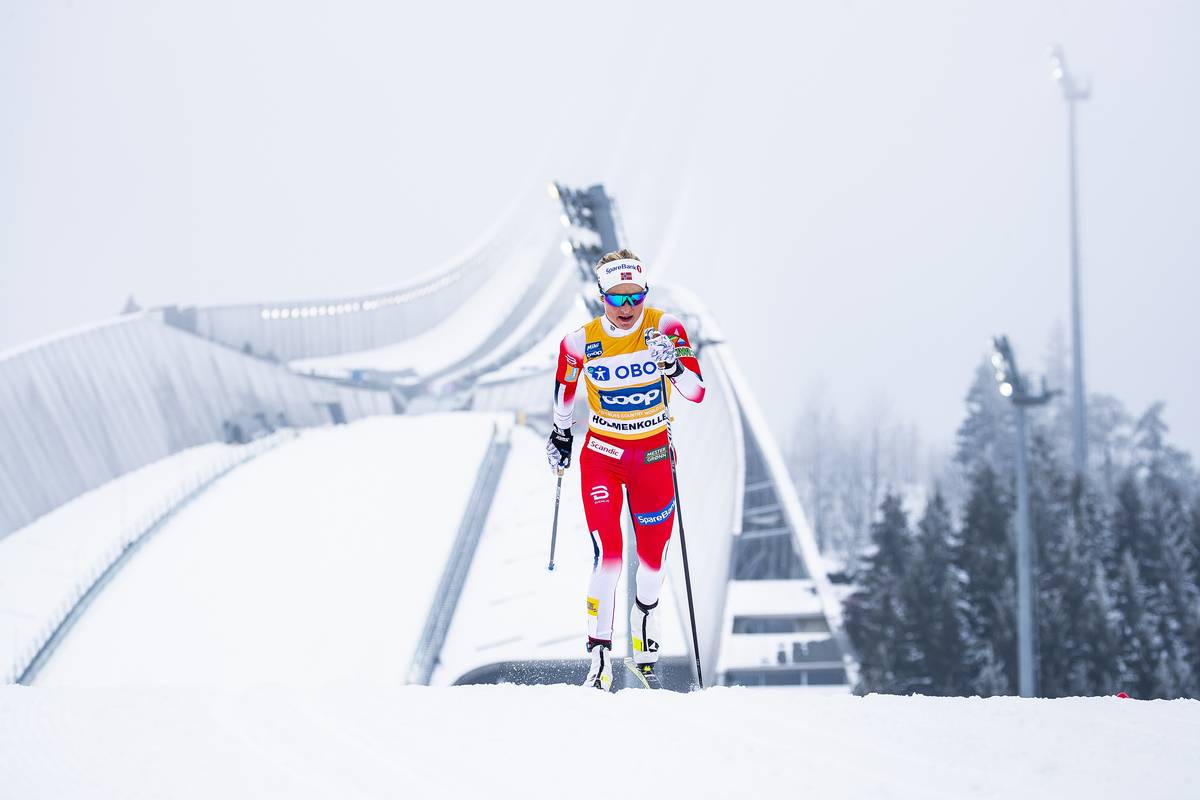
    Therese Johaug, who has distance points of 0.00, skiing solo at Holmenkollen in March 2020. (Photo: NordicFocus)

    First in a two-part series. Coming next week: The meaning of a single FIS point for national team selection.

    The recent news that David Norris was not named to the national team by the narrowest of margins, following the application of objective selection criteria tied to an athlete’s position on an overall FIS points world ranking list, has inspired FasterSkier to take a closer look at where these numbers come from. The goal of this piece is to provide some background on the mathematical inputs for this magic number, and to survey some of the things it is used for. 

    Where FIS points come from

    First things first: FIS is an abbreviation for Fédération Internationale de Ski, the French term for the Switzerland-based International Ski Federation. FIS is an international governing body that sets international competition rules for a range of snow sports. It has a membership of 118 national ski associations.

    There were a great many ski races in this country in the winter of 2019–2020. A relatively small portion were sanctioned by U.S. Ski & Snowboard (formerly and still better-known as USSA), the domestic governing body for American skiing, and were tied to the National Rankings List, or NRL. If you raced at Junior Nationals this year, for example, you got NRL points but not FIS points.

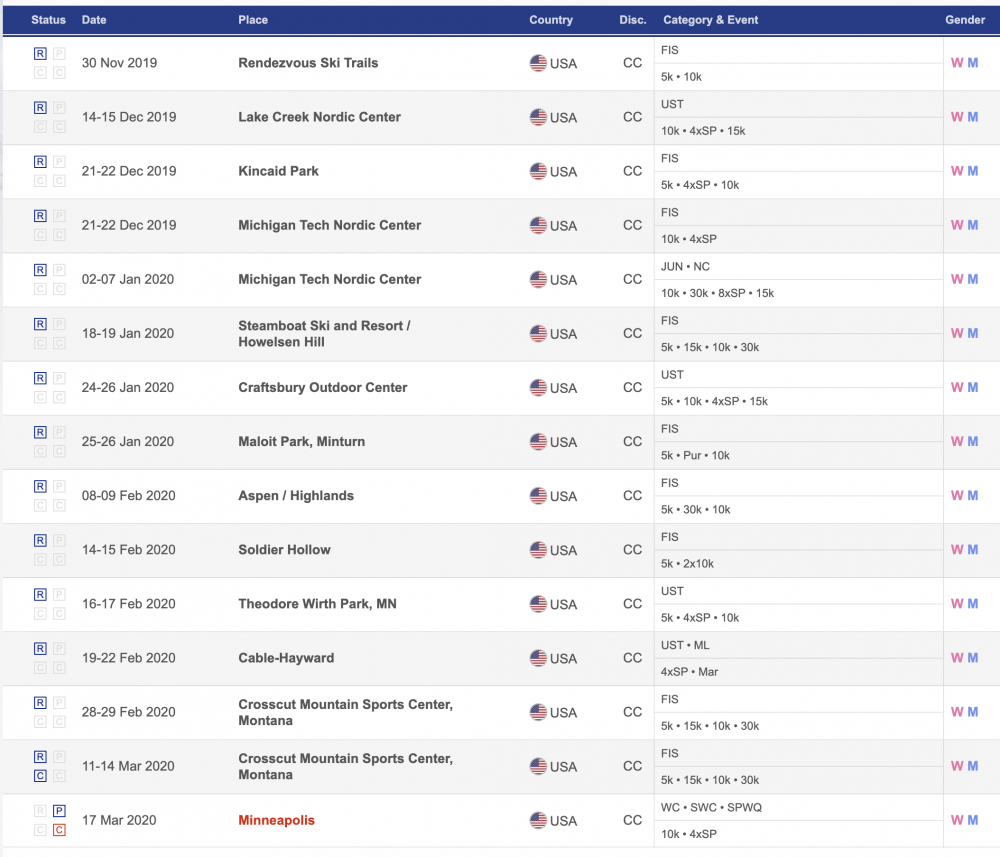
    An even smaller portion of domestic races last year were FIS races, meaning that they would provide FIS points to competing athletes who had an active FIS license. Here is the entire list of FIS races in this country last season (to clarify, clicking on this list on the FIS website yields multiple races for each venue, such as a men’s and women’s distance race, sprint qualifier, and sprint heats for the second entry, the Sun Valley SuperTour stop):
    2020 American FIS races. (photo: screenshot from FIS site) https://www.fis-ski.com/DB/cross-country/calendar-results.html?eventselection=&place=&sectorcode=CC&seasoncode=2020&categorycode=&disciplinecode=&gendercode=&racedate=&racecodex=&nationcode=usa&seasonmonth=X-2020&saveselection=-1&seasonselection=
    2020 American FIS races. (photo: screenshot from FIS site)

    Yes, that’s poignantly missing a certain mid-March domestic World Cup stop (listed in red to show it was cancelled), and technically speaking the March entry for Montana has fewer results than it should because NCAA Championships were cancelled halfway through, but this is otherwise a complete list. It contains U.S. Nationals, standalone SuperTour stops, December JOQ races in Alaska and Michigan, and regular-season races for the RMISA college circuit, but not for CCSA or EISA. Add a November race at West Yellowstone, and that’s a total of 14 FIS race stops, for the entire country, for the entire winter. Not too many.

    Designating a race as an official FIS race involves paying an additional fee to FIS, as well as other logistical requirements aimed at ensuring the fairness of the competition and the accuracy of the results. Most fundamentally, it requires hosting the race on a homologated course, that is, a race course that meets numerous requirements for specifications like width, overall climb, and the placement of hills. You can find more information about the homologation process here, and a very long article about the earliest FIS race in each season here.

    (All that said, FIS points may also be awarded for a race that was intended to be held on a homologated course, but was moved due to safety considerations. The distance races at 2018 U.S. Nationals in Anchorage, distance races at 2014 Spring Series in Anchorage, and the infamous 33-lap 50 km at 2012 Spring Series at Craftsbury are just some of many examples. FIS points are also awarded for city sprints, including those on virtually flat courses that would not meet a typical sprint course homologation standard.)

    How FIS points are calculated

    The following should be clear as mud:

    Screenshot from "Rules for FIS Cross-Country Points 2019-2020" / https://assets.fis-ski.com/image/upload/v1570708645/fis-prod/assets/FIS_points_rules_2019-2020clean.pdf
    Formula for calculating race points (photo: screenshot from Rules for FIS Cross-Country Points 2019-2020)

    Seriously, though, this may look daunting – and the German may not help – but the math, and the concept behind it, are both pretty straightforward. Briefly put, it’s a calculation of an individual racer’s percentage back from the race winner (as measured by time, not by placing), multiplied by a factor that approximates how tightly bunched the field is expected to be.

    As an example, say someone wins an interval-start 5 k race in 14 minutes (840 seconds), and you finish second in 15 minutes (900 seconds). Using the righthand calculation from the screenshot above, 900/840 is, in round numbers, 1.0714. (Put another way, you finished 7.14% back from the winner.) Subtract 1, and you get 0.0714. Multiply that by the race factor, in this case 800 for an interval-start race, and you get 57.12. Your race points for this race are 57.12. That’s it. (At least if this is a World Cup-level race, so you don’t have to do additional steps to account for the relative strength of the field. More on that later.)

    For one more example: Say it’s a mass start race, and you stay in the lead pack till the very end, but then you get viciously dropped on the final downhill back toward the stadium and lose half a minute over the last kilometer (I may be projecting here). The winner finishes in 1 hour even (3,600 seconds); you straggle home in 13th place, 30 seconds later (3,630 seconds). 3,630/3,600 is 1.008333; minus 1 is 0.008333; 0.008333 times 1400 is 11.67. Your race points for this race are 11.67.
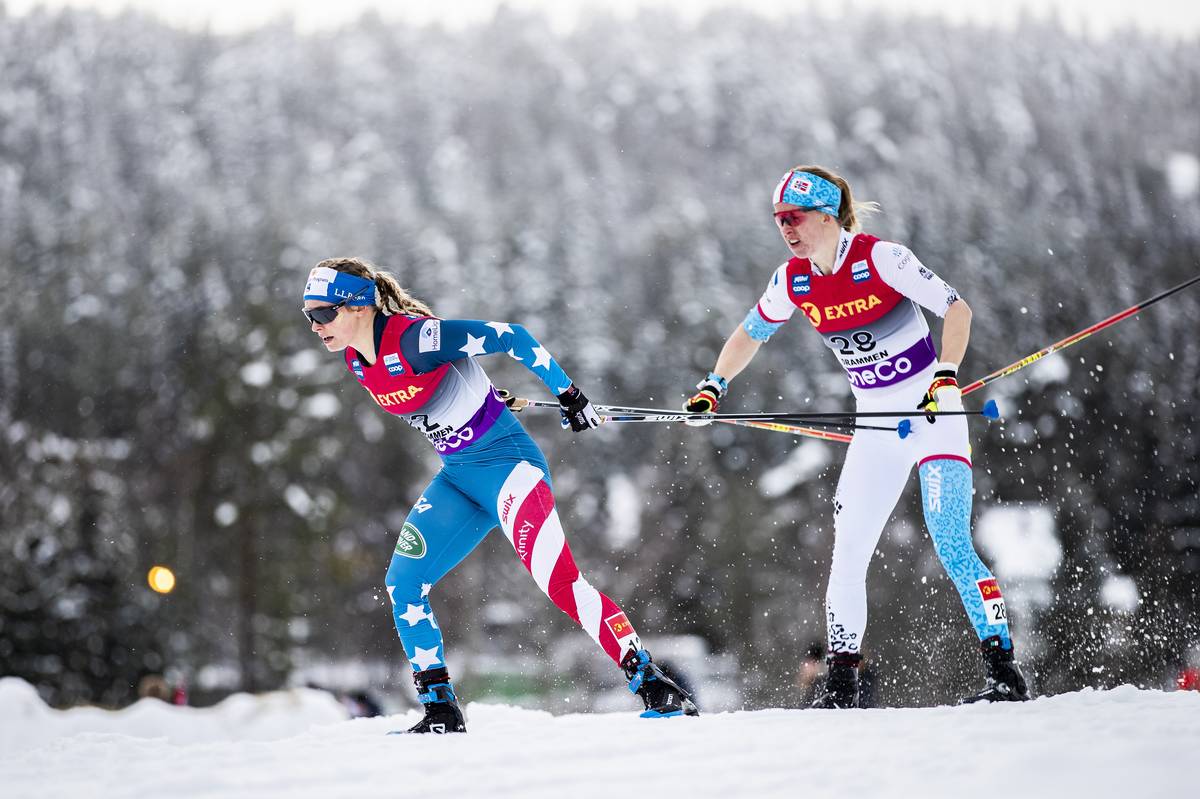
    Jessie Diggins, who has sprint points of 12.80, sprinting in Konnerud, Norway, in March 2020. (Photo: NordicFocus)

    This may be obvious, but it’s worth underscoring that your points for the second race are a whole lot better than those for the first race, even though you were 13th instead of second. (Lower points are better, like a golf handicap. Jessie Diggins’s distance points are 16.11. If you’re an American skier reading this and you’re not Diggins (you’re probably not), your points are worse than that.) A race points calculation has everything to do with your individual percent-back from the winner, and nothing to do with overall place. The math asks how far back you were from the winner, not how many other people finished between you and the winner. As you may have heard a coach express from the side of the course during a time trial, every second really does count.

    The math also values performance in interval-start races, everything else being equal, more highly than performance in mass-start races. You multiply your percent back by 800 for the one, but by 1400 for the other; the race factor for a mass-start race is 75% greater. This makes sense: If you’re fast enough to be skiing with the leaders in a mass start race, finishing one percent back there is in many ways less impressive than finishing one percent back in an interval-start race where you had to ski the whole way on your own. The same splits as the first example – winner in 14 minutes, you in 15 minutes – are a 57-point race for an interval start, but a 100-point race if it was a mass start. That’s a big difference.

    This theory makes more sense at the high end of the field, where a given racer is typically capable of skiing with the lead pack for at least some portion of a mass start race. If you are instead as good a skier as, say, this reporter, while it is obviously easier to ski with a pack than on your own, your overall percent-back figure may not be all that different across the two race formats, given that you typically lose sight of the race leaders by halfway up the first uphill leaving the stadium.

    Indeed, personally speaking, among USSA-sanctioned races tied to the domestic rankings list (same math as for FIS points), my race points for interval-start races typically fall in the 100s and 200s, and for mass-start races in the high-200s or 300s (or the 400s, when the wheels really come off, typically in classic races where the wax tech 🙋really flubs the wax). If I were consistently skiing with the lead pack in both race formats, these numbers would be a lot closer to each other. And much smaller.

    Last step: Add a race penalty

    Finally, note that there is one more step involved in calculating FIS points for any race below the World Cup: adding a race penalty, to the race points number reached above, to reflect roughly how competitive the field is. A World Cup, Olympics, or World Championships race has a fixed penalty, of zero, which is why the math ended there in the calculations above.

    But in any other level of racing, you look at the top five finishers (with active FIS licenses), take the three best FIS-point values from the current sprint or distance ranking list, add them, then divide by 3.75. You then add this race penalty to the race points calculation described above to determine the FIS points for a given result. (You can find a more nuanced analysis of minimum penalties and what to do with insufficient ranked finishers in Section 5.3 of the Rules for FIS Cross-Country Points 2019-2020 document on the FIS website.)
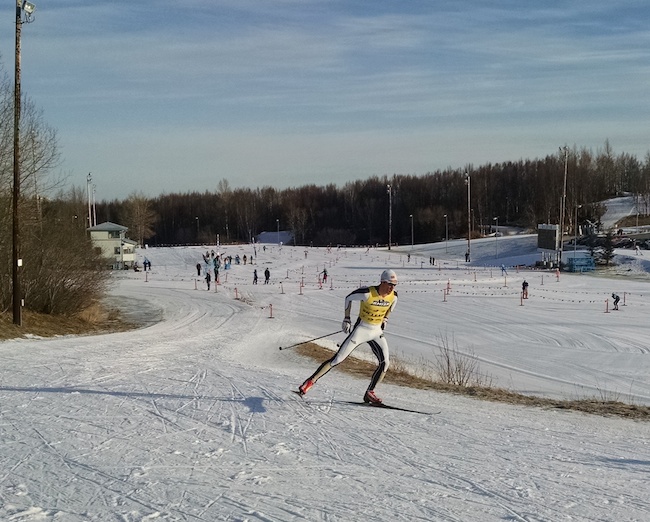
    Rune Ødegård of the University of Colorado, who at the time had distance points of 27.33, racing to second place in the 10 k skate at Kincaid Park as part of RMISA Championships in March 2015. (Photo: Tim Whiton)

    Among domestic races last season, for example, the winner of the men’s classic distance race at RMISA Regionals received 43.46 FIS points; of the December Alaska JOQ race, 42.77 points; of the November West Yellowstone race, 41.82 points; and of the classic race at U.S. Nationals, 26.70 FIS points. For the women, it was 72.26 points for Alaska; 42.07 points for West; 53.82 for RMISA; and 37.34 for U.S. Nationals. The variations show that the points available for a given race will depend on how many fast people show up; among the men’s races listed above, U.S. Nationals unsurprisingly had the best high-end field by a substantial margin, while the other three races were all roughly comparable. For the women, meanwhile, the field was nearly as good in a November race in West Yellowstone as at Nationals. The overall difference between the genders (all the women’s races have higher points than the men’s) likely reflects that more top-level American distance women are racing in Europe each season, so that the domestic field left behind in North America, while strong, is not as strong as the men’s.

    These numbers generally underscore that winning a top-level domestic race is treated as mathematically less impressive than winning a World Cup race, which is appropriate. (The minimum penalty assigned by FIS goes the other way too, though. Winners at Norwegian national championships received the minimum allowed penalty for a domestic FIS race, 20 points, even though topping a domestic podium of Therese Johaug — Astrid Jacobsen — Tiril Weng is no less impressive than winning a World Cup race against a full international field.)

    Inside the rankings list, ft. Master Blaster humble pie

    Speaking of Johaug, she is, as you may imagine, ranked first on the current FIS world rankings distance list: Johaug, Therese, NOR, 1988, 0.00. The rest of the women’s top 10 is about what you would expect: in order, Ingvild Østberg, Ebba Andersson, Heidi Weng, Krista Pärmäkoski, Astrid Jacobsen, Natalia Nepryaeva, Frida Karlsson, Jessie Diggins, Teresa Stadlober. By the time you get to Stadlober, in tenth, the points have already risen from zero to 16.26.

    The top 10 men, meanwhile, start with Alexander Bolshunov of Russia, 0.00 points, and stretch down to Dario Cologna of Switzerland, 5.34 points. Other than Iivo Niskanen of Finland, in sixth, every other man in the top 10 is Norwegian. If you listened to Devon Kershaw’s podcast this season, you may have heard him discuss the Norwegian men’s distance dominance.

    The points are asymptotic for both genders, but the men are more tightly bunched than the women at every level of the distance rankings. On the women’s side, tenth place on the distance list has 16.26 points; 50th has 42.87 points; 100th has 52.52 points; 500th has 117.29 points. For the men’s distance list, 10th place has only 5.34 points; 50th has 24.69 points; 100th has 34.09 points; 500th has 73.47.

    Chart of world rankings by gender for 2020 final FIS Distance Points list. (photo: screenshot of Gavin Kentch chart)
    Chart of world rankings by gender for 2020 final FIS Distance Points list.

    The fact that it is more difficult to achieve a certain ranking for the men than for the women is, at least somewhat, reflected in various selection criteria for choosing American athletes for international competition. For example, the current draft of the selection criteria for World Cup team selection gives World Cup Period I start rights to a woman achieving a top-30 sprint or distance ranking on the current world rankings list, or to a man achieving a top-40 ranking.

    This difference only partially accounts for differing levels of competitiveness, though: 30th on the women’s distance list is 34.67 points, but 40th on the men’s list is 22.07 points. The standard would have to be top-30 for women, or top-105 for men, to achieve equality at the level of 34.67 distance points.

    Finally, at the other end of these rankings, where would you stack up if you’re a mid-level American master skier? No offense, but: not very high.

    I’m going to shift to the first person here and use myself as an example, to avoid seeming to pick on a random, presumably very nice Midwestern skier I’ve never met. I’ve done the American Birkebeiner skate race – a well-known race in this country and a decent barometer for citizen racer fitness – once, four years ago, at age 34. In my first time ever on the course, I started in Wave One and finished 190th among the men. I have a strong urge to make excuses about how much my skis sucked and how poor my nutrition was, but let’s just generally say that it did not feel like a result that showed what I was really capable of. Given improved training since then and hopefully more competitive skis, I would credibly hope to finish somewhere between 100th and 150th if I raced the Birkie again.
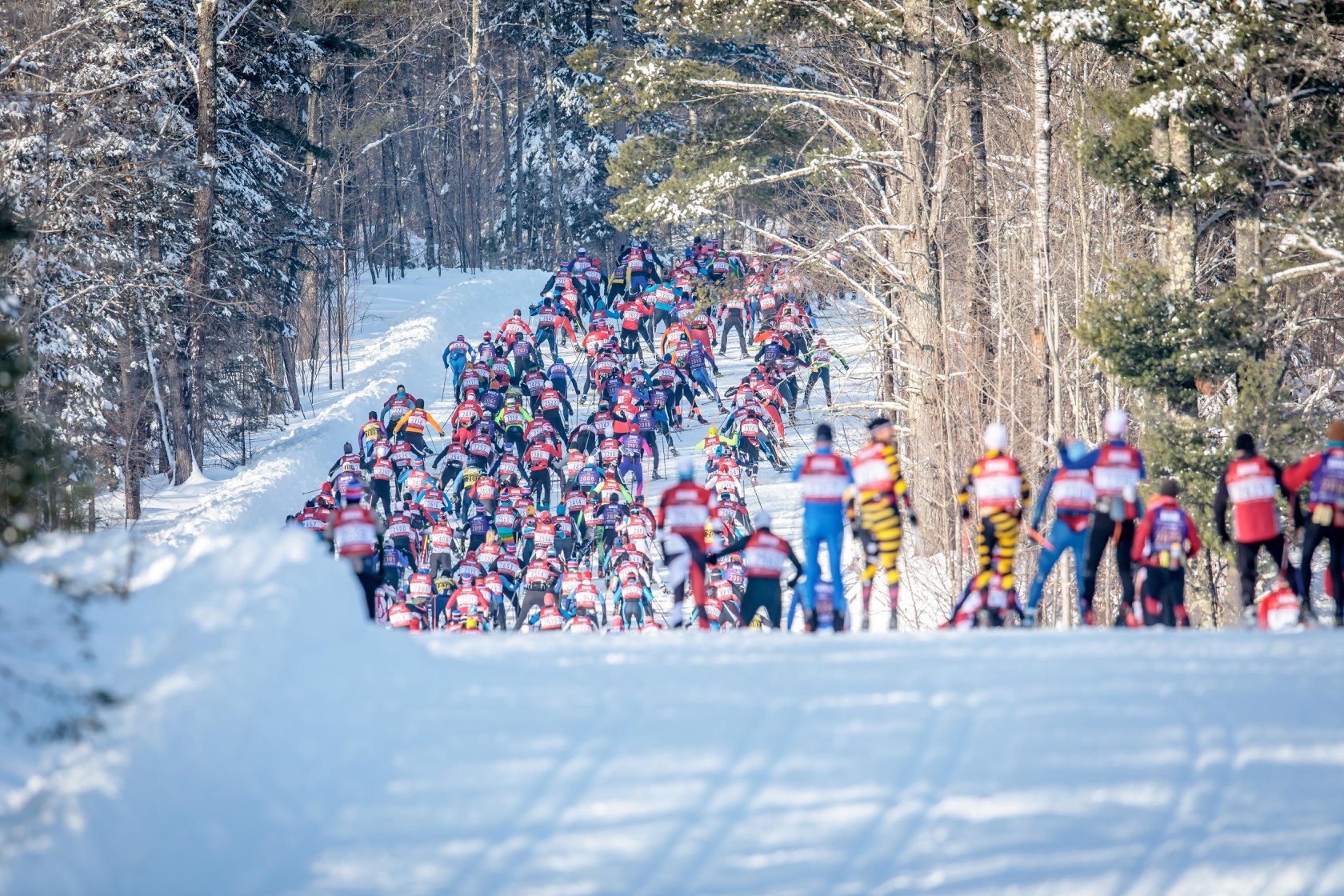
    Wave 2 of the 2018 American Birkebeiner on course. (Photo: American Birkebeiner Ski Foundation)

    I don’t have a FIS license (paying $115 each year for a USSA license to finish in the bottom half of local JOQ races is enough for me), but as an Anchorage-based skier I’ve done many local races against athletes who do have them. Extrapolating from my finishes in these races, and for the sake of the math making the generous assumption that I’d found five interval-start FIS races in the last year (this number would go up significantly if mass-start races were in there as well), I would predict that my current FIS distance points would be, in round numbers, 260.

    FIS points of 260 would give me a current world ranking of… 3,448th among male distance skiers, out of 5,559 male athletes currently ranked. You just finished 120-something in the skate American Birkie, thereby achieving Master Blaster godhead? Congratulations, there are only 3,400 skiers better than you in the world. (Actually, there’s far more than that, since very few masters skiers have current FIS licenses and so are excluded from this listing. But it’s at least that many.)

    What FIS points are used for

    Athletes’ FIS points are most commonly used to rank racers in an interval-start (lowest points start last) or mass-start race (lowest points start first, at the front of the chevron). They are also used as a sort of shorthand requirement for a certain level of performance – the skiing version of “You must be this tall to go on this ride.” Hence, for example, if you are an American skier, you must have:

    And so on. The theory behind FIS points is that they may be used as a credible shorthand for how good a skier is, in any context, particularly in a country as large as the U.S. where skiers do not often all race against each other.

    Finally, and returning to the impetus for this article, FIS points also form the basis for world ranking lists that are used to determine objective selection to the U.S. Ski Team. Please tune in next week for Part II of this series, What’s a Point Worth.

    This article has been edited to reflect the fact that it is specifically in the distance rankings that male athletes are more tightly bunched than women athletes.
  • Hop on Board; Technical Delegates Needed

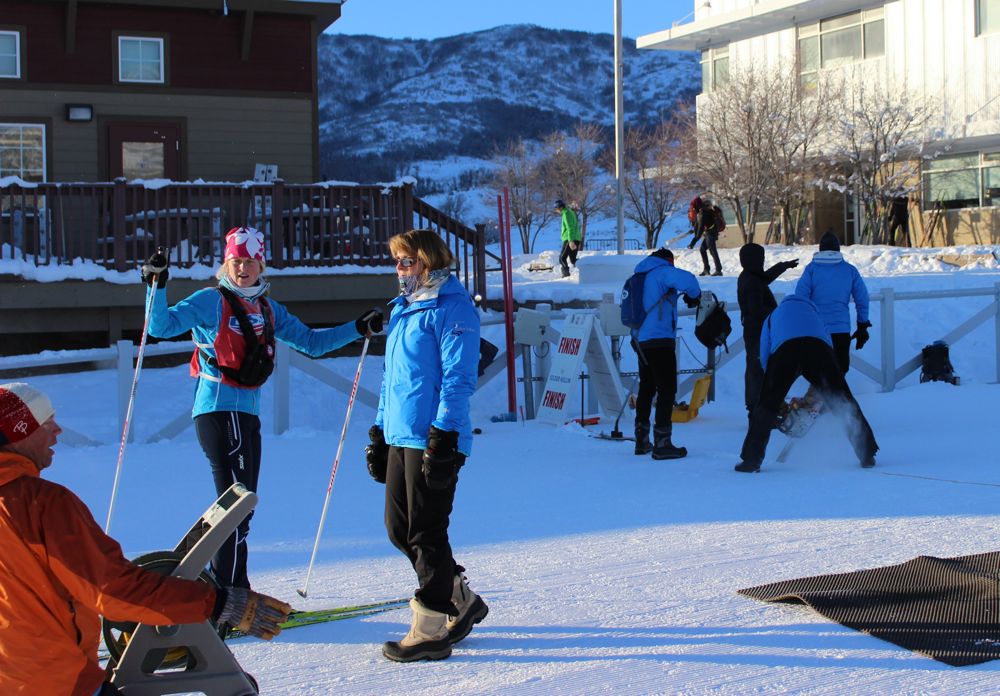
    Technical delegate Eileen Carey (left) talking with race volunteers at an event at Soldier Hollow in Midway, Utah, in 2013.


    This article comes from Alan Watson, a certified TD and head of the cross-country section of the Pacific Northwest Ski Association (PNSA).


    Here’s the straight and simple request: U.S. Ski and Snowboard needs Technical Delegates (TD). Before we go any further, let’s give a brief rundown of what that means.  

    U.S. Ski and Snowboard rules require each sanctioned race to have a jury which ensures that the race is fair, safe and conducted according to the rules. (Sanctioned races are also referred to as “NRL races”, which stands for National Ranking List because those races are used to calculate USSA points). The jury does much more than decide cases of discipline or other disputes. They review all aspects of the race before, during, and after, trying to make sure that everything will go as smoothly and properly as possible.

    For most NRL races the jury consists of three officials: the Technical Delegate (TD), an assistant Technical Delegate (TDA), and the Chief of Competition, and for bigger races like a SuperTour or National Championships the jury normally includes two additional members. That means each race needs at least two, and sometimes four for bigger races, trained technical delegates to serve on the jury. Of course, it doesn’t hurt when the Chief of Competition is a trained and certified TD as well.

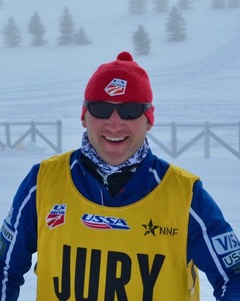
    Jury member, Level 2 certified TD, and U.S. Ski and Snowboard Cross-Country Sport Development Manager Bryan Fish. (Photo: Courtesy of Al Pokorny)

    The TD and the TDA are appointed by and represent U.S. Ski and Snowboard. The idea is that they will be independent of the race organization, and will represent U.S. Ski and Snowboard in overseeing the race. In cases where the race organization might be tempted to ignore the rules, either from naivety or from thinking they have a better way, the jury is responsible for keeping things on track. The jury may suspend or modify certain rules if necessary for safety or to make a better race, as long as the intent of the rules is honored.

    The jury’s work begins well before the race date. Shortly after being assigned to a race in the fall, the TD contacts the TDA and the race organizers and begins an ongoing dialogue. In most cases the relationship between the TD and the race organization is cooperative and supportive, with the TD providing advice, answering questions, and interpreting the rules. The TD inquires about and verifies all aspects of the race, including the schedule, the course and stadium, grooming, timing, medical plans, and results. Although this list is not comprehensive, it provides a general idea of the TD’s responsibilities.

    On arrival at the race venue, the TD inspects the course before official training and helps decide the placement of tracks and technique zones as well as safety precautions. During the race, the TD typically monitors the stadium area while the TDA monitors the rest of the course.

    When all goes well the TD can be proud of being part of a job well done. The happy faces of racers after an event are a reward well worth the time and effort involved. But sometimes awkward or difficult situations can arise which the jury has to address. Perhaps one racer changed lanes improperly and obstructed another racer, or a racer broke a pole in a race and publicly expressed his frustration in unseemly language, or the timer failed to promptly resolve close finishes at the end of each heat. When these things occur the jury’s reward is knowing that they confronted the issue thoroughly and reasonably.

    Both the TD and TDA are required to be trained and certified by U.S. Ski and Snowboard. The process normally begins with a two-day training session. After passing a written exam, a candidate becomes a Level 1 TD which allows him or her to be appointed as a TDA. After serving as a TDA in at least two races, and being recommended by the TD of each, a Level 1 TD can advance to Level 2.

    A Level 2 TD is allowed to be appointed TD or TDA at any NRL race. A similar but more involved process allows a Level 2 TD to advance to Level 3, which allows him or her to serve as TD or TDA at FIS races in addition to NRLs.

    In the western US, we typically have a TD and Race Organizer conference every other year. This serves as the initial training for TD candidates and as continuing education for certified TDs, as well as training for race organizers. The most recent conference was held in West Yellowstone in late November 2018. About 25 of people attended, with eight different attendees and two outside speakers leading the discussions on various aspects of race organization and officiating.

    Dr. Al Pokorny, a certified Technical Delegate at a local Spokane, Washington race. The headgear is not official TD attire. (Photo: Courtesy Al Pokorny.

    Normally the TD comes from a locale different from the race location, and if possible the TDA is local. TDs and TDAs receive travel, lodging, and food expenses plus a small per diem, so it is in the financial interest of the host club to recruit a local to become certified and act as the TDA.

    Senior TDs serve as TD assignors. It can be difficult for an assignor to find enough available TDs to cover all the races on a given weekend. If a TD cannot be found for a race, entrants will not get points for that race. A few years ago all the certified TDs in the Intermountain Division had retired, partly because a whole cohort that got involved before the 2002 Olympics at Soldier Hollow began to age out at the same time. So it is important to recruit new blood into the pipeline and to encourage their development.

    If you are interested in helping our sport by getting into the TD world, contact your division’s assignor:

    Alaska Matt Pauli nordicmatt@gmail.com

    Far West Megan Seifert meganseifert@gmail.com

    Great Lakes Scott Wilson wilson@cresthillresort.com

    High Plains Al Pokorny apokorny@spokaneent.com

    Intermountain Al Pokorny apokorny@spokaneent.com

    Mid Atlantic Jim Rodrigues jimrodrigues3@gmail.com

    Midwest Scott Wilson wilson@cresthillresort.com

    New England Jim Rodrigues jimrodrigues3@gmail.com

    Rocky Quincee Cotton qcotton@comcast.net

    PNSA Al Pokorny apokorny@spokaneent.com

    USA Overall Allan Serrano allanjserrano@gmail.com


  • “There Was Outrage:” USSA Membership, Race Fees Increase In 2012

    “There Was Outrage:” USSA Membership, Race Fees Increase In 2012

    Sh4rp_i/Flickr Creative Commons.

    Athletes who buy U.S. Ski and Snowboard Association (USSA) membership and compete in National Ranking List (NRL) events throughout the season will face higher race and membership prices this winter than in previous years. Due to an increase in its own administrative and insurance costs, USSA has raised the price of some of its services, which has some coaches and regional coordinators concerned about pricing entry-level skiers out of the sport.

    The head tax that race organizers must pay in order to hold a sanctioned NRL event increased by $4 per entrant across all USSA disciplines — from $4 to $8 per head in cross country, with a cap at $800 per race where the limit was once $400. Many regional organizers said they would have to pass on the rate hike to the consumer in the form of higher entry fees.

    USSA’s annual cross-country competitor and club membership dues have also gone up; club membership increased from $150 to $200, individual membership (ages 13 and older) was $140 in 2011 and is now $150, and youth membership (under 13) is $60 where it was once $50.

    According to USSA, the hike in the head tax is necessary to cover its own increasing costs. In the eight years since rates were last changed, there has been a 55% increase in the price the governing body pays to provide liability insurance at sanctioned events, including a 22% increase in the last year alone.

    USSA is also experiencing the added costs of implementing new race administration services. It plans to add an online race registration tool to its website, a service organizers have commonly outsourced to third parties like Active.com in the past and for which competitors pay a processing fee. USSA hopes that internalizing the service will make it easier for organizers to integrate information from its member database into start lists and results, as well as divert processing fee revenue back to the governing body.

    USSA Vice President of Athletics Luke Bodensteiner said that revenue from the increase in cross-country fees will go directly back to supporting cross-country membership programs, such as administration of the ranking list.

    “There are costs we incur to have members, have member clubs, have member races,” Bodensteiner said. “What we try to do is make sure we are bringing in income to support the membership programs.”

    Bodensteiner acknowledged that the increase in head tax would be a challenge for race organizers, who either have to absorb the extra cost or pass it along to the competitors’ entry fees. But he didn’t anticipate much of a drop in registered NRL races.

    “It’s early to gauge, but so far it doesn’t look like there will be a major change in that,” he said in early June.

    Any time there is an increase in fees to members, the USSA board votes on the action. The board includes athlete representatives as well as chairpersons from each of the respective sport committees, who are given the chance to gauge response to any given proposal from the stakeholders within the disciplines at the annual USSA Congress.

    Some regional administrators and event organizers contacted in June for comment on the increase said they would likely not cut the number of NRL races on their respective 2012-2013 calendars, and expected to increase entry fees in order to meet the added cost. Others said they would consider holding fewer NRL events if the added cost didn’t make sense for typically smaller races.

    What the regions agreed upon was a sense of disappointment in not initially being informed of the reasons for the rate hike.

    “We heard about it when we went to the USSA Congress and saw the packet of information before the meeting started,” said Rocky Mountain representative Mike Elliott.

    “There was outrage.”

    Cross-country committee chairman Jon Engen listened to initial feedback at the USSA Congress before reporting back to the board, and sympathized with the frustration expressed by regional representatives.

    “If you had a dollar increase ten years ago, and another dollar increase six years ago, maybe this wouldn’t have been an issue,” Engen said. “But that never did happen, and now with a $4 increase it’s very unpopular.”

    Ultimately, he added, “the price of milk is hard to argue with.”

    Once made aware of the reasons for the rate hike, coaches and program directors were understanding of the financial reality but remained unhappy with USSA’s communication regarding the change.

    “We understand where they’re coming from,” said New England Nordic Ski Association (NENSA) director Zach Stegeman. “We’d have liked to be a part of the conversation, but the reality is that they are increasing fees to represent some real expenses and they are intending to keep all the revenue in the nordic community, so we certainly can’t complain about that.”

    While Stegeman was fairly certain that NENSA uses a separate insurance provider, clubs like the Sun Valley Ski Education Foundation (SVSEF) that also encompass alpine disciplines do rely fully on USSA’s coverage.

    The root of some community members’ disappointment in a perceived exclusion from the rate hike conversation lies in the fear that raising entry fees and membership dues might price some athletes out of the sport.

    “Making the sport more expensive is not a good thing in general, especially for entry level athletes,” said Central Cross Country director Yuriy Gusev. “NRL events always have great competitive atmosphere around them and high level of competition. If this change will affect the number of participants in NRL events that will be a big downside.”

    SVSEF director Rick Kapala made a similar point about the increase in membership.

    “The one I’m the most concerned about is the youth membership increase,” Kapala said. “Every barrier to entry you put into sport at the youngest levels, that’s not good. If you’d have had a discussion about it, which we didn’t, I’d have argued for keeping youth membership exactly the same, and increasing [membership for] J2 and older. They utilize the services more; the points, the pipeline is more geared towards them.”

    For a significant base of USSA members — juniors — the value of membership and participation in NRL races lies in earning potential for USSA points. Points are awarded to USSA members based on NRL results, and USSA keeps track of each athlete’s points on a list that ranks their season-long performance against skiers from all over the country. The list is then used to seed juniors in mass starts at Junior Nationals, and provides certain regions a standard metric with which to determine its elite groups.

    Cutting NRLs out of a regional calendar, therefore, would hurt athletes’ JNs seeding. In Rocky Mountain, Elliott felt the division has no choice but to accept the decision and increase their NRL race entry fees. Other regions felt the same; they would continue sanctioning the same number of NRL races, but would have no choice but to raise prices.

    “I don’t imagine that we are so close to the tipping point that it will have a great effect in entries, but it might deter some people,” wrote Pete Leonard, interim Alaska representative and Fairbanks Nordic Ski Club head coach, in an email. “Hopefully our efforts to make the events…better will counteract that.”

    Alex Matthews contributed reporting.

  • European Races Scored to the USSA NRL List

    As per the 2011 Comp guide, USSA will score certain FIS & Continental Cup events in Europe to the National Ranking List (NRL), as well as them being scored to the FIS points list.  This is a dramatic increase in the number of weekends (from 2 to 10) that will be scored to support the national development strategies being called out by the U.S. Ski Team and club coaches nationwide.

    USSA European NRL events 2011 season
    (not including WJC/U23/WSC/WC events which are included in the NRL)

    Nov 12-14 FIS
    Muonio, Finland
    Sprint F, 5/10k C, 5/10k F

    Nov 20-21 FIS
    Rovaniemi, Finland
    Sprint C, 5/10k C

    Nov 27 FIS
    Piteå, Sweden
    10/15 C

    Nov 28 FIS
    Arvidsjaur, Sweden
    10/15 F
    __________________________________

    Feb 2 – 3 Scando Cup
    Madona, Latvia
    Sprint F
    10/15km F

    Feb 5-6   Scando Cup
    Jõulumäe, Estonia
    Sprint C
    10/15 C

    Feb 11-13 FIS
    Beitostolen, Norway
    Sprint C
    5/10 F
    15/30 C

    Feb 12-13 OPA Cup
    Forni di Sopra, Italy
    Sprint F
    10/15 C

    Feb 18-20 OPA Cup
    Campra, Switzerland
    F Prologue
    5/10 F
    10/15 C Handicap start

    Feb 25-27 Slavic Cup
    Nove Mesto na Morave,
    Sprint C
    10/20 Pursuit
    7.5/15 C
    __________________________________

    Mar 5-6 OPA Cup
    Rogla, Slovenia
    5/15 C
    15/30 F Mst

    Mar 11-13 OPA Cup Finals
    Ramsau / Dachstein, Austria
    Sprint F
    5/10 F
    10/15 C Pursuit Start

    Please feel free to download the below pdf for the complete schedule.  Contact Peter Vordenberg pvordenberg@ussa.org for more information.

    European NRL schedule 2010-11 (PDF)

    *only those USSA members with active FIS licenses will be scored in these events.

    Source: USSA