From the FasterSkier archive — posts syndicated from athletes’ and coaches’ own blogs between 2004 and 2012, kept online as published. Current coverage is at fasterskier.com.

Tag: NSCF-FXC Comp Team

  • NSCF-FXC Seeks Head Coach/Director of Skier Development

    NSCF-FXC Seeks Head Coach/Director of Skier Development

    (Job posting)

    The Nordic Ski Club of Fairbanks (NSCF) is looking for an energetic and enthusiastic individual to lead its junior racing and training program, Fairbanks Cross Country (FXC) as Head Coach.  This person would also serve as the Director of Skier Development, overseeing FXC and the club’s other instructional programs.

    Salary starts at approximately $45,000, plus reimbursements for retirement and health care costs, depending upon experience.  The Head Coach/Director of Skier Development reports directly to the Skier Development Oversight Committee, which committee reports to the Nordic Ski Club of Fairbanks Board of Directors.

    Ideally, the candidate who is selected would arrive in Fairbanks to start leading the program by late summer.  NSCF/FXC will assist with travel and/or moving costs.

    Interested parties should send letters of interest and resumés to administrator@nscfairbanks.org.  The position will remain open until filled.  A selection committee from the NSCF will conduct interviews via telephone with qualified candidates.

    Information about the program, the club and the community:

    FXC has been in existence for 12 years, growing in that time from a program with less than a dozen skiers to a program with 100 or more skiers involved in seasonal and year-round programs at the Competition, Prep, and Junior Development levels, as well as a modest Masters program.  Besides the head coach there is one year-round assistant coach as well as part-time coaches.  The club’s other instructional programs include the Junior Nordic program for skiers up to middle-school age, and an Adult Lessons program.

    Fairbanks is blessed with one of the longest ski seasons in the nation on natural snow – from late October to late April – at an elevation of under 1000’ above sea level.  The home venue for the program is Birch Hill Recreation Area, known around the US for its outstanding trail network and world class facilities.

    FXC has dedicated space in buildings at Birch Hill.  FXC also owns a 2016 passenger van and trailer for hauling gear.  FXC skiers participate in a full schedule of local races, as well as JNQ races elsewhere in Alaska.  Top skiers in the program participate in US National Championships.  FXC coaches are part of the coaching staff on the Alaska Junior National Team.

    The 50-year-old Nordic Ski Club of Fairbanks has approximately 1000 members and is in sound financial condition.  It has provided strong support for cross country skiing in general and for FXC in particular since its inception in 2006.  Fairbanks also has a strong tradition of high school cross country skiing.

    ventolin buy online

    There are exceptional opportunities for a wide variety of exciting outdoor recreational opportunities in and nearby Fairbanks. Fairbanks has a full array of dining, entertainment, lodging and shopping options and is the home of the University of Alaska Fairbanks, which has a cross country ski team.  Fairbanks has excellent connections by passenger jet to major airports throughout the US.  The population of the Fairbanks North Star Borough is approximately 100,000.

    The job descriptions for the FXC Head Coach / Director of Skier Development positions are available at: http://www.nscfairbanks.org/wp-content/uploads/2018/06/FXC-Job-Descriptions-Head-Coach-and-Director-of-Skier-Development.pdf 

  • Wednesday Workout: Getting Adaptable with NSCF-FXC

    Wednesday Workout: Getting Adaptable with NSCF-FXC

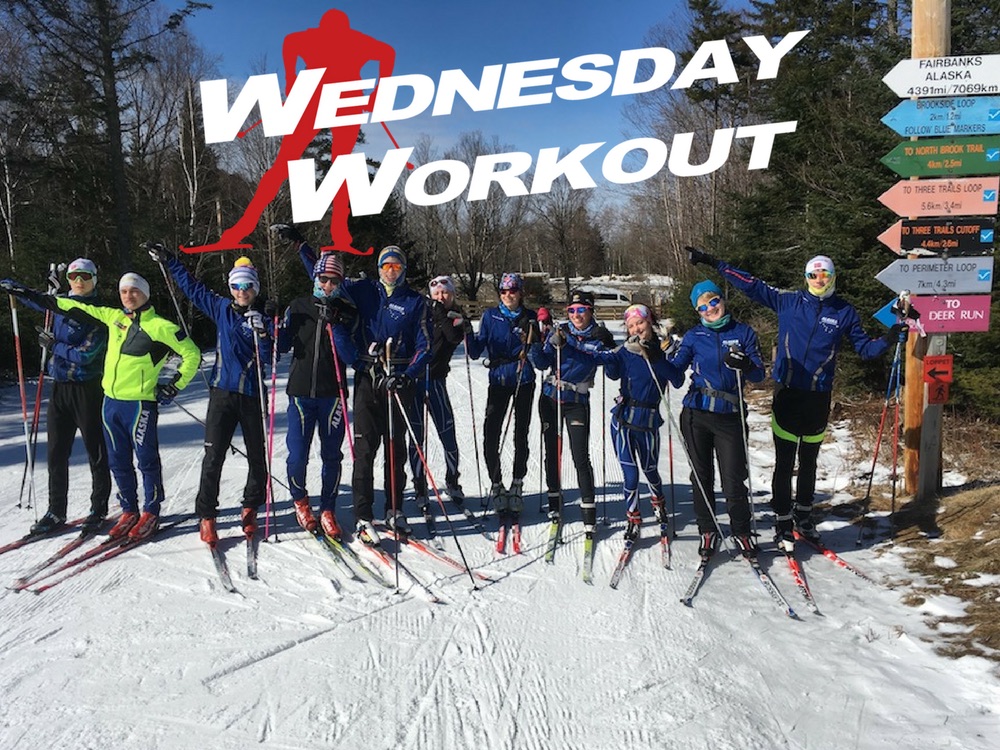
    The NSCF-FXC crew points toward home (some 7,000 kilometers away) at 2017 Junior Nationals this past March in Lake Placid, N.Y. (Photo: Peter Leonard)

    The following workout comes from Alasdair Tutt, interim coach for the Nordic Ski Club of Fairbanks/Fairbanks XC (commonly known as NSCF-FXC). Tutt recognizes that while training in central Alaska has its perks (like reliable snow), it can also be tough for skiers to excel outside of their familiar environment (like on significantly warmer snow). This is true for anyone racing in variable climates and at both high and low elevations across North America. So for NSCF-FXC, the goal is to get develop speediness for races in the lower 48. 

    ***

    Training in Fairbanks, Alaska, may have many advantages: skiable snow for six months a year, tough homologated loops at Birch Hill and the endless wilderness to explore regardless of the season. However, it presents many challenges for the 33 junior athletes who are part of our summer Comp Team when they compete out of town in temperatures often >30 degrees warmer than the average Fairbanks day.

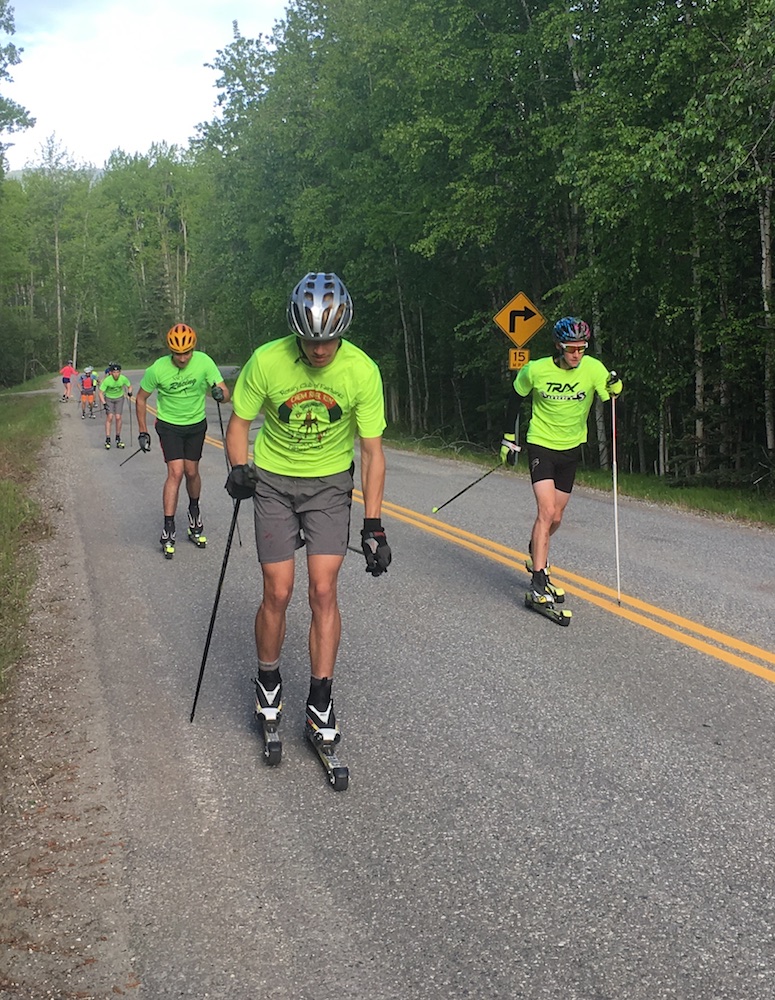
    (From left to right) NSCF-FXC skiers Ben Keener, Ari Endestad and Ti Donaldson work on diagonal striding during a summer workout near Fairbanks, Alaska. (Photo: Alasdair Tutt)

    This workout is designed to counteract the effect of always skiing on slow snow and steep terrain at Birch Hill mid-winter so the athletes can be competitive in faster conditions at the U.S. Cross Country Championships (a.k.a. Senior Nationals) or Junior Nationals. It can be completed skating, bounding, double poling, or diagonal striding. We have primarily focused on using it to improve diagonal striding this summer.

    We have no problem getting our skiers to be strong or have a high-aerobic capacity, but we often struggle to further develop the neuromuscular capacity of our skiers once the snow hits the ground. This can also be true when our athletes compete in high-school cross-country running, as their training can become pretty monotonous and low volume unless they make a considerable effort to add their own ski training on top of the running. This workout is applicable to all athletes though, as I believe all junior athletes need to first develop their capacity to go fast before learning to use that speed over a longer distance.

    The workout: Alaska-Specific (Speed) Training

    • Warmup: Preparation and Mobility
      • Our warmup is typically 20-30 minutes long consisting of about 10 minutes easy skiing to our start point, followed by 10-15 minutes of mobility and preparation exercises specific to the technique being performed on the day (we do this workout skating, double poling and striding depending on the goals of the team as a whole from last year)
    • Intervals: 2-3 sets of 3-5 x 150-250 meters at 2-3 k pace, and 50-80 m at 400 m pace over a course with two separate hills — not so steep as to lose full range of motion, but to challenge the athletes’ balance a little. Then, take a short recovery to return to the start of the next interval.
      • The course should cover around 150-250 m for the longer interval and 50-80 m for the shorter one on a gradual hill that is typically able to either be climbed in double pole or diagonal striding to induce a high speed.
      • First do the ~200m interval at a speed similar to how you would a hill in a 2-3 k event, then after a short recovery, complete the ~60 m interval at a speed just below that of an all out sprint (about 400 m pace). The idea being to have a repeated sprint stimulus and a clear difference in pace between the short and long speeds, without exhausting their capacity in one set.
    • Recovery: About 4-6 minutes active recovery between sets.
      • Between the longer and shorter sprint, just a rolling recovery back to the base of the hill repeated 3-5 times. Between each set there is a 4-6 minutes of active recovery with a chance to grab a drink or watch some video of technique.
    • Cool down: 30-45 minutes of easy rollerskiing back to the starting location.

    Technique Notes: We are looking for full extension through the arms to the back, a pendulum arm swing to return and a relaxed body position with hips over the heel when gliding on a ski during these intervals, as it quite easy to get into a posture with limited range of motion through the shoulders or a “back-seat” body position with little glide and a late kick when mostly skiing on green hardwax. As always when striding on classic rollerskis, we are careful to emphasize an early initiation of power with the lower body and a quick weight transfer from the center of mass over the gliding ski.

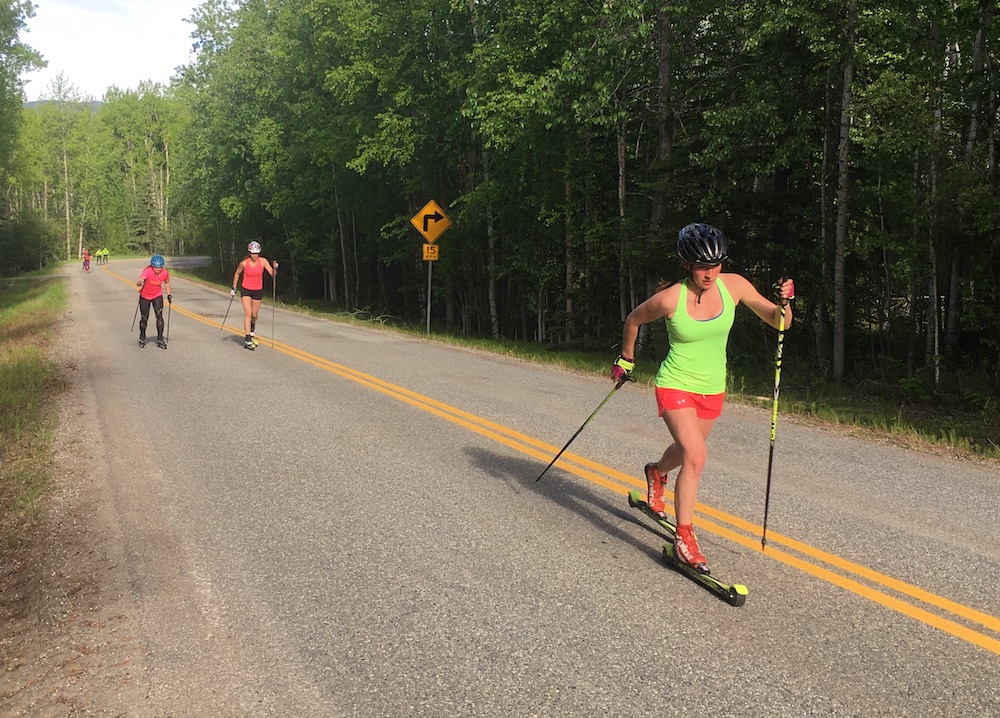
    NSCF-FXC skier Jenna DiFolco (r) leads Mackenzie Parrott (l) and Zoe Ratzlaff (c) during a diagonal-striding workout near Fairbanks, Alaska. (Photo: Alasdair Tutt)

    ***

    Have a workout you want to share? Email info@fasterskier.com with the subject line: Wednesday Workout.