From the FasterSkier archive — posts syndicated from athletes’ and coaches’ own blogs between 2004 and 2012, kept online as published. Current coverage is at fasterskier.com.
The Nordic Ski Club of Fairbanks (NSCF) is looking for an energetic and enthusiastic individual to lead its junior racing and training program, Fairbanks Cross Country (FXC) as Head Coach. This person would also serve as the Director of Skier Development, overseeing FXC and the club’s other instructional programs.
Salary starts at approximately $45,000, plus reimbursements for retirement and health care costs, depending upon experience. The Head Coach/Director of Skier Development reports directly to the Skier Development Oversight Committee, which committee reports to the Nordic Ski Club of Fairbanks Board of Directors.
Ideally, the candidate who is selected would arrive in Fairbanks to start leading the program by late summer. NSCF/FXC will assist with travel and/or moving costs.
Interested parties should send letters of interest and resumés to administrator@nscfairbanks.org. The position will remain open until filled. A selection committee from the NSCF will conduct interviews via telephone with qualified candidates.
Information about the program, the club and the community:
FXC has been in existence for 12 years, growing in that time from a program with less than a dozen skiers to a program with 100 or more skiers involved in seasonal and year-round programs at the Competition, Prep, and Junior Development levels, as well as a modest Masters program. Besides the head coach there is one year-round assistant coach as well as part-time coaches. The club’s other instructional programs include the Junior Nordic program for skiers up to middle-school age, and an Adult Lessons program.
Fairbanks is blessed with one of the longest ski seasons in the nation on natural snow – from late October to late April – at an elevation of under 1000’ above sea level. The home venue for the program is Birch Hill Recreation Area, known around the US for its outstanding trail network and world class facilities.
FXC has dedicated space in buildings at Birch Hill. FXC also owns a 2016 passenger van and trailer for hauling gear. FXC skiers participate in a full schedule of local races, as well as JNQ races elsewhere in Alaska. Top skiers in the program participate in US National Championships. FXC coaches are part of the coaching staff on the Alaska Junior National Team.
The 50-year-old Nordic Ski Club of Fairbanks has approximately 1000 members and is in sound financial condition. It has provided strong support for cross country skiing in general and for FXC in particular since its inception in 2006. Fairbanks also has a strong tradition of high school cross country skiing. i migliori operatori di casinò italiani
There are exceptional opportunities for a wide variety of exciting outdoor recreational opportunities in and nearby Fairbanks. Fairbanks has a full array of dining, entertainment, lodging and shopping options and is the home of the University of Alaska Fairbanks, which has a cross country ski team. Fairbanks has excellent connections by passenger jet to major airports throughout the US. The population of the Fairbanks North Star Borough is approximately 100,000.
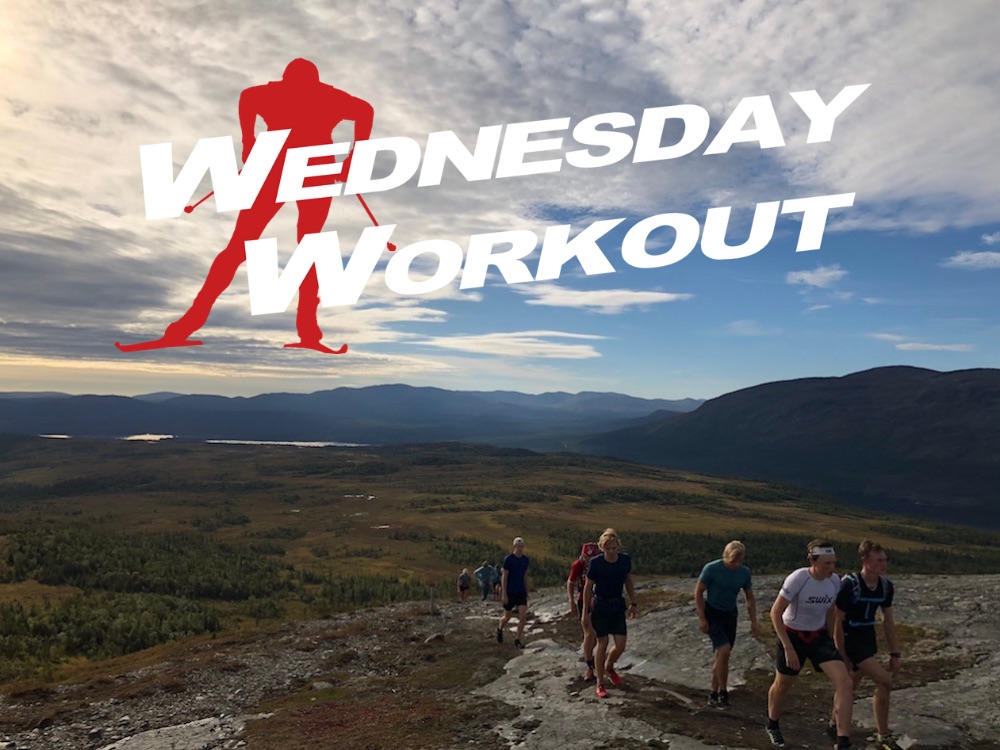
Swedish juniors from the Järpen Skidgymnasium climbing Grovfjellet during a distance run in Åre, Sweden, the day after bog-running intervals. (Photo: Alasdair Tutt)
Today’s workout comes from Alasdair Tutt, head coach and program director at the Nordic Ski Club of Fairbanks/Fairbanks Cross Country (NSCF-FXC) in Fairbanks, Alaska, who recently attended a training camp with Swedish skiers (ages 15-19) at the Åre Ski Gymnasium in Järpen, Sweden. Have a workout of your own (or your club’s) that you’d like to share? Send submissions to info@fasterskier.com with the subject line “Wednesday Workout”.
***
On a recent trip to Sweden for study, I was fortunate enough to attend a training camp with Järpen Skidgymnasium, which is an RIG ski program supported by the Swedish Ski Federation for their top junior skiers. There are five RIG “Kingdoms Sports Schools” aimed at future international level skiers and 12 NIU “National Sport Education” programs aimed at national level skiers in Sweden for cross-country skiing.
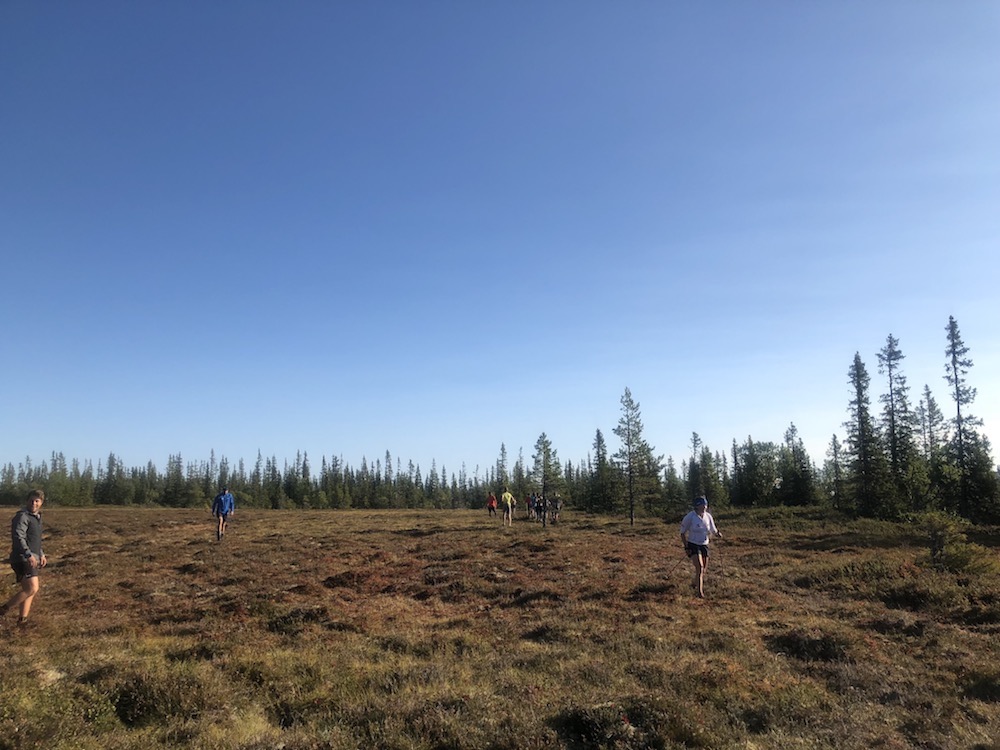
Järpen Skidgymnasium nordic coaches Martin Persson (second from l) and Kicki Fransson (r) observe a bog-running workout as athletes warm up near Åre, Sweden. (Photo: Alasdair Tutt)
The training camp was cross discipline with 70 athletes from cross-country, alpine and freestyle in attendance as a bit of a team-building experience after the first week of school. All athletes did the following swamp-running workout with varying “on” time depending on age and sport. You might be a bit surprised that some of the alpine/freestyle athletes got through the entire set with good speed and form.
In addition, the athletes completed a strength, obstacle and mobility circuit, and a 2-3 hour long distance tour on the final day – running for the cross country athletes and cycling for the others. As part of the school orientation, groups of 7-10 students and coaches also produced an anti-bullying short film. A lot of effort went into the production of these, with some drone footage and high quality of execution.
Bog Running Intervals:
Warmup jog to the bog: About 10 minutes at Level 1 and 5 minutes at Level 2, running around the loop to get orientated.
Interval set:
Pyramid: 1, 2, 3, 4, 3, 2, 1*, 2, 3 minutes of “on” time in Level 4-5, with half recovery time except the 1-minute intervals, which had 1-minute off afterwards.
Running or running with poles for the “on” time and walking or slow jogging between intervals.
*Athletes had the option of stopping after the first pyramid for first-year students and alpine/freestyle, or doing the additional 5 minutes of intervals.
Cool down: A game of bog soccer by year level (1-4) with 2 x 5 min. halves, an easy jog back to camp and some gentle mobility.
Alternative: Some athletes who couldn’t run did a strength circuit for the session.
Total time: About an hour and a half, which struck me as incredibly time-efficient.
According to the athletes, they perform a bog-running interval session maybe once every month or two during the warmer months, mostly for something different, but lots of distance runs tend to end up traversing such terrain. The biggest surprise for me was just how fast some athletes were moving in the difficult terrain, running 5-5:30min/mile pace with poles in shin-deep bogs, but then walking significant portions of the 22-kilometer distance workout we did the next day. Really, it just reinforces the polarization of training that they have built into their culture, and it’s something I think we still need to work on, especially in distance training, with my program in the U.S.
The Nordic Ski Club of Fairbanks (NSCF) announces the hiring of Alasdair Tutt as the new Fairbanks Cross Country (FXC) Head Coach and Program Director. Alasdair comes to the position with an extensive background in ski coaching and strength training. His coaching resume includes regional and national team positions in Australia and time with the Steamboat Springs (Colorado) Winter Sports Club, as well as being an assistant coach with NSCF-FXC since summer 2016. In addition to his coaching experience, Alasdair has more than five years of international racing including representing Australia at the Junior and U23 World Championships.
Alasdair possesses a Bachelor of Sports Coaching and Exercise Science. He is currently working on a Masters of Sports Science – Performance Optimization for Elite Sports. He has USSA Level 100 and Level 200 coaching certifications.
This combination of competing internationally, coaching experience at many levels, and his formal educational background give him an excellent base from which to lead the FXC program into its next stage as Head Coach and Program Director.
Skiers and parents in Fairbanks have gotten to know Alasdair as he worked with the FXC program as Assistant Coach. His practical, in-depth knowledge of the program will help ensure continuity as he continues to develop FXC to meet its athletes’ needs. To that end, one of his first tasks in conjunction with the NSCF’s Skier Development Oversight Committee, is to hire an Assistant Coach for the coming season, a process which has already begun.
The Nordic Ski Club of Fairbanks (NSCF) is looking for an energetic and enthusiastic individual to lead its junior racing and training program, Fairbanks Cross Country (FXC) as Head Coach. This person would also serve as the Director of Skier Development, overseeing FXC and the club’s other instructional programs.
Salary starts at approximately $45,000, plus reimbursements for retirement and health care costs, depending upon experience. The Head Coach/Director of Skier Development reports directly to the Skier Development Oversight Committee, which committee reports to the Nordic Ski Club of Fairbanks Board of Directors.
Ideally, the candidate who is selected would arrive in Fairbanks to start leading the program by late summer. NSCF/FXC will assist with travel and/or moving costs.
Interested parties should send letters of interest and resumés to administrator@nscfairbanks.org. The position will remain open until filled. A selection committee from the NSCF will conduct interviews via telephone with qualified candidates.
Information about the program, the club and the community:
FXC has been in existence for 12 years, growing in that time from a program with less than a dozen skiers to a program with 100 or more skiers involved in seasonal and year-round programs at the Competition, Prep, and Junior Development levels, as well as a modest Masters program. Besides the head coach there is one year-round assistant coach as well as part-time coaches. The club’s other instructional programs include the Junior Nordic program for skiers up to middle-school age, and an Adult Lessons program.
Fairbanks is blessed with one of the longest ski seasons in the nation on natural snow – from late October to late April – at an elevation of under 1000’ above sea level. The home venue for the program is Birch Hill Recreation Area, known around the US for its outstanding trail network and world class facilities.
FXC has dedicated space in buildings at Birch Hill. FXC also owns a 2016 passenger van and trailer for hauling gear. FXC skiers participate in a full schedule of local races, as well as JNQ races elsewhere in Alaska. Top skiers in the program participate in US National Championships. FXC coaches are part of the coaching staff on the Alaska Junior National Team.
The 50-year-old Nordic Ski Club of Fairbanks has approximately 1000 members and is in sound financial condition. It has provided strong support for cross country skiing in general and for FXC in particular since its inception in 2006. Fairbanks also has a strong tradition of high school cross country skiing.
There are exceptional opportunities for a wide variety of exciting outdoor recreational opportunities in and nearby Fairbanks. Fairbanks has a full array of dining, entertainment, lodging and shopping options and is the home of the University of Alaska Fairbanks, which has a cross country ski team. Fairbanks has excellent connections by passenger jet to major airports throughout the US. The population of the Fairbanks North Star Borough is approximately 100,000.
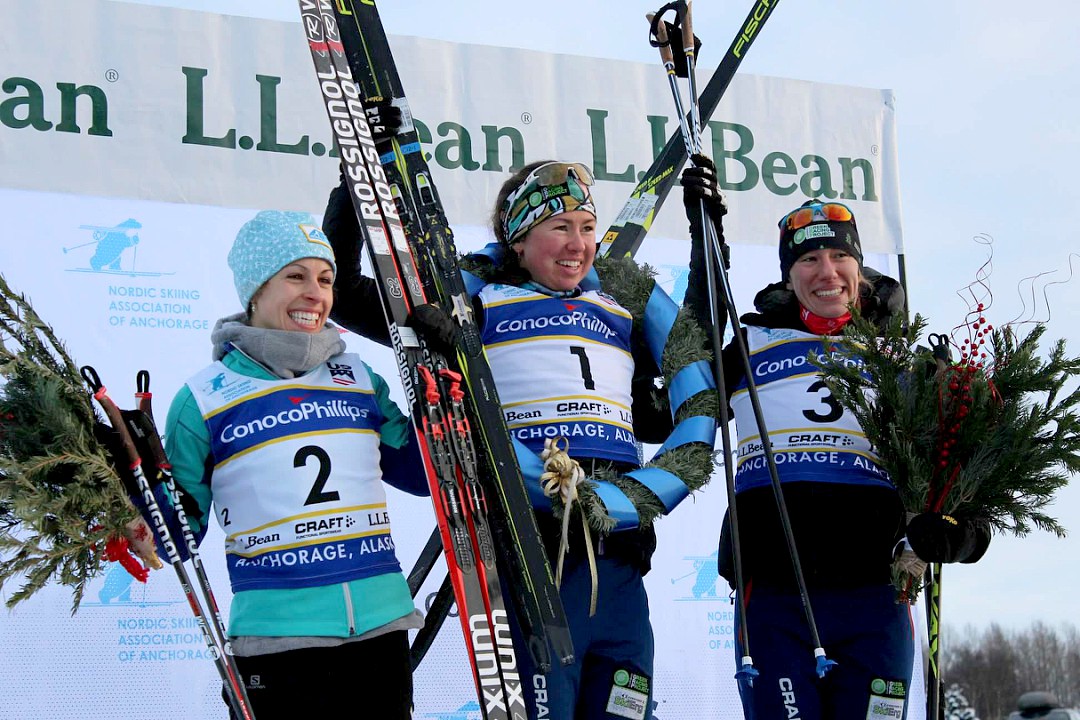
The top-three Americans in the women’s 20 k classic mass start on Sunday at 2018 U.S. nationals in Anchorage, Alaska, with Caitlin Patterson (1) of the Craftsbury Green Racing Project (CGRP) in first, Rosie Frankowski of APU (l) in second, and Kaitlynn Miller (r) of CRGP in third.
ANCHORAGE, Alaska — It turns out that Caitlin Patterson does have a weakness: Swedes. The 27-year-old Craftsbury Green Racing Project (CGRP) skier was denied her first outright victory of the week when she crossed the finish line second to Hedda Bångman, a former member of Sweden’s U23 National Team who now skis for the University of Colorado Boulder (CU), in the women’s 20-kilometer classic mass start at the 2018 U.S. Cross Country Championships on Sunday morning at Kincaid Park. But as the first American, Patterson captured her third national title in as many races.
Rosie Frankowski, of Alaska Pacific University (APU), was the third athlete across the line and second American. She was followed by Jessica Yeaton, who competes domestically for APU, but is an American-Australian dual citizen and competes internationally for Australia. Kaitlynn Miller, also of CGRP, was the fifth athlete across the line to round out the domestic national championship podium.
Bångman crossed the finish line of the four-lap, technically 22-kilometer course in 1 hour, 55.3 seconds, 15.9 seconds clear of Patterson in second. It was the first time all day that Bångman had enjoyed such an edge.
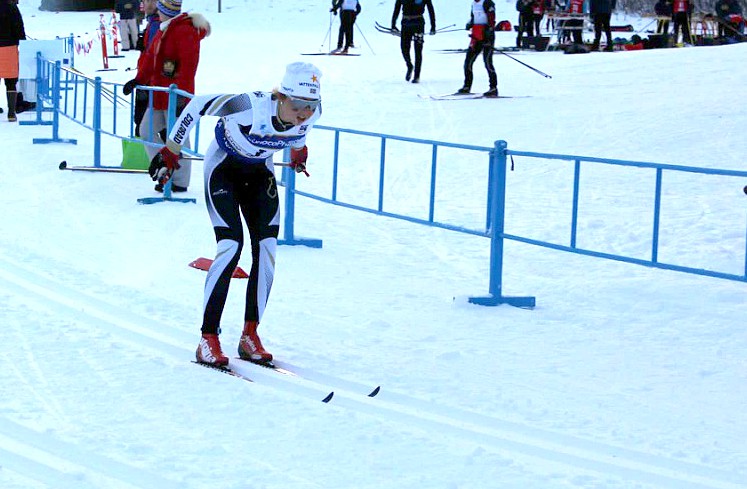
CU’s Hedda Bångman on her way to win the women’s 20 k classic mass start at 2018 U.S. Cross Country Championships on Sunday in Anchorage, Alaska.
The field of 42 skiers left the Kincaid Stadium at 10 a.m. on another perfect race day, the temperature around 16 degrees Fahrenheit and an approaching sunrise about to reveal mountains shimmering in all directions.
Wednesday’s fresh snow had allowed race organizers to come up with a compromise between the snowmaking loop and the full International Ski Federation (FIS) distance courses, a 5.44-k loop that began with an A-climb up Elliott’s Climb, descended most of the way back to the stadium, covered all the hills on the snowmaking loop, then traversed the 1.5 k Lekisch Loop before finishing in the stadium. The hills on the course were relatively front-loaded, with the single largest climb coming in the start of the loop and smaller (but still steep) hills over the final four-plus kilometers. The final kilometer was predominantly downhill from the high point of the 1.5 k Lekisch into the finish.
Snow coverage off of the manmade loops appeared to be good to very good, albeit with a relatively abrasive and icy base in the bottom of the tracks.
The first time up Elliott’s, Frankowski led a large group of 30-plus women (effectively the entire field) up to the top of the A-climb roughly 1.3 k into the race. She was closely followed by APU’s Chelsea Holmes to her left, and Bångman and Miller to her right.
The second time up Elliott’s, little had changed. Frankowski led a group of 10 women, with Bångman, Yeaton, and Holmes immediately behind her, and Patterson a few strides farther back.
The third time up Elliott’s, it was yet again Frankowski in the lead, followed yet again by Bångman, Yeaton and Holmes, with Patterson yet again appearing to lag back slightly on the uphill.
“Rosie Frankowski definitely deserves a shout-out for leading the train a whole lot out there and really pushing the pace,” Patterson told FasterSkier in a finish-line interview.
Four kilometers later, the athletes lapped through the stadium a final time as they headed out on their fourth loop. At this point, Frankowski, Bångman and Patterson, in that order, were still within one second of each other, with Yeaton around seven seconds back in fourth and Miller in fifth 12 seconds behind Yeaton.
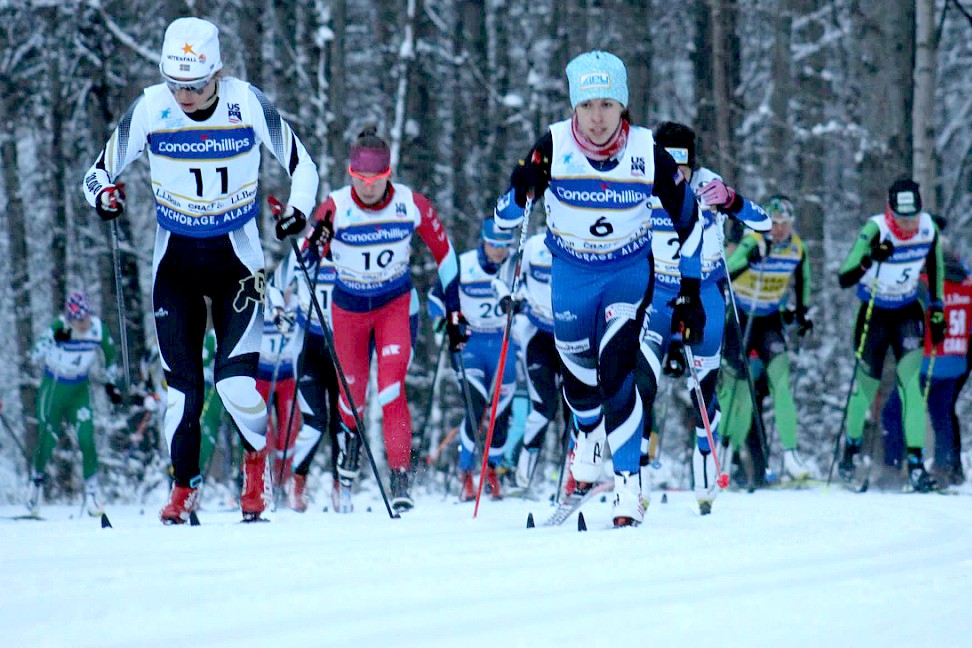
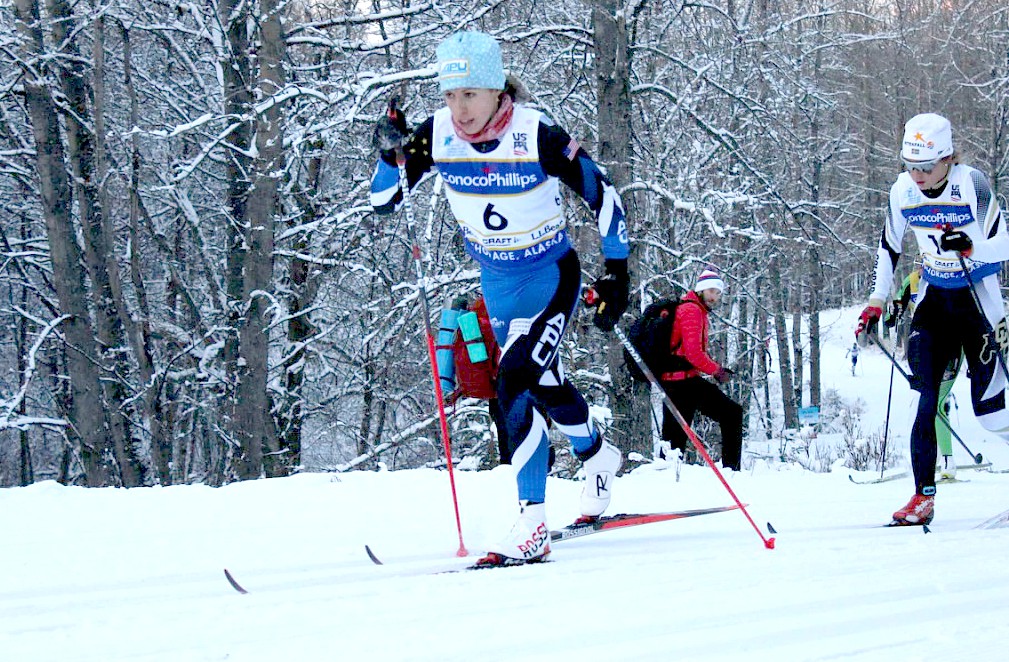
APU’s Rosie Frankowski (6) and CU’s Hedda Bångman (11) leading the charge up Elliott’s Hill in the women’s 20k classic mass start at the 2018 U.S. Cross Country Championships in Anchorage, Alaska.
If the lead pack was going to avoid a three-woman sprint to the finish, something was going to have to give. And the final time up Elliott’s, it did.
“The fourth lap is where it really splintered apart,” Patterson said. “At the top of Elliott’s, that last really kicker hill, the herringbone hill.”
At that point, Patterson, who grew up in Anchorage, recounted that Bångman had “really good skis, like stay-in-the-track that whole way up good. All the rest of us were running outside [the tracks] flailing around a bit, so she gapped us there. And she skis the downhills very well, so she closed a gap there across the World Cup [start area] flat out there, and we never closed that down. Frankie and I were chasing her on Rollercoaster, but I think she held her gap about the same from there all the way to the finish.”
As Bångman, 22, told FasterSkier after the race, “I didn’t have a plan before [the race], but I knew I was the strongest. So when we went out on the last lap, then I realized, ‘I can really make this race.’ So in the first hill on the last lap, I started to push harder, and then I left the others behind me. And then it was just to push as hard as I can to the finish line.”
By the time the three-woman lead pack came around the edge of the stadium again, midway through their final lap, Bångman had a significant lead, roughly 12 seconds. She stretched it to 15.9 seconds by the finish, finally allowing herself to slow slightly, look around, and celebrate in the final meters before crossing the finish line.
Behind her, a battle for top American was shaping up between Frankowski, who had never stood on a national championships podium, and Patterson, who had been there twice already this week.
Coming through the edge of the stadium, Patterson held a lead of two to three seconds over Frankowski as the two of them approached the wall-like climb up the Gong Hill for the final time. Patterson began heading up on the left side of the trail, Frankowski a few meters behind her on the right, herringboning with stunning alacrity for being 20 kilometers into a 22-kilometer race.
Then Frankowski caught a pole tip on her ski and fell into the sugar snow on the uphill. It took her several seconds to get up. While she extricated herself, Patterson skied away and up and over the top of the Gong Hill.
“The real cool thing that came out of that fall,” Frankowski told FasterSkier after, “was that I actually had my pole stuck under my ski, and I had to literally think, ‘Relax, and figure this out and stand up.’ While in the past I would have been so frantic I probably would have dropped more places than I did.”
“So I basically was just trying to get up,” recalled Frankowski, a 26-year-old Minneapolis native. “And when I got up someone yelled, ‘Don’t give up.’ And immediately I felt like, well, I am going to try to catch Caitlin, and if I could I would, but I didn’t. She is so strong right now; I tried and got close, but I didn’t do it.”
Frankowski’s travails were news to Patterson when told about this after the race.
“I had no idea,” Patterson said of her fall. “But that makes sense because it confused me because I was certain that as I ran up on the wall on the left side I was certain that there was someone just by me on the right side. But then I could hear on the downhill that there was no one close and then people were cheering for her 10 meters back, so I didn’t see that during the race.”
Frankowski’s fall came midway through the last lap, roughly 2.1 kilometers before the end of the race. After giving chase over the Lekisch Loop, she made up roughly the time she had lost in the fall before running out of real estate, crossing the finish line 3.7 seconds after Patterson for third overall and second American.
Rosie Frankowski (APU) leads CU’s Hedda Bångman (11) up Elliott’s Hill in the women’s 20 k classic mass start at the 2018 U.S. Cross Country Championships in Anchorage, Alaska.
Yeaton, 26, who was born in Perth, Australia, and moved to Alaska at age 12, skied into the finish alone 24 seconds later for fourth overall. Miller followed another 29 seconds later for fifth overall and third American. Alayna Sonnesyn, a University of Vermont junior, was the second college skier and second U23 skier in the top six.
“I felt so strong today,” said overall first-place finisher Bångman. “It was a so-good race, I’m so happy. My skis were perfect, and my body felt so good.”
Patterson is now three-for-three for national titles this week, but this one didn’t come easy.
“I am pretty excited about this third one, but it was the toughest of them all,” she said.
“It was a real struggle to hang with the people who were pushing the pace today,” she added, crediting Frankowski for her work at the front.
“I know especially how I am racing right now that I just need to hang on and the end can be good, and it was fairly good today,” Patterson added. “So I am really happy with the national title.”
Patterson said that she had opted to prioritize glide over kick on Sunday in light of the course profile, “because I feel like a lot of those walls are steep enough where I would be running anyway.”
“I probably erred a little too much on the glide side,” she continued. “Which is my fault with some testing … so I was herringboning like every single one of those technique zones, every kind of big hill, just had to keep moving. And luckily because the skis were so fast and I know these downhills so well, I was able to catch up on a lot of the downhills when I did get gapped on several uphills, almost every lap.”
Each lap featured three of the technique zones that Patterson had mentioned, in which doublepoling was forbidden. For the Anchorage readers, or anyone else familiar with the Kincaid trails, one was at the top of Elliott’s Climb; one was at the southern end of Dark Alley, approaching the lower tunnel; and one was the entire climb up to the Gong Hill from the north/back side of the snowmaking loop just a few hundred meters later.
(There had been a fourth zone marked during Saturday’s course preview, Patterson recounted, in the first uphill on the Lekisch Loop, which features a stair-step climb with a slight saddle or depression between the two steps. “There was a technique zone that they tried to put there,” she said, “and it literally had a downhill in it, but luckily the coaches protested that and they took it out.”)
After 22 k of skiing and 12 careful trips through each technique zone, Frankowski finished 3.7 seconds behind Patterson. It was the first national championships podium of her career.
Her sole strategy coming into the start of the race had been to “push every uphill,” Frankowski explained. “I have raced at Kincaid enough to know that you recover at every single downhill, and so for someone who doesn’t have a sprint at the end, I needed the pace to be hot at the beginning. So right when we started, immediately out of the start I realized that our skis were incredibly fast, and honestly comparable to or better than anyone else’s in the field, and so I felt, well I am going to doublepole as much as I can and then every downhill, especially the ones I struggle on, just tuck behind and try to be relax and know that I can catch back up.”
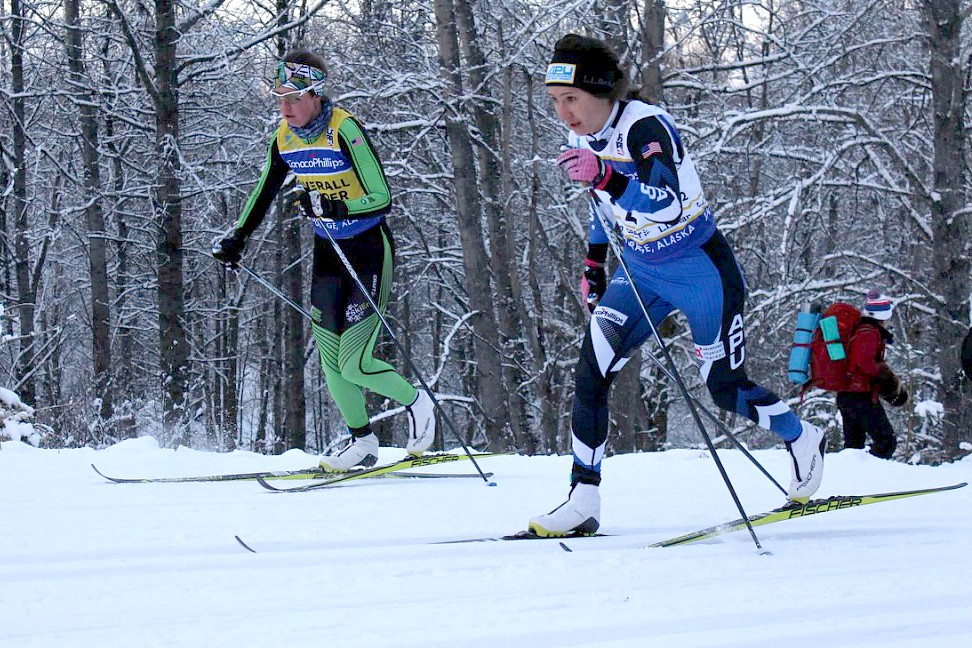
Craftsbury skier Caitlin Patterson (l) with APU’s Chelsea Holmes during the the women’s 20 k classic mass start at the 2018 U.S. Cross Country Championships in Anchorage, Alaska.
Frankowski made clear that, like Patterson, she had gone thin to win when it came to choosing how much kick wax she wanted. “The course here,” she said, “except for maybe Elliott’s, all these hills are running hills so you really had to Klæbo it up or herringbone and just know that you are not going to have perfect striding today, and if you do, your skis are going to be too slow through the stadium to be in the mix.”
Frankowski, whose public social media profile frequently features paeans to the consumption of Thai food, also clarified, “I would say the key to success is that last night I had Tom Yum soup and Pad Thai for dinner, and lots of cookies, so I think that helped also.”
Fellow APU skier Yeaton was the fourth skier across the finish line, 24.5 seconds behind Frankowski and 44.1 seconds back from Bångman.
Yeaton pulled no punches when asked if she had been expecting this result.
“No,” she said. “Not even close. Nowhere in the ballpark. … I was hoping, like on a great day, maybe I’d get top 10. I never thought I’d get fourth.”
Yeaton’s fourth wrapped up a strong week of domestic racing for the Australian-American dual national, who is known more as a sprinter rather than a distance skier. Indeed, her next races will be Dresden, Germany, to compete for Australia at next weekend’s sprint-centric World Cup stop. Yeaton is presumptively qualified for the Australian Olympic Team in the latest FIS Olympic Points List simulation.
29.4 seconds behind Yeaton came Craftsbury’s Miller in fifth overall, but the third American across the line after Patterson and Frankowski. She had been “in contact with the lead group until about the third lap when a gap formed on Elliott’s [Climb] that I was unable to bridge,” Miller wrote in an email to FasterSkier after the race.
“I’m very pleased with my race and it was very exciting to see my teammate, Caitlin Patterson, place second,” she added. “I was very impressed with the 5k course that the organizers put together for the event. It was a fun course to race on.”
Sunday marked Miller’s fifth time on a national championships podium, and second in this week, following a second on the American podium in Friday’s freestyle sprint.
Sonnesyn filled out the rest of the top six. The 21-year-old Vermont college skier identifies as a distance skier and had been hoping for a better result in Wednesday’s 10 k skate, she told FasterSkier at the finish.
“I was excited for that, but unfortunately I didn’t have the race I was hoping for,” Sonnesyn said. “But I came back with a really strong sprint, which kind of surprised me. And I was feeling so great that I came into this race today pretty confident. So I was excited for it this morning, and I’m really happy with the way it went.”
Hannah Halvorsen Wins Junior Race
While junior women (U20 skiers and under) raced alongside the senior/master field in Wednesday’s 10 k freestyle individual start, Sunday saw the juniors get their own starting time and course for the 5-kilometer classic mass start race. One lap, 92 starters, 5.5 kilometers, go!
Before long, a pileup ensued. But “I only heard about it from quite a few girls,” junior winner Hannah Halvorsen, of APU and the U.S. Ski Team, told FasterSkier after. “I was right in front of it; I got lucky.”
Halvorsen, 19, covered the one-lap course in 15:07.8. Second place went to Hailey Swirbul, a University of Alaska Anchorage sophomore, 10.4 seconds back.
Third place on the all-Alaska podium went to an athlete with four years’ less experience and one fewer Junior World Championships medal to her name, U16 athlete Kendall Kramer. Kramer, who finished 4.4 seconds behind Swirbul, skis for the Nordic Ski Club of Fairbanks/Fairbanks XC (NSCF-FXC), as well as West Valley High School. She had competed in only one other FIS race in her life before this week.
Halvorsen was second on the junior girls podium in Wednesday’s distance skate race, and third overall among American women in Friday’s sprint race. Swirbul was the top junior woman on Wednesday and reached the quarterfinals of the senior women’s sprint on Friday.
Halvorsen had high praise for Sunday’s race course: “Super-fun course, up and down, kind of rolling,” she said. “Good places to find speed and carry momentum, time to rest and do different transitions. Just, like, a fun course.”
It probably doesn’t hurt that she won. “It felt good,” said Halvorsen, who grew up in Truckee, California. “I was tired this morning, but it doesn’t really matter how you feel, you just get out there and go for it. I had really good skis, really good support; my dad’s here, my brother’s here. It’s a beautiful day to be racing; really fun racing out there.”
— Gabby Naranja and Ian Tovell contributed reporting
The NSCF-FXC crew points toward home (some 7,000 kilometers away) at 2017 Junior Nationals this past March in Lake Placid, N.Y. (Photo: Peter Leonard)
The following workout comes from Alasdair Tutt, interim coach for the Nordic Ski Club of Fairbanks/Fairbanks XC (commonly known as NSCF-FXC). Tutt recognizes that while training in central Alaska has its perks (like reliable snow), it can also be tough for skiers to excel outside of their familiar environment (like on significantly warmer snow). This is true for anyone racing in variable climates and at both high and low elevations across North America. So for NSCF-FXC, the goal is to get develop speediness for races in the lower 48.
***
Training in Fairbanks, Alaska, may have many advantages: skiable snow for six months a year, tough homologated loops at Birch Hill and the endless wilderness to explore regardless of the season. However, it presents many challenges for the 33 junior athletes who are part of our summer Comp Team when they compete out of town in temperatures often >30 degrees warmer than the average Fairbanks day.
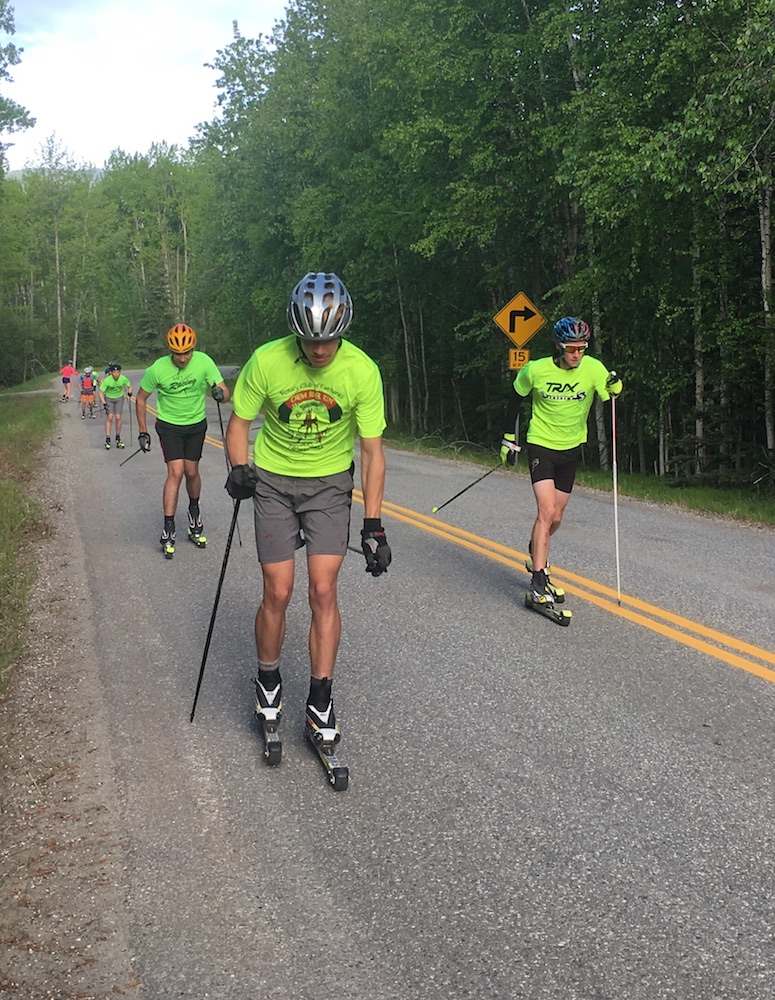
(From left to right) NSCF-FXC skiers Ben Keener, Ari Endestad and Ti Donaldson work on diagonal striding during a summer workout near Fairbanks, Alaska. (Photo: Alasdair Tutt)
This workout is designed to counteract the effect of always skiing on slow snow and steep terrain at Birch Hill mid-winter so the athletes can be competitive in faster conditions at the U.S. Cross Country Championships (a.k.a. Senior Nationals) or Junior Nationals. It can be completed skating, bounding, double poling, or diagonal striding. We have primarily focused on using it to improve diagonal striding this summer.
We have no problem getting our skiers to be strong or have a high-aerobic capacity, but we often struggle to further develop the neuromuscular capacity of our skiers once the snow hits the ground. This can also be true when our athletes compete in high-school cross-country running, as their training can become pretty monotonous and low volume unless they make a considerable effort to add their own ski training on top of the running. This workout is applicable to all athletes though, as I believe all junior athletes need to first develop their capacity to go fast before learning to use that speed over a longer distance.
The workout: Alaska-Specific (Speed) Training
Warmup: Preparation and Mobility
Our warmup is typically 20-30 minutes long consisting of about 10 minutes easy skiing to our start point, followed by 10-15 minutes of mobility and preparation exercises specific to the technique being performed on the day (we do this workout skating, double poling and striding depending on the goals of the team as a whole from last year)
Intervals: 2-3 sets of 3-5 x 150-250 meters at 2-3 k pace, and 50-80 m at 400 m pace over a course with two separate hills — not so steep as to lose full range of motion, but to challenge the athletes’ balance a little. Then, take a short recovery to return to the start of the next interval.
The course should cover around 150-250 m for the longer interval and 50-80 m for the shorter one on a gradual hill that is typically able to either be climbed in double pole or diagonal striding to induce a high speed.
First do the ~200m interval at a speed similar to how you would a hill in a 2-3 k event, then after a short recovery, complete the ~60 m interval at a speed just below that of an all out sprint (about 400 m pace). The idea being to have a repeated sprint stimulus and a clear difference in pace between the short and long speeds, without exhausting their capacity in one set.
Recovery: About 4-6 minutes active recovery between sets.
Between the longer and shorter sprint, just a rolling recovery back to the base of the hill repeated 3-5 times. Between each set there is a 4-6 minutes of active recovery with a chance to grab a drink or watch some video of technique.
Cool down: 30-45 minutes of easy rollerskiing back to the starting location.
Technique Notes: We are looking for full extension through the arms to the back, a pendulum arm swing to return and a relaxed body position with hips over the heel when gliding on a ski during these intervals, as it quite easy to get into a posture with limited range of motion through the shoulders or a “back-seat” body position with little glide and a late kick when mostly skiing on green hardwax. As always when striding on classic rollerskis, we are careful to emphasize an early initiation of power with the lower body and a quick weight transfer from the center of mass over the gliding ski.
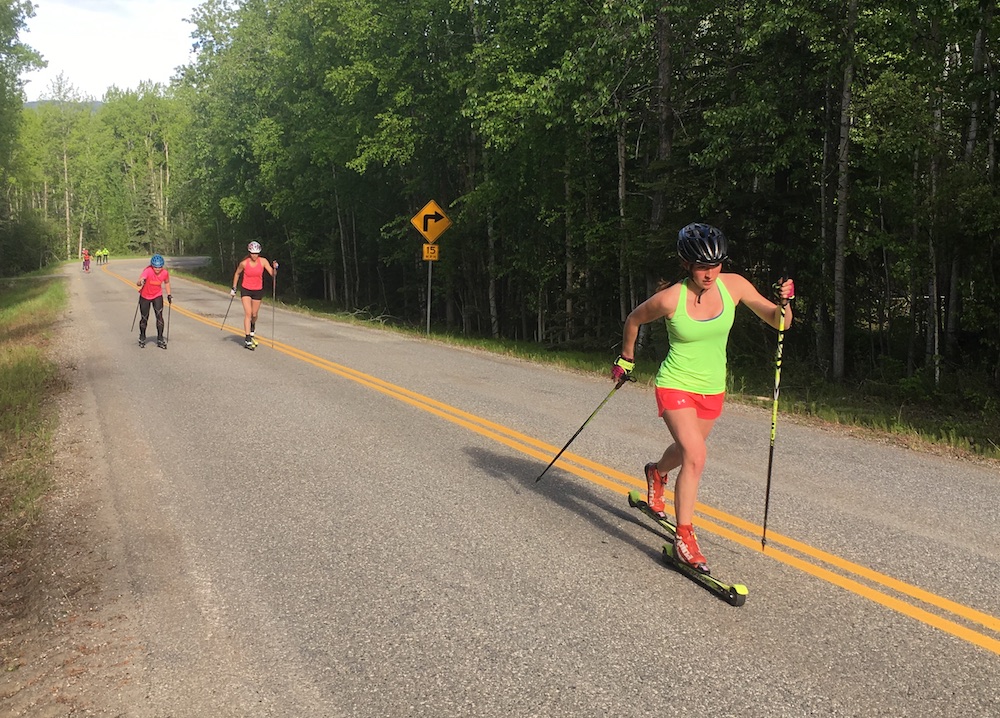
NSCF-FXC skier Jenna DiFolco (r) leads Mackenzie Parrott (l) and Zoe Ratzlaff (c) during a diagonal-striding workout near Fairbanks, Alaska. (Photo: Alasdair Tutt)
***
Have a workout you want to share? Email info@fasterskier.com with the subject line: Wednesday Workout.
Nordic Ski Club of Fairbanks’ Fairbanks Cross Country (NSCF-FXC) junior racing program is looking for an assistant coach to begin work this summer.
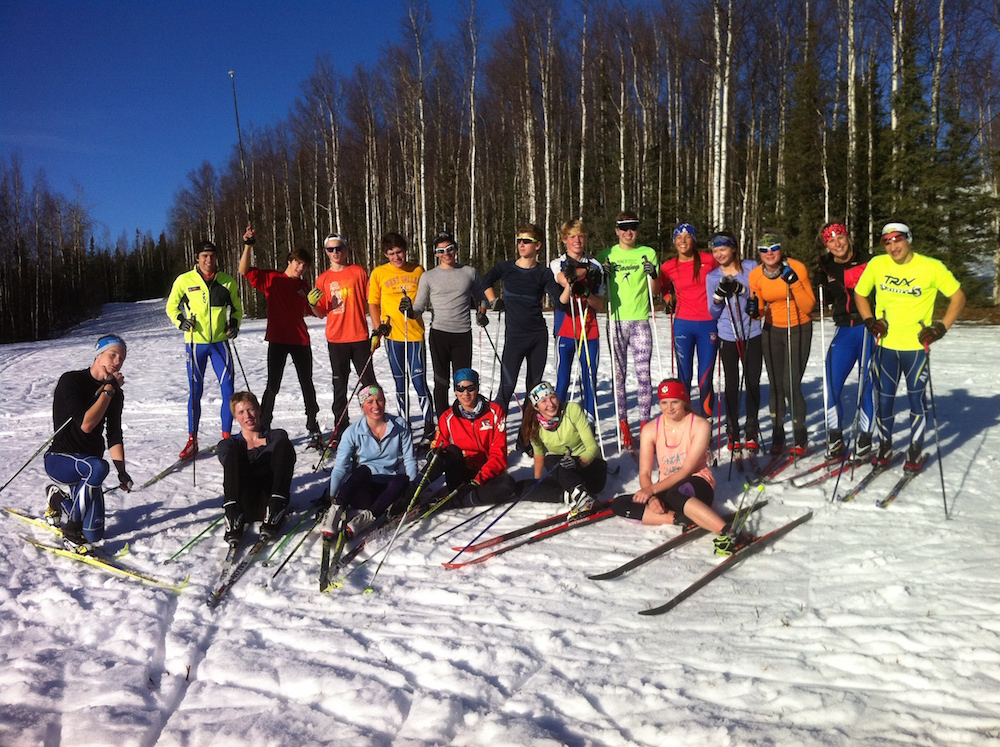
NSCF-FXC Comp Team enjoying an early October ski last year. (Courtesy photo)
Our team has been steadily growing and improving since its inception in 2006; the program currently engages more than 120 athletes on an annual basis and qualified 17 athletes to Junior Nationals and Arctic Winter Games this season.
Athletes in the FXC racing program are split among three tiers and the prospective coach would work with all groups over the course of the year, although primary responsibilities would be with the Jr. Devo (late elementary) and Comp Team (high school and post-graduate). This position could also be involved in a potential expansion of our masters program.
The assistant coach is a year-round position and generally involves 5-6 days and 20-30 hours of work per week, although additional hours are required at busier times of year. The starting wage is $19/hr ($20/hr with completion of USSA L100 coaches certification). The coaching schedule can allow for additional employment within the local ski community (high school coaching, lessons, grooming, etc.) and the Fairbanks community at large. The University of Alaska offers a wide variety of college and graduate level courses at its Fairbanks campus for those wishing to further their education.
The ideal candidate would have raced at the collegiate level or higher, be enthusiastic about and have experience coaching or working with youth, possess excellent communication and organization skills, and be able to complete miscellaneous projects in a timely manner with minimal oversight. The assistant coach must be able to pass a background check and possess a valid driver’s license. If not already certified, it would be expected that the candidate completes the USSA Level 100 certification within 90 days of hire (with educational costs to be covered).
For a broader sense ofthe NSCF as a whole, please consult our website: www.nscfairbanks.org, or the NSCF-FXC Facebook page for a better picture of our program. For questions or to submit an application, contact NSCF-FXC Head Coach and Director of Skier Development Pete Leonard at pete@peterleonard.net or (907) 978-6325. Applications should be submitted to the aforementioned email address and should include a cover letter, resume and contact information for three references. Initial review of applications will begin April 1, and the position will remain open until filled. Ideally the candidate would be on the ground in Fairbanks by late May or early June.
Nordic Ski Club of Fairbanks’ Fairbanks Cross Country (NSCF-FXC) junior racing program is searching for an assistant coach to work as part of a team of professional and volunteer coaches in helping guide its junior and masters athletes as they pursue their goals and dreams in Cross Country skiing.
This is an exciting opportunity to join a program that has been steadily growing and improving since its inception in 2006; the program currently engages more than 120 athletes on an annual basis.
The NSCF-FXC program is part of an integrated development path that begins with the club’s highly successful Junior Nordics program, which instructs over 200 young skiers ages 5-13 each winter. Athletes in the FXC junior program are split among three tiers: the Jr. Devo Team for late elementary skiers, the Prep Team for middleschoolers and the Comp Team for high school and post-graduate athletes. There is also a growing Masters program that was begun in 2013.
We are fortunate to have great opportunities as ski racers in Interior Alaska, due in large part to a strong and exceptionally supportive local ski community. Our home trail system at Birch Hill Recreation Area – one of two primary groomed ski trail networks in Fairbanks (and one of several in the Fairbanks area) – includes over 40 km of trails, 11 km of lighted trails, a full array of FIS homologated race loops, a terrain garden for ski play, and a 10,000-square-foot ski center with various outbuildings. The club provides grooming throughout the 6- to 7-month ski season, and our nationally recognized competition crew organizes a full slate of races ranging from youth events, to marathons, JN qualifiers, National Championships and FIS races. The long days of summer offer great dryland training opportunities particularly for activities on trails, and ready access to some of the most expansive wilderness in North America.
This position would start as a summer position with the potential to expand to year-round (our preferred scenario). Summer would include coaching with all levels of our junior program, while winter would involve both the juniors and work with our Masters program as part of an expansion of our programming at the masters level. Summer training would involve morning and afternoon and/or evening workouts 5-6 days per week with middays free; winter would be primarily afternoons and evenings with some weekend duties.
The ideal candidate would have raced at the collegiate level or higher, be enthusiastic about and have experience working with or coaching youth, possess excellent communication and organization skills, and be able to complete miscellaneous projects in a timely manner with minimal oversight. The assistant coach must be able to pass a background check and possess a valid driver’s license. If not already certified, it would be expected that the candidate completes the USSA Level 100 certification within 90 days of hire (with educational costs covered by the club).
The typical hourly commitment during the busy summer and winter seasons would be 15-25 hours of coaching per week plus 5-10 hours of organization and miscellaneous tasks. Weeks involving training camps, trips or important races would likely exceed 40 hours. The schedule allows for potential additional employment within the local ski community (coaching, lessons, grooming, etc.) and the Fairbanks community at large. The University of Alaska offers a wide variety of college and graduate level courses at its Fairbanks campus for those wishing to further their education.
For a broader sense ofthe NSCF as a whole, please consult our website: www.nscfairbanks.org, or the NSCF-FXC Facebook page for a better picture of our program. For questions or to submit an application, contact NSCF-FXC Head Coach and Director of Skier Development Pete Leonard at pete@peterleonard.net or (907) 978-6325. Applications should be submitted to the aforementioned email address and should include a cover letter, resume and three references. Initial review of applications will begin April 27, and the position will remain open until filled. Applicants should expect to be on the ground in Fairbanks by early June.
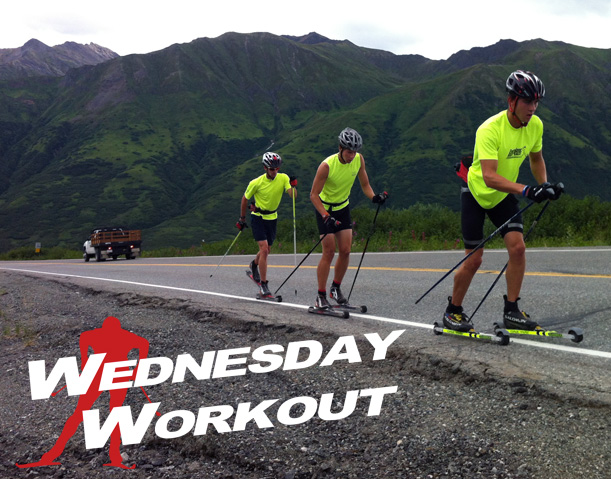
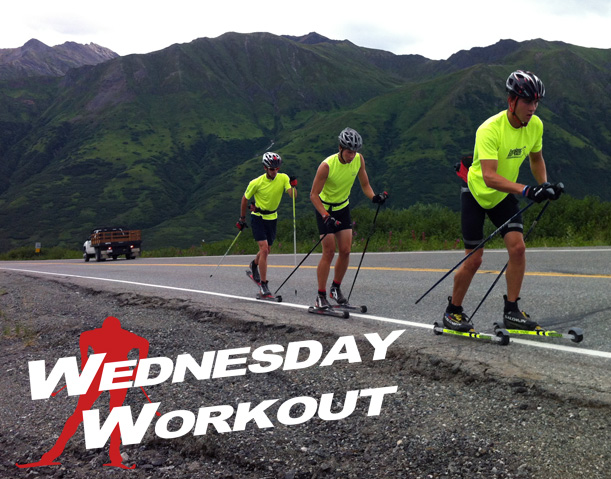
Stefan Hajdukovich (front, University of Alaska Fairbanks/ NSCF-FXC), Jonathon Koenig (NSCF-FXC) and Kyle Hanson (Michigan Tech/ NSCF-FXC) stride up Hatcher Pass near Girdwood, Alaska, on the way home from a summer 2013 training camp. (Photo: Pete Leonard)
Welcome to Wednesday Workout, where we round up training ideas on a weekly basis. This week Pete Leonard, director of skier development for the Nordic Ski Club of Fairbanks, Alaska (NSCF), and head coach of Fairbanks Cross Country (FXC), the junior racing program of NSCF, explains how to get multiple benefits from a single workout.
In most training plans, fall training is characterized by a shift to greater specificity as the high intensity work and choice of training activity and terrain seek to more closely mimic the demands placed on the body during winter racing. It is also a time of year when time constraints due to school, daylight, involvement with fall sports or even low volume from an easy week can start to influence what we can or want to fit in during a single training session. This session aims to address a few of these challenges.
In my mind, the key to a good training program is finding the right balance of ingredients. The correct mix depends on the individual athlete(s) and their mix of strengths, the time of year and so forth. One of the ways this sort of session differs from most training sessions is in how people view the individual session. In setting up training programs I often see people look at training sessions as solid blocks, as in one time it is a speed session, once it is distance, once specific strength, once over distance, once spenst, a time trial, general strength, intervals, etc.
Certainly that allows for focus and purpose in a session, which is vital, but sometimes it seems the sessions become too “cookie cutter” — either becoming stale for the athletes or, often due to time constraints, not getting the desired mix of ingredients overall during a training cycle. Frequently, it seems this is influenced a lot by research articles where they purposely control the study in order to come up with conclusive datasets. As coaches or athletes it is easy to forget that sometimes highly effective training sessions that may even more closely mimic the demands of ski racing can be designed by taking the principle outlined in the study and combining a few complementary training areas together in a single training session. To paraphrase Norwegian physiologist Øyvind Sandbakk’s presentation at the 2011 USSA Coaches Symposium, by focusing our training on making ourselves faster skiers, we will develop the capacities that are characteristic of top performers in our sport, but we might not become fast skiers imply by training to develop those capacities alone.
The following is a simple session example that we have used this fall in making connections between different areas of our training that we have been working on through the summer. The last eight words of the previous sentence are important. This session aims to build on work that has been previously done and is too complex for an introductory session. The athletes will simply need a quick refresher on what we’re doing and know the basic steps.
I should also note that it is certainly possible to connect aspects of training in a single session such as speed and spenst, intervals and specific strength, or speed and distance, etc. The only combinations I haven’t tried at this point are high intensity and general strength, overdistance and strength, and over distance and high intensity, but that doesn’t mean there couldn’t be some value in these combinations for others. For instance, maybe the latter would be useful for high-level marathon racers who are looking to work on finishing fast at the end of the race.
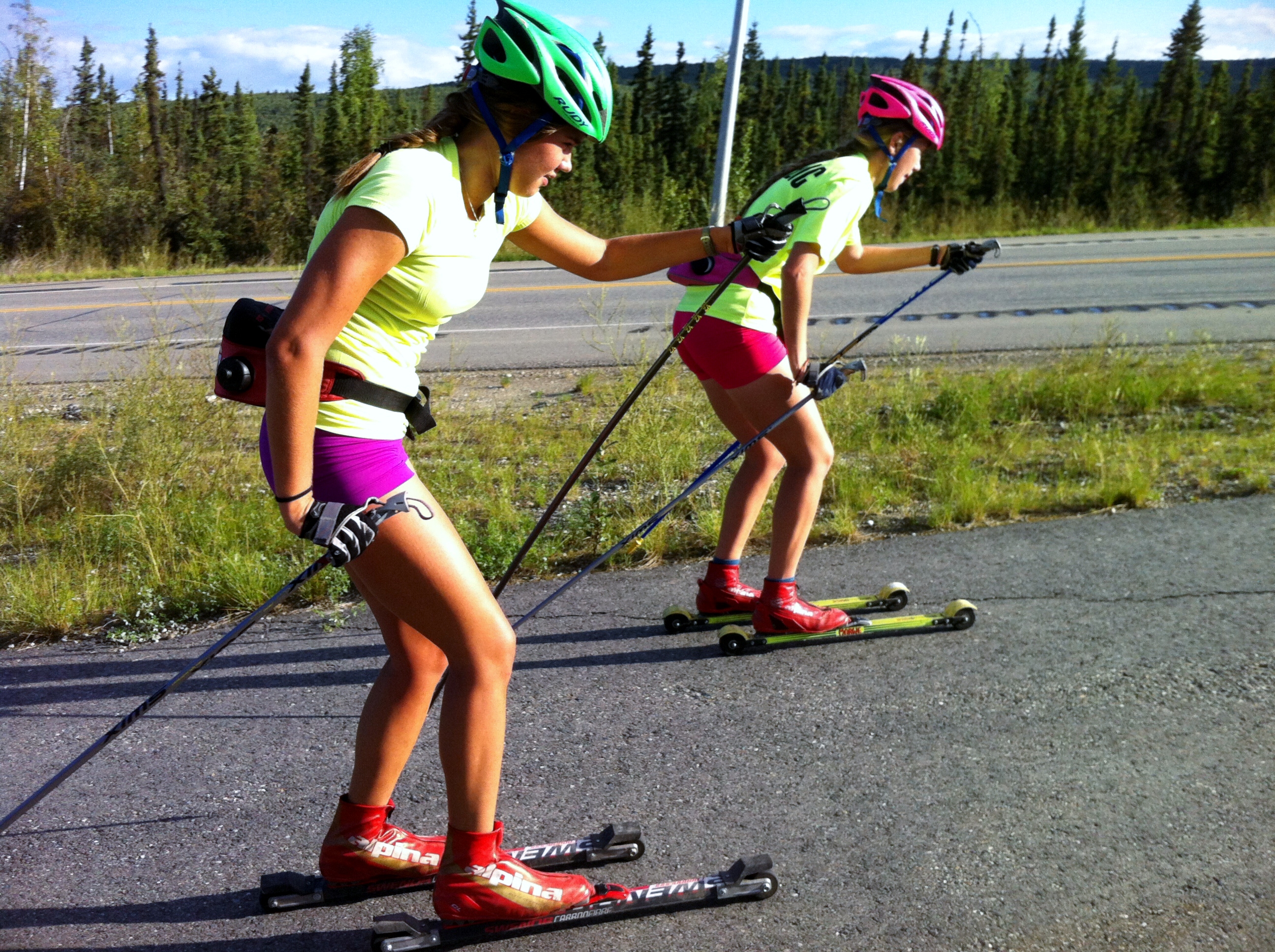
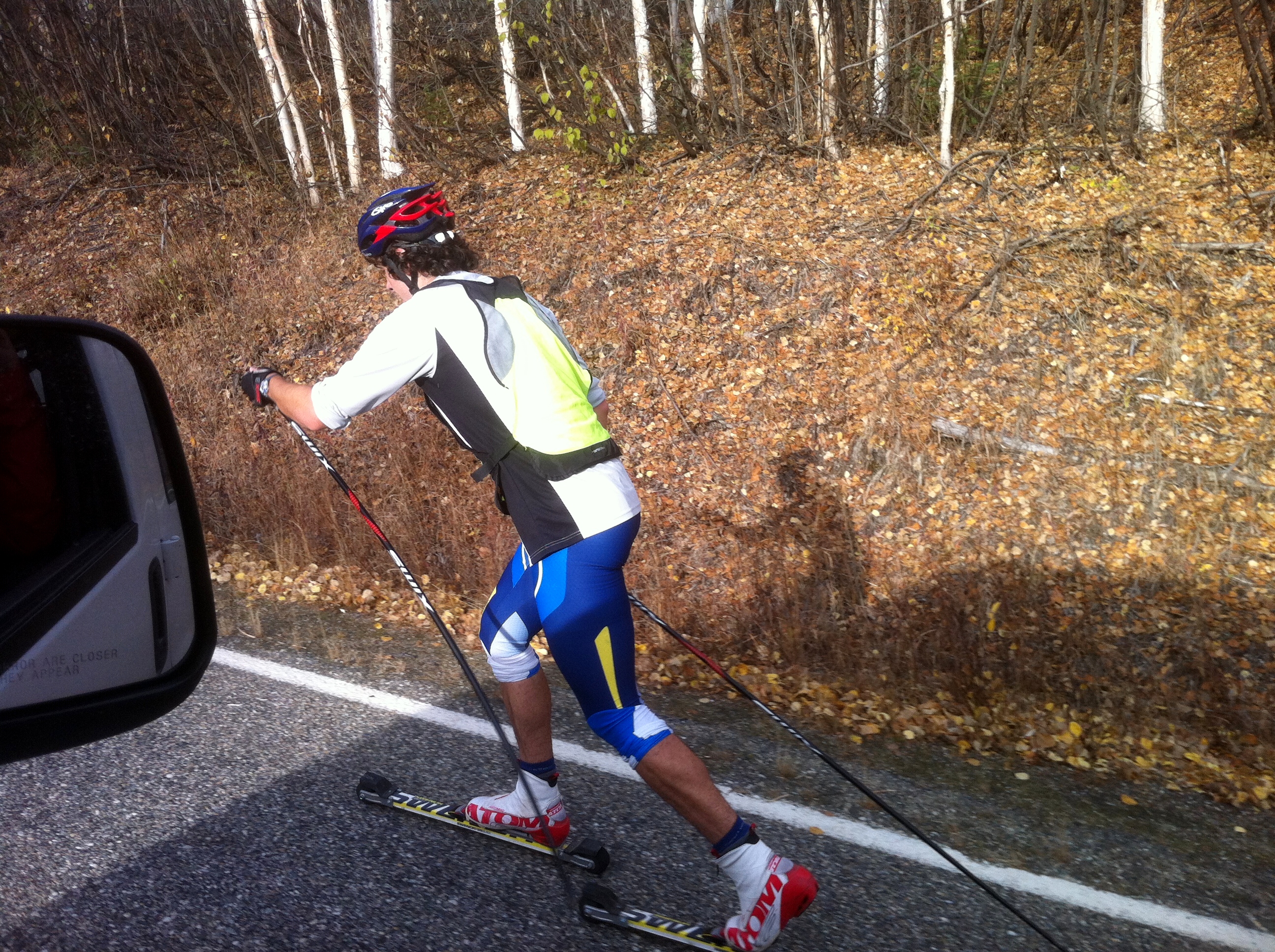
Sisters Eliza and Marisa Rorabaugh single-sticking along the Parks Highway bikepath in Alaska in 2012. (Photo: Pete Leonard)
Example session:
Activity: Classic rollerskiing with an emphasis on striding.
• Extended Warm-up. A. 5 minutes easy skiing to get the blood flowing. B. A quick mobility routine. C. Specific strength. 30 minutes of single-sticking on rolling terrain, beginning at an easy intensity and potentially ramping up to a threshold/ Level 3 output if the session calls for it. D. Technique and speed. Hot feet and bounding drills on rollerskis, combined with light speed out of the ladder.
• Level 2 distance or steady Level 3 intensity on a 6 kilometer uphill.
• Warm-down. 15-30 minutes easy depending on time constraints.
This particular session is focused on using the whole body in classic striding. It also has components of specific strength and speed.
The objective for the warm-up is to set the tone for the session, tuning up the body and mind for what is coming. Most of the times and durations of this example are dependent on how long it takes us to get a spot that is well-suited for the next phase of the session.
We start with an easy 5 minute ski from our meeting point to the end of a bike path. There, we do a simple routine we all know: a few mobility drills such as overhead squats and a variety of lunges.
The next phase of the session I consider to be part of the warm-up, but also hits on specific strength. We received some strong feedback that this is an aspect where our club’s athletes could improve, so we have been looking for ways to keep on developing our strength in single-sticking. This is an added challenge in the fall, with the inclusion of more frequent interval training during the week, greater time constraints for the athletes, and a shift to a focus more on short and fast double poling in our repetition-based specific strength work.
The bike path we use happens to take about 30 minutes of single sticking to arrive at a parking lot near the base of one of our favorite climbs that is good for striding rollerski drills. The focus for the whole session is on reinforcing good mechanics, so if an athlete is not up to 30 minutes of single-sticking with good body position and full range of motion in the arms due to an injury or being new to rollerskiing, then we adapt this portion and perhaps just have them single stick for 15 minutes or three periods of five minutes. If you do not have this set-up in your area, a good alternative could be to do repetition based work of say 5 or 10 by 50-200 meters on a nearby uphill.
If we repeat this session, we may have the athletes ramp up the intensity of their single sticking effort with a crescendo from Level 1 to Level 2 to Level 3, every ten minutes over the course of the 30 minute effort, to make it more challenging and further challenge their specific strength.
After tuning up the upper body, it is time to make sure the lower body is ready for the heart of the session. For this, we often use the hot feet and ladder drills (or a variation of them) that are part of the USSA Level 100 technique clinics. This helps to tune in the athlete’s dynamic balance and coordination for a sharp kick and limits the concern of developing sloppy technique, or a “late kick,” by kicking against the ratchet on rollerskis.
Riley Troyer (NSCF-FXC) strides up Old Nenana Highway in Fairbanks, Alaska, during an uphill time trial in 2012. (Photo: Pete Leonard)
Now we are ready for the climax of the session — what everything else has been building up to. We happen to have a favorite 6 k uphill that has a good pitch for sustained classical striding, but really any terrain that has some adequate inclines for striding can be used with this session. In fact, rolling terrain might be more appropriate and more specific to racing demands when we move closer to the season. However, for now it’s September, and an effort in sustained uphill terrain to develop efficiency is still our goal.
Similarly, we have done a number of longer Level 3 interval (as opposed to sustained) sessions to build up our tolerance for Level 3 work over the course of the summer, so the athletes should be able to maintain high quality for the duration of the effort. If time allows, and the athletes are up for it, we might also add on another half or full trip up the hill to complete the session.
If the session is performed with a focus more on base endurance development, we would typically perform the climb at Level 2, with the hope that letting the lid off the intensity a bit will allow them to perform higher quality motions than if we did it at Level 1.
Technique-wise our goal is simply to put together the previous pieces of the session — using the upper body effectively and making sure we are on top of our skis to kick sharply and effectively. This is the most important time to be laying down good neural patterning, so technique is vital.
Once the uphill work is complete, a 15-30 minute warm-down will finish the session.
I find with junior athletes drawing these very direct connections in training really helps them to understand the purpose of all of their training sessions and develop a better understanding and feel for the technical aspects of the training they are doing. Also, by stepping back and drawing different connections in different manners, sometimes it helps a technique piece “click” for an athlete.
The options for making connections are fairly limitless and a little creativity can go a long way to not only solving the puzzle of limited training time, but to spice up training and keep the training process moving in the right direction.
Nordic Ski Club of Fairbanks’ Fairbanks Cross Country (NSCF-FXC) junior racing program is searching for an assistant coach to work as part of a team of professional and volunteer coaches in helping guide its young athletes as they pursue their goals and dreams in Cross Country skiing.
This is an exciting opportunity to join a junior program that has been steadily growing and improving since its inception in 2006; the program currently engages 75+ athletes on an annual basis and has become one of the top junior programs in the country – ranking 4th for boys and 6th overall in the 2013 JN club trophy.
The NSCF-FXC program is part of an integrated development path which begins with the club’s highly successful Junior Nordics program which instructs over 200 young skiers ages 5-13 each winter. Athletes in the FXC program are split among three tiers: the Jr. Devo Team for late elementary skiers, the Prep Team for middle schoolers and the Comp Team for high school and post-graduate athletes.
We are fortunate to have great opportunities as ski racers in interior Alaska, due in large part to a strong and exceptionally supportive local ski community. Our home trail system at Birch Hill Recreation Area – one of two primary groomed ski trail networks in Fairbanks (and one of several in the Fairbanks area) – includes over 40 km of trails, 11 km of lighted trails, a full array of FIS homologated race loops, a terrain garden for ski play, and a 10,000+ square foot ski center with various outbuildings. The club provides grooming throughout the 6- to 7-month ski season, and our nationally recognized competition crew organizes a full slate of races ranging from youth events, to marathons, JN qualifiers, National Championships and FIS races. The long days of summer offer great dryland training opportunities particularly for activities on trails, and ready access to some of the most expansive wilderness in North America.
During the course of the year, the assistant coach works with all three levels of the racing program, while focusing on the Comp Team and either the Prep or Jr. Devo Team during the busy winter season. Primarily this work involves helping to run motivational, high-quality, age-appropriate training sessions for each of these levels, but can also include various other aspects of running a successful year-round ski-training program. The assistant is expected to coach at summer and winter training camps, travel to and support athletes at major races in Alaska plus other races as needed throughout the country, and help with various other aspects of operating the program. The total hourly commitment varies during the year, but is often around 20-30 hours per week split between about 15 to 25 hours of coaching and 5-10 hours for additional tasks.
The ideal candidate would have raced at the collegiate level or higher, be enthusiastic about and have experience working with or coaching youth, possess excellent communication and organization skills, and be able to complete miscellaneous projects in a timely manner with minimal oversight. The assistant coach must be able to pass a background check and possess a valid driver’s license. If not already certified, it would be expected that the candidate completes the USSA Level 100 certification by the end of 2013 (with educational costs covered by the club).
The job is part-time, year-round, with a salary of $17,000-$22,000 annually and a moving stipend upon arrival in Fairbanks. The schedule allows for potential additional employment within the local ski community (coaching, lessons, grooming, etc.) and the Fairbanks community at large. The University of Alaska offers a wide variety of college and graduate level courses at its Fairbanks campus for those wishing to further their education.
For a broader sense ofthe NSCF as a whole, please consult our website: www.nscfairbanks.org, or visit our off-and-on blog nscffxc.blogspot.com, or our Facebook page for a better picture of our program. For questions or to submit an application, contact NSCF-FXC Head Coach and Director of Skier Development Pete Leonard at pete@peterleonard.net or (907) 978-6325. Applications should be submitted to the aforementioned email address and should include a cover letter, resume and three references. Initial review of applications will begin by July 8, and the position will remain open until filled. Applicants should expect to be on the ground in Fairbanks by September 1.