

From the FasterSkier archive — posts syndicated from athletes’ and coaches’ own blogs between 2004 and 2012, kept online as published. Current coverage is at fasterskier.com.

Tag: NTG Camp

  • Wednesday Workout: Old-School Strength with the NTG

    Wednesday Workout: Old-School Strength with the NTG

    Ben Ogden and Bill Harmeyer during double-pole speeds at the 2017 Junior NTG Camp earlier this month at Soldier Hollow in Midway, Utah. (Photo: Bryan Fish)

    For this week’s workout, we asked for a specific-strength workout from this year’s Junior National Training Group (NTG) Camp, which was held Aug. 2-15 near Park City, Utah. One of three coaches at the camp, Maria Stuber (head nordic coach at the College of St. Scholastica), shared the following, which she described as an “old-school endurance strength workout.” She led the camp with two U.S. Ski Team (USST) staff members, development coach Bryan Fish and World Cup wax technician Tim Baucom. Eighteen athletes attended — 10 men and eight women — all under the age of 21.
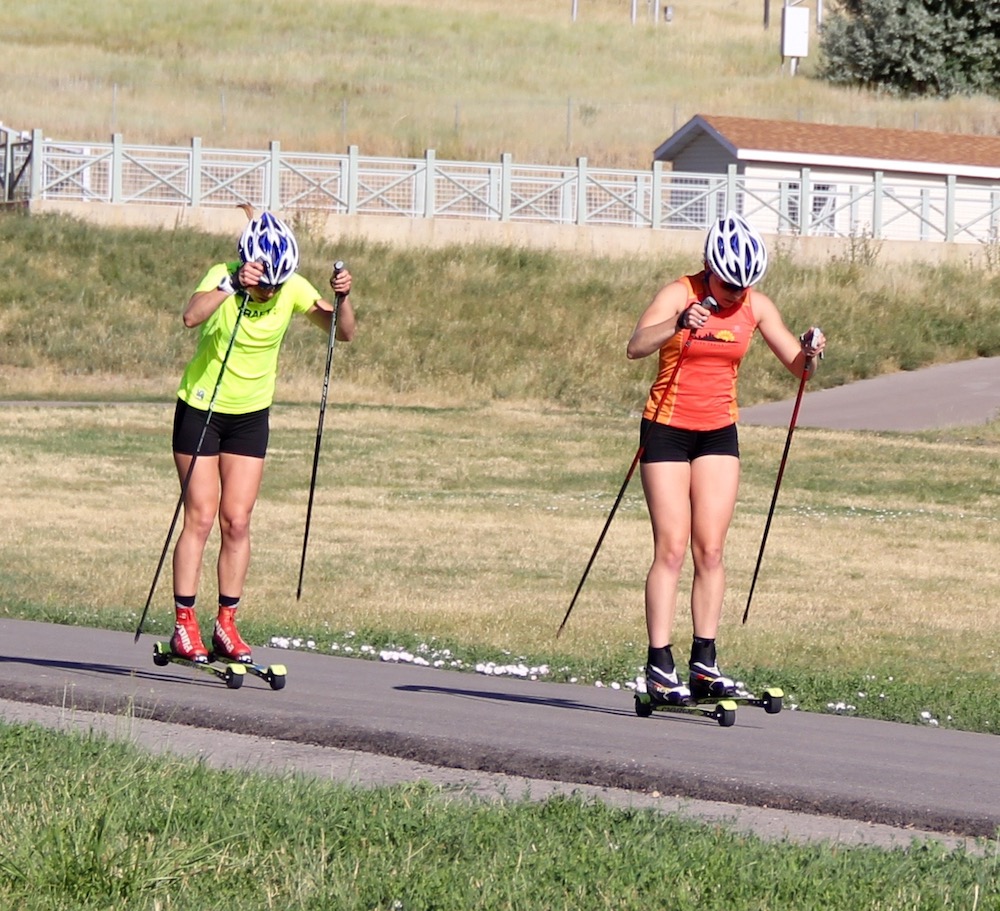
    Lauren Jortberg and Nicole Schneider doing double-pole speeds at the 2017 Junior NTG Camp earlier this month at Soldier Hollow in Midway, Utah. (Photo: Bryan Fish)

    “The U24’s are invited to other U.S. Ski Team camps like our October camp and our May Bend camp,” Fish explained in an email.

    The goal of this month’s camp was “to get our very best together to train and learn from one another,” he wrote. “These are athletes that are already or very well may soon be on the U.S. Ski Team, so building a healthy and positive training environment for these athletes is critical.  Secondly, building an environment where these athletes push each other yet trust one another is critical.  Many of these athletes have already traveled overseas together and continuing to strengthen their comfort and focus toward how we can support, lean on and succeed together – as a group, as a nation, as a team.

    “Third, we want to provide these athletes with meaningful feedback,” Fish continued. “The athletes work with our high performance department at U.S. Ski & Snowboard to learn what individual items they are already strong as well as windows of opportunities for improvement.”

    The primary focus was to provide a “strong training environment,” he wrote, while also testing athletes in areas like strength, power and mobility with a protocol similar to the U.S. Ski Team.

    Throughout the two-week camp, there was an abundance of rollerskiing and threshold ski walking/bounding, as well as strength work.

    “One question that commonly comes up is why such workouts are becoming less familiar or possibly less utilized in coaches’ training plans,” Fish wrote, referring to specific strength. “I think it is because more programs are incorporating this type of effort into classic sprint training sessions. That being said … [this workout develops] many important technical and physical skills.”

    Stuber explained that the workout emphasizes repetition “to work out technique issues and to feel efficiency differences,” she wrote. “It is also a fun social workout because the whole team stays in one place and you can have a good time with rivalries and inter squad competition. “

    The workout: Specific Strength on Skis

    • 20-minute warmup
    • Followed by:
      • 8 x 30 seconds single stick
      • 6 x 30 seconds core-only double pole
      • 8 x 30 seconds double pole
    • 20-minute cool down

    “We did not harp on technique too much and let the athletes think and discover what was working best to move across the ground with the group,” Stuber noted.  “We had video on an iPad for those who wanted to see what they looked like and if the changes they were feeling were showing up on camera.

    “There were a lot of blisters,” she added. “Gloves are recommended for this workout.”
  • NTG Camp Fires Up Developing Athletes

    NTG Camp Fires Up Developing Athletes

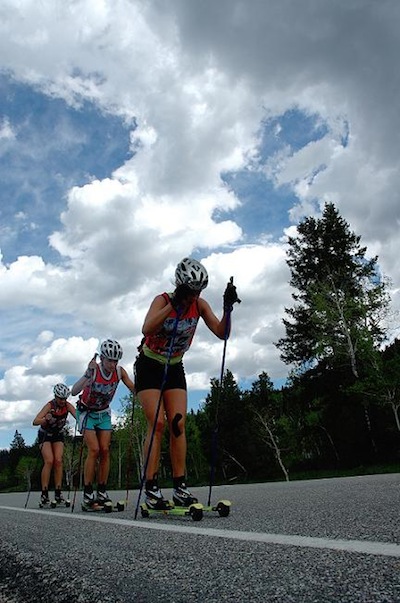
    Sadie Bjornsen (l) rollerskiing with Sophie Caldwell (middle) and Kate Dolan (r)

    Sadie Bjornsen, a new member of Alaska Pacific University’s ski team, gave this firsthand account towards the end of the recently-completed National Training Group camp in Utah. This post originally appeared on her blog, sadiebjornsen.blogspot.com/

    For the past nine days, I have been training and hanging out in Park City, Utah, for the National Training Group camp. Earlier this spring, 25 promising top U-23 and junior athletes were named to this group, which is a new addition to the U.S. Ski Team’s “pipeline.” Six girls and nine boys traveled up, down, or across the country to join the group for ten days of training with U.S. Ski Team (USST) staff. It has been tons of fun, but super hard work.

    Many of these athletes I have never gotten a chance to train with during the summer–I just meet them head-to-head on the race trails–so it has been fun to work alongside them. The coaching has been great as well. We have gotten lots of feedback on technique, training, and just simply our goals in the sport.

    More rollerskiing

    It has been great to train along with Andy Newell and Liz Stephen–it just raises the bar a bit during training. And not only have I been training with top nordie athletes, but also other big shots as well. Yesterday, I was walking backwards on the treadmill (an activity that seems to have no stress on my knee), while watching Ted Ligety speed squat what looked like three times his body weight. I also got to see Lindsey Vonn, an incredible alpine skier, bust out various weight training exercises. It’s funny how you make out these ski heroes to be supernatural people, but then you train alongside or with them and they are normal humans. It sure has a way of firing you up!

    The camp has remained very focused for the entire time. Most days we have hit the pavement or the trails at 8:30 and trained for a couple hours, returned home for some down time, then headed out again for an afternoon workout. After dinner, we return to the “Center of Excellence” [the USST’s training center] for a meeting focused on various aspects of being a ski racer. These meetings have included talks from top athletes like Andy Newell, USST nutritionists, video review, and discussions on topics like relaxation and visualization, World Cup video, and the development pipeline.

    We have hit almost all angles of training. The camp started out with an uphill running time trial, and then was followed four days later with a sprint race simulation. I have been struggling with knee issues, so I had to replace all the running workouts with swimming. I used to be a swim racer during my younger years, but the long break has made me realize how much hard work it is–it’s a great way to increase your upper body strength, for sure! The rest of the workouts have been distance, speed, strength or interval work. This morning, I finally felt the fatigue catching up to me when we did a level three interval workout, 3x14mins, around a loop in town. One more strength workout, a distance workout the following morning, and then I head home to Washington for a few days.

    The weather has greatly improved over the course of the camp. The first few days were rainy and cold, so we have gotten overly excited about the sun coming

    Ouch.

    out these past couple of days. Yesterday, on our afternoon off, we decided to lie by the pool for no more than an hour and came home a little more sunburnt than expected. Turns out you get burned even when its cold out. I am trying to soak up every last bit of sun and heat before I move up to Alaska next week.

  • World Cup Present Battles World Cup Future in NTG Sprint

    World Cup Present Battles World Cup Future in NTG Sprint

    Athletes racing during the NTG Camp freestyle sprint (Screenshot from USST video)

    Andy Newell (USST) may not have been racing against the best skiers in the world in the National Training Group’s sprint time trial at Soldier Hollow on Tuesday, but he certainly was not lacking in motivation.

    “If there’s one thing World Cup sprinters don’t want to do, it’s be juniored,” said Matt Whitcomb, the U.S. Ski Team’s World Cup coach.

    Newell won the men’s time trial by 13 seconds over Erik Bjornsen (MOD) and Reid Pletcher (SVSEF), but there was no question that he was working: his finishing lactate was 15.4 millimoles—a level at which most ordinary people would be curled up in the fetal position.

    “Having TTs in a camp setting like this is great, because that’s really the only way to push yourself that hard,” Newell said in an e-mail to FasterSkier. “It’s tough to post lactates in the high 15’s when you’re out there by yourself.”

    According to Whitcomb, Newell is currently in the middle of an altitude block, and his ability to post such high numbers after a number of solid workouts is “a good sign that he’s been absorbing his training.”

    But while Newell was able to capitalize on the presence of the National Training Group (NTG)—an elite group of juniors and U-23 athletes in Utah for a camp—he wasn’t the only one benefiting. Whitcomb said that the skiers behind Newell got a huge boost from butting heads with a World Cup veteran.

    “The impact that he had on the juniors and U-23 skiers that were in his heat was unbelievable,” Whitcomb said. “They were so engaged—so aware of the techniques he was using, just chasing him and chasing him and chasing him.”

    On the women’s side, Liz Stephen (USST) and Sophie Caldwell (Dartmouth) battled each other for three full rounds. After tying for the fastest time in qualification, the pair skied away from the rest of the fields in their quarter- and semifinal heats, before Caldwell pulled away on the last downhill in the final for the victory. Alexa Turzian (SVSEF) was third.

    “[Caldwell and Stephen] were basically just on each other like glue through every heat,” Whitcomb said. “They had an incredible workout pushing each other all day.”

    Newell had given a talk on sprint preparation and tactics earlier in the week, and as a result, Stephen said that she tried a new protocol for recovery between heats.

    “It’s easy to just ski around between heats–you are filled with lactic acid, tired and trying to mentally and physically prepare for another round or three,” Stephen wrote in an e-mail. “Having a real plan to stick to keeps you on task, focused and as fresh as possible for the coming rounds.”

    While rollerski speed can make a big difference in dryland time trials, all the participants in the NTG camp time trial were using Marwes. However, Whitcomb cautioned, “even when they are matched, there are discrepancies between them, it seems.”

    Newell said that after training with the NTG group for a few days, he’s “impressed with the next wave of top skiers in the U.S.”

    “These guys are going to be the future of World Cup racing in our country,” he said.

    Link to full results.

    Video from the NTG Camp Freestyle Sprint

    More video from this race can be found at the USSA Dartfish Channel