From the FasterSkier archive — posts syndicated from athletes’ and coaches’ own blogs between 2004 and 2012, kept online as published. Current coverage is at fasterskier.com.

Tag: NTG

  • In Good Standing—Fundamental Elements of Ski Stance

    In Good Standing—Fundamental Elements of Ski Stance

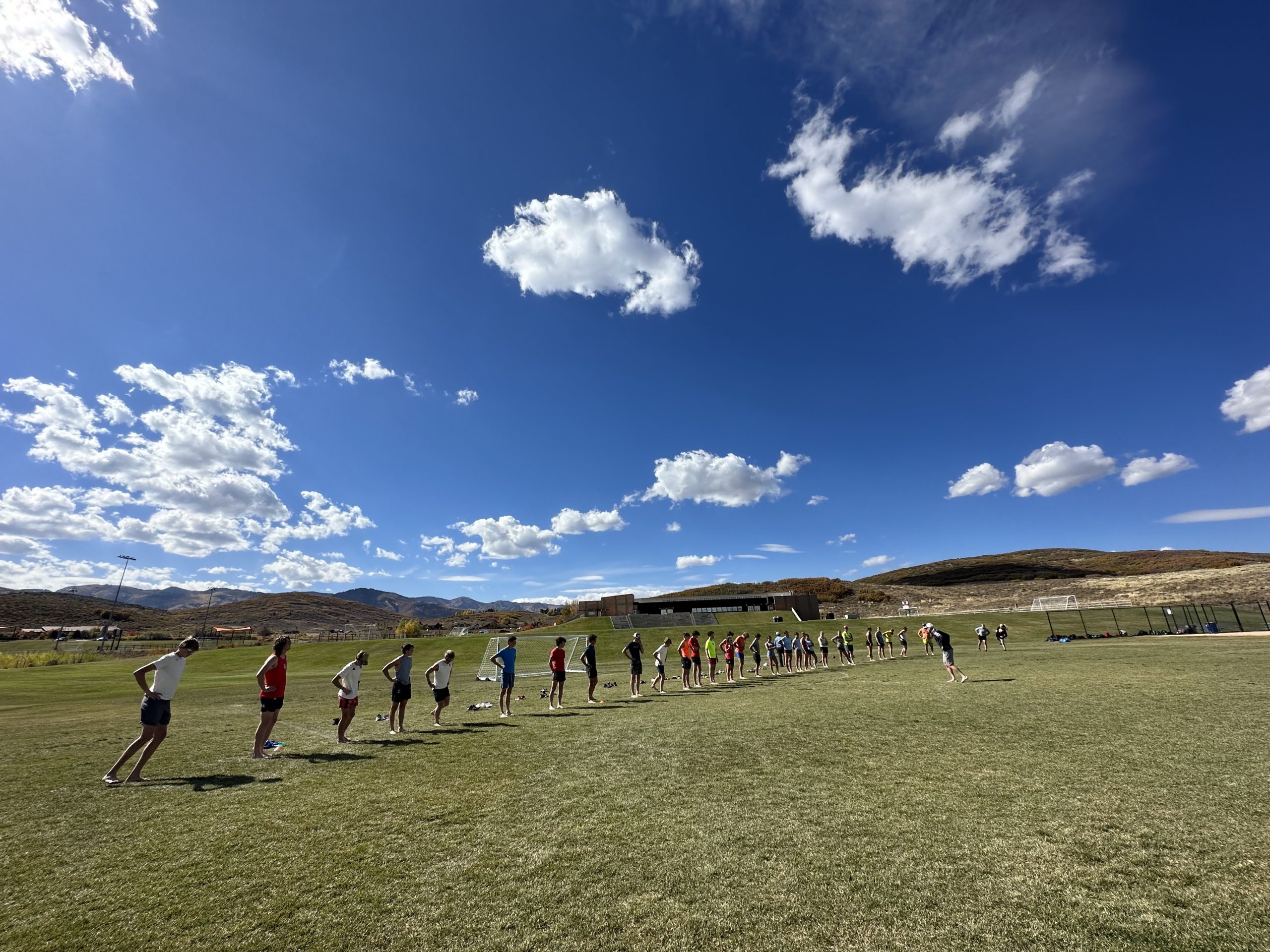
    Ned Dowling conducts a Ski Stance seminar for participants in the recent National Training Group (NTG) and National Elite Group (NEG) training camp in Park City, Utah. (Photo: Ned Dowling)

    “Big motor, lousy suspension.” That’s how I often describe the endurance athletes I see in physical therapy. They have the physiology to go fast but are lacking the stability and/or coordination for efficient movement. Decreased efficiency equals increased load. And excessive load has led to injury and a visit to their friendly, neighborhood PT. 

    I used the same description while Greta Anderson, the US Cross Country Development Coach, and I stood trackside last August watching rollerskiers during the 15k Classic race in Trollhatten, Sweden. At that high level of racing, everyone was fast, but not everyone looked to have good stability, movement coordination, and efficiency. Our peanut gallery coaches’ box banter turned into a lengthy conversation on the fundamentals of Nordic skiing. Next thing I knew, Greta had me leading a training session for the National Training Group (NTG) and National Elite Group (NEG) combined camp in Park City, UT. We called it Stability From the Ground Up with the goal of reinforcing the Ski Stance while balancing on one leg and doing tricks. The following is an excerpt of that training session. 
    .        
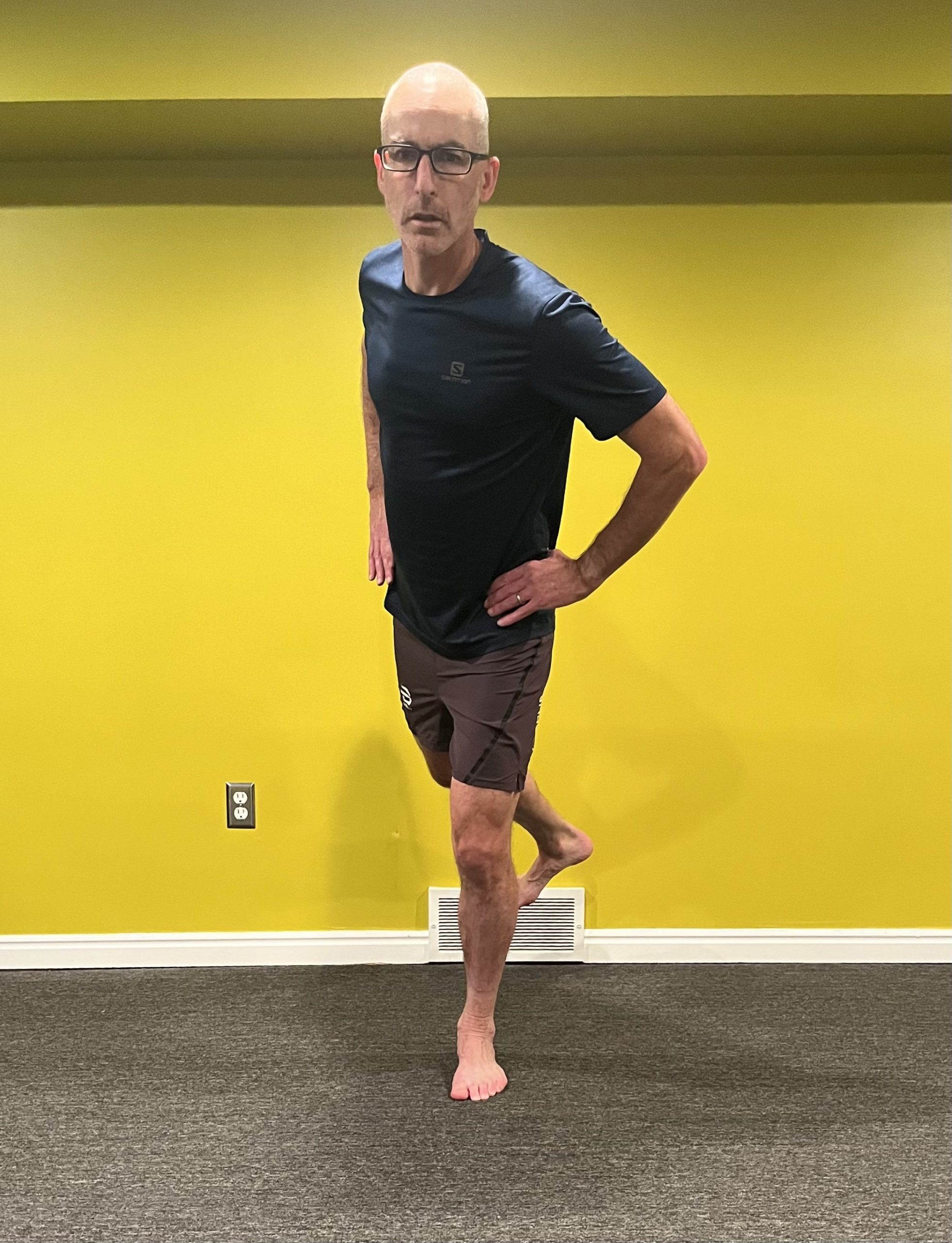
    What is Ski Stance?

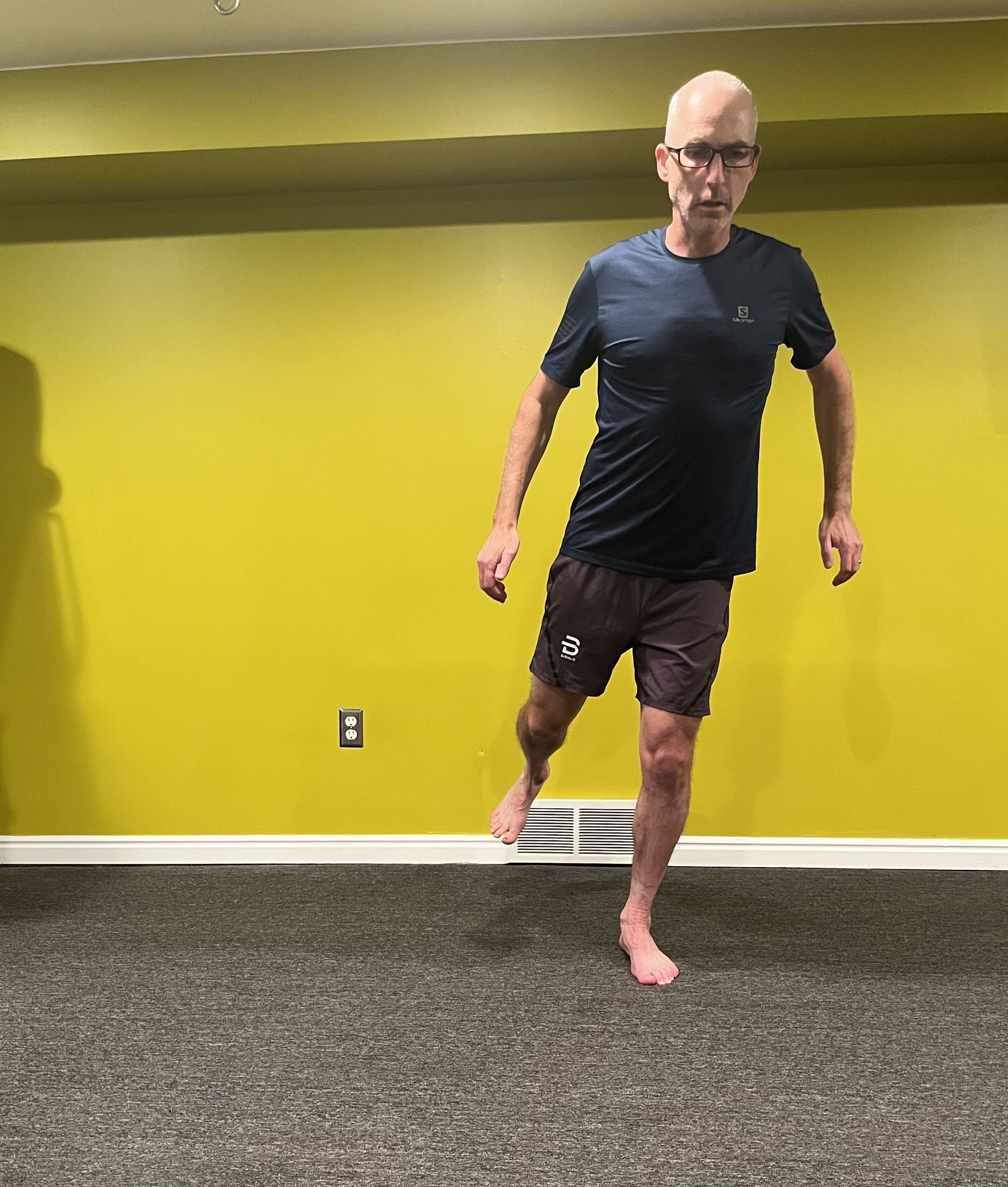
    It is the foundation of Nordic skiing, both Skate and Classic. It is the stable, balanced position on the glide ski that facilitates both optimal glide and a stable platform as the glide ski becomes the kick ski. Stable glide begets more power, and more power begets more stable glide

    Ski Stance Checklist:
    • Balance on one leg.
    • Equal pressure between the inside and outside of the foot, especially across the metatarsal heads between the ball of the foot on the big toe side and the pinky toe equivalent. 
    • Weight is biased towards the front of the foot but the heel stays down. Distribution is in the neighborhood of 70:30, forefoot to rearfoot. 
    • Toes are relaxed. This doesn’t mean the toes are hovering off the ground, but it very much means the toes are not clawing at the floor. (Have a look at the insoles of your ski boots: if there is a lot of wear under the toes, you are likely using them too much. This is either a bad habit or a compensatory strategy, or both. Speaking of insoles…)
    • The ankle is flexed enough to put the kneecap in line vertically over the toes. 
    • Slight bend at the knee and hip.
    • Forward lean at the trunk. This is accomplished with a hinge at the hips, not a flex through the spine. Nose-Knee-Toes is the old cue. If you’re dripping snot out of your nose, it should land on your foot not down the front of your shirt. 
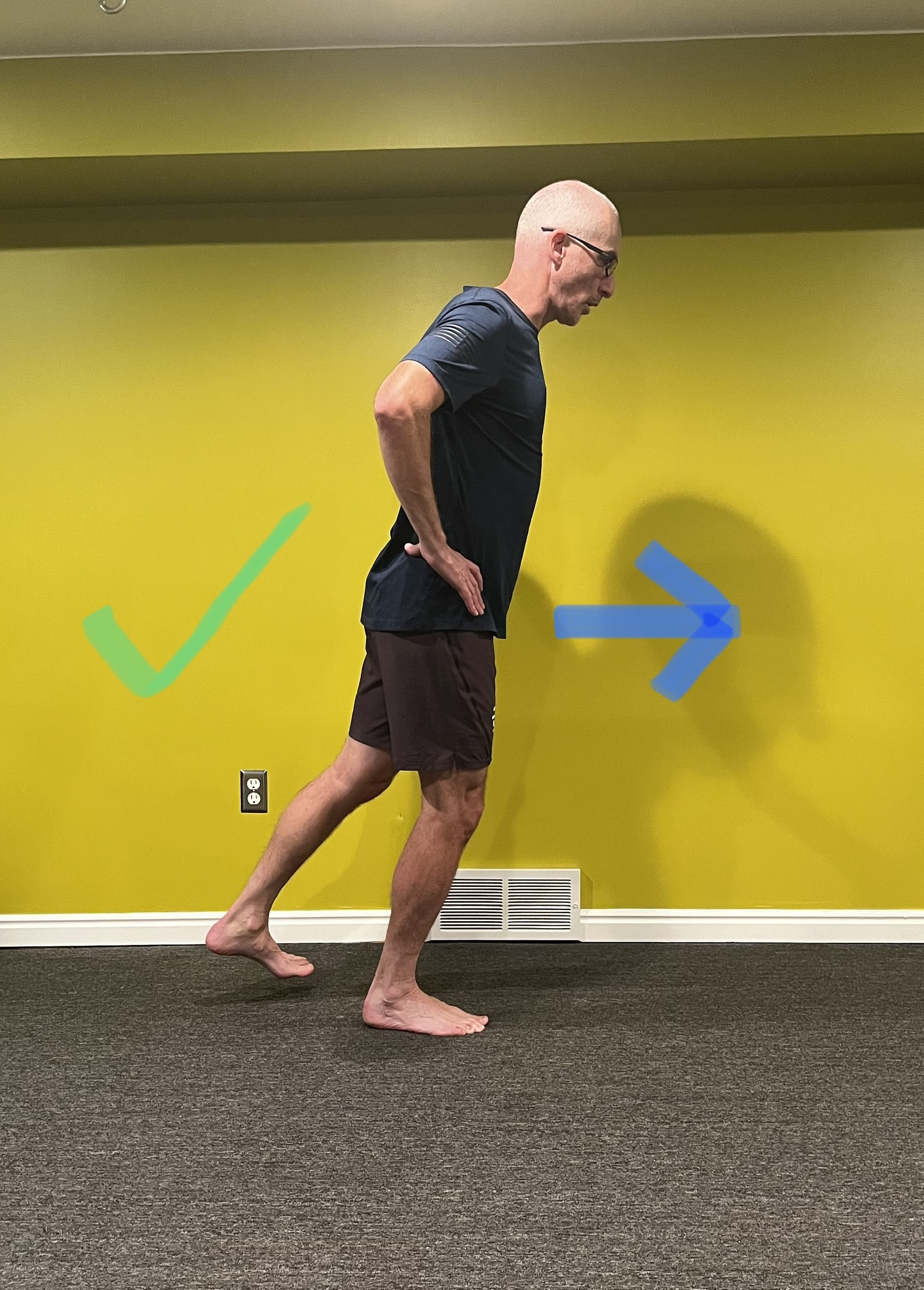
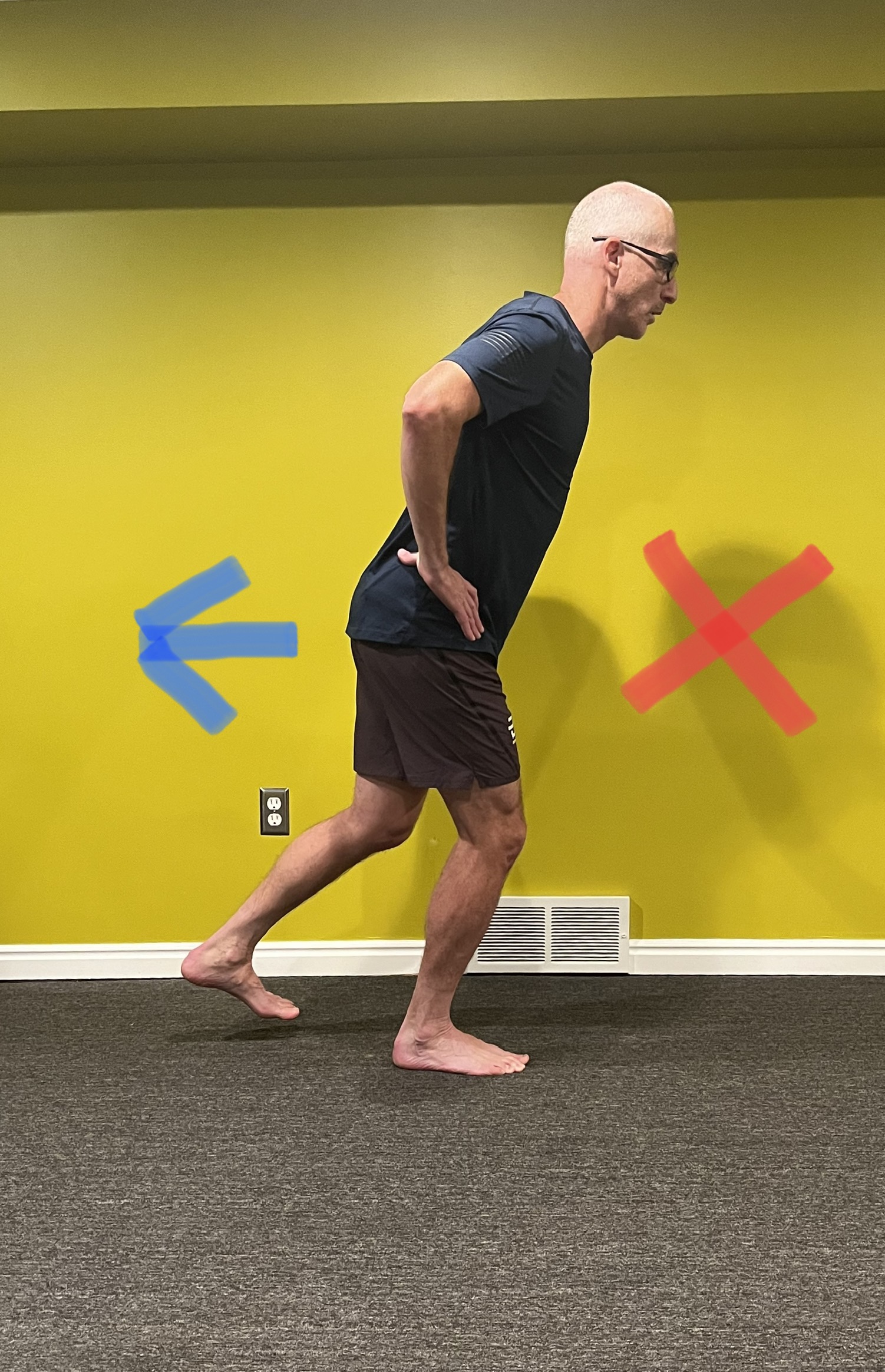
    • High Hips. If I had a dollar for every time Devon Kershaw has endorsed a skier with “high hips” I could buy a ski quiver worthy of the World Cup. But what does this even mean? Our Checklist just listed flexion at the ankle, knee, and hip, so how can we keep the hips high but flexed at the same time? Forward Hips might be a little more intuitive. The pelvis is pushed forward without losing the bend at the hips. It will initially feel like you are falling forward, but that’s a good thing. We want the center of gravity shifted forward to push us down the trail. A different cue is Front seat, not Back Seat. The back seat is like starting to sit on the toilet: ankle, knee, and hip are flexed and the trunk is leaning forward; however, the butt is reaching backwards. Aim to shift the hips forward like someone is pulling at the front of your belt.
    • Stability from the hip, not leaning to the side. When we stand on two feet, the center of gravity is between the two feet. If we are to stand on one foot, we can’t just pick up the opposite foot—our center of gravity has to shift to the stance side. That can be accomplished by leaning the trunk to the side, but this is not an active position and doesn’t facilitate generation of power. The weight shift ideally comes via a lateral movement of the pelvis over top of the stance leg. Note: this shift is very applicable to diagonal stride as we move from the kick ski to the glide ski. The direct application to skate varies a bit with the sub-discipline—V1 has a more distinct weight shift from ski to ski while the transition during V2 is more of a “swapping” of skis underneath the body than a lateral movement from one to the other.
    Exercises 

    The intent of these exercises is to reinforce the Ski Stance. Each one has a movement component to challenge both balance and maintenance of the Ski Stance position. (Here is a primer on single limb balance and stability.) The quality of movement and balance are paramount. In order to be beneficial, the exercise should be challenging but doable. If you are falling all over the place or cannot control the movement, the exercise is likely too difficult for your current level. The exercises are listed in ascending order of difficulty.
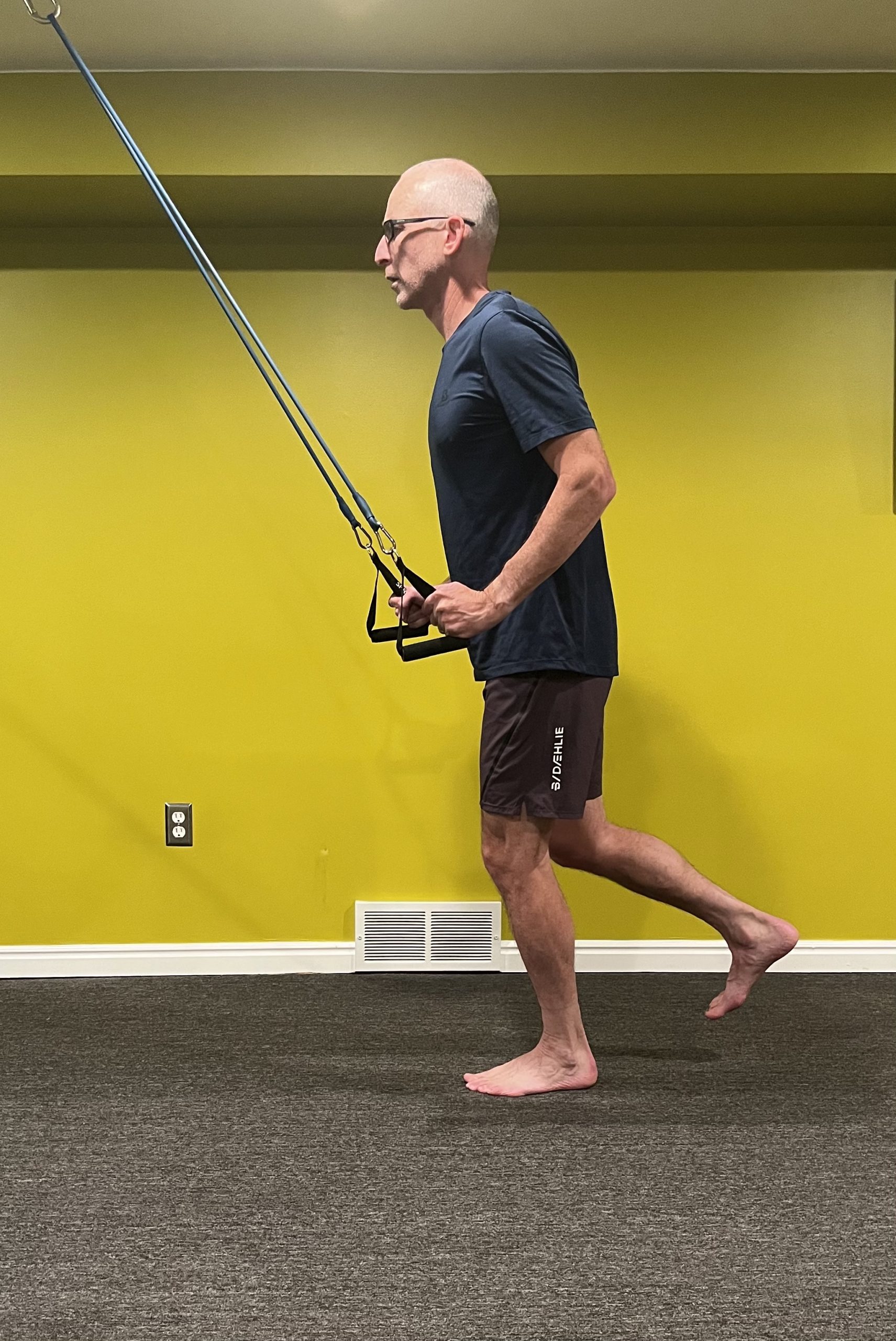
    Band Poling Exercise

    • Ski Stance.
    • Use a two-tailed band or two separate bands anchored at head height or higher.
    • Pull down on bands keeping some bend in the elbows. (This is not meant to be a double poling simulation as we are trying to stay tall in the Ski Stance not dropping down as we would with DP or V2.)
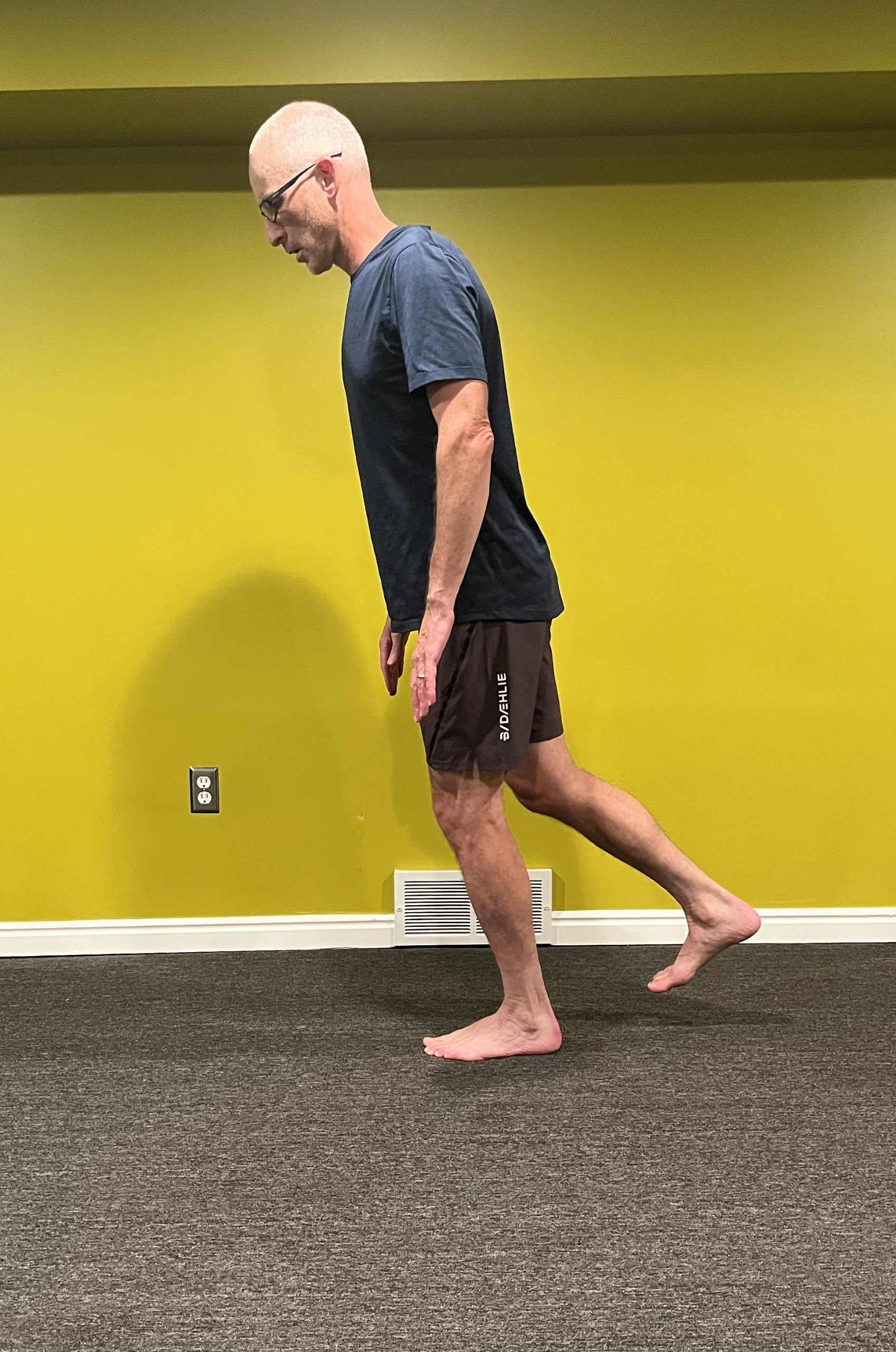
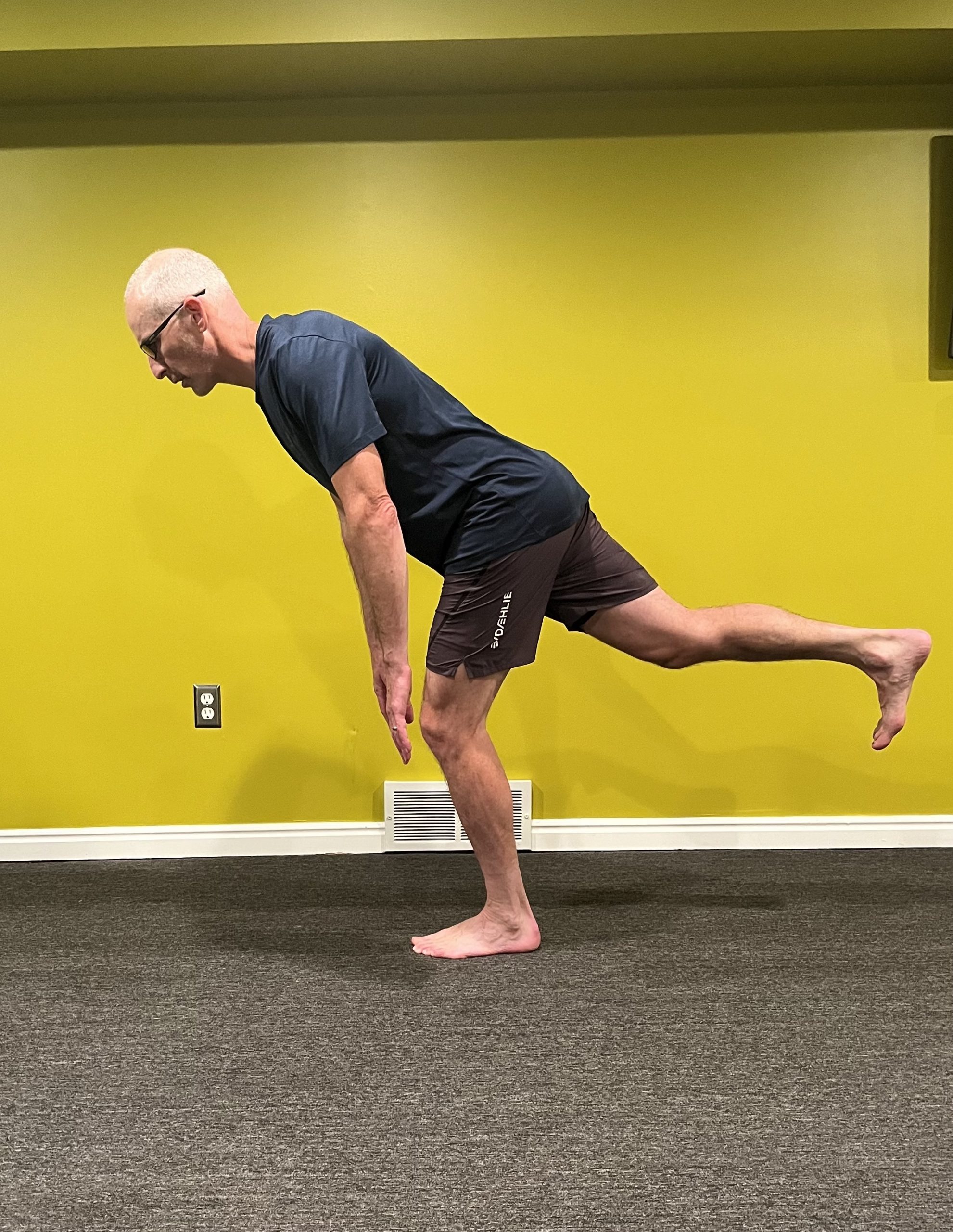


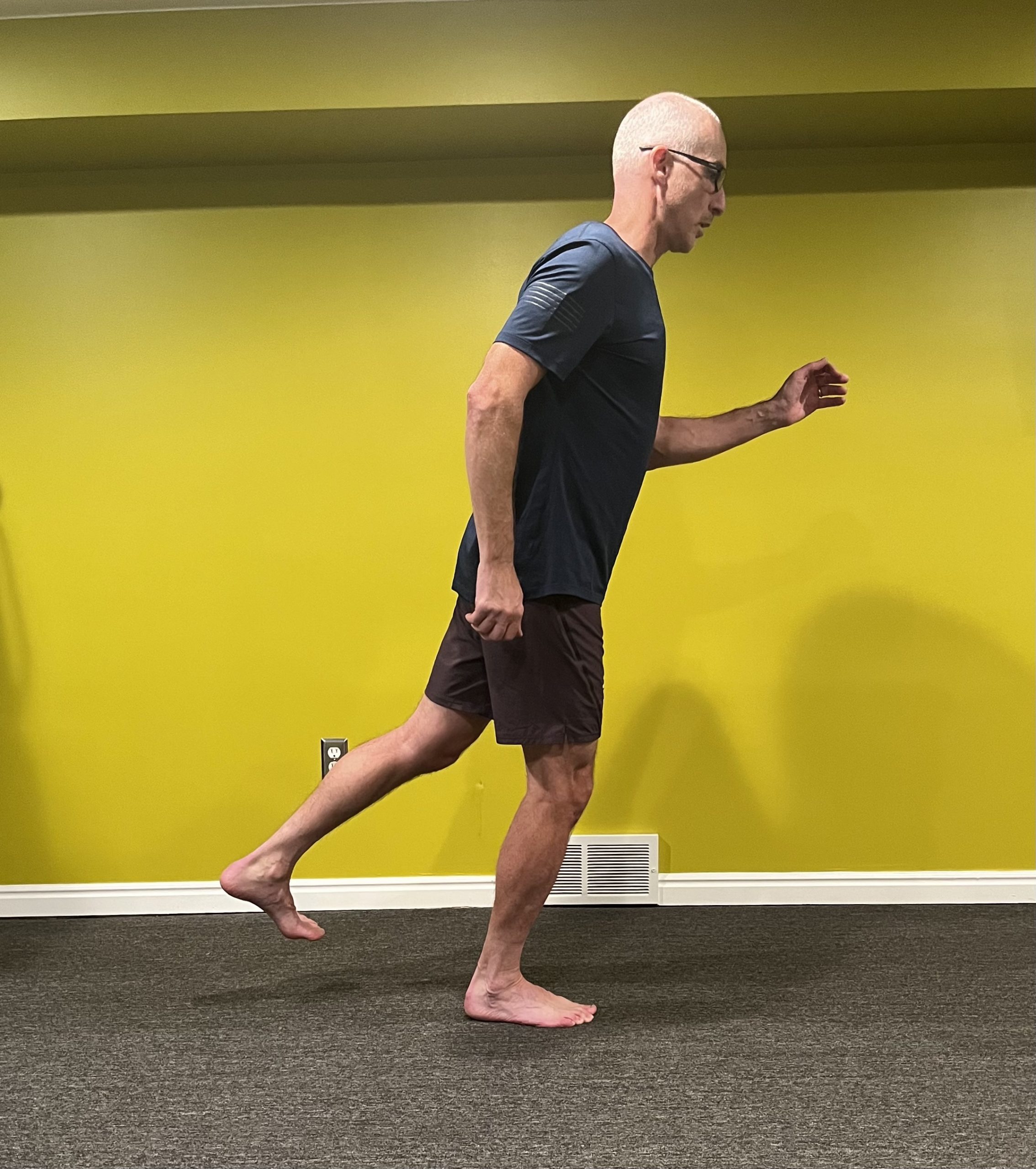
    Romanian Deadlift (RDL) Exercise

    • Ski Stance.
    • Bend forward aiming your fingers for the sides of your knee. The movement is a hinging motion at the hip. The joint angles at the ankle and knee should not change. The spine stays in neutral position without bending.
    • Pelvis stays level as you bend forward (no twisting).
    • Finish with a push forward of the hips/pelvis—front seat not back seat.
    • You can add weight (single dumbbell or kettlebell in the opposite hand or one in each hand) for glute and hamstring strengthening, it doesn’t necessarily make the balance/stability any more difficult. 
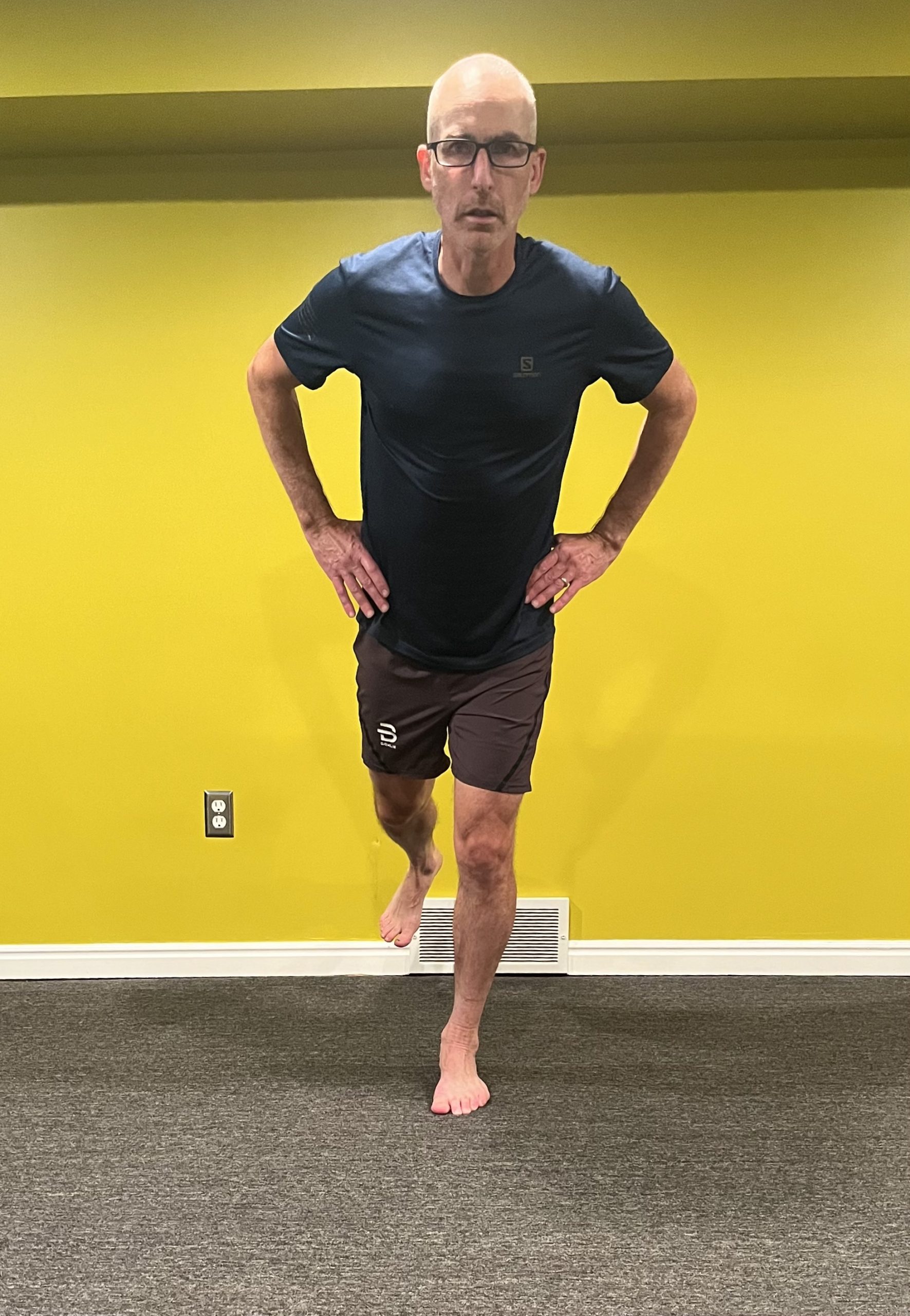


    Hip Twist Exercise

    • Ski Stance.
    • Twist your upper body in the opposite direction of the stance leg (standing on right leg = rotation to the left).
    • Shoulders, belly button, pelvis move together. 
    • Knee cap stays pointing straight ahead. 
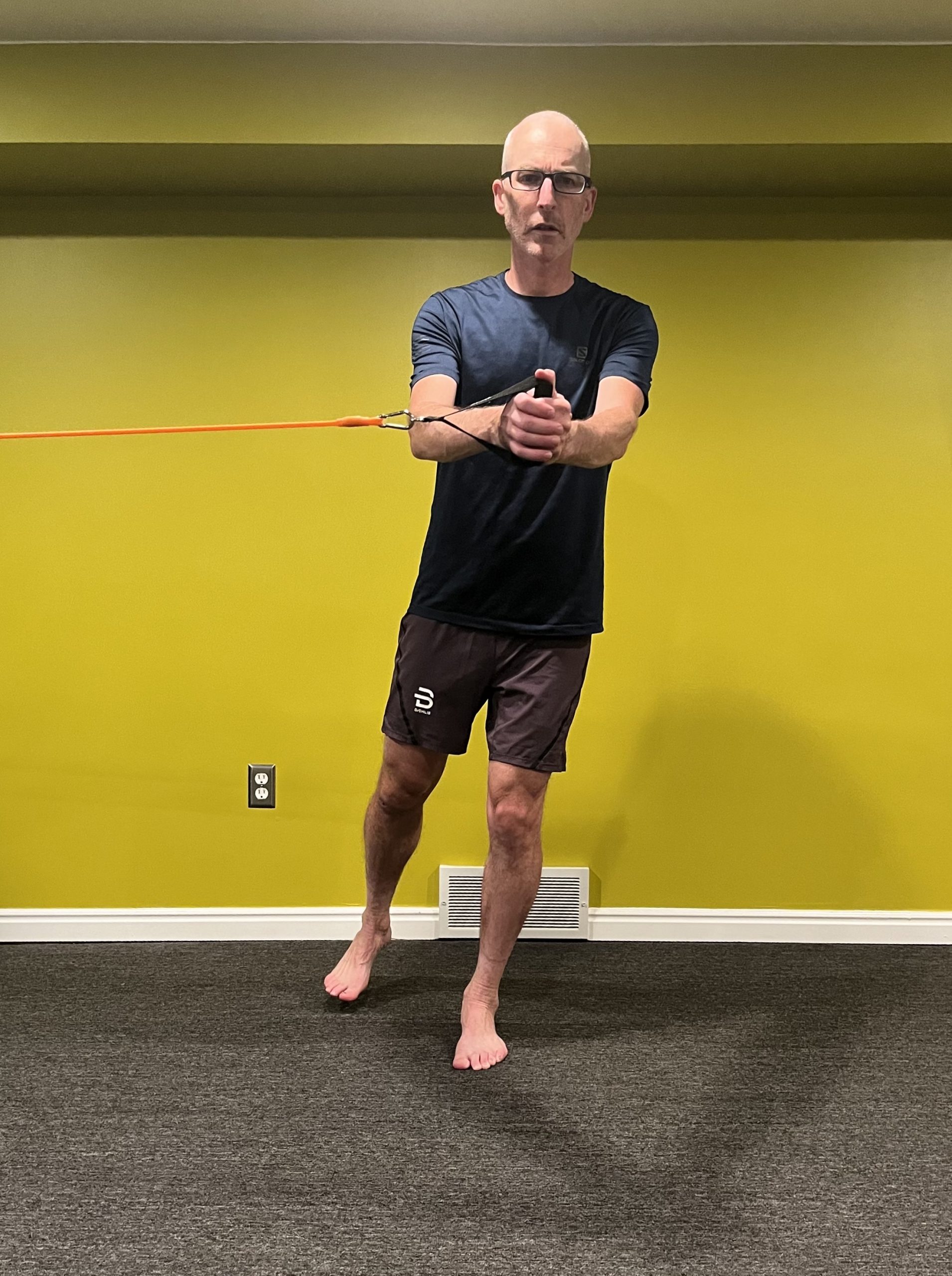


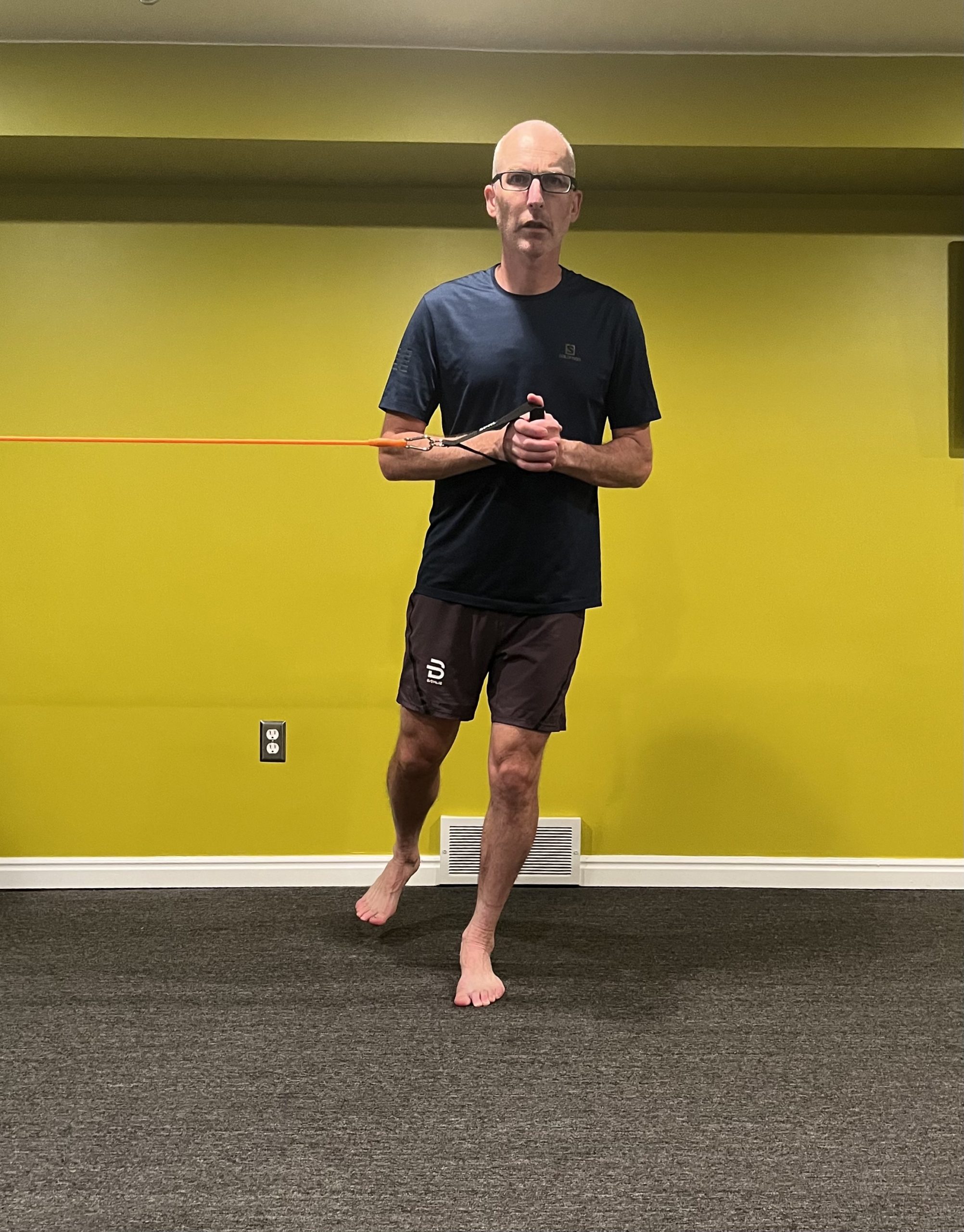
    Paloff Press with Resistance Band Exercise

    • Ski Stance.
    • Band is anchored at chest height coming from the opposite side of the stance leg.
    • Holding the band in both hands, push your arms straight out and back.
    • Keep knuckles pointed straight ahead—don’t let the band twist you.
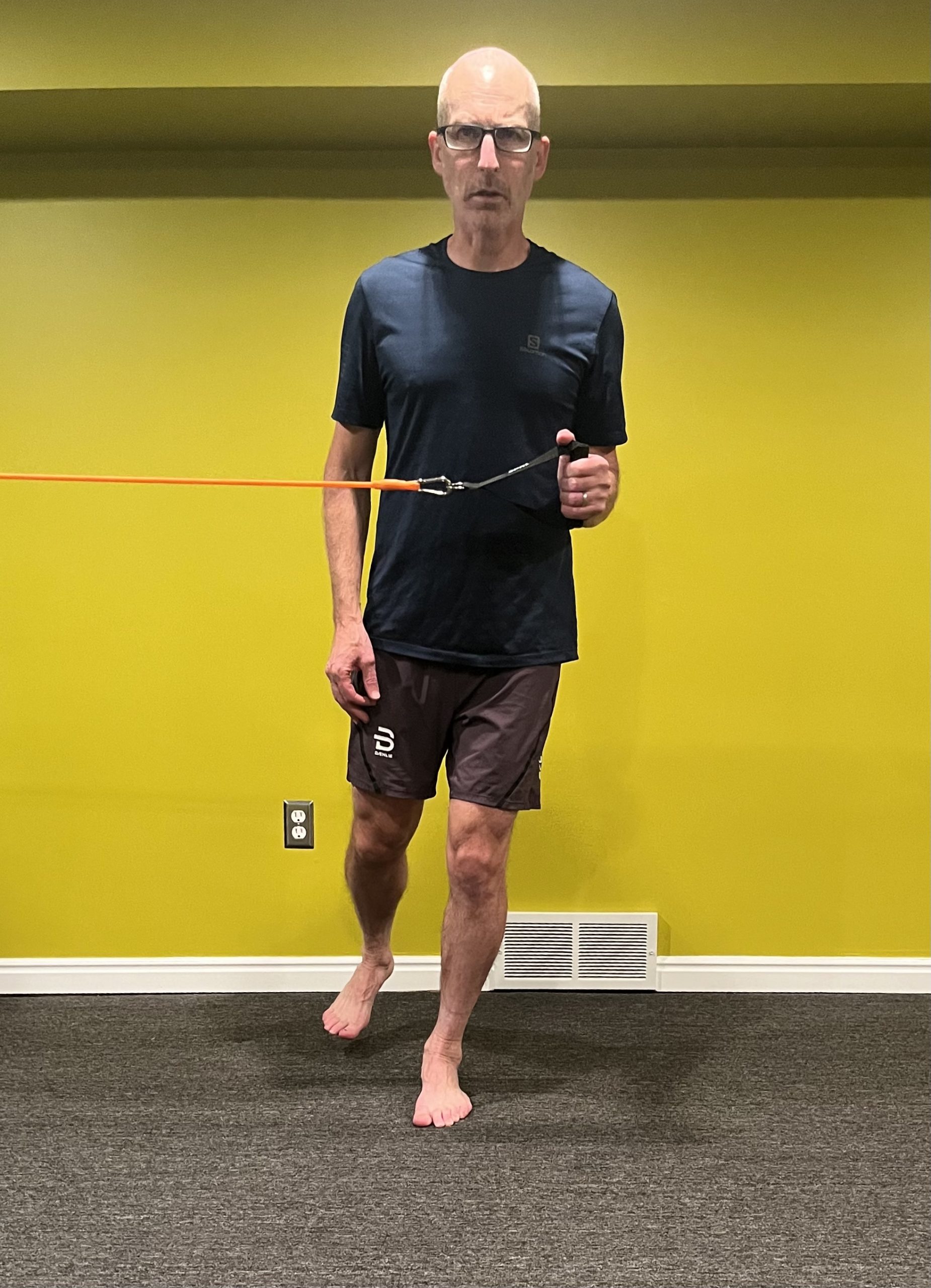


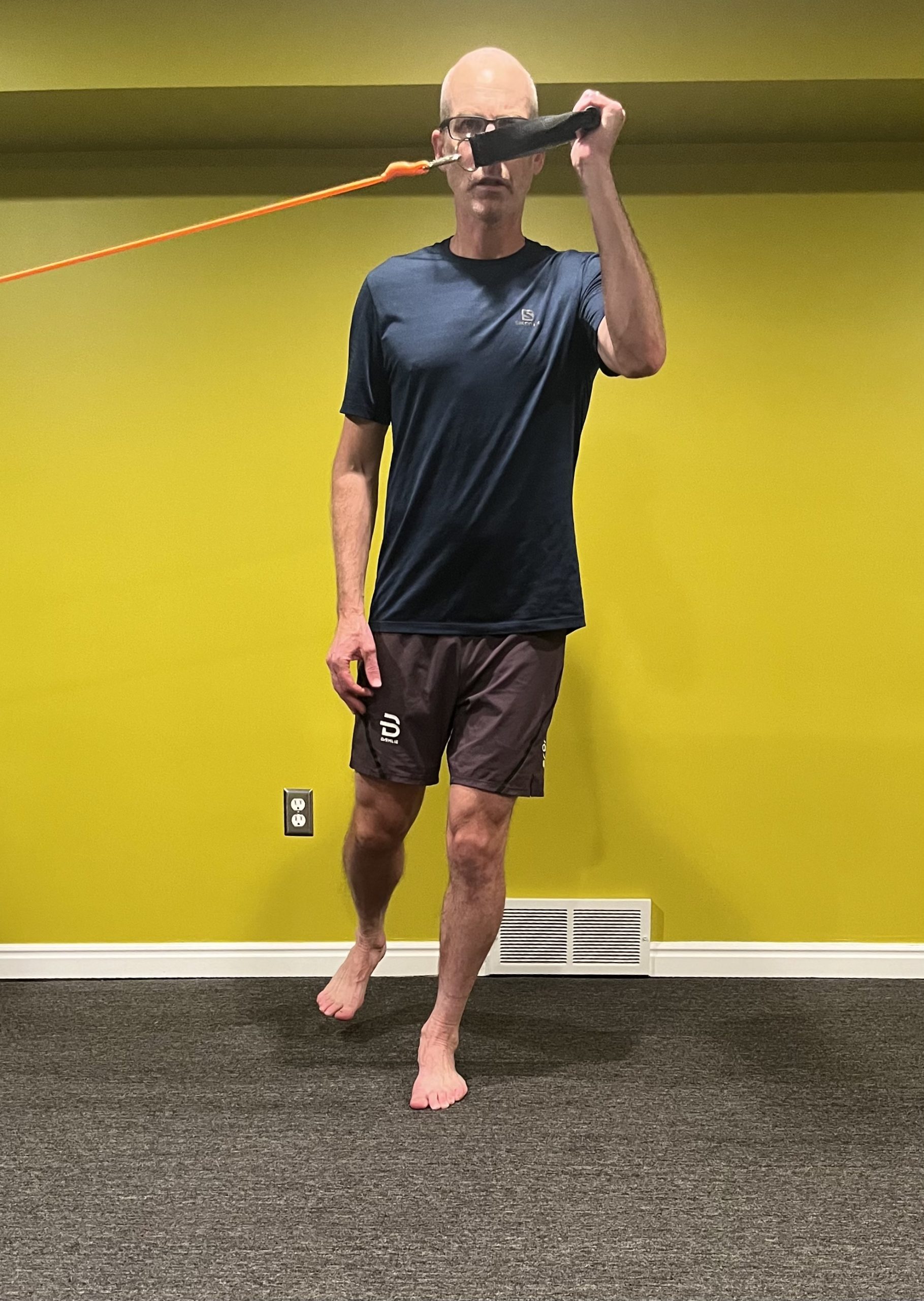
    Shoulder External Rotation + Uppercut with Resistance Band Exercise

    • Ski Stance.
    • Band is anchored at chest height coming from the opposite side of the stance leg.
    • Hold the band in the same hand as the stance leg with your elbow bent at 90 degrees and knuckles pointed straight ahead.
    • Keeping the elbow bent at 90 degrees, raise your arm up as if you were a waiter carrying a tray.
    • This is very good bonus work for your rotator cuff muscles.
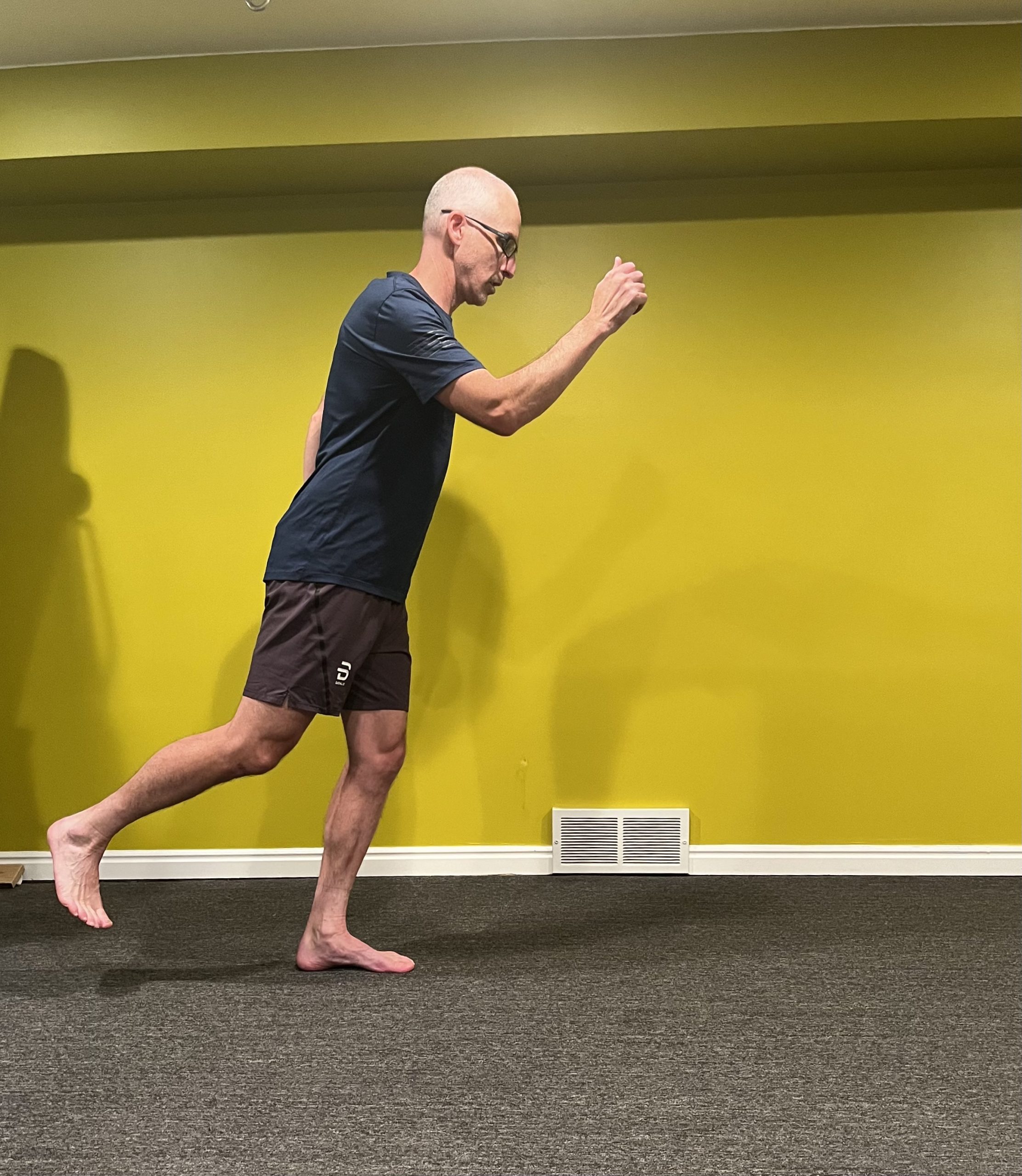


    Classic Stride/Bound with Pause for Balance Exercise

    • Traditional diagonal stride bound except with a pause on the “glide” foot.
    • Be honest about balancing in Ski Stance before kicking onto the other leg.
    • Continue to focus on arm swing mechanics and a strong kick.
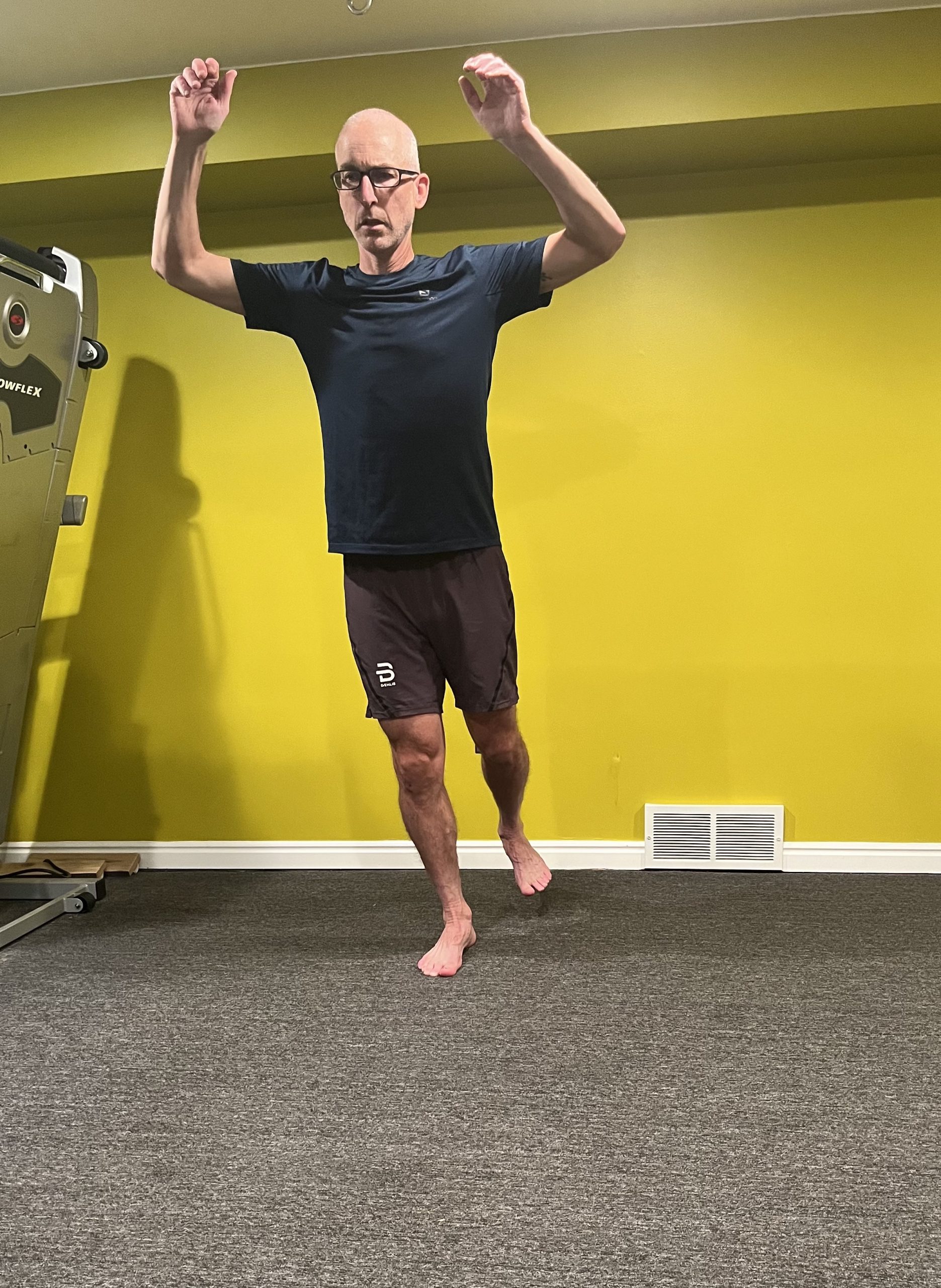


    Skate Stride/Bound with Pause for Balance Exercise

    • Traditional lateral bounding except with pause on the “glide” foot.
    • Be honest about balancing in Ski Stance before kicking onto the other leg.
    • Continue to focus on both the pre-load and strong push through the leg.


  • Wednesday Workout: Old-School Strength with the NTG

    Wednesday Workout: Old-School Strength with the NTG

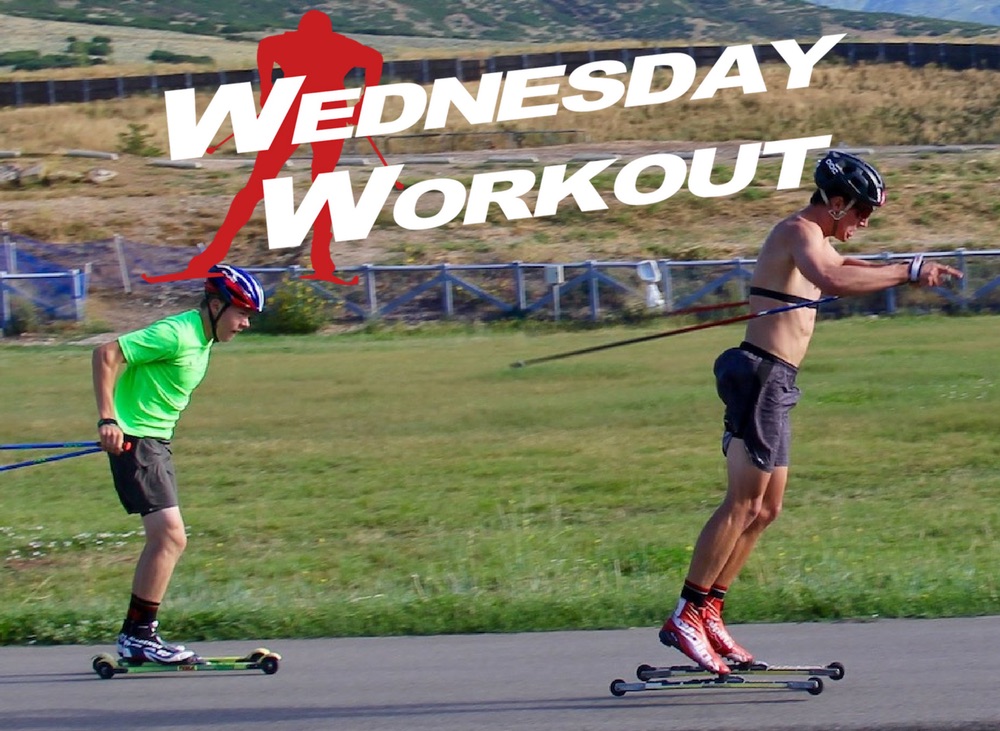
    Ben Ogden and Bill Harmeyer during double-pole speeds at the 2017 Junior NTG Camp earlier this month at Soldier Hollow in Midway, Utah. (Photo: Bryan Fish)

    For this week’s workout, we asked for a specific-strength workout from this year’s Junior National Training Group (NTG) Camp, which was held Aug. 2-15 near Park City, Utah. One of three coaches at the camp, Maria Stuber (head nordic coach at the College of St. Scholastica), shared the following, which she described as an “old-school endurance strength workout.” She led the camp with two U.S. Ski Team (USST) staff members, development coach Bryan Fish and World Cup wax technician Tim Baucom. Eighteen athletes attended — 10 men and eight women — all under the age of 21.

    Lauren Jortberg and Nicole Schneider doing double-pole speeds at the 2017 Junior NTG Camp earlier this month at Soldier Hollow in Midway, Utah. (Photo: Bryan Fish)

    “The U24’s are invited to other U.S. Ski Team camps like our October camp and our May Bend camp,” Fish explained in an email.

    The goal of this month’s camp was “to get our very best together to train and learn from one another,” he wrote. “These are athletes that are already or very well may soon be on the U.S. Ski Team, so building a healthy and positive training environment for these athletes is critical.  Secondly, building an environment where these athletes push each other yet trust one another is critical.  Many of these athletes have already traveled overseas together and continuing to strengthen their comfort and focus toward how we can support, lean on and succeed together – as a group, as a nation, as a team.

    “Third, we want to provide these athletes with meaningful feedback,” Fish continued. “The athletes work with our high performance department at U.S. Ski & Snowboard to learn what individual items they are already strong as well as windows of opportunities for improvement.”

    The primary focus was to provide a “strong training environment,” he wrote, while also testing athletes in areas like strength, power and mobility with a protocol similar to the U.S. Ski Team.

    Throughout the two-week camp, there was an abundance of rollerskiing and threshold ski walking/bounding, as well as strength work.

    “One question that commonly comes up is why such workouts are becoming less familiar or possibly less utilized in coaches’ training plans,” Fish wrote, referring to specific strength. “I think it is because more programs are incorporating this type of effort into classic sprint training sessions. That being said … [this workout develops] many important technical and physical skills.”

    Stuber explained that the workout emphasizes repetition “to work out technique issues and to feel efficiency differences,” she wrote. “It is also a fun social workout because the whole team stays in one place and you can have a good time with rivalries and inter squad competition. “

    The workout: Specific Strength on Skis

    • 20-minute warmup
    • Followed by:
      • 8 x 30 seconds single stick
      • 6 x 30 seconds core-only double pole
      • 8 x 30 seconds double pole
    • 20-minute cool down

    “We did not harp on technique too much and let the athletes think and discover what was working best to move across the ground with the group,” Stuber noted.  “We had video on an iPad for those who wanted to see what they looked like and if the changes they were feeling were showing up on camera.

    “There were a lot of blisters,” she added. “Gloves are recommended for this workout.”

  • Throwback Workout: Pace-Development Intervals with the NAWTA (Remember That?)

    Throwback Workout: Pace-Development Intervals with the NAWTA (Remember That?)

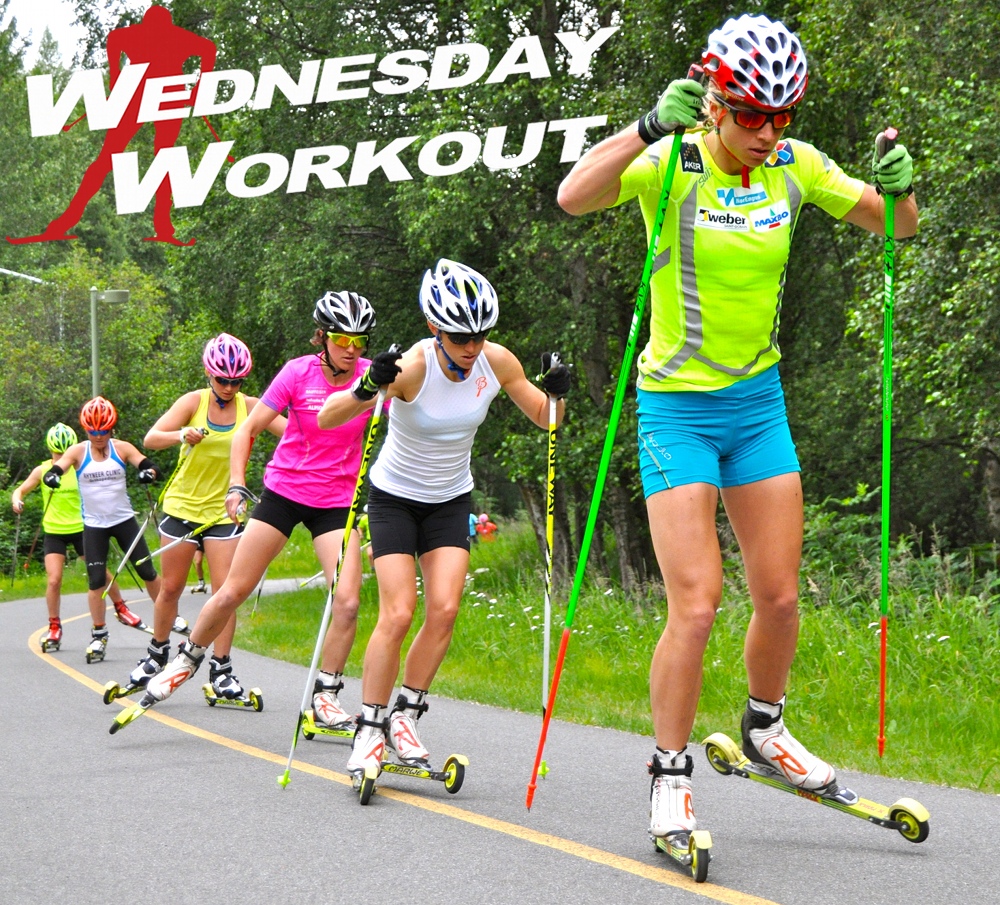
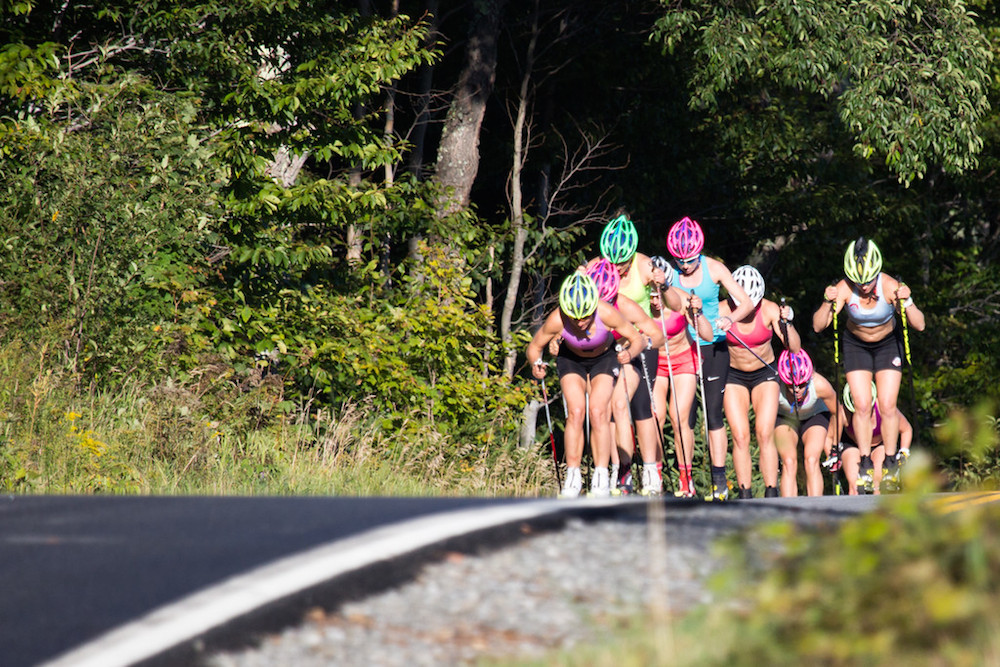
    Astrid Jacobsen (NOR), Liz Stephen, Bettina Gruber (SUI), Jessie Diggins, Holly Brooks and Ida Sargent during threshold intervals in Anchorage, Alaska, on Tuesday. (Photo: Matt Whitcomb)
    Norway’s Astrid Jacobsen (r) leads Liz Stephen (U.S. Ski Team), Switzerland Bettina Gruber, and U.S. Ski Team members Jessie Diggins, Holly Brooks and Ida Sargent during threshold intervals at the 2013 North American Women’s Training Alliance (NAWTA) camp in Anchorage, Alaska. (Photo: Matt Whitcomb)

    For this week’s workout, we bring you one of the best threshold workouts U.S. Ski Team Women’s Coach Matt Whitcomb said he’s ever seen — back in 2013. That’s not to say this workout is outdated, and the kind of training environment nearly a dozen top-level athletes created at the 2013 North American Women’s Training Alliance (NAWTA) camp in Anchorage, Alaska, was one other teams and clubs can try to emulate. All it takes is a quality all-around effort and well-thought-out terrain choices. Read original article here.

    ***

    [circa July 2013]

    The third-annual North American Women’s Training Alliance (NAWTA) camp began this week in Anchorage, Alaska, and on Tuesday morning they completed a threshold workout that ended with a lot of high-fives in the van and left U.S. Ski Team women’s coach Matt Whitcomb pretty happy.

    “Today’s threshold workout was the best threshold workout I’ve seen out of this group of women since I’ve been working with the team,” he said on the phone, as the group began their afternoon strength session.

    Kikkan Randall, Jessie Diggins, Liz Stephen & Co., are joined at this camp by Alaska Pacific University skiers, National Training Group athletes, and decorated Norwegian Astrid Jacobsen, Switzerland’s Bettina Gruber and Canada’s Chandra Crawford. The workout is one that Whitcomb and APU head coach Erik Flora have repeated over the last few years in order to work specifically on high-speed skiing in the middle of a threshold session.

    The keys to accomplishing this goal are two-fold: the choice of terrain, and the presence of a group to ski with. It was his team’s skilled pack skiing that Whitcomb thinks set Tuesday’s session apart from the rest, but the rolling hills are a critical ingredient to the goal of the entire workout.

    “It’s not so much emphasizing going harder, it just emphasizes patterning your muscles, neurally, to fire faster,” Whitcomb explains. “I think a lot of times, certainly my tendency as been to prescribe intervals that are a bit too slow. We might be nailing the percentage of your max heart rate and the proper lactate right on the money, but the pace is just too slow — you’re going uphill, uphill, uphill, and a lot of times when we find hard terrain we go hit intervals there.”

    To encourage speed variation while staying within threshold, the workout should be done on a stretch of pavement that includes gradual uphills, flats and gradual downhills, which “systematically [builds] some pace development intervals into your session,” Whitcomb says.

    “It doesn’t need to be incredibly hard — today was roughly threshold and above during bursts of speed — but it was about the terrain that helped push the pace for us.”

    The Workout:

    • 20-30 minute warm up*
    • 4-6 x 7-10 minute L3 intervals (3 minutes rest) on fast terrain that incorporates gradual uphills, flats and gradual downhills. Most interval sessions use hard and grinding terrain, great for building capacity but not so great for higher pace development. The key to this workout is in the choice of terrain.
    • 20-30 minute cool down*

    *Do a warm up and cool down that allows you to focus on the intervals. “Sometimes a mistake can be made where people are going after volume in addition to high intensity on interval days,” Whitcomb says.

    Don’t do try to multi-task for this workout. “Warm up only the minimum that your body requires,” he continued. “You want to make sure your muscles are ready to go, and build into the intervals if you have to — you don’t want to pull any muscles or get injured — but a 45 minute warm up is too long, as is a 45 minute cool down. Keep them concise and focus more on the on-time.”

    Frequency: 

    Every two to three weeks in the summer, with increasing frequency to every 10 days as fall approaches. “A workout like this is in addition to L4 intervals, time trials, speeds, ODs,” Whitcomb said. “It’s just another small component, another ingredient to throw in the bag and mix it up.”

    Variations:

    • Shorter recovery time as the season goes on, or longer recovery when at altitude — “just to make sure the on-time is what’s being emphasized,” Whitcomb says.
    • Pre-determined sprint preems that accomplishes a similar break from straight threshold, forcing athletes to go from threshold, into race pace, then back into threshold when they cross certain preem markers in the interval.

    On Tuesday, the women did this session on a stretch of bike path in Anchorage’s Kincaid Park. They chose a section of rolling terrain that was about 7-10 minutes long going either way. The group started their first interval in one direction, which took about nine minutes, took their three-minute recovery, and then skied back the other way to the start, which took about seven minutes.

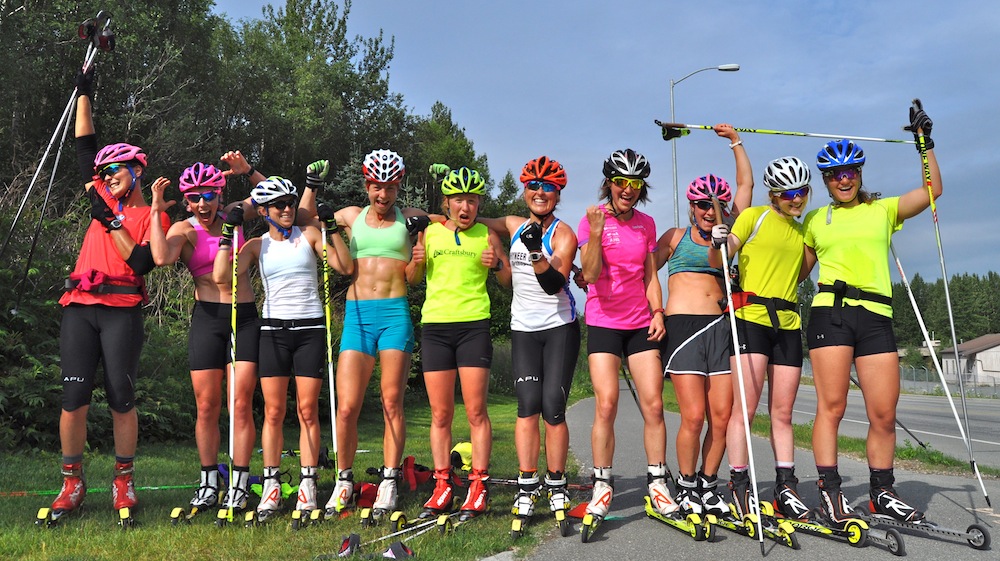
    The 2013 North American Women's Training Alliance group after a well-executed workout in Anchorage, Alaska. (L to R) Kate Fitzgerald, Kikkan Randall, Liz Stephen, Astrid Jacobsen (NOR), Ida Sargent, Holly Brooks, Bettina Gruber (SUI), Jessie Diggins, Emily Hannah, Anika Miller. (Photo: Matt Whitcomb)
    The 2013 North American Women’s Training Alliance group after a well-executed workout in Anchorage, Alaska. (L to R) Kate Fitzgerald, Kikkan Randall, Liz Stephen, Astrid Jacobsen (NOR), Ida Sargent, Holly Brooks, Bettina Gruber (SUI), Jessie Diggins, Emily Hannah, Annika Miller. (Photo: Matt Whitcomb)

    From a coaching perspective, this workout shows Whitcomb things that don’t surface in regular threshold intervals.

    “I think when we started doing this it taught us that the speed didn’t really change as much as we thought it would when the terrain asked for higher speed,” he said. “You try and go faster and your muscles simply didn’t want to move faster. It wasn’t a matter of being at your max heart rate, people were well within threshold, but they just didn’t want to fire those muscles faster. But the body fortunately adapts pretty quickly to a group session like this and you see pretty notable progress in your speed in just a few weeks.”

    So what made Whitcomb call Tuesday’s workout, in particular, the best threshold session he’s ever seen from his team?

    In addition to their raw speed — “they were really flying” — Whitcomb noticed they skied better together within the pack than they have before.

    “Everyone spent some time leading, some time sandwiched cycling in the spin wash in the middle of the pack, and it was really unlike this group perhaps in the past — you know, you establish a pecking order and somebody’s out there hammering off the front all day, maybe somebody switches out if they get tired, somebody is flying off the back all day because they’re struggling,” he said.

    “And today instead it was much more this series of incessant attacks at the front where you’d recover a little bit, spend some time in threshold in the pack, and then you’d work your way to the front and use your good feelings and your recovered state to push the pack and pull everybody along at a faster rate. It looked more like watching a cycling race today, to be honest, and that’s kind of a new thing particularly in girls skiing, I think. The mass starts [sometimes] just getting strung out from 100 m into the race, and I think we’re moving in the direction of more pack skiing. And as we can improve our skills within the pack were going to be better suited for those days when the women’s pack does stay together.”

    — Audrey Mangan

  • USST Turns Up the Intensity in Placid, Skipping Sunday’s Climb to Castle

    USST Turns Up the Intensity in Placid, Skipping Sunday’s Climb to Castle

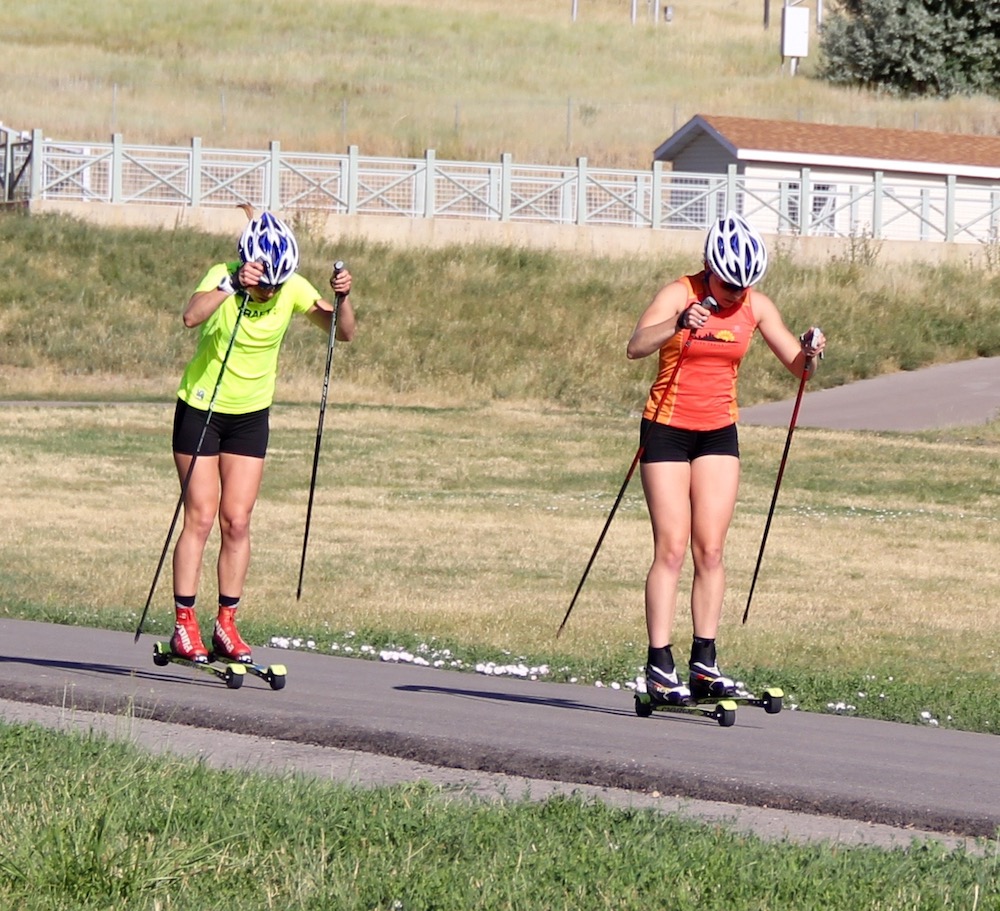
    The women at the USST camp in Lake Placid push each other during some double pole. (photo: Reese Brown)
    The women at the USST camp in Lake Placid, N.Y.,  push each other during some double pole intervals on the rollerski track earlier this week. (Photo: Reese Brown)

    The fall season means many things to the cross-country skiing community. It means the temperatures decrease, the training intensity ramps up, and excitement for winter begins stirring in the soul.

    For well over a decade now, fall for the U.S. Ski Team (USST) has also meant a training camp in Lake Placid, N.Y. Although the team has had camps in New Zealand and Norway not long ago, it still manages to squeeze in a one-week intensity camp before heading to another dryland camp in October in Park City, Utah.

    The national team coaches were already in Lake Placid after hosting the National Coaches’ Education Symposium last weekend, and with half of the USST athletes training with the Stratton Mountain School T2 Team (SMST2) fewer than three hours away, it made sense to have a quick camp at the Olympic Training Center in Lake Placid.

    “We wanted to give them the chance to come to a different venue, get on the rollerski track, and kind of have a check in with them to make sure things are going well technically and recovery wise and everything else,” said USST head coach Chris Grover in a phone interview.

    But the eight national team athletes from the SMST2 Program, Jessie Diggins, Sophie Caldwell, Katherine Ogden, Julia Kern, Andy Newell, Simi Hamilton, Ben Saxton, and Patrick Caldwell, account for a small fraction of the nearly 30 athletes at the camp. Joining the USST is the rest of the SMST2 team, the Sun Valley Gold Team, the National Elite Group (NEG), and the National Training Group (NTG).

    The NEG is made up of the best junior athletes from each region (East, Central, West, Alaska) while the NTG consists of the best U24 and U20 athletes in the United States, based on domestic and international results from last season. The SMST2 domestic team and the Sun Valley Gold Team are made up of elite American skiers not on the national team.

    “The athletes in those clubs are the athletes that are just below the national-team level and aspiring to the national team level,” Grover said. “They are the ones that are knocking on the door and pushing everyone along. It’s really fantastic to have them all here.”

    For all of the non-USST athletes, the camp represents not only an opportunity to train at the Olympic Training Center (OTC), but also the chance to live along side some of the national-team members and see how they train, refuel, and recover. They also receive some technique and training feedback from the national team coaches.

    Andy Newell rollerskis in the colder weather at the USST camp in Lake Placid. (photo: Reese Brown)
    Andy Newell rollerskis through the colder weather. (photo: Reese Brown)

    Because the camp is one week long this year, the group is trying to fit in as much training as possible to get the most out of the venue and one another. On top of a good number of hours, the plan is to have five intensity sessions throughout the week.

    “Obviously if were having a longer camp, 10-day, 12-day, 14-day camp, we have to build in a little more recovery and here we’re just jamming through it and training all seven days. People are taking a break afterwards,” Grover explained.

    In order to fit everything in, the USST is skipping what usually is the highlight event of its camp, the Climb to the Castle rollerski race up Whiteface Mountain in Wilmington. The race goes five miles up the Whiteface Memorial Highway to a castle at the summit and has an average incline of 8 percent. However, this year, the USST coaches felt the race didn’t quite align with the goals of the camp.

    “The Climb to the Castle, as hard as it is to miss it because it is a fantastic event, it just didn’t play well athletically for the needs of the group,” Grover explained. “We wanted to do more sprint specific training and short intensity as opposed to giving up a whole workout or two to do the Climb to the Castle.”

    Also contributing to the decision is the fact that many of the national-team members on the SMST2 team are more sprint-oriented, so the potential benefits of an uphill time trial are not as pronounced for those athletes.

    Meanwhile, many US Biathlon team members will be racing the Climb.

    “Obviously it is unfortunate especially for the organizers that the [U.S. cross-country] ski team is not doing it this year,” US Biathlon women’s coach Jonne Kähkönen wrote in an email. “For us and our athletes; it is one hard session at the end of the test week and in the middle of a tough block of fall training and the goal is always to go all in for these types of sessions — so in terms of that it doesn’t really change anything. We would have liked to have the tough competition there, but understand that it didn’t fit in their plans this time.”
    “As for us; we will have all the athletes that are in 100% health in the race,” Kähkönen added.

    In terms of the differences between this week’s camp and the U.S Ski Team’s two-week camp in Norway, the Lake Placid camp has about three times as many athletes in attendance and the domestic venue really makes for a different approach. In Norway, the group was exploring a new area, but in Lake Placid, the group is back to an old standby.

    “This is obviously a very familiar place to us,” Grover said. “We know all the roads here and all the trails here and that sort of thing. So it’s really easy for us to plan where we are going.”

    So while they had a good time training on new roads and paths in Norway, the group is taking advantage of the more familiar territory in Lake Placid, at least for a week. Next week, the athletes will head home to recover. But for the USST members, the time at home will be short. They have less than a month until their next camp begins in Park City on Oct. 12.

  • Injury Behind Her, Stock Ready for World Juniors

    Injury Behind Her, Stock Ready for World Juniors

    Corey Stock (CSU) skiing into the stadium in Rumford. Photo: Flying Point Road.

    Highlighted by her fourth-place performance in the senior freestyle sprint at U.S. Nationals, 17-year-old Corey Stock (Cambridge Sports Union) earned her first trip to Europe with the U.S. Ski Team’s (USST) World Junior Championship squad this coming February.

    It’s difficult to determine the most remarkable part of that statement. For starters, Stock’s age would normally make her a candidate for the J1 trip, and yet as the top junior finisher in the skate sprint in Rumford, she skipped that step and is headed for a major championship stage with her inaugural trip to Europe.

    Even more impressive, however, is what Stock has managed to accomplish despite the less-than-ideal path she’s had to take. Two years ago, doctors diagnosed pain in her legs as compartment syndrome. She underwent surgery in the summer of 2010, and recovery was slow going.

    “All the time her leg was injured, she was on the Ski Erg,” CSU coach Rob Bradlee said.

    Upper-body work was all Stock could do to keep in shape.

    After her surgery, the pain didn’t completely go away. She had been looking forward to competing at U.S. Nationals in 2011, but she and Bradlee decided not to sacrifice doing lasting damage for the sake of a trip to Europe and skipped Rumford entirely.

    For someone of Stock’s competitive nature, a lengthy injury could have easily brought her down psychologically. When all she could do was double pole on a machine, she conceded that she definitely had her low moments. But she also saw the bright side.

    “I know in the long run it’s been a good thing,” Stock said. “With athletes, it’s inevitable that you’ll encounter obstacles. I learned how to deal with them, I guess.”

    Forced to adjust, Stock set her sights to one year into the future. Despite being held back over the summer, she went on last season to win two out of three individual races at Junior Nationals in Minneapolis, Minn., earning herself a spot on the National Training Group.

    New England's Corey Stock on her way to her second national title in Presque Isle, ME in 2010. Photo: Flying Point Road.

    A trip back to the doctor in the spring revealed that the return of pain in her legs was not compartment syndrome — it had been a trapped nerve all along. Stock underwent surgery for a second time, and this time was able to bounce back and start training again in full.

    Healthy again, Stock reentered a normal training plan from square one. Bradlee said he had to be careful not to bring her back up to speed too quickly, fearing overtraining.

    “My big goal for the year was to do a reasonable amount of training, but not break her,” he said. “It would be so easy to overdo it.”

    Bradlee described Stock’s fourth-place finish at her first U.S. Nationals race as the product of smart training and perfect timing. When Stock started showing signs of tiring at the end of the summer, he scaled back her intensity work and had her focus on getting enough sleep and recovery.

    After winning the sprint qualifier at the Eastern Cup in Craftsbury, Vt., by over six seconds at the end of December, Stock put in another week of work. This was just enough time, in Bradlee’s opinion, for her to be ready to roll in Rumford.

    “When she killed that opening sprint race, it was a big sigh of relief,” said Bradlee. “I though we were doing the right thing, but I didn’t know for sure.”

    Natural speed and hard work haven’t been the only factors at play in Stock’s success. Her mental toughness, explained Bradlee, is exceptional.

    “The tougher the race, the calmer she gets,” he said.

    After every race, Bradlee has his CSU athletes go around in a circle and talk about their day. When it was Stock’s turn to describe her experience moving through the heats, she explained that she’d enjoyed herself as the competition got progressively tougher.

    Stock, in CSU blue, competing in the women's A-final in Rumford.

    “She talked about how her heats were so much fun, duking it out with these really big girls,” said Bradlee. “That’s not something I taught her, you have to arrive with that, I think.”

    At the end of the day, Stock was still processing her fourth-place finish, which for her was a surprise.

    “It’s slowly sinking in,” said Stock. “I’m realizing how much I learned throughout the day. For every [heat] I learned a lot about tactics, and how exciting it is to ski with so many amazing skiers.

    “I saw my confidence in my skiing; I definitely felt better on each heat, more peppy and sharp, and it worked out well.”

    As a member of the USST’s National Training Group this summer, Stock had the opportunity to join the training camp in Alaska, and skied on Eagle Glacier with the fastest women in North America. More than anything, said Stock, the experience gave her the self-confidence to believe she belonged in a race against the likes of U.S. Ski Team members Jessie Diggins (CXC) and Ida Sargent (CGRP).

    Stock, far left, on Eagle Glacier this summer. Photo: Matt Whitcomb.

    “I realized how these amazing women, who I look up to so much, are actually just real people,” she said. “It helped when I raced them today; it wasn’t as intimidating.”

    After opening nationals with a bang, Stock went on to ski to 33rd in the senior 10 k freestyle and then second in the junior 5 k classic.

    With the completion of racing in Rumford and the naming of the World Junior team, the moment she’d been looking forward to for so long had finally arrived. Stock was understandably thrilled.

    “I’ve been getting advice from athletes who have already been,” she said in Rumford. “I know it’s a big step up the first time you race in Europe, but I’m excited, too.”

  • The NTG is Working: Corey Stock on the Alaska Glacier Camp

    The NTG is Working: Corey Stock on the Alaska Glacier Camp

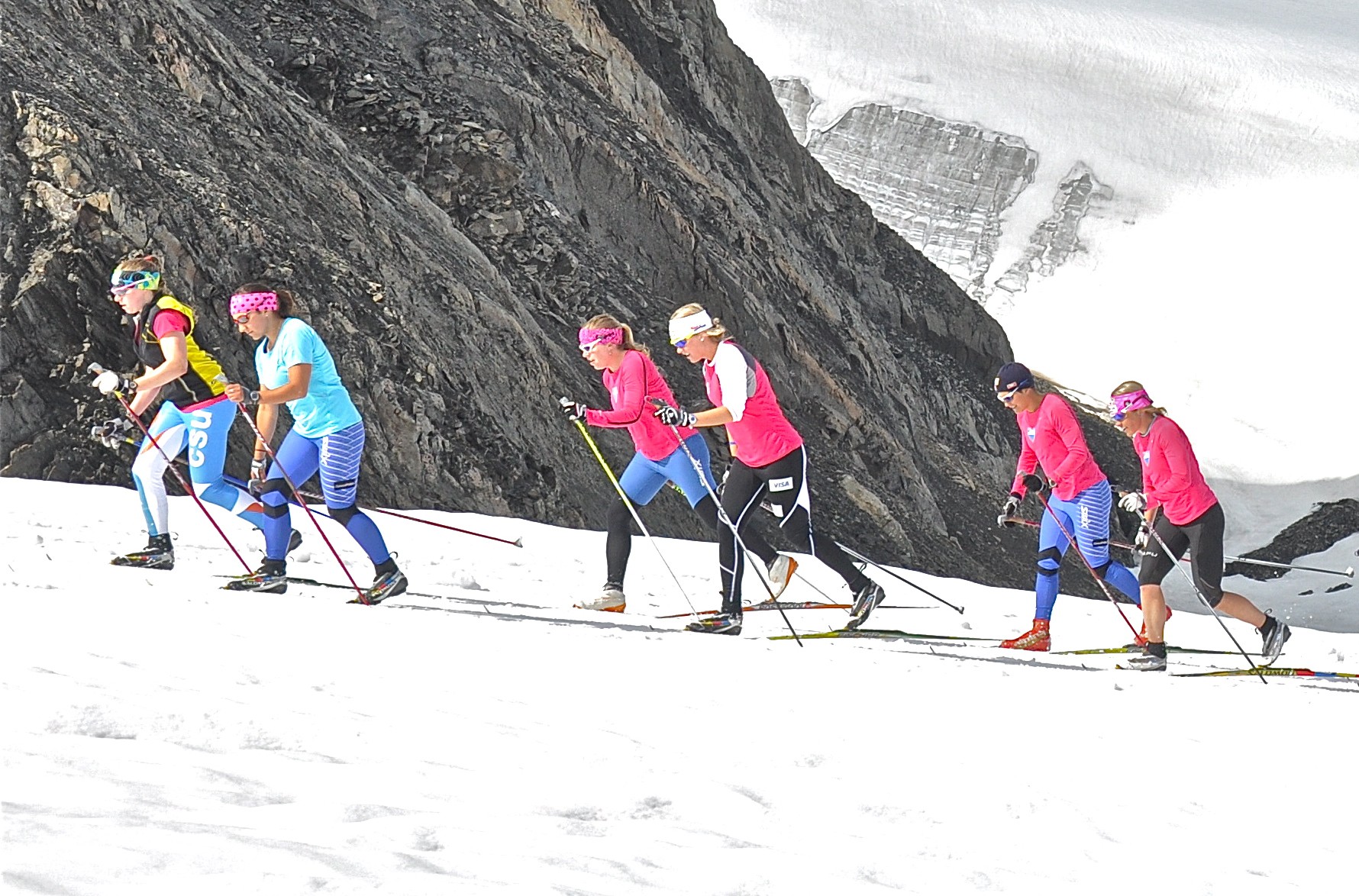
    Corey Stock, far left, training with Kinsey Loan, Rosie Brennan, Sadie Bjornsen, Kate Fitzgerald, and Holly Brooks on the Eagle Glacier in Alaska. Photo: Matt Whitcomb.

    How does a high school student from Massachussetts end up skiing on a glacier with the best athletes from the United States and Canada in the middle of the summer?

    The answer is a program, and a promise for other young skiers. Corey Stock, a 17-year-old racer who usually represents the Cambridge Sports Union, was nominated this year to be a member of the National Training Group (NTG), a program of the U.S. Ski Team.

    “The NTG is an under-21 step to our cross-country development pipeline,” U.S. Ski Team women’s coach Matt Whitcomb told FasterSkier in an e-mail. “Qualifying and racing at World Juniors qualifies an athlete for the NTG for the following year. Additionally, U.S. Ski Team coaches may select athletes via discretion based on outstanding results.”

    Stock missed the first half of last season after getting surgery for compartment syndrome. But once her ski season got going, she picked up an Eastern Cup win and relay gold at Junior Nationals, as well as finishing second to Jessie Diggins, who has since joined the national team, in the distance skate race. While Stock didn’t race in Europe because she missed U.S. Nationals, her results were outstanding in their own right and she was nominated to the NTG.

    “The NTG helps identify our best talents and hardest workers as elite skiers, and then provides new and challenging camp and race opportunities,” Whitcomb said. “Being identified as an elite skier is motivating and helps the U.S. retain athletes.”

    NTG athletes are not funded by the U.S. Ski Team, but are invited to camps – they are actually required to attend at least one – as well as European Continental Cup trips.

    Stock is one of seven athletes currently on the NTG roster. The others are Isabel Caldwell, Anne Hart, and David Sinclair, all of Dartmouth College; Heather Mooney of Stratton Mountain School and Middlebury College; Kinsey Loan of Alaska Pacific University Nordic Ski Club; and Scott Patterson of the University of Vermont.

    Only Stock and Loan have attended a U.S. Ski Team camp so far, both traveling to the Eagle Glacier in Alaska for a combined camp with the Canadian national team (which FasterSkier wrote up here). FasterSkier caught up with Stock via e-mail to see what she thought of the experience.

    FasterSkier: How did you end up at the camp in Alaska?

    Corey Stock: I got to go to the camp because I’m one of the National Training Group athletes. As part of the group, one of the requirements is that you go to one of the U.S. Ski Team camps. Luckily, I was able to make it to the Alaska camp, and it was a really great experience. Kinsey Loan, who is also a member of the National Training Group and is from APU, was there as well. It was really great to get to know her. I’m really glad it worked out.

    FS: Before you left, were you intimidated by the idea of training with the U.S. and Canadian national teams?

    CS: I was definitely intimidated but I was also really excited to get to know them and to try to be training beside them. I was really nervous, but once I got up there I realized that even though they are amazing skiers, they are great people to be around and they’re just like anyone else.

    FS: You’re from New England, where there isn’t snow in the summer. How much did it help you to get on snow this time of year?

    CS: It was really exciting to be on snow after a month of dryland training and rollerskiing. It felt relaxing – not only was my whole body relaxed, but also my mind. It was just really fun to be back on snow, and it reminded me of how I’m looking forward to the season.

    Just being on snow was really awesome, because I’ve never skied in the summer before.

    FS: Is that chance to get on snow going to help your dryland training?

    CS: It’s easier, I think, to work on technique on snow. Also, being on the glacier was gorgeous and it was super cool. But it definitely helped my technique.

    FS: Which coaches did you get to work with?

    CS: It was great because we had a really good coach to athlete ratio. The coaches there were Matt Whitcomb, Chris Grover, and Erik Flora, and Eric de Nys, the Canadian coach. They were all really helpful and it was really cool to get to know them. They were not just helping their own teams, but they were all branching out to everyone, so it was a good atmosphere.

    FS: How did the camp fit in with your normal training plan – you obviously have different coaches back home?

    CS: It fit right into my training plan because it was obviously hugely beneficial for the actual physical training part, but it’s also great to get a sneak peak into their lives and seeing what the rest of the U.S. and the younger skiers have to look and set our goals towards. I think mentally this camp was just as beneficial as it was for the training.

  • Inspired by Brother, Driven by Dreams

    Inspired by Brother, Driven by Dreams

    ENGERDAL, NORWAY – For as long as she can remember, Maja Solbakken wanted to do everything her older brother Martin Andersen did. Siblings of accomplished athletes often feed off the energy and determination of their brother or sister — that is true not only for those on the World Cup circuit, but also for those who are the second-tier.

    Maja Solbakken (Photo courtesy of Maja Solbakken)

    The youngest of three siblings, Maja, 16, grew up in the rural Norwegian community Engerdal, close to the Swedish border. Maja always found Martin, 22, to be a support and an inspiration. She said she feels fortunate to have a brother who has helped her pave the way, fallen into the training traps and dealt with them.

    Four years ago, Martin and three of his ambitious training partners established a privately funded elite development program called Team Norgeshus. The young athletes calculated their needs, created a budget, went after sponsors and secured the funding for the team, then hired coaches and a support staff, designed camp schedules, training plans and competition plans. So far, they’ve accomplished several top Scandinavian results and are going after the U-23 circuit.

    “Martin has a lot of experience to share, and gives me pointers all the time,” Maja said, explaining that he helps her with all aspects of training and racing.

    Martin Andersen knows a thing or two about waxing. (Photo, Inge Scheve)

    “One thing he helps me with is technique, but he’s also really good at seeing when I’m about to fall into the overtraining trap. Then he gets really stern with me and tells me to back off. He’s had a serious bout of overtraining and been in the pits, and he never wants me to have to go there. That’s super helpful to me, since it’s so hard to see it coming yourself,” she said.

    Maja also recognizes that there are significant advantages to being the youngest racer in the family. “My mom and dad have learned a lot from supporting Martin over the years and taking him to races, so they too have a lot of experience at a variety of racing levels, from nationals to local events. They know what’s going on, and that puts me at ease and cuts down on nervousness,” Maja said.

    No rivalry, no pressure

    “I never felt like I had to compete with Martin. He’s six years older than me, so there’s no way I can do everything he does. But I definitely look at what he did when he was my age, and I want to meet or beat that,” Maja said.

    However, whatever pressure there is to perform is entirely her own. Her parents never compare her to Martin, and never expected her to follow his lead.

    Maja's parents, Maj Britt Solbakken and Roald Amundsen, are avid skiers themselves. Roald used to race at the national level. (Photo courtesy of Maja Solbakken)

    “My mom and dad just want me to be happy doing what I do. They are amazing,” Maja said, pointing out that she’s seen some parents who put a lot of pressure on their children.

    “My parents never pressured me to perform, which is something I have seen in some families where there are two or more good siblings,” Maja said, and continued: “The only the pressure is that which I put on myself. I want to perform and improve, and I want to show everyone who supports me that I’m worth the effort — I want to deliver, and I want to give something back.

    Ambitious goals

    Maja has always set ambitious goals for herself, and her ultimate dream is no less than the Olympics. But realistically, she knows she has a long way to go.

    “I’d like to see how far I can get. Of course, I would like to be best in the world, and go to the Olympics, the World Championships and the World Cup eventually, but those are pretty long-term and hairy goals,” she said.

    Accordingly, Maja has set up partial goals along the way and has a systematic approach to her progression.

    “Before [reaching the Olympics], I realize I have to do the standard progression, aim for top-five, top-three and then number one at the Norwegian nationals and the Norwegian national racing circuit. I hope I can qualify for the junior national team and go to the Junior World Championships in a couple of years,” Maja said.

    She believes she has what it takes to go all the way, but that she has to train smart to achieve her Olympic dreams.

    “I think I can get as good as I want to. I have the potential to go far. Whether I do is a matter of what I do to get there,” she said.

    Training smart

    Maja believes there is more to becoming the best than simply volume. She explains that her training philosophy focuses on quality over quantity.

    “I don’t think logging the most hours necessarily makes you the best skier. What matters is what you do during the hours you log,” Maja said. She is keenly aware of how she spends her workouts in order to maximize the training effect. Each workout has a specific purpose, depending on what she needs to emphasize at a given time.

    “You need to focus on the tasks at hand, and really be present both mentally and physically. I try to have at least one specific task to focus on for every workout. For instance, if I do a skate rollerski workout, I try to think about lifting my poles high enough when I V2,” she said.

    However, Maja notices that sometimes skiers seem more obsessed with logging hours than focusing on what they get from the workout. She thinks girls are particularly vulnerable to the junk miles routine.

    “I think a lot of skiers just lollygag around, especially on long distance workouts. They just get lost in chatting, and forget what the job is. I like to catch up on talk before and after, but when I train, I’m into training,” she said.

    Pursuing the elite at Lillehammer

    Maja Solbakken and brother Martin Andersen during a training camp at Sognefjellet last summer. (Photo courtesy of Maja Solbakken)

    This fall, Maja moved away from her parents’ house to attend the national elite cross-country academy training group in Lillehammer and pursue her ski career there. While the 16-year-old admits that it was hard to leave home, she’s not entirely on her own. Martin moved to Lillehammer for college a couple of years ago, and she’s sharing an apartment with him. For some siblings, living so close together could spell trouble, but Maja says it’s an excellent setup for them.

    “We actually enjoy each other’s company a lot. Martin has a lot of experience living on his own, cooking his own meals and balancing life, school and training,” she said, adding that the training group program is a step toward her overall ski goals.

    Different training programs

    Although Maja and Martin have similar approaches to training and development, they recognize that men and women are made differently. Maja admits that she wants to do everything Martin does, but realizes he can handle a larger volume and tougher workouts—both because he’s older and has a bigger base, but also simply because he’s a guy.

    “We do have to train differently. He trains more volume than I do. I just have to face it: Girls just can’t handle the same volume as guys. They have more muscle mass. There is a reason girls don’t race the same distances,” Maja said.

    Maja adds that she also tries to focus on track in the summer, while Martin is strictly focused on skiing. That translates to slightly different approaches to methods and intensity during the dryland season. “I run more than Martin does. He bikes a lot more than I do. That’s partially because I also train for medium and long distances track and field (800m, 1500m and 3000m), and partially because I feel that running is the best way to increase my capacity.”

    Maja also believes women are more dedicated than men in some ways, and therefore more likely to follow their training plans like a bible—which she notes is both an advantage and a potential drawback.

    “I think girls are more likely to follow a training program than guys. If we have a plan, we stick with it. It seems like guys are better at listening to their bodies and adjusting their training according to how they feel. I think guys don’t feel as guilty for going rock climbing or fishing instead of doing the planned workout if they feel like it. But then again, studies show that girls have better core strength than guys, so maybe there is something to sticking with the program after all,” she said with a grin.

  • NTG Camp Update: Agony Hill Time Trial

    The first annual National Training Group (NTG) camp in Park City is underway, and participants were challenged early on with the infamous Agony Hill Time Trial on the first day.

    Alexa Turzian (SVSEF/CU) and Caitlin Patterson (Alaska Winter Stars/UVM) tied in the women’s race, both posting a time of 18:40.  Kate Dolan (BSF/DU) finished third, 40 seconds back.

    Scott Patterson (Alaska Winter Stars/UVM) edged Reid Pletcher (SVSEF/CU) by two seconds in the men’s event, clocking in at 15:00.  Sylvan Ellefson (Ski and Snowboard Club of Vail) was third in 15:18.

    Commented US Ski Team (USST) World Cup Coach Matt Whitcomb, “As far as today’s test goes, I’m encouraged with U.S. development.  The effort was maximal without exception.”

    Video of the time trial can be seen below.

    <Get Microsoft Silverlight

    Camp participants followed up the time trial with two easy distance sessions and a speed workout before getting a day off.

    Whitcomb pointed out that the USST has found that the third or fourth day after travel is usually hardest on the athletes, compounding the issues of jetlag, dehydration, altitude, and training load.

    Whitcomb described the off day as a “precautionary rest day that can yield very productive camps.”

    Matt Gelso (SVSEF) joined the group on Monday, and USST members Andy Newell, Liz Stephen, and Noah Hoffman have participated in several workouts.

    USST National Training Group Agony Time Trial

    Women

    1.   Alexa Turzian                        18:40
    1.   Caitlin Patterson                        18:40
    3.   Kate Dolan                        19:20
    4.   Sophie Caldwell                        19:22
    5.   Rebecca Rorabaugh            19:43

    Men

    1.   Scott Patterson                        15:00
    2.   Reid Pletcher                        15:02
    3.   Sylvan Ellefson                        15:18
    4.   Erik Bjornsen                        15:28
    5.   Andrew Dougherty            16:13
    6.   Rolf Figi (U of U)                      16:29
    7.   Ben Fick (independent)            16:38
    8.   Tyler Kornfield                        16:55
    9.   Sam Tarling                        16:58

  • NTG Training Camp Preview: New camp targets juniors and coaches

    NTG Training Camp Preview: New camp targets juniors and coaches

    Training with peers and coaching support is what its all about.

    Tomorrow fifteen of the top junior nordic athletes from around the country will amass in Park City for an intensive ten days of physical and educational training with the U.S. Ski Team.

    25 athletes were named to this National Training Group (NTG) by the USST based on racing results from last season’s Junior National, U.S. National, U23 and World Junior Championships.

    The goal of the camp, say USST Coaches Chris Grover and Matt Whitcomb, is to not only expose these young athletes to the latest education from USST coaches and athletes, but to bring them together so they can learn from each other.

    “Most of [the NTG athletes] are never together at the same time in the same place for training opportunities,” explains Grover.

    The objective of the camp is just to create another opportunity for the athletes, says Whitcomb, “it’s certainly not a tryout for anything.”

    Whitcomb adds, “They can come knock heads with the best juniors and U23 athletes in the country, train with some different coaches in Park City and work at the Center of Excellence, and then go back home motivated – maybe a little beat up – and a bit more educated, hopefully, and able to interject a little energy into their clubs.”

    This camp will be the first of its kind, a trial run of another piece of the “Athlete Development Pipeline” which the USST would like to see fully connected and operational.  Grover outlines the USST vision for this pipeline in a mission statement he wrote as the new head coach for the USST.  Already taking place along the pipeline are camps for Regional Elite Groups (REG) and National Elite Groups (NEG: top selected athletes from the REG).  The NTG will be different in that it will be comprised of younger, junior age athletes, along with their coaches.

    As Grover explains it, these NTG athletes are at a critical stage of their development and at this camp they will be able to see where they stack up compared to their peers.   In this way they can pinpoint weaknesses and then learn what it takes to close the gaps in their training.  Not only will they be able to compare themselves to other top juniors in the nation, but also to the nation’s top athletes: National Team members Andy Newell and Liz Stephen, who will be training in Park City at this time, will meet with the group for certain workouts and also for several educational sessions. Newell will be present not only to talk about sprint training and racing, but also to compete in a rollerski sprint race at Soldier Hollow.  Grover says that having Newell and Stephens train with the athletes “is going to be a very illustrative tool” for gauging these junior’s development.

    The USST wanted the camp to be run early in the summer so that the athletes could identify their weaknesses and then, as Grover explained, “start out the season thinking about how to tackle these issues.”

    Another element of the NTG camp – an athlete’s club or team coach – is a key piece of the pipeline that the USST hopes to promote.  Each athlete’s coach is invited to come to the camp: as long as the coaches and their athletes can make their own way to Park City they will have housing and ground transportation provided for the duration of the camp.  Whitcomb says the addition of club coaches creates one of the better educational opportunities in the country. The USST coaches will get together with the club coaches in the evening to draw out the specifics of the next day’s workouts, and this will be an opportunity to also discuss their individual philosophies and opinions.  Whitcomb says it is not a one-way stream of education from the USST, and that he personally gains a huge amount of knowledge by talking and working with different coaches who bring a wide variety of experiences to the table.

    Chris Grover coaches an athlete to the top of the hill (teamtoday photo)

    Grover points out that by attending as a third party, coaches can not only view the individual strengths and weaknesses of their individual athletes, but can hopefully take back new ideas and training tools for their whole team.   Unfortunately, Grover explained,  for this particular camp there will only be a small number of outside coaches attending since many were already committed to their team or club schedules.  The USST hopes the success of this camp will garner the interest of more coaches for future camps and that these NTG camps will become as much of an education for coaches and their clubs as for the individual athletes.

    All four USST coaches will be present at the NTG camp: Whitcomb and Grover will be joined by Pete Vordenberg and Brian Fish.  Whitcomb and Vordenberg will be present the entire camp, while Grover and Fish will each be present at subsequent halves.

    Training will only be one aspect of the camp, but it will be intensive.  An uphill running time trial and rollerski skate sprint race will be just two hard workouts in a number of intensity, speed, and specific strength sessions.  There will often be two training sessions a day, and this will be followed by evening educational sessions. One of the educational sessions will be a discussion on sprint racing and training by Andy Newell, several will be given by USST staff such as physiologist Randy Hill, and several will be given by the USST coaches.

    Grover thinks the camp will be a success if the athletes are able to “go home to their communities afterward charged up with some ideas about some things that will really help them improve their skiing.”

    After all, enthusiasm and knowledge spreads.  Especially if there is a pipeline – whose gaps are being filled via new programs such as the NTG –  which will help the US ski community work together toward success.

    Coming soon: USST press release with list of NTG athletes. Check back for the link.