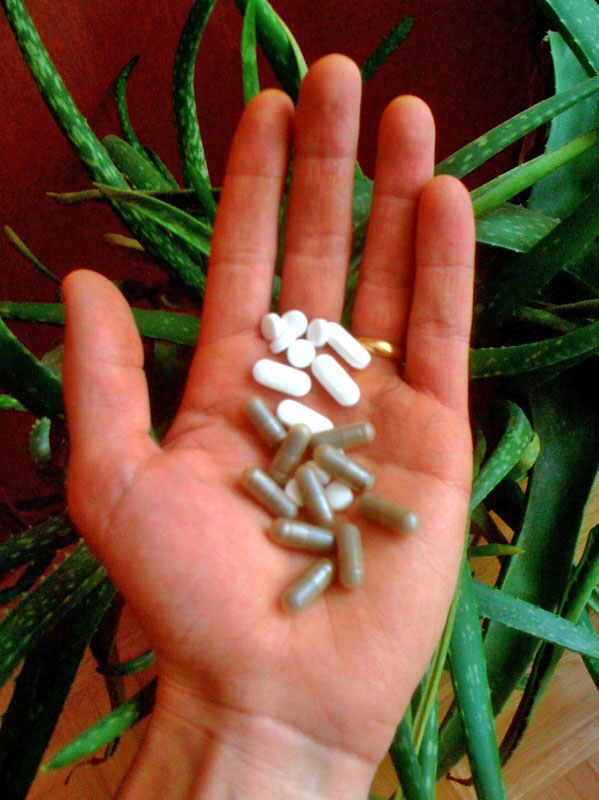
Diet is an important aspect of performance in all sports, while Nutrition is a field plagued with poor—or even false—information. The crossroads of the two is where many athletes find themselves, especially since questionable information (in the field of nutrition) is often presented as “research,” but is just as likely to be marketing-speak masquerading as facts. There’s a lot of money in the supplement industry; an industry that is is loosely regulated, at best. Sports supplements run the gamut from pre-workout mixes used by weightlifters and bodybuilders to sports drinks that are found in every convenience store. This becomes even more muddied when companies like Gatorade actually have some of the best sports science research programs in the world focused on sports nutrition.
In my role as a coach, clients often ask me questions about diet and food. I’m not a dietician, so I often refer them to someone more qualified than me to answer such questions. Even so, I’ve looked into food/diet topics quite a bit to identify resources for those clients who don’t want to take the step of working with a dietician. I also teach Human Nutrition and Exercise Metabolism and Nutrition at the University of Minnesota, Duluth. Through these experiences I have found a philosophy on nutrition as a coach. It’s this: eat a well-balanced diet of real foods with as little processing as possible.
Carbohydrates, Proteins, and Micronutrients
A well-balanced diet includes a mixture of carbohydrates, proteins, and fats, the ratio among these depending upon the individual and their training phase. Nutrition, like training, should be periodized so that it can match the needs of the day’s training.
Generally speaking, endurance athletes need lots of carbohydrates. There is a big push for protein in so many products, but carbohydrates are the backbone of an endurance athlete’s diet.
Protein is important—and necessary for recovery and rebuilding after training degrades bodily structures—but carbohydrates are what fuel endurance performance.
Micronutrients are vitamins and minerals. These also need to be included in the diet. For the most part they are not an issue since most foods contain at least some level of micronutrients. Two that are most often an issue can be too much salt (found in processed foods) and iron deficiencies. If you are feeling inexplicably fatigued for more than a week, it’s a good idea to check your iron levels: specifically, serum ferratin.
Vegetarianism
The dietary needs of any athlete also bring into focus the challenges of following a dietary discipline that does not readily include one, or more, of the proscribed dietary elements (carbohydrate, protein, micronutrient). When looking at specific styles of eating, we often think of those who eat meat and those who don’t. It is often far more nuanced that this, but the vegetarian diet comes under scrutiny far more often that any other. For athletes, it really is a question of how much protein they need, and where does that protein come from? Below are examples some of the different vegetarian diets:
Pescatarian: excludes all meat except fish from their diet. May include eggs and dairy products.
Lacto-ovo-vegetarian: includes eggs and dairy products.
Ovo-vegetarian: includes eggs but not dairy products.
Lacto-vegetarian: includes milk or diary products but not eggs or animal foods.
Vegetarian: avoids all flesh foods; may or may not consume eggs or dairy products.
Vegan: Excludes all animal products including eggs and dairy. May also exclude honey.
Those who choose not to eat meat are often asked how they get enough protein. Meat is strongly associated with protein intake since meat products are complete proteins. This means that they have all the essential amino acids required by the human body. Very few non-meat sources of protein are complete proteins. The “superfood” quinoa is a complete protein, part of the reasons for this designation. Vegetables, legumes and grains not being complete proteins only means that one has to be intentional about finding complimentary proteins. An excellent example of this is the rice-and-bean combination. When consumed together, rice and beans provide all the essential amino acids. Other combinations that provide all the essential amino acids (without meat) include brown rice, green peas and corn; peanut butter, whole wheat bread, and raw veggies; hummus with whole wheat bread.
Collegiate cross-country skier, ultra runner, and vegetarian Chris Rubesch commented on the situation: “As a vegetarian athlete, I have to take more care with my diet to ensure I am getting complete nutrition coverage,” he said. “It’s not difficult to be a vegetarian endurance athlete, but it takes intentionality. Just like my coach and I ensure each workout has a purpose and is meeting a need, I make sure each meal is meeting all my nutritional needs.”
Eating with purpose is an important idea. Be intentional, and think of your nutrition as the fuel it is. We put high performance gasoline in good engines, athletes should do the same.
As Period I wanes and the Tour de Ski approaches, curiosity is naturally piqued as to how various athletes are analyzing their first four weekends of World Cup racing. In particular, our focus is drawn to Olympic medal hopefuls, like last year’s World Cup Overall Champion Jessie Diggins. How is she feeling as she heads into the holiday break, with two individual and one team sprint podium already under her belt and another six weeks to further sharpen her race gears before the Beijing Winter Games kick off in early February?
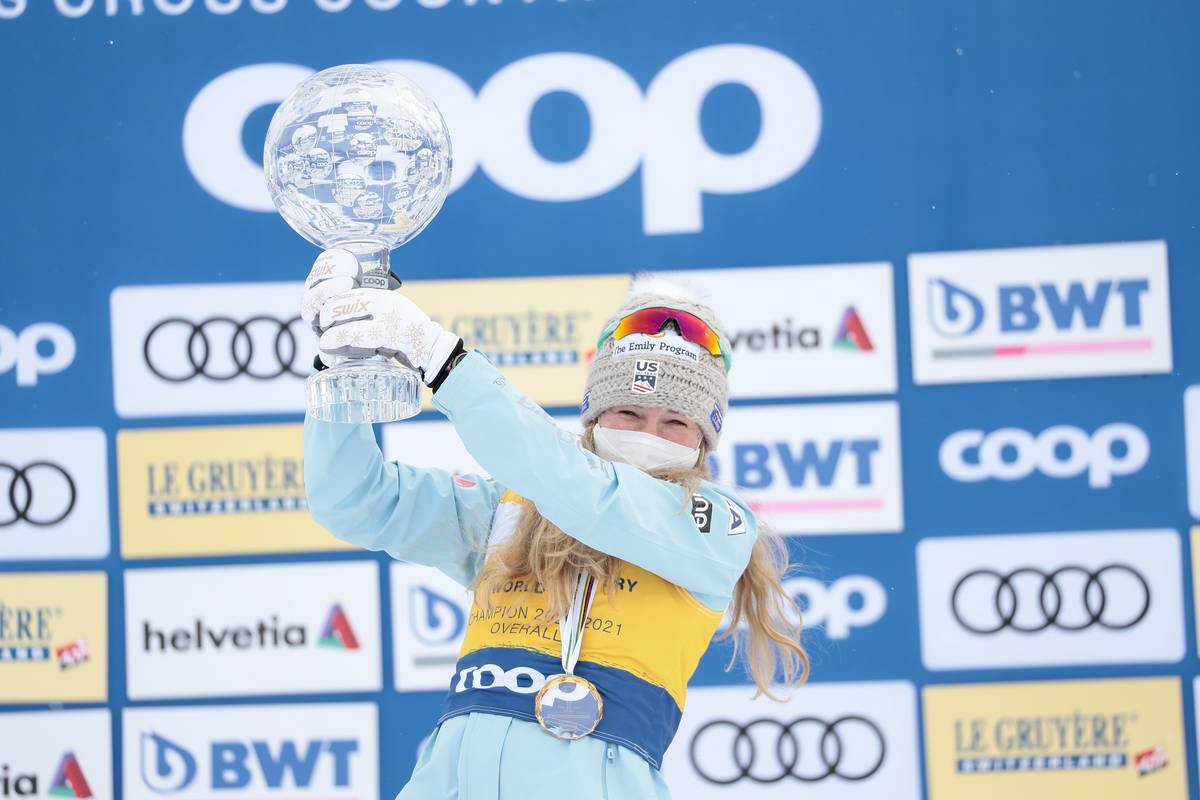
Jessie Diggins hoists the Crystal Globe as the 2021 Overall World Cup champion. (Photo: NordicFocus)
On December 15th, Tom Horrocks, Cross Country Media Coordinator for U.S. Ski & Snowboard, facilitated a Zoom call with a small group of media representatives who wished to question Diggins on the start of her season and her plan for the months ahead. Though we often hear her feelings about individual performances through the audio clips embedded in our race reports, Diggins fielded a variety of broader questions in this call, including her thoughts on early podium finishes, nutritional strategies to support the long grind of World Cup racing, and her focus as the Olympics draw near.
In a previous media call, Diggins explained that viewers should expect her to build into the season as her primary focus was peaking in February for her Olympic goal races. Nevertheless, she won the qualifier in her first World Cup start, the classic sprint in Ruka, then continued to race her way onto the podium on the subsequent three consecutive weekends. If this is what Diggins is capable of while keeping the training volume high in the early season, it’s going to be an entertaining year to be a fan of American cross-country skiing.
“I didn’t have a lot of expectations going into Period I,” Diggins said in the call. “I was not expecting either podium, they came as a wonderful surprise that I’m very grateful for.”
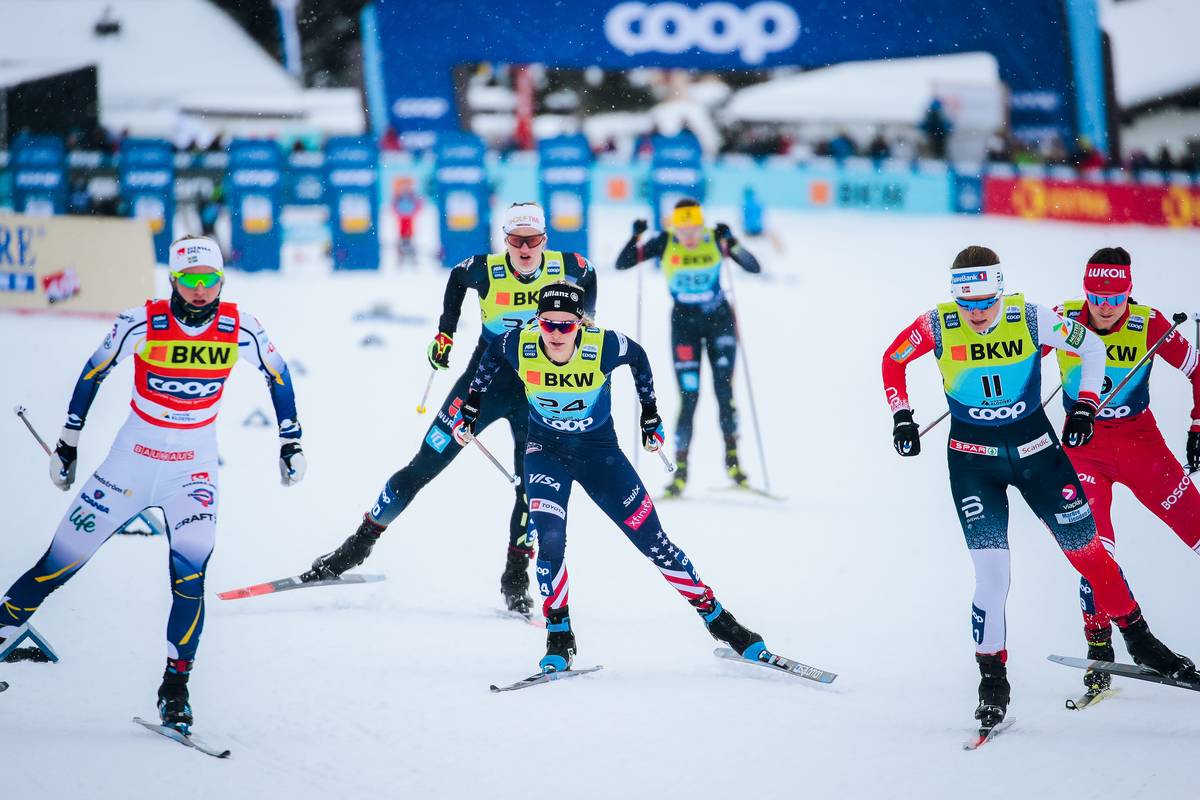
Jessie Diggins in the heats during the skate sprint in Davos. (Photo: NordicFocus)
We’ve heard from both Diggins and her coaches that she is an athlete who responds well to frequent racing. While she puts in large volumes of quality work through the summer and fall, it is during the race season that Diggins truly hones her fitness, both physically and mentally.
“Basically, all of this racing is how I get in shape,” Diggins explained. “Because racing that hard gets you in shape pretty fast. So for me, it’s using the Tour de Ski as part of my preparation for the Olympics, but also – whether or not I’m working into the season, whether or not it’s part of the intentional prep phase – for me, every single race I hit it as hard as I can. And as you probably saw in Davos, I crossed the finish line and there was nothing left. And I’m very proud of that, because that’s how my head gets into the exact right space I need it to be in, so that when I am in my sharpest race form at the Olympics, I already know how to push that hard.”
Diggins also fielded a question on balancing her demanding career with ambitious goals with her life outside of skiing, to which she replied:
“To be totally honest, it is my everyday life. There is not as much balance as you might find, as I hope I find in my next job someday when I retire from the sport, a very long time from now. But it is interesting because it is very all-consuming in that everything you do does reflect upon how you race. So you do have to make sure you’re prioritizing taking care of yourself and sleeping enough and hydrating and on your rest day, you don’t want to go climb the nearest mountain, even though it looks incredibly fun, because you have to rest and let your body recover. So I do think that the way I balance it is by having hobbies that are very restful, so it doesn’t take away from my training.”
She explained that earlier that day, she had spent several hours baking a birthday cake for her teammate, Novie McCabe, who had turned 20. She also expressed gratitude for the support of her family and fiancé, Wade, who will be joining her in Davos, SUI for a week at Christmas.
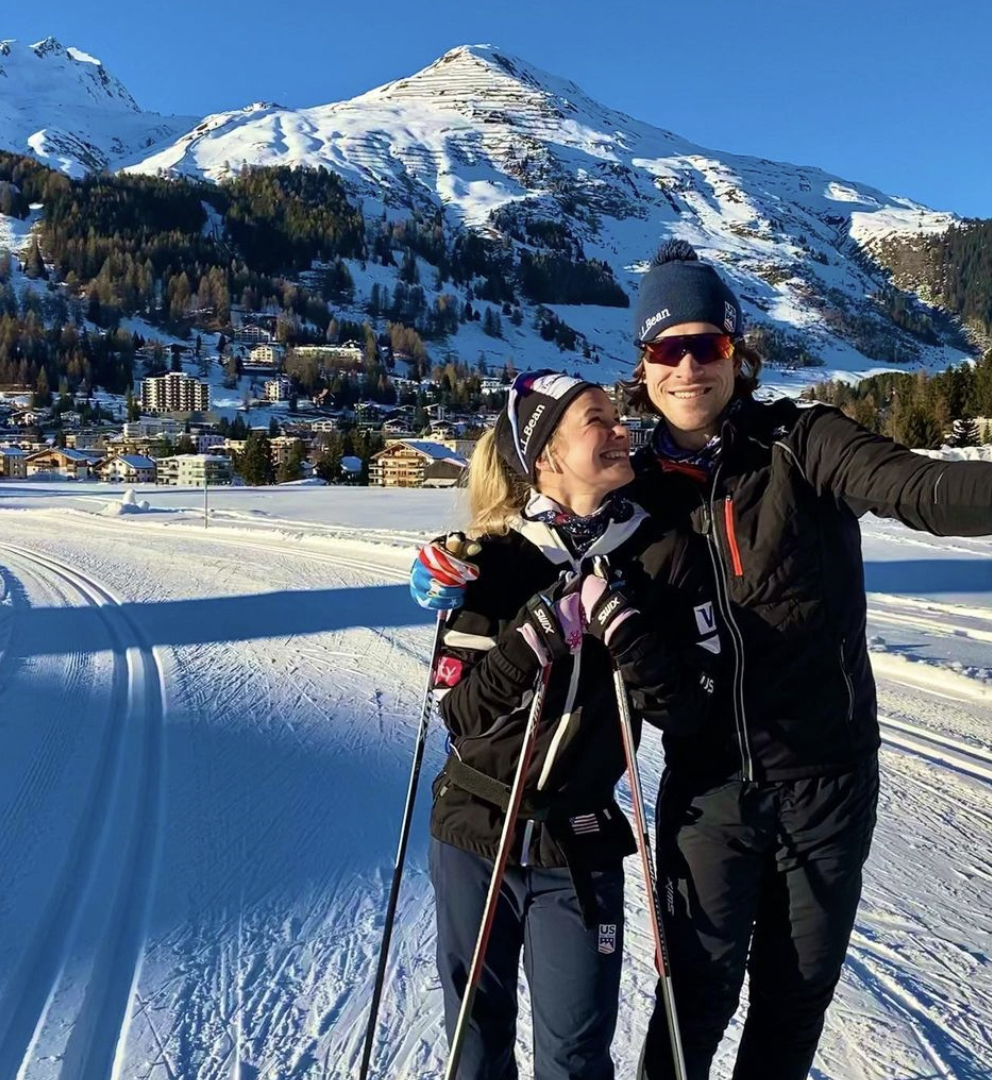
Jessie Diggins and her fiance, Wade, enjoy sun and perfect tracks in Davos. (Photo: Instagram @jessiediggins)
It’s no secret that Diggins has ambitious goals, and she has been open in discussing the work she has put in to manage internal and external expectations and pressures during her career. Particularly in a year where she will receive plenty of attention from the media and her fans as she strives to add additional Olympic medals to her trophy case, she explained how diverting her focus from the end goal allows her to take the steps needed to actually attain it.
“I think it is really important to not fixate on the Olympics, and especially to not fixate on results. Because just thinking about the outcome goals is probably the worst way to achieve them. [That] will create a lot of stress, a lot of pressure and a lot of hype. So, for me, in order to try to meet these big outcome goals, I actually just spend all my time focusing on the process goals and taking care of myself because I really, truly believe that if your mental health is in the right place, that’s how you can push that hard. And that’s how you can train that much and still love it and not feel burned out or feel like racing is suddenly not fun in any way. Because I think, for me anyway, racing does have to be fun in order to be able to push my body that hard over and over and over again.”
A process focus, as Diggins explained, might look like hammering out a specific set of intervals, following a peer and mimicking their technique to fine tune her own, or focusing on skiing the race course in Dresden with powerful leg pushes to maximize her speed on flat terrain.
“It’s really just those little day to day things that add up over time and allow you to get those big goals.”
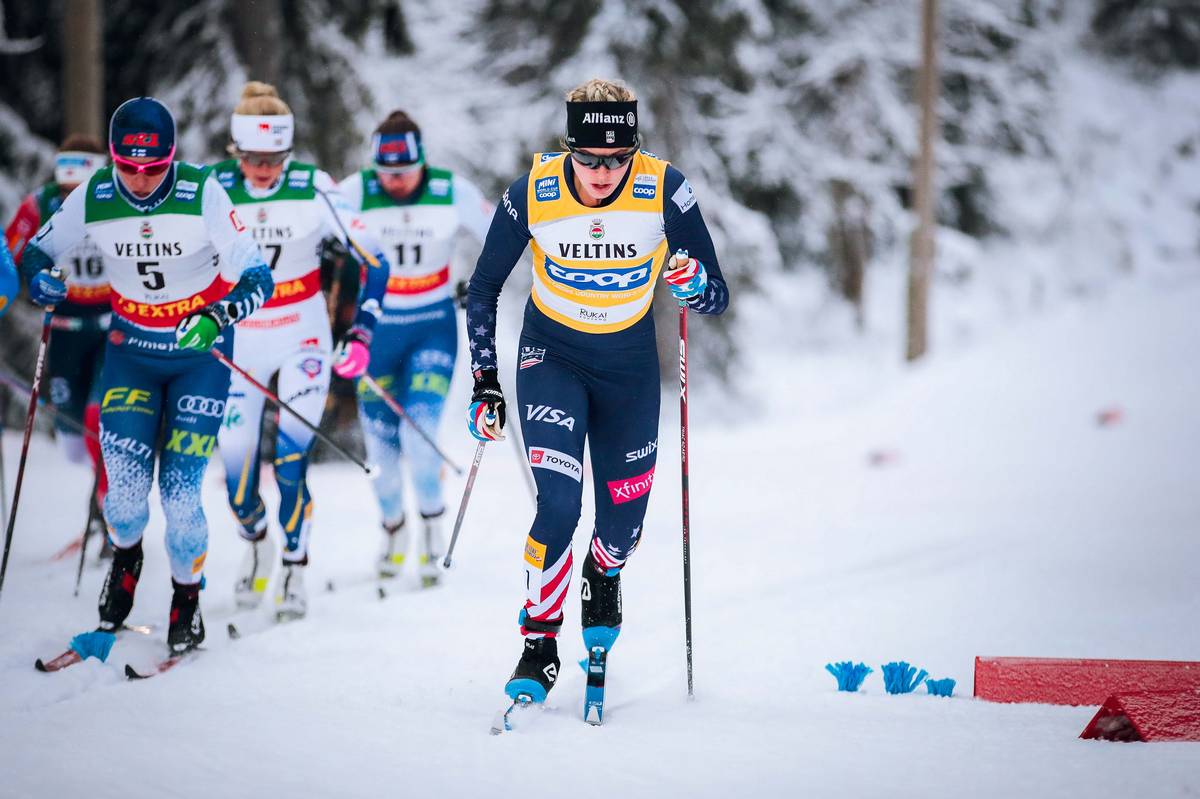
Jessie Diggins leads her heat through the quarterfinal of the opening classic sprint in Ruka. (Photo: NordicFocus)
Fielding a question from Peggy Shinn, author of World Class: The Making of the U.S. Women’s Cross Country Team and senior contributor at TeamUSA.org, Diggins discussed the upcoming Olympics and her role in guiding younger teammates through the build up to their first Games as she prepares for her third.
“It’s weird to say your first Olympics, but we are a sport that lends itself to multiple Olympic cycles because of the lifespan of our sport. So your first Olympics is, and should be, incredibly fun, and hopefully, without a lot of pressure. With every resource that you need to succeed, but without the weight of expectations on your shoulders. And so one of the things I’m going to try very, very hard to do is just – ahead of time, answering all the questions about the Olympics that they could possibly have. And also trying to answer questions that they haven’t even thought they might need to ask to prepare them for success in the little things. Like, it might be noisy, so invest in a really good pair of earplugs and an eye mask, and maybe travel with your own pillow – little things that make your room a better setup for rest and recovery. And even, ‘Hey, you know, there’s this athlete Resource Center. You should go print out some pictures of your family and hang them on the wall.’”
She explained how these little touches can go a long way to helping an athlete stay calm and comfortable amidst the wild experience of competing in what our country deems is the pinnacle of sport.
Diggins also spoke highly of the work ethic and grit of her teammates, in particular lauding Julia Kern’s anchor leg in the 4 x 5k relay in Lillehammer, and the contributions of the men who have put at least one American in the semifinals in each sprint event this season.
Jessie Diggins celebrates a podium effort with team sprint partner, Julia Kern, who anchored the team to 2nd place in Dresden, GER. (Photo: NordicFocus)
If you’ve listened to interviews with Diggins or follow her on social media, you’ll know she places a high value on teamwork. After a slew of retirements of veteran members of the team, like Sadie Maubet Bjornsen, Sophie Caldwell Hamilton, and Simi Hamilton, Diggins finds herself as the longest standing member of the U.S. Ski Team.
In the most recent episode of Nordic Nation, Gus Schumacher, Ben Ogden, and JC Schoonmaker each recognized Jessie as a mentor who has provided invaluable advice to help them succeed on and off the tracks as they step up to senior level racing on the World Cup. Whether it is support in handling the highs and lows of results, or the tactics required to be in a position to advance during the sprint rounds, they explained that Diggins has been thriving in her unofficial leadership role this season.
Diggins laughed that they may have sung her praises because she had baked them cookies the night before, but then she reflected on her own start on the World Cup and how impactful it was when her older teammates welcomed her into the fold and supported her as she first took her own steps forward in racing.
“I had so many people in my life helping me at my first Olympics,” Diggins recalled. “Obviously, we had Kikkan [Randall], and Liz [Stephen], and Holly [Brooks]. And I was going through my first Olympics, together with Sadie and Ida [Sargent] and Sophie… And on the men’s side, we had Andy [Newell], who had been there before, as well as Simi. It was so cool to feel like I could ask all my questions of them and feel so supported.
“And I also feel like a big part of it, too, is just some of the little things about being on the road. For example, we’re going into the Christmas holiday next week, and for a lot of people it is their first time on the road, away from home for Christmas. And that is hard. You know, I haven’t been home for Christmas in like 10 years. And I remember my first Christmas before the Tour [de Ski]. I was rooming with Holly Brooks. And she was like, ‘All right, no Christmas tears.’ She pulled out a whole bag of cloves and oranges and decorated the room, and we had a big secret Santa with Liz, Kikkan, Holly and me, and it was so cool to feel like they really took me under their wing. They were like, ‘We’re gonna make sure this is fun. We’re gonna make sure that you don’t feel super homesick.’ I feel like around the holidays, or really any hugely emotional time, which includes the Olympics and any Championship – anytime it’s really hard – that’s when you feel like you miss and need your family the most. And that’s when it is so important that the ski team becomes your second family because you need that support to fill those holes.”
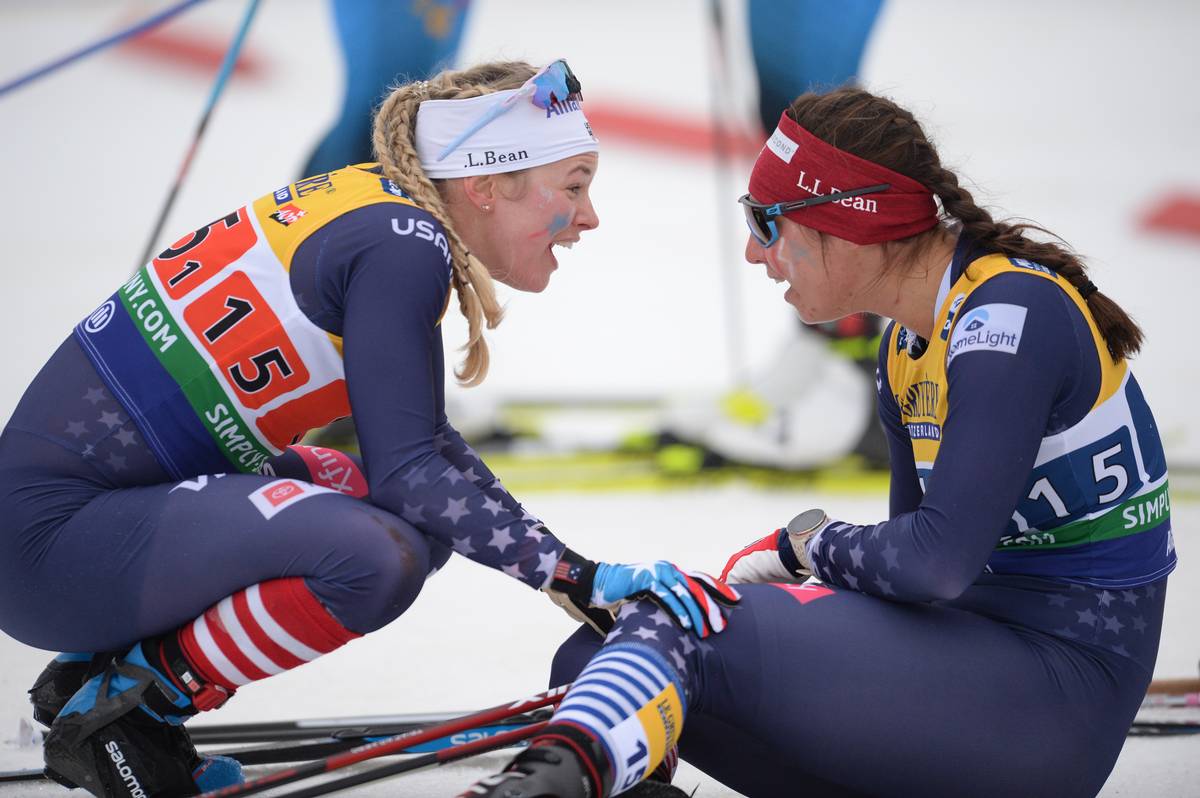
Teamwork. Diggins lays in the snow, exhausted from the effort of earning 4th overall in the 10k skate at 2021 World Championships in Oberstdorf, while Sadie Maubet Bjornsen helps remove her skis. (Photo: NordicFocus)
Following her 2020 Tour de Ski overall victory, Diggins was interviewed by a sports dietitian on the “Eat for Endurance” podcast. One thing that caught my attention was her discussion of having a dietitian and chef on the road with the team, and how she utilized this resource to combat the inevitable depletion that occurs during an event like the Tour. She explained in the podcast that racing often leaves her stomach unsettled, making it harder for her to replace the calories expended when racing repeatedly at maximal effort in the cold. In order to absorb and translate the efforts of the Tour into a fitness boost for the second half of the World Cup season, she needed to first dig out of a calorie deficit during her post-Tour recovery week, giving her body the energy and nutrients it needed to repair and replenish reserves.
Bringing this approach forward into the upcoming Tour, Diggins explained how important focusing on her nutrition has become to ensure she doesn’t fizzle out by the later stages, or carry fatigue forward into Period III and the Olympics.
“In Tours of the past, I’d found myself getting to the last few stages and just feeling very drained. Which, of course, you will anyway, because it’s very tiring, but you don’t necessarily need to feel drained from an available energy perspective when it comes to food. So it has been really amazing having a dietitian with us during the Tour, because I’m pretty sure the extremely high calorie smoothies actually kept me alive.
“For me, it is interesting because my body manifests stress very physically, even if I don’t feel incredibly stressed – you know, I’m excited to race but not overly fluttery about it. I might feel emotionally like I’m in a great place, but my body’s like, ‘Nah, we’re still stressed.’ And so that makes it very hard to eat enough sometimes.”
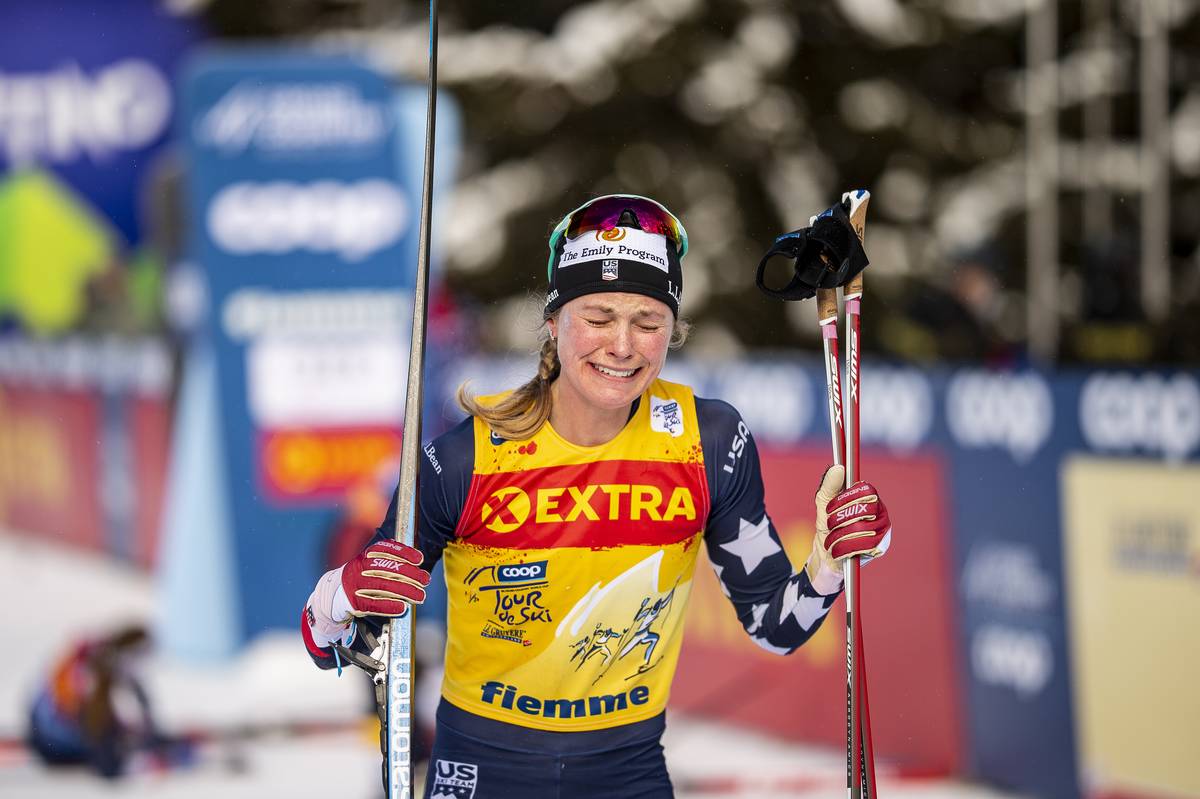
Jessie Diggins collapses after climbing the Alpe Cermis to win the 2021 Tour de Ski, making her the first North American athlete to do so. (Photo: NordicFocus)Jessie Diggins is hit with emotion as she processes being the first North American athlete to win the Tour de Ski. (Photo: NordicFocus)
Diggins later explained that one of the ways the stress her body is retaining manifests itself is very visible and “kind of gross.”
“At the last Olympics, the skin just started falling off my hands to the point where I lost my fingerprints on some of my fingers. And it’s weird because – the performance side was great, my best Olympics ever, my headspace was great, the sports psychology was great, I was able to eat enough…”
Nevertheless, Diggins’ body showed clear evidence of the stress that it was under. This leaves Diggins in a catch-22 as she also recognizes the stress of high-stakes racing helps her dig deeper into the well.
“Although I don’t love what [stress] does to my body, I do thrive under that pressure. Instead of making me crack, it just unleashes that very top level of performance and it brings out the best in me. Which is why I think anchoring the relay was, for a very long time, the only way I would have an outstanding World Cup. It took me a very long time to do that individually without the pressure of holding down the team. But yeah, [when my skin started to fall off] I realized, ‘Wow, my body really feels this.’”
Acknowledging that subjecting herself to this level of stress may not be ideal for her long term health, she rationalized that it – so far – has only happened at the Olympics, which only amounts to a three-week period once every four years.
Returning to the concept of mitigating the nutritional losses accrued during the Tour de Ski, Diggins explained some of the principles that the team dietitian has helped her to develop.
“It has been really, really helpful coming up with these strategies. [One of the strategies is] using Nutrimeal in calorie-dense shakes, or stirring it into my oatmeal in the morning. A lot of peanut butter – that stays down and digests really well. And honestly, a lot of chocolate, that helps too, because you always want to eat it, it always tastes good, and you just need the calories however you can get them. So for me, it has been really fun working with the sports dietitian and figuring that out. Then especially after the Tour, it’s been really important to make sure I’m able to absorb everything that I’ve just done, because that is then going into the Olympics.”
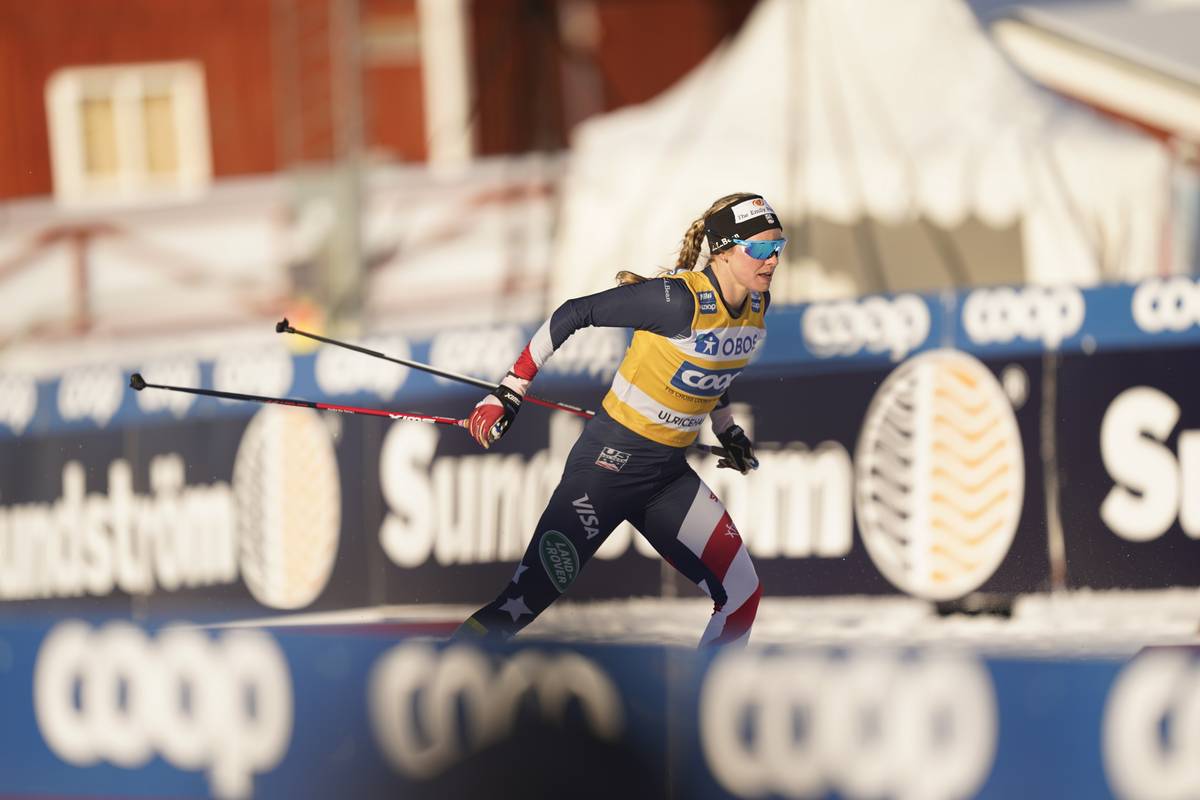
Jessie Diggins powers through the qualifier of a skate sprint in Ulricehamn, SWE in February, 2021. (Photo: NordicFocus)
She also explained that she has been working with the dietitian to problem solve fueling throughout the day leading into an afternoon or evening race, like she will encounter in most of her Olympic events. Diggins shared that it’s a fickle balance, ensuring that her body has the energy and fuel throughout the day that it will need to perform come race time, while also making sure her stomach is settled enough that she does not risk revisiting her breakfast or lunch as she pushes herself to her physical limit.
“It’s been really interesting for me working with our amazing staff, and our awesome sports dietitian, to figure out ‘Okay, here’s what you can digest, because you need a lot of calories, it’s going to be very cold, you’re working very hard, you need that energy, but you need to time it in such a way that you will not have an upset stomach.’ You don’t need any distractions on any race day, but especially not at the Olympics.”
Apart from a dietitian, the team often has access to massage and physical therapists. Diggins credits these resources as another invaluable tool in keeping her body healthy.
“We are so fortunate to have this amazing pool of volunteer massage therapists and physical therapists. Having them on the road with us has been absolutely incredible. It’s a good way to avoid injuries before they happen by taking care of those little things that inevitably pop up, but especially during the Tour, you definitely need massage work every single day. I mean, you need even more than that – you need 10 hours of sleep every single day. So I think trying to really stay on top of the body care, the rest of the recovery, the nutrition pieces, the hydration… I travel with a ton of Nuun products, because staying hydrated through all those races, especially sprint days, which are so long, and you inevitably get dehydrated, because it’s hard to drink enough when you’re jumping up and down and your stomach sloshing. For me, trying to take care of those little pieces has been huge. And that’s definitely something that I’ll be talking to our younger and first time Tour team about. ‘Alright, look, it’s gonna be hard to eat enough, it’s gonna be hard to drink enough. But you just really have to keep hammering that home because this is what will get you through the Tour, and then get you through that week after the Tour so you can bounce back and then race well in Les Rousses (FRA).’”
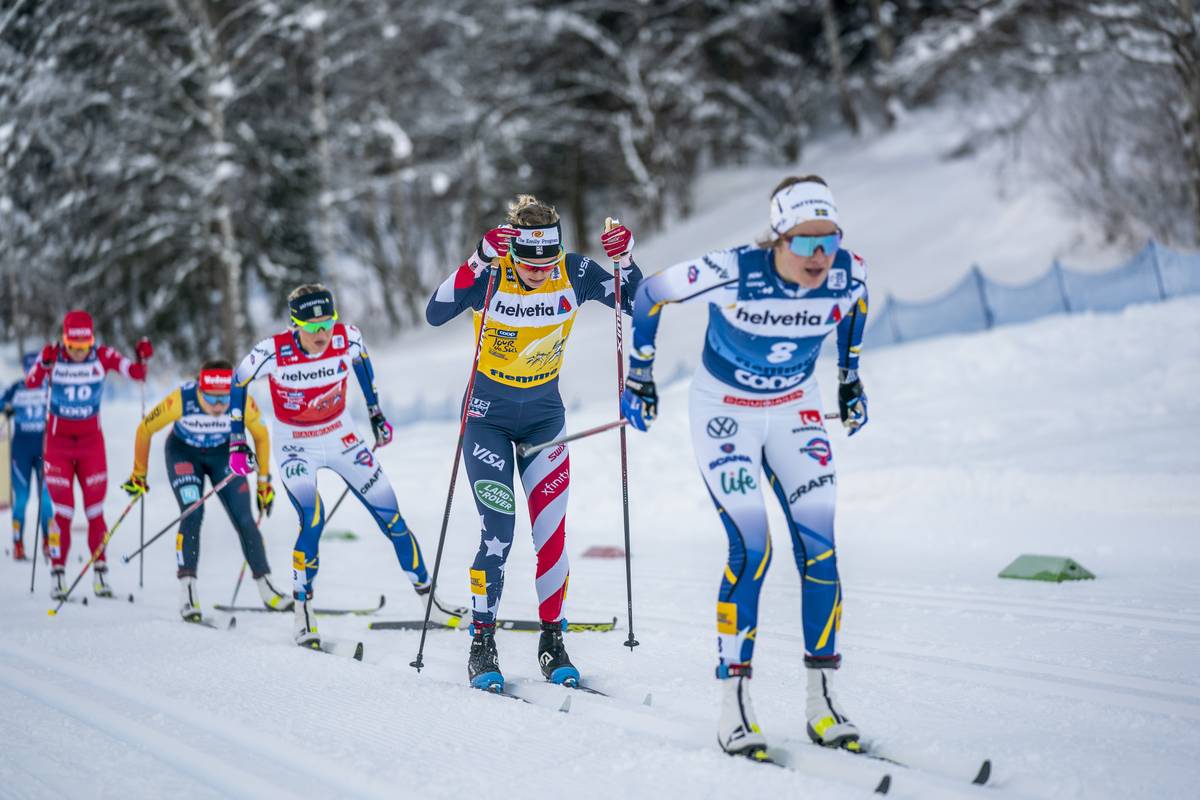
Jessie Diggins follows Sweden’s Ebba Anderson during a mass start 10k classic in Val di Fiemme, ITA, during Stage 6 of the 2021 Tour de Ski. (Photo: NordicFocus)
In reviewing Diggins’ last two Olympic appearances, she raced four events in Sochi in 2014 (15k skiathlon, freestyle sprint, 4 x 5k relay, 30k freestyle), and all six events during the 2018 Olympics in PyeongChang, of course, highlighted by her Gold Medal performance in the team sprint with Kikkan Randall.
This begs the question, in her third Olympics, piggybacking on a season where she won the Overall World Cup title and became the first American to win the Tour de Ski, would Diggins take the same approach and stick her neck out in every event with the hope of having a medal placed around it? Or would the approach be more targeted, sitting out in races where perhaps her odds of a medal are lower in order to conserve energy for a few target races?
“I’m definitely one of those athletes that loves to race and to race everything and so I think for me right now, looking at the Olympics, I definitely need to be racing at a level where I’ve earned starts and where it makes sense for me to race the races, but if I’m racing the way I hopefully am when I come into that sharp form, I’d like to race everything for sure. And I think the plan includes racing nearly all the World Cups to get the experience [I need for that], because pacing different courses, different altitudes, and different techniques that does just take time to get all the little things dialed in and play around with them. So the more World Cups I can race, the more I can play around with those little pieces, especially altitude, because that’s when it gets really tricky. So yeah, I think I’ll be racing most things. Probably not every single World Cup this year, but most of them.”
FasterSkier will continue to provide insight into the American team as they continue their individual journeys through this season. If Period I is any indication of what is to come, bringing you this coverage will be a fun job.
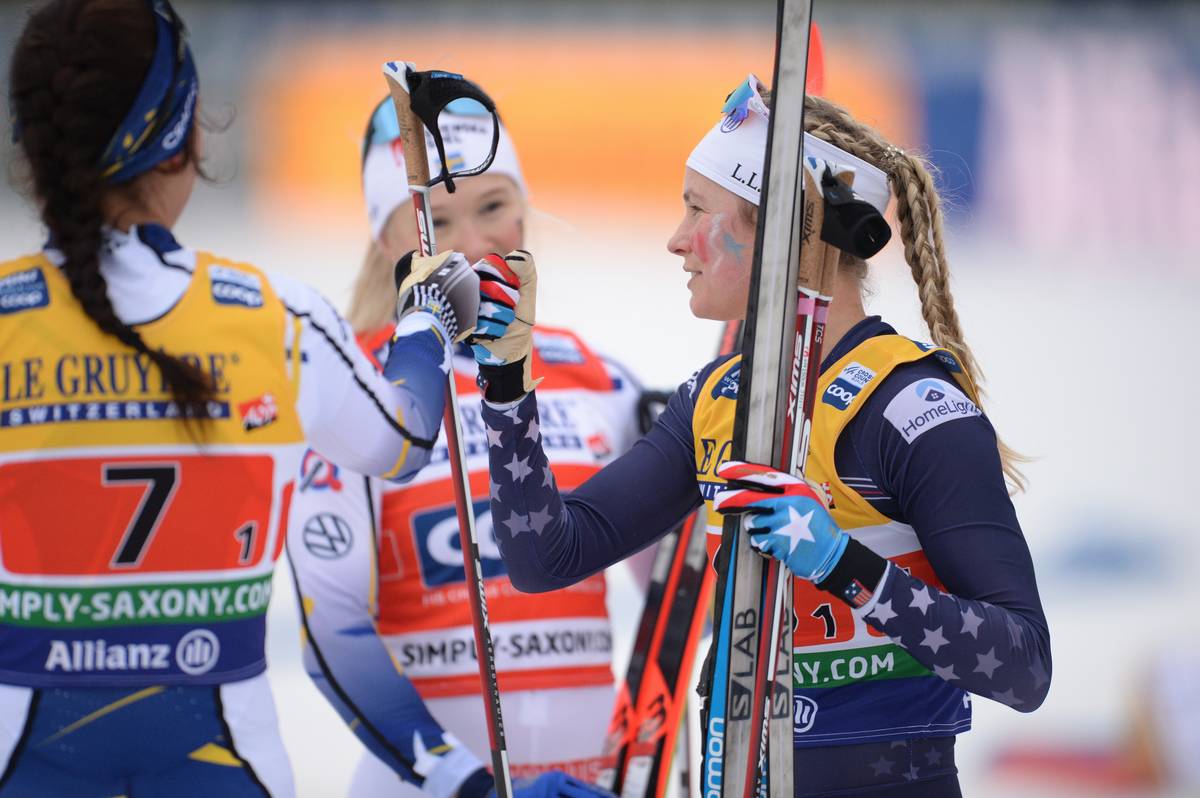
Jessie Diggins fist bumps Jenny Solin (SWE) after the team sprint final in Dresden, where she and Julia Kern took 2nd. (Photo: NordicFocus)
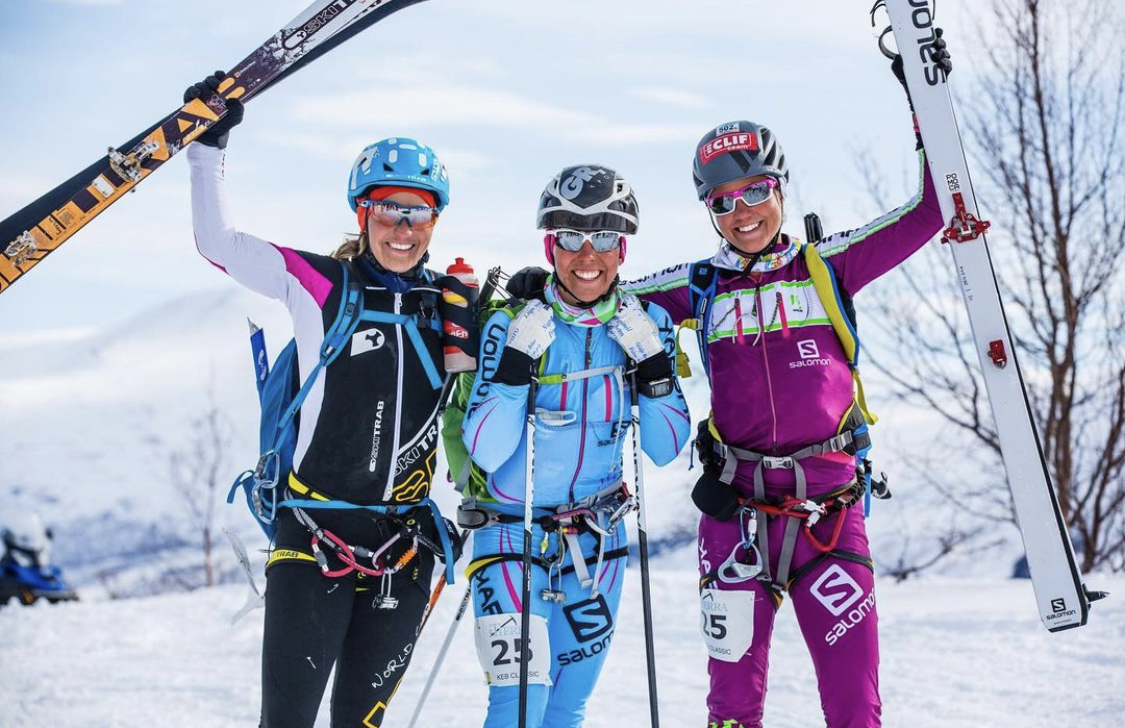
Fans of ski-mountaineering, mountain-running, or ultra events will likely have heard of Emelie Forsberg. A Swedish athlete representing Salomon, Forsberg has an impressive racing resume including, numerous ski-mo World Cup victories, World Championships titles from the Sky running ultra distance series and the women’s Fastest-Known-Time (FKT) on Mont Blanc, the Matterhorn, the Grand Teton, and more.
Josefina Wikberg, Charlotte Kalla, and Emelie Forsberg (l-r) after completing the Keb Classic, a two day ski mountaineering race in nothern Sweden. (Photo: @tinaemelie)
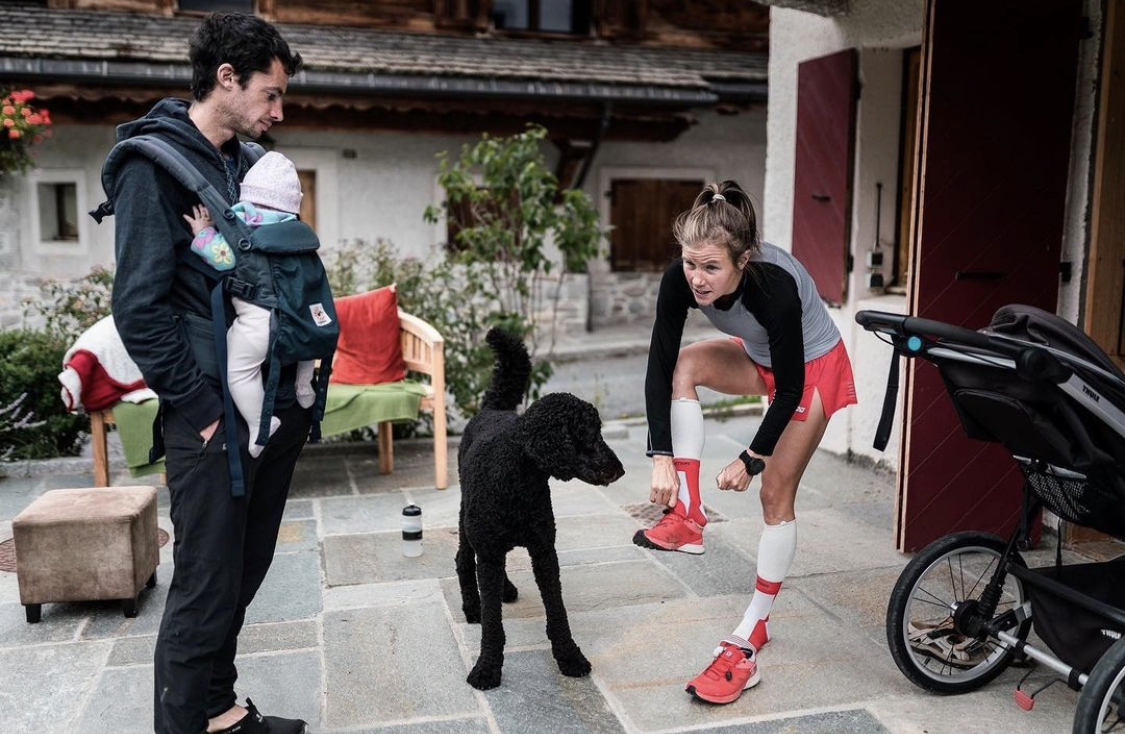
Her partner, Kilian Jornet, is a world-renown athlete whose many feats are too numerous to list here. The two live and train in Norway where they are raising their two daughters.
Kilian Jornet holding their daughter, Maj, while Maui the dog helps Emelie with her shoes. (Photo: @tinaemelie)
In addition, Forsberg owns and operates Moonvalley farm and company with two fellow Swedish runners, Ida Nilsson and Mimmi Kotka. Needless to say, this woman does it all.
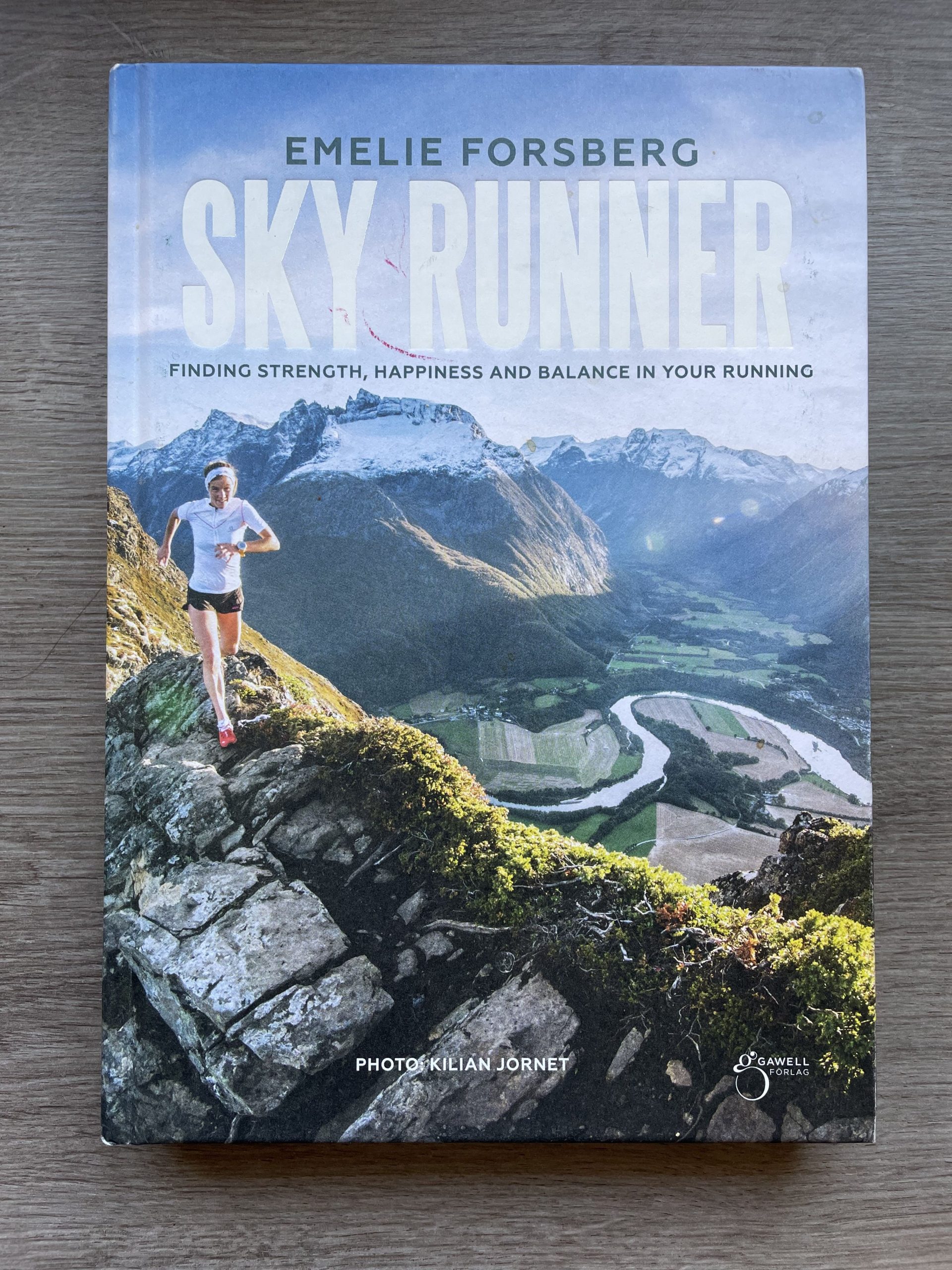
In 2018, Forsberg published a book, Sky Runner, which covers a little bit of everything relating to her life. Between pages of awe-inspiring photographs and accounts of amazing athletic achievements is a collection of some of Forsberg’s favorite recipes. As Forsberg writes, “I like sharing beautiful views, nice runs and things that give me energy. Food is also a part of that. I like cooking and baking, and I love eating good food made from good products, that gives me the energy that I need.” The recipes are simply described, and recently I felt up to the task of trying and testing out a few.
The first to be tested was the lentil stew. Based on what vegetables I had at the time, and my affinity for adding sweet potato to everything I eat, I made a few additions, including garlic, kale, and of course sweet potato. Lentils always take longer to cook than I anticipate so I left the stew to simmer longer than Forsberg suggests. The result was a hearty stew that could be served on its own, or over a grain like rice or quinoa, depending on one’s preference. Not only was the final dish colorful, but it was also delicious and something I will definitely make again.
My second recipe attempt was a bit bolder. I decided to try the cinnamon buns which looked so beautiful and enticing in the book.
Cinnamon bun recipe from Sky Runner.
In reality, an American following Swedish measurements using a French kitchen resulted in something a bit less appealing to the eye.
My recommendation would be to go heavy on the flour to make the rolling and shaping process easier, as well as to bake the buns at a lower temperature for longer than suggested by the recipe. Having not done so in my first go around, I had to deal with a bit of a sticky mess, both pre and post baking. Despite their appearance, the buns tasted great, so I need to revisit the approach to improve the appearance and consistency of my outcomes in the future.
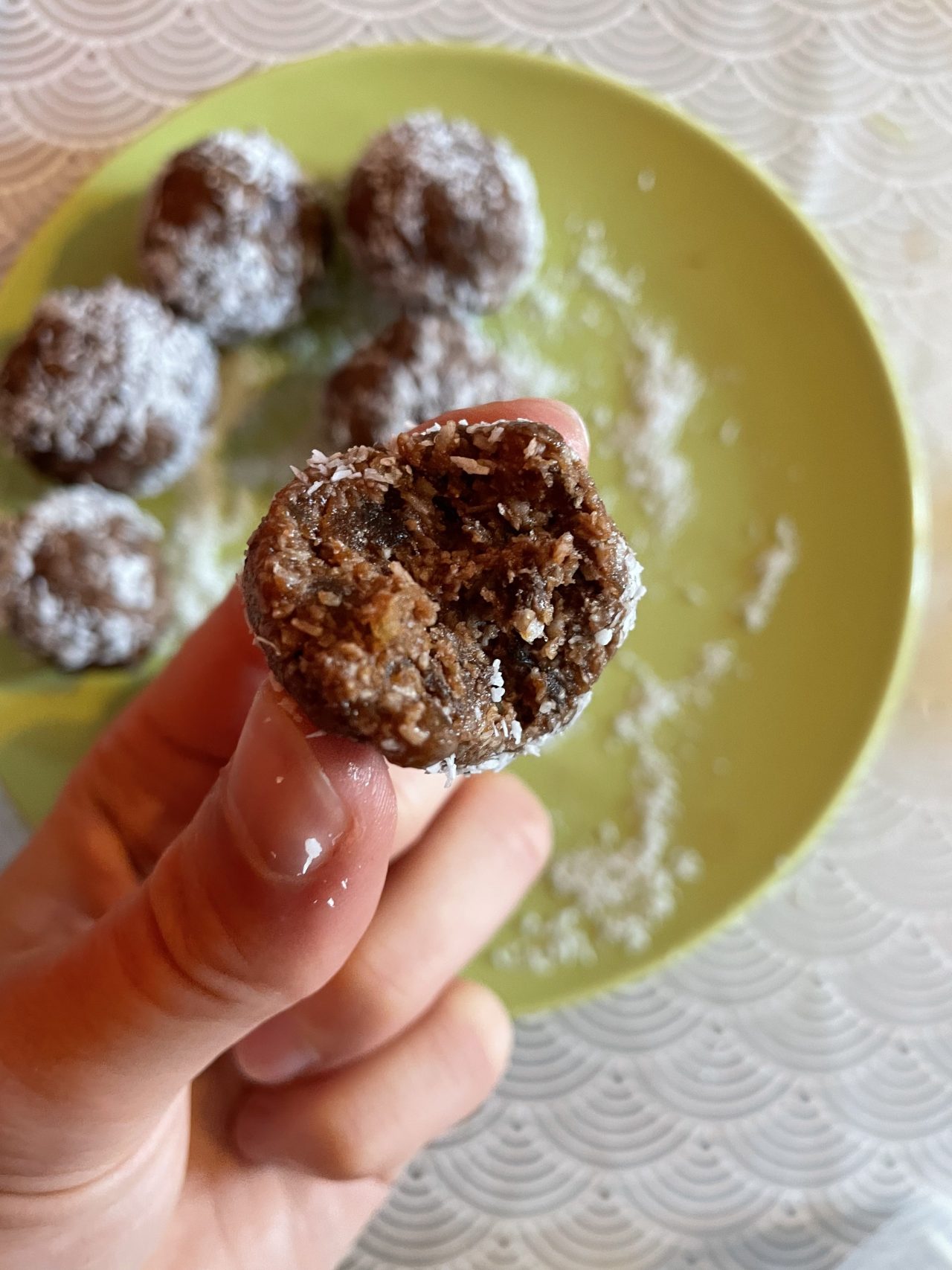
The final recipe I tested was for truffles. These date-based energy balls were simple to make and tasted amazing. After soaking the dates for a few hours, I was able to easily take the outer skin off, which was not mentioned in the recipe but seemed like a good idea in order to achieve a smooth consistency when blended into a paste. I foresee these energy bites quickly becoming a favorite trail snack of mine.
While I have only tested three recipes so far, Sky Runner has many more which all look equally tasty and nutrient dense.
Beyond the recipes, Sky Runner is worth perusing as Forsberg shares training and lifestyle insights, along with stories that I really enjoyed. Originally written in Swedish, you can order an English version online or through your local bookstore.
In this episode, we bring Kris Freeman back to Nordic Nation. For those unfamiliar with Freeman, he skied in four Olympics from 2002 to 2014, placed fourth on two occasions at the World Championships in the 15 k classic, and stayed at the sharp end of American distance skiing until retiring in 2018.
After leaving the ski realm, Freeman — now 40-years old — switched his focus to long distance triathlon and has now completed IRONMAN Lake Placid twice, first in 2019 and second this summer, where he qualified for the Kona World Championships.
All the while, Freeman has managed Type 1 diabetes, which has been omnipresent in his training, racing, and day to day life since his diagnosis at the age of 19. Now an advocate and role model for athletes with Type 1 diabetes, Freeman has fastidiously documented his own methods of balancing synthetic insulin and glucose in alignment with his training and racing throughout his career, and has become an expert in the area of blood sugar management in sport.
In this conversation, Freeman explains the evolution of his own use of continuous glucose monitoring technology, the vital importance that blood sugar management has for him compared to a non-diabetic athlete, and his thoughts on the launch of Supersapiens, which is propelling continuous glucose monitoring into the athletic space. Freeman references this recent article on Gus Schumacher and his experience as a member of the Supersapiens pilot group of athletes.
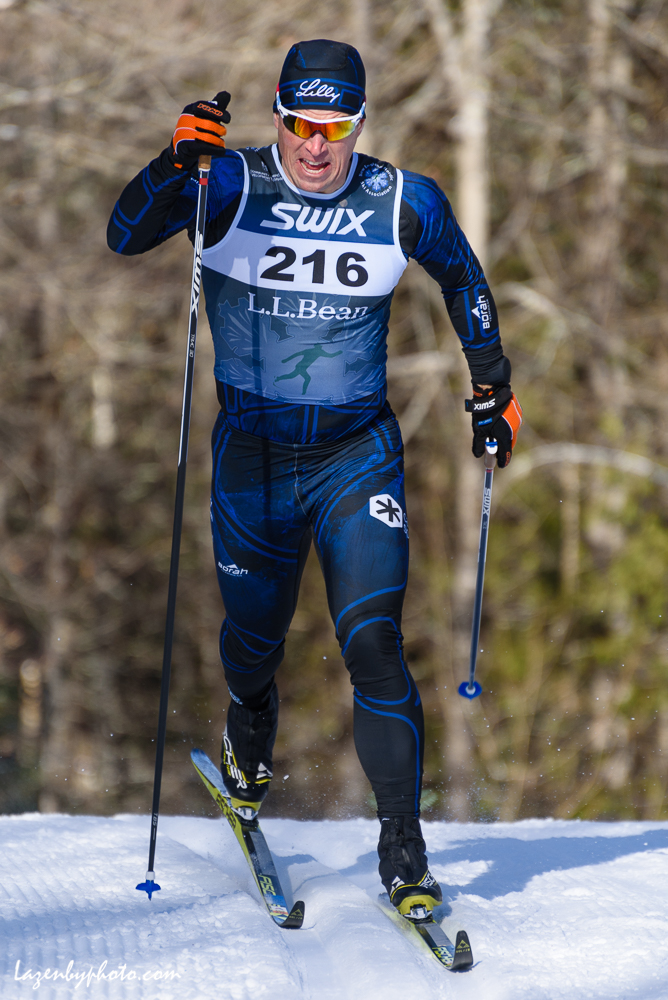
Kris Freeman (Caldwell Sport) racing to 11th in the SuperTour classic sprint qualifier on Feb. 26, 2018 in Craftsbury, Vermont. He went on to place fourth in the final, and two days later, he placed fourth in the 10 k freestyle in Craftsbury. (Photo: John Lazenby/Lazenbyphoto.com)
A quick addition from Freeman on the difference between his own glucose monitoring system, the Dexcom G6, and the Abbot Libre Sense Glucose Sport Biosensor, which he also discusses in the podcast:
“I want to add an important distinction between the Libre and Dexcom products. When CGM products were first hitting the market, many endocrinologist doctors were concerned that their patients would have so much glucose information that they would be overwhelmed. In particular they were worried that diabetes patients would see how often their blood sugars were out of a healthy range and become discouraged with their treatment and less compliant with what their doctors prescribed.
“In response to this, Libre created a system that only stored glucose data and did not provide a way to see glucose numbers in real time. This was done so that doctors and patients would go over weeks worth of data at one time together. Dexcom decided that diabetes patients should know what their real time glucose numbers were and included a receiver in their packaging that showed a real time graph of a patient’s glucose numbers. The graphs could be viewed in 24, 12, 6, 3, and 1 hours increments.
“As phone technology improved the receiver became moot and was replaced by an app on cell phones with the same functions. This app can also be viewed on watches that are linked to the phones. This is what I use to monitor during triathlons. Every five minutes a dot is added to the graph with an arrow accompanying it. A straight across arrow indicates sugars staying constant. A diagonal arrow means slight drop or rise, a vertical arrow a fast drop or rise, and two vertical arrows means drastic changes in glucose.”
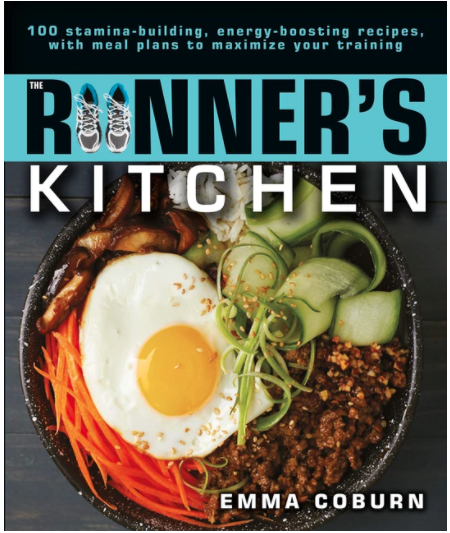
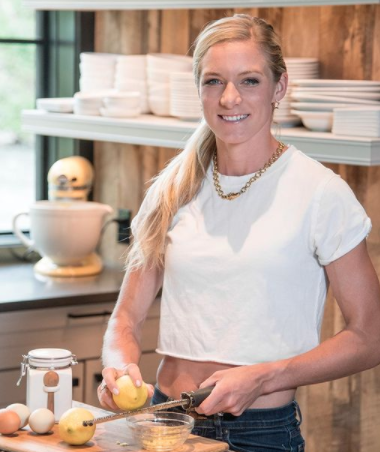
Olympic and World Champion medalist Emma Coburn authored “The Runner’s Kitchen” cookbook, helping athletes of all levels fuel their active lifestyle. (Photo: Instagram @emmacoburn)
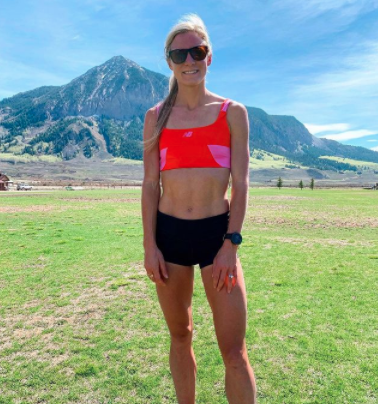
Starting with a quick disclaimer, I’ve been a fan of Emma Coburn, Olympic Bronze Medalist and World Champion steeplechaser, for most of her career. Spending this winter in her hometown of Crested Butte, Colorado has, if anything, amplified my appreciation for her as both an athlete and role model for other female runners. As such, I was very excited this fall when she announced the release of her cookbook, “The Runner’s Kitchen”, and immediately pre-ordered.
I’m pleased to say the purchase did not disappoint.
For starters, the food philosophy Coburn promotes is a breath of fresh air. Contrasting the fad diets often promoted as a panacea in mainstream media — Paleo, keto, vegan, gluten-free — she promotes an “everything in moderation” approach. Her recipes emphasize creating balanced meals that help athletes get the nutrients they need without cutting out foods that simply bring joy and taste delicious.
Through my time in sport, I’ve seen the prevalence of disordered eating in endurance sport from coach, teammate, and personal perspectives. My history involves a tenuous-at-best relationship with food body image, which I’ve recognized in countless others, male and female. I love the message that butter, all-purpose flour, and bacon are part of an Olympian’s diet even during peak competition season. Yes, fruits, vegetables, and whole grains are important (and prevalent in the recipes), but Coburn eschews the idea that restriction is a necessary element of a healthy diet. It’s a message that athletes of all ages can benefit from.
“Fueling for performance doesn’t mean that you have to eat only ‘clean’ foods and cut out all of the foods you enjoy,” writes Coburn. “It means finding a balance that allows you to provide your body with the fuel it needs to perform and recover while still enjoying the foods you love.”
In the introduction, Coburn breaks down how her nutrition strategy changes during the different phases of a training cycle: off-season, mileage increase, and peak season. She guides readers to recipes that can help them similarly tailor their nutrition to meet the demands of their training.
Emma Coburn
As her volume and intensity builds from January through April, she notes, “During this phase, I increase my carbs, I am diligent about eating enough protein, and when in doubt, I try to over-fuel a bit. I would rather be eating too much and feeling strong and healthy than be restrictive and risk any injury or illness.”
While you’ll find recipes for roasted beets, cauliflower-based vegan “mac and cheese”, and kale salad, The Runner’s Kitchen also has recipes for french toast with a brown sugar crumb topping, a baked “fried chicken” sandwich with bacon, and a from-scratch chocolate cake with vanilla buttercream. I most appreciated that the ingredient lists were easy to find –most were already in my pantry– and the recipes were both creative and user friendly.
Despite being packed with flavor and inspired by a variety of cuisine, few recipes require too much chopping or time in the kitchen — a plus for those of us squeezing in skiing around work and/or family.
So far, all of the recipes we’ve tried from The Runner’s Kitchen have been remarkably tasty, despite our relatively mediocre cooking skills. As we’ve been trying to avoid frequent trips to the grocery store since last March, it also helped my family break out of a rut from cooking the same meals on repeat.
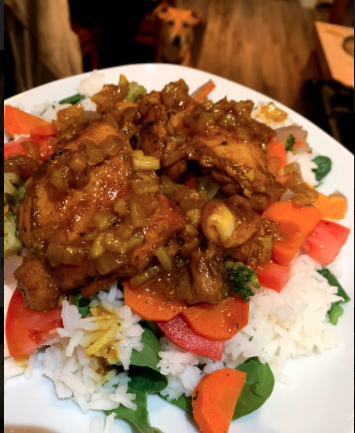
Maple turmeric chicken thighs atop stir fried vegetables and rice is one of many flavorful and satisfying recipes in “The Runner’s Kitchen” by Emma Coburn. Your dog will be very jealous.
The first recipe that caught my attention was maple turmeric chicken thighs, marinated and cooked in a flavorful sauce that has just the right amount of sweetness. Placed atop some rice and veggies, this recipe is unbelievably good. It is by far our most repeated recipe — we’ve made it five times in the two months since receiving the book. Yum.
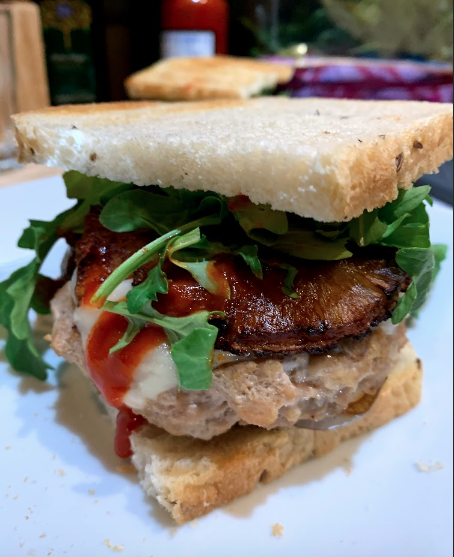
Topped with marinated and grilled pineapple (or broiled/pan-seared when your grill is buried in snow), the teriyaki turkey burgers check all the boxes: sweet, savory, spicy, and satisfying. We also love the buffalo chicken meatballs — even my husband, who previously was opposed to ground poultry as he didn’t think it could quell his voracious appetite.
Sweet, spicy, and filling — a teriyaki turkey burger on sourdough from “The Runner’s Kitchen” by Emma Coburn.
Both the beet and arugula cashew pesto recipes offer a quick and refreshing alternative to our pasta routines, while also being packed with nutrient-rich ingredients.
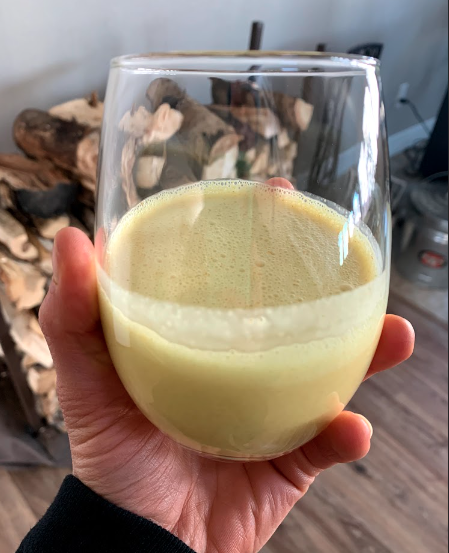
On long ski days, I’ve taken to making the golden milk latte (with coconut milk because I don’t mix well with dairy) as a satisfying way to get in extra calories with the bonus of anti-inflammatory from the turmeric. The aforementioned chocolate cake doesn’t hurt with offsetting calorie deficits either.
The author enjoys a nourishing post-ski golden milk latte.
My “make soon” list includes brunch options, like veggie or chicken apple sausage frittatas, the dutch baby pancake, and shakshouka. When warm weather returns and I begin to crave crunchy and refreshing salads, I have a feeling that the Asian chicken salad will become a mainstay. I’m also eyeing the bibimbap, butternut squash gnocchi, and Pad Thai egg rolls for when I’ve got a little more meal-prep time on my hands.
Olympic and World Champion medalist Emma Coburn authored “The Runner’s Kitchen” cookbook, helping athletes of all levels fuel their active lifestyle. (Photo: Instagram @emmacoburn)
This podcast is part of a series on female athlete specific physiology and sports nutrition. With the help of experts and novel research in this area, this series unpacks how the menstrual cycle might influence training adaptations and provides female athletes and coaches with the information to help optimize fueling and training schedules accordingly. You can find a primer on the menstrual cycle and training here.
Registered dietitian and professional runner Maddie Alm breaks down female athlete specific fueling on the Nordic Nation podcast. (Photo: Instagram @madsalm12)
Based in Boulder, Colorado, Maddie Alm is the face of Fueling Forward, a sports nutrition business helping athletes of all levels improve their nutrition in and out of training to help optimize their training adaptations and health. In addition to being a registered dietitian with a masters degree in nutritional sciences, Alm is a professional track athlete specializing in the 5k. Alm is a member of the Team Boss running team. She is currently working toward the goal of competing in the Olympic track trials.
After joining the renowned team at University of Colorado Boulder as a walk-on, Alm was introduced to a dietitian who helped her improve the quality of her diet and add in additional fuel between workouts to help her get more out of her training. By fueling herself properly, Alm developed into an All American, sparking her own interest in sports nutrition and her desire to help others optimize their own athletic performance through proper fueling.
To Alm, this means developing and sharing an “all foods fit” philosophy which makes eating a high quality diet that matches your training load simple and sustainable. Collaborating with other experts in the area, Alm has also recently taken on a side project in the area of female athlete physiology and nutrition.
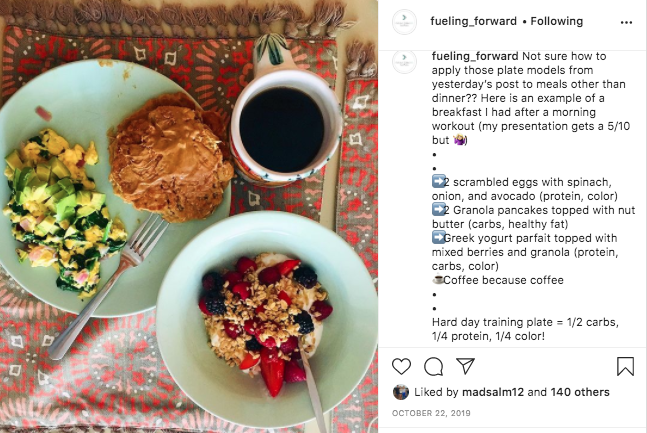
Maddie Alm RD makes fueling an athletic lifestyle simple with her carbs, protein, and color plate approach. (Photo: Instagram @fueling_forward)
In this episode, Alm breaks down how hormonal fluctuations during each phase of the menstrual cycle impact nutritional demands and offers specific suggestions on how athletes might tweak their diet accordingly to ensure their body gets the fuel and hydration it needs. She also discusses how athletes who are negatively affected by PMS symptoms might experiment with their nutrition to reduce the severity of these effects, thereby lessening the extent to which they take away from training or performance.
For more from Alm, you can follow her business account on Instagram @fueling_forward or her athletic profile @madsalm12. The specifics of her sports nutrition services and her “Simple Start: 28 Days to Fueling Better” program can be found on her website: https://www.fuelingforward.com/.
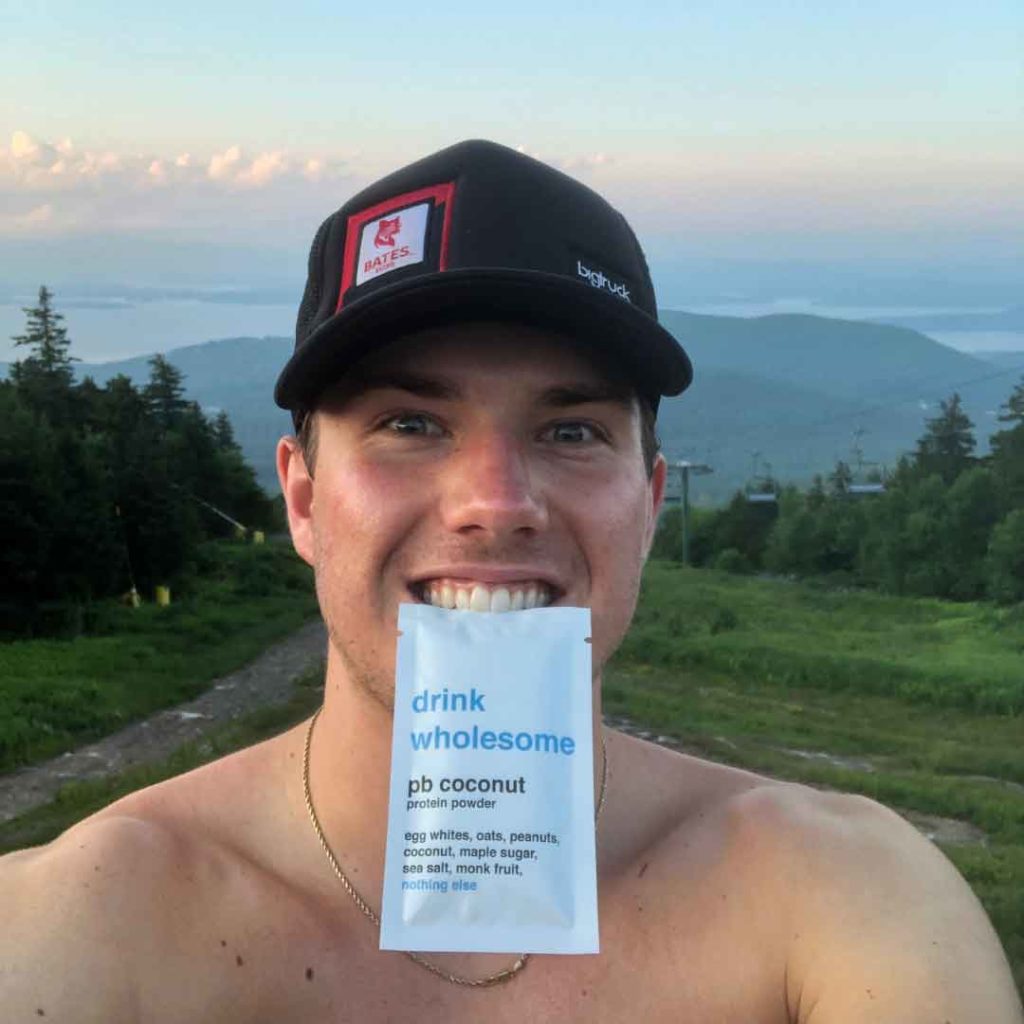
Based in New Hampshire, Drink Wholesome has roots in the nordic ski community. Founder Jack Schrupp is a Williams Skiing alumn. (Photo: DrinkWholesome.com)
As summer training hours trend toward a peak, many athletes are looking for ways to support their nutritional needs, matching high volume training with high volume eating. A new product that should be on your radar is Drink Wholesome protein powder, created by former Williams ski racer Jack Schrupp. This protein is basically the RXBAR of protein powders: all natural without artificial flavorings or sweeteners, packing a high nutrient protein dense punch in each scoop.
The nature of exercise, in particular the type of training that supports building strength and fitness for cross country skiing, is a cycle of breaking down muscle then allowing the muscle to repair itself and grow stronger. Brick by brick, we build a stronger body and more efficient aerobic and cardiovascular systems to power us down the trail. Regardless of whether you follow a rigorous training schedule, upholding an overall active lifestyle with regular exercise increases the body’s energy demands, particularly carbohydrates to replenish glycogen stores and protein to support muscle recovery.
According to the International Society of Sports Nutrition (ISSN), athletes require approximately double the protein intake of an inactive healthy individual to support their overall health and recovery from exercise. By the numbers, an inactive individual requires approximately 0.8 grams of protein per kilogram of body weight, whereas an athlete needs 1.4 – 2 grams per kilogram. For an athlete who weighs 160 lbs, this means consuming 100 to 145 grams of protein each day.
Research supports that this is true regardless of the type of exercise an athlete engages in, or whether they are recreational versus elite. The ISSN also explains that insufficient protein intake leads to impairment in the body’s ability to recover from exercise and an increase in muscle catabolism, meaning muscles continue to break down rather than repair after exercise.
Endurance athletes — like a road cyclist or marathoner — generally fall on the lower end of the range, while those who engage in more strength and power based sports — like weight lifting or CrossFit — occupy the upper end. Where does this leave skiers who lift heavy, throw down during intensity sessions, AND put in lots of hours of L1? Probably somewhere in the middle.
Spreading intake throughout the day has been found to best support muscle protein synthesis, while additionally contributing to a more favorable body composition and improved performance outcomes. This means meals and snacks should contain 20-40 grams of protein each, assuming you’re eating every three to four hours.
For many, these demands can be met with a balanced and varied diet, but protein powders can be a convenient option to boost protein intake, especially when your stomach might not feel up to a full meal after a hard set of intervals or if you are unable or choose not to eat certain foods.
I tend to fall into both of those categories. During the summer, I generally maintain 50 to 60 miles per week of trail running with a day or two of rollerskiing or mountain biking, combined with the general activity of chasing around a toddler requires that I stay on top of my game while properly fueling my body. But hard training tends to throw off my body’s hunger cues – my stomach can only handle a small amount of dairy, and I choose not to eat a lot of meat.
Protein powder has been a nice insurance policy to support my nutritional demands and help me stay healthy. However, it can be hard to find one that I feel good about consuming as many are laden with artificial sweeteners and ingredients I’d have to Google. They also often taste chalky, overly sweet, and like artificial flavoring.
As such, I was excited to try Drink Wholesome protein. After a similar experience with protein powders, the designer, Schrupp, set out to create a product made only of natural ingredients that also tasted good. What resulted is a line of products that have egg white as the first ingredient, or chickpeas for the vegan protein options. They’re sweetened with monk fruit or maple sugar, taste delicious, and pack in 20 grams of protein per serving.
As an extra nod for the ingredient list, Registered Sports Dietician Kylee VanHorn explains in an article for Trail Runner Magazine that egg white protein has been found to be one of the most bioavailable protein sources, meaning it is easily digested and absorbed allowing it to be readily used for muscle repair. It is second to whey protein, but easier on the stomach for many.
Drink Wholesome is an all natural protein powder made from ingredients you can pronounce and find in your kitchen. (Photo: DrinkWholesome.com)
Of the three flavors I tried — peanut butter coconut, mocha, and peanut butter chocolate (vegan) — the pb coconut takes the cake as a total slam dunk. Though perhaps a bit sweeter than the other two, it tastes on its own great blended with water and a splash of almond milk as a post-workout drink to jumpstart recovery. Note that without anti-caking or gelling agents, emulsifiers, or stabilizers, you’ll get the smoothest mixture by preparing this with a blender or in a shaker bottle.
Getting in the habit of mixing up a drink, tossing in some ice cubes, and keeping it in my car to drink after long runs in the mountains when I am generally dehydrated, depleted, and usually feeling a little blah from consuming lots of sports nutrition products on the go has made a big difference in how I feel later that day and the next day.
Most commonly, I stir a half-serving Drink Wholesome into my post run breakfast bowl of oatmeal topped with berries and nuts. Since the protein is sourced from egg white and peanuts, it doesn’t curdle when mixed into the bowl of hot oats, which I have experienced with whey products, making a thick and creamy texture packed with flavor. The vegan pb chocolate is a close second for this purpose, especially when paired with strawberries.
I’ve also enjoyed adding Drink Wholesome to smoothies. One of my go-to blends has become a banana, a handful of spinach, some almond milk, a scoop of mocha protein, and ice, maybe with some nuts tossed in after for texture and fats. It tastes like a coffee milkshake and provides me with plenty of energy to keep me going.
As a parent who generally has to share whatever they are eating with their toddler, it also feels good not to hesitate to give my little one a sip or bite since I know the ingredients are all natural, and it has the added benefit of exposing her to multiple common allergens (peanuts and eggs), as is recommended to reduce the risk of developing an allergy to those foods later on. I’ve also noticed a marked decrease in bloating without the whey protein or artificial sweeteners I had been consuming.
I also feel good about supporting the company’s principles: “keep it real food, keep it local, keep it green”. Drink Wholesome, which is based in New Hampshire and produced in small batches in Massachusetts, sources free range eggs and organic ingredients locally whenever possible. Not using whey protein cuts out the dairy industry, reducing their environmental footprint, and the company gives back, aiming to donate at least 10% of its profits to the preservation of green spaces in New England by 2022. Specifically, the donation goes toward purchasing undeveloped land for public use, particularly in areas where access is limited.
Drink Wholesome offers a vegan protein powder made from chickpeas and peanuts and sweetened with monk fruit. (Photo: DrinkWholesome.com)
Drink Wholesome protein can be ordered on their website. Full sized bags of egg white based protein retail at $38.00 for 20 servings, or $26.60 for 14 servings of vegan protein. You can also order two free sample servings to see which flavor suits your palate.
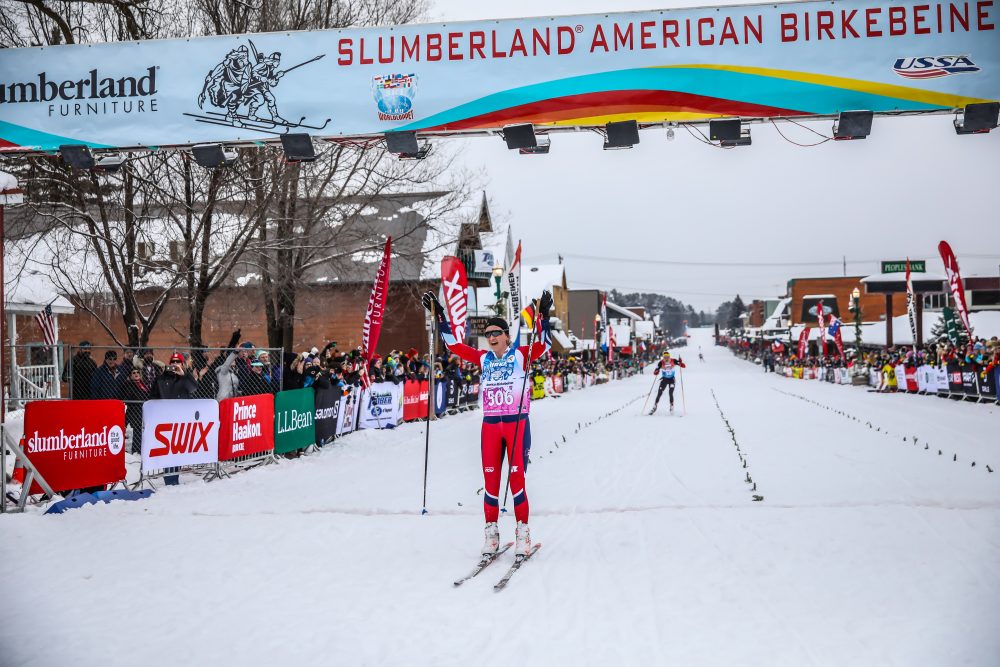
SMS T2 skier Alayna Sonnesyn with the 2019 American Birkebeiner win. (Photo: James Netz)
The countdown is on. Marathon season is underway and we are inside the final two weeks before theAmerican Birkie. At this point, “the hay is in the barn” when it comes to training, but there is still time to dial in a nutrition plan to stay fueled and all the way from Cable to Hayward.
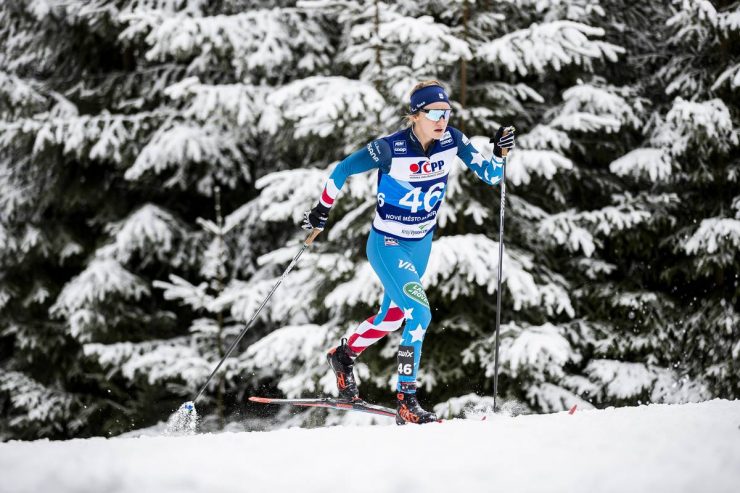
For pro tips, FasterSkier reached out to last year’s Birkie winner, Alayna Sonnesyn (SMST2), for insight into the system that powered her performance. This season, 23-year-old Minnesota native earned three podiums at U.S. Nationals in Houghton, Michigan: 2nd in the 10 k skate, 3rd in the classic sprint, and 2nd in the freestyle sprint. She also earned her first European World Cup starts in Nové Město and Oberstdorf, improving on the results from her first World Cup starts in Quebec City the previous season.
“My dream came true.” An emotional Alayna Sonnesyn after winning the 2019 Birkie. (Photo: Screenshot asonnesyn.com)
For Sonnesyn, the Birkie has always been a family affair. In a blog post, she recalled watching through the fence as racers flew by like “superheroes.” All four members of her family raced the 2019 Birkie; her sister, Marit, took 7th, her mom was 72nd, and her dad 180th.
While bottle hand offs and extra supplies may not be a luxury available to the recreational skier, Sonnesyn’s fueling plan embodies the “eat and drink early and often” wisdom, finding a product that sits well and meets your needs, and erring on the side of over prepared.
Pre-Race Fueling:
The night before the race, I ate a ton of Rigatoni pasta (which contained beef for protein) that my mom made along with a salad.
On the morning of, I had a big bowl of oatmeal with a spoonful of Greek yogurt and a sprinkle of protein powder. I’ve found that extra protein before a big race can give me that extra energy to really dig deep later in the day. I also drank A LOT of coffee that morning, sipping it all the way until the start line.
During the Race:
Last year I carried a water bottle that had Tailwind Nutrition electrolyte mix in it. I’ve been using Tailwind for two years now and I LOVE IT! It’s so easy on your stomach and doesn’t taste overly sugary like Gatorade or Powerade. I prefer the “Naked” flavor which is essentially flavorless but also really like the Berry flavor. I know it’s sold at Gear West!
At about 15k I took a gel and chased it with water at one of the aid stations. It’s nice to know the trail so well that I could anticipate the aid stations well in advance.
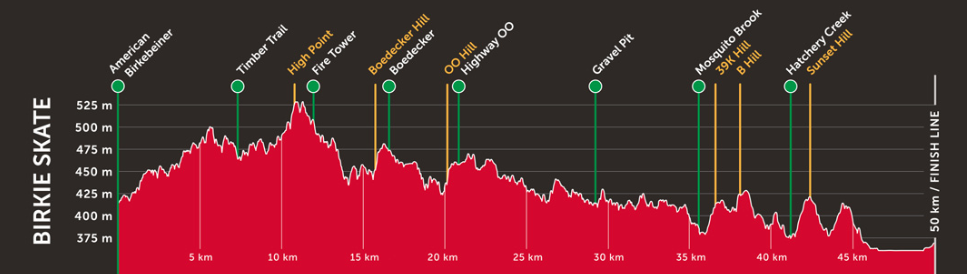
My goal was to have finished my first water bottle by the time I got to OO (kilometer 20.6) where I dropped my bottle and received a new one from my Rossignol rep. This second water bottle contained more Tailwind Nutrition mix and also a crushed up caffeine pill. Not sure if the caffeine pill helped much but I felt great!
At about 35k I took another gel that contained more caffeine and followed this up with water from an aid station. I had the option of getting another water bottle from my Rossignol rep at this point but I was feeling good and didn’t think it was necessary.
Finally, before crossing 77 (6 k to go), I received a “flat coke” feed from another Rossi rep, dropped my drink belt and put the hammer down!
Overall, I didn’t have a “calories/hour” goal but I wanted to take feeds early and often so that I could prevent any bonking. I’m not a fan of gels so I really wanted to be sure I had water after taking these to make sure I got them down well. Also, food and blocks are too much for my stomach during a race like that so I kept things relatively liquid.
The elevation profile of the American Birkebeiner. (Photo: Screenshot birkie.com)
The Race Logistics:
I was fortunate enough to have INCREDIBLE support from my Rossignol team. I gave a Rossi rep a spare set of poles that would be available about 10k into the race in case I needed them. Another Rossi rep had spare poles at OO. Luckily, I didn’t need to use these!
My aunt was also available at OO with extra everything. Poles, gloves, water, food… again though, I was lucky not to need any of this.
My race suit doesn’t have any pockets but my water bottle carrier did. I stored three gels in this pocket that I knew would be plenty to get me through the race (I used two of them). Last year it wasn’t too cold so I wasn’t worried about my feeds freezing, but keeping them close to my body made sure they would stay warm just in case.
Overall, I wanted to be over prepared rather than under. I made sure that if anything went wrong, I was prepared for it. Two days before the race, I practiced skiing at high speed with a water bottle carrier and taking a feed from it. Practicing this helped me feel way more confident in the procedure and all of the logistics for the race.
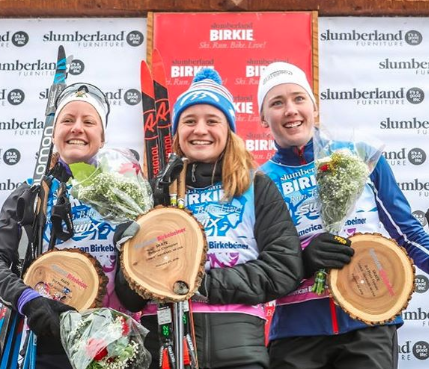
The women’s podium of the 2019 American Birkebeiner. Alayna Sonnesyn took first ahead of Anja Gruber and Katie Feldman. (Photo: Screenshot Instagram @asonnesyn)
Cara Marrs is a registered dietician nutritionist based in Steamboat Springs, CO. (Courtesy photo)
Looking for a fall meal that is both comforting and deeply nourishing? Steamboat Springs, CO based Registered Dietician Nutritionist Cara Marrs shares a mouth-watering anti-inflammatory recipe that we can attest fits the bill. Marrs supports clients through her practice in person and online, and has worked with local Winter Olympians as well as recreational, junior, and collegiate xc skiers on their daily and performance nutrition needs. Outside of nutrition counseling, Marrs is an avid trail runner and loves sharing in the mountain lifestyle with her family. You can find her at caramarrswellness.com or on Instagram @cara_marrs_wellness.
“As an athlete, educator, and certified healthcare practitioner, I can help you bridge the gap between traditional and alternative nutrition therapies and formulate a plan for you as an individual.”
This is a great recipe for chilly days when you need something that will fill your belly and warm you up!
The roasted pumpkin is easy to prepare and lends a wonderful fall flavor while providing some high-fiber complex carbohydrates to fuel your skiing. If you are not able to find a baking pumpkin, butternut or acorn squash make great substitutes. Additionally, Leeks are a great prebiotic food, meaning they feed the “good bacteria” that populate the gut, promoting health.
Looking for a make-ahead dinner? Once the meat is browned, feel free to add the ingredients to a crockpot or instant pot and let them simmer away.
The vegetables can vary, as well as the protein sources depending on your preference. The red curry paste and touch of sriracha lends a wonderful balance of flavors to the sweeter winter squash.
Roasted Pumpkin Curry
Cara Marrs RDN shares a delicious recipe for roasted pumpkin curry that is perfect for fall. (Courtesy photo)
Roast a small-medium baking pumpkin brushed with olive oil and sprinkled with sea salt cut side down for 40 minutes at 375. Set aside. Roasting the pumpkin seeds too is highly recommended!
Brown protein of choice with olive oil, sea salt, 2 cloves of garlic and 1 heaping tbsp of red curry paste, and one large chopped leek. Organic tofu, organic chicken breasts, grass fed beef are all good choices here. If using beans, add in step 3 instead.
After 5 minutes, add 3 cups water or broth, 1 sliced red bell pepper, the flesh of the roasted pumpkin, 1 bunch of torn kale leaves torn, and 3 small multi-colored chopped carrots.
Stir in 1 can of coconut milk, 1 tsp turmeric, 1 tbsp honey, the juice of 1 lime, and 1 herb bouillon cube (if not using broth). Add sriracha to taste. Simmer on low-medium heat until veggies are soft.
Serve with crusty fresh bread and top with the roasted seeds of the pumpkin for some extra crunch and anti-inflammatory fats. Enjoy!
Cara Marrs RDN shares a delicious recipe for roasted pumpkin curry that is perfect for fall. (Courtesy photo)
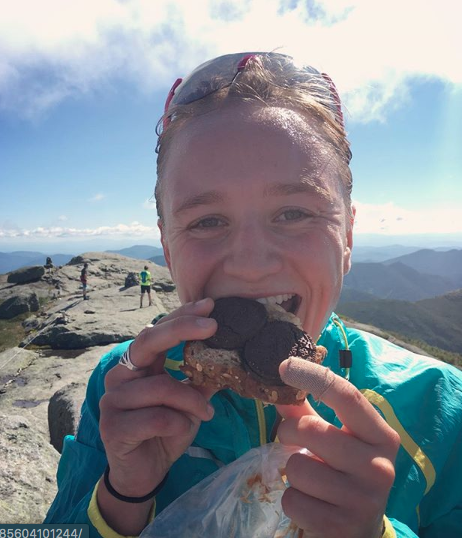
Alayna Sonnesyn refuels with a peanut butter and Newman-O sandwich at the summit of Mt. Marcy during a U.S. Ski Team women’s camp in Lake Placid in July, 2018. (Photo: Screenshot Instagram @asonnesyn)
Trick or Treat! ‘Tis the season of hyperglycemia.
Before balking at the amount of candy that may be lingering in your house over the next few weeks, it might be worth considering mixing it into your stash of bars and gels to be consumed during a long ride, run, or ski. After all, your body relies primarily on carbohydrates for energy during exercise and candy is loaded with simple sugars.
Favorites of the FasterSkier team include Peanut M&M’s, Snickers, Almond Joys and Reese’s Peanut Butter Cups — but not the Reese’s pumpkins which – subjectively – have a flawed ratio of chocolate to peanut butter.
My own foray into opting for candy over gels during long runs and skis was born out of necessity, though guised under the explanation, “they have M&M’s at aid stations at trail ultramarathons, so I’m practicing fueling with what will be available in the race.” In reality, I was a broke recent college graduate trying to make it work as a ski coach in Aspen, CO and a single packet of Gu cost more than a sleeve of six fun sized candies. Six times the calories for less money! Despite increasing my financial stability, candy has remained a constant in my endurance fueling stable.
But wait: if candy is cheaper and more appetizing than energy gels, why does the latter exist? Can I really just down candy with abandon during my workout?
Short answer: yes. But before you unwrap that peanut butter cup, registered sports dietician and competitive trail runner Kylee VanHorn of FlyNutrition offers a deeper look into the concept.
First, VanHorn explains that there are different transporters for different types of sugars (i.e., glucose, fructose, sucrose, maltodextrine) in the gut and too much of one may overload the digestive system, causing gastric upset. Additionally, she explained that fructose is absorbed more slowly than other sugars, which can inhibit the intestine’s ability to pass the sugar into the bloodstream and hinder absorption.
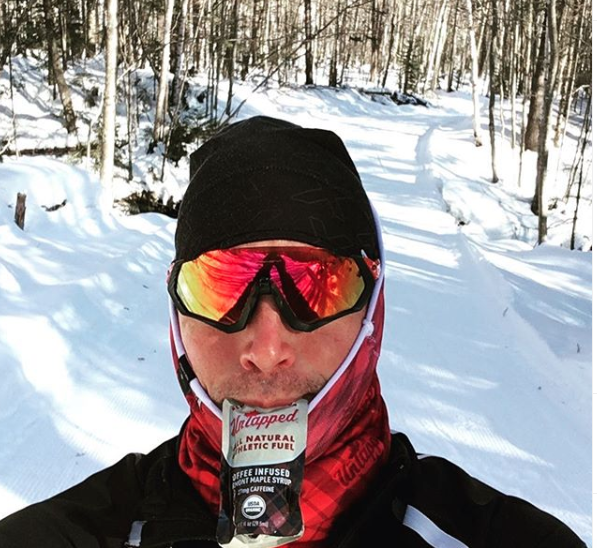
Kris Freeman takes in an Untapped Maple energy gel during a ski. (Photo: Screenshot Instagram @krisfreebird)
For the sake of comparison, a standard packet of Gu Energy gel contains 100 calories, 22 g of carbohydrate, and 5 g of sugar. Gu’s are fat free and contain no protein. The sugar used is a combination of maltodextrin and fructose, with maltodextrin being the primary source. According to the Gu Energy website, when these two sugars are consumed together, it increases the oxidation rate in the gut. (Oxidation releases energy.)
It continues: “when the oxidation rate increases, more carbohydrates can be delivered to the working muscles. For example, when just glucose is consumed, approximately 30g of carbohydrates are utilized by the working muscles per hour. In contrast, when maltodextrin and fructose are consumed together, approximately 60g of carbohydrates can be utilized by the working muscles per hour.”
The nutrition facts on Halloween candy vary by kind, but in general, a fun sized package contains 80 to 110 calories and are primarily made up of sucrose (table sugar) and corn syrup, which is made up of glucose and fructose.
VanHorn explained that the simple sugars in candy can certainly fuel exercise, but recommends considering the intensity of the workout in the decision. Over-distance level 1 sessions get the green light, but proceed with caution during intervals.
“While they may work for low intensity exercise, be careful with chocolate, nuts, and higher fat candy bars on hard efforts. The fat and protein are digested slower and can lead to stomach upset.”
For clarity, Reese’s cups, Snickers, and Peanut M&M’s contain approximately 9 g of carbohydrate, 8 g of sugar, 1.5 g of protein, and 4.5 g of fat.
“Candies like Swedish fish and Mike and Ike’s may be tolerated better than candy bars but they may be higher in fructose, which can sometimes cause GI distress,” VanHorn continued.
These candies contain roughly 27 g of carbohydrate and 23 g of sugar with no protein or fat.
“Remember that candy most likely will not contain electrolytes, which are lost in sweat. Be sure to consume electrolytes from a drink mix or other source.”
While most candy does contain some sodium, the values are less than the 60 mg contained in a Gu. Energy gels also contain potassium, which candy lacks.
Finally, as every athlete is unique, VanHorn reminds skiers to test the waters with eating candy during workouts when the stakes are low.
“As always, practice your fueling before a race. It is not recommended to use candy on race day if you haven’t practiced with it.”
Kylee Van Horn is a registered sports dietitian and owner of FlyNutrition, LLC where she offers nutritional counseling services both in person and online. Van Horn is an accomplished distance runner who turned to the trails after running a 2:49 marathon. You can find her competing in trail races, skinning up the resorts, adventuring in the mountains, and playing with her Aussie shepherd puppy. Van Horn resides with her husband in Carbondale, CO.
Here we are in late August, halfway between the start of the training year in early May and the beginning of the competition season in late November. Volume is the name of the game during the summer and at this time of year, it is not uncommon for top athletes to train 20 to 30 hours per week. Typically, the training logs prescribe athletes to head out on long runs, rides, and rollerskis at a relatively easy pace, but the week is also peppered with interval and strength training sessions.
In order to not only survive but also reap the benefits of this type of training, dialing in nutrition is imperative. In particular, matching the energy output with energy intake — read: eating a lot of food. How does one keep up with the energy demands of training at this level? Though he might be prescribing the training load, U.S. Ski Team coach Matt Whitcomb expressed the answer to this question is best left to someone who specializes in the field.
“The 20 hour weeks are easy; it’s the 25-30 hour weeks that get tough,” wrote Whitcomb in an email. “I keep it simple: I don’t talk with the athletes about nutrition. It’s a smart place for a coach to defer to the experts if they aren’t one themselves. Too many problems are waiting for a coach to trigger this trap. And yes, this is from experience.”
So we brought in an expert. FasterSkier reached out to Dr. Stephanie Howe Violett, who holds a Ph.D. in Nutrition & Exercise Science. In addition to her academic training, Howe Violett has practical experience in meeting the energy demands of high volume training and optimizing nutrition for athletic performance.
Professional ultramarathon runner Stephanie Howe Violett holds a Ph.D. in nutrition and exercise science. She offers insight into optimizing fueling strategies to meet the energy demands of high volume summer training. (Photo: Instagram @stephaniemarieviolett)
After nordic skiing and running through college at the University of Northern Michigan, Howe Violett transitioned to a successful trail running career where she landed on the podium in prestigious races such as the Western States 100, which she won in 2014 and placed third the following year. At the time of the call, Howe Violett was in the midst of some high volume training herself, spending long days training in the French Alps.
While pursuing her doctorate at Oregon State University, Howe Violett studied the connection between exercise and perceived hunger, more specifically looking at how intensity affects the suppression of hormones that are connected to appetite.
“We know just from training and racing that when you go harder it seems that you feel less hungry or less desire to eat in the time period immediately post-exercise,” explained Howe Violett about her research. “If you do hard intervals or a time trial, food doesn’t really sound appealing and there’s a reason for that.”
Her research was specific to running, but she explained that the findings extend to most endurance sports, potentially less so in non-impact activities where the digestive system is less impacted by jarring during exercise. Cross country skiing is relatively low impact, but it can certainly be high intensity, and when paired with dryland training modes such as running and bounding, Howe Violett’s study becomes especially relevant, particularly to those looking to sustain a heavy training load.
“The big take-home message is that, yes, there are appetite hormones that alter our appetite in the direction of suppression for about the first hour post exercise, they’re back up to baseline at about 60 minutes post exercise,” she continued. “That’s important because when you’re trying to optimize performance, the first 30 – 40 minutes after intense exercise is when you really want to refuel because the muscles are more able to uptake the glucose and start the recovery and restoration process for the next session.”
While most of us are probably logging far fewer hours than the pros, the nutritional advice Howe Violett offered benefits skiers at any level. In fact, her most important point is simple.
“Eat enough. There aren’t really strategies in terms of quirky things to do. I think timing is super important and quality is important. You might eat three [primary] meals a day, but then timing your intake before and after exercise is super important and I think that’s something skiers overlook in my experience, maybe more so at the younger ages.”
When meeting the demands of a heavy training load, Howe Violett recommends consuming energy while training as well.
“Fueling during exercise is really important and that time window immediately after is really important. So if you’re doing 20 plus hours a week, I think getting that extra fuel in during those sessions is super important for your overall energy intake. Also having a snack right before bed that is preferably whey protein, dairy is the best source, because that can help with the repair process overnight.”
This fueling strategy was affirmed nearly verbatim by Canadian National Team skier Dahria Beatty.
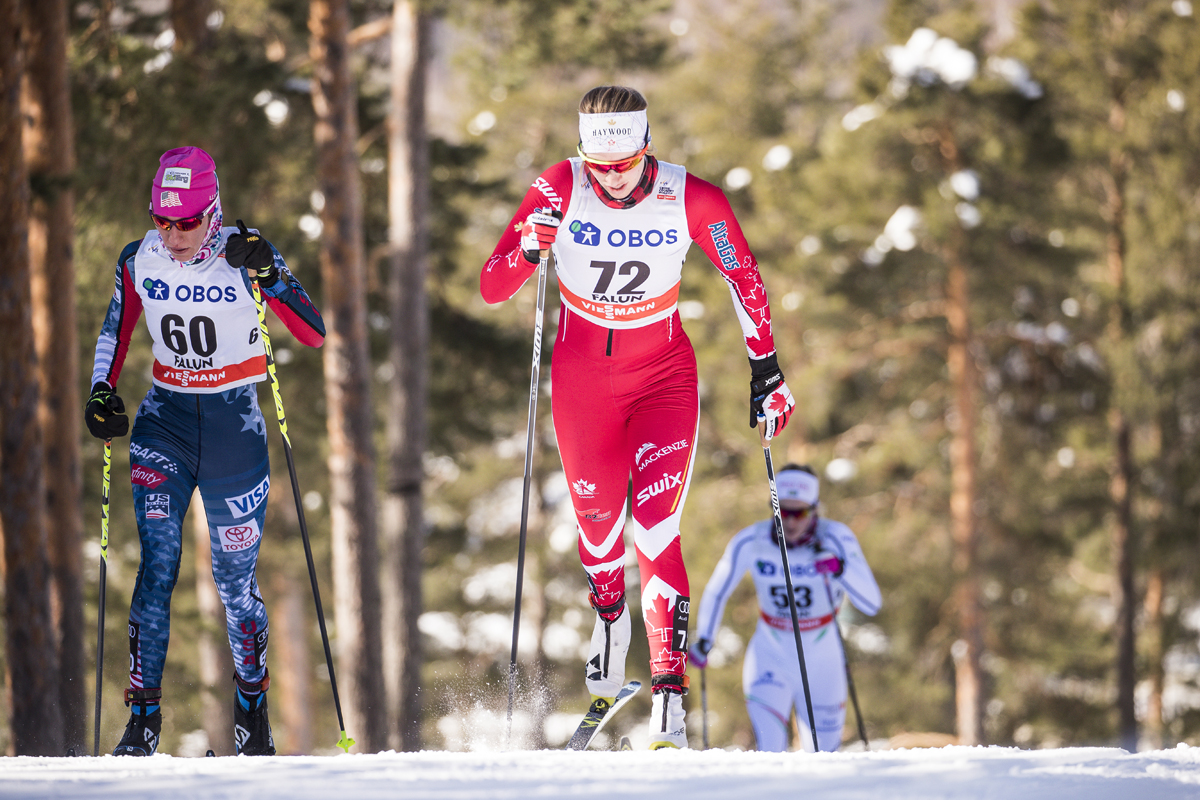
Dahria Beatty (center) on course in the 15k mass start classic race on March 17, 2018, in Falun, Sweden. (Photo: Fischer/Nordic Focus)
“The main thing I think about during a high volume training block is being proactive with my energy intake during and immediately post-training,” wrote Beatty in an email. “That means fuelling during long workouts before I become hungry as well as making sure I have my recovery snack ready for as soon as I am done training.
“My meals outside of training stay pretty similar to those during a normal training block,” Beatty continued. “In big training weeks, I pay more attention to my hunger levels mid-day and in the evening, adjusting my afternoon snack and adding an evening snack if necessary.”
During her training sessions, Beatty’s go-to snacks dried fruit and homemade granola bars or energy balls. After a session, particularly in the summer, she likes to make a fruit smoothie.
“Banana-mixed berry-ginger is my current favourite,” she wrote. “After particularly hard workouts I will top my smoothie with a bit of granola, coconut, and some chocolate chips.”
It might seem that the expression “if the fire is hot enough, any fuel will burn” could fit here, but Howe Violett explains that simply eating high calorie foods is not necessarily the answer.
“You want to get more nutrient dense foods — things that have a lot of vitamins, minerals, and fiber in meals. Then in training and post-training, you actually want very simple carbohydrates so that they can be absorbed a little bit easier.”
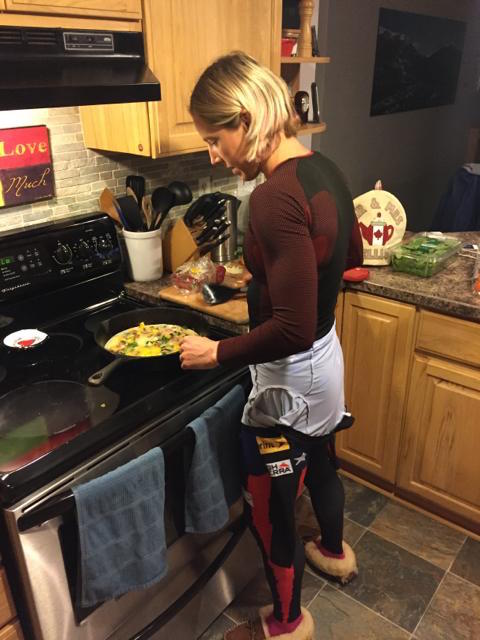
Kikkan Randall in the kitchen “getting ready and fueled” in the fall of 2014. (Photo: Twitter)
An athlete who is not matching the energy or nutrient demands of their training will recognize this deficit in a slowed recovery or feeling more fatigued than would otherwise be expected. If this is the case, Howe Violett recommends considering whether the athlete is consuming enough carbohydrates.
“Suppressing carbohydrate intake or just not getting enough carbohydrate is a common thing that people get right now because carbohydrates aren’t super popular in fad diets. It can lead to mood disturbances, feeling foggy, not recovering, just feeling like you can’t go any faster despite trying. And it can take months or years to overcome that, so I think that it’s really important to be diligent about carbohydrate intake every meal and every day. Not necessarily pasta and cereals, but whole grains like rice, quinoa, starches like potatoes and sweet potatoes, and then a lot of fruits and vegetables. Those are going to be really good sources. Then pairing that with sports products like gels and blocks during training, a bar before training, and something like chocolate milk after training. I think that’s a really good way to ensure enough carbohydrate intake to avoid overtraining or overreaching.”
An athlete’s training log changes with the season. High volume in the summer transitions to low volume but high intensity in the winter. How does this transition impact nutritional needs? Howe Violett emphasized that nutrition is individual and generalized advice is not something she likes to provide. For some of the athletes she works with, their nutrition plans change weekly to account for their training, travel, and race schedule.
“I really encourage people to work one-on-one with someone because you really learn so much about yourself and how to fuel your body, what your needs are, and how to structure it throughout the season.”
She provided a loose framework explaining that the most overall energy is needed when the volume is highest.
“Nutrition is individual, but we work within the framework where we want, for a skier, 50-65% carbohydrate, 20% protein, and about 30% fat throughout the day. Then knowing that that is night and day different from what you might intake before, during, and after training, and it’s really important to optimize both of those occasions because they are both equally important and they can really help drive performance. Training is the thing we think about most of the time, but nutrition can actually be just as important and work synergistically with training and recovery.”
Typically during the more intense winter months, an athlete’s diet might need to be at the higher end of the range for carbohydrate since the body relies on this type of energy most while racing or completing speed sessions. Then, during the off season when volume and intensity are both low, one would be better served to eat a higher percentage of fat and protein.
Howe Violett concluded with advice for athletes at any level, particularly juniors ascending into the college ranks, collegiate skiers chasing professional ski racing, or anyone who is looking to make a jump in their training load and seeks to optimize their nutrition accordingly.
“Eat enough and just ignore all diet recommendations that come from the internet or social media because it’s all just pseudoscience. Take a step back to the basics. Get enough food — if you’re hungry, it means you need to eat. I think a race weight is a really silly way to determine if you’re fit or not. I think when you feel good, when you’re well-fueled, you’re getting enough sleep, and you have energy, that’s a really good state for your body to be in. That is the whole package, nutrition, recovery, stress, and lifestyle.”
Before transitioning to trail ultramarathons, Stephanie Howe Violett skied for the University of Northern Michigan. (Photo: Instagram @stephaniemarieviolett)
From the dawn of sports nutrition when PowerBars were ubiquitous to the DIY world of handcrafted nibbles for athletes on-the-go and recovering, sports nutrition has become an industry.
For this Wednesday Workout, we wanted to revisit a few classic low cost and relatively simple items when it comes to nutrition. Without diving into the deep science, the basics are well agreed upon: you’ll need some protein, carbohydrates, and some ingredients to make it all palatable. We’re thinking a smidge of salt or sugar or even both for that savory combo.
Cook rice. Cook bacon separately and drain fat. Cut the bacon into little pieces.
Mix Bragg’s, rice vinegar, maple syrup, salt in a bowl. When the rice is cooked, transfer to a large bowl and add Bragg’s salt, maple syrup, and rice vinegar.nnStir to mix thoroughly.
In an oblong baking dish, layer half of the rice, spreading with a spatula. Then layer the almond butter on top of the rice. Sprinkle bacon across almond butter. Cover with remaining rice. Refrigerate overnight.
In the morning, Cut into squares, and wrap each square in heavy aluminum foil. Freeze until ready to use. Yield should be 16 rice cakes.
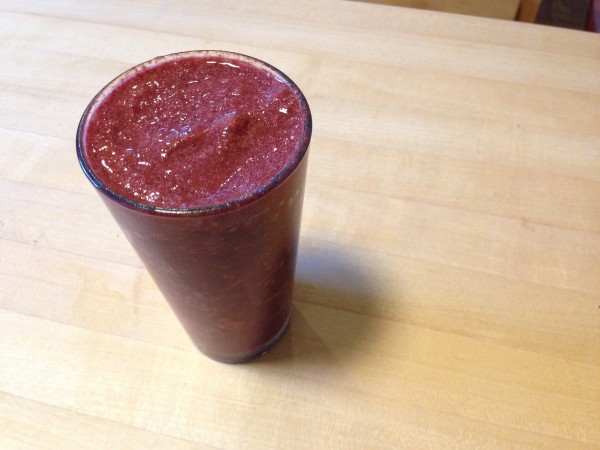
It contains protein, potassium, iron, antioxidants, detoxifiers, and lots of anti-inflammatories.
(Quantities are a rough estimation)
Makes 1 blender full, 2 or 3 servings
1 medium beet, peeled
2 cups of milk
1 scoop or serving of protein powder – the one in my smoothie is 34g and vanilla flavored
2 cups of greens, spinach or kale
1 banana
A handful of candied ginger.
A turmeric finger/root
Ground cinnamon and nutmeg to taste. You can also substitute ground ginger and turmeric for the whole ingredients
Ice
Blend all the ingredients in a blender. Then guzzle.
Turmeric Beet Recovery Smoothie
The Zoë
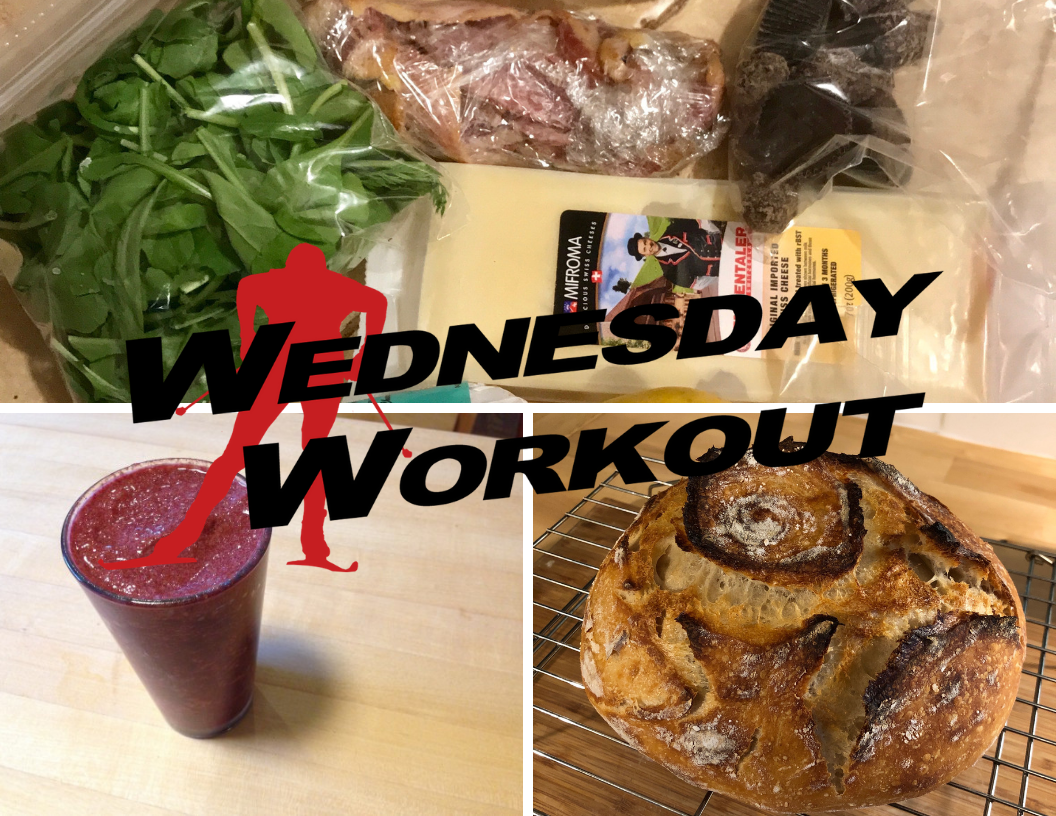
OK. Let’s digress for a bit. If you are ski-touring, as our glance at Instagram suggests many of you still are, you might have a rucksack to carry some on-the-go food. We asked Zoë Roy for an idea. Roy is busy this week (busy-trap busy) prepping for the PPP. What we got though was some culinary gold that highlights the umlot in her first name: it’s Euro-themed.
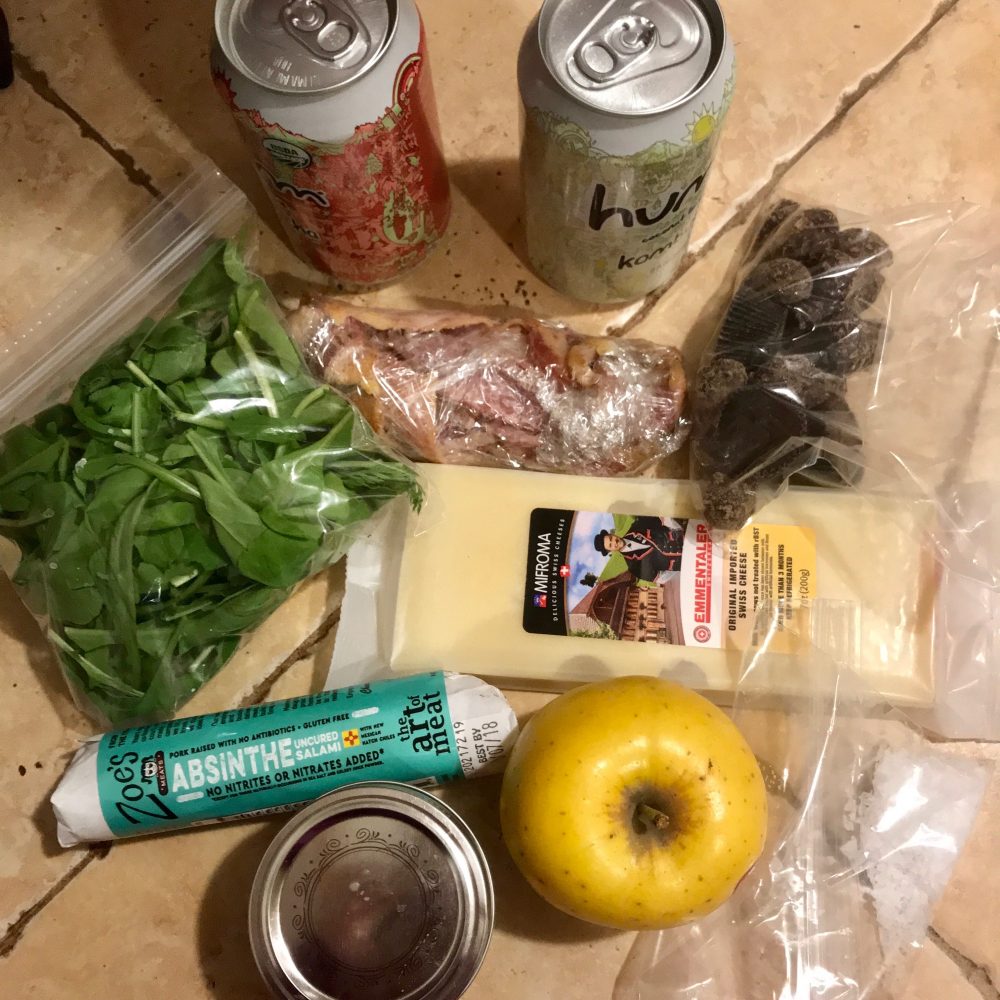
This first photo says it all.
Zoë Roy on-the-go grub.
She’s packed greens, salami, jam, fruit, cheese, bacon, sweets, and kombucha. So good. So tasty. But it for sure is the type of on-the-go food requiring a slight stop.
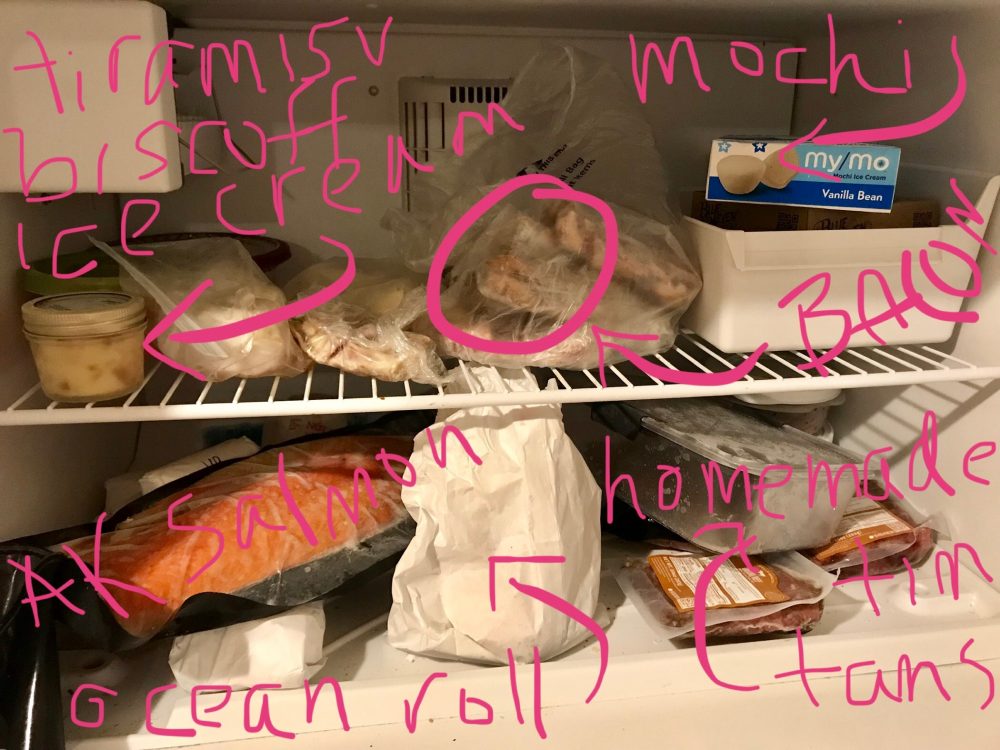
Roy is also known around Bend for her homemade treats and meals. So we also asked for a shot of her freezer to better understand where she is coming from. The freezer, it is often said, is a peek into the soul. Here it is: Alaskan salmon, an Ocean Roll from Sparrow Bakery, homemade ice-cream and some other basics in there. (Note, no freezer burn on any items which indicates a steady rotation of goods.)
Zoë Roy freezer contents.
The Dak Delivery Vehicle
The delivery mechanism is key when it comes to ingesting food. Bread is basic. And it is perhaps humankind’s greatest achievement in nutrition delivery mechanisms. Take a look at Dakota Blackhorse-von Jess’s homemade sourdough – tell us it’s not a golden round of raised dough (see photo).
Once the bread is cooked and sliced, it becomes the perfect vehicle to deliver protein to the system. Fry an egg, toss it on a slice. The sky is the limit here in terms of combining the fundamentals of recovery nutrition with the downright tastiness of the sourdough.
Dakota Balckhorse-von Jess sourdough.
Here’s the recipe:
200g Sourdough Starter
700g 80° water
900g 00 flour (bread flour)
100g Whole Wheat Flour
Combine by hand, let rest for 30-60 minutes
20g salt
Fold to incorporate salt
Let rest 30 minutes
[Repeat 4 times]
Fold (4-fold method)
Let rest 30 minutes
Split dough into two balls, fold to center, put seam down, shape and cover for 10 minutes.
Reshape to build surface tension, place dough ball seam side up into proofing basket
Let proof for 3-6 hours (room temp) or in the fridge overnight (up to 48 hours) for a more sour tasting loaf.
Place Dutch Oven in the oven and turn on to 500°. Let warm up for 30’.
Turn oven down to 450°
Dump loaf into Dutch oven (seam down), score the top, cover and cook for 30′.
Remove lid and cook for an additional 10-20 minutes. Look for dark brown crust (experience will let you cook to suit taste).
Remove loaf and let cool on rack – DO NOT CUT WHILE HOT – this is part of the internal cooking.
Once the crust is slightly warm to the touch (~30’), slice and enjoy!
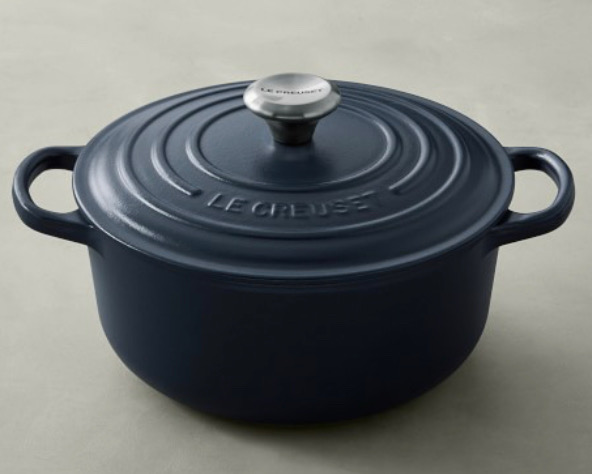
When we asked clarification on “Place Dutch Oven in the oven”, Dak sent this photo.
The Dutch oven.
The Basic
Say you are a college kid or an upstart SMS T2 skier. Or just not that motivated to bake bread. You still need a post-workout nutrition delivery vehicle. There’s the bagel. Nothing perhaps could be more basic than the bagel. Less regal than the sourdough, but tasty too. And perfect for piling on protein and fats.
Lina Sutro (UVM skier on left) and Alayna Sonnesyn (former UVM skier and current SMS T2 athlete) consuming bagels.
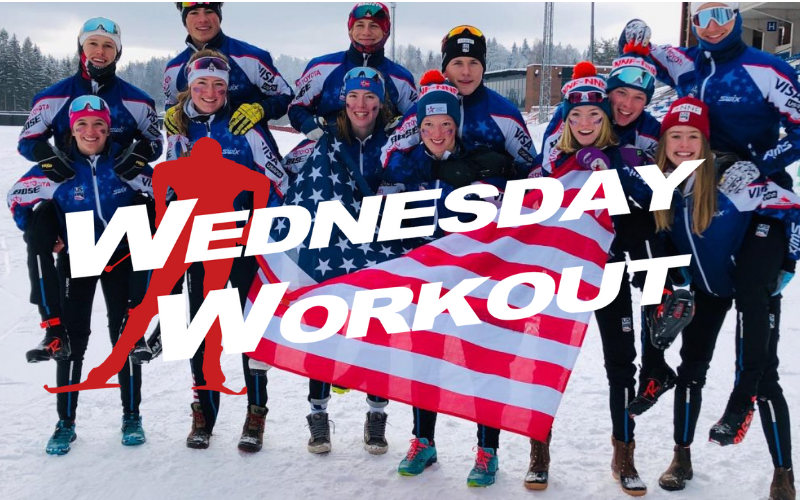
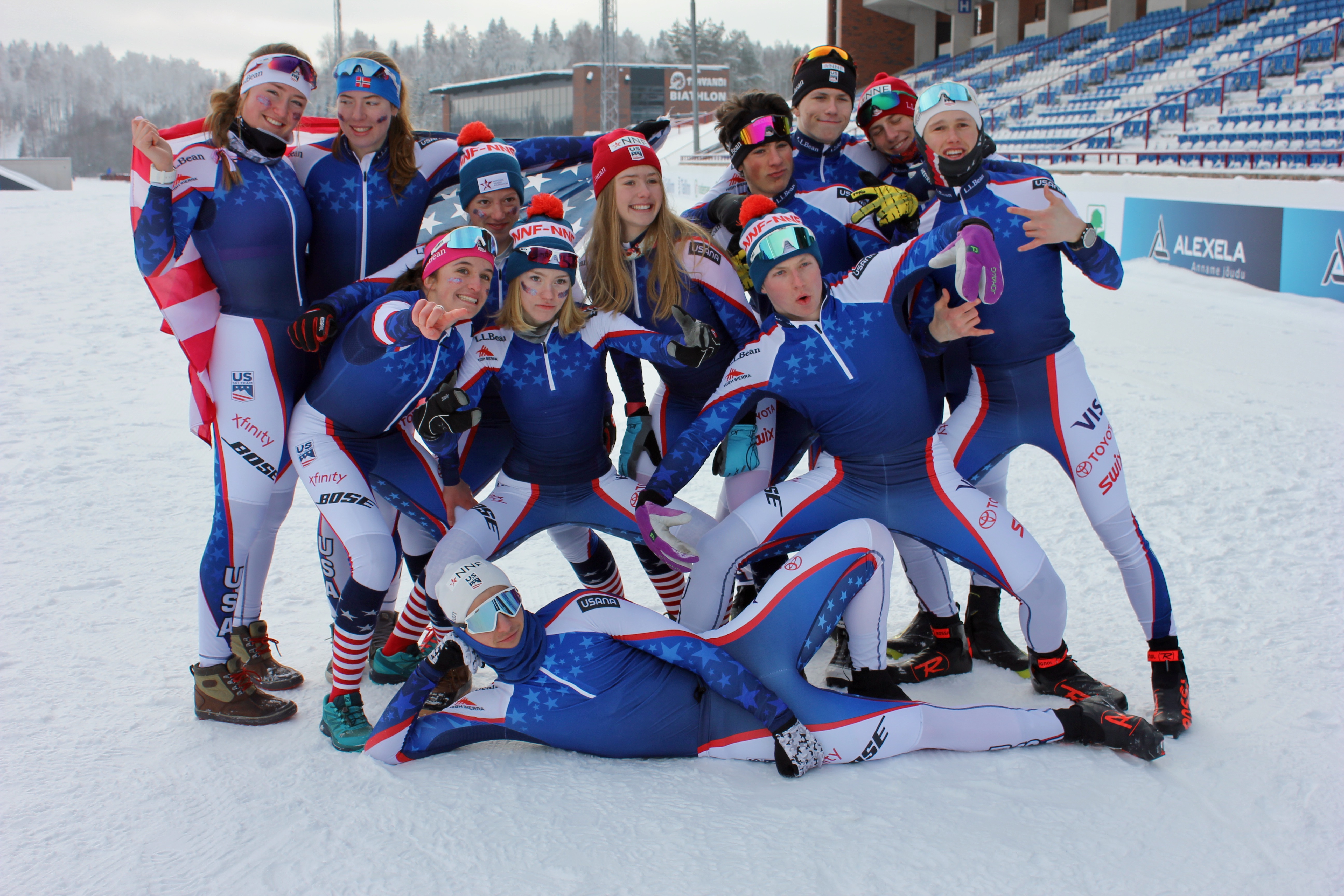
The U18 Nations Cup team poses with the flag in Otepaa, Estonia. Bottom row (from left to right): Annie McColgan (Mt Bachelor SEF), Kate Oldham (AVSC), Charlotte Ogden (SMS), Abigail Streinz (Craftsbury), Adriana Proffitt (Alaska Nordic Racing), Nina Seeman (SMS); Top row: Lane Myshrall (PCSS), Will Koch (SMS), Brian Bushey (GMVS), Michael Earnhart (Alaska Nordic Racing), Joshua Valentine (GMVS), Kai Mittelsteadt (Bridger SF). (Photo: Jane Mittelsteadt)
Kate Oldham is a U18 athlete from Carbondale, CO who skis for the Aspen Valley Ski and Snowboard Club. After strong results at US Nationals, Kate was selected as one of the six female U18 skiers to travel to Otepää, Estonia from January 20th – 30th to race in the Nations’ Cup races, where she competed in a field of about 40 junior athletes from Norway, Sweden, Finland, and Estonia. Kate finished 24th in the 1.3-kilometer classic sprint, and 20th in the 5k skate. The top three members of the team also competed in a 3 x 3k relay.
Staying in peak form while traveling domestically or internationally is a challenge that takes trial and error to dial in, making it difficult for many junior athletes. In this week’s Wednesday Workout, Kate shares what she has learned about staying healthy and ready to race while traveling, and what a typical day in the life of a U18 skier looks like during the Nations’ Cup trip. Here’s Kate’s Write up.
Kate Oldham of Carbondale, CO was selected for the U18 Nation’s Cup Trip in Otepaa, Estonia. (Photo: Austin Colbert/Aspen Times Screenshot)
Being on the road makes recovering from training and preparing for races more challenging. Staying on top of nutrition and self-care are very important since it’s easy to get run down or sick from the added tax on your body. To ensure that I do not allow myself to become depleted, I always bring a snack with simple carbohydrates and lots of protein for right after training, and I make sure that I have a dry change of clothes for when we are done. The snack jumpstarts my recovery since I am replacing the glycogen that is depleted during training and making protein available for my body to begin repairing the muscles that get broken down. It also stabilizes my blood sugar levels so I don’t feel as much of a post-ski crash. The change of clothes keeps me from being chilled on the ride home.
Traveling overseas adds a whole different stress. Sitting during long plane or car rides makes for a stiff body, and the sleep disruption, jet lag, and exposure to new germs can make it easy to get sick. Wearing compression socks or tights, drinking lots of water, and bringing healthy snacks are all key for big travel days. It also helps a lot to get up and walk around whenever possible to keep circulation in the legs. An easy jog or light walk will usually help to flush out lactic acid once I arrive at my destination as well, and can help with adjusting to a time change.
Kate Oldham (AVSC) climbs a hill during the Nation’s Cup 5-kilometer freestyle race in Otepaa, Estonia (Photo: Jane Mittelsteadt)
Luckily, managing daily nutrition in Estonia was fairly easy. The hotel we stayed at was very accommodating and helpful and provided healthy food options. As a backup or to follow a training session, I brought along protein bars and my favorite shake mix so that I always had a really good portable protein source available. My go-to’s are Vega protein powder and Bobo’s peanut or almond butter bars. That way if there are any issues with the meals being served, I can substitute a protein shake in for another part of the meal and still get the nutrients I need. I also use the bars and other protein sources like beef jerky as a quick snack before bed, which helps to sustain glucose levels overnight since they are slower to digest so I’m not as depleted in the morning.
A Day in the Life
Kate Oldham (AVSC) striding forward in the Nation’s Cup 1.3-kilometer classic sprint qualifier in Otepaa, Estonia (Photo: Jane Mittelsteadt)
A day in Estonia begins with a short easy jog or walk to get my muscles moving for the day and to boost my metabolism. Then I eat breakfast, ideally three hours before the start of the day’s race. My usual breakfast before a sprint or 5k is cereal with almond milk, banana, and a scoop of peanut butter, though sometimes I eat something similar with oatmeal instead of the cereal before longer races where I want more sustained energy. After breakfast, I like to stretch before getting ready. Then glitter… very important!!
Around an hour and a half before my start, I head to the venue. I begin warming up an hour prior to the start, then it’s race time! After the race, my focus shifts to recovery again. I switch into my dry clothes and have a quick snack. I like to take a shower if possible to wash the bacteria from my skin and to warm up so I can avoid getting sick on the road. I also try to get in a larger meal within a couple hours post-race, preferably a burrito bowl with rice, beans, lots of veggies, some kind of meat, and all the toppings.
In the evening, we go for a second easy jog or walk to help flush the lactic acid that has built up from the day, followed by some stretching. Then it’s early to bed to rest up for the next day!
The U18 Nations’ Cup team celebrates their accomplishments in Otepaa, Estonia. Back row: (Photo: Jane Mittelsteadt)
Americans and Norwegians train alongside one another at the 2015 International Junior Camp in Oslo, Norway. According to a recent study in the British Medical Journal, nearly 20 percent of Norwegian junior women had disordered eating as of 2010. (Photo: Bryan Fish)
Research across sports and geographic regions has shown that elite athletes have a higher prevalence of disordered eating than non-athletes. For instance, a previous study found that 25 percent of all first-year students in elite sports schools in Norway showed disordered eating, and that for female athletes this primarily resulted from concerns about their appearance.
“Disordered eating is a disturbed and unhealthy eating pattern that can include restrictive dieting, compulsive eating or skipping meals,” Australia’s National Eating Disorders Collaboration explains on its website. “Disordered eating behaviours, and in particular dieting are the most common indicators of the development of an eating disorder. Eating disorders are severe and life threatening mental illnesses. An eating disorder is not a lifestyle choice.”
“[Eating disorders] have severe physical and psychosocial consequences, and are therefore not compatible with sports performance in the long run,” Ingvild Pettersen and her co-authors wrote in the new study.
Their research is notable because it focused explicitly on young female athletes in skiing and biathlon, achieving a large sample size. And the team looked beyond the elite sports schools to see whether sociodemographic factors may change the prevalence of disordered eating.
After the 2009/2010 season, Pettersen’s Oslo-based research group sent out surveys to all the young women who had finished in the top 30 of their age group in at least one Norwegian Junior Cup race. Of the 262 women contacted, 225 responded by filling out the Eating Disorders Inventory-2 and answering questions about their social and demographic backgrounds.
The researchers found that disordered eating seemed to increase with age, with just 10 percent of women in the 17-year-old age category displaying the behavior while more than 20 percent of those in the 18- and 19-year-old categories had disordered eating.
An athlete’s educational situation also played a role, with a high proportion — 28.9 percent — of women who were at elite-sports high schools exhibiting disordered eating. Less than 18 percent of those at any other type of school, including general studies high school, university, or a high school with a sports specialization, showed DE.
“The high occurrence of DE within these schools may be related to their environments,” the authors wrote. “[Elite sports schools] are known for having a high performance pressure. This can result in a performance-focused climate that can predispose to the use of dieting methods in order to improve their performance if the athlete does not cope with the pressure. In addition, the students often move away from home to attend these schools, which may increase the risk of poor nutrition without the parental control.”
The ski and sport schools have been working with a nutritionist as part of the Sunn Idrett (“Healthy Athletes”) initiative, founded in 2008 to help combat eating disorders in female athletes. Biathletes Tora Berger and Tiril Eckhoff and skiers Marit Bjørgen and Astrid Jacobsen are among the ambassadors for the program.
The authors also found a link between sport drop-out and disordered eating, although it was based on only 10 athletes who had ceased practicing their sport. But of those 10, four exhibited disordered eating.
The study design did not allow the authors to address whether drop-out was caused by an eating disorder, as has been speculated in some previous research. The opposite could also be true: the athletes could have developed disordered eating after quitting their sport.
“Athletes who were no longer active had a significantly higher occurrence of DE… than those who were still active, implying that DE may be caused by a morbid fear of fatness and body image disturbances,” the authors wrote.
In other words, once athletes stop training and burning so many calories, they may develop unhealthy eating habits to try to maintain their appearance with lower caloric intake.
In fact, in the study the researchers found that disordered eating in these young athletes was more correlated to body image dissatisfaction than by a drive for thinness.
But as to its ultimate cause and emergence, they concluded that more data was needed. Even by age 17, one in 10 of the women showed disordered eating. Stemming that pattern requires an understanding of the sports and social environment at an even younger age.
“To better understand the causal relationship of the predictors of DE, longitudinal studies are needed on both male and female athletes younger than the junior competing level,” the authors concluded. “There is a need for theory-based research on how we can change and prevent DE behaviour in sports. We need to identify psychological constructs that may influence eating behaviour in sport, and how those factors exert their influence.”
U.S. Nordic Combined skiers Adam (l) and Ben Loomis on a backcountry ski trip in the Rockies near Aspen, Colo. (Courtesy photo)
You’ve heard about the Fletchers, but there are another set of nordic-combined brothers in Park City, Utah, and they’re poised to make an impression on the World Cup.
Adam and Ben Loomis, originally from Eau Claire, Wis., both made the criteria for the U.S. Nordic Combined B-team this season, according to Adam, who has three individual World Cup top-30’s to his name and teamed up with his younger brother Ben in the 4 x 5-kilometer relay in March in Schonach, Germany. With just the Fletcher brothers — Bryan and Taylor — ahead of them on the A-team, the two Wisconsin natives have figurative carrots to chase and plenty of teammates to train with in Park City. But sometimes, the two of them get out for a little quality time.
“Although it’s awesome to get to train together, it’s not too often that this happens on a Wednesday,” Adam, 24, explained in an email. “Ben is in school all summer, so his team trains later in the afternoon than my group typically does. However, on the weekends, we get in some training time together.”
This time of year, the two focus on logging long hours at an easy pace to “build a strong foundation for the season,” Adam continued.
The best time to do that? Weekends.
“A typical weekend session for us is a 3 – 4 hour distance workout, but how we accomplish this depends on the weather and what sounds like the most fun. Weather permitting, my favorite way to get the hours in is on a long backcountry ski. As the snow melts, we get out our bikes, and on the trails, Ben is usually the one leading the way.”
Ben Loomis was one of the 54 “remarkable” people in Eau Claire recently selected by DeLong middle schoolers for their “Humans of the Chippewa Valley” project. (Photo: Karyl Loomis)
Ben is 17, about two weeks shy of his 18th birthday. He moved to Park City two years ago to attend The Winter Sports School in Park City, a college-prep public charter school.
“Adam left home when he was 17 and I was 11 so our workouts were pretty limited,” Ben wrote. “Moving to Park City and living with Adam has been a great opportunity for my training. Adam has been a great partner on long weekend workouts. … He’s like another coach to me, giving me strategy and advice and talking about technique. He’s really helped me.”
So what exactly do they like to do? Ben explained they’ll often hit the trails for a long afternoon.
“A typical workout for us can last as long as 4 hours so hydration and nutrition are key,” he wrote. “I usually bring a bar, a few gels and about a liter of water. Taking small sips and bites throughout the workout is the best way to refuel. Also, thinking about your technique is a great way to pass the time. Incorporating little sprints and drills is another great way to mix up the workout.”
“One way that our team incorporates sprints into our workouts is by racing for town and county signs,” Adam elaborated. “This is an old tradition amongst us when we’re out on group rides on our road bikes. The element of surprise in these sprints makes things fun and interesting and keeps us on our toes.”
“My advice? Setting goals is huge. Think about how you are going to get better every day. Ask yourself, ‘What am I going to do today to get where I want to go the next day, and the next day, and the next day.” — Ben Loomis, as told to sixth graders at DeLong Middle School in Eau Claire, Wis.
As for what a typical training week entails, Adam wrote that late spring calls for three to six long workouts per week, each lasting three hours or more.
“The longer the workout, the more important nutrition becomes, as Ben mentioned. I’m not a big fan of gels, but I tend to graze on bars and ‘chews’ such as Honey Stinger chews throughout the workout,” he wrote. “I also like to have some real food if I’m out for most of the day, like a banana or homemade granola bar, The other week I made rice cakes — which are popular among cyclists and are easy to digest but great for getting sustainable energy for long workouts.”
Most of the intensity workouts are done as a team, as well as a decent amount of distance workouts during the week. But on weekends, training is typically “OYO” — on your own.
“We’ll still meet up with most of the team on many of these days — showing how close we are as a group,” Adam wrote. “But on weekends its easiest for Ben and I to make plans for training at the breakfast table, and then we can go together from there.
“It’s been great to have Ben out in Park City these last couple years,” he concluded. “We didn’t have the chance to train or spend much time together before this, given our 6 year age difference and that I’ve been living out west since high school. Just as cool has been Ben’s quick rise to the international level — suddenly we’re on a much more even level! There’s definitely a special competition that provides extra motivation between brothers!”
The workout: Quality time and conversational distance training
What: 3-4 hour session, either biking, running, or skiing
Bring: Food and water (i.e. energy bar, gels and a liter of water. Take small sips and bites throughout the workout)
Keep in mind:
– Bring a buddy: “It’s important to have a buddy for safety purposes when you’re in the backcountry, and on bikes or trail shoes its just more fun to have someone alongside you,” Adam wrote. “Having fun is important in these sessions — you don’t want to be burned out by June from running laps around a track your city block.”
– Shake it up: “Keep things fresh by making an effort to get onto new terrain, or find variety in your favorite route by going a different direction,” he added.
– Slow it down: “The secret is to take it easy. It’s difficult to go slow too slow, unless you’re out walking your dog, you’re probably going hard enough to get in the training benefit. As our coach Dave Jarrett likes to say — if you’re doing your easy sessions too fast, your intensity sessions will be too slow.”
– Think technique: If the conversation lags, simply focus on technique. “Incorporating little sprints and drills is another great way to mix up the workout,” Ben wrote.
Herbal supplements could land you with not only a doping ban, but also in the emergency room. (Photo: Ano Lobb / flickr creative commons)
With the World Anti-Doping Agency (WADA) prohibiting the use of many stimulants and other drugs, some athletes turn to herbal or “natural” supplements to increase their energy, stimulate weight loss, or ensure that they are receiving necessary minerals and nutrients.
This can have catastrophic consequences for an athletic career. Because such supplements are largely unregulated, what’s in the box may not match the listed ingredients.
There have been roughly 1,000 positive tests for that stimulant, methylhexaneamine, most of them accidental by athletes who were using herbal supplements which they had assumed would be safe.
A new study published in the New England Journal of Medicine shows another reason to avoid herbal and “natural” supplements.
The paper, authored by Dr. Andrew Geller and colleagues at the Centers for Disease Control and Prevention, finds that over 20,000 emergency room visits per year in the United States can be attributed to such supplements.
The authors frame the topic with some stats on herbal supplements: there are over 55,000 of them on the market, as of 2012. About a third of Americans use “complementary health approaches”, with one in five taking supplements other than vitamins. And the market is work billions of dollars.
One might assume that the large and profitable market means that manufacturers don’t have much incentive to improve labeling or safety in the near future: if it’s not broke, don’t fix it?
It has been hard to track health problems caused by supplements because only the most serious, for instance hospitalization and death, are required to be reported.
To close the data gap, Geller and his colleagues looked at 10 years of data from each of 63 hospitals around the country. They looked for emergency room visits caused by supplements, excluding drinks like energy drinks or the tea supplements that tripped up Sachenbacher-Stehle. So their data may actually underestimate the complications caused by products from the herbal supplement industry.
With only non-food and non-drink supplements counted, the authors estimated that between 18,000 and 27,000 emergency room visits per year were caused by the products. About 2,000 of those visits each year led to hospitalization.
Alarmingly, almost a quarter of the emergency room trips were caused by allergic reactions to the supplements.
Another 10% were caused by the patient taking a larger dose than suggested. Many people seemed to think that because a supplement was “herbal” or “natural”, there was no such thing as too much – but many substances and chemical compounds can become toxic at a certain level. After all, most synthetic drug compounds either replicate or imitate compounds found in nature.
The study also found that herbal supplement use can damage other people in a patient’s family, with just over 20% of the emergency room visits due to “unsupervised ingestion” of a supplement by children in the house.
But back to athletes. The majority of the cases came from supplements claiming to promote weight loss, increase energy, or provide micronutrients like calcium, iron, and potassium.
Those are exactly the sort of products which may appeal to athletes hoping to become more lean or have more zip in their training, but who avoid regulated drugs because they include banned supplements.
For instance, a 2011 study found that between 70 and 80% of elite Finnish athletes used nutritional and dietary supplements, but less than a third had ever consulted a dietary specialist about why or how to do so.
Those types of supplements may be even more dangerous than the stimulants athletes are trying to avoid.
“Weight-loss or energy products caused more than half these visits, commonly for cardiac symptoms (palpitations, chest pain, or tachycardia),” the authors of the new study wrote. “Notably, cardiac symptoms were documented more frequently in emergency department visits for adverse events associated with weight loss (43%) and energy products (46%) than for prescription stimulants.”
The message? There’s even more reason to limit the number of substances and supplements which athletes rely on. Talk to a doctor and rely on safe, regulated products which are not on WADA’s banned list, or focus on a balanced diet and a healthy lifestyle to keep the pep in step.
A scene from the start of the 2015 Uitslagen Ladiesrun in Rotterdam. A recent study published in the Scandinavian Journal of Medicine & Science in Sports is shedding light on low energy availability and eating habits of competitive female athletes. (Photo: Wikimedia Commons)
We have written before about the prevalence of eating disorders in female athletes, but a new study attempts to describe the diets of female endurance athletes who have low energy availability and/or skipped periods.
What is energy availability? It is the amount of energy left over for the body to go about its functions and maintain homeostasis after the number of calories expended on exercise is subtracted from the number of calories consumed. Unsurprisingly, it is very important for overall health; low energy availability is a risk, whether it is linked to an eating disorder or not.
The results of the new study show definite patterns in dietary habits among female athletes with low energy availability and skipped periods, and enable the researchers to suggest specific nutritional changes that women can make to maintain their energy intake even when training at a high volume and intensity. Notably, replacing calories obtained through fiber with those derived from carbohydrates might significantly avert the risk of skipped periods and gynecological problems.
Writing in the Scandinavian Journal of Medicine & Science in Sports, Danish researcher Anna Katarina Melin and her colleagues describe studying the eating habits and health of 45 national-level and competitive runners, triathletes, and orienteerers who train at least five times a week. They trained an average of 12 hours per week, plus or minus six hours, and had an average VO2Max of 54.5 mL/kg/min.
The research focused on women whose eating habits are perceived to be normal or irregular, but not to a dangerous extent, and examine how this relates through exercise to health. In initial screening, 11 of the women were found to have disordered eating – that’s roughly 25 percent — and were excluded from the rest of the study.
Those with low energy availability trained 25 percent more than the other women, corresponding to 37 percent more energy being spent on training. Those who skipped periods had 15- to 20-percent lower fat mass on their bodies, although their body mass index (BMI) was not significantly different from athletes who did not skip periods. (This is yet another indication that BMI is not an accurate assessment of health or fat.)
Unsurprisingly, the researchers found that energy availability was associated with how many calories the women consumed, as well as with how many macronutrients, proteins, and fats were in their diet.
The athletes with low energy availability ate less energy-dense foods: that is, foods that provided fewer calories per gram. Athletes with low energy availability also ate fewer than the recommended amount of carbohydrates (6 g per kilogram of weight per day) and ate 26 percent less fat than athletes with optimal energy availability.
Usually, when female athletes have low available or energy or skip periods, it is recommended to gradually increase caloric intake by small amounts so as to regain health without gaining weight.
The research team suggests a more detailed approach: to consider how much energy is being expended in training, and then to make up the deficit in calories with the recommended amounts of protein and, in particular, carbohydrates, which so many of the athletes had been missing.
Meanwhile, the athletes who skipped periods showed a pattern of consuming more than the recommended amount of fiber per day, and much more than the women whose menstrual cycles remained regular.
The researchers write that while the general population is often encouraged to eat more fiber for very good reasons, exceeding the recommended amount of fiber intake brings consequences. A high-fiber diet leads to more excretion of fat and other energy sources, and some kinds of fiber also delay food processing so that an individual feels satiated and does not end up eating as much.
“These fiber-related effects are normally seen as beneficial,” the authors write. “However, in endurance athletes with a high total energy expenditure, they can potentially become problematic since high-intensity exercise also has been shown to have an acute suppressive effect on appetite.”
And finally, high levels of fiber intake have been shown in other studies to be related to lower estrogen levels. This is because estrogen, like fats, binds to fiber in the digestive tract and is excreted instead of being reabsorbed into the body. This might be the mechanism which leads the female athletes with excessively high-fiber diets to skip periods, which puts them at risk for other health problems.
Thus, in addition to making up missing calories with carbohydrates, the researchers suggested that women with low energy availability or skipped periods replace some of the fiber and whole grains in their diet with carbohydrates and energy-dense foods. In particular, they suggest drinking drinks that contain calories, such as juice, dairy, sports drinks, or smoothies, instead of water some of the time.
And, even though none of the athletes had diagnosed eating disorders, the team found that some had a “drive for thinness” related to their pursuit of excellence in their sport. These athletes, even though their diets were more or less following normal patterns, did tend to have lower energy availability and an increased prevalence of skipped periods.
Thus, the authors argue that even slightly restricting caloric intake can have health consequences.
“Our results indicate that even a slightly increased drive to lose or maintain a low body weight is associated with dietary characteristics likely to increase the risk for persistent LEA and FHA,” they concluded. “Handling the issue of leanness and body weight with care is therefore of paramount importance in sport environments.”
The following is brought to you by professional nutrition coach Georgie Fear, a Registered Dietitian and former rower, marathoner and ultrarunner, who recently co-authored the Racing Weight Cookbook. For more on Fear and her nutrition tips and recipes, visit askgeorgie.com.
***
In the fall, training volume for winter athletes is generally at its highest. As the season approaches, athletes want to be strong, fast, and lean, and putting in the hours to train is essential. It’s also critical for good nutrition to be a part of your routine, so that you can ward off illness. After all, getting sick can cost an athlete days or even weeks of critical workouts, and competing while fighting a bug is unlikely to lead to your best performance.
Should you load up on Vitamin C? Drink gallon of echinacea tea? How can you give yourself the best odds of fighting off infections this winter?
Read on for evidence-based nutrition tips to keep your immune system as strong as can be while you hit your peak training volume and performance.
Carbohydrates During Training
Intense and high-volume exercise is known to result in immune system suppression. Training stimulates the release of cortisol and other stress hormones, which decrease the synthesis of immunoglobulins and the proliferation of white blood cells. Consuming carbohydrates while training dampens the rise in cortisol and other stress hormones associated with intense exercise. It also appears to limit exercise-induced immune suppression.
To keep your immune working full-throttle while you’re training hard, consume 30-60 grams of carbohydrate per hour while training, instead of waiting until after your workout to begin refueling.
Consume Enough Protein and Calories
Diets which are too low in protein have been shown to impair immunity by decreasing phagocyte and T-cell function. There is evidence that hard-training athletes should consume at least 15% calories from protein to maintain immune function. Rather than breaking out a calculator to ensure that you get enough, a foolproof way is to include at least one high-protein food each time you eat, such as eggs, meat, poultry, seafood, protein powder, cheese, yogurt, soy, or beans.
When training volume is high, it becomes a challenge for some athletes to eat enough calories, making them more vulnerable to glycogen depletion, overtraining syndrome, hormone disturbances and immunosuppression. Liquid calories can help boost total energy intake, and increasing carbohydrate intake before, during and after training sessions can help maintain intramuscular glycogen.
Vitamins and Minerals
Many vitamins and minerals play a role in keeping your immune system strong. Vitamin B12 (found in beef, turkey and seafood), and folic acid (found in spinach and avocado) are needed for the synthesis of red and white blood cells. Deficiencies in copper, selenium, or iron weaken the immune system by impairing macrophage production, natural killer cell activity, and antibody formation. Whole grains, beans, nuts and seeds are rich in vitamins and minerals, and make excellent staples to add into your meals. If you need some meal ideas, there’s more than 100 dietitian developed and athlete-approved recipes in the Racing Weight Cookbook.
What About Supplements?
If I could make only one supplement recommendation to winter athletes to stay healthy, it would be to supplement vitamin D, especially in the winter months. The amount of circulating vitamin D in an athlete’s blood correlates not only with the number of times they get sick each year but also with symptom severity and duration of illness. In other words, getting enough vitamin D benefits you three ways: you’re less likely to get sick, and if you do get a cold, it’s milder and shorter-lived.
Vitamin D is very sparse in natural food sources, and even in countries where milk is fortified with vitamin D it is at a low enough level that sub-optimal vitamin D intake remains widespread. Very little of this vitamin is diet-derived; almost all of the vitamin D in the human body is synthesized in the skin in response to UV exposure. For those in warm, tropical climates where the sun shines abundantly, synthesizing vitamin D year-round is no problem, but for much of the year it is impossible to synthesize ANY vitamin D north of 35 degrees latitude, due to the angle of the sun’s rays. That means across most of the United States and all of Canada, you couldn’t synthesize enough vitamin D even if you trained outdoors every day naked (though it might make your social life interesting). So taking a vitamin D supplement of at least 2,000 IU (International units) and up to 5,000 IU is paramount during the winter.
Supplementing with Vitamins C and E has been shown in some studies to reduce the incidence of upper respiratory tract infections in athletes, but other trials have observed no effect, so the evidence is not clear if supplementing these nutrients is definitively worth it. It’s unlikely to do any harm however.
Dietary zinc plays an important role in thymic function, lymphocyte development, and resistance to infections. Inadequate dietary zinc lessens immunity, but excessive zinc intake (as found in high dose supplements) also damages the immune system. Thus, mega-doses of zinc are not recommended. Research supports supplementing 10-20 mg per day of zinc, especially for vegetarians, who naturally consume less zinc. (For reference, the megadoses which negatively impacted the immune system were more than ten times this amount, totaling 300 mg per day).
Most of the athletes I work with choose to take a multivitamin in addition to choosing a varied diet based on whole, nutrient rich foods. This can be a good way to make sure that your vitamin and mineral bases are covered, but is by no means license to ignore your food intake. Whole, unprocessed foods are still the cornerstone of a high performance diet. Rumor has it that traveling on the World Cup circuit means that fresh vegetables are hard to come by in some places, but if you have a daily multivitamin on hand, at least you know most of your micronutrient needs will be met.
What to Do
In summary, to avoid immune system suppression associated with peak training volume:
Drink a carbohydrate-containing beverage during all intense workouts, aiming for 30-60 grams of carbohydrate per hour of exercise.
Follow up training with a recovery meal as soon as possible, containing a 3:1 or 4:1 ratio of carbohydrates to protein.
Eat nutrient rich foods such as whole grains, lean proteins, nuts and seeds, and a colorful array of vegetables and fruit.
Eat enough to maintain your weight, and include a protein-rich food at each meal
Take a multivitamin providing about 100% of the recommended daily intake of vitamins and minerals, and supplement with additional Vitamin D during the winter months (2000-5000 IU per day).
Check out the Racing Weight Cookbook for delicious recipes and more guidance on getting enough carbohydrates, proteins and nutrients for optimal performance and body composition.
***
Georgie Fear is a professional nutrition coach whose advice is sought after by athletes ranging from NCAA standouts to Olympic gold medalists. A Registered Dietitian and former rower, marathoner and ultrarunner, Georgie has been helping clients get leaner, healthier and faster since 2005. Her writing and recipes appear at www.AskGeorgie.com.
Kikkan Randall racing the classic sprint at the 2010 Olympics in Vancouver.
On race morning, with all its accompanying nerves, it’s hard enough for cross-country skiers to choke down a single meal. But for sprinters, that’s a scenario that sometimes must be repeated three more times before the day is over.
With races sometimes stretching over several hours, from a qualifying round through three heats, sprinters know that a steady intake of food and drink is crucial to maintaining high energy levels—though that’s easier said than done, between pre-race butterflies and post-race nausea.
To get a sense of just how they meet their nutritional demands, FasterSkier caught up with Andy Newell and Kikkan Randall—two Americans who also happen to be two of the best sprinters in the world.
For Newell, preparation for a weekend of racing actually begins two nights prior to his first event, when he begins a carbo-loading regime. According to Newell, that’s because the human body burns more carbohydrates in sprints than in any other race format.
To meet his needs, he said that he doesn’t adjust portion sizes—just ratios.
“I might skip out on a bunch of vegetables or salad, and try to eat more carbohydrates two nights and the night before,” he said. “Usually, we do a pretty hard workout the day before a race, so you want to be pretty loaded up with carbohydrates in order to make it through that…You don’t want to be already in carbohydrate-deficit before going in.”
Randall said that she’ll also have some kind of snack before bed time the night prior, like cereal. Race morning brings a standard breakfast, though she said that she is always sure to finish hers at least three hours before her start. She’ll also sip sports drink until heading out on course.
Andy Newell
Post-qualifier is when the work really begins—and it’s also when the feeding gets tougher.
“The last thing you want to do is eat. I just try to grab my drink belt and stumble out,” Newell said.
But between the prelims and the start of the heats, sprinters usually have at least an hour off, and during that time, they force themselves to down some kind of food.
Randall said that she’ll usually eat a small sandwich, with honey or jam on bread, while Newell said that he’ll eat a banana or an energy bar. He said that he also will sip some type of sports drink continually—as much as three liters over the course of the day, if he goes all the way through to the finals.
Both athletes also caffeinate before the rounds, which can give an extra edge. Many Europeans opt for good old Coca-Cola; Newell said he tried that, but ended up with an upset stomach. Instead, he takes the drug in pill form, while Randall said that she prefers “gel blasts” made by PowerBar, one of her sponsors, which she’ll eat through the semifinals and finals.
Sometimes, there’s good food provided by organizers in the athletes’ tent, but Randall said that it’s usually too rich, so she doesn’t depend on it. She brings key nutrition products to Europe from the U.S., while things like sandwiches she plays by ear.
“It’s definitely a challenge over here,” she said. “Some of the guys get whatever sports drink they can find…sometimes it’s hard to come by, and it’s different every time.”
When the heats are over, it’s time to replenish energy stores as quickly as possible, even though all the racing doesn’t exactly work up an appetite.
“After a sprint race, most of the time, you feel like crap,” Newell said. “You’re usually not hungry.”
Still, he said, he’ll force something down—some kind of recovery shake or drink within 20 minutes, and then a big dinner. More carbohydrates are in order if there’s another race the next day, as well as some protein to repair torn muscle fibers.
Newell and Randall have both developed their own regimes, but the World Cup travels to many different venues—and timetables for sprint races are rarely are the same week-to-week. That means that their systems aren’t set in stone.
“It’s definitely been a long process—I can remember going to Junior Nationals, doing my first few sprints, and having no idea you needed to eat during the race,” Randall said. “I’m still figuring [it] out a little bit.”
This is the first article in a four-part series on eating to perform while balancing life and training demands. The information provided here is from the Norwegian organization “Sunn Jenteidrett,” which published the “Eat Smart” cookbook and resource guide on nutrition and training. Sunn Jenteidrett is dedicated to increase the awareness about nutrition and performance among young athletes, and is a joint effort of the Norwegian Ski Association, Norwegian Orienteering Association and Norwegian Track and Field Association, backed by the Olympics Development Center.
Eat at least four meals per day. Never go more than three to four hours between eating. Fill in with snacks to avoid going on empty and maintain steady energy throughout the day. All main meals should consist of carbohydrates, proteins and fats, all of which supply energy to the body.
A quick run-down of some important food groups here:
Dairy supplies both proteins, carbs, calcium and other important nutrients. Photo: Inge Scheve
Carbohydrates – the most important energy source for athletes. In order to get enough carbs, start the day with oatmeal, thick slices of bread, or cereals. Crackers and crisp breads are lighter and thinner, and supply less carbs.
Choose whole grains – pick cereals and breads that are high in whole grains and low in sugar. It’s easy: look for whole grain up high and added sugars low on the ingredients list. Whole grains keep you full longer, keeps your blood sugar levels more even, and contain more vitamins and minerals than refined grains.
Proteins – Try to include at least one source of protein with your breakfast. Toast with just jam and a glass of juice contain no significant protein sources. If you add a glass of milk, make your oatmeal with milk (or pour milk over it), or eat your toast with some ham or cheese, you’ve significantly improved this meal.
Calcium – Crucial for strong bones! Milk and dairy products are the most important sources of this mineral. Three servings of dairy product per day will cover your recommended daily intake for calcium. One serving is a piece of bread with cheese, a small container of yogurt (4 oz.), or a glass of milk (8 oz.). Additionally, milk and dairy contribute other important nutrients and minerals.
Fruits and vegetables – “Five a day” is still a good rule of thumb. Try to eat two servings of fruit and three servings of vegetables per day, and more is a bonus! Make sure you have fruit and/or vegetables at every meal, including breakfast. Drink a glass of juice, or use sliced veggies as garnish for sandwiches. Add fruit or berries to your oatmeal or cereal. Not only is this healthy, but it contributes to variation and adds color to your morning routine.
So how do you turn all of these good intentions into action?
The number-one rule for getting healthy food onto the table is having the right stuff on hand. Make sure your kitchen is stocked with the basics.
Dry stuff: All-purpose flour, whole wheat flour, oatmeal, cereals, sugar, pasta, rice and noodles, sauce and soup mix, dry yeast, taco shells, flour tortillas, nuts and raisins, salt and pepper, as well as spices like thyme, basil, oregano, cinnamon
Cans, jars and bottles: Pasta sauce, canned tomatoes and tomato paste, corn, beans, olive oil and canola oil, Tabasco sauce, sweet chili sauce, soy sauce, ketchup, honey, beef/chicken/vegetable broth
In the freezer: bake-off rolls and bread, pita bread, vegetables, ground beef, frozen berries
In the fridge: Ham/lean lunch meat, bacon, milk, low fat sour cream, plain yogurt, eggs, cheese, butter, sundried tomatoes, pesto, orange juice/apple juice
Vegetables: Onions, leeks, carrots, broccoli, lettuce, cucumber, bell pepper, tomatoes, ginger and garlic
Get started: Building a great breakfast
Breakfast is the most important meal of the day – it’s been said before and it will be said again. Do not skip breakfast, no matter how much of a hurry you’re in. It’s your first chance to fill your fuel tanks with energy for training, school, work and other activities. Even if you have an early workout, make sure you ingest something before heading out the door. If you have trouble eating anything substantial right before a morning workout, try oatmeal with extra water – letting it boil a little longer to absorb the extra liquid makes the grains easier to digest.
Good Morning Oatmeal (Photo courtesy of brodogkorn.no)
Here are some options:
Oatmeal in any way you like it – add chopped apples, sprinkles of cinnamon, globs of jam or jelly, or raisins and chopped almonds… Be inspired!
Cereal and yogurt – check your cereal: Many store-bought cereals are high in added sugars. Look for varieties with little added sugar, and sweeten things up by adding fresh or dried fruit, a little honey, or vanilla yogurt (instead of plain).
Recipe: Christine Helle’s Muesli (Helle is a nutritionist with the Olympic Development Center in Oslo, Norway)
Make the muesli the night before, and add fresh fruit and berries when you eat it the next morning. This muesli is great for those who struggle to eat on race mornings, and it also makes a good snack to bring to the race venue for some extra energy before the event – or even as recovery fuel after a race or a hard workout. Use whatever fruit you have – the varieties listed below are suggestions.
What you need:
1 Cup mixed grains (rye, spelt, wheat)
1 Cup oatmeal (not quick oats)
¾ -1 Cup apple juice
2 Cups yogurt (honey or fruit sweetened)
1 apple, shredded
1 banana, sliced
¾ Cups fresh berries or fresh cut-up fruit
¾ C milk
What you do:
The night before – mix grains, oats, juice and yogurt in a large bowl. Add a shredded apple (or a handful of raisins and chopped almonds). Mix well, and set in the fridge until the next morning
In the morning – Slice the banana and dice other fruits if you choose to use them. Carefully fold the fruit and milk into the fridge mixture. This recipe makes four servings.