Tag: NYSEF

  • Keys to the Castle and Free Fall Rollerski Races Light Up the Northeast

    Keys to the Castle and Free Fall Rollerski Races Light Up the Northeast

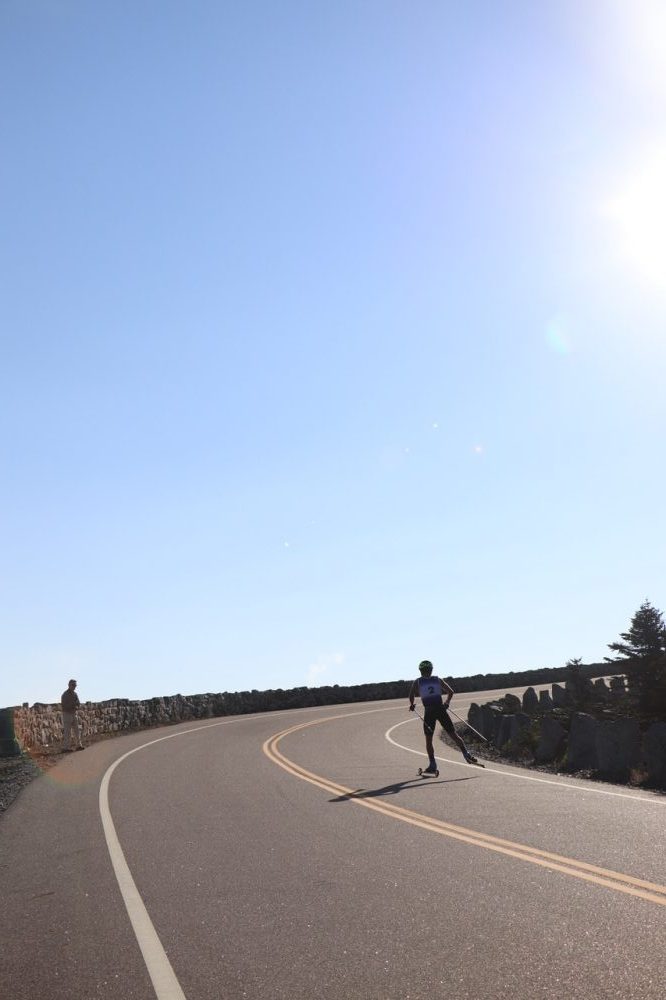
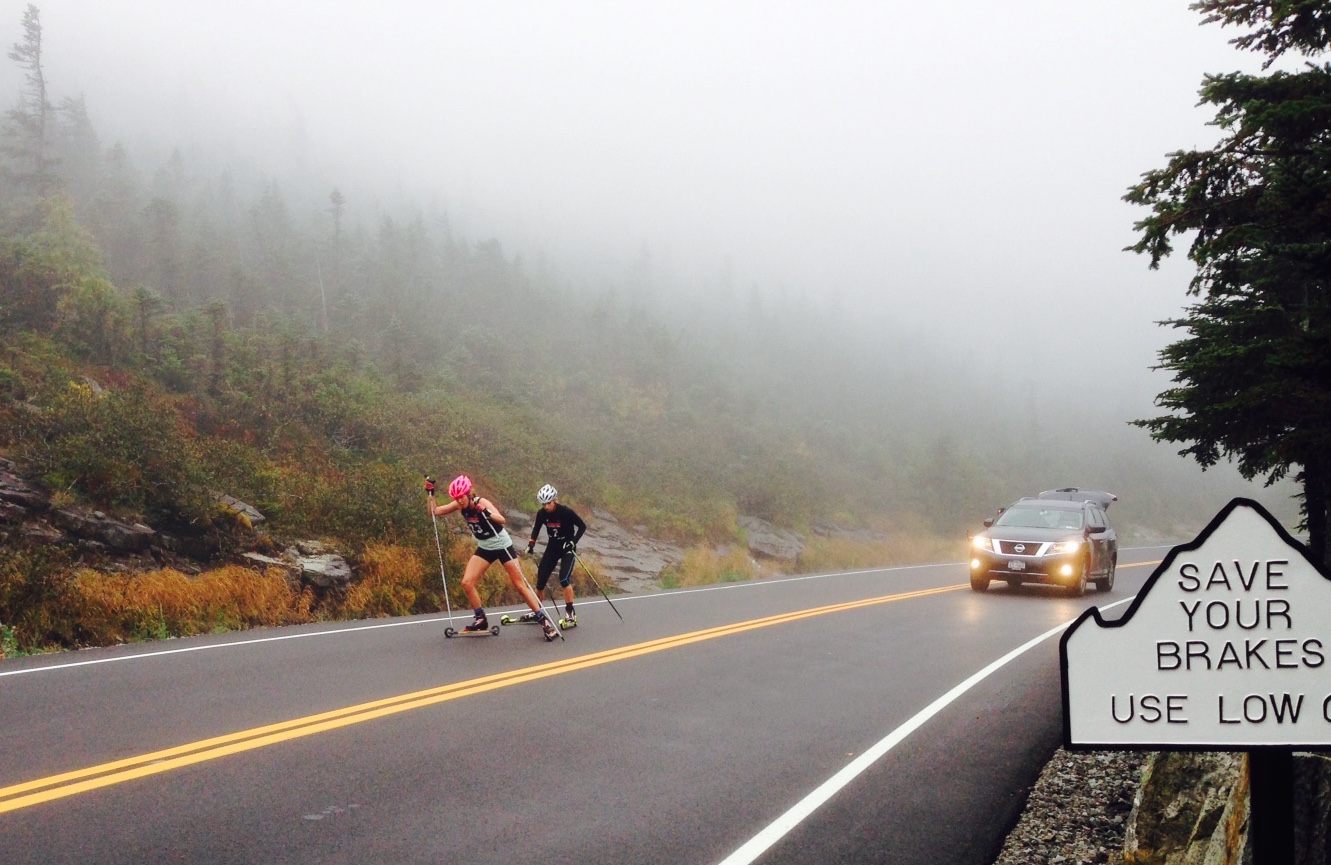
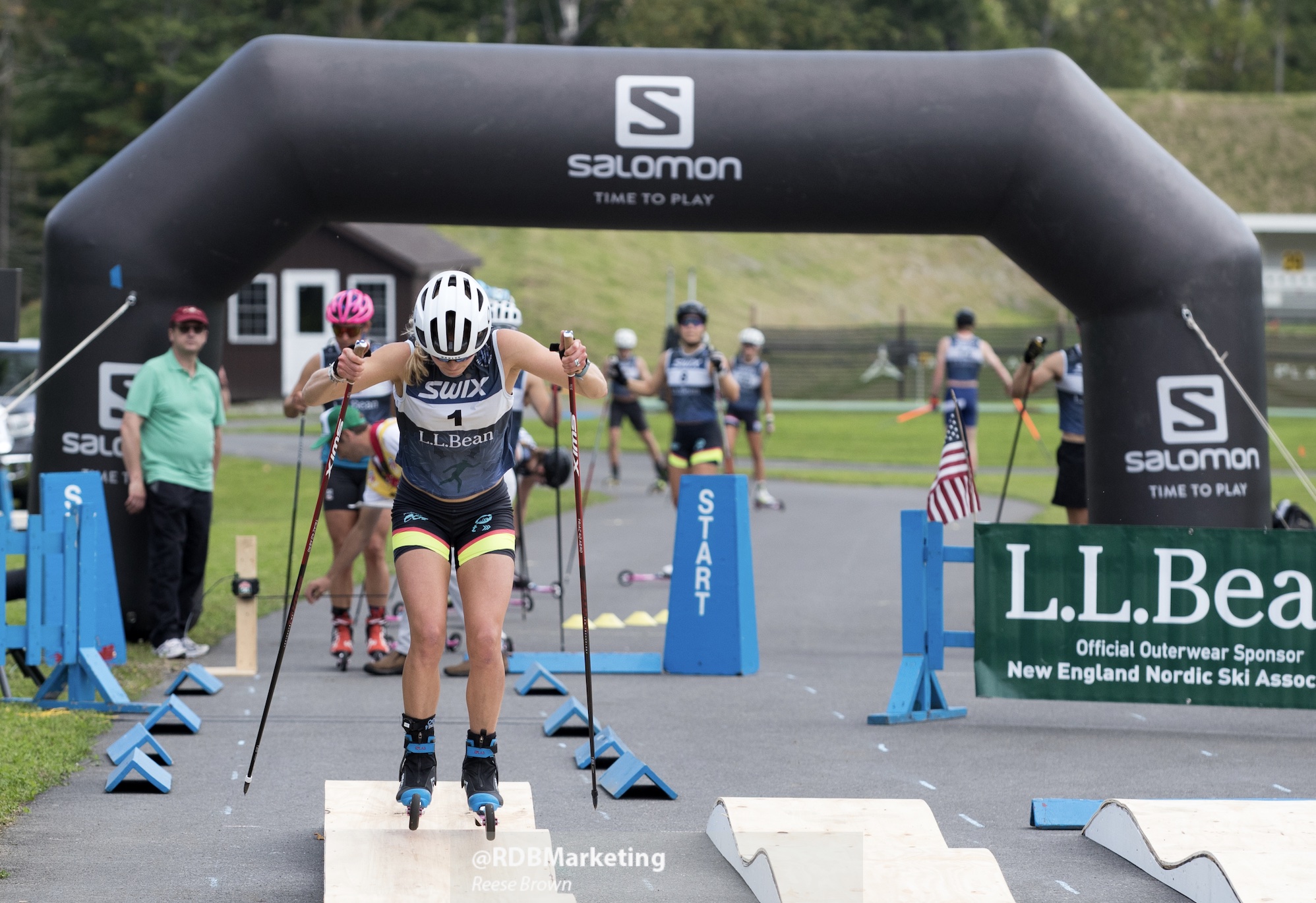
    Over the bumps, Jessie Diggins heads out for her qualifier during the Keys to the Castle rollerski race in Lake Placid, NY. (Photo: Reese Brown / RDB Marketing)

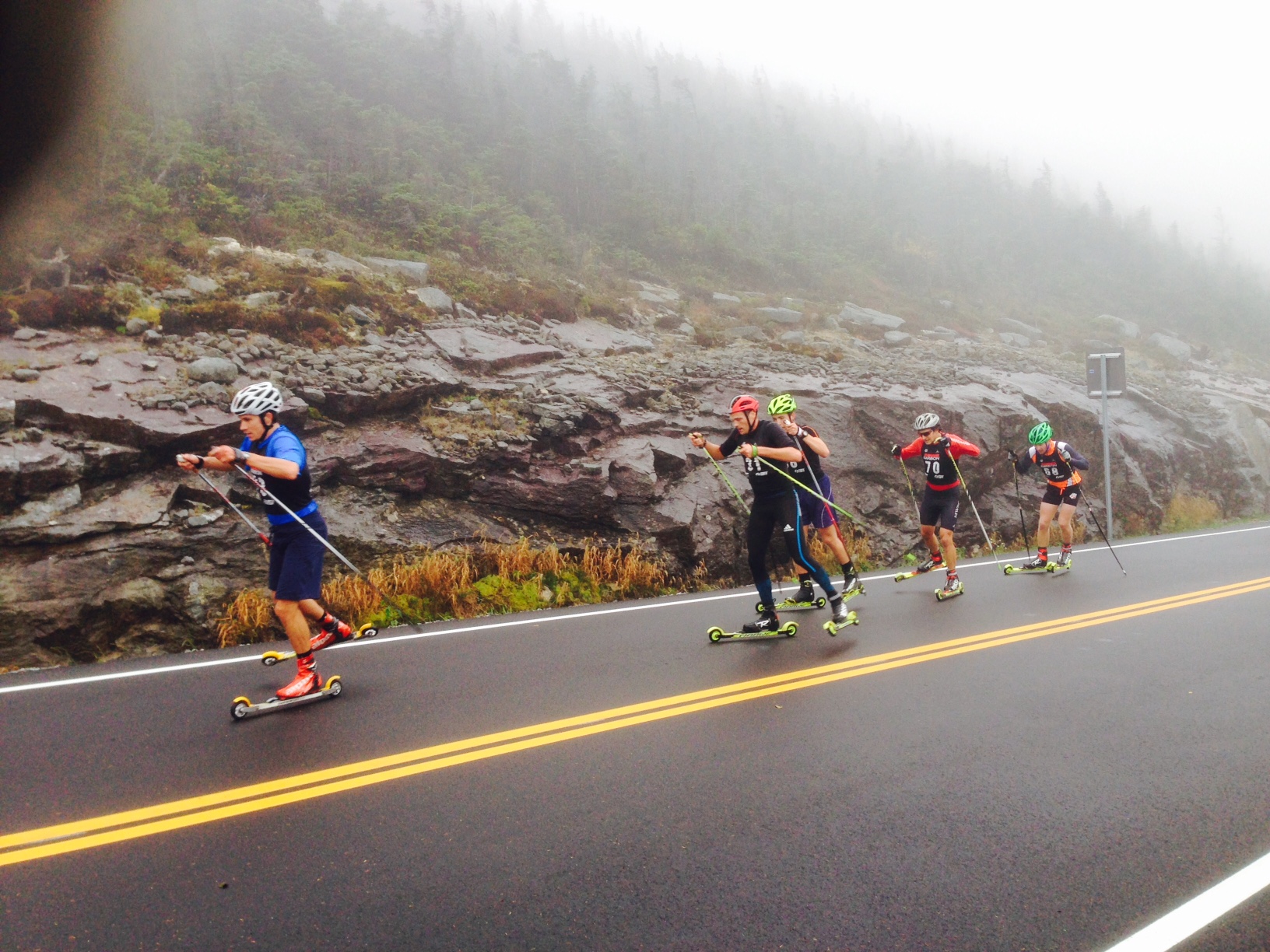
    As summer turned to fall, skiers from the Stratton Mountain School T2 team (SMS T2), the Sun Valley Gold Team (SVSEF), and the Bridger Ski Foundation Pro Team (BSF) met in Lake Placid, NY for a collaborative training camp, capped off with two stages of rollerski racing. The weekend featured a freestyle sprint event — The Keys to the Castle — on the rollerski track at Mt Van Hoevenberg, followed by a distance stage dubbed the Free Fall Rollerski Race in Jericho, VT. These events are perhaps the climax of NENSA’s summer rollerski series, which has helped feed the energy and momentum of the cross country ski community throughout the Northeast. 

    “Lake Placid and Jericho were fantastic events and the beginning of the vision becoming a reality,” NENSA competitive programs director Justin Beckwith shared in an email. “They also highlight the amazing partnerships we have with clubs, venues and sponsors. We have four more roller races this fall including Climb to the Castle this weekend, which is paired with our Eastern Coaches Symposium — back in the Empire State. The really exciting part is we hope to carry the enthusiasm from rollerski into our Popular Race calendar, which will be released in the coming month.”
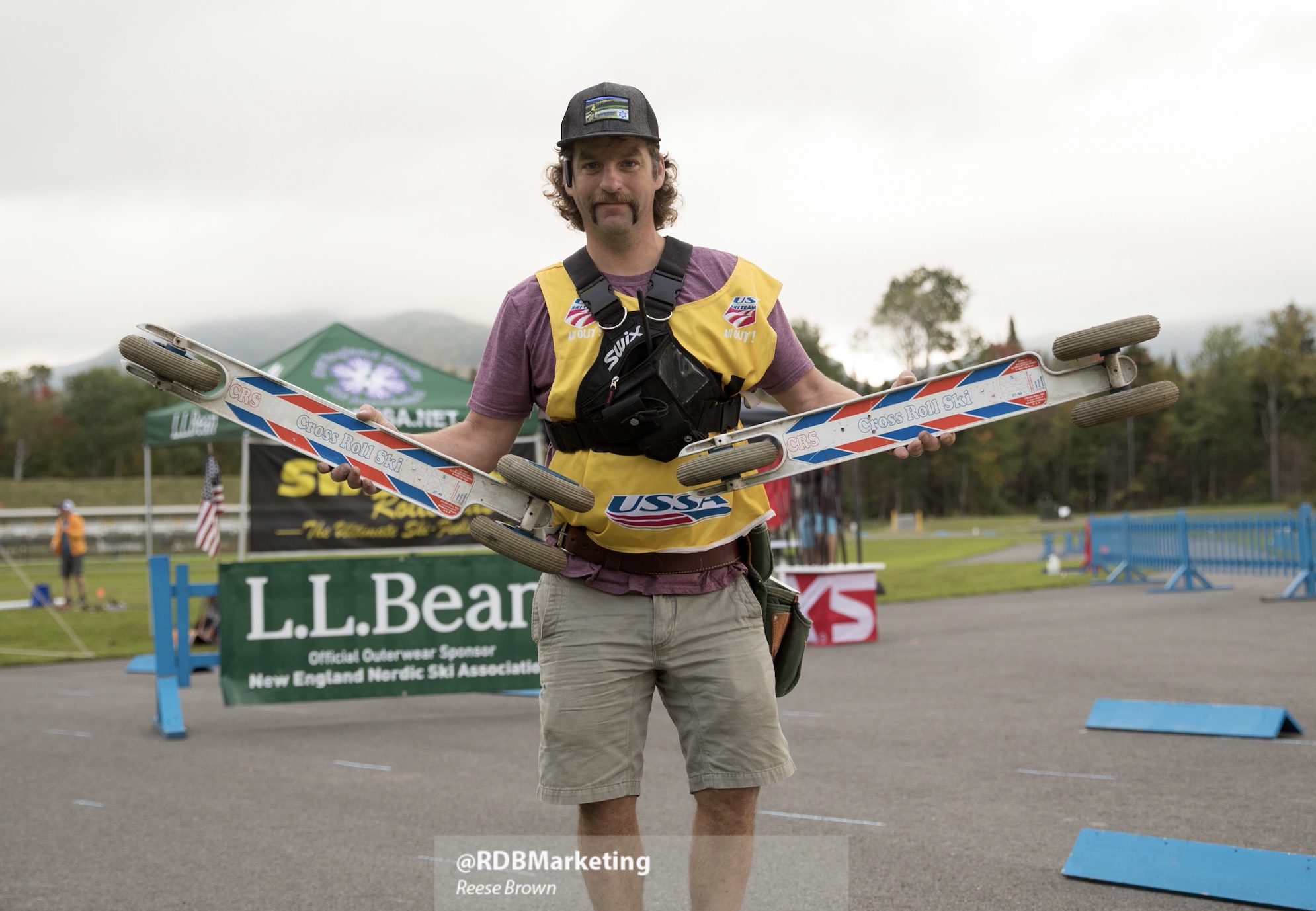
    The man behind the wheels: NENSA competitive programs director Justin Beckwith. (Photo: Reese Brown / RDB Marketing)

    After a year with minimal opportunity for cross-club collaboration, the events provided not only a solid training stimulus, but also invigorated the teams as they prepare for the upcoming season. It left U.S. Ski Team head coach Matt Whitcomb scheming about the opportunity to grow the events in the years to come. 

    “Pulling off a stage-style roller ski race weekend, with over 100 competitors on two different roller-ski tracks, reminds me of summer racing in Norway and Sweden,” wrote Whitcomb in an email. “NENSA has upped its game. Think of the potential, too; we could do four stages, using four different tracks, and all within 1-2 hrs in VT and NY. Start in Craftsbury, move on to Jericho, and then to each of Lake Placid’s tracks. Everyone camps together at each location, and it’s just a giant summer ski party.”

    The facilities at Mt Van Hoevenberg, home to the 1980 Olympics and an Olympic & Paralympic Training Center, have been undergoing extensive renovations and improvements, including the building of the new four-kilometer rollerski track which was finished this past August. (You can take a tour of the track via YouTube courtesy of Paul Schommer/Biathlon Uncharted.) 

    “If I win the lottery, I’m putting in more roller-ski tracks in the U.S.,” said Whitcomb. “It’s a game-changer to not have to worry about cars. Also, the best way to replicate the demands of a ski course is to ski on a ski course.”
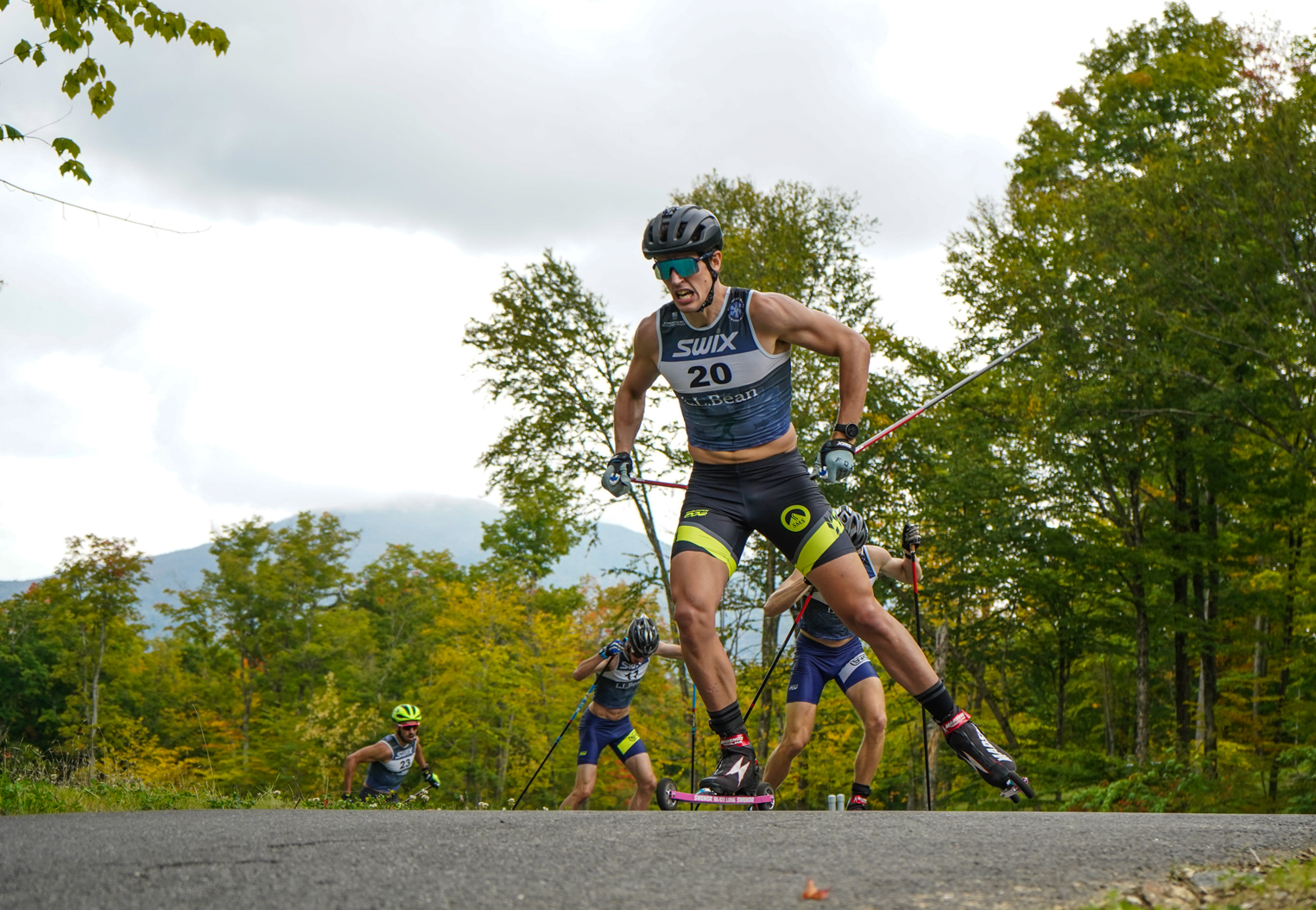
    Bill Harmeyer (SMS T2) makes his way through the heats during the Keys to the Castle rollerski sprint. Harmeyer finished 4th overall on the day. (Photo: Matt Whitcomb)

    Mt Van Hoevenberg has also improved their snow making operations, allowing for 5k of groomed skiing with 3-4 days of blowing snow in cold weather. Whitcomb explained the value this provides to American cross country skiing. 

    “This was our second time utilizing New York’s investment in its facilities at Mount Van Hoevenberg. I’d be surprised if we’re not racing World Cups here in the future. A lot of work by ORDA has resulted in a world class roller-ski track and new race trails. What excites me is the chance for easterners to have early November skiing in years when the weather cooperates. Their snow-making capacity is impressive.”

    With the added twist of a rolling ramp at the start, racers skied their way through the qualifier and rounds. In the women’s field, Jessie Diggins (SMS T2/USST) won the qualifier, cruising onward to snag the top spot on the podium, followed by teammates Julia Kern (SMS T2/USST) in second and Alayna Sonnesyn (SMS T2) in third. 
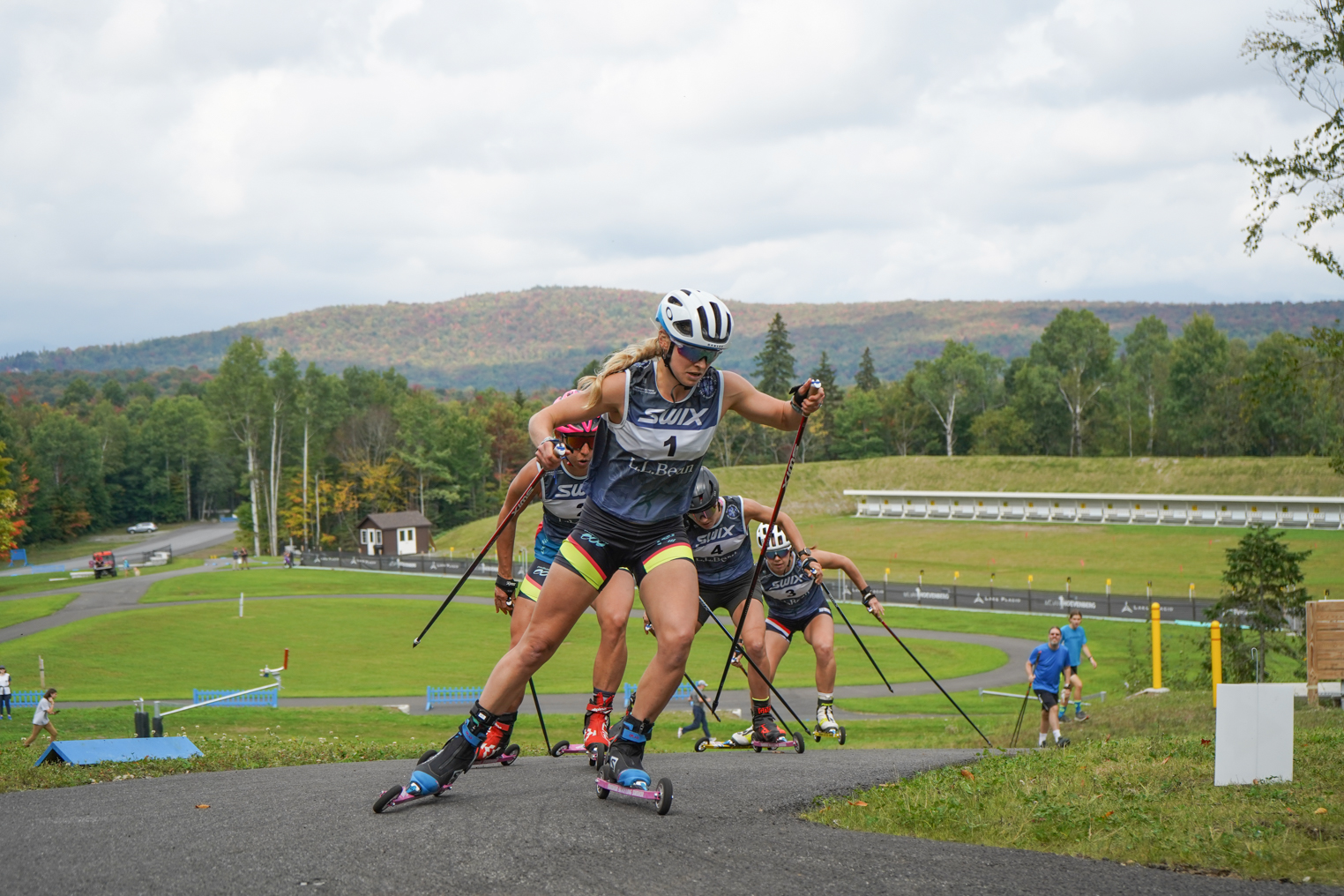
    Jessie Diggins (SMS T2/USST) over the climb during the final round of the Keys to the Castle sprint. (Photo: Matt Whitcomb)

    “This is the time of year where the intensity in training starts to ramp up and it’s always awesome to have the chance to test out your race day preparation,” wrote Diggins after the race. “Things like the timing of pre-race meals to warmups and what you do in between sprint heats to stay activated but not get tired — this was a perfect chance to tune in to those little details at the race in Lake Placid!” 

    Diggins only competed in the sprint stage of the weekend, bowing out before the teams headed to Vermont.

    “I’m super grateful to the organizers and hosts as it was an amazing new roller ski track and venue, and it was very cool to have so many teams and athletes there, from junior skiers to professional teams. The track was challenging and honestly just like a world cup sprint course, in terms of length, challenge and technical aspects. It was fun to fire up the engines and see what I still need to be working on in our final prep phase before the season begins!”

    Jessie Diggins stomps the qualifier, continuing through the rounds to win the overall at the Keys to the Castle. (Photo: Reese Brown / RDB Marketing)

    On the men’s side, Ben Ogden (SMS T2) also doubled up on the qualifier-final victories. He was followed by Peter Holmes (SVSEF) in second, and Logan Diekmann (BSF) in third. 

    “This weekend’s rollerski race was like a breath of fresh air for me and I think most of the competitors,” wrote Ogden in an email. “As fun as constant training, time trials and quarantining was, ski racing is all about racing. Getting together with such a talented group and pushing each other on such a beautiful New England weekend seemed almost too good to be true. Having the BSF Pro Team, Sun Valley gold team, and SMS T2 team, all on sight made it a crazy stacked fall time trial, which was such a treat after a year of so many small group time trials. 

    “This weekend was especially cool for me because It bridged the gap between all the ski worlds, something that has certainly not happened in a long time. Many of the college skiers were there, the SMS t2 team (who I ski with in the summers) was there, even a few fellow US ski team athletes and coaches were there. It’s rare that all these groups get together so that was a lot of fun.”
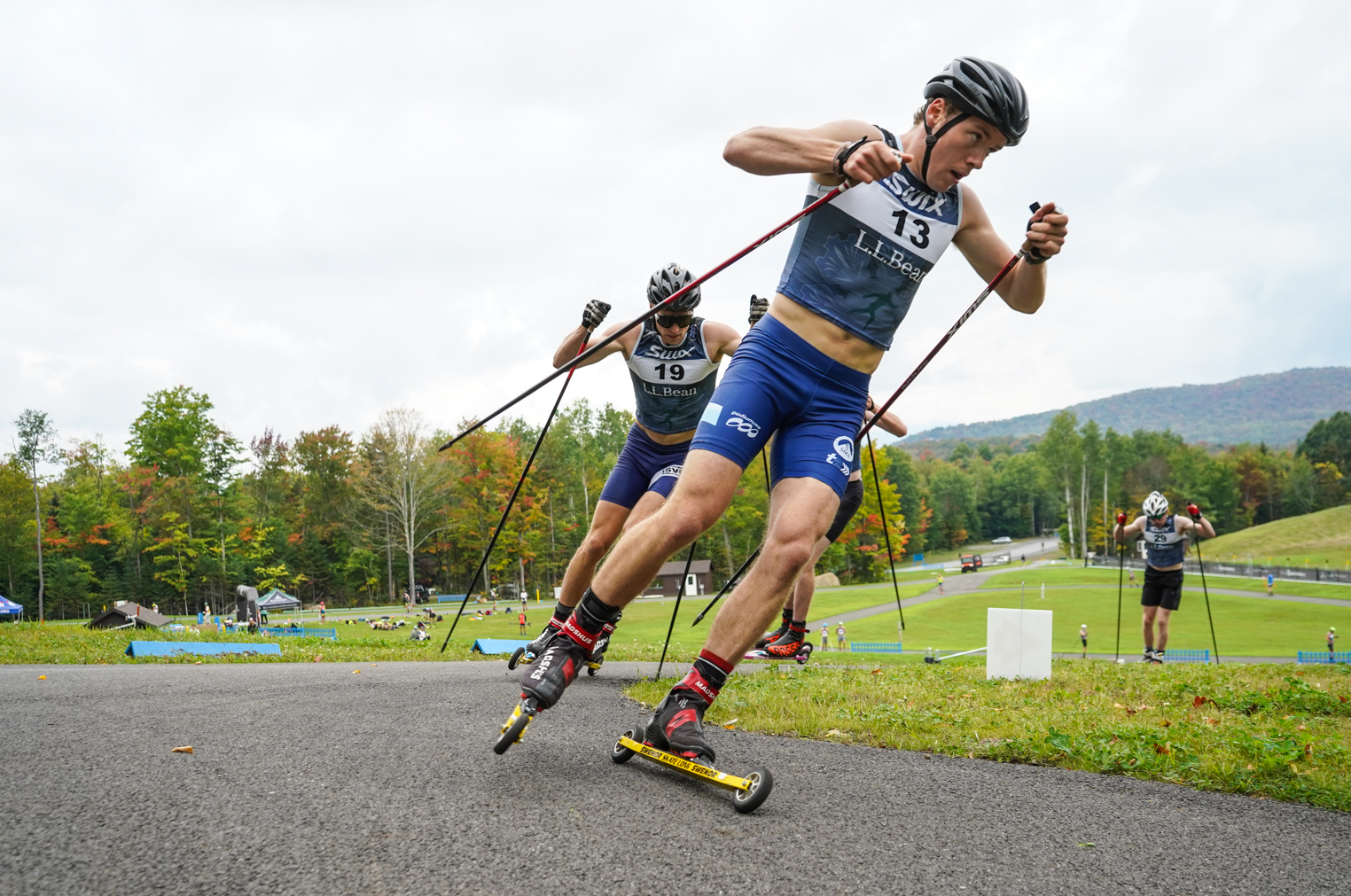
    Putting on a clinic, Ben Ogden powers through the Keys to the Castle, winning both the qualifier and the overall. (Photo: Matt Whitcomb)

    While racing in Vermont was not possible for much of the ‘20/21 season, Ogden, now 21-years-old, had a solid first run of international World Cup racing. On form when the stakes were highest, he qualified in 11th in the classic sprint at the World Championships in Oberstdorf, Germany and finished 17th. He was also the third fastest qualifier in the same event at U23 World Championships in Voukatti, Finland, where he finished 11th overall. 

    Ogden provided insight into his current status with training, and how the races provided him with insight into how his body is responding. 

    “I had a big period of training ending in these races and in true fall rollerski race style I didn’t change up much of my training for the races. I just thought of them as hard workouts with a bunch of friends who I don’t ski with all too often. I was really pleased to find some good speed through the entire skate sprint day. The course was really fast and tons of fun on rollerskis, so it was awesome to ski all three heats on Saturday…

    “I’m really excited to get this winter underway. Feeling good about summer training in Stratton and the beginning of fall training at Groovy. (‘Groovy UV’ = University of Vermont, where Ogden is beginning his third year.) Lots of work to be done!! I think it’s going to be a fun year.”
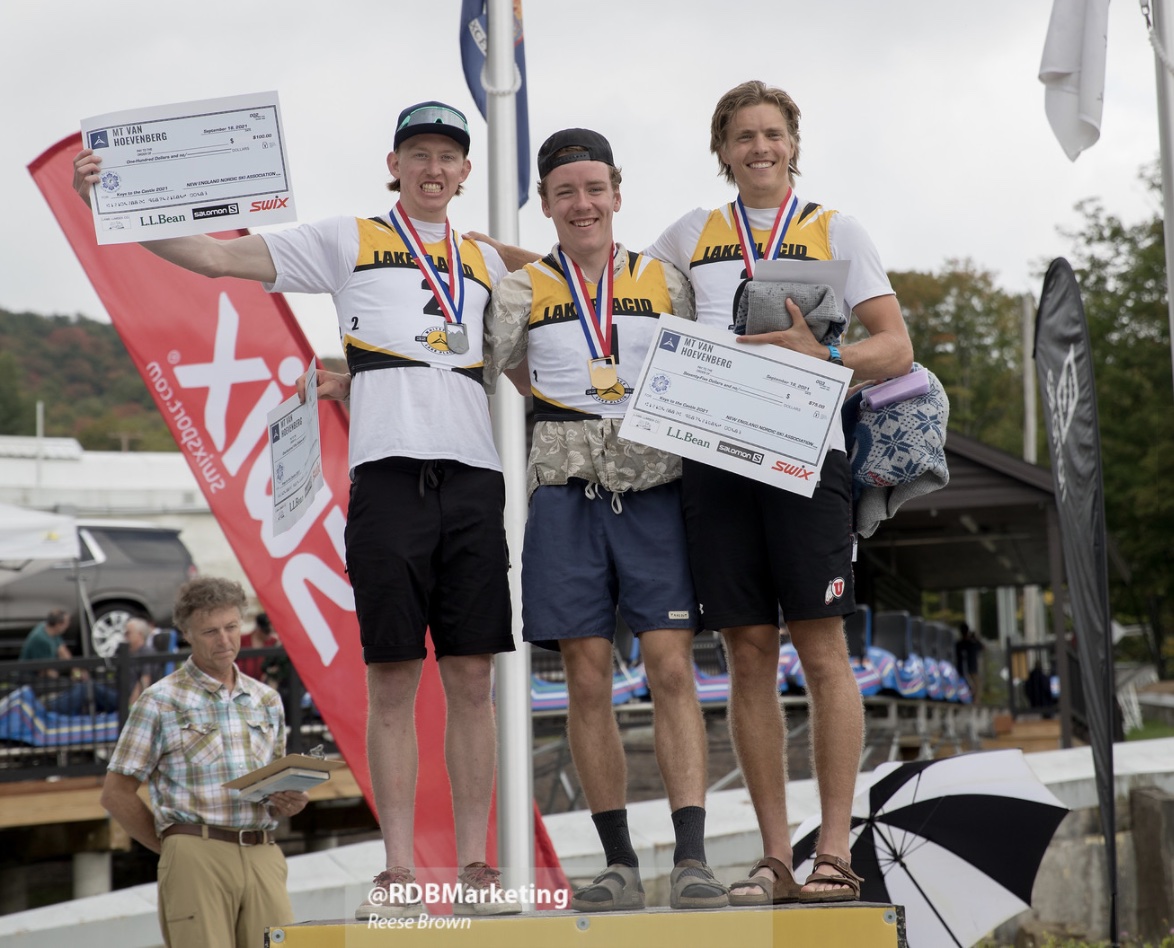
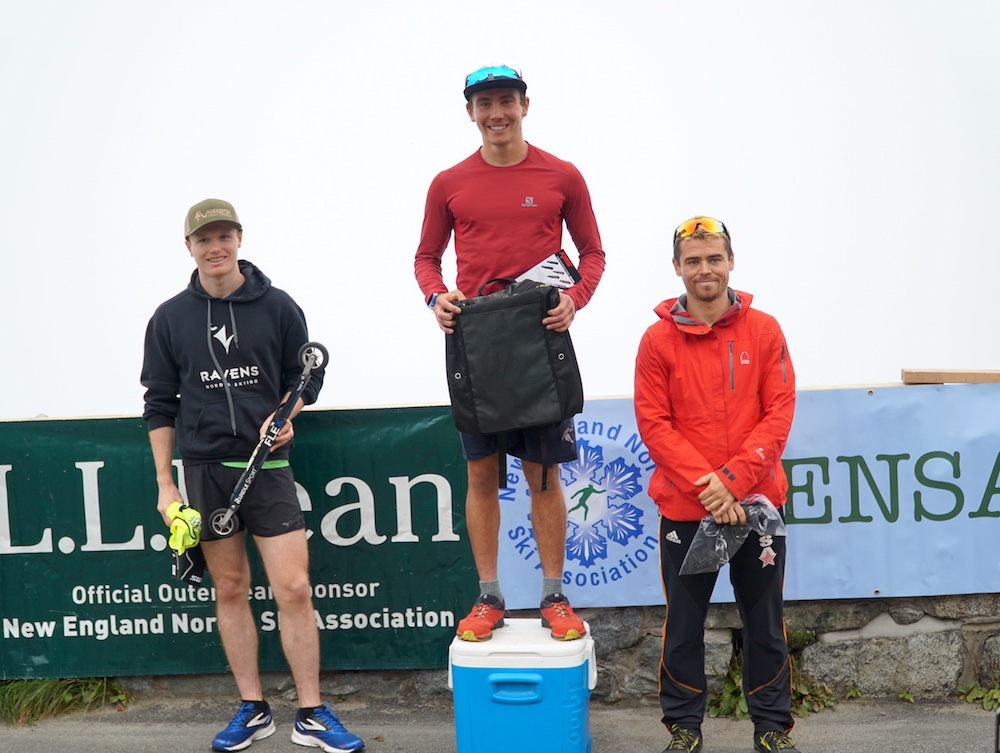
    The men’s podium of the Keys to the Castle rollerski sprint in Lake Placid. Ben Ogden (SMS T2) was the top qualifier and overall winner ahead of Peter Holmes (SVSEF) and Logan Diekmann (BSF Pro). (Photo: Reese Brown/RDB Marketing)

    Heading east to the Camp Ethan Allen Training Site, men and women in the open division raced a 15k skate while juniors completed 5k. 

    For the men, Johnny Hagenbuch (SVSEF) stopped the clock at 32:00.9 with the fastest time of the day. He was pursued by Ben Ogen in second (+1:07.3), with Ian Torchia (SMS T2) on his tails in third (+1:07.6) with a tight finish. 

    “It was an awesome way to cap off a productive training camp!” wrote Hagenbuch after his race. “Being from altitude in Sun Valley, the main goal for the camp was to capitalize on some great venues for intensity training in and around Lake Placid. We had a bunch of really good sessions on rollerskis and foot, and it was awesome to collaborate with Andy Newell’s BSF Pro Team crew on a number of those quality workouts.”

    20-year-old Hagenbuch was born and raised in Ketchum, ID. After taking a gap year following high school graduation, Hagenbuch will be attending Dartmouth College in the fall. He explained that his time spent in the east surrounding these events left him eager for what is to come in the years ahead. 

    “The new venues in Lake Placid at the Mount Van Hoevenberg were incredibly well-designed, and I really look forward to checking out the ski trails in the winter as opposed to bounding. The rollerski track is a really great resource, and NENSA did a fantastic job of hosting that event. There was a surprisingly robust field for a rollerski race in Upstate NY, and it was cool to see how much energy there is for skiing and rollerskiing in the East. I actually had never previously spent any substantive period of time in New England – winter or summer, so it was great to experience orientation at Dartmouth the week before the camp as well. My perception of the East has completely changed; it’s very different from the West, but I love it!”
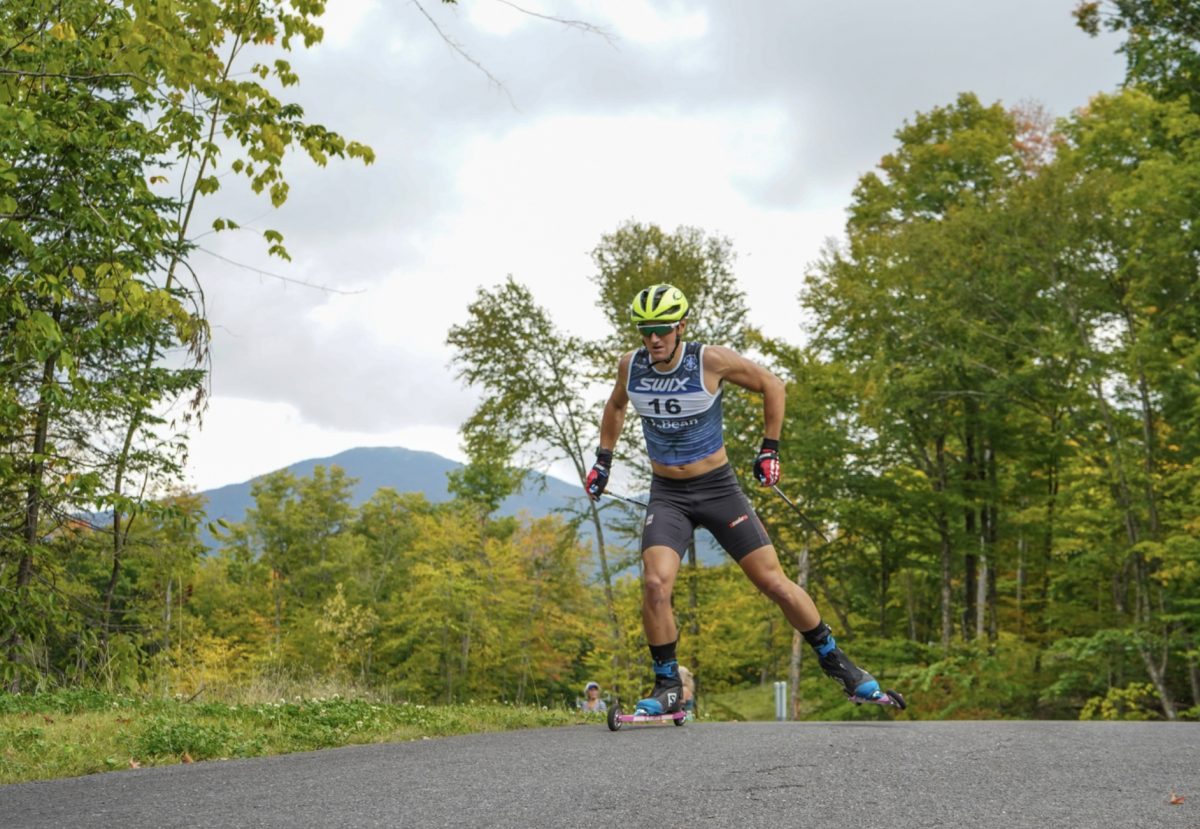
    Johnny Hagenbuch powers through his qualifying round during the Keys to the Castle rollerski sprint in Lake Placid, NY. (Photo: Matt Whitcomb)

    Breaking down the combined stages that led Hagenbuch to a third place finish in the overall standings, he explained his approach to the weekend including how it fits within his overall summer training plan. 

    “The sprint went pretty well for me, especially considering that I historically and currently have not self-identified as the most talented sprinter. At this point in the season, it was a fun, low-stakes way to throw down with a great group of guys. Ben Ogden is fun to watch. The distance day in Jericho was much more my wheelhouse, as distance skate races are typically my best format. The 5km rollerski track on the National Guard base in Jericho was a treat to experience. I haven’t skied on Craftsbury’s rollerski track, but the Jericho rollerski track could easily be the best in the nation. Given that I’m still training at a relatively large volume, I wasn’t really expecting to feel particularly good or race anywhere near to my best form, but it was still a pretty good effort. 

    “One of my goals for the past couple of seasons has been to get stronger and ski more powerfully, and it was cool to see some of that effort pay off in Jericho. I felt that I was skiing much more powerfully in general, and I don’t think I lost much on the uphills – despite having gained 25 pounds in the last year. It was an encouraging result in the end, and I’m excited for the next couple of months of training before the season kicks off in earnest in West Yellowstone. I’ll be pretty consistently alternating between being at home for two weeks and away training or racing for two weeks until January, which’ll be a nice way to break it up (and will make time fly)!”
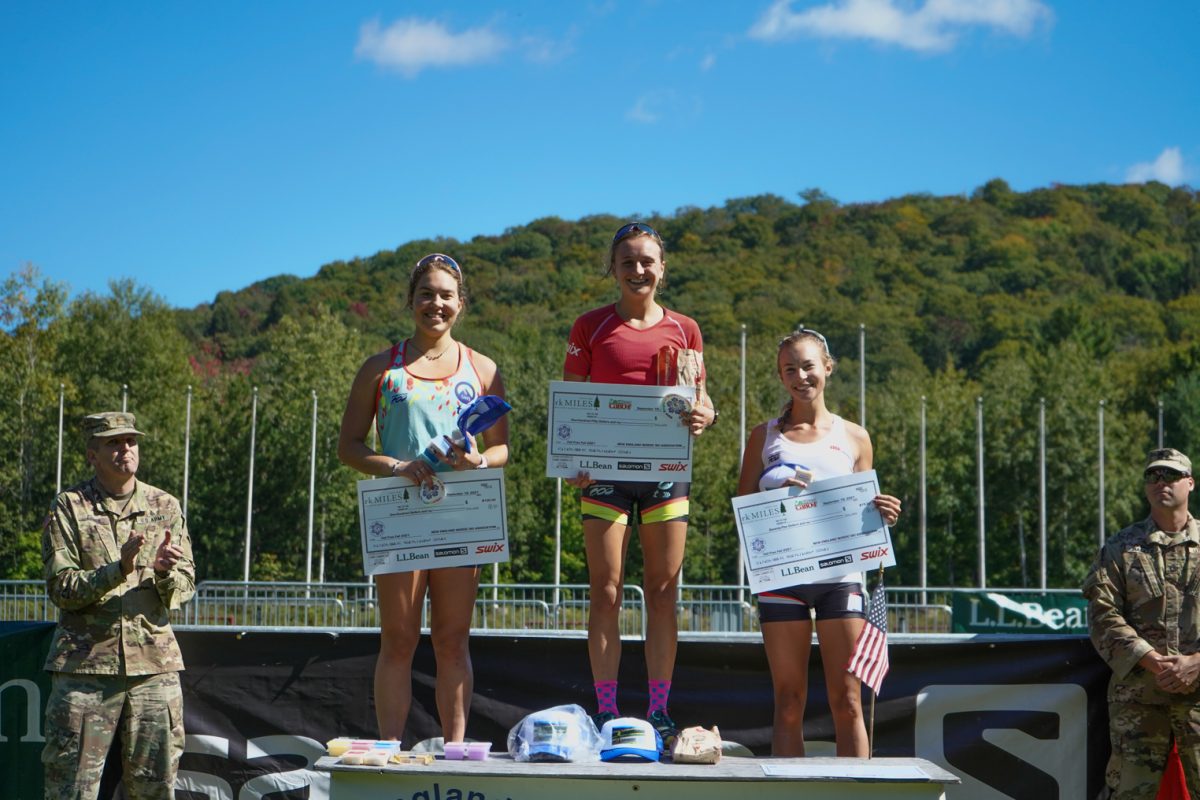
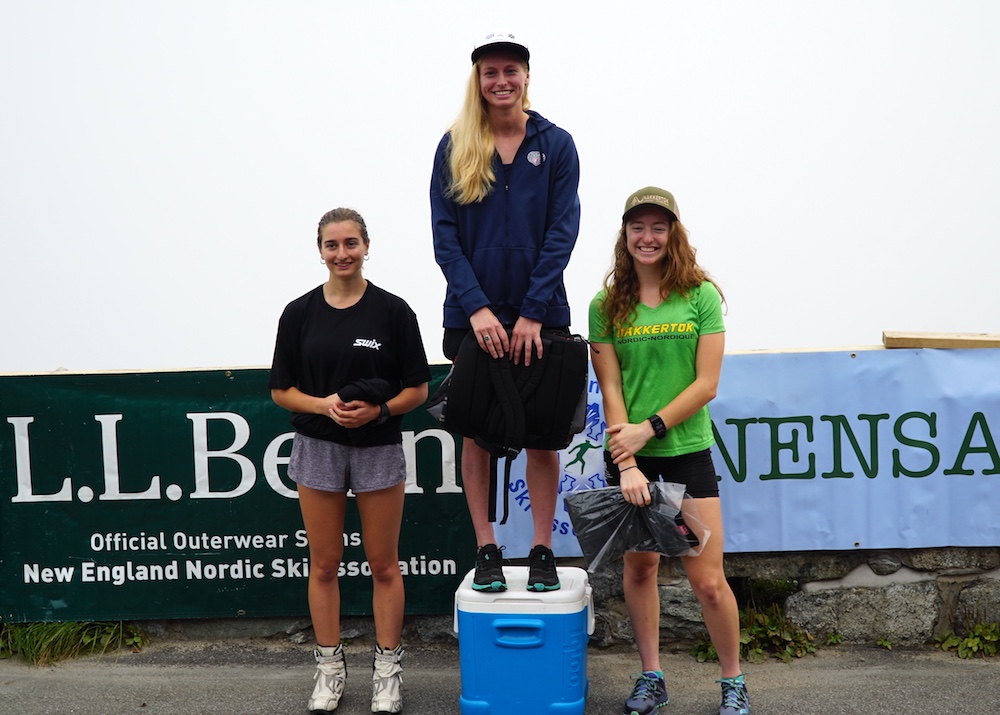
    The women’s podium of the Free Fall distance race in Jericho, VT. Alayna Sonnesyn (SMS T2) took the win ahead of teammate Lina Sutro, with Mariah Bredal (BSF Pro) in third. (Photo: Matt Whitcomb)

    On the women’s side, Alayna Sonnesyn took the win on the second day in a time of 37:55.3, sealing the overall victory for the combined events. Her SMS T2 teammate Lina Sutro rolled through in second (+49.3) with BSF Pro Team member Mariah Bredal in third (+2:33.6). 

    “In Lake Placid, it was really cool to ski on the new roller ski track,” wrote Sonnesyn in an email after the events. “I had heard stories about a pretty twisty and technical track but to finally have the opportunity to ski on a course similar to a World Cup level race was pretty sweet. Not to mention the new facilities at Mt. Van Hoevenberg are unbelievable! It was really fun to get into a sprint simulation with all of the other elite ski teams that were there and it felt almost like a SuperTour. That being said, it’s still September so although I brought a competitive spirit to the races, I still approached them as a workout. It was great to practice going super hard in the qualifier and then play around with tactics in the heats, but it was all in good fun too. With a pretty sketchy corner coming out of the last downhill, the women agreed this race wasn’t worth losing skin over. All in all, a great day!”
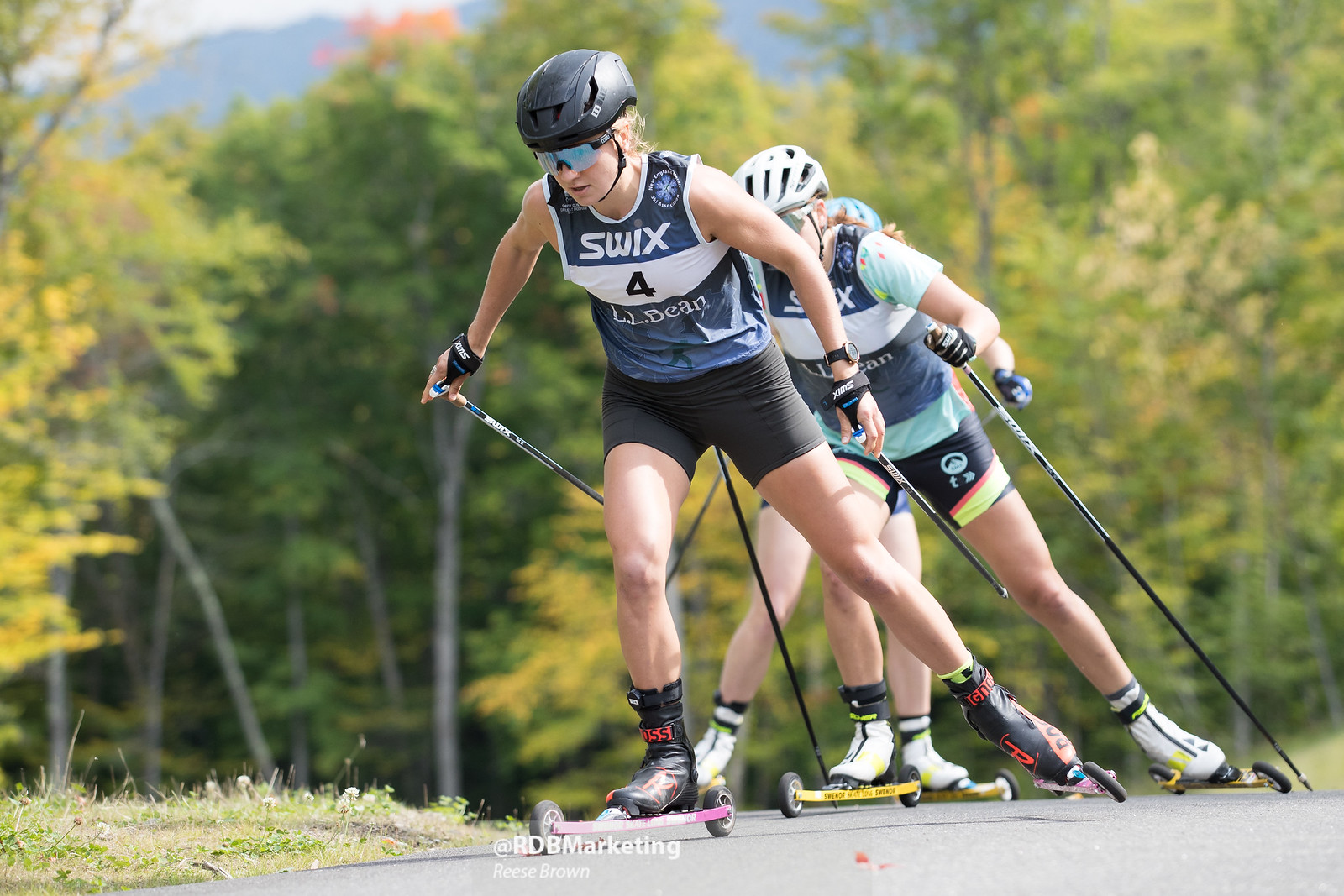
    Alayna Sonnesyn leads her heat during the Keys to the Castle rollerski sprint in Lake Placid, NY. (Photo: Reese Brown / RDB Marketing)

    “The following day in Jericho I was definitely feeling a little tired from the sprints the day before, but that was great practice for wintertime when we frequently race back to back,” Sonnesyn continued. “Also, during my time at UVM we skied at Jericho almost every week so it felt good to be back on a track that I knew so well and felt like home. Adding to that, it was great to see the UVM ski team and other junior/college racers attending this event. It had been a while since I had been at an event with so many New England skiers and I felt like everyone was just really happy to be there. Again, I was finding the balance in this race to approach it as a workout while still taking advantage of the opportunity to practice race warm ups, tactics, fueling, pacing, etc.”

    Sonnesyn also concluded with insight into her overall feelings at this point in the season. 

    “I’m feeling really good and lucky to have these races to test things out. I gained a lot of takeaways on little things I can work on in the next few months, but also built some confidence behind what we have already been doing all summer. I’m excited to potentially compete in a few more NENSA races this fall and get ready for snow to fall!”

    The women’s final of the Keys to the Castle rollerski sprint in Lake Placid, NY. From left to right, Lauren Jortberg (BSF Pro), Julia Kern (SMS T2/USST), Jessie Diggins (SMS T2/USST), Alayna Sonnesyn (SMS T2). (Photo: Reese Brown RDB Marketing)

    Results:

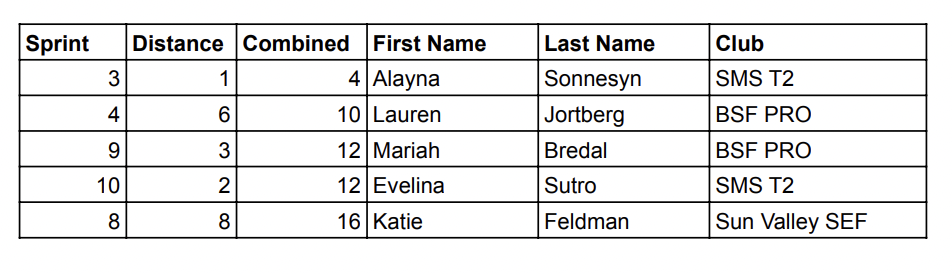
    Keys to the Castle Sprint | Free Fall Distance Race

    Overall Standings for the Combined Events:
  • NYSEF Post-Graduate Program Provides Opportunities for Recent High School Graduates

    NYSEF Post-Graduate Program Provides Opportunities for Recent High School Graduates


    Mission: It is the mission of the NYSEF PG Program to bridge the gap between high school/ collegiate/national teams for athletes who have demonstrated a desire to focus on cross country ski racing preparation and competition at an elite level.  


    Program Overview: The NYSEF PG Program provides the opportunity for post-graduate athletes to strive towards reaching their full potential on the race circuit regionally, domestically and internationally. Sport becomes the primary focus for the athletes in this high-intensity program. 


    Housing: PG athletes will have lodging at a private residence in Lake Placid with a NYSEF staff member/family. They will be provided with limited supervision yet a level of independence along with a bed, access to a kitchen and waxing/equipment space in a garage. Space is limited, first come first serve. 


    PG Academics: Athletes will have an opportunity to continue their academic  journey through local North Country Community College. NYSEF will provide an academic liaison to facilitate this process – working with the athlete to find the best program/s that align with their academic goals and fit within their athletic calendar. Additional fees are determined based on course selection and not part of NYSEF program fees. 


    Expectations: PG athletes are the role models in the program – they have a responsibility to serve as mentors to younger athletes in the program by acting professionally and will be held to the highest standard. They represent the ideal athlete due to their disciplined schedules, motivation to compete at the highest level and dedication to instill a love of the sport in the next generation. We encourage PG athletes to engage in volunteerism while with us at NYSEF.


    Eligibility: Must have graduated high school and demonstrated a commitment to pursuing competitive ski racing at the collegiate or national team level. 


    Facilities: NYSEF Cross Country and Biathlon utilize the new World Cup venue at Mt. Van Hoevenberg. This venue features over 6k of rollerski loops and closed roads, full weight room and field house, rollerski treadmill, 5k race loop of automated snowmaking. Beyond our home base our program takes full advantage of the Adirondack experience around us on a daily basis.


    Program Fees: 

    • Base Athletic fee: Full Year 6-8 training session/week ($5500) +($875 for Biathlon)
    • Fall/Winter: 6-8 Training Sessions/week ($4000) +(600 for Biathlon)
    • Housing at private residence with supervision: $600 per month 


    Scholarship: NYSEF programming has scholarship opportunities. Please apply for scholarship through this link.


    Included: Professional coaching, personalized training plan, rollerski treadmill usage, video analysis of technique, strength training at Lake Placid Training Center, Lactate threshold testing, ORDA rollerski loops, Range usage (biathlon), ammo (biathlon), and the Adirondack High Peaks as your training “backyard!”


    Not Included: Additional training camps, academic programs, competition fees, and travel expenses (including athlete/coach lodging/meals and out-of-region travel), membership in NYSSRA/US Ski and Snowboard/FIS.


    Questions? Please contact Shane MacDowell at shanem@nysef.org or fill out an application online!


  • Brown, Geraghty-Moats Win 2018 Climb to the Castle; Doubleday Race Format Unveiled

    Brown, Geraghty-Moats Win 2018 Climb to the Castle; Doubleday Race Format Unveiled

    Jake Brown (Craftsbury Green Racing Project/US Biathlon) racing to a sizable win at the 2018 Climb to the Castle on Saturday, Sept. 15 in Wilmington, N.Y. (Photo: Heloise Rolland)

    On a humid fall Sunday in northern New York where temperatures reached an uncharacteristic 80 degrees, Jake Brown of the Craftsbury Green Racing Project and US Biathlon Development Team and Tara Geraghty-Moats of USA Nordic won the 2018 Climb to the Castle.

    Brown’s time was 35:40.7, while Geraghty-Moats finished in 45:03.

    Big Gaps and Clear Wins

    On the men’s side, Brown’s Craftsbury teammate Raleigh Goessling finished second in 38:16.6, and Erikson Moore of the Fondeurs-Laurentides team in Quebec was third in 39:00.3.

    Among women, Jackie Garso of Saint Lawrence University was second, in 49:24.1, and Nakkertok’s Zoe Williams third in 49:40.6.

    This year was a high water mark for attendance, with 102 athletes finishing.

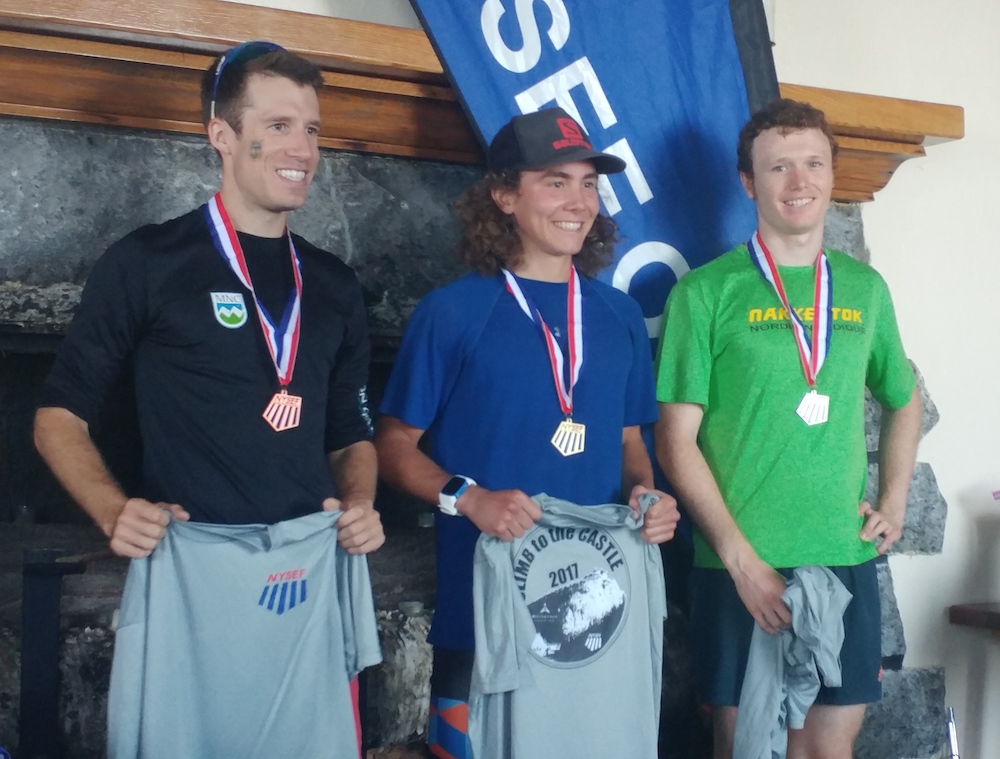
    The overall women’s podium at the 2018 Climb to the Castle at the top of Whiteface on Sept. 15 in Wilmington, N.Y., with winner Tara Geraghty-Moats (c) of USA Nordic, Jackie Garso (l) of St. Lawrence University in second, and Zoe Williams (r) of Nakkertok in third. (Photo: Colin Delaney)

    While a few degrees cooler than last year, dank humidity settled like a blanket over the five-mile climb, with athletes moving through a couple of patches of dense fog on the higher reaches of the mountain.

    “It was a hard one today,” Brown said following the race. “Last year, I felt like I went a little too hard off the line, and kind of buried myself early. So I wanted to be a little more conservative and finish strong today. I tried doing that and it felt a lot better, and I skied a little faster. I was on different rollerskis, so it’s hard to be able to compare it to last year. I was happy with my effort and it was a good push today.”

    This year was Brown’s second consecutive win, and he beat his 2017 time of 39:01.9.

    “It’s always a tough race, but I’m happy with how my summer training has paid off,” Geraghty-Moats said. “I felt strong and I had a good race.”

    Asked if the race was part of her training plan, she replied, “I just finished competing in the Ski Jumping Grand Prix in Russia, so I’m still pretty jet-lagged. I love this race, NYSEF puts a lot of energy into putting it on every year, so I figured I’d make the trip over. It’s really fun and I enjoy racing with a good crew.”

    A ski jumper winning a cross-country ski competition? For those not in the know, Geraghty-Moats is one of the pioneers of the developing women’s nordic combined.

    The overall men’s podium at the 2018 Climb to the Castle at the top of Whiteface on Sept. 15 in Wilmington, N.Y., with winner Jake Brown (c) of the Craftsbury Green Racing Project (CGRP)/USBA Development Team in first, Raleigh Goessling (r) of the CGRP in second, and Erikson Moore (l) of Fondeurs-Laurentides in third. (Photo: Colin Delaney)

    “I’m on the women’s ski jumping team and I’ve been to a World Championship in 2015 and on the World Cup team for the past 4 years,” she explained. “Before that, I was a biathlete, so nordic combined was sort of a natural step for me. FIS has put in a lot of resources to developing women’s nordic combined. This year, they’ll have a Continental Cup circuit; next year, there’ll be a World Cup circuit; and the following year after that, there’ll be a World Championship. I’m starting to learn how to compete in nordic combined and I’m really enjoying it.”

    Zoe Williams, along about 60 other athletes, had participated in the previous day’s Doubleday events at the Intervale Ski Jump. (for more on the Doubleday, keep reading!)

    “I felt a bit tired in my warmup,” Williams said. “By the time I got to the start line and the race started, I didn’t feel as bad as I could have. My legs for sure felt tired in the first kilometer, but after the first k, I started settling into that rhythm and I ended up feeling pretty good for the rest of the race. Climb to the Castle, you just have to find that gear and grind away.”

     In 2017 she was fourth overall, five seconds behind biathlete Deedra Irwin.

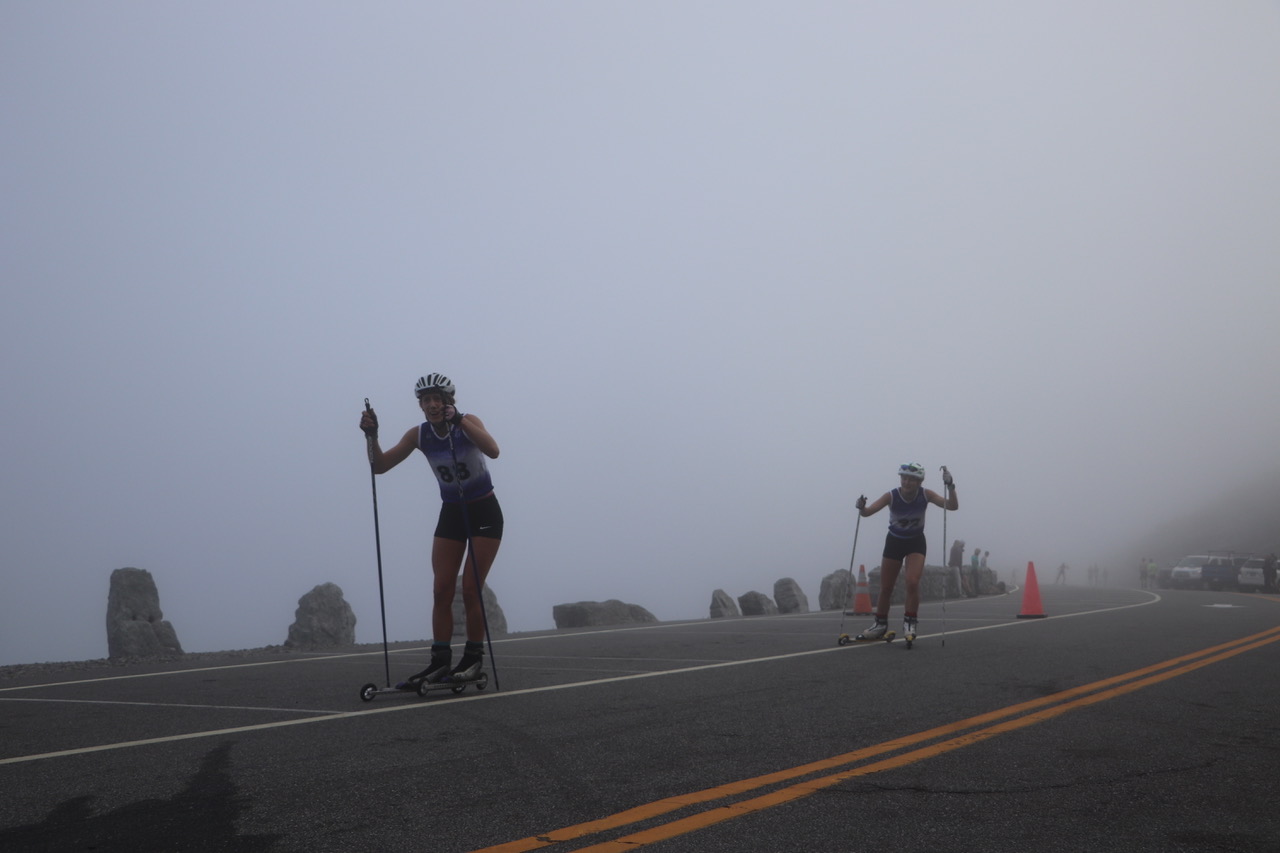
    Meredith Stetter (88) leads her Mansfield Nordic Club teammate Jennifer Wilbraham during a foggy Climb to the Castle rollerski race on Sept. 15 in Wilmington, N.Y. They finished 19th and 20th, respectively. (Photo: Heloise Rolland)

    “This year, I ended up leading the group that I was with, which was kind of a fun change,” Williams said. “But the whole time I was thinking ‘what did Deedra do here? We one-skated [V2’ed] here. I can one-skate here!’”

    Asked if Climb to the Castle was a good fitness benchmark, Williams said, “Because the next couple of months are where you start getting the really high intensity zone four, this is a really  good indicator of the base level fitness that you have, because of the endurance focus of the race.  But I’m for sure looking to find my top end gear in the next couple of months.”

    Full Climb to the Castle Results

    Doubleday Takes Off: New Events Added to the Climb to the Castle weekend

    On Saturday, the New England Nordic Ski Association (NENSA) and the New York Ski Education Foundation (NYSEF) collaborated on a new event held on the rollerski loop at the Intervale Ski jumps.

    Quincy Massey-Bierman won the junior women’s 3 k prologue. (Photo: Heloise Rolland)

    The Lake Placid Doubleday started with a three-kilometer prologue; after a break, there was a 1.5 kilometer sprint time trial. The results of the two races were aggregated to determine winners.

    Nicholas Clifford of Carleton University in Ottawa, Ontario, was the open men’s winner, while Nakkertok’s Williams was the open women’s winner before going on to be the runner-up in the Climb to the Castle.

    We’ve had the  Climb to the Castle for 11 years, and this year we wanted to expand it to a full weekend,” NYSEF head coach Shane McDowell said. “We started talking with Justin [Beckwith, NENSA Competitive Program Director] ] in the spring and he proposed the idea of trying [NENSA’s] new format of the doubleday, which will be used at the Eastern Cup scheduled for 23 February at the Dublin School.”

    “The format came out of discussions this spring,” Beckwith said. “Three kilometers is a national junior relay distance and we were valuing shorter, sprinting efforts in the results because we were usually a little heavy on the distance qualifications for our Junior National team in New England. When partnering with Shane and ORDA [the Olympic Regional Development Authority] to make it a reality, for us to test out the event which has a physiological effect of doing the 3k prologue in the morning and do a prelim in the sprint, the 1.5, would be the timing of a typical quarter final.”

    The roller ski loop at Intervale is serpentine and narrow, with fast downhills. In the pre-race meeting, Beckwith admonished the athletes to be conservative as they warmed up. As they warmed up, the rollerskiers gradually became more aggressive in their approach to the course.

    buy diflucan online, buy bactrim online

    Taking a corner on the Intervale Ski Jump loop during Doubleday. (Photo: Heloise Rolland)

    The race started and finished at the biathlon range located midway through the long climb from the lowest to the highest sections of the course.

    Clifford is the coach of the Carleton University ski team, located in Ottawa, Ontario.

    “It was really exciting,” he said. “It was the first time I’ve skied at [Intervale]. I’ve heard a lot about some of the sketchier downhills but it was actually really well done. It was just like ski racing.”

    Asked how he planned his races, Clifford said, “Not so much. I’m not a shorter distance guy, so the Climb to the Castle tomorrow is the real show and this was just a bit of a tuneup to get some speed in the legs.”

    Of the Doubleday format, the consensus was that it was tough.

    “The course here… It’s pretty much straight up and then you go down and come back up,” CSU’s Alex Burt said. “For the 3 k, you do it twice. It’s a lot more brutal. I had to actually pace it. For the1.5 k, my strategy was to go out as hard as I can and just keep it up.”

    But it was also fun, many participants agreed.

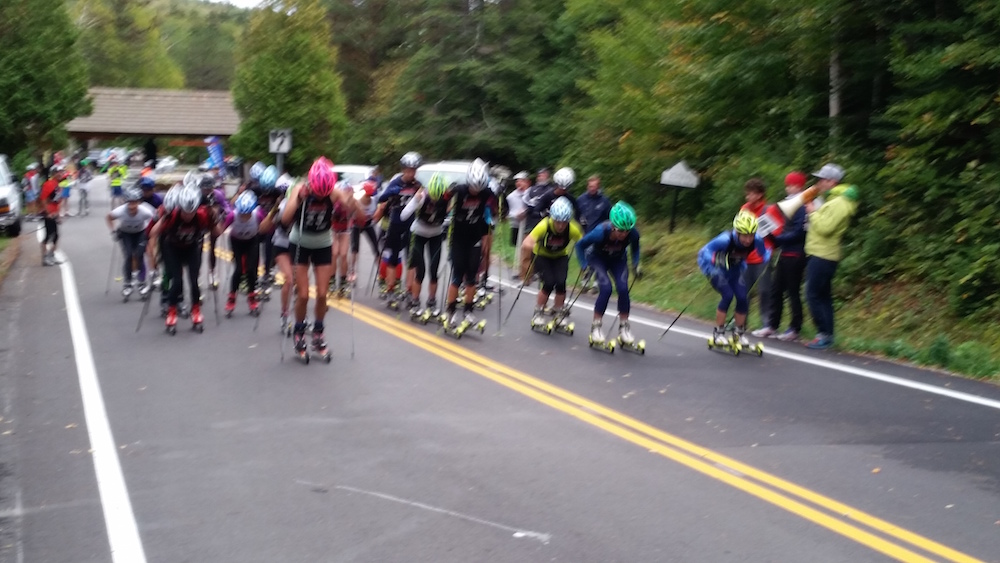
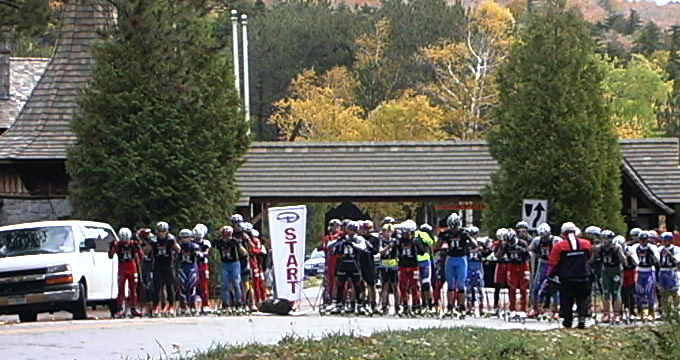
    Racers lined up at the start for a Doubleday competition. (Photo: Heloise Rolland)

    “It was fun,” said Williams of the Doubleday. “The course here was super awesome, because it was like actually skiing, whereas a lot of roller ski races are on roads. It’s so twisty and turns up and down, it’s a lot like actually ski racing.”

    On getting used to the downhills, Williams said, “It took me through mid warm up, to get used to the corners. In the race itself, I didn’t even think about it. It was super nice. I worried about it in the warmup, because there are some really gnarly corners, but when you’re racing, all your focus is on going fast.”

    Amy Duclos of Saint Michael’s College in Burlington VT, was the third overall female finisher at the Doubleday.

    “I wasn’t really sure about the course going into it, because of the turns, the hills, but it was a lot of fun,” she said. “I thought today was a good warmup to get the legs moving for tomorrow. It’s definitely a different type of race.”

    Laura Appleby, of Cambridge Sports Union (CSU), won the junior women’s division at Doubleday and was the fifth junior woman finisher at Climb to the Castle.

    “They went really well,” she said of the Doubleday races. “It was super fun. I liked the downhills… The first race was a little bit longer, so I was definitely pacing it a little bit slower. But generally just go out and ski the course, ski the transitions.”

    Shilo Rousseau, Chandra Rousseau, and Zoe Pekos, all of Barrie [Ontario] Cross-Country, sat for an interview in a downtown Lake Placid coffee shop following the Doubleday.

    ethings

    “It was a little scary at first with the safety meeting,” said Shilo, who finished third junior woman both at the Doubleday and C2C. “After skiing the lap a few times, you realize it’s not that bad.  As you go on, your laps get faster. You really have commit on roller skis.”

    Did she save energy for the C2C?

    “Full send every day,” Shilo replied. “I’m not leaving anything in the tank.”

    Chandra Rousseau said, “The last downhill was bad. The prologue wasn’t as good as I wanted it to be.  I probably could have pushed a little harder on the downhills. On the sprint, I was more used to the course.”

    Recovering in a bench outside the Castle, a reporter asked the Rousseaus and Pekos, so, did you go full send?

    In unison, they replied, “Full send!”

    Full Doubleday results

  • NYSEF Rollerski Race Weekend Sept. 15-16

    (Press release)

    RACE WEEKEND WITH A 360-DEGREE PANORAMIC VIEW OF THE ADIRONDACKS, NEW ENGLAND AND CANADA

    WILMINGTON, NY – The New York Ski Educational Foundation (NYSEF), the New England Nordic Ski Association (NENSA) and the Olympic Regional Development Authority (ORDA) invite athletes to a rollerski race weekend, September 15-16 in the Adirondacks. We are excited to make this a two-day race series and to take advantage of the Olympic venues in our region.

    On Saturday, September 15, there will be a Lake Placid Doubleday consisting of a 3-kilometer freestyle prologue rollerski with an interval start followed by a 1.5-kilometer freestyle preliminary sprint. The Doubleday will take place at 9:00AM at the rollerski loop located at the Lake Placid Olympic Ski Jump.

    On the Sunday, September 16, the Climb to the Castle Skate Race will begin at 8:00AM. The course will start at the Whiteface Toll Booth, climbing for 5 miles with an average 8% grade up the Memorial Highway to the summit of Whiteface Mountain– New York’s 5th highest peak with an elevation of 4,867 feet.

    Following the race events there will be a brief award ceremony for Junior, Senior and Masters Classes.

    Participate, volunteer and/or cheer on Nordic athletes from around the country!

    To register or volunteer go to nysef.org/news.

    A detailed schedule of the weekend events will be posted shortly.

    Questions? Contact Shane MacDowell at shanem@nysef.org.

  • Best Coaching. Best Tutors. Best Facilities. Best Priced.

    The New York Ski Educational Foundation (NYSEF) is excited to announce their new and improved Nordic Skiing Winter Term Program for the 2017-2018 Season. The mission of NYSEF is to provide opportunities for athletes of all ages to reach their potential in snow sports – alpine skiing, freestyle skiing, snowboarding, ski jumping, cross country skiing, nordic combined, and biathlon – through professional guidance and financial support.

    buy naltrexone online

    NYSEF currently has an advanced Winter Term Program specific to alpine and freeride skiing. With new staff developments and local partnerships, this Nordic program is recharged. This program allows aspiring student-athletes the opportunity to pursue their athletics at an advanced level while continuing remotely in their home school’s academic curricula, providing an avenue to excel academically and athletically.

    There is no other program providing skilled coaching and qualified tutors in world-class Olympic venues (located in the heart of Lake Placid). Plus, it is the most affordable Winter Term option in the east!

    If you are not convinced, ask our alumni. Nine NYSEF Alumni participated in the 2014 Winter Olympic Games in Sochi, Russia. Their journey continues on the World Cup circuit with their respective US National Teams, and sights set on the 2018 Games in Pyeongchang, South Korea. Other NYSEF athletes have moved on to become members of National Teams, Junior World Championships and have won Gold at the World Championships, Junior World Championships, NCAA Championships, and Olympic Winter Games.

    Due to Lake Placid’s Olympic training venues, current NYSEF athletes have the unique opportunity to interact with and learn from their role-models on a regular basis.

    In an effort to get the complete winter term experience, we are offering a full winter option starting December 3 and running through March (the end of the race season). This program is designed for athletes to take full advantage of what NYSEF and the Lake Placid Training Center have to offer. This program is tailored towards athletes that wish to race at the Junior National level and beyond. The race calendar focuses on all Junior National qualifying races with the New York State Ski Racing Association (NYSSRA) and the New England Nordic Ski Association (NENSA).  For more information on the program objectives, coaches, schedule, academic support roles, and tuition fees, please click here. For the Winter Term application, click here.

    Eager to learn more? Contact Head Coach Shane MacDowell at shanem@nysef.org.

  • Bender, Brown Top Balmy Climb to the Castle

    Bender, Brown Top Balmy Climb to the Castle

    The men’s top three finishers at NYSEF’s 2017 Climb to the Castle on Sunday, Sept. 24, at the top of Whiteface Mountain in Wilmington, N.Y., with winner Jake Brown (c) of US Biathlon, runner-up Aidan Kirkham (r) of Nakkertok Nordic, and Mansfield Nordic Club Head Coach Adam Terko (l) in third.

    (Note: This article has been updated with comments from Adam Terko in regards to rollerski safety.)

    WILMINGTON, N.Y. — On what may be the hottest day in memory for the annual Climb to the Castle (C2C) rollerski race, hosted by the New York Ski Educational Foundation (NYSEF) up Whiteface Mountain, Jake Brown and Jennie Bender were fastest to the top. Both have spent at least part of their summer training with the US Biathlon Association (USBA) in nearby Lake Placid, N.Y.

    Brown, a 25-year-old USBA X-Team member, finished the five-mile climb up Whiteface’s toll road on Sunday in 39:01.9 minutes, more than five minutes clear of runner-up Aidan Kirkham, a Canadian racer with Nakkertok Nordic, who finished in 44:16. Adam Terko, Mansfield Nordic’s head coach and executive director, placed third in 45:35.7.

    Bender, 29, racing under the team name of “The Dark Side”, which she later explained was a joke, topped the women’s race in 48:59.4. She finished 21.5 seconds ahead of 51-year-old (no, that’s not a typo) Sheila Kealey, who skis for XC Ottawa and coaches for Nakkertok. Deedra Irwin of the Sun Valley Ski Education Foundation (SVSEF) was third woman in 51:13.5.

    “I had put my name in the registration as ‘Darth Vader’, but they changed it on the other end,” Bender wrote in an email. “When I am in Bozeman MT I train with Bridger Ski Foundation, and when I am in Lake Placid, I train with USBA.”

    At the tollgate at 7 a.m., the temperature was already 66 degrees Fahrenheit with clear skies. With mild weather the previous two days, the pavement was dry for 83 skiers who rolled to the start line. At the castle at the summit an hour later, temperatures were upwards of 70, making an already grueling race even more fatiguing.

    The men’s and women’s races played out quite differently. According to Kirkham, Brown led “off the start and gapped the whole field.”

    Familiar with the territory in and around Lake Placid, which has become an annual training camp for Nakkertok, based out of Ottawa, Kirkham said it was one thing to ski the toll road in Zone 1 and another to race it.

    “I wanted to pace it well, and I think I did that,” he added. “I didn’t want to go too hard off the start because there’s no chance to recover on a course like this. … Once I got to the last mile I knew I could try to pick it up a little bit. But I was pretty tired. Just getting to the finish felt good.”

    Having completed five or six C2Cs, Terko said experience was his advantage. But he didn’t exactly have a race plan.

    “The field can vary wildly,” Terko said of the level of competition. “You’re never really sure how the start’s going to play out. I found myself near the front and there wasn’t a ton of US Ski Team or US Biathlon folks.”

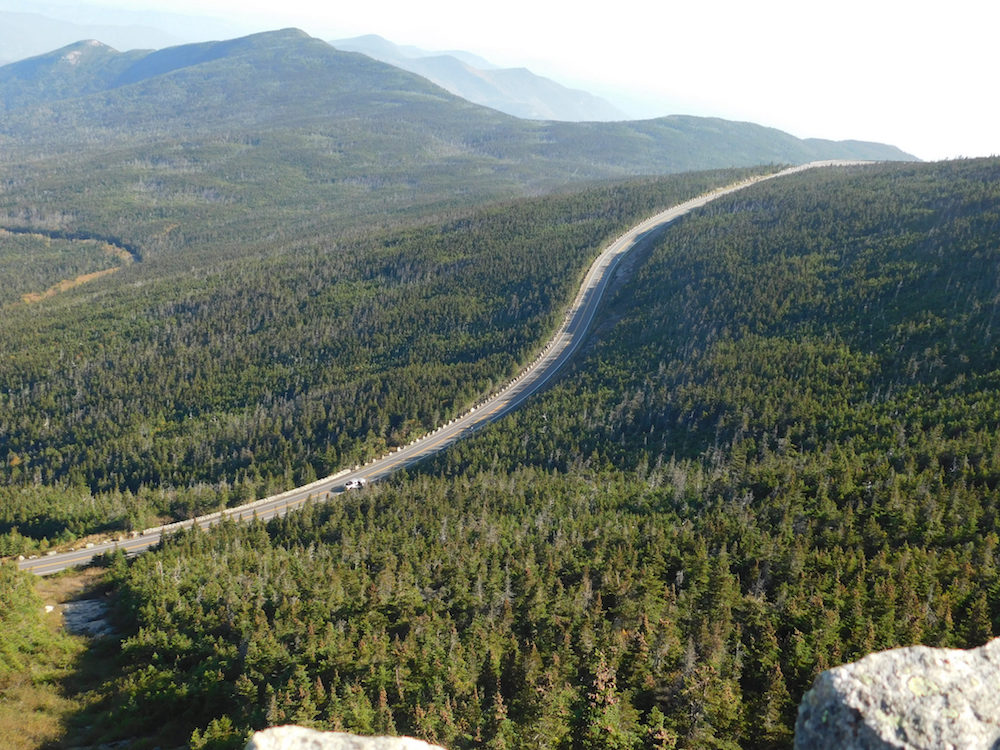
    Looking down at the Whiteface Veterans Memorial Highway, a five-mile toll road to the top of Whiteface Mountain in Wilmington, N.Y., as seen on Sunday, Sept. 24, for the 2017 NYSEF Climb to the Castle rollerski race. (Photo: NYSEF)

    As recently as a few years ago, the U.S. Ski Team held annual dryland training camps in Lake Placid and competed at the C2C. But that camp has been replaced by an on-snow camp in New Zealand. This year, US Biathlon’s top athletes recently spent several weeks training in Germany.

    “Jake Brown was right off the front so I realized that this could be a good day and I might as well try and hang in there,” Terko added.

    While Terko skis and rollerskis plenty with his athletes, he says it’s not always adequate training for a race like this.

    “As a coach, it’s more about generally making sure the workout is going well for the athletes,” he explained. “I’ve made an effort the last few weeks to get out after practice and ski around in the dark myself.”

    (Terko later clarified in an email that he was referring to Mansfield Nordic’s primary training venue, a paved and lit rollerski loop at Camp Ethan Allen in Jericho, Vermont. “Rollerskiing in the dark there is pretty standard as opposed to being in a dangerous road situation which I of course do not advocate!” he wrote.)

    As for Brown, a Northern Michigan University graduate student who is currently living and training with US Biathlon in Lake Placid, he had a slightly different recollection of the start on Sunday.

    “It wasn’t so much I dropped everyone. It was more like I just slowly pulled away,” Brown said. “Within the first 400 meters, I had a small gap. The gap got bigger and bigger as we went along. Maybe by the first mile, I couldn’t hear anyone behind me.”

    Sticking to his own race, he resisted the temptation to look behind.

    “I was trying to get a good effort today on the skis,” he continued. “I was hoping that some of the faster junior skiers would have some fast rollerskis and be able to push me, but pretty much right from the get-go I was on my own, so I was just trying to keep the pedal to the metal and make it a good effort, which gets tough at the end. It definitely helps to know the course.”

    The women’s top three finishers at NYSEF’s 2017 Climb to the Castle on Sunday, Sept. 24, at the top of Whiteface Mountain in Wilmington, N.Y. (From left to right) Jennie Bender in first, Sheila Kealey (XC Ottawa) in second, and Deedra Irwin (SVSEF) in third.

    In contrast, the women’s race swapped leaders. Clare Egan, a USBA national-team member and Craftsbury Green Racing Project (CGRP) member finished fifth (+5:02.4) after leading early.

    “I did lead a little bit at the beginning,” Egan said. “Jennie, Sheila and I were together for the first 1.5 or 2 miles, and then Jennie and Sheila pulled away, and I got caught by Deedra and Zoe [Williams].”

    “From doing this race in the past, the order doesn’t usually change so much after the first mile or so,” she explained. “It’s just so hard to make up gaps on this grade. I wanted to try to hang on for as long as I could and stay in front the whole way, but I wasn’t able to do that. So it was very hard work out there, and I didn’t have what it takes to stay with Jennie and Sheila. Respect to them.”

    Irwin explained in a post-race email that her plan was to pace off Bender and Egan and stick with them for as long as she could.

    “Jennie and Sheila pulled away just around mile two, I think,” wrote Irwin, a SVSEF Gold Team member who was invited to train with US Biathlon (following its Talent ID Camp) in Lake Placid this fall. “My race went really well. I’m really happy with my result. This was my first time doing Climb to the Castle. I didn’t really know what to expect, it’s a tough climb!”

    Blue skies and no snow post-race at the castle atop Whiteface Mountain in Wilmington, N.Y., at the 2017 NYSEF Climb to the Castle on Sept. 24. (Photo: NYSEF)

    As for Kealey, a top-level masters racer on the Canada Cup, she had done the race a few times before.

    “Every year I did it, Liz Stephen did it, and it went out really, really fast,” she said of the U.S. Ski Team member who holds the women’s course record of 41:50. “Really hard at the beginning, and then people dropped off, but today’s pace was a good pace.”

    Kealey described wanting to keep a consistent rhythm all the way to the top. She spent much of the race trading off with Bender.

    “And then I managed to get a gap,” Kealey said. “I had a gap on [Bender] almost until the last 800 meters, and then she caught me. She was hurting, but she put the guns on at the last bit and just pulled away. She skied really well.”

    Reflecting on her win, Bender said, “It wasn’t snowing, and it wasn’t freezing, so that was awesome. My V1 has been getting a lot better. It was a small crowd, but I was stoked to feel good for the whole duration. I haven’t done this race in a long time. I did it probably in college, and it’s fun to see the giant progression since then.”

    She explained that she’s been working with US Biathlon in Lake Placid more this summer.

    “I think in the big picture, it’s fun to see that I’m not just a sprinter,” she said.

    On her race plan, Bender said, “The biggest thing, you have to pace it and not go out too crazy. We kind of started splitting up a bit, and I was going back and forth between first and second throughout the race. First with Clare, then with Sheila and then, near the last 200 to 400 meters, that tunnel, which is always so crazy with the wind, we both were like, ‘Oh.’ We were feeling it.”

    “I saw someone coming up behind us,” Bender continued. “I thought it was Clare, I didn’t realize it was Jake. And then I sprinted it in to the finish. I was stoked to get in under 50 minutes.”

    Bender, Egan, Irwin, and Brown all skied on matched Marwe rollerskis that they also used in time trials, Bender said.

    Zoe Williams, the fourth-place woman (+2:18.8) from Nakkertok and Carleton University, said she wasn’t sure what to expect for her first C2C.

    “About 15 minutes in, I kind of all of a sudden realized that it was all uphill,” Williams said. “I was like, ‘Whoa, what have I got myself into?’ But it was fun. I was following Deedra for most of it. I was trying to match her tempo.

    “The last mile was tough because you can see the castle,” she added. “I really wanted to try to stick with the lead pack as long as I could.”

    In the 11th year of the C2C, Margaret Maher, NYSEF’s outgoing head cross-country coach, said this was one of the warmest race days they’ve had.

    “We’ve had every kind of weather possible,” she said. “It’s just fun to see everybody out there getting ready for winter.”

    “It was really a blessing to have this awesome weather,” Brown concluded. “Normally you come up here and [the castle] is in the clouds, even if it’s sunny down low. It’s cool to do something here with NYSEF and show our support from US Biathlon.”

    Results: Men | Women

  • NYSEF Climb to the Castle on Sept. 24

    NYSEF Whiteface Climb to the Castle Rollerski Race

    Sunday, September 24, 2017

    Climb to the top of Whiteface, New York’s 5th highest peak for a 360-degree panoramic view of the Adirondacks, New England and Canada

    NYSEF.org

    REGISTER HERE

    Race notice (PDF)

    REGISTRATION

    • $30 online registration entry fee
      • Online registration at SkiReg.com – closes Friday, September 22 at 5 PM
    • $40 day-of race registration entry fee
      • Day-of race registration from 6:30-7 AM at the Whiteface Toll Booth Bib pick-up from 6:30-7:30 AM at the Whiteface Toll Booth

    START TIMES

    • 8:00 AM Women’s Start (all age groups)
    • 8:10 AM Men’s Start (all age groups)

    Race will be timed for 2 hours

    Competitors not able to finish in this time window will be picked up before the finish

    RACE DIVISIONS

    Women’s and Men’s race divisions for the following age groups: Junior (U16/U18), U20/U23, Senior, Master (30+)
    EQUIPMENT: SAFETY HELMETS ARE REQUIRED!

    All rollerskis must be inspected by competitor and be in proper working order

    COURSE DETAILS

    Freestyle Technique. 5-mile hill climb with an average 8% grade up the Whiteface Memorial Highway. Course: start at the Whiteface Toll Booth in Wilmington and finish at the Castle on the summit of Whiteface Mountain (elevation 4,867 ft)

    Disclaimer: Inclement weather may limit the race distance. Course is closed to rollerskiing before the start. Pre-race warm-up on rollerskis can only occur in a designated area. All post-race cooling down must be done on foot.

    VEHICLE TRAFFIC AND POST-RACE INFO

    Please carpool to the race start, parking will be limited. Whiteface Memorial Highway will be closed to the general public during the race. Coaches and spectators who will be watching the race will be able to drive up and park off the road before 7:50 AM. All traffic must be parked off the road from 7:50-9 AM. There will be no moving traffic allowed during the race. All competitors will be shuttled back to the race start. No athletes will be allowed to ski back down after the race. Competitors may place a bag in the NYSEF van with post-race clothing that will be driven to the finish line.

    AWARDS

    Awards at the Whiteface Castle immediately following the race at 10 AM

    RACE CONTACT

    Margaret Maher margm@nysef.org

    Interested in volunteering? Click here.

  • Shane MacDowell to Lead NYSEF Cross-Country Program

    Shane MacDowell

    (Press release)

    The New York Ski Educational Foundation (NYSEF) has announced that Shane MacDowell will become the new Head Cross-Country Ski Coach effective September 1, 2017. MacDowell replaces Margaret Maher, who has held the position since 2006.

    MacDowell, originally from Peru, Massachusetts in Berkshire County, attended Burke Mountain Academy in East Burke, Vermont as a cross-country skier before heading to the University of New Hampshire (UNH). MacDowell competed on their NCAA Division 1 Cross-Country Ski Team for four years while earning a Bachelor’s Degree in English and Journalism. During his college athletic career, he earned multiple top-15 finishes on the EISA Division 1 circuit.

    Upon graduation from UNH, MacDowell started his professional career with a position at Boulder Nordic Sport East (BNS), working as a wax technician and sales associate. Simultaneously, he continued his love for skiing and ski racing by serving as Head Ski Coach of the Cape Elizabeth High School Ski Team in Maine and, later, the Head Coach of the BNS Acceleration Project. During that time, he was the Head Wax Technician for the USSA J1 Scandinavian and OPA Cup Finals trips in Europe in 2013.

    Shane MacDowell

    MacDowell went on to hold several coaching positions throughout the United States, including serving as Gold Team Assistant Coach and Head Wax Technician at the Sun Valley Ski Educational Foundation in Idaho. Later, MacDowell returned East to assume the role of Assistant Cross-Country Ski Coach at the Green Mountain Valley School in Waitsfield, Vermont. Most recently, MacDowell has served as the Assistant Cross-Country Ski Coach at Northern Michigan University in Marquette, MI, one of the nation’s premier collegiate Division 1 programs.

    MacDowell says, “I am very excited to be joining such a great program as NYSEF. I look forward to building on the strong program that Margaret has cultivated during her tenure with NYSEF. I plan to use everything I’ve learned over the years with different programs to help each athlete achieve their goals and reach their greatest potential.”

    NYSEF Executive Director John Norton notes, “We’re pleased that Shane has decided to join our team. He brings a level of professionalism and dedication to athletic excellence through his experience at both the elite and grassroots levels. I’m excited to see what Shane brings to the already thriving program that Margaret has helped build.”

    “Shane moves to Lake Placid with ski coaching experience at the college and junior levels” remarked Margaret Maher, who held the position for over 11 years. “I’m excited to see a fellow UNH Wildcat take over the NYSEF program and look forward to watching the athletes grow and excel to the best of their abilities”. Maher has decided to take a full-time job as a registered nurse in orthopedics and sports medicine starting in September. MacDowell will begin work in early August alongside Maher to finish the summer training season.

    MacDowell’s brings a strong level of enthusiasm for the outdoors with him to the Adirondacks. When he’s not focused on cross-country skiing, he canoe races throughout the country and has a passion for building canoes. He also enjoys many outdoor activities like mountain biking, hiking and running.

  • Win #3 for Duncan Douglas, Hannah Rieders Top Woman at Wide-Open Climb to the Castle

    Win #3 for Duncan Douglas, Hannah Rieders Top Woman at Wide-Open Climb to the Castle

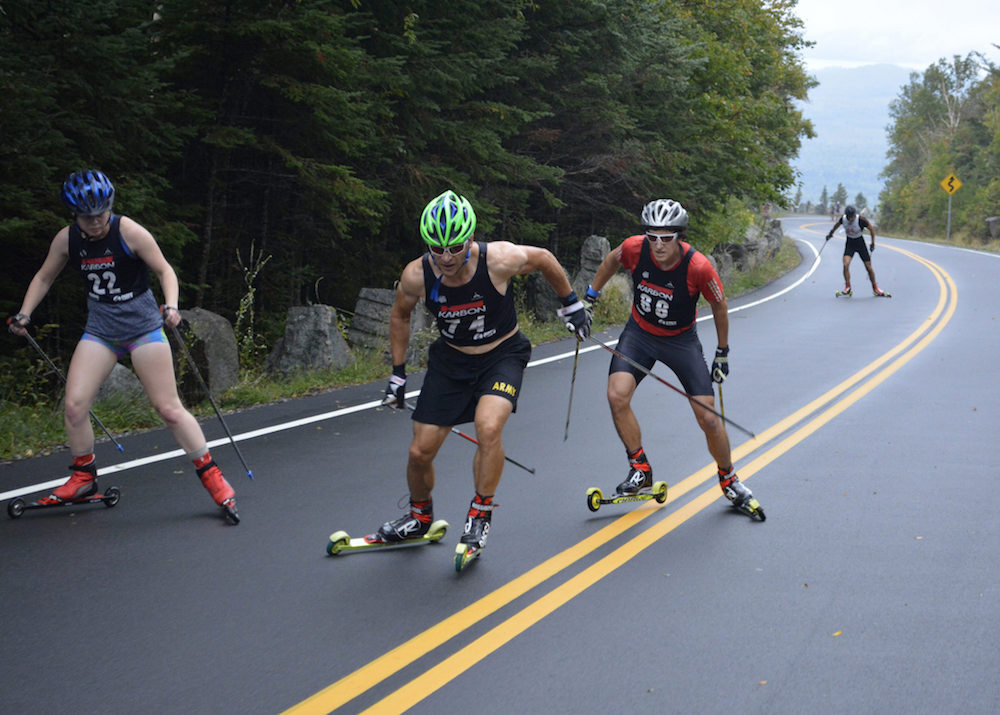
    Duncan Douglas (74) leads biathletes Russell Currier (in red) and Paul Schommer (behind) in Sunday's Climb to the Castle rollerski race up Whiteface Mountain. Douglas held off Currier by eight seconds for his third victory in four times racing the Climb and Schommer finished third. (Photo: NYSEF/Flickr)
    Duncan Douglas (74) leads biathletes Russell Currier (in red) and Paul Schommer (back right) in Sunday’s Climb to the Castle rollerski race up Whiteface Mountain, while Clarkson’s Jenevieve Broadwell (22) looks on. Douglas held off Currier by eight seconds for his third victory in four times racing the Climb and Schommer finished third. (Photo: NYSEF/Flickr)

    (Note: This article has been updated to include comments from third-place finisher Paul Schommer and NYSEF’s cross-country head coach Margaret Maher.)

    WILMINGTON, N.Y. — Four appearances and three wins is an enviable record. On Sunday, 50-year-old Robert Duncan Douglas, the “Jacked Up Old Man” from Honeoye Falls, N.Y., won his third Climb to the Castle (C2C) rollerski race, a five-mile freestyle hill climb up the Whiteface Memorial Highway.

    Douglas previously won the race in 2007 and 2008, with a personal-best time of 34 minutes, 56.6 seconds in 2007 (he was 2 1/2 minutes faster on a shortened course in 2008, when racers were unable to reach the summit because of snow). 

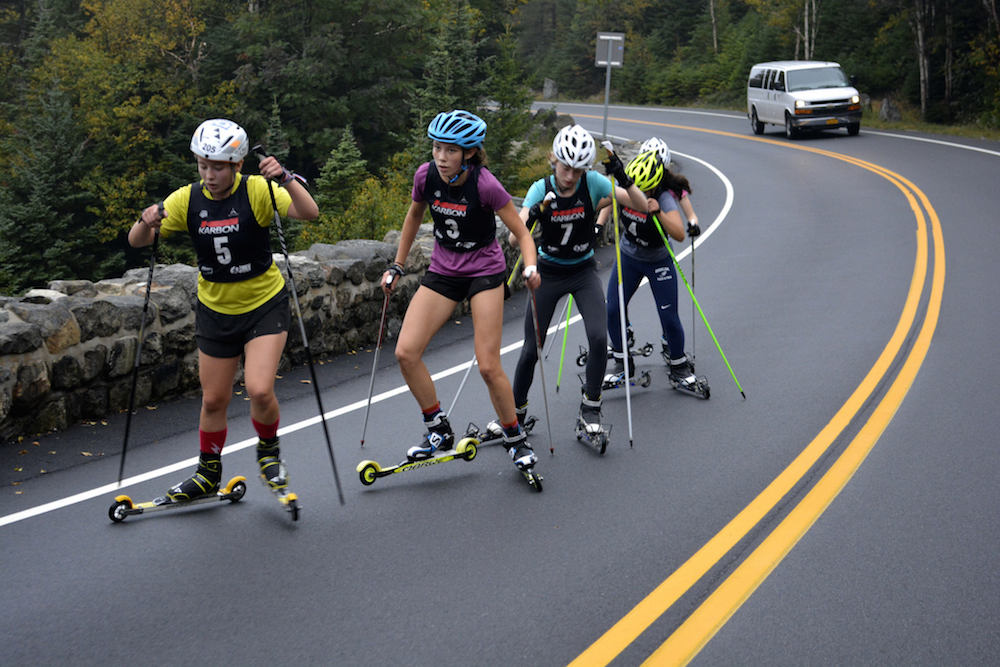
    St. Lawrence's Jackie Garso (5) leads Stratton's Anna Lehmann (3) and CSU's Hannah Rieders (7), Gabby Vandendries (4), and Madeline Rieders (in back)  during the women's Climb to the Castle rollerski race up Whiteface Mountain on Sunday in Wilmington, N.Y. (Photo: NYSEF/Flickr)
    St. Lawrence’s Jackie Garso (5) leads Stratton’s Anna Lehmann (3), and CSU’s Hannah Rieders (7), Gabby Vandendries (4) and Madeline Rieders (in back) during the women’s Climb to the Castle rollerski race up Whiteface Mountain on Sunday in Wilmington, N.Y. (Photo: NYSEF/Flickr)

    Hannah Rieders, a 17-year-old Cambridge Sports Union (CSU) skier whose initial goal was an age-group podium, won her first C2C, on the race’s 10th anniversary.

    Finishing in 37:15.6 this year, Douglas was 8.3 seconds ahead of runner-up Russell Currier, a biathlete who trains with the Outdoor Sports Institute in Maine. Paul Schommer, a senior member of US Biathlon’s National Development Group, placed third overall, 3:02.6 minutes behind Douglas.

    Rieders, a high-school senior from Wellesley, Mass., was the first woman across the line in 55:03.1. She beat Anna Lehmann, a ninth grader representing the Stratton Mountain School (SMS), by 15.7 seconds, and Rieders’s twin, Madeline (also of CSU), finished 1:23.3 minutes back in third.

    “I kind of thought maybe Anna would beat me,” Hannah Rieders said in a post-race interview. “At the start, I just wanted to pace it well. I stayed behind other people for the first three miles.”

    Overnight rain left the road damp. At the toll-booth start in Wilmington, temperatures hovered around 65 degrees under cloudy skies, with sultry humidity. Low clouds at the start turned dense up high near the summit. Unless you were really close to skiers in front of you, it was hard to gauge how far up the road they were, and how much energy one should expend to attack.

    (Story continues below)

    With the U.S. Ski Team wrapping up its New Zealand training camp in New Zealand, and thin representation from elite biathletes, the race was wide open.

    Margaret Maher, head coach of the New York Ski Educational Foundation (NYSEF) cross-country program, explained in an email that she learned in April that the U.S. Ski Team would not be comping to Lake Placid for its usual dryland camp this year. To accommodate the US Biathlon team, she originally scheduled this year’s Climb for next weekend, Sept. 25, but that date conflicted with other races NYSEF’s skiers planned on competing in.

    Maher had to move the race up one week in order for her athletes to attend. Regardless, 85 athletes registered this year, which was on par with the “73-108 athletes” that the race has previously attracted.

    Of the top-five female finishers on Sunday, four were under the age of 18, and Lehmann is a U16. With Jackie Garso (St. Lawrence University) placing fourth and Gabby Vandendries (CSU) finishing fifth, CSU had three in the top five.

    “First time [at C2C] for all three girls,” CSU coach Rob Bradlee wrote in an email. “All three also ran Mt. Washington for the first time in June. Tough kids! I don’t have them do any special prep for this race. Their regular six-days-per-week training clearly is enough to get them ready. All three are very hard workers and have been training hard all summer. I think their results show that.”

    Hannah Rieders explained that five women formed the lead pack. Around mile three, the eventual top three broke away.  They skied together until mile four, “then I went ahead,” Rieders said.

    The women's podium at the 10th Climb to the Castle rollerski race up Whiteface Mountain's Memorial Highway on Sunday in Wilmington, N.Y. With all of the top five under 18, Hannah Rieders (CSU) placed first, Anna Lehmann (SMS) was second, and Madeleine Rieders (CSU) was third. (Photo: NYSEF/Flickr)
    The women’s podium at the 10th Climb to the Castle rollerski race up Whiteface Mountain’s Memorial Highway on Sunday in Wilmington, N.Y. With all of the top five under 18, Hannah Rieders (CSU) placed first, Anna Lehmann (SMS) was second, and Madeleine Rieders (CSU) was third. (Photo: NYSEF/Flickr)

    Madeline Rieders said she skied in the pack until mile three, then pulled away with Hannah and Lehmann. While she lost contact with them on the road, which has an average grade of 8 percent, she maintained a steady gap to the finish and held off fourth place by 50 seconds.

    For the men, it was down to three from the start, according to Currier.

    “Paul, Duncan and I all took turns leading,” he wrote in an email.

    “I’m in better shape this year, but not rollerski shape,” Douglas said.

    For most of the summer, Douglas focused on bike racing, winning his 50-59 age group and placing 25th overall at the Leadville Trail 100 mountain-bike race. He said he just started rollerskiing two weeks before the Climb.

    Douglas, a two-time Olympian who will be 51 in November, had a simple race plan. “Go out, ski hard, have fun,” he reflected.

    For most of the race, Douglas skied with Currier. He dropped Currier once, but the 29-year-old former national-team biathlete regained contact. Douglas said that at the Lake Placid corner – a hard left where the grade eases and one can transition to V2 strides – he broke away to the finish.

    “Once the flat section towards the end started, I wasn’t able to match Duncan’s speed,” Currier wrote. “He was never very far out but enough to make a difference at that point in the race.”

    Of his race, Currier described it as “a solid effort. I really tried to use good technique. For a race that’s nothing but uphill, there’s not much else you can do.”

    In an email, Schommer explained this was his first Climb to the Castle.

    “I went into it with an open mind, knowing that if I killed myself in the first half the second half would be a death march,” the 24-year-old Wisconsin native wrote. “I would say it went decent for me as I was able to stay pretty strong most of the way, despite losing Russell and Duncan about 1.5 miles into the race.”

    The men's podium at the 10th annual Climb to the Castle rollerski race up Whiteface Mountain's Memorial Highway on Sunday in Wilmington, N.Y. Duncan Douglas (c) won, Russell Currier of the Outdoor Sports Institute (r) placed second and Paul Schommer (USBA National Development Group) was third. (Photo: Peter Minde)
    The men’s podium at the 10th Climb to the Castle rollerski race up Whiteface Mountain’s Memorial Highway on Sunday in Wilmington, N.Y. Duncan Douglas (c) won, Russell Currier of the Outdoor Sports Institute (r) placed second and US Biathlon development skier Paul Schommer (l) was third. (Photo: Peter Minde)

    Is the Climb to the Castle a data point for winter fitness?

    “It’s a good, effective workout, really good training,” Currier explained, adding that he didn’t think it was a good indicator of fitness in December or February.

    “I was really happy with how it turned out,” said Adam Glueck, a Ford Sayre U18 skier who finished seventh (+7:52.4) in his first C2C. “I didn’t want to go too hard out of the start. I followed some friends and threw in some double pole to rest my legs.”

    Glueck skied in a small group he eventually lost contact with about halfway through.

    “I managed to catch them on the V2 straight [the Lake Placid corner]. After that, my friend Henry McGrew [eighth overall] was right behind me,” he said. “I had to push hard through the headwind [the last 500 meters] to beat him. I was basically in agony for the last three or four minutes.”

    Agony and clouds: good metaphors for the Climb to the Castle. When athletes returned to the base, the sun was breaking out.

    Results: Men | Women

    Photo gallery

  • NYSEF Whiteface Climb to the Castle on Sunday, Sept. 18

    NYSEF

    Sunday, September 18, 2016 

    Climb to the top of Whiteface, New York’s 5th highest peak for a 360-degree panoramic view of the Adirondacks, New England and Canada

    WILMINGTON, NY – The New York Ski Educational Foundation and the Olympic Regional Development Authority invite athletes to the NYSEF Whiteface Climb to the Castle Rollerski Race on Sunday, September 18 at 8 AM. The course starts at the Whiteface Toll Booth, climbing for 5 miles with an average 8% grade up the Whiteface Memorial Highway to the castle on the summit of Whiteface Mountain, New York’s 5th highest peak with an elevation of 4,867 ft. The race is freestyle technique and athletes will be greeted at the finish with a 360-degree panoramic view of the Adirondacks, New England and Canada.

    This is the 10 year anniversary!

    Please see PDF with race details

    Link to race registration: SkiReg

    Online registration closes Friday, September 16 at 9 AM

    Click here to sign up to volunteer

    Please email margm@nysef.org with questions

  • New to the Climb to Castle Winners’ Circle: Caldwell and Rose Top Whiteface Race

    New to the Climb to Castle Winners’ Circle: Caldwell and Rose Top Whiteface Race

    Paddy Caldwell of the U.S. Ski Team D-team and SMST2 Team won Sunday's Climb to the Castle up Whiteface Mountain in Wilmington, N.Y. Here, around mile four of five, he's seen leading the pack, which includes biathletes Russell Currier and Tim Burke, and Rogan Brown (SVSEF) and Kyle Bratrud (CXC). (Photo: Tim Cowan)
    Paddy Caldwell (black shirt, yellow helmet) of the U.S. Ski Team D-team and SMST2 Team chases Rogan Brown (l) around mile four of five in  Sunday’s Climb to the Castle up Whiteface Mountain in Wilmington, N.Y. Caldwell won the race, followed by biathletes Russell Currier and Tim Burke in second and third, respectively. Brown (SVSEF) placed fourth and Kyle Bratrud (CXC) was fifth. (Photo: Tim Cowan)

    Note: Two photo captions have been corrected to reflect the leader of the men’s race around mile four in the 2015 Climb to the Castle. Rogan Brown of Sun Valley led the pack at the time.

    For years, U.S. Nordic Ski Team athletes and their coaches trucked themselves up to the start of the Whiteface Veterans Memorial Highway, clicked into their rollerskis and allowed an ample amount of time for warming up before ascending New York’s fifth highest peak.

    Before it became an official race nine years ago, it was a workout: a five-mile grind to the summit of Whiteface Mountain, 4,867 feet above sea level in Wilmington, N.Y.

    Now, for many top-level skiers, especially those based on the East Coast, the annual Climb to the Castle an offseason staple. And if you win, you get a T-shirt and a medal for your efforts.

    Mary Rose (SVSEF) leads US Biathlon's Annelies Cook up the Whiteface Mountain toll road during the annual Climb to the Castle. Rose won and Cook finished second, 32 seconds later. (Photo: Tim Cowan)
    Mary Rose (SVSEF) leads US Biathlon’s Annelies Cook up the Whiteface Mountain toll road during the annual Climb to the Castle. Rose won and Cook finished second, 32 seconds later. (Photo: Tim Cowan)

    “Climb to the Castle was a blast this year!” wrote women’s winner Mary Rose of Idaho’s Sun Valley Ski Education Foundation (SVSEF) Gold Team. “My goal going into this race was to have good energy the whole time, focus on technique and hopefully put together a good effort.”

    She reached the top on Sunday in 45:15.1 and topped her competition — the closest of which was US Biathlon’s Annelies Cook — by 32.6 seconds.

    “It was a fun, tough effort,” men’s winner Patrick Caldwell of the U.S. Ski Team D-team and Stratton Mountain School (SMS) T2 Team said in an interview after the finish.

    The 21-year-old Caldwell outlasted biathletes Russell Currier and Tim Burke by 5 and 11.5 seconds, respectively. Caldwell won in 37:05.2, Currier was second and Burke was third.

    “Right from the start, we stayed pretty much together against a decent headwind,” Burke said after the finish. “I think a lot of us were fatigued at the end of a big camp, so I didn’t really want to push like crazy.”

    The US Biathlon and U.S. Nordic teams spent at least the last week training in Lake Placid, N.Y., with biathletes like Burke logging five race efforts in nine days preceding the Climb.

    “I decided today instead of going for time, I wanted to go for the win,” said Burke, a defending multiple-time Climb to the Castle (C2C) champion. “So I decided to sit in and push that last half mile.”

    Paddy Caldwell of the U.S. Ski Team D-team won today's Climb to the Castle up Whiteface. Here he's seen around mile 4 leading the pack, which includes veteran biathlete Tim Burke (who placed 3rd). (Photo: Tim Cowan)
    Rogan Brown (l) of Sun Valley leads Tim Burke (second from l) and Paddy Caldwell (third from l) and Russell Currier and Kyle Bratrud around mile four in Sunday’s Climb to the Castle up Whiteface Mountain in Wilmington, N.Y. (Photo: Tim Cowan)

    He said he “did a lot of pulling and got some help towards the end.” Rogan Brown (SVSEF) led around mile four, and Burke explained that five men battled in the lead pack for the last two miles.

    “I broke my pole in the last couple hundred meters, that kind of took me out of it,” he explained.

    Caldwell took the blame what he called an “unfortunate incident” in the final 200 meters. “I broke Tim Burke’s pole,” he said. He did so when Burke made his final attack toward the finish.

    “Aside from that, it was a good, solid race,” Caldwell said.

    “It’s a good way to end it,” Burke said after 10 days of hard training.

    Currier, who placed second, called it an “entertaining race” with five men contending throughout.

    “For a rare change I was able to be on the better side of tactics and consistently stay in the back of the pack,” Currier wrote in an email. “On the other hand, the final 100 meters came up a lot earlier than I expected and didn’t give much time to react. The pace picked up and Tim Burke lost a pole tip. The next thing I knew there was an opening for the lead. I’m not much of a sprinter and didn’t do much to challenge Patrick, but was I was still pleased to break out of the back of the pack just in time for the podium.”

    A former US Biathlon (USBA) B-team member, Currier, who trains with the Maine Winter Sports Center, was not renamed to the team this spring and is working towards making the cut via a series of trials ending in October.

    “The status for the National team is still very unclear,” he wrote. “… All I can do is make the best of every training session and go for better results. The second round of trials is coming up in October. A couple of good enough results there should help my cause for the coming race season.”

    Brown placed fourth in the men’s race, 4.3 seconds from the podium and 15.8 seconds after Caldwell. Brown edged Kyle Bratrud of Central Cross Country (CXC) by 0.3 seconds, and behind them, another CXC skier Duncan Douglas placed sixth.

    USBA’s Sean Doherty and Lowell Bailey finished seventh and eighth, respectively, Miles Havlick (SVSEF) was ninth and developing biathlete Max Durtschi finished 10th of 61 men.

    The start of the women's race at the 2015 Climb to the Castle up Whiteface Mountain in Wilmington, N.Y. (Photo: Peter Minde)
    The start of the women’s race at the 2015 Climb to the Castle up Whiteface Mountain in Wilmington, N.Y. (Photo: Peter Minde)

    In the women’s race, Rose and Cook pushed each other to the top. Rose recalled it being just the two of them shortly after the start. A perennial contender, USBA’s Susan Dunklee had some pole issues at the very beginning, Rose explained in an email.

    “I knew I needed to break away about 1/2 mile to the finish because I can’t beat [Cook] in a sprint,” Rose wrote. “I fought pretty hard through the ‘wind tunnel’ and I think that is where I broke away.”

    Overnight rain left the toll road wet, and wind dried out its lower sections. From about the halfway point to the finish, skiers pushed through mist on wet pavement and faced a steady wind blowing 10 to 20 miles per hour throughout the race. After starting in temperatures around 47 degrees Fahrenheit, they met temperatures in the mid-30’s at the top.

    “It sounds weird to say it aloud, but I actually had fun doing the climb to the castle,” Cook wrote in an email. “Mary and I skied together the entire time and switched leads back and forth. I usually get bored doing the climb and lose focus and switching back and forth with her kept me in the game mentally.

    “She got me at the last turn right before the finish when I suddenly flooded with lactic acid and had no chance,” she added. “But I don’t really think of myself as a climber and so it was fun to be the two people leading the race. That doesn’t happen too often! Of course, the usual suspects were not there and that obviously made it difference.”

    With the exception of Paddy Caldwell, the U.S. Ski Team (USST) skipped the Climb this year for the first time in years.

    “As hard as it is to miss it because it is a fantastic event, it just didn’t play well athletically for the needs of the group,” USST Head Coach Chris Grover said on the phone last week. “We wanted to do more sprint-specific training and short intensity as opposed to giving up a whole workout or two to do the Climb to the Castle.”

    The USST camp was also only a week long, compared to the two weeks the team usually spends in Lake Placid this time of year. On the other hand, the largely Lake-Placid-based US Biathlon team did either time trials or Level 5 (race-pace) workouts for last 10 days.

    “I had my personal best by quite a lot and I felt strong skiing,” Cook said of the Climb. “It felt good to end a really tough ten days on a good note. … I think we are all pretty glad to be done.”

    The Climb marked the end of a two-week training block for Rose and her Sun Valley teammates, who were in Stratton, Vt., with the SMST2 team for the first week.

    “We had some super hard intensity sessions over the past two weeks and all were very productive,” Rose wrote.

    USBA’s Hannah Dreissigacker, who placed third, 2:05.9 after Rose, explained in an email that the women’s race broke up quickly.

    “Mary and Annelies started off a little faster than I really wanted to be going, and I tried to hold on for a bit but then gave up pretty quickly and lost contact,” Dreissigacker wrote. “My goal in the Climb to the Castle is always to not start too fast and then blow up. Then I skied with Susan for a mile or so and then slowly inched ahead of her a bit. Eventually we skied into a cloud and I lost sight of Annelies and Mary and just skied the whole second half by myself.”

    She finished 1:10.9 ahead of Dunklee, who placed fourth, while wearing a figure-skating tutu she wore the first time she did the race.

    “The lacy elbows really allowed for added breathability and the rhinestones gave me some extra motivation on those long hard stretches when I was all alone,” Dreissigacker wrote.

    Another biathlete, Clare Egan finished fifth, Paige Schember (SVSEF) was sixth, Erin Perryman (St. Lawrence University) was seventh, Jackie Garso of the local New York Ski Education Foundation (NYSEF) was eighth, St. Michael’s assistant coach Silke Hynes was ninth, and Stratton U16 skier Anna Lehmann was 10th of 25 women.

    Results: Men | Women

  • NYSEF Whiteface Climb to the Castle Rollerski Race on Sept. 20

    Sunday, September 20, 2015

    Climb to the Castle

    Climb to the top of Whiteface, New York’s 5th highest peak for a 360-degree panoramic view of the Adirondacks, New England and Canada

    NYSEF

    WILMINGTON, N.Y. — The New York Ski Educational Foundation  and the Olympic Regional Development Authority invite athletes to the 9th annual NYSEF Whiteface Climb to the Castle Rollerski Race on Sunday, September 20 at 8 AM. The course starts at the Whiteface Toll Booth, climbing for 5 miles with an average 8% grade up the Whiteface Memorial Highway to the castle on the summit of Whiteface Mountain, New York’s 5th highest peak with an elevation of 4,867 ft. The race is freestyle technique and athletes will be greeted at the finish with a 360-degree panoramic view of the Adirondacks, New England and Canada. Athletes will have excellent road conditions with all new pavement to the summit.

    NEW this year is a team event! Fastest 3 times will be added together to name a Women’s Team Champions and Men’s Team Champions

    Link to race details: 2015 Climb to the Castle

    Link to race registration: AlpineReg

    Online registration closes Friday, September 18 at 9 AM


    Looking to help out at the awesome C2C race? sign up to volunteer here

    Questions? Email Margaret Maher margm@nysef.org

    Countdown to race day has started…watch the preview video here


    Awards by Mt. Borah

    MT Borah

  • NYSEF ‘Climb to the Castle’ Set for September 6

    Climb to the Castle 2014 NYSEF CLIMB TO THE CASTLE ROLLERSKI RACE

    Saturday, September 6, 2014

    WILMINGTON, NY — The New York Ski Educational Foundation and the Olympic Regional Development Authority invite athletes to the 8th annual NYSEF Whiteface Climb to the Castle Rollerski Race on Saturday, September 6 at 8:00 am. The course starts at the Whiteface Toll Booth, climbing for 5 miles with an average 8% grade up the Whiteface Memorial Highway to the castle on the summit of Whiteface Mountain, New York’s 5th highest peak with an elevation of 4,867 ft. The race is freestyle technique and athletes will be greeted at the finish with a 360-degree panoramic view of the Adirondacks, New England and Canada. Participation is expected from the US Ski Team, the US Biathlon Team, the National Elite Group and many top senior and junior racers from around the country.

    C2C race details here

    Link to race registration (available next week): AlpineReg
    Online registration closes Thursday, September 4 at 9 AM

    Looking to help out at the awesome C2C race? sign up to volunteer here

    Check out the NYSEF XC webpage for updates: http://www.nysef.org/x-c-biathlon/

    Questions? email Margaret Maher margm@nysef.org

  • Whiteface Road Work Could Impact Climb to Castle

    Whiteface Road Work Could Impact Climb to Castle

    The road well traveled...
    The Whiteface Mountain Veterans Memorial Highway, where NYSEF’s Climb to the Castle has been held for the past seven years in Wilmington, N.Y., as seen in 2011. The toll road is undergoing construction this summer and fall.

    There’s a race each year scheduled in line with the end of the U.S. Ski Team’s fall camp in Lake Placid, N.Y. You might have heard of it: the Climb to the Castle. Hosted by the New York Ski Education Foundation (NYSEF), the freestyle rollerski race starts at the entrance to a paved toll road, the Whiteface Mountain Veterans Memorial Highway, and stretches five miles up with an average 8-percent grade. The finish is marked by the castle at the top of New York’s fifth-highest peak at 4,867 feet above sea level.

    Try to rollerski up there now, however, and you’ll likely run into some heavy machinery.

    Construction has already begun on the eight-mile highway as part of a larger project to completely resurface the road over the next several months. The Adirondack Daily News reported Thursday that the upper, toll portion of the road — where the Climb to the Castle (C2C) takes place — will be closed weekdays during May, June and September, but open on weekends. It will be open on weekends and two holiday Mondays during these months: Memorial Day, May 26, and Labor Day, Sept. 1. Throughout July and August, the road is scheduled to be open during daytime hours, with work taking place at night.

    Tim Burke (USBA), Kris Freeman (USST) and Noah Hoffman (USST) leading the men's race.
    US Biathlon’s Tim Burke (l), and U.S. Ski Team members Kris Freeman (c) and Noah Hoffman (r) lead the 2011 Climb to the Castle race in Wilmington, N.Y.

    According to Chris Grover, the U.S. Ski Team will hold its Lake Placid training camp from Aug. 25-Sept. 8. So while there’s a chance construction could impact it, there’s a better chance the toll road will be open on Saturday, Sept. 6, when NYSEF scheduled the race.

    Margaret Maher, NYSEF’s head nordic coach and C2C organizer, wrote in an email to FasterSkier last week that they were “trying to figure out how the road work will influence the race. Hoping we can still have C2C!”

    In all, the highway is expected to be closed 54 days from this week until the end of the season, and open 88 days over the same period, according to the Enterprise.

    While the toll road has been patched periodically since it was opened in the 1930s, it has never been completely resurfaced. Whether rollerskiing, cycling, or running to the summit, it’s riven with frost heaves and cracked pavement. Regardless of what state the road is in this year, its sure to be a superior surface for rollerskiing next summer.

    Rifenburg Construction, based out of Albany, N.Y., will resurface the entire eight-mile length of the road, from the four-way intersection in the center of Wilmington to the summit. They’ll also rehabilitate rock walls and make repairs to the castle.

    The men's start.
    The men’s start of the 2009 Climb to the Castle.

    Rifenburg earned the project with a $11.2-million bid, and the company expects to complete the work by the end of 2015.

    Project manager Russell Huta said that the goal is to have a base layer of new pavement from the tollgate to the castle by the end of this fall.  In 2015, the toll section will be finished, and all work on the section from Wilmington town center to the tollgate will be completed.

    “Each project has its own set of unique challenges,” Huta told FasterSkier, when asked about the difficulty of working in the narrow confines of the toll road. When road work is in motion, the toll road will be closed to traffic.

    In September, Huta said, his company will have “full access” to the toll road Monday through Friday – except for Labor Day. “By the end of the day Friday, there will be a paved surface for [use by] cars, buses, pedestrian traffic” until Monday morning.  “On Monday morning, it’s ours again.”

    If for some reason, the C2C isn’t possible this year, Grover wrote in an email that it won’t be the end-all of camp.

    “We typically run a sprint or team sprint time trial along with the Climb to the Castle,” he explained. “If the Climb is not ready this season, we will employ other alternatives.”

    Before the C2C, a time trial was previously held up Gillespie Drive, now a warmup for athletes. The event is entering its eighth year. USST veteran Liz Stephen won the women’s race the last three years, setting a new course record last year in 42 minutes and 4 seconds. US Biathlon’s Tim Burke won the 2013 men’s race in 37:13.

  • Douglas, Delaney Win Rain-Soaked Harry Eldridge Classic; Freestyle Race Canceled

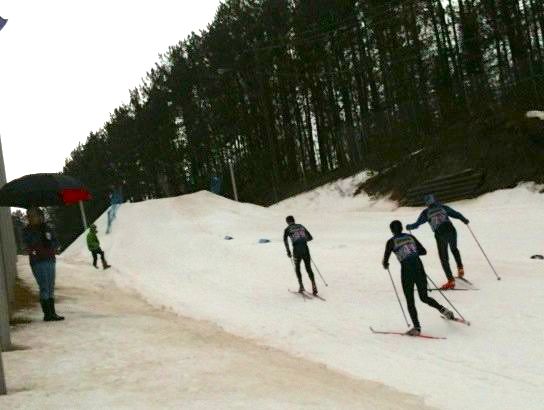
    NYSEF's Henry Eldridge 7.8 k men's race, with competitors heading towards the top of the big manmade climb leaving the stadium at the Olympic Jumping Complex in Lake Placid, N.Y. (Photo: Laurel Minde)
    NYSEF’s Harry Eldridge 7.8 k men’s race, with competitors heading towards the top of the big manmade climb leaving the stadium at the Olympic Jumping Complex in Lake Placid, N.Y. (Photo: Laurel Minde)

    LAKE PLACID, N.Y. — Riley Douglas, a junior at Honeoye Falls-Lima High School, and Colin Delaney of the New York Ski Educational Foundation (NYSEF) won the women’s and men’s 7.8-kilometer Harry Eldridge Memorial classic races on Jan. 11 at the Olympic Jumping Complex in Lake Placid.

    Both men and women skied three laps on the 2.6 k slushy-yet-snow-covered rollerski loop, primarily used by U.S. biathletes in the offseason.  The classic technique race was a Junior Nationals qualifier for Mid-Atlantic skiers, as well as a U.S. Ski & Snowboard Association (USSA) national-ranking list race.

    Mike Wynn of Peru Nordic in the Henry Eldridge 7.8 k classic race on Jan. 11 at the Olympic Jumping Complex in Lake Placid, N.Y. (Photo: Laurel Minde)
    Mike Wynn of Peru Nordic in the Harry Eldridge 7.8 k classic race on Jan. 11 at the Olympic Jumping Complex in Lake Placid, N.Y. (Photo: Laurel Minde)

    Douglas won in 26:14, five seconds ahead of Mackenzie Rizio of the Stratton Mountain School. Autumn Eastman of Champlain Valley Union High School was third.

    Delaney’s winning time was 21:31.  St. Lawrence University skiers Will Frielinghaus and Calvin Swomley finished second and third respectively.

    That the race occurred at all was a minor miracle. Rain had washed away the snow at Mount Van Hoevenberg, leaving only the 2.6 k loop of manmade snow at the ski jumps.  Race day temperature was 46 degrees, and it began to rain on and off 30 minutes prior to the men’s start at noon.  Starting at 1:30, the women raced in an unrelenting downpour.

    Although there were dirty and icy patches, the track was solid, and the downhills were fast. A huge puddle covered the track at the base of the big climb leaving the stadium, and the returning descent. Continuous shoveling by Olympic Regional Development Authority (ORDA) employees and volunteers kept a narrow lane open in each direction. An ORDA employee said he saw someone try to make a move around another skier through the puddle, only to faceplant.

    The weather led NYSEF to cancel Sunday’s freestyle race.

    Results: women | men

  • Convincing Climb to the Castle Wins For Stephen, Burke

    Convincing Climb to the Castle Wins For Stephen, Burke

    Liz Stephen receives encouragement from U.S. Ski Team women's coach Matt Whitcomb while leading the Climb to the Castle rollerski race on Sunday.
    Liz Stephen receives encouragement from U.S. Ski Team women’s coach Matt Whitcomb while leading the Climb to the Castle rollerski race on Sunday.

    WILMINGTON, N.Y. — It didn’t matter that this year’s Climb to the Castle rollerski race fell on the last day of the U.S. Ski Team’s exhausting two-week intensity camp in Lake Placid, N.Y. Liz Stephen (USST/Burke Mountain Academy) was still able to shave a minute and a half off of her winning time from a year ago.

    It took Stephen just over 42 minutes to wind her way up five miles of an eight-percent average grade to the summit of Whiteface Mountain (4,867 feet) Sunday morning. It’s the third straight year Stephen has claimed the title.

    “In these kind of races, the conditions change so much,” Stephen said. “I was just pushing myself today and trying to go as hard as I could.”

    It wasn’t the five-minute margin from last year, but Stephen beat runner-up Caitlin Gregg (Methow Olympic Development) by a commanding 3 minutes and 17 seconds. Stephen strung out the train immediately, seemingly unfazed by the steady wind. Gregg hung on through two miles, but a mile later Stephen had opened a 300-meter gap.

    “My goal was to try and stay with Liz as long as possible,” Gregg said. “I was really impressed. I think Liz was really comfortable V2ing up those steeper sections.”

    Caitlin Gregg tries to keep her technique intact while chasing Climb to the Castle race leader Liz Stephen.
    Caitlin Gregg tries to keep her technique intact while chasing Climb to the Castle race leader Liz Stephen.

    Gregg last competed in the Climb five years ago, when she won on a modified course due to snow on the road in higher elevations. A crisp but dry Sunday gave Gregg her first look at the iconic castle at the finish line.

    “I just didn’t know how long the race was and I got kind of nervous about V2ing all of that,” Gregg said.

    Gregg flew in from Minnesota for the weekend, wanting to gauge her fitness against some of the nation’s best. She said USST women’s coach Matt Whitcomb sent her a copy of the team’s workout plan for the camp, which Gregg wanted to follow to ensure an accurate comparison to her competitors based on fatigue levels.

    “I’ve definitely been training really, really hard,” Gregg said. “It feels really good to get out here and put in a good effort.”

    Ida Sargent (USST/Craftsbury Green Racing Project) pulled away from biathlete Annelies Cook (U.S. Biathlon Association/Maine Winter Sports Center) late to finish third, two minutes back of Gregg. Sargent said she lost sensation in her feet during the race, possibly due to lacing her boots too tight.

    “I was having trouble V2ing, so I just kept trying to take one step after the next,” Sargent said. “It wasn’t exactly how I was hoping it would pan out, but it was a good, hard workout and that’s all that counts.”

    Whitcomb watched the women’s race unfold out the back of a support van.

    “It’s a unique race for us, because it always falls in a different part of the camp,” Whitcomb said. “I was expecting, honestly, to see a little bit more loose ends and ragged technique out here. People kept it together pretty well.”

    Tim Burke’s (USBA) dominance of the men’s race became evident when he had caught nearly all of the women, who started 10 minutes before him, and second place finisher Simi Hamilton (USST) was nowhere in his wake. Burke (37:13) beat Hamilton by 2 minutes and 46 seconds. Karl Nygren (CXC) nearly chased down Hamilton and finished third.

    “I kind of tucked in for the first couple minutes, then wanted to put in a little attack and try to string it out a little bit,” Burke said. “When I attacked, I ended up getting a little break, so I decided to just try and go with it.”

    Video of women’s race by Matt Whitcomb and Steven McCarthy

  • NYSEF Nordic Coaching Positions

    Assistant Cross-Country/Biathlon Coach

    The New York Ski Educational Foundation (NYSEF) in Lake Placid, NY is seeking an Assistant XC / Biathlon Coach for the 2012-2013 season and beyond. The coaching position is full-time from late October-March and will work with all levels of the cross-country, biathlon and Nordic combined programs. Candidates should have racing and/or coaching experience and be willing to travel to regionally and nationally. Salary subject to qualifications. Interested candidates should contact Margaret Maher at margm@nysef.org for full job description and additional information.

     Assistant Cross-Country Coach

    The New York Ski Educational Foundation (NYSEF) in Lake Placid, NY is seeking an Assistant XC Coach for the 2012-2013 season and beyond. The coaching position is on a per-diem basis from late November-March and will work primarily with the J3 and younger cross-country, biathlon and Nordic combined programs. Candidates should have racing and/or coaching experience. Salary subject to qualifications. Interested candidates should contact Margaret Maher at margm@nysef.org for additional information.

  • NYSEF Climb to the Castle Roller-Ski Race this Saturday

    NYSEF Climb to the Castle Roller-Ski Race this Saturday

    Saturday, September 17, 2011

    The US Ski Team and US Biathlon National Team are racing, so get registered for the most exciting roller-ski race of the season!

    Click here to see the athlete roster

    Online race registration closes Thursday, September 15 at 12 noon

    The course starts at the Whiteface Toll Booth, climbing for 5 miles with an average 8% grade up the Whiteface Memorial Highway to the castle on the summit of Whiteface Mountain, New York’s 5th highest peak with an elevation of 4,867 ft. The race is freestyle technique and athletes will be greeted at the finish with a 360-degree panoramic view of the Adirondacks, New England and Canada.
    Link to full race details: Climb to the Castle 2011

    Link to registration: AlpineReg


    Check out the NYSEF XC webpage for updates: http://nysef.org/vanhoevenberg.html

    Questions? Email Margaret Maher margm@nysef.org or call the Nordic office at (518) 523-1900.

  • NYSEF Climb to the Castle Roller-Ski Race

    WILMINGTON, NY – The New York Ski Educational Foundation and the Olympic Regional Development Authority announce the 5th annual NYSEF Whiteface Climb to the Castle Rollerski Race on Saturday, September 17 at 8:00 am. The course starts at the Whiteface Toll Booth, climbing for 5 miles with an average 8% grade up the Whiteface Memorial Highway to the castle on the summit of Whiteface Mountain, New York’s 5th highest peak with an elevation of 4,867 ft. The race is freestyle technique and athletes will be greeted at the finish with a 360-degree panoramic view of the Adirondacks, New England and Canada. Attendance is expected from the US Ski Team, the National Elite Group and many top senior and junior racers from around the country.

    Link to full race details: Climb to the Castle 2011

    Link to registration: AlpineReg

    Check out the NYSEF XC webpage for updates: http://nysef.org/vanhoevenberg.html

    Questions? Email Margaret Maher margm@nysef.org or call the Nordic office at (518) 523-1900.

  • NYSEF Whiteface Climb to the Castle Rollerski Race

    The New York Ski Educational Foundation and the Olympic Regional Development Authority announce the 4th annual NYSEF Whiteface Climb to the Castle Rollerski Race on Friday, October 8, 2010 at 8:30 am. The course starts at the Whiteface Toll Booth, climbing for 5 miles with an average 8% grade up the Whiteface Memorial Highway to the castle on the summit of Whiteface Mountain, New York’s 5th highest peak with an elevation of 4,867 ft. The race is freestyle technique and athletes will be greeted at the finish with a 360-degree panoramic view of the Adirondacks, New England and Canada. Attendance is expected from the US Ski Team, both cross-country and Nordic combined teams, along with many top senior and junior racers from around the country.Link to event flyer and race registration: http://nysef.org/vanhoevenberg.html

    Questions? Email Margaret at margm (at) nysef.org or call the Nordic office at (518) 523-1900.