Tag: Oberhof Germany

  • Oberhof Freestyle Sprint—Lars Heggen Proves His Point

    Oberhof Freestyle Sprint—Lars Heggen Proves His Point

    This coverage is made possible through the generous support of Marty and Kathy Hall and A Hall Mark of Excellence Award. To learn more about A Hall Mark of Excellence Award, or to learn how you can support FasterSkier’s coverage, please contact info@fasterskier.com.

    Lars Heggen (NOR) overpowered the field in Oberhof, but many of the world’s best sprinters—his Norwegian teammates—were absent from the day’s racing. (Photo: Authamayou/NordicFocus)

    Some day, Norway won’t be the only force in Men’s World Cup cross-country skiing. Some day, the participation of other nations will truly matter. Other nations will hear their anthems played, other skiers will excel, other results will be cited and praised. Some day, France may figure it out, or Finland may remember its heritage, or Sweden may return to prominence. The USA may identify another Bill Koch, or Italy another Pellegrino, or Switzerland another Cologna, or Russia another Bolshunov. Some day, the podium of the Men’s Cross-Country Skiing World Cup will not be decorated exclusively in Norwegian flags. While that’s not yet the cross-country skiing world that we live in, it is this upcoming World cup weekend in Oberhof where we expect to witness a kind of “It’s A Wonderful Life” view of Nordic skiing . . . the chance to see what the world would be like without them.

    France stayed home from Oberhof, presumably for national championships and team selections of their own. But everyone else is here, hoping to add to their World cup résumés with some of the scraps left on the tablecloth by absent Norwegians. Finland has sent its best (their Sprinters, anyway), and Sweden (in Norway’s absence they could make a splash), and the Italians (Federico Pellegrino and Elia Barp will see their chances to capture glory). The Czechs and the Swiss are here as well, hoping to grab World Cup distinction while the Norwegians are at home. And Team USA has sent it’s own hungry skate-sprinters, as well. Ben Ogden and Jack Young will be vying to return to the finals . . . even to imagine standing atop the podium (dare we say). JC Schoonmaker will be desperate to prove he belongs on the team that marches into Milano-Cortina. Gus Schumacher will be itching to prove that he and Ogden make a compelling Team Sprint team. There’s a lot going on . . . the same sort of drama that goes on every single week of the World Cup season, but no one really notices it because we’re so distracted by the Norwegian that tsunamis through every World cup venue.

    And where’s Norway? Well, Norway has more important business to attend to. World Cup wins, World Cup podiums, World Cup points: those are every-week occurrences for ski-crazy Norway. But 2026 is an Olympic year . . . the big prizes will be awarded at the Games of Milano-Cortina. So, this weekend in Oberhof, Norway sends stand-ins while the true contenders refine their technique or taper their training, or just put their feet up for a few hours before the headlong streak toward Norwegian immortality in Milano-Cortina continues.

    The elder Northug bother—Petter—was one of Norway’s greatest champions, but even he faced disappointment when it came to Olympic qualification. If Lars Heggen fails to make the team for Milano-Cortina, he will understand the parallels between his pain, and Northug’s. (Photo: Nordnes/NordicFocus)
    Norway Still Expects to Win

    Lars Heggen (NOR) is 20 years old . . . and he just dominated the Sprint competitions at the recent Norwegian Nationals. Granted, a number of Norway’s very best Sprinters weren’t there (no Klaebo, no Valnes, no Amundsen), but Heggen made enough of an impression that many Norwegian ski-pundits called for his immediate elevation to the Olympic Team. We can assume that Petter Northug was not among that enthusiastic group of pundits . . . especially since a 20-year-old Northug dominated 2006 Norwegian Nationals in an even more commanding manner than Heggen did in 2026. And Northug was unceremoniously denied an Olympic berth because of the selection committee’s assertion that, at only 20, he was too young for the pressures of Olympic competition, that Northug would benefit from more development time before being tossed into the Olympic maelstrom. Northug’s career turned out all right in the end, but it may have been even better if he’d collected another Olympic medal or two at the 2006 Games in Torino.

    Northug’s little brother, Even, competes for Norway in the World Cup Sprint this weekend in Oberhof. Like his brother 20 years ago, Even Northug has already been told that no spot is reserved for him on the Norwegian Team at the upcoming Olympic Games. Well, he’s still a world class Sprinter . . . it will be interesting to see how the younger Northug uses this weekend’s Sprint opportunity to comment on his being the second Northug to have been ignored in his efforts to make a Norwegian Olympic Team.

    But first, you need to qualify . . .

    The top American qualifier in Oberhof, JC Schoonmaker (USA) leading Even Northug (NOR), and Zanden Mcmullen (USA) in their quarterfinal heat. (Photo: . Authamayou/NordicFocus)
    Qualifying

    We don’t know exactly why, but it’s been reported that top 30 in today’s Sprint qualifying will be rewarded with increased FIS World Cup points (nearly double when compared to normal World Cups, or to races in tour de Ski that received only 50% points). It’s a good reason to be at your best in this particular qualifying event . . . and a pretty good way to continue shuffling the deck for numerous nations that are still choosing their Olympic Teams. And while a number of Norway’s best sprinters decided to sit this one out, Norway still manages to dominate most men’s Wold Cup racing. Case in point: six of Norways seven entries qualified for the heats, with Lars Heggen doing the job he was sent to do—winning the qualifier by 1.5 seconds.

    Americans took advantage of this diluted World Cup field with JC Schoonmaker finishing 13th, Jack Young 22nd, Zanden McMullen 28th, Michael Earnhart 35th, Kevin Bolger 44th, Owen Young 54th.

    “The heat selection strategy was definitely a bit different today with a lot of normal World Cup guys not being here,” said Schoonmaker. “I went for heat 1 because that felt like a good one to move on from and it was a better option than usual with  Klaebo not here. Other than heat selection the strategy didn’t differ at all for me, just trying to race my best!”

    McMullen is better known as a Distance skier, but his strong qualifying effort proved his versatility. “I do actually like using sprint races as a bit of a warm up,” said McMullen. “It puts my mind and body into a race mentality that I can’t really achieve on a race prep day. Sprints also typically feel lower stakes to me, so it’s just a nice way to go out and have some fun!”

    Sprint Heats—New Cast, New Strategies

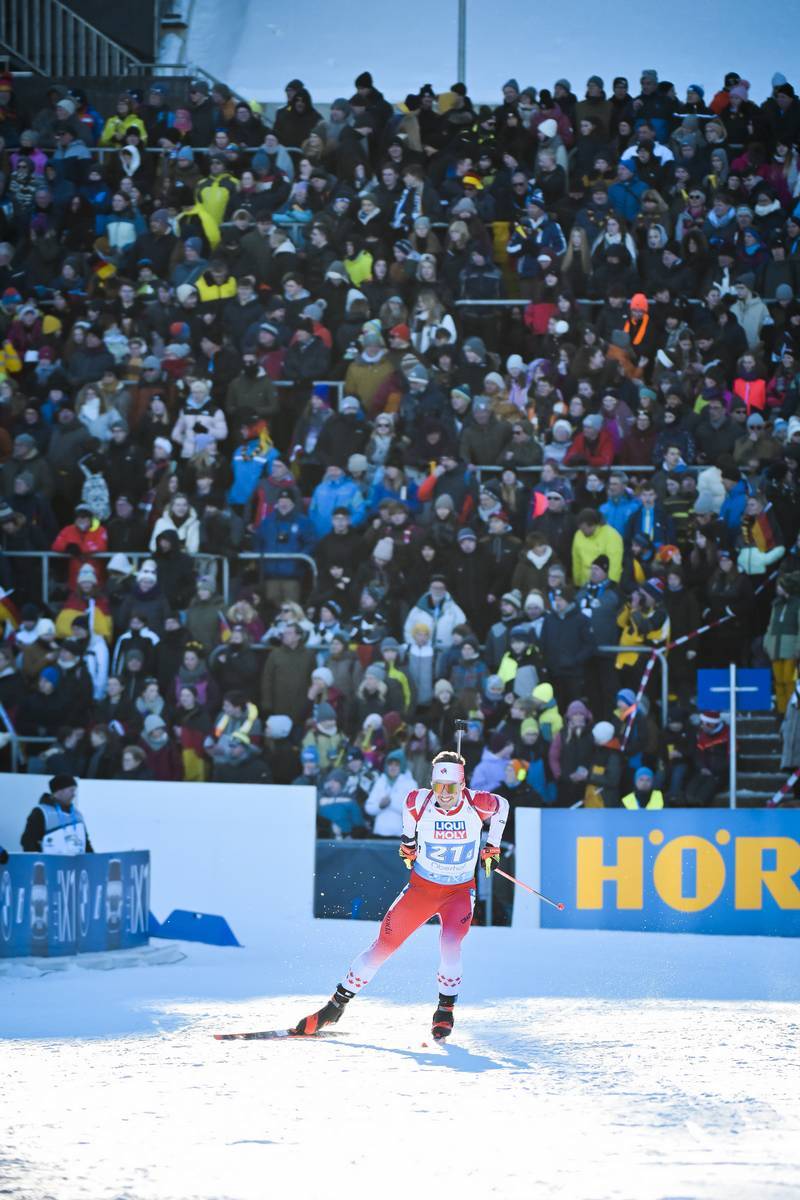
    Skiing can be such a strange sport. Oberhof is a famed biathlon venue; if this were a weekend of biathlon races the grandstands would be packed. As it is, this was a cross-country weekend, and the stadium stood all but empty. The German fans who could’ve been here definitely missed a good show, and a fair indication of what the future of what World Cup Sprint events may look like in the near future. Even with a number of bright stars missing from the days entry list, the racing proved fast and furious.

    There was a lot going on in Quarterfinal 1: Lars Heggen wearing the green U23 World Cup leaders bib, alongside JC Schoonmaker, Zanden McMullen, and Even Northug. Everybody with something to prove, everybody with something to gain, and only two minutes of Heat 1 in which to do it. Schoonmaker led through the early parts of the course, but faded by mid-race. Heggen accelerated up the hill before the finish, sufficiently gapping his rivals and easing up before the finish line which he was followed across by a scrambling Even Northug. McMullen would finish fourth in the heat, followed by Schoonmaker in fifth. On the day, McMullen and Schoonmaker would finish 20th and 23rd, respectively.

    Pellegrino advanced out of Quarterfinal 2 in which Jack Young’s day would end with a fifth place heat finish. Young had led early in the quarterfinal, evidently hoping to press the pace in the hopes of advancing as a lucky loser. His strategy was bold, but it left him one place short. Young would finish 24th on the day.

    “I wanted to get to the front and control the race,” said Young. “Sadly, I wasn’t able to hold my position into the big climb—this wasn’t part of the plan. I then made up sole ground, but I didn’t have the energy to hold my position through the working finish.”

    Semifinal 1 included Heggen, Pellegrino, and Northug who all came in together at the bottom of the final climb. Heggen would V2 the entire climb, while Pellegrino switched to a high-tempo V1 to scoot past into the hole-shot. Northug faded as Lauri Vuorinen (FIN) edged into the top three. Pellegrino would coast across for the heat win, followed by Heggen’s lunge for second ahead of Vuorinen in third and Northug fourth. Those lucky losers would sit and wait for the results of the second semifinal.

    That second semifinal included one well known Sprinter—Switzerland’s Valerio Grond—who was joined by a cast of names we’re less accustomed to hearing: Filip Skari (NOR), Jaume Pueyo (ESP), Emil Liekari (FIN), Jiri Tuz (CZE), and Martino Carollo (ITA). Grond would finish second in the heat behind Liekari to advance to the final. Vuroinen and Northug—lucky losers from Semifinal 1—would advance as well.

    Federico Pellegrino (ITA) used a high-tempo V1 to position himself on the steep uphill of Oberhof’s Sprint course. But Heggen’s V2 would prove stronger. (Photo:  Reichert/NordicFocus)
    Plenty at Stake in the Final

    In the absence of truly dominant skiers, no one really knows what to do. The Sprint Final would become a bit of a curiosity as Heggen hoped to solidify his Olympic credentials . . . but Northug would be harboring similar plans of his own, and they’d both need to figure out how to deal with the cagey veteran, Pellegrino. In the final, Heggen and Pellegrino went to the front to control things, but neither looked eager to really drive the pace. Both the leaders chose the far-right line up the first climb as Liekari spun his wheels in the loose snow on the inside line. That was the point at which Grond took control, charging over the top of the climb. But Heggen’s fast skis could not be contained onthe subsequent downhill. He coasted easily into the lead, followed to the base of the final climb by Pellegrino and Northug. The final hill had offered a contrast in styles all day: Heggen’s V2 power vs. Pellegrino’s V1 tempo. This time up the hill, it was Heggen’s strategy that proved strongest, fending off Pellegrino’s V1 charge and holding on across the finish line for his first World Cup win. Northug would cross the line in third, a fine World Cup finish that was likely to be overlooked in Norway’s construction of its Olympic roster.

    The 20 year old upstart bested the 35 year old veteran. The question that remained was this: was the Norwegian Olympic Team Selection Committee watching?

    Oberhof World Cup Men’s Freestyle Sprint RESULTS

    Oberhof World Cup Men’s Freestyle Sprint QUALIFYING

    The Men’s Freestyle Sprint Podium in Oberhof—Federico Pellegrino (ITA always contends, Lars Heggen (NOR) hopes he proved his point, Even Northug (NOR) left wondering if anyone had noticed. (Photo: Authamayou/NordicFocus)


    Love Stories Like This? Help Keep Them Coming.

    Feature stories like this one take time, access, and care to produce. If you value thoughtful storytelling and independent ski journalism, please consider becoming a Voluntary Subscriber. Your support directly fuels the work we do to cover the people, places, and moments that make our sport special.

    Join the FasterSkier community!
  • Sweden Dominates Oberhof Relay

    Sweden Dominates Oberhof Relay

    This coverage is made possible through the generous support of Marty and Kathy Hall and A Hall Mark of Excellence Award. To learn more about A Hall Mark of Excellence Award, or to learn how you can support FasterSkier’s coverage, please contact info@fasterskier.com.

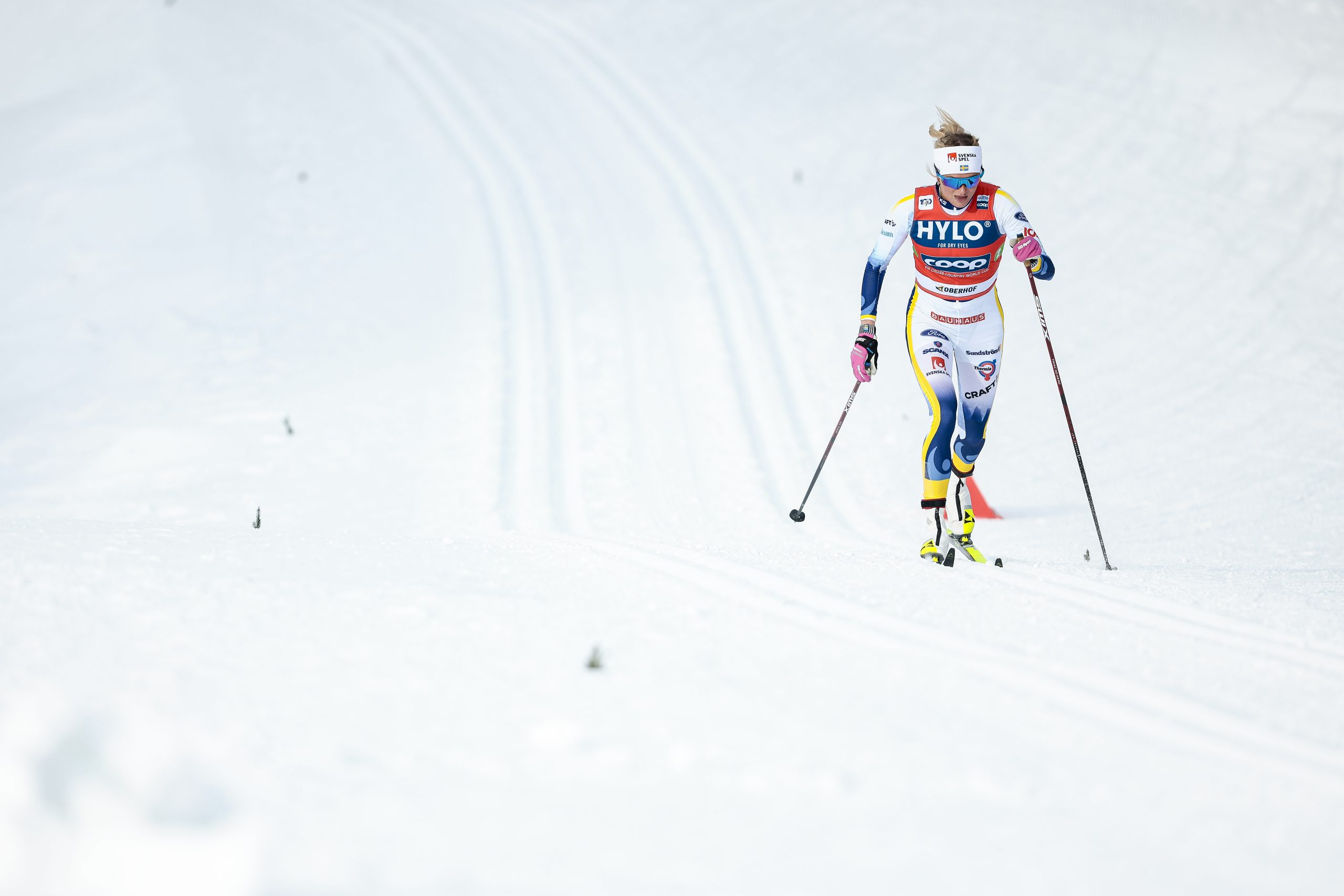
    Sweden I (Linn Svahn, Frida Karlsson, Ebba Andersson, and Jonna Sundling) dominated the 4 x 7.5 k Relay in Oberhof, Germany. (Photo: Modica/NordicFocus)

    When it comes to success in cross country relay finishes, national nordic pride is a vital concern in only those countries where national nordic pride flourishes: Norway, Sweden, Finland, and Germany (and, of course, Russia if they were allowed to enter World Cup races in 2024). For the most part, relays conducted within World Cup seasons are simply rehearsals for the more consequential relays that occur every few years in World Championships and Olympic Games. The USA—especially the women’s team—has long pursued success in relays, and generations of America’s best cross country skiers have devoted considerable time, effort, and race energy to the pursuit of relay podiums (usually to little avail). This weekend, the coaches of Team USA seemed finally to appreciate the value of rest and recovery above the potential value of relay success; the USA fielded no team for the 4 x 7.5 relay in Oberhof, Germany. With Jessie Diggins (USA) and Rosie Brennan (USA) standing first and third, respectively, in Overall World Cup standings—and with no individual World Cup points at stake today—it made sense to prioritize their potential in the season-long World Cup race over a chance (a slim chance) for otherwise-irrelevant relay glory.

    Norway was fourth earlier this season in the relay in Gaellivare, Sweden, a performance that on-air announcers described as a “national disaster.” That was the first time since 2001 that Norwegian women had failed to claim a podium spot in a world-class relay. In Leg 1 of Oberhof’s relay, Norway’s lead off skier—Kristin Austgulen Fosnaes—seemed to struggle with skis that were both slow on the glide and slippery on the kick. It was an inauspicious start to what would prove another disastrous day for Team Norway (Fosnaes, Mathilde Myrvold, Margrethe Bergane, Tiril Udnes Weng) who would finish the day in fifth.

    Ultimately, Sweden I (Linn Svahn, Frida Karlsson, Ebba Andersson, Jonna Sundling) skied purposefully away from the field to secure the win, followed by Germany I (Katherine Sauerbrey, Katharina Hennig, Pia Fink, Victoria Carl) and Finland (Johanna Matintalo, Anne Kyllonen, Krista Parmakoski, Jasmi Joensuu).

    Team Canada finished tenth on the day. Team USA did not field a team in Oberhof’s World Cup relay.

    Frida Karlsson (SWE) set a blistering pace in her Classic leg. By the end of Leg 2, Sweden’s lead swelled to more than a minute, and the race’s outcome was all but decided. (Photo: Modica/NordicFocus)
    4 x 7.5 k Relay

    In the absence of certain stars from various countries, Sweden seemed likely to control the pace throughout the day. In the opening classic leg, it was the two teams from Sweden that forced the pace, followed by Finland, Norway, and Germany. From the very beginning of Leg 1, most skiers sought out the faster snow between the set tracks on the gliding sections. Many skiers also sought additional traction by exiting the tracks in the climbing sections as well. Despite the relentless climbs of the Oberhof course—where each skier would complete three 2.5 k laps—most skiers seemed to prioritize glide over kick. Successfully navigating those conditions, Sweden I, Sweden II, and Finland succeeded in separating themselves from Norway, Germany I, and Germany II.

    Near the end of the second scramble lap, Sauerbrey surged away from the other chasers (Germany II being blocked behind a struggling Fosnaes) in an attempt to connect with the leading trio. Svahn accelerated near the end of Leg 1, dropping Ribom and drawing out Matintalo who tripped over her own pole on the final uphill before the stadium. Entering the exchange zone, then, it was Sweden I with a lead of ten seconds, followed by a chase group of three. Sauerbrey had done her job, handing off to Hennig in the company of Sweden II and Finland.

    Riding a wave of fitness that saw her win yesterday’s 20 k Classic Mass start—and earn her career-first podium spot in Friday’s Classic sprint—Karlsson quickly began adding time to her advantage over Hennig and the chasers. Norway had fallen back into a larger chase group with Germany II, Canada, Switzerland, and Italy. France dangled off the back in 10th, while Kazakhstan struggled on alone.

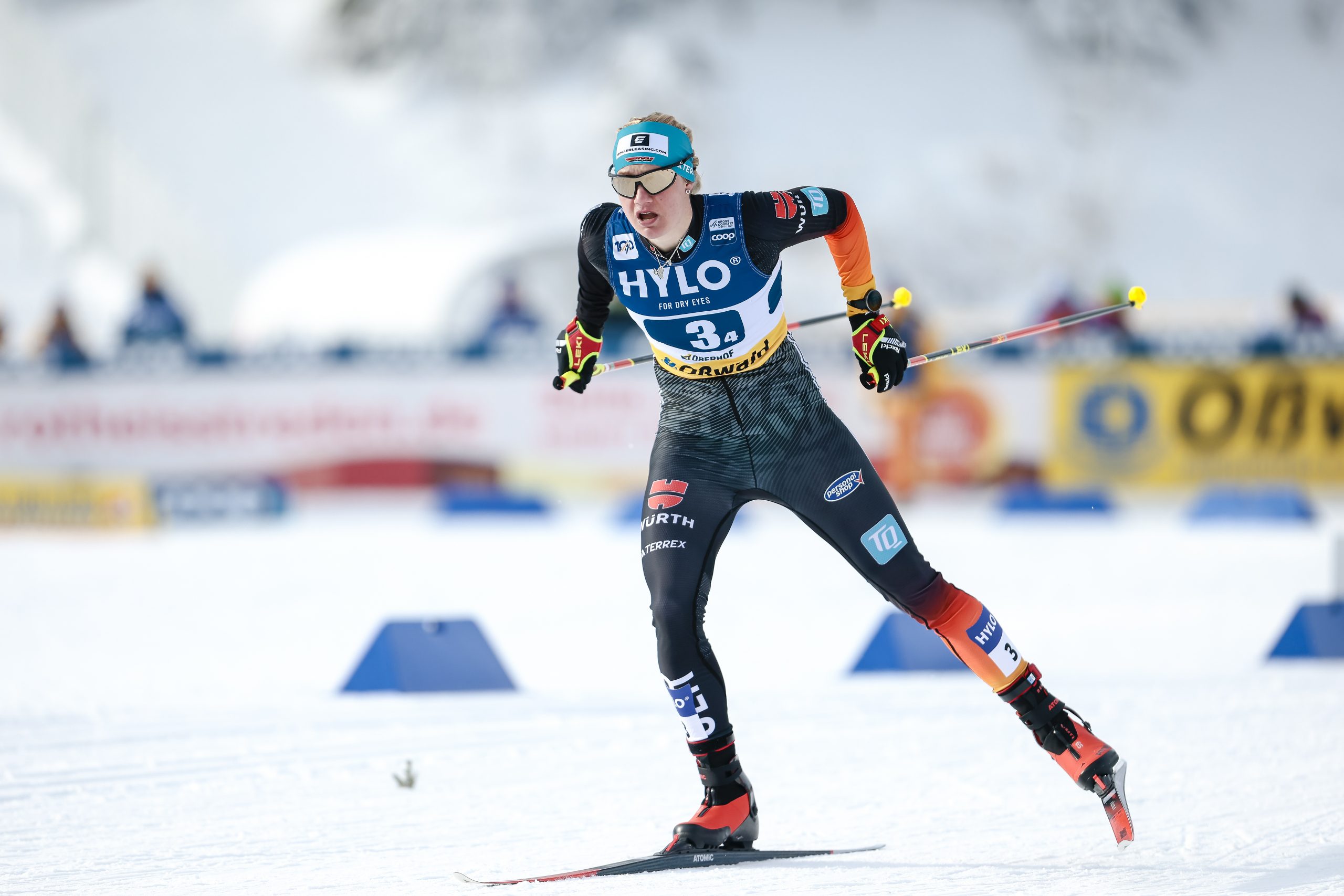
    Victoria Carl (GER) made things interesting in the final leg, trimming 50 seconds from Sweden’s lead to finish just 17 seconds behind the winners. (Photo: Modica/NordicFocus)

    Karlsson continued to drive the pace while Hennig began to separate herself from Kyllonen and Henriksson; the field of contenders spread out into solo efforts. Having put 49 seconds into her rivals in her Classic leg, Karlsson enjoyed a lead of nearly a minute as she handed off to Andersson; still with two 7.5 legs remaining, the race results seemed mostly decided.

    Andersson extended the Swedish lead to 1:07 by the time she handed off to Sundling for the final leg. Ultimately, Carl made it a bit of a race, erasing 50 seconds of Sweden’s advantage in the final leg to finish less than 20 seconds behind in second place.

    Women’s 4 x 7.5 k Relay RESULTS

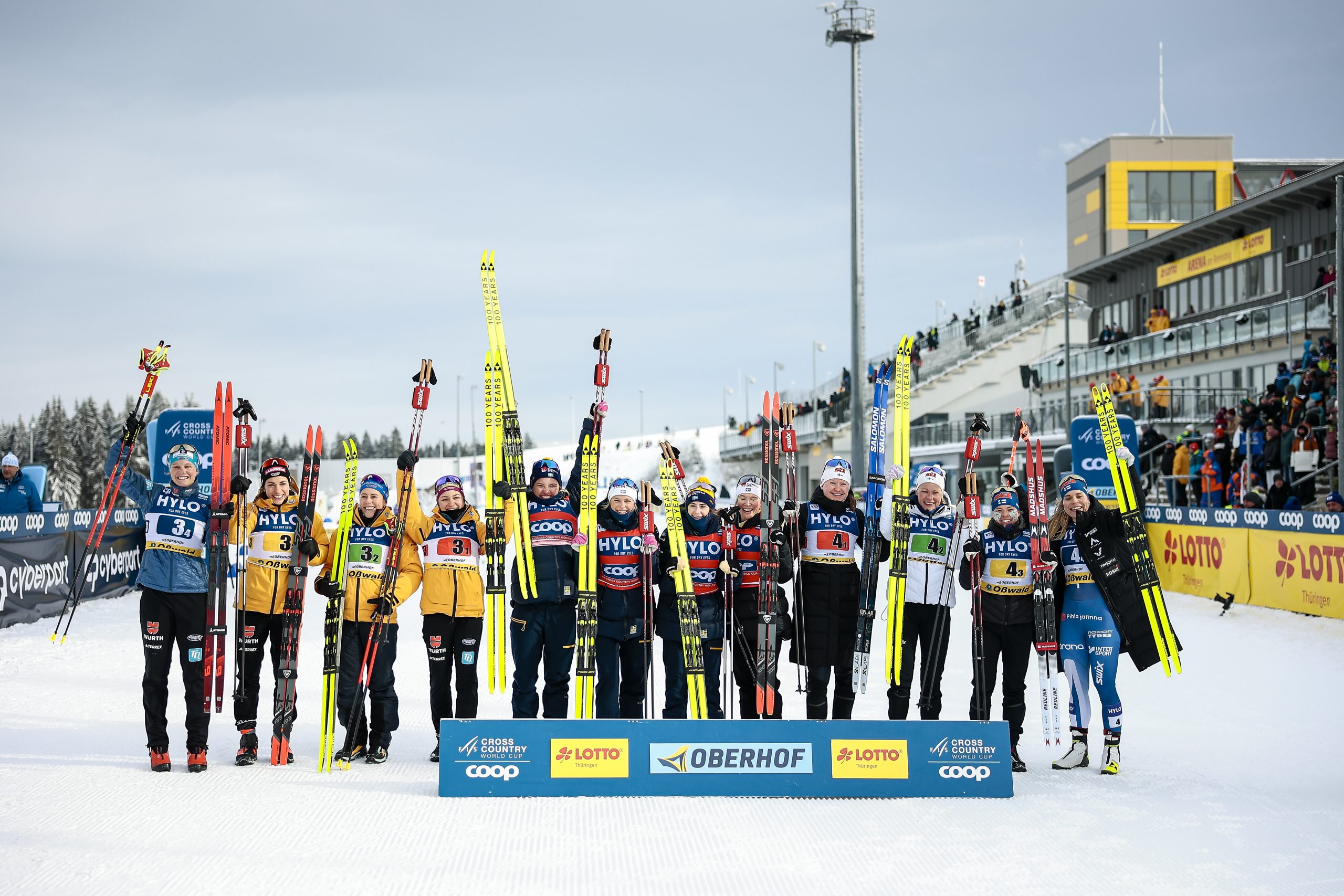
    The podium in Oberhof’s 4 x 7.5 k Relay: Victoria Carl (GER), Pia Fink (GER), Katharina Hennig (GER), Katherine Sauerbrey (GER), Linn Svahn (SWE), Frida Karlsson (SWE), Ebba Andersson (SWE), Jonna Sundling (SWE), Johanna Matintalo (FIN), Anne Kyllonen (FIN), Krista Parmakoski (FIN), Jasmi Joensuu (FIN). (Photo:  Modica/NordicFocus)
  • Biathlon World Championships Mixed Relay: 26 Nations in the Mix

    Biathlon World Championships Mixed Relay: 26 Nations in the Mix

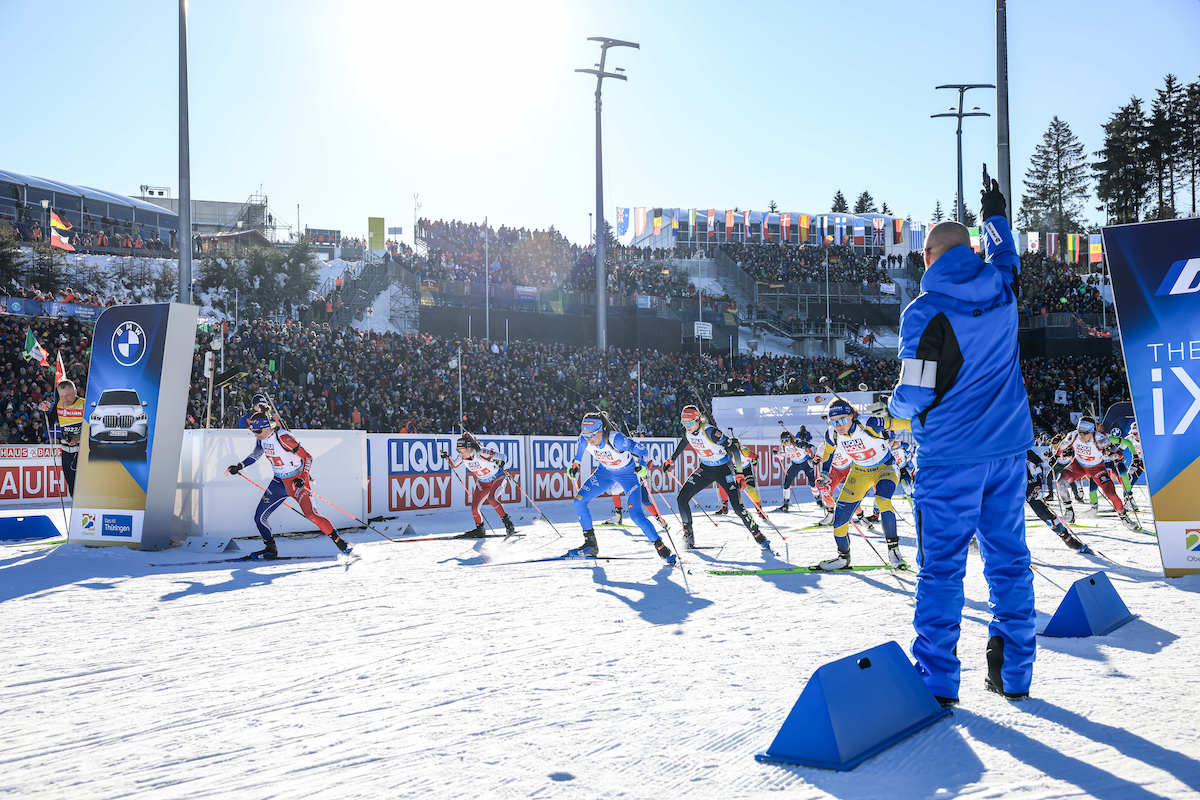
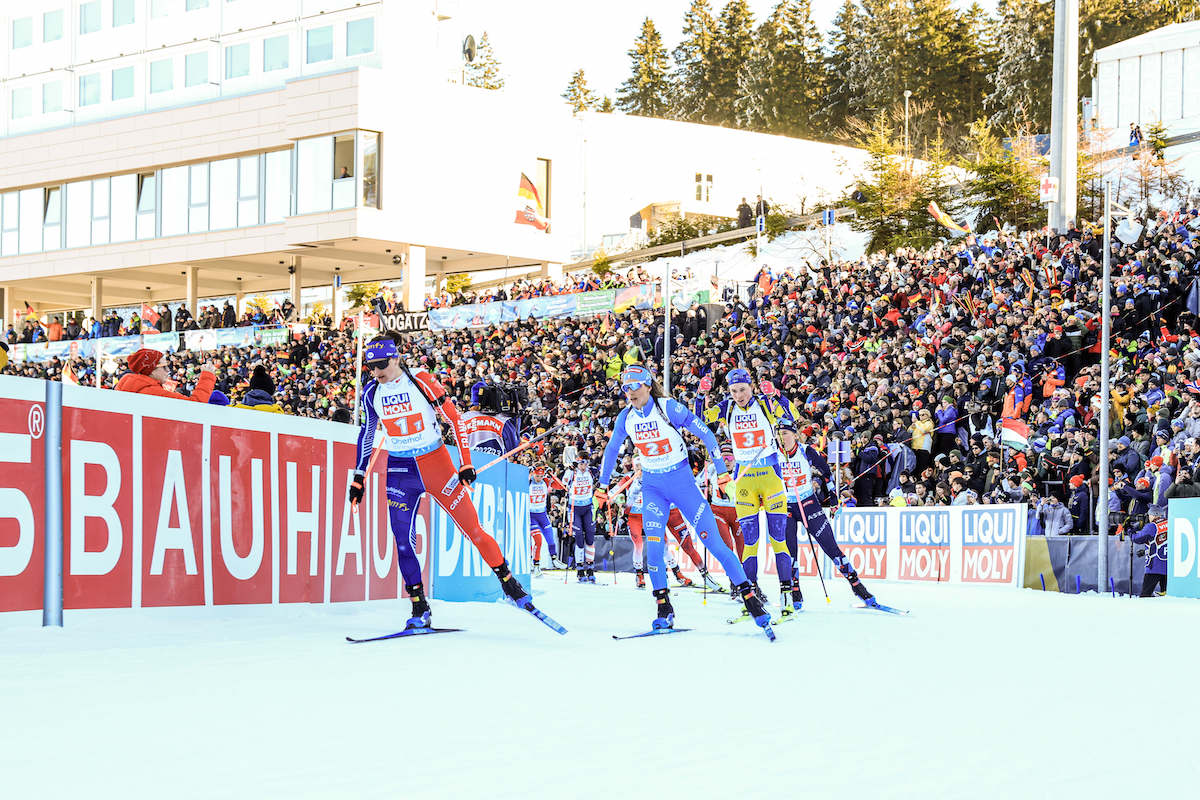
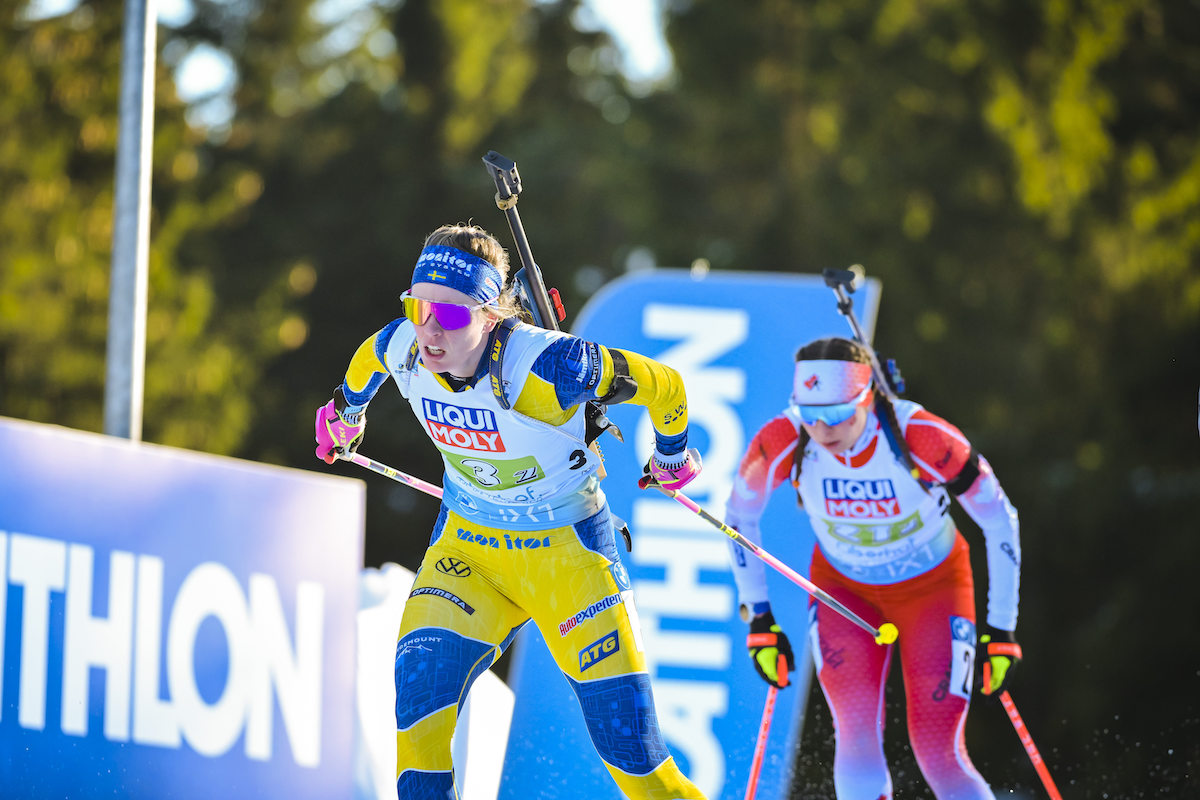
    The start of the IBU World Championships Mixed Relay in Oberhof, Germany. (Photo: NordicFocus)

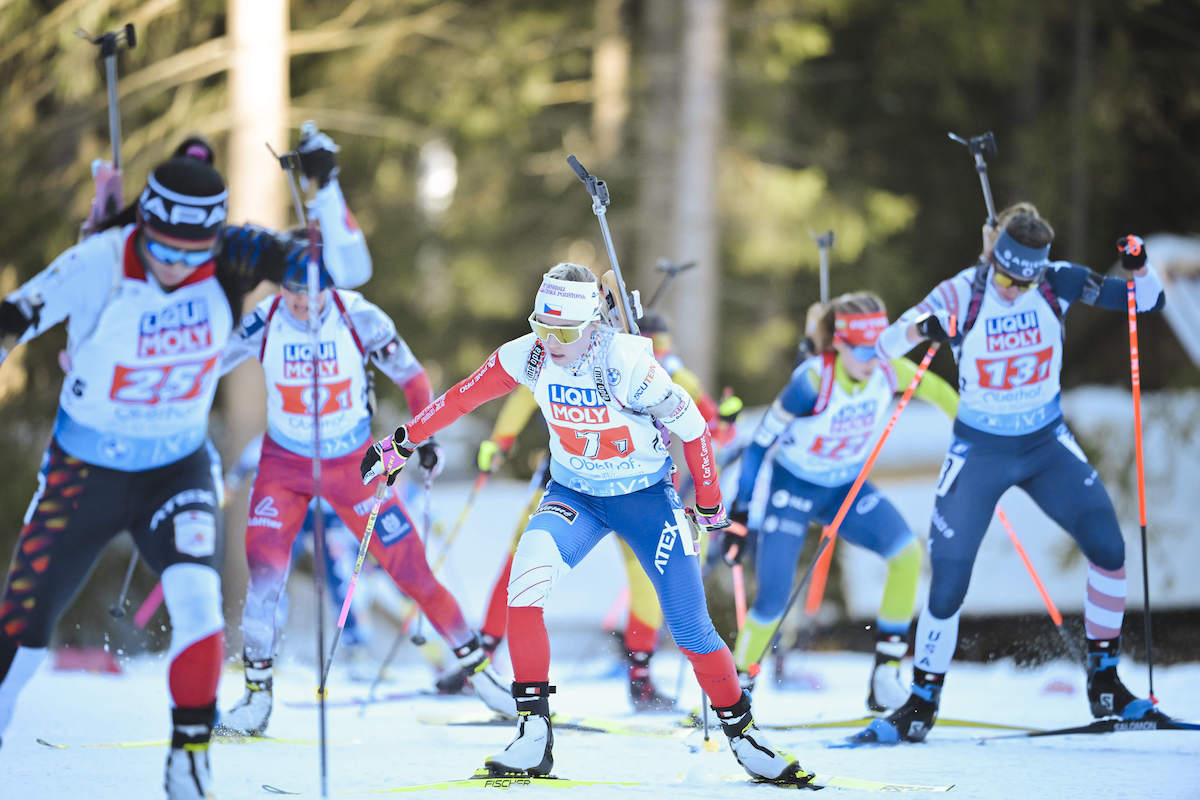
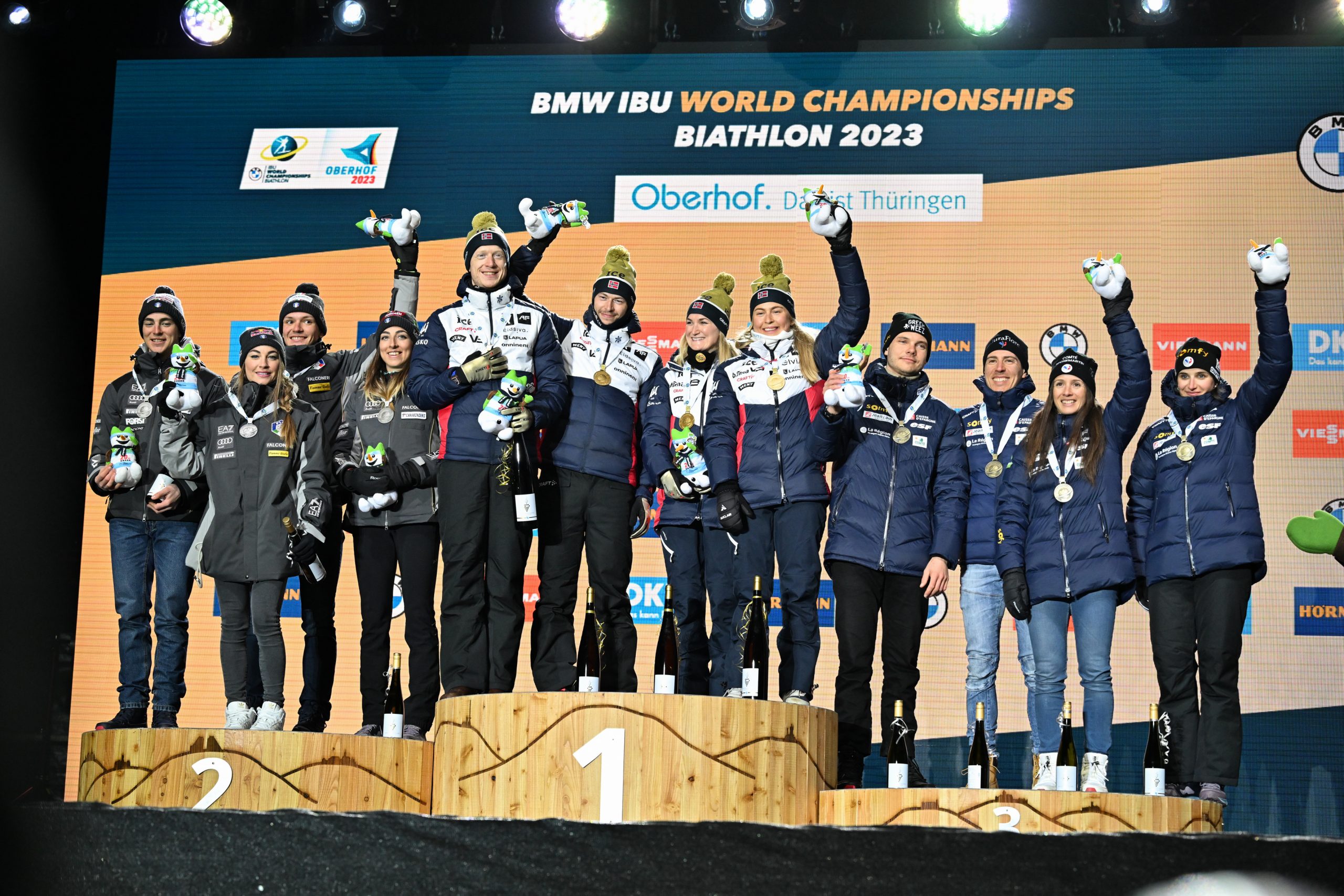
    The opening event of the 2023 World Championships delivered in spectacular fashion. Twenty-six nations lined up for the Mixed Relay on Wednesday afternoon under bright sunshine and calm, clear skies, with temperatures around zero degrees Celsius. The perfect conditions were a dream come true for organizers, spectators, and teams alike, especially since Oberhof has a reputation for dense fog, heavy wind and snow, and that displeasing other form of precipitation which we won’t even name. Ultimately, those perfect conditions were the ideal backdrop for an exciting and dramatic race. On the podium at the end: Norway first, Italy second, France third. But the outcome proved anything but straightforward, and much would transpire between the starting line and the finish line.

    Sean Doherty (USA) zeroing for the IBU World Championships mixed relay. Photo (NordicFocus)
    Race Format

    The Mixed Relay combines the performances of two women and two men who each ski a six kilometer biathlon race—three times around a two kilometer loop—shooting once prone and once standing. As in all biathlon relays, each athlete has the chance to use up to three spare rounds per stage, if needed, to hit the five targets. On those unfortunate occasions when there are still targets left un-hit after using eight rounds, the penalty loop awaits.

    Deedra Irwin (USA, bib 13) racing the first leg of the IBU World Championships mixed relay in Oberhof, Germany. (Photo: NordicFocus)
    Race Course

    Oberhof’s course is one of the hardest in the world, and the two kilometer loop jams together all the nastiest sections. The Birxsteig hill out of the stadium is two minutes of fan-fueled V1/offset technique climbing. Though Eurovision’s announcers remarked that the women in the first leg were going at “a mollusk’s pace,” it’s more likely that they were moving quite well given the steep incline. After a painfully long false flat at the top, athletes crest onto a high-speed, technical descent with a sweeping righthand turn. Hannah Oeberg of Sweden clocked 73 kph there on race day. Next is a sequence of four uphills at varying grades. There is one flattish downhill section mixed in, which tempts athletes to tuck but is really a working section. After the final steep pitch, a short downhill spits out onto the long, flat straightaway approach to the range and finish, where there is often a stiff headwind. Drafting is crucial there.

    Julia Simon (FRA), Lisa Vittozzi (ITA), Hanna Oeberg (SWE), (l-r) rounding the corner into the range at the IBU World Championships mixed relay. (Photo NordicFocus)
    Canada off to an excellent start; setback for Norway

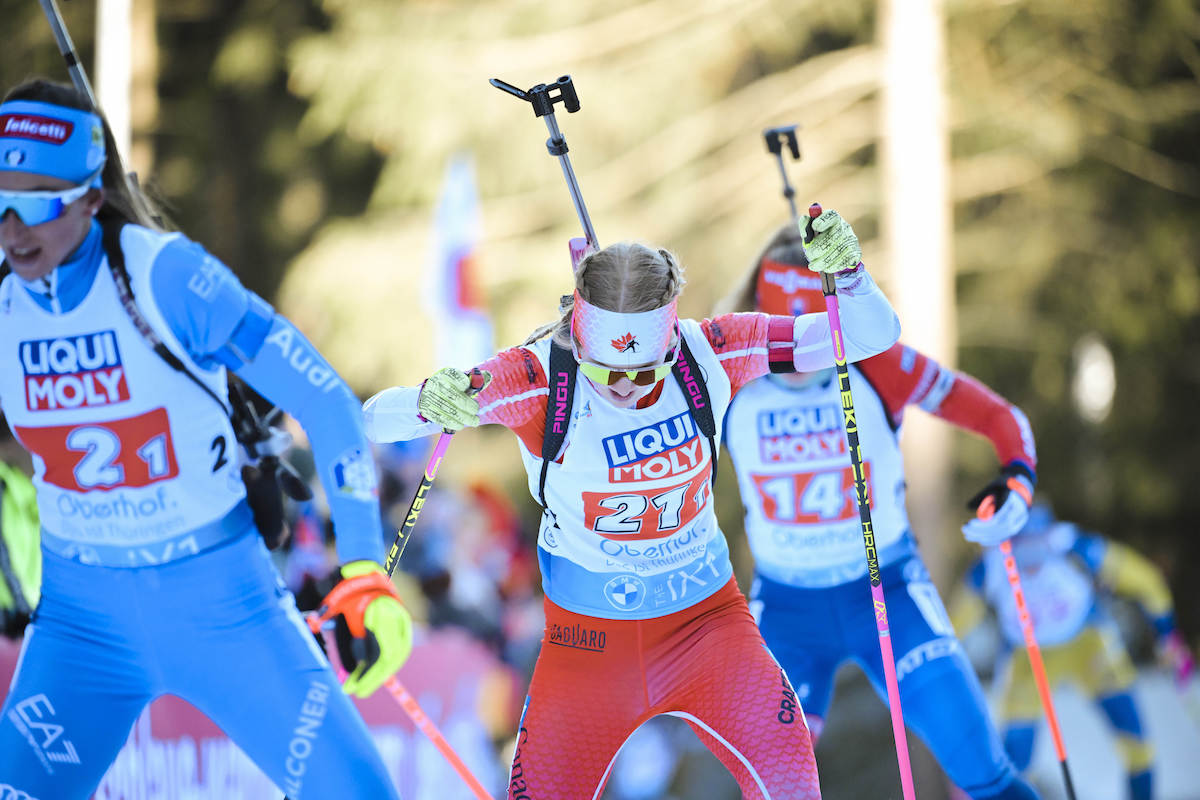
    Norway was heavily favored to win Wednesday’s mixed relay, but right away in the first leg they had a major setback when Ingrid Landmark Tandrevold incurred a penalty loop in standing and left the range in 16th place, 56 seconds back. Lisa Vittozzi of Italy, Julia Simon of France, Emma Lunder of Canada, and Paulina Batovska Fialkova of Slovakia all capitalized on the moment, with Simon clearing her targets in 16.9 seconds to take the lead. At the exchange, Simon led Vittozzi by nine seconds with Fialkova and Lunder following five seconds later. Team Canada couldn’t have asked for a better start from Lunder, who hit 10/10 and skied one of her fastest course times of the season to tag her teammate, Nadia Moser, just 26 seconds out of the lead. Deedra Irwin from the USA also hit the perfect score and skied well especially given a recent bout of illness, tagging Joanne Reid in ninth, right in the mix with nine teams who all tagged between :55 and 1:05 seconds back.

    Emma Lunder (CAN) skiing in third place after the second shooting in the first leg of the IBU World Championships mixed relay. (Photo: NordicFocus.)

    In the second leg, Dorothea Wierer of Italy overtook Anais Chevalier of France, but only by a few meters as both women skied and shot nearly flawlessly. Meanwhile, last year’s World Cup overall winner Marte Olsbu Roiseland tried to claw back time for team Norway but only managed to put five seconds on Wierer. To the delight of the crowd, Denise Herrmann of Germany brought the home team back from a slow first leg, skiing the top course time of the second leg by an impressive 18 seconds to move her team from 11th to third. From Canada, Nadia Moser skied an outstanding first loop, holding onto one of the circuit’s fastest skiers, Sweden’s Eliva Oeberg, but then got left behind on the shooting range when she needed all three spares in prone. Moser escaped without a penalty and eventually tagged in ninth, but Joanne Reid ran into trouble in standing and incurred a penalty loop, tagging in 15th, 2:16 back. At the half way point, Italy, France, Germany, and Sweden were all within 30 seconds of each other at the front of the race, with Norway lagging in fifth still 50 seconds behind.

    Elvira Oeberg (SWE) leads Nadia Moser (CAN) in the IBU World Championships mixed relay. (Photo: NordicFocus)
    Turnaround at the Half-Way Point

    Leg three was a major turning point in the race. Sturla Holm Laegreid fulfilled his teammates’ wildest wishes, executing the perfect race and recovering a 50-second deficit for team Norway to take the lead from France’s Emilien Jaqueline. Didier Bionaz, the first of two 22-year-old men on Italy’s relay team, hung with the more-experienced World Championship medalists from Norway and France to keep his team solidly in the hunt for a medal, tagging off just eight seconds back. Sweden continued lurking dangerously close in 4th, with Martin Ponsiluoma closing the gap to a mere 14 seconds. While Norwegian fans rejoiced, German fans fell off an emotional cliff when Benedict Doll had a penalty loop in prone and sabotaged the comeback Herrmann had just so brilliantly made. Both Canada and US had strong third legs: Adam Runnalls maintained the top-10 position for Canada and Paul Schommer moved from 15th to 13th, losing only 11 seconds to the leaders.

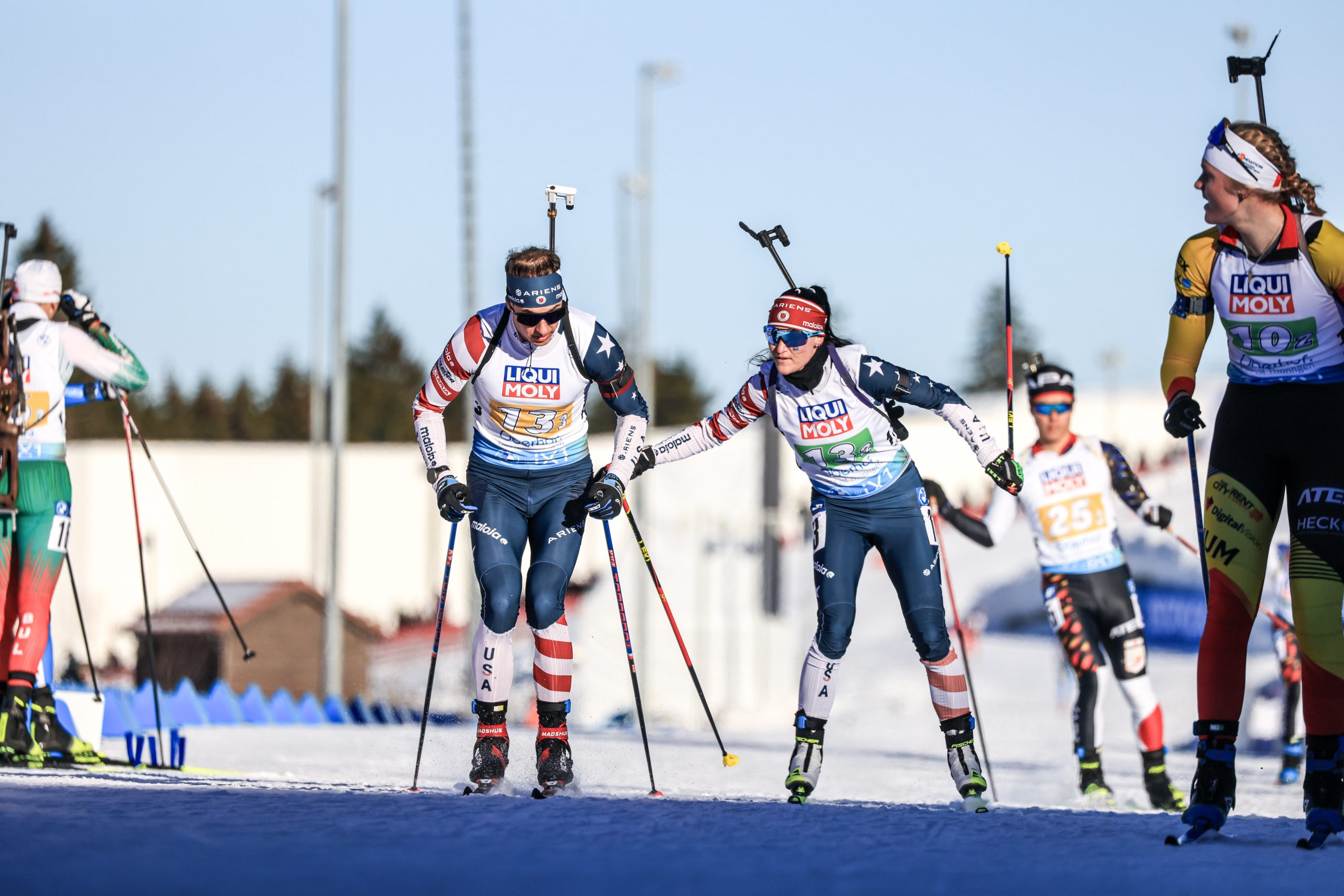
    Joanne Reid (USA) tags Paul Schommer (USA) in the IBU World Championships mixed relay in Oberhof, Germany. (Photo: Nordic Focus)

    When Laegreid tagged Johannes Thignes Boe in first place at the final exchange, it seemed like something crazy would need to happen to prevent Norway from cruising to victory. But then at Shooting 7, the prone stage of the last leg, something crazy did happen. People started missing… and missing, and missing. First Boe, then last year’s World Cup overall winner, Quentin Fillion Maillet of France, then Sweden’s Sebastian Samuelsson, all missed three from the magazine, alarming their teammates who looked on anxiously from the sidelines. The wind flags were not up, so the most probable cause is that the setting sun changed the optics of how athletes saw the target through their sites relative to when they zeroed. In that situation—with no idea where the misses are going or how to make a sight correction—athletes have only one option which is to take a good shot and hope for the best.

    Boe and Fillon Maillet narrowly escaped with no penalty loops, but lost a lot of time shooting each spare round with care. Samuelsson ended up with a hugely disheartening three penalty loops! He later posted on his Instagram account that he found his bedding screws, which hold the rifle in place, to be loose. While the race leaders messed around with spares, 22-year-old Tommaso Giacomel of Italy and 39-year old Simon Eder of Austria managed to clean with no spares, putting Italy in the lead and Austria in fourth!

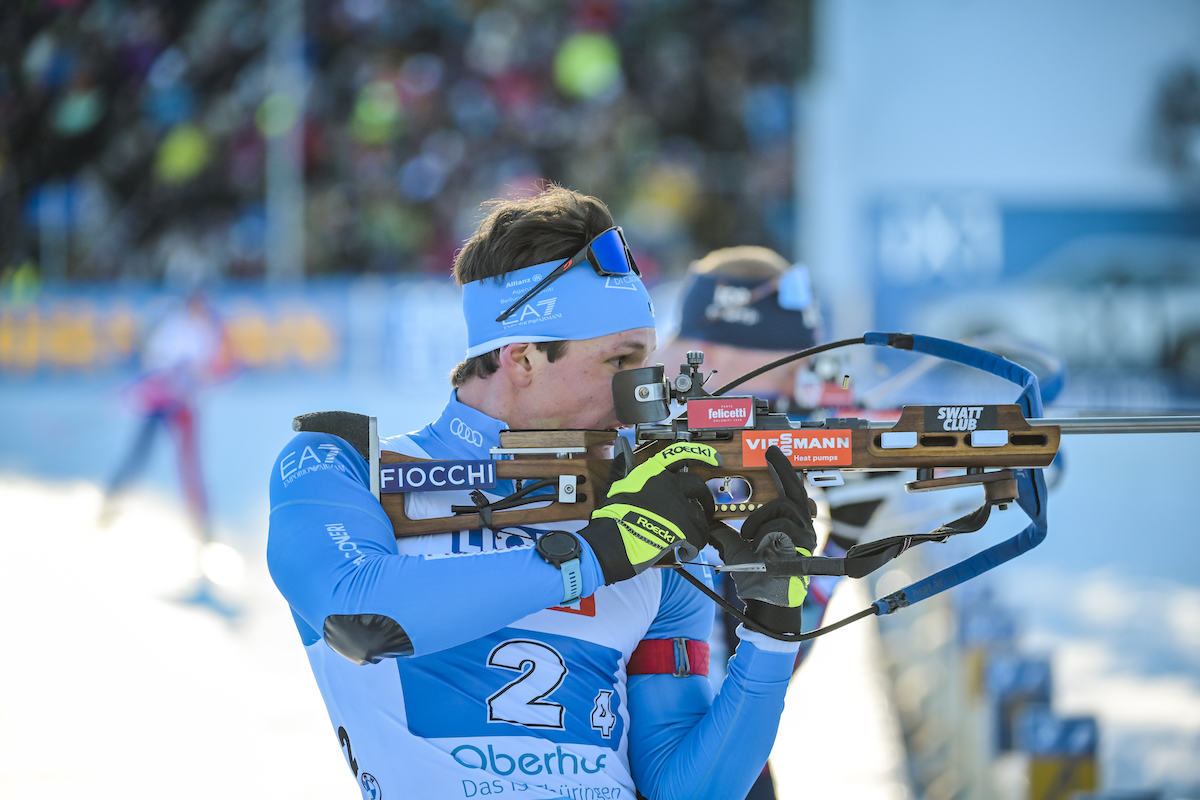
    Tommaso Giacomel (ITA) and Johannes Thignes Boe (NOR) in the final shooting stage of the IBU World Championships mixed relay. (Photo: NordicFocus)

    On the last shooting, all eyes were on the young Giacomel, who found himself shooting on lane one, as superstar Boe let him lead into the range. Shooting on lane one is difficult: big cameras in your face make it nearly impossible to ignore the fact that you’re being watched. You can almost hear the commentators talking about you through the lenses. On any given shooting stage that’s a formidable distraction but when it’s the culmination of a four-person race which has lasted over an hour, and it has all come down to the eighth and final shooting stage to decide who has a chance at a World Championships gold medal, staying focussed downrange is nearly impossible. Giacomel took everyone’s breath away with his composure, hitting four out of five and then the first spare in a total of just 23 seconds.

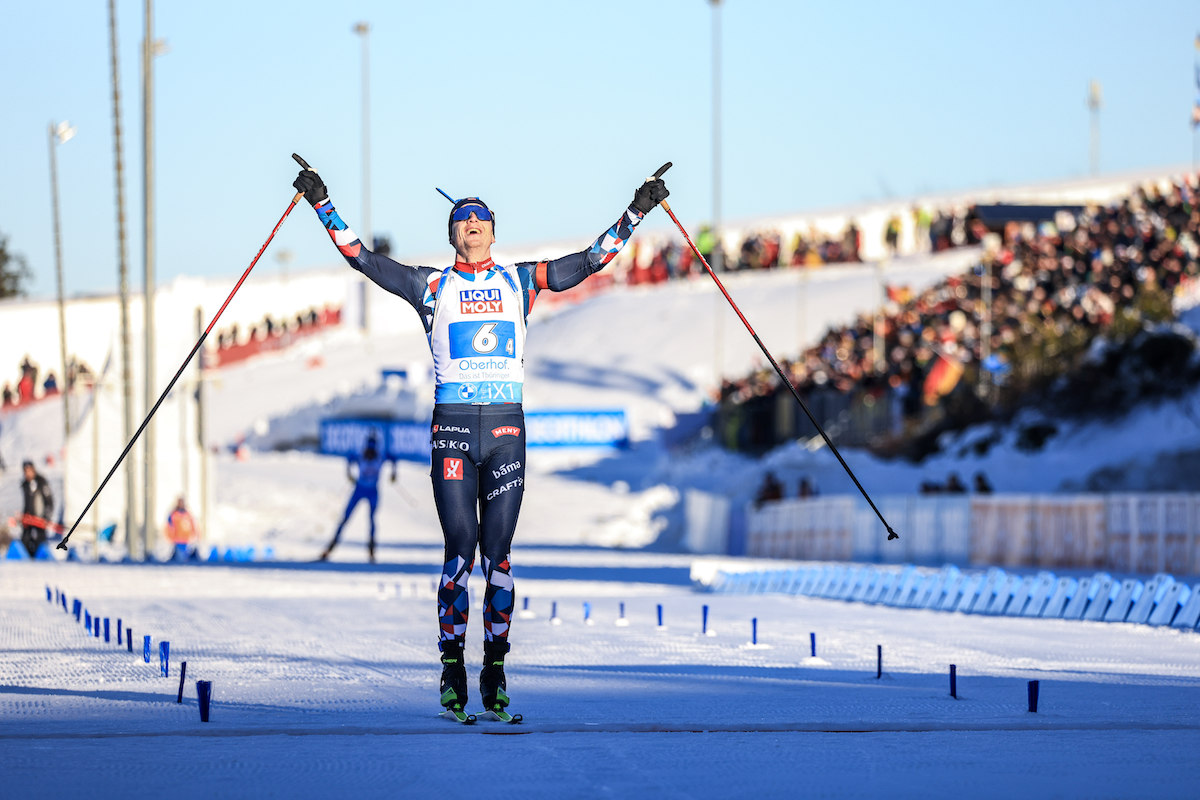
    Johannes Thingnes Boe (NOR) gives double number ones as he crosses the line to take gold for Norway in the IBU World Championships mixed relay. (Photo: NordicFocus).
    Fillion Mailley Keeps it Exciting

    Boe matched Giacomel’s performance on the range, and as they left the range together it was clear the race was already won. The Norwegians managed a remarkable comeback, from nearly a minute back at the half-way point, to take the first medal of the Championships. Giacomel brought home a silver that felt like gold for Italy. Fillon Maillet was safely in third as he waved to fans on his way to the finish, but as if to keep things exciting, he suddenly realized he had missed the finish lanes and was instead skiing through the lap! He turned around and corrected his mistake just in time to hold off ninth-seeded Austria, who had the best shooting performance of the day using just three spares total. Christian Gow (CAN) used just a single spare in prone and held off Sweden to give Canada a solid eighth place finish. For the US, Sean Doherty put together a great performance with a sixth-ranked leg to keep the US in 13th.

    Biathlon World Championships Mixed Relay RESULTS

    Christian Gow (CAN) racing in the IBU World Championships mixed relay in Oberhof. His accurate shooting allowed Canada to hold off Sweden to claim eighth place. (Photo: NordicFocus)
    Next up: Women’s Sprint

    The women’s Sprint is Friday at 8:30AM Eastern Time. Check for the start list at www.biathlonresults.com.

    IBU World Championships mixed relay medals: Didier Bionaz (ITA), Dorothea Wierer (ITA), Tommaso Giacomel (ITA), Lisa Vittozzi (ITA), Johannes Thingnes Boe (NOR), Sturla Holm Laegreid (NOR), Marte Olsbu Roeiseland (NOR), Ingrid Landmark Tandrevold (NOR), Emilien Jacquelin (FRA), Quentin Fillon Maillet (FRA), Anais Chevalier-Bouchet (FRA), Julia Simon (FRA). (Photo: NordicFocus)