Tag: Oberhof mass start

  • Sunday Rundown: Alpe Cermis, Oberhof, Lahti, Soldier Hollow (Updated x5)

    Sunday Rundown: Alpe Cermis, Oberhof, Lahti, Soldier Hollow (Updated x5)

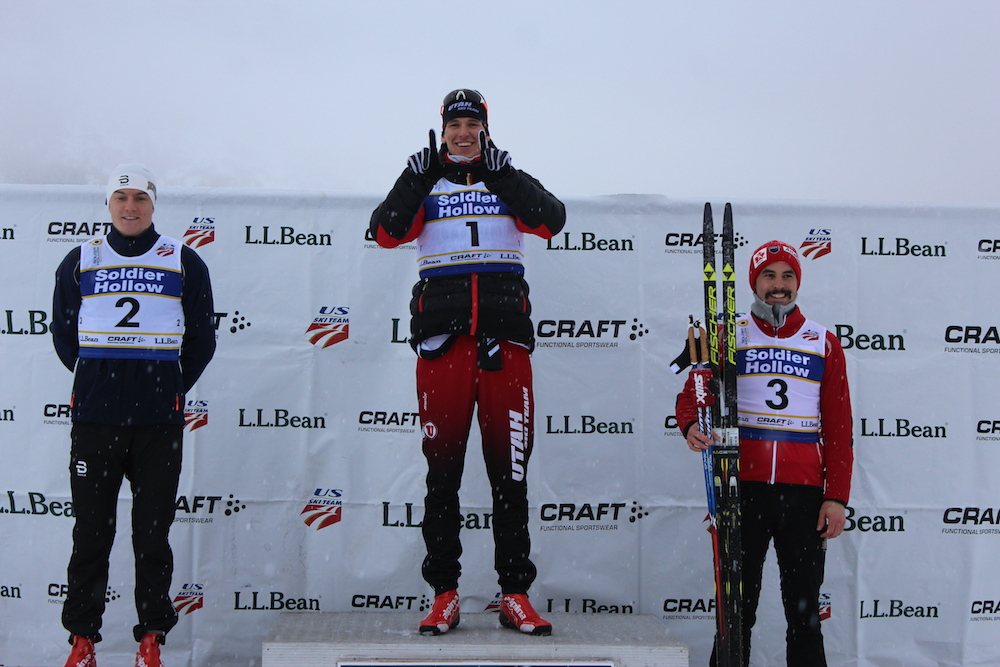
    The men's classic sprint podium at 2017 U.S. nationals at Soldier Hollow on Sunday: with winner Kevin Bolger (c) of the University of Utah, runner-up Moritz Madlener (l) of the University of Denver, and Jess Cockney (r) of the Canadian World Cup B-team in third.
    The men’s classic sprint podium at 2017 U.S. nationals at Soldier Hollow on Sunday: with winner Kevin Bolger (c) of the University of Utah, runner-up Moritz Madlener (l) of the University of Denver, and Jess Cockney (r) of the Canadian World Cup B-team in third.

    U.S. Cross Country Championships (Soldier Hollow): Classic sprints

    Jennie Bender of Bridger Ski Foundation and Kevin Bolger of the University of Utah won national titles in the classic sprints at 2017 U.S. Cross Country Championships at Soldier Hollow earlier Sunday afternoon. They each took narrow – but, for sprinting, relatively uncontested – victories, as each was in the lead coming into the stadium and led through the final 180-degree turn into the finishing straight.
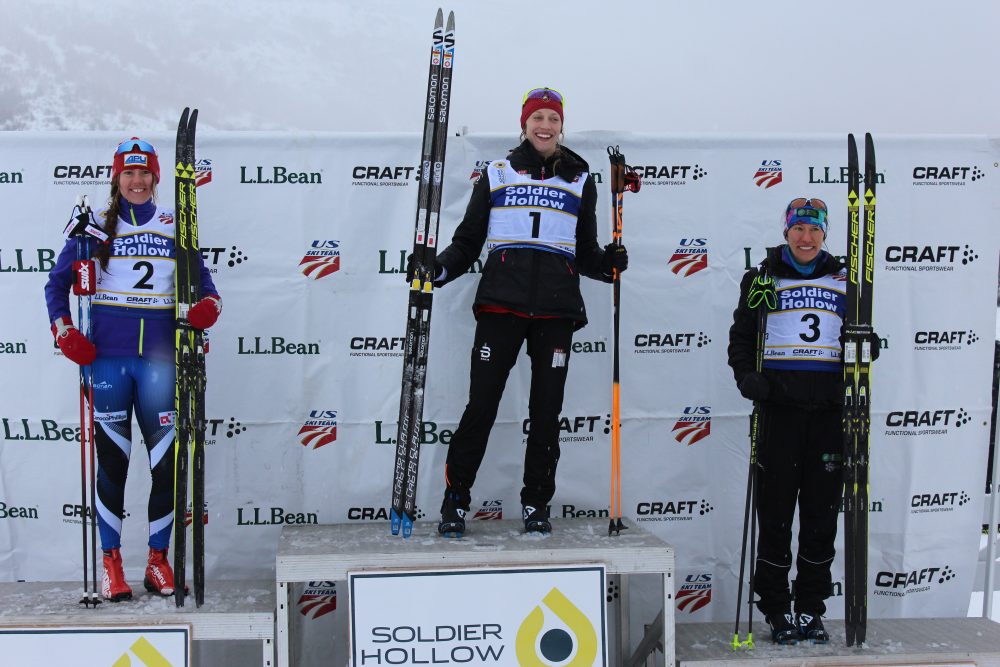
    The women's classic sprint podium at 2017 U.S. nationals on Sunday at Soldier Hollow: with winner Jennie Bender (c) of the Bridger Ski Foundation, runner-up Becca Rorabaugh (l) of Alaska Pacific University, and Kaitlynn Miller (r) of the Craftsbury Green Racing Project in third.
    The women’s classic sprint podium at 2017 U.S. nationals on Sunday at Soldier Hollow: with winner Jennie Bender (c) of the Bridger Ski Foundation, runner-up Becca Rorabaugh (l) of Alaska Pacific University, and Kaitlynn Miller (r) of the Craftsbury Green Racing Project in third.

    In the women’s race, Bender took the victory over Becca Rorabaugh of Alaska Pacific University, who just edged out Kaitlynn Miller of the Craftsbury Green Racing Project for second. Miller had won the qualifier earlier in the day.

    Dahria Beatty of Canada’s Alberta World Cup Academy in fourth, Anne Hart of Stratton Mountain School Elite Team in fifth, and Krista Niiranen, originally from Finland and now a sophomore at the University of New Mexico, in sixth made up the rest of the A-final. There was no B-final contested for either gender.

    In the men’s race, Bolger’s victory marked his best performance in a national championship by a substantial margin: His previous best before today was 23rd, in the 15 k classic at SoHo in 2014. (His 37th in the sprint that same year marked his previous best finish in a national championship sprint.)

    Bolger was followed to the line by Moritz Madlener, of the University of Denver, and Jesse Cockney, of the Canadian World Cup B-team. Cockney had qualified fourth that morning.

    The rest of the A–Final was Canadian Bob Thompson, of National Team Development Centre (NTDC) Thunder Bay, in fourth, Petter Reistad of the University of Colorado in fifth, and Fredrik Schwencke of Northern Michigan University in sixth.

    Madlener is German. Cockney and Thompson are Canadian. Reistad and Schwencke are Norwegian. The USSA selection criteria for World Championships in Lahti provide that, “For the purposes of the 2017 Championship Selection List, athletes that are not US citizens will not be included in the scoring, and US athletes will move up the results/scoring list as foreign athletes are eliminated.” American racers eliminated in the semifinals included, in no particular order, Ben Lustgarten of Craftsbury Green Racing Project, Cully Brown of the University of Vermont, John Hegman and Cole Morgan of Sun Valley Ski Education Foundation (SVSEF) Gold Team, and Ben Saxton of Stratton Mountain School.

    Results: women’s brackets | men’s brackets

    ***

    Earlier Sunday, Kaitlynn Miller won the women’s classic sprint qualifier. Starting sixth out of the 200+ woman field, Miller laid down an unbeatable time of 3:24.5 in difficult waxing conditions. She is the defending classic sprint champion from last year’s national championships.

    Krista Niiranen, originally from Finland and now a sophomore at the University of New Mexico, was next fastest and tallied a time just 0.2 seconds behind Miller’s. Emily Nishikawa of the Canadian National Ski Team was third, Dahria Beatty of Canada’s Alberta World Cup Academy fourth, and Cendrine Browne from the Centre National d’Entrainement Pierre Harvey in Quebec clocked the fifth-fastest time.

    The 30th skier making the cut for quarterfinals — Frederique Vezina, also of the Centre National d’Entrainement Pierre Harvey — was 16.53 seconds behind Miller.

    Ben Saxton of the Stratton Mountain School Elite Team won the men’s sprint qualifier, notching the fastest time by 1.27 seconds over Etienne Hebert of Monteriski.

    Canadians took the three of the top four spots in the qualifier, with Reed Godfrey of Canmore Nordic clocking the third-fastest time and Canada’s Jesse Cockney finishing fourth.

    9.17 seconds separated the top 30 men who moved on to the quarterfinals. That included racers from at least six countries: the U.S. and Canada, but also collegiate skiers from Finland, Germany, France, and Norway. It also included one Under-18 competitor: Ben Ogden from the Stratton Mountain School.

    Results: Women’s qualifier | Men’s qualifier

    ***

    FIS Nordic Combined World Cup (Lahti, Finland)

    It was a World Championships preview weekend on the Nordic Combined World Cup circuit, with two large hill/10 k individual competitions held in Lahti, Finland.

    On Saturday, Germany’s Eric Frenzel took the win in 29:13.7, holding off Finland’s Eero Hirvonen by 4.1 seconds across the line. After posting the second-best jump, Frenzel started the 10 k in second, ahead of Hirvonen in third, but still full 1:06-minutes behind Norway’s Jarl Magnus Riiber, who dominated the jump with 135.2 points. Hirvonen started 1:29 back in third.

    Riiber went on to place sixth at the finish with the 38th-ranked course time (out of 43 finishers). Germany had two on the podium with Johannes Rydzek in third (+26.4).

    American Bryan Fletcher finished 15th (+1:29.8) after jumping to 22nd and starting the ski race 3:06 minutes back. He skied the sixth-fastest 10 k to end up 1:29.8 behind Frenzel at the finish.

    Ben Loomis was the second American competing on Saturday. He finished the day in 40th (+5:18.5) after jumping to 35th.

    On Sunday, Germany swept the podium with Fabian Rießle leading the charge, Frenzel in second and Rydzek in third. Rießle jumped to fifth and captured the win in 25:44.2, ahead of Frenzel (+4.2) and Rydzek (+11.6). Frenzel led after the jump and started the 10 k just 6 seconds ahead of Italy’s Samuel Costa, who ended up sixth at the finish (+40.6).

    Rießle started 16 seconds after Frenzel and posted the third-fastest course time en route to the win.

    Bryan Fletcher raced to 16th (+1:30.7) on Sunday, after jumping to 28th. Loomis did not start.

    The NoCo World Cup moves to Val di Fiemme, Italy, for competitions next Friday through Sunday. Lahti World Championships will hold nordic-combined competitions Feb. 24-March 3.

    Results: Day 1 | Day 2

    ***

    IBU World Cup (Oberhof, Germany): 12.5/15 k mass starts

    Women’s report

    Two North Americans started the International Biathlon Union (IBU) World Cup women’s 12.5 k mass start on Sunday, with one of them finding out at the last minute that they were in for the 30-woman race.

    American Susan Dunklee knew she had qualified well ahead of time after ranking 17th in the overall World Cup. She raced to ninth on Sunday, finishing 1:43.5 behind from the winner, Gabriela Koukalová of the Czech Republic, who cleaned the four-stage race to finish first in 37:20.5.

    Germany’s Laura Dahlmeier made her first appearance of the week in the final race of the World Cup stop in Oberhof, Germany, placing second in the mass start, 31.5 seconds behind Koukalová, with one standing miss (0+0+1+0). The Czech Republic had two on the podium with Eva Puskarčíková in third (+45.4), with clean shooting.

    Dunklee was in contention with the leaders until the last two standing stages, where she missed one target then two more (0+0+1+2) for a total of three penalty laps. Ninth place helped elevate Dunklee to 15th in the overall World Cup standings.

    Canada’s Rosanna Crawford jumped into the race being listed as a reserve athlete on standby. Wearing bib 30, she finished 25th (+3:08.6) with two clean stages and two penalties (0+1+1+0).
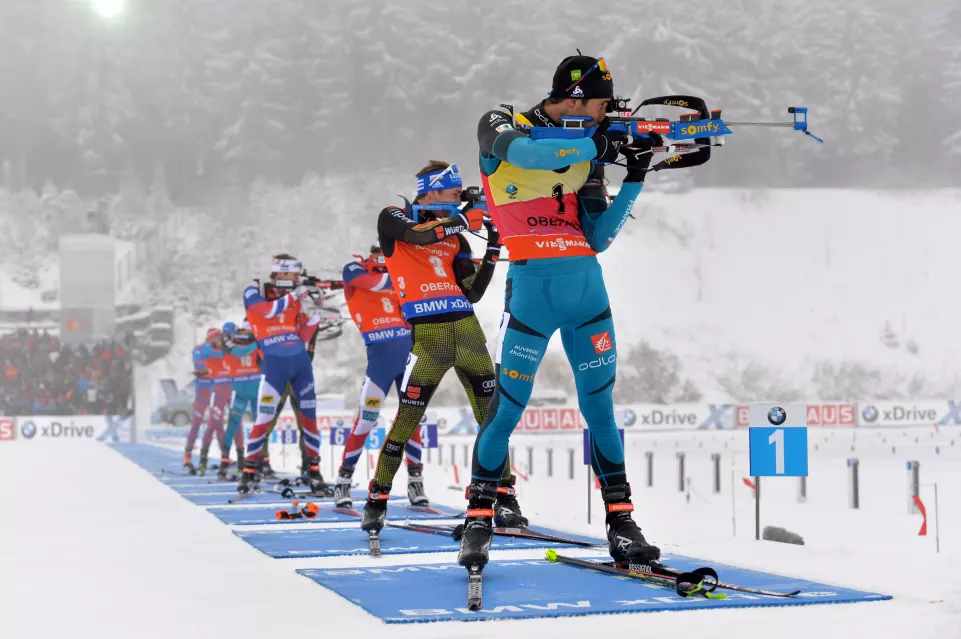
    France’s Martin Fourcade (bib 1) and Germany’s Simon Schempp (bib 3) shooting in the third stage of the men’s 15-kilometer mass start at the 2017 IBU World Cup in Oberhof, Germany. (Photo: IBU)
    France’s Martin Fourcade (bib 1) and Germany’s Simon Schempp (bib 3) shooting in the third stage of the men’s 15-kilometer mass start at the 2017 IBU World Cup in Oberhof, Germany. (Photo: IBU)

    On Sunday in the men’s 15 k mass start, Germany’s Simon Schempp celebrated his first victory of the season, and it was a special one in front of thousands of cheering fans at home in Oberhof. On the final lap, he desperately tried to hang onto the ski tails of France’s biathlon star Martin Fourcade, who pushed hard on the first climb out of the shooting range unsuccessfully trying to create a gap.

    “He started attacking immediately up the Birxsteig [climb],” Schempp told German TV broadcaster ZDF. “And I thought either you blow up or you can stick with him, and I could. Because I was in the draft, I saved a few percent, that probably was the decisive point in the end.“

    Schempp kept right behind Fourcade, then started an attack on the last climb himself and outsprinted his rival on the finishing stretch, celebrating across the line with a time of 38:30.9 minutes, with just one penalty (0+0+1+0).

    To the joy of the German fans, Schempp’s teammate Erik Lesser managed to overtake France’s Jean Guillaume Beatrix on the final loop closing up to the two athletes in front on the last meters, and outlunged Fourcade in a photo finish sprint (both +0.4 seconds).

    “They pushed up the Birxsteig so incredibly hard,” Lesser told ZDF. “I thought I could only fight for position five. Then I saw that Beatrix wasn’t skiing very clean anymore either. So I just tried a full attack… I never would have believed that a second place would come out of that.“

    “My father-in-law is probably watching the Tour de Ski today and saying, ‘Finally the guy makes a lunge,’ ” Lesser joked about the finish sprint. “I never would have believed that Fourcade still lets himself get beaten by the little Lesser. Finally all the strength training paid off.“

    Fourcade had incurred two penalties in the third shooting stage, having to make up a 44 second gap to the top. In the final shooting he stayed clean, but already had to invest a lot of energy on the prior loop so he could not create a significant lead on the last one.

    “I skied as fast as I could, but Simon was just faster and Erik as well,” Fourcade said during the press conference. “I tried my best in the beginning of the lap because we were too [many] people… I gave all I had. I must say I didn’t see Erik until he passed me in the sprint… It was a great competition, a great fight.”

    Coming into the last shooting stage Lesser had been leading the race with Norway’s Ole Einar Bjørndalen, but both missed a target and had to a penalty lap while Schempp and Fourcade stayed clean.

    Fourcade’s teammate Beatrix finished fourth with one penalty (+13.2), Bjørndalen was fifth (+19.5) also with one penalty.

    No North American men competed in the mass start, with US Biathlon’s Lowell Bailey ,who would have been qualified via the overall World Cup standings skipping the race week in Oberhof for a training block. Bailey is currently ranked 19th overall.

    Results: Women | Men

    Overall World Cup standings: Women | Men

    ***
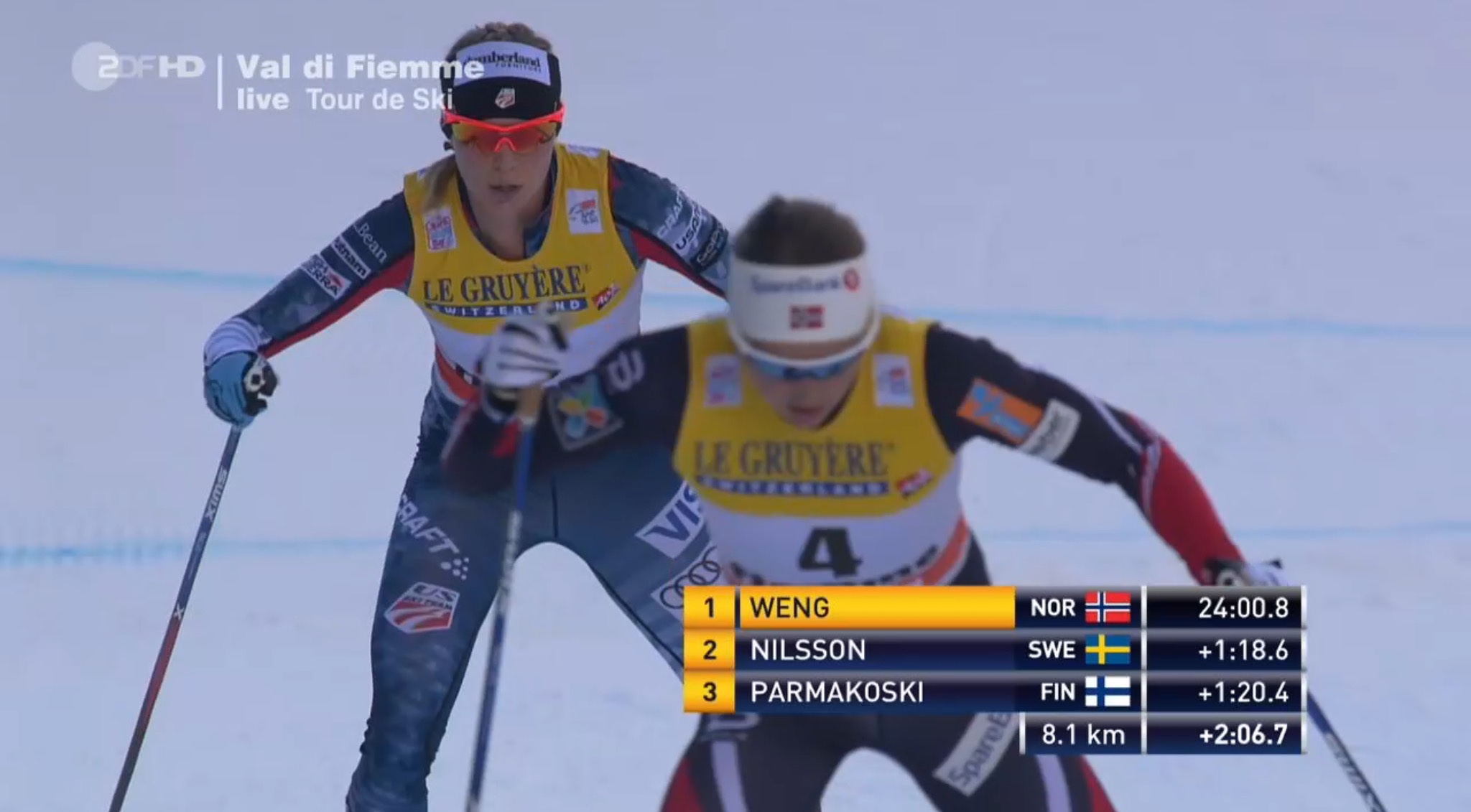
    American Jessie Diggins chasing Norway's Ingvild Flugstad Østberg on the final climb of the 2017 Tour de Ski up the Alpe Cermis in Val di Fiemme, Italy. Østberg finished the Tour in fourth and Diggins fifth, tying a best-ever mark for the U.S., set in 2015 by Liz Stephen. (Photo: ZDF screenshot)
    American Jessie Diggins chasing Norway’s Ingvild Flugstad Østberg on the final climb of the 2017 Tour de Ski up the Alpe Cermis in Val di Fiemme, Italy. Østberg finished the Tour in fourth and Diggins fifth, tying a best-ever mark for the U.S., set in 2015 by Liz Stephen. (Photo: ZDF screenshot)

    FIS Cross-Country Tour de Ski Stage 7 (Val di Fiemme/Alpe Cermis, Italy): 9 k freestyle

    Women’s report | Men’s report

    Heidi Weng of Norway proved that she was the threat everyone was fearing – despite a few races in the Tour de Ski with bad skis or low energy, Weng had a dominating performance up the Alpe Cermis and took her first ever Tour de Ski title.

    At 6.2 k of the 9 k course, Weng passed Stina Nilsson of Sweden, who had started the day in the leader’s bib with a 19.2-second advantage. Weng just stepped on the gas from there, turning in the fastest climb time of the field and winning by 1:37.0.

    Further up the hill, Nilsson was also passed by Krista Parmakoski of Finland, who gapped the Swede and earned second place.

    And Nilsson had to hold off one more attack, from Norway’s Ingvild Flugstad Østberg near the top of the climb. Østberg had started in fourth place and got close to Nilsson, before the Swede found her second (or third, or fourth) wind and sprinted it in to the finish to secure third place and her first Tour de Ski overall podium.

    Weng has three previous Tour de Ski podiums, but never a win. Parmakoski’s previous best overall finish was fourth, in 2014.

    Jessie Diggins of the U.S. Ski Team started behind Østberg and almost made contact at one point, before the Norwegian slipped from her grasp. Diggins finished the Tour de Ski fifth (+3:09.0) — where she had started the day — to tie for the best-ever Tour finish with Liz Stephen, who was fifth in 2015.

    Today, Stephen clocked the second-fastest time up the climb, behind Weng, and finished 14th (+6:45.6).

    Rosie Brennan, the third and final U.S. woman to finish the Tour de Ski this year, landed 28th, +12:59.9. Her time was the 23rd-fastest up the Alpe Cermis.
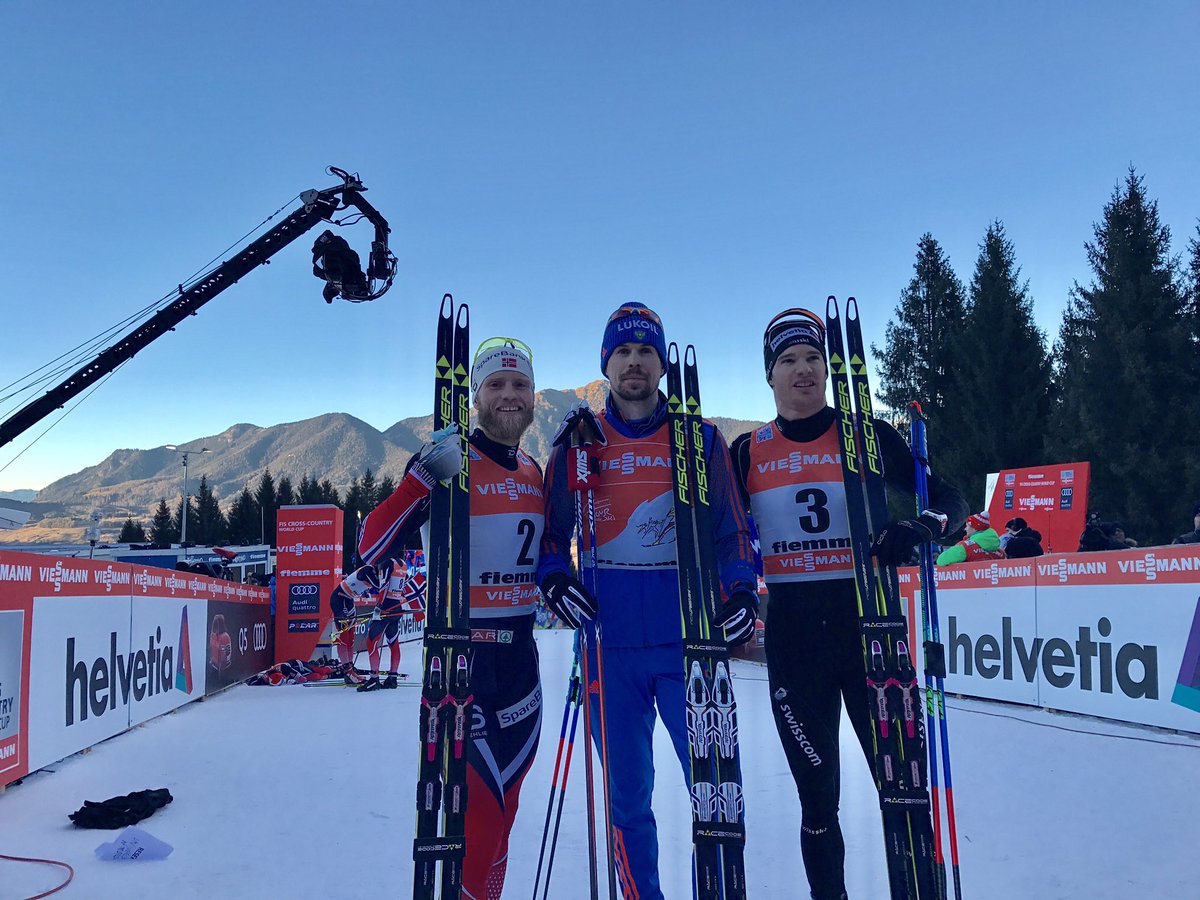
    The overall podium at the end of the 2017 Tour de Ski, with winner Sergey Ustiugov (c) of Russia, Norway's Martin Johnsrud Sundby (l) in second, and Switzerland's Dario Cologna (r) in third after finishing in that order in the 9 k freestyle hill-climb pursuit, Stage 7 of the Tour de Ski in Val di Fiemme, Italy. (Photo: FIS Cross Country/Twitter)
    The overall podium at the end of the 2017 Tour de Ski, with winner Sergey Ustiugov (c) of Russia, Norway’s Martin Johnsrud Sundby (l) in second, and Switzerland’s Dario Cologna (r) in third after finishing in that order in the 9 k freestyle hill-climb pursuit, Stage 7 of the Tour de Ski in Val di Fiemme, Italy. (Photo: FIS Cross Country/Twitter)

    In the men’s 9 k freestyle hill climb that followed, 24-year-old Sergey Ustiugov of Russia raced to his first Tour de Ski victory, heading out of the gate with a 1:12-minute head start over Norway’s Martin Johnsrud Sundby and finishing 1:02.9 ahead for the win in 30:27.7.

    Sundby put time into Ustiugov over parts of the course, particularly in the first kilometer along a flatter section leading up to the climb and then again between 6 and 8 k on Alpe Cermis itself.

    Sundby skied alone throughout the pursuit race, with Switzerland’s Dario Cologna starting 52 seconds behind him. Cologna had a 29-second head start on Finland’s Matti Heikkinen, who entered the race in fourth, and 30 seconds ahead of France’s Maurice Manificat in fifth, but Manificat caught and even passed Cologna with about 0.5 k remaining. Cologna proceeded to pass Manificat back while Heikkinen skied about nine seconds back in fifth.

    Canada’s Alex Harvey had started sixth and helped lead Manificat and Heikkinen in chasing down Cologna early in pursuit, but he faded to seventh, behind Sweden’s Marcus Hellner (who started seventh, 12 seconds after Harvey) by 8.5 k. There, Hellner trailed Heikkinen by 14.6 seconds, and Harvey was another 27.9 seconds back in seventh (and nearly a 54 seconds ahead of the man skiing in eighth at the time, Norway’s Simen Hegstad Krüger).

    Half a kilometer later, it was all over with Cologna securing third overall in the Tour, 1:19.1 behind Ustiugov and 16.2 seconds behind Sundby.

    With the fastest 9 k time of the day, Manificat moved up one place for fourth overall, finishing 1:26.9 after Ustiugov with a time of 29:20 minutes. Heikkinen was the second fastest on course, 6.1 seconds slower than Manificat, for fifth overall in the Tour (+1:31.3). Hellner took sixth at the finish (+2:05.8), ahead of Harvey in seventh (+2:39.7). For Harvey, it was his best overall finish in four competed Tour de Skis (last year, he finished 14th. His best result was 12th in 2012).

    Norway swept the next five places with with Krüger in eighth (+3:27.2), Hans Christer Holund in ninth (+3:50.4), Niklas Dyrhaug in 10th (+4:24.9), Sjur Røthe in 11th (+4:56.4), and Didrik Tønseth in 12th (+5:07.7).

    Canada had two in the final climb with Devon Kershaw finishing 25th (+9:32.2) after starting 23rd. Graeme Killick did not start after being positioned in 37th overall in the Tour.

    Kershaw finished 8.1 seconds ahead of Noah Hoffman, the lone American racing to the top of Alpe Cermis. Hoffman moved up from 30th at the start to finish 26th (+9:40.3) overall, and in doing so, he posted the 15th-fastest time of the day, 1:05.3 back from Manificat.

    Harvey’s time ranked 14th (+1:04.9). Norway’s Holund had the third-fastest time after starting 11th and ending up ninth, Hellner was fourth fastest, and Cologna fifth fastest.

    Tour de Ski final results (with isolated climb times): Women | Men

  • Koukalová Wins Second Mass Start of Season; Dunklee 9th, Crawford 25th

    Koukalová Wins Second Mass Start of Season; Dunklee 9th, Crawford 25th

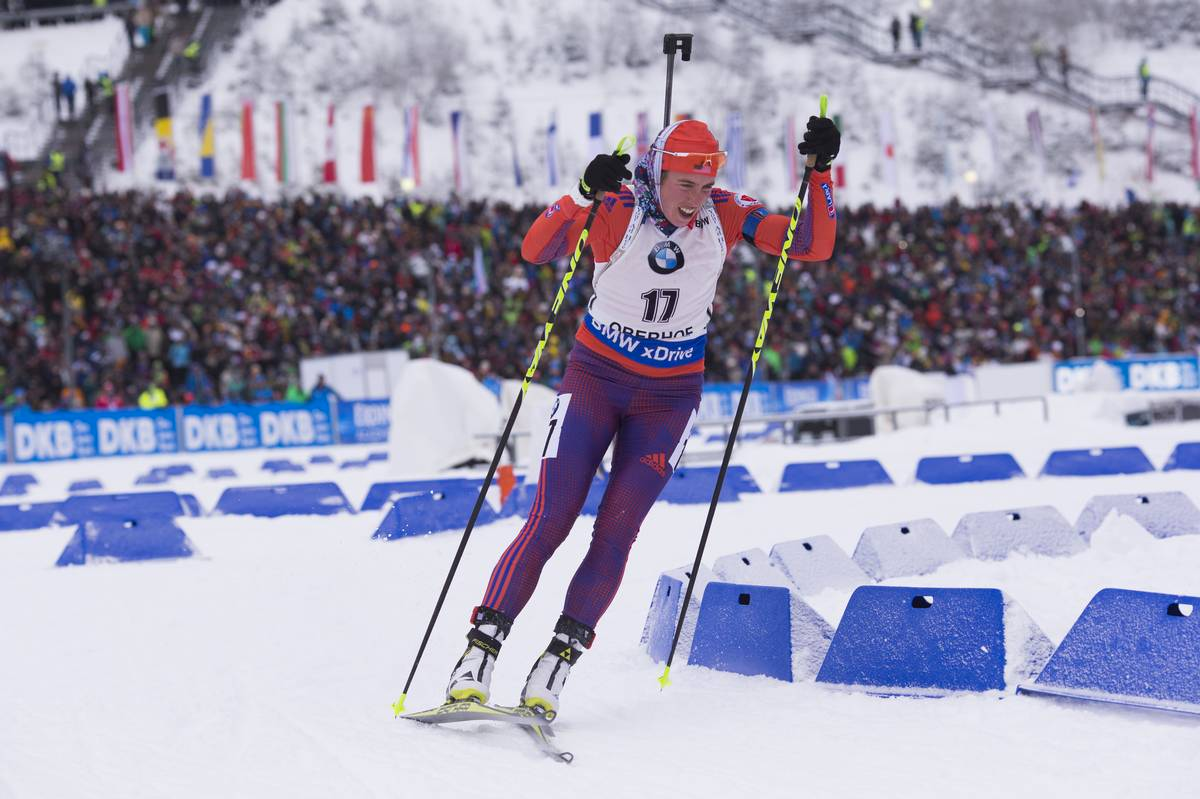
    US Biathlon’s Susan Dunklee skis through the arena during the women’s 12.5 k mass start at the 2017 IBU World Cup on Sunday in Oberhof, Germany. (Photo: USBA/NordicFocus)
    US Biathlon’s Susan Dunklee skis through the arena during the women’s 12.5 k mass start at the 2017 IBU World Cup on Sunday in Oberhof, Germany. (Photo: USBA/NordicFocus)

    After twice shooting clean on Sunday, American Susan Dunklee found herself in third place going out on the next loop of the women’s 12.5-kilometer mass start at the International Biathlon Union (IBU) World Cup in Oberhof, Germany, pushing hard to keep up with Czech Republic’s Gabriela Koukalová and Germany’s Laura Dahlmeier.

    “I was not skiing a sustainable pace,” Dunklee explained in an email to FasterSkier. “Sometimes it makes more sense to keep yourself in the race as long as you can and worry about consequences later.”

    While Koukalová stayed clean also in the next two shooting stages to win the race in a time of 37:20.5 and Dahlmeier only shot one more miss to finish second (0+0+1+0, +31.5), Dunklee had to pay a bit for her tempo when she incurred a penalty in the first standing stage and two more in her last standing bout.

    She left the range after the final shooting in ninth position, but was challenged on the long Birxsteig climb by four athletes who shot clean in the last stage: Norway’s Marte Olsbu, Sweden’s Anna Magnusson, Poland’s Magdalena Gwizdon, and Russia’s Tatiana Akimova.

    “Skiing hard earlier in the race (e.g. with Gabi and Laura) meant that I didn’t have much fight in me on the first huge climb and I lost time there,” Dunklee wrote about the last loop. “To make up for it, I tried to conserve some energy for the last hills, rely on faster skis than the girls around me (our techs did a fantastic job today) and ski tactically.”

    Dunklee fought back, and managed to overtake all of those four skiers again to finish ninth (+1:43.5) with three penalties (0+0+1+2) and the 12th-ranked overall course time. She was passed on that loop only by Finland’s veteran Kaisa Mäkäräinen, who had a rough day on the range with seven penalties, but skied the best course time to finish eighth (+1:39.9).

    During the week’s races in Oberhof, Dunklee missed more targets than she usually does to finish 50th in the sprint with four penalties and 44th in the pursuit with nine penalties.

    “I created a very specific periodization plan for my shooting this year and I believe in it,” Dunklee wrote. “Each week has its own focus, which creates subtle differences in how I approach the shooting. I have now learned that the type of focus I had for this week (and incidentally, Östersund) doesn’t work well. Today I shifted over early to the speed focus I had planned for next week and that was a good decision. My periodization plan is an experiment and a work in progress that I hope to have nailed for next year.”

    “My standing shots all felt good except for my very last shot,” Dunklee said, according to a US Biathlon press release. “I couldn’t get the barrel to stay on the target. Rather than taking an extra breath to reset, I over held it. That is my only regret of the day.”

    When the provisional start list was first released on Saturday, Biathlon Canada’s Rosanna Crawford narrowly missed the qualification for the elite mass start field (with starts being awarded to the top-25 ranked athletes in the overall World Cup plus five more not among those with the best results of the competition week). But she was excited to learn the night before the race that she would be “called up” from a reserve standby list to replace a sick athlete.

    “I love Mass Start races, there is so much potential!” Crawford wrote in an email to FasterSkier. “The best are nervous and the rest of us are the underdogs wanting to prove we belong.”

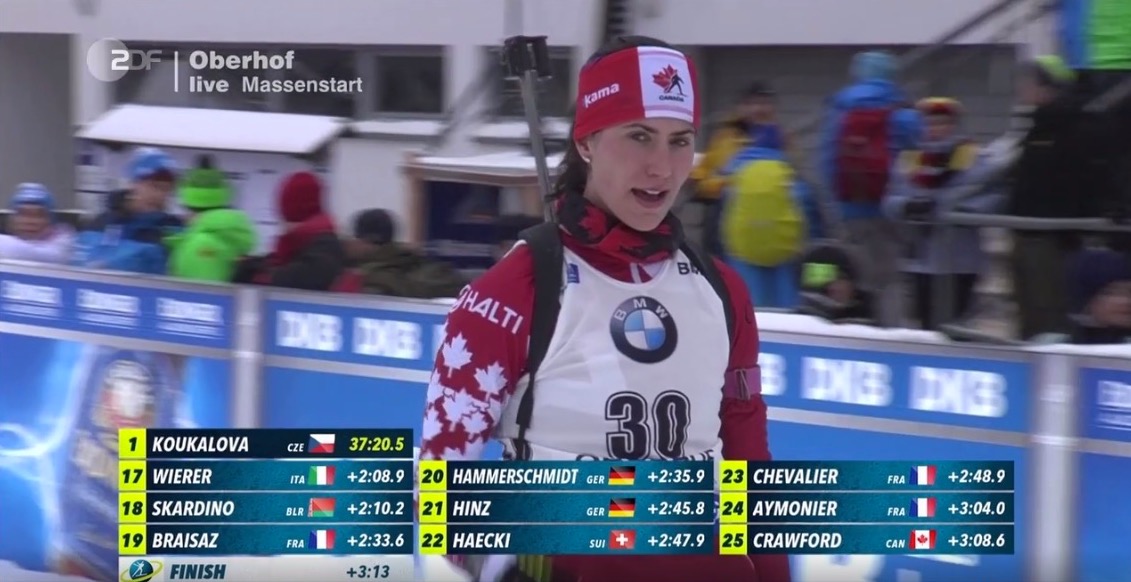
    Biathlon Canada’s Rosanna Crawford after finishing 25th in the women’s mass start at the 2017 IBU World Cup in Oberhof, Germany. (Photo: ZDF screenshot)
    Biathlon Canada’s Rosanna Crawford after finishing 25th in the women’s mass start at the 2017 IBU World Cup in Oberhof, Germany. (Photo: ZDF screenshot)

    After a clean shooting performance in the Oberhof sprint, Crawford was able to shoot well again on Sunday, totaling just two penalties (0+1+1+0), but was unable to keep pace with the leaders with the 28th-ranked course time.

    “Like the last two races, it’s skiing that is really holding me back,” Crawford explained.
    “So I just went out for a good workout and a chance to work on my shooting. I am really angry at my prone miss, just like yesterday [in the pursuit] that was all me! But 18/20 is still a pretty good day. I can only hope that the ski shape turns around in the next few weeks. Our wax techs again did a good job today!”

    Crawford waved to the spectators on the finishing stretch and took a bow as she crossed the line in 25th place (+3:08.6).

    “The crowds here are pretty incredible, there was a lot of people cheering ‘Go Canada’ which really helped fuel me around the course,” she wrote.

    The spectators were particularly fired up after seeing a double-victory for Germany’s Simon Schempp and Erik Lesser in the men’s mass start earlier on Sunday. And with the return of home-crowd favorite Dahlmeier after a longer rest and training period over the holiday break, as well as her teammate Franziska Hildebrand also fighting for a position at the top, they had every reason to cheer during the women’s race as well.

    “I think I did everything right,” Dahlmeier told German broadcaster ZDF of her reason for skipping the sprint and pursuit races. “I did not exactly know good my form would be after the break. Today I had a bit heavy legs from training. But I am happy with the second place and glad that the return worked out like this. It was a lot of fun to ski in front of such an audience today.”

    “The first three World Cup weekends were more strenuous, due to the good results and the yellow bib [of the overall World Cup leader],” she added. “When I go to the start, I want to give it 100 percent, not just coast along. So my feeling was that it would be useful to skip a race, and that this happened to be in Oberhof was due to the competition calendar. But I am glad that I could do this one race.”

    “I didn’t have so good expectations for this,” Koukalová said at the press conference on her race week in Oberhof, with two victories and a second place. “The main goal of the season is the World Championships in Hochfilzen. So I hope that I am still not in the best shape now, because I know it is more difficult to win there than here.”

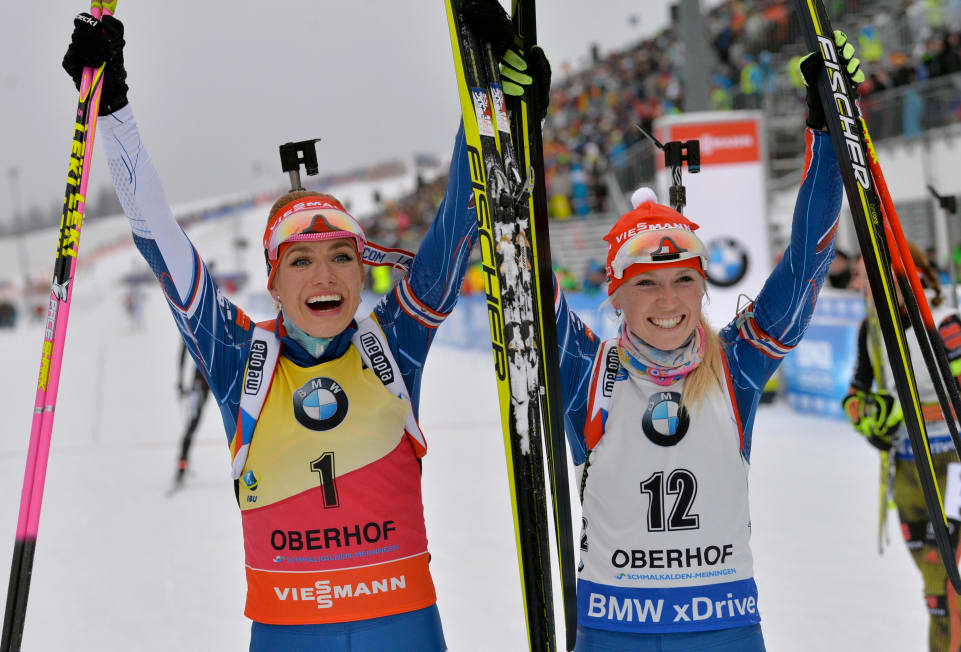
    Czech Republic’s Gabriela Koukalová (bib 1, first place) and her teammate Eva Puskarčiková (bib 12, third place) celebrate at the finish of the women’s 12.5 k mass start on Sunday at the 2017 IBU World Cup in Oberhof, Germany. (Photo: IBU)
    Czech Republic’s Gabriela Koukalová (bib 1, first place) and her teammate Eva Puskarčiková (bib 12, third place) celebrate at the finish of the women’s 12.5 k mass start on Sunday at the 2017 IBU World Cup in Oberhof, Germany. (Photo: IBU)

    Koukalová was also excited that teammate Eva Puskarčiková placed third (+45.4 with no penalties) to stand on the podium with her, and that they were the only two athletes in the field who shot clean. It was the second World Cup podium of the career for Puskarčiková, after a third place in the pursuit in Pokljuka, Slovenia, earlier this season.

    “I don’t know how to say it, but I have many times deeper feelings than to stand there alone,” Koukalová said at the press conference. “It’s very positive and I am very happy for Eva, because she was still sick around Christmas and so she is something like a hero for me. It’s amazing, she is crazy.”

    “I hope so, I hope it will be better and better,” Puskarčiková said with a smile when questioned if her confidence is increasing with each success now.

    In a three-way sprint finish, the fourth place went to Kazakhstan’s Galina Vishnevskaya, the best result of the 22 year old’s career (+1:11.6 with one penalty), ahead of Ukraine’s Yulia Dzhima (+1:12.6 with three penalties) and Germany’s Hildebrand (+1:14.0 with two penalties).

    If the IBU, which likes to stress its “biathlon family” motto, had a fair-play award, it should have gone to Austria’s Lisa Theresa Hauser, who voluntarily gave up a pole to Germany’s Vanessa Hinz after accidentally breaking hers by stepping on it. Hauser’s good deed was not rewarded, as she soon after fell on a steep downhill turn, clogging the sights of her rifle with snow and had to pull out of the race. Hinz finished 21st.

    The IBU World Cup resumes with a men’s relay on Wednesday, Jan. 11 and a women’s relay on Thursday, Jan. 12 in Ruhpolding, also located in Germany.

    Results

  • No One Touches Fourcade in Oberhof Mass Start; North American Men Outside Top 20

    No One Touches Fourcade in Oberhof Mass Start; North American Men Outside Top 20

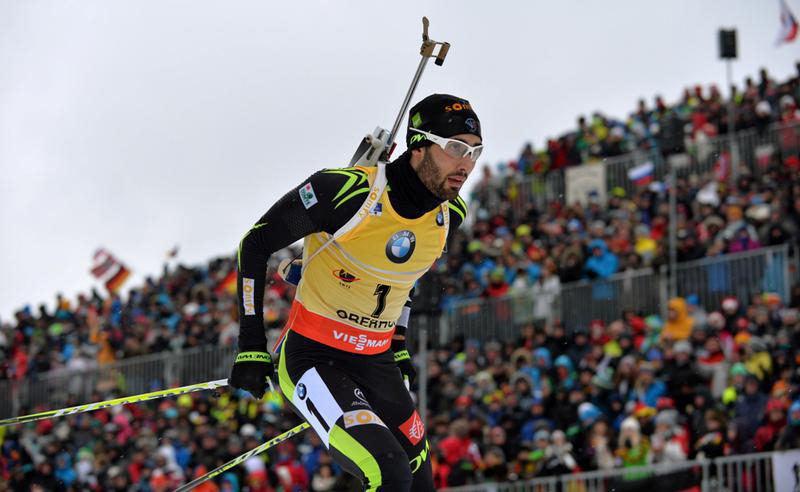
    Martin Fourcade in Sunday's 15-kilometer race. (Photo: IBU/Eberhard Thonfeld)
    Martin Fourcade in Sunday’s 15-kilometer race. (Photo: IBU/Eberhard Thonfeld)

    On Sunday, Martin Fourcade reminded the world that no one can touch him in the 15-kilometer mass start in Oberhof, Germany. Fourcade, of France, used a combination of quick skiing and exceptional shooting to make sure that no one could challenge his reign of the course.

    Though he never posted the fastest course time on any of the five laps, Fourcade’s consistent skiing allowed him the luxury of slower shooting. Fourcade shot perfectly, and in fact was the only racer of the day to have less than three misses. He took first place by 13.1 seconds over Russia’s Anton Shipulin, who missed one shot in each stage, for a total of four misses.

    Shipulin’s teammate, Dmitry Malyshko, was third (+30.7) with three penalties, Bulgaria’s Krasimir Anev missed the podium by just over a half a second, taking fourth (+31.4) with three misses, while Czech Michal Slesingr missed three as well to place fifth (+37.8).

    Fourcade, the overall IBU World Cup leader, had a nearly 30-second lead heading into the final stage. However, upon arriving at the final stage, the wind picked up. Fourcade demonstrated exceptional patience, waiting at the range for the wind to die.

    Of the 29 competitors final competitors, Fourcade’s fourth-stage range time ranked 28th; he spent over a minute and a half on the range. Though Shipulin, among several other competitors, came in while Fourcade was shooting and exited the range ahead of him, they missed shots and were forced to ski penalty loops. Fourcade went straight on to his final loop and the victory.

    ‘Mediocre’ and ‘Really Bad’ Days for Smith, Bailey

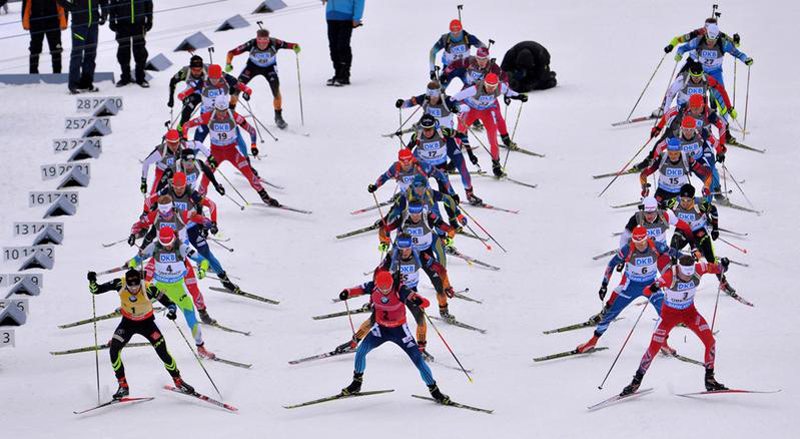
    The start of the men’s 15-kilometer mass start. (Photo: IBU/Eberhard Thonfeld)
    The start of the men’s 15-kilometer mass start. (Photo: IBU/Eberhard Thonfeld)

    Two North Americans entered the race, Canadian Nathan Smith and American Lowell Bailey. American Tim Burke was slated to race, but withdrew in the morning due to illness.

    “Unfortunately, I woke up this morning with a small head cold,” Burke wrote in an email. “I made a promise to myself not to race this year with any sickness. This year I am also only interested in fighting for top results and I don’t really care about the World Cup rankings. With my feeling today, I would have little chance at a top result and it would set me back for the next weeks.”

    Neither Bailey nor Smith were happy with how their day turned out. Bailey had a particularly rough day, finishing last of 29 men with 10 penalties, 4:36 behind Fourcade.

    In a US Biathlon Association press release, Bailey said, “It’s easy to start looking for answers when you have a bad day.  You start to look back at your training and think, ‘Did I make the right choice there? Should I have taken more rest here? More shooting there?’ But the fact of the matter is that I have no excuses. Sometimes you just have a bad day. Sometimes it’s a really bad day!”

    Smith, who tied Sweden’s Frederik Lindström in 20th (+1:51.4) with six misses, called his race “mediocre.”

    “I think my skiing was pretty strong but poor shooting at the beginning and end of the race put me out of contention for a top 8 result,” Smith wrote in an email. “I will definitely spend some time to think of strategies for the last shooting. It’s been a bit of a weakness this season so far and I would like to turn it into a strength.”

    Due to a lack of snow at the venue, the first “lap” was in fact two 2.5 k loops to the first shooting stage. Without a shooting stage to break up the pack, many of the skiers initially stayed together.

    “Everyone was together the entire time and the pace was somewhat leisurely,” Smith wrote. “It was an odd feeling to ski like that for so long. It was [how I would imagine] a cross country race, until after the first trip to the range, when the real racing started.”

    In an email, Bailey wrote that he was confident in his training, adding that he always tries to “salvage any redeeming qualities from a race, even if it’s going poorly.”

    “It was definitely a bad day,” he wrote, “but I jut tried to stay focused through the end and work on ski technique.  The best and worst part of biathlon is that it is a volatile sport; one day you are on top of the world and everything seems easy, the next day nothing goes right.  It’s just a matter of keeping things in perspective.

    “Ruhpolding is up next and it’s a whole new set of races,” Bailey added.

    — Chelsea Little contributed reporting.

    Results