Tag: Oberstdorf classic sprint

  • Nepryaeva Takes Stage 4 Win and Overall Lead; Diggins Tripped, Karlsson Penalized.

    Nepryaeva Takes Stage 4 Win and Overall Lead; Diggins Tripped, Karlsson Penalized.

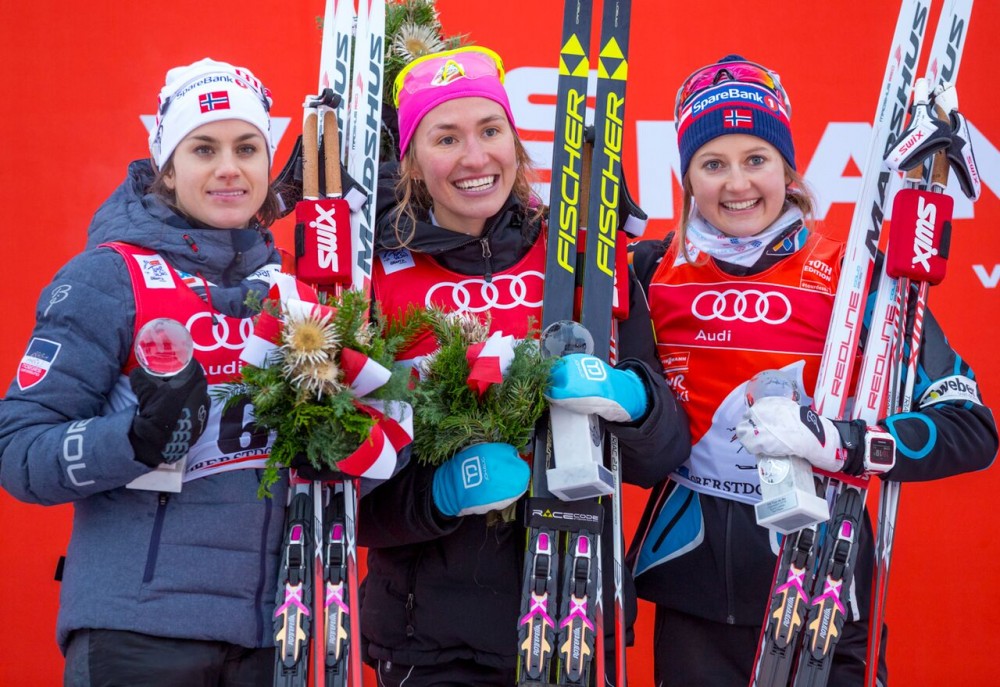
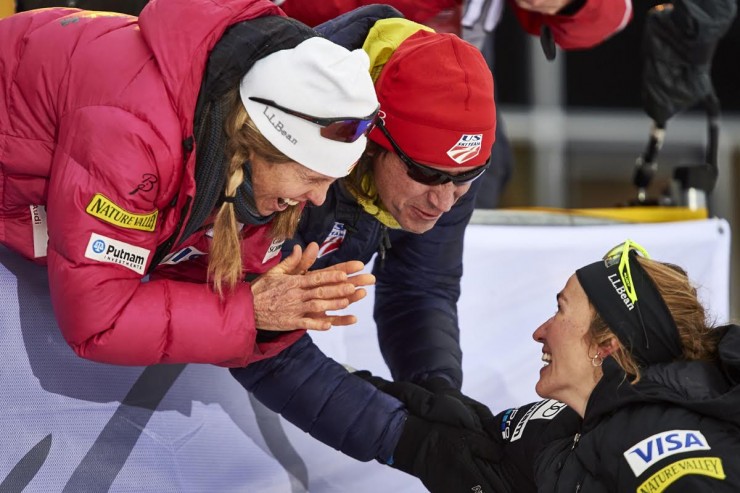
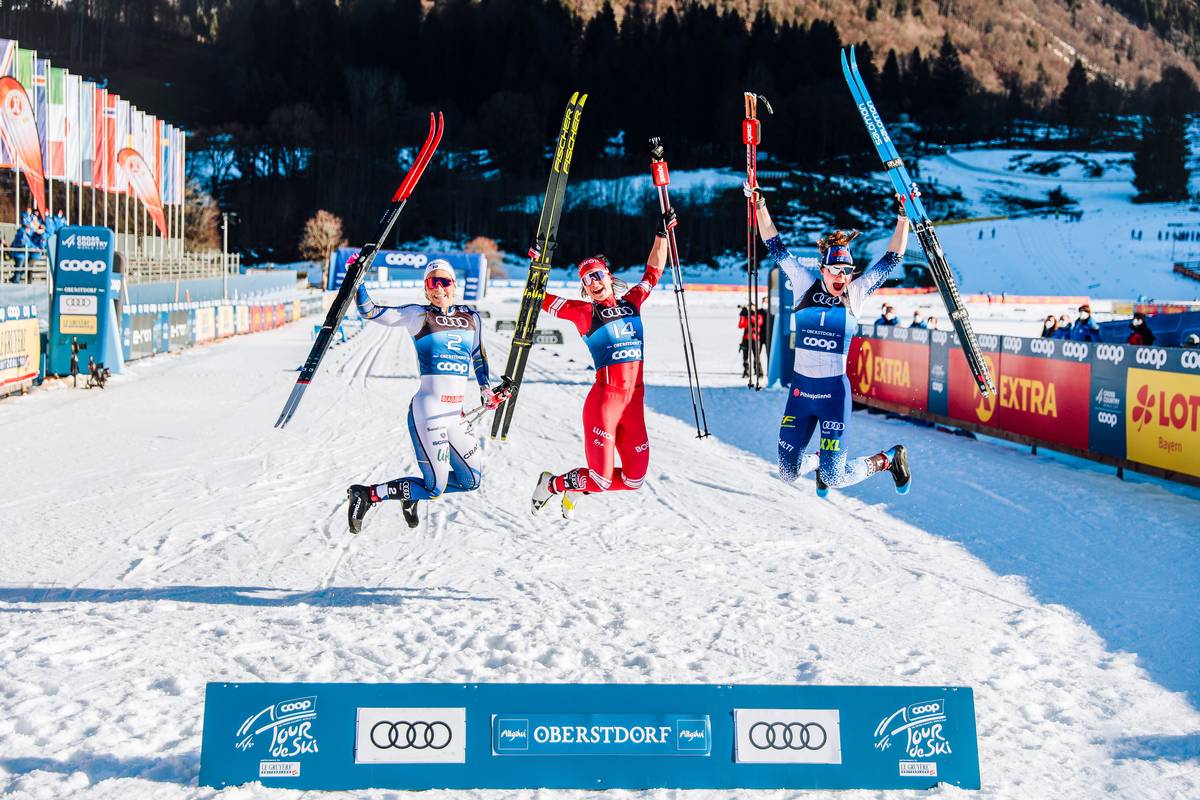
    The women’s podium after Stage 4: Natalia Nepryaeva (RUS) took the win ahead of Johanna Hagström (SWE) and Johanna Matintalo (FIN). (Photo: NordicFocus)

    This World Cup coverage is made possible through the generous support of Marty and Kathy Hall and the A Hall Mark of Excellence Award.  To learn more about A Hall Mark of Excellence Award or to learn how you can support FasterSkier’s coverage please contact info@fasterskier.com.

     

    Every Grand Tour must have a Queen Stage. Dreamt up by organizers, meant to stand at the crux of the race, animate its characters, and start the action towards resolution in the narrative that’s formed over its early stages.

    In cycling, these are the iconic places where grand settings meet grand drama – Alpe d’Huez, Mt. Ventoux, or the Angliru. The Queen Stage comes with pomp and circumstance, like a coronation or diamond jubilee.

    At this year’s Tour de Ski though, the Queen Stage in Oberstdorf — and this 1.2-kilometer Classic Sprint proved to be just that — was more like a queen’s address to parliament; an agenda laid out for how this Tour will go into its final stages in Val di Fiemme, Italy, negotiated through the tricky rules, regulations, and politics of ski racing on the World Cup.
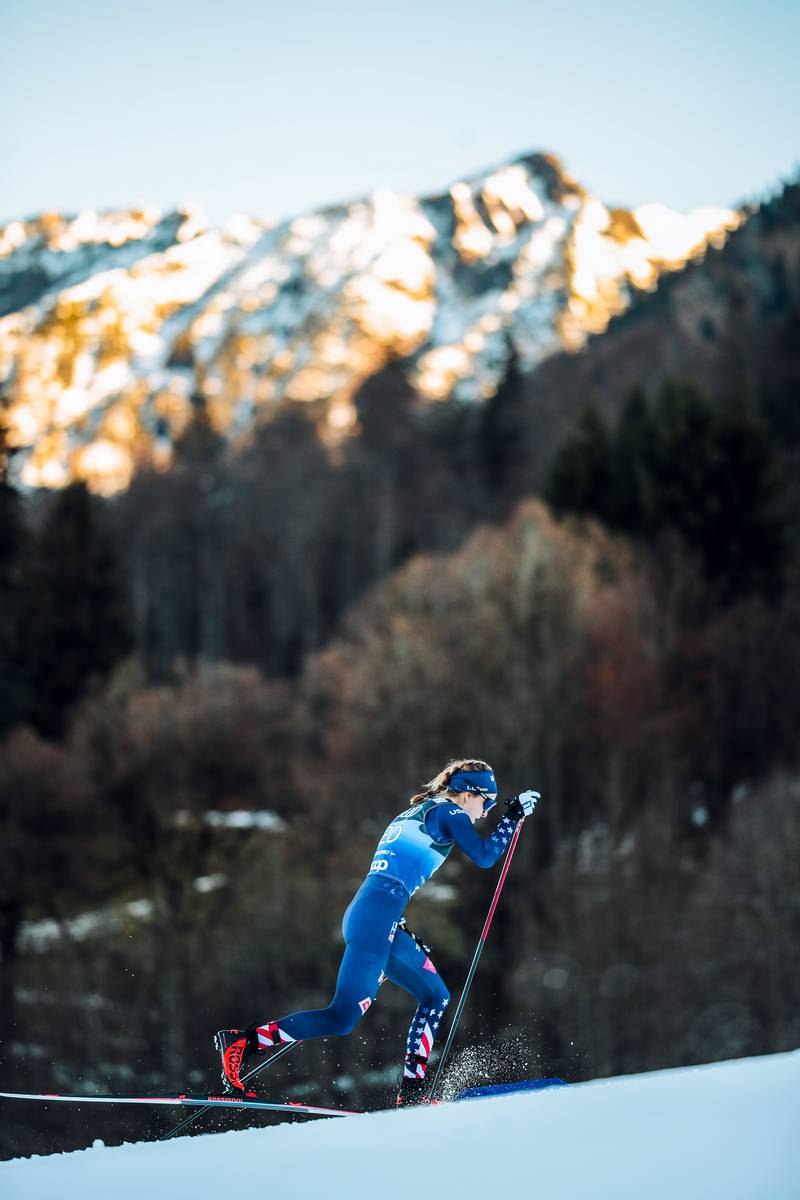
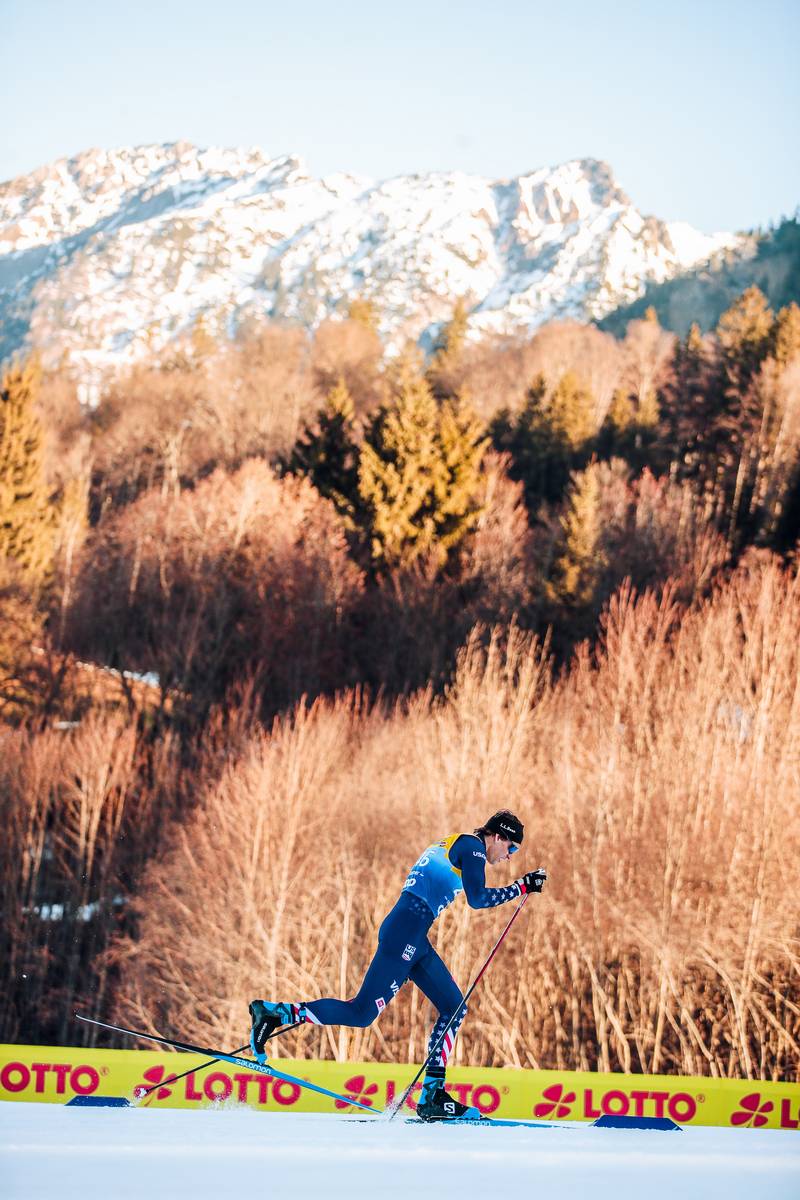
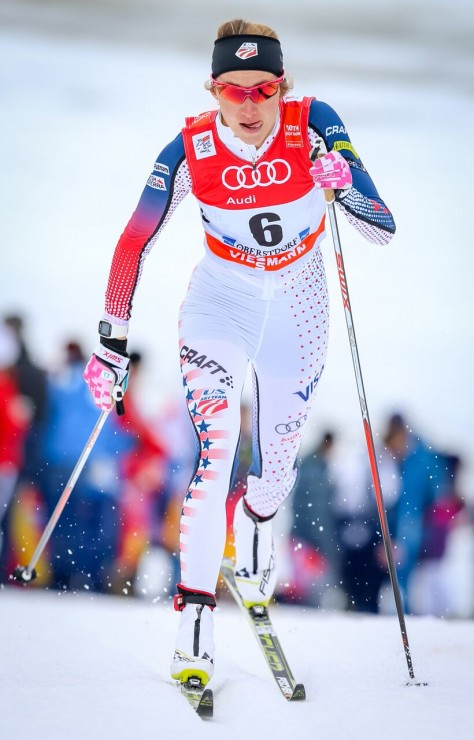
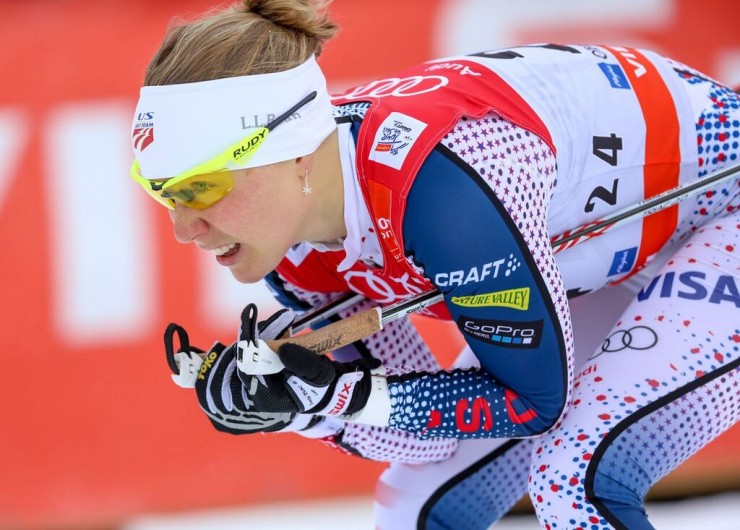
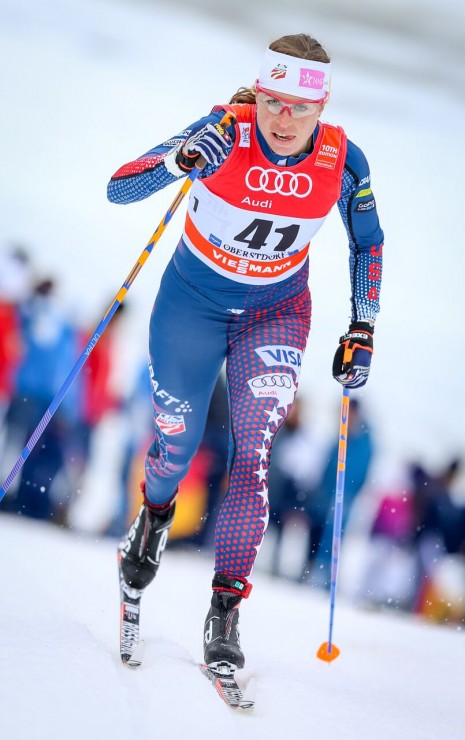
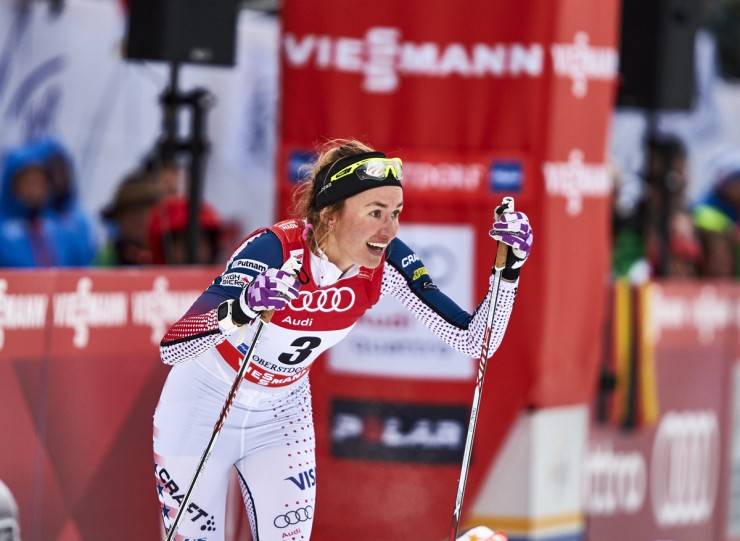
    Alayna Sonnesyn (USA) during qualifying in Oberstdorf at Stage 4 of the Tour de Ski. (Photo: NordicFocus)

    Coming into the day, there was a set order in this year’s Tour de Ski overall classification that matches what you would expect if you just watched the races individually. After a Stage 1 victory in the freestyle sprint, and an exciting 10k freestyle victory yesterday, Jessie Diggins (USA) wore the yellow leader’s bib. Below her was Stage 2 winner Kertuu Niskanen (FIN), and then Natalia Nepryaeva (RUS) in third. The time gap between the three, however, was relatively small. Diggins, despite her two wins, only had a 13 second advantage over Niskanen. With time bonuses for the finalists and semi-finalists in the Stage 4 Classic Sprint all well above that threshold — ranging from 60 sec for the winner to 22 sec for the last semi-finalist finisher — the 1.2k loop at Oberstdorf had the potential to animate and transform the overall classification in an instant. And that’s what happened. Call it a Queen Stage.
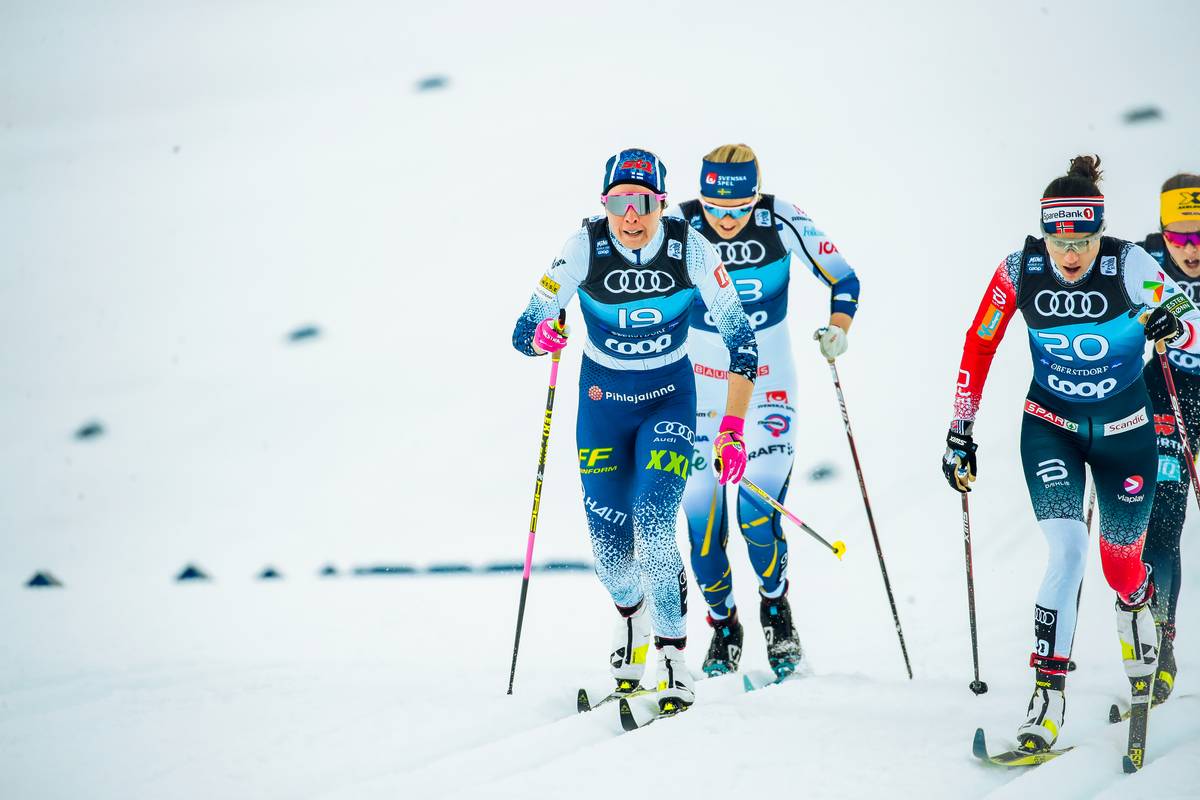
    Kerttu Niskanen (FIN), who started and finished the day in 2nd place in the overall classification. (Photo: NordicFocus)

    The day started strong for the Americans, with Diggins qualifying 7th (+3.43) and Katharine Ogden joining her in heats after qualifying 26th (+7.94).  Diggins’ two closest rivals both qualified off her pace, with Nepryaeva in 13th (+5.08) and Niskanen in 18th place (+6.10).
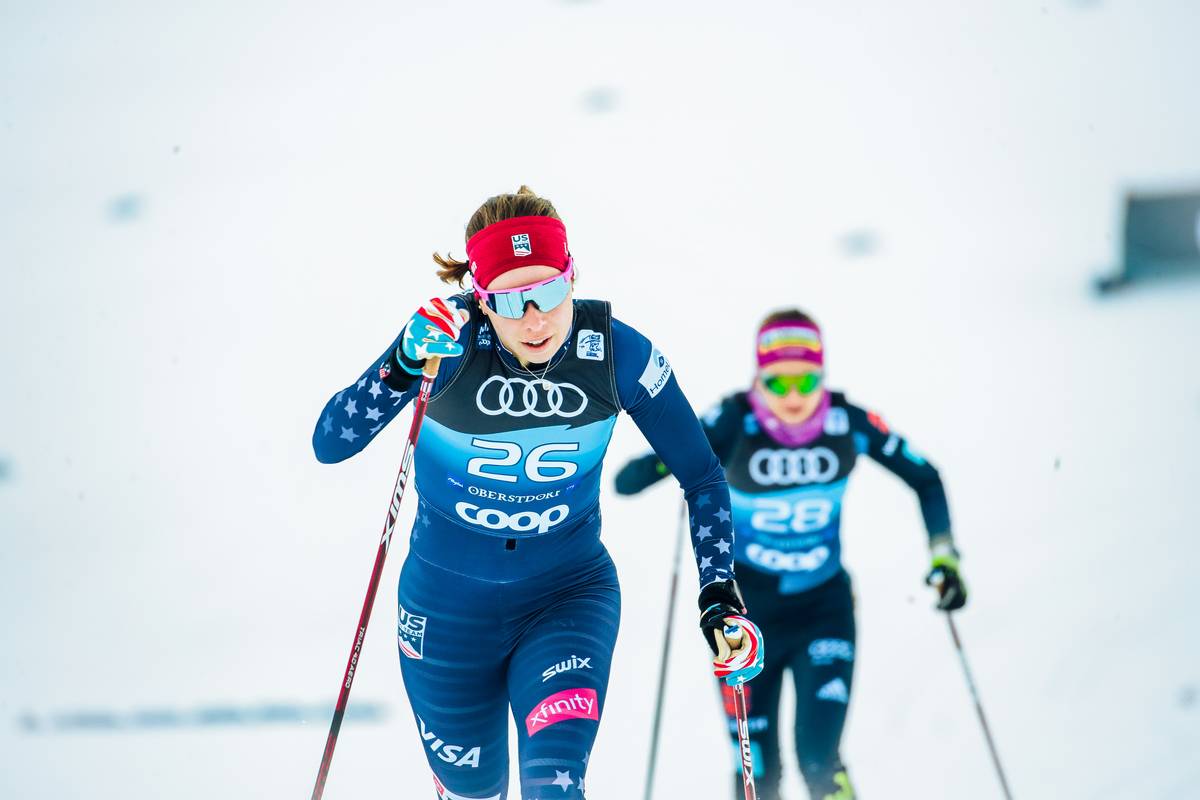
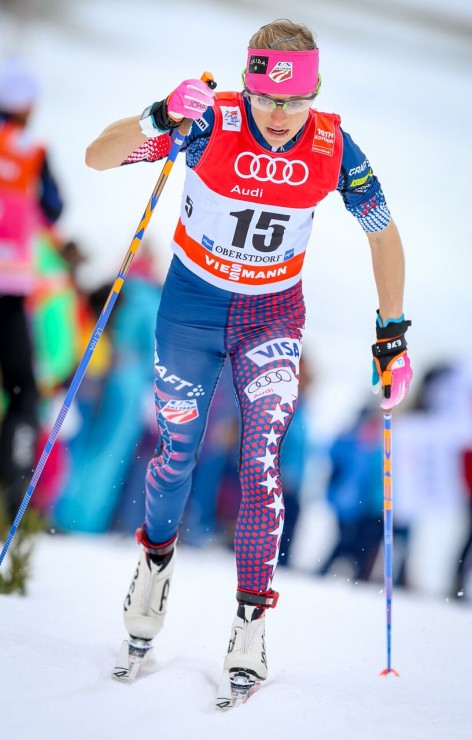
    Katharine Ogden (USA) powers up the first climb during quarterfinal action. Ogden qualified 26th on the day. (Photo: NordicFocus)

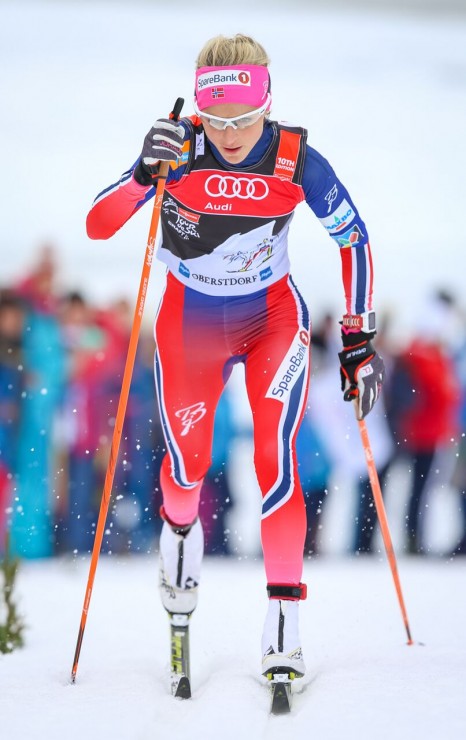
    Ogden would meet Nepryaeva in her quarterfinal, where they set out to race a 1.2k sprint course that featured two punctuated climbs, with a technical downhill sweeping to the right in between. Their heat was a fast one, with Ogden establishing herself in the field behind Anamarija Lampic (SLO), then coming off the top of the first climb in fourth place. As the field spread out across the second climb, Nepryaeva came off the top first, with Lampic in tow. When they came out of the downhill into the long, straight, finishing straight, Nepryaeva had the lead, but Lampic showed a fight to regain her 2nd place ahead of Greta Laurent (ITA). In the excitement, Ogden had been left out of the pack slightly, and came across the line in 5th place.

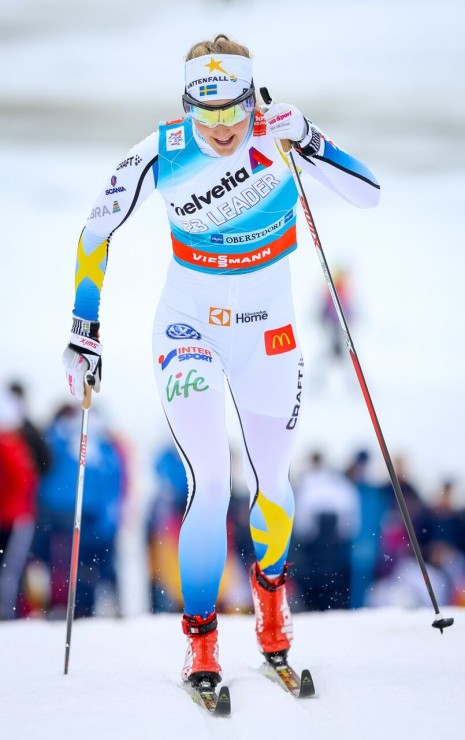
    Where this Tour really turned on its head though, was in Diggins’ quarterfinal heat. Lined up against a field that included qualifier winner Johanna Matintalo (FIN), Tatiana Sorina (RUS), and Frida Karlsson (SWE), the heat was a tense affair from the gun. Sorina led out over the first climb, and Diggins successfully jockeyed for position coming out of the first downhill. In the approach to the final climb, a slight left-hand turn became the setting for the defining moment of the day.

    As Diggins recounted in an interview with U.S. Ski & Snowboard cross country communications manager Tom Horrocks:

    “I was in the track, Frida [Karlsson] was double-poling outside the track, and then moved in on me, so I moved to switch lanes, she switched on top of me, and caused me to fall – which is a huge bummer… that severely impacts my tour.”
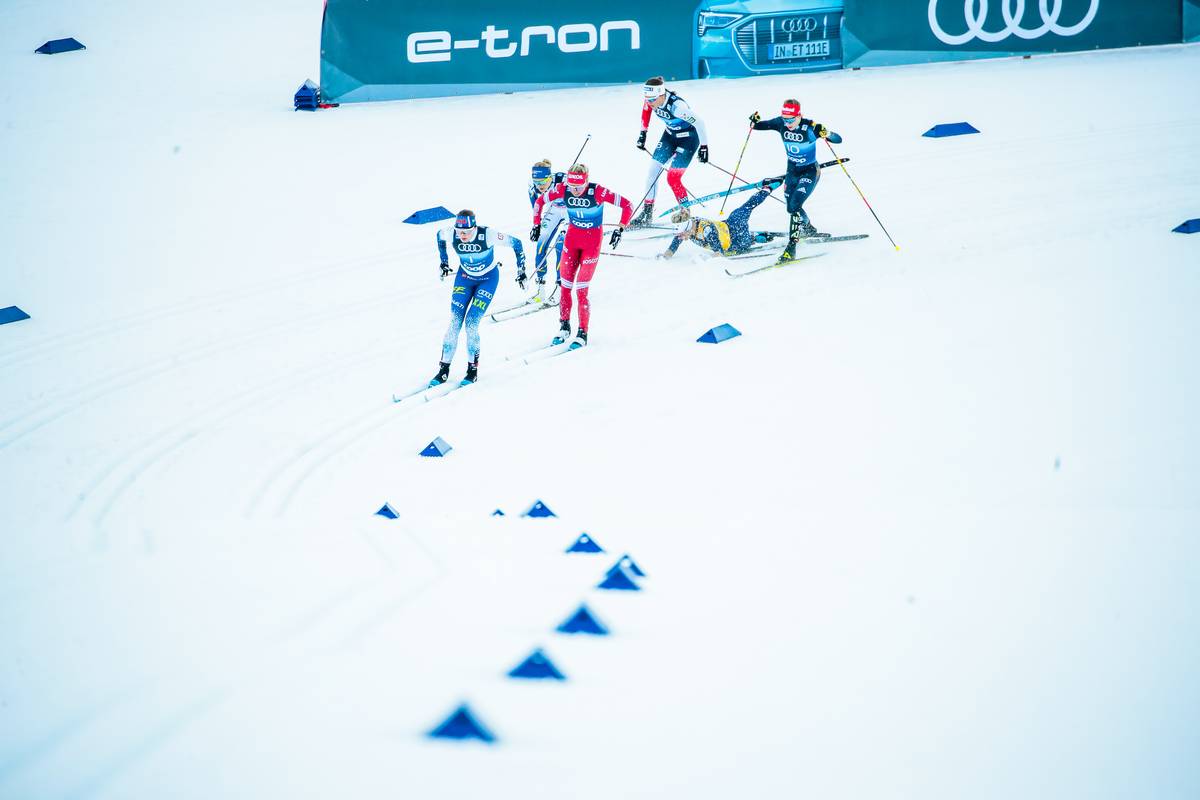
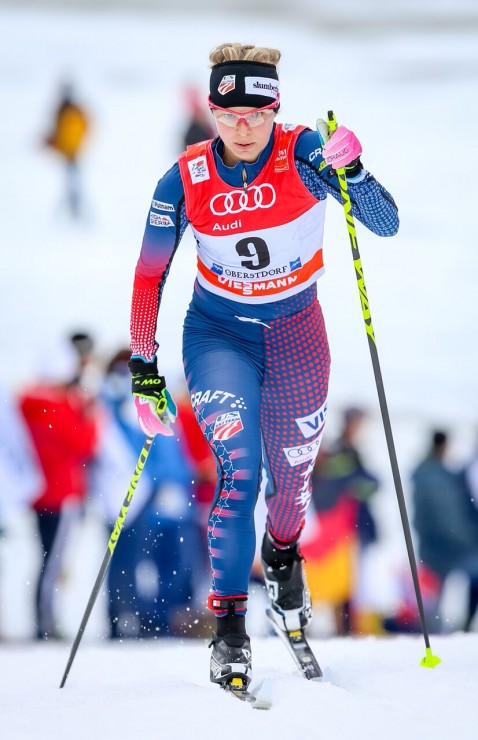
    Jessie Diggins goes down in her quarterfinal heat. Frida Karlsson (SWE) was penalized for obstruction, but the fall left Diggins in 3rd place overall in the Tour de Ski. (Photo: NordicFocus)

    It severely impacted the World Cup season too. Diggins crossed the line in 6th, but before the following heat had hit the first climb the FIS jury had already come back with a yellow-card and disqualification for Frida Karlsson. As a result of it being Karlsson’s second yellow-card of the season, her first arriving in the same event in Ruka back in November, she was also given a 3-minute time penalty in the overall classification for the Tour de Ski.

    That calls to question whether the World Cup’s best distance racer this season will continue to race the Stage 5 10k mass start classic in Val di Fiemme or forgo the end of the Tour altogether. While she started the day in 7th place and +45 sec off Diggins, the 3-minute penalty dropped her to 44th place (+4:30).

    Despite the penalties against Karlsson, Diggins’ quarterfinal time and placing were unaltered, leaving her out while both Niskanen and Nepryaeva advanced to the semi-finals, where the time bonuses for just finishing automatically exceeded the margin of Diggins’ lead in cumulative time standings. Diggins was awarded a 4 sec bonus for her quarterfinal finish, so a net 18 sec gain was at least guaranteed. In an instant then, two of the World Cup’s most compelling stories this season veered towards drastically off course. Diggins’ title-defense now faces steep odds (and a steep climb in Stage 6). Karlsson finds herself further down in the pack than she has been all year.

    The semi-finals then, marked a brave new Tour de Ski.
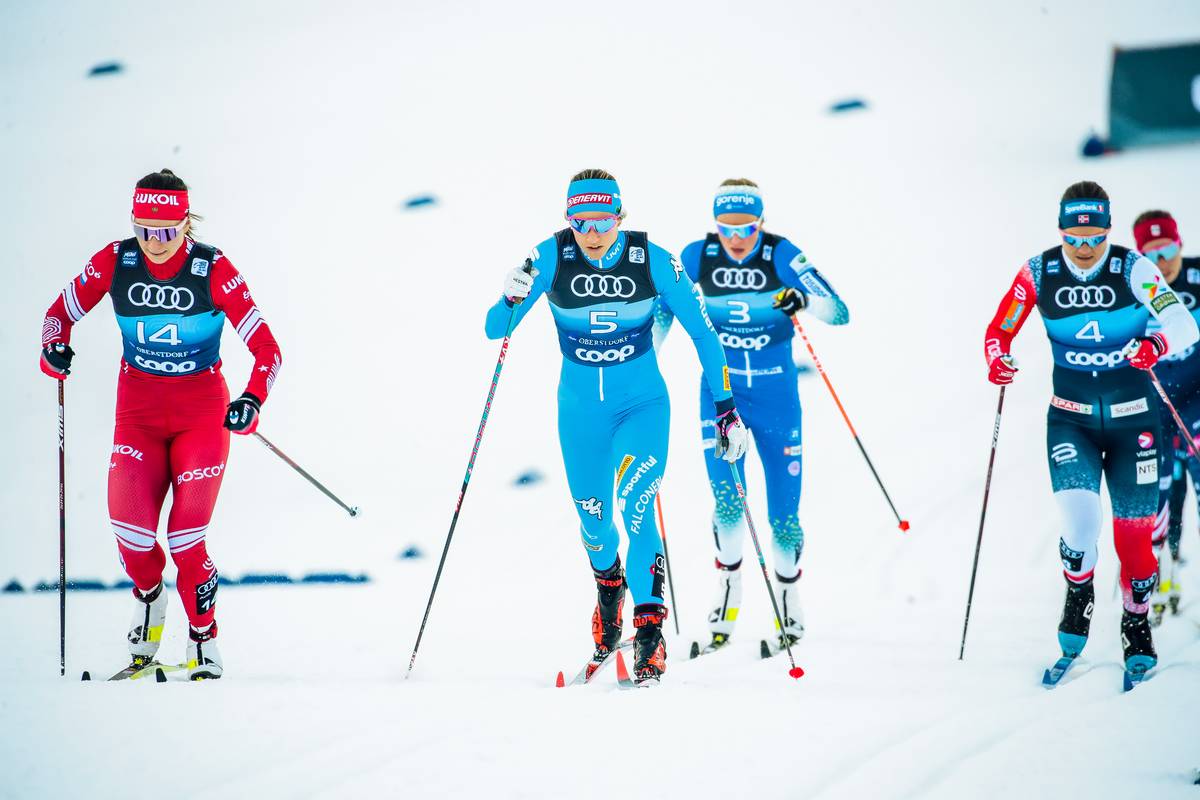
    Natalia Nepryaeva (RUS), Greta Laurent (ITA), Krista Pärmäkoski (FIN), and Ane Appelkvist Stenseth (NOR) (L-R) during their semi-final. (Photo: NordicFocus)

    Nepryaeva raced through her semi-final with a tactical approach carried over from the quarters, preferring to stay with the pack led out by Matintalo and Johanna Hagström (SWE), before pushing the last climb and setting herself up for the long double-pole finish – for which she looked stronger than anyone else in the field. She won a semi-final that stayed tight and stayed fast, sending both lucky losers to the final.
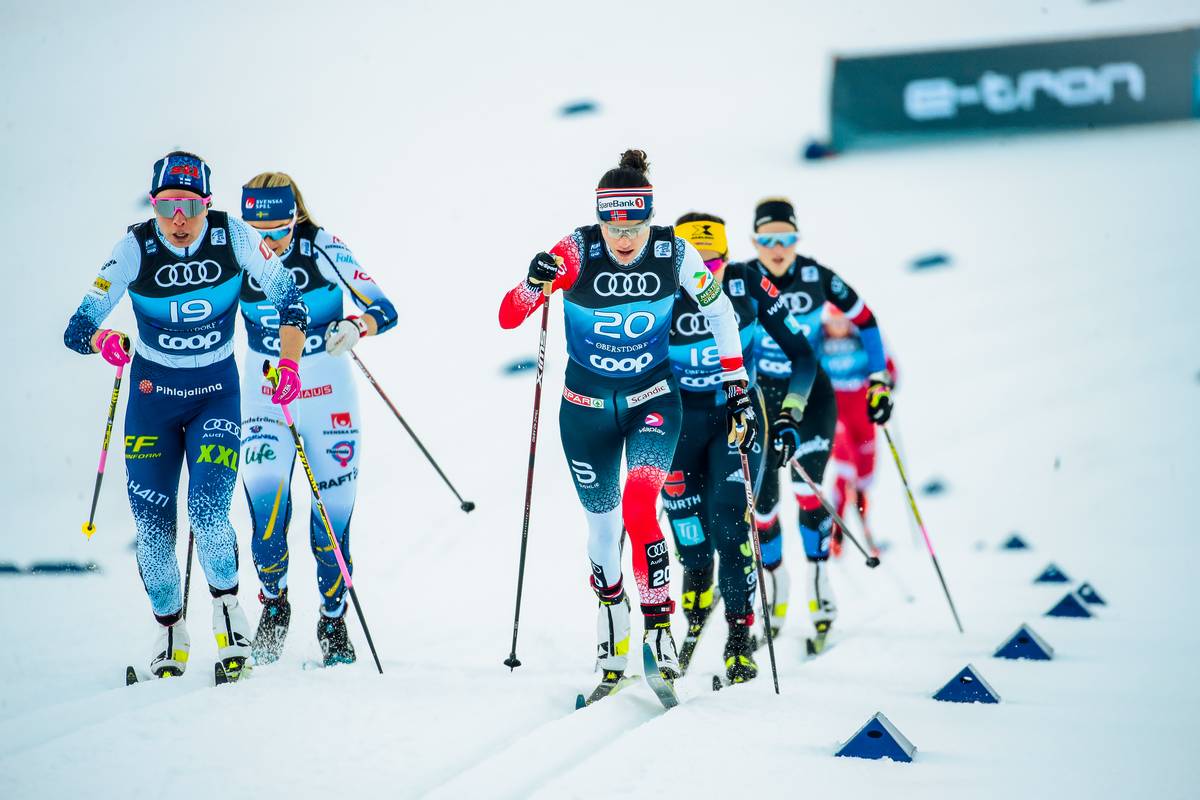
    Kerttu Niskanen (FIN) in 2nd semi-final. She would finish 5th in the heat, with Anamarija Lampic (SLO) winning to advance to the finals. (Photo: NordicFocus)

    Niskanen would line up in the second semi-final. She matched up against Lampic, Laurent and Mathilde Myhrvold (NOR), with the former two looking to lead the race from the gun. By the time they crested the final climb, Lampic had stretched out the field and Niskanen had been caught out the back. She finished fifth in the heat, and didn’t advance to finals. Lampic carried the heat, and Myhrvold came second.

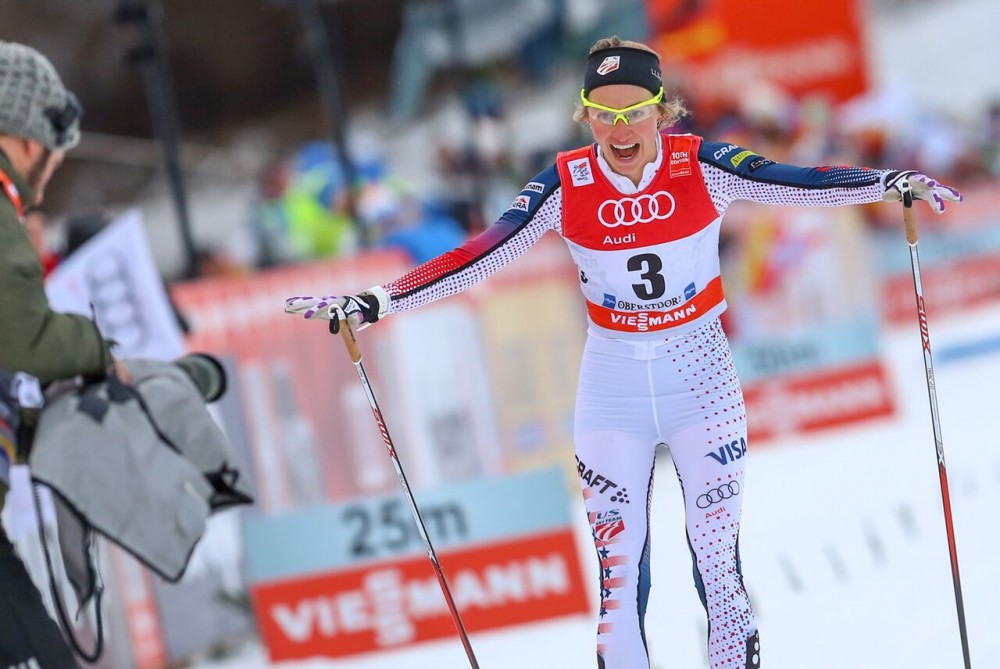
    Nepryaeva then, would be playing a game of seconds for the Tour lead. And she would be playing it, skiing the course, like she had all day. Lampic, Hagström and Matintalo formed the front of the pack, while Nepryaeva waited for the last climb to swing out and throw a burst of acceleration that saw her and Hagström come over the top together. As Nepryaeva came out of her tuck on the finishing stretch, the strength of her double pole was on full display. She crossed the finish line first, and with a scream that no doubt will echo all the way to Val di Fiemme to warn that there is a whole new dynamic coming to its courses when the Tour resumes after the rest day tomorrow.
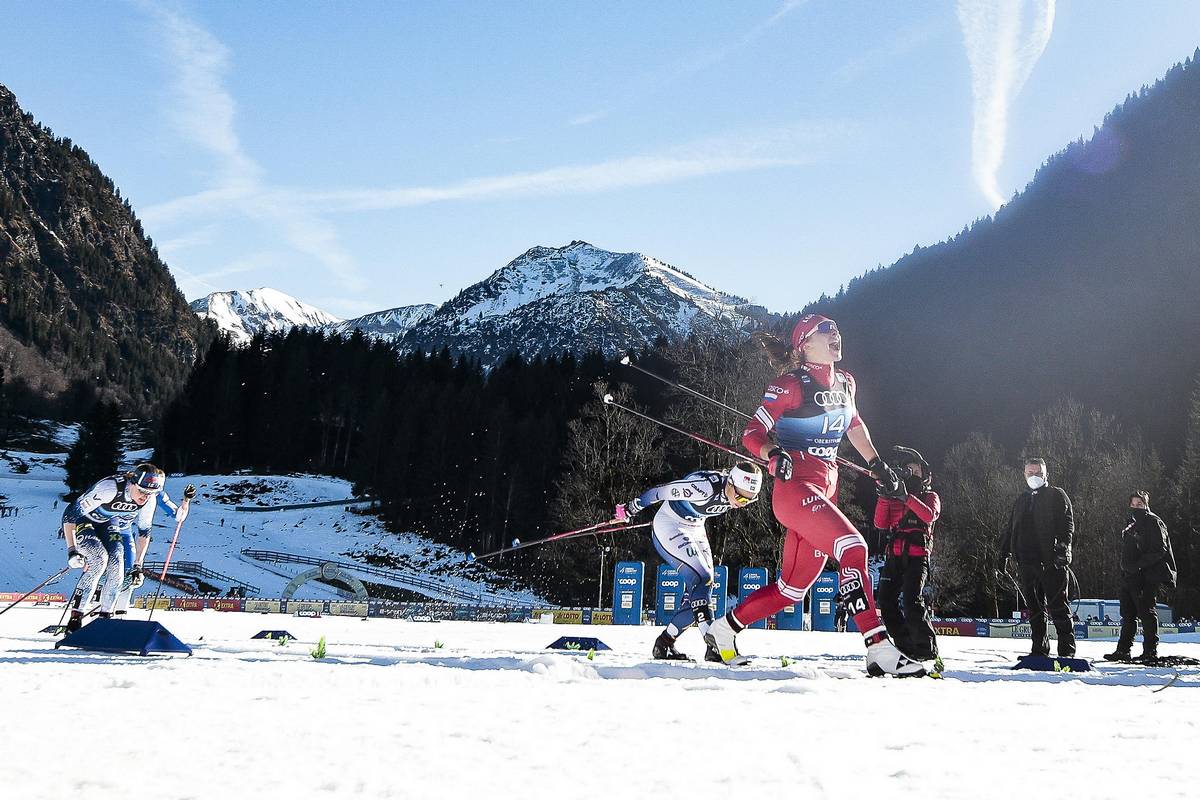
    Natalia Nepryaeva (RUS) comes across the finish line to win Stage 4 and take the lead in the Overall Classification at the Tour de Ski. (Photo: NordicFocus)

    That new dynamic is a new order. Standings going into Italy: Natalia Nepryaeva in first (53:40.0), Kerttu Niskanen in second (+34.0), and Jessie Diggins third (+38.0).
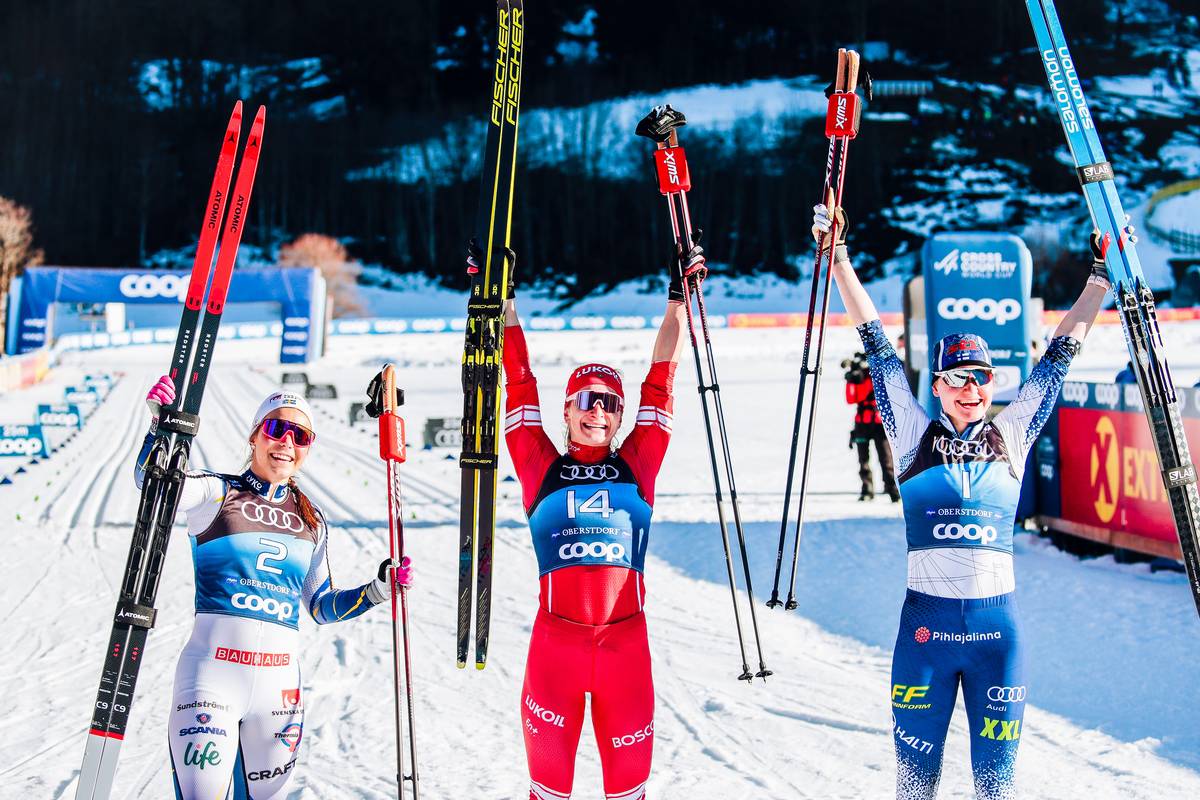
    Johanna Hagstroem (SWE), Natalia Nepryaeva (RUS), Johanna Matintalo (FIN) on the podium in Oberstdorf. (Photo: NordicFocus)

    With two stages to ski though, the gaps in this year’s Tour de Ski are nowhere from definitive. When it was alluded that her misfortune may change her tactical approach to the last two stages in Italy, Diggins replied simply, “it’s still full throttle everyday. It has to be.”

    Full audio clip from post-race interview with Jessie Diggins, hosted by Tom Horrocks:


    The Queen Stage of Oberstdorf may have made its sound and fury, but ultimately this race and its story are far from their conclusion, and it still contains a character in Diggins who has proven so-often that she can make us throw out all of the books.

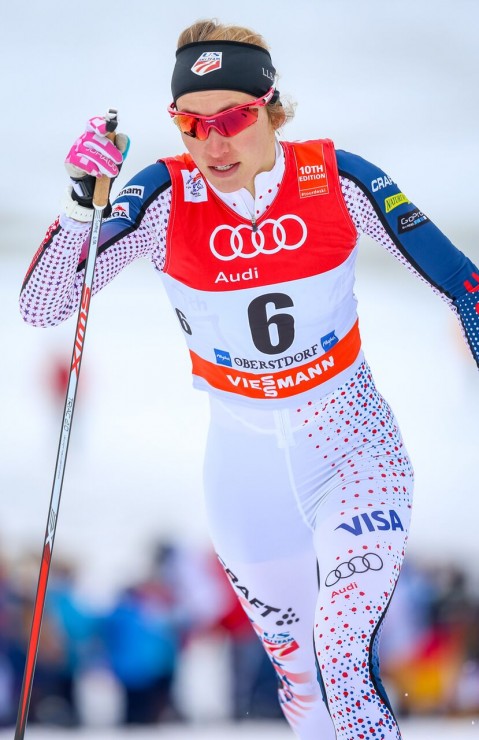
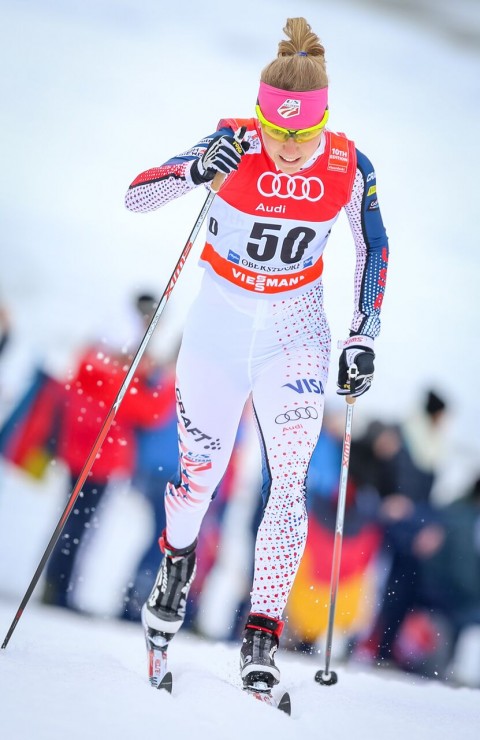
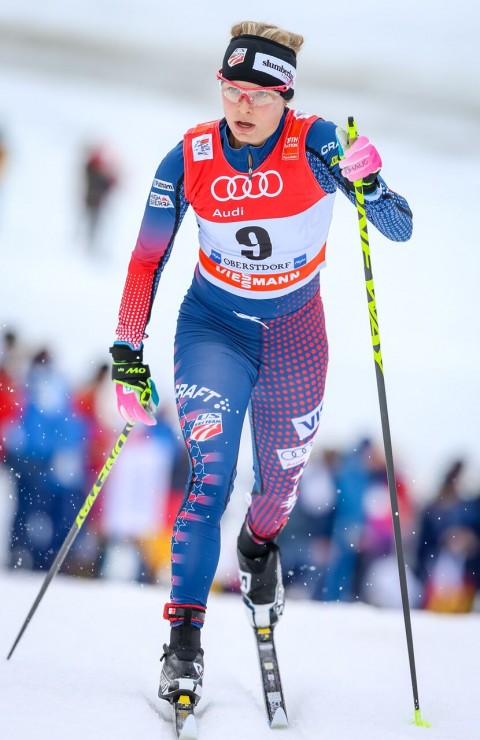
    Jessie Diggins during qualifying at Stage 4 of the Tour de Ski. (Photo: NordicFocus)

    After final results were decided, Diggins ended her day in 21st, with Ogden a few places behind in 24th.

    Outside the Top-30, the U.S. had strong results in the qualifier. Alayna Sonnesyn finished in 43rd (+14.93), Novie McCabe finished in 54th (+18.45), and Sophia Laukli finished in 61st (+26.87).

    Both Hailey Swirbul and Julia Kern have dropped from the Tour, each sharing on social media that they have a cold and are focused on recovery.
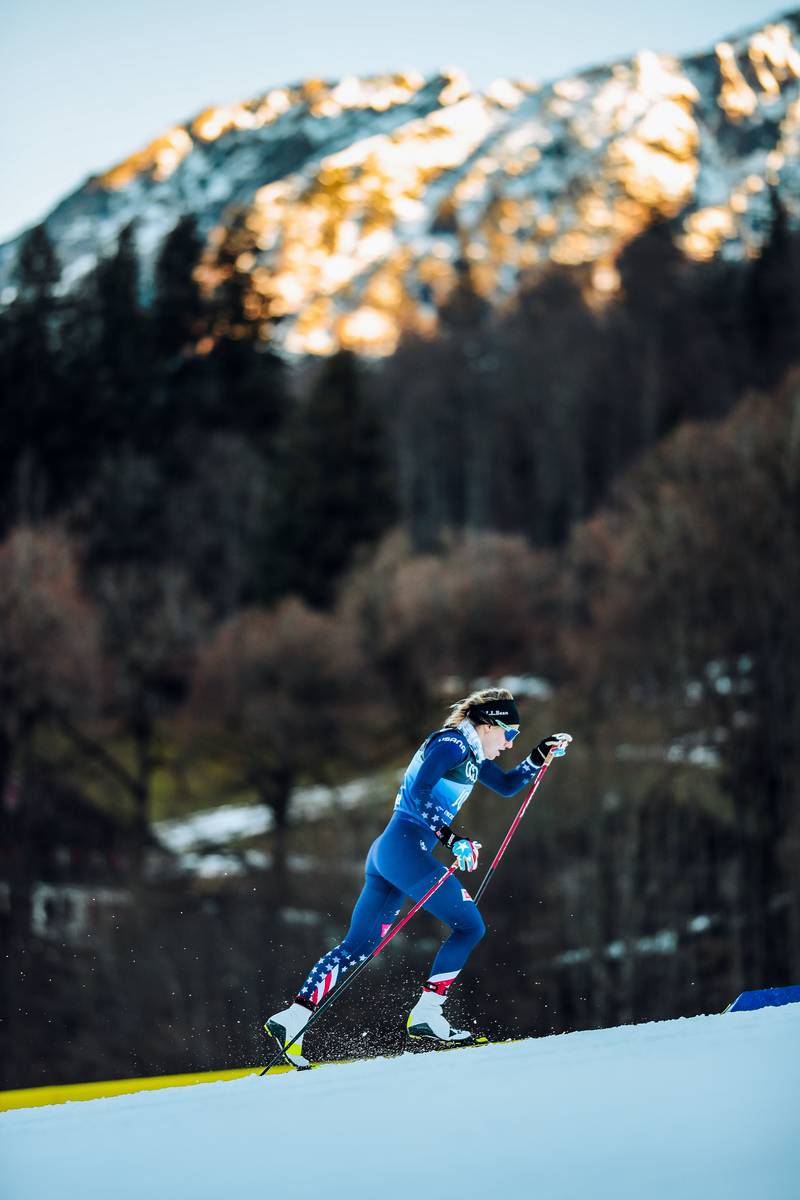
    Novie McCabe during qualifying at Stage 4 of the Tour de Ski. (Photo: NordicFocus)

    Results:
    Qualification | Final
    Tour Standings After Stage 4:
    Cumulative Time | Points

  • Klæbo Runs Away with Third Stage Win in the Classic Sprint; Ogden 22nd, Jager 27th

    Klæbo Runs Away with Third Stage Win in the Classic Sprint; Ogden 22nd, Jager 27th

    This World Cup coverage is made possible through the generous support of Marty and Kathy Hall and the A Hall Mark of Excellence Award.  To learn more about A Hall Mark of Excellence Award or to learn how you can support FasterSkier’s coverage please contact info@fasterskier.com.


    As we begin Stage 4 of the Tour de Ski, the first classic sprint since the opening race of the season in Ruka, Finland on November 26th, we look back to the last time athletes raced the event on the tracks in Oberstdorf, Germany. 

    During the 2021 World Championships, Johannes Høsflot Klæbo (NOR) took command of the gold medal from the qualifier on a 1.5-kilometer course seemingly designed for his racing style. A quick double pole start from the stadium leads to a long steady first climb where he skied long, strong, and steady, usually in second or third position. After a winding descent, athletes encounter a second short but steep climb of roughly 18 vertical meters, where Klæbo would begin his signature run. Stomping his way to the lead as he crested the top of the climb, stepping around a left-hand curve, and dropping into a tuck on the final descent leading into the stadium, Klæbo was repeatedly in position to advance through each round comfortably, eventually winning the final by several ski lengths. (Video highlights here.) 

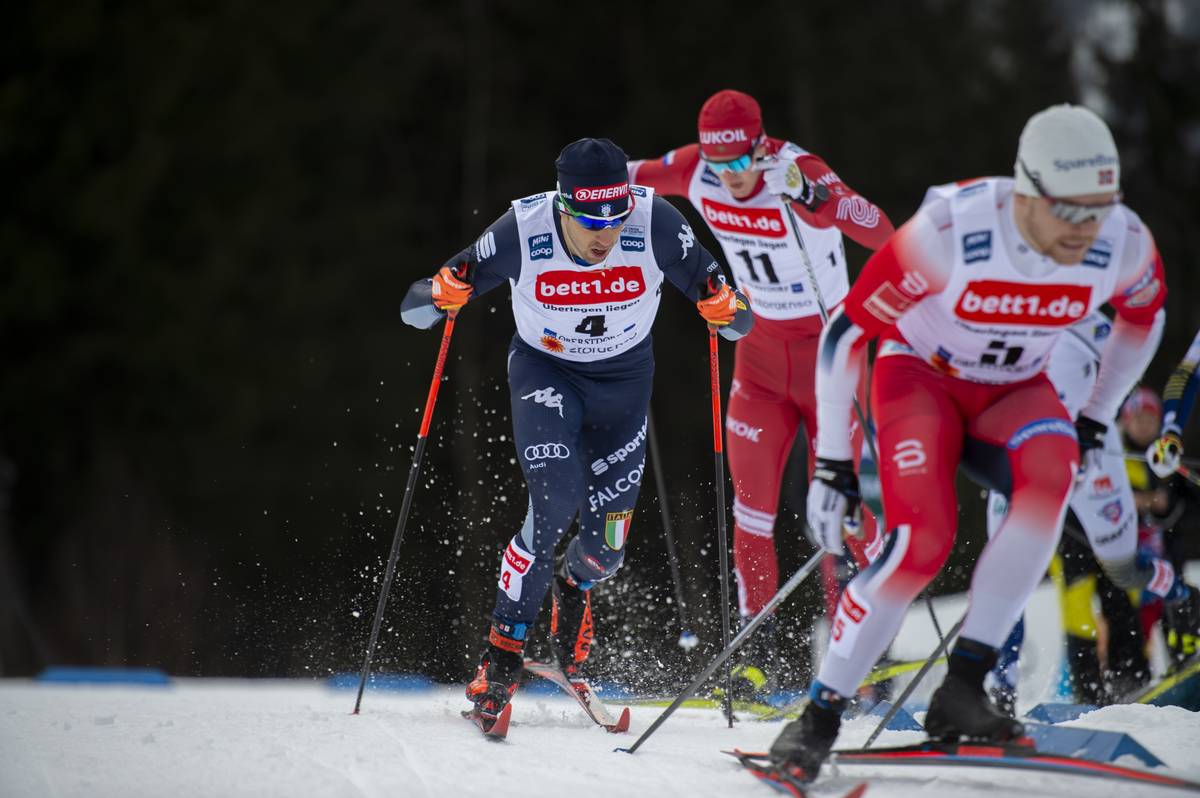
    Alexander Terentev races to second place in qualification during Stage 4 of the Tour de Ski in Oberstdorf. (Photo: NordicFocus)

    Winning today’s qualifier in 2:55.78, Klæbo looked to be on track for a repeat victory in Oberstdorf, however, it is worth noting that he did not win the aforementioned other classic sprint this season. In Ruka, it was 22-year-old Alexander Terentev who took hold of the event in qualification and looked to, well, out-Klæbo Klæbo throughout the heats. We saw familiar tactics with a power move on the final climb, paired with impressive acceleration over the final meters to capture the win, but this time, the athlete employing these tactics was in a Russian race suit. While Klæbo has won each of the sprints he has entered since, with Terentev eliminated in the semis, Stage 4 would be a rematch both were eyeing. 

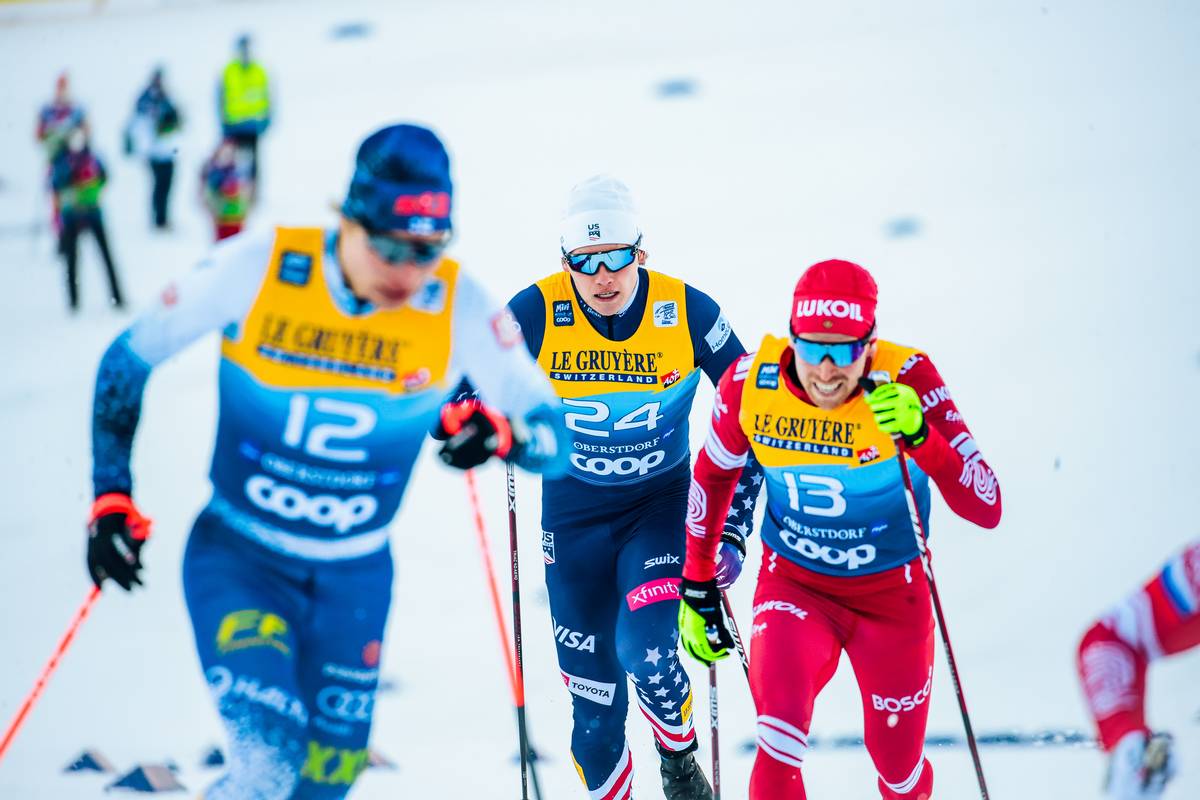
    Setting the stage, Terentev was second in qualification, +1.5 behind Klæbo, with Erik Valnes (NOR) in third (+2.37), Federico Pellegrino 4th (+3.53), and Alexander Bolshunov 5th (+3.61). Ben Ogden was the top American qualifier today, finishing 15th (+8.08), while Luke Jager finished 24th (+10.83). The American selected heats two and five, respectively. 

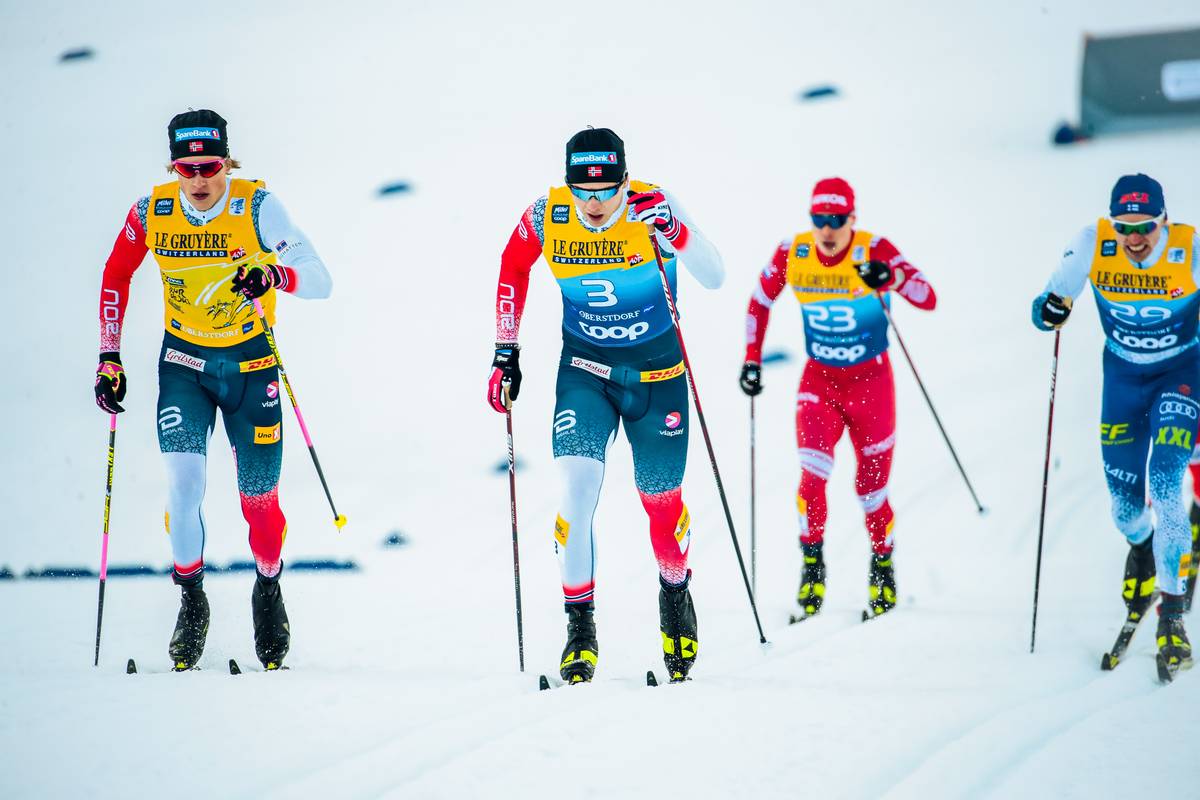
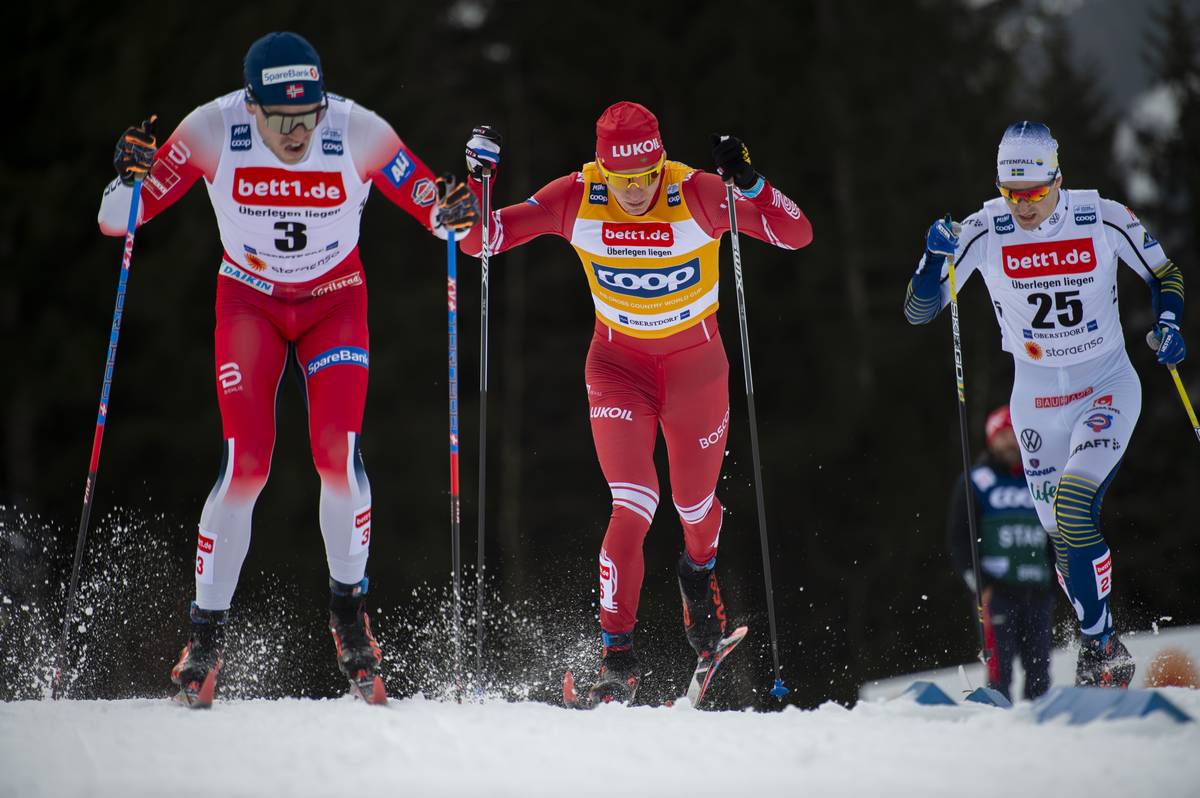
    Johannes Høsflot Klæbo and Erik Valnes take the lead in the final climb of the quarterfinal, with Ivan Yakimushkin (bib 23) and Iivo Niskanen (bib 29) chasing. (Photo: NordicFocus)

    In the first wave of the quarterfinal, Finland’s Iivo Niskanen, winner of the Stage 2 15k classic, pushed the pace heading up the first climb, perhaps looking to ensure an opportunity for a fast rather than tactical heat, knowing he was up against Valnes and Klæbo and likely would only have the opportunity to advance as lucky loser. However, the Norwegians, unphased, chose not to respond, waiting patiently mid-pack to use the same tactic described at World Champs. In the second climb, both created enough room to look as if they had begun their cooldown as they skied through the finish lanes, with Klæbo addigng a lackadaisical boot slide at the line that put him just ahead of his teammate. Behind them, Niskanen and Ivan Yakimushkin (RUS) sprinted to the line to chase the clock, with the Russian finishing ahead of the Finn. However, their times did not hold up through subsequent rounds and their day had ended.

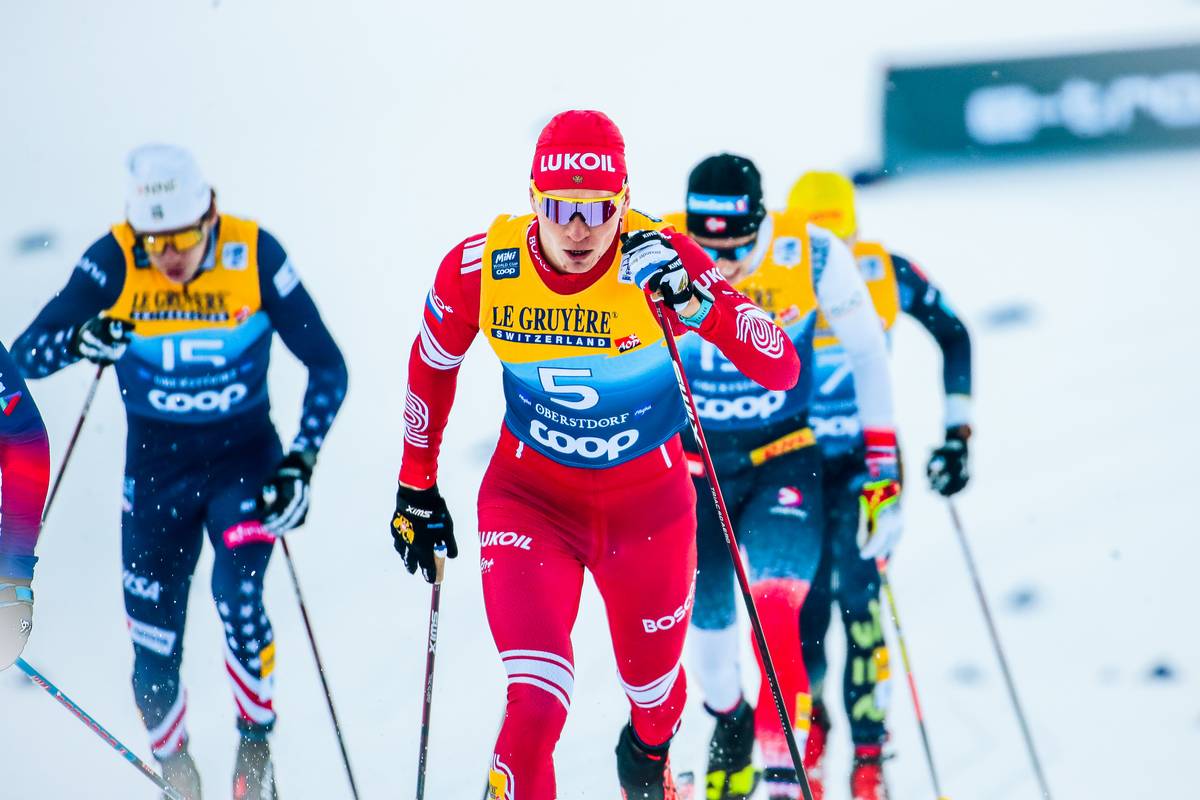
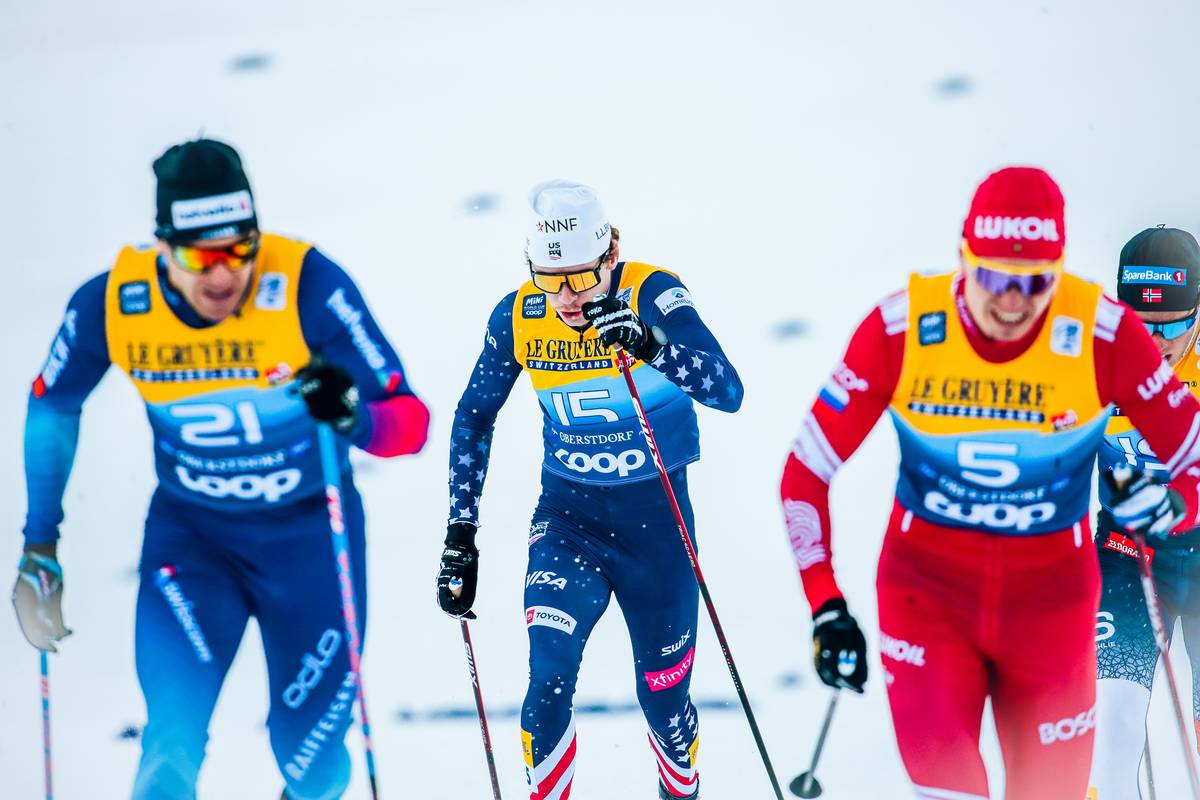
    Alexander Bolshunov leads the quarter final during Stage 4 of the Tour de Ski, with Ben Ogden racing in bib 15. (Photo: NordicFocus)

    In the second heat of the quarters, Ogden lined up alongside Bolshunov, who took control out of the gate. Staying in the pack through the first climb, Ogden found himself in fifth as athletes exited the second and began descending toward the stadium. In the final curves, Ogden couldn’t quite maintain the position needed to contend for a spot as lucky loser, finishing 5th in a fast heat, +1.52 behind Bolshunov.

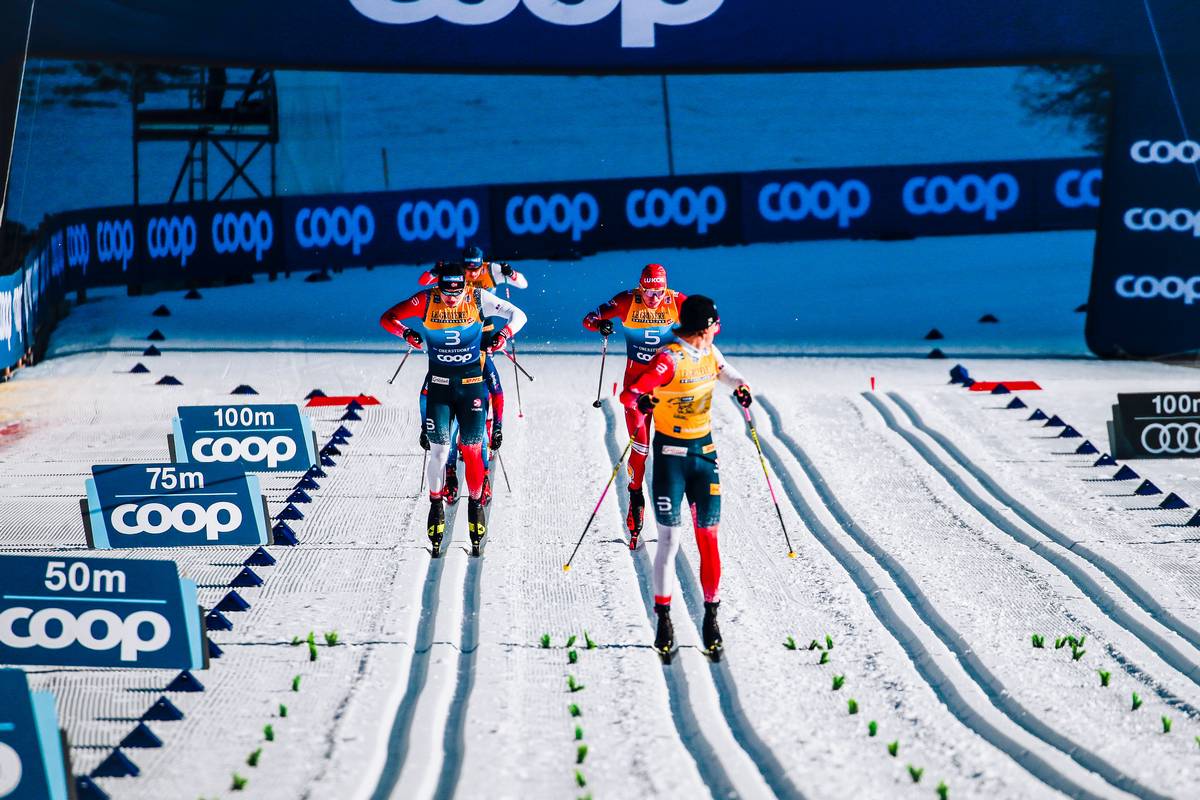
    Terentev looked as though his day might be over before he could face Klæbo head-to-head. Federico Pellegrino (ITA) stepped on his pole as lanes decreased in the opening stretch, causing it to snap. Terentev calmly accepted a replacement, steadily working his way back into the mix. Running out of the tracks in the final climb, Terentev accelerated around the left-hand curve and into the downhill in the lead, continuing through the finish for the win ahead of Mikal Novak (CZE) to advance comfortably.

    Alexander Terentev leads his quarterfinal during Stage 4 of the Tour de Ski in Oberstdorf. (Photo: NordicFocus)

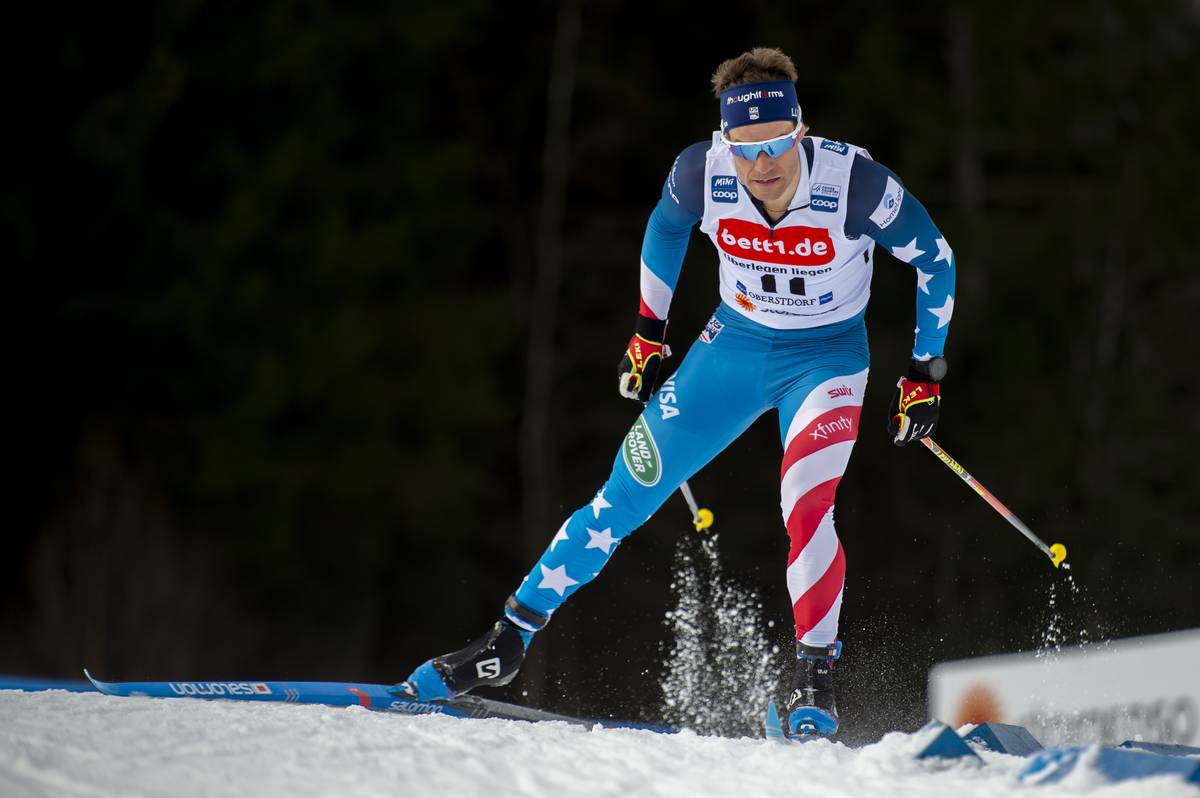
    In the fifth heat of the quarters, Jager maintained contact with the pack through the first climb, but found himself off the back as he left the second. Jager’s legs wobbled as he found his footing in the descent. Perhaps too flooded to ski as aggressively as was needed to put himself in contention for higher placement, he crossed the line sixth in the heat, +6.88 behind the winner. 

    Luke Jager raced in the fifth quarterfinal during Stage 4 of the Tour de Ski in Oberstdorf. (Photo: NordicFocus)

    On we go to the semifinals.

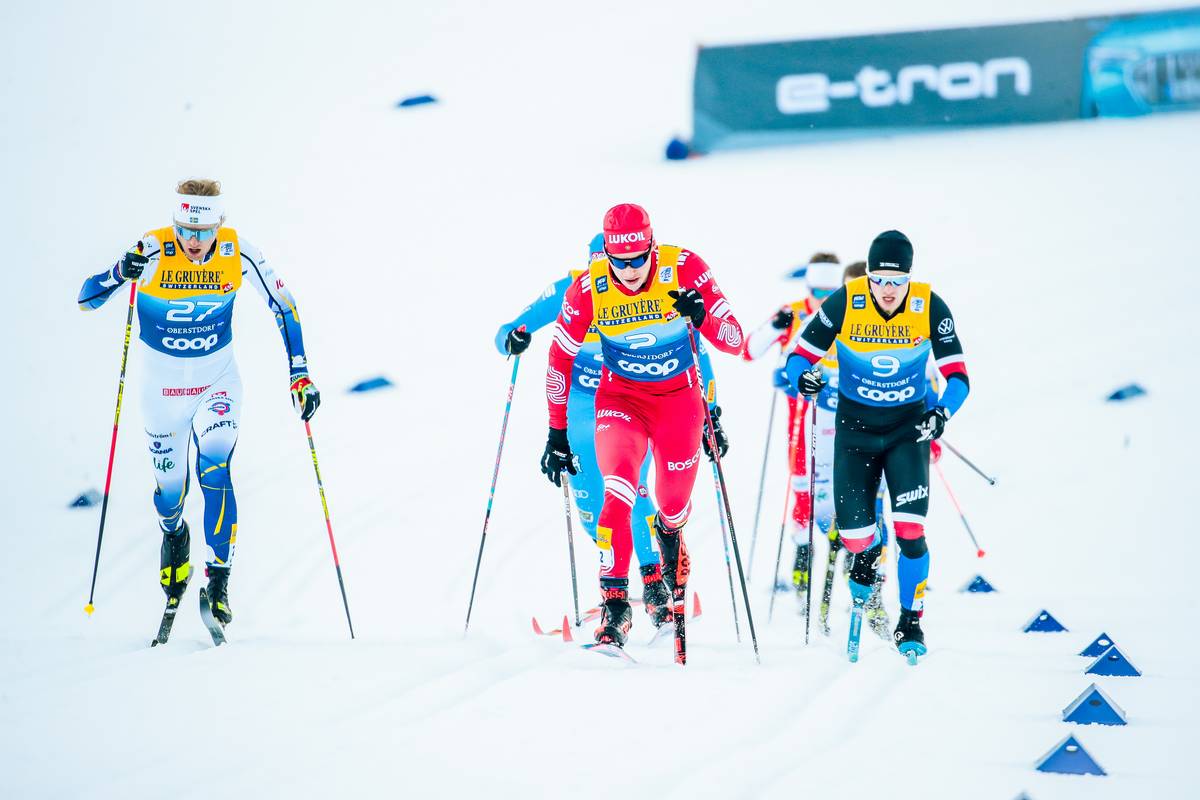
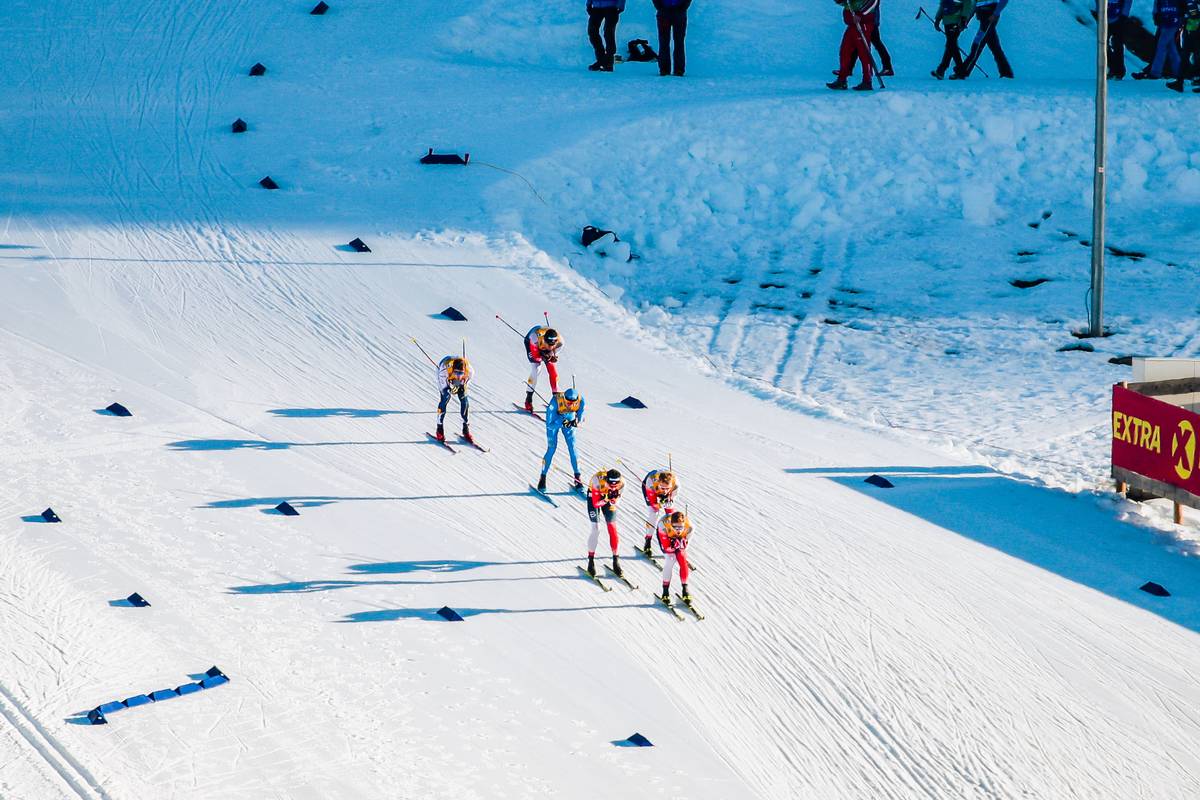
    In a stacked first heat, Bolshunov and Terentev set the pace at the front heading up the first climb. Striding metronomically, they held Valnes and Klæbo temporarily at bay. As the men charged into the final climb, Klæbo advanced at a run up the outside, rounding the left hand bend with Terentev at the front before beginning the sweeping downhill side by side. 

    Terentev began to move across the track behind Klæbo, looking to finding a line that might be optimal for using the Norwegian’s draft to slingshot into the final lanes at high speed. Not waiting long enough, Terentev caught his tips on the Norwegian’s tails, losing his footing and crashing with a slide into the v-boards. No chance to recover what was lost, Terentev stood up, taking a defeated swing at the ground with his pole, before slowly continuing through the final meters to the finish, now well off the back. 

    As the two had created a small gap to their chasers, Valnes and Bolshunov navigated around the crash easily, racing to the line for second and third. Pulling ahead with his double pole, Valnes snagged second with Bolshunov less than half a second back, hoping for a lucky loser spot in the final.

    With a comfortable lead, Johannes Høsflot Klæbo looks over his shoulder as Erik Valnes and Alexander Bolshunov race to the line in the semifinal. (Photo: NordicFocus)

    Terentev later received verbal warning for a classical technique infraction.

    In the second and less-eventful semi, Pål Golberg and Even Northug attempted to take control of the race in the final climb, but they remained matched by Italy’s Francesco De Fabiani and Sweden’s Calle Halfvarsson as they crested the top. Goldberg picked up the most speed in the descent, accelerating out of the final curve with a sizable gap to his three chasers. Laying off the gas before the line, Goldberg took the win ahead of Northug, who left De Fabiani and Halfvarsson fighting for lucky loser spots on his tails. 

    Calle Halfvarsson and Fracesco de Fabiani take it to the line in the semifinal. (Photo: NordicFocus)

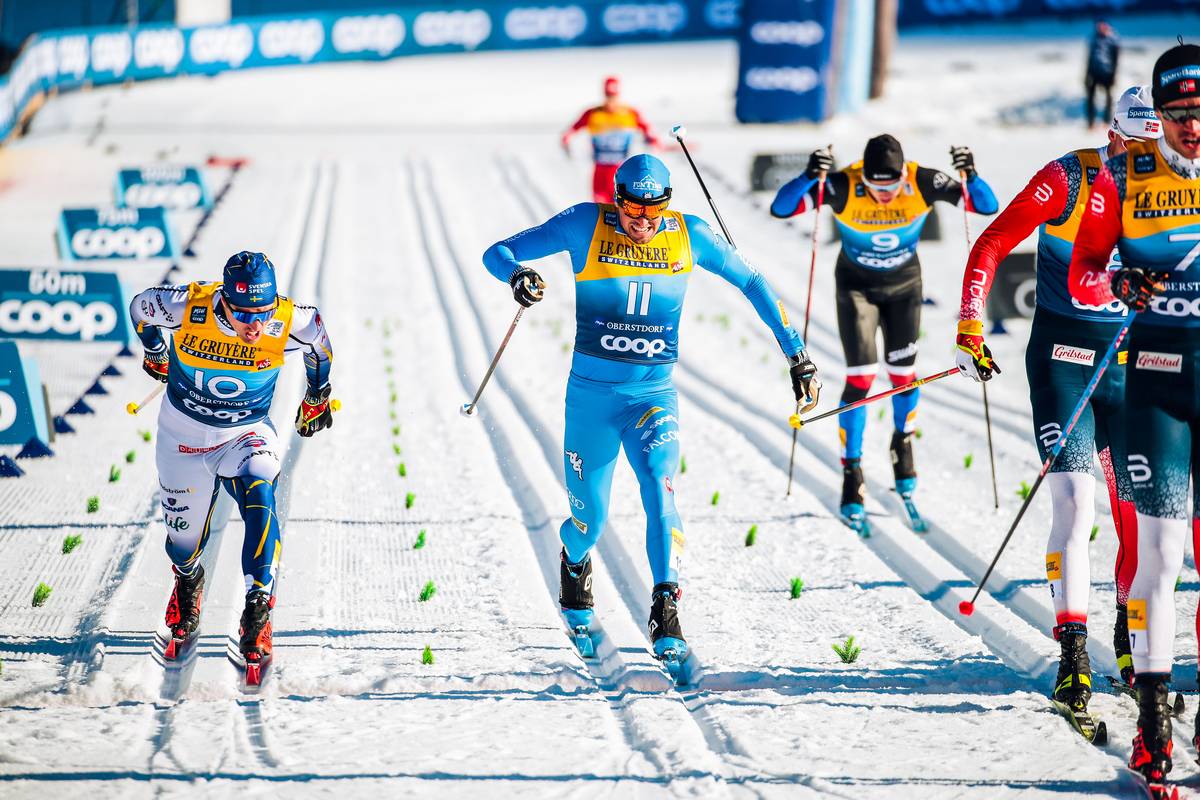
    De Fabiani and Halfvarsson crossed in a photo finish, both just 0.02 seconds ahead of Bolshunov’s mark, allowing them both to advance to the final and ending the Russian’s day.

    With four Norwegians in the final, they were guaranteed at least one spot on the podium. 

    Norway were 1-2-3 coming out of the first climb, with Klæbo sitting in second position. Doublepoling into the next climb, Klæbo matched Valnes as the two ran at the front, Klæbo out of track and Valnes in the inside lane.

    Johannes Høsflot Klæbo leads into the final descent in the last round of the Stage 4 classic sprint in Oberstdorf. (Photo: NordicFocus)

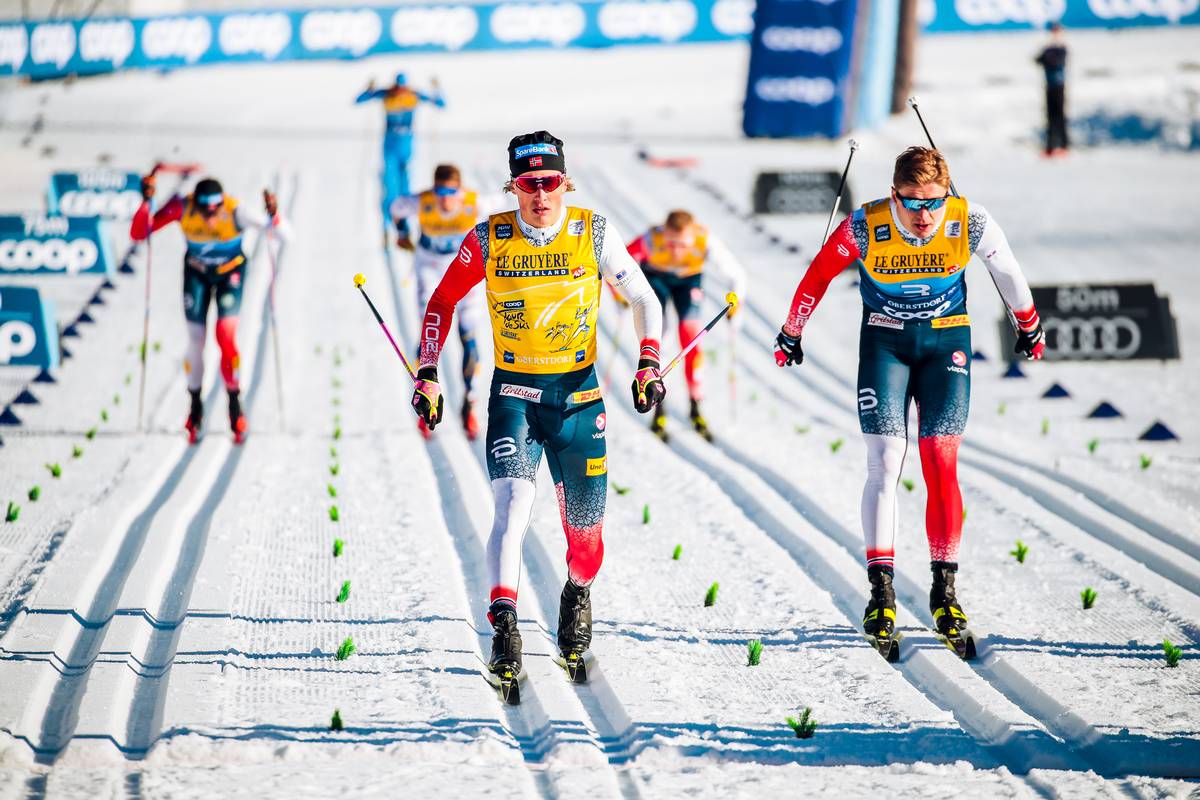
    Klæbo accelerated into the curve at the top stepping in front of Valnes and leading him into the downhill. Klæbo powered into the final stretch still in the lead, with Valnes a ski length back but closing fast with a strong doublepole. Valnes changed lanes, knowing it was his only opportunity if he wanted to try for a win, but there was not enough real estate left and this cost him speed as they came to the line. No time to celebrate this time, Klæbo pushed his boot over the finish to stop the clock at 2:54.77, roughly 3.5 seconds faster than any other rounded, with Valnes 0.3 seconds back for second place. 

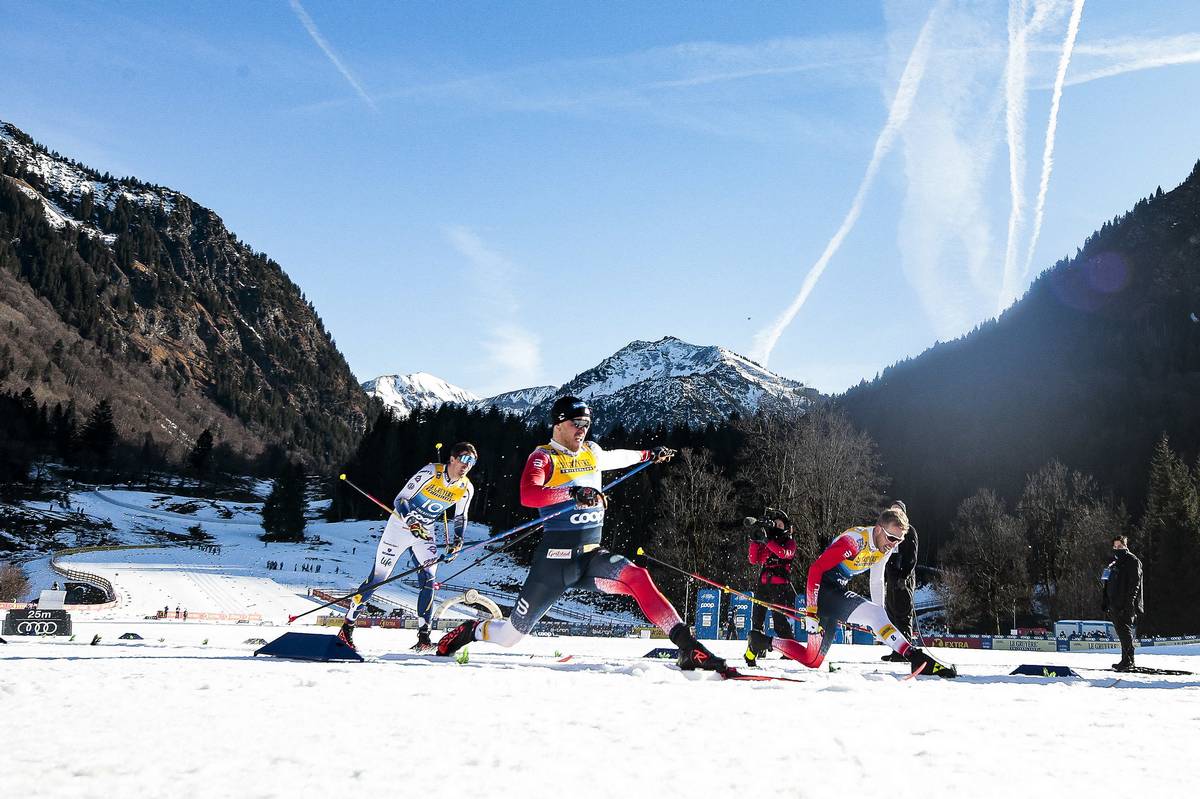
    Johannes Høsflot Klæbo takes the win in Stage 4 ahead of teammate Erik Valnes, while Pål Golberg, Even Northug, and Calle Halfvarsson fight for the final spot on the podium behind. (Photo: NordicFocus)

    Behind the duo, the remaining two Norwegians sprinted to the line for a photo finish, with Goldberg edging out Northug for third by just 0.02 seconds. Halfvarsson, still in contention for the podium in the final stretch, crossed 0.5 seconds behind the Norwegians to end his day in 5th, while De Fabiani seemed to have accepted his fate, crossing the line casually +11.71 behind Klæbo. 

    Determining third place, Pål Golberg (center) edges out Even Northug, wit hCalle Halfvarsson just off the mark in fifth. (Photo: NordicFocus)

    Another all-Norway classic sprint podium in Oberstdorf, and a second consecutive win for Klæbo.

    “It’s amazing to start a new year with a victory and also to have two of my best friends coming onto the podium as well,” Klæbo told FIS at the finish. “I am really satisfied with today’s race, and also to start, hopefully, a good new year.”

    After four races in five days, Klæbo was asked whether Tour fatigue had begun to set in. 

    “For sure, I am getting a little bit tired, but still, when the weather is like this and the conditions are pretty nice, it gives you a lot of energy. So it’s just trying to push hard, looking forward to a rest day tomorrow, and trying to push hard in the last two legs.” 

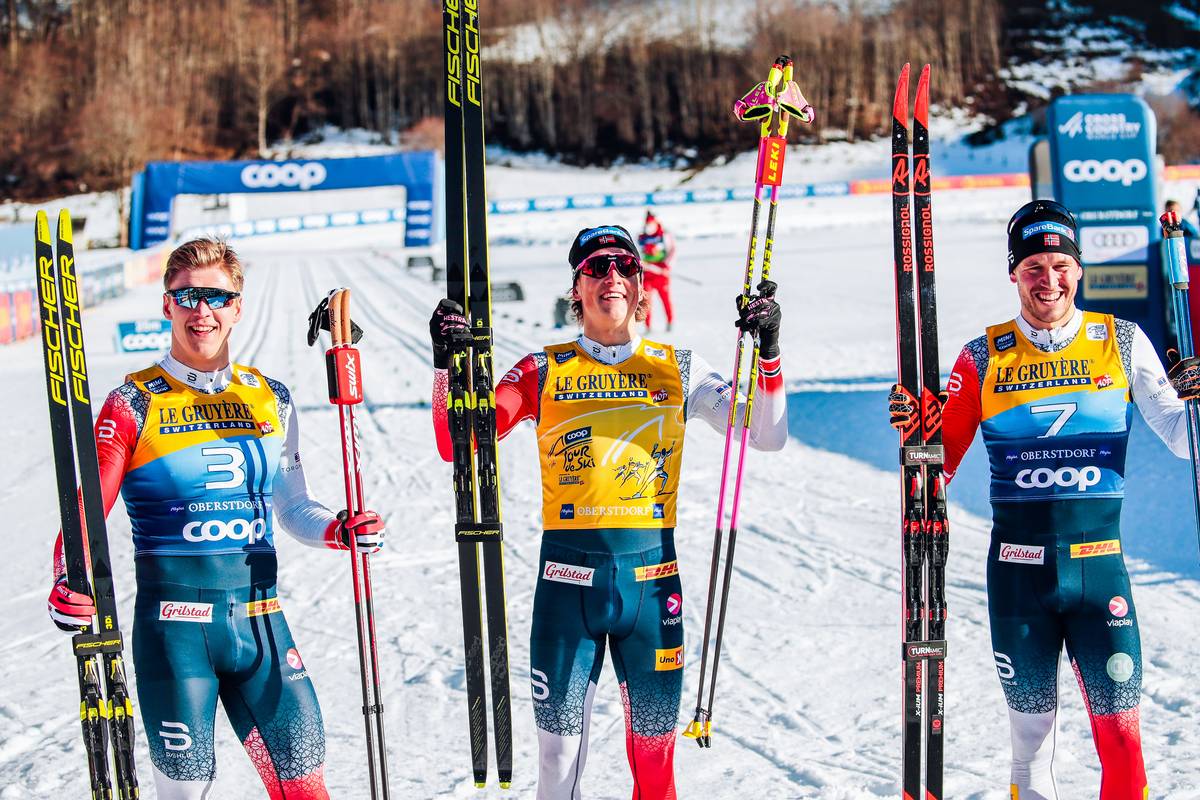
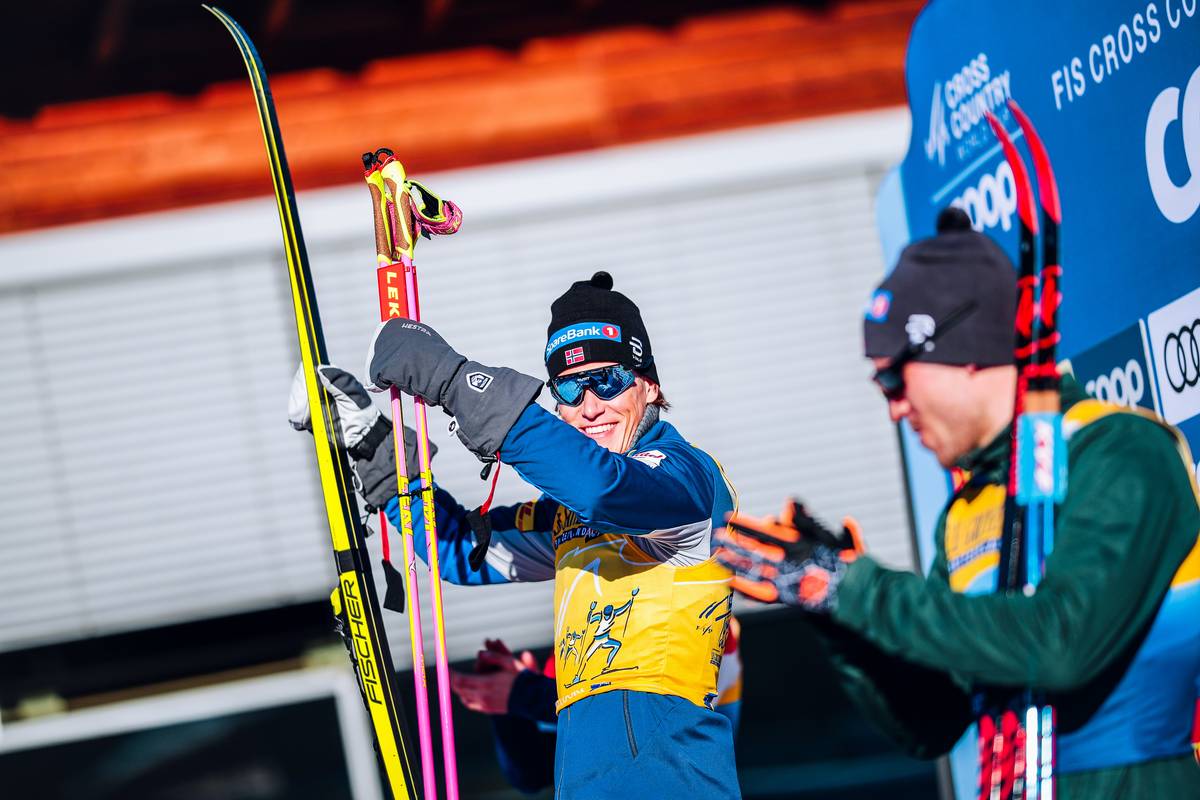
    The all-Norwegian men’s podium after Stage 4 of the Tour de Ski: Johannes Høsflot Klæbo took his fourth win of the Tour ahead of Erik Valnes in second and Pål Golberg in third. (Photo: NordicFocus)

    After the final results were determined, Ogden ended his day in 22nd. 

    “I took the qualifier out really hot, hoping to be in the top 3 in qualification,” Ogden told U.S. Ski & Snowboard cross country communications manager Tom Horrocks at the finish. “I was a little flooded at the end, but not the end of the world. I chose heat 2, which is not always what I do, so I tried something different, and I think I skied well in the heat. It’s been a lot of racing for me early, so I’m a little tired, and wasn’t the smartest out there… but I’d say I’m learning a lot and making progress, so one day I’ll put it together.”

    Full audio clip with Ben Ogden, interviewed by Tom Horrocks.

    Ben Ogden races in heat 2 of the quarterfinals in Oberstdorf. (Photo: NordicFocus)

    It was Jager’s second time qualifying for the rounds in a classic sprint, and his second-best overall World Cup result. Jager was 18th in the opening classic sprint in Ruka, and finished 27th today.

    “I was trying to be competitive, in second, third, or fourth, somewhere where I could potentially get in a draft and have a good finish, hopefully,” Jager told Horrocks post-race. “It didn’t work out that way… Hindsight is 20/20, so maybe I wish I had picked a different lane and just gotten out and ran earlier, but at the end of the day, the pace was just really, really fast. I was and am, chronically and acutely, pretty tired right now, so I just didn’t really have it and wasn’t as aggressive as I should have been going over the top. I like to think if I had another shot in that exact same position, I could make fourth or fifth, but an objective qualification in that [heat] probably wasn’t going to happen for me today.” 

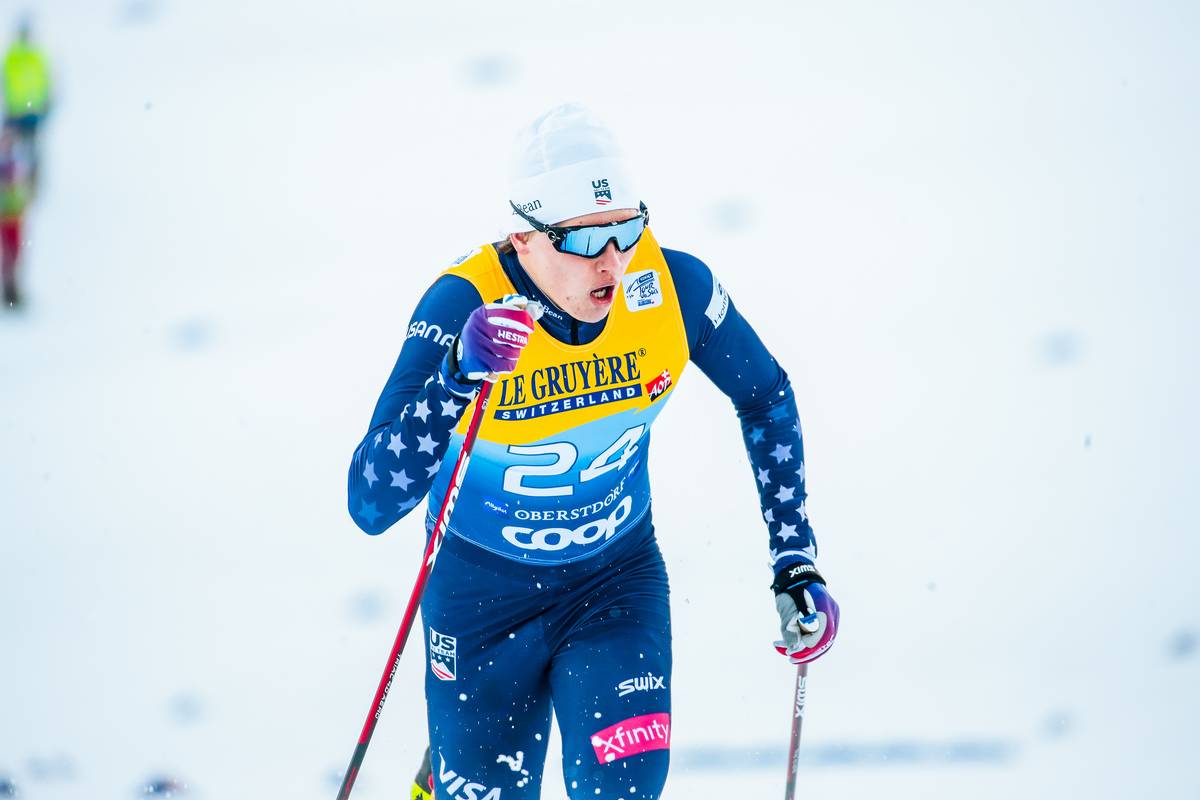
    Luke Jager races to 27th in Stage 4 of the Tour de Ski in Oberstdorf. (Photo: NordicFocus)

    Looking to the bright side, Jager expressed how grateful he has been to have had excellent skis in every race he’s competed this season, which provides confidence even on the days when the body doesn’t want to cooperate. At 21-years-old, Jager’s career is still nascent, and it’s easy to understand how progress at this level may not be linear. 

    “I’m super thankful for the opportunity [to race on the World Cup this season]… It feels often like it’s one step forward, four steps backward over here, just because it’s so brutal. The last month, especially, has been pretty tough and pretty demoralizing at times for me. I’m going home today, so it’s pretty nice to end with a glimmer of hope for what is to come. It’s the real deal. Sometimes it’s easy to forget that because so many Americans are doing well, but it’s pretty damn hard over here.”

    Full audio clip with Luke Jager, interviewed by Tom Horrocks.

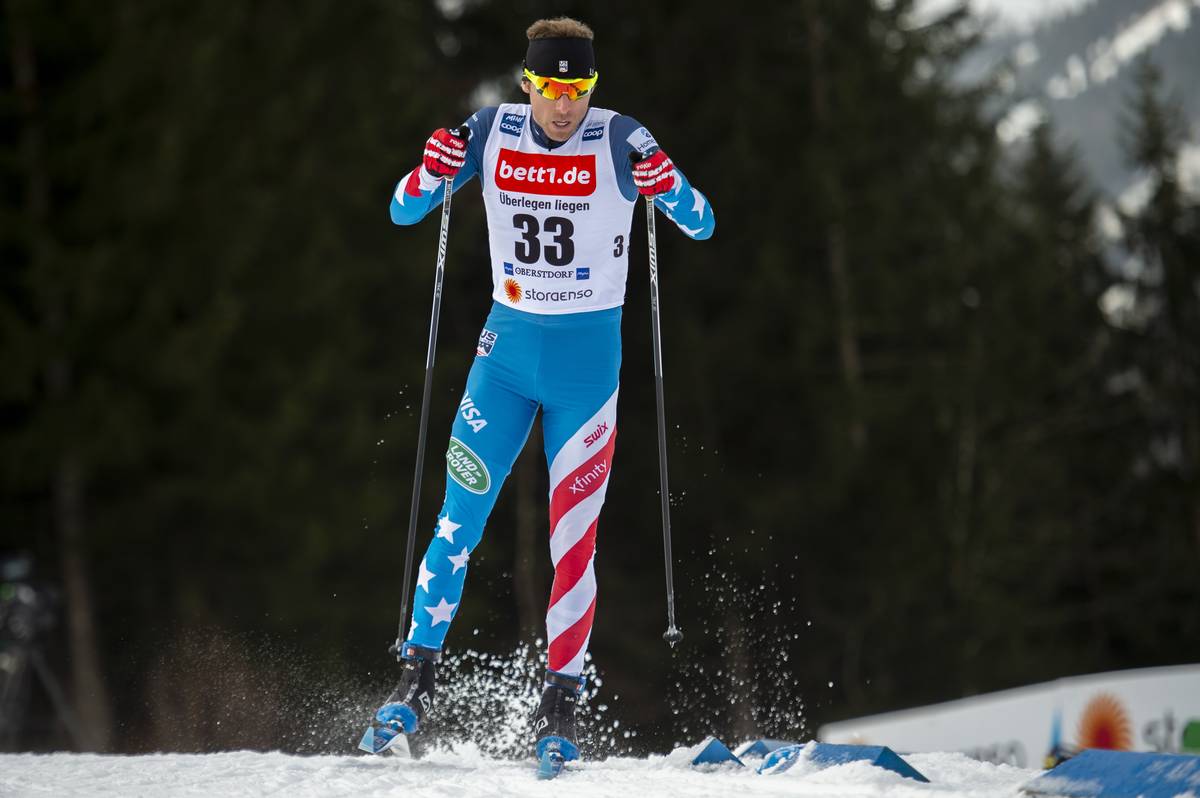
    Kevin Bolger races to 33rd in qualification during Stage 4 of the Tour de Ski in Oberstdorf. (Photo: NordicFocus)

    Outside the Top-30, Kevin Bolger and Zak Ketterson were just shy of making the heats, finishing 33rd (+13.10) and 34th (+13.39), less than a second off the time needed to advance. Logan Hanneman was also a near-miss, finishing 37th (+14.08). Gus Schumacher rounded out the American starters in 45th (+16.51) of 73 starters. 

    Looking at the overall Tour de Ski standings with four of six stages complete, Johannes Høsflot Klæbo tops the list for both cumulative time and points after winning three of four events. By time, he sits 1:03 ahead of teammate Pål Golberg and 1:19 ahead of Alexander Bolshunov. With a 15k mass start classic and 10k freestyle hill climb to go, Klæbo is in good standing, but cannot be complacent, as the hill climb, in particular, has historically favored Bolshunov. 

    By points, which favor sprint stages and intermediate sprints in distance races, Klæbo leads with 81 points ahead of Erik Valnes, who holds 50, and Goldberg with 41.

    After a rest and travel day, racing continues Monday in Val di Fiemme, Italy.

    With three wins in four stages, Johannes Høsflot Klæbo leads the overall Tour de Ski standings by both cumulative time and points. (Photo: NordicFocus)

    Stage 4 Results:

    Qualification | Final

    Tour Standings After Stage 4:

    Cumulative Time | Points 
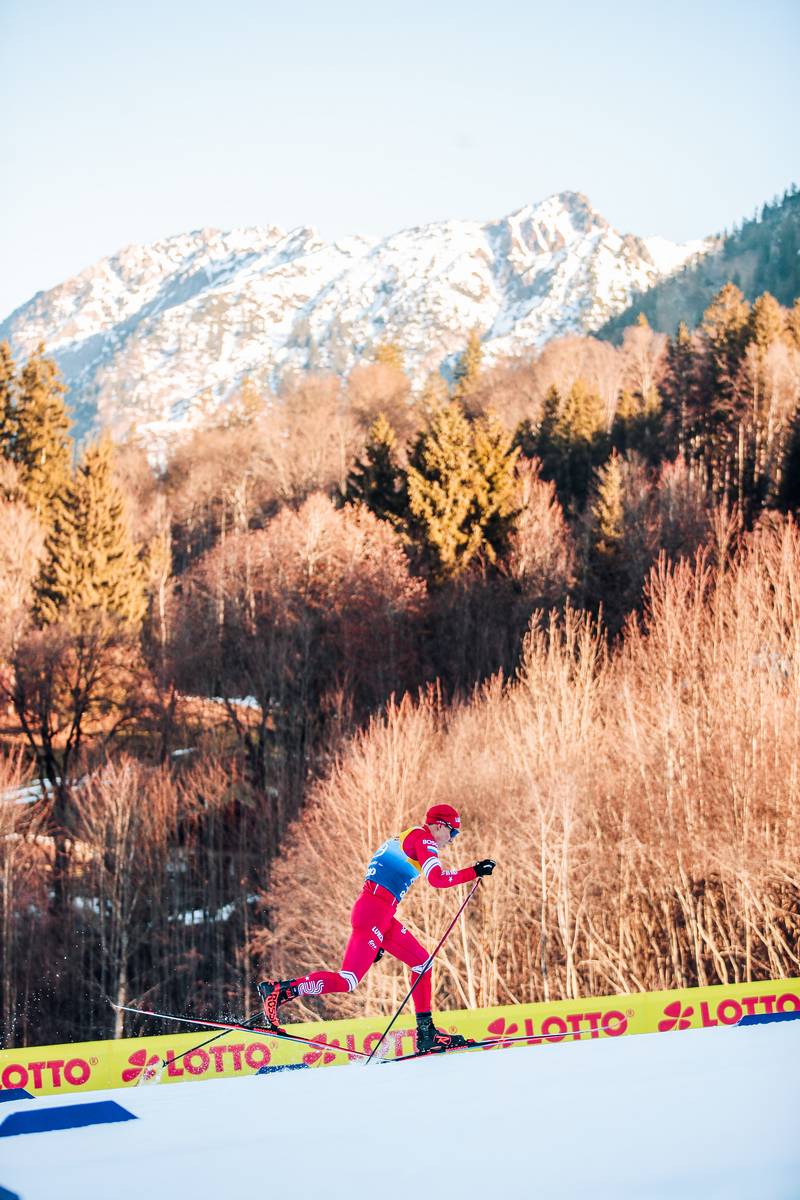
  • Klæbo Runs Away with Oberstdorf Classic Sprint Win

    Klæbo Runs Away with Oberstdorf Classic Sprint Win

    Sunday’s men’s 1.5-kilometer classic sprint course in Oberstdorf, Germany deserves some recognition. Site of the 2021 FIS Nordic Ski World Championships, racers were offered a glimpse into how the world’s foremost sprinter, Johannes Høsflot Klæbo of Norway, would navigate it’s kicker climbs, steep descents, and roughly three minute and thirty-second effort. 

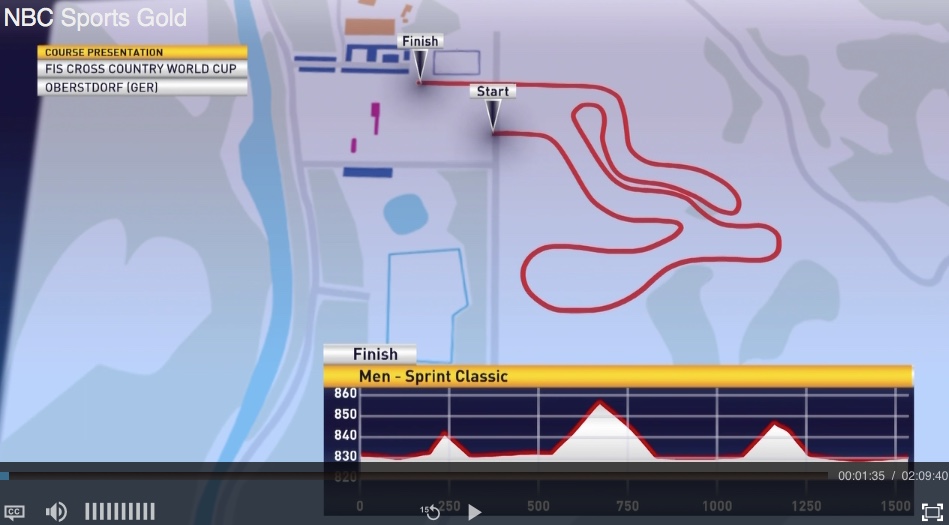
    The sprint course offered three distinct climbs, one at 0.2 k, the largest at 0.52 k, and the third starting at 1.1 k. The descents mirrored the inclines of the ascents and offered little respite or recovery for skiers near their engine’s redline. 

    Men’s Oberstdorf sprint course. (Photo: Screenshot NBC Gold)

    We are focusing on Klæbo, despite the other twenty-nine skiers in the heats, because he was simply a master of pacing, a master of conserving energy on the three-climb course, and freakish in his ability to run away from his five competitors in the final.

    Klæbo qualified in first. The margin back to Erik Valnes of Norway in second was 2.72 seconds. Pål Golberg, the third-fastest qualifier was 5.03 seconds back. There were big-time gaps back to the field of qualifiers. 

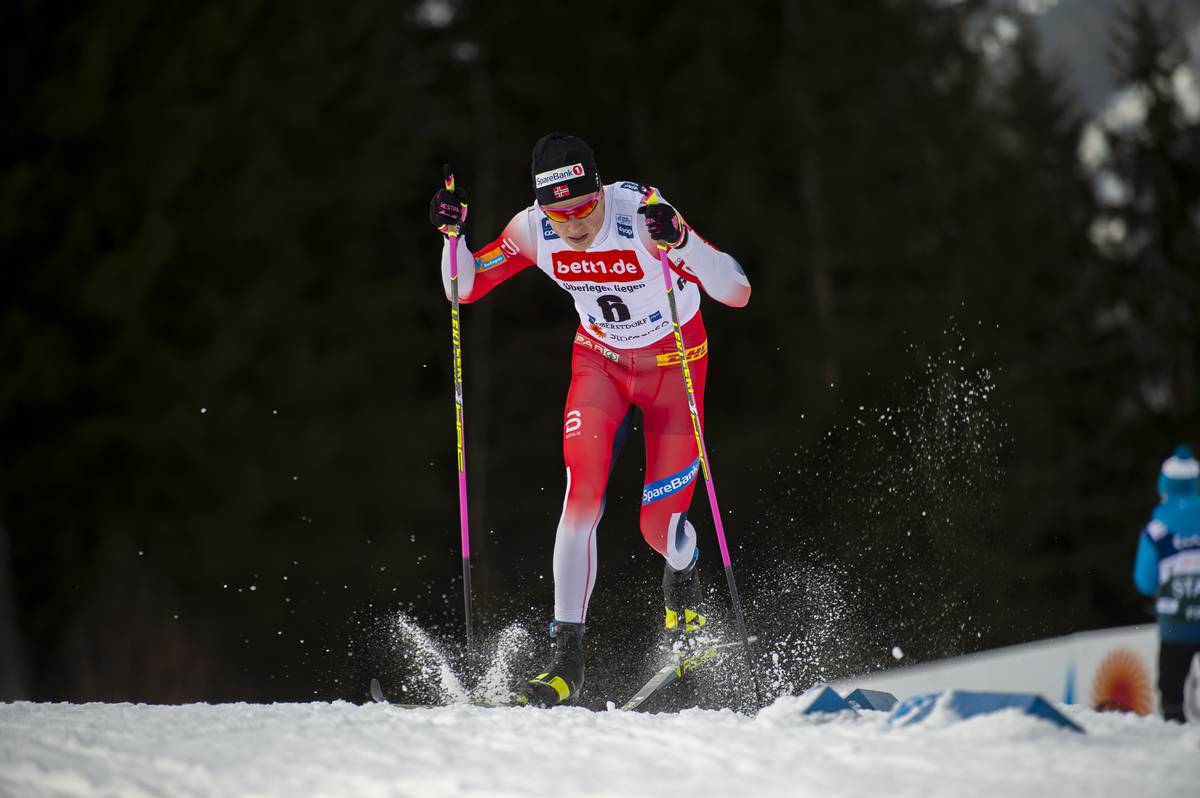
    Johannes Høsflot Klæbo crushing the men’s sprint qualifier in Oberstdorf, Germany. (Photo: NordicFocus)

    Valnes and Klæbo opted for the first quarterfinal. It was here that Klæbo played his tactical hand. He was in no hurry on this endurance sprint course to move to the front and pull others along in his wake. Klæbo sat in fourth on the second hill as Valnes was the heat’s workhorse. Klæbo appeared relaxed, not itching to move to the front. Klæbo moved to third around 2:00 minutes as they crested the course’s highpoint. The third hill, as most sprinters appeared on fumes, is where Valnes and Klæbo pulled ahead. Over the top, the duo glided into a 20-meter lead. Down the stretch, Valnes poled ahead for the quarterfinal win as Klæbo pulled up, stopped poling several meters before the finish — as if he were checking out for a lunch break.

    The third hill would be Klæbo’s charm.

    Along with Valnes in the first semifinal were Italy’s Federico Pellegrino (4th qualifier), Golberg, Håvard Solås Taugbøl also of Norway  (5th qualifier), and Russia’s Sergey Ardashev. This would be the semifinal to watch. 

    Again, Klæbo played the conservation of energy tactic. Up the second climb, Golberg, Taugbøl, Valnes, and Pellegrino strode four across with Klæbo lurking a meter back. The second hill was in the rearview mirror around the two-minute mark. It’s approximately another twenty seconds of descent and working flat before the next decisive climb. 

    As the skiers approached the base at 2:26, Klæbo and Valnes ramped up – they pulled away as they ski-ran up and over the top. Klæbo had been sitting behind Valnes, sucking up in his draft into the final straight. There, Klæbo pulled around his teammate for the semifinal win.      

    Federico Pellegrino of Italy pushing over the top in the Oberstdorf, Germany classic sprint. (Photo: NordicFocus)

    The final featured Klæbo, Valnes, Golberg, Pellegrino, and Oskar Svensson of Sweden and Russia’s Gleb Retivykh. Really, for Klæbo, this was essentially a rematch of his semi.

    Again, Klæbo was cautious from the start. There was no real earnestness to shoot to the front. His show would come later. There was only patience from an athlete who knew he could pounce late in the game. 

    Pellegrino, on the second climb, began to accelerate. He ran outside the tracks in what looked less like a decisive move, and more a burst to position himself tactically in front over the top. For his part, Klæbo matched Pellegrino and strode up alongside the Italian. 

    At 2:35 at the base of the final climb, Klæbo unleashed. It was textbook Klæbo-running. He was gone with a near 20 meter gap over the top. By the finish line, Klæbo looked to put 10 more meters on his competition as he won in 3:29.46. Golberg was second (+1.99), Valnes third (+2.37), and Pellegrino fourth (+3:06).

    In yesterday’s 30 k skiathlon, Klæbo registered a rare DNF (did not finish) as he pulled from the competition. 

    “I think the sprint was much better than the 30 k yesterday,” Klæbo told FIS after the race.  “Yesterday was a really terrible day and today was a bit better. In the end, it was really cool to win here. Yah, I think my shape isn’t the best  but I am really happy to find the win here and to have the Norwegian guys here.

    “I think it was a really good decision yesterday to jump off after 15 k I think, it was really nice to fight for a win today. And for sure I am really looking for the World Championship here next year.”

    What was clear after today was that Klæbo had mastered the course. Anything can happen in a year. And anything can go down in a sprint – broken poles, clipped skis, or slide out on a corner. This much was true exiting Oberstdorf: it will be Klæbo’s race to lose at the 2021 World Championships.

    It was a down day for the American men. No skiers qualified for the heats. Simi Hamilton placed 32nd overall and was +15.94 in qualification. Andy Newell was 41st (+17.48), Tyler Kornfield 55th (+20.88), and Noel Keeffe 64th (+25.33).

    Simi Hamilton during the Oberstdorf, Germany classic sprint qualifier. (Photo: NordicFocus)


    Andy Newell during the sprint qualifier in Oberstdorf, Germany. (Photo: NordicFocus)

    For Canada, Bob Thompson placed 54th and was +20.14 in the qualifier, Paul Grall-Johnson was 58th (+21.74), and Graham Ritchie 61st (+22.92). 

    World Cup Standings Shakedown 

    Coming out of Oberstdorf on the men’s side, Russia’s Alexander Bolshunov remains in command. In first overall with 1457 points, Bolshunov has a 235 point lead on second place Klæbo for the overall lead. Sunday, Bolshunov earned 36 World Cup points after placing seventh overall, Klæbo earned 100 points for the sprint win. If you are keeping score at home, you will note 140 points for Bolshunov’s win in Saturday’s 30 k skiathlon. On yesterday’s course, racers had four opportunities to score bonus points – Bolshunov snatched up 40 of them during the race.    
    Alexander Bolshunov of Russia in the yellow bib. He leads the overall World Cup. He placed 7th on Sunday’s classic sprint in Oberstdorf, Germany. (Photo: NordicFocus)
    Klæbo leads the sprint overall with 350 points. This was Klæbo’s fifth sprint win of the season. He has won every sprint entered thus far. He skipped the skate sprints in Planica, Slovenia and Dresden, Germany.

    The World Cup takes a break next weekend and restarts in Falun, Sweden with a classic sprint on February 8.  

    Men’s qualification results | Final results | World Cup overall standings | World Cup sprint standings

    All Norway in the men’s classic sprint podium in Oberstdorf, Germany: Pål Golberg in second, Johannes Hoesflot Klaebo first, and Erik Valnes third. (Photo: NordicFocus)
  • Oberstdorf Sprint Canceled Due to Storm; Diggins Second in Qualifying Round Most Deemed Unsafe

    Oberstdorf Sprint Canceled Due to Storm; Diggins Second in Qualifying Round Most Deemed Unsafe

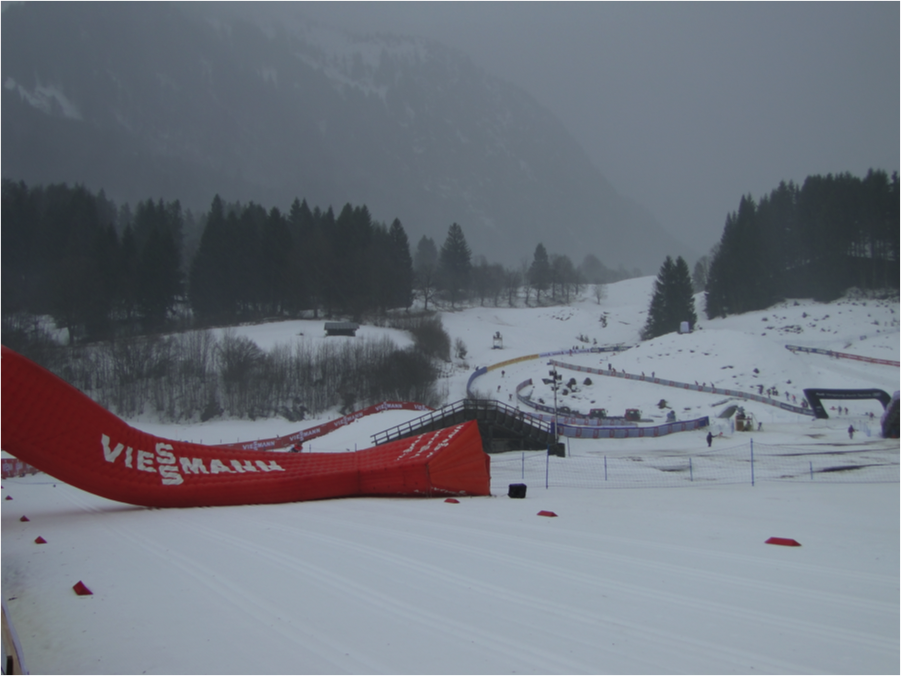
    A view of the racecourse in Oberstdorf, Germany, on Wednesday after Storm Burglind ripped through, bringing rain and wind which tossed materials and trees around the course.

    OBERSTDORF, Germany — On Wednesday, a storm big enough to earn a name from meteorological agencies, “Burglind” provided unexpected obstacles to the World Cup cross-country ski field. With some gusts of wind approaching hurricane speeds, the women’s and men’s sprint courses became potentially dangerous — and they are already difficult to ski under regular conditions.

    Trees fell on a warmup track and a section initially intended for the men’s sprint. Blown-over ad banners and gates littered both the men’s and women’s sprint courses for the fourth of seven stages at this year’s Internationals Ski Federation (FIS) Tour de Ski.

    “There were a few lightning strikes during the ski testing window that were probably within a mile of the venue, so that made everyone nervous and for me that was the scariest part of the day,” Simi Hamilton of the U.S. Ski Team (USST) wrote in an email. “I think they were prepared to keep running the race until a 60-foot tall tree fell down on the distance course where men were warming up and women cooling down. At that point, I think they deemed it too dangerous to continue, and I agree with the decision they made.”

    Ultimately, the race jury canceled the sprints.

    This was not good news for some women, who had looked forward to the races and braved the elements successfully: their sprint qualifying round had still been started despite the adverse conditions. Maiken Caspersen Falla of Norway won that time trial, although it wasn’t ever counted for anything other than FIS points.

    Those who didn’t go as fast as Falla could benefit from having a “mulligan” to try anew on Thursday, when races are scheduled to continue with mass starts also in Oberstdorf.

    “The skiing itself was really good today, perfect klister conditions, so it is unfortunate to cancel the race, but our safety should always come first,” USST member Rosie Brennan wrote in an email. “I think it would have been better to postpone the race as soon as the lighting hit and then make a decision as to whether or not it is safe to race so that no one is out skiing in lightning … I was debating if I should keep warming up or not take the risk, and that is a position I don’t think the athletes should be put in.”

    The qualifying round was drowned out in a rainstorm on Wednesday. The female racers were drenched when they came off the course, and while lightning could be seen over the mountains surrounding the arena they ran to take cover indoors.

    Just as the men’s qualifying round was about to be started, the jury decided to cancel the race day.

    “Heavy rain and strong winds made the competition course not safe for the athletes. The competition has halted after the ladies’ prologue before the men began,” a FIS press release stated.

    Local organizers, team representatives and FIS race officials couldn’t remember if something like this had ever happened, at a Tour de Ski or otherwise.

    “Trees fell over on the course, some athletes just stopped skiing. Those were not acceptable conditions for the athletes, but also for the staff out on the course,” German cross-country team manager Andreas Schlütter told broadcaster ARD, according to a translation.

    According to another jury decision, the FIS points gained in the women’s qualifying will count. However, for the Tour de Ski standings and the overall World Cup, it will be as if no race had happened. The Tour thus will have only six instead of the scheduled seven stages.

    Women’s Qualifying

    Jessie Diggins of the USST, currently in third position in the 2018 Tour de Ski (1:26.9 behind Norway’s Ingvild Flugstad Østberg in first), finished the qualifying in second position, 2.55 seconds behind Norway’s Falla. Local fan-favorite Sandra Ringwald of Germany was third (+5.80), rising from 13th position at the course’s halfway mark.

    Behind Diggins, Ida Sargent raced to ninth (+8.67) in the qualifier, and would have had a good position in the heats. Sargent was coming off a strong run, having qualified in fifth position and then reached the final in a freestyle sprint in Davos, Switzerland, in December, and placed 20th in the freestyle sprint in Lenzerheide, Switzerland, earlier this week.

    “It was really crazy out there,” Sargent wrote in an email after the race. “I’ve never raced in a lightning storm. All through the warmup I was expecting someone to cancel it because the thunder and lightning strikes were really close. I ended up just going inside and spinning because I’m really afraid of lightning. There was another really big lightning strike just before I started the qualifier. Rosie [Brennan] and I looked at each other and both kind of laughed since we couldn’t believe we were actually racing in that. I think it helped me go fast because I just wanted to get back inside as soon as possible. … I felt good out there, so I was actually bummed the weather was so crazy and they had to cancel it. But it was definitely the right call because it just wasn’t safe.”

    Starting a few bibs behind Sargent, Brennan finished 21st (+12.95), following up on a 15th-place finish in the Lenzerheide sprint.

    “I am, of course, bummed to not race,” Brennan wrote in an email. “However, I am also disappointed that we were even allowed to be out there warming up. Things were not bad at all when we showed up, but the rain increased and then the wind picked up, and then the thunder and lightning started. After I heard thunder and lightning, I became very scared.”

    Sadie Bjornsen, currently in fifth overall in the Tour and with a podium in the Stage 2 Lenzerheide 10 k classic, had been looking forward to the Oberstdorf classic race well before starting the Tour, according to a U.S. Ski & Snowboard press release.

    But the safety of the athletes was on her mind more so than her own race performance hampered by external wind influence, which might have seen her drop back in the overall standings if the race had continued.

    “It sure was a wild day out there today,” Bjornsen wrote in an email to FasterSkier. “Unfortunately, it took a turn further from ‘wild’, and turned into life-threatening risk. About 45 minutes before the start of the race, weather took a severe turn. Thunder and lighting started hitting very close, and then the rain came hard, and then the wind picked up. For a while it was funny, but it turned to the point that is was downright dangerous. I was 99% sure the race would be cancelled, so I was trying to not stress. To my disbelief, the jury was not able to weigh the risk between safety and putting on a race, and the race went on.”

    After starting in the middle of the field, Bjornsen’s halfway checkpoint split time ranked 15th.

    “A giant hurricane gust hit as I was making the far turn on the end of the course,” she wrote of her race loop. “I got blown so hard from the back that I had to skid to a stop on the corner in order to stay on the course. Then, as I tried to make my way up the climb back home, the wind was blowing so hard, I literally couldn’t move. At one point, I crouched down, put my head down, and just tried to not get blow away. I finally was able to get going again, but was forced to herring bone up the entire hill against the wind. As I crossed the line, I quickly realized it was not going to be a fair race today. My sole goal was to get indoors though, so I ran for the building. As the results came in, I heard I got pushed out of qualifying, and it slowly broke my heart.”

    Bjornsen finished in 37th position.

    “Ski racing can’t always be fair, and that is life,” she concluded. “But more importantly today, I was super sad to see the race wasn’t called off the minute the first thunder and lighting started hitting, and gusts started blowing that were strong enough to take trees down. … We all want to be out there racing, there is no doubt about that… but we should never chase that dream at the compromise to our life! I hope today was a learning lesson for the jury, and we can avoid situations like this in the future.”

    Her teammate Liz Stephen would have also been out of the heats after she finished the qualifying in 49th place (+39.22).

    Almost exactly two years ago on Jan. 5, 2016, Sophie Caldwell of the U.S. Ski Team won her first World Cup race on this same course and location. On Wednesday, she did not start in the sprint qualifying due to an illness. Earlier this week, Caldwell had already been successful finishing in second place in the freestyle sprint in Lenzerheide, only behind Switzerland’s Laurien van der Graaff.

    Questioned in person, FIS Cross-Country Media & Project Coordinator Michal Lamplot could not immediately confirm whether the cancellation would mean that Caldwell could in theory continue the Tour on Thursday if she wanted to (typically once an athlete does not start a tour stage, that individual is out for the rest of the tour). However, Caldwell had already intended to likely leave the Tour latest after the mass start in Oberstdorf to focus on a weekend of sprint races in Dresden, also Germany.

    Men’s Qualifying Not Started

    Initially the competition jury had considered switching the men’s sprint course to the same 1.25-kilometer loop as the women, omitting a tree-lined higher-elevated section up the (in-)famous Burgstall climb, introduced at 2005 World Championships.

    The men, including Canada’s Alex Harvey, who is currently in fourth overall in the Tour standing (1:01.8 behind Switzerland’s Dario Cologna), came out into the starting pen to warm up running back and forth.

    “Early in my warm up I went on the training trails, saw a first broken tree there, then looping back to a place I had skied four minutes prior I saw that another tree had fallen in that four minute period!” Harvey wrote in an email. “I think canceling the race was the safe call today. You don’t want to have trees falling on the skiers! It’s the first time something like this happened to me as a skier!”

    The men quickly retreated to the athletes’ tent and wax cabins when the jury decision to cancel their race spread around.

    “I’m especially bummed with the decision to cancel the race today,” USST sprinter Andy Newell wrote. “I’m particularly disappointed because this classic sprint was pretty much the only reason I was racing the Tour in order to get some valuable classic sprinting in, since they are so limited on the World Cup.”

    He would have preferred for the race jury to wait a while longer to have another opportunity for a race he had targeted specifically, though in the end that likely would not have helped as rain turned into heavy sleet and the wind hardly died down.

    “I think the weather was probably too poor to have a fair race at the time, but I would have liked to see them postpone or put a hold on qualification rather than cancel,” Newell wrote. “There was heavy rain and wind but the snow was actually in great shape and I think we could have had some good weather windows with a postponed start…. It likely makes it impossible for a tv broadcast with a postponed race, but at least we get something done. This was my main race to focus on in the last month.”

    “I think they made the right call today, and I’m glad that everyone is safe,” Hamilton noted. “… You have to be flexible when you are on the World Cup and it’s a good reminder to make the most of every single race opportunity you are given regardless of the weather and conditions.”

    Along with the teams, some 900 spectators in the stadium area had to leave again without getting to see a race.

    Oberstdorf Stage ‘5’ (Skipped 4) Set for Thursday

    According to a statement by FIS, regularly scheduled 10/15 k freestyle mass start competitions will be held on Thursday, weather permitting, albeit with some alterations due to damage to the course. The races will be a couple kilometers shorter for both the men and the women, with the women racing four laps for 8 k and the men doing six laps for 12 k.

    “Due to the damage on the planned course caused by the severe weather a different competition course will be used resulting in a slightly reduced lap,” a FIS press release stated.

    The USST sprint-specialists will likely withdraw from the Tour, although a few may stay and race Thursday’s Stage 5 (while Stage 4 was never contested, FIS opted to keep the remaining Tour stages named as they previously were). Most World Cup sprinters have their eyes set on a weekend of freestyle sprint and team-sprint races in downtown Dresden, also in Germany, Jan. 13-14.

    “If they just continue with the 15 km mass skate then I’ll consider racing that if the conditions aren’t too crappy,” Hamilton wrote.

    The athletes focused on the overall Tour — or at least intending to complete the grueling challenge of now six races in nine days — will have to deal with whatever happens next.

    “The tour will go on tomorrow,” Bjornsen wrote. “We will keep trying to work through the weather. It is unfortunate to see this storm hitting much harder than expected. In this world, we have to be prepared for everything. Today that meant three layers of clothing, rain outfits, and a positive outlook. We will bring the same tomorrow, and hope the winds and thunder and lighting don’t come to join!”

    Ultimately, losing a sprint out of the schedule could drastically impact the Tour’s final standings.

    “I think if we just lose the classic sprint, it’s better for [Martin Johnsrud] Sundby and Dario [Cologna],” Harvey wrote. “For me personally, I’d like to have a classic sprint, both for my Tour de Ski chances and the opportunity to get another good classic sprint before the Games. They made a new course for the men here and it’s a bit like the PyeongChang course… I don’t know if it’s just me but the first thing I thought when I skied the course yesterday was: sweet, this is a great practice for the Olympic sprint!”

    —Alex Kochon and Chelsea Little contributed reporting

    Women’s qualifier results

    Stage 5 start lists: Women’s 8 k freestyle mass start | Men’s 12 k freestyle mass start

  • One for the Books: Caldwell Wins Oberstdorf Classic Sprint, Over Weng & Østberg

    One for the Books: Caldwell Wins Oberstdorf Classic Sprint, Over Weng & Østberg

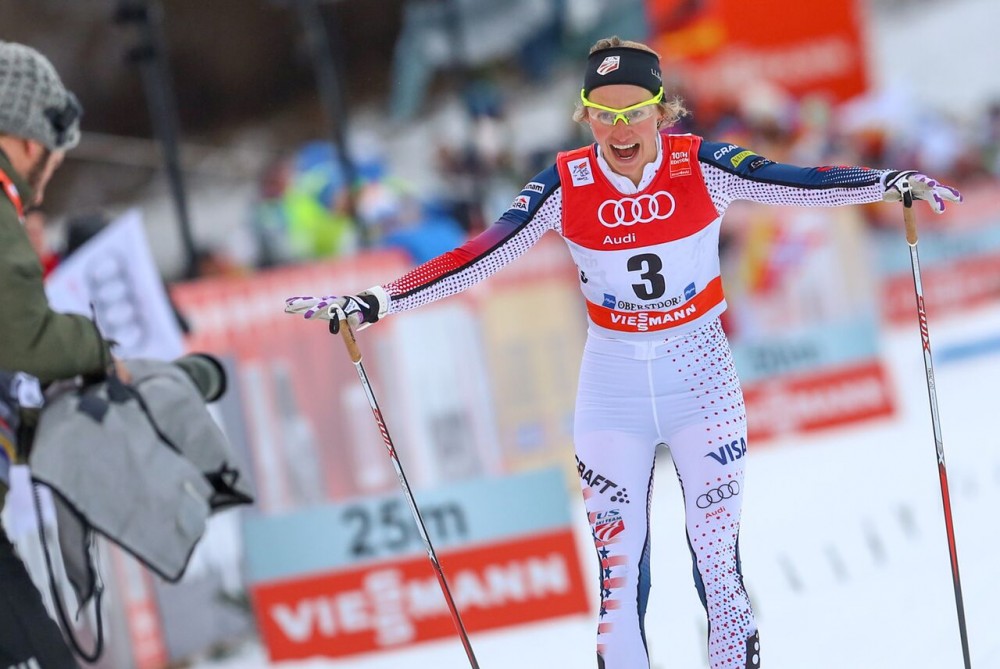
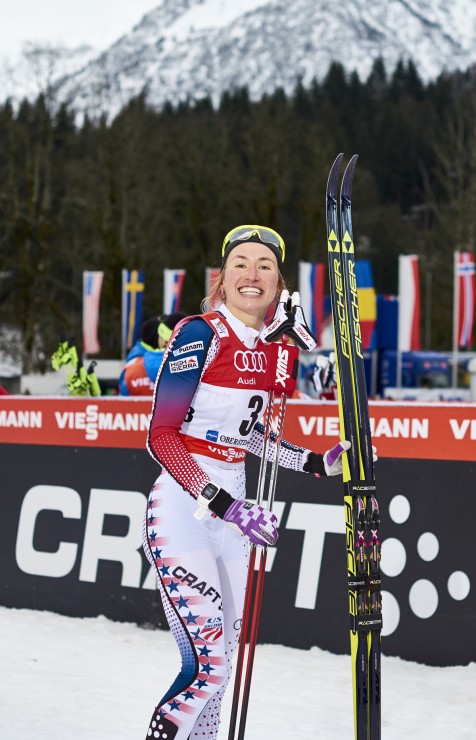
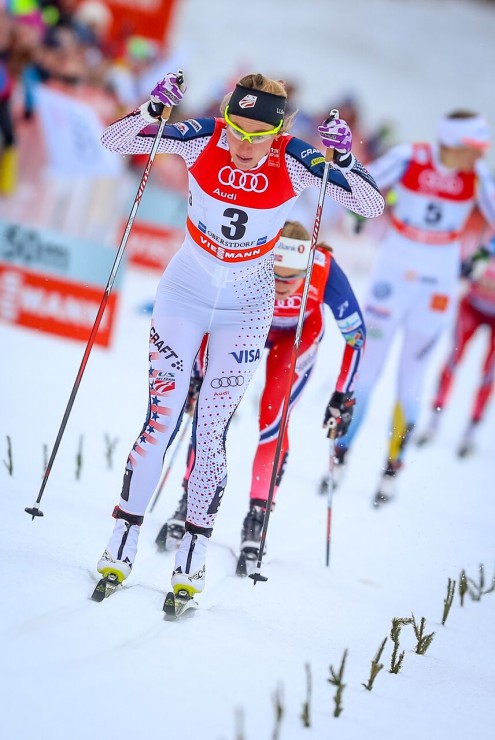
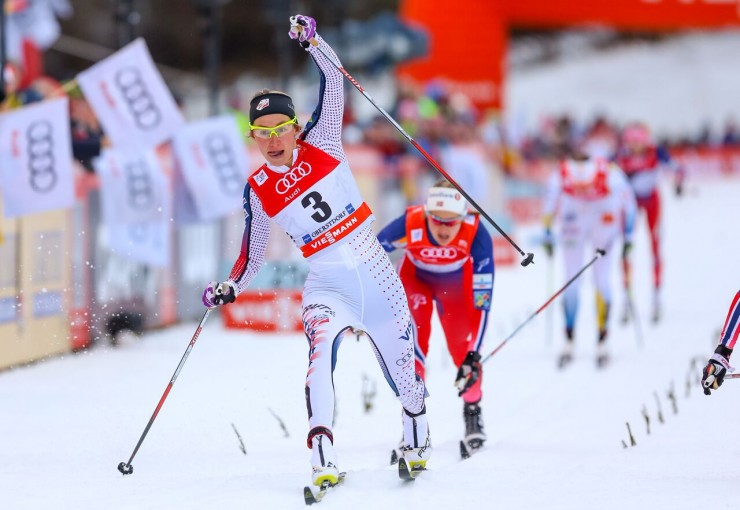
    Sophie Caldwell (U.S. Ski Team) after winning the 1.2 k classic sprint final at Stage 4 of the Tour de Ski in Oberstdorf, Germany. (Photo: Marcel Hilger)
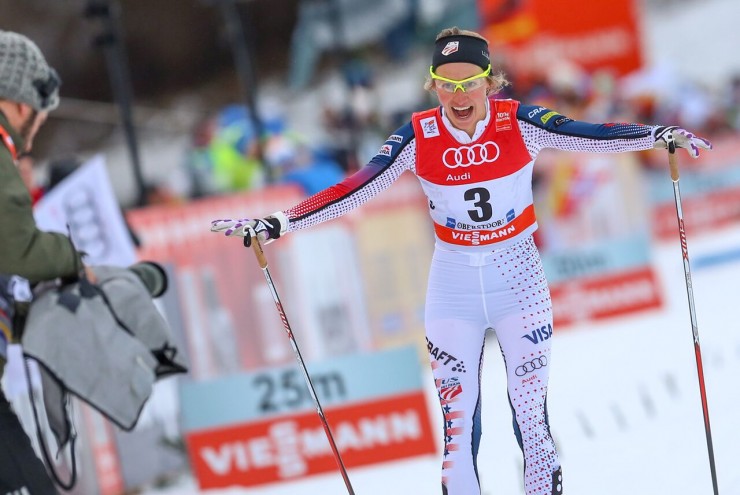
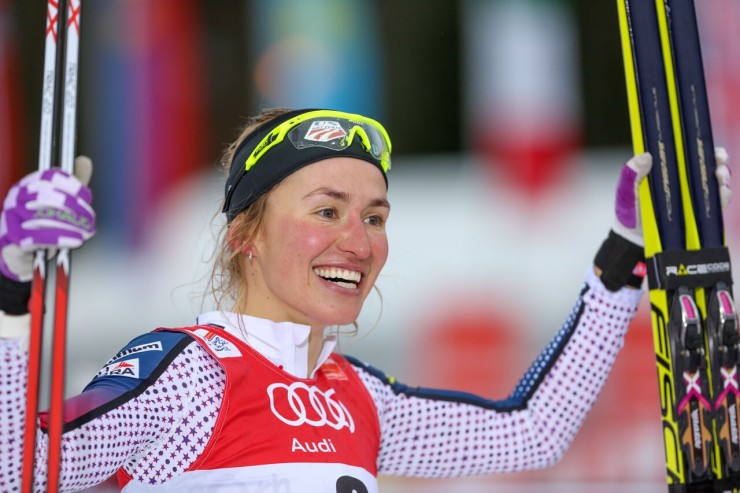
    Sophie Caldwell (U.S. Ski Team) smiles for TV cameras after winning the 1.2 k classic sprint final at Stage 4 of the Tour de Ski in Oberstdorf, Germany. In doing so, she became the third U.S. woman to win a World Cup, after Alison Kiesel (formerly Owen-Spencer) won the inaugural women’s World Cup race in 1978 at Telemark in Cable, Wis. Caldwell’s teammate, Kikkan Randall became the second U.S. woman to top the World Cup podium (and the first in modern World Cups). (Photo: Marcel Hilger)

    OBERSTDORF, Germany — Tuesday was definitely a thrilling day to be a U.S. nordic fan. The race format for the fourth stage of the Tour de Ski: a 1.2-kilometer classic sprint, was characterized by a single lap of wet, mushy, dirty snow.

    Sophie Caldwell, of U.S. Ski Team and Stratton Mountain School T2 Team, shined through the gloomy, spitting weather; advancing through the heats and then beating out a final full of Norwegians and Swedes to take the top spot on the podium. In doing so, the 25-year-old Vermont native became the third U.S. woman to win a World Cup race, and the first to do so in a classic sprint.

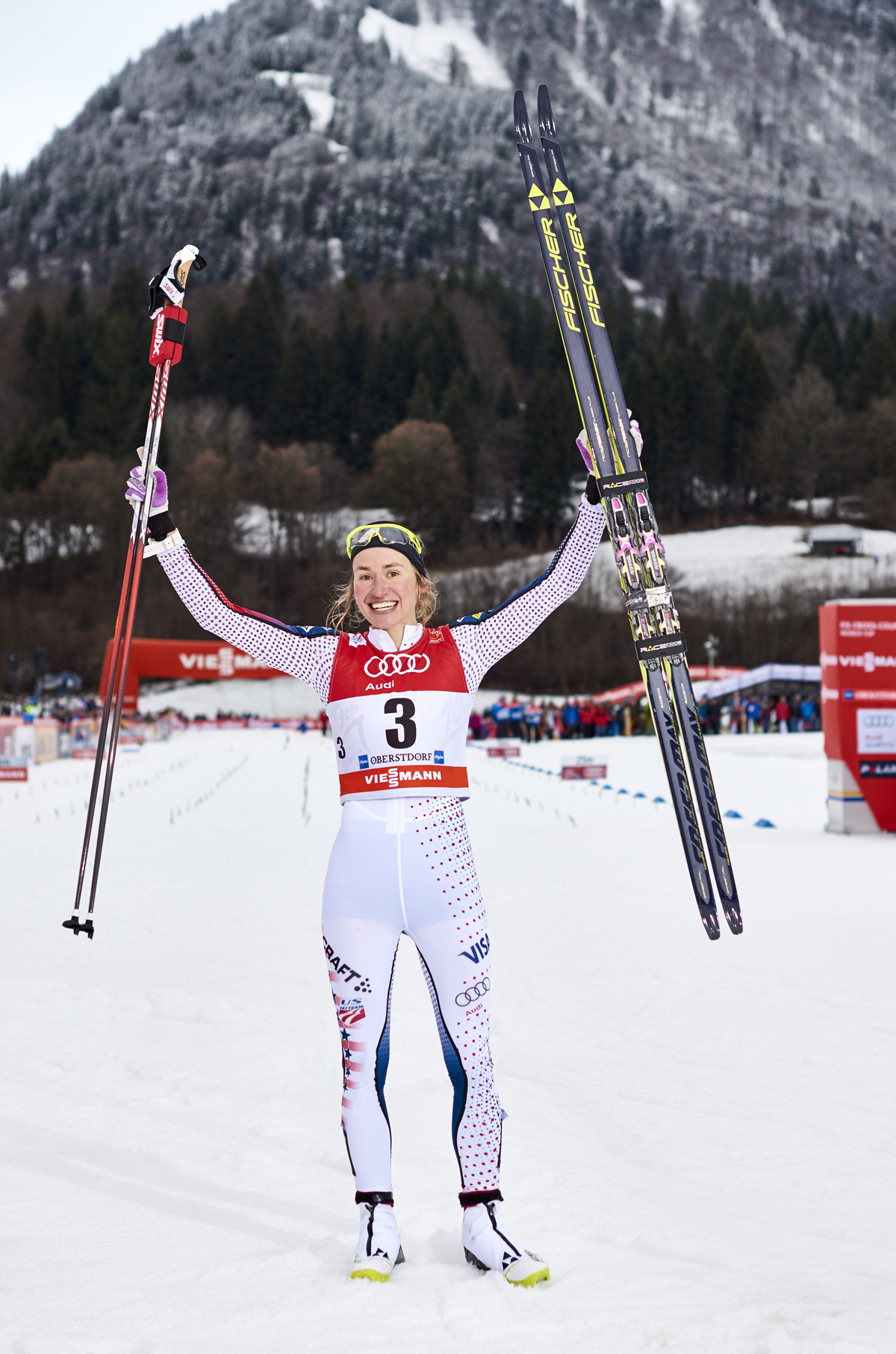
    Sophie Caldwell soaks up her first World Cup win on Tuesday at the Tour de Ski Stage 4 classic sprint in Oberstdorf, Germany. (Photo: Fischer/NordicFocus)
    Sophie Caldwell soaks up her first World Cup win on Tuesday at the Tour de Ski Stage 4 classic sprint in Oberstdorf, Germany. (Photo: Fischer/NordicFocus)

    “Push it over the tops, stick on Ingvild on the ups, and have a strong finish.”

    This was Caldwell’s magic mixture to reach the highest step in the podium, the spot every racer aspires to in their career. It was a simple-enough strategy, but it worked wonders in all of her heats, even securing her joyous victory in the final.

    In the last month or so since the 2015/2016 World Cup season began, Caldwell has emerged as one of the world’s top sprinters. Her win didn’t come out of nowhere; some analysts observed she has been lurking in the shadows of the podium-frequenting Norwegians. She built up to Tuesday with multiple appearances in sprint finals: doing so in two of the three freestyle sprints preceding the Tour’s classic sprint in Oberstdorf.

    The one time she missed the skate-sprint final, she did so by one place — finishing seventh in Toblach, Italy. In the only two sprints of the Tour, Caldwell qualified in second (on Jan. 1 in Lenzerheide, Switzerland; a skate sprint) and third on Tuesday.

    In Lenzerheide, she narrowly missed the podium in fourth in the final. Before the holiday break, she placed seventh in Toblach and sixth in the skate sprint in Davos, Switzerland.

    Yet on Tuesday, she beat the Norwegians at their game — classic sprinting — holding off Heidi Weng by 0.1 seconds in the finishing stretch with the win in 2:46.38 minutes. Ingvild Flugstad Østberg, the overall leader after both Stage 3 and 4 of the Tour, was the second Norwegian on the podium in third (+0.8), but after winning the qualifier to start the day, Østberg had been the favorite.

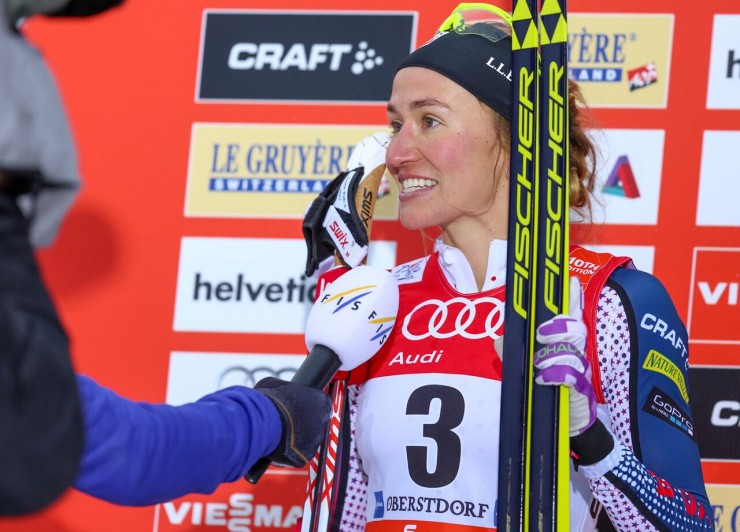
    “It has been a while since I have been on the podium and that is the first sprint I have ever won,” Caldwell reflected in an in-person interview with FasterSkier after the race. “I am psyched. I never thought it would come in a classic sprint, so that was a pleasant surprise.”

    The course, conditions, and resulting tactics

    The Oberstdorf race stadium was far from a dreamy winter wonderland with sleigh rides and snow falling. There had been much uncertainty about whether the event organizers would be able to produce enough snow to cover the stadium race loop. About a week ago, the International Ski Federation (FIS) and the organizing committee gave Oberstdorf “the green light” for the fourth and fifth stages of the Tour. Then, as a rainy sleet mix fell heavily for all of Monday, it was hard to believe world-class ski races would happen there.

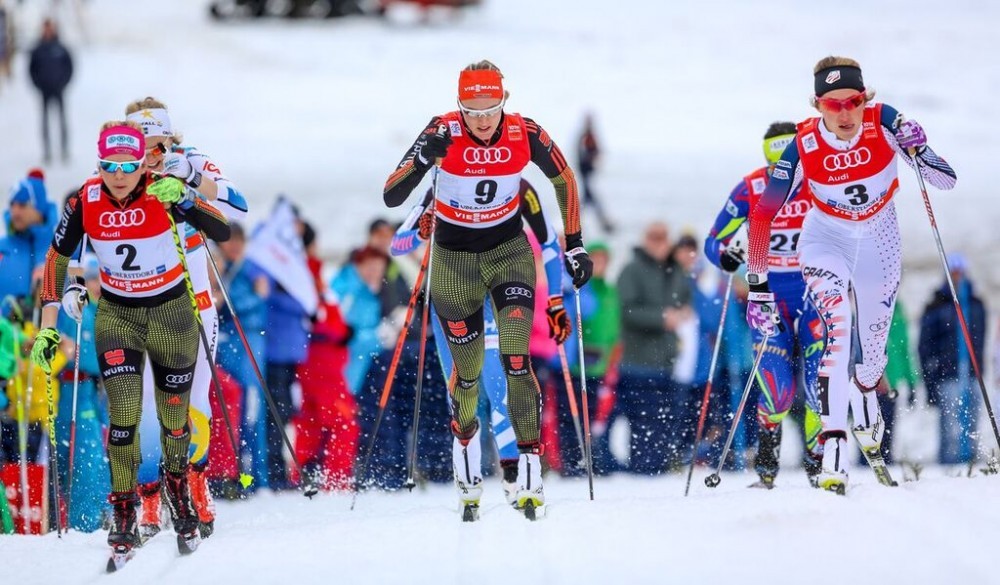
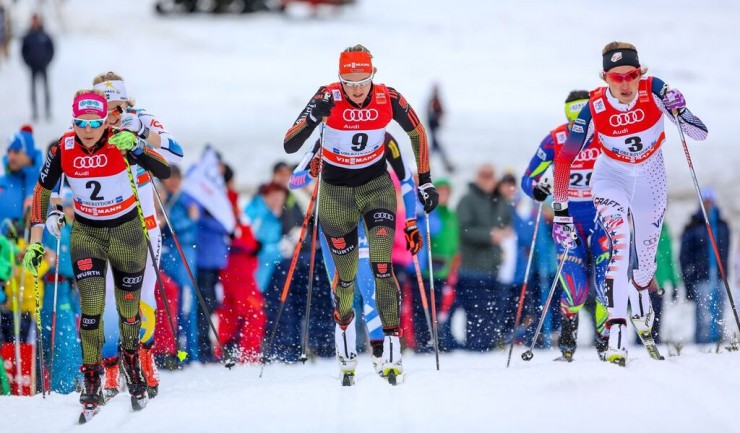
    Germany's Sandra Ringwald (2) and Denise Herrmann (9) go head-to-head with American Sophie Caldwell (3) during the 1.2 k classic sprint at Stage 4 of the Tour de Ski in Oberstdorf, Germany. (Photo: Marcel Hilger)
    Germany’s Sandra Ringwald (2) and Denise Herrmann (9) go head-to-head with American Sophie Caldwell (3) during the 1.2 k classic sprint at Stage 4 of the Tour de Ski in Oberstdorf, Germany. (Photo: Marcel Hilger)

    The course turned out to be quite soft, uneven and thoroughly saturated; a layer of mush on the top seemed to make control tricky. But across the board, athletes were impressed and expressed gratitude about the course the organizers and volunteers worked hard to prepare against the forces of warm weather. Caldwell, a New Englander, thrived in the less-than-ideal snow conditions.

    After the race, U.S. Ski Team Women’s Coach Matt Whitcomb (who previously coached at Burke Mountain Academy in Vermont) commented how “these conditions today are like growing up in New England; skiing through slop, it’s no big deal.”

    Temperatures in the mid-to-upper 30s and drizzle occasionally spitting down on racers made for a brutal day for the waxing team.

    “Really difficult, really difficult,” Whitcomb emphasized, referring to the waxing. “This was a day that could not have been done without great skis.”

    Caldwell described her skis as “amazing. … I was kicking up everything and they were clearly some of the best ones on the downhills.”

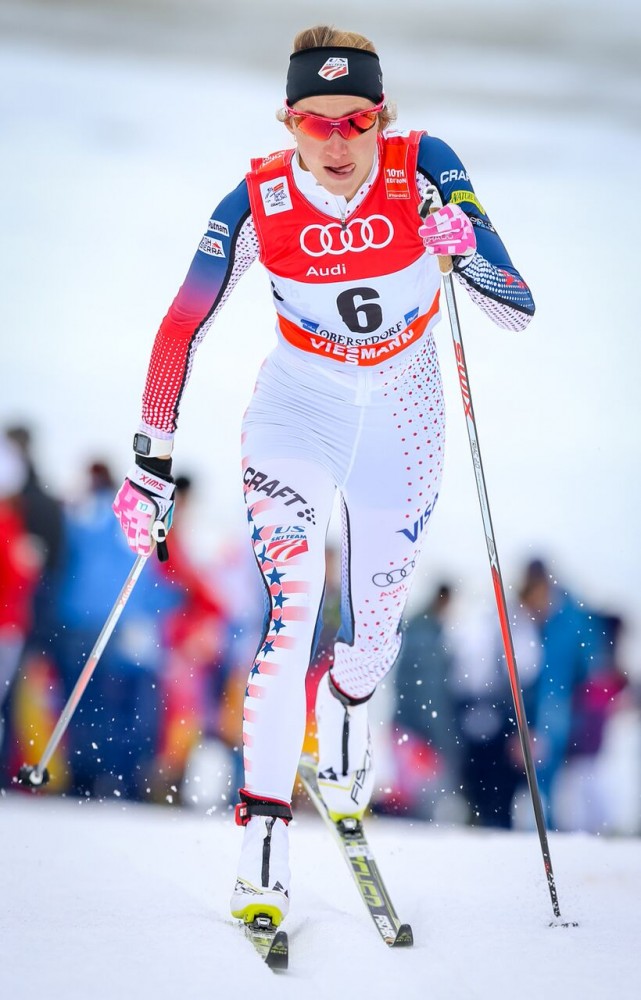
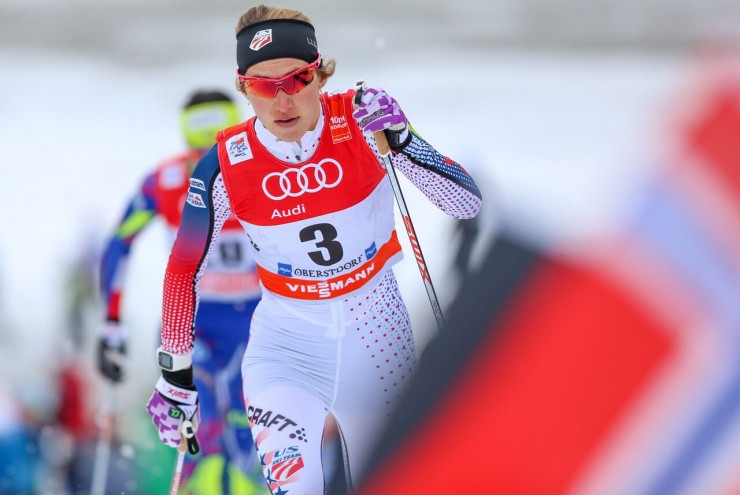
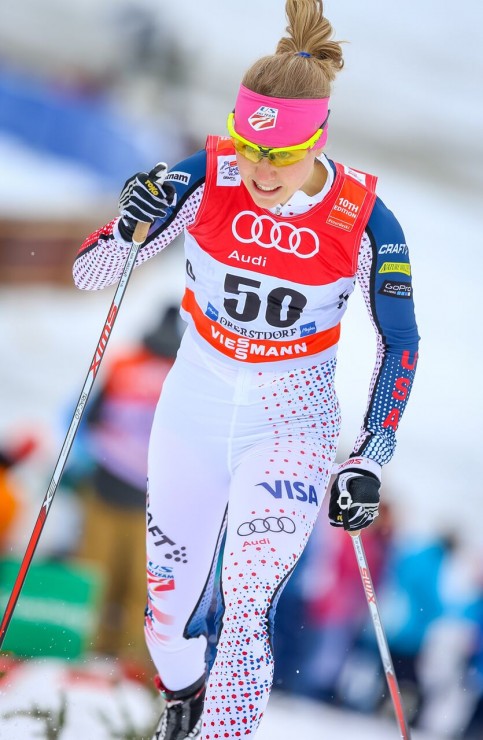
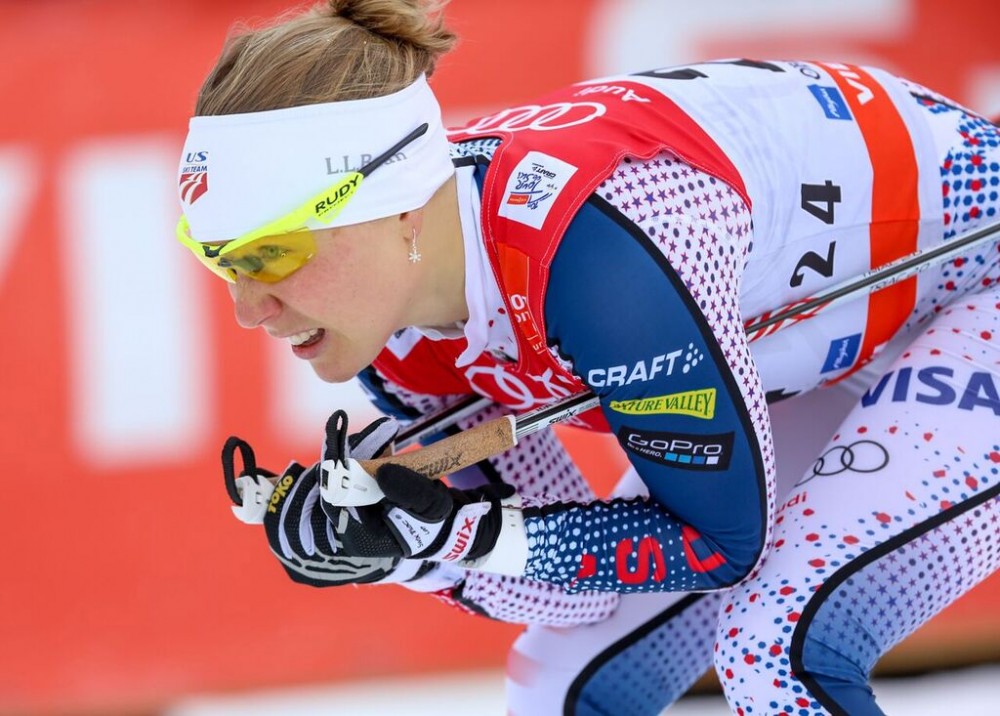
    Sophie Caldwell (U.S. Ski Team) racing to third in the 1.2 k classic sprint qualifier at Stage 4 of the Tour de Ski in Oberstdorf, Germany.  She went on to win the final for her first World Cup victory. (Photo: Marcel Hilger)
    Sophie Caldwell (U.S. Ski Team) racing to third in the 1.2 k classic sprint qualifier at Stage 4 of the Tour de Ski in Oberstdorf, Germany. She went on to win the final for her first World Cup victory. (Photo: Marcel Hilger)

    Not only were her skis some of the best gliding the downhills, but she also proved to be one of the most confident downhill skiers.

    “She got to the tops of climbs and attacked over them rather than backing off, and that was a big difference-maker today,” Whitcomb said.

    There was one particularly treacherous downhill into a turn about halfway into the race. This section gave many athletes trouble during the heats, including a wipeout that took down Caldwell’s teammate Jessie Diggins and out of the running in her quarterfinal.

    In the final, Caldwell avoided any potential for downhill trouble when Sweden’s Ida Ingemarsdotter shifted her skis into a snowplow formation, her ski tails nearly skimming Caldwell’s skis. Caldwell shot past her through an opening on the right, step turning the lefthand corner to get within striking distance of the lead.

    Another major key to Caldwell’s success proved to be a wise tactical move: lock onto Østberg and never let go. That is, until Caldwell passed her on the final roller over a bridge and led down into the finishing stretch. Caldwell faced Østberg in both the semifinal and final, and clamped down on her ski tails without fail. This helped Caldwell, known recognized as one of the most consistent lucky losers in World Cup sprints, comfortably advance to the final: initially winning her quarterfinal (ahead of Sweden’s Stina Nilsson) and placing second in her semifinal to Østberg.

    Østberg won the first quarterfinal by nearly 4 seconds. She entered Tuesday’s race with a broad repertoire of recent sprint podiums, so it fit logic to follow her stride. In the last three skate sprints, she reached the podium in every race. Placing third on Tuesday, she extended her Tour lead over teammate Therese Johaug — a distance skier who notably reached the final and finished fifth (+4.71)

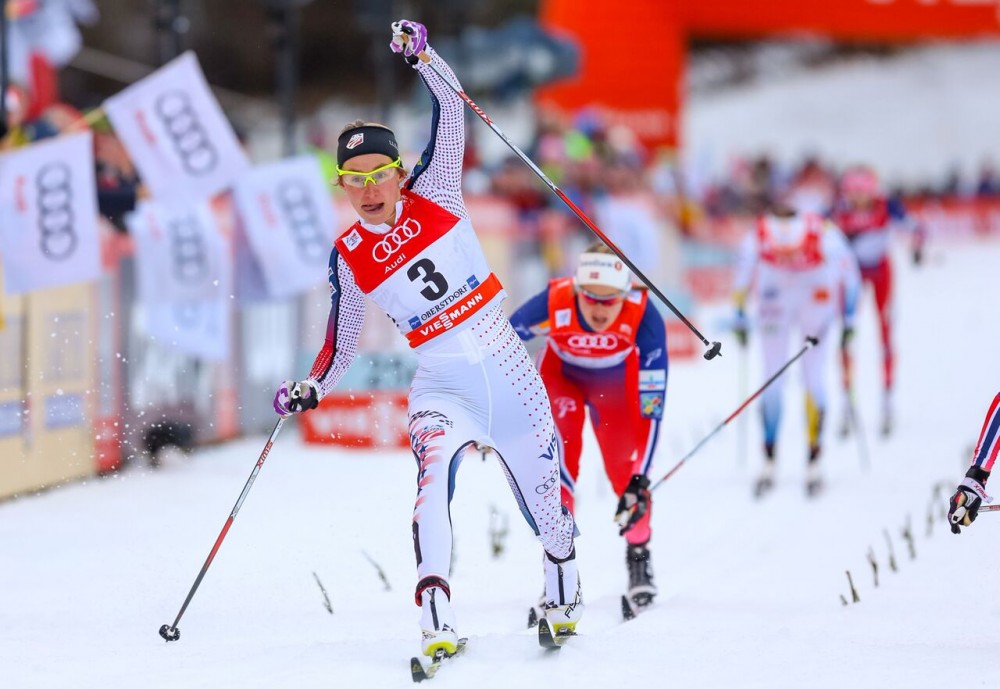
    Sophie Caldwell (U.S. Ski Team)  lunges to edge Norway's Heidi Weng (not shown) for the win in the 1.2 k classic sprint final at Stage 4 of the Tour de Ski in Oberstdorf, Germany. (Photo: Marcel Hilger)
    Caldwell lunges to edge Norway’s Heidi Weng (not shown) for the win in the 1.2 k classic sprint final at Stage 4 of the Tour de Ski in Oberstdorf, Germany. Østberg (behind Caldwell) placed third. (Photo: Marcel Hilger)

    Østberg led the majority of the final with Caldwell behind her, and Weng and Ingemarsdotter skiing beside them in another track. On the final downhill curve, on the backside of the last bridge bump, Caldwell passed Østberg on the inside and led into the finishing flat.

    Weng also passed the tiring Østberg and began gaining on Caldwell. But Caldwell was able to hold off Weng in the double-pole derby and take the win with a final lunge, winning by one-tenth of a second.

    The favorite to win the overall Tour, Johaug was more than thrilled to finish fifth and earn crucial bonus seconds to stay close to Østberg with four distance races remaining. Sweden’s Ingemarsdotter and Nilsson rounded out the final in fourth (+3.95) and sixth (+27.43), after Nilsson crashed alone at the back of the pack on the troublesome downhill and slid into the barrier lining the course.

    Answering a rush of Norwegian reporters after the race, the characteristically modest Caldwell said, “The Norwegians are very dominant, so it feels really good to upset them.

    “But they are all so nice,” she added. “At the end, they were all congratulating me. It was a fun race.”

    Immediately after finishing, Weng was the first to congratulate Caldwell with a hug. Essentially every other competitor in the final made a point to congratulate her as well in a series of embraces before Caldwell’s victory lap.

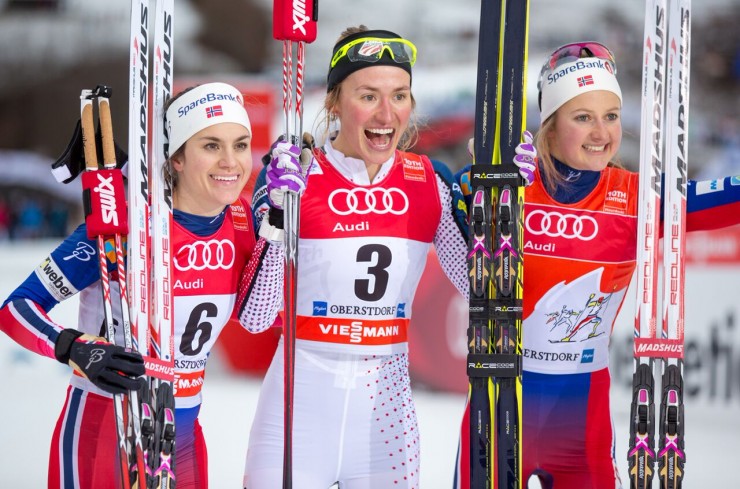
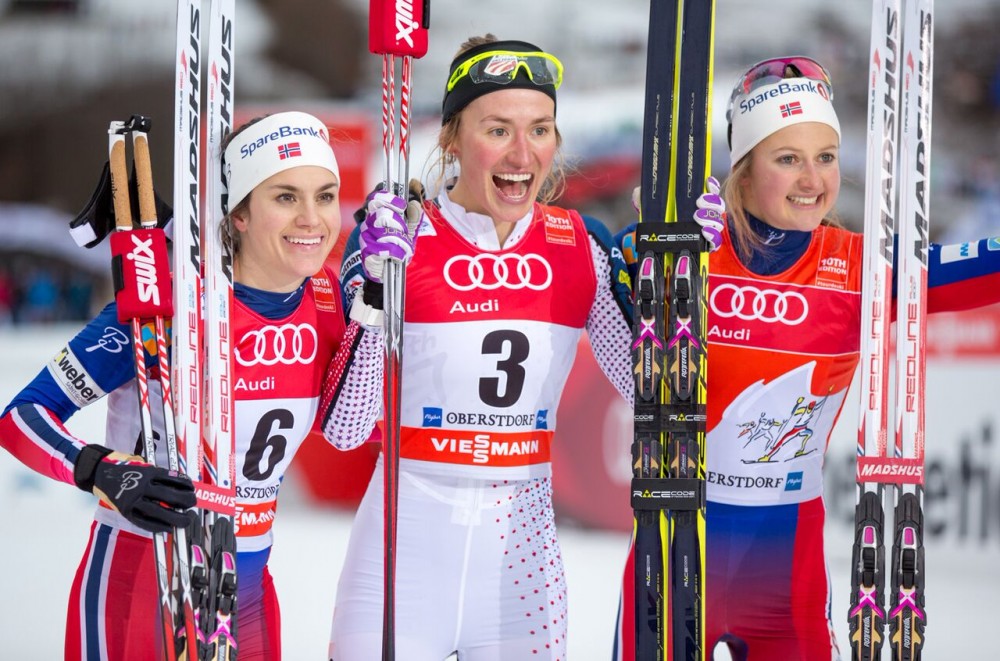
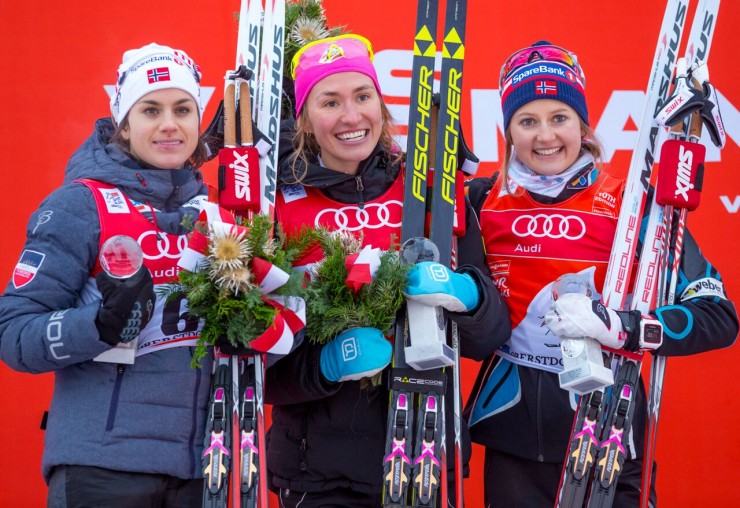
    Sophie Caldwell (c) after becoming the first U.S. woman to win a World Cup classic sprint with the other podium finishers, Norway's Heidi Weng (l) in second and Ingvild Flugstad Østberg (r) in third in the 1.2 k classic sprint at Stage 4 of the Tour de Ski in Oberstdorf, Germany. (Photo: Marcel Hilger)
    Sophie Caldwell (c) after becoming the first U.S. woman to win a World Cup classic sprint with the other podium finishers, Norway’s Heidi Weng (l) in second and Ingvild Flugstad Østberg (r) in third in the 1.2 k classic sprint at Stage 4 of the Tour de Ski in Oberstdorf, Germany. (Photo: Marcel Hilger)

    The dynamics between Caldwell and the two Norwegians sharing the podium with her in the post-race press conference could not have been warmer.

    “These two girls were faster than me the last couple hundred meters,” Østberg said. “That Sophie could win and the U.S. could get a win, I think that’s so fun.”

    A swarm of young children glowing with excitement to get Caldwell’s autograph engulfed the American as she exited the press area. With this, the public celebrations drew to a close and the U.S. team headed back to their hotel with a contagious, electric buzz of team-wide excitement.

    “It’s not just about winning, of course, it’s about watching somebody who put in a lot of work, learned how to believe in themselves, and attack a plan and have it work out,” Whitcomb said. “But at the end of the day it’s also really fun to watch Sophie succeed. She cares every bit as much about her teammates as she does about herself. And so it’s a team win today.”

    Sophie Caldwell plans to race the 10-kilometer classic mass start in Oberstdorf on Wednesday and possibly also race Stage 6 of the Tour: a 5 k skate in Toblach, Italy. Although she does not plan to finish the Tour, it is worth noting a sizable leap from 27th to 14th in the overall Tour standings with her win on Tuesday.

    The rest of the U.S. women: Sargent 15th, Diggins 21st

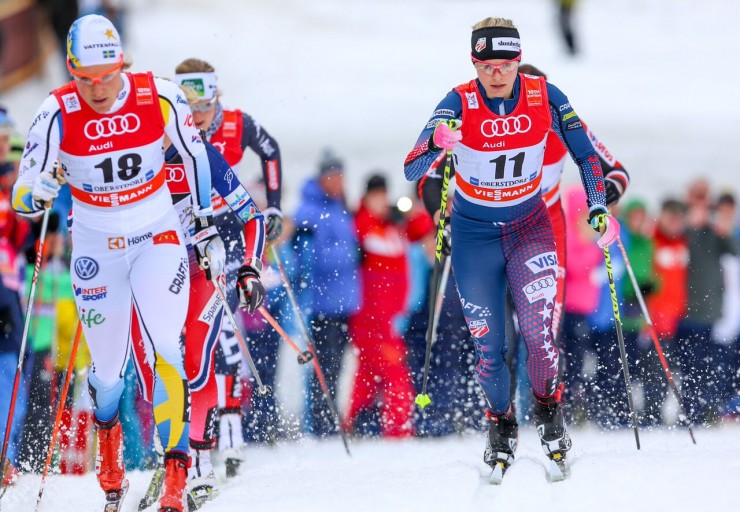
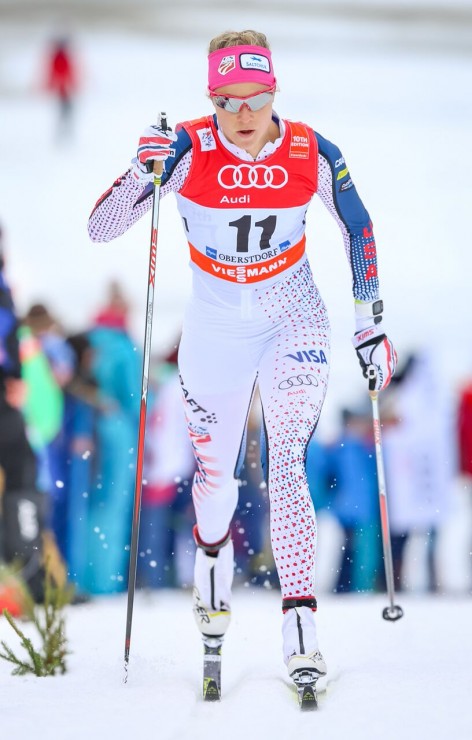
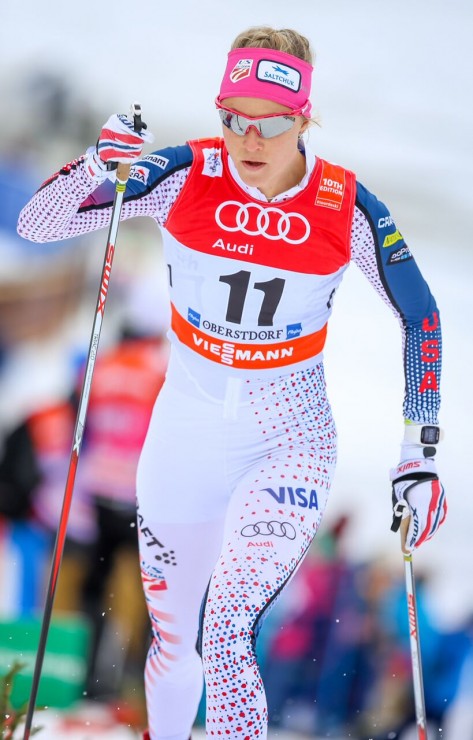
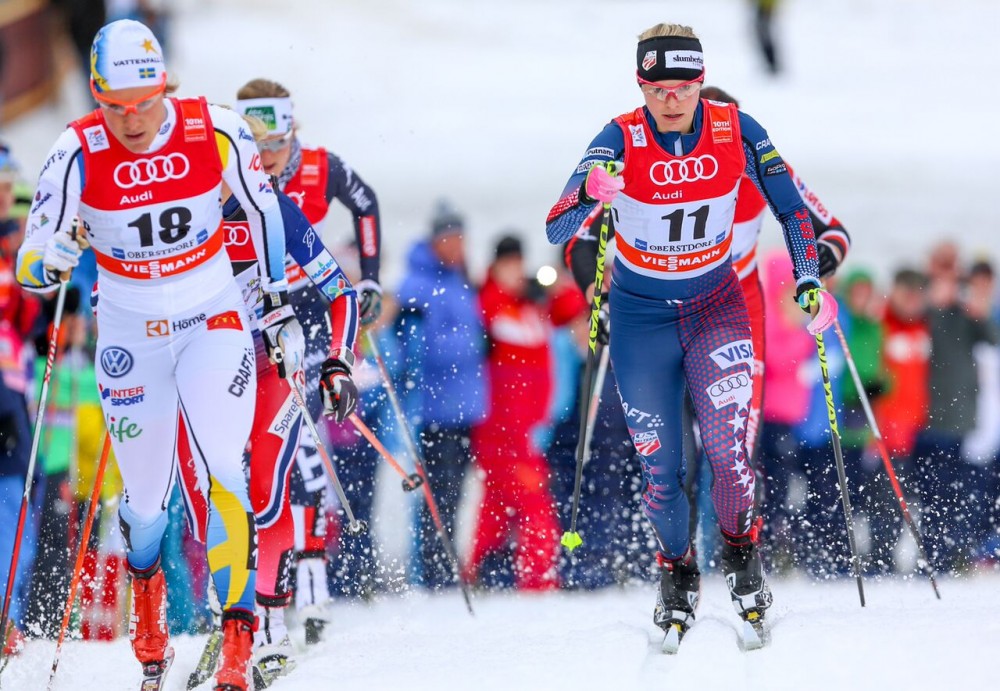
    Jessie Diggins (11) during her quarterfinal of the 1.2 k classic sprint at Stage 4 of the Tour de Ski in Oberstdorf, Germany. The American placed fifth after crashing with Hanna Falk (18). (Photo: Marcel Hilger)
    Jessie Diggins (11) during her quarterfinal on Tuesday. The American placed fifth after crashing with Sweden’s Hanna Falk (18). (Photo: Marcel Hilger)

    Also for the U.S., Diggins and Ida Sargent qualified for the heats with the  11th and 14th-fastest qualifying times, respectively. Notably, Diggins skied her entire qualifier without a pole basket.

    “It fell off at the start and I felt myself punching through, and I was like ‘no way,’ ” she recalled. “So I just skied as hard as I could because I thought, it is going to be a miracle for me to qualify like this.”

    Sure enough she did, and in a comfortable 11th, well within the top 30, 8.45 seconds behind Østberg’s top time of 2:38.18.

    In the quarterfinals, Diggins’ run ended when she collided with Sweden’s Hanna Falk, who snowplowed the notorious downhill. They entered the descent together, side by side in first and second, but as they picked up speed, the back of one of Falk’s skis clipped Diggins and they both went down. Diggins finished fifth in that heat, 26.22 seconds behind Johaug, who won that quarterfinal.

    “The silver linings of today, and I am all about silver linings, are that I felt great … I mean, physically I am fit, I am ready, I am in a good position in the Tour,” Diggins said. She’s currently 10th in the overall standings and 4:33.4 out of the lead. “I am ready for the next race.”

    Ida Sargent ( U.S. Ski Team) racing to third in her quarterfinal for 15th overall at the 1.2 k classic sprint at Stage 4 of the Tour de Ski in Oberstdorf, Germany. (Photo: Marcel Hilger)
    Ida Sargent ( U.S. Ski Team) racing to third in her quarterfinal for 15th overall at the 1.2 k classic sprint at Stage 4 of the Tour de Ski in Oberstdorf, Germany. (Photo: Marcel Hilger)

    Sargent narrowly avoided the first series of crashes of the day in the first women’s quarterfinal (Sweden’s Charlotte Kalla, Russia’s Natalia Matveeva and Germany’s Nicole Fessel all went down on the same hill) and placed third her heat. Sargent finished 10.36 seconds behind the winner of that quarterfinal, Østberg, which was not enough to advance to the semifinals.

    “That downhill was crazy; I was certain I was gonna go down,” Sargent said. “My ski was caught on an ice chunk of some kind so I was really happy to stay up, but I think I needed a little more kick to hammer the [next] uphill.”

    At the end of the day, Sargent placed 15th and Diggins 21st overall. Also for the U.S., Rosie Brennan again narrowly missed qualifying in 35th, Sadie Bjornsen did not make the quarterfinals in 44th due to a crash, Liz Stephen finished 49th, and Caitlin Gregg placed 53rd.

    In terms of overall Tour standings after four of eight stages, Diggins ranks 10th (+4:33.4), Bjornsen slipped out of the top 10 to 13th (+4:53.7), Caldwell is up to 14th (+5:23.7), Stephen is 25th (+6:22.1), Caitlin Gregg 39th (+8:12.6), Brennan 42nd (+8:33.1), and Sargent 45th (+8:47.3).

    Results | Tour standings (after Stage 4)

    — Alex Kochon contributed reporting

  • Oberstdorf Classic Sprint: A Tour de Ski Photo Gallery

    Oberstdorf Classic Sprint: A Tour de Ski Photo Gallery

    OBERSTDORF, Germany — On Tuesday, Sophie Caldwell became the third U.S. woman in World Cup history to win a World Cup race, and the first-ever to win a classic sprint. We are grateful Marcel Hilger shared the following photos recapping the day at the fourth stage of the Tour de Ski, which included another first for Norway’s Emil Iversen, the winner of the men’s final.

  • First Win for Iversen, No Surprise to Roommate Northug

    First Win for Iversen, No Surprise to Roommate Northug

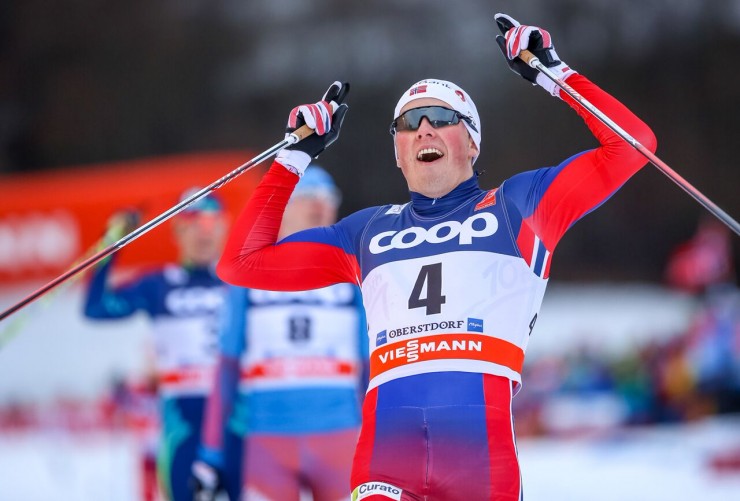
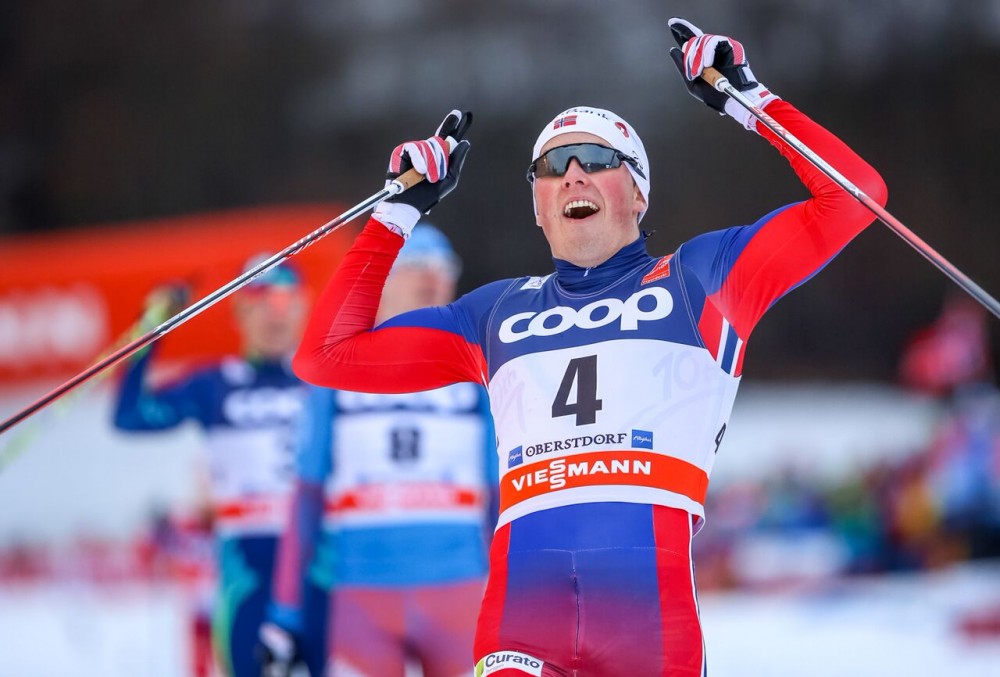
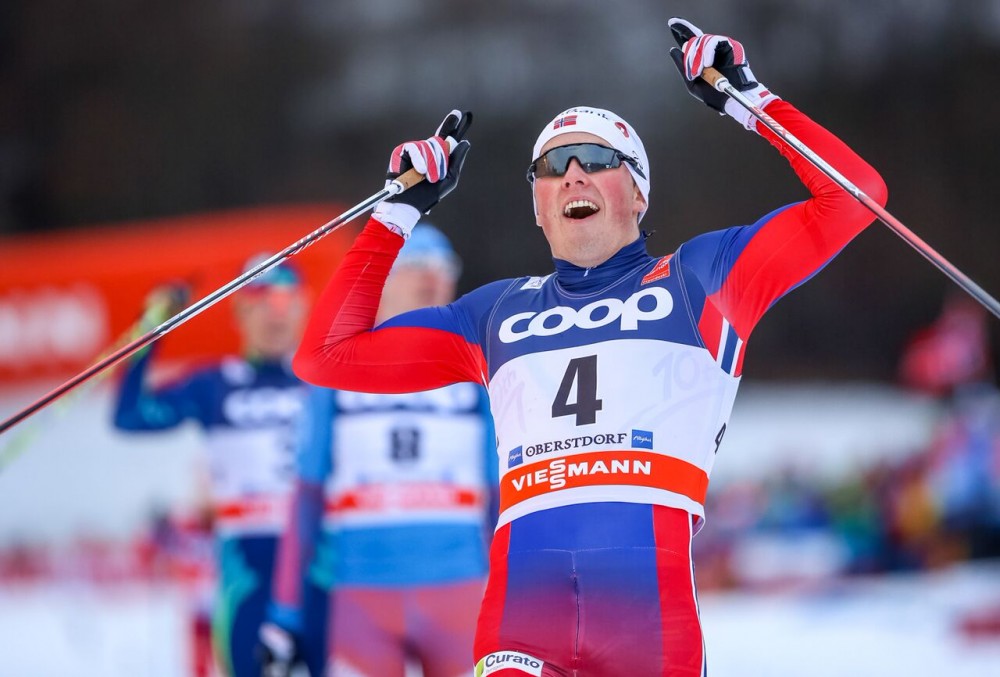
    Emil Iversen of Norway celebrates his first World Cup win in the 1.2 k classic sprint at Stage 4 of the Tour de Ski in Oberstdorf, Germany. (Photo: Marcel Hilger)
    Norway’s 24-year-old Emil Iversen  celebrates his first World Cup win in the 1.2 k classic sprint at Stage 4 of the Tour de Ski in Oberstdorf, Germany. (Photo: Marcel Hilger)

    OBERSTDORF, Germany — In front of some 4,300 spectators in the Ried arena and around the course at the site of the 2005 World Championships, Norway’s Emil Iversen achieved the first World Cup victory of his career in the men’s 1.2-kilometers classic sprint final on Tuesday.

    The fourth of eight stages in this year’s Tour de Ski (visiting Oberstdorf for the fifth time since the Tour began 10 years ago) challenged racers with a difficult course, which was partly due to the precarious snow conditions on the artificial loop, thinly veiled by a few flakes that had fallen during the prior nights on the surrounding slopes. The sprint races on a course with mostly just three groomed classic tracks saw a number of crashes, many on a steep downhill section and left hairpin turn with mushy snow. However, most of those happened in the women’s race, with athletes resorting to the snowplow technique and becoming obstacles for those who did not.

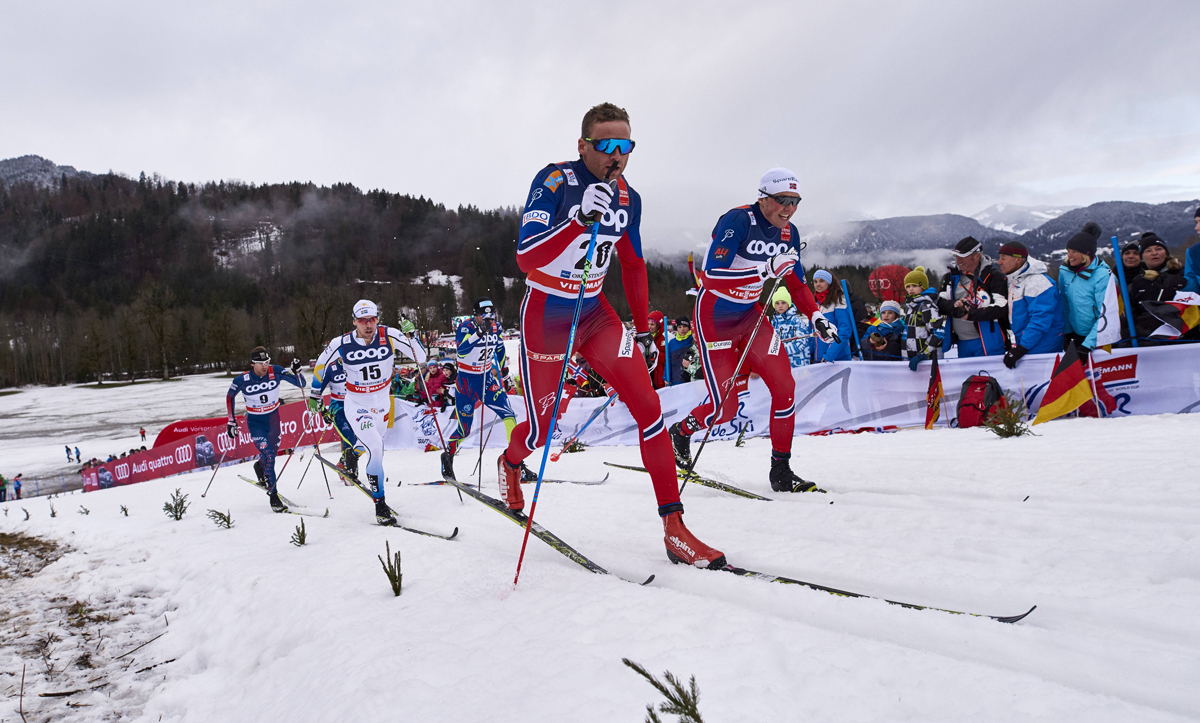
    Emil Iversen (20) skis with  fellow Norwegian Niklas Dyrhaug during the quarterfinal of the men's 1.2 k classic sprint at Stage 4 of the Tour de Ski in Oberstdorf, Germany. (Photo: Fischer/NordicFocus)
    Emil Iversen (r) leads his quarterfinal with fellow Norwegian Niklas Dyrhaug (20) during the men’s 1.2 k classic sprint at Stage 4 of the Tour de Ski in Oberstdorf, Germany. Dyrhaug was relegated to last in the heat for a technique violation. (Photo: Fischer/NordicFocus)

    “I am so excited to win today. I am really surprised to be first,” the 24-year-old Iversen said during the post-race press conference.

    At the first sprint of the Tour last week in Lenzerheide, Switzerland, Iversen failed to advance from the qualifying stage in the freestyle sprint. On Tuesday, he qualified fourth, won his quarterfinal (ahead of Kazakhstan’s Alexey Poltoranin in second*) and advanced to the final as a “lucky loser” in his semifinal — the third finisher with a fast-enough time after Russia’s Sergey Ustiugov, who won that semifinal, and Poltoranin, who again automatically advanced in second.

    Earlier this season, Iversen, a former Norwegian U23 development team member, missed being named to Norway’s senior national team. He had not finished in the top 10 in a World Cup yet this season before Tuesday.

    But Norwegian superstar Petter Northug was not surprised by the success of Iversen, expecting a breakthrough of the teammate with whom he has also been sharing hotel rooms with during this Tour. Last season, Iversen raced in two skate sprint finals in Lillehammer, Norway, and Rybinsk, Russia, where he finished sixth in both races.

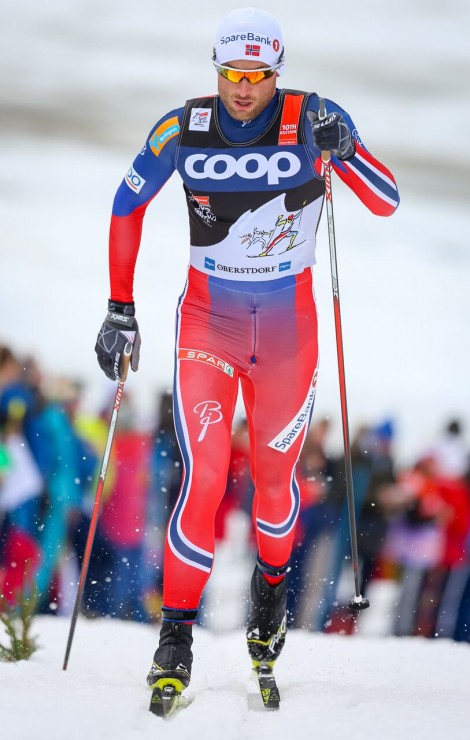
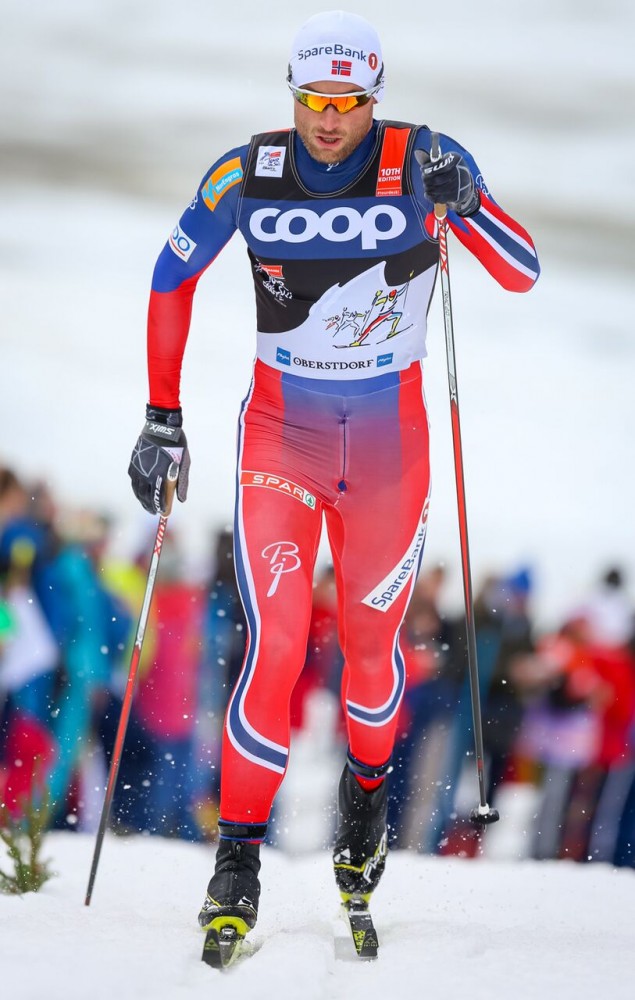
    Norway's Petter Northug qualified fifth and went on to place fifth in the final of the 1.2 k classic sprint at Stage 4 of the Tour de Ski in Oberstdorf, Germany. (Photo: Marcel Hilger)
    Norway’s Petter Northug qualified fifth and went on to place fifth in the final of the 1.2 k classic sprint at Stage 4 of the Tour de Ski in Oberstdorf, Germany. He still ranks second overall in the Tour behind teammate Martin Johnsrud Sundby. (Photo: Marcel Hilger)

    “I have kept him in the reins. He is a better skier than he is a roommate,” Northug joked in an interview with NRK, according to a translation.

    “I’m not surprised. He should have been on the national team a long time ago, but … his development stopped a little bit two years ago,” Northug continued. “I think he has figured out now what is right. Now he is where he should be, and he can do everything from sprint to longer races. He’s going to be skiing on the national team next year.”

    The two trained together this past offseason, and Northug admitted that Iversen repeatedly beat him in interval sessions.

    At breakfast Tuesday morning, Iversen reportedly proclaimed he would win, according to Norwegian sprint coach Arild Monsen.

    “It was said with a bit of gallows humor, but then he comes here and impresses all,” Monsen told NRK.

    Iversen later insisted that he didn’t mean it as a joke, but still did not actually expect the victory.

    Finishing 1.03 seconds behind him in the final, Ustiugov took second place after Iversen gathered enough speed out of the final downhill to gap the field, slingshotting past Ustiugov and Poltoranin to take the lead. The Norwegian held it down the finishing stretch, while Ustiugov and Poltoranin battled for second. Ustiugov edged him by 0.37 seconds, and Poltoranin took the final podium spot in third (+1.4).

    “Ustiugov set the speed after the start and I tried to keep up,” Iversen recounted at the press conference. “I was first on the top and I thought I could go for the podium. I chose a good line in the downhill and to the finish, but I am still very much surprised to win.”

    With the win, Iversen moved into 10th in the overall Tour standings.

    “It is good to be on the podium, but I am little bit tired of losing to a Norwegian all the time,” Ustiugov said in the press conference via a translator. “I made a mistake in the last downhill and lost speed. That probably cost me the victory today.”

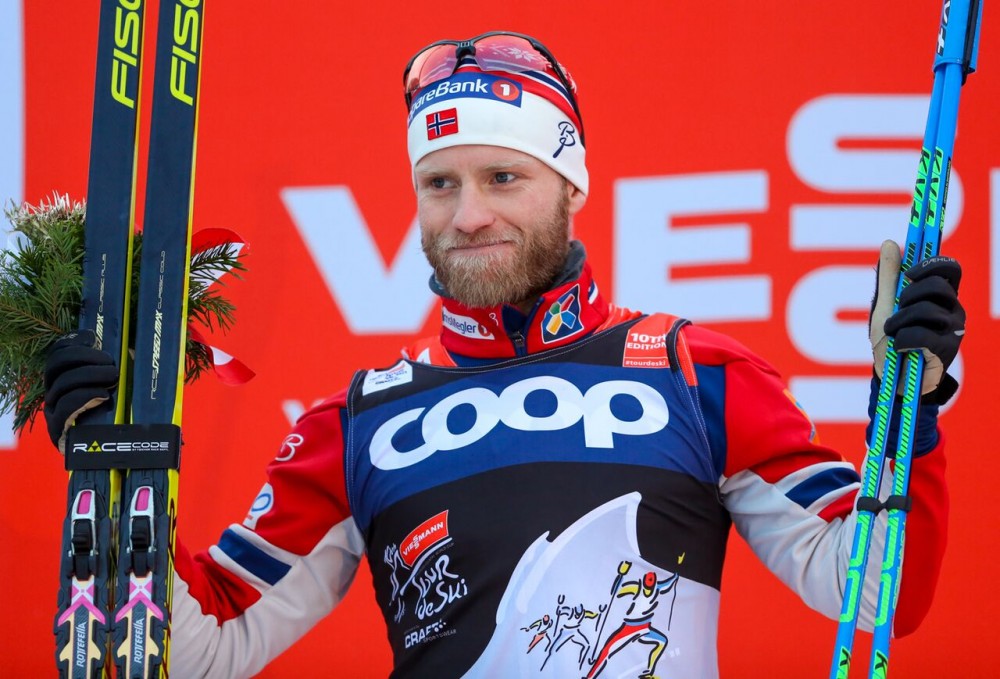
    Norway's Martin Johnsrud Sundby qualified 11th and went on to place fourth in the final of the 1.2 k classic sprint at Stage 4 of the Tour de Ski in Oberstdorf, Germany. Now, he not only leads the overall Tour standings, but the Sprint Tour standings as well. (Photo: Marcel Hilger)
    Norway’s Martin Johnsrud Sundby qualified 11th and went on to place fourth in the final of the 1.2 k classic sprint at Stage 4 of the Tour de Ski in Oberstdorf, Germany. Now, he not only leads the overall Tour standings, but topped the Tour’s sprint standings as well. (Photo: Marcel Hilger)

    Fourth place went to Norway’s Martin Johnsrud Sundby, thereby defending his fairly comfortable lead in the overall Tour standings, 1:33.6 minutes ahead of Northug in second. Sundby also claimed first in the Tour’s sprint standings (ousting Italy’s Federico Pellegrino, who failed to make the semifinals when he placed third in his quarterfinal).

    Ustiugov moved into third overall in the Tour (+1:56.9), bumping Norway’s Finn Hågen Krogh to fourth (+2:13.4), after Krogh planted his own pole between his legs and tumbled out of the start in in his semifinal. Krogh skied the rest of the semifinal alone in sixth, finishing nearly 39 seconds behind Sundby, who won that heat.

    The top North American in the Tour standings, Canada’s Alex Harvey finished 15th to improve one spot into eighth overall (+3:22.2).

    Northug finished fifth in this sprint, 10.32 seconds after Iversen, and for once was not the main focal point of the media assembled in Oberstdorf.

    But he later claimed that he had not even gone all-out in the final, already happy with the bonus seconds he had collected, and instead tried to help Iversen.

    “We discussed the positions out on the track if it was going quiet,” Northug told NRK. “I said that I wasn’t going to go into the basement [pain cave] in the finals, and that he just had to yell at me to get a lane if it went fast. I did not come to war.”

    However, this tactical plan wasn’t necessary. Northug was positioned in the back of the pack for much of the final, and Iversen got the job done on his own merit.

    Also out of position to fight for the podium, Germany’s 25-year-old local fan-favorite Sebastian Eisenlauer placed sixth (+14.19), for his best career result. Eisenlauer hails from a town just a few miles down the valley from Oberstdorf, so racing in front of his family and friends left him stoked.

    “I deliberately saved my strength for today,” he told German TV broadcaster ARD after the race. “But I could have hardly dreamed it would work out so well. That was wicked cool.”

    The best North American of the day was Canadian Len Valjas in 10th overall, advancing through the qualifier and quarterfinals, before being eliminated in his semifinal. He came in fifth in a stacked field that included all three eventual podium finishers.

    His teammate Harvey narrowly missed advancing from his quarterfinal in third. For the U.S., Andy Newell placed 17th after finishing fourth in his quarterfinal.

    The Tour continues in Oberstdorf on Wednesday with 10/15 k classic mass starts on a 2-kilometer loop, extending the sprint course with additional hills. This race replaces the originally scheduled skiathlons, which organizers deemed too difficult to prepare given the lack of snow conditions.

    Results | Tour standings (through Stage 4)

    *Norway’s Niklas Dyrhaug was relegated to last in Iversen’s quarterfinal after initially placing second. The jury ruled he committed a technique violation (i.e. skating). That put him 30th on the day and 14th in the Tour (+4:29.2), and allowed Poltoranin to automatically advance to the semifinal in second.

    — Alex Kochon contributed reporting

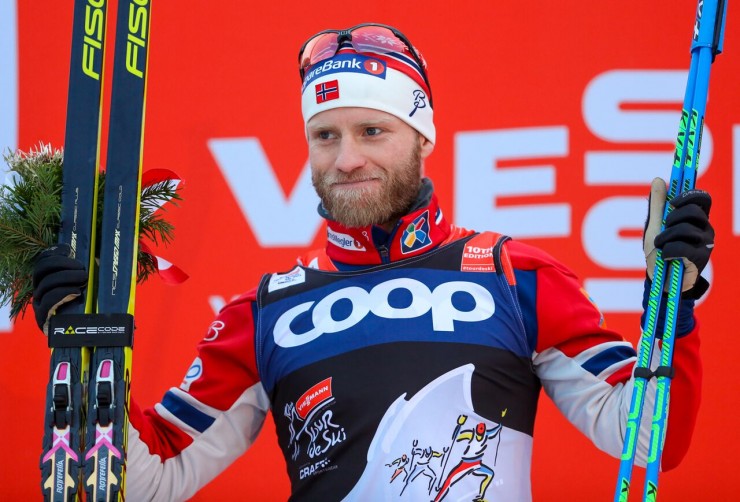
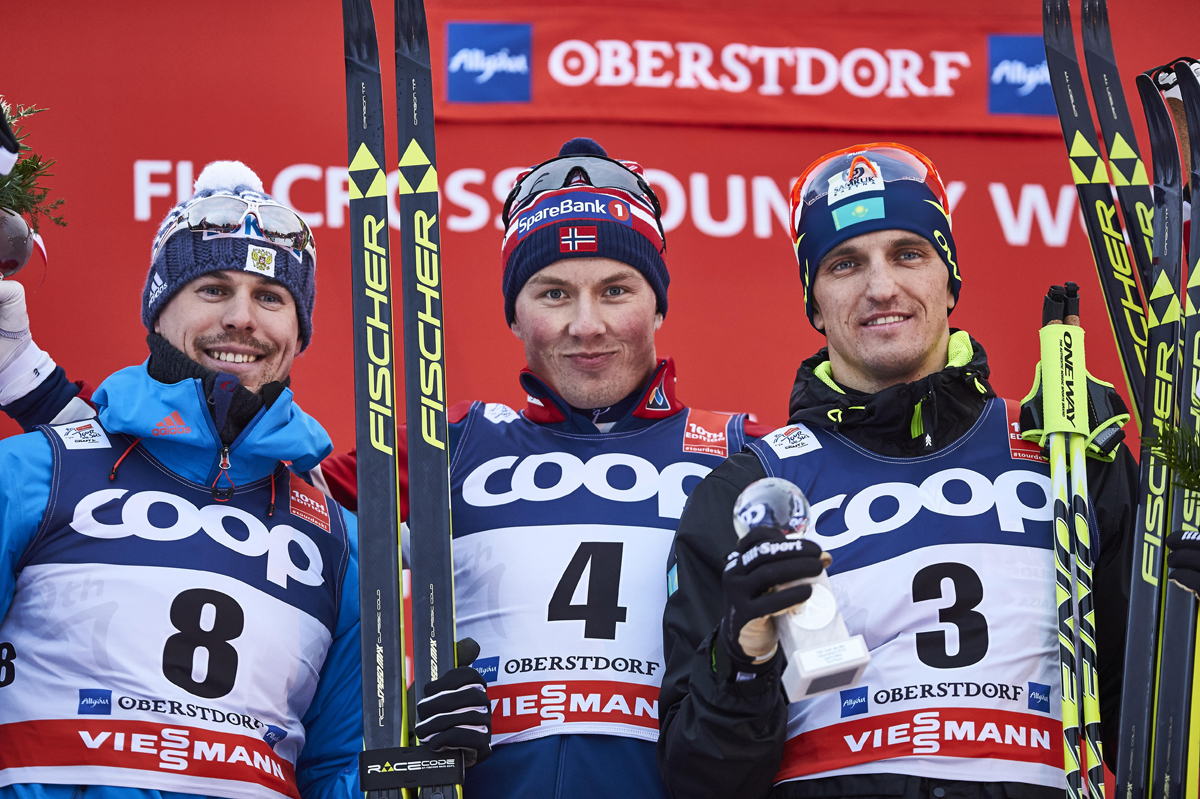
    Norway's Emil Iversen (c) on the podium after winning his first World Cup at Stage 4 of the Tour de Ski in Oberstdorf, Germany. Russia's Sergey Ustiugov (l) placed second and Kazakhstan's Alexey Poltoranin (r) was third. (Photo: Fischer/NordicFocus)
    Norway’s Emil Iversen (c) on the podium after winning his first World Cup at Stage 4 of the Tour de Ski in Oberstdorf, Germany. Russia’s Sergey Ustiugov (l) placed second and Kazakhstan’s Alexey Poltoranin (r) was third. (Photo: Fischer/NordicFocus)