From the FasterSkier archive — posts syndicated from athletes’ and coaches’ own blogs between 2004 and 2012, kept online as published. Current coverage is at fasterskier.com.
The International Ski and Snowboard Federation (FIS) unveiled its proposed 2026/2027 cross-country skiing World Cup calendar this week at the FIS Spring Meetings in Portorož, Slovenia.
The schedule — first shared publicly through FIS social media and still pending FIS Council approval — builds the season around the 2027 World Championships in Falun, Sweden, with three pre-Christmas stops, a nine-race Tour de Ski, a stretch of three weekends between the Tour and Worlds, and a Scandinavian closing kick that ends with the Finals in Ulricehamn.
For North American fans, the calendar is once again entirely European, with no scheduled stops in Canada or the United States.
Frida Karlsson (SWE) poses with Mr. and Mrs. Claus following the 10k Classic to start last season in Ruka (FIN). (Photo: Modica/NordicFocus)
Pre-Holiday: Ruka, Trondheim, Davos
The season opens where it almost always does — in Ruka, Finland, where the World Cup begins November 27. From there, the circuit moves to Trondheim, host of the 2025 World Championships, before the pre-Christmas block closes in Davos, Switzerland, with a team sprint.
November 27-29, 2026: Ruka, Finland
27/11: 10km Interval Start Classic
28/11: Sprint Classic
29/11: 20km Mass Start Freestyle
December 1-3, 2026: Trondheim, Norway
01/12: 10km Interval Start Classic
02/12: Sprint Freestyle
03/12: 20km Skiathlon
December 11-13, 2026: Davos, Switzerland
11/12: 5km Heat Mass Start Freestyle
12/12: Sprint Freestyle
13/12: Team Sprint Freestyle
With Jessie Diggins (USA) now retired, there will be a new FIS Overall Crystal Globe and Tour de Ski champion next season (Photo: Vanzetta/NordicFocus)
Tour de Ski 2026/2027
The Tour de Ski returns to a three-country format, opening in Les Rousses, France, on New Year’s Day, moving to Oberstdorf, Germany, and finishing with three races in Val di Fiemme, Italy — capped, as ever, by the Final Climb up Alpe Cermis.
January 1-3, 2027: Les Rousses, France
01/01: Sprint Classic
02/01: 20km Mass Start Classic
03/01: 15km Pursuit Freestyle
January 5-6, 2027: Oberstdorf, Germany
05/01: 15km Mass Start Classic
06/01: 5km Heat Mass Start Freestyle
January 8-10, 2027: Val di Fiemme, Italy
08/01: 15km Skiathlon
09/01: Sprint Freestyle
10/01: Final Climb
Gus Schumacher (USA) and the rest of the US team will hope to continue their success in Toblach (ITA). (Photo: Modica/NordicFocus)
After the Tour, Before Worlds: Engadin, Toblach, Lahti
Three weekends bridge the Tour de Ski and the World Championships. Engadin opens its weekend with a mixed relay — a format the FIS has been working into more World Cup weekends — and Lahti closes the pre-Worlds stretch with its classic 20km skiathlon and 10km interval start.
January 22-24, 2027: Engadin, Switzerland
22/01: Mixed Relay
23/01: Sprint Freestyle
24/01: 20km Mass Start Freestyle
January 29-31, 2027: Toblach, Italy
29/01: 10km Interval Start Freestyle
30/01: Sprint Freestyle
31/01: 20km Mass Start Classic
February 12-14, 2027: Lahti, Finland
12/02: Sprint Classic
13/02: 20km Skiathlon
14/02: 10km Interval Start Classic
Kendall Kramer (USA) had a breakout World Cup Skiathlon in Falun (SWE) last season. (Photo: Authamayou/NordicFocus)
2027 FIS Nordic World Ski Championships: Falun, Sweden
The 2027 FIS Nordic World Ski Championships run from February 22 through March 7 in Falun, Sweden, with all title formats on the program. Falun last hosted Worlds in 2015.
Final Period: Oslo, Drammen, Ulricehamn
The closing stretch is a Scandinavian one. Oslo’s Holmenkollen weekend features back-to-back 50km mass start classic races on March 13 and 14 — long a fixture of the late-season calendar — before a one-day sprint stop in Drammen and the World Cup Finals in Ulricehamn, Sweden.
March 13-14, 2027: Oslo, Norway
13/03: 50km Mass Start Classic
14/03: 50km Mass Start Classic
March 16, 2027: Drammen, Norway
16/03: Sprint Classic
March 19-21, 2027: Ulricehamn, Sweden (World Cup Finals)
19/03: 10km Interval Start Freestyle
20/03: Sprint Freestyle
21/03: 20km Mass Start Classic
The calendar remains subject to FIS Council approval.
Hunter Wonders (USA) racing the Skiathlon at the 2023 World Championships in Planica, Slovenia. (Photo: Modica/NordicFocus)
When U.S. Ski & Snowboard released its roster for the 2026 Olympic Winter Games, Hunter Wonders’ name appeared without emphasis. No asterisk. No parenthetical explanation. Just another line in a list that had already absorbed months of speculation, anxiety, and arithmetic.
To most readers, the name represented a straightforward outcome: an athlete peaking at the right moment, a season resolved by results. But the roster line masked a career that did not move in a single direction. Wonders’ path bent, paused, and restarted. At one point, it appeared to end entirely.
Understanding how he arrived at the Olympics requires starting far from the Games themselves — in a place where progress is quiet, repetition matters more than recognition, and development happens long before it is visible.
Hunter canoe racing with his dad in Michigan. (Photo: Courtesy Photo)
Alaska, Not Michigan
Hunter Wonders is sometimes misidentified as a Midwestern skier. His parents are from Michigan — his father from Grayling, his mother from Traverse City — and the family returned there most summers to visit grandparents. Wonders spent long stretches canoe racing in Michigan and maintaining close ties to extended family.
But Alaska is home.
“My parents were originally from Michigan… And yeah, they moved to Alaska. It was supposed to be like a two-year thing for my dad’s work,” Wonders said. “And he just knew, like, nope, we’re not going back. I’m staying here.”
That decision happened decades before Wonders had any agency of his own. By the time he was born, Alaska was already permanent.
“I’m definitely from Alaska and have lived there my whole life,” he said.
In American cross-country skiing, place is not just a backdrop. It is infrastructure. Alaska exists at the edge of the domestic system — geographically distant from centralized camps, expensive to travel from, and easy to overlook. Athletes there develop without constant reference points, often without external validation.
For Wonders, that isolation became formative.
Hunter Wonders, Hailey Swirbul, and Chip Schoff (former APU skier and wax tech) on a multi-day hut trip. (Photo: Courtesy Photo)
Alaska, Off the Circuit
In Alaska, training is often solitary. Progress is built through lifestyle and repetition rather than comparison, and improvement is measured internally long before it is confirmed externally.
The winters matter. So does the darkness. Training extends into hours when daylight is no longer guaranteed, when motivation cannot depend on atmosphere or audience. You go out because it’s how you choose to live and enjoy your life.
That rhythm shaped Wonders’ relationship to skiing early. He did not grow up racing for recognition. He learned to train for alignment — the quiet sense that body, terrain, and effort were moving together. Alaska not only accelerated his trajectory. It birthed it.
Hunter Wonders (APU/Alaska) takes the lead in the U16 Boys Mass Start Freestyle race at the US Junior National Championship in Stowe, Vermont in 2014. (Photo: Voisin/FasterSkier)
A Childhood of Rotation
Wonders grew up chasing his older siblings — twin brother and sister, five years ahead — through a constantly shifting landscape of sports. Alpine skiing. Motocross. Soccer. Ski jumping. Biathlon. Mountain biking.
“Anytime I started getting into a sport, my family shifted away from that one,” he said.
The pattern was not neglect, but necessity. Supporting multiple competitive sports for multiple children eventually became unsustainable.
“My parents were like, all right, we can’t do all this stuff. We gotta limit it. And they chose to Nordic ski. And so naturally, I was kind of dragged into that scene.”
Nordic skiing, at least initially, was not a calling. It was what remained once the family consolidated its energy.
Wonders’ first encounter with skis reflects that informality.
“It was my dad playing with me on my back deck in 2001. And I’m not really skiing that much, but that was kind of my first encounter with it.”
There was no mythology attached to that moment. No sense of destiny. Skiing entered his life as play, then habit, then gradually — almost without announcement — as a central structure.
Hunter Wonders (APU/Alaska) winning the U16 Boys Mass Start Freestyle race at the 2014 US Junior National Championship in Stowe, Vermont. (Photo: Voisin/FasterSkier)
Stowe, Vermont
The first moment when that structure revealed competitive meaning came far from Alaska.
Wonders qualified for Junior Nationals in Stowe, Vermont, in 2014. He did so narrowly, selected as the fifth or sixth skier on Team Alaska.
“I barely made Team Alaska. But it was a big goal for me as a U16,” he said.
What followed surprised nearly everyone, including Wonders himself.
“And just out of nowhere, I ended up getting a second place in the individual start race and first place in the mass start. And that was just like, whoa, where did that come from?”
The results did not instantly rewrite his trajectory. But they altered his internal calculus.
“I think it kind of clicked for me that, okay, I can do this. I can be competitive.”
The significance of that realization was not the result itself, but permission. Permission to imagine a longer horizon.
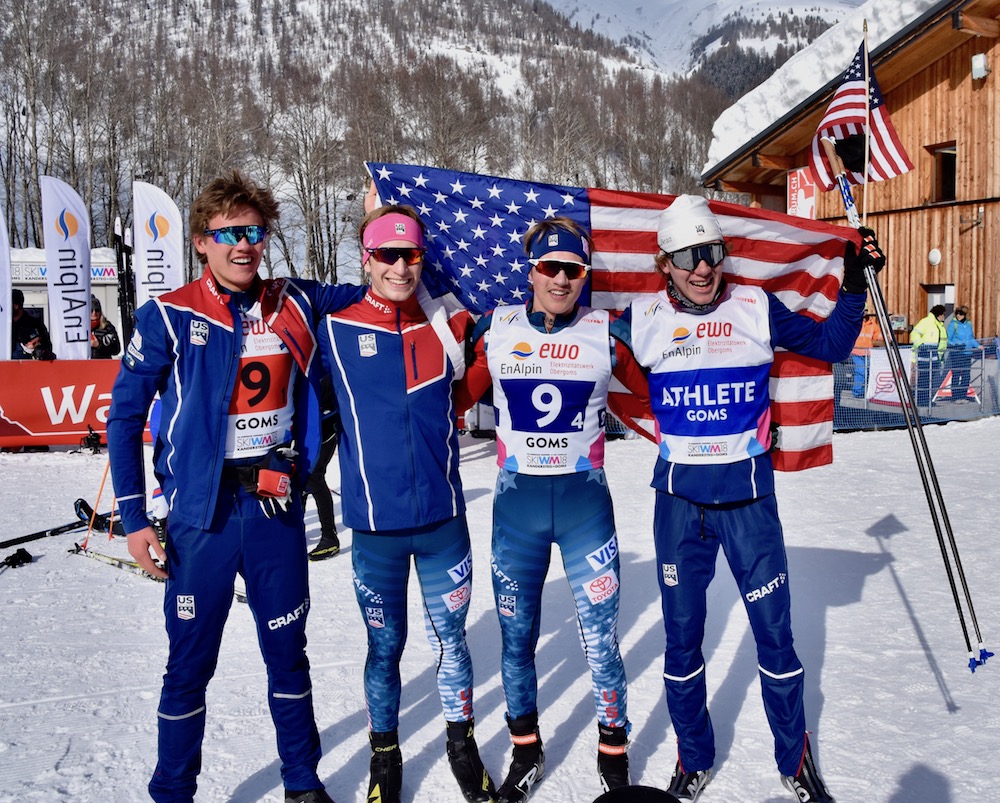
The U.S. men’s silver-medal relay at the 2018 Junior World Championships in Goms, Switzerland, with (from left to right) Luke Jager, Hunter Wonders, Gus Schumacher, and Ben Ogden. (Photo: Julia Kern)
The Long Middle Begins
What followed was not a rapid ascent, but a prolonged middle years defined by steady development, incremental gains, and results that suggested promise without announcing arrival.
On the World Cup, Wonders often raced from the margins. Finishes in the 50s and 60s gave way slowly to finishes in the 30s. The progress was real, but it did not demand attention.
In American men’s skiing, where depth is both strength and complication, that middle can be unforgiving. Selection is rarely guaranteed. Criteria shift. Opportunity compresses.
Wonders responded the way he had learned to respond in Alaska: by focusing inward. Training remained central.
“For me, training has always been kind of the fun part… The training and living that lifestyle is really, really big to me.”
That orientation would become essential later — when the question was no longer how to improve, but whether improvement was still worth pursuing.
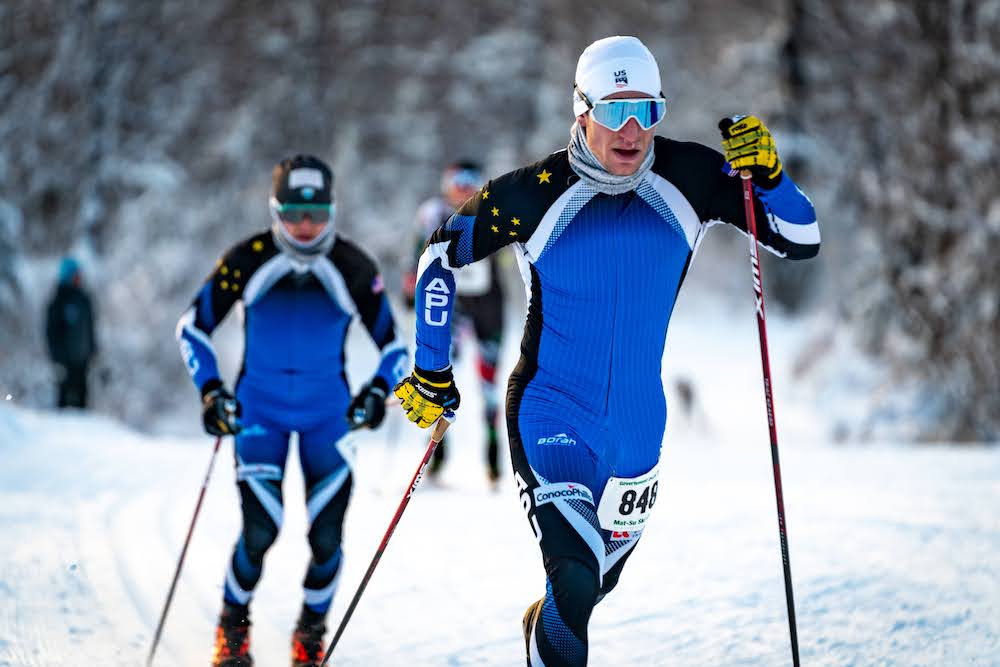
Hunter Wonders races at Government Peak Recreation Area, Palmer, Alaska, Nov. 14, 2021, in the season-opening Race to the Outhouse #1. (photo: Eric Strabel for APUNSC)
APU and Staying Put
Alaska Pacific University provided continuity during those years. It was neither a junior factory nor a national-team satellite. Its athletes often arrived through unconventional paths and stayed longer than expected.
For Wonders, APU offered stability without stagnation. Coaching relationships endured. Autonomy was preserved. Expectations were internal before they were external.
Progress was allowed to be slow.
That patience would later prove critical — because when Wonders eventually left the sport, and then considered returning, there was no system to rebuild, no trust to reestablish. The ground remained where he had left it.
Hunter Wonders (USA) on his way to 16th place in the 10 k Classic in Beitostolen, Norway in 2022. (Photo: NordicFocus)
Proof, Finally
The breakthrough season arrived quietly, without spectacle or announcement.
During the 2022–23 World Cup season, Wonders recorded the strongest international results of his career: a 16th-place finish in Beitostølen, Norway an 11th-place finish in Oberstdorf, Germany and a 23rd-place finish at Holmenkollen. The trajectory was unmistakable, even if it did not demand attention.
“For me, that was a big jump from spending my time in the 50s, 60s,” he said.
The significance of those results was not external. They did not alter his standing overnight or change how the sport viewed him. Their impact was internal.
“It felt good. To prove to myself that I could ski with some of the best out there.”
For years, that belief had existed as conviction rather than certainty. Now it had evidence. The question of whether he belonged — the one that had quietly governed training blocks, selections, and seasons — no longer needed answering.
What remained was not ambition, but choice.
Hunter Wonders (USA) on his way to 23rd place in the Holmenkollen 50 k Freestyle in Oslo, Norway in 2023. (Photo: Modica/NordicFocus)
Leaving Without Collapse
Retirement in endurance sport is often framed as inevitable. Bodies fail. Results decline. Motivation erodes. The decision arrives trailing visible causes.
Hunter Wonders’ retirement did not follow that pattern.
When he stepped away from World Cup racing in the spring of 2023, his career was not unraveling. It was consolidating. The season behind him had not forced his hand; it had freed it.
“My planned last World Cup… it was right after a really good season for me,” he said.
The timing mattered. He was not leaving with questions unanswered. He was leaving with a sense of completion.
For a long time, Wonders had believed he could compete at that level. Now he knew it. And that knowledge altered the logic of staying.
With the central doubt resolved, the future opened in unexpected ways. Instead of sharpening ambition, success created space to consider what life beyond skiing might look like, and whether the cost of continuing still made sense.
“I thought I was content. I thought I was, you know… ready to move on.”
The decision was not driven by exhaustion or dissatisfaction. It was driven by certainty — and by the rare freedom that certainty can bring.
Crust ski in the spring time (Wonders’ all time favorite form of skiing). (Photo: Courtesy Photo)
What It Means to Leave While Improving
Leaving while things are going well carries a specific psychological weight. There is no obvious decline to explain the decision. No external force to blame. The athlete leaves not because the door is closing, but because it remains open.
Improvement, once experienced, does not fade quietly. The body remembers what alignment feels like — when training, racing, and confidence converge. Walking away at that moment does not resolve ambition; it suspends it.
Wonders framed his retirement as closure. But closure in elite sport is rarely permanent. The unanswered questions tend to return first, often in subtler forms.
In his case, the unresolved question was not whether he could ski at the highest level. That had been answered. The question was whether he wanted to continue building a life that revolved so completely around it.
From Seasons to Paychecks
After stepping away, Wonders entered a different rhythm entirely.
“That whole following summer, I worked construction, learned a lot of new skills. That’s when I got my pilot’s license.”
The change was not symbolic. It was practical. Construction offered tangible progress — work that produced visible results and predictable compensation.
“Even when skiing was going well, I just wanted to get out of it and work a normal job, get the normal paycheck, things like that.”
The appeal of normalcy was not rooted in dissatisfaction with skiing. It was rooted in adulthood. After years of living season to season, the idea of stability carried weight.
At the same time, Wonders had recently completed his degree at Alaska Pacific University.
“I graduated with a bachelor’s in business administration,” he said.
What followed was a transition many elite athletes experience but rarely articulate.
“I found a really hard transition when I graduated from being a student athlete to just an athlete. I felt like I wasn’t progressing elsewhere in life. And that was pretty hard for me.”
Without coursework, semesters, or academic milestones, skiing existed in isolation. Progress on snow no longer corresponded to progress in life. The imbalance unsettled him.
The Second Discipline
Aviation entered that gap not as a hobby, but as a parallel discipline.
“I have my pilot’s license now, and I’ve been working on my instrument rating,” Wonders said.
He described the training with precision.
“Being able to fly only using what’s on the dashboard of the plane. Basically, no looking outside the plane.”
Instrument flight is unforgiving. It demands trust in systems over instinct, procedure over perception. For Wonders, it offered a structure that mirrored elite sport without duplicating it.
“It’s been giving me something to work on outside of skiing, which has been really nice.”
More importantly, it offered psychological margin.
“It’s a very important thing for me, I think, to not feel trapped.”
The word matters. Trapped implies more than fatigue or burnout. It implies a loss of agency — the sense that leaving would erase identity rather than expand it.
Aviation gave Wonders a way to be committed to skiing without being consumed by it.
A Life That Almost Fit
For a time, the other life worked.
Construction days were long and direct. Progress was visible. Paychecks arrived on schedule. Flight training offered complexity, mastery, and forward motion.
The pace was different. The stakes were different. The feedback was immediate.
Skiing receded into the background — not as a regret, but as a completed chapter.
Yet even in that distance, the sport did not disappear entirely. It remained embedded in routine, in memory, in the body’s sense of what effort felt like.
Wonders did not describe missing racing. He described missing the calendar.
In November of 2022 Hunter Wonders (USA) was on his way to 30th place at the opening World Cup weekend in Ruka, Finland, but a year later he was home in Alaska. (Photo: NordicFocus)
November
“When everyone started peacing out to go race, I was like, man, what am I doing?”
November arrived the way it always does in elite skiing — as a turning point. Training blocks gave way to travel. Preparation became exposure.
For athletes still inside the system, November is movement. For those who have stepped away, it is absence.
The routines disappear first. Then the shared language. Eventually, the calendar itself feels unfamiliar.
Wonders’ realization was not emotional. It was logistical.
“I can always be installing insulation in some random house someday, but I can’t be skiing forever.”
November clarified something Wonders had not fully confronted while working construction or studying flight manuals: skiing was not just a job he had left. It was a window with an expiration date.
The question was no longer whether another life was possible. That had been answered. The question was whether he was prepared to let the skiing life close while it remained viable.
APU Head Coach Erik Flora, Chip Schoff, and Oscar Flora after getting the PistenBully running on Eagle Glacier last spring. (Photo: Courtesy Photo)
The Conversation That Changed the Direction
Wonders began talking again with his APU coach, Erik Flora. The conversations were not urgent.
“He was very enthusiastic about my getting back into skiing. And so that just made that step a little easier.”
There was no pressure to return immediately. No demand for proof. The space remained open.
What followed was not an impulsive comeback, but a deliberate reconstruction.
Fishing trip on the Gulkana river this last September with close friends. (Photo: Courtesy Photo)
A Three-Year Calendar
Rather than simply resuming his previous life, Wonders built a framework designed to prevent the same tension from reemerging.
“I just planned out this three-year calendar kind of to right now,” he said.
The calendar was not about training volume or race targets.
“I blocked off weeks that I was like, okay, these chunks of time, I’m not going to be thinking about ski racing.”
Those blocks were non-negotiable.
Moose hunting with his father and brother. Fishing weekends on the Kenai Peninsula. Commitments that anchored him to a life beyond snow.
“There are certain things I was willing to give up and certain things I wasn’t.”
The decision to return was conditional. Skiing would be central again, but not all-consuming.
Moose hunting camp with his dad and brother in interior Alaska. (Photo: Courtesy Photo)
The Return, Without Announcement
When Hunter Wonders returned to full-time racing, there was no formal reintroduction. No narrative reset. No expectation that the sport should receive him differently than it had before.
He did not return as a project. He returned as a person who had already tested the alternative.
The first season back was uneven by his own account — fitness arriving in pieces, rhythm coming and going — but the framework held. The calendar he had built remained intact. The boundaries were not abandoned under pressure.
“Coming back from retirement wasn’t the easiest. Not… not the most productive thing,” he said.
The difference this time was not performance. It was posture. He no longer treated each result as a referendum on identity. He had already stepped outside the system once and learned what waited there.
That knowledge altered how he handled uncertainty.
Hunter Wonders (USA) during the 10 k Freestyle in Les Rousses, France of January of 2025. (Photo: Authamayou/NordicFocus)
Progress Without Urgency
As the return season unfolded, improvement came incrementally — the way it always had for Wonders. There was no single race that announced transformation. Instead, there was accumulation: training blocks completed, races absorbed, effort normalized.
The quiet confidence that had once been provisional now appeared settled. Racing no longer felt like a test of belonging. It felt like execution.
That distinction matters in Olympic years, when urgency can distort judgment. Athletes often feel pressure to force form, to manufacture moments that prove readiness. Wonders did not describe that impulse. He described a narrowing focus.
“I really tried to narrow the focus. And limit some distractions in the last year. I just wanted to go all in.”
The phrase carried none of its earlier desperation. “All in” now meant presence rather than sacrifice — committing fully to skiing while refusing to let it consume everything else.
Hunter Wonders (#369 – APU) on his way to winning the opening race, a 10 k Individual Start Classic, at the US National Championships in Lake Placid, New York, at the beginning of January. (Photo: Nancie Battaglia)
The Olympic Winter, Reframed
Olympic selection seasons tend to magnify everything. Results are scrutinized more closely. Criteria are parsed more aggressively. Small margins carry exaggerated meaning.
For athletes who have never stepped outside the system, that pressure can feel total. For Wonders, it did not.
He had already lived the other version of his life — the one with construction hours, flight manuals, and normal paychecks. He knew that version was viable. He also knew it was incomplete.
That knowledge changed how the Olympic Winter Games landed.
The selection process did not define him. It tested him.
Hunter Wonders (USA) racing the 10 k Classic in Oberhof, Germany on the final weekend of racing that was considered for making the US Olympic Team. (Photo: Authamayou/NordicFocus)
Selection as Consequence
When the Olympic team was named, Wonders’ response did not resemble arrival. It resembled recognition.
“My parents are coming over. I’m very excited about that,” he said.
Their presence mattered more than the announcement itself.
“Regardless of whether I made the Olympics or not, they were going to be supportive and proud.”
That certainty allowed the moment to settle without drama.
Still, the meaning was clear.
“To me, making the Olympics is kind of like paying them back… like, I finally made it.”
The phrasing was not triumphant. It was relational. The Olympics were not framed as destiny fulfilled, but as acknowledgment earned — proof that the years of logistics, travel, and patience had resolved into something concrete.
Hunter Wonders (USA) during the 20 k Classic Mass Start in Goms, Switzerland, the weekend after he had been named to the US Olympic Team. (Photo: Authamayou/NordicFocus)
After the Goal
The days after selection often reveal more than the selection itself. For many athletes, the achievement creates a vacuum. The central question disappears, replaced by a quieter one: Now what?
Wonders articulated that shift immediately.
“Now it’s hard. I’ve been kind of thinking about now, what are my goals going forward?”
Qualification had resolved the season’s largest uncertainty. It also removed the shelter of pursuit.
“I don’t want to look like a bum at the Olympics… that’s not why I came here.”
The bluntness mattered. Making the team had never been the end of the story. It was a threshold — one that demanded a different kind of clarity.
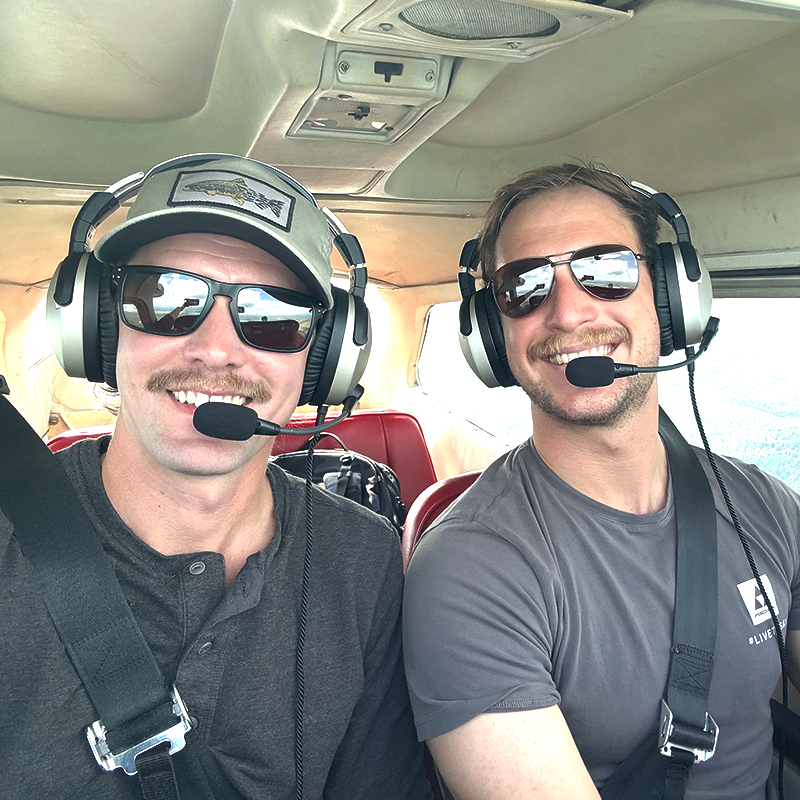
Wonders taking his friend, who’s also a pilot, on a flight while he visits Alaska. (Photo: Courtesy Photo)
Flying by Instruments
The metaphor that runs quietly through Wonders’ story — though he never names it as such — is aviation.
“Being able to fly only using what’s on the dashboard of the plane,” he said, describing his instrument rating.
Instrument flight requires a specific discipline. When visibility disappears, instinct becomes unreliable. The pilot must trust systems rather than sensation, training rather than impulse.
That discipline mirrors the way Wonders has navigated his return. He has learned not to chase feelings — not to react to noise — but to trust the structures he has built.
In an Olympic year defined by margins, criteria, and scrutiny, that trust is rare.
When these two embrace each other next, they will have gone from this first ski on the back deck all the way to the Olympics. (Photo: Courtesy Photo)
A Different Kind of Olympic Story
Hunter Wonders will arrive at the Olympic Games as a first-time Olympian. He will not arrive as someone who chased the Olympics at all costs.
He has already lived the alternative. He knows what it means to step away, to build another life, to find meaning beyond the sport. That knowledge changes how the Olympics function in his story.
The arc matters because it resists simplification. It does not fit neatly into the narratives elite sport prefers — prodigy, burnout, comeback. It occupies a quieter space: adulthood.
Wonders did not return because he had nothing else. He returned because he chose skiing again — deliberately, with boundaries intact, with the instruments checked and trusted.
In endurance sport, where careers are often defined by urgency and fear of loss, that choice may be the rarest qualification of all.
Help Support Our Olympic Coverage!
FasterSkier will have our own Nat Herz on the ground at the Olympics, which, to be honest, is a very big financial lift for us. If you value the thoughtful work and access FasterSkier provides at championships like this one, please consider becoming a Voluntary Subscriber. Your support directly fuels the work we do to cover the people, places, and moments that make our sport special.
If Hunter Wonders (#302) earns an Olympic start this February, hopefully, it will be a little less chaotic than the start of the US Junior National Championship in Stowe, Vermont, in 2014. (Photo: Voisin/FasterSkier)
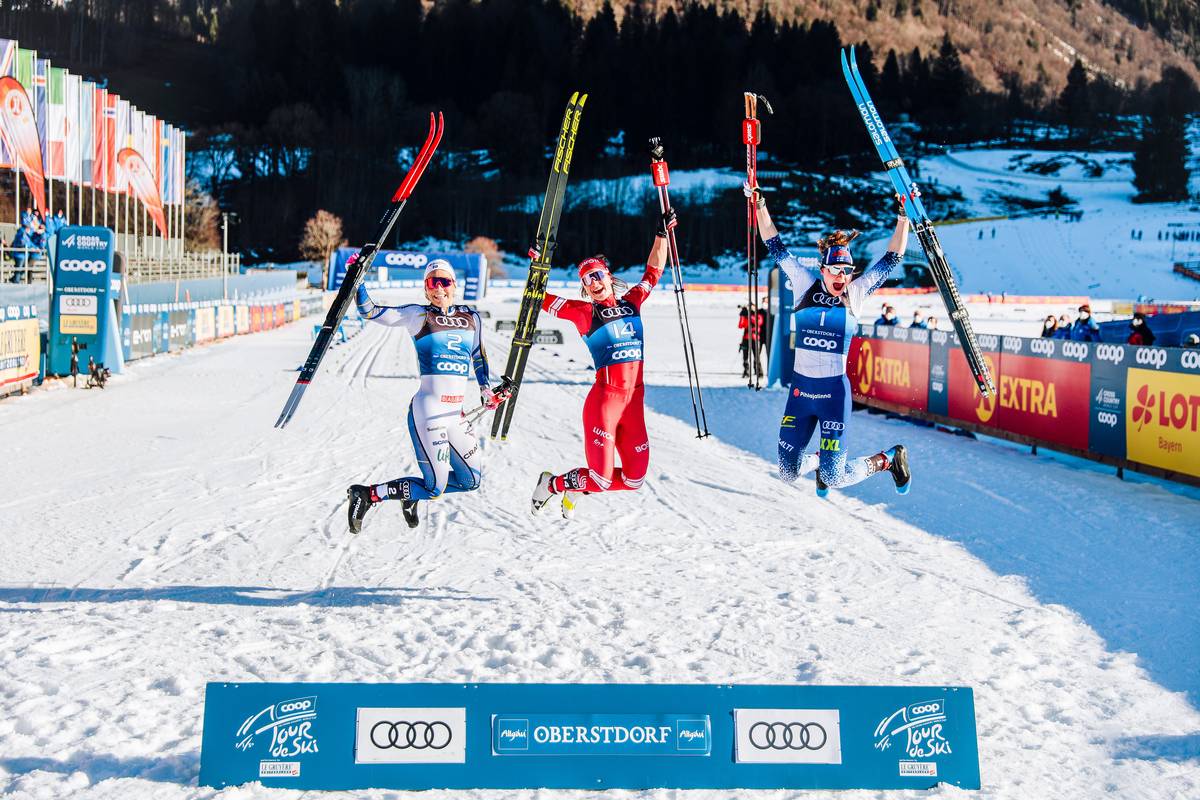
The women’s podium after Stage 4: Natalia Nepryaeva (RUS) took the win ahead of Johanna Hagström (SWE) and Johanna Matintalo (FIN). (Photo: NordicFocus)
This World Cup coverage is made possible through the generous support of Marty and Kathy Hall and the A Hall Mark of Excellence Award. To learn more about A Hall Mark of Excellence Award or to learn how you can support FasterSkier’s coverage please contact info@fasterskier.com.
Every Grand Tour must have a Queen Stage. Dreamt up by organizers, meant to stand at the crux of the race, animate its characters, and start the action towards resolution in the narrative that’s formed over its early stages.
In cycling, these are the iconic places where grand settings meet grand drama – Alpe d’Huez, Mt. Ventoux, or the Angliru. The Queen Stage comes with pomp and circumstance, like a coronation or diamond jubilee.
At this year’s Tour de Ski though, the Queen Stage in Oberstdorf — and this 1.2-kilometer Classic Sprint proved to be just that — was more like a queen’s address to parliament; an agenda laid out for how this Tour will go into its final stages in Val di Fiemme, Italy, negotiated through the tricky rules, regulations, and politics of ski racing on the World Cup.
Alayna Sonnesyn (USA) during qualifying in Oberstdorf at Stage 4 of the Tour de Ski. (Photo: NordicFocus)
Coming into the day, there was a set order in this year’s Tour de Ski overall classification that matches what you would expect if you just watched the races individually. After a Stage 1 victory in the freestyle sprint, and an exciting 10k freestyle victory yesterday, Jessie Diggins (USA) wore the yellow leader’s bib. Below her was Stage 2 winner Kertuu Niskanen (FIN), and then Natalia Nepryaeva (RUS) in third. The time gap between the three, however, was relatively small. Diggins, despite her two wins, only had a 13 second advantage over Niskanen. With time bonuses for the finalists and semi-finalists in the Stage 4 Classic Sprint all well above that threshold — ranging from 60 sec for the winner to 22 sec for the last semi-finalist finisher — the 1.2k loop at Oberstdorf had the potential to animate and transform the overall classification in an instant. And that’s what happened. Call it a Queen Stage.
Kerttu Niskanen (FIN), who started and finished the day in 2nd place in the overall classification. (Photo: NordicFocus)
The day started strong for the Americans, with Diggins qualifying 7th (+3.43) and Katharine Ogden joining her in heats after qualifying 26th (+7.94). Diggins’ two closest rivals both qualified off her pace, with Nepryaeva in 13th (+5.08) and Niskanen in 18th place (+6.10).
Katharine Ogden (USA) powers up the first climb during quarterfinal action. Ogden qualified 26th on the day. (Photo: NordicFocus)
Ogden would meet Nepryaeva in her quarterfinal, where they set out to race a 1.2k sprint course that featured two punctuated climbs, with a technical downhill sweeping to the right in between. Their heat was a fast one, with Ogden establishing herself in the field behind Anamarija Lampic (SLO), then coming off the top of the first climb in fourth place. As the field spread out across the second climb, Nepryaeva came off the top first, with Lampic in tow. When they came out of the downhill into the long, straight, finishing straight, Nepryaeva had the lead, but Lampic showed a fight to regain her 2nd place ahead of Greta Laurent (ITA). In the excitement, Ogden had been left out of the pack slightly, and came across the line in 5th place.
Where this Tour really turned on its head though, was in Diggins’ quarterfinal heat. Lined up against a field that included qualifier winner Johanna Matintalo (FIN), Tatiana Sorina (RUS), and Frida Karlsson (SWE), the heat was a tense affair from the gun. Sorina led out over the first climb, and Diggins successfully jockeyed for position coming out of the first downhill. In the approach to the final climb, a slight left-hand turn became the setting for the defining moment of the day.
As Diggins recounted in an interview with U.S. Ski & Snowboard cross country communications manager Tom Horrocks:
“I was in the track, Frida [Karlsson] was double-poling outside the track, and then moved in on me, so I moved to switch lanes, she switched on top of me, and caused me to fall – which is a huge bummer… that severely impacts my tour.”
Jessie Diggins goes down in her quarterfinal heat. Frida Karlsson (SWE) was penalized for obstruction, but the fall left Diggins in 3rd place overall in the Tour de Ski. (Photo: NordicFocus)
It severely impacted the World Cup season too. Diggins crossed the line in 6th, but before the following heat had hit the first climb the FIS jury had already come back with a yellow-card and disqualification for Frida Karlsson. As a result of it being Karlsson’s second yellow-card of the season, her first arriving in the same event in Ruka back in November, she was also given a 3-minute time penalty in the overall classification for the Tour de Ski.
That calls to question whether the World Cup’s best distance racer this season will continue to race the Stage 5 10k mass start classic in Val di Fiemme or forgo the end of the Tour altogether. While she started the day in 7th place and +45 sec off Diggins, the 3-minute penalty dropped her to 44th place (+4:30).
Despite the penalties against Karlsson, Diggins’ quarterfinal time and placing were unaltered, leaving her out while both Niskanen and Nepryaeva advanced to the semi-finals, where the time bonuses for just finishing automatically exceeded the margin of Diggins’ lead in cumulative time standings. Diggins was awarded a 4 sec bonus for her quarterfinal finish, so a net 18 sec gain was at least guaranteed. In an instant then, two of the World Cup’s most compelling stories this season veered towards drastically off course. Diggins’ title-defense now faces steep odds (and a steep climb in Stage 6). Karlsson finds herself further down in the pack than she has been all year.
The semi-finals then, marked a brave new Tour de Ski.
Natalia Nepryaeva (RUS), Greta Laurent (ITA), Krista Pärmäkoski (FIN), and Ane Appelkvist Stenseth (NOR) (L-R) during their semi-final. (Photo: NordicFocus)
Nepryaeva raced through her semi-final with a tactical approach carried over from the quarters, preferring to stay with the pack led out by Matintalo and Johanna Hagström (SWE), before pushing the last climb and setting herself up for the long double-pole finish – for which she looked stronger than anyone else in the field. She won a semi-final that stayed tight and stayed fast, sending both lucky losers to the final.
Kerttu Niskanen (FIN) in 2nd semi-final. She would finish 5th in the heat, with Anamarija Lampic (SLO) winning to advance to the finals. (Photo: NordicFocus)
Niskanen would line up in the second semi-final. She matched up against Lampic, Laurent and Mathilde Myhrvold (NOR), with the former two looking to lead the race from the gun. By the time they crested the final climb, Lampic had stretched out the field and Niskanen had been caught out the back. She finished fifth in the heat, and didn’t advance to finals. Lampic carried the heat, and Myhrvold came second.
Nepryaeva then, would be playing a game of seconds for the Tour lead. And she would be playing it, skiing the course, like she had all day. Lampic, Hagström and Matintalo formed the front of the pack, while Nepryaeva waited for the last climb to swing out and throw a burst of acceleration that saw her and Hagström come over the top together. As Nepryaeva came out of her tuck on the finishing stretch, the strength of her double pole was on full display. She crossed the finish line first, and with a scream that no doubt will echo all the way to Val di Fiemme to warn that there is a whole new dynamic coming to its courses when the Tour resumes after the rest day tomorrow.
Natalia Nepryaeva (RUS) comes across the finish line to win Stage 4 and take the lead in the Overall Classification at the Tour de Ski. (Photo: NordicFocus)
That new dynamic is a new order. Standings going into Italy: Natalia Nepryaeva in first (53:40.0), Kerttu Niskanen in second (+34.0), and Jessie Diggins third (+38.0).
Johanna Hagstroem (SWE), Natalia Nepryaeva (RUS), Johanna Matintalo (FIN) on the podium in Oberstdorf. (Photo: NordicFocus)
With two stages to ski though, the gaps in this year’s Tour de Ski are nowhere from definitive. When it was alluded that her misfortune may change her tactical approach to the last two stages in Italy, Diggins replied simply, “it’s still full throttle everyday. It has to be.”
Full audio clip from post-race interview with Jessie Diggins, hosted by Tom Horrocks:
The Queen Stage of Oberstdorf may have made its sound and fury, but ultimately this race and its story are far from their conclusion, and it still contains a character in Diggins who has proven so-often that she can make us throw out all of the books.
Jessie Diggins during qualifying at Stage 4 of the Tour de Ski. (Photo: NordicFocus)
After final results were decided, Diggins ended her day in 21st, with Ogden a few places behind in 24th.
Outside the Top-30, the U.S. had strong results in the qualifier. Alayna Sonnesyn finished in 43rd (+14.93), Novie McCabe finished in 54th (+18.45), and Sophia Laukli finished in 61st (+26.87).
Both Hailey Swirbul and Julia Kern have dropped from the Tour, each sharing on social media that they have a cold and are focused on recovery.
Novie McCabe during qualifying at Stage 4 of the Tour de Ski. (Photo: NordicFocus)
This World Cup coverage is made possible through the generous support of Marty and Kathy Hall and the A Hall Mark of Excellence Award. To learn more about A Hall Mark of Excellence Award or to learn how you can support FasterSkier’s coverage please contact info@fasterskier.com.
As we begin Stage 4 of the Tour de Ski, the first classic sprint since the opening race of the season in Ruka, Finland on November 26th, we look back to the last time athletes raced the event on the tracks in Oberstdorf, Germany.
During the2021 World Championships, Johannes Høsflot Klæbo (NOR) took command of the gold medal from the qualifier on a 1.5-kilometer course seemingly designed for his racing style. A quick double pole start from the stadium leads to a long steady first climb where he skied long, strong, and steady, usually in second or third position. After a winding descent, athletes encounter a second short but steep climb of roughly 18 vertical meters, where Klæbo would begin his signature run. Stomping his way to the lead as he crested the top of the climb, stepping around a left-hand curve, and dropping into a tuck on the final descent leading into the stadium, Klæbo was repeatedly in position to advance through each round comfortably, eventually winning the final by several ski lengths. (Video highlights here.)
Alexander Terentev races to second place in qualification during Stage 4 of the Tour de Ski in Oberstdorf. (Photo: NordicFocus)
Winning today’s qualifier in 2:55.78, Klæbo looked to be on track for a repeat victory in Oberstdorf, however, it is worth noting that he did not win the aforementioned other classic sprint this season. In Ruka, it was 22-year-old Alexander Terentev who took hold of the event in qualification and looked to, well, out-Klæbo Klæbo throughout the heats. We saw familiar tactics with a power move on the final climb, paired with impressive acceleration over the final meters to capture the win, but this time, the athlete employing these tactics was in a Russian race suit. While Klæbo has won each of the sprints he has entered since, with Terentev eliminated in the semis, Stage 4 would be a rematch both were eyeing.
Setting the stage, Terentev was second in qualification, +1.5 behind Klæbo, with Erik Valnes (NOR) in third (+2.37), Federico Pellegrino 4th (+3.53), and Alexander Bolshunov 5th (+3.61). Ben Ogden was the top American qualifier today, finishing 15th (+8.08), while Luke Jager finished 24th (+10.83). The American selected heats two and five, respectively.
Johannes Høsflot Klæbo and Erik Valnes take the lead in the final climb of the quarterfinal, with Ivan Yakimushkin (bib 23) and Iivo Niskanen (bib 29) chasing. (Photo: NordicFocus)
In the first wave of the quarterfinal, Finland’s Iivo Niskanen, winner of the Stage 2 15k classic, pushed the pace heading up the first climb, perhaps looking to ensure an opportunity for a fast rather than tactical heat, knowing he was up against Valnes and Klæbo and likely would only have the opportunity to advance as lucky loser. However, the Norwegians, unphased, chose not to respond, waiting patiently mid-pack to use the same tactic described at World Champs. In the second climb, both created enough room to look as if they had begun their cooldown as they skied through the finish lanes, with Klæbo addigng a lackadaisical boot slide at the line that put him just ahead of his teammate. Behind them, Niskanen and Ivan Yakimushkin (RUS) sprinted to the line to chase the clock, with the Russian finishing ahead of the Finn. However, their times did not hold up through subsequent rounds and their day had ended.
Alexander Bolshunov leads the quarter final during Stage 4 of the Tour de Ski, with Ben Ogden racing in bib 15. (Photo: NordicFocus)
In the second heat of the quarters, Ogden lined up alongside Bolshunov, who took control out of the gate. Staying in the pack through the first climb, Ogden found himself in fifth as athletes exited the second and began descending toward the stadium. In the final curves, Ogden couldn’t quite maintain the position needed to contend for a spot as lucky loser, finishing 5th in a fast heat, +1.52 behind Bolshunov.
Terentev looked as though his day might be over before he could face Klæbo head-to-head. Federico Pellegrino (ITA) stepped on his pole as lanes decreased in the opening stretch, causing it to snap. Terentev calmly accepted a replacement, steadily working his way back into the mix. Running out of the tracks in the final climb, Terentev accelerated around the left-hand curve and into the downhill in the lead, continuing through the finish for the win ahead of Mikal Novak (CZE) to advance comfortably.
Alexander Terentev leads his quarterfinal during Stage 4 of the Tour de Ski in Oberstdorf. (Photo: NordicFocus)
In the fifth heat of the quarters, Jager maintained contact with the pack through the first climb, but found himself off the back as he left the second. Jager’s legs wobbled as he found his footing in the descent. Perhaps too flooded to ski as aggressively as was needed to put himself in contention for higher placement, he crossed the line sixth in the heat, +6.88 behind the winner.
Luke Jager raced in the fifth quarterfinal during Stage 4 of the Tour de Ski in Oberstdorf. (Photo: NordicFocus)
On we go to the semifinals.
In a stacked first heat, Bolshunov and Terentev set the pace at the front heading up the first climb. Striding metronomically, they held Valnes and Klæbo temporarily at bay. As the men charged into the final climb, Klæbo advanced at a run up the outside, rounding the left hand bend with Terentev at the front before beginning the sweeping downhill side by side.
Terentev began to move across the track behind Klæbo, looking to finding a line that might be optimal for using the Norwegian’s draft to slingshot into the final lanes at high speed. Not waiting long enough, Terentev caught his tips on the Norwegian’s tails, losing his footing and crashing with a slide into the v-boards. No chance to recover what was lost, Terentev stood up, taking a defeated swing at the ground with his pole, before slowly continuing through the final meters to the finish, now well off the back.
As the two had created a small gap to their chasers, Valnes and Bolshunov navigated around the crash easily, racing to the line for second and third. Pulling ahead with his double pole, Valnes snagged second with Bolshunov less than half a second back, hoping for a lucky loser spot in the final.
With a comfortable lead, Johannes Høsflot Klæbo looks over his shoulder as Erik Valnes and Alexander Bolshunov race to the line in the semifinal. (Photo: NordicFocus)
Terentev later received verbal warning for a classical technique infraction.
In the second and less-eventful semi, Pål Golberg and Even Northug attempted to take control of the race in the final climb, but they remained matched by Italy’s Francesco De Fabiani and Sweden’s Calle Halfvarsson as they crested the top. Goldberg picked up the most speed in the descent, accelerating out of the final curve with a sizable gap to his three chasers. Laying off the gas before the line, Goldberg took the win ahead of Northug, who left De Fabiani and Halfvarsson fighting for lucky loser spots on his tails.
Calle Halfvarsson and Fracesco de Fabiani take it to the line in the semifinal. (Photo: NordicFocus)
De Fabiani and Halfvarsson crossed in a photo finish, both just 0.02 seconds ahead of Bolshunov’s mark, allowing them both to advance to the final and ending the Russian’s day.
With four Norwegians in the final, they were guaranteed at least one spot on the podium.
Norway were 1-2-3 coming out of the first climb, with Klæbo sitting in second position. Doublepoling into the next climb, Klæbo matched Valnes as the two ran at the front, Klæbo out of track and Valnes in the inside lane.
Johannes Høsflot Klæbo leads into the final descent in the last round of the Stage 4 classic sprint in Oberstdorf. (Photo: NordicFocus)
Klæbo accelerated into the curve at the top stepping in front of Valnes and leading him into the downhill. Klæbo powered into the final stretch still in the lead, with Valnes a ski length back but closing fast with a strong doublepole. Valnes changed lanes, knowing it was his only opportunity if he wanted to try for a win, but there was not enough real estate left and this cost him speed as they came to the line. No time to celebrate this time, Klæbo pushed his boot over the finish to stop the clock at 2:54.77, roughly 3.5 seconds faster than any other rounded, with Valnes 0.3 seconds back for second place.
Johannes Høsflot Klæbo takes the win in Stage 4 ahead of teammate Erik Valnes, while Pål Golberg, Even Northug, and Calle Halfvarsson fight for the final spot on the podium behind. (Photo: NordicFocus)
Behind the duo, the remaining two Norwegians sprinted to the line for a photo finish, with Goldberg edging out Northug for third by just 0.02 seconds. Halfvarsson, still in contention for the podium in the final stretch, crossed 0.5 seconds behind the Norwegians to end his day in 5th, while De Fabiani seemed to have accepted his fate, crossing the line casually +11.71 behind Klæbo.
Determining third place, Pål Golberg (center) edges out Even Northug, wit hCalle Halfvarsson just off the mark in fifth. (Photo: NordicFocus)
Another all-Norway classic sprint podium in Oberstdorf, and a second consecutive win for Klæbo.
“It’s amazing to start a new year with a victory and also to have two of my best friends coming onto the podium as well,” Klæbo told FIS at the finish. “I am really satisfied with today’s race, and also to start, hopefully, a good new year.”
After four races in five days, Klæbo was asked whether Tour fatigue had begun to set in.
“For sure, I am getting a little bit tired, but still, when the weather is like this and the conditions are pretty nice, it gives you a lot of energy. So it’s just trying to push hard, looking forward to a rest day tomorrow, and trying to push hard in the last two legs.”
The all-Norwegian men’s podium after Stage 4 of the Tour de Ski: Johannes Høsflot Klæbo took his fourth win of the Tour ahead of Erik Valnes in second and Pål Golberg in third. (Photo: NordicFocus)
After the final results were determined, Ogden ended his day in 22nd.
“I took the qualifier out really hot, hoping to be in the top 3 in qualification,” Ogden told U.S. Ski & Snowboard cross country communications manager Tom Horrocks at the finish. “I was a little flooded at the end, but not the end of the world. I chose heat 2, which is not always what I do, so I tried something different, and I think I skied well in the heat. It’s been a lot of racing for me early, so I’m a little tired, and wasn’t the smartest out there… but I’d say I’m learning a lot and making progress, so one day I’ll put it together.”
Full audio clip with Ben Ogden, interviewed by Tom Horrocks.
Ben Ogden races in heat 2 of the quarterfinals in Oberstdorf. (Photo: NordicFocus)
It was Jager’s second time qualifying for the rounds in a classic sprint, and his second-best overall World Cup result. Jager was 18th in the opening classic sprint in Ruka, and finished 27th today.
“I was trying to be competitive, in second, third, or fourth, somewhere where I could potentially get in a draft and have a good finish, hopefully,” Jager told Horrocks post-race. “It didn’t work out that way… Hindsight is 20/20, so maybe I wish I had picked a different lane and just gotten out and ran earlier, but at the end of the day, the pace was just really, really fast. I was and am, chronically and acutely, pretty tired right now, so I just didn’t really have it and wasn’t as aggressive as I should have been going over the top. I like to think if I had another shot in that exact same position, I could make fourth or fifth, but an objective qualification in that [heat] probably wasn’t going to happen for me today.”
Luke Jager races to 27th in Stage 4 of the Tour de Ski in Oberstdorf. (Photo: NordicFocus)
Looking to the bright side, Jager expressed how grateful he has been to have had excellent skis in every race he’s competed this season, which provides confidence even on the days when the body doesn’t want to cooperate. At 21-years-old, Jager’s career is still nascent, and it’s easy to understand how progress at this level may not be linear.
“I’m super thankful for the opportunity [to race on the World Cup this season]… It feels often like it’s one step forward, four steps backward over here, just because it’s so brutal. The last month, especially, has been pretty tough and pretty demoralizing at times for me. I’m going home today, so it’s pretty nice to end with a glimmer of hope for what is to come. It’s the real deal. Sometimes it’s easy to forget that because so many Americans are doing well, but it’s pretty damn hard over here.”
Full audio clip with Luke Jager, interviewed by Tom Horrocks.
Kevin Bolger races to 33rd in qualification during Stage 4 of the Tour de Ski in Oberstdorf. (Photo: NordicFocus)
Outside the Top-30, Kevin Bolger and Zak Ketterson were just shy of making the heats, finishing 33rd (+13.10) and 34th (+13.39), less than a second off the time needed to advance. Logan Hanneman was also a near-miss, finishing 37th (+14.08). Gus Schumacher rounded out the American starters in 45th (+16.51) of 73 starters.
Looking at the overall Tour de Ski standings with four of six stages complete, Johannes Høsflot Klæbo tops the list for both cumulative time and points after winning three of four events. By time, he sits 1:03 ahead of teammate Pål Golberg and 1:19 ahead of Alexander Bolshunov. With a 15k mass start classic and 10k freestyle hill climb to go, Klæbo is in good standing, but cannot be complacent, as the hill climb, in particular, has historically favored Bolshunov.
By points, which favor sprint stages and intermediate sprints in distance races, Klæbo leads with 81 points ahead of Erik Valnes, who holds 50, and Goldberg with 41.
After a rest and travel day, racing continues Monday in Val di Fiemme, Italy.
With three wins in four stages, Johannes Høsflot Klæbo leads the overall Tour de Ski standings by both cumulative time and points. (Photo: NordicFocus)
An aerial view of the icy track in Oberstdorf, Germany, where winter looks to ebb and flow. (Photo: NordicFocus)
This World Cup coverage is made possible through the generous support of Marty and Kathy Hall and the A Hall Mark of Excellence Award. To learn more about A Hall Mark of Excellence Award or to learn how you can support FasterSkier’s coverage please contact info@fasterskier.com.
Traveling Northeast from Lenzerheide, Switzerland to Oberstdorf, Germany, home to last year’s FIS World Ski Championships, athletes lined up for Stage 3 of the Tour de Ski for a mass start 15-kilometer skate. Once again encountering conditions altogether different from those in the previous stage, the tracks in Oberstdorf were lightning fast, and icy, with bare earth scarring the landscape between the ribbons of white.
Given the conditions and the winding nature of the 3.75k loop, there was little separation in the first three laps of the four-lap race. Johannes Høsflot Klæbo (NOR) and Alexander Bolshunov (RUS) surged to the front to collect the Tour bonus points at the 4.4k checkpoint, with Klæbo keeping putting in just enough effort to slide his boot over the line 0.3 seconds ahead of the Russian’s, earning them 15 and 12 points, respectively. Ivan Yakimushkin (RUS) was next in line at the checkpoint for 10 points, followed by Pål Golberg (NOR) for 8, and Calle Halfvarsson (SWE) for 6.
The pack stayed tight through the first two laps of the men’s 15k freestyle mass start in Oberstdorf, Germany. (Photo: NordicFocus)
Once the checkpoint was crossed, the men stood up, returning to a calm and relaxed state at the front of a massive pack of racers with little opportunity, or need, to break away just yet. Given the density of skiers on the course and the speed of the track, downhills were taken with care, with the leaders standing up, putting arms to the sides to indicate they were all on the same page – take it easy, keep everyone’s equipment intact, no unnecessary crashes.
The leaders wind through icy curves as they descend toward the stadium in Stage 3 of the Tour de Ski in Oberstdorf. (Photo: NordicFocus)
This theme continued through the third lap, where the race for the podium finally began.
At 9.6k, just 12 seconds separated the top 30, who moved like a slinky through the woods, compressing on the climbs, stretching on the descents. Repeat, repeat.
However, by 12k, five men had dropped the masses, and by 13.4, this had dwindled to three. Led by Klæbo in the yellow bib, Bolshunov, Sjur Røthe (NOR), and Andrew Musgrave (GBR) quickly gapped the field to fight for the podium.
Alexander Bolshunov (RUS) leads Andrew Musgrave (GBR) and Johannes Høsflot Klæbo (NOR) as the leaders begin to break away in the final lap. (Photo: NordicFocus)
While one might expect Klæbo in such conditions to wait until the final meters to show off his acceleration, he started his kick much further out, pushing into the final descent and trusting his ability to race the following icy curves. Though his chasers began to catch him as they navigated tight bends that led into the stadium, Klæbo hop-skated over the final roller and held the others at bay, skiing into the finish lanes with plenty of space to earn a clear victory.
Racing all the way to the line, Bolshunov pushed to claim second place (+3.4) with Røthe securing the final podium spot just behind in third (+4.0).
Johannes Høsflot Klæbo (NOR) powers to the line for the win in Stage 3 of the Tour de Ski, while Alexander Bolshunov (RUS) and Sjur Røthe (NOR) fight to the line for second and third. (Photo: NordicFocus)
Lacking the closing speed for a podium spot but still putting together a season-best day, Musgrave closed for 4th (+5.6). Perhaps well-suited to the style of racing in Oberstdorf, the Brit had been tenth in the event on the same tracks during last year’s World Championships in similar conditions. The 2021 World Championships 15k free had an all-Norwegian podium, led by Hans Christer Holund, Simen Hegstad Krüger, and Harald Østberg Amundsen, with Bolshunov disappointed at the line in 4th, and Røthe nearly a minute off the lead in sixth.
Johannes Høsflot Klæbo (NOR) welcomes teammate Sjur Røthe (NOR) across the line in third, while Andrew Musgrave (GBR) takes fourth. (Photo: NordicFocus)
“It was a wee bit annoying to let a podium finish slip through my fingers on a day when I was feeling good and had amazing skis,” wrote Musgrave in a post-race email to FasterSkier. “It was definitely nice to be back racing better after a very tough start to the season though!”
Musgrave continued with a comment on a start to the season he deems sub-par, ending with some optimism.
“I’ve had a rough season so far, struggling to take World Cup points, and just generally not feeling in form. I took a week completely off training between Lillehammer and Davos, and that seems to have got me back on track.”
Though from afar, the race looked congested with the field of men staying tightly grouped through the first 11k, Musgrave painted a different picture, speaking to his approach to the course in fast conditions.
“The race today was a bit less chaotic than I thought it might be. With such fast, icy conditions I thought there would be a big group still together sprinting for the win at the end. My plan was to keep as far forwards as possible, to avoid any falls that might happen in the pack. It ended up being a good call- the group ended up splitting up quite a bit on the technical, icy downhill. I was far enough forward to keep myself on the right side of any gaps that opened up.”
Though just-shy of the podium, Andrew Musgrave (GBR) looked thrilled with his season-best fourth place result in Oberstdorf. (Photo: NordicFocus)
As for Klæbo, today marks his 47th World Cup victory, tying the legendary and notorious Petter Northug, but remarkably, only his second win in a freestyle distance event. His last win in the 15k skate also took place in Oberstdorf, during the 2018/19 Tour de Ski. Of his five wins in the 15k classic, four have taken place in mass start races.
“The first round was pretty slow, then on the third lap it was starting to pick up a little bit,” Klæbo told FIS of his strategy after the race. “I was trying to be near the front today, the downhills were pretty sketchy. For the finish, I didn’t want to take the chance to be [second] in the last turn there, so I went for it.”
The men’s podium of the 15k mass start freestyle in Oberstdorf: Johannes Høsflot Klæbo (NOR) took the win ahead of Alexander Bolshunov (RUS) in second and Sjur Røthe (NOR) in third. (Photo: NordicFocus)
Asked what was the determining factor in the race, and where he found his advantage, Klæbo affirmed his plan of making a move on the winding downhill in the last kilometer.
“I was just trying to push really, really hard in the downhill, and just come through the downhills [safely] because, like I said, it was pretty sketchy.”
Surviving amongst the masses, Gus Schumacher led the American men, breaking into the top-30 to place 25th (+53.3) on the day. Bouncing back from a cold that he feels has impeded him in the first two stages, Schumacher explained he is feeling stronger and more energetic by the day, contributing to his improvement from his first two finish positions.
“[It was] super icy, and I was a little nervous about the dynamics of the first mass start of the year,” Schumacher told U.S. Ski & Snowboard cross country communications manager Tom Horrocks on-site after the race. “But the guys at the front were pushing the pace well enough that it sort of strung out, so it was actually fairly good skiing, except for some of those corners where you’d toss it into a power slide and just keep going forward.”
Gus Schumacher navigates an icy downhill amongst a pack of men, each looking to stay upright with equipment intact through the race. (Photo: NordicFocus)
Though he felt the pace was faster than it appeared from the live stream, he acknowledged that the pack did begin to spread significantly over the final lap and a half, which he identified as an “ideal mass start” situation for him in most circumstances.
“As it strung out, I didn’t quite have the gas that I’ve had before to keep jumping up to the next person, but I think it went well.”
Full audio clip from post-race interview with Gus Schumacher, hosted by Tom Horrocks.
Just off the mark for Top-30, Zak Ketterson skied to 36th (+1:02.6), just 5 seconds shy of 30th. As this year’s Tour de Ski are the first World Cup starts 24-year-old Ketterson has earned, this result marks an international career best at the senior level. Having been pulled up to the World Cup as SuperTour leader following the opening races in Duluth, MN and Cable, WI, the Team Birkie athlete is using this opportunity to vie for a widely-desired sixth spot for American men, which currently is not guaranteed to exist, on the 2022 Olympic team.
“I’m really happy with that. The goal for anyone is to be in the top-30, that’s just the first stepping stone, so for me to be close to that, it’s kind of a dream come true,” Ketterson told Horrocks post-race. “Especially with some rough races at the start of this Tour, it’s nice to have some positive feedback.”
Chaos and carnage at the finish line as athletes chase the final spots in the Top-30. Gus Schumacher, who was 25th, is out of focus in the top right. (Photo: NordicFocus)
“What’s led to me performing my best in the past is just to focus on things I can control and just the process,” Ketterson explained in response to how he is mentally handling these circumstances. “I think that’s what got me here from the SuperTour, I didn’t think about trying to be in the top SuperTour spot, I just thought, ‘Let’s have a good race, and if that gets me where I want to go, great. If not, that’s life.’ So I just try to give myself the best chance everyday and the rest takes care of itself.”
Full audio clip from post-race interview with Zak Ketterson, hosted by Tom Horrocks.
Ben Ogden was the next American in 64th (+1:59.0), crossing the line with his teammate, Kevin Bolger, in 65th (+2:00.4). Luke Jager skied to 70th (+2:19.7), while Logan Hanneman rounded out the men’s squad in 75th (+3:54.1).
Ben Ogden races Stage 3 of the 2021/22 Tour de Ski in Oberstdorf. (Photo: NordicFocus)
Looking to the overall Tour standings, with a one-minute time bonus for his sprint win, coupled with 4th in the 15k classic and a second win today, Johannes Høsflot Klæbo leads the overall standings by both time and points. By time, he is 45 seconds ahead of his teammate Pål Golberg, with Bolshunov moving into third with a 47 second deficit. By points, Klæbo has earned double that of the next athlete with 51, followed by teammate Erik Valnes with 26, and Bolshunov with 24.
Racing continues tomorrow with a classic sprint, where Klæbo will again be a favorite. Quarterfinals begin at 12:00 CET / 6:00 EST.
Johannes Høsflot Klæbo (NOR) out for a training ski after arriving in Oberstdorf, Germany. (Photo: NordicFocus)
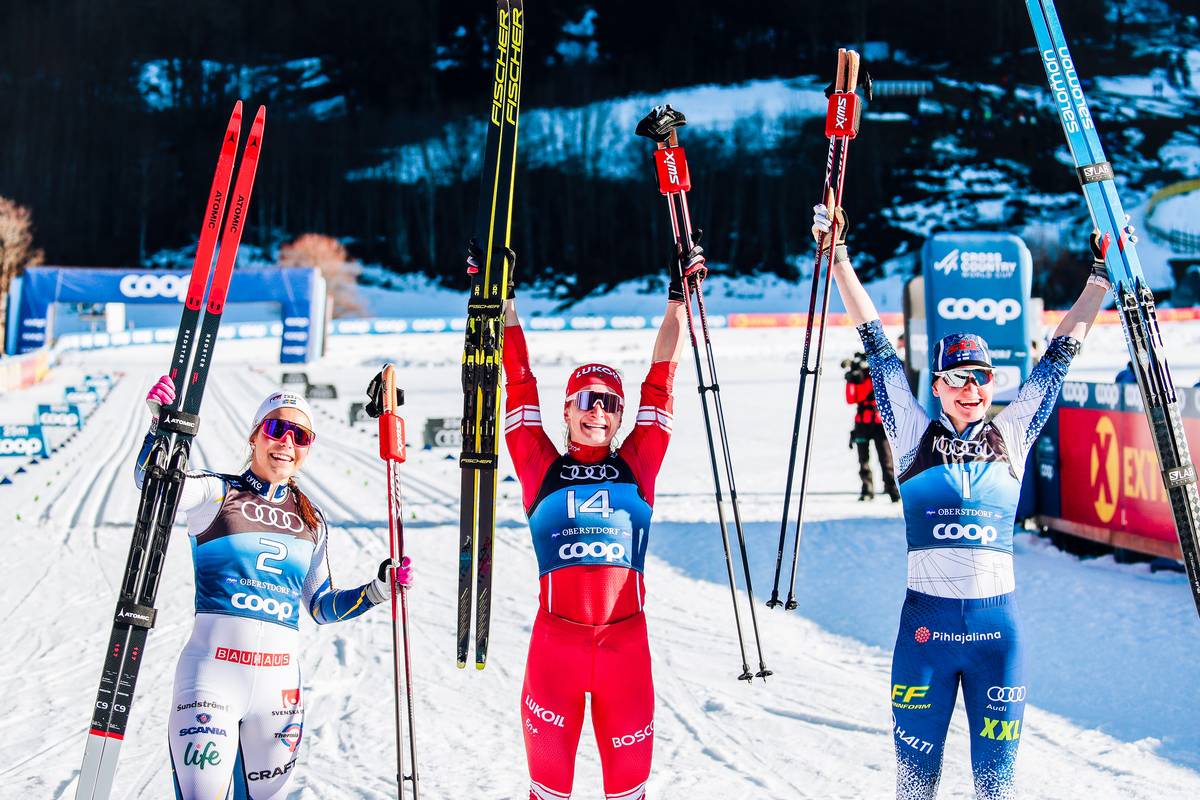
The speedy women of Oberstdorf. Natalia Nepryaeva (RUS) won the classic sprint ahead of Anamarija Lampic (SLO) and Jessie Diggins. (Photo: NordicFocus)
Onward and upward. Day two in Oberstdorf, Germany featured a 1.5-kilometer classic sprint with three sharp toothlike climbs. Seemingly riding the edge of their capability inside the tracks, athletes pumped their way up each pitch before wrapping around a bend and descending an equal grade back toward the stadium.
Wolf jaw or race course? The Obesrtdorf sprint loop in profile. (Photo: Screenshot FIS Broadcast)
After what Matt Whitcomb called an “off day”, the Americans demonstrated their ability to rebound. To not let the sensations or disappointment from one day percolate into subsequent races. Onto the next.
This was clearly demonstrated in the qualifying round: three, four, nine, eleven. Diggins was the fastest of the crew finishing 2.24 seconds behind top qualifier Natalia Nepyaeva of Russia, who stopped the clock at 3:38:08. Diggins was 0.8 seconds behind Anamarija Lampic of Slovenia, who won both sprint events, skate and classic, during the Tour de Ski, and took second the weekend after the Tour in the freestyle sprint in Dresden. Lampic also popped the second fastest qualifying time of the day.
Sadie Maubet Bjornsen nearly matched Diggins time in fourth (+2.35), followed by Sophie Caldwell in ninth (+5.38), and Rosie Brennan in eleventh (+5.90). The only other country to put three athletes in the top ten was Norway, a testament to the strength of the American women on a day where our expectations meet reality.
Striding it out in Oberstdorf, Caitlin Patterson skis to 61st in the qualifier. (Photo: NordicFocus)
Also starting for the U.S., Caitlin Patterson took 61st (+24.18), and Alayna Sonnesyn finished 66th (+26.7).
In the quarterfinals, Maubet Bjornsen wore the lowest bib number in the first heat, which is curious as this is often the choice of the top two qualifiers (see Diggins comments on heat selection below). Maubet Bjornsen took second in a tight finish with Lotta Udnes Weng and Astrid Uhrenholdt Jacobsen of Norway, moving with Weng into the first wave of semis.
Caldwell won the third heat of the semis in a photo finish with Ane Appelkvist Stenseth of Norway. Brennan was eliminated after finishing fourth in the fourth heat to finish 16th for the day, a top result in the event.
“Sprint is always such a bitter sweet event for me,” Brennan emailed. “While today was the best classic sprint of my career, I still felt that I made some mistakes and didn’t ski as well as I felt. The course here is long and has some good striding which I was really excited about. I know there are probably some sprinters that aren’t excited about the length but I felt the course did a good job of including all kinds of skiing and really rewarding good skiers. I am really happy with my feelings and for sure have a little list of things to work on moving forward.”
Diggins charged full gas through the fifth heat of the quarters for the win, beating out Sweden’s Linn Svahn who advanced alongside her.
Jessie Diggins leads Sweden’s Linn Svahn during the quarterfinal in Oberstdorf. (Photo: NordicFocus)
In the first semi, Caldwell and Maubet Bjornsen took it out with the leaders, matching Nepryaeva’s long powerful bound up the climbs and the speedy out-of-the-track tempo of Anna Svendsen of Norway. Coming into the final downhill, Svendsen, Nepryaeva and Caldwell pulled ahead, creating a small gap to the remaining women. Caldwell held her tuck longer than the other women, collecting herself for a spicy double pole sprint to the finish. Sliding across the line at the heels of Nepryaeva, Caldwell stayed ahead of the Norwegian to take second in the heat. Maubet Bjornsen finished fifth between Nadine Faehndrich of Switzerland and her opponent from the quarters, Weng.
“It was one heck of a thrill out there today on the courses for next year’s World Championships,” wrote Maubet Bjornsen in an email to several outlets. “This is certainly one of the hardest sprint courses I have sprinted on, but I really enjoyed it! My legs felt a lot stronger than last weekend, but still not quite recovered enough to put together the race I was dreaming of today. Finishing 9th is still and achievement, but I know I am capable of more when I have my full strength.
“My tactic today was to race at the front of the group, even if it required a bit more energy, because then I knew I wasn’t going to get stuck behind anything. I always feel most confident skiing that way. In the final climb of the semi’s, I think I paid the price a bit.”
Sadie Maubet Bjornsen matches Astrid Uhrenholdt Jacobsen (NOR) up the climb in Oberstdorf. (Photo: NordicFocus)
Striding hot out of the gate, Diggins also held a position at the front, matching Lampic, who dictated the pace, up the climbs and tucking into her draft on the descents. On the last and longest climb, Diggins was overtaken by Svahn and Heidi Weng of Norway and she was unable to regain her position on the subsequent downhill. Though her tempo was faster than her opponents in the final double pole sprint, she finished fourth. As her time would have won the previous heat, Diggins and Svahn advanced with Lampic and Weng as the lucky losers.
Again taking the reins from the start-beep, Lampic surged to the front of the group and stayed there, though she could not drop the strong group of women in her wake. Up the final climb, Nepyaeva matched Lampic stride for stride, her long powerful pushes keeping her alongside the Slovenian’s green and black suit.
Like a slingshot, Nepryaeva sped around Lampic as they rounded the final curve into the straightaway. The duo duked it out double poling in perfect synchrony, but Lampic recovered no ground on the Russian. Nepraeva stopped the clock at 3:27:08, the fastest split of the day.
Down to the final meters, Natalia Nepraeva (RUS) and Anamarija Lampic (SLO) sprint to the line with two Americans on their heels. (Photo: NordicFocus)
Winning by centimeters, Natalia Nepryaeva (RUS) celebrates her accomplishment. (Photo: NordicFocus)
Racing for the last podium position, Diggins and Caldwell flew into the final straight in neighboring tracks, with Svahn not far behind. Firing on all cylinders, Diggins pulled ahead of Caldwell to take third by just over a second (+2.44). After being left behind by the Americans, Svahn finished fifth (+5.16), followed long after by Stenseth (+30.20). The Norwegian had fallen off the pace midway through the round, ceding her chances to contend with the pack.
Jessie Diggins takes third in Oberstdorf, with Sophie Caldwell just behind. (Photo: NordicFocus)
Two up, one down. Anamarija Lampic (SLO), Natalia Nepyaeva (RUS), and Jessie Diggins celebrate their top results in Oberstdorf. (Photo: NordicFocus)
Due to poor WiFi connection, athletes chose to send comments via email. Reflecting on her performance, Diggins expressed that she “loved” the long sprint course.
“You had time to try out different tactics and that last hill saw some moves, for sure. We had awesome skis today so I was able to use a little bit of a slingshot to get into good position in the finishing lanes, and I just worked to stay smooth and calm in the first half, while looking for openings to get into better position.”
Diggins explained that heat selection is variable, and did not feel today’s variance from a usual bracket was explained by the length of the course. Her choice to race in the fifth quarter and second semi were based simply on her perception of the opportunity to advance.
“I chose the latter heat because it was wide open, and seemed to be a good path forward out of the quarters. But you never know how it’s going to go, and I was happy to secure lucky loser time in the fast semifinal!”
Gasping for air after an effort Diggins can be proud of in Oberstdorf. (Photo: NordicFocus)
After finishing 22nd in the skiathlon, some might question from the comfort of their couches whether Diggins is on the same form that we have seen in previous years. As was discussed with Matt Whitcomb, “success breeds expectation.” We expect to see Diggins at the top of the results sheet day in and day out, and that pressure can creep into an athletes self-expectation as well. When asked how she handles this, Diggins explained that she does not dwell on what is on the paper or posted in the comments.
“That’s a great question about handling expectations and pressure…and my plan for that has always been to set really concrete process-oriented goals, work as hard as I can to meet them, and then regardless of the result on paper I can decide if it was a “good” day for myself or not based on my effort, focus, technical progress and strategy.”
In her post-race remarks, Caldwell offered an insightful perspective that took into account her strengths as a sprint specialist versus an all-arounder like Diggins or Maubet Bjornsen.
“This sprint was definitely one of our longest ones, and for sure the longest one of the year. I think it’s really exciting to have varying sprint courses throughout the year and this is about as far from the Dresden course as you can get. I used to think short and flat suited me best, but now I don’t really know what I like, especially for classic, but I try to be excited for any kind of sprint so I don’t count myself out before it begins. That said, I do think that there are already a lot more distance races than sprints, so when it gets much over 3 minutes, it’s starting to favor distance skiers more, which is fine to do sometimes, it’s just too bad when there are already so few sprints if too many of them start getting really long. But I personally really enjoyed the course and the race today. I don’t think it’s too much different for recovery for me whether the course is 3 mins or 3:30, but I think for the men it is probably harder because if they’re in the second half of the bracket, they have a lot less recovery. I usually just try to move around until I’ve flushed my legs out and then relax for a little bit and then start moving around again before my next heat!
“Today was a really awesome day for our team. I was psyched to make my first classic final in years, and I think only my third ever. I’ve now had three 4th places in the last four races, which is a little bittersweet, but it’s important to remind myself that 4th is still a really strong result, especially in a tough classic sprint. It was great to ski with Sadie in my semi and I know she’s bouncing back from giving her all in the tour, but is getting stronger each day and a good result today is a huge step in the right direction. And Jessie was on fire all day and it was awesome to see her get another classic podium. So really fun to have such a strong day for our women and even though it was a tough day for the guys, I know they will be fighting back in Falun!”
Sophie Caldwell skis to 4th place in Oberstdorf. (Photo: NordicFocus)
Between the city sprints in Dresden and today’s event in Oberstdorf, Caldwell headed to Austria for an altitude camp. She explains the role this plays in balancing training and recharging, and how the sprinters use an altitude stint to build fitness without losing their top end speed.
“Simi and I just took a little break in Seefeld during the distance weekend in Nove Mesto and it’s was really nice both physically and mentally. The schedule this year is very demanding, with almost no weekend off, so we felt it was important to find in a couple times to work in a break, remove ourselves from the World Cup, and take some time for ourselves. I was really tired right after Dresden and didn’t realize it until I allowed myself to take a break, so it was nice to have a few days of true recovery and then I felt I was able to train really well for 9 or 10 days before coming here. Seefeld is at mild altitude, but I think it’s only at 3,700 ft, so as long as I keep my easy skis easy, I don’t feel too many effects of altitude and don’t worry about not being sharp when coming down a little in elevation.”
Maya Macisaac-Jones posted the top qualifying time for Canada in 35th. (Photo: NordicFocus)
Racing for Canada, Maya Macisaac-Jones posted the top qualifying time in 35th (+14.28), followed by Dahria Beatty (+15.79), Katherine Stewart-Jones in 50th (+18.58), and Katherine Weaver 65 (+26.08).
The men’s podium in Oberstdorf, Germany. Alexander Bolshunov (RUS) took the win in the 30 k skiathlon ahead of Norway’s Simen Hegstad Krüger and Sjur Røthe. (Photo: NordicFocus)
And the World Cup beat goes on. Nearly 70 men lined up in Oberstdorf, Germany for a 15/15-kilometer skiathlon, battling across techniques in front of a Bavarian Alp backdrop. The venue will be the home of the 2021 FIS Nordic World Ski Championships.
The 3.75 k course in Oberstdorf featured a variety of terrain, with the Burgstall hill climb bringing athletes to the high point of the course. To increase the pulse in the long race, four rounds of 15 World Cup bonus points were available at the 6.2, 9.9, 21.2, and 24.9 kilometer checkpoints in addition to those awarded to the top 30 athletes at the finish.
Russia’s Alexander Bolshunov looked to repeat his skiathlon victory in Lillehammer, preserving his position at the top of the distance standings and becoming the third athlete to win multiple skiathlon events in a season. Norway’s Martin Johnsrud Sundby did this in 2015/16 and Germany’s Tobias Angerer did so in 2005/06. Piggy backing on his back-to-back wins in Nové Město, a skiathlon win for Bolshunov would mark a third consecutive win.
And they’re off! Skiers take to the course in Oberstdorf for the 30 k skiathlon. Johannes Høsflot Klæbo (bib 3) dropped from the race during the classic leg. (Photo: NordicFocus)
Iivo Niskanen (center, bib 2) sets out to lead the classic leg of the 30 k skiathlon in Oberstdorf. (Photo: NordicFocus)
However, it was not the Russian that took the reins off the line. It was the Finns. In particular, Iivo Niskanen who has historically proven his capacity in distance classic events and more recently demonstrated his ability to skate with the best in the world. Niskanen led at nearly every checkpoint over the first 10 k, taking the maximum points at both 6.2 and 9.9 k.
Then things began to change. Bolshunov led at the exchange with a train of Norwegians on his heels. Sjur Røthe, Simen Hegstad Krüger, Hans Christer Holund, and Sundby, who had all taken a conservative approach to the classic leg, were now within 3.5 seconds of the Russian. Fading quickly from his position at the front, Niskanen sat nearly 30 seconds back in 9th.
A Norwegian power train in the 30 k skiathlon in Oberstdorf. (Photo: NordicFocus)
Up the hill and around the bend, Hans Christer Holund (NOR) leads Martin Johnsrud Sundby (NOR) and Andrey Larkov (RUS) during the 30 k skiathlon in Oberstdorf. (Photo: NordicFocus)
And so it was through the next wave of bonus points at 21.2 k. Røthe took the full 15, with Krüger, Bolshunov, Holund, Andrey Larkov (RUS), and Sundby close behind.
Rebounding from his large deficit, Niskanen had slashed his gap in half and was continuing to catch the lead pack. He rocketed his way back to the front by the 24.9 k checkpoint, collecting another 15 bonus points before being swallowed once more by the group.
Rebounding from a deficit, Iivo Niskanen closes the gap to the lead group in the 30 k skiathlon in Oberstdorf. (Photo: NordicFocus)
With just over a kilometer to go, the top seven men were separated by less than four seconds. The pack included the four Norwegians, two Russians, and Switzerland’s veteran Dario Cologna.
Taking the lead on a downhill and holding it on the final climb over a bridge just before the stadium, Bolshunov made his move. With Røthe and Krüger in hot pursuit, the 23-year-old Tour de Ski Champion powered down the final stretch to stop the clock at 1:13:40.6. Krüger took the next podium spot (+0.9), followed by Røthe in third (+1.2).
Alexander Bolshunov sprints for the win in the 15/15-kilometer skiathlon in Oberstdorf, Germany. (Photo: NordicFocus)
Bolshunov strikes again in the 2020 15/15-kilometer skiathlon in Oberstdorf, Germany. (Photo: NordicFocus)
“I’m very happy to win today on the course in Oberstdorf which will be used next year in the World Championship,” Bolshunov told FIS at the press conference through a translator. “The course became much more difficult and more interesting to compete on. For sure, we will see how it will be next year.”
When asked how he worked with the group that emerged at the front, Bolshunov responded, “It was [my] own race.”
“Cat and mouse.” Sjur Røthe (bib 4) chases Alexander Bolshunov’s yellow bib during the 30 k skiathlon in Oberstdorf. (Photo: NordicFocus)
“He really played a little [with us],” Røthe told NRK about Bolshunov’s tactics. “There were four mice against a cat out there.”
Just off the podium, Sundby took home the wooden medal with 4th place (+2.5). It is the 35-year-old’s best result of the season, though he has been unable to do much racing due to a back injury. In fact, Sundby’s last result came in early December in the skiathlon in Lillehammer, where he took 5th. Sundby has won three skiathlon events in his lengthy career, and holds the rare statistic of earning a spot on the podium in 12 seasons, the third-most of any World Cup athlete.
Martin Johnsrud Sundby (NOR) takes 4th in the 30 k skiathlon in Oberstdorf. (Photo: NordicFocus)
Johannes Høsflot Klæbo and Emil Iversen left us scratching our heads. After a poor start to the classic leg, both athletes dropped out. Klæbo’s DNF dropped him from third to fifth in the distance standings, though he remains in second place in the overall, trailing Bolshunov by 299 points.
“I do not know,” Klæbo told NRK, according to a translation. “It’s been a long time since I felt as bad as today. It was really just the whole day and nothing that felt particularly good. If I can’t fight for the top 30, then there is no point going around here.”
Iversen gave NRK a similar explanation.
David Norris skis to 28th in the 30 k skiathlon in Oberstdorf. (Photo: NordicFocus)
The sole American finisher David Norris landed inside the points in 28th (+2:01.0). The Fairbanks native hovered around this top-30 position throughout the race, reaching a peak placement of 20th place at the 9.9 k checkpoint.
“My plan going into the race was to use the classic leg to put myself into good position for the skate,” wrote Norris in an email. “You never know how your body will feel 15 or 20 km’s later so you have to risk it a little. I was happy with my classic skiing and I had moved up into a group on the last lap of the classic which was roughly positions 15 – 22. Unfortunately, over the top of a hill my klister iced up and I fell. That moved me back a few groups to about position 32. Overall my skis were very good, but the snow was variable and the tracks were breaking down.
“In the skate leg I intentionally kept a little in reserve during the first 10km trying to ensure I’d have some energy in the last 5km. I slowly worked up through some guys and felt really strong throughout the skate.”
Norris expressed that the techs did a great job selecting skis and choosing wax given the variable conditions in Oberstdorf. He added that he feels good about the performance and his sensations on course, though he has not felt this way leading up to the event.
“I feel fit. It has been odd that in training I don’t feel very good – tired and kind of flat, but I’m feeling pretty strong the past couple of races. In the skate leg I intentionally kept a little in reserve during the first 10km trying to ensure I’d have some energy in the last 5km. I slowly worked up through some guys and felt really strong throughout the skate.”
Ian Torchia on course during the 30 k skiathlon in Oberstdorf. (Photo: NordicFocus)
Ian Torchia also began the race but did not finish. He was one of seven men to drop from the race. An additional three were lapped and therefore pulled from the competition.
“I felt very bad out there today,” emailed Torchia. “I started flooding very early on while moving backwards in the pack. Very confusing as I felt better this week compared to Nové Město leading into the race. Hopefully a week in Seefeld and some consultation with my coach will put me on the right track.”
In a post-race call, Matt Whitcomb expressed pride in Norris’s grit and dedication to the process of becoming a World Cup contender. He also provided insight into both today’s event, including how Norris’s crash affected his position in reach of the top-20 and Torchia’s DNF.
Whitcomb also explained that Erik Bjornsen, who did not compete today, may return to the World Cup in Lahti after the FIS SkiTour 2020. In the meantime, Bjornsen has his eyes set on domestic distance classics, including the Boulder Mountain Tour and the American Birkie.
Post-race interview with Matt Whitcomb.
Recovering from a inopportune crash, David Norris fought to the point of wobbly legs in the last classic lap of the 30 k skiathlon in Obsertdorf. (Photo: NordicFocus)
U.S. Ski Team members Jessie Diggins (bib 3) and Sadie Bjornsen (bib 5) leading the pack ahead of eventual winner Ingvild Flugstad Østberg (left, red bib) of Norway and third-place finisher Krista Pärmäkoski (bib 4) of Finland in the women’s 10 k freestyle mass start in Oberstdorf, Germany, the fifth stage of the 2017-2018 Tour de Ski.
(Note: This article has been updated to include comments from U.S. Ski Team Women’s Coach Matt Whitcomb.)
OBERSTDORF, Germany — After a severe storm had led to the cancellation of the Stage 4 classic sprint the prior day, the 2018 Tour de Ski resumed on Thursday morning with the scheduled mass starts, albeit on an altered course due to wind damages and the still ongoing strong rainfall.
In the women’s 10-kilometer race, athletes had to ski a 2.1-kilometer course five times (for an actual total of 10.5 k). The course featured a climb out of the arena leading into a steep descent and sharp left hairpin turn (identical to the sprint course), then the athletes had to ski a long and flat out-and-back loop, before the laps concluded with another climb and the descent back into the stadium area.
“Today was definitely a very different course than most due to the storm and trees falling down over the usual course!” U.S. Ski Team (USST) member Jessie Diggins explained in email to FasterSkier. “It was icy and flat, which meant that the pack stayed really tight together as there were no big climbs to break it up. … This was the only course that [the race organizers] were able to make and so I think having a race is better than no race at all, for sure.”
The two American women in the best overall positions in the Tour de Ski (TdS), with Diggins in third and Sadie Bjornsen in fifth heading into Stage 5 put their mark on the first few loops by staying at or near the front of the pack of 45 female starters remaining in the Tour.
“Highlight of the day was controlling lap 2 alongside Jessie,” Sadie Bjornsen wrote in an email to media outlets after the race. “It’s funny during tour events, I always feel like it benefits us to mentally work together!”
Diggins then managed to claim second-place behind Finland’s Krista Pärmäkoski in the women’s only interim sprint for bonus seconds on the third lap, earning 12. “Fortunately, I got into a great position to sprint for the bonus seconds,” Diggins wrote.
But that moment was also when things started to turn south for the Americans, as Bjornsen stumbled on the climb just as the top group accelerated for the sprint.
“I had a great first half of the race, but unfortunately slipped out right before the bonus, and fell down,” Bjornsen wrote. “In the 4 seconds on the ground, I managed to get passed by 20 people, and then struggled to fight my way back up.”
Still third by the 4.2 k split, Bjornsen had fallen back all the way to 23rd at the 5.7 k mark, even though in real time she had only lost 11 seconds to the top.
Diggins remained near the front of the field for the next lap and was still in sixth place and just two seconds off the pace at the 8.4 k split time. But while three Norwegians, Sweden’s Maria Nordström and Finland’s Pärmäkoski up front readied themselves for the final sprint to the finish, Diggins hit a snag.
“Unfortunately, 200 meters from the finish I hit ice and crashed hard into the boards, spinning around and losing quite a bit of time and places,” Diggins wrote. “But that happens sometimes in racing and I shook it off already!”
Skating ahead of her, Norway’s current TdS leader Ingvild Flugstad Østberg and teammate Heidi Weng as her closest pursuer and defending Tour champion built a little gap on a downhill section into the arena to the third Norwegian, Maiken Caspersen Falla, who lost speed when she briefly slipped. Just a few seconds behind followed a still tightly packed group of almost 20 athletes within 10 seconds of one another.
The women’s 10 k freestyle mass start podium at Stage 5 of the Tour de Ski in Oberstdorf, Germany, with Norway’s Ingvild Flugstad Østberg (c) in first and Maiken Caspersen Falla in second, and Finland’s Krista Pärmäkoski (r) in third. (photo: Fischer/Nordic Focus)
The two Norwegians entered the finishing stretch side by side, with Weng taking the right of two center lanes and Østberg the one to her left. Weng might have been a step ahead, but then suddenly lost her balance and veered right, falling on her side.
Uncontested, Østberg celebrated her third-straight TdS win across the finish line, while her teammate Falla claimed second place, 1.9 seconds back. Pärmäkoski took the third position on the podium (+3.2), and Switzerland’s Nathalie von Siebenthal followed in fourth (+4.1) and Nordström fifth (+4.4).
“I’m just really happy that I managed to cross the finish line first,” Østberg told reporters in English after the race. “I thought when we were on the last uphill, I knew that we were in a big, big group. So I thought that maybe 20 girls would pass me in the last 100 meters. I realized that it was a fight with Heidi and me, and I saw that she had an accident — that’s really sad for her. When things like that happen I don’t think it’s fun at all, but I just had to keep on going. I’m sad for Heidi.”
“My plan today [was] to gain as many bonus seconds as possible,” Pärmäkoski, who also benefitted from Weng’s mishap, said according to an International Ski Federation (FIS) press release. “After the bonus sprint [which she won] I knew I had to be fighting for a good position before the finishing straight. I feel sorry for Heidi’s fall, but such situations happen in our sport.”
Norway’s Ingvild Flugstad Østberg reaches out for her teammate Heidi Weng (r) while American Jessie Diggins finishes behind them in the women’s 10 k freestyle mass start at Stage 5 of the 2018 Tour de Ski in Oberstdorf, Germany.
Weng scrambled back to her feet and turned around to face the finish, but having lost all speed only crossed the line 7.2 seconds back in 11th place. She covered her head in her hands, then refused the outstretched arm from Østberg and walked out of the finish pen without talking to her teammates or any media.
Only after about an hour had passed, she told Norwegian broadcaster NRK that she just needed some time alone and had been “very embarrassed”.
Just as the finishing-pen interaction between the two Norwegian rivals unfolded, Diggins snowplowed to a halt behind them, having reached the finish in 24th position, 16.8 seconds out of first, following her own stumble.
Four seconds later, Bjornsen crossed the line in 26th (+20.8).
And just another few seconds later, the third USST member Liz Stephen reached the finish in 28th place (+24.5), after moving her way up from skiing as far back as 40th position at the 4.2 k mark.
A day after she would have made the sprint heats and scored World Cup points after qualifying in 21st place before the race was canceled, the fourth USST member in the Tour, Rosie Brennan finished 36th (+52.7) on Thursday.
Along with 10 other female competitors, Americans Ida Sargent and Sophie Caldwell withdrew from the TdS before Stage 5, with the intention to be ready for the next regular-season World Cup weekend of sprint races Jan. 13-14 in Dresden, Germany.
Overall Tour de Ski Standings
Despite a less-than-ideal stage due to the mishap just before the finish, Diggins remained in third for podium contention in the overall Tour standings. Now 1:56.7 minutes out of first, she lost more time to Østberg, while Weng in second trails Østberg by 57 seconds. Pärmäkoski is fourth overall, 2:09.1 back.
“She skied a gutsy race and didn’t lose a lot of time,” U.S. Ski Team Women’s Coach Matt Whitcomb said about Diggins on the phone late Thursday. “We would’ve loved for her to pick up a few more bonus seconds to put a little time in to Pärmäkoski, but these next two days should be great for Jessie. … Nothing was really gained today, but not a whole lot was lost.”
Norway’s Ingvild Flugstad Østberg after winning her third-straight stage of the 2018 Tour de Ski: the women’s 10 k freestyle mass start in Oberstdorf, Germany.
“I think I need maybe almost two minutes to beat Heidi at the end [up the Alpe Cermis],” Østberg told reporters. “She’s the strongest climber in the World Cup, and she really likes the courses in Val di Fiemme. So I think she will be really strong in the last two stages.”
“It has been a discussion if I will go through the whole Tour or not,” Østberg added. “The sprint yesterday was canceled and today was, uh, a special race, maybe not the hardest one, so that makes it easier to keep skiing. But yes, the last two stages are hard. We have plenty of weeks of rest after the Tour so I think it will be good for preparation for the Olympics.”
With her result in the Oberstdorf mass start stage, Bjornsen slipped from fifth to seventh position (+2:47.0) in the overall Tour standings.
“I was pretty bummed, but then again, it’s tour skiing,” Bjornsen wrote. “You can’t think about a race more than 10 minutes after it’s over… or you waste energy for the next. So now, I’m really looking forward to some great classic skiing in the rain here in a couple days! Let’s see what I can do!”
“Sadie’s skied a brilliant Tour as well,” Whitcomb said. “She slipped a couple spots but not a lot of time, given how tight the race was, even though she finished in 26th she was very close to the leaders. She stumbled on one of the climbs and just ended up getting buried in the pack. When you’re back where she ended up and where Liz and Rosie were, it is really difficult to move. There just aren’t hills to tire people out…”
Bjornsen stands to improve one spot again for the next race as Germany’s Nicole Fessel announced her intention to withdraw from the Tour after this stage, citing a need to conserve energy and the upcoming Olympics as her highest priorities this season. Fessel, who is skiing for the local club in Oberstdorf and thus very familiar with the area, had finished the day in sixth place (+5.5) and was also ranked sixth overall (+2:39.8).
“Conditions were top, considering what happened the last hours here, they really managed to compact the snow,“ she told German broadcaster ARD in an interview, according to a translation. “It was difficult to ski today because the course wasn’t so demanding now, but it still had its challenges. Personally I was missing the climbs a little bit, but I am still satisfied that today I was in the mix and could assert myself in a race that required sharp elbows.”
Stephen is 27th overall (+5:12.2) and Brennan 33rd (+5:50.6) out of 43 women remaining.
Asked what kind of final overall finish in this Tour is attainable to Stephen, one of the strongest hill climbers on the World Cup circuit, Whitcomb said it depends on how her next two races go in Val di Fiemme (with a 10 k classic mass start on Saturday followed by the 9 k freestyle final climb on Sunday).
“I’m focused less on what her end result could be and more on the fact that things are starting to look and feel really good for her,” Whitcomb said. “Today she felt great, and it wasn’t necessarily a course that suited her super well, but she was really engaged physically out there and looked fresh and was just attacking when she could. I think when we put her on a tough course it’s going to go really well.
“I think Rosie’s also in great shape,” he added. “She’s had a couple distance races where she hasn’t skied to the level that’s she currently at with her fitness and ability, and she knows that. Today was tough for her. With this flat, she felt that the platform she was skiing on was very unstable and it made things very challenging today. Rosie’s legs were very tight in the race and she didn’t feel like she could access her motor the way that she wanted to. Val di Fiemme if nothing else does that; these are tough courses here.”
For the third time after 1987 and 2005, Oberstdorf is scheduled to host the 2021 FIS Nordic Ski World Championships, and the organizers will then hope for better luck with the weather conditions that would allow them to showcase all of the demanding courses at the venue.
After a rest and travel day, the TdS will resume on Saturday with the sixth stage, a 10-kilometer classic style mass start for the women in Val di Fiemme, Italy, before concluding with the grueling 9 k freestyle pursuit climb up Alpe Cermis.
This pretty much sums up Stage 5 of the 2018 Tour de Ski, with a France’s Adrien Backscheider (an early race leader) crashing in the background while Switzerland’s Dario Cologna (red Tour leader’s bib) and Great Britain’s Andrew Musgrave (22) and others chase Norway’s Sindre Bjørnestad Skar (39) and others not shown in the men’s 15 k freestyle mass start on Thursday in Oberstdorf, Germany. (Photo: Harald Zimmer)
Like ants swarming a bread crumb — skating ants — on ice. That was one image that could be conceived from the men’s 15-kilometer freestyle mass start on Thursday, which served as Stage 5 of the 2018 Tour de Ski in Obertsdorf, Germany.
After high winds and fallen trees Wednesday in Obertsdorf left race organizers scrambling to set a new course for Thursday’s distance races, the end result was a 2.1 k loop (the women’s sprint course plus a flat section) with a maximum climb of 16 meters per lap for both the men and the women. The men rounded it seven times for 14.7 k and the women lapped five times for 10.5 k.
While Oberstdorf’s distance courses are typically “challenging and hilly and filled with attacks and strategic moves”, according to U.S. Ski Team Women’s Coach Matt Whitcomb, Thursday’s race was mostly flat. “It was probably the flattest race that many of these athletes have ever raced on the World Cup so it made for a really exciting pack race.
“[The organizers] just couldn’t use the course with the hills because the trees and the forest were unstable,” Whitcomb explained on the phone Thursday evening. “They also didn’t have time to clear the wood that fell. There were six or seven huge trees that fell on the course.”
It had also rained on Wednesday — in fact, a lightening storm struck the venue and led to the cancellation of Stage 4 after the women’s qualifier — so organizers opted to salt the course to preserve it as much as possible for the mass starts. It was raining again on Thursday, leaving the course icy with a thin coat of slush on top by the time the men raced after the women.
Start of the men’s 15 k freestyle at Stage 5 of the 2018 Tour de Ski in Oberstdorf, Germany, with Canada’s Alex Harvey (4), Russia’s Sergey Ustiugov (black bib) and Switzerland’s Dario Cologna (red Tour leader’s bib) up front. (Photo: Fischer/NordicFocus)
The men’s field, led by Russians Sergey Ustiugov and Alexander Bolshunov for almost all of the first lap, completed Lap 1 of seven in 4 minutes and 16 seconds (with Sweden’s Calle Halfvarsson leading through the checkpoint). There, at 2.1 k, all 67 starters were within 16 seconds of the lead.
One lap later, as Great Britain’s Andrew Musgrave led the large group through the stadium, just ahead of Norway’s Martin Johnsrud Sundby, Switzerland’s Dario Cologna, and Canada’s Alex Harvey, only one man had been dropped. Sixty-six still skied within 19 seconds of first.
Crashes dotted the entire race, with Bolshunov going down at least twice. Mostly, skiers tripped over one another on the slightly rolling course. Harvey even broke a pole at one point in the middle of the second-to-last lap. In a phone interview on Thursday, the lone Canadian in this year’s Tour de Ski (TdS) estimated he witnessed several crashes per lap.
“I saw for sure between 10 and 15 crashes that happened within my surroundings,” Harvey said.
For the first two laps, Harvey positioned himself in the top five, coming through the 3.6 k sprint bonus in fifth place to earn six bonus seconds (which count toward the overall Tour standings). On Lap 3, he dropped back to around seventh, still within 2 seconds of Musgrave and Norway’s Didrik Tønseth, who swapped the lead throughout the third lap.
On Lap 4, Cologna moved to the front, just ahead of Musgrave, Tønseth, Sundby and 30 others within 10 seconds of first at 7.8 k. There, Harvey was back in 30th, 9.2 seconds back. About 1.5 seconds behind him at 8.4 k, the end of Lap 4, was American Erik Bjornsen in 36th.
“I didn’t want to fall that far back, but I made a couple bad decisions, like picking wrong lanes and it was just a bit of a slower lane on one hill, so you’d lose five, six spots,” Harvey recalled. “Somebody would fall in front of you or in your lane, so then you’d come to a stop and lose 10 spots, so it was just real mayhem there. But my plan was to try to stay in the top five, top 10 all day, but I just didn’t do that.”
Lap 5 saw Cologna, Sundby, Tønseth, and even France’s Clement Parisse at the front of the pack, while Harvey moved back up to around 20th, just 3.5 seconds out of first.
On the penultimate lap, Harvey broke a pole.
“I had been kind out of position for a lap and half by then, so I was just trying to find ways to move, going on the outside, I think somebody just stepped on my pole, but it’s hard to tell,” he said.
Despite dropping to what he estimated to be 40th on that sixth lap, Harvey recovered, thanks to the tightly packed group, and lapped through the stadium in 27th, 5.3 seconds behind Tønseth in first.
Over the final 2.1 k, Harvey continued to pick off the places. One and a half k later, he was up to eighth, 3.4 seconds behind Norway’s Sindre Bjørnestad Skar in first.
“I was really focusing on staying outside the whole time, never going for the inside lane and then maybe people were starting to get tired a little bit, even though the course was not hard and the course was fast,” Harvey said. “… I think a lot of it was luck.”
In the final meters, when everyone at the front of the race turned it up another notch and Norway’s Emil Iversen attacked on the final rise before descending into the stadium, Harvey came out on top off a three-way photo finish for fifth place, edging Musgrave in sixth and Norway’s Finn Hågen Krogh in seventh. All three were within 4 seconds of first place, which went to Iversen.
Norway’s Emil Iversen (17) racing to the line with his teammate Sindre Bjørnestad Skar (39) for first in the men’s 15 k freestyle mass start on Thursday, which Iversen won by 0.4 seconds for his first win and podium of the season, and the first for a Norwegian man in the 2018 TdS. (Photo: Fischer/NordicFocus)
The win was Iversen’s first of the season, and Norway’s first on the men’s side in the 2018 TdS, and puts him in 13th, 2:13 minutes out of first, with two stages remaining.
“It was a fight from the start to the end, and I just had to be in my head… doing the right things,” Iversen told reporters in English after the race. “I did that really good today so I am satisfied with that.”
Iversen crossed finished first in 29:49.8, just 0.4 seconds ahead of his Norwegian teammate Skar in second place. Italy’s Francesco De Fabiani — who had been 34th at 8.6 k, seven seconds back and just ahead of Bjornsen — claimed third place, just 0.9 seconds behind Iversen. Cologna finished fourth (+3.7) to extend his overall TdS lead, followed by Harvey in fifth. Harvey is still fourth in the Tour, now 1:23.1 behind Cologna.
Asked if he was mostly focused on finishing close to Cologna, Harvey said he was actually keeping track of Bolshunov, who ended up 40th (+15.9) on Thursday. Heading into Stage 5, the Russian U23 skier was third in the Tour, 6.3 seconds ahead of Harvey in fourth. So Harvey knew that even 6 bonus seconds at one of two sprint bonuses on the course could be the difference between third or fourth in the standings.
At the first bonus sprint, where Harvey picked up 6 seconds, Bolshunov picked up 3. Then, at the second bonus sprint at 7.8 k, the Russian clocked through in sixth for 5 seconds. Harvey was 30th there for zero. At the end of the day, Harvey held onto fourth in the standings, 1:21.3 minutes behind Cologna, 30.1 behind Ustiugov, who’s still in second, and 15.5 behind Sundby, who improved to third. Meanwhile, Bolshunov slipped to fifth, 3.6 seconds behind Harvey.
“… He ended up crashing on the last lap, I think,” Harvey said of Bolshunov. “I was focusing more on the guys that are closer to me because Dario, he’s so solid, he never really has a bad day. I think a lot of people — nobody’s giving it to him, but it’s going be hard to get back on him, so I think people are starting to fight more for second place. It was more about Bolshunov and Ustiugov.”
Russia’s Sergey Ustiugov leading Norway’s Martin Johnsrud Sundby (6), Austria’s Dominik Bauldof (47), Kazakhstan’s Alexey Poltoranin (5) and the rest of the men’s field during the men’s 15 k freestyle mass start at Stage 5 of the Tour de Ski. (Photo: Fischer/NordicFocus)
Ustiugov finished 28th on Thursday (+11.1) and now trails Cologna by 53 seconds in the overall. Sundby finished eighth (+4.2) and picked up 23 bonus seconds in Thursday’s mass start to move up from sixth to third overall (+1:07.6).
“For sure, it has been difficult weather, difficult conditions for those who make this race, and I think you can argue in a lot of ways today, the race was difficult and blew many racers’ chances, both with the difficulties with the skis and poles,” Sundby told reporters in English after. “But I am happy that they decided to do the race. They found a short track we could ski in and no cancellation I think that was good.
“My main goal for the season is Olympics,” Sundby continued. “I think we use this Tour for, one: I love the Tour de Ski; it’s a beautiful competition, and two: to get in better shape for the Olympics. That is the main goal this season, but I still want to fight for the first [in the Tour]. It looks a bit a long ahead at this point, but we have two more races to go.”
For Harvey, the race was also about distancing himself from some of his biggest threats in the final climb on Sunday, such as Sweden’s Marcus Hellner, who entered Stage 5 in 10th and about 35 seconds behind him overall, and France’s Maurice Manificat, who was previously 36 seconds behind him in 14th overall. They’re still at least 37 seconds behind Harvey after Manificat finished 10th on Thursday to move up to 10th overall (+1:59.0), tied with Germany’s Thomas Bing, who placed ninth Thursday to put himself ninth overall (+1:59.0). Hellner follows in 11th overall (+2:05.3) after finishing 22nd in Stage 5.
“I think for me today was a really good opportunity to make some time, especially on the guys close behind me, like Manificat and Hellner,” Harvey said. “I didn’t lose much, but I kind of missed the opportunity to give myself a bit more of a cushion for the climb, so that’s mostly what I’m bummed out about. That and looking at the schedule of the Tour, [this mass start] was for sure where I thought my best chance at a podium would be. So I’m a bit bummed out that I missed out on that, but it’s part of the game.”
In a Cross Country Canada press release, Harvey was quoted on his frustration with the mass start being held on a short, narrow and relatively easy course.
“It’s just too bad, the organizing committee or the jury should have just made it a sprint or an individual start,” Harvey told FasterSkier. “It was just kind of a stupid race. I was lucky that I ended up not losing too much time but I didn’t feel like I raced. It was easy the whole time, with just nerves the whole time, trying not to fall and stay out of trouble, even though nobody I think was able to stay fully out of trouble today.”
Bjornsen ended up 32nd at the finish, 11.7 seconds out of first, and leaves the TdS in 20th (+3:10.7). After initially planning to race the entire Tour, he spoke with Whitcomb about withdrawing after Stage 5 on Tuesday night.
“Erik is in a great spot,” Whitcomb said. “He’s had a really strong period [1 on the World Cup]. He’s skiing a really strong Tour. He’s made a distinct step forward this year, and we want to not lose sight of the goal of doing well at the Olympics. Erik’s a guy where in a number of events, but especially in the team sprint, a medal could be on the table for him, so we’re really focused on making sure we don’t tap things too deeply when we don’t need to. So Erik decided to ski through today, then head to Ramsau for a little rest, then a training camp.”
“It was a hard decision since I’m feeling good and sitting in 20th place,” Bjornsen wrote in an email. “There is a team sprint coming up in a little over a week [in Dresden, Germany] that I want to prepare for. There are only a couple team sprints each year and I feel that is my best chance of stepping onto a World Cup podium. I can’t let those opportunities pass me by.”
“I was pretty disappointed with my result,” Bjornsen wrote of Thursday’s mass start. “I’ve been feeling strong and felt like I wasn’t able to use my fitness out there today. It was great practice skiing in a tight pack. The finish came way too fast.”
Also for the U.S., Paddy Caldwell raced to 39th on Thursday (+15.5), and Andy Newell was 53rd (+43.2) while Simi Hamilton did not start. Newell and Hamilton have also decided to leave the Tour, as they had originally planned after Oberstdorf, and head to Ramsau, Austria, in advance of the Dresden city sprint World Cup weekend Jan. 13-14.
“I chose to race today because I had held back a bit in the last skate race on stage 3 to rest up for the sprint, and then sure enough It was canceled,” Newell wrote. “So I felt like I still had some good energy and It was worth having one more hard race.
“I felt a lot better racing today than in the distance races at altitude so I was stoked about that,” he added. “It was raining and icy and fast so it made for an exciting time. Lots of crashes and broken poles for sure, it felt more like rollerski racing with such a tight pack. Aside from several small tangles on the uphills, I tried to avoid trouble and was happy to ski with the main pack during the the majority of the race.”
“Kind of a weird stage for sure but I think it’s actually good for the TDS,” he wrote. “Adds some excitement and plays to a different skill set to race on an icy flat course like that. Racing is racing. We have an all uphill stage of the TDS, I think it should be customary to have a flat one:) similar to cycling.”
He leaves the Tour in 65th (+9:37.1), while Caldwell will continue in his first-ever Tour de Ski ranked 60th (+6:58.2) out of 67.
“I felt like I was skiing with new people all the time,” Caldwell wrote in an email about Stage 5. “It was a very dynamic and chaotic race. There were countless crashes and tangles out there. Absolute mayhem. Poles breaking every climb and at least one serious pile up every lap.
“I am happy with my performance today though it is bittersweet being so close to the points and the top guys,” he wrote of his 39th-place stage result. “It has been a pretty rough Tour for me so far fighting a cold, but today was definitely a step in the right direction. Right now I am just hoping to keep working out this cold and be able to put together good efforts for the next two races.”
“I actually thought he skied fantastically today,” Whitcomb said, “and he’s sounding much better tonight so I think there’s quite a bit of hope for Paddy. He’s looking good right now.”
Other notable withdrawals from the Tour include Sweden’s Halfvarsson and Finland’s Iivo Niskanen. Halfvarsson placed 54th on Thursday to leave the Tour in 24th overall. Niskanen did not race in Oberstdorf.
The Tour de Ski Stage 5 women’s 10 k freestyle mass start podium on Thursday in Oberstdorf, Germany, with Norway’s Ingvild Flugstad Østberg (c) in first and Maiken Caspersen Falla (l) in second, and Finland’s Krista Pärmäkoski (r) in third. (Photo: FIS Cross Country/Twitter)
Tour de Ski Stage 5 (Oberstdorf, Germany): 10/15 k freestyle mass starts
In one of the more unconventional stages of the Tour de Ski — a rainy, seven-lap, 14.7-kilometer men’s freestyle mass start, and a five-lap, 10.5 k women’s mass start (both of which were adapted to a shorter course after damage from Wednesday’s storm) — two Norwegians outlasted a tightly packed group of competitors to the finish, with Emil Iversen winning the men’s race and Ingvild Flugstad Østberg capturing her third-straight win in the women’s race on Thursday in Oberstdorf, Germany.
Iversen posted his first win of the season after hanging in the pack throughout the relatively flat race, with a maximum climb of 16 meters and total climb of 50 meters.
In the finishing stretch, he outsprinted fellow Norwegian Sindre Bjørnestad Skar by 0.4 seconds for the win in 29:49.8 minutes. Italy’s Francesco De Fabiani reached the podium in third, just 0.9 seconds out of first. Switzerland’s Dario Cologna kept his overall Tour lead in fourth place (+3.7) and Canada’s Alex Harvey came out on top of a photo finish for fifth with Great Britain’s Andrew Musgrave taking sixth and Norway’s Finn Hågen Krogh seventh, all 4 seconds after Iversen.
Norway’s Martin Johnsrud Sundby placed eighth (+4.2), Germany’s Thomas Bing ninth (+4.9) and France’s Maurice Manificat 10th (+5.2).
Twenty-five skiers finished within 10 seconds of first, and 57 in the 67-man field ended up within 50 seconds of first.
Overall, Cologna continues to lead the Tour standings with two stages to go: a 15 k classic mass start on Saturday and 9 k freestyle hill climb on Sunday, both in Val di Fiemme, Italy. He is 53 seconds ahead of Russia’s Sergey Ustiugov, who placed 28th on Thursday, and 1:07.6 ahead of Sundby in third. Harvey remains in fourth, now 1:23.1 behind and 3.5 seconds ahead of Russia’s Alexander Bolshunov (+1:26.7), who finished 40th on Thursday after falling several times.
Erik Bjornsen led the U.S. men in 32nd (+11.7), Paddy Caldwell placed 39th (+15.5), and Andy Newell was 53rd (+43.2). Simi Hamilton did not start. Overall, Bjornsen is 20th in the Tour (+3:10.7), Caldwell 60th (+6:58.2) and Newell 65th (+9:37.1) out of 67, although this is expected to be Newell’s last stage of the Tour.
In the women’s race earlier in the day, Østberg secured a 1.9-second victory over her teammate, Maiken Caspersen Falla, a Norwegian sprint specialist. Østberg crossed the line first in 23:16.5 and Finland’s Krista Pärmäkoski joined the two Norwegians on the podium in third, 3.2 seconds out of first.
Switzerland’s Nathalie von Siebenthal finished 4.1 seconds back in fourth for her best World Cup result, Sweden’s Maria Nordström was fifth (+4.4) to tie her career best, Germany’s Nicole Fessel sixth (+5.5), Austria’s Teresa Stadlober seventh (+5.8), Norway’s Anne Kjersti Kalvå eighth (+6.5) for her first World Cup top 10, Russia’s Anastasia Sedova ninth (+6.7), and Sweden’s Emma Wiken 10th (+7.1). Norway’s Heidi Weng was another 0.1 seconds back in 11th (+7.2), and for the first time this season, no U.S. Ski Team members finished in the top 20.
Jessie Diggins placed 24th (+16.8), Sadie Bjornsen 26th (+20.8), Liz Stephen 28th (+24.5), and Rosie Brennan 36th (+52.7).
“Today was definitely a very different course than most due to the storm and trees falling down over the usual course!” Diggins wrote in an email to FasterSkier. “It was icy and flat, which meant that the pack stayed really tight together as there were no big climbs to break it up.
“Fortunately, I got into great position to sprint for the bonus seconds [on Lap 3],” she continued. “Unfortunately, 200 meters from the finish I hit ice and crashed hard into the boards, spinning around and losing quite a bit of time and places. But that happens sometimes in racing and I shook it off already!”
Østberg now leads the Tour standings by 57 seconds over Weng while Diggins is nearly 2 minutes back in third (+1:56.7). Pärmäkoski follows in fourth (+2:09.1), Finland’s Kerttu Niskanen is up to fifth (+2:34), Fessel is sixth (+2:39.8), while Bjornsen slipped two places to seventh (+2:47.0). Stephen is 27th overall (+5:12.2) and Brennan 33rd (+5:50.6) out of 43 women.
Ida Sargent and Sophie Caldwell did not start on Thursday and withdrew from the Tour to focus on the regular-season World Cup sprints next weekend in Dresden, Germany, which are also the focus for their U.S. teammates Kikkan Randall, Hamilton and Newell.
A view of the racecourse in Oberstdorf, Germany, on Wednesday after Storm Burglind ripped through, bringing rain and wind which tossed materials and trees around the course.
OBERSTDORF, Germany — On Wednesday, a storm big enough to earn a name from meteorological agencies, “Burglind” provided unexpected obstacles to the World Cup cross-country ski field. With some gusts of wind approaching hurricane speeds, the women’s and men’s sprint courses became potentially dangerous — and they are already difficult to ski under regular conditions.
Trees fell on a warmup track and a section initially intended for the men’s sprint. Blown-over ad banners and gates littered both the men’s and women’s sprint courses for the fourth of seven stages at this year’s Internationals Ski Federation (FIS) Tour de Ski.
“There were a few lightning strikes during the ski testing window that were probably within a mile of the venue, so that made everyone nervous and for me that was the scariest part of the day,” Simi Hamilton of the U.S. Ski Team (USST) wrote in an email. “I think they were prepared to keep running the race until a 60-foot tall tree fell down on the distance course where men were warming up and women cooling down. At that point, I think they deemed it too dangerous to continue, and I agree with the decision they made.”
Ultimately, the race jury canceled the sprints.
This was not good news for some women, who had looked forward to the races and braved the elements successfully: their sprint qualifying round had still been started despite the adverse conditions. Maiken Caspersen Falla of Norway won that time trial, although it wasn’t ever counted for anything other than FIS points.
Those who didn’t go as fast as Falla could benefit from having a “mulligan” to try anew on Thursday, when races are scheduled to continue with mass starts also in Oberstdorf.
“The skiing itself was really good today, perfect klister conditions, so it is unfortunate to cancel the race, but our safety should always come first,” USST member Rosie Brennan wrote in an email. “I think it would have been better to postpone the race as soon as the lighting hit and then make a decision as to whether or not it is safe to race so that no one is out skiing in lightning … I was debating if I should keep warming up or not take the risk, and that is a position I don’t think the athletes should be put in.”
The qualifying round was drowned out in a rainstorm on Wednesday. The female racers were drenched when they came off the course, and while lightning could be seen over the mountains surrounding the arena they ran to take cover indoors.
Just as the men’s qualifying round was about to be started, the jury decided to cancel the race day.
“Heavy rain and strong winds made the competition course not safe for the athletes. The competition has halted after the ladies’ prologue before the men began,” a FIS press release stated.
Local organizers, team representatives and FIS race officials couldn’t remember if something like this had ever happened, at a Tour de Ski or otherwise.
“Trees fell over on the course, some athletes just stopped skiing. Those were not acceptable conditions for the athletes, but also for the staff out on the course,” German cross-country team manager Andreas Schlütter told broadcaster ARD, according to a translation.
According to another jury decision, the FIS points gained in the women’s qualifying will count. However, for the Tour de Ski standings and the overall World Cup, it will be as if no race had happened. The Tour thus will have only six instead of the scheduled seven stages.
Women’s Qualifying
Jessie Diggins of the USST, currently in third position in the 2018 Tour de Ski (1:26.9 behind Norway’s Ingvild Flugstad Østberg in first), finished the qualifying in second position, 2.55 seconds behind Norway’s Falla. Local fan-favorite Sandra Ringwald of Germany was third (+5.80), rising from 13th position at the course’s halfway mark.
Behind Diggins, Ida Sargent raced to ninth (+8.67) in the qualifier, and would have had a good position in the heats. Sargent was coming off a strong run, having qualified in fifth position and then reached the final in a freestyle sprint in Davos, Switzerland, in December, and placed 20th in the freestyle sprint in Lenzerheide, Switzerland, earlier this week.
“It was really crazy out there,” Sargent wrote in an email after the race. “I’ve never raced in a lightning storm. All through the warmup I was expecting someone to cancel it because the thunder and lightning strikes were really close. I ended up just going inside and spinning because I’m really afraid of lightning. There was another really big lightning strike just before I started the qualifier. Rosie [Brennan] and I looked at each other and both kind of laughed since we couldn’t believe we were actually racing in that. I think it helped me go fast because I just wanted to get back inside as soon as possible. … I felt good out there, so I was actually bummed the weather was so crazy and they had to cancel it. But it was definitely the right call because it just wasn’t safe.”
Starting a few bibs behind Sargent, Brennan finished 21st (+12.95), following up on a 15th-place finish in the Lenzerheide sprint.
“I am, of course, bummed to not race,” Brennan wrote in an email. “However, I am also disappointed that we were even allowed to be out there warming up. Things were not bad at all when we showed up, but the rain increased and then the wind picked up, and then the thunder and lightning started. After I heard thunder and lightning, I became very scared.”
Sadie Bjornsen, currently in fifth overall in the Tour and with a podium in the Stage 2 Lenzerheide 10 k classic, had been looking forward to the Oberstdorf classic race well before starting the Tour, according to a U.S. Ski & Snowboard press release.
But the safety of the athletes was on her mind more so than her own race performance hampered by external wind influence, which might have seen her drop back in the overall standings if the race had continued.
“It sure was a wild day out there today,” Bjornsen wrote in an email to FasterSkier. “Unfortunately, it took a turn further from ‘wild’, and turned into life-threatening risk. About 45 minutes before the start of the race, weather took a severe turn. Thunder and lighting started hitting very close, and then the rain came hard, and then the wind picked up. For a while it was funny, but it turned to the point that is was downright dangerous. I was 99% sure the race would be cancelled, so I was trying to not stress. To my disbelief, the jury was not able to weigh the risk between safety and putting on a race, and the race went on.”
After starting in the middle of the field, Bjornsen’s halfway checkpoint split time ranked 15th.
“A giant hurricane gust hit as I was making the far turn on the end of the course,” she wrote of her race loop. “I got blown so hard from the back that I had to skid to a stop on the corner in order to stay on the course. Then, as I tried to make my way up the climb back home, the wind was blowing so hard, I literally couldn’t move. At one point, I crouched down, put my head down, and just tried to not get blow away. I finally was able to get going again, but was forced to herring bone up the entire hill against the wind. As I crossed the line, I quickly realized it was not going to be a fair race today. My sole goal was to get indoors though, so I ran for the building. As the results came in, I heard I got pushed out of qualifying, and it slowly broke my heart.”
Bjornsen finished in 37th position.
“Ski racing can’t always be fair, and that is life,” she concluded. “But more importantly today, I was super sad to see the race wasn’t called off the minute the first thunder and lighting started hitting, and gusts started blowing that were strong enough to take trees down. … We all want to be out there racing, there is no doubt about that… but we should never chase that dream at the compromise to our life! I hope today was a learning lesson for the jury, and we can avoid situations like this in the future.”
Her teammate Liz Stephen would have also been out of the heats after she finished the qualifying in 49th place (+39.22).
Almost exactly two years ago on Jan. 5, 2016, Sophie Caldwell of the U.S. Ski Team won her first World Cup race on this same course and location. On Wednesday, she did not start in the sprint qualifying due to an illness. Earlier this week, Caldwell had already been successful finishing in second place in the freestyle sprint in Lenzerheide, only behind Switzerland’s Laurien van der Graaff.
Questioned in person, FIS Cross-Country Media & Project Coordinator Michal Lamplot could not immediately confirm whether the cancellation would mean that Caldwell could in theory continue the Tour on Thursday if she wanted to (typically once an athlete does not start a tour stage, that individual is out for the rest of the tour). However, Caldwell had already intended to likely leave the Tour latest after the mass start in Oberstdorf to focus on a weekend of sprint races in Dresden, also Germany.
Men’s Qualifying Not Started
Initially the competition jury had considered switching the men’s sprint course to the same 1.25-kilometer loop as the women, omitting a tree-lined higher-elevated section up the (in-)famous Burgstall climb, introduced at 2005 World Championships.
The men, including Canada’s Alex Harvey, who is currently in fourth overall in the Tour standing (1:01.8 behind Switzerland’s Dario Cologna), came out into the starting pen to warm up running back and forth.
“Early in my warm up I went on the training trails, saw a first broken tree there, then looping back to a place I had skied four minutes prior I saw that another tree had fallen in that four minute period!” Harvey wrote in an email. “I think canceling the race was the safe call today. You don’t want to have trees falling on the skiers! It’s the first time something like this happened to me as a skier!”
The men quickly retreated to the athletes’ tent and wax cabins when the jury decision to cancel their race spread around.
“I’m especially bummed with the decision to cancel the race today,” USST sprinter Andy Newell wrote. “I’m particularly disappointed because this classic sprint was pretty much the only reason I was racing the Tour in order to get some valuable classic sprinting in, since they are so limited on the World Cup.”
He would have preferred for the race jury to wait a while longer to have another opportunity for a race he had targeted specifically, though in the end that likely would not have helped as rain turned into heavy sleet and the wind hardly died down.
“I think the weather was probably too poor to have a fair race at the time, but I would have liked to see them postpone or put a hold on qualification rather than cancel,” Newell wrote. “There was heavy rain and wind but the snow was actually in great shape and I think we could have had some good weather windows with a postponed start…. It likely makes it impossible for a tv broadcast with a postponed race, but at least we get something done. This was my main race to focus on in the last month.”
“I think they made the right call today, and I’m glad that everyone is safe,” Hamilton noted. “… You have to be flexible when you are on the World Cup and it’s a good reminder to make the most of every single race opportunity you are given regardless of the weather and conditions.”
Along with the teams, some 900 spectators in the stadium area had to leave again without getting to see a race.
Oberstdorf Stage ‘5’ (Skipped 4) Set for Thursday
According to a statement by FIS, regularly scheduled 10/15 k freestyle mass start competitions will be held on Thursday, weather permitting, albeit with some alterations due to damage to the course. The races will be a couple kilometers shorter for both the men and the women, with the women racing four laps for 8 k and the men doing six laps for 12 k.
“Due to the damage on the planned course caused by the severe weather a different competition course will be used resulting in a slightly reduced lap,” a FIS press release stated.
The USST sprint-specialists will likely withdraw from the Tour, although a few may stay and race Thursday’s Stage 5 (while Stage 4 was never contested, FIS opted to keep the remaining Tour stages named as they previously were). Most World Cup sprinters have their eyes set on a weekend of freestyle sprint and team-sprint races in downtown Dresden, also in Germany, Jan. 13-14.
“If they just continue with the 15 km mass skate then I’ll consider racing that if the conditions aren’t too crappy,” Hamilton wrote.
The athletes focused on the overall Tour — or at least intending to complete the grueling challenge of now six races in nine days — will have to deal with whatever happens next.
“The tour will go on tomorrow,” Bjornsen wrote. “We will keep trying to work through the weather. It is unfortunate to see this storm hitting much harder than expected. In this world, we have to be prepared for everything. Today that meant three layers of clothing, rain outfits, and a positive outlook. We will bring the same tomorrow, and hope the winds and thunder and lighting don’t come to join!”
Ultimately, losing a sprint out of the schedule could drastically impact the Tour’s final standings.
“I think if we just lose the classic sprint, it’s better for [Martin Johnsrud] Sundby and Dario [Cologna],” Harvey wrote. “For me personally, I’d like to have a classic sprint, both for my Tour de Ski chances and the opportunity to get another good classic sprint before the Games. They made a new course for the men here and it’s a bit like the PyeongChang course… I don’t know if it’s just me but the first thing I thought when I skied the course yesterday was: sweet, this is a great practice for the Olympic sprint!”
—Alex Kochon and Chelsea Little contributed reporting
With the 2018 edition of the multi-stage Tour de Ski beginning on Saturday, Dec. 30, and lasting through Sunday, Jan. 7, here’s a glance at the race schedule and several nations’ lineups. If you’re in the U.S. and have access to the Olympic Channel, all of the events are going to be streamed live online, according to a U.S. Ski & Snowboard press release.
Stay tuned for FasterSkier’s full coverage of the event, with quick rundowns, full reports and live tweeting of the races.
2018 TOUR DE SKI SCHEDULE (all times EST)
(Note: All events will be available online. “Streaming only” denotes that an event will not broadcast on TV.)
U.S. Nordic Combined’s Bryan Fletcher (40) on his way to 15th place in Tschagguns, Austria, during the International Ski Federation’s (FIS) Summer Grand Prix 2017. (Photo: FIS Nordic Combined)
Summer flying in at the FIS Nordic Combined Summer Grand Prix 2017 in Tschagguns, Austria. (Photo: FIS Nordic Combined)
On Aug. 23, Tschagguns, Austria, hosted an individual normal hill/10-kilometer Gundersen start. Germany’s Fabian Rießle, after jumping to eighth place, won the event in 23:09.9 minutes. Austria’s Mario Seidl started first based on his jump but finished the 10 k just 0.3 seconds behind Rießle in second. Finland’s Ilkka Herola jumped to seventh and moved up four spots to round out the podium in third (+0.8).
The U.S. entered four skiers. Bryan Fletcher jumped to 40th and proceeded to ski the sixth-fastest time of day, enough to move himself up to 15th overall (+17.9). It was his best individual result of the series after placing 20th in Oberwiesenthal.
“Feels good to be racing again!” Fletcher wrote on Instagram after the race. “Lots of work to do before winter! But 15th place is closer than last week.”
Ben Berend finished the day in Tschagguns in 34th (+59.1), Taylor Fletcher 41st (+1:12.8), and Jasper Good in 58th (+3:02.7).
The Grand Prix took a day off and moved to Oberstdorf, Germany, for two days of jumping and skiing from Aug. 25-26. Day 1 featured an individual large hill/10 k Gundersen, where Germany’s Eric Frenzel, who barely missed the podium in Tschagguns in fourth place, took the win. Frenzel had previously jumped to first and later held off his contenders (with the sixth-fastest ski time) to cross the line in first in 25:27, more than 30 seconds clear of anyone else. German teammate Johannes Rydzek followed in second place (+34.5) just ahead of Austria’s Seidl in third (+36.0).
Taylor Fletcher was the top American in 25th (+2:33.5). He jumped to 44th place, but skied the fourth-fastest time of the day to move up the results list during the ski race. Bryan Fletcher jumped to 40th, skied the 12th-fastest ski time, and ended the day in 28th (+2:49.7). Berend finished 40th overall (+4:13.6), and Good 45th (+4:48.5).
During the second day of summer competition in Oberstdorf, Seidl took first place for his third podium of the week. He won the individual large hill/10 k Gundersen in 26:26.3. Seidl is proving a solid jumper — gaining enough time after to the jump to make up for his less-than top-10 ski speed. On this day, Seidl jumped to first place but skied the 26th-fastest ski time. Germany’s Rießle was second overall (+22.5), and Frenzel third (+22.7).
U.S. Nordic Combined Team skier Adam Loomis was the only American that raced the 10 k. He placed 28th overall (+2:51.8) after starting the race in 42nd and posting the 14th-fastest ski time. Taylor Fletcher and Berend were disqualified in the jump portion, and Bryan Fletcher jumped to 38th but did not start the 10 k.
On Instagram, Taylor Fletcher explained that he was the current red-bib leader for fastest overall skier.
“Part one of grand prix is done and dusted. It was a good test of where I am and where I could be with more consistent jumps,” he wrote. “The final day was good until my disqualification which was in my opinion was crap. I got disqualified for a guideline to a rule which almost every skier would be if they were tested. For the future we will fix the issue and continue fighting.”
Taylor Fletcher’s disqualification occurred on Aug. 18 in Oberweisenthal, Germany during a provisional competition round (PCR). Beyond the top-tier competition, the Summer Grand Prix offers the opportunity for athletes to test equipment and experience how new rules are enforced. One of the key rules has to do with suit permeability.
“I got DQ’d in the first PCR because my suit didn’t pass enough air,” Fetcher wrote in an email. “I wasn’t trying to cheat, but actually it was very warm and I was sweating pretty bad so a thin layer of moisture was on my suits which caused it to blow less air. The next day I passed it without doing anything to my suit.”
The perameters for suit fit have strict tolerances. Fletcher explained that the suits are allowed to be +3cm everywhere possible, but not over the set limit. Fletcher’s detailed account of why he was disqualified signifies the importance of attending the Summer Grand Prix series.
“I was disqualified because my shoulder/armpit was too big,” Fletcher explained. “We have never been tested there and I don’t think really anyone has. As long as the suit feels like it fits in the armpit, we feel that it is good. After the jump on the last day, I was selected for equipment control, I was sure I was good as I made some alterations to my suit the previous night to fix the places that were big (inside thigh). When I got to control I passed my crotch measurement and thought that was it. Then he started to measure my shoulder and armpit and I was shocked because I had never been tested there. He had me hold this triangle apperatus between my arm and hip then measured around that spot. He disqualified me for that spot being too big (20cm to big). There isn’t much I can do after he says you are out, I could file a protest, but that is just silly as these are summer comps and don’t count towards anything. My coaches went and talked with the equipment controller and he told them what is up and how to fix it, but continued to say that it is more of a guideline rather than a rule. We were angry, I was angry as I hate not racing but rather than wasting energy, I just packed my bags and got the hell out of dodge.”
Canada’s Alex Harvey in his well-known guitar stance to celebrate third in the men’s 15 k freestyle pursuit on Wednesday at Stage 4 of the Tour de Ski in Oberstdorf, Germany. (Photo: Salomon/NordicFocus)
Canada’s Alex Harvey is still on the podium.
Then there’s the U.S. women’s team, with athletes in fifth, 10th and 12th in the Tour de Ski standings after big-time performances in Oberstdorf, Germany.
Harvey kept himself in third overall and ahead of Switzerland’s Dario Cologna with a strong pursuit finish on Wednesday, and Jessie Diggins led her U.S. teammates on consecutive days, notching second on Tuesday for a career-best skiathlon result and holding onto fifth overall in the pursuit. Not far behind her, Sadie Bjornsen captured a career-best World Cup result of fifth on Tuesday, and Kikkan Randall skied into the top 10 on Wednesday. Also for the U.S., Liz Stephen clocked the seventh-fastest 10 k time in the pursuit.
Here are some of the comments and photos that didn’t make it into our race reports:
On the strategies for Jessie Diggins and Sadie Bjornsen: “The plan is flexible in the Tour. You never know what type of body is going to show up for you on any given day. We try and be a little bit flexible and try and respond to the cards that you are dealt that day. If you do feel good, try and control things a little bit, stay up near the front third of the pack that you are in, that will decrease the amount of turbulence and crashes and what not. That’s exactly what Sadie and Jessie were able to do today. It worked out fantastically.”
On Liz Stephen: “Pretty strong classic performance out of her today. At the top of the first climb on the last classic lap, she was only 19 seconds out of the lead and just in contact with the main pack, so we expected pretty big things.” (but then skis were bad, as covered in piece.
On slow skis: “It’s tough. We don’t often focus on it too much, but when an athlete or two are skiing really well, I think it’s important for them to be able to put some of the responsibility on the skis. It’s not always the athlete. A bit ironic today, as we felt we had some of the fastest skis in the race as well. There’s a lot that goes into making good skis… I think every brand of skis have their strengths, you know have their conditions that they’re great in. Some brands have some conditions that they can struggle in, a bit more than others. Sometimes, with this new snow, which we have a little bit of trouble with occasionally, not specific to any one. While it is a cold, fresh snow kind of day, it doesn’t mean it is going to be particularly straightforward on the glide.”
On starting alone in a pursuit: “That’s something to consider, but in a tour like this for the women, it’s also important to remember that a lot of people will be released from the gate alone. It’s not like everybody’s in a pack except for her. It will be a pretty fair race tomorrow.”
Sadie Bjornsen, U.S. Ski Team:
On last weekend: “Val Müstair was a little interesting. I definitely wasn’t stoked about my sprint and then I had quite the blowup in the classic race. It definitely was challenging mentally, but I felt pretty confident in how I felt in my qualifier, the very first day, so I knew I couldn’t be in a disaster zone, I just forgot that I was at altitude in that 5 k race, and I did things a little bit wrong there.”
On the pace in the skiathlon: “It’s hard to tell because the people in the very front look like they’re working hard, because I think they’re breaking the wind, and then there’s that draft effect for the middle section, and then you go a little bit farther back and then it becomes like they are working hard again, because it’s that constant traffic jam, it’s like, stop-go, stop-go, stop-go. I actually watched the race this afternoon, because they were showing it on TV, and that’s interesting, like it looks like it is a different pace than normal.”
On her own pace in the skiathlon: “I felt like I was working hard at the beginning of that classic section simply because I was having to go through this accordion effect. But the times when I was conserving energy, I was certainly conserving, but it would be like conserve to sprint. That’s like a challenge of it’s own. I think that’s part of mass-start racing with not much snow anymore, you kind of deal with a little bit of that.”
On lack of a breakaway: “I don’t really know if it was windy, I didn’t notice. I think it was just that maybe the type of snow, that it just seemed [windy]. All those downhills had flat sections afterwards, that may have a been a part of it, too. It was almost like there was more flat than normal in this course, because there’s that middle section that’s very flat. Most World Cup courses, you’re either going up or down, I think that’s what made a draft.”
On the final climb: “It’s hard for me to remember, actually, what happened. I felt really strong going up that climb until maybe the last 20 meters of it, I was like, ‘Oh man, I hope I’m gonna make it over the top of this, ‘cause I’m red-lining.’ That’s certainly where I looked up and saw that those front four girls had gapped, and it was simply a difference right there.”
On leading a group to the finish: “I was definitely stressed about being in the front of that pack, because I knew that there was a draft on the bottom. And I don’t know what happened, I tried to take that last downhill really well, and I had no idea what was going on behind me. I knew it was not ideal, but I was just going to go for it.”
Jessie Diggins, U.S. Ski Team:
On energy conservation with fast skis: “I had great skis, and then our techs did a great job. And then on top of that, downhills are my thing. So it was great because it was a really hard course to move around a lot, and change position. So if I just let myself just tuck the final parts of the downhill, like glide and draft and find myself able to kind of make some moves out there, or just chill out a little bit. So that was really cool.”
On lack of a breakaway: “I actually don’t think anyone was really seriously trying to make any breaks, and I don’t know, that’s just my opinion, from where I was sitting, but it seemed like a different sort of race out there.”
On uphills in traffic: “That will happen, you kind of have to keep your head on a swivel. There were times I felt like I was doing a little hopscotch thing, trying to not step on anyone’s poles, and very carefully, I’m going to put my ski here, and, ‘Oh well.’ ”
On mixed new and manmade snow: “There were a couple sections where over the top of the hill, if it was powdery, if it had been raked or something, you might kind of get a little ‘ooh’, kind of tripping. I thought the downhills were skiing really well; they’re just fast, with some turns at the bottom. The one where the men crashed, everyone was skidding it, it was one of those corners, that maybe if you were by yourself, you could maybe just step it, but like in a group you need to skid it, and sometimes you don’t have room. Yeah, it’s always harder to ski in a group.”
On her energy level in the Tour de Ski: “In general, tours are good for me, because I tend to get stronger as I go. And I really like the big grind of it, and because I can stay really positive, I think that’s a strength of mine. It’s not like you can smile away the tired feelings, but you kinda can [laughs]. I’m looking forward to it, so far it has felt really good.”
Sweden’s Stina Nilsson (r) and American Jessie Diggins (l) lead Norway’s Maiken Caspersen Falla (second from l) and Heidi Weng (second from r) down the finishing stretch of the women’s 10 k skiathlon on Tuesday at Stage 3 of the Tour de Ski in Oberstdorf, Germany. (Photo: Salomon/NordicFocus)
Sweden’s Stina Nilsson celebrates her first World Cup distance win in the women’s 10 k skiathlon on Tuesday at Stage 3 of the Tour de Ski, just ahead of American Jessie Diggins (l) in second. (Photo: Salomon/NordicFocus)
Jessie Diggins (U.S. Ski Team) celebrating second, her career best in a skiathlon, at Stage 3 of the Tour de Ski in Oberstdorf, Germany. (Photo: Salomon/NordicFocus)
The women’s 10 k skiathlon podium at Stage 3 of the Tour de Ski in Oberstdorf, Germany, with Sweden’s Stina Nilsson (c) in first, American Jessie Diggins (l) in second, and Norway’s Heidi Weng (r) in third. (Photo: Salomon/NordicFocus)
Jessie Diggins (U.S. Ski Team) loving on her Salomon boards after placing second in Tuesday’s 10 k skiathlon at Stage 3 of the Tour de Ski in Oberstdorf, Germany. (Photo: Salomon/NordicFocus)
Russia’s Sergey Ustiugov (in blue) leading the men’s 20 k skiathlon with Norway’s Martin Johnsrud Sundby (l) and Canada’s Alex Harvey (r). (Photo: Salomon/NordicFocus)
Canada’s Alex Harvey (3) alongside Russia’s Sergey Ustiugov (l) and Norway’s Emil Iversen during the men’s 20 k skiathlon at Stage 3 of the Tour de Ski in Oberstdorf, Germany. (Photo: Fischer/NordicFocus)
Norway’s Martin Johnsrud Sundby leads Switzerland’s Dario Cologna, Sweden’s Marcus Hellner, and Russia’s Sergey Ustiugov, respectively, during the men’s 20 k skiathlon on Tuesday at Stage 3 of the Tour de Ski in Oberstdorf, Germany. (Photo: Fischer/NordicFocus)
Norway’s Martin Johnsrud Sundby (2) racing at the front of the men’s 20 k skiathlon on Tuesday, with Canada’s Alex Harvey (3) among those chasing in Stage 3 of the Tour de Ski in Oberstdorf, Germany. (Photo: Fischer/NordicFocus)
Canada’s Alex Harvey racing to fourth in the men’s 20 k skiathlon on Tuesday for third overall in the Tour de Ski through Stage 3 in Oberstdorf, Germany. (Photo: Salomon/NordicFocus)
The men’s 20 k skiathlon podium at Stage 3 of the Tour de Ski, with Russian winner Sergey Ustiugov (c), Norway’s runner-up Martin Johnsrud Sundby (l), and Switzerland’s Dario Cologna (r) in third. (Photo: Fischer/NordicFocus)
On pacing with Dario Cologna: “It was in both our interests, both him and I, to try and keep the speed high in the front and stay away from the chase group and maybe gain a few seconds from the front guys.”
On the conditions: “It was pretty windy today so you had a big advantage by following along on the flats.”
On race strategy: “I knew where he would try to attack me, which was on the big hill the same way he did [in the Skiathlon]. So I was just making sure I had enough legs to try and match his speed on the big hill.”
Devon Kershaw, Canadian World Cup Team:
On the upcoming stages: “I hope to feel good like this coming into Val de Fiemme and the classic race there, that’d be really really sweet. The uphill [final climb] is my least-favorite race in all of maybe any competition I’ve ever done, that’s a bit of a survival one, but the Saturday race is definitely something I look forward to.”
Sadie Bjornsen
On winter storms: “With the super-windy conditions and the slower snow, it was challenging to be exactly where you wanted when moves were made. Those hills were challenging today, but the flats were almost more challenging because of the strong wind and slow conditions. There really wasn’t any resting out there!”
Liz Stephen, U.S. Ski Team:
On how mass starts have been frustrating lately: “It’s a nice change! We’ve done so many mass starts, but I feel like there’s so much you can get right or get wrong. It’s nice to have a race that’s engaging because there’s people around. And I like skiing around people! I just don’t enjoy it when the courses are so narrow that you can’t make passes when you want to. Those are the only times I get frustrated with mass starts. I like to ski with people, but it’s hard to want to make these moves and feel like there’s no place to go. It’s nice to have a race I could do what I wanted out there.”
On form coming around: “I don’t know about yesterday. I feel like I’m coming up little by little, skis are part of it, sometimes, for sure, but I feel like I’m racing myself into the kind of shape that I’ve been trying to get in the season. The Tour generally does that for me. I’m looking forward to more racing and more time going this hard. And I think it’s helping me get into the race shape I want to be in, and I think this Tour is playing its role.”
On looking forward to Friday’s Stage 5: “Toblach is a really tough course for me. It’s just so gradual, and a 5 k is so short that I have it on my radar to not lose a ton of time. I’m not setting out there to get a podium or anything, or a top 10 on the 5 k skate here. I’m just setting out to not lose a bunch of minutes on a 5 k where I can help it. I want to pace it really well, and ski it the best that I can, and keep my eyes on the prize in Val di Fiemme.”
On her team: “Watching Sadie skate up the hills, she’s a different Sadie than she’s ever been. Jessie is just a fireball that can’t be caught right now. I think just being a part of the momentum of this team is really a special experience for me. I feel really proud watching my team out there, for sure.”
Noah Hoffman, U.S. Ski Team:
On form at this point in the Tour: “I still feel like my energy is good, even though I didn’t show it with a great result today, and I’m looking forward to three more stages.”
On the wave start: “Starting in a wave is a great position to start, getting a fast time on the day, because there are guys skiing around you who are fast, and guys to follow. I have no complaints about it. It’s basically a small mass start at that point. It’s a really effective way to have a good race.”
Erik Bjornsen, U.S. Ski Team
On form coming into the Tour: “I tried to put in a hard training block after La Clusaz and I think it was a little to close to the Tour. I’ve been feeling a little heavy and tired which is not the way you want to start a seven-stage tour.”
On overall Tour position: “I won’t be competitive in the overall tour. I lost too much time in the skiathlon. That doesn’t mean I’m ready to drop out, though. I’m excited to go into the next couple races with an open mind and try my best to put together a strong race and hopefully take home some more World Cup distance points.”
On the wave start/conditions: “In these conditions, it tends to makes drafting more important and passing even harder. Being in the wave start has its positives and negatives. It was hard to make passes out there, but at least being in the back we had a little drafting effect.”
Russia’s Sergey Ustiugov racing to his fourth-straight victory in the fourth stage of the Tour de Ski on Wednesday during the 15 k freestyle pursuit in Oberstdorf, Germany. (Photo: Fischer/NordicFocus)
Norway’s Martin Johnsrud Sundby racing alone, en route to second in the men’s 15 k freestyle pursuit on Wednesday at Stage 4 of the Tour de Ski in Oberstdorf, Germany. (Photo: Fischer/NordicFocus)
Norway’s Martin Johnsrud Sundby en route to second in the men’s 15 k freestyle pursuit on Wednesday at Stage 4 of the Tour de Ski in Oberstdorf, Germany. (Photo: Fischer/NordicFocus)
Canada’s Alex Harvey outlasting Switzerland’s Dario Cologna in the final meters of Wednesday’s 15 k freestyle pursuit at Stage 4 of the Tour de Ski in Oberstdorf, Germany. (Photo: Salomon/NordicFocus)
Sweden’s Marcus Hellner en route to sixth in the Tour de Ski Stage 4 men’s 15 k freestyle pursuit on Wednesday in Oberstdorf, Germany. (Photo: Fischer/NordicFocus)
Graeme Killick used the Tour de Ski to hit Olympic qualification criteria. (Photo: Fischer/NordicFocus)
Canada’s Alex Harvey celebrates third on the podium of the men’s 15 k freestyle pursuit at Stage 4 of the Tour de Ski in Oberstdorf, Germany. (Photo: Salomon/NordicFocus)
Canada’s Alex Harvey in his well-known guitar stance to celebrate third in the men’s 15 k freestyle pursuit at Stage 4 of the Tour de Ski in Oberstdorf, Germany. (Photo: Salomon/NordicFocus)
Sweden’s Stina Nilsson leading Norway’s Heidi Weng during the women’s 10 k freestyle pursuit on Wednesday at Stage 4 of the Tour de Ski in Oberstdorf, Germany. (Photo: Fischer/NordicFocus)
Sweden’s Stina Nilsson leading Norway’s Heidi Weng and Ingvild Flugstad Østberg during the women’s 10 k freestyle pursuit on Wednesday at Stage 4 of the Tour de Ski in Oberstdorf, Germany. (Photo: Fischer/NordicFocus)
Sweden’s Stina Nilsson en route to her second-straight distance win in the women’s 10 k freestyle pursuit on Wednesday at Stage 4 of the Tour de Ski in Oberstdorf, Germany. (Photo: Fischer/NordicFocus)
American Sadie Bjornsen (l) racing to 12th in the women’s 10 k freestyle pursuit at Stage 4 of the Tour de Ski on Wednesday in Oberstdorf, Germany. (Photo: Fischer/NordicFocus)
American Sadie Bjornsen racing to 12th in the Tour de Ski Stage 4 women’s 10 k freestyle pursuit on Wednesday in Oberstdorf, Germany. (Photo: Fischer/NordicFocus)
Sweden’s Charlotte Kalla leads American Kikkan Randall during the women’s 10 k freestyle pursuit at Stage 4 of the Tour de Ski in Oberstdorf, Germany. Kalla ended up 18th and Randall 10th at the finish. (Photo: Fischer/NordicFocus)
American Kikkan Randall climbed to 10th place in the standings by the end of the Tour de Ski Oberstdorf stages. (Photo: Fischer/NordicFocus)
The women’s 10 k freestyle pursuit podium at Stage 4 of the Tour de Ski on Wednesday in Oberstdorf, Germany, with Sweden’s Stina Nilsson (c) in first, Norway’s Heidi Weng (l) in second, and Norway’s Ingvild Flugstad Østberg (r) in third. (Photo: Fischer/NordicFocus)
(Left to right) Norway’s Martin Johnsrud Sundby, Russia’s Sergey Ustiugov and Canada’s Alex Harvey on the podium in the men’s 15-kilometer pursuit on Wednesday at Stage 4 of the Tour de Ski in Oberstdorf, Germany. (Photo: Fischer/NordicFocus)
Could Russia’s Sergey Ustiugov be the first cross-country skier to perform a seven-stage sweep? He’s certainly well on his way, after collecting his fourth Tour de Ski win in a row on Wednesday in the men’s 15-kilometer freestyle pursuit in Oberstdorf, Germany.
Ustiugov’s four-stage streak alone is unprecedented. Until this year, no other nordic skier in the International Ski Federation (FIS) has been able to complete such a feat during the Tour.
Not even Norway’s defending overall World Cup leader, Martin Johnsrud Sundby can keep up with — or catch — the Russian.
“I was watching for Martin to catch me,” Ustiugov said after Wednesday’s pursuit, according to a FIS press release. “But when he did not come I decided to go for it. I gave everything I had today.”
Russia’s Sergey Ustiugov on his way to his fourth Tour de Ski stage win in a row on Wednesday during the men’s 15-kilometer freestyle pursuit in Oberstdorf, Germany. Ustiugov is the first skier to win four-straight stages in the Tour de Ski.(Photo: Fischer/NordicFocus)
Sundby certainly gave it a shot. Starting 30 seconds back in bib 2, the Norwegian steadily put time on Ustiugov through the first 10 k. In fact, with 5 k to go, he was within 16 seconds of the pursuit race leader.
“At the beginning of the race I felt very good,” Sundby said, according to FIS. “But then something happened and I lost some seconds on Sergey. I did not ski my best today.”
For the last third of the race, Sundby struggled to maintain the seconds he had just gained. Unchallenged, Ustiugov crossed first in a time of 37:58.5 minutes, maintaining his Tour de Ski (TdS) leader’s bib and securing his fourth-consecutive win.
Settling for second place, crossing 37.2 seconds later, was Sundby. He now trails Ustiugov by 42.2 seconds in the overall standings (losing a total of 12.5 seconds in the pursuit) heading into Stage 5 of the Tour: the 10 k freestyle in Toblach, Italy.
Harvey’s ‘Play for the Podium’ Keeps Him in 3rd Overall
For Canada’s Alex Harvey, it was not so much a matter of whether Switzerland’s Dario Cologna could catch him, but what action he’d take when he did.
The Swiss skier was slated to start 17 seconds behind Harvey, and judging by the way Cologna raced the freestyle portion of Tuesday’s Stage 3 skiathlon, Harvey had a hunch that company would soon be calling.
After all, passing the Canadian would not only give Cologna his second stage podium in a row, but more treasured time in the final three stages on Ustiugov and Sundby.
Seventeen seconds would only slow the Swiss skier for so long.
“I had a few different plans in my head,” Harvey reflected on the phone about his race strategy for when Cologna caught him. “I knew that if he made up seconds on me … it would be hard [on] him. So I was expecting him to not pass right away, and that’s what happened.”
By 2.5 k, Harvey’s red-and-white suit was in steady sight for Cologna, less than ten seconds ahead. Within another two kilometers, Cologna had caught Harvey and, as Harvey predicted, drafted for much of their first lap together (Lap 3 of six).
Canada’s Alex Harvey chases Dario Cologna of Switzerland during the men’s 15-kilometer freestyle pursuit on Wednesday at Stage 4 of the Tour de Ski in Oberstdorf, Germany. Harvey ultimately placed third ahead of Cologna in fourth. (Photo: Fischer/NordicFocus)
However, as the two approached the course’s major climb, Cologna went for the pass and Harvey had no choice but to hold on.
“On the hill he was really putting the hurt on me,” Harvey said. “I was trying to do my best to stay with him and kind of at the same time, play for the podium, too.”
Harvey’s first ‘play for the podium’ meant staying behind Cologna through the flats of the fourth lap, where the wind made for more work. In a second podium play, Harvey pulled to the front at the start of Lap 5, before returning the lead back to Cologna by the course’s major climb.
“I noticed that I was faster on the climb, but [Harvey] had the faster ski,” Cologna said during a televised interview, according to a Swiss-German translation. “Maybe he could have helped a bit more on the flats, but that’s the way it is.”
Not wanting to risk an untimely attack, Harvey continued to draft into the final small hill before the stadium. There, the Canadian surged, with Cologna straining to match Harvey’s ski speed through the last lefthand turn. Fifty meters, twenty, ten. It appeared Harvey had him and with eighth-tenths of a second to spare, the Canadian took the final podium spot in third, 1:08.8 behind Ustiugov, while Cologna crossed fourth (+1:09.6).
Heading into the final three stages of the Tour, Harvey holds onto third overall, 1:18.8 behind Ustiugov and 36.6 seconds behind Sundby. With Cologna 5.8 seconds behind Harvey in fourth overall (+1:24.6), the Canadian wants to put as much time as he can on the Swiss skier before the final climb.
“I’m going try to go for the primes, for sure, in Val di Fiemme,” Harvey said of the Tour’s penultimate stage, the men’s 15 k classic. “Dario is probably the favorite for Toblach, but we’ll see.”
The second Canadian on Wednesday was Devon Kershaw in 21st (+4:20.2). Unable to find his race “rhythm”, he described his day as just “OK.”
“I just couldn’t get going as well as the day before so a little bit disappointed that I wasn’t able to stay with some of the Russians,” Kershaw said on the phone. “But before the Tour, I had my eye on three races: Val Mustair, the pursuit and then the 15 k classic in Val de Fiemme. So to come away with another top 30 today, that was definitely a little bit of a bonus.”
Kershaw is currently 4:35.2 minutes back in the Tour standings in 21st.
The first American across the line on Wednesday was Noah Hoffman in 37th (+6:49.0). After crashing out of the start, the U.S. Ski Team member worked to quickly recover.
“The guy in front of me pulled on the start board … and lifted it up when he lifted his poles,” Hoffman explained on the phone. “My skis went under it, and it caused me to face plant, and the board went flying. … It lost me some places at the start, but I got up quickly.”
Canada’s Devon Kershaw (20) racing to 21st in the men’s 15-kilometer freestyle pursuit on Wednesday at Stage 4 of the Tour de Ski in Oberstdorf, Germany. (Photo: Fischer/NordicFocus)
He started in bib 37 and ended up in that position, referring to his race as a bit of a “slow grind.” Hoffman added that he is still “looking forward to three more stages” of racing, starting with Friday’s 10 k skate in Toblach. He is currently 7:04 back in 37th overall.
Following Hoffman, the second American was Erik Bjornsen in 46th (+8:39.0), after starting 50th. With the 27th fastest time of the day, Bjornsen saw the result as an improvement in his overall Tour performance. Heading into the final three stages, he ranks 46th overall (+8:54.0).
“I ended up finishing 27th on time of day (Not sure if FIS has updated the results, they did have 29th but in fact I was 27th and supposably they were going to fix that.)” Bjornsen wrote in an email. “It hasn’t been a great start to the Tour so far but I was satisfied to finally put one together today.”
Canada’s Graeme Killick started 46th and picked off three places for 43rd (+8:01.4), which puts him 8:16.4 back overall. Canadian Lenny Valjas did not start, withdrawing from the Tour “to save his energy for upcoming sprint races on the World Cup and World Championships,” according to a Cross Country Canada press release.
Sweden’s Stina Nilsson celebrates her third victory in four stages of the 2016/2017 Tour de Ski so far, with her 10 k freestyle pursuit win on Wednesday in Oberstdorf, Germany. (Photo: Fischer/NordicFocus)
The immovable object that is the Norwegian women’s ski team may finally have met an unstoppable force: 23-year-old Swede Stina Nilsson.
Norway’s stars Heidi Weng and Ingvild Flugstad Østberg skied with Nilsson for most of Wednesday’s 10 kilometer freestyle pursuit, the fourth stage of this year’s Tour de Ski. But in the end Nilsson came flying off the final downhill in Oberstdorf, Germany, in exactly the same position she had the previous day: first place.
“It is amazing to win again here in Oberstdorf,” she told FIS.
It took part of the first lap for the Norwegians to catch Nilsson. The Swede started with a four-second advantage over Weng and another eight seconds on Østberg.
Østberg quickly caught her teammate. The pair worked together to ski up to Nilsson, who led them around the rest of the 2.5 k loop before pulling aside at the lap marker and asking someone else to lead.
Nilsson appeared to lose a little on some of the uphills, but always caught up easily going down the other side. Her skis were demonstrably faster than those of either Norwegian.
Weng and Østberg occasionally asked her to lead, but Nilsson deferred.
But the Norwegian duo didn’t exactly share the burden of leading. Østberg did most of the work while Weng followed.
“I realized pretty quickly that the other two were not so interested in leading,” Østberg told Norwegian broadcaster NRK. “I hoped they would take some. But somehow there wasn’t a meter to be gotten from Stina and Heidi.”
“Ingvild did an amazing job today,” Weng told FIS. “She was in the front most of the time.”
She later told NRK that the “struggled at the back” almost the whole way in their three-woman pack, and could “just barely keep up.”
And with a windy snowstorm gathering in the German mountain town, being the tip of the spear wasn’t a popular position.
“We almost got blown away by the wind a few times,” seventh-place Nathalie von Siebenthal told Switzerland’s SRF broadcaster.
After sticking with the Norwegians all race and knowing that she had fast skis, Nilsson raced confidently on the last lap.
“My tactic was not to be in the front– I wanted to be in a good position before the last downhill,” she told FIS.
Østberg pushed hard to get away from the other two on the final climb, and a tiny bit of daylight emerged between her and Weng. But Nilsson managed to stay just on Weng’s tails.
On the course’s final up-and-over blip, she sailed past Østberg and secured the inside lane coming.
Sweden’s Stina Nilsson racing to the win in Wednesday’s 10 k freestyle pursuit at Stage 4 of the Tour de Ski in Oberstdorf, Germany, ahead of Norway’s Heidi Weng in second and Ingvild Flugstad Østberg in third. (Photo: Fischer/NordicFocus)
“Stina is insanely strong at the end and she knows it,” Østberg told Swedish news service Expressen. “She wants to play her strong cards, it’s understandable… I did not get much help [at the front]. But there was nothing wrong with what Heidi and Stina did. One must go as they want.”
Nilsson opened up a solid lead in the final meters. Weng (+1.2) outsprinted Østberg (+1.8) for second place.
Krista Parmakoski of Finland held on to fourth after skiing the whole race by herself. She initially closed some time on the leaders, but as their race heated up in the final lap she slipped back. The Finn eventually finished 42.4 seconds back.
To add insult to injury, the bonus seconds awarded to the first three women across the line mean that she is now actually even farther – 57.4 seconds – behind in the overall Tour de Ski standings.
Parmakoski argued that bonus seconds in pursuits should be awarded to the fastest “time of the day.” She believes the current system gives too much advantage to those who are already winning.
“It was a tough competition [for me],” she told Finland’s Iltalehti news service, according to a translation. “It was a tougher performance than for the front three… I had the wind gusts alone.”
But a different bonus structure wouldn’t have changed her ranking on Wednesday. Østberg, Weng, and Nilsson had the fastest ski times of the day, in that order.
Diggins and Bjornsen Maintain Positions
Jessie Diggins clinches fifth place in the current Tour de Ski standings with a tough effort in the Oberstdorf pursuit. (Photo: Salomon/NordicFocus)
Four members of the U.S. team had top-12 results in either the final pursuit standings or the time-of-the-day results. And they got there in a lot of different ways.
Jessie Diggins, coming off a podium in the skiathlon, started and finished in fifth place. She was unable to make up any time on the leaders or fourth-place Parmakoski.
“Today wasn’t a great day for me, but that’s why it’s a stop on the Tour- you keep going and you never know when it’s going to be your day!” she wrote in an email. “I skied completely alone the entire race and with the gusts of wind it would have been a good day to be able to team up and work together with other skiers, but that’s just how it is sometimes!”
Diggins actually slipped back considerably, and now sits 2:02.5 behind Nilsson in the overall rankings.
“I also think we missed a little something on her skis,” U.S. Ski Team coach Jason Cork said in a USSA press release, before concluding on an optimistic note. “But we have a rest day tomorrow and the course at Toblach [Italy] is a favorite of hers. The weather is cold and that’s something she thrives in.”
Despite a bit of disappointment, the fifth-place spot is secure for now. Diggins is 51.6 seconds ahead of Germany’s Nicole Fessel in the Tour standings going into Friday’s 5 k skate.
“Looking forward to Toblach as I really love that venue!” Diggins wrote.
For Sadie Bjornsen – who started 11th and finished 12th – a slip from the previous day’s stellar results also didn’t lose her an advantageous position in the overall Tour standings.
“I am excited to still be in a good place in the Tour, and I can’t wait for an individual start here in Toblach,” Bjornsen wrote in an email. “We are just now getting to the exciting part when everyone starts getting a little tired!”
Bjornsen started out early in a pack with Fessel and several others. But on the second of four trips of the 35-meter-tall Burgstall hill, Fessel, Switzerland’s Nathalie Von Siebenthal, and Russia’s Yulia Tchekaleva made a break and left the rest of the chase pack in the dust.
Bjornsen was trapped behind another struggling skier, and couldn’t cover their move.
“It was a fine effort today,” she wrote. “But I feel like had I been in a better position to go with Nicole and Yulia, that would have been ideal.”
Fast Pursuits by Randall and Stephen
Two other Americans, Liz Stephen and Kikkan Randall, clocked particularly fast isolated pursuit times.
Kikkan Randall racing in the skiathlon in Oberstdorf on Tuesday. (Photo: Fischer/NordicFocus)
Randall fairly quickly closed the gap to the group Bjornsen was skiing in.
“I was starting just a few seconds behind [Sweden’s] Charlotte Kalla and a couple other skiers, So I made a big effort right away to link up with those girls,” Randall explained. “Then we were a pack of five, I think, so I was able to just sit in the pack and work and get my rhythm.”
Stephen later caught up as well. She had come into the day 3:53 back from the leaders, but started as part of a wave of skiers at three minutes after Nilsson.
“Honestly, starting from a wave was the most mellow mass start all season,” Stephen laughed. “It went pretty smoothly and it was a really fun race. The courses here in Obertsdorf were really wide today because we didn’t have to have the classic tracks [on the side] as well, so there were plenty of opportunities to move if you wanted to.”
The wind, however, was certainly a factor in deciding when and where she could make her moves.
“There was a lot of having to draft. It was definitely a very engaging race where you needed to stay close to the person ahead of you,” Stephen said. “If you were trying to bridge some gaps, it was definitely a challenge. But I felt I was able to give a full effort. It took me maybe a lap and a half to bridge to Sadie and Kikkan’s group. That was a bit frustrating, but we did it and once we caught that group, they were working hard… I could ski the way I would have skied, basically, if I was by myself.”
Stephen had essentially received a 53-second time credit at the start of the race. She lost those seconds back again at the finish. Stephen is now 26th in the Tour, despite crossing the line a few places higher up.
Randall had the 11th-fastest time, and was able to jump from 19th to tenth.
The Tour de Ski has proved a turning point for Randall’s season. She failed to crack the top-30 in the first period of World Cup racing – her first competitions back after taking a year off to have a baby. But Randall hasn’t been out of the top-30 since the seven-stage series started.
“It’s really cool to do these back to back races, because whether it goes well, or not well, you get another chance the next day,” she said. “I had some good feelings in the skate portion of the race yesterday, and I was looking forward to today. My results so far in the tour set me up really well today.”
Out of the big pack that included Bjornsen, Stephen and others, Randall was able to lead across the line.
“I had good energy and made a big move on the final climb and kind of got to the front of the train,” Randall said. “I was happy to have that extra gear at the end of the race. All the back to back racing has been helping me sharpen my race form, and get the race feelings back.”
“Getting to watch Kikkan and Sadie make a move on that last uphill…” Stephen mused. “Almost nobody could stay with that, and I just certainly had nothing for it. It was really fun to watch that happen. Especially for Kikkan. She hasn’t had the season that she’s wanted yet and is racing herself back into form. It was just fun to see the old Kikkan come back. There’s a lot more to come.”
Rosie Brennan started and finished 42nd. She is 7:47.9 behind Nilsson in the Tour standings.
Race winner Stina Nilsson of Sweden (c) and second-place Jessie Diggins of the U.S. both had the best results of their careers over 10 kilometers, in Tuesday’s skiathlon in Oberstdorf. Norway’s Heidi Weng was third. (Photo: Fischer/NordicFocus)
In the final kilometer of Tuesday’s 10-kilometer skiathlon in Oberstdorf, Germany, American cross-country skier Jessie Diggins saw a chance to grab her second World Cup win of the season.
It came on the final lap up a 35-meter tall climb, just a few hundred meters from the finish. All she had to do was go over the top and ace the next downhill – a downhill where she had been flying by other racers all day.
If only it were so easy.
“I had decided I was going to go ahead and try to win it,” Diggins said in a phone interview after. “I wanted my own lane, but I didn’t have any room. Luckily, I got in behind [Sweden’s Stina Nilsson] and was able to have a pretty clear shot at [the uphill]. But then I didn’t ski the final downhill the way I had in every practice. I kind of chickened out, my legs were really tired, and I was just so scared of making a mistake and falling, ruining everything.”
Nilsson was a good pick to follow, though. She crested the towering hill before anybody else, including the favored Norwegian women. Despite the lactate burning in her legs, Diggins stuck to her over the top.
Shooting off the downhill and into the finishing stretch, Diggins tuck-skated furiously as Nilsson picked up her poles. They battled all the way to the line, with Diggins crossing just 0.2 seconds back for second place.
Sweden’s Stina Nilsson leading over the top of a hill early on in the Oberstdorf skiathlon. (Photo: Fischer/NordicFocus)
“I wish I could do it again, because I know if I had skied that downhill the way I can, I would have given myself a better chance,” she lamented. “That said, I am obviously thrilled with how it went. But you know, at the end of a race, you always play back. What would I have changed? You ask, what have I learned from today?”
Second place was still good for Diggins’s first podium at the 10 k distance.
Packing It Up
It came on an unusual day. After seemingly years of one woman — usually Therese Johaug or a Norwegian teammate — shattering the pack in long mass-start races, World Cup saw something a bit unusual in this Tour de Ski stage: an entire skiathlon where the top four, count ‘em four, racers were never separated by more than three and a half seconds.
“It was definitely a very different race, with the whole lead group being such a big pack for so long,” Diggins said. “That was really cool, and very different. It’s not something we’re used to. I don’t know if it was the new snow on the course that was just conducive people sticking together more, or what, I don’t know, but it was really cool.”
Norwegian coach Vidar Lofshus speculated that perhaps after coming down from altitude – the previous races were held in Val Mustair, Switzerland – more of the field was feeling fresh and feisty.
But regardless of the cause, pre-race favorites like Norway’s Heidi Weng were unable to break away from the competition. And that meant tight quarters for the women – something the men’s field is far more used to – and not everyone was happy.
“It was a lot of bumping into each other here and there,” Weng told NRK. “If there’s a distance race here again then the course has to be wider. There is barely enough room for one person up the hill. It was goofy.”
That’s called ski racing, though, Diggins thought.
“I’m not going to name names, but somebody full-on used both hands and shoved me sideways, and I was like, all right, we need to keep our hands to ourselves,” she said. “I’m sure I did my share — not on purpose — of accidentally stepping on someone’s ski or their pole. It was wide enough for really two people. And when you’re in a pack of twenty and you’re trying to pass, and you come into the bottom of the hill thinking, oh there’s enough room for three and it turns into two, that is racing.”
In all that chaos, it paid to stay out of trouble and keep a cool head. Sweden’s Nilsson did just that, earning her second win of this year’s Tour and her first ever World Cup victory in a distance race.
Stina Nilsson going for the win in Stage 3 of the Tour de Ski in Oberstdorf, Germany. (Photo: Fischer/NordicFocus)
“I always liked the skiathlon,” Nilsson said, according to the FIS news service. “It was a perfect day for me. My shape was great, everything was perfect. I knew if I wanted to be on the podium I had to be in the front.”
To take the win, she had to hold Diggins in the final meters.
“I felt Diggins was pushing very hard,” Nilsson said, according to FIS. “I thought I had more power than Jessie before the finish.”
And she did: just enough to take a 0.2-second win.
Norway’s Weng was third (+1.5), and teammate Maiken Caspersen Falla fourth (+3.3).
And then, after Falla: another charging American. Bjornsen held off hometown favorite Nicole Fessel to claim fifth place.
“She had her PR, big breakthrough, and that is so cool,” Diggins said of her teammate. “Sadie skied like such a champ, and I don’t want that to get lost either. She is such a consistent skier, she is always up there, and she’s going to be on that podium so soon.”
Another Norwegian teammate expected to be near the top missed big. Ingvild Flugstad Østberg broke a pole on the final climb.
“It’s at the bottom of the final hill where I as about to step out from the pack and increase my speed, but then the opposite happened and I crashed into someone else and broke my pole,” she explained to VG. “Then it becomes all about crawling/pulling myself to the finish line and losing as little time as possible… It’s extremely annoying, especially in a Tour. In a single race you lose a place or a podium finish, but here it’s about the Tour standing and seconds. I’m losing a lot because of this.”
She finished the day 13th, 19.2 seconds behind Nilsson, and lost the overall Tour leader’s bib to Nilsson as well. That puts her in third in the Tour standings, 12.4 seconds behind Nilsson and 8.4 behind second-place Weng.
“These things aren’t supposed to happen, that you’re falling behind, but I have to think positive now,” Østberg told VG. “About new opportunities and new races where I can cut the gap.”
Best-Ever Day for Americans
Sadie Bjornsen (U.S. Ski Team) racing to eighth in the Stage 1 freestyle sprint qualifier last Saturday in Val Mustair, Switzerland. She went on to place 23rd on the day. (Photo: Fischer/NordicFocus)
“I didn’t even know that she was right there,” Bjornsen said of the German she edged at the finish. “I bobbled and almost fell over, similar to what happened in my sprint race in Val Mustair. And I was like, ‘Oh no, not this again. I’m almost going to fall over.’ I didn’t realize that [Fessel] was there until almost at the finish line when I saw that somebody was right there. I was just trying to focus on getting across the line.”
It was a tight photo finish, but Bjornsen ultimately claimed fifth place. It’s a best-ever result for her on the World Cup.
“It’s fun to have a good race, but it’s way better when you have a good race with your teammate,” Diggins said. “And I think it’s cool to have a good race in the skiathlon, because it is proving to yourself that you are an all-rounder, which is something that I’ve always worked on, and I don’t want to speak for her, but I know Sadie feels the same way. We like to sprint, like to do distance, like to do it all, want to be able to do everything.”
Bjornsen was coming off a “blow-up” in the 5 k classic in Val Mustair. On Sunday, she went out hard and ended up spit out by the altitude. But the team wasn’t worried that her blowup would harm her for a second race in a row.
“Normally, when you have an athlete who is tired, they don’t bounce back that quickly,” U.S. Ski Team Women’s Coach Matt Whitcomb said. “So I think our guess that it was just a full-blown the other day at altitude was spot on. Not surprised to see her feeling good today.”
One remnant of the Val Mustair races was bib 22. Racers start Tour de Ski mass starts in the order they are ranked in the Tour, rather than their World Cup ranking. This put Bjornsen farther back in the mass start then she was used to.
“I was trying to just stay super-positive and just be a little more patient today,” Bjornsen said. “Trying to wait to find some openings. I could tell that I felt strong and I felt good.”
By the halfway point Bjornsen was up to 12th position, and then she let it rip.
“Generally in pursuits in the past, I’ve struggled a bit because I’ve always felt I’m stronger in the classic part,” Bjornsen said. “But I am starting to almost prefer switching onto skate. It’s exciting for me. As soon as I felt strong in the skate section, I knew it could be an awesome day. I just went for it after that.”
She was motivated, too, by the course’s big final hill, where she’s had success before.
“In Oberstdorf two years ago, there was a 3 k skate prologue and I got seventh, and at the time that was like my best skate result ever, by a long, long ways,” she said. “I think that kind of started my confidence that I could skate ski. I always get a little belief on that hill, and I was kind of just channeling my past results and just trying to tell myself I can ski hills strongly too.”
Both Diggins and Bjornsen enjoyed some of the fastest skis in the field.
“It was pretty cool to have some really great skis today because a [skiathlon], in the middle of the Tour de Ski, is exceptionally challenging for the waxing crew — just having to put together so much testing,” Bjornsen said. “So I definitely want to give some great credit, because if you watch the race at all, you can see we had quite amazing skis.”
“Just a huge thanks to our staff, obviously they did an incredible job,” Diggins agreed. “If you think the Tour is hard on athletes, it’s doubly hard on the staff, and they don’t even get any sort of thank-you’s, usually. I mean, they get them from us, but … they don’t get the same recognition for all of their hard work, and I think what they’re doing everyday is incredible. Not to mention, they have to tear down and rebuild the wax room.”
Next Steps for the U.S. Team
The women compete in a 10 k skate pursuit on Wednesday, something many are keenly excited for.
Pursuits are one of Diggins’s favorite formats. She will start more or less alone: in fifth position, 12 seconds behind Krista Parmakoski of Finland and 18 ahead of Kathrine Harsem of Norway.
“Tomorrow, I’m just going to go hunting, and chasing, and that is what I love to do,” Diggins said. “I love being given a goal, this really hard test, and I’m just going to go out there and try with all my might. Obviously, the girls that I am chasing down are incredible, incredible athletes. I’ve had some amazingly fun times skiing with Krista Parmakoski, where she’ll lead the climbs, and I’ll lead the flats and downhills. We ski really well together, so if there’s a chance I can catch her and work with her, that will be so fun. But I’m not any presumptions, I’m just going to go out there and try my hardest.”
“Nobody closes a gap more effectively than Jessie,” Whitcomb laughed. “So if she’s feeling good, she’s unlikely to be alone for too long.”
For Bjornsen, the pursuit brings four more cracks at her believe-in-yourself hill.
“I actually really excited,” Bjornsen said. “I just looked at the standings and it looks like I will get to ski with Nicole [Fessel] and [Yulia] Tchekaleva, so definitely I’m really looking forward to testing my skate skills again.”
Other Americans also have another shot. Kikkan Randall finished 28th in the skiathlon (+43.8) and Liz Stephen 30th (+59.9). Rosie Brennan clocked in 45th (+2:14.5).
“We didn’t get her skate skis going today,” Whitcomb said of Stephen. “So that was a little unfortunate and it’s a bummer for her. I know she was excited to attack that skate leg, but we struggled a little bit with [skis for] both Rosie and Liz on the skate section today. So they are both much better than their results indicated today.”
Randall summed up her race as “decent,” in an email to media outlets.
“I struggled to kick my skis in the classic and lost touch with the lead pack on the 2nd classic lap,” Randall wrote. “Had good energy in the skate though and was almost able to bridge back up to the back of the main pack. I was happy with the way my body felt today but a little frustrated with my classic skiing.”
The women’s 10 k skiathlon podium on Tuesday at Stage 3 of the Tour de Ski in Oberstdorf, Germany, with Sweden’s Stina Nilsson (c) winning her first World Cup distance race, American Jessie Diggins (l) notching a career-best skiathlon result in second, and Norway’s Heidi Weng (r) placing third. (Photo: FIS Cross Country/Twitter)
FIS Cross-Country Tour de Ski Stage 3 (Oberstdorf): 10/20 k skiathlons
Positioned in third heading into the third stage of the Tour de Ski on Tuesday, the women’s 10-kilometer skiathlon, Sweden’s Stina Nilsson made the case that she’s more of an all-around threat than some might anticipate.
She contended with early leaders like Norway’s Ingvild Flugstad Østberg and Finland’s Krista Parmakoski throughout the 5 k classic leg, entering the ski exchange in eighth and 2.5 seconds out of first. Østberg led the pack in and came out 0.9 seconds faster than her Norwegian teammate Heidi Weng, while another Swede, Charlotte Kalla, emerged in third (+1.3).
Meanwhile, two Americans were setting themselves up for big finishes. Sadie Bjornsen picked off two places in the exchange to head out on the 5 k skate leg in 10th (+5.8), and Jessie Diggins left the transition in 14th (+7.6).
Diggins had previously taken the lead with Nilsson halfway through the classic leg. Despite dropping back to 18th and nearly 13 seconds back at 4.4 k in the classic leg, she quickly rebounded early in the skate leg.
Half a kilometer in, Bjornsen and Diggins moved within 5 and 6 seconds of the lead, respectively. With about 3 k to go, Diggins and Bjornsen were 3.8 seconds and 4.3 seconds within Østberg in first.
At 7.5 k, Diggins captured the lead, ahead of Kalla, Weng, and Østberg, with Bjornsen skiing 2.4 seconds back in 10th.
Despite challenges from the Norwegians (Østberg, Weng and Falla) and Kalla, Diggins kept herself in contention for the podium by attacking on the final major climb, along with Nilsson, who led her to the top. Diggins chased Nilsson to the finish and missed first by 0.2 seconds, taking second for her career-best skiathlon result. Nilsson won it in 27:23.8, for her second stage win in this Tour, and Weng notched her third straight podium in third (+1.5). Falla placed fourth (+3.3) and Bjornsen tied Germany’s Nicole Fessel for fifth (+8.1). Parmakoski ended up seventh (+8.5) and Kalla eighth (+8.8).
Diggins’s second place puts her fifth overall in the Tour, 51.4 seconds behind Nilsson, who recaptured the lead and of Østberg (now 12.4 seconds back in third). Weng is second, 4 seconds behind Nilsson, heading into Stage 4.
Bjornsen is up to 12th (+2:16.7), and her U.S. teammate Kikkan Randall is 20th (+2:32.9) after placing 28th in Tuesday’s skiathlon (finishing 43.8 seconds behind Nilsson). Also for the U.S., Liz Stephen notched 30th (+59.9) to move up to 36th overall, and Rosie Brennan finished 45th on Tuesday (+2:14.5) for 43rd overall.
The men’s 20 k skiathlon podium at Stage 3 of the Tour de Ski in Oberstdorf, Germany, with Russian winner Sergey Ustiugov (c), Norway’s runner-up Martin Johnsrud Sundby (l), and Switzerland’s Dario Cologna (r) in third. (Photo: FIS Cross Country/Twitter)
[UPDATED] In the men’s 20 k skiathlon that followed, Russia’s Sergey Ustiugov racked up his third-straight victory in as many stages in the 2016/2017 Tour de Ski, with a 0.6-second win over his main contender, Norway’s Martin Johnsrud Sundby.
Ustiugov extended his overall lead in the Tour by about 10 seconds, while Sundby remains second, 29.5 seconds back.
Switzerland’s Dario Cologna reached the podium for the first time this season, finishing third, 1 second behind Ustiugov.
Canada’s Alex Harvey kept his overall third spot in the Tour in fourth place (+2.7), ahead of Sweden’s Marcus Hellner in fifth (+3.6). Harvey is 1:09.3 minutes back in third in the Tour standings, ahead of Cologna in fourth (+1:25.4), and Hellner in fifth (+1:42.4).
Canada had two in the top 10 with Devon Kershaw in 10th (+7.4), which puts him in 20th overall (+3:01.9).
Noah Hoffman led the two U.S. men still in the Tour in 35th (+2:06.8) while Erik Bjornsen finished 53rd (+4:22.4). Hoffman is 37th overall (+5:36.2) and Bjornsen 52nd (+7:35.6).
Also for Canada, Len Valjas was 37th (+2:10.6), and Graeme Killick was 50th (+3:33.7). Valjas is currently 32nd overall (+4:56.1) and Killick 48th (+6:35.2).
Notably, Norway’s Finn Hågen Krogh did not finish and thus withdraws from the Tour.
The Tour de Ski Stage 2 women’s podium on Sunday with (from left to right) Norway’s runner-up Heidi Weng and winner Ingvild Flugstad Østberg, and Finland’s third-place finisher Krista Pärmäkoski in the 5-kilometer classic mass start in Val Müstair, Switzerland. (Photo: Fischer/NordicFocus)
Maybe it was because she wanted redress. Maybe it was because there was less pressure to perform. Or maybe it was because the yellow Tour de Ski (TDS) leader’s bib was with Sweden, calling her Norwegian name.
Whatever it was, when Ingvild Flugstad Østberg lined up for the women’s 5-kilometer classic mass start on Sunday in Val Müstair, Switzerland, she was ready to race for the win.
After being eliminated in the semifinal of Saturday’s freestyle sprint, the 26-year-old turned the lost chance at a podium into an opportunity to prove her place as a top contender.
“I was irritated with myself after yesterday,” Østberg told NRK.
“Such a result sometimes makes you give your best,” she added, according to a International Ski Federation (FIS) press release.
American Jessie Diggins (6) chases down Norway’s Maiken Caspersen Falla (2) at the start of the the women’s 5-kilometer classic mass start on Sunday in Val Müstair, Switzerland. (Photo: Fischer/NordicFocus)
Wearing bib 5, Østberg had her Norwegian teammates, Maiken Caspersen Falla in bib 2, Heidi Weng in bib 3, and Kathrine Rolsted Harsem in bib 4, as well as the Stage 1 TDS leader, Stina Nilsson to chase down.
That didn’t stop Østberg from rallying to the front off the gun, leading the mass of skiers through the first lap, with Weng just behind. As the women started their second lap of the 2.5 k course, a gap began forming between the Norwegians and a second front group, Nilsson and Finland’s Krista Pärmäkoski.
Moving up through the pack into the top 10 by lap one was Finland’s Anne Kyllönen, who started in bib 29, as well as her Finnish teammate Laura Mononen, who started in bib 19.
Switzerland’s Nadine Fähndrich, who started in bib 15, had also joined the front chase group, along with her Swiss teammate Laurien van der Graaff (bib 7). Just behind the Swiss duo was American Jessie Diggins (bib 6) positioned in eighth. Diggins’s U.S. Ski Team (USST) teammate Sadie Bjornsen, who had started in bib 21, had burned her way up to ninth.
Bjornsen’s hot start, however, didn’t last. The American began to fade, falling back into the low 20’s and eventually just outside of the points in 35th, where she ended the day.
“I was behind Nadine [Fähndrich] and Laurien [van der Graaff] and picked the innermost track, so in principle the best lane, and exactly on that lane Bjornsen bonked, totally, she couldn’t move anymore,” Switzerland’s Natalie von Siebenthal said during a television interview. “And I couldn’t get past left or right. Then the other athletes started to go by on my left.”
USST Women’s Coach Matt Whitcomb explained that hard start was part of Bjornsen’s plan. The way her body reacted was not.
“She took it out aggressively, which we told her to do and is always encouraged to do and just didn’t feel good today,” Whitcomb said on the phone after Sunday’s race.
Bjornsen explained that while the result was not what she hoped for, she is ready to move forward with no weight on her shoulders.
“Today was a day to forget and refocus,” Bjornsen wrote in an email. “I had a strong start, and felt great, but felt like I was working extra hard with some potentially slow skis. As soon as I crossed the red line, I wasn’t able to recover as I was hoping, and suffered a pretty bad explosion … Now I am focused on the next two events in Germany, and will hopefully find the good shape I know I am capable of!”
Maintaining position was the name of game for the remainder of the race for those still in the top 10, with Diggins sticking to her spot in eighth and Østberg holding off any attack attempts from Weng.
“I’ve been struggling a bit with the high altitude here,” Weng said according to a FIS press release. “Before the race I was afraid about the downhills but I’m happy I did not fall.”
While Weng was able to avoid any crashes, American Kikkan Randall was not so lucky. Though she had been skiing around 15th for most of the first lap, after starting in bib 17, she fell and had to make her way back into the top 20.
American Kikkan Randall after a crash just over halfway through the women’s 5-kilometer classic mass start on Sunday in Val Müstair, Switzerland. (Photo: Fischer/NordicFocus)
“My shape feels a lot better and sharper than it did in period one of World Cup,” Randall wrote in an email to several media outlets. “Really pumped to feel my race gears coming around and loving the chance to race, race, race!”
“It was so cool to watch an athlete have a breakthrough like that,” Whitcomb said of Randall’s performance. “To start off the Tour with two good races in the points, we all feel really good about that and the team is really proud of her.”
Eventually, with a close to 20-meter gap, Østberg finished first for the win in 13:21.2 minutes. Weng claimed second place, seven seconds back, while third went to Pärmäkoski who finished 11.4 seconds after Østberg.
Diggins crossed 32.6 seconds after Østberg for eighth.
“It was tricky to pace and if I could do it again I would have paced it slightly differently, but I was happy with my skis and I’m chipping away at that striding technique!” Diggins wrote in an email. “Overall I think I’m in a solid place for the tour and I’m really looking forward to the next set of races!”
Randall was the second American after Diggins in 15th (+42.4) followed by Bjornsen, who placed 35th (+1:02.6) in a photo finish with Slovenia’s Petra Novakova. Also racing for the U.S., Sophie Caldwell placed 38th (+1:09.4), Rosie Brennan 39th (+1:10.5), and Liz Stephen 44th (+1:21.2).
“There’s not a whole lot of movement that’s possible in a 5 k classic mass start … when you’re starting out of the top 20,” Whitcomb said. “Rosie and Liz were fighting from the back. … For their position in the start, I thought they skied phenomenally.”
As the USST makes its way to Oberstdorf, Germany, for the third and fourth stages of the Tour — a 10 k skiathlon and 10 k freestyle pursuit — Whitcomb remains positive of where the U.S. women are currently positioned. Diggins currently sits in sixth in the overall Tour standings, 1:01 minutes behind Østberg, Randall 15th (+1:45.9) and Bjornsen 25th (+2:05.4). Caldwell, who is ranked 22nd overall (+2:03.3), planned to withdraw from the Tour after Sunday. Brennan in is 41st (+2:33.1) and Stephen 46th (+2:49.9).
“We don’t put any specific goals or demands for any athlete on any one particular race,” Whitcomb explained. “What we try and do is link together as many quality races in a row as we can. If you can string together a bunch of decent days, and then pop one great one, it can move you way up in the tour.”
Østberg now leads the Tour followed by Weng 10.3 seconds back in second and Nilsson in third (+23.8).
The women’s mass start, seen from above in Val di Fiemme, Italy, at last year’s 2015/2016 Tour de Ski with American Sadie Bjornsen and an Italian in the foreground and Jessie Diggins switching lanes. (Photo: Fischer/Nordic Focus)
It’s time for the International Ski Federation’s (FIS) 11th Tour de Ski. The 2017 edition takes place in three countries and four different venues. Racers will compete in seven stages over the course of nine days. The grueling Alpe Cermis — a 9-kilometer freestyle hill climb in Val di Fiemme, Italy — will be featured again as the final race to determine the overall Tour de Ski (TdS) results.
Directly leading up to the multi-stage event, all four venues reported good snow conditions, even if it’s mostly manmade. In its third year of hosting the Tour, Val Müstair, Switzerland, is opening the TdS for the first time with the first two stages. Oberstdorf, Germany, reported good conditions for two stages on a 2.5 k loop, as did Toblach, Italy, which will hold the fifth stage. The perennial host of the Tour’s final stages, Val di Fiemme has coped with a lack of natural snow, but its course and final climb are ready, with the Alpe being open since Christmas.
Friday, Jan. 6 (Toblach): 5/10 k freestyle (4:45/7 a.m. ET)
Saturday, Jan. 7 (Val di Fiemme): 10/15 k classic mass start (8:30/9:30 a.m. ET)
Sunday, Jan. 8 (Val di Fiemme): 9 k freestyle pursuit (hill climb) (5:30/9:30 a.m. ET)
The Players:
The all-Norwegian 2016 Tour de Ski overall podium, (from left to right) with runner-up Ingvild Flugstad Østberg (l), winner Therese Johaug (c) and third-place finisher Heidi Weng (r) after the final climb in Val di Fiemme, Italy. Johaug is not competing while serving a provisional suspension. (Photo: Fischer/NordicFocus)
Ingvild Flugstad Østberg continues to prove that she can compete for a win in any distance and after finishing second in last year’s Tour (to Norwegian teammate Therese Johaug, currently out with a provisional suspension), Østberg will be back this year to vie for her first TdS title. Her teammate Heidi Weng placed third last year but is already off to her strongest start yet, with three individual victories so far this World Cup season.
A victorious Martin Johnsrud Sundby at the top of Alpe Cermis after winning his third-consecutive Tour de Ski last season in Val di Fiemme, Italy. (Photo: Fiemme World Cup)
Last year’s men’s champion, Martin Johnsrud Sundby of Norway returns to defend his title all the way to the finish in Val di Fiemme. Sundby is in good form, with two individual wins and four podiums so far this season. Also returning is Sundby’s teammate Finn Hågen Krogh, who raced to second last year and is coming off his first victory of the World Cup season in the 15 k freestyle in La Clusaz, France. Russia’s Sergey Ustiugov will be aiming to move up on the podium after taking third last year, and Norway’s Petter Northug continues to miss the World Cup action as he is looking to rekindle his usual level of energy, according to multiple reports.
Six Russian skiers have been provisionally suspended as of Dec. 22, after being tied to doping violations at the 2014 Sochi Olympics in the McLaren report, according to a FIS press release on Friday. Following the investigative actions of the International Olympic Committee (IOC), the FIS Doping Panel “made the unanimous decision today [Friday]” to uphold those provisional suspensions of Evgeniy Belov, Julia Ivanova, Alexander Legkov, Evgenia Shapovalova, Alexey Petukhov, and Maxim Vylegzhanin. The athletes had originally appealed to FIS to compete in the Tour, expediting the FIS Doping Panel’s decision-making process, but ultimately, those six will not be able to compete in the Tour nor any competitions or national-team activities.
“The reasons for the Panel’s decision will be communicated directly to the athletes in due course,” the FIS press release stated.
So who does that leave for Russia, and which other athletes will be competing? Let’s take a look at some of the TdS rosters.
RUSSIA
Women: Yulia Tchekaleva, Polina Kalsina, Elena Soboleva, Alisa Zhambalova, Olga Tsarevets, Mariya Guschina, Anna Nechaevskaya (as leader of the Continental Cup)
Men: Sergey Ustiugov, Alexander Bessmertnykh, Andrey Larkov, Andrey Melnichenko, Petr Sedov, Ermil Vokuev, Alexey Chervotkin (as leader of the Continental Cup)
USA
Jessie Diggins realizing she won the 5 k freestyle at the sixth stage of the Tour de Ski on Jan. 8, 2016, in Toblach, Italy. (Photo: Salomon/NordicFocus)
* Caldwell and Hamilton intend to stop the Tour after Stage 2, according to U.S. Ski Team (USST) Head Coach Chris Grover.
** Randall may stop after Stage 5, according to Grover.
As for the rest of the team, Andy Newell and Ida Sargent are currently in the U.S. and plan to leave for Europe soon. They will join Caldwell and Hamilton at an OPA Cup in Planica, Slovenia, during the last week of the Tour (with all four planning to race the sprint on Jan. 6 and 5/10 k freestyle on Jan. 7).
The six U.S. skiers planning to complete the Tour will recover afterward at Seiser Alm, Italy, for a post-Tour camp Jan. 10-17. The team’s sprinters will race at the regular-season Toblach World Cup Jan. 14-15, and Period 1 Continental Cup leaders Matt Gelso and Liz Guiney will convene with the team the following week in Sweden, according to Grover.
As for how the USST picked its six women for the Tour, Grover wrote in an email that it weighed several factors, including:
“Results in Period 1 of World Cup
History of top performances in the TdS
Current trends in fitness; who is skiing faster each weekend
Who are our strongest distance skiers? There is only one sprint in this year’s TdS and it is the opening stage. Sprinters will stop after 2 stages.
Who needs the multi-day racing format of the TdS to help create top-end fitness for the second half of the season?”
“Ida was originally scheduled to start the TdS,” Grover wrote. “However, we had more women wanting to start than are possible in our quota of 6. … The hardest part of this decision was weighing the impact that a sprinter like Ida might have in the opening stage of the Tour versus the impact that an all-arounder might have in the complete Tour.”
CANADA
Canada’s Alex Harvey (l) on the podium in second place at the 2015 Tour de Ski two years ago, with Norway’s Petter Northug (c), who won the 15 k classic pursuit in Oberstdorf, Germany, and third-place finisher Calle Halfvarsson of Sweden (r). Northug is not competing this year. (Photo: Marcel Hilger)
Men: Alex Harvey, Devon Kershaw, Len Valjas, Graeme Killick
No women’s team, as most of its members are training in Canmore, Alberta, gearing up for U.S. nationals/U23 World Championships trials at Soldier Hollow in Midway, Utah. According to Canadian World Cup coach Ivan Babikov, its veteran athlete, 27-year-old Emily Nishikawa, is also at her training base in Canmore for a training block.
All four men are planning to finish the Tour.
“It’s very good race program at the Tour this year and most of the races suit these guys very well,” Babikov wrote in an email. “But for Len sprint is #1 priority, but he is also very excited about short distance and mass starts, but like I said, even Len is focusing on finishing the Tour.”
SWITZERLAND
Men: Dario Cologna, Toni Livers, Curdin Perl, Jason Ruesch, Jonas Baumann, Erwan Käser, Jovian Hediger, Roman Furger, Roman Schaad, Philip Hälg
Women: Nathalie von Siebenthal, Nadine Fähndrich, Laurien van der Graaff, Heidi Widmer
GERMANY
Women: Nicole Fessel, Victoria Carl, Julia Belger, Steffi Böhler, Katharina Hennig, Sofie Krehl, Elisabeth Schicho, Sandra Ringwald, Hanna Kolb and Antonia Fräbel
Men: Thomas Bing, Lucas Bögl, Jonas Dobler, Sebastian Eisenlauer, Andy Kühne, Valentin Mättig, Florian Notz, Tim Tscharnke and Thomas Wick
FINLAND
Women: Anne Kyllönen, Laura Mononen, Kerttu Niskanen, Krista Pärmäkoski, Riitta-Liisa Roponen, Aino-Kaisa Saarinen
Men: Matti Heikkinen, Perttu Hyvärinen, Ristmatti Hakola, Martti Jylhä, Ari Luusua, Iivo Niskanen
SWEDEN
Women: Anna Haag, Charlotte Kalla, Stina Nilsson, Maria Nordström, Maria Rydqvist, Emma Wikén
Men: Jens Burman, Axel Ekström, Calle Halfvarsson, Marcus Hellner, Daniel Richardsson, Victor Thorn