From the FasterSkier archive — posts syndicated from athletes’ and coaches’ own blogs between 2004 and 2012, kept online as published. Current coverage is at fasterskier.com.
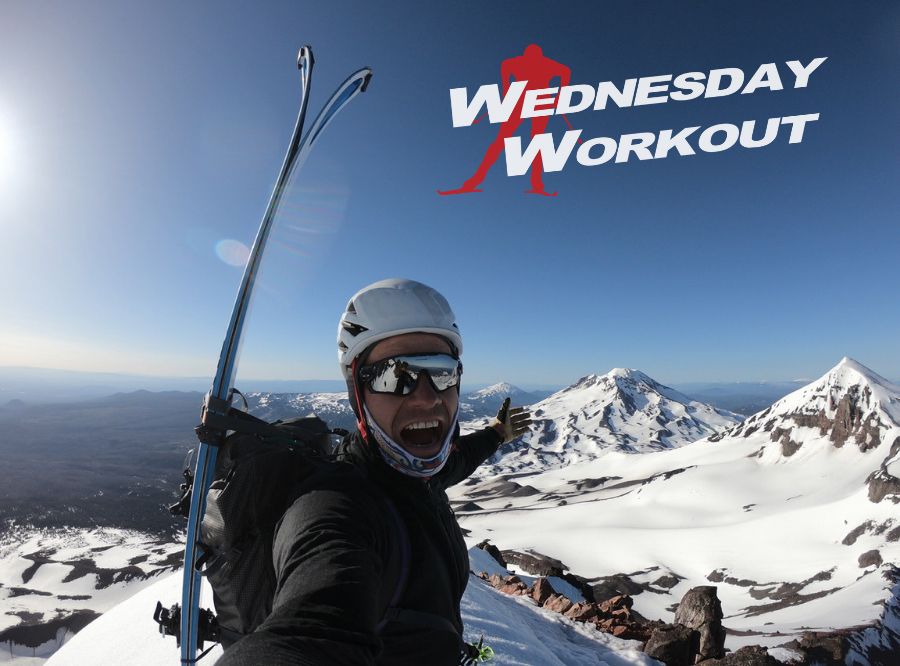
Simi Hamilton on a solo ski-mountaineering adventure to Oregon’s North Sister. The photo was shot before Hamilton skied down and tagged the summit of the Middle Sister (rightmost peak) this May. (Photo: Simi Hamilton)
This post in our long-running Wednesday Workout series takes the 10,000-foot view — almost literally. The nuts and bolts of it are this: we’re posting Simi Hamilton’s training log from Monday, April, 3oth thru Saturday, June 9th.
Hamilton needs no introduction to FasterSkier readers. In any case, here are Hamilton’s basics. Thirty-one-year-old sprint specialist who popped a 12th last season in Seefeld, Austria in a loaded 15-kilometer mass start freestyle. The seventeenth ranked sprinter on the World Cup. Member of the U.S. Ski Team. Fond of thin air, like any good kid from Aspen, Colorado.
On his International Ski Federation (FIS) profile page, two small dashes “–” leave a void describing Hamilton’s hobbies. Let’s assume this was an oversight, with too little room to honor what Hamilton sees as more than a hobby.
He is an athlete clearly satisfied with skiing fast as he’s been a top-ranked World Cup sprinter since 2012. But if you follow Hamilton on social media or the Stratton Mountain School blog, there’s the occasional glimpse into Hamilton’s “hobbies”. If it’s an outdoor activity involving larger than normal size mountains, moving fast and light, pushing what even fit athletes would consider sustainable aerobic thresholds, Hamilton is home.
Simi Hamilton (left) with Akeo Maifeld-Carucci (right) on the southeast ridge of Mt. Jefferson.
Why present a broad-in-scope training log snapshot for a Wednesday Workout? By now, we are guessing most cross-country skiers are seeking snow. They have logged hundreds of hours. There’s been the OD, the L1-L5, the 30 x 30s, the 4 x 4 min. And we are also hoping there’s been plenty of “hobby” time.
If there’s something to learn from Hamilton’s logs, it’s to have fun.
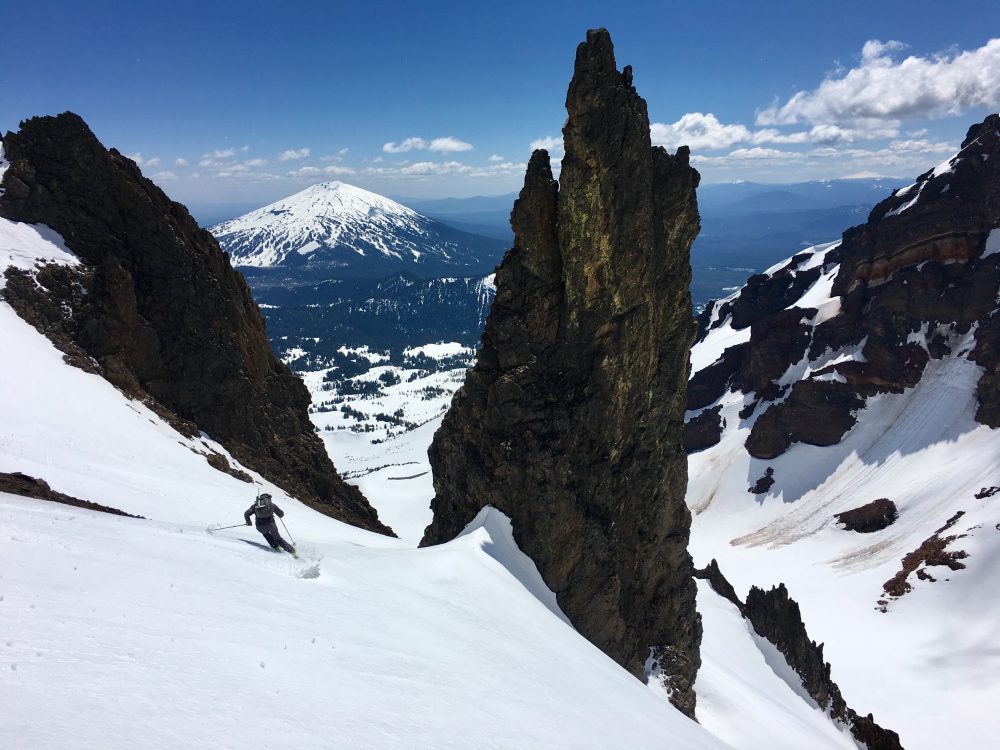
Simi Hamilton harvesting corn snow on Broken Top near Bend, Ore. (Photo: Linden Mallory)
***
The Training Logs:
“That first week in May probably looks a little weak, and it was,” Hamilton emailed, explaining he had been relaxing on a river trip in early May. “I’m usually on my bike a bit more in May, but Matt [Whitcomb] and [Chris] Grover have tried to steer me more towards skiing while in Bend the last few years.”
Technically speaking, skiing has many forms. Maybe skiing in the mountains is what his coaches had in mind.
If you’re reading this now and you’re wearing a race bib at some point this season, we hope you’re having fun. We hope you’ve had fun. We hope you’ve logged some full-blown adventure days.
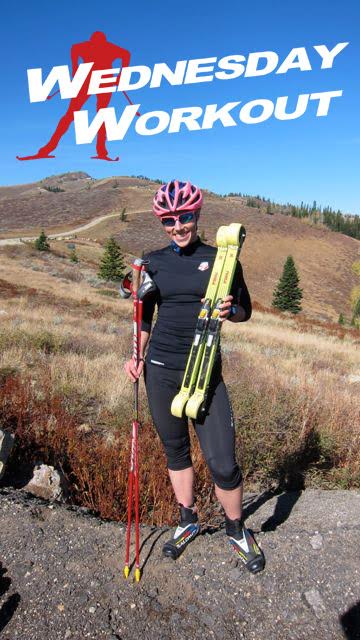
Kikkan Randall taking a break from a fall double pole in 2011 in Anchorage. (Courtesy photo)
This week’s workout is a blast from the past, written four years ago about U.S. Ski Team sprinter Kikkan Randall. Now, with three Sprint World Cup titles to her name, we figured it might be a good time to revisit what made Randall so fast. Interestingly, one of her favorite fall workouts in 2011 was distance. Randall, 32, is currently in Norway preparing for the Toppidrettsveka rollerski races in Aure, Orkdal and Trondheim, held Thursday through Saturday. See the original pro workout here.
***
[Circa Oct. 2011] … Kikkan Randall is known for her speed. But even though her forte is in races under three minutes long, one of her favorite workouts to do in the fall is a 50 k rollerski double-pole session. In addition to being a solid level one effort, the U.S. Ski Team (USST) veteran also uses the workout as an opportunity to work on her double-pole form.
“The goal is to get a lot of repetition in the double-pole movement, going long enough that you tire out the easy-to-use muscles and really find the most efficient positions, timing and impulse,” said Randall.
Randall has a favorite point-to-point route in Anchorage that usually takes her about three hours to cover. She recruits a family member to drive her outside of town, and then she skis home.
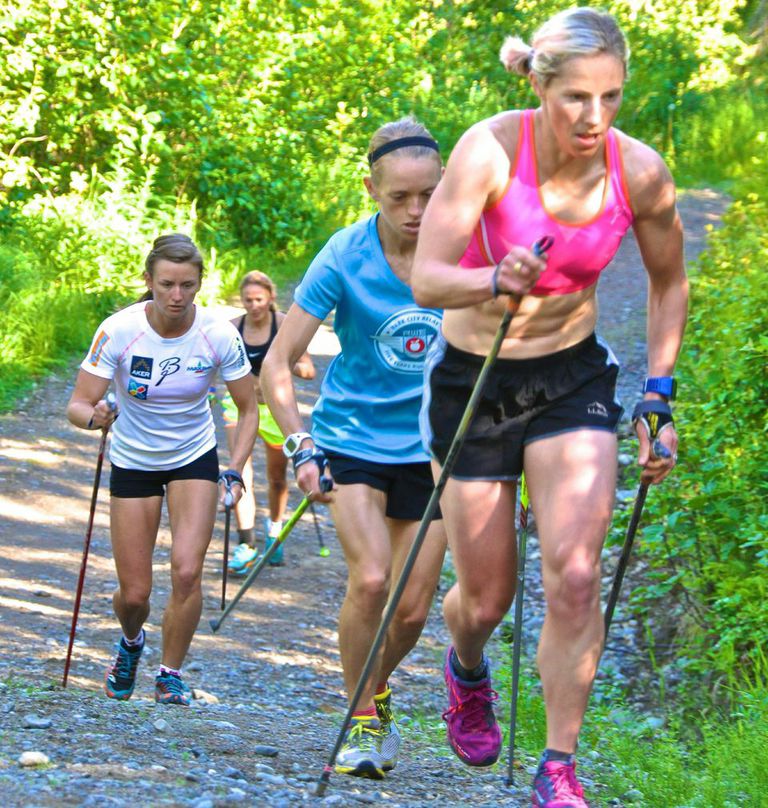
Kikkan Randall (r) leads fellow U.S. Ski Team member Liz Stephen and Norway’s Celine Brun-Lie (l) during a dryland session last summer in Anchorage, Alaska. (Photo: Matt Whitcomb)
“It includes rolling terrain, but most importantly long, flat sections where I can get into a rhythm in my double-pole technique and really ingrain correct movement patterns,” she explained. Randall makes sure to keep her heart rate under control for the duration of the workout, at about 60 to 70 percent of her max.
Between September and when the snow flies in Anchorage at the end of October, Randall will head out for a long double-pole every other week. Sometimes she has company for the three-hour workout, but she also enjoys taking in the fall colors when it’s just her and her iPod.
During such a long, sustained effort, Randall is careful to keep herself hydrated, drinking about 30 ounces throughout the workout, and more after she returns home to continue replenishing lost fluid.
“You lose more water than you think on a long ski like this!” she said.
Randall also emphasizes getting recovery food into her system directly after the workout, and will usually go for a smoothie packed with carbohydrates and protein: 1 cup Greek non-fat plain yogurt, 1 cup frozen berries, 1 scoop protein powder, 1/2 cup milk, 1/2 cup juice and 1 Tbsp honey.
As she usually starts the workout when the air is still crisp, she follows the effort up with a hearty breakfast and a nap.
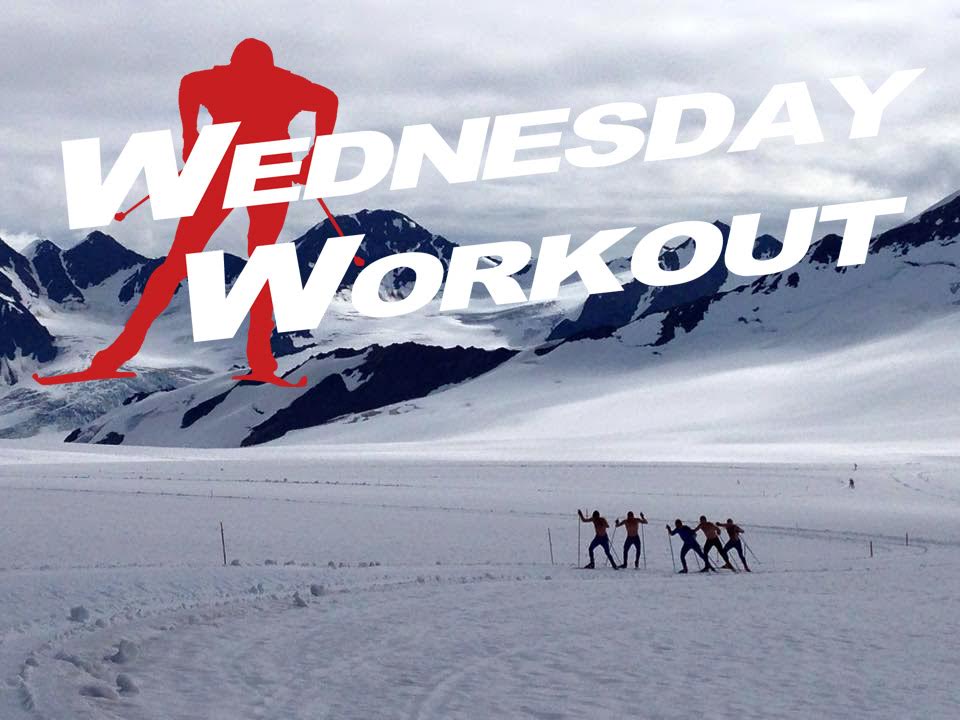
The APUNSC men pushing each other during the final workout of their Eagle Glacier training camp from July 6-11. Becca Rorabaugh explained that the group collectively skied about 1,000 kilometers that day. (Photo: Zuzanna Rogers)
Every summer, the Alaska Pacific University Nordic Ski Club (APUNSC) takes full advantage of Eagle Glacier, just south of Anchorage and some 5,700 feet above Girdwood, Alaska, holding on-snow camps there multiple times throughout the offseason. The APU Elite Team, with head coach Erik Flora, recently completed a camp on the glacier, and while conditions for the last day’s 50-kilometer ski softened and slowed as expected, athlete Becca Rorabaugh explained how she survived the 30-mile workout: “Beautiful weather and fabulous crunchy snow at the start…” she posted on Instagram on July 11. “Knowing I was approaching my 50km goal kept me focused through the slushy last bit.”
Here is the 26-year-old Rorabaugh’s recap of the ultimate over-distance ski, which, she points out, can also be done on dry land (i.e. rollerskis):
***
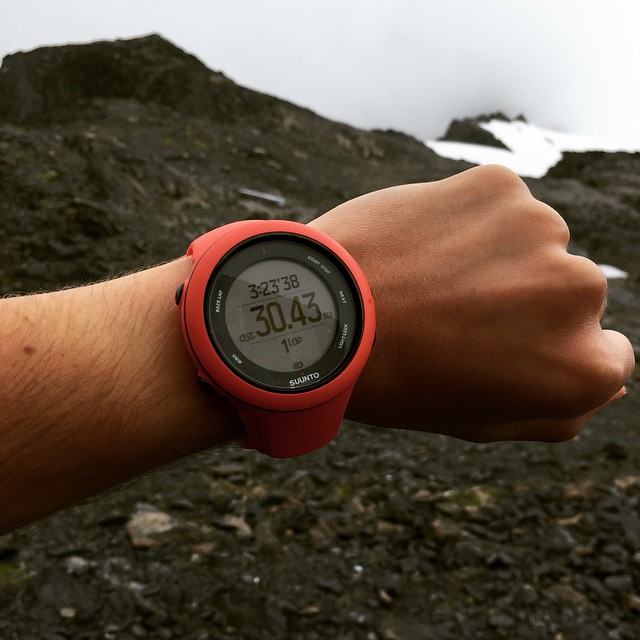
My Suunto Ambit3 at the end of our workout: 30 miles is 50km, and a goal achieved! “#APUNSC #eagleglacier #lastonelongone” (Photo: Becca Rorabaugh/Instagram)
At last week’s APUNSC Elite Team glacier camp there were many hours trained and as a result, many tired athletes. After a week of hard work the last day is always a 3-hour ski. This can be either a fantastic opportunity to duke it out with teammates and see what you have left, or a really rough prospect to handle. Especially if the snow looks like it’s going to get really soft, it can be a tough workout.
The benefits of doing a long final workout are worth the slush-fest, and the effects rely on fatigue that has built throughout the week. If you’ve ever finished a long race and found that you lacked the snappy finishing kick that you were looking for, this is for you.
Flora sat us down beforehand and talked about trying to keep our movement quality throughout the workout, saying that making good race-like motions was paramount to skiing many hours. If we could find a way to make those high-quality movements even without access to the easy energy of fresh ski-specific muscles, we could recruit and hone the sequence of secondary muscle groups. Those are the muscles you’re relying on at the end of a race, and they’re difficult to train. The secondary ski muscles only engage when the primary ones cannot do the work, so you have to be fatigued to train secondary muscle sequence and recruitment. Keeping good technique throughout the workout reinforces good technique at the end of races, when you need it the most.
The power of having positive teammates that push you! From left to right: APU’s Becca Rorabaugh, Sadie Bjornsen, Zuzanna Rogers, and Rosie Frankowski during a water break. (Photo: Zuzanna Rogers)
This last Saturday the day dawned clear and crusty, which on Eagle Glacier means two things. 1: The snow is going to be really crunchy and fast when you start, and 2: if it doesn’t cloud over and start raining soon, you will be skiing on mashed potatoes by 10:00AM.
Sadie Bjornsen and I began talking about trying to get 50km of skiing in, something made possible by the crusty skiing in the beginning, and I was excited to keep track of our progress using my new Suunto Ambit3. We estimated 50km to be six laps of the course, and we turned out to be within a kilometer or two of accurate.
I always ski better throughout the workout if I feel that I am aggressively pursuing a goal, whether that’s a time, a distance, or just hanging on to my Alaska Pacific University Nordic Ski Center teammates for dear life. Starting into a long workout with a sense of purpose really sets the tone, and we started with strong intentions of skiing 50km. We skied 4 loops in the first half of the time, just trying to get in some kilometers before the crust broke down. The final two loops took almost twice as long as the first ones: once the crust breaks on a sunny Eagle Glacier day, it really disappears!
“I always ski better throughout the workout if I feel that I am aggressively pursuing a goal, whether that’s a time, a distance, or just hanging on to my Alaska Pacific University Nordic Ski Center teammates for dear life.” — Becca Rorabaugh, APU Elite Team member
The second half, in soft conditions and with tired legs, is the part that really counts. This is where thinking about a single cue like ‘let your hands swing up’ makes the biggest difference. It’s where technique breakthroughs occur because you’re so tired that you let yourself try different things. Your usual neural sequences are shakier, and you’re able to ingrain new things. At times like that, when you’re pushing the limits of good focused movement, having a defined finish line helps keep motivation. Perhaps most importantly, skiing with friends lets you know whether your technique is working. When you have to make subtle adjustments to keep up, you make the kinds of innate technical improvements that you can find again on race day.
If you’re doing this workout in town, you can still benefit from a long rollerski at the end of a big week. The second half is still the key part, and it’s still important to focus on a single cue. I always recommend doing it with people that push you a little because that’s when you learn to hang on for dear life, adjust movements, and finish strong. Knowing you can ski well when you’re tired will give you the confidence to push at the end of any tough race, be it the Birkie, US Nationals, or the Tour de Ski.
50 k Over-Distance Training Ski Checklist
– Focus on high-quality, race-like motions (and secondary muscle groups if you’re tired from previous workouts)
– Maintain good technique to ensure you’ll have similar technique at the end of a long race
– Get out early to avoid deteriorating conditions (i.e. snow- or weather/heat-related)
– Start with a sense of purpose (you are going to complete 50 k!) and remember that intention when you start to fatigue, especially in the second half of the workout
– Bring a buddy: “Skiing with friends lets you know whether your technique is working.” And pick people that can challenge you.