From the FasterSkier archive — posts syndicated from athletes’ and coaches’ own blogs between 2004 and 2012, kept online as published. Current coverage is at fasterskier.com.
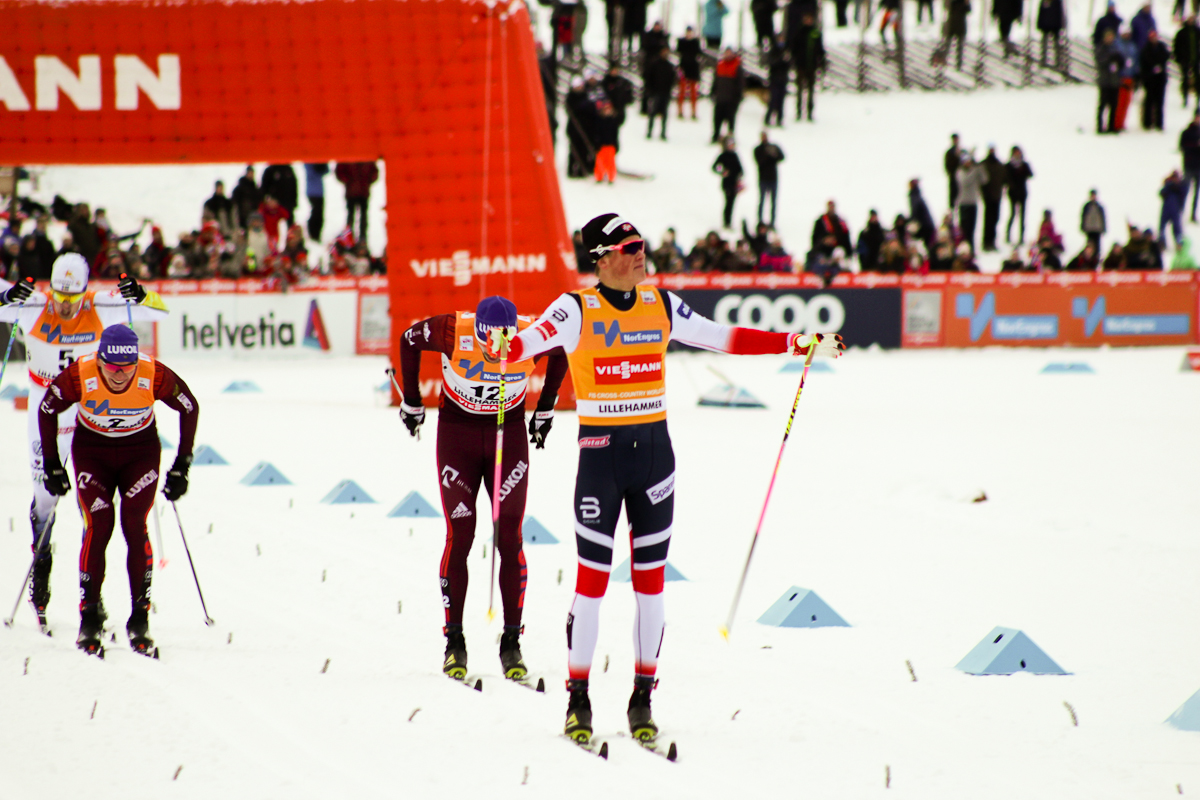
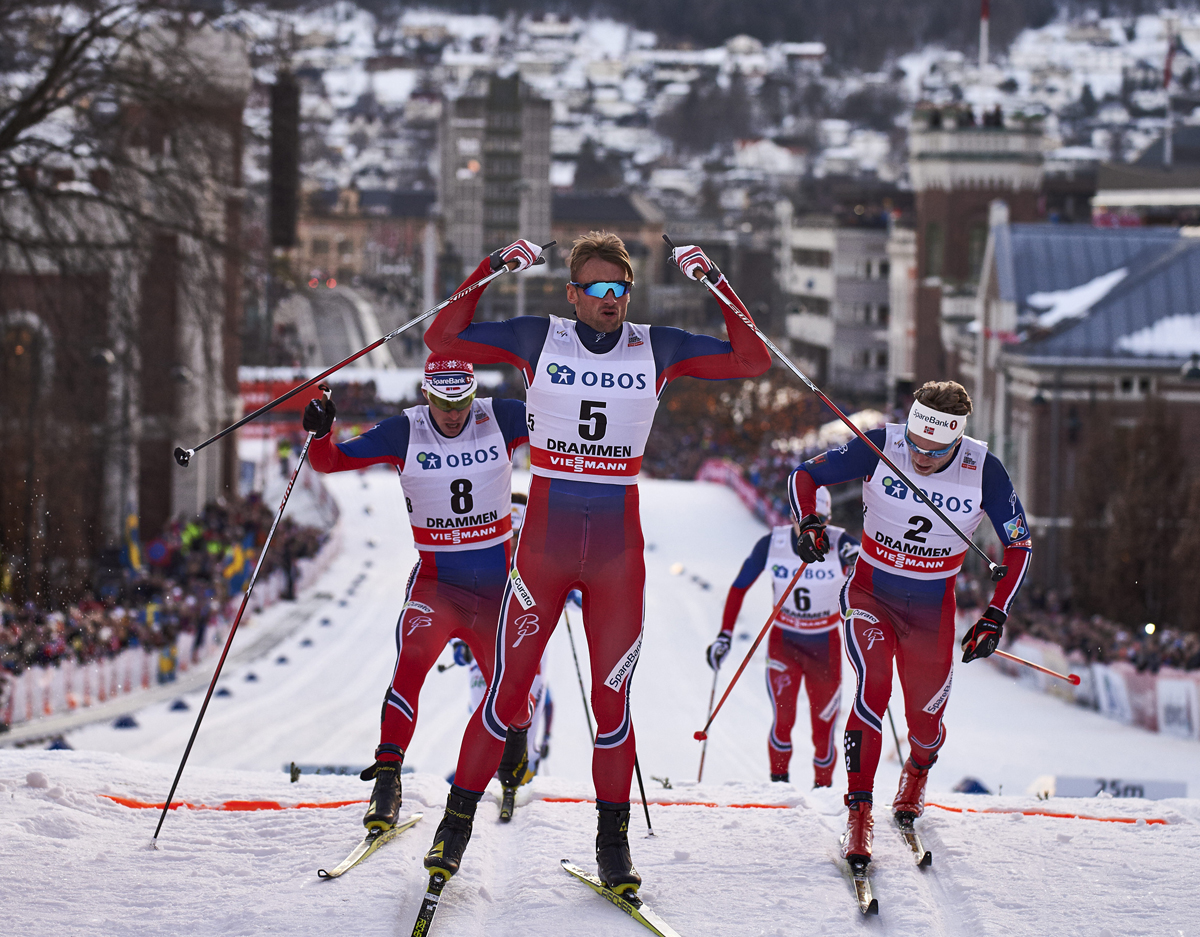
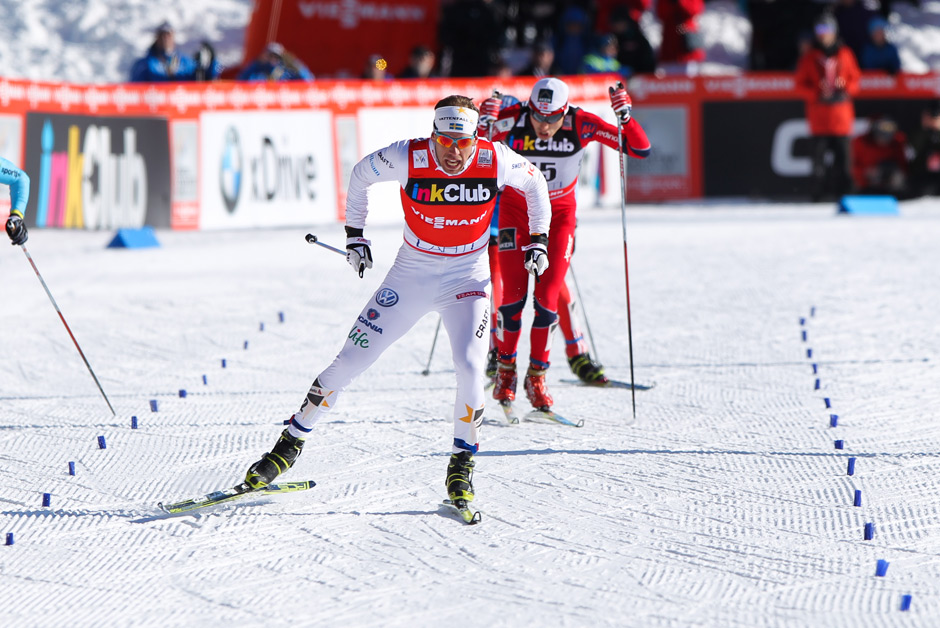
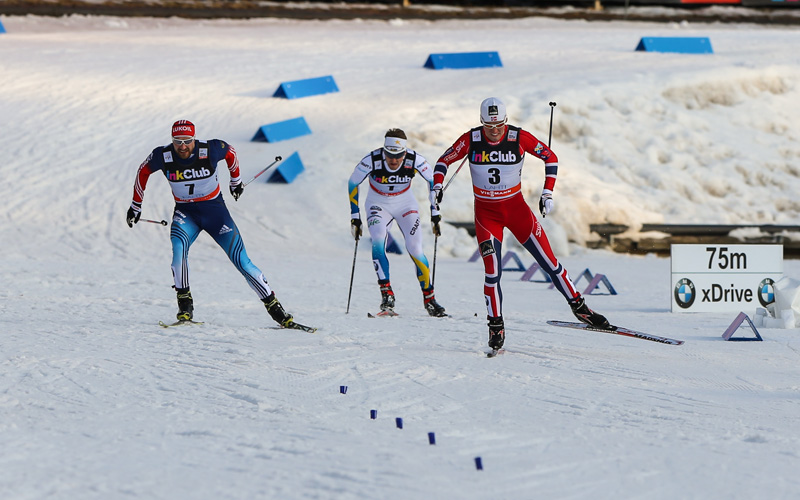
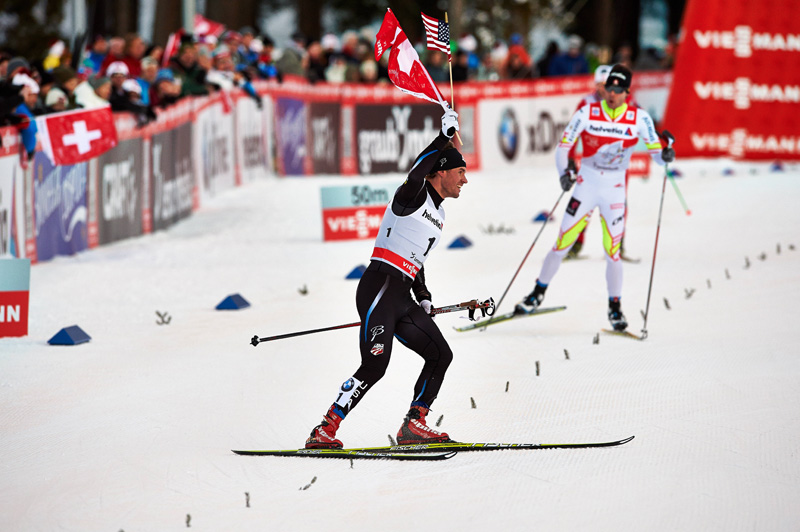
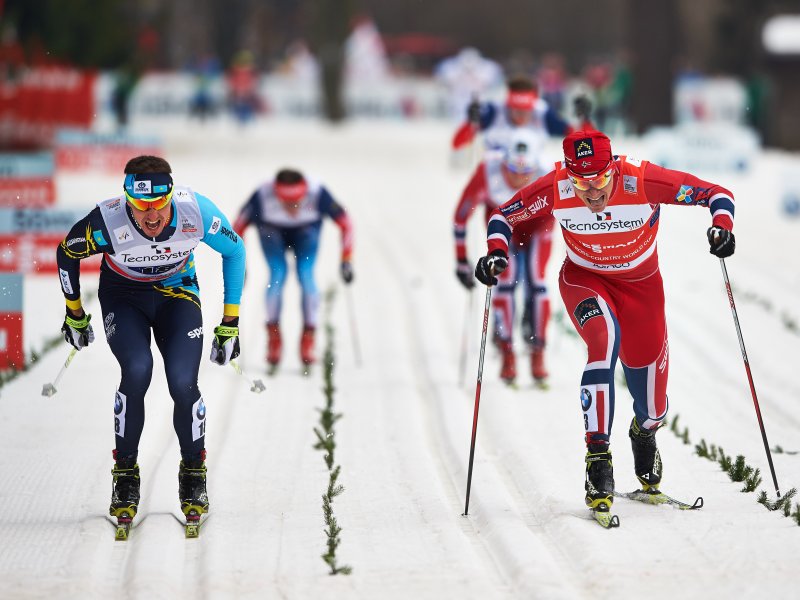
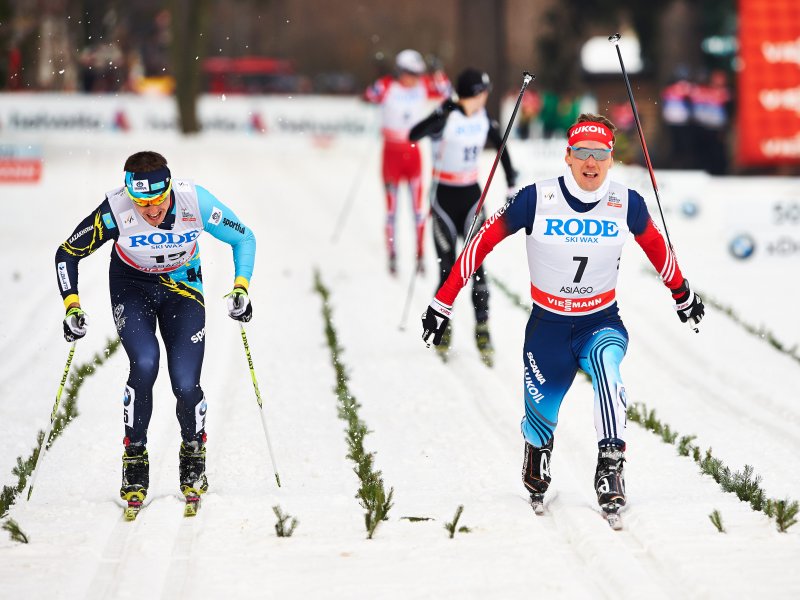
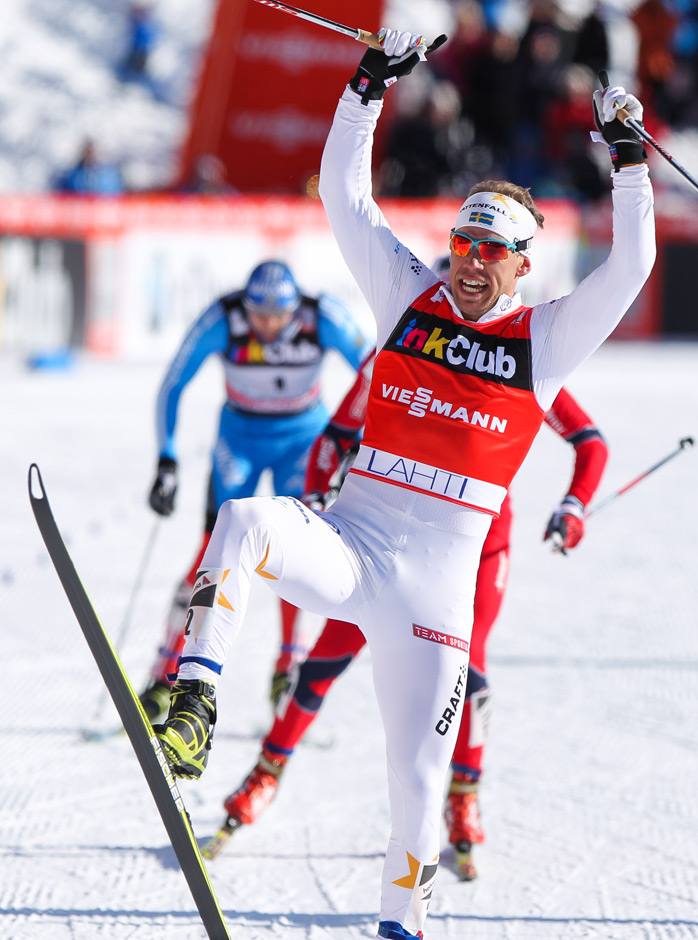
Norway’s Johannes Høsflot Klæbo welcomes another World Cup win as he nears the finish line during the men’s 1.5 k classic sprint final on Saturday in Lillehammer, Norway. (Photo: Henrik Hunne)
Smack dab in the heart of the nordic sport world in Lillehammer, Norway, the World Cup began its second weekend of the 2017/2018 season with a kick-and-glide bang on Saturday. The men contested a 1.5-kilometer classic sprint on a course featuring a flat run into and out of a three successive climb-descent combo.
At 21 years old, Norway’s Johannes Høsflot Klæbo remains peerless.
Is it the lungs? His up-tempo, high-output running style? For all the winning since his World Cup debut in 2016, Klæbo must be prematurely aging his rivals.
As last season’s overall Sprint World Cup winner and last weekend’s Ruka Triple dominator, 2017/2018 is starting off as a continuation of the nascent Klæbo era.
Klæbo has four wins in four races this season as he out-toed Russia’s Sergey Ustiugov by 0.83 seconds to win Saturday’s sprint. Another Russian, Alexander Bolshunov, was third (+1:29). Calle Halfvarsson from Sweden placed fourth (+1.64), and off the back were Norwegians Emil Iversen in fifth (+8.20) and Sondre Turvoll Fossli in sixth (+17.30).
Ustiugov’s exploits are well documented — he skied to five medals at 2017 World Championships, three silvers, and two golds. But like Klæbo, Bolshunov appears to be an authentic, albeit young challenger for future podiums and overalls on the World Cup. He’ll turn 21 on Dec. 31. Bolshunov won the 30 k skiathlon and 15 k freestyle and placed second in the classic sprint at last season’s U23 World Championships. After the Lillehammer sprint, Bolshunov is positioned second in the overall World Cup standings with 252 points — 22 points ahead of Norway’s Martin Johnsrud Sundby in third. (Sundby did not race in Saturday’s sprint.)
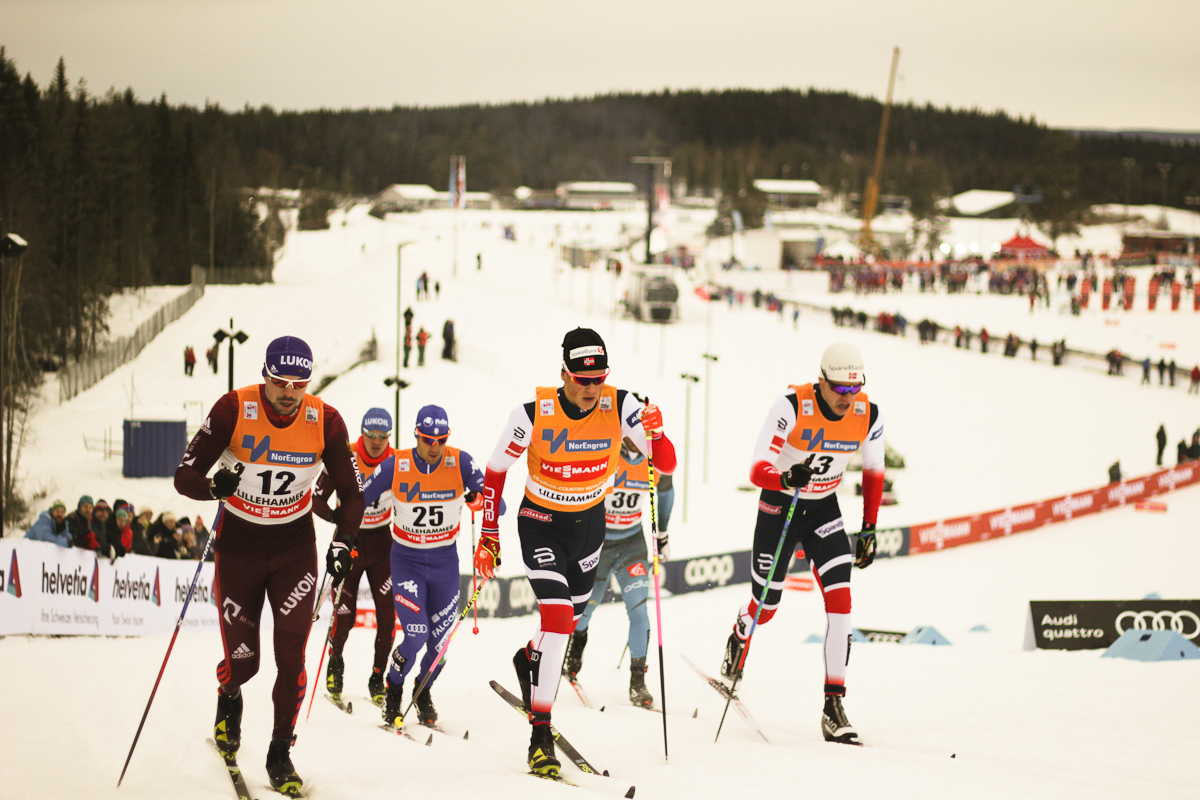
Norway’s Johannes Høsflot Klæbo (center, in leader’s bib) leads his quarterfinal as Russia’s Sergey Ustiugov (12) keeps pace during Saturday’s classic sprint in Lillehammer, Norway. (Photo: Henrik Hunnes)
But the narrative has been all Klæbo.
With 400 points, Klæbo’s foundation for building an early season hold on the World Cup overall is strong.
From the start on Saturday in Lillehammer, it was another stellar performance from the Norwegian in the qualifier: Klæbo won in 3:28.99 minutes with 4.31 seconds on Bolshunov, the next closest competitor.
Klæbo’s winning margin was slimmer in the quarterfinals, but it only amounted to a tease. He bested Ustiugov in the first quarterfinal by 0.17 seconds. In semifinal 1, there was a flip-flop: Ustiugov won, besting Klæbo in second place by 0.25 seconds.
Saturday’s conditions in Lillehammer featured fresh snow, which placed a premium on remaining in the skied-in tracks, maximizing glide without stepping into the slower snow. The final hill and descent into the finishing straight played a key part in Saturday’s winning tactics. Klæbo was mindful of the endurance aspect for Saturday’s sprint and tried tempering his effort until it mattered.
“I changed the plans a little bit in the final and tried to be second in the last downhill,” Klæbo said during the post-race press conference. “And then Ustiugov came before the last uphill there and it was going pretty fast I was just trying to keep up with him and be second on the last uphill there and to push hard and finish.”
With his latest win, Klæbo becomes only the second male skier to win the first two World Cup sprints of the season. In 2008/2009, Norway’s Ola Vigen Hattestad won the first three sprints that season. Klæbo remains the youngest World Cup sprint winner, according to the International Ski Federation (FIS).
Alex Harvey was the lone North American to qualify in the top 30, placing 22nd, 11.89 seconds in back of Klæbo.
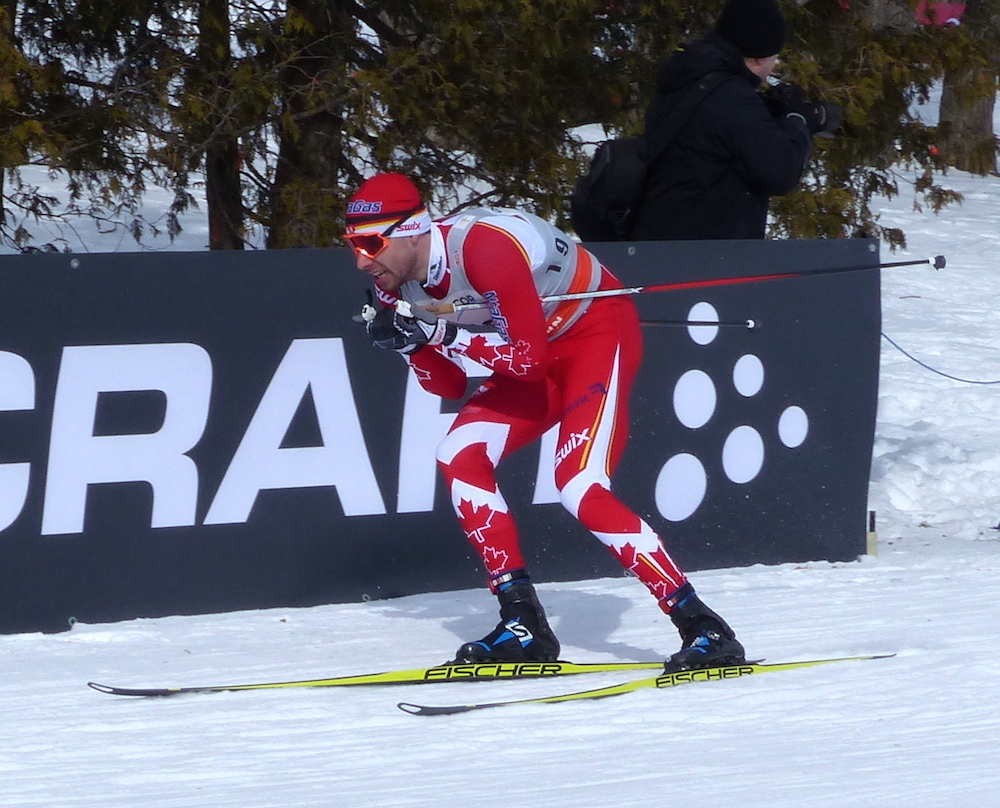
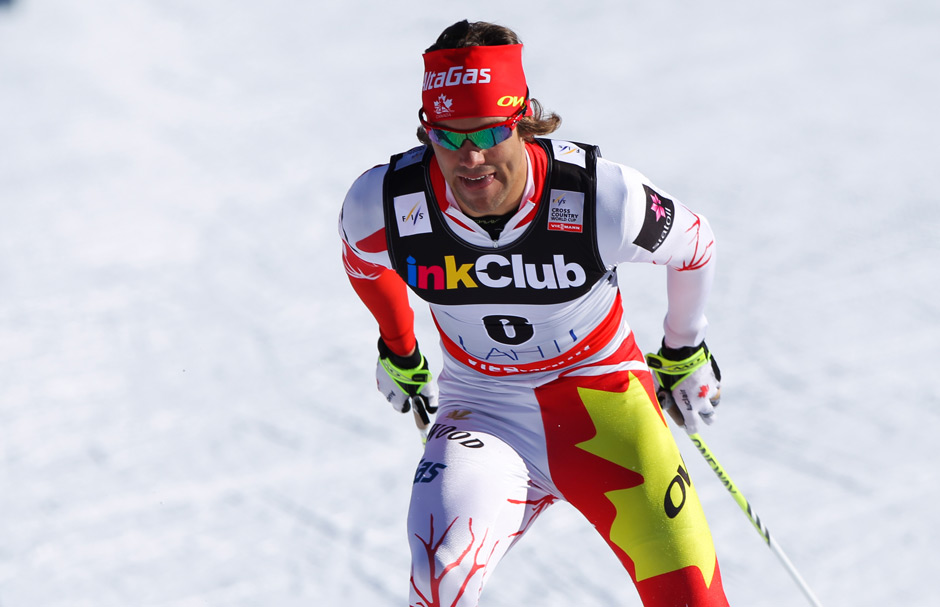
Canada’s Alex Harvey finished 28th overall in Saturday’s classic sprint in Lillehammer, Norway. (Photo: Henrik Hunnes)
At last weekend’s Ruka Triple in Kuusamo, Finland, Harvey finished just off the podium for fourth place in the pursuit and in the overall mini-tour standings. In the first of the three stages there, the classic sprint, Harvey placed 21st. After placing 28th overall in Saturday’s classic sprint in Lillehammer, Harvey stated he was unconcerned about his early season sprint speed.
“I am not really tired, I just don’t have enough speed at that time of the year, but it’s like that every year,” Harvey said. “I am slow before Christmas. I have good endurance but not much speed so that’s what I had today … I feel good about going into tomorrow’s race, it is a totally different race, a 30 k [skiathlon]. In Kuusamo it was kind of the same in the sprint, I was kind of shaky, but then the distance races were good. I am looking forward to the 30 k.”
Harvey’s day ended in the quarterfinals when he placed sixth in the fourth heat, 3.06 seconds behind Norway’s Pål Trøan Aune, who won that quarterfinal.
For the U.S. Ski Team (USST), Erik Bjornsen skied to 35th, 13.61 seconds behind Klæbo in the qualifier and 1.06 seconds out of 30th. Andy Newell finished 38th (+13.89), and Scott Patterson finished 74th (+27.99).
“Disappointing to not make it past the qualifier,” Bjornsen emailed. “The Norwegians were on one today, qualifying 12 guys in the heats, leaving only 18 spots for the rest of the world. Warming up I could feel I didn’t have the snap I needed. I’m excited for a mass start race tomorrow though. It will be great to go head to head in some distance racing.”
Notably absent from Saturday’s sprint was USST sprinter Simi Hamilton.
“It was a disappointing day for the guys,” USST coach Matt Whitcomb said on the phone. “Andy and Erik were close. They were not flanked by Simi who has been battling GI issues since Kuusamo. He has had quite a bug. He skied 30 minutes yesterday and about an hour and a half just walking around on his skis today. We are trying to build him back to strength. But he knocked down very hard by a bug.”
For Canada, those skiers outside the top 30 were Jesse Cockney (Canadian World Cup Team) in 57th (+17.59), Len Valjas (World Cup Team) in 59th (+18.24), Julian Locke (National U25 Team) in 61st (+19.99), and Russell Kennedy (Team R.A.D.) in 63rd (+20.98).
Racing continues Sunday with a 30 k skiathlon for the men and a 15 k skiathlon for the women.
Norway’s 24-year-old Emil Iversen after winning his third-career World Cup race, and first distance race, at the second stage of the Ski Tour Canada on Wednesday: the 17.5 k classic mass start. (Photo:Flyingpointroad.com/NNF)
(Note: This article has been updated to include details about a crash involving Norway’s Martin Johnsrud Sundby early in the men’s classic mass start.)
Certainly it’s too soon for Norway’s Emil Iversen to tell his elders to move over. One of those elders is Norwegian teammate Martin Johnsrud Sundby, current overall World Cup leader. The other, Petter Northug Jr. is … Northug.
But at the second stage of the Ski Tour Canada (STC) on Wednesday, a 17.5-kilometer classic mass start in Montreal, Quebec, Norway’s 24-year old Iversen, strided, herringboned, and double poled to the win.
Exactly 45:05.4 minutes after the start, Iversen crossed the wind-swept finish line first, 5.3 seconds ahead of Northug. The overall leader of the STC and winner of Tuesday’s sprint, Russian Sergey Ustiugov, placed third (+14.5).
The start of the men’s 17.5 k classic mass start on the second day of the Ski Tour Canada in Montreal, Quebec. (Photo: Flyingpointroad.com/NNF)
At 23 years old, it was Ustiugov who first showed his fearlessness. Establishing a tempo and drive that 3.5 k in showed he was going to be the pace-setter — Ustiugov went on to dictate the pace for most of the race.
But at that 3.5 k mark it still could have been a number of skiers’ race to control. Strung out behind Ustiugov in a line were Norwegians Iversen, Sundby, Northug, Finn Hågen Krogh, Canada’s Alex Harvey, Norway’s Ola Vigen Hattestad, and Kazakhstan’s classic specialist, Alexey Poltoranin.
It must have been something subtle. Maybe an extra effort herringboning up the steep, sugary hills, or double poling with his burly core, but only a kilometer later, Ustiugov played for keeps. Only Iversen and Northug could hang on.
Sundby later told reporters that he had crashed early on an icy and curving descent.
“I went on my face,” he told NRK, according to a translation.
Slowly but surely, a gap back to Sundby grew. And as the moisture on Sundby’s beard began to freeze, so did his chances of bridging up to the leaders. At the 4.6 k mark, Sundby was 13 seconds behind.
“I lost a lot of time and then it was [over],” he said. “I’m not sure what to say. We are trying to showcase our sport, but today I am unsure what we were doing. Was it cross-country…?
“It was unusual conditions,” he added. “Fortunately, it was the same for all.”
As the moisture on Sundby’s beard began to freeze, so did his chances of bridging up to the leaders.
By 12.5 k, Sundby chasing in fourth was 18.2 seconds behind the trio of Ustiugov, Iversen and Northug. It remained a long day of trying to play catch up for Sundby, who toiled in no man’s land, chasing solo for the remainder of the race. Sundby finished fourth, 39.8 seconds behind the upstart Iversen.
It’s Northug’s signature tactic to let others set the pace until he marks the race with an exclamation point across the line. But Wednesday, Iversen, having grown up watching Northug’s bait-and-switch prowess over the years, left nothing for chance. With 1.5 k to go, Iversen began to stretch the rubberband back to Northug inch by inch. He had a 3.6-second lead on Northug, but even that small margin never vanished.
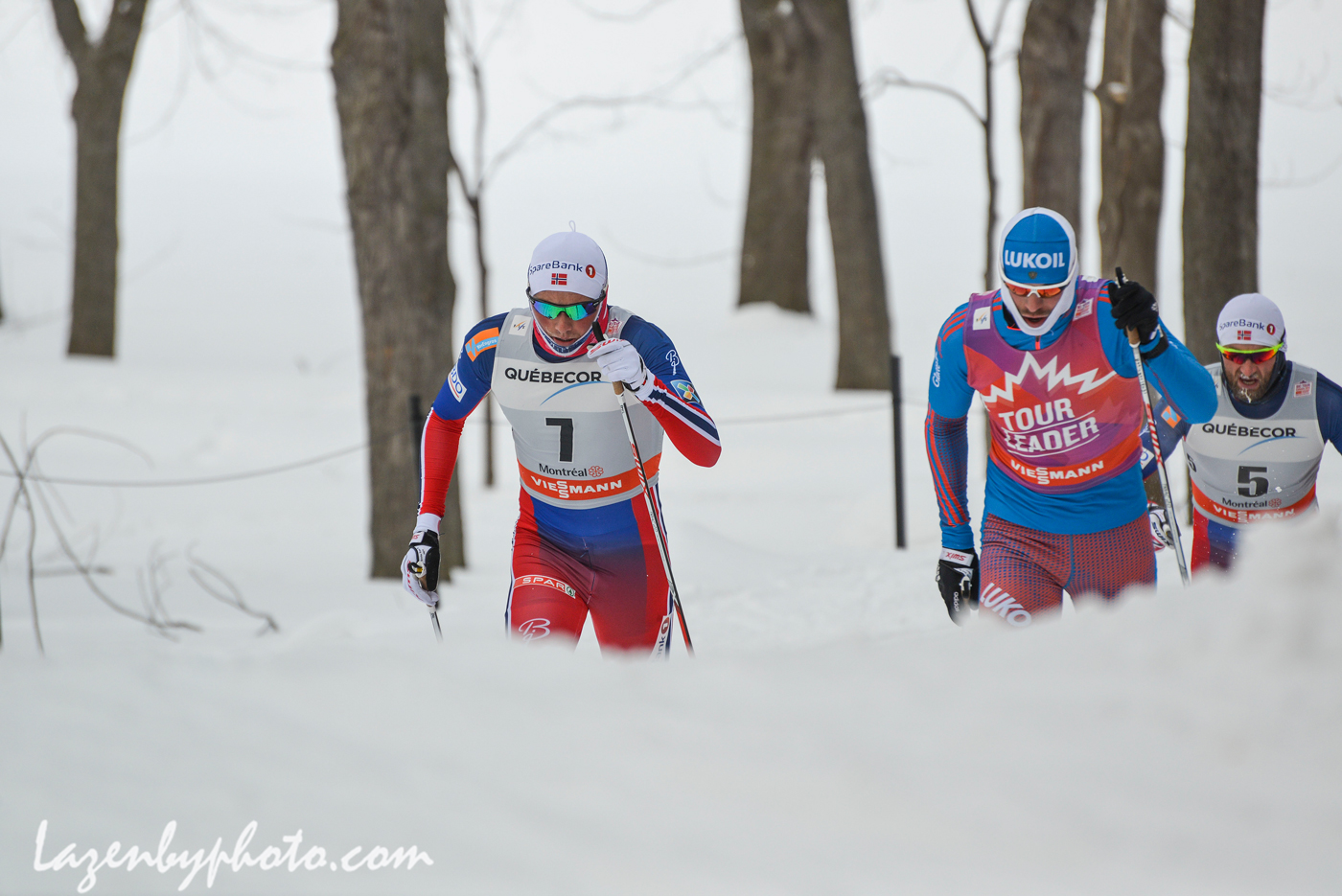
Norway’s Emil Iversen (l) and Russia’s Sergey Ustiugov (red leader’s bib) lead the men’s 17.5 k classic mass start at the second stage of the Ski Tour Canada in Montreal, Quebec, while Norway’s Petter Northug trails in third. Iversen went on to win, Northug placed second and Ustiugov took third. (Photo: John Lazenby/Lazenbyphoto.com)
When Iversen made his decisive move, he simply upped the pace and never looked back.
“In the fourth lap I saw Ustiugov was little bit tired,” Iversen said in the post-race press conference. “I decided to try and went for it 100 percent. I hoped I could get a gap and gain some seconds. My goal before the Ski Tour Canada was to have a good start. I’m sitting in second place. Now I have to take stage by stage and we see what happens.”
With his win on Wednesday, Iversen took his first ever distance World Cup victory and the third of his career. Iversen’s other two World Cup victories, both of which were sprints, also came this season.
Northug spoke about the trio out front and pushing an unrelenting pace.
“The plan was to stay in front of the field,” Northug said during the press conference. “After one lap it was only three or four guys in the lead. The pace was very high. We had to fight hard against the wind and snow. Ustiugov did a lot of work in the lead. He was the strongest today. We can thank him for the high speed.”
Ustiugov also acknowledged that he had taxed himself with the workload.
“It was a very tough race,” Ustiugov said at the press conference, through a translator. “I knew the guys behind me were fresher than me as I did all the work in the front, but I am satisfied with third place and be in the lead of the Ski Tour.”
With two consecutive podiums in as many stages so far, Ustiugov remains in first in the Tour standings, 6.1 seconds ahead of Iversen in second. Northug is third, 11 seconds back, and Sundby is nearly 1:40 minutes out of first in fourth overall.
Harvey in the Hunt
After two days of racing, both of which took place in his home province of Quebec, Harvey ranks sixth overall, 1:58.3 out of first, after placing ninth in Wednesday’s mass start (+1:16.4).
While racing the five laps of Montreal’s 3.5 k loop, Harvey appeared to be one of the few who could match the front runners’ pace. At 5.5 k, the Canadian skied in sixth, 14.5 seconds back.
Canadian World Cup Team member Alex Harvey (10) racing to ninth at the second stage of the Ski Tour Canada, the 17.5 k classic mass start in Montreal, Quebec. (Photo: flyingpointroad.com/NNF)
Again and again, it seemed Harvey would cover the breakaway. In an in-person interview afterward, Harvey said those efforts were exhasting.
“It was a drop in my energy.” Harvey said. “I tried closing the gap with the first three, but I exploded in trying to do so. I fought for the podium but the three guys at the front were out of reach. Ustiugov was really strong the first two laps. I paid at the end for my efforts.”
Harvey did ski wisely. He was close enough to the front to fight for the two mid-race time bonuses. Harvey took an 8-second time bonus at 4.6 k and a 2-second time bonus at 11.6 k.
Thinking more of the long-term than a one off race performance, Harvey said he is staying true to his STC plan.
“My fitness level is good and stable, which is important because you can’t win the Tour in one day, but you can lose it in one day,” he said. “The goal is to not loose the Tour on any day.”
The second best North American result came from fellow Canadian World Cup Team member Devon Kershaw, who began the day near the back of the pack in bib 50. Kershaw moved forward incrementally and by 5 k was skiing in 22nd place. He eventually skied across the finish in 17th (+1:38.9).
“It was a challenging day,” Kershaw said afterward. “Really soft snow, different conditions.”
Despite the less-than-ideal fresh snow and blustery wind, Kershaw appreciated the opportunity to ski in a city some of his family calls home.
“To race in front of friends and family here on the Island of Montreal is a pretty neat feeling,” he said. “It’s just so nice to have the home crowd behind you. My aunt and uncle live here, my mom and my brother live here as well. So I have a lot of family in the city. I heard their voices. It was pretty neat.”
In the points, and moving up on a day with tricky snow and biting wind, Kershaw remained positive.
“Seventeenth isn’t something we are going to be lighting fireworks off, calling everybody that I know,” he said. “But at the same time it’s a step in the right direction. I was pretty disappointed after yesterday so its better.”
Kershaw placed 50th on Tuesday’s freestyle sprint and now sits 17th overall.
A third Canadian World Cup Team skier in the points was Ivan Babikov in 29th (+2:32.1). Unlike Harvey, who started the day in bib 10 (meaning he had a good starting position heading into the courses steeply pitched and punchy climbs), Babikov wore bib 78. As a result, Babikov started near the rear in the field of 85 skiers.
When the day’s sinuous track kicked up on lap one, skiers had to herringbone some of the soft headwalls.
“There was actually a few places, mostly the first and second lap was the worst,” Babikov said on the phone after the race. “The course was just really interesting. I’ve never see something like that before.”
Babikov described quick downhills that pitched up into mandatory herringbone sections. Those sections created bottlenecks since the herringboning forced skiers to keep their skis wide.
“Oh yeah, like people crashing and tangling up all over the place,” Babikov said of the scene. “It also was really soft for the skis, so it created really like barely any track on the uphill where you could have strided … It was just a mess, broken poles, people falling down.”
Babikov explained that maybe the first five, 10 or 15 skiers could ski cleanly through, but not the main pack. On his first lap, Babikov said he felt like he waited thirty seconds for the mess of skiers to clear before pushing ahead.
When he finally did push ahead, he pushed hard. Of his jump from 78th to 29th place at the finish, Babikov said skiing conservatively wasn’t part of the plan.
“You have to take a risk today,” Babikov said. “Like, at times to pass people on the downhills. My body felt pretty good. I tried to pass people whenever I could.”
All that passing moved Babikov up in the overall standings. He now sits 33rd overall.
Canadian Head Coach Justin Wadsworth was pleased with the day’s result.
“It was actually a pretty solid day for us, three guys in the top 30, Alex in ninth, Devon in 17th and Ivan 29,” he said.
Wadsworth also spoke about the benefits of World Cup racing for a future generation of Canadian skiers.
“Today was an experience…,” he said. “For the younger athletes, it was a real eye opener. It was very hard conditions, with the wind and the snow and the course. I think our younger athletes, also arriving just last night … usually you get some time on the course ahead of time and there’s a ski warmup area and a testing area, and none of that happens here. Boom, you show up and you get ready to race on a race course your’ve never raced on at the highest level.”
Also for Canada, Graeme Killick (CNST) placed 50th, Kevin Sandau (Alberta World Cup Academy) was 53rd, Len Valjas (CNST) 63rd, Patrick Stewart-Jones (AWCA) 64th, Jess Cockney (CNST) 66th, Michael Somppi (NDC Thunder Bay) 68th, Knute Johnsgaard (AWCA/CNST) 69th, Bob Thompson (NDC Thunder Bay) 73rd, Russell Kennedy (Canmore Nordic) 74th, Andy Shields (NDC Thunder Bay) 76th, and Simon LaPointe (Skinouk) 82nd.
Bjornsen leads the U.S.
Erik Bjornsen (Alaska Pacific University/U.S. Ski Team) was the top American in 31st, just 0.4 seconds outside the top 30 and 2:37.3 behind the winner. In a post-race phone call, Bjornsen said he is feeling good after two STC stages.
Erik Bjornsen (USA) on his way to 31st place in the men’s 17.5 k classic mass start at Stage 2 of the Ski Tour Canada in Montreal, Quebec.. (Photo: Flyingpointroad.com/NNF)
“Coming into today I knew that I have been feeling pretty good lately, so I was hoping for a good result,” he said.
Bjornsen also noted the difficult herringboning and the likelihood for bottlenecks to develop.
“It went out at a pretty hot pace just knowing things were going to get strung out having such a narrow course like that,” Bjornsen said. “But I felt like I went out all right. I struggled a bit with the herringboning and felt strong on the double pole. I was not happy with being so close to the top-thirty. Definitely hoping for a little more in the next few stages.”
The STC is the second World Cup Tour for Bjornsen.
“In the last Tour I was right outside the top 40,” Bjornsen said. “It’s my goal this time to be closer to the thirties, but I think if I finish in the top 30 I would be very happy with my overall result. We will see how it goes, there is definitely a couple of good races for me coming up. If I could pop into the top 20 in one race that would be absolutely awesome.”
U.S. head coach Chris Grover discussed how the front-end racers escaped from the main group so quickly. Bottlenecks were a recurring theme.
“It was a pretty narrow course overall,” Grover said on the phone. “And in particular, the big longer herringbone hill was really only about one skier width … The packs got super strung out because the nature of the course but also because of the tough conditions. Once people got away from those that were trying to herringbone in the soft stuff, they really got away.”
Grover said those rough-an- tumble patches took a toll on both the U.S. men and women.
“We had a lot of broken equipment today,” he explained. “Just amongst our team, Ida Sargent broke a ski in a crash tangle-up right away. Brian Gregg broke a ski by having a binding rip off a ski. So it was definitely a challenging day.”
American Matt Liebsch (Gear West) waits for his good friend and training partner Brian Gregg (Team Gregg) to finish the men’s 17.5 k classic mass start at Stage 2 of the Ski Tour Canada in Montreal, Quebec. Gregg crashed and his binding ripped off his ski. (Photo: Flyingpointroad.com/NNF)
Gregg ultimately finished 81st.
“I had one pretty solid crash out there, which was certainly very frustrating but that’s part of racing,” Gregg said after.
Noah Hoffman (Ski & Snowboard Club Vail/USST) placed 42nd. He reiterated the tough course.
“It’s a really challenging course,” Hoffman said. “We were just standing still on the first lap, so often. It was so narrow, there’s so much herringbone. It was a challenge from way back off of yesterday’s finish.”
Also for the U.S., Scott Patterson (APU) finished 55th, Simi Hamilton (SMST2/USST) was 58th, Eric Packer (APU) 67th, Reese Hanneman (APU) 70th, Andy Newell (SMST2/USST) 71st, Dakota Blackhorse-von Jess (Bend Endurance Academy) 77th, Matt Liebsch (Gear West) 79th, Tad Elliott (SSCV) 80th, and Gregg (Team Gregg) 81st.
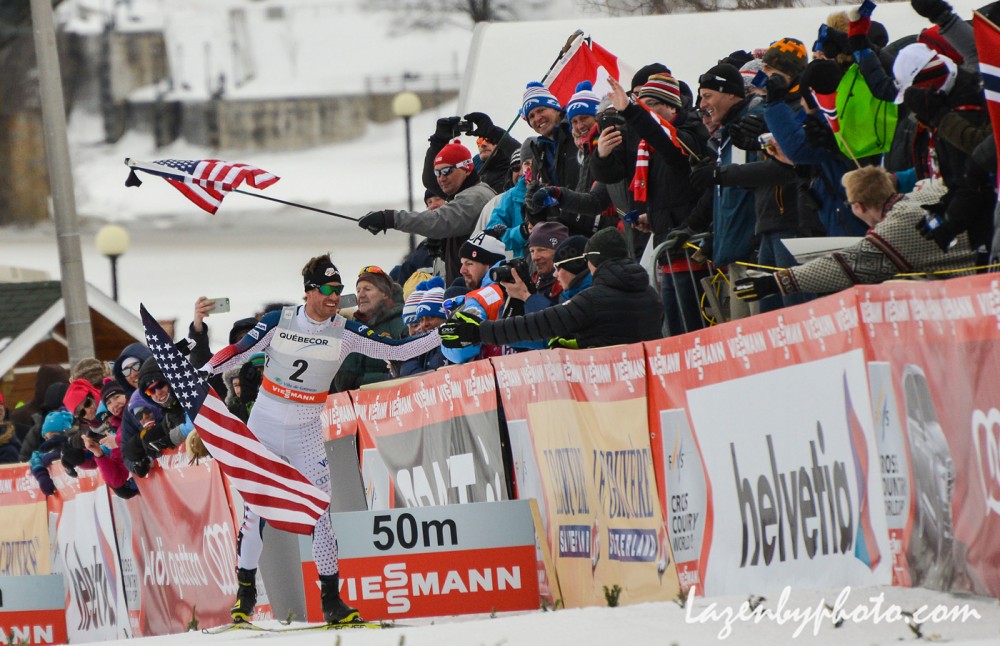
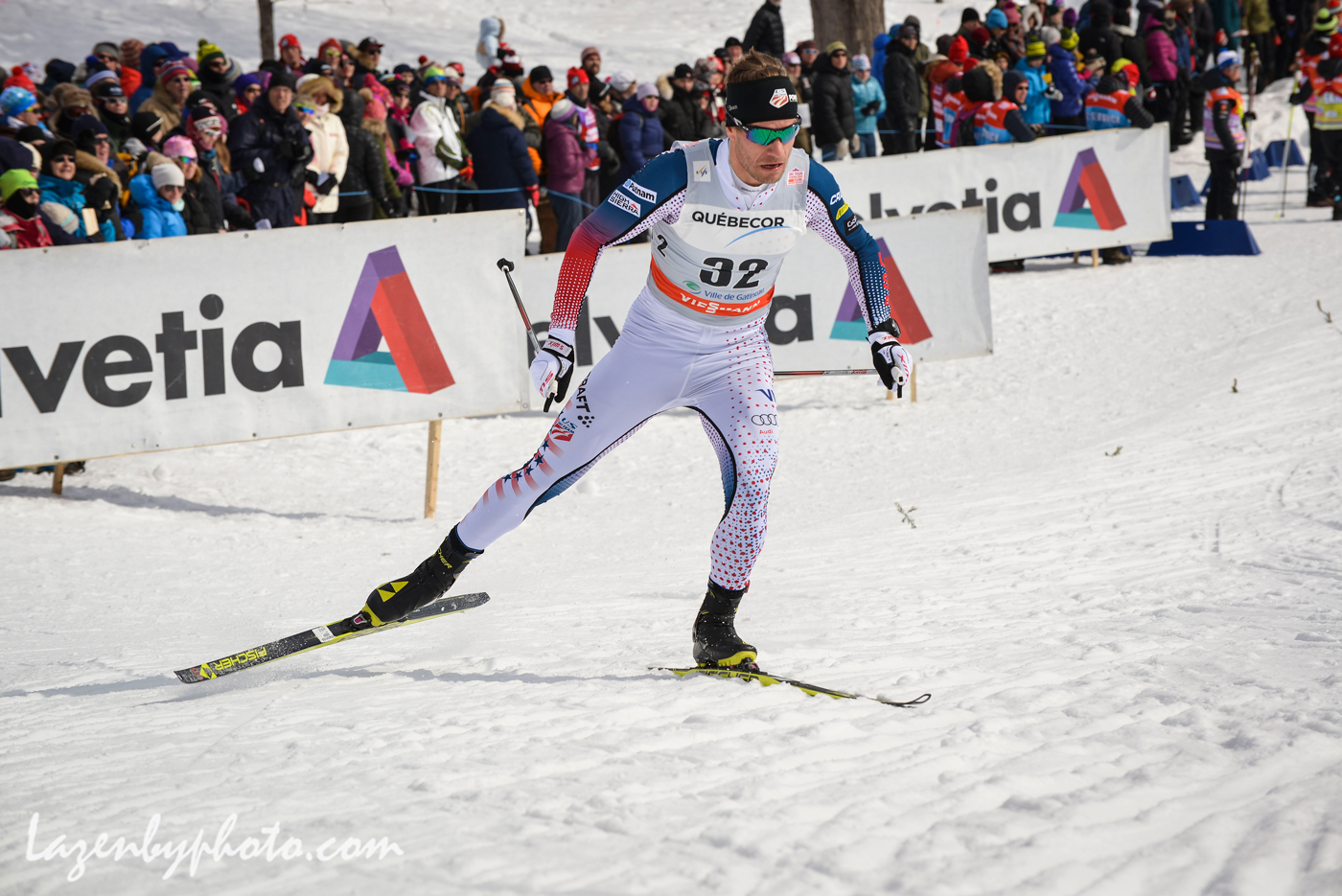
American Simi Hamilton during his “victory lap” after finishing in the top three of the men’s freestyle sprint at the Ski Tour Canada World Cup stage in Gatineau, Quebec. (Photo: John Lazenby/Lazenbyphoto.com)
For the men’s opening stage of the Ski Tour Canada on Tuesday, a 1.7-kilometer freestyle sprint, the end is the best place to start.
Adjacent a frozen Ottawa River in Gatineau, Quebec, those who withstood the -5 degree Celsius (23 Fahrenheit) cold, the tight corners, and the scrum-like jostling at the front of the pack went on to stand on the podium.
Russia’s Sergey Ustiugov won the speedy and tightly contested final in 3:09.36 minutes, proving it’s not over until it’s over — but more on that in a bit. Richard Jouve from France placed second, just 0.08 seconds back. But the big news for North America, U.S. Ski Team sprinter Simi Hamilton took third in a photo finish with both Ustiugov and Jouve. Hamilton was only 0.09 seconds behind Ustiugov and 0.01 seconds out of second place.
Hamilton: Waiting, Waiting, Then Pouncing
For the Aspen, Colo., native, Canada is as close to home-racing soil as he’ll get on this year’s World Cup. Considering he spends most of the offseason training with Vermont’s Stratton Mountain School (SMS) T2 Team, a long drive south, Hamilton came prepared for what he hoped would be a solid day in front of family and friends. And he didn’t disappoint.
In an in-person interview after the race, Hamilton, 28, explained the local support kept the stoke high.
“You always kind of want to play it cool and stay engaged and focused, but it’s so awesome when you run to the start or even when you are racing and you hear, ‘USA,’ and ‘Simi,’ ” Hamilton said. “I have a lot of friends and family out here. It’s just super cool to race so close to home and people are fired up. I think we are bringing a lot of good energy to cross-country ski racing on this continent, and it’s fun to be part of that movement.”
Simi Hamilton (U.S. Ski Team) racing to second in the men’s 1.7 k freestyle sprint qualifier on Tuesday at Stage 1 of the Ski Tour Canada in Gatineau, Quebec. Hamilton went on to place third in the final for his second podium of the season. (Photo: John Lazenby/Lazenbyphoto.com)
Hamilton’s effort in the qualifier made a statement. He wore bib 2 throughout the heats as a result of his second-place qualifying time. Fastest qualifier, Norway’s Petter Northug set the best mark in 3:12.99. Hamilton was a bit more than an eyeblink behind, finishing only 0.45 seconds back.
Quarterfinal 3, Hamilton’s heat, featured Norway’s Emil Iversenas a main threat — Iversen qualified fourth (+1.40). And in Lahti, Finland, the site of the last World Cup sprint, Iversen won out the day.
Clearly in good form again on Tuesday, Iversen led Hamilton’s heat like a greyhound chasing the unreachable rabbit — just go, go, go. Hamilton remained in the back, shifting from third to fourth and back to third. On a portion of the course where two small straights are linked by a horseshoe-shaped bend, Hamilton said he began to learn how the course could be exploited.
“Today I kind of figured out in my quarterfinal that it’s good to conserve energy in the middle of the pack or close to the back of the pack,” Hamilton said in the post-race press conference. “And then I knew that I was skiing that horseshoe climb really well all day today. So I knew that I could put a move on there and I knew that a lot of other people were kind of letting off the gas a little bit on that climb and around the corner.”
That’s where Hamilton began to move up and position himself for the final straight. Iversen took the heat win in 3:13.73, but Hamilton, who finished second (+0.35), took the best how-to-race notes.
Hamilton moved onto the second semifinal where Northug, Jouve, and Norwegian Ola Vigen Hattestad awaited.
With the flat light dulling the course, the star of the show appeared to be Northug. Sporting retro-looking mirrored sunglasses, Northug seemed ready for prime time. Having won his quarterfinal in iconic Northug fashion — never seeming to exert real effort yet moving faster than the others — he won out again in 3:13.38.
In that semi, Hamilton played the same hand as he did in the quarters, with slightly less stellar results. He remained in the pack. He conserved energy. He navigated a pushy and tightly packed group of skiers, but he left his chances up to a nail-biter sprint down the home stretch. But the semi proved to be the faster of the two semifinals, by just under a second. Hamilton placed third, 0.42 seconds back, but his time was fast enough for a spot in the finals.
Remember, Hamilton’s wore bib 2 for the day — a reminder to those around him how fast he had skied previously to reach the final. Lining up with Hamilton was a burly set of skiers, any one of which could take the day. There was third-fastest qualifier Ustiugov, the first semifinal winner Finn Hågen Krogh of Norway, his teammate Hattestad, France’s Jouve, and the ubiquitous Northug.
For the first two thirds of the final, it appeared Hamilton had given his best shot. Never in the front, and at times seemingly at risk of dropping off, the group seemed too congested for any skier to move up from the back. Nearly two minutes into the final, Hamilton remained in sixth place.
But Hamilton was playing it cool, knowing that his peers were used to shorter sprint courses over in Europe.
“I knew that if I played my cards right, I could throw some moves kind of in that horseshoe climb,” Hamilton said in the press conference. “It was going well all day and I just kind of banked on having that in my quiver for the final. So I focused on conserving my energy until then. And then tried to lay down as big a move as possible coming over that hill.”
Hamilton did make a move. But rather than appear decisive, it appeared to get him into a mix of skiers so closely clustered, all of them could end up a World Cup yard sale. Yet his positioning and timing worked.
“It was a long course today. It’s something that we don’t see too much on the World Cup these days,” Hamilton said. “Most of our sprints this year have been about 2:30, so to have a sprint over three minutes was really cool. I think you have to think about some different tactics that you can play. So I figured out that that was kind of one my main strengths on the course today, and I really just relied on that in the final, to be able to put a move in and get ahead of some people there [on the horseshoe].”
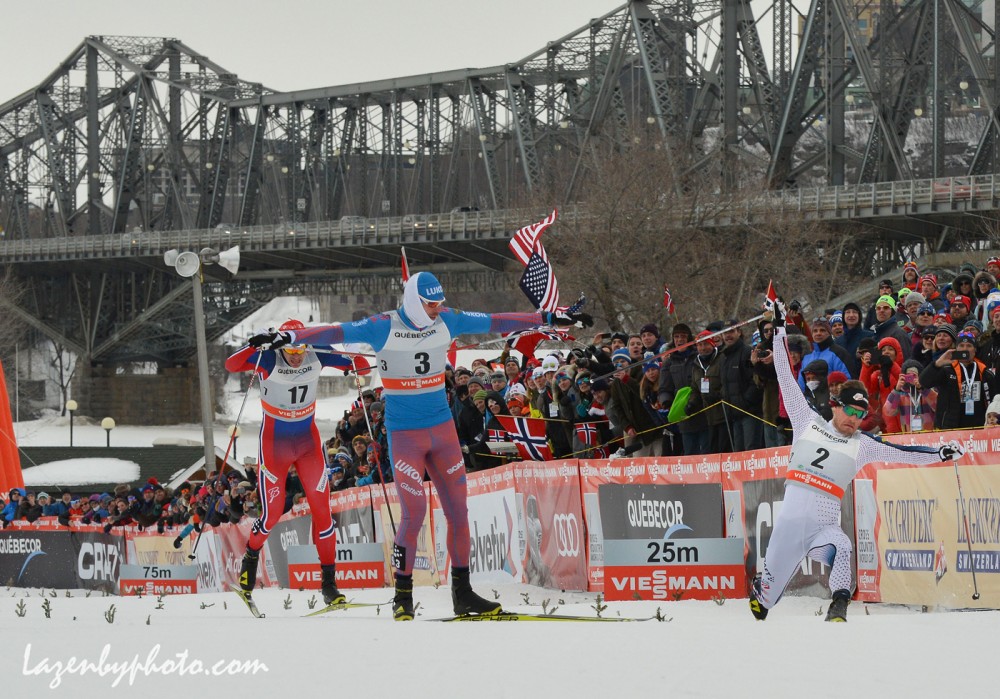
Russia’s Sergey Ustiugov (3) celebrates his win by mere hundredths of a second over France’s Richard Jouve (not shown) and American Simi Hamilton (2), who lunged across the line and placed third for his second podium of the season. Norway’s Finn Hågen Krogh placed fourth and Ola Vigen Hattestad (17) finished fifth, while Petter Northug was sixth. (Photo: John Lazenby/Lazenbyphoto.com)
Into the home straight, Hamilton came charging up along the fence to challenge Ustiugov in the lead.
The only thing clear at the finish was that the athlete with the biggest stretch would finish best. The race ended in a six-way photo finish with all six finalists within 0.72 seconds of Ustiugov.
Hamilton’s lunge at the line? That was good enough for third behind Ustiugov and Jouve, and ahead of three Norwegians.
“It’s great seeing the Norwegians win,” Hamilton reflected in the press conference. “They are incredible skiers, they come from an amazing skiing culture, but it’s pretty cool to be on the podium with people like Richard and Sergey. I think we are showing the rest of the world that this sport can be won by people other than the Norwegians and it’s fun to be able to be a part of that.”
Tuesday was Hamilton’s second podium of the season and third-career sprint podium.
“I think we are showing the rest of the world that this sport can be won by people other than the Norwegians and it’s fun to be able to be a part of that.” — Simi Hamilton, second in the freestyle sprint at the Ski Tour Canada in Gatineau, Quebec
Ustiugov’s Day
A word or two about Ustiugov is well worth a mention. Like Hamilton, the 23-year-old Russian played his tactics well, qualifying in third then winning his fast quarterfinal in a three-way photo finish. (His quarterfinal time bested the fastest qualifying time by almost two seconds.)
In his semifinal, Ustiugov broke a pole just after the start. Cooly, he power skated along until a Russian coach was able to hand him a new pole. On the longer-than-usual course, Ustiugov was able to eventually bridge back up to the leaders.
It also seemed like an aha moment. It was as if the pole break taught Ustiugov something that Hamilton had learned: conserving energy early pays dividends in the end.
By 1:49 into the semifinal, Ustiugov took the lead, despite his long-forgotten broken pole. He ended up second to Krogh in a photo finish.
In the final, Ustiugov hovered in the back of the pack, looking like an afterthought until late in the race.
“It was my tactical goal today,” Ustiugov said, according to a translation at the press conference. “In the quarterfinal, I also started very slowly. In the semifinal, I made a really fast start, and in the final again the same start like in the quarterfinal. So that was my tactic play today.”
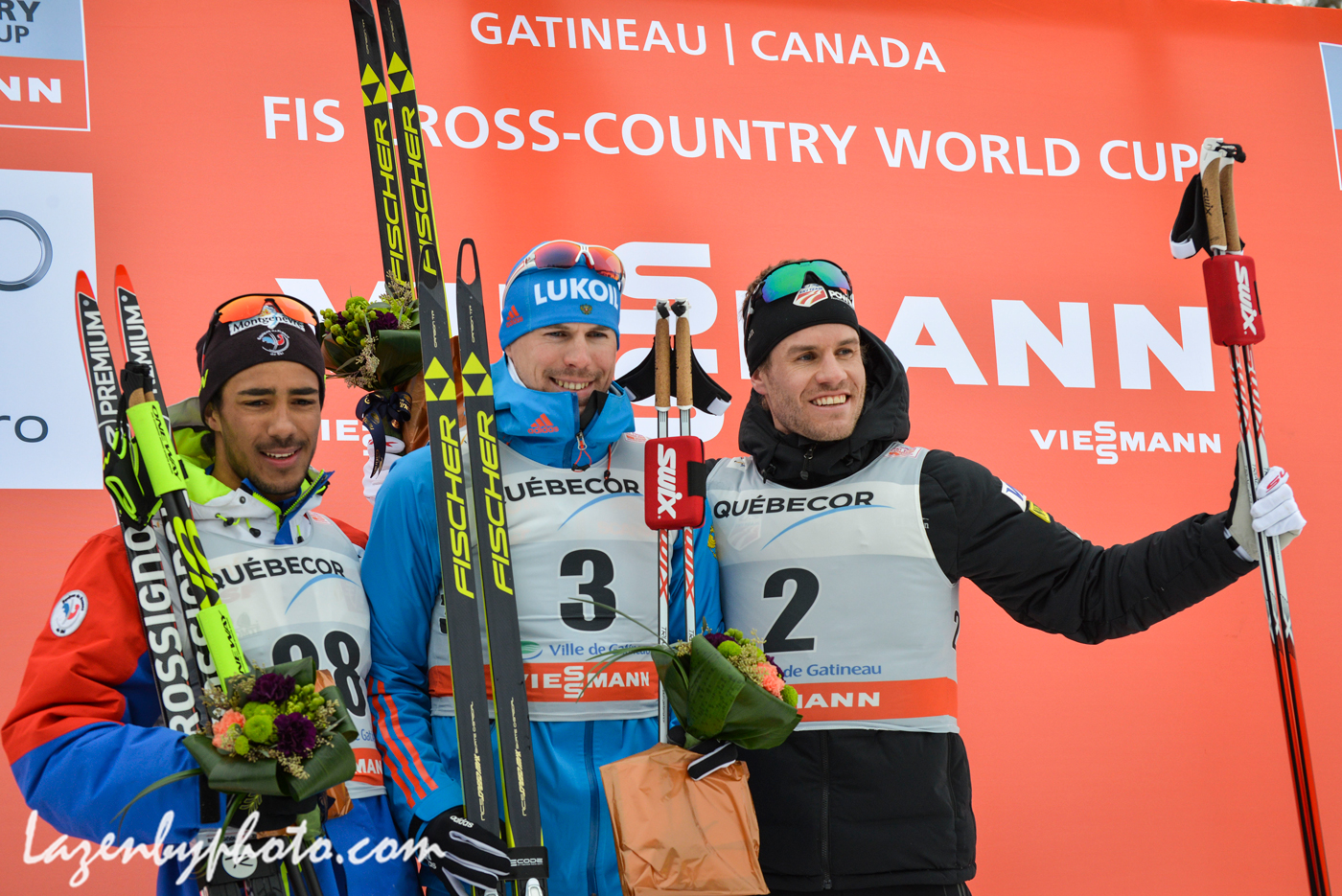
The men’s freestyle sprint podium at the first stage of the Ski Tour Canada with Russian winner Sergey Ustiugov (c), France’s Richard Jouve (l) in second and American Simi Hamilton (r) in third. (Photo: John Lazenby/Lazenbyphoto.com)
Gatineau marked Ustiugov’s first sprint victory since Nove Mesto, Czech Republic, where he won his first World Cup (a freestyle sprint) in January 2014. Last month, he won the 15 k freestyle mass start in Falun, Sweden for his second individual World Cup win.
And on Tuesday, he outlasted five skiers in a photo finish for his third victory, with first through fourth being separated by just 0.13 seconds.
Just a toe behind the Russian winner was Jouve. His plan, unlike Ustiugov’s building pace, was to hang on for as long as possible.
“We had a good race tactic, from the quarterfinals all the way to the final,” Jouve said in the press conference. “We tried to stay at the front of the pack as long as we could.”
Asked about lining up with Northug in the final, Jouve said he convinced himself he belonged.
“It really impressed me being in the final, but I had to tell myself I was as good as any of the other finalists,” he said. “The French-speaking public was great and I want to thank all who cheered for me.”
Including the team sprint in Planica, Slovenia, this was Jouve’s third podium of the season.
The U.S.
U.S. Ski Team member Erik Bjornsen was the next-best American in 25th overall. He qualified for his first sprint of the season in 27th, 7.3 seconds behind Northug’s top qualifying time.
“It was fun to jump into the heats and mix it up a little bit,” Bjornsen told FasterSkier after his quarterfinal.
Initially, at the start of his quarterfinal (the fourth of five), Bjornsen led the pack.
“I was just feeling comfortable and I knew it was important to get a good spot and maybe I got a bit too comfortable out there,” he reflected. “And also I let one or two guys go thinking, ‘It’s going to be fine.’ ”
Bjornsen was knocked out of the competition when he finished fifth in his quarterfinal, 2.17 seconds behind Northug as the winner of that heat.
Bjornsen said he’s looking forward to the distance days to come, starting with a 20 k classic mass start on Wednesday in Montreal.
“Tomorrow and then Canmore, both those classic distance races I’m pretty excited for,” he said.
No other Americans qualified for the heats. Bjornsen’s Alaska Pacific University (APU) teammate Reese Hanneman placed 35th, Andy Newell (SMST2/USST) finished 42nd, Dakota Blackhorse-von Jess (Bend Endurance Academy) was 54th, Eric Packer (APU) 72nd, Noah Hoffman (SSCV/USST) 74th, Scott Patterson (APU) 75th, Tad Elliott (SSCV) 81st, Matt Liebsch (Gear West) 82nd, and Brian Gregg (Team Gregg) 83rd.
The U.S. notched a never-before-seen double podium with both an American man (Hamilton) and woman (Jessie Diggins) on the podium, as Diggins placed third in the women’s final.
“We are so proud of all the USA athletes today,” U.S. Head Coach Chris Grover said in a USSA press release. “It was really exciting to see Erik Bjornsen take his first sprint points of the season and finish 25th. … Once the heats began, both Jessie and Simi were masterful when it came to making space in which to pass their competitors. They made gaps open for themselves and timed their podium bids perfectly.”
It’s Good to be Home
Canadian World Cup Team member Alex Harvey, of St-Férréol-les-Neiges, Quebec, took advantage of the home field right from the go. He qualified 15th (+4.18) for his first time making the heats in a World Cup freestyle sprint this season.
Alex Harvey (Canadian World Cup Team) racing to 15th in the 1.7 k freestyle sprint qualifier at the first stage of the Ski Tour Canada on Tuesday in Gatineau, Quebec. Harvey went on to reach the semifinals for 11th overall. (Photo: Peggy Hung)
“It was a great start to the Tour. I felt really good out there as the day went on,” Harvey said in a Cross Country Canada press release. “I haven’t had much success this year qualifying in the sprint races so to be 15th was a good sign.”
In his quarterfinal, the first of five, it didn’t appear Harvey would advance until the final stretch.
“We had three of the fastest men pushing the pace in the quarterfinals,” Harvey said in a press release. “We get to pick our heats that we want to race in and I wanted that one because I knew it would be fast and a good chance to have a lucky loser spot.”
In a four-way photo finish, Harvey finished fourth, 0.29 seconds behind Ustiugov, the winner of the heat. Krogh automatically advanced in second (+0.01), while Hattestad in third (+0.27) and Harvey two-hundredths of a second behind him reached the semifinals as lucky losers.
Harvey did not advance beyond the semifinals, finishing sixth in the first semi (1.44 behind Ustiugov in first), and placed 11th overall. It was his second-best sprint of the season after placing seventh in a classic sprint last month in Stockholm, Sweden.
“I was better positioned in the semis, but I almost crashed in that final corner and it scrubbed my speed. That was it for me,” Harvey said on Tuesday. “I felt really good as the day went on. The crowd was awesome today and really loud so it was a great start.”
That great start was not Harvey’s alone. Canadian National Development Team athlete Knute Johnsgaard, in his second World Cup sprint, qualified 29th (+7.80). He ended the day 30th overall for his first World Cup points.
Johnsgaard told FasterSkier he tried to relax compared to his recent starts in Europe.
“I think I maybe waited a little better,” Johnsgaard said. “The last rounds I did in Europe would have been the OPA Cup in Planica, the week before the World Cup weekend. And I was … getting a bit too excited off the start that time. So I was just trying to relax this time until the second lap, and maybe make a move on the second lap. But unfortunately everyone is so strong … I don’t think it was much about tactics today, just the strongest skiers went through.”
Canadian World Cup Team member Len Valjas finished 37th, Andy Shields (Thunder Bay National Development Centre) placed 48th, Devon Kershaw (CNST) was 50th, Bob Thompson (NDC Thunder Bay) 52nd, Jesse Cockney (CNST) 53rd, Russell Kennedy (Canmore) 59th, Kevin Sandau (AWCA) 70th, Gatineau’s own Simon Lapointe (Skinouk) 71st, Graeme Killick (CNST) 76th, Ivan Babikov (CNST) 78th, and Patrick Stewart-Jones (AWCA) 84th.
The Ski Tour Canada continues Wednesday in Montreal with the Stage 2 men’s 20 k classic mass start, and a 13 k women’s classic mass start on an approximately 3 k loop.
— Gerry Furseth, Alex Slobodian, François Léger Dionne, and Harald Zimmer contributed reporting
Simi Hamilton with his mom, Ruth, after Hamilton placed third in the men’s skate sprint at Stage 1 of the Ski Tour Canada in Gatineau, Quebec. (Photo: John Lazenby/Lazenbyphoto.com)
Simi Hamilton (U.S. Ski Team) racing to second in the skate sprint qualifier at the Gatineau stage of the Ski Tour Canada. He went on to place third in the final. (Photo: John Lazenby/Lazenbyphoto.com)
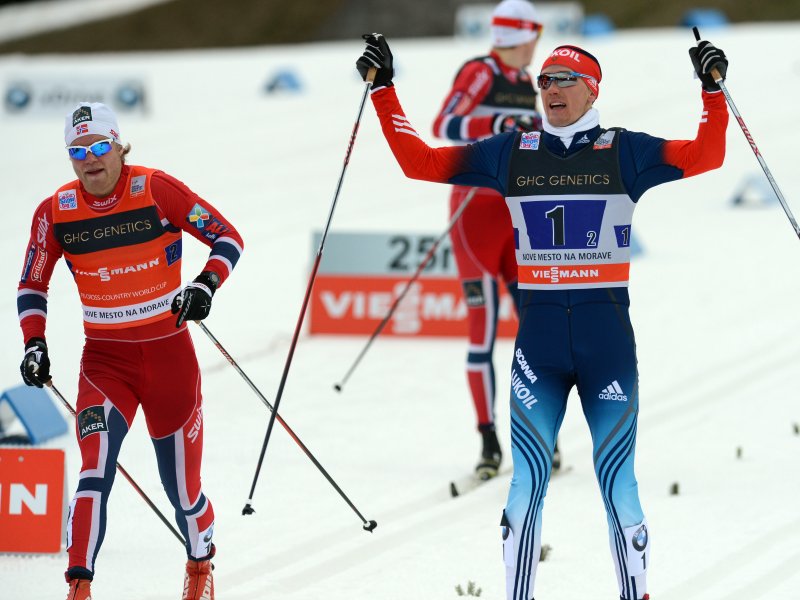
Russia’s Nikita Kriukov (27) celebrates his victory across the line during the men’s classic sprint final at the World Cup in Stockholm. Norway’s Ola Vigen Hattestad (2) placed second and Petter Northug (l) was third. (Photo: Fischer/NordicFocus)
A day of double-pole domination and some unlucky mishaps on a sloppy and warm course made for an interesting lineup in the men’s 1.2-kilometer classic sprint final in Stockholm.
At the start of the men’s classic sprint final at the Royal Palace, there were only was only two interruptions of the imposing red lineup of Norwegians: Frenchman Baptiste Gros and Russian Nikita Kriukov, the only two who could try to prevent a Norwegian sweep. This would be a tall order against Norway’s Petter Northug, Finn Hågen Krogh, Ola Vigen Hattestad, and Sondre Turvoll Fossli.
Although changes were made to the course to include another hill and encourage striding, it did not deter all of the men’s field from double poling the course. The decision to gut it out on skate skis proved to be rewarded through the heats amid deteriorating conditions as a large portion of the top 30 in the heats, including the final, were composed of racers who opted to double pole. Only one finalist, Fossli, chose to race on kick wax.
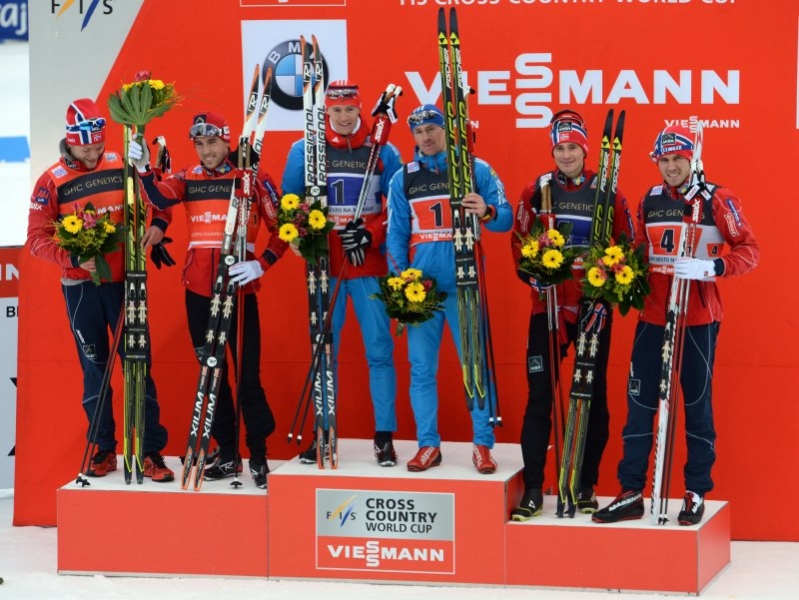
The Stockholm city classic sprint men’s podium on Thursday: with Russian winner Nikita Kriukov (c), Norway’s Ola Vigen Hattestad (l) in second and Petter Northug (r) in third. (Photo: Fischer/NordicFocus)
As the only strider, Fossli led the field up the first climb on the one-lap course. The field strung out, and Fossli continued to lead through the descent and the hairpin turn at the bottom. However, the pack swallowed Fossli on the flats and gentle descent that followed, and he faded to sixth.
Heading into the final straightaway, Hattestad took control, but Northug and Kriukov were closing. In the final 100 meters, Kruikov threw a crushing surge that neither could match. He passed both Northug and Hattestad in the final meters and established enough of a gap to celebrate across the line.
“I’m back!” Kriukov exclaimed at the finish.
With his first World Cup victory since December 2013 in Asiago, Italy, Kruikov had indeed returned. The 30-year-old Russian classic-sprint specialist had previously recorded a season-best 10th at the classic sprint in November in Kuusamo, Finland.
In Thursday’s qualifier, he narrowly made the top-3o cutoff in 27th, 7.4 seconds behind qualifying winner and fellow Russian, Alexander Panzhinskiy. But there’s a reason Kriukov had five previous World Cup victories and an Olympic gold medal in classic sprints.
In the heats, Kriukov automatically advanced to the semifinal after placing second in his quarterfinal, 0.2 seconds behind Fossli. He was the last lucky loser to advance from the first semifinal, after placing fourth behind Fossli, Hattestad, and Northug, respectively.
In the final, he outlasted Hattestad in second place by 0.69 seconds. Heading toward the finish, Hattestad thought he could hold him off.
“When I got halfway up the hill, and did not hear anyone who challenged me, so I thought actually I had it,” Hattestad told NRK, according to a translation. “But then stiffened I bit and then came Nikita in an insane speed.”
“It feels good to be back on the podium again and this time in first,” Kriukov told FIS afterward. “I have skied well here before and I am happy to do it again in the soft snow today.”
The other lucky loser from the first semifinal, Northug followed up his classic-sprint win from last week in Drammen, Norway, with another podium in third, 1.16 seconds behind Kriukov. After the race, Northug was uncharacteristically complimentary.
“What he [Kriukov] did at the end today, was totally awesome,” Northug told NRK.
Kriukov was the highlight for an otherwise rough day for the Russian team. Panzhinskiy posted the top qualifying time by 0.55 seconds over Hattestad in second, but broke a pole in his semifinal and did not advance. Sergey Ustiugov crashed hard in his quarterfinal after posting the third-fastest qualifier, 2.28 seconds behind Panzhinskiy. Hitting the homestretch, Ustiugov appeared to cross his skis when jumping into a track, but nobody else was involved in the crash.
Harvey Narrowly Misses Final; Hamilton and Newell in the Heats
Canada’s Alex Harvey racing to 20th in the qualifier at Thursday’s World Cup classic sprint in Stockholm. Harvey made it to the semifinals, where he placed third in his heat for seventh overall. (Photo: Fischer/NordicFocus)
As Canadian Alex Harvey charged to the line of the second semifinal, the potential of advancing to the final hung tantalizingly close. Harvey was third entering the homestretch, within reach of Gros and Krogh, but the pair pulled away along with Harvey’s shot at automatically advancing.
Harvey lunged for the line in third, finishing 1.11 seconds behind Gros in first and 1.08 after Krogh in second, but the second semifinal was nearly four seconds slower than the first. Gros’s winning time of 2:47.82 was slower than both the lucky loser times of Northug in third (2:45.01) and Kriukov in fourth (2:45.03) from the first semifinal.
Harvey’s finish placed him seventh in the overall standings for his best sprint result this season.
“Sprinting hasn’t been going super for me this year,” Harvey wrote in an email after Thursday’s race. “Today was the first day I made the semis, but still, every time I put a bib on, I’m racing for the podium.”
“Alex skied really well through all the rounds and looked really strong, especially his straightup double pole,” said Canadian head coach Justin Wadsworth said on the phone.
Harvey chose to double pole through the rounds and it paid off as he put together three strong races and narrowly missed qualifying for the final.
“I felt good today, but nothing special,” he wrote. “My lungs are still not 100% recovered from the 50km [last Saturday at Holmenkollen]. I did feel like my double pole was holding up well.”
Harvey was the lone Canadian who reached the heats, qualifying in 20th (+6.72). Americans Simi Hamilton and Andy Newell advanced to the quarterfinals as well, qualifying in 21st (+6.79) and 26th (+7.40), respectively.
Harvey and Hamilton both raced in the fifth quarterfinal — Hamilton striding and Harvey double poling.
Simi Hamilton (U.S. Ski Team) racing to 21st in the classic-sprint qualifier at the World Cup in Stockholm on Thursday. He went on to place 22nd overall after finishing fifth in his quarterfinal. (Photo: Fischer/NordicFocus)
Although he considered double poling the course, Hamilton chose the technique that he felt fit his strengths.
“When it is not obvious that double poling is going to be faster than everything else, I lean towards striding,” Hamilton said on the phone afterward. “I had a really good race last week in Drammen on klister skis when about half the field was double poling so that gave me confidence.”
Hamilton’s plan for Stockholm was to power up the last hill to put himself in contention to advance. However, he ran out of time to close gaps that had opened on the flats and gradual descent.
“I tried to make something happen in that last 200m, my kick was really good and I still felt really good energy wise but I just ran out of room and couldn’t close the gap,” Hamilton explained.
Ahead of Hamilton, Sweden’s Oskar Svensson won the quarterfinal by 0.78 seconds over Harvey in second, as both advanced to the semifinal. Hamilton placed fifth, 2.21 seconds after Svensson, and also behind Finland’s Matias Strandvall in third and Norway’s Even Northug (one of Petter’s younger brothers) in fourth. Overall, Hamilton finished 22nd on the day.
Andy Newell (U.S. Ski Team) racing to 26th in the classic-sprint qualifier at the World Cup in Stockholm on Thursday. He went on to place 23rd overall after finishing fifth in his quarterfinal. (Photo: Fischer/NordicFocus)
Newell found himself in a stacked first quarterfinal, which included eventual finalists Fossli, Kriukov and Gros. Although both Ustiugov and Finland’s Toni Ketelä advanced to the semifinals as lucky losers from that quarterfinal, Newell finished a distant fifth after making a last-minute decision regarding technique.
“In the quarterfinals I was prepared to double pole the heat but switched to kick wax right before the start since it was looking like I would have a majority of striders to go up against,” Newell wrote in an email. “Who knows if it was the right call, but for whatever reason my Klister was dragging a bit on the flats which was frustrating.”
While Newell was far enough behind Ustiugov to avoid his trip-up before the finish and ski around him into fifth (+9.44), it wasn’t enough to advance and he placed 23rd overall.
Canada’s second skier, Len Valjas also chose kick wax and ended up 45th in the qualifier, 10.72 seconds out of first and 2.83 seconds out of the top 30.
Reese Hanneman and Erik Bjornsen also competed for the U.S., finishing 66th (+17.64) and 69th (+18.87), respectively.
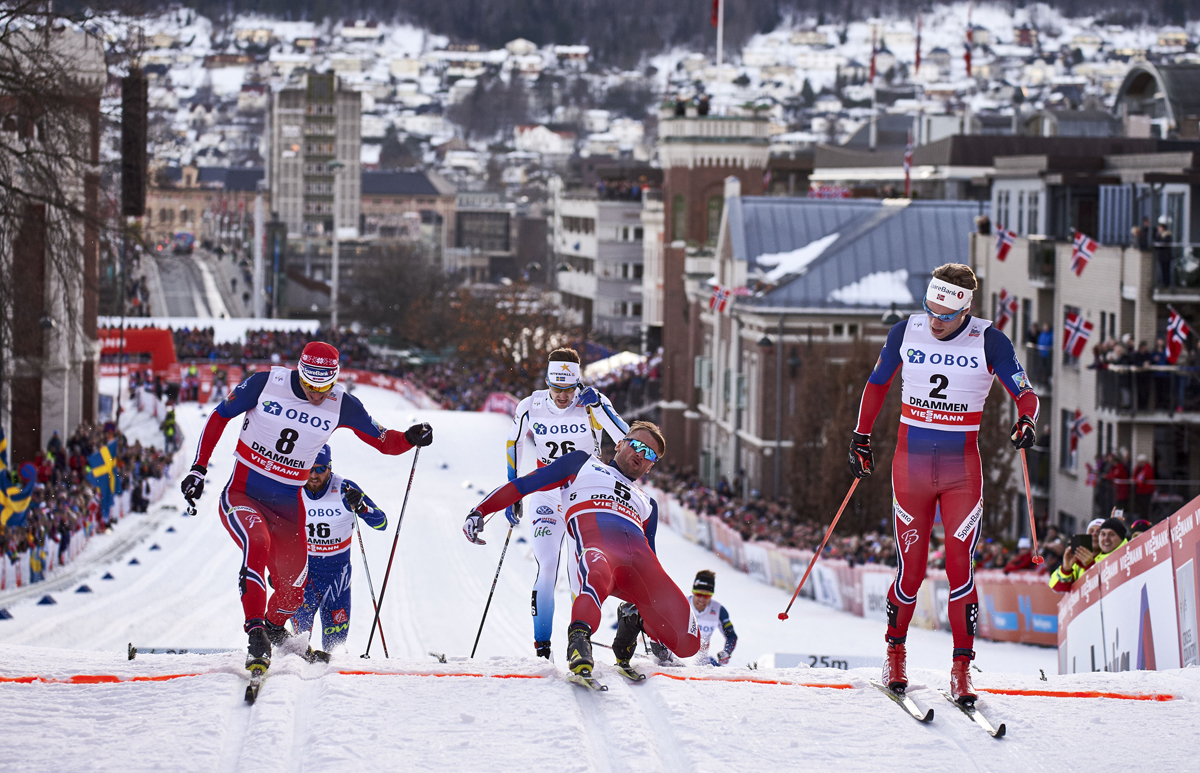
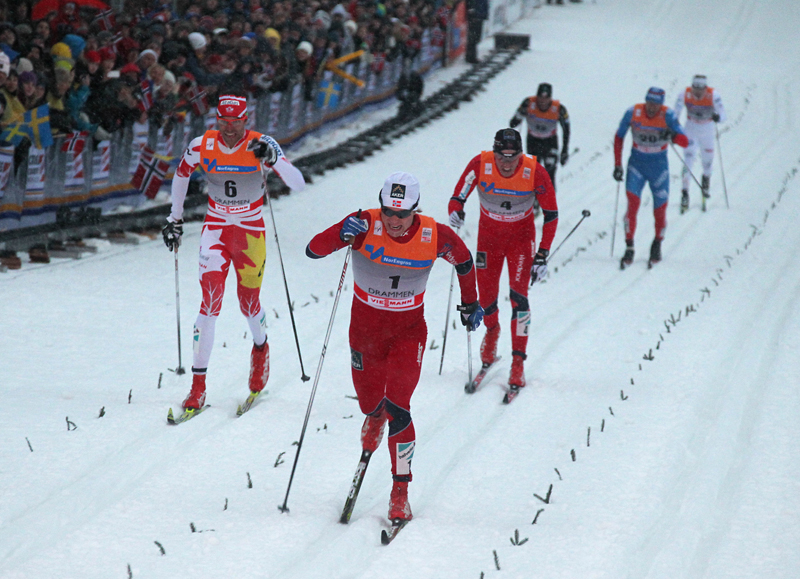
Petter Northug flexes his muscles in celebration of his win during Wednesday’s classic-sprint final at the World Cup in Drammen, Norway. He led a Norwegian sweep of the top four, with Ola Vigen Hattestad (8) in second and Eirik Brandsdal (2) in third. (Photo: Fischer/NordicFocus)
It’s a modified saying, but when in Norway, ski like Norwegians do. During Wednesday’s 1.2-kilometer classic sprint in Drammen, Norway, the Norwegian men took that saying to heart.
On a postcard day, with the late-afternoon sun dipping below the quaint city and the surrounding forested hills, Norway dominated the finals — they locked up the top-four spots. Double poling to victory was Petter Northug Jr. in 2:38.95. Ola Vigen Hattestad, also a double-poler, finished second (+0.41) in a photo finish with Eirik Brandsdal (+0.47), who took third.
Norway’s Finn Hågen Krogh skied to fourth, 1.98 seconds back. The first non-Norwegian was Sweden’s Teodor Peterson in fifth (+2.13). Russia’s Alexander Panzhinskiy rounded out the final in sixth, 11.41 seconds behind Northug.
American skier Simi Hamilton was the top North American finisher, placing 11th on the day. Hamilton was eliminated in the first semifinal, where he finished sixth.
The remaining U.S. Ski Team members did not advance after the qualifier. Erik Bjornsen skied to 46th, 8.23 seconds behind top qualifier, Panzhinskiy, who skied the course in 2:32.69. Reese Hanneman followed in 59th (+10.02), Andy Newell in 63rd (+11.52), Dakota Blackhorse-von Jess in 69th (+15.13), and Scott Patterson in 71st (+18.07).
The top Canadian was Alex Harvey, who placed 20th overall — he was knocked out in the fourth quarterfinal when he finished fourth, only 2.08 seconds out of first. Teammate Len Valjas qualified in 19th, and placed 28th overall after finishing sixth in his quarterfinal. No other Canadians entered the race.
Petter Northug’s lunge at the line during his semifinal heat in Drammen, Norway’s classic sprint, gained him second place to Erik Brandsdal (bib 2) and a spot ahead of Ola Vigen Hattestad (bib 8) in third. (Photo: Fischer/Nordic Focus)
Northug’s World
It’s been nearly a month since the last World Cup classic sprint in Oberstdorf, Germany. That race, as part of the 2016 Tour de Ski, saw many tired sprint specialists — many dropped out of the Tour after that stage. Wednesday’s qualifiers should have seen a World Cup crew of sprinters on rested and ready-to-hustle legs.
As noted, Russia’s Panzhinskiy, a classic sprint specialist who took Olympic silver in 2010, bested the field in the qualifier, crossing the line in 2:32.69. But it was a notable Northug who placed fifth, 2.84 seconds behind. Northug has been a results enigma — always in the hunt, sometimes a crafty World Cup win, on-form for championships.
Despite all the glory, the top-of-the-world all-around skiing, Northug last won a regular World Cup sprint nearly three years ago; a 2013 classic sprint in Stockholm, Sweden. The week prior to that victory, Northug also won the classic sprint in Drammen. (He double poled to victory in those sprints as well.) So to say Northug was due for a win isn’t exactly the truth. But to say that Northug skied wisely, powerfully, and stamped his authority on the reality of the new double-pole norm, is tough to refute.
The first semifinal was stacked. The top finishers on the day, Northug, Brandsdal, and Hattestad finished second, first, and third, respectively. Hamilton placed sixth (+4.69). On a firm-and-fast course, where most skiers used klister and strided on the short-steeps and used a combo of kick and double poling on the false flats, Northug proved he could stay in the mix with the heavy hitters by relying on his slick skate skis and a hammering double pole.
Northug’s semifinal never really strung out. Like a Slinky, expanding and contracting, every time a small gap formed, the group eventually came back together. And that’s how it was: the six skiers entered the final stretch in a clustered group, and it was a frenzy to the finish.
Yet in the finals, it first appeared Northug’s double-pole only strategy would come to naught. Northug dangled in fourth while Panzhinskiy and Brandsdal strided ahead — both used kick wax.
Then the dynamic changed 1:36 into the race. On a fast gradual downhill, in a tight tuck, Northug simply glided past first, second, and third, and into first himself. Just before the final 180-degree turn back to the everlasting homestretch, Northug had time to give a glance, or maybe a glare, behind.
The race then was his to lose.
With his signature forward hips and high hands, Northug looked to be in rare form in victory. As were his comments after the race. Across the finish line, celebrating, Northug flexed his arms.
In a translation from an NRK article, Northug said he was signaling his mother. “It was a signal to my mother that she can be proud that she produced a crazy guy like me,” he said.
Crazy or not, the choice to double pole was never in doubt. “Perhaps it would have been smart to use kick wax in the quarterfinals, but I have always double poled in Drammen,” Northug told NRK. The translation reads that Northug thought he’d be bullied or made fun of had he used kick wax.
“I laugh at those who use kick wax and feel like we should spare our waxers that job,” Northug commented to NRK.
With the win, Northug immediately looked ahead to Saturday’s 50 k classic mass start at Holmenkollen in Oslo, Norway. Apparently, even with his energy expenditures Wednesday, he’s looking forward to it.
“The double poling cost me nothing. It’ll be easy to keep up the same pace for 50 k on Saturday,” Northug joked with NRK. “I’ve been training for the Holmenkollen 50 k the past weeks, it’s the year’s toughest race. My dream is to be in the mix and fight the whole way. I will challenge Martin [Johnsrud Sundby].”
Aware he was speaking about Sundby, an indomitable force this year, Northug doesn’t believe Sundby is nervous. “I’m sure he’s snickering when he thinks about how I raced four heats today. But I’m still really looking forward to Saturday,” Northug told NRK.
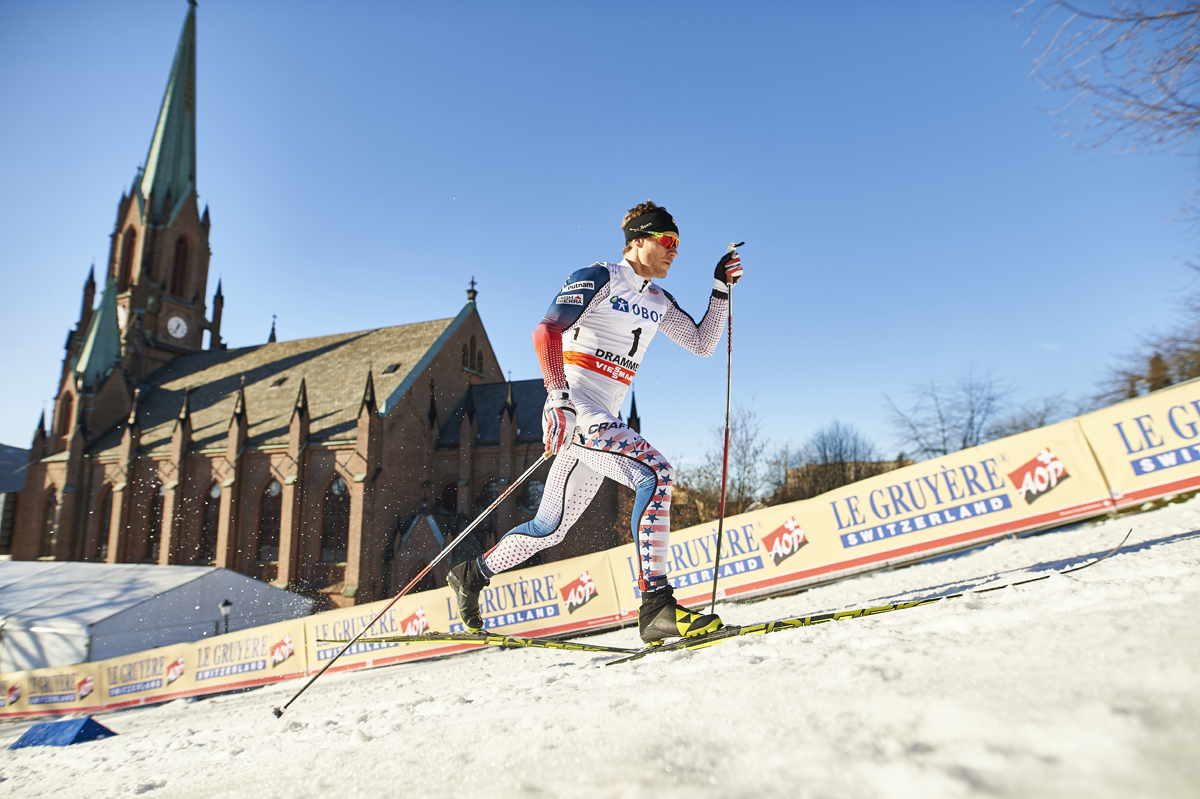
The U.S. Ski Team’s Simi Hamilton leads out in bib #1 during the classic-sprint qualifier in Drammen, Norway. Hamilton was knocked out in the semifinals, but finished the day as the best North American in 11th overall. (Photo: Fischer/Nordic Focus)
Simi in the Semis
North America’s top finisher, Hamilton, who sprinted to 11th overall, was satisfied with his performance.
“I’m definitely happy with today, not ecstatic,” Hamilton said in a post-race phone interview. “It’s always to nice to ski more than just a couple rounds. Drammen for sure is one of the harder sprints of the year, especially for me as more of a skate sprinter. It’s always been either good or bad here, and luckily today was good.”
The Drammen sprint was deep with Norwegian skiers. That, coupled with the nature of the course, made Hamilton’s efforts particularly taxing. Despite cheering fans, Hamilton said the lungs still burned.
“It’s a pretty straightforward course, but you are working for a lot of it,” he said. “The start and finish straight especially, is really tough because it’s so long and you can see where the finish is when you come around that corner at the very far end. And it’s just kind of mentally really hard because you can see it and then you just have to know that it’s just 45 seconds of all out skiing during that section.”
In his semifinal, Hamilton was positioned in second place for much of the first kilometer.
“My tactic was to to ski really comfortably the first half of the race … and just conserve energy and then try to make a move at the bottom of the course,” Hamilton said.
Coming out of the final corner, Hamilton played his tactics well for a big push down the stretch.
“I was in a great spot coming out of that very bottom corner and we hit the finish straight and I just ran out of steam in a big way,” he said. Hamilton finished sixth, and explained that his energy reserves may have had something to do with his lack of rest between his quarterfinal and semi.
“It’s always tough being the second lucky loser coming from the fifth quarter because you go straight into the first semifinal,” he said. “And that basically, it gives essentially six minutes of rest. So it’s a tough spot to be in, it happened at World Champs last year, too. So you’ve just got keep thinking positively and it’s hard for sure.”
Notably absent from the rounds was Newell. He’s a consistent sprint qualifier who craves the classic sprints.
U.S. coach Matt Whitcomb said Newell’s result was unexpected. “I think he [Andy] is a little bit puzzled, he is really disappointed. He chose to double pole and in the end it didn’t end up to be a great value to doing so. What we look for is conditions where klister is slow and skate skis can really shine. But even then, it only works if you have the very fastest pair of skate skis.”
Newell himself got right to the point in an email. “I guess you could call today an interesting day for me!” he wrote. “In a lot of ways I think it was a perfect storm of bad ski selection and just messing up the qual. I didn’t spend enough time dialing in my grip wax skis instead was just too dead set on double poling. The course broke down a lot more than I thought it was going too and I think that caught me off guard when I was out on course and I bogged on the uphill and my skaters just didn’t feel like they were gliding well in the stadium. One of those days when I would love a do-over!”
Newell added that Wednesday’s racing in Drammen was a learning experience, too. “I’ve always taken qualifying for granted so it was hard not to be in the heats today especially on a course where I have been so successful in the past. Its tough but at the same time its good because it helps put things in perspective and makes me realize how important those race day adjustments can be and to be more grateful of the opportunities I have to go for it in the heats.”
Another U.S. skier frustrated with their Drammen results was the Bend Endurance Academy’s Blackhorse-von Jess. Racing and training in Europe for the past three weeks, Blackhorse-von Jess wanted more.
“I was hoping for World Cup experience — in the rounds,” he wrote in an email. “But clearly my issues qualifying are keeping me from the next step. I’ll head home now and see if I can figure out how to put together a race in the Ski Tour Canada.
“The biggest jump for me is figuring out how to put a race together,” Blackhorse-von Jess added. “At home, I never have a problem putting races together. Good days, bad days, I make it work. I haven’t figured out how to make it work over here. Yes, these guys are fast. No question. But if I can’t figure out how to show up and race as fast as I can then I’ll never get the chance to actually race — qualification is important, but it isn’t ‘the race’.”
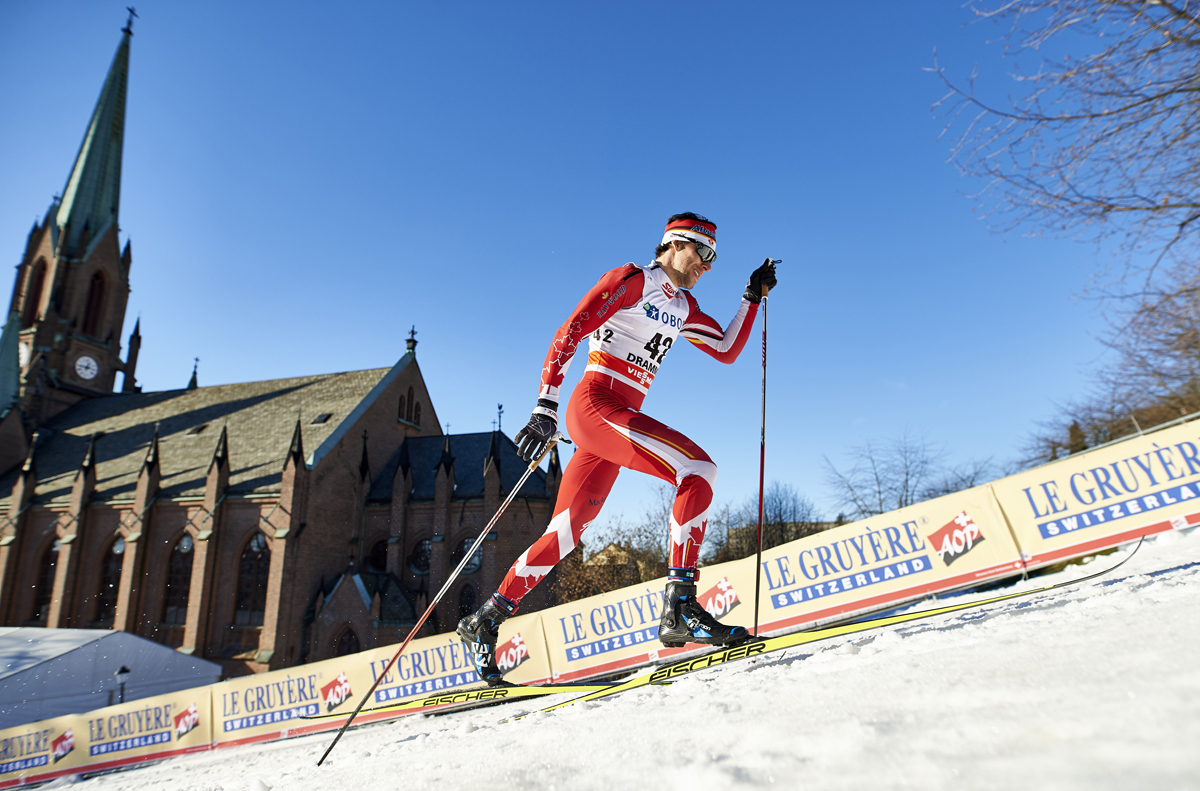
Canada’s Alex Harvey had his second-best sprint result of the 2016 season during the Drammen, Norway classic sprints. He placed 20th overall. (Photo: Fischer/Nordic Focus)
On the Canadian side, the Drammen rounds accounted for a solid result — Harvey finished 20th overall for his second-best sprint result this season after the Oberstdorf classic sprint, where he placed 15th.
“So for me to qualify was already like a really good sign. This year I have qualified only once before and really it was at the Tour, the second sprint of the Tour, when people had already dropped out and their are less sprinters. So really, it’s the first actual real sprint that I have qualified in this year,” Harvey said on the phone.
Harvey’s strong skiing on the day positioned him close to making the semifinals. His fast quarterfinal, the fourth of five heats, earned him a lucky loser spot until Hamilton knocked him out. Yet Harvey comes away with renewed sensations.
“I felt like I had a good kick in the end for the last two to three hundred meters. I think that is the first time this year I felt that strong in a finish,” he said. “In the the past I have quite good finishes in both distance and sprinting. But this year, for some reason, it just wasn’t there until today.”
Harvey plans to race this weekend’s Holmenkollen 50 k classic. He sits 12th overall on the World Cup.
Racing continues for the men on Saturday with the Holmenkollen 50 k classic mass start.
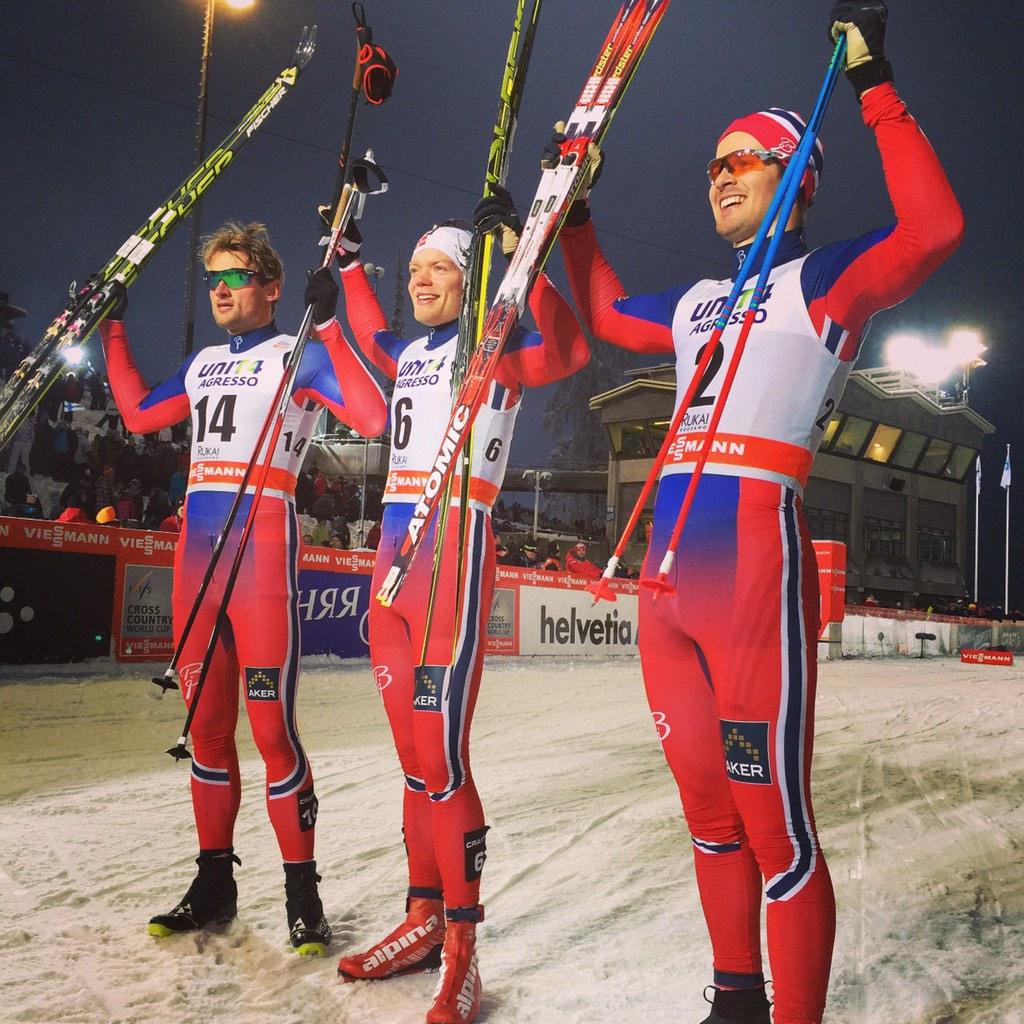
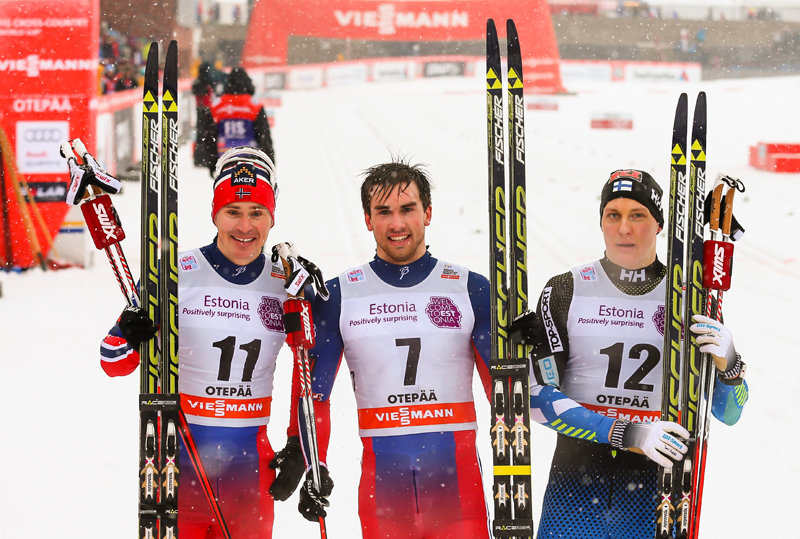
Eirik Brandsdal (c) after winning the 2014/2015 World Cup opening classic sprint in Kuusamo, Finland last November with runner-up and teammate Petter Northug (l) and Sondre Turvoll Fossli. (Photo: FIS Cross Country/Twitter)
The men’s 1.5-kilometer classic sprint final on Sunday in Beitostølen, Norway, shaped up quite nicely for the home nation, the only country out of six with any athletes in the final. Even so, the all-Norwegian sprint finalists showed no mercy on one another, as Eirik Brandsdal was all smiles after beating Petter Northug by 0.6 seconds in the final.
For the 29-year-old sprint specialist, race tactics were key to Brandsdal’s win.
“In the finals, I got [what I] desired and planned,” he told Langrenn, according to a translation. “I knew that Pål [Golberg] would go strongly in front and that Petter would lie slightly behind.”
With no no room for hesitation, Brandsdal accelerated up the final rise in order to get in front and sped toward the finish ahead of Northug.
Norway’s Eirik Brandsdal (1) charges to the finish line for a World Cup classic sprint title in Drammen Norway, in 2012. (Photo: Fischer/Nordic Focus)
After he made his move past Northug, Brandsdal recalled thinking one thing, ” ‘Do not look back. Imagine that you have the devil at your heels.’ “
He told Adressa that “It was great to keep ‘the king’ behind [me] and on the run. It only [makes me] look forward to Kuusamo. I guess we have a new challenge there.”
The World Cup season starts in less than two weeks in Kuusamo, Finland.
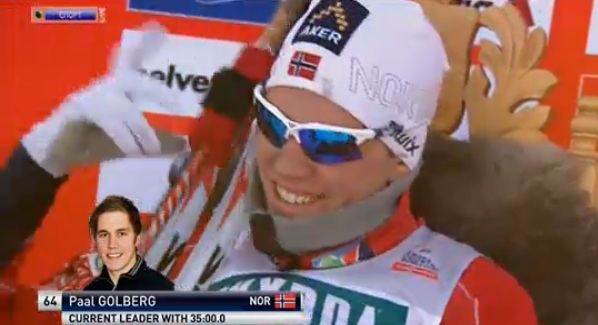
While Brandsdal won the final in 3:38.3 — the fastest course time of the day — Northug placed second and Pål Golberg was third, 1.2 seconds back.
The runner-up by six-tenths of a second, Northug declined to commentafter the final. Throughout the day, his sprint rounds were nothing short of interesting, starting with his quarterfinal, which Northug won by 0.2 seconds over Norwegian up-and-comer Emil Nyeng, 24. Nyeng (Ringebu-Faavang Skiklubb) won the qualifier to start the day by 1.9 seconds over 23-year-old Sindre Odberg Palm (Spydeberg Il).
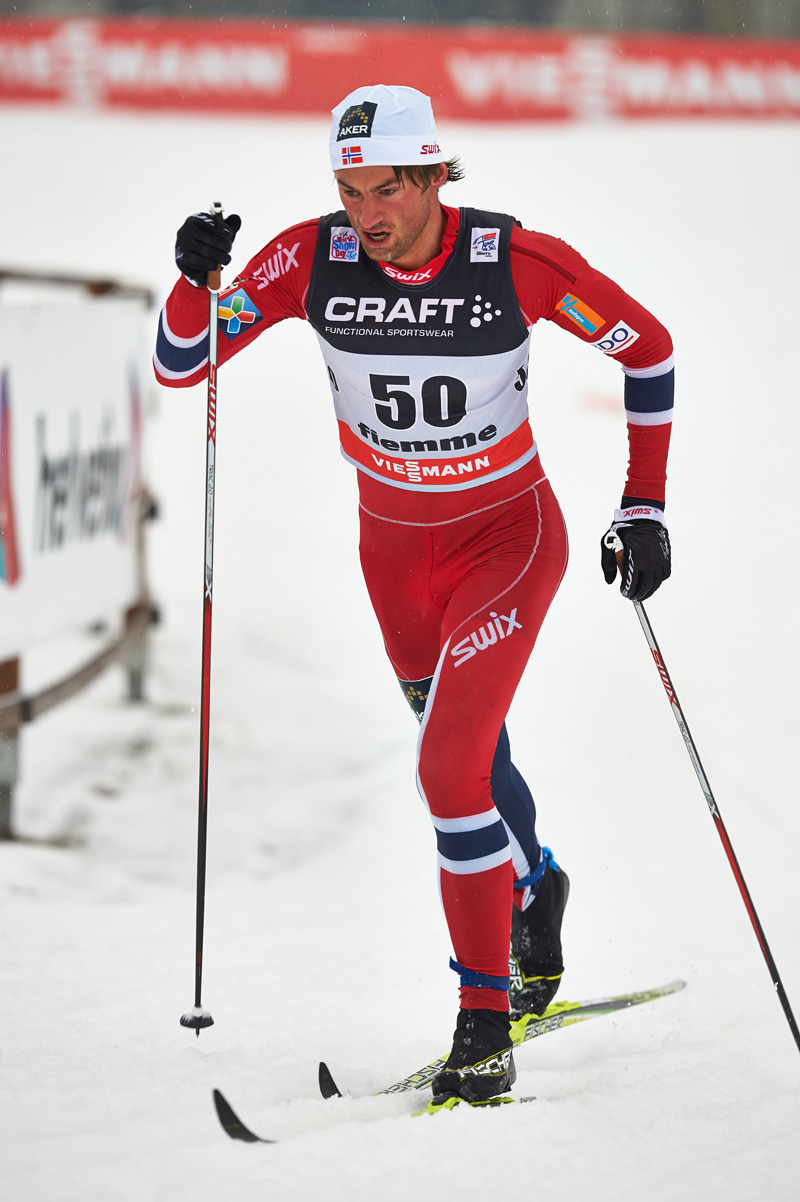
Petter Northug racing in 2014 in Val di Fiemme, Italy. (Photo: Fischer/Nordic Focus)
Also in that quarterfinal, Northug, 29, faced off against his two younger brothers, Tomas, 25, and Even, 20. While Northug and Nyeng automatically advanced in the top two, France’s Baptiste Gros moved on as a lucky loser in third, and Tomas and Even placed fourth and fifth in the heat, respectively.
“I know that I am better than them,” Petter Northug said of his brothers to Langrenn. “I did not choose [to] start as number two, but I gave my place to Even and stood in the second row.”
Northug qualified 11th, Even was 20th in the qualifier and Tomas made the cut in 30th.
The trio didn’t back off the pace, posting the second-fastest quaterfinal heat time. In the end, however, only Petter advanced to the semifinals. There, Northug and Brandsdal raced neck-and-neck to the line, ending in a photo finish for the win. They advanced with identical times.
Previously, Brandsdal, who qualified fifth, topped Golberg by 0.6 seconds to win their quarterfinal.
One name missing from the sprint final was Norwegian sprint specialist Ola Vigen Hattestad, who did not advance past the quarterfinals. Instead, Palm, Morten Eide Pedersen and Martin Løstrøm Nyenget rounded out the final, finishing fourth (+2.8), fifth (+4.9) and sixth (+6.5), respectively.
Norway’s Petter Northug (l) and Canada’s Alex Harvey (r) lunge in Thursday’s 1.4 k classic sprint at the 2015 FIS Nordic World Championships in Falun, Sweden. Northug won the are by 0.05 seconds over Harvey, who earned his best individual finish at a Championships. (Photo: flyingpointroad.com)
FasterSkier’s coverage of the 2015 FIS Nordic World Ski Championships in Falun, Sweden, is brought to you by the generous support of L.L. Bean, now featuring a complete line of Kikkan Randall training wear.
FALUN, Sweden — Alex Harvey may tell you he’s a distance skier, but don’t let him fool you. As demonstrated by his performance in Thursday’s classic sprint at the 2015 FIS Nordic World Ski Championships, Harvey is certainly one of the word’s best all-around skiers.
Starting each of his three heats at the back of the pack, Harvey appeared to be out of the running as skiers traversed the hilly course that featured 1.4 k of twists and turns. However, by the end of every race the 26-year-old from Saint-Ferréol-les-Neiges, Quebec propelled himself into qualifying position. In the final his come-from-behind tactics earned him second overall.
Lunging for a photo finish with Norwegian Petter Northug Harvey topped his previous best individual finish at Worlds – third in the same event in 2013 at Val di Fiemme, Italy. Thursday, he finished 0.05 seconds behind Northug who crossed the line with a time of 3:02.32. Northug’s teammate Ola Vigen Hattestad took the last podium position after a photo finish with Russian Nikita Kriukov. The two trailed the victor by 0.35 and 0.38 seconds, respectively.
Italian sprinter Federico Pellegrino was fifth and finished 0.67 seconds behind Northug. He was followed by Norwegian Thomas Northug to take the last spot in the heat. He was 17.28 seconds behind his brother after leading the first third of the final.
Harvey began his day on a strong note, placing fifth in the qualification round. He finished 2.4 seconds behind the qualifier winner, Kriukov, despite skis that were “too light on kick.”
“The qualifier was a great start for me. I’m never that strong in qualification, usually. I was really happy to see that,” he said in a post-race interview.
Once in the quarterfinals, Harvey explained he struggled tactically, but was able to recover in time to take advantage of several strategic openings near the end of the race. He charged past Calle Halfvarsson of Sweden in the final meters to finish second behind Pellegrino and secure a spot in the semifinals.
According to Harvey, the Canadian regrouped after the close call and thought to himself, “this is on now.”
Harvey’s semifinal would present a different challenge, however, as it featured four Norwegians including the two Northugs, Hattestad, and Eirik Brandsdal. The Canadian knew the Norwegians would push for a fast heat so that all four could advance to the final via automatic qualification and lucky loser positions. Harvey ultimately spoiled their party as he was able to finish in a close fourth position. The heat was one of the quickest on the day, and Harvey’s time was fast enough to advance him to the final.
“[I] just [had to] bite my teeth on the climbs and be strong in the finish,” he said of his effort in the semifinal.
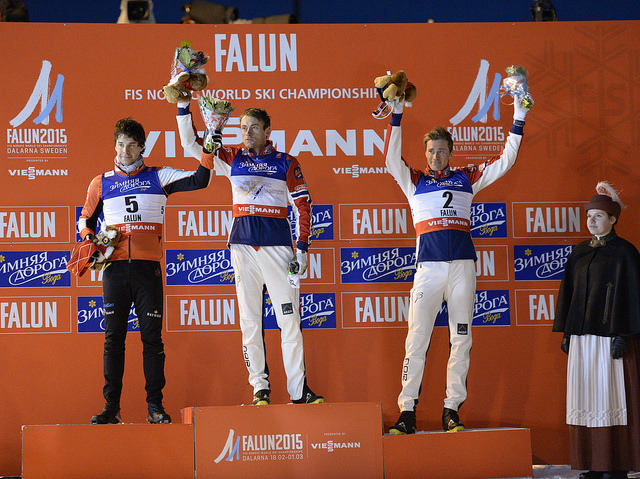
The men’s 1.4 k classic sprint at the 2015 FIS Nordic World Ski Championships. Canadian Alex Harvey (l) placed second, Norwegian Petter Northug (c) earned first, and Northug’s teammate Ola Vigen Hattestad (r) finished third. (Photo: Falun2015)
The much anticipated final began with strong push from Thomas Northug, who led each of his heats to much success throughout the day. He powered out of the stadium and up the largest climb with Hattestad and the rest of the pack following closely behind. As the six skiers tackled the steep pitch, Petter Northug made a forceful move on the inside and bounded past his two teammates to take the lead.
Heading into the downhill, Harvey was in sixth and close to losing contact with the group. “I’m just too slow at the start so I couldn’t contend near the front,” he said of his position.
But Harvey wasn’t about to give up. As the skiers entered the second major climb of the course, the Canadian took advantage of a slowing Thomas Northug to surge past the Norwegian and Kriukov into fourth position.
Pellegrino led Northug and Hattestad into the stadium to the cheers of 18,000 fans, as Harvey rapidly gained. With 200 meters to go, Harvey powered past Hattestad to ski alongside Pellegrino and behind Northug. The Canadian soon realized he had the energy to overcome the leading Norwegian, and moved to the left track to challenge Northug.
The top four skiers were tightly grouped as each meter progressed, with Harvey leading the charge just inches behind Northug. The Canadian nearly pulled even with Northug at the finish line and attempted to out-lunge him. While the initial results reflected a near-tie, it was Northug who was able to outlast the Canadian by 0.05 seconds for the win.
“It’s a big relief when you’re crossing the line first. A sprint day is really long you have to focus for many hours,” he said in a post-race press conference. “You just try to stay focused and have your plan. For sure, I wanted to have everyone as tired as possible. That was my plan when I felt that the speed was going a little bit down on the first climb. I’m happy with my tactic and my final … I think I couldn’t do anything else.”
Northug, who had a turbulent year after an arrest for drunk driving in May, explained the focus of the season has beenWorld Championships and that the dates of the event had been “marked with red.” Northug has yet to win a World Cup in the 2015 season and said that he earned his starting spot in the World Championships sprint after winning the Norwegian National Championships sprint earlier this month. The Norwegian has now won every single competition at World Championships over the course of his career with the sprint victory in Falun.
According to the 29-year-old, Thursday’s final was especially meaningful because it gave him the opportunity to race his younger brother, Thomas.
“For sure it’s big. It means a lot to me, maybe more than my brother, that we were racing together.” Northug said. “It gives you a little bit extra to be fighting with your brother.”
Canada’s Alex Harvey celebrates his second place finish in Thursday’s 1.4 k classic sprint. Harvey skied from behind in each of his heats to achieve the result. (Photo: flyingpointroad.com)
Canadian National Team Head Coach Justin Wadsworth said he believed Harvey could have overcome Northug, had the finishing straightaway been longer.
“I think if it would have been five more meters, he would have won the race,” Wadsworth said in a post-race interview. “[Harvey] said ‘oh i timed it kind of bad,’ but I think it was an amazing race, especially after being in last place at the top of the hill.”
Harvey reflected a similar sentiment, saying that he was gaining on Northug as they approached the finish. However, the Canadian was cautious in his speculation, adding, “I wouldn’t redo the race just to take that chance.”
When asked how he was able to advance from dead-last to a podium position, Harvey explained that his come-from-behind day wasn’t necessarily planned.
“I would like to lead on this course on the first hill if I could. [The course] is a bit more endurance-based and I am a bit more of an endurance-based athlete.” he said.
Despite trailing the pack at the key point in the race, Harvey explained the first hill was more of a “warmup” and the second hill was where he needed to make his move. The Canadian added that he was confident in his skiing despite his position, because he knew his finishing speed was strong.
Wadsworth agreed, adding that fast skis also played a large role in Harvey’s performance.
“I think he knows what he’s capable of and he knew the skis were good enough to do that,” he said. “This course has such a fast downhill. Then all you have to do is run up that and everyone is going to run the same. Then you have to have enough speed for the end and his double poling has been really good.”
Louis Bouchard, Harvey’s personal coach for the last 10 years and head coach of the Pierre-Harvey National Training Centre, said the course largely favored the 26-year-old because of its lengthy hills and prolonged finish. He explained that as the day went on, Harvey grew in strength while his competitors became tired.
Bouchard pointed to his athlete’s development as another piece of the Harvey success story. “The maturity and he’s more stable, he has less injury, he can train more and recover more, so I think it’s normal to expect to see him get better and better at 26 years old,” he siad.
Canada’s Alex Harvey skiing in his quarterfinal en route to second in the 1.4 k classic sprint at the 2015 FIS Nordic World Ski Championships in Falun, Sweden. (Photo: flyingpointroad.com)
Bouchard also explained that Harvey’s best-ever individual finish at a World Championships was meaningful, both on the individual level and because of the implications for the team. Cross Country Canada’s funding was reduced after a medal-less 2014 Olympics, and a strong result such as Harvey’s at the World Championships will help many within the organization to argue for increased finances.
“Now we can expect so many things,” he said. “You need it for the program. You need it for the development. That is a benefit for everybody in Canada, so that is good.”
As Harvey looks to the remainder of the Championships he will focus on Sunday’s 30 k skiathlon and the following week’s 50 k classic mass start. Last year in the 2014 World Cup finals Harvey won the 30 k skiathlon on the trails of Falun. While the course is slightly different in 2015, Harvey is hopeful that he will find similar success. He also joked that if either distance race were similar to Thursday’s sprint, he would have a longer time to win a final sprint.
“The 50 k will take longer to do that last stretch so maybe I will have time to go around him,” Harvey said, referring to his finishing battle with Northug.
In third, Hattestad said he was relieved to have won the photo finish over Kriukov.
“If I had lost the photo finish against Kriukov, it would be a black day.” he said to Fædrelandsvennen. “There are small margins between success and failure. He came quickly, and I thought I lost it. It was lovely to see that I was ahead.”
Hattestad added that he entered the championships with high hopes due to his fitness since the new year.
Only 0.32 seconds from the podium, Pellegrino finished his day in fifth, marking his best classic sprint result to date. The Italian won the last three freestyle sprints on the World Cup circuit and considers himself a freestyle specialist.
“I am satisfied because I did 100 percent of my possibilities, not only physically, but also mentally. I tried to make the best tactic that my abilities could do so I am satisfied,” he said expressing his excitement for Sunday’s team sprint.
“This season for me was a very good season in free technique, today was classic technique. I know that physically I have to grow up, I have to be more strong, so for me in fifth place is good,” he added.
Cross country competition at the 2015 Nordic World Ski Championships continues Saturday with the 15/30 k skiathlons.
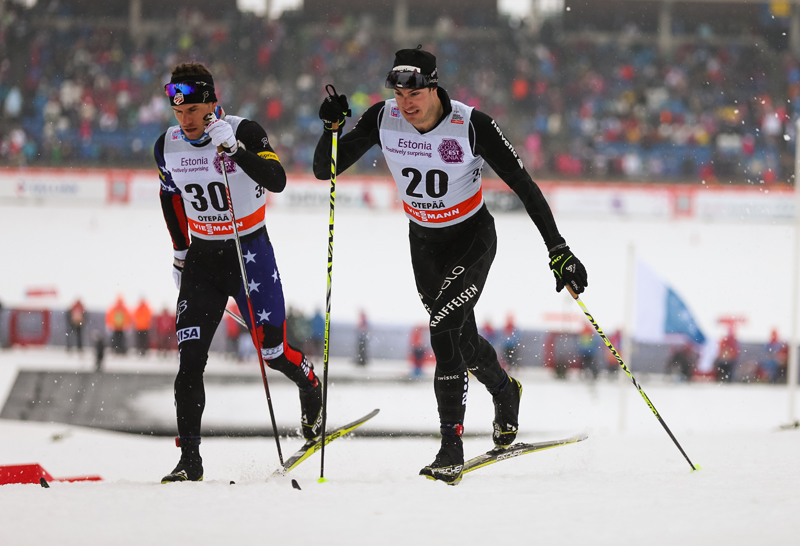
American Simi Hamilton (l) and Switzerland’s Gianluca Cologna going head-to-head in the quarterfinal of the men’s 1.5 k classic sprint on Saturday in Otepää, Estonia. Hamilton placed third in the heat, ahead of teammate Andy Newell in fourth (not shown) and Cologna in fifth. (Photo: Fischer/NordicFocus)
Three Americans made the heats on Saturday, and all of them felt basically “meh” about their races.
“If at first you don’t succeed…try, try again,” Sadie Bjornsen wrote in an online message after placing 15th in the women’s 1.2-kilometer classic sprint in Otepää, Estonia.
In some ways, she found a good deal of success: Bjornsen qualified in 18th, 6,76 seconds behind Norway’s Ingvild Flugstad Østberg, who won the qualifier and went on to win the women’s final. Then the 25-year-old Bjornsen, who was coming off some of her best results of the season in her first Tour de Ski 10 days earlier, nearly secured a spot in the semifinal.
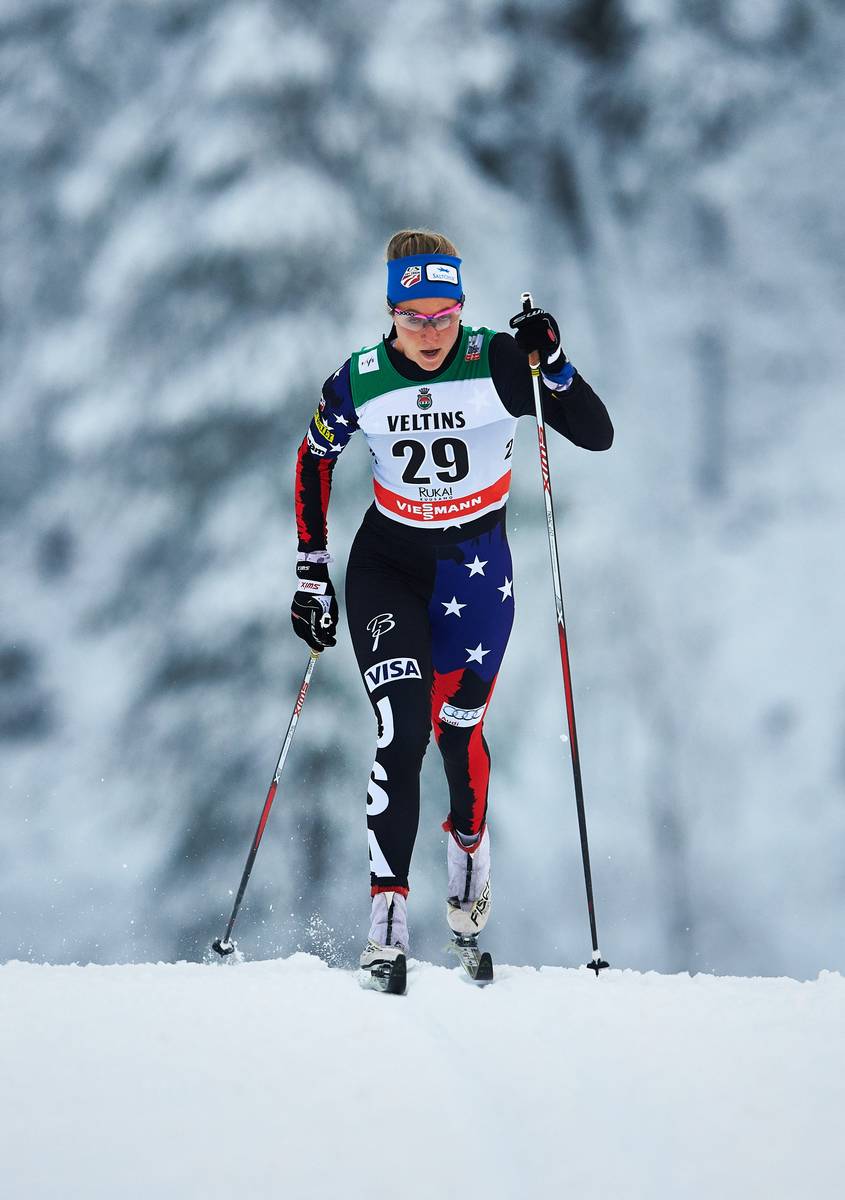
Sadie Bjornsen (U.S. Ski Team) racing to 29th in the World Cup classic sprint early this season in Kuusamo, Finland. (Photo: Fischer/Nordic Focus)
But she was three-hundredths of a second short. In a photo finish for second in her quarterfinal, Bjornsen finished third to Sweden’s Magdalena Pajala, and was 0.34 seconds behind the heat’s winner of the heat, Kari Vikhagen Gjeitnes of Norway.
According to U.S. Ski Team Head Coach Chris Grover, Bjornsen executed her tactics almost perfectly.
“She skied great and of course she is not that happy with it because she has had a lot of qualifiers, but she has struggled to get through the quarterfinals this year,” he said on the phone Saturday. “She really wanted to get through there and man, did she come incredibly close.”
In six sprints this season (two of which have been classic sprints), Bjornsen has made the quarterfinals in four of them, but yet to advance to the semifinals. Her best result this season has been 13th in the Tour de Ski freestyle sprint in Val Müstair, Switzerland.
Out of the start, she challenged for the lead, but tucked behind Russia’s Anastasia Dotsenko after the two bumped slightly while vying for the same track. Pajala led the group out, with Gjeitnes coming up alongside the Swede at the base of the lone climb on the women’s course.
Bjornsen skied hard to get directly behind Pajala, and with five women bunched together at the apex, she was fifth heading into the descent. Sweden’s Evelina Settlin went down moments later, slipping out of contention, and Bjornsen moved into fourth next to Gjeitnes.
She rode her skis even with the Norwegian, tucking while Dotsenko had to stand up and double pole over the last rise, and Gjeitnes and Bjornsen caught Pajala rounding the corner into the finishing straight.
While it looked to be a double-pole showdown for first between Bjornsen and Pajala, with Bjornsen slightly ahead early, Gjeitnes caught them both before the finish, and Pajala outlunged Bjornsen at the line.
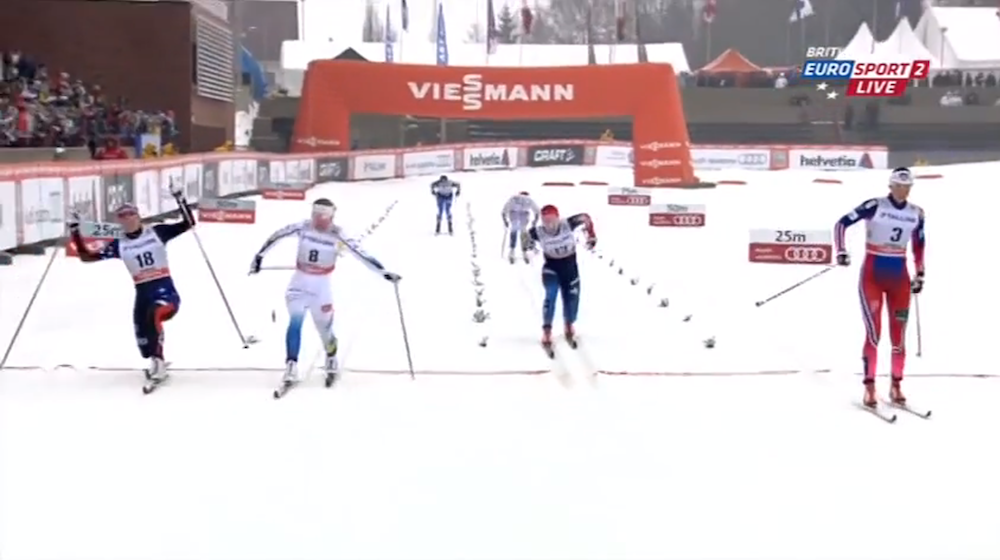
Sweden’s Magdalena Pajala (second from l) edges American Sadie Bjornsen (l) for second after Norway’s Kari Gjeitnes (r) in the quarterfinal of the women’s 1.2 k classic sprint in Otepää, Estonia. Russia’s Anastasia Dotsenko (second from r) pushes for fourth.
“Sadie knew she wanted to be in the top two and she put herself in position with a few meters to go where she was actually second, but she just couldn’t hold off Pajala there at the end,” Grover said.
If she could do it again, Bjornsen explained she would want more of a push at the end.
“I was double poling against one of the finalists [Pajala, who ended up sixth]… so I think I was in there,” Bjornsen wrote. “It was one of those days where the weather was making each heat slower and slower, so maybe on a different day, it could have been a lucky loser position.”
Her heat was the fifth-and-final quarterfinal before the men started. Temperatures hovered above freezing, but it started to rain lightly before the heats. Later on in the rounds, that turned to snow.
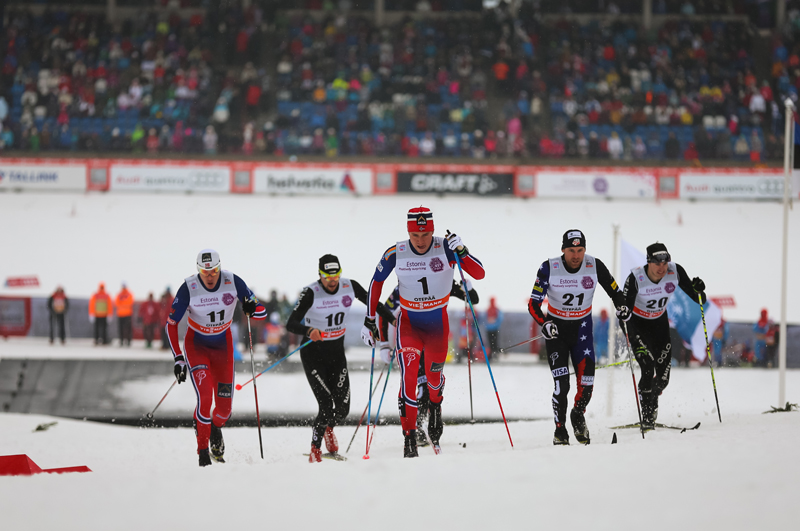
Soon after Bjornsen’s heat, two other U.S. Ski Team members — Andy Newell and Simi Hamilton — started next to each other with four others in the first men’s quarterfinal on a 1.5 k course with a second, steeper climb.
Newell pushed to get in front and lead up the first climb with Norway’s Pål Golberg, while Hamilton skied behind Newell at the back of the pack. Another Norwegian, Ola Vigen Hattestad worked to get in front of Newell at the base of the second hill, which required the not-so-pretty herringbone technique to get up in the softening conditions.
Golberg stayed ahead over the top and Hattestad trailed him by a few meters in second, while Newell skied in third ahead of Hamilton and Switzerland’s Gianluca Cologna. None of the men were quite close enough to get a draft, leaving Newell and Hamilton to race the clock in third and fourth into the finish.
“They [Hattestad and Golberg] had good skis today,” Hamilton said on the phone afterward. The two went on to place second and fourth in the final. “Not that we didn’t, but [the Norwegians] have the resources and the people to make great skis every day and that really showed. I was really psyched on my skis for sure, but having great skis, it’s hard to bridge that gap, especially with such a long hard downhill on the second part of the course.”
In the finishing lanes, both Hamilton and Newell realized it was faster outside the track and skied alongside each other. Hamilton came from behind to finish 0.42 seconds ahead of Newell and 3.26 seconds behind Golberg, who won the quarterfinal, and Hattestad, who was 0.3 seconds back in second.
Americans Andy Newell (21) and Simi Hamilton (behind Golberg in bib 1) chase Norway’s Pal Golberg up the first of two climbs in the men’s 1.5 k classic-sprint quarterfinal on Saturday in Otepää, Estonia. (Photo: Fischer/NordicFocus)
Their quarterfinal was the third slowest, and neither Hamilton nor Newell advanced to the semifinals.
While Hamilton, who narrowly qualified in 30th and went on to place 16th overall, hadn’t felt great in the qualifying round, he noted some improvement in the quarterfinals — and some of his weaknesses as well.
“Up the gradual climb from 400 meters to a ‘k’ or so, I felt like I kind of lost some energy there and that’s something I need to work on for the future,” he said. “I wasn’t able to relax as much there.”
However, he felt he regrouped on the second half of the course.
“I was happy how I skied that,” he said, after putting in a surge up the last climb. “I knew that [Cologna and Ueli Schnider] were fading behind me and I wanted to put a gap on them so they couldn’t get a draft off me.”
Hamilton was pleased with his double-pole finish and his ability to maintain good technique and a high tempo in that stretch, which he’s been working on. He also knew the conditions on Saturday didn’t suit him: “It was kind of soft and sloppy … I think it takes really good balance, something that I’m always working on, but I definitely like it when it’s super-icy and fast and firm.
“I know there’s a lot more,” he added. “I still have some work to do before world champs, but that’s what this time of year is for — keep the train going and trust the coaches and know that in just a few weeks we’ll be at the top of our game.”
“His fitness is there,” Grover commented. “He skied really relaxed during his quarterfinal on the back … but then just got stronger as the round went on and actually passed Andy in the final stretch. He had a great finish and double pole [which] he has been working on it a lot and it is really coming.”
Newell, who qualified 21st and placed 17th overall, said on the phone Saturday that it was fun, but “weird” to be classic sprinting again after not having raced that format since the first World Cup of the season in Kuusamo, Finland.
“This was the first time we had raced this [course], and I think if I’m feeling 100 percent, this is a really good course for me … one I hope to make the finals in,” he said. “But I’m still kind of working into things.”
This season, Newell has been struggling to manage an allergic reaction that comes out in the form of hives and elevated heart rates, and seems to intensify with hard workouts. While his heart rate had normalized this week, Newell took it easy leading up to Saturday’s sprint, Grover explained.
“We’ve been just trying to figure out what’s causing that by trying different diets and different medicines,” Newell explained. “It’s more like there’s something suppressing my system … in a way that’s making me hive up when I’m under stress.”
This week, he started eating gluten-free, following the lead of teammate Liz Stephen, which he said he’d try for a couple weeks despite it being hard to do in Europe.
“Until I figure out my allergic reaction, my racing’s not going to be at my potential,” Newell said. “I think if I felt 100 percent, it would’ve been a better day. I was in there and I knew Hattestad and Golberg would be tough in the finish. … I would’ve been happy trying to lead over that hill and gap them a little bit.”
While he knew Golberg and Hattestad would be tough to beat and even more difficult to catch in the finishing stretch, he didn’t realize Hamilton was right behind him.
“I think for both Simi and I, the race was finished at the top hill,” he said.
In the final straightaway, Newell recalled feeling “draggy; a little fatigued for sure. You just have to try to get across the finish line quickly in hopes that you’re going to get a lucky loser spot,” he said.
But after a long break from racing, he was ready to get back at it again.
“I think my body and my energy are feeling good for sure. I don’t think the result showed that,” Newell said.
On Sunday, Newell and Hamilton will team up in the freestyle team sprint, while Erik Bjornsen and SuperTour leader Matt Gelso (Sun Valley Ski Education Foundation) start on the second squad.
On the women’s side, Sadie Bjornsen and Sophie Caldwell will team up, and Ida Sargent and SuperTour leader Rosie Brennan (Alaska Pacific University) will form the second team. Liz Stephen and Jessie Diggins are taking a break after the Tour and training in Seiser Alm, Italy.
Caldwell started first on Saturday and placed 31st in the qualifier, 0.9 seconds out of the top 30 needed to make the quarterfinals in her first classic sprint of the season.
“Even though the result wasn’t anything spectacular, I am not disappointed,” Caldwell wrote in an email. “I knew that classic sprinting was going to be more difficult for me because I’m naturally a better skate sprinter and it requires more upper body strength, which I’m still working on. The course was pretty broken down and the women’s course in particular had a lot of double poling. I don’t mind the soft conditions, but a gradual classic course is probably not my strength.”
She felt like she had good skis — a sentiment echoed by her teammates — and Grover agreed.
“I think our skis were actually pretty good for the day,” he said, explaining they used straight klister. “Norway had smoking-fast skis during qualification. I think probably they were probably just better than everybody else’s. I mean, they had ten guys make the rounds.”
Alaska Pacific University’s Rosie Brennan notching her third-straight win in the last race of U.S. Cross Country Championships with a skate-sprint victory in Houghton, Mich.
Brennan placed 38th in her first World Cup of the season, 2.8 seconds from 30th. It was her first time back on the circuit since December 2013, and her best result since finishing 38th in the World Cup skiathlon two seasons ago in Canmore, Alberta.
Straight off U.S. nationals in Houghton, Mich., seven time zones away, Brennan and Gelso arrived in Estonia on Wednesday night.
“There is always some amount of jetlag and shaking the travel out, but I feel like I have been faring well all things considered,” Brennan wrote in an email. “It felt good to go hard again, but I feel I don’t have the turn over I would like after a long week of really slow snow in Houghton. I have to say, the course even felt really short after Houghton, which is not the usual reaction when coming from the U.S.”
“I was hoping to just feel like I was skiing well today and I think I accomplished that,” she explained. “I have found from my previous experiences over here that putting some sort of results goal in front of you is often counterproductive and that you can’t beat yourself up over results here. It takes a lot of patience. Weaknesses are often inflated when you go against the best so I already have a good idea of what I need to work on to get the result I believe I am capable of. I’m happy to be here and trying to take each day on its own to make the best of my time here.”
Sargent finished 43rd after falling in the qualifier on the downhill corner into the stadium.
“It is kind of a high-speed corner and it was a little bit tricky … you kind of went from an icy track to loose snow,” Grover explained. “I think her klister just grabbed a little bit as she was going around the corner and the skis were on edge. … It was the worst place on the course to lose your momentum because it is absolutely the place where you are going the fastest. … She is obviously bummed out because it is basically the same thing that she did in Val Müstair.”
“Another sprint another fall…Ugh!” Sargent tweeted afterward. “Practicing patience and getting psyched for the next one!”
Erik Bjornsen finished 57th in the men’s qualifier, 15.19 seconds behind Golberg.
In terms of the team on the whole and what they’re working on in the weeks leading up to World Championships next month, Grover said it breaks down on an individual basis.
“Everybody’s got their thing that is holding them back a little,” he said. “For some it is perhaps fatigue, for some it is that they haven’t fine tuned their fitness, for some it is a double-pole finish, for some it is how they are herringboning compared to some of these others. … I think going into our two-week camp in Davos following Rybinsk [next weekend] everybody is going to have their list that needs to get accomplished if everybody is going to take a step forward.”
Norway’s Tomas Northug, 24, celebrates his first World Cup win on Saturday in the men’s 1.5 k classic-sprint final in Otepää, Estonia. (Photo: Fischer/NordicFocus)
If he hadn’t been a Northug, one might have wondered what that 24-year-old Norwegian was doing.
Tomas Northug had already ditched his hat during the men’s 1.5-kilometer classic sprint on a snowy, just-above-freezing afternoon in Otepää, Estonia. And not long after the start of the final, he made it clear that he was going to drop everyone else if he could, too.
Commentators remarked that his surge early on the first of two climbs on the 1,500-meter course had been very Northug-like, referring to the gutsy performances often churned out by his older brother Petter.
Norway’s Tomas Northug in Saturday’s 1.5 k classic-sprint qualifier, in which he advanced in seventh and went on to win the final for his first World Cup win in Otepää, Estonia. (Photo: Fischer/NordicFocus)
But Petter wasn’t racing on Saturday — Tomas was — and he made his presence known after advancing from the semifinal in fourth as a lucky loser (who was luckily not taken out by Russian Sergey Ustiugov’s late, self-inflicted crash).
Out of the start in the final, Northug positioned himself in second, sitting on the heels of Norwegian teammate Finn Hågen Krogh, the Sprint World Cup leader who opted to double pole on skate skis for the final, while staying ahead of the final’s other Norwegian double-poler, Pål Golberg, in third.
At the base of the first climb, it became apparent that double poling was not the way to go in the slow-and-chewed-up snow, and Northug stepped right to get around Krogh and move to first. The double-polers hopped in behind him by the midway point of the climb, and from there, they started to lose Northug. He strode away while the three others on classic skis (Finland’s Toni Ketelae, and Norway’s Ola Vigen Hattestad and Sondre Turvoll Fossli) lost contact in a one-track train behind Krogh and Golberg.
By the top, Northug heard he had a 50-meter gap from a Norwegian coach (arguably closer to 40 meters) and he took his word, refraining from looking back until several strides later as he began the tuck down the backside of the hill. Meanwhile, another up-and-comer seeing a World Cup breakthrough, Ketelae, 26, led the chase with Hattestad, both several seconds behind on the first descent.
“I feel there was room and I came up the uphill and I think about the race Bjørgen did many years ago,” Northug said in a post-race interview with FIS in broken English. “The coach [on] the uphill say I had fifty [meters] and say to go so I do it.”
In the second semifinal, Ketelae edged four Norwegians (Fossli, Eirik Brandsdal, Timo Andre Bakken, and Vegard Bjerkreim Nislen, respectively) and Russia’s Alexander Panzhinskiy for the win. With that confidence, he chased down Northug to the best of his ability in the final, but the young Norwegian was too far gone.
Northug ran with a narrow herringbone up the steepest of the two hills, getting more encouragement from Norwegian coaches, and Ketelae and Hattestad skied together some six seconds behind on the following downhill.
With 200 meters remaining, Northug double poled up and over the last rise, glanced back once more and realized the race was his. He nearly took himself out on the lefthand corner before the finishing straight, teetering for a moment on his inside ski in all his excitement, but picked the center lane and double poled like mad to the line. There, sealing the win in 3:50:59, he looked back, raised his arms to his chest and pumped them fiercely, gesturing that he, in fact, was the man.
Norway’s Tomas Northug (7) celebrates his first World Cup victory and podium on Saturday in the men’s classic sprint in Otepää, Estonia, while teammate Ola Vigen Hattestad (l) challenges Finland’s Toni Ketelae (in blue behind Northug) for second.
Trailing Ketelae into the stadium, Hattestad jumped to a left lane to challenge the Finn for second. Hattestad outlunged Ketelae in such a close photo finish, time couldn’t even determine it, but a finish-line camera could. The two finished 1.57 seconds after Northug, with Ketelae placing third for his first World Cup top 10 and podium.
After holding his own in fourth for much of the final, Golberg placed fourth, 6.28 behind Northug, and Krogh finished about a second ahead of Fossli, who struggled to keep pace early on and finished 9.23 seconds back.
“It was not really plan to [go ahead] like that, but I felt very strong,” Northug told NRK, according to a translation. “There are some feelings, it is clear there. I have put an enormous amount of work, but not quite achieved what I want. And then came here today.”
The men’s classic-sprint podium in Otepää, Estonia: with Norwegian winner Tomas Northug (c), Ola Vigen Hattestad (l) of Norway in second, and Finland’s Toni Ketelae (r) in third. (Photo: Fischer/NordicFocus)
Northug’s previous best was fifth in a classic-sprint final at 2013 World Cup Finals in Stockholm, Sweden. In the only other classic sprint before Saturday’s this season, he missed the final but placed eighth in Kuusamo, Finland, and was sixth in a freestyle sprint last month in Davos, Switzerland.
He qualified for the heats on Saturday in seventh, 4.4 seconds behind Golberg, who set the fastest qualifying time in 3:17.61. Times were notably slower as the day wore on, with the track breaking down amid wet-and-heavy snowfall and with each passing round of men’s and women’s heats. Fossli qualified second, 1.68 seconds back, and Brandsdal, in the hunt for the Sprint World Cup title, ranked third (+2.74).
The fourth-fastest qualifier, Sweden’s Emil Jönsson edged Northug in their quarterfinal by 0.06 seconds in 3:26.74, which ended up being the second-fastest men’s heat. The two advanced to the semifinals, where Northug got a boot out ahead of Jönsson, who was behind Ustiugov when the Russian poled between his legs and face planted in the finishing stretch. Ustiugov fell into Northug on his left, but Northug avoided escaped with a minor clip and strode a few steps toward the line with Jönsson charging on his right.
The photo-finish picture from the men’s sprint for second and third in the 1.5 k classic-sprint final in 1.5 k classic sprint in Otepää, Estonia, with Hattestad (bottom) edging Ketelae. (Photo: FIS Cross Country/Twitter)
Northug nipped him by 0.16 seconds for the final lucky loser spot, despite finishing fourth in his heat (Jönsson was fifth and Ustiugov finished 14 seconds later in sixth).
Ketelae qualified in 12th and went on to win his quarterfinal, half a second ahead of Fossli, and his semifinal as well, by six-hundredths of a second over Fossli and nine-hundredths of a second ahead of Brandsdal. Right then and there, the Finn had already achieved a career-best day.
“It is amazing to finish third today,” Ketelae told FIS. “It was my first World Cup final and my first World Cup podium result. I felt very good since the prologue.”
Hattestad noted that the final was a gamble when it came to selecting skis.
“I was testing three pairs of skis before the final,” he told FIS. “I think it was the most crazy final I have ever skied. I did not catch Tomas, [he went] away and then the gap was too big.”
Russia’s Sergey Ustiugov (second from r) poled between his legs and took himself (and nearly Norway’s Tomas Northug at right) out of contention in the second men’s semifinal of the 1.5 k classic sprint in Otepää, Estonia.
Russia’s Sergey Ustiugov poled between his legs and took himself (and nearly Norway’s Tomas Northug at right) out of contention in the second men’s semifinal of the 1.5 k classic sprint in Otepää, Estonia.
Russia’s Sergey Ustiugov poled between his legs and took himself (and nearly Norway’s Tomas Northug at right) out of contention in the second men’s semifinal of the 1.5 k classic sprint in Otepää, Estonia.
Russia’s Sergey Ustiugov poled between his legs and took himself (and nearly Norway’s Tomas Northug at right) out of contention in the second men’s semifinal of the 1.5 k classic sprint in Otepää, Estonia.
Russia’s Sergey Ustiugov poled between his legs and took himself (and nearly Norway’s Tomas Northug at right) out of contention in the second men’s semifinal of the 1.5 k classic sprint in Otepää, Estonia.
Lahti World Cup men’s podium: (L-R) runner-up Alexey Petukhov (RUS), winner Pål Golberg (NOR), and third-place finisher Eirik Brandsdal (NOR) (Photo: Fischer/Nordic Focus)
The World Cup returned to Lahti, Finland, on Saturday with a fast 1.55-kilometer sprint course through soft, artificial snow. With little climbing and a course that took just over two and half minutes for the men to complete, it favored the true sprinters, and those that could stay on their skis.
In the first quarterfinal heat, Teodor Peterson of Sweden led the race from start to finish, wearing bib No. 1 as the fastest qualifier of the day, and never appeared to be under pressure. Behind him, and challenging for the second qualifying position, was Sergey Ustiugov of Russia who started intentionally slow but then quickly caught up. In the end, it was Germany’s Josef Wenzl who took second, with Estonia’s Peeter Kümmel in third.
The second quarterfinal heat was led by the tall Swedish skier Johan Edin, who stumbled briefly as he skied over a rise, allowing Alexey Petukhov of Russia and Alex Harvey of Canada to move past him and finish in that order.
The third quarterfinal heat saw Norway’s Sondre Turvoll Fossli push the pace for much of the race, no doubt trying to put distance between himself and sprint stars Ola Vigen Hattestad of Norway and Emil Jönsson of Sweden. Nevertheless, both Hattestad and Jönsson were faster than Fossli, who finished in third but was quick enough to earn a lucky loser place in the semifinals, along with Ristomatti Hakola of Finland.
Finland’s Martti Jylhä lead most of the fourth quarterfinal race, until the final few hundred meters when Norway’s Haavard Solaas Taugboel, the second fastest qualifier, took the lead and outsprinted the finish duo of Jylhä and Matias Strandvall, who finished in second. Germany’s Sebastian Eisenlauer fell coming into the stadium nearly taking out Simi Hamilton of the U.S., who stumbled but didn’t fall to finish fourth in his heat.
Emil Jönsson. Photo: Fischer/NordicFocus
The fifth and final quarterfinal promised to be a battle between Andy Newell of the U.S., Nikita Kriukov of Russia, and a four-man Norwegian contingent of Pål Golberg, Eirik Brandsdal, Finn Hågen Krogh, and Sindre Bjørnestad Skar.
Trouble began, though, as soon as the gun went off. Kriukov, who was skiing to the left of Newell, took an early skating stride after leaving the double pole lane and his right ski went under Newell’s foot.
With Kriukov’s right ski caught, the Russian was yanked back, spinning him clockwise and bringing his left ski directly into the path of Newell who was still on his feet. Newell lept high to avoid Kriukov’s sweeping ski, an impressively agile move that would have worked had his right ski not fallen off. Forced to turn around and reattach his ski, Newell was way out of contention as was Kriukov who tried, but was unable to recover from his early fall. The rest of the heat was a purely Norwegian contest with Brandsdal leading and taking first and Golberg in second.
The first semifinal heat was led from the gun by Peterson, until just before the sharp left corner into the stadium where Petukhov cleverly cut into the lead. Behind the Russian were Peterson, Jönsson, and Harvey. Jönsson tried to move past Harvey on the inside lane and appeared to ski into the Canadian, sending Harvey wildly off balance and breaking Jönsson’s pole. Harvey regained himself, though not enough to advance to the finals. Petukhov won the heat and hurried off to prepare for the final, with Peterson finishing in second.
It was a disappointing day for Jönsson, who has won the World Cup sprint race held in Lahti for the past three years. Jönsson was also looking for the opportunity to make history at his best venue by setting a new record for the most freestyle sprint victories. Currently he is tied with Tor Arne Hetland’s old record of seven wins, but with no remaining freestyle sprints on the World Cup calendar, Jönsson must wait until next season to try and break the record. Jönsson acknowledged his string of bad luck lately with a translated Twitter post that read, “Last three World Cup races, I have fallen / broken rod, in the Olympics, I stood up. Maybe will try to continue with that tactic #wisely #GrattisPål”
Golberg, Petukhov, and Peterson at the finish. Photo: Laiho/NordicFocus
The second semifinal heat was an all-Nordic affair, with four Norwegians and two Finns. Hattestad took early control of the heat, with Brandsdal and Golberg skiing alongside of him. Despite the Norwegians control of the race from the starting gun, the heat moved quite fast, with Hattestad and Brandsdal pushing the pace and finishing first and second, respectively. Behind them, Finland’s Strandvall closed his race with a strong burst of skiing after looking trapped behind the Norwegians for much of the race. Golberg finished fourth, but, like Strandvall, was fast enough for a lucky loser position.
The final heat was led out of the gates by Peterson, who jump skated up the first slushy hill, and cornered tightly, controlling the race and keeping the pace high. Behind him at first was Strandvall, who was quickly passed by Hattestad who skied patiently behind Peterson, waiting for his opportunity.
As the course gradually descended into the stadium through slushy snow, first Strandvall went down in the back of the pack, then an instant later, Hattestad fell skiing in second place. Both men appeared to fall simultaneously, and without cause or relation to each other. Brandsdal had to move out of the way of a falling Hattestad which put him slightly behind the now leading three of Peterson, Golberg, and Petukhov.
In the final few hundred meters, Golberg stormed past a tiring Peterson who’s early efforts seemed to catch up with him. Petukhov tried to challenge Golberg but didn’t quite have enough power to match the 23-year-old Norwegian, and finished in second. Brandsdal, too, had a late burst of energy left and he managed to just get ahead of a steadily fading Peterson to take third, with the Swede in fourth.
Strandvall applauded the Finnish fans in the stadium before shaking his head as he crossed the line in fifth. The good natured Hattestad smiled as he finished in fifth, looking a little amused and sheepish about his fall, and congratulated Golberg and Brandsdal on their results.
Norway’s Pål Golberg in a race earlier this season.
Golberg, for his part, appeared somewhat surprised at his victory and perhaps a little confused about how he should acknowledge it, as he skied a cool down lap in front of the stadium, stealing furtive glances at the crowd while the second place finisher Petukhov waved heroically to the crowd.
Golberg won with a time of 2:32.29, Petukhov was 0.55 seconds behind, and Brandsdal was 1.3 seconds slower than Golberg.
It was Golberg’s second career World Cup victory after winning Lillehammer’s 15 k classic race in December. Golberg told NRK after the race Saturday, “The way the victory came on today was probably a bit lucky, but such is skate sprinting, and today it was my turn.”
Golberg told FIS, “It’s been a while since I won in Lillehammer. I was sick afterwards and out for almost a month. The Games did now work out well so I am happy to be back on the top of the podium today. It was a crazy final with two falls. I was bit lucky I could avoid a crash, but luck belongs to sport. For tomorrow I do not know what to expect from myself as I have not raced 15 km free a while.”
Petukhov looked pleased with second place, and told FIS after the race, “Last two season have been quite difficult for me. Of course I am a bit disappointed I could not win but I am happy for the second place. The organizers did a great job with the course. It was quite soft but so it was also in other venues. I have to congratulate to Pål and Eirik. They are great athletes.”
Brandsdal took the sprint leader’s bib today from Wenzl, who trails by a mere four points. Hattestad sits in third in the World Cup sprint standings, thirty points behind. With just two sprint races left in the World Cup, both in classic technique, it will be a close contest to see who hoists the crystal globe in Falun, Sweden, in two weeks time.
Finland’s Sami Jauhojärvi crosses the line ahead of Russia’s Nikita Kriukov to win a gold medal in Wednesday’s team sprint at the Olympics.
FasterSkier’s coverage is made possible through the generous support of Swix.
KRASNAYA POLYANA, Russia – The cross-country team sprint had been whittled down to men from three countries: Germany, Finland, and Russia.
As they skied around the final downhill corner, into the stadium, the only question left seemed to be who would get bronze, who would get silver, and who would get gold.
That is, until Sami Jauhojärvi, the Swedish anchor, drifted to his right, at the same time that Tim Tschanke, the German anchor, drifted to his left.
Their skis crossed, and Tscharnke spun around and crashed, leaving him down on the snow as Jauhojärvi and Nikita Kriukov, from the Russian team, went on to collect the gold and silver medals.
By the time Tscharnke got up, it was too late: Teodor Peterson had passed him, snatching the second lucky bronze of Sweden’s cross-country campaign at these Olympics.
The Germans trailed in in 7th place, nearly 45 seconds behind.
The result set off a wild celebration by Jauhojärvi and his teammate Iivo Niskanen at the finish, with Jauhojärvi raisinghis arms and screaming as he crossed the line.
But it also set off some grumbling by the Russians—Kriukov said he was also held up by the crash, and otherwise could have challenged for gold—and a formal protest from Germany, which the race jury rejected.
The Germans still had 48 hours to file an appeal, and it was unclear whether they had done so late Wednesday.
Jauhojärvi looks back at Kriukov at the finish.
Bjoern Weisheit, the German team manager, said any objection would be only to get “justice,” rather than to elevate Tscharnke and his partner Hannes Dotzler to the medals, since the two finished in seventh place.
As the drama with the protest unfolded, Jauhojärvi and Niskanen were left to celebrate their gold.
The two form an interesting pair. Jauhojärvi is a compact 5’9” with dark hair, and at 32 he’s a veteran cross-country skier who is likely racing in the last Olympics of his career.
Niskanen is 22, blond, a lanky 6’2”, and was skiing in his first-ever games. He had a breakout result in the 15-kilometer individual race last week, in which he placed fourth, less than a second away from a bronze medal.
“We are, with Iivo, in a different position,” Jauhojärvi said afterwards. “He is just in the beginning of his career.”
The race stayed together until the fifth of sixth laps. (In the team sprint, each athlete took three trips around a 1.8-kilometer loop.)
On the fifth lap, Dotzler helped push the pace and broke apart the group, which up to that point had included eight different teams.
He tagged off to Tscharnke in the lead, with Finland and Russia not far behind, thanks to powerful legs from Niskanen and Maxim Vylegzhanin. Those three teams ended up breaking away from the rest of the pack, and headed up the last hill together.
The course at the Laura Cross-Country Ski Center was an especially tough one.
Team sprints are known for their unique demands on athletes’ speed and endurance, but at an interminable four minutes long, with two long climbs, the loop here brought a special kind of pain. The U.S. head coach, Chris Grover, described the course’s effects on Wednesday as “taking the best skiers and reducing their legs to jelly.”
“This is just about the most difficult track that I have ever been to,” Kriukov said.
The Finns, the Russians, and the Germans all had selected at least one skier for their teams Wednesday whose athletic background was more suited towards distance races than sprints.
For the Germans, that was Dotzler, who has never even made it past the preliminary round in a World Cup sprint, while Vylegzhanin and both Finnish men have strong track records in distance races.
Somewhat surprisingly, the leaders dropped the Norwegian team, which consisted of Petter Northug, a multiple Olympic medalist from 2010, and Ola Vigen Hattestad, who won the individual sprint here last week.
Hattestad was the one who lost contact, in the second-to-last leg, and told Norway’s national broadcaster, NRK, that “when they made the move, I had nothing to respond with.”
This time, Norway’s failure appeared to be all physical, following the country’s high-profile struggle with slow skis earlier this week.
Team manager Vidar Lofshus said that Hattestad reported no problems with his skis Wednesday.
“We should definitely have been on the podium in this one,” Lofshus said. “I am a little bit disappointed.”
For the Finns, and for Jauhojärvi especially, the medal drew out some deep emotions.
His last year-and-a-half had been difficult, with the unexpected death of his father last winter, followed by struggles with illness.
After an unrestrained, gleeful celebration as he crossed the line, then a flag-waving victory lap with Niskanen, Jauhojärvi lost his composure in the finish pen, breaking into tears as he slumped over a wall.
The medal was the first from the Olympics in Jauhojärvi’s long career.
“It means everything for him, I think,” said Reijo Jylhä, Jauhojärvi’s coach. “I’m crying.”
Niskanen simply said the medal was “unbelievable.”
“It has always been my dream since I grew up, and my dreams have come true,” he said.
For the Russians, the medal was the second in cross-country skiing at these Olympics, which should help ease the pressure on their athletes in the two remaining competitions—the 30- and 50-kilometer distance races next weekend.
Vylegzhanin and Kriukov both sounded pleased with the silver, but also a little irritated to miss out on a duel with Finland for the gold, after being slowed in the mishap with the Germans.
“Had we not had the crash that we did, we would have had a good fighting chance for a gold medal,” Kriukov said. “I worked my 90 percent. If not for the crash, I probably would have worked out all of my 100 percent.”
Sweden, meanwhile, ended up with its second gifted medal of the games, after a big pileup in the men’s individual sprint last week allowed Emil Jönsson to collect an improbable bronze.
Jönsson skied the first leg of Wednesday’s event, and said he and Peterson, his teammate, would have been satisfied with fourth place, knowing that they’d given a full effort.
Neither Swede expressed an opinion about who was at fault in Germany’s crash, but Jönsson noted that it came in a type of race that’s notoriously chaotic.
“I feel really sorry for them, but it’s also a sprint, and you have to stand up all the way to the finish line,” he said. “We are a little bit in shock, and a little bit happy to be number three.”
—Chelsea Little and Alex Matthews contributed reporting.
Norway’s Ola Vigen Hattestad celebrates winning Olympic gold in the sprint in Sochi.
FasterSkier’s coverage is made possible through the generous support of Rudy Project.
SOCHI, Russia — At the start line of Tuesday’s Olympic sprint final, Norwegian Ola Vigen Hattestad thought back four years, to when he was standing on another start line, at the Vancouver games in 2010.
In that race—the last Olympic sprint final—he was caught flat-footed when a pair of Russian skiers slammed on the gas right from the gun and skied away to gold and silver, as two of their chasers crashed out and Hattestad ended up fourth.
In this Olympics, Hattestad resolved that the race would go differently.
“I was really thinking about it now, standing on the start line in the final,” Hattestad said. “I wanted to control this race. I don’t want to be behind.”
He did, getting himself to the front of the pack in time to avoid a messy pileup on a nasty downhill corner that took out half of the men’s field, evoking memories of Vancouver.
Hattestad climbs during the qualification round.
The crash left Hattestad to duel with just one other man, Sweden’s Teodor Peterson—a duel that ended with the Norwegian finishing with enough of a lead that he could raise both arms in celebration before crossing the line.
“It’s a great feeling to succeed in the Olympics,” Hattestad said. “It’s been a career gold for me, to take a medal.”
Twenty seconds behind Hattestad and Peterson, another Swede, Emil Joensson, tore to the finish, arriving just in time to earn a bronze that could end up being the most improbable medal awarded in this entire games.
Joenssen had been suffering from a back strain this week and had given up on a podium finish almost as soon as the gun went off.
He was trailing the pack by a huge margin when he came into the final downhill corner, where he swept past the three skiers who had crashed: one of his own teammates, plus a Russian and another Norwegian.
“I didn’t know how many they were, that were lying there,” Joensson said afterwards. “But I came to the big curve there, and up the last hill, and I heard a guy was in back of me, and I heard the Swedish coaches screaming that I’m going for a medal. And I was just giving everything I had.”
The end result was the hardware that has eluded Joensson, who is perennially one the world’s best sprinters, for years.
“Right now, I don’t know if I’m going to be happy, or if I’m going to be (sad),” he said. “It was really winning a lottery.”
A lottery does seem like the best metaphor for Tuesday’s sprint races, which saw multiple crashes take out some of the contenders on the men’s side—while on the women’s side, heavyweight Marit Bjoergen fell in a preliminary heat, and favorite Kikkan Randall was inexplicably outskied and failed to even qualify for the semifinals.
Sprinting is always unpredictable, but the white-knuckle corner on the men’s course added an extra level of chaos on Tuesday.
Warm temperatures at the Laura Cross-Country Ski Center on Monday night left the race organizers coping with sloppy conditions on Tuesday.
They spread salt on uphill sections of the course to make them more firm, but the downhill righthander leading into the last climb remained a sloppy, treacherous mess. (The organizers didn’t salt those areas because they didn’t want athletes to fall onto a harder surface, according to Pierre Mignerey, the cross-country race director for the International Ski Federation.)
Several spectacular crashes ensued before the final—one involving Switzerland’s Dario Cologna, and another in which a Russian athlete broke a ski. A Chinese skier had to be taken out of the venue on a stretcher.
In the finals, Hattestad had stuck to his plan and was leading a pack of five—minus Joensson—through the corner.
Both Hattestad and Peterson, who was close behind, skied it cleanly. But the next athlete to enter the turn, Norway’s Anders Gloeersen, slipped and fell, and the skier behind him, Sweden’s Marcus Hellner, fell too.
They both slid to the outside of the corner, directly into the path of Russia’s Sergey Ustiugov, who got taken out at the knees.
Joensson was the last man standing, as Hattestad and Peterson skied off to gold and silver.
Joensson’s performance was still Olympic in one sense—he was so exhausted and in so much pain from his strained back at the finish that he had to be helped away.
At a press conference afterward, Hattestad said he felt bad “for those who ended their day” on the corner. But he noted that the organizers had scraped excess snow from the turn, and added: “I don’t know if they can do anything more.”
“I guess, it is sprint racing,” he said.
In a phone interview, Mignerey, the race director, referred to the corner in the same way.
“It’s one part of the game,” he said. “Cross-country skiing is also to be able to be fast in downhills—even in hard downhills, curves.”
But, he added, “the men’s final today—it’s too much, for sure,” and he said he wanted to see some changes to the corner before the team sprint later in the games.
“Joensson almost gave up after the first uphill, (and) at the end he has a medal,” Mignerey said. “Not, sportwise, the best thing we can have.”
Ola Vigen Hattestad (NOR) celebrates his victory in Toblach, Italy. Photo: flyingpointroad.com
It is difficult to pick a favorite in the men’s Olympic sprint, but Norwegian Ola Vigen Hattestad made a strong case for that designation, winning the final pre-Games tune-up in Toblach, Italy.
Teammate Eirik Brandsdal finished second and German Josef Wenzl rounded out the podium in third.
“I was told after Norwegian Championships that I wasn’t ready for Sochi but I think today I showed that I am,” Hattestad said after winning each of his heats in the skate event.
The 2009 World Champion in the skate sprint, Hattestad does not have an Olympic medal, placing ninth in 2006 and a heart-breaking fourth in 2010. He famously gave up his spot in the team sprint in 2010, missing another shot at Olympic hardware.
The Toblach course, with a one steep climb, specs out as relatively flat compared to Sochi, but Hattestad showed top form against a robust field that was missing only a handful of the World’s best sprinters.
Hattestad qualified in seventh, just over a second behind the fastest man, Jovian Hediger of Switzerland.
He then proceeded to execute flawlessly in the quarterfinals and semis, maintaining position toward the front while remaining patient, and taking advantage of the draft on a long gradual descent through the backstretch in the stadium.
In the quarters he waited until halfway down the stretch before stepping out from behind Roman Schaad of Switzlerand. Driving a strong no-pole skate, Hattestad blew by the leader to take the lead around the hairpin into the home straight to advance easily.
The semis played out in nearly identical fashion with merely a change of Swiss leader. This time it was Jovian Hediger who led Hattestad down the final descent. Once again the Norwegian stepped out, and once again he slingshotted into first, and skied away to a spot in the finals.
In both the quarters and semis, Wenzl followed Hattestad drafting his lanky competitor to set up a clear run to the line. In the first heat, Wenzl lost out to Schaad but advanced as a lucky loser, while in the semis he bested Brandsdal in a photo finish, leaving the Norwegian to wait for a lucky loser slot in the finals.
In the final, Hattestad gambled on his strength and shifted strategies, moving to the lead early. He held his position over the last climb and into the descent, a bold move given his own success following in earlier heats.
In the women’s race, completed just minutes earlier, American Kikkan Randall employed similar tactics with unfortunate results. Randall was swept up by the pack and pinched out around the last corner. It was Marit Bjørgen (NOR) and Denise Herrmann (GER) in the top two spots — women who were bringing up the rear entering the descent.
Hattestad, however, opted to be aggressive, and at the crux, did what he needed to do. Over the top of the final climb, he gained a small gap, just enough space to break the draft. He was first into a no-pole skate as the terrain flattened, and Brandsdal, leading the chasers, had no chance of closing.
Afterward Hattestad said that he executed as planned, knowing he was “strong enough to lead” in the finals.
Brandsdal and Wenzl duked it out for second, with Wenzl showing no disappointment in his third place result.
The German jumped across the line, letting out a yell that matched Hattestad’s finishing celebration.
“This was a really great result for me today,” Wenzl said at the post-race press-conference. “I have been quite strong this season and I am glad that it continues. Sochi will be difficult. It will be a much harder course than today so we will see what happens. But today was great.”
He earned his second podium of the season while making his third finals appearance — all in freestyle sprints.
Brandsdal was also pleased, seeing no shame in losing out to Hattestad.
“Ola was very strong but I did my best,” Brandsdal said. “I think my shape is where it should be and it feels good heading to Sochi.”
Brandsdal will be making his Olympic debut, while Wenzl will be looking to improve upon his thirty-first in the classic sprint at the 2010 Games.
Of Note:
– Just 4.01 seconds separated the first and thirtieth qualifiers.
– Great Brittain’s Andrew Musgrave was the first man out, missing the heats by .07 seconds.
– Musgrave was followed by Dario Cologna (SUI) who appears in good form after revering from an injury.
– Hediger crashed in the finals, tripping entering the last hill. It appeared to be an unforced error. Despite the crash, Hediger still set a personal best, placing sixth.
– Emil Joensson (SWE) crashed in the semis after qualifying second. A favorite in the 2010 Olympic sprint, Joennson failed to make the finals in Vancouver.
– Several Russian Olympic distance skiers, including Alexander Legkov and Illia Chernousov, started the sprint. Legkov was 58th and Chernousov 63rd.
Nikita Kriukov (r) celebrates a 0.22-second victory for Russia I over Norway I’s Eirik Brandsdal in Sunday’s 6 x 1.6 k classic team sprint. Norway II’s Ola Vigen Hattestad placed third, 1.78 seconds back in the final classic sprint before the Olympics. (Photo: Fischer/Nordic Focus)
Twenty-five days before the Olympics open in Sochi, Russia, Nikita Kriukov couldn’t have timed Sunday’s 6 x 1.6-kilometer team-classic sprint victory much better. The 28-year-old Russian’s execution was right up there as well.
Following Norway’s Eirik Brandsdal into the finish, the reigning sprint world champion left no doubt that he’s still in top form, and when it comes to classic sprinting, watch out.
With teammate Maxim Vylegzhanin, Kriukov anchored Russia I to a World Cup win in 22:03.89 in the final classic-sprint tuneup before the Olympics, To do so, he outsprinted not only Brandsdal of Norway I by 0.22 seconds, but outlasted Norway II’s Ola Vigen Hattestad, who took third 1.78 seconds back.
Almost as soon as he crossed the finish, Kriukov graciously bowed to the grandstand at Nové Mesto, Czech Republic. The Norwegians hung their heads, fully realizing what happened and the work they have cut out in the team classic sprint at the upcoming Winter Games.
“I followed the plan and hoped to avoid meeting Kriukov [in the finish],” Brandsdal, 27, told NRK, according to a translation.
Despite teammate Eldar Rønning giving him a 1.1-second head start out of the last exchange, Brandsdal ended up chasing Kriukov to the finish anyway.
“We have to hope for a step up in the Olympics, but we do not know if this is being made,” Rønning told NRK. “There is strong competition.”
But rehearsal is rehearsal and the show is the main attraction, the 31-year-old Rønning reasoned. Either way, the Russians made a point.
The Norwegians led out of the start with Norway II’s Pål Golberg, 23, leading through the first exchange, just 0.4 seconds ahead of Rønning. Sweden II (Marcus Hellner/Emil Jönsson) remained in the mix 0.9 seconds back with Germany I (Sebastian Eisenlauer/Josef Wenzl), and Vylegzhanin was just a second back in fifth. Switzerland I (Ueli Schnider/Gianluca Cologna) tagged sixth, a tenth of a second ahead of the Americans, with Simi Hamilton handing off to Andy Newell 1.4 seconds back from the leaders.
“We got off to a really good start,” Hamilton said on the phone, after the Americans qualified in second in their semifinal then placed fifth behind the Czech Republic (Martin Jaks/Ales Razym) in the final.
All 10 teams remained within 2 1/2 seconds of one another through the first four laps, before the three leaders — Rønning, Vylegzhanin and Golberg — broke away on the second-to-last leg.
Meanwhile, Hamilton put the U.S. in fourth, 4 1/2 seconds back. Newell had posted the fastest leg just before him to bring the team to third at the fourth exchange, tied with Russia.
Russia I’s Maxim Vylegzhanin leading Norway II’s Pål Golberg in Sunday’s World Cup 6 x 1.6 k classic team sprint in Nove Mesto, Czech Republic. (Photo: Fischer/Nordic Focus)
“It was pretty tight the entire time with all ten teams and we lost a little bit of time in one of the tags because it was so tight with all ten teams within a couple seconds,” Hamilton explained.
After Newell’s first lap, Hamilton fell from sixth to ninth, 2.4 seconds behind the two Norwegian teams and Russia up front.
“We got a little scrapped up in one of the tags and lost a little time and came back thanks to Andy’s second leg,” Hamilton said. “When he tagged off to me on my last leg I just made it a goal to stay in contact with the top three teams. … I skied as hard as I could and lost a little bit of time but fought hard.”
After Newell received the tag in fourth, he led the chase pack as Russia, Norway I and Norway II continued to contend for the lead.
Norway II’s Hattestad fell off the pace on one of two climbs with what appeared to be less-than-ideal skis on the 36-degree Fahrenheit afternoon. Slipping up while herringboning outside the track, Hattestad initially lost contact with Kriukov and Brandsdal before putting on a last-ditch attempt to catch up.
Brandsdal took advantage of his superior glide on the descent as he drafted and passed Kriukov a few hundred meters before the finish. Heading down into the stadium, Brandsdal led while Kriukov followed closely, and Hattestad, who anchored Norway to a classic team sprint victory three weeks ago in Asiago, Italy, trailed a couple meters behind.
As Newell led the second group, including Czech Republic’s Razym and Germany’s Wenzl, into the stadium, Kriukov unleashed his well-known double pole, stepping around Brandsdal and definitively beating him to the finish.
The World Cup men’s classic team sprint podium in Nove Mesto, Czech Republic: (from left to right) runner-up Norway I, Russia I’s winners Nikita Kriukov and Maxim Vylegzhanin, and Norway II in third. (Photo: Fischer/Nordic Focus)
“I felt much better than yesterday,” Kriukov told FIS after narrowly qualifying in 27th in Saturday’s classic sprint and placing 10th overall. “It was my first time skiing with Maxim. It gives us great confidence going to Sochi.”
“A few centimeters were missing on Kriukov,” Brandsdal told FIS. “I do not like losing in the finish. Nikita was very strong. It was cool to have such [a] tight fight.”
Newell successfully dropped Switzerland’s Cologna and bested Wenzel, but failed to match Razym, who used the home-crowd advantage to edge him by 0.54 seconds for fourth.
The Americans placed fifth, 14.28 seconds behind the Russian winners, and held off Germany by seventh-hundredths of a second. Switzerland placed seventh, another 6 1/2 seconds back, France was eighth (+22.08), Italy ninth (+26.47), and Sweden 10th (+50.32).
After Jönsson’s second leg, Sweden dropped from seventh to 10th with Hellner, leading him to rethink whether he’ll sprint at the Olympics after failing to qualify on Saturday.
“It would not be fun to go and feel like this in the Olympics,” he told aftonbladet.se, according to a translation.
“Right now I am pensive on sprint,” Hellner told Radio Sport. “But who knows, maybe it will be better and better. Nothing is certain in any case.”
Jönsson was back in action after sitting out Saturday’s sprint because of a troublesome right knee.
“I could list 3,000 things we could have done differently, but I’ve got three good races, have a knee … and Marcus holding up and moving well, so there is probably some bright spots,” Jönsson said.
Andy Newell (U.S. Ski Team) racing the individual sprint at the Tour de Ski Dec. 29 in Oberhof, Germany. (Photo: Fischer/Nordic Focus)
Newell said that he and Hamilton, who won the Tour de Ski freestyle sprint in Lenzerheide, Switzerland, on New Year’s Eve, relied on smart yet aggressive skiing and not being afraid to take chances.
“We were right in there for a while,” Newell said on the phone. “Whenever I do a sprint relay it’s just kind of my goal to stay up front and keep us in a good position and save as much energy as I can for the end because that’s when it’s really going to matter.”
At least 20 meters behind the top three on the last lap, he realized the podium was likely out of reach.
“We tagged in fourth for my last lap, but even then we weren’t in medal contention,” Newell said. “In a sprint relay even 20 meters is too much to make up on the best skiers in the world. If we’re going to be in medal contention, we need to be up in the front for the last tag, which is the only thing holding us back for being a contender. It’s looking good leading into Sochi for sure.”
While fifth remains the best U.S. men’s team sprint result in recent memory, another highlight of the day was Hamilton and Newell automatically qualifying in second in their semifinal, 0.82 seconds behind Norway I’s Rønning and Brandsdal.
“We had a really good day with Andy and Simi qualifying outright, being second in their semifinals and were strong all day,” U.S. Ski Team Head Coach Chris Grover said. “I don’t think the guys have been as high as fifth for a few years now so that was really cool.”
Simi Hamilton (U.S. Ski Team) enjoying a victory lap after winning the third stage of the Tour de Ski on Dec. 31 in Lenzerheide, Switzerland. (Photo: Fischer/Nordic Focus)
Racing against 15 other teams in the second semifinal, Grover pointed out that they needed to place in the top two to guarantee themselves a spot in the final. Ultimately, Germany I, Sweden II and Italy I (David Hofer/Federico Pellegrino), ended up advancing with them as lucky losers.
“Andy and Simi’s semifinal was running slightly slower than the first semifinal which is somewhat typical in warmer conditions were the track is actually slowing down,” he said. “They would have been fine if they had been in the top four as it worked out, but you have to play it safe. Beyond that, we just try and get in the finals, and once you’re in the finals the tactic is just to rest when you can and be as strong as you can on the last two and half to three legs when people take off and really start hammering.”
“We were able to save our energy when we needed to and stay on our feet and that’s all you can hope for, just staying out of trouble and staying up with the leaders,” Newell said. “We don’t want to be trying to break off the front. You only have to ski as fast as the people around you.
“That’s what were trying to do in these relays: keep up with the leaders, stay out of trouble, and it always just comes down to last lap or two,” he added. “In Sochi it’s going to be a harder course, but I think were both in good enough shape so that when it comes down to our last laps we need to be up there with the best. I think we can do that for sure.”
“It’s obviously a very different course than what we’re going to find at Sochi, but last year we skied really well at the team sprint day there,” Hamilton said, after he and Newell placed seventh in the World Cup classic team sprint in Sochi last February. “We both like that course there. I think it speaks to our fitness right now. We are both on a really good trajectory in terms of where our fitness is and our speed is. We’re encouraged and we’ll see what happens, but we’re psyched for sure. Today it would have been great to be on the podium but I think we’re encouraged with how everything went.”
The Americans will continue training in Nové Mesto before the next World Cup in Szklarska Poreba, Poland, with an individual skate sprint and 10/15 k classic mass start on Saturday and Sunday.
After that, they’ll head to Europe’s largest high-altitude meadow at Seiser Alm, Italy, for a training block before the last World Cup before the Olympics in Toblach, Italy.
— Lander Karath and Pasha Kahn contributed reporting
Look familiar? Kazahstan’s Alexey Poltoranin (l) placed second for the second-straight day at the Asiago World Cup in Italy, as Ola Vigen Hattestad (r) secured the Norwegian victory in the 6 x 1.65 k classic team sprint. (Photo: Fischer/Nordic Focus)
The way things were shaping up in the men’s 6 x 1.65-kilometer classic team sprint final at the World Cup in Asiago, Italy, it could’ve been anybody’s race.
Yes, Norway’s Eldar Rønning and Ola Vigen Hattestad were generally leading the 10-team pack on Sunday, and yes, the top-four combination was often something like Norway, Russia, Norway, Russia (with each nation having two teams in the final), but you couldn’t count teams like Sweden and Kazakhstan out.
The men’s classic team sprint podium at the Asiago World Cup in Italy on Sunday: Norway I won with Eldar Rønning and Ola Vigen Hattestad (c), Kazakhstan’s Nikolay Chebotko and Alexey Poltoranin (l) placed second, and Norway II was third with Eirik Brandsdal and Øystein Pettersen. (Photo: Fischer/Nordic Focus)
While Sweden’s first starter, Teodor Peterson clocked the fastest leg in each of his rounds, his teammate Simon Persson repeatedly dropped several places after every exchange. Without their original starter in Emil Jönsson, who had to scratch because of a sore back on Sunday morning, Sweden slipped from first to sixth, second to sixth, and finally third to fifth.
They weren’t a threat to Norway’s first team of Rønning and Hattestad, which won the first semifinal over Russia’s Alexander Panzhinskiy and Nikita Kriukov, but the Kazakhs were.
Second in their semifinal after Norway II’s Øystein Pettersen and Eirik Brandsdal, Kazakhstan’s Nikolay Chebotko and Alexey Poltoranin sat patiently around fourth early in the final, then rose to second by the fourth of five exchanges.
Just 0.6 seconds behind Rønning at the start of his last lap, Chebotko held his position until planting his pole between his legs and toppling over. Kazakhstan dropped from second to sixth, and it seemed their hope for a podium was slipping as the rest of the leaders skied into the exchange zone.
Podium? The thought probably never crossed Poltoranin’s mind as he waited for the tag just a couple hundred meters later. He was going for the win. Norway’s Hattestad would have to try to stop him.
After getting the tag in fifth, Poltoranin made up nearly 5 seconds on the leaders, including Hattestad up front, followed by Kriukov, Persson and Brandsdal.
Maxim Vylegzhanin lifted Russia II into the top four, but he and teammate Dmitriy Japarov were later disqualified for a “violation of classical technique rules,” likely skating on the mostly double-pole course. At least half the men’s field raced on skate skis, including most of the top men’s finalists.
Coming out of a sharp corner on a long descent, Kriukov’s pole strap broke, but he quickly got a replacement and resumed his spot amongst the top five with Norway I, Russia II, Norway II, Russia I, and Kazakhstan.
With 800 meters remaining, Poltoranin took a shortcut to second, cutting in on the inside lane around a tight turn. Most everyone had to snowplow on the final corner to avoid crashing in the sugary, melting snow, but Poltoranin remained in position to challenge Hattestad – who was still leading – to the finish.
Hattestad didn’t have to look back. He needed to go hard the last 100 meters to the finish. Committed to a central lane, the Norwegian double poled like mad while Poltoranin jumped into the left lane behind him, which was considered one of the fastest in the homestretch.
It may have been faster as Poltoranin came within centimeters of Hattestad, but the Norwegian held him off, throwing his leg across the line and winning in a photo finish in 24:47.4.
“I did not know we had won until I saw Eldar come running towards me,” Hattestad told VG Nett, according to a translation.
“It’s fun to win with only five centimeters,” said Rønning, who initially put Norway I in third, just 0.7 seconds behind Russia II up front.
After the first tag, Hattestad brought the team to first, where they remained fractions of a second ahead of anyone else for the rest of the race.
Norway II finished third, 2.17 seconds after Kazakhstan in second, but dropped as far back as seventh during the second leg, when Japarov fell on one of the last downhills and took out Pettersen. Brandsdal lifted them back to third with the fastest-course time for that leg, and Pettersen tagged him in fourth for the final lap.
“Good day: back on the podium in WC, argue with a good Russian (became friends again), Christmas holidays and given away flowers to a little girl,” Pettersen tweeted after the race, according to a translation.
“It is the best result of the season and I am very happy for that,” Pettersen told FIS. “Luckily we could get back. Team sprints are never easy.”
Russia’s Nikita Kriukov (r) edges Alexey Poltaranin (KAZ) for the individual classic sprint victory on Saturday in Asiago, Italy. (Photo: Fischer/Nordic Focus)
They are especially tough one day after an individual classic sprint on the same soupy course in similarly warm (41-degree) temperatures. Poltoranin, who was just short of a victory behind Kriukov on Saturday, said he recovered well with some physio work.
“Ola Vigen Hattestad is a very strong sprinter, but I think if we were not double poling in the finals, I would have had a chance to beat him,” said Poltoranin, who has placed second in his last three World Cup races.
While he sat out the Davos World Cup last weekend, Poltoranin was second to Norway’s Pål Golberg in the 15 k classic on Dec. 7 in Lillehammer, Norway.
Last season at the pre-Olympic World Cup classic sprint in Sochi, the Russians won on their home turf with Japarov and Vylegzhanin. Sweden’s Peterson and Jönsson placed second and Germany was third with Axel Teichmann and Tobias Angerer.
(Teichmann teamed up with Tim Tscharnke for Germany I on Saturday, placing fourth in their semi and narrowly missing the final for 10th overall. Germany II’s Angerer and Alexander Wolz finished 12th of 15 teams in the first semifinal.)
Russia’s No. 2 team of Alexey Petukov and Kriukov notched fourth last winter in Sochi, Norway’s Pettersen and Petter Northug placed fifth, and Kazakhstan’s Chebotko and Poltoranin finished sixth.
Andy Newell on his way to qualifying in fourth in the 1.4 k skate sprint FIS race in Beitostølen, Norway. (Photo: Noah Hoffmann/noahhoffman.com)
In his first skate sprint since August, when Andy Newell mixed it up in New Zealand at the NZ Winter Games, the U.S. Ski Team’s veteran sprinter made it all the way to the final on Sunday in Beitostølen, Norway. Newell ended up sixth in the 1.4-kilometer freestyle sprint, the last FIS race in a three-race series this weekend.
Fourth in the qualifier, Newell was one of the top guys heading into the final after Norwegians Sondre Turvoll Fossli, Ola Vigen Hattestad and Anders Gløersen. The 20-year-old Fossli went on to win every heat, including his final in 2:33, just a tenth of a second faster than runner-up Finn Hågen Krough, also from Norway.
A lucky loser in both his quarterfinal and semifinal, Newell finished 4.6 seconds behind Fossli in the final (and 0.2 seconds behind German fifth-place finisher Sebastian Eiesenlauer).
“I was feeling ready to race leading into [the race], although I hadn’t done a real skate sprint since New Zealand,” Newell wrote in an email. “This course wasn’t too easy because of the wind … but it definitely wasn’t a World Cup course either with less climbing, only taking us about two-and-a-half minutes. So I knew I was going to have to be quick in qualification and aggressive in the heats.”
He tried to get out front in each of his heats to avoid trouble and “also get some room to punch it on the uphill,” Newell explained.
“My fitness and speed was feeling good so I think I was able to push a high pace in the heats, but just didn’t have my usual kick at the end,” he added. “This tends to be a recipe for Lucky Loser, which is what happened to me today.”
A problem for most everyone, Newell said the wind was a factor in the men’s race.
“We all stayed together up and over the final uphill but my legs were just a little too heavy to challenge in the lanes and the German skier and I duked it out,” he explained. “It’s still early and I want to be skiing my best in January and February … so I’m confident, but also not feeling much pressure.”
With this coming Friday’s sprint part of the Kuusamo Ruka Triple mini tour, and a “double distance weekend” Dec. 7-8 in Lillehammer, Norway, Newell said the next two weeks will also be about building and “hopefully get me ready to rock once the real sprints start going off.”
Simi Hamilton racing to 15th in Sunday’s 1.4 k freestyle sprint qualifier in Beitostølen, Norway. (Photo: Noah Hoffman/noahhoffman.com)
Newell’s teammate on the USST and Stratton Mountain School T2 Team (SMST2), Simi Hamilton was also looking forward to moving on after the FIS races in Beitostølen. He qualified in 15th on Sunday and went on to place 27th with a sixth-place finish in his quarterfinal.
“I decided to make a move around [German] Josef Wenzel on the inside when we were coming around the last 180 turn before the finishing stretch,” Hamilton explained in an email. “I knew [I] could ski the corner better and faster than him, so I decided to go for it and see what happened. Wenzel is an aggressive skier and crashes occur in a lot of heats that he skis. When I was coming thru on his inside, I got nudged into the V boards and possible got my skis stepped on. It went down pretty quick.
“I broke my pole and lost all my momentum coming into the finishing stretch, but rubbing is racing and I’m using it to fuel the fire for the upcoming World Cup sprints,” he added.
Hamilton finished last in his heat, more than 19 seconds behind Wenzel, who went on to place eighth overall. Regardless, Sunday’s crash and an unlucky 15 k classic race on Friday didn’t faze Hamilton.
“My energy felt really good going in to the day,” he wrote Sunday. “It was a good course for me… Pretty short time-wise and some good transition skiing on fast and hard conditions. During the qualifier I focused on skiing powerfully and getting that good skate sprint feeling going.”
After the race, Hamilton said he did some mock sprint intervals. “I’m using that as a good sign of where I am fitness and speed-wise,” he wrote. “I’m psyched about that feeling, especially after such a frustrating day on Friday when I broke my pole after catching my kick pocket on a sheet of ice and just couldn’t get my body revved up to where I wanted it to be during that race.”
Three other American men raced on Sunday, but missed qualifying for the heats. Torin Koos (Bridger Ski Foundation) placed 32nd, less than four-tenths of a second out of qualifying. Dakota Blackhorse-von Jess (Bend Endurance Academy) tied for 54th, and Mikey Sinnott (Sun Valley Ski Education Foundation) was 71st.
“I felt optimistic going into [Sunday’s] race,” Sinnott wrote in an email. “Body was feeling sharp. I had a solid warm up and things seemed ready to go. I tried to ski longer and glide a lot during the race, which I believe I did. I never bogged down and had plenty left for a strong finish, which can be a weakness of mine.”
Ultimately, Sinnott felt he should have been more aggressive.
“I still had plenty left in the tank at the finish line,” he wrote. “This week was about relearning to race and assessing fitness, in that regard it was a success. I can have a tough time the first week in Europe, but I didn’t suffer the usual deep fatigue. I didn’t ski fast this week, but it was a low priority to do so. Mostly I wanted to have a test run.”
“Now, I know where I need to work in the upcoming week,” Sinnott added. He’s planning to race all three races in Kuusamo. “I’m close to where I want to be next week, and I think you’ll see a big change.”
Emil Jönsson (SWE) celebrates his victory in Lahti. (Photo: Fischer/NordicFocus)
Just over two weeks ago Emil Jönsson (SWE) was leading the World Championship sprint with 500 meters to go. With unrivaled finishing speed, the race was his to lose.
And lose it he did. The veteran faded in the last third of the challenging Val di Fiemme course, slipping to fourth, and holding his championship medal count in the sprint at a single bronze from 2011.
He bounced back to pair with Marcus Hellner to earn silver in the team sprint, and demonstrated he is still the sprinter to beat today, employing the finishing kick that eluded him in Italy.
On short, relatively flat and fast course, Jönsson toyed with his competition through the first two rounds, before abusing Norwegian Ole Vigen Hattestad in the final 100 meters for the win in Lahti, Finland.
Another Norwegian, Finn Haagen Krogh took the final podium spot, outlunging Nikolay Chebotko (KAZ) at the line.
With several sharp corners, including a full hairpin, and a little climbing, the race was as much about tactics and ski handling as fitness.
With just a few places to pass, Jönsson picked his spots perfectly. After leading early in his quarterfinal, he slipped back to third, before powering up to the lead on the wide roller just before the small ascent to the hairpin.
The 90 degree swing played a significant role in most heats. Skiers outside of the top two quickly found themselves staring down a gap as jockeying for position around the bend prevented acceleration through the turn.
Jönsson came out five meters ahead, and quickly doubled that margin, ultimately cruising to the line while removing his poles before crossing.
The semis played out in nearly the same fashion. The Swede took an early lead before giving up the top spot on the climb. But once again on the roller, he moved into first as the hairpin approached.
Jönsson brings it home. (Photo: Fischer/NordicFocus)
While he was unable to gap the field this time through, he held pole position entering the homestretch and easily outpaced the competition, initiating pole removal before hitting the line.
The World Championship sprint may have not played out exactly how Jönsson wanted, but he has still had a phenomenal season.
That cannot be said of Hattestad who did not start his first World Cup race until mid-January this year.
He placed 8th and 44th in the two World Cup events leading up to the Championships and was just 6th in the Norwegian National Championship sprint.
Yet he still made the team for Italy, but was unable to advance past the semifinals.
The two time Sprint Cup Champion has been left without his top speed this year, but in Lahti, through the early rounds, he was in strong form.
One of the smoothest skiers on the circuit, he won both his quarterfinal and semifinal, setting up a showdown with Jönsson.
It was Hattestad who made the first move. He led right out of the start, with teammate Krogh and top-qualifier Gleb Retivkyh (RUS) between him and Jönsson.
The Norwegian held his ground over the top of the climb, and down over the roller, inching over just enough to prevent Jönsson from repeating his strategy from the earlier heats.
All six men were tightly clustered entering the hairpin, but Hattestad and Jönsson held the all-important top two spots.
With the four behind on top of each other, the leaders hit the final descent with a five-meter lead.
Krogh came out of the scrum first, leading Chebotko, but too far back to challenge for any more than third.
As the race headed into the long sweeping turn to the homestretch, Jönsson pulled alongside Hattestad, forced to take the long route on the outside. But the speed of the Swede was that of a champion, and Hattestad was not on par.
Out of the turn, Jönsson accelerated stepping in front and leaving Hattestad far behind. Krogh held off Chebotko for third with both men timing impressive lunges.
Jönsson was ecstatic after the win, taking the individual victory and also locking up the overall Sprint Cup for the third time in his career. He won in both 2010 and 2011, but slipped to eighth last year.
He told FIS News after the race that he “felt good all day.”
He pointed to the need to focus on the fast run to the finish with the field so tightly packed. And with Hattestad leading in the final, he was forced to modify his pre-race strategy.
Because of his down season, rife with health problems, Hattestad had no complaints as runner-up.
“Second place feels like victory for me,” Hattestad told FIS News. “The course here fit me perfectly as I did not train as much as other guys. The podium today is very important for my self-confidence especially for the Olympic winter.”
Krogh was also pleased, and was unfazed by the course.
“Almost every sprint course fits me as long as it is in free technique,” he said.
Racing continues on Sunday with a 15k classic individual start.
Len Valjas (CAN) en route to a eighth-place finish in the freestyle sprint in Lahti, Finland, on Saturday. Photo: Fischer/Nordic Focus.
Len Valjas (CAN) led the Canadian men on Saturday in Lahti, Finland, with an strong eighth place finish.
His performance was just as fueled by frustration as it was fitness. Valjas toed the line today after a miserable run of sickness.
“I was sick for nine days,” he said. “I had strep throat, then a chest cold, and laryngitis. It felt good to get out of bed.”
The timing of the sickness couldn’t have been worse, as it forced him to sit out World Championships in Val di Fiemme, Italy, last week.
“It sucked,” Valjas said. “We planned for two years for worlds, but that stuff happens. And now all I can do is have a good spring.”
Prior to the World Championships, Len showed strong signs of form in Davos, notching a sixth place finish. Twenty-one days hence, in a different technique, a strong result was anything but assured. Valjas, however, was quietly confident.
“I know the shape is there, I felt good in Davos before worlds. All I did at Worlds was rest.”
Valjas delivered a strong qualification, finishing in 2:26.37, just 1.85 seconds off the pace of frontrunner Gleb Retivykh (RUS).
The course, just 1.55 k long, favored pure sprinters, in contrast to the longer courses on the circuit like Sochi or Davos.
“It was a short, fast course — a real sprint course,” Valjas said. “It was a nice change from Sochi and a few of the other ones that were super long.”
The track, lacking steep walls or a decisive climb, demanded a strong V2 and V2-alternate rather than a dynamic V1. Valjas, who missed out on Quebec’s gentle terrain, welcomed the change in profile.
“I like the fact that the hills aren’t that steep, so it’s a lot of 1-skate,” he said. “It’s nice having a skate sprint on a gradual course.”
The shortened, narrow track favored a strong start. Valjas was seeded in the third quarterfinal heat, and the start was full gas right from the gun.
“The quarterfinal was crazy fast,” Valjas said. “I had two Norwegian distance skiers in my heat, so they knew their only way to get through was to push the pace. It was surprisingly fast and it made me a bit tired.”
Sindre Skar (NOR) took the pace right from the gun along with compatriot Finn Hagen Krogh (NOR). Vajas kept his head and settled into fourth position leading into the first hill.
Over the roller, Valjas ate up the track and closed the space on the charging Norwegians, but fell back going through the switchback leading into the finish.
Instead of fading in the final stretch, Vajas charged. “I had a good kick in the last 100 meters of the quarterfinal and I was able to go from fifth to third,” he said.
Finn Haagen Krogh took the quarterfinal, with the trio of Jovian Hediger (SUI), Valjas and Skar stretching for the line just behind in a photo finish. Valjas was awarded third place for his lunge and a lucky loser position.
It was a last-grasp effort to get through, but Valjas was pleased, saying, “My legs were heavy for the semifinals, but I was happy to get that lucky loser spot.”
In the semifinal Valjas was seeded in the far lane and pitted against Retivykh, the qualification winner, a resurgent Ola Vigen Hattestad (NOR), hard-charger Jovian Hediger (SUI), and outsiders Anton Lindblad (SWE) and Nikolay Morilov (RUS).
The fatigue of Valjas’s quarterfinal charge immediately manifested itself.
“In the semifinals my legs felt a bit heavy, so I was stuck at the back again, my usual spot,” Valjas said.
On a longer course, a slow start can be remedied. On Lahti’s course, a slow start is usually fatal. Hattestad assumed leadership duties from the start, and Valjas drifted to the back of the pack.
Into the switchback leading into the finish Valjas trailed in last postion without enough track to reclaim some places.
“The finishing straight was just not long enough for me to get the top two guys,” Valjas said.
Valjas was awarded fourth place after a photo finish with Nikolay Morilov. The heat finished in 2:25.21, which wasn’t fast enough to get through to the final, ending Valjas’s day.
With an eighth place finish, the Canuck moved up to sixth overall in the World Cup sprint standings with 198 points, just 12 points behind Dario Cologna (SUI).
“I’m happy with today’s race,” Valjas surmised. “I moved up in the overall. I’m sixth in the overall, so I’d like to hold on to that in the next two sprints.”
Canadian national team coach Louis Bouchard was pleased with Valjas’s performance.
“It was really good for Lenny,” Bouchard told FasterSkier. “It was a good race. He did well in qualification, he was strong. He was missing a little, but it was good, definitely.”
Valjas won’t take part in tomorrow’s 15 k classic examination. He’ll rest up in preparation for Wednesday’s sprint in Drammen, Norway.
Fellow Canadians Jesse Cockney, Alex Harvey, and Graeme Killick also took part in Saturday’s race, but failed to qualify for the heats.
Cockney was subdued in his assessment of his race, saying, “the qualifier was really close to perfect, I maybe didn’t feel amazing but I had a good warmup and parts of the course felt really strong. The short course was good but I would have preferred more climbing.”
Cockney was the next-best Canadian behind Valjas, finishing in 50th place in a time of 2:30:46, 5.94 seconds off the pace.
Alex Harvey, the recent World Championships bronze medalist in the classic sprint, finished 56th place but was unavailable for comment at press time. He finished in 2:31.34, 6.82 seconds out of first.
Bouchard expected as much, saying, “Alex knew a little bit before that it was a really short sprint. He’s never been good there. He needs a long sprint to be good.”
Harvey will take part in the individual 15 k classic tomorrow.
Michael Somppi finished the qualifier in 74th position. The 24-year-old was not happy with his performance.
“The race didn’t go well,” Somppi said via email. “I felt good warming up and thought I skied the first half OK, but some nervous tension got the better of me over the second half of the course.”
Somppi will be racing on Sunday and looks to get more comfortable on the World Cup circuit.
“I think my form is as good as it’s been all season and I just need to get past the nervous feelings of racing World Cups in Europe. I am racing tomorrow and hope to get more comfortable in a World Cup racing bib,” Somppi said.
Notable absentee Devon Kershaw won’t race in Lahti, and is taking the weekend in order to recuperate after a tough world championships.
“Devon is not here,” coach Bouchard said. “The strategy for him is to take some rest before the final World Cups. We think the rest and recovery time for him will be good for the rest of the winter. He will be in Drammen.”
Liza Goodwin competing at Bysprinten. Photo: Per Vikan, Helgeland Arbeiderblad.
The sixth annual Bysprinten took place over the weekend in the small town of Mosjøen, Norway. The town is home to less than 10,000 residents, yet the event manages to attract some of the biggest names in cross-country skiing every year from both Norway and elsewhere in Europe. This year, Petter Northug (NOR), Laurien Van der Graaff (SUI), Øystein Pettersen (NOR), Heidi Weng (NOR) and Ola Vigen Hattestad (NOR) were among the biggest draws of the weekend, in addition to a sizeable youth competition, live music, and the fact of a ski festival being held in the town streets at the end of April.
Keene Valley, New York native Liza Goodwin was among the small group of entrants. Goodwin has been living in Norway on and off since first spending a few post-graduate years with the Northern Norwegian Ski Gymnasium in Nordreisa. She came back and skied for Montana State University for the 2009-2010 season before deciding to go back to Norway. She currently lives in Tromsø, where she is studying physical therapy.
Skiing has recently taken the backseat to her studies, but Goodwin decided to enter the Bysprinten race for fun, much like the rest of her competitors. She ended up finishing 13th in the 1.5 k freestyle sprint. We sent her a few questions about what the experience was like.
FasterSkier: What was the scene like in Mosjøen? Is this event big deal there?
Liza Goodwin: The scene in Mosjøen was really awesome. The town has done an impressive job of making the event a big deal locally. They say that there were several thousand spectators there lining the entire course, which makes for a great atmosphere. Being a competitive skier is an identity that most Norwegians have a lot of respect for. The ski culture of Norway makes the best skiers huge celebrities, and people of all ages don’t want to miss out on the opportunity to see these famous people live.
There was also a kid’s race the evening before, and a youth race the morning of. Much of the event is to inspire kids to be skiers and the kids love being able to get autographs from all of the “big racers” (including myself!). The event might not be a big deal for Norway, because Mosjøen is a small town in Northern Norway, but it represents the passion Norwegians have for skiing and the role that elite racing has in Norwegian culture.
Tomas Northug (NOR) leading a train during the "brother's relay" that included the Northugs, Pasinis, and Rennemos. Photo: Bysprinten.
FS: Overall, how did you think the race went?
LG: I didn’t have big expectations going into the race. I have stopped competing at the national level here in Norway and haven’t been training very much. I’ve been missing my speed on skis for over a year now, and the Bysprint was no exception. I am just not as powerful as I used to be and feel pretty slow. The course was also pretty uneven and I struggled to find enough balance to get into a good rhythm. I made a graceful belly-flop in the “Losers Heat” that cost me one place. The racing as a whole was OK, but the main goal of the event for me personally, and for the other racers and organizers, was that the race was supposed to be fun!
A "graceful belly-flop." Photo: Per Vikan, Helgeland Arbeiderblad.
The 700 m prologue was one lap. There were then four to five people in each quarterfinal, semi and final. The heats used two laps, which included using the U-turn at the end of the course, also on the second lap. That meant that there was a 180-degree turn about 25 meters from the finish line!
Everyone who didn’t go to the finals was in a “Losers Heat”. This was just one lap and the winner got to join the others in the final.
During the prologue, the police used their radar gun to measure the speed of each racer during the first 100 meters. The top three men and women from the speed measurements then competed individually in a 100 meter timed race.
Petter Northug (NOR) leading the charge, followed by Fabio Pasini (ITA) and Kiristian Tettli Rennemo (NOR). Photo: Bysprinten.
FS: I know you were just having fun with it, but was lining up next to some big names intimidating?
LG: Of course it is intimidating lining up with Heidi Weng and other racers, but after racing in Norway for a few years, I’ve gotten used to that. I am used to competing against women who are the best in the world. My expectations are adjusted accordingly, but the actual racing isn’t that intimidating. I was more nervous about being in the whole group atmosphere and trying to consider myself as somewhat of an equal. The girls are really nice and it is pretty much the same atmosphere as being around any other skier girls at a race.
Heidi Weng (NOR) and Bettina Gruber (SUI). Photo: Bysprinten.
FS: Besides entering races with Norwegian national team members, what are you up to now?
LG: My first “PG years” were spent at the Northern Norwegian Ski Gymnasium in Nordreisa. After competing for Montana State for one year, I applied for the physical therapy program at the University in Tromsø. Last year I focused a lot more on skiing that school, but now that has changed. Skiing in now on the side of my studies. I am currently in the middle of a seven-week clinical period at the hospital in Mo I Rana. This is the reason I asked to be a part of the Bysprint, since Mosjøen is just a little over an hour away from here. Otherwise, I am living in Tromsø and enjoying life as best I can. The skiing and training (playing?) opportunities are endless.
Laurien Van der Graaf (SUI), shown here in the Milan, Italy World Cup, won both women's events at Bysprinten on Saturday.
No snow-speed records were broken at the sixth edition of Bysprinten, but the annual two-day ski festival on the streets of Mosjøen, Norway provided plenty of excitement for the 3,000 spectators who came out to see their favorite national team members ski as fast as possible. On Saturday, Eirik Brandsdal (NOR) prevailed in the men’s final sprint, and Laurien Van der Graaf (SUI) topped the women’s field.
“I am very fond of Bysprinten. I often do it well and it’s fun to go with so many people in the streets,” said Brandsdal.
Petter Northug, whose presence at the event was the most highly anticipated, provided a bit of drama in the semifinals when he tangled with Øystein Pettersen (NOR) and appeared to be out for the final. The jury ruled that Pettersen had blocked Northug, however, and sent him through. Northug ended up finishing fourth.
The Norwegian celebrity made no excuses — “I’ve relaxed on the couch for three months, so my ass is getting a little wide. I am not quite in top shape today,” he told the NRK.
In addition to the 1.5 k, the day’s program included a youth sprint, an elite 100 m individual sprint, and a “brothers relay” that set the Petter and Tomas Northug against Renato and Fabio Pasini (ITA) and Anders and Kristian Tettli Rennemo (NOR).
The Northugs lived up to their promise to “defend the family honor,” and defeated the Pasinis in second and the Rennemos in third.
In the 100 m dash, organizers had a radar gun on hand in anticipation of witnessing a new world record, but it was not to be — local newspapers reported that the direction of the straightaway was into the wind. Ola Vigen Hattestad (NOR) clocked in at 12.39 for the win over Petter Northug in second (12.60) and Anders Gløersen (NOR) in third (12.63).
“It was really fun to go today. I was not as good technically, but I did everything I could,” said Hattestad to the NRK.
Van der Graaf dominated the day from the get-go, taking the women’s 100 m in 13:48. Slovenia’s Katja Visnar took second (13.83) followed by Mari Eide (NOR) in third (13.96).
“It has been really fun and I enjoyed myself,” said Van der Graaf.