Tag: Ole Einar Bjoerndalen

  • Doherty Breaks Through on World Cup, 17th in Östersund Individual

    Doherty Breaks Through on World Cup, 17th in Östersund Individual

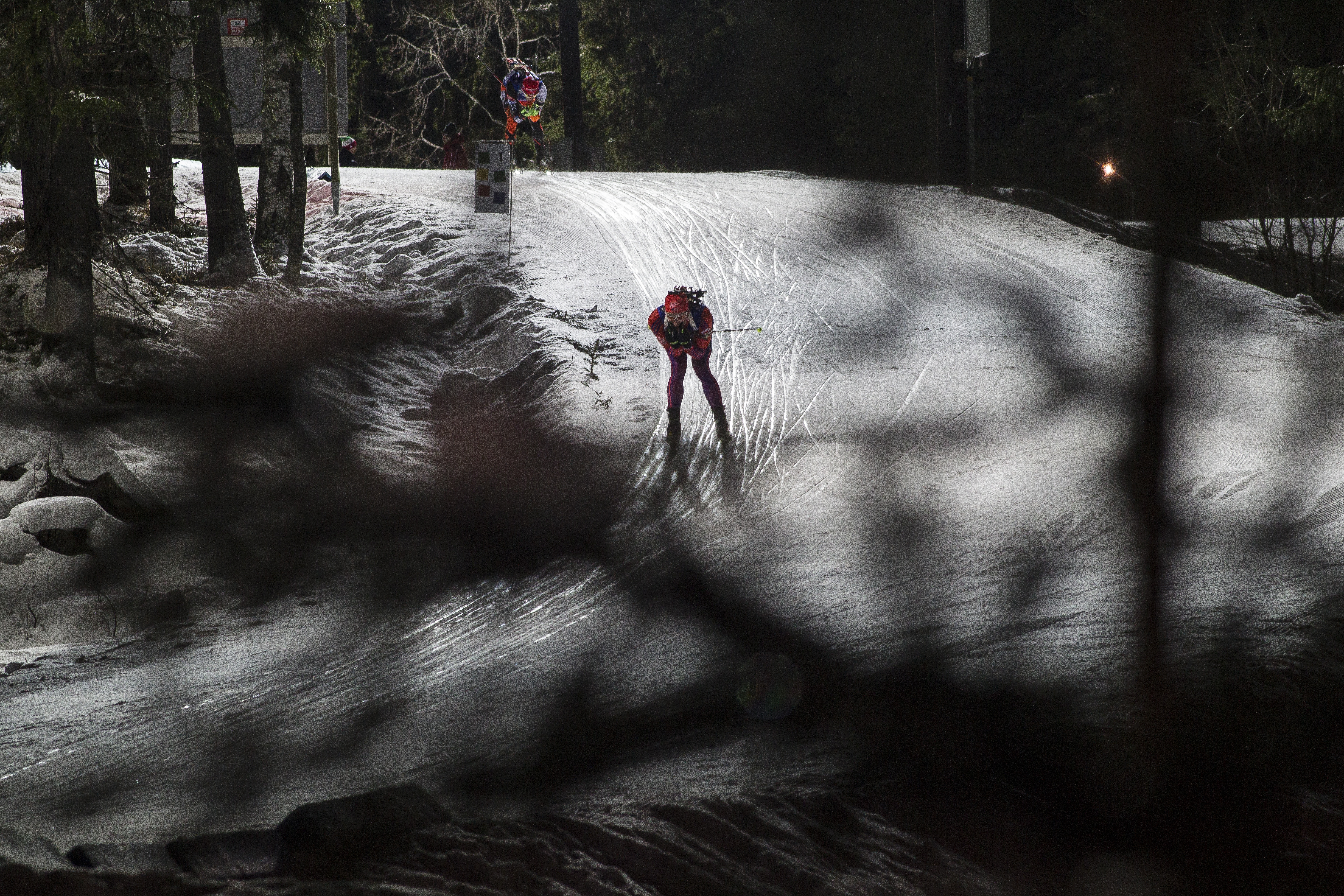
    Sean Doherty takes a downhill under the bright lights of the Oestersund trails. The 20-year-old American finished 17th in the first individual World Cup race of the season. (Photo: U.S. Biathlon / NordicFocus)
    Sean Doherty (US Biathlon) takes a downhill under the bright lights of the Oestersund trails. The 20-year-old American finished 17th in the first individual World Cup race of the season. (Photo: U.S. Biathlon/NordicFocus)

    You’re forgiven if you didn’t see this one coming: at Wednesday’s World Cup 20 k individual race in Östersund, Sweden, the top North American performance came from Sean Doherty.

    The 20-year-old American has a strong set of credentials, having won three World Youth Championships titles, attended the 2014 Olympics and 2015 senior World Championships, and earned a bronze medal at World Junior Championships last season.

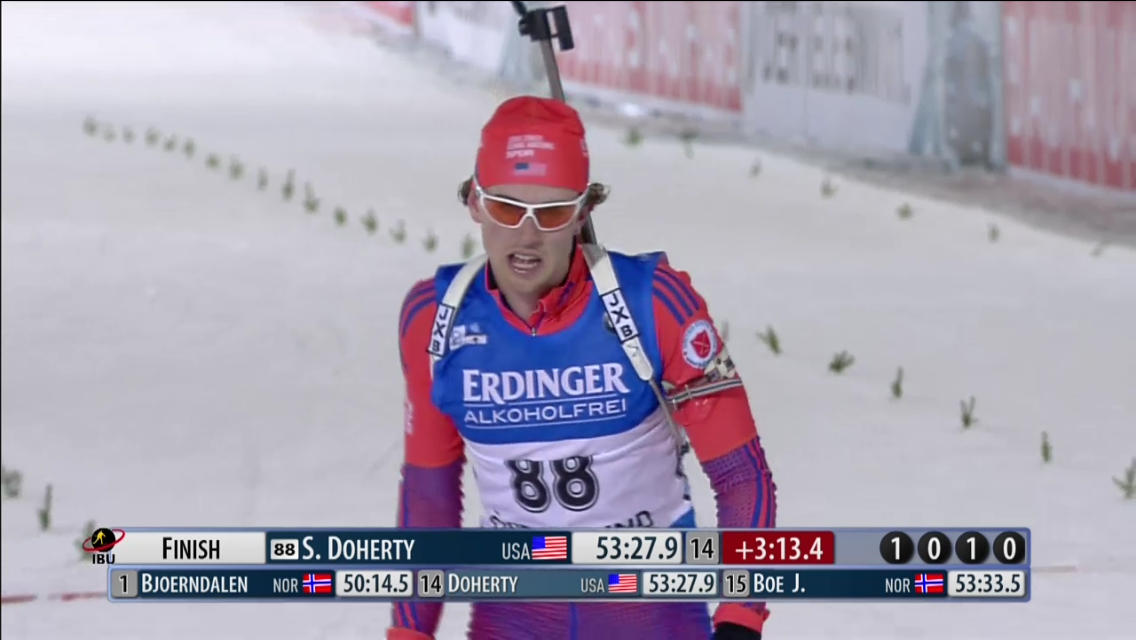
    But even Doherty didn’t totally expect his breakthrough in the first individual race of the World Cup season: 17th place (+3:13.4 from winner Ole Einar Bjørndalen of Norway) with two penalties in the 20-target race.

    “It’s a huge confirmation of the all the work I put in over the summer,” Doherty said. “I’m real happy with it.”

    His previous best on the World Cup had been 45th-place finishes in pursuits in Kontiolahti, Finland, and Nove Mesto, Czech Republic, last season – just outside the World Cup points.

    When the U.S. team started off this season with grand prix races in Sjusjøen, Norway, Doherty placed 29th in the sprint.
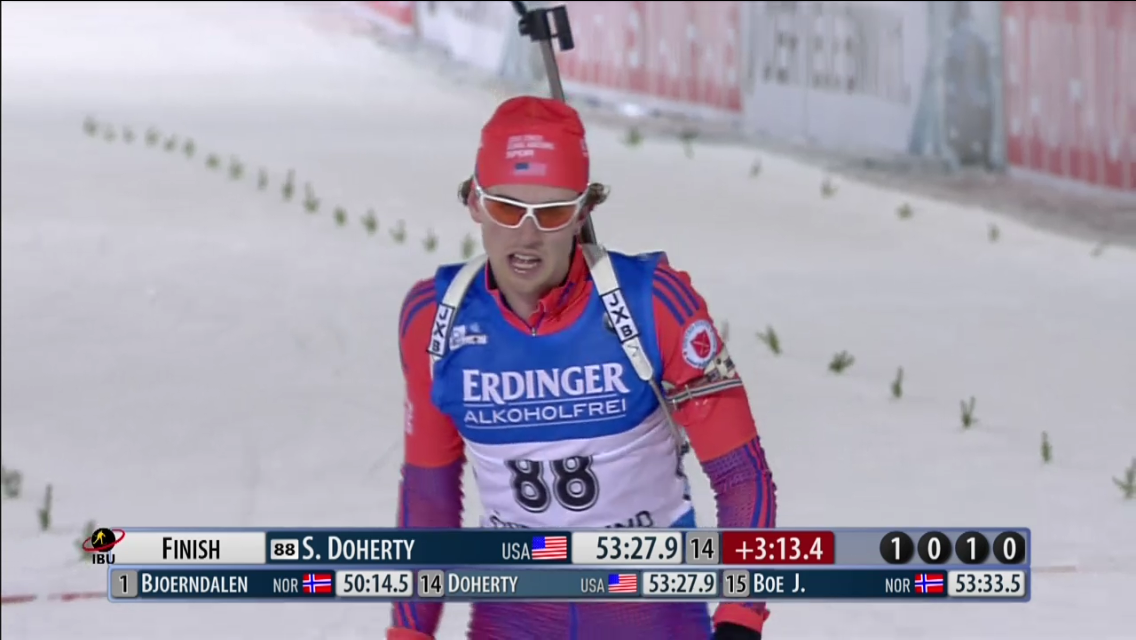
    Doherty crossing the finish line in 14th place. He was later bumped down three spots by other even later starters.
    Doherty crossing the finish line in 14th place. He was later bumped down three spots by other even later starters.

    “I was optimistic,” the New Hampshire native said. “But I wasn’t expecting this. I was happy with how I felt in Norway, but that was in no way leading me to believe I could just pull a top 20 today. It was pretty surprising in a way.”

    Others, though, expected plenty of success for Doherty this season.

    “Psyched to see Sean have such a good finish,” teammate Lowell Bailey, who finished a few spots behind him in 24th, wrote in an email. “I did expect him to have a breakthrough this season. He’s been right there in training throughout the season and I think he will continue to show top results throughout the season. This is by far the strongest men’s team we’ve ever had. It’s exciting to be a part of it.”

    While he has done a few 20 k competitions in the past, he also wouldn’t have guessed that his breakthrough would come in the format, which assigns a one-minute penalty for each missed shot instead of sending skiers to a penalty loop, which usually takes between 20 and 25 seconds.

    “Typically, the individual is not my strongest race,” Doherty said. “I’m not a bad shooter, but it is truly a precise shooter’s event with a stiff penalty. It’s not something I would expect to be my best. I guess now it is a good one for me!”

    The range in Östersund is often windy, and Doherty said his shooting “just kind of came together.”

    “Luckily I had a good zero prone, and I was confident that I knew how to react to the changing conditions if need be,” he explained. “For standing, I shot on point 30 all the way at the end of the range, which might be slightly sheltered by a building nearby. Maybe putting that together allowed me to have just a little extra help in these windy conditions.”
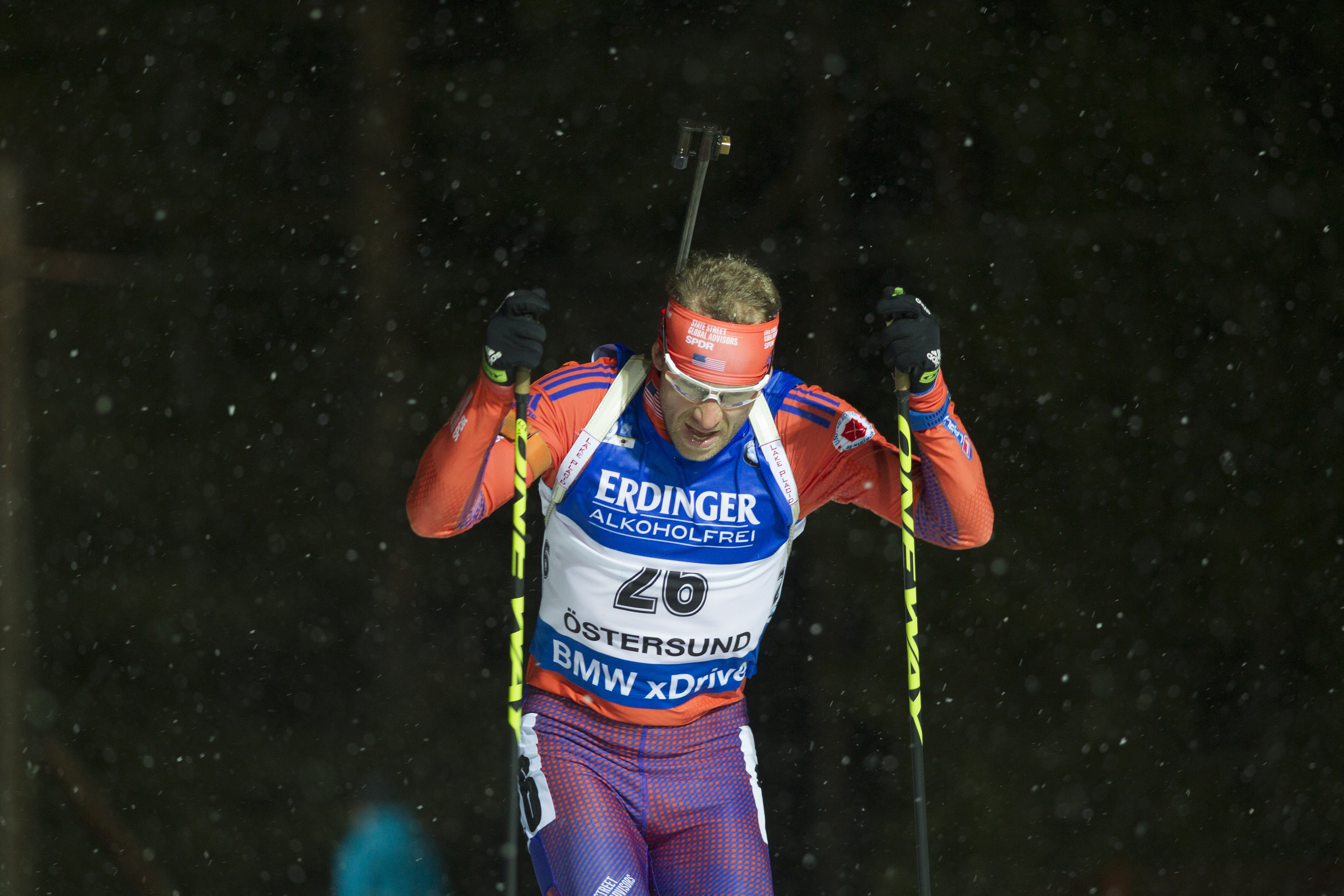
    Lowell Bailey on course. Bailey was clean through three stages, which would have put him in the top 10, but he missed two shots in the final standing stage. (Photo: U.S. Biathlon/NordicFocus)
    Lowell Bailey on course. Bailey was clean through three stages, which would have put him in the top 10, but he missed two shots in the final standing stage – a situation made more painful by the fact that one miss was a split bullet. (Photo: U.S. Biathlon/NordicFocus)

    Although he was one of the latest starters, Doherty didn’t get many splits during his race – he said he didn’t need them. Only on the last lap did his team begin telling him just how well he was doing.

    So Doherty put his head down and accelerated, skiing his fastest loop of the day for the 38th-fastest course time in the field.

    “You have to,” he said of the effort, which left him completely depleted at the finish. “Everybody’s cheering their hearts out for me and I’m in a good position. It’s all about the seconds. I ended up only 0.2 seconds in front of 18th place. So every little bit you can find matters. You just have to dig at the end of that long race.”

    Luckily, the late-starting position didn’t hurt his chances as it sometimes does.

    “The course conditions here were very, very good, and they stayed very consistent throughout the race,” Doherty said. “Being a late bib didn’t have much of an effect. Sometimes you get a late bib and it starts snowing on you or something, and it really kind of stinks.”

    Doherty will stick with the World Cup until Christmas, and then his plans are up in the air. He plans to compete at one last Junior World Championships in Cheile Gradistei, Romania, at the end of January. How he prepares is somewhat undecided.

    “The racing’s the same,” Doherty said of an event he’s competed at many times. “The distances are the same. It’s just against a different crowd. But it’s still a really high level – the junior men’s field is really strong. The thing that changes the most is that the World Cup is the big show and the Junior Worlds is a little more low key in comparison. It’s a different environment, and it’s fun. Being on the team with other younger guys and people who are just getting into it. I like both circuits and it’s fun to bounce back and forth a bit.”

    If this opening competition is any indication, he has made a jump in performance level since last season.

    “I had really solid results last season individually, and I was part of some good relays, which was cool,” Doherty said. “I’m just really glad to step things up for this year. It’s really encouraging to open on such a strong note.”

    Also for the U.S., Bailey finished 24th, also with two penalties (+3:44.1). Tim Burke raced to 37th with three penalties (+4:36.6), while Leif Nordgren had a tough day in prone and finished 104th with 13 penalties.

    “It’s always a tough start to the season to lead off with this particular Individual course, but it also helps you get into the right mindset going forward,” Bailey wrote. “I was happy with the result given the tricky conditions on the range. I had a split bullet on my last shot… sometimes there’s no explanation for a bad shot. The only thing I can say is that it’s pretty hard to clean a four stage race.”

    The Canadian team was led by Nathan Smith in 27th. Smith, who on Sunday had teamed up with Rosanna Crawford to place second in the World Cup single mixed relay, missed four shots and finished 3:51.9 behind the winner.

    “Shooting was a little disappointing today,” Smith wrote in an email. “Conditions weren’t perfect but also not horrendous. To be in the game you have to hit at least 18, maybe even more if it’s especially good shooting conditions. I felt like my shooting was there, but just couldn’t quite knock down all five on any of my trips to the range. Other than not quite clicking for the wind enough on my first prone I can’t really think of any mistakes. I felt calm and under control throughout the race.”

    Christian Gow placed 62nd (+6:20.6), Brendan Green 77th (+7:51.0), Macx Davies 85th (+9:10.5), and Scott Gow 86th (+9:25.0) for Canada.

    “I know it’s not possible to have a best-day ever every day,” Smith wrote. “Despite feeling pretty average on skis I actually turned in a solid ski performance. I’m excited to see my result on a top notch day. I’m not going to change course yet in shooting training. The fundamentals are there and I just need to be patient.”

    Results

  • The King Is Back: Ageless Bjoerndalen Wins Sprint, Equals Daehlie Mark

    The King Is Back: Ageless Bjoerndalen Wins Sprint, Equals Daehlie Mark

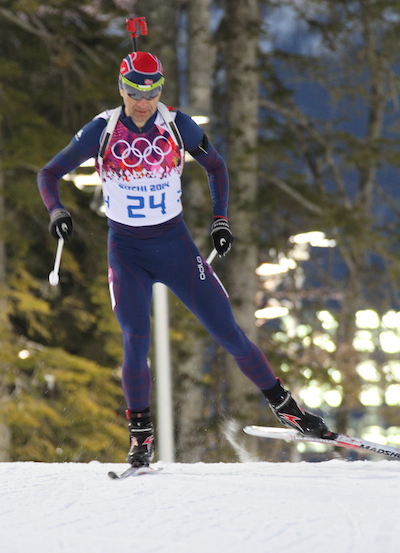
    Norwegian biathlete Ole Einar Bjoerndalen skiing to the win in Saturday's 10 k pursuit at the Sochi Olympics.
    Norwegian biathlete Ole Einar Bjoerndalen skiing to the win in Saturday’s 10 k pursuit at the Sochi Olympics.

    FasterSkier’s coverage is made possible through the generous support of Rudy Project

    SOCHI, Russia — When Norwegian biathlete Ole Einar Bjoerndalen won his first Olympic medal, Google didn’t exist.

    That was in 1998, when Bjoerndalen won gold in the sprint in Nagano, Japan.

    Sixteen years later, Bjoerndalen, now 40, won again in the same event at the 2014 games in Sochi, Russia on Saturday — earning his seventh career gold and 12th Olympic medal, besting competitors half his age over 10 kilometers of skiing and two rounds of shooting.

    Bjoerndalen’s result tied the record for the most career medals in the Winter Olympics, a mark that had been held by the Norwegian cross-country skier Bjoern Daehlie, who Bjoerndalen describes as “one of the biggest stars in Norway, and one of the biggest stars, total.”

    But there’s no doubt that Bjoerndalen belongs in that same category — and his result Saturday only solidified that standing.

    He won the race despite notching a penalty, edging out two men who ended up below him on the podium despite shooting clean — Austrian Dominik Landertinger and the Czech Republic’s Jaroslav Soukup, who trailed by 1.3 and 5.7 seconds, respectively.

    Of the 87 men in the race, Bjoerndalen was the third fastest on his skis — behind only the French star Martin Fourcade and Russia’s Anton Shipulin, each of whom also had one penalty.

    But what put Bjoerndalen atop of the podium was the combination of speed on skis with speed on the range: the Norwegian took his 10 shots in just 45 seconds. That was quicker than all but three other men, none of whom were as fast as Bjoerndalen on the course.

    “They don’t call him the king for no reason,” said Leif Nordgren, an American biathlete who finished 45th, nearly two minutes behind Bjoerndalen.

    Admiration for Bjoerndalen poured in from all sides — from teammates and competitors alike.

    “He’s been my big idol since I was 10 years old, starting with this sport,” said Norway’s Tarjei Boe.

    “He can step up to the plate and do it,” said American biathlete Lowell Bailey. “It’s pretty amazing.”

    “If there’s one guy outside of our four that I wanted to see win, it was him,” said Canadian Scott Perras, looking more than a little bit starry eyed. “Forty years old, and what an inspiration.”

    Perras recalled how the Canadians had held a pre-Olympic camp at the ski area in northern Italy where Bjoerndalen was training alone — where Perras said the Norwegian had asked workers to specially groom a meadow to prepare him for the courses in Sochi.

    “Once the normal uphill ended, they added another section,” Perras said. “You’d just see him do his loop, go back up the hill, do his loop. So it’s no wonder.”

    On Saturday, Bjoerndalen said he was worried his speed was beginning to falter in the later part of the race.

    “But in the last uphill, I had some power in my legs,” he said.

    His last Olympics, in 2010, had been moderately successful, as he earned a silver medal in the individual 20 k race, and a gold in the relay.

    In the intervening years, however, he’d struggled with illness, as well as some of the inevitable aches and pains that come with aging: he blamed a back injury in 2011 on an attempt to cut down a tree that went awry.

    (“I thought I could do it,” he said at the time. “But I got injured and lost several weeks.”)

    What kept him going?

    “Life is too short to give up,” Bjoerndalen said in a press conference after the race. “My motivation was never a problem, so I could keep on and do my training every day — and that was most important to why I am here today.”

    This season will be Bjoerndalen’s last. But before it’s over, he’ll likely have several chances to break Daehlie’s record of 12 Olympic medals.

    As of last week, he had not been promised a position on Norway’s relay team, which should win a medal barring a catastrophic collapse. But Bjoerndalen’s result Saturday should dramatically improve his chances of earning a spot, and he’ll start Monday’s pursuit in the lead.

    In the mean time, his performance in the sprint will serve as something for his competitors to aspire to, according to Perras, the Canadian.

    “Just to see him train, how focused and dedicated he was,” Perras said, referring to his time watching Bjoerndalen at the Italian ski area. “He’s just really pushing the sport, still.”

    –Alex Matthews and Chelsea Little contributed reporting.

  • The Madshus RED Triumph

    Emil Hegle Svendsen (NOR) – IBU world championships Nove Mesto (CZE). Photo: Manzoni/NordicFocus.
    Emil Hegle Svendsen (NOR) – IBU world championships Nove Mesto (CZE). Photo: Manzoni/NordicFocus.

    The 2013 IBU World Championships represent one of the best ever performances by the Madshus team athletes. No less than nine medals – eight gold and one bronze – were secured on the new Madshus REDLINE skate skis and  Super Nano Ski boots.

    While Emil Hegle Super-Svendsen (NOR) took home an impressive four gold medals and one bronze medal, veteran biathlete Ole Einar Bjoerndalen (NOR) earned his 50th Championship medal at the 2013 World Championships in Nove Mesto this week.

    “I guess the media are thinking more about this being my 50th medal than I am. But of course, when you point it out, it is a little bit special, Bjoerndalen said after his relay race on Saturday.

    “This is certainly one of the best Biathlon World Championships for Madshus,” says Per Wiik, who is the Global Marketing Manager at Madshus headquarters in Biri, Norway.

    “It’s really fun to note that all of these medals are earned on our new REDLINE and SuperNano equipment, which is certainly defining the new gold standard for speed and performance,” Wiik says, adding that Madshus is now looking forward to the 2013 FIS Nordic World Championships in Val di Fiemme (ITA). The Nordic World Championships start on February 20 and end on March 3.

    Madshus athletes helped themselves to a total of eight gold medals:

    • Emil Hegle Svendsen (NOR) won the sprint and the pursuit as well as helping Norway to gold medals in the mixed relay and the men’s relay. He also won the bronze in the men’s 20km mass start.
    • Synnoeve Solemdal (NOR) helped Norway to gold in the mixed relay and the women’s relay.
    • Ann Kristin Aafedt Flatland helped Norway to a gold in the women’s relay.
    • Ole Einar Bjoerndalen (NOR) helped Norway to gold in the men’s relay.
  • Making the Level Higher: Tarjei Bø On His Breakout Season

    Tarjei Boe racing in northern Maine earlier this year.

    Both cross-country skiing and biathlon have welcomed their shares of stars over the past few years, but few, if any, have exploded onto the scene as quickly as Tarjei Bø.

    Last season, the 22-year-old Norwegian won an Olympic gold medal as part of the Norwegian relay team, but his best finish on the World Cup circuit was fourth.

    This year, though, he has come on like a freight train. After collecting his first World Cup win in December, he has been on the podium 10 more times, and is the current owner of the World Cup overall leader bib. With just four competitions left and a 92-point lead, he’s not likely to be giving it up.

    FasterSkier had a chance to speak with Bø back in February, during the World Cup races in northern Maine. With the Norwegian a major player in the biathlon World Championships going on right now in Siberia—through four events, he has two golds and two bronzes—now is a perfect time to read about his training, his relationship with his superstar teammates Svendsen and Ole Einar Bjoerndalen, and his thoughts about that other sport that’s big in Norway, cross-country skiing.

    FasterSkier: So, this year has been very good for you. But a couple of years ago, you had to take some time off because you had tonsillitis?
    Tarjei Bø: Yeah, I had some problems with my throat, and I removed my tonsils and had two seasons where I had a lot of problems with sickness. I couldn’t train as I wanted to, so last season was okay, and this season, I had no problems.

    FS: Last year wasn’t bad for you, but this season has been a lot better. What has been the difference?

    TB: Everything has to work together. So when you’re not sick as much, you also can train as you want, and as hard as you want. The problem when you’re sick a lot is that you can’t make your level higher—after sickness, you always have to just come back to the level you were.

    This year, I haven’t been sick, so I can only get better and better all the time, and stronger. I’ve trained hard, and I have had some good results.

    FS: Have you been surprised with how well you’ve done this season? Obviously, you had done well at the World Junior Championships in the past, so you must have known you were among the top.

    TB: It’s been over my expectations, of course. I knew I could win a race or two, and my goal was to win my first World Cup. But it has gone very fast—especially that I’m so stable up there, it shows that it’s not luck or anything. It’s just my level is that high, and I’m very satisfied with that.

    FS: So, quickly, do you train mostly with your home club? Or do you train with the national team? Who are you doing most of your training with?
    TB: I never train with my home club. I moved from home, and I live by myself in Lillehammer, where I do my training.

    Emil Hegle Svendsen in northern Maine. Photo, flyingpointroad.com

    I train with my friends, and some other athletes—Emil Hegle Svendsen also lives in Lillehammer. So, between the training camps with the national team, I train by myself and with my teammates.

    FS: Do you train with Ole Einar Bjoerndalen, as well? Have you taken a lot from working with those guys?
    TB: Yeah, of course—they are the best athletes in the world. Ole lives in Italy, so I never train with him, except for at training camps, but of course, then we help each other and push each other to get stronger, and better, and faster.

    FS: What is his attitude like when you’re training and traveling and competing with him? Is he kind of like a fatherly figure, or more like a brother, or…?

    TB: He’s not a father figure, but he’s always been an idol for me, especially when I was younger. Still, he’s an idol for every athlete in the world, I think. He has reached all his goals, and it’s fantastic to see how he trains and prepares himself, and competes. It’s extraordinary for other athletes—he’s done everything perfect in his career, so, a lot to learn from him.

    FS: Do you think it has been hard for him this year, having to compete a little more with you and with Emil?
    TB: Yeah…Not hard—I think he was prepared. He’s getting older, and biathlon is harder now than five years ago. Now, there are many more athletes, and especially young athletes, are also coming up. Earlier, there were only older guys, who had this routine and everything, and [were] getting the results. But now, a lot of younger people are also fighting very hard, and I think that’s the main difference. Because, the younger athletes have another way of solving things—in the range and in the tracks—maybe, more offensive. Not so tactical, but when it works, it’s hard to beat the young guys (chuckles).

    FS: We also cover cross-country skiing. Do you feel like with you, and Emil, and Ole on the men’s side, and Tora Berger on the women’s side, that biathlon is fairly strong in Norway, in comparison?

    TB: It’s always been a big star in Norway, because of TV coverage, and the interest is very big. The main thing in Norway is that people who aren’t that interested in sports still love biathlon, because it’s something special for everyone to watch, and it’s exciting. More exciting than cross-country.

    But cross-country is very big in Norway—especially this year, when it’s the World Championships in Oslo. Interest is very high for cross-country—I think it’s equal interest, I guess.

    FS: Do you feel like you have to compete with the cross-country skiers at all, for attention?

    TB: No, I don’t think so. They have some stars who are really good, and I guess they have as many stars as us. We have three to four of the top athletes in the world, and they are the same. It’s not like they win everything, but they have Northug and Bjoergen, and some sprinters, also. It’s the good results that give them and us attention.

    FS: Do you ever do any training with those guys?
    TB: No, not too much. At the headquarters of sports in Norway, the Olympiatoppen, we had a training camp in the spring together, for four days. Also, with some of the other winter sports athletes.

    But not so much—we have to train with our rifle, and at training camps, it’s maybe not so easy to cooperate. We were in Val Senales [Italy], in October, in the same place, and we trained together for some sessions, and we’re also always on the glacier together.

    FS: Is that something you’d be interested in doing more?

    TB: Yeah, of course. They have a lot of qualities that we need to get better in, especially in the power in sprints. Cross-country has developed to be a very explosive sport, sort of—everything extends to the finish line now. Biathlon is also more like this—it’s closer, and more athletes at the top. You see more races that are duels in the last round. I think we have a lot to learn from them, on this side.

    FS: Do you know a lot of those guys? Are you friendly with them?

    TB: Yeah, I know most of them. Of course, I know all the young guys around my age very well, and I’m getting to know the team better. They’re good guys.

    FS: With Emil being named for the cross-country team for Oslo, it seemed like there was a bit of controversy…

    TB: It’s always like that—cross-country skiers say that they don’t need any biathlon athletes to do their third leg, and I think it’s possible that they don’t. The last few years, [biathlete] Lars [Berger] has done the relay, and done very well, and I think they feel like it’s safe to use one of us. But, of course, they also have other athletes who can do the same job—maybe now, they’re secure.

    FS: Do you have any interest in crossing over?

    TB: Yeah, when I was a junior, I did a lot. I was national champion twice in cross-country, and I want to do it again. I haven’t been so much slower than Emil this year, so I guess in a few years, I hope it will be me.

  • Bjoerndalen Bests Svendsen in Thrilling Ostersund Pursuit

    The first big chinks in Ole Einar Bjoerndalen’s armor showed up at the 2010 Olympics, where his two-medal performance was eclipsed by the three podiums collected by his Norwegian teammate, Emil Hegle Svendsen.

    Bjoerndalen, 36, was charitable at the time, as befitted a living legend with nearly three-dozen World Championships medals to his name. And there was no sense that he felt threatened by Svendsen—after all, the three medals that Svendsen won in Vancouver represented his career total, while Bjoerndalen has nine more in his quiver.

    But after Svendsen’s red-hot start to the year, in which he won the first two World Cup races of the season over Bjoerndalen in Ostersund, Sweden, one could sense Bjoerndalen’s grip on the sport loosening just a little—and he didn’t like it. After his crash on the final corner of Saturday’s sprint gifted Svendsen the win, Bjoerndalen was furious, angrily throwing his poles to the ground and storming out of the finish pen.

    So while Bjoerndalen’s victory in Sunday’s pursuit wasn’t much in the grand scheme of things—he has a whopping 92 World Cup wins to his name—he seemed to relish it a little more than usual, as it finally gave him the opportunity to put Svendsen, 25, back in his place. At least for now.

    After hanging doggedly with Svendsen for three quarters of the 12.5 k pursuit in Ostersund, matching him shot for shot, Bjoerndalen dropped his teammate on the final shooting stage, when an errant bullet by Svendsen went low and left. With one penalty to Svendsen’s two, Bjoerndalen was free and clear to ski in for the win.

    “I knew exactly what Emil was shooting. I heard every shot hit the target, so I knew he missed two,” Bjoerndalen said.

    Slovenia’s Jakov Fak was third, but he finished a full minute back, and never challenged the two Norwegians. Jean Philippe LeGuellec was the top North American in 13th, with one penalty, and Tim Burke was the top U.S. biathlete, in 32nd.

    The focus of the television cameras rarely strayed from the top two, though, as the race was a battle between Bjoerndalen and Svendsen from the gun. Biathlon pursuit races are handicapped using the results from a sprint, usually held a day or two earlier, and on Sunday, Svendsen left first, with a four-second advantage over Bjoerndalen. France’s Martin Fourcade, a strong podium threat, started third, but four penalties over the course of the day took him out of contention.
    Pursuits feature four shooting stages, but by the time Svendsen finished his first loop and glided into the range, Bjoerndalen had already closed the gap. The two slung off their rifles, took their prone positions side-by-side, and both shot clean. They left the range together, Bjoerndalen shadowing Svendsen, whose skiing had been slightly faster in races earlier this week.

    The two Norwegians went stride-for-stride on the second lap, and the third, too. They were also nearly flawless in shooting—both cleaned the second stage, and had just one penalty on the third.

    The fourth lap would be the difference-maker: if Svendsen could equal Bjoerndalen in the shooting, it was unlikely that the elder Norwegian would be able to hold on for the final lap. But after matching the veteran through four shots, Svendsen’s very last bullet was off-target, leaving Bjoerndalen the opening he needed. Afterwards, Svendsen blamed his inaccuracy on the weather.

    “I had a little bit of trouble in standing. The wind was a problem,” he said. “When you are so close to winning…the worst thing is missing that last shot.”

    Svendsen had to ski one more penalty loop than Bjoerndalen, which set him back more than 20 seconds. That was enough time for Bjoerndalen to ease up when he neared the finish line, pointing, as he passed by to the spot in the corner where he crashed on Saturday.

    ““I took a little break there today, so I could look at that place,” he said.

    Afterwards, the tension between the two Norwegians boiled over, as Svendsen called Bjoerndalen “cowardly” for not once taking the lead.

    “I would certainly [think] that he should contribute a little, but he was apparently not interested,” Svendsen told the Norwegian broadcaster NRK.
    Bjoerndalen acknowledged that he had spent minimal time in the wind, but that, he told NRK, was a tactic he’d learned from years of racing in cross-country competitions.

    “I was not as strong as he was—I had to run my race,” Bjoerndalen said.

    Despite Bjoerndalen’s win on Sunday, though, Svendsen still leaves Ostersund with the yellow bib of the overall World Cup leader. He said that he’s not interested in giving it up, though with Bjoerndalen just six points behind, Svendsen will surely have his hands full next week.

  • Bjoerndalen to Head to Cross-Country Opener

    Norwegian biathlon legend Ole Einar Bjoerndalen is getting a ticket to the World Cup opener in Gällivare, and will join the Norwegian team at the first cross-country competitions of the season in Sweden.

    “We seriously consider all athletes. It’s not age that counts, but if they are fast enough. We have good cooperation between biathlon and cross-country skiing” explained sports chief Åge Skinstad.

    Ole Einar Bjoerndalen has already made to the top in Gällivare. In 2006 he dominated the season opener and proved to be one of Norwegian free technique specialists. He did not deliver outstanding performance last Friday in Beitostoelen placing 9th.  “Ole Einar was not in an optimal shape on Friday, but the skiing part of the biathlon race Sunday was much better. After this race we decided to give him a chance ” revealed Skinstad reason why Bjoerndalen got invitation.

    Bjoerndalen for World Champs?

    Another reason why Bjoerndalen will show up in Gällivare is that he might get a ticket for the World Champs in Oslo. He has taken part already in two Nordic Wordls in Oberstdorf 2005 and Sapporo 2007. Skinstad can test him in 15 km Free and see if he could fit in the relay team for Oslo. There are only three relays before the World Champs. In Gällivare, La Clusaz and Rybinsk. Bjoerndalen will be racing at biathlon World Cup so Gällivare could be the only chance.

    Norway will pit two rela teams. Final team composition will be done after the opeining Staurday’s race.

    Mixture of youth and experience

    National coach Morten Aa Djupvik says they picked up a good World Cup squad. “It’s an exciting team with a mixture of young and promising athletes with more experienced and older athletes “he said. There are six ladies in the distance team that get ready for Gällivare, including Ingvild Flugstad Østberg.  “We have pretty good team. We have mostly focused on skaters. All skiers confirmed fine shep this weekend “said national coach Egil Kristiansen.

    Norway’s line up

    Men:

    Tord Asle Gjerdalen, Fossum IF

    Martin Johnsrud Sundby, Røa IL

    Ole Einar Bjoerndalen, Byåsen IL

    Geir Ludvig Aasen Ouren, Oddersjaa SSK / Sirdal Ski Cross

    Chris Andrew Jespersen, Byåsen IL / Team Manpower

    Sjur Røthe, Voss IL / Team Manpower

    Kristian Tettli Rennemo, Leksvik IL (scholarship)

    Petter Northug., Strindheim IL (scholarship)

    Eldar Rønning Skogn IL (relay)

    Ladies:

    Marit Bjorgen, Rognes IL

    Astrid Jacobsen Uhrenholdt, IL Heming

    Therese Johaug, IL Nansen

    Marthe Kristoffersen, IL Varden

    Kristin Stormer Steira, IL Attempts

    Vibeke Skofterud Slitu IF

  • Svendsen Wins 20k Individual, Then Come a Pair of Silvers

    Svendsen Wins 20k Individual, Then Come a Pair of Silvers

    Ole Einar Bjoerndalen waiting for Sergey Novikov (BLR) to finish his last loop

    Anyone watching knew that it was going to be close.

    When Sergey Novikov (BLR) left the range after his final round of shooting in the 20k individual start, he led Norwegians Emil Hegle Svendsen and Ole Einar Bjoerndalen by seven and 26 seconds, respectively. But Novikov’s lead was due to good shooting, not fast skiing, and the question was whether he could hold on.

    For the two Norwegians, who had already finished racing, the nine minutes and eleven seconds Novikov took to ski his last loop must have felt like an eternity. As the Belarusian came back into the stadium, it was clear that Svendsen would win. But the battle between Bjoerndalen and Novikov would come down to the wire.

    Sergey Novikov (BLR) leaving the range during the 20k individual

    Novikov finally crossed in 48 minutes, 32 seconds, and zero tenths—the exact same time as Bjoerndalen’s. The race for silver was a tie—the first time in the sport’s Olympic history that had ever happened.

    “It’s amazing that they can be so close. I think this is good for biathlon,” said Mikael Lofgren, the Norwegian biathlon coach, adding that the result today speaks to the depth and competitiveness of the men’s field.

    Svendsen shot clean in the first three stages, and combined with some blistering skiing, the race appeared to be his to win. Novikov didn’t miss a shot all day, but his skiing speed wasn’t even close to either of the Norwegians.

    But in the final shooting stage, Svendsen couldn’t quite seal things, and missed a single shot, setting up some suspense after his finish as he waited for first Bjoerndalen and then Novikov to come to the line.

    Bjoerndalen was actually ahead of Svendsen after the latter’s penalty in the last stage, but then Bjoerndalen had a miss of his own.

    He left the range seventeen seconds behind Svendsen, and given Bjoerndalen’s superior skiing speed, it looked like the pair could finish in a dead

    Emil Hegle Svendsen (NOR) on his way to the finish

    heat.

    Bjoerndalen took a glance at the scoreboard on the way out of the stadium, and he said afterwards that he knew just how far behind he was.

    “We have four kilometers on the last lap, and I was a little bit afraid to start too fast,” he said. “Maybe I waited a little bit too long—if I could have started a little bit earlier, maybe I could have taken three or four seconds more. But ten seconds [the gap that remained at the finish] was too much.”

    Novikov didn’t succumb to the pressure on his last round of shooting, both entering and leaving as the leader after hitting all five targets. As he went

    out on course for his final loop, he enjoyed an eight second advantage over Svendsen and 25 seconds over Bjoerndalen. But Novikov’s fitness isn’t close to that of the Norwegians, and he said that he got over-excited and went out a little too hard up on the first climb.

    “Indeed, the energy was depleted,” he said through a translator.

    He wasn’t fast enough to beat Svendsen, but the effort was exactly enough to match Bjoerndalen, although Novikov didn’t appear to lunge for the line—which could have made the difference.

    He and Bjoerndalen shared the second step of the podium during the flower ceremony. Both will receive silvers.

    Novikov in the range