From the FasterSkier archive — posts syndicated from athletes’ and coaches’ own blogs between 2004 and 2012, kept online as published. Current coverage is at fasterskier.com.

Tag: Ole Einar Bjorndalen

  • The Chinese Ski Team’s Path to Beijing (Part 3)

    The Chinese Ski Team’s Path to Beijing (Part 3)

    This is the final installment of a three-part series on the development of the Chinese ski program. Click here to read part 1 and part 2.

    Part 3: Olympic Hopes and Misgivings in Norway

    For the Chinese cross country ski team, the 2022 Beijing Olympics opened with a blaze when Dinigeer Yilamujiang was selected to co-light the Olympic flame. It was an enormous honor for the twenty year old cross country skier from Altai, China with Uyghur roots. Yet her ethnic background overshadowed the moment, and, like so many aspects of the Chinese cross country skiing project, the ceremony meshed sporting aspirations with political theater.
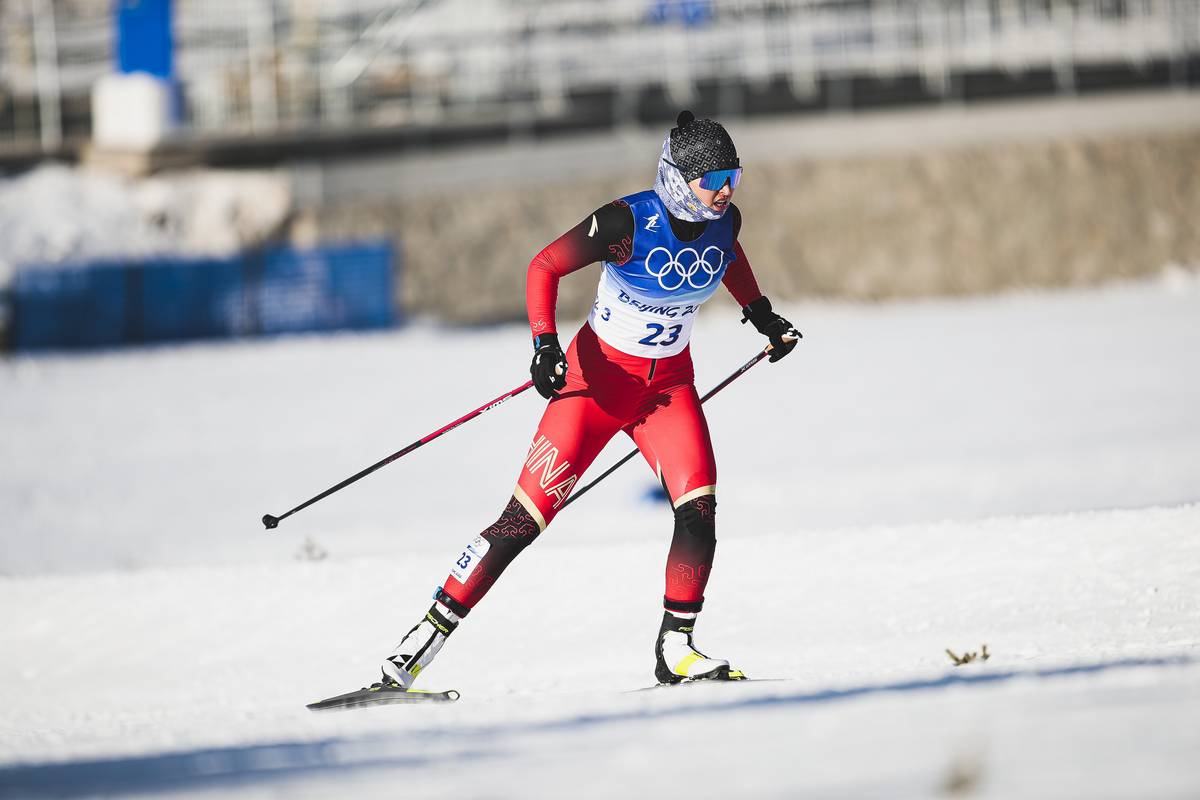
    China’s Dinigeer Yilamujiang (CHN) races the freestyle sprint qualifier during the 2022 Olympic Winter Games in Zhangjiakou. (Photo: NordicFocus)

    Dinigeer, known as Dini on the ski circuit, is a rising star on the Chinese ski team. She is one of the few of the team’s new generation that grew up with skiing, and her father had hopes of becoming a great skier himself, and later became a coach. 

    Dini’s father Mulaji Yilamujiang, never expected her to become a professional athlete. That began to change when at age twelve, Dinigeer competed in a regional race and a competitive chord was struck. “She wanted to win the race like a professional athlete and get on the podium,” Mulaji recounted to Chinese news outlet Xinhua.

    It was hardly surprising then that when Kristian Bjune Sveen took the job as coach of the Swix China team in 2017, he picked fifteen year old Dini. 

    Since then, her success has by any measure been extraordinary: At the 2020 and 2021 Junior World Championships, Dinigeer proved that she was among the best in her age group, finishing 5th and 6th respectively in the 5k distance. 
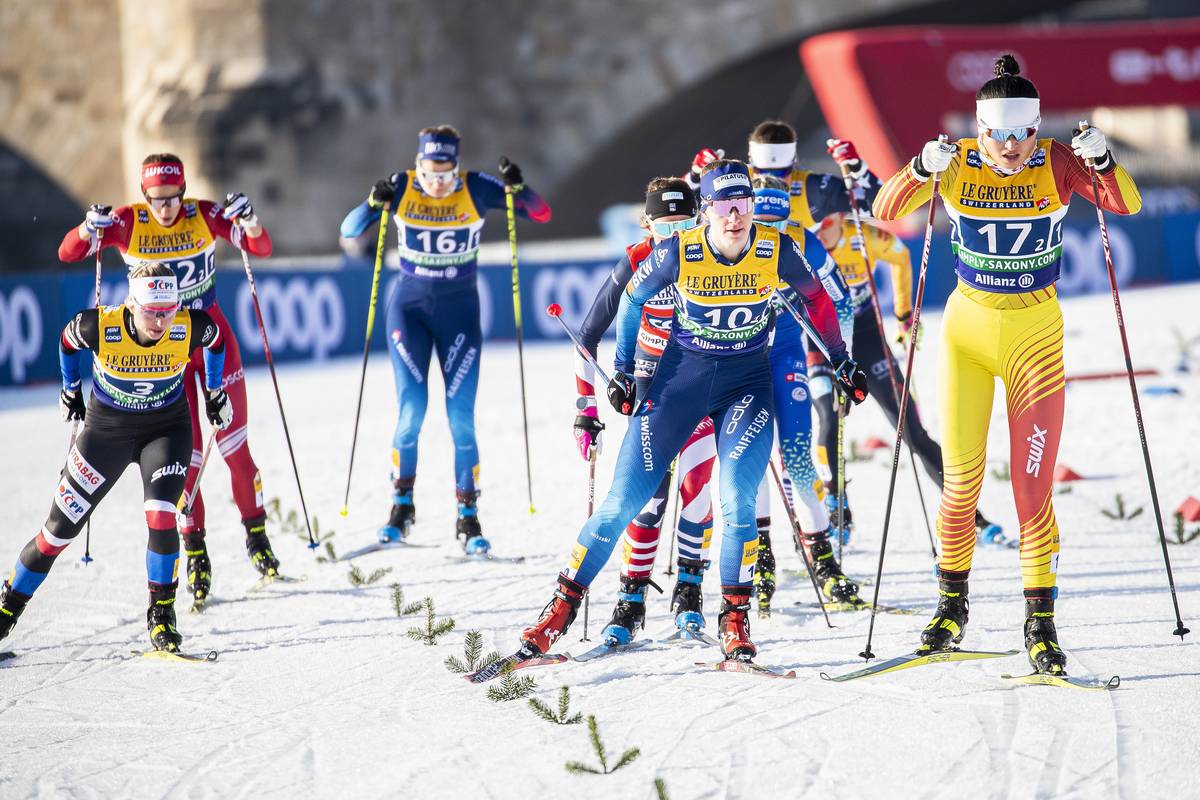
    Chinese cross country skier Dinigeer Yilamujiang (bib 17) races a December, 2020 team sprint in Dresden, Germany. (Photo: NordicFocus)

    Together with her teammate Bayani Jialin—who had no prior skiing experience before joining Sveen’s team—the two have skied together on the World Cup to top ten team sprint finishes and top thirty in individual sprints. 

    “Going from being an untrained person to being able to beat half the Norwegian national team and become a top 30 in a sport you [didn’t] know existed,” Sveen told NRK, “it is objectively completely insane!”

    Liu Rongshen is another twenty year old Chinese skier that has impressed early in the Games. Originally a runner from Yunnan, he was “one of the athletes that came to Meråker [in] March 2019,” wrote Tor-Arne Hetland to FasterSkier. Liu finished 38th in the men’s skiathlon, some 16 seconds ahead of Johannes Klæbo. “Pretty [impressive] that he never had been on skis before he came to Norway,” Hetland wrote, adding, “Maybe in the sprint China can have athletes in the semi-finals.”

    Hetland’s prediction nearly came true when Wang Qiang—China’s best sprinter and medal hope—qualified in 5th in the men’s sprint and appeared to have advanced out of his quarterfinal heat only to be ruled out due to obstructing another skier. 

    In biathlon, the women are led by Meng Fanqi—one of the best sharpshooters on the circuit—as well as Chu Yuanmeng and Zhang Yan. All three are top class on the range, and with a home snow advantage, and fast skis provided by Norway, a relay medal remains a tangible, if distant, prospect. 

    Although some juniors such as Dinigeer Yilamujiang spent the last few winters in Norway, much of the Chinese cross country team has been based in China since the start of the pandemic. 

    To compensate for the lack of international racing for their homebound skiers, Russian second tier racers were hired to come to China for extended periods and enliven national races and ski with Chinese athletes. 
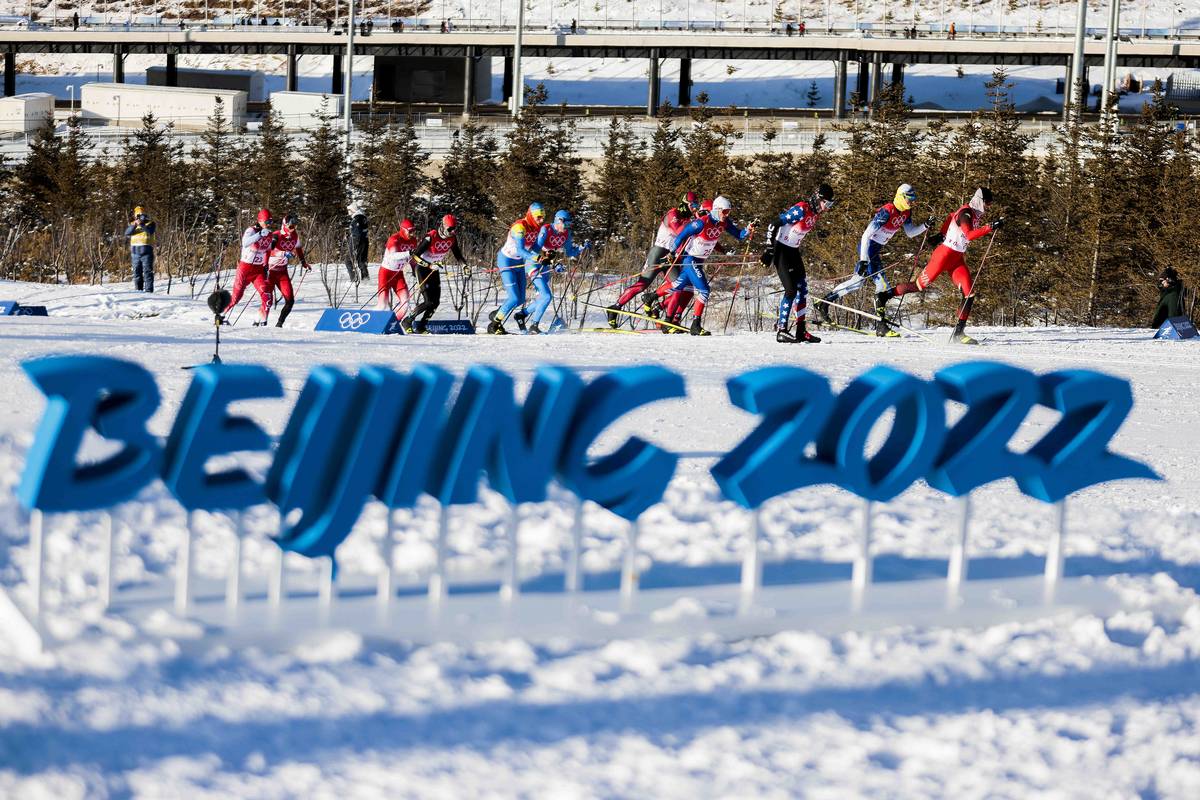
    Wang Qiang (CHN) takes an early lead in the men’s team sprint semifinal during the 2022 Olympic Winter Games. (Photo: NordicFocus)

    To the Chinese skiers advantage was sole access to the Olympic courses in Zhangjiakou ahead of the Games, although their coach Bernhard Rønning dismissed this assertion to Dagbladet, saying that while they had trained and competed in the area “not so much in the Olympic tracks.”

    Still, the team was not without excellent training opportunities, with ready access to altitude, year round skiing in the Beishan tunnel, and “the best equipment,” according to Max Volkov, coach of the Chinese distance team.

    Volkov, the former assistant coach to Alexander Bolshunov, joined a talented coaching staff in China, including his compatriot and former Olympic champion Nikita Kriukov, who trained their sprint team. 

    Magnus Frodahl worked with the Nordic combined team, and former Norwegian World Champion Terje Langli ran the Chinese cross country teams wax service, and trained in two apprentices, Li Xin & Wang Yihan. 

    Rounding out the core foreign coaches for the cross country team were Ole-Marius Bach, Bernhard Rønning, and Kristian Bjune Sveen.


    Bjørndalen

    The highest profile coaches to sign on to the Chinese Olympic project were Ole Einar Bjørndalen and his wife, former Belorussian biathlete Darya Domracheva. The two joined in 2019. 

    After the pandemic interrupted their debut season with the team, Bjørndalen rejoined his squad in China during the summer of 2020.  

    There, even for a legendary biathlete, the work was anything but glamorous. That summer, Bjørndalen worked daily from six in the morning to eleven at night. Each time he entered China he had to undergo a 17 day quarantine. Always the athlete, Bjørndalen ran 20 k a day inside his hotel room, running the length of the room around one thousand times. 

    The biathlon team spent the 2020/21 season training in China inside of an intense bubble. “There is no question of anyone coming in,” Bjørndalen told NRK, “And if you are going out on an errand in Beijing, it is straight into the corona quarantine.”
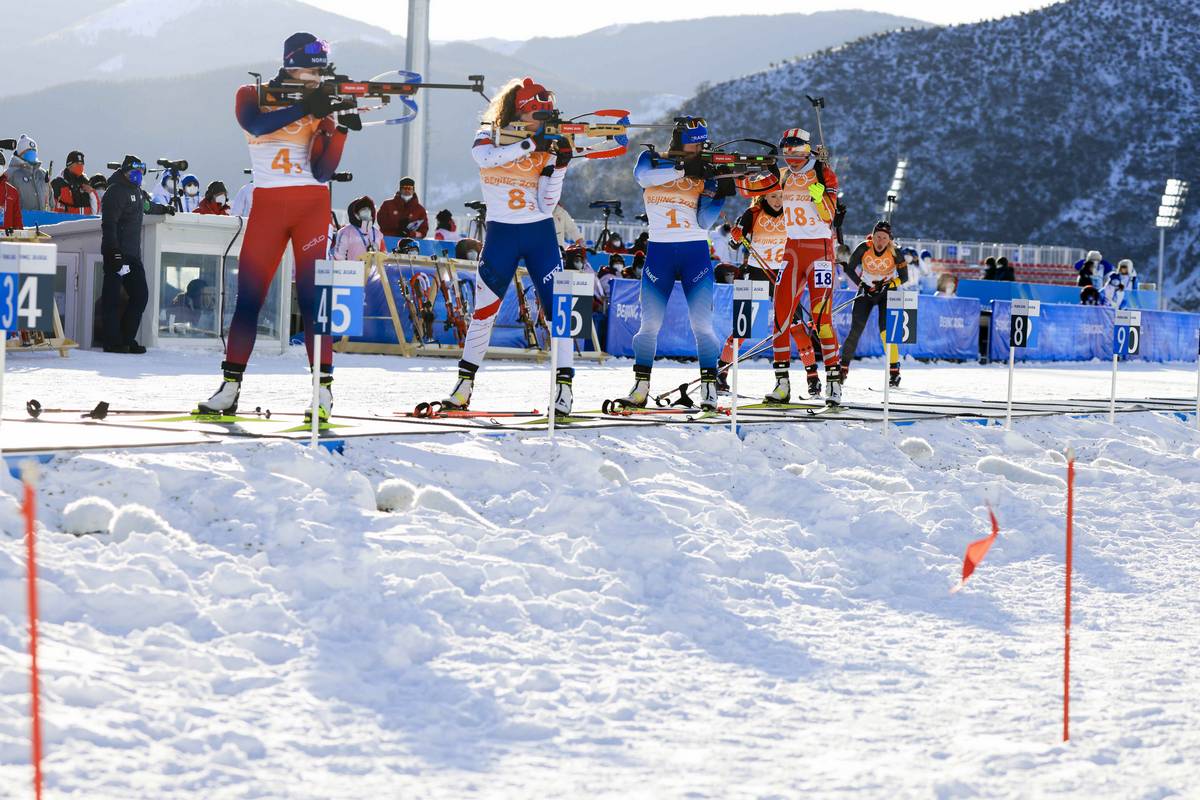
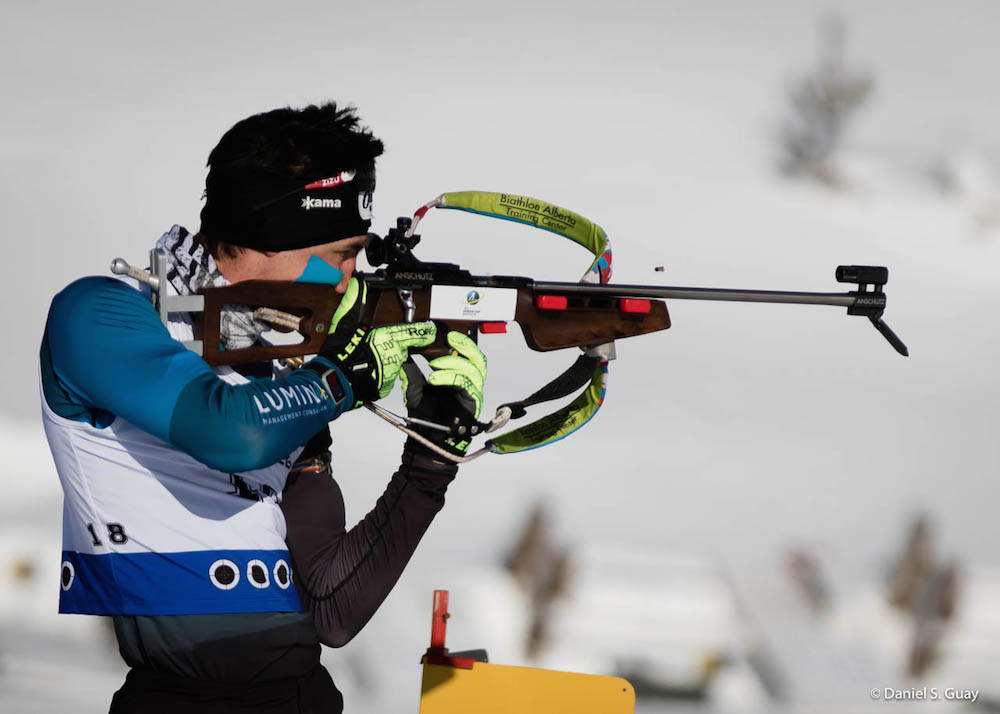
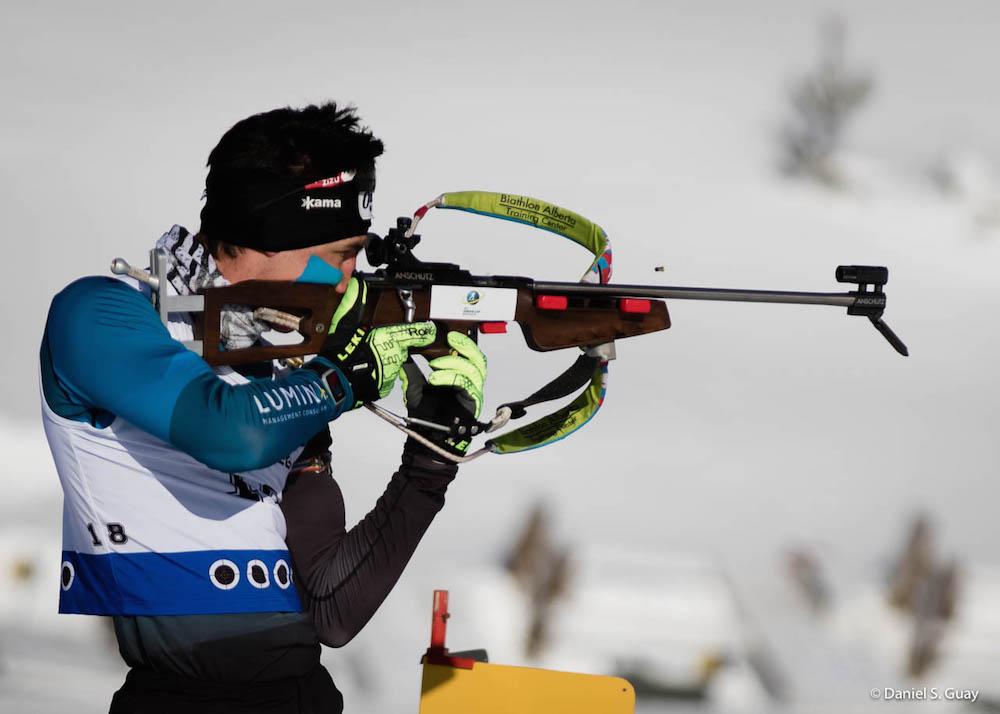
    Chinese biathlete Ding Yuhuan (bib 18) takes aim during the women’s relay in Zhangjiakou. (Photo: NordicFocus)

    That winter, Chinese President Xi Jingping visited the team. “I think he liked biathlon,” Bjørndalen said in the article.

    According to NRK, Xi’s visit to the Biathlon camp underscored the expectations to deliver results. “We have set ourselves the goal of winning a medal in the relay,” Bjørndalen explained, adding, “It’s a pretty horrible goal, but anything is possible.”

    The work of the famous duo has been apparent on the IBU World Cup, which China returned to this winter. US Biathlete Clare Egan said, “They’ve really done an incredible job bringing the athletes up. It’s funny because Daria [Domracheva] has a very unique and beautiful, graceful ski style and now all of the Chinese women, half the time I think they’re Daria when they go by me, they all ski exactly like her.”

    The shooting prowess of the Chinese biathletes is exceptional according to Egan. “They’re incredible, incredible precision shooters. I have to imagine that their team hit percentages are at least as high, if not higher, than any of the other teams.”

    “The reason they’re not winning medals is because they’re not quite there with the ski speed,” Egan said, “Even though they’ve really improved a lot.”

    When Bjørndalen took the job he ensured his athletes would have competitive skis by signing a deal with the Norwegian biathlon team to wax their skis through to the Olympics. 

     Tobias Dahl Fenre, the head waxer for the Norwegian biathlon team, said of the wax deal, “We do not share the expertise. It will be in Norway. We employ Norwegian waxers in the Norwegian system.”  

    The deal, worth an undisclosed sum, allowed the Norwegian biathlon team to hire four more techs, bringing their service team size to fifteen. 

    Egan said the results of the wax partnership were clear on the IBU World Cup. “It’s cool to see them have a chance on skis because previously when they were waxing their own skis, they just didn’t have that background to be internationally competitive. Now sometimes they’re passing us on the downhill.” 
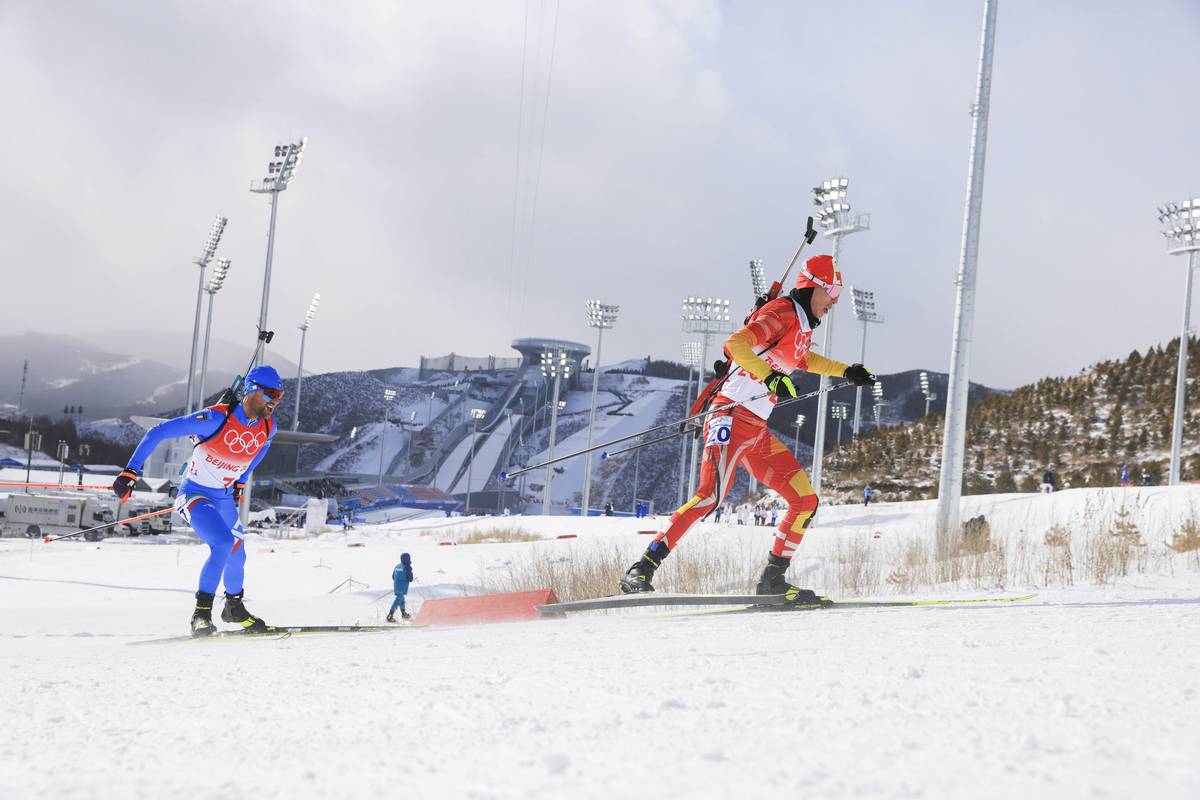
    Cheng Fangming (CHN), races the men’s relay during the 2022 Olympic Winter Games. (Photo: NordicFocus)

    While the work of Bjørndalen, Domracheva, and Sveen have impressed, for the foreign coaches working in China, the experience varied. 

    For Kristian Bjune Sveen, who took the job with Swix China when he was twenty five years old, the experience had been positive, if exhausting. “I work around the clock, every day, and have almost no privacy,” he told NRK. Nevertheless he said it was “an insanely exciting job. It is a coach’s dream to be able to design a plan that you want.”

    Sveen felt that he would not find another opportunity to influence a whole skiing culture in the way that he could in China, and fretted that the next job wouldn’t match the significance of his present work. “It’s almost like I’m not sure if I want to be a coach again after this,” Sveen said. “These are athletes I think can be the best in the world.”

    Others had more jaundiced views of coaching in China. When Anita Moen’s athlete’s were recalled abruptly in December 2019, the pandemic prevented her from rejoining her team until the following August. 

    “By then, five months had passed without me having been a coach for them,” Moen recounted. “That was when I noticed the change. The basic work we had done, and on which we made such great progress, was destroyed.”

    Moen’s athletes had returned to a Chinese sport system marked by authoritarian control. The result had a big effect on her. 

    “I knew these athletes very well,” she said. “I did not need to talk to them. I could see it in their eyes…The joy I had seen was gone.” Moen found the experience troubling, and decided to end her involvement.

    A non disclosure agreement had prevented her, (as well as many other coaches) from discussing the team’s work. Through these legal tools, much of what the Chinese team has been up to in the last year and half has remained opaque.


    Soul Searching

    As the Games crept closer, so did criticism of China’s human rights record. In Norway, the agreement to help the Chinese skiing programs became a contentious topic, with anxiety over whether the work of some one hundred coaches, techs, and physios was done in the service of expanding the sport, or rather a massive nation branding campaign to distract from China’s human rights abuses. 

    Had Norway, the home of the Nobel Prize and defender of human rights, sacrificed its moral center for a trade agreement masked by a feel-good ski coaching story? 

    That was the argument made by John Peder Egenæs, the head of Amnesty Norway, who suggested to NRK that China’s 2019 hiring of Bjørndalen—the most popular athlete in Norway—as the head coach of their biathlon team was part of a “big political game.” 

    Egenæs believed that the Olympics were being used to “launder a deplorable human rights record,” and feared that Bjørndalen would be used as an “ambassador for [Norway] to forget the negative sides of China.”
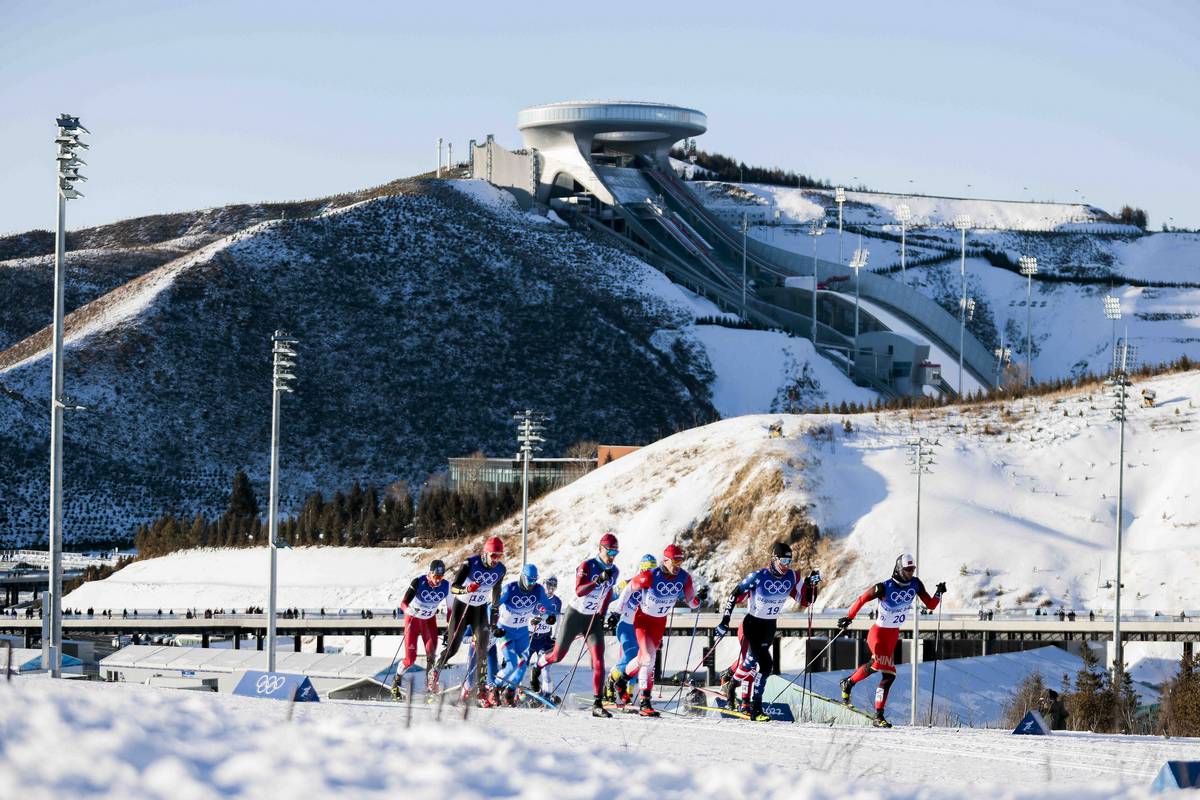
    China’s Jincai Shang (bib 20) leads the men’s semifinal of the classic team sprint in Zhangjiakou. (Photo: NordicFocus)

    Bjørndalen disagreed with the criticism, and told NRK, “I do not feel any political game in what I do. I focus on the skiers I have and do not have any dialogue about any propaganda with any leader.”

    Sports commentator Andreas Selliaas fretted about the whole agreement, saying to Aftenposten, “I do not think Norwegian sports really know what they are involved in. This is not about skiing, but about nation building and domestic politics in China.”

    Questions began to be raised about why the Sports Confederation was not consulted prior to the 2017 agreement. “The sport was thrown in like a meat bone to the Chinese,” was the assessment of Gudmund Skjeldal, a former Norwegian national team skier. 

    Tom Tvedt, the former President of the Norwegian Sports Confederation believed that the agreement had overstepped the historic divide between Sport and State, saying, “In this area, the independent, free sports movement was abused.”

    In an op-ed to Aftenposten, a group of PhD students at the Norwegian Sports Academy wrote, “Perhaps the point is not whether we, a tiny country, can influence the gigantic China. There is something called losing one’s soul. There is something more important than Olympic gold medals. It’s something more important than salmon, even.”

    The authors pointed to the history of Norwegian sports resisting oppression, and ski jumping hero Birgir Ruud, who refused to organize competitions during the Nazi Occupation and was imprisoned.  

    “So one might like to ask:” The authors wrote rhetorically, “[Why didn’t] Norwegian sports protest against being forced to cooperate with such a totalitarian power as China?”

    The answer, they suggested, had much to do with funding. 

    Others asserted that Nordic skiing needed China to survive in the future. In a story in Aftenposen, Rønning said, “If you bring China with you, you have almost saved the sport of cross-country skiing.”

    Tvedt disagreed. “It’s really a disaster. Both for sports and Norwegian democracy.” 

    Skjeldal and others have called for the Norwegian Parliament to investigate the matter. That the calls of alarm came at the doorstep of the Olympic Games may be telling. 
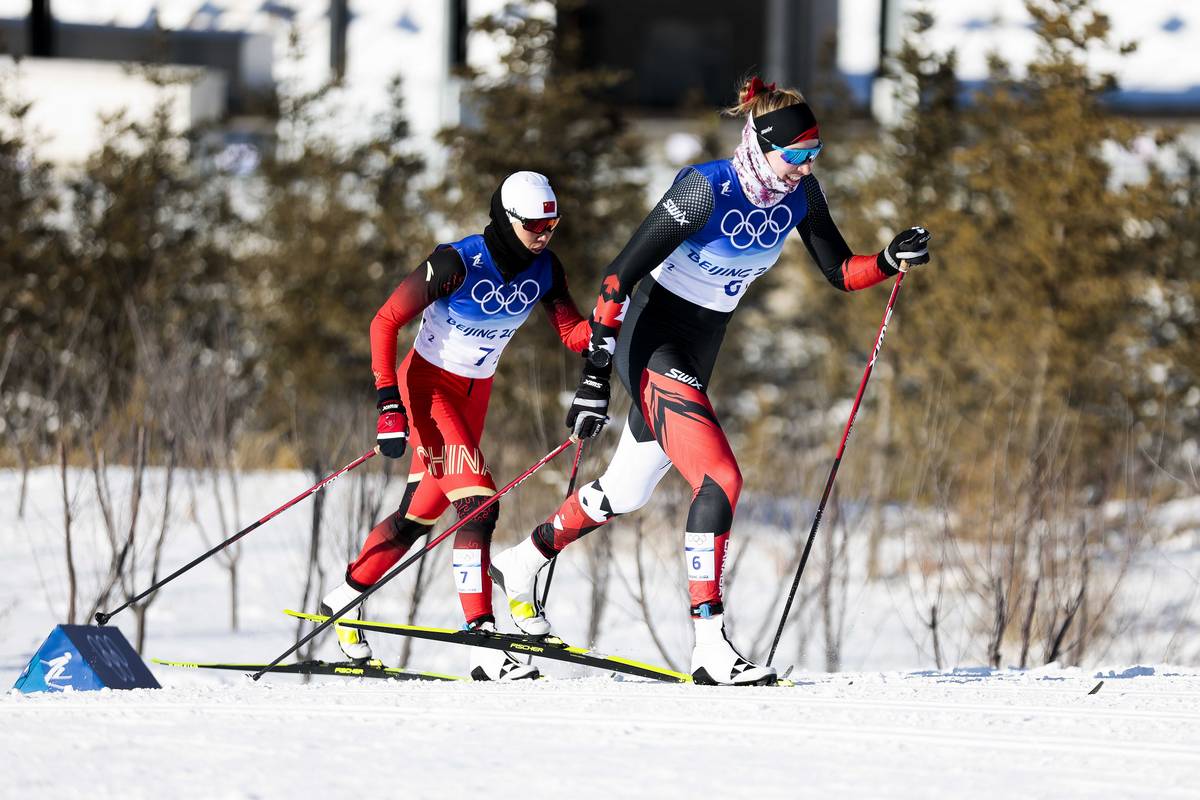
    Li Xin (CHN) follows Dahria Beatty (CAN) during the classic team sprint semifinal. (Photo: NordicFocus)

    While Norway wrestled with the ethics of their nearly completed sports agreement, the Chinese cross country ski team faced controversies over the diversity of the team’s athletes that include ethnic Uyghur, Kazakh, and Tibetan skiers. 

    The diverse team has been celebrated by Chinese State Media and questioned abroad. As a Uyghur athlete, Dinigeer Yuliamujiang is the prime example. She gained international fame overnight by lighting the Olympic torch—but not as a skier. Instead she has been viewed symbolically as Beijing’s defiant and brazen counter to charges of an ongoing Uyghur genocide. 

    Dini’s teammate, Bayani Jialin, is an ethnic Kazakh, and Chen Zhendui (whose Tibetan name is Tsering Damdul), made history by being one of the first Tibetans to compete for China at the Winter Olympics. He too was caught in the furor of the Tibetan exile communities’ protest against the Games over human rights abuses and an Olympic inspired crackdown in Tibet.

    The push and pull of dueling narratives has put the young and unseasoned skiers in an impossible position as they seek to make good on the far fetched expectations of medaling on home snow. 
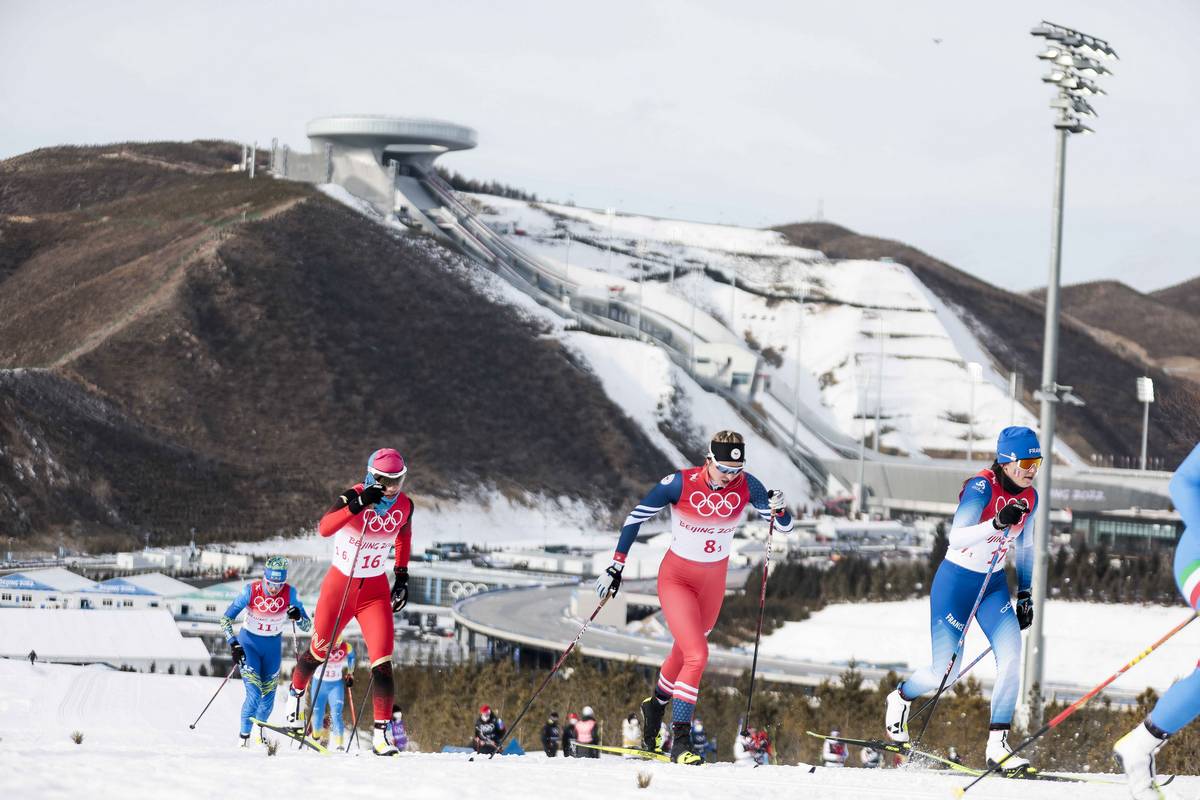
    Chunxue Chi (bib 16) skis the scramble leg of the women’s 4 x 5 k relay for China. (Photo: NordicFocus)

    The Chinese skiing project is something of a looking glass, with those involved seeing in it what they wish to see. For Moen, who had grown close to the athletes under her care, the project represented a lost opportunity.

    “Imagine if we could have the Chinese athletes here in Norway most of the time, in all these years,” she pondered. “Then I think the whole project could have been very, very exciting. Because they had such extreme progress that they could [have] continue[d]. There could have been results that would have been sensational.”

    Whether or not Chinese athletes in the Nordic disciplines manage to medal remains to be seen. The Games will mark the culmination of an expansive and unprecedented experiment in cross country skiing. 

    Historians of the future may well parse out the significance that a few hundred novice Chinese skiers and their Norwegian coaches had on the course of geopolitics. For now, all we can do is watch them race. 
     

  • Stars Bjørndalen, Domracheva and Shipulin Bid Adieu at Biathlon auf Schalke

    Stars Bjørndalen, Domracheva and Shipulin Bid Adieu at Biathlon auf Schalke

    Italy’s Dorothea Wierer and Lukas Hofer in first place (center), Germany’s Franziska Preuß and Simon Schempp in second place (left), and Darya Domracheva of Belarus with her husband Ole Einar Bjørndalen of Norway in third place (right) on the podium of the 2018 “Biathlon auf Schalke” event. The invitational was billed as the last international race for Domracheva and Bjørndalen, the winningest biathlete of all time. (Photo: Event organizer)

    The “Biathlon auf Schalke” two-person mixed relay show race in Gelsenkirchen, Germany, has become a Christmas holiday break fixture on the winter sports calendar. Many biathletes are in awe of the event, featuring a temporary ski course in and around a massive domed arena that usually serves as the home pitch for the Bundesliga soccer club Schalke 04, along with a raucous atmosphere in a sold-out venue and millions watching the broadcast live on TV in several countries.

    It’s no real surprise that some living legends of the sport would pick the frantic event that brings biathlon from the mountains to the city as the final race for their storied careers.

    In 2018 in its 17th season and with 46,421 fans in attendance, no North American team was represented among the ten invited teams.

    The event on Saturday evening mainly drew its fascination from being billed as the final race in the long and successful athletic careers of Ole Einar Bjørndalen of Norway, age 44, and Darya Domracheva of Belarus, 12 years his junior. Combined, the husband-and-wife team could display 12 Olympic gold medals in their personal trophy case, to name just one of their many achievements. By their own admission in a series of interviews with German TV host network ZDF and other broadcasters before, during and after the event, the day certainly was an emotional highlight for Bjørndalen and Domracheva.

    “It’s just fantastic, vielen vielen Dank, thank you so much for your support, you are the best!” Domracheva hollered in a fun language mix in an interview with ZDF after the race, drawing a big cheer when her words echoed through the arena via the public address system.

    “You couldn’t have dreamed it [better],” her husband Bjørndalen also added in German. “This is incredible, so many people  … I never experienced fans as good as this in my life. Thanks again Schalke, this is incredible!”

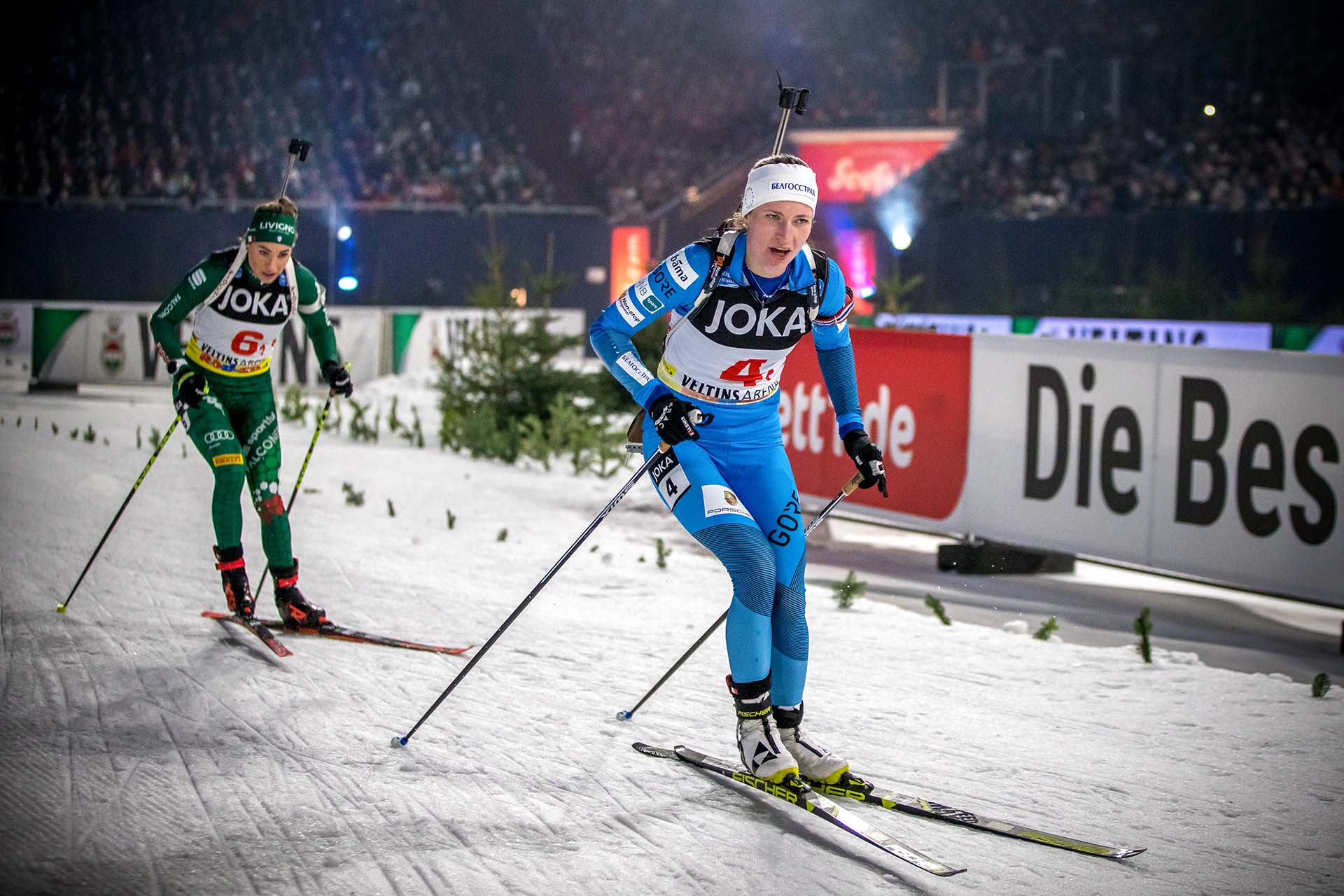
    Darya Domracheva of Belarus skiing in front of Italy’s Dorothea Wierer during the 2018 Biathlon auf Schalke event. Wierer went on to win the race with her partner Lukas Hofer. (Photo: Event organizer Facebook page)

    First World Team Challenge Victory for Italy

    In terms of the athletic merit of the event, the 2018 edition saw the first victory in the history of this competition for an Italian team, with current International Biathlon Union (IBU) World Cup women’s total score leader Dorothea Wierer successfully pairing up with teammate Lukas Hofer.

    Over the course of the evening, the Italian pairing turned out to be an ideal combination of the fastest shooter on her race legs and the fastest skier on his. The duo narrowly won the “first half” mass start race of the event which was followed by a 30-minute intermission. Wierer and Hofer also created a convincing lead in the pursuit, which was featured as the “second half” of the evening’s racing.

    But their victory was briefly in doubt when Hofer missed three targets in his final standing stage — a bit unusual on a range with no wind influence. Having to circle the penalty loop (though shorter than in regular World Cups) and now on tired legs, the three penalties allowed Germany’s clean-shooting Simon Schempp – who raced with his fellow national team member and girlfriend Franziska Preuß – to catch up to Hofer on the final lap that meandered through a “winter village” concourse around the arena.

    “I knew [Lukas] is super on skis, but when he missed three that was still becoming pretty suspenseful,” Wierer laughingly remembered the situation in an interview with ZDF after the race, according to a translation. “But luckily that triggered a little bit of adrenaline.”

    Hofer slowed down on the winding 1.3-kilometer course that provided few opportunities for overtaking other skiers before coming back into the main arena where he began to push hard on the only notable straight section along the shooting range. He managed to create a small gap between himself and Schempp and defended that to the finish line to secure the victory in a time of 33:23.6 minutes. Schempp finished 1.2 seconds behind.

    “My knees were trembling like a sewing machine,” Hofer said about his problems in the final shooting stage. “Luckily it somehow still worked out fine. I had to ski a tactical final loop, and it’s just great to finally stand at the top of the podium.”

    “It’s just a grandiose event,” Schempp said, seemingly not minding the narrowly lost victory (and sponsored car prize). “It’s so incredibly fun to race here in front of such an audience. And when a German team is also in the mix in front, that creates such an atmosphere … That gives you back a lot as an athlete. Just a lot of fun.”

    “You really feel like a soccer player with so many people watching,” Wierer added. “Even if you are just trying to have a conversation, it’s so loud you hardly understand anything with all this noise. And it’s great that everyone is being cheered for. Really cool.”


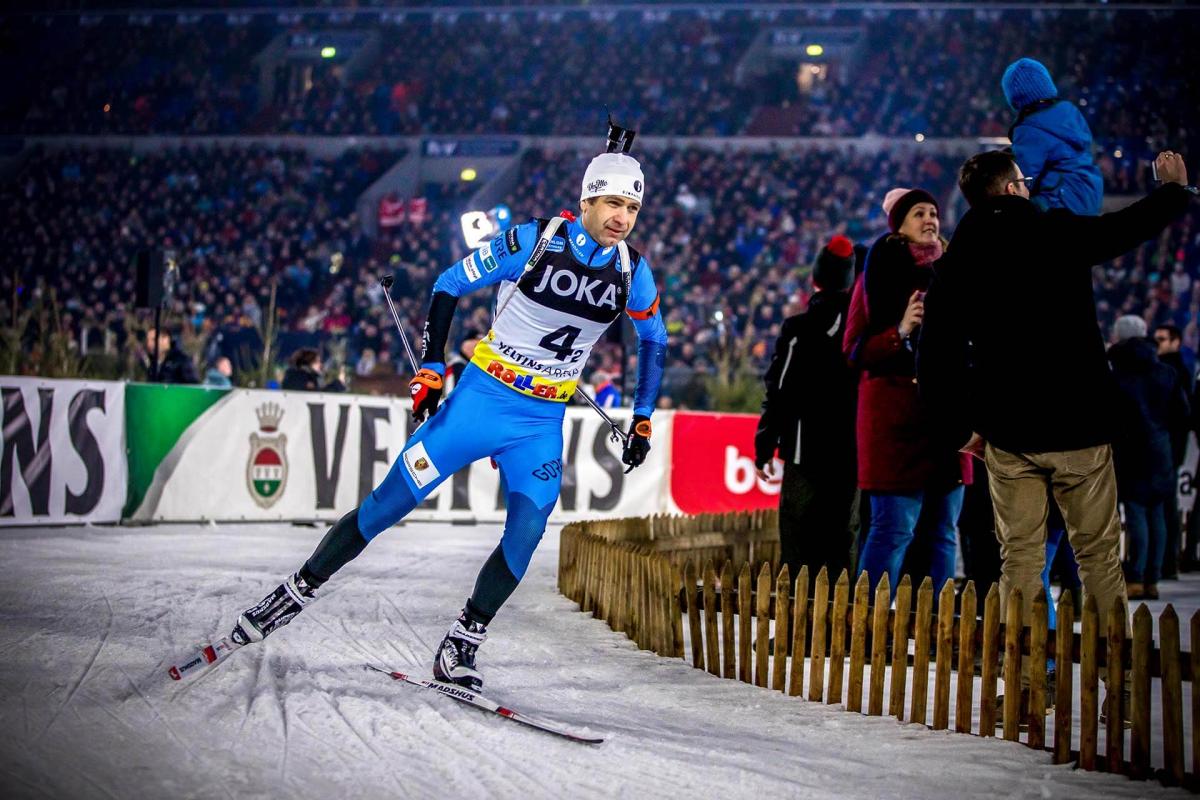
    Norway’s Ole Einar Bjørndalen on course during the 2018 Biathlon auf Schalke, billed as the last international race of his storied career. (Photo: Event organizer)

    Third Place for the Biathlon Legends

    But the real story of the night unfolded a little behind the race for the top of the podium.

    In the first event of the evening, Bjørndalen had proven once more that he still ‘got it’, winning a shootout competition to determine the start order against a host of athletes known as fast and accurate shooters.

    The semi-retirees Bjørndalen and Domracheva initially struggled a bit with the speed of the athletes still active week to week on the World Cup. Although they were able to hold their own and finished the event’s first half in third place, 6.1 seconds behind Italy and 2.7 seconds behind the French team of Anaïs Bescond and Emilien Jacquelin.

    “The course is not so difficult, but when you are in a bad shape it becomes difficult,” Bjørndalen told broadcaster ZDF at halftime, according to a translation. “We didn’t prepare so well, though Darya is still strong but I am flailing a bit in the skiing. Maybe next round will be better.”

    Despite admitting he had prepared for the event with a brief training camp in Norway and then a course inspection a day before most competitors had arrived at the venue, the athlete nicknamed “the cannibal” for eating up gaps to other athletes on the course in the prime of his career had some problems keeping speed with the fastest skiers on Saturday.

    Domracheva was able to hold up well on the range and course. With her signature elegant ski technique she kept right behind Germany’s currently best-ranked World Cup athlete Preuß on a loop, and stuck within viewing distance of the fast skiing Wierer. With a series of cleaned targets, Domracheva and Bjørndalen managed to keep themselves in podium contention and at one point even maneuvered into the lead, to the joy of the spectators who cheered for them at least as loud as for the German home teams.

    Then came the final exchange to the men, which required athletes to shoot a standing stage before skiing another full loop.

    “It was mega-cool to watch the final leg, very exciting,” Preuß told ZDF, according to a translation. “I believe everyone watching today saw how the suspense was bubbling up again. That’s how you wish a race should be.”

    Bjørndalen had incurred one penalty in his final shooting and skied back on the main course in third position behind Hofer and Schemp. But just a few seconds back, Benedikt Doll, who formed an “injury replacement” second team for Germany together with Denise Herrmann, managed to catch up and pass the Norwegian on the final lap. Being aware that a fourth place just off the podium for the final race for the biathlon star would be an anticlimactic result, Doll waited a few meters before the finish line for the man who he considers his biathlon idol. Doll then grabbed and lifted up Bjørndalen’s arm before skiing into the finish side by side. Intentional or not, Bjørndalen slid his ski boot over the line 0.1 seconds ahead of Doll.  

    “It was a very nice gesture. It is impressive that he does it at home. Thank you very much,” Bjørndalen told Norwegian broadcaster NRK about Doll’s actions, according to a translation. During the victory ceremony, he and Domracheva then called Doll up to the podium and hung their awarded medals around his neck, who seemed to reluctantly accept the honor.

    Darya Domracheva of Belarus (in foreground) is waiting to greet her teammate and husband, Norway’s Ole Einar Bjørndalen, as he skis towards the finish line together with Germany’s Benedikt Doll at the 2018 Biathlon auf Schalke event, billed as the last race of Bjørndalen’s career. (Photo: Event organizer Facebook page)

    Bjørndalen will retire as the winningest biathlete of all time, following a 25-year career that is a rare achievement in any endurance sport. To honor Bjørndalen, ZDF showed some old footage and interviews from early in his athletic career in the lead-up to the race.

    Bjørndalen amassed eight Olympic gold medals of 13 total Olympic medals, 20 IBU World Championship golds of 45 total championships medals, and 95 World Cup wins with an additional World Cup win in cross-country skiing. Even France’s current biathlon star Martin Fourcade would have to keep competing for numerous years to have any chance at matching those numbers. Bjørndalen’s Olympic record is only surpassed by fellow Norwegian cross-country skiing star Marit Bjørgen.

    Domracheva has four Olympic and two World Championship gold medals to her name, most recently anchoring the women’s relay to the gold medal for Belarus at the 2018 PyeongChang Winter Olympics. She told ZDF in an interview that she considers the 2014 Olympic Games in Sochi, Russia, to be the peak of her athletic career, where she won gold in the individual, sprint and pursuit disciplines.

    Domracheva reportedly plans to still race in one more event at home in Minsk, the capital of Belarus, for which 100,000 spectators are expected to show up.

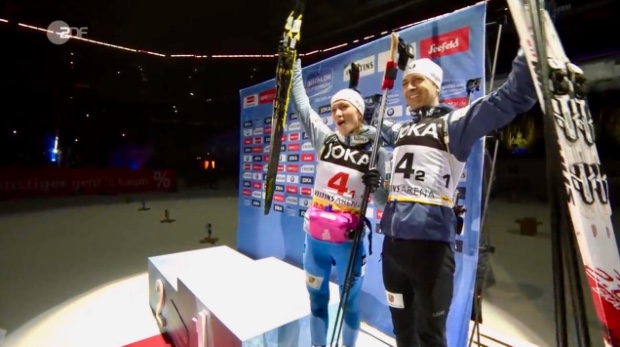
    Darya Domracheva of Belarus and Ole Einar Bjørndalen of Norway waiving to the crowd before the victory ceremony of the 2018 Biathlon auf Schalke invitational race. (Photo: ZDF screenshot)

    With homes all over Europe in Beitostølen (Norway), Minsk (Belarus) and Obertilliach (Austria), and already active in other career ventures from sports broadcasting to fashion design, the pair told reporters they have not yet decided where they will ultimately settle in the next few years, wanting to decide that once their young daughter is of school age. For now, their only firm plans are to spend New Year’s Eve together in Norway.

    Another Farewell: Russia’s Anton Shipulin

    Anton Shipulin – Russia’s best biathlete of the last few years – also announced last week that Schalke would be the final race of his international career.

    “Thank you very much, dear fans, for your support,” he posted on his social media accounts, according to a translation. “Without you, this adventure would have been more difficult. My victories are also your victories. I will always remember this. You are the best. I hope we will be able to please you once again at the ‘Christmas race’ [World Team Challenge], which will be held on December 29 and will be the final in my professional career.”

    Last winter, Shipulin had been among a number of Russian athletes barred by the International Olympic Committee (IOC) from starting at the 2018 Olympics in PyeongChang, and claims that to this day he has not yet received a satisfying official explanation by either the IOC or IBU for that blow to his athletic career, according to a fairly rare international interview he gave German home broadcaster ZDF before the race.

    Shipulin came back with a vengeance to close out the 2017/18 IBU season, winning the sprint at the World Cup in Kontiolahti, Finland, during the race week immediately following the Olympics.

    Overall he has achieved 11 World Cup victories in individual races during his career and won seven medals at World Championships including one gold. Arguably his biggest success, the gold medal from the men’s relay at the 2014 Olympics at home in Sochi, Russia, hangs in the balance as the IOC and International Biathlon Union keep investigating allegations, though for now publicly only against retired teammate Evgeny Ustyugov. Shipulin’s fourth-place mixed relay result from those Olympics has already been voided.

    Shipulin conveyed in statements that the international sports bodies and anti-doping authorities have treated his case unfairly during the last two seasons, and the murky situation about his ability to participate in future major sports events combined with the unpleasant prospect to see old results annulled seemingly has exhausted his motivation to keep training and competing.

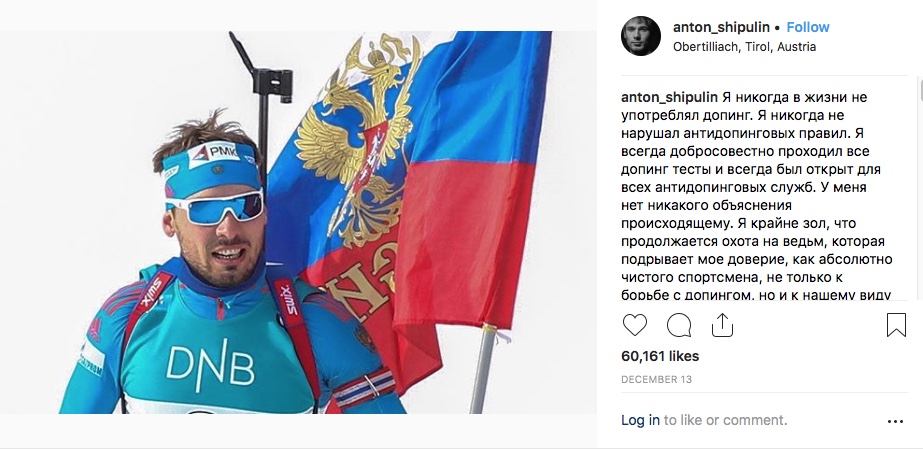
    Russia’s Anton Shipulin claimed his continued compliance with anti-doping regulations in a Russian and English post on his Instagram social media account from December 13, 2018. (Photo: Instagram screenshot)

    “I never violated anti-doping rules. I have always completed doping tests in good conscience,” he told ZDF in an interview, according to a translation, reiterating comments he made in social media posts including one from December 13, 2018, in which he called the most recent investigations triggered by Austrian and Italian authorities that reportedly included a team hotel search a “witch-hunt” and “total nonsense”.

    On Saturday, the pre-determined final race together with his teammate Ekaterina Yurlova-Percht didn’t quite go as storybook-scripted as for Bjørndalen and Domracheva. Incurring too many penalty laps, the Russian duo was never really in contention for the podium and ended the race in seventh place (+1:48.8).

    Yurlova is a veteran of racing at Schalke, winning the event a year ago together with Alexey Volkov, as well as in 2012 when she had teamed up with Shipulin and is currently in full World Cup race mode. Also, like her teammate Shipulin, Yurlova was not allowed by the IOC to start in PyeongChang and reportedly could still be under investigation by international sports and legal authorities. But so far has not been publicly charged with any concrete violations. She is married to an Austrian national, and by living in that country is under the supervision of the local anti-doping agency for much of her off-season.

    Shipulin had not yet raced in an IBU event this season, citing a lack of training time in the summer. Though prior to his announcement last week it had been widely expected that he would be back with the Russian team in time for the races in January or at the latest for the World Championships in Östersund, Sweden.

    Similar to Domracheva, Shipulin might still make an appearance in a farewell race at home. He told ZDF that he looks forward to now spend time in Tyumen, Russia, with his family, and said he was also happy to have more opportunities for his other sports passion: fly fishing.

    Final Results “Biathlon auf Schalke” World Team Challenge 2018

    1 Dorothea Wierer / Lukas Hofer (Italy), 33:23.6 minutes

    2 Franziska Preuß / Simon Schempp (Germany I) +1.2

    3 Darja Domratcheva / Ole Einar Bjørndalen (Belarus/Norway) +24.2

    4 Denise Herrmann / Benedikt Doll (Germany II) +24.3

    5 Lisa Theresa Hauser / Dominik Landertinger (Austria) +1:04.1

    6 Veronika Vítková / Michal Krčmář (Czech Republic) +1:09.5

    7 Ekaterina Yurlova-Percht / Anton Shipulin (Russia) +1:48.8

    8 Juliya Dzhyma / Artem Pryma (Ukraine) +2:12.3

    9 Anaïs Bescond / Émilien Jacquelin (France) +3:11.3

    10 Fuyuko Tachizaki / Mikito Tachizaki (Japan) +4:58.0

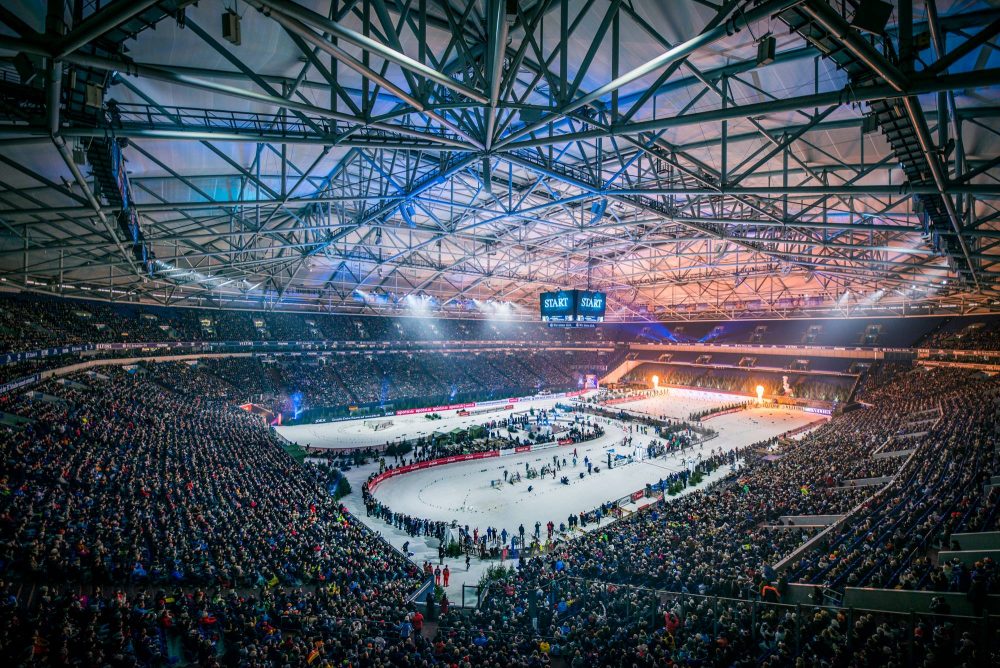
    Shooting range and part of the ski course inside the domed Veltins Arena during the 2018 ‘Biathlon auf Schalke’ invitational race event. (Photo: Event Organizers Facebook Page)


    While the International Biathlon Union has adopted the mixed and single-mixed relay formats as exciting new disciplines in recent years, the “Biathlon auf Schalke” also dubbed the World Team Challenge by the organizer is an invitation-only private event not sanctioned by the IBU (even though there are plans to cooperate in the future, especially regarding a junior competition leading up to the main event), so there were no World Cup points much less internationally recognized medals to win in the race. That will happen towards the end of the season in March at the IBU World Championships in Östersund, Sweden.

    The regular IBU World Cup season will continue on January 10th, 2019, in Oberhof, Germany.


  • Bye Bye Biathlon: Many Retirements After 2018 Olympic Season

    Bye Bye Biathlon: Many Retirements After 2018 Olympic Season

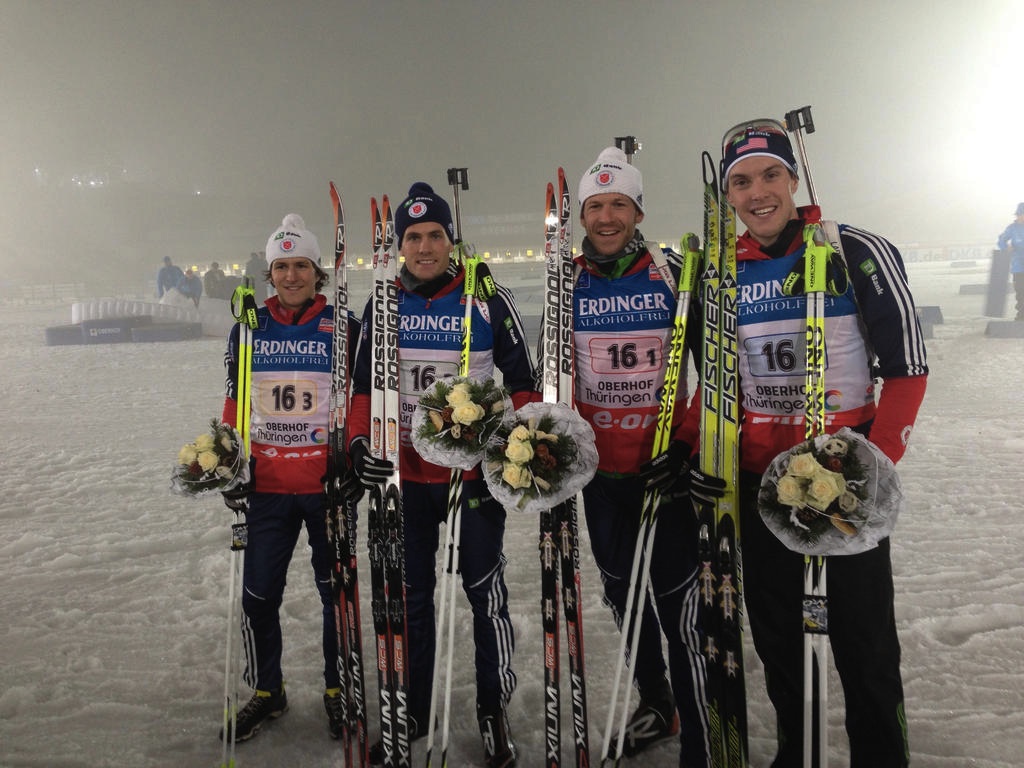
    Russell Currier, Tim Burke, Lowell Bailey, and Leif Nordgren after a fifth-place relay finish in the IBU World Cup relay in Oberhof, Germany, in 2013. Currier, Burke, and Bailey are all retiring. (Photo: USBA.)

    With the 2018 Olympics come and gone, many of biathlon’s athletes are calling it quits. Here’s a roundup of who you won’t see on the World Cup next season – and who’s still on the fence about their future.

    USA

    2017 Word Champion Lowell Bailey has long planned to retire after the 2018 season, and now that time has come. His first World Junior Championships was in 1999 and he got his first World Cup start in 2002. He raced 2003 World Championships before taking a break to go to the University of Vermont, before returning and competing in the 2006, 2010, 2014, and 2018 Olympics. His eighth-place finish in the 20 k individual at the 2014 Games are the best ever by an American biathlete. Bailey is the Executive Director of the Crosscut Mountain Sports Center in Bozeman.

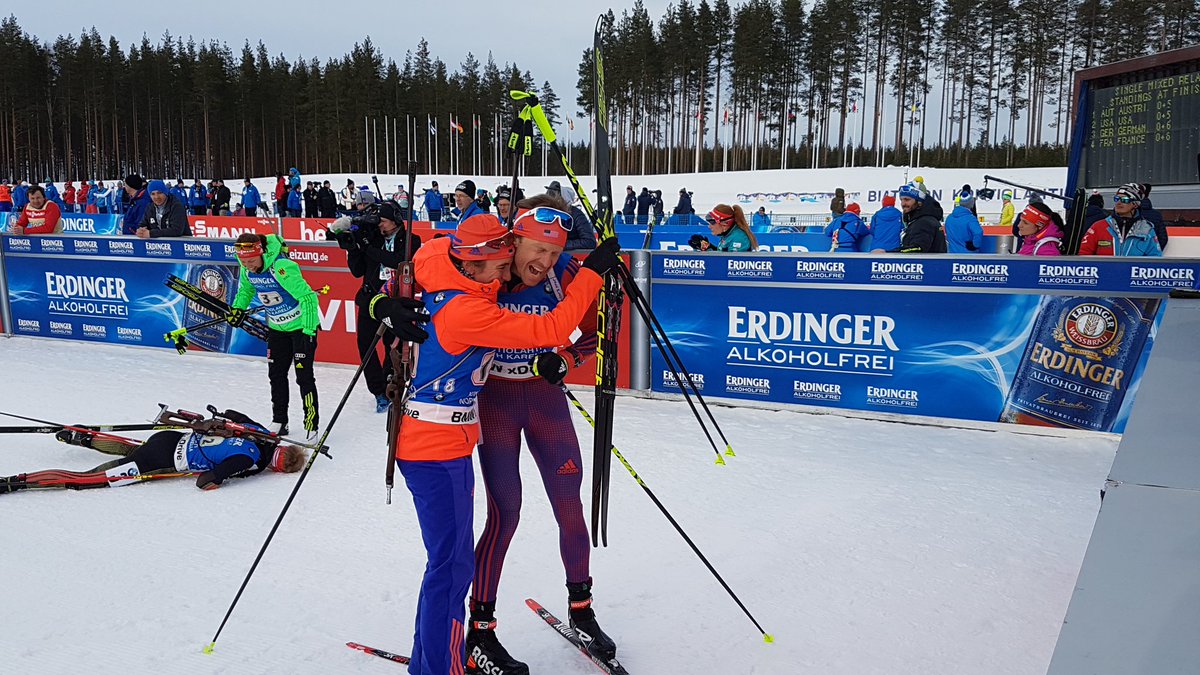
    Susan Dunklee and Lowell Bailey celebrate after finishing second in the World Cup single mixed relay in Kontiolahti, Finland, in 2017. Austria won the competition. Bailey is retiring and Dunklee is undecided as to whether she will continue racing. (Photo: IBU/Twitter)

    “I told myself this morning that I just wanted to go out on a high note,” he told FasterSkier in Oslo after leading off a U.S. relay team that finished seventh, in his last World Cup race. “I wanted to go out with a good result. And, I’m really happy to have shot clean in standing, clean from the clip in my last stage as a World Cup biathlete. That feels good. I’ll always remember that — that I went out with a clean stage.”

    Longtime teammate and 2013 World Championships silver medalist Tim Burke will also retire. Burke has six World Cup podiums to his name including that silver medal, and led the World Cup partway through the 2009-2010 season. Burke started racing internationally at 2000 Junior World Championships, and made his first senior World Championships in 2004. Like Bailey, he is a four-time Olympian.

    “It’s weird, I don’t honestly I don’t know if it’s truly hit me,” he said after the Oslo relay. “It might take weeks… I think it’s going to take a long time for all to settle in and for me to really reflect back on my career. Yeah, it’s a lot of emotion.” Burke says that his post-biathlon plans are not yet certain.

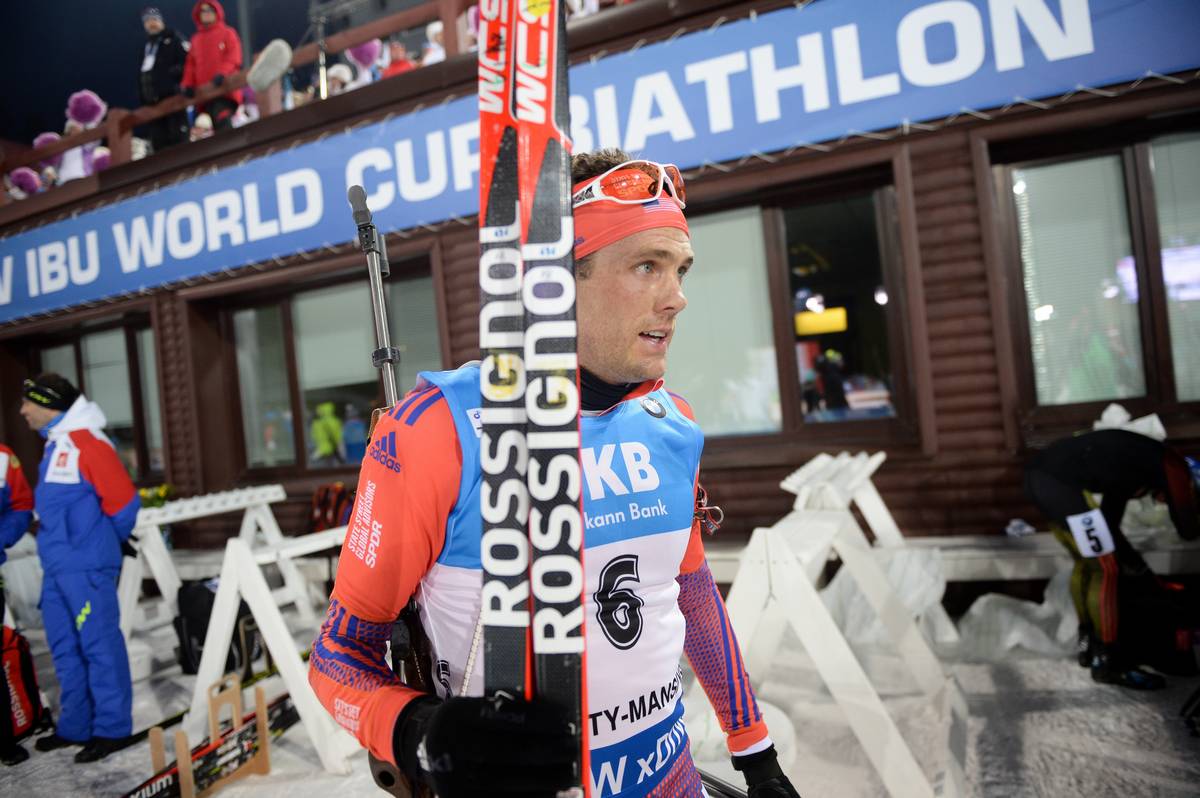
    Tim Burke after placing sixth in a World Cup pursuit in Khanty-Mansiysk, Russia, in 2016. (Photo: USBA/NordicFocus)

    Also retiring is Russell Currier, an off-and-on member of the national team and the Maine Winter Sports Center (now the Outdoor Sports Institute). Currier had two sixth-place World Cup results in 2012, and is a four-time World Championships team member. Since his World Cup debut in 2009, he has contributed to many U.S. relay efforts. He also competed at the 2014 Olympics, with a top finish of 49th, and was a member of the 2018 Olympic team though he did get any starts in PyeongChang.

    “USBA nationals will be officially be the last race of my biathlon career,” Currier wrote in an email to FasterSkier this week.

    The women’s team likely won’t see three retirements, and will thus have some more stability than the men’s crew, but there is more uncertainty regarding the women’s roster. Clare Egan wrote in an email this week that she was “Undecided!” about whether to continue racing. And in Oslo, after finishing third in the pursuit which was her last World Cup of the season, Susan Dunklee said the wasn’t sure if she would keep competing. “Ask me again in a month,” she said.

    Canada

    Julia Ransom retired in Oslo, as the 25-year-old is planning a career in dentistry and has many years of school ahead of her. “It’s just a good time for my partner and I to kind of move on,” she said after crossing the line in her final World Cup, the pursuit, hand in hand with teammate Rosanna Crawford.. “And it does feel right. It feels right.”

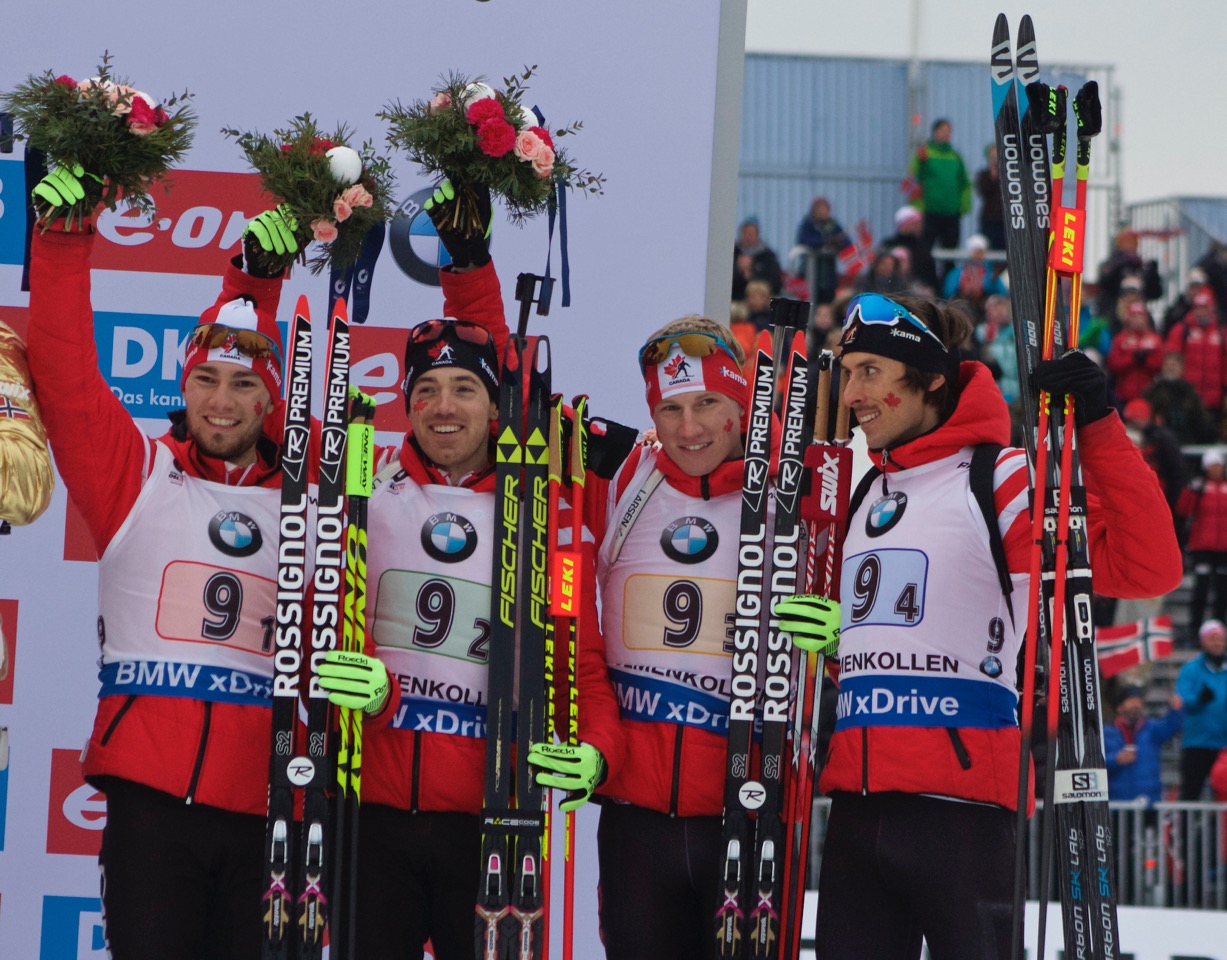
    The Canadian men’s team (l-r) Christian Gow, Nathan Smith, Scott Gow, and Brendan Green celebrate bronze in the men’s 4 x 7.5 k relay at 2016 World Championships in Oslo, Norway. Both Green and Smith are undecided on their future plans. (Photo: JoJo Baldus)

    Ransom scored two top-ten finishes at 2014 World Juniors, and made her first senior World Championships team in 2015. This season she had two top-ten World Cup finishes, and went to the Olympics in PyeongChang, where she finished 28th in the pursuit.

    She is the only one from the Canadian team who is definitely retiring, but quite a few of her teammates are on the fence and there could be huge turnover on the team depending on what they decide. That includes Rosanna Crawford and Brendan Green, even though Crawford finally bagged her first World Cup podium this season.

    “We’re not 100% sure yet,” Green said after the relay in Oslo. “Both Rosanna and I will sit on it a little bit over the spring. We will reevaluate a little bit and see what other opportunities arise. I think we both still love to race and train, and if we continue down that path I know we will still be motivated. But as of right now I’m not sure.”

    2015 World Championships silver medalist Nathan Smith – who was also, along with Green, Christian Gow, and Scott Gow, part of a bronze-medal relay at 2016 World Championships – is also unsure. He missed most of the 2016-2017 season with health issues and though he returned to the World Cup and the Olympics this year, did not perform up to his own expectations. 

    Rosanna Crawford, Megan Imrie, Megan Tandy, and Zina Kocher celebrate a fourth-place World Cup relay finish in Annecy, France, in 2014. Crawford and Tandy may not keep racing after this season; Imrie retired in 2014 and Kocher in 2016. (Photo: Matthias Ahrens)

    “I’m kind of waiting to see what happens with Biathlon Canada,” Smith wrote in an email this week. “I think some very difficult years are coming for the organization, unfortunately. That will play a big part in my, and I’m sure many other athletes’, decisions. Of course, I’m also not looking to have a continuation of the health problems over the last two seasons, which made competing at the highest level really difficult. So I will be keeping a close eye on how my body is reacting to training. If it’s still not coming around that would certainly not encourage me to continue either.”

    2010, 2014, and 2018 Olympian Megan Tandy also struggled with health issues this winter, and is likewise not sure what her future holds.

    “Originally it was my intention to retire after this season, however it was literally my worst season ever!” she wrote in an email. “I was sick more in the past 6 months than in the past two years. Anyways,  I have taken some time since the Olympics to followup about my health and to consider options for next season. I want to race a final season – one where I feel good and can put up a good fight (not necessarily results dependant, I just want to leave this sector of my life feeling like I gave it all I got), but a lot of things will need to fall into place for that to be realistic: sponsor support, coaching opportunities during the training season, and my health of course.”

    Poland

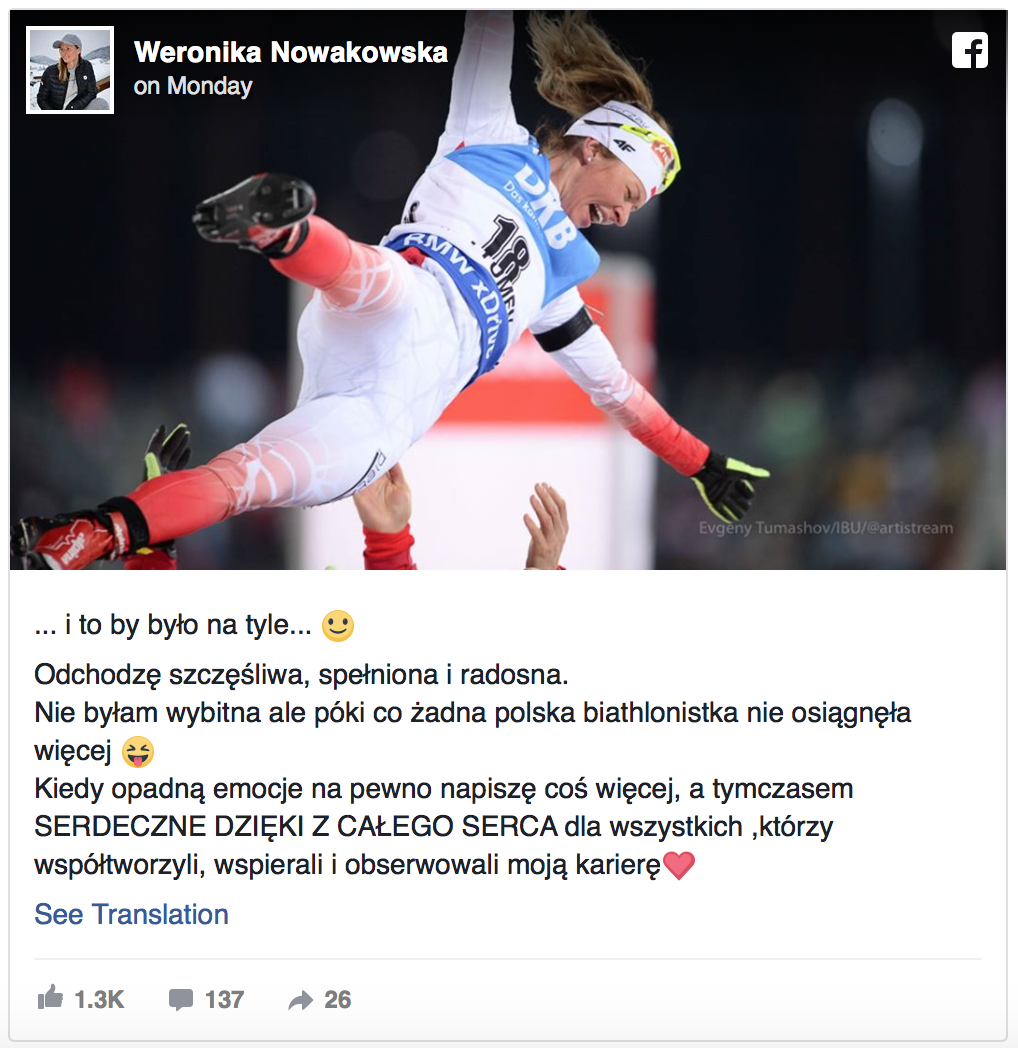
    Weronika Nowakowska is calling it a career. The 31-year-old picked up two World Cup podiums in the 2015 season before taking a break from competition to give birth to twins. She made a successful return this season and represented Poland in PyeongChang, with a top finish of 21st in the individual. She also had sixth- and fourth-place finishes on the World Cup this year and contributed to four different top-eight relay efforts, including one at the Olympics.
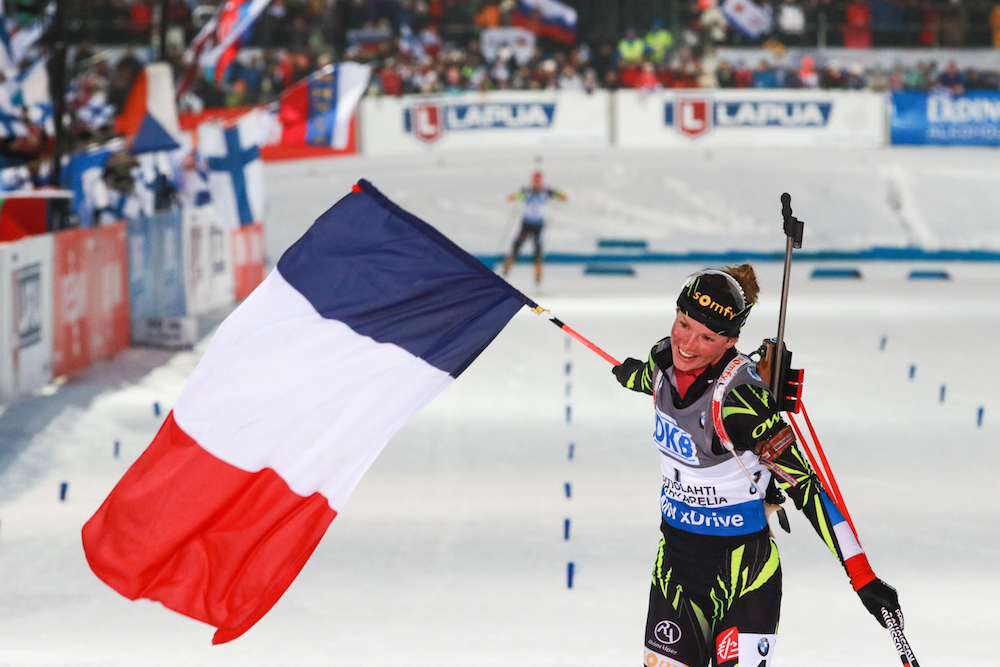
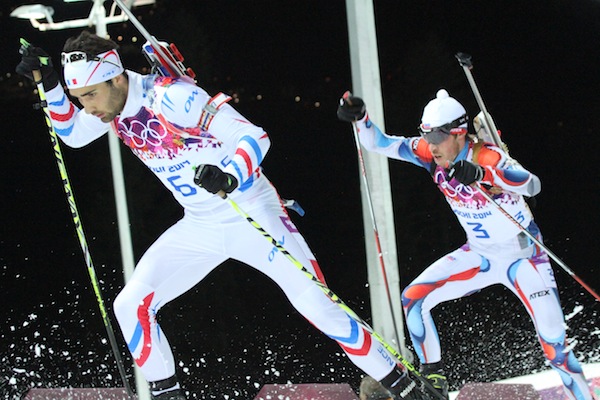
    “I leave happy, fulfilled and cheerful,” she wrote on her Facebook page, according to a translation. “I was not outstanding, but so far no Polish biathlete has done better”

    France

    Back in Oslo, French star Marie Dorin Habert ended her career. Dorin Habert – then simply Marie Dorin – competed in her first senior World Championships in PyeongChang in 2009, where she had a top individual finish of 18th and was part of the bronze-medal relay team. Fast forward and she had racked up a sprint bronze at the 2010 Olympics, seven World Cup wins, ten more World Championships relay medals, and four individual gold, one silver, and one bronze medal at World Championships, four of which were from the 2016 edition where she did not finish a single race without a medal.

    France’s Marie Dorin Habert celebrates her second win in as many races at 2015 IBU World Championships, after taking gold in the 10 k pursuit in Kontiolahti, Finland. (Photo: Kontiolahden Urheilijat/Jarno Artika)

    She found herself back in PyeongChang for the 2018 Olympics, where, despite a frustrating season until then, she was fourth in the sprint, bronze in the women’s relay, and gold in the mixed relay.

    “It’s so nice to end this way, to share it with all of the team, and the beautiful sun, and all the French people,” Dorin Habert said after winning the women’s relay in Oslo along with her teammates. “It’s a wonderful day for me. I would like to thank a lot, well, everyone, for being there in the biathlon family. I’m really happy to have this career, and I’m really happy for everything.”

    Jean Guillaume Beatrix he told is also retiring. Beatrix was a World Junior Champion in 2009, before going on to be a five-time World Championships team member and a 2014 Olympic bronze medalist in the pursuit. He was part of three silver- and one bronze-medal winning men’s relay teams at World Championships. But this season, he did not perform well enough to make a very competitive French team for the 2018 Olympics. His retirement was “a decision precipitated by my results”, L’Equipe, according to a translation.

    Czech

    France’s Martin Fourcade leading Jaroslav Soukup of the Czech Republic during the men’s Olympic 12.5 k pursuit at the 2014 Olympics.

    Jaroslav Soukup, the bronze medalist in the sprint at 2012 World Championships, where he was also part of the silver-medal mixed relay team, is retiring. Later in 2012, he suffered a horrendous accident while biking, including open fractures in his arm and neck and back injuries. By 2014, he made it back and won the same medals at the Olympics that he had at World Championships two years before: bronze in the sprint and silver in the mixed relay. Soukup qualified for the 2018 Olympics but only competed in the relay, which finished seventh. He had one World Cup top-30 this season.

    Norway

    Hilde Fenne, a staple of the Norwegian women’s team, retired after the last race of the season in Tyumen, Russia. Fenne never found breakout success as an individual; she had three top-15 finishes in her career. But she was an integral part of the women’s team and contributed to numerous World Cup relay podiums, as well as the gold-medal winning women’s relay at 2013 World Championships in Nove Mesto, Czech Republic.

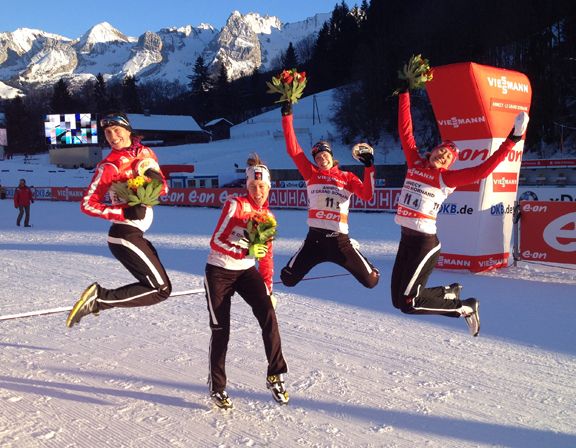
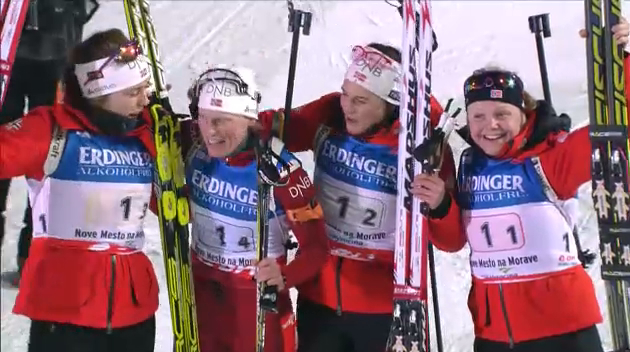
    The Norwegian women’s relay celebrates its second-ever World Championships title after winning the 4 x 6 k event in Nove Mesto, Czech Republic. From left to right: Synnøve Solemdal, Tora Berger, Ann Kristin Flatland and Hilde Fenne.

    In that final race, her teammates wrote her name on their cheeks. “She has been a very important piece for me,” teammate Synnøve Solemdal told NRK, almost in tears. “We have stayed in a lot of hotel rooms together. I’m going to miss her very much.”

    On the men’s side, there is uncertainty as to whether some veterans will stick with racing or not. One is Ole Einar Bjørndalen, who was left off Norway’s Olympic team, who for the first time since 1992 this season. And yet, the 44-year-old has not stated that he will retire, and some who know him are speculating that he may try to stick it out one more year and go out with better results than he saw this season.

    Also with no stated plans is Emil Hegle Svendsen. Bjørndalen is the winningest athlete in World Cup history; Svendsen is number four. He won the World Cup overall title in 2010, and is a four-time Olympian. He won gold in the individual in 2010 and in the mass start in 2014, after which he suffered a total collapse anchoring the Norwegian men’s relay. In the past seasons he has been off and on, and he has only won two races since then. But this season he showed flashes of brilliance, and he was third in the mass start at the 2018 Olympics as well as anchoring the silver medal men’s relay and mixed relays.

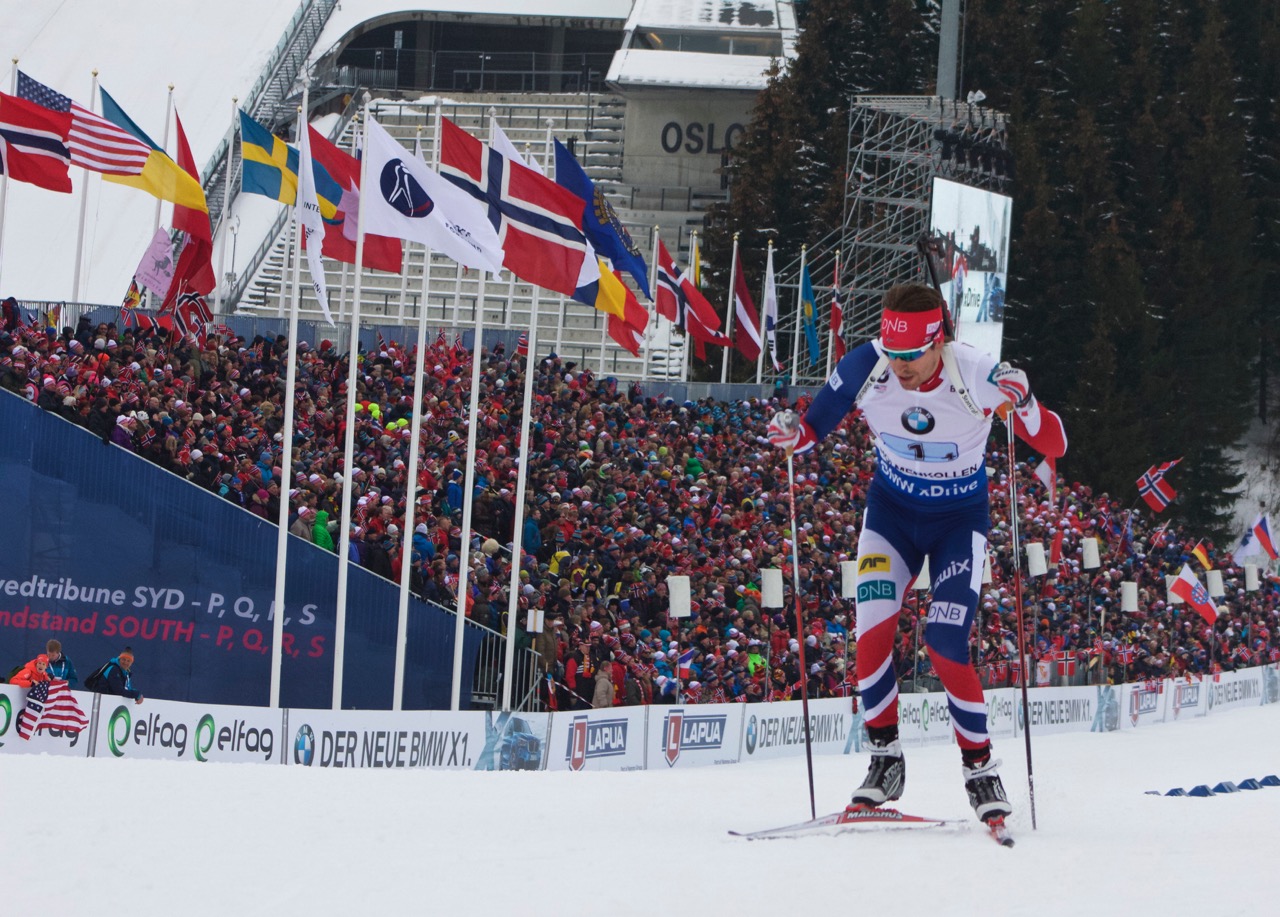
    Emil Hegle Svendsen of Norway leaves the stadium in the 2016 Holmenkollen World Cup as thousands of his countrymen cheer him on. Svendsen has not officially announced his plans for next season. (Photo: JoJo Baldus)

    “What Emil has done is absolutely fantastic,” teammate Tarjei Bø – who won the overall World Cup the year after Svendsen – told NRK two weeks ago. “He has won everything, and in addition done it several times, and he has come back again and again after being down. He has had a fantastic career and I hope he continues.”

    Finland

    She just won the overall World Cup crystal globe, but Kaisa Makarainen is not sure whether she will continue racing. In several previous years she had already discussed potentially retiring, but now she is reportedly waiting to think it over more as well as to discuss with the new team staff. U.S. Biathlon Women’s Coach Jonne Kahkonen, himself a Finn, was just announced as the new Head Coach for Finland.

    Germany

    Florian Graf, an athlete who finished as high as fourth on the World Cup in 2013 but has more recently been racing on the IBU Cup, is calling it quits at age 29.

    Several other top athletes are suspected to be considering retiring, but there hasn’t been much on the record discussion by them. Stay tuned.

  • Belarus Nabs First Olympic Gold in Women’s Relay; Canada 10th, U.S. 13th

    Belarus Nabs First Olympic Gold in Women’s Relay; Canada 10th, U.S. 13th

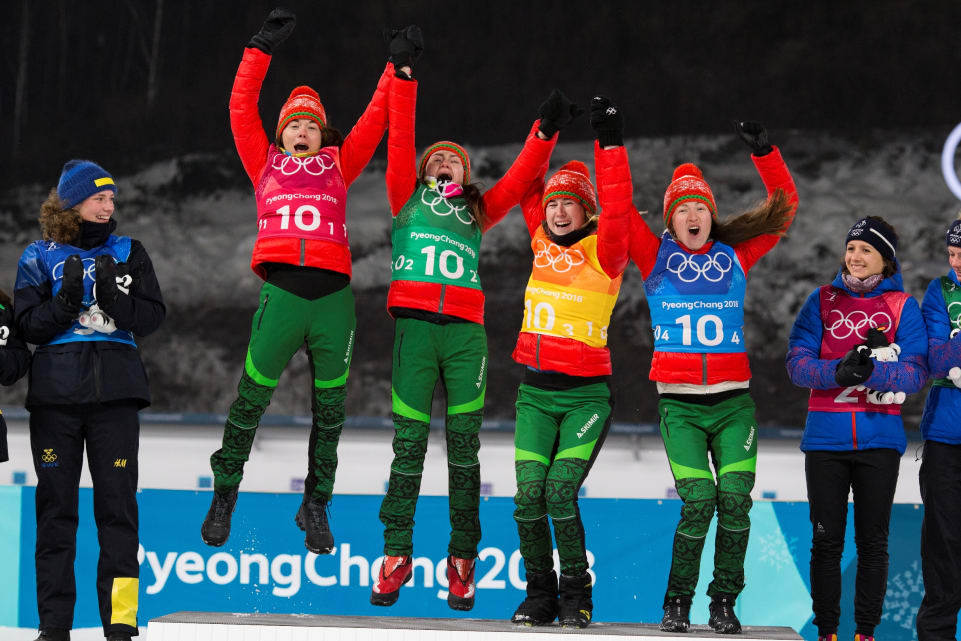
    The Belarusian women’s biathlon team, with (from left to right) Nadezhda Skardino, Iryna Kryuko, Dzinara Alimbekava, and Darya Domracheva, celebrates winning a historic gold for their nation in the 4 x 6 relay at the 2018 Olympics in PyeongChang, South Korea. They were ranked 10th coming into the day. (Photo: IBU/Biathlonworld)

    FasterSkier would like to thank Fischer Sport USA, Madshus USA, Concept2, Boulder Nordic Sport and Swix Sport US for their generous support, which made this coverage possible.

    PYEONGCHANG, South Korea — Some things were the same on Thursday night: the attention-grabbing biathlon stadium announcer generating an atmosphere of stoke, thumping house music, and shivering yet engaged fans. Making it feel like true winter, a heavy snow squall settled in over the Alpensia Biathlon Center for the women’s 4 x 6-kilometer relay.

    Ultimately, Belarus won gold in a time of 1:12:03.4 hours with Nadezhda Skardino, Iryna Kryuko, Dzinara Alimbekava, Darya Domracheva. Sweden’s Linn Persson, Mona Brorsson, Anna Magnusson, and Hanna Öberg took silver (+10.7), while France’s Anaïs Chevalier, Marie Dorin Habert, Justine Braisaz, and Anaïs Bescond claimed bronze (+17.6).

    For the first few legs, however, all three medaling teams seemed an outside shot at the podium. On a windy and, for the first time at the Olympics, snowy evening, the win was up for grabs from the start.

    After the first lap, a rainbow of suits came into the shooting range together, 7.8 seconds separating the leader from the field’s tail. America’s lead-off skier, Susan Dunklee, skied out of the range first after shooting clean in prone. The U.S. skier was followed by Ukraine, 2.9 seconds back. And Canada’s Sarah Beaudry had also cleaned without any spares to put her team in third, 7.1 seconds back.

    Dunklee held her lead through the 2.9 k checkpoint and by 3.6 k, she was up to 8.1 seconds ahead of Japan chasing in second. Canada had fallen to 12th, 14.9 seconds back. With dumping snow and blustery wind before their second shooting round, it was Dunklee all entering the range all alone that was featured on the stadium’s jumbotron.

    For her standing stage, Dunklee missed one target, but cleaned it with one spare. She left the range 5.2 second behind Italy’s Lisa Vittozzi, who had also cleaned with one spare. After the first leg’s final shooting stage, the field started to spread out. Beaudry used three spares to clean standing and avoided the penalty lap, returning to the course in 13th, 50.5 seconds out of first.

    Susan Dunklee skiing the first leg of the mixed relay on Tuesday at the 2018 Olympics in PyeongChang, South Korea. She tagged the team in fifth and they went on to place 15th. On Thursday, she skied the U.S. women’s 4 x 6 k relay into second by the first exchange. (Photo: FlyingPointRoad)

    “There’s some, as a friend of mine would call it, Disneyland snow, falling from the sky so it makes it exciting in the relay,” Beaudry told FasterSkier after her race. “Everyone shoots at the same time so I wouldn’t say anything is unfair. It makes opportunity. So hopefully my teammates can take advantage of that.”

    Dunklee came through the 5.6 k checkpoint trailing Vittozzi by 7.2 seconds. At the first exchange, Italy tagged off first and Dunklee handed off to Clare Egan 7.6 seconds back in second. 

    “It has been a tough Games. We came in here with a lot of expectations and certainly haven’t really lived up to them,” Dunklee told FasterSkier after her leg. “It’s extremely frustrating. To think about every decision you make in your life over four years, with your best training in mind and your best performance in mind, and then getting sick at the wrong time is tough. The guys have struggled.

    “We have had some bright spots with the girls; Emily and Joanne have carried us, they have had PR’s here. That is exciting,” Dunklee added, before looking up at the screen to see Egan skiing in third. “And this is exciting today. This is really exciting! Anything is possible.”

    Beaudry tagged Canada’s Julia Ransom in 15th, 1:15 minutes out of first.

    “I was really happy with my first lap and my prone,” Beaudry said after her first Olympic relay. “I tried to keep with the group on my second lap and I think that left me a little shaky in standing. I’m not too pleased with my two spares, but I mean, I missed three and I didn’t miss a spare, so at least shoot a spare, hit a spare.”

    After the first loop of the second leg, Italy was still in first, with Dorothea Wierer at the helm. In prone, there was a reshuffling of leaders as Slovakia’s Anastasiya Kuzmina cleaned with one spare to move into first, 15.3 seconds ahead of Norway’s Tiril Eckhoff, who had cleaned with a single spare, in second. Egan cleaned without a miss and left the range in third (+17.3). Meanwhile, Wierer still had two targets standing after using all three spares, leaving her with two costly penalty laps and 1:11 minutes back in 13th.

    Finland’s Kaisa Mäkäräinen shot clean to put her team in fourth, 23.9 seconds behind Kuzmina. France was sixth (+32.6), and Belarus ninth (+46.6). Canada’s Ransom shot clean without any spares and left the range in  12th (+1:08.3) while Sweden was 15th (+1:16.4).

    While Kaisa Mäkäräinen moved into second behind Kuzmina on the next loop, Eckhoff and Egan followed them into the range in third and fourth, respectively. There, during an especially blustery standing stage, Kuzmina missed her first three shots and ended up with a penalty lap, which put her 20 seconds back in eighth. Wierer cleaned to reclaim first for Italy, just 0.9 seconds ahead of Mäkäräinen in second, who used two spares to avoid a penalty. Belarus’s Kryuko shot clean to leave the range in third (+7.9), and Egan hit five more shots without any spares to follow her in fourth (+10.7).

    Ransom used three spares to avoid the penalty lap and headed back on the course in 10th (+44.2) for her final 2 k loop.

    “Oh my gosh, I was really due for this,” Egan said after. “It’s by far my best race of the season so I couldn’t be more happy with my race.”

    By the time the skiers came in for the second exchange, the order had changed again. Finland handed off in first, Italy second, 14.2 seconds back, Slovakia third (+16.1) and U.S. fourth (+16.8). Canada came through in 10th (+1:09.5).

    “Kuzmina kept being behind me and then passing me,” Egan reflected. “I think every lap Kuzmina passed me so there is a lot of really fast skiers, most teams put their fastest skiers on their second legs. I tried to stay with them, but I can’t always do that. I did have people around me the whole time though so I was able to keep fighting.”

    “All you can do is just leave it all on the track no matter what it is,” Ransom said of her race. “My standing was a little bit precarious, missing three from the clip. But I’m happy I was able to hit the precious spares. It was very gusty.”

    Egan tagged off to Joanne Reid for the third of four legs. Reid slipped to sixth on her first loop and during her first prone shooting, she used three spares and had to ski a penalty lap, returning to the course in ninth, 33.6 seconds behind Italy’s Nicole Gontier, who cleaned with three spares, in first. Gontier skied just 0.4 seconds ahead of Slovakia’s Terezia Poliakova, who used one spare to clean. 

    Belarus had moved into third (+2.4), France into seventh (+19.2), while the Swedes sat in 11th (+1:33.6) and Canada, with Emma Lunder who had to ski a penalty, was still in 12th (+1:45.7).

    As the leaders came in for their standing bout, it was Italy, France, Belarus, Norway, Finland, Slovakia, Poland, and U.S.A. Belarus’s Alimbekava took the lead after using one spare, Poland chased in second (+6.2), Slovakia was next, followed by Italy. The U.S. was back up to fifth (+28.1) after Reid used one spare to clean. France was sixth (+29.2) and Sweden eighth (+1:10). Lunder cleaned to put Canada in 11th (+1:24.7).

    “I had a pretty good standing, but we need every second we can get,” Reid said after. “You never know what will happen in the next stage and the wind picking up. So even if we’re in fifth you never know. I was just trying to hang on on that uphill and give it everything I had.”

    “I didn’t feel amazing, skiing, but I ripped off my standing with no spares, like, record fast, so I was really pumped about that,” Lunder reflected. “I moved up like a ton in the range there. So I think I tagged Rosanna in a decent position to be with some girls and fight a bit.”

    Poland’s Krystyna Guzik caught Belarus’s Alimbekava and by the final exchange, it was Poland in first, France in second, Italy in third, and Belarus in fourth. Reid handed off to Emily Dreissigacker in sixth (+21.4) while Lunder tagged Rosanna Crawford in 13th (+1:22.6). Sweden exchanged in eighth (+59.1)

    The skiers had maintained their order as they approached the range for the seventh round of shooting. Belarus’s anchor leg, Domracheva, shot clean to take the lead. France was now in second, Poland third, and the U.S. in seventh (+41.1), after Dreissigacker used two spares to clean. Sweden was back in ninth (+41.9), while Crawford cleaned with one spare and out for her second loop in 12th (+1:28.6).

    Coming into the final shooting shooting round, Belarus teetered on a lock for gold, 24.8 seconds ahead of France in second. Poland still clung to third, 34.5 seconds back, while Sweden was now ranked seventh, 56.4 seconds back. The U.S. had moved back to tenth, while Canada was right behind them in 11th.

    Domracheva missed three targets standing, but used three spares to clean and avoid any penalties to hang onto first. France’s Bescond needed three spares to clean but stayed out of the penalty lap and headed out on the final loop in second (+6.4). Sweden’s Öberg cleaned her second-straight stage without any misses to move all the way up into third (+10.9). 

    For the U.S., Dreissigacker used her three spares to clean standing, but experiencing unsteady winds, took her time to steady her shot and left the range in 12th (+1:20.2). Canada’s Crawford used one spare to clean and moved up to 11th (+1:19.9).

    “It was really windy for my standing,” Crawford noted. “I really waited it out.”

    “It wasn’t great,” Dreissigacker, a first-time Olympian, said of her race. “I didn’t feel that great skiing, might’ve went out a little hard, and the shooting just wasn’t good either. I was happy to at least hit them all with my spares, but standing especially, I took all three spares and the wind came up like crazy, right before I started shooting my spares, so I had to like stand there and wait out the wind, which cost me a lot of time.”

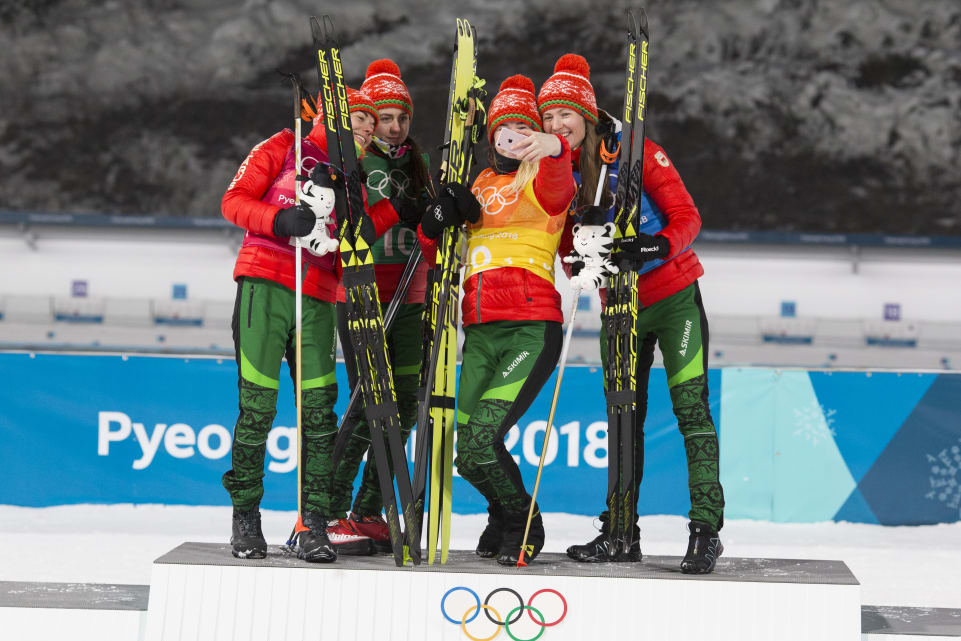
    The Belarusian women’s biathlon team, with Nadezhda Skardino, Iryna Kryuko, Dzinara Alimbekava, and Darya Domracheva, snaps a podium selfie after winning their first relay gold on Thursday at the 2018 Olympics in PyeongChang, South Korea. (Photo: IBU/Biathlonworld)

    Over the last 2 k of the race, Domracheva kept her competition behind her and crossed the line first for Belarus’s first relay gold in 1:12.03.4 (after its mixed relay team placed fifth two days ago). 

    Öberg passed Bescond to claim silver for Sweden, 10.7 seconds back, while Bescond anchored France to bronze (+17.6), ahead of Norway in fourth (+29.7), Slovakia in fifth (+38.4), Switzerland in sixth (+43.5), Poland in seventh (+43.6), Germany in eighth (+53.9), Italy in ninth (+1:04.1), and Canada in 10th (+1:33.4). The U.S. finished 13th (+2:01.9) of 18th teams.

    With the first-place finish, Domracheva is the most decorated female biathlete in Olympic history, with six medals (four golds, a silver and a bronze) between three Olympics. Her husband, Ole Einar Bjørndalen of Norway, is the most successful Olympic biathlete of all time with 13 medals. 

    “I didn’t think that before you said it,” Domracheva, 31, said of her medal record during the post-race press conference. “Of course it was a lot of challenges for me on the way. Such days and such medals mean that it’s important to believe in yourself, important to believe in your team and overcome some difficulties, and then all doors are open for you.”

    In the last four Winter Olympics, France has claimed three relay medals. Before Thursday’s bronze, their most recent was silver in 2010 and prior to that, bronze in 2006.

    Sweden’s silver medal was its first in the women’s 4 x 6 k relay at the Olympics.
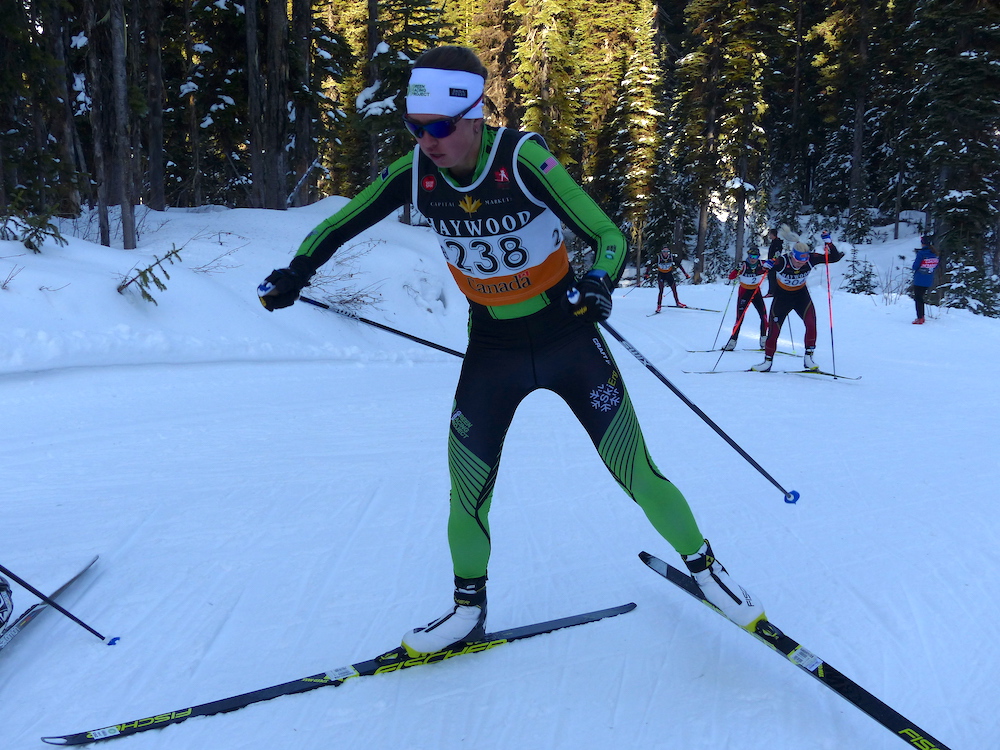
    “This team worked together really hard for the last couple of years,” said Öberg, who won her first medal — gold — in the 15 k individual race earlier in the Games. “That we are here today is unbelievable. I’m really happy to share this medals with the rest of the girls.”

    Crawford caught Ukraine’s Anastasiya Merkushyna in her final lap to anchor Canada to 10th while the U.S. finished three places later in 13th.

    “My last loop I could hear Julia [Ransom] and Sarah [Beaudry] all around the course,” Crawford told FasterSkier. “They managed to be everywhere really cheering me on, and that fueled me to catch the Ukrainian.

    “I’m just so proud of this women’s team,” Crawford added. “We fought so hard out there today. We’ve been through a lot this summer and really supported each other. And I’m just really proud of the team and I think biathlon in Canada has the potential to have a bright future.”

    Results

  • Thursday Olympic Rundown: Haga Crushes 10 k, Diggins 5th; Öberg Stuns and Bø Reigns in Biathlon Individuals

    Ragnhild Haga on the way to gold in the 10 k skate at the 2018 Olympics. It is the first medal for the 27-year-old Norwegian. (Photo: FlyingPointRoad)

    FasterSkier would like to thank Fischer Sport USA, Madshus USA, Concept2, Boulder Nordic Sport, and Swix Sport US for their generous support, which made this coverage possible.

    2018 Winter Olympics (PyeongChang, South Korea): Biathlon Men’s 20 k individual

    Full report

    It was a disappointing opening to the Olympics for Johannes Thingnes Bø of Norway, who despite winning eight World Cup races this season started the Games with finishes of 31st and 21st in the sprint and pursuit. But on Thursday he showed why he was a medal favorite and won the 20 k individual race – only by 5.5 seconds, but that margin becomes impressive when you consider that he had two penalties, and thus two minutes of penalty time, while silver and bronze medalists Jakov Fak of Slovenia and Dominik Landertinger of Austria (+14.2) shot clean.

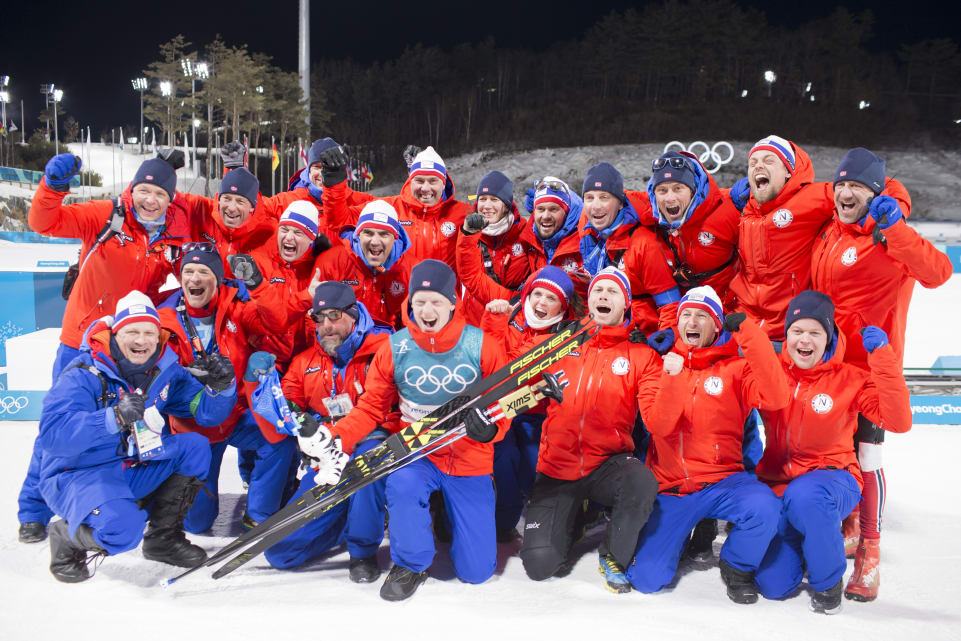
    Johannes Thinges Bø celebrates with Norwegian team staff after winning Olympic gold in the 20 k individual despite two missed shots. (Photo: IBU/Biathlonworld.com)

    Sweden’s Sebastian Samuelsson followed up a silver medal in the pursuit with fourth place in the individual, missing one shot and notching a time 29.1 seconds behind Bø. France’s Martin Fourcade, gold medalist in the pursuit, missed two shots like Bø but finished in fifth (+42.4). Switzerland’s Benjamin Weger placed sixth (+48.6) with one penalty.

    It was a good day for Canada on the back of strong shooting: Scott Gow placed 14th (+2:02.5) with one penalty for a career-best result result; he had previously had two 16th-place finishes on the World Cup this season. With the same shooting, Brendan Green placed 22nd (+2:26.6). Christian Gow had two penalties to finish 26th (+2:57.2). Canada’s fourth man, Nathan Smith, missed five shots and placed 81st (+8:11.9).

    For the United States, shooting was not as successful and Tim Burke led the way in 41st (+4:01.9) with four penalties. With one less penalty Sean Doherty was close behind in 44th (+4:21.8). Lowell Bailey placed 51st with four penalties (+4:53.0) and Leif Nordgren missed five shots to finish 66th (+6:27.3).

    Results

    ***

    Biathlon: Women’s 15 k individual

    Full report

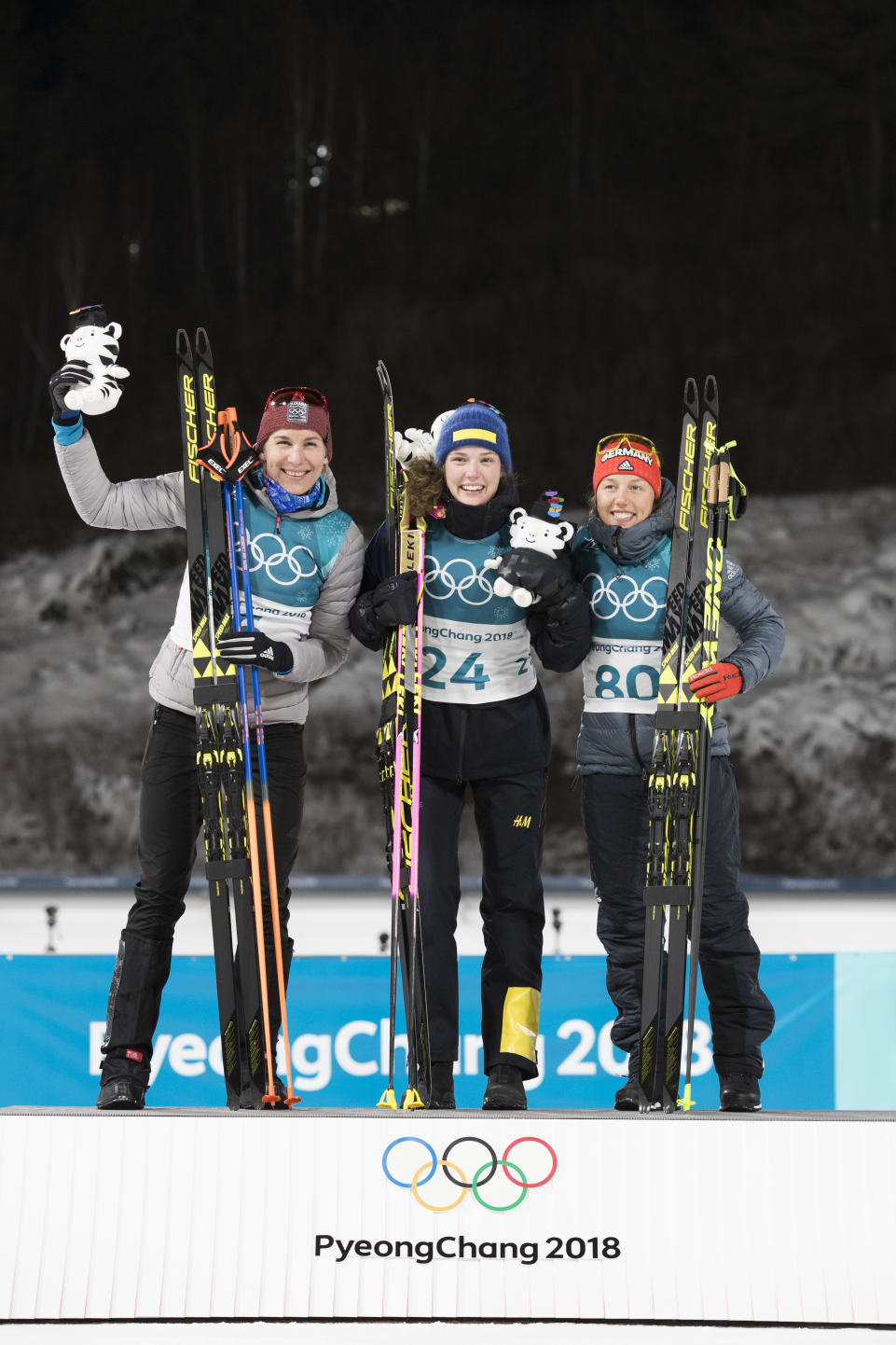
    Sweden’s Hanna Oeberg (center) won gold in the biathlon women’s 15 k pursuit, followed by Slovakia’s Anastasiya Kuzmina (left) in silver and Germany’s Laura Dahlmeier in bronze. (Photo: IBU/Biathlonworld.com)

    A few days after teammate Samuelson scored a career-best result to earn silver in the pursuit, Hanna Öberg of Sweden used perfect 20-for-20 shooting to capture gold in the women’s 15 k individual. The 22-year-old’s previous best results were fifth place in both Monday’s pursuit, and in a World Cup race last season.

    She bested the two pre-race favorites: Anastasiya Kuzmina of Slovakia had two penalties but still managed a silver medal, her second of the games, finishing +24.7. And double gold medalist Laura Dahlmeier of Germany had one penalty and earned bronze (+41.2).

    It was a good day for both of those teams as Franziska Preuss of Germany finished fourth, +59.0 with clean shooting, and Paulina Fialkova of Slovakia placed sixth (+1:02.3) with one missed shot. Poland’s Monika Hojnicz finished sixth (+1:54.8) with one missed shot as well.

    The United States was led by Susan Dunklee in 19th, with two penalties (+3:26.3). Her teammate Joanne Reid finished 22nd (+3:34.1), her best-ever result in top-level international competition, with just one missed shot. Clare Egan finished 62nd (+6:53.6) and Emily Dreissigacker 67th (+7:09.2) with four penalties apiece.

    For Canada, Rosanna Crawford led the way in 26th (+3:48.7) with two penalties and Sarah Beaudry was close behind in 29th (+3:58.4) with one missed shot. Emma Lunder finished 54th (+5:49.4) with three penalties and Julia Ransom was 74th (+8:31.4) with five missed shots.

    Montana State University student Johanna Talihärm of Estonia finished 50th (+5:36.8) with three penalties.

    Results

    ***

    Cross-Country Skiing: Women’s 10 k freestyle

    Full report

    Quotes & photos

    Thursday afternoon saw more of the same for the women’s cross-country ski events at this year’s Winter Olympics: Scandinavia filling up the podium, with American Jessie Diggins tantalizingly close to that breakthrough American podium in fifth. This time it was Norwegian Ragnhild Haga in first in the 10 kilometer freestyle individual start, Charlotte Kalla of Sweden in second (+20.3), and Finland’s Krista Pärmäkoski and Norway’s Marit Bjørgen tied for third (+31.9).

    The bronze is Bjørgen’s 12th lifetime Olympic medal, moving her into a tie with fellow Norwegian Bjørn Dæhlie for the most Olympic medals won by a cross-country skier. Countryman Ole Einar Bjørndalen, a biathlete, holds the overall Winter Olympics record with 13.

    Diggins was 35.2 seconds back of Haga in fifth. She was in seventh place through 1.6 k, up to fifth at 5 k, up to third at 6.2 k, and still in third at the 8.4-k time checkpoint, 1.9 seconds up on Bjørgen and five seconds up on Pärmäkoski. But her form seemed to break down over the final uphill, and Diggins lost just enough time on Bjørgen and Pärmäkoski over the final 1.6 k to slip off the podium.

    Between a 4.6-second deficit to third in Saturday’s skiathlon and a 3.3-second gap here, Diggins has now missed two bronze medals by a combined 7.9 seconds over 25 kilometers of racing.

    Jessie Diggins pushing to the finish in the Olympic 10 k skate. The American finished fifth. (Photo: FlyingPointRoad)

    Sixth place went to Swiss skier Nathalie von Siebenthal (+49.8), who slowed slightly after a fast start that saw her with the second-ranked time through 1.6 k. Ingvild Flugstad Østberg (+1:05.5), in seventh, was the third Norwegian in the top seven.

    Olympic Athlete from Russia Anastasia Sedova (+1:07.3), Austrian Teresa Stadlober (+1:15.6), and Olympic Athlete from Russia Anna Nechaevskaya (+1:24.3) rounded out the top ten.

    Sadie Bjornsen (+1:42.1) in 15th and Kikkan Randall (+1:49.9) in 16th were the next two Americans. Randall started relatively early with bib number 23, and was the leader in the clubhouse when she crossed the finish line. Liz Stephen (+2:35.4) was 30th.

    For the Canadians, Emily Nishikawa (+2:41.) led the way in 32nd. Dahria Beatty (+2:48.4) was 37th, Cendrine Brown (+3:11.9) 43rd, and Anne-Marie Comeau (+4:10.8) 62nd.

    Also of note, Australia’s Jessica Yeaton, who lives and trains in Anchorage with Alaska Pacific University, recorded an Olympics personal best finish of 41st (+3:09.1). University of Alaska Anchorage student Casey Wright, also competing for Australia, finished 81st (+6:55.8).

    University of Colorado skier and NCAA champion Petra Hyncicova of the Czech Republic finished 60th (+4:09.4). University of New Hampshire alum Annika Taylor of Great Britain finished 75th (+5:52.4).

    And Jaqueline Mourau of Brazil, who lives and trains in Quebec, was 74th (+5:49.8).

    Results


  • The Run Is Over: Bjørndalen Not Named to Norway Olympic Team

    The Run Is Over: Bjørndalen Not Named to Norway Olympic Team

    Ole Einar Bjørndalen out on the trails at the 2014 Olympics, where he won gold in the sprint and the mixed relay.

    For the first time since 1992, Ole Einar Bjørndalen will be doing the same thing as you come Winter Olympics time: he’ll be watching it.

    Okay, not just like you, but Bjørndalen – who made his Olympic debut in 1994 and went on to become the most successful Winter Olympian of all time with eight gold and five other medals – won’t be on the Norwegian biathlon team.

    Instead, the husband of Belorussian superstar Darya Domracheva will be watching her. The couple have a 15-month-old daughter together.

    Domracheva won three gold medals at the 2014 Olympics in Sochi, Russia, and will be trying to make more history for her country. She has already won half of Belarus’s total Winter Olympic gold medals in the time since the country left the Soviet Union.

    After taking a break for the 2016 season, Domracheva returned and won silver in the pursuit at 2017 World Championships; this season, she has already won a World Cup sprint.

    While she takes the start line, Bjørndalen won’t. It’s not from lack of trying. He competed in four World Cup weekends this winter and was intending to go to PyeongChang.

    He even resigned from a position on the International Olympic Committee’s Athlete Commission to focus on preparing for the Games.

    But his top finishes this season came in Östersund, Sweden, with a pair of 18th-place results.

    That’s not enough for the Norwegian team. In an announcement on Monday, the Norwegian Olympic Committee named Johannes Thingnes Bø, Tarjei Bø, Emil Hegle Svendsen, Lars Helge Birkeland, Erlend Bjøntegård, and Henrik L’Abee-Lund as the men’s biathlon team for PyeongChang.

    “I think it would be wrong to take Bjørndalen [to the Olympics],” Norwegian Biathlon Head of Sport Per Arne Botnan told NRK. “We will go with athletes to the championships so that they perform. He is not at the level he has been before previous championships. It would be unfair if we didn’t include those who have fulfilled the Olympic criteria.”

    Johannes Bø has won seven World Cups this season, and Tarjei Bø one; they sit second and fourth in the overall World Cup rankings. Svendsen has a podium and three fourth-place finishes, while Bjøntegård and L’Abee-Lund have each finished twice in the top ten, and Birkeland once in the top ten.

    Critics were somewhat skeptical of Bjørndalen’s push for the 2014 Olympics, but there he opened the Games by winning the 10 k sprint.

    He thinks he could do it again.

    “I could take a medal at the Olympics,” Bjørndalen told Norwegian broadcaster NRK, according to a translation. “But there are others who are taken onto the team. I have not shown good form and have delivered poor results.”

    “Unfortunately, [Bjørndalen] has not met the requirements, and there are other athletes on the team who have performed better and fulfilled the criteria,” Tore Øvrebø, senior vice president of the Olympic Committee, wrote in the organization’s statement on Monday, according to a translation. “These athletes obviously deserve the opportunity to participate in PyeongChang.”

    According to NRK, there were arguments between the Olympic Committee – who wanted Bjørndalen in South Korea – and the biathlon federation, which had made the decision that he didn’t qualify.

    Bjørndalen is on the Norwegian roster for the next IBU Cup races. According to the International Biathlon Union database, he has never before competed on the second-tier circuit.

    “The motivation is no less, even if I don’t go to the Olympics,” Bjørndalen insisted to NRK. “It’s just getting my body going, and I hope it responds to training now.”

    On the women’s side, Marte Olsbu, Synnøve Solemdal, and Ingrid Landmark Tandrevold have qualified for PyeongChang. The 2014 bronze medalist in the mass start, Tiril Eckhoff, has not yet finished in the top 20. But while the men’s team is filled, two more women should be chosen for the team after this week’s World Cup competitions in Antholz, Italy.


  • U.S. Men, Canadian Women 9th in Extra Windy, Hochfilzen Relays

    U.S. Men, Canadian Women 9th in Extra Windy, Hochfilzen Relays

    Leif Nordgren (US Biathlon) skiing the second leg of the IBU World Cup men’s 4 x 7.5 k relay on Sunday in Hochfilzen, Austria. The U.S. men ended up ninth overall out of 26 teams. (Photo: IBU/NordicFocus)

    Strong gusts of wind on the range required strong nerves and a lot of luck in the women’s and men’s relay races that concluded the International Biathlon Union (IBU) World Cup in Hochfilzen, Austria, on Sunday afternoon.

    While the relays concluded with teams on the podium one might expect there, tempestuous weather conditions that at times made it almost impossible to hit the targets also gave outsiders a good chance, and both the U.S. men and Canadian women remained in contention for a long time. The men’s 4 x 7-5-kilometer relay was particularly wild with more than 100 penalty laps, and it began with a big surprise.

    Belgium’s starter Michael Rösch tagged off in first place for the first time in the history of that team, representing a country that until now, rarely had enough athletes for a relay and had thus far had a 24th place at the 2016 World Championships to its credit. And on his tails was Norway’s Ole Einar Bjørndalen, and shortly behind them US Biathlon’s Lowell Bailey in third.

    The three aforementioned athletes all raced in the Olympic relay more than a decade ago at the 2006 Winter Games in Torino, Italy, but back then Rösch raced for Germany and won gold with his team.

    “I wanted to tag off in first at all costs, to see the Belgian flag at the top,” Rösch told TV broadcaster ARD on Sunday while the race was still going on. “But Ole made it really hard for me. … I was on my last fumes, I tumbled into the finish, I was just seeing black, but it definitely was worth it.”

    Just a turn behind, Bailey had gotten off to a strong start for the U.S. team, temporarily taking the lead out of the arena on the first lap before shooting clean in his prone stage to put himself in the lead group of seven. Facing strong wind in his standing stage, Bailey missed two targets but avoided the penalty lap with his last spare in that stage (0+0, 0+3), and tagged off to teammate Leif Nordgren in third position, 23.8 seconds out of first.

    Nordgren ended up with a penalty in his first prone after missing two targets, and returned to the course in fifth. While his penalty had increased the gap to first by 50 seconds, Nordgren made up a few seconds with a clean standing bout, hitting all targets without requiring a spare (1+3, 0+0).

    Italy and France passed him on the final loop, and Nordgren handed off in seventh, 1:34.2 minutes behind Norway setting the pace up front.

    “The team came pretty close to a good result today in a relay with nasty weather,” Nordgren wrote on his Instagram account. “Personally I’m quite disappointed with my skiing, it’s been a struggle to find the top gears so far this season and I’m far from where I know I should be. It’s a long season though and there is still plenty of time to turn it around.”

    US Biathlon’s Tim Burke loading a spare in his prone stage of the men’s relay at the 2017/2018 IBU World Cup in Hochfilzen, Austria. The team went on to finish 9th. (Screenshot: ARD broadcast)

    Taking over next for the U.S. was Tim Burke, who pointed out this was one of the most challenging races in terms of wind that he’d experienced.

    “This was definitely one [of the] windiest races that I have taken part in,” Burke wrote in an email to FasterSkier. “We knew it would be very challenging right from the start but our team tried to look at it as an opportunity for a top result. I feel like our team did a great job at avoiding any big disasters on the range and this allowed us to stay near the front for most of the race.”

    After only needing one spare in his prone shooting to hit his last target, Burke incurred a penalty in his standing stage (0+1, 1+3), but kept his position on the final loop in a hard race against Switzerland’s Jeremy Finello to exchange still in seventh, now another minute back (+2:49.4).

    “I was not surprised to see a mix of different teams near the front today,” Burke wrote. “It was one of those days that any team could find themselves with multiple penalty loops after a windy shooting stage.“

    Taking over from Burke as the U.S. anchor leg was Sean Doherty, coming off two strong shooting performances in the sprint and pursuit earlier this week.

    U.S. relay anchor Sean Doherty taking aim in difficult wind conditions during his standing stage of the men’s relay at the 2017/2018 IBU World Cup in Hochfilzen, Austria. His team finished ninth. (Screenshot: ARD broadcast)

    In his prone stage, Doherty again shot clean and fast (with the second-fastest prone shooting time on his leg) and overtook Switzerland to move into sixth. He kept that position on the course, vying for a position in the top five with the teams from France, Italy, Ukraine, and Russia also in his vicinity.

    “Today was a crazy one for sure,” Doherty wrote in an email. “The conditions on the course were decent, firm tracks and we had good skis. The wind was whipping, so that really just made some sections a lot harder than normal when you added in the head wind. I have done races in bad weather before but today was amongst the most windy.

    In the standing stage, Doherty hit his first four shots in another fast sequence before missing the last one. It looked as if he had thought that final shot was also a hit as he dropped his rifle slightly, but then realized he had to load spares. Unable to clear the last target, Doherty ended up with the team’s third penalty.

    “With the shooting you try to get a general idea of how far the wind is pushing the shots and do the best you can,” Doherty explained. “It’s a total toss up and the finish order is just a ranking of who battled the wind the best and had most to least luck along the way.”

    He set out on his last loop in eighth place with Ukraine’s Dmytro Pidruchnyi and Switzerland’s Mario Dolder right ahead of him, and Russia’s Anton Shipulin ten seconds behind.

    “The fight on the last lap is always tough,” Doherty wrote. “Although I felt better today I was not able to hang with the two guys I left the range with. I was able to ski a good lap but not enough to hold off Anton.”

    After Shipulin passed him up the big last climb, Doherty came to the finish in ninth position, 3:38.3 minutes behind the winners with a team total of three penalties and 13 spares.

    “We were not too excited with the end result because we saw the potential was there for a top 5,” Burke concluded for the team. “We are also all far from our best on the tracks right now, but are hopeful that will come with more racing.”

    Norway Successful with Its ‘Second Unit’

    Norway’s Lars Helge Birkeland, Erlend Bjøntegaard, Henrik L’Abée-Lund and Ole Einar Bjørndalen (left to right) following their victory in the men’s relay at the 2017/2018 IBU World Cup in Hochfilzen, Austria. (Photo: IBU/Biathlonworld)

    Norway started the men’s relay race without Emil Hegle Svendsen, who was sidelined with a cold, and also rested brothers Johannes Thingnes Bø and Tarjei Bø, both of whom had already won races this season.

    But shooting was more important than skiing in a relay decided by strong crosswinds on the range, and that’s where the Norwegians coped by far the best. While Norway also required nine spares, which usually is a rather average performance in a relay, on Sunday this was the top shooting performance of the men’s relay.

    After veteran Bjørndalen, Henrik L’Abée-Lund and Erlend Bjøntegaard had created a fairly comfortable lead of almost a minute on the first three legs, Lars Helge Birkeland anchored them to the victory by shooting clean in prone and only needing one spare to hit every target in his final stage despite some widely spread shots.

    “It is really nice; a good start for Norway and good self confidence for the the rest of the season,” L’Abée-Lund said at the post-race press conference.

    “It’s always fun to compete on the highest level with the best guys,” Bjøntegaard said. “I think I did pretty good on my leg today. It was tough conditions as it was for everyone else. I am just happy to show what I am capable of.”

    “It feels great, it was an amazing feeling on the last loop, and really satisfied with my own leg,” Birkeland said. “I just decided to be offensive and attack and don’t think about the others and just do my own race. … We have a really strong team with a lot of good guys, so we don’t need to have all the best at the start to have a chance to win.”

    All hopes for Germany’s Simon Schempp to contend with Birkeland for first were dashed when Schempp required three spares to clear both his prone and standing stages, narrowly avoiding the penalty lap twice.

    Due to the huge distances between the top-three teams, the final loop was more of a cool down for their anchors, with Norway taking the win in 1:21:21.8 hours, just under two minutes ahead of Germany, with Erik Lesser, Benedikt Doll, Arnd Peiffer and Schempp, in second (+1:54.9, with zero penalties and 17 spares).

    “At least we avoided the penalty loop, for me it was definitely close in standing,” Peiffer told German broadcaster ARD. “There was so much wind that it was impossible to shoot calmly and controlled. … It was clear that today there would be some upsets, like Belgium being in the mix in front. You just had to somehow avoid the penalty lap.”

    “The last years in Hochfilzen we have never been on the podium, so it’s the first time in like six years we are back again,” Peiffer said at the press conference. “So that’s a good start for us because normally we are struggling here and we don’t know why.”

    France, which had rested its star Martin Fourcade and started Jean-Guillaume Beatrix, Simon Desthieux, Emilien Jacquelin, and anchor Quentin Fillon Maillet, finished another 40 seconds later in third (+2:34.0, with three penalties and 13 spares).

    Another 20 seconds back, Sweden with Peppe Femling, Jesper Nelin, Sebastian Samuelsson, and Fredrik Lindström crossed the line in fourth (+2:54.8, with three penalties and 12 spares).

    “Today was very hard, very strange result, because when we look at all the penalties on the result list it was just crazy,” Beatrix said at the press conference. “I am satisfied for the team, and I am also really satisfied for the newcomer Emilien because it’s his first two weeks on the World Cup and first relay, and he did a every good job and brought us to the podium.”

    “Today I was a little bit stressed, because the French guys are so strong and I had to be at their level, so I am happy to do a good relay today,” the 22-year-old Jacquelin said.

    And what happened to the brave team from Belgium? With three athletes who had just made an overnight trip from an IBU Cup race in Lenzerheide, Switzerland, they came through the second exchange in second place after Florent Claude only needed one spare in standing. On the last two legs, however, three penalties for both Tom Lahaye-Goffart and Thierry Langer put them in 16th at the finish (+6:24.9) , which was still a team-best relay result for Belgium.

    Just ahead of them in a finishing sprint anchored by Brendan Green was Biathlon Canada, with a lineup that earned bronze at the 2016 World Championships in Oslo, Norway. On Sunday, however, the Canadians’ race began with difficulties for brothers Christian Gow (1+3, 2+3) and Scott Gow (1+3, 2+ 3), each having to ski three penalty laps and exchanging in 21st position already 4:45.7 minutes back. Then Nathan Smith (0+0, 0+2) and Green (0+3, 0+3) were able to move them up a bit again, with Smith putting them as high as 13th by the final exchange and Green anchoring them to 15th (+6:22.5, with six penalties and 20 spares).

    Of 26 teams in the men’s relay, Norway and Germany were the only ones that succesfully avoided the penalty lap.

    Hochfilzen World Champs Women’s Podium Repeats

    Later on Sunday afternoon in the women’s 4 x 6 k relay in slightly better conditions than the men’s race, last season’s reoccurring winner Germany struck gold again.

    Germany with (left to right) Vanessa Hinz, Franziska Hildebrand, Maren Hammerschmidt and anchor Laura Dahlmeier shows off their medals following their victory in the women’s relay at the 2017/2018 IBU World Cup in Hochfilzen, Austria. (Photo: IBU/Biathlonworld)

    The victorious world-champion quartet of Vanessa Hinz, Franziska Hildebrand, Maren Hammerschmidt,and Laura Dahlmeier won with a large lead ahead of Ukraine (+44.9) and France (+1:04.5). The first-, second- and third-place teams were a repeat of last season’s World Championships relay in Hochfilzen this past February.

    Fighting for position with Ukraine and Switzerland on the third leg, Hammerschmidt got her team on the road to victory when she cleaned every target within 24 seconds despite difficult conditions to reclaim the lead, erasing the gap she had been handed of almost 30 seconds to first.

    “For me it was very important to have a good standing shooting today, because the last two days were not so good,” Hammerschmidt said at the press conference. “I thought it was one of my best standing shootings, and I was so happy to go on the last loop and fight for every second to give to Laura.”

    Dahlmeier returned to the World Cup after missing last week’s opening races with a cold, then had no major problems defending the lead. Dahlmeier used just one spare in each of her shooting stages, while Switzerland’s Irene Cadurisch as the closest pursuer had to ski a penalty lap. Germany finished in a time of 1:14:36.4, with zero penalties and nine spares.

    “It’s a really cool feeling to be here again,” Dahlmeier said at the press conference. “Especially with the team. We know we can make a good race, but it’s important for every person to be good on the range and on the tracks. Relays are special races.”

    “From the last year we have good memories about Hochfilzen … and today it was a good place, too,” Hildebrand said “I was really impressed with [Ukraine’s] Yulia Dzhima’s standing shooting, because she took all targets out while I used two extra bullets and was happy I could go out on the track again.”

    Ukraine’s Olena Pidhrushna anchored her team, with Vita Semerenko, Yulia Dzhima and Valj Semerenko, to second (+44.9), thanks to the best team shooting performance of zero penalties and five spares, and despite a fall on the first leg by Vita Semerenko.

    “I think our team spirit is very strong, without that we wouldn’t be on the podium, so I am very thankful to all the girls and our staff for making this happen,” Valj Semerenko said at the press conference, via a translator.

    “My start this season was not so good … Actually today I was so nervous ahead of the relay,” Pidrushna explained. “But I saw that we had a little bit of extra time at the last exchange, and I calmed down a little bit and it worked well in the end. … And I think my team believes in me [to anchor it successfully].”

    Twenty seconds behind her, France with Marie Dorin Habert, Celia Aymonier, Justine Braisaz and the current women’s World Cup leader Anaïs Bescond, passed Russia’s Ekaterina Yurlova-Percht on the final loop to claim third place  (+1:04.5, with two penalties and 13 spares).

    “Honestly at the beginning when I started I didn’t think a podium was still possible, but loop after loop I thought maybe I can still catch a podium [position],“ said Bescond, who skied the fastest course time on the final leg amidst strong competition.

    A few seconds behind, Russia with Victoria Slivko, Tatiana Akimova, Irina Starykh, and Ekaterina Yurlova-Percht finished fourth (+1:09.0, with no penalty and nine spares).

    Another 16 seconds back, Switzerland, with Elisa Gasparin, her older sister Selina Gasparin, Lena Häcki and Cadurisch finished fifth (+1:25.7, with two penalties and 12 spares) for Switzerland’s best women’s relay result, which fulfilled its national qualification criteria for the Olympics.
    Canada in Contention

    For Biathlon Canada, Emma Lunder started off the race in the middle of the field, and managed hit all her targets with one spare in her prone stage to leave the range in 16th position.

    Biathlon Canada’s starter Emma Lunder (r) exchanging to Rosanna Crawford in the women’s relay at the 2017/2018 IBU World Cup in Hochfilzen, Austria. Crawford temporarily moved up to fifth before the team finished in ninth position. (Screenshot: ARD broadcast)

    While a number of competitors, including France’s Dorin Habert, incurred penalties, Lunder again needed just one spare to clean (0+1, 0+1) and moved Canada up to 1oth. After losing a few more seconds on her last loop to the leaders, with Germany’s Hinz up front, she tagged Rosanna Crawford in 12th position, 51.7 seconds back.

    Crawford started out fast and also needed just one spare to hit all five prone targets, improving by three places to ninth.

    “It was a tricky shooting day today, you really had to be aware of the wind, and be prepared to do a correction even part way through a bout of shooting,” Crawford wrote in an email. “In prone I made a correction of 5 left and 2 up and it was enough to keep me pretty centred.”

    Then in her standing stage, she picked off four more positions with clean shooting and no spares to leave the range in fifth place, while most teams around her needed spares or even incurred a penalty in seemingly difficult wind conditions.
    “I was really happy with my standing today,” Crawford explained. “I saw Brendan [Green] right before zero and he said that it’s worthwhile to take your time and make each shot a good one. So I really thought about that as I came into the shooting, there was a big gust right off the start, so I waited and could hear the women around me missing. Each shot was really precise. My shooting time was 33 seconds which is really slow for standing but still the 2nd fastest of my leg, which says a lot about the wind today!”
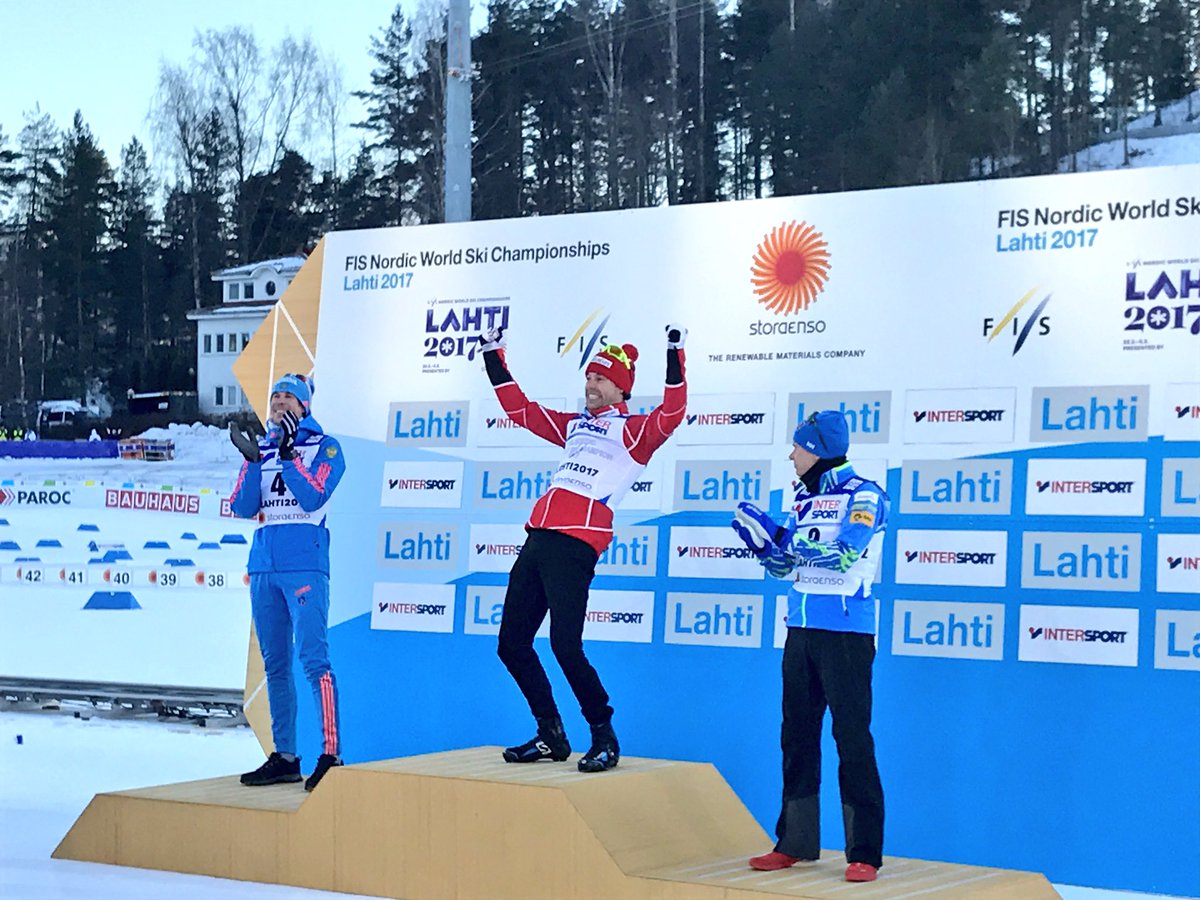
    Biathlon Canada’s Megan Bankes shooting in her standing stage in the women’s relay at the 2017/2018 IBU World Cup in Hochfilzen, Austria. The team finished ninth overall. (Screenshot: ARD broadcast)

    Crawford tagged Megan Bankes in fifth (+36.3), after having regained 15 seconds on the leaders and skiing the second-fastest course time on the final loop.

    “It’s always fun to tag off in a high position but today was a bit of a lucky draw for what you got in the range,” Crawford concluded.

    The 20-year-old Bankes as Biathlon Canada’s youngest team member started out just as fast, nearly maintaining that time gap on the first loop.

    “I was super stoked to be tagged in such a good place, but I definitely still felt that I was able to ski my own race,” Bankes wrote in an email. “I wanted to ski my best, and not lose to much time on the tracks, but also be controlled on the range, because I knew it was going to be a tricky shooting day.”

    She was able to get through the prone stage with two spares in a stage when all leading teams needed them, keeping her in fifth. Bankes followed that up with just one spare in her standing shooting, temporarily moving up to fourth after overtaking Sweden’s Mona Brorsson.

    “Coming into the range I was focussed on my own shooting more than anything else,” Bankes wrote. “I knew that the wind was pretty variable, and that I needed to make sure I took good, smart shots, and correct appropriately for the wind. I was super happy with how I ended up doing on the range, and also with my speed on my first couple of laps.”

    On the last loop, Brorsson and Russia’s Starykh passed her, and Bankes came through the final exchange in sixth place (+1:28.8).

    “I died a bit at the end, but I still managed to tag Julia in a good position, so for me it was a pretty great race!” Bankes concluded.

    Shown on television in the exchange zone, looking back at the final curve to see when Bankes would arrive, Ransom took over as the anchor and skied a very fast first loop, just 1 second off the fastest pace on that loop.

    She then managed to still clean all five targets in a controlled fashion, leaving the range again in fifth position, with Switzerland in sight and Russia nearby as well.

    After a slower second loop, Ransom struggled to clean all her targets in the final stage, but avoided the penalty lap with her last shot and left the range in ninth position. Sweden’s anchor Anna Magnusson was still in sight, 10 seconds ahead, but extended her lead on the final loop, while Japan’s anchor Rina Mitsuhashi was already more than a minute behind Ransom in 10th.

    Ransom crossed the line in ninth place (+2:31.6) with zero penalties and nine spares for the team.

    “A top 10 is a decent result for our team, it’s nice that we were fighting for a top 6 for most of the race,” Crawford wrote. “Our team has come a long way and I’m really proud to be a part of this team! Emma and Megan had a great leg and Julia an awesome prone and then it was quite windy for her standing, but most teams have their strongest women on the last leg, so it’s always a hard fight!”

    In other good news for Biathlon Canada this weekend, the team finished eighth in an IBU Cup mixed relay and national team member Megan Tandy raced to 11th place in the sprint followed by ninth place in the pursuit this weekend in Lenzerheide, Switzerland.

    “Another #perfect #shooting day! I was hoping for more, but you gotta work with what you got – in my case very heavy legs skiing. Nonetheless, a solid race,” Tandy wrote on Instagram after shooting clean in both the sprint and mixed relay.  

    The U.S. Women and Nation Cup Standings

    US Biathlon could not start a women’s relay on Sunday because it only has three women currently on the World Cup circuit: Susan Dunklee, Clare Egan and Emily Dreissigacker. US Biathlon had hoped that its fourth woman Kelsey Dickinson, would qualify for the first trimester of World Cup racing by scoring necessary points at the IBU Cup opener in Sjusjøen, Norway. But unfortunately that did not work out.

    In addition to Dickinson missing out on the World Cup starts because of that technicality, and her teammates now missing out on one of only three opportunities on the World Cup competition calendar to prepare for the relay in the upcoming Olympics, this also means they lost out on valuable points for the Nation Cup Score. That ranking is its own award category in the World Cup season (last year Germany won it for both the women and men), but more importantly for the North American teams, also determines the starting quota for the following season.

    With a third of the races counting towards that already completed (unlike at World Championships the races at the Olympics don’t apply, neither do pursuits and mass starts), the U.S. is currently in 21st position for the women with 676 points and in danger of losing its fourth starting position for next year again, which would make team selections and travel planning even harder.

    While certainly not impossible — last year the U.S. women also did not start a relay in Pokljuka, Slovenia — it will be a bit of an uphill battle to make that up the rest of the season, requiring a number of strong results. For instance, South Korea is currently 357 points ahead in 17th, the benchmark for a fourth quota spot.

    The Canadian women are currently in 14th position with 1220 points. Last season they were 15th and the U.S. 14th. For the men’s teams, Canada is currently in 12th position with 1260 points, the U.S. is 13th with 1198.

    The teams will now travel to Annecy-Le Grand Bornand, France, for the next World Cup from Thursday, Dec. 14, to Sunday, Dec. 17.

    Results: Men | Women

  • Sunday Rundown: Davos, Hochfilzen and Sovereign

    Sunday Rundown: Davos, Hochfilzen and Sovereign

    CGRP's Caitlin Patterson charging up the wall climb. (Photo: Peggy Hung)
    Caitlin Patterson (Craftsbury Green Racing Project) charging up the wall climb en route to the win in the women’s 10 k freestyle on Sunday at the Sovereign Lake NorAm/SuperTour near Vernon, B.C. (Photo: Peggy Hung)

    NorAm/SuperTour (Sovereign Lake near Vernon, British Columbia): 10/15 k freestyle

    VERNON, B.C. — The combined NorAm and SuperTour event at the Sovereign Lake Nordic Centre continued with individual-start distance races and continued with the theme of U.S. domination of the leaderboard.

    Ian Torchia, of Northern Michigan University (NMU) and the U.S. Ski Team D-team, started the day with a big victory in the men’s 15 k freestyle, finishing in 36:29.7 minutes and on the heels of Canadian Para-Nordic guide Graham Nishikawa, who started 30 seconds ahead of him and ended up sixth. Jack Hegman of the Sun Valley Ski Education Foundation (SVSEF) placed second, 19.0 seconds back, to complete his good weekend. Canadian Para-Nordic superstar Brian McKeever rounded out the podium in third, 22.6 seconds back.

    Graham Nishikawa and Ian Torchia worked together after Torchia closed the 30 second gap. (Photo: Peggy Hung)
    Graham Nishikawa (l) and Ian Torchia worked together after Torchia closed the 30-second gap en route to a victory in the men’s 15 k freestyle on Sunday at the Sovereign Lake NorAm near Vernon, B.C. (Photo: Peggy Hung)

    The women were next to get some time in the sunshine with two laps for 10 k. Caitlin Patterson of the Craftsbury Green Racing Project (CRGRP) upgraded from Saturday’s silver to gold on Sunday with winning time of 27:13.0. Rosie Frankowski of Alaska Pacific University (APU) snatched second, 30.7 seconds back. Caitlin Gregg (Team Gregg) raced to third, 1 second behind Frankowski.

    Former Canadian national-team biathlete Zina Kocher started her new cross-country career as the top Canadian in seventh (+1:31.2).

    The weather was a repeat of Saturday: -2 degrees Celsius, windless and sunny. Smiles were evident everywhere, even for athletes who didn’t quite nail the pacing on an unforgiving course.

    Results

    ***

    France’s Maurice Manificat (c) after winning the men’s 15-kilometer freestyle on Sunday in Davos, Switzerland. He finished ahead of Russians Sergey Ustiugov (l) and Alexander Bolshunov in second and third respectively. (Photo: FIS Cross-Country/Twitter)

    FIS Cross Country World Cup (Davos, Switzerland): 10/15 k freestyle 

    Women’s report

    Men’s report

    After a day of sprinting, cross-country racers returned to the Davos World Cup venue on Sunday for the women’s 10-kilometer and men’s 15-kilometer freestyle individual start competitions.

    For his first World Cup win in almost two years, France’s Maurice Manificat took the men’s 15 k race title in a time of 33:56.2. Exactly 4 seconds flat behind Manificat in second place was Russia’s Sergey Ustiugov. Ustiugov’s teammate Alexander Bolshunov, finished 10 seconds behind Ustiugov and 14.6 seconds behind Manificat for the men’s third and final podium spot.

    The remainder of the men’s top ten included Norway’s Simen Hegstad Krüger in fourth (+21.3), Switzerland’s Dario Cologna in fifth (+26.5), Sweden’s Marcus Hellner in sixth (+35.4), Russia’s Denis Spitsov in seventh (+36.1), Hans Christer Holund of Norway in eighth (+36.9), Russian Alexey Chervotkin in ninth (+54.2), and Alex Harvey of Canada in 10th (+1:01.2).

    The next best male North American finisher was American Patrick Caldwell in 41st (1:50.2).

    Canada’s Devon Kershaw placed 44th (1:59.8), Graeme Killick 59th (+2:27.8), Russell Kennedy 68th (+2:43.4), and Julien Locke in 94th (4:27.5). Knute Johnsgaard did not start.

    For the U.S., Noah Hoffman finished 48th (2:05.5) and Scott Patterson 88th (3:46.2). Simi Hamilton did not start and Andy Newell did not finish.

    The women’s 10 k freestyle podium on Sunday at the Davos World Cup in Switzerland, with Norway’s Ingvild Flugstad Østberg (c) in first and Ragnhild Haga (l) in second, and Finland’s Krista Parmakoski (r) in third. (Photo: FIS Cross Country/Twitter)

    In the women’s 10 k, 75 starters finished the 10 k course with Norway’s Ingvild Flugstad Østberg claiming first in a time of 25:28.5. Her Norwegian teammate, Ragnhild Haga finished 5.9 seconds behind her for second place. Krista Pärmäkoski of Finland raced to the third and final podium spot, 7.9 seconds back from Østberg’s winning time.

    Rounding out the women’s top ten was Heidi Weng in fourth (+14.5), Austria’s Teresa Stadlober in fifth (+16.4), Switzerland’s Nathalie von Siebenthal in sixth (+16.4), Finland’s Kerttu Niskanen in seventh (+24.9), Sweden’s Charlotte Kalla in eighth (+26.8), Norwegian Marit Bjørgen in ninth (+35.9), and Astrid Uhrenholdt Jacobsen in tenth (+37.6).

    Leading the U.S. women was Sadie Bjornsen in 12th (+44.6), seven seconds outside the top ten. The next two Americans finishers were within 3.1 seconds of each other, with Kikkan Randall finishing 14th (+56.8) and Jessie Diggins in 15th (+59.9).

    Also scoring World Cup points for the Americans, Rosie Brennan finished in 17th (+1:11.2) and Chelsea Holmes in 29th (+1:32.9).

    The U.S.’s Liz Stephen and Sophie Caldwell finished in 40th (+1:58.5) and 52nd (+2:20.1), respectively.

    For the Canadians, the team was led by Cendrine Browne in 45th (+2:05.9), followed by Emily Nishikawa in 50th (+2:18.4). Dahria Beatty placed 73rd (+2:53.0) and Katherine Stewart-Jones 79th (+3:44.6).

    Results: Women | Men

    ***

    IBU World Cup (Hochfilzen, Austria): Men’s and women’s relays

    Men’s and women’s relays took place on the final day of racing in Hochfilzen, with Norway winning the men’s 4 x 7.5 k and Germany topping the women’s 4 x 6 k by considerable margins.

    Norway’s Ole Einar Bjørndalen, Henrik L’Abée-Lund, Erlend Bjøntegaard, and Lars Helge Birkeland raced to first in 1:21.21.8 hours, nearly two minutes clear of Germany in second, after taking the lead on L’Abée-Lund’s second leg. They avoided the penalty loop and used a total of nine spares, and never lost hold of first place for the rest of the race.

    Germany raced to second (+1:54.9) with Erik Lesser, Benedikt Doll, Arnd Peiffer, and Simon Schempp, with zero penalties and 17 spares, after Peiffer lifted them from fourth to second on the third leg. Schempp held them there, despite using a maximum of three spares on each of his shooting stages, in the final leg.

    France claimed third (+2:34.0) with Jean-Guillaume Béatrix, Simon Desthieux, Emilien Jacquelin, and Quentin Fillon Maillet, despite three penalties and 13 spares. Two of their penalties came on Beatrix’s first leg and another in Fillon Maillet’s final shooting. After being tagged in fifth, Jacquelin raced them up to third on the third leg and Fillon Maillet held onto that position for the last spot on the podium.

    The U.S. men finished ninth (+3:38.3) with Lowell Bailey, Leif Nordgren, Tim Burke, and Sean Doherty, after they combined for three penalties and 13 spares. Bailey avoided the penalty lap and put them in third at the first exchange, while Nordgren slipped to seventh after a penalty, Burke remained in seventh with one penalty as well, and Doherty had one more penalty to anchor the team to ninth.

    Canada placed 15th (+6:22.5) with six penalties and 20 spare rounds, with Christian Gow, Scott Gow, Nathan Smith, and Brendan Green. After being tagged in 21st, Smith raced them up to 13th, using just two spares to clean. Green anchored them to 15th after using six spares and skiing the 15th-ranked time on that last leg.

    In the women’s relay that followed, Germany won by 44.9 seconds over Ukraine, with Vanessa Hinz, Franziska Hildebrand, Maren Hammerschmidt, and Laura Dahlmeier using nine spares while staying out of the penalty lap.

    After Hinz raced them into first, Hildebrand slipped to fourth after using four spares on the second leg. Hammerschmidt raced the fastest third leg to put them back in first, and Dahlmeier held them there to the finish, crossing first in 1:14:36.4.

    Ukraine (0 penalties, 5 spares) took the lead on the second leg but ultimately settled for second with Vita Semerenko, Yuliia Dzhima, Valj Semerenko, and Olena Pidhrushna. Dzhima put them in second heading into the race’s halfway point, but Valj Semerenko lost two places to tag Pidhrushna in third. Pidhrushna used just two spares on the final leg to bring them to second, about 20 seconds ahead of France in third.

    Despite a tough first leg for Marie Dorin Habert, in which she had two penalties and tagged off in 14th, France rose to third place at the finish (+1:04.5) thanks to strong skiing and shooting from anchor Anaïs Bescond.

    The team had a total of two penalties and 13 spares. Celia Aymonier used four spares to put them in ninth after the second leg, and third-leg Justine Braisaz lifted them one more place to seventh before Bescond skied the fastest last leg to pick off four more places.

    Canada placed ninth (+2:31.6) with Emma Lunder, Rosanna Crawford, Megan Bankes, and Julia Ransom, with no penalties and nine spares. Crawford put them in fifth after the second leg, Bankes lost one place on the third leg, and Ransom slipped three more with three spares on her final shooting to finish ninth.

    The U.S. did not enter a women’s team.

    Results: Men | Women

  • Fourcade Secures World Cup Sprint Title; Bailey 16th in Kontiolahti

     France’s World Cup sprint and total score winner Martin Fourcade (c) on the podium of the men’s 10 k sprint at the 2017 IBU World Cup in Kontiolahti, Finland, with the Czech Republic’s Ondrej Moravec (l) in second and Norway’s Emil Hegle Svendsen (r) in third. (Photo: IBU)

    These days at the International Biathlon Union (IBU) World Cup in Kontiolahti, Finland, biathlon star Martin Fourcade of France is not as worried about his opponents on the course as he is about the imminent birth of his second child.

    “That’s the first thing I did when I came to the finish, I checked my phone to see if my wife called,” he told German broadcaster ZDF after the race.

    There was no message yet, so he declared that he also intends to race on Saturday before traveling back home. “Then I don’t know about my schedule, I have to wait what my wife decides,” he added with a laugh.

    In Friday’s 10-kilometer sprint, Fourcade once again posted the best course time as he so frequently has this season, and thus was able to make up the seconds he lost after a miss in his standing shooting. At the end of the day, he was the only man in the top five without hitting all 10 targets.

    After that penalty, Fourcade had to fight hard for the victory on the last loop. He crossed the finish line in 22:17.0 minutes, just 0.6 seconds ahead of Czech Republic’s Ondřej Moravec, who had taken the lead just a few minutes earlier. Three-hundred meters before the finish at the last timing point, Fourcade had been two seconds behind.

    “Just after the shooting, I saw the screen [in the arena] and thought, ‘OK, five seconds back with one more penalty loop, it’s something I can do,” Fourcade explained at the post-race press conference. “Then at the first split time, I was still five seconds back and thought to myself that it’s over and I will never catch him. But at the last split time my coach said to me, ‘Only two seconds,’ so I started to believe again. I think I was really lucky to start on his back. It was a real advantage today to know about the situation.”

    “I think it’s a track that suits me well,” Fourcade told ZDF. “I’ve known this place for a long time, it’s where I got my first victory in the World Cup. I love it because it’s really hard, you never stop pushing. Of course I am really satisfied, because the three guys behind me were not in PyeongChang [South Korea, at last week’s World Cup]. So I didn’t choose the best situation to win here because the travel was really hard, but I [managed] to win in PyeongChang and today so I am really proud.”

    With his victory Fourcade also secured the “small crystal globe” awarded to the sprint World Cup discipline winner, after he had already locked up his sixth overall World Cup title in PyeongChang. With this 13th victory of the season, he also surpassed the all-time record for most victories within one season after he previously tied Norway’s Ole Einar Bjørndalen mark a week ago.

    “I want to thank him for being such an amazing inspiration,” Fourcade said during the press conference, and added regarding his sprint title: “It’s not just business. I can remember when I won my first globe in 2010 in Oslo. I always try to remember the feeling I had. And I really respect this award, and am proud and satisfied I won it.”

    Norway’s Emil Hegle Svendsen claimed the third place on the podium (+9.4), pushing his teammate Johannes Thingnes Bø to fourth. Both Moravec and Svendsen had opted against the long trip to South Korea.

    “Battling with Martin is always hard,” Moravec said in the press conference. “When I saw him in the last hill it was really close with 2.2 seconds. And then I knew, ‘This is not good,’ because the last 500 meters of my race were nothing special, I was really tired on the last part of the track.”

    At last month’s IBU World Championships in Hochfilzen, Austria, US Biathlon’s Lowell Bailey denied Moravec his first win of the season in the individual race by 3.3 seconds.

    “It is what it is, 0.6 seconds, but today I am still really satisfied for the second place,” Moravec said. “Last time [in Hochfilzen] I was 50-50 maybe, but today it’s different.”

    “I think it was a big advantage for me,” he added when asked about not traveling to PyeongChang. “Because I did a great preparation at home and took a rest … I think my result today is a good answer to this question.“

    “Of course I thought about going to Korea,” Svendsen explained. “But I think if I would have gone there I would have done medium races during the last three World Cups. Now I got at least one podium, and I think it is better to have some good races than a lot of medium races. I think it was better for me to stay at home after a really bad World Championships.”

    “Five podiums this year is much more than I expected,” he said when asked to reflect on his season. “Because the preparation this year was not so good. I am really happy with this after all the troubles I had last summer… But I hope I can now have six good months of training and come back stronger than ever.”

    One of the earliest starters in bib 3, Bø hit all of his targets and was the race leader until Svendsen finished 2.7 seconds faster. As the race progressed, Fourcade and Moravec also finished ahead of him, pushing Bø to fourth (+12.1)

    “It was quite a good race,” Bø told the IBU in an interview. “I don’t know where I could do better. So even if I’m fourth place I know I did my best today. It was high level on the shooting range today, and for myself I am quite happy with 10 hits in a fast speed. … I felt strong on the tracks, and just wish I were a little bit stronger to make the podium.”

    Also shooting clean, Germany’s Arnd Peiffer finished fifth (+22.3).

    “This is a demanding course with three long and steep climbs,” Peiffer told ZDF. “I am glad I got through with clean shooting on the range today. In PyeongChang, I was struggling in my standing stages … and that was pretty annoying. On the course it was a solid performance. I am still feeling the effects of the travel, but that won’t be any different for the others … So I am happy about this fifth place.”

    Just behind Peiffer, Austria’s Simon Eder placed sixth (+23.0) with one penalty (0+1), and Latvia’s Andrejs Rastorgujevs missed the first World Cup podium of his career after he missed his last target to finish seventh (+25.1) with one penalty (0+1).

    Kontiolahti is hosting the eighth World Cup stage of the season in place of Tyumen, Russia, which withdrew as a host in the wake of the McLaren report. Though almost 2,000 miles away from Tyumen, thanks to the new location near the northern Russian-Finnish border, a number of Russian fans still made the trip to Finland. Judging by flags, outfits and cheers, it seemed like they were about even with the local fans with the feel of a home World Cup.

    Bailey Clean But Slower on Course

    US Biathlon’s Lowell Bailey skiing into the finish of the men’s 10-kilometer sprint at the 2017 IBU World Cup in Kontiolahti, Finland. He placed 16th. (Photo: USBA/NordicFocus)

    Another skier who managed to shoot 10-for-10 on Friday was Bailey, continuing his extremely accurate shooting form of the last few weeks. But this time, the American didn’t quite have the punch that propelled him to his historic gold medal at last month’s World Championships and another second place in PyeongChang last week. After eight straight races of placing in the top 10, Bailey finished 16th on Friday, 1:01.1 behind Fourcade.

    But Bailey didn’t blame the travel from South Korea to Finland for his slower ski time than usual, after posting the 43rd-ranked course time of the day.

    “It was actually a little bit longer than 24 hours,” Bailey wrote in an email to FasterSkier. “I’m not sure I can use that as an excuse; several athletes did just fine after that travel (Martin Fourcade was flying again!).

    “I didn’t feel completely comfortable on my skis today,” Bailey added, regarding the race conditions. “It was an icy, unstable track and I struggled to keep a flat gliding ski … The conditions were the best we’ve had all week; not too much wind on the range and the tracks were hard and didn’t seem to break down at all.”

    Coming out of the final standing stage in 12th place and 32.6 seconds out of first, he lost almost another 30 seconds on the final loop.

    “I definitely didn’t have the strongest last loop,” Bailey wrote. “I just didn’t have a whole lot in the tank for the three big climbs. Some days are better than others and today I wasn’t at my best on the course. But, things can change quickly and I’m hoping to feel better for tomorrow’s pursuit.”

    Three Americans, Two Canadians in the Pursuit

    US Biathlon’s Sean Doherty (71) and Biathlon Canada’s Brendan Green (21) on the range during the second shooting stage of the men’s 10 k sprint at the IBU World Cup in Kontiolahti, Finland. (Photo: USBA/NordicFocus)

    In addition to Bailey, two other Americans qualified for Saturday’s pursuit in the top 60, with Leif Nordgren in 43rd (+1:36.8) with two penalties (1+1) and Sean Doherty finishing one position behind in 44th (+1:38.5) with one standing miss (0+1).

    Paul Schommer, who is replacing Tim Burke in these final World Cups, finished 84th (+3:02.5) with three misses (2+1).

    Two Canadians shot clean and also qualified for the pursuit: Brendan Green in 45th (+1:41.4) and Christian Gow in 50th (+1:55.0). Scott Gow missed the top 60 in 67th (+2:21.9) with two penalties (1+1).

    Results | Pursuit start list

  • Friday Rundown: Kontiolahti & Lake Placid (Updated)

    Friday Rundown: Kontiolahti & Lake Placid (Updated)

    The women’s 7.5 k sprint podium on Friday at the IBU World Cup in Kontiolahti, Finland, with Norway’s Tiril Eckhoff (c) in first, Germany’s Laura Dahlmeier (l) in second, and Belarus’s Darya Domracheva (r) in third. (Photo: IBU)

    IBU World Cup (Kontiolahti, Finland): Men’s & women’s sprints

    [UPDATED] Fifth place is becoming a habit for US Biathlon’s Susan Dunklee, who shot 9/10 on Friday (1+0) and finished 34.9 seconds out of first for her third fifth-place result in the last three individual races.

    Twice at last week’s International Biathlon Union (IBU) World Cup in PyeongChang, South Korea, Dunklee placed fifth: first in the sprint and again in the pursuit. She ended her racing there with the U.S. women’s relay, which placed 14th.

    Back at it again on Friday in the women’s 7.5-kilometer sprint in Kontiolahti, Finland, Dunklee placed fifth behind Norwegian winner Tiril Eckhoff, who shot clean (0+0) and finished in 19:18.4 minutes.

    Germany’s Laura Dahlmeier started in bib 27, immediately after Eckhoff (bib 26) and ended up 18.3 seconds shot of the Norwegian’s time for second place (+18.3) with one standing penalty (0+1). Darya Domracheva of Belarus started 32nd and shot clean to notch third (+20.4) for her second podium of the season (including a silver medal in the IBU World Championships pursuit).

    The last starter in bib 94, Russia’s Daria Virolaynen shot clean and claimed fourth (+34.8), bumping Dunklee, the 33rd starter who initially finished fourth, by one-tenth of a second to fifth.

    All three of the U.S. women that raced on Friday finished in the top 60 to qualify for Saturday’s pursuit, with Joanne Reid taking 55th (+1:59.7) with clean shooting, and Clare Egan 59th (+2:07.4) with three standing penalties (0+3).

    Two Canadians qualified as well, with Emma Lunder in 56th (+2:02.8) with one miss (1+0) and Julia Ransom making the cut in 60th (+2:08.0) with one penalty (1+0) as well.

    In her first World Cup start, Canada’s 19-year-old Megan Bankes — coming off a gold medal at IBU Junior World Championships in Slovenia — placed 78th (+2:56.9) with three penalties (2+1).

    ***

    The men’s 10 k sprint podium at Friday’s World Cup in Kontiolahti, Finland, with France’s Martin Fourcade (c) in first, the Czech Republic’s Ondřej Moravec (l) in second and Norway’s Emil Hegle Svendsen (r) in third. (Photo: IBU)

    Lucky No. 13. That’s how many World Cup wins France’s Martin Fourcade has accumulated this season, including his victory in the men’s 10 k sprint in Kontiolahti.

    Thirteen wins puts him ahead of Norway’s Ole Einar Bjørndalen for the most wins in a single season, and Fourcade topped Friday’s race by just 0.6 seconds over the Czech Republic’s Ondřej Moravec in second place. (Bjørndalen finished about 30 seconds back in eighth.)

    Fourcade started 38th, after Moravec in bib 24, and had to ski a penalty lap after missing one in his standing shooting, but was able to top Moravec’s time by fractions of a second in 22:17.0 minutes.

    Moravec shot clean to reach the podium in second, along with Norway’s Emil Hegle Svendsen, who hit all 10 targets as well to place third (+9.4).

    One of the earliest starters in bib 3, Norway’s Johannes Thingnes Bø hit all of his targets and was the race leader until Svendsen finished 2.7 seconds faster than him. Bø ultimately ended up fourth, and Germany’s Arnd Peiffer, the fourth man in the top five to clean, placed fifth (+22.3).

    After eight straight races of placing in the top 10, Lowell Bailey finished 16th on Friday, 1:01.1 behind Fourcade despite clean shooting.

    Three Americans qualified for Saturday’s pursuit, with Leif Nordgren in 43rd (+1:36.8) with two penalties (1+1) and Sean Doherty 44th (+1:38.5) with one standing miss (0+1).

    Paul Schommer finished 84th (+3:02.5) with three misses (2+1).

    Two Canadians shot clean and qualified for the pursuit: Brendan Green in 45th (+1:41.4) and Christian Gow in 50th (+1:55.0). Scott Gow missed the top 60 in 67th (+2:21.9) with two penalties (1+1).

    Results: Women | Men

    ***

    USSA Cross Country Junior Championships (Lake Placid, N.Y.): 5/10/15 k classic individual starts

    The U20 men’s 15 k classic podium on Friday at 2017 U.S. Junior Nationals in Lake Placid, N.Y., with Hunter Wonders (c) of Alaska Pacific University (APUNSC) in first, Peter Wolter (l) of the Sun Valley Ski Education Foundation (SVSEF) in second, and Canada’s Étienne Hébert (r), of Montériski in third. (Photo: India Harvey)

    [UPDATED] On the third day of racing at U.S. Junior Nationals at the Olympic Jumping Complex in Lake Placid, N.Y., Julia Kern, representing New England and the Stratton Mountain School (SMS), completed her sweep of the U20 women’s races, winning Friday’s 10-kilometer classic individual start by 1 minute and 30.5 seconds in 32:32.3 minutes. (Kern had previously won the U20 women’s 5 k freestyle and classic sprint at Junior Nationals this week.)

    Intermountain’s Leah Lange (University of Utah) joined her on the podium on Friday in second place, and the Midwest’s Hannah Rudd (Loppet Nordic Racing) tallied third place (+1:38.6).

    The U20 women’s 10 k classic podium at 2017 U.S. Junior Nationals in Lake Placid, N.Y., with Julia Kern (c) of SMS in first, Leah Lange (l) University of Utah in second, and Hannah Rudd (r) of Loppet Nordic Racing in third. (Photo: India Harvey)

    In the U20 men’s 15 k, Alaska’s Hunter Wonders, of Alaska Pacific University (APUNSC), finished 37 seconds ahead of anyone else in 45:15.7. Intermountain’s Peter Wolter, of the Sun Valley Ski Education Foundation (SVSEF) took second (+37.1), and Canada’s Étienne Hébert (Montériski) placed third for the second time in three races, 49.1 seconds behind Wonders. Daniel Streinz (New England/Mountain Endurance) was the third American in fourth overall (+1:00.7).

    Coming of two-second place performances this week, Intermountain’s Sydney Palmer-Leger, of the Park City Nordic Ski Club (PCNSC) raced to first in the U16 girls’ 5 k in 16:42.1, 16.3 seconds ahead of Alaska’s Kendall Kramer (Nordic Ski Club of Fairbanks-FXC) in second. Novie McCabe (Pacific Northwest/Methow Valley Nordic Ski Educational Foundation), reached the podium in third (+21.9).

    The U16 girls’ 5 k classic podium on Friday at U.S. Junior Nationals in Lake Placid, N.Y., with Sydney Palmer-Leger (c) of PCNSC in first, Kendall Kramer (l) of NSCF-FXC in second, and Novie McCabe (r) of the Methow Valley Nordic Ski Educational Foundation in third. (Photo: India Harvey)

    A runner-up earlier in the week in the freestyle individual start, Intermountain’s Johnny Hagenbuch (SVSEF) took the win in the snowiest race of the day — the U16 boys’ 5 k — finishing just 2.5 seconds ahead of Alaska’s runner-up George Cvancara (Alaska Nordic Racing) in 15:06.8 in the closest race of the day. Intermountain had two on the podium with Skylar Patten (PCNSC) in third (+3.8).

    The U16 boys’ 5 k classic podium on Friday at U.S. Junior Nationals in Lake Placid, N.Y., with Johnny Hagenbuch (c) of SVSEF in first, George Cvancara (l) of ANR in second, and Skylar Patten (r) of PCNSC in third. (Photo: India Harvey)

    In the U18 boys’ 10 k, New England’s Ben Ogden (SMS) pulled out an 11.7-second victory to deny Alaska’s Gus Schumacher (Alaska Winter Stars) of his third-straight win of the week. Ogden finished first in 29:36.5, Schumacher took second for his third-consecutive podium, and Alaska’s Luke Jager (APUNSC) placed third (+29.2) for his second podium in three races.

    In the U18 girls’ 10 k classic, Intermountain’s Anna Gibson (Jackson Hole Ski Club) took the win for her second-straight podium in 33:59.7, 6.9 seconds ahead of Rocky Mountain’s Ezra Smith (Summit Nordic Ski Club), who notched her second podium of the week as well, in second. Mara McCollor (Midwest/Wayzata Nordic Team) also scored a podium in third (+11.2).

    Results: U20 women | U20 men | U16 girls | U16 boys | U18 boys | U18 girls

  • Sunday Rundown: Harvey Wins World Champs Gold in Lahti; PyeongChang + Vasaloppet (Updated)

    Sunday Rundown: Harvey Wins World Champs Gold in Lahti; PyeongChang + Vasaloppet (Updated)

    Canada’s Alex Harvey (3) celebrates his win in the men’s 50 k freestyle mass start, his first individual gold medal at a World Championships, on Sunday at 2017 Nordic World Championships in Lahti, Finland. He beat Russia’s Sergey Ustiugov (l) by 0.6 seconds while Norway’s Sjur Røthe (9) can be seen coming in for sixth place, behind (not pictured) Finland’s Matti Heikkinen, Great Britain’s Andrew Musgrave and Norway’s Martin Johnsurd Sundby, respectively. (Photo: NBC Sports screenshot)

    FIS Nordic World Championships (Lahti, Finland): Men’s 50 k freestyle mass start

    After a week of missing out on the medals at 2017 Nordic World Championships, Canada’s Alex Harvey, a four-time World Championships medalist from 2011, 2013 and 2015, achieved his first individual gold medal in the final race of this year’s World Championships in Lahti, Finland.

    Harvey, 28, won the men’s 50-kilometer freestyle mass start in a drag race to the finish. Entering the final descent into the stadium with Norway’s Martin Johnsrud Sundby and Russia’s Sergey Ustiugov, Harvey rode his fast skis past both of them then had the most finishing kick in the final straightaway for a 0.6-second victory. He finished in 1:46.28.9 hours, while Ustiugov followed him across the line in second and Finland’s Matti Heikkinen from behind for third (+1.4), after passing Sundby around the outside of the last corner.

    Canada’s Alex Harvey (c) celebrates gold in the men’s 50 k freestyle mass start on Sunday at 2017 Nordic World Championships in Lahti, Finland, with Russia’s Sergey Ustiugov (l) and Finland’ Matti Heikkinen (r) joining him on the podium in second and third, respectively. (Photo: Cross Country Canada/Twitter)

    Sundby appeared to miss a pole plant soon after Heikkinen passed him and let off the pace a few meters before the finish. That’s where Great Britain’s Andrew Musgrave continued to accelerate and took fourth place, 2.9 seconds behind Harvey and 0.1 seconds ahead of Sundby in fifth. Norway’s Sjur Røthe followed another 0.4 seconds back in sixth, Switzerland’s Dario Cologna was seventh (+8.9), Norway’s Petter Northug eighth (+12.3), France’s Maurice Manificat ninth (+13.4), and Norway’s Hans Christer Holund 10th (+14.3).

    “I had really good skis,” Harvey said in a post-race interview with FIS. “I knew if I came into the corner in second place, that was the optimal position. So I was able to fight hard and hit that last corner in second and slingshot by Martin along the flat and then that was good after that.”

    “This is the best race of my life, for sure,” he added. “So I’m really happy.”

    Tad Elliott (Ski Club Vail) led the Americans in 27th (+3:16.8). Noah Hoffman (U.S. Ski Team) finished 50th (+8:53.1) and Kyle Bratrud (CXC Team) did not finish.

    Canada started four men, with Devon Kershaw finishing 38th (+5:45.5), Graeme Killick 43rd (+7:04), and Knute Johnsgaard in 55th (+12:03.3).

    For Harvey, the medal is his fifth at three World Championships and his first individual gold after winning the classic team sprint with Kershaw in 2011.

    Results

    ***

    IBU World Cup (PyeongChang, South Korea): Men’s and women’s relays

    Between the men’s and women’s relays on Sunday at the International Biathlon Union (IBU) World Cup in PyeongChang, South Korea, Canada had two teams in the top eighth, with its men’s team finishing seventh in the 4 x 7.5 k and women’s team eighth in the 4 x 6 k. Behind them, the U.S. men finished 10th and U.S. women 14th.

    France won the men’s relay by 33.8 seconds over Austria, using a total of 10 spare rounds but avoiding the penalty lap. Martin Fourcade anchored France to the win in 1:12:09.5 hours, after Jean-Guillaume Béatrix initially tagged them in first, his older brother Simon Fourcade raced them into second with near-perfect shooting (using just one spare to clean), and Simon Desthieux picked off one more place to give Fourcade a 16-second lead for the final leg.

    Austria achieved second place with Lorenz Wäger, Simon Eder, Julian Eberhard, and Dominik Landertinger combining for zero penalties and nine spares.

    Norway finished third (+45.4) with Vetle Sjåstad Christiansen, Ole Einar Bjørndalen, Vegard Gjermundshaug, and Henrik L’Abée-Lund. They had one penalty on Gjermundshaug’s third leg, and used a total of eight spares.

    Canada’s Christian Gow, Scott Gow, Nathan Smith, and Brendan Green finished seventh (+3:03.1) with zero penalties and nine spares. After Christian tagged his older brother Scott in ninth, Scott raced them into sixth place before Smith slipped four places to 10th at the final exchange. On the final leg, Green raced them into seventh, requiring two spares to clean.

    The Americans finished about nine seconds later in 10th (+3:12.8) with Lowell Bailey, Leif Nordgren, Paul Schommer, and Sean Doherty combining for zero penalties and nine spares, just like Canada. Bailey had originally put them in second at the first exchange, Nordgren dropped to seventh, then Schommer to 13th, before Doherty finally brought them back to 10th out of 24 teams.

    In the women’s relay, Germany pulled off a 22.8-second win over Norway, with one penalty and eight spares. Nadine Horchler put Germany in third at the first exchange, then Maren Hammerschmidt raced them into first by the race’s halfway point. From there, Denise Herrmann, a former cross-country World Cup regular, had to ski a penalty lap and tagged off in second, 13.5 seconds out of first. With teammate Laura Dahlmeier sitting out the relay, Franziska Hildebrand anchored Germany to the win in 1:07:35.6 after she used just one spare to clean.

    Norway placed second with Kaia Wøien Nicolaisen, Hilde Fenne, Tiril Eckhoff, and Marte Olsbu accumulating one penalty and 11 spares. Olsbu beat out the Czech Republic’s Gabriela Koukalová by one-tenth of a second at the finish, as the Czechs placed for third (+22.9), with Jessica Jislová, Eva Puskarčíková, Lucie Charvátová, and Koukalová (with a total of one penalty and nine spares).

    Canada took eighth (+1:34) with Rosanna Crawford, Julia Ransom, Megan Tandy, and Emma Lunder. Crawford tagged in second at the first exchange, Ransom slipped one place to third, Tandy lost another place to tag in fourth, and Lunder ultimately anchored them to eighth.

    The U.S., with Clare Egan, Susan Dunklee, Joanne Reid, and Maddie Phaneuf, finished 14th (+3:08.3) with one penalty and 10 spares. After Egan had a penalty on the first leg, Dunklee skied the fastest second leg to move the team from 19th to 14th, then Reid put them in 11th by the final exchange. Twenty-one teams competed in the women’s race.

    Results: Men | Women

    ***

    Ski Classics 90 k Vasaloppet (Sälen to Mora, Sweden)

    John Kristian Dahl (r) of Team United Bakeries outlunges Ski Classics sprint leader Andreas Nygaard (r) of Team Santander for the win in Sunday’s 90 k Vasaloppet in Mora, Sweden. (Photo: Visma Ski Classics)

    [UPDATED] In Sunday’s 93rd annual 90-kilometer Vasaloppet from Sälen to Mora, Sweden, the ninth event of the Ski Classics series, John Kristian Dahl (Team United Bakeries) outlasted Andreas Nygaard (Team Santander) by one-tenth of a second for the win in 3:57:18.1 hours. The race came down to a five-way fight for first, with Stian Hoelgaard (Team Leaseplan) finishing 0.6 seconds back in third. The top 15 men were all within 21.7 seconds of the podium, and Brian McKeever, a member of Canada’s Para Nordic Ski Team, placed 20th (+2:31.1).

    “It has been a fight all day,” Dahl said, according to a Ski Classics press release. Three days ago, he had been unsure about starting the Vasaloppet following a back injury. “I was tired already after 30 k and had to let go of the lead group, but I fought my way back taking it step by step and hill by hill.”

    In the women’s race, Britta Johansson Norgren (Lager 157 Ski Team) broke away from the field to win by 1:37.9 minutes in 4:19.43.4.

    Astrid Øyre Slind (Team United Bakeries) finished second, and Sara Lindborg (Team Serneke) placed third, 9 minutes and 4.2 seconds behind Norgren. Kateřina Smutná (Team Santander) dropped out of the race about halfway through.

    “I am very tired but also so happy to win today,” Norgren said, according to the press release. “It felt pretty easy until Oxberg [Sweden] with 30 k to go, but then it got really tough and I had to fight all the way to the finish.”

    It was Norgren’s first Vasaloppet win after placing second the last three years. She increased her lead in the overall Ski Classics to 215 points over Smutná, while Tord Asle Gjerdalen continues to lead the men’s overall standings ahead of his Santander teammate Nygaard, who is 349 points behind in second place. Gjerdalen did not race Sunday’s Vasaloppet.

    Results

  • 20-for-20 with Charlotte Hamel

    20-for-20 with Charlotte Hamel

    Charlotte Hamel (Biathlon Estrie) competing in the sprint at Canada’s trials for 2017 IBU Youth/Junior World Championships in Valcartier, Quebec. (Photo: Andrée Dufresne)

    In another 20-something-question, fill-in-the-blanks series, we checked in with the world-class U.S. and Canadian biathletes before they competed at 2017 International Biathlon Union (IBU) Youth & Junior World Championships Feb. 22-28 in Osrblie (also known as Brezno-Osrblie), Slovakia.

    Here’s 20-year-old Charlotte Hamel, of Biathlon Estrie, who represented Canada at her third Youth/Junior Worlds. Hamel started the 12.5 k individual but did not finish due to illness.

    ***

    “My full name is Charlotte Hamel, and I don’t have a nickname so just call me Charlotte! I was born in Sherbrooke, Quebec, raised in this beautiful city, and one thing you should know about my hometown is even if it small, it’s the best place if you are a sports lover.

    I started cross-country skiing when I was born because my parents use to bring me in a baby glider when they were skiing. I learned to ski the same time I started to walk. I started biathlon when I was 8, thanks to big brother Félix, who introduced me to this wonderful sport.

    I currently train in Sherbrooke with Biathlon Estrie at our training center in Stoke, a little village close to Sherbrooke.

    If I’m not skiing, you might find me in the kitchen doing some cooking or in a cafe doing some homework.

    Canada’s Charlotte Hamel racing at the IBU Junior Cup in December in Hochfilzen, Austria. (Photo: Bryan Dickson)

    If I had to pick a favorite book, it would be… I really don’t know!! I read a lot, about five book a year or more, but if I had to chose only one it will be ‘Le voleur d’ombre’ by Marc Levy because I read it really quickly.

    One of the things I’m most excited about for Youth/Junior World Championships in Brezno-Osrblie is to be one of the oldest athletes here! I will be sharing my experience, and that’s really nice.

    This will be my third Youth/Junior World Championships, and this year, I’m competing as a junior. One race I’m especially targeting there is the individual.

    The best advice anyone ever gave me about skiing or racing was to always cross the finish line with a smile. Whatever happed in your race, there always be something good and something that you can learn about. If you can’t see that, that’s means you’re too hard on yourself, and it will be harder to make improvements.

    One of the best race memories I have is when I won my first gold medal at nationals. It was at my first year as a senior girl and it was the first time I cleaned a race. I wasn’t the fastest skier so be able to win the sprint was really impressive for me and it showed me that I can do anything!

    If I could meet one World Cup biathlete, it would be Ole Einar Bjørndalen, because he is the greatest biathlete of all time and even if his not the fastest, he is always shooting great and he is still doing podiums.

    If I don’t end up being a professional biathlete, I’ll probably be opening my own coffee/bakery shop or I’ll be in the woods doing some research for an environmental group.

    I’m missing 18 days of school to be here, and my teachers/professors are probably thinking, ‘That’s not good for her grades.’

    You can follow me on Instagram @hamel.charlotte.”

  • 20-for-20 with Zachari Bolduc

    20-for-20 with Zachari Bolduc

    Canada’s Zachari Bolduc racing at the first IBU Junior Cup earlier this season in Lenzerheide, Switzerland. (Photo: Bryan Dickson)

    In another 20-something-question, fill-in-the-blanks series, we checked in with the world-class U.S. and Canadian biathletes that will be competing at 2017 International Biathlon Union (IBU) Youth & Junior World Championships Feb. 22-28 in Osrblie (also known as Brezno-Osrblie), Slovakia.

    Here’s 19-year-old Zachari Bolduc, of Team Quebec, who will be representing Canada at his second Youth/Junior Worlds in his first year as a junior. On Thursday, Bolduc led the North Americans in 34th in the junior men’s 15 k individual.

    ***

    “My full name is Zachari Bolduc, but you can call me Zac. I was born in Laval, Quebec, raised in Sainte-Sophie, Quebec, and one thing you should know about my hometown is that I’m the only biathlete from there and even from all my region.

    Zachari Bolduc (Team Quebec) racing at last month’s Canadian trials for 2017 IBU Youth/Junior World Championships in Valcartier, Quebec. (Courtesy photo)

    I started cross-country skiing when I was 9 and started biathlon when I was 12, thanks to Lise Le Guellec for introducing me to biathlon. I currently train in Quebec City with Team Quebec.

    If I’m not skiing, you might find me hunting or fishing.

    One of the things I’m most excited about for Youth/Junior World Championships in Brezno-Osrblie is that I will have the chance to race against all the best biathletes in the world.

    This will be my second Youth/Junior World Championships, and this year, I’m competing as a junior.

    One race I’m especially targeting there is the sprint.

    The best advice anyone ever gave me about skiing or racing was train as you race to race as you train.

    One of the best race memories I have is our 5th place at the relay from last year’s World Championships.

    If I could meet one World Cup skier, it would be Ole Einar Bjørndalen.

    If I don’t end up being a professional skier, I’ll probably be a physical education teacher or a bussiness owner.

    I’m missing 14 days of school to be here, and my teachers/professors are probably thinking, ‘This guy is going to fail my class.’ But they are wrong, I do this for five years now 😉.

    You can follow me on Facebook at ZachariBolducbiathlon.”

  • 20-for-20 with Trevor Kiers

    20-for-20 with Trevor Kiers

    Trevor Kiers (Biathlon Alberta Training Centre) taking aim during 2017 Junior Worlds trials in Valcartier, Quebec. (Photo: Daniel S Guay)

    In another 20-something-question, fill-in-the-blanks series, we checked in with the world-class U.S. and Canadian biathletes that will be competing at 2017 International Biathlon Union (IBU) Youth & Junior World Championships Feb. 22-28 in Osrblie (also known as Brezno-Osrblie), Slovakia.

    Here’s 19-year-old Trevor Kiers, of the Biathlon Alberta Training Centre, who will be representing Canada at his first Junior Worlds.

    ***

    “My full name is Trevor John Kiers, but you can call me Trevor. I was born in Welland, Ontario, raised in Sprucedale, Ontario, and one thing you should know about my hometown is that it’s super tiny, only 800 residences in the township, very spread out, but such a tight community.

    Trevor Kiers (Biathlon Alberta Training Centre) racing at the IBU Cup #1 in Lenzerheide, Switzerland. (Photo: Bryan Dickson)

    I started cross-country skiing when I was 13 turning 14, and started biathlon that same year, thanks to the cadet program, and more specifically, Capt. Steve Strom.

    I currently train in Canmore, Alberta, with the Biathlon Alberta Training Centre.

    If I’m not skiing, you might find me working at Canadian Tire 🙂.

    If I had to pick a favorite book, it would be the Narnia series (easy to read, but a good message).

    One of the things I’m most excited about for Youth/Junior World Championships in Brezno-Osrblie is the course, it’s fast, everything is going to be super quick, the big succession of hills brings you to the top of the course, being a light guy, only 140 lbs, it gives me a chance to really put myself to the test.

    This will be my first Youth/Junior World Championships, and this year, I’m competing as a  junior. The races I’m especially targeting there are the sprint and relay.

    The best advice anyone ever gave me about skiing or racing was ‘Biathlon is won on the range,’ Dan S. Guay said that to me once, and it’s stuck ever since.

    One of the best race memories I have is cleaning a race at the IBU Junior cup in Lenzerheide.

    If I could meet one World Cup skier, it would be Ole Einer [Bjørndalen].

    If I don’t end up being a professional skier, I’ll probably be big into music, but I could see myself still in the sport industry, just not sure where I would fit in.

    I graduated in the summer of 2015 from high school and unfortunately haven’t had the chance to follow up on post-secondary yet.

    You can follow me on Facebook page at Trevor Kiers – biathlete.”

  • 20-for-20 with Alex Kilby

    20-for-20 with Alex Kilby

    Alex Kilby (Alaska Winter Stars/Anchorage Biathlon Club) racing in the youth men’s 10.4 k sprint on Dec. 28, 2016 in Jericho, Vt. There, he earned a spot on the U.S. team for 2017 IBU Youth/Junior World Championships. (Photo: Catherine Kilby)

    You know the drill. We did “Under 23 Questions” with the North American athletes at Nordic Junior and U23 World Championships, now we’re checking in with the world-class U.S. and Canadian biathletes that will be competing at 2017 International Biathlon Union (IBU) Youth & Junior World Championships Feb. 22-28 in Osrblie (also known as Brezno-Osrblie), Slovakia. We had them fill in the blanks to tell us more about themselves.

    Starting off, here’s 18-year-old Alex Kilby, of Alaska Winter Stars and the Anchorage Biathlon Club, who will be representing the U.S. at his second Youth Worlds.

    ***

    “My full name is Alexander Kilby, but you can call me Kilby. I was born in Manitowoc, Wis., raised in Anchorage, Alaska, and one thing you should know about my hometown is that moose like to stand in the trails, and some people have a harder time than others getting by them.

    I started cross-country skiing when I was 11 and started biathlon when I was 12, thanks to Eagle Eyes Biathlon. I currently train in Anchorage with Alaska Winter Stars and Anchorage Biathlon Club.

    If I’m not skiing, you might find me in the mountains. If I had to pick a favorite book, I wouldn’t because I hate reading.

    One of the things I’m most excited about for Youth/Junior World Championships in Brezno-Osrblie is the crowds and attention biathlon gets in Europe. This will be my second time at Youth/Junior World Championships, and this year, I’m competing as a youth.

    One race I’m especially targeting there is the sprint. The best advice anyone ever gave to me about skiing or racing was ‘Smooth is fast, fast is smooth.’

    One of the best race memories I have is shooting clean in 2015 Youth World Trials.

    If I could meet one World Cup skier, it would be Ole Einar Bjørndalen.

    If I don’t end up being a professional skier, I’ll probably be an engineer.

    I’m missing zero days of school to be here, and I don’t have any teachers/professors.

  • From Fans to Competitors, Biathlon World Goes Wild for Bailey’s Gold

    From Fans to Competitors, Biathlon World Goes Wild for Bailey’s Gold

    Lowell Bailey, his wife Erika, and daughter Ophelia stand atop the World Championships podium in Hochfilzen, Austria. Second-place Ondrej Moravec of the Czech Republic and third-place Martin Fourcade of France didn’t begrudge Bailey the win: “It means a lot a guy like Lowell won today for the sport,” Fourcade said. (Photo: Glen Crawford)

    HOCHFILZEN, Austria–As Lowell Bailey sprinted around the final four kilometers of the 20 k individual on Thursday, the stadium announcer told the crowd that they were witnessing something special.

    Fans who had been watching the sprint and pursuit earlier in the World Championships had seen Bailey come oh-so-close to the podium, only to miss out, finishing fourth in the sprint and sixth in the pursuit.

    This time, he was on track to stay on that podium – and the announcer explained that it would be the first top-level win ever for an American biathlete.

    The crowd went wild.

    As Bailey pushed towards the finish and back towards the stadium, the crowd was asked to urge him on. They responded, as loudly as the predominantly German and Austrian fans would have cheered for their own favorites. The roar was deafening.

    And from deep in his pain cave, Bailey heard.

    “I did notice all the cheering,” Bailey said once he was sitting down and could process having just won World Championships gold. “It made me want to cry. This is an amazing sport, all the support we have.”

    Martin Fourcade missed two shots in the 20 k individual, one more than he could afford if he wanted to win another gold medal. Instead, he settled for bronze. (Photo: Glen Crawford)

    The fans weren’t the only ones pleased to see Bailey finally break through. Other competitors, too, seemed happy to see him atop the podium. That even included Ondrej Moravec, the Czech who came so close to winning his first individual World Championships gold himself.

    “I am really happy for his gold medal, because he waited for this for a long time,” Moravec, who finished 3.3 seconds back to take silver, told NBC’s Chris Dupre. “As he said, from 2000 he competed first here in Hochfilzen, and I started in 2001 in Khanty-Mansiysk. So I know him long time, and he is a really good guy.”

    So you’re completely happy with silver? That was the question from Peer Lange, the International Biathlon Union’s Communication Director.

    “Well,” Moravec laughed. “It is like — I already won other medals, bronze, silver — but never gold. And today I was really closer ever than I was. It was a big chance for me today, but I was not good enough.”

    Martin Fourcade, the pre-race favorite who finished third, was also gracious. And while the reaction from some was a surprise that an American could possibly win, Fourcade was among those who saw it as a day that had long been coming.

    “I think when someone is finishing fourth in the sprint and sixth in pursuit you can say it’s not a big surprise,” he said in the press conference. “I know Lowell a bit more from this year. I know the guy.”

    It was suns out, guns out for Germany’s Erik Lesser, whose one penalty kept him off the podium. He ended up fourth. (Photo: Glen Crawford)

    Fourcade was referring in part to Bailey’s work as an Athlete Representative to the International Biathlon Union. Throughout the doping scandal which has built since the release of the first McLaren report, Bailey has been working to give athletes a voice in how their federation handles doping violations.

    Fourcade has sometimes been right there beside him. He was among the nearly 200 signatories on a letter sent by World Cup athletes to the federation requesting action, has spoken out in the press, and led an athlete walk-out from a meeting with the federation where athletes felt that the sport’s leaders were not adequately answering their questions.

    “I am really really happy for Lowell, a guy with amazing values on the track and outside,” Fourcade said in an interview with NBC’s Chris Dupre. “Lowell is our Athlete Representative for the federation. We fought together for more anti-doping rules, and it means a lot a guy like Lowell won today for the sport.”

    “I really appreciated his working in the athletes committee, fighting for better conditions for the athletes, against doping,” Moravec agreed. “So that’s a great performance.”

    Ole Einar Bjørndalen, the Norwegian legend who is also an Athlete Representative, said that Bailey’s commitment to representing athletes and fighting for clean sport made it even better to see him atop the podium.

    A fan holds an American flag at the end of the day on Thursday in Hochfilzen. (Photo: Glen Crawford)

    “It was fantastic,” Bjørndalen said. “He is a fantastic guy, and it’s fantastic that he win in World Championship. I’m so happy for him. And he is a fantastic athlete. He is really a fair athlete, also, and I really like to compete with him.”

    Germany’s Erik Lesser, who finished fourth, would have earned a medal if Bailey had missed even one shot.

    “I don’t begrudge him this victory at all,” he told German broadcaster ARD. “Last year he had kind of retired already, he was at home on his bison farm or whatever, and now he comes here and becomes World Champion. He deserves that. He is a great guy with incredible experience. He has always been a good go-to guy for me when there have been any problems. That’s just the way it is.”

    While Bailey could sometimes frustrate the German on the trails, that wasn’t the case on Thursday.

    “In mass starts he can be a bit annoying squeezing himself into gaps, but today he pretty much squeezed himself into a gap left open by others,” Lesser said. “Four times zero, that has to be rewarded, just like Moravec. That just deserves to be honored with a medal.”

    Fourcade also highlighted what all those people in the crowd who had cheered so loudly for Bailey had known: to see an American at the top of the sport, that’s not such a bad thing.

    “I know how important it really is for biathlon,” Fourcade said of Bailey’s gold medal. “To see some people outside of Europe winning. I think that is the most we can do to make our sport bigger. I cannot be more satisfied about the guy winning today.”

    Tim Burke was the last U.S. man to stand on a World Championships podium. He won silver in the 20 k individual in 2013, just as Josh Thompson did in 1987. Their medals had been the best-ever finishes for the U.S. – no more.

    “I don’t look at like that, that’s not what it’s about,” Burke said of losing his record to his long-time training partner and friend. “It’s great for the entire team, especially for our program. You see we don’t even have a title sponsor this year. I’m sure we’re the only team that has a world champion that does not have a title sponsor, so it helps with things like that. It helps with the morale. It’s great for everyone.”

  • Sixth Place for Bailey in Pursuit, Gow 23rd; Fourcade Gets His Hochfilzen Gold

    Sixth Place for Bailey in Pursuit, Gow 23rd; Fourcade Gets His Hochfilzen Gold

    France’s Martin Fourcade jumping for joy on the podium after winning the men’s 12.5 k pursuit on Sunday at 2017 IBU World Championships in Hochfilzen, Germany. (Photo: Glen Crawford)

    HOCHFILZEN, Austria — In a World Championships that started as a contentious battle of snubs between France and Russia, the first week ended with three guys who couldn’t be happier to compliment each other on the podium.

    Starting third in Sunday’s 12.5-kilometer pursuit, after earning bronze in the sprint, Martin Fourcade of France was nearly perfect. He only missed the last of his 20 shots and cruised to a 22.8-second victory for his first gold medal of the Championships.

    France’s Martin Fourcade celebrates his first win of the 2017 IBU World Championships on Sunday with a nearly 23-second win in the 12.5 k pursuit in Hochfilzen, Austria. (Photo: Glen Crawford)

    In the press conference, he was liberal with his praise for second-place Johannes Thingnes Bø and third-place Ole Einar Bjørndalen, both of Norway.

    “I am pretty satisfied to be on the podium with Johannes, one of the greatest biathlon talents, and with Ole who is as well one of the greatest biathlon talents,” Fourcade said, understating Bjørndalen’s role in the history of the sport. “It was amazing for me to share this podium with them, because Johannes is always good on the big events… And everyone is asking me when I will break Ole’s record, and how I will do that. But I am simply sure that if I want to break one his records he will have to stop.”

    If Fourcade seemed to have things locked up with one stage to go, the battle for second place was fierce.

    Bjørndalen, Krasimir Anev of Bulgaria, and Ondrej Moravec of the Czech Republic were all in the pack close behind Fourcade, but all missed a shot. Lowell Bailey of the United States, however, cleaned – as did Bø and Anton Shipulin of Russia.

    Bailey headed out of the range in second place, with Bjørndalen exiting the penalty loop just behind him.

    The American led for a while, but Bjørndalen was stronger. And although the pair had a substantial lead on the others when they left the range – Bailey had 7.1 seconds on Anev, 12.8 seconds on Bø, and another 2-3 seconds on Moravec and Shipulin – the chasers were charging hard.

    American Lowell Bailey (4) chasing Norway’s Ole Einar Bjørndalen during the men’s 12.5 k pursuit at 2017 IBU World Championships in Hochfilzen, Austria. (Photo: Glen Crawford)

    About the time that Bjørndalen passed Bailey, Bø realized he had a chance.

    “I was not sure I would catch Ole,” he said in the press conference. “When I closed up he was going past Bailey… he looked quite strong. But Lowell had not his best day I think on the last loop, and on the last uphill I managed to catch Ole.”

    Bø fought with Bjørndalen in the final kilometer. He ended up with a clear edge, earning silver (+22.8) while Bjørndalen took bronze (+25.6).

    The 43-year-old Bjørndalen seemed to harbor no hard feelings after being knocked down a spot by his younger teammate.

    “It was a really good race for me,” Bjørndalen said. “Shooting was really good, and I felt much better on the skis also today, so it was a really good race.”

    The last time World Championships were in Hochfilzen, in 2005, Bjørndalen won three individual gold medals, as well as one in the relay. On Sunday, bronze was good enough.

    “2005 I was definitely stronger on the skis than I am in the moment today,” he said.

    The men’s 12.5 k pursuit podium at 2017 IBU World Championships, with France’s Martin Fourcade (c) in first, Norway’s Johannes Thingnes Bø (l) in second, and Norway’s Ole Einar Bjørndalen (r) in third. (Photo: Glen Crawford)

    His younger teammate started in second place, just where he finished. But it was not a straight line in between. Bø racked up three penalties and had a bobble that tripped him up and sent him sprawling to the ground as he left the shooting mat at one point.

    While he had been disappointed to be second the day before – by just 0.7 seconds to Benedikt Doll of Germany – he seemed ebullient with his pursuit silver.

    “Today it is quite a better feeling,” he said. “Not quite so tired after the race as I was yesterday. It’s quite fun to [finish by] gaining places up to the podium today. It’s a little bit more fun than losing the gold medal [at the end] yesterday.“

    As for Bailey, he was finally caught by a group of Shipulin, Moravec, and Anev. He couldn’t stay ahead of anyone but Anev, and finished sixth (+34.7).

    “In the end I just didn’t quite have enough,” he said at the finish. “It’s just so close and there are so many good guys. One more shot! One more shot, ten more seconds… You know, I could keep going and going, but that’s the way it is.”

    A New High for USA

    Although Bailey was so close to the podium he could almost taste it, sixth place was still a solid result to follow up his fourth-place finish in Saturday’s sprint.

    Lowell Bailey (US Biathlon) racing to sixth in the men’s 12.5 k pursuit on Sunday at 2017 IBU World Championships in Hochfilzen, Austria. (Photo: Glen Crawford)

    “Two times in the top six, we cannot complain about that,” U.S. Biathlon Associaiton Chief of Sport Bernd Eisenbichler said. “It’s a fantastic result for Lowell.”

    While fourth place in the sprint was the second-best result ever by an American at World Championships – Tim Burke won a silver medal in 2013 and Josh Thompson a silver in 1987 – two top-six finishes in a single Championships is pretty unprecedented.

    Starting a pursuit in fourth position is certainly an advantage, but it’s also far from any sort of guarantee. Just ask Doll, who won the sprint but ended up 11th in the pursuit. Or Germany’s Vanessa Hinz, who started the women’s pursuit sixth but ended up 20th.

    “I think it was really impressive how he approached those two races,” Eisenbichler said. “Yesterday he was really aggressive on the range, really went for it, had the second-fastest shooting time. And you know, it was just unlucky that there were three better guys… And I have to say that I am even more proud today, because this was a really tough race for him. And he kept it together in the last shooting, and I am really proud of that.”

    Bailey had a similar assessment.

    “Obviously I would have loved to be on the podium,” he said. “That’s what we all hope for. But I approached each race this year just telling myself to go out there and do what you can do for the day. Some days you got more in your legs than others. I am actually really happy with the shooting today, because I held it together shooting up there near the lead the whole time. Quite honestly, that’s where I have struggled in the past. So I am really happy to have stuck with my game plan in shooting and kept my focus.”

    Bailey took his time to clean the last five targets, but even so was the second-fastest shooter in the field when all the stages were added up. That helped him, since the skiing did not go exactly as he would have wished.

    “I would say the pace was a little bit faster than I would have liked to go in the beginning,” Bailey admitted. “But I knew that if I didn’t maintain contact, I wouldn’t have a chance. So I went as hard as I could in the beginning, and then I paid for it in the end. But you have to be there at the end to have a chance. So…”

    He shrugged his shoulders. What are you going to do?

    The weekend netted Bailey another major accolade: he became the first athlete of any sport to qualify for the U.S. Olympic team to PyeongChang, South Korea, for 2018. U.S. Biathlon qualification rules stated that any athlete with a top-six finish at 2017 World Championships would get a spot, and Bailey nailed it – twice.

    “It’s a goal that I’ve had for a long time and I think now it means so much more for me to be competing with the support of my wife Erika and our new daughter Ophelia,” Bailey said of the 2018 Olympics in a Team USA press release. “To know that I can represent the U.S. team for her is really special for me to be able to have that privilege.”

    Tim Burke (US Biathlon) racing to 32nd in the men’s 12.5 k pursuit at 2017 IBU World Championships in Hochfilzen, Austria. (Photo: Glen Crawford)

    Behind him, his three American teammates didn’t have as strong days on the range. Tim Burke had three penalties to move from 40th up to 32nd (+2:45.4); Leif Nordgren had five missed shots to drop from 26th to 49th (+4:11.1); and Sean Doherty collected nine penalties to fall from 39th to 55th (+5:15.2).

    But Eisenbichler focused on their performances in the sprint as a sign of what was to come.

    “I am really happy how the recovery goes for [Nordgren and Doherty],” he said, referring to a toe injury and mononucleosis, respectively. “I still call it a recovery, they are still on the path to get back to their full shape. Sean had a really super shape in the summertime — he was there with Tim and Lowell –and Leif had also a really high level. And so I was really pleased to see Leif’s 26th place, and Sean also taking points with two misses in prone which is absolutely not perfect. But with a clean shooting he’d have been up there. And don’t forget about [Burke], too. We had a really good men’s team performance overall yesterday, so we are really looking forward to the individual and to the relay.”

    Personal Best for Gow to Lead Canada

    Christian Gow (Biathlon Canada) racing to a career-best 23rd in the men’s 12.5 k pursuit on Sunday at 2017 IBU World Championships in Hochfilzen, Austria. (Photo: Glen Crawford)

    Meanwhile, Christian Gow matched Bailey’s shooting to move from 32nd up to 23rd and collect a new personal best.

    “I was super happy with it, finally breaking into the top 30,” Gow said. “I have been in so many races right around that cusp. So it feels good to get into it.”

    Before the competition, it hadn’t seemed like things were off to an auspicious start. Yet Gow kept an open mind and began to feel better and better.

    “Starting today, I didn’t feel very good warming up,” he admitted. “I felt exhausted still from yesterday, and my legs just felt kind of dead. The first loop of the pursuit was crushing. I was kind of like‚ ‘Okay, there is 2.5 out of 12.5 done…’ I don’t know, it was looking a little bleak, but then something changed on the range, and all of a sudden I just felt fine on skis. And I felt like I was fine on the last lap. I was pretty hurt, but I am really happy with the race.”

    32nd had been the best sprint result of Gow’s career, so he was starting the pursuit in fast territory. That added some pressure.

    “Looking at my skiing yesterday, it wasn’t great,” Gow said. “And a lot of the guys around me were guys that are some of the strongest skiers, who just missed too many yesterday. So they had two or three misses and were at my [level] with three more hits. So I knew today was going to be a lot of work, but I kept together on the range really well, I am happy about that. It was great to feed off the fast guys out on my loops. And sometimes your realize, ‘Oh wait, that pace isn’t so bad, I can manage that’.”

    His older brother Scott Gow had seven missed shots to drop from 25th to 47th (+3:56.0), and Brendan Green missed five to slip from 38th to 52nd (+4:19.5).

    — Harald Zimmer contributed

    Results

    Scott Gow (Biathlon Canada) racing to 47th in the men’s 12.5 k pursuit at 2017 IBU World Championships in Hochfilzen, Austria. (Photo: Glen Crawford)
  • Friday Rundown: Antholz & Whistler (Updated)

    Friday Rundown: Antholz & Whistler (Updated)

    Russia's Anton Shipulin after winning the men's 20 k individual at the IBU World Cup on Friday in Antholz, Italy. (Photo: IBU/Twitter)
    Russia’s Anton Shipulin after winning the men’s 20 k individual at the IBU World Cup on Friday in Antholz, Italy. (Photo: IBU/Twitter)

    NorAm Western Canadian Championships (Whistler, B.C.): Freestyle sprints

    [UPDATED] On Friday, the first day of the NorAm Western Canadian Championships at Whistler Olympic Park in Callaghan Valley, British Columbia, Dahria Beatty and Jess Cockney topped the women’s and men’s 1.2-kilometer freestyle sprint A-finals, respectively.

    Beatty, of the Alberta World Cup Academy (AWCA) and Canada’s National U25 Team, started the day by qualifying in second, 0.31 seconds behind her fellow AWCA and U25 Team member, Olivia Bouffard-Nesbitt, who won the qualifier in 2:59.9.

    Both Bouffard-Nesbitt and Beatty went on to win both their quarterfinal and semifinals before facing off in the A-final, where Beatty edged her teammate by 0.74 seconds. Beatty crossed the line in 3:02.89, Bouffard-Nesbitt took second and Katherine Stewart-Jones (NTDC Thunder Bay/NST U25 Team) raced from fifth to third in the finishing stretch for the final spot on the podium, 1.09 seconds behind Beatty.

    In the men’s sprint, Cockney, of the Canada’s World Cup B-team, originally qualified second, just eight-hundredths of a second behind Dominique Moncion-Groulx (AWCA), who won the qualifier in 2:37.42.

    While Moncion-Groulx advanced to the A-final with a second-place finish in his quarterfinal (behind Julien Locke, of the AWCA and U25 Team) and third place in his semifinal (behind Locke and Lappe Nordic’s Andy Shields, respectively), Cockney won both his quarterfinal and semifinal before winning the final in 2:33.56.

    Locke took second, 0.81 seconds back, and Moncion-Groulx finished the day in third (+1.86). Just 0.17 seconds off the podium, Shields placed fourth.

    The three-day Western Canadian Championships continue with 10/15 k classic interval starts on Saturday and freestyle relays on Sunday.

    Results: Qualifier | Heats

    ***

    IBU World Cup (Antholz, Italy): Men’s 20 k individual

    Race report

    Russia’s Anton Shipulin took his first win of the season and five U.S. men scored points in the top 40 of the International Biathlon Union (IBU) World Cup men’s 20-kilometer individual on Friday in Antholz, Italy.

    Lowell Bailey led the U.S. in 10th, one place off his season-best ninth. He finished 1:39.1 minutes behind Shipulin with a single miss (0+0+0+1) in the last stage, which ultimately took him out of contention for a podium.

    Shipulin missed one as well, but in the third shooting (0+0+1+0) and posted the fastest time at the finish, besting France’s Martin Fourcade (0+1+1+0) by 41 seconds. Ukraine’s Sergey Semenov was an early leader in bib 16 and hung on for third (+56.8) with one penalty (0+0+0+1). Norway’s Ole Einar Bjørndalen recorded his best result of 2016/2017 in fourth (+1:04.9) with one penalty (0+0+1+0), and Germany’s Simon Schempp followed in fifth (+1:09.8) with two misses (0+1+0+1).

    The second North American in the top 20, Canada’s Scott Gow achieved a career best in 17th (+2:37.7) with one penalty (0+0+1+0).

    In his fourth World Cup race this season, American Leif Nordgren finished 29th (+4:00.1) with two misses (1+1+0+0). And then there was 24-year-old Paul Schommer in his World Cup debut, who raced to 33rd (+4:16.6) and cleaned three stages. Schommer had two penalties in his first standing stage (0+2+0+0) but finished the race without another miss.

    Also for the U.S., Tim Burke followed Schommer in 34th (+4:36.5) with four penalties (0+1+1+2), and Sean Doherty was 36th (+4:41.6) with three misses (1+1+0+1).

    Canada’s Brendan Green finished 75th (+7:09.6) with six penalties (2+1+2+1), and teammate Christian Gow clocked the same time in 76th (+7:09.6) with four penalties (0+2+0+2). Macx Davies did not start.

    Currently ranked 16th in the overall World Cup standings, Bailey is listed on the provisional start list for Sunday’s 15 k mass start. Scott Gow also made the 30-man list based on his result on Friday. On Saturday, the men will race a 4 x 7.5 k relay. Start lists for the relay were not immediately available.

    Results | Men’s mass start (provisional start list)

  • Fourcade Continues Record Season in Ruhpolding Pursuit

    Fourcade Continues Record Season in Ruhpolding Pursuit

    France’s Martin Fourcade (c) celebrates his 10th victory of the 2016/2017 IBU World Cup season in the men’s 12.5 k pursuit in Ruhpolding, Germany. Norway’s Emil Hegle Svendsen (l) placed second, and the Czech Republic’s Michal Krcmar (r) was third for the first podium of his career. (Photo: IBU)
    France’s Martin Fourcade (c) celebrates his 10th victory of the 2016/2017 IBU World Cup season in the men’s 12.5 k pursuit in Ruhpolding, Germany. Norway’s Emil Hegle Svendsen (l) placed second, and the Czech Republic’s Michal Krcmar (r) was third for the first podium of his career. (Photo: IBU)

    Even Martin Fourcade himself seems surprised with his season so far in the record books.

    “I know what I did this season is incredible,” the French biathlon star said in Sunday’s press conference in Ruhpolding, Germany. “Even in my best dreams I could never imagine that.”

    Fourcade continued his series of stellar performances in the men’s 12.5-kilometer pursuit at the International Biathlon Union (IBU) World Cup in Ruhpolding, Germany. But he cut it close this time on his way to his 10th victory of the season.

    In heavy snowfall on the course in the Bavarian Alps, Norway’s clean-shooting Emil Hegle Svendsen took the lead for a short time when Fourcade missed two targets in his second prone stage and added another penalty in the first standing stage, returning to the course 0.5 seconds behind the Norwegian.

    But after initially letting Svendsen set the pace on the loop before the final shooting, Fourcade pushed the tempo up the “Wall of Ruhpolding” climb to create a small gap on a group of five others still fighting for the podium within ten seconds of each other. He managed to reach the range first, and had already hit his first targets before his opponents set up in their lanes. Fourcade took his time with his last shot before finally hitting that one, too. While Svendsen also avoided the penalty lap, he left the range 14.3 seconds behind Fourcade.

    On the last loop the two athletes were satisfied to just defend their positions, with Fourcade crossing the line in 33:47.5 minutes, with three penalties (0+2+1+0), and Svendsen 18.3 seconds back with no penalties.

    “On the fourth and the last lap I was really, really tired,” Svendsen said at the press conference. “And [with] the slow conditions, when you feel tired it gets even worse, you know. The snow was coming down, and it was a tough battle with my own inner demons and my legs … To be second with this kind of fatigue at the end of the race, I am happy I came to the finish before the other guys.”

    Just behind Svendsen, the third place on the podium was decided in a three-way race between Russia’s Anton Shipulin, Czech Republic’s Michal Krcmar and Germany’s Arnd Peiffer. At first it looked like Shipulin would prevail when he built a small gap on the last loop, but in the finishing stretch, Krcmar pushed up to him and outsprinted the Russian to achieve his first-career World Cup podium in third (+19.5 with no penalties), moving up all the way from starting in 29th. His previous best results had been two fifth places last season, one of those also in Ruhpolding in a mass start.

    “First time for me and a little bit nervous,” Krcmar said with a laugh in his opening remark at the press conference. “On the last shooting I was clean, and on the track I concentrated on the fight with Arnd Peiffer. But on the last downhill, I see Anton so close and I try it and done. A very amazing day for me, I am so happy. ”

    Shipulin finished in fourth (+21.3 with one penalty) and Peiffer in fifth (+24.1 with one penalty).

    A knowledgeable student of the history of biathlon, who frequently cites certain races or career achievements of his youth idols (including his countryman Raphaël Poirée), Fourcade acknowledged that he is keenly aware he already tied the best World Cup season of his career, and is motivated by the chance he may soon break Norwegian Ole Einar Bjørndalen’s record of 12 wins in one season.

    “I know I already won so much this season,” Fourcade said at the press conference. “There is a big gap [already] in the overall rankings. So if I had not these kinds of statistics, I don’t like the word record, but if I were not fighting for these statistics, I will not stay as focused as I am now and have less victories.”

    Germany’s Simon Schempp (l) and Arnd Peiffer (r) after tangling in the men’s 12.5 k pursuit on Sunday at the 2017 IBU World Cup in Ruhpolding, Germany. (Photo: ARD broadcast screenshot)
    Germany’s Simon Schempp (l) and Arnd Peiffer (r) after tangling in the men’s 12.5 k pursuit on Sunday at the 2017 IBU World Cup in Ruhpolding, Germany. (Photo: ARD broadcast screenshot)

    Peiffer’s race got off to a bad start when, on the first loop, he tangled and crashed with his teammate Simon Schempp. Peiffer broke a pole, but both fell flat on their bellies and at least their rifles remained undamaged.

    “I can’t really explain what happened yet,” Peiffer told German broadcaster ARD after the race. “Simon was behind me on the downhill. And I believe the root cause was that my ski bumped to the side. In that moment Simon pushed into me, and then it all went so fast that I got an imbalance. Then I lay there, and oh, this was so annoying. I stood up, my pole was broken in three pieces. Simon had crashed with me, and a whole group skied past us. Then it took a while for me to get a spare. I may have to talk to our support staff about that because they stood there like stuffed dummies while I was yelling. Then I got a pole with a strap that was like glove size 5 [i.e. much too small]. Then I had to collect myself for the shooting range, and at least that worked kind of well.”

    Schempp ended his race in seventh (+39.7) with two penalties (0+0+0+2).

    US Biathlon's Tim Burke on course in heavy snowfall during the men’s 12.5 k pursuit at the 2017 IBU World Cup in Ruhpolding, Germany. (Photo: USBA/NordicFocus)
    US Biathlon’s Tim Burke on course in heavy snowfall during the men’s 12.5 k pursuit at the 2017 IBU World Cup in Ruhpolding, Germany. (Photo: USBA/NordicFocus)

    Americans Tim Burke and Lowell Bailey skied close together throughout the race, initially moving up several positions with two clean prone shooting performances after starting 12th and 18th, respectively. Burke left the range in 11th and Bailey in 13th place, both just a few seconds out of the top 10. But in the first standing shooting, Burke fell back to 28th with two penalties, and added another penalty in the final stage to finish 24th (+1:31.6).

    “Today was another solid race for me,” Burke said, according to a US Biathlon press release. “I felt solid on the course but have not quite found my timing on the shooting range. I feel like things are headed in the right direction for me and I am looking forward to competing in Antholz next week, which has always been one of my favorite courses.”

    With a penalty in each of the standing stages (0+0+1+1), Bailey finished 26th (+1:33.8), two seconds behind Burke.

    “I struggled a bit on the skis today,” Bailey told US Biathlon. “No explanation, but I’m still happy with a solid top-30 going into Antholz. It was difficult conditions with falling snow, so I was satisfied with the shooting. Of course, I wish I could have those two misses back, but I’ll have to wait until Antholz.”

    In his second World Cup week of the season, their teammate Sean Doherty finished 43rd (+3:22.1) with four penalties (1+0+2+1) after starting out in 40th position.

    For Biathlon Canada, only Scott Gow qualified for the pursuit with his sprint result. He started 42nd and finished just ahead of Doherty in 41st place (+3:09.3) with three penalties (0+1+1+1).

    “It wasn’t a huge move up today, but I still managed to gain one spot at the finish,” Gow wrote on Facebook. “Tricky conditions and heavy snow made for a challenging race! Lots of fun and looking forward to Italy.”

    The IBU World Cup continues next week in Antholz with the women’s 15 k individual on Thursday, Jan. 19, and the men’s 20 k individual on Friday, Jan. 20.


    Results

  • Sunday Rundown: Alpe Cermis, Oberhof, Lahti, Soldier Hollow (Updated x5)

    Sunday Rundown: Alpe Cermis, Oberhof, Lahti, Soldier Hollow (Updated x5)

    The men's classic sprint podium at 2017 U.S. nationals at Soldier Hollow on Sunday: with winner Kevin Bolger (c) of the University of Utah, runner-up Moritz Madlener (l) of the University of Denver, and Jess Cockney (r) of the Canadian World Cup B-team in third.
    The men’s classic sprint podium at 2017 U.S. nationals at Soldier Hollow on Sunday: with winner Kevin Bolger (c) of the University of Utah, runner-up Moritz Madlener (l) of the University of Denver, and Jess Cockney (r) of the Canadian World Cup B-team in third.

    U.S. Cross Country Championships (Soldier Hollow): Classic sprints

    Jennie Bender of Bridger Ski Foundation and Kevin Bolger of the University of Utah won national titles in the classic sprints at 2017 U.S. Cross Country Championships at Soldier Hollow earlier Sunday afternoon. They each took narrow – but, for sprinting, relatively uncontested – victories, as each was in the lead coming into the stadium and led through the final 180-degree turn into the finishing straight.

    The women's classic sprint podium at 2017 U.S. nationals on Sunday at Soldier Hollow: with winner Jennie Bender (c) of the Bridger Ski Foundation, runner-up Becca Rorabaugh (l) of Alaska Pacific University, and Kaitlynn Miller (r) of the Craftsbury Green Racing Project in third.
    The women’s classic sprint podium at 2017 U.S. nationals on Sunday at Soldier Hollow: with winner Jennie Bender (c) of the Bridger Ski Foundation, runner-up Becca Rorabaugh (l) of Alaska Pacific University, and Kaitlynn Miller (r) of the Craftsbury Green Racing Project in third.

    In the women’s race, Bender took the victory over Becca Rorabaugh of Alaska Pacific University, who just edged out Kaitlynn Miller of the Craftsbury Green Racing Project for second. Miller had won the qualifier earlier in the day.

    Dahria Beatty of Canada’s Alberta World Cup Academy in fourth, Anne Hart of Stratton Mountain School Elite Team in fifth, and Krista Niiranen, originally from Finland and now a sophomore at the University of New Mexico, in sixth made up the rest of the A-final. There was no B-final contested for either gender.

    In the men’s race, Bolger’s victory marked his best performance in a national championship by a substantial margin: His previous best before today was 23rd, in the 15 k classic at SoHo in 2014. (His 37th in the sprint that same year marked his previous best finish in a national championship sprint.)

    Bolger was followed to the line by Moritz Madlener, of the University of Denver, and Jesse Cockney, of the Canadian World Cup B-team. Cockney had qualified fourth that morning.

    The rest of the A–Final was Canadian Bob Thompson, of National Team Development Centre (NTDC) Thunder Bay, in fourth, Petter Reistad of the University of Colorado in fifth, and Fredrik Schwencke of Northern Michigan University in sixth.

    Madlener is German. Cockney and Thompson are Canadian. Reistad and Schwencke are Norwegian. The USSA selection criteria for World Championships in Lahti provide that, “For the purposes of the 2017 Championship Selection List, athletes that are not US citizens will not be included in the scoring, and US athletes will move up the results/scoring list as foreign athletes are eliminated.” American racers eliminated in the semifinals included, in no particular order, Ben Lustgarten of Craftsbury Green Racing Project, Cully Brown of the University of Vermont, John Hegman and Cole Morgan of Sun Valley Ski Education Foundation (SVSEF) Gold Team, and Ben Saxton of Stratton Mountain School.

    Results: women’s brackets | men’s brackets

    ***

    Earlier Sunday, Kaitlynn Miller won the women’s classic sprint qualifier. Starting sixth out of the 200+ woman field, Miller laid down an unbeatable time of 3:24.5 in difficult waxing conditions. She is the defending classic sprint champion from last year’s national championships.

    Krista Niiranen, originally from Finland and now a sophomore at the University of New Mexico, was next fastest and tallied a time just 0.2 seconds behind Miller’s. Emily Nishikawa of the Canadian National Ski Team was third, Dahria Beatty of Canada’s Alberta World Cup Academy fourth, and Cendrine Browne from the Centre National d’Entrainement Pierre Harvey in Quebec clocked the fifth-fastest time.

    The 30th skier making the cut for quarterfinals — Frederique Vezina, also of the Centre National d’Entrainement Pierre Harvey — was 16.53 seconds behind Miller.

    Ben Saxton of the Stratton Mountain School Elite Team won the men’s sprint qualifier, notching the fastest time by 1.27 seconds over Etienne Hebert of Monteriski.

    Canadians took the three of the top four spots in the qualifier, with Reed Godfrey of Canmore Nordic clocking the third-fastest time and Canada’s Jesse Cockney finishing fourth.

    9.17 seconds separated the top 30 men who moved on to the quarterfinals. That included racers from at least six countries: the U.S. and Canada, but also collegiate skiers from Finland, Germany, France, and Norway. It also included one Under-18 competitor: Ben Ogden from the Stratton Mountain School.

    Results: Women’s qualifier | Men’s qualifier

    ***

    FIS Nordic Combined World Cup (Lahti, Finland)

    It was a World Championships preview weekend on the Nordic Combined World Cup circuit, with two large hill/10 k individual competitions held in Lahti, Finland.

    On Saturday, Germany’s Eric Frenzel took the win in 29:13.7, holding off Finland’s Eero Hirvonen by 4.1 seconds across the line. After posting the second-best jump, Frenzel started the 10 k in second, ahead of Hirvonen in third, but still full 1:06-minutes behind Norway’s Jarl Magnus Riiber, who dominated the jump with 135.2 points. Hirvonen started 1:29 back in third.

    Riiber went on to place sixth at the finish with the 38th-ranked course time (out of 43 finishers). Germany had two on the podium with Johannes Rydzek in third (+26.4).

    American Bryan Fletcher finished 15th (+1:29.8) after jumping to 22nd and starting the ski race 3:06 minutes back. He skied the sixth-fastest 10 k to end up 1:29.8 behind Frenzel at the finish.

    Ben Loomis was the second American competing on Saturday. He finished the day in 40th (+5:18.5) after jumping to 35th.

    On Sunday, Germany swept the podium with Fabian Rießle leading the charge, Frenzel in second and Rydzek in third. Rießle jumped to fifth and captured the win in 25:44.2, ahead of Frenzel (+4.2) and Rydzek (+11.6). Frenzel led after the jump and started the 10 k just 6 seconds ahead of Italy’s Samuel Costa, who ended up sixth at the finish (+40.6).

    Rießle started 16 seconds after Frenzel and posted the third-fastest course time en route to the win.

    Bryan Fletcher raced to 16th (+1:30.7) on Sunday, after jumping to 28th. Loomis did not start.

    The NoCo World Cup moves to Val di Fiemme, Italy, for competitions next Friday through Sunday. Lahti World Championships will hold nordic-combined competitions Feb. 24-March 3.

    Results: Day 1 | Day 2

    ***

    IBU World Cup (Oberhof, Germany): 12.5/15 k mass starts

    Women’s report

    Two North Americans started the International Biathlon Union (IBU) World Cup women’s 12.5 k mass start on Sunday, with one of them finding out at the last minute that they were in for the 30-woman race.

    American Susan Dunklee knew she had qualified well ahead of time after ranking 17th in the overall World Cup. She raced to ninth on Sunday, finishing 1:43.5 behind from the winner, Gabriela Koukalová of the Czech Republic, who cleaned the four-stage race to finish first in 37:20.5.

    Germany’s Laura Dahlmeier made her first appearance of the week in the final race of the World Cup stop in Oberhof, Germany, placing second in the mass start, 31.5 seconds behind Koukalová, with one standing miss (0+0+1+0). The Czech Republic had two on the podium with Eva Puskarčíková in third (+45.4), with clean shooting.

    Dunklee was in contention with the leaders until the last two standing stages, where she missed one target then two more (0+0+1+2) for a total of three penalty laps. Ninth place helped elevate Dunklee to 15th in the overall World Cup standings.

    Canada’s Rosanna Crawford jumped into the race being listed as a reserve athlete on standby. Wearing bib 30, she finished 25th (+3:08.6) with two clean stages and two penalties (0+1+1+0).

    France’s Martin Fourcade (bib 1) and Germany’s Simon Schempp (bib 3) shooting in the third stage of the men’s 15-kilometer mass start at the 2017 IBU World Cup in Oberhof, Germany. (Photo: IBU)
    France’s Martin Fourcade (bib 1) and Germany’s Simon Schempp (bib 3) shooting in the third stage of the men’s 15-kilometer mass start at the 2017 IBU World Cup in Oberhof, Germany. (Photo: IBU)

    On Sunday in the men’s 15 k mass start, Germany’s Simon Schempp celebrated his first victory of the season, and it was a special one in front of thousands of cheering fans at home in Oberhof. On the final lap, he desperately tried to hang onto the ski tails of France’s biathlon star Martin Fourcade, who pushed hard on the first climb out of the shooting range unsuccessfully trying to create a gap.

    “He started attacking immediately up the Birxsteig [climb],” Schempp told German TV broadcaster ZDF. “And I thought either you blow up or you can stick with him, and I could. Because I was in the draft, I saved a few percent, that probably was the decisive point in the end.“

    Schempp kept right behind Fourcade, then started an attack on the last climb himself and outsprinted his rival on the finishing stretch, celebrating across the line with a time of 38:30.9 minutes, with just one penalty (0+0+1+0).

    To the joy of the German fans, Schempp’s teammate Erik Lesser managed to overtake France’s Jean Guillaume Beatrix on the final loop closing up to the two athletes in front on the last meters, and outlunged Fourcade in a photo finish sprint (both +0.4 seconds).

    “They pushed up the Birxsteig so incredibly hard,” Lesser told ZDF. “I thought I could only fight for position five. Then I saw that Beatrix wasn’t skiing very clean anymore either. So I just tried a full attack… I never would have believed that a second place would come out of that.“

    “My father-in-law is probably watching the Tour de Ski today and saying, ‘Finally the guy makes a lunge,’ ” Lesser joked about the finish sprint. “I never would have believed that Fourcade still lets himself get beaten by the little Lesser. Finally all the strength training paid off.“

    Fourcade had incurred two penalties in the third shooting stage, having to make up a 44 second gap to the top. In the final shooting he stayed clean, but already had to invest a lot of energy on the prior loop so he could not create a significant lead on the last one.

    “I skied as fast as I could, but Simon was just faster and Erik as well,” Fourcade said during the press conference. “I tried my best in the beginning of the lap because we were too [many] people… I gave all I had. I must say I didn’t see Erik until he passed me in the sprint… It was a great competition, a great fight.”

    Coming into the last shooting stage Lesser had been leading the race with Norway’s Ole Einar Bjørndalen, but both missed a target and had to a penalty lap while Schempp and Fourcade stayed clean.

    Fourcade’s teammate Beatrix finished fourth with one penalty (+13.2), Bjørndalen was fifth (+19.5) also with one penalty.

    No North American men competed in the mass start, with US Biathlon’s Lowell Bailey ,who would have been qualified via the overall World Cup standings skipping the race week in Oberhof for a training block. Bailey is currently ranked 19th overall.

    Results: Women | Men

    Overall World Cup standings: Women | Men

    ***

    American Jessie Diggins chasing Norway's Ingvild Flugstad Østberg on the final climb of the 2017 Tour de Ski up the Alpe Cermis in Val di Fiemme, Italy. Østberg finished the Tour in fourth and Diggins fifth, tying a best-ever mark for the U.S., set in 2015 by Liz Stephen. (Photo: ZDF screenshot)
    American Jessie Diggins chasing Norway’s Ingvild Flugstad Østberg on the final climb of the 2017 Tour de Ski up the Alpe Cermis in Val di Fiemme, Italy. Østberg finished the Tour in fourth and Diggins fifth, tying a best-ever mark for the U.S., set in 2015 by Liz Stephen. (Photo: ZDF screenshot)

    FIS Cross-Country Tour de Ski Stage 7 (Val di Fiemme/Alpe Cermis, Italy): 9 k freestyle

    Women’s report | Men’s report

    Heidi Weng of Norway proved that she was the threat everyone was fearing – despite a few races in the Tour de Ski with bad skis or low energy, Weng had a dominating performance up the Alpe Cermis and took her first ever Tour de Ski title.

    At 6.2 k of the 9 k course, Weng passed Stina Nilsson of Sweden, who had started the day in the leader’s bib with a 19.2-second advantage. Weng just stepped on the gas from there, turning in the fastest climb time of the field and winning by 1:37.0.

    Further up the hill, Nilsson was also passed by Krista Parmakoski of Finland, who gapped the Swede and earned second place.

    And Nilsson had to hold off one more attack, from Norway’s Ingvild Flugstad Østberg near the top of the climb. Østberg had started in fourth place and got close to Nilsson, before the Swede found her second (or third, or fourth) wind and sprinted it in to the finish to secure third place and her first Tour de Ski overall podium.

    Weng has three previous Tour de Ski podiums, but never a win. Parmakoski’s previous best overall finish was fourth, in 2014.

    Jessie Diggins of the U.S. Ski Team started behind Østberg and almost made contact at one point, before the Norwegian slipped from her grasp. Diggins finished the Tour de Ski fifth (+3:09.0) — where she had started the day — to tie for the best-ever Tour finish with Liz Stephen, who was fifth in 2015.

    Today, Stephen clocked the second-fastest time up the climb, behind Weng, and finished 14th (+6:45.6).

    Rosie Brennan, the third and final U.S. woman to finish the Tour de Ski this year, landed 28th, +12:59.9. Her time was the 23rd-fastest up the Alpe Cermis.

    The overall podium at the end of the 2017 Tour de Ski, with winner Sergey Ustiugov (c) of Russia, Norway's Martin Johnsrud Sundby (l) in second, and Switzerland's Dario Cologna (r) in third after finishing in that order in the 9 k freestyle hill-climb pursuit, Stage 7 of the Tour de Ski in Val di Fiemme, Italy. (Photo: FIS Cross Country/Twitter)
    The overall podium at the end of the 2017 Tour de Ski, with winner Sergey Ustiugov (c) of Russia, Norway’s Martin Johnsrud Sundby (l) in second, and Switzerland’s Dario Cologna (r) in third after finishing in that order in the 9 k freestyle hill-climb pursuit, Stage 7 of the Tour de Ski in Val di Fiemme, Italy. (Photo: FIS Cross Country/Twitter)

    In the men’s 9 k freestyle hill climb that followed, 24-year-old Sergey Ustiugov of Russia raced to his first Tour de Ski victory, heading out of the gate with a 1:12-minute head start over Norway’s Martin Johnsrud Sundby and finishing 1:02.9 ahead for the win in 30:27.7.

    Sundby put time into Ustiugov over parts of the course, particularly in the first kilometer along a flatter section leading up to the climb and then again between 6 and 8 k on Alpe Cermis itself.

    Sundby skied alone throughout the pursuit race, with Switzerland’s Dario Cologna starting 52 seconds behind him. Cologna had a 29-second head start on Finland’s Matti Heikkinen, who entered the race in fourth, and 30 seconds ahead of France’s Maurice Manificat in fifth, but Manificat caught and even passed Cologna with about 0.5 k remaining. Cologna proceeded to pass Manificat back while Heikkinen skied about nine seconds back in fifth.

    Canada’s Alex Harvey had started sixth and helped lead Manificat and Heikkinen in chasing down Cologna early in pursuit, but he faded to seventh, behind Sweden’s Marcus Hellner (who started seventh, 12 seconds after Harvey) by 8.5 k. There, Hellner trailed Heikkinen by 14.6 seconds, and Harvey was another 27.9 seconds back in seventh (and nearly a 54 seconds ahead of the man skiing in eighth at the time, Norway’s Simen Hegstad Krüger).

    Half a kilometer later, it was all over with Cologna securing third overall in the Tour, 1:19.1 behind Ustiugov and 16.2 seconds behind Sundby.

    With the fastest 9 k time of the day, Manificat moved up one place for fourth overall, finishing 1:26.9 after Ustiugov with a time of 29:20 minutes. Heikkinen was the second fastest on course, 6.1 seconds slower than Manificat, for fifth overall in the Tour (+1:31.3). Hellner took sixth at the finish (+2:05.8), ahead of Harvey in seventh (+2:39.7). For Harvey, it was his best overall finish in four competed Tour de Skis (last year, he finished 14th. His best result was 12th in 2012).

    Norway swept the next five places with with Krüger in eighth (+3:27.2), Hans Christer Holund in ninth (+3:50.4), Niklas Dyrhaug in 10th (+4:24.9), Sjur Røthe in 11th (+4:56.4), and Didrik Tønseth in 12th (+5:07.7).

    Canada had two in the final climb with Devon Kershaw finishing 25th (+9:32.2) after starting 23rd. Graeme Killick did not start after being positioned in 37th overall in the Tour.

    Kershaw finished 8.1 seconds ahead of Noah Hoffman, the lone American racing to the top of Alpe Cermis. Hoffman moved up from 30th at the start to finish 26th (+9:40.3) overall, and in doing so, he posted the 15th-fastest time of the day, 1:05.3 back from Manificat.

    Harvey’s time ranked 14th (+1:04.9). Norway’s Holund had the third-fastest time after starting 11th and ending up ninth, Hellner was fourth fastest, and Cologna fifth fastest.

    Tour de Ski final results (with isolated climb times): Women | Men