From the FasterSkier archive — posts syndicated from athletes’ and coaches’ own blogs between 2004 and 2012, kept online as published. Current coverage is at fasterskier.com.
This article was made possible through the generous support of our voluntary subscribers who have helped put our Nat Herz on the ground at the Olympics. If you value coverage like this, please support FasterSkier with a voluntary subscription.
Tim Baucom mountain biking with his parents on the Bangtail Divide Trail in Bozeman, Montana. (Photo: Courtesy Photo)
After a historic day like yesterday, there are so many possible stories, some big, some smaller, but all important. It is easy to get lost in the moment, the history, and the meaning, but we also cannot forget about how it happened. Not just on the race course, but bigger than that, how did the team make it happen, specifically the service team?
A lot of credit should be given to Eli Brown, who is the tech for both Ben Ogden and Julia Kern. Clearly, Brown, a self-proclaimed golf caddy for his athletes, provided some special magic, as did Oleg Ragilo, who leads the kick team, and Chris Hecker, who leads the glide team, but what makes the US Cross-Country Ski Team service team special is that they know they work best when all of their pistons are firing in sync.
One of those pistons is their head of hand structure, Tim Baucom. His route to the wax truck bench was less predictable than you might expect.
Baucom’s first ski race. (Photo: Courtesy Photo)
Just a Kid Who Loved Sports
Like many who stay in coaching and the industry, Baucom loved all sports growing up.
“Sports were definitely my biggest focus when I was young. As soon as I started playing Little League baseball, soccer, and stuff, it was definitely all I thought about, in school too. Gym class and recess.”
For a long time, Baucom played all the sports he could, but he was definitely into soccer, which was probably his favorite, and he played through high school.
Middle School State Championships with his coaches Kate and Chris Northcott. (Photo: Courtesy Photo)
Baucom grew up in Walpole, a small town in southwest New Hampshire, but cross-country skiing wasn’t on his radar as a child. Though he tried it in fifth grade and continued through high school, he did not approach it with the passion one might expect from a story about someone at his current level.
“I didn’t really have much of a community for it where I grew up. It’s funny because New England’s so small.”
Little did Baucom know he was just across the Connecticut River from the epicenter of American Nordic skiing.
“I was 15 or 20 minutes away from Putney… but the communities in New England are so removed from one another. My dad even worked in Putney, and I didn’t really know those kids or race against any of them, or know the coaches.”
While he loved soccer and other ball sports, skiing seemed to fit best.
“Once I started skiing, I realized it was probably my best sport, at least the one I was more naturally adapted to.”
But that didn’t mean he was fully committed to training like the top juniors in the region.
High School State Championships with teammates Brenden Short, Morgan Brown, and Tyler Westover. (Photo: Courtesy Photo)
“The first time I roller skied was my freshman year at UNH… There were three or four of us who had grown up in the New Hampshire high school skiing world and played other sports and never thought about roller skiing.”
And while that might sound surprising to some people, it is not something Baucom regrets at all.
“In most ways, I’m super thankful that I had a very diverse sports background… competent at ball sports, and alpine skiing—I alpine skied a ton—and telemark skied and ice climbed, and rock climbed. I’m definitely thankful for that.”
Racing for UNH in Houghton, Michigan. (Photo: Courtesy Photo)
Moving West and Almost Choosing a Different Path
After high school, Baucom chose to stay in-state and attend the University of New Hampshire, where he majored in anthropology and had minors in history and music. Skiing became a big part of his life through connections and friendships, but he admits he probably wasn’t fast enough to make the team now.
After graduation, he spent the summer helping build houses up in North Conway, but as fall approached, he left Durham, North Conway, and southwest New Hampshire behind.
“I moved out to Bozeman the year after graduating… planning on being a ski bum for a little bit and then probably going back to grad school. I was very interested in public health, and medical anthropology really interested me.”
But Baucom needed to find a way to support his ski bum lifestyle:
“I started coaching that winter for Bridger Ski Foundation because it was an easy job. I could go ice climb or ski all day, and then at 4:00 show up at Lindley Park and ski around with some kids for a little bit and get paid a little money.”
He figured that, between the money he had saved that summer and what he was making as a coach, he would be able to make his lifestyle work financially, but he didn’t expect to enjoy coaching so much.
“I started dryland training… working with younger kids who were just starting to roller ski and just starting to learn how to bound and ski walk. We played soccer and speedball, mostly, which [was] awesome.”
Working in Quebec with fellow UNH alumni Nick Brown and Andrew Morehouse. (Photo: Courtesy Photo)
First Real Exposure to Waxing
At BSF, Baucom found mentors to guide him in waxing.
“We had a few coaches and techs who were quite experienced… Floyd Rieshus… he was probably in his 70s when I was working with him, and he was so dialed.”
But it wasn’t just the technical side of waxing that was appealing; there is something about the physical labor of being a cross-country ski coach that draws in a certain type of person.
“We’d show up in West Yellowstone, and he’d have his big sled that he’d hauled his elk out of the woods with—still covered in blood—and we’d throw all the waxing tables and gear into that, and the generator, and he would slowly trudge from town all the way out to the stadium.”
In addition to Rice, Bjorn Bakken was heavily involved in BSF, and Baucom was willing to take on whatever they suggested.
Baucom must have been doing something right because when the opportunity presented itself, the head coaches threw him into the deep end of the pool to see if he could swim.
“[U.S. Nationals] was in Rumford, and [my boss] called me, ‘one of the people couldn’t make it,’ and they were like, ‘We really need extra help.’ So I went there and really got thrown into it.”
When he arrived in Maine, conditions were, to say the least, challenging, but the rest of the BSF service team didn’t question his ability. They put him in charge of kick, even though Baucom felt as if he had imposter syndrome.
“I think I was honestly in charge of kick—which was a joke at the time—because I had no experience making skis for that quality of athlete and that high level of race.”
Baucom knew the stakes were high and that he had better figure out what to do quickly, but then the weather of New England did what New England weather does in January and tossed a wintery mix classic race day at everyone.
It was situations like that that Baucom loved, having to get creative when there was no other option.
Baucom and Jason Cork on top of Stratton Mt. (Photo: Courtesy Photo)
How He Made it to the World Cup
As a parent, you try to teach your child to advocate for themselves, and clearly, Baucom was taught that lesson well.
“For a few years, politely persistent. I emailed [Chris] Grover a few times, being like, ‘Hey, I’m interested in this job.’ I emailed [Jason] Cork [on the tech side] and was like, ‘Any advice if I want to be a tech on the World Cup?’”
The message back was simple: keep doing what you are doing, it is really the only way. What Baucom may not have realized about the impression he was leaving wasn’t just that he was skilled when things got unpredictable, but that he brought the right ‘vibe’ with him to the wax trailer.
“I think if you have the right personality, and enough people see that, I think that helps. That is huge for a team like this. We’re living together for four or five months… one of the most important aspects is to be able to work together.”
Eventually, that persistence with the right vibe got Baucom to Europe to start lending a hand.
Simi Hamilton and Baucom in Quebec. (Photo: Courtesy Photo)
Baucom’s Role: Manual Structure
For people who don’t know what manual structure is: basically, the base of any ski has structure in it, small etch marks that help move water through the base or over snow crystals, depending on the temperature and the sharpness of the crystal.
When World Cup skis come from the factory or, more directly, from the brand reps at World Cup races, they are ground, which creates a more permanent structure cut by a machine. What Baucom and the rest of the team are trying to determine on race day is whether adding a different pattern over that grind with a hand tool improves speed compared to the structure already on the ski from the brand.
“The idea is to find something that’s durable, lasts the duration of the race, doesn’t pick up excessive dirt, works well with the grind that’s under it, and works well with the base material.”
The US Cross-Country Ski Team has five different ski brands represented, and “they all have factory grinds that are great, and we use them. So we need to find something that works well for everyone.”
In the days leading up to a race, the team will run a structure test or two and another on race morning before both the men’s and women’s races, “depending on conditions, it could be eight pairs, it could be four,” said Baucom.
“We’re trying to narrow a giant box of different hand structures down to eight on the morning of, and then from there down to one—or maybe two options—that could work with different grinds.”
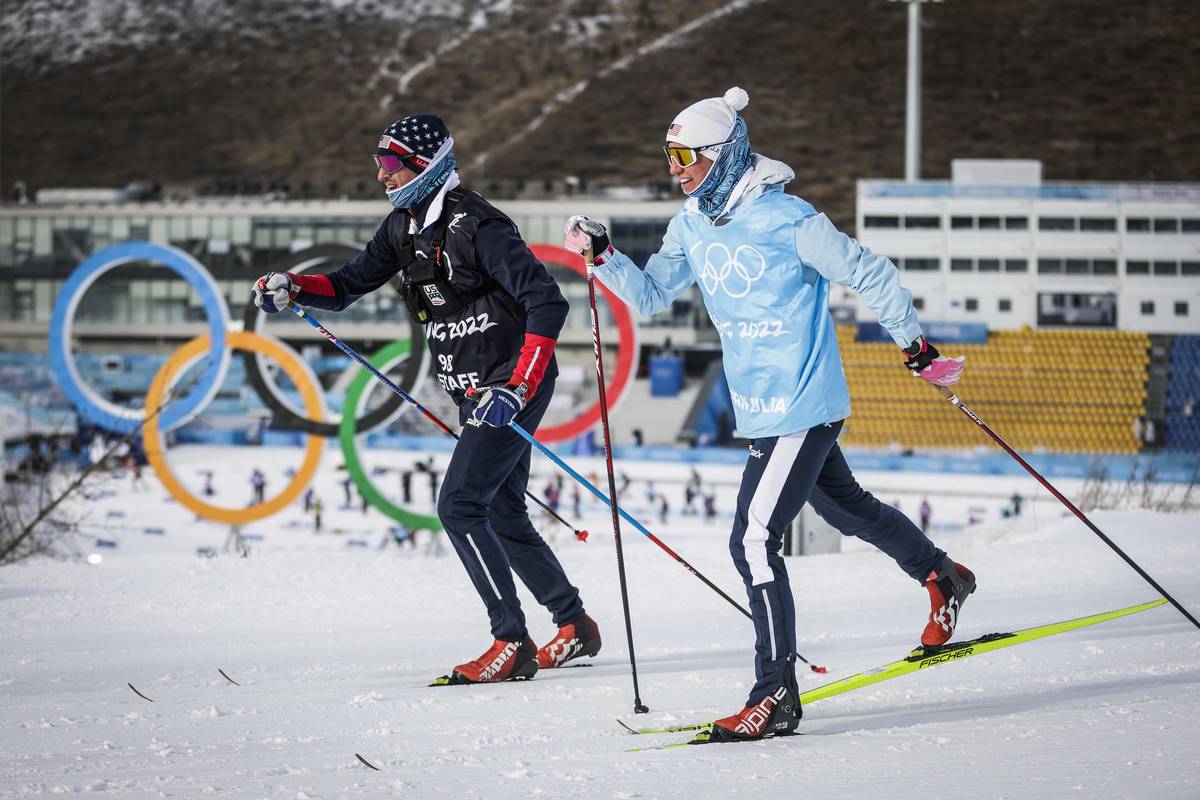
Hailey Swirbul and Baucom on a ski in China one of their first days on the ground OWG 2022. (Photo: Courtesy Photo)
Trial, Error, and Evolution
Not everything Baucom and the team do works, so they have to catalog the results and move on with that knowledge for the next time similar conditions arise.
“There are certain structures we stay away from that we’ve had bad luck with… and there are certain grinds from different ski companies that we pretty much won’t ever put manual structure on.”
That’s the tricky part: not all athletes ski the same way, are looking for the same feel from a ski, or ski on the same brand of skis.
“The most important thing is for each individual tech to have an idea of what works with their athlete’s skis.”
Baucom and his partner Brooke Segerberg in Davos, Switzerland. (Photo: Courtesy Photo)
A Historic Day
Elite skiers train nearly a thousand hours a year, year after year, which is the required ante chip to line up at a race, especially an Olympic one. For Baucom and the rest of the US Ski Team service staff, the skis raced on World Cup weekends and at these Olympics did not come together the way you might prepare them for a Saturday morning ski. It, too, took thousands and thousands of hours of work over decades of involvement for the entire service team to put world-class skis in the athletes’ hands so they could realize their dreams.
Another historic day might materialize at these games, and one thing we know for certain is that the service staff is working hard to make it happen.
Help Support Our Olympic Coverage!
FasterSkier has our own Nat Herz on the ground at the Olympics, which is a significant financial lift for us. If you value the thoughtful work and access FasterSkier provides at championships like this one, please consider becoming a Voluntary Subscriber. Your support directly fuels our work to cover the people, places, and moments that make our sport special.
ZHANGJIAKOU — Patrick Moore is a cheerful accountant from Edmonton, Alberta. Tim Baucom spends his summers working sales for a Vermont plank flooring company. Oleg Ragilo runs a cosmetic shop in Estonia with his wife.
Jessie Diggins, the American cross-country ski star, couldn’t have won her Olympic bronze without them.
Jessie Diggins earns an Olympic bronze medal in the 1.5 k freestyle sprint. (Photo: NordicFocus)
Moore, Baucom and Ragilo all belong to America’s nine-member ski service team here — a mix of mostly paid staff and a couple of volunteers like Moore.
“I can’t speak highly enough of their work ethic — they’ve been out here every single day, hours and hours and hours, probably skiing like 50 k a day,” Diggins said after finishing eighth Thursday in her third race of the Games. She added, referring to her medal-winning ski: “They delivered such a clutch performance the other night.”
The service crew is charged with the complicated, high-stakes work of choosing the right skis and wax for the snow conditions in Zhangjiakou, the mountain resort town outside Beijing where Olympic cross-country events are taking place.
The task sometimes can make the difference between an average day and a medal.
But the work, which happens in drab tan buildings off a corner of the stadium, is relatively anonymous — except when things go wrong.
“I think it’s sometimes hard for people at my regular job what I look like here,” said Moore, the accountant. “And it’s probably hard for people at this job to understand what I look like there.”
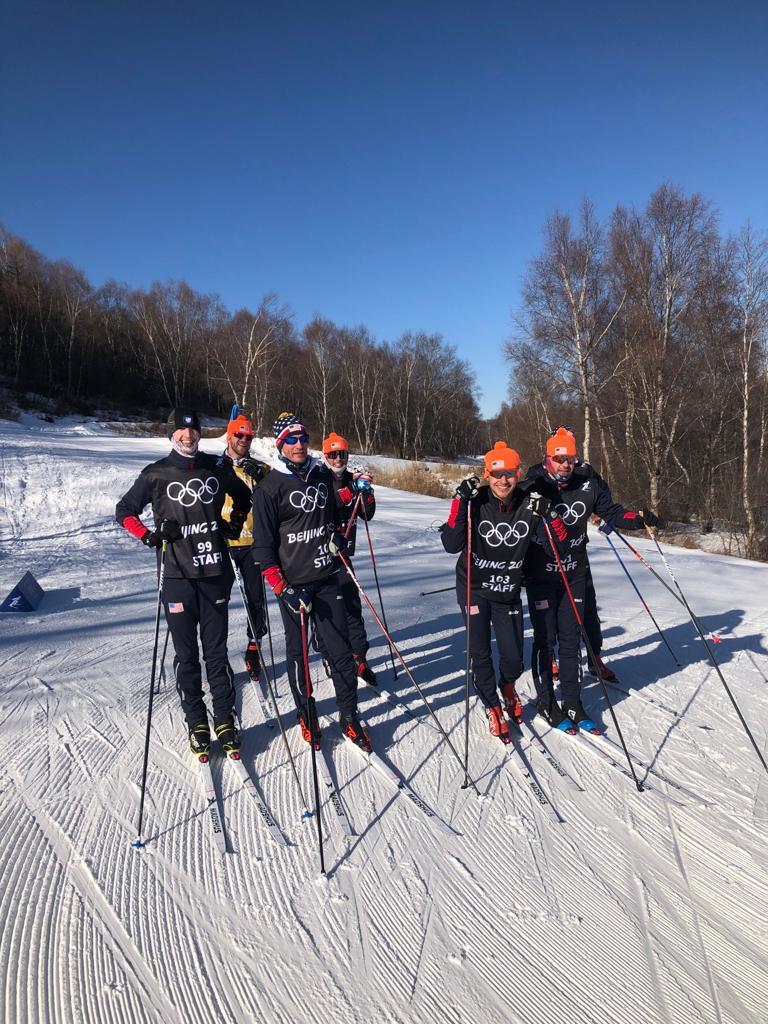
The U.S. wax staff arrives in Zhangjiakou. From left to right, Patrick Moore, Andrew Morehouse, Bjorn Heimdal, Tim Baucom, Chris Hecker, Jason Cork, and Eli Brown. (Photo courtesy fellow technician, Karel Kruuser)
The U.S. service team is composed of a mix of Americans and Europeans — including Ragilo, who previously waxed for superstars in Estonia and is something of a legend there.
To appreciate the crew’s work requires a quick lesson in ski technology.
Cross-country ski bases — the part that slides across the snow — are generally made of a plastic called polyethylene, or p-tex. The material has tiny pores, somewhat like a sponge, which means it absorbs wax that’s ironed or rubbed in by technicians; the excess can be scraped off to leave what appears to be a smooth plastic surface.
Manufacturers produce different waxes to help the skis slide faster in different conditions: warmer or colder, natural snow or man-made.
The waxes are typically layered, and they can be applied in different ways — ironed in, rubbed in with a corkor even a spinning wool cylinder attached to a drill, for example.
Technicians can also enhance the gliding potential of skis with metal tools that press tiny, intricate patterns into the bases, known as structure. Then there are the skis themselves, which are built stiffer or softer to suit snow conditions. American athletes each brought dozens of pairs to the Olympics — perhaps 300 total.
Sorting through each of those variables and identifying the best skis, waxes and structures takes hours and hours of testing. U.S. service team members arrived in Zhangjiakou a week before the first race, and got to work.
“None of us are scientists,” said Baucom. “But we just tinker around with all this stuff.”
Old entries in a U.S. wax technician’s notebook keep track of the many iterations tested en route to a winning selection. (Photo: Nat Herz/FasterSkier-ADN)
The crew spends its first day or two skiing the race courses, setting up gear and getting a feel for the place. Then, they start testing the first layers of waxes and the best methods for applying them, as well as durability: How far can they ski before the wax starts losing potency?
Most of the testing is done by feel, with two technicians gliding down a hill, side by side, on two pairs of skis with different waxes to see which pair is faster. The American technicians can ski 30 kilometers a day or more; some or the Scandinavian teams with larger staffs have workers whose sole job is testing and can ski twice that far.
When race day arrives, the U.S. team may have tested 50 or 60 types of glide wax, and a similar number of kick waxes, which skiers use to grip the snow and push themselves uphill.
Olympic team staff test skis and wax Friday, February 4, 2022 at the Zhangjiakou National Cross-Country Skiing Center. (Nat Herz/FasterSkier-ADN)
They’ll narrow that number to perhaps 16 waxes to test in the hours before the gun goes off. Athletes, who are paired with the technicians, will also test a handful of pairs of skis before a race to see which are fastest.
The Americans aren’t typically expecting to find a magic bullet that makes their skis the best in the field, said Baucom, the U.S. team’s head of glide waxing in Zhangjiakou.
“You always want to have skis that are ridiculous, and make you look good,” he said. “But really, our goal is to have competitive skis. And it seems like in these conditions, as far as I can tell, almost every team has had pretty competitive skis.”
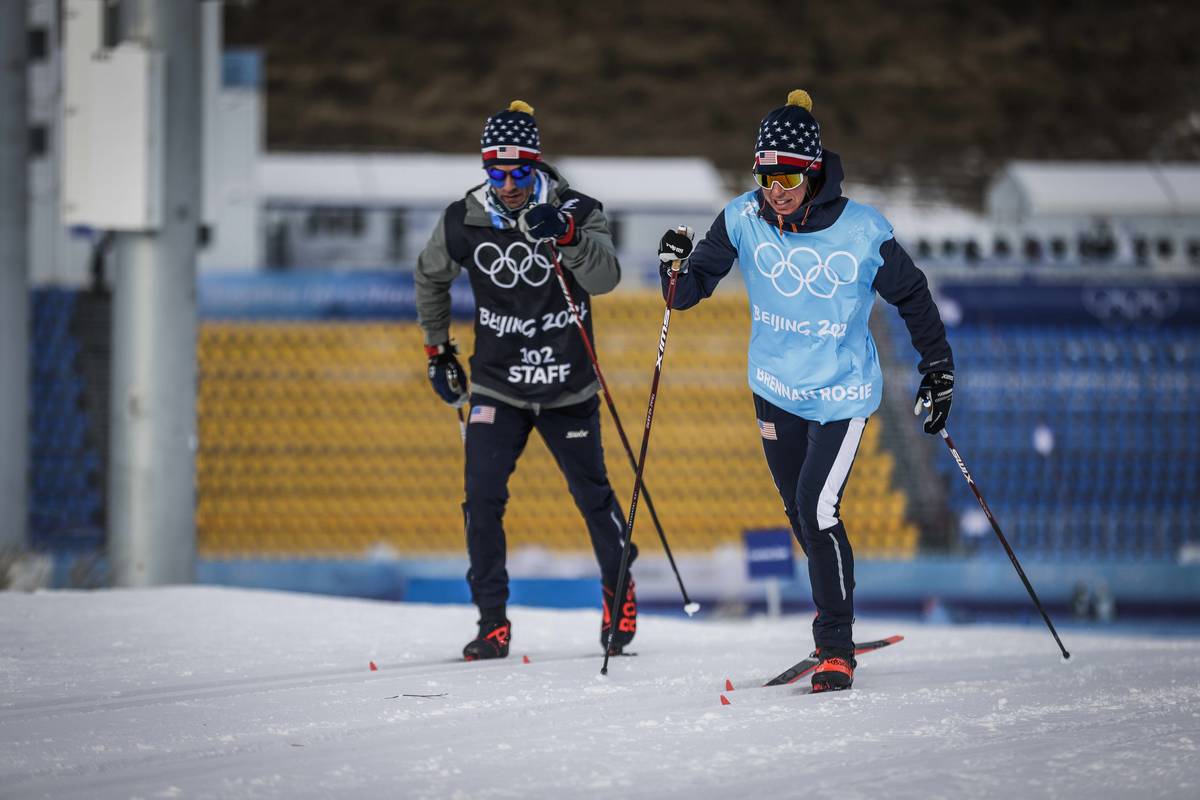
Rosie Brennan tests skis with her tech, Bjørn Heimdal, before the opening 15 k skiathlon. (Photo: NordicFocus)
The area is not far from the Gobi desert and gets minimal precipitation, so skiers are racing mostly on manmade snow. Before the Games, Baucom heard about storms that deposited sand on the trails that ruined skis.
But so far, he said, the skiing at the Olympics has been quite good, even if the snow is a little dirty and wears away wax a bit more quickly than usual.
“It’s not throwing us for a loop as far as being very different from other really cold, dry snow that we’ve raced on,” Baucom said. “It’s abrasive, but it’s not, like, crazy.”
Ski preparation at the elite level can be something of an arms race: On the European World Cup cup circuit, bigger teams, including the U.S., travel with huge trucks that have been outfitted as roving wax rooms at a cost of $500,000 or more. Those trucks, however, did not make the trip to Zhangjiakou.
Scandinavian teams spend more money on ski service and have bigger workforces, which can sometimes produce inequities. At the World Championships in Germany last year, the U.S. technicians had an especially tough day in the women’s pursuit race, where the skis they gave athletes were too slow to be competitive. Baucom described the feeling as “gut-wrenching” for the staff.
Julia Kern prepares for the 15k skiathlon with her wax technician, Eli Brown. (Photo: NordicFocus)
When things go wrong, the U.S. team will often collect skis after the race and retest, to see what went wrong.
At the Olympics, though, conditions have been stable and relatively straightforward for waxing, even after a flurry of fresh snow Saturday morning. So far, the American athletes have had few complaints.
“It feels good to know that everyone has a pretty fair shot,” Diggins said. “I’m just so grateful to our staff, because we win as a team.”
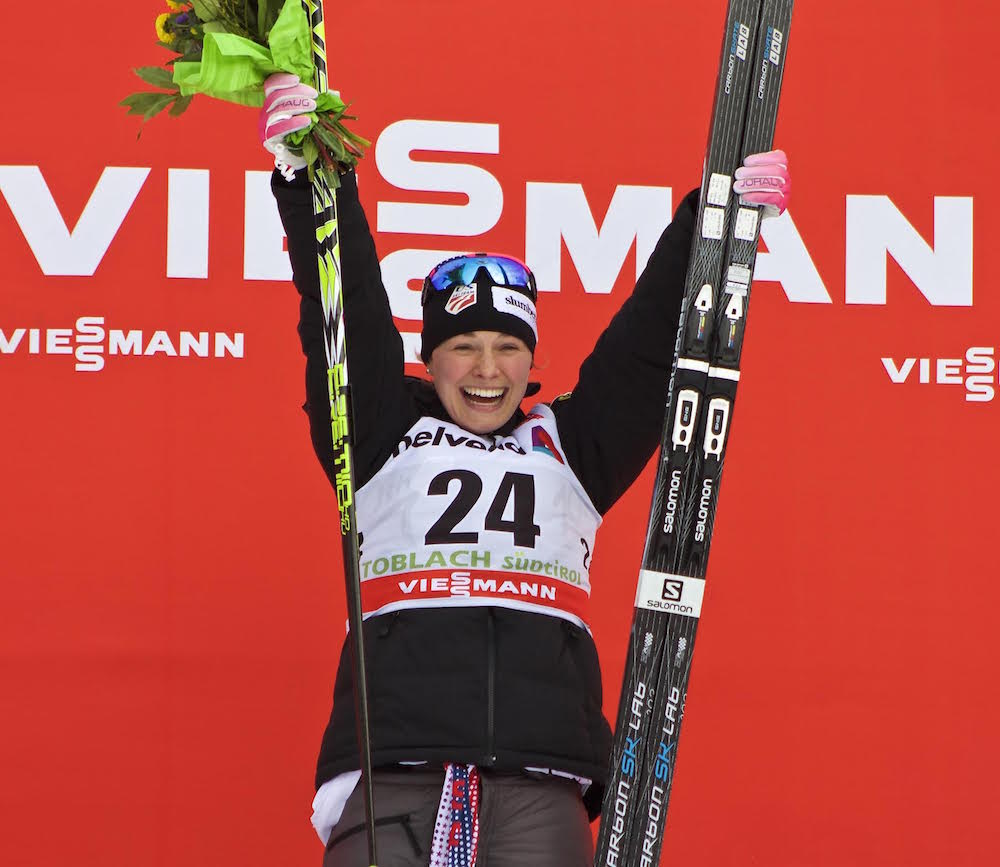
American Jessie Diggins after winning her first individual World Cup on Friday in the women’s 5 k freestyle at Stage 6 of the Tour de Ski in Toblach, Italy. For the U.S. Ski Team, it was their second victory in the last three stages. (Photo: JoJo Baldus)
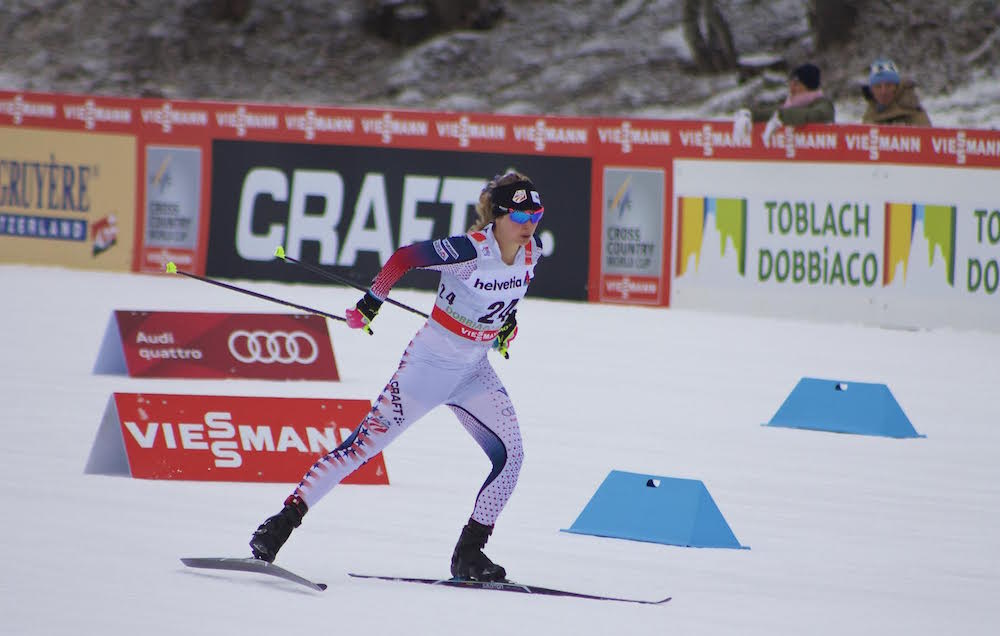
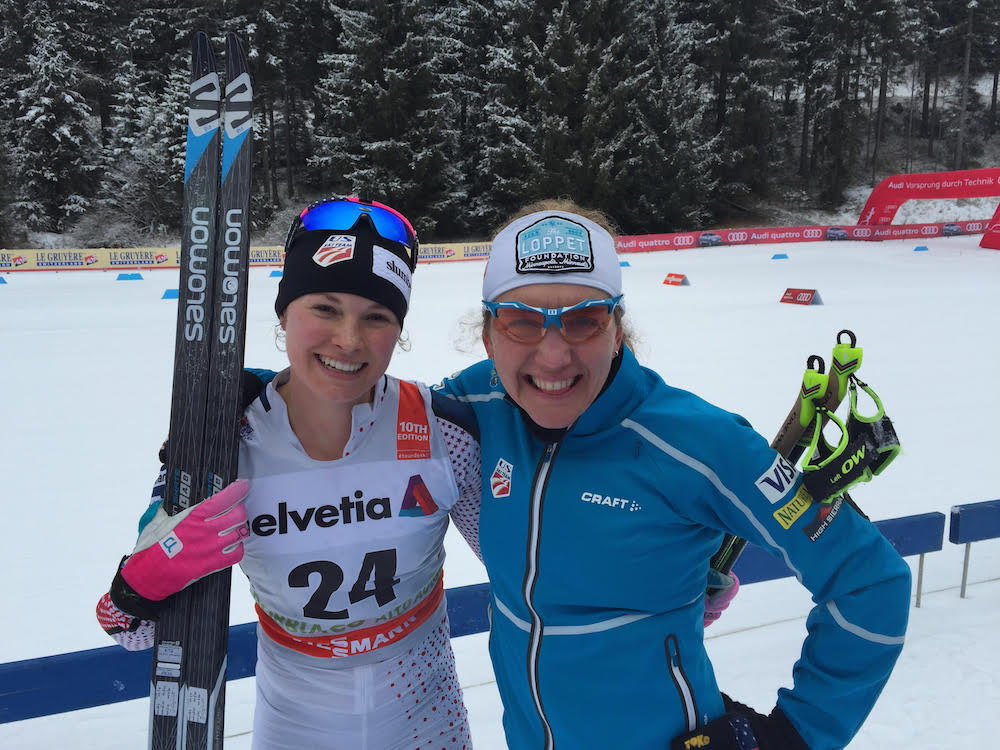
TOBLACH, Italy – With many smiles, shrieks and leaps of joy, Jessie Diggins won Stage 6 of the Tour: a 5-kilometer freestyle individual start. It was the second of two huge wins for the U.S. women, following Sophie Caldwell’s Stage 4 classic-sprint victory on Tuesday in Oberstdorf, Germany.
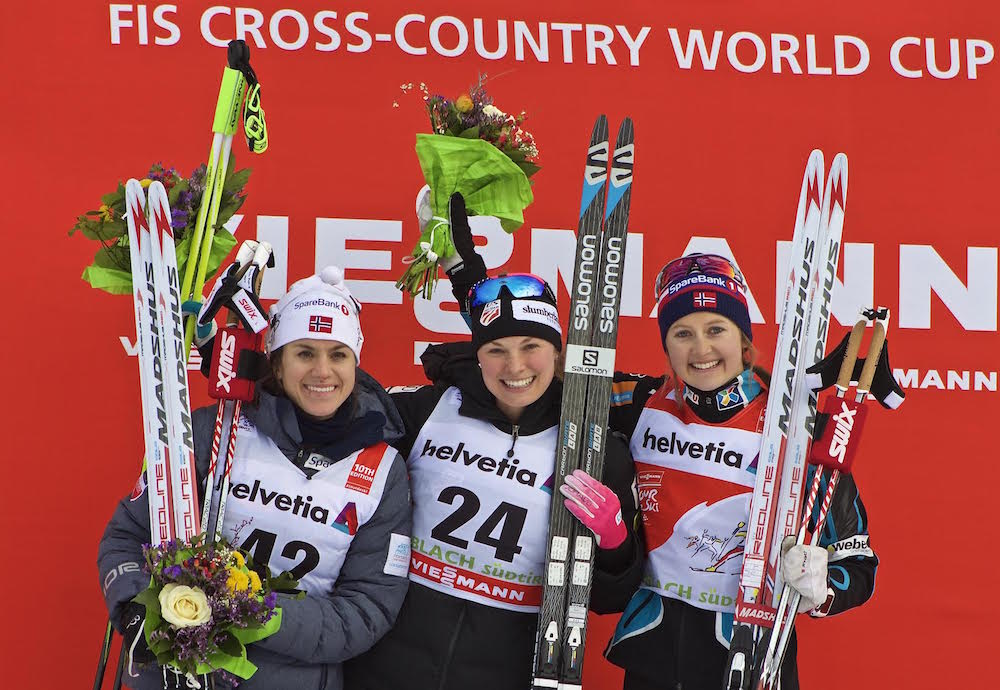
Interestingly, the podium remained exactly the same between both races — with Heidi Weng in second and Ingvild Flugstad Østberg in third — except Diggins replaced Caldwell on the top step.
“What’s so cool about this team is we ride on each other’s successes,” Jessie exclaimed in an in-person interview after Friday’s race. “Seeing Sophie do it, we all train together, and we can do this! It really shows the strength of the team that we push each other and train so hard to get to this point where we can start putting together really good races. So this is a pretty sweet victory for the team.”
Diggins is now the fourth U.S. woman to win a World Cup race, and the first to do so in a modern distance race. (Kikkan Randall has won numerous freestyle sprints and a 3 k prologue, but nothing longer.)
A 24-year-old member of the U.S. Ski Team, Diggins was a 2015 World Championships silver medalist in the 10 k freestyle and won gold in the freestyle team sprint at 2013 World Championships with Randall. She also won the preceding World Cup freestyle team sprint with Randall in December 2012, but had yet to achieve an individual World Cup podium before Friday.
Her post-race demeanor was true to herself — bursting with enthusiasm, belief, positivity, and especially a team-focused mentality — times 100.
“I didn’t believe it,” Diggins said when asked about seeing her name in first place. “I mean, to come out on top in this field with those incredible women feels like doing the impossible. So that really speaks to how hard the [wax] techs have worked, how fast the skis were, the incredible cheering…”
Racing to First
Jessie Diggins (U.S. Ski Team) racing to her first individual World Cup victory in the 5 k freestyle at Stage 6 of the Tour de Ski in Toblach, Italy. She won by 0.9 seconds, beating out four Norwegians in the top five. (Photo: JoJo Baldus)
Depending on how racers show up on a given day, the individual-start format can be anything from interesting to anti-climactic, and even nerve-racking.
Forty-six women started on Friday, heading out at 30-second intervals. After racing the clock and crossing the finish line, athletes are left waiting to see how their time stacks up against the rest of the field.
Early starters don’t have much to work with in terms of splits. The race consisted of a single 5 k loop, with gradual climbing out of the start and official timing points at 1.7 and 2.1 k.
Diggins started 24th and reached the first timing point in 4:28.9, which turned out to be the fourth-fastest time of the day. Then at the 2.1 k, her time ranked third, indicating she was accelerating.
“When the split at 2.1 came in that Jessie was 8 seconds out of the lead with everyone by, we knew that meant she could win,” U.S. Ski Team Women’s Coach Matt Whitcomb told FasterSkier afterward. “Nobody finishes this course more successfully than Jessie.”
What made her the best woman out there today? The answer lies largely in the subtle downhill profile of the latter part of the course.
“You are always working and you have to really work those downhills,” Diggins said of the Toblach course. “It is a great course for me because I love to V2 and I love those downhills where you just get in your little tuck and you just skate.”
From Afton, Minn., Diggins won Minnesota state championships three times, which is held at Giant’s Ridge. The end of the course is characterized by a similar, long downhill segment for the last kilometer or two leading out of the woods and right into the stadium.
Several coaches and race organizers on the Minnesota high-school scene remember the way Diggins would come flying down this hill in a bullet-like tuck, practically sitting on the back of her skis. From high-school meets all the way to the top podium spot in the World Cup, Jessie Diggins can truly work the downhills.
“She can lay down the fastest time day after day after day through terrain like this; she is a glider and she is a finisher,” Whitcomb explained. “[The course] suites Jessie’s strengths very well.”
“There are very few skiers in the world that can close down the final kilometer of a course like Jessie,” U.S. Ski Team Head Coach Chris Grover said in a team press release. “She was fierce and unrelenting on the downhills and flats leading back to the stadium; pushing extremely hard on her skis. We’ve been wowed by this ability of hers many times, most notably in the recent Lillehammer 4×5 k women’s relay.”
Diggins crossed the line in 13:15.5, “A new best time!” as stadium commentators exclaimed over the sound system, 15.7 seconds ahead of the previous leader; Germany’s Denise Herrmann, who started 11th. But half the field was still racing, including most of the seeded competitors, who stood the biggest chance at challenging Diggins’ time.
Diggins with fellow U.S. Ski Team member Caitlin Gregg. The two shared the podium at 2015 World Championships in the 10 k freestyle, where Diggins placed second and Gregg was third. (Photo: JoJo Baldus)
The waiting began — a system of delayed gratification. She didn’t know how well her time was going to hold up, and so she collected her skis and left the finishing pen, walking past broadcast reporters who didn’t bother to interview her yet while fielding a multitude of polite congratulatory remarks.
Slowly, but surely, her time weathered more and more finishers, keeping that top spot. She had enough time to go change clothes — little did Diggins know she was changing in preparation for the podium ceremony.
Then came a moment of great excitement. Some of the remaining favorites were entering the stadium and finishing in rapid succession. Where would they stack up?
Norway’s Ragnhild Haga: not quite, as she was 8.4 seconds short for second initially, and fourth at the end of the day.
Sweden’s Charlotte Kalla: 12.3 seconds behind Diggins at the line would eventually be enough for seventh.
One by one, as each of these top athletes crossed the line, Diggins’ eyes and smile grew bigger and bigger. She could not believe it. “I thought, well, this is obviously a really good race, and… maybe, maybe I will be on the podium,” she recalled.
But they kept coming, unable to touch Diggins.
Jessie Diggins (c) of the U.S. Ski Team after capturing the second U.S. women’s win of the week at the Tour de Ski. Diggins won Friday’s 5 k freestyle in Toblach, Italy, by 0.9 seconds over Norway’s Heidi Weng (l) and another Norwegian Ingvild Flugstad Østberg (r) was 1.5 seconds behind in third. (Photo: JoJo Baldus)
As Østberg — the clear leader at both timing points — cruised down into the stadium, the announcer bellowed, “Her pace is matching Diggins’ with a few hundred meters remaining,” and repeated the observation in several different languages.
“No, she is 1.5 seconds back from Diggins’ time,” he continued.
That put the overall Tour leader in second.
Therese Johaug, second to Østberg at the 2.1 k checkpoint, was ultimately unable to match Diggins nor Østberg and finished fifth, 9.6 seconds back.
Then came Weng, another Norwegian threat. “She could do it!” the announcer said.
Spectators watched the seconds tick by on the Jumbotron.
“She is into the final sprint, and ladies and gentlemen, this will be a fight to the end…”
As Weng lunged across the line: “No, Weng cannot beat Diggins. Jessie Diggins has kept the top time. Weng takes second, just nine-tenths of a second behind!”
Diggins melted to the ground in overwhelming excitement and disbelief. Weng and Østberg shared a hug of utter exhaustion just across the finish line before sincerely congratulating Diggins. Just 1.5 seconds separated the top three. “A day of very small margins,” as coach Whitcomb put it.
***
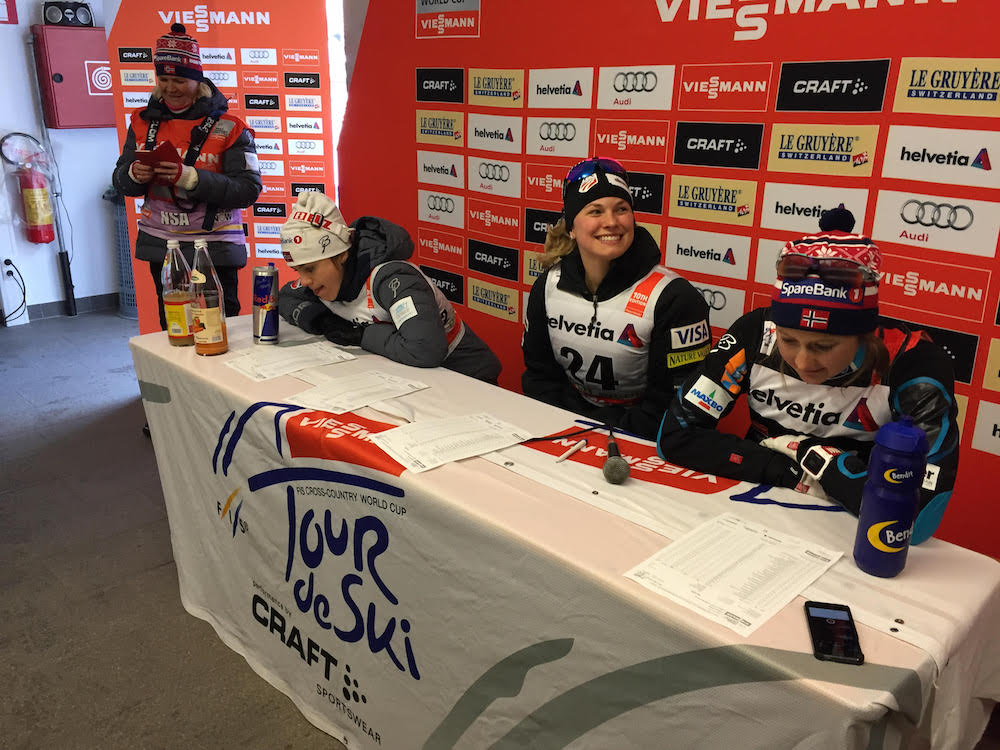
A smiling Jessie Diggins before the post-race press conference after winning her first individual World Cup, the sixth stage of the Tour de Ski (a 5 k freestyle individual start). (Photo: JoJo Baldus)
Diggins emphasized that, despite feeling good about the race, she certainly did not expect to win.
“I’m still in shock!” Diggins said as she awaited the awards ceremony. “I never thought that I would win it.”
Diggins and Weng accelerated through the end of the course into first and second, respectively. Just under seven seconds off the podium in fourth, Haga also had faster second-half splits, but not quite enough to reach Diggins or Weng. Østberg and Johaug both lost time and ranking on the second half of the race.
“I tried to open a bit slowly and get faster in the downhills,” Weng explained in a post-race press conference. “I think that was a very good tactic for me. … It’s a very hard race because you can overpower and it can go very good or it can go [bad] and you can [lose] many seconds in the end. It’s very hard to go five kilometres.”
Østberg in third ended up besting her teammate and biggest Tour rival, Johaug, by 8.1 seconds. She will continue to wear the red Tour leader’s bib heading into the last two stages in Val de Fiemme, Italy, after extending her overall lead to 25.3 seconds ahead of Johaug.
“It was a tight and hard race, and maybe I had a little [too] hard opening, different from the other racers, I guess,” Østberg said in the press conference. “In the last uphill my mother cheered for me, but my legs were just so tired I didn’t think I was gonna come to the finish. Another podium for me, and it’s so amazing that I’m still in the lead of the Tour de Ski. It’s unbelievable, for sure I didn’t believe it was possible. And 1.5 seconds from the win that’s amazing.”
After the stage win, Diggins improved to 10th overall, 6:50.2 behind Østberg.
A Proud U.S. Ski Team
Diggins’ win, piggybacking on Caldwell’s sprint victory just two days prior, provides a very notable marker for the overall success of the U.S. Ski Team.
“You need to have kind of everything perfect to have such a good race,” Diggins said in the press conference. “You have to have really good skis and your head has to be in the right place and then your body has to feel good, so it’s really exciting for us that it all worked out so many times this year.”
“It is totally surreal,” Whitcomb remarked. “It is totally surreal because we have never had such success in a small amount of time with two different athletes. [There are] so many guns on this team.”
Never before had the U.S. team racked up two stage wins by different athletes in the same Tour de Ski, which is in its 10th year. Randall won a prologue and a sprint stage in 2012/2013.
According to FIS, the U.S. joins Norway and Finland as the only nations with a history of two stage wins by different athletes in the same Tour. Aino-Kaisa Saarinen and Virpi Kuitunen won stages in 2007/2008.
“One thing is for sure, the Americans have proved they can for sure play with those Norwegians!!” teammate Sadie Bjornsen wrote in an email. She placed 13th on the day, 25.7 seconds behind Diggins.
The wax team and support staff can revel in the team’s recent successes as well.
“It speaks volumes to the work [head of service Oleg Ragilo] has put forward, the leadership that he has created out there…,” Whitcomb said. “When those guys can be rewarded with good results like this it makes us really happy for them.”
Bjornsen Up to 13th Overall
Sadie Bjornsen (U.S. Ski Team) racing to 13th in the 5 k freestyle at Stage 6 of the Tour de Ski in Toblach, Italy. (Photo: Fischer/NordicFocus)
The 20th starter, heading out two minutes ahead of Diggins, Bjornsen initially finished fourth.
“I went out there today racing for the podium,” Bjornsen recalled after starting the day ranked 14th in the Tour. “I decided to go with no fear and see how long I could hold on for…. And that lasted about 2.5k… At which point I realized I was going to have to dig seriously deep to make it home.”
Her 1.7 k time held up as 10th fastest, 9.8 seconds behind Østberg, and at 2.1 k, Bjornsen sat in eighth, 5.8 seconds behind Diggins in third.
“I am proud for taking a chance… Because at some point it will work,” Bjornsen continued.
She improved one spot to 13th in the Tour, 7:58.8 out of the lead.
U.S. teammates Liz Stephen placed 26th on Friday (+41.5) to move up three places into 25th overall, just over 10 minutes back, Rosie Brennan finished 33rd (+54.4) for 34th overall, and Caitlin Gregg was 39th (+1:05.7) for 39th overall.
“I’m starting to feel more like myself everyday,” Brennan said during an in-person interview after the race. In the sixth stage of her first Tour de Ski, she started 41st on Friday, 30 seconds ahead of Weng.
“I was coming down the hill and Heidi had passed me, and I’m like, Well, I really hope she’s having a good one,” Brennan recalled. “I just saw out of the corner [of my eye], the screen and I saw Jessie’s name, and I’m like, God damn that’s awesome!”
Brennan plans to complete the Tour, ending with the final climb on Sunday.
“I don’t have a particular one event that’s way better than the other, so I think this type of tour really suits me,” she said. “I’m looking forward to chalking this one up to experience and coming back for more later.”
Also in her first-ever, eight-stage Tour, Gregg started 13th, one position ahead of Poland’s Justyna Kowalczyk, on Friday. While Kowalczyk went on to finish 18th (+34), Gregg explained being caught by her was a good thing.
“I got caught by Kowalczyk at like 2 k, but then we actually skied together and that was awesome. It kind of lifted my momentum and I felt like my skis were really good,” Gregg said.
“I think I entered [the Tour] just not really knowing how it would go and maybe I’m a little off — I have been since I got over here,” Gregg added. “Every race … I don’t get those good race sensations when I’m racing. I’m actually going home on Monday and I’m pretty stoked to reset and recharge.”
The Tour continues in Val di Fiemme on Saturday with the women’s 10 k classic mass start and concludes with the 9 k freestyle climb up Alpe Cermis on Sunday.
— Alex Kochon and Harald Zimmer contributed reporting
About the Author: JoJo Baldus is a nordic skier from snowy Minneapolis, Minn. Currently living the dream as a volunteer journalist and photographer for FasterSkier while enjoying a gap year before starting at Macalester College in St. Paul. He could not be more excited to attempt to stagger across the finish line of 8 different WorldLoppet ski races this winter!
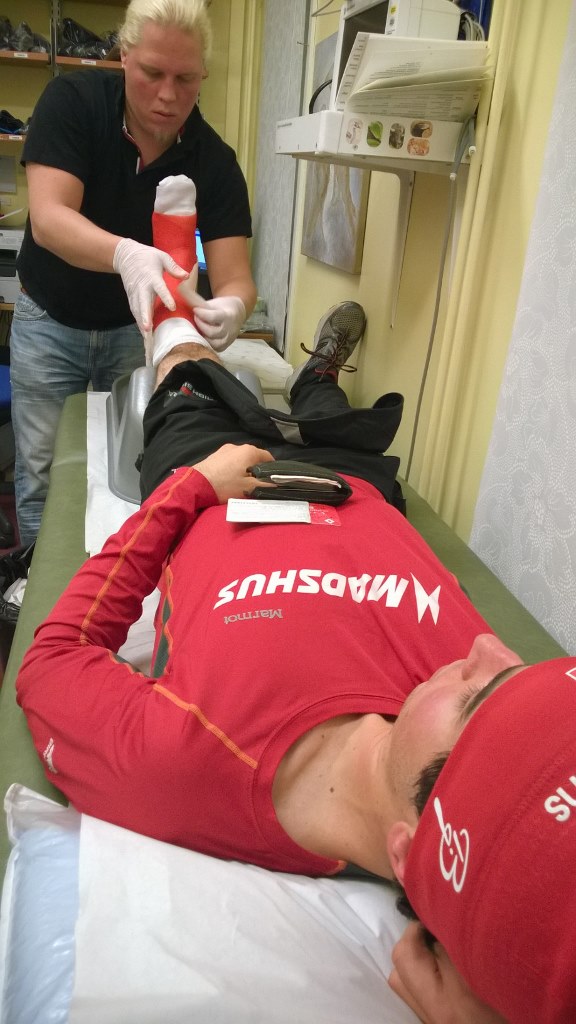
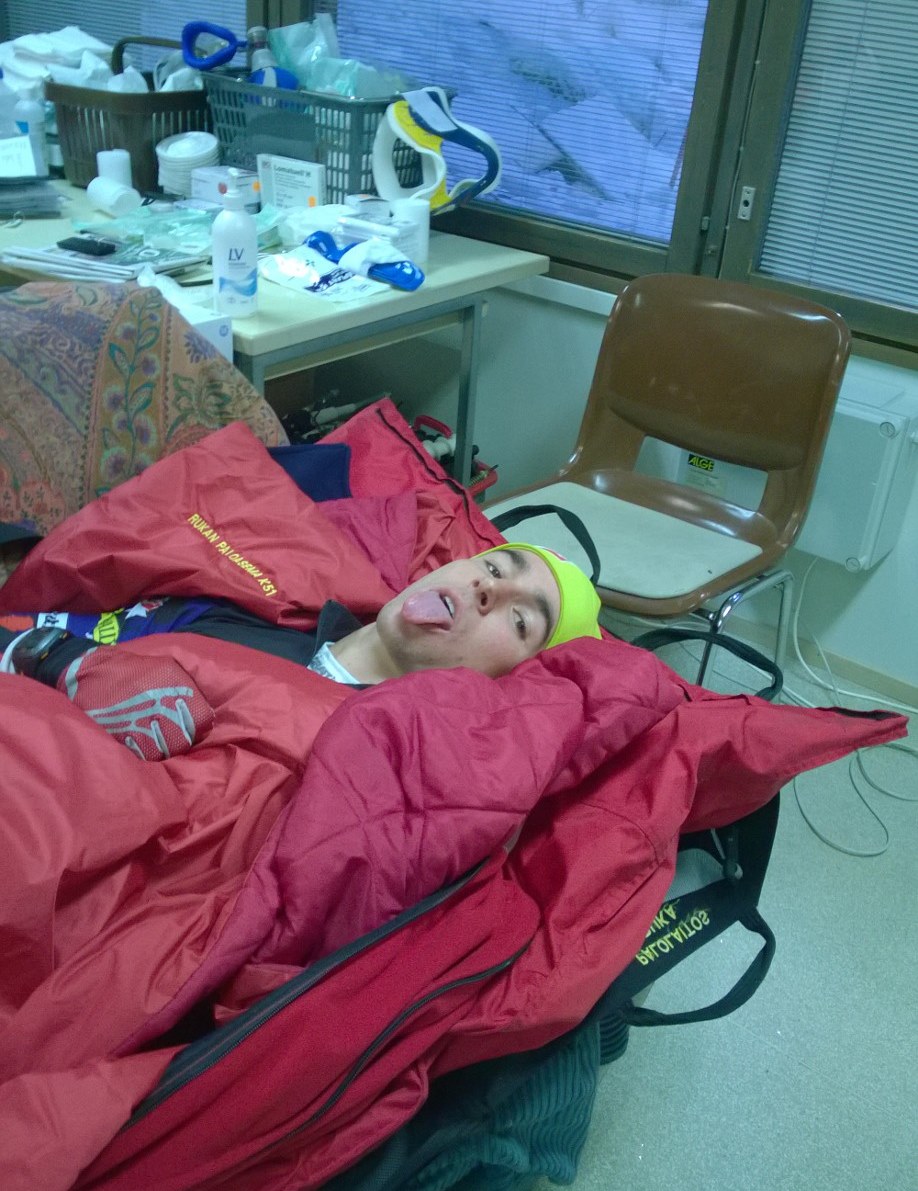
Noah Hoffman on Sunday at the Ruka clinic in Kuusamo, Finland, after breaking his fibula in the 15 k classic. He and physical therapist Peter Dickinson waited in the clinic for an ambulance to take them to a nearby medical center for X-rays. “We were only going half a kilometer and I thought the ambulance was overkill,” Hoffman wrote on his blog. (Photo: Peter Dickinson via NoahHoffman.com)
Never fail, on Monday afternoon during a flight from Frankfurt to Denver, Noah Hoffman blogged. And not just any quick update, almost a whopping 2,000 words.
The U.S. Ski Team’s top male distance skier emerged from a one-day online hiatus to explain exactly what happened Sunday in Kuusamo, Finland, where he fell hard with slightly less than 2 kilometers left and did not finish a World Cup race for the first time in his career.
Hoffman explained he aimed to start the 15 k classic — the first distance race of the season — conservatively, and he settled after the first kilometer. Waiting patiently to get a ride, he saw his opportunity with Norway’s Pål Golberg, who went on to place ninth, after the first lap around 5 k. As Hoffman accelerated to catch him up the big climb and did so about halfway up, he found shortly after that the effort was too much, too soon.
“For several kilometers I had to focus on being smooth and recovering. I lost a ton of time,” Hoffman wrote on his blog on Monday.
At the end of the second lap, Finland’s eventual third-place finisher Sami Jauhojärvi caught Hoffman. He saw that as another opportunity and stayed with Jauhojärvi around the stadium and up the big climb, but “just like the lap before, the effort was too much for me. He dropped me and I was blown,” Hoffman wrote. “I was suffering for the rest of the race. I was not skiing fast. At the 13.1 kilometer split station, which was right before I crashed, I was in 52nd place, not where I want to be.”
Hoffman went down on a sharp-righthand corner at the bottom of a fast downhill. He expected it to be icy and wasn’t intimidated by it and didn’t think it would be a problem. When he crashed on his third lap, no one was near him and he explained he wasn’t trying to be aggressive. If anything, he wondered if he should have tried to carry more speed through the turn.
“I’m not sure exactly what happened. I slid on the ice, went into the snowy berm, lost control and slammed into the fence,” he wrote.
What he thought was his right ski snapped in half as it hit the solid paper or plastic lining the bottom half of the fence. The top part was made of alpine netting. His other leg punched through the solid material and was tweaked with his left ski still in the fence. He kept sliding and injured his knee and ankle.
“I knew almost immediately that I was hurt,” Hoffman recalled. “I got up and glided about a hundred meters down the trail. I needed to get out of the way of other racers and I needed to get to some people who could help me.
“I couldn’t put any weight on my left leg,” he continued. “I knew I couldn’t finish the race, which is significant because I’ve never previously dropped out of a race. I’m bummed that I had to end that streak yesterday.”
A photo of Hoffman’s X-ray taken by Peter Dickinson. “It didn’t turn out super well but you can see the fracture in the fibula behind the tibia, at least that’s what I’m told,” Hoffman wrote on his blog. (Photo: Peter Dickinson via NoahHoffman.com)
Hoffman’s blog post was titled, “Broken Fibula,” and he included an X-ray taken at a medical center near Ruka venue, which showed a fracture in his fibula behind the tibia (shin bone), “at least that’s what I’m told,” he wrote.
“The plan then immediately became for me to get back to the U.S. as fast as possible,” he continued. “There wasn’t really any discussion about it, and I didn’t have any say in the matter. They put me in a hard cast for the travel.”
Hoffman and the U.S. team’s physical therapist, Peter Dickinson, who accompanied him to the clinic, took a taxi 300 meters to their condo “because Pete wouldn’t let me crutch down the icy stairs and hill,” he explained.
“Things happened really fast once I got back to the condo. I got on the phone with the U.S. Ski Team travel agent to try to re-book my ticket,” he wrote.
Hoffman getting a hard cast on his left leg for travel. (Photo: NoahHoffman.com)
His previously scheduled return was after the Tour de Ski in early January, departing from Munich and arriving in Hartford, Conn. Last night, he wanted to leave northern Finland for Denver on the earliest flight. Unable to re-book, he found the cheapest option was buying a new ticket for $1,000 dollars. But there weren’t any seats available in most of the airports near Kuusamo.
“When we kept striking out I started doing some research on my own and amazingly found an award ticket option through United but on partner airlines out of Lulea, Sweden,” Hoffman wrote. “The only ticket available was in business class for 70,000 miles. Luckily I had that many miles available and it sounded better to me to spend them than paying $1,000, so I purchased it at 6 O’clock last night. The flight was at 6:20 this morning. Lulea is 5 hours from Kuusamo.”
From there, two of the team’s wax techs JP Laurin and Oleg Ragilo drove him to Luleå. They were headed there anyway with a cargo van full of skis en route to Lillehammer before next weekend’s World Cup. Hoffman squeezed up front with them in the three-person bench seat.
“Oleg and Jp were ready to depart before I even booked the flight and I hadn’t packed, eaten dinner or showered. Also, my leg was quite painful,” he wrote. “Luckily I have incredible teammates. They did everything for me. I took a washcloth bath while Simi and Ida packed my duffel bag and Liz made me four peanut butter and jelly sandwiches for dinner. I got out of the condo in less than 15 minutes.
“As we took off on the long drive I had to make a ton of phone calls, organizing things at home. I talked to my coaches and parents, started the process of setting up doctor’s appointments and organized transport with [my girlfriend] Emilia for when I land in Denver,” he added. “The drive was long and monotonous on snow covered roads.”
But they got to Luleå at midnight, 1 a.m. Kuusamo time. Hoffman wrote he slept fairly well despite keeping his leg elevated.
“I made it to the airport without issue, although crutching while rolling a duffel is a challenge,” he wrote.
At the airport, Scandinavian Airlines couldn’t find his ticket number. Hoffman spent a half hour on the phone with United sorting it out and almost missed his flight.
“Since then the travel has gone very smoothly,” he added. “I’m ashamed to say I’ve been getting pushed around airports in a wheelchair.”
Once airborne, he enjoyed business class and his first time with internet access in a trans-Atlantic flight.
Hoffman is currently on blood thinners and Aspirin to reduce the risk of a blood clot. After flying into Denver, he was headed to Breckenridge, Colo., Monday evening and hoped to see a specialist at The Steadman Clinic in Vail on Tuesday.
“Then I can start making plans for my recovery and my return to racing,” he wrote.
“Because I haven’t posted anything, I didn’t know anybody knew about my crash yesterday,” Hoffman noted. “Apparently I was wrong. I just turned on my computer for the first time, and I’m overwhelmed by the number of get well messages. I feel incredibly lucky to have so much support! Thank you all.”
Randy Gibbs waxed Liz Stephen’s winning skis at U.S. Distance Nationals last week. The top coat she was on was from a new company called Mantra Wax, which Gibbs is starting with fellow USST wax technician Oleg Ragilo. Courtesy photo.
When Randy Gibbs looks at the high-end ski wax on his bench, he finds himself uninspired by the plain vials of powders laid out before him. As a U.S. Ski Team service technician for the past seven years, few know better than he does how important wax is to any successful ski race. But when it comes to the brands of fluorocarbons available to most consumers, Gibbs sees a hole in the market for a product that’s cool, something skiers and coaches would be proud to own.
“Right now everything is so lame out there. They’re all boring and there’s nothing creative,” Gibbs says. “Not that those products aren’t great; we use every brand, for sure. Everyone has the best wax at certain times for certain things.”
But Gibbs thinks there’s room for another player at the service room table, and he’s hoping his new company, called Mantra Wax, will be it. Using raw materials that have been developed and tested over the past year and a half by a Russian manufacturer, Mantra aims create a line of top coats that will bring something to the wax market that it hasn’t seen before.
Mantra’s origins are certainly unique. This past winter, Gibbs and fellow U.S. team serviceman Oleg Ragilo obtained exclusive rights to package and sell the wax, and by October they plan to be delivering the high-end liquids and powders directly to coaches and technicians all over the U.S. and Europe, as Ragilo lives in Estonia and will head Mantra’s presence there. And because they plan to integrate small-batch, limited-release products into the wax line, Mantra aims to make its products cool and somewhat exclusive.
The Mantra Wax label.
“It’s going to be more like a whisky bottle or small-batch bourbon where…it’s a cool thing to have in your wax cabin,” Gibbs said. “You put it on your table and the other guy is like, ‘Oh, man. We’re screwed.’”
Gibbs and Ragilo have started with branding to establish that image. Mantra’s name was inspired by a David Grohl song with the same title, and their wax label could just as easily be an album cover.
Creative branding aside, Gibbs knows the most important thing in a wax is performance. So how does Mantra stack up next to products from major companies like Swix, Holmenkol or Toko?
Apparently, pretty favorably. At SuperTour finals, Mantra Wax had the opportunity to answer that question when the Craftsbury Green Racing Project hired Gibbs and two other technicians to help work on the team’s skis. The job became Gibbs’ chance to test Mantra’s new waxes on race day and generate some attention in the process, if the wax was successful. CGRP’s hired service crew included Eli Brown and Gibbs’ fellow U.S. serviceman Corey Wubbels to help him, and in addition to waxing CGRP’s skis all week the team also adopted Liz Stephen’s fleet.
The results turned out as well as Gibbs could have hoped. Stephen won SuperTour Finals and the 30 k classic championship, CGRP’s Ida Sargent and Pat O’Brien both podiumed in the classic sprint in miserably wet waxing conditions, and they were joined in the A-Final by Tim Reynolds and U.S. biathlete Susan Dunklee. CGRP head coach Pepa Miloucheva, able to leave the wax room and watch her skiers race for the first time in three years of coaching them, called her athletes’ results in the sprint “one of the best days” for her team all year. Skiers from other teams noted the speed of Craftsbury’s skis all week.
Mantra Wax founders Oleg Ragilo and Randy Gibbs at 2013 World Championships in Val di Fiemme, Italy. Courtesy photo.
What were they skiing on? Mantra Wax. The new powders won or were near the top of pre-race tests throughout the series and Craftsbury and Stephen raced on Mantra powders and liquids in each race at SuperTour Finals and distance nationals.
“They were awesome,” Stephen said of her skis in the 30 k.
Gibbs didn’t know what to expect from the results, but was pleased with the successful outcome of Mantra’s U.S. debut. He brought a small amount of powders with him to California to sell throughout the race series, and by the end of the week he was sold out. Gibbs said coaches returned to him to say that Mantra won a lot of their tests.
What’s so special about Mantra Wax?
“Nothing, really, other than it works really well in a lot of conditions,” Gibbs says. “It’s not a risky powder. Some of these powders, if it snows you might as well put paraffin on your skis and go out on training wax, because they get so slow. And this stuff seems to be great in new snow, old snow, manmade snow, wet snow, clean snow, fine-grained, course like out here — so it just works well. I’m not saying it’s going to win the test every time, but it’s going to be near the top more consistently, from what we’ve seen so far.”
Mantra Wax is so new it’s not yet widely available, but by the fall Gibbs hopes to have an introductory line up and running from the website and from select retail outlets. In Truckee, he sold 30-gram vials of powder for $100 each to help get the brand off the ground, but Gibbs thinks they will eventually retail for closer to $150.
Mantra Wax turned some heads in Truckee, and to increase the company’s visibility throughout the country it will put sales reps at major U.S. events next season. Gibbs also has his eyes on a few elite athletes to represent the brand, and at SuperTour Finals he and Stephen made plans to make Mantra Wax Stephen’s casual-wear sponsor next year.
“So far we’ve used their wax every day this championships,” Stephen said. “I want to support Randy and Oleg and what those guys are doing, and at the very least I want to wear what they have going on.”
Gibbs and Ragilo will continue to work on skis for the USST in the winter, by which point they hope to have two to three powders and four to five liquids as part of the Mantra Wax line, with plans to add klisters, paraffins and kick wax down the road in small-batch, special-edition releases. Gibbs foresees keeping the company relatively small, but for now things are still in the planning stages. He’d been thinking about starting a wax company for years, and now that the pieces are coming together he’s taking things slow.
“We’re not going make a million dollars or anything, but if we can make a great wax that’s better than everything else and have fun doing it, that’s what our goal is,” he said. “We don’t know what it’s going to evolve into. The Mantra is coming in hot.”
Gibbs, Eli Brown and Corey Wubbles with U.S. 30 k champion Liz Stephen. Courtesy photo.
Last week the U.S. Ski Team announced an addition and reshuffling of its service staff for the coming season. Former Rossignol and Sun Valley Ski Education Foundation wax tech Cory Wubbels was hired as a fourth member of the cross-country staff and long-time US technician Peter Johansson moved up to the Head of Service.
The changes reflect the need for more people in the wax room for a growing American squad on the World Cup, which at times includes numerous SuperTour points leaders on top of USST athletes. A focus on World Championships in Val di Fiemme, Italy, this winter additionally creates a need to increase support staff numbers
“Last year we had some unique challenges in that we at times had 12 or 13 athletes with us,” said USST head coach Chris Grover. “We had these really big teams and it was absolutely a challenge for us to provide the kind of service they needed to have the best possible chance of making world-class skis.
“Our goal for this season was to add another full-time service person to our staff so that we could provide a little more consistent service to a bigger team.”
Wubbels joins the USST most recently from White Pine Touring in Park City, Utah, where he has been a stone grinder for the past two seasons. His first job in ski service was in 2007 with Rossignol’s race service team, and since then he’s also helped Sun Valley at big domestic events and intermittently waxed skis for the U.S. and Canadian Nordic Combined teams.
At the start of the World Cup season last fall, Wubbels also filled in the waxing duties for then-men’s coach Pete Vordenburg when the latter was at home for the birth of his daughter. Grover and his team made note of the quality of Wubbels’ work during his brief time with them, which included a weekend in Dusseldorf, Germany, when the US brought home two podiums.
“He was a great fit; the athletes enjoyed working with him, the staff liked working with him,” said Grover. “He melded into our current team really well.”
The USST service staff now includes four dedicated servicemen — Wubbels, Johansson, Randy Gibbs and Oleg Ragilo — and three coaches that invariably take on waxing duties in addition to coaching responsibilities.
Wubbels is eager to be joining the group in a full-time capacity.
“It is really a great time to jump in with this team because they are on their way up!” he wrote in an email. “Coming off their best season of results, with more athletes in the red group and more athletes on the World Cup, there is almost tangible momentum. It is really an honor to be asked to work with this team.”
With more people handling the Americans’ skis than there have been of late, Johansson was promoted to a recreated leadership position so that one person would be responsible for calling the shots on race day.
When it had only three servicemen Grover was often the one charge of the USST’s skis, but with more staff, “I need some help from someone actually in the wax room all day to come up with the best strategy,” he said.
“A small team works on a World Cup weekend, but doesn’t work so well during major championships.”
The inner workings of the USST service team might seem like mundane details, but a lack of summer news isn’t the only reason to pay attention. A growing team and staff size means more people on USST payroll and an accordingly bigger cross-country budget — though only “slightly.”
Without specifying the exact size of the increase, Grover said it wasn’t huge. Moderately bigger funds wouldn’t get rid of the need to be creative with available resources.
“We’re having some savings in some places but we’re spending more in others,” he explained. “We’ll have the same challenges.”
What could have a more significant impact on next season’s resources is whether the US Dollar grows stronger than the Euro in the months leading up to November and through the rest of the season. The USST spends nearly half the year in Europe getting charged in Euros or Swiss Francs. If the dollar keeps getting stronger like it has over the past 12 months, the budget stretches even further.
“If the strength of the US Dollar versus the European currency continues with the current trend, that is huge for us,” said Grover.
Andrus Veerpalu in the Otepaa World Cup in January, one of his last races on home soil in Estonia.
Before flying to Estonia last January, I didn’t know much about that nation’s cross-country skiers aside from their names—and their medal records.
Jaak Mae, Andrus Veerpalu, and Kristina Smigun-Vaehi—between the three of them, seven Olympic and 10 World Championship medals. Not a bad record for a country with a population of 1.3 million, or the same as the state of Maine.
But while Scandinavian stars like Petter Northug and Marit Björgen blend a certain appeal, accessibility, and charisma, there was nothing that seemed to distinguish the Estonians, save a propensity for finding their peak fitness at just the right moments. The Russians had their Vladimirs and their Olgas; the Estonians had their Kristinas and Jaaks. Every few years, they’d come out of the woodwork, win their medals, and then travel back into the darkness of Eastern Europe, with Westerners’ doubts about doping chasing them to the border and bouncing off the tatters of the Iron Curtain.
Through the beginning of last winter, I knew as much as I needed to know about the Estonians to do my job as a cross-country skiing beat reporter. Smigun was retired, while Mae and Veerpalu were both in their late thirties, but remained among the best in the business—especially in the classical technique, in which they were generally considered to be among the most graceful skiers in the world.
But come January 20, it was time for me to visit Estonia in the flesh to report on a series of races, and I decided that I should do a little bit more research. So the day I flew out of Boston, I spent some time in a bookstore reading a guidebook to the Baltics and perusing press clippings. Among other things, I learned that Estonia’s people had been denied independence for much of the 20th century, up until the 1990s,and that the country was noted for its folksinging traditions.
And, oh yeah—a press release from the organizers said that some 15,000 people show up for the annual cross-country ski races in Otepaa. Assuming those numbers were accurate, that’s just over one out of every hundred Estonian citizens—proportionally, the same as three million Americans showing up for a football game.
I left Boston for Estonia on a redeye on a Thursday night. The closer I got to the start of the World Cup races on Saturday morning, the more I sensed a strange passion among Estonians for the sport of cross-country skiing.
After landing in Tallinn, the capital of the country on its northern coast, I caught a two-hour ride to Tartu, another city in the interior that’s 45 minutes from Otepaa, where the races would take place.
For my first few nights, I stayed with the family of Vahur Teppan, an Estonian who had skied for the University of Alaska-Fairbanks. Vahur lived in Otepaa, where I’d be based for the last week of my visit. But because he was racing in the World Cup himself, I was spending the weekend in Tartu, in his mom’s apartment.
Tuuli, Vahur’s sister, picked me up at the bus station on Friday night. After a quick stop at McDonald’s for dinner, we drove back to her family’s flat. Their building, a large complex with the typical, northern-European gabled roof, was imposing from the outside. But the interior was welcoming: a cozy kitchen; a den with a big couch and a television;and my own room, complete with a wall mural depicting a pair of cross-country skiers. Tuuli left me in the den with my McDonald’s, and as I nursed my first Sprite in two years, I watched preview coverage of the World Cup races on two different Estonian television stations before going to bed.
The TV reports, though, were just the hors d’oeuvres. I got my real introduction to Estonian skiing culture the next morning, when I got up before dawn and bought a bus ticket for the 25-mile ride from Tartu to Otepaa. It was still dark when we arrived, but even as the bus rolled through the outskirts of town, I could see the floodlights in the ski stadium brightening the sky in all directions. As I walked up to the entrance to the Tehvandi Spordikeskus, I was met with a spectacle unlike anything I’d ever
The stadium in Otepaa.
seen at races in North America: tents set up for vendors to hawk flags and trinkets; a “Park of Estonian Skiing Heroes,” which was a large plaza with giant, glassed-in posters of star athletes; and, once I’d gone inside the stadium, stands with rows upon rows of seats, concessions with beer and Jagermeister, and a gleaming, four-story race headquarters that housed a cafeteria, a media center, and even a winter sports museum.
Before I’d flown across the Atlantic, I thought I’d known cross-country skiing. But I was beginning to realize that there were still some huge gaps in my knowledge. What were the roots of this fervor? What had it sprung up in Estonia? By the time the weekend was over, it was clear to me that there was a story about Estonian skiing that needed writing. As it turns out, that story is one of cross-country skiing’s most compelling—and there’s an epilogue that has yet to play out.
—————
After the weekend World Cup races, I moved my base of operations to Vahur’s apartment in Otepaa, where I’d be covering the World Junior Ski Championships. I also set about trying to unravel the mysteries of Estonian skiing. One of the first things I did was to set up a meeting with Tiit Pekk, the smiling, gregarious chief of competition for the Championships and a former student-athlete at the University of Colorado-Boulder.
At 40, Pekk is still well-muscled, handsome, and athletic. Tall, with close-cropped blond hair,his cheerfulness prompted a former teammate to describe him to me as “Mr. Estonia.” But Pekk’s charm belies a feverish intensity. His day job is working as an IT project manager for Swedbank; his dedication to cross-country skiing is so complete that one worries for his wife and kids. In addition to working the races in Otepaa, he’s the chairman of the International Ski Federation (FIS) committee in charge of running the entire World Cup circuit. And last February and March, he served as one of the chief officials at the 2011 World Ski Championships in Oslo. Pekk is “a little bit better balanced” today than he was in 2005, when he took 56 vacation days for skiing. (That was “quite mad,” he said.) But the guy still lives for the sport. The first time I got a chance to chat with him was when Vahur and I crashed an evening sauna with Pekk and a few of the members of the Estonian sprint team. When we arrived, the topic of discussion, over beers, was how many start spots the team was likely to earn for its quota for World Cup races next winter.
During a subsequent hour-long interview in an Otepaa hotel, Pekk took me on a tour of his country’s ski history. Later, I filled in some holes thanks to a conversation with Jaan Martinson, a bearded, bifocaled, chain-smoking reporter for the Estonian newspaper Ohtuleht. Martinson has been covering cross-country skiing for almost 15 years; he said that he has seen every single Estonian World Championship and Olympic medal-winning performance in person.
—————
According to the two men, the history of Estonian skiing is divided into two phases: the Soviet era, and the one that followed.
After a brief 20-year period of independence, Estonia was annexed by Russia in 1940 as part of World War II, and incorporated into the USSR. For the next half-century, it remained a part of the Soviet Republic, and its skiers did, too, wearing Russian uniforms and competing as part of Soviet teams.
The early period of Russian occupation was harsh, with campaigns of killings and deportations. A guerrilla movement was stamped out by the mid-1950’s, but Estonians still held on to some of their cultural traditions, like folksinging, as means of indirect resistance.
According to Martinson, skiing was another form of national expression. While the sport hadn’t exactly been on the fringe—he said that it’s a required activity at public schools during the winter—its popularity blossomed in the 1970’s, when an Estonian television station found a way to televise its own feed of the World Championships, with Estonian commentators—an anomaly, Martinson said, when most sports coverage came from Moscow. When the races were shown on TV, he continued, the Estonians would watch, and cheer for anyone not wearing a Soviet suit. Schools even brought televisions into the classroom to show morning races.
“All Estonians watched the TV, and everybody was against the Russians,” Martinson said. “We screamed for Swedes and Norwegians, the Finns.”
Estonia may not have had any of its own medal-winners during the Soviet era, but all along, Martinson said, the country was waiting for them. Pekk was one of the skiers who came up through the Soviet system, competing for the Estonian Soviet Republic team, which counted as his mandatory military service. His achievements included winning a Soviet Land Force championship in skiing, early in his career.
According to both Pekk and Martinson, the Soviet system provided good support for its athletes—a salary, food, housing, early-season on-snow training camps in Siberia. There were some Estonian athletes who showed glimmers of greatness. But few of them made it out of the Soviet machine in one piece, because the system was essentially training by brute force. Rather than tailoring training programs to each individual, the Soviets simply put large numbers of athletes—“meat,” Pekk called them—through various brutal regimes.
“They brought 100 [of the] best juniors, and everyone has [the] same training. Very, very hard training,” Martinson said. “If you’re still alive, you become a great skier.”
But many Estonians ended up overtrained and burned out. As an example, Pekk recounted the career of Urmas Vyalbe, the ex-husband of Russian Ski Federation President Elena Vyalbe, who destroyed his immune system in a special Soviet altitude training program. Martinson described the fall of Rutt Rehemaa, Kristina Smigun’s mother, who had a medal-winning junior career, then went through the Soviet regimen, skiing 70 kilometers a day in her teens, and burned out.
“We [had] many, many good juniors, but the Soviet Union system killed them all,” Martinson said.
One who survived, though, was Allar Levandi, a nordic combined skier with a mane of brown hair who won a bronze medal at the 1988 Winter Olympics in Calgary, at the tender age of 22. Technically, Levandi’s medal was awarded to the USSR, but coming as it did just after the first inklings of an independence movement were bubbling up in the late 80’s,the bronze was also claimed by Estonians, along with other medals won later that year by an Estonian track cyclist and basketball player who were competing in the Summer Games for the Soviet Union.
“These were very much taken as our medals, although they were representing the Soviet system,” Pekk said.
When the Soviet Union collapsed in the early 1990’s,Estonians finally got the chance to compete for their own country. But while the country’s athletes had gained their independence from Russia, they were now left without the support system that had sustained them throughout the previous decades. Pekk saw the writing on the wall and got out, heading to the U.S. to continue his career, and to study. Meanwhile, the athletes and coaches that remained were left to build a program from the ground up.
—————
As part of my job, I read about a dozen foreign websites every day, to stay in touch with skiing news from around the world. During the last off-season, in 2010, the Russians were abuzz with what to me seemed like a relatively inconsequential development: Elena Vyalbe, the president of the Russian Ski Federation, was trying to lure longtime Estonian head coach Mati Alaver to her country.
There are a lot of Russians in Russia, and, I’m sure, plenty of ski coaches. I couldn’t understand why Vyalbe wanted Alaver so badly, but I still didn’t give it much thought, and the news was filed into the same corner of my brain occupied by other curiosities like the net worth of the Norwegian legend Björn Daehlie. For months, it remained there, until I finally arrived in Estonia and learned how Alaver had presided over the meteoric rise of his country’s ski program.
If Estonian ski culture lacked its own organizing principles after the collapse of the Soviet Union, then Alaver was its Lenin, formulating an ideology and a structure that would help propel the sport to its great accomplishments of the last 12 years.
His tenure, however, did not begin auspiciously. The Estonian Ski Federation was starved for cash in the early 1990s, when Alaver got to work, and according to Martinson, the operation was running on a shoestring. The athletes, Martinson said, had no money for a car, and at one point they even resorted to carrying bags of food, on foot, to a train that would take them
Mati Alaver (R), trailside in Otepaa.
to a training camp in Finland. Veerpalu, who was supporting a wife and child, actually borrowed money from Alaver to put food on the table. At the 1992 Olympic Games in France, Veerpalu raced on cheap skis from Visu, an Estonian ski company, with Alaver himself doing the waxing.Martinson described Estonia at that point as the “poorest ski nation in the world.”
For the first half of the decade, there was no indication that Veerpalu and Mae, Alaver’s chosen pupils, were on track to challenge the world’s best—let alone win eight Olympic and World Championship medals over the course of their careers.Their results in skate technique were abysmal, but even in their favored, classic technique, even on good days, they rarely climbed higher than 30th place.
Alaver, though, had a plan. Not just a series of workouts, or an altitude training protocol, but a comprehensive blueprint for a program that would take the Estonians to another level. According to Pekk, after the Lillehammer Olympics, in 1994, Alaver wrote a thesis detailing his systematic approach.
“The foundation of what they are doing, he laid down in ’94, and he has been pursuing this ever since,” Pekk said.
Physiologically, Pekk said, Alaver’s design was largely based on what he had learned from the Russians—his teachers are “a list of Soviet great coaches.” According to Martinson, when the Soviets came to Estonia for training camps, Alaver would watch them for hours, taking notes. There were Scandinavian influences, too—Finnish coaches, and the Norwegian journeyman Inge Bråten, according to Pekk.
Another key ingredient was Alaver’s own research. A graduate of Tartu University, Alaver is constantly in pursuit of knowledge, science, and data on topics ranging from strength training to nutrition. Martinson called him the best-read coach in all of Estonia—his mind is legendary.
“He’s so phenomenal with numbers,” Björn Kristiansen, a Norwegian who coached the Estonian sprint team for the last five years, told me in a phone interview. “Places, times, VO2 max results or other results—he just knows…I would say he has been one of the strongest coaches I’ve ever worked with, because he’s a bank of information.”
Coaching, though, was only half of Alaver’s job. The rest was money—doing the fundraising required to turn Estonia’s ski team into a more muscular, legitimate operation. That meant, essentially, going door-to-door to entreat various businesses.
“He still has files, how many hundreds of letters he has sent to companies for fundraising,” Pekk said.
Alaver, a lean man with a stern, chiseled face, has a natural charisma, and as the skiers’ results improved, he was ultimately able to bring large companies on board, like Saku—the Estonian equivalent of Budweiser—and Swedbank.
“He’s a great public speaker. One day he will go to politics—there’s no question,” Pekk said.
According to Martinson, physiological testing showed Alaver that both Veerpalu and Mae had potential. But before they could start peaking to win big races, Alaver put them through years of hard training. During one camp, Martinson said,
Andrus Veerpalu racing in Estonia.
Veerpalu called Alaver, who had stayed behind to save money.
“We are practicing more than all [the] others,” Veerpalu said, according to Martinson. “But they beat us by minutes.”
“Wait—wait a couple more years,” Alaver told him. Then, he said, the two men could start a different kind of training—“to be winners.”
On February 28, 1999, in Ramsau, Germany—more than six years after his first World Cup competition—Veerpalu climbed onto the podium of an international race for the first time. He had just won the silver medal in the 50 k classic at the World Ski Championships.
Over the next 12 years of his career, Veerpalu would go on to win five more major medals, with Mae pitching in two of his own. Early in the post-Soviet era, some had derided the Estonian ski program, and even suggested that it was not worth funding. But by the time I arrived, Alaver and his two pupils had become beloved. The front-page photos and double-page spreads in the national newspaper during the World Cup were one example. But the adulation wasn’t limited to the one weekend a year that the circuit stopped in Otepaa—the skiers’ economic success was testament to that. In 2004, for example, Veerpalu became an investor in one of the hotels in Otepaa. All the major athletes, and even some of the minor ones, now have their own car sponsorships. (Mae drives a personalized Mercedes Benz.) And the country’s ski association, Martinson said, is now the “biggest, best federation in Estonia.”
“They have a lot of money,” he said.
Why, and how, had the skiers become so popular? And what made them so appealing? I couldn’t get clear answers to those questions while I was in Estonia. The results were obviously one factor, but results alone aren’t enough to sustain an entire country’s passion. One explanation, Pekk surmised, was that the athletes had worked to improve their public personas—an area in which he said they had not always been “gifted.”
“They have changed a lot. Their mindset—what they are explaining, how much they can express,” he said. “With this media attention that they have got, their coaches, their advisors…have put quite a bit of effort into this.”
There’s also charisma. I never spoke with either Alaver or Veerpalu—neither speaks English, and my visit was too brief to organize an interview with a translator—but my colleague, Chelsea Little, talked with both of them in Finland last fall (with the help of her Russian-speaking coach), and the two men made a big impression. Alaver, she said, was a natural, compelling speaker, even in Estonian.
“He was very outgoing, very personable, very willing to talk,” she said. “He just acts, and looks, and personifies somebody who knows what’s up—he’s like a really athletic, attractive grandfather.”
Tall, with blue eyes, Veerpalu was much more reserved—he was not one to rattle off his accomplishments. But Chelsea said that there was still something quietly powerful about him, a kind of sincerity. When Veerpalu opens his mouth, “you want to hear what he has to say.”
Veerpalu conducting an interview.
“He just wasn’t really that interested in self-promotion, or even discussing himself,” she said. “He seemed very focused, and content on the life he had made for himself.”
One final factor might be that as the Estonians reeled off medal after medal over the last decade, they gave the country’s citizens an outlet for the nationalistic feelings that had been silenced up until the very end of the Soviet era. There’s no easy way to measure that. But if the number of flags toted by spectators to the Otepaa races serves as quantification, the dozens in the stands and along the trailside certainly make that case.
“Relative success at different international competitions has prompted Estonians to put more money and effort into the national past-time itself, since Estonia can’t compete in all of the major fields,” Vello Pettai, a political scientist and an expert on Estonia, wrote me in an e-mail. “When this kind of investment pays off with a real medal, it raises pride in the nation, and naturally prompts even more investment and enthusiasm.”
—————
Veerpalu and Mae, between them, have won eight major medals on behalf of their country. But that total actually represents less than half the total hardware brought home by Estonian skiers since the country’s independence. The rest of the medals, all nine of them, belong to a woman who eschewed Alaver’s methods: Kristina Smigun.
The most decorated athlete in the history of Estonian skiing, Smigun has an unrivaled athletic pedigree, as the daughter of two elite skiers in their own rights. That was clear from when she was in her teens, as she racked up six medals over three years at the World Junior Championships—including one race in Canada that she won by nearly half a minute over her sister, Katrin.
Smigun ended her career in 2010, after winning her third Olympic medal; up until then, she was coached by her father, Anatoli. Anatoli Smigun is a Russian-born, former Soviet ski team member with an education from a sport institute in Moscow, according to Martinson, who recently finished co-authoring Kristina’s autobiography.
For the most part, Kristina Smigun didn’t work with Alaver or his two male stars, instead relying on her own support crew known as “Team Smigun.”That split highlights something that took me quite a while to discover: Despite all of his success, not everybody thinks that Mati Alaver is the greatest thing since sliced rye bread.
In the first few interviews I did with Estonians, people spoke about the coach in reverential, hushed tones. He seemed to be a mythic figure in the skiing community, with his reputation as a physiological genius. But I got a very different perspective from Oleg Ragilo, an Estonian wax technician who was working for the American team throughout the World Junior Championships.
Martinson told me that Ragilo had been Smigun’s chief ski waxer for much of her career, and at the tail end of the races in
Kristina Smigun (in white and blue) on the way to gold at the 2006 Olympics.
Otepaa, I cornered him for an interview for a profile. We also discussed Estonian skiing more generally, and almost immediately, Ragilo’s feelings about Alaver were clear: he didn’t like the guy.
At first, the criticisms were vague—Ragilo complained how the Estonian Ski Association treated Alaver “like a god.” But then, he got more specific, saying that Alaver’s training system is formulaic, with a predictable seven-day cycle, and that it only works for Veerpalu and Mae, Alaver’s two stars. While that pair had obviously prospered, Ragilo recounted a story about the former World Junior Champion Aivar Rehemaa that ended differently. After joining the Estonian national team, Rehemaa promptly saw his results go downhill, but when he went back to work with Anatoli Smigun, they recovered.
Ragilo has spent most of his career working with the Smiguns, so it’s possible his beef could be as much political or personal as anything else. It was obvious that Ragilo had problems with Alaver’s style as much as his substance: he said that the coach operates like a “psychologist,” and treats people as though they are “below him.”
But a closer look at Estonian results—past the heroics of Veerpalu and Mae—shows that Ragilo might actually have a point.
Estonian juniors have had their share of successes over the past few years, and there’s some talent in the pipeline. But with Smigun’s retirement after the 2010 season, and with Veerpalu and Mae departing last spring, the Estonian media—and to a certain extent, its citizens—have been hotly debating the future of their nation’s ski program. The podium performances by their stars have come fast and thick over the past decade, but at least when it comes to distance racing, there’s no one that appears to be immediately poised to fill the void left by their retirements. Things are especially bad on the women’s side: at this year’s World Ski Championships in Oslo, the Estonians didn’t even field a female relay team. And at the distance race at their home World Cup, the one I attended in January, they had just a single women’s starter: 25-year-old Laura Rohtla, who finished 38th out of 49 starters.
“We could have entered 13 [women], maybe,” Pekk said. “But we had one. So this is hard—this is the chance to promote your sport, and you have the one athlete.”
As for the men, things are slightly better. There’s a small handful of non-Veerpalu and non-Mae Estonians who have crept into the top 20 places in distance World Cup races in the last few years. Algo Karp, 26, finished 23rd in the 15 k at World Championships in March, and his teammate Karel Tammjarv, an up-and-comer at 22, was just three places farther back. And at the World U-23 Championships in January, Tammjarv made it into the top 10 two separate times.
For non-nordic powerhouse nations, those results would be enough to keep people optimistic—especially when you also remember that the country’s sprint team has two men, in Peeter Kummel and Kein Einaste, who each came close to podium
Peeter Kummel (left).
finishes in the last year. Both are still under 30, and have room for improvement. But in the mean time, the Estonian public, which has celebrated 17 Olympic and World Championship medals in the past 12 years,isn’t content with top-10’s. After Kummel finished sixth in the World Championships sprint in Oslo, Martinson told me that the result was “very good—but not enough for us.”
There are all kinds of questions about the future. Should the country be shifting its focus to sprinting, because that’s where it’s closest to a breakthrough? Or should it leave that focus on distance racing, where its heritage is stronger? What about putting more of an emphasis on skating—the technique that has historically been its weakness? Estonian skiing also needs to make more of an investment in training its coaches, Pekk said, though finding the funding to do so remains a challenge.
“The standard of living is still so low in Estonia that having so many volunteers working with kids—it’s a long shot before that will take,” he said.
As far as the current predicament, how much of the blame—if that’s the right word—to place on Alaver is unclear. On the one hand, in coaching Mae and Veerpalu, he has accomplished more than anyone could have imagined back in the thrifty post-Soviet days of the early 1990’s. Eight Olympic and World Championship medals is enough to merit a bit of laurel-resting.
On the other hand, Alaver is also the architect of the whole Estonian ski program, and the head coach of the country’s national team. One could argue he should be held responsible for its fate—even after the retirement of its big stars. Pekk seemed inclined to do so, at least in part, acknowledging that as far as the Estonian women were concerned, Alaver’s ideology “has not held.”
“The attention has been with the older guys,” he said. “Kristina’s had her separate team, lived her separate life, but overall, the ladies’ part has not been the focus.”
“This is a really tough time at the moment,” Pekk continued. Mae, Veerpalu, and Smigun have given the Estonians “so many moments. But what is after that?”
In March, with the departure of Veerpalu and Mae, the Estonian Ski Association suffered through several spasms of upheaval. A number of key support staff departed the program for greener pastures, like Urmas Vyalbe, a wax technician who worked closely with Jaak Mae, and Lauri Rannamaa, a physiotherapist. In total, according to Kristiansen, the sprint coach, four out of five of the team’s wax staff went to go work for Russia. Money was a problem: in a report in his newspaper, Ohtuleht, Martinson quoted Alaver as saying that lackluster results at the World Championships cost the Estonians crucial funding from the country’s Olympic committee.
But still, it didn’t appear to be a full-on crisis. Alaver’s rumored departure for Russia was never confirmed; Kristiansen, the sprint coach, wasn’t going anywhere. The up-and-coming athletes were still on board, as well as Kummel and Einaste, the two sprinters who are closest to a breakthrough. The key pieces of the program seemed intact. At least, that is, until early April, when the Estonian media began reporting that Veerpalu had tested positive for human growth hormone.
—————
The news wasn’t exactly out of the blue: when the Norwegian coach Björn Kristiansen first traveled to Estonia to head the country’s sprint team, in 2006, he had heard all the rumors.
“I thought I was going to Russia. I thought, ‘oh, okay, they’re doing some fake and illegal stuff,’” Kristiansen said. “But I was promised free hands to deal with the sprinting when we made the contract, so I thought, ‘okay, let’s try.’”
Suspicions had always abounded around Veerpalu and Mae for their uncanny ability to peak perfectly for important events—racing sparingly and slowly early in the season only to come on strong and sudden when it counted. In 2009, Veerpalu won
Veerpalu.
a World Championship gold medal in late February; up until that point in the year, he hadn’t cracked the podium a single time.
There were other questions, too. Smigun had had an A-sample test positive for steroids in 2001, only to have the B-sample come back negative. (A World Anti-Doping Agency official later said that that was because the lab that did the first test thought Smigun was male, according to a report in the British newspaper The Guardian.) And when a Norwegian reporter claimed to have obtained leaked results from tests looking at fluctuations in blood values among athletes participating at the 2001 World Championships in Lahti, Finland, Veerpalu was among a group whose numbers were considered “abnormal.”(Dr. Jim Stray-Gundersen, the author of a study that was widely suspected as being the source of the test results, would not confirm the reporter’s claims in an e-mail to me, citing the confidentiality of his findings.)
Estonia was also a former Soviet Republic, and the USSR’s record on performance-enhancing drugs is dubious, to put it mildly. According to a paper that appeared in 2003 in Perspectives in Biology and Medicine, a scholarly journal published by Johns Hopkins University Press, the Soviets conducted studies on the effects of blood doping on swimmers and runners, then used the technique on skiers and biathletes at the 1976 and 1980 Olympic Games. The author of the article, citing a Russian PhD dissertation report, said that the practice was “pervasive” during the 1970s and 1980s.
While I couldn’t find any irrefutable evidence linking Estonian skiers to drugs during this period, Levandi, the medal-winning nordic combined skier, was tied to a minor scandal in the late ’80s. A 1989 report in the British newspaper The Independent cited a Soviet magazine, Smena, as claiming it had evidence that an East German anti-doping lab providing tip-offs to Levandi and two other athletes that they had traces of performance-enhancing drugs still in their bodies in “pre-departure tests”—which in turn enabled them to withdraw from major championships before they could test positive.
But when Kristiansen arrived in Estonia, and throughout his ensuing five-year tenure as the sprint coach, he didn’t see any of that. Instead, to his surprise, the key components of the Estonian training plan appeared to be physical, not chemical.
“The way they have worked in these five years, it’s what I’m used to when I see Norwegian elite, or [what] top-level athletes are doing,” he told me. “What they were doing—it was just pure, hard work, as I’ve been used to in my life as a skier, and also, after that, as a coach. I didn’t suspect anything, actually…. After a while, my Russian imagination was just gone.”
There would always be rumors, but by the time I arrived in Estonia in January, it appeared that all three of its greats—Veerpalu, Mae, and Smigun—would be able to close the doors on their careers without any hard evidence of cheating.
Still, it was a topic that Pekk seemed reticent to address during our conversation in Otepaa. When I first asked him about doping allegations, he abruptly changed the subject to the next day’s weather. When I pushed him, he acknowledged that the rumors were something that the Estonians had to stomach if they were going to rely on Alaver’s training philosophy, which was itself largely based on Soviet methods. Coming into the 2002 Salt Lake City Olympics, Pekk said, he was warned by Estonian journalists that the Scandinavians would not accept Veerpalu, Mae, and Smigun waltzing into major championships and collecting medals that had typically gone to the Norwegians and Swedes.
“The journalists actually said, before it happened, that you will be attacked because you are there, [in] what they perceive as their playground,” Pekk said. “One month later, it was there.”
The more time that I spent in Estonia—and the more that I learned from Pekk, Martinson, and others about the country’s ski program—the more that I was inclined to believe that its skiers were clean. Pekk’s analysis made perfect sense. When I traveled to Norway later in the winter, I witnessed the exact same air of superiority that he had described—a refusal to see as credible any performance that bested a Scandinavian’s. When I mentioned to one of my Norwegian hosts that I had traveled to Estonia and developed a greater respect for the accomplishments of Veerpalu and the others, she sniffed, and immediately said something about artificial enhancements.
As the winter wound down, I grew more and more determined to show people the remarkable backstory of the Estonian program—which, perhaps, would make them pause a little bit longer before dismissing the country’s skiers as just another bunch of dopers.
But then, in the final days leading up to the World Championships in Oslo in late February, word came out of Estonia that Veerpalu was injured. First, he skipped the championship tune-up races; then, as attention and tension mounted, he made the abrupt announcement a few days later that he’d have to miss the Oslo races, too.
Just like that, Veerpalu’s career was over: with the news that he would miss World Championships came the decision that he would be retiring. For Estonians, who had hoped for perhaps one last medal, it was a huge disappointment. But the reaction paled in comparison to what came next. In late March, anonymously-sourced reports began appearing that said Veerpalu had failed a drug test. Initially, no one would confirm them, but after a few days, as a media frenzy began building, Veerpalu acknowledged in a tearful press conference that one of his samples had indeed tested positive.
The story-book tale of the Estonian achievements—20 years in the making, and just months from its conclusion—had just been punctured like a balloon. Even if Veerpalu is ultimately acquitted, the stain of a positive drug test will never be fully rinsed from his career, and among non-Estonians, it will likely forever obscure both his fairy-tale successes, and his intriguing cultural significance at home. It’s not just Veerpalu’s accomplishments that will be called into question, either. Fairly or not, the doping positive raises doubts over the whole Estonian program—over Alaver’s regime, and perhaps even Smigun’s career, as well. If Alaver was coaching Veerpalu, and Veerpalu was doping, would Mae, his counterpart, have been doing anything different? And Smigun may have worked in a separate program, but she comes from the same country, and from the same ski culture, too.
To a large extent, Estonia’s skiing future is staked on the outcome of the case—Alaver and the entire board of the country’s ski association have said that they will resign if Veerpalu is found guilty. There has already been significant fallout: after the announcement of the positive test, Kristiansen resigned from his position as sprint coach. In an interview a few months later, he told me that he was “furious” that he’d had to learn of the positive test through the press—not directly from the Estonian Ski Association—and that he refused to work with people who doped their athletes. Still, he said, the decision was one of the hardest he’s ever had to make, since the sprinters weren’t involved in the scandal.
“One day, you’re really motivated to continue, and the next day you just feel that someone has trampled you, down in the mud,” he said. “It’s unfair, I would say, because [the sprinters] are harmed by me stepping aside, ending my coaching there.”
“Whether they like it or not, they’re struck by people turning their back to them. That means sponsors, and the skiing community—and especially the Norwegian skiing community,” Kristiansen said.
Kristiansen had commuted between Norway and Estonia during his time as the country’s sprint coach; now, he’s living at home outside of Oslo, where he’s coaching at a local high school, and still mentoring some of the Estonians.He said his association with the teamhas damaged his prospects of getting a job at the national team level. But when I asked Kristiansen if he thought that the Estonians were capable of pulling off a doping regimen, he was still skeptical.
“I haven’t been there 24/7, or year-round, so everything would be possible,” he said, emphasizing that he was speculating. “I haven’t even been 24/7, full year-round with my athletes in the sprint group. So it could even have been possible to be [doping] there. But I’d say that they’re not doing any systematic doping—nope. That’s my impression, but it might be that I’m stupid, and perhaps I’m even used for this cause—that I was hired in five years ago, to just make a blur over what they’re doing.”
—————
Veerpalu’s arguments were heard in June by FIS’s Doping Panel, the federation’s internal body charged with judging the case.
After the positive test was made public in April, Veerpalu and the Estonian Ski Federation assembled a muscular defense team. Participants in the FIS hearing included Veerpalu himself, two lawyers from a prominent Estonian firm, and two scientific experts.Other scientists have also been consulted in the case, according to Ilmar-Erik Aavakivi, one of the two lawyers.
In an e-mail, Aavakivi laid out his team’s assault on Veerpalu’s positive test, starting with the definitive statement that “Mr. Veerpalu has not used growth hormone or any other type of doping. He has to be found NOT GUILTY.”
Aavakivi said that the problems with Veerpalu’s case began with the sample itself, which he claimed was collected under “exceptional circumstances,” though he refused to go into the details of those circumstances. But he didn’t stop there—the defense team, Aavakivi said, has had “a lot to say” against the positive test.
Among their lines of argument, he continued, are that the defense team found problems with the reliability and accuracy of the HGH test itself, as well as problems with the handling of the sample by the World Anti-Doping Agency (WADA), which accredited the lab in Cologne, Germany, where Aavakivi said that the analysis was conducted. One of the facts highlighted by the Veerpalu’s scientific team, Aavakivi said, was that the values measuring HGH in the A- and B-samples differed by 34 percent. And after citing a 2010 article in which a WADA official was quoted emphasizing the need for “rigorous” policies for the collection and storage of blood samples drawn for HGH tests, Aavakivi said that “we can say and have said that WADA has not followed its own procedures. Definitely, WADA’s diligence shown in this case has been far from ‘rigorous.’”
A WADA spokesman declined to respond to Aavakivi’s allegations; Sarah Lewis, the FIS secretary general, was similarly mum. It’s hard to tell how much credence to give Aavakivi’s arguments, given his own refusal to go into the details. To get some more information, I contacted Richard Holt, a Britain-based endocrinology professor who has worked to develop an alternative HGH test to the one currently in use.He wouldn’t speak to the specifics of Veerpalu’s case, but he did send me a review article he’d written about HGH doping. The piece suggested that if there’s any criticism that could be made of the current test, it’s that it doesn’t do a good enough job of ensnaring dopers—not that it has a tendency to produce false-positives. The window for catching an HGH doper is short, Holt wrote—the hormone is “frequently undetectable in a blood sample taken the morning after an injection.” He also noted that the HGH test was performed more than 1000 times before identifying its first culprit in 2010—six years after the procedure had been introduced.
As for the 34 percent difference between the A- and B-samples? In his e-mail, Holt said that “analytical variation” can cause swings of up to 10 percent in lab measurements. Since the test looks at a ratio of two different values, those swings could be present in each, leading to a divergence that could be, roughly, as high as 20 percent. But that still doesn’t account for the Aavakivi’s claim of a 34 percent gulf.
Complexities aside, the case is, most likely, still a long way from resolution. The Estonian media has reported that FIS will likely release a verdict by the end of the summer, but Veerpalu’s team can appeal a guilty ruling; the case would then be considered in another hearing by the Court of Arbitration for Sport, which has the final say on the matter. Conversely, if Veerpalu is found innocent by FIS, WADA could appeal that ruling, though its spokesman declined to comment on the likelihood it would do so.
—————
The outcome of the Veerpalu proceedings will undoubtedly have huge ramifications for the Estonian ski program’s reputation, and its
The poster of Veerpalu in Otepaa's Park of Estonian Skiing Heroes.
future. There’s no question that it’s in for some hard times, with the departure of some staff members already announced, as well as the potential for losses in sponsorship after the retirements and the doping scandal. But it’s now, with some doubts raised about his legacy, that Alaver will have to show that he can succeed with skiers other than Veerpalu and Mae, Kristianson said. If Alaver had wrapped up his coaching career after Veerpalu’s gold medal in the 2009 World Championships, “he had nothing more to prove.”
“Now, perhaps, it’s the other way around,” Kristiansen said. “Now it’s important to prove something.”
Martinson, though, thinks that some leaner times might not hurt the Estonians. Thanks to the success of the country’s ski association, all the Estonian athletes—even juniors—receive plenty of perks, like the car sponsorships. In a conversation with Alaver, Martinson said he told the coach that perhaps the reason that Estonia was having a hard time producing a second generation of star athletes was because they had it too easy. Perhaps, he said, the new skiers need to be doing what Smigun and Veerpalu did during those Spartan post-Soviet days: “take [their] own food, and [go] by train to Finland.”
“Maybe,” Martinson said, “they have to start from nothing.”
Traces of skiing legends are all over Otepaa, Estonia, where American athletes were contesting the cross-country World Junior and U-23 Championships in late January.
Framed posters of the country’s Olympic medalists were scattered near the entrance to the venue, in the “Park of Estonian Skiing Heroes.” Jaak Mae’s Mercedes Benz was parked across the way.
Oleg Ragilo used to wax for Estonian legend Kristina Smigun.
But inside the American service cabin, in the guise of a pudgy, unassuming figure at one of the wax tables, was one skiing hero in the flesh: Oleg Ragilo, the former personal ski tech for Estonian Olympic gold medalist Kristina Smigun-Vaehi. At World Juniors, he was working for the U.S. team as a freelancer, in an off-year of what has otherwise been a remarkable career.
In skiing-mad Estonia, Ragilo’s status is just short of legendary in his own right—he is known as the best glide waxer in the entire country, according to Jaan Martinson, a journalist who ghostwrote Smigun’s book and has covered skiing for the last 14 years.
“Everybody knows him,” Martinson said.
A former Estonian junior champion, Ragilo began working as a wax tech in the 2001 season—a year after the conclusion of his own athletic career. When Smigun-Vaehi’s old wax tech retired, her manager, a mutual friend, approached Ragilo and offered him the job.
He took it, and ended up working for Smigun-Vaehi through last season, with a two-year hiatus working for the U.S. Ski Team in 2008 and 2009 during her brief retirement.
In his job as a service-man, Ragilo’s sole responsibility was waxing Smigun-Vaehi’s 60-some pairs of Fischers. All he worried about was kick and glide—another man, Raul Seema, was in charge of choosing the right skis. Smigun-Vaehi wasn’t involved at all.
“Her only work was racing,” Ragilo said. “She didn’t know anything about her skis.”
Aside from the first few years—when he worked for a telecommunications firm in the summer—Ragilo was a wax tech full-time, year-round.
His job took him around the globe, from the Olympics in Vancouver and Italy, to World Championships in Japan, to the annual World Cup circuit from Scandinavia through continental Europe and Russia.
It sounds glamorous, but Ragilo said it was anything but.
“A lot of people think it’s a cool job,” he said. “What you see, mostly, is the Autobahn in Germany. You arrive late nights in other places…You see the different ski tracks, but not much of the sightseeing.”
Ragilo was present for all three of Smigun-Vaehi’s medals—two golds in Italy in 2006, and silver last year in Vancouver. At those races, he said, he often had to make tough decisions on her behalf.
One such case was the 10 k classic in Torino. It was klister conditions; the Estonians prepared Smigun’s skis, and sent her out to test.
“She tried them, came back, and goes, ‘I have no kick at all—you should do something,’” he said.
Kristina Smigun (in white and blue) on the way to gold at the 2006 Olympics.
The wax, though, should have been working. Ragilo took the skis back, and sent Smigun-Vaehi away.
“We said, ‘you go to the start—we’ll go to the wax room and we’ll add some more wax,’” Ragilo said.
Smigun-Vaehi got her skis back, started the race, and on the first uphill, she informed the Estonian staff that the wax was fine. She went on to win the gold medal that day, and Ragilo met her at the finish.
“She goes…’what you did was perfect!’” he said. “I told her, we didn’t do anything.”
“That shows what work you’re doing,” Ragilo said. “You have big decisions to make—you cannot change a lot. You need to know your athlete.”
According to Ragilo, he rarely messed up—the number of times he blew Smigun-Vaehi’s wax was no more than three times over the course of his career. And even then, he said, it wasn’t a total disaster.
“She was a strong skier—she could get tenth place with really bad skis,” he said.
For Smigun-Vaehi, the mess-ups weren’t a big deal—athletes, Ragilo said, “understand you are not a robot.”
But in the pressure-cooker atmosphere of Estonian skiing, Ragilo’s work was under constant scrutiny by the media. Ultimately, he said, it was 1.3 million people—the country’s entire population—“rating your job every weekend.”
“Not many jobs you can find like that,” he said.
Ragilo said that he read the newspapers when he started working for Smigun-Vaehi, but that he wasn’t the kind of person to let criticism bother him.
“You do your best—what more can you do?” he said. “If it’s enough, that’s good. If it’s not enough, you learn something and try again next time.”
Smigun made the decision to retire for a second time in June, which Ragilo said was too late for him to get a job working for another athlete or team this season. He told FasterSkier he was hoping to work for the Americans again in 2012; Martinson said that Ragilo could end up waxing for Swedish star Charlotte Kalla.
In the mean time, Ragilo is working as a freelancer—he aided the Americans in Otepaa, and has also been helping out with a small club, mostly with juniors. Other than that, he’s taking a little more time with his family this year, before heading back on the circuit next season. For athletes, skiing can be an all-consuming profession, but for Ragilo, the sport is just one way to make a living.
“You are not a rich person, but you’re okay,” he said.


 Tim Baucom mountain biking with his parents on the Bangtail Divide Trail in Bozeman, Montana. (Photo: Courtesy Photo)
 Baucom’s first ski race. (Photo: Courtesy Photo)
 Middle School State Championships with his coaches Kate and Chris Northcott. (Photo: Courtesy Photo)
 High School State Championships with teammates Brenden Short, Morgan Brown, and Tyler Westover. (Photo: Courtesy Photo)
 Racing for UNH in Houghton, Michigan. (Photo: Courtesy Photo)
 Working in Quebec with fellow UNH alumni Nick Brown and Andrew Morehouse. (Photo: Courtesy Photo)
 Baucom and Jason Cork on top of Stratton Mt. (Photo: Courtesy Photo)
 Simi Hamilton and Baucom in Quebec. (Photo: Courtesy Photo)
 Hailey Swirbul and Baucom on a ski in China one of their first days on the ground OWG 2022. (Photo: Courtesy Photo)
 Baucom and his partner Brooke Segerberg in Davos, Switzerland. (Photo: Courtesy Photo)