From the FasterSkier archive — posts syndicated from athletes’ and coaches’ own blogs between 2004 and 2012, kept online as published. Current coverage is at fasterskier.com.

Tag: Olga Podchufarova

  • Germany Wins First Gold of IBU World Champs; France and Russia Steal Mixed-Relay Show

    Germany Wins First Gold of IBU World Champs; France and Russia Steal Mixed-Relay Show

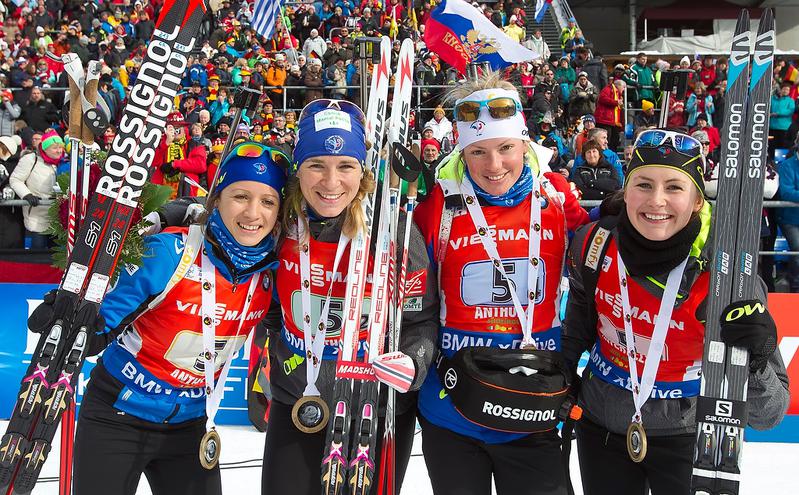
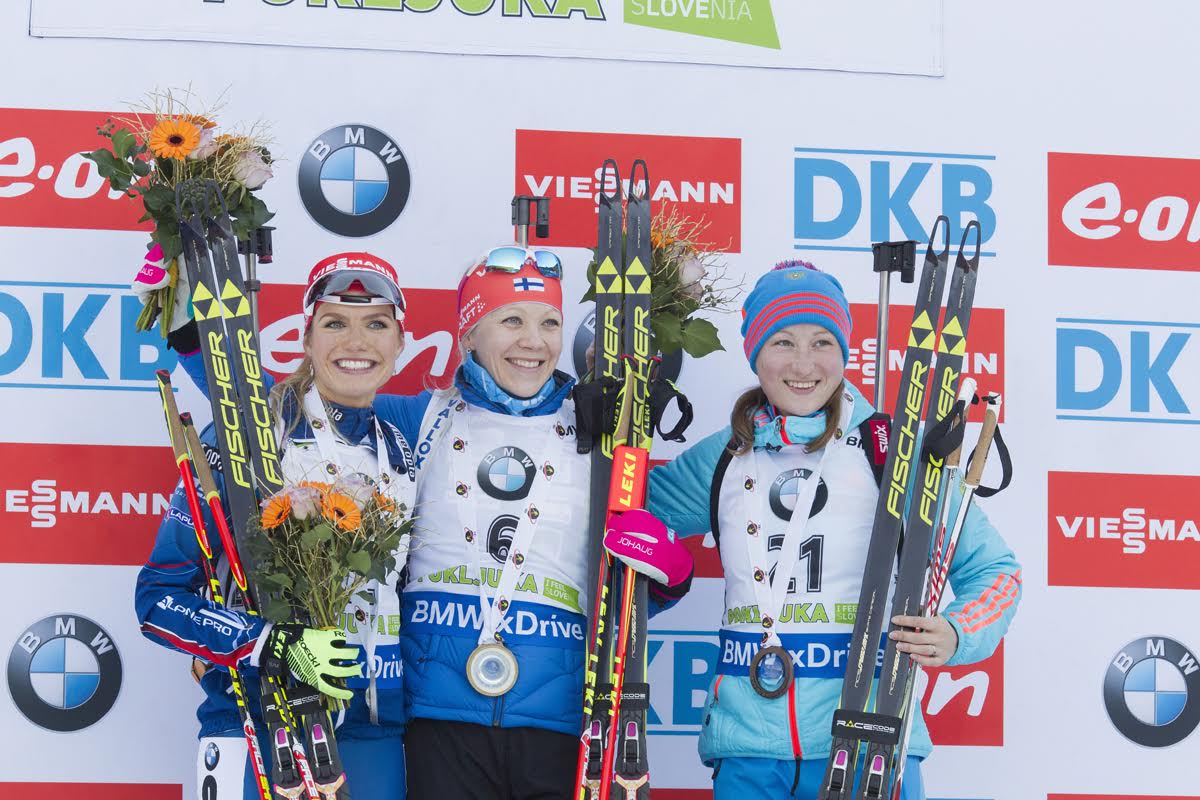
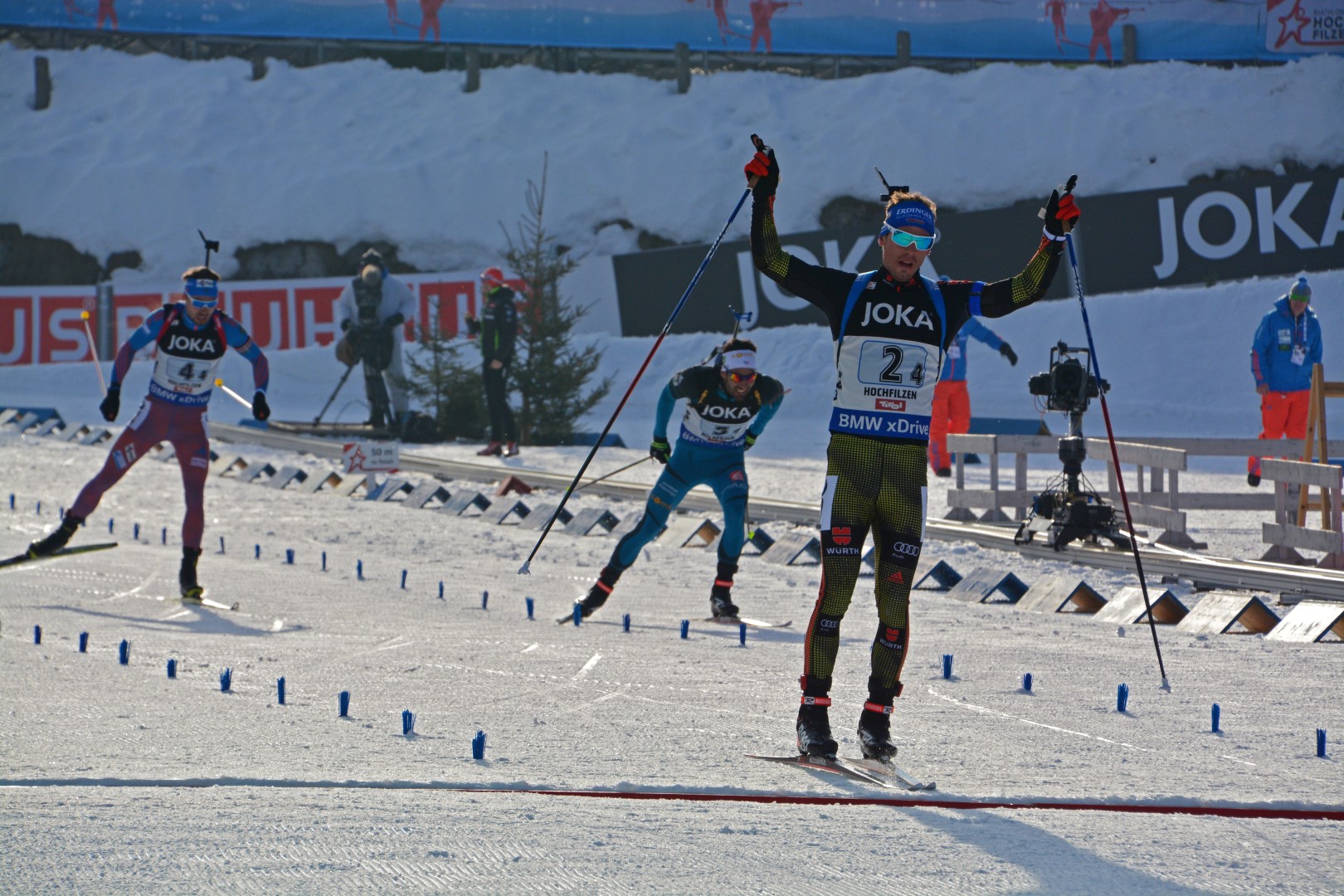
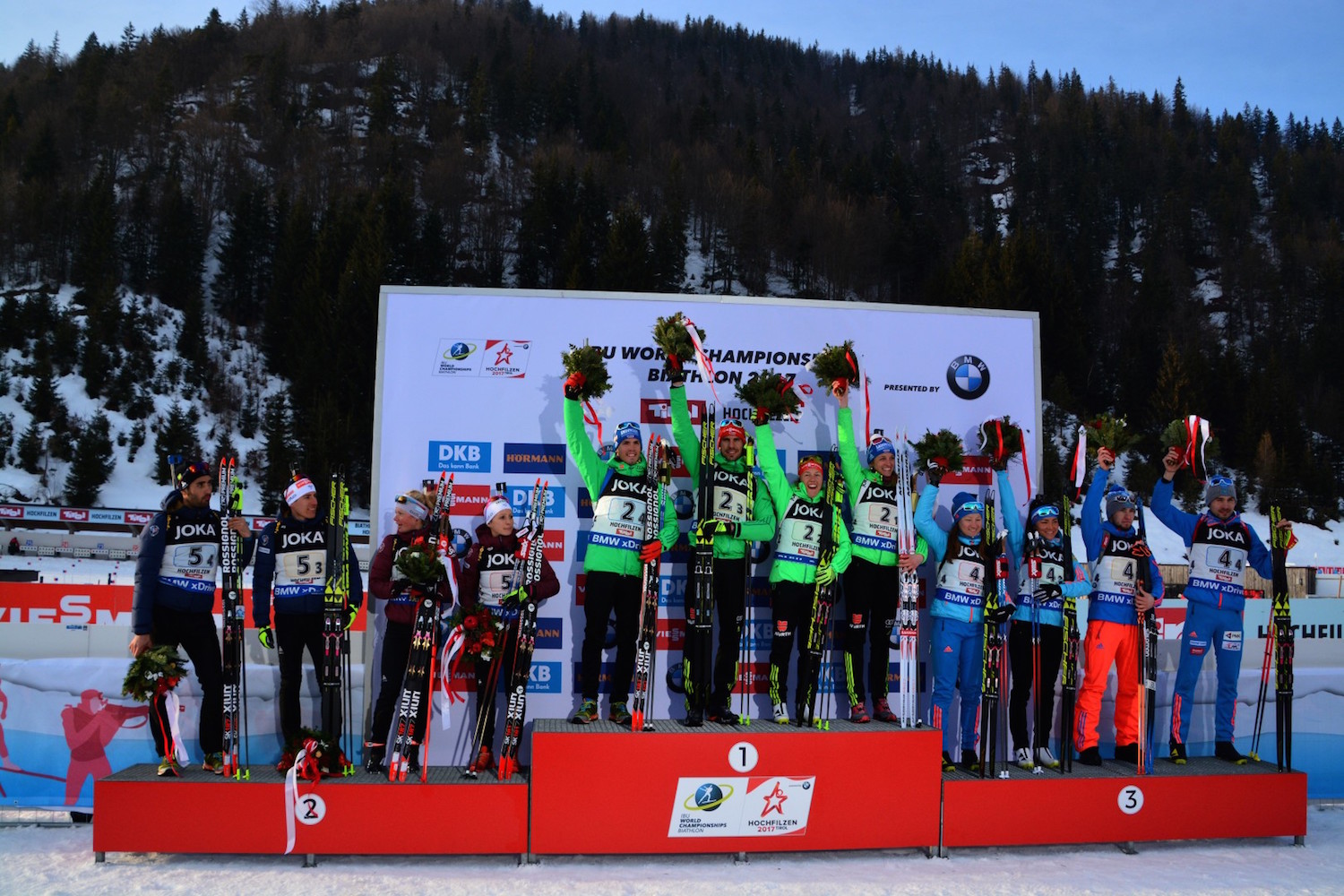
    The mixed relay podium on the opening day of 2017 IBU World Championships in Hochfilzen, Austria, with Germany in first (c), France (with Martin Fourcade at far left) in second, and Russia in third (r). (Photo: Glen Crawford)

    Germany was front and center for the first race of 2017 International Biathlon Union (IBU) World Championships on Thursday in Hochfilzen, Austria, but there was a sideshow that stole a good chunk of the limelight between France (namely Martin Fourcade) and Russia (namely Alexander Loginov).

    The action began with the 2 x 6 + 2 x 7.5-kilometer mixed relay, a co-ed event where teams start women for the first and second legs, followed by men for the third and fourth legs.

    Germany ran away with the lead with a rock-solid performance from third-leg Arnd Peiffer, who cleaned both his prone and standing stages without using any spare rounds, but the team had to credit second-leg Laura Dahlmeier, who built the lead in the first place.

    Dahlmeier, the World Cup Total Score leader, raced from sixth to first after getting the tag from her teammate Vanessa Hinz just 9.8 seconds out of first. Dahlmeier used two spares to clean prone and another two to clean standing, yet she avoided the penalty lap and remained in third for much of her race — behind Italy’s Dorothea Wierer and France’s Marie Dorin Habert.

    As she left the range for the last time and embarked on her last loop, Dahlmeier remained in third, nine seconds behind Wierer in first. Dorin Habert remained on Wierer’s heels, 1.6 seconds back.

    Dahlmeier caught both by the second exchange and tagged Peiffer in first, 0.8 seconds ahead of France and 3.8 seconds ahead of Italy.

    The rest was history as Peiffer extended the gap to 11.1 seconds over Italy’s Lukas Hofer after the first shooting stage on the third leg. With another clean bout one loop later, Peiffer was up to 20 seconds ahead of Hofer, who used one spare in prone and cleaned standing without a miss.

    “After the prone shooting I was alone on the loop, that is a pretty thankless job,” Peiffer told German broadcaster ZDF after. “Then I tried to focus on my tempo, to keep pushing into the standing shooting, and that worked well. But it was not clear to me while on the course that it would work out like that.”
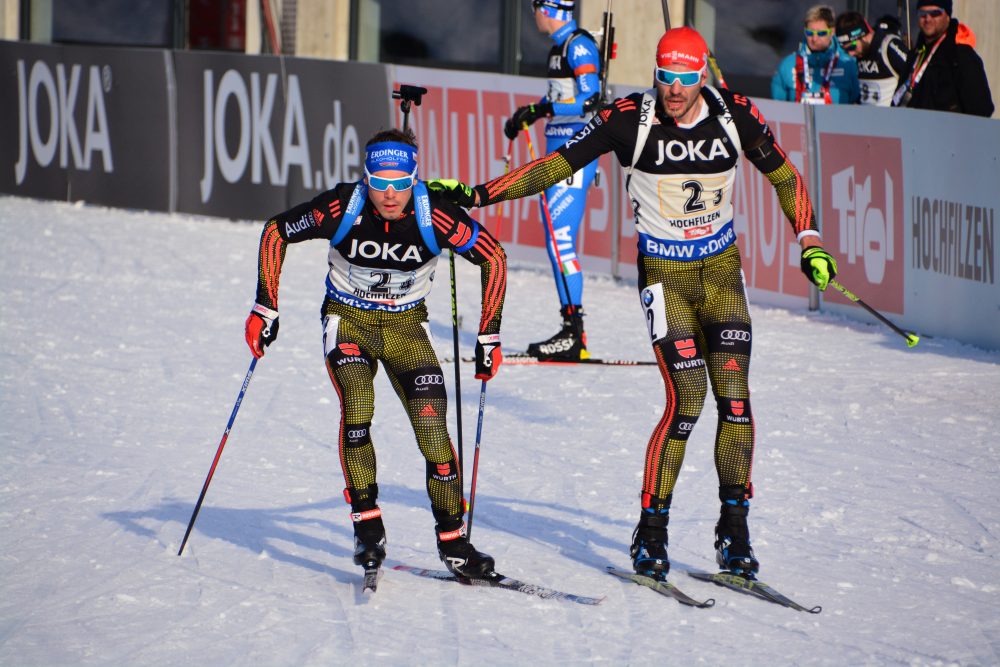
    Germany’s Arnd Peiffer (r) tagging his teammate Simon Schempp during the final exchange of the mixed relay at 2017 IBU World Championships on Thursday in Hochfilzen, Austria. Peiffer tagged in first, and Schempp held the lead through the finish. (Photo: Glen Crawford)

    Peiffer tagged German anchor Simon Schempp 21.2 seconds ahead of Italy’s last leg, Dominick Windisch, and 46.5 seconds ahead of France’s Martin Fourcade in third. Russia entered the final exchange with France, with Loginov tagging Anton Shipulin just 0.9 seconds behind France.

    That’s where things got interesting. Schempp executed as needed to secure the win — cleaning prone without any spares and using just one in standing — and Windisch as his most immediate threat fumbled on the last stage when the he missed two and left the range in fourth, 32 seconds behind Schempp.

    There, Fourcade moved into second with his second-straight flawless stage (0+0, 0+0), 17.9 seconds behind Schempp, and Shipulin remained in third (+18.6) after cleaning both stages as well (0+0, 0+0). Fourcade and Shipulin started the race together and jockeyed between third and fourth for the first two loops, until both moved ahead of Windisch and had the opportunity to battle for second place on the last loop.

    For Fourcade, who had already won 10 races (including relays) this season and entered the World Championships mixed relay as a defending champion with France, it wasn’t so much about the silver. It was about beating Russia.

    As Fourcade and Shipulin descended a downhill together on the last loop, Fourcade took the lead by the bottom and attacked on the long uphill that immediately followed. Shipulin remained on his heels as the two came within view of Schempp, who was skiing what appeared to be a casual pace off the front — although Schempp would later say he was going full speed.

    “I think you could see that they wanted to get back up to [Schempp],” German men’s head coach Mark Kirchner told ZDF of Fourcade and Shipulin on the last loop. “But when they reached the highest point of the course it looked like they rather skied tactically, who becomes second and who becomes third. Then I was sure that this would end well for us.”

    About 100 meters before the finish, Schempp glanced back to see Fourcade and Shipulin charging hard. Schempp appeared unfazed and maintained his pace, holding his arms up to celebrate before he crossed the line first.
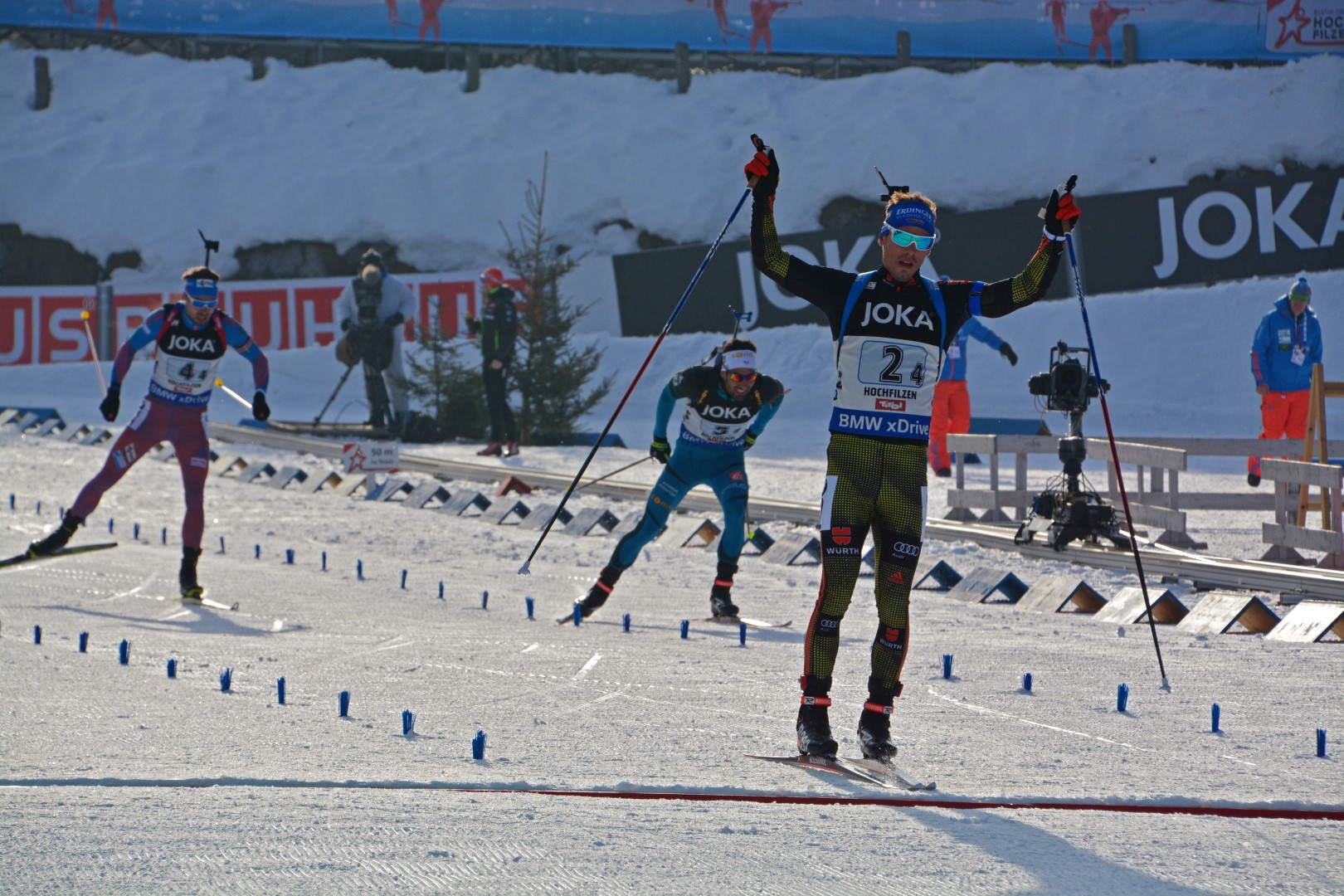
    Germany’s Simon Schempp (2) celebrates his team’s victory in the mixed relay on the opening day of 2017 IBU World Championships in Hochfilzen, Austria, after he held off France’s Martin Fourcade (second from r) in second and Russia’s Anton Shipulin in third. (Photo: Glen Crawford)

    Germany took the relay gold in 1:09.06.4 hours, while Fourcade finished 2.2 seconds later to secure silver for France. One second later, Shipulin anchored Russia to bronze (+3.2).

    “Fourcade really attacked enormously,” German men’s assistant coach Andreas Stitzl told ZDF. “Thank God Fourcade and Shipulin were not totally in agreement, so it went our way.”

    Schempp later said he realized those two were getting closer, “but there was a bit of a buffer,” he told ZDF. “I wasn’t certain, so I still skied full speed … Of course this is an enormously cool start for our team into the World Championships, immediately with a first place. And I think I am speaking for everyone that we are overjoyed.”

    It was the first mixed-relay win for Hinz and Dahlmeier.

    “These are big emotions, winning it all in a team together with the men,” Dahlmeier told ZDF. “I have never won a mixed relay before, and this is only my second one ever. I think this means a lot to the whole team, that we became world champions right in the first race.”

    “I am still a little bit speechless,” Hinz said. “I was very happy that the coaches trusted me with this assignment, and it means quite a lot to me.”

    During the flower ceremony, Germany’s four racers stood on the highest step of the podium. France followed them to the second step, with Anais Chevalier, Dorin Habert, Quentin Fillon Maillet, and Fourcade, and Russia was introduced third, with Olga Podchufarova, Tatiana Akimova, Loginov, and Shipulin.

    As the four Russians approached the French team to shake hands in usual fashion, Fourcade shook the hands of the two women, but did not come in contact with the two men. As Russia proceeded to its spot on the podium, Fourcade clapped sarcastically, then stepped down from the podium and attempted to leave the ceremony. Not long after, he returned, likely having been instructed to.

    “I’m a bit sad,” Fourcade said at the post-race press conference. “I just want to remember that one week ago the president of the Russian federation asked the IBU to take disciplinary sanctions against me because I did a tweet about Loginov and today they decide to not shake my hand on the podium so I’m a bit surprised the president of the Russian federation wants to disqualify his own athletes.”

    While it’s tough to pin down exactly which tweet Fourcade was referring to, he wrote on Twitter, “We didn’t think it was possible so they did it………….” on Wednesday, the day before the opening race of World Championships, likely when he learned Loginov would be starting the relay. Loginov is coming off a two-year ban for EPO use and dominated the competition at last month’s IBU Open European Championships.
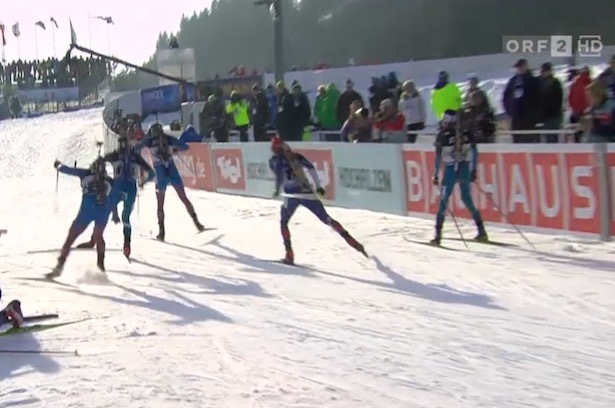
    Russia’s Alexander Loginov (l) takes a tumble after tagging his teammate Anton Shipulin (third from l) in the final exchange of the 2017 IBU World Championships mixed relay in Hochfilzen, Austria. France’s Martin Fourcade (second from l) skated left after getting the tag from his teammate Quentin Fillon Maillet (far r). (Photo: ORF screenshot)

    Whether the Russian men didn’t shake Fourcade’s hand on the podium, or vice versa; whether they were upset about his tweet or the fact that he appeared to go out of his way to trip Loginov in the exchange zone on Thursday (after Loginov had tagged Shipulin right after Fourcade), one thing is clear: there is some definite tension between Fourcade and Team Russia.

    And it’s not all on Fourcade; this has been months in the making after World Cup athletes demanded that the IBU implement stricter anti-doping policies and measures. Fourcade walked out of a meeting last month, telling NRK, “I am pissed off.” The next day, the IBU Executive Board announced it would hold an “Extraordinary Congress” before World Championships to vote on rule changes. The IBU announced the Congress decisions on Wednesday, which included plans to impose higher fines and reduced quotas for nations that violate anti-doping rules. Moreover, 2021 World Championships will not be held in Tyumen, Russia.

    An IBU press release on Thursday didn’t get into details beyond the mixed relay itself: “Today is not the best example of a sprint finish battle that I could have done,” Shipulin said, according to the release. “I hope the rest of the World Championships it will be better.”

    In terms of shooting performance, Russia was the best of the 25-team field with a total of four spares (three of which came on Loginov’s standing stage) and zero penalties. France had eight spares and overcame one penalty (on Fillon Maillet’s standing stage), and Germany used a total of seven spares but avoided the penalty lap.

    “I was expecting us to be in the mix and fight for the medals,” Kirchner told ZDF, “but you can’t plan it working out like this, standing on the first position is always a surprise.”
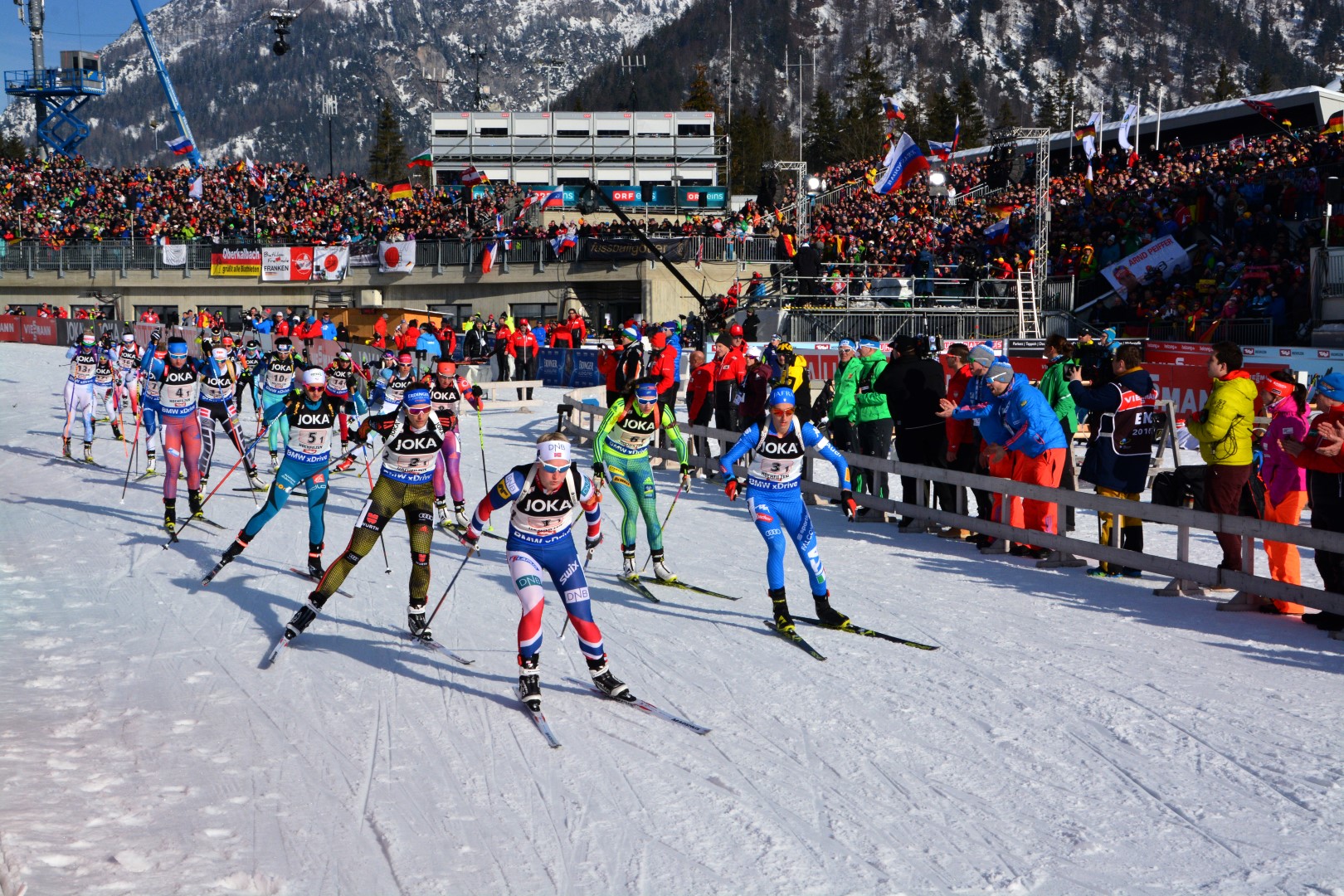
    Norway’s Marte Olsbu (front left) and Italy’s Lisa Vittozzi (front right) leading early in the mixed relay at 2017 IBU World Championships on Thursday in Hochfilzen, Austria. (Photo: Glen Crawford)

    Italy (Lisa Vittozzi, Wierer, Hofer, Windisch) placed fourth, 28.7 seconds out of first and 25.5 off the podium, with six spares and zero penalties.

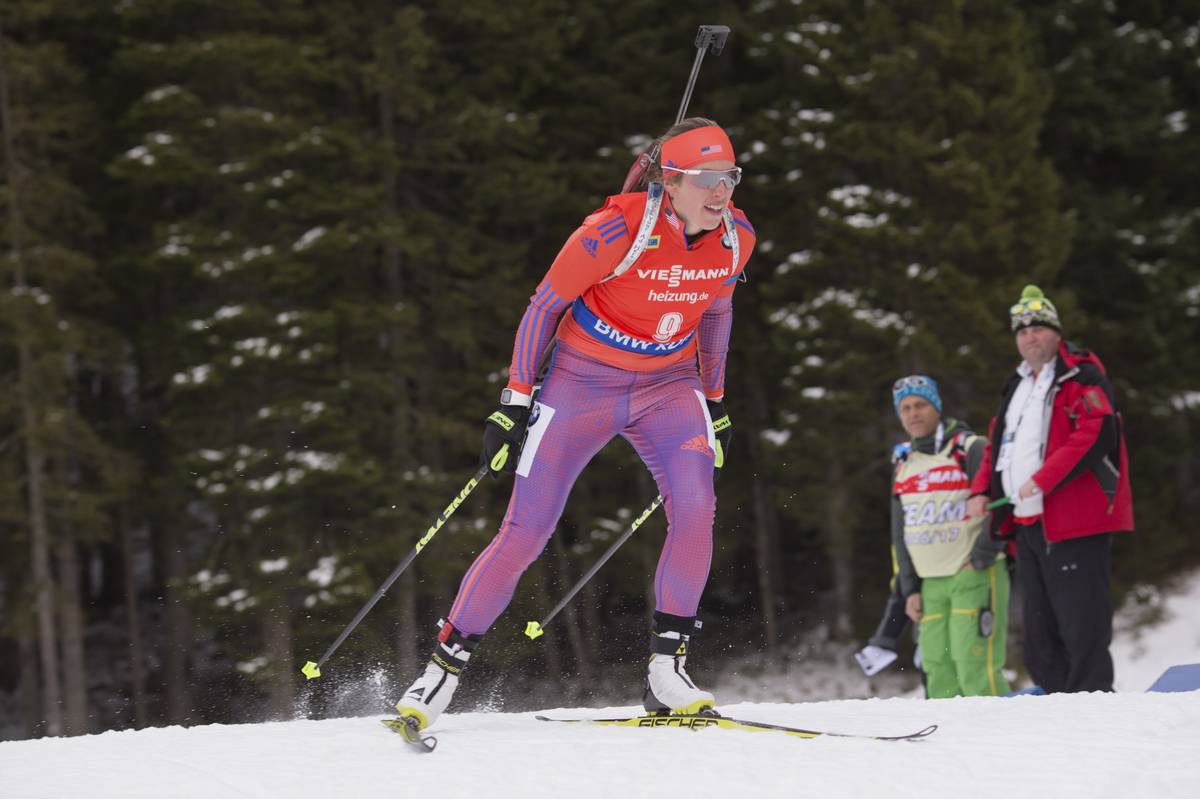
    Vittozzi initially put the team in first at the first exchange, 1.8 seconds ahead of Norway’s Marte Olsbu in second. There, Austria’s Lisa Theresa Hauser followed 5.7 seconds back in third, and American Susan Dunklee was fourth, 7.6 seconds out of first.

    Dunklee used two spares to clean prone and another two in standing (0+2, 0+2), but posted the second-fastest course time of the first-leg skiers to stick with the leaders through the first exchange. While Vittozzi hit all 10 of her targets (0+0, 0+0), Olsbu used a spare (0+1, 0+0) and Hauser required two (0+2, 0+0).

    “It wasn’t overly tricky wind but there is more mental pressure in championship situations,” Dunklee wrote in an email about the conditions and why many of the top racers struggled on the range on Thursday. “The days when it matters most can be the days that it’s hardest to perform normally.”

    She explained that she was disappointed with her shooting percentage but happy with her speed.

    “My skiing feels sharper than it has all year and my body feels ready. That’s a big confidence booster going into the rest of the week,” Dunklee added.
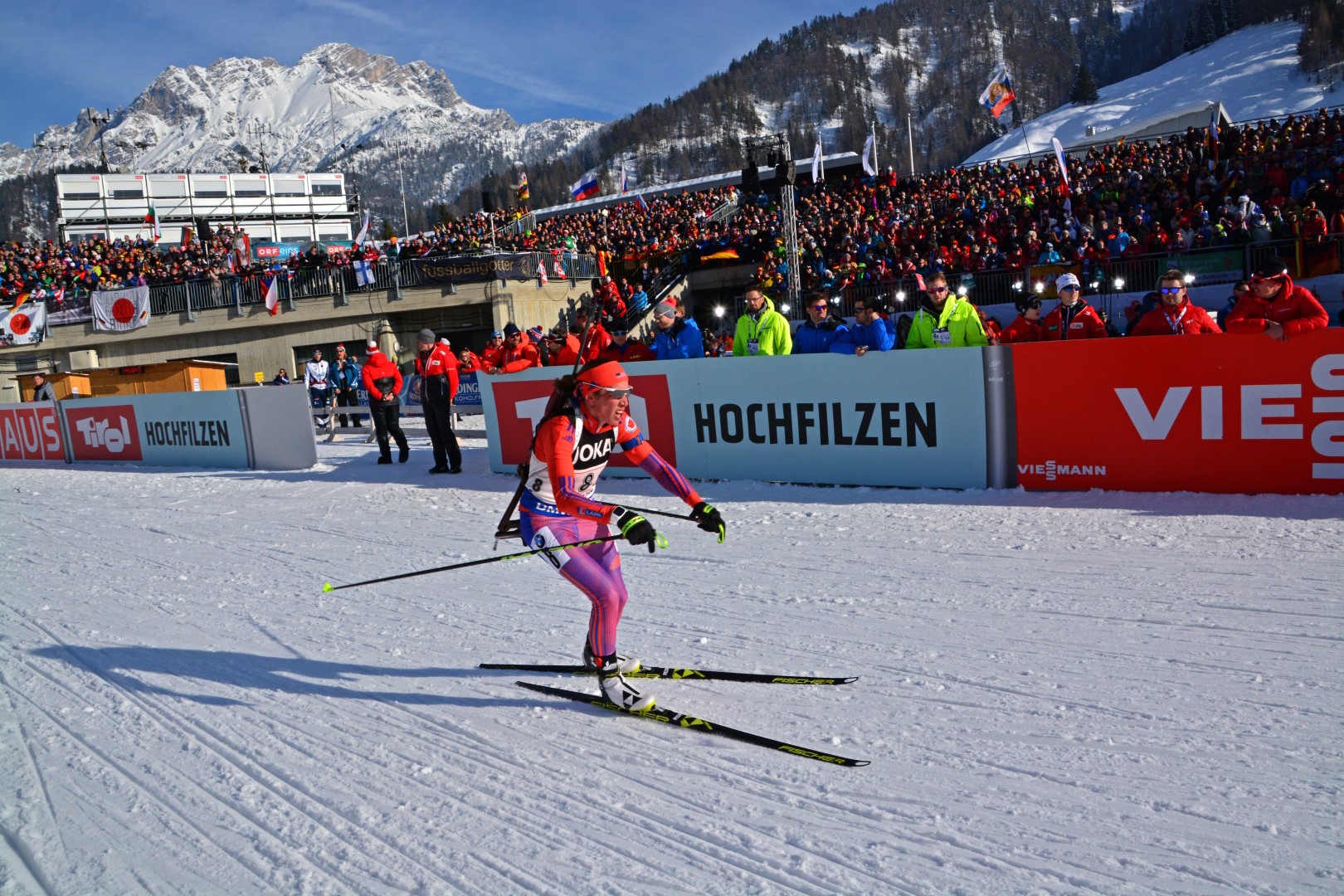
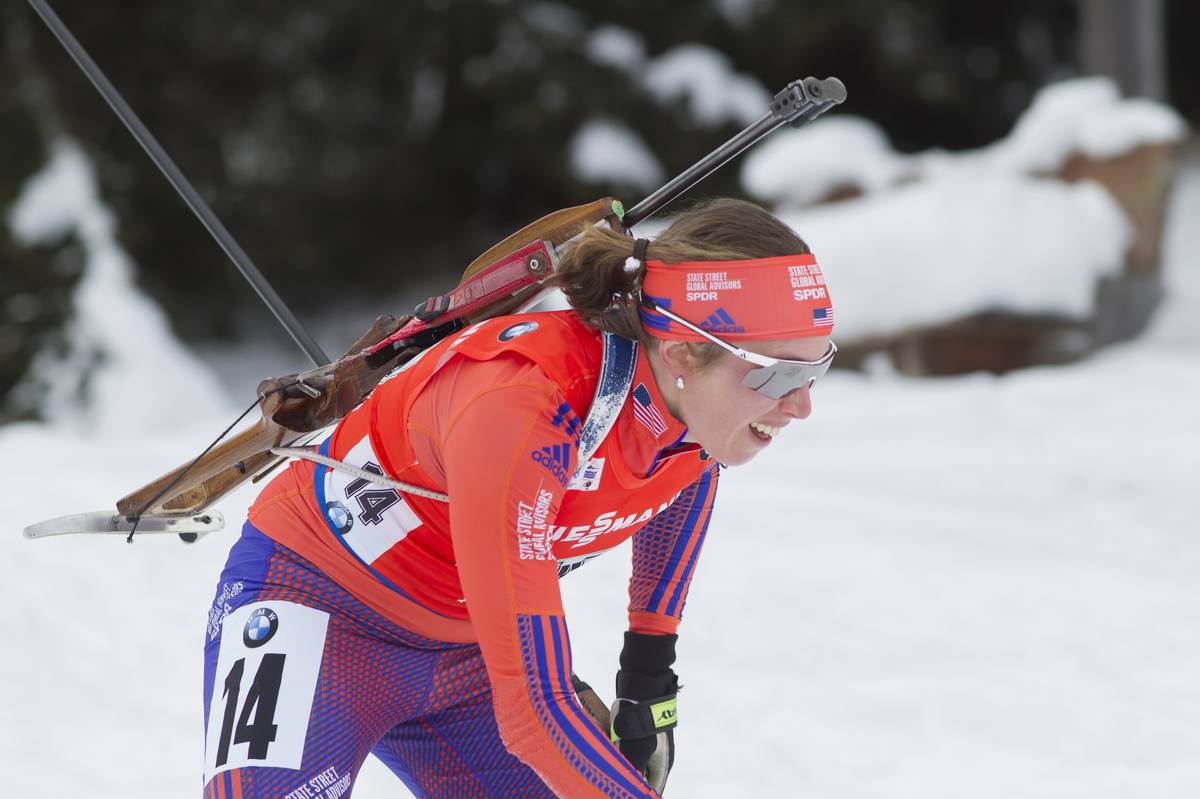
    Susan Dunklee racing the first leg of the 2017 IBU World Championships mixed relay for the U.S. She tagged off in fourth and the U.S. went on to finish 16th. (Photo: Glen Crawford)

    The U.S. finished 16th (+3:20.2), with two penalties and 13 spares. Second-leg Clare Egan remained in the top 10 until her standing stage, where she skied a penalty lap (0+1, 1+3) and slipped to 17th by the exchange, 2:01 minutes out of first. There, Lowell Bailey took over and used one spare in each stage (0+1, 0+1) and skied the sixth-fastest third leg to hand off in 16th, 2:24.2 back. The team’s anchor, Sean Doherty had the team’s second penalty in his prone, but cleaned standing without any spares (1+3, 0+0) to finish 16th.

    “We had a disappointing result as a team, but the Championships are long,” Dunklee wrote. “The most important thing is to take one day at a time and come to the venue fully focused and ready to make the most of each opportunity.”
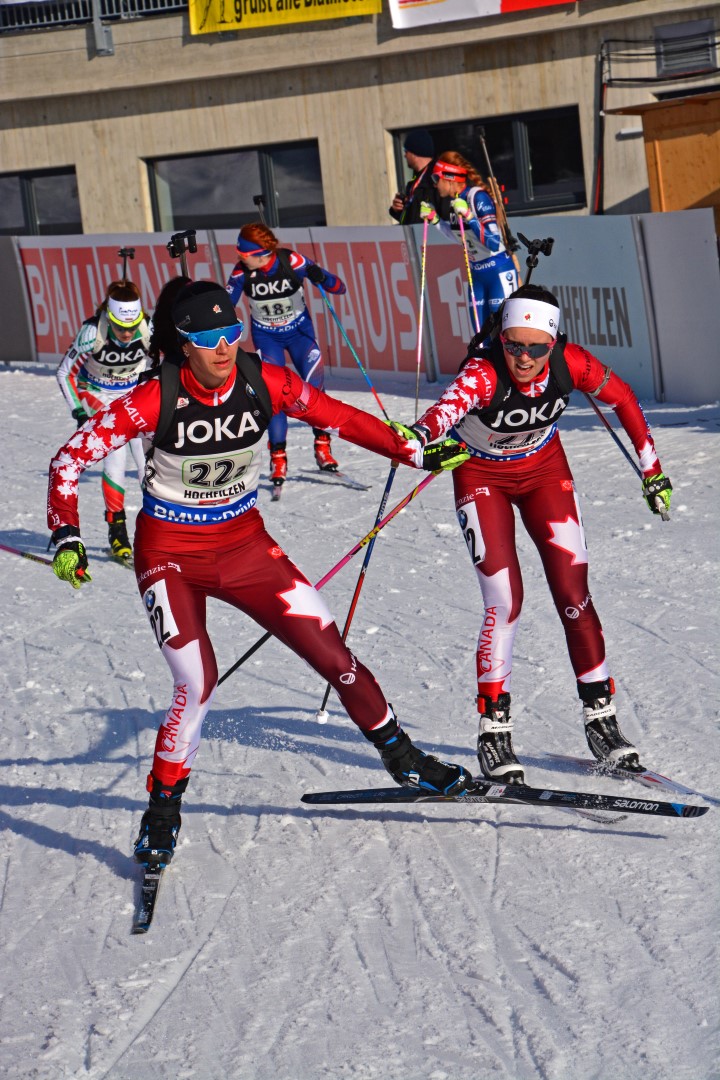
    Canada’s Julia Ransom (r) tagging teammate Rosanna Crawford after the first leg of the mixed relay at 2017 IBU World Championships in Hochfilzen, Austria. Canada went on to finish 13th. (Photo: Glen Crawford)

    Canada finished more than a minute ahead of the U.S. in 13th (+2:18.2), with nine spares and zero penalties. Julia Ransom started the Canadians off and used four spares (0+3, 0+1) to tag Rosanna Crawford in 18th, 59 seconds out of first. Crawford used three spares as well in prone but also avoided the penalty lap, and cleaned standing (0+3, 0+0) to tag her boyfriend Brendan Green in 15th, 1:29 back.

    Green improved one place to 14th, using just one spare in his prone stage (0+1, 0+0) and tagged Scott Gow 2:06.8 out of first. Gow cleaned prone and used one spare in standing (0+0, 0+1) to finish 13th, just 0.6 seconds ahead of Switzerland in 14th.

    “The goal during my leg was to ski hard and push the shooting as much as I could,” Gow wrote in an email.

    Both his shooting and range times were sixth-fastest among the anchor legs.

    “My shooting was good, and all I can attribute it to is my prep the last two weeks,” Gow explained. “Shooting conditions were quite good, a little bit of wind here and there, so the environment wasn’t too much of a factor. I spent the last two weeks adding extra stress to my shooting and making sure all the fundamentals were in place, and that is what helped me today.

    “I’m happy with my race and our team is optimistic for what is to come,” he added. “There were a lot of positives from the past two weeks within the whole team, so there a lot of possibilities.”

    Personally, Gow’s main focus for the championships is the men’s relay after Canada earned a historic bronze in the event at 2016 World Championships.

    “Last year our team had an incredible result in the relay and it would be great to have another awesome team result at these championships,” he wrote. “Aside from the relay, I’m looking most forward to the sprint. I’ve had some great sprints this year and I’d like to continue the good trend.”

    IBU World Championships continue Friday with the women’s 7.5 k sprint at 8:45 a.m. Eastern time. Watch it live on Eurovisionsports.tv.

    Results

    — Harald Zimmer contributed
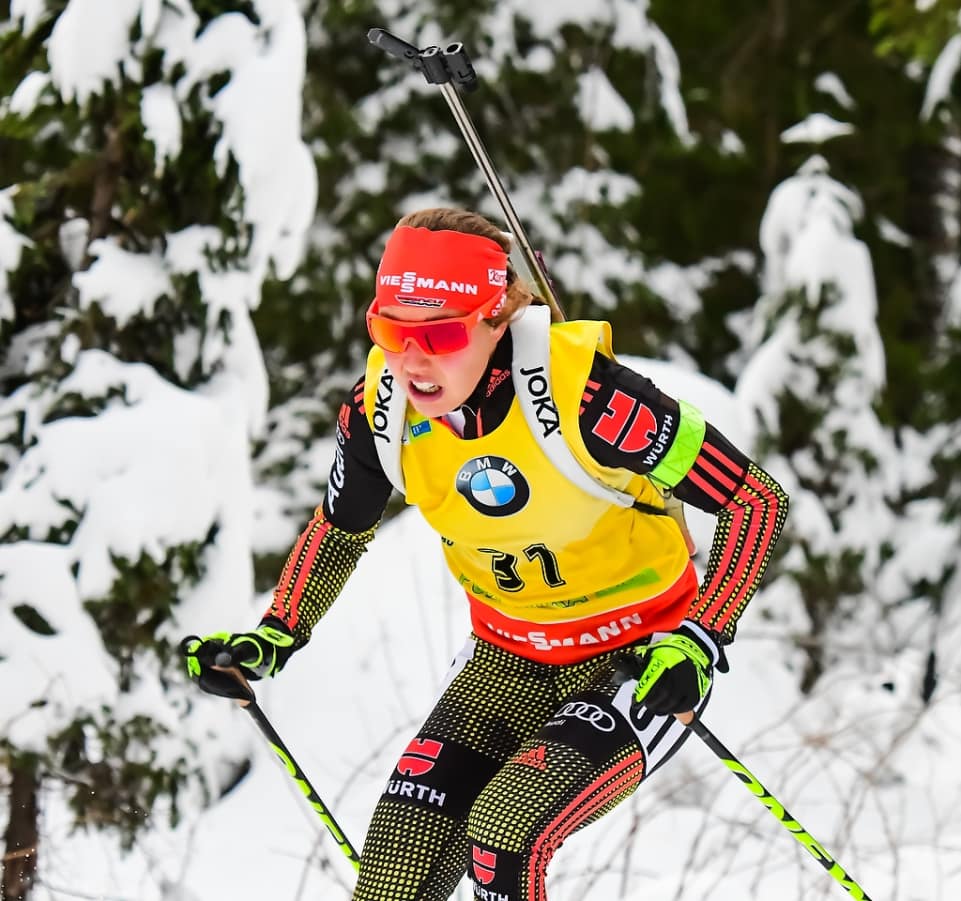
    Scott Gow anchoring Canada to 13th in the mixed relay, the opening race of 2017 IBU World Championships in Hochfilzen, Austria. (Photo: Glen Crawford)
  • Germany Wins at Home in Soccer Arena; Canada Debuts at Schalke

    Germany Wins at Home in Soccer Arena; Canada Debuts at Schalke

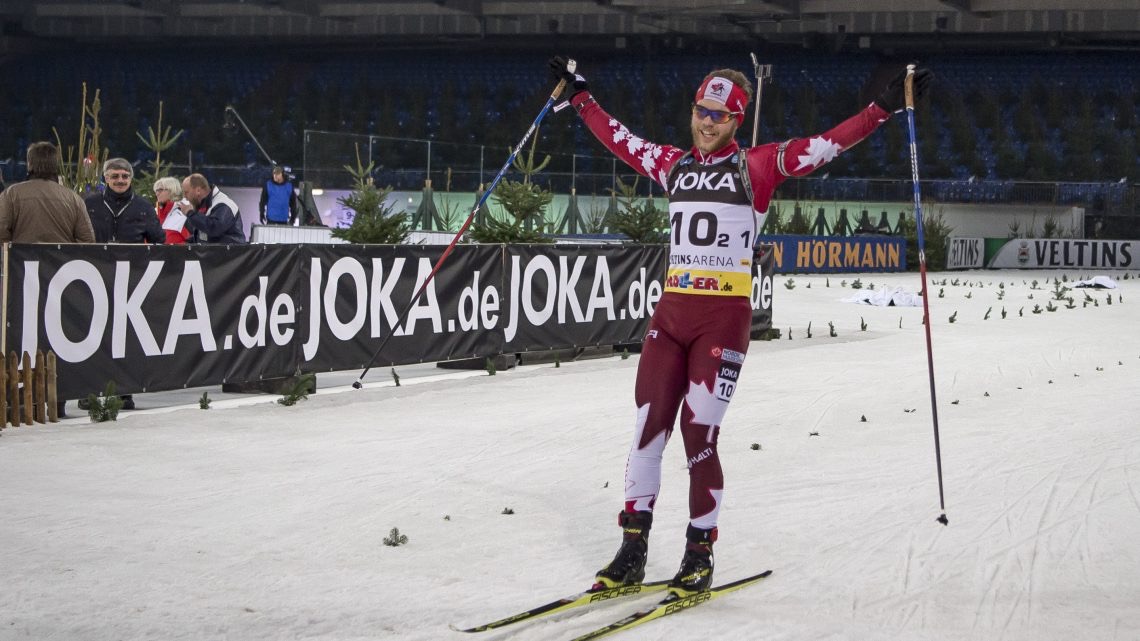
    Canada’s Macx Davies celebrates as he is cheered on by 42,000 fans during the final lap of the 2016 Biathlon auf Schalke invitational race. The Canadian relay team, with his partner Megan Tandy, finished 10th. (Photo: Biathlon-aufschalke.de)
    Canada’s Macx Davies celebrates as he is cheered on by 42,000 fans during the final lap of the 2016 Biathlon auf Schalke invitational race. The Canadian relay team, with his partner Megan Tandy, finished 10th. (Photo: Biathlon-aufschalke.de)

    A biathlon relay with athletes skiing around and through a huge soccer arena in a city with no snow seems like a crazy idea.

    But in the 1990s, the German cross-country skier and biathlete Herbert Fritzenwenger, who had retired from active sports after competing in the 1988 Calgary Olympic Games, believed there had to be some way to make biathlon even more attractive for viewers. He wanted to mix sports and entertainment bringing the sport out of the forest and closer to the people, the way city sprints are now doing it for cross-country. He also believed a discipline where women and men compete together would be more interesting to watch.

    Thus the World Team Challenge was born, a two-person mixed relay invitational, with each team representing a country. In 2002, Frizenwenger took the next step to bring that race to an even higher level of awareness. Together with the then-manager of first-league soccer team Schalke 04, he moved the event to the team’s newly constructed Veltins Arena in Gelsenkirchen, Germany. Only problem: The arena, which features a retractable roof, is located in a flat region of the country far away from any mountain range with predictable snowfall. But using manmade snow from a nearby ski hall to create a course just for this race every year the concept instantly worked, and has drawn some of the biggest crowds for any biathlon event in the world ever since.

    Now in its 15th year, the “Biathlon auf Schalke” race has become a Christmas holiday break tradition on TV in Germany, also broadcast live in several other countries. Many biathletes love the event for its atmosphere in front of 42,000 raucous fans in the arena, and as an interesting way to keep the race shape sharp during the break.

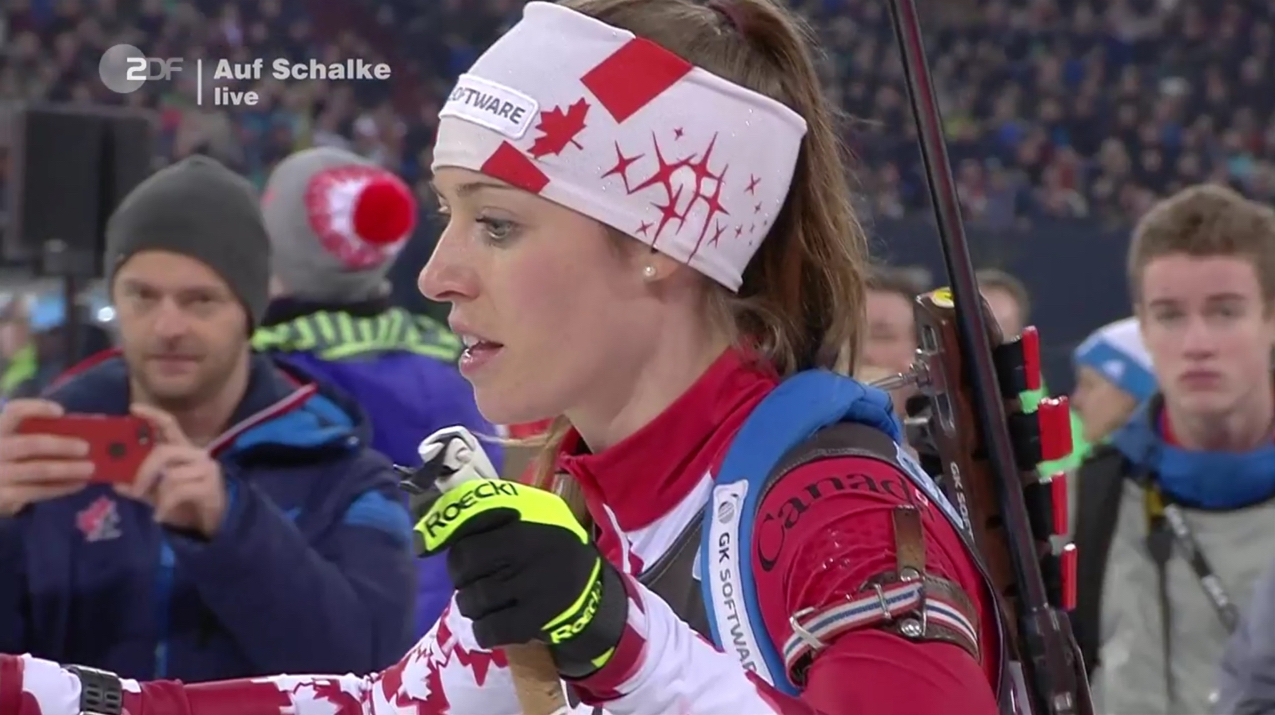
    This year’s edition took place on Wednesday evening, and it was the first time a Canadian relay was at the start, with Megan Tandy and Macx Davies teaming up to represent Canada in a show event that combines a mass start with a pursuit after a short “halftime” intermission.

    In both races, the Canadian pair quickly incurred a number of penalty laps (unlike in other relays the athletes are not allowed to use spares in the fast-paced competition) and slipped to the back of the field of 10 teams, tagging off to the partner after each shooting stage to chase once more over the 1.3-kilometer course around the arena.

    But Davies finished the event to huge cheers, with the audience elated by a victory of the home teams seemingly not wanting the show to be over yet, and screaming until he had crossed the line.

    “The atmosphere was GREAT!!!” Davies wrote in an email to FasterSkier. “Very loud and very fun crowd. They even cheered most of our shootings! (When we were the only ones in the range.) It was amazing to ski through the tunnel the last time to such a big ROAR from the stadium.”

    The arena was rocking particularly loudly as Germany’s fan-favorite Simon Schempp entered the finishing stretch for his first victory at Schalke with his partner Vanessa Hinz, crossing the line in a time of 33:11.4 minutes (with four penalties).

    Originally, the German coaches hadn’t selected Hinz to compete at Schalke, but she replaced her sick teammate, Franziska Preuss, to team up with Schempp. Last year, Hinz and Schempp had placed third in the World Team Challenge, with Hinz also subbing in at the last moment. This year, it was their time on the top of the podium.

    “Yeah, this is pretty crazy,” Schempp told German TV broadcaster ZDF after the race, in an interview that was heard throughout the arena. “That must be how soccer players feel every week. The atmosphere is gigantic. This is much more extreme than in a biathlon arena because there is a roof. I don’t know how many exactly, but I believe 40,000 people are here and it’s just crazy fun. [Cheers in the arena] You can hear it, craziness.”

    The announcer asked Hinz how she stayed so calm in front of her home crowd on the shooting range.

    “That’s what we do all year, but in front of such an audience your knees get weak,” she said. “It’s just brutal. We just want to say many thanks, because to experience something like this is unique.”

    The audience in the arena was happy to hear that, erupting in huge cheers again. Germany last won the event in 2013 with Laura Dahlmeier and Florian Graf. Dahlmeier, the current women’s overall IBU World Cup leader, took a break this year, as did the defending World Team Challenge champions Marie Dorin Habert and Martin Fourcade of France.

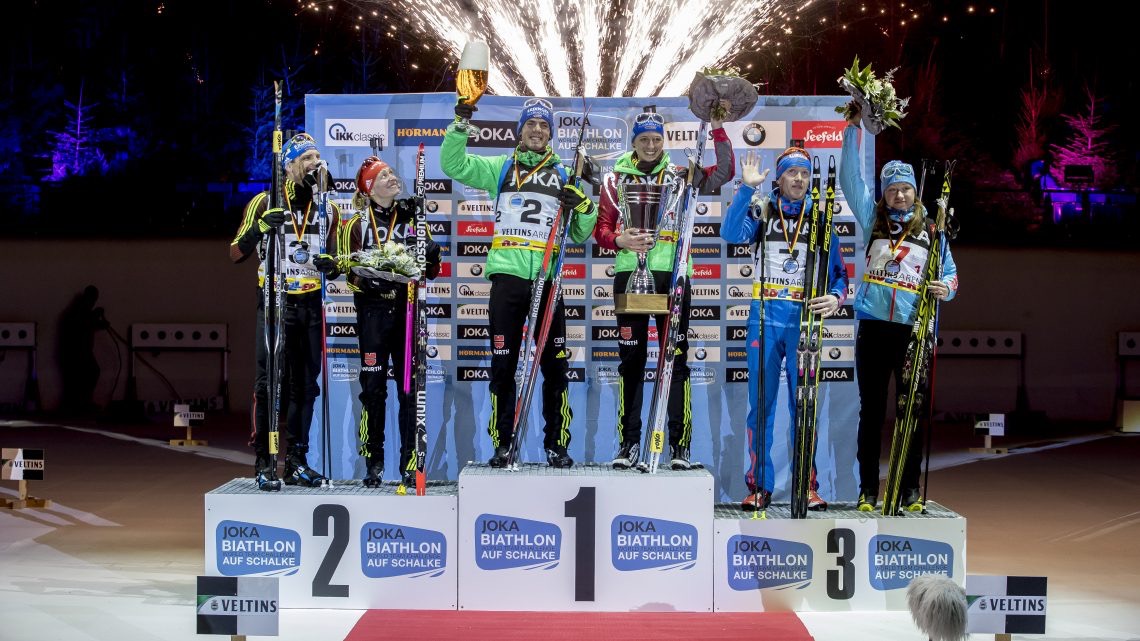
    The 2016 Biathlon auf Schalke podium on Wednesday night, with (from left to right) Germany’s Erik Lesser and Franziska Hildebrand (second place), Germany’s Simon Schempp and Vanessa Hinz (first place), and Russia’s Olga Podchufarova and Alexey Volkov (third place). (Picture: Biathlon-aufschalke.de)
    The 2016 Biathlon auf Schalke podium on Wednesday night, with (from left to right) Germany’s Erik Lesser and Franziska Hildebrand (second place), Germany’s Simon Schempp and Vanessa Hinz (first place), and Russia’s Olga Podchufarova and Alexey Volkov (third place). (Photo: Biathlon-aufschalke.de)

    Despite usually entering multiple teams at Schalke, Germany had not been able to claim first and second on the podium — until this year, which sent the arena into frenzy.

    For Germany’s second team, Franziska Hildebrand teamed up with Erik Lesser for the second-straight year after the duo finished seventh in 2015. They came close to the overall victory this time, winning the mass start by 15 seconds ahead of Hinz and Schempp, and later staying in their vicinity throughout the pursuit. But Lesser missed his final standing shot when he still had a small chance to catch up to Schempp in first.

    “Of course [the atmosphere] is pushing me,” Hildebrand had told ZDF at halftime, after the mass start. “It’s such an incredible audience. It’s so beautiful when you come into the arena as a German athlete and experience such a loud support. That is always a total buzz, a breathtaking moment.”

    On the first loop of the pursuit Lesser broke his pole after stepping on it, and did not receive a replacement until after the exchange to Hildebrand.

    “For the shooting I don’t need a pole, and afterwards that half-a-second I lost I can deal with that, before someone runs over and probably breaks his foot,” he told ZDF after the race, causing a big laughter in the arena. “Such a great atmosphere. The spectators are really picking it up. And that’s why I am here.”

    At times more than a minute ahead of the field, the German teams made the race relatively close again with two laps to go, when standing next to each other both Hinz and Hildebrand shot two penalties despite their otherwise almost-flawless shooting performances.

    The third place on the podium went to Russia’s Olga Podchufarova and Alexey Volkov (who won gold with the men’s relay at the 2014 Olympics), narrowly edging out France’s Anaïs Bescond and Jean-Guillaume Béatrix (+42.6), Austria’s Julia Schwaiger and Simon Eder (+43.0) and Norway’s husband-and-wife team of Fanny Horn Birkeland and Lars Helge Birkeland (+43.3) on the final loop and finishing sprint.

    Long Day on a Challenging Course

    Originally, Tandy — who trains and lives in Germany for part of the year — had planned on racing with Biathlon Canada teammate Nathan Smith, but Smith returned to Canada after struggling in the initial World Cup races of the season with unclear symptoms, which he has since been trying to resolve.

    “After Nathan went home I was talking with Megan and [coach] Matthias Ahrens about if it would be possible to race,” Davies explained. “Because I have been watching this race for a long time now and always thought it would be an awesome event to compete at, which it is! So I changed my plans so we could start an all-Canadian team and I am very happy to have raced the World Team Challenge!”

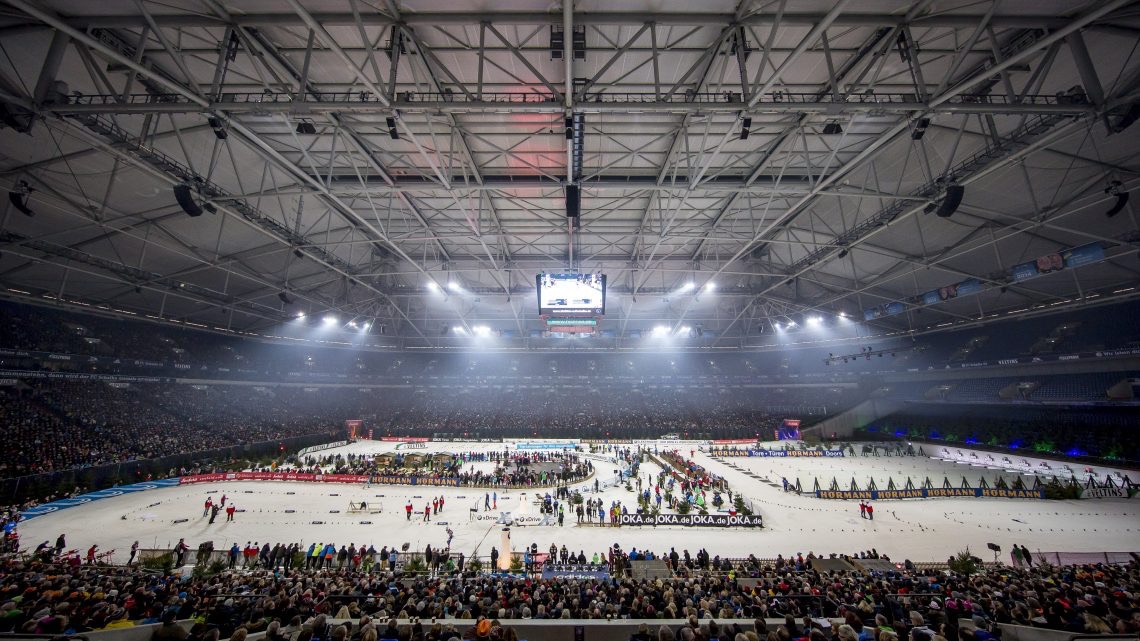
    View of the indoor section of the ski track and the shooting range inside the domed Veltins Arena during the 2016 Biathlon auf Schalke invitational. (Photo: Biathlon-aufSchalke.de)
    View of the indoor section of the ski track and the shooting range inside the domed Veltins Arena during the 2016 Biathlon auf Schalke invitational. (Photo: Biathlon-aufSchalke.de)

    Even more so than a regular IBU World Cup, the race is held in a huge party atmosphere, with athletes skiing through a winter village park with food stands and sponsor exhibition tents lining the artificial snow track around the huge soccer arena, before entering the pitch inside the arena again via a darkened tunnel with light effects. And then having to shoot in front of the 42,000 fans, frequently with loud music blaring, and the noise level amplified indoors many times.

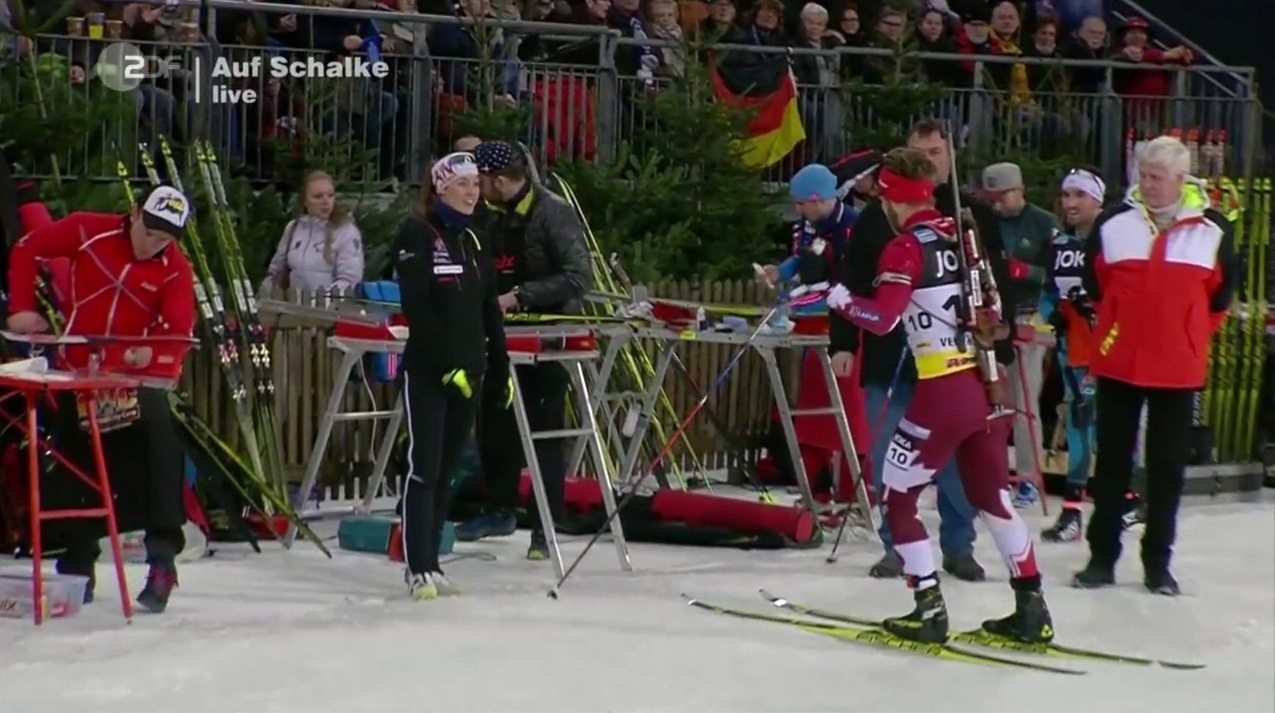
    The World Team Challenge relay race is also executed in a special format, with one woman and one man forming a team and exchanging repeatedly, each skiing a loop of about 1.3 k and having to clean a shooting stage — or ski a shorter-than-usual 75-meter penalty lap — before tagging off to their teammate again. While one athlete was out on the track, crews of wax technicians hurried to clean and prepare the skis of the athlete who was receiving a short break. This mode of competition is fairly similar to the new single mixed relay in biathlon or the team sprint in cross-country.
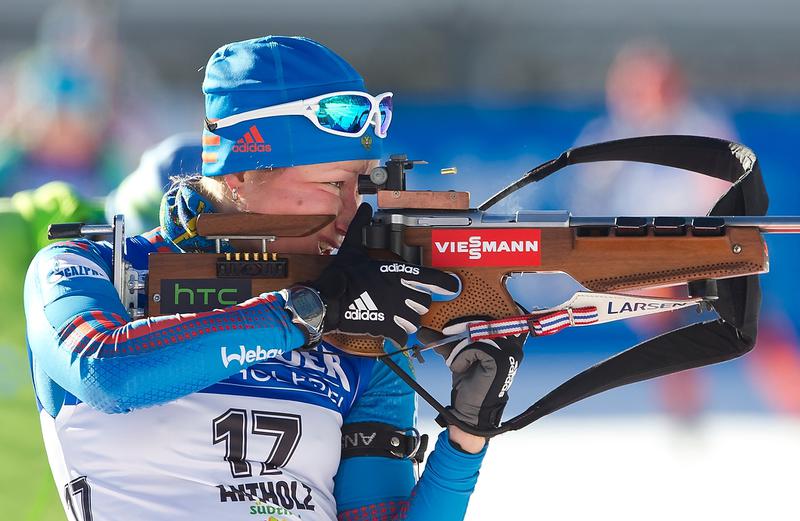
    It was a long race day for the athletes, with a “shootout” followed by the main event split into two “halftimes,” as the organizers called it, borrowing the terms from soccer. At first a nine-loop mass start (the women skied four loops, the men five including the final loop) on the 1.3 k course, followed by a pursuit race of that same length after just a short intermission. Thus the women had to ski about 10 k in total, while the men had to ski 13 k.

    The gaps to the best team in the mass start were halved respectively, capped at a maximum of 45 seconds for the pursuit, so even the teams at the back of the field like Canada could still have a realistic shot at the podium.

    Prone and standing stages interchanged with each partner shooting twice in prone and twice in standing per race, and because the loops were comparatively short and intense, like a sprint, shooting accuracy was at least as important as in regular World Cup races.

    “I really like the format of this race, and think maybe it should replace the Single Mixed relay,” Davies explained in his email. “But maybe only race once, doing both was very challenging. But it is a fun event nonetheless!”

    In the first few years of the Biathlon auf Schalke event, the course was a relatively flat loop, but after a redesign last year added longer climbs and a downhill section on the part of the track that meanders through the park outside the arena, it is supposed to more closely resemble what athletes would see “on the World Cup level,” as the organizers announced in a presentation before the race.

    Using artificial snow mostly coming from a ski hall in the nearby city of Neuss, every loop is now 1,300 meters long, featuring 30 meters of vertical climb nicknamed the “Ruhrpott Glacier”, which added up to about 300 meters for the men and 240 for the women for the whole race day.

    “It’s really not just a show race,” Schempp told broadcaster ZDF. “The legs are really burning very much. Because you have those short individual loops, but that just makes it even worse because you just ski that kilometer even faster than at normal competition speed. And because of that it is really challenging, but still is a lot of fun.”

    “The course is really good for what they have,” Davies wrote in his email. ”The stadium is exciting with all the corners and I think the track is decently difficult, though below World Cup level. I think they did a better job on the downhill corner this year, because it was easier to ski, the athletes don’t like to see crashes.”

    The athletes had fewer problems with that downhill section leading into a sharp-right hairpin turn than during the prior year when that was introduced, but the Czech Republic’s defending World Cup winner Gabriela Koukalová fell this year, grimacing and rubbing her thigh as she got back up. She finished seventh with her partner, Michal Šlesingr, after placing second with Ondrej Moravec in 2015.

    “We just saw [a replay of] Gabriela slipping out there,” Hildebrand told ZDF when questioned about her more conservative downhill snowplow technique. “I wanted to avoid that at all costs, so I chose the safety version.”
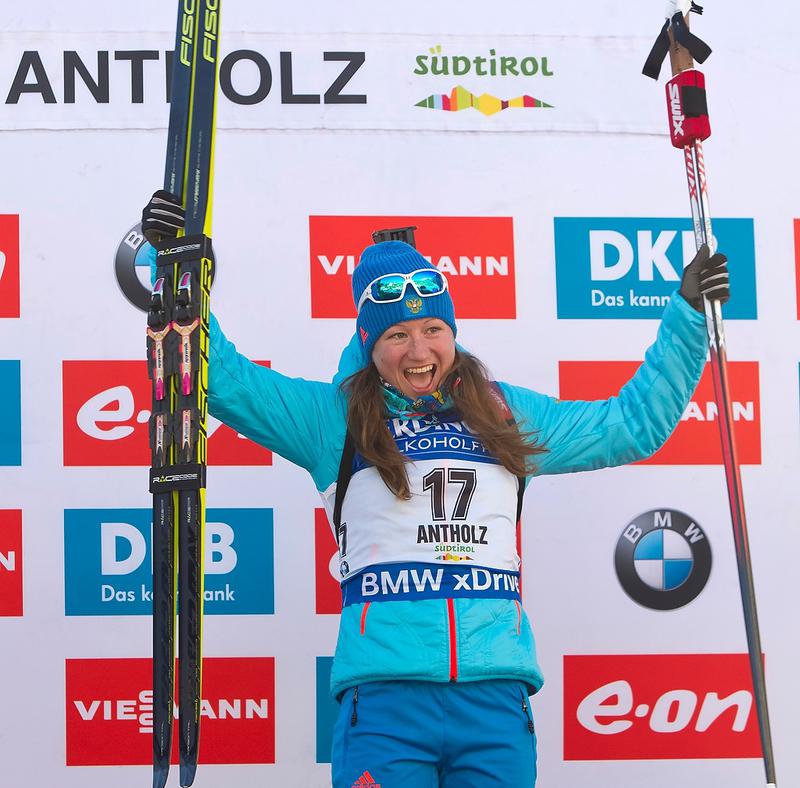
    After some years where the organizers experimented with rifles using a laser-aiming system, the athletes now use their own rifles with real ammunition on the 10-position range again, with bulletproof glass walls and an empty section behind it to protect the audience.
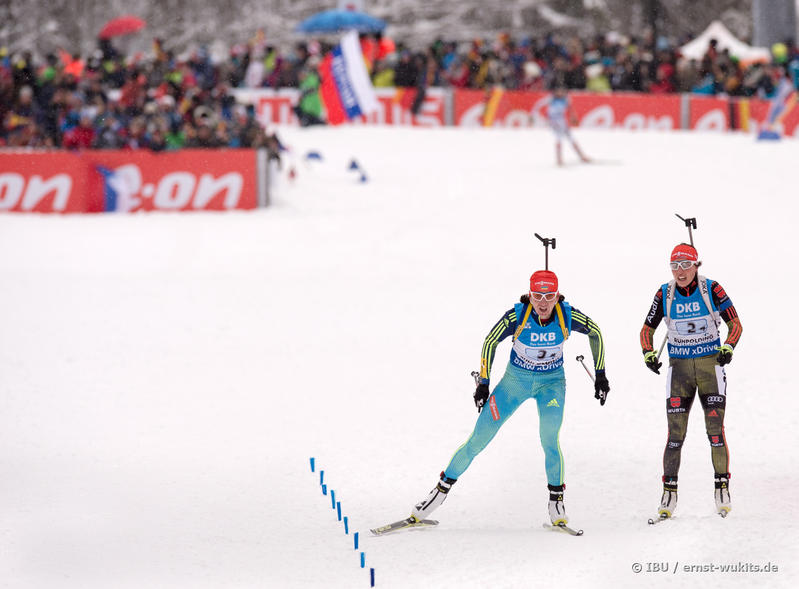
    The difficulty of the course was once again evident during the races. Despite the indoor shooting range with almost no wind influence, many athletes who are known as good shooters incurred more misses and thus had to skate more penalty loops than they normally would in a World Cup.

    “The shooting range was good, no wind, which is nice, but you are skiing very hard into the range and must shoot fast and accurately to stay with the leaders,” Davies commented.

    2016 World Team Challenge Results 

    1. Germany I (Vanessa Hinz/Simon Schemp) 33:11.4
    2. Germany II (Franziska Hildebrand/Erik Lesser), +16.7
    3. Russia (Olga Podchufarova/Alexey Volkov), +40.2
    4. France (Anaïs Bescond/Jean-Guillaume Béatrix), +42.6
    5. Austria (Julia Schwaiger/Simon Eder), +43.0
    6. Norway (Fanny Horn Birkeland/Lars Helge Birkeland), +43.3
    7. Czech Republic (Gabriela Koukalová/Michal Šlesingr), +57.6
    8. Italy (Dorothea Wierer/Dominik Windisch), +1:06.1
    9. Ukraine (Olena Pidhrushna/Serhiy Semenov), +1:20.0
    10. Canada (Megan Tandy/Macx Davies), +2:32.0
    Canada’s Megan Tandy at the start of the pursuit race during the 2016 Biathlon auf Schalke invitational event. (Photo: ZDF broadcast)
    Canada’s Megan Tandy at the start of the pursuit race during the 2016 Biathlon auf Schalke invitational event. (Photo: ZDF broadcast)

    Tandy and Davies became the fifth North American team to be invited to the Biathlon auf Schalke event, and the first Canadian one. In 2008 and 2009, Lanny Barnes and Jay Hakkinen represented the U.S., placing ninth and sixth for the best finish by a North American team to-date. In 2010, Tracy Barnes-Coliander and Tim Burke finished 10th, and in 2012, Susan Dunklee teamed up with Burke for 10th.

    “What a fun event last night,” Davies summed up his experience on his Facebook page. “I am very thankful to have been able to compete in the Biathlon World Team Challenge and I hope to be invited back to show you how good Canada can be! (Unfortunately we didn’t do very well this time…) Till next year.”

    “I second everything Macx wrote ☺ ☺ ☺,” Tandy commented on his status.

    Pre-Race Events with a Farewell to a Former World Champion

    Before the two main races of the evening, Russia’s Volkov won a “shootout” event among all participating women and men, narrowly edging out Austria’s Eder, who is known for his fast shooting performances on the World Cup circuit, with Germany’s Hildebrand finishing third and Schempp fourth. Tandy and Davies had not qualified for the final of that event.

    In this competition the athletes — while not wearing skis — were required to run up to the shooting mats and hit 20 targets as fast as possible (5 prone, 5 standing, 5 prone, 5 standing), using as many spare rounds as necessary.

    The organizers also used the shootout event as a farewell to Germany’s national team member Daniel Böhm, men’s relay gold medal winner at the 2015 World Championships in Kontiolahti, Finland, and silver medalist in the relay at the 2014 Olympics in Sochi, who announced his retirement from biathlon earlier this month. He qualified for the final round of the shootout, where he finished fifth. Böhm plans to begin a training program to become a helicopter pilot with the German federal police.

    “In the shootout I was a little bit shaky,” Böhm told ZDF. “It is something very special to compete here at Schalke. And I think there is nobody who can completely tune this out. It’s crazy what the fans are doing here, and great that I am allowed to say goodbye on this stage. That is a special honor, and now I can enjoy it looking on from the outside.”

    While the IBU has adopted the mixed and single mixed relay formats in the last years as attractive new disciplines, Biathlon auf Schalke is an invitation-only race not hosted by the IBU, so there were no World Cup points to win in the event. However about €168,000 ($175,000 dollars) in prize money were awarded.

    The IBU World Cup will resume next week Jan. 5-8 in Oberhof, Germany, with sprint races, pursuits and mass starts.

    Canada Biathlon’s Megan Tandy (in black) greets her relay partner Macx Davies in the tech service area after the mass start race during the 2016 Biathlon auf Schalke invitational event. (Photo: ZDF broadcast)
    Canada Biathlon’s Megan Tandy (in black) greets her relay partner Macx Davies in the tech service area after the mass start race during the 2016 Biathlon auf Schalke invitational event. (Photo: ZDF broadcast)
  • Despite Placing 11th in Pokljuka, Dunklee Calls It ‘A Sad, Sad Day’

    Despite Placing 11th in Pokljuka, Dunklee Calls It ‘A Sad, Sad Day’

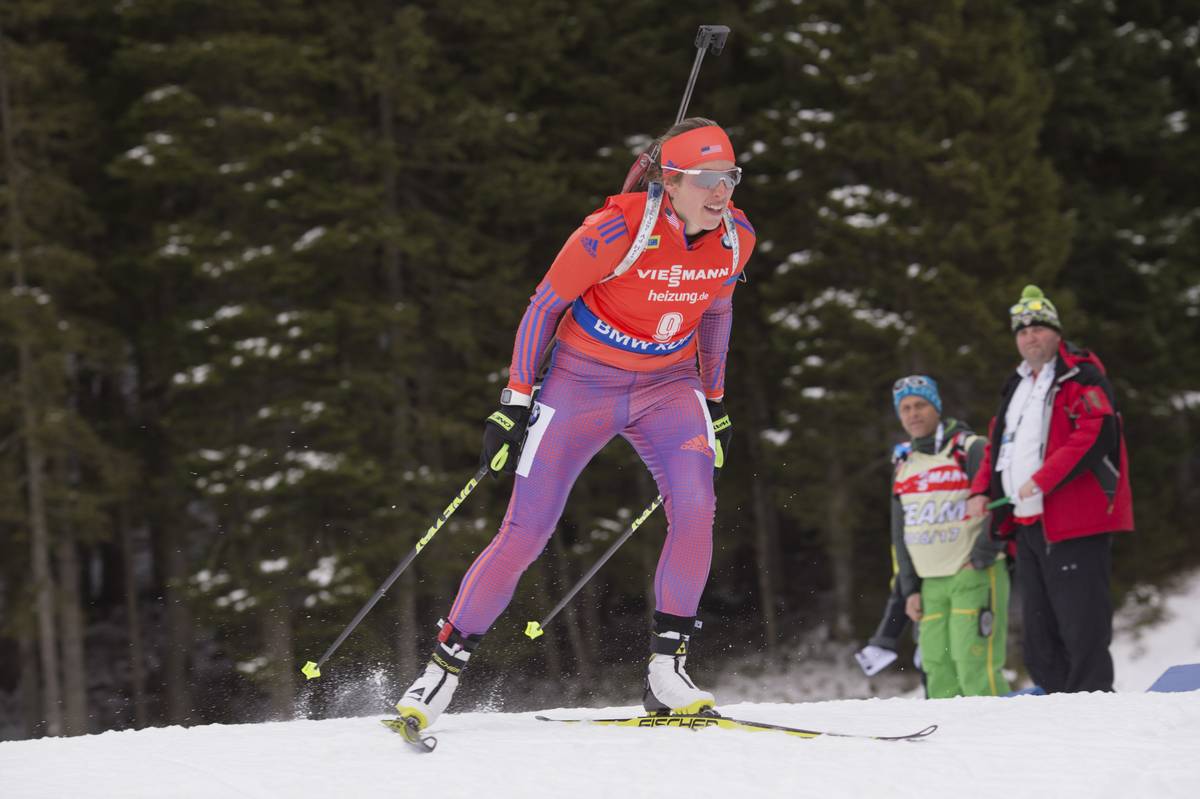
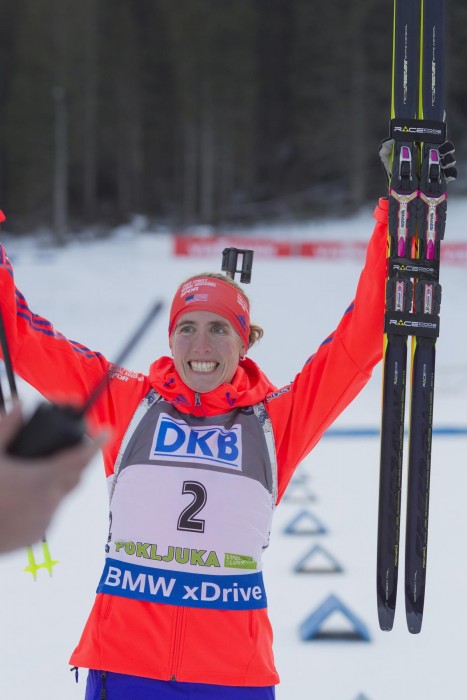
    US Biathlon's Susan Dunklee, an early starter in bib 9, racing to an early lead in Friday's 7.5 k sprint at the IBU World Cup in Pokljuka, Slovenia. She ended up 11th with clean shooting for a season best. (Photo: USBA/NordicFocus)
    US Biathlon’s Susan Dunklee, an early starter in bib 9, racing to an early lead in Friday’s 7.5 k sprint at the IBU World Cup in Pokljuka, Slovenia. She ended up 11th with clean shooting for a season best. (Photo: USBA/NordicFocus)

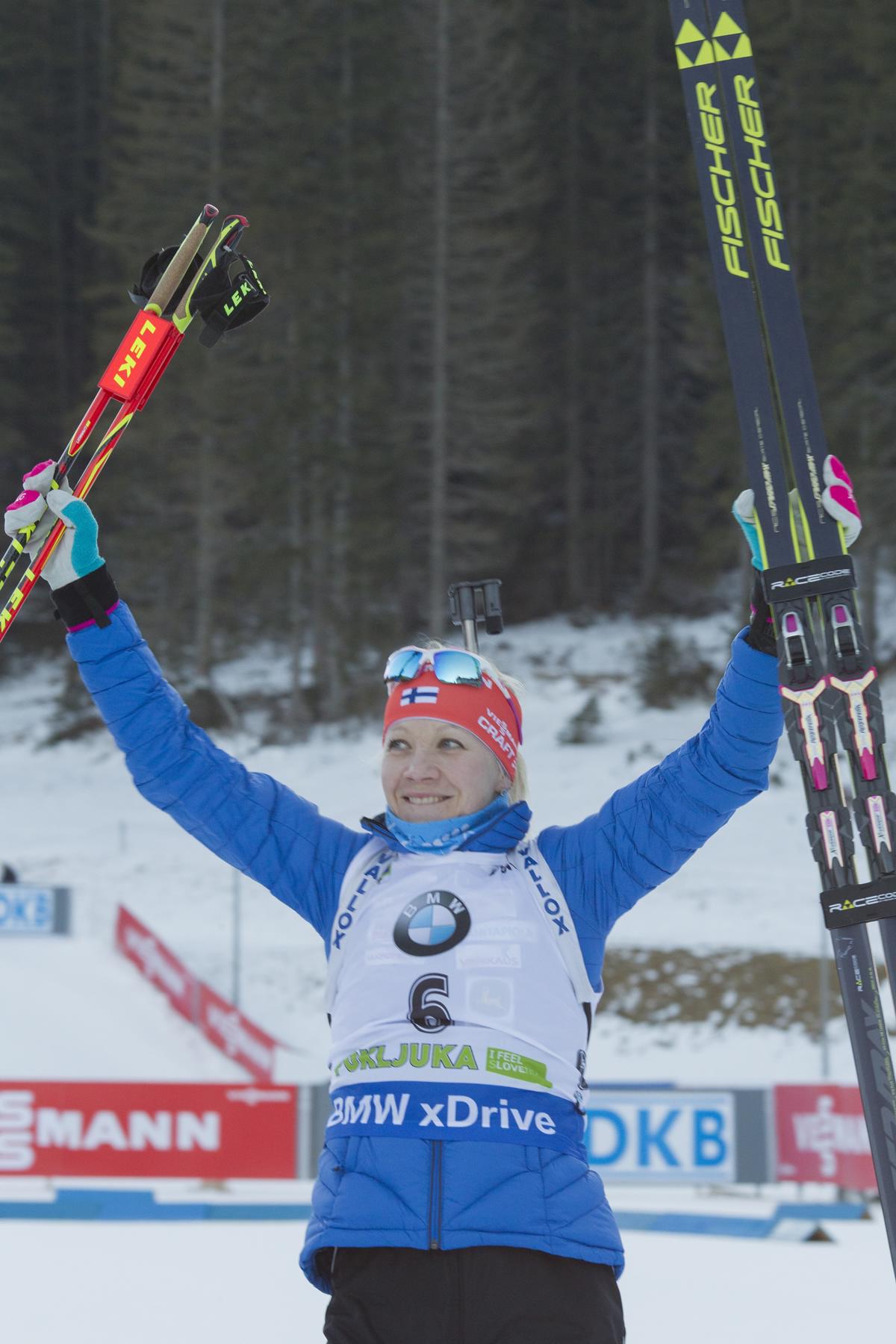
    For a good portion of Friday’s race, Susan Dunklee found herself in first place. Not fourth, not third, not even second. First.

    The ninth starter out of the gate in the women’s 7.5-kilometer International Biathlon Union (IBU) World Cup sprint in Pokljuka, Slovenia, Dunklee cleaned the first of two shooting stages — prone — to put herself in second behind Norway’s Tiril Eckhoff, who was leading at the time by a mere 0.9 seconds.

    Eckhoff started seventh.

    Then there was Finland’s Kaisa Mäkäräinen, in bib 18, who cleaned the first stage as well on a day with little to no wind and took the lead by 3.4 seconds over Eckhoff. But let’s get back to Dunklee.

    The standing stage brought a miss for Eckhoff. That sent her to the penalty lap and into second behind Russia’s Olga Podchufarova, who started third and cleaned both stages to take an early lead. Dunklee hit all five of her targets once again and bested Podchafarova’s time leaving the range, taking the lead and holding it on the final loop to the finish. Dunklee crossed the finish 7 seconds faster than the Russian and claimed first — which held up through the first batch of early finishers.

    Austria’s Lisa Theresa Hauser came close, hitting all of her targets as well, but came up 5.7 seconds short of Dunklee’s time at the finish. Then there were Dunklee’s most-immediate threats — Germany’s Franziska Hildebrand (bib 15), Mäkäräinen, and a surprise challenger: France’s Justine Braisaz (bib 23).

    Hildebrand was the first to bump Dunklee out of the top spot by 16.9 seconds, then Mäkäräinen finished 5.6 seconds faster than Hildebrand to move Dunklee into third. After that, Braisaz topped Mäkäräinen’s time by more than 19 seconds and knocked Dunklee off the podium.

    Germany’s Laura Dahlmeier was faster still (by 3.5 seconds) and turned out to be the fastest of the day, with a final winning time of 19:51.7 minutes. Braisaz held onto second place, and Norway’s Marte Olsbu, who started 45th, claimed third (+21.3). All of the top three shot 10-for-10; Mäkäräinen in fourth did not, with a single standing penalty costing her the podium (0+1, +22.8). Then there was Hildebrand in fifth (0+0, +28.4), and Slovakia’s Anastasiya Kuzmina in sixth (0+0, +30.7), ahead of the Czech Republic’s Gabriela Koukalova in seventh (0+1, +39.4) and Eva Puskarcikova in eighth (0+0, +39.8), France’s Celia Aymonier in ninth (0+1, +40.8), Germany’s Miriam Gössner in 10th (0+1, +42.8), and Dunklee in 11th (0+0, +45.3).

    France's Justine Braisaz (r) racing to second in the women's 7.5 k sprint on Friday at the IBU World Cup in Pokljuka, Slovenia. American Susan Dunklee (l) finished 11th after initially leading at the finish. (Photo: IBU)
    France’s Justine Braisaz (r) racing to second in the women’s 7.5 k sprint on Friday at the IBU World Cup in Pokljuka, Slovenia. American Susan Dunklee (l) finished 11th after initially leading at the finish. (Photo: IBU)

    Of the top 15 finishers, all of them cleaned the first prone stage and had one penalty or less. Those with the standing penalty were the minority: 11 out of the 15 hit every target.

    So on a day with ideal shooting and racing conditions, Dunklee excelled — posting the second- and third-fastest overall shooting and range times of 105 finishers — but so did several others. Dunklee’s course time ranked 29th overall and she slowed on the final loop with the 48th-ranked third-loop time.

    Regardless, 11th was her best result this season. But afterward, Dunklee didn’t really want to talk about the race. Instead, she used an email correspondence with FasterSkier as an opportunity to vocalize her thoughts on the McLaren report, the second part of which was released a couple hours before the women’s race on Friday.

    “We raced a World Cup today, but that is completely insignificant compared to the news that came out in the McLaren report,” Dunklee wrote. “Today is a sad, sad day for our international biathlon community and the global Olympic movement. We face stunning revelations of systematic doping within our community. I respect my body and I respect my competitors and that is why I compete clean. Today we must all speak up and demand the International Olympic Committee [IOC] and International Federations to take a powerful stance for clean sport.”

    Asked specifically what actions she thinks the IBU should take, Dunklee added that it should start with cooperating with the World Anti-Doping Agency (WADA).

    “For clean sport to work, the IBU has a responsibility to work with and support WADA,” she wrote. “Currently the IBU is not in compliance with the WADA code after awarding Tyumen, Russia the World Championships for 2021. This is very concerning to many of us biathletes on the World Cup.

    “We need stiff penalties for doping violations and tampered-with samples,” Dunklee continued. “The McLaren report needs to be looked at very carefully and punishments handed out to officials, administrators, doctors and athletes who have cheated. Currently the IBU fines countries with multiple doping violations in an 18 month period a slap-on-the-wrist sort of fee. What things actually matter and would be more effective? Reducing World Cup start spots and banning Olympic participation for federations found to have systematic cheating.”

    “We raced a World Cup today, but that is completely insignificant compared to the news that came out in the McLaren report. Today is a sad, sad day for our international biathlon community and the global Olympic movement.” — Susan Dunklee (US Biathlon) after placing 11th in Friday’s IBU World Cup 7.5 k sprint

    Dunklee wasn’t the only one with plenty to say about Russia. Her US Biathlon teammate Lowell Bailey, who placed 18th in the men’s sprint, weighed in on how McLaren’s findings should be handled as well.

    Lowell Bailey (US Biathlon) racing to 18th on Friday in the men's 10 k sprint at the IBU World Cup in Pokljuka, Slovenia. (Photo: USBA/NordicFocus)
    Lowell Bailey (US Biathlon) racing to 18th on Friday in the men’s 10 k sprint at the IBU World Cup in Pokljuka, Slovenia. (Photo: USBA/NordicFocus)

    “It is now time for the IBU to reconsider its decision to hold the Tyumen World Cup in 2017 and the IBU World Championships in Tyumen 2021,” he wrote in an email after Friday’s race. “I expect that the IBU will follow the instructions set forth by WADA and the IOC to halt all competitions in Russia. To do otherwise would show the world that our leadership, the IBU Executive Board, is unwilling to defend clean athletes, the WADA Code, and a fair field of play.

    “The WADA Code expressly forbids International Federations, such as the IBU, from holding international competitions in any country whose national federation is non-compliant with the WADA Code,” Bailey, an IBU athlete representative, explained. “WADA declared Russia’s Anti-doping agency non-compliant in November of 2015.”

    He added that he agrees with IOC President Thomas Bach, who recently stated that “any athlete who took part in such a sophisticated manipulation system” should be excluded from future Olympics “in whatever capacity.”

    “It is a privilege and honor to compete for one’s own country on the Olympic stage,” Bailey added. “For biathletes, and many other winter athletes, it is the most sacred field of play.  It takes decades of hard work and sacrifice just to qualify for an Olympic Games, let alone stand on the Olympic podium. Any athlete who is willing to cheat has no place in an Olympic stadium, ever.”

    Asked how much feedback he has received, as the athlete rep, on McLaren’s reports about Russia, Bailey wrote, “The overwhelming majority of clean athletes within the IBU are disheartened and appalled at the degree and scope of this recent doping scandal. They expect the IBU to react decisively to both levy consequences for past doping infractions and to revise and enact new anti-doping policies that are much more severe than the current punishment guidelines and will serve to effectively deter further doping in the future.”

    Three Canadians, Two U.S. Women Qualify for Pursuit

    Germany's Laura Dahlmeier racing to her second win of the season on Friday in the women's 7.5 k sprint at the IBU World Cup in Pokljuka, Slovenia. (Photo: IBU)
    Germany’s Laura Dahlmeier racing to her second win of the season on Friday in the women’s 7.5 k sprint at the IBU World Cup in Pokljuka, Slovenia. (Photo: IBU)

    In terms of the women’s race itself, Dahlmeier was able to take the sprint win with the second-fastest final loop, which moved her from third leaving the range to first at the finish. Overall, her course time ranked fourth.

    “I like Pokljuka … it’s very beautiful, the weather here is always very nice. I am also used to altitude because of the Alps,” Dahlmeier said, according to an IBU press release.

    But in bib 31 out of more than 100, she wasn’t overly confident her lead would hold.

    “Some really strong athletes started late, and I was not sure of my win until after the last athlete was at the finish line,” Dahlmeier added.

    For 19-year-old Braisaz, it was her first World Cup podium (after placing fourth in a World Cup sprint in Khanty-Mansiysk, Russia, last season).

    “I am really happy about the race today,” Braisaz told the IBU. “I didn’t believe my coaches when they told me I was in the lead. Before the competition, I didn’t want to leave my bed this morning, I didn’t feel confident.”

    Even Olsbu was surprised with her podium.

    “My goal this season was to fight for the podium, but I didn’t think I could make it before Christmas,” she told the IBU.

    On Saturday, she’ll start third in the 10 k pursuit, 21 seconds behind Dahlmeier in first, and two seconds ahead of Mäkäräinen in fourth. Braisaz will head out second, 4 seconds after Dahlmeier.

    “It will be a good fight,” Olsbu predicted. “Kaisa starting right behind me, this will be very difficult.”

    Aside from Dunklee, another North American had her best result of the season so far, with Biathlon Canada’s Julia Ransom placing 34th (+1:32.8) with clean shooting.

    “The course is right up my alley with lots of transitions and fast downhills, and the range is usually pretty calm making for lots of clean shooting across the board,” Ransom explained in an email.

    “Östersund was a bit of a mixed bag,” she wrote of last week’s World Cup. “After an abysmal relay performance from myself, I had a great race in the sprint but unfortunately we missed the skis. The pursuit was good on the ski side but a little rough on the shooting side. That is biathlon I suppose! On a whole, I think the team was looking forward to moving on and starting fresh. My goal of top 20’s and top 15’s still remain and I hope to pick up some momentum towards achieving that.”

    While she was satisfied with her result on Friday, Ransom added that she had hoped for top 30. Her overall course time ranked 57th.

    “After analyzing today, I am going to focus on picking up those extra seconds to move up (hopefully to top 20!)” she wrote.

    Canada’s Megan Tandy also finished in the top 60 to qualify for the pursuit in 49th (+1:58.5) with a single standing penalty (0+1), as did American Clare Egan in 53rd (+2:08) with two standing penalties, and Canada’s Rosanna Crawford in 58th (+2:19.6) with three misses (2+1).

    Canada’s Sarah Beaudry finished 75th (+2:58.2) with clean shooting (0+0). Joanne Reid (US Biathlon) was 85th (+3:16.8) with four penalties (3+1).

    Results | Pursuit start list (starts at 8:45 EST) Stream live at Eurovisionsports.tv.

  • Sunday Rundown: Ruka, Östersund, Pontresina & Beitostølen (Updated x6)

    Sunday Rundown: Ruka, Östersund, Pontresina & Beitostølen (Updated x6)

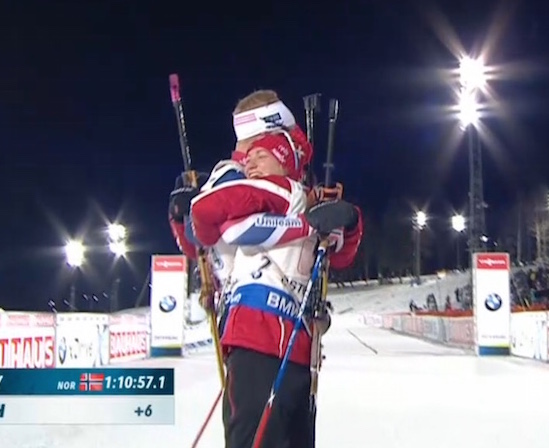
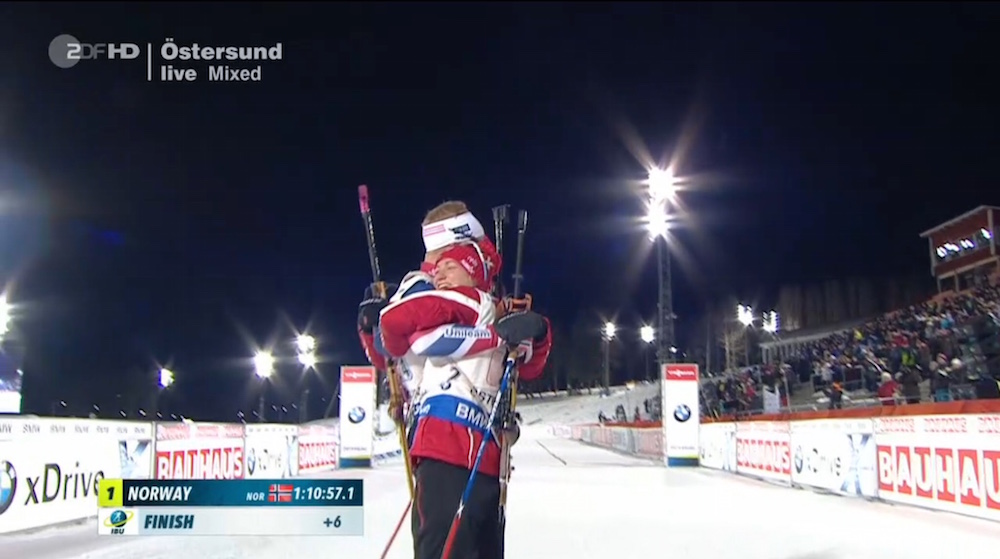
    The Norwegian mixed relay team celebrates after its win in the first IBU World Cup race of the 2016/2017 season on Sunday in Östersund, Sweden. (Photo: ZDF screen shot)
    Two members of the Norwegian mixed relay, Johannes Bø and Marte Olsbu, celebrate their win in the first IBU World Cup race of the 2016/2017 season on Sunday in Östersund, Sweden. (Photo: ZDF screen shot)

    Welcome to The Rundown, your quick primer of need-to-know information about the day’s racing. We’ll be updating this digest as the day goes on with additional results, photos and quotes. The Rundown is NOT a race report; stay tuned for complete race reports later today with interviews from the day’s top racers.

    ***

    IBU Cup in Beitostølen: 7.5/10 k sprints

    [UPDATE] With the second set of men’s and women’s sprints canceled Saturday and moved to Sunday in Beitostølen, Norway, the first IBU Cup relays of the season were bumped off the schedule, and no North Americans competed on Sunday. (American Russell Currier placed 44th in the IBU Cup sprint on Friday.)

    In the women’s 7.5 k sprint, Marketa Davidova of the Czech Republic pulled out a 3.6-second win over Germany’s Nadine Horchler, and Germany had two on the podium with former cross-country skier Denise Herrmann in third (+29.9). Davidova hit 9 out of 10 targets (1+0) en route to the victory in 24:18.3. Horchler missed just one target as well (0+1) and Herrmann (who won the IBU Cup women’s sprint two days earlier) had three penalties (1+2) but skied fast enough for the podium.

    In the men’s 10 k sprint, Russia’s Matvey Eliseev edged his teammate Dmitry Malyshko by just 3.2 seconds for the win in 26:16.8. More than a minute later, Norway’s Henrik L’Abee-Lund placed third (+1:15.9) with four penalties (1+3). Both Eliseev and Malyshko had one miss apiece, with Eliseev missing one in prone (1+0) and Malyshko missing one standing (0+1).

    The next IBU Cup is set for Dec. 6-11 in Ridnaun, Italy.

    Sunday’s sprint results: women| men

    Friday’s sprint results: women | men

    ***

    IBU World Cup in Östersund: Mixed and Single Mixed Relays

    Single Mixed Relay report | Mixed Relay report

    The first race if the International Biathlon Union (IBU) World Cup season went to Norway, which won Sunday’s co-ed mixed relay (2 x 6 k + 2 x 7.5 k) by nearly 34 seconds over Germany in Östersund, Sweden.

    The Norwegian team of Marte Olsbu, Fanny Horn Birkeland, Ole Einar Bjørndalen, and Johannes Thingnes Bø used a total of six spare rounds to get to the finish line first in 1:10.57.1.

    Germany, with Franziska Hildebrand, Laura Dahlmeier, Benedikt Doll, and Arnd Peiffer, used the same amount of total spares for second place (+33.7), and both teams avoided the penalty loop.

    Italy took third (+44.2), with Lisa Vittozzi, Dorothea Wierer, Lukas Hofer, and Dominik Windisch using a combined 12 spares and having one penalty loop during Hofer’s standing stage.

    The Italians narrowly held off Russia (Olga Podchufarova, Tatiana Akimova, Maxim Tsvetkov, Anton Shipulin) by 0.3 seconds for the final spot the podium.

    France placed fifth (+1:13.3), Sweden was sixth (+1:20.9), the Czech Republic seventh (+1:20.9), and the U.S. eighth (+2:38.5).

    Susan Dunklee started first for the Americans using three spares to clean (0+1, 0+2), then tagging off to Clare Egan, who didn’t need any spares for prone, but had to use all three and skied two penalty loops in standing. Lowell Bailey used just two spares (0+1, 0+1), and Tim Burke locked up eighth for the team with a flawless prone and three spares in standing (0+0, 0+3). In all the team used 13 spares and had two penalty loops.

    Of 24 teams in the race, Canada (Julia Ransom, Megan Tandy, Scott Gow, and Brendan Green) was among the four that were lapped. In seven out of eight stages, the team combined for 11 spares and two penalties.

    Results: Mixed relay | (Single mixed relay, see race report)

    ***

    FIS Nordic Combined World Cup in Ruka: Individual Large Hill/10 k

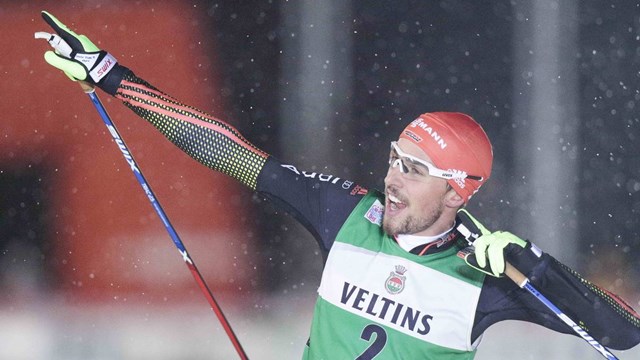
    Germany’s 24-year-old Johannes Rydzek celebrating his first of two wins on Saturday at the Ruka Nordic Combined World Cup in Kuusamo, Finland. He now has eighth career individual World Cup victories. (Photo: FIS)
    Germany’s 24-year-old Johannes Rydzek celebrating his first of two wins on Saturday at the Ruka Nordic Combined World Cup in Kuusamo, Finland. He now has eighth career individual World Cup victories. (Photo: FIS/NordicFocus)

    Germany’s Johannes Rydzek can do the Usain-Bolt-victory stance all the way to the next Nordic Combined World Cup after winning the first two competitions of the 2016/2017 season, with another individual large hill/10 k win on Sunday in Kuusamo, Finland.

    After winning by 34 seconds over his teammate Eric Frenzel on Saturday, Rydzek took a 14.7-second win over Wilhelm Denifl of Austria, while Japan’s Akito Watabe was just 0.3 seconds back in third.

    Rydzek posted the fifth-best jump after Norway’s Jarl Magnus Riiber, Watabe, Denifl, and Austria’s Mario Seidl, respectively. Rydzek started the 10 k Gundersen 1:04 minutes after Riiber and posted the seventh-fastest course time to capture first. Riiber slipped to 10th (+1:07.5) at the finish, with the 37th-ranked course time of 42 in the cross-country race.

    Of note, Frenzel improved from 27th in the jump to 17th (+1:32.4) at the finish with the second-fastest course time.

    Bryan Fletcher was one of two Americans in the race, finishing 31st (+3:40.7). His jump ranked 40th, but he skied the fourth-fastest course time to pick off nine places. Taylor Fletcher placed 40th (+6:24.4), improving slightly from 43rd in the jump.

    The Nordic Combined World Cup now moves to Lillehammer, Norway, for a team and two individual competitions Dec. 2-4.

    Final results

    ***

    Visma Ski Classics Prologue in Pontresina: 8 k Classic

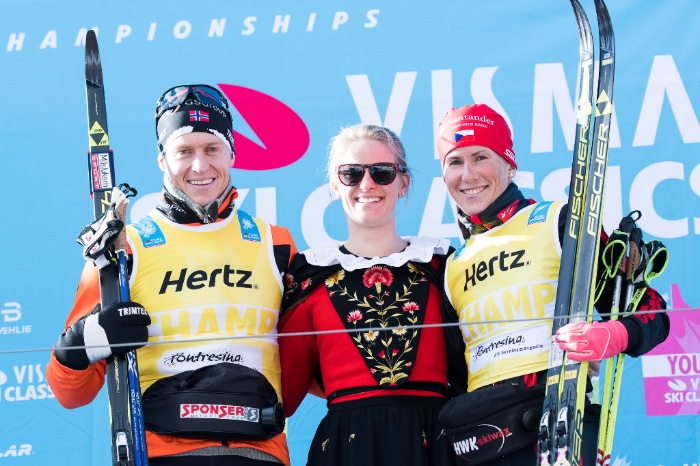
    Petter Eliassen of Team Leaseplan Go (left) and Katerina Smutna of Team Santander (right) celebrate after winning the Visma Ski Classics 8 k prologue in Pontresina, Switzerland. (Photo: Visma Ski Classics)
    Petter Eliassen of Team Leaseplan Go (left) and Katerina Smutna of Team Santander (right) celebrate after winning the Visma Ski Classics 8 k prologue in Pontresina, Switzerland. (Photo: Visma Ski Classics)

    The Visma Ski Classics series started off in Pontresina, Switzerland, with 8-kilometer time trials for both men and women.

    In the women’s race, an individual interval start seeded last to first, Kristin Antonsen of Team Synnfjell set an early best mark. But as the previous season’s top women hit the course times began to come down, and the race ended as a battle between Britta Johansson Norgren of Team Lager 157 and Katerina Smutna of Team Santander. Smutna ended up with the win by just 0.66 seconds over Johansson Norgren, with Sara Lindborg of Team Serneke third (+20.66).

    The men’s race was a team interval start, with the teams separated by five minutes and with skiers at 15 second intervals within that span. Last year’s Visma Ski Classics Champion, Petter Eliassen of Team Leaseplan Go, came out on top with a time of 19:42.66. Bastien Poirrier of Team Gel Interim Rossignol was second (+8.53), leading five members of his new France-based team into the top ten and turning heads along the way. Morten Eide Pedersen of Team BN Bank was third (+15.80).

    Results

    ***

    FIS Cross-Country World Cup in Ruka: 10/15 k Classic

    Women’s report | Men’s report

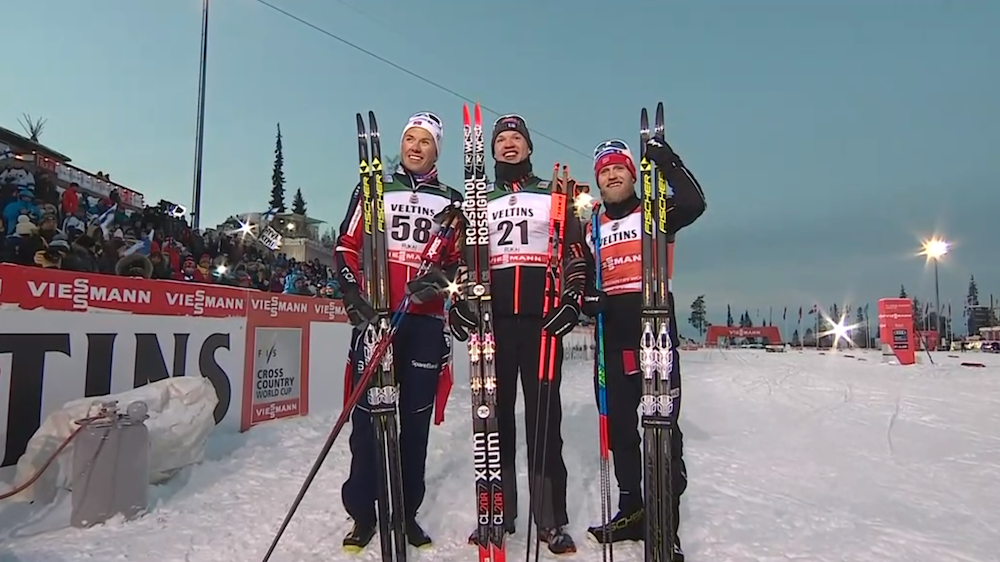
    Twenty-four-year-old Finnish A-teamer Iivo Niskanen notched his second-career World Cup victory the men’s 15-kilometer classic on Sunday, Day 2 of the Ruka World Cup in Kuusamo, Finland.

    The men's podium in Sunday's 15 k classic at the Ruka World Cup in Kuusamo, Finland: with Finnish winner Iivo Niskanen (c) and Norway's Emil Iversen (l) in second and Martin Johnsrud Sundby (r) in third. (Photo: NBC Sports screen shot)
    The men’s podium in Sunday’s 15 k classic at the Ruka World Cup in Kuusamo, Finland: with Finnish winner Iivo Niskanen (c) and Norway’s Emil Iversen (l) in second and Martin Johnsrud Sundby (r) in third. (Photo: NBC Sports screen shot)

    Niskanen started 21st of more than 90 in the men’s field and finished in 35:27.6, which stood as the fastest time all day. After the finish, he paced between the leader’s chair and the finishing pen, even jogging around the stadium and course. But every time he looked the Finnish crowd, he was all smiles.

    Niskanen held off three Norwegians in the top four, with Emil Iversen 10.2 seconds behind him in second, Martin Johnsrud Sundby 11.2 seconds back in third, and Didrik Tønseth missing the podium by about six seconds and tying Sweden’s Johan Olsson for fourth (+17.0). Norway’s Finn Hågen Krogh placed sixth (+18.3), Sweden’s Calle Halfvarsson was seventh (+21.2), Russia’s Alexander Bessmertnykh was eighth (+24.3), Finland’s Matti Heikkinen ninth (+32.0), and Great Britain’s Andrew Musgrave 10th (+33.8).

    Canada’s Alex Harvey was close behind in 11th (+35), and was the lone North American man in the points on Sunday. His teammate Devon Kershaw missed the top 30 by 4.5 seconds in 33rd (+1:23.4).

    Erik Bjornsen led the U.S. men in 41st (+1:37.2). Canada’s Graeme Killick was 53rd (+2:12.9), American Noah Hoffman was 64th (+2:42.6). For Canada, Len Valjas was 76th (+3:19.8), Jess Cockney 78th (+3:26), Knute Johnsgaard 85th (+3:53.4), and Andy Shields 91st (+4:26.1), and for the U.S., Eric Packer 87th (+4:01) and Andy Newell 88th (+4:17.4) out of 96.

    In the women’s 10 k classic earlier in the day, Marit Bjørgen of Norway picked up her first win of the season, a 4.6-second win over Finland’s Krista Parmakoski.

    Marit Bjørgen of Norway (center) collected her first World Cup win of the season in the 10 k classic in Ruka, Finland, ahead of Finland's Krista Parmakoski (left) and Norway's Heidi Weng (right). (Photo: FIS Cross Country/Twitter)
    Marit Bjørgen of Norway (center) collected her first World Cup win of the season in the 10 k classic in Ruka, Finland, ahead of Finland’s Krista Parmakoski (left) and Norway’s Heidi Weng (right). (Photo: FIS Cross Country/Twitter)

    It is the 103rd World Cup win for the 36-year-old Bjørgen, who took last season off to have a baby. Norway followed up Bjørgen’s win with third and fourth place finishes by Heidi Weng (+12.7) and Ingvild Flugstad Ørtberg (+36.8).

    Parmakoski also led a good day for the Finnish team, with Laura Mononen coming in seventh (+50.0). She was just behind sixth-place Nicole Fessel of Germany (+42.4).

    Jessie Diggins led the U.S. women’s team with a 13th-place finish (+1:09.0), one of her best distance classic races ever outside of Tour and mini-tour stages. Sadie Bjornsen followed in 17th (+1.14.9), and 2016 SuperTour champion Caitlin Patterson of the Craftsbury Green Racing Project scored points in 28th (+1:45.4). The U.S. Ski Team rounded out its results with Rosie Brennan 39th (+2:22.2), Kikkan Randall 43rd (+2:29.7), Ida Sargent 44th (+2:30.4), and Sophie Caldwell 61st (+3:13.4)

    Cendrine Browne and Emily Nishikawa slotted into 58th and 59th for Canada, +3:04.8 and +3:07.1, respectively. Dahria Beatty finished 74th (+3:54.4).

  • France’s Dorin Habert and Fourcade Dominate Single Mixed Relay; Canada 12th, U.S. 16th

    France’s Dorin Habert and Fourcade Dominate Single Mixed Relay; Canada 12th, U.S. 16th

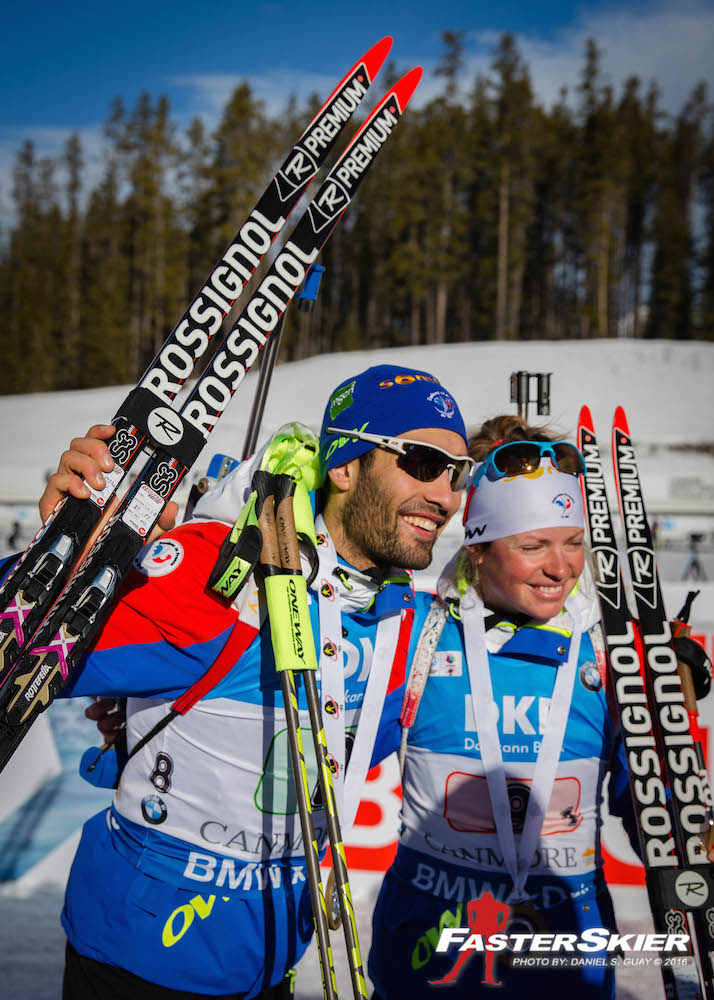
    Teammates in the single mixed relay on Sunday, France's Martin Fourcade and Marie Dorin Haber after winning the first of two relays on the last day of the IBU World Cup in Canmore, Alberta. (Photo: Daniel S. Guay)
    Teammates in the single mixed relay on Sunday, France’s Martin Fourcade and Marie Dorin Haber after winning the first of two relays on the last day of the IBU World Cup in Canmore, Alberta. (Photo: Daniel S. Guay)

    France was determined to win the International Biathlon Union (IBU) World Cup 13.5-kilometer single mixed relay on Sunday in Canmore, Alberta, using their best athletes with men’s overall World Cup leader Martin Fourcade and Marie Dorin Habert, who ranks third in the women’s standings. And they succeeded in convincing fashion, finishing first in 37:58.0 minutes, with four spares and no penalties.

    The first time the new race format was on the calendar this season at the World Cup in Östersund, Sweden, the French duo of Dorin Habert and Martin’s older brother Simon Fourcade thought they had won the race, but because Fourcade had not fired a shot during the competition the team was slapped with a four-minute penalty, putting them back to 21st place.

    On Sunday morning, France made no such mistakes and didn’t leave the other teams any chance in nearly a start-to-finish victory. Dorin Habert took the lead out of the arena, stayed there for most of her leg and tagged narrowly in first place, before both Fourcade and Dorin Habert expanded their lead on the next three legs with good shooting and fast skiing. Fourcade put an exclamation mark on the victory by sprinting into the finish despite knowing he had a comfortable lead of more than half a minute on the final loop.

    “It was a really exciting race. I like these kind of short races. I tried to be as strong as Martin, it’s an honor to run with him,” Dorin Habert said at the post-race press conference. “It was in our head before the competition to win, but this is biathlon and everything can happen on the [shooting range].

    “I tried to train the finish, I think that was a good opportunity,” Fourcade explained during the press conference. “But I actually didn’t compete the full last loop,” he added with a smile. “I only did for some parts, the ones in front of the TV.”

    “Today I was satisfied even if I needed two extra shots, two too much,” Fourcade later told the IBU in an interview. “It was a good competition for both of us.”

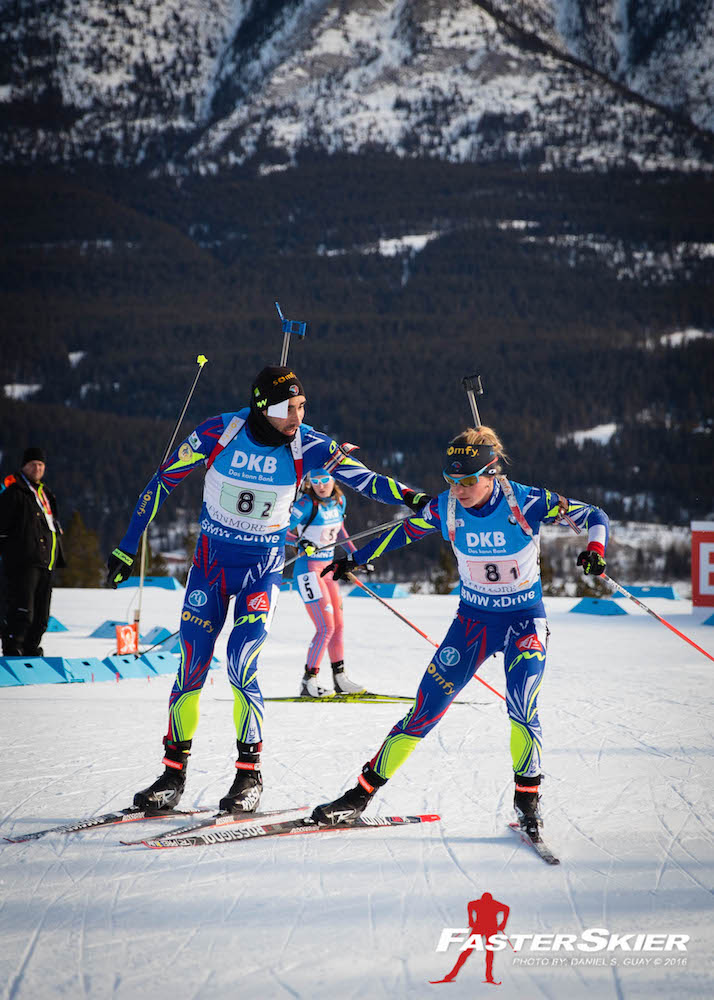
    France's Martin Fourcade (l) tags teammate Marie Dorin  Habert for her the third of four legs in the single mixed relay at the IBU World Cup in Canmore, Alberta. They ended up winning by 45 seconds. (Photo: Daniel S. Guay)
    France’s Martin Fourcade (l) tags teammate Marie Dorin Habert for her the third of four legs in the single mixed relay at the IBU World Cup in Canmore, Alberta. They ended up winning by 45 seconds. (Photo: Daniel S. Guay)

    Second place went to the Austrian duo Lisa Therese Hauser and Simon Eder, 45.2 seconds back, with eight spares and no penalties. It was Hauser’s first World Cup podium.

    Norway’s Hilde Fenne and Lars Helge Birkeland secured the third spot on the podium, 55.3 seconds back, with seven spares and no penalties. Birkeland defended his lead on the final loop, coming into the finish two seconds ahead of Russia’s Olga Podchufarova, who teamed up with Alexey Volkov to finish fourth (+57.3), with no penalties and just two spares.

    New since the 2014/2015 season and only held for the third time at the World Cup level on Sunday, the single mixed format was established by the IBU to have another action-packed event and give “smaller” biathlon nations a shot at the podium. For some countries, it presented an opportunity to start a team event. It is not yet a part of Biathlon World Championships or Olympic Games.

    “The single mixed relay is interesting for smaller nations, because they maybe don’t have five women and five men who can compete with the top, but maybe one or two,” Canadian head coach Matthias Ahrens told German TV broadcaster ZDF in an interview before the race. “Then you can use those in the mixed or single mixed relay, thereby potentially getting a chance to reach the podium, which worked pretty well for us at the season-opening in Östersund [where Canada placed second].”

    On Sunday, some teams, such as France — though not an example for a “small” biathlon nation — Austria and Latvia (in eighth place), made use of that by putting their best racers in the event. Other teams decided to focus on the “normal” mixed relay, with two women and two men on each team, that followed later on Sunday in Canmore.

    The single mixed relay features the shortest loops in biathlon, with the athletes skiing a 1.5-kilometer loop between each shooting stage, then immediately exchanging after the standing shooting. After the female team member starts and shoots one prone and one standing stage, she exchanges to her male teammate, then the woman gets tagged again to ski the third leg (six kilometers total), and the man closes out on the fourth anchor leg racing an additional 1.5 k after the final standing shooting, which adds up to the odd 13.5 k distance. The athletes are allowed to use three spare rounds per shooting like in a normal relay, and the penalty lap is also shortened to 75 meters (usually 150).

    Thus the whole race is extremely fast-paced, and rather resembles a cross-country team sprint than a traditional biathlon or cross-country relay.

    “This was a new start for me in the World Cup, because I never did a single mixed relay before,” Fourcade said at the press conference. “I already did it a lot during the show competitions like Schalke [World Team Challenge in late December] or Moscow or Tyumen [Race of Champions, another invitational at the end of the season]. I really love that. But it was different today … with the pressure of the World Cup… I think the single mixed relay is really good for biathlon.”

    “The single mixed relay is a super fun race format, but you really have to shoot well to have a chance,” U.S. Biathlon’s Annelies Cook wrote in an email.

    “Certain abilities are demanded, especially ‘shooting efficiency,’ ” Ahrens told ZDF. “That means you need athletes who, first of all, can shoot well and hit, but also shoot very fast.”

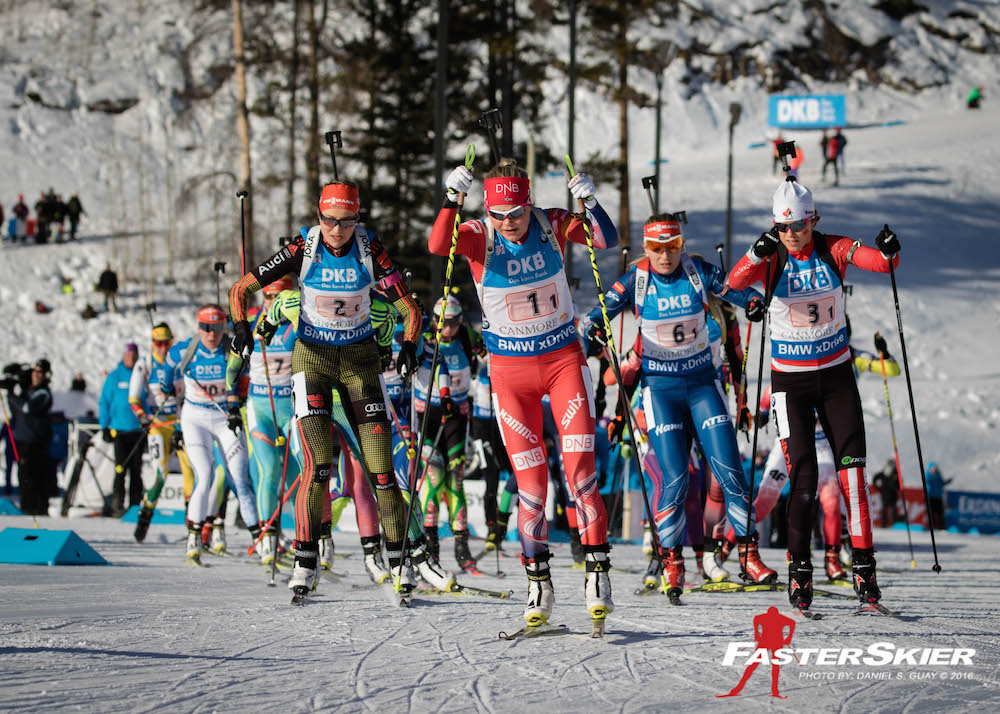
    Germany's Luise Kummer (2), Norway's Hilde Fenne (1) and Canada's Julia Ransom (3) early in the single mixed relay at the IBU World Cup in Canmore, Alberta. Norway went on to place third, Germany seventh and Canada finished 12th. (Photo: Daniel S. Guay)
    Germany’s Luise Kummer (2), Norway’s Hilde Fenne (1) and Canada’s Julia Ransom (3) early in the single mixed relay at the IBU World Cup in Canmore, Alberta. Norway went on to place third, Germany seventh and Canada finished 12th. (Photo: Daniel S. Guay)

    Conditions on Sunday were good throughout the race, with calm winds and the sun shining in the Canadian Rocky Mountains, after the athletes had struggled with snowfall and strong gales in the previous days.

    “I think we were all satisfied to know that it would be fair and beautiful conditions. It’s the [kind of] biathlon we love,” Fourcade said in an interview with the IBU.

    “Today was the best snow conditions of the week. There was a light wind, but it seemed pretty consistent,” Canada’s Nathan Smith wrote in an email.

    France steadily expanded its lead throughout the race. At the first exchange, Dorin Habert tagged Fourcade in first, just 0.4 seconds ahead of Sweden. Fourcade slightly expanded that lead to 6.5 seconds over Russia in second place by the next exchange, and then Dorin Habert cleaned both shooting stages on her second leg to balloon the gap to 50.1 seconds over Norway in second. Essentially, Fourcade just needed to go through the motions on his last leg to lock up first.

    Before the final shooting, Germany’s Erik Lesser had been in second place behind Fourcade. But unable to clean his targets and running out of spares, Lesser incurred a penalty lap and ended up seventh (+1:29.6), as teams passed him with better shooting. Lesser and teammate Luise Kummer combined for one penalty and eight spares.

    This brought back some painful memories from the first time a single mixed relay was held in a year ago in February 2015  in Nove Mesto, Czech Republic. Lesser and Kummer had been in the lead before the final shooting, then Lesser slipped into fourth with a penalty.

    After Sunday’s race, suffice to say Lesser wasn’t happy.

    “Does anyone still want to see that? I don’t!” Lesser quipped when the interviewer in the mixed zone asked him to take a look at a replay of his targets in the final shooting stage. “It really doesn’t matter where those [shots] went, I just didn’t hit, fired four really poor shots,” he added after taking a glance at the fairly close misses. “If Mark [Kirchner, men’s head coach] wants to chew me out for that, I hard-earned it.”

    “On the first spare I was already thinking, ‘Oh great, this is going the same way as last year,’ ” Lesser continued. “On the second leg I struggled, I tried to keep the others at bay on the course so they would not catch up, but I somehow didn’t move well, got tense on the shooting range, and then the misses happened. I am completely annoyed, mega-disappointed… This is the World Cup level, so you should also be able to hit with tired legs.”

    Kummer used four spares and was also disappointed, but didn’t pin the blame on Lesser.

    “A [single mixed] relay is comprised of two people, everything has to work out, and that mistake can happen to everybody,” she told ZDF. “You are always happy yourself to get through [a relay shooting stage] unscathed, so that shouldn’t be a problem…. I still think it’s a very exciting competition for the spectators, very fast-paced exchanges. It doesn’t have the same standing as a relay or mixed relay yet, but one can see that it is developing.”

    Lesser’s troubles allowed Austria’s quick-shooting Eder to pass him and secure second place, after he and Hauser had been just outside the podium ranks for most of the race.

    “I am really happy about this podium today. It’s my first one. I dreamed about it, and today it worked,” the 22-years-old Hauser told reporters at the press conference. “My shooting was not so good especially in prone. Simon and I are both fast shooters and also good shooters, but today it was not the best.”

    “I felt great on the course, I always could keep up or even close gaps,” Hauser added in an Austrian Ski Federation press release. “On the shooting range I let the stress get to me a little bit, that caused the spares. But of course I am overjoyed by the podium finish.”

    “The first turn did not go according to plan on the shooting range. I had problems with my ski poles and used too many spares,” Eder, 32, said in the press release. “But the second turn went all the better, I could really push the tempo also on the shooting range. Finally we have a place on the podium also in a mixed relay.”

    In the absence of their usual stars that are skipping the North American World Cups in the leadup to 2016 World Championships at home in Oslo, the Norwegians still reached the podium with Fenne and Birkeland, who both improved on their second legs to move from seventh at the first exchange to third at the finish. (Birkeland also won the first single mixed race of the season, though with Kaia Woeien Nicolaisen as his partner.)

    “I am not sure why, we just always try to do good races,” Fenne said during the post-race press conference when asked why Norway seems to do so well in the single mixed relay. She added that the coaching staff picked the lineups for Sunday, so she didn’t know why she was put on the single mixed relay instead of the four-person mixed relay.

    Canada 12th, U.S. 16th 

    Representing Canada at home in Canmore, Julia Ransom, who is competing in her first full World Cup season, teamed up with veteran Nathan Smith, who raced to second in the Östersund single mixed relay with Rosanna Crawford.

    Canada's Nathan Smith (behind) coming through the exchange zone to tag teammate Julia Ransom during single mixed relay at the IBU World Cup in Canmore, Alberta. (Photo: Daniel S. Guay)
    Canada’s Nathan Smith (behind) coming through the exchange zone to tag teammate Julia Ransom during single mixed relay at the IBU World Cup in Canmore, Alberta. (Photo: Daniel S. Guay)

    This time, the Canadians ended up nearly two minutes off the podium in 12th (+1:54.3), with 10 spares and no penalties.

    On her first leg, Ransom used one spare round in her first prone, but then required all three spares in standing to narrowly avoid a penalty lap.

    “It was hard, very hard,” Ransom said in a Biathlon Canada press release. “I haven’t done that format before. I felt that one for sure. This is the first time I’ve done a relay with Nathan so it was lot of fun for me, and a great experience.

    “I was bouncing around at the start and maybe nerves got to me a little bit because I didn’t know what to expect,” she added. “The techs just told me to ‘reel it in.’ ”

    After the first 1.5 k, she tagged Smith 47.0 seconds behind in 19th of 23 teams. On his first leg, Smith cleaned prone without any spares and only required one spare in standing to keep his distance to the top, handing off to Ransom 49.2 seconds back in 11th.

    “We unfortunately fell back pretty early in the race. Julia had some difficulty in the range,” Smith wrote in an email to FasterSkier. “The time lost loading spares is even more penalizing when the loops are so short. The format itself is pretty fun to race, and quite a bit different from traditional races. It’s almost more like two races back to back with a little break. It suits my quick shooting speed really well.”

    Ransom cleaned her next prone stage as she had done repeatedly in recent weeks, but with two more spares in standing, she lost a minute to the top.

    Still in 11th when he received the tag, Smith again hit all targets in his prone stage, but required three spares in his last standing to avoid the penalty lap, approximately holding his gap to the leaders.

    “Other than my last standing my [two relay] legs went really well. Prone felt amazing. Probably almost the best ever. Just fast, easy and accurate,” Smith wrote. “I ended up battling a lot with [Latvia’s] Rastorgujevs. He surprised me by matching my shooting speed. He’s always one of the fastest out there. It was too much for me to hang on to on the last lap.”

    “It was my best race this week. The legs felt a lot better today. Not amazing, but quite good until that last lap,” Smith said in the team press release. “One of the toughest things to do is race at home with the pressure we put on ourselves with our friends and family watching all the volunteers we know out here. I obviously wanted to peak here and do well but there are so many factors that come into play. It was a great experience racing at home that we’ll be able to take with us.”

    For the U.S., Cook teamed up with Leif Nordgren. In Östersund, their teammates, Clare Egan and Sean Doherty finished 15th in the single mixed relay. This time, the Americans finished in the same range in 16th place (+3:20.1), with one penalty and 14 spares.

    Annelies Cook (US Biathlon) during one of her two standing stages in Sunday's single mixed relay at the IBU World Cup in Canmore, Alberta. She teamed up with Leif Nordgren to place 16th. (Photo: Daniel S. Guay)
    Annelies Cook (US Biathlon) during one of her two standing stages in Sunday’s single mixed relay at the IBU World Cup in Canmore, Alberta. She teamed up with Leif Nordgren to place 16th. (Photo: Daniel S. Guay)

    After using just one spare in her first prone stage, Cook incurred a penalty in her first standing stage, quickly disappearing out of the focus of the TV cameras, tagging Nordgren in 20th, about 1:05 behind the leaders.

    “I felt good on skis and was in the mix, but I had a hard time holding back in the skiing and was probably breathing too hard to shoot well in standing,” Cook wrote in an email. Her course time ranked seventh fastest of the first-leg skiers. “My penalty in standing took us too far from the top to have contact.”

    Nordgren needed two spare rounds in prone and another one in standing, losing about another 30 seconds to the top teams on his leg (+1:41.3) as he tagged Cook in 18th.

    “This format is for sure a little different than a typical relay,” Nordgren explained in an email. “The pace is usually fast right from the start, and because the loops are so short it really puts all the focus on the shooting since its hard to really break away on such a short loop. It’s nice to have that difference, but you really have to be on top of your game in the shooting to be competitive.”

    On her second leg, Cook again emerged from prone with just one spare, but needed another three spare rounds to clean her final standing stage and avoid another penalty. When she exchanged back to Nordgren, the U.S. was 3:04.7 out of first in 20th.

    “The race does feel like a cross country sprint. But what makes it hard is knowing that you still have to hit targets, and finding the balance between all out sprinting and going just at the level where you can manage to hit your targets is tricky,” Cook wrote. “I just tried to make up time lost on the range by catching up on skiing as best as I could. There were a few of us together each lap, so it felt like a competition between that group of people.

    “I had a hard time holding back because I really love sprinting, and that probably kept me from hitting in standing,” she added. “That put Leif on a position where he had to try and chase people down. He did a really good job of that and I was proud of him for catching people in the last loop.”

    On the anchor leg, Nordgren mirrored his performance from his first round, again requiring two spares in prone and one in standing, but only lost 15 more seconds to the leaders and leapt to 16th by overtaking Romania, Slovenia, Belarus and Finland.

    “Today neither Annelies nor I really had a great day on the range so we had a hard time to stay with the top teams,” Nordgren concluded. “The tracks were in perfect shape today which is always nice. Our techs did a great job to give us fast material, but we weren’t able to put it to good use.”

    Staying Warm

    In the exchange zone, several teams could be seen using spinning bikes to keep warm and stay loose during their race breaks while their teammate was out on the course, something the Norwegians pioneered for the single mixed relay in Östersund, though the Americans and Canadians opted for a traditional warmup.

    “I just ran around to keep warm,” Cook wrote. “It’s not a big break and we don’t have a team bike. But running was totally fine for me.”

    “During the break both of us just opted to jog around, being that it’s such a short race, it’s more important to stay warm any way possible,” Nordgren wrote. “Today was the first day in a several that the wind was pretty low, so that made staying warm a little easier.”

    “I just jogged around while Julia was doing her second leg,” Smith explained in his email. “I considered using a spin bike but decided it would be best to practice like at World Champs.”

    Moving on to Presque Isle

    Nathan Smith (Biathlon Canada) during Sunday's single mixed relay at the IBU World Cup in Canmore, Alberta. He teamed up with Julia Ransom to place 12th. (Photo: Daniel S. Guay)
    Nathan Smith (Biathlon Canada) during Sunday’s single mixed relay at the IBU World Cup in Canmore, Alberta. He teamed up with Julia Ransom to place 12th. (Photo: Daniel S. Guay)

    The IBU World Cup now moves east to Presque Isle, Maine, with sprints for the women and men on Thursday, followed by pursuit races on Friday, and traditional relays on Saturday (men) and Sunday (women).

    “Today was the best I’ve felt in a couple weeks. I hope my shape continues to return to normal through Presque Isle,” Smith wrote.

    While Smith continues to work to hold his own in the overall World Cup standings (he’s currently 19th), the rest of Canada’s A-team, those pre-qualified for World Championships, will skip the Presque Isle World Cup and train in Canmore until Feb. 22, according to Crawford. That includes Crawford, Ransom, Sarah Beaudry, Brendan Green, Scott Gow, Christian Gow, and Macx Davies.

    Smith and a women’s contingent of Emma Lunder, Zina Kocher, Audrey Vaillancourt, and Erin Yungblut will head to Maine, and after those races, the Canadian team will select its fourth woman for World Championships.

    “I think we’re … looking forward to racing next week on home soil in Presque Isle,” Nordgren wrote on behalf of the U.S. team. “I haven’t raced there for about 5 years, so it will be fun to be back!”

    In the four-person mixed relay that followed Sunday afternoon, the U.S. notched a team-best fourth with Susan Dunklee, Hannah Dreissigacker, Tim Burke, and Lowell Bailey, while Canada tied its previous best of sixth, with Crawford, Beaudry, Davies, and Green. Stay tuned for a separate report.

    Note: Presumably due to a software bug, the IBU’s competition analysis report for the single mixed relay contained erroneous ranks for data such as course and shooting times, with higher numbers than the 23 teams that started in this race, so no such information was used for this article.

    Results

    Photos

  • France Dominates Women’s Antholz Relay; Canada 13th; U.S. 17th 

    France Dominates Women’s Antholz Relay; Canada 13th; U.S. 17th 

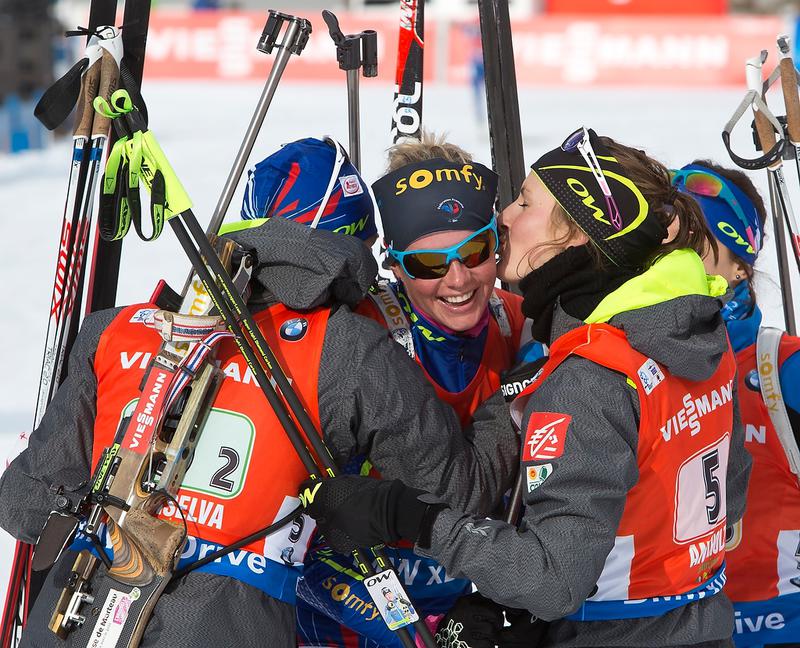
    The French women's 4 x 6 k relay team, including Justine Braisaz, Anaïs Bescond and Anaïs Chevalier, hugs and kisses anchor Marie Dorin Habert at the finish, after Habert secured their IBU World Cup victory by 17 seconds over the Czech Republic on Sunday in Antholz, Italy. (Photo: IBU)
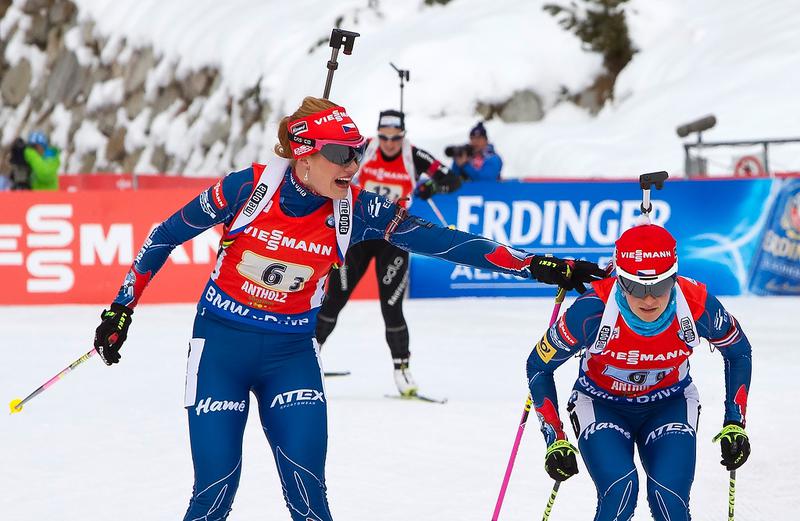
    The French women’s 4 x 6 k relay team, including Justine Braisaz, Anaïs Bescond and Anaïs Chevalier, hugs and kisses anchor Marie Dorin Habert at the finish, after Habert secured their IBU World Cup victory by 17 seconds over the Czech Republic on Sunday in Antholz, Italy. (Photo: IBU/Rene Miko)

    After Ukraine, Germany and Italy occupied the podium in the first two International Biathlon Union (IBU) World Cup women’s relays of the season, on Sunday it was time for three other nations to shine in front of more than 20,000 fans in a packed arena in Antholz, Italy.

    On a beautiful day with blue skies, almost no wind, and surrounded by the spectacular mountain scenery of the South Tyrolean Alps, the French team with Justine Braisaz, Anaïs Bescond, Anaïs Chevalier, and Marie Dorin Habert shot well and skied fast to stay near the top throughout the 4 x 6-kilometer relay. Habert as the anchor received the tag with a 10.6-second buffer to Russia in second, then closed out the race with clean shooting in both stages, eliminating any chance of other teams challenging her.

    After she crossed the finish line in first for France with a time of 1:07.53.5, her teammates hugged her enthusiastically. Overall the French women shot no penalties and required just eight spare rounds.

    “It was a very nice race for the team,” starter Braisaz said during the post-race press conference. “I was a bit [too] excited on my first shoot. But it was a good experience to start the relay. And I am very happy today.”

    “A very happy end to my week,” her teammate Bescond told the media. “Today I felt very good on my skis. I think all of the team made a very good job.”

    “I am very tired, especially this week,” Habert said, reflecting on her season and the race. “It’s a very good thing to finish in the first position.”

    The French women's relay after winning Sunday's 4 x 6 k IBU World Cup relay in Antholz, Italy. With Justine Braisaz, Anaïs Bescond, Anaïs Chevalier, and anchor Marie Dorin Habert (second from r). (Photo:  IBU/Rene Miko)
    The French women’s relay after winning Sunday’s 4 x 6 k IBU World Cup relay in Antholz, Italy. With Justine Braisaz (l), Anaïs Bescond (second from l), Anaïs Chevalier (r), and anchor Marie Dorin Habert (second from r). (Photo: IBU/Rene Miko)

    “This is the first time we tried our relay for the World Championships [in Oslo], so it’s important to [get] a good position to see that this formation of the relay is functioning,” she later said in another interview with the IBU.

    On the last loop, the Czech Republic, Russia and Italy battled for the positions on the podium, with Veronika Vitková able to create a small gap to secure second place for the Czech team, 17.2 seconds behind France.

    Initially, the outlook didn’t look good for the Czech Republic, after second-leg Lucie Charvátová skied two penalty laps and slipped to 12th at the exchange. Later she could be seen in the finish pen with tears in her eyes, while being consoled by team staff.

    “After my leg I didn’t think [it would be possible to come back], because I was such a bad shooter in each relay I started this year. So I was afraid, afraid all race, all year,” Charvátová, 22, said during the press conference. “I am so under pressure. So I am very happy, because those other girls are the best.”

    Gabriela Soukalová (l) tags Czech teammate Veronika Vitková in fourth during the final exchange in the IBU World Cup women's 4 x 6 k relay. The Czech Republic team went on to finish second with just two spares from Vitkova. (Photo: IBU/Rene Miko)
    Gabriela Soukalová (l) tags Czech teammate Veronika Vitková in fourth during the final exchange in the IBU World Cup women’s 4 x 6 k relay. The Czech Republic team went on to finish second with just two spares from Vitkova. (Photo: IBU/Rene Miko)

    Her veteran teammates, World Cup leader Gabriela Soukalová and Vitková turned the race around with solid shooting and fast skiing, recording the best and fourth-best course times on their legs, respectively, to capture second. Overall, the team incurred two penalties and required seven spare rounds. It was the best performance for the Czech relay team this season, after two sixth-place finishes before.

    “It’s very surprising,” starter Eva Puscarciokova said during the press conference. “I am very happy today, because it was very hard after my race in Ruhpolding [Germany] when I went to the penalty loop.”

    Third place on the podium went to the Russian team with Ekaterina Shumilova, Anastasia Zagoruiko (who replaced Daria Virolaynen from the last relay in Ruhpolding), Ekaterina Yurlova, and Olga Podchufarova, finishing 21.2 seconds back, with no penalties and 10 spare rounds.

    Yurlova, Saturday’s pursuit winner, lifted her team from sixth to second, skiing fast — with the second-best course time of the third-leg skiers — and only needing two spares.

    “I am really happy about my leg, and especially about my standing [shooting],” Yurlova said at the press conference. “Because I am really, really tired after two competitions before. And now I was really afraid about my standing. It was all shaking, but I am really happy that I could do it clean. Overall I am really satisfied about this World Cup.”

    In the finishing stretch, Italy’s anchor, Dorothea Wierer, and Russia’s Podchufarova (who had beaten Wierer in the sprint last Friday) fought for third, as they had done earlier this season at the end of the relay in Ruhpolding, Germany, where Italy came out ahead. But this time, Podchufarova prevailed, to the huge excitement of her teammates who immediately ran into the finish area and piled onto her. Wierer crossed the line just 0.5 seconds behind (+21.7), after having made up nearly 15 seconds after the final shooting.

    “My only thought was to come into the finish in the third position,” Podchufarova said in the press conference. “I didn’t know at first that [Wierer] was behind me, only when I came into the stadium I saw it on the monitor. Then I tried my best to get the third place for the team.”

    “I wanted to go on the podium, but I was too [many] seconds behind,” Wierer said in a post-race interview with the IBU. “On the finish line I couldn’t anymore, because I was flushed pushing from the first loop, and in the final I had no more energy.

    “It was a really nice [weekend], but I am a little disappointed today,” she added with a laugh. “You want always more and more, that is the problem.”

    Norway, with Kaia Wøien Nicolaisen, Fanny Horn Birkeland, Marte Olsbu and Tiril Eckhoff, had been in third position behind France and Russia coming into the last shooting, but Eckhoff — a fast skier who has struggled with her shooting all season, hitting 68 percent of her standing targets — again had problems and ended up skiing a penalty lap. She finished fifth for Norway, 47.1 seconds back from France, with a team total of one penalty and 10 spares.

    “I had the opportunity and screwed it up. This was real sh*t. This was not the way I wanted to end [my] last World Cup race before the World Championships,” Eckhoff told Norwegian broadcaster NRK after the race, noting she and her coaches were aware of some technical corrections she still plans to implement.

    Ahead of the upcoming World Championships on their home turf in Oslo, the Norwegian women have yet to reach the podium since earning bronze in the relay at the 2014 Olympics.

    Arguably the biggest surprise of the day was Sweden, with Emma Nilsson, Mona Brorsson, Ingela Andersson, and Linn Persson, in sixth place (+50.5) just 3.4 seconds behind Norway, with no penalties and seven spare rounds.

    After the race, the Swedish women claimed they knew they were on a very good trajectory this season.
    “We expected it,” Brorsson said during in a group interview with the IBU.

    “We really thought we had a chance to be top six,” Andersson added.

    They credited their coach, Wolfgang Pichler, for their improved performance, after he helped several Swedish biathletes, such as Magdalena Forsberg, Helena Ekholm and Anna Carin Olofsson (now Zidek) reach Olympic and World Championship medals, before returning last summer after a stint with the Russian biathlon team.

    “I think that’s the big difference this year,” said Brorsson. “He always finds a way to motivate you. On the track, he is incredible. He knows what he is doing.”

    Ukraine, winner of the last relay in Ruhpolding and usually a team with very solid shooting performances, had some difficulties on the range on Sunday and finished ninth (+1:45.5). The team with Iryna Varvynets, Valj Semerenko, Olga Abramova (replacing Juliya Dzhyma) and Olena Pidhrushna stayed near the front for most of the race and Semerenko even exchanged in the lead. But Abramova needed five spares, and anchor Pidhrushna had to ski a penalty lap, setting them farther back (12 spares overall).

    Similarly, Germany had been in second place for both relays this season. On Sunday, with their regular anchor Laura Dahlmeier taking a break after a respiratory infection, the team struggled almost right out of the gate. Starter Karolin Horchler required five spare rounds and only narrowly avoided the penalty lap in her prone stage, leaving in last position at that time. She tagged off already a minute behind the best in 15th, before Miriam Gössner and Vanessa Hinz moved up a bit, but each incurred a penalty to slow down the chase. Anchor Franziska Hildebrand still managed to improve her team two positions on her leg, ultimately finishing 10th (+1:51.8).

    “I don’t know why, but my legs felt like a sewing machine today in standing, that hasn’t happened to me in a long time,” Gössner told German TV broadcaster ARD in an interview while the race was still going on. “I stood there, and already from the first shot my legs were shaking so much that I really didn’t have myself under control anymore. Even though I went slowly on the prior loop. I tried to fight and prevent the penalty lap, but unfortunately I did not succeed.”

    “My race was all right. All in all I am satisfied,” Hildebrand told ARD. “We somehow struggled a bit in Antholz. Next time it hopefully will be better again for us. There are weekends where not everything works out, and this was one of those.”

    Switzerland, with Saturday’s pursuit runner-up Selina Gasparin, started the relay very strong, with Gasparin tagging off in the lead, and her younger sister Aita Gasparin keeping the team in contention in fourth. Then two less-experienced skiers closed for Switzerland, with Irene Cadurisch tagging off in fifth place, before anchor Ladina Meier-Ruge faded a bit and lost two minutes to the front. They finished 12th with nine spares, one place ahead of Canada.

    Canada 13th, U.S. 17th

    After achieving her first-career top 20 in Saturday’s pursuit, Canada’s Julia Ransom had said her team was “fired up” for the relay, and that they were eager to reach the top six after feeling they had come close in ninth a week ago in Ruhpolding.

    Unfortunately on Sunday, the performance on the shooting range did not allow that to happen for the Canadian team with Ransom, Rosanna Crawford, Megan Tandy, and Zina Kocher.

    Starting as the scramble leg, Ransom missed two targets in her first prone stage, then required all three spares to clean them, narrowly avoiding the penalty but only leaving the range again in 18th position, already 41 seconds back.

    After skiing a fast second loop (with the third-best course time, seventh-best overall) and a clean standing shooting, she moved the team back up significantly and tagged Crawford in ninth place, 32.2 seconds behind the top.

    Crawford had two solid shooting performances, requiring one spare round in her prone stage and two in standing. Skiing the 11th-fastest second-leg course time, she brought her team close to the top six in seventh place, just 32.5 seconds out of first.

    Tandy skied a very fast first loop (fourth-best), and came through her prone stage with two spare rounds, leaving still in 10th position. After a slower loop, she then struggled in her standing position, and was unable to avoid the penalty lap (0+2, 1+3), losing a minute to the top. She tagged off in 13th place (+1:58.7).

    Kocher as the team’s anchor initially held 13th and had a solid first prone shooting with one spare round, but lost another minute on the next loop. In the final standing, similar to Tandy, she also ran out of spares and had to ski a penalty lap, leaving the range in 14th and more than four minutes behind the leaders. On the final loop she was able to pass Bulgaria’s anchor Daniela Kadeva, finishing 13th for Canada (+4:12.2 minutes) with two penalties and 15 spare rounds.

    In an email, Biathlon Canada’s head coach Matthias Ahrens explained that the team was packing up Sunday afternoon, driving to Munich, Germany, then flying back to Canada early Monday morning. The Canadian athletes could not be reached for immediate comment.

    “Women’s race started excellent with Julia and Rosanna, then unfortunately Megan and Zina could not match that Performance,” Ahrens briefly noted about the women’s result before leaving Antholz.

    Susan Dunklee (US Biathlon) used a total of four spares between two stages in the women's 4 x 6 IBU World Cup relay, handing off in 14th. (Photo: USBA/NordicFocus)
    Susan Dunklee (US Biathlon) used a total of four spares between two stages in the women’s 4 x 6 IBU World Cup relay, handing off in 14th. (Photo: USBA/NordicFocus)

    The U.S., with Clare Egan, Susan Dunklee, Annelies Cook, and Joanne Reid, adapted its lineup order a bit again on Sunday compared to the first two relays, with Egan starting and Cook moving to the third leg.

    “Today I got my first mass-start experience at the World Cup level,” Egan wrote in an email. “It reminded me of how much I thrive on head-to-head racing. The decision was made with the intent of giving me that head-to-head experience, both because it will be useful in the future for pursuits and mass starts, and because I think my coaches thought I would like it.”

    She skied at a steady pace in the middle of the field, and required just one spare in each of her shooting stages.

    “The altitude is a challenge here, for the skiing of course but also for recovering before the shooting,” Egan wrote of the biathlon trails situated some 2,000 meters (6,500 feet) above sea level. “The range approach does not provide rest, so I have been making rest for myself by skiing into the range extra easily.”

    “There was a light wind but it was constant, so with the correct sight adjustments the wind was not a factor,” Egan explained. “I had super fast skis and put them to good use passing people on course, but then despite using only one spare round per stage, I still lost places on the range to faster shooters.”

    On the last loop, Egan sped up her pace and skied the sixth-fastest course time of her leg, catching six other teams in front of her to hand off in 12th place (+53.9)

    “The highlight for me was on the last lap when I passed Team Germany,” she wrote.

    After receiving the tag from Egan, Dunklee set out fast with the best course time on her first loop, but then required three spare rounds in her prone shooting. After skiing her second loop at a slightly lower pace, she managed to miss only one target in standing. She slipped two spots to tag off in 14th (+1:10.1), with the third-best course time overall.

    Cook was initially able to hold that position, despite requiring two spares in her prone. Then in standing, she used all three spares and had to ski a penalty lap. That set her back to 18th place, more than three minutes behind the leaders. She tagged off still in that position (+3:36.7).

    In the second World Cup weekend of her career, Reid, 23, skied as the U.S. anchor for the second time. She posted the ninth-best course time on her first loop and managed to shoot clean in prone, but then was lapped by the top teams after another penalty in her standing. That kept Reid from skiing her last loop and ended the race for the U.S. in 17th place with two penalties and 14 spares. Estonia and Romania behind them were lapped as well.

    Next Stop: Canmore/Canada

    The IBU World Cup picks back up again in two weeks in Canmore, Alberta, with sprints on Thursday, Feb. 4 and Friday, Feb. 5, followed by mass starts on Saturday, Feb. 6, and single-mixed relay (1 woman, 1 man) and mixed relay (2 women, 2 men) relays on Sunday, Feb. 7.

    Several strong athletes will not make the trip overseas, notably several members of the Norwegian team, such as Eckhoff and Synnøve Solemdal, citing a focus on instead preparing for the upcoming World Championships.

    Sitting in second in the overall World Cup standings, Habert plans to be there to fight for more points: “Just five days to recover, and then we will fly to Canmore,” she said at the press conference.

    “We are still in discussion with the coaches about the best approach,” Germany’s Hildebrand told ARD. “In order to stand nicely relaxed and regenerated at the start in Oslo.”

    Note: The U.S. men placed sixth in the men’s 4 x 7.5 k relay to match a season best, despite using 13 spares and skiing a penalty lap, with Lowell Bailey, Tim Burke, Leif Nordgren, and Sean Doherty. Canada’s men, with Christian Gow, Nathan Smith, Macx Davies, and Scott Gow, placed 11th with eight spares and no penalties.

    Stay tuned for a complete report on the men’s race.

    Results

  • First Regular-Season Win For Yurlova, While Gasparin Gets Her Post-Baby Podium

    First Regular-Season Win For Yurlova, While Gasparin Gets Her Post-Baby Podium

    Katja Yurlova of Russia, a 2015 World Champion, got her first World Cup win on Saturday with clutch shooting in the Antholz 10 k pursuit. (Photo: IBU/Rene Miko)
    Katja Yurlova of Russia, a 2015 World Champion, got her first World Cup win on Saturday with clutch shooting in the Antholz 10 k pursuit. (Photo: IBU/Rene Miko)

    On Thursday, Russia’s Olga Podchufarova picked up her first World Cup win in the 7.5 k sprint in Antholz, Italy.

    On Saturday she led into the final stage of the 10 k pursuit, but fell apart on the range, missing three shots in the final bout.

    There to pick up the pieces was teammate Ekaterina Yurlova, who shot a near-perfect race. She started third after joining Podchufarova on the sprint podium, then missed one shot in the first stage. But after that she hit target after target, picking up places along the way until she left the range the last time in first place.

    “The last shooting was so unbelievable for me,” Yurlova told IBU news. “There was a strong wind, but my amunitions were just flying into the target! When I shot clean, I saw that Doro [Wierer] and Olga [Podchufarova] were in the penalty loop, I told myself that this was my chance…. so I just took all my power and did it.”

    Yurlova thrilled at the finish. (Photo: IBU/Rene Miko)
    Yurlova thrilled at the finish. (Photo: IBU/Rene Miko)

    There could be more surprising athletes to see atop the podium; Yurlova was the World Champion in the 15 k individual in 2015.

    But this was actually her first regular-season victory, something that had eluded her so far.

    “I didn’t think I would be again on the podium,” Yurlova said in the post-race press conference. “I didn’t prepare for the podium. I was thinking just that I need to do my job good, good skiing, good shooting, that’s enough.”

    Joining her was another woman who didn’t expect to be there – yet whose name didn’t cause surprise, either. Selina Gasparin of Switzerland is a World Cup winner who also won her country’s first Olympic biathlon medal, in Sochi in 2014.

    But while Yurlova was winning World Championships last season, Gasparin was sitting out. She took a year off to have her first child.

    After returning this season she had been yet to hit the podium, and after finishing 16th in the sprint it didn’t seem likely in the pursuit either. Yet Gasparin had only a single penalty, like Yurlova’s coming in the first stage, and skied the second-fastest course time of the day, moving up to second place by passing Wierer in the final few hundred meters.

    “This has been a mega-beautiful race,” Gasparin told Swiss broadcaster SRF. “In the beginning I shot a miss and thought ‘oh no, not again.’ In a pursuit I am usually behind. And I was pretty annoyed by the miss, because I lost contact [to the top]… And then in standing I though to myself ‘no matter how long I stand here, I just have to hit.’ And yeah, I didn’t really know where I was with regards to split times. Thank God I didn’t know during the last shooting that it could be enough for the podium when they shot misses.”

    Selina Gasparin of Switzerland was thrilled to be back on the podium. (Photo: IBU/Rene Miko)
    Selina Gasparin of Switzerland was thrilled to be back on the podium. (Photo: IBU/Rene Miko)

    She finished twelve seconds behind Yurlova and six ahead of Wierer, who had led early in the race before accumulating two penalties in the third stage and one in the fourth.

    “I started good but two mistakes was too much,” Wierer said in the press conference. “In the last standing, I tried to shot fast and zero and it did not work.”

    For Gasparin, shooting well under pressure and edging Wierer at the finish was a particularly meaningful way to get her first post-baby podium.

    “This second place is as valuable as my victories in sprint [in Annecy, France, and Hochfilzen, Austria, during the 2013-14 season],” Gasparin told Swiss media. “In the pursuit you have to get the result in a fight woman versus woman. There it’s important to keep your nerves in check.”

    Tiril Eckhoff of Norway placed fourth (+48.0) and Krystyna Guzik of Poland fifth (+51.9) after starting 20th and 26th, respectively. Skiing fast, they moved up despite three misses by Eckhoff and two by Guzik.

    Susan Dunklee, the lone American in the pursuit, finished 17th, also moving up considerably after earning bib 37 in the sprint. She had the fourth-fastest ski time in the field.

    “The race felt great!” Dunklee wrote in an email. “I had little expectation or pressure going into it. I wasn’t starting very high up and didn’t expect my skiing to bounce back so quickly. It felt so flat in the sprint and I’m not entirely sure why. Today felt more like the Antholz form I remember from the past. Having this strong performance will definitely boost my confidence going into the break.”

    Dunklee missed two shots in the first stage, as well as one in the third. After the first stage she had dropped even lower than her bib number despite initially making up ground on skis.

    “There were some big gusts on the range including one during my first prone that sent my first two shots wide,” she wrote. “The wind also dumped big clumps of snow on course from the trees. Today it was important to keep your sight covers closed between shootings.”

    After cleaning her last stage, Dunklee left the range in 25th. But she wasn’t done yet. She skied the third-fastest closing loop – less than two seconds slower than Gasparin. She used her spot next to 2015 World Cup Total Score winner Kaisa Makarainen of Finland to her advantage.

    “The highlight of the race was my last loop,” Dunklee wrote. “I left the range right behind a giant pack and patiently picked them off one by one following behind Kaisa. Then I remembered Kaisa’s been sick and not at the top of her form, so I passed her too. I really like the way the 2 km flows towards the end with its hard climbing attacks and recovery; it suits my strengths well.”

    The second period of World Cup racing will conclude on Sunday with relays for both men and women.

    Stay tuned for a report on the Canadian results.

    Results

  • Podchufarova Cleans Antholz Sprint for First-Career Win; Two Russians on the Podium

    Podchufarova Cleans Antholz Sprint for First-Career Win; Two Russians on the Podium

    Russian Olga Podchufarova shoots 10 out of 10 in Thursday's 7.5-kilometer sprint in Antholz, Italy. (Photo: IBU/Rene Miko)
    Russian Olga Podchufarova hit 10 out of 10 targets in Thursday’s 7.5-kilometer sprint in Antholz, Italy, to take her first World Cup win. (Photo: IBU/Rene Miko)

    Olga Podchufarova stood atop the International Biathlon Union (IBU) World Cup podium on Thursday in Antholz, Italy, for the first time in her career. The 23-year-old Russian biathlete shot clean in the 7.5-kilometer sprint to claim her first-ever win in 21:01.9, saying that it was something that she has been looking for all season.

    “I understood [this year] that I became stronger, not only physically, but mentally,” she said in an English interview with Eurosport. “And I understood that I was ready for better results than previous year.”

    The 17th starter, she established a pace and finishing time no one else could match. Overall, her course time ranked ninth, and she was one of five women in the top 20 (and two in the top three) to shoot clean. For Podchufarova, it was her second-career IBU World Cup podium; earlier this season she placed third in the mass start in Pokljuka, Slovenia.

    After starting immediately behind her in bib 18, Italy’s Dorothea Wierer took second in front of an enthusiastic crowd, finishing 8 seconds off Podchufarova’s time with one miss in standing. She was happy with her performance, saying that racing in Italy is stressful due to increased press coverage and pressure.

    “Of course it hurts when you make one [penalty] … I was good on skis today…,” Wierer said in a post-race interview, implying that she knew that that one penalty was what kept her from the top spot on the podium. “I was also happy that I missed only one because I was shaking so much in standing. I am happy with this,” she concluded with a laugh.

    The third spot on the podium went to another Russian, Ekaterina Yurlova (+22.1), who started 40th and shot clean to land in the top three. She bumped France’s Anais Bescond, in bib 23, to fourth (+24.7), after Bescond had a single prone penalty. When a Eurosport announcer asked Bescond if she was the “queen of fourth place” after her third fourth-place finish this year, she laughingly agreed, noting that fourth is “better than fifth, or 30th, or 60th.”

    Canada’s Rosanna Crawford was the top North American in 33rd (+1:24.6) after cleaning prone but missing one in standing. American Susan Dunklee was not far behind in 37th (+1:30.1) with one miss in each stage. Neither of the two women were very pleased with their results:

    “Even though I train and live at altitude, I don’t seem to be able to race at it very well!” Crawford wrote in an email, referring to Antholz’ relatively high elevation of 1600 meters (5200 feet). “I’ve always had a hard time with ski speed here and today was no exception. My first two laps were ok, but I lost a lot of time on my final 2.5km loop.”

    Russian Olga Podchufarova celebrates her win in Thursday's 7.5-kilometer sprint in Antholz, Italy. (Photo: IBU/Rene Miko)
    Russian Olga Podchufarova celebrates her win in Thursday’s IBU World Cup 7.5-kilometer sprint in Antholz, Italy. (Photo: IBU/Rene Miko)

    “I love racing here,” Dunklee wrote in an email. “It’s a place where I have often done well.  I usually start to come alive towards the end of the trimester when everyone else is starting to struggle, but today I was the one struggling.  My skiing felt extremely flat and I couldn’t hold my normal pace.”

    “It was a nice sunny Italian day,” Crawford added. “No wind and fair conditions. It’s a hard course here with not a lot of rest, you always have to be working.

    “Shooting has been solid this year and I was confident going into the race,” she continued. “I took a couple extra breaths before my first prone shot but still was able to hit them relatively quickly. Girls really slow down it seems here, because of the altitude, but I practiced the range entry quite a few times in the two days leading into the race and was confident I could keep my normal range rhythm. My standing miss was disappointing, I just hadn’t quite moved onto the target when I pulled the trigger.”

    “Antholz brought out its best today: sunshine, hard packed conditions, and an animated crowd of spectators,” Dunklee concluded. “I’m going to put this one behind me and enjoy the challenge of pack racing in the pursuit.”

    The top-60 finishers in Thursday’s sprint qualify for the pursuit on Saturday. Crawford and Dunklee will be joined in that race by Canadian Julia Ransom, who finished in 46th (+1:47.2) on Thursday, who shot 9-for-10 with one standing penalty.

    Also in Thursday’s sprint, Canadian Zina Kocher finished 66th (+2:29.0) with three penalties (2+1), American Clare Egan was 67th (+2:31.8) after a clean prone but three standing penalties, Canadian Megan Tandy in 72nd (+2:49.1) with three misses as well (1+2). Also for the U.S., Joanne Reid, in her second World Cup weekend, placed 74th (+2:51.1) with three standing misses (0+3) and Annelies Cook in 75th (+2:51.4) shot 70 percent as well (2+1).

    Results | Pursuit start list

  • Ukraine’s Relay Shuts the Door on Germany; Canada 9th; USA 16th 

    Ukraine’s Relay Shuts the Door on Germany; Canada 9th; USA 16th 

    Ukraine's Olena Pidhrushna (l) boxing out Germany's Laura Dahlmeier in the final meters of the women's 4 x 6 k relay in front of a packed Chiemgau Arena at the IBU World Cup in Ruhpolding, Germany. (Photo: IBU/Ernst Wukits)
    Ukraine’s Olena Pidhrushna (l) boxing out Germany’s Laura Dahlmeier (r) in the final meters of the women’s 4 x 6 k relay in front of a packed Chiemgau Arena at the IBU World Cup in Ruhpolding, Germany. (Photo: IBU/Ernst Wukits)

    It’s not often that you can hear catcalls and booing in a ski stadium. A football, basketball or soccer game maybe, but biathlon? On Sunday, 20,000 spectators packed the Chiemgau Arena in Ruhpolding, Germany, and many were not pleased with how the IBU World Cup women’s 4 x 6-kilometer relay played out. Just before the finish, Ukraine’s anchor Olena Pidhrushna, skiing in first, cut off local fan-favorite Germany’s Laura Dahlmeier to claim the ideal left lane in the final stretch. That ended Dahlmeier’s furious chase on the last loop to finish, and Ukraine took the win by 1.2 seconds in 1:16:14.2.

    Ukraine, with Iryna Varvynets, Yuliia Dzhyma, Valj Semerenko, and Pidhrushna, incurred one penalty lap and only needed four spare rounds (three prone and one standing), while Germany, with Karolin Horchler, Miriam Gössner, Maren Hammerschmidt and Dahlmeier, had two penalties and required eleven spares (six prone, five standing), but the latter three athletes all skied the fastest course times on their legs to make up the deficit.

    Behind them, Dorothea Wierer anchored Italy — which had no penalties and used 10 spares — to third (+43.8), about a second of Russia’s Olga Podchufarova, after the Russians had two penalties and required seven spares. Thus the same teams that had already been on the podium after the first relay of the season December in Hochfilzen, Austria, made it again, except Italy and Ukraine swapped positions.

    Teams from 22 countries started on Sunday and 17 finished without being lapped.

    Canada, with Julia Ransom, Rosanna Crawford, Megan Tandy, and Zina Kocher, placed ninth (+1:59.5) with no penalties and seven spare rounds, while the U.S., with Annelies Cook, Susan Dunklee, Clare Egan, and Joanne Reid, finished 16th(+5:39.8) with three penalties and eleven spare rounds.

    ‘Of course you are angry in the moment’

    At first, Dahlmeier was visibly annoyed about the end of the race, after she erased a 27.7-second gap on the last leg (and was still 9.2 seconds behind heading into the last loop). After getting blocked she switched back to the middle lane, but once she realized she couldn’t beat Pidhrushna, Dahlmeier stopped pushing and slammed her right pole into the snow across the finish.

    “The final loop was really hard. Of course you are angry in that moment, after going at full throttle for 6 kilometers, and then it fails on the last few meters,” said Dahlmeier, who anchored Germany to a relay gold at 2015 World Championships, told TV broadcaster ZDF. “But we can be very, very happy about the second place, especially with the penalty laps that were shot, and with this lineup. I think that’s really nice, and a beautiful finish for the days in Ruhpolding.”

    “It was a hard last loop,” Pidhrushna said at the post-race press conference through a translator. “I know Laura is a really good skier, and I knew that I would have to fight for every meter. I am really happy that the team won. I just held the shortest line to the finish. I really wanted to win; it was a big battle but it is sport.”

    After seeing a replay again, Dahlmeier agreed in a later interview with ZDF: “That was all correct, you can’t say anything against that. For me, it’s too bad; it didn’t help to switch lanes, and then it was already all over. Maybe I have to train a little bit with the cross-country skiers, pick up some things on how they solve sprints in order to become better.”

    “That’s biathlon, that’s the race,” her teammate Hammerschmidt said at the press conference. “It was the same in Hochfilzen [where Germany lost a finishing sprint to Italy], maybe in the next relay we are first. But I think it was OK, and the girls [from Ukraine] make a good job, congratulations to the first place.”

    The German athletes did not complain for long, knowing their day could have ended much worse after second leg Gössner incurred two penalty laps earlier in the race, at that time falling back to 15th position with the podium seemingly out of reach.

    (Story continues below)

    The women's 4 x 6 k relay podium at the IBU World Cup in Ruhpolding, Germany; with Ukraine (c) in first, Germany (l) in second, and Italy (r) in third. (Photo: IBU/Ernst Wukits)
    The women’s 4 x 6 k relay podium at the IBU World Cup in Ruhpolding, Germany; with Ukraine (c) in first, Germany (l) in second, and Italy (r) in third. (Photo: IBU/Ernst Wukits)

    Race Day

    Several teams had opted to rest good athletes for Sunday’s relay at the end of a long block of races, including Germany. Franziska Hildebrand, who already won two World Cups this season, had asked her coaches for a break, and then Vanessa Hinz also had to defer her relay start due to a cold, while teammate Franziska Preuss missed the entire Ruhpolding weekend with a hairline fracture in her tailbone.

    That prompted the coaches to change their second-place relay from Hochfilzen on three positions, and make a call to Karolin Horchler, 26, who originally had other plans for Sunday:

    “[Saturday] afternoon I had been on my way to Ridnaun, South Tyrol [Italy], because I was supposed to compete there in an IBU Cup mixed relay today,” Horchler told ZDF. “And shortly before the arrival Gerald [Hönig, women’s head coach] called me and said I should please turn around. All in all, it was on the road for five hours… To start here in my second home in Ruhpolding, that’s what I always dreamed of.”

    “It’s surely not a very common lineup,” coach Hönig told ZDF before the race. “But in general our expectation is that any relay team we start contends for a spot on the podium.”

    Similar to Germany, the Czech Republic chose to rest overall World Cup leader Gabriela Soukalová, France rested Marie Dorin-Habert, currently second place in the World Cup standings, Italy’s Federica Sanfilippo sat out the relay, and Austria’s top skier Lisa Theresa Hauser missed it as well. Finland didn’t enter a team, missing their best athletes Kaisa Mäkäräinen and Marie Laukanen.

    The newly called-up Horchler began the race well for her team, skiing at a pace that allowed her to stay in contact with the best and requiring only one spare each in prone and standing. She tagged off in fifth place, 22 seconds behind Norway’s Marte Olsbu in the lead, with Ukraine’s Varvynets in second after shooting clean.

    “It was a really crazy day, in the morning I heard that I can start here. The second place is very good for the team. It’s wonderful,” Horchler said in the press conference after the race.

    “It’s surely not a very common lineup, but in general our expectation is that any relay team we start contends for a spot on the podium.” — German Women’s Head Coach Gerald Hönig

    Germany’s second skier, Gössner skied out fast on her first loop making up positions, but struggled in prone, missing two of her targets and quickly running out of spare rounds.

    “Trying to do everything especially well because it’s a relay is a fitting description,” Gössner told ZDF while the race was still going on, with tears welling up in her eyes. “I really can’t explain myself how I can shoot two penalty laps in prone. I didn’t have the feeling that conditions were difficult or that I was shaking… Then I was completely flustered, I didn’t know if that shot went left or right, just didn’t know where to aim.”

    After another fast loop, at least she was able to avoid the penalty lap in the standing position after requiring two spare rounds, usually her more shaky discipline, moving up to 13th place.

    “Without my two penalty laps a lot more would have been possible today,” a still-disappointed Gössner later told ZDF after the race. “Our luck was that the other nations also shot penalty laps, so the other two [teammates] could make up some time, and that saved us. But my race was absolutely not good.”

    “Yeah, she is very annoyed, but that’s relay,” said Hammerschmidt, who lifted Germany from 11th to second on the third leg. “That happens to everyone, but it’s all the better for her that we still got the second place. And I just told her she is allowed to say two more sentences about her shooting, and then we’ll call it a day.”

    “I just told her she is allowed to say two more sentences about her shooting, and then we’ll call it a day.” — Germany’s Maren Hammerschmidt, about her teammate Miriam Gössner

    While Gössner had been struggling on the range, Ukraine’s Dzhyma shot clean at the top of the field, and while not quite as fast as the German behind her, also skied the sixth-fastest time on her leg.

    “Our skis were really good today, thanks to the service team,” she said in the press conference. “I like the new [additional] snow better.”

    Hammerschmidt received the tag 1:48.8 minutes behind Ukraine in 11th place, then began a furious chase to get closer to the top again (“one of the best relay performances I can remember in quite a while” ZDF color-commentator Herbert Fritzenwenger commented).

    She missed two shots in her prone shooting stage, and then needed one more spare round in standing.

    “I have to say, I was a little too cautious there,” Hammerschmidt told ZDF. “I should have turned [on the sights] immediately but thought ‘maybe it will work,’ and when you think that it usually doesn’t. So I should have reacted earlier, I got pretty nervous there after the two misses. In standing I went with full risk, and thankfully only had to reload once.”

    Like Gössner, she skied the fastest course time of all athletes on her leg, and handed off to Dahlmeier in second place, 27.7 seconds behind.

    “Of course I would have liked to have a better starting position,” Hammerschmidt told ZDF during the race. “But maybe the pressure was off a little. I just wanted to do my own race, and see that I can catch a good pack. I had really good skis today, and felt good on the course. On the last loop I could catch one after another, that was such a great feeling. And then I was really surprised to be second in the finish.”

    Ukraine’s Semerenko skied the third leg, and at this point could have secured a large gap over the rest of the field. She narrowly missed her last shot in prone, but then the usually solid shooter was not able to clean the remaining target with her three spares, and had to ski a penalty lap. That opened the race back up as Belarus’ Nadzeya Pisareva overtook her and some other teams moving back within striking distance of the lead.

    “I had nothing left but to run faster,” Semerenko joked in the press conference, according to a translator.

    How quickly the fortune of a team in a relay can change was demonstrated once again after the next shooting. Pisareva and Semerenko each needed one spare in standing, with Semerenko still trailing by 9.8 seconds as she left the range. Then suddenly Pisareva completely ran out of energy, and could be seen trying to herringbone up the next hill without any glide.

    Semerenko quickly passed her, along with several other teams as well. At the bottom of the next climb, Pisareva stopped next to one of her coaches to exchange a few words, seemingly ready to quit the race, before continuing to ski again.

    The Belarusian tagged her teammate Darya Yurkevich 1:28.2 minutes behind in 11th place. Yurkevich would end up losing two more positions, finishing 13th (+2:40), despite Belarus posting one of the best shooting performances of the field for Belarus (no penalties, five spares).

    With Belarus now out of the picture, the race for the podium on the final leg came down to Ukraine, Germany (+27.7), Norway (+28.6), Italy (+42.4), Sweden (+43.0), Slovakia (+45.3), and Russia (+45.7), with more teams looming shortly behind.

    Dahlmeier set out at a fast pace to close the gap to Pidhrushna, and after both shot clean in prone, the lead had been reduced to 18 seconds. On the next loop, Dahlmeier stormed up the climbs and managed to catch Pidhrushna, overtaking her just before the shooting range. But while the Ukrainian stayed clean in the final standing stage, Dahlmeier required one spare, again falling behind by 9.2 seconds as they left the range.

    On the final loop, Dahlmeier had more problems catching up to Pidhrushna again, who managed to preserve her lead through the last flat section and descent into the stadium. Then the most talked-about scene of the race happened, and Ukraine prevailed in that final sprint.

    “I was pretty down on my strength, but too bad, at the end it went a little poorly,” Dahlmeier told ZDF. “Maybe I should have stayed behind her and then pick the middle lane. A little unfortunate. But still, considering how it looked initially, we are mega-happy about the second place. That was a grandiose success, and you really see what is all possible in a relay race.”

    After a number of changes between several countries vying for third place, Italy,

    with Lisa Vittozzi, Karin Oberhofer, Alexia Rungaldier and Wierer, beat out Russia’s Ekaterina Shumilova, Daria Virolaynen, Ekaterina Yurlova and Podchufarova in a second exciting finishing sprint by 1.1 seconds.

    “I think the relay is the work of the whole team, everybody has to do their best, it’s not only one man or one woman,” Wierer said in the press conference. “I was in the fourth position when I started, and I was a little bit worried because [there were] also Tiril [Eckhoff] and Laura. I hoped that I would shoot well. I was a little too fast in the standing so I missed the first one. But I was lucky that Tiril shot more misses than me. And then behind me was the Russian, and I was really nervous. I was sure that she will pass me on the finish line, but I gave everything and it was the third place, finally.”

    Norway was fifth (+1:11.5) with Marte Olsbu, Fanny Horn Birkeland, Synnøve Solemdal and Eckhoff combining for one penalty and 13 spares. Olsbu tagged the team in first after the first leg, and after Birkeland’s penalty on the second leg, Norway still remained in podium contention, picking off the places with Germany, until Eckhoff required all her spares on the last leg — three in prone, three in standing.

    Ahead of the upcoming World Championships at home in Oslo, the Norwegian women have not reached the podium since taking bronze at the 2014 Olympics, though they remain hopeful.

    “It may not look like we’re there yet, but we are good enough. It’s about getting the final touches in place,” Eckhoff told Norwegian broadcaster NRK.

    Canada in Top 10

    Canada's 22-year-old Julia Ransom (116) during the 2014 IBU Junior World Championships pursuit. (Photo: Katrina Howe)
    Canada’s 22-year-old Julia Ransom (116) during the 2014 IBU Junior World Championships pursuit. (Photo: Katrina Howe)

    For Canada, Ransom’s day began with tangle out of the start and a resulting broken pole, but she quickly received a replacement.

    “It caught me a little by surprise but I quickly realized that I needed to signal to someone for a spare,” Ransom wrote in an email to FasterSkier. “I was on the opposite side of the trail as all of the coaches, but one of our wax techs was somehow able to get a pole to me despite having a few girls between us. Unfortunately that little mishap put me to the back of the pack, but I was able to sneak my way back in there before the first shooting.”

    After the field had stayed closely together on the first loop, Ransom shot fast and accurately in the first prone, cleaning all five targets and leaving the range in fifth place. By the next timing point, she even had moved up to third.

    “I was stoked to be skiing with the top 3 girls! I felt strong and controlled on skis,” she wrote. “Unfortunately, I struggled with my [standing] spares and lost those leaders. I’m not letting that happen again next relay! “

    In her standing stage, Ransom initially missed just one shot, but then required all three spares to clean it and avoid the penalty lap. She fell back a few positions, and tagged off to Crawford in 11th place, 50.7 seconds behind Norway up front.

    Crawford shot flawlessly, cleaning both her prone and standing positions, something only 10 other athletes achieved on Sunday. When she left the range after the last stage she had moved her team back up to fifth place (+1:01.5), then only lost only a few more seconds on the final loop tagging Tandy still in fifth (+1:07.7), behind Slovakia and ahead of Norway.

    In the prone stage, Tandy missed two targets, then needed all three spares to clean them, leaving the range in 10th place (+1:17.1) with Germany still behind in 12th.  In standing, Tandy was able to stay clean, though she could not make up another position. But she also barely lost any more time, tagging off in 10th and 1:17.6 back.

    After being bounced from the World Cup mid-season, Kocher returned to Canmore, where she finished second in an IBU Cup sprint. (Photo: Pam Doyle)
    Kocher winning an IBU Cup sprint in Canmore, Alberta, last season. (Photo: Pam Doyle)

    Team veteran Kocher anchored the relay, and like her teammates, displayed a strong shooting performance. She cleaned prone, and then had only one miss in the final standing, leaving the range in the vicinity of a number of other teams fighting for position.

    “Last laps are usually my strength so I attacked leaving standing,” Kocher wrote in an email. “Unfortunately, just before the uphills the French competitor [Celia Aymonier] stepped on my pole and it broke, costing me metres of time. I got a pole fairly soon from Norway, but it was very short, and then for the last sprint to the finish switched it for my own pole from our coach Matthias [Ahrens]. But that cost us a potential top 6. Two broken poles for our team, crazy!”

    In the end, she finished the ninth for Canada, 1:59.5 minutes back, with no penalties and only seven spares. “Excellent momentum for going forward to next week’s relay for our team,” Kocher concluded.

    “Our team had a goal of collectively using 8 spares and stay in the top 10… We also wanted to beat Sweden to maintain our current Nation’s Cup position,” Ransom wrote.

    They achieved both those goals. The Nations Cup is its own end-of-season award by the IBU, but also determines the number of starting spots a country gets awarded for the next year. Germany is still in the lead after the races of this weekend, with Canada in 10th position and the U.S. in 15th.

    “I was proud of our women’s team today. We all had fairly solid races and had the potential for top 6; unfortunately Zina broke a pole on her last lap, which caused a fall and a few positions. I think we are all fired up for another exciting race next weekend,” Ransom added. “The crowds here in Ruhpolding were fantastic. They brought a lot of energy to the races and were devoted fans in even the worst conditions.”

    U.S. 16th with three penalties

    For the U.S. the relay got off to a difficult start, when Cook incurred a penalty lap in her first prone shooting, leaving the range in 20th position, 58.6 seconds back behind the leaders.

    “I was disappointed in myself today because I had a penalty in the first prone shooting that put me in the back of the pack,” Cook said in a US Biathlon press release. “I was unable to get the girls into a good starting position, although I had a lot of confidence in what could happen after that. It was a crazy day with lots of penalty loops happening to great teams and the standings changed a lot through the race.”

    After a better standing stage shooting where she only required one spare, Cook about kept her position but lost a few more seconds to the top (despite skiing the 14th best course time on her leg), tagging Dunklee in 21st (+1:38.4).

    Susan Dunklee (US Biathlon) skied the second leg for the U.S. women's relay on Sunday, picking off three places to bring them from 21st for 18th. They ultimately placed 16th. (Photo: USBA/NordicFocus)
    Susan Dunklee (US Biathlon) skied the second leg for the U.S. women’s relay on Sunday, picking off three places to bring them from 21st for 18th. They ultimately placed 16th. (Photo: USBA/NordicFocus)

    Dunklee, who had been the starter for several years, again moved to the second leg, the same order the team had experimented with in the relay in Hochfilzen. After needing one spare in the prone, she had moved up one position, but had lost additional time to the leaders (+1:58.8) despite skiing the fastest first loop.

    In standing, she again had to use one spare and left the range in 19th (+2:26.3). Dunklee barely lost more time on the final loop, and tagged Egan in 18th, having made up three positions on her leg, but almost losing another minute to the top, now 2:29.9 behind.

    On Sunday, Egan had one of her best recent shooting performances, cleaning prone and only requiring one spare round in standing.

    “I made a breakthrough in my standing shooting at the beginning of the winter, and I’m taking advantage of that newfound confidence. I have bad stages now and then but I am learning from each one and improving all the time,” Egan wrote in an email. “For example I missed 1,3 in the first two stages of Thursday’s Individual, but then pulled myself together and finished the race with 0,0 on the last two stages. Today I missed my last (10th) shot, which is a letdown, but I was able to hit it with my first spare round.”

    Clare Egan (US Biathlon) skiing the third leg of the 4 x 6 k relay on Sunday, bringing her team from 18th to 16th with just one spare round. (Photo: USBA/NordicFocus)
    Clare Egan (US Biathlon) skiing the third leg of the 4 x 6 k relay on Sunday, bringing her team from 18th to 16th with just one spare round. (Photo: USBA/NordicFocus)

    Out on the loop, Egan skied the 14th-fastest time of her leg, and was able to move her team up two positions, tagging off 2:45.4 minutes behind in 16th.

    “The conditions were relatively fast today,” she added. “It snowed a ton last night but we were lucky and it stopped during our race. Our wax staff gave me excellent skis this morning, but unfortunately I was not able to put them to very good use, as my body was not responding well at all.”

    In her first week with the World Cup team, Joanne Reid anchored the relay (in place of Hannah Dreissigacker, who skied that leg during the first relay of the season).

    “I think the reason the coaches put me last is because I don’t have the consistency or the experience of the rest of the team, and therefore any mistakes I made would be after they had already raced,” Reid wrote in an email.

    Reid emerged from prone having used just one spare, but then struggled in the final standing, running out of spare rounds and ultimately having to ski two penalty laps (0+1, 2+3).

    “Today I made what I assume is a classic error for a new biathlete coming in from pure skiing, and came into the range too hard in standing,” Reid explained. “I was intensely focused on catching the two teams in front of me, which was going well until I got to the range. It’s always hard to remember in the heat of the moment that your shooting is just as important as your skiing.”

    In her first IBU World Cup relay, Joanne Reid anchored the U.S. women's team to 16th with the 11th-fastest course time on that leg. (Photo: USBA/NordicFocus)
    In her first IBU World Cup relay, Joanne Reid anchored the U.S. women’s team to 16th with the 11th-fastest course time on that leg. (Photo: USBA/NordicFocus)

    “The pacing on that lap was certainly my mistake, and not just pacing, but the fact that I don’t have the shooting skill to handle as high of a heart rate or shoot at the same speed as the rest of the girls, not to mention I hand load spares much slower.”

    Overall, Reid skied the 11th-fastest course time.

    “It was definitely a fast course out there, but still very difficult. I can only imagine how tired the athletes are who have raced the entire world cup period, and also qualified for and raced the mass start this weekend,” she wrote. “For Susan to go out there and ski the fastest leg after all those races (and long ones besides) is incredibly inspiring to me, and I wish I could have given her a better performance on my end.”

    “I really enjoyed the course out there today — we were much luckier than everyone in the mass start to have such hard-packed conditions,” Reid added. “I think that’s the only 6 km I’ve ever skied in my life, so I wish I could compare it to something, but until I do a few more biathlons I have no reference point.”

    Reid finished in 16th for the U.S., ahead of Romania, with the other five teams behind them lapped.

    “We wanted to do better than last time (15th) but unfortunately we fell just short of that today,” Egan concluded in her email.

    “This team has so much potential and I really believe in that,” Cook said in a US Biathlon press release. “So many of the pieces are there and are also showing, but not quite enough of them to do what we are capable of. It is frustrating but it is also making us hungry to do better and we have another relay coming up next week.”

    “I think a team always goes into a relay with the hope that they can improve on their start position,” Reid wrote. “Obviously for us today, that didn’t happen, but I think we have a lot of the pieces right, and I’m certain this team (whether or not in the future it includes me), can have an incredible day.”

    The IBU World Cup now moves on to Antholz-Anterselva, Italy, where there will be another relay for the women and men on Sunday.

    Results

  • Hildebrand Wins at Home in Germany; Dunklee 11th in Ruhpolding Sprint

    Hildebrand Wins at Home in Germany; Dunklee 11th in Ruhpolding Sprint

    Germany's Franziska Hildebrand on her way to winning her second IBU  World Cup during Friday's sprint in Ruhpolding, Germany. (Photo: IBU/Eberhard Thonfeld)
    Germany’s Franziska Hildebrand on her way to winning her second IBU World Cup during Friday’s sprint in Ruhpolding, Germany. (Photo: IBU/Eberhard Thonfeld)

    In a 7.5-kilometer sprint that came down to the wire on Friday afternoon, Germany’s Franziska Hildebrand, who has made Ruhpolding her training ground in recent years, achieved the second World Cup win of her season and career in front of thousands of excited fans, clamoring for a good result after the German men failed to reach the podium earlier that day.

    Hildebrand crossed the finish line in 19:46.5 minutes, just 0.3 seconds ahead of Czech World Cup leader Gabriela Soukalová who had been the race leader until then. Finland’s Kaisa Mäkäräinen, who won the last race of the 2015 before the holiday break, could not make up a deficit on the final loop, taking third, just 2.3 seconds back. All podium finishers cleaned both shooting stages.

    Susan Dunklee achieved the best results for a North American biathlete on Friday, finishing 11th, 45 seconds back from Hildebrand with one penalty (0+1).

    Despite no direct sunshine on most of the track, snow conditions on the course started to get softer compared to the earlier men’s race where athletes had still described the track as “icy,” giving a slight advantage to starters with an earlier bib.

    “Starting early was good today,” Hildebrand said in a post-race interview with German TV broadcaster ARD. “On that long climb back there, the snow was pretty deep because temperatures are above freezing point, you can see on the [TV] images that we kind of had to dig through that.”

    Soukalová, starting in a red bib 13 as the overall World Cup leader, initially set the best split times on the course and at the finish by hitting all 10 of her targets. A slight mistake cost her several seconds, when she rushed to leave the mat on the range but dropped a ski pole, having to step back to pick it up.

    Starting four positions behind her, Hildebrand skied fast while opting to shoot slow and methodical, only recording the 65th fastest time on the range (all podium finishers ranked in the bottom half of that statistic). After the second shooting, Hildebrand left the range 5.1 seconds behind the Czech, but was able to make up the deficit by skating the third-fastest last loop (and second-fastest course time overall). She received split times from her coaches, while Soukalová clocked the seventh-fastest final loop.

    The IBU World Cup women's sprint podium on Friday in Ruhpolding, Germany, with German winner Franziska Hildebrand (c), Gabriela Soukalova of the Czech Republic (l) in second, and Finland's Kaisa Mäkäräinen in third. (Photo: IBU/Eberhard Thonfeld)
    The IBU World Cup women’s sprint podium on Friday in Ruhpolding, Germany, with German winner Franziska Hildebrand (c), Gabriela Soukalova of the Czech Republic (l) in second, and Finland’s Kaisa Mäkäräinen in third. (Photo: IBU/Eberhard Thonfeld)

    Hildebrand took time to waive to the crowd and kiss her skis in the finish: “We had really great skis today, and that was the foundation for the outstanding result,” she told ARD.

    “I expected this today, it’s my home track so I’m very powerful,” Hildebrand added.

    “It was a big surprise for me today,” she said in a post-race press conference. “It is difficult to compete in Germany with so many spectators, and so it’s unbelievable that I finished first. Over a couple of years, I think I can manage it better and better. I remember the first time when I competed in Oberhof [in front of a home crowd], it was a difficult feeling for me, because all the people screamed when they saw me.”

    “I am very happy to have this result after Christmas, this is amazing for me,” Soukalová said during the press conference. “Sometimes you just don’t know what to expect, as other people might have better preparation than you.

    “I was a little bit afraid of the range conditions, because I have seen the track after the guys’ race,” she added. “But I thought it was definitely quite well, and snow was not as deep as I thought. I just tried to do everything like in the training.”

    One of the later starters to land on the podium, Finland’s Kaisa Mäkäräinen in bib 26, considered one of the best skiers in the field with frequently the best course times, could not quite make up a 12-second deficit to Hildebrand on the final loop, significantly reducing, but not closing the gap despite her coaches’ encouragement to catch the German.

    “I was really really happy to shoot clean today. It has been many years since my last sprint zeroes,” Mäkäräinen said in the press conference. “Skiing in these conditions when it’s a little bit soft and no big uphills, it’s not my favorite, but I tried to do my best. I was quite behind the fastest skiers, so I still have work to do and am waiting for the more difficult track.”

    Asked about the increasing level of competition, she added: “It looks like that. Many girls can now ski the fastest times, there are no big differences anymore. As you see, the women shoot always very well so if you want to be on the podium, you also need really good shooting. Some years ago I could shoot two penalties in the sprint still get high on the result list, but not anymore.”

    Hildebrand recalled Mäkäräinen telling her in the locker room that she had not cleaned a sprint in a long time.

    The top three all shot clean, but fourth-place finisher Laura Dahlmeier did not: widely missing her first shot of the competition to the audible dismay of many spectators. She could not know it then, but in the end, this mistake cost her a spot on the podium despite skiing the fastest course time by 17.7 seconds. She finished 2.8 seconds behind Hildebrand and just 0.5 seconds back from Mäkäräinen (a penalty lap typically costs racers about 20 seconds).

    Dahlmeier achieved all that despite still suffering from the aftereffects of a cold, according to her interview with ARD.

    “I am pretty surprised by that [course time], especially because it was so decisive,” Dahlmeier said. “I am extremely happy that it works so well so early again, but it’s all the more annoying that I shot the miss.

    “I was not really nervous, but I just didn’t know where that shot went, and now I am irritated by that,” she recounted of her prone miss. “But well, that’s biathlon, that’s only human.”

    “I think this [race] was an argument for how close the German team, and in general the international women’s biathlon field, is grouped together these days,” Dahlmeier added.

    Also all shooting clean, Russia’s Olga Podchufarova finished fifth (+22.3), 0.2 seconds ahead of Italy’s Dorothea Wierer in sixth place (+22.5).

    Shuffled Squads for North Americans; Dunklee Leads 4 in Pursuit

    Susan Dunklee (US Biathlon) racing to 11th in the women's 7.5 k sprint at the IBU World Cup in Ruhpolding, Germany. (Photo: USBA/NordicFocus)
    Susan Dunklee (US Biathlon) racing to 11th in the women’s 7.5 k sprint at the IBU World Cup in Ruhpolding, Germany. (Photo: USBA/NordicFocus)

    The U.S. and Canadian women’s teams came to Ruhpolding out of the holiday break with changed and smaller rosters.

    US Biathlon assigned regular A-team member Hannah Dreissigacker to the second-level IBU Cup in Nove Mesto, Czech Republic, reinforcing a team with her sister Emily Dreissigacker, Maddie Phaneuf and Joanne Reid.

    As with the men, the plan is to call up the best finisher for the next World Cups, in order to have the chance to collect Nation Cup Score points and secure at least the fourth starter spot for next season. Phaneuf is also pre-qualified for the upcoming Junior World Championships in Cheile Gradistei, Romania.

    Thus only three U.S. athletes started the Ruhpolding sprint on Friday: Dunklee, Annelies Cook and Clare Egan.

    “The break was good. I enjoyed spending a couple weeks at home in Craftsbury [Vermont],” Dunklee wrote in an email. “I stayed healthy and got in a super training block with the [Craftsbury Green Racing Project] biathletes and visitor Maddie Phaneuf.

    “Normally the first races after the break aren’t my finest, but this week I have been adjusting to jet lag better than I ever have before and feel well rested and relaxed,” she continued. “I tried to approach the race without any expectations and just do my normal thing and see what happened.”

    Dunklee added that she was glad to be racing in Ruhpolding two weeks in a row, after the originally scheduled IBU World Cup 4 in Oberhof, Germany, had to be moved to Ruhpolding for this week.

    “Ruhpolding isn’t my favorite skiing course because everyone’s ski times tend to be very tight, but I love the general atmosphere and have great memories of this place,” she wrote.

    In the 2011/12 season, Dunklee had achieved fifth in an individual-start race in Ruhpolding, her first major World Cup breakthrough.

    On Friday, Dunklee started early in bib 14, one position behind eventual runner-up Soukalová. Dunklee went out of the gate fast, recording the ninth-fastest course time on the first loop. Nevertheless, she hit all five prone targets in what looked like a fluid sequence by her usual standards on the range (with the eighth-fastest shooting). After skiing a slower second loop, she went on to miss one of her standing targets (0+1).

    “My prone shooting has been going well lately but standing has been challenging all winter,” Dunklee reflected. “Although it wasn’t perfect, I was satisfied to have a good standing stage today.”

    Dunklee skied the 11th-fastest course time overall, but as she explained, an error on the last loop — out of the sights of TV cameras — might have cost her an even better position.

    “On the last loop I planted my pole between my legs and fell which cost me a couple places but I’m hoping to make those up tomorrow!” she explained.

    One position behind Dunklee was France’s Marie-Dorin Habert in 12th. Ranking second in the overall World Cup standings, Habert missed two (1+1) and finished 53.4 seconds back from Hildebrand.

    Starting closer to the middle of the field in bib 41 when course conditions already had started to deteriorate, Cook also qualified for Saturday’s pursuit in 43rd place. Like Dunklee, she initially shot clean, before missing one shot in the standing stage (0+1), and finished 1:47 back.

    Egan started even later in bib 79, and two misses in the standing shooting (0+2) cost her a better result after initially skiing in 49th after the first loop and prone stage. In the end she finished in 74th (+3:08.6), over 30 seconds out of the top 60 needed to qualify for the pursuit.

    Like the U.S., Biathlon Canada also only had three women at the start of Friday’s sprint.

    Rosanna Crawford, who stands as Canada’s best woman in the overall World Cup, caught a cold over the holiday break and decided to stay home in Canmore, Alberta, to rest and train.

    Thus Zina Kocher and Sarah Beaudry were called up from the IBU Cup team, while first-trimester World Cup starter Emma Lunder was assigned to join a group heading to Nove Mesto.

    Kocher notched fifth in an individual 15 k and sixth in a 7.5 k sprint race in Obertilliach, Austria, just before the holiday break. Beaudry had placed 12th  in the sprint and 37th in the 15 k there.

    In Ruhpolding, they joined Julia Ransom as the only woman who already competed in the World Cup weekend in Pokljuka, Slovenia. On Friday, 22-year-old Ransom achieved the best result for her team in 49th (+2:02.1). She initially cleaned prone, leaving the range in 25th, but missed two shots in standing (0+2), while skiing the 44th-fastest course time overall.

    Beaudry finished 55th (+2:23.0) after missing one shot (0+1), narrowly qualifying for the pursuit 10 seconds ahead of 60th.

    Kocher finished 76th (+3:10.7), after skiing four penalty laps (1+3). She ended up just behind Egan, also missing the pursuit.

    Pursuit Race on Saturday

    “Tomorrow will be another very close race,” Hildebrand predicted of the 10 k pursuit. “I am not actually getting chased, the four of us [Hildebrand, Soukalová, Mäkäräinen, Dahlmeier] are only 2.8 seconds apart going on the first loop, so it rather has a mass-start character. I hope we can benefit from each other and pull each other, because the others are also extraordinary skiers.”

    “For tomorrow I think everything is wide open,” her teammate, Dahlmeier added. “I think the four of us will go on the first loop [together]. It will surely be a suspenseful race that will be decided on the shooting range again. I feel strong in terms of skiing, especially on the final loop. This will be an exciting race in front of a home crowd.”

    Results | Pursuit start list

  • Mäkärainen Tops Pokljuka Mass Start for Second Win of Season; Dunklee 22nd

    Mäkärainen Tops Pokljuka Mass Start for Second Win of Season; Dunklee 22nd

    Finland's Kaisa Mäkäräinen celebrates her second IBU World Cup victory of the 2015/2016 season on Sunday at the 12.5 k mass start in Pokljuka, Slovenia. (Photo: Fischer/NordicFocus)
    Finland’s Kaisa Mäkäräinen celebrates her second IBU World Cup victory of the 2015/2016 season on Sunday at the 12.5 k mass start in Pokljuka, Slovenia. (Photo: Fischer/NordicFocus)

    “I know I will probably feel tired, but everyone else in the race will be exhausted from the past month so that shouldn’t be a big problem,” US Biathlon’s Susan Dunklee predicted in an email to FasterSkier on Friday.

    Several other athletes had echoed this feeling of really looking forward to a break, including France’s Marie Dorin Habert and Germany’s Laura Dahlmeier, winners of the IBU World Cup races last Friday and Saturday, respectively.

    A bit of mental and physical exhaustion toward the end of a long stretch of eight races was evident in the women’s 12.5-kilometer mass start race on Sunday afternoon. Even athletes who had already been highly successful this season skied slower and shot more misses than usual. At least one woman seemed to be at the top of her game: Finland’s Kaisa Mäkäräinen.

    After achieving third place in Saturday’s pursuit, the two-time Overall World Cup champion improved on that by winning the mass start in 34:40.2 minutes.

    Despite a penalty lap in the first prone shooting, which set her back to 20th place, with her skiing strength as the fastest athlete on the course and three-consecutive clean stages thereafter (1+0+0+0), Mäkäräinen was able to close the gap to the leaders again.

    On the final loop, she managed to distance herself from the Czech Republic’s Gabriela Soukalová and Russia’s Olga Podchufarova, two athletes who cleaned the entire four-stage race.

    “When I had one penalty in the first prone, I thought the day would not be that good,” Mäkäräinen said in the post-race press conference. “But I decided it would be my last mistake for this competition!”

    On the third loop, she had come back to the top of the field and was skiing in a small group with Soukalová and her Czech teammate Veronika Vítková. Both strong skaters with the eventual fifth- and seventh-fastest course times, they nonetheless had no chance to keep up with Mäkäräinen when she decided to push the tempo.

    She came first into the final shooting and fired before the others had reached their positions, hitting all her targets, and left the stage 4 seconds ahead of Soukalová in second. On the last loop, she almost tripled that lead until the finish.

    Soukalová finished second, 11.8 seconds back, and Podchufarova placed third, 27.7 seconds after Mäkäräinen. Vítková was fourth, 12.5 seconds off the podium, with her only miss in the final stage.

    The women's IBU World Cup mass start podium in Pokljuka, Slovenia: with Finland's winner Kaisa Mäkäräinen (c), runner-up Gabriela Soukalova (l) of the Czech Republic, and Russia's Olga Podchufarova (r) in third. (Photo: Fischer/NordicFocus)
    The women’s IBU World Cup mass start podium in Pokljuka, Slovenia: with Finland’s winner Kaisa Mäkäräinen (c), runner-up Gabriela Soukalova (l) of the Czech Republic, and Russia’s Olga Podchufarova (r) in third. (Photo: Fischer/NordicFocus)

    For Mäkääainen, the win was her 17th in an IBU World Cup and her second one of the season.

    Asked in an English interview with German TV broadcaster ZDF if the improved shooting was most likely reason for her recent successes, Mäkäräinen said, “Probably. It seems like all the women are shooting really well, and skiing times are more and more close to each other, so I cannot do that much on the course even if I feel strong. So I also need to shoot well.”

    “I now plan to go home to Joensuu [Finland] to spend time with my family, with my parents,” Mäkäräinen said when asked about her plans for the holiday break.
    “I think the first week is a little more easy, and then I will start preparing for Oberhof [Germany, the site of the next World Cup races Jan. 6-10].”

    Runner-up Soukalová was satisfied with her result, commenting in the press conference about the race and about Pokljuka in general, the site where she achieved her first World Cup victory.

    “I am so happy, I was feeling that I lost energy from yesterday,” Soukalová said. “My teammate Veronika Vítková was helping me on the track. Pokljuka is my favorite destination, I would like to continue to be on the podium here.”

    After Vítková had shot a miss in the final shooting, Podchufarova was still able to overtake her to grab the final spot on the podium. It was the Russian’s first World Cup podium, and while this result might have been unexpected to outside observers, she believed she executed her game plan well.

    “I am not surprised. I had a certain plan before the competitions, and everything went according to the plan,” Podschufarova said at the press conference. “I was almost the last one at the start, as I was trying to take it slowly and save my energy for the final loops.”

    Susan Dunklee (US Biathlon) placed sixth in the IBU World Cup sprint on Friday in Pokljuka, Slovenia. (Photo: Fischer/NordicFocus)
    Susan Dunklee (US Biathlon) placed sixth in the IBU World Cup sprint on Friday, Dec. 18, in Pokljuka, Slovenia. (Photo: Fischer/NordicFocus)

    Podchufarova added that she expects this result will also help her team, since this was the first podium for the Russian women this season.

    “I think it’s because of the last preparation period, it was hard for us to start,” she said. “With this podium, things will get easier as the pressure will be off.”

    At the halfway mark, 22-year-old Norwegian Hilde Fenne had been in the lead, after creating a little gap to a larger chase group. But in the first standing, she missed three of five shots and lost almost a minute in the penalty laps. She finished in 16th place with four penalties  (0+0+3+1), 1:40.2 minutes back from Mäkääainen.

    Austria’s Lisa Theresa Hauser, also 22, was one of four athletes in the women’s field to clean all four shooting stages, but could not quite keep up with the fastest skiers on Sunday, coming in eighth place (+1:08.7) to tie her career best.

    “Four times zero, that’s amazing. The mass start seems to be my race,” Hauser told Austrian TV broadcaster ORF. “I am almost surprised it worked so well today because the last two days were quite hard. Today I even could improve on the track during the course of the race. I am super happy. Now I can really enjoy the holidays.”

    Dunklee was the lone North American to qualify for the mass start as the best athlete outside of the top-25 due to her results in the preceding two races (sixth in the sprint and 10th in the pursuit) in Pokljuka. She finished 22nd (+2:29.5) after missing four targets throughout the mass start( 1+0+1+2).

    Starting out of the ninth row in bib 26, Dunklee initially attempted to improve her position on the first round, but broke or lost a ski pole early in the first loop. After recording a miss in the first prone, she exited the penalty loop in 22nd place, already 31.9 seconds behind the leaders.

    After the second loop and a clean second prone shooting, she improved to 16th and 38.4 seconds behind. She skied a strong third loop with the 11th-fastest course time, but a miss in the first standing prevented her from moving up more, as she fell back 30 more seconds to 19th place.

    Then in the final shooting, Dunklee had two more penalties, almost doubling her time back behind the leaders to 2:11.6 in 22nd place. She kept that position to the finish, only losing a bit more time to Mäkäräinen.

    New Women’s World Cup Leader is The Old One

    Martin Fourcade tweeted the following photo on Saturday of him and French teammate Marie Dorin Habert holding up the overall World Cup leader's bibs: "This does not happen every day!" he wrote. (Photo: Martin Fourcade/Twitter)
    Martin Fourcade tweeted the following photo on Saturday of him and French teammate Marie Dorin Habert holding up the overall World Cup leader’s bibs: “This does not happen every day!” he wrote. (Photo: Martin Fourcade/Twitter)

    On Saturday evening, a proud World Cup leader Martin Fourcade posted a picture on Twitter that showed himself and teammate Dorin Habert both holding up the “yellow bibs” of the Overall World Cup score leaders, with the caption “this does not happen every day!”

    While Fourcade was able to defend his position on Sunday, Dorin Habert, who had said in a press conference after the pursuit that she hoped, “I won’t wear it just for one competition,” didn’t get her wish granted after finishing seventh on Sunday.

    When the World Cup resumes in Oberhof next month, Soukalová will be the woman in yellow again, leading the overall standings with 359 points to Dorin Habert’s 345. After eight competitions, Germany’s Franziska Hildebrand is in third place (307), while Mäkäräinen moved up to fourth (278).

    “This is really good motivation for me,” Soukalová said. “I know that the season will be long. We will have a lot of competitions, and girls are very strong. We will see.”

    Dunklee improved to 27th place in the World Cup standings with 97 points, and Biathlon Canada’s Rosanna Crawford, the other North American in the top 30, ranks 29th with 91 points.

    Results

  • Crawford Flies from 34th to Career-Best Fifth in Hochfilzen Pursuit; Mäkäräinen Wins Again

    Crawford Flies from 34th to Career-Best Fifth in Hochfilzen Pursuit; Mäkäräinen Wins Again

    Rosanna Crawford with coach Roddy Ward. "Such a fun race today, I moved from 34th to 5th for a new personal best with 19-for-20 shooting," Crawford wrote on Facebook. (Photo: Chris Lindsay)
    Rosanna Crawford with coach Roddy Ward after placing a career-best fifth in the IBU World Cup 10 k pursuit on Sunday in Hochfilzen, Austria. “Such a fun race today, I moved from 34th to 5th for a new personal best with 19-for-20 shooting,” Crawford wrote on Facebook. (Photo: Chris Lindsay)

    Note: This article has been corrected to reflect the fact that American Annelies Cook caught skiers on her penultimate lap.

    “You can’t expect to be fast all the time,” Biathlon Canada’s Rosanna Crawford stated just two days ago after placing 34th in the IBU World Cup 7.5-kilometer sprint in Hochfilzen, Austria.

    But sometimes, you’re going to be very fast and extremely efficient when it comes to shooting, according Crawford’s coach Roddy Ward. And it’ll happen when you least expect it — like Sunday.

    Ward explained in a phone interview on Sunday that Crawford was probably least confident in her pursuit racing compared to, say, sprints and relays, which she considers her strengths.

    He joked that was going to have a talk with her about that after the women’s 10-kilometer pursuit on Sunday, after Crawford skied up from 34th and 1 minute, 34 seconds out of first to a career-best fifth, 53.4 seconds behind Finnish winner Kaisa Mäkäräinen.

    Her previous individual World Cup best was eighth in a mass start last season in Holmenkollen, Norway. Sunday, however, marked her first individual flower ceremony.

    “She’s got good accuracy, she’s got good speed, she likes to fight, she’s very competitive,” Ward said. “So it has always shocked me a little bit that [she thinks the pursuit is] not her best. I think her goal was just to move up and I was just like, ‘Way more is possible.’

    “Today was a good moment for her to show just what she can do in a pursuit,” he continued. “She can be the best, she was the best today in the world, so that’s got to give her confidence. … This is big. This is huge.”

    “I think her goal was just to move up and I was just like, ‘Way more is possible.’ ” — Roddy Ward, Biathlon Canada national-team coach and Crawford’s personal coach

    Crawford, 26, was slightly reserved when it came to reflecting on what she had done.

    “It’s pretty exciting; I definitely made things hard on myself by not having a good ski day Friday,” she said on the phone after Sunday’s race.

    Canada's Rosanna Crawford (at right) receiving her fifth-place award after achieving a career best in the IBU World Cup 10 k pursuit in Hochfilzen, Austria. (Photo: Chris Lindsay)
    Canada’s Rosanna Crawford (at right) receiving her fifth-place award after achieving a career best in the IBU World Cup 10 k pursuit in Hochfilzen, Austria. (Photo: Chris Lindsay)

    Two days ago, Crawford explained she lacked snap and her legs felt heavy. She hit 90 percent of her shots in the sprint, but felt her ski speed was lacking. She rebounded to post one of the fastest second legs of Saturday’s 4 x 6 k relay, where she lifted the team from 16th to sixth with fast, clean shooting.

    With her form feeling like it was coming around in time for the Hochfilzen pursuit, Crawford explained that she tried not to get ahead of herself. With solid shooting, she knew she could pick off the places — and sure enough, after the third shooting stage, she was up to 10th.

    “Shooting has been always good for me in Hochfilzen,” Crawford said after missing a single target in her first prone, then cleaning the next three stages.

    A top-five result didn’t cross her mind before the start, but she thought with 90- to 100-percent shooting, she could finish in the top 15.

    By the fourth stage, she found herself in ninth entering the range for the final standing. Meanwhile, Ward, who had been in the range watching her shots through the scope, had done some quick math in his head to determine that she could nab a top five if she cleaned that stage.

    As he watched all five of her last shots hit her targets, he looked up at the scoreboard and realized she was in fourth.

    He excitedly radioed his colleagues out on course, including Biathlon Canada’s head coach Mattias Ahrens and several of the team’s wax technicians. One woman yelled, “Go get her! Go get her, Rosanna, go get her!” which was picked up by the IBU television crews, as Crawford left the stadium 2.4 seconds behind France’s Anais Bescond in third.

    After Mäkäräinen led into the range and cleaned the final stage, she left with a nearly 50-second gap to Russia’s Ekaterina Glazyrina, who also cleaned the last standing to stay in second.

    Bescond moved to third with a clean bout as well after Ukraine’s Valj Semerenko and Germany’s Franziska Preuss both missed one and had to ski a penalty loop.

    Bescond and Crawford were about a minute behind Mäkäräinen, and Crawford started the final 2 k lap less than six seconds ahead of Russia’s Olga Podchufarova in fifth. Italy’s Karin Oberhofer, who started second after placing second on Friday, was another two seconds back in seventh.

    Crawford described that last lap as “so hard.”

    “I went pretty hard the whole race and was running out of gas,” she said.

    Podchufarova charged ahead on the last climb to pass her in fourth, and Crawford used every last ounce to hold off Oberhofer. She did so by 2 seconds and finished 6.9 seconds off the podium in fifth, collapsing immediately after crossing the line.

    “She was fighting from 34th — she fought her way up the whole race and just at the end there was this last little bit the she just didn’t have,” Ward said. “Up to that point she was out-skiing those girls, but they could hold a little reserve [as earlier starters] … Otherwise, she was fighting for the podium.”

    “I was happy to hold onto a top five because Oberhofer was coming on as well,” Crawford said. “I was really glad I had what little energy I had left.”

    Mäkäräinen won her second individual race in Hochfilzen and third-straight World Cup race in 30:44.8, 34.4 seconds ahead of Glazyrina in second. Bescond and Podchufarova fought for third, with Bescond outlasting the Russian by 3.2 seconds. Crawford finished 3.7 after Podchufarova.

    The way the Canadian pushed herself to the point of visible exhaustion didn’t surprise Ward.

    “I see that kind of pain from Rosanna every intensity session; this is no different,” he said. “She definitely gives everything she has.”

    “I see that kind of pain from Rosanna every intensity session … She definitely gives everything she has.” — Ward

    After making up more places than anyone else to finish in the top five, Crawford ended the day with the sixth-fastest course time after Belarus’s Darya Domracheva (who missed five to end up 13th) as the fastest, and Veronika Vitkova of the Czech Republic (who was 25th with five penalties, and had to switch mats and restart one stage when another racer cross-fired, hitting her targets). Finland’s Mari Laukkenen’s course time ranked third, but she had seven misses, Semerenko was fourth fastest and finished 10th, and Poland’s Monica Hojnisz improved from 40th to 11th with the fifth-fastest course time.

    “She definitely showed she was at the top of the field in shooting and skiing,” Ward said of Crawford. “I’m excited. I think she just has to be patient. Results like this don’t necessarily happen when you want them to happen … they happen when you least expect [it].”

    This past spring, Ward said he and Crawford discussed her potential for a podium this season.

    “I really felt this was possible for her,” he said. “If she’s not her biggest believer, I am. I’ve got to be second. I’m up there anyway.”

    In an email, Ahrens wrote that Crawford’s race showed her potential, “combining great ski speed with good shooting efficiency. When all those components align she can be on the podium, she has made another step this season in her training, it shows in more efficient ski technique and in general aerobic capacity.”

    Pulling Off a Near-Perfect Race, From Start to Finish

    According to Crawford, the key to her success was not overthinking it. She knew the start could be her forte, and she immediately worked to chase 11 women who started within 10 seconds ahead of her. With her skis running well, especially on the downhills, she moved up to 31st by 1.2 k and 28th after the first stage.

    Finland's Kaisa Mäkäräinen after winning Sunday's 10 k pursuit, her second individual race of the IBU World Cup weekend in Hochfilzen, Austria. It was her third-straight individual World Cup victory. (Photo: IBU/Ernst Wukits)
    Finland’s Kaisa Mäkäräinen after winning Sunday’s 10 k pursuit, her second individual race of the IBU World Cup weekend in Hochfilzen, Austria. It was her third-straight individual World Cup victory. (Photo: IBU/Ernst Wukits)

    In the first shooting, Mäkäräinen cleaned with careful aim to head out on her second lap, 30 seconds ahead of Oberhofer, who missed one but remained in second. Germany’s Franziska Hildebrand cleaned to leave the range another three seconds back in third, and Domracheva improved from eighth to fourth by the first stage with clean shooting as well. She left three seconds after Hildebrand, who started fifth.

    American Susan Dunklee, who started 29th, 1:29 behind Mäkäräinen, hit all her initial targets to improve to 18th and 1:25 back after the first prone.

    Crawford said it was a little chaotic entering the range for the first time, especially with Hochfilzen’s uphill approach. The lane-designator got confused, she said, and told her to go in lane 30 for the first prone, but there was no one in lane 29.

    “That might’ve affected me because there’s a bit of a berm there,” she said. She also felt slightly rushed getting settled and removing her sunglasses. Crawford missed her third target — but that was her only hiccup of the day.

    “I worked really hard on just not having thoughts when I’m racing; you can’t get ahead of yourself and start thinking about the range,” she said.

    One mantra she uses while racing is repeating to herself, “Just this.” That helps her focus on her technique and the moment, rather than what just happened or what lies ahead.

    On the second lap, Domracheva surged to second and entered the range with Hildebrand, just as Mäkäräinen was leaving after cleaning her second-straight stage.

    Both Domracheva and Hildebrand missed their first two shots, and the two dropped to 13th and 14th, respectively. Preuss cleaned her second-straight prone to jump to second, 38.7 seconds behind Mäkäräinen. Bescond cleaned her second straight as well to move into third, 51.4 seconds out of the lead. Oberhofer missed one target but hung in fourth, five seconds behind Bescond.

    Just like the first two stages, Mäkäräinen came into the range alone for the third shooting, but this time, the calm-and-collected Finn missed her first standing shot. Just as she left the mat to head out on her penalty lap, about eight women entered the range.

    The first of them, Preuss in second missed two of her targets to drop to fifth. Glazyrina cleaned to move into second, 42.6 seconds behind Mäkäräinen, and Bescond missed one but stuck in third, 56.2 seconds back.

    Crawford cleaned her second-consecutive stage to start her fourth lap in 10th, 1:08.7 behind. After two clean prone stages, Dunklee missed two standing to slip from 14th to 20th and 1:53 out of the lead.

    With about 10 women chasing Glazyrina, the Russian continued to push to maintain second — and be ready for the off-chance that she could move into first — with Mäkäräinen some 40 seconds ahead of her. Mäkäräinen cleaned her final standing to essentially lock up the win.

    Glazyrina cleaned the fourth stage as well to hold her position, leaving the range 49 seconds behind Mäkäräinen. Bescond also hit her final standing targets to remain in third, just ahead of Crawford, who was happy to clean her last stage as well.

    “I know it kind of sounds silly, but I’ve worked so hard on not paying attention to what’s going on around [me],” she said. “As soon as you look around to who’s shooting in lane four or five, you’re just throwing away shots there.”

    That said, she was pleased to find herself in fourth at the beginning of her last lap.

    “I have high expectations this season and I know that a podium is just around the corner,” she told the IBU in a post-race video interview.

    “I’ve worked so hard on not paying attention to what’s going on around [me]. As soon as you look around to who’s shooting in lane four or five, you’re just throwing away shots.” — Rosanna Crawford (Biathlon Canada) after career-best fifth in Hochfilzen pursuit

    Dunklee missed two in her last stage to fall farther back to 30th. On the last lap, she skied the seventh-fastest course time to finish 27th overall, 2:40.4 behind Mäkäräinen.

    Susan Dunklee (US Biathlon) on her way from 29th to 27th in Sunday's 10 k pursuit at the IBU World Cup in Hochfilzen, Austria. (Photo: USBA/NordicFocus)
    Susan Dunklee (US Biathlon) on her way from 29th to 27th in Sunday’s 10 k pursuit at the IBU World Cup in Hochfilzen, Austria. (Photo: USBA/NordicFocus)

    “No matter whether I am in first or in fiftieth, I believe it is important to fight all the way to the finish,” Dunklee explained in an email. “The last loop, I gave everything I had to catch a French girl [Enora Latuilliere] in sight ahead of me, but this time she outsprinted me to the line. It was a fun battle.

    “I am not entirely sure what went wrong in standing,” she wrote. “Missing so many was frustrating. I have a lot of faith in my prone shooting right now, so between that and the ski speed, I am able to create good opportunities almost every race. The next step will be to follow through on that trajectory by improving my standing percentages.

    “I had a great race going for a while,” she added. “I dreamed of moving up 20 places like I did last week, which didn’t happen, but I was inspired to see Annelies move up 17 and Rosanna almost 30!”

    Her US Biathlon teammate, Annelies Cook, started 50th and improved to 32nd with 80-percent shooting (1+0+0+1).

    “Missing one in prone on the first stage left me pretty much in the same place,” Cook explained in an email. “So it was really cleaning the next prone and standing that jumped me up quite a lot and then keeping it together in the last standing. That was my best shooting in a long time! I just tried to be relaxed and I told myself that I had to do it.”

    On Cook’s fourth lap, she caught up to some skiers and and was able to draft a few of them, giving her an uplifting confirmation that her skis were running well.

    “Today was really good for me mentally. I was feeling quite stressed and bummed about my earlier performances and I needed today for a boost in confidence,” she added.

    Results

  • With Clutch Prone, Preuss Clinches German Relay Victory in Hochfilzen; Canadian Women 11th

    With Clutch Prone, Preuss Clinches German Relay Victory in Hochfilzen; Canadian Women 11th

    Germany's anchor, Franziska Preuss celebrates a 21-second victory in the women's 4 x 6 k relay at the IBU World Cup on Saturday in Hochfilzen, Austria. (Photo: IBU/Ernst Wukits)
    Germany’s anchor, Franziska Preuss celebrates a 21-second victory in the women’s 4 x 6 k relay at the IBU World Cup on Saturday in Hochfilzen, Austria. (Photo: IBU/Ernst Wukits)

    For three out of the four legs in the IBU World Cup women’s 4 x 6-kilometer relay on Saturday in Hochfilzen, Austria, it could’ve been anyone’s game, especially Russia’s, Germany’s, Poland’s and the Czech Republic’s.

    All four were within 40 seconds of one another behind Russia in first at the final exchange — and while it might have seemed like Russia with a 19-second lead was untouchable — any biathlete will tell you nothing in biathlon is ever a sure-thing.

    Ekaterina Shumilova tagged off in first, upholding the position teammate Olga Podchufarova put her in during the second leg. However, by the final prone, Russia’s lead started to unravel. Ekaterina Glazyrina used all three spare rounds, then had to ski the team’s first penalty loop of the day.

    She dropped from first to fifth, 44 seconds out of the lead.

    Meanwhile, Germany’s anchor Franziska Preuss cleaned her first stage to take control — not knowing what happened to Glazyrina.

    “I had no idea that she was on the loop,” Preuss told the IBU after the race. “I did not know it until the finish line.”

    Veronika Vitkova of the Czech Republic used one spare to move to second after prone and trailed Preuss by 24.1 seconds leaving the range. Belarus was suddenly back in contention when Darya Domracheva cleaned prone to jump from sixth at the exchange to third, 37 seconds after Preuss.

    For the final standing, the pressure was on for Preuss. She had to use one spare, but so did Vitkova and Domracheva in second and third.

    The German left the range with a 29-second lead over Vitkova and remained 37.4 seconds ahead of Domracheva in third. With a huge smile, Preuss entered the stadium uncontested and waved to the Austrian crowd as she finished. Domracheva outsprinted Vitkova for second, giving Belarus the silver, 21.1 seconds behind Germany, and the Czech Republic took third another 1.1 seconds back.

    The German women's relay atop the podium on Saturday at the Hochfilzen World Cup: (from left to right)  Luise Kummer, Franziska Hildebrand, Vanessa Hinz, and Franziska Preuss. (Photo: IBU/Ernst Wukits)
    The German women’s relay atop the podium on Saturday at the Hochfilzen World Cup: (from left to right) Luise Kummer, Franziska Hildebrand, Vanessa Hinz, and Franziska Preuss. (Photo: IBU/Ernst Wukits)

    For Germany, the relay victory marked the first podium for two of its members: first-leg Luise Kummer and third-leg Vanessa Hinz, the latter of which lifted the team from fourth to second with two spares.

    “It is very exciting being up there; it is such a great feeling!” Kummer said.

    Second-leg Franziska Hildebrand, who brought Germany from 11th to fourth by the second exchange, said the team’s goal was to be on the podium.

    “People should be happy, because we are a very young team and this shows how good we can be,” Hildebrand said.

    The Czech Republic’s second skier who brought her team to third from seventh, Gabriela Soukalova was also pleased with the top-three finish.

    “We realized at the beginning of the season that we can have a strong relay team I think this result will be a great motivation for our whole team,” she said. “For me, I have had some problems and I needed to have a great race.”

    Germany finished the day with zero penalties and eight spares, Belarus had 10 spares and the Czech Republic had nine spares.

    Italy (1+4) fell from an early lead set by first-leg Dorothea Wierer, to 13th when second-leg Nicole Gontier had a penalty loop on her second stage. Karin Oberhofer lifted the team from 11th at the final exchange to fourth overall (+39.9) with clean shooting.

    Norway placed fifth with a penalty and 12 spares, five of which came from second-leg Synnøve Solemdal. Anchor Tiril Eckhoff skied the team up from 14th to fifth (+46.3).

    Poland ended up sixth (0+8), Ukraine was seventh (1+11), Russia eighth (1+7), France ninth (1+10), and Slovenia 10th (0+7).

    The Canadian women's relay team after placing 11th on Saturday: (from left to right) Rosanna Crawford, Audrey Vaillancourt, Sarah Beaudry, and Megan Heinicke. (Photo: Rosanna Crawford)
    The Canadian women’s relay team after placing 11th on Saturday: (from left to right) Rosanna Crawford, Audrey Vaillancourt, Sarah Beaudry, and Megan Heinicke. (Photo: Rosanna Crawford)

    The Canadians finished 11th overall (0+7), 2:11.1 behind Germany. They were 16th at the end of Megan Heinicke’s first leg, after she cleaned prone and missed three standing.

    “I wasn’t feeling particularly snappy but I have been recovering from a cold since last Saturday so I am hoping for a bit more explosiveness next week,” Heinicke explained in an email.

    While she was “happy and motivated” by her prone stage, which put her in seventh, Heinicke added that she was surprised by her standing.

    “I didn’t feel like I had pushed very hard during the 2nd loop so I was pretty surprised when my left leg was shaky during standing,” she explained. “I have often struggled with standing in the last 2 seasons but rarely because of shaky legs! There was definitely that element of slight panic at needing to use all 3 spares and a fierce determination to hit then. I admit, I was relieved to bypass the penalty loop. My goal on the last loop was simply to giver and try to catch 1 or 2 of the girls ahead of me.”

    She moved up one spot from 17th to 16th, tagging teammate Rosanna Crawford 52 seconds back from Italy in first.

    “I knew that with some good quick shooting on the range that you can move up a lot in a relay,” Crawford explained, adding that she didn’t think about shooting right away. “You don’t want to start thinking about shooting as soon as you start a race or that’ll put too much pressure on yourself. So I focused on my skiing and switched to shooting when I was getting closer to the range. My skis were really good today, which always makes for a fun race, because you just feel like you’re flying!”

    With clean shooting on both stages, she left the range in 12th after prone and sixth after standing. She recorded the fastest shooting for her leg.

    “I just took it one shot at a time never getting ahead of myself,” Crawford wrote. “Things can go wrong quickly in a biathlon races if you start thinking about the 5th shot when you’re only on the 1st!”

    She handed off to 20-year-old Sarah Beaudry, who was in her first World Cup relay and second-ever World Cup race, in sixth. In an email, Beaudry explained that she simply wanted to hit her targets and ski fast.

    After cleaning prone, she was up to fourth.

    “Moving up to fourth wasn’t really part of any plan, it was more just a result of my good prone shooting,” Beaudry wrote. “For my prone I just came in really relaxed and my focus was to watch wind. Sometimes I am a little forgetful about wind so I think having that focus helped me stay calm.”

    Fortunately for the women’s and men’s races on Saturday, there wasn’t much wind to speak of.

    Beaudry tried to stay calm as she approached her standing stage, but after hitting her first two targets, she got “a little too excited” and ended up missing the last three, she explained.

    “Then I was just trying hard to avoid the penalty loop with my spares,” she added. She avoided it, tagging Audrey Vaillancourt in 12th, 1:09.4 back.

    “Today I was going to give everything I had no matter what place I was tagged in, and this is exactly what I did,” Vaillancourt wrote.

    With a single prone miss, Vaillancourt maintained her position in 12th. One lap later, she cleaned standing to improve to 11th.

    “I kept focused on trying to get closer to the other team, but I also knew there were some very strong women out there in the last leg,” she wrote.

    Slovenia’s Urska Poje was 15 seconds ahead of her in 10th heading into the final lap. Vaillancourt ended up finishing 18 seconds behind in 11th.

    “Overall I am very happy with my race, both on the skiing and shooting side. I have had a cold all week which affected my training and preparation a lot, but today I felt a lot better so I think I’m back on track,” Vaillancourt wrote.

    Crawford referred to her team’s 11th place, with zero penalties and seven spares, as a “decent result.”

    “We had two legs with some scary standing, but no penalty loops is great!” she wrote. “A few less spares and we could have been top 10. We were trying a different order today and it seemed like it worked out pretty well. Megan did a great job at the start of the race.”

    Later Saturday afternoon, the Canadian men tied a team-best sixth in the 4 x 7.5 k relay.

    “So excited for men’s team,” Crawford wrote. “They’ve had a bit of a bumpy start and not performing like they were hoping for. A top 6 is a great way to build some confidence into the rest of the season.”

    With three women on the World Cup circuit, the U.S. did not field a women’s relay.