From the FasterSkier archive — posts syndicated from athletes’ and coaches’ own blogs between 2004 and 2012, kept online as published. Current coverage is at fasterskier.com.
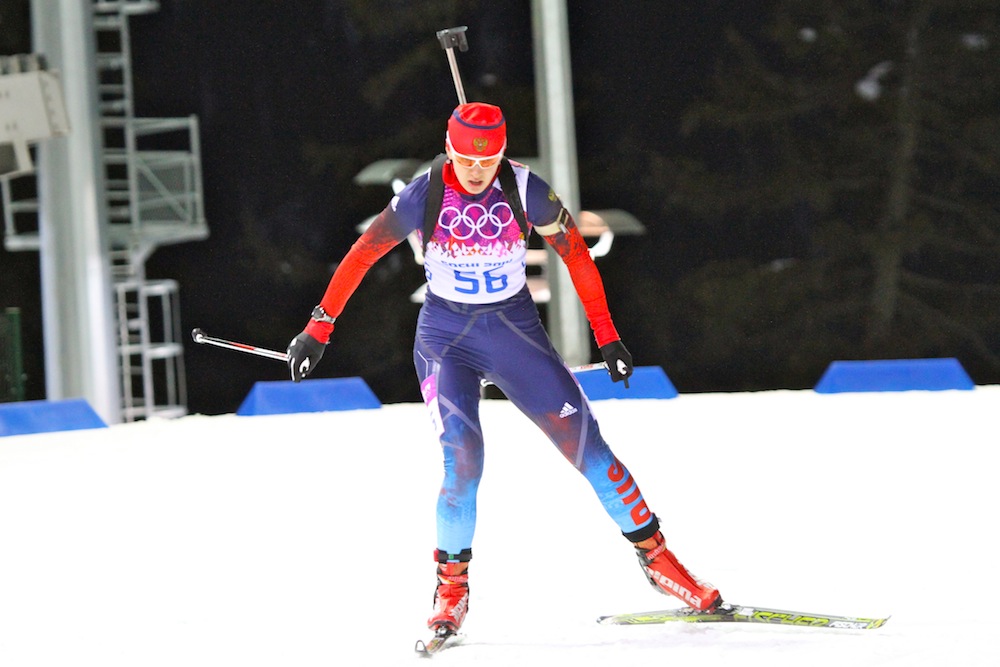
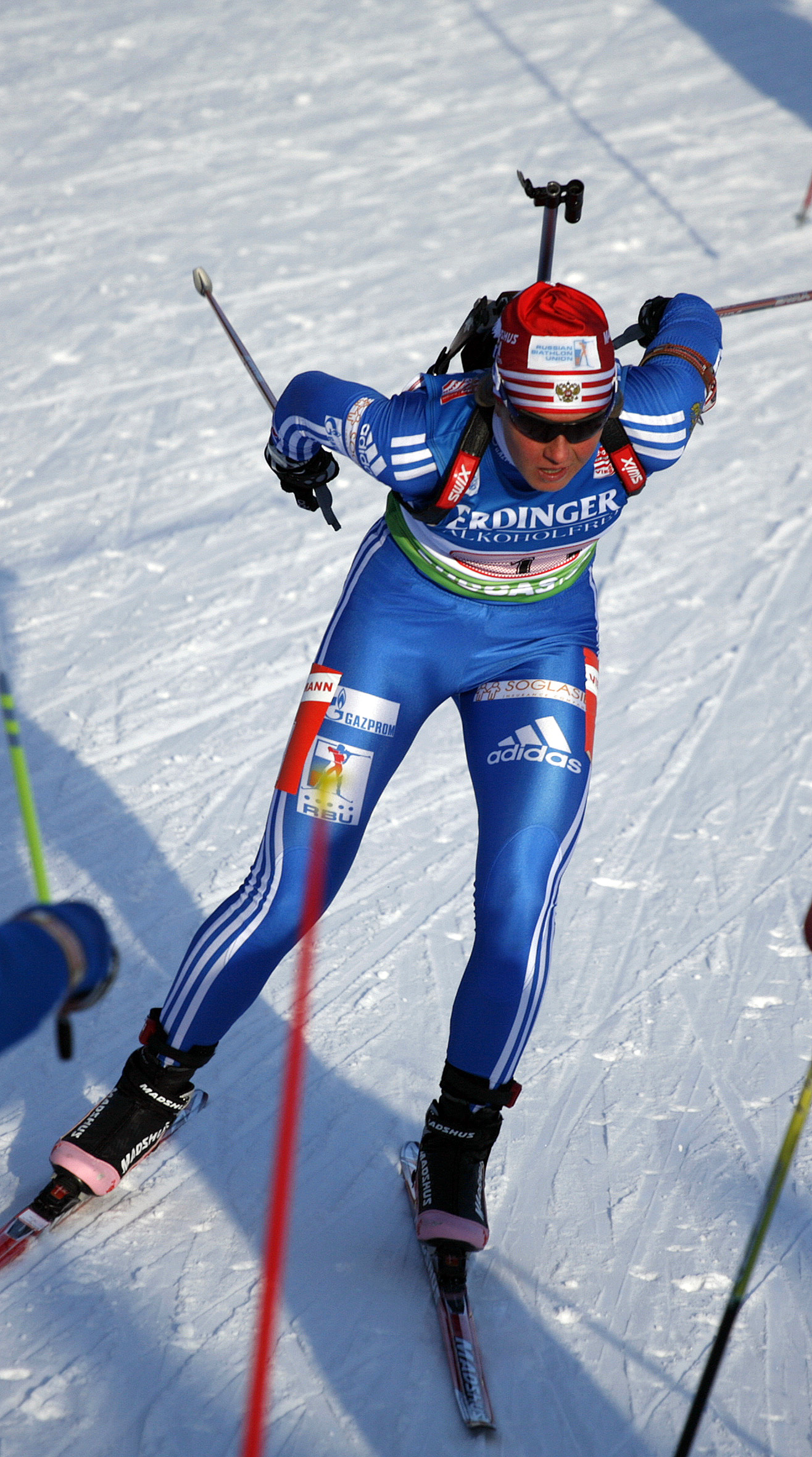
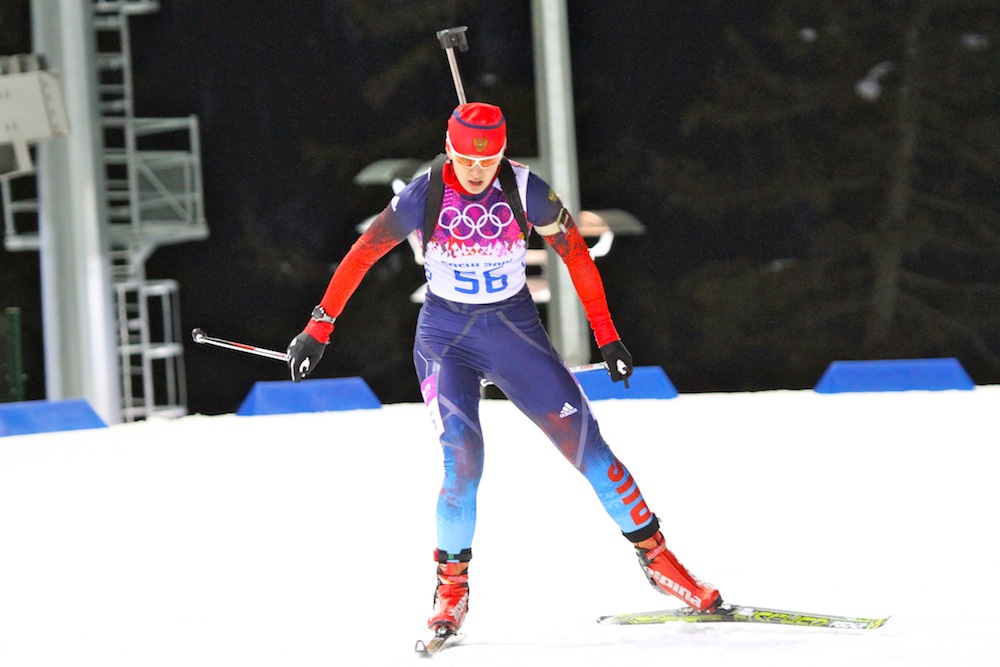
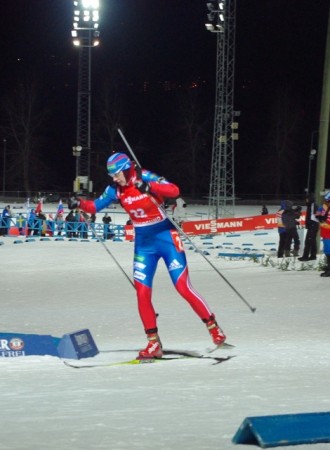
Olga Vilukhina won a silver medal in the sprint at the 2014 Olympics.
The Court for Arbitration in Sport (CAS) announced Thursday that three Russian biathletes implicated for doping at the 2014 Sochi Olympics had their lifetime bans overturned. The biathletes in question, Olga Vilukhina, Yana Romanova, and Olga Zaitseva were first handed lifetime bans in 2017 by the International Olympic Committee (IOC).
The McLaren Report included information tying the three athletes to doping. The IOC subsequently ruled the three Russians had committed an ADRV, or anti-doping rules violation. Their individual and team results were nullified and they were banned from all future Olympic Games. All three skiers have retired.
In the case of Romanova and Vilukhina, CAS stated: “that none of the acts alleged to have committed by these two athletes had been established to its comfortable satisfaction and beyond the mere suspicion of a potential ADRV.”
Prior to the 2017 IOC penalty, Vilukhin won the 2014 Olympic silver medal in the 7.5-kilometer sprint. That medal was subsequently stripped. Thursday’s CAS ruling reinstated individual results from the Sochi Games for both Romanova and Vilukhina. As a result, the silver medal will be returned to Vilukhina.
Zaytseva’s penalty was handled differently. CAS ruled Zaytseva had committed an ADRV for both swapping her urine for clean urine and using a prohibited substance. CAS clarified that Zaytseva would not have a lifetime ban, but would be “ineligible” for the 2018 Games after Sochi.
Beyond having her individual results not reinstated on Thursday, CAS maintained the IOC’s 2017 decision to nullify results from any team including Zaytseva at the 2014 Games. Zaytseva had teamed up with Romanova, Vilukhina, and Ekaterina Shumilova to win silver in the women’s 4 x 6 k relay in Sochi. That medal was stripped in 2017 – CAS upheld that penalty. Zaytseva was also on Russia’s fourth-place mixed relay team.
Zaytseva won gold medals in the 2006 and 2010 Olympic relays and a silver in the 2010 Olympic mass start. Those results are not impacted by the recent CAS decision.
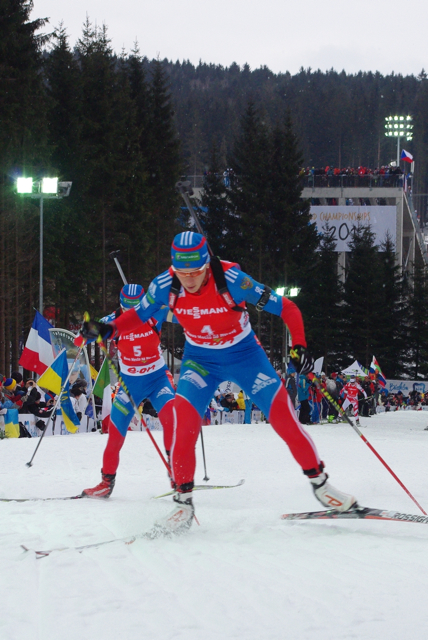
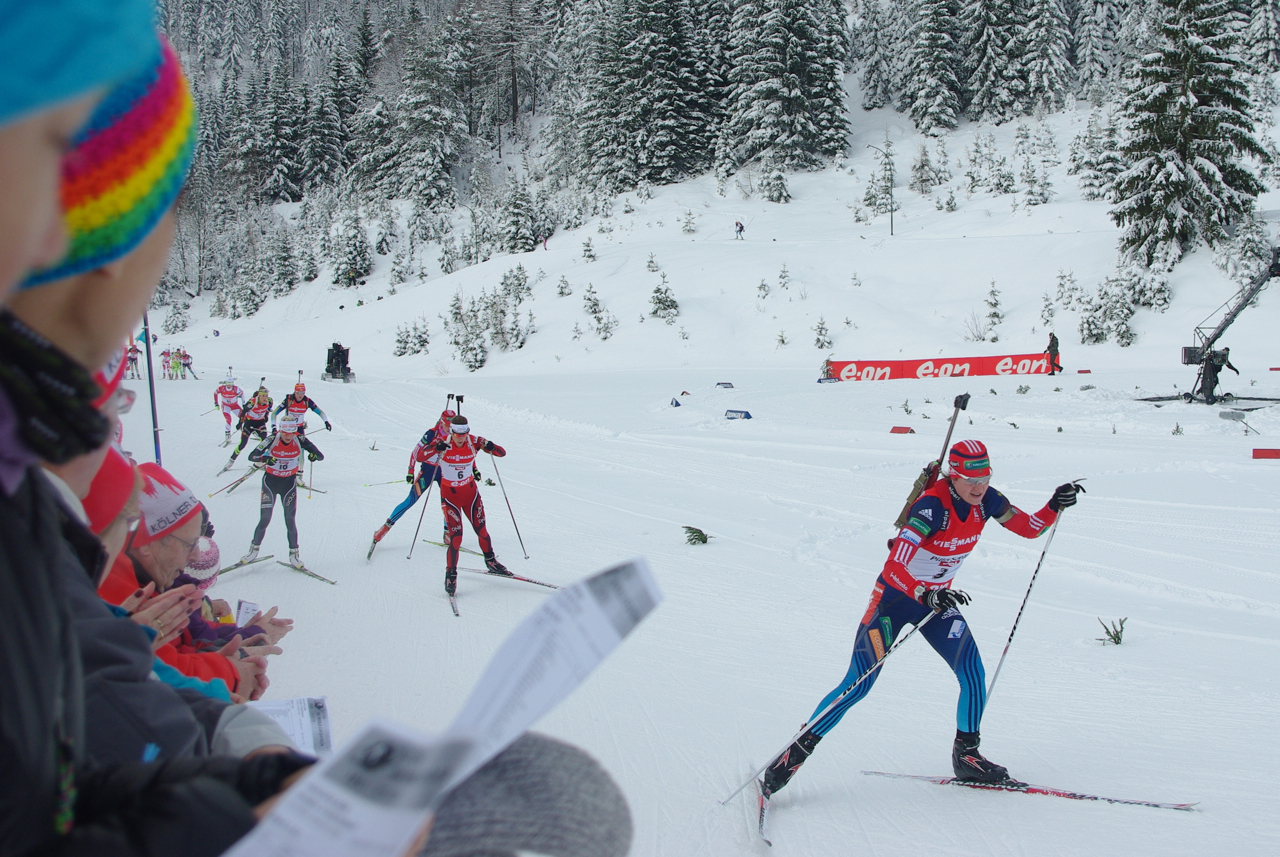
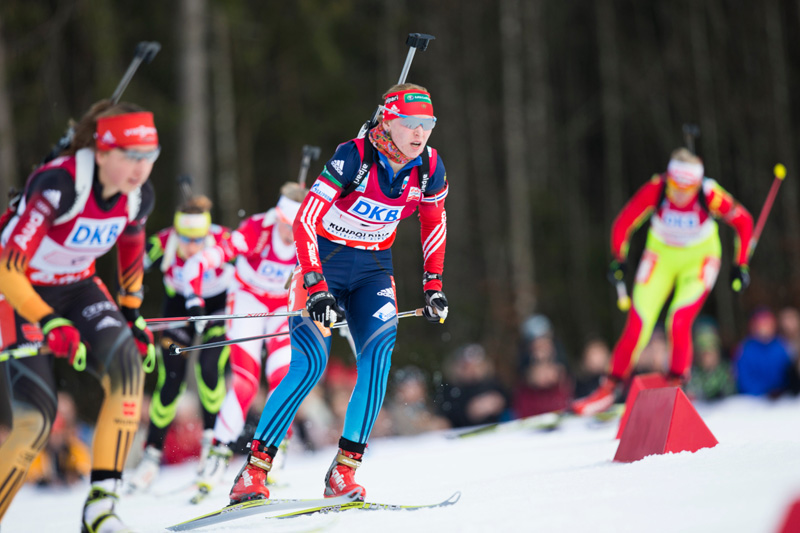
Russians Olga Zaitseva and Olga Vilukhina competing in the pursuit at 2013 World Championships. Both were disqualified from the 2014 Olympics by the International Olympic Committee, with a whistleblower stating that the biathlon team was doping in the years leading up to Sochi.
On Friday, the International Olympic Committee (IOC) posted the reasoned decision from its Disciplinary Commission, in which Russian biathlete Olga Zaitseva was disqualified from the 2014 Olympics in Sochi, Russia.
Zaitseva’s disqualification had been announced previously, but this is the first full-length decision presenting the evidence for the disqualification of any biathlete. Olga Vilukhina and Yana Romanova have also been suspended, but the Oswald Commission’s full decisions for their cases have not yet been released.
The reasoned decision not only contains details about Zaitseva, but also additional information which should put the whole biathlon world on notice.
“Dr. Rodchenkov further states that the entire Russian biathlon team, including the Athlete Zaytseva, has been using the Duchess Cocktail before the Olympic Winter Games Sochi 2014,” paragraph 359 of the decision reads. “He also provided an email sent April 2013, whereby he raised concerns about the high levels of haemoglobin for the biathlete team that was detected by his laboratory.”
The Duchess Cocktail refers to a combination of performance-enhancing drugs designed by Rodchenkov, the former director of the Moscow Anti-Doping Laboratory who assisted Russian teams in numerous sports to evade anti-doping rule violations before he became a whistleblower.
The Russian sports agency and the state security agency, FSB, developed a method to open anti-doping sample bottles. Using this method, they replaced the urine of athletes who had taken the Duchess Cocktail with previously-collected clean urine so that their doping would not be detected.
Thus, Rodchenkov is asserting that every Russian performance in the biathlon events at the 2014 Olympics was tainted by illegal performance-enhancing drugs.
This is notable because the men’s biathlon team, for instance, had not previously been implicated in doping scandal that has been raging for several years. Only the likely members of the women’s biathlon relay team – Vilukhina, Zaitseva, Romanova, and Irina Starykh (who was caught using the blood-doping drug EPO before the Olympics and suspended) – were on the “Duchess List,” a list of athletes presumed to have been given the drug cocktail. No male biathletes appeared.
However, it doesn’t seem surprising that they would, given that 14 cross-country skiers, virtually the entire Russian squad for Sochi, appeared on the list, as well as the female biathletes.
And that’s what Rodchenkov said, too.
“Dr. Rodchenkov… gives indications regarding the widespread use of Prohibited Subtances notably human growth hormones and EPO in the years preceding the Olympic Games,” another paragraph of the decision reads, referring to “members [of] the biathlon and cross-country skiing teams, for which the endurance is an absolutely critical elements.”
This raises the question of whether further action will be taken against more biathletes by the IOC, or by the International Biathlon Union (IBU).
The IBU has provisionally suspended the Russian Biathlon Union, but that actually has few consequences: Russia is still slated to host a World Cup weekend in March, Russian Victor Maygurov is still the First Vice President of the IBU, and all Russian athletes are still allowed to compete in the World Cup and the Olympics (Romanova, Vilukhina, and Zaitseva retired before they were suspended).
In the meantime, she has maintained her innocence. So has Wolfgang Pichler, the German coach who worked with the Russian women’s biathlon team in the four years leading up to the Sochi Olympics. For his troubles, he has been banned from attending the 2018 Olympics, where he would have coached the Swedish women’s team, which he now leads.
As the decision notes, Zaitseva and her legal team raised several objections to the case against her. She claimed that to suspend her was to pursue “collective justice” based on the widespread evidence of doping by Russia, rather than referring to any fault of her own. She also attacked Rodchenkov’s character, calling him an unreliable witness.
And finally, her team questioned the methods developed by Professor Champod at the University of Lausanne to detect whether anti-doping sample bottles had been tampered with.
That was wise, because the most damning evidence against Zaitseva comes from her sample bottles. Two of her sample bottles from Sochi had multiple marks on them consistent with tampering. In one of those bottles, the urine had such high amounts of salt that it is not possible that the concentration was produced by the human body. Together, these two pieces of evidence were used to argue that her samples had been tampered with.
According to logic used by the Disciplinary Commission in this and other cases, that tampering couldn’t have happened without Zaitseva’s knowledge. DNA testing showed that the urine in the samples was hers, which indicates that if the urine was replaced, it had to have been given by her at a different time. The Commission rejected the possibility that such a urine sample could have been collected without an athlete knowing its intended purpose.
But while two experts testifying on Zaitseva’s behalf criticized Champod’s methods as being incompletely described, they were unable to convincingly explain why their questions would absolve Zaitseva of blame.
“Neither Mr Alexei Bushin, nor Ms Evgeniya Burova did, in particular, offer any alternative explanations for the presence of marks consistent with the opening of the bottles with tools of the kind used by Prof. Champod,” the decision noted. “The IOC Disciplinary Commission finds this absence of alternative explanation even more significant in the case where one of the bottles not only bears marks strongly indicative of opening, but in addition contains urine with an abnormal salt content. Both elements support the conclusion that it was opened. The expertise of Prof. Champed convincingly demonstrates how this opening, which necessarily occurred, could be operated.”
This forensic evidence was used in the Commission’s decision that Zaitseva had violated the provision of the Anti-Doping Rules for the 2014 Winter Olympic Games which prohibits tampering with samples or with the integrity of the anti-doping process.
By doing so, they also found that she was complicit in a cover-up, thus breaking another provision of the Anti-Doping Rules.
In a strange aside, a urine sample belonging to Zaitseva but collected later, in October 2014, was analyzed in order to make a DNA comparison to the Sochi samples. What such a comparison actually revealed was that the October sample contained the urine of two different women mixed together, indicating that sample-swapping continued after the 2014 Olympics.
“This result does not concern the Olympic Games in Sochi and, as such does not fall within the scope of the application of the Rules,” the Commission wrote in its decision. “It however constitutes additional evidence that the Athlete was a protected elite athlete actively engaged in doping practices.”
The Commission also concluded that Zaitseva had used prohibited performance-enhancing drugs, on the basis of testimony from Rodchenkov.
“Use or Attempted Use of a Prohibited Substance can be established by any reliable means,” the Commission wrote. “This includes witness evidence.”
In an affidavit to the Disciplinary Commission hearing, Rodchenkov shared his own observations, many of which were based on detailed notes he had taken in a daily diary over the years. He also provided emails and documents related to Zaitseva and to the biathlon team.
“Dr Rodchenkov provides a list issued in October 2012 reflecting the clean urine bank existing at that time,” paragraph 358 reads. “The Athlete Zaytseva is mentioned on this list, with an indication that her urine was delivered to the Moscow Laboratory on 24 October 2012.”
“Dr Rodchenkov also recalled that in 2013 and early 2014 he had numerous conversations about the Athlete Zaytseva, as she was on a protected list,” another paragraph reads. “In autumn 2013, he took part to a discussion with the Athlete Zaytseva at the Ministry of Sports in Moscow. During this meeting the abnormal [Athlete Biological Passport’ data, due to her constant [performance-enhancing drugs] use, was discussed.”
And there was also evidence that Zaitseva was both doping, and also being tested more frequently than many other athletes, which is consistent with a previously-stated policy of the IBU to do “targeted testing” on athletes with suspicious biological passport profiles.
“Dr Rodchenkov specifically recalls swapping sessions of the Athlete’s numerous sample,” paragraph 361 reads. “Due to the intensity of the testing, Dr Rodchenkov underlines that they almost ran out of the Athlete’s clean urine. He remembers that the Athlete Zaytseva provided three plastic bottles of clean urine to freeze and store at the FSB and that additional urine had to be delivered.”
Zaitseva argued that Rodchenkov’s recollections and correspondence should not be used against her because of the illegal actions he had taken in the past. The Disciplinary Commission disagreed.
“Given the insistence of the Athlete’s attacks, the Disciplinary Commission will add the following,” the Commission wrote. “The Athlete refers to the past actions and behaviours of Dr Rodchenkov. In this respect, the Disciplinary Commission wants to be very clear in confirming that considering Dr Rodchenkov as a reliable witness is not in any way an approval of his past actions and his moral character. His actions, while being a director of the Moscow Laboratory, are despicable and inexcusable. This said, in a case of a conspirative scheme, the main evidence is often coming from participants, who accept to stand as witness.”
Anna Magnusson competing in the mixed relay in Östersund, Sweden, this season. The Swedish women’s biathlon team will be without its top coach at the 2018 Olympics. (Photo: Svenska Skidskyyteförbundet)
Wolfgang Pichler, the coach of the Swedish women’s biathlon team, will not be allowed to attend the 2018 Olympics in PyeongChang, South Korea. The reason? He previously worked with Russian athletes who have now been convicted of doping violations.
The German rose to prominence as a coach when he led the Swedish team during the time of Magdalena Forsberg, coaching Anna Carin Zidek and Helena Eckholm as well. But he then left the team and decided to go to Russia.
An outspoken critic of doping who had previously called for the Russian team to be excluded from international biathlon for its raft of doping offenses, Pichler went there to clean up. He vowed to work with the women’s team, which he said had a lot of talent, and see what they could accomplish without performance-enhancing drugs.
Unfortunately, as the McLaren Report and now the International Olympic Committee (IOC) Disciplinary Commission investigations have revealed, doping did not stop in Russian biathlon after Pichler’s arrival and his public assertions about how his team would be run.
Several of his former athletes have been disqualified from the 2014 Olympics and all future Games.
Olga Zaitseva (RUS) gets encouragement from coach Wolfgang Pichler at 2013 World Championships in Nove Mesto, Czech Republic.
That includes Olga Vilukhina, who worked with Pichler at the beginning of his tenure before leaving his group and returning to Russian coach Vladimir Korolkevich.
Korolkevich had also coached several of the Russians caught doping in the past. Indeed, in the run-up to 2014, two of his athletes – Irina Starykh and Ekaterina Iourieva – were caught blood doping, in Iourieva’s case a repeat offense as she had already served a doping suspension. He is also now one of the current leaders of the Russian biathlon team.
Olga Zaitseva, who did continue working with Pichler through his entire tenure with the Russian team, was also recently disqualified by the IOC.
Pichler, who left Russia after 2014 and is now working with the Swedes again, has conceded that things may have happened behind his back. But he has insisted that he had no knowledge of doping among his athletes, and flatly disbelieves that Zaitseva was involved.
“I believe and say today that my team was clean,” he told Sport.de in January, also noting that he supported a ban on Russia competing internationally if the allegations in the McLaren Report were true: “If all that is true, as it has been said, then the Russians should have to take an Olympic break and be excluded.”
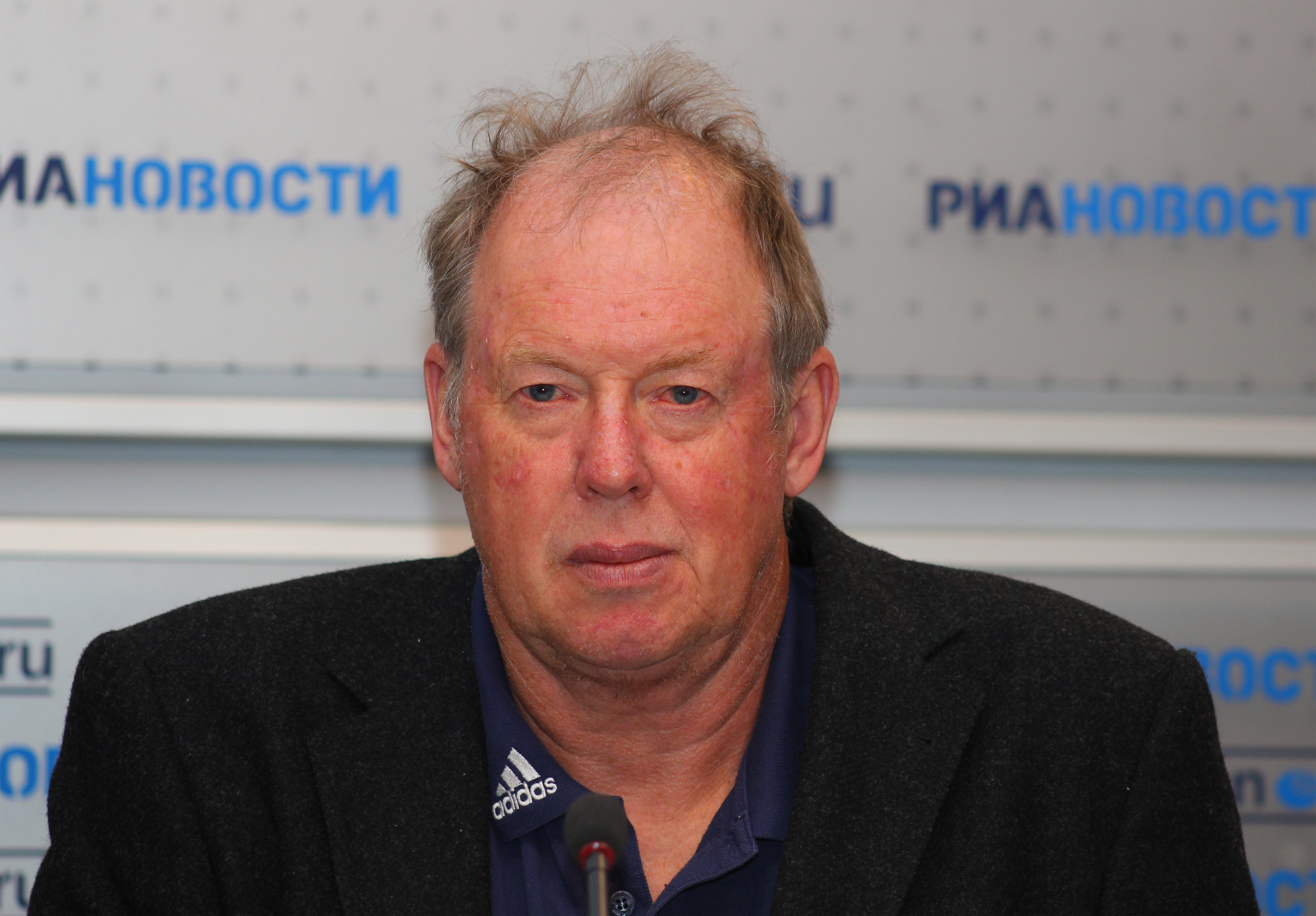
Wolfgang Pichler. (Photo: Wikimedia Commons)
Whether he knew what was happening or not matters little. In its December 5 decision suspending the Russian Olympic Committee and mandating that Russian athletes compete in PyeongChang under the moniker “Olympic Athlete of Russia”, the IOC wrote that “No coach or medical doctor whose athlete has been found to have committed an Anti-Doping Rule Violation can be included on the invitation list” to PyeongChang.
That apparently includes Pichler. Reuters reported today that he will not be allowed to travel to the Olympics with his Swedish athletes.
“The Swedish Biathlon Federation still has strong confidence in Wolfgang, who throughout his career advocated for clean sport as an active leader, but accept and understand the IOC’s line that says that leaders who worked with Russian athletes who committed doping offences in conjunction with the Sochi Olympics in 2014 cannot attend Pyeongchang 2018,” the Swedish Biathlon Federation wrote in a press release, according to a translation.
According to Scandinavian media, the decision by the IOC cannot be appealed and the Court of Arbitration for Sport has no jurisdiction. It is not a doping case per se, and ratehr a decision by the IOC about who can be invited to its events.
This creates an unusual situation where coaches of athletes from other countries who have been suspended for doping, such as the coaches of Norwegian cross-country skiers Therese Johaug and Martin Johnsrud Sundby, Austrian cross-country skiers Johannes Düerr and Harald Wurm, or Slovenian biathlete Teja Gregorin, could be present in PyeongChang but Pichler will not.
“I was not involved in any way, not a single percent,” Pichler told Swedish paper Expressen, according to a translation. “It’s true. Everything may happen behind one’s back, of course, but I was not involved in any of it… No one is talking to me. None from [the World Anti-Doping Agency], none from the IOC. No one at all. There was no court process, no one has asked me questions or given me the opportunity to explain. What should I say? in my eyes, I am a victim, maybe a political victim.”
The young Swedish women’s team Pichler is heading may be the real victim. The women have had some strong results recently; 27-year-old Mona Brorsson was sixth in the Östersund 20 k individual, where Linn Persson and Sebastian Samuelson were fifth in the single mixed relay and the mixed relay team was also fifth. Last season, Brorsson, Persson, Hanna Oeberg, and Anna Magnusson were sixth in the women’s relay at World Championships.
“I will prepare the team the best I can,” Pichler told Expressen. “As usual, I will give 150 percent and during the Olympics I can also Skype with them.”
The Swedish team is looking for a solution so that the athletes also have a coach on the ground in PyeongChang.
Italy placed second in the mixed relay at the IBU World Cup in Canmore, Alberta, in 2016. Karin Oberhofer (second from l) is the 2014 Olympic bronze medalist in the sprint after the disqualification of Russia’s Olga Vilukhina for doping. (Photo: Daniel S. Guay)
And not only Italy – but specifically, Karin Oberhofer.
The then-28-year-old was part of the mixed relay team which won bronze, along with Lukas Hofer, Dominik Windisch, and Dorothea Wierer. Oberhofer will now receive her bronze medal in the sprint as well, where she finished 27.9 seconds behind gold medalist Anastasia Kuzmina of Slovakia with ten-for-ten shooting. Before 2014, she had never stood on an individual podium at the top level of competition.
“I would be very happy to belatedly receive the Olympic bronze medal,” Oberhofer – who was officially fourth at race time, while now-disqualified Vilukhina was officially second – wrote in an email. Her comments were made in German and translated into English.
Vilukhina, meanwhile, has said that she refuses to give back silver medals from the relay and the sprint.
“I won’t just give up the medals,” she told sports.ru, according to a translation. “I’m a two-time Olympic medalist.”
The International Olympic Committee, however, has ordered that her medals be returned, and notified the Italian Olympic Committee that Oberhofer will be getting bronze.
“Of course everything has a bitter aftertaste, but I would say: ‘better late than never’,” Oberhofer wrote. “It would be wonderful for me if my performance on that day would now be crowned with the bronze. It would also mean to me that justice has finally won.”
Since the Olympics, Oberhofer also won two bronze medals at 2015 World Championships, in the mass start and the women’s relay. The same season, she was second in a World Cup sprint.
Then, Oberhofer took a break last season to prepare her first child, Paul, who was born in August. She has continued training but has not raced yet this season.
“I am very happy with my little family and about my new challenge,” Oberhofer wrote. “Every day with my little son is unique and indescribably beautiful. It’s not always easy, but my family helps me a lot and I love doing sports. I do it because I like to do it, and little Paul allows me to do it and is very well-behaved. At the moment I am at home and prepare myself individually for the competitions. I have to qualify again for the international competitions first.”
Oberhofer has known for nearly a year that her Olympic sprint was likely medal-worthy. When the McLaren report released its evidence packet, the names of four Russian biathletes, including Vilukhina, were not redacted in one of the documents.
“11 months ago there were already these rumors, and several members of the media contacted me about that,” Oberhofer wrote. “[Recently] I was contacted by Giovanni Malagó, President of the Italian National Olympic Committee, who informed me that Vilukhina had been banned and removed from the list of results.”
Oberhofer isn’t sure whether there will be some medal ceremony arranged for the one she missed out on in Sochi.
“Honestly, I don’t really know what to say about that,” she wrote. “It would be a big surprise for me if it took place in public. But that’s not so important. The most beautiful thing for me would be to get the medal at all. But what I do know is that I would belatedly celebrate this medal with my family and friends in a small ceremony.”
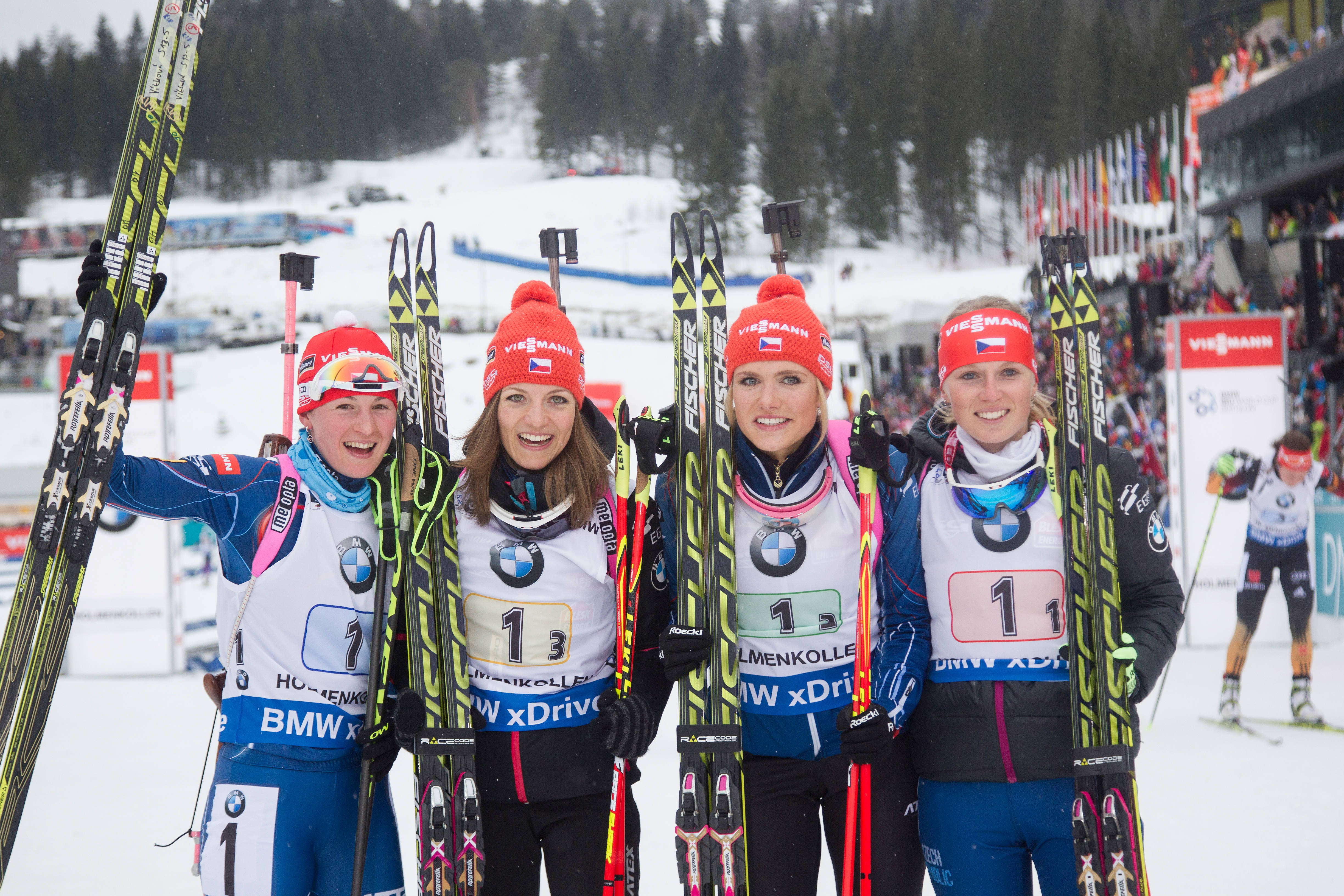
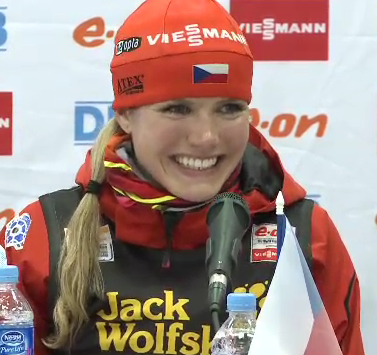
Biathletes Veronika Vítková, Jitka Landová, Gabriela Koukalová, and Eva Puskarčíková after a 2015 relay in Oslo, Norway. The Czech women learned that they would receive an Olympic bronze medal after the Russian team has been disqualified for doping. (Photo: Fischer/NordicFocus)
(Editor’s note: This article contains explicit language.)
The U.S. women finished seventh in the Sochi relay, and some athletes spoke out about how much it would have meant to be sixth not three years later, but the day they competed.
“It only took us 4 years, but now our historic 7th place is actually 6th…tying the best ever Olympic relay result for US Biathlon – men or women!” team member Sara Studebaker wrote on Facebook. “It’s unfortunate it took 4 years for this to happen. Because we were 7th instead of 6th, some teammates missed out on being pre-qualified for events and getting monetary support… Doping affects all athletes at some level. There is no excuse.”
“The ripple effect from athletes doping feels even more personal now,” she wrote. “It’s wild to think about what would have been different for us with a 6th place relay at the Olympics instead of 7th. Thanks Russia for the flower ceremony at the Olympics that we didn’t get to have, A-team status and funding for 2015, and pre-qualification for the World Cup.”
Canada finished eighth in the relay and will now move up to seventh.
Vilukhina earned a silver medal in the 7.5-kilometer sprint; that means that Vita Semerenko of Ukraine will be upgraded from bronze to silver, and Karin Oberhofer of Italy will earn bronze, the first individual Olympic medal of her career.
Then there is the relay, where both Vilukhina and Romanova represented Russia. They took silver with teammates Olga Zaitseva and Ekaterina Shumilova. The Norwegian team will now move from bronze to silver, and the Czech team will now earn bronze.
Gabriela Koukalová posted on her Facebook page about how frustrated she was with the scandal. A translated version reads,
“I know that you all know… I mean about our Olympic medal from Sochi for the women’s relay, which we are going to receive with almost four years of delay. On one side it’s great that justice was achieved, but on the other side I am truly sorry for Eva Puskarčíková and mostly for my lifelong friend Jitka Landová, who had to end her biathlon career due to medical reasons. She spent almost her entire career with hard work and without any memories of success. I am not sure about you, but I want to turn doping into a crime and not allow Russian Federation to start at the Winter Olympics, like it already happened at the Summer Games! I also would like to stress one more goal, and that is more important than victories. Their names are HONESTY AND FAIRNESS, not only in sport but overall in the life! Too bad that they [Russians] hadn’t figured that one yet! And now I would like to move on from this topic…”
Meanwhile, Landová isn’t sure that a medal would have changed the trajectory of her career, saying that she doesn’t look back. But she does wish she’d had the medal earlier, she said in a Czech radio interview.
“Last night I received a message from Eva Puskarčíková that we really had the Sochi medal,” Landová said, according to a translation. “I looked at it first with disbelief, because as long as I have no tangible evidence, I just don’t believe it. From the very beginning, we knew the Russians were not clean.”
“I do not know whether to be glad or cry,” Puskarčíková told the same radio broadcaster.
The pushback against the women on social media has been swift and severe.
The number of comments below Koukalová’s Facebook post calling her stupid and a disgrace are too many to count, as are those telling her to stick to sport and “worry about your performance,” a comment that sometimes had a foreboding connotation. Other comments call her a “b*tch” or a “f*cking b*tch.” Still others compare her to Nazis or fascists.
Then there are the threats.
“Russia will be wait you on World Cup in Tyumen 2017… you want to get negative before the Olympic Games? ok, you will get it!,” wrote one poster, following this with an emoji of a punching fist.
“you have found enemies in the face of 300 million people… be careful,” one commenter wrote.
“Can be you sure that your test-tube Ok or someone scratch it and you will be deprived of all medals,” another threatened.
Instagram was, if anything, worse – even though that’s not the platform where the athletes had made any of their comments.
On the account “jitka_official_landova”, which it is not clear is actually maintained by Landová, received hate on nearly all of the posts, even though the last post was only from 2015 and the account has no recent activity. Under a picture of Landová posted in February, 2015, one comment reads, “prostitutky,” which translates from to “prostitutes”.
There are several Instagram pages attributed to Koukalová, some of which are clearly fan pages and two which are verified by Instagram (calling into question the efficacy of the verification system, but that’s another story.) It’s unclear if either of the two verified accounts are operated by Koukalová; there is no link to Instagram from her website.
But regardless of whether comments left there are actually reaching her, a lot are being posted regardless. Many are filled with emojis of livestock like pigs and sheep, and feces. The pigs and excrement were often accompanied by a lipstick emoji; Koukalová has a contract to appear in makeup ads.
On a page seeming to really belong to Koukalová, she was repeatedly called “scum.”
“you’re a lying b*tch!” one commenter wrote in English. “You are fascist,” wrote another. “You are one disgraceful sh*tty slut,” another commenter added.
Then there were those written in Russian, which translated to, if anything, worse comments:
“Go in a hole and don’t come back”
“prostitute”
“burn in hell”
“F*ck you, f*cking b*tch, no one will remember you and the medal”
“You b*tch”
“you don’t take medals, you only take it in the mouth”
“piece of sh*t”
“The end”
After one Russian fan writes a supportive message, another replies, “burn at the stake with her, sheep.”
Comments also riddled posts on an account which appeared to be maintained by fans.
“Such animals must be hung!” one comment translated from Russian read. Some others:
“Better not come to Tyumen!”
“Whore”
“Her brains are only enough to paint her face”
“Wash it, it’s a man”
“Lose weight, you’re so fat”
Many mention the phrase “life is a boomerang”. “Remember everything comes back, it’s the rule of life and your joy for getting not yours medal will turn into tears soon,” one comment written in English says.
Koukalová is not competing in the opening World Cup weekend in Östersund, Sweden, as she is still recovering from a calf injury. Many comments stated that they hoped she would never return to competition, or if she did, that she would lose every race. See this link for a good example. Take a look.
In the 15 k individual today, the first individual race of the World Cup season, Puskarčíková finished seventh with perfect 20-for-20 shooting; Vítková finished 12th with two penalties.
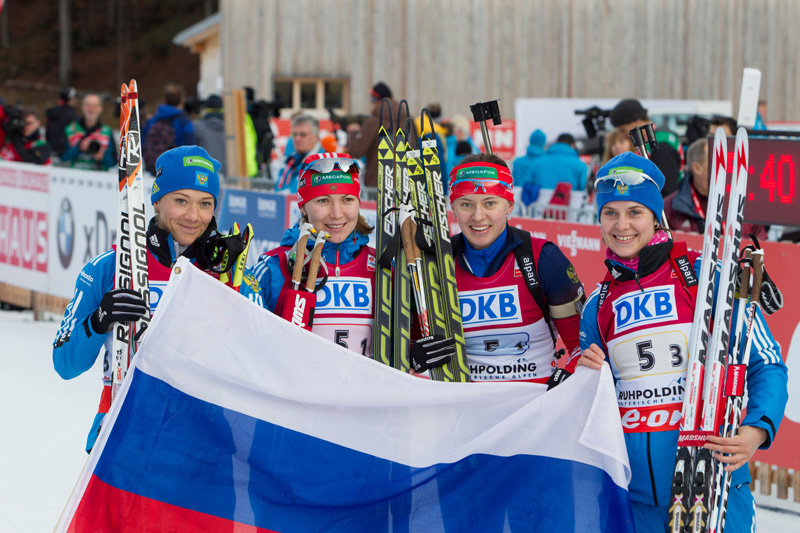
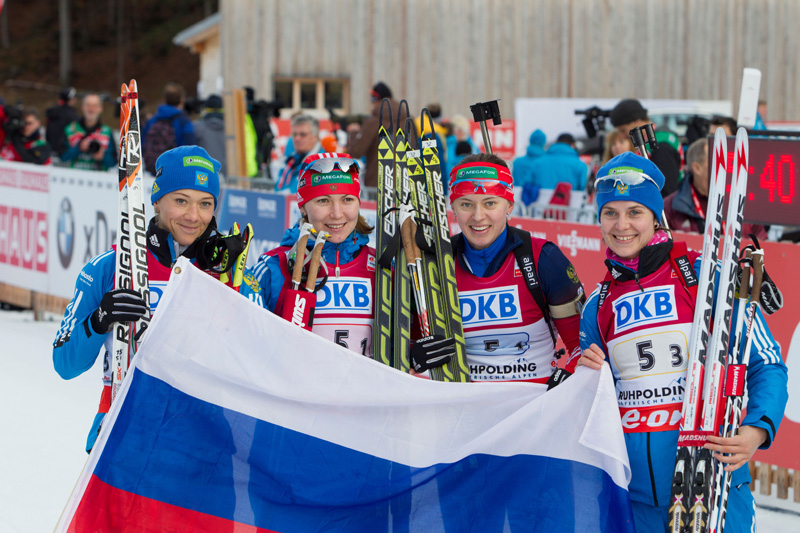
Olga Zaitseva, Ekaterina Glazyrina, Olga Vilukhina, and Irina Starykh celebrate their IBU World Cup biathlon relay victory in Ruhpolding, Germany in January 2014. (Photo: Fischer/Nordic Focus)
The International Biathlon Union (IBU) has received a list of 31 Russian athletes involved in doping, IBU President Anders Besseberg told Norway’s VG newspaper.
“Some of the 31 athletes are already banned, others have retired, but the most urgent thing is to assess the biathletes who are now participating in our international competitions,” Besseberg said. “I reckon that we on the board will make recommendations within a week… of those athletes who the Committee believes should be provisionally excluded.”
Some information about the athletes, however, can already be gleaned from the McLaren report.
For example, one document in the Evidence Disclosure Packet (EDP) failed to redact the names of four biathletes and replace them with alpha-numeric code identifiers. The four athletes were the planned roster for the women’s 4 x 6 k relay at the 2014 Olympics in Sochi, Russia: Olga Zaitseva, Olga Vilukhina, Yana Romanova, and Irina Starykh.
While the document identifying the women and their code numbers did not contain any evidence of doping, it means that any references to their code identifiers in other evidentiary documents can be connected to them.
For instance, such cross-referencing reveals that one of several samples deemed to be too dilute to be an authentic urine sample by the Drug Control Centre at King’s College London, used by the investigation for external analysis of suspicious samples, belonged to Romanova.
The team – with Ekaterina Shumilova replacing Starykh – won silver in the 4 x 6 k relay in Sochi.
Zaitseva retired after Sochi, as she had long planned to do. Romanova retired after the 2014/2015 season. Vilukhina took that year off and made an unsuccessful return last season, before announcing her retirement on November 14 of this year.
Nine other unnamed biathletes were shown in various documents to have tested positive for banned substances. In at least four of these cases, the results of the test were reported to the World Anti-Doping Agency’s ADAMS reporting database to be negative tests.
And at least 20 more athletes in the report belonged to biathlon, although in those cases there is no specific information about what substances they may have used.
Here is an extensive list of all the biathlon athletes mentioned in central documents from the evidence disclosure packet.
About the Documents
Professor McLaren (c) addressing the media after the his second report on systematic, state-sponsored doping in Russian summer and winter sports. (Photo: WADA/Twitter)
EDP1162 and EDP1149: Professor McLaren describes this document in his report: “Alexey Velikodniy created a daily competition schedule that identified protected athletes. The schedule was continuously updated during the Games and included all those on the Sochi Duchess List and athletes added during the Games, such as the female hockey team.”
EDP1149 includes English translation of the original EDP1162, and on page 44 of EDP1149 the names of the women biathletes are not redacted. Why redaction was successful in all other parts of the document, but not there, is questionable. Additionally, the document still seems to have been a planning document, as Staryk is still listed as competing in the relay even though she had long been off the Olympic team.
EDP1156: A list of sample numbers and collection during or immediately before the 2014 Olympics in Sochi, from protected national team athletes. Some data about the urine tests, like pH and specific gravity, are included, indicating that this was not merely a planning document but that the tests took place.
EDP1141: Results of a study done at King’s College London assessing whether the sodium concentration and specific gravity of some doping control samples were abnormal. (They were: in some cases, though none in biathlon, sodium concentrations were consistent with having added a teaspoon of salt to a one-cup urine sample.)
EDP1155: Translations of emails involving Grigory Rodchenkov, the former head of the Moscow anti-doping laboratory who became a whistleblower and took his story to the New York Times.
EDP1166: A list of test numbers, mostly associated with athlete ID numbers, identified by the investigation. “The IP has identified more than 1231 samples where the Moscow Laboratory communicated the presence of a prohibited substance in a Russian athlete’s sample to the [Ministry of Sport] and later reported that sample as negative in ADAMS or did not report the sample at all.” This document lists those 1231 samples.
There are columns for which substances were positive in the sample (this column is often blank) and how the report was filed in the ADAMS database. Many samples were filed as “negative”, but this column is also often left blank. This may mean that the sample was never reported in ADAMS at all – as McLaren says was fairly common – or simply that there was no information about it.
In general, the investigation’s translations from Russian into English are not always smooth. This is particularly apparent in reference to competitions: the name or level of a series is hard to interpret. It’s possible that the anti-doping staff themselves were not familiar with the different race circuits because they were not necessarily biathlon experts, and worked more generally in all sports.
A further note: some documents are scanned and thus not searchable by text. Thus some names and numbers may be referenced in places where we have not yet found them.
The Biathlon Relay Team
A0944, Olga Vilukhina
Olga Vilukhina won a silver medal in the sprint at the 2014 Olympics.
Why do we know her name? Listed in position “1” on pages 44 and 45 of EDP1149, in the 4 x 6 k relay
Evidence of being a protected athlete? Yes, in multiple documents (although those documents may be redundant; without metadata, it is difficult to tell).
Evidence that positive tests were covered up? Maybe. In EDP1166, one of Vilukhina’s samples (2870741) is listed as being reported “negative” to the ADAMS database and referred to in a document titled (in Russian) “Biathlon 3”, indicating a date of 06.01.2014 for the sample. But there is no substance listed for this sample in EDP1166. Because this document was assembled to be a list of samples which were reported to the Ministry of Sport as being positive, it’s not clear what to conclude from this combination of facts.
Other tests? Besides that one sample, there are several other samples listed for Vilukhina: urine samples collected January 31, February 9, and February 16, 2014, and a blood sample collected February 15, 2014. While the urine samples are referenced in EDP1166, no substances were listed and the test does not seem to have been entered into ADAMS. February 9 was the day of the women’s sprint in Sochi, where Vilukhina won a silver medal. February 16 was the day before the women’s mass start, where Vilukhina placed 21st.
A0983, Olga Zaitseva
Olga Zaitseva blows kisses to the crowd as she brings Russia the gold in the Olympic biathlon relay in 2010.
Why do we know her name? Listed in position “3” on pages 44 and 45 of EDP1149, in the 4 x 6 k relay
Evidence of being a protected athlete? Yes, in multiple documents (although those documents may be redundant; without metadata, it is difficult to tell).
Evidence of positive tests? Maybe. In EDP1166, one of Zaitseva’s samples (2870735) is listed as being reported “negative” to the ADAMS database. But there is no substance listed for this sample or date of collection and it is not referred to in any other documents. Because EDP1166 was assembled to be a list of samples which were reported to the Ministry of Sport as being positive, it’s not clear what to conclude from this combination of facts.
Other tests? Besides that one sample, there are several other samples listed for Zaitseva. Around the time of Sochi, urine samples were collected January 31, February 14 and February 19, 2014, and a blood sample collected January 31, 2014. An additional undated urine sample is referred to in EDP1166. For these samples, no substances were listed and the test does not seem to have been entered into ADAMS. February 14 was the day of the women’s 15 k individual, where Zaitseva placed 15th, and February 19 was the mixed relay, where the Russian team including both Zaitseva and Vilukhina placed fourth.
A0714, Yana Romanova
Yana Romanova competing in Kontiolahti, Finland, in 2010. (Photo: Peter Porai-Koshits/Wikimedia/Creative Commons)
Why do we know her name? Listed in position “4” on pages 44 and 45 of EDP1149, in the 4 x 6 k relay
Evidence of being a protected athlete? Yes, in multiple documents (although those documents may be redundant; without metadata, it is difficult to tell).
Evidence of positive tests? The report from King’s College London indicates that one of Romanova’s samples (number 2889617, collected on February 2, 2014, just before the Sochi Olympics began, according to another document) was too dilute to be an authentic sample. In the report and the New York Times investigation, Rodchenkov described adding water or salt to samples that were being manipulated. The King’s College London test suggests that this may be one such sample.
In EDP1166, one of Romanova’s samples (2870745) is listed as being reported “negative” to the ADAMS database. But there is no substance listed for this sample or date of collection and it is not referred to in any other documents. Because EDP1166 was assembled to be a list of samples which were reported to the Ministry of Sport as being positive, it’s not clear what to conclude from this combination of facts.
Other tests? Besides those two samples, there are several others listed for Romanova. Around the time of Sochi, urine samples were collected January 31, February 2, 13, and 21, 2014, and blood samples collected February 14 and 15, 2014. An additional undated urine sample is referred to in EDP1166. For these samples, no substances were listed and the test does not seem to have been entered into ADAMS. February 14 was the day of the women’s 15 k individual, where Romanova placed 53rd, and February 21 was the day of the women’s relay.
A0856, Irina Starykh
Targeted testing based on data from the IBU’s Athlete Biological Testing program led to the suspension of Irina Starykh, above on her way to fifth place in the World Cup pursuit in Hochfilzen, Austria, in 2013, and another Russian biathlete for blood-doping. The IBU fined Russia for a cluster of doping cases.
Why do we know her name? Listed in position “5” on pages 44 and 45 of EDP1149, in the 4 x 6 k relay
Evidence of being a protected athlete? Yes, in multiple documents (although those documents may be redundant; without metadata, it is difficult to tell).
Evidence of positive tests? In EDP1166, two of Starykh’s samples (2870740 and 2870745) are listed as being reported “negative” to the ADAMS database. But there is no substance or date listed for either sample, and they are not referred to in any other documents. Because EDP1166 was assembled to be a list of samples which were reported to the Ministry of Sport as being positive, it’s not clear what to conclude from this combination of facts.
Other tests? No tests are listed for Starykh at the Sochi Olympics, because she was not there. However, there are five more samples of hers listed in EDP1166, for which no substances were listed and the test does not seem to have been entered into ADAMS.
Other Athletes with Positive Tests Described in Documents
Thirty-one other athlete ID numbers are associated with the sport of biathlon, and three additional mentions of biathletes which are not associated with any ID number. This means that they could belong to some of the 35 numbered athletes (the four named women plus the 31 unidentified, but numbered, athletes), or they could be completely separate cases.
Of those 31-34 other biathletes, here are the ones for whom positive tests for prohibited substances are explicitly mentioned in the documents.
A0241, female
Evidence of being a protected athlete? Maybe. This athlete was certainly competing internationally. By the time Russian anti-doping staff were discussing her case, she was in Ruhpolding, Germany, and then was set to travel to Antholz, Italy – consistent with the World Cup schedule – before checking into the Olympics. This plan does not seem to be jeopardized by her positive test, although the staff notes that she is at risk. After the positive test, Rodchenkov notes that “it is necessary to hide her immediately.”
Besides the four athletes named above, Shumilova competed in Sochi, along with Olga Podhufarova and Ekaterina Glazyrina. Several others were competing on the World Cup, but were unlikely to have been slated for Sochi participation because they did not have strong results so far in the season – the possible exception being Ekaterina Yurlova.
Evidence of positive tests? In EDP1166, this athlete’s sample (2866518) is shown as testing positive for methenolone, oxandrolone, and trenbolone, all anabolic steroids. The test was allegedly collected on 12.19.2013 in Izhevsk, Russia, at the biathlon championships.
How was the test handled? In the emails, which you can see in Russian here, this sample is given a “save” order, meaning that it should be reported as negative. And in EDP1166, the sample is shown as being negative in ADAMS. She may have additionally been quarantined: the anti-doping staff write in emails that if she was to be subjected to an international test (for instance, but the International Biathlon Union), she would certainly test positive and it would be “a very ugly situation for the lab if we ‘found nothing’ in such concentrations and for those substances.”
Other tests? In EDP1166, two of this athlete’s samples (2870746 and 2867708) are listed as being reported “negative” to the ADAMS database. But there is no substance or date listed for either sample, and they are not referred to in any other documents. Because EDP1166 was assembled to be a list of samples which were reported to the Ministry of Sport as being positive, it’s not clear what to conclude from this combination of facts. An additional blood test is listed in EDP1166 with no substances listed, and the test does not seem to have been entered into ADAMS.
Unnumbered Athlete, male
Evidence of being a protected athlete? No. The only other information about this athlete is that it was a man.
Evidence of positive tests? The emails refer to this athlete’s sample (2759623) being positive for 16a-hydroxyprednisolone (budesonide metabolite). Budesonide is a corticosteroid which is used in asthma medications such as Pulmicort inhalers, but it is also used in other forms: as pills, nasal sprays, and as a rectal foam to treat intestinal problems. The sample is written to have been collected on 11.1.2013 at in international competition in Ostrov, Russia. That day, IBU Cup sprints were held in Ostrov, with three Russian men (race winner Alexey Slepov, plus Sergey Korastylev and Sergey Klyachin) in the top six.
How was the test handled? There’s no information about how this test was handled. It is discussed in the email, but no conclusion is reached. It also does not appear in EDP1166.
Other tests? None listed.
A0028
Evidence of being a protected athlete? There’s no other information about this athlete.
Evidence of positive tests? In the emails, athlete A0028 is described as having tested positive for “methandienone circuit” at the Russian biathlon championships in Uvat on 31.07.2014. It’s unclear what “circuit” refers to – it may be an awkward translation – but methandienone is an anabolic steroid. In addition, the testosterone to epitestosterone ratio is listed as 6.2. A high ratio can indicate that an athlete was using exogenous testosterone, and a finding of a ratio above 4.0 triggers further investigation. The original email can be seen (in Russian) here.
How was the test handled? In the emails, the word “Quarantine” appears above the description of this athlete’s test results. This likely means that the athlete was kept in Russia until they could pass an anti-doping test. There’s no information about whether the test was reported to the ADAMS database or not.
Other tests? None listed.
A0179, female
Evidence of being a protected athlete? No. The only other information about this athlete is that it was a woman.
Evidence of positive tests? Document EDP1166 states that on 09.28.2014 at Russian biathlon championships in lzhevsk, a sample tested positive for isomers of amphetamines, which are banned stimulants. There is also discussion of the sample in the emails, with someone writing, “find out what she took!” The group seems to suspect that the substance came from a dietary supplement. The email (in Russian) can be seen here.
How was the test handled? In the emails, this case is listed with a “save” order: that means that a positive test should be turned into a negative one. Indeed, document EDP1166 states that this test was reported as negative to the ADAMS database.
Other tests? None listed.
A0461, male
Evidence of being a protected athlete? No. The only other information about this athlete is that it was a man.
Evidence of positive tests? EDP1166 shows that one of this athlete’s samples (2867705) tested positive for tuaminoheptane, a prohibited stimulant which is used in nasal decongestants. The emails (here) show that this sample was collected on 12.21.2013 at a Russian Cup race in lzhevsk.
How was the test handled? The emails are unclear, with someone writing, “and this one still does not have a decision (or I missed it).” However, in EDP1166 the test is listed as having been reported to ADAMS as negative.
One staff member, perhaps assumed to be Rodchenkov, writes this regarding the sample: “Alex, come on, I’ll close the whole shop… They are imprudent beyond measure… and then I will go to other laboratories after February 2014.”
Other tests? In EDP1166, two of this athlete’s samples (2918636 and 2870699) are listed as being reported “negative” to the ADAMS database. But there is no substance or date listed for either sample, and they are not referred to in any other documents. Because EDP1166 was assembled to be a list of samples which were reported to the Ministry of Sport as being positive, it’s not clear what to conclude from this combination of facts.
A0751, female
Evidence of being a protected athlete? No. The only other information about this athlete is that it was a woman.
Evidence of positive tests? EDP1166 shows that one of this athlete’s samples (2945500) tested positive for pthalates, which are plasticizers. They are prohibited because they are thought to indicate the use of blood transfusions, with the plasticizers being used to soften the plastic in blood bags and then diffusing into the blood. The emails show that this sample was collected on 09.28.2014 at Russian biathlon championships in lzhevsk, That email (in Russian) can be seen here.
How was the test handled? EDP1166 shows that this test was reported as negative to ADAMS.
Other tests? None listed.
A1244, male
Evidence of being a protected athlete? No. The only other information about this athlete is that it was a man.
Evidence of positive tests? The sample (2868394) is not listed in EDP1166, but only discussed in the emails (in Russian here). The emails refer to a positive test for trimetazidine, a metabolic modulator which protects against angina and heart problems, much like meldonium. According to the emails the sample was collected in Uvat at Russian biathlon championships on 6 April (assumed to be 2014).
How was the test handled? There’s no information about how this test was handled.
Other tests? None listed.
Unnumbered Athlete, male
Evidence of being a protected athlete? No. The only other information about this athlete is that it was a man.
Evidence of positive tests? In the emails, one of this athlete’s samples (2689927) is written to contain methylhexanamine, a banned stimulant common in dietary supplements (it is in fact the same substance which German biathlete Evi Sachenbacher-Stehle tested positive for at the 2014 Olympics). The sample was collected on 2012-12-17 at all-Russia competitions in Ekaterinburg.
How was the test handled? There’s no information about how this test was handled. In the emails, it is clear that nothing was done about the test until the following year (2013), but the final action is not discussed. It also does not appear in EDP1166.
Other tests? None listed.
Unnumbered Athlete, male
Evidence of being a protected athlete? No. The only other information about this athlete is that it was a man.
Evidence of positive tests? One of this athlete’s samples (2746493) is discussed in the emails as having tested positive for furosemide, a diuretic and masking agent. The sample was collected on 01/09/2013 at all-Russia competitions in lzhevsk.
How was the test handled? There’s no information about how this test was handled. Other than reporting the sample, there is no discussion of the test in the emails, and also does not appear in EDP1166.
Other tests? None listed.
Other Athletes Mentioned in the Documents
For the rest of the biathletes, sample numbers are listed in EDP1166, but no substances are listed and positive tests are not discussed described in any of the other documents. Because EDP1166 was assembled to be a list of samples which were reported to the Ministry of Sport as being positive, it’s not clear what to conclude about the samples.
Here is what we know about them.
ID Number
Gender
Samples reported as negative
Samples with no information about reporting
A0023
Male
2869722
A0136
Male
2870692
A0157
Male
2867964
A0201
Female
2869837
A0232
Male
2870747
2889906, 2890603, 2890739, 2944467
A0282
Female
2866843
A0321
Female
2868243
A0491
Male
2870733
857444 (blood)
A0508
Male
2868236
A0521
Male
2870742
857581, 857105, 857600
A0548
Female
2869752
A0567
Female
2867862
A0576
Male
2866527
A0579
Female
2870697
A0598
Female
2847214
A0639
Female
2869643
A0640
Male
2869203
A0687
Male
2867881
A0795
Male
2870739
2944657, 2890878, 2890855, 2889922, 2889808
A0804
Male
2869859
A0808
Female
2870743
857613 (blood)
A0930
Male
2870744
857573, 857440 (blood)
A0950
Male
2870748
A1031
Male
2869912
In addition:
A0142, male
Mentioned in EDP1166: Sample 2916590 is listed as having been reported as negative in the ADAMS database. There is no information listed about substances in the sample.
Other mentions: The same sample is described in an email which does not seem to have been translated into English. The sample was collected on 2014-07-17 in Toksovo, outside of Saint Petersburg.
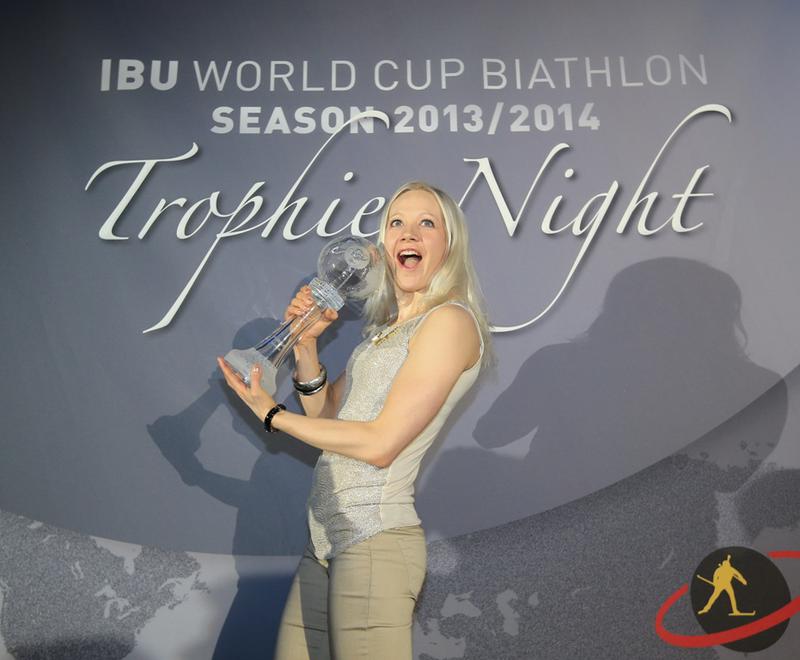
Kaisa Mäkäräinen, Finland’s IBU Overall World Cup champion, with her crystal globe at the IBU’s Trophie Night. (Photo: IBU/Evegeny Tumashov)
When the IBU World Cup kicks off in Östersund, Sweden, on November 30, the women’s biathlon field will look considerably different than it has for the past few years. While several veterans have retired, rising younger stars are also taking the season off for a variety of reasons – from pregnancies to injuries. Here’s a summary of what’s going on with last year’s top competitors:
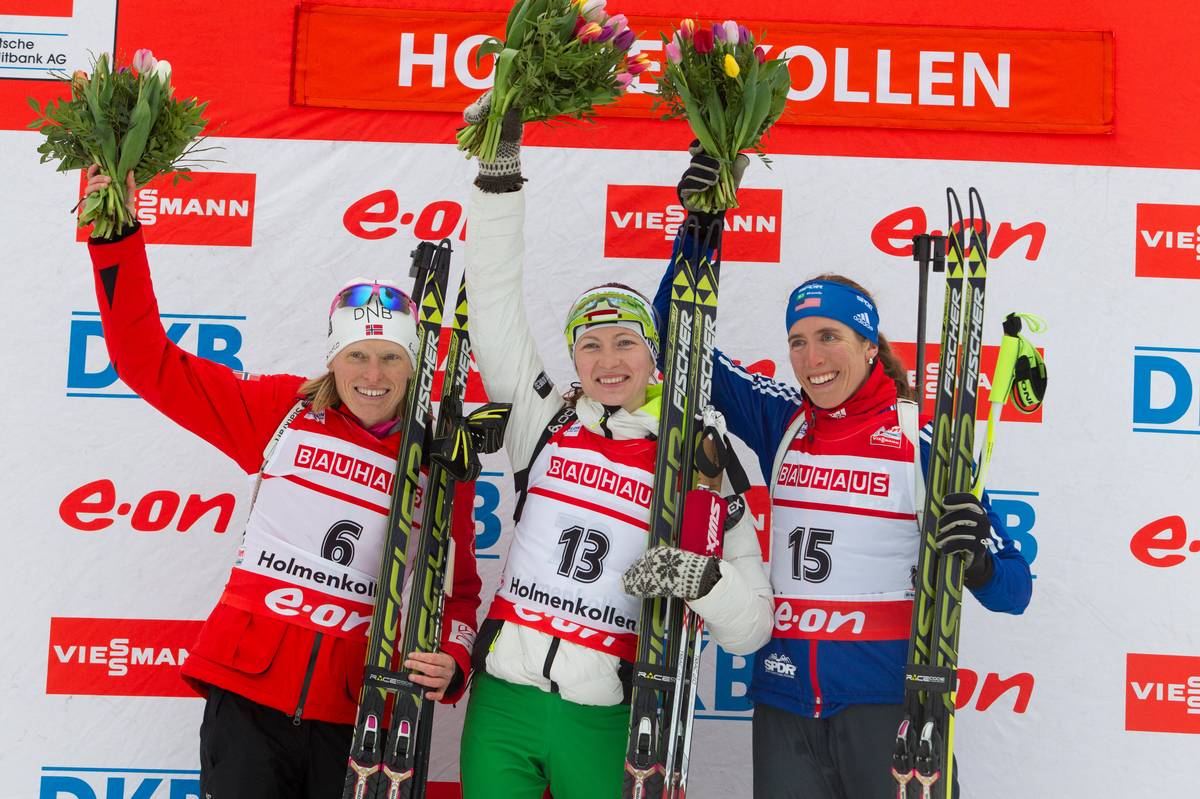
This Oslo podium from last season won’t be seen again: Tora Berger (l) retired. But Darya Domracheva is back with a new coach, and U.S. athlete Susan Dunklee saw her first podium last season. Photo: NordicFocus/UBSA.
Last year’s overall World Cup champion Kaisa Makarainen of Finland is gearing up for a home World Championships in Kontiolahti. When the U.S. women’s team visited her for a training camp there this summer, she did an interview with FasterSkier, where she said that the most important thing to be able to excel this winter would be to stay healthy, something she has struggled with in the past.
Norway’s Tora Berger, last year’s runner-up and the previous season’s overall champion, has retired. Races will be much less exciting without her on the start line – or more importantly, charging into the finish.
Darya Domracheva of Belarus has spent the summer making the most of her three Olympic gold medals from Sochi, and is doing a lot of outreach and media work. She also has been working with a new coach. She had previously worked with Klaus Siebert, who recently returned to his native Germany. The new coach of the Belorussian team is Austrian Alfred Eder (whose son Simon is an Olympic medalist himself). “Training plans are strikingly different since last season,” Domracheva said at a press conference earlier this month.
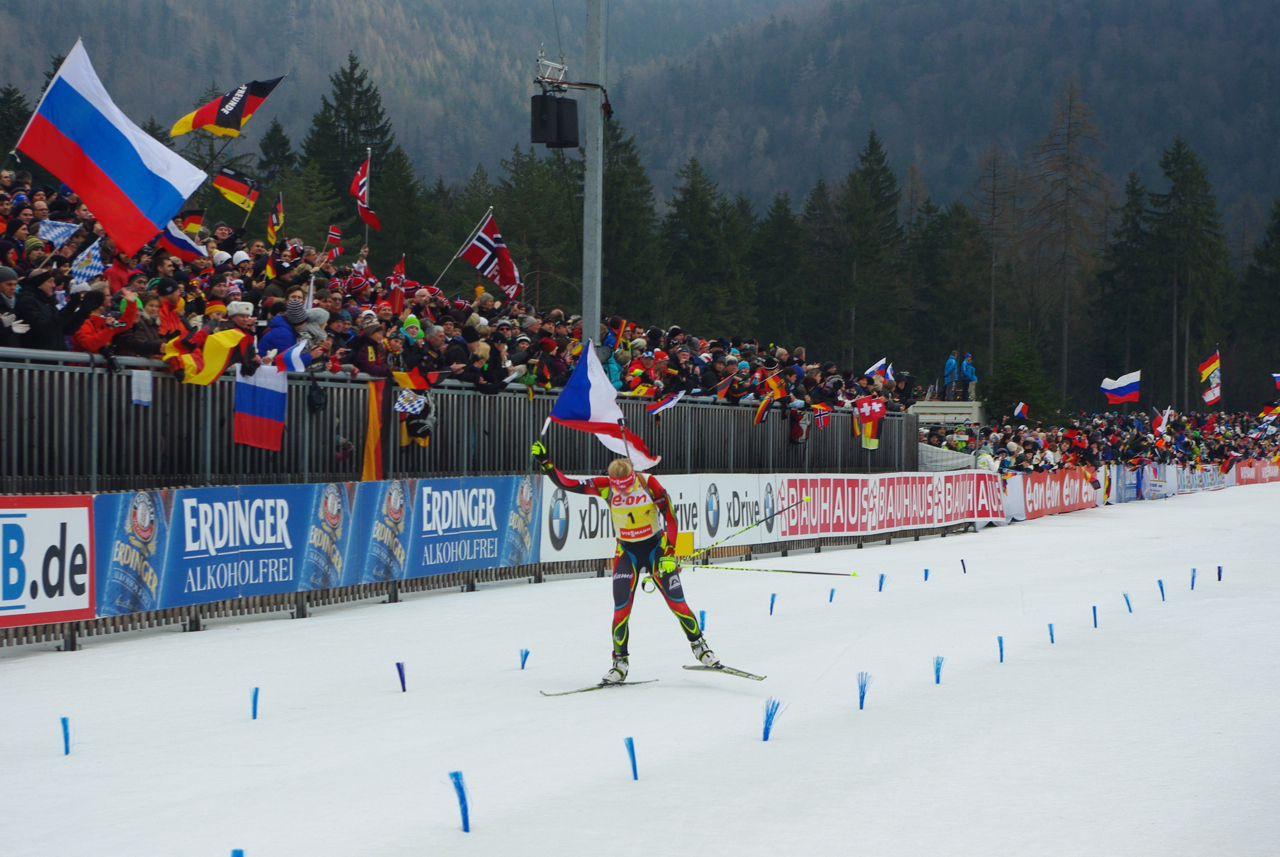
Gabriela Soukalova celebrates with the Czech flag as she wins the 10 k pursuit in Ruhpolding, Germany, in January.
Gabriela Soukalova was the biggest breakout star of the last two years, and in 2014 was youngest member of the World Cup top five. The Czech spent last year training with the men’s team, and after winning mass start silver in Sochi seems poised to go head to head with Makarainen and Domracheva for the World Cup title this season.
Olga Vilukhina of Russia was a continued strong performer last season, albeit an inconsistent one. She won silver in the sprint in Sochi, the only Russian woman to take an individual medal. But it was recently reported in the Russian media that the star will sit out this season. There’s speculation that it’s due to a baby, but Vilukhina has denied this and said that the goal is to recover from several old injuries.
Anastasiya Kuzmina of Slovakia winning the 7.5 k sprint at the Olympics in February.
Anastasiya Kuzmina became the first woman to defend an Olympic gold medal when she won the sprint in Sochi. She also finished off the year strong with pursuit and mass start victories at the culminating Oslo World Cup. Kuzmina trains notoriously seriously, and she’ll be back. Last year she traveled to Canmore, Alberta, for Frozen Thunder, and is rumored to be returning for a fall training camp again this season.
Norway’s Tiril Eckhoff had a breakout season last year, rising to the level of her more famous teammates Tora Berger and Ann Kristin Flatland. With both those older mentors retiring, Eckhoff is clearly Norway’s best hope next season. She has stayed active and fast during the summer, winning the Odlo City Biathlon in Puttlingen.
Speaking of Puttlingen, Valj Semerenko won the qualification round there, and was also on the podium at the Tyumen summer biathlon competition. Her sister Vita Semerenko (the bronze medalist in the Sochi sprint) had surgery, but is now back in training. The biggest thing holding the twins and their Olympic champion relay teammates back this season may be money: the Ukrainian federation is strapped for cash given the civil problems in the country. The federation has been spending its own money for several months, but it is unclear whether it will be paid by the government, and funds may soon run out. The twins also publicly commented that they did not receive the apartments in Kiev promised by the former president to any medal winners in Sochi.
Veronika Vitkova of the Czech Republic joined Soukalova as a podium presence last season. She won the sprint at Czech national championships this summer. In the off-season, she has proved to be more focused than Soukalova; will that continue when racing really begins?
Andrea Henkel, Veronika Vitkova and Valj Semerenko (r) in the World Cup pursuit last season in Oberhof, Germany.
The biathlon world will also feel the absence of German veteran Andrea Henkel, who retired at the end of last season after over a decade at the top of the sport.
Selina Gasparin became the first Swiss biathlete to ever win a World Cup when she took top honors in the Hochfilzen sprint last season. Then she earned silver in the individual in Sochi – another Swiss first. Gasparin just announced that she’ll sit out the season because she is pregnant: she married Russian skier Ilia Chernousov this summer.
Russian veteran Olga Zaitseva has been fending off implications that she should retire. Most recently, a sports club announced that she had joined their coaching staff – but Zaitseva herself denied it, saying that she is still an active athlete and couldn’t possibly also coach.
Other news:
Miriam Gössner, a German biathlete, on her way to a fourth-place finish at FIS Cross Country World Championships in 2013, her last full season competing.
Miriam Gossner of Germany sat out most of last season after being unable to recover from a bad accident in time for the Olympics. A top competitor the previous season, she’s back now – but just suffered a concussion in a rollerski crash, which offered a further setback to her training. Nevertheless, she will likely be a presence on the World Cup again this season – but will the dramatic shooting improvements that allowed her to capture her first podiums remain, or has she regressed to her formerly erratic shooting?
Marie Dorin Habert of France missed part of last season with a foot injury, but came back strong with a podium in the final World Cup weekend in Oslo. This year will also be a bit unusual for her: she just gave birth to a daughter, Adele. However, Dorin Habert has trained through her pregnancy and made waves when photos of her rollerskiing with a very large belly surfaced from a French team training camp. She may return to competition at the end of the season.
Ann Kristin Flatland of Norway retired, as didMarie Laure Brunet of France.
Anastasiya Kuzmina of Slovakia won her first race in over a year when she took Olympic gold in the 7.5 k sprint today.
FasterSkier’s coverage is made possible through the generous support of Rudy Project.
SOCHI, Russia – Sometimes, lightning does strike the same place twice.
When Anastasiya Kuzmina won the Olympic sprint in Vancouver in 2010, it was the first win of her career at the international level, and came as quite the surprise to the biathlon community.
“Vancouver was the first gold medal in my life, and it was just a new emotion of my first Olympic games,” Kuzmina said in a press conference today.
Coming into today’s 7.5 k sprint at the next Olympics, few predicted that Kuzmina would be able to defend her title. She hadn’t won a World Cup race in over a year, and in fact had only three victories since her last Olympics.
But when Kuzmina, starting in bib 33, crossed the line, she put nearly 30 second into Anais Bescond of France, who was leading at the time. As the rest of the field came through one by one, nobody was able to match Kuzmina’s time, and she ended up a gold medalist by 19.9 seconds over Olga Vilukhina of Russia.
“Today was just an amazing day for me,” Kuzmina said. “Here it was my second Olympic Games and it was a long way to this gold medal. It’s not the same. It was hard work for four years and just unbelievable…. Today is unbelievable. It is my favorite race.”
Olga Vilukhina (RUS), silver medal.
Kuzmina shot clean, as did Vilukhina, third-place Vita Semerenko of Ukraine, and fourth-place Karin Oberhofer of Italy. But among those athletes, Kuzmina’s skiing was in a league of its own. She had the fourth-fastest course time of the day, which paired with her the eighth-fastest shooting was an unbeatable combination.
When FasterSkier interviewed Kuzmina in November, she said that she had “no expectations” about whether she would be able to defend her medal. And her skiing has clearly come around: her lone podium of the season, at the opening race in Östersund, Sweden, came thanks to her shooting. Her skiing was only ranked 13th.
The victory today had special significance to Kuzmina, who is originally from Russia. On one hand, it was revenge for her brother, Anton Shipulin, who finished fourth in yesterday’s men’s sprint. Just 0.7 seconds from a bronze medal, Shipulin was also in a position to win until he missed a shot in his final shooting stage; the penalty loop gave him far more time than the 6.4 seconds he ultimately finished behind Ole Einar Bjørndalen of Norway.
However, Shipulin is still in a good position for tomorrow’s pursuit, making it possible that both siblings will win medals, and possibly even double gold, in the same Olympics.
“This victory was for him, too,” Kuzmina said. “I hope it inspires him for the pursuit. He can win.”
Kuzmina herself was thrilled to be back on what she still considers home turf, and also dedicated her performance to Maxim Vylegzhanin, a Russian skier who finished fourth in today’s 30 k skiathlon after being debatably obstructed by Norway’s Martin Johnsrud Sundby.
“This victory in my homeland is a big thing,” she said. “Yes, I am a Slovakian passport holder, but here I am at home. This atmosphere is so comfortable it is so homey. I am so happy to see my friends and family… they really understand what I was going through, what this means to me.”
Vita Semerenko (UKR), bronze medal.
Not all Russians, though, seemed to support her. Reactions were mixed as she skied through the finishing straight.
After all, biathlon is a signature sport in Russia, and Kuzmina did take gold away from a Russian who still competes for Russia. However, Vilukhina did still earn the first Russian medal of the Games, taking some of the pressure off the team.
Like Kuzmina, Vilukhina, had her best performance in almost a year: she was second in the final World Cup pursuit in Khanty-Mansiysk, Russia, last season.
“Until the very last moment you did not know anything about whether you would stay in second place,” Vilukhina said. “I was only able to relax when I went to the flower ceremony.”
Vilukhina is part of the same training group as Ekaterina Iourieva and Irina Starykh, who have tested positive for a banned substance presumed to be the blood doping drug recombinant erythropoietin, and are serving provisional suspensions from competition. The coach of this training group, Vladimir Korolkevich, has ties to past doping scandals.
Until this season, Vilukhina had been part of the training group of Wolfgang Pichler, a German hired in part to clean up the Russian team and who is an outspoken opponent of doping.
“I would like to thank [Pichler], who I had the honor to work with my previous season,” Vilukhina said.
But she made it clear that the silver medal – which brings her back to her form 2012, when she won bronze in the pursuit at World Championships – had something to do with switching to Korolkevich’s supervision.
“Today’s silver speaks for itself,” Vilukhina said. “We had a competent training plan, which developed me well as an athlete.”
Saying that she had been dreaming of this moment since she was ten years old – Vilukhina is a first-time Olympian – she thanked all of her supporters throughout Russia.
“I think in my home, I’m more happy because today the entire city got together today to watch the Games,” she said. They made a screen and watched the sprint with an overhead projector, so I’d like to thank everybody that was supporting me sincerely. Today’s silver medal makes me really happy but the Olympics aren’t over yet, and I will only be able to relax on February 23.
Third-place Semerenko won the first Ukrainian medal of the Olympics, and was rewarded with a three-bedroom apartment courtesy of the President of Ukraine. All Ukrainian athletes who win medals will receive an apartment.
“This is just my first sprint. This is just the beginning of me winning many apartments,” Semerenko laughed.
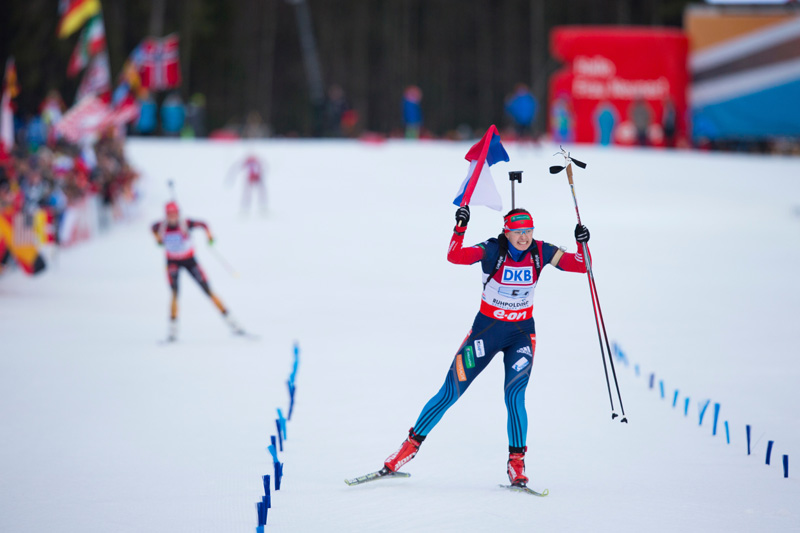
Olga Vilukhina skis across the finish line with the Russian flag, as Franziska Hilebrand (GER) skis it in for second place. Photo: Fischer / Nordic Focus.
The most exciting days in sports are when a team that is down by a seemingly insurmountable margin comes back for the win. Those are the kinds of days that fans live for: when almost as much adrenaline courses through their own veins, as they wonder “will they?”, as through those of the athletes themselves.
Today’s 4 x 6 k relay in Ruhpolding, Germany, was not one of those days. The Russian women were never more than 10 seconds from the lead and skied a consistent, if unremarkable, race. Anchor Olga Vilukhina secured a six-second win by using a single spare round on her own leg.
But even though the Russians still won, it was almost – almost! – one of those days. Fans knew they were in for something special when Evi Sachenbacher-Stehle, an Olympic gold medalist in cross country skiing, took the tag from German teammate Franziskza Preuss.
Preuss had led off with a painful penalty lap in the first prone stage of the race, then also used a spare round in standing. She was in 18th place, almost a minute behind the top team.
Sachenbacher-Stehle was having none of it.
Ekaterina Glazyrina (RUS) in the women’s biathlon relay in Ruhpolding (GER). Photo: Fischer / Nordic Focus.
She may not be a veteran on the range. This is only Sachenbacher-Stehle’s second year competing in biathlon. But you’d never know it. Not only did she use her skiing skills to turn in the fastest course time of all the second-leg skiers, but she also dropped all of her prone targets in quick succession and used a single spare round in standing. Her shooting times weren’t even that much slower than her competitors, who have been doing this their whole lives.
After the prone stage, she had climbed to 13th. Then after standing to sixth, but still over 20 seconds behind the lead.
No matter. By the time she tagged off to Laura Dahlmeier, Sachenbacher was at the front of a four-woman pack, and technically crossed the line first.
Germany was unable to hold onto the lead; Dahlmeier skied and shot impeccably and entered her own exchange even with Russia’s Irina Starykh, but anchor leg Franziska Hildebrand (new to the job) lost just a few seconds to Vilukhina, and Germany ended up second.
It wasn’t as good as a win, but Sachenbacher-Stehle’s exciting performance may have jazzed up the German crowds even more than a more even-keeled winning race would have.
The Germans were without both veteran star Andrea Henkel, who is sitting this race out, and Miriam Gössner, who ended her season early after being unable to fully recover from fractured vertebrae sustained in a bike accident this spring.
The final podium spot went to Norway, which had a major turnaround of its own. Tiril Ekhoff led off with two spare rounds in prone and then two penalty loops in standing, and was left in 22nd place, far behind even Preuss.
But Ann Kristin Flatland began the comeback, taking the team up to 10th, and then Synnøve Solemdal shot perfectly – a rare feat for her – to ski all the way to third as teams around her continued to make errors.
Anchor leg Tora Berger, who won the mass start in Oberhof last week, could have arguably pushed for second place. Instead, she used a spare round in each stage and was in fourth place for much of the race. She eventually buried Ukraine’s Valj Semerenko in the final loop and made up more than 20 seconds on the leaders, but Solemdal could be forgiven if she was a little grumpy with her teammate’s performance on the range.
Ukraine settled for fourth and France used an excellent anchor performance by Anais Bescond to move from 11th to fifth.
The other big excitement came as Switzerland surprised by earning their first-ever top ten in a women’s relay, thus meeting the Swiss Ski standards for an Olympic nomination. The team consists of three sisters, making the trip together even more meaningful (read more).
The Canadian team of Rosanna Crawford, Megan Imrie, Audrey Vaillancourt, and Megan Heinicke finished 12th with a combined seven spare rounds.
Olga Zaitseva (RUS), Ekaterina Glazyrina (RUS), Olga Vilukhina (RUS), Irina Starykh (RUS) celebrate their IBU World Cup biathlon relay victory in Ruhpolding (GER). Photo: Fischer / Nordic Focus.
Gabriela Soukalova of the Czech Republic was speechless, but smiling, after winning the mass start in Khanty-Mansiysk today.
Before this season, Gabriela Soukalova of the Czech Republic had never raced into the top ten in a biathlon World Cup.
She had only ever stood on the podium in relays – and then only once, in Hochfilzen, Austria. The 23-year-old had never made it into the top 60 of the World Cup standings, and had only scored 39 points in her young career.
So earlier this season when she started winning, it was a surprise.
And this weekend in Khanty-Mansiysk, it was still a surprise. First Soukalova won the sprint, then the pursuit, and finally, on Sunday, used perfect shooting and the second-fastest ski time of the day to win the 12.5 k mass start by ten seconds to cap off the World Cup season.
“I would like to say nothing, because this is an impressive moment for me right now – it is perfect,” she said in the post-race press conference. “I said yesterday that the win was the biggest shock of my life, but now I can say that again… this is the biggest shock of my life!”
In other ways, though, it’s not so unusual that Soukalova should rise to the top. She has good help: her father, Karel Soukal, is a biathlon coach in Poland, while her mother (also Gabriela) was part of Czechoslovakia’s silver-medal cross country skiing relay team in the 1984 Winter Olympics in Sarajevo. Together, the two are Soukalova’s coaches.
“We were watching the race on the internet through our phone,” her mother told Czech newspaper Sport Aktualne. “It was pretty exciting. I didn’t think that she could win a third time. It’s a really great performance and I bow down before her.”
The difference for the young Czech this year is not only good shooting, like her perfect work on the range today, but much faster ski speed which has allowed her to be competitive where other shooting specialists, like Marie Laure Brunet of France, have been left constantly just out of the picture even when they clean.
The hat trick in Russia makes it four wins and two additional podiums for Soukalova, who will finish the year ranked sixth in the World Cup total score.
Despite her clean shooting and fast skiing, it wasn’t always clear that Soukalova was going to win; after the first stage she was 20 seconds behind the leaders. Even after the third stage, when she had made it up to second position, she was skiing more than 15 seconds behind Vita Semerenko of Ukraine.
But Soukalova skied her way up to the Ukrainian, and then Semerenko missed a shot in the final standing stage while Soukalova cleaned. For the first time in the entire race, she had the lead, and held it all the way to the finish.
Behind her, Marie Dorin Habert of France moved into second position with a clean stage of her own; she was 15 seconds back. There was a gap of another 25 seconds to Olga Vilukhina of Russia, then Kaisa Makarainen of Finland a few seconds behind her.
While Dorin Habert was safe in second, no amount of cheering by the home team’s fans could keep Vilukhina on the podium. Makarainen skied the fastest finishing lap of the race and moved into third, closing all but ten seconds on Dorin Habert.
“I felt tired before the race today,” Makarainen said in a press conference. “But when I started the last loop and heard the gap between me and Semerenko, I knew that I needed to try. I was only thinking that I needed to be third today.”
It was the sixth podium of the season for Makarainen and the third for Dorin Habert. Despite the fact that neither won a race this year, they will land fifth and fourth, respectively, in the rankings.
“I was consistently good, except for the World Championships,” said a happy Dorin Habert of her season.
Despite a lackluster 13th-place finish, Tora Berger of Norway was so dominant during the rest of the season that she easily claimed the World Cup title.
No U.S. or Canadian women qualified for the mass start.
Gabriela Soukalova of the Czech Republic competing in the mixed relay at World Championships last month. Today, she won her third World Cup of the season.
As Gabriela Soukalova picked up her second win of the weekend and third of the season in the 10 k pursuit in Khanty-Mansiysk, Russia, the American biathlon squad was not quite as happy with their performances.
After Susan Dunklee and Annelies Cook both notched season-best performances in Sochi the previous weekend, they hoped to stay on a roll when the World Cup moved from the Black Sea to Siberia.
In the sprint, the pair finished 28th and 36th: solid, good efforts, but nothing special given their recent results. Going into today’s pursuit, Dunklee said that she was hoping to move up enough to qualify for Sunday’s mass start, which takes only thirty women.
But things quickly went south. She missed two shots in her first prone stage, dropping out of the top 30. Then she failed to hit a single target on the second stage.
“As the race went on I had to constantly create new goals for myself to stay in the race,” she wrote in an e-mail to FasterSkier. “It was a sad downhill progression. At first I wanted to beat my bib number and maybe event earn a spot in tomorrow’s mass start. Next I refocused on making a top 40 and some World Cup points. Midway through the race disaster struck and I dirtied a stage in spite of calm conditions. By the end, my struggle was to not get lapped.”
If a competitor doesn’t finish shooting their final stage before the leaders hit the finishing stretch, they are pulled from the competition. As Dunklee pulled into the range for the final time, she knew that Soukalova, who was trying her hardest to stay in front of a hard-charging Olga Vilukhina or Russia, were nearing the finish. She needed to get out of there.
“I shot my last clip as fast as I could and only missed one,” Dunklee wrote.
That should have been, well, not exactly cause for celebration, but maybe a small victory: despite the earlier errors, when she was under the most pressure, Dunklee pulled through. But her travails weren’t over yet.
“The icing on the cake of my epic fail today was when my coach told me afterwards that I cross fired on that last stage and incurred several more minutes of penalties,” she wrote.
Two minutes, to be exact, is the amount of time added for each penalty loop that an athlete fails to complete, and firing on the wrong target once meant that Dunklee had done one penalty loop when she should have done two. The extra time that left her in 58th place out of 58 starters when the results came out – not 50th place, where she had been when she finished.
“The bright side is that I concentrated all my biggest mistakes of the season into a single race,” she joked.
While Cook did not have anywhere near the bad day, or the eleven penalties, that Dunklee experienced, she, too, was left frustrated. Clean through three stages, she had climbed all the way up to 17th place, on track for the fourth top-20 of her career. But it proved to be too much, too fast, and Cook imploded on the range in the final stage.
“I just wanted to do well so badly and I knew that clean shooting would be my ticket,” she explained. “But, my brain got in the way. People who have never sat there on their last stage, with three clean shootings, will never understand what it is like – but everyone who has knows the feeling of messing it up or pulling through beautifully. It is a learning process that you have to go through a few times and start to find ways to manage your brain versus what your body knows how to do.”
Four penalties in that last stage sent Cook round and round the penalty loop, and she left the range in 35th place. Tired from the extra 600 meters of skiing and also discouraged, the final lap of skiing was her slowest and she was unable to gain any places.
“I think normally, I would be happy for this result and how I did on average – it was not a bad day overall,” she wrote in an e-mail. “I felt good skiing and 80% shooting is a good to average day. But when you go from 36th to 17th and back to 35th in one shooting stage, it hurts inside a bit, especially when you want to finish on a high note.”
Without any spectacular results in the pursuit, neither Dunklee nor Cook made it onto the start list for the mass start. That meant that this was their last World Cup race of the season.
It was a pretty bittersweet way to finish, Cook said.
“Today was a classic biathlon day,” she wrote. “So painful and heartbreaking and good all at the same time. It’s hard to separate your feelings when you know you are having a good day and then you want something so badly, that you just mess it up… I have so much motivation to keep learning and getting better this summer.”
Despite her so-called “epic fail,” Dunklee said she was also leaving Russia with positive vibes.
“The week has been fun overall,” she wrote. “I have been hanging out a lot with athletes from different teams and practicing speaking German.”
Most of all, the Americans are relieved that after almost three months straight in Europe – they only take a small break for Christmas – they will finally be heading back to the Western Hemisphere for some time with family and friends.
“After almost five months in Europe [total], I’m psyched to be headed home soon!” Dunklee concluded.
Tora Berger (Norway) celebrating a victory earlier this season in Ostersund, Sweden. Photo: Fischer/NordicFocus.
After climbing so high and winning her first World Cup in two years on Thursday, Anastasiya Kuzmina of Slovakia probably felt that a weight was lifted off her shoulders – but another was squarely placed on them, as she started Saturday’s pursuit in Antholz-Anterselva, Italy, with the lead and tried to hold onto it.
After a penalty in the first stage she left the range with a few seconds on Kaisa Makarainen, and managed to hang on when the Finn caught her out on the two-kilometer loop. But from there, Kuzmina’s hopes of another podium – let alone a win – disintegrated, as she picked up three penalties in the next prone stage and then one and two in the standing stages.
Instead, it was Makarainen and Olena Pidhrushna of Ukraine who took their turns at the front of the field. With nobody shooting clean through four stages, Pidhrushna’s single penalty tied her for the best shooting in the field. Makarainen didn’t do so well, but skied the third-fastest time over the 10 k course and was consistently leading or near the front.
Pidhrushna left the third stage with a ten second lead over Makarainen and Teja Gregorin of Slovenia. But the pair worked together and gradually cut away second after second from the Ukrainian’s time and by the time they hit the range, Pidhrushna only had a slight advantage – she was maybe one or two shots ahead of the others as they all began shooting at their targets.
After Pidhrushna missed a target, it seemed like there was an opportunity for Makarainen or for Gregorin, who was ranked as high as sixth in the World Cup total score earlier this season but has never won a World Cup.
Instead, Makarainen accumulated two penalties, bringing her total to four for the competition, and Gregorin three.
“I was mentally ready to be first, but when my legs started shaking, there was nothing I could do,” Makarainen said after the race.
It was Tora Berger who shone, after starting in 14th position after an uncharacteristically bad sprint and had moved into sixth place on the previous loop despite two penalties already in the race. Cleaning her targets at her trademark quick place, Berger hit the trails just before Pidhrushna finished her penalty loop.
It was surprising to see so many misses from the top competitors while the wind flags were barely fluttering in the Antholz stadium, but indeed most of the field seemed to struggle with standing today.
Not Berger.
“I was as surprised as everyone else when I first went out after the last shooting,” she told Norwegian broadcaster NRK.
From there, it was game over, at least for the win. The Norwegian immediately put a sizeable gap on Pidhrushna, and attacked the final loop with a ferocity that was at times difficult to comprehend.
“I am more happy than disappointed with second place,” Pidhrushna said in a press conference. “It is still a good result. When I came out of the last shooting with Tora, I knew I was fighting for second place.”
Olga Vilukhina of Russia had left the range in third place, eight seconds behind Berger, and seemed like a lock for the podium. But she was being chased by Makarainen, who was another 15 seconds back but furious about her penalties, and Nadine Horchler of Germany, just three seconds behind the Russian.
Like Berger, Horchler attacked early in the loop and then passed and dropped Vilukhina. Makarainen, too, soon caught up as the Russian faltered on the trails.
Horchler seemed to be headed for the first podium of her career, but she had made a novice mistake of using her speed too far from the finish line. As the women swept through a large, open field, into the Antholz sunshine and towards the stadium, Makarainen – with Vilukhina in tow – swept past her, the German fading out the back.
It was Makarainen who emerged into the finish stretch in third place, after having mounted an improbably comeback from the last stage.
“I was surprised myself with my last loop; I was over 10 seconds back,” she said. “But on the last hill, I saw them, and found a small place very close to the coaches and got ahead…. I am really tired now.”
That was nothing compared to Berger, though. The sprint had brought up many ideas about the World Cup leader: maybe, as the season wore on, her lead in the standings would diminish. The results seemed like a break for Darya Domracheva, last year’s overall runner-up who finished third and finally scored some points against Berger. But Miriam Gossner of Germany, currently in second, hadn’t scored any points or qualified for the pursuit, a break for the current leader.
Today, Berger proved beyond a doubt that she should never be counted out, and that she was perfectly capable of following up a mediocre performance with a brilliant one.
“I really did not expect to win when I got up this morning,” she said in a press conference. “After a penalty in the second shooting, I thought there was no possibility to win… Then I saw the possibility to win I tried to go as fast as possible.”
In fact, her whole team reminded the world that it’s not just the Norwegian men who are so variably excellent: Ann-Kristin Flatland, in her second weekend back on the World Cup after having a baby last year, raced from 20th place up to sixth in the pursuit despite two penalties, and Synnøve Solemdal moved from 30th to ninth with the same tally.
Berger had been planning to sit out Sunday’s relay, but with the whole team doing so well, she might be called upon to anchor after all.
“We have a good chance to win, so now I may have to be in the relay,” she said.
After a strong sprint race, Annelies Cook was undone by seven penalties and dropped from 18th to 38th in the pursuit. Her American teammates Sara Studebaker and Susan Dunklee moved up slightly: Studebaker from 46th to 39th with four penalties and Dunklee from 49th to 45th with seven.
Zina Kocher and Audrey Vaillancourt of Canada placed 45th and 49th.
Tora Berger of Norway cruising in Ostersund, Sweden, where she won the 7.5 k sprint by 16.9 seconds and improved to two-for-two on the season. She’ll retain that yellow leader’s bib for a while.
ÖSTERSUND, Sweden – It took perfect shooting for Canada’s Jean Philippe Le Guellec to ski to an 18-second win earlier this afternoon in the men’s 10 k sprint.
Tora Berger in the women’s 7.5 k edition? Not so much.
The Norwegian powerhouse missed a shot in standing, but still cruised to a 16.9-second victory over Olena Pidhrushna of Ukraine, with Olga Vilukhina of Russia placing third another two and a half seconds behind. In fact, the first four finishers all had a penalty in standing; Andrea Henkel of Germany shot clean, but was only able to secure fifth place.
It was the second win in a row for Berger, who used sensational 20-for-20 shooting to notch a big win in Thursday’s 15 k individual race. It was hard to say which race was better, she said, but shooting was one measure.
“I’m really happy for the shooting in the individual, and today I missed one,” Berger said in a press conference.
She said that she may have been “too eager” in standing shooting, and hoped to improve that in tomorrow’s pursuit race.
Berger also overcame a fall in the last corner of the course. It’s an icy downhill hairpin that in past years had felled legendary teammate Ole Einar Bjørndalen, costing him a win. This time, it didn’t stop a Norwegian from reaching the top of the podium.
“I took a chance on that last corner,” Berger said. “But I was skiing was so it was okay.”
Berger’s ski time improved from the individual, where she had used a very deliberate strategy to achieve her perfect range score. Today, she had the fifth-fastest ski time, which was enough to make up for mistakes on the range and on the trails.
“It was just poor execution by me,” Berger elaborated to Norwegian newspaper Aftenposten. “It was icy, and maybe I risked a little bit too much. I went really hard into the corner on the first two laps, but not on the last one.”
Olena Pidhrushna (UKR, left) chasing hard to reach her first World Cup podium.
Behind the Norwegian star, Pidhrushna had the race of her career. 25 years old and already an Olympian and several-time World Championships competitor, the Ukrainian had never been on the podium in a World Cup individual race. Instead, twin sisters Vita and Valj Semerenko have been the stars of the team. But she was due for a good result, Pidhrushna said in the postrace press conference.
“We all the time do our preparations all together, so any of the four of us could have the same result,” she explained through a translator. “But for me there hasn’t been so much luck, and now I feel like the stars have aligned for me and I had good luck.”
What one person could call luck, another could call preparation. The cold wind that blew through the Östersund stadium presented a challenge to all the competitors, yet Pidhrushna said she was ready for it.
“The weather conditions were very hard and I felt it through the whole race, all over my body,” she said. “But I did very good mental preparation, and had very good resolve to go through it with the weather. The competition was quite good today for my speed.”
Vilukhina continued a strong run here in Sweden; she participated in the winning mixed relay team on Sunday, then placed fifth in the individual race. Despite winning a bronze medal in the pursuit at 2012 World Championships, Vilukhina has never before strung together such a run of good results.
Olga Vilukhina (RUS).
“I’m happy today,” she said in the press conference. “It was a really nice – my skis worked very well, and I was very happy. The skiing was much better than in the individual race.”
But it’s Berger who is clearly having the best run. After finishing third in the World Cup standings in 2012, she has said that winning the overall title is a big goal for this season. She certainly is off to a good start, and will retain the yellow bib for a while – Vilukhina was the only other racer to repeat a top-six finish, so the Norwegian has jumped to a big early win in the points. It’s more than even she was hoping for.
“I was not expecting that I should win the two first competitions, and I am very lucky for that,” she smiled when she was informed that she had tied the record number of wins – four – for a woman here in Östersund, and that she could stand alone if she won tomorrow’s pursuit. “I didn’t know that, but I will try to my best. I’ll try to just think about myself, and I think there will be some people around me tomorrow so I will try to stay focused.”
Vilukhina’s teammate Olga Zaitseva placed fourth (+23.9), followed by Henkel (+26.5) who sat in the lead for many minutes after starting with bib number two. Jana Gerekova of Slovakia tied the best result of her career in sixth (+35.2), while 2012 World Cup runner-up Darya Domracheva of Belarus struggled with three missed shots to place seventh (+37.7). Marie Laure Brunet of France (+43.3), Veronika Vitkova of the Czech Republic (+43.6), and Zina Kocher of Canada (+46.2) rounded out the top ten.
Domracheva and Neuner shooting side by side in the second prone stage.
RUHPOLDING, Germany – In Saturday’s World Championships sprint, Darya Domracheva of Belarus tried her hardest to best Germany’s Magdalena, but it was to no avail.
On Sunday, their battle spilled over into the 10 k pursuit, with the two women at many times so close that they shared the shooting range with each other. Each was confident that they could be the first across the finish line.
“I am very strong at the moment,” Neuner said, referring to her turn in the mixed relay and her dominating victory in the sprint.
Domracheva had a different source of inspiration.
“In biathlon, nothing is impossible,” she said in a press conference. “[Whether] you are more seconds behind or less seconds behind, always you have a chance for the win.”
Neuner leading Domracheva early in the race.
But despite two worthy adversaries, there was only room for one at the top of the podium. For most of the race, it looked like the title was Neuner’s to lose. Starting with a 15-second advantage, the German took off out of the start like a bullet. After the first stage, she and Domracheva were both clean, and Neuner had added a second to her lead. After another stage, they both had one miss, and the lead was 12 seconds. And then in the third stage, Neuner was in and out in a flawless 25 seconds, while Domracheva took 35 and missed one shot.
With a 33 second lead, Neuner appeared to be on her way to gold again, in a reprise of Martin Fourcade’s performance earlier in the afternoon. She cruised around the two-kilometer loop in perfect control, her trademark combination of power and tempo keeping her far enough in front of Domracheva to stay comfortable.
But then in the final stage, something went wrong for Neuner. She missed two shots and headed to the penalty loop. Meanwhile, Domracheva came into the range, cleaned, and left again. For the first time all day, she had a lead: 13 seconds.
Neuner is fast, but so is the Belorussian, and Neuner was no match for Domracheva on the trails. While Domracheva skied the quickest closing loop – just as she had done for every other loop all race – Neuner bogged down, only turning in the eighth-best loop time and finishing 25 seconds back for silver.
Domracheva, victory in hand, leaving the range.
“I feel really good right now because this was one of my dreams and it has come true,” Domracheva told the television commentator. “I always say that you should dream big, and your dreams will come true.
“I dreamed about it from the first day I started training, when I started skiing at six years old,” she added in the press conference.
It was not only Domracheva’s first World Championships title but also the first for Belarus. She has won six World Cup races over the course of her career and many of those have come, like today’s title, at the very end; Domracheva’s never-give-up attitude and ski speed are well-known on the circuit.
On Sunday, it was also her shooting which earned her the win.
“I saw that Magdalena was really fast on the range today, but I was really concentrated on my shooting,” Domracheva said. “It was a fight only between me and my targets.”
The pressure on Neuner – like that on all of the Germans – has been intense this week, and the star admitted that on Sunday it had gotten to her.
“We have seen that it’s not easy,” she said. “Today I had a few seconds in the race where I was a little bit nervous, where it was a little bit too much for me.”
But over and over, she repeated that even though her thousands of fans might be disappointed with her performance – even though the German public demands nothing but gold, gold, gold – she was happy with all of her races so far at this Championships.
Neuner cresting the hill out of the stadium.
“My goal was to get six medals, and I already am World Champion, which is something that I wanted to achieve,” she said. “We still have three competitions ahead of us, and I am very happy with silver, I have to say. It’s a shame to have these two mistakes at the shooting range, but still, I am satisfied.”
Once Neuner made those errors and saw Domracheva skate past the penalty loop without stopping to visit, she knew the race for gold was over. Instead of trying to catch the Belorussian, she focused on soaking up the atmosphere at biathlon’s biggest venue.
“I really enjoyed winning my third medal, and I also tried to enjoy going into the finish zone with the atmosphere that was there,” she said.
As in the sprint, Neuner and Domrachava were untouchable to the rest of the field.
For most of the race, Marie Laure Brunet of France sat in third, and seemed to be headed for pursuit bronze again; she was third in this event at the 2010 Olympics. In the final stage, however, Brunet missed a shot, and Russia’s Olga Vilukhina slipped past.
Tora Berger and Olga Vilukhina.
Vilukhina, who accrued only a single penalty over the course of the race and almost immediately moved into fourth position after starting eighth, found motivation in thinking of another race here in Ruhpolding, where she had finished fourth.
“I remember in 2008 at the Junior World Championships, there was a pursuit competition and I was fighting with Brunet for bronze,” she said in a press conference. “At the last shooting [today] there were Brunet, Berger, and I, and I heard that they both had penalties, so I knew that the only thing I had to do was shoot clean. And then I went on to win bronze.”
This was the first podium of Vilukhina’s career, and she was overwhelmed when she crossed the finish line 1:15 behind Domracheva, burying her face in her hands.
That sentiment was still strong an hour later at the press conference.
“I really don’t know what to say,” she mused. “Sitting here with these athletes is just such an honor for me.”
Brunet’s penalty allowed not only Vilukhina to pass her, but also Tora Berger of Norway and Helena Ekholm of Sweden. Russia’s Olga Zaitseva of Russia finished seventh, while the sprint bronze medalist, Vita Semerenko of Ukraine, dropped to eight. Marie Dorin Habert of France and Anna Maria Nilsson of Sweden rounded out the top ten.
Germany's Magdalena Neuner enters the stadium for the final shooting stage of Wednesday's World Cup relay.
The best biathletes in the world got a warm welcome in Oberhof, Germany, on Wednesday – in fact, they could be forgiven if they felt that they were in the Thuringian version of a tropical storm.
Although it didn’t actually rain during the evening race, the temperatures hovered just around freezing, humidity was close to 100 percent, and the wind, despite averaging around two meters per second, was recorded to gust up to 35 miles per hour at a nearby weather station. Add that to the dearth of snow resulting from the weekend’s downpour, and it just doesn’t look like winter in Oberhof.
But women from 14 countries gamely raced through the woods on a white ribbon of packed snow, and thrilled the crowd in an evening relay under the lights of the stadium.
And that white ribbon was a character in the race, too: the trucked-in snow was deep, rutted in places, and slow nearly everywhere. Fanny Welle-Strand Horn of Norway, Jenny Jonsson of Sweden, and Nadezhda Skardino of Belarus tangled on an early uphill as they tried to awkwardly skate through the wet mush, causing two of them to fall. Even on the very fist lap, the top women threw huge snowplows as they approached downhill corners. On some of the course’s gradual uphills, they appeared to be barely moving as they strained to keep up their V2. The course’s lights glistened in the wet puddles left in the ski tracks.
The start of the women's relay.
There were plenty of surprises in the initial legs of the relay. At the first handoff, top seed Norway was stuck in 11th place, nearly two minutes behind the first-place French, after Horn had to visit the penalty loop twice.
On the opposite end of the spectrum, 11th-seeded Slovakia was still in podium position at the second handoff. It was expected that their star, Olympic gold medalist Anastasiya Kuzmina, would turn in a strong leadoff leg, but less so that teammate Jana Gerekova could move the team into second place. Add the fact that Gerekova collided with German skier Tina Bachmann and broke a pole, and her performance becomes even more impressive.
But mistakes in the early going are easy to erase, and standout performances are easy to negate. In the case of Norway, Elise Ringen skied the second-fastest second leg and used only two spare rounds on the gusty range, moving the team from 11th to fifth.
“Elise Ringen… made the race for us,” teammate Synnøve Solemdal said in the postrace press conference.
“I had decided to be aggressive from the gun, and I think I succeeded,” Ringen told Norwegian state television.
As in any relay, the surprises that made the most difference were the ones at the end. And as far as surprises go, the late errors were so great that the 19,000 fans packing the Oberhof stadium were practically speechless.
Germany’s golden girl, eight-time World Champion Magdalena Neuner, had skied away from Russia’s Olga Vilukhina on their second loop and entered the stadium for the race’s final shooting stage with a 15-second lead.
Even if she had to use a spare round, victory seemed certain. The German fans in the stadium were cheering wildly, waving flags and holding up “Magdalena Neuner” banners.
German fans in disbelief after Neuner's fourth miss.
Then, Neuner missed a shot.
“I had a good feeling,” Neuner told German press after the race. “I wondered why the target didn’t drop.”
So she kept shooting, confident in herself. The crowd quieted. She missed another shot. The boos were louder. Then another miss. Neuner later said that she was eventually “resigned” that she couldn’t knock down the targets; she at least took a long pause before her fourth shot. There were gasps as she quickly missed twice more.
For any World Cup athlete to miss all five targets in a stage – to “dirty” – is practically unheard of, but for the very best? The development was more shocking than any of the convoluted plot twists in “Storm of Love,” the star’s favorite soap opera. The crowd was still trying to process what had happened as Neuner loaded the first of her spare rounds, a luxury only available in relays.
Finally, she hit a shot.
Neuner, stuck on the shooting range.
But by the time she had missed with her second spare round, Vilukhina had left the shooting mat beside her. Neuner missed again and had to do something she’s probably never done before, at least not at this level: ski four penalty loops.
After an agonizing minute and a half on the range and then another 1:44 on the penalty loop, Germany, which just three minutes earlier had been leading the race, was far behind Russia, Norway, and France, and had no chance of reaching the podium.
At the front , Tora Berger of Norway was attempting to chase down Vilukhina; the two were separated by 13 seconds after shooting. But the German fans were in such shock that they didn’t put their usual zest into spectating – they barely cheered at all as third-place Sophie Boilley of France knocked down her final target.
Vilukhina was almost certainly under more pressure than she ever had been before, and accepted the challenge. Despite an attack by Berger, the Russian didn’t give up even a second over the first half of the loop, which seemed unbelievable when watching Berger’s furious tempo and drive. By the end of the race, Vilukhina was slowing down, so exhausted that her poles dangled limply at her sides as she negotiated a mashed-potatoes downhill. But she had the victory in hand and crossed the finish line six seconds ahead of the Norwegian.
Russia had ended the first period of World Cup racing on a high note, with Olga Zaitseva winning both the sprint and the pursuit and then anchoring the first-place mixed relay in Hochfilzen, Austria. With today’s win, her team has made it four in a row.
“I hope we can be the dominant team in biathlon; we have worked very hard for it,” said leadoff skier Anna Bogaliy-Titovets in a press conference.
As for the French, who crossed the line a 1:06 off the Russians’ pace, they were just relieved to be on the podium after Boilley replaced an ill Marie Laure Brunet.
“Without our leader Marie, we did not expect this, but it is a very nice surprise to start the New Year up here,” said Anais Bescond.