Tag: Olivia Bouffard-Nesbitt

  • Sundling Returns to Win Lahti Sprint as Crystal Globe Battle Tightens

    Sundling Returns to Win Lahti Sprint as Crystal Globe Battle Tightens

    This coverage is made possible through the generous support of Marty and Kathy Hall and A Hall Mark of Excellence Award. To learn more about A Hall Mark of Excellence Award, or to learn how you can support FasterSkier’s coverage, please contact info@fasterskier.com.

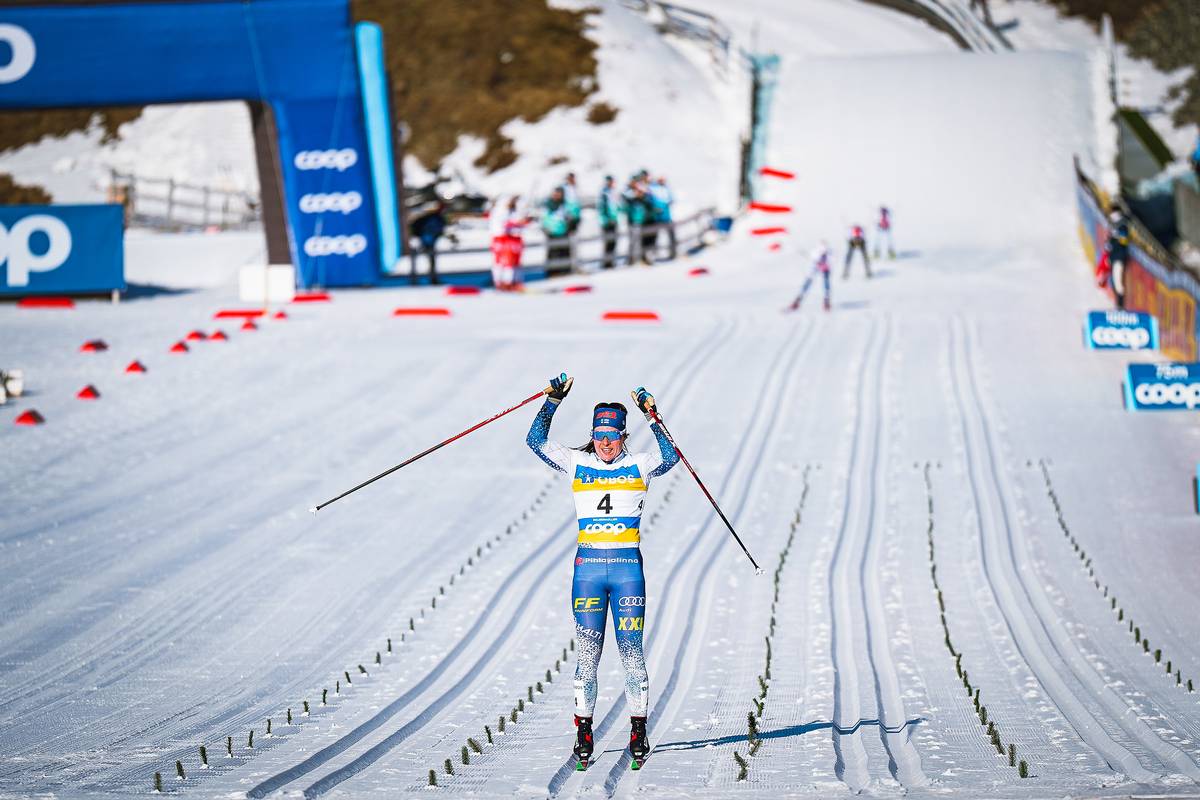
    Jonna Sundling (SWE) during qualification in Lahti, Finland. (Photo: Authamayou/NordicFocus)

    The World Cup season returned to Finland this weekend, closing a circle that began more than three months ago in Ruka. In the time since Olympic teams were selected, dreams realized or deferred, experience forged, and farewells offered week after week as the long winter wears on. If the stakes in Lahti feel slightly lower than they did earlier in the season, they are tightening in another way — especially in the races for the Crystal Globes.

    With only a handful of races remaining in the season, the women’s Freestyle Sprint offered more than just another podium. The fight for both the Sprint Crystal Globe and the Overall Crystal Globe continues to tighten.

    In tricky conditions, Sweden’s Jonna Sundling emerged as the day’s winner, navigating the heats with authority before closing out the final to claim victory.

    “I think all day it’s been difficult with the conditions because it seems so nice, but when you ski it’s like icing underneath,” Sundling said in a post-race interview with FIS on the broadcast. “There were some challenges with the skiing, but I’m glad that I could ski as I did today and go all the way.”

    The victory marked a strong return for Sundling, who said she had recently been dealing with a cold and missed racing in Falun before arriving in Lahti.

    One of the most interesting moments of the women’s race came when Kristine Stavaas Skistad (NOR) was disqualified during the semifinals for what appeared to be a very minor incident.  She received a yellow card for the incident, and because she was already carrying one from a previous violation, she was disqualified. (Photo: Authamayou/NordicFocus)
    A Tactical Sprint Course

    The Lahti freestyle sprint course rewarded patience as much as power. After the individual qualification round, the top 30 athletes advanced into the head-to-head heats — five quarterfinals of six athletes each, with the top two finishers and the two fastest “lucky losers” advancing to the semifinals.

    From there, the field narrowed again: two semifinal heats would determine the six skiers racing for the win.

    While the course appeared straightforward on paper, athletes quickly discovered the conditions made positioning critical. The climb before the final hairpin offered one of the few reliable passing opportunities before the long run to the finish, which saw the race often gather back together around the final corner before the finishing stretch. And throughout the heats, several favorites discovered how narrow the margin for error could be.

    Maja Dahlqvist (SWE) got out well, but was unable to advance from the quarterfinals. (Photo: Authamayou/NordicFocus)
    Globe Leaders Falter

    Two of the athletes who have dominated the sprint standings this season — Maja Dahlqvist (Sweden) and Nadine Fähndrich (Switzerland) — both saw their days end earlier than expected, failing to advance beyond the quarterfinals.

    Their early exits added intrigue to the sprint globe race as the season heads toward its final stretch.

    Meanwhile, Sundling continued to build momentum, advancing smoothly through her heats despite the difficult snow conditions.

    “I’m super motivated,” Sundling said of the final weeks of the season in the broadcast interview. “It’s my favorite time of the year.”

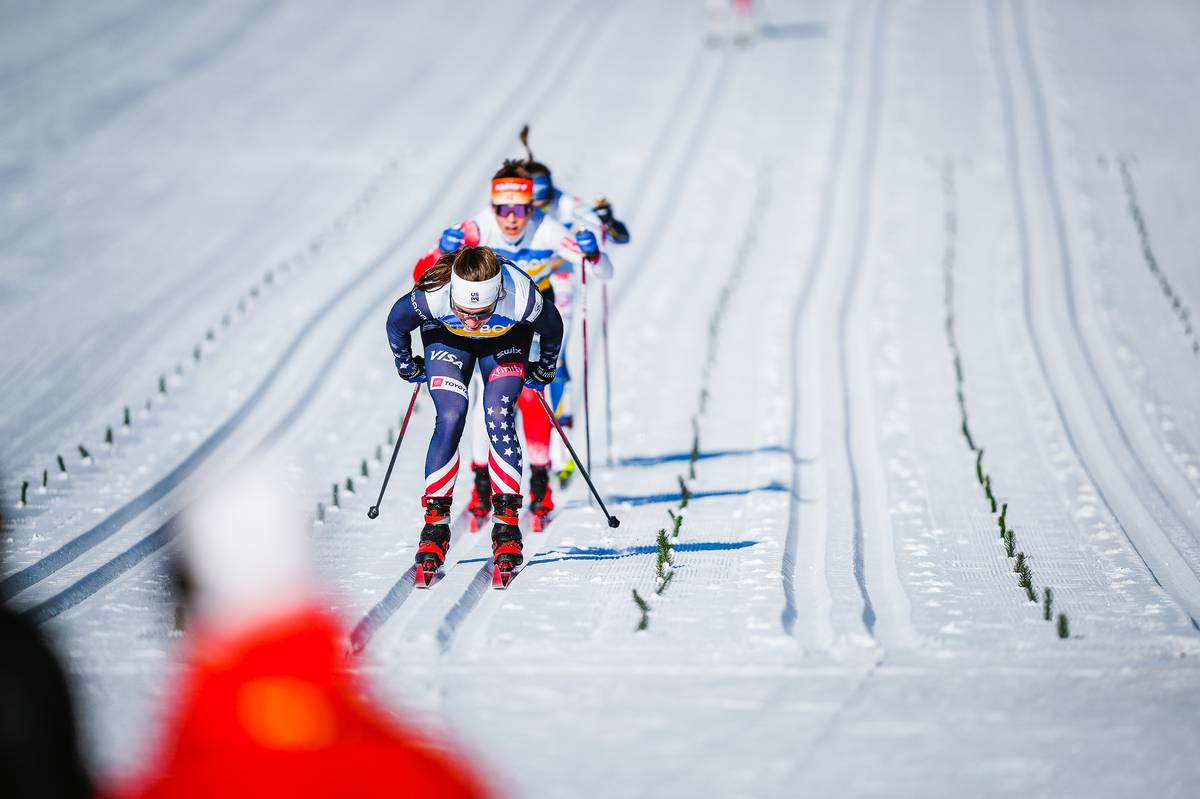
    Hilla Niemela (FIN), Johanna Hagstroem (SWE), and Jessie Diggins (USA) (l-r) charge up the opening climb of the Freestyle Sprint in Lahti, Finland. (Photo: Authamayou/NordicFocus)
    Diggins Attacks, But Falls Short

    For the United States, Jessie Diggins came closest to advancing deep into the rounds.

    In her quarterfinal, Diggins launched a decisive move on the final climb, surging to the front of the group in an effort to create separation before the tight hairpin turn at the top of the hill. Over the crest, she continued the attack, aggressively no-pole skating the downhill in an attempt to open a gap.

    For a moment, the tactic appeared to work.

    But the chasing group quickly organized behind her, the draft pulling them back together on the descent into the stadium. Sweden’s Johanna Hagström surged in the final meters, lunging at the line to edge Diggins and end the American’s day in the quarterfinal.

    Diggins said the Lahti crowd helped make the experience memorable.

    “It was so cool to hear the crowd roaring. There were so many people out, really filling the stadium and along the course. It’s just a very cool environment. It was sunny and beautiful, which made it really fun.

    “I was really happy with my energy today. I feel like I skied a pretty good race and did everything I could. But again this year, I feel like I just don’t quite have that ultimate power, especially in the finishing stretch.

    “I’m excited for tomorrow and just excited to be finishing out my last stretch here in Europe. That feels really special. It’s kind of cool to take a moment to reflect on my many years spent on the road in Europe. That chapter is coming to a close now, which is really cool and really special. I’m just grateful thinking back on all the memories over all the different years.”

    Rosie Brennan (USA) fighting to maintain contact with the group as Gina Del Rio (AND) takes the opening climb out fast during their quarterfinal. (Photo: Authamayou/NordicFocus)
    Brennan Knocked Out in Quarterfinal*

    Veteran American Rosie Brennan also reached the quarterfinals but was unable to advance.

    Lauren Jortberg (USA) on her way to 37th place in qualification in Lahti, Finland. (Photo: Authamayou/NordicFocus)
    Jortberg Reflects on Qualification Miss

    For Lauren Jortberg, the Lahti sprint was a reminder of how thin the margins can be in World Cup qualification.

    Jortberg finished 37th in the qualification, just outside the top-30 cutoff needed to advance to the heats. After the race, she said the conditions on the Lahti course made it difficult to find the right balance between glide and stability.

    “There was kind of an ice sheet underneath with some sugar on top,” Jortberg told FasterSkier after the race. “So it was hard to find skis that were running really well while also being able to push off and plant well. It made the skiing a little tricky, but that’s pretty typical for what we’ve seen in Lahti the last few years.”

    Jortberg also felt she left something on the course in terms of pacing.

    “I think I just didn’t pace it very well,” she said. “I probably paced it too much. I didn’t really finish feeling that tired, so that was a bit of a bummer.”

    Part of that caution, she explained, stemmed from having dealt with illness in the days leading into the race.

    “I had been sick the last week, so I think I held back a little bit,” Jortberg said. “That’s frustrating because I felt really good and I think I could have been competitive today.”

    Even so, Jortberg said the past months of racing have helped build confidence as she continues gaining experience on the World Cup circuit.

    “One of the big takeaways from these World Cup weekends is that when I can put down a really solid qualifier, I’m very much in the mix,” she said. “Even though today wasn’t a great qualifier, I wasn’t that far out of the heats, so I think that’s something I can take confidence from going into the next few weekends.”

    Julia Kern (USA) during qualification. (Photo: Authamayou/NordicFocus)
    Julia Kern Trying to Get Back to Form*

    Julia Kern, returning to racing after illness following the Olympic Games, placed 44th in the qualification round.

    Albrecht Gaining World Cup Experience

    Emma Albrecht, competing in her fourth World Cup weekend, finished 48th in the qualification round in Lahti as she continues gaining experience at the highest level of the sport.

    Albrecht said one of the biggest adjustments to racing on the World Cup has been the razor-thin margins in sprint qualification.

    Emma Albrecht (USA) gaining experience during the qualification in Lahti, Finland. (Photo: Authamayou/NordicFocus)

    “The biggest adjustment to racing at this level is how tight the race margins are,” Albrecht told FasterSkier after the race via email. “The U.S. SuperTour field is obviously not as competitive, and it has been a shift — especially in sprinting — to have to have a fast qualifier. You are no longer guaranteed to make heats.”

    The Lahti sprint course also served as a reminder of the confidence and technical skills required to compete in crowded sprint fields.

    “Today’s qualification reminded me to take up space on the course and not be afraid of a little hop skate,” she said.

    Even with the challenges, Albrecht said the experience is fueling motivation heading into the offseason.

    “This weekend is making me very excited for summer training,” she said. “A field as deep as this really highlights weaknesses on course. I would love to become a more efficient jump skater and be more confident in my high-speed V2. I’m definitely walking away with a lot of motivation to improve.”

    Liliane Gagnon (CAN) charges up the first climb during her quarterfinal, where she narrowly missed advancing to the semifinals. (Photo: Authamayou/NordicFocus)
    Canadian Results

    Canada’s top performance came from Liliane Gagnon, who finished third in her quarterfinal — just short of advancing to the semifinals.

    Teammates Olivia Bouffard-Nesbitt and Katherine Weaver placed 43rd and 46th, respectively, in qualification.

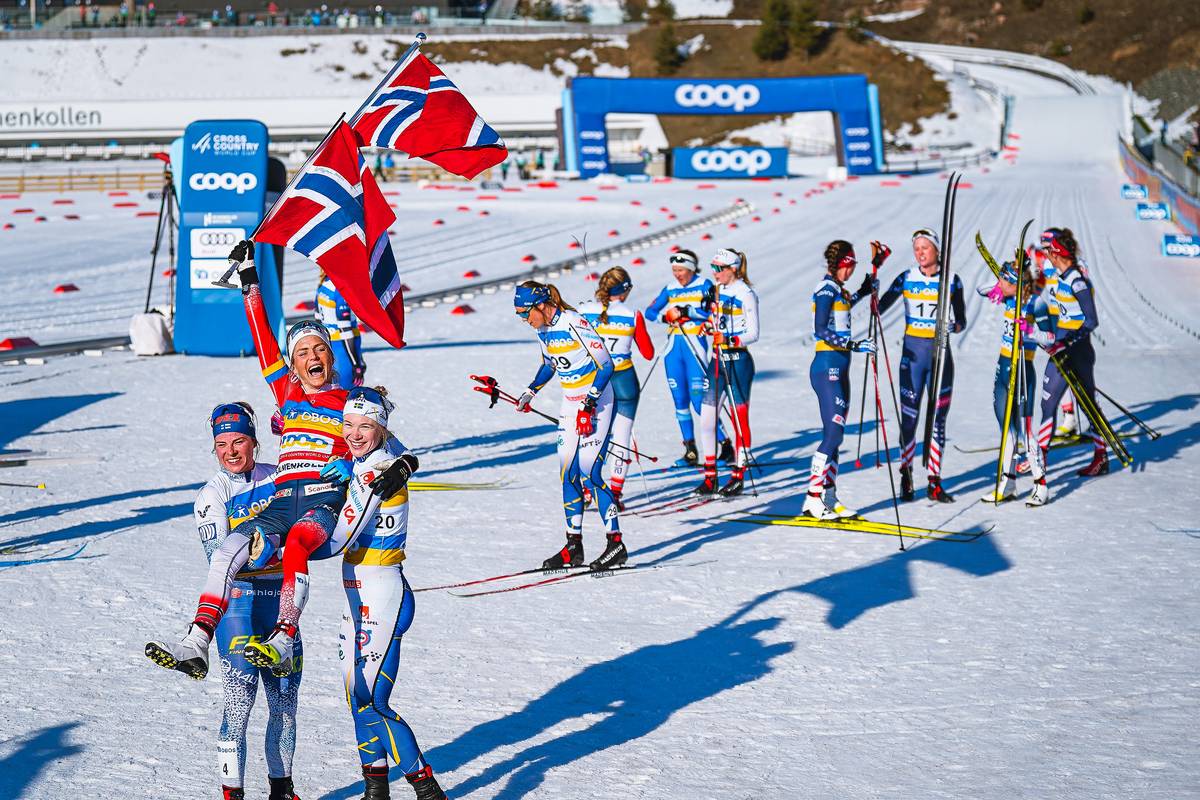
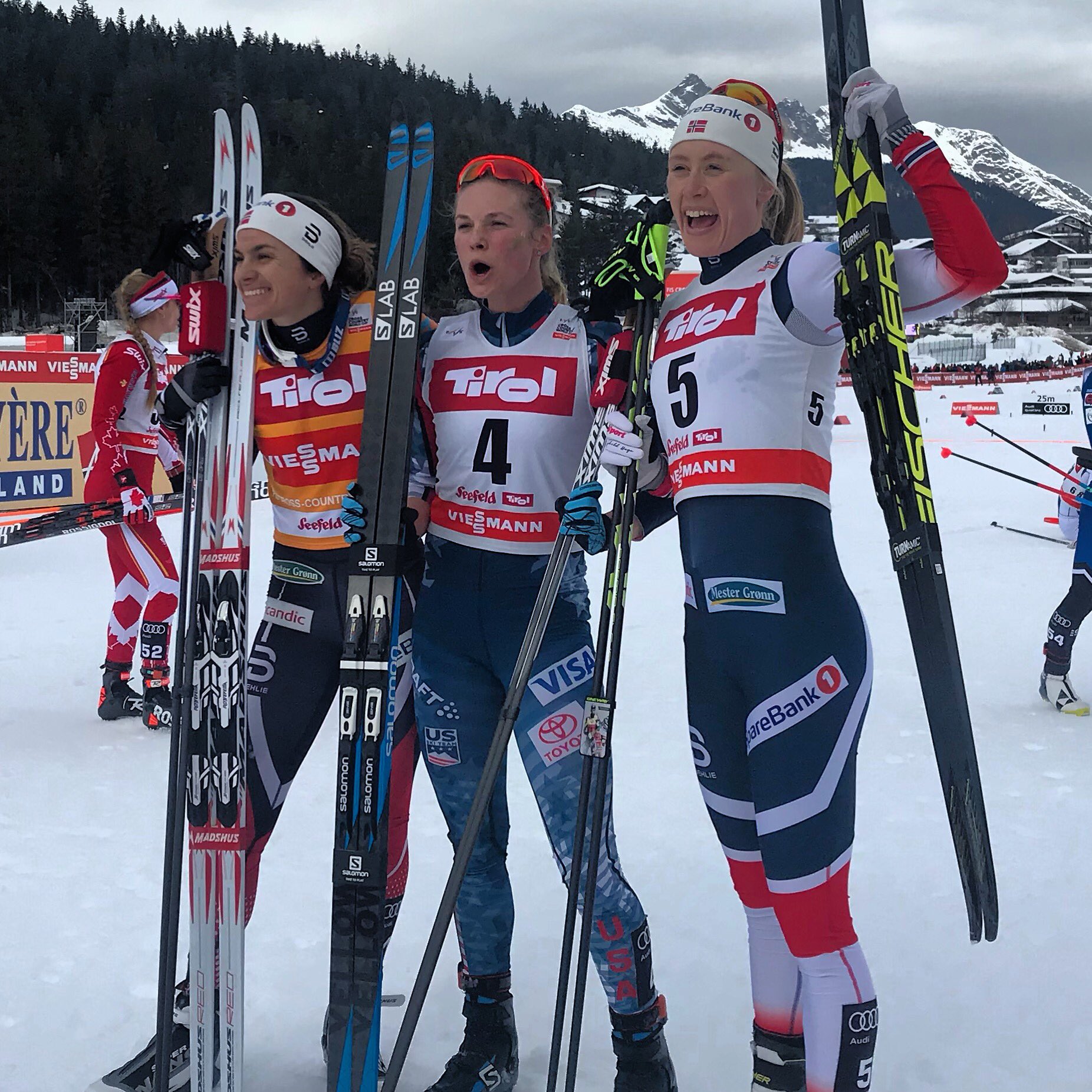
    Jonna Sundling (SWE) celebrates the win while Coletta Rydzek (GER) and Johanna Hagstroem (SWE) lunge for third behind her. (Photo: Authamayou/NordicFocus)
    The Season’s Final Push

    With only a handful of races remaining on the World Cup calendar, the results in Lahti could prove important in shaping the final standings.

    For Sundling, the victory served as both a return to form and a statement heading into the closing weeks of the season.

    “I’m looking forward to the rest of the season,” she said.

    For others — particularly those chasing the Crystal Globes — the margin for error continues to shrink.

    And with more racing still ahead in Lahti this weekend, the battle for the season-long trophies is far from settled.


    Lahti Women’s Freestyle Sprint QUALIFICATION RESULTS

    Lahti Women’s Freestyle Sprint FINAL RESULTS


    *We hope to add more quotes above from athletes if we hear back from them, but wanted to get this race report posted in a timely fashion.


    Love Stories Like This? Help Keep Them Coming.

    Feature stories like this one take time, access, and care to produce. If you value thoughtful storytelling and independent ski journalism, please consider becoming a Voluntary Subscriber. Your support directly fuels the work we do to cover the people, places, and moments that make our sport special.

    Join the FasterSkier community!


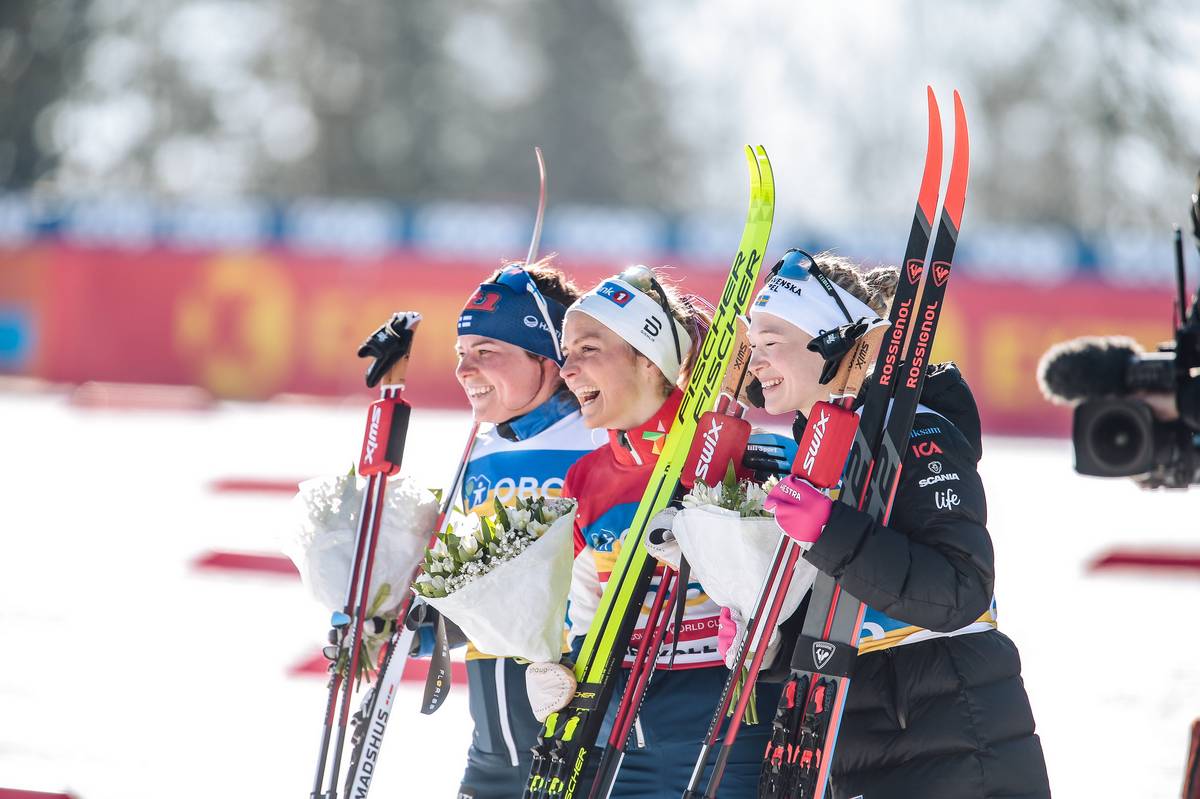
    Linn Svahn (SWE), Jonna Sundling (SWE), and Coletta Rydzek (GER), (l-r) share the Freestyle Sprint podium in Lahti, Finland. (Photo: Authamayou/NordicFocus)
  • After Two COVID Winters, an Unusual Sight at World Championships: Parents

    After Two COVID Winters, an Unusual Sight at World Championships: Parents

    This World Cup coverage is made possible through the generous support of Marty and Kathy Hall and A Hall Mark of Excellence Award. To learn more about A Hall Mark of Excellence Award, or to learn how you can support FasterSkier’s coverage, please contact info@fasterskier.com.

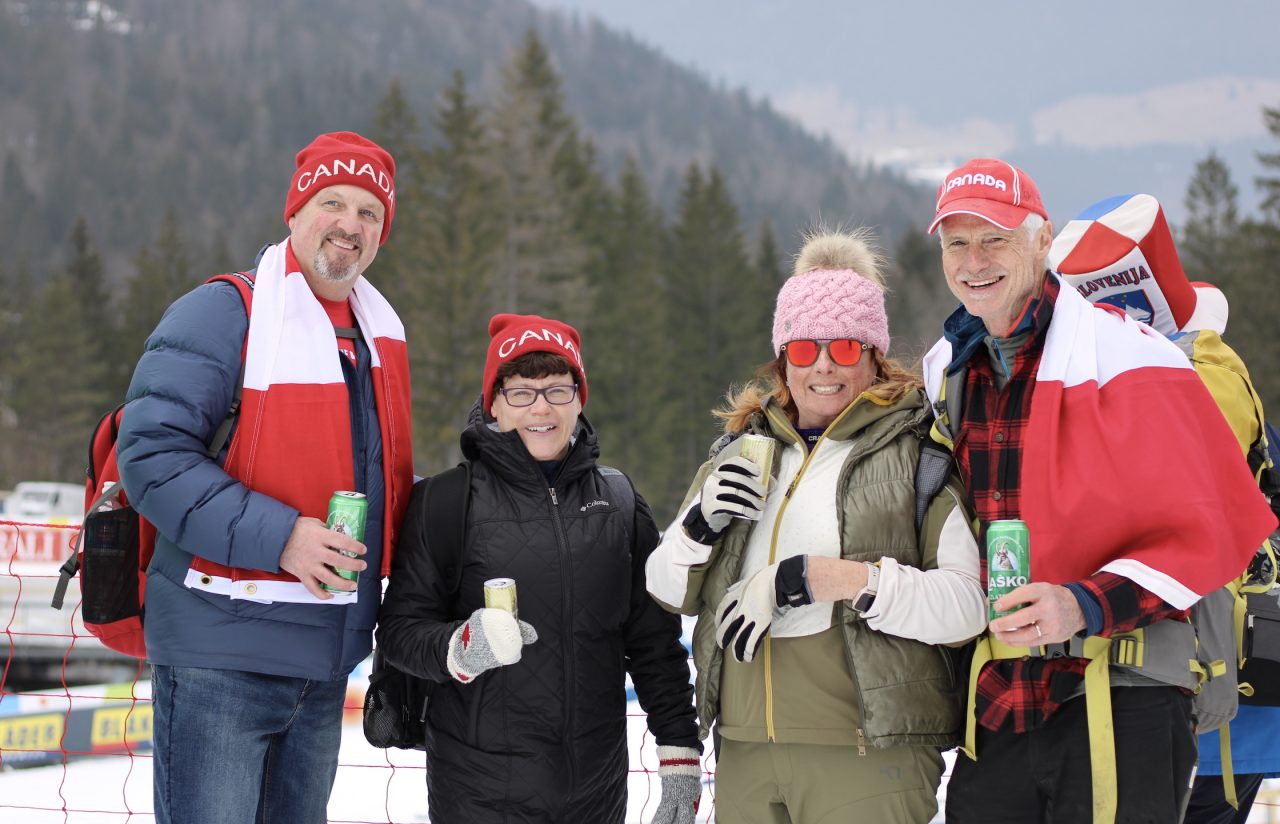
    Dave Ritchie, Christine Babcock, Sylvie Bouffard and Rick Nesbitt traveled from Canada to watch their children Graham Ritchie and Olivia Bouffard-Nesbitt compete at the 2023 World Championships in Slovenia. (Nathaniel Herz/FasterSkier)

    PLANICA, SLOVENIA – A year ago, Canadian cross-country skier Graham Ritchie had reached the pinnacle of his sport: He was competing at the Winter Olympic Games in Beijing.

    His parents? They were half a world away, forced by China’s draconian coronavirus protocols to take in their son’s achievements on television.

    “It sucked,” said Dave Ritchie, Graham’s father. “Really, it sucked.”

    Fast forward a year, to the World Ski Championships here: Ritchie, an insurance broker from the hardscrabble town of Parry Sound, Ontario, was posted up on the side of a trail on his first-ever European trip — beer in hand, taking in the picturesque views of the Julien Alps with his wife as his son raced by with the best skiers in the world.

    “It’s special,” he said. “It’s exciting to come and see what they do.”

    The Ritchies are one of a bevy of families who flew to Slovenia from North America this week to watch their children compete. Their presence here is one of the clearest signs yet of the end of the past two years of coronavirus-imposed isolation on the international circuit for Canadian and American athletes, who were competing largely without any in-person support from their loved ones and friends since the onset of the pandemic.

    “Whether you get dead last or you win, they love you just the same,” said Hailey Swirbul, a 2022 Olympian who’s also racing in Planica. “It’s so nice for me to have safe people around, who provide that for me.”

    Brick Swirbul, the father of U.S. Ski Team member Hailey Swirbul, stands in the stadium in Planica, Slovenia, where he and his wife traveled to watch their daughter compete in the 2023 World Championships. (Nathaniel Herz/FasterSkier)

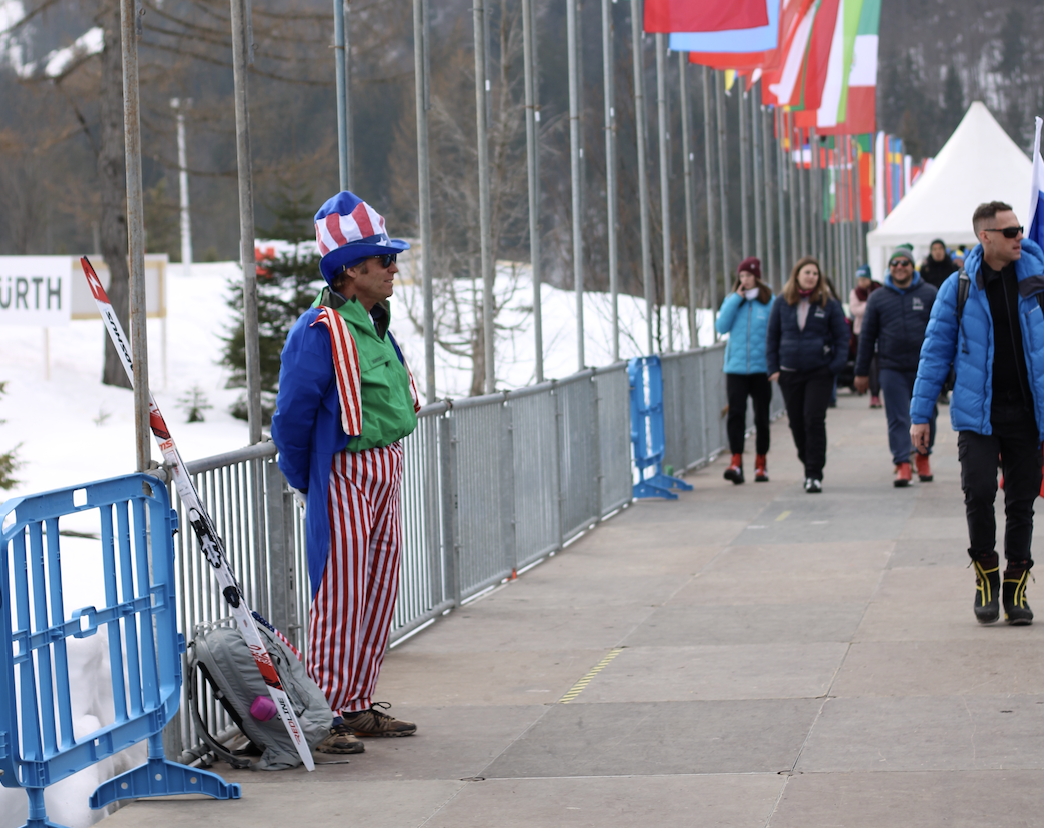
    Swirbul’s parents, Rebecca and Brick, both flew to Slovenia from Colorado and were along the course to see their daughter place 33rd in Thursday’s sprint race. Brick, wearing pants, a vest and stovepipe hat all made from American flag striped fabric, was impossible to miss.

    Hailey Swirbul’s place on the American team wasn’t confirmed until a few weeks ago, and her parents hastily made plans to watch her race at an international level. The pandemic had kept them from seeing their daughter in Beijing and at the 2021 World Championships, in Germany.

    The Swirbuls also had planned to see Hailey at World Cup races in Quebec, in early 2020. But the coronavirus forced the cancellation of those races just days before.

    Being in Planica is “spectacular,” Rebecca Swirbul said.

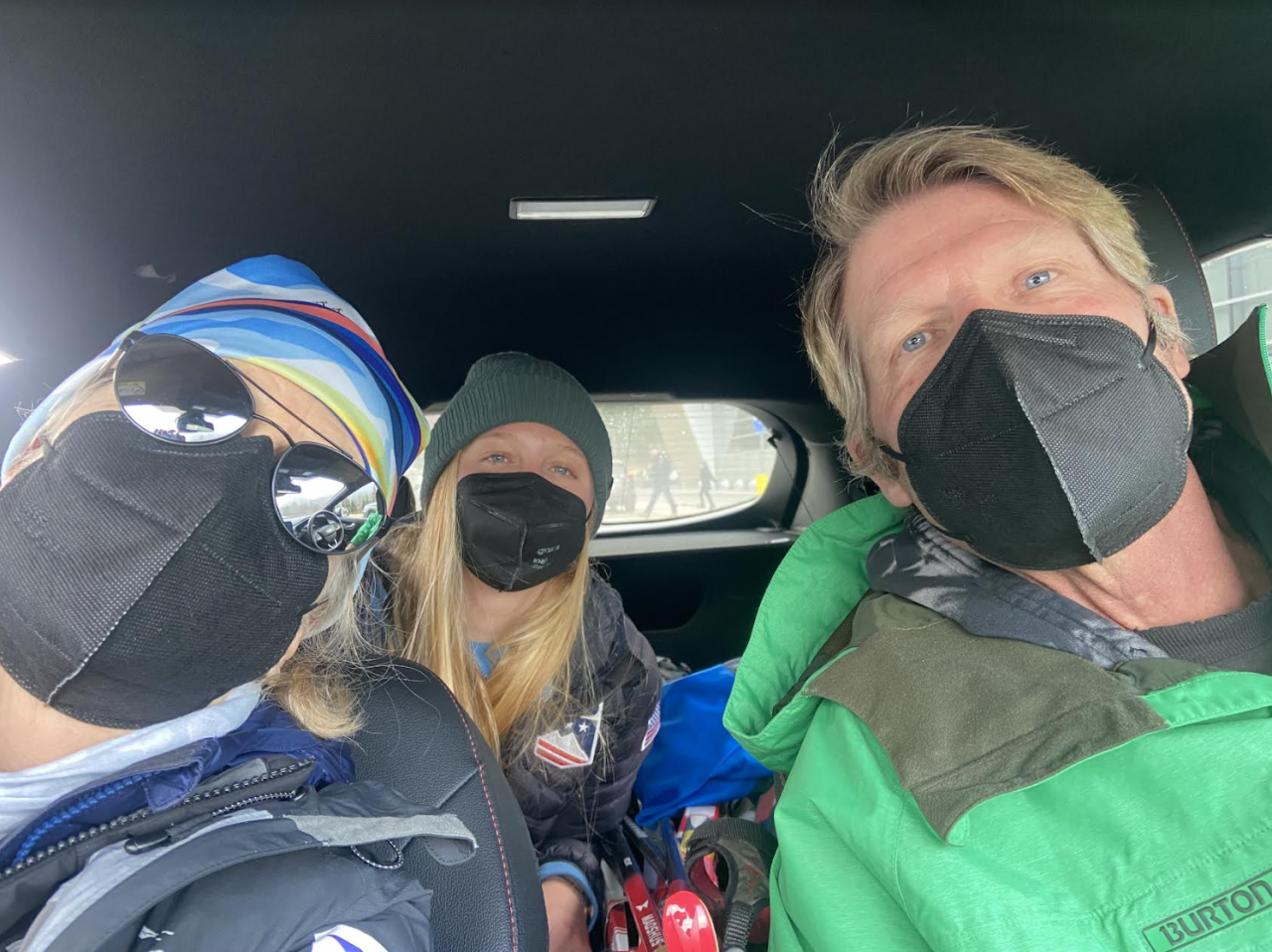
    But it’s also not completely normal. When the three Swirbuls spent some time driving together earlier this week, “we wore masks in the car, I opened the windows,” Rebecca said.

    Rebecca and Brick Swirbul masked up as a precaution when they drove with their daughter, Hailey Swirbul, during the 2023 World Championships in Slovenia.

    “It’s sad that that’s our reality now,” she said. But after raising two endurance athletes, she added — Hailey’s brother, Keegan, is a professional cyclist — she understands the need for caution.

    “I get it,” she said. “A cold: you’re done.”

    Another set of parents in Planica — those of American sprinter Julia Kern — saw those risks for themselves when they were following their daughter’s competitions in Europe earlier this year, during the Tour de Ski.

    At the time, several U.S. team staff caught the coronavirus, and Kern’s parents, Dorothee and Gunther, were pressed into service.

    Dorothee, a former professional basketball player, said her own experience as a professional athlete has helped her understand the need for boundaries while her daughter is competing.

    “It is important that they have their space and that they do their thing,” she said.

    One thing that athletes’ parents can do, the Kerns said, is bring needed items from the U.S. to Europe, where many North American skiers live for months at a time — things like medication, clothing and caffeinated beverages of choice.

    Dorothee and Gunther Kern watched their daughter, Julia Kern, compete at the 2023 World Championships on Thursday, February 23. (Nathaniel Herz/FasterSkier)

    “I roast my own coffee, and Julia is a real fan — and I think Jessie (Diggins) as well,” Gunther Kern said. “Fresh roasted beans.”

    The parents of Olivia Bouffard-Nesbitt, meanwhile, brought a new credit card for their daughter from their home in Canada.

    “The last one is expired,” said Sylvie Bouffard, Bouffard-Nesbitt’s mother.

    The Bouffard-Nesbitts and Ritchies watched Thursday’s race together, sporting maple leaf flags and attire. They said they plan to do some sightseeing over the course of the 11-day championships; team leaders are also organizing a dinner for parents and athletes.

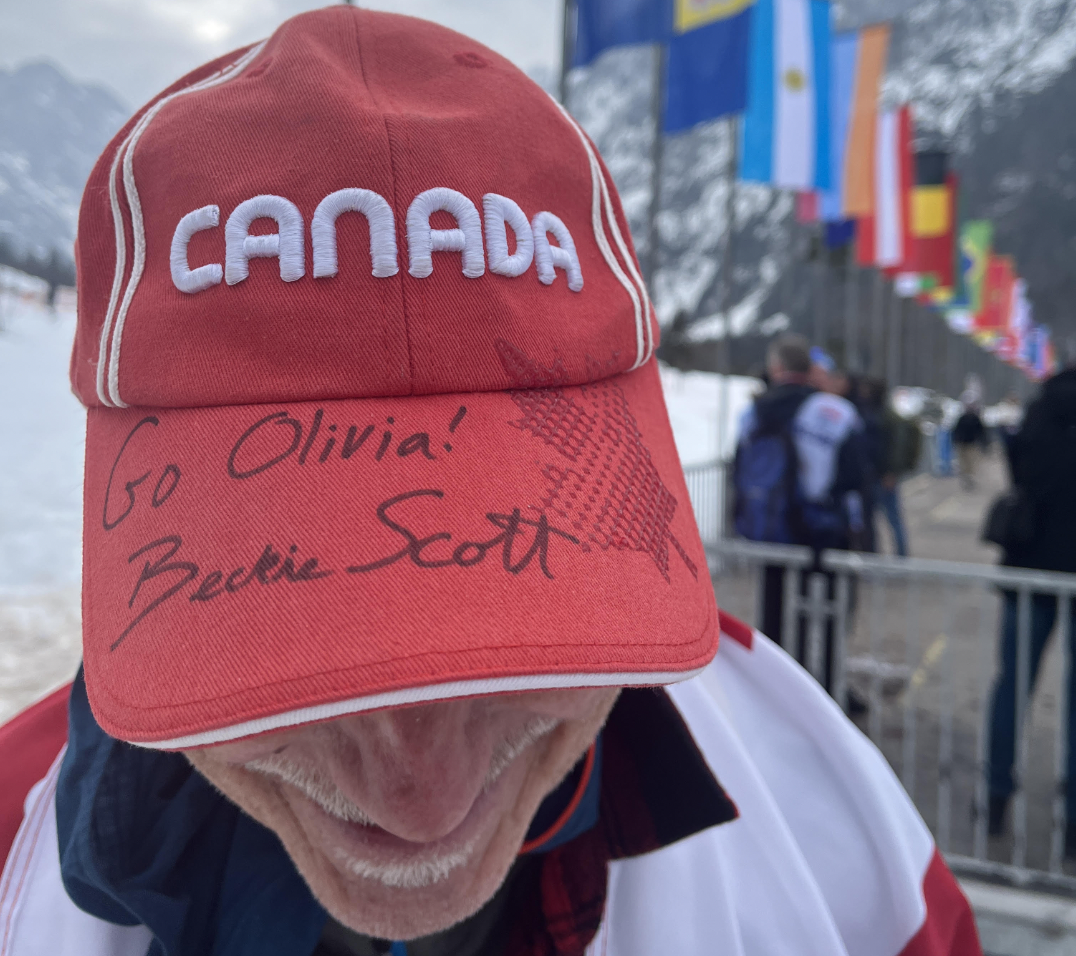
    Rick Nesbitt wears a hat that Canadian cross-country ski legend Beckie Scott signed for his daughter, Olivia Bouffard-Nesbitt. (Nathaniel Herz/FasterSkier)

    Bouffard-Nesbitt said she didn’t actually hear her parents out on the course, which was lined with boisterous European fans. But she said she’s thrilled about their presence.

    “They’re such big ski fans. They love to watch the World Cup, and they love to follow my racing,” she said. “I’m so happy that they’re here — I just think it’s such a fun environment to be in, as a ski fan.”

    Graham Ritchie did hear his parents during his qualifying lap of the sprint course — though he wasn’t entirely prepared for it.

    “It almost caught me off guard for a little bit,” he said. “I wasn’t used to hearing my dad’s voice, in Slovenia.”

    The extra support helps even the athletes who don’t have parents around, said Matt Whitcomb, the head coach of the U.S. team.

    “You ski through the stadium, and you can’t help but train your eyes on a few American flags that are just peppered throughout,” he said. “It’s energy that is being invested in our team.”

    European parents are also getting their first chance at watching in-person competition in more than two years. During Friday’s hour-long pursuit race, the fathers of two of the Norwegian medalists — Johannes Høsflot Klæbo and Sjur Røthe — spent the event along the trails above the Planica stadium, running from fence to fence to cheer their sons on to silver and bronze, respectively.

    Elisabeth Høsflot and Haakon Klæbo, the parents of Johannes Høsflot Klæbo, pose for a photo after Johannes won a silver medal in Friday’s pursuit race at World Championships in Slovenia. (Nathaniel Herz/FasterSkier)

    Haakon Klæbo, whose son is one of the most decorated cross-country skiers in history, said Johannes’ grandparents, mother and brother are all in attendance this week.

    “Yesterday, when he won the sprint — the first thing he did was just to go over to the family,” Haakon said. “You could just see it in his eyes and in his smile, he was very happy. I think it means a lot to the athletes.”

  • A full-circle moment, Johaug wins the 30 k classic at Holmenkollen, exactly 11 years after her first individual World Championship gold; Brennan leads the US in 7th

    A full-circle moment, Johaug wins the 30 k classic at Holmenkollen, exactly 11 years after her first individual World Championship gold; Brennan leads the US in 7th

    Crowds line the storied tracks at Holmenkollen during the women’s 30 k classic. (Photo: NordicFocus)

    This World Cup coverage is made possible through the generous support of Marty and Kathy Hall and the A Hall Mark of Excellence Award.  To learn more about A Hall Mark of Excellence Award or to learn how you can support FasterSkier’s coverage please contact info@fasterskier.com.


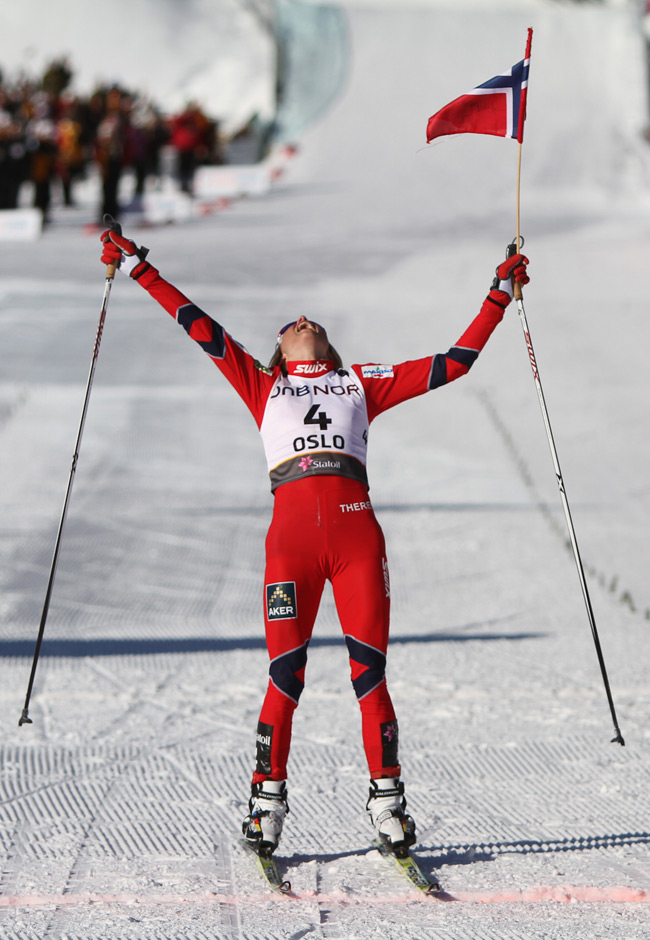
    Terese Johaug wins her first individual World Championship gold medal in the 30 k mass start skate in Oslo, NOR. (Photo: FS Archives)

    Eleven years ago to the day, racing the 30-kilometer mass start skate, a 22-year-old Therese Johaug won her first individual World Championship gold medal in a breakout performance at Holmenkollen near her home in Oslo, NOR. In doing so, she had broken apart a field of women considered legends of the sport on an equally legendary course known for long grinding climbs that require superior fitness and technique. Johaug won by nearly 45 seconds over one of the greatest cross country skiers of all time, her teammate Marit Bjørgen, and was 1:34 ahead of the Polish champion Justyna Kowalczyk. 

    “It was hard for me. It’s hard to see her go in front, and the gap [grow] bigger and bigger,” said Bjørgen that day. Then at the peak of her career, Bjørgen had gone four-for-four that week with gold medals in each of the previous World Championship races in Oslo, and the upset was a shock to those following along. “But I’m very happy for Therese. She is a young girl, and a girl for the future—and for Norway.”

    Little did cross country ski fans know just how storied the athlete’s career would be.

    Therese Johaug races in front of a home crowd during the 30 k classic at Holmenkollen. (Photo: NordicFocus)

    Today, under clear skies that allowed for views of the city skyline and Oslofjord, Norwegian flags flying, and fans returning to the crowded stadium and partying in the woods, she did it again, as one of her final performances after more than a decade as the top female distance skiers of all time. 

    And what’s more, Johaug won today’s 30 k classic in the same dominant fashion that she did eleven years ago, and has done many time since, stopping the clock at 1:19:22.8.

    Though the final results show just 19.4 seconds as her winning margin, this only tells part of the story. By 10 k, Johaug held a margin of over 23 seconds, which she steadily grew over the subsequent laps. At 25 k, she led by nearly a minute and a half.

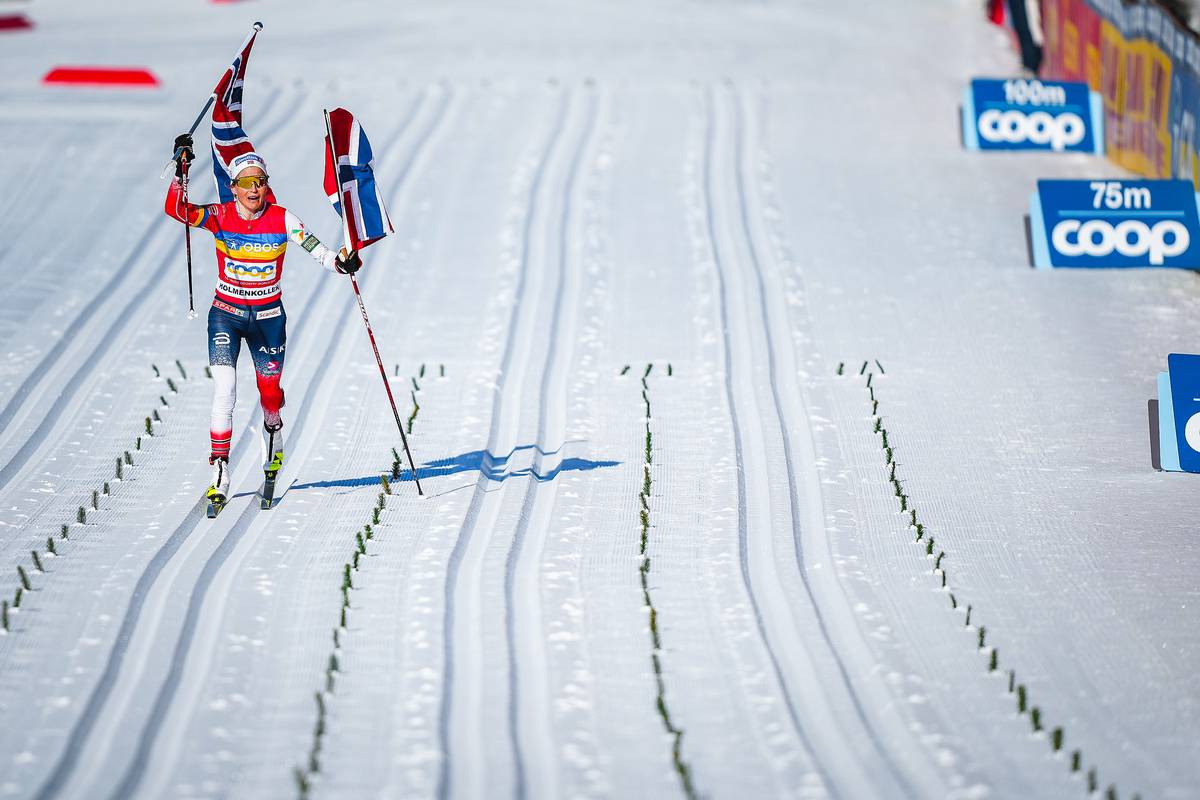
    Therese Johaug waves Norwegian flags as she skis the final meters of 30 k classic at Holmenkollen. (Photo: NordicFocus)

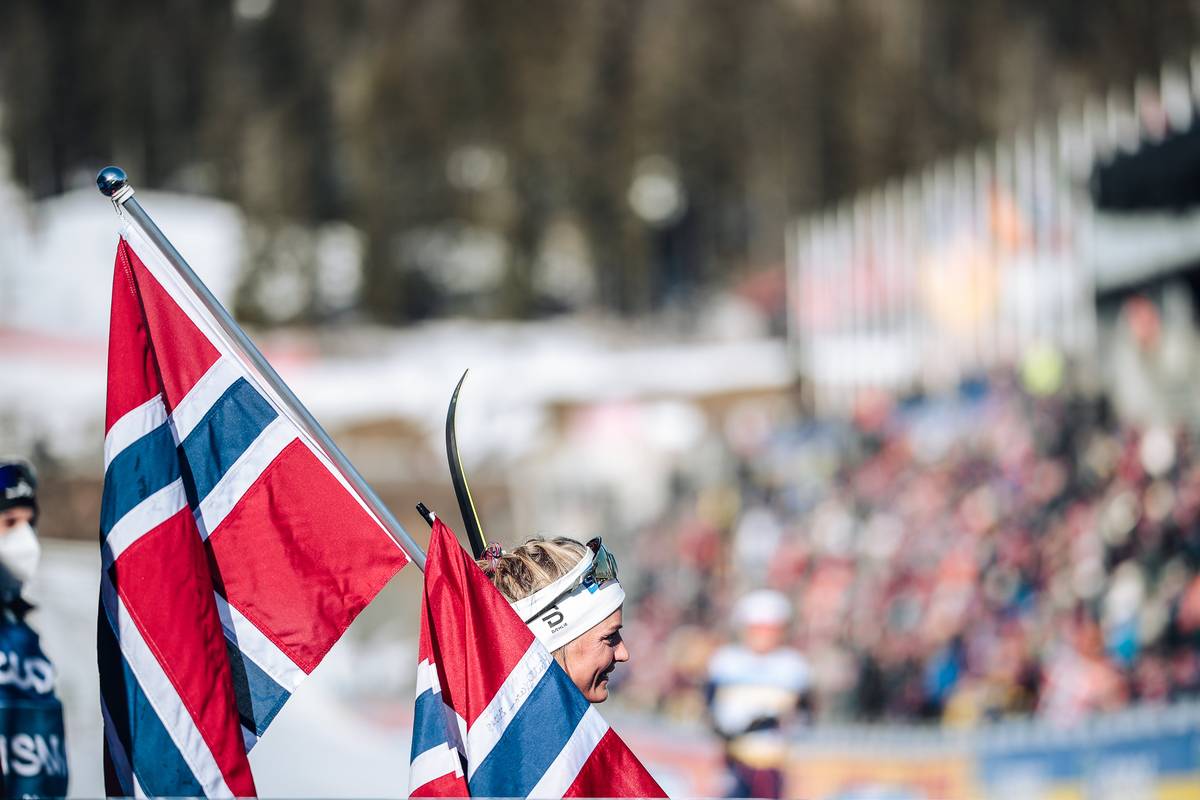
    As she entered the stadium, Johaug was greeted by coaches and techs who handed her a flag for each hand, which she carried through the finish, waving, and stopping to take in the erupting cheers from the crowds. 

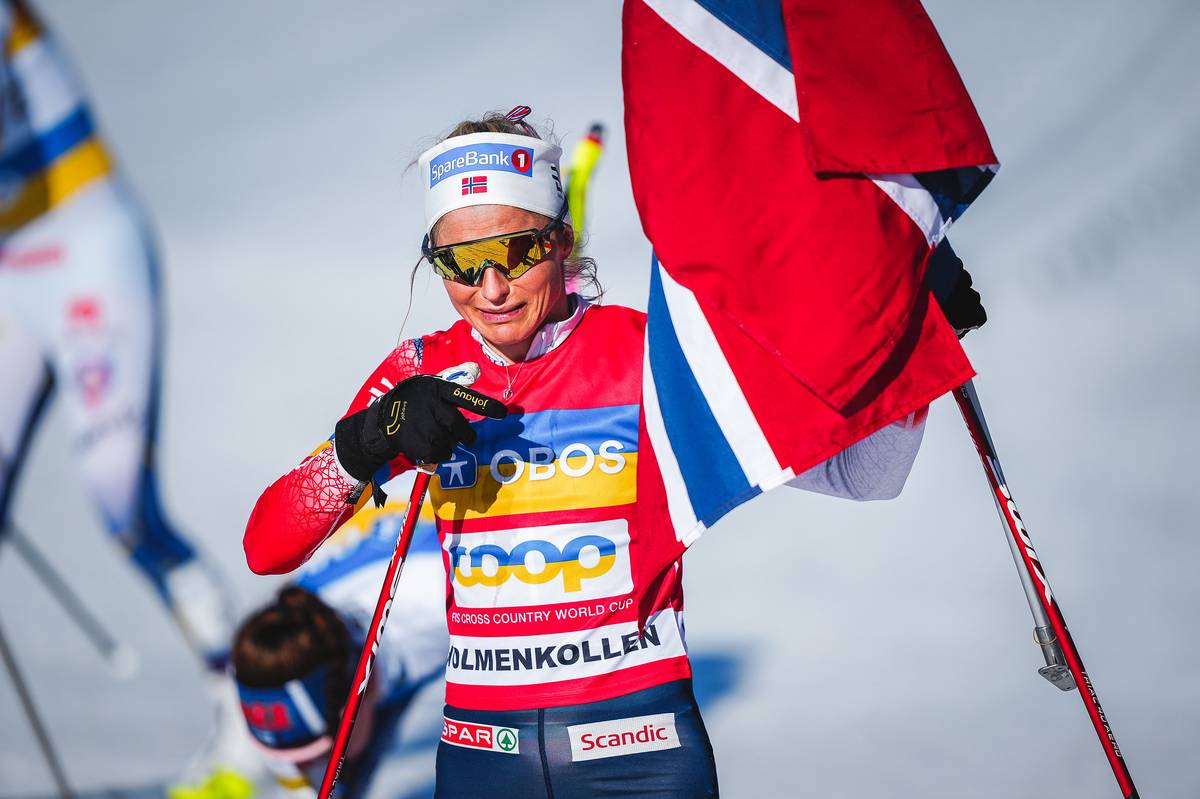
    Laughing behind tears as the rest of the field began to trickle across the line, Johaug was hoisted onto shoulders, waving her flags for a loud Norwegian crowd who had supported and applauded her through fifteen years of racing on the World Cup. 

    “It’s a lot of emotion now,” Johaug said at the finish. “I start here in 2011 with my first individual victory, and today is my last race here. It was sun and blue sky, the same as  in 2011, and there were a lot of people around the track cheering for me. I’m so happy now, but also so sad that this is the end of my career.”

    Therese Johaug was emotional at the finish of today’s 30 k classic at Holmenkollen, the venue where she won her first individual World Championship gold in the 30 k skate eleven years prior. (Photo: NordicFocus)
    Norway’s legendary Therese Johaug wins the 30 k mass start classic, exactly 11 years after her first individual World Championship gold medal was won on the same tracks. (Photo: NordicFocus)

    While she indicated during the Olympics that she would not compete another four years, it was not until yesterday that she officially announced that this would be her final race at Holmenkollen. 

    “In many ways, it feels as if the [story] ends when on Saturday, March 5, 2022, I stand on the starting line for another 30 k in Holmenkollen. I really do not want the journey to end, but it is a time for everything,” she wrote to NRK. “In light of this, I look forward to a final fight at home with the flag on my chest, and I am grateful for everything the sport has given me.”

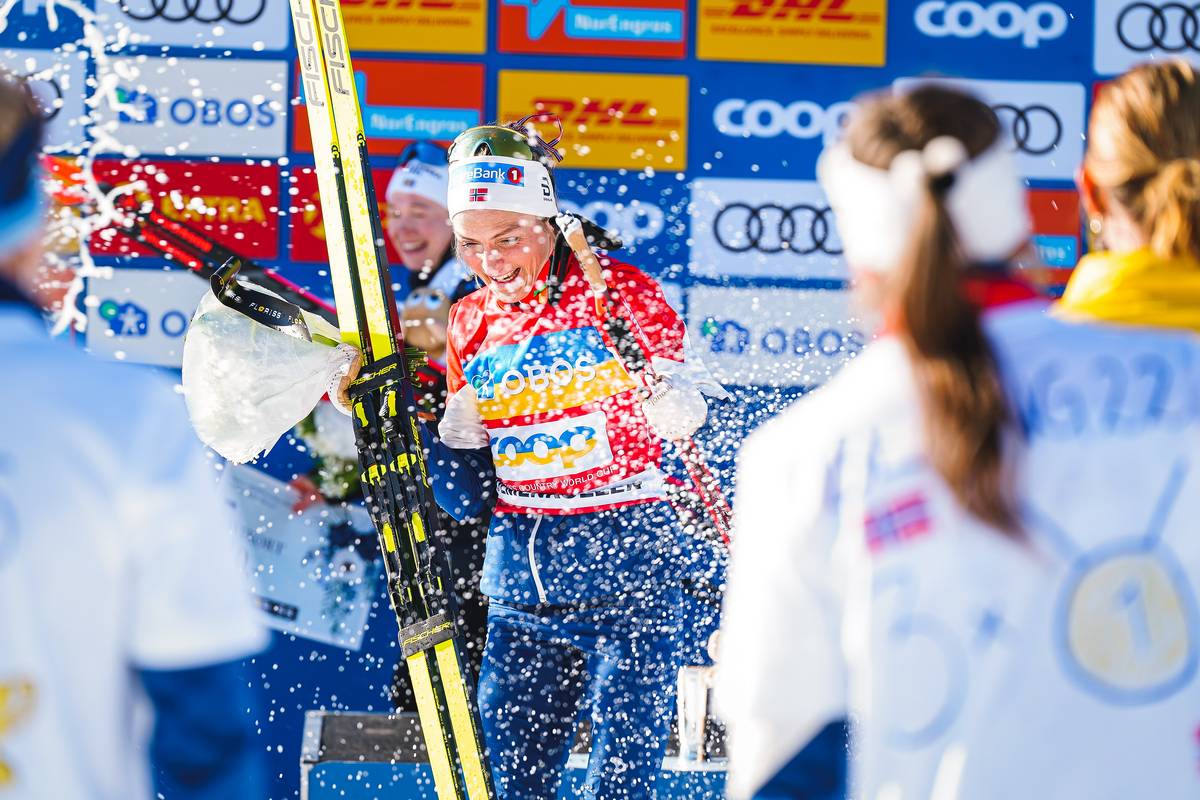
    Therese Johaug is showered with champagne after winning the 30 k classic at Holmenkollen following her retirement announcement. (Photo: NordicFocus)
    Therese Johaug celebrates her final race race at Holmenkollen, winning the 30 k classic exactly eleven years after taking her first individual World Championship gold on these tracks. (Photo: NordicFocus)

    As Queen’s “We are the Champions” blared through the stadium, Johaug stepped off the podium only to be soaked by champagne sprayed by a flock of teammates wearing shirts spelling her name, with “takk” – thank you – written with a heart at the end of the row. It was a joyous celebration fitting for the moment, and perhaps also a refreshing distraction from the times at large.

    “There are a lot of strong moments, but I am moved when so many people come here and see my last race. I must thank the Norwegian people who stand here today,” Johaug later said to NRK.

    While you can certainly expect a more in-depth look at her storied career on FasterSkier, for now, we’ll echo the crowds in congratulating Therese Johaug, and we look forward to following along for the next chapters.

    Therese Johaug celebrates her final race race at Holmenkollen, winning the 30 k classic exactly eleven years after taking her first individual World Championship gold on these tracks. (Photo: NordicFocus)
    Krista Pärmäkoski (FIN) and Jonna Sundling (SWE) lift champion Therese Johaug (NOR) for a podium shot at the finish of the 30 k classic in Oslo. (Photo: NordicFocus)

    Behind the celebration, the lineup of women in today’s top-10 was remarkably similar to the Olympic 10 k interval start classic, with a few name swaps, and of course, a few noteworthy athletes missing – namely, Natalia Nepryaeva and Tatiana Sorina of Russia, and Jessie Diggins, who had been fourth, seventh, and eighth, respectively. 

    The volume of the ringing cowbells swelled as Finland’s Krista Pärmäkoski skied through the stadium on her own for second place, after pulling away from the first chase pack with 5 k to go and maintaining a healthy 10-15 second gap through the finish. Coming back on form after a few rocky seasons, Pärmäkoski had been third in the 10 k classic in Zhangjiakou, behind her teammate Kerttu Niskanen, who was fourth today (+33.8). 

    Finland’s Krista Pärmäkoski takes second in the 30 k mass start classic at Holmenkollen in Oslo, NOR. (Photo: NordicFocus)
    The women’s 30 k classic podium at Holmenkollen: Therese Johaug (NOR) took the win ahead of Krista Pärmäkoski (FIN) and Jonna Sundling (SWE). (Photo: NordicFocus)

    Between the Finns, Sweden’s Jonna Sundling reaffirmed her talents across all distances, taking the third spot on the podium (+32.3) just two days after being second in Drammen’s classic sprint. Matching her fifth place result in the Olympic 10 k, Germany’s Katharina Hennig followed Niskanen to the line (+34.7) with Therese Stadlober, who was ninth at the Games, crossing after a gap in sixth (+46.7). 

    Leading the next chase group, and the American team, was Rosie Brennan in seventh (+1:12.3), bringing Norway’s Marte Skaanes and Sweden’s Ebba Andersson to the line just behind her for eighth (+1:13.1) and ninth (+1:13.8), respectively.  

    Rosie Brennan leads Norway’s Marte Skaanes and Sweden’s Ebba Andersson to the line. (Photo: NordicFocus)

    “Today was huge for me,” Brennan wrote in a post-race email. “I have struggled here my entire career, and [though] it’s been a few years since I’ve raced here and I have improved a lot in the last few years, I still felt I lacked a lot of confidence and excitement coming here [today]. It’s also been a really stressful week for a variety of reasons, so I showed up today with an immense amount of anxiety that I needed to get a hold of before the race started. 

    “I am really proud of giving myself another chance to put together a good race here and to have managed the stress and anxiety well enough to do so. I wasn’t feeling in a place to shoot for the moon so I tried to start a bit a conservative the first 5 k and then reevaluate. I had a great ride with Ebba and really had an enjoyable time skiing out there today. The last lap, we had the chance to pick off a few from the lead pack and so I started to ramp things up to see what was possible. I felt strong on the last climb and felt I had a good shot at the sprint finish so I went on the last little bump before the [last 100 meters]. It felt great to finish strong and to put together a really solid race today.” 

    Rosie Brennan skis to seventh in the 30 k classic at Holmenkollen. (Photo: NordicFocus)

    Following her classic sprint race in Drammen Thursday, Brennan joked post-race that she had lost out on yet-another boot slide. Today, the final sprint was hers. It was perhaps, also worth American fans celebrating that today that she won amongst her chase group, just under two weeks after a brave and gritty performance in the Olympic 30 k skate where she had pulled the chase group for much of the race, wearing herself out to break the wind, only to be dropped in the final 600 meters as Niskanen pulled away for a bronze medal. However, Brennan said she is not connecting any dots between the two.

    “This race was nothing like Zhangjakou, really hard to even compare the two. 30 k’s are always an adventure and I am really happy to have put together two strong ones, in each technique.” 

    Rosie Brennan skis to seventh in the 30 k classic at Holmenkollen. (Photo: NordicFocus)

    Commenting on how she is feeling, mentally and physically, with one final race weekend to go, Brennan concluded, “I am really bummed that the [World Cup] Finals were canceled. I haven’t raced a ton this season because of the earlier cancellations and while it has been a very high density block since the Olympics started, I am still feeling strong and wanted to see what I could do. But it will be really fun to end the season with the mixed relay event as that is a new one for us!” 

    Julia Kern was next for the US in 23rd (+3:37.2), followed by Hailey Swirbul in 26th (+3:57.8), and Caitlin Patterson – six days after taking second at the American Birkie – in 30th (+4:11.5). 

    Julia Kern skis to 23rd in the 30 k classic at Holmenkollen in Oslo, NOR. (Photo: NordicFocus)
    Hailey Swirbul skis to 26th in the 30 k classic at Holmenkollen in Oslo, NOR. (Photo: NordicFocus)

    In a post-race call, head coach Matt Whitcomb shared that Kern’s result was perhaps especially noteworthy as she has been struggling throughout the season with nausea during distance races, making it difficult for her to keep down fluids taken in prior to the race, let alone receive feeds during. Whitcomb also explained that Diggins sat out today’s race as she was feeling lingering fatigue from the long, and successful, season of racing. He affirmed that she is healthy and will be ready to race for the final World Cup weekend in Falun, beginning next Friday. Listen to the full call with Whitcomb below.

    Outside the top-30 for the US, Katharine Ogden was 37th (+5:54.1), followed by Rosie Frankowski, who has consistently landed on SuperTour podiums throughout the season, in 46th (+8:12.2). 

    Katharine Ogden (left) and Caitlin Patterson (right, bib 32) take to the course at the start of the women’s 30 k classic at Holmenkollen. (Photo: NordicFocus)
    Canada’s Cendrine Browne (bib 43) leads Katharine Ogden (bib 40) during the 30 k mass start classic at Holmenkollen. (Photo: NordicFocus)

    Racing for Canada, Katherine Stewart-Jones led the way in 22nd (+3:25.0), with Cendrine Browne also inside the top-30 in 25th (+3:53.7). After a successful World Junior Championship in Lygna, NOR, Jasmine Drolet finished 42nd today (+6:53.2), with Olivia Bouffard-Nesbitt closing out the Canadian racers in 48th (+10:19.8). 

    Results

  • (Press Release) Canadian Women’s Relay Team Skis to Ninth in Beijing

    (Press Release) Canadian Women’s Relay Team Skis to Ninth in Beijing

    Canucks celebrate best Olympic relay result since 2002


    BEIJING, Chn—The Canadian women’s relay squad skied to its best result Olympic result in two decades, finishing ninth on Saturday at the Zhangjiakou National Cross-Country Ski Centre.

    Skiing on a mission for eighth spot, the women’s team of Katherine Stewart-Jones, Dahria Beatty, Cendrine Browne and Olivia Bouffard-Nesbitt mixed together their best relay result on the sport’s ultimate stage since the 2002 Games, skiing into the top-10 in the 4 x 5 kilometre race with a combined time of 57:20.9.

    Katharine Stewart-Jones skis the opening leg of the women’s 4 x 5 k relay. (Photo: NordicFocus)

    “I love relay days. There is no race more fun than a relay. The 5 k’s are brutal. They are really rough. We all went out together and gave it absolutely everything,” said Stewart-Jones. “I had a good time cheering the girls on when I was done, and I think we can be really proud of our effort.”

    The women’s relay consists of each athlete skiing one five-kilometre leg. The first two athletes ski classic-ski format followed by the final two members of the team taking on the skate-skiing legs.

    Stewart-Jones (Chelsea, Que.) was first out of the gate for the Canucks , skiing a steady 5km before passing off to Dahria Beatty (Whitehorse) in 10th spot.  Beatty, a two-time Olympian, continued her solid run in Beijing where she has rattled off a trio of career-best races, by grabbing two spots on the field before completing her five-kilometre charge around the challenging Nordic trails.

    “I just tried to empty the tank out there and give it all I had. I had China to catch at the beginning and saw Japan in the distance and tried to reel them in,” said Beatty. “There was a new pack well out in front of me that was a big group. I did a solo time trial out there and gave it all I had. It was a great result for the team.”

    Cendrine Browne races the 4 x 5 k relay during the 2022 Beijing Olympic Winter Games. (Photo: NordicFocus)

    Cendrine Browne (Prévost, Que.) – the only other two-time Olympian on Canada’s Nordic Ski Team in China – skied a steady third leg to hang onto the eighth spot before tagging Olivia Bouffard-Nesbitt for the anchor portion of the race.

    “Katherine got us in good position and Dahria skied really well. When she tagged me, my job was to keep the gap. I was able to do that,” said Browne. “We were aiming for top-eight. Olivia skied really strong. I’m so proud of our entire team.”

    Dahria Beatty races the third leg of the 4 x 5 k relay during the 2022 Olympic Winter Games. (Photo: NordicFocus)

    Bouffard-Nesbitt gutted out a solid skate-ski leg where she continued to hold eighth spot until the final kilometre of the race.  The Morin Heights, Que. resident battled the last Italian skier through to the finishing stretch but was edged out at the line.

    “It was such a privilege to be racing with this team. I was so impressed with my teammates. They did everything they could and I so badly wanted that eighth-place for the team,” said Bouffard-Nesbitt. “It was tough at the end. I could feel Italy on me. I tried to use whatever tactics I had left to play with in last 400 metres.

    “She was a little too strong for me in last 50 metres, but I think ninth by four-tenths shows eighth was a realistic goal and all of the girls did exactly what we needed to do.”

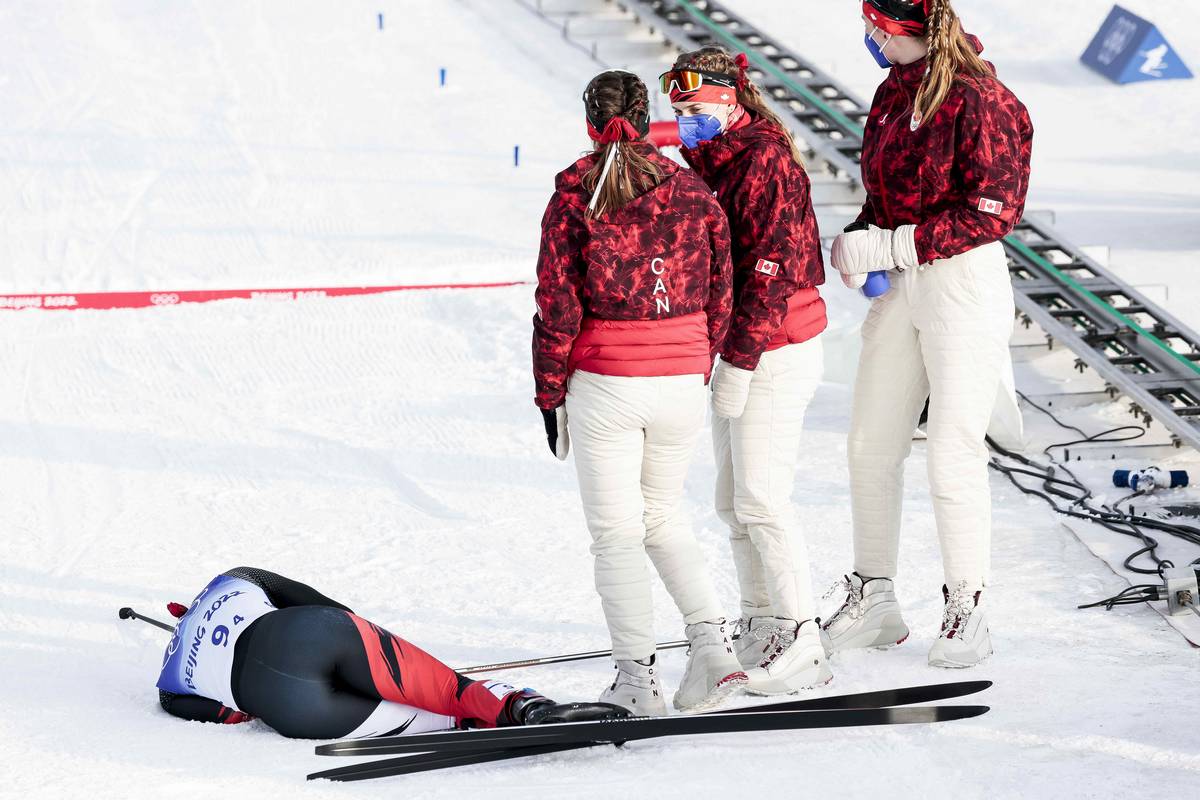
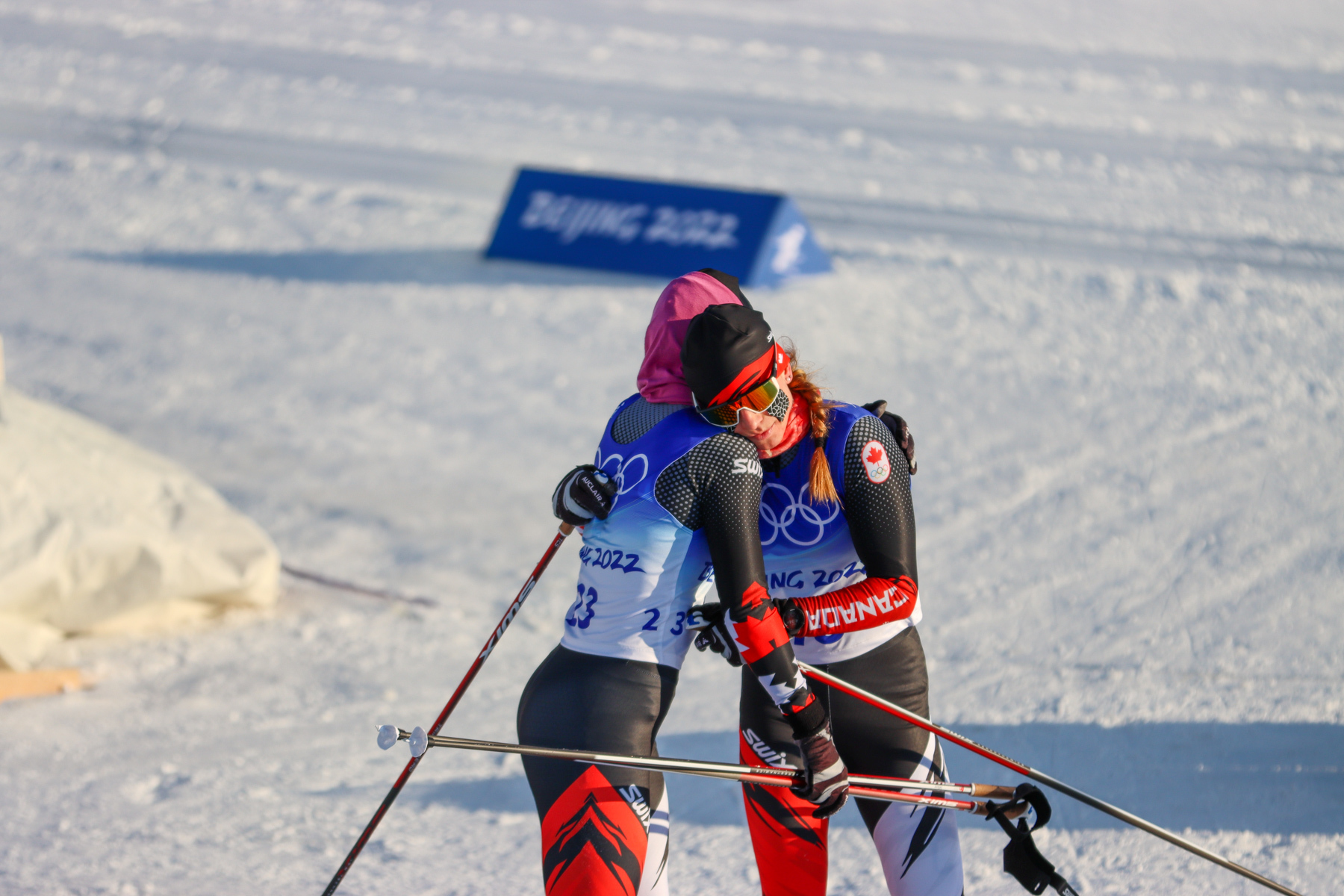
    Olivia Bouffard-Nesbitt (CAN) collapses as she’s greeted by her team at the finish of the 4 x 5 k relay. (Photo: NordicFocus)

    Canada’s women’s Olympic relay team of Beckie Scott, Milaine Theriault, Sara Renner and Amanda Fortier were eighth in 2002. The Canadian women also posted ninth at last year’s World Championships, which was also the best result at the premier event in a non-Olympic year in two decades.

    Athletes representing the Russian Olympic Committee won the women’s relay with a time oof 53:41.0. Germany was second at 53:59.2, while Sweden skied to the bronze medal with a time of 54:01.7.

    ***

    Complete Results: https://bit.ly/3GPLqU1

    For complete details on Team Canada at the 2022 Olympic Winter Games, please visit  https://olympic.ca/games/beijing-2022/

  • (Press Release) Dahria Beatty Beaming in 18th with Career Best Olympic Result

    (Press Release) Dahria Beatty Beaming in 18th with Career Best Olympic Result

    Canada’s Dahria Beatty was beaming after cracking the top-20 for the first time in her two trips to the Olympic Winter Games, finishing the women’s individual start 10-kilometre classic cross-country skiing event in 18th spot.

    Feeding off career-best Olympic performances in her first two starts, the 27-year-old put down a memorable performance, skiing twice around the demanding five-kilometre loop in a time of 30:00.2.

    “I definitely feel like I am in the best shape of my season now, so I knew there was potential for a strong race today,” said Beatty, who placed 28th in the skiathlon and 25th in the sprint races earlier this week.

    “I’ve been feeling good in the other two events and think that I’ve been building through each one. I had a strong result in this race at our Trials in Canmore and I feel like I’m in a lot better shape now. It was a happy surprise to be in the top-20.”

    The cagey veteran of the National Ski Team skied smart and aggressively while finding her groove while powering her way through the heavy winds and steadily working her way up the epic climbs at the Zhangjiakou National Cross-Country Ski Centre.

    “I was able to get into my own rhythm. I felt I was too conservative in the skiathlon (earlier in the week) on the climbs – especially in the classic part of the race. I had a better idea of how that would go today.

    “I really tried to push my limits on the climbs and trust that I’d be able to recover enough on the downhills to go into the next one.”

    Dahria Beatty (CAN) skiing to a personal best Olympic result of 18th in the 10 k classic. (Photo: NordicFocus)

    The Whitehorse resident was hanging tough with the sport’s elite, progressively gaining time on the field as the race went on.

    Norway’s Therese Johaug clocked the golden time at 28:06.3, edging out Finland’s Kerttu Niskanen by .4 seconds. Niskanen celebrated the silver medal at 28:06.7. Her teammate, Krista Parmakoski, finished 31.5 seconds off the leading mark to claim the bronze medal at 28:37.8.

    Beatty has only finished in the top-20 on the World Cup four times throughout her career. Three of those performances – two 15ths and a 16th place – have come in sprint races. Steadily making progress with her distance skiing, Beatty’s best World Cup distance race came last season when she was 15th in a 30-kilometre pursuit in Engadin, Switzerland.

    “If you go back to my teenage years, I was more of a distance skier, but I’ve had a lot more success sprinting internationally,” said Beatty. “It is definitely easier to break into sprinting if you are able to get that qualifying speed, but the last few years, I’ve been able to have good training seasons and that overall fitness has been caught back up with the tactical power I’ve had for sprinting.

    “I’ve never given up saying I’m an all-around skier so I’m happy that I am finally showing that again after all of these years.”

    Katharine Stewart-Jones (CAN) races the 10 k individual start classic during the 2022 Olympic Winter Games. (Photo: NordicFocus)

    Three other talented Canadian women also hit the start line on Thursday for the individual start race. Katherine Stewart-Jones (Chelsea, Que.) battled to 36th place with a time off 31:08.6. Cendrine Browne (Prévost, Que.) skied into 48th spot with a time of 31:47.9. Olivia Bouffard Nesbitt (Morin Heights, Que.) completed the 10-kilometre test in a time of 33:01.1 for 61st place.

    Additional Canadian Athlete Quotes

    Olivia Bouffard Nesbitt

    “I tried super hard, and I was able to make myself hurt. Some of those uphill’s were painful in the best way. That is how absolutely what you want in this race is to finish having hurt yourself a little bit. I’m pumped. I’m super grateful to be here and to have an Olympic bib on.”

    Cendrine Browne

    “Sadly, it was tougher today. I always have more difficulty with the 10 km classical event and the second part of the race today was a bit more difficult. I was on my own on the track for a while. I gave everything I had today even if it’s not the result I was looking for. It can only be better next time. I am looking forward to the relay event with the girls. I believe we are all in a good shape right now and the best is yet to come for us.”

    Katherine Stewart-Jones

    “Definitely pretty disappointed with my race. After the skiathlon I know that I’m in really good shape so I thought I could get a really good result today. I just fell short of that. I gave everything I had but it just wasn’t the feeling I wanted. I know I’m in shape and that’s nto the problem. I have other races to look forward to so I am excited for that.”

    Three Canadian men – Olivier Léveillé (Sherbrooke, Que.), Antoine Cyr (Gatineau, Que.) and Rémi Drolet (Rossland, B.C.) – will compete in Friday’s 15-kilometre individual start classic-ski race.

    *****

    Complete Results: https://bit.ly/3BdoBbG

    For complete details on Team Canada at the 2022 Olympic Winter Games, please visit  https://olympic.ca/games/beijing-2022/

  • (Press Release) Cendrine Browne Battles to 20th in Epic Olympic Skiathlon

    (Press Release) Cendrine Browne Battles to 20th in Epic Olympic Skiathlon

    Three Canadian women ski into elite group of 30 on grueling race day in Beijing

    By Chris Dornan on behalf of Nordiq Canada

    Katharine Stewart-Jones (bib 23) skis to 23rd in the women’s 15k skiathlon, which opened the 2022 Beijing Olympic Games. (Photo: NordicFocus)

    BEIJING, Chn — Cendrine Browne and her teammates set the tone for the Canada’s cross-country skiers at the 2022 Winter Games after putting down her best-ever Olympic performance, skiing to 20th place in the women’s 15-kilometre skiathlon race on Saturday in Beijing, China.

    Competing in her second Olympic Games, the 28-year-old from Prévost, Que. clocked a time of 47:58.1 after a gutsy effort that challenged the top women’s cross-country skiers who were faced with long punishing climbs and blustery winds on a frigid afternoon at the Zhangjiakou National Cross-Country skiing Centre.

    “That is a career-best result today! I’m really, really happy and proud of how I raced,” said Browne. “I worked very hard on my classic the last year and I think that really helped me today. It was definitely a tough race with tough conditions so I’m glad I was able to ski relaxed and be conservative with my energy. It was really fun being in the same pack as Katherine! I’m so proud of our team. This shows that we are in great shape!”

    Canada’s Browne, Katherine Stewart-Jones (Chelsea, Que.) and Dahria Beatty (Whitehorse) worked together in the chase pack for much of the race. Browne and Stewart-Jones exchanged positions as the top Canuck in each of the four laps. Skiing strong, the Canadian trio conserved their energy for a strong finish in the top-30.

    Dahria Beatty races the 15k skiathlon in Zhangjiakou, the opening event of the 2022 Beijing Winter Olympic Games. (Photo: NordicFocus)

    Skiing in and out of the top-20 on the wide-open course, Stewart-Jones (Chelsea, Que.) finished 23rd at 48:17.3 in her Olympic debut.

    “This is my first Olympic Games, so it was a really great experience. There was a lot of wind today, so it was important to stay in the tracks and conserve energy,” said Stewart-Jones. “It was a long 15 kms given how tough a course this is. I was happy with the way I felt out there despite it being so long since I had raced, and I didn’t really know what to expect. This will do a lot for my confidence for the rest of these Games.”

    Beatty also had a boost of confidence with her career best Olympic result, skiing steady in the middle of the pack en route to a 28th place finish at 48:52.0.

    “You had to be pretty strategic on the downhills today. With the wind, my goal was to be as small as possible on the downhills and then give everything I had on the climbs. I’m super happy with how it went for me. Being in the top-30 in a distance race is always something I’m happy with,” said Beatty.

    Olivia Bouffard Nesbitt (Morin Heights, Que.) scrapped her way to 44th in a time of 50:11.7.

    “It was super challenging conditions for everyone. It was windy, cold, the snow was slow, and this is a heck of a course,” said Bouffard Nesbitt. “It is one of the hardest courses if not the hardest. It was just epic today – my first Olympic race – getting blasted by the wind right off the start. You really could just feel the size of the event right away.”

    Battling for the first Nordic skiing medal of the Games, the field of 63 women set an electric pace from the start gun and held it throughout the challenging 15-kilometre test which combined 7.5 kilometres of classic cross-country skiing followed by 7.5 additional kilometres in the free technique. Athletes change equipment in a pit stop area between the two legs with the clock still running.

    Cendrine Browne (right) hugs teammate Katharine Stewart-Jones (left) after the pair finished 20th and 23rd, respectively, in the 15k Olympic skiathlon. (Photo: Nat Herz/FasterSkier-ADN)

    Norway’s Therese Johaug controlled the pack in both disciplines. A force from start-to-finish, Johaug led a group of approximately 15 athletes who strung out the field on the second hill in the first lap. Charging out onto the second half of the course after leading the pack into the exchange area, the Norwegian skied with a handful of athletes until surging with less than three kilometres to go en route to winning the gold medal with a time of 44:13.7.

    Natalia Nepryaeva, who is an athlete representing the Russian Olympic Committee, was the next best finisher 30.2 seconds off the golden pace. Nepryaeva claimed the silver with a time of 44:43.9, topping Austria’s Teresa Stadlober who grabbed the bronze medal at 44:44.2.

    The Canadian men will hit the Olympic start line for a 30-kilometre skiathlon race on Sunday.

    *****

    Complete Results: https://bit.ly/3B0mbxc

    For complete details on Team Canada at the 2022 Olympic Winter Games, please visit  https://olympic.ca/games/beijing-2022/

  • Canadian Journey to Beijing

    Canadian Journey to Beijing

    Katherine Stewart-Jones sprinting over the saddle at Sovereign Lake during the Beijing Prep Camp. (Photo: Peggy Hung)

    Canada was successful in delivering the team to Beijing and getting them on snow in Zhangjiakou. The decision to go above and beyond in isolating athletes before a carefully planned drive to a charter flight worked, although other countries also succeeded with a more laid-back approach.

    What can fans expect from the Canadian team in Beijing? It all comes down to qualifying and performing.

    Qualifying

    Canada had an Olympic quota of four women and three men, with a pretty high probability of gaining another woman and man in reallocation. The size of the quota depends on World Cup/World Championship performance and domestic FIS races; the top countries earned the maximum team size of 8 per gender. As Canada cancelled all races last season and only took a small team to Europe for a six week visit, the only path to a larger team would have been more athletes getting top 30 results in Europe last season.

    Three men (Tony Cyr, Olivier Léveillé, Graham Ritchie) and one woman (Katherine Stewart-Jones) met the world cup results standard for Olympic qualification during period 1. The Trials in Canmore (January 6th to 11th) would then select three women, and possibly one woman and one man who would have first dibs after reallocation.

    Dahria Beatty, an Olympic veteran from Pyeongchang, was one of the skiers who now had to qualify through a rigid qualification document at Canmore trials.

    “Yes, it was definitely different last time. I was qualified for the [2018] Games a season in advance, essentially,” Beatty explained at the Prep Camp at Sovereign Lake.

    At the Canmore sprint, Beatty qualified third and finished the heats in 4th, which meant Laura Leclair earned her first Olympic berth and Cendrine Browne her second.

    For Beatty, selection came down to Saturday’s 10km individual classic. If she won, or placed second to Stewart-Jones, she got the spot. The latter happened, with Beatty 0.5 seconds behind and 20 seconds clear of third.

    “Honestly, I don’t think I’ve had to qualify for a team specifically like that since U23 World Champs so it’s been a long time definitely.”

    Olivia Bouffard-Nesbitt was ranked 5th after trials, waiting on the reallocation process. Her journey has been longer than most, with injuries, training setbacks, car accidents, and bad luck. In 2014, she recovered from a back injury just in time to compete at Olympic trials. She won the qualifier on her first race day of the season. While lining up for the A-final heat with selection on the line, she was told that the jury had disqualified her for micro-skating during the quarter-final earlier. This year, the pieces came together.

    “​​It’s hard to find words. It’s something that I believed in, like my whole life, I believed that it was possible. But then throughout the setbacks, the doubt kind of built up. And, increased and I thought it wouldn’t happen, maybe and that I just had to grow up and face that reality. But there was still like, a little voice inside me that thought it was possible. And just to have– persisted, and trusted that with patience like things would line up for me. It means so much, it means so much for me but also for the people who helped me get here because it feels like I know that they would support me no matter what but it just feels like doing them justice as well. Like putting all the time into this project that is me trying to get to the Olympics was worth it.”

    Jasmine Drolet was next, with only the faint hope of moving up through a positive COVID test for an athlete above. Jasmine does have the consolation of earning a start at U20 World Championships.

    Russell Kennedy finished 27th in the Ruka 15km classic in November, enough to help Canada’s World Cup quota for next season. Kennedy would have needed to ski 15 seconds faster to take the 20th place from Federico Pellegrino and earn the 4th Olympic spot. The next day he moved up to 21st in the pursuit with the 24th fastest time of day, again just outside the criteria.

    The reallocation spot would be decided in the 15km individual start classic on January 8th. Whoever finished highest, after excluding the three already qualified men, would be on tenterhooks until the 17th and then be officially announced on the 19th.


    Rémi Drolet in a practice skiathlon at the Beijing Prep Camp at Sovereign Lake, Jan 23, 2022. (Photo: Peggy Hung)

    Cyr won, surprising no one, with Rémi Drolet edging out Kennedy by 10.8 seconds to take second. Every skier in the top ten had either a WC top 30 or a Canada Cup podium this season. Every one of those skiers could believe that their best effort would end in selection.

    Rémi is a second year senior who chose to take a gap year from Harvard to focus on getting faster on the World Cup and qualifying for Beijing. He didn’t get selected for Period 1, but did get some good results in early season Continental Cup races in Finland and Sweden.

    “For me, it was important to try really hard to make it this time around, because I think it’ll be an important stepping stone in my career,” he told FasterSkier during the prep camp. “To be able to, I guess, be a leader in the team, with so many strong guys coming up.”

    Rémi is getting good results for his age, but also looking over his shoulder at juniors like Tom Stephen and Xav McKeever, who are already collecting senior wins at Canada Cup races. These three teamed up with Léveillé to collect a relay silver at U20 Worlds two years ago.

    Kennedy is now 30. His ‘day job’ is with Canada’s Para National team, one of two guides for Brian McKeever. After PyeongChang, his goal was not just to qualify, but deliver at Beijing, and that dream ended with an invitation to train as a spare.

    “Well, I mean, for me, it’s been a rough two weeks. I spent three years working for this year. I was focused on the Olympics, and not really as much qualifying I guess.”

    Asked about sharing a bubble for two weeks with the four men who are living his dream, Kennedy didn’t shy away from truth.

    “And yeah, it’s been hard. But I’ve been trying to put on a good face around them. Because it’s sweet [for them]. They’ve done it, they’re going to the Olympics, it’s a huge goal and a huge achievement. But for me, it’s definitely hard. I’m really fast right now, which just makes it harder. But that’s part of sport.”

    Performing

    For some people, just reaching the Olympics is the pinnacle of their dreams. And it is a major achievement, even more so now with smaller quotas. In 2006, Canada had five women who earned Torino quota spots, in addition to the ten nations spots, allowing Canada to select 15 women. 

    What distinguishes the athletes who deliver results from those who participate?

    “Some people believe, and some people want to believe, but [it’s] the ones that really believe.” Dave Wood explained to FasterSkier in July of 2021.

    Going back to 2006, three Canadian women came home with medals: Chandra Crawford, Beckie Scott, and Sara Renner. Each of these women had individual World Cup podiums in the final two months of preparation and came into Torino with confidence. 

    The current team of nine Canadians has only two members with Olympic experience: Beatty and Browne. It will be much harder for this team to dream of podiums.

    Stewart-Jones, Cyr, Léveillé, and Ritchie can find confidence from their period 1 results. Drolet can find confidence in beating Léveillé and Kennedy at trials as both have World Cup top 30’s this season.

    The others? They will have to find confidence inside themselves.

    Expecting

    One of the common expectations of sports fans is that Olympians should produce their best performance of the season on the biggest stage. Athletes work their whole lives to get to an Olympics and it seems obvious that they should be peaking at precisely the right moment.

    “The results came from those that started their Olympics in May or April.” – Dave Wood, talking about Vancouver 2010.

    Wood was referring to athletes who qualified for the Olympics during the previous season, allowing them to build the entire training year around performing during a two week period. Athletes who have not qualified in advance have to focus their season plan on earning selection.

    Kennedy was one athlete who missed that balance.

    “Because sometimes I feel with sport, you have to choose if you want to go or if you want to do well. It’s the one thing that I’ve been struggling with. And also, it’s hard because like the people making the decisions don’t really have any repercussions for their choices. So the repercussions fall on athletes, and unfortunately, this year fell on me. Yeah. It sucks, but it’s part of it. I knew what I signed up for.”

    Once selected, each athlete can then reset their priorities. Four Canadians hit that point in December, three more on January 8th, and the last two on January 17th. With the first race on February 5th, which feels like the 4th after crossing the international date line, the one big thing athletes can do is not catch COVID-19.

    Back in 2010, Canada had four men performing on the world cup and when it came time to pick four men for the 50km on the final day, there were five names. Ivan Babikov, George Gray, and Alex Harvey had placed 5th, 8th, and 9th in the skiathlon and were obvious choices. The final place had to go to either Brian McKeever, who had qualified first at trials in Canmore, or Devon Kershaw, whose best individual result was a 16th. Unusually for Canada, there was outside pressure on this selection, as McKeever would have been the first person to compete at the Olympics and Paralympics in the same season.

    “The way the other four boys had been skiing, there was no decision, there was no discussion,” Wood explained. “Brian didn’t beat Kershaw and Alex and Ivan and George [at trials], he beat the others.”

    The coaches chose Kershaw, which paid off with a 5th place finish, 1.6 seconds from gold. In 2022, there will be no difficult decisions for the men, but there are five women and four starts per individual race.

    FasterSkier asked Beatty what races she was looking forward to.

    “Well, if I get a start in the team sprint, I love team sprints, I love team events. So I’m definitely hoping to be doing that race, I’m looking forward to that. I’m also really looking forward to the individual sprint and the 10k individual.”

    This may not be the Norwegian or Swedish level of choice, with eight skiers and four starts, but expect Canada to hold some time trials during the Olympics to inform the coaches’ choice.

    Beatty and Browne were in PyeongChang, and will have experience to share with the neophytes.

    “​​The races themselves, even though they will be the most stressful part, are also going to be the most fun because that’s what we dream of,” Bouffard-Nesbitt speculated three days before getting on the plane.

    “I’ve never been to an Olympic Games, and especially a COVID games. So I don’t know what the rest of the time will be like.”

    The Canadian women having (distanced) fun. Click the image to see the Instagram reel.

    Early evidence is athletes will be killing time in their rooms and finding virtual fun with your teammates.

    Dreaming

    FasterSkier asked a number of the athletes a simple question: when you first dreamed of the Olympics, what sport were you dreaming of?

    “I have to say, probably hockey with that one. For sure. I didn’t know I was gonna end up as a cross country skier.” — Ritchie

    “Cross country skiing. Yeah, it’s always been that.” — Stewart-Jones

    “I definitely think it was probably cross country skiing. That’s always been the sport I’ve been strongest at, even as a kid. I did a bunch of different sports. I always loved watching figure skating at the Olympics, but I knew that I was never going to pursue that long term, definitely was not flexible enough.” — Beatty

    “I don’t know. I guess when I first really thought about the Olympics was back when I was playing hockey. But at that time, it wasn’t really, it was kind of just like, whoa, it’d be cool to go to the Olympics. But I didn’t really think of what sport I might make it in. It’s only really four years ago, I started thinking, this is what I need to work towards, to make the Olympics in Beijing.” – Rémi Drolet

    “That is such a good question. Because around the time when I became really inspired by the Olympics was the 2000 Olympics in Sydney, and I think Simon Whitfield winning the triathlon was the really big moment at that Olympics. And at the time, in my youth, I was just obsessed with soccer, but also skiing, so I dreamt of either/or soccer or skiing.” — Bouffard-Nesbitt

    “Oh, man, I didn’t really have a sport I was dreaming of, exactly. But I thought maybe skiing because I was on skis at two years old. More downhill racing.” – Kennedy

    “I was the dreaming to go to the Olympics as a cross country skier. It didn’t happen as a cross country skier but as a technician.” — Simon Boisvert

    “Ah, to be honest, I’ve always been into cross country skiing with my dad and my sister, my older sister ahead of me, but always been into cross country skiing, and I thought that maybe mountain biking, but a few years ago, I knew I was not. I wasn’t going as an athlete, but I’m pretty pumped to go for my first time as a wax technician.” — Félix-Antoine Vezina

  • An Inside Look at the Canadian Olympic Prep Camp

    An Inside Look at the Canadian Olympic Prep Camp

    Katherine Stewart-Jones ready to start a skiathlon at the Olympic Prep Camp.

    The Canadian Prep Camp in Sovereign Lake and SilverStar, BC prior to the 2022 Beijing Olympics sounds like a nordic skier’s heaven.

    A two-week ski vacation with 100 kilometres of perfectly groomed snow. A private room above a great coffee shop (pain au chocolate!) and next door to some great beer. January weather just below freezing with enough falling snow to make every day a hardwax day. Two weeks of what locals call superhero snow. A whole lot of sunshine.

    The reality was a little different: COVID stress, travel uncertainty, and outside pressure combined to make this very much a work trip, not a vacation.

    The camp, which ran from January 12th to 25th, included nine athletes, the high-performance manager plus two coaches, two wax techs, a massage therapist, and a cook.

    The athletes included the majority of the 2022 Olympic Team: Katherine Stewart-Jones, Laura Leclair, Dahria Beatty, Tony Cyr, Olivier Léveillé, and Graham Ritchie. Alternates Olivia Bouffard-Nesbitt and Rémi Drolet would officially join the team after the quota reallocation during the second week. Second alternate Russell Kennedy will not add to his Olympic CV and will instead go to his third Paralympics as a guide, supporting the well-decorated visually impaired athlete, Brian McKeever. The only Olympic team member not in attendance was Cendrine Browne, who chose to train in Canmore, while second alternate Jasmine Drolet returned to school at Dartmouth and earned her first collegiate wins.

    World Cup coach Erik Bråten, Next Gen coach Eric de Nys, Team Lead and high performance manager Joel Jaques, techs Simon Boisvert and Félix-Antoine Vezina, massage therapist Stephen Waterreus, and Zoe the cook made up the support crew. Everyone except de Nys and Zoe are going to Beijing.

    When this writer asked for last names, the response was always, “Zoe? You know Zoe.” In the end, it was revealed that Zoe is Zoë Roy, who retired from racing in 2014 as a founding member of Team Ninja. Yup, we all know Zoë.

    All interviews were done on snow, from a distance, with FasterSkier wearing an N95 mask.

    On Snow Training

    The on-snow part of the camp was reported to have gone very well. The coaches were able to find times and trails that allowed training races that closely matched the Olympic course for profile and elevation while keeping distance from the local skiers. 

    The Zhangjiakou 5km course elevation range is 1639m to 1696m. The Sovereign Lake upper World Cup 5km is 1651m to 1708m, with the stadium at 1660m.

    The Friday sprint course worked fairly well, despite a layout that would give any technical delegate apoplexy. As Bråten explains above, the coaches chose to do four qualifiers instead of heats to manage risk.

    The Sunday skiathlon course ended up being 13km for the women and 17km for the men, with some flat sections removed from the 5km loop to better mimic the Olympic courses.

    Bråten was often seen working with athletes one-on-one.

    As the days counted down to departure, skiers were working on filling their bags with seconds gained: a tweak in one skate (V2) poling, free skating further on a fast flat section, experimenting with pacing on courses that simulate Zhangjiakou.

    The mood of the camp seemed slightly tense, at least to a journalist who was careful not to pierce the bubble. The change on Tuesday morning, 12 hours after everyone passed the final COVID test, was dramatic, with smiles everywhere.

    “It’s been fantastic conditions and just a really nice camp all around, it’s always nice when you get some sunshine,” Kennedy told FasterSkier. “So yeah, especially after a [World Cup] Period One in Finland in the dark.”

    First time Olympian Rémi Drolet is all smiles after passing the final pre-travel testing.

    COVID Management

    COVID protocols at the camp were strict, races were more relaxed.

    A positive test would be the end of one person’s Olympic dreams and a logistical nightmare for the support team. Any close contact of the infected person would not be able to travel. Any replacement person, athlete or not, would need to follow the same testing protocol. If that replacement wasn’t ready for the scheduled flight, the complexity of travel planning might be insurmountable.

    In order to travel to the Olympics, the athletes, coaches, and techs would all have to pass two PCR tests less than 24 hours apart in the final 96 hours before boarding. Once at the Calgary airport, there would be another PCR test, with a fourth upon arrival in China.

    Nordiq Canada chose a more restrictive plan than some other countries. Each person (athlete, coach, tech, cook, massage therapist) had their own room and didn’t enter other rooms. Meals were delivered. Grocery shopping was done by local resident, de Nys, scheduled for 7am to avoid crowds. No one entered coffee shops, bars, or restaurants. Each morning, everyone would do a rapid antigen test in their room. Athletes skied from their accommodation at SilverStar to the homologated trails at Sovereign Lake to avoid close contacts in vehicles. Only de Nys and Zoë the cook had contacts outside the bubble, and neither is going to Beijing.

    The goal behind this aggressive protocol was twofold. First, to prevent exposures. Second, if one person tested positive, there would be no close contacts forced into isolation or removed from the Olympics. The two wax techs (Simon Boisvert and Félix-Antoine Vezina) inevitably had a shared bubble as they shared a private waxing room.

    Was this the right answer? We got three answers to that.

    Drolet found the camp harder than usual: “We were still able to ski together a little bit, but it was definitely a little bit lonely at times.”

    Kennedy, entering with a mentally tough prospect of only making the team if disaster struck a friend, found the positive. “The guys have been playing, like hanging out online together… And we’ve been skiing together. So it’s separate, but at the same time, not too lonely.”

    “Ask me on Monday afternoon when we get all the results back,” Jaques told FasterSkier on Sunday morning. “We’ve taken the right precautions so we’ll just see. But I think it’s looking good.”

    A number of athletes mentioned feeling comfort in knowing they were doing everything possible to protect their Olympic dreams. 

    The system has worked. Everyone tested negative and the entire team is now on snow in Zhangjiakou.

  • (Press Release) Rémi Drolet and Olivia Bouffard added to Beijing 2022 cross-country skiing team

    (Press Release) Rémi Drolet and Olivia Bouffard added to Beijing 2022 cross-country skiing team

    CANMORE (January 21, 2022) – Team Canada will now have five women and four men on the cross-country skiing start line as Olivia Bouffard Nesbitt and Rémi Drolet are heading to Beijing for the 2022 Olympic Winter Games.

    Bouffard Nesbitt (Morin Heights, Que.) and Drolet (Rossland, B.C.) were the final two athletes nominated by Nordiq Canada to the Canadian Olympic Committee after an additional two quota spots were handed down to Canada by International Ski Federation (FIS) following a reallocation process.

    “This is a tremendous opportunity for Remi and Olivia to test themselves on the ultimate stage while having the opportunity to realize their Olympic dream,” said Stéphane Barrette, Chief Executive Officer, Nordiq Canada. “Gaining two additional quota spots allows Nordiq Canada to deepen our high-performance program by having more athletes on the start line competing against the world’ best.”

    Olivia Bouffard-Nesbitt striding into a skiathlon time trail at Sovereign Lake on January 23rd, 2022. (Photo: Peggy Hung)

    The 29-year-old Bouffard Nesbitt, who is a former National Ski Team member, was named first alternate for Canada’s cross-country ski team after placing second in the skate-sprint qualifier before going onto finish third in the head-to-head heats at Nordiq Canada’s Olympic Trials earlier this month.

    “Getting this confirmation was a huge moment for me and, quite honestly, overwhelming validation of years of hard work,” said Bouffard Nesbitt. “This journey has required patience and persistence through a lot of ups and downs, but the belief this was possible never wavered. I am so grateful to all of those who have invested in me. It was the most amazing feeling to call all of those people and tell them we made it happen. I’m so grateful. I’m so happy and I’m going to race my heart out with the team in Beijing for all of Canada.”

    Drolet, one of the top young prospects in the Canadian men’s program, earned his alternate spot following a second-place finish in the 15-kilometre classic cross-country ski race at the Trials. The 21-year-old Drolet skied the anchor leg of Canada’s historic silver medal-winning relay team at the 2020 Junior World Ski Championships.

    Rémi Drolet races the 50km freestyle during the 2021 World Championships in Oberstdorf, Germany. (Photo: NordicFocus)

    “When I found out I would be getting an Olympic spot I was overjoyed, and it was incredibly relieving,” said Drolet. “Making it to Beijing has been a dream goal of mine for the past four years so it feels amazing to have achieved it. Having this opportunity at this point in my career is encouraging for me to see what I am capable of and I want to use this a steppingstone to reach a strong international level in the next few years.”

    FIS distributes quota spots to each country based on international rankings. If the top nations do not use all of their qualified spots at the deadline, those spots are then reallocated to the next highest-ranking nation.

    Bouffard Nesbitt and Drolet round out the Olympic cross-country ski team which was announced on January 13.

    The athletes nominated are:

    Dahria Beatty (Whitehorse, Yukon)
    Olivia Bouffard Nesbitt (Morin Heights, Que.)
    Cendrine Browne (Saint-Jérôme, Que.)
    Antoine Cyr (Gatineau, Que.)
    Remi Drolet (Rossland, B.C.)
    Laura Leclair (Chelsea, Que.)
    Olivier Léveillé (Sherbrooke, Que.)
    Graham Ritchie (Parry Sound, Ont.)
    Katherine Stewart-Jones (Chelsea, Que.)

    Cross-country skiing events will take place February 5 to February 20 (Day 2 to 16) at the Zhangjiakou Cross Country Centre.

    Prior to being named to Team Canada, all nominations are subject to approval by the Canadian Olympic Committee’s Team Selection Committee following its receipt of nominations by all National Sport Organizations.

    The latest Team Canada Beijing 2022 roster can be found here and the qualification tracker can be found here.

    MEDIA CONTACTS:


    Chris Dornan, Communications Advisor for Nordiq Canada

    C: 403-620-8731

    E: hpprchris@shaw.ca

    Tara MacBournie, Team Canada’s Cross Country Skiing Media Attaché

    C: 647-522-8328

    E: tmacbournie@olympic.ca

    Josh Su, Team Canada’s Press Operations Lead
    C: 647-464-4060
    E: jsu@olympic.ca

  • Western Canada Cup #3 and #4: Déjà Vu

    Western Canada Cup #3 and #4: Déjà Vu

    Rémi Drolet leads out the first mass start of the season. (Photo: Peggy Hung)

    Race, rinse, repeat. The Western Canada Cup series returned to Sovereign Lake for race days 3 and 4 of the new season.

    Originally scheduled for Rossland, BC, the event had to be moved after an ‘atmospheric river’ event delivered warm rain to almost all southern BC trail systems on December 1st. Sovereign Lake was the least damaged, able to hold WCC #1 and #2 on the 4th and 5th as scheduled. By December 11th, skiing conditions were much improved and the racers were primed to go again. 

    The organizing committee was a little less primed, with four chiefs unavailable, along with many of the 180 volunteers from the previous weekend. With some timely help from Nordiq Canada, it all came together. Next Gen coach Eric de Nys (a Vernon resident) could be seen moving V-boards with High Performance Manager Joel Jaques (from three ski areas to the south in Penticton) while Al Maddox shortened his vacation to fill in as Technical Delegate.

    Despite hosting major events on the two previous weekends, the club was able to find enough volunteers to make it work.

    While there was still plenty of rust on display, more athletes were getting more things right than last weekend.

    Saturday: 5km/10km Classic Interval Start

    The weather gods delivered one of everything for Saturday’s classic, with fresh snow, strong winds, a brief blizzard during wax testing, before settling for overcast race conditions with firm tracks that occasionally filled with dry blowing snow at -4C.

    On the flat 2.5km course, there were enough skiers lapping to keep the tracks packed. This is the first time this course has been used for the open categories and it has a distinctly different feel to the traditional 5km loop. Eliminating much of the climbing, the new course turns downhill halfway up the first A-climb at the 5km mark, before skipping the second A-climb entirely. 

    Dartmouth’s Jasmine Drolet took the win in 17:22.0, matching her result from last Sunday with an overall win, in addition to topping the U20 list. AWCA’s Olivia Bouffard-Nesbitt was 3.0 back in second ahead of teammates Laurence Dumais in third (+47.1) and Beth Granstrom in fourth (+1:00.8).

    “Definitely not my favourite race,” Jasmine Drolet told FasterSkier, despite preferring classic technique. “I tend to prefer the longer races but still good and a good effort out there.”

    “I was happy with it,” Bouffard-Nesbitt explained after the race. “It was unusual for us to start so late at one [pm]. It was sunny this morning, beautiful, mild. We showed up to the racecourse this afternoon and it was blizzarding, so windy. And then it cleared up for our race. So it was fun to do 5km.”

    “It’s definitely quite a bit different than the five km [course]: it’s less climbing and more flat,” Dumais told FasterSkier. “Which is in my favour, because I’m better at double polling, so it was good.”

    In the men’s 10km, Black Jack’s Rémi Drolet matched his sister’s achievement, finishing in 30:37.2, edging out Foothills junior teammates Tom Stephen by 4.7 seconds and Xavier McKeever by 7.0. AWCA’s Jack Carlyle (39.2 back) and Hardwood’s Scott Hill (54.3 behind) completed the senior podium.

    “It was a pretty good day,” Stephen explained. “Not a course that favours me, but I still pushed hard and I’m happy with the results.”

    Asked about ski and wax choices, Stephen said “the coaches were really accommodating today because they tested my skis before we got here, because we had such a late start. So that was nice, a lot less stress than having to get here and test all the skis with the new tracks and stuff like that.”

    McKeever enjoyed the ‘new’ course.

    “I felt really strong with the double pole, there was a lot of double poling on this course. That really played into my favour.”

    McKeever also broke down how the course skied during the race.

    “Overall, there’s some good climbs. there’s two good climbs in there for sure. But once again, it’s it’s a lot of double pole. So I’d say in that sense, it’s like fairly flat overall. There’s like gradual sections, but yeah, you definitely can’t get caught off guard.”

    There were 112 finishers. The smaller field was a result of only two age groups (open and U20) and road closures affecting some teams.

    Sunday: 10km/15km Mass Start Free

    Sunday was a great day of skiing, with snow clouds blowing away in the morning for a sunny afternoon of mass start racing on the traditional Upper World Cup 5km course that older racers know so well.

    Rémi Drolet leads Xav McKeever and Tom Stephen at the end of lap 2. (Photo: Peggy Hung)

    The men raced first, with a very tactical first lap before the action began on the second of three laps. 

    On the third lap, McKeever attacked on the ‘wall’ climb to get a gap he would not relinquish in the final 1.x km. With only one small climb left, racers need either a gap at the top of the wall or confidence in their final sprint.

    McKeever took his first open win in 37:22.3, 1.2 seconds clear of fellow U20 Tom Stephen. Carlyle passed a fading Rémi Drolet to take third, 21.0 seconds behind, while Bob Thompson narrowly missed out on fourth, finishing 40.0 back.

    “I was really happy with my race and how I skied both tactically and technically, so overall, [it was a] good day,” McKeever said after collecting his first senior win at age 18.

    He continued that he “couldn’t really have asked for anything better from a start [to the season], but we’ve just got to keep putting in the work, keep training hard.”

    Stephen, in his last year as a U20, was more philosophical.

    “I’m definitely feeling a little tired,” Stephen said. “There’s a lot of racing back to back for me. But yeah, I think it went well. I’m happy with the result.”

    On his approach to racing, Stephen explained how the weather factored into his race plan.

    “I think I was pretty smart in the tactics part. There were a lot of people throwing down sprints halfway through trying to break away and then easing up because the wind plays a big factor into it.”

    Carlyle also enjoyed the day: “It was good, super fun to ski in the pack and do a mass start race and it felt like Real Racing was back.”

    “I didn’t really think too much about how to win I just kind of wanted to like make their day as hard as I possibly could,” Carlyle continued. “The way it played out was going into the second last climb, I guess it would have been the like the super steep hill [the wall], Xav just had so much speed. So much speed. So Tom and I are kind of standing still and that’s pretty impressive.”

    Jasmine Drolet stretches out the group at the start of the 10km. (Photo: Peggy Hung)

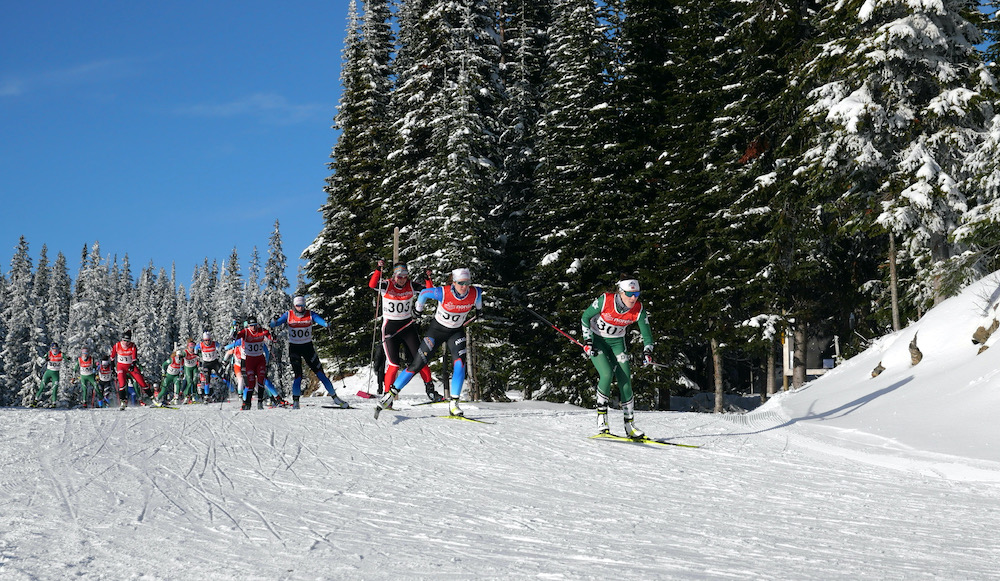
    Shortly after the top men finished, the women began their first mass start of the season with two laps of the same course. Jasmine Drolet strung the group out quickly, opening passing opportunities for lower ranked skiers like Bouffard-Nesbitt who would quickly join the action at the front. After the pandemic break, the points list is a much less useful guide to current performance, but today there was no difficulty to pass on the wide opening climb with room to skate four abreast for over a kilometre.

    Bouffard-Nesbitt finished alone in 29:04.4.

    “It was really good. I love mass starts and I’m so happy that sovereign decided to host a mass start race today,” she said. “The conditions were the best they’ve been in the last two weeks. It was a great day.”

    Jasmine Drolet took second, 12.4 seconds back, followed by fellow U20 Marielle Ackermann from Kimberly in third (+21.0), and Granstrom in fourth (+26.5).

    Jasmine Drolet leads a large pack near the end of lap 1. (Photo: Peggy Hung)

    “It was pretty chill for the first lap,” Bouffard-Nesbitt said. “I didn’t feel that I needed to lead especially, [since] I’m pretty confident in my sprint. So I was happy just to follow and then, yeah, on the second lap, I started to have fun playing around, going to the front a little bit and pushing the downhills and unfortunately, as Jasmine might tell you if you interview her, she had a fall before the last two climbs. That was too bad and that’s where my gap opened up. I just pushed it from there.”

    Jasmine Drolet did include her fall in her post race comments, reflecting on an experience that was “Pretty hard. That’s all, really hard.”

    “A little bit frustrating,” Drolet continued. “I mean, I lead a lot of the race, which is not really what I wanted, but then fell and couldn’t catch up again. So a little bit frustrating, but that’s how mass starts are.”

    She fell on the one tricky corner on the course, a fast hairpin that becomes challenging as the lactate builds in the legs.

    The pandemic has made student life easier, with distanced exams that can be done anywhere. Easier, but not easy, with a large number of athletes needing a quiet space to write exams Sunday evening after the racing was done. Ackermann was one of those student athletes who rushed away before FasterSkier could catch up with her.

    In addition to all the racing, there were bets to be settled.

    Rémi Drolet explains his new purple hair to Next Gen coach Eric de Nys.

    This writer entered a casual masters program mass start classic race on Saturday morning, using the same course as the elite skiers used in the afternoon. The finish times were very different, but I am still smiling days later. To twist up Joni Mitchell, “you don’t know what you’ve got til it’s back!”

    Photo Galleries:

    Doug Stephen (VR45 Photography): Interval, Mass Start.

  • Western Canada Cup #1: Back to the Bibs

    Western Canada Cup #1: Back to the Bibs

    Olivia Bouffard-Nesbitt starts the first FIS race in Canada in 20 months.

    Racing returned to Canada after a lost season, and there are plenty of storylines to follow.

    This weekend, The Sovereign Lake Nordic Centre in Vernon, BC hosted a freestyle sprint and a classic 10/15-kilometer individual start. It sounds so familiar, a re-run of the annual NorAm kickoff with a new Western Canada Cup name.

    Travel to the venue became more challenging when a November 13th ‘atmospheric river’ destroyed the two main highways between Vancouver and Vernon. The two alternate routes reopened fairly quickly, but only for commercial traffic. This created an unusual situation where athletes from Vancouver had to fly while athletes from Manitoba (two time zones east) were able to drive.

    Official training on Friday was lightning fast.

    Another atmospheric river on December 1st brought record heat to the region, with a high of 16C in Vernon, well above the old 7C record. A timely cold snap saved the snow base, albeit with extremely fast glide for Thursday and Friday training. The sprint course was changed from the 2005 World Cup loop to a safer and slower variation.

    Despite border restrictions, a number of U.S. teams attended. Dartmouth made their annual trip from Vermont, joined this time by Green Mountain Valley School and Stratton Mountain School (not the post-graduate SMS T2 team; they went to Duluth). Methow Valley Nordic Ski Education Foundation sent a much smaller team than usual, but Sugar Bowl Academy in California helped to make up the numbers (and took a few medals home too).

    Further reaching by geography, Brazil and Portugal each had one woman racing, who were discussing plans to earn quota spots for the 2026 Olympics. Throw in the second ever Mexican National Championships and you have the makings of a great weekend.

    Saturday Freestyle Sprint

    Two themes dominated the sprint day: smiles and rust. With only a few athletes having raced the previous season (World U20/U23 and World Cup athletes), the excitement of racing again was visible everywhere. 

    The rust was also on display. Athletes regretted their layering choices. Enthusiasm led to extremely aggressive starts and ragged finishes. Many athletes forgot to allow time to collect timing chips on the way to the start. More forgot that it takes extra time to show the ‘fully vaccinated’ wristband to be eligible to start. Quite a few discovered that the wristband should not be on your watch arm, because the wristband is covered by a sleeve locked in place by the watch strap resulting in a longer delay. A wristband that is applied so that it can’t be transferred to another person also can’t be moved to the other wrist for day two. Lessons learned, or re-learned, for many skiers.

    National Team Development Centre Thunder Bay (NDC TBay) athlete Julian Smith summed up the first day back for FasterSkier.

    “Yeah, first day racing in Canada in a long time,” he said. “My last race was the American Birkebeiner in February 2020. So that’s pretty fun to put the bib on, really push the body and race with all our friends out here. The organizers here at the Nordic Center did a great job. And everyone was doing their job well and it ran really smoothly.”

    Behind the scenes, there were also a few learning and re-learning moments for the 180 volunteers running the event.

    Nonetheless, race morning dawned with a steady snowfall at -4C that provided great skiing and slower racing.

    Olivia Bouffard-Nesbitt was the top seed and became the first person to race for points in Canada in twenty months.

    Pre-race speculation had a changing of the guard, with the young athletes expected to displace the known entities, and most athletes feeling confident in their preparation with very little evidence to back it up.

    Bouffard-Nesbitt, who trains with Alberta World Cup Academy (AWCA), justified her #1 bib by winning the 1.3km qualifier in 2:59.69, 2.31 seconds ahead of Kimberly’s U20 Marielle Ackermann. Shaylynn Lowen (NDC TBay) skied to third (+6.54).

    In the heats, Ackermann comfortably won each U20 round to take the win while Bouffard-Nesbitt showed her experience to dominate the senior heats.

    Bouffard-Nesbitt, like most of the skiers, was visibly thrilled to be back on course.

    “Oh, it was really good,” she said, before laughing. “It was rusty! It kind of felt like the first race back in two years. But every heat got progressively better. Quarter was better than the [qualification] and then better after that, so yeah, it was great.”

    Sovereign’s own Hannah Mehain got stronger through the heats to take second place, ahead of Dartmouth’s Callie Young.

    “I felt maybe not quite as snappy in the qualifiers,” Mehain told FasterSkier. “But it improved for the day and I just felt better and better .”

    As the American east and Eastern Intercollegiate Skiing Association (EISA) faced COVID restrictions that limited race opportunities, Young was in a similar boat to the Canadian women in terms of lack of high-level racing opportunities. She also shared her feelings on the sprint day.

    “I didn’t have my best qualifier, this is my second day at altitude,” Young said. “So it was kind of tough. But when I get into the heats, it’s always so fun and competitive.”


    On the same course NDC TBay’s Smith was clearly the strongest of the men, winning the qualifier and all three heats. Xavier McKeever and Tom Stephen, qualifying 2nd and 6th, both chose to race up in senior, resulting in some hard fought heats. McKeever and Stephen are both members of the national team and train with Foothills Nordic Ski Club in Calgary.

    “It was really fun,” said Smith after his race. “It was a blast for the body to do what it’s supposed to do, what I’ve been training it to do, so that was really fun.”

    Smith was one of the few who answered the tactics question with something other than how much fun it was to be racing again.

    “In the final, it kind of slowed down at about the first third. And I just tried to go when everyone else started to go and got a bit of a gap and in the end, was able to hold the lead. So that was really fun.”

    In the end, the juniors found themselves enrolled in the Locke School of Heat Tactics, with Black Jack’s Julien Locke using guile to take second in the final after qualifying 7th.

    AWCA’s Bob Thompson gapped NDC TBay’s Pierre Grall-Johnson on the climb to complete the podium.  

    World U20 relay silver medallist teammates McKeever, Rémi Drolet, and Stephen were 5th, 6th, and 7th, while Olivier Léveillé was away in Lillehammer. Though age and experience filled the podium, Grall-Johnson-Johnson was the first U23 athlete showing that the younger skiers are putting the pressure on.

    Sprint Results: Qualification, Heats, Final, U18/U16 Mass Start.


    10km/15km Classic Individual Start

    The race of truth was also the race of discovery as many athletes re-discovered why pre-race routines exist. Sunday dawned clear and cold, rising to -11C for the men’s start at 9am. With yesterday’s new snow packed hard, there was no difficulty in finding grip with hard wax, but not everyone found the glide necessary on a 5km loop that is flat and fast by World Cup standards.

    Rémi Drolet, just returned from racing Continental Cups in Muonio and Gällivare, skied a consistent race to take the win in 39:06.1, setting the fastest time in all three laps.

    Stephen was second, 39.6 behind, moving up on the final lap.

    “It was really good,” Stephen said. “It’s my first 15k back this season because I’ve been coming back from injury. And it went really well, it went just like I planned it, so really happy with it.”

    Interval starts are more exciting than they used to be.

    “Oh, it’s so fun,” Smith added. “I haven’t done something like this with this many people in a long time.”

    AWCA’s Jack Carlyle skied a very strong first 5km lap before struggling with the cold after a mistake choosing baselayers, finishing third at 49.2 back.

    “I made a rookie mistake and did not wear enough layers and froze halfway through the race,” Carlyle explained once he was warm again. “But I had great skis. And for the first bit of the race, I had great feelings. So yeah. Happier where the body is just need to remember not to make silly mistakes.”

    McKeever recovered from a slower first lap, moving up from 7th to finish 4th at 1:06.8 behind.

    “I was really lucky to start my season off in Europe, with a couple of victories in Finland and Sweden. And I was really happy with how they went, especially after last year being a really tough year for myself,” he said. “So overall, I’m pretty stoked to just be back at it.”

    “The sprint yesterday, I think went really well. Today, I was just missing a bit of gas. I feel I didn’t feel awesome, awesome, but it’s just nice to get out there and race again in Canada. And we have more next weekend.”


    Jasmine Drolet stepped up the sibling rivalry with a win in the 10km in 30:38.9. Now in her first year at Dartmouth, she made up for missing the sprint with a steady performance.

    “Definitely a shock to the system,” she told FasterSkier. “But I’m glad to have gotten it over with and to be in racing season now.”

    Back in Canada after her first semester in the Ivy League, she was adjusting to the changes.

    “I was nervous before [the race]. Changing training, and changing coaches and everything, but now, I feel confident that my training this fall was good. The US is maybe a little bit different than Canada, but not very different. It’s a lot of work to juggle school and skiing full time, but it’s manageable.”

    Bouffard-Nesbitt finished in second place, 41.4 back, with a fast first split.

    Another full-time student, Mehain was third at 1:09.7, just holding off a fast finishing Beth Granstrom.

    “I had a great day,” Mehain said. “It’s really fun to be out racing again, seeing everybody. I pushed fairly hard on that course for the classic 10k and had a lot of fun.”

    Distance Results: Interval Start, Full Weekend.

    Mexican National Championships

    Karla Schleske Shepard is the first female National Champion for Mexico. (Photo: Peggy Hung)

    This is the second National Championship for Mexico, with the first held in Canmore at Canadian nationals in 2019. Starting a ski program in a country without snow or a skiing tradition is hard, even without a pandemic disrupting progress. This year, there were six men and one woman competing.

    Jonathan Soto Moreno won both days, capping a year where he also earned a Beijing quota spot for Mexico at World Championships.

    Karla Schleske Shepard, a former heptathlete who represented Mexico at the PanAm games, became the first ever female champion after learning to ski in February 2021.

    What’s Next?

    December 11th and 12th has both the Eastern Canada Cup #1 at Nakkertok and the Western Canada Cup #2.

    The major storm that threatened the first weekend at Sovereign did even more damage in Rossland, forcing Black Jack’s Organizing Committee to cancel. WCC #2 will now be held at the backup venue, Sovereign Lake, with details forthcoming.

    With continued highway closures in BC and additional border restrictions related to the omicron variant, many travel plans will change. Both ECC #1 and WCC #2 may have smaller fields as US teams react to the increased friction at the border.

    NDC TBay, based in arguably the east/west centre of the country, is headed for the eastern Canada Cups. This will allow some comparison between the two series and give ski fans something to debate during the Christmas break.

    All will be made clear in Canmore on January 6th to 11th, when trials for OWG, U20/U23 World championships, and World Cup Period 4 will bring together the top athletes from the entire country.

    Photo Galleries: Doug Stephen (VR45 Photography): Sprints, Distance


  • Sovereign Lake Hosts 1st Annual Enduro Ski Race (with Video)

    Sovereign Lake Hosts 1st Annual Enduro Ski Race (with Video)

    VERNON, British Columbia — Each year, the Sovereign Lake Nordic Centre reopens its trails in May to let skiers start the new training season on snow at its annual Spring Fling Ski Camp.  In addition to the local skiers, groups came from Whitehorse, Canmore, Saskatchewan, and Methow Valley to absorb some Vitamin D and snow. The longest travel award goes to Mark who travelled from Atlanta, Georgia, for a long weekend on snow.

    Day three of Spring Fling, May 12th, 2018. (Photo: Gerry Furseth)
    Crusty morning on Day 3 of Sovereign Lake’s 2018 Spring Fling Ski Camp on May 12.

    The trails were open from 6:30 a.m. to 2 p.m. each day to take advantage of the cooler mornings, with a crusty start and a soft layer over a firm base later on. Air temperatures rose from 1 degree Celsius to 10-15 degrees by noon (34 degrees Fahrenheit to 50-60 F). Most athletes skated early, switched to classic as the snow softened, and then headed down to the valley for biking, running, and paddle boarding in the afternoon.

    While there was enough snow to open the whole system, the club only set about 20 kilometers each day as there were only a few hundred skiers expected.

    Last year’s innovation was the pushup time trial, which was so much fun it was repeated with double the participation on Saturday, May 12.

    This year, the club added an ‘enduro’ race on Sunday, May 13 to spice things up.

    Enduro is a popular mountain-bike race format, with a defined course that everyone must complete, but only the downhill stages are timed. The winner is the person whose total time for the timed stages is the lowest.

    buy nasonex online

    The response from the 53 participants was generally positive, with most wanting to repeat the event next year.  Many suggested the long flat runout at the end of Stage 2 didn’t feel flat with soft, sticky snow in the sunshine on race day. A few said they were going to copy the event at their home ski area next season.

    The official course map. The green sections are timed stages, the red is the route to the next stage.
    The official course map. The green sections are timed stages, the red is the route to the next stage.

    How to Host an Enduro

    Pick a course that is safe for the snow conditions you’re dealt. Especially in spring, transitions can be dangerous. When the predicted high on race day was 17 C, the start time was advanced by an hour and the stages were slightly modified for safety.

    Balance the distance with the number of athletes you expect to attend. Sovereign used a 20 k loop with three stages of roughly 1 k, 1.5 k and 4 k.

    If your budget doesn’t suit chip timing, have the racers self-time their sections. This event used four volunteers. One covered the front desk in the day lodge while the manager started the event. Three wrote down the self-reported stage times on clipboards. Strava is an option for mountain-bike events, but not many skiers carry a GPS.

    Plan for some slow skiing. Many athletes skied the non-timed sections as a group chat. The transfer to the start of Stage 3 had a total climb of about 250 meters which, combined with hot and sunny weather, made for a very slow average pace with the first finishers arriving about 30 minutes later than estimated.

    Focus on fun. There are no FIS points for this race format, which means the organization can be very laid back. As this was the fourth day of a volume camp for most athletes, participants were more focussed on having fun than winning. Women’s winner Olivia Bouffard-Nesbitt didn’t check the results and was surprised to be awarded a prize (a 10-day Sovereign punch pass) as she packed her skis at the end of the weekend.

    Official results were not available at press time, but it appeared Olivia Bouffard-Nesbitt (Rocky Mountain Racers) won the women’s enduro and Sam Hendry (Canmore Nordic) was the men’s winner.

    Olivia Bouffard-Nesbitt (RMR), Maya MacIsaac-Jones (U25 national team and RMR), and Hannah Mehain (Sovereign Lake) at the finish.
    From left to right: Olivia Bouffard-Nesbitt of Rocky Mountain Racers (RMR), Maya MacIsaac-Jones (National U25 Team and RMR), and Hannah Mehain (Sovereign Lake) at the finish.
  • Cross Country Canada Nominates 2018/2019 National Team

    Cross Country Canada Nominates 2018/2019 National Team

    (Note: This article has been updated to reflect that Len Valjas was nominated to the B-team, rather than the A-team as previously stated.)

    On Thursday, Cross Country Canada (CCC) announced its national-team nominations for the 2018/2019 season via a press release.

    Canada’s Alex Harvey celebrating on the podium after placing second in the World Cup men’s 15 k freestyle mass start in Seefeld, Austria, last season. (Photo: Salomon/NordicFocus)

    Notably, the World Cup A-team is made up of one man — Alex Harvey — after three athletes from last year’s World Cup A-team retired (Devon Kershaw, Jess Cockney and Knute Johnsgaard). Graeme Killick, of last season’s World Cup B-team, also retired. Len Valjas was nominated to the B-team, a demotion, he said, that was a result of him ending his season immediately after the PyeongChang Olympics.

    “The reasoning is that I … didn’t show up to [the World Cup in] Drammen, is that I didn’t follow what the team said,” Valjas told FasterSkier on May 22. He explained he had a broken spine, which required rest and rehabilitation.

    On the women’s side, Dahria Beatty was renominated to the World Cup B-team, while Emily Nishikawa and Olivia Bouffard-Nesbitt were not.

    All five of last year’s U25 Team were renominated to the national team, with Cendrine Browne and Julien Locke making the jump to the World Cup B-team, while Katherine Stewart-Jones, Maya MacIsaac-Jones and Gareth Williams were renominated to the U25 Team. Also on the U25 development squad, Antoine Cyr was promoted from the junior national team, and Graham Ritchie earned his first national-team nomination.

    The World Cup team will once again be led by co-coaches Ivan Babikov and Louis Bouchard.

    On the Para-Nordic side, the World Cup Team grew by one despite the retirement of Chris Klebl. Six athletes and two guides were nominated to the Para-Nordic World Cup Team, while two were renamed to the Development & Prospects Team. Four other athletes round out the team as part of the Prospects Team.

    buy skelaxin

    National Ski Team: Senior Team

    World Cup A-team

    • Alex Harvey (Pierre-Harvey National Training Centre)

    World Cup B-team

    • Len Valjas (Team Hardwood)
    • Dahria Beatty (Alberta World Cup Academy)
    • Cendrine Browne (Pierre-Harvey National Training Centre)
    • Julien Locke (Black Jack)

    U25 Team

    • Katherine Stewart-Jones (NTDC Thunder Bay)
    • Maya MacIsaac-Jones (Rocky Mountain Racers)
    • Gareth Williams (Telemark)
    • Graham Ritchie (NTDC Thunder Bay)
    • Antoine Cyr (Pierre-Harvey National Training Centre)

    National Ski Team: Junior Team

    • Sam Hendry (Canmore Nordic)
    • Remi Drolet (Black Jack)
    • Pierre Grall-Johnson (Nakkertok)
    • Finn Dodgson (Barrie Cross Country)
    • Tallon Noble (Strathcona Nordic)
    • Malcolm Thompson (Big Thunder Nordic)
    • Elizabeth Elliott (Revelstoke Nordic)
    • Roxanne Vermette (Club Nordique M.S.A.)
    • Benita Peiffer (Whistler Nordic)
    • Beth Granstrom (Revelstoke Nordic)
    • Alexandra Racine (Club Ski de Fond Orford)

    Para-Nordic National Ski Team

    World Cup Team

    • Mark Arendz (Rocky Mountain Racers)
    • Collin Cameron (Laurentian Nordic)
    • Brittany Hudak (Sturgeon River Nordic)
    • Brian McKeever (Fast Trax Run & Ski Club)
    • Russell Kennedy (guide) (Canmore Nordic)
    • Graham Nishikawa (guide) (Whitehorse)
    • Natalie Wilkie (Larch Hills Nordic)
    • Emily Young (Telemark)

    Development & Prospects Team

    • Sébastien Fortier (Skibec)
    • Derek Zaplotinsky (Strathcona Wilderness Centre)

    Prospects Team

    • Jessie Bachinsky (Kenora Nordic)
    • Kyle Barber (Laurentian Nordic)
    • Ethan Hess (Nordic Racers)
    • Cindy Ouellet (Club Nordique M.S.A.)
  • Wednesday Workout: Building Intervals with Olivia Bouffard-Nesbitt

    Wednesday Workout: Building Intervals with Olivia Bouffard-Nesbitt

    Olivia Bouffard-Nesbitt rollerskiing in Sainte-Anne-des-Lacs, Quebec, last summer. (Courtesy photo)

    It’s May 2 and the overall NorAm leader heading into the 2018/2019 race season, Olivia Bouffard-Nesbitt, is champing at the bit to get back at it. Like most other pro nordic skiers, the 25-year-old Morin Heights, Quebec, native spent the last month getting some off-ski R & R, which wasn’t completely devoid of snow. In April, Bouffard-Nesbitt and her boyfriend went surfing at Lawrencetown Beach near Halifax, Nova Scotia (brrr!).

    Olivia Bouffard-Nesbitt snaps a photo of her boyfriend Stuart and their boards while surfing in April near Halifax, Nova Scotia. (Courtesy photo)

    “I was planning to travel somewhere a little more exotic later in April but opted to get all my wisdom [teeth] pulled out instead,” Bouffard-Nesbitt wrote in an email.

    She planned to return to her training base in Canmore, Alberta, next week, where she’ll be “jumping right back on snow and right into some training camps” with her team, Rocky Mountain Racers (RMR). They’ll start the training season at Sovereign Lake in Vernon and Penticton, British Columbia, then head south to Bend, Oregon, in early June.

    “I can’t even tell you how excited I am to dive head first into this training season!” wrote Bouffard-Nesbitt, who has had previous seasons derailed by a myriad of injuries.

    Despite a late start, she finished last winter as the first Canadian woman in the overall NorAm standings, earning World Cup starts in November and December later this year.

    So what’s one of the workouts she’s looking forward to this spring? That would be Rocky Mountain Racers’ “most tried and true workout”, which can be done skiing, rollerskiing, ski striding, or even biking.

    inhalers online

    “It’s simple, it’s appropriate for pretty much any time of the year, and it’s reliable,” Bouffard-Nesbitt explained. “I found myself really looking forward to doing these intervals after coming back from injury. This workout kind of feels like ‘home’ for me, and I trust it to get me fit in a short period of time.

    “It’s funny, even just thinking about this workout makes me happy, that’s how good it makes me feel,” she added. “When I got back to Canmore and started doing some on-snow intensity last December I was nervous about my fitness, but after a few of these types of workouts, within two weeks I already felt way more confident in my fitness and my race readiness.”

    The workout: 6-8 x 5-minute Building Intervals

    • Warmup: 15-30 minutes of easy Zone 1 skiing

    “We usually do a lap or two of the predetermined interval course to get familiar with it. I like to get up into zone 2 near the end of the warm up to get my technique right and set my technique intentions for the intervals.”

    • Intervals: 6-8 times 5 minutes, building from interval to interval, with around 3 minutes of rest.
      • First interval: Below threshold to wake up the body.
        • “The goal after the first one is to increase the distance you cover over every consecutive interval.”
      • Last two intervals: should be harder, “definitely into race pace. On the last two intervals we also like to increase the effort within the interval, so the last minute would be flat out.”

    More on “building”: 

    “I like the building aspect because you’re not demanding a huge effort of yourself right off the bat. You get really familiar with how much your body can handle, and I love the feeling of just having the reins cut loose for the last interval and seeing how much further I can push.

    “Mentally it just feels great to go further and further every interval, and I love the challenge near the end of the set to make sure you’re primed to push harder in the next interval, and to convince yourself that you always have more in you. The last interval is usually pretty hard, but you rarely get to the end of the workout feeling crushed, because the intervals aren’t too long and you’re really only pushing hard at the end. So it covers everything from threshold to race pace and gives you a great race feeling by the end.”

    • Cool down: As long as you need, usually around 30 minutes.

    “I love this workout because I feel like it gives me everything I need, including a bit of mental conditioning and confidence,” Bouffard-Nesbitt wrote. “It’s nice to start the intervals with a controlled effort to get a sense of how your body feels that day. Building from interval to interval allows you to work on your pacing because you’re always trying to make it further than the last interval while conserving just enough energy to go further on the next one. Seeing how much your increase in effort translates to the extra distance you covered also helps you become more efficient.

    “I’m paraphrasing my coach John [Jaques] here to summarise – this workout is great because you are taxing different energy systems all within the same interval set,” she concluded. “And it’s a low-risk and adaptable workout in that you only continue to build if you can handle the previous interval.”

    Olivia Bouffard-Nesbitt (c) holds off Zina Kocher (l) and Annika Hicks (r) to win the women’s freestyle sprint final at 2018 NorAm Western Canadian Championships in January in Red Deer, Alberta. (Photo: Doug Stephen)
  • FasterSkier’s Canadian Continental Skiers of the Year: Andy Shields and Olivia Bouffard-Nesbitt

    FasterSkier’s Canadian Continental Skiers of the Year: Andy Shields and Olivia Bouffard-Nesbitt

    Andy Shields (l) of Lappe Nordic and Olivia Bouffard-Nesbitt (r) of Rocky Mountain Racers are FasterSkier’s 2018 Canadian Continental Skiers of the Year. (Photos: Doug Stephen & Mario Walker)

    With the 2017/2018 season officially in the rearview, FasterSkier is excited to unveil its annual award winners for this past winter. Votes stem from the FS staff, scattered across the U.S., Canada, and Europe, and while not scientific, they are intended to reflect a broader sense of the season in review. This set of honors goes to the Canadian Continental Skiers of the Year.

    Previous categories: Junior Skiers of the Year | Collegiate Skiers of the Year | Biathletes of the Year | Para-Nordic Skiers of the Year | NoCo Skier of the Year | Canadian Breakthrough Skiers of the Year | U.S. Breakthrough Skiers of the Year | Coach of the Year | U.S. Continental Skiers of the Year

    ***

    Andy Shields, Lappe Nordic

    Despite scaling back his training last year, Andy Shields had one of the most consistent seasons of any Canadian nordic racer, tallying five podiums between the NorAm and SuperTour circuit. That included a win in the 15-kilometer classic mass start at Western Canadian Championships in Red Deer, Alberta, and a runner-up finish in the skate sprint at Canadian Ski Nationals on the trails he trains on at Lappe Nordic in Thunder Bay, Ontario.

    After winning the overall NorAm title in 2015/2016 and going out on his own with the help of his dad  and the Lappe Nordic Ski Club, Shields did it again this winter as the overall NorAm leader at the season’s end. He raced fast enough to earn Period 4 World Cup starts and went on to post a top World Cup finish of 47th in the Holmenkollen 50 k freestyle mass start.

    Andy Shields racing the 15 k classic at the World Cup on March 4 in Lahti, Finland. In his first World Cup distance race of the season, Shields, who won the NorAm overall and placed second in the NorAm sprint standings, finished 70th in that race. (Photo: Fischer/NordicFocus)

    In an email to FasterSkier this week, Shields, 27, who grew up in Waterloo, Ontario, explained that last spring, he changed his mental approach to skiing.

    “Before last April, I had seven years of experience as a full-time skier and I considered it my profession,” he wrote. “However, it was becoming quickly becoming a profession that caused bills rather than paid them especially with the loss of my Canada card. This contributed to an overall feeling of not being too jazzed about competing in another season of full-bore, focussed, make-all-the-little gains, maximum performance training and racing.”

    He questioned whether he wanted to continue racing and how he was going to improve if he wanted to do so.

    “After getting wrecked on the Period 1 World Cups the season before and coming nowhere near a top 30, I had serious doubts on whether it was worth it to keep trying to crack the ‘nut’ we call World Cup racing,” Shields wrote.

    He wondered if he was physiologically and psychologically talented enough to compete at the World Cup level. He considered “setting the bar lower” to make himself happier, focusing solely on top NorAm and SuperTour finishes rather than making it to the World Cup.

    “Obviously it was time to reframe things. It was an Olympic year so and I was still having lots of fun skiing so quitting wasn’t an option,” Shields wrote. “I needed cash so I bought Skiwax.ca and started a business selling ski wax and ski equipment online and became a BNS [Boulder Nordic Sport] Canadian sales rep for SkiGo and a few other brands.”

    That summer, he also worked for his friend’s painting business in Thunder Bay.

    “With cash taken care and the birth of a burgeoning career as a sales rep and business owner, I moved skiing squarely into the ‘hobby’ category,” Shields wrote. “I suspected I could still be reasonably competitive on the NorAm and SuperTour circuits with minimal training if I relied on my large training history — maybe even quick enough to earn an Olympic spot. I decided not to subject a coach to my misadventures and intention of not working too hard. If this new way of approaching things went bad, I wanted it to be my fault.”

    He worked out less than usual last summer and fall (estimating he trained 600 hours total) and didn’t write a training plan nor keep a training log. He followed his intuition and didn’t bother to fix his heart rate monitor when it broke last June.

    “Training was very unstructured and came second to my various jobs – except for a number of training camps with the Greggs, or Micheal Somppi, or others where I buckled down for brief periods of athlete mode,” Shields noted.

    Still, his fitness gradually improved as the offseason wore on. By the time the race season arrived, he was raring to go and “hungry”, Shields reflected.

    “Only one Olympic spot was available to domestic skiers and it was a classic sprint spot, which is my weakest event,” he wrote. “When the selection criteria came out for the Olympic team, it did take awhile to get over the fact that it was extremely unlikely I’d make it. I was able to reset my goal to doing well in the NorAm overall and it wasn’t long into the season before I was in the hunt for the NorAm overall.

    Canada’s Devon Kershaw leads Andy Shields during the Holmenkollen 50 k freestyle mass start on March 10 in Olso, Norway. (Photo: Fischer/NordicFocus)

    “This was great!” he continued. “I was racing fast mostly and having a lot of fun kicking ass. When I got the opportunity to race period 4 on the World Cup, including the Holmenkollen 50km, it was a fantastic bonus.”

    That iconic race in Oslo, Norway, he said, was the highlight of his season.

    “I don’t know if I’ve ever raced so hard before,” Shields wrote. “Only 25km into the race, I was getting adrenaline rushes from the pain when I survived another climb. I had to skip World Cup Finals because I needed one more good race to lock up the NorAm overall so I came back to North America straight after the Holmenkollen to join Nationals partway through the event.”

    Four days after racing in Oslo, he reached the podium in the Canadian nationals skate sprint.

    “I dedicated that podium to Reijo Puiras who passed away over the summer and was the founder of the Lappe Ski Centre,” Shields wrote. “It turned out that final podium at Nationals was what I needed to secure the NorAm overall. It’s hard not to be satisfied with how this season turned out. I got a great sense of accomplishment from having done it on my own – financially and as my own coach. Of course, I had a lot of help in the wax room and my parents are great roommates.”

    As he looks ahead to 2018/2019, Shields explained that he’s planning to continue down a similar path, while logging some more “serious training” before starting the season on the World Cup in November. World Cup Period 1 remains his main focus for next winer.

    “It’s a chance at redemption for such an abysmal period 1 experience my first time over there,” he said. “World Cup Finals in Quebec City is also a huge focus. I have a number of top 50s in Quebec World Cups so I have a track record of good racing there to build on.”

    Olivia Bouffard-Nesbitt, Rocky Mountain Racers

    In what could very well be dubbed her comeback season, Olivia Bouffard-Nesbitt, 25, took it by storm after a rocky start. The Morin Heights, Quebec, native has dealt with an assortment of setbacks — both big and small — over the last several years. Hindered by stress reactions in her foot from 2013 to 2016, she was injured in a car accident in February 2017, which herniated a disc in her neck. She spent last summer rehabbing that injury, then last fall, discovered issues with her sympathetic nervous system.

    After nearly a year away from the racing, Bouffard-Nesbitt started her season this past January at the Mont Sainte-Anne NorAm, which doubled as Canada’s Olympic trials. In her first race there, she raced to third in the classic-sprint qualifier and advanced all the way to the A-final, but was relegated to 25th overall for a technique infraction. Also at trials, she finished ninth in the 10 k classic.

    “It was an absolute roller coaster (mostly uphill) getting to the start line of my first race of the season – the classic sprint at Olympic trials,” Bouffard-Nesbitt reflected in a recent email to FasterSkier. “But once the dust settled and I found my groove on the Noram circuit, the season actually turned out really well.”

    Olivia Bouffard-Nesbitt (c) holds off Zina Kocher (l) and Annika Hicks (r) to win the women’s 1.2 k freestyle sprint final on Friday at the NorAm Western Canadian Championships in Red Deer, Alberta. (Photo: Doug Stephen)

    At Western Canadian Championships in Red Deer, she earned her first NorAm win in four years, topping the freestyle sprint. She also placed second in the 10 k classic mass start there.

    Bouffard-Nesbitt ended the year with a national title in the 5 k classic as well as the 10 k freestyle pursuit (as the first Canadian/second overall in the latter race) at Canadian nationals. She also placed fourth in the 30 k classic mass start.

    With a strong three months of NorAm/SuperTour racing, Bouffard-Nesbitt ended the season as the first Canadian in the overall NorAm standings (she was second to American Caitlin Gregg, who led the aggregate standings with 830 points). Bouffard-Nesbitt had 635 points, as did Annika Hicks of the Alberta World Cup Academy, but Bouffard-Nesbitt won the tiebreaker based on number of wins.

    Asked about the highlight of her season, Bouffard-Nesbitt said it was winning the 5 k at nationals. More specifically, it was the “unexpected flood of emotion and sense of validation I felt after learning I had won” that race, she wrote.

    Olivia Bouffard-Nesbitt (Rocky Mountain Racers) racing to second overall (first Canadian) in the women’s 10 k freestyle pursuit on March 13 for her second national title of the week at 2018 Canadian Ski Nationals in Thunder Bay, Ontario. (Photo: Doug Stephen)

    “Really it felt like my ‘comeback’ had culminated in that moment,” she continued. “I felt like I’d shaken that monkey off my back and I felt so invigorated. I felt like I had finally proven myself. More broadly though, a major highlight was putting so many solid races together back-to-back. For the COC [Continental Cup] standings they count your best 10 races. So after a scrapped trials, I had eleven races to get there, thirteen if you count each pursuit race as two. Finishing the season as the COC leader was the best case scenario. It’s amazing and I’m ecstatic about it!”

    Going into the season, her primary goal had been to take care of herself and make sure she didn’t re-injure her neck. Secondly, she wanted to qualify for the Olympics, and when that didn’t pan out, she shifted her focus to finishing on top of the NorAm circuit.

    Moving forward, Bouffard-Nesbitt plans to continue training with Rocky Mountain Racers in Canmore, Alberta.

    “While I was rehabbing in Quebec, I was itching to get back to Canmore because I had equated being in Canmore to being healthy enough to take up my normal training routine,” she wrote. “… It’s tough to enter a race season, both physically and mentally, when you’re really under-trained. Like I said though, after I recovered from Olympic trials, I was healthy and continuously gaining fitness all winter. It felt great.”

    Next year, she aims to continue building on the work she’s done and gains she’s made over the last year while staying “hyper in tune with my body.”

    “I’m just going to train as usual, and catch up on all the fun I’ve missed,” she wrote. “I’ve been dreaming of putting together a full summer of training for a while, and I’m optimistic that it’s going to happen this year.”

    Honorable Mention: Evan Palmer-Charrette, National Team Development Centre Thunder Bay

    Evan Palmer-Charrette (l) chases American Thomas O’Harra in the 15 k skate at the Sovereign Lake NorAm near Vernon, B.C. (Photo: Peggy Hung)

    Evan Palmer-Charrette, our Canadian Continental Skier last year, had another stellar season, finishing the winter out with a national title in the 50 k classic mass start and third-place finish in the freestyle sprint at Canadian nationals. There, in Thunder Bay, where he lives and trains with the National Team Development Centre (NTDC) Thunder Bay, he also placed fourth in the national 15 k freestyle pursuit and seventh in the 10 k classic.

    Overall, he ended up third in the NorAm standings, behind Shields and Canadian World Cup Team member Jess Cockney. Earlier in the season at a NorAm mini tour in Rossland, B.C., he raced to second in the skate sprint and fourth in the 15 k skate pursuit for fourth overall in the mini tour.

    He also placed fourth in the classic sprint at Mont Sainte-Anne NorAm Olympic trials. In all, he recorded 15 individual top-10 results between the NorAm and SuperTour in 2017/2018.

    “I like to think, and try to be, a well balanced skier,” Palmer-Charrette wrote of his equal focus on sprints and distance races in an email after the Rossland NorAm.

    “… Overall period one has been a struggle coming into it after be being quite sick,” he wrote at the time. “That being said I think I haven’t burnt my brightest match of the season and have as good of a shot as anyone. I would like to have strong races in both the sprint and distances races in Quebec, but with the sprint being the only race with an Olympic birth that will be the main focus of the event for me.”

    He didn’t make the Olympics, but at 23, Palmer-Charrette still has plenty of racing years ahead of him.

    Honorable Mention: Zina (Kocher) Lawson, Foothills Nordic

    Zina Kocher (Foothills Nordic) racing to 11th in the 10 k classic on Jan. 10 at the Mont Sainte-Anne NorAm in Quebec. (Photo: Mario Walker/NorAm MSA 2018 Facebook)

    A former national-team biathlete, Kocher was our pick for Canadian Breakthrough Skier of 2018 after coming out of retirement in an effort to make the 2018 Winter Olympics in cross-country skiing.

    She went all-in in an attempt to qualify for her fourth Olympics and ultimately came up short, but she still ended up third in the overall NorAm standings, behind Bouffard-Nesbitt and Hicks, respectively. The 35-year-old Red Deer native reached the NorAm podium in seven individual races and won the 51 k freestyle Gatineau Loppet in mid-February. As the NorAm leader for Period 3, she earned late-season World Cup starts and raced the Holmenkollen 30 k freestyle mass start as well as World Cup Finals. Kocher opted out of Canadian nationals and still finished as the third Canadian in the aggregate NorAm rankings. For now, she is once again retired.

    “I think what I loved the most about this season was the challenge, being pushed out of my comfort zone, and trying a lot of firsts,” Kocher wrote in a recent email to FasterSkier. “And knowing if the big goal didn’t work out, I did have something else I was fully committed to outside of racing. (My massage therapy diploma, I had 3 courses in the fall & 2 during the winter).”

    She made a point to thank former national team coach Justin Wadsworth for coaching her over the last season and for “his enthusiasm & teaching me the classic basics, convincing me I got this,” she wrote.

    “It was really fun to do the NorAm circuit,” she reflected. “I had a really fun time, racing at new places, new formats, and many ‘firsts’ – like classic racing. The biggest challenge was classic! Doing something new and totally out of my comfort zone. And the other big challenge I was feeling, was being ok and comfortable with digging deep and the pain associated with pushing your max efforts. Was also really great to make and also re-establish old connections with the xc community.”

    Just over a week ago, on April 10, Kocher survived a scary incident in an avalanche.

    “I slid 350m, somehow missed a small cliff/rock band, and remained on top though I was in a cloud of snow pretty soon after it started moving, until it stopped and I saw the sky again,” she reflected, crediting her late coach Richard Boruta for saving her life. He passed away in a climbing accident almost exactly eight months earlier, on Aug. 9, 2017.

    “Angel Richard probably scooped me out of there,” she wrote.

  • 2018 Canadian Nationals: 30/50 k Classic Recap

    2018 Canadian Nationals: 30/50 k Classic Recap

    Katherine-Stewart Jones (193) of NTDC Thunder Bay soaks up her win in the women’s 30 k classic mass start on Saturday at 2018 Canadian Ski Nationals in Thunder Bay, Ontario, just 2.3 seconds ahead of Annika Hicks (AWCA) in second. (Photo: Doug Stephen)

    (Note: This article has been corrected to reflect that Evan Palmer-Charrette won his second national title last weekend.)

    2018 Canadian Ski Nationals (Thunder Bay, Ontario): 30/50 k classic mass starts

    On the final day of racing at Canadian Ski Nationals in Thunder Bay, two National Team Development Centre (NTDC) Thunder Bay athletes topped the podium on their local trails at the Lappe Nordic Centre on Saturday. Katherine Stewart-Jones and Evan Palmer-Charrette won national titles in the women’s 30-kilometer and men’s 50 k classic mass starts, respectively.

    Stewart-Jones, 22, who is also a Canadian National U25 Team member, won the women’s 30 k for her first national title by 2.3 seconds over Annika Hicks of the Alberta World Cup Academy (AWCA) with a time of 1:33:50.7 hours. NTDC Thunder Bay had two women on the podium with Alannah Maclean finishing third, 10.2 seconds behind her teammate. Stewart-Jones had previously placed second in the freestyle sprint last Wednesday at nationals.

    “Am I happy or am I happy????” Stewart-Jones, 22, wrote on Instagram following her win “Beyond stoked to finally get a National Champs Title in the 30km”

    Stewart-Jones also started the week with a win in the classic team sprint with Nakkertok club teammate Zoë Williams on March 10.

    Also in the top 10 of Saturday’s 30 k, Olivia Bouffard-Nesbitt of Rocky Mountain Racers (RMR) raced to fourth (+18.3), Frédérique Vézina of the Pierre-Harvey National Training Centre (CNEPH) placed fifth (+19.2), American Caitlin Gregg finished sixth (+1:25.5), Sadie White (NTDC Thunder Bay) was seventh (+2:48.3), Williams (Nakkertok) eighth (+3:40.4), Laurence Dumais (AWCA) ninth (+4:30.4), and Katie Weaver (Hollyburn) 10th (+6:47.7).

    Jack Carlyle (l) of the AWCA and Ryan Jackson (81) of BXC leading the men’s field in Saturday’s 50 k classic mass start on the last day of 2018 Canadian Ski Nationals in Thunder Bay, Ontario. (Photo: Doug Stephen)

    In the men’s 50 k, Palmer-Charrette, 23, who grew up racing at Lappe Nordic, tallied his second-straight podium (after placing third in the skate sprint) with a win in 2:16:44.1. The national title was his second after Palmer-Charrette was the top Canadian in last year’s classic sprint at nationals in Canmore. On Saturday, he finished 9.8 seconds ahead of Scott Hill of Barrie Cross Country (BXC) in second place, and BXC had two on the podium with Ryan Jackson in third (+14.6).

    The top three separated from the rest of the pack, with Julian Smith (NTDC Thunder Bay) finishing 2:40.1 back in fourth, Michael Somppi (AWCA) following in fifth (+2:45.2), then Bob Thompson (NTDC Thunder Bay) in seventh (+2:57.2), Andy Shields (Lappe Nordic) in seventh (+3:13.6), Alexis Dumas (CNEPH) in eighth (+3:20.6), Jack Carlyle (AWCA) in ninth (+3:21.9) and Jess Cockney (AWCA/Canadian World Cup Team) in 10th (+5:20.5).

    Results

    See also: Canadian nationals classic team sprints + interval starts| Skate pursuits + sprints

  • 2018 Canadian Nationals: Skate Pursuits and Sprints

    2018 Canadian Nationals: Skate Pursuits and Sprints

    Jess Cockney (396) after winning the men’s 15 k freestyle pursuit at 2018 Canadian Ski Nationals, ahead of Ty Godfrey (l), Michael Somppi (r) and Evan Palmer-Charrette (second from r) in Thunder Bay, Ontario. (Photo: Doug Stephen)

    Canadian Ski Nationals (Thunder Bay, Ontario): Freestyle pursuits and sprints

    Ski Nationals continued Tuesday and Wednesday at Lappe Nordic in Thunder Bay, with 10- and 15-kilometer freestyle pursuits (based on Sunday’s 5/10 k classic interval starts) followed by sprints.

    Jess Cockney (396) leading the men’s 15 k freestyle pursuit on Tuesday at 2018 Canadian Ski Nationals in Thunder Bay, Ontario. He went on to win the pursuit as well as the freestyle sprint the next day. (Photo: Doug Stephen)

    On Tuesday, Jess Cockney of the Canadian World Cup Team and Alberta World Cup Academy (AWCA) raced to first in the men’s 15 k freestyle pursuit, up from sixth after the 10 k classic. His cumulative time for the two races was 1:04:06.7 hours, just 1.2 seconds ahead of Ty Godfrey of Team R.A.D. in second. (Godfrey previously placed ninth in the 10 k classic.) Michael Somppi, who grew up skiing with Lappe Nordic and now trains with the AWCA, completed the podium in third, 2 seconds behind Cockney, after placing 10th in the classic race.

    Just behind Somppi, another local skier Evan Palmer-Charrette, of Lappe Nordic and the National Team Development Centre (NTDC) Thunder Bay, placed fourth in the pursuit (+2.8). Antoine Cyr and Alexis Dumas, both of the Pierre-Harvey National Training Centre (CNEPH), finished together in fifth (+11.5) and sixth (+11.6), respectively, ahead of Knute Johnsgaard (World Cup Team) in seventh (+13.4), Scott Hill of Barrie Cross Country (BXC) in eighth (+16.3), Reed Godfrey (Team R.A.D.) in ninth (+31.8), and Ryan Jackson (BXC) in 10th (+38.9).

    The fastest 15 k skate time of the day was clocked by Somppi in 36:54.5. Ty Godfrey had the second fastest time of day, just 0.2 seconds back, while Cockney’s freestyle time ranked third fastest (+4.9).

    Olivia Bouffard-Nesbitt (Rocky Mountain Racers) racing to second overall (first Canadian) in the women’s 10 k freestyle pursuit on Tuesday for her second national title of the week at 2018 Canadian Ski Nationals in Thunder Bay, Ontario. (Photo: Doug Stephen)

    American Caitlin Gregg, of Central Cross Country (CXC), Team Gregg and Loppet Nordic Racing, won the women’s 10 k freestyle pursuit by more than a minute in 43:12.4, after placing second in the 5 k classic. The winner of Sunday’s classic race, Olivia Bouffard-Nesbitt of Rocky Mountain Racers (RMR) scored her second-straight title as the first Canadian in the pursuit, placing second overall, 1:03.4 behind Gregg. Annika Hicks (AWCA) was the second Canadian in third overall (+1:16.3), up from fifth in the classic race.

    Katherine Stewart-Jones (NTDC Thunder Bay/National U25 Team) placed fourth in the pursuit (+1:18.3), Frédérique Vézina (CNEPH) fifth (+1:24.0), Alannah Maclean (NTDC Thunder Bay) sixth (+1:40.8), Maya MacIsaac-Jones (RMR/National U25 Team) seventh (+2:07.8), Lisle Compton (NTDC Thunder Bay) eighth (+2:14.4), Laura Leclair (CNEPH) ninth (+2:19), and Annika Richardson (NTDC Thunder Bay) 10th (+2:19.6).

    Gregg clocked the fastest 10 k skate time in 27:51.6, while Vézina was second fastest on the day, 1:06.5 back. Hicks had the third-fastest time, 1:07.3 back from Gregg.

    On Wednesday, Cockney racked up his second-straight national title with a victory in the 1.4 k freestyle sprint final. Cockney edged Andy Shields (Lappe Nordic) by 0.83 seconds for the win in 2:39.87. Just three-hundredths of a second behind Shields, Palmer-Charrette reached the podium in third (+0.86), Somppi followed in fourth (+2.14), Julian Smith (NTDC Thunder Bay/National U25 Team) finished fifth (+4.3) and Sebastien Boehmler-Dandurand (Stefan Kuhn HP Team) placed sixth (+11.81).

    Shields won the qualifier to start the day in 2:44.54, while Cockney was the second-fastest men’s qualifier, 1.39 seconds off Shields’s time. Shields went on to win his quarterfinal and place second in the first semifinal, while Cockney was second to Smith in both the fourth quarterfinal and second semifinal.

    Maya MacIsaac-Jones (l) and Katherine Stewart-Jones (r) go head to head for the win in the women’s freestyle sprint final on Wednesday at 2018 Canadian Ski Nationals in Thunder Bay, Ontario. MacIsaac-Jones won it by 0.05 seconds. (Photo: Doug Stephen)

    MacIsaac-Jones won the women’s skate-sprint final in 3:06:68, five-hundredths of a second ahead of Stewart-Jones in second. In a race for third, Maclean took it (+4.82), ahead of Gregg in fourth (+5.01). Hicks placed fifth (+7.22) and Zoë Williams (Nakkertok) was sixth (+9.12).

    MacIsaac-Jones topped the women’s qualifier by 5.78 seconds in 3:12.87. Mathilde Petitjean of Club Nordique Mont Sainte-Anne (C.N.M.S.A.) qualified second, and Maclean was 6.42 seconds back in third.

    MacIsaac-Jones then won the first quarterfinal and placed second to Stewart-Jones in the first semifinal. Stewart-Jones finished second to Bouffard-Nesbitt in the second quarterfinal, and Maclean won the second semifinal over Gregg, after finishing second to Gregg in the fifth quarterfinal.

    Nationals conclude with 30/50 k classic mass starts on Saturday.

    Audio livestream

    Full race schedule

    Photos

    Results:

    Pursuit | Pursuit time of day

    Sprint heats | Sprint qualifier


  • 2018 Canadian Nationals Weekend Recap: Days 1 and 2

    2018 Canadian Nationals Weekend Recap: Days 1 and 2

    Patrick Stewart-Jones (l), skiing for his club team Nakkertok, and Scott Hill (r) of Barrie Cross Country (BXC) going head to head in the men’s classic team sprint on Saturday at Canadian Ski Nationals in Thunder Bay, Ontario. Nakkertok won and BXC placed second. (Photo: Doug Stephen)

    Canadian Ski Nationals (Thunder Bay, Ontario): Team sprints + 5/10 k classic 

    Canada’s 2018 Ski Nationals opened this past weekend at Lappe Nordic in Thunder Bay, Ontario, with classic team sprints on Saturday followed by 5- and 10-kilometer classic interval starts on Sunday.

    Nakkertok topped the podium in both the open men’s and women’s team sprints. In the men’s final, Nakkertok’s Dominique Moncion-Groulx and Patrick Stewart-Jones won by 1.95 seconds over Barrie Cross Country (BXC) in 14:50.79. BXC’s Ryan Jackson and Scott Hill teamed up for second place, and Skibec’s Alexis Morin and Antoine Brand raced to third (+2.57).

    Katherine Stewart-Jones (22), skiing for her club team Nakkertok, while leading Annika Richardson (Hollyburn Ski Club) and Mathilde Petitjean (r) of C.N.M.S.A. during the women’s classic team sprint at 2018 Canadian Ski Nationals in Thunder Bay, Ontario. (Photo: Doug Stephen)

    The Stewart-Jones family was also a big winner on Saturday, with Nakkertok’s Zoë Williams and Katherine Stewart-Jones (Patrick’s sister) racing to first in the women’s final in 13:04.72. They finished 2.37 seconds ahead of Katie Weaver and Annika Richardson of the Hollyburn Ski Club in second place, and Marie Corriveau and Mathilde Petitjean of Club Nordique Mont-Sainte-Anne (C.N.M.S.A.) raced to third (+7.42).

    On Day 2 and the first official day of Canadian Ski Nationals, Hill (BXC) took his second-straight win of the weekend, topping the men’s 10 k classic with a time of 26:45.1 for his first senior national title. He finished 7.2 seconds faster than Alexis Dumas, of the Pierre-Harvey National Training Centre (CNEPH) in second, and an early race leader, Knute Johnsgaard of the Canadian World Cup Team, placed third (+12.0)

    Johnsgaard clocked the fastest split at the race’s halfway point, while Hill’s 5 k time was almost 10 seconds slower. But over the final 5 k, Hill’s lap time was nearly 22 seconds faster than Johnsgaard’s. Dumas skied a consistent race, with the fourth-fastest first lap and second-fastest second lap.

    Knute Johnsgaard (Canadian World Cup Team) racing to third in the men’s 10 k classic on Sunday at Canadian Ski Nationals in Thunder Bay, Ontario. (Photo: Doug Stephen)

    Jackson (BXC) finished fourth (+14.7), and Jess Cockney of the Alberta World Cup Academy (AWCA) and Canadian World Cup Team placed fifth (+22.2). Leading the National Team Development Centre (NTDC) Thunder Bay on its home trails was Evan Palmer-Charrette in sixth (+24.8), and Lappe Nordic’s Michael Somppi (AWCA) placed seventh (+29.1). Gareth Williams of Telemark Nordic and the Canadian U25 Team finished eighth (+39.5), American Brian Gregg (CXC/Team Gregg/Loppet Nordic Racing) was ninth (+44.7), and Jack Carlyle (AWCA) 10th (+49.5).

    Olivia Bouffard-Nesbitt of Rocky Mountain Racers (RMR) collected her first senior national title with a 13.3-second victory in the women’s 5 k classic. She finished in 15:07.5, ahead of American Caitlin Gregg (CXC/Team Gregg/LNR) in second, while Katherine Stewart-Jones (NTDC Thunder Bay) was the second Canadian and third overall (+17.9).

    NTDC Thunder Bay had two in the top four with Alannah Maclean in fourth (+19.8). Annika Hicks (AWCA) followed in fifth (+22.2), Frédérique Vézina (CNEPH) was sixth (+30.8), Sophie Carrier-Laforte (Skinouk) seventh (+33.0), Maya MacIsaac-Jones (RMR/Canadian U25 Team) eighth (+37.4), Laura Leclair (CNEPH) ninth (+58.1), and Williams (Nakkertok) 10th (+1:07.2).

    Nationals continue Tuesday with 10/15 k freestyle pursuits, followed by skate sprints on Wednesday and 30/50 k classic mass starts on Saturday.

    Audio livestream

    Full race schedule

    Photos

    Results:

    Day 1: Classic team sprint

    Day 2: 5/10 k classic


    Spectators during the classic team sprint at 2018 Canadian Ski Nationals in Thunder Bay, Ontario. (Photo: Doug Stephen)
  • Sunday Rundown: Gatineau, Hakuba & Planica

    Sunday Rundown: Gatineau, Hakuba & Planica

    Rosie Frankowski (APU) racing to a 2-second win in the women’s 10 k classic pursuit on Sunday, the final day of 2018 Eastern Canadian Championships in Gatineau, Quebec. (Photo: Rob Smith)

    NorAm Eastern Canadian Championships (Gatineau, Quebec): 10/15 k classic pursuits

    Rosie Frankowski defended her lead and tallied her second-straight win on Sunday, the final day of Eastern Canadian Championships, both a NorAm and a SuperTour. Meanwhile, David Norris overcame a 10-second starting deficit to make it all Alaska Pacific University (APU) atop the podium in the classic pursuits.

    Frankowski started the women’s 10 k pursuit 47 seconds clear of her APU teammate Becca Rorabaugh in second and held Rorabaugh off by 2 seconds at the finish, crossing the line first in 1:00:32.6 hours on a warmer day around 0 degrees Celsius with heavy snow in Gatineau. Kaitlynn Miller of the Craftsbury Green Racing Project (CGRP) was the third American on the podium, racing up from seventh to third, 21.3 seconds behind Frankowski.

    Olivia Bouffard-Nesbitt (Rocky Mountain Racers) led the Canadians in fourth (+3:09.2), up from sixth at the start, and Frédérique Vézina, of the Pierre-Harvey National Training Centre (CNEPH), followed in fifth (+3:15.2), after starting fourth.

    Another 4.6 seconds back was Liz Guiney (CGRP) in sixth (+3:19.8). Felicia Gesior (CXC Team) finished seventh (+4:05.6), Corey Stock (Bridger Ski Foundation) placed eighth (+4:05.8), Annika Hicks of the Alberta World Cup Academy (AWCA) was ninth (+4:40.8), and Alannah Maclean of the National Team Development Centre (NTDC) Thunder Bay finished 10th (+5:25.9).

    Tad Elliott (13) leads Brian Gregg (17) and Jack Hegman (11) up a climb during the men’s 15 k classic pursuit on Sunday at 2018 Eastern Canadian Championships in Gatineau, Quebec. Gregg went on to edge Elliott in a photo finish for third and Hegman followed in fifth. (Photo: Rob Smith)

    In the men’s 15 k, Norris started second and caught leader Jack Hegman, of the Sun Valley Ski Education Foundation (SVSEF) early then raced alone to the victory in 1:19.26, while Ben Lustgarten (CGRP) followed 1:17.8 minutes later in second. Lustgarten started the race in sixth and Brian Gregg (Team Gregg/Loppet Nordic Racing/CXC) started seventh, with Gregg edging Tad Elliott (Ski Club Vail) by less than a tenth of a second in a photo finish for third (+1:38.5). Elliott had started third.

    Hegman finished fifth (+1:42.6), his Sun Valley teammate Kevin Bolger was next across the line in sixth (+1:59.1), Adam Martin (CGRP) finished seventh (+2:01.2), Rogan Brown (SVSEF) was eighth (+2:02.9), Scott Hill (Barrie Cross Country) was the top Canadian in ninths (+2:22.5), and Jack Carlyle (AWCA) finished 10th (+2:44.2).

    Results

    ***

    Nordic Combined World Cup (Hakuba, Japan): Large hill/10 k Gundersen

    In the final nordic combined World Cup competition before the Olympics, Norway’s Jan Schmid came from 1:14 minutes behind at the start of Sunday’s 10 k to win the individual large hill/10 k event by 6.6 seconds in 25:36.5.

    Schmid started the race in seventh, based on his competition jump, 1:14 behind Estonia’s Kristjan Ilves in first. Ilves had jumped to first and started the race 13 seconds ahead of Japan’s Yuto Nakamura in second, but while Nakamura dropped to 18th (+2:21.2) at the finish, Schmid moved all the way up to first with the fourth-fastest course time.

    Japan’s Akito Watabe, who won Saturday’s large hill/10 k competition, took the final spot on the podium after a photo finish with the Czech Republic’s Tomas Portyk. They finished 11.1 and 11.2 seconds behind Schmid in third and fourth, respectively.

    American Adam Loomis achieved his best individual result in three years, placing 24th (+3:03.4), after jumping to 30th and starting 3:20 out of first. Loomis skied the eighth-fastest course time.

    His USA Nordic teammate Ben Berend placed 31st (+4:28.4) after ranking 28th in the jump.

    Results: Jumping | Final

    ***

    Nordic Combined Continental Cup (Planica, Slovenia): Saturday and Sunday

    Meanwhile on the Nordic Combined Continental Cup, Americans Bryan and Taylor Fletcher reached the podium on both Saturday and Sunday in Planica, Slovenia.

    Bryan won back-to-back individual large hill/10 k Gundersen starts, while Taylor placed second on Saturday and third on Sunday.

    On Saturday, Bryan jumped to third on the 139-meter large hill and started the 10 k race 22 seconds behind Germany’s Anton Schlüter in first. Taylor jumped to 14th and started 1:35 minutes out of first and posted the fastest course time in the 10 k to finish second to his older brother, 59.4 seconds back.

    Bryan skied the third-fastest 10 k to take first in 26:24.1 minutes. About a minute behind Taylor, Austria’s Martin Fritz placed third (+1:58.8). Schlüter ended up 15th (+3:51.5).

    Also for the U.S., Jasper Good raced from 26th in the jump to eighth overall (+3:08) with the fifth-fastest course time. Grant Andrews did not finish after posting the 38th-ranked jump.

    Canada’s Nathaniel Mah placed 28th (+5:41.5) after starting 27th based on his jump.

    On Sunday, Fritz jumped to first and finished between the Fletcher brothers in second place, 39.7 seconds behind Bryan, who repeated in first.

    Bryan had jumped to second and started the 10 k just 9 seconds back. He skied the fourth-fastest course time en route to the win in 25:01.6.

    Taylor’s jump put him in 15th and 1:40 back at the start of Sunday’s race, and he passed 12 competitors to claim third (+1:25.0) with the second-fastest course time.

    Good finished 17th (+3:12), up from 23rd in the jump, with the ninth-fastest 10 k time, and Andrews placed 22nd (+3:38.2), up from 24th.

    Mah finished 34th (+5:38.7) after jumping to 21st.

    Results: 

    Saturday: JumpingFinal

    Sunday: Jumping | Final

  • Sunday Rundown: Seefeld, Goms, Ridnaun, Craftsbury

    Sunday Rundown: Seefeld, Goms, Ridnaun, Craftsbury

    US Biathlon’s Lowell Bailey (l) and Susan Dunklee after teaming up for bronze in the single mixed relay at 2018 IBU Open European Championships on Sunday in Ridnaun, Italy. (Photo: Manzoni/NordicFocus)

    IBU Open European Championships (Ridnaun-Val Ridanna, Italy): Single mixed & mixed relays

    Susan Dunklee and Lowell Bailey teamed up for the final day of the 2018 International Biathlon Union (IBU) Open European Championships in Ridnaun, Italy, and raced to a bronze medal in the single mixed relay.

    The American duo, both of which earned individual medals at last year’s IBU World Championships, finished just 9.1 seconds out of first, which went to Norway’s Thelka Brun-Lie and Vetle Sjåstad Christiansen. The Norwegians won in 35:39.6 with zero penalties and six spares. They took the lead after Brun-Lie’s second leg, where she cleaned both stages without spares.

    France placed second, 8.6 seconds back, with Julia Simon and Emilien Jacquelin, who combined for no penalties and 11 spares. They led the first half of the race, but slipped to second behind Norway on Simon’s second leg.

    Dunklee put the Americans off in second on her first leg, which she cleaned with a spare in each stage, then they slipped one place to third on Bailey’s first leg, where he cleaned as well and used three spares. In all, they used 10 spares and avoided the penalty loop, and finished half a second out of second place.

    “Over Christmas, we trained a little bit with the French athletes, including Jacquelin,” Bailey said, according to a US Biathlon press release. “So I know that he has quite a fast finish, and I thought I am kind of an old man here, I should maybe try to go harder on the first part of the lap. But he stayed with me all the time and had me in the end.”

    “It was a good opportunity to tune up the race shape, build some confidence and find that sharp feeling heading into the Olympics,” Dunklee told US Biathlon. “The single mixed relay is one of my favorite race formats and today was a blast!”

    Canada’s Sarah Beaudry and Carsen Campbell placed eighth of 24 teams in the single mixed relay, finishing 1:03.6 out of first with just eight spares and zero penalties. In 11th after the first leg, they moved into eighth on Campbell’s first leg, which he cleaned with one spare. Beaudry then cleaned her second leg without any spares, and Campbell anchored them to eighth.

    The U.S. entered a team in the mixed relay that followed, with Chloe Levins, Deedra Irwin, Paul Schommer, and Alex Howe placing 17th (+5:55.5) of 19 teams with no penalties and 12 spares.

    Ukraine won the mixed relay to conclude the championships, with Yuliia Zhuravok, Iryna Varvynets, Artem Pryma, and Dmytro Pidruchnyi combining for zero penalties and six spares and finishing in 1:11:40.1.

    Russia placed second (+11.7) with Victoria Slivko, Anastasia Zagoruiko, Evgeniy Garanichev, and Alexander Loginov combining for zero penalties and nine spares.

    Norway followed in third (+33.2) with Emilie Ågheim Kalkenberg, Kaia Wøien Nicolaisen, Håvard Gutuboe Bogetveit, and Fredrik Gjesbakk combing for no penalties and just four spares.

    Results: Single mixed relayMixed relay

    ***

    U.S. SuperTour (Craftsbury, Vermont): 5/10 k freestyle

    Two Alaska Pacific University (APU) athletes topped the podium on Sunday at the SuperTour in Craftsbury, Vermont, with David Norris winning the men’s 10-kilometer freestyle individual start in 21:54.9 and Becca Rorabaugh topping the women’s 5 k freestyle in 12:06.4.

    Norris won the men’s race by 6 seconds over Canada’s Andy Shields (Lappe Nordic) and Kevin Bolger of the Sun Valley Ski Education Foundation (SVSEF) placed third (+15.8). Kris Freeman (Caldwell Sport) was the third American in fourth overall (+23.7), and three Canadians took fifth through seventh with Michael Somppi (Lappe Nordic) in fifth (+27.9), Evan Palmer-Charrette (NTDC Thunder Bay) in sixth (+37.5) and Scott Hill (Barrie Cross Country) in seventh (+37.6), ahead of Brian Gregg (Team Gregg/LNR/CXC) in eighth (+39.4), Tad Elliott (Ski Club Vail) in ninth (+44.3) and Jack Hegman in 10th (+50.4).

    Rorabaugh won the women’s race by just 2.2 seconds over her APU teammate Rosie Frankowski in second, and Erika Flowers of the Stratton Mountain School (SMS) T2 Team placed third (+4.6). Two Craftsbury Green Racing Project (CGRP) skiers finished fourth and fifth, with Kaitlynn Miller in fourth (+12.1) and Liz Guiney in fifth (+22.5), Kelsey Phinney (SVSEF) was sixth (+25.8), and Canadians Olivia Bouffard-Nesbitt (Rocky Mountain Racers) seventh (+26.4) and Frederique Vezina (Pierre-Harvey National Training Centre) eighth (+36.0). Corey Stock, of the Bridger Ski Foundation (BSF) placed ninth (+39.9), and Felicia Geisor (CXC Team) was 10th (+44.4).

    On Saturday, the Craftsbury Outdoor Center hosted its 37th annual Craftsbury Marathon, with Nils Koons winning the 48 k men’s race in 2:28:51.0 hours and Hannah Dreissigacker winning the 48 k women’s race in 3:01.48.7.

    Results: Men’s 10 k | Women’s 5 k 

    Marathon (non-SuperTour) results

    ***


    Hannah Halvorsen of the U.S. Ski Team and APU on the start line in Ulrichen, Switzerland, after finishing fifth in the sprint qualifier. (FIS screencap)

    FIS Cross Country World Junior Championships (Ulrichen, Switzerland): Freestyle sprints

    Full report

    World Junior Championships kicked off today with freestyle sprints in Ulrichen, Switzerland. Moa Lundgren of Sweden claimed with women’s title by 1.89 seconds over Kristine Stavås Skistad of Norway in the final, with Sweden’s Frida Karlsson finishing third (+1.89).

    Hannah Halvorsen of the United States qualified in fifth place before skiing to second in her quarterfinal heat. Halvorsen hovered around third or fourth place through much of her semifinal and was unable to snipe any spots in the finishing straight, ending up fourth in the heat and eighth on the day.

    Fellow Americans Margaret Gellert and Sofia Shomento also made the quarterfinals, finishing 18th and 23rd, and Canada’s Hannah Mehain wound up 29th on the day.

    The new men’s junior world champion is Tom Mancini of France, who nipped Norway’s Jørgen Lippert by just 0.10 seconds to take the win. Valerie Grond gave the Swiss crowd a thrill by making it all the way to the final and taking home bronze, despite qualifying in just 21st position. The Swiss junior narrowly edged France’s Vincent Buiatti for the final step on the podium.

    Canada’s Graham Ritchie finished second in his quarterfinal after qualifying in 28th position, earning an automatic spot in the semifinals. There he finished sixth (+9.30 behind Mancini), winding up 12th on the day. Teammate Antoine Cyr also made the quarterfinals where he had an impressive crash, slinging off the trail and into the infield, finishing 30th on the day. For the U.S., Gus Schumacher was the lone qualifier for the heats. He finished fourth in his quarterfinal and was just 0.22 seconds away from a “lucky loser” spot in the semifinals. Schumacher finished 19th on the day.

    In the junior women’s race, Hannah Rudd of the United States finished 35th in qualification, +18.15. For Canada, Annika Richardson finished 52nd (+24.09), Catherine Reed-Metayer 56th (+28.25), and Alexandra Racine 69th (+37.27).

    In the junior men’s sprint, Canada’s Reed Godfrey finished a tough 31st, just 0.21 seconds out of making the quarterfinals. Etienne Hebert rounded out the Canadian finishers in 36th place (+11.81) in the qualifier. Canyon Tobin was 41st in qualification for the U.S. (+13.46), followed by Karl Schulz in 54th (+16.90) and Luke Jager in 60th (+18.15).

    Results: men’s qualifier | women’s qualifier | men’s final | women’s final

    ***

    FIS Nordic Combined World Cup (Seefeld, Austria): Individual normal hill/15 k

    Japan’s Akito Watabe after winning the 2018 Seefeld Triple Nordic Combined World Cup. He is the only athlete besides Germany’s Eric Frenzel to win the event. (Photo: FIS Nordic Combined)

    On the final day of the Seefeld Triple, Japan’s Akito Watabe completed his sweep of the three-day weekend and Norway’s Jarl Magnus Riiber reached the podium for the third-straight day, placing second. Germany’s Fabian Rießle placed third for his second podium in the last two days.

    Watabe jumped to first on the normal hill and started the 15 k Gundersen 48 seconds ahead of Riiber in second. He went on to win the race by 1:14.9 minutes in 34:58.6, becoming the only man besides Germany’s Eric Frenzel to win the Seefeld Triple in its five-year history.

    After jumping to fifth, Rießle won a photo finish for third (+1:57.9), edging Germany’s Vinzenz Geiger by less than a tenth of a second. Geiger moved up from ninth in the jump to fourth overall (+1:57.9).

    Norway’s Jørgen Graabak followed in fifth (+2:02.4), Frenzel placed sixth (+2:07.4), Norway’s Jan Schmid was seventh (+2:09.8), Finland’s Eero Hirvonen eighth (+2:13.5), Norway’s Espen Andersen ninth (+2:28.0), and Austria’s Mario Seidl 10th (+2:42.1) out of 28 finishers.

    No Americans contested the final day of the Triple, the last World Cup before the 2018 Winter Olympics in PyeongChang, South Korea.

    Results: Jumping | Final

    ***

    Jessie Diggins of the U.S. Ski Team (center) celebrates after winning the 10 k mass start freestyle in Seefeld, Austria, over Heidi Weng (left) and Ragnhild Haga of Norway. (Photo: FIS Cross Country/Twitter)

    FIS Cross Country World Cup (Seefeld, Austria): 10/15 k mass start freestyle

    Women’s report

    Men’s report

    In the final World Cup race before the 2018 Olympics, Jessie Diggins achieved the ultimate goal to give herself the utmost confidence heading into PyeongChang — winning the women’s 10-kilometer freestyle mass start at the World Cup in Seefeld, Austria, on Sunday.

    The win was her first of the season and fourth individual victory of her career. Diggins, a 26-year-old U.S. Ski Team member, pulled it off by attacking on a long climb and leaving Norway’s Heidi Weng, Ragnhild Haga and Ingvild Flugstad Østberg chasing. While Diggins was several seconds ahead over the top and all alone on the long descent that followed, Weng and Haga worked to close the gap — and nearly did in the finishing stretch. But Diggins held them off, winning by 0.7 seconds over Weng in second place and 1 second ahead of Haga in third, and threw her fists down in celebration as she crossed the line first in 23:08.5 minutes.

    “I just put my head down and it wasn’t pretty, but I just hammered,” Diggins told the International Ski Federation (FIS) in a televised post-race interview.

    She was the only non-Norwegian in the top five, with Østberg in fourth (+8.7) and Marit Bjørgen in fifth (+16.7). Austria’s Teresa Stadlober placed sixth (+16.9), Norway’s Kari Øyre Slind was seventh (+19.1), and American Sadie Bjornsen placed eighth (+20.5), ahead of Switzerland’s Nathalie von Siebenthal in ninth (+30.3).

    The U.S. had three in the top 15 with Kikkan Randall (U.S. Ski Team) in 14th (+48.5), and two more women in the top 30, with Caitlin Patterson (Craftsbury Green Racing Project) in 23rd (+1:00.7) and Liz Stephen (USST) in 29th (+1:18.2). Rosie Brennan (USST) finished 53rd (+2:26.9).

    Emily Nishikawa led the Canadians in 35th (+1:36.5), followed closely by teammate Cendrine Browne in 37th (+1:36.6). Dahria Beatty finished 45th (+1:58.9).

    Women’s Results

    Dario Cologna of Switzerland (center) won the men’s 15 k skate mass start in Seefeld, Austria, over Alex Harvey of Canada (left) and Martin Johnsrud Sundby of Norway (right). (Photo: FIS Cross Country/Twitter)

    The Olympics are nearing and so Switzerland’s Olympic legend Dario Cologna is ramping up: after winning the Tour de Ski, he took another win in the 15 k mass start skate in Seefeld, Austria, on Sunday.

    With much of the field staying relatively close together until the finish, Cologna nabbed the win by 1.4 seconds over Canada’s Alex Harvey, who took his second podium of the season in addition to also finishing third in the overall Tour de Ski.

    Norway’s Martin Johnsrud Sundby was third (+2.9), then teammate Didrik Tønseth in fourth (+5.9) and France’s Maurice Manificat in sixth (+7.5).

    The U.S. Ski Team’s Erik Bjornsen had a breakthrough day finishing ninth (+9.3), followed by Simi Hamilton in 12th (+12.4). Behind them, Scott Patterson placed 27th (+23.4), then Patrick Caldwell 49th (+1:26.2), Ben Lustgarten 55th (+1:42.7), and Tyler Kornfield 77th (+3:00.0).

    Canada’s Devon Kershaw and Graeme Killick finished 30th (+26.5) and 31st (+27.4), respectively. Len Valjas placed 58th (+1:53.1), Knute Johnsgaard 82nd (+3:23.1), Bob Thompson 87th (+4:27.5), and Julien Locke 92nd (+4:56.9).

    Men’s Results