From the FasterSkier archive — posts syndicated from athletes’ and coaches’ own blogs between 2004 and 2012, kept online as published. Current coverage is at fasterskier.com.

Tag: Olivier Léveillé

  • Where the Margins Speak: U.S. Nationals Opens with Questions, Not Answers

    Where the Margins Speak: U.S. Nationals Opens with Questions, Not Answers

    This article was made possible through the generous support of our voluntary subscribers.  If you value coverage like this, please support FasterSkier with a voluntary subscription.  

    The US National Championships got started yesterday with the 10 k Classic Individual Start in Lake Placid, NY.  Hunter Wonders (#369 – APU) took top honors in the men’s race.  (Photo: Nancie Battaglia)

    On a January afternoon in Lake Placid, Mt. Van Hoevenberg did what it has always done best: it asked skiers to be honest.

    The 10-kilometer classic individual start is not a format that rewards theater. It doesn’t care how good you looked in warm-up, how confident you sounded the night before, or how convincing your season-long narrative might be. It rewards pacing that’s brave but not reckless, technique that doesn’t unravel under strain, and the ability to keep making good decisions when your legs are trying to renegotiate the terms of the day.

    This year, the U.S. National Cross-Country Ski Championships opened with that race—two laps on the 5-kilometer loop—and the timing was no accident. In an Olympic winter, Nationals is never just Nationals. It’s an argument. It’s a week where results don’t merely “count,” they accumulate, and the accumulation becomes the story that follows athletes into selection meetings, petitions, and—if all goes right—onto a plane headed for Italy.

    Men’s 10 k Classic Individual Start Results

    Women’s 10 k Classic Individual Start Results

    Will Koch (SVSEF) on his way to 8th place on the day. (Photo: Nancie Battaglia)

    The Course: Where You Can’t Afford to “Blow Up”

    The Van Hoevenberg course is famous for being “fair,” but fairness in skiing is rarely gentle. The climbs arrive in layered sequences—sections where you can press, sections where you can survive, sections where you can lose seconds simply by being a fraction late to a gear change. There are places to win time, and places where you simply try not to hemorrhage it.

    Hunter Wonders described the central problem precisely after the finish:

    “It has some big hills. And I really think that in this course you can’t afford to blow up. If you blow up, you’re just going to bleed so much time.”

    That idea—bleeding time—was the hidden refrain of the day. Not because athletes were exploding spectacularly, but because this loop punishes any lapse in restraint. It is a course that rewards a mind that stays intact.

    Corbin Carpenter (UAA) on his way to 10th place in the 10 k Classic at US Nationals. (Photo: Nancie Battaglia)

    Men’s Race: Seconds as a Selection Language

    At the front of the men’s race, the margins compressed into something almost absurd: a national title decided in a space so small it could be measured in one imperfect corner, one extra step of herringbone, one pole that slips just slightly at the wrong moment.

    Hunter Wonders won the men’s 10 k Classic National Championship. Behind him, the podium fight came down to an almost unnerving closeness. The story wasn’t simply that the race was fast; it was that it was tight—tight enough to turn pacing into the defining skill.

    Wonders’ post-race reflection didn’t sound like someone who had “controlled” the race so much as someone who had managed it correctly, which is often the same thing in interval start racing:

    “Yeah. So going through it never really felt like it was my day. I knew it was going to be a competitive one, and I knew that it would just come to good skis, good feelings in the body, good pacing, and I’m just really happy that I was able to pull it off.”

    He returned to pacing again, emphasizing that his strategy wasn’t about heroics, but about avoiding the one mistake that the Van Hoevenberg loop will magnify:

    “I think pacing was the biggest challenge for me today… So I was trying to take it out hot to where I could be competitive but not blow myself up.”

    What made Wonders’ win especially convincing was how he described staying committed to his plan and then finishing with intent when the splits told him the race was available:

    “I never really changed my race plan mid-race. But I did get some good splits, especially near the end, so I just tried to finish as hard as I could.”

    And then, because it’s 2026 and everyone knows what this week represents, he said the part that matters most:

    “And then, of course, U.S. Nationals does carry some heavy weight in an Olympic year. And I’ve been thinking about this race since the races in Anchorage ended, so I’m just really happy to have it behind me.”

    He wasn’t pretending the pressure isn’t real:

    “I definitely felt the pressure, and I’m going to continue to feel the pressure throughout the rest of this Nationals. But I think I have good momentum going, and I have good confidence. I know that I’m in shape, and everything else just kind of hopefully falls into place over the next week.”

    The finish-line truth of the men’s race is that it created a kind of selection tension that will hang over the rest of the week: the top contenders weren’t separated by a narrative gap. They were separated by seconds.

    Luke Jager, who finished second, captured what that tightness means on this course and in this moment:

    “Yeah, crazy how close the times were! The course is cool because there are so many different gears in the climb that people can all have different focus spots and still end up so close together at the finish line. It is really cool, fair racing like that.”

    That line—different focus spots, same finish—explains why the top of the results can look like a near-tie without being random. You can ski this course well in different ways. But you still have to ski it well.

    Jager also spoke directly to the Olympic subtext without overplaying it:

    “I’m not naive enough to say that the Olympics aren’t on all of our minds, but I’m also really having fun just trying to do my best and working to solve the puzzle of how to perform on any given day. Italy would be sweet, but I’m super thankful for this opportunity to even be feeling that pressure at all. It’s been fun to have such a big challenge.”

    And then the warning embedded in the closeness:

    “The close times just show me that you can’t take anything for granted, and each race could be someone else’s day. Fun to have to try and be as dialed and prepared as you can every day when the stakes are high.”

    In other words, this wasn’t a day that “settled” anything. It made the next races more consequential.

    Men — Top 10 (10 km Classic Individual Start)

    1. Hunter Wonders — APU — 25:28.8
    2. Luke Jager — APU — 25:30.2
    3. Olivier Leveille — Orford – CNEPH — 25:30.8
    4. Zachary Jayne — University of Utah — 25:31.2
    5. John Steel Hagenbuch — DAR — 25:35.6
    6. Zanden McMullen — APU — 25:36.4
    7. Mons Melbye — University of Utah — 25:55.3
    8. Will Koch — SVSEF — 25:58.1
    9. Brian Bushey — Craftsbury — 26:00.1
    10. Corbin Carpenter — UAA — 26:01.3

    Men’s 10 k Classic Individual Start: Complete Results

    Hailey Swirbul (APU) on her way to a national title in the 10 k Classic at US Nationals in Lake Placid. (Photo: Nancie Battaglia)

    Women’s Race: Swirbul’s Return, and a Course That Doesn’t Flatter Anyone

    If the men’s race was defined by a razor-thin margin, the women’s race had a different feel: not less intense, but shaped by a performance at the front that felt like a statement. And the words that followed from the winner did not sound like someone who had stumbled into a good day; they sounded like someone who had been building toward a day like this for a long time.

    Hailey Swirbul framed her win as the visible outcome of a longer experiment:

    “Winning this race felt like finally getting to watch the outcome of a long experiment unfold! I’ve wanted to approach this season from a place of curiosity to see if I can get fitness and strength back after a 2.5-year hiatus. It has felt so rewarding to get stronger and remember how it feels to race and go hard again.”

    She described the way racing itself can re-teach an athlete what “hard” feels like:

    “Each race or hard interval session reminds me what it feels like a little bit more.”

    And then she said what almost everyone in the finish area seemed to be thinking, whether they admitted it or not:

    “This course is legit. I didn’t hear the words ‘I felt good out there!’ come out of a single person’s mouth! It was a battle of self against hill.”

    That sentence carries the whole day inside it: not a battle against other people, exactly, but against the course’s capacity to strip away pretense.

    Hailey Swirbul (APU) charges up one of the many climbs on that Lake Placid course behind Virginia Cobb (#120 – DAR) and Marit Flora (#76 – UAA). (Photo: Nancie Battaglia)

    Swirbul’s race plan—at least as she described it—was deeply personal in its logic. Not a copy of someone else’s pacing, not a response to what she imagined others were doing, but an attempt to ski in a way that matched her strengths:

    “I tried to ski true to myself. I wanted to use momentum and my own body weight the most effectively I could to get around that course as fast as I could- regardless of how the pacing looked for others.”

    And because it’s an Olympic year, she made the subtext explicit:

    “I have my eyes on an Olympic Team spot, and I’m going to continue to fight for it until the team is officially named. I’m not thinking beyond this week of racing here at Nationals. One step at a time, staying present…”

    Then the line that reminds you why athletes keep doing this:

    “…and enjoying getting to live this life and see so many people from old racing days— it’s a good life.”

    Women — Top 5 (10 km Classic Individual Start)

    1. Hailey Swirbul — APU — 28:42.5
    2. Erica Lavén — University of Utah — 29:14.4
    3. Tilde Bångman — University of Colorado — 29:23.9
    4. Novie McCabe — APU — 29:26.1
    5. Samantha Smith — SVSEF — 29:47.3
    6. Ava Thurston — DAR — 29:48.8
    7. Rosie Fordham — UAF — 29:56.7
    8. Kendall Kramer — APU — 30:02.7
    9. Renae Anderson — APU — 30:14.2
    10. Alayna Sonnesyn — Team Birkie — 30:16.0

    Women’s 10 k Classic Individual Start: Complete Results


    McCabe: Process as a Way Through Uncertainty

    Novie McCabe’s post-race comments carried a tone that felt especially relevant to this week: gratitude, yes—but also a clear-eyed description of how fragile a season can feel, and how an athlete can build stability by focusing on what can be controlled.

    “It meant a lot to be starting today for sure! I think that being a bit unsure of whether I’d be starting these races made me feel pretty grateful for the opportunity to go out there and give it my best today.”

    She described the emotional mix honestly:

    “There were, of course, lots of doubts and some nerves going in as well, but I really tried to just enjoy the skiing and made that my main goal going into it.”

    And she emphasized that conditions and course feel matter—not as excuses, but as context:

    “The conditions were insanely nice today, which helped, and this course is one of my favorites!”

    On pacing, McCabe described a strategy rooted in self-knowledge:

    “Honestly, I kinda just went out as hard as I could within reason, and tried to relax and hold onto it. I know the splits don’t really make it look that way, haha, but I am not the fastest starter, so it is usually best for me to go out at what feels like a pretty hard pace.”

    Then she explained the architecture of her day: not results goals, but process goals. She made a point that’s easy to dismiss until you remember what an Olympic week does to people:

    “Being focused on process goals going into a race really helps me develop a framework for success.”

    She listed those goals with specificity—how she wanted to feel, what she wanted to focus on, what she wanted her mind to do when discomfort arrived:

    “…going out hard but comfortable and trying to hold it, skiing well (not skiing hard), be the focus of the day, keeping up the positive self-talk, and finding the good and noticing what is going well throughout the race.”

    And on Olympic pressure, she offered a perspective that will sound familiar to anyone who has ever had a season disrupted by health or inconsistency:

    “I think it has honestly helped me out in terms of handling self-imposed Olympic qualification pressure to not have had the best lead up and be pretty unsure of what I would be doing as far as racing goes this year…”

    She described her focus as narrower—day by day—because it has to be:

    “…it has taken some of my focus off of results… It has just kind of led to an approach where I take it day by day, and don’t really think much further into the future than that.”

    That isn’t resignation. It’s an operating system. And it’s one that often works, especially on a course where you can lose time in the exact moment you start racing the future instead of the hill in front of you.

    Rosie Fordham (UAF) leaving it all on the course on her way to 7th place overall. (Photo: Nancie Battaglia)

    Samantha Smith: A Double Life and a Very Real Result

    Samantha Smith’s presence near the top of the women’s results came with a storyline that’s unusual even in American ski racing: balancing elite cross-country skiing with Division I soccer at Stanford, and arriving at the heart of ski season off a long NCAA tournament run.

    She spoke about the short transition plainly:

    “Yes, that’s correct, that our soccer team’s long run into the NCAA tournament has made for a much shorter transition to the season. I’ve only been on snow for a few weeks, so I know my ski fitness is improving every day.”

    She described the emotional carryover of playing for a national title—how it can become fuel rather than a distraction:

    “Playing in the National Championship was an amazing experience—we were so close to winning it all. It was a tough way to end such a great season. I’m taking that fire from our final game and pouring it into my skiing.”

    And she framed her path as something she’s embracing, not defending:

    “I know my path is different from others, but I’m doing what I love, and I think there’s a lot to be said for staying true to that. I’m trying to take everything step by step, live in the moment, and focus on what I can control!”

    On the scrutiny that comes with missing ski events earlier in the season, she emphasized the lessons she’s drawn from doing two sports seriously:

    “…for me, I feel like there’s actually a lot I can pull from the two sports and use it to my advantage.”

    She described last year as a “trial year” and explained how she’s adjusted:

    “I needed that test phase to figure out what works and what doesn’t work. I made some adjustments this year in training, switching things up a bit, and I feel like that’s helped me a lot going into this season.”

    She credited Braden Becker for helping with training and coaching through the fall:

    “I owe a huge thank you to Braden Becker, a retired skier, who’s now a grad student at Stanford. He helped me a lot with training this fall, and it honestly made a world of difference…”

    And then she returned to the mental challenge of this week—high stakes, lots of uncontrollables—and the philosophy that keeps an athlete from spiraling:

    “…I’m just trying to focus on what I can control—my attitude and effort.”

    Finally, she addressed the question of what a distance result might “say” about her:

    “I was happy with today’s result… I think today’s race was a good indication of my trajectory for the rest of the week and the rest of the season.”

    And she framed versatility—distance and sprint—as part of the argument she wants to make this winter:

    “…hopefully showcase some of my versatility in different distances and disciplines, which I think can be important for big competitions like the Olympics.”

    Alayna Sonnesyn (Team Birkie) on her way to 10th place overall. (Photo: Nancie Battaglia)

    Why This Week Matters So Much

    For the men, the arithmetic of Olympic selection is already partly written—and partly unresolved. At present, the United States is allotted seven men’s quota spots for the Olympic team, with the possibility that an eighth could roll down following this weekend’s World Cup races in Oberhof, Germany. That uncertainty is where much of the tension at U.S. Nationals resides.

    It is also where most of the speculation comes from—so take it for what it is, informed but unofficial. The six American men who recently raced the Tour de Ski appear, by any reasonable reading of the criteria, to be on solid ground. Each currently ranks in the top 45 on the FIS World Cup sprint and distance overall lists, the threshold set by the US Ski Team that meets the objective requirements for Olympic selection.

    Within that group of six, there is also ample sprint depth to cover the four available starts in the individual classic sprint and to form a competitive two-man sprint relay. As a result, Tuesday’s Freestyle Sprint at Nationals is likely to carry less weight for those athletes racing in Lake Placid with dreams of making the Olympic roster. Instead, the races most likely to function as closing arguments—particularly if an additional quota spot materializes—were Sunday’s 10 k Classic and Thursday’s 20 k Freestyle Mass Start. For at least one man, and potentially two, those performances may determine whether this week in Lake Placid becomes a footnote or a turning point.

    On the women’s side, the picture is far less settled—and far more fluid. The United States has eight Olympic quota spots available, but only a portion of them is considered secure. Jessie Diggins—if it were ever in doubt—has already satisfied the objective criteria by finishing in the top eight in World Cup races that are part of the Olympic schedule. Julia Kern and Rosie Brennan also appear well-positioned, based on their respective rankings on the sprint and distance overall lists.

    That still leaves as many as five remaining spots to be determined, drawing from a complicated blend of results across Period One on the World Cup, the SuperTour events in Alaska, and, critically, U.S. Nationals this week in Lake Placid. For those athletes, Nationals is not simply a domestic championship. It is an audition, a data point, and—in some cases—the clearest remaining path onto the Olympic team.

    John Steel Hagenbuch (DAR) on his way to 5th place overall on the day. (Photo: Phillip Belena/EISA)

    Grover: “There’s Going to be Space”… and then the Paperwork

    US Cross-Country Ski Team Director Chris Grover offered perhaps the clearest explanation for why the opening races at Nationals feel unusually charged—not because they deliver final answers, but because they create space. Space in which athletes can move themselves from the margins of the conversation toward its center.

    The story, as Grover framed it, is not simply who wins. It is what a result permits: what doors it opens, what arguments it strengthens, and how it positions an athlete within the broader, inevitably imperfect machinery of Olympic selection.

    As Grover put it in an interview with FasterSkier, U.S. Nationals does exactly that—it creates room:

    “…it’s going to be a great story because there’s space. There’s going to be space on both the men’s squad and the women’s squad, by the looks of it, for athletes to qualify from Nationals, to have great U.S. Nationals and come over, especially on the women’s side…”

    That space, however, is not filled automatically. In an Olympic year, it is accompanied by paperwork, petitions, and deliberation—an acknowledgment that performance, while central, is rarely the entire story.

    Grover outlined the petition process that follows Nationals, a step that often receives less public attention but carries significant weight:

    “…all athletes who want to be considered for discretionary selection… We’ll put in an application. Or a petition rather, where they will kind of write out what their case is, why they should be considered…”

    Those petitions, Grover explained, are then evaluated by a selection committee—six people tasked with translating results, trends, and context into final decisions:

    “…we have the six-person selection committee that will pick the team. So as a committee, we’ll read everybody’s application, and then we, as a committee, will decide whether we want to elevate somebody using Coach’s discretion to be selected.”

    Even the arithmetic of quota spots, Grover noted, is subject to forces beyond any one athlete’s control. On the men’s side, the possibility of an additional spot remains unresolved:

    “…it’s after Oberhof… qualification for nations also closes on January 18… and at that point a spot [might be] available…”

    Which is to say: timing matters. So does patience.

    Taken together, Grover’s explanation underscores a truth that every athlete racing this week understands intuitively. Lake Placid does not merely crown national champions. It produces evidence—sometimes decisive, sometimes ambiguous—for a selection process that will soon harden from theory into reality. And once it does, the margins that feel abstract today will become permanent.

    Ava Thurston (#45 – DAR) on her way to 6th place overall on the day. (Photo: Phillip Belena/EISA)

    What Sunday Actually Did

    The first day of Nationals did not select the Olympic team. It did something subtler and, in some ways, more powerful: it established the tone of the week.

    On the men’s side, it proved that the domestic field is not going to give anyone breathing room. Wonders’ win was decisive in the only way that matters in interval start racing: he was fastest when everyone had to ski alone. But the closeness behind him reinforced Jager’s point—each race could be someone else’s day. In a week like this, that’s not a platitude. It’s a forecast.

    On the women’s side, Swirbul’s victory felt like a day where preparation and belief finally aligned. But even she framed the week properly: one step at a time, staying present, not thinking beyond Lake Placid. McCabe and Smith offered two different versions of the same survival skill: build a framework, focus on process, control what you can, and let results become the output rather than the obsession.

    If there was a single emotional throughline, it was this: the athletes weren’t pretending the Olympics weren’t there. They were trying, in different ways, to keep that fact from hijacking the work.


    A Conclusion in the Shape of an Interval Start

    There’s a particular quiet that follows an interval start classic race—not silence, exactly, but the hush of athletes doing their internal accounting. A national championship can feel like a celebration. In an Olympic year, it can also feel like a deposit: something placed into the larger selection ledger, something that will matter later, in rooms the athletes won’t be in, in conversations they can’t control.

    What makes Lake Placid different—what makes Mt. Van Hoevenberg feel so permanent—is that it refuses to dramatize any of this. It simply asks the same thing of everyone: ski two laps honestly, manage the climbs, keep your head when your legs get loud, and finish without bargaining.

    Wonders said he felt the pressure—and expects to keep feeling it. Jager said the closeness means nothing can be taken for granted. Swirbul described a long experiment that finally yielded its outcome. McCabe described building success from process, not prediction. Smith described a life lived between two sports, and a focus narrowed to attitude and effort.

    Taken together, those aren’t just post-race quotes. They’re the first chapter of the week.

    And in an Olympic winter, first chapters matter—because the next race arrives quickly, and the story keeps writing itself, one start at a time.


    Love stories like this? Help keep them coming.

    Feature stories like this one take time, access, and care to produce. If you value thoughtful storytelling and independent ski journalism, please consider becoming a Voluntary Subscriber. Your support directly fuels the work we do to cover the people, places, and moments that make our sport special.

    Join the FasterSkier community!


    Brian Bushey (#345 – Craftsbury) on his way to 9th place overall. (Photo: Nancie Battaglia)
  • Holmenkollen 20 k Classic—Nyenget’s Revenge, Schumacher Seventh

    Holmenkollen 20 k Classic—Nyenget’s Revenge, Schumacher Seventh

    This coverage is made possible through the generous support of Marty and Kathy Hall and A Hall Mark of Excellence Award. To learn more about A Hall Mark of Excellence Award, or to learn how you can support FasterSkier’s coverage, please contact info@fasterskier.com.

    Martin Loewstroem Nyenget (NOR) dominated the 20 k Classic on Holmenkollen’s trails high above  Oslo. In this place where Norway crowns its heroes, Nyenget may have tasted sweet revenge for the bad luck that befell him at the World Championships in Trondheim. (Photo: Modica/NordicFocus)

    Holmenkollen is the home of Norwegian cross country skiing. It’s their Yankee Stadium, their Churchill Downs, their Wimbledon Centre Court, their Indianapolis Speedway. It’s the place where the Kingdom of Norway would usually crown its greatest champions, identify its cultural icons. But Norway already did that a week ago in Trondheim at the FIS World Championships where Johannes Hoesflot Klaebo (NOR) so totally dominated the racing that no other performance in World Championship history even begins to compare. Klaebo sits alone atop the throne of Nordic skiing, making today’s races at Holmenkollen less of a coronation, and more of a victory lap.

    Johannes Hoesflot Klaebo (NOR) may be forgiven for seeming a bit flat in Holmenkollen. Last week’s six World Championship gold medals is a tough act to follow. (Photo: Authamayou/NordicFocus)

    But Klaebo was not the only one racing in Holmenkollen, and the event staged on Holmenkollen’s first day of racing—the 20 k Classic Interval Start—was not likely to be his best. Frankly, Klaebo’s six gold medal performance in Trondheim could easily have been upset by the presence of Iivo Niskanen, the Finnish Classic specialist who skipped the championships due to lingering illness. Had Niskanen been healthy for the 10 k Classic in Trondheim, Klaebo’s World Championship headlines might have been markedly different. But the stars aligned over Klaebo in Trondheim, allowing him to etch his name into skiing’s history books. In Holmenkollen, just one week later, Niskanen might’ve been hoping to etch his own name . . .

    If he hoped to do so, Niskanen would be forced to do things the hard way: his start position in Holmenkollen made him the first of the true contenders to start. He races hard regardless of start position, but he would be at the disadvantage of having all his Norwegian rivals (Klaebo, Martin Loewstroem Nyenget, Simen Hegstad Krueger, Erik Valnes, Paal Golberg, Andreas Fjorden Ree) start behind him. They’d get plenty of useful information, while Niskanen would race virtually alone.

    Iivo Niskanen (FIN) may have attempted to quick a return from the illness that also kept him out of Trondheim’s World Championships. He would be a DNF in Holmenkollen. (Photo: Authamayou/NordicFocus)

    In the end, Niskanen looked as though his recovery from the flu was not yet complete. He and Klaebo both skied with little fire, with Klaebo finishing 14th, and Niskanen a DNF.

    The athelte who did display considerable fire was Martin Loewstroem Nyenget (NOR) who seemed to be channelling the bottomless disappointment that must’ve resulted from his untimely fall in last week’s World Championship 50 k. Nyenget stormed through all the checkpoints of the Holmenkollen 20 k Classic on his way to an astronomical 51 second victory. He was joined on the podium by William Poromaa (SWE) and Simen Hegstad Krueger (NOR).

    Olivier Leveille (CAN) strided to a remarkable 10th place finish at Holmenkollen’s 20 k Classic. (Photo: Modica/NordicFocus)

    Canadian finishers included Olivier Leveille in a terrific 10th place, followed by Xavier McKeever 28th, Remi Drolet 47th, Thomas Stephen 52nd, Max Hollmann 57th.

    Among Americans, Gus Schumacher delivered a masterfully paced performance to finish seventh, only 22 seconds from the podium. Other Americans included Ben Ogden 33rd, Kevin Bolger 36th, Luke Jager 59th.

    “I’m feeling tired after the 50 k, for sure,” said Schumacher. “But every day was getting better than the last this week . . . still, maybe the last lap was a bit too hard for going faster. Definitely not super easy to nail the individual start 20 k pacing!”

    William Poromaa (SWE) continues to prove himself capable of breaking up Norwegian podiums. (Photo: Modica/NordicFocus)
    20 k Classic

    The men’s 50 k race in Trondheim concluded only a week ago, but the conditions in which the men’s field raced that World Championship event were nowhere near as taxing and exhausting as those experienced by the women’s field. Even so, the lingering stresses of such a 50 k race influenced FIS to replace Holmenkollen’s usual 50 k race with a 20 k Classic event on the World Cup schedule.

    Holmenkollen offered racers an18.6 kilometer course (shortened from the original 20 kilometers due to weather and course considerations). Starting a few hours after the women’s event (won by Therese Johaug), the weather in Holmenkollen had warmed to over 40 degrees Fahrenheit. The sky had gone from sunny to overcast, so the waxing remained straightforward despite the warm temperatures.

    Niskanen has dominated 10 k Classic races on the World Cup circuit this season; Holmenkollen represented his opportunity to re-establish himself at the top of the Classic field, and to seek a bit of retribution for the World Championship medals he perhaps missed due to his absence from Trondheim. But Holmenkollen proved to be too quick a return to action for Niskanen, who found himself already 10 seconds behind the leaders at the two kilometer mark. His technique appeared efficient, but his tempo slow and uninspired. Like Niskanen, Klaebo came through the two kilometer checkpoint some 10 seconds behind the leaders. Both pre-race favorites continued to lose time throughout the day with Klaebo finishing 14th, and Niskanen abandoning the race entirely.

    Gus Schumacher (USA) skied strongly through the early checkpoints, delivering split times in the top ten of a tightly packed group of early leaders.

    “The strategy was mostly pacing-related,” said Schumacher after the race. “I felt like I paced it pretty well. Don’t feel like I could’ve gone too much easier in the middle, but there’s always more room for me to relax and have more energy for the finish.”

    Gus Schumacher (USA) paced himself to a seventh place finish in Holmenkollen’s 20 k. (Photo: Modica/NordicFocus)

    Schumacher continued to accelerate through the middle kilometers, moving past Golberg, Ree, and Hugo Lapalus (FRA) into the fastest position at 14.4 kilometers. Schumacher was later supplanted by Amundsen, Krueger, and William Poromaa (SWE) with all the leaders being overhauled by Nyenget who seemed unmatchable on his way to the win.

    Starting 66th, Nyenget began delivering split times well ahead of all other contenders, appearing to channel his frustration that had begun with his untimely fall in last week’s World Championship 50 k. He established a 35 second lead over all other contenders by the halfway mark.

    Schumacher crossed the finish line 2.5 seconds behind Golberg. Both would sit and wait to see what placings their finishing times would earn them. Lapalus bumped Schumacher down by .1 seconds. Each successive finisher took over the lead; first Amundsen, then Krueger, then Poromaa, and finally Nyenget who crossed the finish line right after Poromaa, and 51 seconds ahead of everyone. Poromaa had the race of his life—second place in this World Cup 20 k Classic—and nearly found himself getting caught on course by Nyenget.

    “Everyone was speaking since the 50 k that ‘you will have your revenge next week,’” said Nyenget in post-race interviews. “I feel I really had a great day, and got my revenge, if you can call it that.”

    Holmenkollen is the venue where Norway crowns its heroes. He may have missed that opportunity in Trondheim, but Martin Loewstroem Nyenget more than made up for it on the storied trails of Holmenkollen.

    Men’s 20 k Classic Interval Start RESULTS

    William Poromaa (SWE), Martin Loewstroem Nyenget (NOR), Simen Hegstad Krueger (NOR) thrilled Norwegian crowds at Holmenkollen. (Photo: Modica/NordicFocus)
  • The Devon Kershaw Show: Thanksgiving turkeys (and stuffing) with Canada’s Julia Ystgaard

    The Devon Kershaw Show: Thanksgiving turkeys (and stuffing) with Canada’s Julia Ystgaard

    It’s race season, baby. It’s also Thanksgiving week, at least in America. Tune in to learn how to avoid turkey legs while you’re racing and for a full recap of last weekend’s competitions in Sweden and Norway. Didn’t know the name Andreas Ree before Sunday? We’ll catch you up. Julia Ystgaard, Canada’s World Cup coach, joins us to break down her team’s solid performances, as well.

    It’s also the time of year when we remind you that we need your help to keep this podcast running, along with the rest of the site. Please consider a voluntary membership — options available here.

  • The Devon Kershaw Show: Quick bonus episode with the Canadian relay men

    The Devon Kershaw Show: Quick bonus episode with the Canadian relay men

    Canada threw down an impressive fifth place finish in Friday’s men’s 4×10 k relay, finishing just seconds from the medals. We caught up with the team afterwards in the mixed zone — here are our interviews with, in order, Tony Cyr, Graham Ritchie and Olivier Leveille. (We interviewed scramble leg skier Xavier McKeever earlier in the day, which is why he’s not featured in this clip.)

    We’ll be back tonight with a recap of the women’s 30 k. Stay with us. You can reach us at devon@fasterskier.com and nat@fasterskier.com.


  • The Devon Kershaw Show: Norway’s men pull out the broom for a pursuit sweep

    The Devon Kershaw Show: Norway’s men pull out the broom for a pursuit sweep

    Longtime Canadian racer Jesse Cockney joins us to recap a surprisingly exciting men’s pursuit race at the World Championships in Planica, Slovenia.

    We’ll be back tomorrow. Send your questions to devon@fasterskier.com and nat@fasterskier.com.

  • North American Men End on High Note in Falun 15 k Free; Patterson 7th, Léveillé 9th, Ketterson 15th

    North American Men End on High Note in Falun 15 k Free; Patterson 7th, Léveillé 9th, Ketterson 15th

    This World Cup coverage is made possible through the generous support of Marty and Kathy Hall and the A Hall Mark of Excellence Award.  To learn more about A Hall Mark of Excellence Award or to learn how you can support FasterSkier’s coverage please contact info@fasterskier.com.

    Following the men’s Olympic 50-turned-28.6 k in Zhangjiakou, long-time American distance champion Kris Freeman and Devon Kershaw called Scott Patterson an “Olympic Specialist”, commenting on how Patterson had found many of his top results at either World Ski Championships or during the Olympics in PyeongChang and Zhangjiakou. 

    His top championship results are this: 8th in the 30 k free in Beijing, 11th in the 15/15 k skiathlon; 14th in the skiathon and 10th in the 50 k classic during the 2021 World Ski Championships in Oberstdorf, Germany; 21st in the skiathlon in the skiathlon during the 2019 World Champs in Seefeld, Austria; 18th in the skiathlon, 21st in the 15k skate and 11th in the 50 k classic during the 2018 Olympics in PyeongChang.  

    Until today, Patterson had raced into the Top-20 on the World Cup five times individually, with his best result – and only other individual Top-10 – arriving in 2017 in the 30 k skiathlon during a pre-Olympic World Cup in PyeongChang. This event saw just 31 finishers, and a scan of the results sheet shows only a small number of names that frequent this site. 

    Scott Patterson races to 7th place during the 15 k individual start skate in Falun. (Photo: NordicFocus)

    But here in Falun, Sweden, Patterson popped a 7th place finish in the 15-kilometer individual start skate, finishing 42 seconds behind winner Didrik Tønseth (NOR) as the first non-Scandinavian athlete on the tails of five Norwegians plus Calle Halfvarsson of Sweden. 

    Roughly another 40 seconds back, Team Birkie’s Zak Ketterson was rolling too. In a steady effort that saw him inside the Top-20 throughout the day, he not only his first World Cup points, but finished 15th, +1:20.8 on Tønseth. 

    In short, Patterson and Ketterson shaped the final men’s distance race of the season into a high note for the U.S. And both men did it as early-starters, before the seeded group.

    Zak Ketterson (bib 8) leads Logan Hanneman during the 15 k individual start skate in Falun. (Photo: NordicFocus)

    Diving into the race, a winning strategy looked to be a conservative first of four laps on the championship-caliber course in Falun. While the top-three established themselves early, the eventual winner, Tønseth, did not make his charge for the win until the final lap. 23-year-old Harald Østberg Amundsen (NOR) was on top at the first lap, followed by Halfvarsson of Sweden, and then Tønseth. At the half, it was Halfvarsson on top, with Amundsen and Tønseth just under four seconds back. Then, Tønseth slowly turned the dial upward. 

    With one lap to go, Tønseth had five seconds on the Swede, and ten on his young countryman. With just over 2 k to go, this lead had grown to +13.3 seconds, of which he ceded very little through the finish. Tønseth stopped the clock at a ripping 31:57.6, knocking down the time of Halfvarsson who had started eleven bibs earlier. The Swede kept the second spot on the podium (+9.0), while Amundsen, who faded in the second half, kept pace from the back-half of the seeded group to finish third (+20.4). 

    Sweden’s Calle Halfvarsson sets the mark at the finish of the 15 k skate in Falun, while Scott Patterson races the final meters in the background. (Photo: NordicFocus)
    Norway’s Didrik Tønseth wins the 15 k individual start skate in Falun. (Photo: NordicFocus)

    Today marked Tønseth’s second consecutive podium, after taking 3rd at Holmenkollen last weekend, and his career first World Cup victory in freestyle. It had been a nearly three year stretch since his previous World Cup podium, which took place in Québec City in March, 2019.

    “I’m happy to end it like this,” Tønseth told FIS after the race. “This year has been pretty good, to finish it off with victories – I’m really happy with that. Considering the last two seasons before this one have been tough, and it was not working, but this one has been better and better, and I ended  up at the top, so I’m really happy.”

    Norway’s Didrik Tønseth wins the 15 k individual start skate in Falun. (Photo: NordicFocus)

    On his season highlights, Tønseth continued, “For me, the most important is that my body works and I can train it. I can train hard, and things respond, and I’m happy to go ski fast.”

    Asked his feelings on sharing the podium with teammate Amundsen, Tønseth said, “He is a rookie, but he showed last year, he is a good cross country skier. I’m happy for him to be on the podium and I’m happy to beat him as well.”

    Falun’s 15 k skate podium: Didrik Tønseth (NOR) took the win ahead of Calle Halfvarsson (SWE) and Harald Østberg Amundsen (NOR). (Photo: NordicFocus)

    Expanding on the conservative start – though the eventual podium athletes would simply reshuffle themselves throughout the race, the remainder of the top-10 saw some changes, like France’s Clement Parisse falling from fourth place at the halfway mark to 8th at the finish, and two Finns, Remi Lindholm and Iivo Niskanen, dropping from fifth and seventh at the first lap to 14th and tenth at the finish. 

    Meanwhile, the seemingly more patient starters, like Martin Løwstrøm Nyenget, who won last weekend’s 50 k classic at Holmenkollen, were climbing the rankings at time checks. Nyenget was in eighth at the half, before ascending to fifth at the finish (+23.6), just behind his teammate Hans Christer Holund, who took fourth (+21.2).

    Both Patterson and Ketterson exemplified this tactic also, knocking off three spots each between the halfway mark and the finish. Propagating a banner day for North America, Canada’s Olivier Léveillé was also steadily climbing the ranks, moving up from 16th at 7.5k to finish 9th (+48.9). Léveillé’s teammate Antoine Cyr had skied up from 37th at the half to finish 25th (+1:42.3), while fellow Canadian Phillippe Boucher took 29th (+1:45.0) as the third member of his team inside the top-30.

    Canada’s Antoine Cyr skis to 25th in Falun’s 15 k free. (Photo: NordicFocus)

    While Patterson was 15th in Falun last year, and has aforementioned strong results on championship courses like this one, Patterson said in a post-race call that the venue has actually been a challenge for him through his career. Though it’s a championship course, it lacks the high altitude factor of Zhangjiakou, where Patterson thrived, and has just one major climb, the signature “Morderbakken” which rises 65 vertical meters over the course of roughly 0.6 k. Gaining from his experiences racing on this course, Patterson shared what he’s done to solve the puzzle.

    “A lot of my approach today was trying to find some of the same feelings as last year, which was a lot of pushing hard, working through all the transitions. There’s a lot of time out there — beyond Morderbakken, there’s a lot of twisting down hills and gradual flats where it’s easy to lose time. But if you’re on form and thinking about it all the time, it’s a good place to gain time.”

    Scott Patterson takes 7th place in the 15 k individual start skate in Falun. (Photo: NordicFocus)

    Patterson also shared that he was unsure how his form would be today, as he was carrying fatigue from his performance at the Holmenkollen, which he identified as below his expectations. 

    “I started questioning my fitness. So it was nice to turn that around today with a good race and actually remind myself that I can ski well again and also appreciate a good distance skate race.”

    Overall, the season has been one of high highs and low lows for the 30-year-old. A late-fall broken wrist inhibited his ability to capitalize on the fitness he built over the summer, along with his early-season results, which would be critical for making the 2022 Olympic team. Patterson discussed the turning point of his season, which will end on a high note. 

    “[I hit a] big turning point going into nationals, where I had a lot of pressure, but I felt like I was actually starting to find my form and race well. So that was one big point, just coming into nationals and actually pulling out those results to make the Olympic team. But also, just going into the Olympics, I I had a really good training block in Bozeman. I was staying with my parents instead of going over to Livigno, like a lot of the US Olympic team. And I think that was really productive for me getting some altitude training, but also just keeping the stress low, which really helped going into the Olympics.”

    Here’s the full interview with Patterson, including non-race season highlights and how a trivia night in Lahti helped bring the North American contingent closer together, making today’s results even more exciting for Patterson to be part of.

    Adam Martin pushes to the line at the finish of the men’s 15 k individual start skate in Falun. (Photo: NordicFocus)
    Canada’s Xavier McKeever down the home stretch in the men’s 15 k free in Falun. (Photo: NordicFocus)

    Outside the Top-30 for the U.S., Crafttsbury’s Adam Martin skied to 44th (+2:20.9), while Logan Hanneman finished 52nd (+2:58.4), and Peter Holmes took 68th (+4:20.0). For Canada, Thomas Stephen was 61st (+3:32.2), while Xavier McKeever was 62nd (+3:36.9). 

    Post-race interview with Matt Whitcomb:

    With World Cup individual racing now complete for the 2021/22 season, awards for both the overall and distance champions were handed out today in Falun. 

    Though he was 10th today, Finland’s Iivo Niskanen ended his season with 493 points, overtaking previous leader Alexander Bolshunov (RUS) to win the distance standings. Bolshunov remained in second, trailing by 75 points. After a remarkable Olympic run, Bolshunov missed the final two distance races on the World Cup following FIS’ ban of Russian and Belarusian athletes on March 1st. Also unable to compete in the final two World Cup distance events after contracting COVID-19, Johannes Høsflot Klæbo finished third, at an 80 point deficit.

    Finland’s Iivo Niskanen is the 2022 World Cup distance champion. (Photo: NordicFocus)

    With Niskanen still the only podium member present to accept his awards, this leaderboard was reshuffled for the overall standings. Having won the 2021/22 Tour de Ski and consistently proved his range beyond the sprint course, Klæbo ran away with the overall World Cup victory to finish with 1375 points. He’s had some cake, but receiving the crystal globe will have to wait for the time being. 

    Bolshunov held his ground in second place, 497 points back, while Niskanen took third in the overall standings, 631 points behind Klæbo. 

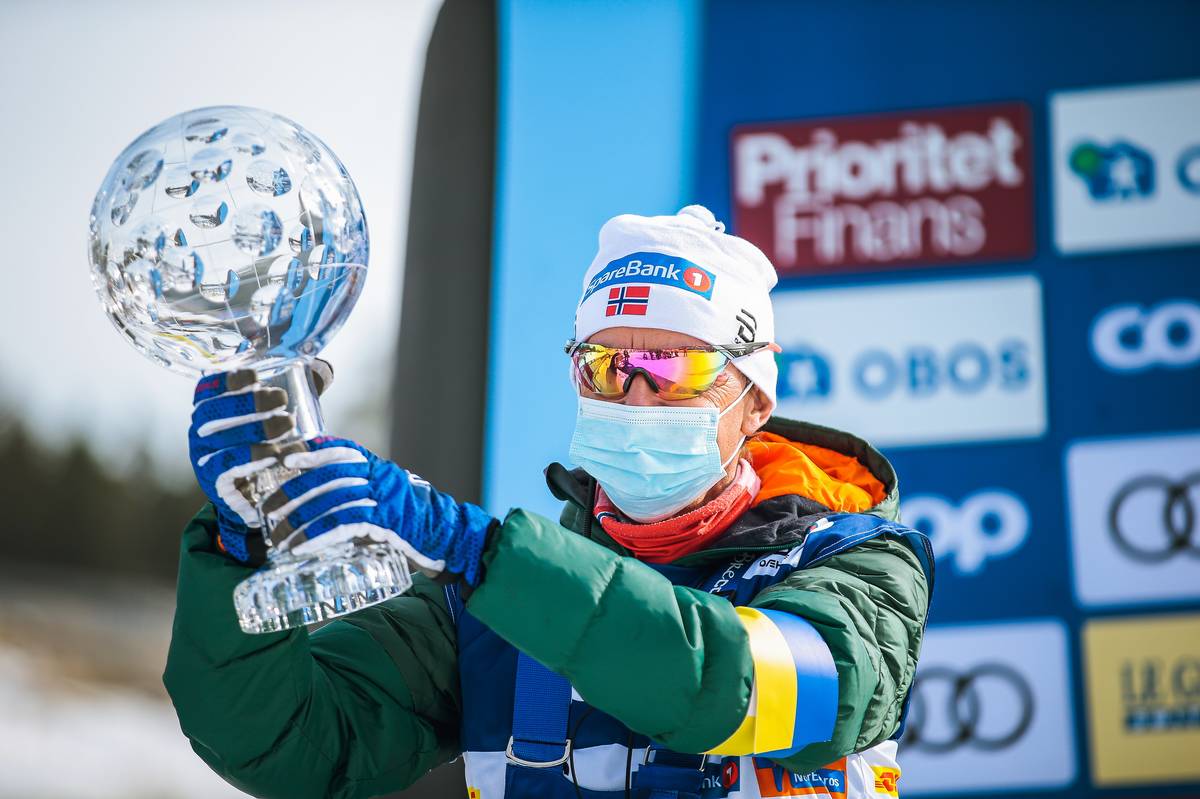
    A Norwegian coach accepts the overall World Cup crystal globe on behalf of winner Johannes Høsflot Klæbo. (Photo: NordicFocus)

    You can expect more analysis on the seasons of these World Cup champions, but first, we’ve got one final day of World Cup racing on deck. The final day of racing in Falun will feature a mixed-gender 4 x 5 k relay in the morning, followed by a mixed team sprint in the afternoon. 

    Results

    World Cup: Overall | Distance


  • In Front of a Long-Awaited Crowd, Klæbo and Chanavat Take It to the Line in Lahti Freestyle Sprint

    In Front of a Long-Awaited Crowd, Klæbo and Chanavat Take It to the Line in Lahti Freestyle Sprint

    This World Cup coverage is made possible through the generous support of Marty and Kathy Hall and the A Hall Mark of Excellence Award.  To learn more about A Hall Mark of Excellence Award or to learn how you can support FasterSkier’s coverage please contact info@fasterskier.com.


    By Rachel Bachman Perkins and Ian Tovell

    During a brief reprieve from racing, the top tier of international racing made its way from the high desert of Zhangjiakou, China to a venue tucked into snow-capped pines and nestled amongst the lakes of southern Finland. With more start spots per country than during the Games and some athletes choosing a weekend away from the World Cup, a number of new faces appeared on the start lists in Lahti for the 1.6-kiilometer freestyle sprint. 

    Logan Diekmann (BSF Pro) makes his first World Cup appearance in the 1.6 k freestyle sprint qualifier in Lahti, FIN. (Photo: NordicFocus)

    For the U.S., these names included Logan Diekmann (BSF Pro Team) and Bill Harmeyer (SMS T2), both of whom earned their first World Cup starts this weekend via their performance on the SuperTour circuit this season. These athletes joined Kevin Bolger, Logan Hanneman, and Zak Ketterson; the Team Birkie athlete also earned his first World Cup starts earlier this year at the Tour de Ski.

    Diekmann currently leads the SuperTour sprint standings with 119 points. He was second in the freestyle sprint during the U.S. Cross Country Championships in Soldier Hollow in January and skied to 5th in the sprint in both Duluth and Lake Placid. 

    Harmeyer was ranked third in the sprint standings with 83 points, behind Noel Keeffe who is currently racing at the 2022 U23 World Ski Championships in Lygna, NOR. Harmeyer has consistently posted top-five times in qualification during the SuperTour sprint races, and has raced into the final in three out of six SuperTour sprints. A fall in the quarterfinal during US Nationals left him in 24th after qualifying in fifth. 

    Bill Harmeyer (SMS T2) makes his first World Cup appearance in the 1.6 k freestyle sprint qualifier in Lahti, FIN. (Photo: NordicFocus)

    Lucas Chanavat (FRA) was the top qualifier finishing the course in a time of 2:57.85. All five of the Americans finished outside the top-30 in qualification, but Canadian Graham Ritchie cracked into the heats for North America in 27th (+7.73). 

    The quarterfinal rounds played out mostly as expected, with Chanavat and Johannes Høsflot Klæbo (NOR) advancing from the first round after a close finish. Norway’s Håvard Solås Taugbøl and Olympic silver medalist Federico Pellegrino of Italy crossed the line first and second in heat two, spread by just 0.06 seconds. Winning the third heat, Andrew Young (GBR) crossed the line in 3:04.32, just ahead of Russia’s Gleb Retivykh (+.20). 

    The fourth quarterfinal heat saw a close finish, as Sindre Bjørnestad Skar (NOR) took the race to the line alongside Richard Jouve of France and Alexander Bolshunov of Russia were right at his heels. Skar won the closing sprint with Jouve +0.01 behind and Bolshunov in third (+0.07). Michal Novak (+.49) of the Czech Republic finished in fourth, with both Novak and Bolshunov narrowly missing out on lucky losers.  

    Fast racing in the fifth heat saw four competitors advance to the next round. Janik Riebli (SUI) won the heat in a time of 2:59.56, while China’s Qiang Wang finished second (+.10) to move onto the semis. A top prospect for the Chinese ski program, this is Wang’s first World Cup appearance since the pandemic began. Wang was fifth in qualification during the Olympic freestyle sprint in Zhangjiakou, where he took second in his heat to Norway’s Erik Valnes before being issued a disqualification for obstruction and being relegated last in the heat.

    Qiang Wang (CHN) leads at the start of the fifth quarterfinal heat in Lahti. (Photo: NordicFocus)

    Following the pace of the leaders, Maciej Starega (+.64) of Poland and Arnaud Chautemps (+1.61) of France crossed the line third and fourth to advance into the semis as lucky losers.

    In the first semifinal, five skiers all remained close coming into the finish to vie for the two automatic spots. Pellegrino was able to hold the field off and win the semi with a time of 2:59.57, however, he was later disqualified, pushing him to sixth place.  Klæbo crossed in second  (+.07), guaranteeing his spot in the final, while Chanavant and Taugbøl were third (+.21) and fourth (+.37), respectively. Due to Pellegrino’s disqualification, Taugbøl was able to make it through to the final as a lucky loser. 

    In the second semi, Retivykh held off a push from Skar to win in 2:59.67, with the Norwegian 0.02 behind. Wang crossed third (+.34) with a time fast enough to earn the second lucky loser spot in the final.

    Sindre Bjørnestad Skar leads his heat during the freestyle sprint in Lahti, FIN. (Photo: NordicFocus)

    In the final, an early tangle between Wang and Retivykh as the two rounded a corner sent the Chinese athlete to the ground, losing contact with the pack. 

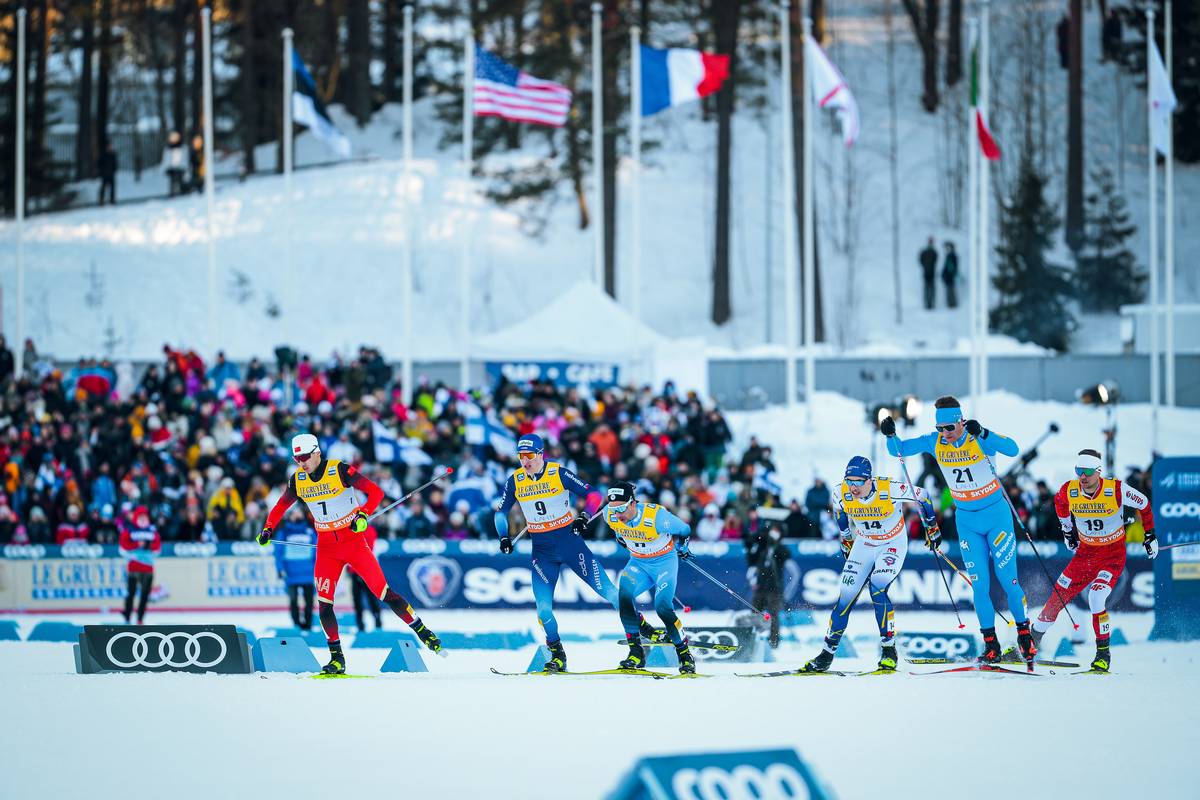
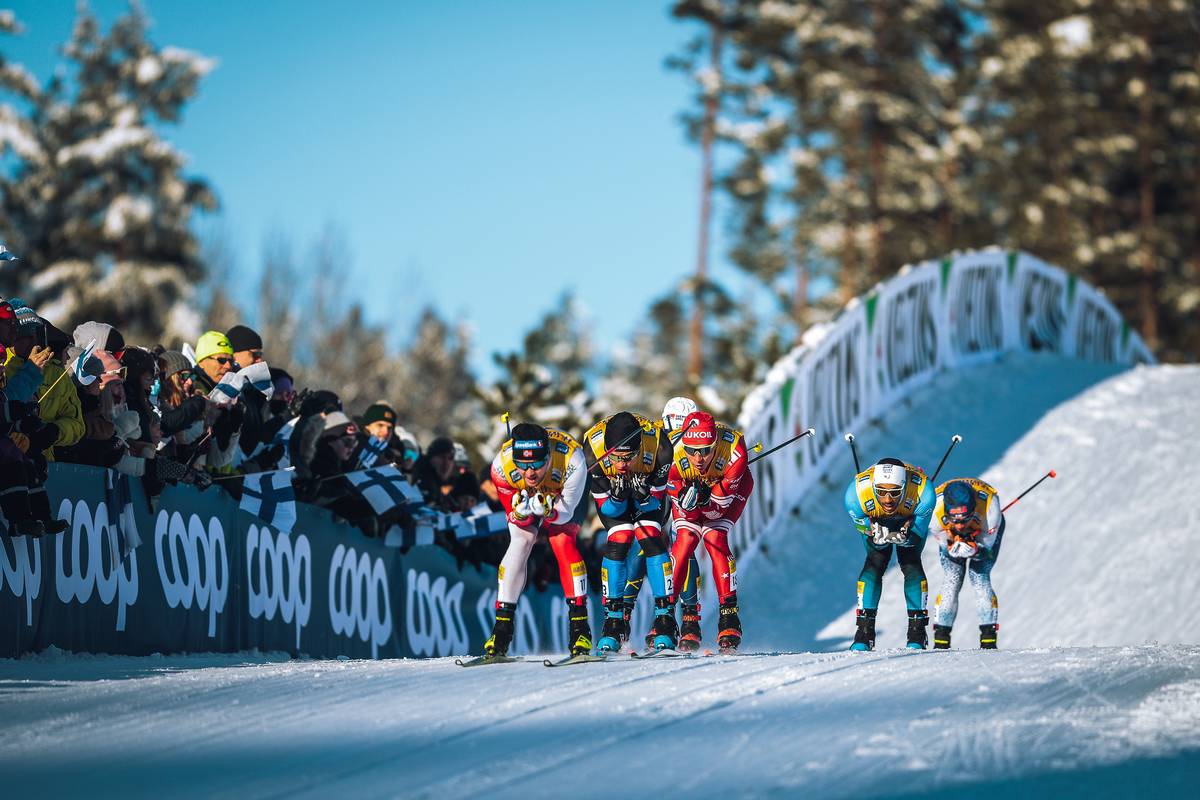
    The remaining five men stayed close as they powered through the course. Rounding the bend into the final 100 meters, four skiers remained in contention for the podium, but it was Klæbo who slingshot from the outside, putting his closing speed on display as he threw his boot to win a photo finish with Chanavat in 2:58.34, Skar and Taugbøl on their tails. 

    Johannes Høsflot Klæbo with a look before taking the win in the freestyle sprint in Lahti, FIN. (Photo: NordicFocus)

    The Norwegian had advantage at the finish, with Chanavat just 0.04 seconds back in second place. Skar held off his teammate for the final podium spot in third (+.23), while Taugbøl took fourth (+0.58). Retivykh crossed a few meters back in fifth (+0.90), while Wang rebounded from his crash to finish 7.77 seconds behind in sixth.

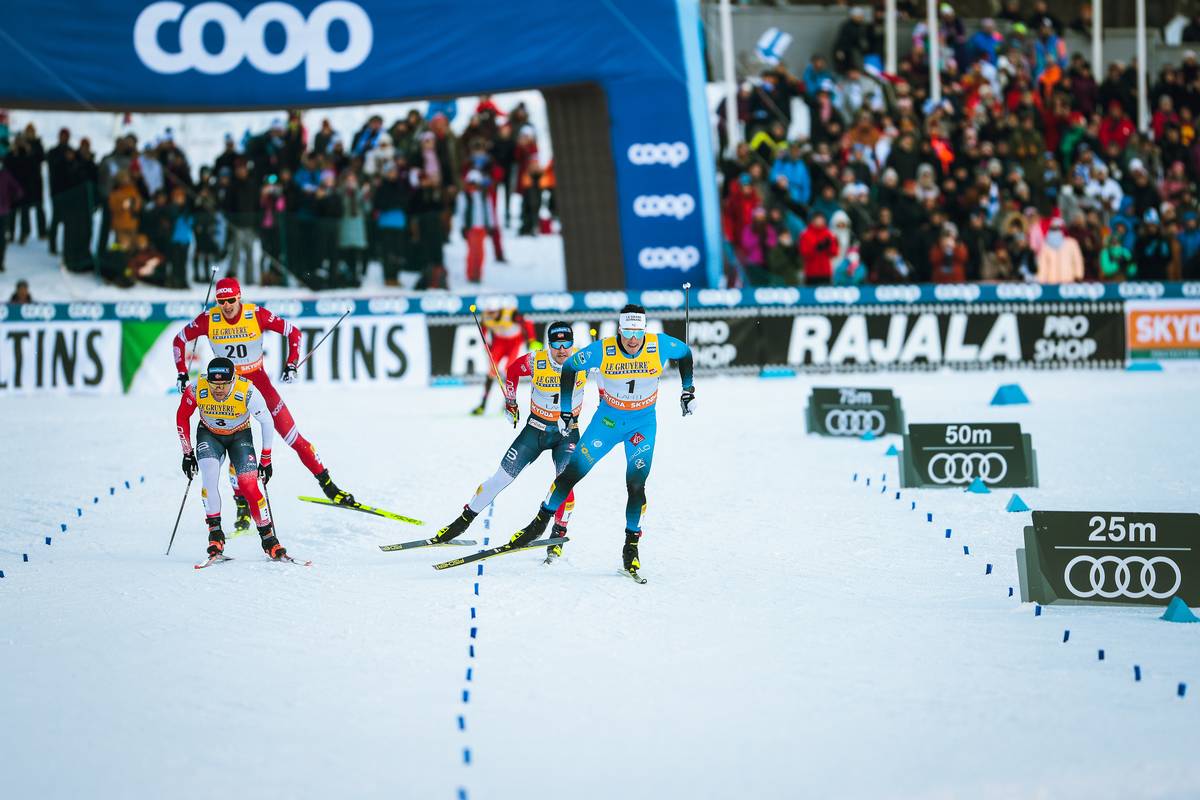
    A close race for second and third heads into the final 25 meters in Lahti. (Photo: NordicFocus)

    “It was amazing,” Klæbo told FIS after the race. “It isn’t so many days since we competed in the Olympics, but still, it’s always fun to race.” 

    Klæbo commented on the excitement of racing in Lahti, which has hosted many championship events including the 2019 World Championships. He added that the racing on these tracks is often tight, which keeps it exciting for spectators – of which there were many today. When asked about racing in front of a crowd after nearly two years of empty stadiums, Klæbo smiled.

    “It was amazing. I think what they have done, and finally seeing the end of the COVID situation – I think it’s amazing. It’s always great to compete against a big crowd, and it was amazing today as well.” 

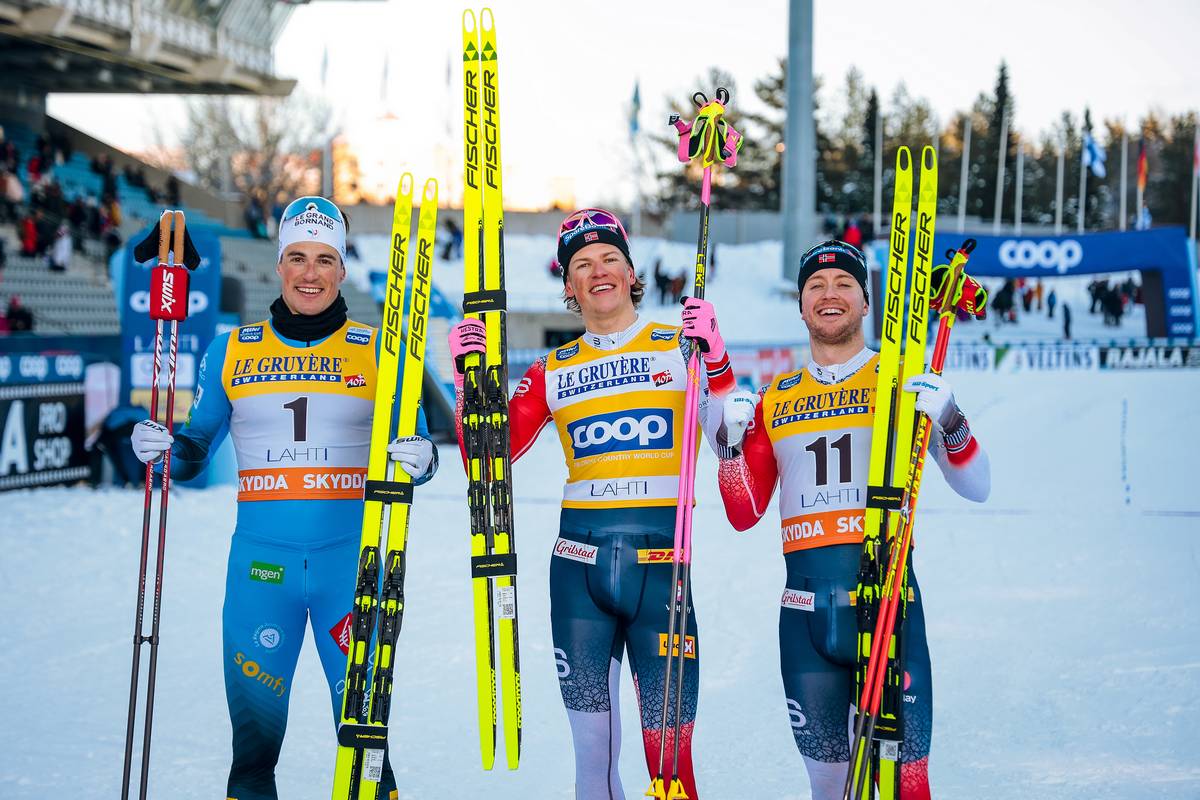
    Johannes Høsflot Klæbo (NOR) takes the win in Lahti’s freestyle sprint ahead of Lucas Chanavat (FRA) and Sindre Bjørnestad Skar (NOR). (Photo: NordicFocus)
    Graham Ritchie races in the quarterfinal of the freestyle sprint in Lahti, FIN. (Photo: NordicFocus)

    After finishing fifth in a tightly spread third quarterfinal heat, Graham Ritchie bumped up from his bib rank to finish 24th.

    Kevin Bolger was the top American qualifier in Lahti in 33rd (+8.90), just 0.41 seconds off the mark needed for the top-30. On his tails was Diekmann in 34th (+9.14), with Hanneman close behind in 39th (+9.79). Ketterson was next for the U.S. in 49th (+12.13), with Harmeyer next in 50th (+12.28).

    Kevin Bolger leads the American men in 33rd during the freestyle sprint qualifier in Lahti, FIN. (Photo: NordicFocus)
    Antoine Cyr (CAN) races the qualifier of Lahti’s freestyle sprint. (Photo: NordicFocus)

    Outside the top-30 for Canada, Antoine Cyr was 40th in qualification (+9.99), with Olivier Léveillé next in 46th (+11.79), followed by Phillippe Boucher in 55th (+14.02) and Rémi Drolet in 58th (+15.87). 

    Racing continues tomorrow with a 15 k individual start classic.

    Results:

    Qualification | Final

  • (Press Release) Olympic Rookie Olivier Léveillé Leads Canucks in Individual Classic Cross-Country Ski Race at Beijing

    (Press Release) Olympic Rookie Olivier Léveillé Leads Canucks in Individual Classic Cross-Country Ski Race at Beijing

    The youngest member on Canada’s Olympic cross-country ski team, Olivier Léveillé, battled to a 29th-place finish at the Beijing Olympics on Friday.

    The 20-year-old from Sherbrooke, Que. found his groove while steadily working his way around the 15-kilomtetre course to finish in the elite group of 30 with a time of 40:52.0.

    Canada’s Olivier Léveillé leads the North American athletes in 29th during the 15 k individual start classic. (Photo: NordicFocus)

    “It is always hard to ski at altitude, but I felt good today,” said Léveillé. “Sometimes you feel like you are stuck in a gear, but I felt like I was stuck in a good gear today.”

    Struggling with pace on a punishing skiathlon course in the Olympic opener earlier in the week, Rémi Drolet, of Rossland, B.C., bounced back and was Canada’s next best finisher in 33rd spot with a time of 41:07.7.

    “It was definitely an improvement from my last race. I don’t know that I felt a whole lot better. I think I am combating a decent amount of fatigue right now and I’m battling to get over it,” said Drolet. “But I think being able to race my own race and not having to fight to stay with the pack I didn’t blow up. I’m not satisfied with how I skied but my execution was good.”

    The nation’s top men’s skier heading into Beijing, Antoine Cyr (Gatineau, Que.), struggled to find his groove. The 23-year-old was left wanting more following a 37th place on Friday, completing the course in a time of 41:17.7.

    “I’m really disappointed in the race. It is sad, but this is life and that is why we love sports so much because there are ups and down,” said Cyr. “Emotion around a good performance is insane, but then it is also the same around a bad performance.”

    Antoine Cyr races the 10 k individual start classic during the 2022 Olympic Winter Games. (Photo: NordicFocus)

    Finland’s Iivo Niskanen was tops all day, posting the fastest splits throughout the course while skiing to the gold medal in a time of 37:54.8. Alexander Bolshunov, who is an athlete representing the Russian Olympic Committee, stopped the clock at 38:18.0 to win the silver. Norway’s Johannes Klaebo claimed the bronze medal with a time of 38:32.3.

    Canada will send Katherine Stewart-Jones, Dahria Beatty, Cendrine Browne and Olivia Bouffard-Nesbitt to the start line on Saturday for the women’s 4×5-kilometre relay.

    Complete Results: https://bit.ly/3rH4sb1


    For complete details on Team Canada at the 2022 Olympic Winter Games, please visit  https://olympic.ca/games/beijing-2022/

  • (Results Brief) Niskanen strides away with gold medal; Bolshunov 2nd, and Klæbo 3rd; Patterson top US skier in 38th

    (Results Brief) Niskanen strides away with gold medal; Bolshunov 2nd, and Klæbo 3rd; Patterson top US skier in 38th

    In what might be the rematch of the games, Finland’s Iivo Niskanen faced Alexander Bolshunov of the Russian Olympic Committee in the 15-kilometer individual start classic event. In the opening event of the Games, the 30 k mass start skiathlon, Niskanen and Bolshunov raced together to set the pace well off the front of the men’s pack for the first 15 k, raced classic, but Niskanen could not hold the effort in the freestyle half. Bolshunov skated away for gold. 

    With a World Championship gold medal from 2017 and a bronze from 2019 in the 15 k classic, along with 12 World Cup podiums in the event, seven of which are wins, Niskanen is perhaps a specialist in the event.

    Niskanen led through each of the time splits from the 3k time check, with Bolshunov building into the race to establish himself as the primary opponent before the second lap. 

    Iivo Niskanen (FIN) takes gold in the 15 k classic, with Alexander Bolshunov (ROC) earning silver and Johannes Høsflot Klæbo (NOR) bronze. (Photo: NordicFocus)

    Ultimately, Niskanen’s lead only grew as he skied smoothly for the win in 37:54.8. Bolshunov held his position for the silver medal (+23.2) with sprint gold medalist Johannes Høsflot Klæbo of Norway taking the bronze (+37.5). 

    The top American on the day was Scott Patterson in 38th (+3:28.3), with Ben Ogden next in 42nd (+3:35.0). Gus Schumacher skied through the finish in 48th (+3:58.6), with JC Schoonmaker rounding out Team USA’s starters in 66th (+5:36.8). 

    Racing for Canada, Olivier Léveillé was the top finisher in 29th (+2:57.2), with Rémi Drolet next in 33rd (+3:12.9), and Antoine Cyr in 37th (+3:22.9). 

    Results

  • Bolshunov Dominates Men’s 30 k Skiathlon to Win First Olympic Gold; Patterson Matches Olympic Career Best in 11th

    Bolshunov Dominates Men’s 30 k Skiathlon to Win First Olympic Gold; Patterson Matches Olympic Career Best in 11th

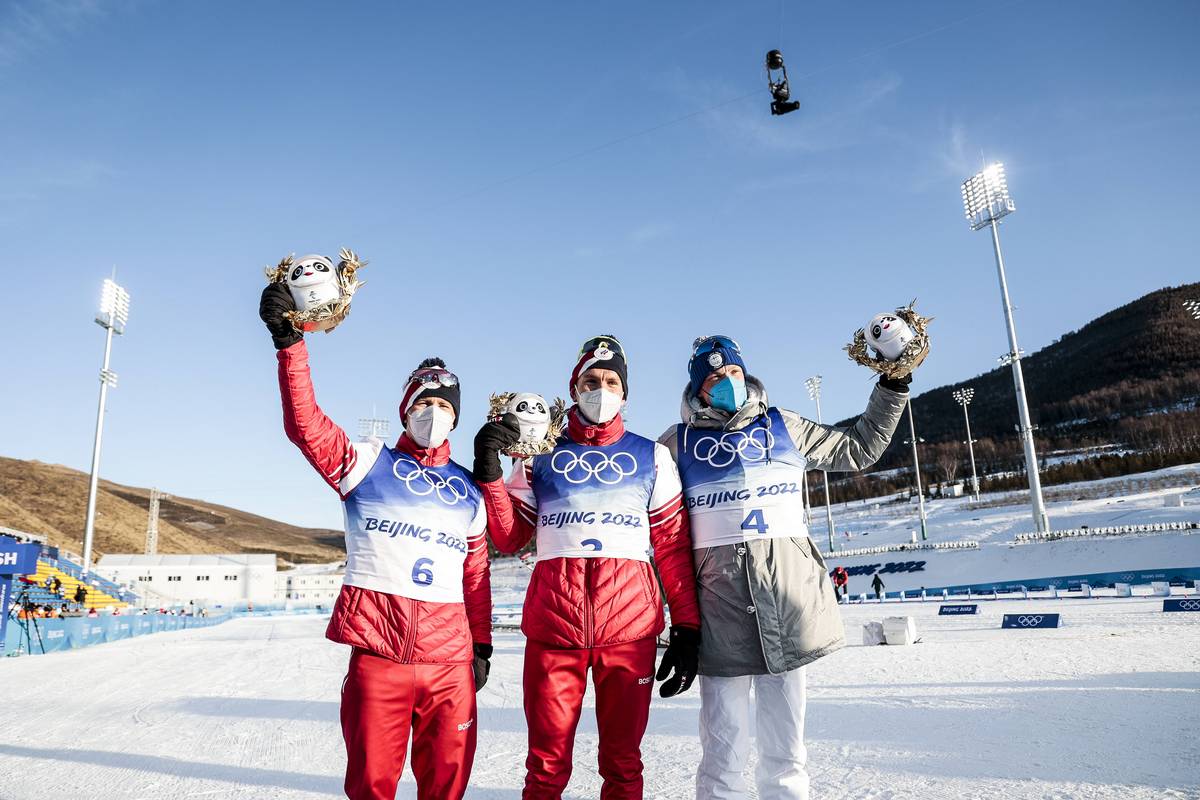
    The first podium of the 2022 Olympic Games following the men’s 30 k skiathlon. Alexander Bolshunov (ROC) dominated the event for gold, ahead of teammate Denis Spitsov who took silver, and Iivo Niskanen (FIN) bronze. (Photo: NordicFocus)

    This World Cup coverage is made possible through the generous support of Marty and Kathy Hall and the A Hall Mark of Excellence Award.  To learn more about A Hall Mark of Excellence Award or to learn how you can support FasterSkier’s coverage please contact info@fasterskier.com.


    On the heels of the women’s opening Olympic race, a colorful lycra field in their Sunday best lined up to race the men’s 30-kilometer skiathlon. While the women raced a four-lap 15 k event, men faced double the distance – over 75% longer by finish time – though they were greeted by much more favorable weather. It was sunny, still, and clear. Classic tracks were crisp and firm, and the familiar sound of poles powerfully planting and pushing off from cold snow, akin to the blasters of Storm Troopers in the classic Star Wars films, was not obscured by wind ripping through the stadium. 

    A quick nod to the start list for North American fans: Scott Patterson and Gus Schumacher were the only men racing in stars and stripes today, while Olivier Léveillé, Antoine Cyr, and Rémi Drolet raced for Canada. 

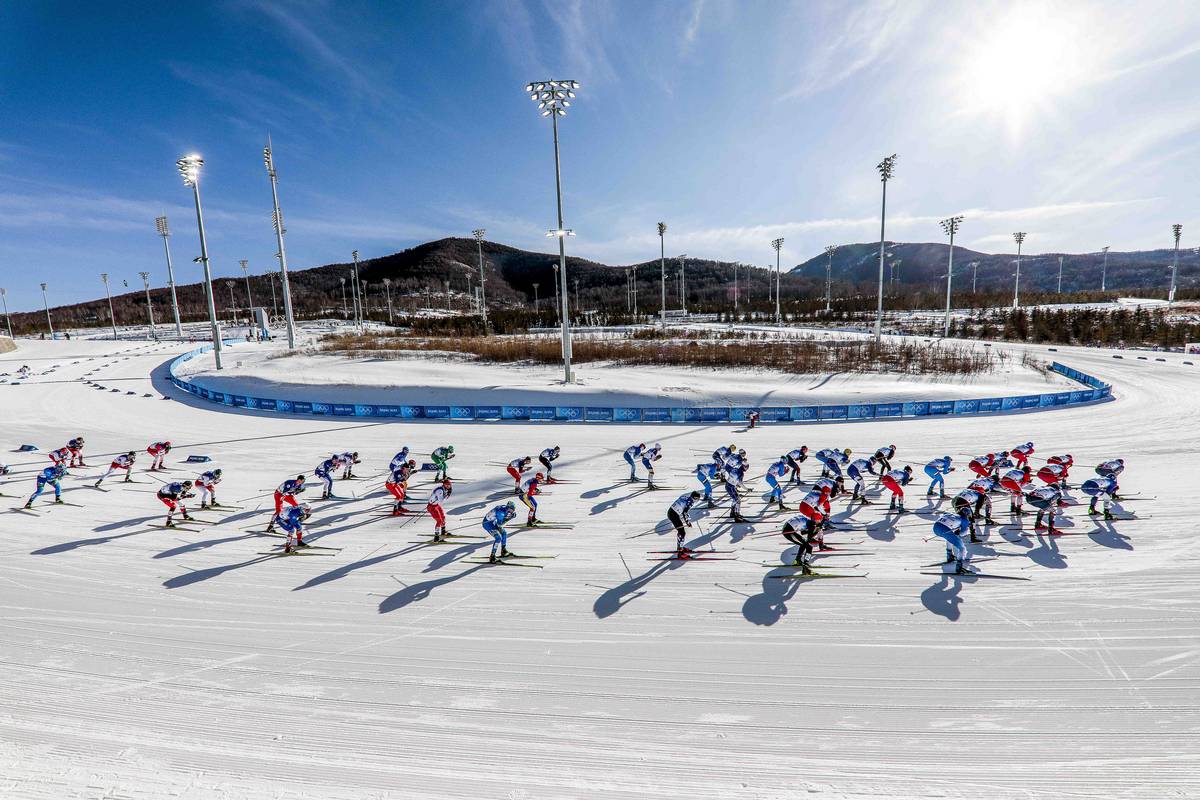
    Athletes take to the course for the men’s 30-kilometer skiathlon, the opening event of the 2022 Beijing Olympic Winter Games. (Photo: NordicFocus)

    To review the last two Olympiads, the 2018 Games saw a Norwegian sweep of the skiathlon podium, with Simen Hegstad Krüger breaking away to win gold by eight seconds ahead of his teammates Martin Johnsrud Sundby and Hans Christer Holund. After testing positive for COVID-19 shortly before his scheduled departure for Beijing, Krüger is currently riding out his  quarantine in a hotel room, resolutely training on a spin bike in hopes of making it to the 2022 Games in time for the final event, the men’s 50 k freestyle. Sundby retired from World Cup level racing after the 2021 World Championships in Oberstdorf, Germany, in which he earned an auto start as the reigning champion in the 15 k classic. This season, Sundby raced a series of marathon and longer races in Italy during January. This leaves only Holund returning to the Olympic skiathlon in 2022.  

    In 2014, it was a dog fight to the finish, with Dario Cologna of Switzerland taking gold by just 0.4 seconds over Marcus Helner of Sweden. Near the peak of his career, Norwegian powerhouse Sundby was one second behind Helner in third. 

    Athletes take to the course for the men’s 30-kilometer skiathlon, the opening event of the 2022 Beijing Olympic Winter Games. (Photo: NordicFocus)

    Over the first 15 k of classic racing, two names that have not yet been mentioned, from countries who have not been on the podium in the last two Olympic competitions, pulled away from the field. Leading the charge was the king of the 15 k classic, Finland’s Iivo Niskanen. Niskanen has won seven World Cup 15 k classic events, including a grueling race through falling snow in Lenzerheide, SUI at the beginning of the 2021/22 Tour de Ski. The Finn was second to Johannes Høsflot Klæbo (NOR) a week later in Val di Fiemme, ITA, near the other end of the Tour. 

    On Niskanen’s tails over the first four laps was Alexander Bolshunov of the Russian Olympic Committee (ROC). Bolshunov was fifth and seventh in the two most recent 15 k classic events, amidst a start to the 2021/22 World Cup season that did not match his previous three seasons of racing. Bolshunov was the World Cup distance champion in 2019, 2020, continuing his dominance to win both the distance title and the overall World Cup title in 2021. He also earned three silver medals in the 2018 Games – he was the runner up in the 50 k classic, and supported the ROC to second place finishes in the relay and team sprint – in addition to a bronze medal in the classic sprint.

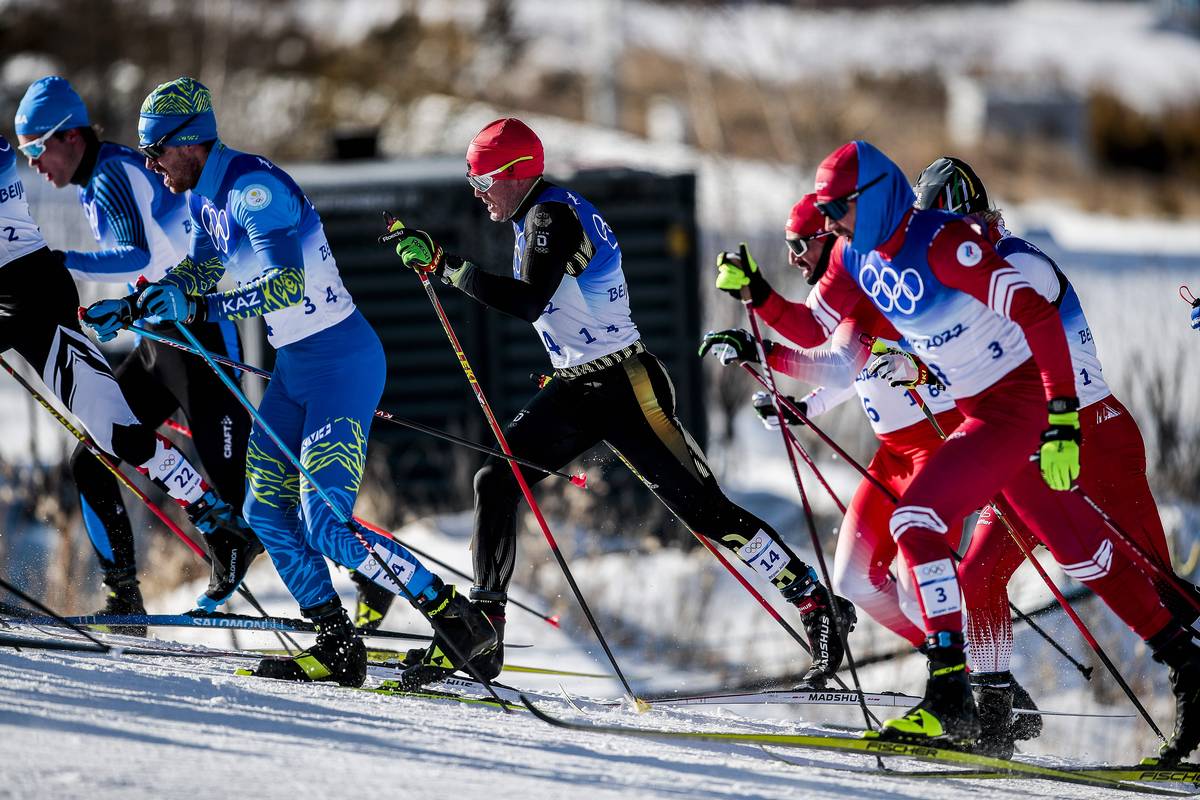
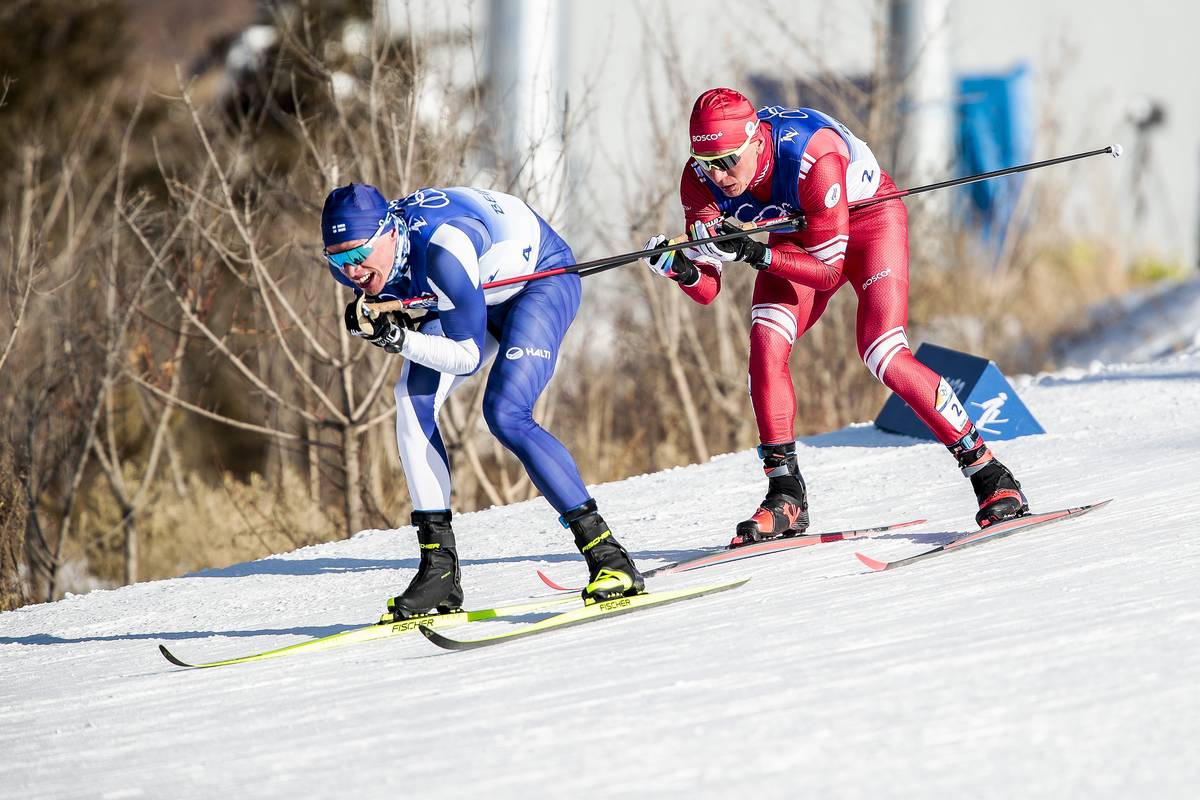
    Iivo Niskanen (FIN) leads Alexander Bolshunov (ROC) as the pair drops the field during the classic leg of the 30 k skiathlon. (Photo: NordicFocus)

    Leading into this season, Bolshunov has had a less than ideal buildup. The 25-year-old experienced a bike crash in addition to a tooth infection that required multiple surgeries, interrupting his ability to train with the consistency and volume – rumored to be over 1,200 hours annually –  that has contributed to his strength over the last quadrennial. 

    At the 5 k checkpoint, the top-10 racers were spread by less than 5 seconds, before Bolshunov and Niskanen began to pull away. At 10 k the duo had built a 12 second lead to the chase pack, led by Denis Spitsov (ROC), and between 10 k and the pit-box at 15 k where athletes switched from classic to skate, this lead more than doubled to 30 seconds. 

    The chase group of Hans Christer Holund (NOR), Denis Spitsov (ROC), and Pål Golberg race the classic leg of the men’s 30 k skiathlon in Zhangjiakou. (Photo: NordicFocus)
    Alexander Bolshunov (ROC) begins to pull away from Iivo Niskanen (FIN) at the start of the 15 k skate leg of the men’s skiathlon. (Photo: NordicFocus)

    Niskanen and Bolshunov left the transition from classic to skate together, but over the next lap, Niskan’s wheels began to fall off. At 16.3 k, Bolshunov was already 13.5 seconds ahead, with Spitsov racing on his own, nearly 18 seconds behind Niskanen and closing fast. Originally podium favorites, two Norwegian chasers worked together roughly 1:06 behind Bolshunov, sitting well over 30 seconds out of third place. 

    Looking like his body had flooded with lactate and his matchbox was suddenly empty, Niskanen was unable to respond as Spitsov reeled him in, eventually leaving the Finn in his wake by the end of the first skate lap. From then on, the podium story looked to be pre-written.

    At 20 k, Bolshunov had more than 40 seconds on Spitsov, with Niskanen in no man’s land 1:03 behind the leader, and 50 seconds ahead of the Norwegian chasers. At 25 k, Bolshunov had grown his lead to nearly a minute over his countryman, and 1:50 to Niskanen.

    With well over a minute lead on second place, Alexander Bolshunov (ROC) takes a bow as he enters the stadium to win the men’s 30 k skiathlon. (Photo: NordicFocus)

    Entering the stadium, Bolshunov had all the time in the world to savor the victory of his first Olympic gold medal.

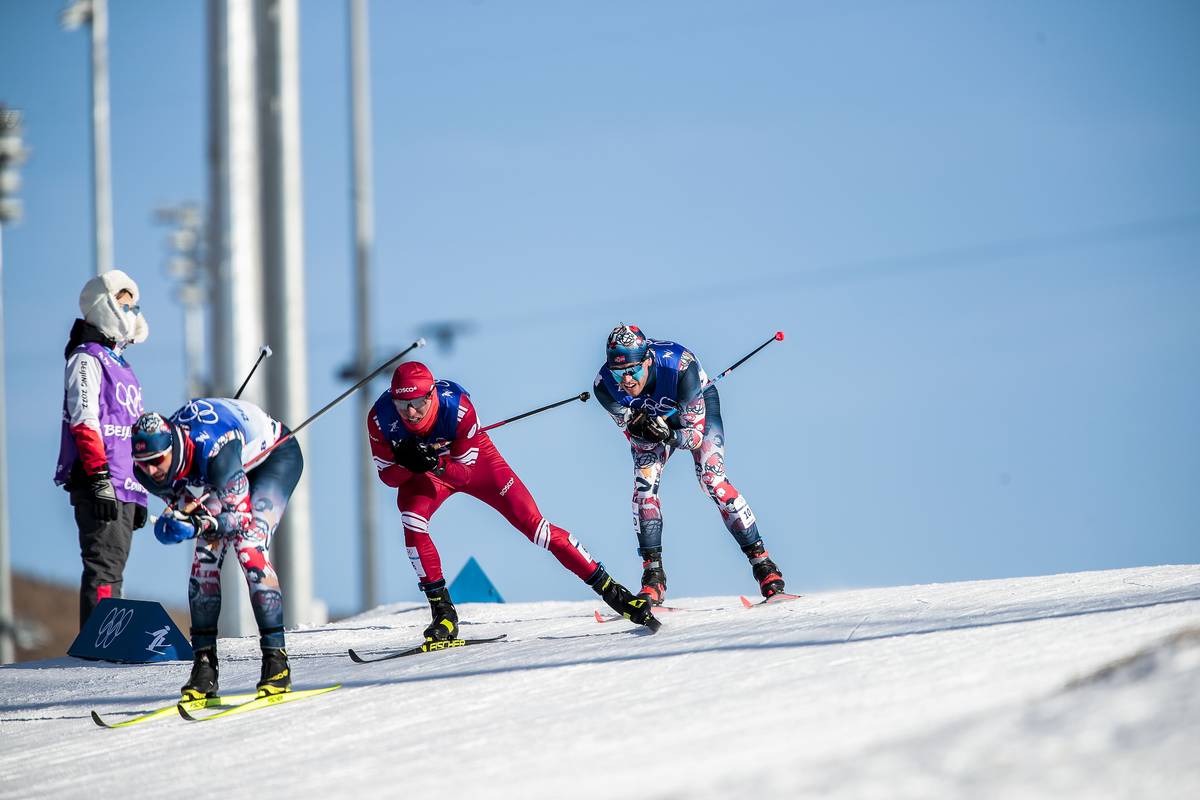
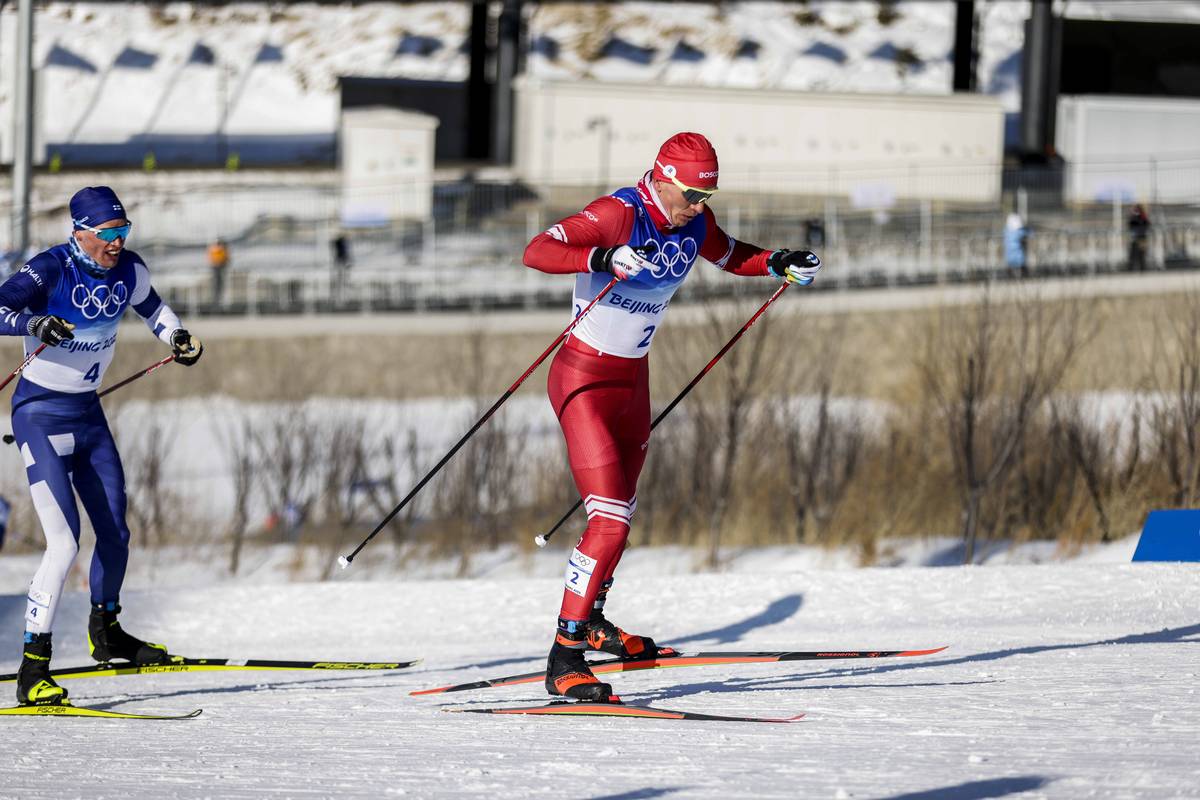
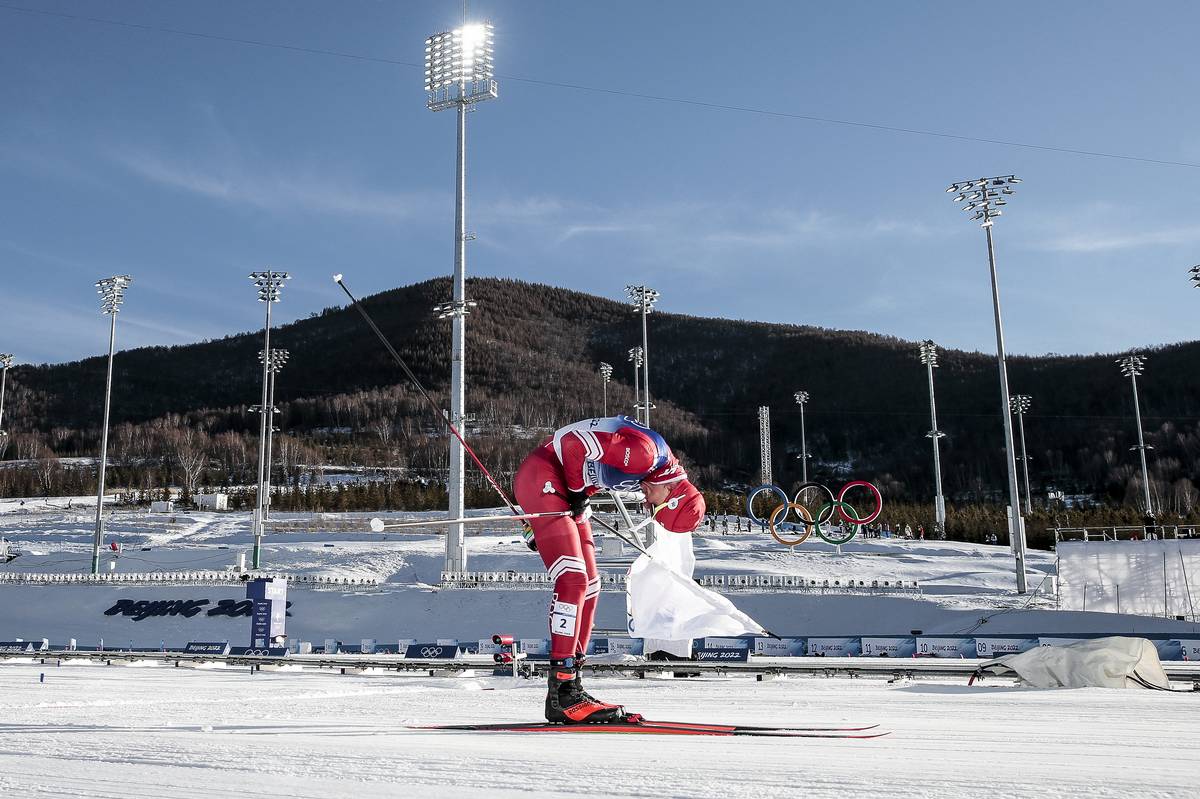
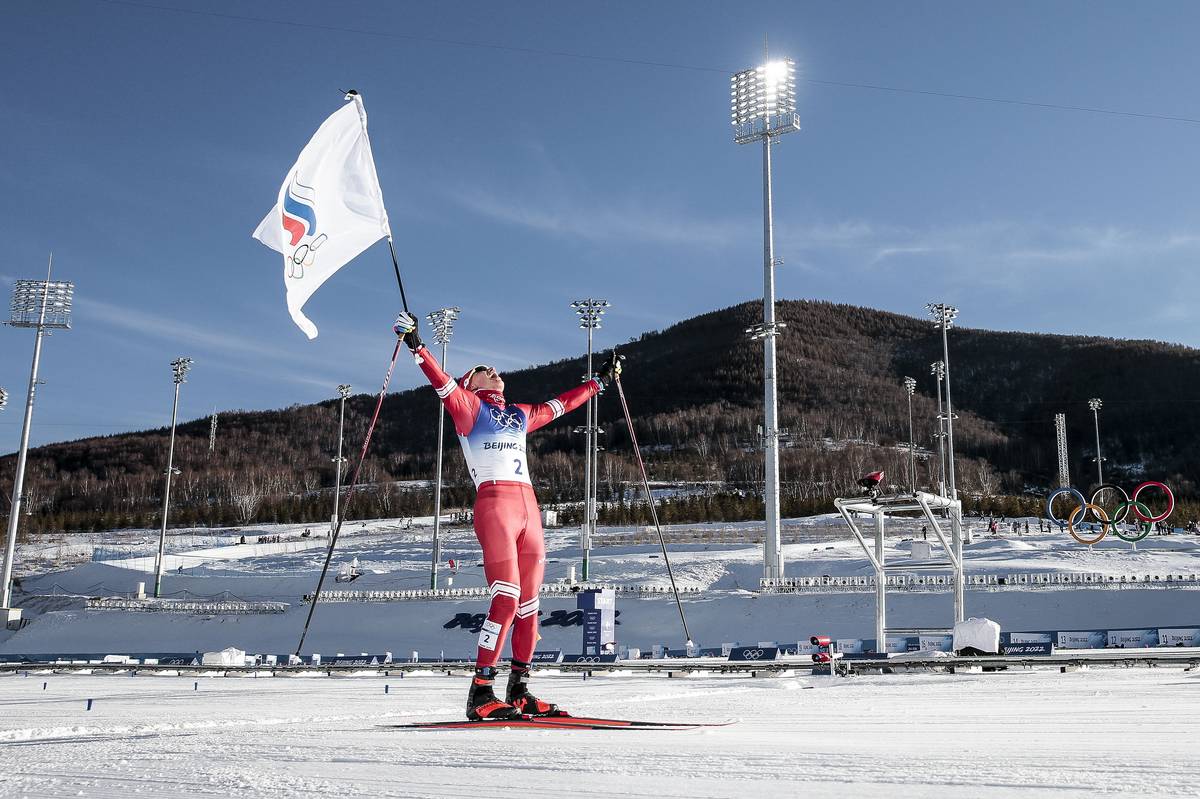
    Before rounding the bend into the final straight, Bolshunov took a deep bow. He accelerated around the final bend toward the sidelines, where he collected a ROC flag. Coasting down the lanes, Bolshunov waved this flag over his head with one hand, while pumping his left fist into the air, basking in the glory of a dominant performance on the world’s most prestigious stage. 

    Alexander Bolshunov celebrates a dominant victory, earning his first Olympic gold medal at the men’s 30 k skiathlon. (Photo: NordicFocus)
    Olympic champion Alexander Bolshunov welcomes his teammate Denis Spitsov (right) to the finish of the men’s 30 k skiathlon, going one-two for the Russian Olympic Committee. (Photo: NordicFocus)

    Bolshunov took off his skis, unable to stop smiling, as he turned around to greet his teammate Spitsov, who crossed the line for silver 1:11.0 behind. Niskanen had padded his lead enough over the first half of the race so that his hold on a medal was never threatened. Regaining his form over the final kilometers, he skied smoothly through the stadium to collect the bronze medal in third (+2:00.2). 

    “I just couldn’t keep pace with those Russians,” Niskanen told the Finnish news outlet Yle after the race. “They were just ridiculously fast today. Unbelievable, the speed they can ski at. It was even a little bit surprising that I wasn’t able to respond to them at all.”

    Iivo Niskanen pushes to the line for a bronze medal in the men’s 30 k skiathlon. (Photo: NordicFocus)

    Spread over the next minute, Holund took fourth (+2:30.9), with Golberg in fifth (+2:52.5). 

    While a glance at his FIS profile this season might not have identified Spitsov as a favorite, the 25-year-old was fourth in the event in the 2018 Games in Korea, where he also collected a Bronze medal in the 15 k freestyle. Spitsov collected a slew of top-10 World Cup results over the subsequent seasons, and was named to the 2021 World Championships, before he crashed while training at the venue in Oberstdorf, sustaining a fracture in his left hand that left him unable to compete. Racing back into form this season, Spitsov was fourth and seventh during the 15 k classic stages of the Tour de Ski, where he finished 4th overall. 

    Whenever the podium is dressed predominantly in Russian Red, speculation arises that the state sponsored doping that overshadowed any Russian performance at the 2014 Sochi Games has continued through 2022. This is especially true when an athlete runs away with a race, despite facing a field made of the top athletes in the world who have all, presumably, prepared in a way that maximizes their potential on the race course. FasterSkier’s Nat Herz voiced this speculation during Bolshunov’s post-race press conference, asking if there was anything the Russian champion would like for people to know regarding his performance on the day.

    “Well, people don’t become Olympic champions all of a sudden,” Bolshunov stated matter of factly. “In the past several years, I have been proving this in every race that I participate in, and I achieved distinguished results and I fight to the end. As to doping – you’re hinting at doping – when I hear about this, I don’t feel good at all. When I hear these words, I want to turn and just walk away because I just hate hearing this, because this should have nothing to do with sports. 

    “We have clean sportsmen, clean athletes here at the Olympics. We go through doping tests almost every day and we have to fill out these forms where we indicate where we will be training from which hour to which hour, when the training session starts, when it finishes and so on…”

    Alexander Bolshunov takes the men’s 30 k skiathlon win in Zhangjiakou. (Photo: NordicFocus)

    Bolshunov continued to explain a system akin to American doping control, where athletes need to report their whereabouts daily, including all details on training, travel, and even times of day when they might be running errands, or otherwise not at a location where an anti-doping agent could arrive unannounced to collect a sample. In his mind, this level of testing makes questioning whether or not the Russian program is competing fairly a moot point.

    “I believe that it’s wrong to ask us these questions. Well you don’t achieve these results all of a sudden — you don’t become an Olympics champion because it takes years and years of training. This is very hard and if you personally want to see how we train, please, we invite you. You are welcome. And these training sessions are very difficult — believe me. And after you will have seen how we train, I believe that you and your audience will never have these questions again. So I believe these are not the best questions to be asked. They’re irrelevant.”

    Scott Patterson tucks in behind Alexey Chervotkin (ROC) during the 30 k skiathlon. (Photo: NordicFocus)

    Off screen, yet another impressive comeback was underway. At the transition from classic to skate, Scott Patterson sat in 19th place, 2:15 behind the leaders. Steadily picking skiers off, Patterson moved into 16th by 20 k, and was tied with Germany’s Lucas Bögl in 11th at the 25 k checkpoint. Jules Lapierre and Clement Parisse of France were within reach in 9th and 10th, only a few seconds ahead. 

    Over the final kilometers, Patterson passed Parisse and pulled ahead of Bögl, but was passed by Artem Maltsev (ROC) to maintain his position in 11th place (+4:00.2) at the finish. This result matches Patterson’s Olympic career best result; he was 11th in the 50 k freestyle in the 2018 Olympics, after finishing 18th in the skiathlon earlier in the Games. 

    If you’ve followed Patterson’s trajectory this season, you’re aware of two things: first, that he sustained a wrist injury from a mountain bike crash that left him in need of surgery just five weeks before the opening World Cup races in Ruka. He joined the team a week late for the Lillehammer mini-tour, racing in a brace that left him unable to fully utilize his poles. 

    Patterson finished 70th in the 15 k free in Lillehammer, followed by a 75th place finish in the same event the following weekend in Davos. 

    The second thing you’ll have noted about Patterson’s season is that the trend from that moment forward pointed toward a very different result. Stepping back to the summer, Patterson had put together several impressive trail races, including breaking a storied course record at the Crows Pass Crossing in August, in which he had competed in seven previous summers. It was evident that his fitness was at an all time high before the crash.

    At the U.S. Cross Country Championships in Soldier Hollow in January, Patterson broke away to win the men’s 30 k skate by over 11 seconds, and was second in the 15 k classic two days later racing in a perfect storm of above freezing temperatures with mixed precipitation, on skis that perhaps were not up for the task. 

    Scott Patterson races to 11th in the men’s 30 k skiathlon during the 2022 Olympic Winter Games. (Photo: NordicFocus)

    Speaking to FasterSkier after the race, Patterson called a spade a spade, acknowledging that he had a “slow start to the season.” However, he found confidence in his racing in the years prior, where he came into peak form surrounding February championship events, regardless of what his Period 1 results looked like. 

    “[The Olympics] also get right into the races that I really like – a 30 k, then towards the end the 50 k. I think also the little bit smaller fields at the World Champs or Olympics kind of help. It’s a little less chaotic, where I can just kind of get in my groove and ski. So, [how prepared I am] was a little unknown going in. I had some confidence coming off Nationals, and I had a good training block [afterward], so I was optimistic, but it definitely was a big question mark how it would go. Obviously, it started out pretty strong, and I’m looking forward to more racing.”

    Scott Patterson takes 11th in the men’s 30 k skiathlon. (Photo: NordicFocus)

    Patterson was asked to quantify the extent to which the cold and the challenge of the course factored into the time gaps seen at the finish. Patterson acknowledged the altitude, and the speed of the snow, but ultimately concluded that at an Olympic event, the results are not unexpected.

    “It’s the Olympics like people just go hard,” he said simply. “I think we saw that in 2018 where no one sits around at an Olympic race. And we saw that for sure today with Iivo and [Bolshunov] – really strong off that classic leg. And I don’t think there’s any way to hide out here with these long hills and tough course – especially with the way they groomed it, where you don’t have tracks on the downhills. It’s hard to recover, so you have to work for a lot of it. And a lot of these hills are just that grade kind of in between V2 and V1. Or if you switch early to V1, you’ll be V1-ing for a long time.”

    With that, Patterson headed out to “go pee in a cup”, acknowledging that he was heading to doping control, and in response to a question on the winners, that they likely were too. 

    Gus Schumacher races the men’s 30 k skiathlon during the 2022 Beijing Olympic Winter Games. (Photo: NordicFocus)

    Schumacher, in his first Olympic performance, was 39th (+9:04.5). The 21-year-old gave an emotional response in the mixed zone, saying felt “depleted and empty” after his race. Showing maturity beyond his years in the sport, Schumacher fielded questions from the media regardless, stating that he felt he had paced the race well, but his energy was not what he had hoped for, and he took pride in simply finishing the race. His next statements, uttered while clearly choked up behind his N95, were powerful. 

    “I think when I was younger, I would have seen someone like myself have a tough race on a big stage and kind of be disappointed [in them]. And I am disappointed. But I want younger people to know that it’s a long process, and there are going to be bad days. And sometimes there are going to be a lot of bad days – this season hasn’t been my best. But I know I’m doing the right things, and more years of doing that, it’s just going to get better. I don’t want people to doubt me – I don’t really care that much [if they do] – but that is something that’s on my mind, because I’ve doubted people before. But I know there’s a lot of people at home that believe in me, and that have supported me to get to this point. And I know that they’re proud of me. And that means a lot.”

    Gus Schumacher races in his first Olympic event, the men’s 30 k skiathlon. (Photo: NordicFocus)
    Olivier Léveillé leads the Canadian men in 31st in the men’s 30 k skiathlon. (Photo: NordicFocus)

    Just outside the Top-30, Olivier Léveillé was the top Canadian finisher in 31st (+7:32.2), with Antoine Cyr a minute and a half behind in 42nd (+9:16.2). Drolet was lapped just before the 20 k checkpoint and did not finish the race. 


    Men’s 30 k Skiathlon Results

  • (Press Release) Young Nordic Canucks Get First Taste of Olympic Experience in Skiathlon

    (Press Release) Young Nordic Canucks Get First Taste of Olympic Experience in Skiathlon

    Olivier Léveillé grinds out 31st-place finish on a monster of a course

    By Chris Dornan on behalf of Nordiq Canada

    BEIJING, Chn—A trio of Canadian men officially made their Olympic debut in the men’s 30-kilometre skiathlon race on Sunday at the Zhangjiakou National Cross-Country Skiing Centre near Beijing.

    The youngest member of the Canadian squad at 20 years of age, Olivier Léveillé (Sherbrooke, Que.), finished just outside the top-30 in the 70-man field, clocking a 31st-place time of 1:23:42.0.

    Olivier Léveillé leads the Canadian men in 31st in the men’s 30 k skiathlon. (Photo: NordicFocus)

    “It was a tough course and a really tough race, but I was able to stay in control and finish strong today so I’m feeling pretty good,” said Léveillé. “I’m happy now to be an Olympian. I’m going to eat, get some rest and come back strong for the sprint race.”

    Antoine Cyr (Gatineau, Que.) battled through the challenging conditions, completing his eight laps around the punishing course in a time of 1:25:26.9 for 42nd spot.

    Rémi Drolet (Rossland, B.C.) was one of 18 athletes pulled from the course after getting lapped near the 20-kilometre mark.

    Rémi Drolet competes in the men’s 30 k skiathlon during the 2022 Beijing Olympic Winter Games. (Photo: NordicFocus)

    The Canadians skied strong early in the mass start, matching the pace for the first five kilometres before the field broke apart. Léveillé bounced around the middle of pack before finding a comfortable pace in a small group of four who worked together to reel in a handful of skiers before crossing the finish line together.

    Two athletes representing the Russian Olympic Committee finished on top of the podium. Alexander Bolshunov dusted the field to win with a time of 1:16:09.8. Denis Spitsov skied to the silver medal at 1:17:20.8. Finland’s Iivo Niskanen secured the bronze with a time of 1:18:10.0.

    The men’s skiathlon consisted of 15 kilometres of classic cross-country skiing followed by a final 15 kilometres in the free technique. Athletes change equipment in a pit stop area between the two legs with the clock still running.

    The men’s and women’s Olympic free technique sprint races are slated for Tuesday, February 8.

    *****

    Complete Results: https://bit.ly/3rvbG1S

    For complete details on Team Canada at the 2022 Olympic Winter Games, please visit  https://olympic.ca/games/beijing-2022/

  • Canadian Journey to Beijing

    Canadian Journey to Beijing

    Katherine Stewart-Jones sprinting over the saddle at Sovereign Lake during the Beijing Prep Camp. (Photo: Peggy Hung)

    Canada was successful in delivering the team to Beijing and getting them on snow in Zhangjiakou. The decision to go above and beyond in isolating athletes before a carefully planned drive to a charter flight worked, although other countries also succeeded with a more laid-back approach.

    What can fans expect from the Canadian team in Beijing? It all comes down to qualifying and performing.

    Qualifying

    Canada had an Olympic quota of four women and three men, with a pretty high probability of gaining another woman and man in reallocation. The size of the quota depends on World Cup/World Championship performance and domestic FIS races; the top countries earned the maximum team size of 8 per gender. As Canada cancelled all races last season and only took a small team to Europe for a six week visit, the only path to a larger team would have been more athletes getting top 30 results in Europe last season.

    Three men (Tony Cyr, Olivier Léveillé, Graham Ritchie) and one woman (Katherine Stewart-Jones) met the world cup results standard for Olympic qualification during period 1. The Trials in Canmore (January 6th to 11th) would then select three women, and possibly one woman and one man who would have first dibs after reallocation.

    Dahria Beatty, an Olympic veteran from Pyeongchang, was one of the skiers who now had to qualify through a rigid qualification document at Canmore trials.

    “Yes, it was definitely different last time. I was qualified for the [2018] Games a season in advance, essentially,” Beatty explained at the Prep Camp at Sovereign Lake.

    At the Canmore sprint, Beatty qualified third and finished the heats in 4th, which meant Laura Leclair earned her first Olympic berth and Cendrine Browne her second.

    For Beatty, selection came down to Saturday’s 10km individual classic. If she won, or placed second to Stewart-Jones, she got the spot. The latter happened, with Beatty 0.5 seconds behind and 20 seconds clear of third.

    “Honestly, I don’t think I’ve had to qualify for a team specifically like that since U23 World Champs so it’s been a long time definitely.”

    Olivia Bouffard-Nesbitt was ranked 5th after trials, waiting on the reallocation process. Her journey has been longer than most, with injuries, training setbacks, car accidents, and bad luck. In 2014, she recovered from a back injury just in time to compete at Olympic trials. She won the qualifier on her first race day of the season. While lining up for the A-final heat with selection on the line, she was told that the jury had disqualified her for micro-skating during the quarter-final earlier. This year, the pieces came together.

    “​​It’s hard to find words. It’s something that I believed in, like my whole life, I believed that it was possible. But then throughout the setbacks, the doubt kind of built up. And, increased and I thought it wouldn’t happen, maybe and that I just had to grow up and face that reality. But there was still like, a little voice inside me that thought it was possible. And just to have– persisted, and trusted that with patience like things would line up for me. It means so much, it means so much for me but also for the people who helped me get here because it feels like I know that they would support me no matter what but it just feels like doing them justice as well. Like putting all the time into this project that is me trying to get to the Olympics was worth it.”

    Jasmine Drolet was next, with only the faint hope of moving up through a positive COVID test for an athlete above. Jasmine does have the consolation of earning a start at U20 World Championships.

    Russell Kennedy finished 27th in the Ruka 15km classic in November, enough to help Canada’s World Cup quota for next season. Kennedy would have needed to ski 15 seconds faster to take the 20th place from Federico Pellegrino and earn the 4th Olympic spot. The next day he moved up to 21st in the pursuit with the 24th fastest time of day, again just outside the criteria.

    The reallocation spot would be decided in the 15km individual start classic on January 8th. Whoever finished highest, after excluding the three already qualified men, would be on tenterhooks until the 17th and then be officially announced on the 19th.


    Rémi Drolet in a practice skiathlon at the Beijing Prep Camp at Sovereign Lake, Jan 23, 2022. (Photo: Peggy Hung)

    Cyr won, surprising no one, with Rémi Drolet edging out Kennedy by 10.8 seconds to take second. Every skier in the top ten had either a WC top 30 or a Canada Cup podium this season. Every one of those skiers could believe that their best effort would end in selection.

    Rémi is a second year senior who chose to take a gap year from Harvard to focus on getting faster on the World Cup and qualifying for Beijing. He didn’t get selected for Period 1, but did get some good results in early season Continental Cup races in Finland and Sweden.

    “For me, it was important to try really hard to make it this time around, because I think it’ll be an important stepping stone in my career,” he told FasterSkier during the prep camp. “To be able to, I guess, be a leader in the team, with so many strong guys coming up.”

    Rémi is getting good results for his age, but also looking over his shoulder at juniors like Tom Stephen and Xav McKeever, who are already collecting senior wins at Canada Cup races. These three teamed up with Léveillé to collect a relay silver at U20 Worlds two years ago.

    Kennedy is now 30. His ‘day job’ is with Canada’s Para National team, one of two guides for Brian McKeever. After PyeongChang, his goal was not just to qualify, but deliver at Beijing, and that dream ended with an invitation to train as a spare.

    “Well, I mean, for me, it’s been a rough two weeks. I spent three years working for this year. I was focused on the Olympics, and not really as much qualifying I guess.”

    Asked about sharing a bubble for two weeks with the four men who are living his dream, Kennedy didn’t shy away from truth.

    “And yeah, it’s been hard. But I’ve been trying to put on a good face around them. Because it’s sweet [for them]. They’ve done it, they’re going to the Olympics, it’s a huge goal and a huge achievement. But for me, it’s definitely hard. I’m really fast right now, which just makes it harder. But that’s part of sport.”

    Performing

    For some people, just reaching the Olympics is the pinnacle of their dreams. And it is a major achievement, even more so now with smaller quotas. In 2006, Canada had five women who earned Torino quota spots, in addition to the ten nations spots, allowing Canada to select 15 women. 

    What distinguishes the athletes who deliver results from those who participate?

    “Some people believe, and some people want to believe, but [it’s] the ones that really believe.” Dave Wood explained to FasterSkier in July of 2021.

    Going back to 2006, three Canadian women came home with medals: Chandra Crawford, Beckie Scott, and Sara Renner. Each of these women had individual World Cup podiums in the final two months of preparation and came into Torino with confidence. 

    The current team of nine Canadians has only two members with Olympic experience: Beatty and Browne. It will be much harder for this team to dream of podiums.

    Stewart-Jones, Cyr, Léveillé, and Ritchie can find confidence from their period 1 results. Drolet can find confidence in beating Léveillé and Kennedy at trials as both have World Cup top 30’s this season.

    The others? They will have to find confidence inside themselves.

    Expecting

    One of the common expectations of sports fans is that Olympians should produce their best performance of the season on the biggest stage. Athletes work their whole lives to get to an Olympics and it seems obvious that they should be peaking at precisely the right moment.

    “The results came from those that started their Olympics in May or April.” – Dave Wood, talking about Vancouver 2010.

    Wood was referring to athletes who qualified for the Olympics during the previous season, allowing them to build the entire training year around performing during a two week period. Athletes who have not qualified in advance have to focus their season plan on earning selection.

    Kennedy was one athlete who missed that balance.

    “Because sometimes I feel with sport, you have to choose if you want to go or if you want to do well. It’s the one thing that I’ve been struggling with. And also, it’s hard because like the people making the decisions don’t really have any repercussions for their choices. So the repercussions fall on athletes, and unfortunately, this year fell on me. Yeah. It sucks, but it’s part of it. I knew what I signed up for.”

    Once selected, each athlete can then reset their priorities. Four Canadians hit that point in December, three more on January 8th, and the last two on January 17th. With the first race on February 5th, which feels like the 4th after crossing the international date line, the one big thing athletes can do is not catch COVID-19.

    Back in 2010, Canada had four men performing on the world cup and when it came time to pick four men for the 50km on the final day, there were five names. Ivan Babikov, George Gray, and Alex Harvey had placed 5th, 8th, and 9th in the skiathlon and were obvious choices. The final place had to go to either Brian McKeever, who had qualified first at trials in Canmore, or Devon Kershaw, whose best individual result was a 16th. Unusually for Canada, there was outside pressure on this selection, as McKeever would have been the first person to compete at the Olympics and Paralympics in the same season.

    “The way the other four boys had been skiing, there was no decision, there was no discussion,” Wood explained. “Brian didn’t beat Kershaw and Alex and Ivan and George [at trials], he beat the others.”

    The coaches chose Kershaw, which paid off with a 5th place finish, 1.6 seconds from gold. In 2022, there will be no difficult decisions for the men, but there are five women and four starts per individual race.

    FasterSkier asked Beatty what races she was looking forward to.

    “Well, if I get a start in the team sprint, I love team sprints, I love team events. So I’m definitely hoping to be doing that race, I’m looking forward to that. I’m also really looking forward to the individual sprint and the 10k individual.”

    This may not be the Norwegian or Swedish level of choice, with eight skiers and four starts, but expect Canada to hold some time trials during the Olympics to inform the coaches’ choice.

    Beatty and Browne were in PyeongChang, and will have experience to share with the neophytes.

    “​​The races themselves, even though they will be the most stressful part, are also going to be the most fun because that’s what we dream of,” Bouffard-Nesbitt speculated three days before getting on the plane.

    “I’ve never been to an Olympic Games, and especially a COVID games. So I don’t know what the rest of the time will be like.”

    The Canadian women having (distanced) fun. Click the image to see the Instagram reel.

    Early evidence is athletes will be killing time in their rooms and finding virtual fun with your teammates.

    Dreaming

    FasterSkier asked a number of the athletes a simple question: when you first dreamed of the Olympics, what sport were you dreaming of?

    “I have to say, probably hockey with that one. For sure. I didn’t know I was gonna end up as a cross country skier.” — Ritchie

    “Cross country skiing. Yeah, it’s always been that.” — Stewart-Jones

    “I definitely think it was probably cross country skiing. That’s always been the sport I’ve been strongest at, even as a kid. I did a bunch of different sports. I always loved watching figure skating at the Olympics, but I knew that I was never going to pursue that long term, definitely was not flexible enough.” — Beatty

    “I don’t know. I guess when I first really thought about the Olympics was back when I was playing hockey. But at that time, it wasn’t really, it was kind of just like, whoa, it’d be cool to go to the Olympics. But I didn’t really think of what sport I might make it in. It’s only really four years ago, I started thinking, this is what I need to work towards, to make the Olympics in Beijing.” – Rémi Drolet

    “That is such a good question. Because around the time when I became really inspired by the Olympics was the 2000 Olympics in Sydney, and I think Simon Whitfield winning the triathlon was the really big moment at that Olympics. And at the time, in my youth, I was just obsessed with soccer, but also skiing, so I dreamt of either/or soccer or skiing.” — Bouffard-Nesbitt

    “Oh, man, I didn’t really have a sport I was dreaming of, exactly. But I thought maybe skiing because I was on skis at two years old. More downhill racing.” – Kennedy

    “I was the dreaming to go to the Olympics as a cross country skier. It didn’t happen as a cross country skier but as a technician.” — Simon Boisvert

    “Ah, to be honest, I’ve always been into cross country skiing with my dad and my sister, my older sister ahead of me, but always been into cross country skiing, and I thought that maybe mountain biking, but a few years ago, I knew I was not. I wasn’t going as an athlete, but I’m pretty pumped to go for my first time as a wax technician.” — Félix-Antoine Vezina

  • An Inside Look at the Canadian Olympic Prep Camp

    An Inside Look at the Canadian Olympic Prep Camp

    Katherine Stewart-Jones ready to start a skiathlon at the Olympic Prep Camp.

    The Canadian Prep Camp in Sovereign Lake and SilverStar, BC prior to the 2022 Beijing Olympics sounds like a nordic skier’s heaven.

    A two-week ski vacation with 100 kilometres of perfectly groomed snow. A private room above a great coffee shop (pain au chocolate!) and next door to some great beer. January weather just below freezing with enough falling snow to make every day a hardwax day. Two weeks of what locals call superhero snow. A whole lot of sunshine.

    The reality was a little different: COVID stress, travel uncertainty, and outside pressure combined to make this very much a work trip, not a vacation.

    The camp, which ran from January 12th to 25th, included nine athletes, the high-performance manager plus two coaches, two wax techs, a massage therapist, and a cook.

    The athletes included the majority of the 2022 Olympic Team: Katherine Stewart-Jones, Laura Leclair, Dahria Beatty, Tony Cyr, Olivier Léveillé, and Graham Ritchie. Alternates Olivia Bouffard-Nesbitt and Rémi Drolet would officially join the team after the quota reallocation during the second week. Second alternate Russell Kennedy will not add to his Olympic CV and will instead go to his third Paralympics as a guide, supporting the well-decorated visually impaired athlete, Brian McKeever. The only Olympic team member not in attendance was Cendrine Browne, who chose to train in Canmore, while second alternate Jasmine Drolet returned to school at Dartmouth and earned her first collegiate wins.

    World Cup coach Erik Bråten, Next Gen coach Eric de Nys, Team Lead and high performance manager Joel Jaques, techs Simon Boisvert and Félix-Antoine Vezina, massage therapist Stephen Waterreus, and Zoe the cook made up the support crew. Everyone except de Nys and Zoe are going to Beijing.

    When this writer asked for last names, the response was always, “Zoe? You know Zoe.” In the end, it was revealed that Zoe is Zoë Roy, who retired from racing in 2014 as a founding member of Team Ninja. Yup, we all know Zoë.

    All interviews were done on snow, from a distance, with FasterSkier wearing an N95 mask.

    On Snow Training

    The on-snow part of the camp was reported to have gone very well. The coaches were able to find times and trails that allowed training races that closely matched the Olympic course for profile and elevation while keeping distance from the local skiers. 

    The Zhangjiakou 5km course elevation range is 1639m to 1696m. The Sovereign Lake upper World Cup 5km is 1651m to 1708m, with the stadium at 1660m.

    The Friday sprint course worked fairly well, despite a layout that would give any technical delegate apoplexy. As Bråten explains above, the coaches chose to do four qualifiers instead of heats to manage risk.

    The Sunday skiathlon course ended up being 13km for the women and 17km for the men, with some flat sections removed from the 5km loop to better mimic the Olympic courses.

    Bråten was often seen working with athletes one-on-one.

    As the days counted down to departure, skiers were working on filling their bags with seconds gained: a tweak in one skate (V2) poling, free skating further on a fast flat section, experimenting with pacing on courses that simulate Zhangjiakou.

    The mood of the camp seemed slightly tense, at least to a journalist who was careful not to pierce the bubble. The change on Tuesday morning, 12 hours after everyone passed the final COVID test, was dramatic, with smiles everywhere.

    “It’s been fantastic conditions and just a really nice camp all around, it’s always nice when you get some sunshine,” Kennedy told FasterSkier. “So yeah, especially after a [World Cup] Period One in Finland in the dark.”

    First time Olympian Rémi Drolet is all smiles after passing the final pre-travel testing.

    COVID Management

    COVID protocols at the camp were strict, races were more relaxed.

    A positive test would be the end of one person’s Olympic dreams and a logistical nightmare for the support team. Any close contact of the infected person would not be able to travel. Any replacement person, athlete or not, would need to follow the same testing protocol. If that replacement wasn’t ready for the scheduled flight, the complexity of travel planning might be insurmountable.

    In order to travel to the Olympics, the athletes, coaches, and techs would all have to pass two PCR tests less than 24 hours apart in the final 96 hours before boarding. Once at the Calgary airport, there would be another PCR test, with a fourth upon arrival in China.

    Nordiq Canada chose a more restrictive plan than some other countries. Each person (athlete, coach, tech, cook, massage therapist) had their own room and didn’t enter other rooms. Meals were delivered. Grocery shopping was done by local resident, de Nys, scheduled for 7am to avoid crowds. No one entered coffee shops, bars, or restaurants. Each morning, everyone would do a rapid antigen test in their room. Athletes skied from their accommodation at SilverStar to the homologated trails at Sovereign Lake to avoid close contacts in vehicles. Only de Nys and Zoë the cook had contacts outside the bubble, and neither is going to Beijing.

    The goal behind this aggressive protocol was twofold. First, to prevent exposures. Second, if one person tested positive, there would be no close contacts forced into isolation or removed from the Olympics. The two wax techs (Simon Boisvert and Félix-Antoine Vezina) inevitably had a shared bubble as they shared a private waxing room.

    Was this the right answer? We got three answers to that.

    Drolet found the camp harder than usual: “We were still able to ski together a little bit, but it was definitely a little bit lonely at times.”

    Kennedy, entering with a mentally tough prospect of only making the team if disaster struck a friend, found the positive. “The guys have been playing, like hanging out online together… And we’ve been skiing together. So it’s separate, but at the same time, not too lonely.”

    “Ask me on Monday afternoon when we get all the results back,” Jaques told FasterSkier on Sunday morning. “We’ve taken the right precautions so we’ll just see. But I think it’s looking good.”

    A number of athletes mentioned feeling comfort in knowing they were doing everything possible to protect their Olympic dreams. 

    The system has worked. Everyone tested negative and the entire team is now on snow in Zhangjiakou.

  • Norway Takes the Relay Win at Home in a Close Match; United States I Team Races to 9th, Canada 10th

    Norway Takes the Relay Win at Home in a Close Match; United States I Team Races to 9th, Canada 10th

    It was Norway I, Russia II, and Norway II for the podium during the men’s 4 x 7.5k relay in Lillehammer. (Photo: NordicFocus)

    This World Cup coverage is made possible through the generous support of Marty and Kathy Hall and the A Hall Mark of Excellence Award. To learn more about A Hall Mark of Excellence Award or to learn how you can support FasterSkier’s coverage please contact info@fasterskier.com.

    Most-often the champions of the event, the Norwegian men’s program has been waiting for another crack at the 4 x 7.5-kilometer relay on home turf for the last two years. In 2019, Russia not only won the 4 x 7.5-kilometer relay in Lillehammer but the Russia II team took second as well. The World Cup in Lillehammer that was scheduled for 2020 was first postponed, then cancelled, to manage the nation’s COVID-19 cases. With the opportunity to take back their title at home in 2021, Norway was ready to throw down on the modified tracks in Lillehammer today. 

    Luke Jager leads the American men’s team during the 4 x 7.5k relay in Lillehammer. (Photo: NordicFocus)

    Hoping to be in the mix was the young American team made up of Luke Jager, Ben Ogden, Gus Schumacher, and Zanden McMullen. Each currently 21-years-old, Jager, Ogden, and Schumacher were part of the World Junior Championship back-to-back gold medal teams.  

    From the Canadian World Junior team who earned a silver medal during that relay in Oberwiesenthal, Germany, Olivier Leveille has moved onto the World Cup and raced today as a member of the Nordiq Canada relay team. Leveille would race as the third leg, following teammates Russell Kennedy and Antoine Cyr, who skied the classic legs. Graham Ritchie would ski the anchor leg for Canada. 

    A second U.S. team was also entered. This team included Hunter Wonders, David Norris, Kevin Bolger, and JC Schoonmaker, racing in that order.  

    Hunter Wonders skis the first leg for the United States II team. (Photo: NordicFocus)

    From the first leg, it was no surprise to see both teams from Russian and Norway leading the pack, separated by only 1.2 seconds. Team France (+9.7) was sitting in fourth place while  Jager (19:40.9) was able to keep the U.S. within striking distance in sixth at the first exchange (+10.2). 

    The United States II team sat in ninth (+25.8), with the Canadians close behind in 13th (+28.1).

    Iivo Niskanen (FIN) and Alexander Bolshunov (RUS) lead the train during the second leg of the men’s 4.75k relay. (Photo: NordicFocus)

    During the second classic leg, the lead group compressed. Iivo Niskanen (FIN) closed a 17-second gap for Finland to take the lead at the second exchange. Niskanen won the 15k classic distance opener last weekend in Ruka. 

    Russia I (+0.4), Norway I (+11.9), Russia II (+12.4), and Norway II (+14.2) rounded out the top 5 as teams made the second tag to begin the final two skate legs of the race.

    U.S. I was sitting in 12th place (+27.9)  after a strong leg from Ogden, with Cyr passing off for Canada just ahead in 8th place (+22.5) .  

    Ben Ogden skis on the tails of leader Alexander Bolshunov during the second classic leg of the men’s relay in Lillehammer. (Photo: NordicFocus)
    Olivier Leveille (Bib 9) races the third leg of the men’s relay in Lillehammer. (Photo: NordicFocus(

    As teams entered the stadium after their first 7.5k skate leg, the Norwegians and Russians were back on top, separated by only 1.3 seconds.  Skiing the 6th fastest time for his leg, Schumacher was able to move up 5 spots to leave the U.S. I team in 7th (+29.0)  (18:11.9). This effort brought the Americans back into the mix at the front of the lead chase group. Canada dropped down to 11th place (+33.5) after the third leg.  

    As teams made the final exchange, Johannes Høsflot Klæbo (NOR I), Sergey Ustiugov (RUS II), Harald Østberg Amundsen (NOR II) and Ivan Yakimushkin (RUS I) took off in a group.

    The final exchange. Simen Hegstad Krüger tags Johannes Høsflot Klæbo for the final leg of the men’s 4 x 7.5k relay in Lillehammer. (Photo: NordicFocus)
    Still tight at the front: two Russian teams and two Norwegian teams push the final leg of the men’s relay in Lillehammer. (Photo: NordicFocus)

    The two Norwegian and Russian teams stayed together as a pack over their last two laps, conserving their energy for a final sprint. This lead pack of four continuously grew their gap from the chase pack, building suspense for moves that might determine the podium. 

    With 1.5k to go, the lead pack began to accelerate. Moves were made by each team, but all moves were quickly answered. It remained anyone’s game. 

    Once the lead pack hit the stadium, Klæbo looked to take control, initiating his top gears in hopes of creating separation from the pack. Bringing it down to the wire, Ustiugov followed this attack as the group turned the corner for the last 100m. 

    Down the home stretch, Johannes Høsflot Klæbo turns on the sprint gears to bring the Norway I team home. (Photo: NordicFocus)

    In the head to head sprint into the finish, Klæbo showed an edge over Ustiugov, gaining ground and throwing his ski at the line for the win. Sealing the deal on a Norwegian victory, Klæbo stopped the clock at 1:14:58.7 to reclaim the relay at home. 

    Still in the hunt, Ustiugov brought Russia II home in second (+0.2), with Norway II just behind in third (+1.2). Also edged out at the line, the Russia I team finished fourth (+1.4).  

    Johannes Høsflot Klæbo brings home a win for Norway in the men’s relay in Lillehammer. (Photo: NordicFocus)
    Keeping the final leg tight, Sergey Ustiugov anchored Russia II team who took second in the men’s relay in Lillehammer. (Photo: NordicFocus)

    Looking excited and proud, Klæbo shared his thoughts on the day with FIS after the finish.

    “It was a really tough one,” Klæbo said. “It was a nice fight and it was for sure really fun to cross the finish line first and to win as a team.”

    Emil Iversen, who had raced the second leg, praised Klæbo for his sprinting ability, adding the value his prowess added to the relay team. 

    “We know we have the best man in the finish. It was a pretty exciting sprint today. It’s nice to have him in the last leg of the relay – he is the best sprinter in the world.” 

    Winners of the relay in Lillehammer, the Norway I team included Erik Valnes, Emil Iversen, Simen Hegstad Krüger, and Johannes Høsflot Klæbo. (Photo: NordicFocus)
    Take a bow. Zanden McMullen crosses the finish after racing the anchor leg of the men’s relay in Lillehammer. (Photo: NordicFocus)

    Closing for the Americans, McMullen skied a strong anchor leg for the U.S. I, finishing 9th overall (+1:02.5). McMullen raced a steady leg to hold the American position near the front of the first chase group, hovering in sixth or seventh position throughout the leg. In the final push, McMullen was overtaken by athletes from the German and first Swedish team.

    After the race, Matt Whitcomb provided insight into selection for each of the American teams, along with insights into their performances, conditions in Lillehammer, and the overall team dynamic after the second consecutive three-day race weekend.

    At the finish, Canada was just behind the U.S. I team in 10th (+1:15.5), while the United States II team crossed the line further back in 15th (+3:20.9).

    Russell Kennedy (Bib 9) skis the anchor leg for Nordiq Canada during the men’s 4 x 7.5k relay in Lillehammer. (Photo: NordicFocus)

    After a fantastic weekend of racing in Lillehammer, teams are headed to Davos, SUI for a weekend of freestyle racing. The program includes a freestyle sprint on Saturday, followed by a 15k distance race on Sunday. 

    Final Results

  • Junior World’s Relay: In Photos

    Junior World’s Relay: In Photos

    Junior Men’s Relay:

    Luke Jager for the US, bib 1, a deep breath before the scramble leg beat down. (Photo: Doug Stephen)


    Luke Jager: onward. He gapped the field by 25 seconds on the scramble leg. (Photo: Doug Stephen)


    Ben Ogden for the U.S. on his solo journey to keep his team way off the front. (Photo: Doug Stephen)


    Ben Ogden tags to Johnny Hagenbuch for the first skate leg. (Photo: Doug Stephen)


    Gus Schumacher: The Closer. (Photo: Doug Stephen)


    The Win. (Photo: Doug Stephen)


    Canada’s Turn

    From left to right: Canada’s Olivier Léveillé, Tom Stephen, Xavier McKeever, and Rémi Drolet. Second overall in the World Junior’s 4 x 5 k relay. (Photo: Doug Stephen)


    Bib 11, Xav McKeever for Canada fighting for position on the scramble leg. (Photo: Doug Stephen)


    Leg 2, Canada’s Olivier Léveillé leading the chase. (Photo: Doug Stephen)


    Where they belong: Canada’s Tom Stephen taking the pull on the front chase group. (Photo: Doug Stephen)


    Rémi Drolet — closing it out. (Photo: Doug Stephen)


    Drolet, almost there. (Photo: Doug Stephen)


    The maple leaf group hug. (Photo: Doug Stephen)


    Junior Women’s Relay:

    Sydney Palmer-Leger (bib 4) during the scramble leg. (Photo: Doug Stephen)


    Kendall Kramer on the second classic leg. (Photo: Doug Stephen)


    Leg 3 for the U.S., Sophia Laukli (Photo: Doug Stephen)


    Novie McCabe on the fourth leg for the U.S. (Photo: Doug Stephen)


    The U.S. takes second overall. (Photo: Doug Stephen)


    Canada’s Molly Miller tagging Jasmine Drolet: Leg one to two. (Photo: Doug Stephen)


    Leg three to four: Canada’s Lilian Gagnon tags Elizabeth Elliott. (Photo: Doug Stephen)


    Let’s not forget the Swiss who had a fine day. Here’s Swiss skier Anja Lozza closing down for the team win. (Photo: Doug Stephen)

    Watch the races here on the FIS site.

    Doug Stephen has more photos here.

  • Junior World’s Relay: U.S. Women 2nd, U.S Men 1st, Canada 2nd

    Junior World’s Relay: U.S. Women 2nd, U.S Men 1st, Canada 2nd

    Friday was a much anticipated day across the Atlantic from the Oberwiesenthal, Germany: Junior World’s relay day. 

    Junior Women’s 4 x 3.3 k Relay

    For the U.S. junior 4 x 3.3 k relay, oh-so-close was last year’s World’s just off the podium fourth place performance. Twelve months later and a loaded team featuring (in this order) Sydney Palmer-Leger, Kendall Kramer, Sophia Laukli, and Novie McCabe, the group skied themselves into second overall, 4.9 seconds off the winning time of Switzerland in first. The Swiss won in 35:08.6. Sweden placed third, 14.2 seconds back. 

    The tag to the U.S. at 9.9 k saw the team 27.8 seconds down on Switzerland, followed by the Swedes about six seconds further behind. Around 11 k, the Swedes and the U.S. were paired together in the hunt. McCabe eventually began to pull ahead into a secure second place position. In 3.3 k, McCabe locked in and chipped away nearly 23 seconds on the Swiss — who no doubt were feeling the pressure as McCabe gapped up. 

    Canada’s Molly Miller, Jasmine Drolet, Liliane Gagnon, and Elizabeth Elliott placed ninth (+1:25.8).  

    Eighteen teams started the race, with Germany and Poland disqualified for not following the marked course. 

    Junior Women’s Relay Results 

    Junior Men’s 4 x 5 k Relay

    The U.S. juniors, Luke Jager, Ben Ogden, Johnny Hagenbuch, and Gus Schumacher had experience on their side for Friday’s relay. Last year the foursome clinched a first ever U.S. relay win at World Juniors. That victory came down to a Schumacher anchor leg in which he outpaced the Russians by 3.9 seconds to the line. 

    This year, in 54:54.9, the U.S. built a cushion of 35.5 seconds on second place Canada — which was the surprise, perhaps, of these Junior Worlds. (More on that in a few paragraphs.)

    But, it’s never over until it’s over. However, Jager ended this sooner than anticipated. He pegged the scramble leg, putting 25 seconds into second place Germany when he tagged Ogden. It was game over as the U.S. added a few more seconds on each successive leg in their win. 

    “Today ended up perfect, but in the morning we didn’t know that would happen, and with the past 2 years of great relays, we had a lot of pressure on ourselves to do it again,” Schumacher emailed. “We’d looked at the teams quite a bit, and were glad with how they looked, especially with a strong American skier to match every other strong German and Norwegian leg. I myself was fairly confident with a lot of different scenarios on the last leg, but I knew that it depended on the first 3 legs going well, and those boys exceeded my expectations in a big way. They’ll say they had great skis and that’s why they were able to splinter a stacked field, but really these boys are some of the best skiers in the world and when it comes together perfectly (which it seems to often do on relay day), there’s not much match for them. I’m so proud of this team for making a 3rd relay podium look almost easy, because it definitely isn’t. The execution out of them was unparalleled today and I’m so glad to be a part of this team. Also all of us were so proud and stoked for our women’s silver medal this morning and also the Canadian men’s silver medal! Both were great races and it’s great to see them get such good placement here. Now we’re all looking forward to some North American world cups, especially Minneapolis. Go USA!!”
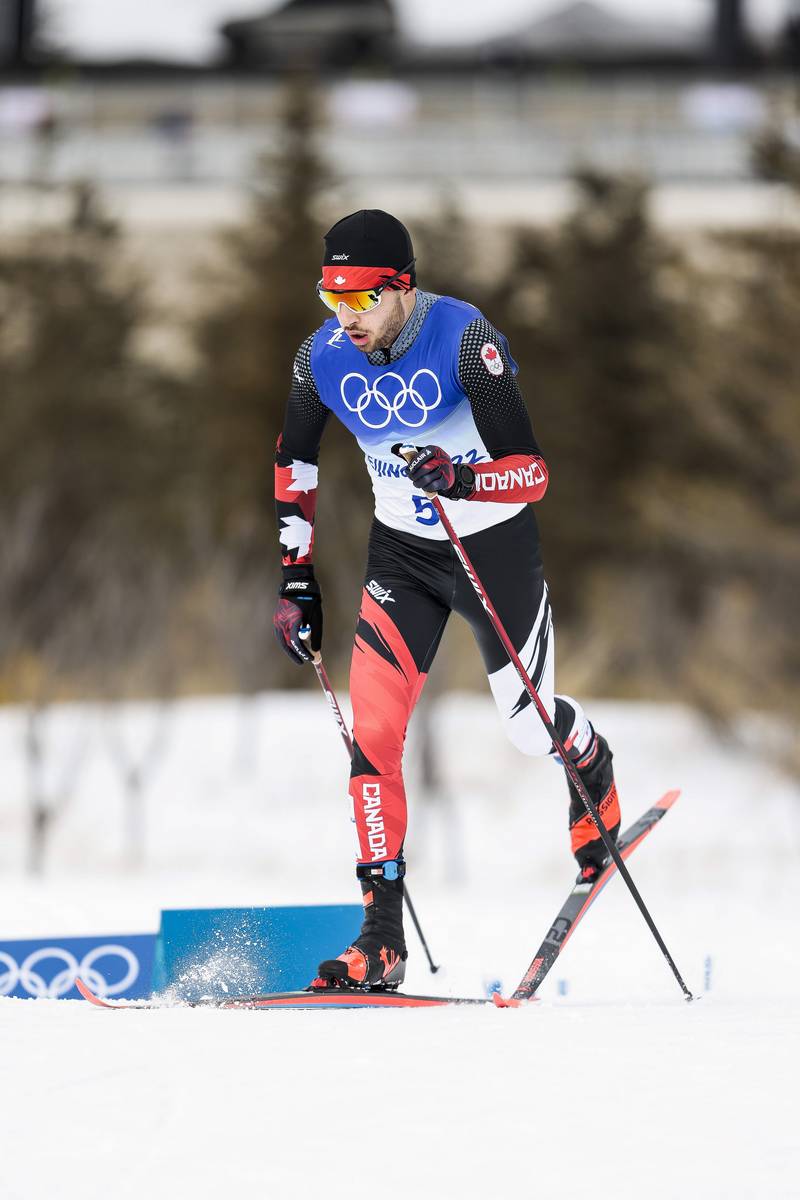
    Let’s get back to Xavier McKeever, Olivier Léveillé, Thomas Stephen, and Remi Drolet; starting in bib 11 for Canada. It clicked today for this group. Good skis? Surely. Inspired by their U.S. neighbors? Perhaps. Stoked by their on-site talisman Devon Kershaw (in Germany to coach)? Does that need an answer?

    No matter how you spin it, this was the race of the day. Certainly unexpected, and certainly deserved for a program rebounding from low funding and in the midst of a rebuild.

    At the 10 k mark, Italy, at 30.8 seconds behind the U.S., was trailed by Norway, Switzerland, Canada, and France — all within roughly seven seconds. That five team pack moved together through the final tag off at 15 k. Glued together through 16.8 k, only Norway fell off the pace. 1.5 k later, and it was Italy’s turn to feel the burn, as they fell off too. 

    That left Canada and Switzerland 10 seconds ahead of the now trailing Italians. By the time the next k had clicked by, Drolet, who was coming off a stellar fourth in the junior men’s 30 k mass start skate, made it real: he gapped the Swiss by 20 seconds. 

    It’s worth mentioning again – Canada in second overall, 35.5 seconds off the winning pace. The Italians rebounded as the Swiss fell back. Italy took third (+55.4), the Swiss placed fourth (+1:34.4).

    “This is absolutely incredible,” Drolet said to Nordiq Canada after the race. “We were so stoked to start this race, and we told ourselves last night we are going to go for the medal today. This is one of the best, if not the best, World Juniors for a Canadian team in terms of results. Knowing everyone on the relay team had a top-30 at the Championships we knew this was doable.”

    Adding his own poetry to the historic relay for Canada, “People don’t really understand what went down today, but it is insane,” Kershaw told Nordiq Canada.

    Junior Men’s Relay Results 

  • Schumacher Wins World Junior’s 10 k Classic; Ogden 9th, Jager 10th (With Audio Interview)

    Schumacher Wins World Junior’s 10 k Classic; Ogden 9th, Jager 10th (With Audio Interview)

    The weight is heavy. Pressure from expectations that can cripple or tap into even more primal motivation. Gus Schumacher (U.S./AWS), after qualifying first, and bowing out on Saturday’s World Junior’s skate sprint in the semifinals, placed seventh overall. That is stout. But so is the person behind the results who possesses a killer instinct on the race course but by all accounts projects humility in the rest of his life. The impression is that this nineteen-year-old from Anchorage, Alaska is downright kind — understanding that the hardware won becomes hollow if the person behind the top-step glory is singularly focused on the self.

    Taking it. Gus Schumacher of the U.S. wins the World Junior’s 10 k classic. (Photo: Doug Stephen)

    Post-race interview with Gus Schumacher

    The time between Saturday’s sprint and Monday’s 10-kilometer interval start classic race must have been a liminal moment for the young skier. Schumacher is in Oberwiesenthal, Germany for podiums not the process of ruminating on what-if scenarios. The transition from not meeting his own benchmark of success on Saturday to channeling all that potential and kinetic energy down to the mitochondrial level was evident Monday as Schumacher won the 10 k classic in 26:31.7. 

    This was a close race that Schumacher, as the last of 103 starters, could chew on as the day’s fastest time split makers at 5 k in bib 102, Germany’s Friedrich Moch, and bib 103, Italy’s Davide Graz, set off before him. The German and Italian came through in first and second, respectively, at 5 k. Moch was 7.5 seconds up on Schumacher, Graz only 1.2 seconds faster. 

    The 10 k no-fuel-left rest phase for Gus Schumacher. (Photo: Doug Stephen)

    Schumacher closed down. By the finish, he had put 4.5 seconds into Moch in second overall and 6.7 seconds into Graz. Good young man, who also happens to be fast, wins a close race. 

    This is Schumacher’s first individual World Junior’s medal. He placed fourth last year at the Lahti World Junior Championships in the 30 k mass start classic. He also anchored the junior men’s winning 4 x 5 k relay for the U.S. at those championships. 

    The celebration continued for the U.S. with two other skiers in the top-10. Ben Ogden (UVM/SMST2) raced to ninth place (+49.8), and Luke Jager (U Utah/APU) 10th (+50.6). The fourth U.S. skier, Johnny Hagenbuch (SVSEF) notched 25th overall (+1:29.8). 

    Ben Ogden on his way to 9th place in the World Junior’s 10 k classic. (Photo: Doug Stephen)


    Luke Jager on his way to 10th in the World Junior’s 10 k classic. (Photo: Doug Stephen)

    Canada’s Xavier McKeever skied to 17th (+1:13.4), Remi Drolet 29th (+1:35.0), Olivier Léveillé 30th (+1:35), and Thomas Stephen 65th (+3:48.7). 

    Xavier McKeever of Canada, hips forward, on his way to 17th in the World Junior’s 10 k classic. (Photo: Doug Stephen)

    Results      

  • Ogden Sixth, Schumacher Seventh, Schoonmaker 13th for U.S. in Junior World’s Sprint

    Ogden Sixth, Schumacher Seventh, Schoonmaker 13th for U.S. in Junior World’s Sprint

    Junior men’s quarterfinal action: For the U.S. (l-r), Luke Jager, J.C. Schoonmaker, and Gus Schumacher. (Photo: Doug Stephen)

    The monochromatic backdrop during the junior women’s sprint was the persistent theme in Oberwiesenthal, Germany  — it bled right into the World  Junior men’s 1.3 k freestyle sprint. For U.S. fans, in particular, this first event of four for the junior men possessed an element of tension. The tension, for those that follow, was seeded last year with an unequivocal success story that was the U.S. junior men’s run at the 2019 Junior Worlds in Lahti, Finland. The final collective chapter there capped with the 4 x 5 k relay win. 

    Today, again, was full of promise, and perhaps the pressure that comes with being a known quantity – otherwise called podium favorites, at this year’s event.  

    The U.S. put three skiers into the top-11 during qualification: Gus Schumacher was first in 2:26.34, ben Ogden third (+1.13), and J.C. Schoonmaker 11th (+4.76). Slotting into 21st for the U.S. was Luke Jager (+6.42).

    Let’s start with Jager. He looked strong in the first quarterfinal, in which he was grouped with Schumacher and Schoonmaker. Leading into a short punchy hill, Jager appeared to lose his footing and tripped, coming to a standstill. He recovered to place fourth in the heat but was eliminated. Schumacher skirted by Jager when he stumbled and took the win. Schoonmaker was third and did not advance. 

    Ogden, in the fifth quarterfinal, cruised. He won by 2.32 seconds in earning his semifinal spot. 

    Ready. Set. Go. Ben Ogden (pink beanie), during the World Junior’s skate sprint. (Photo: Doug Stephen)


    Ben Ogden on quarterfinal’s cruise control. (Photo: Doug Stephen)

    In the first semi, Schumacher pushed from the back portion of the pack – never finding enough room to seize an opening. He came down the stretch positioning himself into third, 0.46 seconds back. However, in the slower of the two semis, he was unable to advance as a lucky loser.

    Ogden placed third in the second semi to take a lucky loser spot in the final. But Ogden, racing the fifth quarterfinal, and with a quick turnaround into the semis, ran on fumes in the final. He placed sixth in the final, 17.62 seconds off the winning pace of Norway’s Ansgar Evensen who won in 2:33.44. Switzerland’s Valerio Grond placed second (+2.32), and Germany’s Maxim Cervinka third (+3.21). 

    Norway’s Ansgar Evensen winning the World Junior’s skate sprint. (Photo: Doug Stephen)

    In the final standings, Ogden was 6th overall, Schumacher 7th, Schoonmaker 13th, and Jager 18th. A stout day collectively for the American foursome. 

    Canada’s Remi Drolet, a student at Harvard, began his day by qualifying 16th (+5.76). Drolet placed fifth in the third quarterfinal to finish 23rd overall. Also for Canada, Thomas Stephen finished 36th, Xavier McKeever 44th, and Olivier  Léveillé 49th.       

    Canada’s Remi Drolet, the day’s 16th fastest qualifier. (Photo: Doug Stephen)

    Junior Men’s Qualification | Junior Men’s Results | Junior Men’s Bracket 


  • MSA Trials Rundown: Classic Interval Starts

    MSA Trials Rundown: Classic Interval Starts

    Russell Kennedy (#46) caught Sam Hendry (#45) and Nicolas Beaulieu (#44) on his way to third place in the 15km. (Photo: Doug Stephen)
    Russell Kennedy (#46) caught Sam Hendry (#45) and Nicolas Beaulieu (#44) on his way to third place in the 15km. (Photo: Doug Stephen)

    Fresh snow greeted day two of the Mont Sainte-Anne Trials for the interval start classic. With athletes battling to qualify for U20/U23 World Championships in Oberwiesenthal, Germany and three separate World Cup trips (Falun/Scando Tour, Sprint Tour, Canmore), it was never going to be a simple matter of skier against the clock.

    Antoine Cyr rocking the NorAm leader's bib on the way to victory. (Photo: Doug Stephen)
    Antoine Cyr rocking the NorAm leader’s bib on the way to victory. (Photo: Doug Stephen)

    Racing started with the open men’s 15km on a 5km loop that was shared by all the elite categories. Early on, it looked like a tight four way battle, but CNEPH’s Antoine Cyr, starting last, was 14 seconds ahead after the first lap. Cyr was fastest on all three laps to win in 40:05.1, 47.5 seconds ahead of Fondeurs Laurentides’ Ricardo Izquierdo-Bernier and 51.6 ahead of Canmore’s Russell Kennedy. Cyr should be selected for U23’s based on this win. In the interview posted below, he talks about his relief to know that his form is still good after a disappointing first World Cup in Europe.

    The U20 and U18 men raced 10km  and once again Black Jack’s Rémi Drolet displayed that full time students can be competitive, as he won both laps to finish in 26:46.2. CNEPH’s Olivier Léveillé took advantage of a late start bib to narrowly beat ULLR’s Xavier McKeever, finishing at 35.4 and 39.1 seconds respectively. This result combined with Thursday’s sprint should see both Léveillé and McKeever selected for U20 Worlds.

    Olivier Léveillé took second place and pencilled his name on a ticket to Oberwiesenthal. (Photo: Doug Stephen)
    Olivier Léveillé took second place and penciled his name on a ticket to Oberwiesenthal. (Photo: Doug Stephen)

    (Drolet’s post-race interview starts with the punchline to a joke, but without the setup we miss the laugh.)

    In the women’s 10km, Emily Nishikawa continued the theme of winning every lap on her way to a clear victory in 29:51.2. CNEPH’s Cendrine Browne showed that her recovery is going well with a strong second place in her less-favoured technique, finishing 48.7 back. Laval University’s Andrée-Anne Théberge completed the podium, 2:04.7 back.

    Emily Nishikawa on a mission. (Photo: Doug Stephen)
    Emily Nishikawa on a mission. (Photo: Doug Stephen)

    AWCA’s Annika Richardson was 4th at 2:15.4 to take the top U23 finish and what should be a selection for U23 Worlds.

    By the time the U20 and U18 women headed out, the tracks were showing some wear, but that didn’t stop Black Jack’s Molly Miller from winning the 5km in 15:24.8, 10.9 seconds ahead of teammate Jasmine Drolet, and 11.0 ahead of Revelstoke’s Beth Granstrom. Revelstoke also took fourth with Alexandra Luxmoore at 11.1 seconds, only 0.2 seconds away from silver.

    Molly Miller attacking the 5km classic at MSA Trials. (Photo: Doug Stephen)
    Molly Miller attacking the 5km classic at MSA Trials. (Photo: Doug Stephen)

    Black Jack defended their club’s reputation for developing young skiers with three U20 wins so far this weekend. Revelstoke is also starting to make waves with yesterday’s winner Elizabeth Elliott 11th today at 47.6 seconds. With 86 U20 and U18 men and 72 U20 and U18 women competing today, the future of Canadian skiing is starting to look brighter.

    Sunday’s free technique mass starts should be exciting, with the U20 and Open categories merged so the younger athletes can measure themselves against the top seniors.

    Results: Full Weekend (including live timing for Sunday), Interval Start Classic

    Photographer Doug Stephen has a new gallery for Saturday. Athletes are welcome to download and use full resolution images if they give credit to ‘Doug Stephen’ or @vr45photography.