Tag: Olympic 30 k

  • Inside the hardest race of Diggins’ life: a unique post-30 k interview with FasterSkier in Zhangjiakou

    Inside the hardest race of Diggins’ life: a unique post-30 k interview with FasterSkier in Zhangjiakou

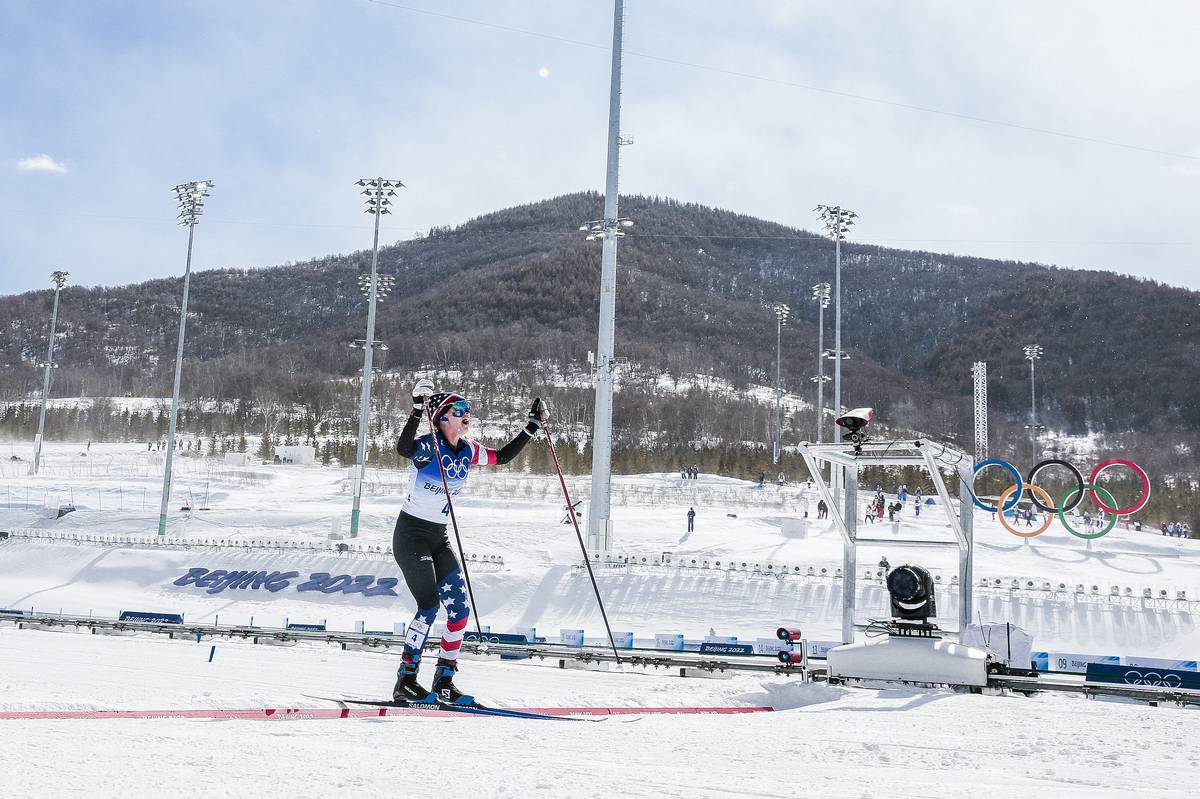
    Diggins takes silver in the women’s 30 k skate. A bout with food poisoning 24 hours before her final Olympic race set the stage for what she later described as “one of the hardest things I’ve ever done.” (Photo: NordicFocus)

    On February 20th, Jessie Diggins made Olympic history yet again, taking second in the 30 k mass start skate to round out the colors of her medal collection. Gold in the freestyle team sprint in 2018, silver in the 30 k skate, and bronze in the individual skate sprint.

    Now thirty years old, Diggins is the most successful American cross country skier in Olympic history. She has spent over a decade rising to the top of American and international ski racing, elevating those around her as she reaches for goals that make us lose sight of the fact that the American women’s cross country program was only reinstated with funding in 2006. 

    There are currently thirty-nine pages of articles tagged with Diggins name on the FasterSkier archives, detailing the many steps forward, and backward, she has taken in her career, transforming her into the athlete, role model, and spokesperson she is today.

    Her first tagged appearance was on January 25th, 2010 amid coverage of the Junior World Ski Championships in Hinterzarten, Germany. Both Diggins and Sophie Caldwell (now Hamilton) raced in the quarterfinals of the 1 k freestyle sprint that day, where Diggins crashed and ultimately finished 26th.

    50 meters into her quarterfinal here, Jessie Diggins found herself on the ground, seeing stars,” wrote one of FasterSkier’s young reporters, Nat Herz.

    Perhaps it is fitting that 12 years later, following the press conference for Diggins’ Olympic silver medal, it was Herz who caught Diggins as she left, creating the opportunity for this unique interview. The following has been lightly edited for clarity and to account for the extreme wind at the venue, which significantly impaired the audio in a few places.
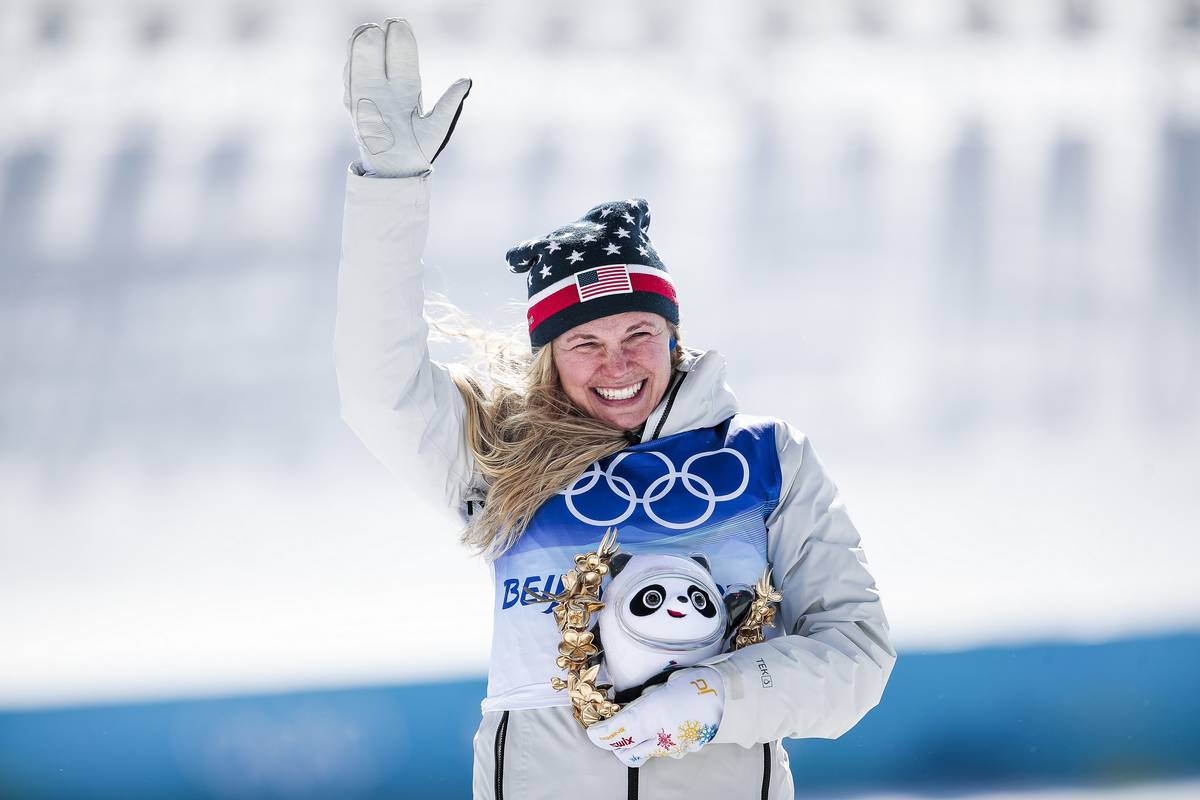
    Jessie Diggins earns an Olympic silver medal in the women’s 30 k mass start skate. (Photo: NordicFocus)

    Nat Herz / FasterSkier: How are you feeling?

    Jessie Diggins: Honestly, I’m feeling okay now. I haven’t felt that bad at the finish of a race maybe ever. It was a little scary. I couldn’t really walk. But also I’m not surprised, because like 24 hours ago I felt pretty awful too. It’s been a wild, wild last 48 hours. 

    ***

    Following the race, Diggins had shared with the media that came down with food poisoning the day before the race, leaving her unsure whether she would be able to line up for the final Olympic event, and if she did, what amount of fight would be left in her body.

    Elaborating on what it had been like to cross the line in second place after this experience, Diggins said she felt “disbelief” and that mentally, she had been preparing herself to accept whatever outcome the day would behold. “You’ve had a great time [at these Games] and just do what you can to take care of yourself.”

    Diggins continued by explaining the support she received leading into the race that allowed her to keep herself in the positive headspace she needed to perform.

    JD: I had a great talk with my sport psychologist, my fiancé, and with my parents. They reminded me that this — the weather, the wind, it’s just like skiing at Giant’s Ridge in Minnesota when I was a kid. You know, I’m just gonna go out there and ski because I love to race and [we’ll] see what happens. My mom reminded me last night, ‘You don’t have to decide right now. Wait. Just see how you feel once you’re actually racing. And then see how you feel in another 5 k and another 5k. You don’t know right now and that’s okay.’ So I went from like, ‘Wow, this is not the race prep I envisioned’, like laying in bed force feeding myself oatmeal and soup from a can. I was really proud of the amount of sport drink I consumed… and I was just like, ‘Okay, we’re just gonna see what happens out there.’ And I just wanted to race because I love to race. 
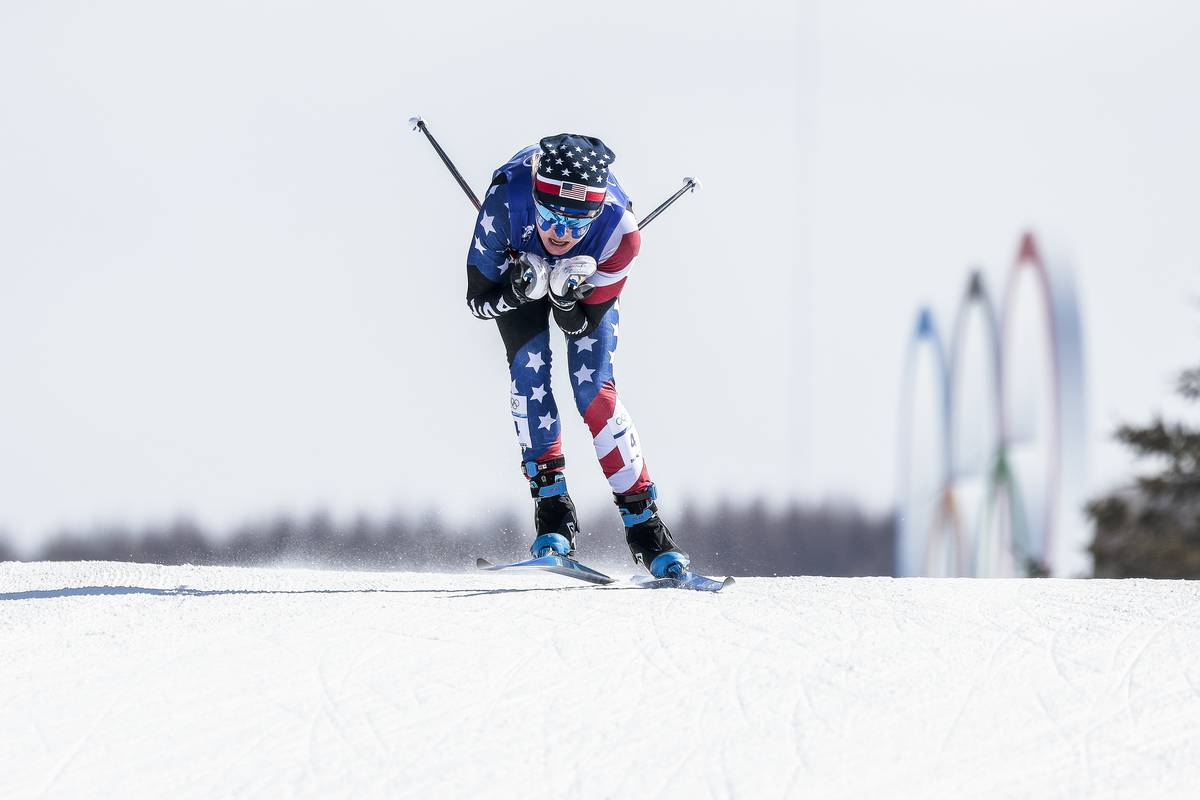
    Jessie Diggins fights through food poisoning-induced cramps to win a silver medal in the 30 k skate. (Photo: NordicFocus)

    How she would feel while racing became apparent early. Diggins explained that by 12 or 13 k, her body was already beginning to fight against her efforts. 

    JD: I just kept trying to keep down some sugar and then my left knee started cramping and then my right quads and my left quads and my left hip. I tried to keep telling myself ‘Use your arms, use your arms.’

    Grateful for the distraction and encouragement as she endured the pain of racing in that state, she expressed her gratitude from the support she received from the sidelines.

    JD: I think we had like all of US Biathlon out there. The whole ski team was out there, all the techs. I mean, Oleg was cheering on the last lap, ‘We’re proud of you!’ And I was like, ‘I’m gonna cry.’ That was the coolest thing. Pretty much every other country also started cheering for me, and so I felt like the whole world was helping me get up those hills when my legs were just spasming and going numb. And I just kept thinking, ‘I’ve got to keep pushing as hard as I can, because at any point — what if my legs give out? I can’t back down. I can’t let up on this pace. I just have to keep going.’

    FS: I imagine you were kind of on this seesaw between, ‘I’m in a medal winning position and I could fall over at any time…

    JD: I was trying very hard to not think about that, and just think about using my arms, using my head — what I mean by that is like, I’d come over the top and it’s really windy, and I’m like, ‘Okay, I’m just going to doublepole.’ Or, ‘I’m gonna hold this tuck longer.’ Because it was the sustained climbs where I started to really cramp, so I kept thinking like, ‘Okay, I gotta ski as smart as I can, and be really thoughtful about where I use my legs and where I use my arms.’ Which is funny, because normally, I’m a legs skier, so that was a funny flip for me. I tried not to let myself think about a medal, because I had to stay focused on getting through the race, and not let myself think about anything else.
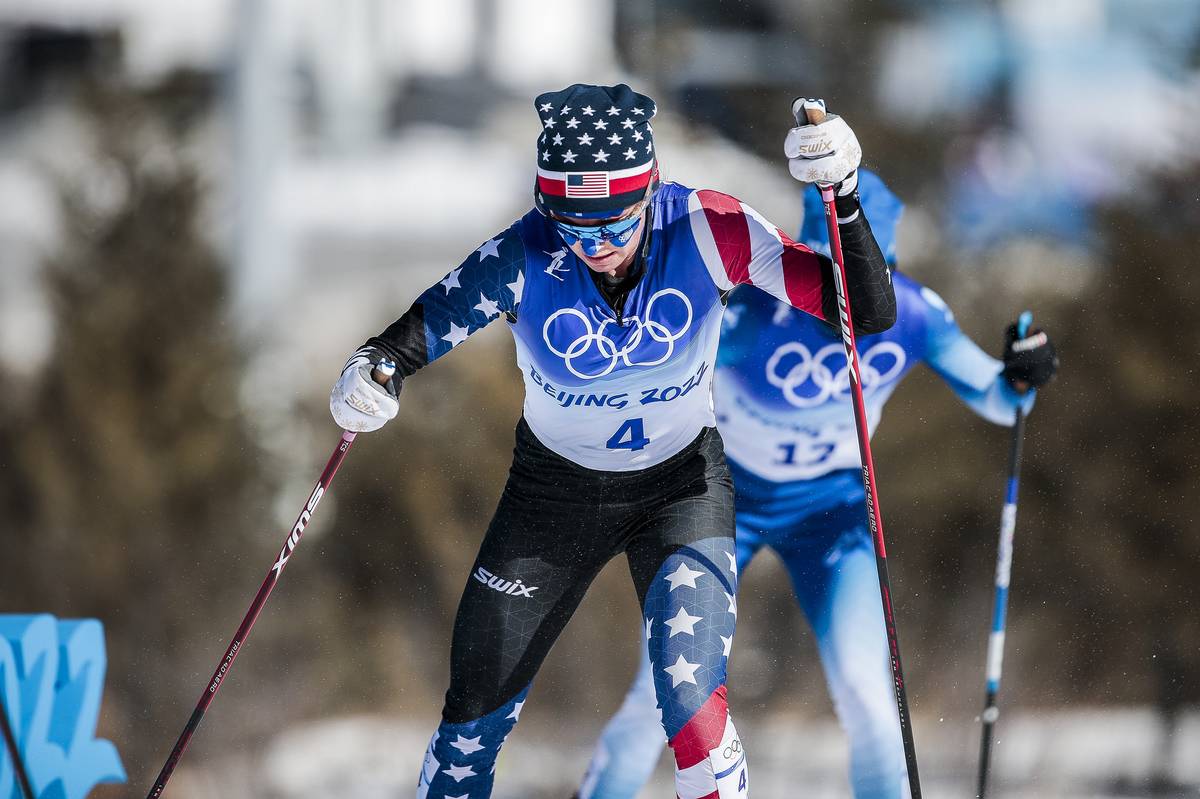
    Jessie Diggins pushes through food poisoning to win a silver medal in the 30 k mass start skate. (Photo: NordicFocus)

    FS: When you think about the amount of pride you’re gonna feel in finishing that race the way that you did, when you’re ultimately able to look back on that, would you say this would rank up there in your catalog of things you’ve had to suffer through?

    JD: I think that might have been the hardest thing I’ve ever done in my life. It might be.  Finishing the Tour de Ski this year was also very hard, but that’s why I did it. 

    I told myself last night, nothing will probably feel harder than being actively sick and finishing that final climb. I’ve prepped for this. My head is tough as it is ever going to get, and I need that right now. And I’m grateful for all those super hard training sessions and all those super hard races where I finished, without being able to feel my legs at all because in the middle of the race [today], when my legs were spasming and I couldn’t really feel them, I was like, ‘This is not new.’ Unfortunately, which is probably medically concerning. But this is not a new thing for me, and so I know I can survive this. 
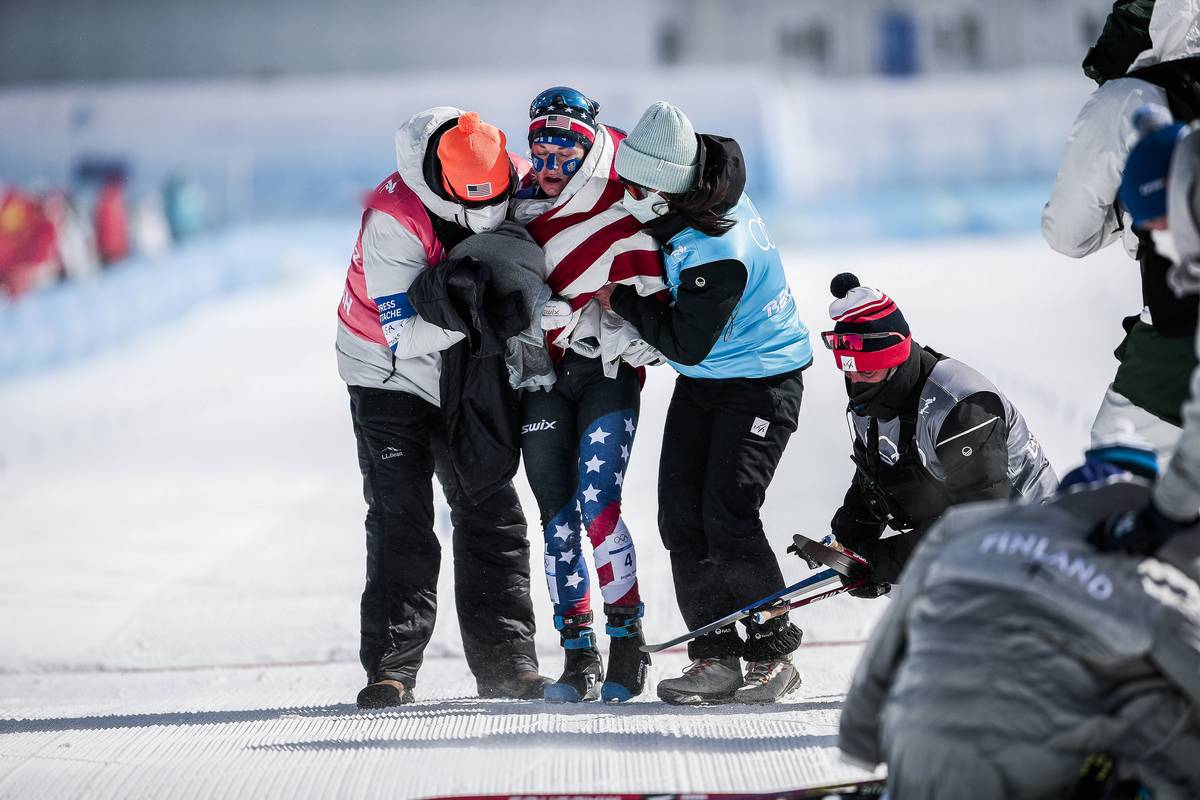
    After collapsing at the finish line, Diggins is helped off the course following the Olympic 30 k skate, where she pushed through food poisoning to earn a silver medal. (Photo: NordicFocus)

    The other prominent storyline of the day was that Rosie Brennan knocked on the door of an Olympic medal yet again, perhaps helping Kerttu Niskanen of Finland to bronze, only to walk away empty handed herself in sixth place. Brennan had been fourth in the freestyle sprint the week before, and had tagged off to Diggins in third place after her final lap of the classic team sprint where the Americans finished fifth. 

    It was perhaps not altogether a very different Olympic experience from Diggins’ in PyeongChang in 2018, where she took fifth in two individual races, sixth in another, and seventh in the last. In the 10 k skate, Diggins fifth place meant she was the first woman not to earn a medal, as Marit Bjørgen (NOR) and Krista Pärmäkoski (FIN) had tied for third.  

    FS: When you think about Rosie’s results today, and here, just overall. Is there anything you would want to say about that, because you’ve sort of similar positions — fourth places, tough spots.

    JD: I do know how that feels, and I think it’s so important to remember that nobody gets to say if that was a good race or not but Rosie. Nobody gets to judge. Nobody gets to criticize. She’s the one who gets to define what success looks like. And personally, I’m just so proud of her. I mean, the Olympics is an emotional roller coaster. And she rode it with grace, and as a good teammate, and looked out for other people. She’s just been amazing. And to me, she found success in every definition that matters.

    FS: If you were Rosie, would you be proud of your races? 

    JD: Yeah, I would. Because when I was fourth [in the 10 k skate in PyeongChang], or fifth because of the tie, I was proud. When you give it everything you have in a race, you can and you should be proud. And I think that’s that. 

    Rosie Brennan works against the lead while leading a chase pack during the 30 k skate, which included eventual bronze medal winner Kerttu Niskanen. (Photo: NordicFocus)
  • Bjørgen Racks Up Third Gold in Sochi; Norwegian Women Complete 30 k Sweep

    Bjørgen Racks Up Third Gold in Sochi; Norwegian Women Complete 30 k Sweep

    Marit Bjørgen celebrates a 2.6-second victory over Norwegian teammate Therese Johaug in Saturday's 30 k freestyle mass start, the last women's race of the Sochi Olympics.
    Marit Bjørgen celebrates a 2.6-second victory over Norwegian teammate Therese Johaug in Saturday’s 30 k freestyle mass start, the last women’s race of the Sochi Olympics.

    FasterSkier’s coverage is made possible through the generous support of Swix.

    KRASNAYA POLYANA, Russia — Wouldn’t it have been fun to be a fly on the wall, or on the headband of one of the three Norwegian women leading the Olympic 30-kilometer freestyle mass start on Saturday?

    The dialogue between Marit Bjørgen, Therese Johaug and Kristin Størmer Steira throughout the three-lap race must’ve been interesting. Who called the shots? Who decided when to lead when? Who directed the charge?

    Then again, it sounded like it was fairly straightforward and a matter of executing a plan that didn’t really need verbal cues. With the three skiing alone for the last 20 k of the race, it was basically like a long training session. If anything, the chatter was probably conversational.

    After Johaug led early out of the start, the Norwegians’ defining break came at the end of the first 10 k loop. They had already put some time into the women behind them up the unrelenting 2.5 k climb back to the stadium. There, they stuck with their team plan and skipped the first of two possible ski changes. Sweden’s Charlotte Kalla in fourth followed Johaug, Steira and Bjørgen, respectively, just under 5 seconds back.

    A full lap later, Kalla was down to 31st, two and a half minutes back behind Bjørgen. No one else was close to the Norwegian trio; Eva Vrabcova-Nyvltova of the Czech Republic led the chase 50 seconds back.

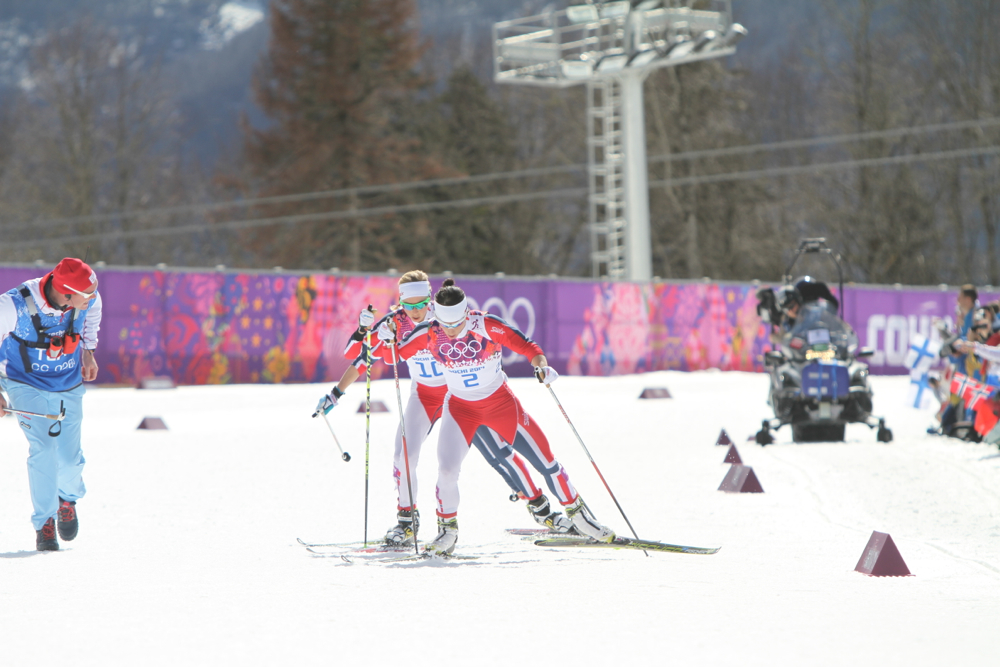
    Norway's Marit Bjørgen leads teammates Kristin Størmer Steira (10) and Therese Johaug (not shown) up one of the steep climbs in the 30 k freestyle mass start on Saturday, the final women's race of the 2014 Sochi Olympics. Bjørgen won by 2.6 seconds over Johaug in second, and 23.6 seconds ahead of Steira in third.
    Norway’s Marit Bjørgen leads teammates Kristin Størmer Steira (10) and Therese Johaug (behind) up one of the steep climbs in the 30 k freestyle mass start on Saturday, the final women’s race of the 2014 Sochi Olympics, while Norwegian women’s sprint coach Roar Hjelmeset runs along side them. Bjørgen won by 2.6 seconds over Johaug in second, and 23.6 seconds ahead of Steira in third.

    “We have a plan to go as a team the first 20 [kilometers] and after that they have to go for each other,” Norwegian women’s coach Egil Kristiansen said afterward.

    According to Johaug and Steira, they had also been instructed to change skis before the final 10 k. They made the executive decision not to, fearing what some 30 seconds in the transition area would cost them.

    “Me and Therese decided not to change skis; I think Marit was a bit more insecure,” Steira said in a press conference. “She was in the stadium looking around and she was thinking, if I do the ski change then the other two won’t. We talked about it and got some messages from coaches around 15, 17 k and they told us to change the skis and we were like, ‘No, no we’re not doing it!’ ”

    Bjørgen, the well-established queen of cross-country skiing, went with the consensus. Unlike teams like the U.S., which switched to fresh skis at both 10 and 20 k, the Norwegians wore the same pair from start to finish.

    The plan worked as they finished nearly a minute ahead of anyone else, with Finland’s Kerttu Niskanen closing hard at the front of the 11-person chase pack and edging Vrabcova-Nyvletova by 0.2 seconds for fourth.

    Aside from who would win the race for fourth, the top story of the day materialized in the last few hundred meters of the final climb. Johaug led up the long hill from the lowest point of the course a few kilometers before the finish. Bjørgen sat in second and Steira started to waver in third, allowing some daylight between her and the other two for the first time in the entire race.

    Up to that point, the three had generally skied single file on the tails of one another, taking feeds simultaneously and even chatting when the terrain allowed.

    Now, Johaug was starting to push. The sense was that Bjørgen would make a move; where was the question.

    The 33-year-old Bjørgen, who had already notched two Olympic golds in Sochi, charged over the top of the steep hill before the finish, passing Johaug and immediately gapping her on the downhill.

    Johaug, 25, chased her down into the finishing lanes, which ended with a horseshoe-shaped loop and false flat that was actually slightly uphill. Bjørgen took the victory by 2.6 seconds over Johaug with a winning time of 1:11.05.2. Steira finished 23.6 seconds after Bjørgen for bronze, her first individual Olympic medal.

    “I’ve tried so many times and I finally succeeded,” Steira, 32, told reporters. “It’s amazing. … It’s been a lot of hard work, but also a lot of fun. [I was] smiling all the way, but when I crossed the finish line, I felt emotional.”

    It was Norway’s first Winter Olympics medal sweep since 1994, and 12th overall in the history of the Games.

    For Bjørgen, the gold was her sixth, adding to her total Olympic haul of 10 medals, which made her the most successful woman in Winter Olympics history. She equaled the total gold medals won by former Russian speed skater Lidia Skoblikova and former cross-country skier Lyubov Ivanovna Yegorova, also from Russia, and tied former nordic skiers Stefania Belmondo of Italy and Russia’s Raisa Smetanina for 10 Olympic medals.

    But her ratio of six golds, three silvers and one bronze beats them all.

    “I am not thinking about how many medals I have,” Bjørgen said in a press conference. “This year, for sure this 30 k has been motivation for me. I am really happy … with my teammates also … it’s very good for our teammates. I think when I’m finished skiing I can think about how many medals I have.”

    While she plans to compete through the 2015 World Championships in Falun, Sweden, Bjørgen said this Olympics will likely be her last.

    “I think in four years is a long time, and I’m not getting younger,” she said. “I’m also thinking to have a family. I was also thinking to compete in Falun and we’ll see after that. … It’s hard to sit here and say what I will do in four years.”

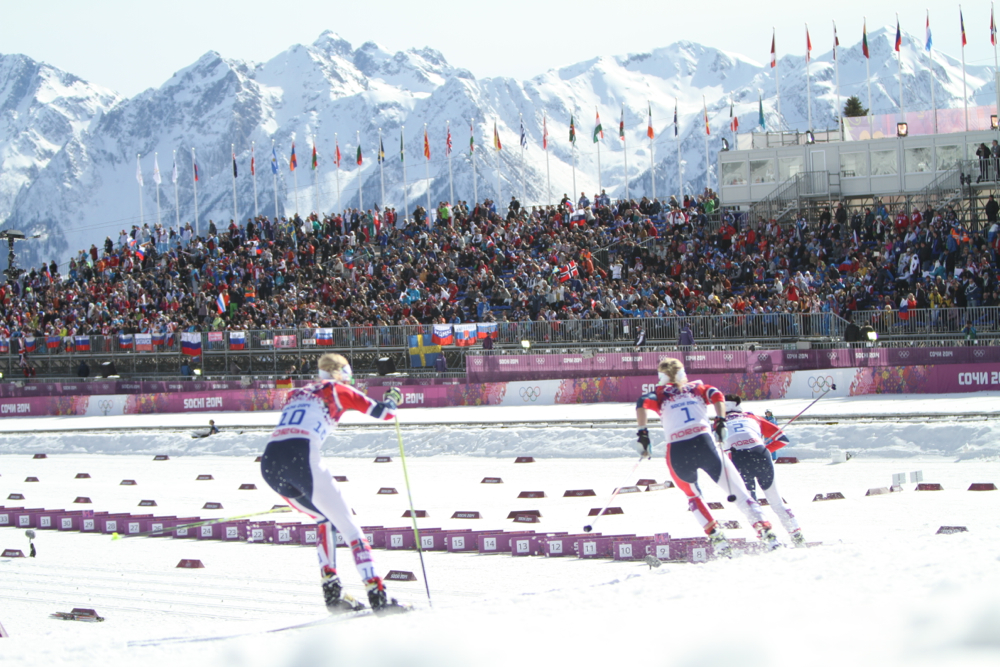
    Marit Bjørgen leads Norwegian teammates Therese Johaug and Kristin Størmer Steira into the stadium during the 30 k freestyle mass start, the last women's race of the Sochi Olympics.
    Marit Bjørgen leads Norwegian teammates Therese Johaug and Kristin Størmer Steira into the stadium during the 30 k freestyle mass start, the last women’s race of the Sochi Olympics.

    Johaug notched her best individual finish at the Olympics and second medal at these Games (after bronze in the 10 k classic). Four years ago, she and the Norwegian women’s team won gold in the 4 x 5 k relay. This year they placed fifth behind Sweden, Finland, Germany, and France, respectively.

    “We knew we were stronger than that,” Johaug told reporters.

    As for her own race, Johaug knew an attack was coming from Bjørgen, who’s typically stronger than her on the flats. While Johaug’s strength is climbing, she said her legs seized a bit on the last hill.

    “I know that Marit is really strong in the last hill and she had a lot of power,” Johaug said. “I tried to do my best, but she was better than me today. … I’m really happy with my second place, but what I’m most happy for is we are three girls in the top three. It’s a big day for my team and for Norway.”

    It was also the final women’s cross-country race of the Olympics, and it left Bjørgen with as many golds as she accumulated in Vancouver. At those 2010 Games, she was second in the 30 k classic and won gold in the classic sprint, 15 k skiathlon, and relay. This year, she defended her skiathlon title, then went on to win the team sprint with Ingvild Flugstad Østberg, and finally the 30 k.

    “It’s incredible,” she said. “This has been a goal for me for a long time.”

    Despite skiing in eighth through 12.5 k, Poland’s Justyna Kowalczyk pulled out of the race after someone apparently accidentally kicked her broken foot.

    “Immediately after starting I got a minor collision with another skier,” the 10 k classic Olympic champion, Kowalczyk told Poland’s TVP, according to a translation. She had received injections in her foot before her races in Sochi to numb the pain. But on Saturday, someone’s ski hit her in a part of it that wasn’t numb.

    “Eventually I got so much pain that I could not continue,” she said.

    While Kowalczyk has declined to elaborate on when she plans to retire, she’s said this is her last Olympics.

    “I am very upset,” she told TVP. “It was not how I wanted my Olympic career to end.”

    Germany’s Nicole Fessel and Bulgaria’s Teodora Malcheva also did not finish.

    As for Kalla, who ended up 34th, her Swedish teammate said the result was not unexpected after she had been “lying in bed” sick for the last few days, according to EuroSport. Aftonbladet reported that she had a cold.

    Finnish head coach Magnar Dalen said his team was “very happy” with fourth.

    “Norway had a very strong team with four skiers, and one of them had a bad day and three had a good day, so then the medals was gone,” he said, referring to Norway’s fourth woman Heidi Weng in 19th. “Then we was winning the league number 2, so we’re happy about that.”

    “That is not an abnormal … high altitude, hard track, skating race,” he said of the Norwegian sweep. “It was just sad that Charlotte Kalla had been sick and was not able to fight with them.”

    “It’s nice to see them skiing, helping each other, working as a team and building up the distance to the others,” Swiss head coach Guri Hetland said. “It’s impressive, and it’s impressive what Marit does. I think it’s her 18th gold medal in championships or Olympics. So that’s amazing. For them, it’s normal. They are training together, they are pushing it, and that’s also the reason why they are so strong.”

    Østberg said her teammates have been “really focused since the relay, trying not to think about the skis.” Ultimately the Norwegian team went out on a high note, along with its waxing staff.

    “At some point [we knew] they would figure out what to do with the skis,” Østberg said.

    — Nat Herz and Chelsea Little contributed reporting

     Results