From the FasterSkier archive — posts syndicated from athletes’ and coaches’ own blogs between 2004 and 2012, kept online as published. Current coverage is at fasterskier.com.
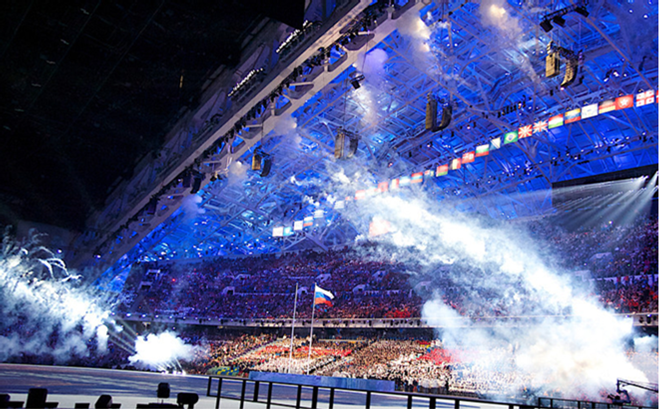
A scene from the Opening Ceremony of the 2014 Winter Olympic Games in Sochi, Russia. (Photo: Wikimedia Commons)
A full Olympic quad after Sochi, nothing remains irrefutably clean. Off the radar then on again, the Sochi doping scandal has sent recent tremors through the sports world.
In a quick summary, after the 2014 Winter Olympics in Sochi, Russia, the host nation was handed sanctions for the 2016 Rio Summer Olympics that affected some of its athletes. A total ban from Rio was not enacted despite the World Anti-Doping Agency (WADA) recommending the contrary. Russian athletes competed under the Russian flag.
At the 2018 Winter Olympics in PyeongChang, South Korea, the International Olympic Committee (IOC) handed down a fiercer sanction. Russia as an official team and its Olympic delegation were banned from the Games, as were athletes suspected of taking part in the Sochi affair.
Russian winter athletes without any ties to the scandal competed under the IOC’s neutral flag as the Olympic Athletes from Russia (OAR).
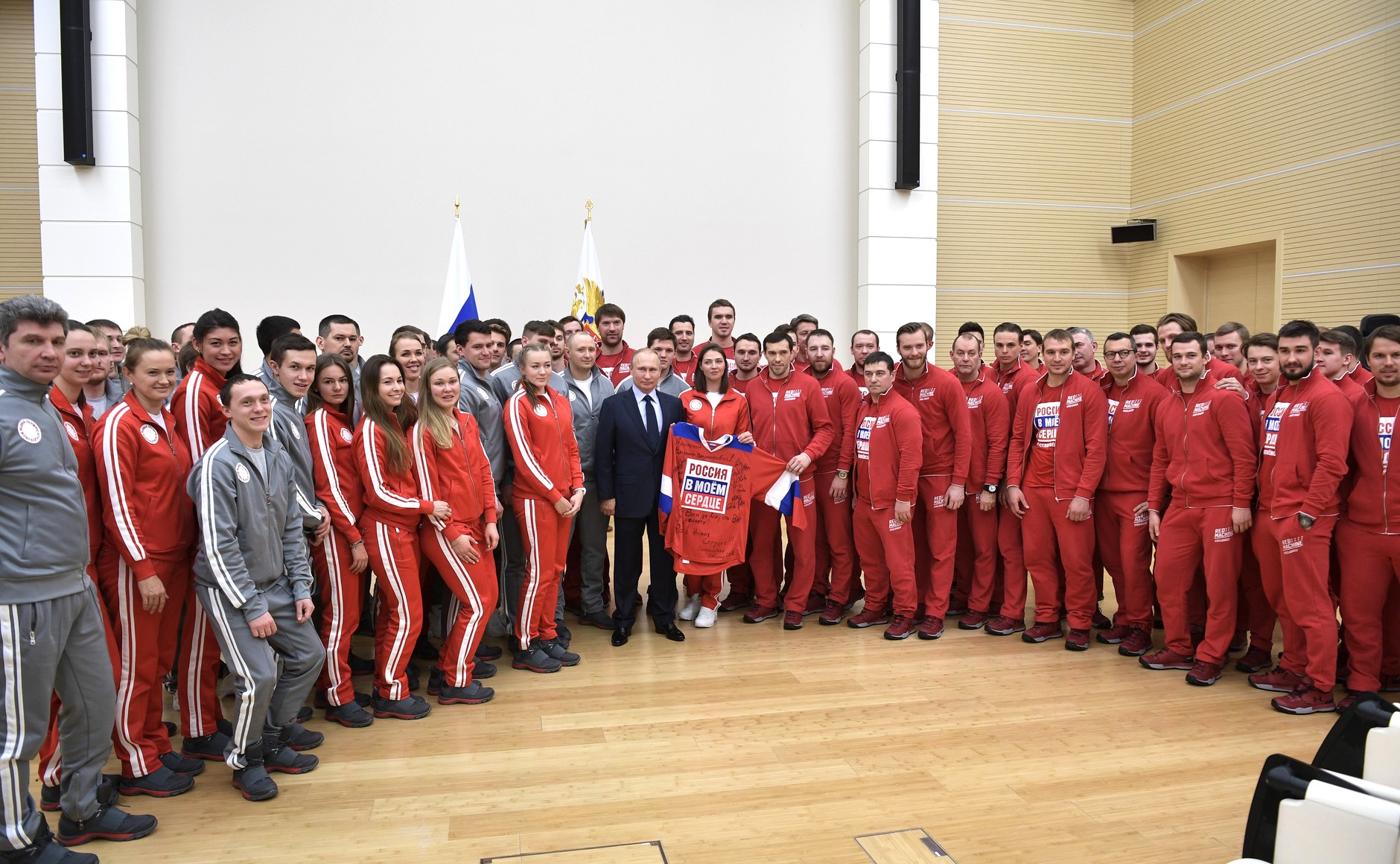
Russian President Vladimir Putin with Russia’s 2018 Olympians prior to the Games on Jan. 31, 2018. (Photo: Wikipedia)
At the 2018 Games, OAR cross-country athletes were on-form. They were repeated medalists, fast and collectively young.
Today (Thursday, Sept. 20), it was the WADA’s turn to take another stance. During a meeting in Seychelles, the WADA Executive Committee (EC) voted to reinstate the Russian Anti-Doping Agency (RUSADA).
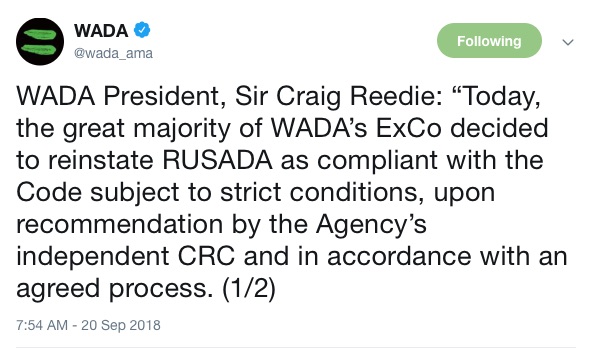
WADA announced the decision via Twitter. In the two-part tweet, WADA President Sir Craig Reedie stated, “Today, the great majority of WADA’s ExCo decided to reinstate RUSADA as compliant with the Code subject to strict conditions, upon recommendation by the Agency’s independent CRC and in accordance with an agreed process.
“This decision provides a clear timeline by which WADA must be given access to the former Moscow laboratory data and samples with a clear commitment by the ExCo that should this timeline not be met, it would support the CRC’s recommendation to reinstate non-compliance.”
For reasons already exhaustively documented, RUSADA was deemed non-compliant in November 2015. By August 2017, WADA had created a concrete outline of concessions and reforms known as the RUSADA: Roadmap to Compliance.
The roadmap reads like a hardened list of demands. In Part I of the document, WADA notes 20 actions already taken by RUSADA as conditions for reinstatement as a compliant anti-doping agency. Part II details 12 steps that remained unfulfilled at the time of the roadmap’s release. Much of those 12 steps begin with the words “RUSADA must”. Last week, it became public that much of WADA’s leadership have a malleable understanding of the word “must”.
Here’s the basic background to understanding how WADA’s Sept. 20 EC vote transpired:
Two critical conditions set forth in the RUSADA roadmap remained unmet by Russia as of Sept. 20, 2018. Russia has not officially accepted the McLaren Report findings and has not provided WADA with unmanipulated digital forensic data or unfettered access to RUSADA’s Moscow lab.
Starting this summer, it was time for WADA and RUSADA to think about a resolution.
In a letter obtained by the BBC dated June 22, 2018, signed by Reedie and WADA Director General Olivier Niggli, the two responded to a recent overture from Russian Minister of Sport Pavel Kolobkov. The letter clarified how WADA would be willing to move forward in negotiating Russia’s reinstatement.
Kolobkov’s response did not mention the McLaren Report commissioned by WADA, but it did acknowledge the IOC’s 2017 Schmid Report (the IOC investigation into the McLaren Report’s findings). But no overt guilt was admitted in the letter. Instead, it made a tepid hint at conciliation. According to the letter, the Russian Federation “fully accepted the decision of the IOC Executive Board on December 5, 2017, that was made based on the findings of the Schmid Report.”
The main body of Kolobkov’s letter establishes a quid pro quo. It states that only after RUSADA is reinstated, and with the consent of the Russia Investigative Committee, Russia will provide access to its lab and data. Kolobkov provides no timeline for when Russia would provide these two key provisions after reinstatement.
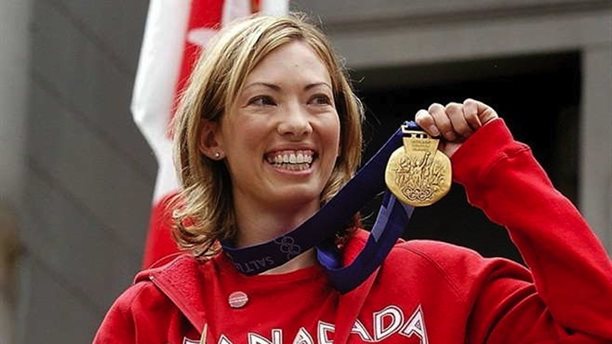
Beckie Scott with the gold medal she was awarded at a ceremony in Vancouver in June 2004. A former Canadian cross-country skier, Scott finished third in the 5 k pursuit at the 2002 Olympics but was later awarded gold when the two women ahead of her were disqualified for using performance-enhancing drugs. (Photo: Cross Country Canada)
On Sept. 14, only a day after Kolobkov’s letter, WADA’s Compliance Review Committee (CRC) approved RUSADA’s reinstatement. A member of the CRC, Beckie Scott, a former Canadian cross-country skier and Olympic gold medalist, resigned her position last week in protest of the pending reinstatement. Scott remains the Chair of WADA’s Athlete Commission.
In an interview with the CBC on Thursday following the official decision, Scott said she was “profoundly disappointed”.
“I feel that this was an opportunity for WADA as the global body responsible for regulating doping in sport and responsible for the rights of clean athletes has really dealt a devastating blow to clean athletes with this decision and I’m quite dismayed with the way things went today,” she continued.
“With WADA’s sudden shift in position raising questions about its transparency and about where its loyalties lie, we must begin the journey of returning trust to the system, enhancing WADA and creating a system fit for the next generations of athletes,” Moses wrote. “Having spoken to athletes, I know they overwhelmingly support the right decision being made in the Seychelles — they overwhelmingly support WADA’s sticking to its road map. This was not the time, they say, for the global antidoping body to perform the U-turn of all U-turns.”
The U.S. Olympic Committee (USOC) issued a press release echoing sentiments to instill faith in the anti-doping system.
“We hope that WADA can reach a conclusion on RUSADA that will give athletes a firm belief that when they compete, it will be on a level playing field, without any doubts,” it stated. “Anything that stops short of satisfying that will not only be a huge disappointment to the USOC and American athletes, but to the entire Olympic and Paralympic movements.”
But according to Reedie, Russia’s reinstatement is key to progress WADA’s worldwide mission.
“It’s my convinced view that the best thing WADA can do is to have an efficient and well-operated anti-doping system in Russia, and we’ve been trying to do that for two years,” he told the BBC. “This moves things forward.”
“To sit back and do nothing doesn’t serve the world of sport so I think progress has been made,” Reedie added. “To the members of the Ukad, athletes’ commission, I am grateful to them for their advice and can be reassured that I take their advice and I operate within the roadmap.”
One WADA EC member, Linda Helleland, Norway’s sport minister and vice president of WADA as she represents national governments on the EC, declared herself a “no” vote prior to today’s meeting.
FasterSkier will update this story with any new developments.
Finland’s Iivo Niskanen after winning the men’s 50 k classic mass start at the 2018 Winter Olympics in PyeongChang, South Korea. (Photo: FlyingPointRoad)
PYEONGCHANG, South Korea — Sun, clouds, fog, and snow. At the Alpensia Cross-Country Skiing Center on Saturday, the men’s 50-kilometer classic mass start transpired like a 50 k should. There was the break-the-pack pace from the start. There was the hard-man up front trying for a solo break. Of course there were chasers: one of whom blew up and faded and another that latched on for a silver-medal ride. And eventually there was a group of four that closed in on a single medal that eventually left three athletes unsatisfied. This was solid Olympic 50 k racing.
For Finland’s 26-year-old Iivo Niskanen, the plan worked. Burning through the 68 other starters began right away. As the 2 p.m. unfettered sun warmed the tracks, the kilometers ticked off with the favorites coalescing in the front. They included Martin Johnsrud Sundby of Norway, Kazakhstan’s Alexey Poltoranin, Alex Harvey of Canada, and the Olympic Athletes from Russia’s (we’ll just call them Russians) Alexander Bolshunov — a 21-year-old star of the Games, if you’re a medal counter (with two silvers and a bronze before Saturday’s race).
This is the 50 k classic, a race usually suited for the well-established and the well-conditioned. This was Niskanen’s day.
The switch flipped at 17.5 k when the Finn was set to fly. Sundby skied 1.4 seconds back, Poltoranin +2.3, Russia’s Alexey Chervotkin +3.4, Bolshunov +4.3, Russia’s Andrey Larkov +5.4, Norway’s Hans Christer Holund +5.7, and Harvey +6.0. These were the names that topped the course’s time checks.
Bold. Daring. Tempting fate. All these words could describe the noticeable uptick in effort from Niskanen at 22.36 k that cracked the field. Unike the tale of the frog in boiling water unaware of it’s slow demise — Niskanen’s pacing shakedown was abrupt. Although not exactly a punch of effort, there was no subtlety to it.
Passing through 27.2 k, Bolshunov trailed the Niskanen-Poltoranin duo by 20.9 seconds. Niskanen soldiered as the consummate soloist except Poltoranin was velcroed on. A look to the side here, another look to the side there from Niskanen could not convince Poltoranin to take a pull up front.
Norway’s Niklas Dyrhaug leads a mass of skiers during the men’s 50 k classic mass start on Saturday at the 2018 Olympics in PyeongChang, Sourth Korea. (Photo: FlyingPointRoad)
A second and third plot line developed behind. Bolshunov surged. Sundby, Holund and Harvey solidified into a core that would slowly bleed time to the leaders. In their own eventual fight for bronze, Harvey’s group fended off every racer except for Russians Larkov and Chervotkin.
Up ahead, Bolshunov flaunted his 21-year-old verve. There was no stage fright. He caught, passed, and gapped Poltoranin. At 33.32 k, only Bolshunov could muster the fight and locked in on Niskanen. As much as Bolshunov was the 50 k’s yin at this point, Poltoranin was its yang. His valiant chase of Niskanen early on smudged out by his crash and burn. Poltoranin was eventually caught by the Harvey group and finished 15th (+5:15.0).
Late in the race, the temps had cooled below freezing and flurries fell. The sun-to-cloud swap also came with a fog bank reminiscent of March in Holmenkollen. Through the stadium at 37.5 k, neither Niskanen nor Bolshunov exchanged skis. Again, like with Poltoranin, Niskanen pulled up slightly. Bolshunov wouldn’t take the invite. He continued drafting the Finn.
Finland’s Iivo Niskanen leads Alexander Bolshunov of the Olympic Athletes from Russia during the men’s 50 k classic mass start at the 2018 Olympics in PyeongChang, South Korea. (Photo: FlyingPointRoad)
That dynamic changed as Bolshunov led down the sweeping turn into the stadium area around 40 k. With the Russian 0.6 seconds ahead, Niskanen changed into his third pair of skis for the day, taking advantage of his ability to swap skis twice during the race. (This is important and we’ll come back to this point: Bolshunov exchanged skis only once.)
With Niskanen’s gear swap and Bolshinov’s power-double-pole, the Russian led out of the stadium.
“I saw the gap appear,” Niskanen said in the post-race press conference. “There’s is no penalty loop like in a normal exchange area — often there is an extra meters when you are going to change skis. So of course, it’s a guess about the dirty snow, and here the snow is so dirty that it’s a big difference between fresh and old skis.”
Niskanen gambled. So, too, did Bolshunov. Eleven seconds opened as they both rolled the dice. This was not, as it first appeared, a gold-medal move for Bolshunov. Less than two kilometers later, Niskanen was there to taunt Bolshunov with noticeably faster skis.
“I could catch him quite easily,” Niskanen recalled. “Then the only tactical plan was to wait and wait and use better skis when it is possible and the best place to use them.”
The best place was the final headwall. The body worked. The skis flew. Niskanen won the 50 k in 2:08:22.1 as he pulled away from Bolshunov in the race’s closing moments. A dejected Bolshunov earned his fourth medal of the 2018 Games (after silver in the relay and team sprint, and bronze in the individual classic sprint) placing second, 18.7 seconds back.
A medal still hung out there for Larkov, Harvey, Sundby, and Holund. Like Niskanen on the final climb, Larkov stung the group first while Harvey and Sundby punched too late. Larkov took bronze, 2:37.5 minutes behind Niskanen. Harvey shut down Sundby on the final stretch to secure fourth (+2:43.6). and Sundby placed fifth (+2:43.7).
The Russians were first to the press conference. Through an interpreter, Bolshunov hinted at his frustration at being so close to gold.
“Obviously I am a little bit disappointed because I could have won this race,” Bolshunov said. “There was a small problem that affected my result.”
Norway’s Martin Johnsrud Sundby leads Finland’s Iivo Niskanen (8), Kazakhstan’s Alexey Poltoranin (behind Niskanen), and Canada’s Alex Harvey (2) early in the men’s 50 k classic mass start at the 2018 Olympics in PyeongChang, South Korea. (Photo: FlyingPointRoad)
That small problem, Bolshunov clarified, were his skis. “Basically the small problem was with the fact that it got much colder and the skis were not as slippery as they should have been. So my result was affected,” he said.
Larkov, too, said his skis were off. “Basically just like my teammate I am also a little bit disappointed,” Larkov, 28, said. “I had some problems with my skis because the weather got colder as we were racing and I had to change my skis. After I changed skis I thought I basically I had no chance but I managed to get to third place.”
Bolshunov and Larkov were the only two skiers in the top 31 to swap skis once. Every other racer took the two allowed ski exchanges. (Four other skiers total among the finishers changed skis a single time.)
Bolshunov entered the optional ski exchange area slightly ahead of Niskanen when the Finn swapped at 40 k. Asked by FasterSkier why he chose to ski on, Bolshunov claimed he wasn’t in position.
“Basically I was on the right and I was not in the right position to change the skis,” Bolshunov said. “I would have changed them but I could not do it in time, so I had to go on like that.”
During the press conference, neither Niskanen nor the Russians acknowledged each other. After learning that the Russians blamed skis as their demise and Niskanen’s gift, the gold-medal winner tried to set the record straight as he and Bolshunov share the same ski sponsor.
“Skis were really really good,” Niskanen said of his own planks. “Maybe you can see the reason here in the result list. The Russian guys have changed skis only once, but that has been their tactic. Also my tactic was to use third and second best pair at the beginning of the race and leave the best pair at the end. It’s the same series skis for me and one of them. We have brother pairs.”
Niskanen’s win was the first gold for Finland (across all sports) in PyeongChang. As the reigning 15 k classic world champion, Niskanen said that he has embraced a selective peaking strategy. For the last two years he has focused on two championship classic races: the 15 k in Lahti, and Saturday’s 50 k.
“Two years after Sochi, I trained so hard and tried to do too many things and have too much races and I got easily sick,” Niskanen said. “And then last two years I want to be the best shape at the right time. Maybe someday my main goal in the season is to win the World Cup overall, but last two years, the only goal has been one race because at the moment, I am so much better in classic. Everything, like the skiathlon [here], they have been preparation races for me to improve the shape.”
If the skiathlon was a training run for Niskanen, as he claimed, it worked. Yet his fortunes were much better Saturday. During the skiathlon, Niskanen strung out the field during the classic leg. He faded to finish in 19th. His hot start in the 50 k, Niskanen acknowledged, made for an anxious Finnish coach.
“Maybe my coach was a bit nervous to watch the race because I often start too hard too early,” Niskanen said. “This time I suffered well, but you just need to live the moment and play the game. If you don’t try you cannot win. This time I was the strongest man.”
The men’s Olympic 50 k classic podium in PyeongChang, South Korea, with (from left to right) Alexander Bolshunov (l) of the Olympic Athletes from Russia (OAR) in second, Finland’s Iivo Niskanen (c) in first, and Andrey Larkov (OAR) in third. (Photo: FlyingPointRoad)
The strongest man on Saturday was undeniably the strongest man. For the second consecutive Olympics, Russia has stepped onto the 50 k podium. With that comes the spectre of doping. Russia went 1-2-3 in the 50 k in Sochi amidst evidence later uncovered about state-sponsored doping. In PyeongChang the Olympic Athletes from Russia (OAR) went 2-3. With that, of course, comes questions. At the 2018 Winter Olympics, even with the increased scrutiny since Sochi, two Russian athletes have been flagged for doping: a curler and bobsledder.
“I don’t know if I can answer this question because I’m only starting to compete on this level,” Bolshunov, who was invited to these Olympics as an OAR athlete because he was not associated with the Sochi debacle, said when asked if he and his 2018 Olympic teammates have any affiliation with Sochi’s taint. “I cannot really compare what happened four years ago with the athletes that are here. I am my own man and they were their own team. So we just do the best we can and we move ahead.”
Johannes Høsflot Klæbo anchoring the Norwegian men’s 4 x 10 relay to gold on Sunday at the 2018 Olympics in PyeongChang, South Korea, while Denis Spitsov (background) celebrates silver for the Olympic Athletes for Russia. (Photo: FlyingPointRoad)
For a while in the men’s 4 x 10-kilometer relay on Sunday, it looked like the Russians might run away with the win. But that was just two classic legs and 20 k into the race, with a lot more racing to come.
While Kazakhstan’s Alexey Poltoranin had handed off in first at the first exchange, just ahead of Andrey Larkov of the Olympic Athletes from Russia, Italy, France and Norway skied together behind them, with Norway’s Didrik Tønseth trailing off the back, 18 seconds behind.
On the next classic leg, Russia’s Alexander Bolshunov put a hurt on the field. Within the first 3.3 k lap, he was 25 seconds ahead of Kazakhstan’s Yevgeniy Velichko in second, who was followed closely by Italy, Norway and France in third through fifth. Sweden’s Daniel Rickardsson had fallen farther behind to more than a minute back in sixth place, after his teammate Jens Burman lost contact with the lead group on the first leg.
By the second exchange, Russia was 24.5 seconds clear of second place, while Italy’s Francesco de Fabiani tagged Giandomenico Salvadori in second, France’s Maurice Manificat tagged Clement Parisse in third (+28.0), and Norway’s Martin Johnsrud Sundby tagged Simen Hegstad Krüger in fourth (+32.1). Kazakhstan’s Velichko had fallen off the pace and was another 19 seconds back in fifth.
Over the next 10 k, the first skate leg, Krüger and Parisse reeled in Russia’s Alexey Chervotkin, catching him before the end of their second lap. One lap later, Krüger came through the final exchange in first, tagging Johannes Høsflot Klæbo 0.4 seconds ahead of France in second. Chervotkin tagged Russia’s anchor Denis Spitsov in third, 16.2 seconds back, while Finland’s Matti Heikkinen passed Italy’s Salvadori on the last climb to put Finland in fourth (+58.6).
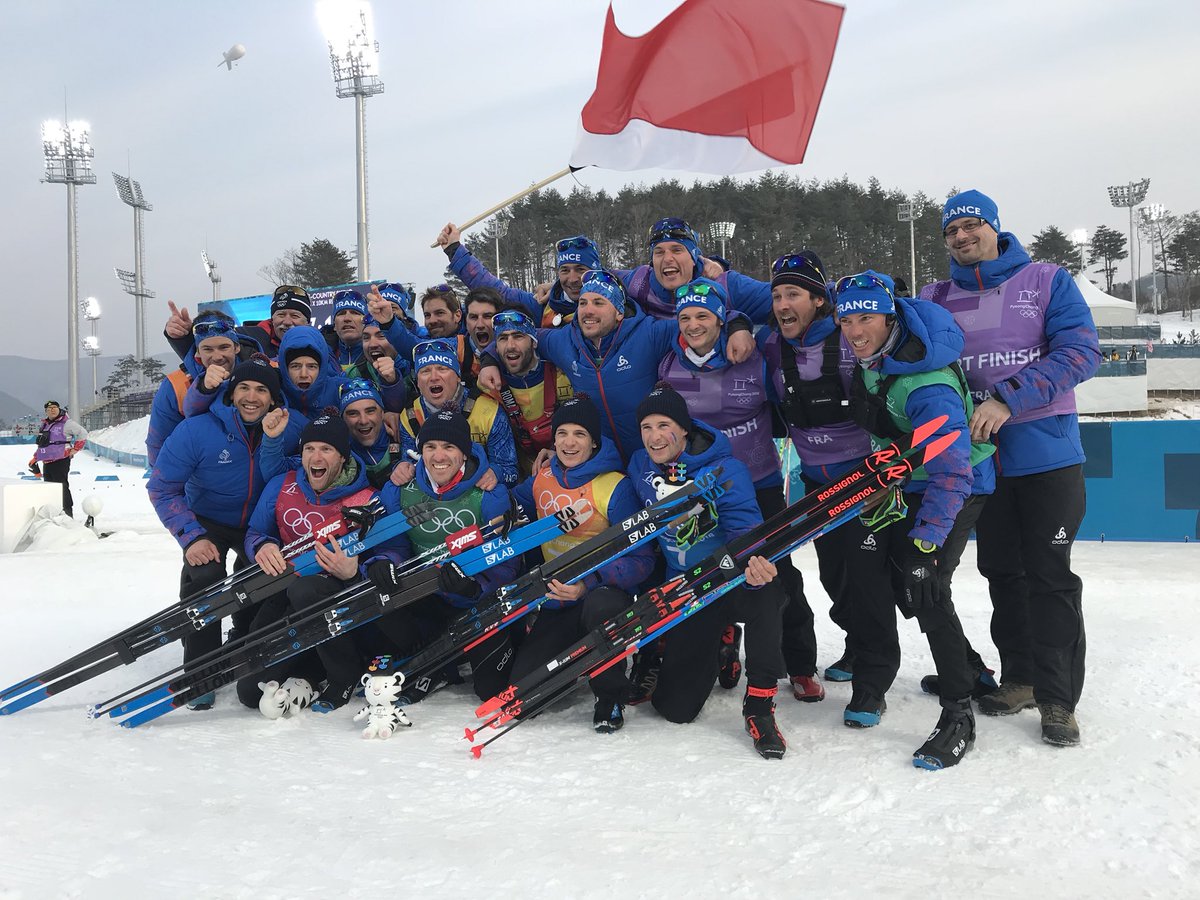
Team France celebrates its bronze-medal finish in the men’s 4 x 10 k relay at the 2018 Olympics on Sunday in PyeongChang, South Korea. (Photo: FIS Cross Country/Twitter)
Early in the final leg, France’s Adrien Backscheider took the lead ahead of Klæbo. The two held Spitsov off until the end of the second lap, where Spitsov came through the stadium first to start the final loop. Spitsov and Klæbo soon upped the pace, dropping Backscheider, and shortly after the 8.27 k checkpoint, Klæbo truly put the jets on to accelerate away from Spitsov. He dropped the Russian on a climb just before the final uphill, where it was clear that the gold was Norway’s.
As he sped down into the stadium, Klæbo relaxed his arms, skied to the sideline and took a flag from the stands. He looked back for a moment and then crossed the finish line first in 1:33:04.9 hours, while Spitsov followed 9.4 seconds later for silver for Russia. Backscheider held on for bronze (+36.9) as his team exuberantly celebrated with him at the finish.
Finland placed fourth (+1:40.5), Sweden fifth (+2:05.6), Germany sixth (+2:08.2), Italy seventh (+2:35.2), and Kazakhstan eighth (+3:31.4). Canada was ninth (+3:41.0) for its second-best Olympic relay result (with Len Valjas, Graeme Killick, Russell Kennedy, and Knute Johnsgaard), and the U.S. finished 14th (+9:24.2), out of 14 teams, with Andy Newell, Reese Hanneman, Scott Patterson, and Noah Hoffman.
France’s Martin Fourcade lunging for his second gold of the 2018 Olympics in PyeongChang, South Korea, winning the men’s 15 k mass start on Sunday. (Photo: FlyingPointRoad)
Martin Fourcade is the champion once again. Six days after he won the 12.5-kilometer pursuit for his first gold in PyeongChang, the 29-year-old Frenchman did it again in the men’s 15 k mass start on Sunday, winning in a photo finish at the line.
He took charge on the first loop, leading the field into the range for the first prone shooting. There, Fourcade shot a penalty and slipped to 19th, but it wasn’t over.
Clean shooting on the second prone brought him up to eighth, 9.4 seconds out of first. Germany’s Benedikt Doll took that lead at that point after his second stage without a miss. Meanwhile Norway’s Johannes Thingnes Bø shot three misses on that second stage and dropped out of contention.
One loop later, Fourcade moved into first with a clean standing. He left the range about 1 second ahead of Germany’s Simon Schempp and 2 seconds ahead of Germany’s Erik Lesser, after both made it through the first three stages without a miss. Doll missed one to slip to seventh, almost 30 seconds behind.
After Fourcade and Schempp exchanged leads over the next loop, Lesser moved into first just before the final shooing, Going head to head, Fourcade and Schempp both missed one while Lesser missed two. Fourcade and Schempp still left the range in first and second, respectively, separated by 0.4 seconds, while Lesser slipped to fifth, 22.5 seconds back.
Doll left the range in third (+19.2) after cleaning and Norway’s Emil Hegle Svendsen moved into fourth (+21.9) with a clean standing stage as well.
In the end, Fourcade outlunged Schempp for the win in 35:47.3 minutes, with Schempp finishing less than a tenth of a second behind for silver, and Svendsen beat out Lesser in the finishing stretch by 0.4 seconds to claim bronze, 11.2 seconds behind, while Lesser settled for fourth (+11.6). Doll followed them in fifth (+18.8), Austria’s Julian Eberhard placed sixth (+30.7) with three penalties, Norway’s Erlend Bjøntegaard seventh (+32.1) with two misses, Norway’s Tarjei Bø eighth (+34.6) with three penalties, Sweden’s Jesper Nelin ninth (+34.6) with two misses, and Slovenia’s Jakov Fak 10th (+36.1), just ahead of the Czech Republic’s Ondřej Moravec in 11th (+36.3), with one miss each.
So many suits — The start of the women’s 15 k skiathlon on Saturday, Feb. 10, Day 1 of the 2018 Winter Olympics in PyeongChang, South Korea. (Photo: FlyingPointRoad)
PYEONGCHANG, South Korea — This time last week, we brought you the basics of Olympic cross-country and biathlon cheat sheet, and not long after, we received a comment from a reader asking for a uniform cheat sheet. We, too, found ourselves sometimes befuddled. During Saturday’s skiathlon, this reporter found himself looking for the emblematic stars on the U.S. Ski Team’s new unis. There were stars, think Diggins and Kalla, just no obvious stellar-like branding on the USST suits.
So for you and for us, here’s a basic cross-country race suit cheat sheet. Disclaimer: we do nordic here at FasterSkier. Which is saying fashion and nordic are often mutually exclusive. Sometimes we do fashion (right FBD?), but not really. For more fashion expertise here’s a site that popped up when googling “most famous New York fashion writer”. Back to race suits.
Sweden: Out with the all-whites and in with the mostly royal-blue tights. The blue is emphasized on the thighs and blends into yellow knee-highlights, which in turn blends into white on the lower leg. Blue, yellow, white is all Sweden. Here’s Sweden’s own Charlotte Kalla racing to second in Thursday’s 10 k skate.
Sweden’s Charlotte Kalla racing to second place in the women’s 10 k skate at the 2018 Winter Games in PyeongChang, South Korea. (Photo:FlyingPointRoad)
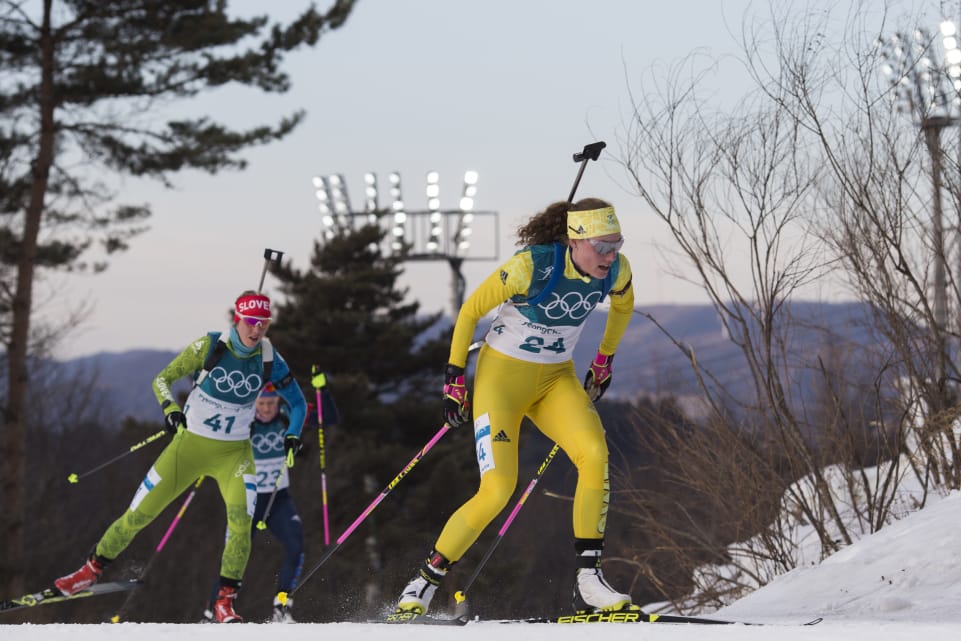
Sweden’s biathlon race suits epitomize reductionism. In other words — K.I.S.S. — as in, keep it simple, Sweden. Our wish is their command. Two words to help identify Sweden on the biathlon range or tracks. Canary yellow. Thank you Sweden.
Sweden’s Hanna Öberg on her way to a gold medal in the women’s 15 k individual at the 2018 Olympics in PyeongChang, South Korea. Öberg skied the sixth-fastest time and shot 20/20. (Photo: IBU/Biathlonworld.com)
Finland: Every day is a new day. A positive outlook works wonders in the tough-to-win sport of World Cup skiing. Finland’s Krista Pärmäkoski is positive and owning it in Finland’s lycra whites. Yes, there’s navy blue on the forearms and just below the patella, but if you can kill in mostly white, you can kill on the ski course. That’s evidenced by Pärmäkoski’s arm raise: positive vibes and she’s in for the bronze. (Note: if Pärmäkoski is skiing away from you, the Finland suits emphasize blue on the backside.
Finland’s Krista Pärmäkoski crosses the line for bronze in the 2018 Olympic women’s skiathlon. (Photo: FlyingPointRoad)
You’ll have to look past Canada’s Rosanna Crawford and zero in on Finland’s Mari Laukkanen in bib 22 to burn the Finn’s biathlon uniform into the synapses. Finland’s biathlon unis do the flag proud. It’s a zippy look that takes the essentials into play: blue and white. Certainly less white and more blue than their cross-country brethren. For the feisty Finns — they dealt with invading Soviets in winter of 1939 — we say it works.
Fashionably crushing it, Canada’s Rosanna Crawford (bib 22) in the 7.5 k sprint in PyeongChang. Finland’s Mari Laukkanen (bib 21) skis behind Crawford. (Photo: FlyingPointRoad)
France: We’re sticking with countries that begin with the letter F. C’est la vie. But we’ll go a little crazy and start with France’s biathlon garb. Why is that? Because of Martin Fourcade — the French force of biathlon. He shoots like a veritable post-doc in Jedi-studies and skis like he could crush the 15 k skate on the cross-country World Cup. France’s biathlon suits get jazzy in a sky blue kind of way on the lower leg. And just when you get complacent with all the blue tones, the right arm gets proud in red. You should get to know this suit, Fourcade is likely to rule these Games; he’s already won the men’s 10 k pursuit.
France’s Martin Fourcade defending his Olympic gold from four years ago on Monday in the men’s 12.5 k pursuit at the 2018 Olympics in PyeongChang, South Korea. (Photo: FlyingPointRoad)
France also gets props for keeping it easy on spectators and viewers. If you’ve studied Fourcade’s race suit already, you’re all set. In the image below, France’s Jean-Marc Gaillard (9) proves our point. Biathlon or cross-country, the suits are the same.
Canada’s Alex Harvey (4) leading France’s Jean-Marc Gaillard (9) and Finland’s Iivo Niskanen (8) during the skate leg of the men’s 30 k skiathlon at the 2018 Olympics in PyeongChang, South Korea. Harvey went on to finish eighth. (Photo: FlyingPointRoad)
Norway: It’s Norway after all. Nothing too drastic here, and certainly we’re imagining athletes will have several colors schemes to choose from at a later date. For now, the new kind of looks like the old. Which when consulting fashion guides, retro can be cool — think the resurgence of L.L. Bean’s duck boots or those Greg-Lemond-era Oakleys that Harvey has rocked.
OK, the cross-country suits. Here’s Norway’s race wear as worn by Heidi Weng (bib 1) and Ingvild Flugstad Østberg (bib 2) during Saturday’s skiathlon. The easy thing about trying to identify the Norwegians in a deep field cross-country scrum: look towards the sharp end of the race. Most often in the lead pack you’ll see a predominately red-suited athlete pushing the pace. Yeah, that’s probably Norway. (That said, deference to Canada’s Harvey, we want to get our red suits straight. We’ll get to the maple leaf in a bit, but in the case of Canada just think a different shade of red, because Harvey is a front-pack skier. Big respect for Harvey in red.)
The start of the women’s 15 k skiathlon on Saturday, Day 1 of the 2018 Winter Olympics, with (front row, from left to right) Austria’s Teresa Stadlober, Norway’s Ingvild Flugstad Østberg, Norway’s Heidi Weng, American Jessie Diggins, and Sweden’s Charlotte Kalla leading out of the stadium in PyeongChang, South Korea. (Photo: FlyingPointRoad)
Here’s a shot of Norway’s biathlon suit. Again, Norway has gone with reliable themes. Yet in this case, pin striping rules. There’s the red, the deep blue, and the white. The striping certainly gives it a more formal look as if to say “we’re here to shoot clean”.
Norwegian biathlete Erlend Bjøntegaard on his way to fifth in the men’s 10 k sprint. (Photo: FlyingPointRoad)
Canada: Why not? Let’s break down Canada’s race gear next. Nothing too crazy here on the XC side from our good friends up north that brought us Bob and Doug McKenzie and sort of Kenny G. (Officially, Kenny G. is American; he was born in Seattle. But his mom is from Saskatchewan. A loose connection, but only separated by one degree. And Seattle is super close to Vancouver.) Like the Norwegians’ cross-country race suit, this is a mostly red affair. But it rocks perhaps the most identifiable flora icon on the planet: the maple leaf. In our opinion, this suit is an instant classic. Maple-leaf patterns run down the length of the arms. Nothing too gaudy here. No fluorescent yellow, no overdoing it with the “Canada-ness” of it all. And there’s just the right amount of white lycra highlights to keep it sleek looking. If you’re looking to impress on the Olympic trails but be simultaneously understated, look no further than Canada. Here’s Alex Harvey racing to seventh, his best individual result in his third Olympics, in Friday’s 15 k skate:
Canada’s Alex Harvey racing to seventh in Friday’s 15 k freestyle at the 2018 Olympics in PyeongChang, South Korea. (Photo: FlyingPointRoad)
Under the bright lights of the Alpensia biathlon venue, Biathlon Canada got a wee bit friskier. Down the right arm you’ll note … wait for it … white maple leaves of varying sizes. Little known fact, at least to FS, “an infusion” of maple-tree bark can be used to treat cramps and dysentery. Any chance that infusion works on norovirus? Just asking.
Lots of digressions here. But this is for certain and maybe it’s a trickle-down effect of honoring the most beautiful autumn tree on the planet. Across the board, XC or biathlon, Canadian athletes are a delight to chat with. You parent-folk raise them well up north.
Canada’s Brendan Green en route to 82nd in the men’s 10 k sprint at the 2018 Olympics in PyeongChang, South Korea. (Photo: FlyingPointRoad)
The lower half of Canada’s biathlon unis are trending more towards what we have seen in the recent Canadian lycra past: bigger and badder maple leafs. A big white maple icon sits on the lower right leg, with a smaller slightly more delicate yet distinguished maple icon on the upper left thigh. There you have it. When in doubt, channel the red suit and the maple leaf and you’ll know it’s Canada at any of the nordic venues.
Canada’s Christian Gow racing to 62nd in the men’s 10 k sprint at the 2018 Olympics in PyeongChang, South Korea. (Photo: FlyingPointRoad)
U.S.A.: Jingoism = “extreme patriotism, especially in the form of aggressive or warlike foreign policy.” We are not jingoistic here at FasterSkier. Read Saturday’s skiathlon report and it’s clear we’re not jingoistic. The day’s winner Kalla — from Sweden — is given plenty of coverage. Yeah, Jessie Diggins killed, but Kalla was a force, too.
Jessie Diggins racing to fifth in the women’s 10 k skate for her third top-six (and second top-five) of the 2018 Olympics. (Photo: FlyingPointRoad)
So the good ole’ red-white-and-blue (r-w-b). That’s pretty much still the theme. Visually speaking, we think it’s a nice blend of the r-w-b trifecta. It’s mostly blue. And a cool blue at that. Again coolness reigns with the white downward slanting stripes running from the lower thigh to below the knee. Those stripes scream, “Scoreboard!” And the red on the arms? Awesome. And if you’re like this reporter looking around in the pack for the U.S. skiers, it helps to read the bold print on the right upper arm. Read: U.S.A.
American Noah Hoffman racing in the 15 k freestyle at the 2018 Olympics in PyeongChang, South Korea, where he finished 48th. (Photo: FlyingPointRoad)
Now to US Biathlon. For starters, the national governing body of biathlon in the U.S. is … US Biathlon. A totally different sporting body than U.S. Ski and Snowboard. And the uniforms on the biathlon side make that clear. There’s little cross-pollination like we see with the Canadian suits.
For awhile, U.S. Biathlon raced in suits with a distinct mix of blue and red. If you can harken back to elementary school art class, or if you’re in elementary school now, you’d have to pass this basic test to move onto more complex colors.
Test: How do you make purple. Yes! Mix red and blue together.
The older U.S. biathlon uniforms had a distinct purple hue on the bottom-half. The top was a tasteful strawberry red called into action by iconic Adidas striping down the arms. That purple hue is no longer. Get rid of that in your mind’s eye. We’re not even posting a photo of that older race suit. It’s so not now.
Want to know where Susan Dunklee or Lowell Bailey are? Look for uniforms that harness the “blue blazer” in all of us. First let’s zoom in. (See photo below). We note here that it’s not simply a solid-blue pattern. The hat, shoulders and upper torso host a maze of small deep blue “three-stripe” hash marks printed over a lighter bluebird blue. Since those appear on several team’s 2018 Olympic suits (like Sweden, Germany, and the Olympic Athletes from Russia), all of which were made by Adidas, we’re guessing it’s a nod to their uniform supplier? (You know, with the “threes” theme.) Nonetheless, the upper is mostly covered by the bib. And from a distance, as we zoom out, it simply looks blue. But before we do that, here’s Clare Egan — total badass polyglot; she speaks Korean — during the women’s sprint here in PyeongChang.
Clare Egan (US Biathlon) racing to 61st in the women’s 7.5 k sprint at the 2018 Olympics in PyeongChang, South Korea. (Photo: FlyingPointRoad)
Now for the zoom out. This shot is great for many reasons, so a shoutout to FlyingPointRoad guru Steve Fuller. Since we are talking colors here, let’s just continue the shout out to Steve. This photo kills because a Swedish skier follows Tim Burke in a canary yellow race suit. Blue and yellow are primary colors. The blue-Burke here stands out more as he’s contrasted by the yellow-Swede. Intentional or not Steve, well done.
Let’s focus on Tim Burke’s legs. That’s a solid royal blue, right? A basic blue, but a royal blue. There’s just no damn distractions from the business at hand here. Maybe the small USA on the left calf area is a nod to those fans still time-capsuled with Lake Placid’s 1980 gold-medal hockey team and the venerable announcer Al Michaels. That USA on the leg isn’t really yelling U.S.A!!! U.S.A!!! It’s sort of a kinder and gentler u.s.a. (no caps intentional). Like a whisper, saying we come in peace even though we’re charging hard with rifles on our backs. Back to the point. No distractions. #businesstime.
USA = basically blue. Look for the blue. That’s the U.S. biathlon team.
Tim Burke (US Biathlon) en route to 47th in the men’s 10 k sprint at the 2018 Olympics in PyeongChang, South Korea. (Photo: FlyingPointRoad)
Other notable suits:
Switzerland: From a country we all associate with Swiss-Army-Knife red, we get thrown a change up. It took us all a few seasons to get accquainted with the race-lycra formal wear donned by the Swiss cross-country team. Cross-country World Cups aren’t exactly formal occasions, but the tuxedo black suits the Swiss have worn for a few years now — a look you’d seek if you were on the race equivalent of a Georgetown cocktail circuit — are gone. The Swiss sport maroon suits with red highlights on the lower legs and arms.
(Note: These suits resemble Russia’s cross-country race suits on the World Cup. Alas, they also resemble Russia’s suits during the Games despite the fact that Russia’s skiers are competing under the Olympic flag as Olympic Athletes from Russia (OAR). See photo featuring Great Britain’s Andrew Musgrave — that’s Denis Spitsov of the OAR chasing, not a Swiss skier. It helps that the Swiss skiers wear hats reading “Suisse”.)
Switzerland’s Dario Cologna racing to gold in the men’s 15 k freestyle on Friday at the 2018 Olympics in PyeongChang, South Korea. (Photo: FlyingPointRoad)
Great Britain: From the people who brought us the modern navy … we get navy blue. Nothing says “we are not in your face” more than navy blue. Great Britain’s cross-country race suits are appropriately regal. Think the Queen, Lady Di, and the ever so cool and soon-to-be-in-line-for-the-throne, Meghan Markle. Also, Andrew Musgrave, as this reporter’s grandfather used to say, is the real McCoy. (The Scottish McCoy, not the Irish McCoy). It was a delight to watch the 2018 Olympic skiathlon unfold as a fly-on-the-wall surrounded by British journalists. Move over Chelsea. Move over Man-United. Yeah, that’s right. Musgrave is on your tails sporting navy blue lycra.
Britain’s Andrew Musgrave (10) during the men’s 30 k skiathlon in PyeongChang, South Korea, followed by Russia’s Denis Spitsov (16), skiing as a member of the Olympic Athletes from Russia. (Photo:FlyingPointRoad)
Italy: Ah Italia. They exported high fashion with the house of Gucci and they school us in the color wheel. First, Italy’s cross-country race suits feature a halcyon blue. A blue when blues sang like a pristine alpine sky and times were simpler. A time perhaps when you were finishing an altitude camp in Seiser Alm and all you had to worry about was visiting the physio for a rub-down and connecting for a post-training sesh espresso with the whos who of the World Cup … also finishing an altitude camp.
Second, we note orange. Orange is many things, but it does not scream Italy. However, we believe Italy is paying respect to its storied-art legacy by deferring to the color wheel — Italy’s suits have just a tad more than a splash of orange on the lower legs and lower arms. Blue and orange are complementary colors. That means they are opposite one another on the color wheel. Opposites attract. And if anything is attracting here, it’s Federico Pellegrino and his panache on the big stage. Dude can classic sprint, too. Here’s Pellegrino an eyeblink before crossing the line in the classic sprint final (he took silver).
Third, and this may be breaking news, Italy may have a one-off suit for Pellegrino. If you compare the below image with the one below that (behind American Caitlin Patterson, there’s an Italian skier, Sara Pellegrini), newsflash — no splash of orange. Absent the orange, the suit is identical to Pellegrino’s. ITA adorns the upper-left quad area on each suit. Italy’s biathlon team also wears the all-blue suit. Ciao for now.
Norway’s Johannes Høsflot Klæbo (l) and Italy’s Federico Pellegrino finishing first and second, respectively, in the first semifinal of the men’s 1.4-kilometer classic sprint at the 2018 Olympics in PyeongChang, South Korea. (Photo: FlyingPointRoad)American Caitlin Patterson leads Italy’s Sara Pellegrini (not to be confused with Pellegrino) into the finish of the women’s 15 k skiathlon at the 2018 Olympics. They finished 34th and 35th, respectively. (Photo: FlyingPointRoad)
Austria: What’s black and white and red allover? Austria. Across the board: cross-country, biathlon, and nordic combined, the uniforms are all the same. You’ll never not notice Austria.
Austria’s Dominik Landertinger racing to bronze in the men’s 20 k individual at the 2018 Olympics in PyeongChang, South Korea. (Photo: FlyingPointRoad)
Germany: Embracing their inner-Vader is Germany. Like the old Swiss race suits but taking black lycra to “11”. Germany. Add just a sprinkle of white around the shoulders to lighten the mood. The red hat emblazoned with the Bundesadler — the German federal eagle — is a fitting cap for their race wear. As badass as Clare Egan is speaking Korean (go back to U.S.A. for a refresher), the Bundesadler is nearly her avian iconography equivalent.
Germany’s Eric Frenzel (5) leads Austria’s Lukas Klapfer during the individual normal hill/10 k competition on Wednesday at the 2018 Olympics in PyeongChang, South Korea. Frenzel went on to win while Klapfer placed third. (Photo: FlyingPointRoad)
Germany’s cross-country, biathlon, and nordic combined teams share the same uniform.
Germany’s Laura Dahlmeier racing to her first Olympic gold (and first Olympic medal) on Saturday in the women’s 7.5 k sprint, the first biathlon race of the 2018 Winter Olympics in PyeongChang, South Korea. (Photo: FlyingPointRoad)
We couldn’t cover every team, so we’re aware we left more than a few out. Hopefully this leaves you feeling a little more in-the-know when it comes to Olympic XC and biathlon spectating. Onto the relays (and biathlon mass starts) we go!
***
A message from a Korean fan during the men’s 15 k freestyle on Friday at the 2018 Olympics in PyeongChang, South Korea. (Photo: FlyingPointRoad)A message from an unidentified spectator during the men’s 15 k freestyle on Friday at the 2018 Olympics in PyeongChang, South Korea. (Photo: FlyingPointRoad)
Switzerland’s Dario Cologna racing to gold in the men’s 15 k freestyle on Friday at the 2018 Olympics in PyeongChang, South Korea. (Photo: FlyingPointRoad)
PYEONGCHANG, South Korea — For Swiss skier Dario Cologna, the triptych that began in 2010 was bookended here in PyeongChang on Friday during the men’s Olympic 15-kilometer freestyle race at the Alpensia cross-country center. Cologna became the first cross-country skier in Olympic history to haul in three golds in a specific men’s event: the 15 k hammerfest.
It all started at the 2010 Winter Olympics in Vancouver, British Columbia, where Cologna won the 15 k skate. Four years later, in 2014 in Sochi, Russia, he won the 15 k classic (as well as the 30 k skiathlon). Then today, in PyeongChang, Cologna won the 15 k skate. It’s a three-chapter performance over eight years that illustrates one skier’s aptitude for longevity and the ability to remain relevant during a year when several young international skiing stars are emerging.
Switzerland’s Dario Cologna celebrates gold in the men’s 15 k freestyle on Friday at the 2018 Olympics in PyeongChang, South Korea. It was his third-straight Olympic win in the 15 k individual and his fourth Olympic gold after winning the skiathlon at the 2014 Games. (Photo: FlyingPointRoad)
The 31-year-old Cologna stopped the clock Friday in 33:43.9 minutes. The 68th starter, he bested the time of Sunday’s 30 k skiathlon gold medalist, Simen Hegstad Krüger of Norway (bib 60) by 18.3 seconds, for the win.
“It’s [an] amazing feeling to win a gold medal,” Cologna said in the post-race press conference. “It’s always a lot of hard work to be on top, and now three Olympics in a row to win this event it feels very good. And I am very happy and also proud to be back again on top, and to win this gold medal for Switzerland, it’s big emotions.”
“When you say it, it sounds crazy,” Krüger said of his two-medal Games thus far at the press conference. “I came here to the Olympics with a dream of maybe taking one individual medal, but to suddenly stand here with one gold medal and one silver medal after two competitions is an unbelievable feeling.”
Norway’s Simen Hegstad Krüger racing to silver, his second medal of the 2018 Olympics, on Friday in the men’s 15 k freestyle in PyeongChang, South Korea. (Photo: FlyingPointRoad)
Krüger, 24, added that his preferred race format is the individual start. Krüger pounced at the opportunity to race in the skiathlon, taking the field by surprise. But Friday was a different race puzzle for Krüger and it as a race he had marked as his best medal chance.
“In a mass start you have to be prepared for a lot of different scenarios and outcomes,” Krüger said. “But when it’s an individual start it’s just you against the clock. You have to do everything by yourself, and I really enjoy that kind of skiing. That’s what I usually have been best in. With a mass start you have figure in many kinds of situations. You have to be able to ski ahead or to hang on … Today was actually my main goal going into these Olympics. This was the race I thought most of, thought I had my best chance taking a medal. So it is a really special feeling to take silver today.”
Denis Spitsov, of the Olympic Athletes from Russia, racing to bronze in the men’s 15 k freestyle at the 2018 Olympics in PyeongChang, South Korea. (Photo: FlyingPointRoad)
With many of Russia’s biggest names banned from the Games, 21-year-old Denis Spitsov, who started 48th, eased some of his nation’s angst by taking third (+23.0) under the team affiliation of Olympic Athletes from Russia.
“It’s not as simple as it might seem,” Spitsov said at the press conference, through a translator. “I’ve trained for a long time. It’s a lot of discipline, perseverance and hard work. Everybody wants to achieve a medal, but I was luckier than the others today, hence the result.”
But this was Cologna’s day.
The marquee event of any championships are touted as the 50- and 30-kilometer distance races. Those races are the epics: head-to-head duels where strategy could mean hiding behind in a lycra V-formation on wind-pummeled courses or lighting out on a solo longshot. The 15 k tale is stark when it comes to plot line. It’s each skier alone fighting for the fewest tens of minutes and clicks of seconds until the clock stops.
As the 68th starter in a 119-skier field, Cologna’s shakedown in this 15 k began at the halfway mark. This season’s resurgent Cologna skated by the 7.5 k timecheck in 16:18 minutes. Prior to the race, some Oslo oddsmaker might have thrown other names a favorable line: Norway’s Martin Johnsrud Sundby, Canada’s Alex Harvey, France’s Maurice Manificat. The list could reasonably be ten-skiers deep.
Cologna’s 7.5 k split was 15.6 seconds up on the next fastest-skier, Manificat. (At 7.5 k, Krüger was fifth, 19.6 seconds back, while Spitsov was eighth, 31.6 seconds behind.)
Norway’s Simen Hegstad Krüger (60), leads France’s Jean-Marc Gaillard (l) and Lithuania’s Manthas Strolia (r), during the men’s 15 k freestyle at the 2018 Olympics in PyeongChang, South Korea. (Photo: FlyingPointRoad)
In the second half of the race, Cologna was able to ramp up the effort, while the others either bled time and or couldn’t gain the meters fast enough.
When the clock stopped for all the potential podium threats, once again, Cologna proved he remains the 15 k slayer in the big show.
“It’s always hard to say,I think it’s always some details,” Cologna said of why he felt sharp during Friday’s race. “I was not 100-percent sure today about my shape. After the skiathlon of course I was a little bit disappointed.”
Cologna, a pre-race skiathlon favorite, placed sixth in that first race of the 2018 Games.
“I expected maybe a little bit more [in the skiathlon] after my win in the Tour de Ski and Seefeld,” Cologna said, referring to his pre-Olympic World Cup win in the 15 k freestyle mass start on Jan. 28 in Seefeld, Austria. “Today was just a perfect day. I started very fast from the beginning, but the feeling was still good and when I heard the times I knew there is a big chance to win a medal. And when the gap was over 20 seconds then I was quite sure it should be enough to win today.”
As an individual-start race at the Olympics, entries are opened up to qualifying skiers we often don’t associate with cross-country prowess. Of the 116 finishers, Columbia’s 42-year-old Sebastian Uprimny placed 115th and Mexico’s German Madrazo, 43, finished 116th. They were also among the last starters and Cologna them as they crossed the line.
“It’s great to see a lot of skiers,” Cologna said of the broad international field. “I think we had over 60 nations today. Of course we are fighting here for the medals, but it’s also great to see this Olympic spirit, and it’s good to see many athletes at the start who like to do this sport.”
The men’s 15 k freestyle medalists at the 2018 Olympics in PyeongChang, South Korea, with Switzerland’s Dario Cologna (c) in first, Norway’s Simen Hegstad Krüger (l) in second, and Russia’s Denis Spitsov (r) in third. (Photo: FlyingPointRoad)
With Krüger and Spitsov sweeping up the remaining Olympic bling in second and third respectively, Sundby’s quest for his first championship gold continued as he placed fourth, 24.9 seconds behind Cologna. Manificat skied to fifth (+27.0), and Norway’s Hans Christer Holund finished sixth (+34.5).
Canada’s Alex Harvey hung in the medal conversation through 7.5 k at which he was fourth-fastest, 1.9 seconds out of third. Harvey lost time in the race’s final half to finish seventh (+35.5). FasterSkier will post a separate story on the North American results.
Olympic racing continues Saturday with the women’s 4 x 5 k relay, and Sunday with the men’s 4 x 10 k relay.
— Harald Zimmer, Gabby Naranja and Alex Kochon contributed
Dario Cologna of Switzerland put his name in (more) Olympic history books today, winning the 15 k skate in PyeongChang, South Korea. (Photo: Flying PointRoad)