From the FasterSkier archive — posts syndicated from athletes’ and coaches’ own blogs between 2004 and 2012, kept online as published. Current coverage is at fasterskier.com.
This coverage is made possible through the generous support of Marty and Kathy Hall and A Hall Mark of Excellence Award. To learn more about A Hall Mark of Excellence Award, or to learn how you can support FasterSkier’s coverage, please contact info@fasterskier.com.
Sophia Tsu Velicer (TPE) during the World Cup Finals 20 k Freestyle on Sunday in Lake Placid, New York. (Photo: Thibaut/NordicFocus)
Taiwanese-American skier Sophia Tsu Velicer on racing in the U.S., representing Taiwan, and her mission to open doors for the next generation.
LAKE PLACID, N.Y. — Sophia Tsu Velicer didn’t mince words when FasterSkier caught up with her in the mixed zone after Sunday’s 20-kilometer mass start freestyle at the Stifel Lake Placid Finals.
“It was kind of brutal,” she said, still catching her breath, “but kind of super duper fun.”
That pretty much captures Velicer’s entire approach to cross-country skiing: an honest acknowledgment of how hard it is, paired with an irrepressible love for it. The 26-year-old, who represents Taiwan (Chinese Taipei), finished 52nd in the 20 k Freestyle Mass Start in 52:50, four and a half minutes behind the winner. She’d posted a nearly identical placement in Friday’s 10-kilometer classic interval start, crossing in 33:19 for 52nd. But for Velicer, the weekend was never really about the result sheet.
“Hang on and soak up the crowd”
Her strategy for the final race of the season was refreshingly uncomplicated.
“My strategy was kind of to just hang on as long as I could and try to find a group and really just soak up the crowd and enjoy this,” she said. “It’s the last race of a long season. So I think that was our strategy.”
And what a season it’s been. Velicer arrived in Lake Placid fresh off her first Olympic Games, where she became the first woman ever to represent Taiwan in Olympic cross-country skiing. She placed 52nd in the Skiathlon and then turned heads with a 22nd-place finish in the 50-kilometer classical, the best result by any athlete from an Asian country in that event. At the closing ceremony, she carried the Taiwanese flag.
Sophia Tsu Velicer (TPE) comes to the finish of Friday’s 10 k Classic while Jessie Diggins (USA) catches her breath. (Photo: Thibaut/NordicFocus)
A homecoming – in the loosest sense
Velicer was born in Michigan and grew up in Bloomington, Indiana, before eventually basing herself in Europe to train and compete. So when asked whether racing at Mt. Van Hoevenberg felt like a home World Cup, she laughed.
“Yeah, kind of in the loosest sense of the term,” she said. “I lived in the States when I was a kid. I was born in Michigan, and then I lived in southern Indiana. So not really close to here, but the U.S. does feel very, very homey.”
She paused, and her voice picked up.
“It’s just so exciting to be back and to be surrounded by all these people who are just stoked to be here and love the sport,” she said. “You don’t really get this in the same way in Europe, and it’s really special.”
Anyone who was at Mt. Van Hoevenberg over the weekend, the thousands who braved wet snow and packed every corner of the course, would be hard-pressed to argue with that.
Opening doors for the next generation
Velicer’s path to the highest levels of the sport was not a straightforward one. Representing a nation with essentially no cross-country skiing infrastructure meant navigating bureaucratic and logistical hurdles that most European or North American skiers never have to think about. Now, she wants to make sure those who follow her don’t face the same barriers.
“My general goal is to just improve as much as I can and have fun,” she said of next season. “I do want to try to make it easier for younger Taiwanese skiers to enter the highest level of sport, if they’re able to, if they have the level for it, because it was really difficult for me to get here. So to make that easier for them.”
At the 2025 FIS Nordic World Ski Championships in Trondheim, Velicer placed 38th in the 10-kilometer individual. She has her sights set higher for the 2027 edition.
“I would love, love, love to get a top 30 result at World Champs next year,” she said.
Given the trajectory of her career, from a kid racing the North American Vasa in Traverse City to Olympic flag bearer for Taiwan in the span of 15 years, it would be unwise to bet against her.
FasterSkier’s Luke Dykowski reported from the mixed zone throughout the Stifel Lake Placid Finals at Mt. Van Hoevenberg.
Love Stories Like This? Help Keep Them Coming.
Feature stories like this one take time, access, and care to produce. If you value thoughtful storytelling and independent ski journalism, please consider becoming a Voluntary Subscriber. Your support directly fuels the work we do to cover the people, places, and moments that make our sport special.
Andzelika Szyszka (POL) and Sophia Tsu Velicer (TPE), (l-r) during the 20 k Freestyle Mass Start in Lake Placid (USA) this past Sunday. (Photo: Thibaut/NordicFocus)
This coverage is made possible through the generous support of Marty and Kathy Hall and A Hall Mark of Excellence Award. To learn more about A Hall Mark of Excellence Award, or to learn how you can support FasterSkier’s coverage, please contact info@fasterskier.com.
Jessie Diggins answering questions at the press conference before the World Cup in Lake Placid, New York. (Photo: Voisin/FasterSkier)
Lake Placid, N.Y. — The eve of the World Cup finals at Mount Van Hoevenberg brought press conferences, sound checks that went sideways, and three American skiers who couldn’t stop making each other smile.
Jessie Diggins, Ben Ogden, and Gus Schumacher sat side by side Wednesday afternoon — the same trio that has turned the 2025-26 season into something U.S. cross-country skiing has never seen before. Between them: Olympic medals, historic podiums, a 50-year drought shattered, and one very good birthday cake.
But with three races left and Diggins’s retirement looming, the mood wasn’t heavy. It was loose, funny, and deeply human — exactly the way this team tends to do things.
“Probably Glitter”
Asked to define her legacy heading into her final World Cup weekend, Diggins did what Diggins does: she went somewhere unexpected.
“I think I define my legacy honestly, completely outside race results,” she said. “I am more proud of the things I have done off the course. I think my legacy is going to be in my advocacy and the way that I have spoken about mental health and eating disorders specifically, and the way I’ve tried to make really hard conversations less hard for people to have.”
She pointed to her work with Protect Our Winters and Share Winter, to the energy she’s poured into the team’s culture over the years. And then she landed the dismount.
“And probably glitter. I think there’s a lot more glitter in ski races now, and that’s always a great thing — as long as it’s biodegradable.”
Diggins has spent the season saying goodbye in pieces — a little cry leaving training camp in Bend, quiet moments at each World Cup stop. She knows what’s probably coming Sunday.
“I suspect it’s probably going to hit like a dump truck on Sunday, and there’s probably going to be a lot of tears.”
But she’s ready. And what she’s ready for is maybe the most Jessie Diggins thing of all: she sees ski racing as performance art, and she wants her final show to leave people wanting to go run up a mountain or sign their family up for ski lessons.
“I realized that I can do that moving forward, but just with my story and with my words, and I don’t have to push my body so hard, but I can still leave people inspired and motivated.”
In the meantime, she’s looking forward to being able to wash her clothes when they’re dirty, cook whatever she wants, and bake cookies on the weekend instead of training and racing all day.
Ben Ogden answering questions at the press conference before the World Cup in Lake Placid, New York. (Photo: Voisin/FasterSkier)
“Your Life Is Not Going to Be the Same”
Ben Ogden grew up in Landgrove, Vermont. American skiing legend Bill Koch lived close by in Peru, Vermont. Same zip code, as Ogden puts it — “not so different.”
Fifty years separated Koch’s 1976 Olympic medal from Ogden’s silver this season, and when Ogden finally got on the phone with his neighbor and mentor after breaking the drought, Koch didn’t mince words.
“Bill just sort of said, ‘Hey, congratulations, and your life is not going to be the same from this point forward.’ And that was kind of crazy to hear.”
Ogden hopes to see Koch at the races this weekend. And racing at Van Hoevenberg carries its own weight for him — not just because of Koch, but because of his father, who was deeply embedded in the New England ski racing community.
“I think it’s really hard for me to come race in the U.S. and look around and not just, like, constantly think about him, because this was his scene,” Ogden said, his voice softening. “He would have been in such paradise on the side of the trail here in Lake Placid. And I’ll be thinking about him a lot this weekend, for sure.”
This is technically Ogden’s first home World Cup — he was sick for Minneapolis — and it’s hitting him right. He grew up racing the NYSEF Festival series at Lake Placid, bringing crews of Vermont kids over for slushy late-season races.
“It’s not my home, but it feels like it.”
Gus Schumacher answering questions at the press conference before the World Cup in Lake Placid, New York. (Photo: Voisin/FasterSkier)
Aspirations, Not Goals
Gus Schumacher has been doing some linguistic rebranding.
“I’ve been calling them aspirations for a few years now,” he said of his season targets, “because I feel like the pressure of goals was kind of weird for me.”
The distinction matters to Schumacher. He sets plenty of small goals — the daily, tactical kind — but the big ones, like winning an Olympic medal or finishing in the top 10 of the overall World Cup standings, he holds more loosely. They’re aspirations: things he wants, things he’ll chase, but things he won’t let crush him if they don’t happen.
“Those are things I want to do, but if they don’t happen, it won’t be because I didn’t try.”
He accomplished the Olympic medal. He entered this final weekend ranked sixth in the world, with a top-10 finish still in play. And he’s approaching Lake Placid the same way he approached Minneapolis, where he won his first World Cup in front of a hometown crowd: just be happy to be racing, and feed off the energy.
“Already today, it was really cool to have people cheering us on in the race prep, which doesn’t really happen much on the World Cup ever.”
Schumacher also dropped maybe the best origin story of the press conference: the formative moment that lit a fire under his career was Luke Jaeger beating him at an Anchorage cup race.
“That kind of put a fire under my belly to really start training, because I didn’t want him beating me anymore.”
The Knitting Club, the Water Pump, and the Greenhouse
The press conference’s best stretch might have been when someone asked the athletes how they decompress.
Schumacher keeps it clean: headphones, 10 to 20 deep breaths — four seconds in, eight seconds out. Standard operating procedure.
Ogden? He knits. And he’s not shy about it.
“After races, I’ve been doing a lot of knitting and stuff like that. Helps me just relax really quick.” After the season, it’s bigger projects: car work. “You can feel like you’re the king of the world after a couple medals, but go and try and replace a water pump on a Forerunner, and that’ll make you feel completely incompetent.”
Diggins revealed there was a full-on knitting club on the team this winter. Her own reset button is simpler: she calls her husband.
“He’s my absolute center of my world. The race could have been amazing, and it could have been also completely horrible. And we’re just talking about what I want to do with the garden, and how I want to start a greenhouse. And he’s like, ‘Uh huh, yeah, sure, I’ll support you in that.’”
One More Thing
Almost as a throwaway, Ogden mentioned that Andy Newell — “the original Nordic ski backflip guy” — is in Lake Placid this weekend. And Ogden himself has had a backflip dialed since he was 17.
“I’m hoping on Sunday we can kick up a little ski jump. I’m looking to take another one Sunday afternoon. So stay tuned.”
Three races to go. A retirement to honor. A culture to celebrate. And maybe a backflip.
It’s going to be a weekend.
Love Stories Like This? Help Keep Them Coming.
Feature stories like this one take time, access, and care to produce. If you value thoughtful storytelling and independent ski journalism, please consider becoming a Voluntary Subscriber. Your support directly fuels the work we do to cover the people, places, and moments that make our sport special.
The first time I saw Colin Rodgers, he was climbing onto a podium in the basement of a hotel in Biwabik, Minnesota. I honestly can’t remember the name of the hotel, but I can remember the rooms, the enormous lobby complete with an indoor minigolf course, and the basement where the awards were taking place. It was Junior Nationals, 1997, and he’d just won the opening U16 race. We were there with the New England contingent. They held the awards in this low-ceilinged basement room, and although he wasn’t the tallest of boys, his blonde hair almost touched the ceiling tiles. Colin went to Holderness School in New Hampshire, and as I looked up at his smiling face, it was obvious that he was the kind of kid who was going somewhere.
A few years later, I was watching him again, but this time from behind as he skied away from me up one of the small climbs on Woodpecker during the 3 x 5 k Classic Relay at the Williams College Carnival. Colin raced for Middlebury, and I raced for UNH, and at carnivals, he’d ski away from me. That was the deal. He was always a step, or a lot more, ahead.
We caught up over Zoom last week. Colin was in a hotel room in Falun, Sweden, traveling with the U.S. Ski Team on the World Cup circuit. I was sitting on a rocking chair in the foyer of our local dentist’s office while my boys were inside getting their teeth cleaned. That’s how FasterSkier interviews happen sometimes.
Colin Rodgers (SVSEF) – 4th Place
Since his competitive career ended, Colin has given himself fully to coaching. First with the SVSEF Gold Team, who he had raced for at the end of his career, and later junior skiers at Green Mountain Valley School, where he spent nine years. And now, as head coach of the SMS T2 Team at Stratton Mountain School in Vermont, he works with some of the best cross-country skiers in the world.
The team this year included Jessie Diggins, Ben Ogden, Julia Kern, and Canadian skier Remi Drolet, as well as collegiate skiers Fin Bailey and Jack Lange. Of the professional skiers, three of them finished in the top six at the Olympics. All four were in the top 20. Ben Ogden came home with two silver medals and ended a 50-year Olympic medal drought for American men in cross-country skiing. And Jessie Diggins, who is currently wrapping up a career that is the best of any American skier ever, added a bronze medal to her collection.
Colin still seemed a little stunned by it all when we spoke.
“We were so far beyond wherever I thought we were going to be,” he said. “I had a good feeling about this year. But for Ben to take home two silvers, and Jesse a bronze, and Remi to be in the top 20 and really help Canada with a historic relay finish, and Julia in the top six. It’s stuff that I could never believe was truly going to happen. And here we are talking about it.”
SMS T2’s Rémi Drolet, Ben Ogden, Julia Kern, Jessie Diggins, and coach Colin Rodgers. (Photo: courtesy photo)
Colin grew up in Westford, Vermont. His father was the program director for the U.S. Biathlon team from 1984 to 1988, which brought the family to northern Vermont. His parents built a house in Westford that year and never left.
He went to Holderness, then Middlebury, and after college, he headed to the Maine Winter Sports Center, where coaches like Jens Johansson, Eli Brown and Will Sweetser were building something in the northern reaches of the state. From there, he moved to Sun Valley, Idaho, where he joined the SVSEF Gold Team and kept racing.
Colin was good. He raced on the World Cup. But the jump he’d always hoped to make didn’t quite happen.
“I think as a nation now, we’re so much more educated,” he said. “I had amazing coaches. But we were just kind of, maybe sometimes trying too hard.”
He talked about spending time in Scandinavia and being around athletes who were significantly better than him. What he noticed wasn’t that they worked harder. It was that they were smarter about the work.
“I probably trained at level two way too much of the time,” he said. “Especially being a little more anaerobic and linked to the sprint side. I really needed to be doing the easy training even easier.”
He paused.
“When it’s time to go, you’ve got to let the dog run,” he said, quoting his old Middlebury coach Terry Aldrich. “And that was the exact opposite. Like, now it’s time to really peak, and you let it loose.”
I told him I’d heard a version of that from the other direction. When I was coaching, I used to tell my kids about Matt Whitcomb, who had been a teammate of Rodgers at Middlebury, previewing a course at Junior Nationals and telling the athletes they had to “walk the f-ing dog.” Every time they got to a climb, they were pulling back on the leash. Walking the dog.
Two coaches. Related metaphor. Opposite leash relationships. That’s about as clean a summary of training philosophy as you’ll find in this sport. Keep the dog relaxed in training often, until it is time to let it run when it matters.
Matt Gelso on the finishing stretch with coach Colin Rodgers encouraging in West Yellowstone (Photo: Toko)
Before Stratton, the coaching experience that shaped Colin most was the time he spent around Rick Kapala at Sun Valley.
Kapala ran the Sun Valley Education Foundation for nearly 30 years and built a program Colin still talks about with real admiration.
“It was serious training, but it was also really creative,” Colin said. “You’d go out for long mountain adventures, do different kinds of workouts. It kept people engaged.”
That stuck with him. When he moved to GMVS to coach high school athletes, he kept coming back to a simple question.
“What would make me really want to go to practice today?”
He laughed when he said it.
“It sounds basic. But it actually matters a lot. If people don’t want to be there, something’s probably off.”
He talked about his coaching years at GMVS and how, for him, the job was about getting kids to believe in what they could do.
“When kids are in high school, they’re questioning everything. How they look, how they’re growing. And you’re just like, no, dude, this is fun. This can be a real blast. And believe. Like, damn, I can do a good job at this. If I’m doing this every day, I might as well be good at it, right?”
He spent nine years doing that work. And then the SMS T2 job came along.
“It was an opportunity there’s no way I was going to pass up,” he said. “It’s changed my life. Literally.”
The program at Stratton operates under a mission statement crafted by Colin’s predecessor, Sverre Caldwell: international excellence and local inspiration.
Colin said that phrase was part of what sold him on the job.
“It’s everything I believe in. We’re trying to be the best we can be, win races, kick ass internationally. But then also, along the way, inspire the next generation of skiers coming up.”
At Stratton, those two things aren’t separate. The T2 athletes train on the same roads and trails as the younger skiers in the school’s Nordic program. When Stratton kids show up for a summer or fall practice, and the older athletes are there, everyone just funnels in together and heads out.
“It doesn’t even need to be talked about, really,” Colin said. “It’s just showing up, doing the work. This is how it’s done. And if you keep working really hard for a long time, you’re probably going to get really good too.”
He brought up the chain of inspiration that runs through American skiing. Jessie Diggins was inspired by Kikkan Randall, by Andy Newell, by Simi Hamilton. Kern was inspired by Diggins.
“When you get motivated by somebody who’s special and inspiring to you, if you have some talent and the fire to go for it, you realize you can chase that person. And then it’s like, oh, I can maybe be them. And then it’s like, oh, maybe I can be better than them.”
One of the more interesting aspects of Colin’s role at SMS T2 is that he’s not the only coach in the picture. Not even close.
Kristen Bourne and Colin Rodgers out for a run during the OD run at Park City camp, 2025. (Photo: Matt Whitcomb)
Diggins works primarily with Jason Cork on the U.S. Ski Team staff. Ogden’s training has long been guided by Patrick Weaver, his college coach at UVM. Kern has a deep relationship with Kristen Bourne, who is also a national team coach. Drolet works with Dave Wood, a former coach of the Canadian national team. And Bailey goes to UVM and skis for Weaver, while Lange goes to Dartmouth and is coached by Brayton Osgood.
Colin sees his job as connecting the dots.
“Each athlete comes in with their own support network,” he said. “Jason has been working with Jesse forever. Ben has a really close connection with Weave. And I’ve been able to learn a lot from Patrick about how Ben ticks.”
He was honest about what that requires.
“When you step into a role like this, you have to check your ego,” he said. “It’s not about being the only voice in the room. It’s about helping the athlete succeed.”
What he brings is proximity. He sees the athletes more frequently than some of their other coaches, especially during training blocks in Vermont. He can offer technique advice, fill gaps when someone else isn’t available, and keep everyone communicating.
“I think one of my strengths is the ability to connect people,” he said. “And to connect with people.”
Colin has watched American skiing grow up. When he was racing, relatively few American men were competitive at the highest levels. The development pathways weren’t as clear. The coaching wasn’t as sophisticated.
“We’re closer as a nation now to what it means to go to that next level,” he said. “We know what to do. As coaches, we’re totally clued in on this systematic, long-term idea of how to periodize correctly, and also how to make it fun.”
Colin Rodgers, Jessie Diggins and Julia Kern. (Photo: courtesy photo)
He pointed to results at every level. At the time we spoke, American athletes were fighting with the best in the world at the World Junior Championships. On the World Cup, Diggins, Kern, and Ogden, along with the APU-based skiers, are proving it can happen at the very top.
“A lot of people have helped build this,” he said. “It’s not just one program or one coach.”
But the jump from junior skiing to the World Cup is still enormous. And programs like SMS T2 exist to help athletes survive that transition.
“Having environments where athletes can develop during that stage is really important,” he said. “The gap is huge.”
Before we wrapped up, I asked Colin what success looks like for him five years from now.
He went big picture with a slightly longer lens. The 2034 Olympics will be in Salt Lake City. There’s a generation of young American skiers who have already raced at Soldier Hollow, the Nordic venue, during their youth careers. Now they’re looking ahead to competing on home soil.
“We’re working towards 2034,” he said. “And we want to be successful there. If we stay on this trajectory, we can have medals. That’s our ultimate goal.”
Within Stratton, he wants to grow the team thoughtfully. This year was lean, focused on supporting the Olympic athletes. Going forward, he wants to build back toward four or five athletes on each side, men and women, plus NCAA skiers.
“We have to do it the right way,” he said. “We don’t want to take on too many people too fast.”
Jessie Diggins (USA), whose World Cup career will conclude in a week and a half, celebrates her bronze medal in the Olympic 10 k Freestyle in Tesero, Italy. (Photo: Vanzetta/NordicFocus)
He’s also thinking about the athletes who won’t be there. Jessie Diggins is retiring. That will leave a void at SMS T2 and on the World Cup, where Colin noted she currently sits at 380 career starts, more than any other skier.
“Jesse’s going to go on and do a lot of really cool things and still inspire the next generation in new ways,” he said. “And then there’s going to be up-and-comers who are going to step up and be inspired by everything she’s done, and by everything Ben and Julia and Remy are already doing.”
International excellence. Local inspiration. It’s a simple mission. But Colin Rodgers has spent a career learning that the simple things are usually the ones that matter most.
He’s been chasing the highest levels of this sport since he was 15 years old, standing on a podium in a hotel basement in Minnesota. The path just looks different now.
Help Support Our Olympic Coverage!
If you value the thoughtful work and access FasterSkier provides, please consider becoming a Voluntary Subscriber. Your support directly fuels our work to cover the people, places, and moments that make our sport special.
Ben Ogden (USA) celebrates as he crosses the finish line with an Olympic silver medal, the first medal for the U.S. men in the sport in fifty years. (Photo: Vanzetta/NordicFocus)
This essay by Jim Galanes was written on the evening of the Olympic Men’s Classic Sprint in Val di Fiemme, when Ben Ogden won silver to become the first American man in 50 years to medal in an Olympic cross-country skiing event. It was drafted from the race course that same night and is being published now, several weeks later, as a reflection from someone who has witnessed multiple generations of American skiing.
~ ~ ~ ~ ~
A friend texted and reminded me as we were standing on the course for the sprint race, in Val di Fiemme, that it had been 50 years and five days since Bill Koch won his silver medal in Seefeld, Austria, at the 1976 Olympics.
I was at those Games as a Nordic Combined skier, 20 years old learning the sport, I was trail side 4-5 kilometers from the finish cheering Bill on. In fact, I got so caught up in the moment that I nearly missed my own ski jumping training window and had to hustle back to squeeze in my final practice jumps before competition. Bill’s performance mattered, not just for the result, but for what it signaled about what American skiers could do on the world stage.
Fast forward five decades (and five days), and I found myself in a remarkably similar position, but as a spectator, back on course, watching Ben Ogden put together what I believe was the most complete race of his career , tactically, psychologically, and physiologically, on the same Val di Fiemme tracks that have tested athletes for the past 30 years.
Johannes Hoesflot Klaebo (NOR) and Ben Ogden (USA), (l-r) crest the final climb before descending into the finish during the semifinals. (Photo: Barbieri/NordicFocus)
Let’s be clear. Racing against Johannes Høsflot Klaebo is a different challenge altogether. He is, quite simply, the dominant sprinter of this era. Everyone knows that. But if there is someone willing to challenge him, to pressure him early rather than concede, Ben is one of the few with the courage and competitive instinct to do it.
Ben has always been an aggressive racer. We’ve all seen the pattern before, going out hard, sometimes, too hard in qualification or early rounds, only to lose just enough capacity to not be a factor when it matters most. That’s not an athletic flaw. It’s the learning curve of a young athlete figuring out how to apply fitness in international competition.
This time was different.
With an early start in qualification, Ben laid down a fast, aggressive time that held up until Klaebo edged it. What stood out wasn’t just the speed; it was the control, the discipline, and the focus. Ben skied the lower sections with restraint, clearly managing energy so he could handle the Zorzi climb effectively and carry speed over the top. From our vantage point near the finish, you could see those who had overcooked that climb and the early sections of the course. Those athletes crested without momentum, struggled to accelerate on the descent, and had difficulty navigating the soft, wet corner into the finishing straight.
Ben didn’t have that problem.
We couldn’t see the full climb directly, but the stadium screen told the story. He attacked decisively, created separation, and more importantly, did it without being frantic or over his limits. Still, the coach in me wondered whether that effort would cost him later. History makes me cautious.
As the rounds progressed, it was obvious the conditions were deteriorating. The snow got slower each heat. Times drifted up significantly, and the race began to perhaps reward athletes with deeper aerobic reserves and better efficiency rather than pure power. In softer conditions, maintaining effective kick can become a limiter. Some athletes compensated with excessive upper-body work. Ben, by contrast, maintained clean mechanics and consistent pressure and pace through the race
In the semifinal, Johannes Hoesflot Klaebo (NOR) was first across the line, while Ben Ogden (USA) was outlunged by Lauri Vuorinen (FIN) and needed a lucky loser spot to advance to the finals. (Photo: Vanzetta/NordicFocus)
In the semifinal, we positioned ourselves on the first uphill. Klaebo and Ogden came through side by side. Partway up, Klaebo glanced over, the kind of look experienced racers give when they recognize a real contender, as if to say OK-lets go. The front group, Klaebo, Ogden, and Vuorinen, quickly separated from the field. No one could break it open on the final climb, and it came down to the finishing sprint, where Ben placed third and advanced as a lucky loser out of the faster semifinal.
Not dramatic. Just composed. Exactly what he had to do.
By the final, the track had slowed even more. Once again, Ben committed from the gun, but not recklessly. On the Zorzi climb, he and Klaebo distanced the rest of the field, turning the race into a two-man contest for gold and silver. Over the final roller, Klaebo made the decisive move, a couple of double poles, as he has done here numerous times, and created the separation he needed. Ben held second convincingly ahead of a very strong Norwegian contingent.
Here’s my takeaway.
Ben has adjusted tactically. But this wasn’t just better tactics. This was the performance of an athlete who arrived. The fitness is there. The psychological composure is there. The tactical judgment has caught up to his physiology. At the end of the race he was spent as he should have been. That wasn’t miscalculation; that was full commitment.
Ben Ogden (USA) celebrates on the podium with his Olympic silver medal. (Photo: Vanzetta/NordicFocus)
Fifty years ago, Bill Koch’s medal showed that an American could belong at the front of international cross-country skiing. Performances like this suggest we are entering another period where that idea is no longer an exception.
On the men’s side, athletes like Ogden, Gus Schumacher, Ketterson, Wonders, McMullen, and Schoonmaker, the talent is real. The depth of talent is unquestionable. The question is no longer whether they can compete. The question, as always in endurance sport, is whether they can improve their consistency of their performance, continue to build, stay healthy, and keep progressing.
That part never gets easier. We can do it if we can continue to support and improve the club programs that have developed these athletes.
Jim Galanes, Peter Davis, and Peter’s granddaughter. (Photo: Joyce Allgier)
As a side note, this is the first Olympics I have been to since 1994, more than 30 years. It has sort of been like old home week, bumping into friends who had just skied in the World Masters in Sampada, Italy. Spending an hour with Rick Kapala in the food court line while discussing many of what we both see we need to work on to the keep the sport progressing. Connecting briefly with former Olympians Judy Rabinowitz, Trina Hosmer, and her husband Dave, old ski and bike riding friends from Stowe. On the last day, I was also able to meet with Peter “Giant” Davis and his wife, Nancy, on the side of the trail. Peter was an athlete on the US Ski Team in the 70’s, a coach at Telemark Academy, and later at the Lyndon Nordic Ski Center. The first residential programs for junior cross-country skiers in the country.
Gus Schumacher fans. (Photo: Joyce Allgier)
We also enjoyed meeting some of Gus Schumacher’s friends, family, parents, and others. It is fun to see so many old soldiers of the sport still around and enjoying the time watching U.S. skiers compete on the world stage. It was great to see and know so many other US ski fans who were there that I did not get to see personally. Most of all, having a young APU skier who I had never met come up and thank me for founding the APU program that is giving her the opportunity to pursue her dreams. The success we are seeing today and what we need to do in the future is built upon an understanding of what we have done in the past and a clear vision of what we need to do in the future to move forward.
Picture of Vermonter Bill Koch celebrating his winning the FIS Overall WC crown with a very happy coach, the late Mike Gallagher. A very special moment. (Photo and caption courtesy of Peter Graves)
A clear vision of the future should require an understanding of where we have come from, and what we have done in the past. It is interesting that some of those who have been influential in the past are still engaged in the sport. Maybe a curse of old age, or maybe relevant, that we see the past as a building block for the future. As I look back in my lifetime in the sport, understanding where we are today would not have been possible without the likes of John Caldwell, Sven Wiik, two of the earliest coaches in the sport who helped create coaching for aspiring athletes. Athletes, like Gray, Gallagher, Rockwell and Elliot who laid the foundation in international competition and inspired my generation. The Southern Vermont quad of Koch, Caldwell, Galanes and Dunklee took the next steps, along with women like Spencer, Owen, and Rabinowitz. The next generation of athletes like Kemppel, Bauer, Freeman, and Randall, who, despite a multitude of challenges and inadequate support from the US Ski Team, produced some excellent results.
In 1996 I established Gold 2002 program in Anchorage, later I brought into APU to become APU Nordic Ski Center. I established this program to create a better (a different) or alternative pathway that would provide athletes with full-time coaching and a base level of support to keep athletes skiing after college or have an alternative pathway to the NCAA route. Many more of these so-called pro teams followed in the coming years. We now have strong club programs in every region of the country. Those programs have been critically important to the success we have enjoyed over the last decade or so. We need to support and help those programs to continue to improve and expand so we can have even more athletes ready to perform when they step on the World Cup and Olympic stage. Perhaps the biggest hurdle these days. It is possible that we just need to find the best pathway to make the next steps in developing athletes.
Help Support Our Olympic Coverage!
If you value the thoughtful work and access FasterSkier provides, please consider becoming a Voluntary Subscriber. Your support directly fuels our work to cover the people, places, and moments that make our sport special.
Ben Ogden (USA), Johannes Hoesflot Klaebo (NOR), and Oskar Opstad Vike (NOR), (l-r) share the 2026 Olympic Winter Games Classic Sprint podium in Tesero, Italy. (Photo: Vanzetta/NordicFocus)
This coverage is made possible through the generous support of Marty and Kathy Hall and A Hall Mark of Excellence A Hall Mark of Excellence Award. To learn more about A Hall Mark of Excellence Award, or to learn how you can support FasterSkier’s coverage, please contact info@fasterskier.com.
Johannes Hoesflot Klaebo (NOR) continues his march on a most historic season in Falun, Sweden. (Photo: Authamayou/NordicFocus)
Six days after the Olympic flame dimmed in Italy, the World Cup caravan reassembled in Falun, Sweden, at the Lugnet cross-country ski center. The Mördarbacken — the famed “murder hill” — still looms over the stadium, waiting to torture the athletes tomorrow. The snow was fast, and the sport’s most dominant man arrived with something bordering on the unthinkable within reach.
Johannes Hoesflot Klaebo had already swept the Olympic program: six races, six gold medals. He had already conquered the Tour de Ski. He leads the sprint standings. He leads the distance standings. He leads the overall.
In Falun’s Freestyle Sprint, he resumed his campaign as if nothing had interrupted it.
And to no one’s surprise, Klaebo won again.
The victory — tactical, controlled, clinical — pushed his streak forward and kept alive the possibility of something the sport has never seen: a season in which one athlete claims the Olympic sweep, the Tour de Ski title, and all three FIS World Cup Crystal Globes.
“So interesting watching Klaebo,” FasterSkier’s John Teaford observed. “In the semi, he had Chanavat in front, so Klaebo went wide to force him into the lead. In the final, Chanavat was already there, so Klaebo took the inside to shut down Heggen. He’s racing, everyone else is just reacting.”
On a course where lane choice and downhill drafting often matter more than raw power, Klaebo once again skied as if he had solved the puzzle in advance.
Johannes Hoesflot Klaebo (NOR) gets his quarterfinal started. (Photo: Thibaut/NordicFocus)
The Course That Punishes Hesitation
Lugnet’s sprint track is deceptively compact — Klaebo won the qualification in 2:33.9 — but it rewards patience and punishes impatience. The downhill into the stadium is long enough to generate devastating draft effects; even if a skier has what seems like a wide enough margin out front, they often get swallowed up.
Lars Heggen, left off Norway’s Olympic team in favor of Oskar Opstad Vike, skied with visible urgency all afternoon. He had qualified 26th but surged through the rounds, eventually finishing second behind Klaebo in the final. Vike, the Olympic bronze medalist in the Classic Sprint, failed to advance to the finals.
In a Norwegian program that might be the deepest in skiing history, the margins remain ruthless, and the storyline between Vike and Heggen will continue throughout the rest of the season.
Gus Schumacher (USA) during qualification. (Photo: Thibaut/NordicFocus)
Schumacher: Six Olympic Races, Then a Movie Theater
If Klaebo’s season has been relentless, Gus Schumacher’s has seen both uncertainty and excellence. Schumacher was the only Olympic racer besides Klaebo to start all six events in Italy, culminating in the 50-kilometer classic last weekend.
His recovery plan for Falun?
“I was just chilling,” Schumacher said afterward. “I didn’t ski Sunday or Monday. Tuesday, I went skiing for a little bit, but I wasn’t too stressed about the training. The biggest thing was just not doing too much.”
He went to a movie theater on Tuesday night.
“Just kind of like doing sort of normal life things,” he said. “Helped with recovery for me.”
There was no urgency in his tone, no sense of chasing something lost. Instead, he described an emotional decompression that many Olympians quietly experience.
“All week it’s been a little low,” he admitted. “Today was just nice to go out and race.”
Schumacher advanced cleanly from his quarterfinal, but the semifinal unfolded differently. His start, he acknowledged, hasn’t been historically a strength.
“My start has never been that fast,” he said. “So for me to get into a top-four spot early on is hard. I was kind of relying on gaps to open up.”
But they didn’t.
“The pace was kind of too high, or it was too wide or both,” he said. “I really should have just pulled up a little bit, embrace sixth until the finish, and then gone fast there.”
He missed a lucky loser qualification by three-tenths of a second.
“I’m not super happy with it,” he said. “But the quarterfinal was nice.”
After the emotional volatility of the Games, including a crash in his opening race, a silver medal in the team sprint with Ben Ogden, Schumacher’s energy felt steadier in Falun.
“I wouldn’t say I’m digging deep,” he said. “I think I’m just enjoying the ride.”
After an Olympic training block, Jack Young (USA) is back racing on the World Cup in Falun, Sweden. (Photo: Thibaut/NordicFocus)
Young’s Gamble
Jack Young arrived in Sweden with a different story.
He made the Olympic team but did not earn one of the four U.S. sprint starts in Val di Fiemme. Rather than chase race sharpness, he chose volume.
“I trained very hard for the two weeks leading up to Falun,” Young wrote us in an email after the race. “The theory was that my speed was really good and I needed a fitness boost to finish out the season well.”
This may have been a bit of a risk, but one Young was willing to take.
“I’ve never trained even close to this much volume this close to a World Cup sprint,” he said. “But it seems to have paid off.”
He did not miss race intensity.
“In fact, the two weeks of training were some of my favorite weeks of the winter.”
Young benefited from Filip Skari’s disqualification after he received a second yellow card of the season in the quarterfinals, advancing to the semifinals. There, the course’s tactical nuance intervened.
“I wanted to ski the corner really well, exit with speed, and hopefully overtake Vike and Ersson right before the course kicks up again,” he said. “I had too much speed out of the corner and passed Vike too early and lost the draft.”
The mistake was microscopic, but the consequence decisive.
“Today was hectic but fun,” Young said. “Really cool sprint racing.”
If there was a change in him, it was mental.
“This was probably the most locked in I’ve been for a World Cup semifinal,” he said. “I was ready to really race with those guys and try to beat them.”
For a 23-year-old navigating the narrowest margins in sprint racing, that shift may matter as much as fitness.
Kevin Bolger, who narrowly missed Olympic selection, qualified for the heats but was eliminated in a stacked quarterfinal that included Klaebo. (Photo: Thibaut/NordicFocus)
Bolger’s Return
For Kevin Bolger, the weeks surrounding the Olympics were heavier. Bolger narrowly missed selection for Milan-Cortina, and the emotional toll was real.
“I mean — at the beginning, life sucked,” he said. “It feels like everything is against you and that I was wronged.”
He had been to the Olympics before — in Beijing — and that perspective helped, but it did not soften the blow.
“It still really sucked and hurt a lot,” he said.
Bolger’s response was simple: train.
“My motivation was training through that period and hopefully be able to attack these last World Cup weekends. And of course pour my energy into Maja and do what I could to help her get some medals.”
By the time Falun arrived and the World Cup season got restarted, Bolger felt ready. He knew his quarterfinal would be stacked — Johannes Klæbo among those in the heat — and expected the pace to be high.
“I was prepared for that,” he said. “I felt great and was mentally ready for the pace.”
But on a course like Falun — fast, tactical, draft-dependent — ski speed can decide everything.
“I don’t think I had the most competitive skis in my heat,” Bolger said. “So on a fast tactical course, it’s a bit of an uphill battle. I was hoping to catch the draft coming back to the stadium, but the skis didn’t seem to be running as I’d hoped. But that’s life, and we move on.”
Bolger did not struggle to keep pace with the athletes racing in Val di Fiemme.
“It’s not that hard,” he said. “I had a few weekends of racing to help keep the sharpness going and the shape. It always seems to get better when you can actually just get back into a good training routine. And right now I feel like I’m in a great place and just happy to be racing back in the heats.”
Johannes Hoesflot Klaebo (NOR) climbs one of the sprint course hills in front of the Swedish fans in Falun, Sweden. (Photo: Authamayou/NordicFocus)
The Stakes Beyond Saturday
Klaebo’s victory further tightened his grip on the sprint and overall standings.
The distance globe remains mathematically alive, though narrowing. The sprint globe appears close to decided, and the overall lead, barring collapse, is substantial.
What remains compelling is not merely whether Klaebo will win, but whether he will complete something approaching total seasonal dominance.
Johannes Hoesflot Klaebo (NOR) once again makes it look easy during his win in Falun, Sweden. (Photo: Authamayou/NordicFocus)
After the Olympics, and the understandable fatigue that would be a result of winning gold in all six races, you might expect Klaebo to take some time off from the World Cup… he did not.
Klaebo moves forward, and what awaits in Lake Placid, where fans will gather to celebrate the close of the season and Jessie Diggins’ final World Cup start, is the possibility of witnessing something the sport has never seen: a Tour de Ski title, an Olympic sweep, and three Crystal Globes claimed in a single winter.
In a season already defined by dominance, Klaebo is now skiing toward something that would endure long after the snow melts.
Feature stories like this one take time, access, and care to produce. If you value thoughtful storytelling and independent ski journalism, please consider becoming a Voluntary Subscriber. Your support directly fuels the work we do to cover the people, places, and moments that make our sport special.
Lars Heggen (NOR), Johannes Hoesflot Klaebo (NOR), and Benjamin Moser (AUT), (l-r) share the Freestyle Sprint podium in Falun, Sweden. (Photo: Authamayou/NordicFocus)
If you are a parent or coach and have been responsible for waxing skis for an important race — a state championship, a Junior National Qualifier — you know how stressful that can be. Now imagine it’s the morning of the Team Sprint at the Olympics, and you are responsible for Gus Schumacher’s skis. Feel your blood pressure rising yet?
Welcome to the life of Chris Hecker, the US Cross-Country Ski Team service tech who leads the glide program and is Schumacher’s personal tech. Hecker, at this point, knows Schumacher well and that he has logged nearly 1,000 hours of training annually for years, and that he has dreamed of this specific day since the end of last season.
“One of the most stressful moments actually came [on race day], about 45 minutes before the Men’s Team Sprint. I had selected the race skis for Gus and felt confident in the decision. At the time, it was clearly the best pair for the conditions.”
Everything seemed to be playing out as Hecker had hoped, but then everything changed.
“Then, about five minutes later, the sun came out. The course started to break down and got noticeably wetter. I still had a few minutes before beginning to wax, so I decided to run one more quick test. In the ten minutes between tests, the two top pairs kept getting closer and closer in performance.”
These are the moments when experience, confidence, and a little tech magic can make or break a race. “In the end, I chose what was technically Gus’s second-best pair at that moment,” Hecker recalled. “As more athletes skied and the temperature continued to rise, there’s a good chance those skis actually became the faster option anyway.”
Hecker was quick to point out that “Gus and Ben were on another level. Regardless of which skis Gus raced on, I’m confident the result would have been the same. They were [racing] on another level.”
We may never really know, but maybe that decision did have something to do with Schumacher and Ben Ogden winning silver in the Team Sprint? For Hecker, it was a choice that was actually years in the making.
Guided by family and noted mentors
Hecker grew up in a family of skiers; his father, Mike, was a Pelton ski and Exel pole rep in the Midwest and had Chris on skis when he was just nine months old, “shuffling around and falling down.” Mike and his wife would pack the entire family, including Chris and his older brother Jeremy, and spend weekends traveling to different ski shows and venues. The parents told Chris and Jeremy it was their ‘vacation’, but in reality, it was just a family deeply invested in both the industry and the lifestyle.
“So we were skiing from a really, really early age, and then we got into racing,” said Chris. When Chris was in middle school and high school, he raced for Anoka High School, in Minnesota, a northern suburb of Minneapolis. After graduating in 2013, he headed to St. Scholastica in Duluth, where he raced for three years under Chad Salmela and, in his senior year, under Maria Stuber.
After graduating from St. Scholastica in 2017, Hecker took a job with Rex Ski Wax for the 2018 / 2019 season.
“I worked with them for a year, spent a year on the World Cup being their racing service manager and research and development, kind of lead testing for all the new products, testing all the old products, and then walking around and working with the teams and saying, What do you need from us?”
Hecker made himself available to World Cup teams, asking which products he could help with and which they thought were working well and which needed improvement. He continued this work for three full seasons before starting with the US Ski Team in 2020; this is now his sixth full season with the team.
Two brothers… “Give me something weird.”
Chris’s older brother, Jeremy, has kept the family tradition alive too, serving as a full-time employee of Pioneer Midwest and, in addition, as the domestic rep and race service lead for Rex ski wax.
“We talk multiple times a week, and we get really deep into the weeds,” says Chris, who gives his brother lots of respect and praise. “He’s a really good wax tech, and sometimes you just need an idea from an outside source.”
So when waxing domestically, Jeremy will ask his brother at the World Cup, “Give me something weird, give me something random to go out and test,” because he has all the normal, routine choices down.
“He’ll always ask me for one random suggestion to try out for some of those race weekends. And sometimes it works, and sometimes it doesn’t.”
For the most part, the two brothers talk about local races and how Jeremy can better support local skiers, since the products Chris is working on for the World Cup aren’t available to domestic skiers.
“But it is also fun to talk about, when we have a really good day, like in Goms, or a really good day, like in the Val de Fiemme, on the final hill climb.”
When that happens, Jeremy can spot it on the livestream and will call up Chris and ask, “Oh, what’d you guys do differently!”
A lot more than two pairs of skis… like over 100
In addition to being Schumacher’s personal tech, Chris Hecker is also responsible for Novie McCabe when she is on the World Cup and when she raced at the Olympics.
In addition, Hecker is responsible for managing both athletes’ ski fleets. For McCabe, that means 38 pairs of skis and another 65 pairs for Schumacher, but even that can be variable, “like, Gus gets a ski [from Rossignol] maybe every other weekend or every third weekend because they’re always coming out with new prototypes and new skis.”
McCabe is a Fischer-sponsored athlete, and they are admittedly a bit more controlled on allocating skis, but if Hecker and McCabe decide to “knock out a bad ski,” they can give it back to them and get another for her quiver.
The new Rossignol skis arriving can introduce many more variables for Schumacher and Hecker to consider. As Hecker says, “ it can be new base material, new grinds, new core materials… the construction of the ski can be different.”
Every little tweak has a purpose, “maybe it’s an easier kicking classic ski, maybe it’s a faster base material on a state ski.” As Hecker continues… “Maybe it’s a different laminate on a zero ski,” and what becomes quickly obvious is that all of these subtle variations make for endless possibilities.
Building a rapport
Hecker and Schumacher have been working together for two years now. Last season, Hecker was not responsible for another athlete, so he could focus on Schumacher, and the two quickly bonded.
From the beginning, “working with him was really fun,” said Hecker . “We were trying to build a rapport as a new athlete and tech combination between the two of us.”
Schumacher’s previous tech had left for the Swiss Biathlon Team, but Hecker and Schumacher found a lot of success last season with several top 10s and a podium in Falun, Sweden. As they started this season, they got right back to work.
“Then starting this year, it was like jumping right back into it.” The two had a full year of experience to build on, and the dialogue and descriptions began to get more dialed, which is critical in the relationship between a tech and an athlete.
Hecker began to know what Schumacher “likes for kick in skis, what feeling and stability he likes on skate skis,” and the two have been able to build that “innate rapport” which leads to a trusting relationship.
As Hecker puts it, “[Schumacher] is one of the most astute athletes that I’ve worked with. He always comes with a question or two on race day. ‘Do you think we should try testing over on this side of the course instead of that side of the course, because I’m really trying to execute a plan here. Can we try focusing on glide for this half of the course, and maybe do a couple of glide outs here?”
Hecker continues to describe how impressed he is with Schumacher as an athlete:
“And so he’s always equally thinking as a wax tech and as an athlete when we’re out skiing together, and he’s really trying to dissect where the best places to test are. And it’s not just my job to revive the skis for him, but it’s also his job to pick the correct skis for him. And so he needs to know almost as much as I do about his skis and what is working and why it’s working, because ultimately we have to come to the decision together. He is racing, not me, and so we have a really cool relationship together to kind of pick and choose what we want to race on as a team.”
Learning what he likes instead of what you like
At this level, picking the right ski for an athlete is not just about what is fastest. It is also about picking a ski that responds the way the athlete prefers, and that matches the way a skier races.
For Schumacher, that means a ski that is “extremely stable and forward tracking.” Hecker knows the way Schumacher skis, and how “when he pushes off to the left or to the right, and he goes fully onto one ski, he wants it to go straight.”
“He doesn’t want the tip to move at all. He just wants it to point and shoot straight.”
That isn’t a characteristic Hecker is personally always looking for in a ski, but he knows that’s what Schumacher wants. “So when I’m looking and testing without him some days, I say, ‘Okay, this ski is for sure going to be moving on because this feels better for him.’ And so we kind of have differing opinions sometimes on feeling, because I like a slightly different ski.”
For Hecker, though, what is most important is that he understands not just what will ski fast, but also what will work best for Schumacher in different conditions, based on how he will race.
“On a really firm course, he’ll look for this ski that just goes straight. And I think the reason why he likes that is that he will free skate a lot and likes being able to just push with his legs. And he’s so strong at that, and so relaxed when he does it, and so he can conserve a lot of energy.
So it’s a really cool technique change from him, because I don’t think a lot of people utilize that on the men’s field. You see a lot of people always V2ing, and you’ll see him kind of free skating in the middle of the pack, just relaxing his upper body and giving half of his body a rest.”
Inside the wax truck: how race morning actually works
On a stable day, glide testing is fairly methodical.
“We usually have four fleets of skis that go out,” Hecker explained. “Eight structure skis, eight paraffin skis, eight topping skis, and four to six application skis.”
Before any athlete even gets to the venue, there is what the service team calls a “thinking period.” Jason [Cork], Tim [Baucom], Hecker, and anyone else in the truck who wants to join in, gather around a table with wax options.
“We’ll put maybe 10 to 12 waxes in,” Hecker said. “Eli [Brown] might give us a wax. Oleg [Ragilo], our head of service, might give us a wax. Bernie [Nelson] might give us a wax. Then at the end of the table, it’s on me to narrow it down.”
Ten or twelve become eight after the team removes the overlapping options. Some are eliminated because something similar tested better earlier in the week. Predictability and durability matter as much as outright speed.
Structure follows a similar pattern. Baucom pulls 10 or 12 patterns before narrowing to eight that fit the day’s snow. The brainstorming narrows the options, then the skis go outside for testing.
When results come back, they’re measured in inches and sometimes just two or three separate first from third.
“If there are three that are really close,” Hecker said, “we might race on third place. Even if it’s two inches behind.”
Because two inches in early testing might not matter if the wax is more durable, safer, or better, as temperatures rise and the track grows glazy under the skis of a throng of World Cup skiers.
“It’s up to us to make a call,” Hecker said. “This is the wax we’re going to run today, even though it may not have won.”
Once the athletes start warming up and testing skis, the techs have to add that feedback to the equation as well. Often, Hecker has one ear tuned to Gus’s feedback and the other to the incoming results.
“When Gus is racing, a lot of these tests are going on,” he said. “I have to have my head on both testing skis with Gus, but also on the results that are coming in.”
A call might come mid-session: pair 47 instead of pair 45. At this level, it’s small changes, constant recalibration, and decisions layered on decisions.
For spectators, the race begins at the gun. For the glide team, it began hours earlier — likely in the dark — and never really stops until the racers reach the first checkpoint in the race and the team knows whether their choices put them in the race or not.
“It’s definitely the hardest part of this job.”
For Hecker, this will be his last season as part of the US World Cup service team.
“It’s been a thing that I decided at the end of the year last year,” Hecker said. “I gave a fairly big heads up to the team in Bend in April.”
This season marks the end of a third Olympic cycle for Hecker, but it is not that moments like the Olympic Team Sprint are wearing him down. That is not the hardest part of the job. The hardest part of the job is being away from his wife, Katie, family, and his dog.
“It’s time to be at home with my wife and be more with my family and be back at home with my dog. And, yeah, right now it is time to retire after this year, and we’ll see what happens after that.”
Like other staff and coaches on the US Ski Team, Hecker was able to sneak home twice so far this season, but those opportunities are few and far between.
“Yeah, it’s, it’s definitely the hardest part of this job, not that waxing isn’t hard, but being away from your family, being away from loved ones for so long. It’s really hard.”
This decision wasn’t made lightly because there are many things about being on the World Cup that Hecker will miss. Most significantly, the US Ski Team has done an amazing job creating a unified family.
“It’s hard because this team is like a second family. Being away from these guys for long stretches is tough. I love working with them. When you like the person you’re rooming with every weekend, that means something. So leaving the team feels like leaving family.
But I know it’s the right decision for me. I’m getting tired. There was a time when traveling to Europe was exciting, going to new venues, seeing new places. That was fun.
Now it’s, ‘Okay, we’re going back to Val di Fiemme. We’re going back to Oberhof. We’re driving the wax truck to Oslo again.’ Last year, I realized I wasn’t looking forward to the travel anymore. I’d be excited once I got there, but the constant moving was wearing on me. That’s when I knew it might be time.”
Gus Schumacher and Ben Ogden (USA), (l-r) celebrate their Olympic silver medal in the Team Sprint in Tesero, Italy. (Photo: Vanzetta/NordicFocus)
On another level
When the sun came out in Italy last Wednesday morning, it forced a decision. A choice was made to go with a slower pair of skis, but that decision was not a whim; it was not a swing for a bases-loaded grand slam to win the World Series. It was choosing an option that presented itself through a trusted process, through seasons of tested routines, and having the experience to trust instinct.
By the time Gus Schumacher and Ben Ogden pushed off the line in the Team Sprint, the work had already been done, in the dark, in the truck, in inches measured on a test lane. Structures narrowed from twelve to eight, waxes debated and eliminated.
The silver medal will always belong to the athletes. They were, as Hecker put it, “on another level.”
But long before Schumacher chased down Johannes Høsflot Klæbo on the anchor leg, before the crowd roared in excitement, before the final sprint up the Zorzi Climb, there was a moment when the sun came out, and a technician had to make a decision.
And one detail to remember when the story of the 2026 Olympic Team Sprint is retold for years to come is that the United States service team, on that day, was also ‘on another level.’
Help Support Our Olympic Coverage!
FasterSkier will have our own Nat Herz on the ground at the Olympics, which, to be honest, is a very big financial lift for us. If you value the thoughtful work and access FasterSkier provides at championships like this one, please consider becoming a Voluntary Subscriber. Your support directly fuels the work we do to cover the people, places, and moments that make our sport special.
The highs were high and the lows were low in the Olympic team sprint in Italy, with the Ogden-Schumacher men’s team claiming silver and the Diggins-Kern women’s pair finishing out of the medals. Devon and Nat break the whole thing down.
We’ll be back after Saturday’s men’s 50 k. Reach us at devon[at]fasterskier.com and nat[at]fasterskier.com. We’re really grateful for all the support during the Olympics — thanks for notes and encouragement.
A reminder: This is a homegrown podcast done by two guys working long hours and late nights. We’re also paying real money to be here in Italy. If you can, support the show and FasterSkier’s ongoing coverage with a voluntary membership. We’re also offering a bonus during the Olympics: a WhatsApp group with notes on Nat’s experiences in Italy, the food he’s eating, interview transcripts and more.
Send nat[at]northernjournal[dot]com a confirmation of your voluntary membership and the number he should use for WhatsApp and we’ll get you signed up. You can also Venmo him directly at @nat-herz if a membership isn’t for you. We’re suggesting a minimum of $10, but we also won’t turn anyone away who wants to join because of an inability to pay.
Help Support Our Olympic Coverage!
FasterSkier will have our own Nat Herz on the ground at the Olympics, which, to be honest, is a very big financial lift for us. If you value the thoughtful work and access FasterSkier provides at championships like this one, please consider becoming a Voluntary Subscriber. Your support directly fuels the work we do to cover the people, places, and moments that make our sport special.
This article was made possible through the generous support of our voluntary subscribers who have helped us put our Nat Herz on the ground reporting at the Olympics. If you value coverage like this, please support FasterSkier with a voluntary subscription.
Jonna Sundling (SWE) follows Jessie Diggins (USA) during the Olympic Women’s Team Sprint in Tesero, Italy. (Photo: Vanzetta/NordicFocus)
PREDAZZO, ITALY — Eight years ago, on a different continent, the words “Here Comes Diggins!” by Chad Salmela vaulted American cross-country skiing into a new era. On Wednesday in Val di Fiemme, the event that changed everything for the United States returned to the Olympic stage.
The Women’s Freestyle Team Sprint has long been one of the Americans’ signature races. In the PyeongChang 2018 Winter Olympics, Kikkan Randall and Jessie Diggins delivered the nation’s first Olympic gold medal in cross-country skiing. Last March in Trondheim, Diggins and Julia Kern claimed World Championship silver.
On Wednesday, Diggins started the race in the first leg, handing off to Kern for the anchor leg, as they had in their previous medal run. They hoped for one more shared championship moment.
It was not to be. The Americans finished fifth, in a race that required not just fitness but flawless execution. Sweden’s Jonna Sundling and Maja Dahlqvist took gold. Switzerland’s Nadja Kaelin and Nadine Faehndrich secured silver. Germany’s Laura Gimmler and Coletta Rydzek won bronze after a late-race crash by Finland opened the door in the final turn.
For the Americans, the margin was not dramatic. But close, at this level, does not bring home a medal.
Jessie Diggins (USA) and Jonna Sundling (SWE), (l-r) come through the stadium during the Olympic Women’s Team Sprint. (Photo: Vanzetta/NordicFocus)
“Honestly, left it all out there.”
The Team Sprint is one of the sport’s most punishing formats. Two skiers qualify individually; their times are combined to determine which 15 nations reach the final. In that final, the athletes alternate laps — three each — on a course that offers no reprieve.
Often, one skier brings distance strength, and the other sprint speed. For the United States, Diggins and Kern blur those categories. Both are capable of driving pace. Both can finish.
From the gun, Diggins did what she has done throughout her career: she went to the front.
She and Sundling stretched the field immediately, driving into the Zorzi Climb, the race’s defining ascent. The early order — Sweden, the United States, Norway, Canada — hinted at the nations prepared to dictate terms.
Jonna Sundling (SWE) stretches her lead. (Photo: Vanzetta/NordicFocus)
When Sundling surged later in the race, Diggins expected it.
“I knew she was probably going to do that,” Diggins said afterward. “And I was like, just do the best that you can do. You know, like, you can’t control anything except your effort and your heart. And I was like, skiing out of my body, and I just did everything that I could, and I’m proud of that.”
That theme — control what you can — carried through her reflections.
“Honestly, I almost passed out like four different times,” she said. Then, clarifying: “No, from going that hard, no regrets. Honestly, left it all out there. I feel like we did everything we could, and that is the only thing you can control at the end of the day.”
Julia Kern (USA) and Jessie Diggins (USA), (l-r) gather in the finish area after the race, Diggins racing in the US team’s relay socks for the final time. (Photo: Barbieri/NordicFocus)
One final lap with ‘Relay Socks’
By the last exchange, Sweden had carved out daylight. Switzerland began clawing into Finland’s hold on silver. Behind them, Germany, Norway, the United States, and Finland battled for bronze.
On the final descent, Finland’s anchor, Jasmin Kahara, lost her balance in the sweeping right-hand turn and fell, sliding out on her stomach. Germany and Norway slipped past in their tucks. Kern, just meters behind, fought to the line, but the podium had narrowed to two.
Coletta Rydzek (GER) brings home the bronze medal for Germany with Norway’s Julie Bjervig Drivenes just off camera. (Photo: Vanzetta/NordicFocus)
As they drove for the line side by side, aerodynamically no-pole skating with everything they had, it was clear this was going to be close. Germany claimed bronze while Norway left empty-handed in fourth. Just behind, Kern brought the United States to the finish in fifth.
For Diggins, the moment carried a different weight. It was, by her admission, her last Olympic relay leg.
“I love racing with this girl. I’m so, so proud of her,” she said of Kern. “And, yeah, it’s emotional to feel like I’m never gonna pull on those relay socks again.”
When asked whether there was a sense of handing the event forward, she reflected on the arc of her career — from her first team sprint world title in 2013 to the growth of youth programs back home.
“It’s just really cool to be part of the evolution of American skiing,” she said.
Julia Kern (USA) and Nadine Faehndrich (SUI), (l-r) find their lines around a tricky corner. (Photo: Vanzetta/NordicFocus)
Whitcomb knows they can win
For Head Coach Matt Whitcomb, the analysis was candid and clear-eyed.
“Yeah, it was a good race,” Whitcomb said. “Of course, this is an event that we know we can win, and we didn’t today.”
In a format this tight, small imperfections are decisive.
“For even a bronze medal to happen, both legs have to be firing exquisitely,” he said. “We swung as hard as we could. We did our best. We were prepared to win today, and we just didn’t.”
Of Kern’s anchor leg, Whitcomb offered both empathy and affirmation.
“Julia is an incredible performer, and one thing you can always trust from her is that you’re gonna get her absolute best,” he said. “We saw it on the final climb. I was happy with how she climbed. Just didn’t quite have the entire thing today, and that’s okay.”
Jessie Diggins tags Julia Kern (USA), while Jonna Sundling tags Maja Dahlqvist (SWE), (l-r) in the exchange zone between laps. (Photo: Vanzetta/NordicFocus)
Diggins in the best fitness of her life
Diggins has raced these Games managing injury concerns, including rib pain after a fall in the opening Skiathlon. But when asked whether her fitness was lacking, she pushed back.
“I feel like I’ve come into this with the best fitness in my life,” she said. “And that’s one of the only things I could control.”
There is comfort, perhaps, in that certainty — in knowing preparation was not the missing piece.
“I was skiing out of my body,” she said. “And I just did everything that I could.”
In Olympic-level team sprinting, that is sometimes enough. On Wednesday, it was not quite.
But the American women did what Diggins described as the only thing you can in cross-country skiing: you have to leave it all on the course without regret.
FasterSkier will have our own Nat Herz on the ground at the Olympics, which, to be honest, is a very big financial lift for us. If you value the thoughtful work and access FasterSkier provides at championships like this one, please consider becoming a Voluntary Subscriber. Your support directly fuels the work we do to cover the people, places, and moments that make our sport special.
This article was made possible through the generous support of our voluntary subscribers who have helped us put our Nat Herz on the ground at the Olympics. If you value coverage like this, please support FasterSkier with a voluntary subscription.
Megan Chacosky hauling one of many loads of groceries for hungry skiers. (Photo: Megan Chacosky)
Megan Chacosky had just finished cleaning up from dinner when she hopped on the Zoom from the US Olympic Cross-Country Ski Team’s pre-Olympic training camp in Livigno, Italy.
“Yeah, that’s okay,” she said. “I appreciate you waiting for me to reply while I cook dinner.”
When Chacosky isn’t back in Vermont at the Craftsbury Outdoor Center, she’s often doing the unseen work that keeps elite endurance athletes moving: shopping, planning, cooking, adapting — and doing it in places where the grocery store might have four chicken breasts and a cart that doesn’t want to go straight.
“Especially with the Euro grocery carts,” she said, “because they, like, Tokyo, drift in each direction. So once you weigh them down at all, you’re just bumping into everything.”
Chacosky’s path to this role didn’t start with a lifelong plan to work in skiing. It started with kitchens — and with the realization that restaurant hours and athletic training don’t always coexist.
“I really liked it,” she said of her early restaurant experience, “but I recognized really early I was a two-sport athlete in college at the time that it was really difficult to be cooking for a full day, and then still try to be an athlete and move my body.”
She went back to school for nutrition, initially without much sense that sports nutrition was its own lane. “Thinking that sports nutrition didn’t even exist yet at that point,” she said. But at the University of Utah, she found herself in the right place at the right time: volunteering with the ski team, then stepping into a hybrid chef-dietitian role. “That was 2013, my first year with the team,” she said.
Chacosky stayed on full-time through the PyeongChang quadrennial, then spent four years at the U.S. Olympic and Paralympic Committee, overseeing sport nutrition for winter athletes. But she kept circling back toward cross-country skiing.
“Always throughout that time, I’ve tried to maintain a connection with cross-country and with this team in particular,” she said, adding that the athletes “really value nutrition and they value the staff who come in to support them in these contractor roles.”
She also didn’t romanticize what she saw when she first arrived at the highest level of sport.
“It’s easy to overclaim, maybe the Olympics, or what it looks like and feels like at the professional level,” she said. “And then you kind of see all these athletes who are footing their own bill for most of the season, or they are, you know, they’re really working to get more financial support, to get more resource support in general.”
When Chacosky talks about fueling athletes, she doesn’t talk like someone selling a single perfect plan. Her starting point is simpler, and harder: build meals that can work for many different athletes, training loads, preferences, and moods — even if she isn’t the primary dietitian guiding each athlete day to day.
“I have to assume that every individual from this team is going to walk into this room with a different goal for what they want, their nutrition, or their kind of fueling experience to look and feel like,” she said.
In those situations, she aims for variety and flexibility. “Really try to make it kind of as, you know, choose your own adventure as it can be,” she said. “So I try to make it feel like everybody walks in and they think, ‘Oh, this meal was made for me,’ even if there’s 20 people walking into the room.”
The job is equal parts logistics and psychology. Chacosky will ask athletes what they miss, then shape menus around those answers. It could be a “food from home that [they] really want to see, like, a specific hot sauce that I’m going to bring,” she said.
She’s found patterns. “Any Mexican food and Asian food is usually popular with anybody in the group,” she said, because in much of Europe those flavors can be hard to find — especially in the team hotels athletes rotate through during the winter. “Those are really difficult flavors to find,” she said.
She also tries to keep herself learning. “It’s been a goal of mine on every trip to try to pick a new meal that I haven’t made before,” she said. In Italy, that might mean leaning into where she is. “Maybe I’m going to try making fresh pasta or making gnocchi,” she said.
All of it, however, depends on what she can actually buy — and that’s where the day-to-day grind starts.
“I go to the grocery store at least once a day, every day, since I’ve been here,” she said.
The reason is scale. At altitude, with athletes stacking long training sessions, food disappears quickly. “It’s just a mental exception, like, I just need to accept I’m going to go to the store every day,” she said.
In Livigno, she’s had help. “[Coach] Jason [Cork] has been driving me to the store,” she said. “Very, very appreciative of his help.” When someone can share the errand, it changes the rhythm. “To be able to hand him a list, and just know he can go through the store and get some of those things and help me,” she said.
Even with help, the optics are what you’d expect: foreigners filling carts, locals watching. “And then we just fill up two carts, and we go online, and we get laughs and sneers from a lot of the people who are there,” she said. “It’s like, what are you doing?”
Sometimes it backfires. “Russia was probably the most,” she said, remembering an incident from years ago. “I accidentally dropped a container of blueberries… and they kicked us out of the store because I dropped the blueberries.”
Sometimes it works better if she can communicate ahead of time. “We can talk to the grocer and tell them, ‘Hey, we’re staying here for two weeks. I’m going to be buying this amount of food every single day,’” she said. “So… we can actually communicate and just let them know, ‘like I’m going to be eating all of the eggs that you have. So if you can get more from your supplier… that might help you out.’”
In Livigno, the constraints can be more basic, as in what the shelves can actually hold. Chacosky described walking into small Italian shops and finding limited quantities of meat. “There’s, you know, like four chicken breasts that are there,” she said. “Because that’s just what the butcher brought in. That’s what the farm was able to provide that day.”
That scarcity has an upside: the quality. “Just the quality of… the meat and dairy products here have been really, really good,” she said.
Then there are the unexpected windfalls — the strange currency of a long European winter: podium prizes and leftovers.
The U.S. team arrived with a trio of cheese blocks from recent success; Chacosky said she’d used Gruyère “at almost every single meal so far.” Athletes, she explained, treat it as a snack as much as an ingredient. “They’ve gone through almost a wheel… just in snacking,” she said. But she’s cooked with it too: “I did a bunch of the grilled paninis the other day… We did some pasta and meatballs.”
She’s also dealing with another inheritance: “There was, like, 20 bags of trail mix from Oberhof,” she said. Rather than let it sit, she’s been breaking it down. “I’ve been sorting the dried fruit and nuts from the trail mix to use for different things throughout the week.”
Her approach is shaped by her work back home. “My full-time role is with Craftsbury and the Green Racing Project,” she said, “and I think part of that too, I really like to bring this kind of degree of sustainability and resourcefulness when I go on the road.” The goal isn’t just abundance; it’s abundance without waste. “Trying to… get down to as little food waste as possible at the end [of a trip], has become kind of another project of mine,” she said.
That kind of planning gets more complicated when you add medical constraints — the things that can’t be solved by enthusiasm and another shopping trip.
“So we have one celiac allergy with us right now,” she said. “And celiac has such an easy cross-contamination zone.” Her response is immediate and practical. “I will travel with painters’ tape and Sharpie,” she said, “and I will just immediately… label them. Like, ‘this is gluten-free only.’”
There’s another allergy on the coaching staff side that changes everything. “Chris Grover (US Cross-Country Ski Team program director) is probably the weirdest,” she said. “He has a poultry allergy.” She described the implications plainly: “chicken is, like, only one of the best proteins that you can serve… and he can’t.” At a previous championship, she took extreme measures. “In Trondheim for World Champs,” she said, “I would cook chicken in the sports Med Room.”
These are details athletes sometimes mention in passing, but they define Chacosky’s work: building a kitchen that is fast, safe, flexible, and — somehow — comforting.
When asked what meals get the biggest reaction, she didn’t point to anything trendy. She pointed to the things that feel almost too easy.
“It’s probably ‘Brinner’,” she said, explaining: “the breakfast for dinner.” She laughed at herself a little. “I could make it every single day, and I don’t think anybody would complain.”
Then she offered another surprise: “the soup and sandwich day.” For her, it can feel like she’s cutting corners. For athletes, it can feel like exactly what they needed.
“It’s all of the meals to me that feel like I’m not doing my job,” she said. “Like I’ve just made a tomato soup and put some grilled cheese together with ham and a fruit and veggie tray. And I was like, ‘this is like, cheating.’” But then: “They just are out of their minds excited about it.”
The team’s appetite isn’t only for comfort. It’s also for familiarity — the branded products and specific flavors they’ve trained with for years, the stuff they don’t want to gamble on when the stakes rise. Chacosky is involved in that, too: the long process of shipping a slice of home across an ocean.
“I actually get to be a part of the process too, for all of the food that we ship over from the US to the games,” she said. This year, because Italy’s venues are spread out, cross-country skiing got something rare. “Cross-country, got to pick, we got our own budget to kind of pick our own pallet of food to send for just these athletes,” she said. “Which is such a huge benefit.”
The list is partly performance, partly preference. “We send a survey out to athletes,” she said. If someone needs a very specific bar flavor, she can put it on the pallet. “Jesse loves peppermint Luna bars,” she said. “I want two cases of those, and we’re going to put them on the pallet.”
The freight itself is a slow-moving, months-long commitment. “They… put them on a pallet, typically at the end of October,” she said. “To be shipped over.”
Some places require an absurd amount of paperwork. For Beijing, she remembered, “every product, including different flavors… had to have four pieces of paperwork.” Italy, she said, has been easier on packaged goods, though anything involving meat or dairy still brings extra scrutiny.
Her description of what they shipped this time sounded like a team trying to control the controllables: hydration mixes they already use, recovery drinks in familiar flavors, and enough real food for the staff who may be away from the hotel all day.
“We added a bunch of Maurten products,” she said. “We got a lot of Skratch product as well for hydration support.” And for the technicians: “We’ve got some ramen or like Annie’s mac and cheese cups going to them.”
She paused on that point — the staff. “Some of our focus, too, was very intentionally for the tech staff as well,” she said, because on race days they may be at the venue “from the morning till the night.”
On television, the sport is skiers, split times, a leaderboard, and a finish line. In the background, there are also shopping carts that won’t roll straight, a roll of painter’s tape, a curated pallet of food from home, and the daily decision to go back to the store again.
Help Support Our Olympic Coverage!
FasterSkier will have our own Nat Herz on the ground at the Olympics, which, to be honest, is a very big financial lift for us. If you value the thoughtful work and access FasterSkier provides at championships like this one, please consider becoming a Voluntary Subscriber. Your support directly fuels the work we do to cover the people, places, and moments that make our sport special.
That was a banger. We’re deep into the Olympics now, and Devon and Nat return for the third straight night to recap the women’s relay. One more race — the Norwegian men versus the world — and then everyone gets two days off.
Reach us at devon[at]fasterskier.com and nat[at]fasterskier.com. We’ll be back tomorrow.
A reminder: This is a homegrown podcast done by two guys working long hours and late nights. We’re also paying real money to be here in Italy. If you can, support the show and FasterSkier’s ongoing coverage with a voluntary membership. We’re also offering a bonus during the Olympics: a WhatsApp group with notes on Nat’s experiences in Italy, the food he’s eating, interview transcripts and more.
Send nat[at]northernjournal[dot]com a confirmation of your voluntary membership and the number he should use for WhatsApp and we’ll get you signed up. You can also Venmo him directly at @nat-herz if a membership isn’t for you. We’re suggesting a minimum of $10, but we also won’t turn anyone away who wants to join because of an inability to pay.
Help Support Our Olympic Coverage!
FasterSkier will have our own Nat Herz on the ground at the Olympics, which, to be honest, is a very big financial lift for us. If you value the thoughtful work and access FasterSkier provides at championships like this one, please consider becoming a Voluntary Subscriber. Your support directly fuels the work we do to cover the people, places, and moments that make our sport special.
The one Jessie Diggins was waiting for: Nat and Devon were both on hand for the Olympic 10-kilometer freestyle and have this recap. It gets pretty heated! But in a good way.
We’ll be back tomorrow after the showdown between Johannes Klaebo and Einar Hedegart in the men’s race. Nat wrote a profile of Klaebo-killer Hedegart — the biggest threat to what could otherwise be a golden sweep of the Olympics by the cross-country skiing king.
Reach us at devon[at]fasterskier.com and nat[at]fasterskier.com. We’ll be back tomorrow.
It’s really expensive to be here in Italy. If you can, support the show and FasterSkier’s ongoing coverage with a voluntary membership. We’re also offering a special bonus to our members during the Olympics: an insider’s WhatsApp group featuring notes on Nat’s experiences in Italy, the food he’s eating, links to international coverage of cross-country skiing and more. Send nat[at]northernjournal[dot]com a confirmation of your voluntary membership and the number he should use for WhatsApp and we’ll get you signed up. You can also Venmo him directly at @nat-herz if a membership isn’t for you. We’re suggesting a minimum of $10, but we also won’t turn anyone away who wants to join because of an inability to pay.
Help Support Our Olympic Coverage!
FasterSkier will have our own Nat Herz on the ground at the Olympics, which, to be honest, is a very big financial lift for us. If you value the thoughtful work and access FasterSkier provides at championships like this one, please consider becoming a Voluntary Subscriber. Your support directly fuels the work we do to cover the people, places, and moments that make our sport special.
This article was made possible through the generous support of our voluntary subscribers who have helped put our Nat Herz on the ground at the Olympics. If you value coverage like this, please support FasterSkier with a voluntary subscription.
Tim Baucom mountain biking with his parents on the Bangtail Divide Trail in Bozeman, Montana. (Photo: Courtesy Photo)
After a historic day like yesterday, there are so many possible stories, some big, some smaller, but all important. It is easy to get lost in the moment, the history, and the meaning, but we also cannot forget about how it happened. Not just on the race course, but bigger than that, how did the team make it happen, specifically the service team?
A lot of credit should be given to Eli Brown, who is the tech for both Ben Ogden and Julia Kern. Clearly, Brown, a self-proclaimed golf caddy for his athletes, provided some special magic, as did Oleg Ragilo, who leads the kick team, and Chris Hecker, who leads the glide team, but what makes the US Cross-Country Ski Team service team special is that they know they work best when all of their pistons are firing in sync.
One of those pistons is their head of hand structure, Tim Baucom. His route to the wax truck bench was less predictable than you might expect.
Baucom’s first ski race. (Photo: Courtesy Photo)
Just a Kid Who Loved Sports
Like many who stay in coaching and the industry, Baucom loved all sports growing up.
“Sports were definitely my biggest focus when I was young. As soon as I started playing Little League baseball, soccer, and stuff, it was definitely all I thought about, in school too. Gym class and recess.”
For a long time, Baucom played all the sports he could, but he was definitely into soccer, which was probably his favorite, and he played through high school.
Middle School State Championships with his coaches Kate and Chris Northcott. (Photo: Courtesy Photo)
Baucom grew up in Walpole, a small town in southwest New Hampshire, but cross-country skiing wasn’t on his radar as a child. Though he tried it in fifth grade and continued through high school, he did not approach it with the passion one might expect from a story about someone at his current level.
“I didn’t really have much of a community for it where I grew up. It’s funny because New England’s so small.”
Little did Baucom know he was just across the Connecticut River from the epicenter of American Nordic skiing.
“I was 15 or 20 minutes away from Putney… but the communities in New England are so removed from one another. My dad even worked in Putney, and I didn’t really know those kids or race against any of them, or know the coaches.”
While he loved soccer and other ball sports, skiing seemed to fit best.
“Once I started skiing, I realized it was probably my best sport, at least the one I was more naturally adapted to.”
But that didn’t mean he was fully committed to training like the top juniors in the region.
High School State Championships with teammates Brenden Short, Morgan Brown, and Tyler Westover. (Photo: Courtesy Photo)
“The first time I roller skied was my freshman year at UNH… There were three or four of us who had grown up in the New Hampshire high school skiing world and played other sports and never thought about roller skiing.”
And while that might sound surprising to some people, it is not something Baucom regrets at all.
“In most ways, I’m super thankful that I had a very diverse sports background… competent at ball sports, and alpine skiing—I alpine skied a ton—and telemark skied and ice climbed, and rock climbed. I’m definitely thankful for that.”
Racing for UNH in Houghton, Michigan. (Photo: Courtesy Photo)
Moving West and Almost Choosing a Different Path
After high school, Baucom chose to stay in-state and attend the University of New Hampshire, where he majored in anthropology and had minors in history and music. Skiing became a big part of his life through connections and friendships, but he admits he probably wasn’t fast enough to make the team now.
After graduation, he spent the summer helping build houses up in North Conway, but as fall approached, he left Durham, North Conway, and southwest New Hampshire behind.
“I moved out to Bozeman the year after graduating… planning on being a ski bum for a little bit and then probably going back to grad school. I was very interested in public health, and medical anthropology really interested me.”
But Baucom needed to find a way to support his ski bum lifestyle:
“I started coaching that winter for Bridger Ski Foundation because it was an easy job. I could go ice climb or ski all day, and then at 4:00 show up at Lindley Park and ski around with some kids for a little bit and get paid a little money.”
He figured that, between the money he had saved that summer and what he was making as a coach, he would be able to make his lifestyle work financially, but he didn’t expect to enjoy coaching so much.
“I started dryland training… working with younger kids who were just starting to roller ski and just starting to learn how to bound and ski walk. We played soccer and speedball, mostly, which [was] awesome.”
Working in Quebec with fellow UNH alumni Nick Brown and Andrew Morehouse. (Photo: Courtesy Photo)
First Real Exposure to Waxing
At BSF, Baucom found mentors to guide him in waxing.
“We had a few coaches and techs who were quite experienced… Floyd Rieshus… he was probably in his 70s when I was working with him, and he was so dialed.”
But it wasn’t just the technical side of waxing that was appealing; there is something about the physical labor of being a cross-country ski coach that draws in a certain type of person.
“We’d show up in West Yellowstone, and he’d have his big sled that he’d hauled his elk out of the woods with—still covered in blood—and we’d throw all the waxing tables and gear into that, and the generator, and he would slowly trudge from town all the way out to the stadium.”
In addition to Rice, Bjorn Bakken was heavily involved in BSF, and Baucom was willing to take on whatever they suggested.
Baucom must have been doing something right because when the opportunity presented itself, the head coaches threw him into the deep end of the pool to see if he could swim.
“[U.S. Nationals] was in Rumford, and [my boss] called me, ‘one of the people couldn’t make it,’ and they were like, ‘We really need extra help.’ So I went there and really got thrown into it.”
When he arrived in Maine, conditions were, to say the least, challenging, but the rest of the BSF service team didn’t question his ability. They put him in charge of kick, even though Baucom felt as if he had imposter syndrome.
“I think I was honestly in charge of kick—which was a joke at the time—because I had no experience making skis for that quality of athlete and that high level of race.”
Baucom knew the stakes were high and that he had better figure out what to do quickly, but then the weather of New England did what New England weather does in January and tossed a wintery mix classic race day at everyone.
It was situations like that that Baucom loved, having to get creative when there was no other option.
Baucom and Jason Cork on top of Stratton Mt. (Photo: Courtesy Photo)
How He Made it to the World Cup
As a parent, you try to teach your child to advocate for themselves, and clearly, Baucom was taught that lesson well.
“For a few years, politely persistent. I emailed [Chris] Grover a few times, being like, ‘Hey, I’m interested in this job.’ I emailed [Jason] Cork [on the tech side] and was like, ‘Any advice if I want to be a tech on the World Cup?’”
The message back was simple: keep doing what you are doing, it is really the only way. What Baucom may not have realized about the impression he was leaving wasn’t just that he was skilled when things got unpredictable, but that he brought the right ‘vibe’ with him to the wax trailer.
“I think if you have the right personality, and enough people see that, I think that helps. That is huge for a team like this. We’re living together for four or five months… one of the most important aspects is to be able to work together.”
Eventually, that persistence with the right vibe got Baucom to Europe to start lending a hand.
Simi Hamilton and Baucom in Quebec. (Photo: Courtesy Photo)
Baucom’s Role: Manual Structure
For people who don’t know what manual structure is: basically, the base of any ski has structure in it, small etch marks that help move water through the base or over snow crystals, depending on the temperature and the sharpness of the crystal.
When World Cup skis come from the factory or, more directly, from the brand reps at World Cup races, they are ground, which creates a more permanent structure cut by a machine. What Baucom and the rest of the team are trying to determine on race day is whether adding a different pattern over that grind with a hand tool improves speed compared to the structure already on the ski from the brand.
“The idea is to find something that’s durable, lasts the duration of the race, doesn’t pick up excessive dirt, works well with the grind that’s under it, and works well with the base material.”
The US Cross-Country Ski Team has five different ski brands represented, and “they all have factory grinds that are great, and we use them. So we need to find something that works well for everyone.”
In the days leading up to a race, the team will run a structure test or two and another on race morning before both the men’s and women’s races, “depending on conditions, it could be eight pairs, it could be four,” said Baucom.
“We’re trying to narrow a giant box of different hand structures down to eight on the morning of, and then from there down to one—or maybe two options—that could work with different grinds.”
Hailey Swirbul and Baucom on a ski in China one of their first days on the ground OWG 2022. (Photo: Courtesy Photo)
Trial, Error, and Evolution
Not everything Baucom and the team do works, so they have to catalog the results and move on with that knowledge for the next time similar conditions arise.
“There are certain structures we stay away from that we’ve had bad luck with… and there are certain grinds from different ski companies that we pretty much won’t ever put manual structure on.”
That’s the tricky part: not all athletes ski the same way, are looking for the same feel from a ski, or ski on the same brand of skis.
“The most important thing is for each individual tech to have an idea of what works with their athlete’s skis.”
Baucom and his partner Brooke Segerberg in Davos, Switzerland. (Photo: Courtesy Photo)
A Historic Day
Elite skiers train nearly a thousand hours a year, year after year, which is the required ante chip to line up at a race, especially an Olympic one. For Baucom and the rest of the US Ski Team service staff, the skis raced on World Cup weekends and at these Olympics did not come together the way you might prepare them for a Saturday morning ski. It, too, took thousands and thousands of hours of work over decades of involvement for the entire service team to put world-class skis in the athletes’ hands so they could realize their dreams.
Another historic day might materialize at these games, and one thing we know for certain is that the service staff is working hard to make it happen.
Help Support Our Olympic Coverage!
FasterSkier has our own Nat Herz on the ground at the Olympics, which is a significant financial lift for us. If you value the thoughtful work and access FasterSkier provides at championships like this one, please consider becoming a Voluntary Subscriber. Your support directly fuels our work to cover the people, places, and moments that make our sport special.
This article was made possible through the generous support of our voluntary subscribers who have helped put our Nat Herz on the ground at the Olympics. If you value coverage like this, please support FasterSkier with a voluntary subscription.
Johannes Hoesflot Klaebo (NOR) crosses the line during the Men’s Olympic Classic Sprint semifinal while Ben Ogden (USA) and Lauri Vuorinen (FIN) (l-r) lunge for second during the semifinals of the Olympic Classic Sprint. (Photo: Vanzetta/NordicFocus)
PREDAZZO, ITALY — Ben Ogden finished his semifinal standing upright, his skis still on, lungs burning in the familiar way that meant the work had been done, but the verdict was not. He crossed the line in third place — close enough to matter, not close enough to know if he would advance. As he waited and recovered, on another stretch of the course, the second semifinal was still unfolding, its clock still running, its outcome still capable of undoing everything he had just done.
For a few minutes, the race was no longer about how he skied. Ogden, in this moment, had to wait.
Out on the course, six more skiers were racing for two automatic spots and two chances to survive on time. The math of it was simple, brutal, and final. Either his time would hold, or it wouldn’t.
In the stadium, just above the finish line, Andrea Ogden, Ben’s mother, stood with a friend, phone clenched in her hand, trying to make peace with the day as it already was. She had watched enough sprint races to know how easily they break. She knew what it meant that Ben had been edged into third. A podium was possible, but so was an ending that would look, on paper, entirely ordinary.
“That would have been okay,” she said later. “That would have been a great day.”
This wasn’t resignation. It was realism.
While Ogden waited Jiri Tuz (CZE) and Oskar Opstad Vike (NOR), (l-r) stride their way to the top of the Zorzi Climb. (Photo: Barbieri/NordicFocus)
Men’s sprint racing begins with a time trial that sorts athletes by hundredths of a second, and from there it becomes a sequence of increasingly narrow tests. Thirty advance. More than seventy don’t. On this day in Val di Fiemme, the margins were particularly cruel. Thirty-first place missed the heats by fourteen hundredths of a second. From twenty-second to thirty-first, was separated by just over a second — a slip in a corner, a missed pole plant, a hesitation where there could not be one.
For the United States team, the line had already claimed one of its strongest skiers. Gus Schumacher was that racer who finished thirty-first, out by the smallest of margins. His Olympic sprint ended before it began.
Ogden avoided that fate in the morning. He qualified second-fastest, behind only Johannes Høsflot Klaebo, the Norwegian who arrived at these Games with history in his sights. It was an early signal that Ogden’s form was real — but sprint days are not won in qualification. They are endured through rounds, managed through fatigue, and decided by timing as much as strength.
He moved through his quarterfinal easily after gaining a big lead on the Zorzi Climb. In the semifinal, he held back, once again saving his effort until the final climb. There, he skied next to Klaebo and crossed the line, still unsure whether the result would hold.
Five minutes can feel like an hour when a season or sometimes a career is compressed into a single time.
When the final times from the second semifinal appeared, they came without drama. Ogden’s time held. He was through to the final.
Only then did the day change shape.
Six men would race for medals. Ben Ogden would be one of them.
Johannes Hoesflot Klaebo (NOR) on his way to winning qualification. (Photo: Vanzetta/NordicFocus)
Qualification: The Day Narrows
Sprint days do not unfold evenly. They constrict. After the top 30 advance from the qualification to the heats, the field shrinks heat by heat. First to 12, then to six, and eventually to one.
By the time the men’s classic sprint reached its decisive final, the field had already been reduced by not just the clock but also by the rapidly changing conditions, the soft corners, the hard, long climbs, and a finish stretch that at times required careful and unique tactics. What remained was not simply the fastest skiers, but the ones who had survived a sequence of increasingly challenging tests throughout the day.
Ben Ogden (USA) steadies himself in the starting gate as he gets ready to start his day and chase his dream. (Photo: Barbieri/NordicFocus)
The course at the Olympics is a 1.5 k sprint loop with a grinding climb. Klaebo set the fastest qualifying time with his usual economy, skiing exactly as hard as necessary and no harder. Ogden followed less than three seconds back, skiing with a balance he hadn’t always found earlier in his career, and to be fair, this season.
Behind him, the time gaps shrank again.
Zak Ketterson qualified twenty-third. JC Schoonmaker slipped in at twenty-eighth. Schumacher missed by fourteen hundredths. None of the Canadian men advanced. The difference between safety and elimination felt almost arbitrary, though every athlete on the start list knew it wasn’t.
Johannes Hoesflot Klaebo (NOR) and Ben Ogden (USA), (l-r) crest the final climb before descending into the finish during the semifinals. (Photo: Barbieri/NordicFocus)
The Heats
Once the heats started, the race took on a new feel.
Sprint brackets reward quick decisions and punish hesitation. Six skiers line up, two move on automatically, and the rest hope their times are fast enough to be one of the two Lucky Losers. Drafting is valuable, and position matters. Every downhill section encourages patience and positioning, but every corner can ruin it.
Ogden skied his quarterfinal calmly, not pushing too hard, until the final climb. Ketterson’s race ended suddenly when he fell, his klister sticking at the worst possible time. Schoonmaker made it to the semifinals, but later stated that he just didn’t have what he needed on the final climb.
By the semifinals, the race had stripped itself down to essentials. Like the quarterfinals, six skiers per heat. The top two in each advanced automatically to the finals. And again, two Lucky Losers did so on time as well.
It was here that Ogden’s approach stood out. Earlier in his career, he had raced as if opportunity might vanish at any moment — attacking early, burning energy that never came back. Today, he waited. He skied the lower sections under control and trusted that something would still be there when it mattered.
That restraint didn’t make the racing feel safe. It made the result possible.
Erik Valnes (NOR), Ben Ogden (USA), Oskar Opstad Vike (NOR), Johannes Hoesflot Klaebo (NOR), Jiri Tuz (CZE), and Lauri Vuorinen (FIN), (l-r) start the men’s final. (Photo: Barbieri/NordicFocus)
The Final
Six men lined up for the final, and for the first time all day, everything was clear.
There were no more clocks to watch or other heats to compare. The medals would be decided in one lap, based on position, timing, and nerve.
From the gun, Klaebo and Ogden moved to the front side by side without urgency, setting a pace that revealed nothing until it started to. Norway’s Oskar Opstad Vike hung in the tracks behind the two leaders. The others followed, each solving the same problem: how long to wait until trying to break open the race or at least make a move for a medal.
The course rewarded drafting, especially through the downhill sections and into the finishing straight. The question, however, was whether the medals could be won on the Zorzi Climb with an explosive attack that would open up a large enough margin so the draft wasn’t a factor.
“I was definitely feeling it,” Ogden said later. “The body’s starting to hurt. But I figured that was my one chance.”
Johannes Hoesflot Klaebo (NOR) celebrates as he comes to the line for the gold. (Photo: Barbieri/NordicFocus)
The decisive move did come over the final hill, where Klaebo accelerated with the explosiveness that has made him nearly untouchable. As seen in so many races before, it was a surge meant to drop everyone immediately.
Ogden tried his best to keep up with the attack, just as he had in the semifinal when he skied next to Klaebo.
“I wondered a little bit in the semifinal,” said Haakon Klaebo, Johannes’s father. “They were really looking at each other.”
In the final, though, Klaebo pulled ahead, as he often does. Behind him, the fight for silver became even more intense.
As the climb reached the crest, Ogden gave one last surge that opened up a small enough gap on Vike so the Vermonter could get clear and avoid being overtaken by the Norwegian, as he had been in the semifinal by Finland’s Lauri Vuorinen.
Ben Ogden (USA) double-poles with everything he has down the finish stretch to win silver. (Photo: Vanzetta/NordicFocus)
Ogden stayed tucked down the final descent into the finish stretch before popping up and double-poling for the finish with everything he had left. In sprinting, skiers are often passed in the last hundred meters by someone who has saved just a little more.
“I was double-poling down that final stretch,” Ogden said, “[hoping] no one comes sneaking up behind me.”
No one did.
When he crossed the line, he didn’t look back.
Klaebo took gold. Ogden crossed second, winning the silver. Vike followed for bronze.
Only after he crossed the finish line did Ogden let up.
Ben Ogden (USA) waves to his fans as he celebrates the first American Olympic medal in 50 years. (Photo: Vanzetta/NordicFocus. For editorial use only.
The Weight of What Came Before
Klaebo did not come to Val di Fiemme chasing a single race. His sprint victory was another step in an attempt no skier has ever completed: winning gold in every Olympic cross-country event. Doing so would place him beyond even Marit Bjoergen, whose Olympic record has long defined the sport’s outer limit.
His dominance framed the day, but it did not define it.
Ogden’s silver mattered because of what it represented for American men’s skiing. The last Olympic medal by a U.S. man came in 1976, when Bill Koch won silver in Innsbruck. Since then, generations of skiers had come close without breaking through.
Ogden grew up near that history, not as legend but as geography. He learned to ski on trails threading through maple groves and dirt roads in southern Vermont. Koch lived nearby, as in just a couple of miles away. The connection was literal, not symbolic.
For years, Ogden raced with urgency, as if opportunity might disappear. In Val di Fiemme, he raced differently.
What changed was not his strength, but his patience.
Ben Ogden (USA) jumps on the podium to the delight of all his teammates, coaches, and fans who came to celebrate this moment with him. (Photo: Vanzetta/NordicFocus)
After the Line
Ogden skied through the finish, coasted toward the fencing, and bent forward, hands on knees. The medal was secure. There was nothing left to calculate.
Andrea Ogden was crying in the stands.
“It was overwhelming,” she said. “Just pure joy.”
At the medal ceremony, with the ribbon of the silver medal draped around his neck and over his shoulders, there was just one choreographed celebration waiting for him, a backflip off the podium he had promised himself he would do as a young teenager had the dream been realized. From there, just teammates, coaches, family, and a long exhale of disbelief.
“You know how many things have to go right,” Andrea said. “And how many times they don’t.”
Ogden spoke afterward with excitement, as if the day had been so much more than he had dreamed of for years.
Ben Ogden (USA) captures Olympic silver and realizes a dream a long time in the making. (Photo: Vanzetta/NordicFocus)
What It Means
“A huge goal of mine this year has been an Olympic medal,” Ogden had said months earlier, when he spoke with FasterSkier over Zoom, careful to pair ambition with realism. He talked then about patience, about understanding how foolish it is to expect outcomes in a sport built on margins.
The final played out exactly that way.
Ogden waited when others pressed. He trusted preparation. When it was time to commit, he did so without hesitation.
“This wasn’t something that surprised us,” said Chris Grover, the U.S. program director. “Ben’s been building toward this for a long time.”
Head coach Matt Whitcomb agreed. “He skied like a complete athlete,” he said. “He managed the day.”
The rest of the team felt the other side of the sport. Schumacher was out by just fourteen hundredths. Ketterson went down in a fall. Schoonmaker was eliminated in the semifinals. All prepared. Yet all were impacted by the reality of cross-country skiing, especially sprint racing.
Ben Ogden (USA), Johannes Hoesflot Klaebo (NOR), and Oskar Opstad Vike (NOR), (l-r) share the 2026 Olympic Winter Games Classic Sprint podium in Tesero, Italy. (Photo: Vanzetta/NordicFocus)
That context matters. It keeps the medal from becoming myth.
Ogden will leave Val di Fiemme with more attention than he arrived with, but with the same constraints. Sprint skiing will remain unforgiving. The margins will not soften.
What has changed is clarity.
There is now proof — not theoretical, not historical — that on the right day, with the right decisions, an American man can stand on the Olympic podium again.
Ogden’s moment was born from hours of training on a network of muddy dirt roads in southern Vermont and fueled by the sap running through the lines strung from maple tree to maple tree, which lined those same roads. It will live in the memory of a final hill, a perfectly timed move, and the discipline to wait.
After thousands and thousands of hours of training, and maybe as much time dreaming, what remained was simple. It took a decision not to rush, the nerve to trust that choice and seize the moment when it arrived, and the experience to know that waiting, when done at the right time, was what would make the dream come true.
Olympic Winter Games – Men’s Sprint Qualification – RESULTS
Olympic Winter Games – Men’s Sprint Final – RESULTS
On the ground reporting by FasterSkier’s Nat Herz.
Help Support Our Olympic Coverage!
FasterSkier has our own Nat Herz on the ground at the Olympics, which is a significant financial lift for us. If you value the thoughtful work and access FasterSkier provides at championships like this one, please consider becoming a Voluntary Subscriber. Your support directly fuels our work to cover the people, places, and moments that make our sport special.
Ben Ogden (USA), Johannes Hoesflot Klaebo (NOR), and Oskar Opstad Vike (NOR), (l-r) share the 2026 Olympic Winter Games Classic Sprint podium in Tesero, Italy. (Photo: Vanzetta/NordicFocus)
This article was made possible through the generous support of our voluntary subscribers who have helped put our Nat Herz on the ground at the Olympics. If you value coverage like this, please support FasterSkier with a voluntary subscription.
Hailey Swirbul (USA) racing the 20 k Classic Mass Start in Goms, Switzerland, two weeks ago. (Photo: Authamayou/NordicFocus)
When Hailey Swirbul logged onto a Zoom call from Italy last Monday, she was already living inside uncertainty.
“I’m in Livigno right now,” she said. “Yeah — the higher one.”
The U.S. team held two pre-Olympic altitude camps, and Livigno was the higher-altitude option. With thinner air, it’s a place where nothing happens quickly, where adaptation takes patience, and where clarity is rarely immediate. When we spoke, it still wasn’t public which races she might ski, or even whether she would start any at all. She was there because she had qualified back onto the U.S. Olympic Cross-Country Ski Team — but nothing beyond that had been decided.
She didn’t talk about it like a comeback. She didn’t talk about it like redemption, either. Mostly, she sounded attentive — to her body, to her thinking, to the risk of letting the story get ahead of her.
“I’ve thought about this whole thing more as an experiment,” she said. “Like… can I do this? And can I do it in a way that actually feels good?”
The Olympics mattered. She didn’t pretend they didn’t. But they weren’t the point.
“What can I do?” she kept asking.
Hailey Swirbul’s entry into endurance sports began with mountain bike racing with her family around Colorado. (Photo: Courtesy Photo)
Before Skiing Was the Point
Swirbul’s relationship with endurance sport started long before skiing felt central, or even intentional.
“I grew up in just a really active family,” she said. “My parents valued getting outside and doing that with our family.”
Neither parent was an elite athlete. That wasn’t the model. The emphasis was simpler: movement, time outdoors, effort shared rather than measured.
“They just love being outside and moving our bodies,” she said. “And they taught that to my brother and me growing up.”
The first sport that really mattered to her wasn’t skiing.
“The main thing we loved to do as a family when we were young was mountain bike races,” she said. “We would travel around Colorado or the West and camp as a family and do these bike races.”
Mountain biking wasn’t cross-training. It was the center.
“That was kind of the first main sport that my brother and I both really loved,” she said.
Nordic skiing entered her life almost accidentally. Her older brother decided to try it as winter conditioning for mountain biking.
“So as the younger sister,” she said, “I was just going to follow whatever he did.”
Her first experience skate skiing was blunt.
“I had never skate skied before,” she said. “And I just got destroyed. I was so far behind everyone.”
What stayed with her wasn’t embarrassment. It was the challenge.
“I remember feeling this sense of, like, I need to figure this out,” she said.
Progress came quickly, and with it a new kind of motivation.
“I remember feeling like, whoa,” she said. “It’s pretty fun to do well at it — whatever well means.”
What drew her in wasn’t winning so much as the learning curve.
“Skiing is such a hard sport to master,” she said. “I don’t think anyone really can. It’s always evolving.”
By middle school, she was actively seeking out more difficulty.
“I wanted to race more,” she said. “I would go on jogs in the fall after soccer practice because I was like, I need to get more training.”
She started racing up in age groups — not because anyone pushed her, but because she wanted to be there.
“I raced up as a U16 when I was still 13,” she said. “And I qualified for Junior Nationals that year.”
Being part of something bigger mattered.
“Getting to go and be part of this bigger thing,” she said, “that was incredibly motivating to me.”
Hailey Swirbul celebrates the U16 Junior National Championship title in the Freestyle Mass Start in Stowe, Vermont, in 2014. (Photo: Voisin/FasterSkier)
Racing Up — Until There Was Nowhere Left to Go
Much of Swirbul’s early career followed that same pattern.
“My young career — and honestly much of my career — was defined by racing up,” she said.
It worked. Racing older athletes fed her curiosity and reinforced the idea that discomfort was something to move toward, not away from.
But as she progressed through the development pipeline and into the World Cup system, the feedback loop changed.
“There’s this moment where it flips,” she said. “And suddenly you’re supposed to be top 30.”
Early World Cups felt expansive. Points mattered. Starts felt earned.
“Getting points felt exciting,” she said.
Hailey Swirbul scored her first varied World Cup points in the 2019 Davos, Switzerland, Skate Sprint. (Photo: NordicFocus)
Over time, expectations hardened. Results that once signaled progress became baseline.
“It stops being exciting,” she said.
What made it difficult wasn’t failure in the dramatic sense. It was repetition.
“It’s really hard to go over there and be 45th every weekend,” she said. “And still believe in yourself.”
She kept coming back to that number — not as a complaint, but as a psychological reality.
“When that happens over and over,” she said, “it starts to mean something about you.”
The pressure didn’t explode. It narrowed.
“I felt really rigid,” she said. “And I didn’t like that.”
By the end, the issue wasn’t the results.
“There wasn’t anything wrong, exactly,” she said. “That was kind of the hard part.”
She wasn’t falling apart. She just wasn’t herself anymore.
Rosie Brennan (USA), Samantha Smith (USA), Jessie Diggins (USA), Julia Kern (USA), and Hailey Swirbul (USA) (l-r) celebrate the end of the season and Swirbul’s retirement in 2023. (Photo: NordicFocus)
Leaving Without Drama
Swirbul didn’t retire in crisis. She retired calmly.
“I don’t regret retiring,” she said. “At all.”
She enrolled in an engineering program. She stepped away from the race calendar. For the first time in years, skiing wasn’t the organizing principle of her life.
That winter, she worked as a ski patrol member in Colorado.
“At Aspen Highlands, we have this hike-to terrain up at 12,000 feet,” she said. “It’s like an 800-vertical-foot hike.”
For weeks at a time, that meant repeating the same climb again and again.
“You’re hiking up and down that bowl for six hours a day,” she said. “And honestly, I loved it.”
She was careful to separate that year from any training narrative.
“That wasn’t training,” she said. “It was just work.”
What mattered was usefulness. Responsibility. Being competent at something that didn’t care who she was or what she’d done before.
“There’s something really grounding about that,” she said.
Her body worked constantly, but without scrutiny.
“I just loved hiking,” she said. “That was my whole day.”
Hunter Wonders, Hailey Swirbul, and Chip Schoff (former APU skier and wax tech) on a multi-day hut trip. (Photo: Courtesy Photo)
When Time Shows Up
The idea of returning didn’t appear during that patrol season in any obvious way. It arrived later, through moments that didn’t seem connected at first.
One came from a book about time—the idea that a human life spans roughly 4,000 weeks.
“It wasn’t panic,” she said. “It was more like honesty.”
Another came from a comment made by someone she respected — casual enough that it might have been ignored.
“I kind of just sat with it,” she said. “And I couldn’t shake it.”
What lingered wasn’t urgency. It was clarity.
“If I’m ever going to do this again,” she said, “it’s now.”
Not because she felt behind. Because waiting indefinitely no longer felt natural.
The Risk of Trying Again
Coming back wasn’t simple. It carried risk.
“I didn’t want to come back if I was just going to be the same athlete,” she said.
She worried about slipping back into rigidity. About obligation replacing curiosity again.
“I’m way more aware now of how easily I can slip back into that mindset,” she said.
She also worried about the other possibility.
“What if I come back,” she said, “and I’m just not good enough anymore?”
She didn’t rush past that thought.
“That’s part of the experiment,” she said. “Like… maybe it doesn’t work.”
Hailey Swirbul (APU) racing the US National Championships Mass Start Freestyle in Lake Placid in January. (Photo: Nancie Battaglia)
Starting Where She Actually Was
When Swirbul decided to race again, she didn’t shortcut the process. She entered domestic races. She lined up without protection.
“I was literally starting from the back in mass starts,” she said. “And I was like, okay. This is fine.”
Fine didn’t mean easy. It meant honest.
“I actually loved that,” she said. “It took so much pressure off.”
Domestic racing gave her feedback she could read again. Progress looked like progress. Bad days stayed contained.
Later, she reached for a phrase that stuck with her — the idea of a “safe nest.”
“A place where you can go out into the world and get beat down a little bit,” she said, “but you always have somewhere you can come back to and rebuild your confidence.”
For her, that place was domestic racing.
Samantha Smith (USA), Hailey Swirbul (USA), NS Rosie Brennan (USA), (l-r) in the 20 k Classic Mass Start in Goms, Switzerland, two weeks ago. (Photo: Authamayou/NordicFocus)
Europe, Revisited
She never forgot what the other side felt like.
“There’s this moment where it flips,” she said again of World Cups. “And suddenly you’re supposed to be top 30.”
She talked about Europe without bitterness, but with clarity.
“It’s really hard to go over there and be 45th every weekend,” she said. “And still believe in yourself.”
This time, she wasn’t trying to prove she could survive that environment again.
She wanted to know whether she could return without losing herself to it.
Not Being Only One Thing
Throughout her return, Swirbul kept coaching at Alaska Pacific University.
“I was doing three sessions a day sometimes,” she said. “Elite team, masters, devos.”
The workload was heavy. She didn’t romanticize it. But she didn’t want to let it go.
“Being around kids who are just excited to ski,” she said, “it reminds you why you started.”
She was conscious of what she modeled — not just in training, but in attitude.
“I didn’t want to be only an athlete again,” she said.
Hailey Swirbul enters these Olympic Games not only to prove she can still perform at an elite level, but also to celebrate that she still loves endurance sports, just as she did growing up in Colorado. (Photo: Courtesy Photo)
Where the Experiment Stands
Qualifying for the Olympic team didn’t resolve the experiment. It simply moved it forward.
“It doesn’t make the decision right,” she said. “It’s just what happened.”
She didn’t frame it as validation.
“I don’t regret retiring,” she said. “At all.”
While in Livigno, she waited — not gripping, not withdrawing.
The Olympics were close enough to matter. Far enough away to remain uncertain.
Now the races have started, and Swirbul is presumably days away from a race start at the Winter Olympic Games. So the hypothesis has been written and the lab experiment designed.
“What can I do?” she asked.
Not forever. Not for anyone else. But the time to run the test has arrived.
Help Support Our Olympic Coverage!
FasterSkier has our own Nat Herz on the ground at the Olympics, which is a significant financial lift for us. If you value the thoughtful work and access FasterSkier provides at championships like this one, please consider becoming a Voluntary Subscriber. Your support directly fuels our work to cover the people, places, and moments that make our sport special.
This article was made possible through the generous support of our voluntary subscribers who have helped put our Nat Herz on the ground at the Olympics. If you value coverage like this, please support FasterSkier with a voluntary subscription.
Four Norwegian men, including Martin Loewstroem Nyenget (NOR), Mattis Stenshagen (NOR), Harald Oestberg Amundsen (NOR), Johannes Hoesflot Klaebo (NOR), (l-r) set to lead the Men’s 20 k Skiathlon out of the start and begin the 2026 Milano-Cortina Olympic Winter Games in Tesero, Italy. (Photo: Vanzetta/NordicFocus)
PREDAZZO, ITALY — The snow in Val di Fiemme had finally settled. After a colder night and a full day’s distance from the most recent snowfall, the surface beneath the men’s skis on Sunday morning felt less negotiable than it had twenty-four hours earlier. It was firmer, faster, and exacting—the kind of track that rewards decisiveness and punishes hesitation. On a course defined by momentum, there would be no neutral moments.
By the time the leaders crested the Zorzi Climb for the final time, illuminated by the bright northern Italian sun, one truth had been clarified: the Olympic Men’s Skiathlon had not produced a surprise. It had produced a confirmation.
Johannes Hoesflot Klaebo arrived in Val di Fiemme as the most accomplished skier of his generation, the reigning master of range—sprint speed married to endurance patience, and the man who, one year earlier at the World Championships in Trondheim, Norway, became the first skier ever to win gold in every event. On Sunday, in the opening men’s race of the 2026 Olympic Winter Games, he did not reinvent himself. He simply waited, watched, and delivered exactly what the sport has come to expect.
But the Skiathlon is never only about the man who wins it. It is about where the race breaks, who is caught on the wrong side of that break, and how little time there is to recover once it happens.
In Val di Fiemme, that truth arrived early—at a fast right-hand corner about two kilometers into the race—and again, more quietly but just as decisively, midway through the skate leg, when a tangle in the pack ended one of Norway’s strongest medal threats.
An unfortunate early crash took Gus Schumacher (USA) out of a top performance. (Photo: Vanzetta/NordicFocus)
Firmer Conditions, Faster Consequences
The men’s skiathlon opened with a 10-kilometer classic leg, mass start, with athletes seeded by season-long results. It is a procedural detail that becomes strategic fact the moment the gun fires: the highest-ranked skiers line up at the front, while those just behind them must navigate the churn.
On Sunday, the pace was relentless from the first kilometer. The field stretched quickly as athletes fought for position ahead of the course’s first defining technical feature—a fast right-hand corner roughly two kilometers in, where the trail bottoms out before pitching uphill again.
It was the same corner where Jessie Diggins fell in Saturday’s women’s race. And once again, it reshaped the day.
Several skiers went down in the crash, including Edvin Anger (SWE), Zak Ketterson (USA), and Gus Schumacher (USA)—all athletes with legitimate top-ten potential under normal circumstances. The cost of falling there was immediate and severe: not just lost momentum, but lost momentum at the precise moment the leaders were accelerating uphill and creating separation.
“I was dead last after the fall,” Schumacher said afterward. “Unfortunately, Zak fell right in front of me. It was tight coming into that corner, and I didn’t see what happened to Zak, but into the dropdown I got one ski around him and the other caught and spun me around off track.”
“I did what I could, but when the people at the front are still going as fast, it’s hard to catch them. All I could do was ski as smoothly as I could for the next 18 k. At that point, it’s an individual race. I feel like I skied well for being back there.”
Zak Ketterson (USA) was involved in the same crash as Schumacher and was forced to burn many matches early while playing chase, which ultimately proved too costly. He ultimately ended the race in 43rd place. (Photo: Vanzetta/NordicFocus)
Ketterson’s version of the same moment underscored how quickly the situation unraveled.
“I fell on that same corner Jessie Diggins fell on yesterday,” he said. “I was hopeful we’d ski it well, but coming into it everyone started snowplowing and freaking out and someone in front of me fell.
“I fell pretty hard, but I got back up and just burned so many matches catching back up to the group. I was fighting from there to the finish.”
Ahead of them, the race did not wait.
Xavier McKeever (CAN) had, what he described, the race of his life. (Photo: Vanzetta/NordicFocus)
Control Without Calm
With the early chaos, the classic leg splintered the field. A front group formed, thinned, and re-formed, the pace steady enough to discourage attacks but high enough to extract a cost from anyone forced to chase.
For the U.S. team, there was at least one quiet positive. Head coach Matt Whitcomb felt far better about ski preparation than he had the day before.
“We had, in general, very competitive skis today,” Whitcomb said.
But ski quality can only matter if contact is maintained.
“When you get taken out of contact with the leaders,” Whitcomb said, “the people you’re drafting off of are slower than the leaders. It’s kind of negative compounding—you just drift away.”
By the time the top eight skiers entered the stadium for the ski exchange at the end of the classic leg, the race had already begun to select for those who could tolerate discomfort without revealing it. Among them were Norway’s Mattis Stenshagen, who soon faded, France’s emerging depth, and Klaebo himself—observant and patient.
Then the skis changed, and the race revealed its teeth.
Harald Oestberg Amundsen (NOR) got tangled with Savelii Korostelev (AIN), which caused him to fall and lose contact with the lead pack. Korostelev managed to stay on his feet and was able to earn a fourth place. (Photo: Barbieri/NordicFocus)
A Quiet Turning Point in the Skate Leg
The opening kilometers of the freestyle leg altered the race more subtly, but no less decisively.
At approximately 11.5 kilometers, Harald Oestberg Amundsen (NOR)—who had positioned himself exactly where Norway would want him entering the skate portion—tangled skis with Savelii Korostelev (AIN). Amundsen went down. The lead group did not.
He remounted quickly, but the elastic had snapped. His chance to fight for a medal in the opening race of the Games was gone.
For Norway, a team that has dominated the men’s World Cup season at times filling nearly the entire top ten, it was a small moment with outsized implications.
Hugo Lapalus (FRA), Martin Loewstroem Nyenget (NOR), Savelii Korostelev (AIN), Mathis Desloges (FRA), Johannes Hoesflot Klaebo (NOR), (l-r) formed the lead pack and became the group that would battle for the podium. (Photo: Vanzetta/NordicFocus)
Desloges, a Yellow Card, and a Protest That Went Nowhere
As the race accelerated, Mathis Desloges (FRA) briefly found himself leading at the end of the first skate lap. In a moment of confusion, he mistakenly turned into the ski exchange lane before cutting back through the V-boards and rejoining the course.
The detour shortened his route by only a few meters and offered no meaningful advantage. The race jury issued Desloges a yellow card warning and allowed the result to stand.
After the race, AIN filed a protest, arguing that the infraction should result in disqualification and elevate Korostelev, who finished fourth, to the bronze medal position. The jury rejected the protest.
Desloges framed the day not around controversy, but around progression.
“I’m very happy,” he said. “The preparation was very good. Two years ago today, I became [the U23 World Champion], and now it’s different. I’m better than two years ago.
“This medal is for my family, for my friends, and for everyone on the French team—the staff and my family.”
Johannes Hoesflot Klaebo (NOR) delivered a spectacular move on the Zorzi Climb that opened up a large gap in the final kilometer. (Photo: Barbieri/NordicFocus)
Klaebo on the Zorzi Climb
There are moments in ski racing that feel preordained—not because they are inevitable, but because the athlete who executes them has taught the sport to expect them.
Klaebo’s move on the Zorzi Climb belonged to that category.
He waited. He measured. And then, on the final ascent, he applied a pressure no one else in the group could answer. The gap opened quickly, almost unbelievably so if he had not done the same thing so many times before, and by the time the course tipped back toward the stadium, the Olympic gold medal was no longer in doubt. Klaebo came to the finish with enough margin to ease up, take off his poles, and ski the final meters, celebrating in front of the stadium crowd.
For Klaebo, the performance was the product of both familiarity and tension.
“The last couple of days have been nerve-racking,” he said. “I’ve had a very high resting heart rate these days. I’ve been very nervous, but this is my third Olympics, so you get a little bit of experience. This is a track and course that we know a lot from previously—we’ve done a lot of World Cups here.”
When the skis changed and the race accelerated, that experience showed.
“I had good skis, my body felt good,” Klaebo said. “It’s always good to start a championship in good shape.”
One year removed from his historic sweep in Trondheim, Klaebo arrived in Val di Fiemme carrying questions that extended well beyond a single race. Six gold medals are available in Milano Cortina. No man has ever won them all.
“We’ll see,” Klaebo said. “I’m going to take one race at a time. But it’s a pretty good start. With the weather and the crowds, it was amazing out there.”
Mathis Desloges (FRA) and Martin Loewstroem Nyenget (NOR), (l-r) come down the finish stretch battling for the silver and bronze medal. (Photo: Barbieri/NordicFocus)
Nations in Contrast
France: Depth and Belief
If Norway remains the benchmark, France is no longer content to chase quietly.
Desloges acknowledged Norway’s status entering the race, but did not concede anything beyond the present tense.
“The French athletes are very strong,” he said. “Of course, the Norwegian guys are also very strong, but I believe we can be better. Today, I’m very good, and I’m happy.”
France backed up that belief with the most comprehensive team performance of the day, placing second, fifth, ninth, and fifteenth.
“We see the French team on a similar level as our team,” Whitcomb said. “When we have success, they’re one of the first teams to congratulate us. They’re just a really passionate group, and we love to see them succeed.”
Hugo Lapalus (FRA) and Mathis Desloges (FRA) celebrate an unbelievable day for France. (Photo: Vanzetta/NordicFocus)
Norway: Gold, Bronze—and Perspective
For Norway, the medal count told only part of the story. A gold and a bronze would thrill nearly any other nation, but the context surrounding this team—deep enough to leave world-class skiers at home—made the result feel more measured.
Bronze medallist Martin Loewstroem Nyenget (NOR), racing his first Olympic event, framed the day not as a shortfall, but as an arrival.
Johannes Hoesflot Klaebo (NOR), Martin Loewstroem Nyenget (NOR), Harald Oestberg Amundsen (NOR), and Mattis Stenshagen (NOR), (l-r) all entered the day with hopes of an Olympic medal for Norway; two delivered, two did not. (Photo: Barbieri/NordicFocus)
“I’m really happy and proud,” Nyenget said. “It’s a result of training, but also of time away from family and a lot of hard mental work. The past days and weeks, I’ve been nervous, so it’s good to be done with my first Olympic race.
“To have this first race in this atmosphere, with these blue skies, and have my wife and little kid in the stadium somewhere—it’s a really good day.”
Asked whether gold and bronze constituted a satisfactory outcome, Nyenget was direct.
“I think so,” he said. “We have some really high pressure. We’ve been doing crazy good in the World Cup, but usually in championships, all racers are at their very best. You see today that there is strong competition from the French, and we took two podium places. It’s good.”
After the fall Gus Schumacher (USA) spent the day racing his way through the field, eventually finishing in 24th place. (Photo: Barbieri/NordicFocus)
United States: Disappointed, Not Discouraged
For the U.S. team, the early crash changed everything.
Schumacher and Ketterson were forced into playing chase. Zanden McMullen, who avoided the crash, felt the day slip away in the skate leg.
“Today’s race was not great, but not horrendous,” McMullen said. “I felt really good in the classic leg and then I don’t know what happened in the skate portion. I was cramping up quite a bit and just didn’t have it.”
Hunter Wonders (USA) on his way to 31st place. (Photo: Vanzetta/NordicFocus)
Hunter Wonders, making his Olympic debut, focused instead on the scale of the task.
“It was hard,” Wonders said. “It was a hard course with tricky conditions. The skiathlon is difficult because it mixes up the muscle groups you use and takes a second to transition, but it was fun. Great Olympic debut.”
Whitcomb struck a measured tone.
“I’m feeling good, not great,” he said. “Slightly disappointed, but not discouraged. Nothing about that feels negative to me. This is just one of the days of the Games, and now it’s behind us.”
Xavier Mckeever (CAN) fighting for a top ten, eventually finishing in 13th place. (Photo: Vanzetta/NordicFocus)
Canada: The Race of a Lifetime
For Canada, the day belonged to Xavier McKeever, who finished 13th after spending much of the race on the edge of the top ten.
“Oh man—that was incredible,” McKeever said. “I can’t believe what just went down, to be honest.”
He described a race that improved with each kilometer.
“I felt like I skied it really smart—tried to conserve as much energy as possible—and I just felt better and better,” he said. “The skate felt really good, which is sweet, because that’s usually a weak spot for me.”
Mid-race, the realization crept in.
“You can’t really comprehend what’s going on,” McKeever said. “You’re just like, ‘Holy crap, I’m here right now, fighting for top ten.’ It’s surreal, but you’ve got to focus on the race.”
The result carried deeper meaning.
“To be honest, I was about a foot away from not making this Olympic team,” he said. “To come here and have the best race of my life so far on the first day at the Olympics—I couldn’t ask for anything more.”
Mathis Desloges (FRA), Johannes Hoesflot Klaebo (NOR), and Martin Loewstroem Nyenget (NOR), (l-r) share the Olympic Men’s 20 k Skiathlon podium in Tesero, Italy. (Photo: Vanzetta/NordicFocus)
One Race Down
The skiathlon rarely offers mercy, and Val di Fiemme offered none.
There will be more races, more chances, and more medals to chase. Klaebo will insist he is taking this one race at a time. Everyone else will count.
On firmer snow, with no ambiguity left beneath the skis, the hierarchy revealed itself plainly—and the Olympic Winter Games began exactly where cross-country skiing so often does: with Johannes Hoesflot Klaebo setting the standard.
On the ground reporting by FasterSkier’s Nat Herz.
Help Support Our Olympic Coverage!
FasterSkier has our own Nat Herz on the ground at the Olympics, which is a significant financial lift for us. If you value the thoughtful work and access FasterSkier provides at championships like this one, please consider becoming a Voluntary Subscriber. Your support directly fuels our work to cover the people, places, and moments that make our sport special.
This article was made possible through the generous support of our voluntary subscribers who have helped put our Nat Herz on the ground at the Olympics. If you value coverage like this, please support FasterSkier with a voluntary subscription.
At the Olympic Women’s Skiathlon podium press conference in Val di Fiemme, the three medalists provided insight into their performances, discussing equipment choices, team dynamics, and the mental preparation that shaped one of the Games’ defining races.
Heidi Weng, who earned bronze, reflected on the significance of winning a medal at a venue tied closely to her career. Thirteen years after claiming her first major championship medal in Val di Fiemme, Weng spoke with noticeably more confidence — in English — while acknowledging the emotional weight of racing, bolstered by the presence of her Italian wax technician. Technically, Weng admitted the classic portion of the race was stressful, particularly on the uphills where grip felt uncertain. The race turned for her once she switched to skating, where she immediately felt freer and more powerful. Despite Olympic stakes, Weng said her routine remained largely unchanged from previous championships, with only a sharper focus on the moment.
Gold medalist Frida Karlsson fielded questions that ranged from equipment to philosophy. She revealed she raced the classic leg on a 10-year-old pair of skis she affectionately called her “golden pair,” skis she has owned since before becoming an elite athlete and which seem to resurface whenever championships arrive. Karlsson also described her unconventional training approach, explaining that she does not track heart rate or lactate and instead trains by feel. She credited recent altitude camps with Norwegians Johannes Høsflot Klæbo and Emil Iversen for teaching patience and discipline.
Much of Karlsson’s confidence, she said, stemmed from the Swedish team environment. With multiple athletes capable of winning gold, the squad has embraced a shared mentality built on mutual belief. Seeing teammates succeed reinforces the sense that winning is possible — a mindset cultivated intentionally through visualization during team meetings before the race.
Silver medalist Ebba Andersson echoed those themes, describing her long partnership and rivalry with Karlsson at both club and national levels. That history, she said, has transformed competition into inspiration, pushing both athletes to higher levels. With another Olympic opportunity approaching later in the week, Andersson emphasized that momentum and belief remain high.
Together, the press conference painted a picture of an Olympic podium shaped as much by trust — in skis, teammates, and oneself — as by tactics and fitness, underscoring why this skiathlon resonated far beyond the finish line.
On the ground reporting by FasterSkier’s Nat Herz.
Help Support Our Olympic Coverage!
FasterSkier has our own Nat Herz on the ground at the Olympics, which is a significant financial lift for us. If you value the thoughtful work and access FasterSkier provides at championships like this one, please consider becoming a Voluntary Subscriber. Your support directly fuels our work to cover the people, places, and moments that make our sport special.
This article was made possible through the generous support of our voluntary subscribers who have helped put our Nat Herz on the ground at the Olympics. If you value coverage like this, please support FasterSkier with a voluntary subscription.
Ebba Andersson (SWE), Frida Karlsson (SWE), Astrid Oeyre Slind (NOR), Jessie Diggins (USA), and Teresa Stadlober (AUT), (l-r) lead the field out of the start during the opening race, the 20 k Skiathlon, at the 2026 Milano-Cortina Olympic Winter Games in Tesero, Italy. (Photo: Vanzetta/NordicFocus)
PREDAZZO, ITALY — The snow in the Tesero Cross-Country Ski Stadium sat in that uneasy middle ground—soft, glazed, and ready to decide races in small, brutal ways. It sat like the snow of March more than that of early February, ready to punish skis that went outside of the traffic lines, a little slushy where the sun found it, and it turned the opening day of Olympic cross-country into something more challenging than spectacular. Not just strength, not just tactics—also the small, decisive physics of momentum lost and regained, of skis that either release cleanly or cling, of a tip that vanishes into wet snow at exactly the wrong moment.
A Skiathlon is built to expose those details. Ten kilometers of classic to write the first draft—who’s fresh, who’s brave, who’s overreaching—then a transition that feels like a breath held too long, then ten kilometers of freestyle to reveal what was real and what was merely early. It is the most honest event on the program and, sometimes, the cruelest: it doesn’t only ask who is the best skier today? It asks what else failed to cooperate?
On Saturday in Val di Fiemme, Sweden arrived with a plan that looked less like a plan than a certainty. Frida Karlsson (SWE) and Ebba Andersson (SWE) skied the opening classic like athletes who had been waiting for this specific hour, not simply training toward it. Heidi Weng (NOR) carried her own bright energy into the skate leg and outlasted the late cracks around her for bronze. Behind them, the Americans—Jessie Diggins, Julia Kern, Rosie Brennan, and Novie McCabe—worked through a day where the sensations were often better than the splits, and where Diggins’ race, in particular, became a case study in how thin the margin is between a medal and an explanation.
Ebba Andersson (SWE) and Frida Karlsson (SWE), (l-r) showed they were in top form throughout the race. (Photo: Vanzetta/NordicFocus)
Sweden’s patience, Sweden’s pressure
The results tell the shape of it quickly. Karlsson won in 53:45.2, Andersson followed 51 seconds back, and Weng took bronze at 55:11.9.
But the split ranks show how they built it.
Karlsson was first at 10 k at the end of the classic leg (27:24.4) and the fastest split again in the 10 k freestyle segment (25:49.7).
For Karlsson, the victory arrived with clarity rather than chaos. She said the moment only fully registered when she grabbed the Swedish flag in the finish straight — when she realized it was real. The skis, she said, were “super,” the body “felt amazing,” and the alignment of those pieces reflected years of work with her coach and team. “I’ve never been as much in love with skiing as I am now,” she said, calling the win a once-in-a-lifetime moment — one she plans to ride forward, rather than dissect.
The only athlete under 26 minutes on the skate leg. Andersson was right there in classic—third at 10 k (27:25.3)—then held her silver with the fourth-fastest skate segment (26:41.1).
Andersson framed the result not as a surprise but as an arrival. “It means a lot,” she said, noting that this was her third Olympic Games but her first individual Olympic medal. In conditions she described as “very wet” and mentally taxing, she said the race demanded constant commitment — the willingness to keep the pace even when fatigue made that decision feel irrational. It was, she added, the product of a preparation plan she trusted, one that now allowed her to move forward with momentum rather than relief.
Heidi Weng (NOR) was a bit off during the classic leg, but found her legs during the freestyle leg to charge her way to the bronze medal. (Photo: Vanzetta/NordicFocus)
Weng’s race was the opposite kind of inevitability: not the best classic, but close enough (fifth at 10 k, 28:03.6) to keep the door open; then the second-fastest freestyle leg (26:34.8) to kick it in.
Weng later confirmed that the race unfolded exactly as those lines indicated. She said she didn’t feel at her best during the classic portion, but once those skis came off, “I had so much power. It was an amazing feeling.” Despite nerves she described as the strongest she’d ever felt, the skate leg became something closer to joy — three laps where she felt happy rather than hunted, and where her energy proved decisive.
This was the story on the ground, too: a front group that looked stable until it didn’t, and then a medal fight that shifted from who can hang on? to who still has electricity when everyone else goes dim.
Astrid Oeyre Slind (NOR) went for the win, coming into the exchange with the top Swedes, but faded in the freestyle. (Photo: Barbieri/NordicFocus)
Astrid Øyre Slind (NOR) deserves her own paragraph because she skied the first half like a spoiler and the second half like a warning. At the changeover, Slind was second at 10 k classic (27:25.0), effectively welded to the Swedish pair, the one non-Swede who could match their calm pace on the front end. Then the skate leg happened. Her freestyle segment (27:44.2) was 13th-fastest, and she slid from the medal conversation to sixth overall.
Afterward, Slind didn’t pretend it was anything else. She said she “completely died out there” on the skate portion and described the skate leg as feeling “hopeless.” That’s Skiathlon truth: you can be perfect for half a race and still spend the other half paying interest.
Jessie Diggins (USA) fell at an unfortunate time during the first lap and did not have great skis during the classic. (Photo: Vanzetta/NordicFocus)
Diggins, the season-long wager
Jessie Diggins finished eighth, 2:21.1 behind Karlsson. If you only read that line, you might miss the more useful information for the rest of these Games: Diggins’ body is not the problem.
Her splits are almost paradoxical. Diggins was 15th at 10 k (28:52.8), and then she produced the third-fastest freestyle segment (26:39.1) in the entire field. If the Olympics are an argument about peaking, that’s evidence—strong evidence—that she arrived with the fitness to fight for wins.
Diggins said as much in the mixed zone, with microphones practically stacked in front of her. “I am in the best shape of my life, and my body felt really, really good,” she said.
And yet, she also sounded like an athlete reciting the essential checklist for how an Olympic race has to go right. “There are a lot of things that need to come together for a good ski race to happen,” she said, describing “puzzle pieces” that “need to lock into place.”
Diggins came into these Olympics after a season that asked her to be visible everywhere—chasing the overall World Cup Crystal Globe, carrying the weight of expectation that comes with being the most decorated U.S. cross-country skier in history. The critique is familiar and not irrational: race too much, arrive tired. Diggins’ counter-belief is equally familiar and, for her, historically true: racing sharpens her, racing brings her up to her best. Saturday’s skate split supports Diggins’ version of the story.
So why wasn’t it a medal day?
Start with the two things Diggins named immediately: a fall, and classic skis that weren’t working the way they needed to.
“I had a crash on the first lap where my tip just disappeared in the slush,” she said, and she explained why that particular spot mattered: “it was a tough spot where you lose all your momentum.”
Jessie Diggins (USA) posted the third fastest freestyle leg, eventually catching Teresa Stadlober (AUT) to finish in eighth place. (Photo: Barbieri/NordicFocus)
Then came the other part—more delicate to describe, but impossible to ignore at this level: “the classic half, the things out of my control did not go very well,” Diggins said.
U.S. program director Chris Grover was more explicit in his post-race assessment, saying the team missed the classic setup—“wrong kick/glide combination”—and that Diggins spent too much energy working in classic as a result. In a skiathlon, “working too hard” in the first half is rarely just a feeling; it becomes a number later.
The key nuance—one that should frame every Diggins paragraph for the rest of these Games—is that she didn’t implode. She stabilized. The crash cost time and, maybe more importantly, cost free speed at the exact moment the course turned back uphill. But Diggins insisted the crash itself wasn’t the main reason the day slipped away. “The crash wasn’t that big of a deal to me,” she said. “Yes, I did lose some time, but that wasn’t the bigger problem today.”
Her response was almost clinical: “stay calm, work your way back… ski the best that you can ski.” And that’s what the freestyle split looks like: not panic, not surrender—just the third-fastest skate leg in the field.
If you want an Olympic moral, it is probably this: peak fitness is necessary; it is not sufficient. You need skis. You need timing. You need the kind of luck that doesn’t show up on the wax chart but reveals itself when your tip either rides the slush or dives into it.
Heidi Weng (NOR) celebrates the bronze medal as she crosses the line. (Photo: Vanzetta/NordicFocus)
The bronze fight that became an energy test
Behind the Swedish gold-silver pairing, the day’s most compelling drama was the fight for third—because it kept changing hands in real time as athletes discovered, one by one, what they’d brought to the skate leg.
Weng’s bronze was not a casual podium; it was earned by acceleration. Her second-ranked freestyle segment (26:34.8) is the signature of someone who didn’t just survive the transition but arrived there with something stored.
Nadja Kälin (SUI) finished fourth—her best-ever Olympic result by a wide margin—and her race reads like a smart decision made early and defended late. She described saving energy during the classic portion and then trying to go with Weng when the medal became available, only to find Weng “too strong.” Kälin’s splits support that she belonged in that conversation: eighth in the classic and sixth on the freestyle segment, good enough to hold fourth overall.
Slind’s fade is the counterexample—proof that no classic heroism is automatically convertible into skate speed in wet conditions.
And if you want to understand why Weng’s energy mattered so much, look at who clustered just behind the podium: Kerttu Niskanen (FIN) in fifth, Slind sixth, Katerina Janatová (CZE) seventh, then Diggins eighth. This was not a race where the field shattered completely; it was a race where the last ten kilometers graded everyone on what they had left.
Rosie Brennan (USA) was the top American halfway through the race as she came into the transition to freestyle. (Photo: Vanzetta/NordicFocus)
The rest of the Americans—plans, pride, and the grind
Behind Diggins, the U.S. women had a day that was quieter on the leaderboard but still useful for the team’s internal map of these Games.
Julia Kern finished 24th in a photo finish cluster at 58:02.4. Novie McCabe was 26th at 58:06.1. Rosie Brennan finished 37th (1:00:06.0).
Julia Kern (USA) was the second fastest American, skiing to 24th place. (Photo: Vanzetta/NordicFocus)
Kern framed her race as execution—sections where she wanted to push, moments where she wanted to draft and guard technique—and, in classic Kern fashion, she made it sound like survival was an intentional skill: she said she “died 20 times” and “kept coming back to life.”
Novie McCabe (USA) fought her way to 26th place on the day. (Photo: Barbieri/NordicFocus)
McCabe called the race “medium,” said the classic start felt hot and chaotic, and described finding her groove later. In the mixed zone, she also pointed to the team atmosphere—“super amazing,” “keeping things light”—which matters more than it sounds like it does when you’re staring down two weeks of Olympic pressure.
Although she faded in the freestyle leg, Rosie Brennan (USA) showed she is in great classic form. (Photo: Vanzetta/NordicFocus)
Brennan’s day is its own category because it intersects with something bigger than form: health. In the mixed zone after the race, she discussed external iliac endofibrosis restricting blood flow to her legs and causing cramping during skating, while also noting that her classic skiing felt in good shape. That context makes her split profile feel less mysterious: she was 16th at 10 k, but 49th on the freestyle segment.
Rosie Brennan (USA) has been dealing with health issues that have made skating especially challenging, but her teammates were there to help at the finish. (Photo: Barbieri/NordicFocus)
Grover acknowledged the same dynamic—good classic sensations, skating limitations—and framed it as information the team can carry into the rest of the championships.
That’s what opening-day races do at the Olympics. They crown medalists, yes. But they also establish what kind of Games it might be—for each athlete, for each wax room, for each team trying to decide where to spend its confidence.
Ebba Andersson (SWE), Frida Karlsson (SWE), and Heidi Weng (NOR), (l-r) celebrate the first cross-country ski podium of the Olympic Winter Games. (Photo: Vanzetta/NordicFocus)
What Saturday revealed about the Games to come
The easiest narrative is Sweden’s. Karlsson and Andersson made a statement that wasn’t only about today: first race, first chance, gold and silver, with Karlsson posting the fastest classic and the fastest skate segment in the field. It’s the kind of performance that turns the rest of the women’s field into economists—studying gaps, calculating where time can be found, wondering if the Swedes are simply better or if their timing and preparation have landed more perfectly on this particular snow.
But the more interesting narrative, especially from an American perspective, is Diggins’ split sheet.
Eighth place is not what she came here for. She said it plainly in the way she talked about home, community, and wanting to race in a way that “make[s] them proud.” Yet the race also offered a kind of reassurance that you don’t always get when a favorite misses the podium: the fitness signal is green.
Diggins’ third-ranked freestyle segment is the kind of number that doesn’t happen by accident. It suggests that the season-long wager—the racing, the belief that racing sharpens her rather than dulls her—has not left her empty. It suggests that if the U.S. team can find the right skis in the same wet, tricky conditions, Diggins can still play offense in the remaining distance races.
Ebba Andersson (SWE), Frida Karlsson (SWE), and Heidi Weng (NOR), (l-r) celebrate on the Olympic podium of the Women’s 20 k Skiathlon. (Photo: Barbieri/NordicFocus)
And it also reinforces the oldest Olympic truth: medals are rarely won by having one thing go right. They are won when the body is ready, and the skis are right, and the moment doesn’t ask for a recovery surge at the exact place where momentum is hardest to rebuild.
Diggins, asked how she recalibrates, returned to process: calm, work back, ski your best. She also sounded, quietly, like an athlete relieved to have begun. “It’s nice to know… my body’s in a good place,” she said. “It’s nice to get things rolling and get into the rhythm of things.”
The Olympics are never a single race. They are an accumulating story, written in conditions that change by the hour and decided by margins so small they can be hidden inside a clump of slush. On the opening day in Val di Fiemme, Sweden wrote the cleanest version of that story—sharp, bright, and undeniable.
Everyone else wrote something messier. But messy doesn’t mean finished.
For Diggins and the U.S. team, Saturday was the frustrating kind of evidence: proof that the engine is there, paired with proof that the sport still demands the other pieces. The Skiathlon exposed the puzzle, exactly as it is. Now the Games move on, and the next start will ask a simpler question—one that is still brutally hard to answer:
Can all the pieces lock into place on the same day?
Olympic Winter Games – Women’s Skiathlon – RESULTS
On the ground reporting by FasterSkier’s Nat Herz.
Help Support Our Olympic Coverage!
FasterSkier has our own Nat Herz on the ground at the Olympics, which is a significant financial lift for us. If you value the thoughtful work and access FasterSkier provides at championships like this one, please consider becoming a Voluntary Subscriber. Your support directly fuels our work to cover the people, places, and moments that make our sport special.
The bad news? Devon is indisposed and isn’t here for the Olympic preview podcast. As a consolation: We have a great guest in Philip Gadd, a sports reporter with the Swedish tabloid Expressen.
Philip takes us through his new podcast about Frida Karlsson and Ebba Andersson’s rivalry, the feast and famine of Sweden’s women’s and men’s teams, and other Olympic predictions. You can read about his dystopian experience in an isolation hotel at the last Olympics here. (Spoiler alert: He eventually got out.)
Reach us at nat[at]fasterskier.com and devon[at]fasterskier.com. We’ll be back after tomorrow’s race.
Help Support Our Olympic Coverage!
FasterSkier will have our own Nat Herz on the ground at the Olympics, which, to be honest, is a very big financial lift for us. If you value the thoughtful work and access FasterSkier provides at championships like this one, please consider becoming a Voluntary Subscriber. Your support directly fuels the work we do to cover the people, places, and moments that make our sport special.
This reporting costs money. Please support this coverage with a voluntary subscription (below) so FasterSkier can provide this level of access to the sport we all love year-round.
On the eve of the opening event of the Olympic cross-country program, U.S. head coach Matt Whitcomb sounded equal parts energized and grounded. Speaking with FasterSkier’s Nat Herz in the mixed zone, Whitcomb touched on everything from ski exchanges and early-Games logistics to the long arc of the U.S. program—and the feeling inside the team right now.
One technical focus that has drawn attention ahead of the Skiathlon is the ski exchange, especially after Jessie Diggins (USA) and Frida Karlsson (SWE) tangled while lining up for their respective individual exchange boxes in the last World Cup Skiathlon, but Whitcomb emphasized that there’s no single formula.
“It really varies,” he said. “This is a skill that we’ve practiced over a decade and a half in some cases, but each athlete really takes their own initiative.”
Some athletes choose to practice exchanges using the same straps on two pairs of poles; others use separate straps for each pair. The calculus, Whitcomb explained, comes down to risk versus reward.
“The thing that can go wrong in the ski exchange is everything,” he said. “And the thing that can go right is you can gain a second or two. And then the pack’s back together.”
That balance—between chasing marginal gains and avoiding catastrophic mistakes—often reflects an athlete’s mindset. Whitcomb pointed to Diggins, who had been practicing exchanges at full speed the day before, including simulated interference.
“She’s somebody who visualizes things, tries to practice them, goes back to visualizing, and then does it again,” he said. “You try a few different scenarios, and those all become part of your visualization. One thing we can guarantee is that there’ll be a lot of people in a small space. If that’s part of your visualization, you won’t be disappointed.”
Beyond the technical details, Whitcomb acknowledged the peculiar chaos that comes with the opening days of the Olympic Games.
“The schedules in the first few days are a little bit chaotic,” he said. “You’ve got press conferences, headshots—things that are kind of smack in the middle of a complicated schedule. And then on top of that, you’ve got 16 athletes with 16 different workouts.”
That congestion, he noted, eases once racing begins. Only four athletes per country race per day, and there’s a single training window on the course—simplifying logistics and allowing the staff to think about getting athletes off-site for training once the championships settle. Whitcomb mentioned options such as skiing the Marcialonga course or heading to Passo Lavazè or Predazzo for quality terrain and sunshine, but wanted to be careful to avoid too much altitude.
Asked how the team felt in that moment, Whitcomb didn’t hesitate.
“Really excited,” he said. “Very centered. Prepared. Our team is vibing in a really incredible way.”
Despite the athletes coming from different clubs and training backgrounds, he said the atmosphere feels unified.
“It feels like it is Team USA,” Whitcomb said. “It’s not one club versus another club. It’s just this amazing union. And I think the athletes would agree with that.”
Whitcomb also reflected on how much the program—and the sport in the U.S.—has changed over the course of Jessie Diggins’ career. He recalled the early years, when training camps meant homestays and catered enchiladas from a local Mexican restaurant, and waxing operations ran out of two Conex containers that had to be loaded and unloaded before and after every race.
“Now we’re renting houses and bringing a chef,” he said. “We’re in two trucks instead of two Conexes. We’re not moving 2,000 pounds of equipment every time.”
Just as striking, he said, is how expectations have shifted.
“We used to really celebrate a single top-30 on the whole team,” Whitcomb said. “We had a banner where we’d write those results down—29th in a World Cup, that went on the banner. And just the way the standard has changed across the board…”
That evolution, he explained, has been the product of steady, incremental growth rather than dramatic leaps. Whitcomb traced it back to the mid-2000s, when Pete Vordenberg secured funding to build a development team and expand the women’s program.
“I’ve benefited from nearly incremental progress every year with regard to budget,” he said. “And I think more than anything, the stability—not having a huge gap that takes us back five or ten years—has been key.”
Through all that growth, Whitcomb said the program has retained something essential.
“As the level of professionalism and resources has climbed, it’s remained fun and enjoyable, and we haven’t lost a human value,” he said. “That’s perhaps the thing I’m most proud of.”
He credited that culture in part to athletes like Diggins, Rosie Brennan, and Julia Kern—athletes whose long careers have helped define what the team is now.
As the racing is about to begin, Whitcomb’s message was clear: the work is done, the team is ready, and the foundation beneath it has been years in the making.
FasterSkier’s Nat Herz reporting from the Mixed Zone.
Help Support Our Olympic Coverage!
FasterSkier has our own Nat Herz on the ground at the Olympics, which is a significant financial lift for us. If you value the thoughtful work and access FasterSkier provides at championships like this one, please consider becoming a Voluntary Subscriber. Your support directly fuels our work to cover the people, places, and moments that make our sport special.
Zak Ketterson (USA) during the 10 k Classic in Toblach, Italy, as part of the 2026 Tour de Ski. (Photo: Vanzetta/NordicFocus)
On Monday, a clear winter morning in northern Italy, Zak Ketterson skied intervals while his teammates enjoyed a point-to-point on an idyllic pre-Olympic winter day. The sun was out. The snow was good. He was working.
“I did some hard intervals,” he said later. “So it was still nice and sunny and everything, but not as enjoyable.”
That small distinction — between the workout that feels good and the workout that gets you ready — has followed Ketterson for most of his career. He has never been the prodigy. He has never been the junior who arrived early, polished, and inevitable. His path to the Olympic start line has been indirect, uneven, and occasionally fragile. It has also been intentional in ways that only make sense in hindsight.
At 27, Ketterson is preparing to race at his first Olympic Winter Games, starting with the Skiathlon on Sunday, the culmination of a season that has quietly redefined his place in American men’s cross-country skiing. He has been competitive across formats, consistent across weekends, and calm in moments that once rattled him. But none of that came from doing things the “right” way — at least not the way modern development systems tend to define it.
Ketterson arrived here by starting late, resisting structure, leaning into racing before training, and trusting that if he kept showing up long enough, the pieces might eventually fall into place.
They have. Just not quickly.
Ketterson’s favorite sports as a child were football and baseball. (Photo: Courtesy Photo)
A Winter Without a Script
Ketterson grew up in Minnesota, where winter is not an inconvenience so much as a condition. The days shorten. The lakes freeze. School calendars and community life bend around the cold. You don’t opt out of winter there; you adapt to it.
In many households, adaptation means skiing. For Ketterson’s, it meant something else first.
“For me, I was always really into football and baseball,” he said. “That was my fall sport and my spring sport.”
Those sports gave his year shape. Football stretched into late autumn. Baseball pulled him toward summer. They came with teammates, structure, and a clear sense of belonging. Winter, by contrast, arrived as a blank space.
Basketball — his favorite sport to this day — lived somewhere between play and possibility. He loved it but never formally committed to it. Organized winter athletics never quite settled into his life. Not yet.
Before skiing was ever part of his life, Ketterson dreamed of being a pro athlete. (Photo: Courtesy Photo)
Cross-country skiing entered almost accidentally, carried in by family rather than ambition.
“My brother, for whatever reason, was more into cross-country running, track, and cross-country skiing,” Ketterson said. “He kind of convinced me, like, yo, you don’t have anything going on in the winter, you should just try this.”
It wasn’t a calling. It was a solution.
He was thirteen — late by elite skiing standards, but early enough to slip into the margins of the system. In Minnesota, seventh graders could train and travel with high school teams. Ketterson joined at the JV level, young and mostly anonymous.
The draw wasn’t the work. It was the race.
“I really liked racing, especially mass starts and sort of the competitive head-to-head aspect of it,” he said.
Training, on the other hand, felt like an obstacle.
“I absolutely hated that,” he said. “When it came to going into the woods and just doing a two-hour ski or something, I hated it.”
Sometimes, hatred turned into avoidance.
“There were a lot of practices where I would hide in the woods,” he said. “My friends and I would just pretend that we trained, but we were actually just building snow forts.”
If this were a conventional development story, it might end there. Plenty do. A late start, uneven buy-in, resistance to structure — those are often warning signs.
But Ketterson kept finding himself back on start lines.
Early days on skis for Zak Ketterson. (Photo: Courtesy Photo)
Racing as the Through Line
What sustained him through those early years was not discipline, but opportunity. Each step forward offered another race, another environment where effort produced immediate feedback.
Junior Nationals. Then World Juniors. Eventually, college.
“The thing that kept me in the sport initially was just the racing,” he said.
That instinct — to measure himself against others rather than against a stopwatch or a training plan — would define much of his early relationship with the sport.
By the time he reached Northern Michigan University, skiing stopped being seasonal. It became daily. The margin for avoidance narrowed.
“I started to develop more of a relationship with the training aspect of it,” he said. “Especially in college, I began to really enjoy the process of trying to improve and optimize things.”
Sleep. Nutrition. Recovery. The quiet details, that barely registered when skiing was something you fit around football and baseball, suddenly mattered.
The shift wasn’t romantic. It was practical.
That change carried him into a professional career after graduation — not as a finished skier, but as someone finally willing to do the work consistently.
A young Zak Ketterson (Midwest/Loppet Nordic Racing) leads the U16 Boys 5 k Classic Mass Start at the 2013 Junior Nationals in Fairbanks, Alaska. (Photo: bertboyer.zenfolio.com. Proceeds go to NNF)
Northern Michigan, Daily Work
Northern Michigan University didn’t transform Ketterson overnight. It narrowed the margins.
Skiing there demanded repetition. Cold mornings. Tired legs. Routine. Improvement stopped being incidental.
The biggest shift came junior year, when he began dating his now wife, Julie Ensrud, and skiing stopped being something he did mostly alone.
“When I started dating her my junior year in college,” Ketterson said, “that really coincided with when I started doing a lot better in skiing.”
Julie grew up in Norway, in a system that treated sport as something you lived inside rather than something you added on. She attended a specialized Norwegian sports high school. She trained at volume. She understood structure.
“She was kind of living semi-professionally from the age of 16,” Ketterson said.
She noticed the basics first.
“I started going to bed a lot earlier,” he said. “I would always just be on my phone until 11 or 11:30.”
Food followed.
“Not only eating healthier,” he said, “but eating more of the right things. More carbs. The timing of what you eat with training.”
By living together senior year, Ketterson’s bad habits became visible.
“She’s probably the hardest worker and most efficient person I’ve ever met,” he said. “She gets an email and does it immediately.”
Ketterson noticed the contrast.
“I used to be super disorganized,” he said. “I used to lose stuff and leave things everywhere.”
Being around someone who treated time deliberately changed how he approached his own days.
“She comes to basically every interval session I do,” he said. “Takes video. Takes lactates. Gives technique tips.”
What could have felt like a sacrifice became shared life.
“If I were single and just kind of doing this grind alone,” he said, “it would feel like a much bigger sacrifice.”
Ketterson (NMU) racing at the CCSA opener in Houghton, Michigan during his college days at Northern Michigan University. (Courtesy photo)
Learning How to Stay Anyway
Leaving college did not feel like an arrival. It felt like exposure.
Professional skiing offered fewer guarantees. Results came without permanence. Progress was harder to measure.
“This is maybe my fifth year as a professional,” Ketterson said. “I feel like I’ve just been sort of taking small steps each year.”
From the outside, those steps were hard to see. He qualified. He scored points. Then momentum faded.
“I’ve had glimpses here and there of being quite good on the World Cup,” he said. “But it was so inconsistent and few and far between.”
One year, sprint qualification came easily while distance slipped. Another season, the opposite.
“I would qualify every sprint but struggle in distance,” he said. “Or I wouldn’t qualify in sprints, but I’d get a lot of top-30s in distance.”
The belief stayed intact.
“I believed I had that all-around potential,” he said.
Belief, however, doesn’t quiet doubt when seasons stack without resolution.
Ketterson’s wife, Julie Ensrud, assists him with lactate testing during a treadmill session. (Photo: Zak Ketterson)
Choosing a Place That Could Hold the Work
For American skiers, Europe is often something you pass through. For Ketterson, Norway eventually became something else.
Julie’s family lived outside Oslo, close to training venues and the airport. There was also a cabin — quiet, familiar.
“It works out super well,” Ketterson said. “I can just get these three- or four-day stints at the cabin and unpack my bag and feel really at home.”
Most American skiers live out of their bags.
“There are a lot of Americans who just live out of their bag and are constantly in hotels,” he said.
In Norway, life slowed just enough for training to accumulate rather than reset.
“They’re super into skiing,” Ketterson said of Julie’s family. “Her brother skied competitively growing up.”
Her father, especially, was absorbed by the details.
“He’s so into ski waxing and the nitty-gritty stuff,” Ketterson said.
The support wasn’t motivational. It was stabilizing.
“They’ve sort of adopted me,” he said. “Like, how can we support him?”
Norway wasn’t the breakthrough. It was the ground beneath it.
USA I takes the win in a rare World Cup 4 x 5 k mixed relay in 2022. From left to right, Scott Patterson, Rosie Brennan, Zak Ketterson, and Jessie Diggins. (Photo: NordicFocus)
Nothing Fancy, Just Better
With stability in place, the training changed.
“I started working with a coach in Oslo,” Ketterson said.
The relationship was loose.
“He created the framework,” Ketterson said. “But I was still writing probably 90 percent of my training.”
The biggest change was subtraction.
“I used to do strength twice a week, sometimes even three times a week,” he said. “Now it was basically once every ten days.”
The logic was blunt.
“If you want to get better at double pulling,” he said, “you just need to double pull more.”
He replaced strength with ski-specific work. Fitness became the priority.
His training rhythm flattened.
“My training became much more consistent,” he said. “Every week was pretty similar.”
No dramatic rest weeks. No spikes. Stress accumulated steadily.
He returned to the same hills. The same treadmill sessions.
“If something feels way worse than the last six times,” he said, “then you know you need rest.”
Zak Ketterson logs some roller-ski hours in Minneapolis with Team Birkie. (Photo: Instagram @zaketterson)
Toppidrettsveka
Late in August, Ketterson lined up at Toppidrettsveka, Norway’s popular roller-ski stage race.
“I was expecting to be absolute middle of the pack,” he said.
Instead, he stayed with the leaders.
“From the first race — a mass start 50k — I was fighting for the win,” he said.
Three years earlier, he had been dropped halfway.
“That was one of those moments where it’s like, wow,” he said. “This is a really big difference from anything I’ve felt before.”
Across stages, the pattern held.
“That gave me a lot of confidence,” he said. “Like, okay — what we’re doing is really working.”
Still, he waited.
The Ultimatum
By autumn, the feeling hadn’t faded.
“I told Julie that this had been by far my best off-season ever,” Ketterson said.
Then came honesty.
“I told her that if I’m not good this year,” he said, “or if I don’t make a really big jump, then I kind of want to retire.”
It wasn’t dramatic. It was diagnostic.
“If this doesn’t work,” he said, “then I don’t know anything about training.”
Zak Ketterson (USA) and Friedrich Moch (GER) (l-r) lapping through the stadium during the Men’s 20 k Mass Start Freestyle in Ruka, Finland, at the beginning of the 2025/2026 season. (Photo: Modica/NordicFocus)
Ruka
Ketterson finished 14th in the World Cup opener in Ruka.
“I was crying in the finish,” he said.
Not from disappointment.
“It was such an emotional rush,” he said. “All the work that I’d put in, and that my wife had supported — it finally got some validation.”
For the first time since college, the feeling matched the effort.
The season didn’t spike. It held.
“For the first time,” he said, “regardless of whether it’s a sprint or a distance race, I feel like I can compete that day.”
Zak Ketterson (USA) racing on the Olympic Sprint Course in Val di Fiemme, Italy, during the 2026 Tour de Ski last month. (Photo: Vanzetta/NordicFocus)
Arrival Without a Finish Line
Ketterson will start his first Olympic race just days from now — older than most of his teammates, newer to the stage, and unusually calm.
“I’m just treating it like any other race,” he said.
There is no demand for the outcome. Only execution.
“What would haunt me,” he said, “is doing something that was within my power not to do.”
So he will race. He will pace. He will pay attention.
The long way in has given him that luxury.
Help Support Our Olympic Coverage!
FasterSkier has our own Nat Herz on the ground at the Olympics, which is a significant financial lift for us. If you value the thoughtful work and access FasterSkier provides at championships like this one, please consider becoming a Voluntary Subscriber. Your support directly fuels our work to cover the people, places, and moments that make our sport special.

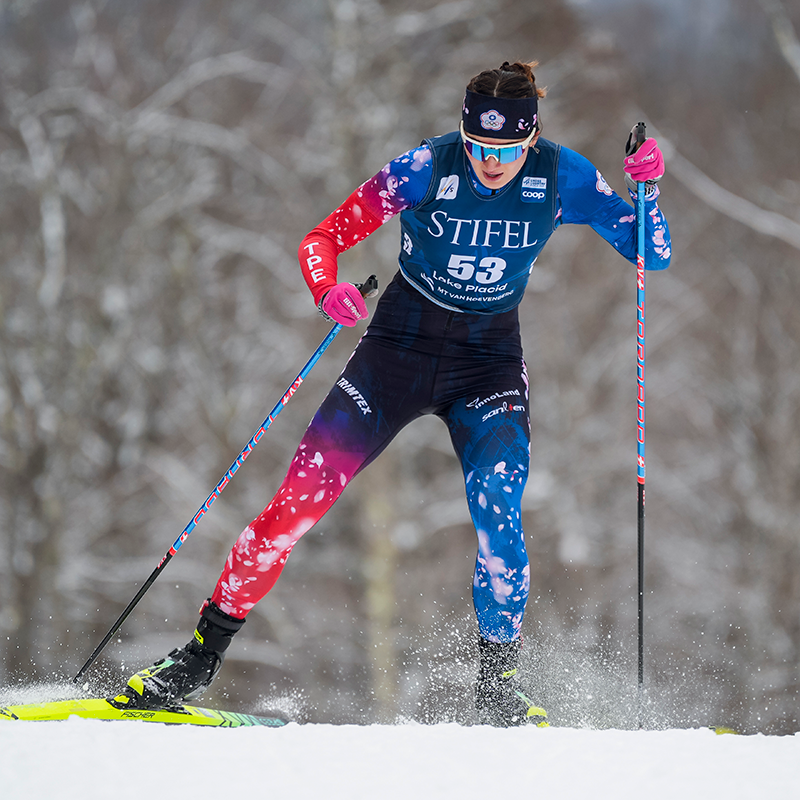
 This coverage is made possible through the generous support of Marty and Kathy Hall and A Hall Mark of Excellence Award. To learn more about A Hall Mark of Excellence Award, or to learn how you can support FasterSkier’s coverage, please contact info@fasterskier.com.