Tag: Olympic Jumping Complex

  • What to Do in Lake Placid When You’re Not Watching World Cup Racing

    What to Do in Lake Placid When You’re Not Watching World Cup Racing

    You’ve got your tickets. You know the race schedule. You’re making the trip to Mt. Van Hoevenberg for the first World Cup finals ever held on American soil. But the racing doesn’t fill every hour of the day, and Lake Placid is the kind of town that rewards a little wandering. Over the last 15 years, my family and I have spent a lot of time in Lake Placid, and here’s what we’d suggest for filling in the gaps — whether you’re traveling solo, with a crew, or with kids in tow.

    Fuel up

    Start the morning at Big Mountain Deli & Crêperie on Main Street. They’ve got 46 sandwiches named after Adirondack high peaks, plus breakfast burritos, crepes, and all the espresso drinks you need to survive a cold morning in the stadium. A word of advice: order online in advance. The line moves faster if your food is already being made. Note that they’re closed on Wednesdays, so plan accordingly if you’re arriving midweek.

    If you’d rather sit down and take your time, The Breakfast Club is just up the street and serves a proper breakfast and lunch with views of Mirror Lake. The portions are generous, the pancakes are legit, and if you’ve got kids, the hot cocoa is a guaranteed win. They open at 8 a.m. daily and close at 1, so don’t dawdle.

    Lunch and dinner

    For a real meal, Lisa G’s is our pick. It’s a short drive from Main Street on Sentinel Road, with a menu that leans American but doesn’t phone it in — think elevated pub food with creative wings, excellent fish and chips, and a solid beer list. They serve lunch on Fridays through Sundays starting at 11:30, and dinner Thursday through Monday. Closed Tuesdays and Wednesdays, so keep that in mind for early-week arrivals.

    For something more upscale, the Mirror Lake Inn is one of the classic Adirondack properties — a lakefront resort with a polished dining room and views to match. And if you want something a bit more casual but still special, check out The Cottage, also on the Mirror Lake Inn grounds. It’s a cozy spot right on the water where you can grab dinner or a drink in an old gondola. It’s open Tuesday through Sunday — closed Mondays.

    If you’re looking for a spot that can handle a crowd, Dancing Bears at the High Peaks Resort is worth a look. It’s at the far end of Main Street and has plenty of space — which matters on a weekend like this one, when every restaurant in town is going to be slammed. We’re fans of the food here, especially the salmon. It’s a reliable pick when other spots have a 45-minute wait.

    Breweries

    Lake Placid has two breweries worth your time, and both serve food if you’re looking to make a full stop of it.

    Lake Placid Pub & Brewery has been an institution on Mirror Lake Drive for years. The beer list is deep, the vibe is pub-casual with college banners lining the walls, and the upstairs bar is a solid spot to post up after a day at the races. They’re open daily from 11:30 a.m. (noon on Sundays) and stay open late — midnight on weeknights, 2 a.m. on Fridays and Saturdays. If you can only try one drink, ask about the Smoked Berry Old Fashioned.

    Big Slide Brewery & Public House is out on Cascade Road, about a five-minute drive from downtown and right near the Olympic Jumping Complex — which makes it an obvious stop if you’re heading to the Skirious Problems live recording Saturday evening. The beer ranges from fruit-forward lighter options to solid IPAs and porters, and the food holds its own. The burgers are good, the pizza is legit, and the buffalo wings have a bit of a cult following. They’ve also got outdoor seating with fire pits and Adirondack chairs if the weather cooperates. Open daily from 11:30 a.m. (10 a.m. on Sundays).

    Catch some NCAA March Madness

    The World Cup finals land smack in the middle of the NCAA basketball tournament, and if you need a screen and a cold beer between race sessions, Lake Placid has you covered. Wiseguys Sports Bar & Grill on School Street is the classic move — TVs everywhere, good wings, no pretense. They’re open Wednesday through Sunday. Players Waterfront Eatery on Main Street is another solid option with screens and lakeside seating if the weather cooperates.

    Stroll and Explore Main Street

    Don’t underestimate a good Main Street stroll. Lake Placid’s downtown is walkable and full of shops worth ducking into.

    Saratoga Olive Oil Company is one of those places you walk into out of curiosity and end up spending way longer than you planned. They’ve got dozens of flavored olive oils and balsamic vinegars you can taste — some combinations will surprise you, and it’s a genuinely fun challenge for your taste buds. Great for picking up a gift or just entertaining yourself for half an hour.

    The Maple Shop is exactly what it sounds like — a deep dive into maple syrup and all things maple. But it’s more interesting than you might expect. They carry different varieties and grades, and tasting your way through the range is a quick education in how much variation there is in something most people think of as one flavor.

    Adirondack Popcorn Co rounds out the Main Street tasting tour. They specialize in creative popcorn flavors — some classic, some funky — and it’s the kind of snack you can grab and take with you to the races or back to wherever you’re staying.

    Get Outside

    You’re in the Adirondacks. Get some fresh air.

    Though having recently CLOSED at the end of the 2026 season, Olympic Speed Skating Oval is open for public skating and is one of the few outdoor refrigerated ovals in the country. If the oval’s schedule doesn’t line up with yours, Mirror Lake itself often has a maintained skating area — check conditions locally when you arrive.

    Get out on the Ironman Lake Placid course on Mirror Lake Drive — hopefully it won’t be raining — like IMLP Champion Trevor Foley. (Photo: Voisin / FasterSkier)

    For our money, no trip to Lake Placid is complete without a walk or jog around Mirror Lake. The loop is about 2.7 miles on a paved path, it’s flat and accessible, and the residential architecture along the shoreline is worth the trip on its own — beautiful old Adirondack homes mixed in with classic lake houses, all set against the mountains. It’s a perfect way to shake out your legs before or after a day in the stadium.

    If you’re looking for something a bit more rugged, there are dozens of short hikes in the area, but be warned: this time of year, trail conditions are unpredictable. You might hit packed snow, mud, ice, or all three in the span of a quarter mile. Bring traction devices if you have them, and dress for the mess. Cobble Hill is a nice short option with a rewarding view at the top — nothing too long or steep, but enough to feel like you earned it.

    Need to get out for a Nordic Ski

    If you’re itching to actually ski while you’re up here, your options may be limited. Mt. Van Hoevenberg’s trails will almost certainly be closed to the public during the World Cup weekend. But if you’re willing to make the drive, the Paul Smith’s College VIC in Paul Smiths — about 30 minutes north of Lake Placid — is a strong option. We checked in with Paul Smith’s head Nordic coach Matt Dougherty, who had his team out on the trails Wednesday morning for biathlon practice. “It was actually fantastic,” Dougherty told FasterSkier. “Conditions will reflect the temperatures — normal spring skiing.” Most trails are open and being groomed daily with the college’s PB 100, though a few trails that got washed out last week are closed for the season. The VIC maintains over 25 miles of trails, including more than 10 kilometers of FIS-homologated courses and 25 kilometers of skate skiing. The system benefits from heavier snowfall than other parts of the region, which tends to keep trails skiable even when conditions elsewhere are lean. Trail conditions are updated on their Nordic Pulse page. The VIC’s winter season runs through April 1.

    Saturday Evening at the Jumps

    After the sprint finals wrap up on Saturday, head over to the Olympic Jumping Complex on Cascade Road for a live recording of the Skirious Problems podcast at 6:00 p.m. Hosts Mika Vermeulen and James Clugnet will be joined by Ben Ogden, Frida Karlsson, and Federico Pellegrino. It’s free, but organizers are suggesting it may already have sold out — check the World Cup Finals event page for the link. After that, the Palace Theatre downtown is screening Threshold at 7:00 p.m.

    Family-friendly fun

    The Lake Placid Toboggan Chute on Mirror Lake is one of those only-in-Lake-Placid experiences — a 30-foot wooden tower that launches you and a toboggan out across the frozen lake. Warmer spring temperatures have caused the chute’s closing for this season, but it’s typically open Friday evening and Saturday and Sunday during the day. Lines can build, but it’s worth the wait.

    If you’re already out at Mt. Van Hoevenberg, the Hi Notch Indoor Climbing center is right inside the Mountain Pass Lodge. It will be CLOSED during the FIS World Cup finals, but other days you’ll find a 30-foot top rope wall with over 1,500 square feet of climbing space, plus bouldering and traverse walls. All gear is provided, and instructors are on hand during daytime sessions. It could be busy this weekend, given the crowds, but it’s a great option for families or anyone who needs to burn off some energy between races.

    If you’ve got a free morning or want a half-day excursion, the Wild Center in Tupper Lake is about 45 minutes west and worth every mile. It’s a natural history museum with live animals, hands-on exhibits, and the Wild Walk — a series of treetop bridges with panoramic views of the Adirondacks. It’s open Friday through Sunday, so you could pair it with a race day or build it into your travel schedule. Just know you’ll have to choose between the Wild Center and a morning at Van Hoevenberg if you’re trying to do both.

    Closer to town, the Palace Theatre on Main Street is a beautifully maintained old single-screen movie house — a perfect way to wind down after a long day in the cold. And if your group wants something more active, Lake Placid Lanes (also known as Big Z’s) has bowling, arcade games, shuffleboard, darts, and a full bar. Reservations are recommended, especially on weekends — this place fills up.

    Lake Placid has been hosting the world’s best winter athletes since 1932. The town knows how to do this. Get out there and enjoy it.

  • Wednesday Workout: Team Sprinting with the U.S. Ski Team

    Wednesday Workout: Team Sprinting with the U.S. Ski Team

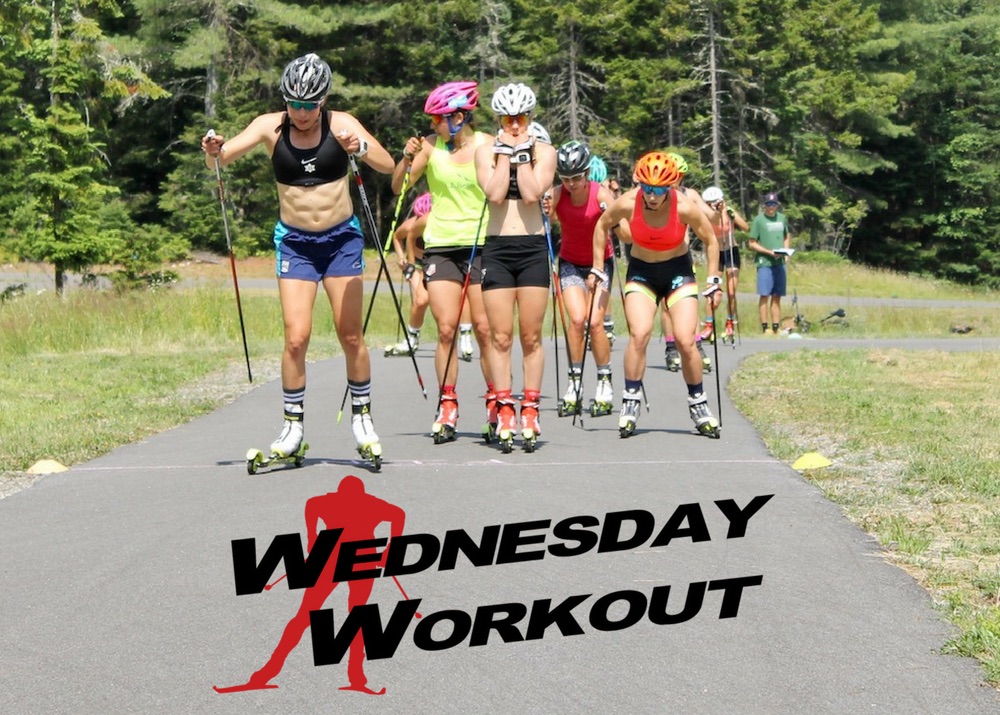
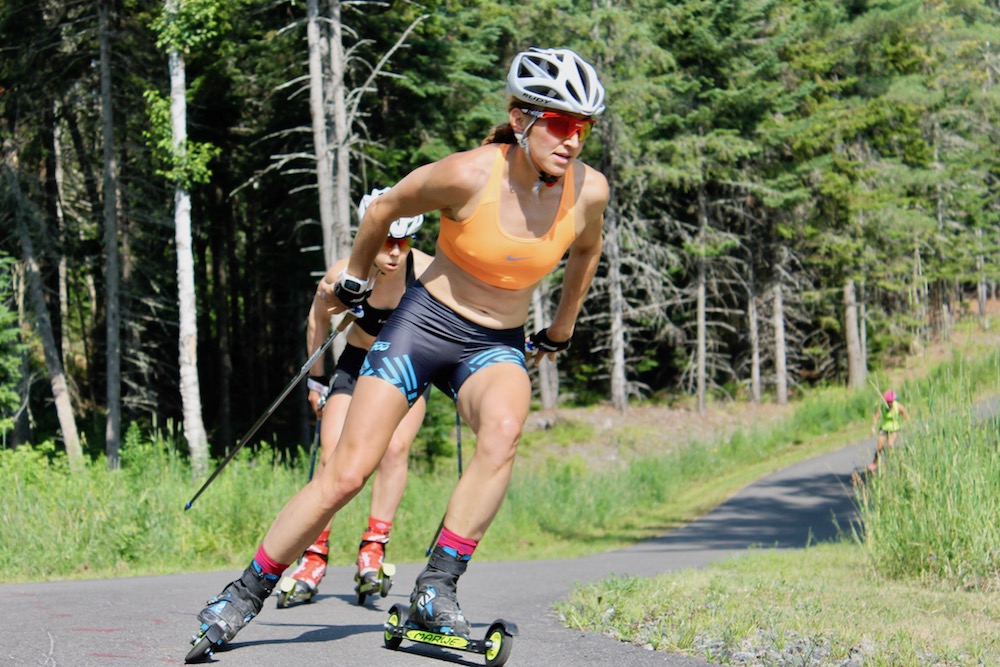
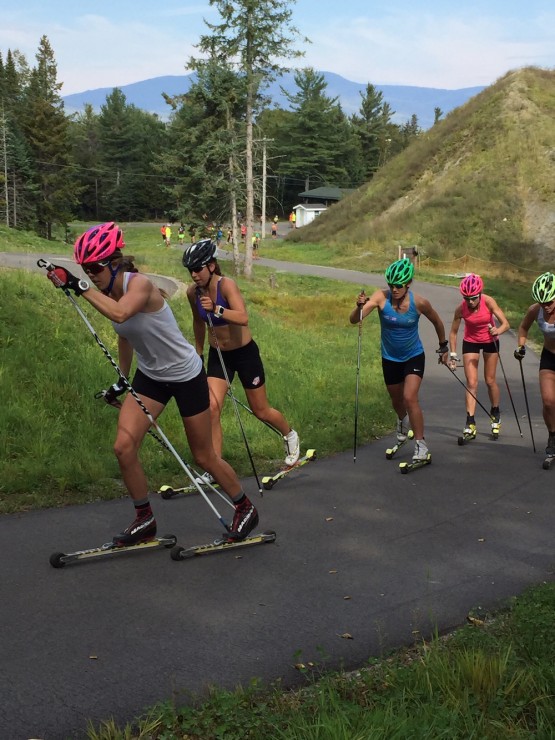
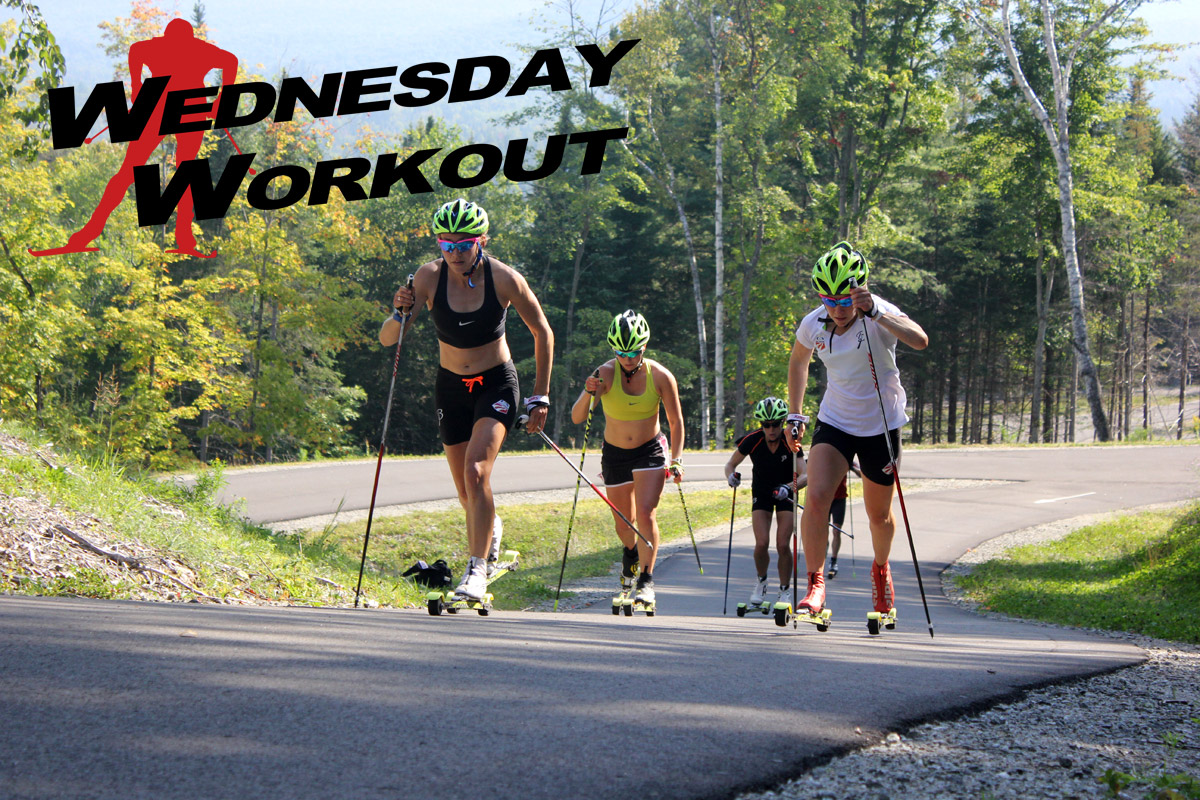
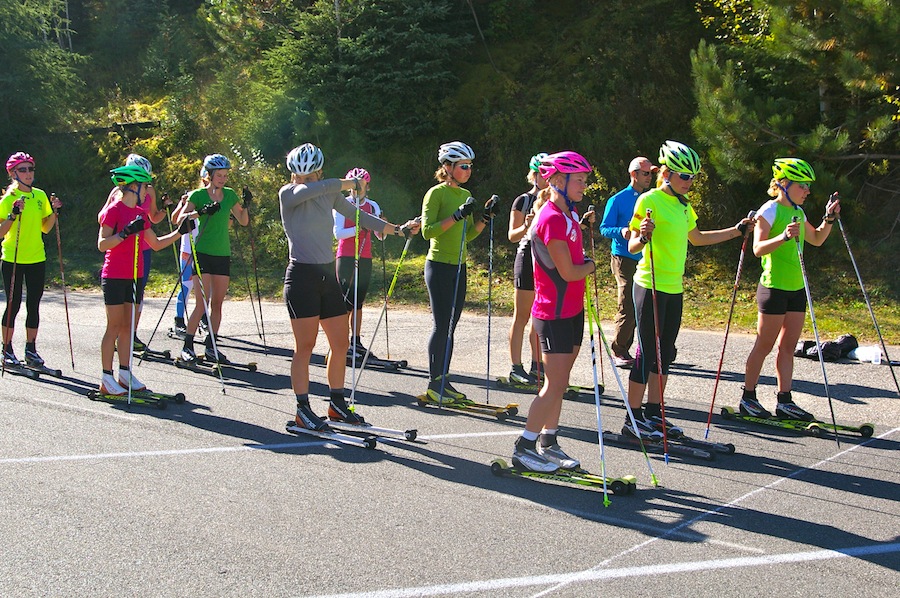
    From left to right: Katharine Ogden, Julia Kern, Ida Sargent, Caitlin Patterson and Kelsey Phinney navigate the tag zone during a freestyle team-sprint rollerski workout at the U.S. Ski Team women’s camp on July 15 in Lake Placid, N.Y.

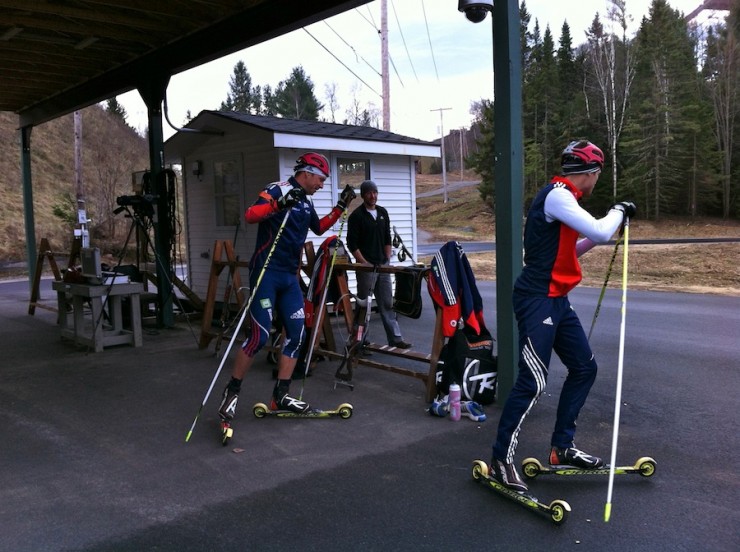
    LAKE PLACID, N.Y. — This past Sunday, July 15, FasterSkier visited the U.S. women’s cross-country team in Lake Placid, where the team has been holding a dryland camp since July 11. Most all of the team’s top athletes are there — sans those that train with Alaska Pacific University (they’ll largely stick to Anchorage and nearby Eagle Glacier for summer training) — for a “semi-intensity focused” camp that will last through Friday, July 20. Their training has included everything from rollerski speed work to ski walking/bounding, over-distance trail running/hiking and point-to-point distance rollerskiing. And they’ve held several workouts with the US Biathlon team, which is based in Lake Placid.

    Meanwhile, four members of the U.S. men’s team (Erik Bjornsen, Simi Hamilton, Ian Torchia, and Paddy Caldwell) have been in Villard-de-Lans, France, for a camp following the wedding of Bjornsen and Marine Dusser. Their overseas training, which has also included some “incredible trail/mountain running,” as head coach Chris Grover explained, wraps up today.

    “The weather has been fantastic so far; warm and dry during the days and cool at night,” Grover wrote in an email on July 9, the first full day of camp.

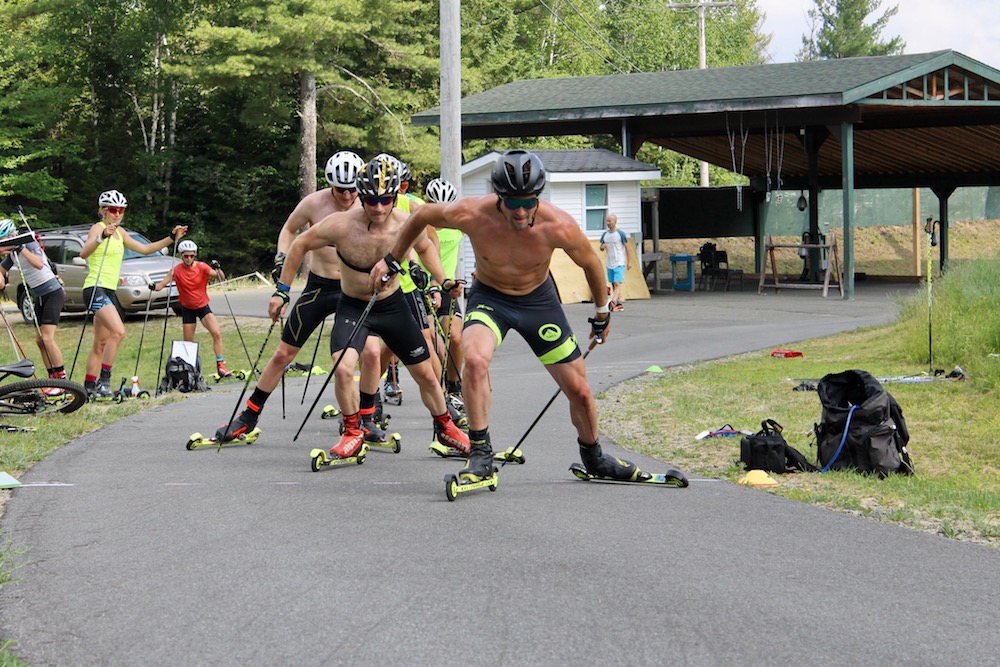
    Ben Saxton, of the Stratton Mountain School (SMS) T2 Team, leads the men’s rollerski-sprint workout out of the start, with Ben Lustgarten (Craftsbury Green Racing Project) and Kyle Bratrud (SMST2) closest behind on July 15 in Lake Placid, N.Y.

    In Lake Placid on Sunday, it was a warm yet breezy day for a freestyle team sprint, with temperatures reaching the 80s by late morning. Asked how many times a year the U.S. team practices team sprints, complete with each member of a two-person team racing three laps apiece, U.S. coach Matt Whitcomb said they did so about twice a year: once in mid-summer and again in October.

    (On the World Cup circuit, team sprints are only held a couple of times each winter. This coming winter, a freestyle team sprint — the event Kikkan Randall and Jessie Diggins won at the 2018 Olympics — is on the schedule at 2019 World Championships in Seefeld, Austria.)

    “We’ll do a formal team sprint like this a couple times a year,” Whitcomb said. “It’s obviously a huge opportunity for us with the sprint depth that we have, for both men and women, and it’s just a fun way to have a super-hard workout in a camp environment.”

    Jessie Diggins (r) and Julia Kern during recovery time between the semifinal and final of their team-sprint session on July 15 at the Olympic Jumping Complex in Lake Placid.

    Sunday’s training group included 11 women, including Diggins, Sophie Caldwell, Ida Sargent, Julia Kern, and Katharine Ogden from the U.S. Ski Team, and several others from the Craftsbury and Stratton programs, and six men (Ben Saxton, Ben Lustgarten, Akeo Maifeld-Carucci, Kyle Bratrud, Adam Martin, and Karl Schulz). The course, which was held on the Olympic Jumping Complex rollerski loop, was about 1.3 kilometers for the women and 1.7 k for the men (taking about 3 minutes per lap for the women and 3:40 for the men).

    “Goal number 1 is to keep it safe and make sure we’re not having needless injuries, checking the equipment and making sure the athletes’ bindings are all working … ,” Whitcomb said. Sunglasses and helmets were mandatory. “And then secondly, just creating an environment that gives them a perception by the time they hit winter or the first team sprint on the World Cup that they’ve done this. When you feel that you’ve had experience, even if it’s because of a workout in July and one in October, you can draw a lot of confidence from that. While it is just a total 20 minutes of ‘on’ time today, it has much greater value than just that.”

    “When you feel that you’ve had experience, even if it’s because of a workout in July and one in October, you can draw a lot of confidence from that.” — Matt Whitcomb, U.S. Ski Team coach

    Athletes were selectively partnered in an effort to make for a “stimulating event”, Whitcomb explained. At times, they were instructed to leave the tag zone early before their teammate arrived to make for a more competitive event. The workout started with a semifinal round of head-to-head racing, followed by about a half-hour break, then finals. Due to lower numbers, the men did not compete as teams and instead raced each lap together, then took about an equal amount of rest before the second and third intervals.

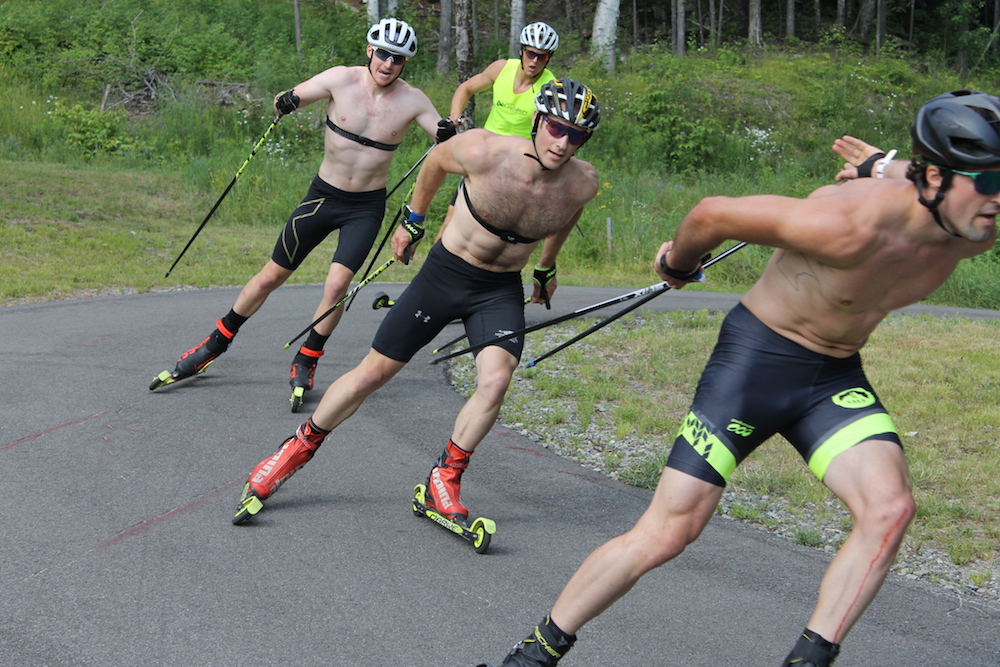
    Ben Saxton (r) leads Ben Lustgarten, Kyle Bratrud and Adam Martin during a team-sprint workout on July 15 at the Olympic Jumping Complex in Lake Placid, N.Y.

    For coaches and athletes wanting to replicate this workout, Whitcomb said you don’t have to have a ton of athletes and a car-free, challenging rollerski loop like the one at the Olympic Jumping Complex.

    “Some days you only have three athletes and you might just have a one-mile strip of road that works and you can’t do a loop,” he said.

    The U.S. team has held similar team-sprint sessions with just five or six women.

    “We’ll just run it like an interval session,” he said. “We simulate it and you even have a tag zone, but you don’t have a teammate. We might simulate a race situation where somebody’s partner broke a pole and we’ll make them wait for five extra seconds or something like that.”

    On a point-to-point course, it might take a little more time to get back to the start, “but it gives the athletes what you’re looking for,” Whitcomb said.

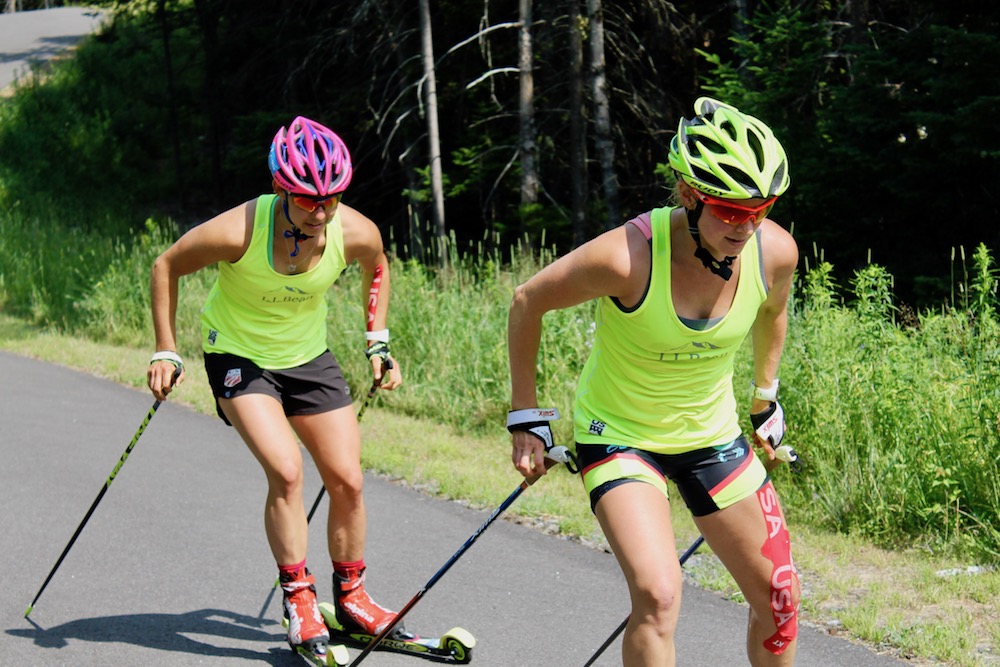
    Sophie Caldwell leads Ida Sargent at the front of the pack during a team-sprint training session on July 15 in Lake Placid, N.Y.

    He also recommended getting creative and having fun with the workout.

    “Sometimes the ladies are making decisions on their own; they’ve got a good idea of what makes a great workout,” Whitcomb said. “There were a couple times where our PA, start-finish guy, Gus [Kaeding], who was also our creativity manager today, came up with some interesting situations, like somebody had slow skis that lap so [their partner] had to wait a little bit. For the men, they were running it more interval-style where they sent Kyle [Bratrud] out as a rabbit for Ben [Saxton] and Ben [Lustgarten] to chase down and that made it really exciting and stimulating for them.”

    The workout takes close to two hours to complete so plan the start time accordingly. The U.S. coaches moved the start of the women’s final up slightly to try to beat the heat.

    “In hindsight we probably would have started a little bit earlier,” Whitcomb said. “It’s hot out here today and it’s something you have to watch out for in the summer. If it’s excessively hot, we won’t run this workout because you start to lose the benefit. … But today was reaching 80 and happened to be humid, but it was manageable.”

    Coaches also took lactate readings of all participating athletes immediately after they finished their final laps of both the semifinals and finals.

    buy clomid online, buy yasmin online

    Team sprint start times (as outlined by the U.S. Ski Team for its July 15 workout. These changed slightly during the session):

    9:30 a.m. Men’s semifinal (3 laps of 1.7 k with about 4 minutes of rest in between)

    10 a.m. Women’s semifinal (3 laps of 1.3 k with about 3 minutes of rest in between)

    10:30 a.m. Men’s final (Same format as men’s semifinal)

    11:00 a.m. Women’s final (Same format as women’s semifinal)

    The U.S. women’s and men’s teams also have upcoming training camps planned for New Zealand (three weeks in late August/early September) and Park City, Utah, in October.

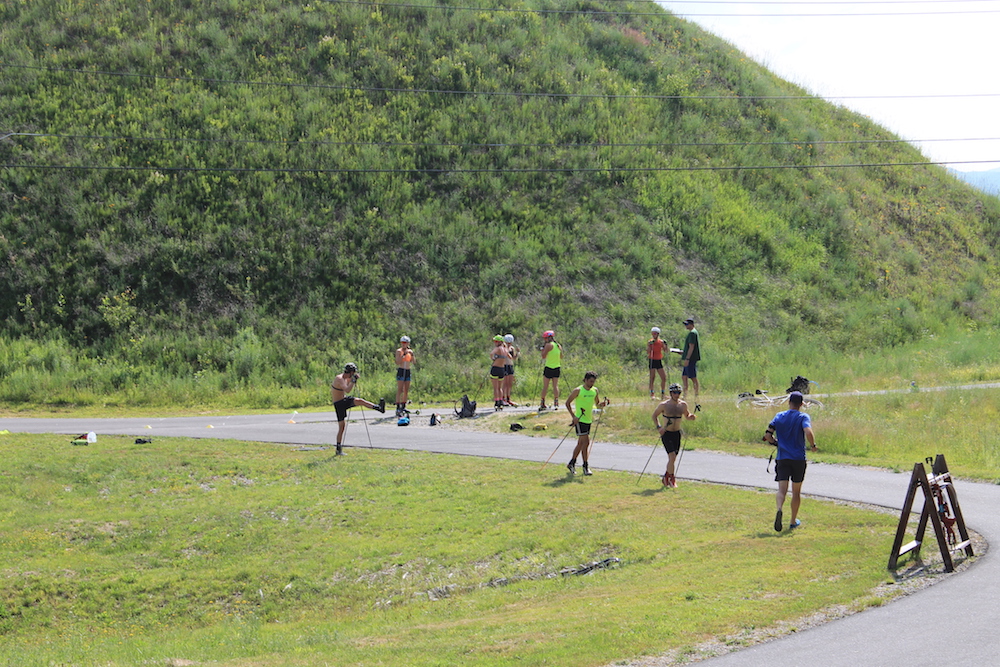
    Athletes staying loose during team-sprint day at the Olympic Jumping Complex in Lake Placid, N.Y.
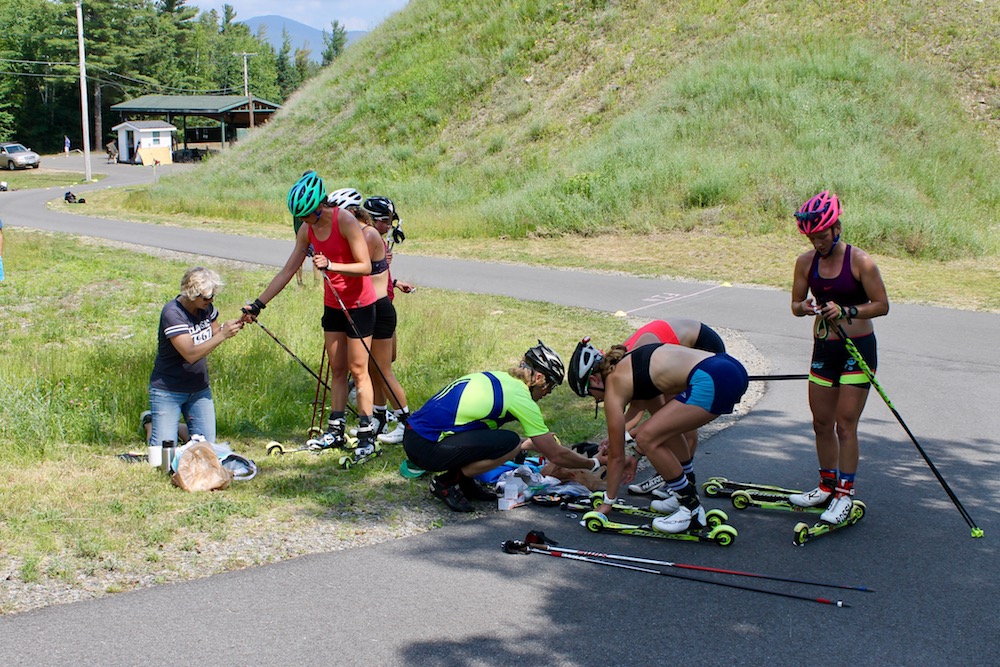
    Craftsbury Green Racing Project Head Coach Pepa Miloucheva (l) and Stratton Mountain School T2 Team Head Coach Pat O’Brien (center) assist athletes with lactate testing after the U.S. Ski Team’s rollerski team sprint on July 15 in Lake Placid, N.Y.
  • Monday Rundown: Junior Nationals Open in Lake Placid

    Monday Rundown: Junior Nationals Open in Lake Placid

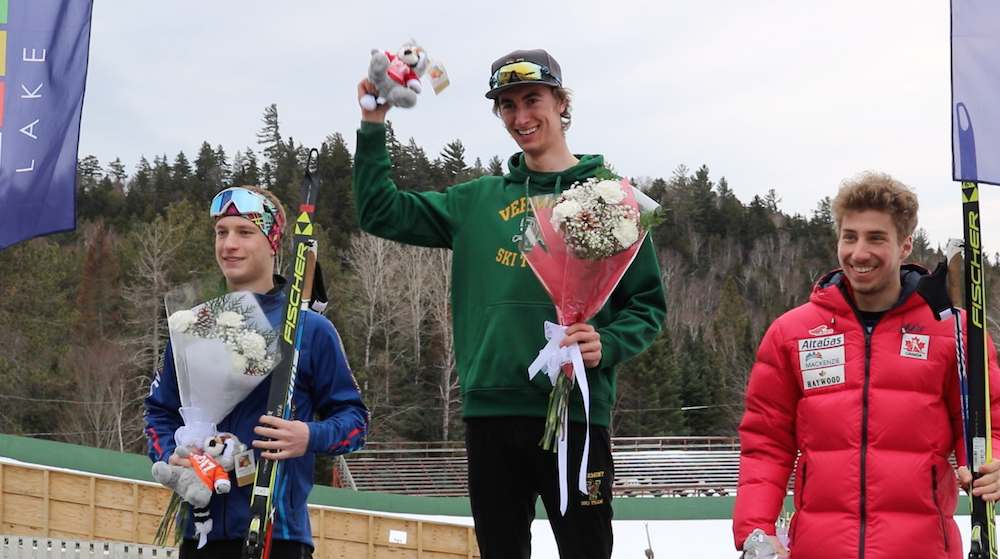
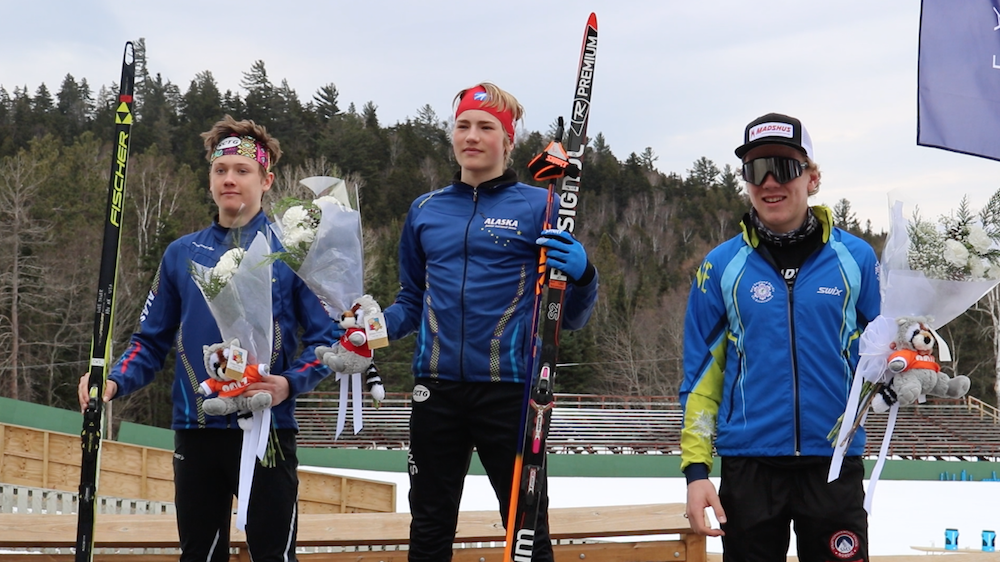
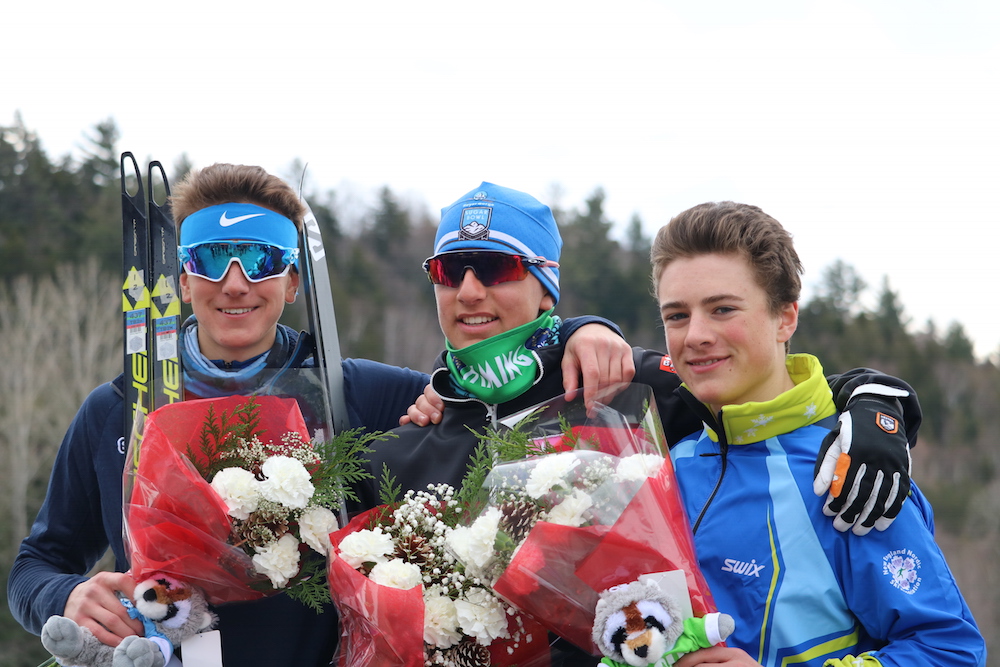
    The U20 men’s 10 k freestyle podium on Day 1 of 2017 U.S. Junior Nationals in Lake Placid, N.Y., with Lake Placid’s own Karl Schulz (c) of the University of Vermont in first, Hunter Wonders (l) of Alaska Pacific University in second, and Canada’s Étienne Hébert (r) of Montériski in third. (All photos: India Harvey)

    USSA Cross Country Junior Championships (Lake Placid, N.Y.): 5/10 k freestyle individual starts

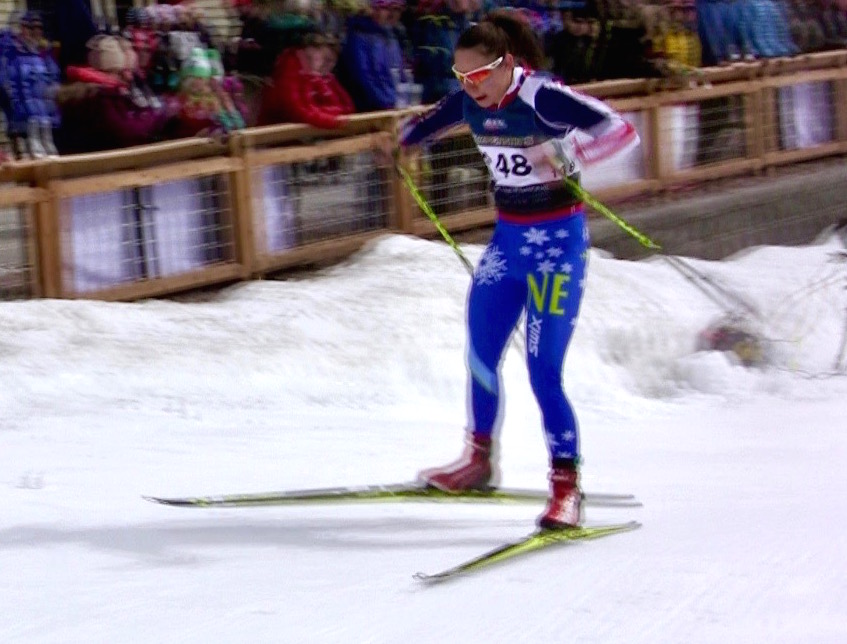
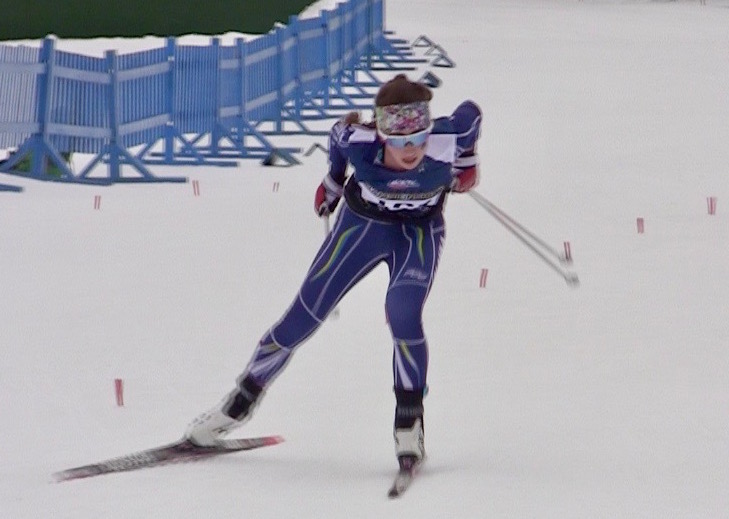
    The U.S. Ski & Snowboard Association (USSA) Cross Country Junior Championships (a.k.a. Junior Nationals) opened Monday in Lake Placid, N.Y., with U16, U18 and U20 men’s and women’s 5/10-kilometer freestyle individual start races taking place at the Olympic Jumping Complex trails just up the road from Mt. Van Hoevenberg, where organizers had originally planned to host the weeklong event. A lack of natural snow led to the use of a 2.5-kilometer loop on manmade snow at the Olympic Jumping Complex, US Biathlon’s home training base.

    The U20 men’s 10 k freestyle proved to be the closest race of the day, with Karl Schulz, a University of Vermont (UVM) freshman who grew up in Lake Placid, winning by 0.1 seconds over Alaska’s Hunter Wonders, of Alaska Pacific University (APUNSC), in second place. Racing for the Mid-Atlantic division, Schulz clocked the fastest time in 24:58.6 minutes, which was 33 seconds faster than Canadian third-place finisher Étienne Hébert, of Montériski. New England’s Daniel Streinz (Mountain Endurance) was the third American in fifth overall, 59 seconds off Schulz’s winning time and 16.4 seconds behind another Canadian, Ty Godfrey (Canmore Nordic/Team R.A.D.) in fourth.

    Julia Kern (New England/SMS) racing to the win in the U20 women’s 5 k freestyle on Monday at 2017 U.S. Junior Nationals in Lake Placid, N.Y.

    Julia Kern, of New England and the Stratton Mountain School (SMS), won the U20 women’s 5 k by the biggest margin of the day: 42.4 seconds in 13:48.5. Canada’s Katherine Weaver (Hollyburn XC Ski Club) placed second and UVM’s Mackenzie Rizio took third (+43.9), while Sarah Goble (Great Lakes Division/Sun Valley) was the third American in fourth overall (+49.3).

    The U18 boys’ 10 k freestyle podium on Monday at U.S. Junior Nationals in Lake Placid, N.Y., with Gus Schumacher (c) of Alaska Winter Stars in first, Luke Jager (l) of APU in second, and Ben Ogden (r) of SMS third.

    In the U18 boys’ 10 k, Alaska took first and second with Gus Schumacher, of Alaska Winter Stars (AWS) topping the podium in 25:07.3, and Luke Jager (APUNSC) finishing 3.7 seconds back in second. New England’s Ben Ogden (SMS) notched third (+10.6).

    Alaska’s Margaret Gellert (Alaska Winter Stars) racing to a U18 girls 5 k freestyle victory at U.S. Junior Nationals on Monday in Lake Placid, N.Y.

    Alaska topped the U18 girls’ 5 k as well, with Margaret Gellert (AWS) winning by 17.6 seconds in 14:02.9. Intermountain’s Sofia Shomento (Bridger Ski Foundation) finished second and Rocky Mountain’s Ezra Smith (Summit Nordic Ski Club) placed third (+23.6).

    The U16 boys’ 5 k freestyle podium on the first day of 2017 U.S. Junior Nationals in Lake Placid, N.Y., with Haydn Halvorsen (c) of Sugar Bowl Ski Team & Academy in first, Johnny Hagenbuch (l) of SVSEF in second and Will Koch (r) of SMS in third.

    In the U16 boys’ 5 k race, Far West’s Haydn Halvorsen (Sugar Bowl Ski Team & Academy) raced to a 5.3-second victory over Intermountain’s Johnny Hagenbuch, of the Sun Valley Ski Education Foundation (SVSEF). Halvorsen finished in 12:35.2 minutes, and New England’s Will Koch (SMS) was 29.5 seconds back in third.

    In the U16 girls’ 5 k, Novie McCabe (Pacific Northwest/Methow Valley Nordic Ski Educational Foundation) earned a junior-national title by 1.7 seconds in 14:14.6. Intermountain’s Sydney Palmer-Leger (Park City Nordic Ski Club) placed second and Far West’s Nina Seemann (Auburn Ski Club Associates Inc.) reached the podium in third (+28.8).

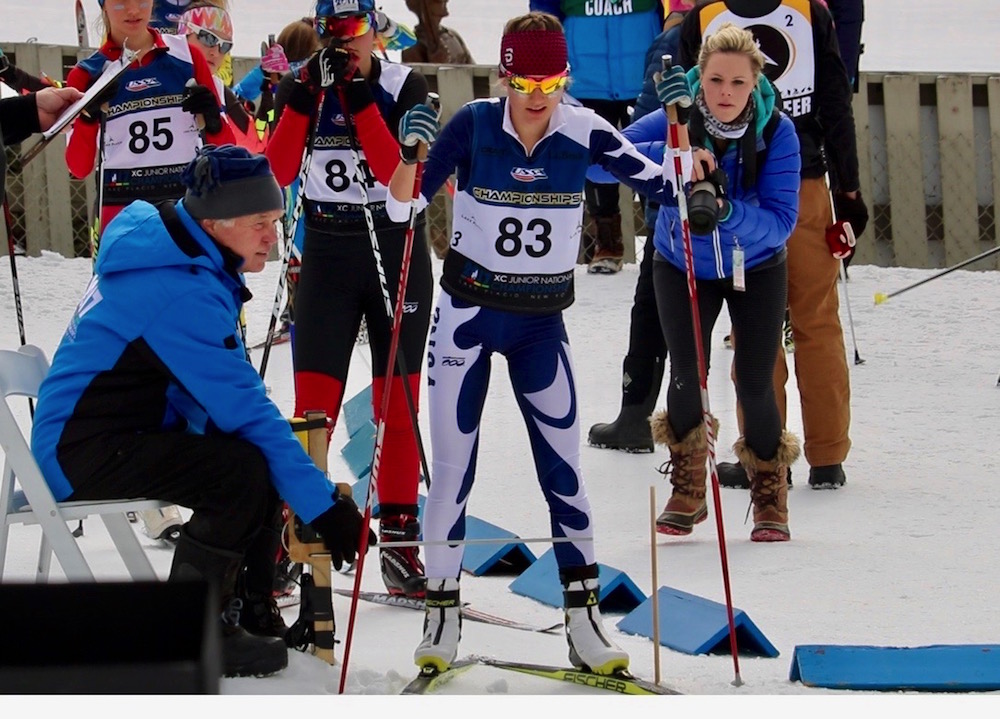
    Novie McCabe (83) of Pacific Northwest/Methow Valley Nordic Ski Educational Foundation at the start of the U16 girls’ 5 k freestyle. She went on to win by 1.7 seconds on Monday at Junior Nationals in Lake Placid, N.Y.

    Results: U20 men | U20 women | U18 boys | U18 girls | U16 boys | U16 girls

  • Lake Placid Camp in Photos: Packing It All In

    Lake Placid Camp in Photos: Packing It All In

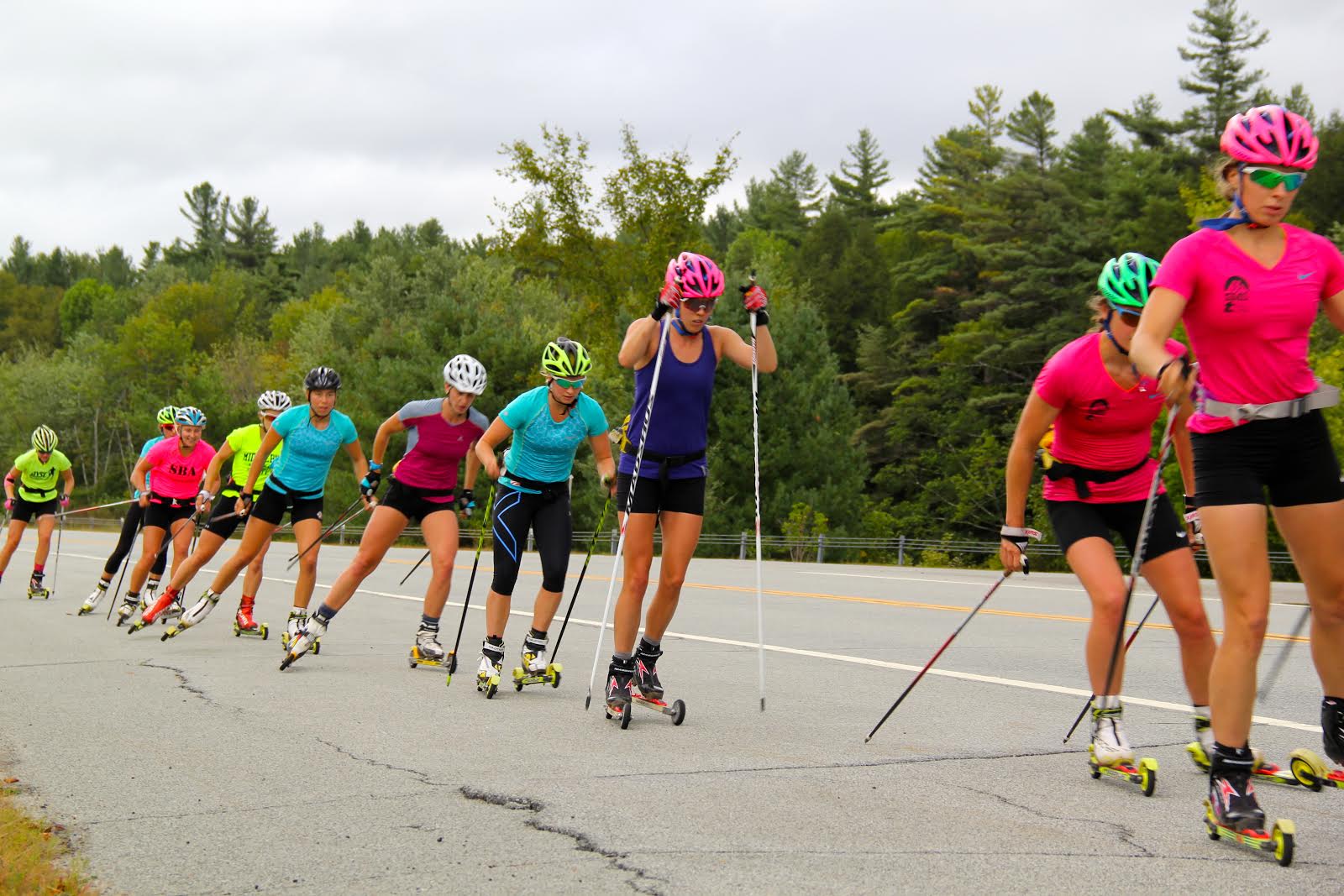
    Annie Hart leads Annie Pokorny, Mary Rose, Jessie Diggins, Deedra Irwin, Katharine Ogden, Kelsey Phinney, Hannah Halvorsen, Sophie Caldwell, and Hailey Swirbul during a rollerski session near Lake Placid, N.Y.  (Photo: Bryan Fish)
    Annie Hart leads Annie Pokorny, Mary Rose, Jessie Diggins, Deedra Irwin, Katharine Ogden, Kelsey Phinney, Hannah Halvorsen, Sophie Caldwell, and Hailey Swirbul during a rollerski session near Lake Placid, N.Y. (Photo: Bryan Fish/USSA)

    Of the 12 workouts in six days at last week’s U.S. Ski Team (USST) dryland camp in Lake Placid, N.Y., two tested VO2 max, two were speed-specific, including a classic-sprint simulation, and three were strength sessions with a smattering of recovery runs. Also that week, the team incorporated Level 3 threshold and three distance sessions, with the National Elite Group (NEG) and National Training Group (NTG) joining several of its workouts.

    At the end of it all, several team members shared their highlights from camp:


    – Katharine Ogden (USST D-team/Stratton Mountain School T2 Team):

    Favorite training moment: “Doing skate speeds on the Lake Placid rollerski track, for sure. It was so awesome to practice high-speed transitions and get some sweet, smooth, car-free speed practice.”

    Favorite moment outside of training: “Getting some sweet henna tattoos from Hailey and Jenna (two of the junior girls at camp).”

    On training with the best: “It never ceases to amaze me training with the USST girls. Getting the opportunity to copy their technique and have them there to motivate us during harder sessions is beyond awesome. One thing that I learned talking to some Norwegian junior skiers is that they have never even met most of their national team girls. This really put in perspective for me how lucky we are to be able to train with them.”

    On making strides: “I’ve learned so much this camp. I’ve been working a lot on bounding technique and it was pretty sweet to have some breakthroughs doing bounding. I’ve also learned a lot about sprint tactics from having the opportunity to do a sprint time trial alongside the USST girls.”


    – Sophie Caldwell (USST A-team/SMST2 Team):

    Favorite workout: “My favorite workout of the camp was probably the run we did on the final day. We ran up Algonquin and then to Avalanche Lake. I love running in the Adirondacks and was happy we got to get out and do some adventuring at the camp. It was the perfect way to wrap up and watch the fall colors begin to change.”

    On what makes the camp unique: “This camp was both the shortest camp and the most focused on intensity that I have done this summer. I thought it was a really fun format and enjoyed jamming so much into one week.”

    On a larger training group: “I think having a larger, younger group is both motivating and inspiring. I remember when I was the same age the NTG girls are now and how excited I would get for camps. I got to room with Julia, who is also my SMS teammate, but I loved talking to her about everything and reflecting on what it was like when I was her age. They all bring a lot of new energy and are also fast and can challenge us in many of the workouts.”

    – Andy Newell (USST A-team/SMST2 Team):

    Highlight: “To be able to hammer out some high-intensity intervals and be pushed by some new faces I don’t get to train with very often.”

    On a tight schedule: “This camp was slightly different than our normal Lake Placid camp because it was shorter and more intense, our coaches packed in a lot of quality training into 6 days including one day with double intervals. I think our camp schedule has been thought out really well this year and personally, my fitness is feeling better than ever.”

    On working out with young guns: “Having a younger contingent at this camp was awesome. For someone who has spent the majority of the last several years racing on the world cup there are a lot of young faces in the National Training Group or even top level US skiers that I’m just meeting for the first time. This LP camp was a cool way to connect with the up and coming talent and train together and push each other, I’m really impressed with both the younger guys and girls that are training with the NTG these days.”

    – Simi Hamilton (USST A-team/SMST2 Team):

    Favorite moment: “Watching the bobsledders train for their World Cup team selection… those dudes can push some serious weight.

    “Our Placid camp was great this year. Only being there a week, our focus was on quality over quantity. Of course we got in some great runs (today we did the Algonquin to Avalanche Lake loop), but we were hitting the pavement hard with 5 intensity sessions and 2 speed sessions throughout the week.”

    On training with the NTG: “It was so awesome having the NTG group around. We were getting pushed in every single workout by those guys and girls, and it’s always an awesome feeling to turn around during a hard interval session and see a 16 year old hot on your heels. I’m so psyched about where our future is headed as a top XC nation.”

  • Speed Camp, Fast and Female Engage Locals in Lake Placid

    Speed Camp, Fast and Female Engage Locals in Lake Placid

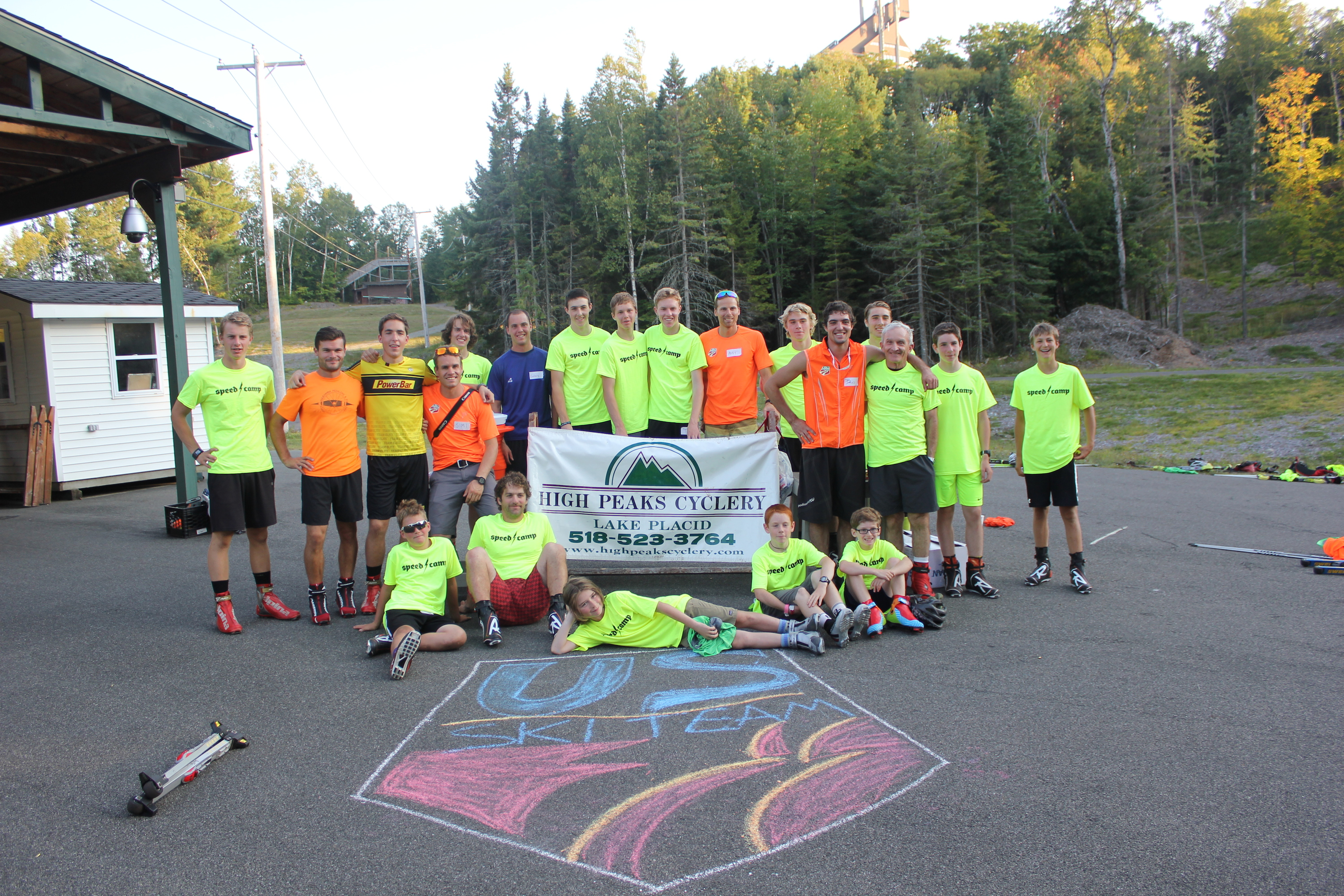
    Lake Placid Speed Camp
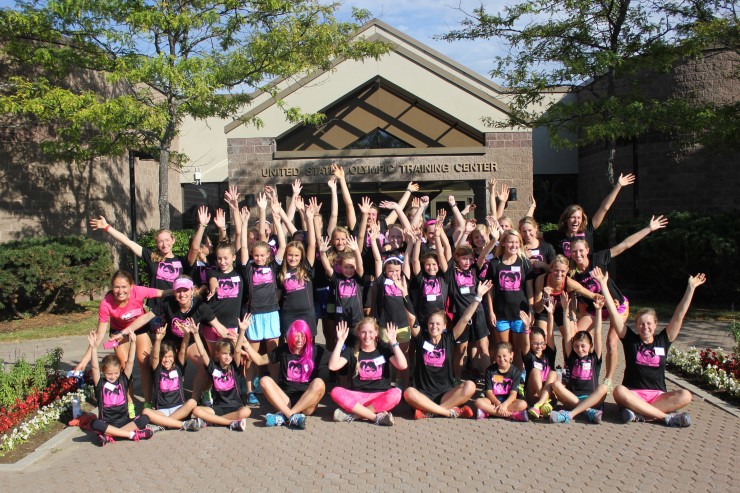
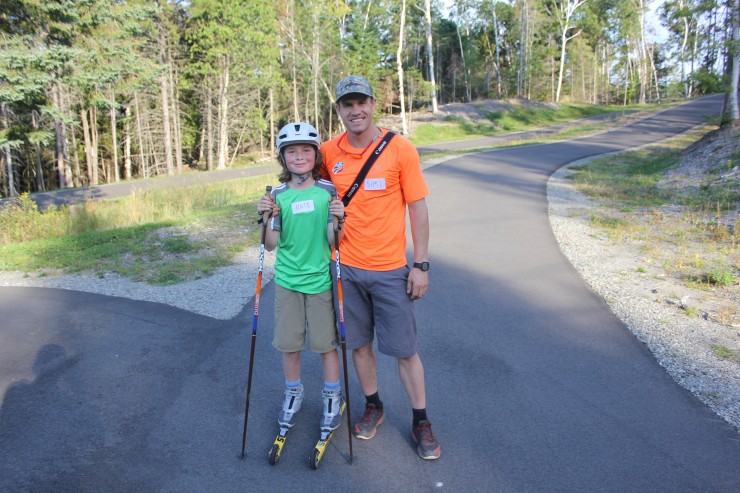
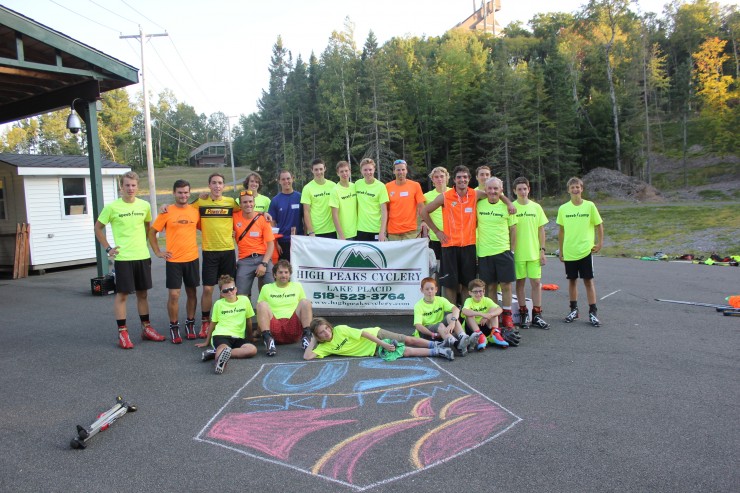
    Speed Camp participants and organizers pose for a picture at the Olympic Jumping Complex in Lake Placid, N.Y. September 5.

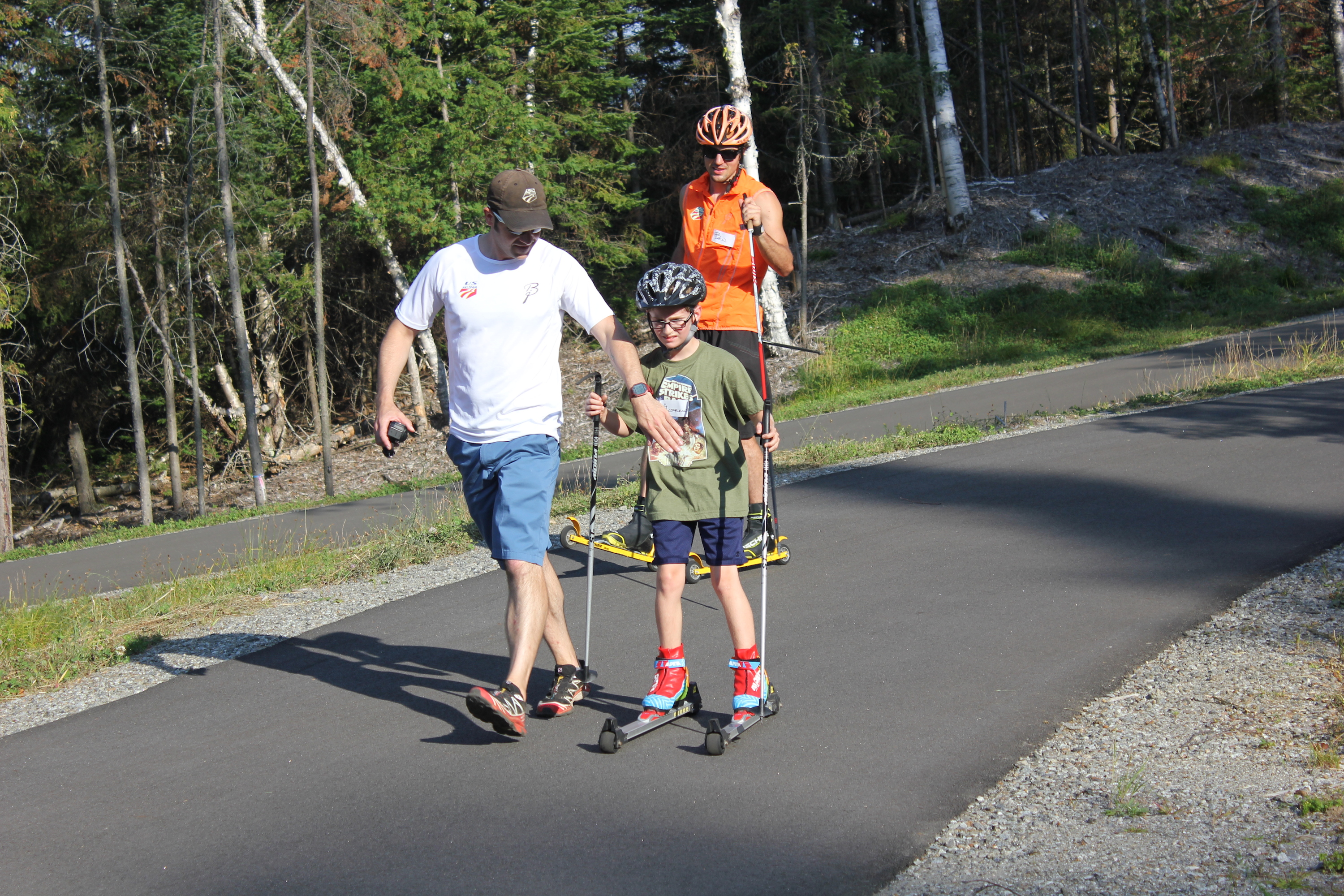
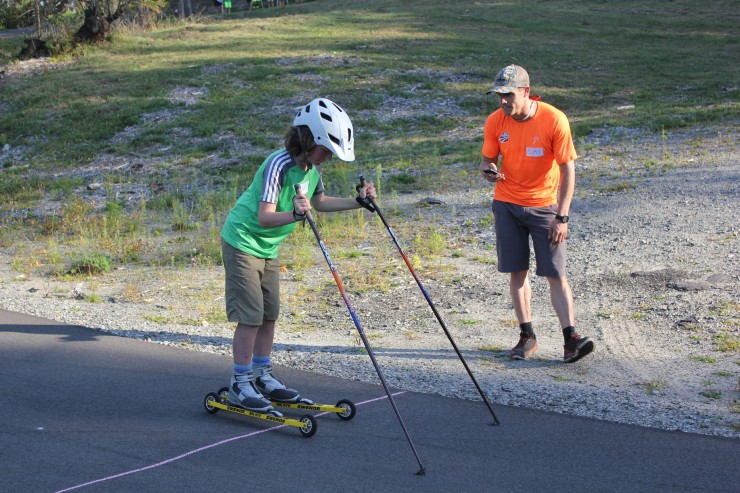
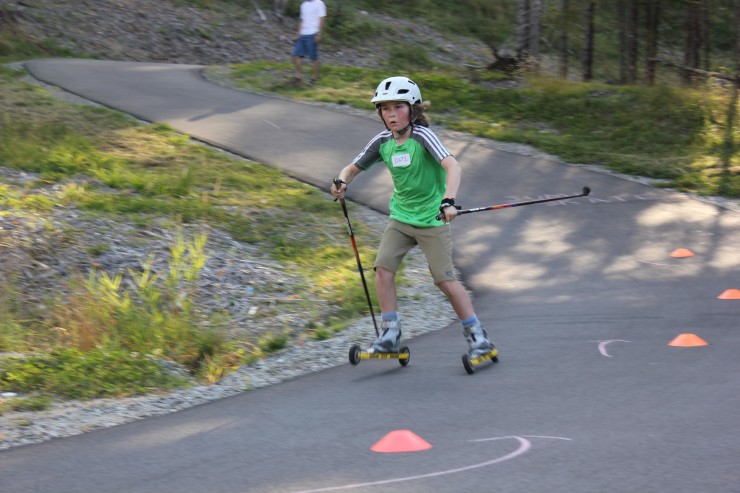
    LAKE PLACID, N.Y. – Nate Ball had fallen multiple times. His shorts were ripped and his legs were shaky. Despite the fact that it was Ball’s second time on rollerskis, he was ready to take on his next challenge – beat his pervious time of 30 seconds on the race course World Cup stage-winner Simi Hamilton had created for him.

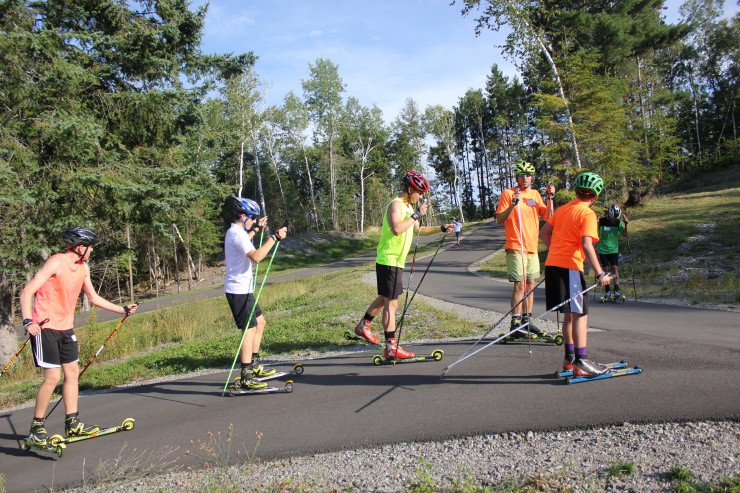
    Ball, a 10-year-old who skis and jumps for the New York Ski Education Foundation, was participating in the second-ever Speed Camp put on by the men of the U.S. Ski Team.

    Lake Placid Speed Camp
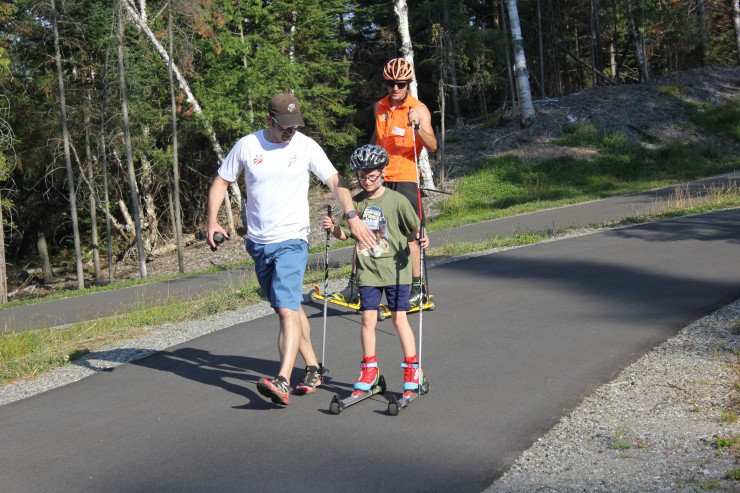
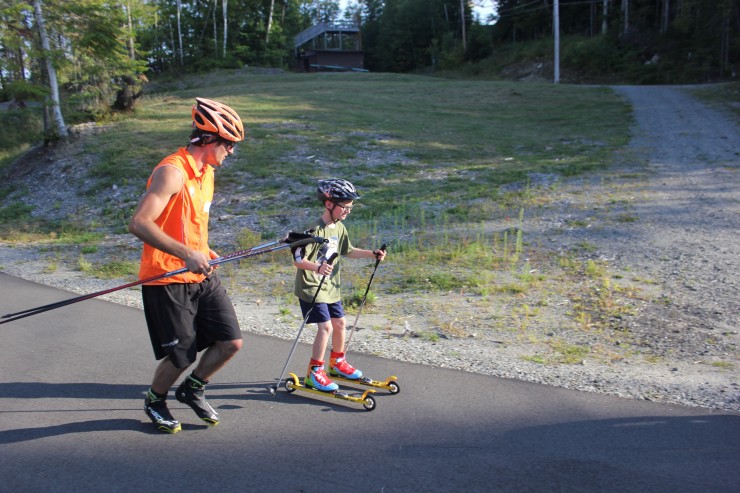
    USST coach Jason Cork helps Andrew Scanio, 9, navigate a downhill. It was Scanio’s third time on rollerskis and first time on skate rollerskis.

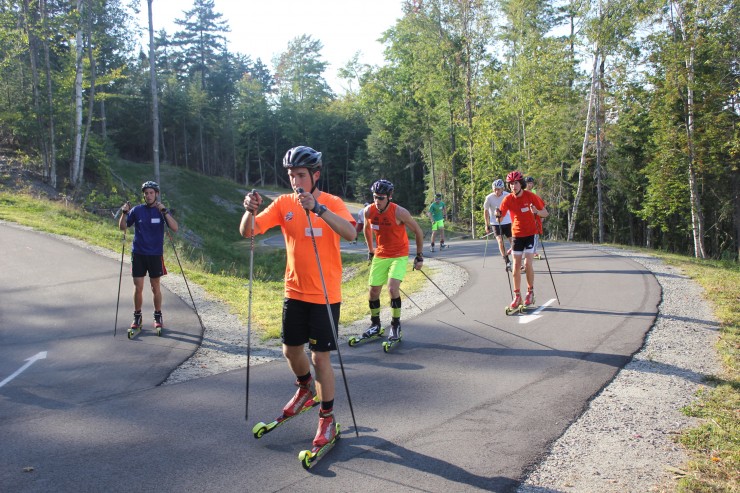
    The September 5 event took place at the Olympic Jumping Complex and was aimed at introducing young skiers to speed on rollerskis.

    A brainchild of Andy Newell and Hamilton, Speed Camp was a male version to Chandra Crawford’s girls event, Fast and Female.

    The roughly 20 participants at the Speed Camp filled a spectrum of ages, ranging from 9-year-olds to a older local coach aiming to increase his knowledge of rollerski technique.

    “This is my second time on rollerskis. It’s good and hard,” Ball said. “The guys are nice.”

    When asked what his favorite part of the day was, the 10-year-old responded with excitement saying, “The one time I did the downhill without falling!”

    At the nearby Olympic Training Center a similar event for youngsters of the opposite gender was taking place.

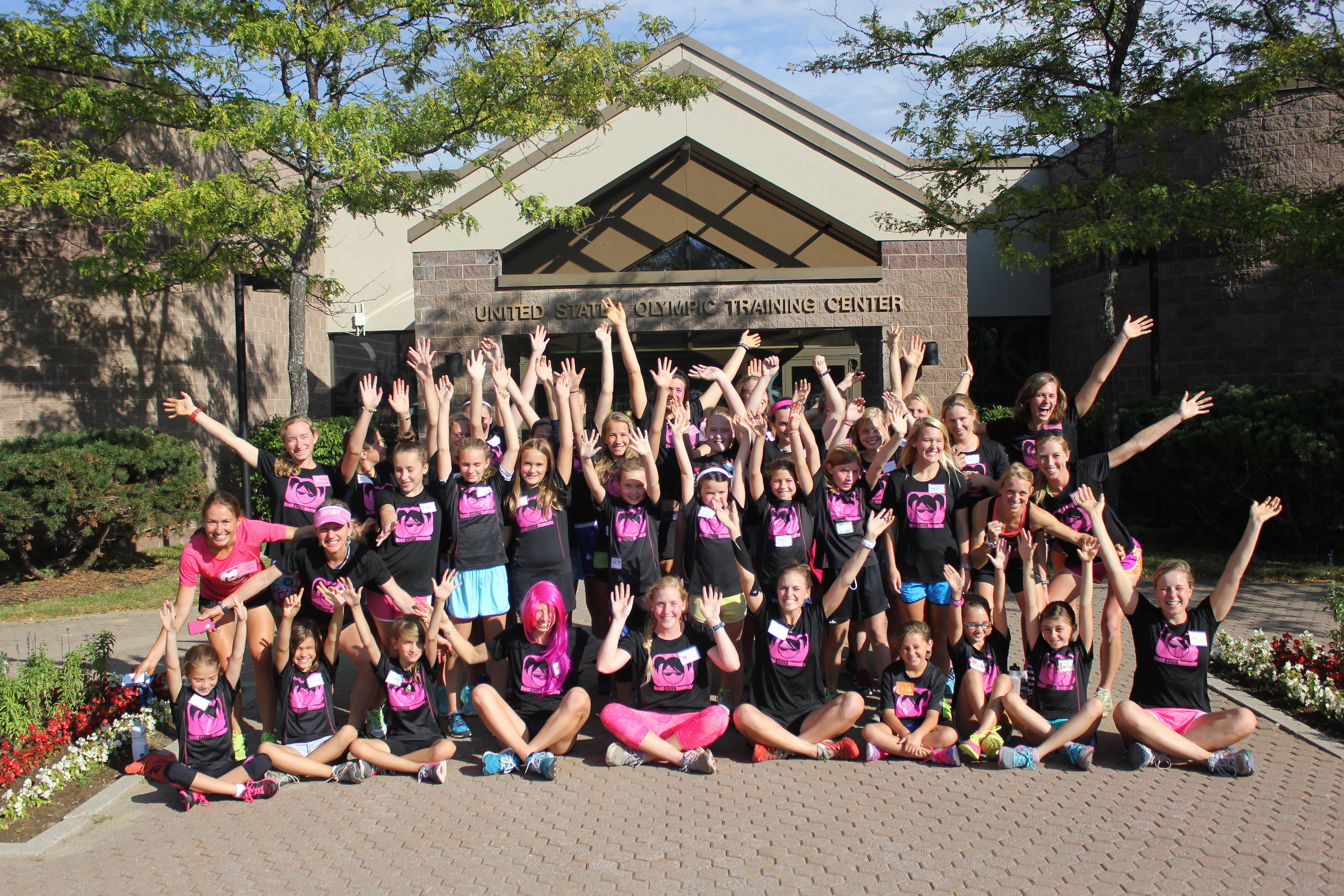
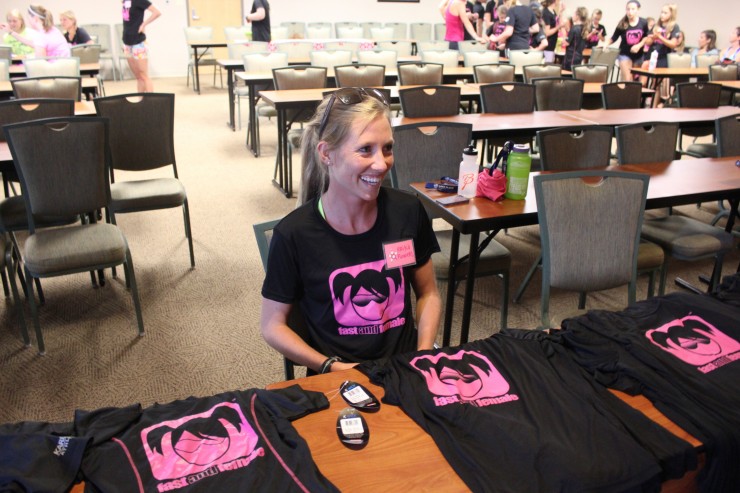
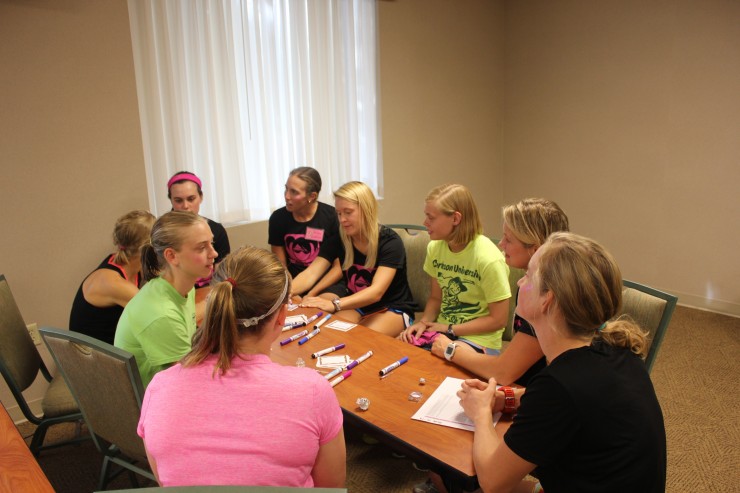
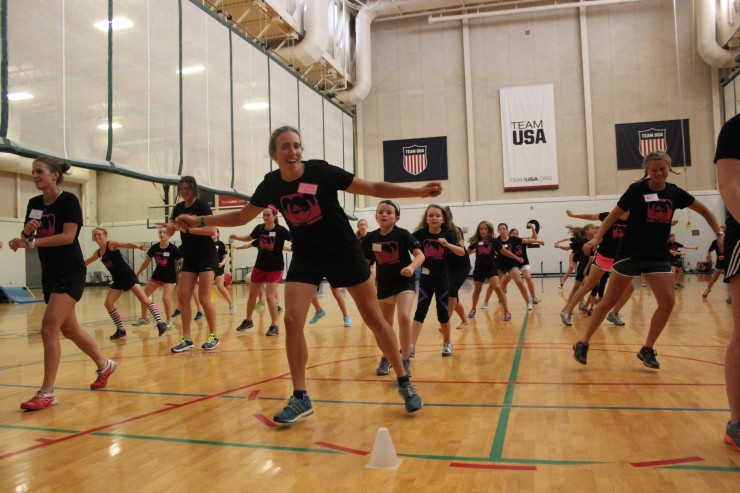
    Lake Placid Fast and Female
    Fast and Female at the Olympic Training Center in Lake Placid, N.Y. September 5.

    The U.S. Ski Team women in addition to the women of U.S. Biathlon were hosting a popular Fast and Female workshop.

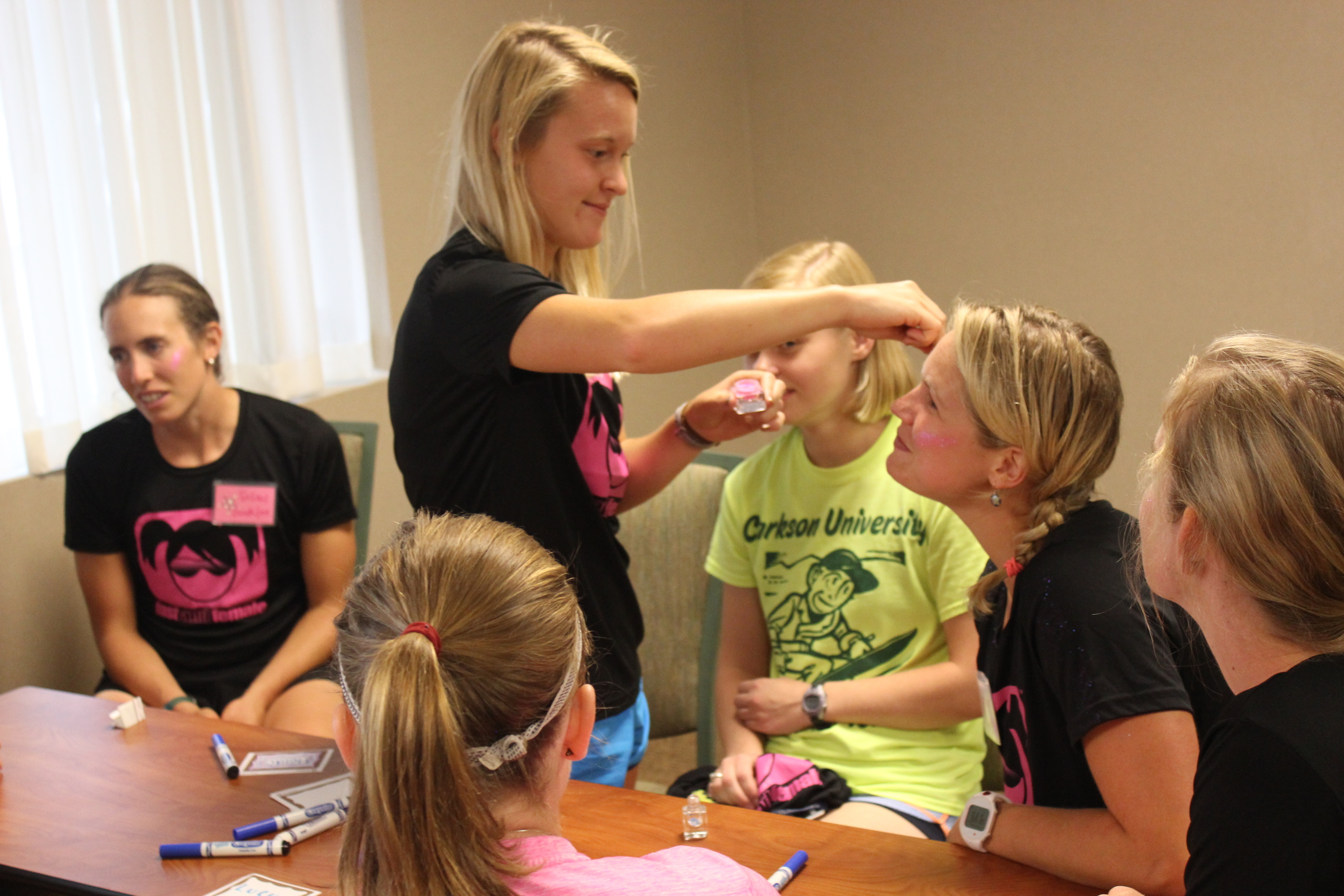
    Like the Speed Camp, Fast and Female is geared toward girls aged nine to 19. Unlike the Speed Camp, there was a lot of glitter involved.

    In it’s ninth year, Fast and Female events have become wildly popular across the continent. This year alone, Annie Pokorny of the SMST2 team told FasterSkier that she has helped lead three of the events and has one more scheduled this fall.

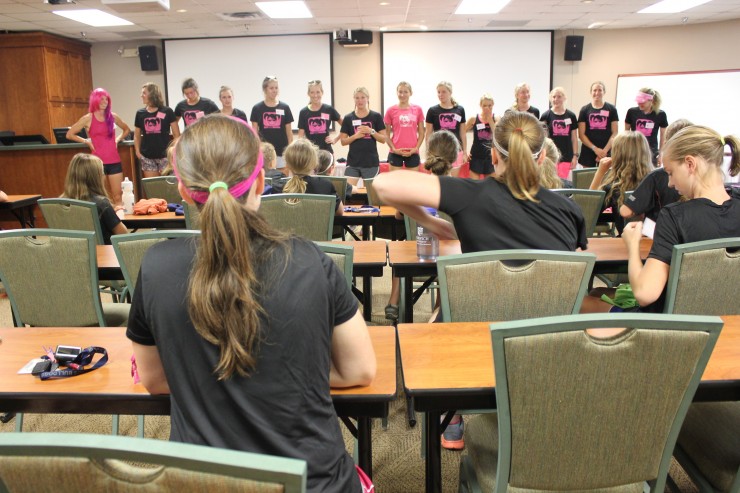
    At the Lake Placid gathering, girls were introduced to the U.S. Ski Team and U.S. Biathlon skiers who would be leading the event.

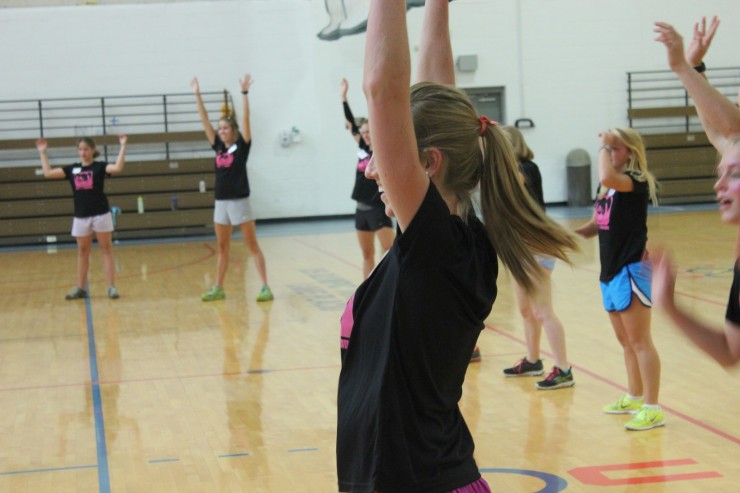
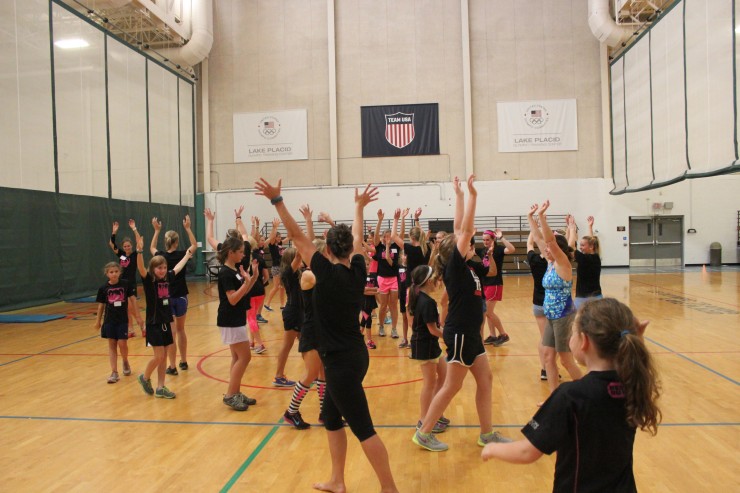
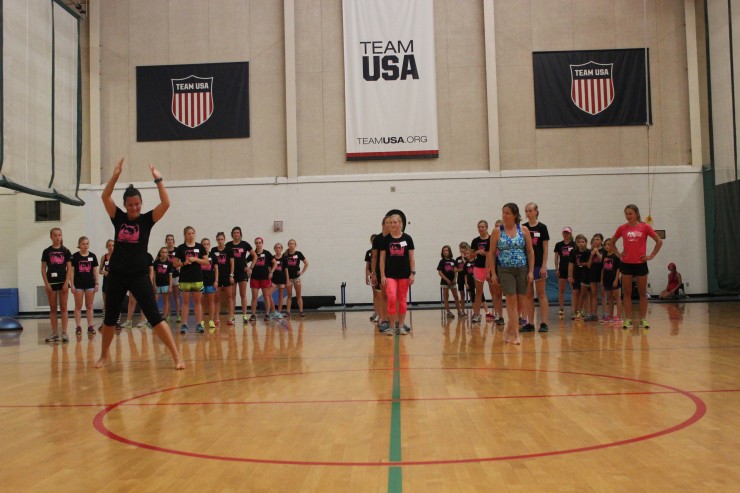
    After the introduction in which skiers stating her favorite place to ski, the group headed to the center’s gym where they participated in rhythmic dancing, an obstacle course, and one-on-one instruction in skiing and shooting.

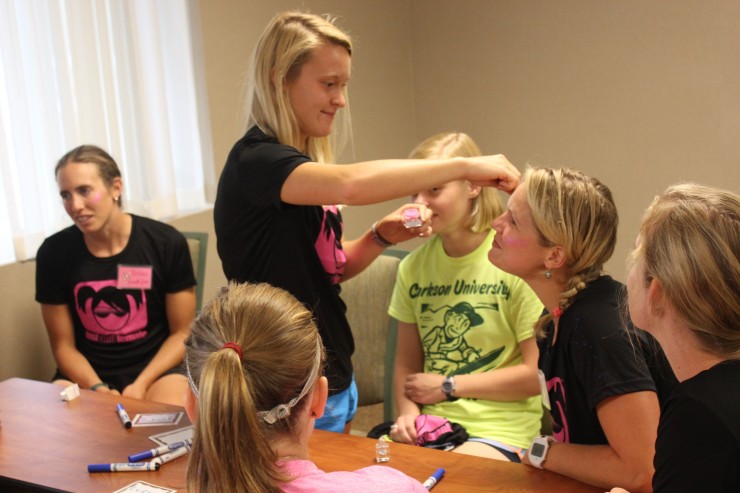
    Lake Placid Fast and Female
    A Fast and Female participant applies glitter to Jessie Diggins face.

    According to the organizers of the Lake Placid event, the goal of Fast and Female gatherings are to create an environment where girls and women are comfortable and excited to be active in sport.

    A little inspiration from Olympians Jessie Diggins, Sophie Caldwell, Liz Stephen and Susan Dunklee doesn’t hurt.

    Both Speed Camp and Fast and Female demonstrate a marked effort by the U.S. Ski Team and U.S. Biathlon to give back to the communities in which they train. Whether it’s learning how to slalom with Hamilton or dancing next to Caldwell, America’s top skiers are attempting to make a positive impact on the lives of the next generation of athletes.

    If the big smiles of participants were any indication, it would appear that their efforts were working.

  • Wednesday Workout: Classic Speeds from the USST’s Lake Placid Camp

    Wednesday Workout: Classic Speeds from the USST’s Lake Placid Camp

    FS-WW-USST-doublepole-lp
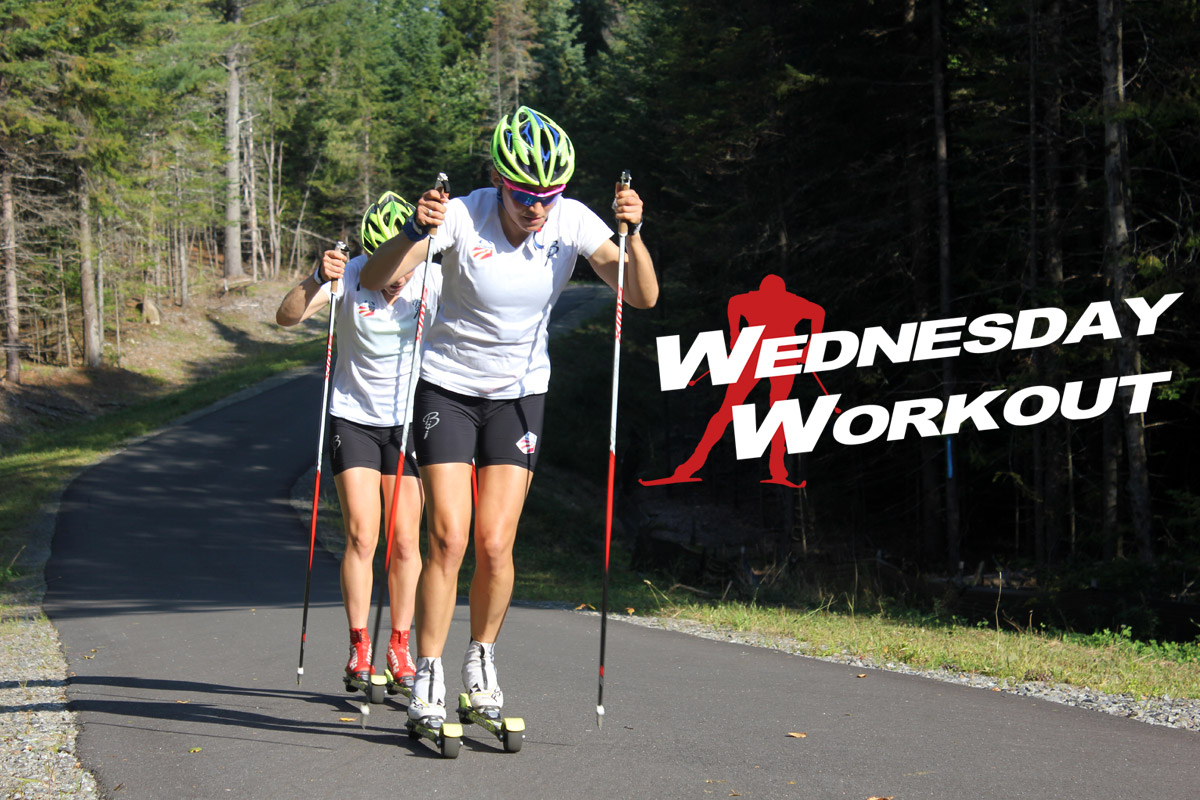
    Sophie Caldwell (USST/SMST2) and Ida Sargent (USST/CGP) in the middle of their first set of rolling speeds.

    LAKE PLACID, N.Y. – Fall is just beginning which means leaf-peeping, cider donuts, and pumpkin spice lattes are likely on your radar. However, once you get your head out of the changing leaves it may be time to focus on some new training goals as winter approaches. If you’re looking to maintain a plan similar to the U.S. Ski Team, that means that you are focusing less on volume and more on intensity before you head into the depths of fall.

    USST Lake Placid Camp Speeds Friday Sept. 5, 2014
    Jessie Diggins (USST/SMST2) warms up with agility before her classic speeds. Here she is partaking in the slalom.

    As part of their 2014 Lake Placid Fall Training Camp, the U.S. Ski Team took part in a classic speed workout aimed at activating quick twitch muscles and improving technical and tactical skills.

    According to women’s coach Matt Whitcomb, the workout is part of a greater push by the U.S. Ski Team to include complex workouts that have various levels of development. The goal is to have sessions that not only increase fitness but also create an infrastructure for athletes to progress their skiing in a technical manner.

    “At this time of the year we have tried to do is build an infrastructure for the athletes. The aim is create incredible workouts that have various levels of focus and various chapters,” Whitcomb said.

    The Lake Placid workout does just that. Starting with an agility warmup, it progresses from eight rolling double pole speeds to eight striding speeds that are bound to make you analyze your technique and leave you out of breath.

    The Workout: 1. Agility warmup 2.Two sets of four rolling double pole speeds on varying terrain 3. One set of eight striding speeds on an incline

    Where: Olympic Jumping Complex, Lake Placid, N.Y.

    What: Start your warmup as usual but after several minutes of easy classic skiing you should enter an agility course. This will not only help you warmup, but it will also help you engrain basic yet effective agility into your workout. The entire warmup should last roughly 20 minutes.

    In Lake Placid the USST used the following exercises that were placed in a loop. Athletes then completed the loop as many times as they felt necessary.

    – Right foot slalom (Enter a short slalom course with your left foot elevated and hop through the short course while keeping the left foot in the air)

    – Left foot slalom (Opposite of the right foot slalom)

    – Regular slalom 

    – Skip striding (Stride across a 50 m section while skipping during each stride. It creates an awkward feeling but after several attempts you should be able to get the hang of it.)

    After completing the warmup pick two sections of a 500 to 1000 meter loop to do your rolling speeds. Each section should have varying terrain including corners and rolling hills that are suitable for double poling. The distance should be no more than 100 meters and should last roughly 15 to 20 seconds. Complete the loop once to get a feel for the terrain then ski the loop four times, each time rolling into an acceleration in the same speed zone. If you need to take another loop for more rest, do so. Once you’ve completed four speeds in one zone, repeat the process in the second zone. While you are competing these speeds make sure that you are conscious of the path you choose around corners. Many skiers often begin to turn into the corner too late. Draw a chalk arrow where you or your coach think it is best for you begin your turn as a friendly reminder.

    When you’re done with the rolling speeds, find a short hill that requires striding. You will repeat a similar process as before, skiing in between each of your eight speeds. Before you begin each speed bring yourself to a complete stop and begin with a double pole start. Then progress into striding until you reach the top of the hill. To gain the most from this speed make sure that you enact a slight running technique. This will feel slightly awkward. While you will be sprinting up a hill, remember to be as relaxed as possible.

    Once done with the eight speeds, cooldown by skiing 20 to 30 minutes.

    Length: The entire workout should take anywhere from two to two and-a-half hours including warmup and cooldown.

    Ben Saxton (USST/SMST2) and Andy Newell (USST/SMST2) partake in the striding speeds in Lake Placid.
    Ben Saxton (USST/SMST2) and Andy Newell (USST/SMST2) partake in the striding speeds in Lake Placid.

    With such a complex workout, there may be times when you feel as if your technique is less than ideal. If that’s the case, get a coach or fellow skier skier to watch you and give you some technique advice.

    A unique aspect of the U.S. Ski Team is that they readily ask each other for help when they need it. If you want to train like the team, ditch the ego and ask your teammates, competitors, or random skiers for their advice.

    “An athlete can be the best teacher because we’re actually doing the motions” Liz Stephen explained. “A coach can see it and they can know exactly what to say but for some reason I sometimes can’t compute it. I went through trying to learn that run technique and it wasn’t until the speeds were done that Ida [Sargent] said to me ‘I think about keeping my hands in sight when we’re doing this.’ As soon as she said that it clicked for me.”

    To see more pictures from the workout check out our photo gallery from the training.

    USST Lake Placid Camp Speeds Friday Sept. 5, 2014
    Liz Stephen (USST/Burke) takes off her rollerskis to help her master the technique required for the striding speeds.
  • Henkel on Starting Strong, Going Out with a Bang (Exclusive Interview)

    Henkel on Starting Strong, Going Out with a Bang (Exclusive Interview)

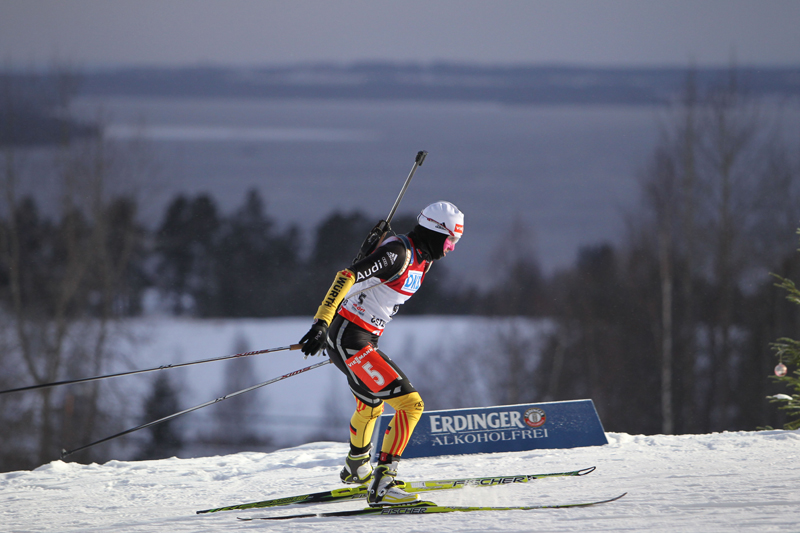
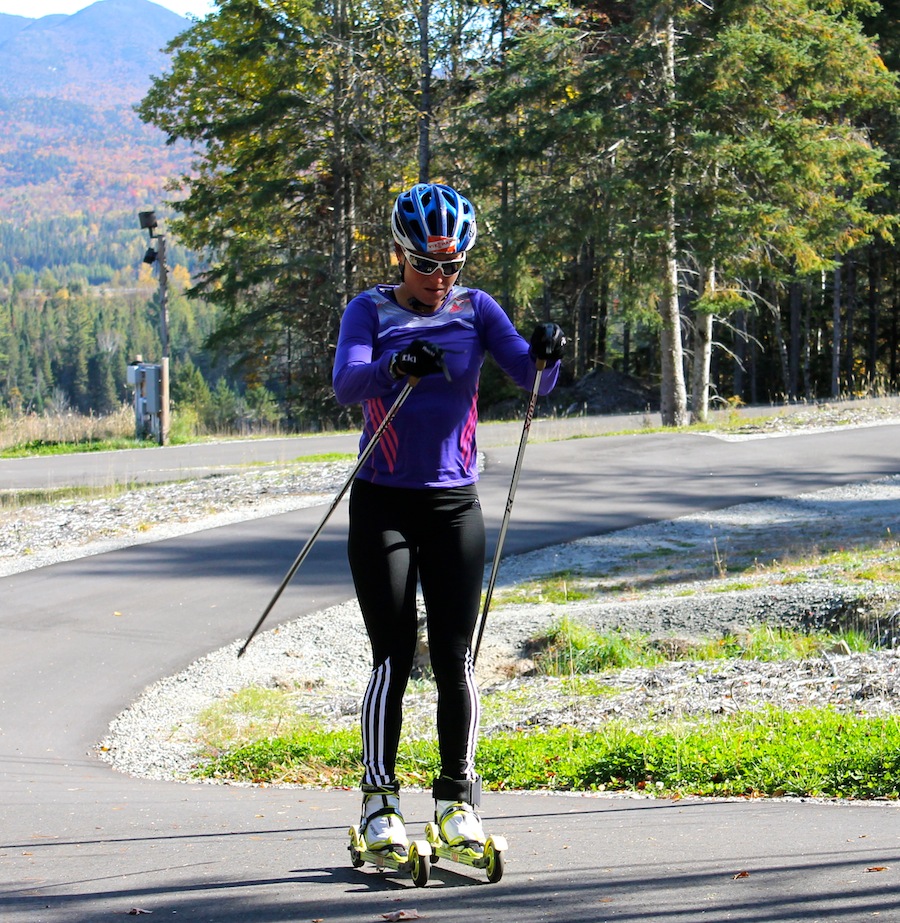
    Germany's celebrated biathlete and four-time Olympic medalist, Andrea Henkel cruises along the 1-year-old rollerski loop on Oct. 3 at the Olympic Jumping Complex in Lake Placid, N.Y.
    Germany’s celebrated biathlete and four-time Olympic medalist, Andrea Henkel cruises along Lake Placid’s 1-year-old rollerski loop at the Olympic Jumping Complex in northeastern New York.

    This might be Andrea Henkel’s swan-song season, but the 35-year-old German biathlete and multiple Olympic gold medalist showed she’s in the hunt for one of her best winters yet – sweeping the opening biathlon races last weekend in Sjusjøen, Norway.

    Before the start of her 15th World Cup season, Henkel completed Saturday’s 7.5-kilometer sprint with one penalty and a 27-second win over France’s Marie Dorin Habert. On Sunday, she missed just one target and won the 12.5 k mass start by 9.1 seconds over Ukrainian Valentyna Semerenko.

    Andrea Henkel en route to a podium finish earlier this season in Ostersund; today she turned in a strong relay performance.. Photo: Fischer/NordicFocus.
    Andrea Henkel on her way to the podium last season at a December World Cup in Ostersund, Sweden (Photo: Fischer/NordicFocus)

    “I have trained for a few years to get into this kind of shape!” Henkel said with a laugh to NRK on Sunday. “But actually I didn’t feel as good today as I did [Saturday]… I hope I am feeling better for the Olympics, but if I still win there then it doesn’t matter!”

    In early October, FasterSkier caught up with Henkel, who was third in last year’s overall International Biathlon Union (IBU) World Cup. The eight-time world champion – and first biathlete to win a world title in each individual event – was visiting her boyfriend, US Biathlon’s Tim Burke, in Lake Placid, N.Y., for just over two weeks. She said that marked her first time in upstate New York in the fall.

    “Usually, I come in summer,” she said while putting her classic rollerskis in Burke’s car after a double-pole workout on the team’s new rollerski loop. For the short stay, she left her rifle at home.

    Used to visiting in June and July, Henkel made the trip over earlier this year as well, staying April through May. Now she’s been to the U.S. almost every month except January and December, she said.

    “At first, I planned to go to Utah – that was last year – and then I decided in spring I would not go to Utah and would come back to here,” she explained of picking Lake Placid over Soldier Hollow.

    “In Utah last year, I felt pretty tired after the traveling and then this altitude and was there for a little bit over two weeks just, too,” she added. “Here I have a little set up already so I don’t have to plan so much. … Everybody is saying it’s so nice in fall.”

    After arriving on Sept. 26, she flew back to Germany later in October when the U.S. team left for Soldier Hollow for the final rollerski trials of the season.

    Here’s what else Henkel had to say while in Lake Placid:

    Andrea Henkel double poles her way up the rollerski loop at the Olympic Jumping Complex on Oct. 3 in Lake Placid, N.Y.
    Andrea Henkel double poles her way up the rollerski loop at the Olympic Jumping Complex on Oct. 3 in Lake Placid, N.Y.

    FS: How have you been feeling, and what have you been working on?

    AH: Basically, I’m getting better faster. At the moment I did a lot of intensity, you know, I’m pretty tired doing this, and now I am working on my strength [with double poling], so everyday something to work on.

    FS: You had a big intensity block back home?

    AH: Already at home and then when I came I just continued and will have another few workouts doing this here. At the moment, I didn’t bring my rifle for this short time because it’s sometimes tricky [with airlines] so I took a shooting break. So I’m kind of [training] by myself. If something works out then I would like to be with the girls or sometimes with the guys to train, but yeah, two weeks is not so long and then I can handle it by myself, too.

    FS: Now that you’re gearing up for your fourth Olympics, how meaningful is this one?

    AH: This time will be my last time, but also I said last time already this will be my last one.

    FS: So you never know?

    AH: No. I know. Last time I knew that this will not be my last season. This time I decided that this will be my last season and so it’s a little bit different and more focused I think, and after this I know that it’s over.

    FS: How’s your health been and what is your hope for these Olympics?

    AH: I am healthy. Everything is working so far and I hope for another medal, of course.

    FS: As a team and individually, too? (She won gold in the 15 k individual and with the relay at the 2002 Salt Lake Games.)

    AH: The best thing would be both, so I see. At the moment, I just train and hope it works out again.

    FS: What is it like to be on a team with several promising younger women?

    AH: That’s good. I mean every time pushed the older ones by youngest ones. I was a few years ago, too, and pushed the older ones so this helped everybody and is a little bit congruent in their own team. It’s good to see the young ones are pushing again cause they had a little time – maybe two years – that it didn’t happen this way and now they are back and it’s good.

    FS: How did you like racing in Sochi?

    AH: I was once fourth [in the 15 k individual last season] … but the track is tricky and I had to change a little bit what I really should do because it’s pretty uphill – the uphills are great. I like that, but the downhills were a little bit too aggressive, I would say. For us girls, it was still fine, but in the guys’ race it was already, like, always night time as late afternoon and it got colder and was freezing and then the course was just not doable anymore for a lot of good skiers. So they should change something up.

    FS: Outside of Sochi’s course, what do you think of the whole area?

    AH: The area is beautiful.  It’s kind of sad to see how many trees just had to go for this. I am sure the athletes will have everything they need … I think for us, it will make a nice Olympics. Everything that’s coming with is maybe not be so nice.

    FS: So what’s next, after biathlon? What would you like to do?

    AH: I plan on moving one day to the U.S., but at first I have to get all when and how and … I think at first, I need my time to settle down a little and organize myself, my new life. Then I can tell you what I can do.

  • Demong Gets It Done in Placid with Ninth National Title; Van and Alexander Dominate Ski Jumping

    Demong Gets It Done in Placid with Ninth National Title; Van and Alexander Dominate Ski Jumping

    Olympic Champion Billy Demong shares the podium with teammates Taylor and Bryan Fletcher after winning his ninth career U.S. title. (Photo: USST/ORDA-Jon Lundin)
    U.S. Nordic Combined’s Billy Demong (c) shares the podium with teammates Taylor (l) and Bryan Fletcher after winning his ninth national at U.S. Nordic Combined Championships on Sunday in Lake Placid, N.Y. (Photo: USST/ORDA-Jon Lundin)

    Consistency is key when it comes to nordic combined. Third in the morning jump at the U.S. Nordic Combined Championships on Sunday in Lake Placid, N.Y., national-team staple Billy Demong went on to win the 10-kilometer rollerski with the third-fastest time at the Olympic Jumping Complex, holding off teammates Bryan and Taylor Fletcher by 11 seconds in 25:47.8.

    According to Steamboat Today, Demong started 16 seconds behind jump leader Todd Lodwick, another U.S. Nordic Combined veteran. Lodwick started four seconds ahead of Aleck Gantick and ultimately placed fifth after Demong, Bryan Fletcher, Taylor Fletcher and Brett Denney, respectively. Bryan and Taylor started nearly a minute behind in seventh and eighth, respectively.

    Taylor passed his brother and edged him for second by 0.3 seconds. Denney finished 31.1 seconds behind Demong in fourth and Lodwick was fifth (+1:14.5), reportedly slowed by asthma.

    It was Demong’s ninth national title in what may very well be his last U.S. championships. The 33-year-old Lake Placid-area native plans to retire after the 2014 Sochi Olympics.

    “No doubt, this was my best race of this summer,” Demong said in a U.S. Ski Team press release. “This was a solid start to where I want to be right now.”

    Most threatened by the idea of Lodwick sprinting to the finish or Taylor Fletcher catching him and skiing away, Demong said he tried to ski his own race.

    “I just wanted to ski an even split and stay just 10 to 15 seconds in front of [Taylor] so he didn’t have the opportunity to break away from me,” he explained. “It seemed like that worked out. He pulled within 10 seconds of the last lap, but I had enough energy to hold that gap to the finish line.”

    Best of all, Demong said the dryland results indicate that the team’s in good shape overall.

    “There were four to five guys who could have won so I think that our team is exceptionally strong, even stronger than four years ago,” he said. “That’s the most important thing to me.”

    The U.S. Nordic Combined squad is headed to Europe on Monday for its final overseas training camp before the World Cup season starts next month.

    “We had some good results,” head coach Dave Jarrett told Steamboat Today. “It was difficult conditions and this hill is hard. We didn’t do very well jumping, but we have jumped well here, so this was just one of those days.”

     2009 World Champion Lindsey Van celebrates her U.S. Ski Jumping title along with teammates Jessica Jerome and Alissa Johnson in Lake Placid. (ORDA-Jon Lundin)

    2009 World Champion Lindsey Van (c) celebrates her U.S. Ski Jumping title along with teammates Jessica Jerome and Alissa Johnson on Sunday in Lake Placid, N.Y. (Photo: USST/ORDA-Jon Lundin)

    Van, Alexander Take Jump Titles

    Also on Sunday in Lake Placid, 2009 world champion Lindsey Van (Women’s Ski Jumping USA) and Nick Alexander (USA Ski Jumping) notched national titles on the K90 Olympic normal hill at the U.S. Ski Jumping Championships. For Van, it was her 16th title and Alexander’s second.

    “This validates all of the hard work that I’ve been putting in all this summer,” Alexander said in a U.S. Ski Team press release. “Now I just have to appreciate today and work even harder heading into the wintertime.”

    “I had fun today and jumping is about fun,” Van said. “I started jumping well a couple of weeks ago. It’s nice as I was struggling a couple of years. It was nice to feel the rhythm of ski jumping again.”

    Earlier this summer, U.S. Women’s Ski Jumping world champion Sarah Hendrickson, who is recovering from knee surgery and did not compete on Saturday, and USA Ski Jumping’s Nick Fairall won the large hill competitions in Park City, Utah.

    Van tallied the two longest jumps of the weekend of 92.0 and 96.5 meters to top teammate Jessica Jerome, who was second, and Alissa Johnson in third. Alexander soared 99 meters on both rounds, the longest of any man, to beat teammates Fairall in second and Anders Johnson in third.

    Video from WPTZ News Channel 5

    Results

  • Parking Lot Alternative: Biathletes Welcome New Lake Placid Rollerski Loop (with Video)

    Parking Lot Alternative: Biathletes Welcome New Lake Placid Rollerski Loop (with Video)

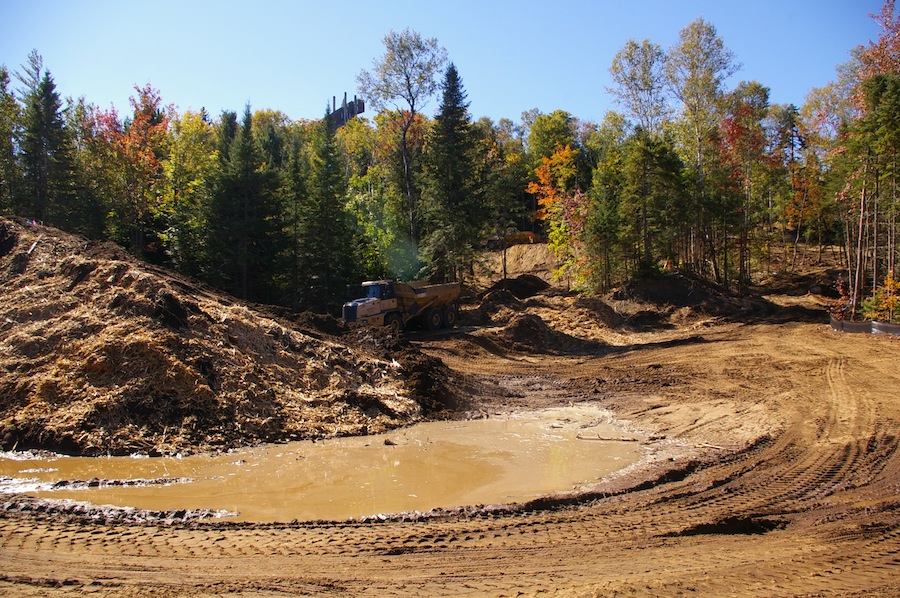
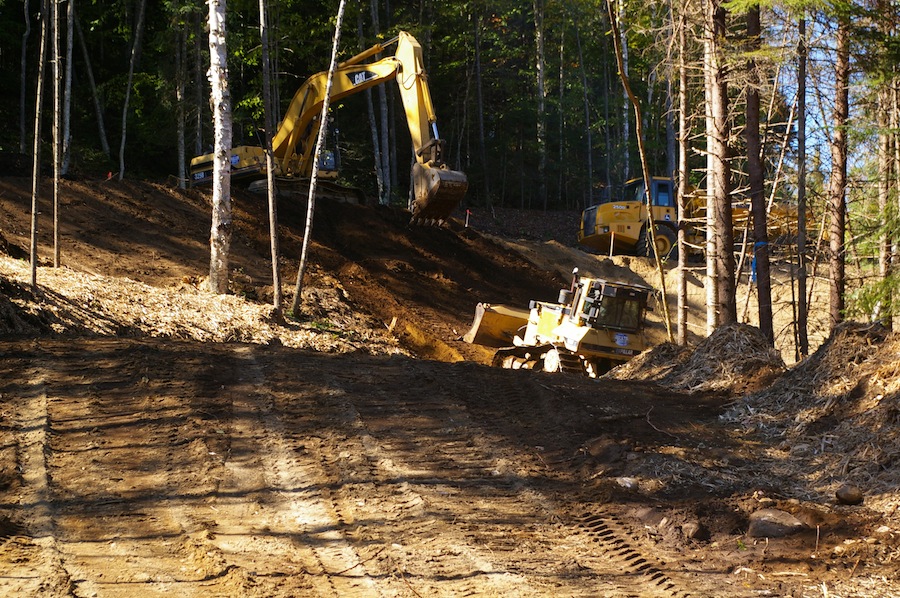
    The land behind Lake Placid’s Olympic Jumping Complex biathlon range very much under construction in late September. The Olympic Regional Development Authority (ORDA) headed the half-million dollar project to extend the rollerski loop by 1.5 kilometers. It was completed in mid-October.

    LAKE PLACID, N.Y. – Anyone on the upper part of the rollerski loop at the Olympic Jumping Complex after mid-August likely caught a glimpse of its under-construction backdrop. Mounds of dirt and heavy machinery littered the landscape spanning farther up the hill. Something was going on, and it looked like a big deal.

    Ooh la la. Near the top of the new rollerski loop at the Olympic Jumping Complex in Lake Placid, N.Y.

    Training on the range below almost daily throughout the offseason, US Biathletes Tim Burke and Lowell Bailey knew exactly what the plan was. They helped design it.

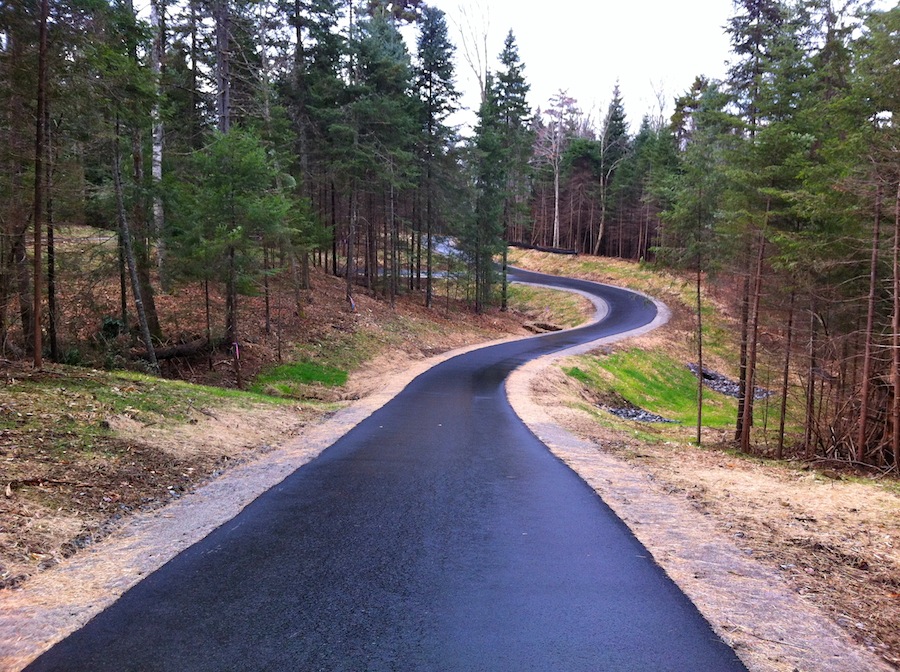
    The nearly 14-week project, headed by the Olympic Regional Development Authority (ORDA) with the financial backing of the United States Olympic Committee (USOC) and its sponsor, 24 Hour Fitness, wrapped up in mid-October and added another kilometer and a half of paved rollerski trails to make for a nearly 3 ½ k loop.

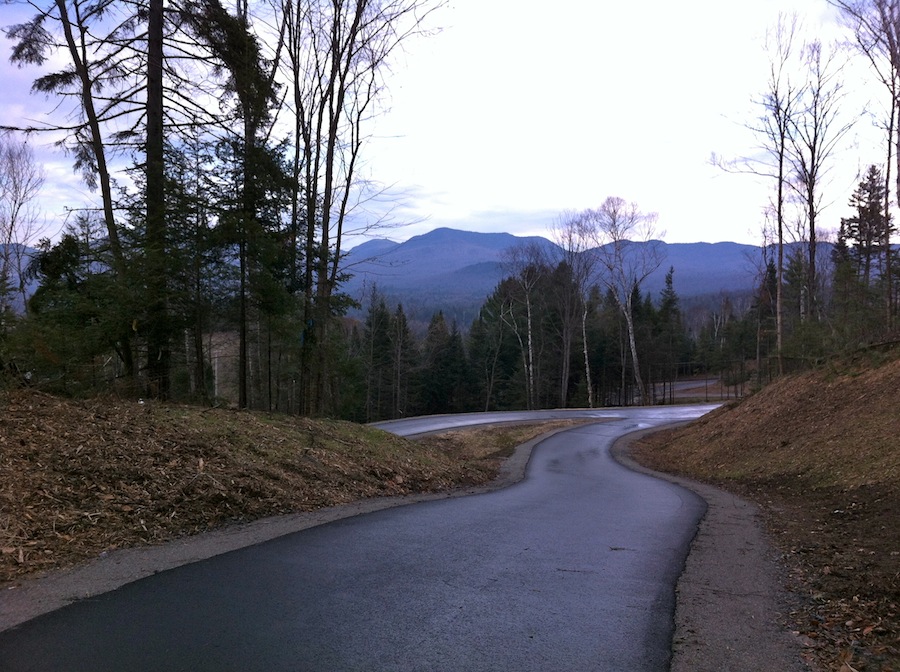
    By the time Lake Placid-based biathletes like Burke and Bailey returned from a national-team camp in Park City, the bulldozers had dispersed and pavement solidified to reveal an impressive series of switchbacks. Suddenly, no snow in late October and early November wasn’t the worst thing in the world. The biathletes had a brand new rollerski loop to train on.

    “It’s absolutely huge for us,” Burke said Nov. 11 during one of his last days on the Lake Placid range before leaving for Sweden. “We’ve been skiing through the parking lot for the last five years, really, so to have this means so much to us and our program.”

    US Biathlon Executive Director Max Cobb said the rollerski loop has been a goal of the association’s for nearly 25 years.  Back when he started with USBA in 1989, it had plans to construct a paved loop at Mount Van Hoevenberg, which hosted cross-country skiing, biathlon, bobsled, luge and skeleton at the 1980 Olympics. The Adirondack Park Agency upheld wildlife conservation laws and shot that down, so USBA sought alternatives, which took another two decades to materialize.

    Bulldozers, skid steers and dump trucks working on the rollerski loop behind Lake Placid’s Olympic Jumping Complex in late September.

    “It’s definitely been a really, really long time in the making,” Cobb said on the phone earlier this month. “I’ve got to give ORDA a lot of credit. It’s a tough time financially for all of the state organizations and ORDA definitely stepped up this year and said, ‘Yep we need to do this for the biathlon team.’ They put in a lot of staff time that isn’t reflected in the contractor costs, so I can’t say enough good about they way ORDA and the USOC came together and made this happen.”

    In all, the project cost about $500,000 dollars, Cobb confirmed. The USOC came forward with the initial funds with the support of 24 Hour Fitness, and ORDA budgeted the additional amount, he explained.

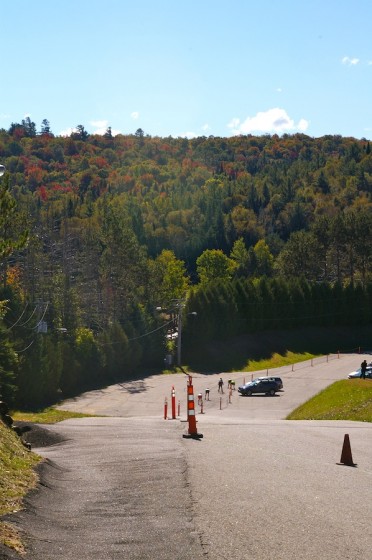
    Since ORDA built the range at the jumping complex in 2008, it intended to extend its paved loop from approximately 2 kilometers (which involved a hairy section through the parking lot, down into the jumping stadium and back up a massive hill to the top of the range) to something that didn’t require so many traffic logistics. As it was, a team staff member had to stand by the gate in the middle of the two-tiered downhill to make sure cars didn’t interfere with rollerskiers flying by. It was the same scenario at U.S. Ski Team camps or whenever junior programs like the New York Ski Educational Foundation (NYSEF) used the loop.

    However, state budget cuts since 2008 made money for venue development hard to come by.

    “New projects really weren’t possible for them last season when we had hoped to get this done,” Cobb said. “But they were able to commit some funds to it this year and the U.S. Olympic Committee really stepped up big time with the support of their sponsor … to make the loop happen.”

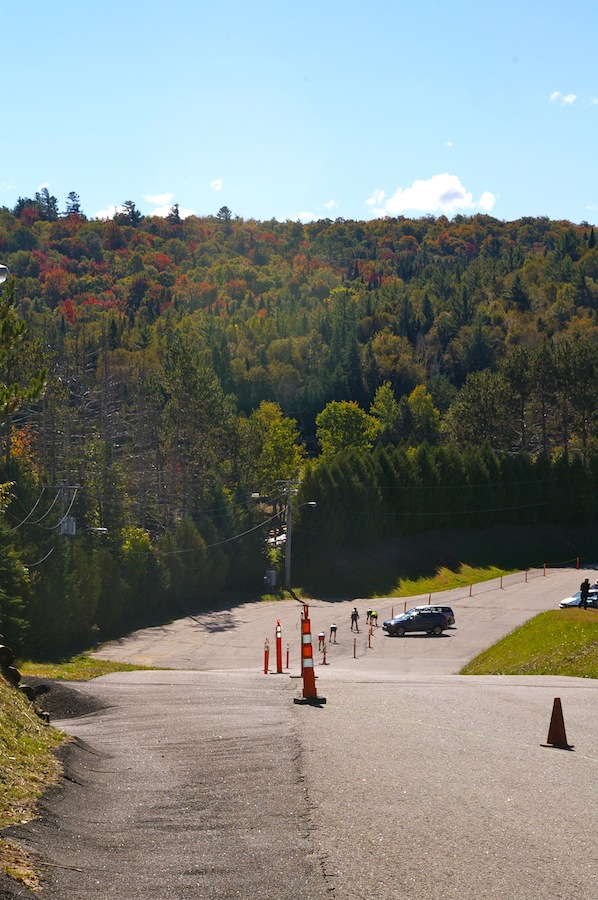
    The big downhill out of the parking lot and into the stadium at Lake Placid’s Olympic Jumping Complex. Previously the only way to make a loop there, 1.5 k of new paved trails offers an alternative above the biathlon range.

    Now athletes can use the parking-lot portion if they wish for a longer loop or stick to 2 to 2 ½ kilometers of paved skiing up top.

    US biathlete Leif Nordgren got out on the course for the first time in early November and tweeted a photo of it. The next day, he was excited to return for another session.

    “I told the coach right as I showed up, I said, ‘Phew, it wasn’t just a dream, it’s still here,’ ” Nordgren said. “To finally have it done and completed, it’s a big relief, and it’ll be really exciting to have it all next summer to train on, too.”

    The extension wasn’t very sizeable at about a kilometer and a half, but “it’s a big, huge step up from what we had before,” Nordgren said.

    “The pavement is super nice, super smooth, and in general, the course is really nice, too,” he added. “It flows really good for skating and it ties into the range pretty well, and also builds on the loop that was here to begin with so everything works pretty well together now.”

    Among the most important aspects of the new course are its transitions. Before, rollerskiers had to chug up a long hill out of the stadium and keep ascending into a curvy wooded section before reaching the range, previously at the height of the land. The new loop extended higher beyond that, toward the ski jump access road, which athletes could also use for longer intervals. Switchbacks on the course made the steep terrain more manageable, and essentially, more rolling.

    “You’re always working; there’s a big climb out of the range, but it’s not overly hard and it’s nothing compared to what it was before,” Nordgren said. “It requires you to be a much better technical skier than the old loop did.”

    In his opinion, the course flows more like a biathlon loop with a distance closer to their typical 2.5- or 3.3-kilometer race loop. Also, US biathletes, most of which train in Lake Placid at some point in the year, tended to be better hill climbers because of their training venue. The problem was, “there’s no biathlon course in the world that’s set up like that,” Nordgren said.

    “Every time you come in to shoot your heart rate is through the roof and you’re completely dead,” he added. “It never really gave us a chance to work on things like transitions and technique changes and things like that. With this new loop, it’s skis so much more like the courses that we race on so hopefully it will help us better prepare for the competition season.”

    Tim Burke (r) and Lowell Bailey (l) leaving the biathlon range to ski on their new rollerski loop on Nov. 11 in Lake Placid, N.Y.

    That was the idea, especially as designers sought input from Cobb, Burke and Bailey. Among the things they tweaked were corners and transitions to make it workable.

    “We wanted to get in more ski-like terrain and obviously we had to use more transitions because we had to somehow get from the top point of the venue back down to the range in a safe way,” Burke said. “It’s very skiable. There’s nothing out there that’s too bad. When everyone first walks it, they say, ‘Oh, there’s a loop at the jumps there, it must be crazy and scary downhills and dangerous,’ but I did it on classic rollerskis yesterday and it’s totally fine.”

    Cobb is thrilled his athletes will be able to use the new 10-foot wide course, which is wider in two-way traffic areas, next year leading up to the 2014 Sochi Olympics. Mostly, he said it’ll be best for combination training.

    “It’s still a little bit short for over-distance work, but honestly we have good routes on the roads around Lake Placid for that kind of training,” Cobb said. “It really changes the nature of the opportunity for Lake Placid; it makes it a viable year-round training site for us, for the national team, where we don’t feel like we’re really missing anything there now. There are bigger rollerski loops and other things in other places, but we can do the work we need to do here, so we’re meeting that or so it seems.”

    Aside from the national team, it’s a better venue for the community in terms of safety and terrain more like cross-country ski trails, he said.

    “It’s definitely a big step up in terms of the youth programs that can be done there now and done really safely because it’s off the roadways,” Cobb added.

    NYSEF nordic head coach Margaret Maher wrote in an email that her athletes tried the course for the first time a few weeks ago, after she deemed them ready for its downhills and corners. They will continue to have to reserve time at the venue, she explained.

    For a virtual tour, check out this on-course video from USBA coach Jonne Kähkönen.

    ***

  • U.S. Ski Team Elite Camp: Time-Trial Video

    U.S. Ski Team Elite Camp: Time-Trial Video

    The women get ready for the quarterfinals at the U.S. Ski Team Elite Camp classic rollerski sprints on Sept. 20 at the Olympic Jumping Complex in Lake Placid, N.Y. Up front, from left to right: Jessie Diggins, Sophie Caldwell and Ida Sargent.

    LAKE PLACID, N.Y. — Exactly a week ago, 40 elite skiers threw down some solid efforts at a U.S. Ski Team (USST) classic rollerski time trial, with the fastest men and women moving on to their respective quarterfinals, semifinals and finals.

    Sophie Caldwell and Andy Newell of the Stratton Mountain School T2 Team topped the women’s and men’s fields in the sprint workout. For more about the races, click here. Otherwise, enjoy the video below capturing the action at the Olympic Jumping Complex, from the qualifiers through the heats.

  • Caldwell, Newell Stay Ahead in USST Camp Rollerski Sprints (Updated)

    Caldwell, Newell Stay Ahead in USST Camp Rollerski Sprints (Updated)

    Sophie Caldwell (r) leads Ida Sargent (second from r), Caitlin Patterson (second from left), Jessie Diggins (behind Patterson) and Anne Hart (l) at the start of the big downhill in the first semifinal of the women’s 1.4 k classic rollerski sprint on Thursday. The time trial was the first of this year’s USST Elite Camp in Lake Placid, N.Y. and took place at the Olympic Jumping Complex.

    LAKE PLACID, N.Y. – Flinging around a sharp corner about a ski length behind one another, Sophie Caldwell (Stratton Mountain School T2 Team), Ida Sargent (Craftsbury Green Racing Project), Caitlin Patterson (CGRP) and Jessie Diggins (SMS) each lowered into a tuck and prepared for a long, steep descent.

    Diggins called out to the others just ahead of her in the classic rollerski sprint at Lake Placid’s Olympic Jumping Complex.

    “That’s it,” the U.S. Ski Team (USST) member said. “Nice.”

    Conversations like that, in the first of two women’s semifinals at the USST Elite Camp on Thursday, didn’t take place every heat. But they generally differentiated the women’s and men’s races.

    According to Caldwell, who eventually won the women’s 1.4-kilometer final, nothing was too cutthroat about the sprint rounds. Caldwell finished first in the quarterfinal, semifinal and A-final, beating USST member Sargent in the latter by 1.4 seconds. Diggins finished third in the A-final, about four seconds back.

    “We try to be nice,” Caldwell said. “We even talk to each other and let each other know how much space we have. I don’t know what the boys do.”

    She laughed. Anyone who watched the men’s heats on Thursday knew exactly what they did.

    Simi Hamilton (left) leads Skyler Davis (second from l) and Andy Newell (front right) into the long downhill during the quarterfinals of the men’s 1.5 k rollerski classic sprint on Thursday at the USST Elite Camp in Lake Placid, N.Y. Newell went on to win the A-final, Davis was second, and Hamilton was third.

    In the first of four men’s quarterfinals, USST members Simi Hamilton, Andy Newell and Skyler Davis all battled for position on the same corner at the top of the long hill. Each had to pass through two narrowly spaced cones to make the turn.

    All three of them did so and managed to stay on their feet, while Ryan Scott (Team HomeGrown), Tim Reynolds (CGRP) and Sylvan Ellefson (HomeGrown) worked hard behind to close the gap. Davis said he felt someone push his poles, which made him go uncomfortably faster on the ripping downhill.

    In the end, they all made it to the finish. Newell ultimately won the men’s 1.5 k final, about two seconds ahead of SMS teammate Davis in second, and Hamilton (Sun Valley Ski Education Foundation) in third (+4.42).

    “This course is pretty wild because there’s so much tucking,” Newell said after the race. “To have six people going around that course is pretty crazy. Skyler and I are used to banging heads with each other because we do it every day, but it was fun to have Simi and Ryan Scott and some of those other guys in there, fun to go really fast on the downhill and try to pass each other on some of the corners. Nobody crashed hard I think, so it was a good day.”

    Davis, who was second behind Newell in the qualifier and every heat that followed, said his performance was a “confidence booster” after being sick at the Lake Placid camp last year and having to call it a day after the prelims.

    “Coming in [to this workout], I was pretty tired. This camp’s been hard,” Davis said. “Once I started warming up I felt great.”

    A competitive field of 26 men made for fast heats. On the same course last year, USST A-teamer Kris Freeman won the classic sprint in 3:30. Newell posted 3:22.38 in Thursday’s A-final and threw down a 3:18.91 in the qualifier.

    In the women’s qualifier, which consisted of 14 skiers, Diggins was fastest in 3:42.20 – the same time Sargent clocked to win last year’s time trial. On Thursday, Caldwell qualified second 0.15 seconds back, and Sargent was close behind in third (+0.24).

    Those kinds of measurements are what matter most this time of year, according to USST head coach Chris Grover.

    “It’s too early to really hang your hat on any sort of results here,” Grover said. “It’s just kind of a road mark. I think for a lot of the athletes, we want them to take a look at what kind of lactates are they able to create, what kind of heart rates are they able to have. That gives us an indication of how much of their aerobic system they’re able to access, how much of their anaerobic system they’re able to access, those kind of feedback markers plus how they sustain the rounds.”

    If they fade progressively after the prelims, something’s got to give. Grover said race scenarios give skiers an opportunity to assess where they’re at, and how to move forward.

    “Like, ‘OK, I’m handling training well during this period,’ or, ‘I’m starting to get a little fatigued, I’ve really got to concentrate on rest for a few days, or for a week after this camp,’ ” Grover said. “So it’s not so much the placings that are critical; there’s a lot of different rollerskis out there, there’s a lot of different ski speeds. It’s more the individual feedback in terms of heart rate, lactate, times, technique.”

    Photo gallery | Complete results

    ***

    Additional quotes:

    Sophie Caldwell (1st woman): “I felt good today. In the qualifier there were a few things that I felt like I didn’t do quite right. I took the corner on the bottom wrong, so I worked on those in the heats and it was good to be able to follow some people and see what they did, like Jessie was really good at going fast over the top of this hill and taking the corner down there.

    “I didn’t really know what to expect. I wanted to be right up there with Jessie and Ida. … This summer we basically just did all Level 3, not many Level 4 workouts, and then we do some speed workouts. I think now we’re starting to do more Level 4, time trial, race pace stuff, but it feels good so far so it’s good to know you can still get fit just doing Level 3. … We all have different skis and everything, but I’m just happy to come out here and feel good and be in the mix with everyone.”

    Ida Sargent (2nd): “It’s a rollerski time trial in September and everyone is on different skis,” she wrote in an email. “I wasn’t concerned with results, instead focusing on gettiing a hard workout and practicing some technique goals in a max effort. It was a really fun skiing with everyone and it felt good to feel the lungs burning with cold air this morning!”


    Jessie Diggins (3rd): “During such a good intensity camp, my goal with this workout was to get in some good hard efforts, and really work on my qualifier,” she wrote in an email. “Classic sprinting is definitely my weakest area and epecially qualifying, and so I’ve been really focusing on, well, FOCUS during the qualifier.

    “I definitely was feeling the fatigue in my body, but that was to be expected during this camp after a 4.5 hour training day yesterday [Wednesday], so I wasn’t super worried about it. However, it still doesn’t feel good to not be moving lactate out as fast as I want!”


    Andy Newell (1st man): “I definitely feel so much better than I have in the past racing here. I’ve been doing a lot more hard stuff, a lot more speed, so it’s good. I actually feel like a sprinter again, which last year at this time and for most of the winter, I didn’t really feel like a sprinter so it feels really good to get that kind of power back.

    “I’m usually not such a good classic rollerski sprinter, for whatever reason, my technique doesn’t translate that well over onto rollerskis, but it feels good to double pole well and I like courses that have lots of striding like this. … Last year, I was sick for this race or I’m [usually] really tired for Lake Placid camp because I’m coming in training too much volume.  I tried to cut back [the week before] so I was able to really come into this camp and get the most out of each interval session and time trial. That was the goal of the camp and I think that worked out well. I’ve been feeling good all camp and hopefully will be able to absorb some of this hard training better than in the past.”


    Skyler Davis (2nd man): “We had a sprint time trial about two and a half to three weeks ago in Maine. It was pretty similar to this except it was all double pole so I got to go head to head with [Newell] on that. This was the same type of thing, we were battling the whole time, especially coming up the hill. All those guys were pushing pretty hard … so all of our heats were pretty fast. It was really good training.”


    Simi Hamilton (3rd man): “I felt pretty good today, considering that I’ve done pretty much no max efforts yet this year,” he wrote in an email. “I actually felt better today than I have in years past during the camp, so I am taking that as a good sign that my training is going in the right direction, especially in terms of overall fitness and improved endurance throughout heats. I ran into some slight equipment problems [blown-out rear wheel] today, so that was kind of a bummer, but other than that I am pretty happy with how the day turned out.

    “My main goal today was to ski consistent efforts in the qualifier and each heat … And I think I did that, especially since my equipment problems required me to switch to a slightly slower pair of skis for the semis and finals.”


    Chris Grover: “We’re toward the end of the camp now so people are starting to accumulate some fatigue. We’re actually doing threshold bounding intervals tomorrow [Friday], so I expect that just about everyone will need a few easy days following the camp and that’s normal.

    “We like to push the athletes when they’re together and they have a chance to go head to head. At the same time, it looked like good movement out of a lot of the athletes. I really like this course because it has such a wide, steep finish hill, really a chance for athletes to demonstrate how their holding up through the rounds, if they’re able to carry good momentum up that hill and over the top and into the finish. I think it’s also great to have a big hill and then a long finish straight, especially like we have for the men on this course, because it replicates a lot of the courses that we encounter in the winter time.”

     ***

    Women’s A-Final

    1.  Sophie Caldwell (SMS) 3:37.82

    2. Ida Sargent (CGRP/USST) 3:39.22

    3. Jessie Diggins (SMS/USST) 3:41.89

    4. Amy Glen (CGRP) 3:43.48

    5. Anne Hart (Dartmouth) 3:45.41

    6. Clare Egan (CGRP) 3:47.92

     Women’s B-Final

    1. Caitlin Patterson (CGRP) 3:41

    2. Liz Stephen (USST) 3:45

    3. Heidi Halvorsen (GMS) 4:02

    4. Erika Flowers (SMS) 4:04

    5. Annie Pokorny (Middlebury) 4:11

    6. Julia Kern (CSU) 4:31


    Men’s A-Final

    1. Andy Newell (SMS/USST) 3:22.38

    2. Skyler Davis (SMS/USST) 3:24.39

    3. Simi Hamilton (SVSEF/USST) 3:26.80

    4. Pat O’Brien (CGRP) 3:29.94

    5. Ryan Scott (Team HomeGrown/SSCV) 3:30.10

    6. Eric Packer (SMS) 3:33.51

    Men’s B-Final

    1. Nils Koons (CGRP) 3:31

    2. Alex Howe (CGRP) 3:32

    3. Sylvan Ellefson (Team HomeGrown/SSCV) 3:33.12

    4. Dylan McGuffin (CGRP) 3:33.39

    5. Tim Reynolds (CGRP) 3:33.89

    6. Gordon Vermeer (CGRP) 3:34.78

    Link to complete results