From the FasterSkier archive — posts syndicated from athletes’ and coaches’ own blogs between 2004 and 2012, kept online as published. Current coverage is at fasterskier.com.
This reporting costs money. Please support this coverage with a voluntary subscription (below) so FasterSkier can provide this level of access to the sport we all love year-round.
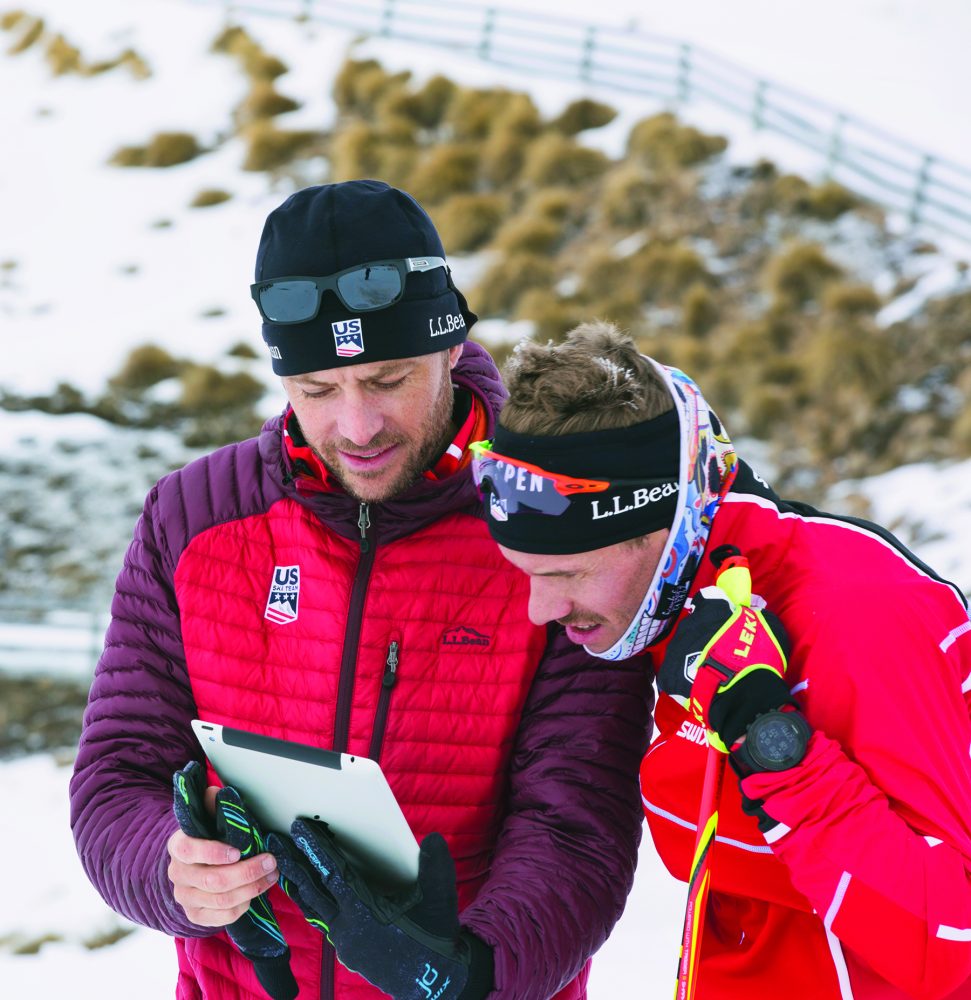
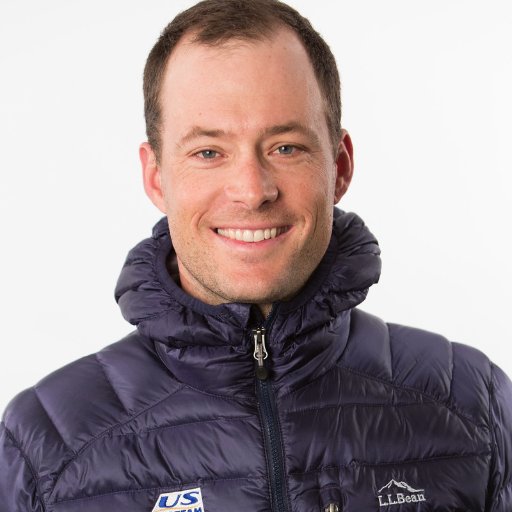
On the eve of the opening event of the Olympic cross-country program, U.S. head coach Matt Whitcomb sounded equal parts energized and grounded. Speaking with FasterSkier’s Nat Herz in the mixed zone, Whitcomb touched on everything from ski exchanges and early-Games logistics to the long arc of the U.S. program—and the feeling inside the team right now.
One technical focus that has drawn attention ahead of the Skiathlon is the ski exchange, especially after Jessie Diggins (USA) and Frida Karlsson (SWE) tangled while lining up for their respective individual exchange boxes in the last World Cup Skiathlon, but Whitcomb emphasized that there’s no single formula.
“It really varies,” he said. “This is a skill that we’ve practiced over a decade and a half in some cases, but each athlete really takes their own initiative.”
Some athletes choose to practice exchanges using the same straps on two pairs of poles; others use separate straps for each pair. The calculus, Whitcomb explained, comes down to risk versus reward.
“The thing that can go wrong in the ski exchange is everything,” he said. “And the thing that can go right is you can gain a second or two. And then the pack’s back together.”
That balance—between chasing marginal gains and avoiding catastrophic mistakes—often reflects an athlete’s mindset. Whitcomb pointed to Diggins, who had been practicing exchanges at full speed the day before, including simulated interference.
“She’s somebody who visualizes things, tries to practice them, goes back to visualizing, and then does it again,” he said. “You try a few different scenarios, and those all become part of your visualization. One thing we can guarantee is that there’ll be a lot of people in a small space. If that’s part of your visualization, you won’t be disappointed.”
Beyond the technical details, Whitcomb acknowledged the peculiar chaos that comes with the opening days of the Olympic Games.
“The schedules in the first few days are a little bit chaotic,” he said. “You’ve got press conferences, headshots—things that are kind of smack in the middle of a complicated schedule. And then on top of that, you’ve got 16 athletes with 16 different workouts.”
That congestion, he noted, eases once racing begins. Only four athletes per country race per day, and there’s a single training window on the course—simplifying logistics and allowing the staff to think about getting athletes off-site for training once the championships settle. Whitcomb mentioned options such as skiing the Marcialonga course or heading to Passo Lavazè or Predazzo for quality terrain and sunshine, but wanted to be careful to avoid too much altitude.
Asked how the team felt in that moment, Whitcomb didn’t hesitate.
“Really excited,” he said. “Very centered. Prepared. Our team is vibing in a really incredible way.”
Despite the athletes coming from different clubs and training backgrounds, he said the atmosphere feels unified.
“It feels like it is Team USA,” Whitcomb said. “It’s not one club versus another club. It’s just this amazing union. And I think the athletes would agree with that.”
Whitcomb also reflected on how much the program—and the sport in the U.S.—has changed over the course of Jessie Diggins’ career. He recalled the early years, when training camps meant homestays and catered enchiladas from a local Mexican restaurant, and waxing operations ran out of two Conex containers that had to be loaded and unloaded before and after every race.
“Now we’re renting houses and bringing a chef,” he said. “We’re in two trucks instead of two Conexes. We’re not moving 2,000 pounds of equipment every time.”
Just as striking, he said, is how expectations have shifted.
“We used to really celebrate a single top-30 on the whole team,” Whitcomb said. “We had a banner where we’d write those results down—29th in a World Cup, that went on the banner. And just the way the standard has changed across the board…”
That evolution, he explained, has been the product of steady, incremental growth rather than dramatic leaps. Whitcomb traced it back to the mid-2000s, when Pete Vordenberg secured funding to build a development team and expand the women’s program.
“I’ve benefited from nearly incremental progress every year with regard to budget,” he said. “And I think more than anything, the stability—not having a huge gap that takes us back five or ten years—has been key.”
Through all that growth, Whitcomb said the program has retained something essential.
“As the level of professionalism and resources has climbed, it’s remained fun and enjoyable, and we haven’t lost a human value,” he said. “That’s perhaps the thing I’m most proud of.”
He credited that culture in part to athletes like Diggins, Rosie Brennan, and Julia Kern—athletes whose long careers have helped define what the team is now.
As the racing is about to begin, Whitcomb’s message was clear: the work is done, the team is ready, and the foundation beneath it has been years in the making.
FasterSkier’s Nat Herz reporting from the Mixed Zone.
Help Support Our Olympic Coverage!
FasterSkier has our own Nat Herz on the ground at the Olympics, which is a significant financial lift for us. If you value the thoughtful work and access FasterSkier provides at championships like this one, please consider becoming a Voluntary Subscriber. Your support directly fuels our work to cover the people, places, and moments that make our sport special.
This coverage is made possible through the generous support of Marty and Kathy Hall and A Hall Mark of Excellence A Hall Mark of Excellence Award. To learn more about A Hall Mark of Excellence Award, or to learn how you can support FasterSkier’s coverage, please contact info@fasterskier.com.
Emma Ribom (SWE), Moa Ilar (SWE), Kerttu Niskanen (FIN), Karoline Simpson-Larsen (NOR), (l-r) lead early in the women’s 20 K Classic Mass Start in Goms, Switzerland. (Photo: Authamayou/NordicFocus)
The sky above the Goms Nordic Centre on Sunday morning had the washed-out look of winter at altitude — pale and reflective. Snow had fallen overnight — not enough to transform the valley, but enough to affect ski behavior. The tracks were glazed in some places and soft in others, offering a surface that challenged kick, balance, and restraint.
This was the third and final race of the last World Cup weekend before the Olympic Games. The final challenge came in the form of a 20-kilometer Classic Mass Start — a distance long enough to punish impatience, short enough to reward precision. In many ways, it felt like a rehearsal, a partial preview of the Olympic 50 k to come, even as two of the discipline’s defining figures — Sweden’s Ebba Andersson and Frida Karlsson — were notably absent.
Fifty-six women started. Not all of them finished. None of them were anonymous by the time the race ended.
Jessie Diggins (USA) and Astrid Oeyre Slind (NOR), (l-r) got away early in the first lap before being brought back by the chase pack around 6.5 K. (Photo: Authamayou/NordicFocus)
An Early Question — and a Fast Answer
From the opening kilometers, the field confirmed what the course profile had suggested: this would be a race shaped less by outright speed than by rhythm and positioning. Short climbs arrived in quick succession, descents offered only brief relief, and the peloton stretched and compressed like an accordion with every change in gradient.
The first clear question of the day was posed early.
On the opening lap, Norway’s Astrid Øyre Slind moved decisively off the front. Jessie Diggins, wearing bib one and leading both the overall and distance World Cup standings, responded immediately. For a moment, the two skied clear — a clean, purposeful break that suggested collaboration rather than desperation.
The gap grew briefly, then stalled. By roughly 6.5 kilometers, the chase pack — patient, organized, and unwilling to let the race fracture too soon — closed the door. The break dissolved without drama, but not without meaning. The message was clear: separation would be earned later, not gifted early.
Through the first full lap and into the second, the splits told a consistent story. No one was allowed to escape. The front group remained compact, with the top ten separated by only a few seconds at successive checkpoints. Every surge was answered. Every acceleration absorbed.
Karoline Simpson-Larsen (NOR), Dariya Nepryaeva (AIN), Katharina Hennig Dotzler (GER), Johanna Matintalo (FIN), and Kerttu Niskanen (FIN), (l-r) work to bring back Diggins and Slind. (Photo: Authamayou/NordicFocus)
The Long Middle: Where Races Are Actually Won
What followed was the part of mass-start racing that rarely makes highlight reels but defines outcomes: the long middle.
The snow conditions amplified this dynamic. The fresh layer over a firmer base rewarded good kick but punished over-striding. Downhills carried enough draft that working alone was inefficient. On climbs, being out of position meant burning matches simply to stay attached.
Julia Kern spent much of this phase skiing in between packs — strong enough to feel underutilized, cautious enough to avoid overreaching.
Julia Kern (USA) and Tiril Udnes Weng (NOR), (l-r) trying to maintain contact. (Photo: Authamayou/NordicFocus)
“Today’s race was definitely a really hilly one, and not that fast, given the new snow,” Kern said afterward. “The tracks were a bit glazed, but also powder. The techs did a really good job giving us great kick, and I really needed that for how much climbing there was.”
She described a race defined by indecision forced by circumstance rather than confidence.
“I skied a lot of the race kind of stuck in between two packs,” she said. “In the second lap, I wasn’t sure if I should really go with the pack and risk it. I didn’t want to blow up, especially at semi-altitude. It was just hard to say with such a long, slow race.”
When a small bridge attempt formed later in the race, Kern hesitated — not from fear, but from realism.
“It was one of those days where I was feeling stronger than the pack I was skiing in, but not quite sure I could keep up with the pack in front,” she said. “They started to slow down, so it was a little bit of yo-yoing.”
For Kern, the result — 16th — came with clarity rather than frustration. The margins were small, the lessons specific, and the work ahead clearly defined.
Hailey Swirbul (USA) coming up the final climb with teammate Kendall Kramer (USA) slightly behind. (Photo: Authamayou/NordicFocus)
Moving Forward from the Back
If Kern’s race unfolded in the gray area between groups, Novie McCabe and Hailey Swirbul experienced the race from its deepest end.
McCabe started with bib 57. Swirbul with 58. Both expected chaos early — and neither panicked when it arrived.
“I kind of expected the accordion,” McCabe said. “I talked to my tech before the race, and he thought it would be a good idea to stay calm early. When it strung out, that’s when I should try to move up.”
That patience paid dividends. As the field gradually fractured, McCabe began to advance — not in dramatic surges, but in deliberate steps.
“I tried to push up to whoever was ahead, then tuck in and rest,” she said. “Eventually, I got into a good group with Catherine Stewart-Jones and some others. At that point, it was about hanging on a little more.”
The effort came at a cost. McCabe admitted she was suffering late, but also recognized the value of the experience.
“It was nice to have such a good classic skier to ski behind and try to relax in there,” she said.
Swirbul’s approach mirrored that composure, shaped by perspective earned through time away from the sport.
“The start of the race actually didn’t feel stressful to me,” she said. “There’s not much you can do to move up until it breaks up a little bit, so I took that as an opportunity to relax and work into the race.”
She broke the race into manageable pieces.
“I like trying to pick people off in a mass start,” she said. “It helps to focus on closing one gap at a time.”
Swirbul finished 24th, McCabe 22nd — both having moved forward through nearly the entire field.
Samantha Smith (USA), Hailey Swirbul (USA), and Rosie Brennan (USA), (l-r) early on in the women’s 20 K Classic Mass Start in Goms, Switzerland. (Photo: Authamayou/NordicFocus)
Rosie Brennan: The Value of a Steady Day
For Rosie Brennan, Goms was not a race defined by sharp inflection points or dramatic movement through the field. Instead, it was a professional, workmanlike effort — the kind that rarely demands attention but often proves essential when teams begin to think about Olympic lineups, relays, and durability.
Brennan skied much of the race just outside the most active chase groups, navigating the same glazed tracks and punchy climbs that tested everyone else. On a course that punished inefficiency, her race was marked by steadiness rather than volatility. She did not chase moves that would cost more than they offered, nor did she allow the race’s elastic rhythm to pull her into repeated accelerations that would compound fatigue.
In a season where results are scrutinized as much for how they are achieved as where they land, Brennan’s day in Goms served as a reminder of her role within the U.S. program: a veteran presence capable of managing long classic efforts even when conditions and dynamics do not invite heroics.
These are the kinds of races that rarely make headlines — and yet, as part of Olympic preparation, they often matter most.
Kendall Kramer (USA) comes to the line with a top 30. (Photo: Authamayou/NordicFocus)
Kendall Kramer: Learning in Plain Sight
Kendall Kramer’s race unfolded quietly, but not inconsequentially. Still early in her World Cup career and newly named to her first Olympic team, Kramer approached the 20 K Classic as both an examination and an education.
She remained engaged with the race as it evolved, skiing within her limits while absorbing the tactical realities of a mass start at altitude: when the field compresses, when it stretches, and how much energy it costs simply to stay connected on repeated climbs. In a race where early overcommitment was punished and late positioning proved decisive, Kramer’s task was not to force relevance, but to understand it.
Her finish inside the top 30 (27th) reflected a growing familiarity with World Cup distance racing — not yet a statement, but a step. For an athlete still building the physical and tactical base required for races of this length, Goms offered clarity about where the work remains, and confidence that she belongs in the conversation.
Samantha Smith (USA) nears the end of the 20 K in Goms, Switzerland. (Photo: Authamayou/NordicFocus)
Samantha Smith: Building the Long View
For Samantha Smith, the 20 K Classic represented another piece in a longer developmental arc — one that continues to unfold quietly but deliberately.
Smith skied the full distance with control, settling into the rhythm of the race rather than fighting it. In a field that included Olympic medalists, Crystal Globe contenders, and seasoned distance specialists, her goal was not to dictate the race but to measure herself against it. The result reflected that intention: steady pacing, minimal volatility, and a complete performance on a demanding course.
At this stage of her career, races like Goms are less about immediate return and more about accumulation — learning how long classic efforts feel when contested at World Cup intensity, how fatigue presents itself late, and how small tactical decisions compound over 20 kilometers.
Those lessons are not always visible on a results sheet. But they are foundational — and necessary — for what comes next.
Alison Mackie (CAN) continued her strong season as the U23 leader. (Photo: Authamayou/NordicFocus)
The Canadian Women: Depth That Shapes the Race
While the podium fight ultimately played out among familiar names, the Canadian women were far from passive participants in the race’s structure.
Alison Mackie, wearing the under-23 leader’s green bib, skied assertively within the main chase group for much of the race. Starting deeper in the field, she navigated the accordion effect with composure, staying attached as the pace fluctuated and the snow conditions demanded constant adjustment. Her performance reinforced why she has emerged as one of the most promising young distance skiers in the World Cup field.
Katherine Stewart-Jones, meanwhile, played a quieter but equally influential role. Her presence in the chase packs — particularly later in the race — provided both pace and stability. For athletes moving forward from the back, including Novie McCabe and Hailey Swirbul, Stewart-Jones’ classic proficiency offered a valuable reference point, a wheel worth following when the race began to exact its toll.
Together, the Canadian performances underscored a broader truth about modern World Cup distance racing: influence is not limited to podium contenders. Nations with depth — even without a skier contesting the final sprint — shape how races unfold, how packs form, and how energy is spent.
Astrid Oeyre Slind (NOR), Johanna Matintalo (FIN), and Jessie Diggins (USA), (l-r) charge for the podium. (Photo: Authamayou/NordicFocus)
The Final Selection
By the final lap, the race had distilled itself down to a familiar truth: six women remained, and no one else was coming back.
Diggins had conserved. Øyre Slind remained vigilant. Finland’s Johanna Matintalo had been quiet — almost invisible — in the way that often precedes a decisive move.
Diggins knew exactly what she had left, and just as importantly, what she didn’t.
“I knew I was going to need to ride the draft as much as possible and save my energy,” she said. “It’s been a really big training week for me, so I knew I kind of had one shot.”
Her plan was precise.
“I was going to need to launch that move as late as possible, probably on the hill,” she said. “I had amazing kick. Double-poling isn’t quite my strength right now.”
On the final major climb, Diggins moved. So did Øyre Slind. But Matintalo matched them — and crested first.
From there, the race tipped irrevocably. Matintalo exited the climb with speed, controlled the final straight, and claimed her first World Cup victory. Diggins finished second, securing her 77th individual World Cup podium. Øyre Slind followed in third.
Johanna Matintalo (FIN) claims the victory, with Jessie Diggins (USA) second, and Astrid Oeyre Slind (NOR) third. (Photo: Authamayou/NordicFocus)
What It Means Going Forward
This was the final race before the Olympic Games. Diggins left Goms having extended her lead in both the overall and distance World Cup standings. More importantly, she leaves having confirmed — again — that her classic skiing is no longer something she manages, but something she trusts.
“I try not to overthink it,” Diggins said of the looming 50 k. “All you can do is the best you can in the moment with the tools you have that day.”
That sentiment echoed through the U.S. team’s performances — from podium contention to patient rebuilding.
The race in Goms did not offer easy answers. But it did offer honest ones.
Jessie Diggins (USA), Johanna Matintalo (FIN), and Astrid Oeyre Slind (NOR), (l-r) share the 20 K Classic Mass Start podium in Goms, Switzerland. (Photo: Authamayou/NordicFocus)
A Quiet Confidence
By the time the fog settled back into the valley and the stadium emptied, the course had revealed itself fully. It had rewarded patience. It had punished haste. And it had reminded everyone watching — and skiing — that distance racing rarely announces itself loudly.
The Olympic 50 k will be longer. The stakes will be higher. The margins may be smaller still.
But the questions asked in Goms were the right ones — and the answers, for those willing to listen, were already there.
Goms World Cup Women’s 20 k Classic Mass Start RESULTS
FasterSkier will have our own Nat Herz on the ground at the Olympics. If you value the thoughtful work FasterSkier provides at championships like this one, please consider becoming a Voluntary Subscriber.
This coverage is made possible through the generous support of Marty and Kathy Hall and A Hall Mark of Excellence Award. To learn more about A Hall Mark of Excellence Award, or to learn how you can support FasterSkier’s coverage, please contact info@fasterskier.com.
It was a good day at the office, a stunning office, for Ben Ogden (USA) in Goms, Switzerland. (Photo: Authamayou/NordicFocus)
For the skiing stars of Norway, World Cup victories are commonplace—almost expected. For the skiers of most other nations, any World Cup podium appearance is a career-defining event. That said, some of the most interesting World Cup racing takes place on those days when the strength of the field is re-shuffled, when a few notables stay home, when a few teams re-arrange their rosters. Those are days when World Cup podiums will still be filled, and a greater number of teams know they can rise to that occasion. Still, it’s not a straightforward task, and many teams find themselves stumbling over the challenge rather than rising to the top. Today was a day that the USA saw this opportunity, and rise they did . . .
Norway may have won today’s Team Sprint (though with Harald Oestbeg Amundsen and Einar Hedegart are a team that’s unlikely to contend for this same win when the Olympics begin in Val di Fiemme), and Italy may have flown second across the finish on the wings of Federico Pellegrino (a performance he would hope to repeat in front of his countrymen in the Olympics), but it was the third-place effort of Team USA’s Ben Ogden and Gus Schumacher that really drew attention. The circumstances of the day offered them an opportunity to ascend to a World podium; they grabbed that opportunity with both hands. It’s great to see American men on World Cup podiums, even greater to see them earn that position with such fortitude and skill.
“Today was a pretty full field,” said Ogden. “But there was no Klaebo today. There definitely will be Klaebo in Val di Fiemme. I’m sure that some teams will put up different athletes on their Team Sprint than they did today, but it’s really one of those things that’s not worth dwelling on until the time comes to actually seethe start list, to go out and get it done.”
The day started with Gus Schumacher (USA) having a great qualification for the Team Sprint in Goms, Switzerland. (Photo: Authamayou/NordicFocus)
The Alpine municipality of Goms, Switzerland (population 1,160) was the venue for a staging of an event that will take place in the Olympic Games in Val di Fiemme—the Freestyle Team Sprint—but today’s race was not exactly a dress rehearsal for that Olympic race. Specifically, the cast of characters is likely to change in the Olympics even as the strategy employed by today’s winner, Team Norway, is likely to remain the same. They’ll set the pace, they’ll stay at the front (and out of trouble). They’ll accelerate in the penultimate leg. They’ll hope to give Johannes Hoesflot Klaebo a lead at the beginning of the anchor leg. They’ll rely on Klaebo to remain unbeatable in any Freestyle Sprint where he enters the finishing straightaway with a lead. We really do expect this Olympic event to follow that script. Even so, many questions remain. Who will team with Johannes Hoesflot Klaebo in what is likely to be the gold medal favorite team? And who will the USA field as its Team Relay pair? Will Schumacher team with Ogden? Or will coaches choose another combination of abilities? Will Pellegrino and Elia Barp continue to be factors in the finishing straightaway? And which other teams will arrive with hopes of a medal: Finland? Switzerland? Sweden?
“If history is any indicator, then Norway leading and everyone else following will likely (repeat as a strategy) at the Olympics,” said Ogden. “Val di Fiemme is definitely a harder course, so I anticipate it being something like that. Championship Team Sprints are definitely intense; it’ll have some similarities to today, and probably many differences.”
Individual qualifying saw USA 1—comprised of likely Olympic teammates Ben Ogden and Gus Schumacher—as the third fastest qualifier. They would be joined in the 15-team Final by USA 2’s JC Schoonmaker and Zanden McMullen (who would finish 11th on the day).
Home-team, Switzerland 1, was the top qualifier thanks to the efforts of seasoned Sprint competitors Janik Riebli and Valerio Grond (though packing a Team Sprint team with a pair of true sprinters is usually not considered to be the best way to excel in this event—Switzerland 1 would top all qualifiers, but would finish sixth on the day). Switzerland’s fast qualifying standard was followed by Norway 1’s Harald Oestberg Amundsen and Einar Hedegart, both of whom were recently named to the Norwegian Olympic team, but neither of whom are likely to appear in this event in Milano-Cortina. Fourth fastest qualifier was Italy 1’s Elia Baro and Federico Pellegrino who are likely to team up when the Olympic Team Sprint takes place in their homeland.
Ben Ogden (USA) also had an excellent qualification for the Team Sprint – together with Schumacher, they posted the third-fastest time. (Photo: Authamayou/NordicFocus)
A Plan to Follow—Easier Said than Done
For some teams, Goms’ Team Sprint was an Olympic dress-rehearsal, for other teams, a consolation prize. Norway 1 had the potential to take a World Cup win, but they will certainly NOT be the Olympic duo that Norway fields in this event (that spot being reserved for Johannes Hoesflot Klaebo and (presumably) his gold medal partner from Beijing, Erik Valnes). Norway 2 was comprised of Ansgar Evensen and Even Northug, two of the world’s best sprinters who, nonetheless, found themselves overlooked when Norway selected its team of Olympians. While the skiers of Norway 2 may have hoped to prove that they belonged on the Olympic Team, their efforts fizzled in Goms. Norway 2 would place 15th, last among starters in the Team Sprint final.
Norway 1, on the other hand, performed as expected. Amundsen led out Leg 1, keeping the pace high and keeping himself out of trouble. He was followed by Riebli, Barp, and Ogden. Ogden tangled skis briefly with Barp as they entered the exchange, but both skiers shook it off masterfully. Norway 1 continued to lead.
Norway kept the pressure on to keep things stringed out. (Photo: Authamayou/NordicFocus)
Ogden tagged Schumacher to begin Leg 2. Schumacher seems a logical choice to team with Ogden in the Olympic Team Sprint, a pairing suggested by the tactic of pairing a sprinter with a seasoned, fast-skiing all-rounder who can navigate in a tight pack and not get dropped. American Olympian, Jack Young, is a world-class freestyle sprinter, but even though it’s called the “Team Sprint,” there’s no use in fielding a team of two pure sprinters. The only sprint that matters is the one to the finish line at the end of the final leg. Before then, each teammate’s job is simply to steer clear of trouble, to hang on to the pace, and to not get dropped. More than perhaps any of his US Olympic teammates, Schumacher fits that bill.
“The first leg was pretty chill,” said Schumacher. “I found myself a little far back after our tag, but made a good move on the fast corner.”
“The second leg was pretty fast,” Schumacher continued. “But we still had a group, so it wasn’t too bad. We held the gap to Norway, which is good. Norway was definitely trying to string everyone out. They were really impressive, but we’re not far off. And I think. if the right person was in a good position, they probably could have held that. With Norway, that’s something to think about for the future.”
Schumacher knows his role, and in Goms’ Team Sprint he skied it brilliantly. Through Leg 2, he remained in contact, preserving energy as Norway 1’s Hedegart set the pace at the front followed by Switzerland’s Grond and Sweden’s Edvin Anger. Leg 3 began with no changes in leaders, and with Ogden remaining solidly in contact with the top five. Amundsen continued to set the pace for Norway followed by Riebli and Barp.
Einar Hedegart (NOR) clearly was racing with something to prove to the Norwegian team coaches about his place in the Olympic Team Sprint with Johannes Hosflot Klaebo. (Photo: Authamayou/NordicFocus)
Leg 4 saw Hedegart stringing out the pace while Schumacher continued to mark the skiers at the front. The field began to string out, with Schumacher keeping USA 1 in contention.
Leg 5 is where the field expects Norway to make a move; Amundsen did not disappoint, storming off the front even before the field had left the flat terrain around the exchange zone. By the time he reached the course’s first uphill, Amundsen enjoyed a lead of 30 meters. Rather than chase him in vain, the chase group—led by Barp—sat up a bit to preserve energy. Norway had earned a gap as Amundsen tagged Hedegart to begin the anchor leg. The rest of the field would fight for second and third.
The way the Americans set up today’s relay team—with the sprinter, Ogden, leading off and the all-rounder, Schumacher, finishing—showed that Team USA may realize that the Olympic version of this event will NOT come down to a finishing line sprint, but to a final-leg high-speed dash that sheds sprinters and leaves all-rounders leading the way to medals. This may be the scene in a few weeks—Schumacher dueling Pellegrino in the final leg. If so, then today was a bit of a dress rehearsal after all. On the first of the final leg’s two uphills, Schumacher tried desperately to cross the gap to Amundsen. It was a bold ploy, but one that a fast distance skier needed to try in order to shake Pellegrino. Pellegrino shadowed Schumacher, but seemed to struggle in doing so. Over the second uphill, and Pellegrino struggled again under Schumacher’s re-application of pressure . . . but in order to beat a sprinter you need to drop a sprinter.
Gus Schumacher (USA) kept the pressure on, leading the chase group behind Norway. (Photo: Authamayou/NordicFocus)
Ahead of them, Hedegart show-boated playfully at the finish line, taking off his poles and sheathing them like a sword after a successful duel. Pellegrino undid Schumacher in the finishing straightaway—a cagey veteran having played his hand with seasoned mastery. Schumacher shrugged across the finish line in third, having done all he could to lengthen the sprint in an attempt to take the sting out of Pellegrino’s sprint.
“Pellegrino is a super strong sprinter,” said Schumacher.” Today, he basically made me pull through. I didn’t want to mess around with a big bunch sprint, and I’m glad I didn’t. I’m fine with him beating me in the end. But, yeah, we’ll see how it plays out in Val di Fiemme. I think I can beat him if I can get a good draft. We’ll see; you need drop him before the finish line. I guess you just have to go faster! But he’s also a great distance skier, so that’s a tough one.”
“Having Gus in the second leg felt good for me,” said Ogden. “He’s really good at positioning, and super strong and fit, and he’s going to have legs at the end when it matters . . . Today was just to try something and learn from it. I think that we thought it was a natural thing to try. We went with it today, and it worked out well.”
After all the strategizing, all the jockeying, all the surging, all the positioning, it’s a skier like Pellegrino—a world-class sprinter who can also contend in distance races—who is the ideal finisher for a Team Sprint. Approaching the Olympic Team Sprint in his home country—and hoping for a gold medal in front of his countrymen—Pellegrino still has one major obstacle to overcome: Klaebo is the one skier who has proven to be even faster, even more durable than Pellegrino. If the Italian wants to claim gold on home turf, he’ll need to beat the best of all time in order to do it . . . but that will be the same for any skier who hopes to claim gold in any event when the Olympic races are run in Val di Fiemme.
Gus Schumacher (USA) and Ben Ogden (USA), (l-r) proved they are true contenders for a medal in the Team Sprint at the Olympics. (Photo: Authamayou/NordicFocus)
While the cast may be different when this event is staged at the Olympics of Milano-Cortina, the script is likely to be strikingly similar. If so, then Team USA will be there hoping. To recreate the tactics, the speed, the strength, and the brilliance that took them to a third place finish today in Goms. Ironically, today’s Norwegian winners are not likely to be offered the chance to pursue Olympic gold in this same event. When asked whether he thought this dominant performance ahead of numerous teams likely to contend in this event in Val di Fiemme could cause Team Norway to reconsider their starters in the Olympic Team Sprint, Hedegart was playful, yet again.
“Message sent,” grinned Hedegart. “I hope the message is received.”
Chance of Hedegart becoming the face of Team Norway in season’s to come? Quite high, it appears. Chance of Hedegart replacing Valnes (as Klaebo’s teammate) in Norway’s Olympic Team Sprint? Far less likely . . . but much could happen between the World Cup finish line in Goms and the Olympic starting line in Val di Fiemme.
Goms World Cup Men’s Freestyle Team Sprint QUALIFYING
Goms World Cup Men’s Freestyle Team Sprint RESULTS
Help Support Our Olympic Coverage!
FasterSkier will have our own Nat Herz on the ground at the Olympics, which, to be honest, is a very big financial lift for us. If you value the thoughtful work and access FasterSkier provides at championships like this one, please consider becoming a Voluntary Subscriber. Your support directly fuels the work we do to cover the people, places, and moments that make our sport special.
Federico Pellegrino (ITA), Elia Barp (ITA), Harald Oestberg Amundsen (NOR), Einar Hedegart (NOR), Gus Schumacher (USA), Ben Ogden (USA), (l-r) share the Team Sprint podium in Goms, Switzerland. (Photo: Authamayou/NordicFocus)
In this episode, we connect with US Ski Team Head Coach Matt Whitcomb following the US Ski Team and National Training Group camp in Park City. Whitcomb answers a variety of questions to provide insight into the upcoming season leading up to the 2022 Beijing Olympics.
Matt Whitcomb. (Photo: Twitter)
A couple of notes:
Firstly, you’ll notice some crackling in the audio on our end. We’re working out the kinks. Thanks for your patience.
Also, if your interest has been piqued, FasterSkier has an upcoming article providing a deeper look into the pace project that Whitcomb discusses here.
(13:30) Whitcomb’s cross country road trip and seeing various junior club programs
(15:30) The generational shift happening on the U.S. Ski Team following several notable retirements, and its implications for leadership and team dynamics
(19:30) Outlook for the men’s program as the crop of athletes successful at the junior level moves into the Olympic season
(25:00) Altitude training camps leading into Beijing: the when, where, and why.
(30:15) Olympic team selection and athlete quotas
(35:00) Season planning: decisions around competing at the Tour de Ski and other World Cup weekends
(40:30) Managing athlete and personal wellbeing and holistic health, in the wake of Simone Biles decision to withdraw from the Tokyo Olympics
A colorful rollerski session during the fall 2021 U.S. Ski Team and National Training Group camp in Park City, UT. (Photo: Alayna Sonnesyn/SMS T2 team blog)



 This coverage is made possible through the generous support of Marty and Kathy Hall and A Hall Mark of Excellence A Hall Mark of Excellence Award. To learn more about A Hall Mark of Excellence Award, or to learn how you can support FasterSkier’s coverage, please contact