From the FasterSkier archive — posts syndicated from athletes’ and coaches’ own blogs between 2004 and 2012, kept online as published. Current coverage is at fasterskier.com.

Tag: Olympic Qualifying

  • Biathlon Canada’s Olympic Team: Who’s (Most Likely) In and How They Qualified

    Biathlon Canada’s Olympic Team: Who’s (Most Likely) In and How They Qualified

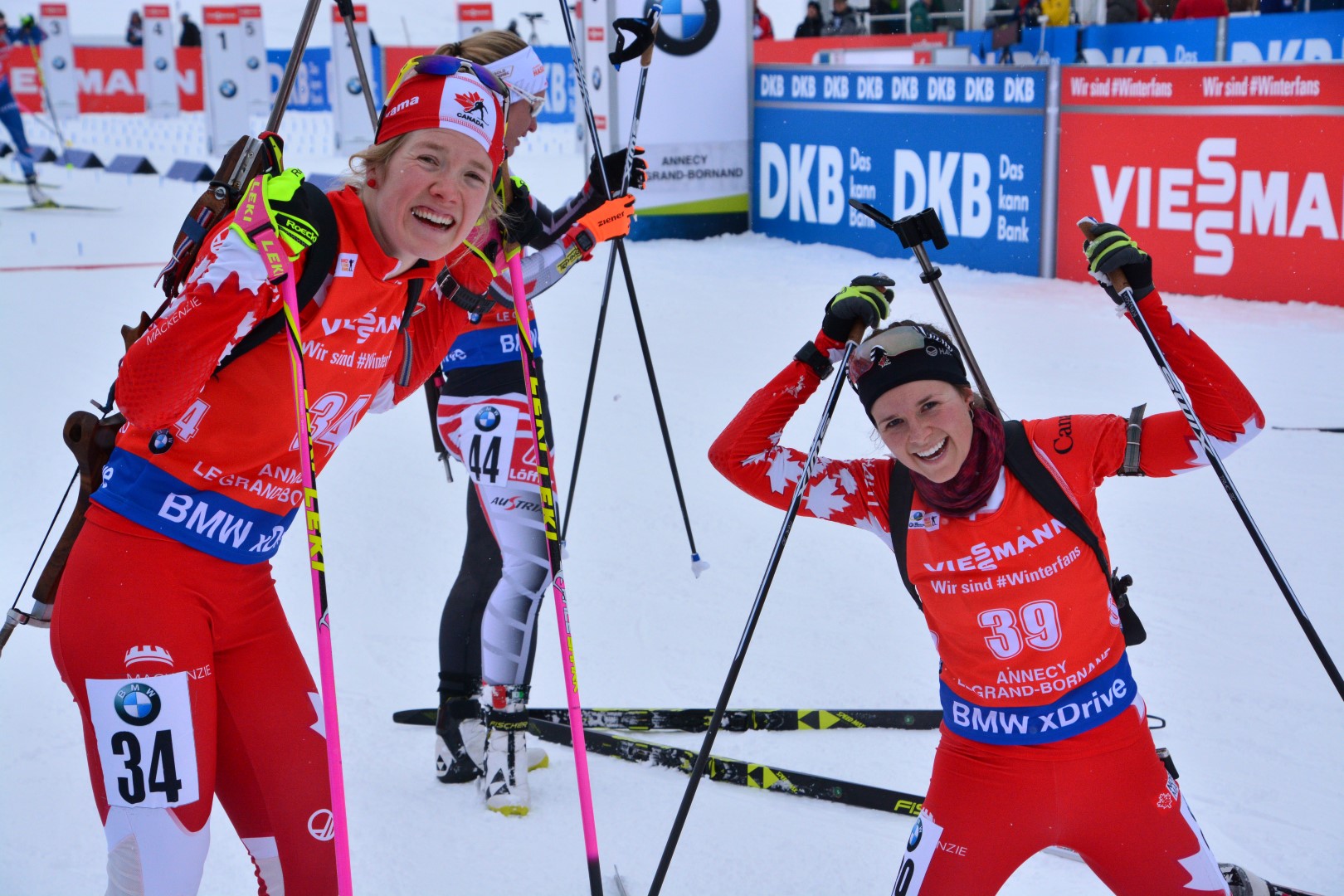
    Biathlon Canada’s Emma Lunder (l) and Julia Ransom (r) after finishing 18th and 27th in the women’s 10 k pursuit on Saturday at the IBU World Cup in Annecy, France. (Photo: Glen Crawford)

    Two hundred and thirty biathletes, 115 men and 115 women, will earn the right to be called a 2018 Olympian — 10 of whom will be Canadian.

    The top-six teams in last season’s International Biathlon Union’s (IBU) final Nation’s Cup ranking can bring a full team of six men and six women to the Games. Canada’s men’s finished ranked 13th while the women ranked 15th, so each squad can bring five athletes.

    Biathlon Canada’s criteria for the Games team are heavily weighted toward biathletes who can demonstrate success on the IBU World Cup. The Biathlon Canada High-Performance Working Group (HPWG) developed what it calls Internal Nomination Procedures (INP), which formulated the qualifying guidelines for PyeongChang. The Olympic qualification period, as established by Biathlon Canada, began last season on Nov. 25, 2016, and ends Jan. 22, 2018. Since the criteria began at the onset of last season’s World Cup, it also included results at the 2017 IBU World Championships.

    The INP includes Priorities 1, 2, 3.1-3.7 and a Priority 4, a tiered and sequential system of results standards. Athletes meeting Priority 1 will be named to the team first, before those meeting Priority 2, and so on. In the event of a tie when determining rankings in the first three priorities, an athlete’s next-best World Championship or World Cup result during the qualification period will be used to break the tie.

    It’s a tight go for all Canadian biathletes: there’s only 10 spots open, and each nation represented in the Olympics can field a maximum of four athletes in any individual biathlon race and a single team in the relay events.  

    “You can see pretty quickly here that the only way for anyone to get on the team now, and to supplant some of these people, is they need to score results on the World Cup,” Biathlon Canada’s High Performance Director Roddy Ward said on the phone in mid-November.

    Ward was referring to this document detailing Olympic criteria standards met by specific athletes since June 1, 2017. Based on results from the first two World Cup weekends, positions have changed a bit when analyzing results through Dec. 9.

    No Canadian biathletes have met Priority 1: a single top-eight individual or top-three relay result at a World Cup (WC) or World Championship (WCH).

    Priority 2 requires an athlete to place two times in the top 16 or notch a top-six relay result on the World Cup or at World Champs. Scott Gow has also met that by racing to a career-best 16th at the first World Cup weekend in Östersund, Sweden and then again placing 16th in the sprint in Annecy, France. Julia Ransom is halfway to meeting the Priority 2 criteria: she placed ninth in the women’s 15-kilometer individual on Nov. 29 at the World Cup opener in Östersund. 

    Moving down one rung on the Olympic qualifying criteria standards and potential Olympic team spots begin to fill up. Prior to this year’s start of the IBU World Cup, Rosanna Crawford had already fulfilled Priority 3.1’s standard: three times in the top 30 on the World Cup or at World Championships (so had Scott Gow and Ransom, who will meet Priority 3.1 even if Ransom does not score another top 16 to meet Priority 2; she has turned in several more top 30’s, too).
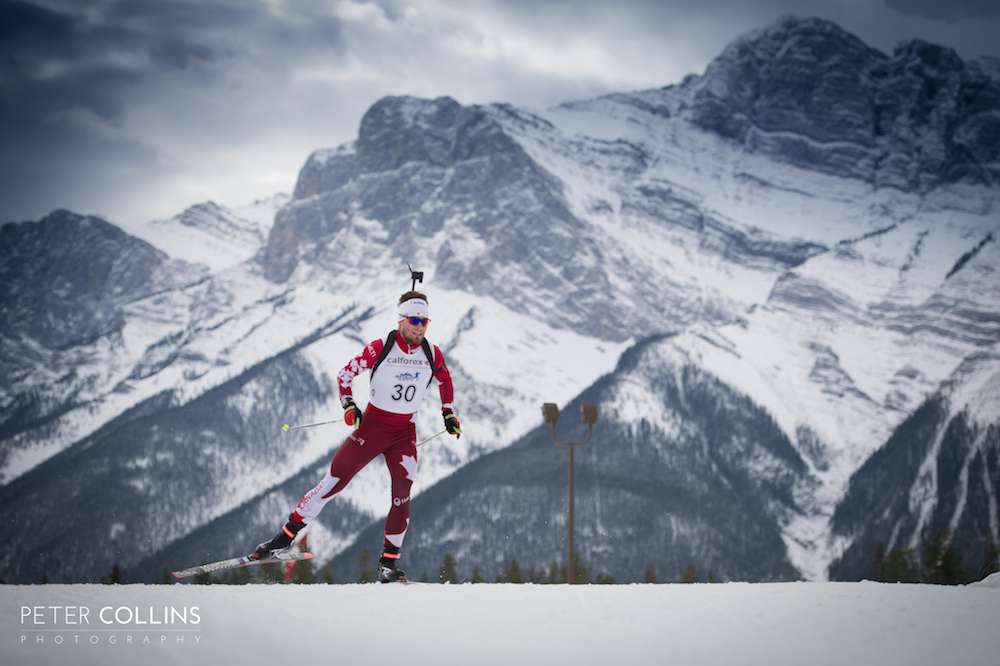
    Christian Gow (Biathlon Canada Senior National Team) racing to ninth in the men’s modified sprint at Biathlon Canada’s team trials in Canmore, Alberta. With the third-best performance percentage of the trials, Gow was the fourth man named to Canada’s IBU World Cup team for the first trimester of racing, and he has since turned in four top-30 World Cup results. (Photo: Peter Collins/petercollinsphoto.com)

    Christian Gow is also currently qualified under the 3.1 standard after placing 21st, 26th, 29th, and 30th in races this season, and shooting consistently well in the process.

    Emma Lunder has also seen a big performance jump this season, meeting Priority 3.1 by finishing 27th in the pursuit in Hochfilzen, 18th in the pursuit in Annecy, and 28th in the mass start there, the first mass start qualification of her career.

    Meanwhile, Nathan Smith is close on this criteria: he placed 19th in the 10 k sprint during last weekend’s World Cup racing in Hochfilzen, Austria, and 24th in Hochfilzen, Austria. 

    By doing so, Smith has definitely met Priority 3.2 benchmarks — two top-40 WC/WCH results — as have Brendan Green  and Megan Tandy, both two-time Olympians already.

    Green has several top 40’s from last season, and a 33rd-place finish in the pursuit in Hochfilzen. Tandy turned in her top 40’s last season as she did not qualify for the World Cup tour at trials in November, but has since torn it up on the IBU Cup circuit, collecting finishes of ninth, 11th, and 18th over two weekends of racing.

    Macx Davies currently meets Priority 3.3 criteria: two top-60 WC/WCH results. Like Tandy, he started the season on the IBU Cup; there, he collected two top-30 results. Megan Bankes partially meets 3.3 after her 60th place on the first World Cup weekend, and is locked in for Priority 3.4 — one top-three World Junior Championship (WJCH) result after winning the individual race at 2017 IBU Junior World Championships.

    The objective criteria set forth by Biathlon Canada extends through Priority 3.7 to determine the Olympic team, but as five athletes on both the men’s and women’s sides have already met higher priority criteria, they will not be used.
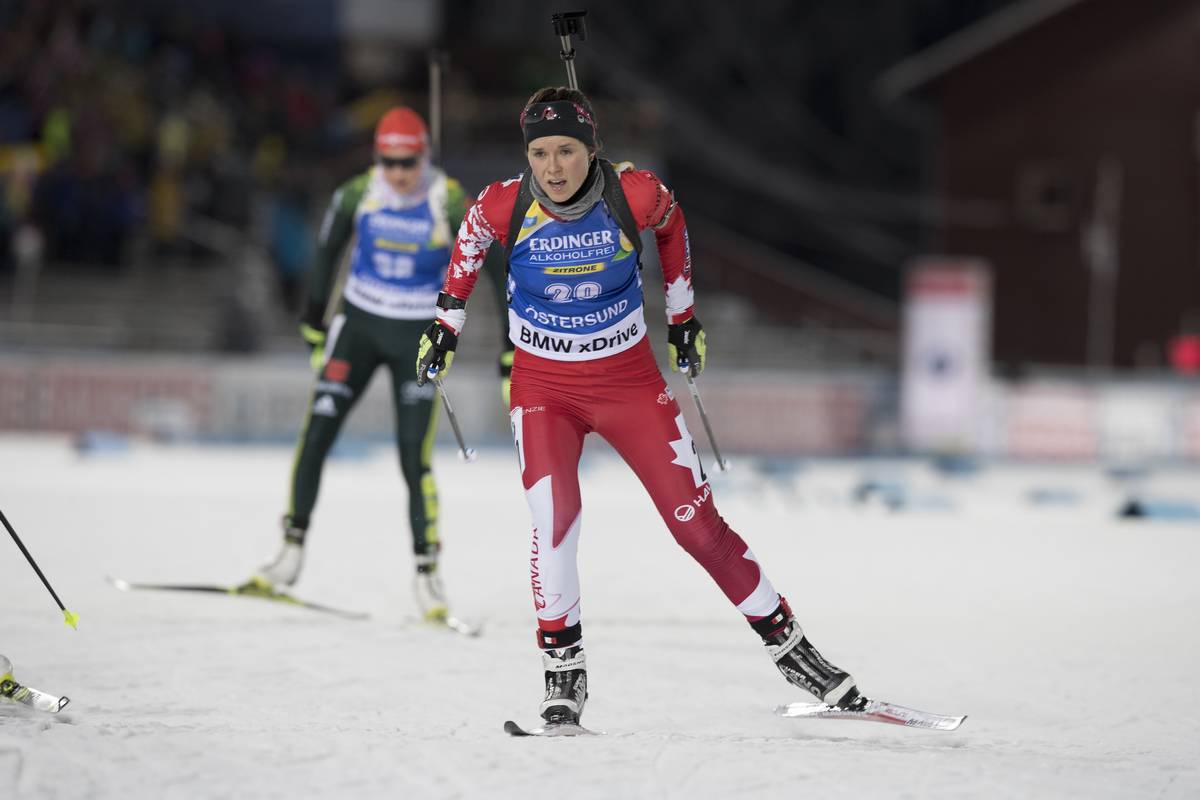
    Julia Ransom (Biathlon Canada) racing to ninth in the women’s 15 k individual at the IBU World Cup opener in Östersund, Sweden. In her first World Cup race of the season, it was Ransom’s career-best result and Biathlon Canada’s best individual result since 2015/2016. (Photo: Biathlon Canada/NordicFocus)

    Here’s the summary for the five available spots on the men’s and women’s side. Currently the women’s rankings are as follows: Ransom 1st, Lunder 2nd, Crawford 3rd, Tandy 4th, and Bankes 5th.

    On the men’s side, it’s: Scott Gow 1st, Christian Gow 2nd, Smith 3rd, Green 4th, and Davies 5th.

    As made clear by Ward earlier, the primary road to qualifying for PyeongChang is on the IBU World Cup. Even before this year’s results, the women already had four skiers meeting criteria from their World Cup results and a junior skier with a podium at Junior Worlds.

    Similarly for the men, as of June 1, four skiers had fulfilled minimum criteria, while Smith recovered from illness he also had a 43rd place to partially meet Priority 3.4 — the two times in the top-60 benchmark.

    “Just by virtue of this criteria, closed Olympic trials is not going to happen,” Ward said. 

    For now, 10 spots are open, and those spots are technically spoken for by skiers with World Cup opportunities.

    Then there’s that 10-letter word — discretion.

    This for sure can be debated, but in the case of making Canada’s Olympic biathlon team in 2018, it appears very clear what the criteria are.  

    “This is how we use discretion,” Ward began. “Either through current or historical results. That could be 50 results in the past or what is happening right now. For example, historical results would be how we prequalified Julia Ransom and Rosanna for the first tour here on the World Cup. That was based on last year’s results. Current result demonstrate the ability or the potential to meet Biathlon Canada’s objectives for the high-performance program.

    “There is data on everything. But you know some form of discretion is necessary. You can never build criteria that is absolutely perfect in every scenario. Completely unrealistic. If you have to build with some notion of fairness and objectivity and also to give yourself a little bit of wiggle room to use discretion in those certain scenarios that pop up every year.”
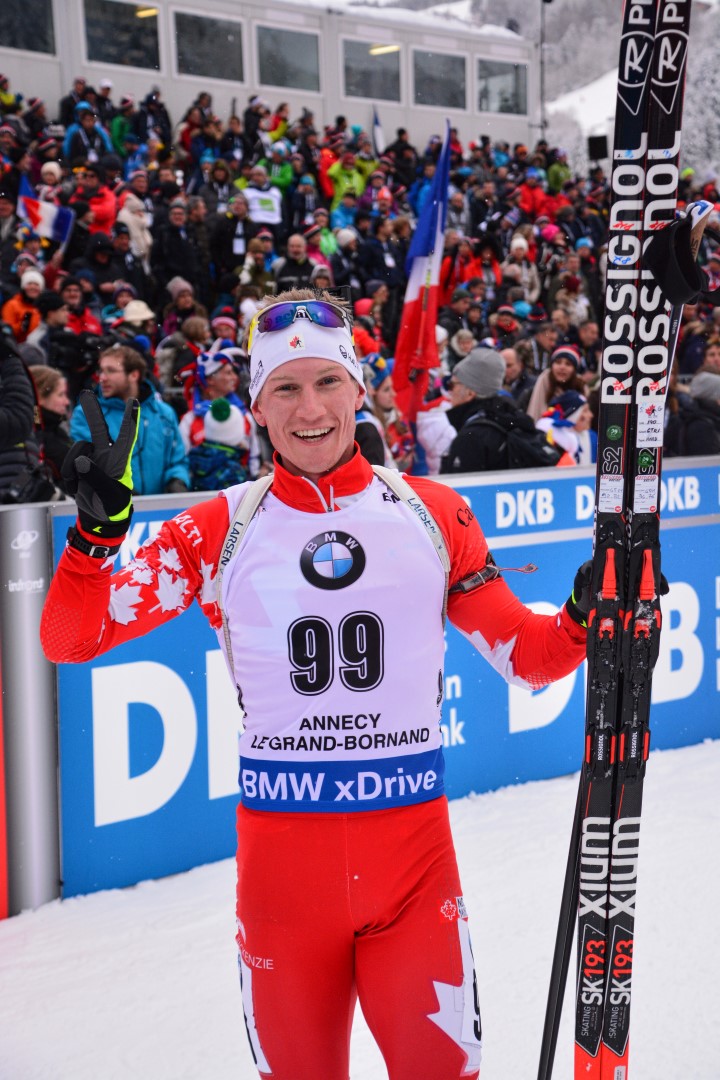
    Scott Gow (Biathlon Canada) after placing 16th in the IBU World Cup men’s sprint last month in Annecy, France. (Photo: Glen Crawford)

    Once at the Olympics, as previously mentioned, only four athletes can start for each country in each competition. That means that a fifth team member on both the men’s and women’s side will be watching from the sidelines. And who that is will be formally known: of the 10 Canadian biathletes headed to PyeongChang, the fifth qualifier for the men’s and women’s team will be considered an alternate.

    “The top-four ranked athletes in each gender get individual start rights, and the relays are up to coach’s discretion,” Ward stated.

    In an email from Ward on Dec. 27, he noted Tandy, Beaudry and Carsen Campbell would get World Cup starts when the IBU World Cup resumes Jan. 4 in Oberhof, Germany.

    “Due to their strong results on IBU Cup, they have earned an opportunity on the WC and to score criteria for the Olympics,” Ward wrote. “With a Sprint, Pursuit, Relay in Oberhof this will very likely be the last weekend to change the Olympic ranking. Qualifications end January 15th after Ruhpolding WC.”
    Those three biathletes will join Lunder, Random, Smith and both Gow brothers all of whom have been racing on the IBU World Cup.
    “This means we will also have a very strong team at IBU 4 with Davies, Green, Crawford, Moser, Bankes,” Ward explained further. “After WC/IBU4 there will very likely be another change up as we shift gears towards Olympic preparation and finalizing our top 4 who will start the Individual races at the Games.”

    Three World Cup weekends remain until the PyeongChang qualification period concludes.

  • With a Few Last Laps on Frozen Thunder, Smith Readies for Pressure-Laden December World Cups

    Nathan Smith competing at 2012 World Championships in Ruhpolding, Germany.

    Despite tying his career-best World Cup result last year, winning three IBU Cup races and hitting the podium in another, and securing a spot on Biathlon Canada’s “A” team, until recently Nathan Smith wasn’t feeling too confident about the upcoming season of racing.

    “I got a cold at the end of August and I guess I underestimated how much of a toll it took on me,” he told FasterSkier in an interview on Thursday. “So I did the NorAm races here in September and then went on a camp to Austria. I was pretty tired from that and October was pretty rough – I wasn’t feeling like my usual self. But within the last two or three weeks, I feel like I’m starting to get back into better shape.”

    That fitness was on display last week, when the Canadians had two time trials in Canmore on their two-kilometer on-snow loop, Frozen Thunder. In the sprint, Smith shot one penalty in each stage and finished a second off the podium.

    “It was a lot better for me,” Smith said. “I was pretty happy with my skiing, and shooting was good, especially in the pursuit considering that it was very windy at the range. So I’m happy with it… now I’ve had a couple of good time trials, so I’m feeling good about going into the season. I was a little bit worried earlier.”

    While Smith, as an “A” team member, is pre-qualified for the first World Cup races in Östersund, Sweden, the pressure is far from off. He has never spent a full season competing on the World Cup circuit: thanks to Biathlon Canada’s philosophy that athletes should routinely excel at IBU Cup races before making the jump to the World Cup, there’s typically a lot of movement in and out of the last starting spots on Canada’s World Cup team over the course of the season.

    Nathan Smith (l) and Scott Perras training in Bend, Oregon, this spring, a new camp for the Canadians.

    There’s added pressure this year because the organization will more or less select the team for World Championships, to be held in mid-February, before Christmas.

    “Due to a very unusual IBU Cup schedule, we do not anticipate having any IBU Cup athletes in Europe during January, just our World Cup team,” Biathlon Canada High Performance Director Chris Lindsay wrote in an e-mail. “This means that if you are on the World Championships team you will have been at the World Championships prep camp [in early February], and to be at the prep camp you were probably at World Cups five and six [in January], and to be selected for [them] you will have had to do well in December.”

    Although Lindsay stressed that total season performance would be considered in selecting the Championships team, and that World Cup athletes who didn’t perform well in the January World Cups wouldn’t be kept in Europe if other athletes had excelled in IBU Cup races, the strange schedule definitely puts the pressure on to perform well early in the season and hold onto a World Cup starting spot.

    “December is really important for us,” said Smith, who has raced at three prior senior World Championships and finished 43rd in the pursuit at the 2012 edition. “You have to show what you can do.”

    He’s also already thinking ahead to the Olympics, since the qualifying window is now open and senior athletes can only qualify through World Cup and World Championship events. Doing so is another reason to stay on the World Cup rather than bouncing down to the IBU Cup, where he won three races last year.

    “I’d like to make some Olympic criteria,” he said. “As a senior, you have to be going for top-30’s on the World Cup, so I would like to get a few of those, and then that will help a lot. Last year I didn’t have any top-30’s, but I think that some of my best IBU Cup races would have been at that level, so I hope that I can pull off races like that on the World Cup when I need to.”

    That’s a lot to think about, but luckily the team has been having fun as well. Last Tuesday, part of the national team headed to Calgary to try out speedskating.

    “It was pretty fun, but then yesterday we had to do our time trial and then again today, and pretty much everyone was complaining about their backs hurting because you have to bend over so much,” Smith said. “Yesterday my back was destroyed, but now it’s better. So it was fun, but next time I won’t do that this time of year.”

    It was a good exercise – “I can’t really think of anything that would be closer to cross-country skiing, the way that you’re supposed to set your foot and the balance,” Smith said – and typical of the Canadian team’s current tendency towards involvement with other sports. Head coach Matthias Ahrens, Smith said, had invited some of the speedskaters up to try an agility course and other biathlon training in Canmore earlier this year. And then there’s the increased collaboration with the national cross country team.

    “We did two or three intensity workouts with their team this year,” Smith said of the skiers. “Obviously that’s not a lot, maybe not enough, but it’s a start and it’s more than we have done before, so that was good. I hope it continues.”

    The issue of joint training is similar to that faced by the American ski and biathlon teams: how do you coordinate schedules? The skiers, Smith said, are often gone on camps, much more so than the biathletes. So even they are both at home base (more or less) in Canmore, it’s tough to line up workouts.

    “We do see them,” Smith said. “I’ve been seeing Ivan [Babikov] out there pretty much every day.”

    In addition to training, the two teams have gone in on a few other things together. One is the new rollerski treadmill in Canmore, which both groups used for testing. They also  announced their national teams at the same time in a joint media event.

    “That’s good especially for raising our profile,” Smith said. “Biathlon Canada is maybe riding their coattails a little bit. I think it’s partly because Chris Lindsay, our High Performance Director, is based out of Canmore now [he had been in Ottawa], so he probably gets to chat more with the cross country guys. That’s certainly a good thing.”

    Having a few more training partners was especially beneficial for the men’s team this year because Brendan Green, one of the most successful of the biathletes, has been out since February with a bad back and will likely miss the whole competition season.

    “We definitely miss training with him,” Smith said. “He’s always pushing us.”

    While Green’s absence is a blow to the team, it might help Smith in his quest to stay on the World Cup, however.

    “A lot of the time I’m kind of the fourth guy, and without Brendan last year we lost quite a bit of points at the end of the season so we actually only have three World Cup spots this year,” Smith explained. “It is unfortunate. So if Brendan was racing I would probably hardly do any World Cups. So I guess that’s one positive thing for me, but it’s not really that great.”

    Luckily, Smith said, Green didn’t fashion himself as the team captain, so leaving him at home in Canada doesn’t create as much of a hole as it could have.

    “Brendan is a pretty quiet guy,” he said. “I know he had the best results out of all of us, but he never really – he doesn’t like to be the leader. I don’t think our team really has a leader. Obviously Scott Perras and I really look up to the results that Brendan and JP [Le Guellec] have gotten, but it’s not really a leadership thing.”

    For another week or so, Smith is with the team in Canmore, training away until they depart for Sweden. That means more loops on Frozen Thunder.

    “Last week was pretty warm here,” he lamented. “We lost all of our natural snow, and Frozen Thunder was getting pretty thin and dirty. There were lots of rocks. But then a cold front came in and it started snowing, so it’s getting better. Just a little bit on top really helped it out.”

    Is he getting bored of skiing around such a small loop?

    “I don’t know, it’s okay, especially with shooting,” Smith said. “I think if you’re a cross country skier, it would be a lot worse.”

  • US Olympic Qualifying: How it Works

    US Olympic Qualifying: How it Works

    When the U.S. National Championships ended on Friday, Pete Vordenberg’s job started getting complicated.

    As the head coach of the U.S. Ski Team, it’s his responsibility to pick the group of athletes that will get to compete in February at the 2010 Winter Olympics in Whistler. On January 19th, after four years of hard work by the nation’s top athletes, his announcement will simultaneously crush some dreams and bring others to fruition.

    All about the podium...
    All about the podium…

    In his deliberations, Vordenberg will be guided by an eight-page, fifteen-section U.S. Ski and Snowboard Association (USSA) document that outlines the procedures used to select the team. It contains a mix of subjective and objective criteria that will steer him, but ultimately, Vordenberg will have to pick most of the team himself.

    In an interview with FasterSkier, Vordenberg was clear about what he wants from his team.

    “We have one goal—and that’s the podium,” he said. “That’s what we want to do and that’s what this country wants us to do.”

    For the Americans with the best chances of grabbing gold, their berths on the Olympic team are assured. But for those who won’t be winning medals, the future is muddier. Below, FasterSkier lays out the selection process.

    The Guidelines

    For three athletes, spots on the Olympic team are guaranteed by their results from earlier in the year. Those ranked in the top 30 of the World Cup distance or sprint lists, or the top 50 in the overall standings, qualify automatically.

    Sidebar: Olympic Qualification

    How many people get to go the Olympics?
    Right now, the U.S. has eight spots for the 2010 Olympic Winter Games, although that number could go up before the team is named on January 19th. According to USSA Nordic Director John Farra, having an equal number of men and women on the team would be ideal, but there is no guarantee of that.

    When will we know the final number?

    The initial Olympic team will be named on the 19th, but the final makeup will not be known until after a process called reallocation (during which more athletes could be added), on the 29th.

    How does USSA decide who to put on the team?
    The top three American athletes going to Whistler have already qualified based on their results on the World Cup circuit earlier this winter. The composition of the rest of the team will be primarily determined by a USSA ranking list, although U.S. Ski Team Head Coach Pete Vordenberg can make exceptions if he feels that the ranking list does not fully capture athletes’ potential to have a good result at the Games.

    If the team were selected now based solely off the USSA ranking list, who would be on it?
    Based on the current U.S. quota of eight, and assuming an equal number of men and women, the team would be Kris Freeman, Andy Newell, Torin Koos, James Southam, Kikkan Randall, Liz Stephen, Caitlin Compton, and Morgan Arritola.

    Under those criteria, Kris Freeman, Andy Newell, and Kikkan Randall have already secured their berths. But with the current U.S. quota standing at eight, that leaves at least five more positions to be filled.

    Which is where things start to get more complicated. Beyond the U.S. World Cup athletes, the next level of decision-making is discretionary, and the composition of the team will be up to Vordenberg.

    But just because he has some flexibility doesn’t mean that the coach can go out and choose his drinking buddies. According to USSA’s nordic director John Farra, Vordenberg will be primarily relying on the most recent National Ranking List (NRL), which ranks the nation’s skiers based on their three best results from the last calendar year.

    “The first thing to look at is the points list, because that’s what everybody knows it to be,” Farra said. “The only reason to go to discretionary is if there’s some failure of the written criteria.”

    The NRL is separated into three different divisions: an overall, a sprint, and a distance list. But Farra said that the overall is the sole version that matters as an objective measure—the other two can only be used to help Vordenberg if he decides to make a discretionary selection.

    Discretion—when?

    The points list is actually prioritized below coach’s discretion in the USSA document, but Farra said that this is only to ensure that Vordenberg has flexibility, in case someone has a strong series of races that aren’t captured in the NRL— “when people start having standout performances.”

    The men’s freestyle sprint at U.S. Nationals in Anchorage was a good example of how this could happen. Simi Hamilton and Garrott Kuzzy both had fast times in the qualifying round (from which points are calculated), but their results may not end up being reflected as strongly in the NRL due to the absence of U.S. Ski Team sprinters Andy Newell and Torin Koos, which may have skewed the points from the race upwards.

    Those types of results—where a “standout performance” might not be captured in the rankings—become especially important in the period leading up to the Olympics (like at last week’s U.S. Nationals), because one aspect of the discretionary criteria is to consider the “recent trend or direction” of an athlete’s races.

    Technically, Vordenberg can also consider skiers whose results on their own might not merit selection to the team, but whose potential for future Olympics could be elevated by participation in the 2010 Games. But he told FasterSkier that he didn’t think that discretion is designed “to look towards the future with.”

    “The Olympics is its own thing,” Vordenberg said. Discretion, he said, “is largely so that you don’t miss taking somebody that you think can help you achieve your goals at those Games.”

    As to whether Vordenberg would use his discretionary powers to ensure that the U.S. field a starter in each Olympic event, Farra said that this would only happen if the athlete in question had proven that they would be able to turn in a strong performance. The USSA guidelines, he said, dictate that a discretionary selection should be “ready to have a level of success that is worth going through that process.”

    With this year’s small quota allowing for scant wiggle room, Farra said that the U.S. may be forced to bring a team that is “heavy in one gender towards distance, and then the other gender, it might be heavy towards sprint.”

    Capturing the trend

    The system seems a little convoluted, since coach’s discretion technically carries more weight than the NRL in the USSA guidelines. But Farra said that this is merely to ensure that his organization doesn’t get locked into making specific choices for the team based solely on the numbers.

    At the same time, though, Farra acknowledged that using a one-year points list as the primary qualifying criteria might not be the best way of doing things. Under the current system, results from a full year before the Olympics can still end up being the basis for qualifying.

    “Generally speaking, we try to capture the trend [of an athlete’s performance],” said Farra. “It’s a little against that notion to have it be a one-year list.”

    “I want to analyze [the system] carefully, and moving forward make sure it’s the right model for us,” he said.

    The low quota numbers this year have made Farra to take an especially hard look at the qualifying process.

    “With a potential team of only eight, it seems so much more intense,” he said. “Maybe if it was 16, you start reaching back eight and eight [for each gender], and you don’t feel quite as stuck.”

    Making the picks

    James Southam (APU)
    James Southam (APU) is currently a frontrunner to make the team.

    Currently, the U.S. quota stands at eight spots for the Games. With Randall, Freeman, and Newell pre-qualified, that leaves five berths remaining. Assuming that Vordenberg will bring an equal number of each gender, he will have to pick an additional two men and three women for the initial team named on the 19th.

    In a follow-up e-mail, Farra wrote that “a balanced team is ideal” in terms of gender, but that until the U.S. gets its final quota on the 18th, it is hard to say “where [the] holes are.”

    While Vordenberg does not have to stick to the overall NRL, if he does, the five additional team members would be Torin Koos, James Southam, Liz Stephen, Caitlin Compton, and Morgan Arritola.

    But for those with Olympic dreams, the initial selection on the 19th is not their last chance. Some countries will end up with more quota places at the Games than they want to fill, and their unused spots will go back into a pool that could potentially trickle down to the U.S. through a process called reallocation.

    It’s difficult to say exactly how many extra places the U.S. could gain from reallocation, but it could be at least one or two. In October, Farra wrote in a press release that the number would have been at least three had the process occurred then.

    The U.S. will not know its full reallocation until January 28th—just 18 days before the 10/15k freestyle in Whistler. Not until the day after that, the 29th, will Vordenberg be able to nominate the rest of the team.

    Despite the fact that his choices will probably not win him unanimous support, Vordenberg said that he still relishes the period leading up to the Games.

    “My favorite part of the job is working with athletes and helping people get better,” he said. “But in a way this is a part of that too, because at some point, the preparation is over, and it’s time to see people perform. And here we see some performance.”

    More Info and Other Predictions

    The current USSA points lists are available for download here

    Pat Cote, NENSA Executive Director, also outlined the selection process and made predictions on the final composition of the team.  Pat has served for several years as a member of the USSA Points Working Group and has calculated both USSA and NENSA points for races in New England for the past eight years, so has a broad resume of experience calculating and watching the points.

    Here are his predicted teams, excerpted from his article on NENSA.net

    Men: Newell, Freeman, Koos, and Kuzzy with Southam Southam with Kuzzy as the first alternate. (This could be a tough choice since Kuzzy is a threat in both distance and sprints, while Southam is a distance specialist.  But, I am going to predict that they will go with the points on this one.)

    Women: Randall, Stephen, Compton, Brooks with Ida Sargent added to the list as a discetionary based on her classic sprinting prowess and future medal potential with Arritola as the first alternate.

    You can read his full article on NENSA.net here

    Vancouver 2010 - USST Logo

  • Ben Koons earns New Zealand Olympic Standard

    Ben Koons earns New Zealand Olympic Standard

    Ben Koons (MWSC/NZ) racing to sub 100 points
    Ben Koons (MWSC/NZ) racing to sub 100 points

    Muonio, Finland–Far above the arctic circle in Lapland this past Saturday, Ben Koons, of Sidney, became the first Mainer to achieve an Olympic qualifying standard in Nordic Skiing for the 2010 Winter Olympic Games. Koons, who holds dual citizenship in the U.S. and New Zealand, raced to a 103rd place in the men’s 15km classic at the Olos resort. Initial calculations indicate that it was good enough for a 99.54 point FIS race, and good enough to drop his international point profile below 100 points–the qualifying standard set by the New Zealand Ski Federation.

    Koons, who skis for the Maine Winter Sports Center, traveled to northern Finland with the MWSC XC squad in hopes of earning his first Olympic start. An upper respiratory infection nearly stopped him in his tracks.

    “We traveled well, and everyone seemed perfectly healthy,” said MWSC Coach, Will Sweetser. “Then Ben came down with something just two days out from the race. We crossed our fingers and hit it with everything we had.”

    It may have been just enough. Koons sat out the classical sprint race on November 13, in order to gain another day of rest. While he was still clearly sick at the start line of the 15km classical race on November 14, he had just enough in the tank to push through with the result he needed.

    “That wasn’t the finish I was hoping for, but it got me what I needed,” Koons said. “I’ll take it.”

    Indeed, despite being forced back to bed on Sunday, the one race Koons managed will likely take him all the way to Vancouver. The next steps in Koons’ Olympic journey depend on FIS ratification of the weekend’s racing and on the New Zealand Olympic Team naming process. Currently, Koons is the only New Zealand male skier who has achieved the sub 100 FIS point standard. The team will be named on January 19.

    Results from the Muonio XC Openers are available here

    Full results, including FIS points will be available Wednesday here

  • Wildcard Nordic Combined Olympic Spot up fro Grabs in Steamboat

    STEAMBOAT SPRINGS, Colo. (October 12, 2009) – U.S freestyle and nordic combined athletes will get a one shot, winner-takes-all chance at making the 2010 U.S. Olympic Team as the U.S. Olympic Committee (USOC) and U.S. Ski and Snowboard Association (USSA) host the 2010 U.S. Olympic Team Trials in Steamboat Springs Dec. 23-24. A total of five U.S. Olympic Team spots in moguls, aerials and nordic combined will be up for grabs on those two days in Steamboat-Ski Town, U.S.A. ®.

    Scheduled to air on NBC at 2:30 p.m. ET on Dec. 26, the 2010 U.S. Olympic Team Trials event, which complements the season-long selection process for the remainder of the Team, offers athletes a direct ticket to the Games should they be skilled enough to win against a field of the nation’s best. The format dates back to 1998 with a similar event held just prior to the 2002 Salt Lake Olympic Winter Games, and a freestyle only event in Steamboat prior to the 2006 Olympic Winter Games. Nordic combined is being added for the first time this season.

    “The Steamboat community takes great pride in its hometown winter Olympians and has been a hotbed of athletic development in nordic combined and freestyle skiing over the years,” said USSA Vice President, Events, Calum Clark. “It will be great to bring the best athletes in the country to Ski Town USA to compete in front of an enthusiastic and supportive crowd.”

    “Freestyle and nordic combined skiing always has been, and remain at the heart of Steamboat’s claim to Ski Town USA,” said Andy Wirth, senior vice president of sales & marketing for Steamboat Ski & Resort Corporation and president of the Steamboat Springs Winter Sports Club (SSWSC). “The Winter Sports Club, Ski Area and entire community are excited to be hosting the 2010 U.S. Olympic Team Trials.”

    “The USOC welcomes the opportunity to partner with the U.S. Ski and Snowboard Association and the the city of Steamboat Springs to offer this unique winner-take-all event,” said USOC Chief of Sport Performance Mike English. “These Trials will capture all the thrill and excitement that comes with making Team USA and should prove to be a great holiday present for all ski enthusiasts.”

    The likes of World Champions and hometown heroes Todd Lodwick and Johnny Spillane (both Steamboat Springs, Colo.) as well as World Champion and former Steamboat resident Billy Demong (Vermontville, N.Y.) will each look for a wildcard spot on the U.S. Olympic Team prior to the official team selection. The combined events will be held at Steamboat’s historic Howelsen Hill in the heart of the city and home to the Steamboat Springs Winter Sports Club.

    “It will be great to have a high quality competition that will showcase nordic combined in Steamboat again, because it’s been absent from here for a long time. Any opportunity to have a televised Nordic combined competition in Steamboat is great,” Lodwick said.

    After the nordic combined competition, the Trials moves to the moguls event on the afternoon of Dec. 23 at nearby Steamboat Resort. World Cup moguls champion Hannah Kearney (Norwich, Vt.), Olympic silver medalist Shannon Bahrke (Tahoe City, CA) and moguls World Champion Patrick Deneen (Cle Elum, WA), local favorite Emiko Torito (Denver, CO) and their teammates will all be going after their shot at being named to the 2010 U.S. Olympic Team.

    “As a graduate of Whiteman and a member of the Steamboat Springs Winter Sports Club, I feel so much affection for Steamboat,” Torito said. “It is the place where I believe I blossomed as a skier. Timmy Maher makes the best courses, and I can’t wait to see some of my old friends, coaches, and teachers. There is no better place to have the Olympic Trials than Steamboat Springs.”

    The party continues after the awards are made on Dec. 23 with a night of live music and celebration in the heart of the mountain village.

    The event wraps up on Christmas Eve morning as Colorado native, SSWSC athlete and aerials World Champion Ryan St. Onge (Winter Park, Colo.), Olympian and executor of the highest scored trick on the World Cup aerials circuit Jeret “Speedy” Peterson (Boise, Idaho) and World Cup winner and U.S. Ski Team veteran Emily Cook (Belmont, Mass.) fly, flip and stick their chance at landing a place on the 2010 U.S. Olympic Team.

    “Going home to compete in Colorado is always my favorite,” St. Onge said. “We don’t get to compete there very often, so it’s a unique experience for me. I’m going back there to win. The last time I competed in Colorado I won, so hopefully I can do it again.”

    The full 2010 U.S. Olympic Teams for freestyle and nordic combined will be determined primarily from season-long World Cups and will be named in January.

    2010 U.S. OLYMPIC TEAM TRIALS – FREESTYLE SKIING/NORDIC COMBINED EVENTS(actual start times TBD)

    Dec. 23, 2009

    Morning – Nordic Combined, Howelsen Hill
    Afternoon – Men’s and Women’s Moguls, Steamboat Resort
    Evening – Concert and Celebration

    Dec. 24, 2009

    Morning – Men’s and Women’s Aerials, Steamboat Resort