From the FasterSkier archive — posts syndicated from athletes’ and coaches’ own blogs between 2004 and 2012, kept online as published. Current coverage is at fasterskier.com.
The highs were high and the lows were low in the Olympic team sprint in Italy, with the Ogden-Schumacher men’s team claiming silver and the Diggins-Kern women’s pair finishing out of the medals. Devon and Nat break the whole thing down.
We’ll be back after Saturday’s men’s 50 k. Reach us at devon[at]fasterskier.com and nat[at]fasterskier.com. We’re really grateful for all the support during the Olympics — thanks for notes and encouragement.
A reminder: This is a homegrown podcast done by two guys working long hours and late nights. We’re also paying real money to be here in Italy. If you can, support the show and FasterSkier’s ongoing coverage with a voluntary membership. We’re also offering a bonus during the Olympics: a WhatsApp group with notes on Nat’s experiences in Italy, the food he’s eating, interview transcripts and more.
Send nat[at]northernjournal[dot]com a confirmation of your voluntary membership and the number he should use for WhatsApp and we’ll get you signed up. You can also Venmo him directly at @nat-herz if a membership isn’t for you. We’re suggesting a minimum of $10, but we also won’t turn anyone away who wants to join because of an inability to pay.
Help Support Our Olympic Coverage!
FasterSkier will have our own Nat Herz on the ground at the Olympics, which, to be honest, is a very big financial lift for us. If you value the thoughtful work and access FasterSkier provides at championships like this one, please consider becoming a Voluntary Subscriber. Your support directly fuels the work we do to cover the people, places, and moments that make our sport special.
This article was made possible through the generous support of our voluntary subscribers who have helped us put our Nat Herz on the ground reporting at the Olympics. If you value coverage like this, please support FasterSkier with a voluntary subscription.
Jonna Sundling (SWE) follows Jessie Diggins (USA) during the Olympic Women’s Team Sprint in Tesero, Italy. (Photo: Vanzetta/NordicFocus)
PREDAZZO, ITALY — Eight years ago, on a different continent, the words “Here Comes Diggins!” by Chad Salmela vaulted American cross-country skiing into a new era. On Wednesday in Val di Fiemme, the event that changed everything for the United States returned to the Olympic stage.
The Women’s Freestyle Team Sprint has long been one of the Americans’ signature races. In the PyeongChang 2018 Winter Olympics, Kikkan Randall and Jessie Diggins delivered the nation’s first Olympic gold medal in cross-country skiing. Last March in Trondheim, Diggins and Julia Kern claimed World Championship silver.
On Wednesday, Diggins started the race in the first leg, handing off to Kern for the anchor leg, as they had in their previous medal run. They hoped for one more shared championship moment.
It was not to be. The Americans finished fifth, in a race that required not just fitness but flawless execution. Sweden’s Jonna Sundling and Maja Dahlqvist took gold. Switzerland’s Nadja Kaelin and Nadine Faehndrich secured silver. Germany’s Laura Gimmler and Coletta Rydzek won bronze after a late-race crash by Finland opened the door in the final turn.
For the Americans, the margin was not dramatic. But close, at this level, does not bring home a medal.
Jessie Diggins (USA) and Jonna Sundling (SWE), (l-r) come through the stadium during the Olympic Women’s Team Sprint. (Photo: Vanzetta/NordicFocus)
“Honestly, left it all out there.”
The Team Sprint is one of the sport’s most punishing formats. Two skiers qualify individually; their times are combined to determine which 15 nations reach the final. In that final, the athletes alternate laps — three each — on a course that offers no reprieve.
Often, one skier brings distance strength, and the other sprint speed. For the United States, Diggins and Kern blur those categories. Both are capable of driving pace. Both can finish.
From the gun, Diggins did what she has done throughout her career: she went to the front.
She and Sundling stretched the field immediately, driving into the Zorzi Climb, the race’s defining ascent. The early order — Sweden, the United States, Norway, Canada — hinted at the nations prepared to dictate terms.
Jonna Sundling (SWE) stretches her lead. (Photo: Vanzetta/NordicFocus)
When Sundling surged later in the race, Diggins expected it.
“I knew she was probably going to do that,” Diggins said afterward. “And I was like, just do the best that you can do. You know, like, you can’t control anything except your effort and your heart. And I was like, skiing out of my body, and I just did everything that I could, and I’m proud of that.”
That theme — control what you can — carried through her reflections.
“Honestly, I almost passed out like four different times,” she said. Then, clarifying: “No, from going that hard, no regrets. Honestly, left it all out there. I feel like we did everything we could, and that is the only thing you can control at the end of the day.”
Julia Kern (USA) and Jessie Diggins (USA), (l-r) gather in the finish area after the race, Diggins racing in the US team’s relay socks for the final time. (Photo: Barbieri/NordicFocus)
One final lap with ‘Relay Socks’
By the last exchange, Sweden had carved out daylight. Switzerland began clawing into Finland’s hold on silver. Behind them, Germany, Norway, the United States, and Finland battled for bronze.
On the final descent, Finland’s anchor, Jasmin Kahara, lost her balance in the sweeping right-hand turn and fell, sliding out on her stomach. Germany and Norway slipped past in their tucks. Kern, just meters behind, fought to the line, but the podium had narrowed to two.
Coletta Rydzek (GER) brings home the bronze medal for Germany with Norway’s Julie Bjervig Drivenes just off camera. (Photo: Vanzetta/NordicFocus)
As they drove for the line side by side, aerodynamically no-pole skating with everything they had, it was clear this was going to be close. Germany claimed bronze while Norway left empty-handed in fourth. Just behind, Kern brought the United States to the finish in fifth.
For Diggins, the moment carried a different weight. It was, by her admission, her last Olympic relay leg.
“I love racing with this girl. I’m so, so proud of her,” she said of Kern. “And, yeah, it’s emotional to feel like I’m never gonna pull on those relay socks again.”
When asked whether there was a sense of handing the event forward, she reflected on the arc of her career — from her first team sprint world title in 2013 to the growth of youth programs back home.
“It’s just really cool to be part of the evolution of American skiing,” she said.
Julia Kern (USA) and Nadine Faehndrich (SUI), (l-r) find their lines around a tricky corner. (Photo: Vanzetta/NordicFocus)
Whitcomb knows they can win
For Head Coach Matt Whitcomb, the analysis was candid and clear-eyed.
“Yeah, it was a good race,” Whitcomb said. “Of course, this is an event that we know we can win, and we didn’t today.”
In a format this tight, small imperfections are decisive.
“For even a bronze medal to happen, both legs have to be firing exquisitely,” he said. “We swung as hard as we could. We did our best. We were prepared to win today, and we just didn’t.”
Of Kern’s anchor leg, Whitcomb offered both empathy and affirmation.
“Julia is an incredible performer, and one thing you can always trust from her is that you’re gonna get her absolute best,” he said. “We saw it on the final climb. I was happy with how she climbed. Just didn’t quite have the entire thing today, and that’s okay.”
Jessie Diggins tags Julia Kern (USA), while Jonna Sundling tags Maja Dahlqvist (SWE), (l-r) in the exchange zone between laps. (Photo: Vanzetta/NordicFocus)
Diggins in the best fitness of her life
Diggins has raced these Games managing injury concerns, including rib pain after a fall in the opening Skiathlon. But when asked whether her fitness was lacking, she pushed back.
“I feel like I’ve come into this with the best fitness in my life,” she said. “And that’s one of the only things I could control.”
There is comfort, perhaps, in that certainty — in knowing preparation was not the missing piece.
“I was skiing out of my body,” she said. “And I just did everything that I could.”
In Olympic-level team sprinting, that is sometimes enough. On Wednesday, it was not quite.
But the American women did what Diggins described as the only thing you can in cross-country skiing: you have to leave it all on the course without regret.
FasterSkier will have our own Nat Herz on the ground at the Olympics, which, to be honest, is a very big financial lift for us. If you value the thoughtful work and access FasterSkier provides at championships like this one, please consider becoming a Voluntary Subscriber. Your support directly fuels the work we do to cover the people, places, and moments that make our sport special.
The men’s 4 x 10 k relay itself lacked for drama, but fortunately there’s plenty going on in the Norwegian team for us to talk about. Devon and Nat are back to break down Russia’s convincing win in the relay, the most disappointing silver ever for Norway and a gold-like bronze for France.
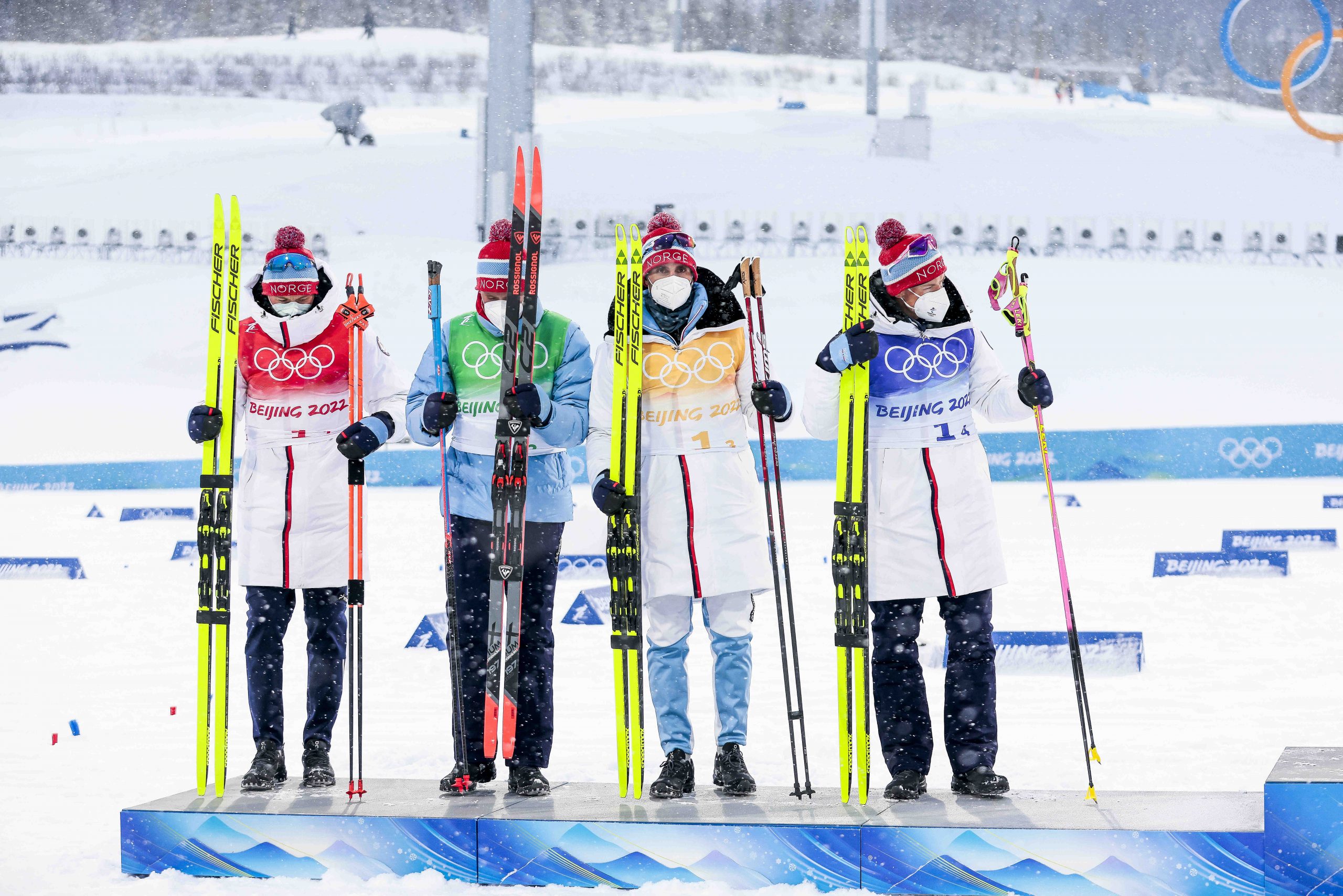
Emil Iversen (NOR), Paal Golberg (NOR), Hans Christer Holund (NOR), Johannes Hoesflot Klaebo (NOR), (l-r) were the only team not celebrating their medal after the 4 x 10 k relay (Photo: NordicFocus)
Canucks celebrate best Olympic relay result since 2002
BEIJING, Chn—The Canadian women’s relay squad skied to its best result Olympic result in two decades, finishing ninth on Saturday at the Zhangjiakou National Cross-Country Ski Centre.
Skiing on a mission for eighth spot, the women’s team of Katherine Stewart-Jones, Dahria Beatty, Cendrine Browne and Olivia Bouffard-Nesbitt mixed together their best relay result on the sport’s ultimate stage since the 2002 Games, skiing into the top-10 in the 4 x 5 kilometre race with a combined time of 57:20.9.
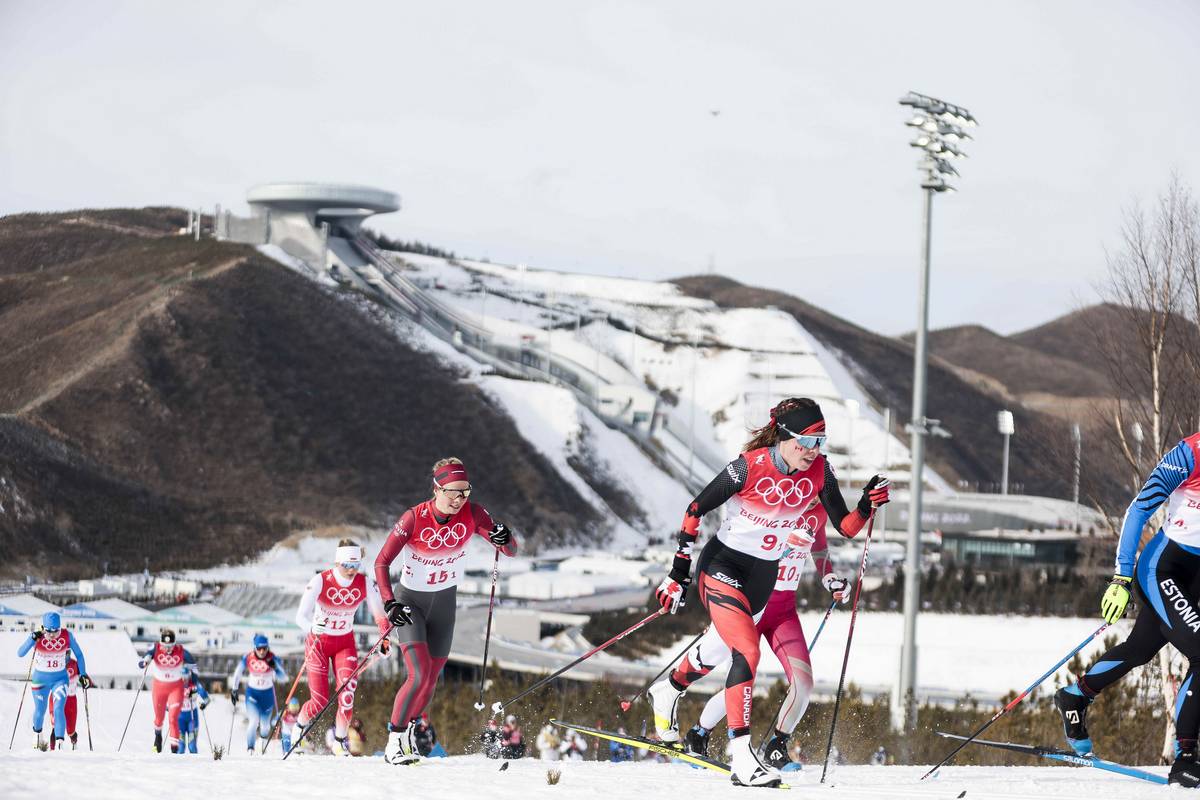
Katharine Stewart-Jones skis the opening leg of the women’s 4 x 5 k relay. (Photo: NordicFocus)
“I love relay days. There is no race more fun than a relay. The 5 k’s are brutal. They are really rough. We all went out together and gave it absolutely everything,” said Stewart-Jones. “I had a good time cheering the girls on when I was done, and I think we can be really proud of our effort.”
The women’s relay consists of each athlete skiing one five-kilometre leg. The first two athletes ski classic-ski format followed by the final two members of the team taking on the skate-skiing legs.
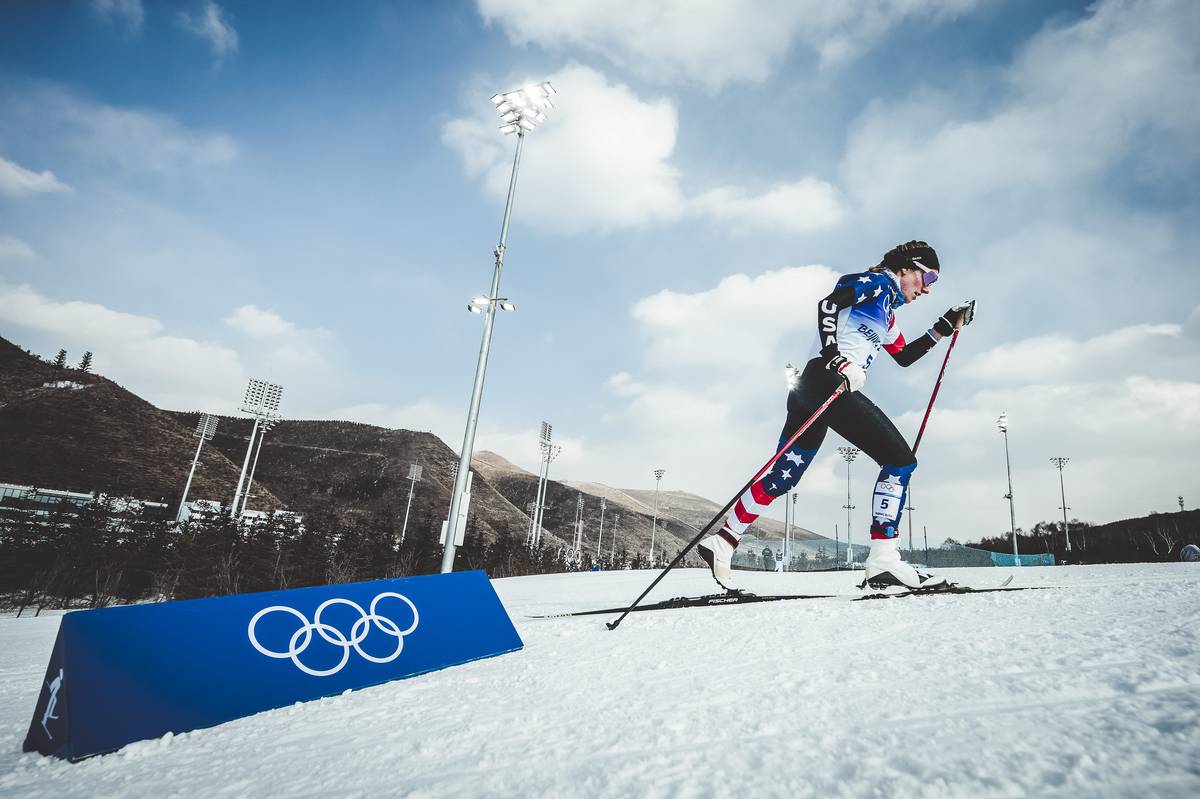
Stewart-Jones (Chelsea, Que.) was first out of the gate for the Canucks , skiing a steady 5km before passing off to Dahria Beatty (Whitehorse) in 10th spot. Beatty, a two-time Olympian, continued her solid run in Beijing where she has rattled off a trio of career-best races, by grabbing two spots on the field before completing her five-kilometre charge around the challenging Nordic trails.
“I just tried to empty the tank out there and give it all I had. I had China to catch at the beginning and saw Japan in the distance and tried to reel them in,” said Beatty. “There was a new pack well out in front of me that was a big group. I did a solo time trial out there and gave it all I had. It was a great result for the team.”
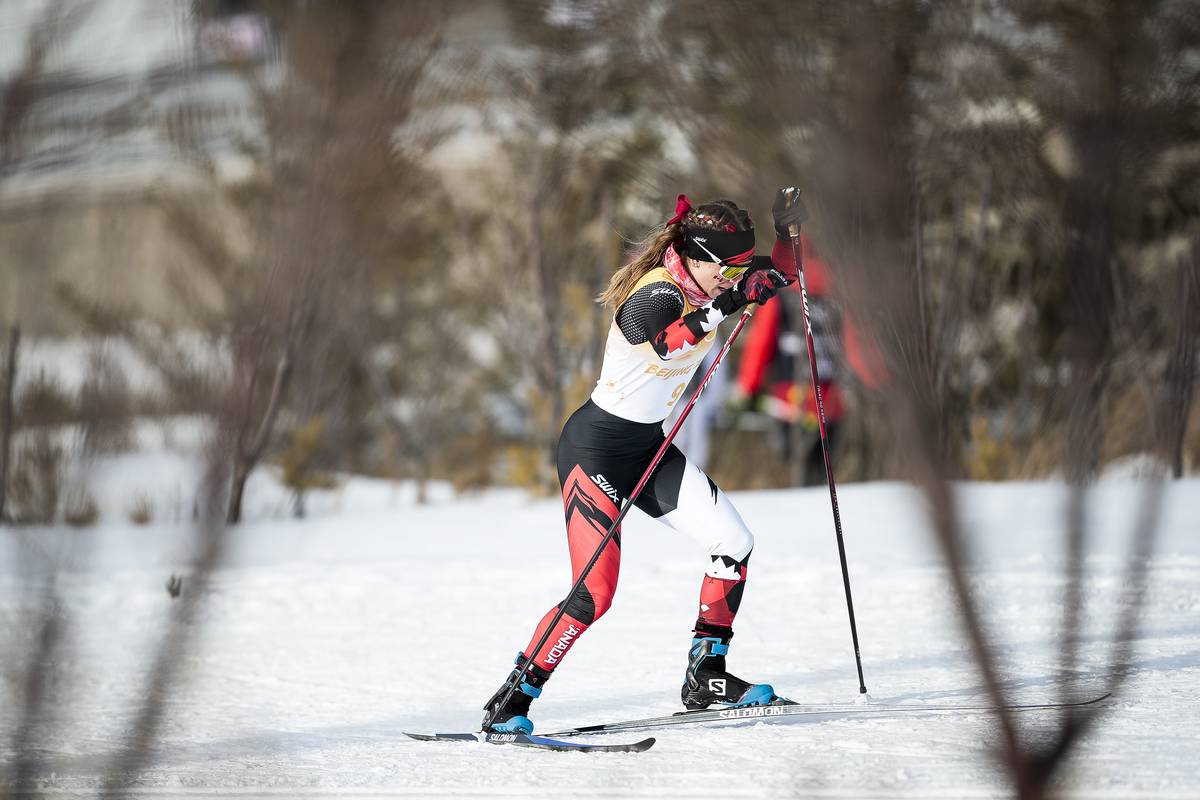
Cendrine Browne races the 4 x 5 k relay during the 2022 Beijing Olympic Winter Games. (Photo: NordicFocus)
Cendrine Browne (Prévost, Que.) – the only other two-time Olympian on Canada’s Nordic Ski Team in China – skied a steady third leg to hang onto the eighth spot before tagging Olivia Bouffard-Nesbitt for the anchor portion of the race.
“Katherine got us in good position and Dahria skied really well. When she tagged me, my job was to keep the gap. I was able to do that,” said Browne. “We were aiming for top-eight. Olivia skied really strong. I’m so proud of our entire team.”
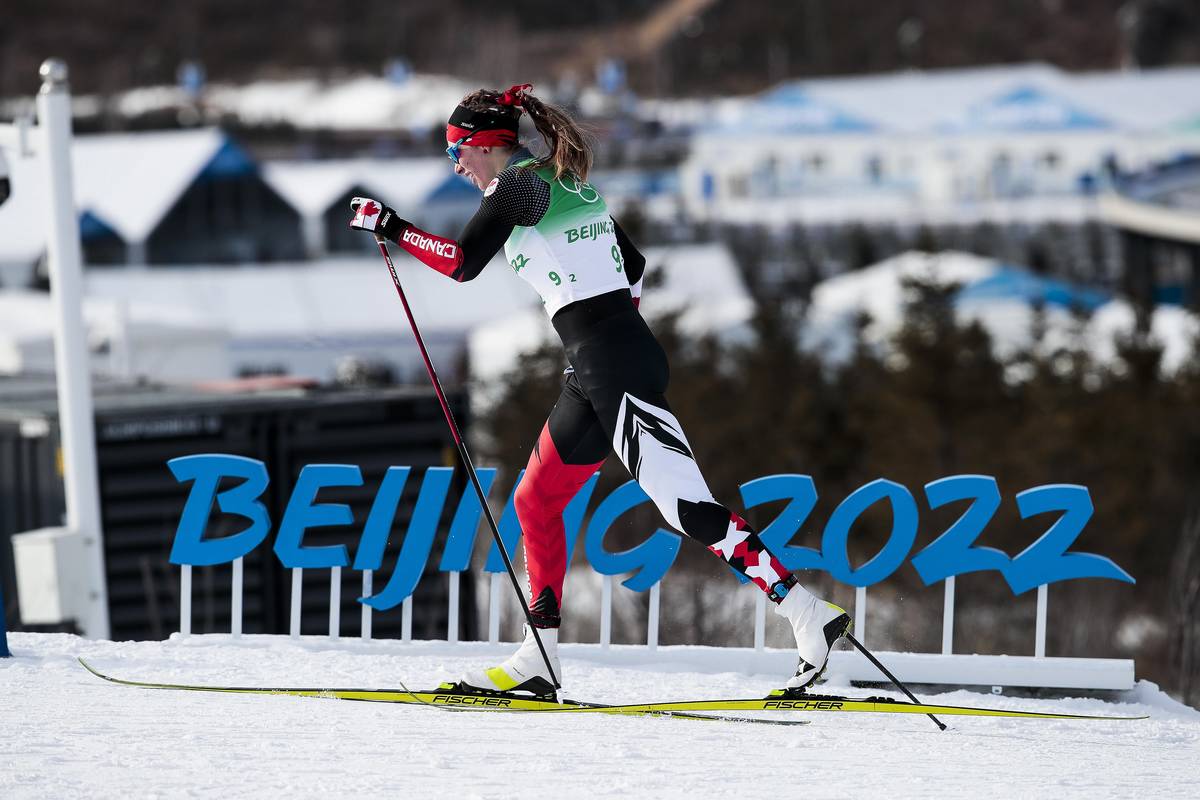
Dahria Beatty races the third leg of the 4 x 5 k relay during the 2022 Olympic Winter Games. (Photo: NordicFocus)
Bouffard-Nesbitt gutted out a solid skate-ski leg where she continued to hold eighth spot until the final kilometre of the race. The Morin Heights, Que. resident battled the last Italian skier through to the finishing stretch but was edged out at the line.
“It was such a privilege to be racing with this team. I was so impressed with my teammates. They did everything they could and I so badly wanted that eighth-place for the team,” said Bouffard-Nesbitt. “It was tough at the end. I could feel Italy on me. I tried to use whatever tactics I had left to play with in last 400 metres.
“She was a little too strong for me in last 50 metres, but I think ninth by four-tenths shows eighth was a realistic goal and all of the girls did exactly what we needed to do.”
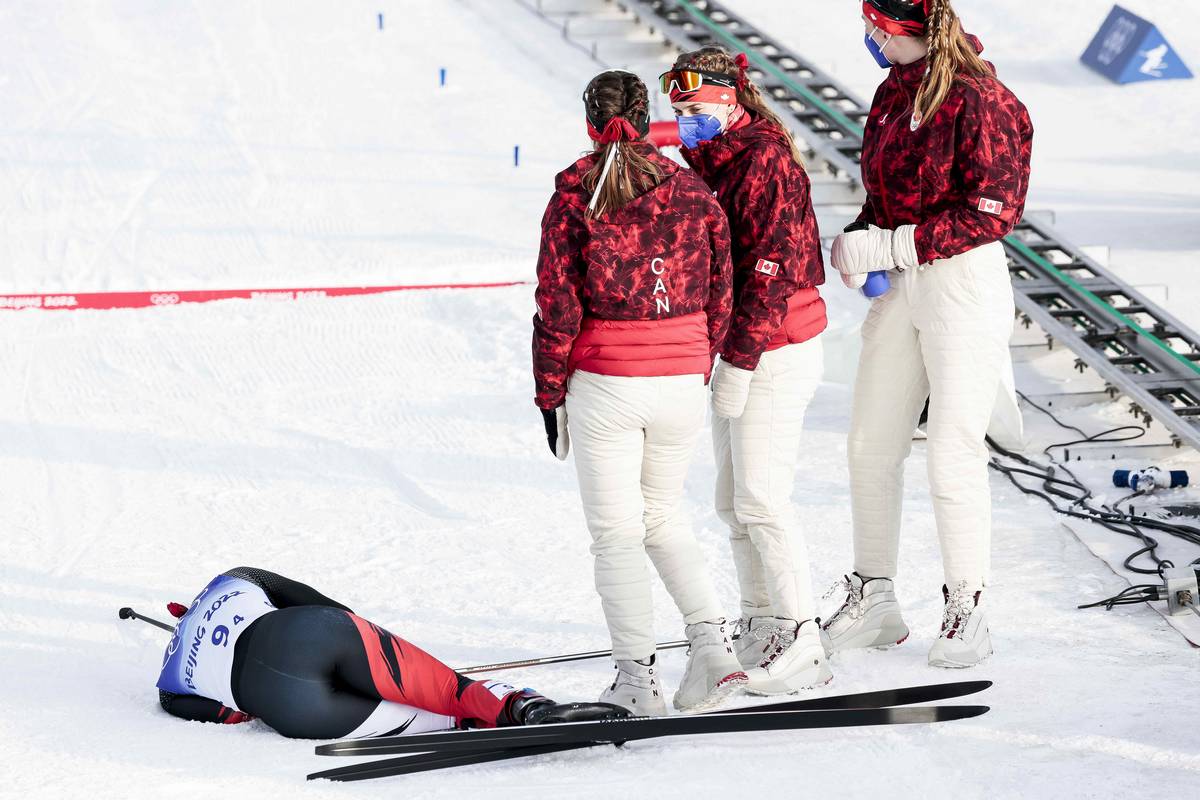
Olivia Bouffard-Nesbitt (CAN) collapses as she’s greeted by her team at the finish of the 4 x 5 k relay. (Photo: NordicFocus)
Canada’s women’s Olympic relay team of Beckie Scott, Milaine Theriault, Sara Renner and Amanda Fortier were eighth in 2002. The Canadian women also posted ninth at last year’s World Championships, which was also the best result at the premier event in a non-Olympic year in two decades.
Athletes representing the Russian Olympic Committee won the women’s relay with a time oof 53:41.0. Germany was second at 53:59.2, while Sweden skied to the bronze medal with a time of 54:01.7.
ZHANGJIAKOU, CHINA — American cross-country ski coaches face a high-stakes dilemma over the next 24 hours as they choose which members of their deep, talented women’s team will race Saturday’s four-person relay at the Beijing Olympics.
The U.S. women have a fair shot at a medal in the event, in which each woman skis a five-kilometer leg. But don’t envy the American coaches, who are still pondering which of six athletes will fill the last two spots on the team alongside stars Jessie Diggins of Vermont and Rosie Brennan of Anchorage.
Rosie Brennan crosses the line in 13th after the 10 k individual start classic. (Photo: NordicFocus)
“We try to instill belief all year long, so that we can roll through some of these punches and athletes have that level of confidence that allows them to flow through some of these setbacks, potentially, of maybe not being selected for a team,” said U.S. Ski Team Head Coach Matt Whitcomb. “But straight up, it’s impossibly hard.”
In an interview next to the cross-country venue’s empty stadium late Thursday, all Whitcomb could say for sure about the team is that Brennan and Diggins will be on it.
Entries are due by late Friday afternoon Beijing time.
“I will say with 100% honesty, we haven’t decided yet,” Whitcomb said. “We have a team of eight women who are incredible racers, and we’ve considered every name, in multiple legs. And we are currently in the process of talking with these athletes about how they’re feeling.”
Novie McCabe races to 24th in the 10 k individual start classic. (Photo: NordicFocus)
The relay is a preoccupation not just for the coaches but also for the athletes on the bubble.
But both Novie McCabe and Hailey Swirbul, the two Americans who raced in Thursday’s individual start Olympic event in addition to Diggins and Brennan, said there’s nothing personal about it.
“It’s for sure a goal of everyone’s,” said McCabe, who finished 24th in her Olympic debut. “There are definitely a lot of girls with a chance to be on it. But I think we all believe in each other a lot.”
The coaches will likely be informed by the results from Thursday’s race, in which Swirbul placed 32nd, along with the two previous women’s events at the Games.
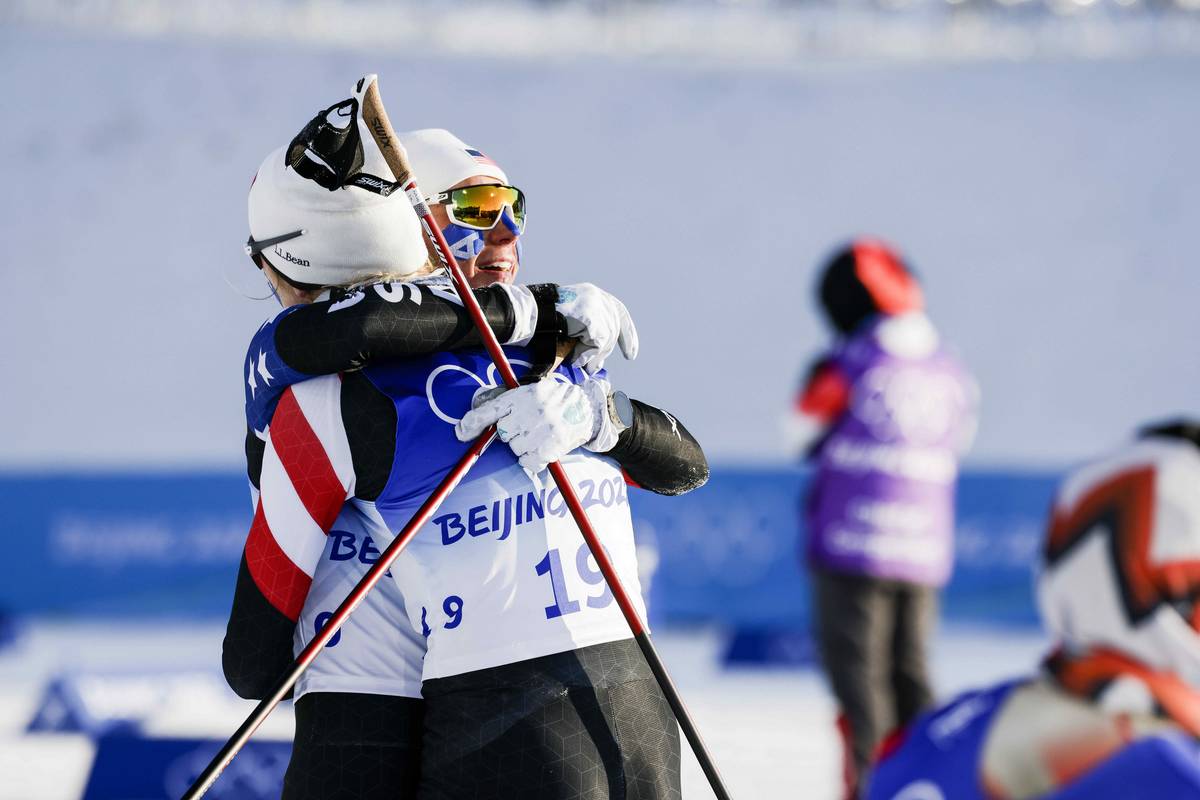
Hailey Swirbul embraces her teammate, Julia Kern, following the opening event of the 2022 Olympics, the 15 k skiathlon. (Photo: NordicFocus)
Two other U.S. women who haven’t yet competed in Beijing, Sophia Laukli and Caitlin Patterson, also skied a race effort on Thursday’s course before the Olympic event. But Whitcomb said it wasn’t intended as a test for the relay.
“Am I curious with how they felt? Yes, definitely. But…I don’t have the times, and they deliberately didn’t want to be compared, and we didn’t want them compared. This is a workout, so they can get faster,” he said. “We’ve talked about running time trials before, and we just don’t feel like it aligns with our team culture.”