From the FasterSkier archive — posts syndicated from athletes’ and coaches’ own blogs between 2004 and 2012, kept online as published. Current coverage is at fasterskier.com.
Val di Fiemme — Tesero Cross-Country Skiing Stadium (Fabio Canal Center)
Below is the Olympic cross-country ski competition schedule for Milano Cortina 2026 (all events subject to change; times local to Italy) – the best way to watch is on NBC Peacock:
Saturday, February 7
• Women’s 20 km Skiathlon (Classic + Free) – RESULTS
Sunday, February 8
• Men’s 20 km Skiathlon (Classic + Free) – RESULTS
Read all of our FasterSkier featured athlete profiles for the entire US Olympic Cross-Country Ski Team (links in the list above).
Help Support Our Olympic Coverage!
FasterSkier will have our own Nat Herz on the ground at the Olympics, which, to be honest, is a very big financial lift for us. If you value the thoughtful work and access FasterSkier provides at championships like this one, please consider becoming a Voluntary Subscriber. Your support directly fuels the work we do to cover the people, places, and moments that make our sport special.
This article was made possible through the generous support of our voluntary subscribers who have helped put our Nat Herz on the ground at the Olympics. If you value coverage like this, please support FasterSkier with a voluntary subscription.
Four Norwegian men, including Martin Loewstroem Nyenget (NOR), Mattis Stenshagen (NOR), Harald Oestberg Amundsen (NOR), Johannes Hoesflot Klaebo (NOR), (l-r) set to lead the Men’s 20 k Skiathlon out of the start and begin the 2026 Milano-Cortina Olympic Winter Games in Tesero, Italy. (Photo: Vanzetta/NordicFocus)
PREDAZZO, ITALY — The snow in Val di Fiemme had finally settled. After a colder night and a full day’s distance from the most recent snowfall, the surface beneath the men’s skis on Sunday morning felt less negotiable than it had twenty-four hours earlier. It was firmer, faster, and exacting—the kind of track that rewards decisiveness and punishes hesitation. On a course defined by momentum, there would be no neutral moments.
By the time the leaders crested the Zorzi Climb for the final time, illuminated by the bright northern Italian sun, one truth had been clarified: the Olympic Men’s Skiathlon had not produced a surprise. It had produced a confirmation.
Johannes Hoesflot Klaebo arrived in Val di Fiemme as the most accomplished skier of his generation, the reigning master of range—sprint speed married to endurance patience, and the man who, one year earlier at the World Championships in Trondheim, Norway, became the first skier ever to win gold in every event. On Sunday, in the opening men’s race of the 2026 Olympic Winter Games, he did not reinvent himself. He simply waited, watched, and delivered exactly what the sport has come to expect.
But the Skiathlon is never only about the man who wins it. It is about where the race breaks, who is caught on the wrong side of that break, and how little time there is to recover once it happens.
In Val di Fiemme, that truth arrived early—at a fast right-hand corner about two kilometers into the race—and again, more quietly but just as decisively, midway through the skate leg, when a tangle in the pack ended one of Norway’s strongest medal threats.
An unfortunate early crash took Gus Schumacher (USA) out of a top performance. (Photo: Vanzetta/NordicFocus)
Firmer Conditions, Faster Consequences
The men’s skiathlon opened with a 10-kilometer classic leg, mass start, with athletes seeded by season-long results. It is a procedural detail that becomes strategic fact the moment the gun fires: the highest-ranked skiers line up at the front, while those just behind them must navigate the churn.
On Sunday, the pace was relentless from the first kilometer. The field stretched quickly as athletes fought for position ahead of the course’s first defining technical feature—a fast right-hand corner roughly two kilometers in, where the trail bottoms out before pitching uphill again.
It was the same corner where Jessie Diggins fell in Saturday’s women’s race. And once again, it reshaped the day.
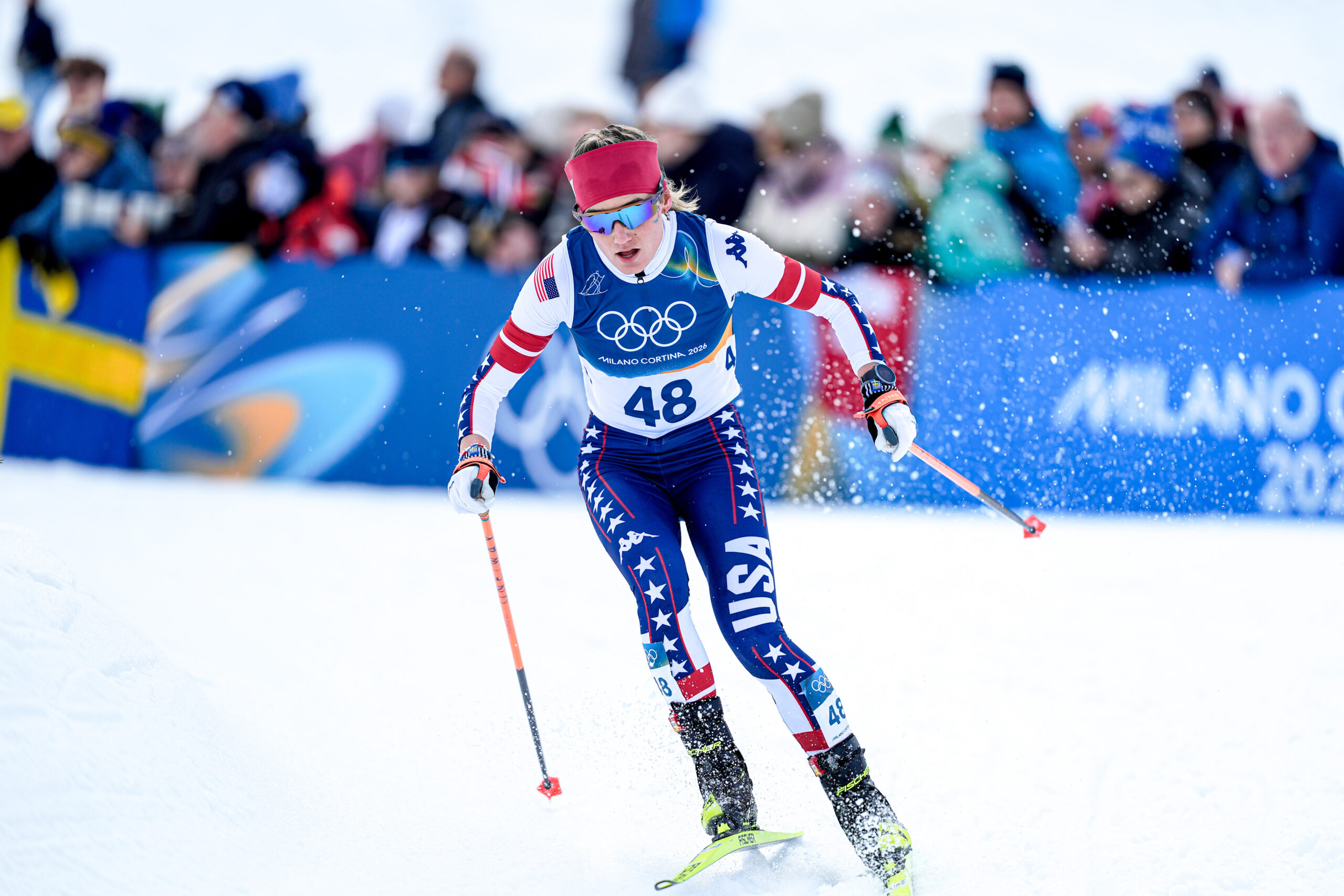
Several skiers went down in the crash, including Edvin Anger (SWE), Zak Ketterson (USA), and Gus Schumacher (USA)—all athletes with legitimate top-ten potential under normal circumstances. The cost of falling there was immediate and severe: not just lost momentum, but lost momentum at the precise moment the leaders were accelerating uphill and creating separation.
“I was dead last after the fall,” Schumacher said afterward. “Unfortunately, Zak fell right in front of me. It was tight coming into that corner, and I didn’t see what happened to Zak, but into the dropdown I got one ski around him and the other caught and spun me around off track.”
“I did what I could, but when the people at the front are still going as fast, it’s hard to catch them. All I could do was ski as smoothly as I could for the next 18 k. At that point, it’s an individual race. I feel like I skied well for being back there.”
Zak Ketterson (USA) was involved in the same crash as Schumacher and was forced to burn many matches early while playing chase, which ultimately proved too costly. He ultimately ended the race in 43rd place. (Photo: Vanzetta/NordicFocus)
Ketterson’s version of the same moment underscored how quickly the situation unraveled.
“I fell on that same corner Jessie Diggins fell on yesterday,” he said. “I was hopeful we’d ski it well, but coming into it everyone started snowplowing and freaking out and someone in front of me fell.
“I fell pretty hard, but I got back up and just burned so many matches catching back up to the group. I was fighting from there to the finish.”
Ahead of them, the race did not wait.
Xavier McKeever (CAN) had, what he described, the race of his life. (Photo: Vanzetta/NordicFocus)
Control Without Calm
With the early chaos, the classic leg splintered the field. A front group formed, thinned, and re-formed, the pace steady enough to discourage attacks but high enough to extract a cost from anyone forced to chase.
For the U.S. team, there was at least one quiet positive. Head coach Matt Whitcomb felt far better about ski preparation than he had the day before.
“We had, in general, very competitive skis today,” Whitcomb said.
But ski quality can only matter if contact is maintained.
“When you get taken out of contact with the leaders,” Whitcomb said, “the people you’re drafting off of are slower than the leaders. It’s kind of negative compounding—you just drift away.”
By the time the top eight skiers entered the stadium for the ski exchange at the end of the classic leg, the race had already begun to select for those who could tolerate discomfort without revealing it. Among them were Norway’s Mattis Stenshagen, who soon faded, France’s emerging depth, and Klaebo himself—observant and patient.
Then the skis changed, and the race revealed its teeth.
Harald Oestberg Amundsen (NOR) got tangled with Savelii Korostelev (AIN), which caused him to fall and lose contact with the lead pack. Korostelev managed to stay on his feet and was able to earn a fourth place. (Photo: Barbieri/NordicFocus)
A Quiet Turning Point in the Skate Leg
The opening kilometers of the freestyle leg altered the race more subtly, but no less decisively.
At approximately 11.5 kilometers, Harald Oestberg Amundsen (NOR)—who had positioned himself exactly where Norway would want him entering the skate portion—tangled skis with Savelii Korostelev (AIN). Amundsen went down. The lead group did not.
He remounted quickly, but the elastic had snapped. His chance to fight for a medal in the opening race of the Games was gone.
For Norway, a team that has dominated the men’s World Cup season at times filling nearly the entire top ten, it was a small moment with outsized implications.
Hugo Lapalus (FRA), Martin Loewstroem Nyenget (NOR), Savelii Korostelev (AIN), Mathis Desloges (FRA), Johannes Hoesflot Klaebo (NOR), (l-r) formed the lead pack and became the group that would battle for the podium. (Photo: Vanzetta/NordicFocus)
Desloges, a Yellow Card, and a Protest That Went Nowhere
As the race accelerated, Mathis Desloges (FRA) briefly found himself leading at the end of the first skate lap. In a moment of confusion, he mistakenly turned into the ski exchange lane before cutting back through the V-boards and rejoining the course.
The detour shortened his route by only a few meters and offered no meaningful advantage. The race jury issued Desloges a yellow card warning and allowed the result to stand.
After the race, AIN filed a protest, arguing that the infraction should result in disqualification and elevate Korostelev, who finished fourth, to the bronze medal position. The jury rejected the protest.
Desloges framed the day not around controversy, but around progression.
“I’m very happy,” he said. “The preparation was very good. Two years ago today, I became [the U23 World Champion], and now it’s different. I’m better than two years ago.
“This medal is for my family, for my friends, and for everyone on the French team—the staff and my family.”
Johannes Hoesflot Klaebo (NOR) delivered a spectacular move on the Zorzi Climb that opened up a large gap in the final kilometer. (Photo: Barbieri/NordicFocus)
Klaebo on the Zorzi Climb
There are moments in ski racing that feel preordained—not because they are inevitable, but because the athlete who executes them has taught the sport to expect them.
Klaebo’s move on the Zorzi Climb belonged to that category.
He waited. He measured. And then, on the final ascent, he applied a pressure no one else in the group could answer. The gap opened quickly, almost unbelievably so if he had not done the same thing so many times before, and by the time the course tipped back toward the stadium, the Olympic gold medal was no longer in doubt. Klaebo came to the finish with enough margin to ease up, take off his poles, and ski the final meters, celebrating in front of the stadium crowd.
For Klaebo, the performance was the product of both familiarity and tension.
“The last couple of days have been nerve-racking,” he said. “I’ve had a very high resting heart rate these days. I’ve been very nervous, but this is my third Olympics, so you get a little bit of experience. This is a track and course that we know a lot from previously—we’ve done a lot of World Cups here.”
When the skis changed and the race accelerated, that experience showed.
“I had good skis, my body felt good,” Klaebo said. “It’s always good to start a championship in good shape.”
One year removed from his historic sweep in Trondheim, Klaebo arrived in Val di Fiemme carrying questions that extended well beyond a single race. Six gold medals are available in Milano Cortina. No man has ever won them all.
“We’ll see,” Klaebo said. “I’m going to take one race at a time. But it’s a pretty good start. With the weather and the crowds, it was amazing out there.”
Mathis Desloges (FRA) and Martin Loewstroem Nyenget (NOR), (l-r) come down the finish stretch battling for the silver and bronze medal. (Photo: Barbieri/NordicFocus)
Nations in Contrast
France: Depth and Belief
If Norway remains the benchmark, France is no longer content to chase quietly.
Desloges acknowledged Norway’s status entering the race, but did not concede anything beyond the present tense.
“The French athletes are very strong,” he said. “Of course, the Norwegian guys are also very strong, but I believe we can be better. Today, I’m very good, and I’m happy.”
France backed up that belief with the most comprehensive team performance of the day, placing second, fifth, ninth, and fifteenth.
“We see the French team on a similar level as our team,” Whitcomb said. “When we have success, they’re one of the first teams to congratulate us. They’re just a really passionate group, and we love to see them succeed.”
Hugo Lapalus (FRA) and Mathis Desloges (FRA) celebrate an unbelievable day for France. (Photo: Vanzetta/NordicFocus)
Norway: Gold, Bronze—and Perspective
For Norway, the medal count told only part of the story. A gold and a bronze would thrill nearly any other nation, but the context surrounding this team—deep enough to leave world-class skiers at home—made the result feel more measured.
Bronze medallist Martin Loewstroem Nyenget (NOR), racing his first Olympic event, framed the day not as a shortfall, but as an arrival.
Johannes Hoesflot Klaebo (NOR), Martin Loewstroem Nyenget (NOR), Harald Oestberg Amundsen (NOR), and Mattis Stenshagen (NOR), (l-r) all entered the day with hopes of an Olympic medal for Norway; two delivered, two did not. (Photo: Barbieri/NordicFocus)
“I’m really happy and proud,” Nyenget said. “It’s a result of training, but also of time away from family and a lot of hard mental work. The past days and weeks, I’ve been nervous, so it’s good to be done with my first Olympic race.
“To have this first race in this atmosphere, with these blue skies, and have my wife and little kid in the stadium somewhere—it’s a really good day.”
Asked whether gold and bronze constituted a satisfactory outcome, Nyenget was direct.
“I think so,” he said. “We have some really high pressure. We’ve been doing crazy good in the World Cup, but usually in championships, all racers are at their very best. You see today that there is strong competition from the French, and we took two podium places. It’s good.”
After the fall Gus Schumacher (USA) spent the day racing his way through the field, eventually finishing in 24th place. (Photo: Barbieri/NordicFocus)
United States: Disappointed, Not Discouraged
For the U.S. team, the early crash changed everything.
Schumacher and Ketterson were forced into playing chase. Zanden McMullen, who avoided the crash, felt the day slip away in the skate leg.
“Today’s race was not great, but not horrendous,” McMullen said. “I felt really good in the classic leg and then I don’t know what happened in the skate portion. I was cramping up quite a bit and just didn’t have it.”
Hunter Wonders (USA) on his way to 31st place. (Photo: Vanzetta/NordicFocus)
Hunter Wonders, making his Olympic debut, focused instead on the scale of the task.
“It was hard,” Wonders said. “It was a hard course with tricky conditions. The skiathlon is difficult because it mixes up the muscle groups you use and takes a second to transition, but it was fun. Great Olympic debut.”
Whitcomb struck a measured tone.
“I’m feeling good, not great,” he said. “Slightly disappointed, but not discouraged. Nothing about that feels negative to me. This is just one of the days of the Games, and now it’s behind us.”
Xavier Mckeever (CAN) fighting for a top ten, eventually finishing in 13th place. (Photo: Vanzetta/NordicFocus)
Canada: The Race of a Lifetime
For Canada, the day belonged to Xavier McKeever, who finished 13th after spending much of the race on the edge of the top ten.
“Oh man—that was incredible,” McKeever said. “I can’t believe what just went down, to be honest.”
He described a race that improved with each kilometer.
“I felt like I skied it really smart—tried to conserve as much energy as possible—and I just felt better and better,” he said. “The skate felt really good, which is sweet, because that’s usually a weak spot for me.”
Mid-race, the realization crept in.
“You can’t really comprehend what’s going on,” McKeever said. “You’re just like, ‘Holy crap, I’m here right now, fighting for top ten.’ It’s surreal, but you’ve got to focus on the race.”
The result carried deeper meaning.
“To be honest, I was about a foot away from not making this Olympic team,” he said. “To come here and have the best race of my life so far on the first day at the Olympics—I couldn’t ask for anything more.”
Mathis Desloges (FRA), Johannes Hoesflot Klaebo (NOR), and Martin Loewstroem Nyenget (NOR), (l-r) share the Olympic Men’s 20 k Skiathlon podium in Tesero, Italy. (Photo: Vanzetta/NordicFocus)
One Race Down
The skiathlon rarely offers mercy, and Val di Fiemme offered none.
There will be more races, more chances, and more medals to chase. Klaebo will insist he is taking this one race at a time. Everyone else will count.
On firmer snow, with no ambiguity left beneath the skis, the hierarchy revealed itself plainly—and the Olympic Winter Games began exactly where cross-country skiing so often does: with Johannes Hoesflot Klaebo setting the standard.
On the ground reporting by FasterSkier’s Nat Herz.
Help Support Our Olympic Coverage!
FasterSkier has our own Nat Herz on the ground at the Olympics, which is a significant financial lift for us. If you value the thoughtful work and access FasterSkier provides at championships like this one, please consider becoming a Voluntary Subscriber. Your support directly fuels our work to cover the people, places, and moments that make our sport special.
This article was made possible through the generous support of our voluntary subscribers who have helped put our Nat Herz on the ground at the Olympics. If you value coverage like this, please support FasterSkier with a voluntary subscription.
At the Olympic Women’s Skiathlon podium press conference in Val di Fiemme, the three medalists provided insight into their performances, discussing equipment choices, team dynamics, and the mental preparation that shaped one of the Games’ defining races.
Heidi Weng, who earned bronze, reflected on the significance of winning a medal at a venue tied closely to her career. Thirteen years after claiming her first major championship medal in Val di Fiemme, Weng spoke with noticeably more confidence — in English — while acknowledging the emotional weight of racing, bolstered by the presence of her Italian wax technician. Technically, Weng admitted the classic portion of the race was stressful, particularly on the uphills where grip felt uncertain. The race turned for her once she switched to skating, where she immediately felt freer and more powerful. Despite Olympic stakes, Weng said her routine remained largely unchanged from previous championships, with only a sharper focus on the moment.
Gold medalist Frida Karlsson fielded questions that ranged from equipment to philosophy. She revealed she raced the classic leg on a 10-year-old pair of skis she affectionately called her “golden pair,” skis she has owned since before becoming an elite athlete and which seem to resurface whenever championships arrive. Karlsson also described her unconventional training approach, explaining that she does not track heart rate or lactate and instead trains by feel. She credited recent altitude camps with Norwegians Johannes Høsflot Klæbo and Emil Iversen for teaching patience and discipline.
Much of Karlsson’s confidence, she said, stemmed from the Swedish team environment. With multiple athletes capable of winning gold, the squad has embraced a shared mentality built on mutual belief. Seeing teammates succeed reinforces the sense that winning is possible — a mindset cultivated intentionally through visualization during team meetings before the race.
Silver medalist Ebba Andersson echoed those themes, describing her long partnership and rivalry with Karlsson at both club and national levels. That history, she said, has transformed competition into inspiration, pushing both athletes to higher levels. With another Olympic opportunity approaching later in the week, Andersson emphasized that momentum and belief remain high.
Together, the press conference painted a picture of an Olympic podium shaped as much by trust — in skis, teammates, and oneself — as by tactics and fitness, underscoring why this skiathlon resonated far beyond the finish line.
On the ground reporting by FasterSkier’s Nat Herz.
Help Support Our Olympic Coverage!
FasterSkier has our own Nat Herz on the ground at the Olympics, which is a significant financial lift for us. If you value the thoughtful work and access FasterSkier provides at championships like this one, please consider becoming a Voluntary Subscriber. Your support directly fuels our work to cover the people, places, and moments that make our sport special.
This article was made possible through the generous support of our voluntary subscribers who have helped put our Nat Herz on the ground at the Olympics. If you value coverage like this, please support FasterSkier with a voluntary subscription.
Ebba Andersson (SWE), Frida Karlsson (SWE), Astrid Oeyre Slind (NOR), Jessie Diggins (USA), and Teresa Stadlober (AUT), (l-r) lead the field out of the start during the opening race, the 20 k Skiathlon, at the 2026 Milano-Cortina Olympic Winter Games in Tesero, Italy. (Photo: Vanzetta/NordicFocus)
PREDAZZO, ITALY — The snow in the Tesero Cross-Country Ski Stadium sat in that uneasy middle ground—soft, glazed, and ready to decide races in small, brutal ways. It sat like the snow of March more than that of early February, ready to punish skis that went outside of the traffic lines, a little slushy where the sun found it, and it turned the opening day of Olympic cross-country into something more challenging than spectacular. Not just strength, not just tactics—also the small, decisive physics of momentum lost and regained, of skis that either release cleanly or cling, of a tip that vanishes into wet snow at exactly the wrong moment.
A Skiathlon is built to expose those details. Ten kilometers of classic to write the first draft—who’s fresh, who’s brave, who’s overreaching—then a transition that feels like a breath held too long, then ten kilometers of freestyle to reveal what was real and what was merely early. It is the most honest event on the program and, sometimes, the cruelest: it doesn’t only ask who is the best skier today? It asks what else failed to cooperate?
On Saturday in Val di Fiemme, Sweden arrived with a plan that looked less like a plan than a certainty. Frida Karlsson (SWE) and Ebba Andersson (SWE) skied the opening classic like athletes who had been waiting for this specific hour, not simply training toward it. Heidi Weng (NOR) carried her own bright energy into the skate leg and outlasted the late cracks around her for bronze. Behind them, the Americans—Jessie Diggins, Julia Kern, Rosie Brennan, and Novie McCabe—worked through a day where the sensations were often better than the splits, and where Diggins’ race, in particular, became a case study in how thin the margin is between a medal and an explanation.
Ebba Andersson (SWE) and Frida Karlsson (SWE), (l-r) showed they were in top form throughout the race. (Photo: Vanzetta/NordicFocus)
Sweden’s patience, Sweden’s pressure
The results tell the shape of it quickly. Karlsson won in 53:45.2, Andersson followed 51 seconds back, and Weng took bronze at 55:11.9.
But the split ranks show how they built it.
Karlsson was first at 10 k at the end of the classic leg (27:24.4) and the fastest split again in the 10 k freestyle segment (25:49.7).
For Karlsson, the victory arrived with clarity rather than chaos. She said the moment only fully registered when she grabbed the Swedish flag in the finish straight — when she realized it was real. The skis, she said, were “super,” the body “felt amazing,” and the alignment of those pieces reflected years of work with her coach and team. “I’ve never been as much in love with skiing as I am now,” she said, calling the win a once-in-a-lifetime moment — one she plans to ride forward, rather than dissect.
The only athlete under 26 minutes on the skate leg. Andersson was right there in classic—third at 10 k (27:25.3)—then held her silver with the fourth-fastest skate segment (26:41.1).
Andersson framed the result not as a surprise but as an arrival. “It means a lot,” she said, noting that this was her third Olympic Games but her first individual Olympic medal. In conditions she described as “very wet” and mentally taxing, she said the race demanded constant commitment — the willingness to keep the pace even when fatigue made that decision feel irrational. It was, she added, the product of a preparation plan she trusted, one that now allowed her to move forward with momentum rather than relief.
Heidi Weng (NOR) was a bit off during the classic leg, but found her legs during the freestyle leg to charge her way to the bronze medal. (Photo: Vanzetta/NordicFocus)
Weng’s race was the opposite kind of inevitability: not the best classic, but close enough (fifth at 10 k, 28:03.6) to keep the door open; then the second-fastest freestyle leg (26:34.8) to kick it in.
Weng later confirmed that the race unfolded exactly as those lines indicated. She said she didn’t feel at her best during the classic portion, but once those skis came off, “I had so much power. It was an amazing feeling.” Despite nerves she described as the strongest she’d ever felt, the skate leg became something closer to joy — three laps where she felt happy rather than hunted, and where her energy proved decisive.
This was the story on the ground, too: a front group that looked stable until it didn’t, and then a medal fight that shifted from who can hang on? to who still has electricity when everyone else goes dim.
Astrid Oeyre Slind (NOR) went for the win, coming into the exchange with the top Swedes, but faded in the freestyle. (Photo: Barbieri/NordicFocus)
Astrid Øyre Slind (NOR) deserves her own paragraph because she skied the first half like a spoiler and the second half like a warning. At the changeover, Slind was second at 10 k classic (27:25.0), effectively welded to the Swedish pair, the one non-Swede who could match their calm pace on the front end. Then the skate leg happened. Her freestyle segment (27:44.2) was 13th-fastest, and she slid from the medal conversation to sixth overall.
Afterward, Slind didn’t pretend it was anything else. She said she “completely died out there” on the skate portion and described the skate leg as feeling “hopeless.” That’s Skiathlon truth: you can be perfect for half a race and still spend the other half paying interest.
Jessie Diggins (USA) fell at an unfortunate time during the first lap and did not have great skis during the classic. (Photo: Vanzetta/NordicFocus)
Diggins, the season-long wager
Jessie Diggins finished eighth, 2:21.1 behind Karlsson. If you only read that line, you might miss the more useful information for the rest of these Games: Diggins’ body is not the problem.
Her splits are almost paradoxical. Diggins was 15th at 10 k (28:52.8), and then she produced the third-fastest freestyle segment (26:39.1) in the entire field. If the Olympics are an argument about peaking, that’s evidence—strong evidence—that she arrived with the fitness to fight for wins.
Diggins said as much in the mixed zone, with microphones practically stacked in front of her. “I am in the best shape of my life, and my body felt really, really good,” she said.
And yet, she also sounded like an athlete reciting the essential checklist for how an Olympic race has to go right. “There are a lot of things that need to come together for a good ski race to happen,” she said, describing “puzzle pieces” that “need to lock into place.”
Diggins came into these Olympics after a season that asked her to be visible everywhere—chasing the overall World Cup Crystal Globe, carrying the weight of expectation that comes with being the most decorated U.S. cross-country skier in history. The critique is familiar and not irrational: race too much, arrive tired. Diggins’ counter-belief is equally familiar and, for her, historically true: racing sharpens her, racing brings her up to her best. Saturday’s skate split supports Diggins’ version of the story.
So why wasn’t it a medal day?
Start with the two things Diggins named immediately: a fall, and classic skis that weren’t working the way they needed to.
“I had a crash on the first lap where my tip just disappeared in the slush,” she said, and she explained why that particular spot mattered: “it was a tough spot where you lose all your momentum.”
Jessie Diggins (USA) posted the third fastest freestyle leg, eventually catching Teresa Stadlober (AUT) to finish in eighth place. (Photo: Barbieri/NordicFocus)
Then came the other part—more delicate to describe, but impossible to ignore at this level: “the classic half, the things out of my control did not go very well,” Diggins said.
U.S. program director Chris Grover was more explicit in his post-race assessment, saying the team missed the classic setup—“wrong kick/glide combination”—and that Diggins spent too much energy working in classic as a result. In a skiathlon, “working too hard” in the first half is rarely just a feeling; it becomes a number later.
The key nuance—one that should frame every Diggins paragraph for the rest of these Games—is that she didn’t implode. She stabilized. The crash cost time and, maybe more importantly, cost free speed at the exact moment the course turned back uphill. But Diggins insisted the crash itself wasn’t the main reason the day slipped away. “The crash wasn’t that big of a deal to me,” she said. “Yes, I did lose some time, but that wasn’t the bigger problem today.”
Her response was almost clinical: “stay calm, work your way back… ski the best that you can ski.” And that’s what the freestyle split looks like: not panic, not surrender—just the third-fastest skate leg in the field.
If you want an Olympic moral, it is probably this: peak fitness is necessary; it is not sufficient. You need skis. You need timing. You need the kind of luck that doesn’t show up on the wax chart but reveals itself when your tip either rides the slush or dives into it.
Heidi Weng (NOR) celebrates the bronze medal as she crosses the line. (Photo: Vanzetta/NordicFocus)
The bronze fight that became an energy test
Behind the Swedish gold-silver pairing, the day’s most compelling drama was the fight for third—because it kept changing hands in real time as athletes discovered, one by one, what they’d brought to the skate leg.
Weng’s bronze was not a casual podium; it was earned by acceleration. Her second-ranked freestyle segment (26:34.8) is the signature of someone who didn’t just survive the transition but arrived there with something stored.
Nadja Kälin (SUI) finished fourth—her best-ever Olympic result by a wide margin—and her race reads like a smart decision made early and defended late. She described saving energy during the classic portion and then trying to go with Weng when the medal became available, only to find Weng “too strong.” Kälin’s splits support that she belonged in that conversation: eighth in the classic and sixth on the freestyle segment, good enough to hold fourth overall.
Slind’s fade is the counterexample—proof that no classic heroism is automatically convertible into skate speed in wet conditions.
And if you want to understand why Weng’s energy mattered so much, look at who clustered just behind the podium: Kerttu Niskanen (FIN) in fifth, Slind sixth, Katerina Janatová (CZE) seventh, then Diggins eighth. This was not a race where the field shattered completely; it was a race where the last ten kilometers graded everyone on what they had left.
Rosie Brennan (USA) was the top American halfway through the race as she came into the transition to freestyle. (Photo: Vanzetta/NordicFocus)
The rest of the Americans—plans, pride, and the grind
Behind Diggins, the U.S. women had a day that was quieter on the leaderboard but still useful for the team’s internal map of these Games.
Julia Kern finished 24th in a photo finish cluster at 58:02.4. Novie McCabe was 26th at 58:06.1. Rosie Brennan finished 37th (1:00:06.0).
Julia Kern (USA) was the second fastest American, skiing to 24th place. (Photo: Vanzetta/NordicFocus)
Kern framed her race as execution—sections where she wanted to push, moments where she wanted to draft and guard technique—and, in classic Kern fashion, she made it sound like survival was an intentional skill: she said she “died 20 times” and “kept coming back to life.”
Novie McCabe (USA) fought her way to 26th place on the day. (Photo: Barbieri/NordicFocus)
McCabe called the race “medium,” said the classic start felt hot and chaotic, and described finding her groove later. In the mixed zone, she also pointed to the team atmosphere—“super amazing,” “keeping things light”—which matters more than it sounds like it does when you’re staring down two weeks of Olympic pressure.
Although she faded in the freestyle leg, Rosie Brennan (USA) showed she is in great classic form. (Photo: Vanzetta/NordicFocus)
Brennan’s day is its own category because it intersects with something bigger than form: health. In the mixed zone after the race, she discussed external iliac endofibrosis restricting blood flow to her legs and causing cramping during skating, while also noting that her classic skiing felt in good shape. That context makes her split profile feel less mysterious: she was 16th at 10 k, but 49th on the freestyle segment.
Rosie Brennan (USA) has been dealing with health issues that have made skating especially challenging, but her teammates were there to help at the finish. (Photo: Barbieri/NordicFocus)
Grover acknowledged the same dynamic—good classic sensations, skating limitations—and framed it as information the team can carry into the rest of the championships.
That’s what opening-day races do at the Olympics. They crown medalists, yes. But they also establish what kind of Games it might be—for each athlete, for each wax room, for each team trying to decide where to spend its confidence.
Ebba Andersson (SWE), Frida Karlsson (SWE), and Heidi Weng (NOR), (l-r) celebrate the first cross-country ski podium of the Olympic Winter Games. (Photo: Vanzetta/NordicFocus)
What Saturday revealed about the Games to come
The easiest narrative is Sweden’s. Karlsson and Andersson made a statement that wasn’t only about today: first race, first chance, gold and silver, with Karlsson posting the fastest classic and the fastest skate segment in the field. It’s the kind of performance that turns the rest of the women’s field into economists—studying gaps, calculating where time can be found, wondering if the Swedes are simply better or if their timing and preparation have landed more perfectly on this particular snow.
But the more interesting narrative, especially from an American perspective, is Diggins’ split sheet.
Eighth place is not what she came here for. She said it plainly in the way she talked about home, community, and wanting to race in a way that “make[s] them proud.” Yet the race also offered a kind of reassurance that you don’t always get when a favorite misses the podium: the fitness signal is green.
Diggins’ third-ranked freestyle segment is the kind of number that doesn’t happen by accident. It suggests that the season-long wager—the racing, the belief that racing sharpens her rather than dulls her—has not left her empty. It suggests that if the U.S. team can find the right skis in the same wet, tricky conditions, Diggins can still play offense in the remaining distance races.
Ebba Andersson (SWE), Frida Karlsson (SWE), and Heidi Weng (NOR), (l-r) celebrate on the Olympic podium of the Women’s 20 k Skiathlon. (Photo: Barbieri/NordicFocus)
And it also reinforces the oldest Olympic truth: medals are rarely won by having one thing go right. They are won when the body is ready, and the skis are right, and the moment doesn’t ask for a recovery surge at the exact place where momentum is hardest to rebuild.
Diggins, asked how she recalibrates, returned to process: calm, work back, ski your best. She also sounded, quietly, like an athlete relieved to have begun. “It’s nice to know… my body’s in a good place,” she said. “It’s nice to get things rolling and get into the rhythm of things.”
The Olympics are never a single race. They are an accumulating story, written in conditions that change by the hour and decided by margins so small they can be hidden inside a clump of slush. On the opening day in Val di Fiemme, Sweden wrote the cleanest version of that story—sharp, bright, and undeniable.
Everyone else wrote something messier. But messy doesn’t mean finished.
For Diggins and the U.S. team, Saturday was the frustrating kind of evidence: proof that the engine is there, paired with proof that the sport still demands the other pieces. The Skiathlon exposed the puzzle, exactly as it is. Now the Games move on, and the next start will ask a simpler question—one that is still brutally hard to answer:
Can all the pieces lock into place on the same day?
Olympic Winter Games – Women’s Skiathlon – RESULTS
On the ground reporting by FasterSkier’s Nat Herz.
Help Support Our Olympic Coverage!
FasterSkier has our own Nat Herz on the ground at the Olympics, which is a significant financial lift for us. If you value the thoughtful work and access FasterSkier provides at championships like this one, please consider becoming a Voluntary Subscriber. Your support directly fuels our work to cover the people, places, and moments that make our sport special.
This coverage is made possible through the generous support of Marty and Kathy Hall and A Hall Mark of Excellence Award. To learn more about A Hall Mark of Excellence Award, or to learn how you can support FasterSkier’s coverage, please contact info@fasterskier.com.
The men’s 20-kilometer Skiathlon at Granåsen never felt like an ordinary World Cup. From the moment the athletes stepped into the start pen, there was a tension in the air that didn’t match an early-December race. The stadium filled slowly; the fog sat low; the snow clung wetly to the klister underfoot. Yet the energy was unmistakable. It felt charged, anticipatory, almost uneasy.
You could see it most clearly in the uniforms. Twelve Norwegians stood in the field of 91, and every one of them carried something heavier than usual race nerves. This wasn’t just about points. It wasn’t just about winning. It wasn’t even about bragging rights.
Today, for Norway, was about the Olympics.
Earlier that morning, Austria’s Mika Vermeulen summed it up bluntly when asked what he expected:
“The Norwegians need to go fast to qualify for the Olympics.”
It was the truth that everyone else was dancing around.
On paper, this was a World Cup Skiathlon. On snow, it became something else entirely: an unofficial Olympic sorting ceremony, shaped by weeks of controversy, public criticism, and a federation under scrutiny.
The start of the Men’s 20 k Skiathlon Trondheim (NOR). (Photo: Modica/NordicFocus)
A Race Run Under a Shadow
The tension surrounding this race didn’t begin in Trondheim. It started with a roster decision — or, in the eyes of many Norwegians, an omission. Emil Iversen, the veteran racer with a World Championship gold and a decade of elite podiums behind him, was left off the opening World Cup weekend in Ruka.
The decision rippled across Norwegian media.
The loudest voice belonged to Johannes Høsflot Klæbo.
In a widely circulated VG article, Klæbo called the decision “dårlig håndverk” — poor workmanship — and argued that if the goal was to send the fastest athletes, Iversen had earned his seat on the plane.
“If you are good enough, you should get to go,” he told VG.
Former national-team director Espen Bjervig fired back in Stavanger Aftenblad, criticizing both Klæbo and Iversen for speaking publicly about selection practices, arguing that it “creates noise and negativity.”
Suddenly, what is typically a quiet, internal Norwegian debate had spilled into full public view. Selection wasn’t just a technical matter — it was a national storyline.
And this Skiathlon, the only one before the Olympics, sat squarely in the center of that storm.
Iivo Niskanen made his way to the front during the classic leg, but ultimately faded to 25th place on the day. (Photo: Modica/NordicFocus)
The Classic Leg: A Tense, Measured Beginning
When the field set off into the opening 10 k of classic skiing, the pace was high but controlled. Nobody wanted to take on the risk of an early break. The lead shifted lightly — Finland’s Iivo Niskanen testing, Norway’s Martin Loewstroem Nyenget responding — but the main pack stayed dense, the elastic never stretching too far.
What stood out was not who led, but how closely the Norwegians watched one another. Every surge drew an immediate answer. Every gap in the pack was filled. There was a vigilance to their movements: unspoken, but unmistakable.
Behind them, American Gus Schumacher skied with patience, always hovering near the front third, avoiding trouble. Ben Ogden played the elastic back-and-forth of the pack, feeling the surging, slowing, and reshuffling that characterizes Skiathlon racing.
Nothing broke the race open. But everything pointed toward what was coming.
Emil Iversen (#37, white hat), Zanden McMullen (#26 USA), Andrew Musgrave (GBR), Gus Schumacher (#18 USA) and Ben Ogden (#24 USA) navigate the pack during the classic leg. (Photo: Modica/NordicFocus)
The Transition: When the Real Race Began
At the stadium, skis were neatly arranged in assigned pens; in the grandstand, the crowd pressed forward on their seats, and the atmosphere shifted. The transition from classic to skate is always an inflection point in a Skiathlon. But today’s felt like the release of a held breath.
As athletes stepped out of classic skis and into skate gear, the pace vaulted. The race’s character changed instantly — no longer steady, but sharp. No longer patient, but aggressive.
Within seconds of leaving the exchange zone, the field stretched into a long, thin line—athletes who had looked comfortable in the first half suddenly fought to hold contact. The front swallowed the course in powerful V2 tempo, and what had been a race of restraint transformed into a race of revelation.
From this point on, the Skiathlon resembled more of a Norwegian internal selection trial than a World Cup.
With Johannes Hoesflot Klaebo (NOR) and Emil Iversen (NOR) at the front, Federico Pellegrino (ITA), Elia Barp (ITA), (l-r) and the rest of the lead pack try to match pace during the initial kilometers of the skate leg. (Photo: Modica/NordicFocus)
The Skate Leg: Norway Sorts Itself Out
With 10 kilometers to go, the lead group had thinned to about twenty athletes. By the next climb, it was closer to fifteen. And among those fifteen were eleven Norwegians — each racing not only the field but each other.
Every shift in tempo felt deliberate.
Every climb tested hierarchy.
Every acceleration seemed to ask a quiet question:
If this is for a trip to Milan–Cortina, who survives?
Nyenget pushed the climbs with authority. Harald Østberg Amundsen pressed from the front like a man intent on staking a claim. Mattis Stenshagen floated with the leaders, unfazed by the fire around him. And somewhere in that pack, Emil Iversen — overlooked just one week earlier — had battled from the 37th starting position and was skiing with a visible urgency, a visible hunger.
The pace was unrelenting. When Andrew Musgrave surged near 15 km, the field snapped back immediately. No one would be allowed to disrupt the internal Norwegian calculus.
This was not a race that welcomed outsiders.
Behind them, Schumacher held position just beyond the front group, skiing an intelligent and confident race on a day that didn’t cater to anyone not wearing red. Ogden fought through the volatility of the middle pack as the front repeatedly drove the pace into the threshold.
Ben Ogden (USA) finding his skate legs in his first freestyle race of the season during the 20 k Skiathlon in Trondheim (NOR). (Photo: Modica/NordicFocus)
American Reactions: Schumacher and Ogden Describe the Chaos
Schumacher, who had circled this Skiathlon as a key Olympic-learning opportunity, said the day unfolded exactly as he expected:
“I’m still kind of building into the season… but I’ve got some good skiathlon experience, and they don’t feel so crazy now. Treat it like a race, try to do my best, and definitely learn some stuff.”
He found those lessons quickly — particularly in the transition to skate:
“The pace was definitely hot… right out of the start of the skate, they went hard. A lot of those fitness guys are trying to put some distance to the faster people. It’s tough on this course. I felt ready for it, but struggled a little bit with the skis. They were digging too much in the hills.”
And he could feel the intensity radiating from the Norwegians:
“It absolutely was their Olympic trial. There’s definitely some intensity from their side. A lot of those guys are really nervous — and to be honest, they don’t seem to be having that much fun right now. It’s a tough fight for those four spots.”
Ogden, who finished 35th, echoed the shock of the pace — especially coming off a demanding classic leg:
“The pace today was probably the hardest thing for me. The classic was just so fast… and I haven’t skated a lot this year. It came after the world’s hardest 10k classic.”
He battled through the skate leg, trying to recalibrate on the fly:
“I don’t think I skated very well. I didn’t push into the downhills very well, and I was just tired. You can go hard in the classic and still be competitive in the skate, but you have to be a little more tactical.”
And, like Schumacher, he found himself needing to rewrite his goals mid-race:
“Reevaluating your plan on the fly is always the hardest part. Once your plan falls apart, it’s easy to lose a little bit of grit mentally. Today, the goal just became to hang onto the back and try to beat a couple of them.”
Maybe it isn’t in focus, but what is clear is Harald Oestberg Amundsen (NOR), Mattis Stenshagen (NOR), Johannes Hoesflot Klaebo (NOR), Emil Iversen (NOR), Jan Thomas Jenssen (NOR), Erik Valnes (NOR), Martin Loewstroem Nyenget (NOR), (l-r) all charging up the final climb of the 20 k Skiathlon in Tronheim, Norway. (Photo: Modica/NordicFocus)
The Final Kilometers: A Reckoning on the Last Climb
With three kilometers left, the stadium roar began to build. The final climb hovered ahead — long, grinding, decisive. The pack tightened—the Norwegian national and club team suits clustered near the front. And then the sorting began in earnest.
Amundsen drove up the hill with power.
Klæbo hovered, always exactly where he needed to be.
And Iversen — the man left off the Ruka start list — refused to yield a single meter, emerging along the outside edge of the trail toward the front of the pack.
The race crested the final hill, swept through the big left turn, and spilled into the descent where Skiathlon medals — and today, Olympic dreams — are so often decided.
Klæbo did what only Klæbo does: timed the moment flawlessly, slid into open snow, and glided away with the control and confidence that has defined his career. Behind him, Amundsen locked up second.
But all eyes were on third.
There, straining every muscle, skiing with unmistakable desperation and defiance, was Emil Iversen.
He crossed the line in third place — a podium on the only Skiathlon before the Olympics.
For him, it was not just a race result.
It was a reclamation.
Johannes Hoesflot Klaebo (NOR) leads a Norwegian train down the home stretch. (Photo: Thibaut/NordicFocus)
A Sweep That Spoke Volumes
Norway swept the top eight.
The best non-Norwegian — the always-impressive Mika Vermeulen — finished ninth.
The top nine were separated by five seconds.
The top fifteen by fifteen seconds.
It was depth displayed as dominance, and dominance displayed as a message.
For Klæbo, the picture is clear.
For Amundsen, clearer still.
For Stenshagen, it was a breakthrough.
And for Iversen, it was a revival that carried the weight of the last two weeks on its shoulders.
For the American men, Schumacher’s 21st showed consistency and smart racing in a field that spent much of the day executing internal warfare—Ogden’s 35th offered lessons in reading a volatile race and surviving wave after wave of pace changes.
Harald Oestberg Amundsen (NOR), Johannes Hoesflot Klaebo (NOR), Emil Iversen (NOR), (l-r) take the Skiathlon podium in Trondheim (NOR). (Photo: Thibaut/NordicFocus)
What This Means for the Olympic Picture
Klæbo, with a smirk on his face, didn’t hesitate after the race:
“I think I made the team now for sure.”
He wasn’t wrong.
Amundsen likely solidified his place as well.
Stenshagen made himself hard to ignore.
And Iversen forced the federation to confront the conversation it had hoped to avoid.
Performance is supposed to matter.
And Iversen delivered the clearest performance of anyone not named Klæbo.
In the eyes of fans, teammates, and media, he didn’t just earn consideration — he demanded it.
Emil Iversen may be the happiest person in Trondheim (NOR) today. (Photo: Thibaut/NordicFocus)
A World Cup in Name Only
As the sun faded over Granåsen and crews raked the sugary snow from the corners, it became apparent that what we had just witnessed was something far larger than a World Cup.
This race was a referendum on form.
A public test of internal politics.
A stage where the world’s strongest skiing nation sorted itself out in real time.
The stadium announcer called it the men’s 20 k Skiathlon.
But everyone who watched, coached, raced, or cheered knew better.
This was the reckoning.
This was the day Norway began choosing its Olympic distance team.
Feature stories like this one take time, access, and care to produce. If you value thoughtful storytelling and independent ski journalism, please consider becoming a Voluntary Subscriber. Your support directly fuels the work we do to cover the people, places, and moments that make our sport special.
Emil Iversen (NOR) was so happy to be back on the World Cup podium, but clearly his smiles were about something even bigger. (Photo: Thibaut/NordicFocus)
ZHANGJIAKOU, CHINA — Even Scott Patterson wasn’t totally certain he was the right guy for the American Olympic team in Beijing.
The veteran Alaska cross-country skier broke his wrist in August, derailing his training and throwing his participation in the Games into limbo. When he finally made it to Europe to race on the top-level World Cup circuit, he placed fourth-to-last in his first event back.
“I was a little bit questioning,” said Patterson. “The last time I raced a World Cup, I was 75th.”
Fast-forward two months to the Olympic trail system in Zhangjiakou, the resort town in the mountains outside Beijing where the ski races are taking place.
Patterson, having made the team, delivered an 11th place in his first race, the 30-kilometer skiathlon — the best result of the Games so far by an American man.
“To come here and be able to throw down — it’s like, ‘Yeah, okay, I belong,’” he said.
Scott Patterson races to 11th in the men’s 30 k skiathlon during the 2022 Olympic Winter Games. (Photo: NordicFocus)
Patterson’s finish reasserts his status as one of America’s very best male distance skiers. And it also caps a recovery from the fractured scaphoid bone that observers describe as nothing short of miraculous.
“It’s insane,” said Brooke Lewis, an Anchorage physical therapist who worked with Patterson. “We definitely would not have typically given the okay to the normal person to return to skiing like he has.”
Lewis said she, too, was a little concerned about Patterson’s performance in the early winter in Europe, and was second-guessing whether she and medical experts had prematurely given him that okay to return to racing.
Patterson, 30, was on track for a banner season before the wrist fracture. His summer training had gone well, and he’d smashed the course record and his previous personal bests at the Crow Pass Crossing, an epic Alaska adventure running race.
“He was heading toward a career best, for sure,” said Erik Flora, Patterson’s coach at the Alaska Pacific University club team.
As a distance specialist, Patterson trains more than 1,000 hours a year, usually twice a day, with a rest day perhaps every two months.
In mid-August, he was out for a mountain bike on Anchorage’s Hillside trails when, as he was wrapping up his ride, he decided to check out a just-opened pump track — a short, curvy, rolling dirt circuit.
One of the first few corners was a little sharper than he expected, and he slid out. It was clear immediately that something was badly wrong with his right wrist: He couldn’t hold his handlebars on his way home.
For those questioning why Patterson jeopardized his ski season by taking the risks entailed in mountain biking, he wants you to know: He’d navigated far more challenging terrain earlier in his ride, and rides cautiously.
“I have fun going as big as I do. I don’t need to go bigger. And my No. 1 goal is to not get hurt,” he said.
“It was a stupid injury,” he added said. “But I could have tripped on a rock in the parking lot and done the same thing.”
X-rays didn’t reveal much initially. Once the inflammation went down, doctors diagnosed a hairline fracture, but it appeared to be healing, and Patterson could keep training with running workouts and skiing with a single pole.
But another series of x-rays in October showed that the bone wasn’t healing, which forced Patterson to opt for surgery at the Steadman Clinic in Colorado: two screws in his wrist that will be there permanently. The news, he said, was “pretty devastating.”
Scott Patterson underwent wrist surgery in October to repair a fracture sustained late summer. (Courtesy photos)
“Everything just felt like it came apart in the end of October,” said Flora, Patterson’s coach. “It breaks your heart. You’re working with someone who’s putting their life into it. All of his goals were focused on how he was going to perform at the Olympics. And in just a few minutes, the reality is that it’s going to be hard to even get him to the Olympics.”
By that point, it was clear the injury was going to cost Patterson some performance — the training he was doing could maintain his base fitness, but the injury kept him from some of the harder workouts needed to round into racing shape.
The positive side of the surgery, however, was that it allowed for an accelerated recovery.
Ideally, Patterson would have taken two months in a cast. But instead, he went through a series of braces, and within six weeks, he was racing in Norway — a recovery three or four times faster than an average person’s, said Lewis, the physical therapist.
And in spite of some lackluster results in Europe in December, Patterson raced well enough at the U.S. National Championships in January to be named to the American team for Beijing.
Now, he seems to be finding peak fitness at just the right moment. And as much as the wrist injury felt like a setback, he also wonders a little bit whether it may have helped with his timing.
“It’s always hard: Maybe this wrist is honestly putting me in a better place, and I would have peaked in November,” he said. “I’m here. It happened. I’m happy with where I am, and ready to throw down in a few more races.”
A shot of Scott Patterson’s wrist taping, which is still needed to support healing from a late-summer fracture. (Photo: Nat Herz/FasterSkier-ADN)
The 11th place in Patterson’s first race here matched his best result from the 2018 Games. He’s looking for at least a top-10 before the Olympics are over, and thinks even the podium could perhaps be within reach in the final men’s race of the Games.
The format suits him — it’s a 50-kilometer marathon, at altitude, on a hard course.
After the Games, Patterson’s not sure if his racing career will continue. He’s been doing it for a long time, the European hotel life is a grind and he has a part-time engineering job in Anchorage. And he’s ready for more recreational skiing in the mountains.
But the idea of competing on the marathon circuit for a European professional team also doesn’t sound so bad — a chance of pace and a change of scenery.
No teams have recruited him yet. “But if they want to,” he said, “let me know.”
We’re back with a recap of Russian Alexander Bolshunov’s dominating victory in the Olympic 30-kilometer skiathlon. We break down the dramatic start to the race, the Russians’ epic performance, Iivo Niskanen’s heroic effort to hang on to a bronze and the huge time gaps we saw to even some of the sport’s biggest names. And we talk about doubts about Bolshunov’s success.
And read a Russian news story about a politician calling for the revocation of Nat’s press credential here.
Alexander Bolshunov skis to his first gold medal in the men’s 30 k skiathlon, the opening event of the 2022 Beijing Olympic Winter Games. (Photo: NordicFocus)
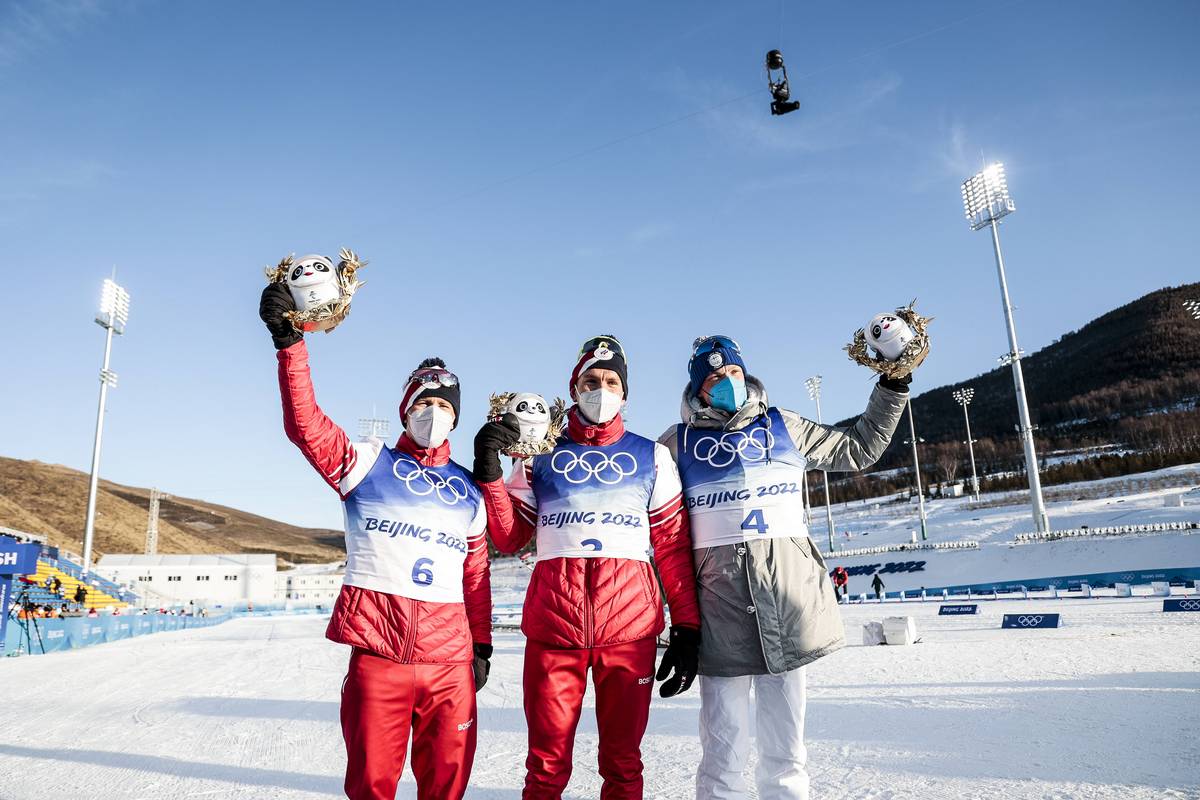
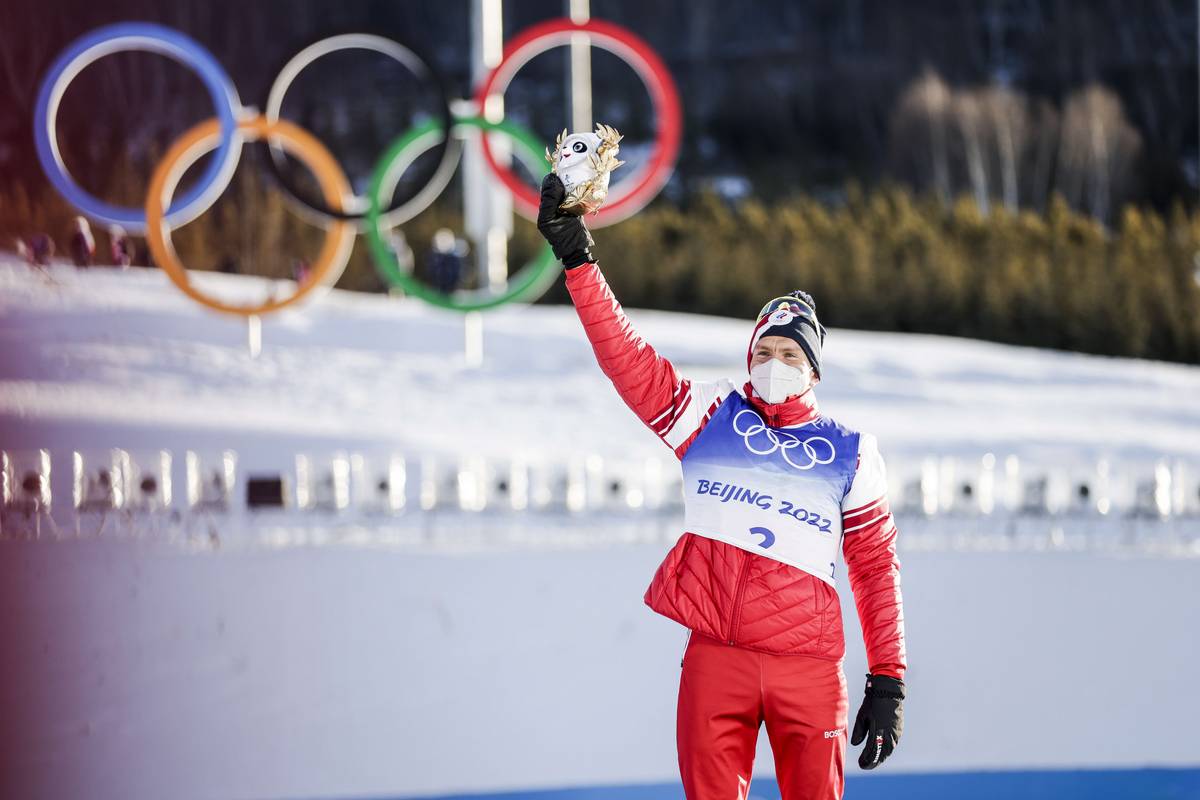
The first podium of the 2022 Olympic Games following the men’s 30 k skiathlon. Alexander Bolshunov (ROC) dominated the event for gold, ahead of teammate Denis Spitsov who took silver, and Iivo Niskanen (FIN) bronze. (Photo: NordicFocus)
This World Cup coverage is made possible through the generous support of Marty and Kathy Hall and the A Hall Mark of Excellence Award. To learn more about A Hall Mark of Excellence Award or to learn how you can support FasterSkier’s coverage please contact info@fasterskier.com.
On the heels of the women’s opening Olympic race, a colorful lycra field in their Sunday best lined up to race the men’s 30-kilometer skiathlon. While the women raced a four-lap 15 k event, men faced double the distance – over 75% longer by finish time – though they were greeted by much more favorable weather. It was sunny, still, and clear. Classic tracks were crisp and firm, and the familiar sound of poles powerfully planting and pushing off from cold snow, akin to the blasters of Storm Troopers in the classic Star Wars films, was not obscured by wind ripping through the stadium.
A quick nod to the start list for North American fans: Scott Patterson and Gus Schumacher were the only men racing in stars and stripes today, while Olivier Léveillé, Antoine Cyr, and Rémi Drolet raced for Canada.
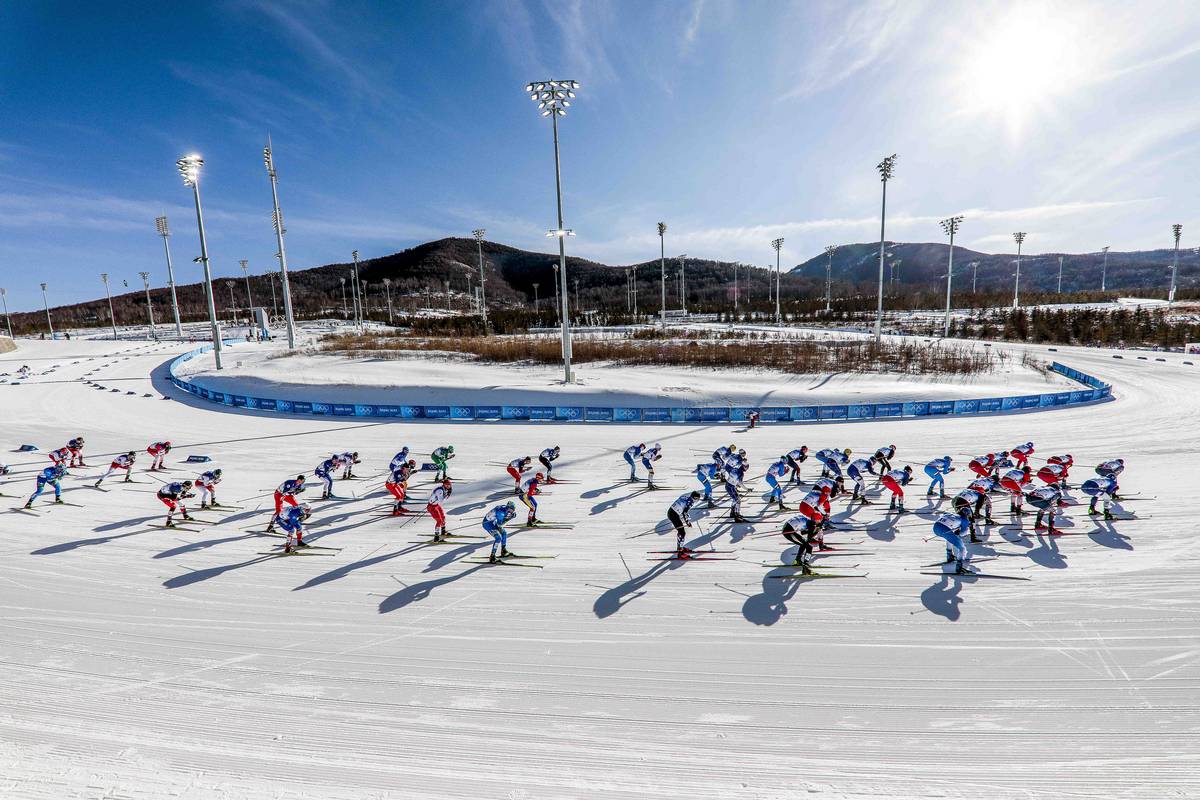
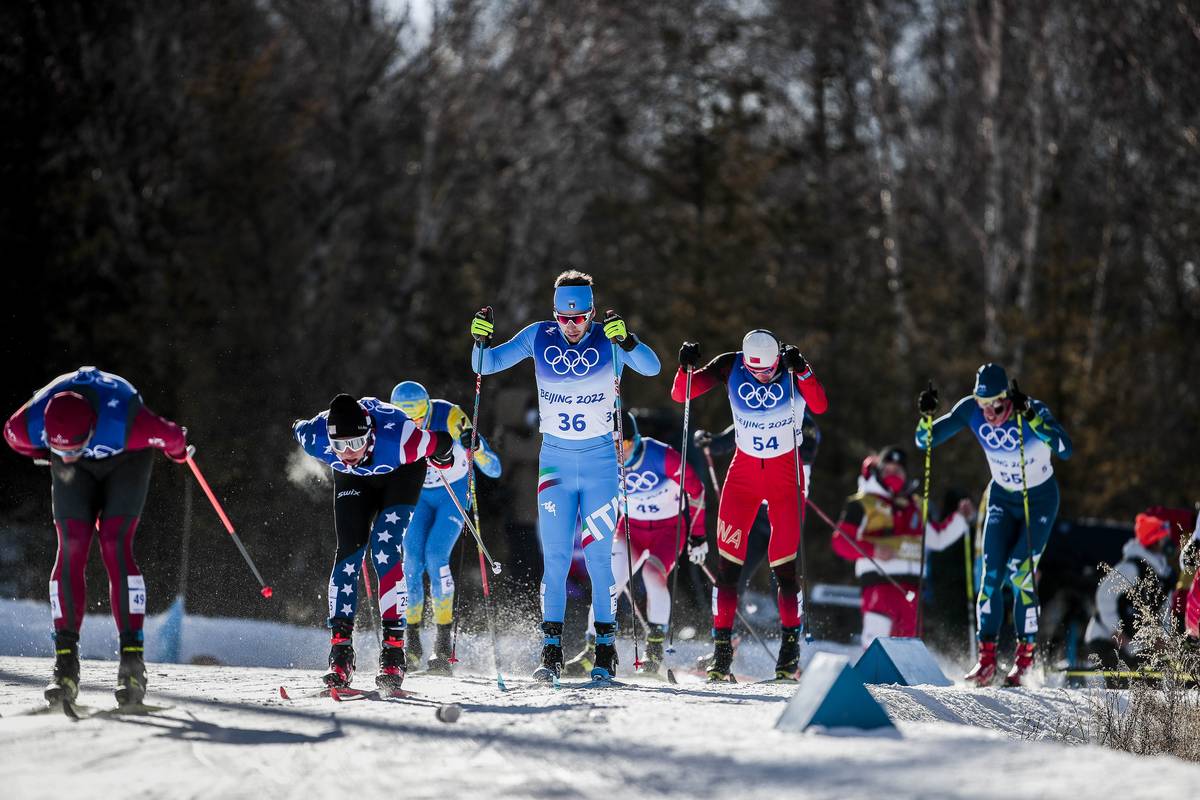
Athletes take to the course for the men’s 30-kilometer skiathlon, the opening event of the 2022 Beijing Olympic Winter Games. (Photo: NordicFocus)
To review the last two Olympiads, the 2018 Games saw a Norwegian sweep of the skiathlon podium, with Simen Hegstad Krüger breaking away to win gold by eight seconds ahead of his teammates Martin Johnsrud Sundby and Hans Christer Holund. After testing positive for COVID-19 shortly before his scheduled departure for Beijing, Krüger is currently riding out his quarantine in a hotel room, resolutely training on a spin bike in hopes of making it to the 2022 Games in time for the final event, the men’s 50 k freestyle. Sundby retired from World Cup level racing after the 2021 World Championships in Oberstdorf, Germany, in which he earned an auto start as the reigning champion in the 15 k classic. This season, Sundby raced a series of marathon and longer races in Italy during January. This leaves only Holund returning to the Olympic skiathlon in 2022.
In 2014, it was a dog fight to the finish, with Dario Cologna of Switzerland taking gold by just 0.4 seconds over Marcus Helner of Sweden. Near the peak of his career, Norwegian powerhouse Sundby was one second behind Helner in third.
Athletes take to the course for the men’s 30-kilometer skiathlon, the opening event of the 2022 Beijing Olympic Winter Games. (Photo: NordicFocus)
Over the first 15 k of classic racing, two names that have not yet been mentioned, from countries who have not been on the podium in the last two Olympic competitions, pulled away from the field. Leading the charge was the king of the 15 k classic, Finland’s Iivo Niskanen. Niskanen has won seven World Cup 15 k classic events, including a grueling race through falling snow in Lenzerheide, SUI at the beginning of the 2021/22 Tour de Ski. The Finn was second to Johannes Høsflot Klæbo (NOR) a week later in Val di Fiemme, ITA, near the other end of the Tour.
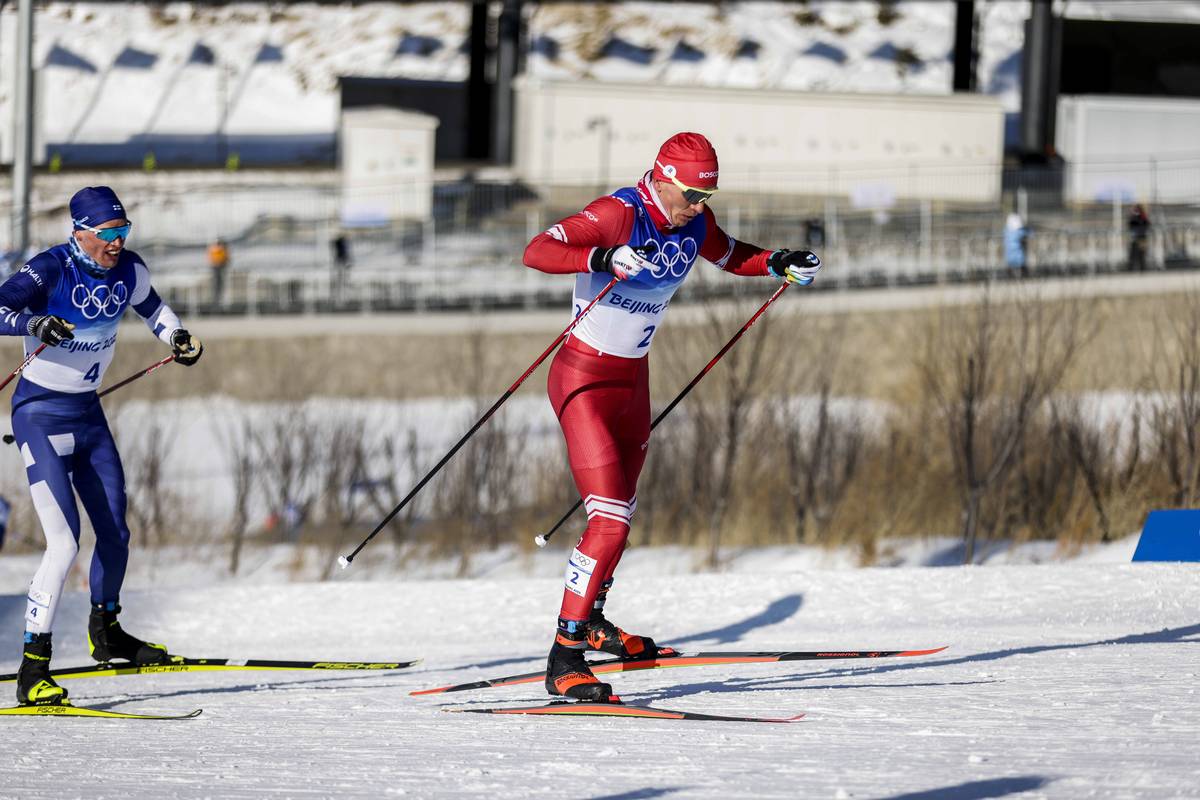
On Niskanen’s tails over the first four laps was Alexander Bolshunov of the Russian Olympic Committee (ROC). Bolshunov was fifth and seventh in the two most recent 15 k classic events, amidst a start to the 2021/22 World Cup season that did not match his previous three seasons of racing. Bolshunov was the World Cup distance champion in 2019, 2020, continuing his dominance to win both the distance title and the overall World Cup title in 2021. He also earned three silver medals in the 2018 Games – he was the runner up in the 50 k classic, and supported the ROC to second place finishes in the relay and team sprint – in addition to a bronze medal in the classic sprint.
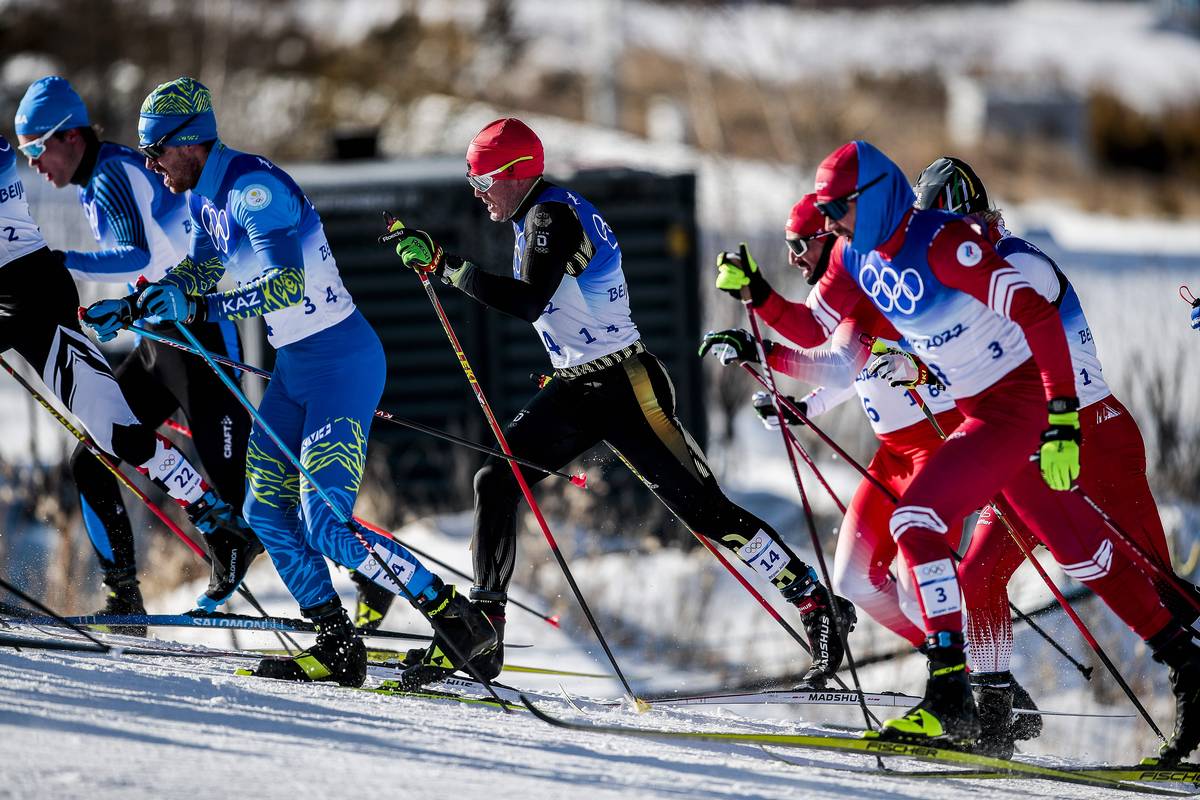
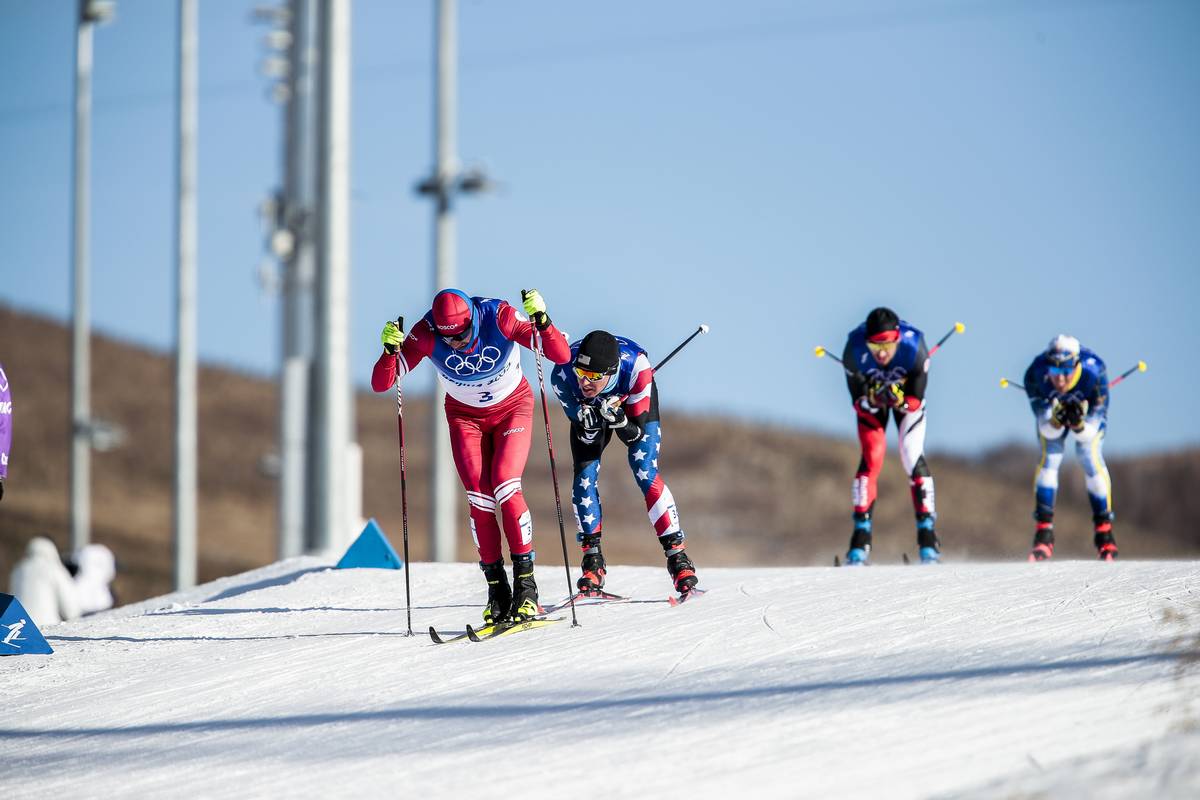
Iivo Niskanen (FIN) leads Alexander Bolshunov (ROC) as the pair drops the field during the classic leg of the 30 k skiathlon. (Photo: NordicFocus)
Leading into this season, Bolshunov has had a less than ideal buildup. The 25-year-old experienced a bike crash in addition to a tooth infection that required multiple surgeries, interrupting his ability to train with the consistency and volume – rumored to be over 1,200 hours annually – that has contributed to his strength over the last quadrennial.
At the 5 k checkpoint, the top-10 racers were spread by less than 5 seconds, before Bolshunov and Niskanen began to pull away. At 10 k the duo had built a 12 second lead to the chase pack, led by Denis Spitsov (ROC), and between 10 k and the pit-box at 15 k where athletes switched from classic to skate, this lead more than doubled to 30 seconds.
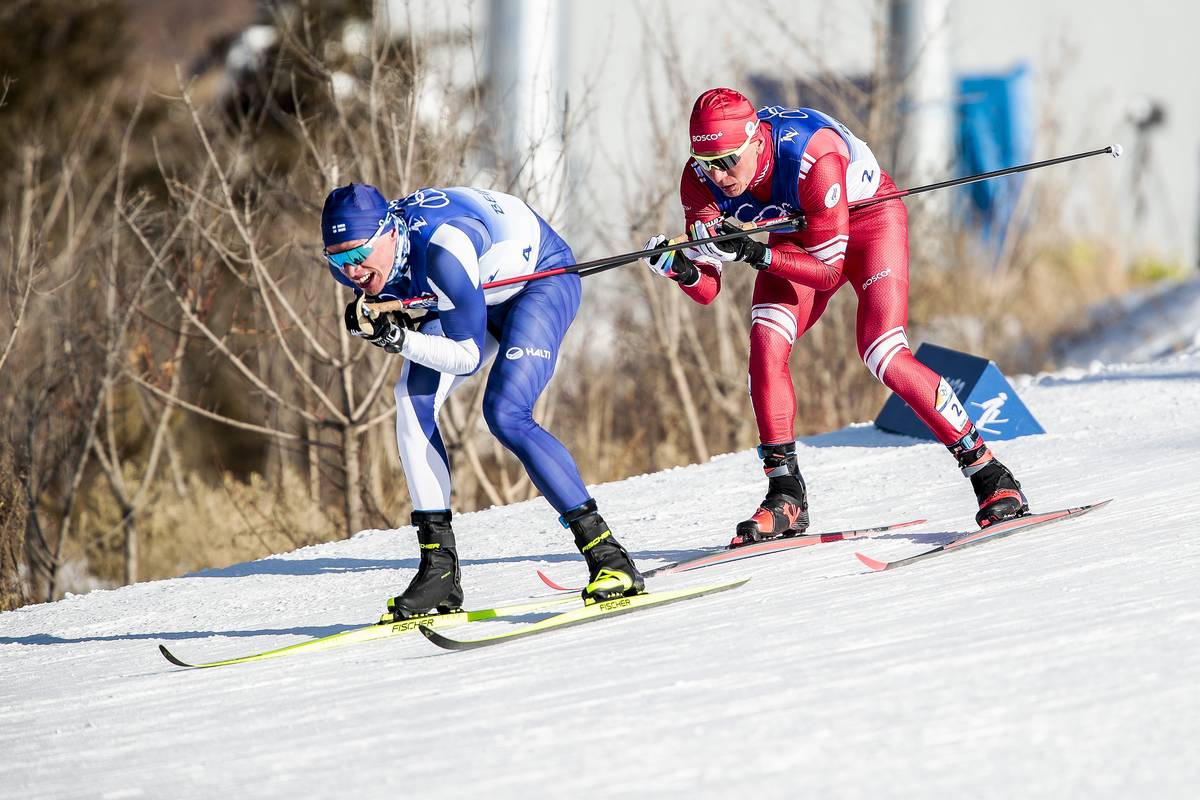
The chase group of Hans Christer Holund (NOR), Denis Spitsov (ROC), and Pål Golberg race the classic leg of the men’s 30 k skiathlon in Zhangjiakou. (Photo: NordicFocus)Alexander Bolshunov (ROC) begins to pull away from Iivo Niskanen (FIN) at the start of the 15 k skate leg of the men’s skiathlon. (Photo: NordicFocus)
Niskanen and Bolshunov left the transition from classic to skate together, but over the next lap, Niskan’s wheels began to fall off. At 16.3 k, Bolshunov was already 13.5 seconds ahead, with Spitsov racing on his own, nearly 18 seconds behind Niskanen and closing fast. Originally podium favorites, two Norwegian chasers worked together roughly 1:06 behind Bolshunov, sitting well over 30 seconds out of third place.
Looking like his body had flooded with lactate and his matchbox was suddenly empty, Niskanen was unable to respond as Spitsov reeled him in, eventually leaving the Finn in his wake by the end of the first skate lap. From then on, the podium story looked to be pre-written.
At 20 k, Bolshunov had more than 40 seconds on Spitsov, with Niskanen in no man’s land 1:03 behind the leader, and 50 seconds ahead of the Norwegian chasers. At 25 k, Bolshunov had grown his lead to nearly a minute over his countryman, and 1:50 to Niskanen.
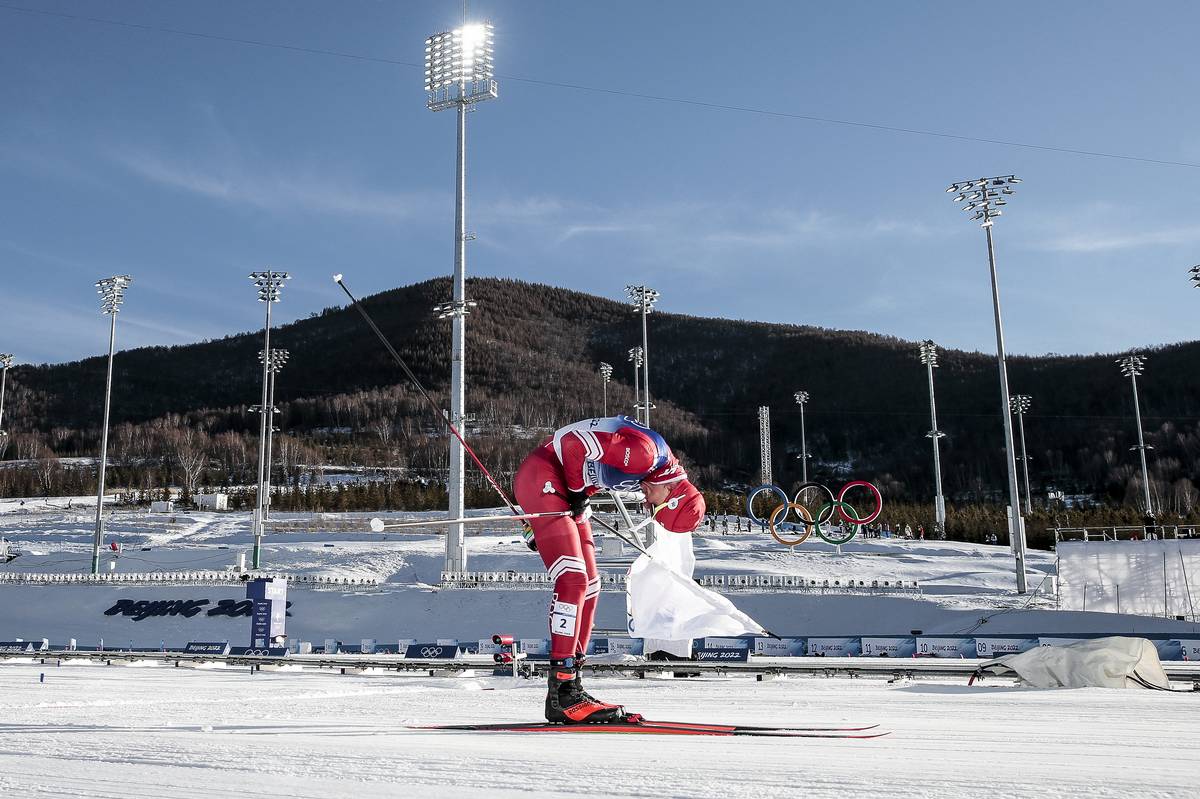
With well over a minute lead on second place, Alexander Bolshunov (ROC) takes a bow as he enters the stadium to win the men’s 30 k skiathlon. (Photo: NordicFocus)
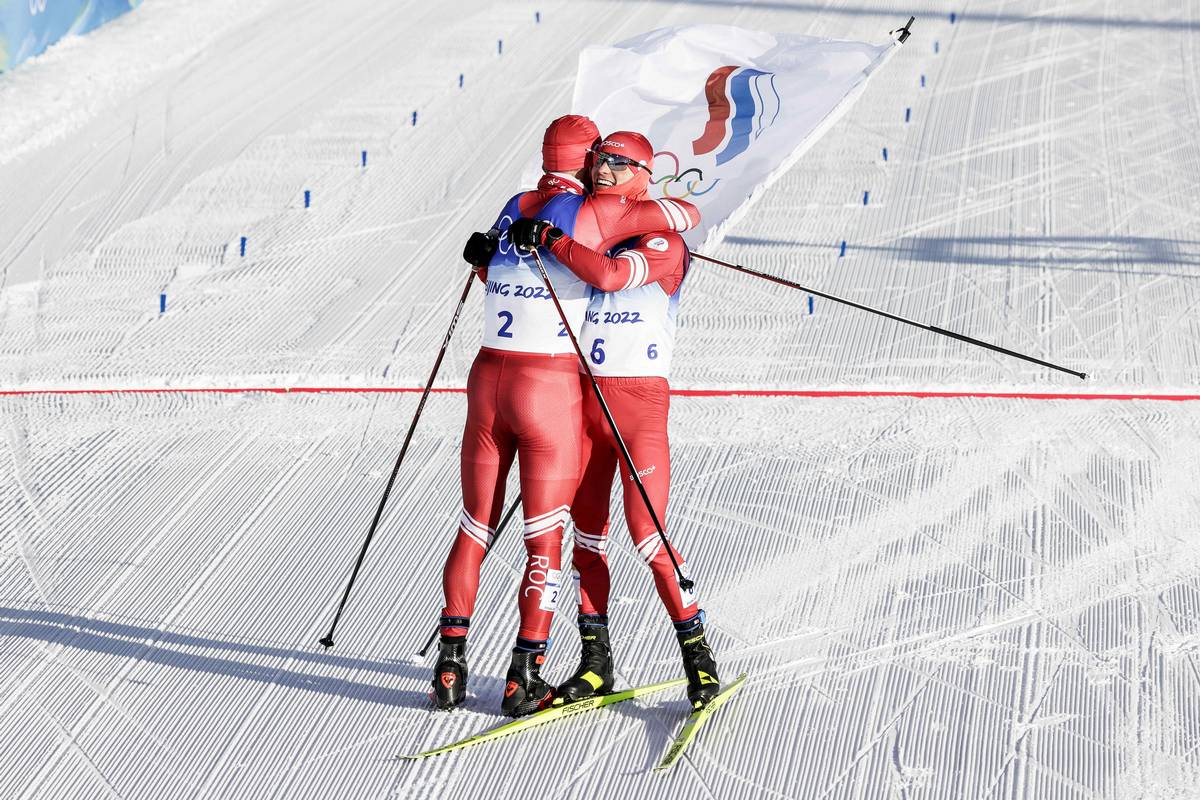
Entering the stadium, Bolshunov had all the time in the world to savor the victory of his first Olympic gold medal.
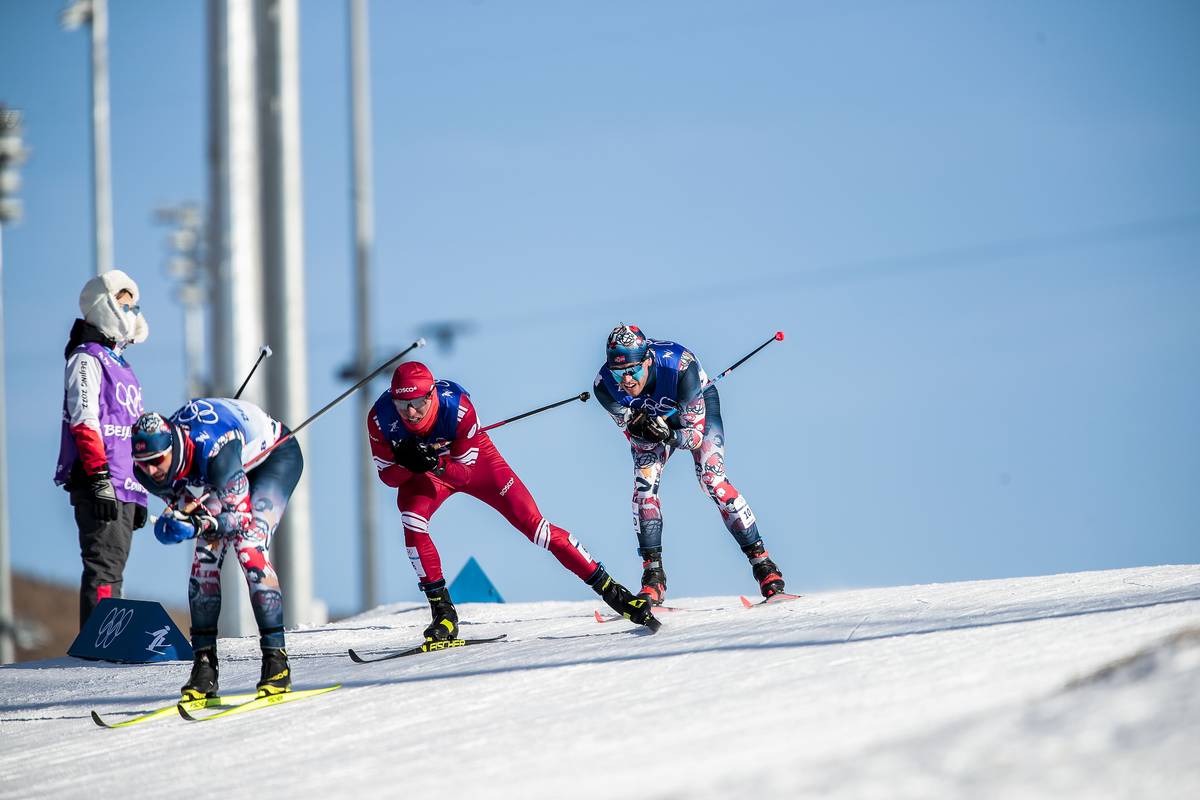
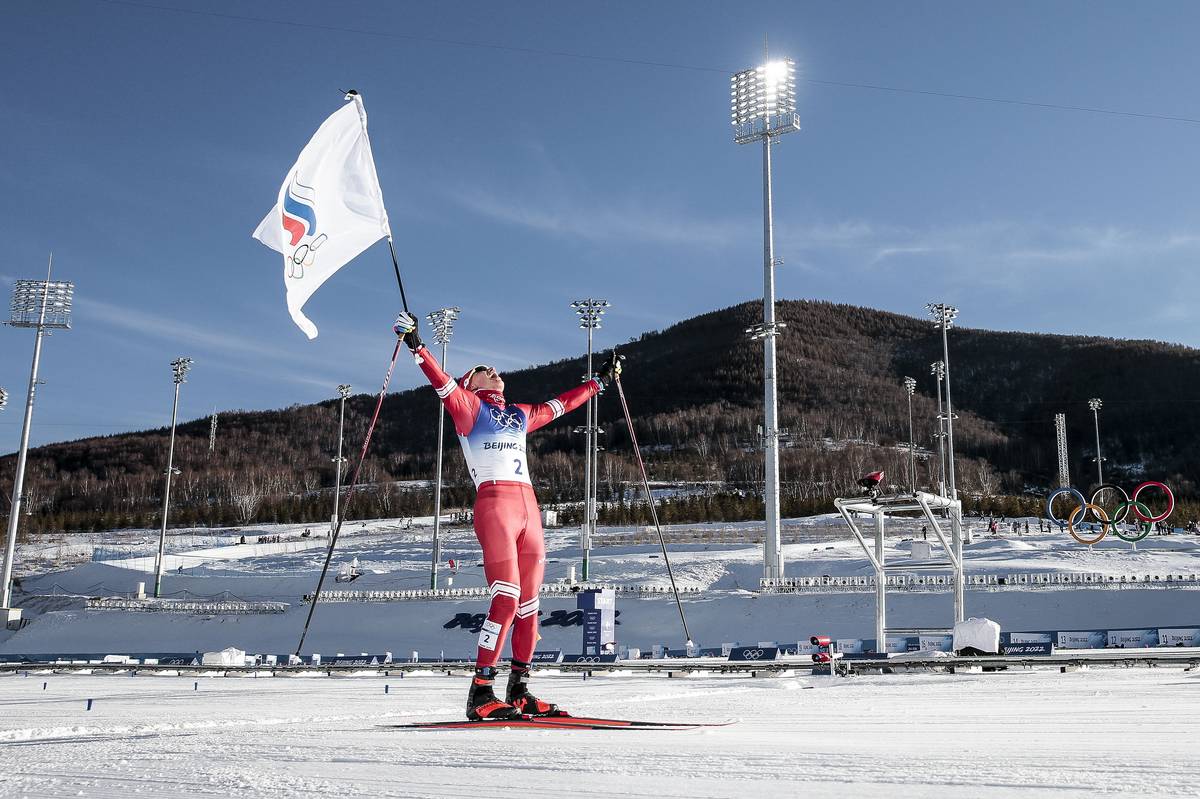
Before rounding the bend into the final straight, Bolshunov took a deep bow. He accelerated around the final bend toward the sidelines, where he collected a ROC flag. Coasting down the lanes, Bolshunov waved this flag over his head with one hand, while pumping his left fist into the air, basking in the glory of a dominant performance on the world’s most prestigious stage.
Alexander Bolshunov celebrates a dominant victory, earning his first Olympic gold medal at the men’s 30 k skiathlon. (Photo: NordicFocus)Olympic champion Alexander Bolshunov welcomes his teammate Denis Spitsov (right) to the finish of the men’s 30 k skiathlon, going one-two for the Russian Olympic Committee. (Photo: NordicFocus)
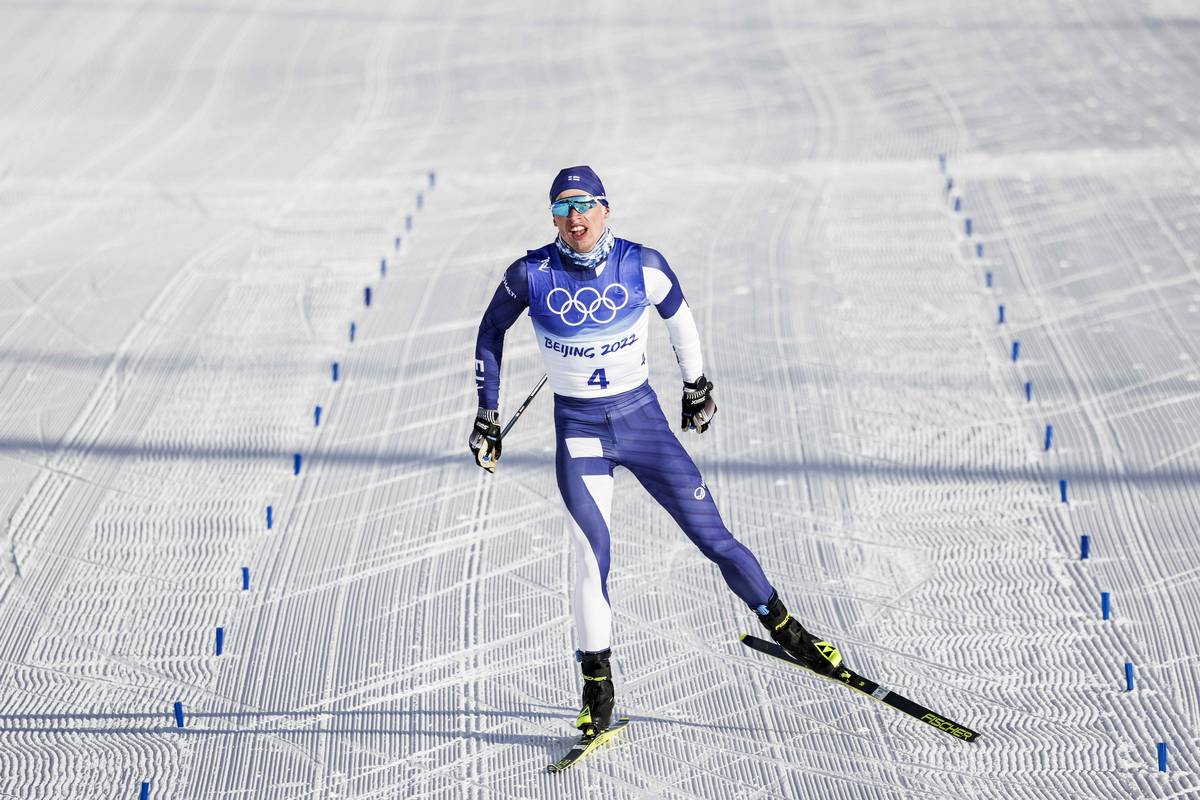
Bolshunov took off his skis, unable to stop smiling, as he turned around to greet his teammate Spitsov, who crossed the line for silver 1:11.0 behind. Niskanen had padded his lead enough over the first half of the race so that his hold on a medal was never threatened. Regaining his form over the final kilometers, he skied smoothly through the stadium to collect the bronze medal in third (+2:00.2).
“I just couldn’t keep pace with those Russians,” Niskanen told the Finnish news outlet Yle after the race. “They were just ridiculously fast today. Unbelievable, the speed they can ski at. It was even a little bit surprising that I wasn’t able to respond to them at all.”
Iivo Niskanen pushes to the line for a bronze medal in the men’s 30 k skiathlon. (Photo: NordicFocus)
Spread over the next minute, Holund took fourth (+2:30.9), with Golberg in fifth (+2:52.5).
While a glance at his FIS profile this season might not have identified Spitsov as a favorite, the 25-year-old was fourth in the event in the 2018 Games in Korea, where he also collected a Bronze medal in the 15 k freestyle. Spitsov collected a slew of top-10 World Cup results over the subsequent seasons, and was named to the 2021 World Championships, before he crashed while training at the venue in Oberstdorf, sustaining a fracture in his left hand that left him unable to compete. Racing back into form this season, Spitsov was fourth and seventh during the 15 k classic stages of the Tour de Ski, where he finished 4th overall.
Whenever the podium is dressed predominantly in Russian Red, speculation arises that the state sponsored doping that overshadowed any Russian performance at the 2014 Sochi Games has continued through 2022. This is especially true when an athlete runs away with a race, despite facing a field made of the top athletes in the world who have all, presumably, prepared in a way that maximizes their potential on the race course. FasterSkier’s Nat Herz voiced this speculation during Bolshunov’s post-race press conference, asking if there was anything the Russian champion would like for people to know regarding his performance on the day.
“Well, people don’t become Olympic champions all of a sudden,” Bolshunov stated matter of factly. “In the past several years, I have been proving this in every race that I participate in, and I achieved distinguished results and I fight to the end. As to doping – you’re hinting at doping – when I hear about this, I don’t feel good at all. When I hear these words, I want to turn and just walk away because I just hate hearing this, because this should have nothing to do with sports.
“We have clean sportsmen, clean athletes here at the Olympics. We go through doping tests almost every day and we have to fill out these forms where we indicate where we will be training from which hour to which hour, when the training session starts, when it finishes and so on…”
Alexander Bolshunov takes the men’s 30 k skiathlon win in Zhangjiakou. (Photo: NordicFocus)
Bolshunov continued to explain a system akin to American doping control, where athletes need to report their whereabouts daily, including all details on training, travel, and even times of day when they might be running errands, or otherwise not at a location where an anti-doping agent could arrive unannounced to collect a sample. In his mind, this level of testing makes questioning whether or not the Russian program is competing fairly a moot point.
“I believe that it’s wrong to ask us these questions. Well you don’t achieve these results all of a sudden — you don’t become an Olympics champion because it takes years and years of training. This is very hard and if you personally want to see how we train, please, we invite you. You are welcome. And these training sessions are very difficult — believe me. And after you will have seen how we train, I believe that you and your audience will never have these questions again. So I believe these are not the best questions to be asked. They’re irrelevant.”
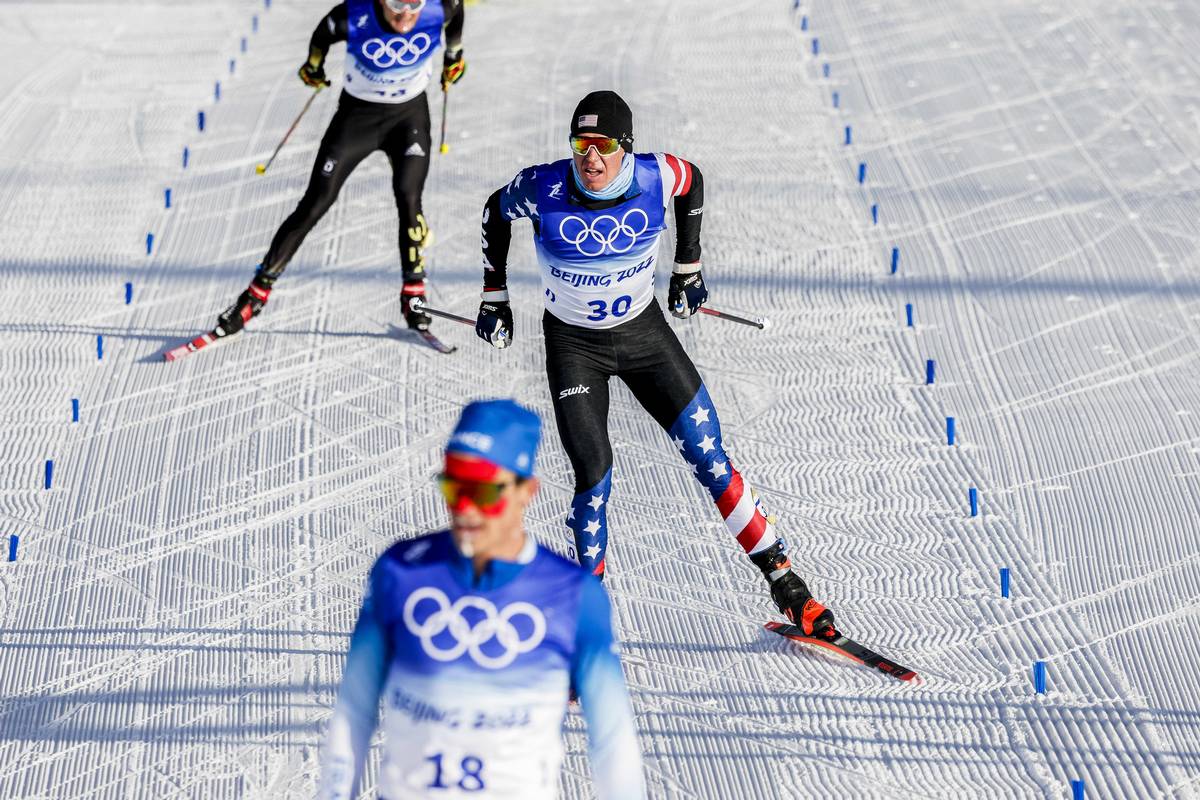
Scott Patterson tucks in behind Alexey Chervotkin (ROC) during the 30 k skiathlon. (Photo: NordicFocus)
Off screen, yet another impressive comeback was underway. At the transition from classic to skate, Scott Patterson sat in 19th place, 2:15 behind the leaders. Steadily picking skiers off, Patterson moved into 16th by 20 k, and was tied with Germany’s Lucas Bögl in 11th at the 25 k checkpoint. Jules Lapierre and Clement Parisse of France were within reach in 9th and 10th, only a few seconds ahead.
Over the final kilometers, Patterson passed Parisse and pulled ahead of Bögl, but was passed by Artem Maltsev (ROC) to maintain his position in 11th place (+4:00.2) at the finish. This result matches Patterson’s Olympic career best result; he was 11th in the 50 k freestyle in the 2018 Olympics, after finishing 18th in the skiathlon earlier in the Games.
If you’ve followed Patterson’s trajectory this season, you’re aware of two things: first, that he sustained a wrist injury from a mountain bike crash that left him in need of surgery just five weeks before the opening World Cup races in Ruka. He joined the team a week late for the Lillehammer mini-tour, racing in a brace that left him unable to fully utilize his poles.
Patterson finished 70th in the 15 k free in Lillehammer, followed by a 75th place finish in the same event the following weekend in Davos.
The second thing you’ll have noted about Patterson’s season is that the trend from that moment forward pointed toward a very different result. Stepping back to the summer, Patterson had put together several impressive trail races, including breaking a storied course record at the Crows Pass Crossing in August, in which he had competed in seven previous summers. It was evident that his fitness was at an all time high before the crash.
At the U.S. Cross Country Championships in Soldier Hollow in January, Patterson broke away to win the men’s 30 k skate by over 11 seconds, and was second in the 15 k classic two days later racing in a perfect storm of above freezing temperatures with mixed precipitation, on skis that perhaps were not up for the task.
Scott Patterson races to 11th in the men’s 30 k skiathlon during the 2022 Olympic Winter Games. (Photo: NordicFocus)
Speaking to FasterSkier after the race, Patterson called a spade a spade, acknowledging that he had a “slow start to the season.” However, he found confidence in his racing in the years prior, where he came into peak form surrounding February championship events, regardless of what his Period 1 results looked like.
“[The Olympics] also get right into the races that I really like – a 30 k, then towards the end the 50 k. I think also the little bit smaller fields at the World Champs or Olympics kind of help. It’s a little less chaotic, where I can just kind of get in my groove and ski. So, [how prepared I am] was a little unknown going in. I had some confidence coming off Nationals, and I had a good training block [afterward], so I was optimistic, but it definitely was a big question mark how it would go. Obviously, it started out pretty strong, and I’m looking forward to more racing.”
Scott Patterson takes 11th in the men’s 30 k skiathlon. (Photo: NordicFocus)
Patterson was asked to quantify the extent to which the cold and the challenge of the course factored into the time gaps seen at the finish. Patterson acknowledged the altitude, and the speed of the snow, but ultimately concluded that at an Olympic event, the results are not unexpected.
“It’s the Olympics like people just go hard,” he said simply. “I think we saw that in 2018 where no one sits around at an Olympic race. And we saw that for sure today with Iivo and [Bolshunov] – really strong off that classic leg. And I don’t think there’s any way to hide out here with these long hills and tough course – especially with the way they groomed it, where you don’t have tracks on the downhills. It’s hard to recover, so you have to work for a lot of it. And a lot of these hills are just that grade kind of in between V2 and V1. Or if you switch early to V1, you’ll be V1-ing for a long time.”
With that, Patterson headed out to “go pee in a cup”, acknowledging that he was heading to doping control, and in response to a question on the winners, that they likely were too.
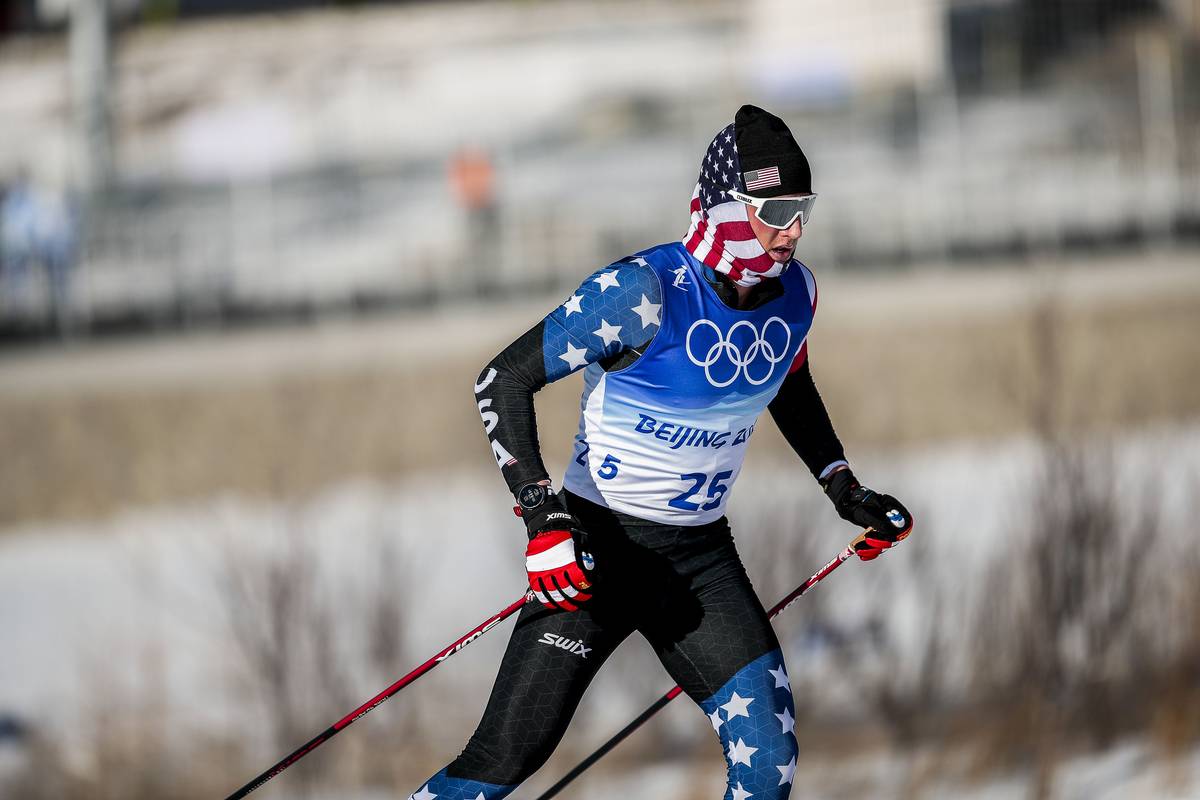
Gus Schumacher races the men’s 30 k skiathlon during the 2022 Beijing Olympic Winter Games. (Photo: NordicFocus)
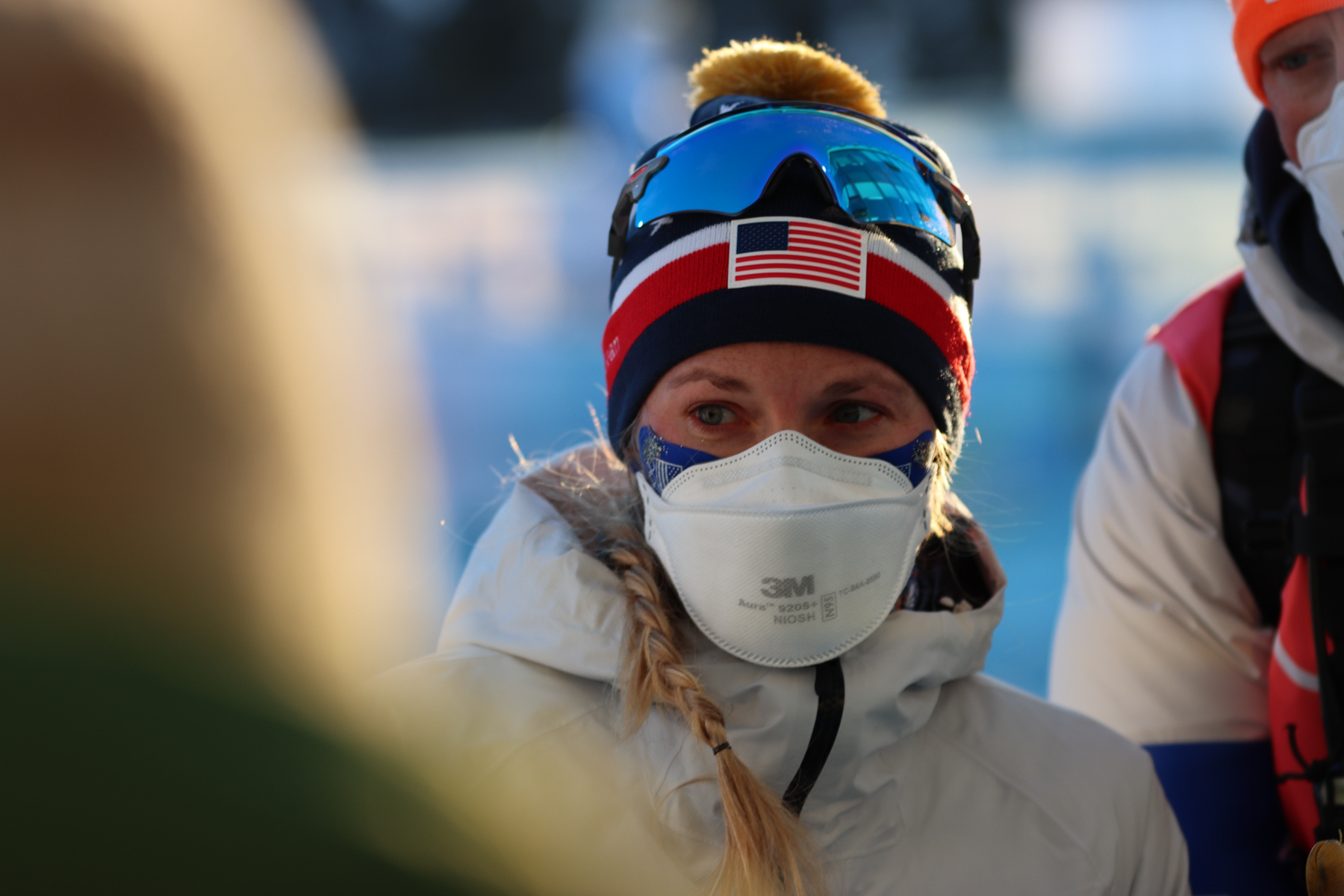
Schumacher, in his first Olympic performance, was 39th (+9:04.5). The 21-year-old gave an emotional response in the mixed zone, saying felt “depleted and empty” after his race. Showing maturity beyond his years in the sport, Schumacher fielded questions from the media regardless, stating that he felt he had paced the race well, but his energy was not what he had hoped for, and he took pride in simply finishing the race. His next statements, uttered while clearly choked up behind his N95, were powerful.
“I think when I was younger, I would have seen someone like myself have a tough race on a big stage and kind of be disappointed [in them]. And I am disappointed. But I want younger people to know that it’s a long process, and there are going to be bad days. And sometimes there are going to be a lot of bad days – this season hasn’t been my best. But I know I’m doing the right things, and more years of doing that, it’s just going to get better. I don’t want people to doubt me – I don’t really care that much [if they do] – but that is something that’s on my mind, because I’ve doubted people before. But I know there’s a lot of people at home that believe in me, and that have supported me to get to this point. And I know that they’re proud of me. And that means a lot.”
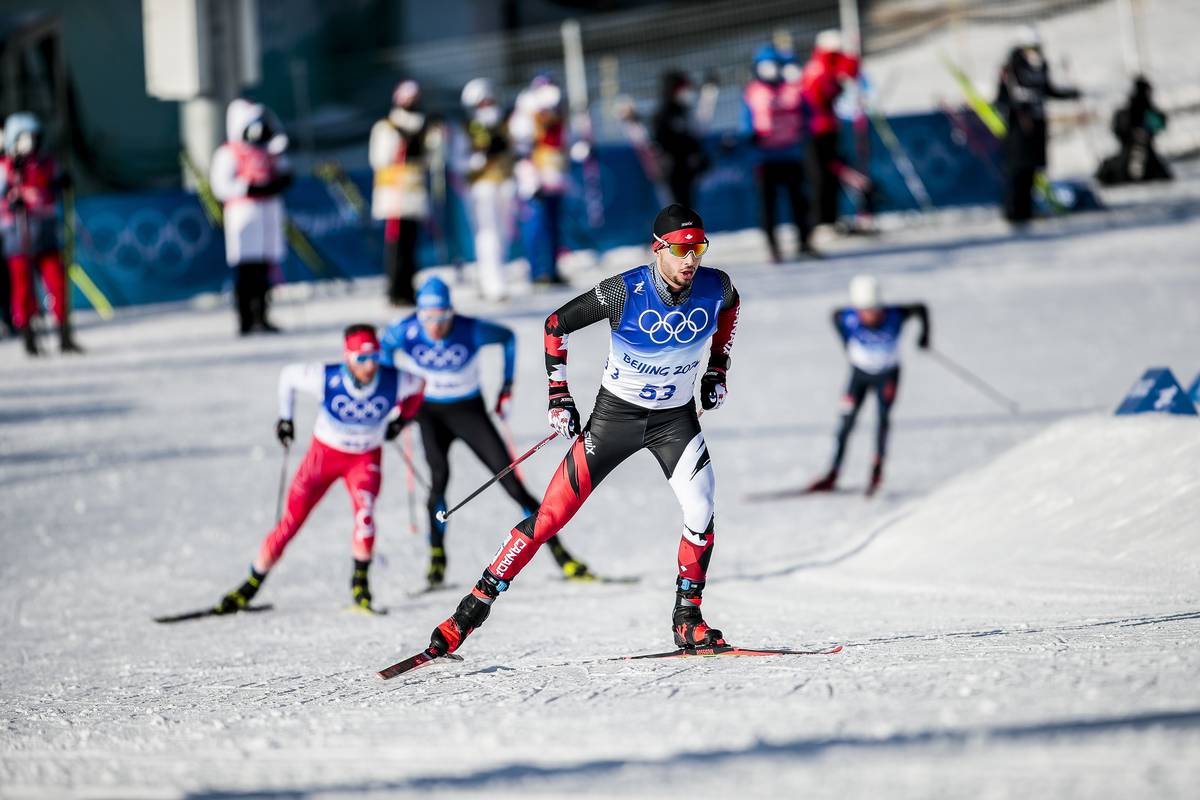
Gus Schumacher races in his first Olympic event, the men’s 30 k skiathlon. (Photo: NordicFocus)Olivier Léveillé leads the Canadian men in 31st in the men’s 30 k skiathlon. (Photo: NordicFocus)
Just outside the Top-30, Olivier Léveillé was the top Canadian finisher in 31st (+7:32.2), with Antoine Cyr a minute and a half behind in 42nd (+9:16.2). Drolet was lapped just before the 20 k checkpoint and did not finish the race.
Three Canadian women ski into elite group of 30 on grueling race day in Beijing
By Chris Dornan on behalf of Nordiq Canada
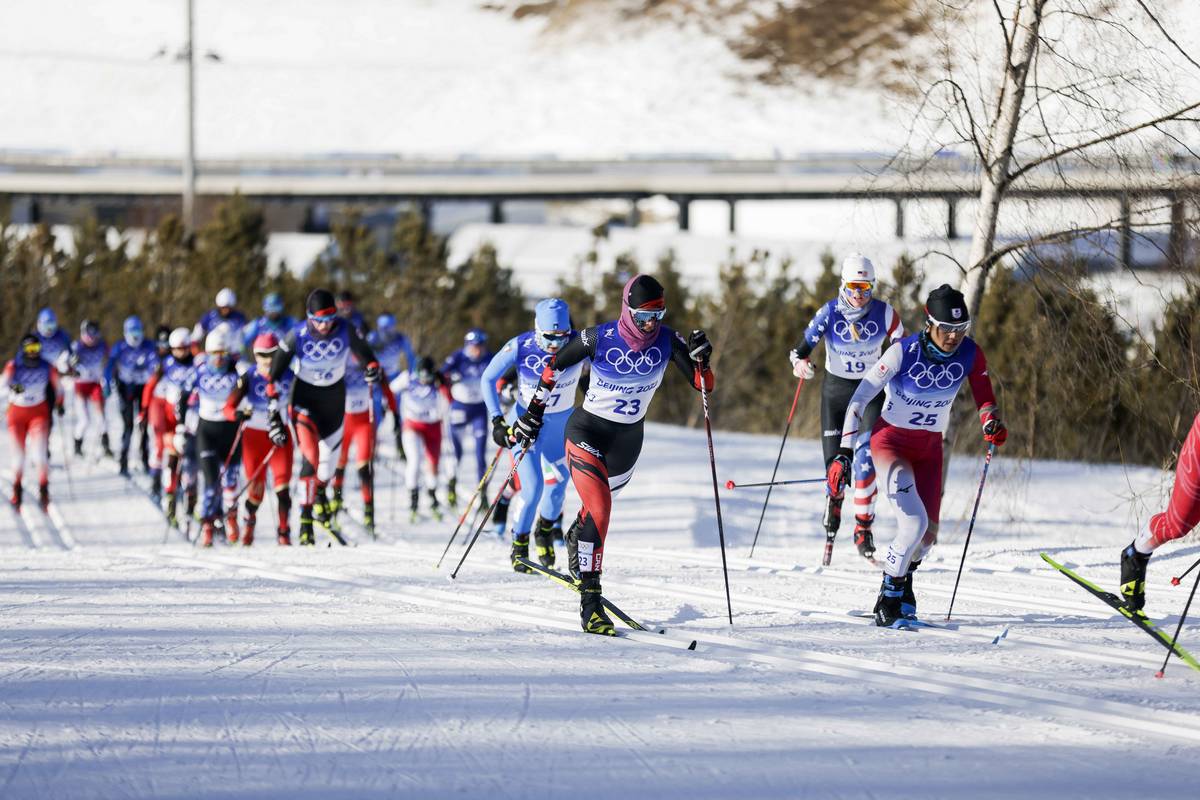
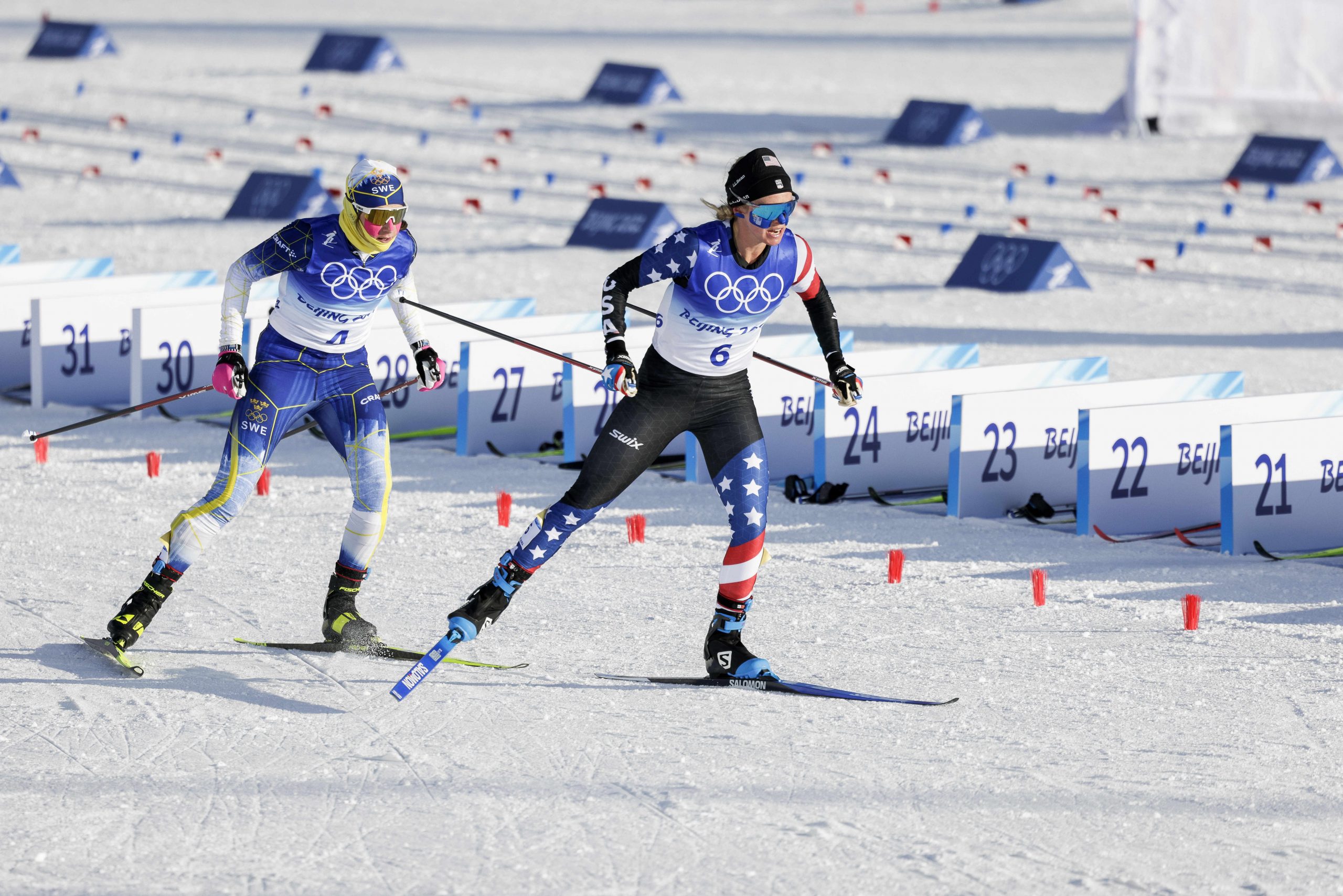
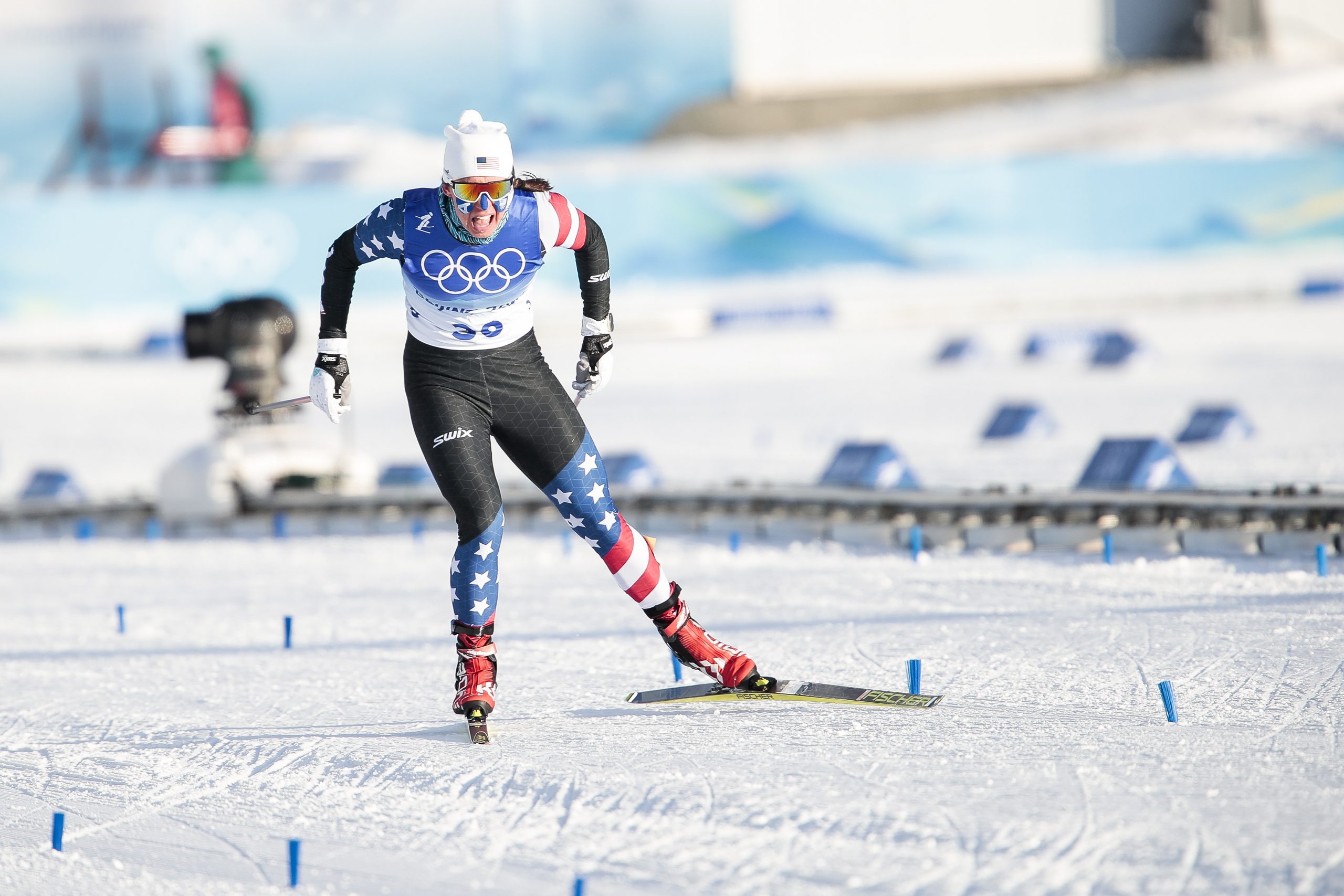
Katharine Stewart-Jones (bib 23) skis to 23rd in the women’s 15k skiathlon, which opened the 2022 Beijing Olympic Games. (Photo: NordicFocus)
BEIJING, Chn — Cendrine Browne and her teammates set the tone for the Canada’s cross-country skiers at the 2022 Winter Games after putting down her best-ever Olympic performance, skiing to 20th place in the women’s 15-kilometre skiathlon race on Saturday in Beijing, China.
Competing in her second Olympic Games, the 28-year-old from Prévost, Que. clocked a time of 47:58.1 after a gutsy effort that challenged the top women’s cross-country skiers who were faced with long punishing climbs and blustery winds on a frigid afternoon at the Zhangjiakou National Cross-Country skiing Centre.
“That is a career-best result today! I’m really, really happy and proud of how I raced,” said Browne. “I worked very hard on my classic the last year and I think that really helped me today. It was definitely a tough race with tough conditions so I’m glad I was able to ski relaxed and be conservative with my energy. It was really fun being in the same pack as Katherine! I’m so proud of our team. This shows that we are in great shape!”
Canada’s Browne, Katherine Stewart-Jones (Chelsea, Que.) and Dahria Beatty (Whitehorse) worked together in the chase pack for much of the race. Browne and Stewart-Jones exchanged positions as the top Canuck in each of the four laps. Skiing strong, the Canadian trio conserved their energy for a strong finish in the top-30.
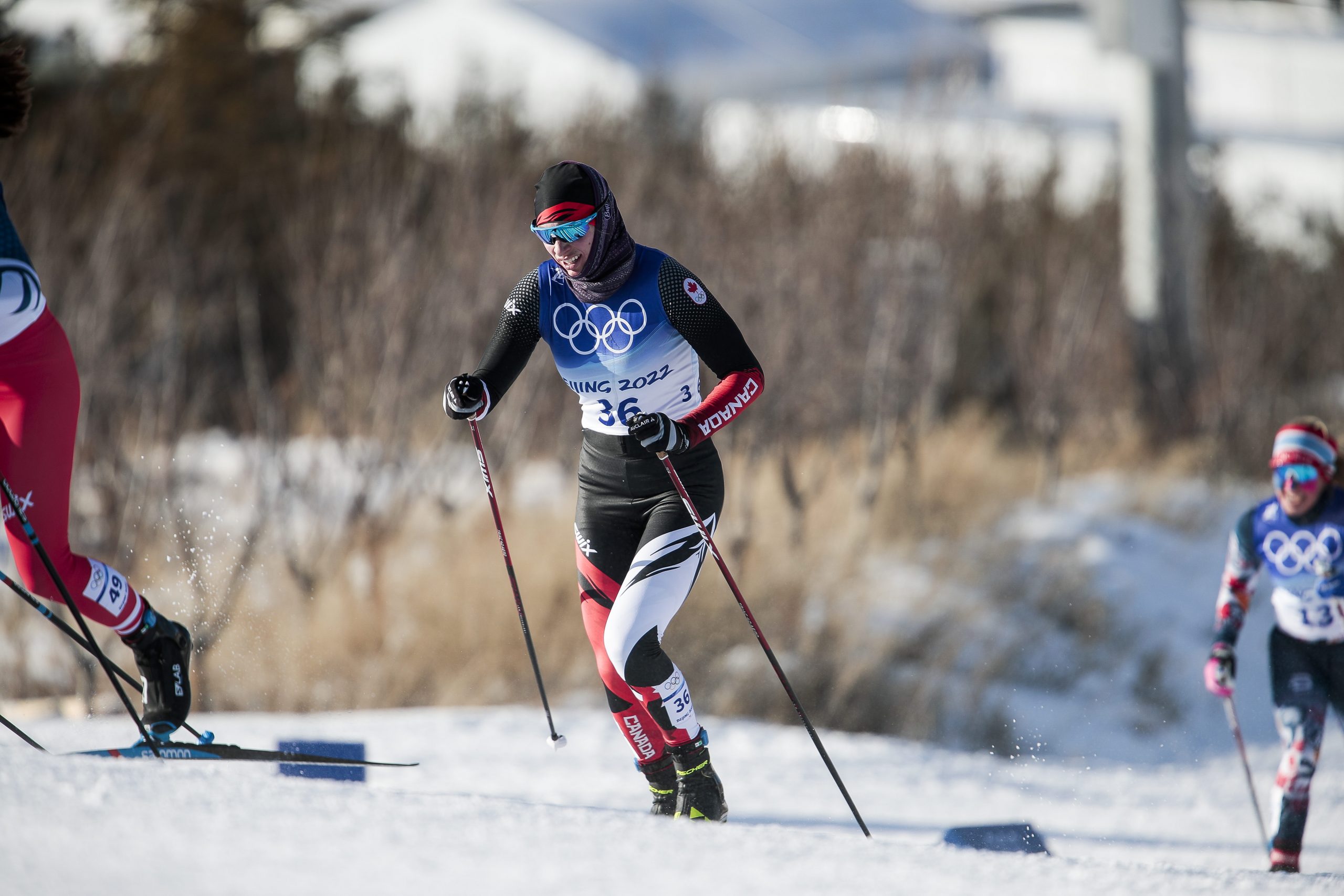
Dahria Beatty races the 15k skiathlon in Zhangjiakou, the opening event of the 2022 Beijing Winter Olympic Games. (Photo: NordicFocus)
Skiing in and out of the top-20 on the wide-open course, Stewart-Jones (Chelsea, Que.) finished 23rd at 48:17.3 in her Olympic debut.
“This is my first Olympic Games, so it was a really great experience. There was a lot of wind today, so it was important to stay in the tracks and conserve energy,” said Stewart-Jones. “It was a long 15 kms given how tough a course this is. I was happy with the way I felt out there despite it being so long since I had raced, and I didn’t really know what to expect. This will do a lot for my confidence for the rest of these Games.”
Beatty also had a boost of confidence with her career best Olympic result, skiing steady in the middle of the pack en route to a 28th place finish at 48:52.0.
“You had to be pretty strategic on the downhills today. With the wind, my goal was to be as small as possible on the downhills and then give everything I had on the climbs. I’m super happy with how it went for me. Being in the top-30 in a distance race is always something I’m happy with,” said Beatty.
Olivia Bouffard Nesbitt (Morin Heights, Que.) scrapped her way to 44th in a time of 50:11.7.
“It was super challenging conditions for everyone. It was windy, cold, the snow was slow, and this is a heck of a course,” said Bouffard Nesbitt. “It is one of the hardest courses if not the hardest. It was just epic today – my first Olympic race – getting blasted by the wind right off the start. You really could just feel the size of the event right away.”
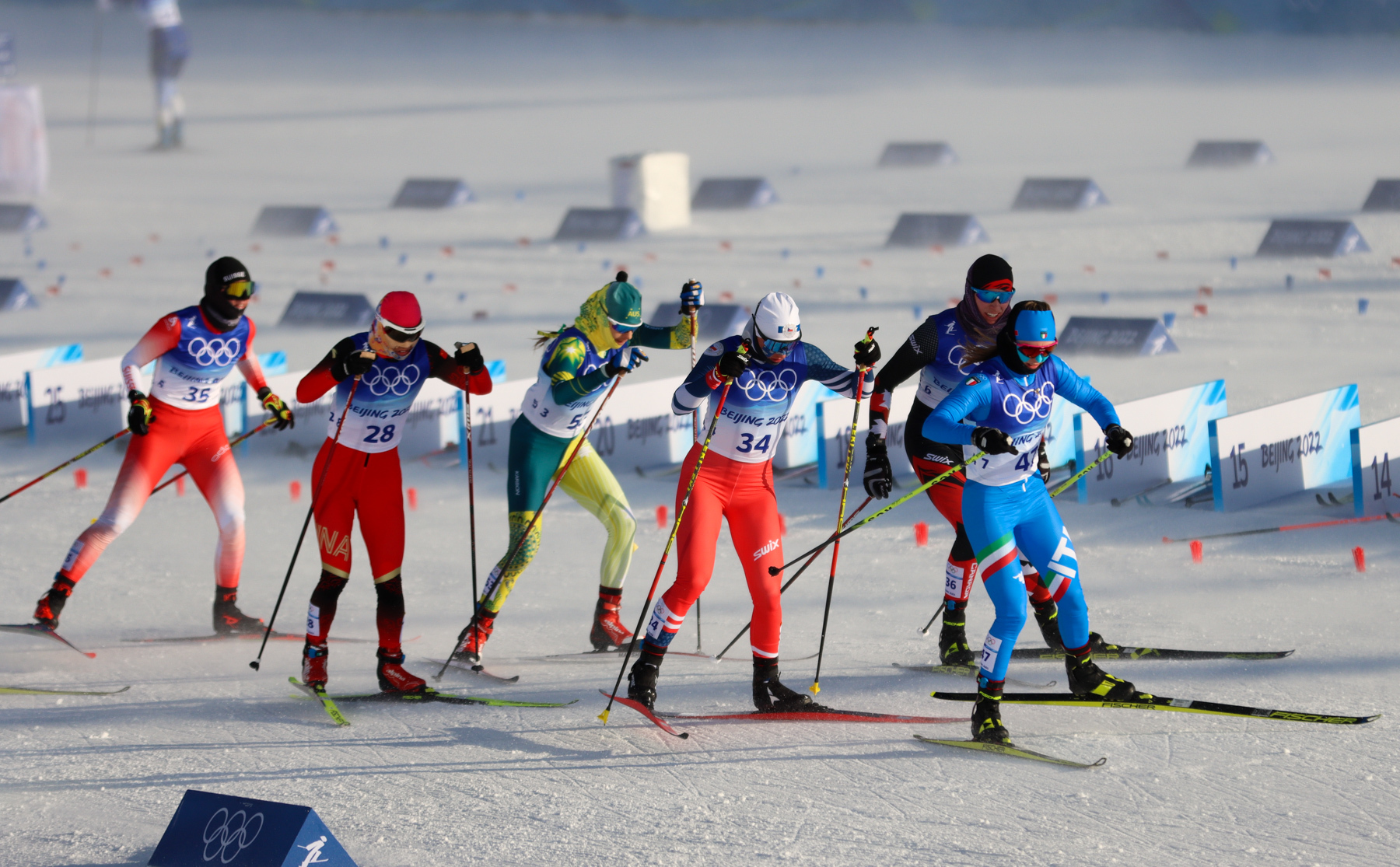
Battling for the first Nordic skiing medal of the Games, the field of 63 women set an electric pace from the start gun and held it throughout the challenging 15-kilometre test which combined 7.5 kilometres of classic cross-country skiing followed by 7.5 additional kilometres in the free technique. Athletes change equipment in a pit stop area between the two legs with the clock still running.
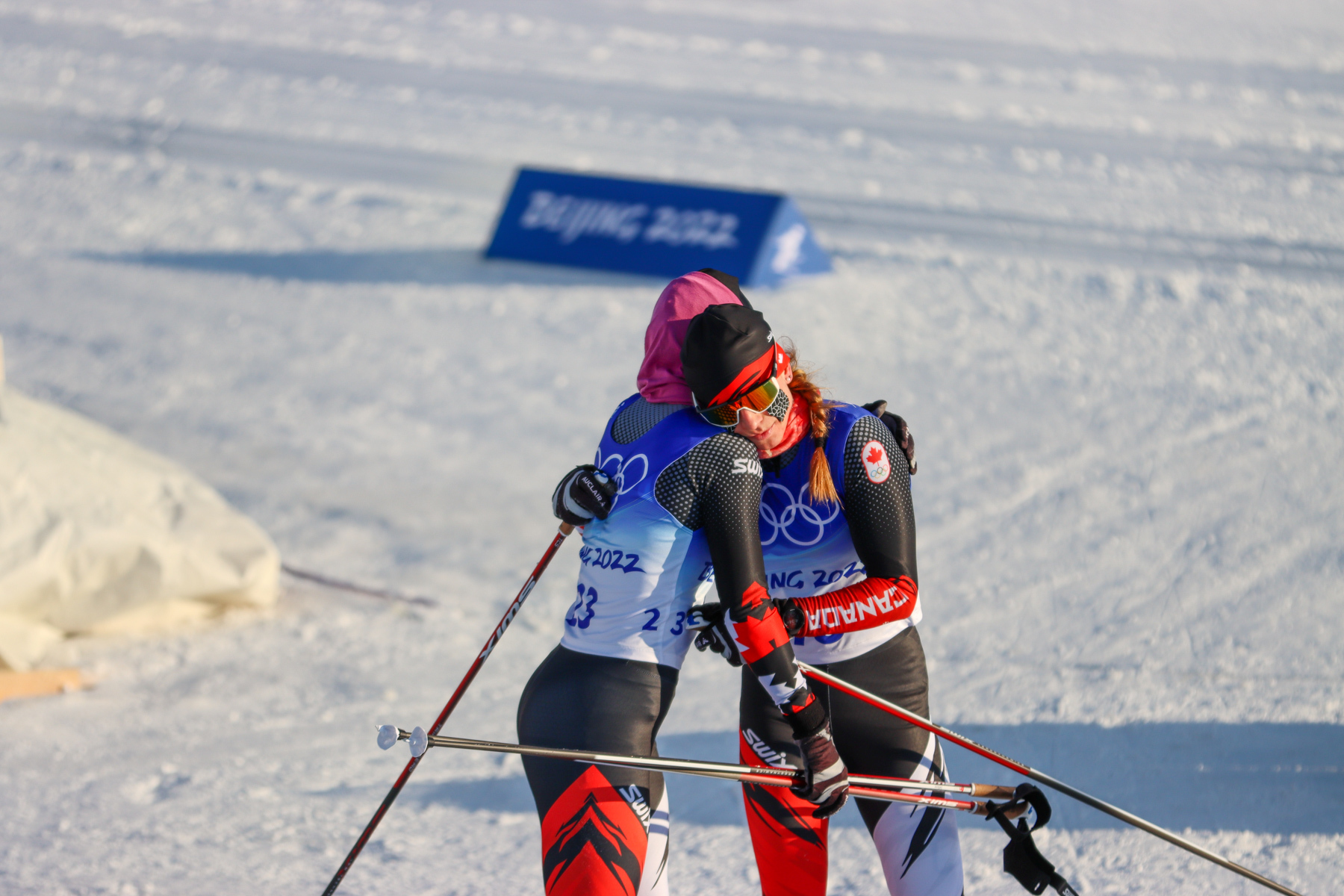
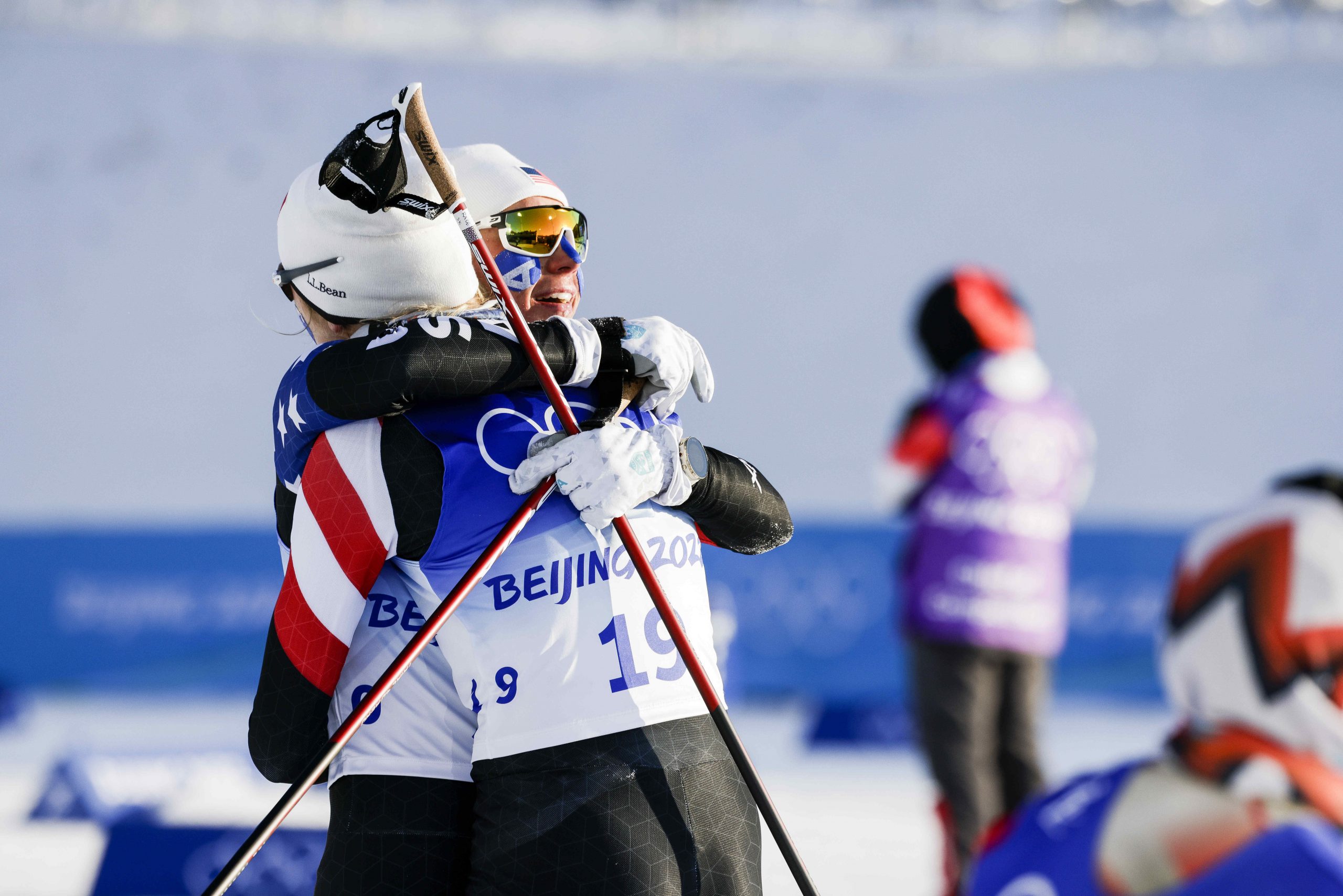
Cendrine Browne (right) hugs teammate Katharine Stewart-Jones (left) after the pair finished 20th and 23rd, respectively, in the 15k Olympic skiathlon. (Photo: Nat Herz/FasterSkier-ADN)
Norway’s Therese Johaug controlled the pack in both disciplines. A force from start-to-finish, Johaug led a group of approximately 15 athletes who strung out the field on the second hill in the first lap. Charging out onto the second half of the course after leading the pack into the exchange area, the Norwegian skied with a handful of athletes until surging with less than three kilometres to go en route to winning the gold medal with a time of 44:13.7.
Natalia Nepryaeva, who is an athlete representing the Russian Olympic Committee, was the next best finisher 30.2 seconds off the golden pace. Nepryaeva claimed the silver with a time of 44:43.9, topping Austria’s Teresa Stadlober who grabbed the bronze medal at 44:44.2.
The Canadian men will hit the Olympic start line for a 30-kilometre skiathlon race on Sunday.
Kicking off the 2022 Beijing Olympic Games with a look into the women’s skiathlon. Co-host Nat Herz was on site during the race, braving the wind and cold to collect deeper insights into the scene, while Kershaw gives his hot take as a very-well-informed armchair quarterback. Note that Kershaw picked two of the top-three athletes correctly in his pre-Olympic podium picks: unsurprisingly, the favorite, Therese Johaug took gold, while Natalia Nepryaeva (ROC) earned silver instead of the bronze Kersh predicted. (Find full compiled picks and current standings for the Devon Kershaw vs. Alex Harvey Olympic podium predictions showdown here.)
Stay tuned for regular updates and race breakdowns over the course of the Games! Thanks for listening.
Jessie Diggins throws down an impressive performance in the skating half of the women’s 15k skiathlon, the opening event of the 2022 Beijing Winter Olympic Games. (Photo: NordicFocus)
Striding out of the stadium at the Zhangjiakou National Cross-Country Skiing Center (Photo: NordicFocus)
This World Cup coverage is made possible through the generous support of Marty and Kathy Hall and the A Hall Mark of Excellence Award. To learn more about A Hall Mark of Excellence Award or to learn how you can support FasterSkier’s coverage please contact info@fasterskier.com.
After a long hiatus from international racing, the top athletes found themselves on the start line once again, ready to contest the first event of the 2022 Winter Olympics. First up, a 15-kilometer skiathlon, featuring 64 starters completing four 3.75 k loops. The skiathlon, which combines both classic and skate in one race (7.5 k of each in this case), is an infrequent event on the World Cup circuit though appears on the schedule at all championships.
Four years ago, at the Olympics in PyeongChang, it was Charlotte Kalla of Sweden who bested the field to take gold, followed by Marit Bjørgen of Norway and Krista Pärmäkoski of Finland. Notably, this year’s winner, Therese Johaug was not present, but we will return to this point later on.
Celebration for Therese Johaug (NOR) as she takes her first ever individual Olympic gold medal (Photo: NordicFocus)
Watched by a few masked fans in the stands, the athletes completed final preparations before the start. Even without looking at the temperature, the cold was evident, from the blowing trees and bibs to the drifting snow across the tracks and the face-tape present on all the starters. The thermometer said -12.5°C or 9.5°F, though this reading likely didn’t factor in the windchill. With minutes to go, the athletes emerged from a set of underground stairs, bundled in parkas, to take their places on the start line.
At the starters command, the first cross-country ski race of the 2022 Olympics was underway, and almost immediately two skiers went down in a crash, though thankfully the damage did not impact the rest of the field. Coralie Bentz of France and Anne Kyllönen of Finland recovered quickly and rejoined the pack. With the first A-climb less than 1 k into the course, early leaders Rosie Brennan (USA) and Therese Johaug (NOR) pushed the pace, and the pack soon thinned.
Therese Johaug (NOR) leads the charge up the first big hill, Rosie Brennan (USA) can be seen leading the left most column (Photo: NordicFocus)
On the descents, the camera showed most athletes opting to ski on the platform, rather than the tracks, due to the drifting snow that was filling them. Skirting another fall, this time from Johanna Matintalo of Finland, the front group entered the stadium for the first round in a pack of roughly fifteen. With just over eleven minutes on the race clock, there were ten athletes within five seconds of Johaug, a slight surprise given her tendency for early breakaways.
Heading out for the second lap, Johaug visibly upped the pace though still had difficulty shaking her followers. Through the 5.1 k mark, the spread was now ten athletes over the span of ten seconds, led by Kerttu Niskanen (FIN) and ending with her teammate Matintalo, who had recovered from her fall. Whittled away over the duration of that lap, when they reached the second A-climb of the course before descending towards the stadium, Johaug was leading a group of just six skiers.
Entering the stadium for the transition to skate skis, Johaug double-poled the final rise, managing to open a slight gap to Niskanen, Frida Karlsson (SWE) and Pärmäkoski (FIN). Executing a quick exchange she held the lead and was out with 23:04.7 elapsed on the clock. Niskanen followed +1.0 behind, Pärmäkoski +2.2 and Karlsson +4.3.
It is worth noting that after the exchanges, Jessie Diggins of the USA was in tenth, +57.5 seconds behind Johaug, having dropped significantly over the first two classic loops. Rosie Brennan was next in 14th (+1:11.9), with Hailey Swirbul in 23rd (+1:52.6) as the final American inside the Top-30. Julia Kern was +4:07.1 behind in 53rd, about to hit the gas on the skate laps.
Jessie Diggins (USA) strides up one of the many challenging climbs (Photo: NordicFocus)
Capitalizing on her one-second advantage, Johaug found herself off the front for the first time. Pärmäkoski, Karlsson and Niskanen shared leads in an attempt to chase her down but by 8.8 k the gap had stretched to +15.8, effectively securing Johaug her first ever individual Olympic gold medal. From that point, the margins only grew: +26 at 10 k, +44 at 12.6 k and +30.2 at the completion of 15 k.
Despite her utter dominance of World Cup races and World Championships the past few seasons, Johaug’s results sheet at the Olympics is not what you might expect.
Tears were shed by Therese Johaug (NOR) as she finally gets her long deserved gold medal (Photo: NordicFocus)
Prior to the day’s skiathlon victory, she had only one other gold medal, coming from the team relay in the 2010 Games in Vancouver Canada. She was a runner-up in Sochi 2014 during the 30 k freestyle mass start when she placed second behind teammate, Marit Bjørgen, and she also earned bronze in the 10 k classic in Sochi. Johaug received an 18-month competition ban in 2017 for a positive doping test which prevented her from attending the 2018 Olympics in PyeongChang.
In her post-race press conference, Johaug said she does not hold onto anger about her suspension, which left her even more motivated to prove herself this year.
“I’m finished with these years and I’m focusing on myself, and the future and things I can do something with,” Johaug said in a press conference. “It means maybe more for me today when I’m didn’t have this gold medal, and maybe if I had the gold medal before, this Olympics, maybe I would not been here.”
Therese Johaug (NOR) on top in the first cross-country competition at the 2022 Olympics (Photo: NordicFocus)
With the recent outbreak of COVID amongst the Norwegian team, Johaug’s path to Beijing has not been as smooth as she would have liked. She only arrived at the venue on Wednesday, leaving just a few days to adjust to the time change and climate before the first event. In spite of these challenges, she proved equal to the task, skiing away with the victory in a time of 44:13.7.
Behind Johaug, the race for silver and bronze was playing out in a dramatic way. Initially, Karlsson of Sweden seemed to have pulled away, when at 10 k she was 26 seconds behind Johaug, and 10 seconds ahead of Niskanen (FIN) and Teresa Stadlober of Austria. However, this break was short-lived, and at 11.3 k, Karlsson was less than a second ahead of Natalia Nepryaeva (ROC) who had worked with Stadlober to rejoin the chase pack. Pärmäkoski (FIN) began to drop off the pace and the group was down to four. At this point, Diggins (USA) could be spotted closing in on Pärmäkoski, who continued to fade.
Entering the final A-climb of the race, Stadlober (AUT) injected some pace, attempting to pull away but Karlsson of Sweden and Nepryaeva (ROC) hung on. Only Niskanen (FIN) dropped slightly.
Thus it was three skiers vying for two medal spots. But as they descended towards the stadium Niskanen closed in again, making the group four. Nepryaeva crested the final rise in front as across the stadium the camera showed Johaug crossing the line, arms raised and a frozen smile on her face.
Frozen but happy, Therese Johaug (NOR) (Photo: NordicFocus)
Down the finishing straight Nepryaeva held onto her lead as Stadlober mounted a final challenge, ultimately running out of space as the two finished in silver and bronze position respectively. Niskanen (FIN) finished fourth (+36.1), Karlsson (SWE) in fifth (+42.5), and in an impressive comeback, Diggins crossed the line sixth (+50.5).
A tight battle for silver and bronze between Teresa Stadlober (AUT) and Natalia Nepryaeva (ROC), (l-r) (Photo: NordicFocus)
This silver is the first Olympic medal for Natalia Nepryaeva, who most recently became the first Russian women to win the Tour de Ski. Her only other Olympic appearances came in PyeongChang where her best finish was fourth in the classic sprint.
Teresa Stadlober (r-AUT) celebrates a bronze medal as Natalia Nepryaeva (l-ROC) is overcome with emotion (Photo: NordicFocus)
For Teresa Stadlober of Austria, this bronze medal could be viewed as redemption. Stadlober was in medal contention during the 30 k classic at PyeongChang when a last minute wrong turn took her out of the running. Furthermore, after a total of 18 individual starts at championship events (Olympics and World Championships), this is Stadlober’s first medal. She holds just three World Cup podiums, two during the 2018 edition of the Tour de Ski in Toblach where she placed third in the 10 k classic mass start and had the second fastest time of the day on the Alpe Cermis hill climb. The third podium was in a 15 k skiathlon in Oberstdorf Germany in 2020 where she also placed third.
First Olympic medal for Teresa Stadlober (AUT) (Photo: NordicFocus)
Other noteworthy performances from the day includes Anastasia Rygalina (ROC), who has had just ten World Cup starts in her career and never finished in the top ten, finishing the race in 8th. Behind her, Delphine Claudel of France earned a new personal best for the Olympics placing 9th.
Jessie Diggins (USA) exits the transition zone, followed by Ebba Andersson (SWE) (Photo: NordicFocus)
After being +55.5 seconds behind Pärmäkoski and the chase group at the exchange, Diggins ended up finishing a full eight seconds ahead of the Finn and was just 20 seconds behind bronze medalist, Stadlober.
“I definitely finished with nothing left so I feel really good about that,” said Diggins in the mixed zone after the race. “I was so proud of never giving up. I feel really good about the pacing and where my fitness is. I definitely want to figure out some things with my power striding, but overall I think this was a really encouraging start to the Games and honestly it feels really good just to have gotten here and to be able to race.”
Left it all on the course, Jessie Diggins (USA) collapsed in the finish (Photo: NordicFocus)
When asked about the cold and windy conditions Diggins replied, “My hands got pretty cold because I needed thinner gloves for the pit-box changing. My muscles stayed warm though. [The wind] is really something, and that’s what makes it so cold, so I think it’s important to really push that and stay warm.”
Regarding the course, Diggins said, “They’re really good courses. I really like them. I think they’re really fair and great championship courses. They’re as hard as they look, you’ve really got to work for it.”
Jessie Diggins fields media questions in the mixed zone. (Nat Herz/FasterSkier-ADN)
In Diggins final 5k, she advanced from eighth place and over 1:13 back to finish sixth place and roughly 50 seconds back. This is a difference of 23 seconds gained on the leader over 5k, with ten seconds gained in the final 2.4k.
“I had amazing skate skis and I think I had paced just well enough to be able to do that,” Diggins said of this progress. “I crossed the finish line with nothing left. It’s really cool to get a race on these courses in and I think I’m figuring [them] out.”
Rosie Brennan leaves the exchange zone halfway through the women’s 15k skiathlon, the opening race of the 2022 Winter Olympics. (Nat Herz/FasterSkier-ADN)
Brennan was the next finisher for Team USA, in fourteenth position (+2:51.7). Brennan had initially fallen behind Germany’s Katharina Hennig in the skate leg to slide into 15th, but she regained her position with 3 k to go, further accelerating to give herself a 7 second cushion at the finish.
“Definitely a little bit of everything out there today,” Brennan told U.S. Ski & Snowboard communications manager Tom Horrocks after the race. “Some good, some ugly, some in between.”
While Brennan’s result might not be evidence that she is a medal threat in the event, and she is surely left wanting more, she spoke like a true veteran, showing maturity and perspective in her response to how she will look back on the performance.
“I think I have to take the like big picture perspective. Four years ago, I think I was close to dead last fighting some [mononucleosis], and that was my first and last Olympic race. So I really had kind of a — I don’t know what you’d call it — a demon in the back of my mind that I needed to get rid of. So to be in a better place today, even if it wasn’t my best, was a step in the right direction. And that’s something that I’m proud of.”
Rosie Brennan catches her breath after finishing 14th in the women’s skiathlon at the 2022 Beijing Winter Olympic Games. (Nat Herz/FasterSkier-ADN)
While official start lists are not yet available, as Brennan is one of USA’s top skiers, she will likely start in multiple upcoming events.
On her mindset and how she’s feeling heading into these stages, Brennan said, “It’s been a while since I’ve done racing at an international level. (Brennan left Europe after the Davos World Cup races in mid-December, spending the last six weeks near her home in Park City, UT.) I’m really hoping that the effort today was what I needed to just get back into things and find a better place ,because I certainly have had some workouts that have indicated that I’m in good shape. So I do want more and I think I can get more. I’m really looking forward to the other races.”
Behind Brennan, Hailey Swirbul finished in 40th (+5:28.8).
“It’s a lot of V1 skate, it’s hard,” Swirbul said in the mixed zone in reference to the course, “It makes for fair racing but you have to be totally on your game. It didn’t feel like [you get a break] today, it was a tough day for sure.”
Hailey Swirbul transitions from classic to skate, fighting windy conditions on course during the women’s 15k skiathlon. (Nat Herz/FasterSkier-ADN)
When asked about taking part in the Olympics and the momentum of the team, Swirbul said, “It’s a hugely exciting time to be part of this team. We’ve shown over the last four years what we’re capable of. We will give everything we have out there. It feels like a relief that we made it here and that our team has been healthy and we prepared really well so far. A race is a race, no matter if it’s an Olympic or local race. It’s important to keep your head in the game, and be ready to fight no matter what.”
Hailey Swirbul (USA) embraces teammate Julia Kern (USA) after the skiathlon (Photo: NordicFocus)
Julia Kern rounded out the US finishers in 53rd position (+7:51.8). It was “windy and tough,” said Kern definitively. “That was a really tough race, probably the windiest race I’ve ever done. I had a ton of base layers on so I stayed warm, but the wind cools you right down on the downhill.”
Regarding her participation in the Games, Kern said, “It’s a dream come true, I’m really excited to see what we can do as a team for the rest of the Games. This is just the beginning.”
Julia Kern (USA) fights hard to the finish (Photo: NordicFocus)
The Canadian women made a strong showing in the top thirty, led by Cendrine Browne in 20th (+3:44.4). Not far behind her was Kathrine Stewart-Jones, matching her bib number and finishing in 23rd (+4:03.6). In a dramatic finish – essentially a forward fall across the line – Dahria Beatty finished 28th (+4:38.8), putting three Canadians in the top thirty. Olivia Bouffard-Nesbitt was the fourth Canadian and finished 44th (+5:58).
Dahria Beatty (CAN) finished 28th in the 15 k skiathlon (Photo: NordicFocus)
Racing for Australia, APU’s Jessica Yeaton finished just outside the Top-30 in 31st (+4:40.3).
Australia’s Jessica Yeaton (bib 53) races to 31st in the women’s 15k skiathlon, which opened the 2022 Winter Olympics in Beijing. (Nat Herz/FasterSkier-ADN)
The men will race a 30 k skiathlon tomorrow, and the next women’s event will be the freestyle sprint on February 8th. You can find a detailed schedule for the Olympic cross-country events, including how to watch, here.
FasterSkier’s coverage is made possible through the generous support of Rudy Project.
SOCHI, Russia — It didn’t take long to get the men’s cross-country skiathlon medalists down to the adjacent biathlon venue for their press conferences on Sunday, before busing them down to Sochi’s Olympic Park for their medal ceremonies that night.
Switzerland’s Dario Cologna looks over at Sweden’s Marcus Hellner (not shown) before capturing his second Olympic gold in his first race of the 2014 Olympics — the 30 k skiathlon — on Sunday in Sochi, Russia. Hellner placed second while Norway’s Martin Johnsrud Sundby (l) and Russia’s Maxim Vylegzhanin (7) sprinted for third. Sundby won it but received a written warning for obstruction.
But there was plenty to tend to in between, especially for jury officials, the Russian team and initially Norway’s Martin Johnsrud Sundby, who received a written warning for obstructing Maxim Vylegzhanin in the final meters of the 30 k skiathlon. Technically, that meant he deviated from the optimal racing line. According to RIA Novoski, the International Ski Competition Rules No. 343.9 states that: “In all competitions obstruction is not allowed. This behavior is defined as deliberately impeding, blocking (by not following best line), charging or pushing any competitor with any part of the body or ski equipment.”
Sundby, 29, nearly crossed skis with Vylegzhanin as he staggered to the left while sprinting to the finish. The Norwegian took third by one-tenth of a second for his first medal at his second Olympics, and Vylegzhanin, 31, left empty handed in fourth.
Yet it’s never over ’til it’s over, and the Russian Cross-Country Ski Association President Yelena Välbe made sure that their case was heard — twice if necessary.
After Russia filed a protest, Sundby left the jury’s office with a warning for cutting off Vylegzhanin before the finish. The Norwegian claimed it was unintentional: “The fight was close,” Sundby said. “I can’t remember so much about the last 100 meters. When I see the pictures, I think the last 10 meters there was not fair play. I changed lines when there was 4 or 5 meters to go. This was never ever my intention. Luckily, it didn’t influence the result. I was in front of Maxim and I would have been in front even if I stayed in my line.”
Sundby said he spoke with Vylezhanin afterward, who told him he didn’t feel he was obstructed. “He didn’t notice when he came to the finish line,” Sundby added.
“I don’t think I obstructed or touched the skis of Maxim so hopefully he doesn’t feel like I destroyed his finish,” he said. “For sure, from me, it was not the purpose.”
According to RIA, Vylegzhanin was ambiguous.
“Was I cut up? Everyone who watched the race saw that we fought to the end,” he said. “What happened, happened.”
They jury made its decision and the results stayed the same, but Välbe told RIA she was taking the case to another round of International Ski Federation (FIS) appeals.
“Nothing is finished. Everything will continue,” she said on Sunday afternoon. “We will submit an appeal to the FIS and we have 24 hours to do that.”
Her next step was to present the protest to the federation, not the on-site officials. Otherwise, “it would be considered by the same people,” Välbe said, the ones that overruled the assertion that Sundby impeded Vyleghanzin in the first place.
On Sunday night, the Russians followed through with a second appeal.
“Maxim Vylegzhanin told me that he noticed that I came into his tracks,” Sundby said after the medal ceremony.
Later Sunday night, NRK reported that Vegard Ulvang, chairman of the FIS cross-country committee, confirmed that the Russian national team submitted the appeal, which called for stripping Sundby of his bronze.
“The case will now be considered in FIS ‘Appeals Committee,” Ulvang said, which could take 72 hours, or three days, to hear. However, a decision was expected sooner.
“I think Martin will retain the bronze medal,” Norwegian International Olympic Committee (IOC) member Gerhard Heiberg told NRK. “I do not think there is any danger that he will lose it. The Russians may take the case to CAS [Court of Arbitration for Sport], but it will take a long time.”
Norway’s Petter Northug spoke to the greater context of the issue, likening it to war.
“This is typical … they will have more to protest in the future,” he told NRK, according to a translation. “There are certainly wars with them both sprint and relay.”
Anastasiya Kuzmina, a Russian-born, Slovakian passport holder and national-team biathlete who won the women’s 7.5 k sprint, said in a Sunday night conference that she dedicated her win to Vylegzhanin.
“I felt for him, I was rooting for him,” she said. “Unfortunately it was not his day. Today when I approached the starting line I said to myself, ‘If this is my day I will dedicate it to him.’ I hope he has heard my message and I help his feelings.”