From the FasterSkier archive — posts syndicated from athletes’ and coaches’ own blogs between 2004 and 2012, kept online as published. Current coverage is at fasterskier.com.
Feature stories like this one take time, access, and care to produce. If you value thoughtful storytelling and independent ski journalism, please consider becoming a Voluntary Subscriber. Your support directly fuels the work we do to cover the people, places, and moments that make our sport special.
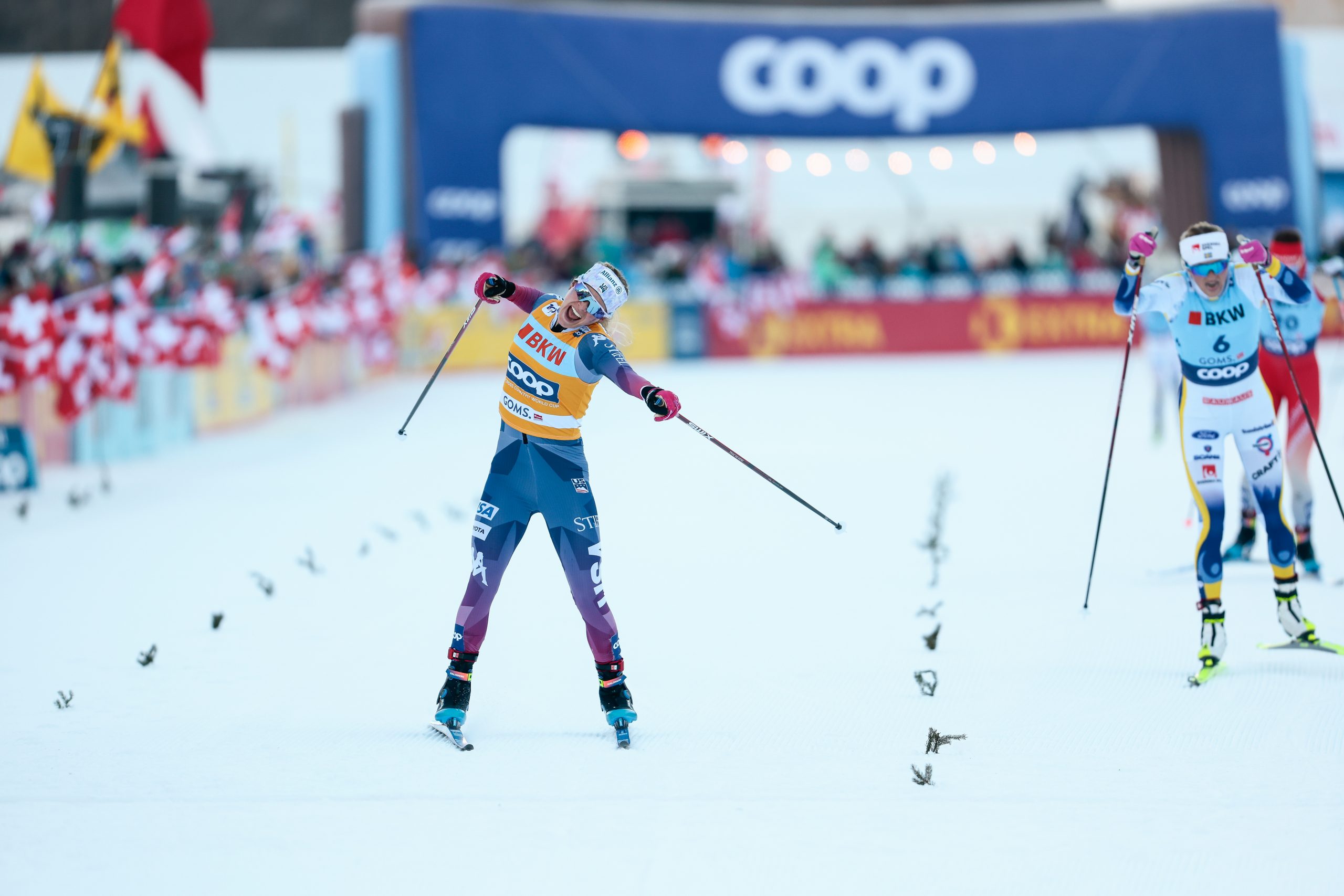
Jessie Diggins (USA) was the first athlete this season to meet the objective criteria. (Photo: Modica/NordicFocus)
There is a persistent fantasy about Olympic selection: that somewhere, behind a closed door or a spreadsheet or a stopwatch, a single correct answer exists. That if you line up the results cleanly enough—World Cups here, Nationals there—the truth will announce itself. The fastest will go. The rest will not. The system will be clean. The arguments will end.
Chris Grover, the U.S. Cross-Country Ski Team’s Program Director, has lived inside that fantasy long enough to know better.
“It could go either way,” he said last week, speaking from Europe, where the World Cup season has entered its final, decisive stretch. “It could go objective, or it could go by discretion. Hard to say.”
That sentence—calm, unadorned, almost casual—contains the entire tension of Olympic selection in an American endurance sport. Nothing is ever fully objective. Nothing is ever fully discretionary. And no amount of rules can insulate the people charged with making the decision from the weight of what it costs.
On Sunday night, after the final race of the Olympic selection period, a six-person selection committee will meet. They will review the results. They will read petitions. They will vote.
“There are six of us,” Grover said. “Just whatever the majority of the group wants to do.”
The committee includes:
Anouk Patty – U.S. Ski & Snowboard Chief of Sport
Rick Kapala – U.S. Ski & Snowboard Sport Committee Chair
Chris Grover – U.S. Ski & Snowboard Cross-Country Program Director
Matt Whitcomb – U.S. Ski & Snowboard Head Cross-Country Coach
Sadie Maubet Bjornsen – Athlete Representative
James Southam – Athlete Representative
That meeting will not take place in a conference room or a boardroom. It will happen over Zoom.
Some of the skiers being considered on the call will be in vans together earlier that day. Some will be sharing hotel rooms while the committee debates.
And when it ends, years of preparation will either collapse into certainty—or disappear.
A Committee by Design
The selection committee is small by design: six people, with athlete representation constituting roughly a third of the voting body. That structure is not incidental. It is a response—legal, cultural, and philosophical—to decades of disputes in American Olympic sport.
“It’s a really good process that we have,” Grover said. “To have 33% of athlete representation on this selection committee.”
The group includes staff members from U.S. Ski & Snowboard, athlete representatives, and leadership from the sport committee. The committee itself is distinct from the working groups that make World Cup start decisions or provide coaching input. This separation matters.
“The six-person committee is different from the group that’s doing the nominations for the World Cup,” Grover explained. “That group is a working group. It’s not a committee by any means.”
Committees are formal. They are governed by bylaws. Their authority is prescribed. Working groups are not.
“[The World Cup working group] is not set up like the sports committee,” Grover said. “It’s more informal than that.”
Olympic selection, by contrast, is deliberately formal. Every vote is anchored in a process vetted not just by coaches and administrators, but also by attorneys and athlete advocates. The goal is not speed. It is defensibility.
“It’s driven by the U.S. Olympic Committee,” Grover said. “And their attorneys. And our attorney at U.S. Ski & Snowboard, too. And the Ted Stevens Act.”
That legal scaffolding exists for a reason: Olympic selection is not merely a sporting decision. It is a federally protected process. Athletes are entitled to transparency, due process, and recourse. The rules are not optional.
Gus Schumacher (USA) will be leading a strong men’s team into the Olympics. (Photo: Modica/NordicFocus)
Objective Is a Choice, Not a Default
The public version of Olympic selection often begins with a misunderstanding: that objectivity is the natural state, and discretion is a deviation from it.
In reality, objectivity is itself a decision—one that the committee must actively choose.
“It could go either way,” Grover said again, returning to the point. “The selection committee could decide to use some discretion. Hard to say.”
That choice is not made in advance. It is made after the final race of the selection period, when all data—results, trends, injuries, illnesses, and context—is finally complete.
Discretion, when used, is not informal. Athletes must formally request it.
“Everybody who wants to be considered for selection method two, which is discretion, has to submit an application, basically,” Grover said. “Or like a short petition.”
Those petitions are not symbolic gestures. They are documents. They are arguments. They are an athlete’s opportunity to explain why the raw results do not fully capture their Olympic readiness.
“They’re not due till the 18th,” Grover said. “So athletes can potentially be racing on the 18th and then submit a petition after the race.”
That timing is intentional.
“We want everybody to have a chance to tell their story with all the data,” Grover said. “Being able to use all the data that they can muster.”
The committee reads every petition before voting. No one enters the meeting without knowing exactly what is being asked of them.
“So everyone’s got all the facts at their fingertips,” Grover said.
Democracy, American-Style
Grover is careful when he describes the system. He does not claim it is perfect. He does not claim it eliminates controversy. But he does make one striking assertion.
“I feel like we’re probably doing Olympic selection more democratically than any other nation on earth,” he said.
That statement is not bravado. It is an observation rooted in comparison. In many countries, selection authority rests almost entirely with coaches or federation leadership. Athlete representation, if it exists, is advisory in nature.
In the United States, athletes vote.
That structure does not guarantee consensus. It guarantees legitimacy.
“And it’s a good process,” Grover said again. “It’s gotten more and more professional and more and more transparent.”
Transparency, however, does not make the outcome easier to live with.
Ben Ogden (USA) has had success on the Olympic Classic Sprint course in Val di Fiemme (ITA). (Photo: Modica/NordicFocus)
The Emotional Cost of Fairness
There is a moment in Grover’s voice when the conversation shifts—when Olympic selection stops being a system and becomes a human problem.
“It’s exciting,” he said, then paused. “But it’s also… yeah. It’s a hard process.”
The difficulty is not procedural. It is personal.
“We obviously have a lot of athletes that are with us,” Grover said. “And a lot of them are going to make the team. And there’s going to be some that don’t make the team.”
That reality is not abstract. It unfolds in real time, in shared spaces.
“We’re all going to be in the vans together in the next few days and in the hotel and going home and stuff together when the team is announced,” he said.
In those moments, selection becomes a lived experience.
“There’ll be people that are rooming together,” Grover said. “Where one person is making it and the other one isn’t.”
Joy and loss are not separated by geography. They coexist.
“So there’s all this joy on one side,” he said, “and there’s all the sadness from the other person who’s just worked the last four years to try to make this team.”
For staff, that proximity cuts both ways.
“Those of us who are staff, we care about all these athletes,” Grover said. “And it’s a hard thing to walk a lot of people through.”
The system can be fair and still be painful. In some ways, fairness makes the pain sharper.
Selection Does Not Mean Starts
One of the most persistent misconceptions about Olympic selection is that making the team guarantees racing. It does not.
Grover is explicit about this distinction.
“The selection committee has no say in the starts,” he said.
Selection determines who is eligible. Starts are decided later based on performance and evolving conditions at the Games.
“That’s a conversation that’s gone on for a while,” Grover said. “Like back in October, actually.”
Athletes and coaches were told months ago when starters would be identified.
“After the Goms weekend,” Grover said, “we’re going to identify the starters for the skiathlon and for the sprint.”
After that, decisions unfold chronologically.
“Once we get to the Olympics and start racing those events,” he said, “then we kind of name the starters for events in chronological order as we get more and more data on how they’re performing.”
Selection, in other words, is not a guarantee of opportunity. It is a prerequisite for it.
Julia Kern (USA) racing during the Tour de Ski in Val di Fiemme (ITA) on the Olympic Sprint course has been back home in Vermont preparing for the games. (Photo: Vanzetta/NordicFocus)
Even the Team Isn’t the Team
There is one final layer of distance between an athlete and the Olympic start line—one that surprises even people inside the sport.
“This is not the ski team’s team,” Grover said. “This is the Olympic Committee’s team.”
The distinction is not semantic. It is legal.
“What we are doing,” he explained, “is we are sending them our nominations. And then they approve the nominations and post them.”
The public announcement does not come from U.S. Ski & Snowboard. It comes from the United States Olympic & Paralympic Committee.
Grover laughed as he recalled learning this lesson the hard way.
“I remember in the past Tom Kelly giving me a hard time,” he said. “Because I told an athlete, ‘You made the Olympic team.’ And he was like, no.”
The correction was precise.
“You’re telling the athlete that they’re getting nominated,” Grover said. “And then the Olympic Committee is the one that says you made the Olympic team.”
Even certainty has a chain of custody.
Why It Never Feels Clean
From the outside, Olympic selection often appears chaotic. From the inside, it is closer to controlled complexity.
Rules exist. Votes matter. Athletes have representation. Petitions are read. Nothing is decided casually.
And still, when the meeting ends on Sunday night, there will be silence on one end of the call and relief on the other. The system will have done its job. And it will have hurt.
That tension—the irreconcilable distance between fairness and pain—is not a failure of the process. It is the cost of taking athletes seriously as stakeholders rather than subjects.
“It’s a really good process,” Grover said once more. “But it’s also fraught with a lot of emotions.”
There is no algorithm for that part. There never has been.
And that, more than anything, may be the truest thing about Olympic selection.
Love stories like this? Help keep them coming.
Feature stories like this one take time, access, and care to produce. If you value thoughtful storytelling and independent ski journalism, please consider becoming a Voluntary Subscriber. Your support directly fuels the work we do to cover the people, places, and moments that make our sport special.
Feature stories like this one take time, access, and care to produce. If you value thoughtful storytelling and independent ski journalism, please consider becoming a Voluntary Subscriber. Your support directly fuels the work we do to cover the people, places, and moments that make our sport special.
Jessie Diggins Objective 25-26 Overall World Cup Leader
Julia Kern Objective 20th 25-26 Sprint World Cup
Rosie Brennan Discretion 15th Ruka Sprint C
Sammy Smith Discretion 1st US Nationals Sprint C qualifier
Ava Thurston Discretion 3rd US Nationals Sprint C qualifier
Erin Bianco Discretion 4th US Nationals Sprint C qualifier
Lauren Jortberg Discretion 5th US Nationals Sprint C qualifier
Alayna Sonnesyn Alternate 27th Davos Sprint F
Jessie Diggins (USA) and Frida Karlsson (SWE), (l-r) coming to the line in Goms (SUI) in 2024. (Photo: Modica/NordicFocus)
The above discretionary selections were nominated by a 15-person working group that included:
James Southam Athlete Rep
Ida Sargent Athlete Rep
Perry Thomas Mansfield Pro Nordic Team
Chad Salmela Team Birkie
Andy Newell Bridger Ski Foundation
Erik Flora Alaska Pacific University
Pepa Miloucheva Craftsbury GRP
Colin Rodgers SMS T2
Peter Holmes SVSEF Gold Team
Sophie Caldwell Aspen Valley Ski and Snowboard Club
Eliška Albrigtsen Denver University
Chris Grover USST
Matt Whitcomb USST
Jason Cork USST
Kristen Bourne USST
The nominations were then approved by a discretionary selection review group comprised of:
Tyler Kornfield U.S. Ski & Snowboard Athlete Rep
Anouk Patty U.S. Ski & Snowboard Chief of Sport
Bryan Fish U.S. Ski & Snowboard Development Director
The above discretionary selection process will be repeated for each period of World Cup this coming season. As always, if you have questions or concerns about this process, feel free to contact me directly.
The men’s Classic Sprint heats got started with quarterfinal number one at the US Nationals Cross-Country Ski Championship at Mt Vanhoevenberg in Lake Placid NY. (Photo Nancie Battaglia)
The last day of the U.S. National Cross-Country Ski Championships in Lake Placid arrived the way honest days in this sport often do. The snow at Mt. Van Hoevenberg had been churned and scoured by a week of racing and changing weather, its surface no longer pristine but revealing, the kind that gives little for free. Legs were tired. Arms were tender. Expectations had been trimmed back by accumulated kilometers and decisions already made.
For the men lining up for the classic sprint, this was not simply a final chance at a national title. In an Olympic winter, nothing is ever only what it claims to be. The sprint was an audition—not necessarily for Olympic selection, but for relevance. For future start rights. For the ability to say, credibly, that range still exists.
Sprint qualification, in particular, has a way of stripping sport down to its essentials. No drafting. No hiding. One lap to explain yourself. As has been said all week about sprints, it does not matter how clever you are in the heats if you cannot arrive there in the first place. In Lake Placid, that truth shaped the day from the first starter onward.
Fin Bailey (UVM) makes his way up the Lake Placid sprint course’s signature climb. (Photo Nancie Battaglia)
Qualification: where the day declares itself
Qualification mattered here in a way that went beyond podiums and medals. With sprint start rights in the World Cup largely determined by qualification speed, the men knew exactly what was at stake. If this were a sorting mechanism, it was a blunt one.
The fastest man through the course was John Schwinghamer, whose time at the top of the board set the early benchmark. But the story quickly widened. Pierre Grall-Johnson followed closely, and then Will Koch, who would soon become central to the day’s most unusual tactical thread, placed third.
A few seconds farther back sat a cluster of names that told a deeper story: athletes with distance pedigrees, athletes chasing U23 selection, athletes managing fatigue from a long week and still trying to produce speed on demand.
Among them was Zanden McMullen, who qualified tenth, solid but not dominant. “The qualifier felt a little off,” McMullen admitted. “I didn’t feel smooth and thought I skied poorly through the terrain. I was happy to qualify and have another chance to improve on the day.”
That, in retrospect, was the quiet warning shot.
Classic striding versus powerful double poling was one of the key storylines in the men’s Classic Sprint. (Photo Nancie Battaglia)
A decision made in minutes
If qualification is the most honest part of sprinting, it is also where improvisation sometimes reveals itself. Koch arrived at the start line with little margin and even less certainty.
“I was already pretty tired going into the classic sprint,” Koch said. A bonk midway through the 20-kilometer freestyle earlier in the week had drained his reserves, and classic sprint had never been his strength. “With about ten minutes to go before my qualifier, I still couldn’t get my classic skis to kick.”
The decision that followed was not theoretical. Koch asked his coach to prepare a pair of skate skis — not as a backup, but as a commitment. He reached the start with roughly 90 seconds to spare, hoping that strength alone might be enough to advance.
Third in the qualifier erased doubt immediately. “When I ended up third, I knew it was the right call,” he said. “I never even tested a classic ski the rest of the day.”
The gamble would ripple through every round that followed.
Will Koch (SVSEF) powered through the qualification and heats, double poling on skate skis. (Photo Nancie Battaglia)
Heats: when fatigue starts to speak
Classic sprint heats at Mt. Van Hoevenberg reward clarity. The course offers opportunities, but they are conditional. Mistime a move, and the course and competition punish hesitation. Get trapped behind the wrong skis, and speed evaporates.
Koch’s plan was simple and exhausting: lead early, create space before the climb, and survive long enough for glide to matter again. “If I could crest the climb with the group, my skis would be fast enough to carry me through,” he explained.
For a time, it worked exactly as intended.
But others were playing different games.
Zach Jayne arrived at the sprint with a different set of calculations. Already qualified for U23 Worlds and carrying a narrow SuperTour points lead, his goals were layered. “I wanted to finish strong,” Jayne said. “I also wanted to make the final so I could displace other U23 athletes and help ensure my teammate Max Kluck made the trip.”
Jayne, Koch, and teammate Carl Rune all opted to double-pole the heats on skate skis, a choice that paid dividends early. “It worked really well in the quarterfinal,” Jayne said. “But as the rounds went on and fatigue built, I was definitely wishing I’d brought a pair of klister skis.”
That fatigue — cumulative, unrelenting — became the quiet theme of the afternoon.
Zanden McMullen (APU) showed he had made the right calculations for himself in the final, creating a gap on the large climb, which he was able to maintain on the final downhill. (Photo Nancie Battaglia)
Trusting kick in uncertain snow
While some chased glide, Max Kluck made a different bet. His week had been defined by nerves more than novelty. “I was more nervous than I’ve been in years,” Kluck said. “I knew my U23 spot was on the line.”
The snow tempted experimentation, but Kluck resisted. “I was pretty certain I wanted to stay on classic skis unless the weather took a major turn,” he explained. “I stuck with my gut.”
The reward came immediately. In the quarterfinals, Kluck ran the climb with confidence, kick biting cleanly while others labored, arms already beginning to pay the price. “I figured I might be able to make double-poling work once,” he said. “But I didn’t think I could personally do it four times.”
His solution was economy. By trusting his wax and striding more often, Kluck preserved his upper body for the finishing straight — a detail that would matter later.
UVM’s Fin Bailey was showing he was on form and a threat for the podium throughout the heats, but his final got off to an unlucky start with a broken pole. (Photo Nancie Battaglia)
The final: legs versus arms
By the time the final assembly was complete, the calculus was visible even from the sidelines. The men who had double-poled all day carried speed — and fatigue. Those who had relied on kick carried legs.
McMullen understood the equation precisely. “Going into the final, I knew the few boys that double-poled all day would be tired,” he said. “My plan was to keep them in reach before the final climb and then gap them.”
Snow conditions had continued to degrade, wind and rain complicating grip and timing. McMullen’s classic skis, however, remained reliable. “Our classic skis felt good,” he said. “I didn’t think there was a need to try and double-pole the race.”
When the decisive climb arrived, McMullen did not hesitate. He strung together clean transitions, trusted his kick, and separated decisively. “I felt really fresh still at the start of the final,” he said. “I knew I would be able to run away with it.”
Behind him, the chase unfolded exactly as predicted. Koch’s glide carried him, but the cost of four rounds of double-poling showed. Kluck’s restraint paid dividends, his saved arms helping him close strongly. Jayne fought valiantly through fatigue, his earlier work for teammates already done.
McMullen crossed the line alone — a national champion not because he had chased novelty, but because he had waited for the moment that mattered.
Zanden McMullen (APU) comes to the finish of the Classic Sprint with his second national title in as many days at the US Nationals Cross-Country Ski Championship at Mt Van Hoevenberg in Lake Placid, NY. (Photo Nancie Battaglia)
What the result actually means
The men’s classic sprint did not reshape Olympic selection overnight. Sprint specialists were unlikely to be named from Nationals alone. But the race clarified something subtler and perhaps more important.
It showed who can adapt under stress. Who can make decisions when plans unravel? Who understands that qualification speed opens doors long before medals do?
For Koch, the day was a revelation. “The classic sprint was a really pleasant surprise to end the week,” he said, even as he acknowledged that broader goals remained unmet.
For Jayne, consistency mattered more than headlines. “I don’t race to prove people right or wrong,” he said. “I know what I’m capable of.”
For Kluck, the outcome was tangible. “Securing my U23 spot was the biggest goal of my season,” he said. “Locking it down here feels incredible.”
And for McMullen, the victory was both affirmation and invitation. “I hope people know now that I’m an all-around skier,” he said. “And I hope the Olympic selection committee knows I have a lot of potential to succeed at the Olympics.”
Zanden McMullen (APU) first place, Will Koch (SVSEF) second place, and Max Kluck (UU) third place at the US Nationals Cross-Country Ski Championship Classic Sprint at Mt Vanhoevenberg in Lake Placid NY. (Photo Nancie Battaglia)
A quiet ending, honestly earned
As the course emptied and the equipment was packed away, Mt. Van Hoevenberg returned to stillness. Another Nationals was complete. Another set of arguments had been made — not loudly, not always cleanly, but honestly.
Sprint racing, especially in January of an Olympic year, has a way of revealing truths athletes might prefer to delay. Qualification does not negotiate. Fatigue does not compromise. Decisions, once made, echo through every climb and corner that follows.
On this final day in Lake Placid, the men who listened closely to their bodies, their skis, and the snow underfoot, were the ones who left with something lasting.
Feature stories like this one take time, access, and care to produce. If you value thoughtful storytelling and independent ski journalism, please consider becoming a Voluntary Subscriber. Your support directly fuels the work we do to cover the people, places, and moments that make our sport special.
What was truly on display this week at the US Nationals Cross-Country Ski Championship at Mt Van Hoevenberg in Lake Placid, NY was not only that cross-country skiing is an awesome sport, but the community that embodies it is something worth celebrating. (Photo Nancie Battaglia)
Sofia Pedersen (UU) and Samantha Smith (SVSEF) lead the first quarterfinal out onto the course at the start of the heats. (Photo: Nancie Battaglia)
On the morning of the women’s classic sprint at the U.S. National Cross-Country Ski Championships, the quiet around Mt. Van Hoevenberg felt deliberate.
Not calm — no one was calm by Friday — but restrained. The week had already taken its toll. Distance races had piled fatigue into legs and minds alike, and no one arrived at the sprint believing freshness would be part of the equation. What remained, instead, was clarity: the understanding that in an Olympic winter, the most important racing of the day would happen before the heats ever began.
“It definitely started the day tired,” Ava Thurston said. “But I was trying to just remind myself that everyone was feeling that way. Most people had raced two, if not three, of the races, and we’re all coming in in a similar place.”
That recognition — that fatigue was universal — became the baseline. The differentiator would be execution.
For the women with Olympic aspirations, the classic sprint qualifier was no formality or warm-up. It was the argument itself. The U.S. selection process, quietly but decisively, has elevated qualification speed to the top of the sprint hierarchy. Heats matter, but only if you earn the right to be in them. On Friday in Lake Placid, no one confused the order of importance.
Sofia Pedersen (UU) and Samantha Smith (SVSEF) get the action started in the quarterfinals. (Photo: Nancie Battaglia)
Carrying the Week
By the time the women clipped in for qualification, the week was already present in their legs.
After Thursday’s 20-kilometer race, Sammantha Smith felt that accumulation acutely — and honestly. “After the 20 k, I was definitely feeling the fatigue and accumulation of all the racing throughout the week,” she said. “I know I’m more of a sprinter, but obviously, I was still hoping to perform well in the 20k, so I was not thrilled with the race.”
Rather than letting that disappointment linger, Smith pivoted quickly. “I tried to quickly put it behind me and get ready for some classic sprinting,” she said. “My goal for the day was to focus on skiing a clean qualifier and ski to my strengths.”
Hailey Swirbul arrived at the start line with similar fatigue — and a similar refusal to let it define the day. “Today, I definitely felt a little tired this morning warming up compared to the other races after a hard 20 k effort,” she said. “But so was everybody else dealing with that same.”
For Swirbul, there was anticipation as well. “I was really excited to get to finish this week off with a classic race,” she said. “I just love classic skiing. I think it’s such an art, and I really appreciate the finesse that is needed to be able to make skis kick well.”
Thurston framed the day with a different emphasis — joy rather than pressure. “It had been a great week so far,” she said, “so I was excited to get to go fast and run up that big hill.”
Different approaches, same reality: the sprint would reveal who could still make good decisions under fatigue.
Samantha Smith (SVSEF) commanded the Classic Sprint day from start to finish just like she had done in the Freestyle Sprint. (Photo: Nancie Battaglia)
Qualification: Where the Day Was Decided
When the women dropped into the qualifier, the course made its judgment quickly and without theatrics.
Smith’s run stood apart immediately. She won the qualification by more than six seconds — not by forcing the issue, but by skiing exactly the race she had planned. “It was my first classic sprint of the year, so I didn’t really have too many expectations,” she said. “But I was hoping for a strong result.”
What made the result significant wasn’t just the margin — it was the trajectory behind it. “Up until last season, I think there was a noticeable gap between my skate and classic sprinting,” Smith explained. “But the last few years I’ve really prioritized working on getting my classic sprint to a place I’m happy with.”
That work showed. In an Olympic winter, qualification speed isn’t just about advancing — it’s about relevance. Smith’s time didn’t merely put her safely through; it reframed the sprint conversation.
Behind her, two performances raised equally important questions.
Swirbul and Thurston — both known primarily for their distance strength — delivered qualification runs that demanded attention. In a format that strips away drafting, tactics, and protection, they showed they belonged in the sprint conversation on pure speed.
“I didn’t set out to make a statement this week,” Swirbul said. “I just wanted to show up and try to race my best and see where that landed me.”
For selectors, where it landed mattered.
Quarterfinal 4 trying to find their space and line around the U-turn on the sprint course in Lake Placid. (Photo: Nancie Battaglia)
A Day That Wouldn’t Sit Still
As the day progressed, conditions refused to settle. Snow softened. Moisture crept in. Wind shifted. Ski choices that worked in the morning became liabilities by afternoon.
“The waxing team today was absolute heroes,” Swirbul said. “They were out until the wee hours of the morning, waxing late last night and woke up for a super early morning today for a classic day with really gnarly conditions.”
Adaptability became a skill equal to speed. “I raced on totally different skis from the qualifier to the heats,” Swirbul said. “And even in the heats, I had a couple of changes to my kick in between the rounds because our conditions were continuing to change.”
Smith faced the same puzzle. “In my quarter and semi-final I was actually icing up a bit and too grabby on kick as the snow got wetter,” she said. “My coaches ended up stripping a lot of the kick to bring back some of the glide for the final.”
The goal, she explained, was precision rather than excess. “The main thing was to try to have just enough kick to get up the hills but not so much that it was draggy for the double pole or downhills.”
Thurston made a strategic choice early — prioritizing glide over grip. “I ended up going with the pair that had a little more glide for the downhill finish,” she said, “just because I wanted to be able to hang with people rather than having that extra kick on the hill.”
Three athletes, three solutions, same underlying demand: bend, don’t break.
Lauren Jortberg (CNEPH)leads semi-final 1 out of the starting stretch. (Photo: Nancie Battaglia)
Heats: Confirmation, Not Reinvention
By the time the heats began, the hierarchy established in qualification largely held — and that, too, carried meaning.
Smith moved through the rounds with patience and control, never forcing a moment unnecessarily. Swirbul sharpened as the day progressed, her adjustments paying dividends. Thurston continued to ski within herself, staying connected and opportunistic.
For Thurston, the day reinforced something larger than a single result. “What it kind of said to me was that I can be really consistent,” she said, “and I’m also a strong all-around skier.”
That consistency — across multiple races, formats, and conditions — is currency in an Olympic year.
The women’s final gets started on the last day of racing at the 2026 US National Cross-Country Ski Championships at Mt Van Hoevenberg. (Photo: Nancie Battaglia)
The Final: Execution, Not Emotion
The women’s final unfolded cleanly and decisively.
Smith took control early, extending her advantage where momentum mattered most. The ski changes made before the final were immediately evident. She crossed the line as U.S. National Champion in the classic sprint, completing a sweep of the week’s sprint events.
Behind her, Swirbul claimed second, a reward for adaptability and composure. Thurston rounded out the podium, another affirmation of her ability to race fast across disciplines.
For Smith, the result was about more than placement. “I hope people see that I love to race,” she said. “I love to compete and push myself, and I always leave everything I have out on the course.”
Everyone was deserving of a helping hand up after a full week of racing at the US National Cross-Country Ski Championships at Mt Van Hoevenberg. (Photo: Nancie Battaglia)
What the Race Clarified
Nationals does not select Olympic teams outright, but it argues persuasively — and the women’s classic sprint in Lake Placid made its case clearly.
Smith’s qualification speed, combined with her technical development in the classic sprint, strengthened her position at precisely the right moment. Swirbul’s performance underscored versatility and poise under changing conditions. Thurston’s podium reinforced consistency and all-around strength.
“I’m really happy with how this week went,” Swirbul said. “And looking forward to figuring out where the rest of the season goes.”
Thurston echoed that momentum. “This week was so, so awesome,” she said. “I’m excited to keep racing.”
The arguments weren’t loud. They didn’t need to be. On a tired Friday at Mt. Van Hoevenberg, they were made the way Olympic cases often are — quietly, cleanly, and against the clock.
Feature stories like this one take time, access, and care to produce. If you value thoughtful storytelling and independent ski journalism, please consider becoming a Voluntary Subscriber. Your support directly fuels the work we do to cover the people, places, and moments that make our sport special.
The women’s Classic Sprint podium, including Samantha Smith (SVSEF) in first, Hailey Swirbul (APU) in third, and Ava Thurston (Dartmouth) in third at the US National Cross-Country Ski Championships at Mt Van Hoevenberg. (Photo: Nancie Battaglia)
The start of the US National Cross-Country Ski Championship Men’s 20 k Freestyle Mass Start. (Photo: Nancie Battaglia)
There are moments in endurance sport when the noise falls away—not because the stakes are small, but because they are too large to announce themselves loudly. The men who gathered on the start line at Mount Van Hoevenberg on Thursday afternoon understood that kind of quiet. The banners said US National Championships. The calendar said 20 k Freestyle Mass Start. The course—four laps of five kilometers, stitched together by long climbs and fast descents—said this will be honest. But the silence said Olympics!
For much of the week in Lake Placid, honesty had come quickly. The 10 k classic individual start exposed margins. The sprint laid bare specialization. By the time the men lined up for the 20 k Freestyle Mass Start, the argument had narrowed. There were medals to be won, yes, but more importantly, there were questions still unresolved about who might fit through the narrowing door of Olympic selection.
For Zanden McMullen, the stakes were explicit. “Today’s race was a ‘one shot, one opportunity’ type of race for me,” he said later. He knew that anything short of a win would leave his Olympic case incomplete. That knowledge sat heavily over the first kilometers—not as panic, but as pressure carefully managed.
What followed was not a race that fractured early or declared itself with theatrics. Instead, it unfolded as a study in restraint.
A large, shifting group stayed at the front early on in the race. (Photo: Nancie Battaglia)
A Race That Refused to Break
From the opening lap, the field behaved in a way that confounded expectations. In contrast to the women’s race earlier in the day, no decisive break formed. Attacks surfaced briefly—on climbs, into transitions—but were quickly absorbed by the physics of the course. Downhills regrouped the field. Drafting mattered. The snow was fast, the air cold enough to preserve glide, and separation proved expensive.
John Steel Hagenbuch allowed himself to drift deep into the pack early—sometimes close to twentieth—an approach that looked counterintuitive given both his fitness and his history on the course. It was neither indecision nor passivity. “I was just staying relaxed and letting people work out some energy that I knew wasn’t going to result in any meaningful gain,” he explained. “Racing in the U.S. is very different than racing on the World Cup, and being able to relax at the start of a mass start race is perhaps the best example of that.”
Zanden McMullen (APU) and his APU teammates Hunter Wonders (#208) and Luke Jager (#204). (Photo: Nancie Battaglia)
The early splits reflected this tension. Leaders rotated through the front, but gaps rarely exceeded a handful of seconds. By the midpoint of the race, the field had thinned not through violence but through attrition—skiers falling off the back as the pace remained relentlessly honest.
McMullen, meanwhile, adhered to a plan that demanded patience. “My race strategy was to conserve as much energy as possible,” he said. “Every time a move was made, I made sure to match it calmly but decisively.” By the second lap, he sensed the race’s texture changing. The pack stretched. Breathing deepened. The small inefficiencies of earlier surges began to show.
Zach Jayne, consistently present near the front group, felt that tension acutely. “Holding position is always difficult,” he said. “So being aware while racing is important.” In a race defined by proximity rather than separation, awareness became a skill as valuable as strength.
Olivier Leveille (CNEPH), John Steel Hagenbuch (Dartmouth), Zanden McMullen (APU), Jakob Elias Moch (CU), and Brian Bushey (Craftsbury) (l -r). (Photo: Nancie Battaglia)
Decisions Not Taken
If the race hinged on a single moment, it may have been defined instead by two moments when nothing happened.
Hagenbuch identified them clearly. The first came at the start of the third lap, at the base of the long climb—a place where he has both won and lost races before. “Looking back at it now,” he said, “the one that makes me wonder the most is the decision to not attack on the third lap.” His reasoning was sound. The conditions were fast. The field regrouped quickly on descents. “In order to get away, you would have to be very fit and have the best skis in the race,” he said. Unsure that any gap would hold, he chose restraint.
Mons Melbye (UU) leads Zanden McMullen (APU) and John Steel Hagenbuch (Dartmouth), and Jakob Elias Moch (CU) (r – l) down the final downhill into the stadium. (Photo: Nancie Battaglia)
The second moment arrived on the final sprint climb before the descent into the stadium. Again, Hagenbuch assessed the cost-benefit. He believed he could crest first—but likely only to be swallowed by the draft. “As such, I decided to follow Zanden over the top,” he said. “I think this was the correct thing to do tactically.”
That calculus—when to go, when to wait—defined the race for several athletes. McMullen made the same choice from the opposite perspective. “There was no need to do anything rash,” he said. “Just go out and race hard and smart.”
The result was a front group of four that arrived at the final kilometer together, legs full but not shattered, tension compressed into seconds.
Zanden McMullen (APU) and John Steel Hagenbuch (Dartmouth) follow Jakob Elias Moch (CU) near the end of the race. (Photo: Nancie Battaglia)
The Finish
As the leaders dropped off the final descent and into the stadium, the race became what everyone suspected it would be: a matter of position, timing, and nerve.
McMullen entered the final stretch calm by design. “During the final lap, I knew it would come down to the final meters,” he said, “and I just made sure to relax as much as I could.”
Hagenbuch, attempting to execute his finishing move, found the narrow margins of mass-start racing unforgiving. “Getting around Jakob was the crux move of the finishing maneuver I was trying to execute,” he said. “And there just wasn’t enough room for me to come around.” Pushed slightly wide through the final sweeping corner, he lost the speed he needed. “That’s racing,” he added. “It didn’t pan out, but it doesn’t always.”
McMullen surged cleanly to the line, stopping the clock at 47:37.0. The University of Utah’s Mons Melby was 7-tenths of a second behind, with Hagenbuch a second from the win for third. Behind them, the rest of the field streamed in—gaps small, order consequential.
Zanden McMullen (APU), John Steel Hagenbuch (Dartmouth), and Jakob Elias Moch (CU) — with Mons Melbye (UU) off camera — come down the finish stretch. (Photo: Nancie Battaglia)
What the Race Revealed
On paper, the result was simple: a national champion crowned. In context, it was anything but.
For McMullen, the victory represented survival as much as success. “The Olympic selection has definitely been looming over my head all week,” he admitted. The stress was real. So was the clarity. He did what he could do.
For Hagenbuch, the outcome carried both frustration and resolve. “I still have faith that there is a path for me to the Olympics,” he said, while acknowledging that the decision now sits elsewhere. He stood by his choice to skip the Tour de Ski, citing health and long-term belief. It was not a plea, but a statement of readiness.
Zach Jayne, who again placed himself among the front contenders, viewed the week through a longer lens. “If you look at my results a year ago or two, I was barely a name in the competitive field,” he said. Improvement, for him, is cumulative. “Overall development is just as important to me as any given race.”
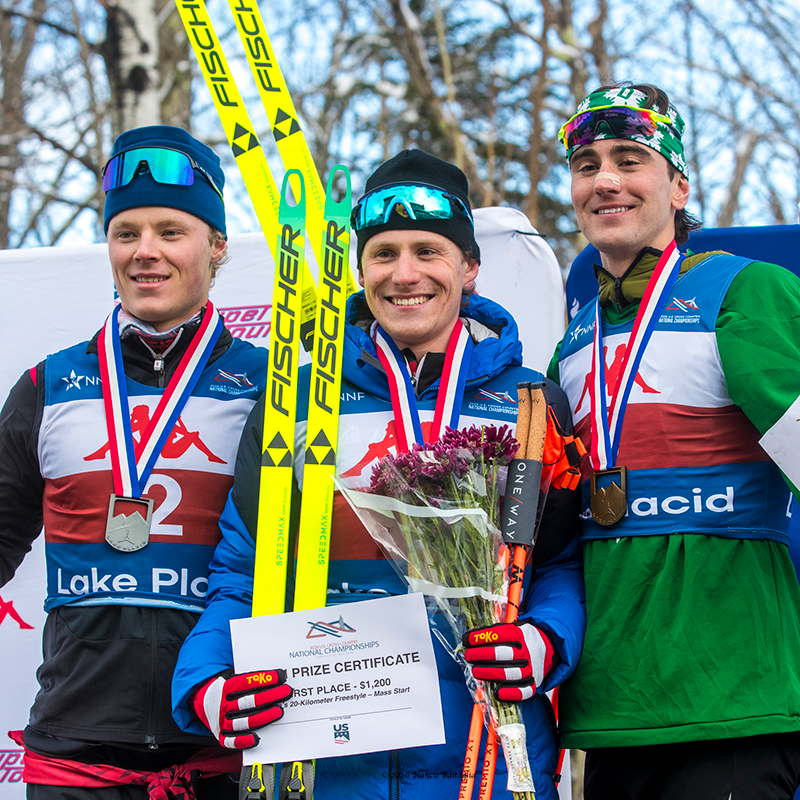
The national podium for the US National Cross-Country Ski Championship Men’s 20 k Freestyle Mass Start with Zanden McMullen (APU) first, John Steel Hagenbuch (Dartmouth) second, and Zach Jayne (UU) third. (Photo: Nancie Battaglia)
A Door, Not Yet Closed
National championships often promise clarity. This one offered something subtler: differentiation without finality. The men’s 20 k freestyle did not decide everything, but it sharpened the picture. It showed who could manage pressure, who could read a race, who could wait—and who could finish.
In an Olympic winter, those qualities matter as much as any single result.
As the stadium emptied and the snow settled back into quiet, the door to Milan–Cortina did not swing wide. But for one, and hopefully two skiers, it remained open, narrow, demanding, and earned.
Feature stories like this one take time, access, and care to produce. If you value thoughtful storytelling and independent ski journalism, please consider becoming a Voluntary Subscriber. Your support directly fuels the work we do to cover the people, places, and moments that make our sport special.
Traffic was thick at the beginning of the US National Cross-Country Ski Championship Women’s 20 k Freestyle Mass Start in Lake Placid, NY. (Photo: Nancie Battaglia)
There is a particular moment in a long mass start when the race quietly declares what it will be. It does not arrive with a surge, a crash, or even a decisive move. It arrives when the pack thins just enough that the edges of the course begin to matter—when skis no longer overlap cleanly, when passing requires intention, and when each athlete realizes—often simultaneously—that this is no longer a collective undertaking.
At Mt. Van Hoevenberg, that moment came early.
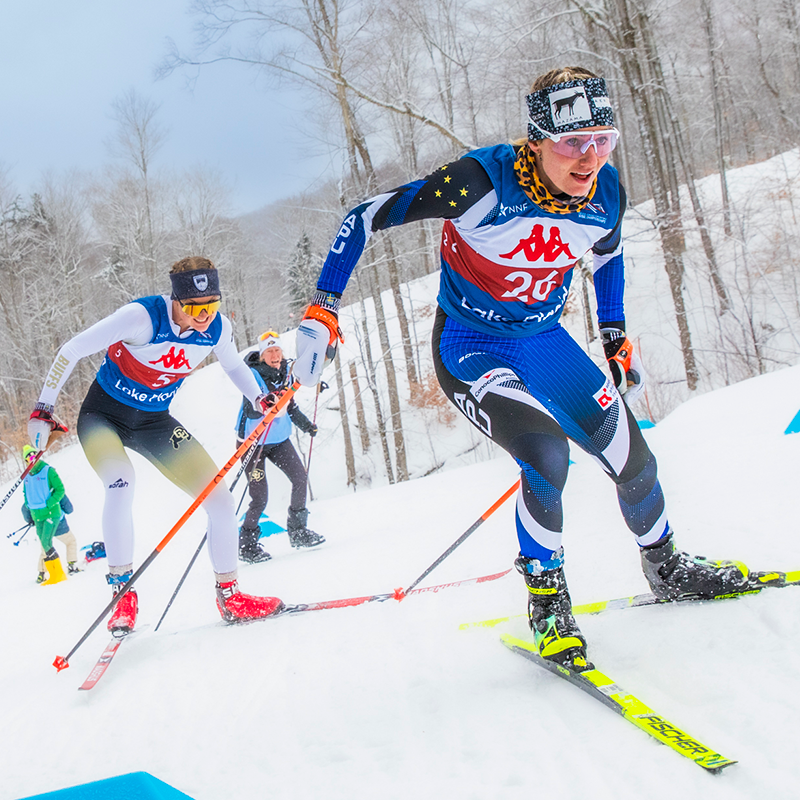
The women’s 20-kilometer freestyle mass start at the 2026 U.S. National Cross-Country Ski Championships unfolded under conditions that rewarded clarity and punished hesitation. The course was wide in places, narrow in consequence. Fresh snow lined the edges, slower and heavier than the main track, turning every attempt to move forward into a calculation of cost. The pace at the front was honest from the gun—fast enough to string the field out, fast enough to strip away the illusion that patience alone would bring opportunity.
In an Olympic winter, Nationals rarely exist in isolation. They are arguments as much as races, each result carrying the quiet weight of future conversations. But on this morning, before selection scenarios and season arcs could intrude, the race itself demanded attention. Four laps. Twenty kilometers. A course that climbs insistently and asks athletes to be precise even when tired.
What followed was not one story, but several—layered, intersecting, and revealing.
Colorado’s Tilde Bångman did much of the work at the front of the Women’s 20 k Freestyle Mass Start in Lake Placid, NY. (Photo: Nancie Battaglia)
The Fast Start That Changed Everything
From near the front, the race immediately took on the shape many expected. Kendall Kramer, eager to avoid the kind of chaos that can derail a mass start before it has truly begun, made her intentions clear.
“I wanted to go out fast because I didn’t want any funny business—colliding or breaking equipment,” Kramer said later. “I was super looking forward to being in the front of a mass start after being caught in the back on World Cups.”
For Kramer, the early pace felt familiar rather than reckless. World Cups, she noted, often begin faster than domestic races, and the instinct to establish position early has become second nature. The speed was assertive but manageable. She felt fit, capable, present.
Behind her, the effect was immediate. The field stretched, then fractured, then reorganized into smaller, more intentional units. For athletes starting deeper in the field, this stringing-out created both opportunity and pressure.
Novie McCabe, starting from bib 26, felt the opening kilometers open rather than close.
“My plan for the start was just to stay relaxed and try to work my way up,” she said. “It honestly ended up being easier than expected because the front girls took it out so fast. It was very strung out, and there was lots of room to move around.”
Within minutes, McCabe had navigated cleanly into the front group. What followed was less about advancing and more about survival.
“I got to the front pack about three minutes into the race,” she said. “So I spent most of it there just trying to hang on for as long as I could—and ended up having it in me to hang till the end.”
That phrase—hang on—would recur in different forms throughout the day, taking on slightly different meanings depending on where each skier found herself in the race.
Ava Thurston (#8 – Dartmouth) couldn’t quite hang on to the lead group of three, but eventually skied with Hailey Swirbul (#67 – APU) and Haley Brewster (#46 – UVM) before finishing fourth overall and third-place American. (Photo: Nancie Battaglia)
When the Front Pulls Away
Not everyone who tested the front pace could stay there.
Late in the first lap, Ava Thurston made her own attempt to bridge. She came close enough to feel the rhythm of the leaders, close enough to understand the cost.
“I tried to get back onto the front group, and I got pretty close,” Thurston said. “But I realized that I wasn’t going to be able to match their pace.”
The realization came with consequences. For a brief stretch, she found herself skiing alone—a dangerous place in a mass start, especially early, when gaps can grow quietly and decisively.
“That was where I did have a little bit of that panic,” she admitted.
The panic did not last. Company arrived in the form of Hailey Swirbul and Haley Brewster, and with it, perspective.
“Once I was skiing with them, I was kind of just thinking, ‘This is a good group. I can stay with these guys,’” Thurston said.
From there, her race became less about chasing what was ahead and more about managing what was happening around her. She tucked in, matched surges, and responded quickly to small separations before they became something larger.
“There were a couple of times where I would fall off the pack just a little bit,” she said. “Each time, I worked hard to get right back on before letting it be a big gap. I was really stoked on that.”
On a course like Van Hoevenberg—four laps of sustained uphill skating—those moments add up. Fitness is exposed repeatedly, not all at once. For Thurston, the race offered reassurance.
“This was the first race longer than 10k I’d done this year, and the first mass start that wasn’t a sprint,” she said. “It was a really good indicator that my fitness is there. It’s hard to fake anything on this course.”
She would finish fourth, clearly separated from the podium trio but equally clear of the deeper chase—an honest result in a demanding field.
With higher FIS points from not racing the past two seasons, Hailey Swirbul (#67 – APU) needed to ski through a lot of traffic during the early kilometers, but eventually found herself in the chase pack. (Photo: Nancie Battaglia)
Racing From the Back Without Racing Small
While the front and mid-pack sorted themselves, Hailey Swirbul was running an entirely different race.
Starting from bib 67, she entered the day knowing she would need to be deliberate.
“I didn’t even realize I would be seated so far back until the start list came out,” she said. “Obviously, I would be, because my FIS points aren’t low at this point—but it was an experience.”
The challenge was not simply moving forward. It was how to do so without paying too steep a price.
“The edges of the course had fresh snow on them,” Swirbul explained. “It was much slower, and a much higher energy expenditure to get around people that way.”
Instead of forcing passes, she waited. Instead of locking into the pace of whatever group surrounded her at a given moment, she kept her attention forward.
“I almost approached the first couple laps like an individual start,” she said. “It’s really easy to lock into the group you’re around and forget about the people ahead of you.”
Women’s racing, she noted, often begins with a fast, destabilizing surge—a period where the goal is simply to hang on long enough for things to settle.
“That’s exactly what happened today,” she said. “The leaders go fast, string it out, and then the real race starts again.”
For Swirbul, the balance was constant: advancing through traffic while respecting the race’s length.
“A 20k is a long race,” she said. “You can’t really pay for it.”
Though she never bridged to the front trio, Swirbul finished fifth—solidly clear of the next wave behind her—and left the course satisfied with her execution and proud of the broader team effort.
“Our coach absolutely crushed it with skis and feeds,” she said. “It was a good day to be APU.”
Novie McCabe (APU) maintained contact on the uphills and used the downhills to close the small gaps to Tilde Bångman (CU) at the front of the race. (Photo: Nancie Battaglia)
The Margins at the Front
At the sharp end, the race narrowed to a familiar dynamic: strength, speed, and patience under pressure.
As the kilometers mounted, Tilde Bångman began to apply pressure on the climbs, testing the group’s elasticity. By mid-race, the front had distilled to three: Bångman, McCabe, and Kramer. The chase group behind them was no longer within striking distance, and the podium places would be decided among those three alone.
McCabe felt the pressure immediately.
“In the last few kilometers, Tilde was skiing super strong and still really pushing the pace,” she said. “She would gap me a little bit on some of the hills.”
Each gap mattered. Each closure required confidence—in skis, in timing, and in restraint.
“I had some super good skis, so I was able to glide back up to her,” McCabe said.
The plan crystallized: stay attached through the final hill, try once to make a move, and if that failed, save everything for the finish.
“I tried to get a gap on the last hill, which didn’t quite work,” she said. “So I tried one last time at the finish.”
It was enough.
McCabe crossed the line first, securing the national title after a race built not on constant aggression, but on measured commitment. The emotion that surfaced surprised even her.
“I think when I crossed the line, I mostly just felt super happy to be back racing and feeling like myself,” she said.
The win mattered. So did what it represented.
“Going into this week, I wasn’t sure it was the best idea for me to race frequently this season,” she said. “Now I have a lot more confidence that I can race—and maybe more importantly, recover from racing.”
In an Olympic year, that distinction is not trivial.
The lead pack and eventual overall podium with Kendall Kramer (APU), Tilde Bångman (CU), and Novie McCabe (APU) (l – r). (Photo: Nancie Battaglia)
Kramer’s Race: Control Without Regret
For Kendall Kramer, the separation late in the race came not through fitness, but friction.
“My skis slowed down as they went,” she said. “They started to feel sticky—like I skied through too much Gatorade or something.”
The effect was most pronounced on the downhills, where speed should have come freely.
“The girls had to push my poles to speed me up to keep together,” she said. “Eventually, they could just gap on all the downhills.”
Once the gap formed, Kramer shifted her focus from contesting the win to finishing the race well.
“I’m happy to maintain my place and feel good,” she said. “I can’t complain.”
What she wanted from the race, she explained, was not chaos or last-minute risk, but sustained pressure in a small group.
“I wanted a small pack where we could test at every little bit,” she said, “as opposed to leaving it to a sprint or taking risks at a time like this.”
She finished third, completing the podium, and left Lake Placid without repeating her national title—but with confirmation that mattered just as much.
“I felt fit and totally capable today,” she said. “I didn’t feel bad feelings.”
Novie McCabe (APU) managed to put a small gap on teammate Kendall Kramer to get away with Tilde Bångman (CU) and eventually ski to the national title in the finish stretch. (Photo: Nancie Battaglia)
What the Race Revealed
By the time the women completed their fourth lap, the story of the day was no longer about who surged when, but about how each athlete managed the same course differently—and honestly.
McCabe raced with restraint until she no longer needed to. Kramer raced with intent and accepted the margins. Thurston learned, adjusted, and confirmed her distance fitness. Swirbul navigated from deep in the field with patience and clarity.
None of those narratives exists in isolation. Together, they form a portrait of a championship race that did what the best distance races always do: expose truth without exaggeration.
At U.S. Nationals, the women did not simply ski 20 kilometers. They negotiated space, managed doubt, trusted preparation, and tested belief.
In an Olympic winter, those are not side effects.
They are the point.
The national podium for the US National Cross-Country Ski Championship Women’s 20 k Freestyle Mass Start with Novie McCabe (APU) first, Kendall Kramer (APU) second, and Ava Thurston (Dartmouth) third. (Photo: Nancie Battaglia)
Feature stories like this one take time, access, and care to produce. If you value thoughtful storytelling and independent ski journalism, please consider becoming a Voluntary Subscriber. Your support directly fuels the work we do to cover the people, places, and moments that make our sport special.
The overall podium for the US National Cross-Country Ski Championship Women’s 20 k Freestyle Mass Start with Novie McCabe (APU) first, Tilde Bångman (CU) second, and Kendall Kramer (APU) third. (Photo: Nancie Battaglia)
Samantha Smith (#1 – SVSEF) was the fastest qualifier and advanced through all her rounds in first on her way to the national championship at the US National Cross-Country Ski Championships Freestyle Sprint. (Photo: Nancie Battaglia)
There is a particular kind of pressure that lives in a sprint qualification. It isn’t loud. It doesn’t announce itself with theatrics. It sits in the quiet places: the moment you realize the warm-up loop is over and you’re headed back toward the start; the thin stretch of time when your poles feel too long and your gloves feel too tight and the only thing you can hear is the scrape of skis and the soft, practiced urgency of coaches repeating the same cues they’ve repeated for years.
In the heats, there is cover. There is a draft. There is a corner to hide behind, a decision to delay, a shoulder to lean into, a mistake you can sometimes survive. Qualification has none of that. Qualification is a solitary negotiation with speed, oxygen, and the course itself. And in an Olympic winter, it also becomes something else: a sorting mechanism. A gate. A reminder that at the Games, you don’t get to be “good in the heats” if you don’t first earn your way into them.
At the 2026 U.S. National Cross-Country Ski Championships in Lake Placid, Tuesday’s freestyle sprint at Mt. Van Hoevenberg offered that truth clearly. On the women’s side, Samantha Smith (Sun Valley SEF) was the fastest qualifier. On the men’s side, Zanden McMullen (APU Nordic Ski Center) topped the morning results.
By the end of the afternoon, the national titles belonged to Smith — who converted qualifier speed into clean, controlled racing through every round — and Mons Melbye (University of Utah), who did something deceptively difficult: he kept winning as the format stopped forgiving mistakes.
Dartmouth College’s Ava Thurston was impressive all day on her way to third overall. (Photo: Nancie Battaglia)
Qualification as the Real Story — and the Olympic-Year Subtext
The sprint format always tempts us to focus on finish-line photos, final turns, and last lunges. But if you’re trying to understand what this race meant in the broader context of the week — and in the longer context of an Olympic winter — you start with the qualifier.
Smith’s win in qualification wasn’t just fast; it was decisive in a way that matters in a discipline where tenths often separate confidence from chaos. She led Alayna Sonnesyn (Team Birkie) by nearly two seconds, with Lauren Jortberg (CNEPH) third and Ava Thurston (Dartmouth) fourth.
On the men’s side, the top end was deep and tightly packed. McMullen led Owen Young (University of Vermont) by just over a second, with Michael Earnhart (APU Nordic Ski Center) essentially on Young’s shoulder. Melbye qualified fourth, with Cole Flowers (University of Alaska Fairbanks) and Max Kluck (University of Utah) close behind.
This matters because international sprinting — the kind that happens at the Olympics — is not a format where you can count on “finding your way through the rounds” if you start your day in the wrong place. Qualification is where your sprint begins or ends.
The subtext, however, differs by gender. On the men’s side, the Olympic pathway through domestic sprinting appears closed this winter. On the women’s side, the picture has felt more open, with multiple domestic spots likely in play and sprint specialists carrying meaningful leverage. The sprint, then, does not “mean” the same thing for every athlete — but it still demands the same thing from all of them.
Eventual winner, Samantha Smith (#1 – SVSEF) controls the start of the women’s final at the US National Cross-Country Ski Championships Freestyle Sprint. (Photo: Nancie Battaglia)
Women: Samantha Smith’s Control, Sonnesyn’s Speed, and a Final that Rewarded Discipline
Smith won the qualifier. Then she won her quarterfinal. Then she won her semifinal. Then she won the final.
Behind her in the final were Sonnesyn in second and Thurston in third, followed by Nina Schamberger (University of Colorado), Jortberg, and Katherine Weaver (Alberta World Cup Academy).
Sonnesyn’s day began where the pressure was heaviest.
“I am really proud of my sprint qualifier,” Sonnesyn said. “There was a lot of pressure on it, and I was feeling that, so I really leaned into the energy of those around me. I left everything I had out there on that course. Not perfect, but really good.”
In the final, she was clear-eyed about what limited her chances to fight for the win.
“I always need to keep working on my starts,” she said. “It’s really hard for me to get going that fast, and I ended up getting a bit boxed during the final because I didn’t have a great start. That being said, I think that final hill and the super fast downhill at the end worked in my favor.”
Alayna Sonnesyn (#2 – Team Birkie) pushes over the top of the sprint course’s main climb. (Photo: Nancie Battaglia)
Smith described a day defined by managing nerves and executing details.
“I was quite nervous going into today’s race,” Smith said. “I was putting a lot of pressure on myself to perform well, so I tried to channel the nerves into adrenaline. I focused on skiing smoothly, working the transitions, and finding the most efficient line out there.”
The final climb played directly to her strengths.
“The final hill was definitely my favorite part of the course,” she said. “I really love to hop skate, and the gradient of that hill is perfect for it. On this course, transitions are critical, so I tried to be really disciplined about skiing hard over the tops and pushing into the downhills.”
Thurston, who qualified fourth and finished third overall, described a sprint day built around process rather than pressure.
“My approach to nerves was to focus on having fun and getting to the start line ready and excited to race,” she said. “Having my whole team here helped a lot. Chatting and joking with teammates and competitors really eases my nerves.”
She found her biggest opportunities during the heats.
“During the heats, I gained the most time on the final big hill,” Thurston said. “The wide trail made it an ideal place to pass. I’m still working on my double pole at the start, so that’s an area where I think there’s more speed to unlock.”
Lauren Jortberg (CNEPH) leads her semifinal at the US National Cross-Country Ski Championships Freestyle Sprint. (Photo: Nancie Battaglia)
Jortberg’s fifth-place finish, after qualifying third, served as a reminder of sprinting’s second demand: doing the work repeatedly under imperfect conditions.
Jortberg said the qualifier remained her primary focus, especially in an Olympic winter where advancing matters as much as how fast you ski.
“Sprint qualification is something I’ve been working on a ton,” she said. “That’s the most important part of the day, especially when it comes to World Cup skiing — just moving on. I was happy with my qualifier. It wasn’t my best skiing, but it was solid.”
She said lingering fatigue from the previous classic race played a role, particularly after spending much of that race running due to skis that wouldn’t kick.
“I definitely felt like I was carrying some fatigue from the classic,” Jortberg said. “So I’d say the qualifier was okay, but not my best work. I know I can ski better than that.”
Jortberg said the Van Hoevenberg sprint course suits her strengths, but emphasized that the margins — especially on the downhills — leave no room for lapses.
“I really like this course. It plays to a lot of my strengths — strong V2, a long climb, and hop skating,” she said. “But you have to be diligent everywhere, especially on the downhills. You can’t be lazy for even half a second.”
In the semifinals, she said the tight schedule and downhill dynamics ultimately limited her ability to move forward.
“My semifinal was only about eight minutes before the final,” Jortberg said. “I couldn’t really clear the lactic acid, and I didn’t have much time. I got passed on the downhill and then couldn’t really move in the final.”
Despite the broader Olympic context, Jortberg said she is deliberately keeping her focus narrow.
“I try not to stress about spreadsheets or criteria,” she said. “I just want to race, have fun, and ski the best way I know how. That’s really all you can do.”
Smith added one more note at the end of the day, confirming she plans to continue racing later in the week.
“As of now, yes, I am planning to race the 20-kilometer on Thursday.”
Eventual winner, Mons Melbye (#4 – UU) in his quarterfinal at the US National Cross-Country Ski Championships Freestyle Sprint. (Photo: Nancie Battaglia)
Men: Melbye’s Title, Jayne’s Podium, and Endestad’s Deep Run from 16th
On the men’s side, the qualifier winner did not win the title.
McMullen was fastest in the morning, but the championship ultimately went to Melbye, who qualified fourth and then won his quarterfinal, semifinal, and final.
Behind Melbye, Sasha Masson (CNEPH) finished second, Zachary Jayne (University of Utah) third, and Ari Endestad (Alaska Pacific University Nordic Ski Center) fourth. Michael Earnhart finished fifth, with Owen Young sixth.
The University of Utah was central to the men’s story throughout the day, with Melbye winning the title and Jayne joining him on the podium.
Zach Jayne (UU) during qualification. (Photo: Nancie Battaglia)
Jayne described a qualifier that didn’t match his expectations — and a deliberate reset once the rounds began.
“Coming off a skate qualifier win in Alaska, I was disappointed after my qualifying performance,” Jayne said. “I thought I was capable of much more. Knowing that, I went into the heats with a better plan focused on composure and power. I was more relaxed and less nervous once I committed to that.”
His view of sprint racing was blunt.
“The rounds were incredibly close, but it only matters where people are at the finish — nowhere else,” he said.
Young (University of Vermont), who finished sixth overall, described a day shaped largely by the pressure of the qualifier and the need to earn his way into the rounds.
“Heading into the race today, my internal goals were a bit of a mixed bag,” Young said. “The main focus was result-based, but I really approached the day thinking about the qualifier. I’ve only raced one sprint this season, and the result was pretty mediocre, so I was pretty dead set on just trying to qualify.”
Once through the qualifier, Young said his focus narrowed to managing the rounds one at a time.
“After the qualifier, I tried to just take each heat one at a time and give it my best shot to move on,” he said. “I don’t really try to preserve energy in the qualifier — I usually give it everything I’ve got. That might not be the smartest choice for later in the day, but the confidence boost from a fast qualifier can really help mentally in the heats.”
Miachael Earnhart (APU) on his way to posting the third fastest qualification time. (Photo: Nancie Battaglia)
Endestad’s fourth-place finish told a different story: one of survival, adaptation, and opportunity.
He qualified 16th in what he described as one of the tightest sprint qualifiers he had ever seen at Nationals, then raced his way through the rounds into the final.
“Ideally, I would’ve liked to qualify a little higher,” Endestad said. “But with how close it was, I felt lucky just to be in the heats at all.”
The physical cost of the day was obvious.
“This course is so hard,” he said. “I threw up after the qualifier and had to fight to stay composed through the quarter and semi. There were only about 12 minutes between the semi and the final, so it was about breathing, keeping it down, and making good decisions.”
Tactically, he was clear about where he needed to attack.
“It might have looked like patience early, but honestly, I was barely hanging on from the start,” Endestad said. “The goal was to be in position for the main hill, because that’s where I felt I could really put the hammer down.”
Ari Endestad (APU) leads teammate Michael Earnhart (APU) during the heats of the Freestyle Sprint at the US National Cross-Country Ski Championships. (Photo: Nancie Battaglia)
Michael Earnhart said his goals at U.S. Nationals were shaped as much by the SuperTour standings as by the result of any single race.
“One of my goals coming into Nationals was to try to take back the SuperTour lead heading into Period 3,” Earnhart said. “Today helped me with points against Hunter Wonders, but not against Zach Jayne. It’s still very close, and both of them are really good athletes.”
He admitted he arrived with higher expectations after last season’s skate sprint performances.
“After last year, I really wanted to try to win today,” he said. “So I was a little disappointed to come in fifth. But with how close the qualifier was and how strong the competition is getting in the U.S., I’m not overly disappointed. It’s a reasonable result.”
Earnhart said experience helped him stay composed through the rounds.
“I’ve done a lot of heats on the SuperTour, so I feel confident in this field,” he said. “I try to ski to my strengths, stay relaxed, and ski with the confidence that I deserve to win the heat. Normally, that gets me through, but sprinting is unpredictable.”
He added that Van Hoevenberg offered rare opportunities to move in a skate sprint.
“The main sprint hill is wide enough to move, and jump skating is my strongest technique,” Earnhart said. “When the qualifier is six seconds from first to 30th, it’s fine margins. Sometimes you need a little luck — but you also have to make your own.”
Mons Melbye (#4 – UU), Sasha Masson (#11 – CNEPH), and Zach Jayne (#12 – UU) on their way to first, second, and third places, respectively, with Ari Endestad (APU) trailing in fourth place during the men’s Final at the US National Cross-Country Ski Championships Freestyle Sprint. (Photo: Nancie Battaglia)
What It Means — and What It Doesn’t
It’s tempting in an Olympic year to treat every Nationals result like a verdict. But Nationals is not the Olympics, and a domestic sprint is not a World Cup sprint field.
What it can be is a stress test.
For the women, the sprint reinforced that athletes who can combine elite qualifier speed with repeatable execution are building strong cases. Smith won both the qualifier and the final. Sonnesyn backed up top-end speed with a runner-up finish while clearly identifying where she can improve.
For the men, the sprint may not be about Olympic selection, but it was revealing and also adds to the season-long narrative. Melbye showed an ability to win under repeated pressure. Jayne demonstrated resilience after a disappointing qualifier. Endestad showed how quickly sprinting can reward those who survive long enough to find their moment.
Young’s comments also underscored the tradeoffs athletes are navigating as the week continues.
“I don’t have a definite answer, looking forward to the rest of Nationals,” he said. “I’d like to throw down top results in the 20k and the classic sprint, but I need to talk with my coach and assess the best plan to give me the best shot at scoring enough points. That could mean skipping the 20k and focusing on the sprint, or maybe doing both — it’s tricky with no rest day and the body starting to feel the last couple days of racing.”
Katey Houser (MSU) leads Ruby Serrouya (DU) and Marit Flora (UAA) in their quarterfinal at the US National Cross-Country Ski Championships Freestyle Sprint. (Photo: Nancie Battaglia)
A Closing Note from Lake Placid
By late afternoon, the sprint course felt smaller than it had in the morning. Not only because it changed slightly for the juniors, but because sprint days compress experience. The same hill feels steeper the fourth time. The same turn feels tighter. The same finishing straight feels shorter.
That is the quiet lesson of a National sprint in an Olympic winter. It doesn’t allow vagueness. It demands specificity. It asks for one fast lap — and then asks you to do it again, and again, and again, under less forgiving conditions.
Samantha Smith and Mons Melbye won because they answered those questions most consistently.
For everyone else, Lake Placid delivered the same message sprinting always does: if you want to be part of the story later, you still have to earn your way into the next round now.
Feature stories like this one take time, access, and care to produce. If you value thoughtful storytelling and independent ski journalism, please consider becoming a Voluntary Subscriber. Your support directly fuels the work we do to cover the people, places, and moments that make our sport special.
Mons Melbye (#4 – UU), Sasha Masson (#11 – CNEPH), and Zach Jayne (#12 – UU) on their way to first, second, and third places, respectively, with Owen Young (UVM – far left), Ari Endestad (#16 – APU), and Michael Earnhart (#3 – APU) trailing to start the men’s final at the US National Cross-Country Ski Championships. (Photo: Nancie Battaglia)
This coverage is made possible, in part, through the generous support of Marty and Kathy Hall and A Hall Mark of Excellence Award. To learn more about A Hall Mark of Excellence Award, or to learn how you can support FasterSkier’s coverage, please contact info@fasterskier.com.
Gus Schumacher (USA) and the rest of his heat work their way up and over Toblach’s signature feature during the 5 k Mass Start last week. (Photo: Modica/NordicFocus)
There are days in this sport when the numbers feel like the whole story: a time, a place, a gap. But every so often, cross-country skiing produces a day that can’t be explained by the clock alone — a day that feels bigger than the course, bigger than the snow, bigger than the athlete who happens to win it.
December 31, 2025, was one of those days.
In the space of a few hours at the Tour de Ski in Toblach, Gus Schumacher and Jessie Diggins both climbed onto the top step of the World Cup podium — Schumacher winning the men’s 5 km freestyle heat mass start in 9:35.4, Diggins winning the women’s in 10:51.2.
It’s worth pausing on what that sentence contains.
Not merely that two Americans had strong races on the same day. Not merely that the U.S. team put two athletes in contention. But that the United States — a nation that has spent decades carving out its place in a sport long dominated by Europe — produced two winners, one men’s and one women’s, on the same World Cup day, in the same venue, in a brand-new format that demanded equal parts speed, tactics, and social intelligence.
The official results pages will always show the same clean fact pattern: Schumacher over Austria’s Benjamin Moser by two-tenths, Norway’s Lars Heggen third; Diggins comfortably ahead of Sweden’s Emma Ribom and Moa Ilar.
But inside the U.S. wax room and the mixed zone, the day’s atmosphere was not clinical. It was almost disorienting — a moment that drew a line through American skiing’s past and then, for a beat, let everyone see how far the line had traveled.
“It’s probably going to take us all a little bit to really kind of wrap our heads around it,” U.S. Ski Team Nordic Director Chris Grover said afterward, still sounding like someone trying to describe a thing while standing inside it.
And then he admitted the quiet truth that every program director carries: days like this don’t happen on demand.
“It’s a special moment to see both those athletes on top at the same time,” he said. “It’s going to be hard to replicate. We’ll take it where we can get it for sure.”
U.S. head coach Matt Whitcomb saw it less as lightning and more as follow-through.
“It truly was a great day,” Whitcomb said. “And it was actually better than the results show. Every heat — with the exception of Kevin [Bolger’s] experience — our athletes moved up, finished competitively, and executed the plans they intended to execute.”
What stood out most to him wasn’t just the double victory. “Honestly,” Whitcomb said, “better than the double win is the feeling that we came up with a plan individually and as a team — and executed. It was a big win for everybody.”
Jessie Diggins (USA) wasn’t just the leader of the race and the Tour, but also of the athletes she teamed with in her heat of the 5 k Mass Start. (Photo: Modica/NordicFocus)
A day that didn’t have to happen this way
If you want to understand why Toblach felt like more than an athletic coincidence, it helps to begin with the format, because the format did not reward the simplest kind of superiority.
Stage 3 was a 5-kilometer freestyle race in four separate mass-start heats with staggered start times and a final classification determined by combined times, not by who crossed the line first in any single heat. It was new enough that even veterans were still learning what the race “wanted.”
Whitcomb described the format as genuine unknown territory — not because the course was unfamiliar, but because the distance itself had been largely absent from the World Cup.
“The 5 k hasn’t been part of the World Cup for a while,” he said. “We know historically that we skate well, sprint well, skate 10 k’s well — and we focus a lot on the 5 k as a building block in training. But nobody really knew what to expect.”
The approach, he said, was deliberately simple: stay organized, enjoy the process, and trust the system. “We just operated the way we always do,” Whitcomb said. “Be organized, enjoy each other’s company, and look at the results at the end of the day.”
In a normal interval start, you win by suffering well. In a normal mass start, you win by positioning, conserving, and timing. In this hybrid, the incentives were stranger: the best strategy could be to help your competitors go faster — to create a heat so fast that it swallowed the rest of the field on arithmetic.
That sounds like something coaches dream up in theory and athletes abandon under the first real surge.
And yet, both Diggins and Schumacher described essentially the same decision: race the clock, and don’t be precious about the heat win.
Schumacher put it in his own blunt, funny way when asked about winning on the same day as Diggins: “I think it’s super cool! Jessie had to be a huge favorite today, so it was up to us to hold up our end, haha.”
Diggins, in the mixed zone after her race, was still riding the strange energy of having watched the men first — watched the experiment play out once — and then stepping into the women’s version with a clearer sense of the rules of engagement.
“What’s nice is it was just 5 k,” she said. “After watching the men, you were like, okay, you’re going to gain or lose 10 seconds on the Tour overall. But the big thing was to just have a really fast heat.”
Then she said the thing that makes this day so revealing: she described her heat as a temporary team—a coalition formed not by flags but by incentives.
“I thought it was so cool and fun to feel the camaraderie,” Diggins said. “I was talking to all the girls beforehand, like, okay, team number three, we’re going to do this… we’re going to change leads, and everyone’s like, yeah… We had really great teamwork out there… It was an unexpected delight of the format.”
Gus Schumacher (USA) charges to the finish line to win heat two and post the fastest time of the day. (Photo: Modica/NordicFocus)
Schumacher told a version of the same story — not as delight, but as commitment.
“I think my heat-mates and I realized that having a fast heat was the biggest picture,” he said. “I was prepared to be 10th in the heat if it meant we were fast.”
From the outside, Whitcomb saw something even more deliberate.
“Gus spent time reaching out to Lars Heggen and Ben Moser and came up with a plan,” Whitcomb said. “You saw some really well-orchestrated trading off of the lead in that heat. That led to a fast heat — and it led to those three guys on the podium.”
For Whitcomb, that was the defining trait of the race. “Gus is an incredibly savvy racer,” he said. “He’s a great physical specimen — this distance suits him. But what really made the difference was his willingness to control everything he could. And that meant teaming up with athletes from Austria and Norway.”
He explained how that philosophy became practical: trading leads early, staying disciplined, then continuing to work together deeper into the race than he expected — a heat built like a rotating paceline, but on snow, at World Cup speed.
And then, of course, the part no coalition can hand you: the finish.
Schumacher still had to have enough left to win the stage outright. Diggins still had to be strong enough to make the tactics matter.
The format offered an opening. The athletes still had to ski through it.
Benjamin Moser (AUT), Gus Schumacher (USA), and Lars Heggen (NOR), (l-r) share the Tour de Ski stage podium in Toblach (ITA). (Photo: Modica/NordicFocus)
The numbers, briefly, before the meaning
It’s important in a historical story to keep the results clean and factual.
On the men’s side, Gus Schumacher (USA) won in 9:35.4, with Benjamin Moser (AUT) second at +0.2, and Lars Heggen (NOR) third at +0.6.
On the women’s side, Jessie Diggins (USA) won in 10:51.2, with Emma Ribom (SWE) second at +5.5, and Moa Ilar (SWE) third at +6.9.
Those are the hard edges of the day — the parts that will remain true no matter what story gets written around them.
But what made Toblach feel different was not just that two Americans won; it was who they were, where they were in their respective arcs, and what it implied about the American program’s shape heading into an Olympic season.
Diggins is the established cornerstone — a skier who has spent years normalizing things that once felt improbable for the U.S. program. Schumacher is the next wave, still building the evidence that Minneapolis wasn’t a one-off, that his skillset is durable, that he can win in more than one kind of race.
In the mixed zone, Diggins made it feel personal and immediate. She had the post-win glow, yes, but the first emotion she reached for was pride in Schumacher.
“It was really cool,” she said. “It was super inspiring seeing Gus with his win. I’m so proud of him. So excited for him.”
That’s the moment: the most decorated active American skier on the women’s side, standing in Toblach, still buzzing, describing the men’s win as fuel — not as separate news.
Emma Ribom (SWE), Jessie Diggins (USA), and Moa Ilar (SWE), (l-r) on the Tour de Ski podium for the 5 k Freestyle Mass Start. (Photo: Modica/NordicFocus)
Toblach, of all places
Grover, thinking like a director who has watched years of World Cup logistics and outcomes, pointed to something that has been true long enough to become lore: Toblach has often been a good venue for the U.S. team.
“It’s funny — over the years, I’ve got to say Toblach has probably been the best venue for us of any place on the World Cup,” he said. He cited previous successes there — podiums and performances from different eras and athletes — and he also offered the pragmatic layer: Toblach’s dry, manmade Italian snow can be “easier to wax for,” which matters more than casual fans appreciate.
The location matters for another reason, too: Toblach sits inside the Tour de Ski, a crucible that encourages narratives. Athletes arrive tired. They leave tired. Every result is filtered through what it means for the overall standings and what it costs to achieve it.
This year’s Stage 3 came after a rest day and arrived as a kind of reset: short enough to be explosive, structured enough to be strange, meaningful enough to be remembered.
It was also the kind of stage where the U.S. program’s long-running strengths could express themselves.
Grover offered one of the more interesting explanations for why the U.S. has historically punched above its weight in short freestyle formats: structural adoption.
When sprint racing emerged and became formalized on the World Cup, the U.S. embraced it aggressively, he said — building it into domestic racing pathways early, so the program effectively selected and developed athletes with high anaerobic capacity, then built the aerobic engine on top.
The result, over time, has been athletes who can tolerate the speed of short formats without losing the distance competence required to survive something like the Tour.
Diggins and Schumacher are not identical athletes, but the day in Toblach suggested they share a kind of hybrid competence: fast skating with depth.
And that’s exactly what the new format asked for.
The historical thread: what came before, and why this is still rare
Toblach’s double win is easier to appreciate when you place it alongside earlier American “two-at-once” moments — because it clarifies what is new here and what is part of a longer progression.
Fellow U.S. Ski Team members Kikkan Randall (l) and Sophie Caldwell after finishing an unprecedented first and third, respectively, in the World Cup freestyle sprint in Lahti, Finland in 2014. (Photo: Fischer/Nordic Focus)
Two Americans on the same World Cup podium: the women’s thread
Over the last 15 years, the most frequent American double podiums in individual races have come on the women’s side — and FasterSkier’s archive captures that evolution in chapters.
At the 2015 World Championships in Falun, Jessie Diggins and Caitlin Gregg won silver and bronze in the 10 km freestyle — an all-timer, not only for the medals but for what it did to the American imagination about what was possible in championship distance racing.
If you track those milestones as a line, you can see how the U.S. women’s program went from “breakthrough” to “repeatable.” It also helps explain why Diggins winning in Toblach — while still special — did not feel like a shock.
It felt like the continuation of a normal she helped invent.
Simi Hamilton (l) hugs fellow U.S. Ski Team member Jessie Diggins after both placed third in their respective freestyle sprint finals at the World Cup stage in Gatineau, Quebec. (Photo: John Lazenby/Lazenbyphoto.com)
Men + women on the podium the same day: the precedent
Now add the second thread: men and women both reaching the podium on the same day.
That day is an important historical anchor because it shows how rare cross-gender podium alignment was, even during periods of strong U.S. women’s success.
That alignment has echoed in the recent past, too — most memorably on February 18, 2024, in Minneapolis. Schumacher’s first World Cup victory, a 10-kilometer freestyle individual start on home snow, came on a day when Diggins also climbed onto the podium, finishing third in the women’s race. It was the kind of split-screen moment that hinted at what might be coming: a U.S. program no longer living on isolated miracles, but beginning to stack elite performances across genders on the same afternoon. Toblach sharpened that earlier echo into something rarer still — not a shared podium, but shared victories, on foreign snow, inside the Tour de Ski.
Toblach 2025 goes a step further than Gatineau 2016 — not “podium together,” but win together.
And that is why Grover’s comment — “hard to replicate” — matters. Because even a strong program doesn’t get to schedule these moments. It can only position itself to recognize them when they arrive.
Gus Schumacher (USA) celebrates the victory in Toblach (ITA) with his US Ski Team teammates, coaches, and staff. (Photo: Modica/NordicFocus)
Why the double win felt like a team story
One reason Toblach resonated within the team is that both Diggins and Schumacher narrated their wins with a vocabulary that sounded less like a solitary triumph and more like collective execution.
Diggins led with skis.
“Fast snow, had really fast skis,” she said. “So thank you to our team…”
She emphasized tactics not as personal cleverness but as mutual agreement: “Everyone did their part… Okay, I can pull now, and you can pull now.”
And she framed the day’s broader meaning not as a press-release milestone but as a human reaction: “I’m so proud of Gus and everyone on the team.”
Schumacher, asked to reflect on the same-day symmetry, responded with humor and a little humility — the kind that still acknowledges responsibility.
Jessie Diggins (USA) also celebrates the victory in Toblach (ITA) with her US Ski Team teammates, coaches, and staff. (Photo: Modica/NordicFocus)
Jessie “had to be a huge favorite,” he said. So “it was up to us to hold up our end.”
That sentence contains something important about Schumacher’s emergence: he speaks like someone who believes he belongs in the job.
Not in a boastful way — in a functional way. Like a skier who believes the U.S. men’s team is allowed to contribute to a “historic day” not as an anomaly but as a duty.
Grover, who has watched the U.S. program move through phases in which the women carried the torch while the men tried to catch up, seemed to feel that shift, too.
He described the day as something that bridges eras: there were times when a strong men’s day came without a matching women’s result; times when the women’s team was deep, and the men’s team was still searching for its consistent breakthrough.
Toblach wasn’t just both genders on the podium. It was both on top.
Whitcomb saw the same pattern across the roster.
“Every one of our athletes — men and women — finished competitively in their heats,” he said. “And they executed the plans they came in with.”
That included results beyond the podium: Diggins winning, Schumacher winning, Julia Kern in 10th, Ben Ogden in 20th, and J.C. Schoonmaker in 29th. “It really was an all-around great day,” Whitcomb said. “The execution was better than the results show.”
A program doesn’t change overnight, but it does reveal itself in moments like this — when two separate pipelines deliver winners on the same day, under the same strange rules, in the same high-pressure context.
Jessie Diggins (USA) embracing the excitement in the finish corral. (Photo: Modica/NordicFocus)
The strange beauty of the format: teamwork as the unintended point
FIS likely designed the four-heat format for spectacle: shorter races, more winners crossing lines, more “events” within a day. But Diggins described a different kind of spectacle — not for the cameras, but for the athletes.
The format made cross-country skiing briefly feel like a sport of temporary alliances.
“Maybe that wasn’t the goal,” Diggins said, acknowledging that she was projecting her own values onto a structural experiment. “Maybe that wasn’t the goal to get teamwork across countries. But for me, that was the goal.”
Whitcomb was candid about why formats like this matter beyond athlete preference.
“What’s most important isn’t actually what the athletes think,” he said. “It’s what the fans think. What the fans think dictates whether or not the sport survives in some regards.”
Traditional 10 and 15-kilometer individual starts, he added, can be hard for casual viewers to engage with. “We need some change,” Whitcomb said. “And I think today provided a little bit of life to the sport. Frankly, it needs that.”
Schumacher’s description of his heat was less philosophical but equally revealing: a group of men deciding, in advance, that the only way to win was to make the whole heat fast — even if it meant giving up individual control.
This is an unusual kind of honesty in ski racing, where athletes are trained to reveal as little as possible about tactics.
And it helps explain why the double win felt like a “team day” even though cross-country skiing is, most of the time, one of the most solitary endurance sports in the world.
Both winners described the same phenomenon: speed created by cooperation.
And both wins required the same final act: individual excellence layered atop shared work.
Gus Schumacher (USA) thanks his ‘lucky’ fan club in Toblach (ITA). (Photo: Vanzetta/NordicFocus)
The human detail that made it feel like a story, not a statistic
Near the course, as the day unfolded, there was also the kind of detail that doesn’t appear in official documents but sticks to memory — the four “good luck Alaskans” who have now become part of Schumacher’s mythology.
They were present at his World Juniors victory. They were present in Minneapolis. They were in Toblach again.
They will be at the Olympics, too.
It’s an affectionate superstition, but it also points toward something real: American skiing used to feel like a sport of isolated miracles — one athlete, one day, one surprise.
Now, it is starting to feel like a sport that can sustain its own community momentum — people traveling for it, following it, building rituals around it.
A program becomes a culture not when it wins once, but when it wins often enough that people start to behave like it’s a thing worth following.
Jessie Diggins (USA) and Rosie Brennan (USA), (l-r) skied to second and third place in Davos in 2024. (Photo: NordicFocus)
What to do with a day like this
There is always a temptation, after a historic result, to treat it like a prophecy.
To declare that the U.S. has “arrived,” that the future is guaranteed, that Toblach is the beginning of the next era.
Neither Diggins nor Schumacher offered that kind of certainty. Diggins, even in the glow, stayed practical; Schumacher talked about holding up his end and taking the Tour day by day.
Grover, too, resisted prophecy. He chose something quieter: recognition, gratitude, and the realism that moments like this can’t be manufactured.
But history has its own rules. Even if athletes move on quickly, even if the World Cup continues, even if the next races erases some of last week’s glow, the record will still show: the United States won both races on the same World Cup day in Toblach.
And when future athletes look back through FasterSkier’s archive — through Lahti 2014, Falun 2015, Gällivare 2015, Toblach 2017, the Tour days with Diggins and Brennan, the first men-and-women same-day podium in Gatineau — they will see Toblach 2025 not as a random spike, but as a point that makes the line look continuous.
A story isn’t just an outcome. It’s the shape that outcomes make when you stack them over time.
On December 31, 2025, American cross-country skiing’s shape changed again — not by accident, but by two winners choosing to race the same strange day with the same clear idea of what mattered.
Feature stories like this one take time, access, and care to produce. If you value thoughtful storytelling and independent ski journalism, please consider becoming a Voluntary Subscriber. Your support directly fuels the work we do to cover the people, places, and moments that make our sport special.
It is fitting that Brennan and Diggins were there in Minneapolis to celebrate and lift Schumacher when he won his first World Cup race; it’s easy to imagine Randall, Gregg, Maubet Bjornsen, Caldwell Hamilton, and Hamilton also there lifting all of them because they are all building blocks for what comes next. (Photo: Modica/NordicFocus)
Deep into this winter’s Walkabout de Northern Italy, we’re wearing a little thin, but Devon rallies just before midnight to recap stages three and four. We’ll have a wrap-up after the final climb.
You can reach us at devon[at]fasterskier.com and nat[at]fasterskier.com. We appreciate all the feedback we’ve been getting — happy new year!
Love episodes like this? Help keep them coming.
Feature stories like this one take time, access, and care to produce. If you value thoughtful storytelling and independent ski journalism, please consider becoming a Voluntary Subscriber. Your support directly fuels the work we do to cover the people, places, and moments that make our sport special.
It’s time for the Tour de Ski, which really is just a northern Italy promenade this year — no races in Switzerland or Germany. Nonetheless, we’re excited for some fun storylines and to follow along with you this year. Here’s a quick preview.
Questions? Comments? Hit us up at devon[at]fasterskier.com and nat[at]fasterskier.com. For those of you who have become voluntary FasterSkier supporters, we’re really grateful.
Love Stories Like This? Help Keep Them Coming.
Feature stories like this one take time, access, and care to produce. If you value thoughtful storytelling and independent ski journalism, please consider becoming a Voluntary Subscriber. Your support directly fuels the work we do to cover the people, places, and moments that make our sport special.