Tag: Olympics

  • After the World Cup, Rosie Brennan Still Has More Skiing Ahead

    After the World Cup, Rosie Brennan Still Has More Skiing Ahead

    This article was made possible through the generous support of our voluntary subscribers. If you value coverage like this, please support FasterSkier with a voluntary subscription.

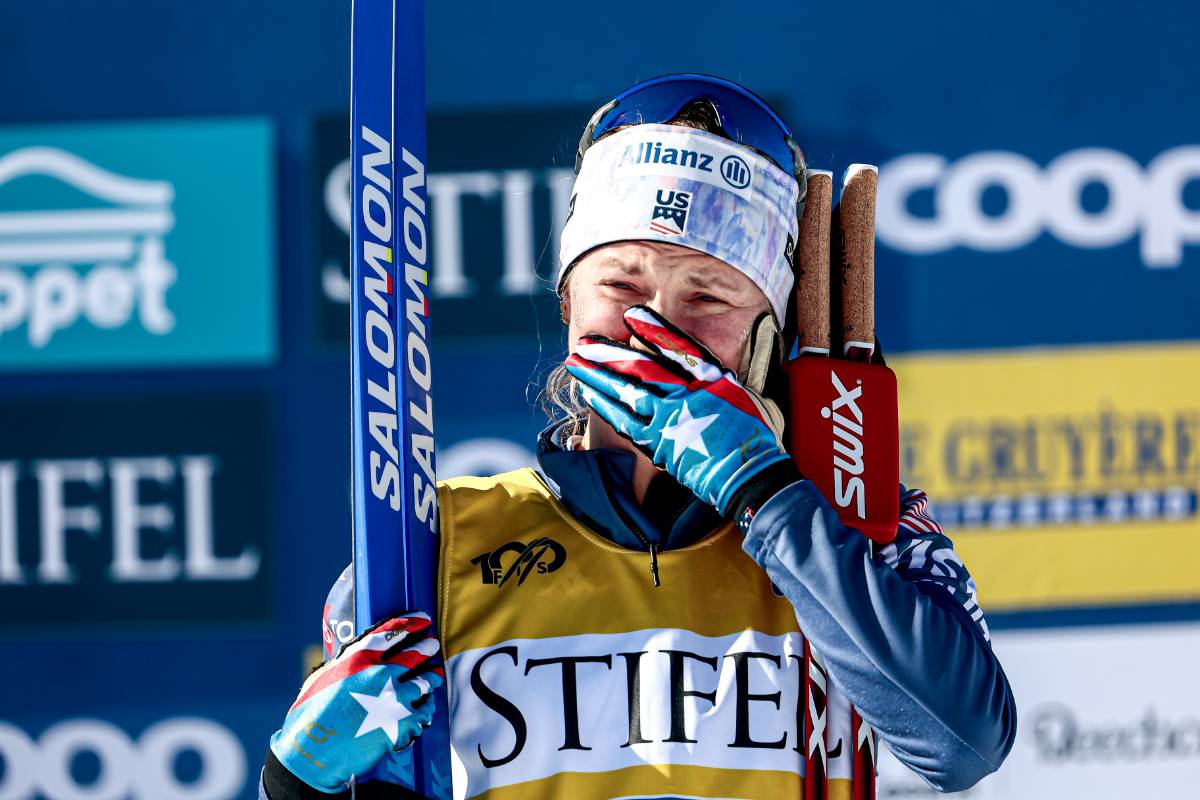
    Rosie Brennan (USA) celebrates in Ruka (FIN) in 2023 after finishing 2nd in Saturday’s 10 k classic race. The result was Brennan’s first classic World Cup podium of her career. (Photo: Nordic Focus)

    Rosie Brennan has stepped away from the World Cup, though she’s still figuring out exactly how to define the next chapter in her life.

    Retirement is the easy word, and in some ways, the accurate one. She is done with the World Cup. She is done with the version of cross-country skiing that demands five months in Europe, constant travel, start lists, team schedules, narrow margins and the unrelenting pressure of measuring a career in seconds. 

    After more than a decade with the U.S. Ski Team, three Olympic appearances, hundreds of World Cup starts, two World Cup wins and a place among the best all-around skiers the United States has produced, Brennan has stepped away from the highest level of the sport.

    But if retirement is supposed to mean the end of something, Brennan is not quite sure the word fits.

    “Retirement has been a tough word for me,” Brennan said. “It feels very black and white.”

    “One of my friends and older teammates called it rewiring.”

    To Brennan, that seems closer. She’s not walking away from skiing so much as trying to build a new relationship with it. The shape of her days may change, and her focus will no longer be “110 percent” on racing, but skiing itself remains too central, too familiar and too joyful to simply leave behind. 

    “I love skiing and ski racing,” Brennan said. “I want to continue to be able to use my body in ways that challenge and push me in the world of skiing and competition again at some point, maybe sooner than later.”

    “Skiing is just not that for me,” Brennan said of the idea of retiring and never doing the thing again. “It’s something that I hope to do till the day I die, honestly.”
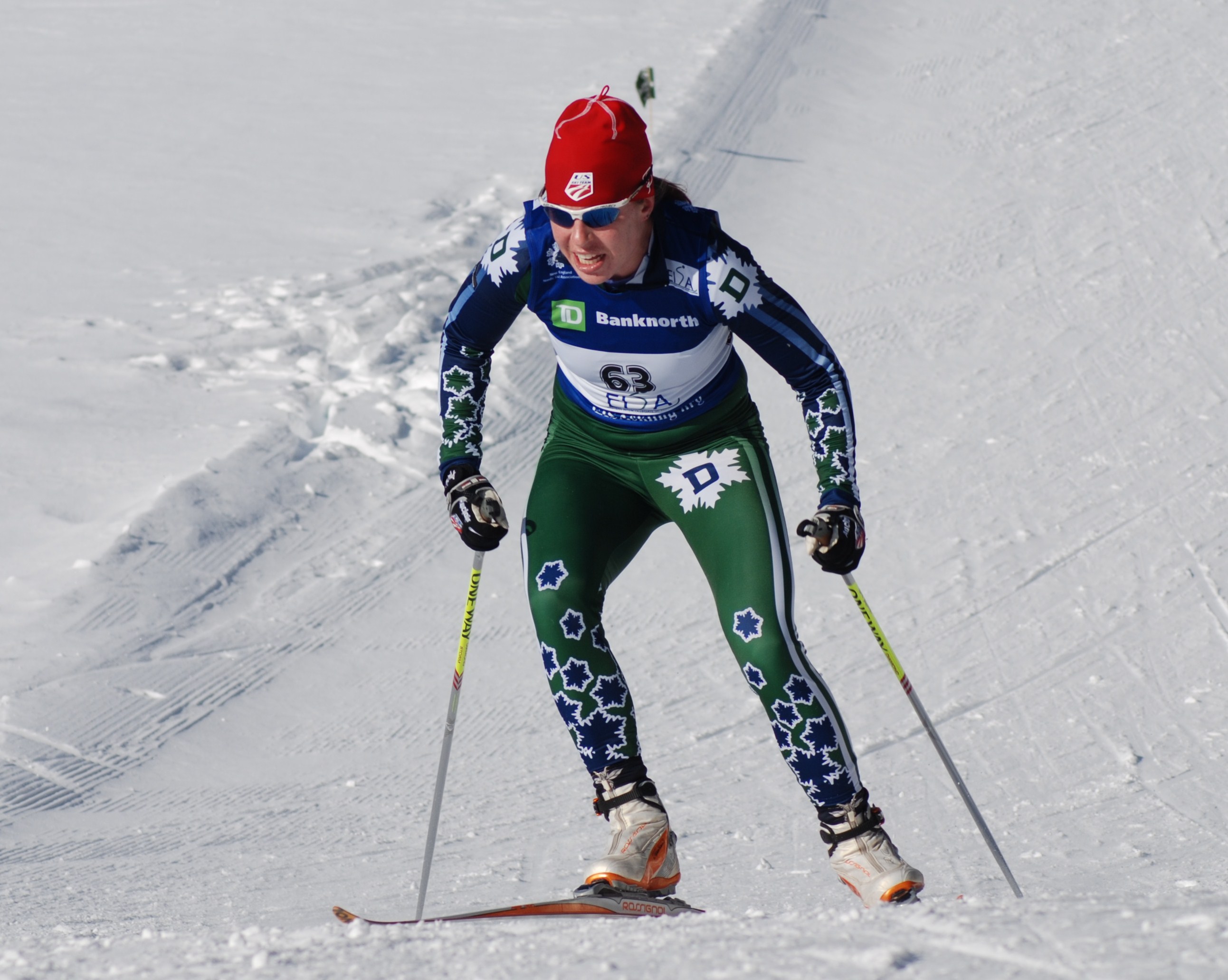
    The first uploaded image of Rosie Brennan in the FasterSkier archives after she won both EISA women’s races in Feb. 2009 (Photo: Ruff Patterson)

    A Career Built on Perseverance

    When Brennan looks back now, the first thing she points to is not a specific race, podium or result sheet, but rather the belief in herself that made all of those things possible.

    “I’m really proud of, I guess, the perseverance of my career,” Brennan said. “It takes perseverance to have longevity in a career, to weather the inevitable obstacles that appear throughout a long career, and to find belief when things aren’t going your way.”

    That perseverance became the throughline of a career that took time to reveal itself. Brennan was not a teenage prodigy who moved smoothly from junior success to World Cup podiums. She came to skiing later than many of her peers, waited longer for the biggest results and had to weather the doubts that creep in when progress slows, injuries interrupt momentum and other paths begin to look more practical. Then when the results did arrive, those earlier years felt even more meaningful. 

    In a career defined by patience and progress, one of the things Brennan says she is most proud of is not just that she reached the top level, but that she continued to expand what she could do once she got there. She never settled into one lane as only a distance skier or only a classic specialist. Instead, she kept working to become more complete, finding reward in the challenge of improving across formats, distances and techniques.

    “I’m also proud of the range that I maintained throughout my career,” Brennan said. “Continuing to be an all-arounder throughout my career and finding some success in all the disciplines and both techniques throughout — that was something that was just, I don’t know, I guess a personal challenge that I found a lot of reward in.”

    That sense of progress extended beyond Brennan’s own results. Her career also unfolded during the strongest era in the history of American women’s cross-country skiing, and as the U.S. team continued to raise its standard internationally, Brennan came to see herself as part of something larger than her own race days.

    “I’m proud to have been part of a really amazing wave of American women skiing,” Brennan said, “and to have done my best to carry that wave forward and to help push things forward and pass things on to future generations as well.”
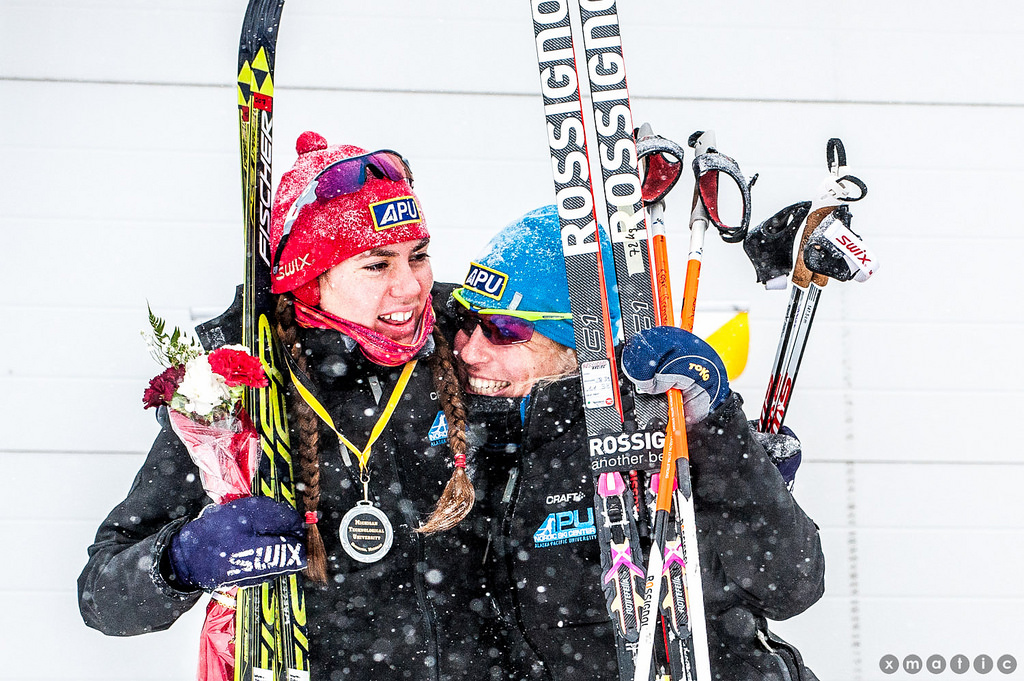
    APU’s Rosie Brennan (r) embraces close friend and APU teammate, Becca Rorabaugh (l), after they finish first and second, respectively, in the Women’s 1.5 k Classic Sprint at the 2015 U.S. Cross Country Championships in Houghton, Mich.

    Starting Late, Staying Long Enough

    Brennan started skiing at 14, late by the standards of an international sport where many athletes first step onto a set of fish scales as young children. But she never saw her development as a simple matter of being behind.

    “I was older when I kind of found top-level success in podiums on the World Cup,” Brennan said. “But because I started skiing so late, I guess I never really saw it that way.”

    In her mind, the clock did not start with age, but when she first found herself on a pair of skis.

    “If you look at when I started at 14 to when I had success, those accumulated hours of skiing and training are probably actually fairly equivalent to somebody who started at eight,” Brennan said. “So I always just chose to look at it that way, as if it was just going to take time to learn those skills, and it was fine that I started late.”

    “I’m not good at being patient,” Brennan said.

    But skiing gave her little choice. It took time to develop the specific strengths required of the sport, to learn how to race and to absorb the small skills that many skiers pick up almost without realizing it when they start young. Brennan had to build the engine and the instincts at the same time.

    There were moments when she wondered whether it was worth it. In college, after injuries and difficult stretches, she decided she was done with skiing when she graduated. She looked toward other paths. At times, she quit, or at least tried to. But the sport kept pulling her back.

    “I think what I enjoyed the most that made me keep coming back was just the challenge of it,” Brennan said. “Waking up every day with some purpose to get a little bit better, and to have the challenge of seeing if it was possible.”

    Eventually, that challenge became a way of life.

    “I just learned to really enjoy and thrive and love the lifestyle of skiing,” Brennan said. “And so that made it a lot easier to just keep coming back.”

    Brennan is quick to point out that she did not do that alone. The support systems around her mattered. At Dartmouth and later at Alaska Pacific University, she found teams and coaches that helped her keep believing when she could not quite do it herself.

    “There were definitely moments that it’s easy to question, and it’s hard to keep going,” Brennan said. “I was really fortunate to be part of some really, really amazing groups, and have coaches that fostered that belief in me, and made me see things in myself that I couldn’t see on my own.”
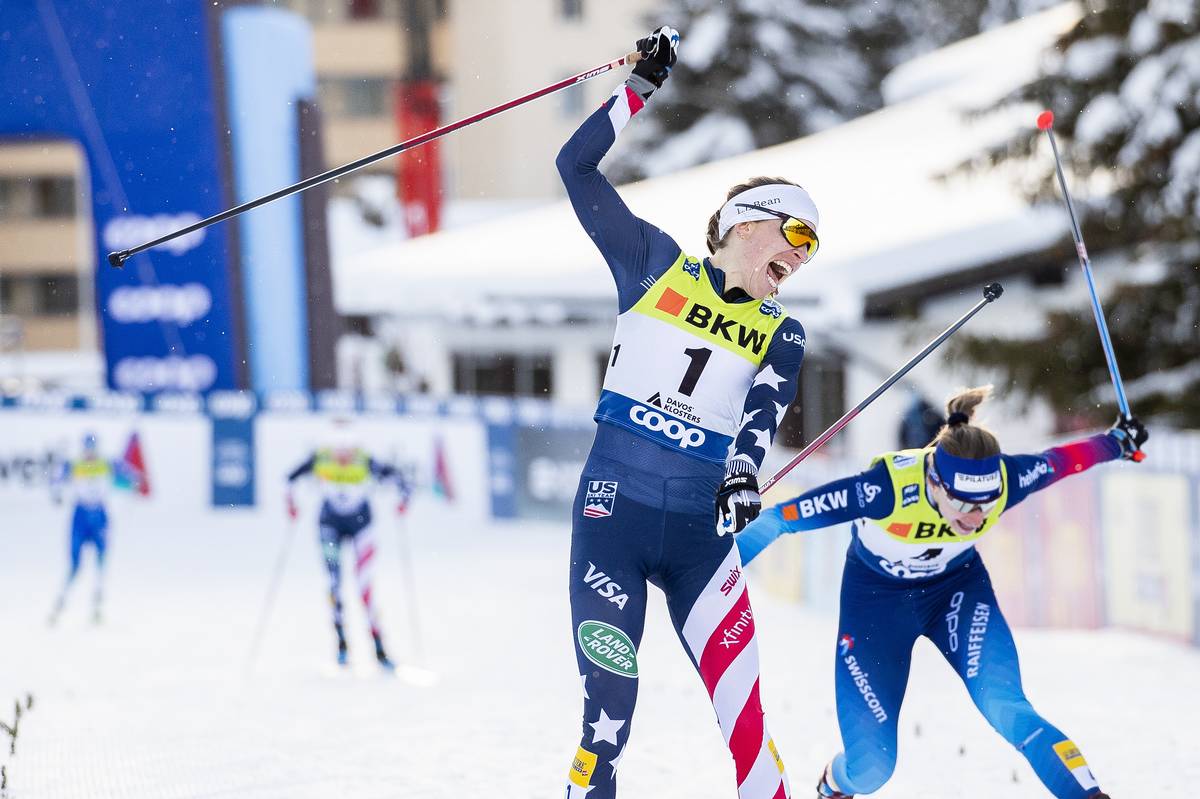
    Rosie Brennan celebrates her victory and first World Cup podium after the freestyle sprint in Davos, Switzerland. Photo: NordicFocus

    When the World Was Put on Notice

    For years, Brennan’s career was a slow and steady build, but then came that famous weekend in Davos.

    In December of 2020, during a World Cup season shaped by the uncertainty of the pandemic, Brennan won twice in two days in Switzerland. On Saturday, she claimed her first career World Cup victory, in a freestyle sprint, and then the very next day, she won again in the 10-kilometer freestyle.

    From the outside, it looked like a breakthrough and a historic moment for U.S. skiing. Brennan does not dispute that. She says what stays with her the most now is not only the winning, but everything she had to manage in order to ski that way.

    “Davos 2020 was definitely a breakthrough moment for me,” Brennan said. “That year was challenging for the whole world, and being a ski racer during that time certainly had its challenges too.”

    The uncertainty of that season weighed heavily. Rules changed, travel was complicated and athletes did not always know whether races would happen. The risk of illness carried not just health concerns, but career implications for athletes whose bodies were their livelihoods.
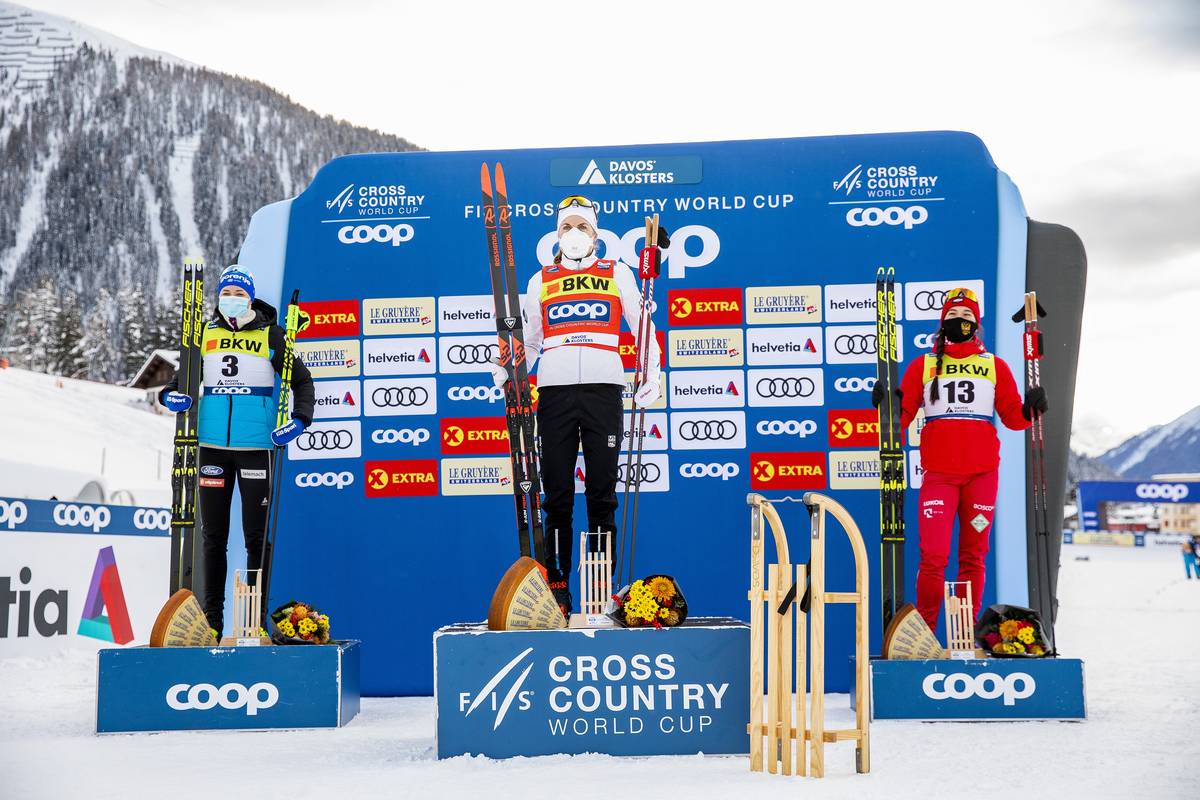
    Taking the victory and the sled, Rosie Brennan stands atop the podium in Davos, Switzerland. (Left to right) Anamarija Lampic (SLO) 2nd, Brennan (USA) 1st, Natalia Nepryaeva (RUS) 3rd.

    “I really struggled with the anxiety of it all,” Brennan said. “Just never knowing — traveling in foreign countries, where the rules were changing all the time, and you didn’t know what would happen if you got sick.”

    Hence why Davos still means something more than two entries on a results page. Brennan was proud of the wins, of course, but she was even more proud of how she managed everything around them.

    “It definitely showed me what I was capable of,” Brennan said, “and that I could manage these really high-stress environments and all the uncertainty and thrive in that setting.”

    That weekend did not just give Brennan her first World Cup wins. It helped confirm the range she had been building toward for years. Later that season, she became the first American to hold the overall World Cup leader’s bib, sprint leader’s bib and distance leader’s bib at the same time. Which was both a major accomplishment and also a fitting reward for all the work she had put in to become a more complete racer.
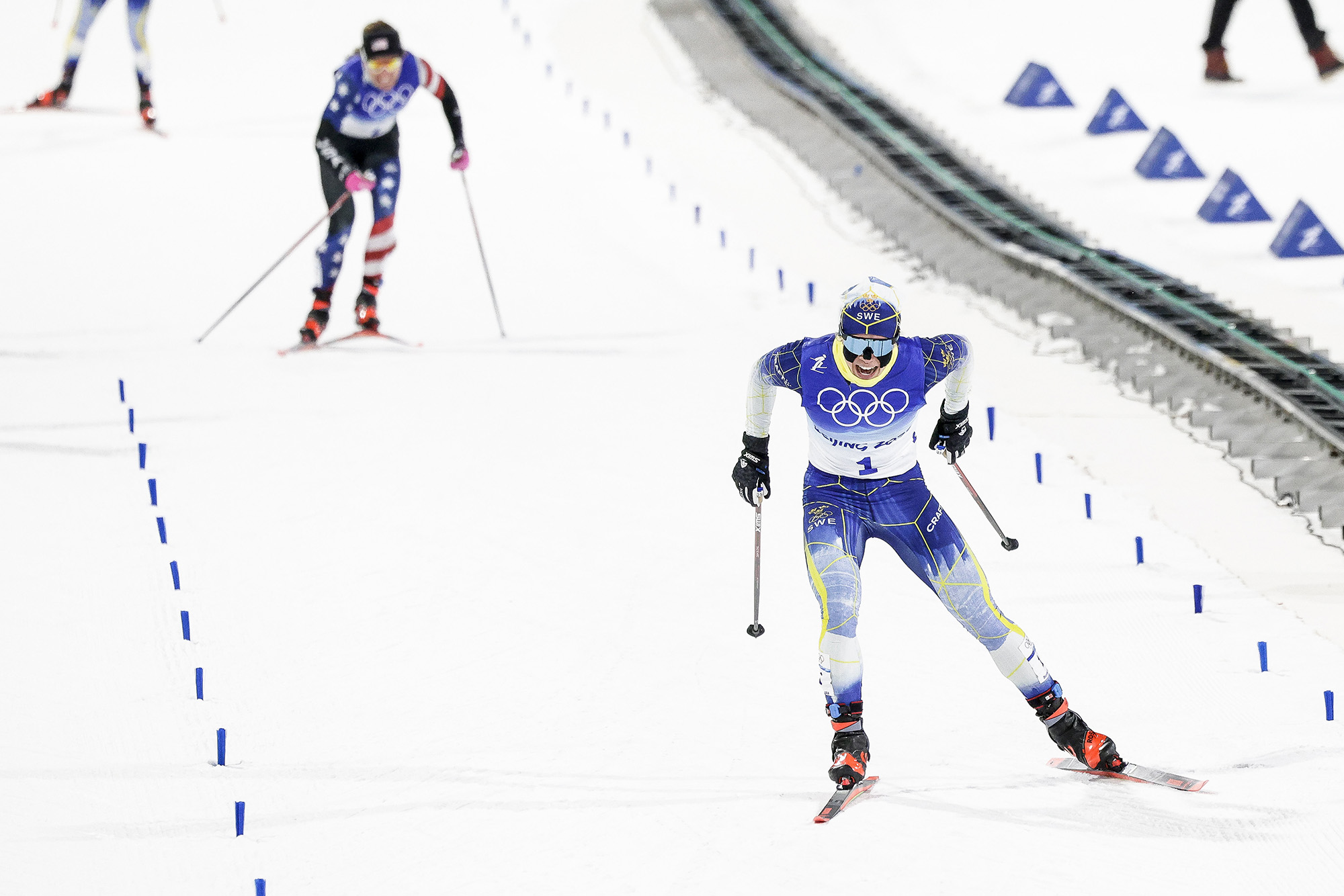
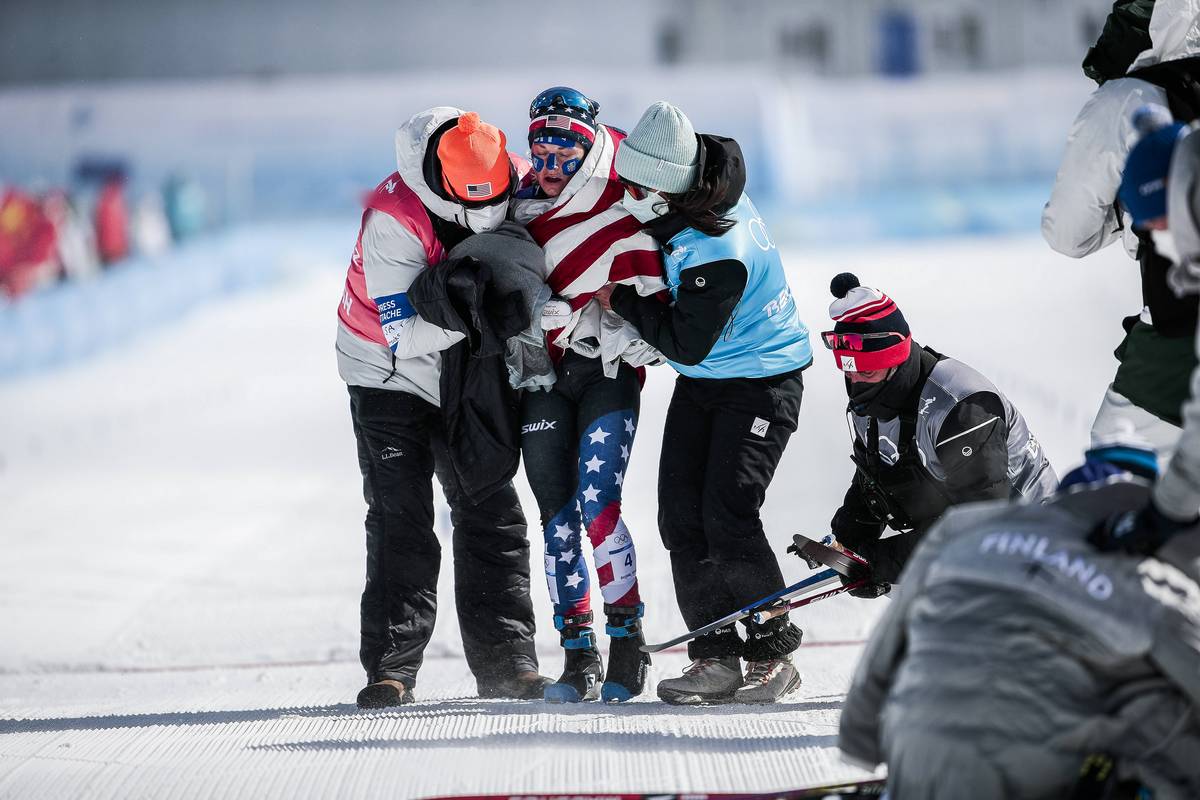
    Jonna Sundling (SWE), with a commanding victory in the 2022 Olympic individual freestyle sprint, comes to the finish with Rosie Brennan (USA) in the background on her way to fourth. (Photo: NordicFocus)

    What the Career Adds Up To

    Brennan will take a step back from her professional career after amassing quite the résumé, representing the United States at the 2018, 2022 and 2026 Winter Olympics. She finished fourth in the freestyle sprint at the Beijing Olympics in 2022, the kind of result that can feel both extraordinary and excruciating, by missing out on an Olympic podium by a single place. She reached World Cup podiums across seasons and disciplines. She became a two-time World Cup winner, a fixture in the American women’s team and one of the athletes who helped move the U.S. from occasional contender to regular presence near the front of international races.

    But Brennan’s own accounting of her career is not limited to the results she garnered over the years. She is proud of showing up. Proud of learning. Proud of becoming competitive in every event. Proud of the people who helped her and the younger athletes she helped in return. Proud that a career that could have ended several times kept expanding instead.

    That may just be why the end of her World Cup career does not feel like a true breakup. For Brennan, skiing was never just a job. It provided her with structure, challenges, community, identity and gave her something to work toward every day and a way to test what was possible. Even now, when she is no longer organizing her life around World Cup racing, she says she’s not suddenly becoming someone else.

    “When you train that many years, it’s hard,” Brennan said. “I’m still going out twice a day most days, because it just feels so normal to me.”

    That may change when she starts school again and other commitments begin to fill the space skiing once occupied. Brennan says she plans to pursue new interests and give attention to parts of herself that the World Cup lifestyle did not always allow. But the habits of a skier are not easy to unwind, and she does not seem especially eager to unwind all of them.

    “I definitely hope to bring forward a lifestyle that’s active, that treats your body well, that’s also willing to push yourself and see where the limits are,” Brennan said.

    Rosie Brennan (USA) during the individual sprint qualification at the final World Cup weekend this past March in Lake Placid, New York. (Photo: Modica/NordicFocus)

    Rewiring, Not Retiring

    That is why “rewiring” works. Brennan is not flipping a switch. She is just rearranging the circuitry.

    There will be no more full World Cup campaign, no more life built entirely around the next race weekend. But there will still be skiing, there will still be movement and there will still be competition. The habits and lessons of her career that she built through years of resilience and patience are not things Brennan expects to leave behind.

    “I’m sure there are countless skills, probably most of the skills I’ve learned in my adult life, that I will have to lean on in any of the various careers that I may pursue, and in my studying as well,” Brennan said. “The lessons that I’ve learned will undoubtedly come with me, along with the character and strength that I’ve built throughout my career.”

    Those lessons were built through the less tidy parts of Brennan’s career, from the late start and the years before the podiums to the injuries and doubts that forced her to keep adjusting. But the same career that asked so much of her also gave her something lasting. Skiing was more than a pursuit or a profession, it was the driving rhythm of her adult life, and one she still feels lucky to have followed for so long.

    “It’s definitely an incredible lifestyle to be a ski racer,” Brennan said. “I feel insanely lucky to have called that my career, and to have done so for so long.”

    That gratitude does not make the transition simple. After so many years of organizing life around training, racing and the rhythm of the World Cup, stepping back from that structure means more than changing a schedule. It means figuring out what skiing looks like when it is no longer the center around which everything else has to turn.

    Rosie Brennan (USA) during her final World Cup of her career — the 20 k Freestyle Mass Start in Lake Placid (USA). (Photo: Thibaut/NordicFocus)


    But there is also freedom in that. Brennan no longer has to prove she belongs. She already did. And now, instead of defining skiing only through the World Cup, she gets to decide what parts of it she wants to keep.

    Maybe that means races. Maybe it means long days outside. Maybe it means testing herself in new settings, with new stakes, away from the circuit that shaped so much of her adult life. Maybe it means all of that.

    What seems clear is that Brennan is not disappearing from the sport. She is stepping out of one version of it and into another.

    She is retired, if that is the word people want to use. But it is not the sunset kind. Not the final-page kind.

    For Rosie Brennan, skiing will always be there, just not in the all-consuming way it once was. Now, she gets the chance to redefine her relationship with the sport as something woven into the life she is building next.

    “It’s truly been a dream,” Brennan said.


    Help Support Our Coverage!

    If you value the thoughtful work and access FasterSkier provides, please consider becoming a Voluntary Subscriber. Your support directly fuels our work to cover the people, places, and moments that make our sport special.

    Join the FasterSkier community!


    Brennan’s U.S. teammates wait at the line to greet her after her final World Cup race, a 20-kilometer start in Lake Placid on March 22. (Photo: NordicFocus)
  • Schumacher and Ogden claim an Olympic silver built on community

    Schumacher and Ogden claim an Olympic silver built on community

    This article was made possible through the generous support of our voluntary subscribers who have helped put our Nat Herz on the ground at the Olympics. If you value coverage like this, please support FasterSkier with a voluntary subscription.

    Ben Ogden, left, celebrates his Olympic silver medal in the team sprint with Gus Schumacher. (Davide Barbieri/Nordic Focus)

    TESERO, ITALY — After Gus Schumacher and Ben Ogden on Wednesday won only the third-ever U.S. men’s medal in cross-country skiing at the Olympics, one of the biggest grins in the stadium was on the face of their teammate, JC Schoonmaker.

    Schoonmaker, who lives in Anchorage and trains with Schumacher at the Alaska Pacific University Club Program, was basking in his teammates’ silver glow. 

    But he was also already starting to dream about when he and Schumacher return home to Alaska, medal in tow.

    “There’s going to be so many juniors out skiing, just so hyped. And that’s the coolest part, I think,” Schoonmaker said.

    Schoonmaker, 25, had his own standout performance at the Olympics, finishing eighth in the individual sprint last week. He said he was himself inspired by the 2018 gold claimed by Americans Kikkan Randall and Jessie Diggins — underscoring how medals can plant the seeds of future medals. 

    “I liked Nordic skiing,” Schoonmaker said. “But watching that, I was like, ‘I need this.’ That gave me such a drive.”

    Eight years later, Schoonmaker’s teammates will be bringing their own hardware to their homes at far ends of the country — Schumacher to Alaska, and Ogden to Vermont.

    And unlike Diggins, who is retiring at the end of the season, Ogden, 26, and Schumacher are still just getting started — with long careers, and likely more medals, still in front of them. 

    Schumacher has spoken openly about competing through the 2034 Olympics, which will take place on U.S. soil in Utah.

    “You just see these guys, the energy building,” Erik Flora, Schumacher’s coach in Anchorage, said in an interview in Italy after Wednesday’s race. “You have this momentum now.”

    Gus Schumacher and Ben Ogden (USA), (l-r) celebrate finally getting onto the Olympic podium together. (Photo: Barbieri/NordicFocus)

    Both American medal winners were talented juniors, with Schumacher featured in news coverage at age 13. And early in their careers, each man found success in the events where they perhaps had more natural talent — Schumacher in longer distance races, and Ogden in shorter-distance sprints.

    The team sprint event that the Americans medaled in Wednesday is unusual in the way it demands both the speed that’s Ogden’s strength, and the fitness that Schumacher is known for. The two athletes, and their coaches, said that the podium performance was a reflection of focused training that Schumacher and Ogden did in an effort to become more well-rounded.

    The work Ogden and Schumacher did to put themselves in medal contention Wednesday didn’t happen overnight, though. It took years, with strong teammates pushing them and elite coaches to advise them — building on a foundation of years more of junior racing and playing on skis with their local clubs, said Matt Whitcomb, a longtime coach of the U.S. team.

    “It’s just not about this last year’s training plan,” he said. “It’s about the very first coach, the support their parents put in, their siblings, the camaraderie there with their friends.”

    Which is one of the things that Whitcomb and other team members say is great about winning an Olympic medal: the chance to share it with everyone who pitched in along the way.

    Ogden, in an interview after his first medal, described feeling anxious as he worked with a press officer to draft an initial Instagram post: What if he forgot to mention someone?

    “It’s so overwhelming to think of all the people you want to thank,” he said. “When the time comes, you’re just like, ‘Oh, my God. This is too many. It’s too hard.”

    He added: “There were so many people that went into that success.”

    Schumacher described feeling the same kind of gratitude as he crossed the finish line Wednesday — for a chance to share his elation with the many teammates, family members and others who were in Italy to witness it in person. 

    Flora, his coach, said that “maybe the best thing about this Olympics is all the people that it touches.” 

    “Everyone that’s been involved. Everyone that’s a fan of skiing, all the coaches that worked with all these people. All the athletes that are buddies and helped push — it’s just a very collective good feeling,” Flora said.

    The Americans still have a few weeks of racing left on the international circuit after the Olympics close Sunday, capped with a final weekend of World Cup racing on home snow in Lake Placid, New York.

    Then, after a chance to celebrate the medals and a few weeks away from training, it will be back to work — likely alongside newly inspired teammates.

    Gus Schumacher and Ben Ogden (USA), (l-r) on the podium showing their silver medals to their fans after the Olympic Men’s Team Sprint. (Photo: Barbieri/NordicFocus)

     “Everyone’s going to be so pumped and motivated and just firing, ready to go,” said Schoonmaker, the Olympian who trains with Schumacher in Anchorage. “It’s just going to be sick.”

    Fed by that kind of energy, the Americans were eager to talk about how the results might look different, and better, by the next Games. Schumacher’s charge up the final hill, where he largely kept pace with Norwegian superstar Johannes Høsflot Klæbo — who’s undefeated in five races in Italy — had his coach’s head spinning.

    “To see him put his head down and try to chase him, and he was holding his own, was unbelievable,” Flora said. “That he could fight with Klæbo in the future? I think so.”

    Flora added: “I think he’s just going to get better. We’re just starting to see what the potential is.”


    Help Support Our Olympic Coverage!

    FasterSkier will have our own Nat Herz on the ground at the Olympics, which, to be honest, is a very big financial lift for us. If you value the thoughtful work and access FasterSkier provides at championships like this one, please consider becoming a Voluntary Subscriber. Your support directly fuels the work we do to cover the people, places, and moments that make our sport special.

    Join the FasterSkier community!
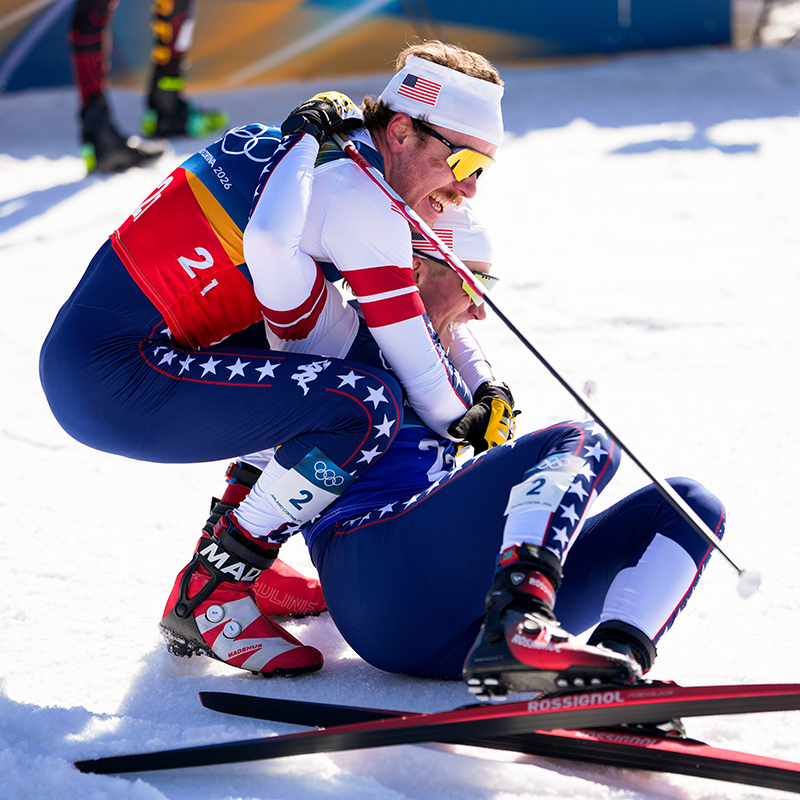
     

  • We’re in Italy. So we asked a Milan fashionista to review — and rank — the Olympic xc ski suits.

    We’re in Italy. So we asked a Milan fashionista to review — and rank — the Olympic xc ski suits.

    This article was made possible through the generous support of our voluntary subscribers who have helped us put our Nat Herz on the ground at the Olympics. If you value coverage like this, please support FasterSkier with a voluntary subscription.

    Priscilla Arresti, an art director in Milan, used this digital board to arrange the material for her reviews of the Olympic cross-country ski suits.

    From FasterSkier reporter Nat Herz, in Predazzo: Here in northern Italy, where I’m covering the Olympics, I’m technically the chief fashion critic for the bureau — though  only because it’s a one-man bureau. And unfortunately, the five-year-old baggy ski pants I wear everywhere have disqualified me from offering any sartorial opinions. 

    But this is Italy, a global fashion capital. And I still wanted someone to review the racing suits sported by cross-country skiers that each nation typically customizes for the Olympics — and I figured that this should be doable, knowing that I’m close to Milan, a global fashion capital. 

    It turned out that my host here in Italy knew just the right person for the job. He connected me with Priscilla Arresti, a friend of his who works as an art director for a studio in Milan. As it happened, Arresti had already been following the Olympics and watched the opening ceremonies — and she was eager for the assignment.

    Arresti was tasked with reviewing and ranking the suits from 10 of the top cross-country skiing nations — plus the wild card of Australia, for the sole reason that the Australian suit looked cool. 

    Here are her takes. Photos special to FasterSkier by Tobias Albrigtsen.

    1. Austria

    Are those supposed to be snow strokes? A kind of irregular white wrapping? 

    I’m not sure…

    Confusing, rather than energizing. Far more interesting are these graphic, muscular lines that open up, almost sculpting the body and amplifying its movement. Focusing on this motif alone would have been enough — no need for the snow strokes.

    1. Germany

    Not a fan of this graphic all-over print that is visible on many of the items of the entire German team’s Olympic collection.

    It tries to symbolize an inner fire and passion of the athletes, inspired by the Olympic flame.

    But this thin, geometrical silhouette evokes a more static feeling than dynamism. It reminds me more of an urban pattern of different letters, or a map of some city. don’t get the fluidity and vibrations of a flame.

    1. Italy

    Chic, dynamic but a bit predictable.  I wished for a louder and bolder choice — like asking for advice from a young Italian designer to twist the “tricolore” in a more contemporary way than a ribbon floating around the suit. Someone like Giuliano Calza, of GCDS, which knows how to push boundaries yet remains deeply Italian in its irony and eclecticism.

    1. Finland

    It feels as though the Finnish flag has been lifted by the wind, draped across the body, then sculpted into aerodynamic precision.

    The colors and sweeping lines create the impression of riding an icy wave. Against the snow, Finnish athletes cut a striking silhouette, as if rising from northern waters and frozen seas.

    1. Norway

    Norway gives vintage vibes. Exactly the kind of wardrobe Wes Anderson might envision for his Olympic winter cast.

    Ultra-classic look with lateral stripes in flag colors all along the body. No gradients, no bluff. An iconic look considering all the attire, from the ceremony outfit to the race suits. It reflects all Norway’s grounded, authentic tradition. 

    1. France

    It’s a curious one. It doesn’t quite converse with the graphic boldness seen in the suits worn by French athletes in the other Winter Olympic sports. Are those tiny intersecting ski tracks on the cross-country kit meant to “cross lines” for cross-country? A little too literal, maybe?

    Overall, it’s tasteful, but it feels slightly dated. Which is surprising, considering the other French ski suits are genuinely “magnifique” (chef’s kiss): contemporary, confident, built on strong color-blocking and retro-leaning graphic lines, all cleverly manipulated and artfully enlarged.

    1. Canada

    The Canadian suit plays with black, like an animal camouflage. It reshapes the figure, creating a sculptural effect that impresses both in motion and at rest. The athlete’s body becomes a stage, while the viewer’s gaze bounces playfully from curve to curve, sliding along subtle, luminous gradients — almost as if the suit itself is choreographing the eye.

    1. Switzerland

    The Swiss team is spot-on. Like its flag, red is the statement. Up-close, pixelated chromatic shifts of red emerge. An ethereal mesh design that nods to Switzerland’s strong digital ecosystem, but that also elongates the athletes’ silhouettes with sophistication — sculpting movement through the nuanced use of a single strong hue, and a quiet and measured texture.

    1. Australia

    Behind the vibrant colors of Australia’s Olympic suits lies a layered weave of past and present. The symbolic compositions originate from contemporary Indigenous voices: Torres Strait artist David Bosun and Aboriginal artist and Olympic boxer Paul Fleming.

    Fleming’s work “Walking Together” portrays lines of repeated footprints that, in Aboriginal art, are far more than decorative marks — they are narrative devices. Powerful symbolism of shared steps, collective journeys, ancestral stories, connection to land.

    It’s a superb collaboration — where art, performance, design and cultural narrative converge with intention.

    1. United States

    The entire U.S. Olympic kit genuinely reads like a fashion collection. The interplay of textures, mixed patterns, and calibrated color stories across uniforms and off-duty pieces shows the masterful hands from Ralph Lauren. Garments many would happily claim for their own wardrobes.

    Even the cross-country ski suit carries subtle retro cues, and it works. It feels relevant.

    Perhaps the red armbands could have been reconsidered; they slightly interrupt the line of the body, cutting the silhouette at an awkward point.

    1. Sweden

    A curated throwback by the Craft designers behind the Swedish suits — and a graphic tribute to the 1956 Winter Olympics in Cortina d’Ampezzo, and its legendary ice car races. 

    The checkered flag — iconically displayed at the start and finish line — becomes a transdisciplinary symbol of speed and technology. A dynamic motif that makes the eye vibrate. The suits are infused with an emblem of confidence and luck — after all, the checkered flag is the one historically claimed by the winner at the finish line.


    A reminder that producing this kind of work at the Olympics is expensive — we paid both Priscilla and Tobias for their work, and we’re spending a significant sum to be on the ground at the Olympics in Italy. If you can, support us with a voluntary membership here. If you’re already a supporter, thank you.

  • She almost retired at 26. Now, at her first Olympics, Astrid Øyre Slind has a gold medal at age 38.

    She almost retired at 26. Now, at her first Olympics, Astrid Øyre Slind has a gold medal at age 38.

    This article was made possible through the generous support of our voluntary subscribers who have helped put our Nat Herz on the ground at the Olympics. If you value coverage like this, please support FasterSkier with a voluntary subscription.

    Astrid Øyre Slind races in Norway earlier this season (Federico Modica/NordicFocus)

    PREDAZZO, ITALY — When Astrid Øyre Slind was 26, she almost retired from cross-country skiing.

    She was a good skier, just not quite good enough to break into the international circuit from her home country of Norway, where competition in cross-country is cutthroat. She was, in her own words, “stuck,” feeling like being an athlete wasn’t worth it any more.

    “If you try for the same thing for 10 years, you get disappointed in yourself that you’re not getting better,” she said. “You’re working your ass off, and you’re still not there.”

    But Slind didn’t retire. Instead, she mixed up her training plan, found a new coach and spent years racing on a lower-level long-distance circuit — the minor league baseball of cross-country skiing.

    Nearly a decade later, in 2022, she returned to the international stage, and soon after made her first-ever World Cup podium, against Olympic-caliber competition.

    This season, she finally qualified to race at her first Olympics, at age 38. 

    In Thursday’s 10-kilometer freestyle race, Slind finished a painful fourth place, just seconds from a medal. But on Saturday, she led the Norwegian women’s relay team to gold — punctuating a career arc that few novelists could have scripted.

    “Her story, I think it’s really important to tell,” said Pål Golberg, another Norwegian skier who found success late in his career.

    Slind, he said, was not an athlete with exceptional physical talent, nor especially good technique, and at times she was “struggling to find her way.” 

    But there’s still a message embedded in her success.

    “You can get really far just by hard working,” Golberg said. “And she’s a perfect example.”

    At a news conference after Saturday’s relay, Slind said she’d accomplished something she’d been working toward since childhood.

    Slind, at lower left, celebrates her Olympic relay medal with, in clockwise order, Heidi Weng, Karoline Simpson-Larsen and Kristin Austgulen Fosnaes. (Federica Vanzetta/NordicFocus)

    “It’s kind of crazy to say, but it’s actually been a dream for 30 years,” she said. “And it’s something I’ve given up on during the way there — and then started to believe again.”

    She added: “It’s nice to finally make it.”

    Not a top prospect

    Cross-country skiers can be competitive into their late 30s, but few of them stay in the sport that long. In Thursday’s freestyle race, Slind was the oldest competitor, and one of just two of the 111 athletes who was born in the 1980s.

    Slind grew up in the village of Oppdal in Central Norway, in a family of skiers. Her father, Peder Einar Slind, is a ski coach who once spent a year in Western Massachusetts on an exchange with a collegiate cross-country ski coach there. 

    Astrid also has two ski racing sisters: a younger one, Kari, and a twin, Silje.

    Both still compete at a high level on European circuits. Kari, in fact, had the first breakthrough at the international level, nearly landing on the World Cup podium in her mid-20s. Experts thought she would be “the biggest of them,” said Birger Lofaldli, a reporter at Adresseavisen, the Slinds’ local newspaper.

    In this archival photo, Kari Øyre Slind, center, poses with American skier Jessie Diggins and Slind’s friend Ragnhild Haga after a strength training session in Norway years ago. (Roar Hjelmeset)

    “But Astrid came back,” Lofaldli said. “And now she’s greater than ever.”

    Astrid did not grow up as a top prospect. 

    Unlike Kari, she never qualified to represent Norway at the World Championships for juniors, a proving ground for young athletes.

    But Astrid was always skiing, she said in an interview in November. Her father would take the sisters out to play on skis; the twins were always pushing each other, with Kari “chasing us behind,” Astrid said.

    At three years old, she added, the twins were “crying ourselves in” to local club races in Oppdal, where their parents initially didn’t want them to compete.

    “Silje and I really wanted to go,” Astrid said. “From that day, we’ve just been skiing as long as the snow is out, and loving it.”

    ‘Crazy training’ with a new coach

    After failing to break into Norway’s national team and the top-level World Cup circuit in her 20s, Slind spent years racing on a tour called the Ski Classics. The circuit features distance races as long as 90 kilometers, or 56 miles. 

    Slind celebrates winning the Birkebeiner, a long-distance race that finishes in Lillehammer, Norway. (Federico Modica/NordicFocus)

    She had her ups and downs there, too. In one especially tough year, Slind said, she had trained too much — so much, that she could barely race — and was again thinking about quitting the sport.

    Instead, she started talking about her problems with a teammate, Chris Jespersen, another Norwegian who was a few years older and had also struggled to stay at the highest level of the sport.

    “He was like, ‘You know what? I really think I can make a good skier out of you — I’ve made all the mistakes myself. I can see what you’re doing. Let’s try to figure it out together,’” Slind said.

    Jespersen, at the time, was not a coach, just an “athlete who had ideas,” Slind said. 

    But at that point, Slind said, she had nothing to lose, so the two started working together. They made a deal: When they disagreed — if Slind, for example, wanted to push herself to do more training but Jespersen thought it was too much — Jespersen would get the last word.

    It turned out that Jespersen had a knack for explaining what Slind needed to do differently with her ski technique, in a way that she could understand. He was also a good check on what Slind describes as her impulse to do “crazy training” — things like a six-hour session of skiing with the arms-only double pole technique, with hard intervals in the middle of it, or workouts where she’d try to keep up with her team’s strongest men.

    Slind had done more of those kinds of sessions as she moved into the Ski Classics circuit, where she discovered that she “needs a lot of training to be at a good enough level.”

    “I think it was what put a spark in my skiing again,” she said.

    But Jespersen, she added, helped rein her in when the crazy training got a little too crazy.

    “He wasn’t too eager, and he wasn’t too defensive,” she said. “It was kind of the perfect balance for me.”

    A breakthrough, and medals

    Slind’s breakthrough came in the winter of 2022-2023, when she finally qualified to return to the World Cup circuit after a nearly nine-year absence.

    Two months into the season, after nine races, Slind stood on the podium for the first time. Later that season, she won a bronze medal at the World Championships in the skiathlon, and a gold medal with Norway’s relay team.

    Still, it hasn’t always been easy since then. 

    Last season, she raced at what was effectively a home World Championships, in the city of Trondheim just a two-hour drive from her hometown. Amid challenging snow conditions and constant rain, her results were disastrous, including a mishap with a ski during the skiathlon, and she finished with no individual medals — just a silver from the relay.

    Then, at the Olympics this year, she was oh-so-close to a medal in the 10-kilometer freestyle race in fourth, just 3.3 seconds behind bronze medal-winner Jessie Diggins of the U.S.

    Slind was also painfully close in her first Olympic race, the skiathlon, where she was skiing in medal position before being overtaken by a teammate and ultimately fading to eighth.

    “I completely died out there,” Slind said in an interview afterward. “I’m not a good enough skier today.”

    In Sunday’s relay, though, Slind was one of the strongest athletes in the race, putting pressure on the Swedish star Ebba Andersson, who ultimately crashed twice and cost her team the gold medal.

    Slind leads the Olympic relay on Saturday. (Nathaniel Herz/FasterSkier)

    The performance caps a storybook turnaround — one so improbable that Slind probably wouldn’t have believed it herself, said Jostein Vinjerui, a Norwegian coach who works with Slind’s club team, Aker Dæhlie.

    “If you’d have asked her during the Beijing Olympics, four years ago, if she’d be able to do the Olympics in four years time, I think she would have laughed, I’m pretty sure,” Vinjerui said. “It’s just an amazing story, being 38 years old now and winning a first gold medal.”

    More Olympic medals are possible for Slind: The Norwegian coaches have named her to the two-person team sprint squad, and she and Julie Bjervig Drivenes will be podium contenders in the event Wednesday. Slind is also expected to vie for medals Sunday in the longest race of the Games, the 50-kilometer competition in the classical technique.

    After the relay gold, Slind said at the news conference that she’s good at turning depressing results into motivation for the next event.

    “Maybe the two other races just made me more on fire for today, and really wanting to show what I’m good for,” she said. “And I will take that with me into the 50 k.”


    Help Support Our Olympic Coverage!

    FasterSkier will have our own Nat Herz on the ground at the Olympics, which, to be honest, is a very big financial lift for us. If you value the thoughtful work and access FasterSkier provides at championships like this one, please consider becoming a Voluntary Subscriber. Your support directly fuels the work we do to cover the people, places, and moments that make our sport special.

    Join the FasterSkier community!
  • After son’s fourth straight gold in Italy, Klæbo’s father says “we’re just having fun”

    After son’s fourth straight gold in Italy, Klæbo’s father says “we’re just having fun”

    This article was made possible through the generous support of our voluntary subscribers who have helped put our Nat Herz on the ground at the Olympics. If you value coverage like this, please support FasterSkier with a voluntary subscription.

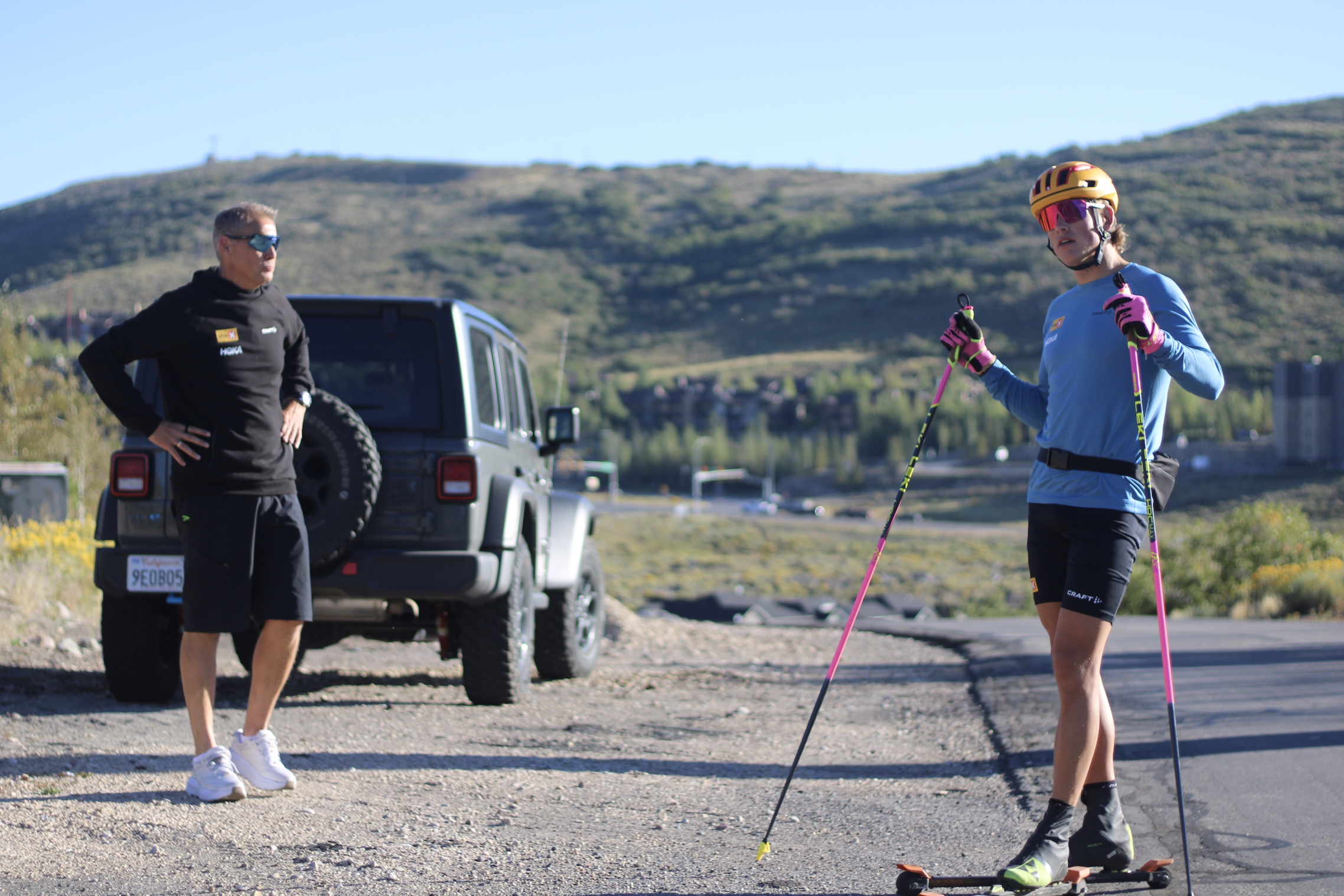
    Johannes Klæbo stands with his father, Haakon, during a water break on a rollerski workout in Utah in 2023. (Nathaniel Herz/FasterSkier)

    PREDAZZO, ITALY — Johannes Høsflot Klæbo is four for four — and officially the most golden Winter Olympian in history.

    By anchoring Norway’s relay team to first place Sunday, Klæbo claimed his ninth Winter Olympic gold — moving him out of a tie, with two other Norwegian cross-country skiers and a Norwegian biathlete, for the most ever.

    At a news conference afterward, Klæbo said he’d been drained by the effort it took to win Friday’s 10-kilometer individual start skate race — the first time he’d ever won an event in that discipline.

    The next day, he said, “the only thing I did was lay in the bed and play on my PlayStation.” But by the time he woke up Sunday morning and checked his heart rate, he said, “it looked pretty good.”

    [Read more: That guy rollerskiing around Utah by himself: Yeah, it’s 5-time Olympic champ Johannes Klæbo]

    After Sunday’s relay win over France and Italy, Klæbo is now poised to win the last two cross-country events at the Games, both of which — a team sprint, and a 50-kilometer mass start race in the classical technique — favor him.

    At the news conference, he said he’s still taking it one day at a time. “We’ll see where we end up at the end,” he said. “But it feels, so far, so good.”

    In search of some more revealing answers, we went looking for Klæbo’s father.

    Haakon Klæbo, for the past week, has been a ubiquitous presence at the Olympic cross-country ski venue, watching races with the masses alongside the race trails with friends and family. We found him walking alone behind the stadium — where he was happy to answer a few questions before others broke in.

    Nathaniel Herz: Are the Olympics a platform where Johannes is starting to go from a Norwegian to a global star, with these viral videos of him running up the last hill in the sprint race?

    Haakon Klæbo: Yeah, it looks like at least it is. It is a huge interest in him. Olympics is really big in the U.S. But I also think that more U.S. citizens are learning how much time he spent there. He’s linked with (Utah physiotherapist) Megan (Stowe). She is really the one that has made his strength program, which is — it’s not that it’s secret, but if you look into it, he’s doing a lot of core strength. This is a program that he also follows at home (in Norway).

    NH: How nervous were you for the 10-kilometer skate race two days ago?

    HK: I was really nervous for the 10 k, and I knew that it was his weak point, or Achilles, in a way. We have to remember that he has never won a 10 k skate before, never — and this is in his whole career. I think that he has been in good enough shape, but this has been something in his head — and something that if you do not accomplish, it starts to become even more problematic.

    Devon Kershaw, a retired Canadian World Championships gold medalist in cross-country skiing, who’s working as an expert TV commentator at the Olympics, walks up: Congratulations.

    Herz, to Klæbo: You know this guy?

    HK: No.

    NH: This is Devon Kershaw.

    DK. Congratulations, it’s been quite the show.

    HK: Oh! Yeah — it is a little unbelievable, because you don’t expect it. And we had these crazy days in (the World Championships in) Trondheim last year, in which were hoping for like two or three (medals). (Klæbo won gold in all six events.)

    And now, with four.

    NH: Do you think going through this whole Trondheim experience last year is making this a lot easier for him now?

    HK: Yeah. He had been training for that since he heard Trondheim would host the World Championships, and he has been the front figure. They used him (in their marketing materials), saying, ‘Born and raised.’ He’s standing there, like 18 years old — he had one pair of Leki ski poles at that time. He was wearing a suit that he had borrowed from a friend that was on the team. He was like, ‘This is my dream.’ And then he managed to do it. So, I think he was really stressed for it.

    This season, it has just been fun. We’ve been together with (teammate and friend) Emil (Iversen). Me and him and Emil have been traveling around  — it’s like being there with two boys playing around. So, I think he’s really much more relaxed. And you can see, also — I think he is even stronger, here, if you look at his sprint.

    [Podcast: Johannes Høsflot Klæbo has a lot to say. We listened.]

    DK: I agree with you, 100%. Everyone made such a big deal of it, but winning the individual start skate. That’s the biggest thing to me, as a fan and a person that raced his whole life. I’m getting goosebumps thinking about what I saw two days ago. When you win that, then you’re really the king.

    HK: And I said to Nathaniel that I think that he has been strong enough to do it for years. But it has been something up here (points to his head). He’s never won it.

    NH: Do you think that’s his best accomplishment ever?

    HK: Yeah, I think it is. And he was really tired after — he has been working really, really hard. I was afraid for this relay today — that he wouldn’t be able to run, because I think he put so much into the 10k. So much energy spent.

    Johannes Høsflot Klæbo celebrates one of his four Olympic gold medals in Italy. (Davide Barbieri/NordicFocus)

    NH: Was he at a disadvantage being first, in this individual time-trial style race, of all these Norwegian guys? That meant that he wouldn’t get as much information on the course from his coaches about how his times compared to the others.

    HK: Actually, his best races from skate individual start are when he is just doing his own thing — just making his own pace, and doing what he’s good at. You could see that for the others, it was a disadvantage. I think, for (rival-teammate) Einar (Hedegart), it was trying to push on Johannes’ time (that was the problem). If you look at the two of them, racing, they’re pretty similar in taking it a little slow in the first two kilometers. Then starting to get faster and faster and faster, and having a crazy second half. 

    I think that that was what made Einar lose the silver. He pushed too hard — and he got burned and he lost 20 seconds in the last 1,000 meters.

    NH : Will you be very stressed about the 50 kilometer race, the last event? Or do you feel like, once you get to the 50 k, so much has already been done that you can relax a little.

    HK: The 10 k was what I was really afraid of. And now, I don’t know — we’re just here here enjoying and having fun. And then, everything can happen. And even if he is getting sick tomorrow, we’ve had four gold medals, and you’re the best Winter Olympian — and still, you can race for another Olympics. I think if you ask him, his dream Olympics would be to do a 50 k in Soldier Hollow (in Utah) — which is his home.

    A middle aged fan carrying a Finland flag breaks in, screaming: “Klæbo! Klæbo! Number one!” The fan demands a photo, then ushers Klæbo away.


    Help Support Our Olympic Coverage!

    FasterSkier will have our own Nat Herz on the ground at the Olympics, which, to be honest, is a very big financial lift for us. If you value the thoughtful work and access FasterSkier provides at championships like this one, please consider becoming a Voluntary Subscriber. Your support directly fuels the work we do to cover the people, places, and moments that make our sport special.

    Join the FasterSkier community!
  • ‘Hard things are what’s cool about sport’: Gus Schumacher on a tough Olympics start

    ‘Hard things are what’s cool about sport’: Gus Schumacher on a tough Olympics start

    American Gus Schumacher competes in his first race at the 2026 Olympic Games at the cross-country ski venue in Tesero, Italy. (Federica Vanzetta/Nordic Focus)

    Gus Schumacher is one of the stars in U.S. cross-country skiing, and he was one of the team’s top medal hopefuls coming into the Winter Olympics in Italy.

    Against the same field that competes at the Games, the Alaskan won a World Cup race in Minnesota in 2024. Then, Schumacher, 25, was on the World Cup podium twice more just last month, in Switzerland.

    So far, though, his Olympics haven’t gone as planned, with tough results in several races. In his first one, he crashed. In the subsequent sprint — one of the disciplines where Schumacher was on the podium last month — he had another tough day, while his roommate and close friend, Ben Ogden, won a silver medal.

    Speaking with media Friday, after his third race, Schumacher bristled, a bit, at a question from a reporter who asked him if, maybe, he was not having the best time at the Olympics. He said he was actually having a good time, and in a good place in spite of his results.

    A day later, reporter Nat Herz asked Schumacher if he’d be willing to expand on his comments — but also offered him an out if he didn’t have more to share. He responded quickly by text: “Let’s do it. I’d rather get a story out there than have people make their own conclusions.”

    Here’s Schumacher in his own words.

    Nat reached out to me yesterday to ask if I was up for an interview. His timing was good, because I almost for sure would’ve said no most of the last six days. The opening of my Olympics has been hard, and processing it has taken time and effort, but I’m so proud to have been able to get through some rough days and be ready to fight again and again.

    For context, my hard races have involved a crash, an anomalous sprint qualifier, and a day where I think my skis had me out of the race in the second half. On top of it, my teammate and one of my best friends did something we’ve all wanted to do for years. I’m stoked for Ben, but it’s also still hard, and that’s fine! The real miss would be an inability to talk it out and move forward to race another day.

    I’m proud of my team, and I’m proud of myself for how I’ve handled a rough start, because this thing isn’t over and I’ve still got skiing to do!!

    Below is a transcript of Schumacher’s conversation with Herz. It’s been lightly edited and condensed for clarity.

    Nat: I don’t want to put words in your mouth — so maybe you could start by describing how it’s been for you here?

    Gus: I can set the stage for people who are listening. So I finished this (10-kilometer freestyle race Friday) and I wasn’t even on the results board — I knew I was far back. It was not what I wanted. And (a reporter) said, ‘So, I assume you’re having a really bad week here.’ And I was like, ‘Okay.’ First off, I wasn’t in a great mood then. But I’ve had a lot of things I’m really proud of. And I think, just, blanket statement, horrible week — it just goes to show you can’t really assume how people are feeling, because you don’t know.

    I understand, obviously, yeah: It’s not how I want to be skiing. In that sense, it hasn’t been great. But I wouldn’t just say I’ve had a horrible week, because these things make you better overall.

    Gus Schumacher, left, celebrates his podium finish at a World Cup race in Switzerland last month. (Augustin Authamayou/NordicFocus)

    NH: Can you take us back to the beginning of your time here?

    GS: I fell in the first lap of the skiathlon (the first Olympic race, which features legs in two different techniques, classical and skating). Someone fell right in front of me. There’s just a chain reaction, and maybe I could have put myself in a bit of a different place. I could have set myself up otherwise. But it was a crazy corner. I crashed there, 30 seconds back pretty quickly, and the pace was hot. In hindsight, I wasn’t going to have a chance of catching the leaders, which is where I wanted to be skiing.

    And I skied well — I think the classic went really well. In the skate, I think my motivation flagged a little bit. And I realized I have a lot more racing, and it wasn’t worth it to push super hard to get into 20th or something. But, you know, there were still some good things about how I skied.

    But it’s also still hard to really feel good in that situation, because you’re kind of swimming upstream.

    I left that, and I was just already on the back foot, needing to refocus — basically, not having a super confidence inspiring race, even if I was skiing pretty well. Objectively, it still wasn’t the result that I wanted. And then two days later, in the classic sprint, I didn’t qualify (as one of the top 30, who move into heat rounds), in an event where I’ve been pretty solidly qualifying lately. And I was really far back. I wasn’t in the realm of where I feel like I’ve been skiing lately. So that was another bummer.

    I want to say it was (problems with my) skis. I know there’s not super conclusive evidence of that. But I think that’s the best way for me in a championship to go forward — because I can’t change anything now, and I need to believe in my fitness, and I do. It’s just to say there’s something going on under the feet, and whatever: I’m racing again soon.

    And then (teammate and close friend) Ben (Ogden) got a medal (in the sprint). And that was a crazy event for all of us, especially me. Definitely took some thinking and processing to go through — especially given my tough start. I think I did a great job of getting back to a place where I’m just excited to ski and do what I can do.

    Ben Ogden celebrates his silver medal in the Olympic sprint Tuesday. (Federica Vanzetta/Nordic Focus)

    And then in (Friday’s) 10 k, again, I just really struggled. And I opened well, I feel like I skied really well. And again, something just didn’t line up, didn’t work. And I’m just gonna go with the skis again, basically. I don’t know exactly what it was. I think it probably has something to do with how they were actually pushing, and pressure stuff, which is kind of weird. But for my own sake, for these next races, I do still think I’m skiing well, and my movements are good and my energy is good.

    NH: Fair to say this is about as hard an environment as exists to have to deal with this stuff, though?

    GS: Yeah. In a normal World Cup weekend — and I had this at the beginning of the season, and it was still hard — you’ve just got another race the next weekend. And it’s easy to just say, ‘Yep, first race of the season. Shit luck. We got time.’

    But right now, I’m getting interviewed by NBC before every race. And everything’s going viral on social media. And it’s just a big moment, as people like to say. And it’s when everyone wants to be at their best. Part of what’s so hard about winning the Olympics, or medaling, is just that your timing has to be good. And my timing’s been great before. You know, Minneapolis, I still think, is the craziest timing ever. (In Minneapolis, Schumacher took his first-ever World Cup win when the circuit was on its first swing through the United States in more than two decades.)

    But, yeah, it’s really hard place to deal with tough results. Even if they’re not entirely because of me, or they’re a little bit out of my control, it doesn’t really matter.

    At the end of the day, to all the people that never watch skiing — it sucks, in my head, to feel like all those people won’t recognize me. And I know that’s somewhat vain — but, you know, a lot of this is vain. And there’s a part of me that’s, just — I want to be a ski star. I want to be really good, and I am, and it’s just through the first half of this championship, it hasn’t worked out amazingly. But there’s still time. At the end of the day, I just want to be skiing fast, in general. Skiing fast is what’s fun to me. And it’s cool if it’s at the Olympics — but it’s also cool if it’s at the Tuesday night race (in Anchorage, Schumacher’s home town), in April.

    Gus Schumacher stands with his club coach, Erik Flora, during a training session at the Olympics in Italy. (Nathaniel Herz/FasterSkier)

    NH: I talked yesterday with Ben Ogden about how you guys have been navigating since he won the first men’s Olympic medal in cross-country skiing in half a century — which is something that many of you guys on the men’s team are gunning for, but only one of you got.

    He spoke about how that’s obviously a challenging dynamic, but said you guys have been navigating it really openly. He’s also your roommate here in Italy.

    Can you talk about all that?

    GS: I mean, it’s been, honestly, great. It’s super hard. But having it be Ben is so nice. But he’s so good in that situation.

    Obviously, it’s really cool and big for all of us. But everyone wants to be the guy to break the drought, right? And I, for sure, wanted to be that guy. But I also wanted to win the green bib (of best under-23 skier on the World Cup). And I didn’t do that, because I wasn’t skiing that fast, and he did. And that was really cool, that he did that. And then, I’m sure he wanted to compete (at the World Cup) in Minneapolis, but he got mono, and I won.

    It’s not just Ben and I. (American) JC (Schoonmaker) got the first podium of any of us, and Ben was fourth that day. We all know how it feels to be on the other side.

    Ben came back in the room at 5 p.m., after a one o’clock finish — he’d had a crazy afternoon. I know he had interviews lined up, and I’d just been at home, basically stewing about myself and about the whole situation. And I can’t remember exactly what he said, but the first thing he said, basically, when he came in the room, was: I’ve been thinking about you.

    And that meant so much to me. That he would go through all of this, and enjoy himself — I know he was really enjoying himself, and I would not want him to not enjoy himself — but to have your teammate just immediately recognizing: Yeah, I know how it feels to be on the other side.

    It made it so much easier for me. And I’ve been clear with him, too, that yeah, it’s kind of hard. But I’m also really proud of him, and it’s really cool that he (won silver). One of us needed to do it, and it’s so, so cool that one of us did. And I also really want to be racing faster, and those things can be true together.

    It’s hard. But the hard things are what’s cool about sport, and the Olympics. And the hard times are a lot of what I enjoy about what I do, because I think it makes me a better person. It just makes everything else in life feel so much easier.

    To have a team like this, that can have those conversations and be real about it is so nice. Because obviously, it’s not sunshine and rainbows, no matter what it is. You can love someone with all your heart, and if they get something that you wanted, that you can’t have, or you didn’t get, it’s hard. And I’m really glad we don’t just say, ‘I’m so happy for you. Nothing but tears.’ Because it’s not always true. At least for me, honesty is the best policy. And to be able to air stuff makes it so much easier to just go on with it, and talk about the real things.

    Gus Schumacher and Ben Ogden celebrate a podium finish in a World Cup team sprint event in Switzerland last month. (Augustin Authamayou/NordicFocus)

    NH: Maybe this is touchy, but just to put a fine point on it: It’s not just that you and Ben both wanted a medal, any medal. He won this medal in a specific event that you were also racing in, and could very well have won a medal in.

    GS: Yeah. I mean, watching him, it felt a lot like what I did two weeks ago. (Schumacher finished second in a World Cup sprint race in Switzerland in late January.) He looked amazing, and I felt really good in (Switzerland), and I didn’t even really get tired — and the other guys were sort of tired in that final, and it was so similar.

    So, yeah, it felt like, ‘Fuck, it’d be awesome if that was me.’ But that’s just how it works in sport. Sometimes you’re there, sometimes you’re not. And if it was always the same, it would get boring.

    NH: I’ve been thinking back to the Beijing Olympics four years ago. You had a pretty hard time there, but I wonder if you think it’s right to say that you are experiencing things here in a different way — maybe with more resilience based on that past Olympics experience.

    GS: For sure. Everything I do, I think, makes it easier. But four years ago is, for sure, different — a different type of disappointment. And I’d rather have this one — I’d so much rather be in a true contender seat, where I feel like I have a shot at medals. I’d so much rather have that than not be recognizing my body — not be, just, super tired going up the hills.

    I learned a lot from Beijing, and I got a lot better after that. Mentally, it’s been a really cool experience to go through these emotions, feel them really well, write them down, pay attention to it, and talk to a bunch of people that can think with me. And I can just, sort of, rant, or do whatever, and get through it and be ready for the next one, because that’s what you need to do, when you’re feeling good, especially.

    I’m still feeling good. And it would be such a shame to have a couple bad races and mentally throw in the towel, because it’s hard to draw confidence from a race where you fell in. That’s silly. I can draw confidence from so many things, and that’s what I’m doing. The most recent experience I have, which is the easiest one to go on, is not great. But I’ve got a lot more in the tank to draw from, and I’m really excited to go out there and do what I do.

    NH: Fair to say you feel like you are mentally prepared to show up on the start line of the men’s relay tomorrow with a clear head and some confidence in your fitness?

    GS: Yeah. I think I’m ready to ski with the best, no matter what has happened so far. And that’s where I want to be. And I feel confident that that’s where I am. And I’m really excited to lay it out there for the team tomorrow, because I think we have a really strong team right now. I maybe alluded to, ‘Ben got something that I didn’t get.’ But this Games isn’t over — and we’ve got more Olympics (in four and eight years), too. I feel confident that I’ve still got time, which is nice.

    NH: I think I want to print this just as an unadulterated Q&A. Do you feel good about that?

    GS: Yeah — I think it’s important to talk about some of the hard things. It’s what makes our team strong. And I think it is something that is often so much more helpful than I even know for people to hear. Because a lot of this stuff is pretty applicable not just to sports, but even just day-to-day life.

    Shit happens, and sometimes it happens when you really don’t want it to. You’ve got to move through it, and it’s so much easier said than done. But I think talking about it — and hopefully I shed enough light on it to maybe inspire people, to help them understand — I think it’s a good message. It makes me proud to know that I’m still in the fight because of how I’ve gone about it.

  • Slovak Indirect: How an Alaska-raised skier ended up representing Slovakia at the Olympics

    Slovak Indirect: How an Alaska-raised skier ended up representing Slovakia at the Olympics

    This article was made possible through the generous support of our voluntary subscribers who have helped put our Nat Herz on the ground at the Olympics. If you value coverage like this, please support FasterSkier with a voluntary subscription.

    Peter Hinds racing at the Olympics for Slovakia. He grew up in the 49th state, wore bib 49 in Tuesday’s sprint race, and finished 49th. (Courtesy Peter Hinds)

    PREDAZZO, ITALY — On Denali in Alaska, there’s a famed climbing route called Slovak Direct — a nod to a group of skilled alpinists from Slovakia who established it in 1984.

    Now, as this year’s Winter Olympics kick off, an Alaska-raised athlete is making something of a name for himself in Slovakia, competing for the nation’s Olympic team in cross-country skiing.

    Peter Hinds, a 23-year-old graduate of University of Alaska Anchorage, realized last year that he could race for the country where his mother grew up — then qualified to represent it in Italy.

    Call it Slovak Indirect.

    Hinds competed in his first Olympic race Sunday in Italy, finishing 60th — capping a whirlwind season that’s also included a ceremonial team-naming in Bratislava with a handshake from the Slovak president, Peter Pellegrini.

    Peter Hinds shakes hands with Slovakia’s president, Peter Pellegrini, in a pre-Olympics ceremony in Bratislava. (Office of the President of the Slovak Republic)

    “They had the guards with the little floofy hats and the guns, standing perfectly still,” Hinds said. “It was cool — it kind of felt like royalty. And that’s the thing about something as big as the Olympics: It lives bigger in people’s minds.”

    Hinds’ Olympic saga starts with the fall of the Iron Curtain, at the end of the 1980s. His mother, Elena Hinds, grew up in the Slovakia city of Bratislava when it was part of the Eastern Bloc.

    “I was young, fresh out of school, just wanted to travel and see the world,” she said in an interview in Italy, after watching her son’s first Olympic race. “Landed in Los Angeles.”

    There, Elena met Peter’s father, Cory, when she joined the local mountaineering club, and the couple ended up in Alaska.

    Peter grew up there as an only child with, he joked, “no rights.”

    “I had to do everything that the parents decided to lug me on,” he said — including being roped in with them on glaciers during alpine traverses.

    A young Peter Hinds on the Eklutna Traverse, a famed climbing route in the mountains behind Anchorage, Alaska. (Courtesy Peter Hinds)

    Hinds also spent time absorbing Slovak language and culture growing up, including a school year in Bratislava, where he still has family. Elena cooked Slovak foods, too, like bryndzove halušky — a gnocchi-like dumpling traditionally paired with sheep cheese and bacon bits.

    “It’s so good,” Hinds said. “You get the sour blanket, white canvas taste of that cheese. And then you get a really sharp, salty bacon bit in there — it’s really a good dish.”

    As a kid, Hinds trained with Anchorage’s Alaska Pacific University club program, then studied engineering at the University of Alaska Anchorage, where his results included a 14th place at the collegiate national championships. He’s also placed sixth in the sprint at the U.S. national championships.

    As school was wrapping up, he went to the career fair and interviewed with several companies with offices in Anchorage; he thought maybe he could pair an engineering job with an assistant cross-country ski coaching gig. He also contemplated graduate school.

    But Hinds had Slovak citizenship through his mother, who’d been following the country’s ski team, thought her son would be competitive and encouraged him to explore whether he could join. At a ski marathon last spring, he also got a nudge from an international athlete, Australian Rosie Fordham, who attends the University of Alaska Fairbanks.

    Hinds eating makové slíže, a Slovak dish of potato dumplings with maple syrup and ground poppyseed. “The poppyseed is exquizite,” Hinds wrote in a text message. (Courtesy Peter Hinds)

    “She was like, ‘Mate, you should totally just switch your (International Ski Federation) license to Slovakia. You’d probably be the best skier there,’” Hinds said.

    He didn’t really know where to start that process, though, so he went to the internet, where he noticed that his rankings were competitive with Slovakia’s top racers. “I looked them up on Instagram, sent them a DM,” and the process unfolded from there, effectively “no questions asked,” Hinds said — though he acknowledged detecting a little skepticism, at first, from Slovak athletes at risk of being displaced by an American-raised interloper.

    “I came over and I actually knew how to speak Slovak, and they were impressed,” he said.

    The license change prompted an enthusiastic press release from the Slovakia ski team, which celebrated the addition of a “promising young endurance athlete.” Slovak media has also chronicled Hinds’ progress and results, with family members collecting copies of print newspapers.

    A Slovak print newspaper featured a story about Hinds. (Courtesy Cory Hinds)

    After training in Alaska last summer, Hinds bought a one-way ticket to Bratislava, where he has a “home base” with family. Since then, he’s been ski racing, at training camps with the Slovakia team or staying with other friends around Europe.

    At stops on the top-level World Cup circuit, he’s encountered other Alaska athletes that he’s raced and trained with, like JC Schoonmaker and Gus Schumacher — both standouts on the U.S. team.

    “I’m a small fish compared to those boys on the circuit, so I’ve got to know my place,” Hinds said. “But it’s cool to see them, say hi, and see that this is really where they’re able to do things that few can, you know?”

    Fordham, the Australian who Hinds credits with inspiring his European experience, described him as a “good friend on the World Cup who doesn’t take things too seriously, but is pretty serious about ski racing.”

    Hinds speaks with reporters after his first race at the Olympics. (Nathaniel Herz/FasterSkier)

    “He’s just, like, so excited to be here,” she said. “It’s good to see someone who has such enjoyment of the sport and just wants to be out here having fun skiing fast, and with his friends.”

    At the Games, Hinds got to attend one of the opening ceremonies, then found himself surprised by the gravity of the moment when he finally got to the start of his first Olympic race.

    “It’s super cool to see all these people here — I mean, it was a great atmosphere. But I was genuinely nervous,” Hinds said in an interview afterward. A crash on a busy corner early in the 20-kilometer race set him back, but he made it to the finish without getting lapped and pulled out — a fate suffered by a number of athletes from other small nations.

    One of the benefits of being on a small team: Hinds will get to race more events in Italy, unlike some of the athletes from the larger U.S. team who might only get a single start at the Olympics.

    And while he doesn’t plan to spend time at bars, he does plan to spend some time enjoying and absorbing the Olympic experience — perhaps getting over the mountains to another satellite competition venue in the resort town of Cortina. He’ll also get time with his girlfriend and parents, both of whom are in Italy to watch.

    “Nobody expected this. But he’s making it happen, and it’s pretty exciting,” Cory Hinds said. “Everybody’s cheering for Peter like crazy.”


    Help Support Our Olympic Coverage!

    FasterSkier has our own Nat Herz on the ground at the Olympics, which is a significant financial lift for us. If you value the thoughtful work and access FasterSkier provides at championships like this one, please consider becoming a Voluntary Subscriber. Your support directly fuels our work to cover the people, places, and moments that make our sport special.

    Join the FasterSkier community!


    Hinds’ parents Elena and Cory and his girlfriend Eva Weymuller take a moment to relax after watching his first race at the Olympics. (Nathaniel Herz/FasterSkier)
  • The new Diggins documentary is a crucible of elite sport and mental health

    The new Diggins documentary is a crucible of elite sport and mental health

    Jessie Diggins, left, racing at the Olympics in Italy on Saturday. (Davide Barbieri/NordicFocus)

    Two years ago, U.S. cross-country skiing star Jessie Diggins was battling a relapse of an eating disorder — an episode that she publicly acknowledged at the time.

    What she didn’t share until now, though, was how close it came to derailing a year in which she won cross-country skiing’s season title and celebrated the return of the top-level World Cup circuit to the U.S., in her home city of Minneapolis.

    In the middle of that winter, Diggins was still struggling enough that she went in for a scan in Norway to assess her body composition. The results, according to her longtime coach Jason Cork, were “shocking,” with too many red flags — so many that U.S. Ski Team staff was prepared to stop her from racing.

    The previously undisclosed mid-season ordeal is featured in a new documentary about Diggins, “Threshold,” which will premiere nationally at the end of the Olympics.

    The film doesn’t cover the specifics of what the body scan revealed, other than that important indicators were off. 

    It depicts Diggins’ subsequent improvement, with support from family members who traveled to Europe to be with her during a scheduled Christmas break from racing.

    But the documentary also underscores how persistently the eating disorder continued to plague Diggins after it emerged in her teens — through revealing conversations between her, her coaches and the filmmakers taped in hotel rooms as she traveled across Europe for races.

    Jessie Diggins runs through a tunnel in a scene from the movie. (Brinkema Brothers Productions)

    The U.S. Ski Team announced the film’s debut in a press release last week. 

    Diggins is a longtime advocate for destigmatizing eating disorders through public discussion, and she’s written about her fight with bulimia in her autobiography, “Brave Enough.” She said at a news conference in Italy just before the start of the Olympics that she decided making the movie would be worth the cost to her privacy.

    “I’m willing to put my story on the line to help change this,” she said. “I hope that it inspires people to have really critical conversations that can end up actually saving lives. And I hope that it inspires coaches to learn more about these serious illnesses and have resources handy to help the athletes that are under their care.”

    The documentary’s release on the Peacock streaming service will be the culmination of three years of work by a pair of young cross-country ski racers-turned-filmmakers, brothers Torsten and Lars Brinkema, who, like Diggins, grew up in Minnesota. 

    TV and movie star Patrick Dempsey, a Diggins fan and an avid skier, is an executive producer.

    “Close to the edge”

    Torsten and Lars Brinkema were 24 and 20 years old, respectively, when they first showed up at a U.S. Ski Team spring training camp in Oregon in 2023, Torsten said in a phone interview.

    They’d come to film at the invitation of U.S. star Ben Ogden, whom Torsten had raced against on the university circuit when Ogden was competing for the University of Vermont and Torsten was at Colby College. 

    Unlike other videographers who had done work with the team in the past, the brothers could actually keep up on skis and knew how to stay out of the way — making for an easy camaraderie with the athletes, Torsten said.

    “I think we just weren’t very intimidating,” he said. “We were just these guys that were hanging out in the sun with our cameras.” 

    Lars and Torsten Brinkema (Brinkema Brothers Productions)

    On a ski with Diggins near the end of the camp, Torsten said, they talked through possibilities for further filming, particularly around Diggins’ upcoming home World Cup race.

    “I think she also felt a level of trust pretty soon with us because we’re from Minnesota,” Torsten said. “On both sides, a light bulb kind of went off, thinking: If there’s any season to follow, it’s got to be this one.”

    Thus began an odyssey that took the Brinkema brothers around the world with Diggins and the team, through a training camp in New Zealand and races in northern Scandinavia, Canada and Minneapolis. 

    They considered other ideas for the structure of the project, including a Netflix-style docuseries on the team; a broader focus on the whole international World Cup circuit; and a narrative strand documenting Ogden grappling with the death of his father from cancer. 

    In the end, though, fitting together an Ogden and Diggins narrative was too much for one movie, Torsten said. 

    “We ended up picking Jessie’s and really going all the way with it,” he said.

    While Diggins had spoken publicly about her relapse before the start of the 2023-2024 season shown in the film, the documentary reveals how she continued to struggle not just in the summer and fall but through the winter — even as she was racking up podium finishes. 

    One coach, in the film, describes how Diggins had previously warned him about her ability to hide when she’s not doing well — and how he couldn’t trust what she was telling him at the time.

    “She got very close to the edge,” Chris Grover, the U.S. cross-country program director, said in an interview. “It was incredibly stressful.”

    In the film, another coach said the U.S. staff warned Diggins she was not going to continue to ski. 

    “A hard message was delivered from a lot of people that really care about her,” Grover said in the interview.

    But Diggins, he said, “got the message.” She spent the holiday recovering with her family and “did what she had to do to get back to a healthy space,” Grover said. 

    After positive results from bloodwork and a bone scan, Diggins returned to racing after the winter break, won the Tour de Ski stage race and then went on to stand on the podium in one of the World Cup races in Minneapolis.

    Jessie Diggins stands on the World Cup podium in front of her home crowd in Minneapolis. (Nordic Focus)

    The filmmakers ended up with more than 15 interviews with Diggins, all of which were at least two hours — and 400 hours of footage total, Torsten said. 

    Dempsey, the actor, joined the project after Diggins, knowing he was a fan of hers, sent him a message on Instagram on the Brinkema brothers’ behalf. They didn’t expect a response, Torsten said, but “he got back to her two minutes later and said, ‘Send the brothers to Maine!’”

    “We showed up at his house and asked him to be a producer to help us navigate the film world,” Torsten said.

    To pay for the work of transforming the raw material and race footage into a fully produced documentary, the brothers raised tax-deductible contributions in partnership with a Minnesota nonprofit that supports local filmmaking. Key financial support also came from one of Diggins’ main sponsors, an eating disorder treatment clinic called the Emily Program.

    Diggins had approval power over the final version of the film, which Torsten described as “part of the trust” during the filmmaking process. She watched four different versions over a period of six or so months, mainly giving small notes about things like voiceovers, Torsten said.

    Beyond streaming on Peacock, he said, a theatrical release is also planned, with hopes of debuting at this year’s end-of-season World Cup races in Lake Placid, New York. There’s also hope that the movie could play in markets in Europe, where Diggins has a sizeable fan base.

    “It’s been three years of our life, and we could not be more proud that our debut feature film is about this sport that we grew up doing and this person that we’ve looked up to our whole life,” Brinkema said. “We’re stoked.”

  • This Australian skier had never raced a skiathlon event. Until the Olympics.

    This Australian skier had never raced a skiathlon event. Until the Olympics.

    This article was made possible through the generous support of our voluntary subscribers who have helped put our Nat Herz on the ground at the Olympics. If you value coverage like this, please support FasterSkier with a voluntary subscription.

    Maddie Hooker of Australia races in Saturday’s skiathlon at the Olympics in Tesero, Italy. (Davide Barbieri/NordicFocus)

    TESERO, ITALY — There’s having your Olympic debut. Then there’s having your Olympic debut in an event that you’ve literally never raced in before.

    That was the story Saturday for Maddie Hooker, a 21-year-old Australian for whom Saturday’s Olympic skiathlon race was the first time she’d ever competed in the event.

    Hooker is not a skiing novice: She competes on the U.S. East Coast collegiate circuit for Colby College in Maine. But the skiathlon — which combines cross-country’s two techniques, with a swap of skis and poles in the middle of the race while the clock is still running — is rarely contested outside of international championships, given its logistical complexity and requirements of multiple sets of gear.

    “What other sport would you actually turn up for the Olympics not actually having done the event?” Jake Hooker, Maddie’s father, said in an interview at the cross-country skiing venue just before his daughter hit the trails. But, he added: “Why not start at the Olympics?”

    Maddie Hooker made it three-fourths of the way through the 20-kilometer race before she was lapped and pulled by the organizers — but she was still buoyant afterwards. 

    She said the experience of being thrown into the deep end is “the beauty of being Australian” — a country that doesn’t exactly have a storied cultural tradition of cross-country skiing.

    Nonetheless, the nation has periodically produced competitive athletes on skiing’s international circuit, and even some who have grown up in urban areas: Rosie Fordham, who grew up in Sydney and now attends the University of Alaska Fairbanks, placed 13th in a top-level World Cup race earlier this year.

    Hooker, who’s from Melbourne, learned to ski on trips to the United States, attended a skiing-focused high school in Vermont called Stratton Mountain School, and now goes to Colby College in Maine. 

    Maddie Hooker competes in a race on the U.S. East Coast. (Daryn Slover)

    She said she was not expecting to qualify for the Olympics this year but had strong early-season results and ended up rounding out Australia’s women’s team as the fourth member.

    For the skiathlon, her biggest challenge might have been procuring a pair of event-specific boots — a sort of hybrid of the more supportive boots with an ankle cuff used for cross-country’s skating technique, and the lower profile version used for classical striding. They’re scarce, and the family’s contact at Fischer Sports, Hooker’s ski company, didn’t have any, said Jake Hooker.

    Maddie Hooker’s parents Jake Hooker and Antoinette Walshe helped her find a pair of the rare boots used by cross-country skiers in skiathlon events. (Nathaniel Herz/FasterSkier)

    After “hours on the internet trying to find a pair of boots,” he said, “eventually we found a pair.”

    Then, in the days before the race, Hooker spent time practicing the ski exchange — the part of the event where athletes make a pit stop as the clock runs to exchange their classic skis and classic poles for skating equipment.

    “I find getting the pole straps off the hardest. But I kind of picked it up, just followed my teammates,” she said. 

    The event itself, she said, was fun. While some athletes are stronger in one technique over the other, Hooker said she doesn’t have a preference.

    “I think it kind of suits me quite well doing both,” she said. “And at the end of the classic I was definitely very happy to change over to skate.”

    She’ll race three more events, Hooker said, before the Olympics are over.


    Help Support Our Olympic Coverage!

    FasterSkier has our own Nat Herz on the ground at the Olympics, which is a significant financial lift for us. If you value the thoughtful work and access FasterSkier provides at championships like this one, please consider becoming a Voluntary Subscriber. Your support directly fuels our work to cover the people, places, and moments that make our sport special.

    Join the FasterSkier community!
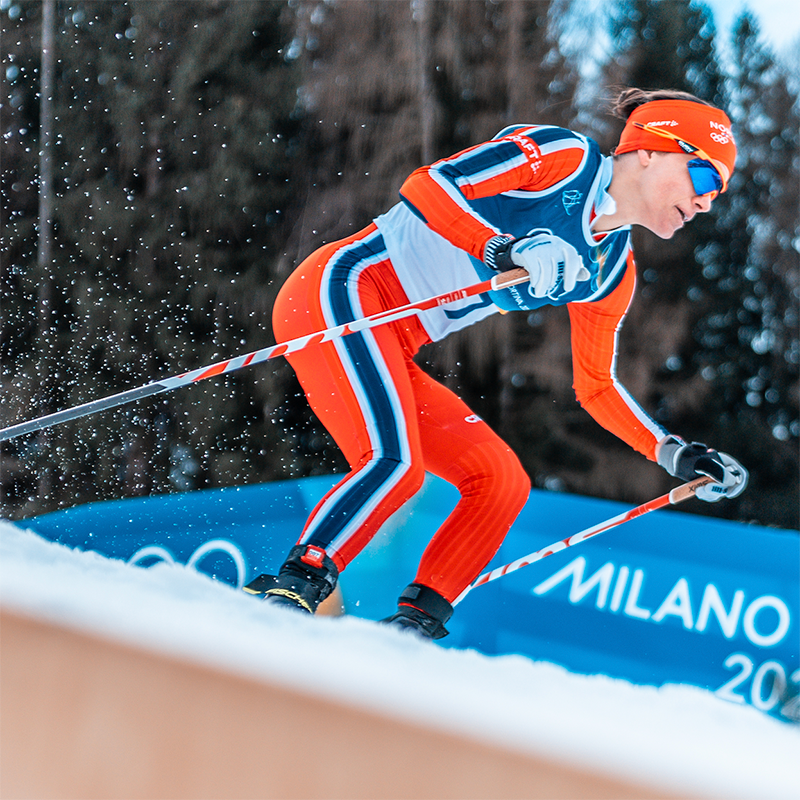
     

    Maddie Hooker (AUS) and Nadezhda Stepashkina (KAZ), (l-r) during the freestyle leg of the Olympic Women’s 20 k Skiathlon Tesero (ITA). (Photo: Vanzetta/NordicFocus)
  • Outside Olympic glamour, cross-country skiing’s broadcasters face late nights and solo calls

    Outside Olympic glamour, cross-country skiing’s broadcasters face late nights and solo calls

    This article was made possible through the generous support of our voluntary subscribers. If you value coverage like this, please support FasterSkier with a voluntary subscription.

    Andrew Kastning is one of a small crew of Americans who work as commentators on late-night broadcasts of European cross-country ski races. He works from laptops and a television in his home in Anchorage, Alaska, and says he draws energy from a jumpsuit donated by a local U.S. Ski Team member.

    PREDAZZO, ITALY — By day, Andrew Kastning’s life sounds conventional: He’s a father of three, with a desk job in Alaska doing permitting work for a federal agency.

    During the winter? It’s another story. 

    On periodic Friday and Saturday mornings, you’ll find Kastning awake at 1 a.m., 2 a.m. or 3 a.m., standing in his living room in a sports jumpsuit, wearing a headset and delivering a monologue while watching his television.

    Welcome to the strange world of being a North American television announcer of Olympic-level cross-country skiing. 

    With nearly all of the sport’s premier races taking place at European venues, those following cross-country from stateside have to pull overnight shifts to catch the events on an internet livestream.

    Kastning, who’s paid by the International Ski Federation to call an English-language broadcast, has outfitted his wife with earplugs and a face mask that plays white noise so she can sleep through his calls. But he still woke his family up with some particularly enthusiastic play-by-play two weeks ago, when a fellow Alaskan, Gus Schumacher, cracked the podium in two World Cup races in Switzerland.

    “My oldest daughter said she dreams sometimes and hears me calling the race, like: ‘Jessie Diggins!’” said Kastning, referring to the U.S. Olympic medal-winning skier.

    Other regular cross-country broadcasters include Chad Salmela, a former competitive biathlete and veteran analyst from Minnesota, along with Kikkan Randall, the retired Olympic gold medal winning cross-country skier, who lives in Anchorage. 

    Both Randall and Salmela also pull the weekend wee-hours shifts as regular hosts of the English language livestream. And the pair will be featured this month as commentators on NBC’s national Olympics broadcast — though rather than being on site in Italy, they’ll be working out of an office complex in Connecticut.

    The NBC Olympic cross-country broadcast team of Chad Salmela, right, Kikkan Randall and Steve Schlanger prepared for the first event at an office complex in Connecticut. (Courtesy photo)

    Still, the setup will be an improvement over the 2022 COVID Olympics, when the broadcasters were at the same complex but sealed into individual booths connected by plexiglass windows — so they wouldn’t be sharing the same air. 

    It’s also the first time cross-country skiing will have Olympic commentary from announcers who are working consistently together in the leadup to the Games, with a U.S. Ski Team donor helping to boost Salmela’s and Randall’s pay in recent years to keep them on the livestream for non-Olympic World Cup races.

    Cross-country athletes, coaches and boosters say regular television coverage of the sport could ultimately help make the U.S. more competitive with traditional ski powerhouses like Norway and Sweden.

    “An underappreciated role of the TV product is how it builds kids’ dreams of being future champions,” Randall said in an interview. “This can actually be an important piece of developing our pipeline for the future.”

    Randall’s own experience shows how much more accessible cross-country skiing has become for American spectators in recent years. A digital platform, Ski and Snowboard Live, now allows consumers to pay to stream international races while they’re happening or on tape delay.

    When Randall, 43, was in high school, she said, “I remember sending in a check via mail to the National Ski Education Foundation to get VHS tapes of the World Cups of the year before.” 

    Kikkan Randall competing during her World Cup career in Estonia. (Fischer/Nordic Focus)

    “Outside the Olympics, that was the only way to see World Cup level skiing,” she said. It was “pretty much completely inaccessible,” she added.

    Randall has now fully embraced her role translating cross-country skiing’s sometimes-complicated race formats to a mass audience.

    “I was curious: Am I going to know what to say? It’s one thing to have lived it, and it’s another to be able to talk about it,” she said. “But it’s come to me more naturally than I thought it would, and I really enjoy it. I get, kind of, a thrill from it — and it makes me happy to still feel that connection to the sport.”

    With two kids and a full-time job leading Anchorage’s ski association on top of the commentary gig, Randall said she has to weigh opportunities carefully. It’s helped that the ski team donor, a strategic consultant named Liz Arky, offered to bump up the pay rate for the core broadcast team of Randall and Salmela — who now earn more than the few hundred dollars a night Kastning gets when he fills in.

    “They can hook you, because they’re such good storytellers, and they’re so immersed in it, and they’re so passionate about it — and I just feel like that’s infectious,” Arky said in an interview. “It’s incumbent on us to grow our community and grow the audience.”

    Salmela, meanwhile, pulls double duty as a commentator for both biathlon and cross-country races that are nearly all in Europe. The repeated early morning wakeups are a grind, and Salmela said his doctor has questioned whether it’s worth the cost.

    “It’s a hard existence for a guy who’s 54 and dealing with Parkinson’s,” Salmela said. “It’s a tough call, because I recognize that it’s important for the sport.”

    Salmela’s looking forward to the Olympic broadcasts on NBC, though, as they offer the commentators substantially more support than they get for the World Cups during the rest of the season: statistics researchers, a producer, a sound assistant. Salmela also said he’s enjoyed the partnership with Randall, who he called a “natural analyst.”

    Chad Salmela interviews cross-country skier David Norris at the American Birkebeiner in 2023. (American Birkebeiner Ski Foundation)

    “Her content is superb,” he said. “Because she’s smart, and she’s been one of the best at the sport — so, her perspective is well-spoken and legitimate.”

    Kastning’s job can be tougher: He’s a solo practitioner for all his broadcasts, with no other analysts to banter with or riff on his takes.

    He spends lunch breaks in the days before the races looking for storylines and fiddling with an Excel statistics spreadsheet. He’ll try to nap a bit in advance, then wakes up, closes his sleeping kids’ bedroom doors and heads into the living room for a sound check that takes place an hour before the start.

    The toughest nights are when he’s calling two separate races, one for men and one for women: There’s generally an hour, sometimes two, between them.

    “It’s really tempting to take a nap in between, because we’re talking like 2 to 3 a.m.-ish,” he said.

    Kastning draws energy, he said, from his jumpsuit, which was donated by Alaska Olympic cross-country skier JC Schoonmaker. 

    After the soundcheck, Kastning said, “I’m kind of waiting until 10 minutes out — the countdown begins.”

    “And then I’m off and running,” he said.


    Help Support Our Olympic Coverage!

    FasterSkier has our own Nat Herz on the ground at the Olympics, which is a significant financial lift for us. If you value the thoughtful work and access FasterSkier provides at championships like this one, please consider becoming a Voluntary Subscriber. Your support directly fuels our work to cover the people, places, and moments that make our sport special.

    Join the FasterSkier community!


  • In Italy, four years after the COVID Games, Olympic teams are still isolating

    In Italy, four years after the COVID Games, Olympic teams are still isolating

    This article was made possible through the generous support of our voluntary subscribers. If you value coverage like this, please support FasterSkier with a voluntary subscription.

    U.S. Olympic men’s cross-country ski team member Ben Ogden, second from left, speaks at a news conference Thursday, Feb. 5 at the competition venue in Tesero, Italy. From left, Ogden’s teammates are Zak Ketterson, JC Schoonmaker and Zanden McMullen. (Nathaniel Herz for FasterSkier)

    PREDAZZO, ITALY — The Olympics have traditionally been known as a kind of sports melting pot, where competitors from different backgrounds and countries could share meals and trade pins at tight-knight athletes’ villages.

    For winter sports, though, those social traditions ground to a halt at the COVID Olympics in China in 2022. And four years later, it turns out they may not be coming back, at least entirely.

    At this year’s Games in Italy, to avoid the risk of illness, multiple cross-country ski teams are skipping the athletes’ village and staying at private hotels — with participants even restricting contact with their own family members and loved ones who have come to watch.

    U.S. superstar Jessie Diggins, who’s retiring after this season, said at a news conference Thursday that her husband will be traveling to Italy to spectate — presenting what would otherwise be a precious chance for Diggins, who spends her winters thousands of miles from home racing in Europe, to spend time with him. 

    Canoodling is not in the cards, though. 

    The couple can spend unmasked time outdoors together, she said. But inside, “we are still going to be wearing masks,” she added.

    “He wants to protect my health too,” Diggins said. “We’ve been waiting for 10 years to have the rest of our lives together all the time and not worrying about sickness. We can wait.”

    Masked members of the U.S. women’s Olympic cross-country ski team pose for a photo Thursday, Feb. 5 after a news conference at their competition venue in Tesero, Italy. From left , Jessie Diggins, Hailey Swirbul, Sammy Smith, Julia Kern, Novie McCabe and Rosie Brennan. (Nathaniel Herz for FasterSkier)

    The U.S. cross-country team is living outside the Olympic village in an off-site hotel during the entirety of the Games — a substantial financial investment intended to protect “health and wellness” and to keep tabs on who comes in and out of their living space, Kristen Bourne, one of the American coaches, said in a statement.

    “Our top priority is making sure our athletes and staff stay healthy for the entirety of the Games,” Bourne said. “It’s also great to have all of our team together in one place.”

    Some athletes have famously pushed through illness to deliver transcendent performances in other sports — like Michael Jordan’s legendary “flu game” in the NBA championships in 1997, when he scored 38 points after a miserable night of vomiting and diarrhea that he later blamed on tainted pizza.

    Diggins even won a silver medal in a long-distance race at the 2022 Games after what she said was her own case of food poisoning. 

    After collapsing at the finish line, Diggins is helped off the course following the Olympic 30 k skate, where she pushed through food poisoning to earn a silver medal. (Photo: NordicFocus)

    But cross-country skiers are especially vigilant about respiratory viruses like COVID or the flu because of their sport’s dependence on their lungs. Infection could derail an athlete’s hopes for the full Olympics. 

    “You definitely get impacted more,” said Kendall Kramer, an American team member from Alaska. “Your body has to be definitely 110% to do the sport on any given day.”

    The U.S. team, Kramer said in a phone interview Wednesday, has collectively agreed to form, in effect, an Olympic bubble among themselves.

    “Worst-case scenario is someone’s a little more loosey goosey because they don’t have as much on the line. And then they would get some hard-hitters sick,” she said. 

    U.S. coaches Kristen Bourne and Matt Whitcomb wore masks at Thursday’s news conference. (Nathaniel Herz for FasterSkier)

    That means athletes will miss out on some of the traditional social aspects of the Games, she acknowledged. But it’s also creating a tighter and more private living experience for the team, Ben Ogden, one of the U.S. men, said at a news conference.  

    “We’re pretty locked down trying not to get sick,” he said. “But that’s okay — because we have six, seven of our best friends inside the bubble.”

    At least one other cross-country ski team is on a similar program. The Swedish tabloid Expressen reported that one of the team’s stars, Ebba Andersson, arrived Tuesday in Italy and will isolate from her teammate and boyfriend, Gustaf Berglund, for the first 48 hours after her arrival. 

    That’s the most likely window for her to start experiencing viral symptoms if she was exposed during travel, the team’s doctor told Expressen.

    Ebba Andersson (SWE) skiing in Val di Fiemme, Italy, during the Individual Sprint of the Tour de Ski on the Olympic course. (Photo: Modica/NordicFocus) 

    “We have closed our hotel. We don’t want outsiders in, and we don’t want infections to come in,” the doctor, Rickard Noberius, told the newspaper. “So, it’s just us and the family who run the hotel — and they have been given strict restrictions as well.”

    The risks of inadequate precautions have become painfully apparent for other athletes in Milan — specifically, the Finnish women’s hockey team. The squad has been hit by an outbreak of norovirus that’s either infected or forced the isolation of 13 players, said Lassi Kuisma, a reporter with Iltalehti, a Finnish newspaper, who’s covering the story from Milan.

    Just eight players and two goalies were able to practice Thursday and the team had to postpone its first game, against Canada. Players are currently facing harsh scrutiny in the Finnish press because of a video filmed Sunday that they posted on Instagram of team members singing a Backstreet Boys song at karaoke at a restaurant outside the Olympic village.

    “Nobody knows where the virus came from, of course,” Kuisma said in a phone interview. “But the team is putting itself under the microscope because they did a thing like that right before the tournament.”

    A columnist at Kuisma’s newspaper contrasted the hockey players’ conduct with that of Finnish cross-country ski star Iivo Niskanen, who’s known for taking strict precautions about his health. Her headline, in a rough translation, said that the women’s hockey team “really screwed up — Iivo Niskanen would never do the same.”

    As for the American skiers, it’s not just Diggins who will forgo time with a spouse during the Olympics. 

    Athlete Zak Ketterson said his time with his wife, who’s traveling to the Games from Minnesota, will also likely amount to outdoor hangs, or possibly with masks indoors. 

    While it can be difficult for everyone on a personal level to limit time with loved ones, Ketterson, like Diggins, said the restrictions totally make sense given how much athletes and the U.S. team have invested in preparing for the Olympics and booking their hotel. 

    “The Olympics are just a few weeks every four years,” he said. “So we can lock in a little bit.”

    Help Support Our Olympic Coverage!

    FasterSkier has our own Nat Herz on the ground at the Olympics, which is a significant financial lift for us. If you value the thoughtful work and access FasterSkier provides at championships like this one, please consider becoming a Voluntary Subscriber. Your support directly fuels our work to cover the people, places, and moments that make our sport special.

    Join the FasterSkier community!


  • FIS Schedule, 2025-2026

    FIS Schedule, 2025-2026

    Between World Cups, the Tour de Ski, and the Olympic Winter Games, there will be 72 elite cross-country ski races contested this winter on the international scene. FasterSkier remains committed to covering each and every international race—we’ll get up early to prepare race reports based on live results, and publish them here in our online forum. And when we have all the information on streaming, viewing, and network broadcast coverage, we’ll pass that along, too. That way, our readers can be up early with us to watch all the action in what’s sure to be a memorable season.

    FIS World Cup Period 1

    November 28-30, 2025: Ruka, Finland (Week 1)
    Nov 28: 10km Interval Start Classic
    Nov 29: Sprint Classic
    Nov 30: 20km Mass Start Freestyle

    December 5-7, 2025: Trondheim, Norway (Week 2)
    Dec 5: 10km Interval Start Freestyle
    Dec 6: Sprint Classic
    Dec 7: 20km Skiathlon

    December 12-14, 2025: Davos, Switzerland (Week 3)
    Dec 12: Team Sprint Freestyle
    Dec 13: Sprint Freestyle
    Dec 14: 10km Interval Start Freestyle


    FIS World Cup Period 2

    Tour de Ski

    December 28, 2025 – January 1, 2026: Toblach, Italy (Week 4)
    Dec 28: Sprint Freestyle
    Dec 29: 10km Interval Start Classic
    Dec 31: 5km Heat Mass Start Heat Freestyle
    Jan 1: 15km Pursuit Classic

    January 3-4, 2026: Val di Fiemme, Italy (Week 5)
    Jan 3: Sprint Classic
    Jan 4: 10km Mass Start Freestyle – Final Climb

    FIS World Cup resumes

    January 17-18, 2026: Oberhof, Germany (Week 6)
    Jan 17: Sprint Freestyle
    Jan 18: 10km Interval Start Classic

    January 23-25, 2026: Goms, Switzerland (Week 7)
    Jan 23: Team Sprint Freestyle
    Jan 24: Sprint Classic
    Jan 25: 20km Mass Start Classic

    Olympic Winter Games

    February 4-22, 2026: Milan/Cortina, Italy 

    Feb 7: Skiathlon, Women
    Feb 8: Skiathlon, Men
    Feb 10: Sprint Classic, Women and Men
    Feb 12: 10km Freestyle, Women
    Feb 13: 10km Freestyle, Men
    Feb 14: Relay, Women
    Feb 15: Relay, Men
    Feb 18: Team Sprint, Women and Men
    Feb 21: 50km Classic, Men
    Feb 22: 50km Classic, Women

    FIS World Cup Period 3

    February 28 – March 1, 2026: Falun, Sweden (Week 8)
    Feb 28: Sprint Freestyle
    March 1: 20km Skiathlon

    March 7-8, 2026: Lahti, Finland (Week 9)
    March 7: Sprint Freestyle
    March 8: 10km Interval Start Freestyle

    March 12-15, 2026: Drammen – Oslo, Norway (Week 10)
    March 12: Sprint Classic
    March 14: 50km Mass Start Freestyle Men
    March 14: 50km Mass Start Freestyle Women

    March 20-22, 2026: Lake Placid (Finals)
    March 20: 10km Interval Start Classic
    March 21: Sprint Freestyle
    March 22: 20km Mass Start Freestyle